Internet

FCC seeks input on new media ownership rules

0

By Kaitlyn Paris

The Federal Communications Commission filed a Notice of Inquiry on May 25 asking for public input on its changing media ownership rules. Citizens concerned about proposals to expand corporate control of local television, radio, and print should submit their views within 30 days via the FCC website. The list of 107 topics can be found here, along with Commissioner’s statements outlining the intent and scope of the rules and comments.

The request for public opinion is aimed at gaining information on almost every aspect of media for the purpose of shaping laws that encourage competition, localism, and diversity. In the last two reviews, however, the FCC decided to relax ownership rules across media platforms, giving corporations more leeway in acquiring multiple outlets and triggering an overwhelming backlash from the public.

“I have many times expressed my displeasure with the way this review was handled in its previous two incarnations,” wrote Commissioner Michael Copps in his inquiry statement. “Hopefully, the third time is the charm.”

The deregulation initiatives proposed in 2003 and 2007 were blocked by lawsuits, but with this Notice of Inquiry the process has officially begun anew even as the 2007 decisions are contested in court. “We want to finish this proceeding by the end of the year, but from my experience, it is a very hot button political issue,” FCC Media Bureau staffer Krista Witanowski told the Guardian. “It could take a year to two. The goal is to finish it within the year.”

After the time for comments has lapsed, the Commissioners will review them and issue a Notice of Proposed Rulemaking. “We’re trying to get more concrete information,” Witanowski said. “But that doesn’t mean that when this gets going people won’t make a push for all intensive meetings with Commissioners.”

In preparation for its mandatory four year review, the FCC hosted the last of three cross-country “workshops” at Stanford on May 21. Since 1975 the FCC has banned a single entity from owning both television, newspaper, or radio in one local market. The possibility of increased corporate conglomeration of various media outlets brought together concerned citizens and a mix of panelists for discussion and public comment.

The Internet, big business interests argued, provides sufficient alternative news to avoid monopolization of editorial views and broadcasting resources. Ruth Robertson, a member of the Raging Grannies who protested with signs and cookies outside the workshop, is concerned about the digital divide and its effects on already marginalized groups. “It’s easier for someone younger than me to say the Internet is a whole new world,” said Robertson, citing the ease with which her children learned to use computers and the high proportion of seniors who don’t use the web. “Big media tries to make the case that ‘oh well there’s the Internet so there’s this great variety.’ In actuality you can search a certain topic but you’ll see the same quote over and over again.”

Ravi Kapur, panel member and vice president of KAXT-CA Channel One, contends that current news practices ignore the needs and concerns of Bay Area communities. If deregulation occurs, Kapur is worried that smaller frequencies like his will be quieted. “We’ll be wiped out and the corporations will do the same stuff. You’re not going to get Vietnamese newscasts or newscasts in Tagalog and that’s what we’re doing. Other broadcasters could easily do it but they choose not to, that’s why they complain and say they need to streamline their costs. Why don’t they innovate? I don’t want to encourage competition, but they have more resources than us.”

No Commissioners were present at the conference, though it was moderated by staffers from the Media Bureau. Public opinion weighed heavily on the side of upholding regulations. Tracy Rosenberg, a member of Media Alliance (a group involved in the lawsuit blocking the previous FCC decisions) described the concerns she and other attendees voiced: “As members of the public I think mostly their concerns were previous media consolidations. People anecdotally have seen more wire coverage, more repetitive stories, less independent investigative reporting in their neighborhoods.”

If you didn’t hear about the workshop, you’re not alone. Only one network, KGO 7, turned up to cover it. In the weeks leading to the meeting little was done to draw attention and public participation. Tiffiniy Ying Cheng, panelist and co-founder of the Participatory Culture Foundation, thought the FCC could have reached out to the Palo Alto community. “There were very few students and very few people in general, especially for public comments,” she wrote.

With the Notice of Inquiry the public now has a short chance to submit their opinions online without taking the time to attend a workshop. Even without wading through the 35 page inquiry, most Bay Area community members have some input on the current state of local news, issues surrounding consolidation, big media mergers, or net neutrality. Now is the chance to give the FCC a piece of your mind.

Film Listings

0

Film listings are edited by Cheryl Eddy. Reviewers are Kimberly Chun, Michelle Devereaux, Max Goldberg, Dennis Harvey, Johnny Ray Huston, Erik Morse, Louis Peitzman, Lynn Rapoport, Ben Richardson, and Matt Sussman. For rep house showtimes, see Rep Clock. For first-run showtimes, see Movie Guide.

OPENING

*Big River Man Some people are just larger than life. Martin Strel is 53-year-old overweight, alcoholic, endurance swimmer from Slovenia who has made it his calling to swim the world’s longest rivers. Borut Strel, his son and primary publicist, might say his father does it to increase awareness about pollution or, in the Amazon’s case, deforestation, but we quickly see that there is a deeper compulsion that goes into Martin’s swims. Big River Man chronicles Martin’s descent down the Amazon river, from Peru to Brazil, as he scoffs at piranhas and alligators, all while drinking two bottles of wine a day. Martin is definitely a funny guy and he helps make Big River Man a funny film, but most impressive is the subtle shift from quirky human interest documentary to Heart of Darkness-style thriller when too many days in the sun cause Martin to lose his grip on reality. (1:34) Roxie. (Peter Galvin)

*The Father of My Children Grégoire Canvel (Louis-Do de Lencquesaing) is a perpetual motion machine: a Paris-based veteran film producer of complicated multinational whose every waking moment is spent pleading, finessing, reassuring, and generally putting out fires of the artistic, logistic, or financial kind. But lately the strain has begun to surpass even his Herculean coping abilities. Debtors are closing in; funding might collapse for a brilliant but uncommercial director’s already half-finished latest. After surviving any number of prior crises, Gregoire’s whole production company might finally dissolve into a puddle of red ink and lawsuits. He barely has time to enjoy his perfect family, with Italian wife Sylvia (Chiara Caselli) and three young daughters happily ensconced in a charming country house. Something’s got to give — and when it does, writer-director Mia Hansen-Love’s drama (very loosely based on the life of a late European film producer) drastically shifts its focus midway. Her film’s first half is so arresting — with its whirlwind glimpse at a job so few of us know much about, yet which couldn’t be more important in keeping cinema afloat — that the second half inevitably seems less interesting by comparison. Still, for about 55 minutes The Father of My Children offers something you haven’t quite seen before, an experience well worthwhile even if the subsequent 55 are less memorable. (1:50) Embarcadero. (Harvey)

*Looking for Eric Eric Bishop (Steve Everts) is a single dad, frustrated at his inability to bond with his teenage sons and heartbroken over his failed marriage to Lily (Stephanie Bishop), the woman he walked out on 20 years ago but never managed to get over. Just when things are looking dire, Eric is delivered in surprising, magical fashion by hallucinatory visitations from Eric Cantona, his favorite soccer player, a philosophical Frenchman who was as renowned for his inscrutable press conferences as he was for his scintillating goals. Cantona plays himself, and passes pensive joints with Bishop as they slowly piece his shattered life back together. American viewers might be have trouble deciphering the intricacies of soccer culture or the molasses-thick Mancunian accents, but at its heart the movie (by Brit director Ken Loach) is an amusing, tautly crafted fable of middle-aged alienation giving way to hope and gumption. (1:57) Opera Plaza, Smith Rafael. (Richardson)

Prince of Persia: The Sands of Time Jake Gyllenhaal stars as the titular hero this video game adaptation. (2:10) California, Presidio.

Sex and the City 2 Oh my god, (more) shoes. (2:24) Castro, Cerrito, Marina, Presidio, Shattuck.

Survival of the Dead See Trash. (1:30) Lumiere, Shattuck.

ONGOING

Alice in Wonderland Tim Burton’s take on the classic children’s tale met my mediocre expectations exactly, given its months of pre-release hype (in the film world, fashion magazines, and even Sephora, for the love of brightly-colored eye shadows). Most folks over a certain age will already know the story, and much of the dialogue, before the lights go down and the 3-D glasses go on; it’s up to Burton and his all-star cast (including numerous big-name actors providing voices for animated characters) to make the tale seem newly enthralling. The visuals are nearly as striking as the CG, with Helena Bonham Carter’s big-headed Red Queen a particularly marvelous human-computer creation. But Wonderland suffers from the style-over-substance dilemma that’s plagued Burton before; all that spooky-pretty whimsy can’t disguise the film’s fairly tepid script. Teenage Alice (Mia Wasikowska) displaying girl-power tendencies is a nice, if not surprising, touch, but Johnny Depp’s grating take on the Mad Hatter will please only those who were able to stomach his interpretation of Willy Wonka. (1:48) SF Center. (Eddy)

*Babies Thomas Balmes’ camera records the first year in the lives of four infants in vastly different circumstances. They’re respectively born to hip young couple in Tokyo’s high-tech clutter; familiar moderately alterna-types (the father is director Frazer Bradshaw of last year’s excellent indie drama Everything Strange and New) in SF’s Mission District; a yurt-dwelling family isolated in the vast Mongolian tundra; and a Namibian village so maternally focused that adult menfolk seem to have been banished. Yes, on one level this is the cutest li’l documentary you ever saw. But if you were planning to avoid thinking that is all (or most) of what Babies would be like, you will miss out big time. Void of explanatory titles, voice-over narration, or subtitle translations, this is a purely observatory piece that reveals just how fascinating the business of being a baby is. There’s very little predictable pooping, wailing, or coddling. Instead, Balmes’ wonderful eye captures absorbing moments of sussing things out, decision-making, and skill learning. While the First World tykes firstborns both — are hauled off to (way) pre-school classes, the much less day planned Third Worlders have more complex, unmediated dealings with community. Those range from fending off devilish older siblings to Mongol Bayarjargal’s startlingly casual consorting with large furry livestock. (Imagine the horror of parents you know were their baby found surrounded by massive cows — a situation that here causes no concern whatsoever for adults, children, or bovines.) So accustomed to the camera that it doesn’t influence their behavior, the subjects here are viewed with an intimacy that continually surprises. Babies is getting a wider-than-usual release for a documentary, one cannily timed to coincide with Mother’s Day. But don’t be fooled: this movie is actually very cool. (1:19) Albany, Empire, 1000 Van Ness, Piedmont, Smith Rafael, Sundance Kabuki. (Harvey)

*City Island The Rizzo family of City Island, N.Y. — a tiny atoll associated historically with fishing and jurisdictionally with the Bronx — have reached a state where their primary interactions consist of sniping, yelling, and storming out of rooms. These storm clouds operate as cover for the secrets they’re all busy keeping from one another. Correctional officer Vince (Andy Garcia) pretends he’s got frequent poker nights so he can skulk off to his true shameful indulgence: a Manhattan acting class. Perpetually fuming spouse Joyce (Julianna Margulies) assumes he’s having an affair. Daughter Vivian (Dominik García-Lorido) has dropped out of school to work at a strip joint, while the world class-sarcasms of teenager Vinnie (Ezra Miller) deflect attention from his own hidden life as an aspiring chubby chaser. All this (plus everyone’s sneaky cigarette habit) is nothing, however, compared to Vince’s really big secret: he conceived and abandoned a “love child” before marrying, and said guilty issue has just turned up as a 24-year-old car thief on his cell block. Writer-director Raymond De Felitta made a couple other features in the last 15 years, none widely seen; if this latest is typical, we need more of him, more often. Perfectly cast, City Island is farcical without being cartoonish, howl-inducing without lowering your brain-cell count. It’s arguably a better, less self-conscious slice of dysfunctional family absurdism than Little Miss Sunshine (2006) — complete with an Alan Arkin more inspired in his one big scene here than in all of that film’s Oscar-winning performance. (1:40) Lumiere, Shattuck. (Harvey)

The City of Your Final Destination In James Ivory’s latest literary adaptation, Omar (Omar Metwally), an Iranian American graduate student of Latin American literature, precipitously descends on a rural estate in Paraguay, hoping to petition the relatives of deceased writer Jules Gund for authorization to write his biography. Numbering among the somewhat complicated ménage are Gund’s widow, Caroline (Laura Linney), his mistress, Arden (Charlotte Gainsbourg), their child, Portia (Ambar Mallman), the author’s brother, Adam (Anthony Hopkins), and Adam’s lover, Pete (Hiroyuki Sanada), a household that the film depicts as caught in a sedative isolation obstructing any progress or flourishing or change. But where Gund’s violent suicide has failed to produce a cataclysmic shift, the somewhat hapless Omar manages to interrupt their idle routines and mobilize them, stirring up sentiment and ambition. The notion of redirected fate is telegraphed by the title, but what the film does best is show the calm before the storm (really more of a heavy downpour) — and showcase the fineness of Hopkins’s and Linney’s dramatic abilities. In the final act, we see the characters being moved about rather than moved, and the sound of screeching brakes applied as the film reaches its conclusion undoes much of the subtlety invested in their performances. (1:58) Embarcadero, Shattuck. (Rapoport)

Clash of the Titans The minds behind Clash of the Titans decided their movie should be 3D at the last possible moment before release. Consequently, the 3D is pretty janky. I don’t know what the rest of the film’s excuse is. Clash of the Titans retreads the 1981 cult classic with reasonable faithfulness, though Ray Harryhausen’s stop-motion effects have been (of course) replaced with CG renderings of all the expected monsters, magic, gods, etc. Liam Neeson and Ralph Fiennes — as other reviews have pointed out: Schindler’s List (1993) reunion! — glow and glower as Zeus and Hades, while Sam Worthington (2009’s Avatar) once again fills the role of bland hero, this time as a snooze-worthy Perseus. You might have fun in the moment with Clash of the Titans, but it’s hardly memorable, and certainly nowhere near epic. (1:58) SF Center. (Eddy)

*Dirty Hands The 1990s-ish iconoclastic, workaholic breed of Asian hipster is obsessively worked by David Choe in Dirty Hands. Exhaustively documenting the Los Angeles-born artist for eight years as he matures before our eyes, director Harry Kim charts the growth spurts: from mischievous tot to shoplifter and graf artist to porn illustrator to street-art superstar to spiritual penitent after a stint in a Tokyo jail. The filmmaker doesn’t seem to know quite when to stop, but then neither does his subject: an obviously intelligent, playful talent who specializes in compulsively analyzing himself and pushing himself to the limits of the law, his work, and his own (r)evolution as a human being. So driven in his pursuit of edge-skating experiences that he comes off as less hipster than haunted, Choe and his Bukowskian tendencies, Vice aesthetics, and “deep” thoughts rivet long after the bodily fluids and sensory overload murals congeal. (1:33) Roxie. (Chun)

*Exit Through the Gift Shop Exit Through the Gift Shop is not a film about the elusive graffiti-cum-conceptual artist and merry prankster known as Banksy, even though he takes up a good chunk of this sly and by-no-means impartial documentary and is listed as its director. Rather, as he informs us — voice electronically altered, face hidden in shadow — in the film’s opening minutes, the film’s real subject is one Thierry Guetta, a French expat living in LA whose hangdog eyes, squat stature, and propensity for mutton chops and polyester could pass him off as Ron Jeremy’s long lost twin. Unlike Jeremy, Guetta is not blessed with any prodigious natural talent to propel him to stardom, save for a compulsion to videotape every waking minute of his life (roughly 80 percent of the footage in Exit is Guetta’s) and a knack for being in the right place at the right time. When Guetta is introduced by his tagger cousin to a pre-Obamatized Shepard Fairey in 2007, he realizes his true calling: to make a documentary about the street art scene that was then only starting to get mainstream attention. Enter Banksy, who, at first, is Guetta’s ultimate quarry. Eventually, the two become chummy, with Guetta acting as lookout and documenter for the artist just as the art market starts clambering for its piece of, “the Scarlet Pimpernel of street art,” as one headline dubs him. When, at about three quarters of the way in, Guetta, following Banksy’s casual suggestion, drops his camcorder and tries his hand at making street art, Exit becomes a very different beast. Guetta’s flashy debut as Mr. Brainwash is as obscenely successful as his “art” is terribly unimaginative — much to the chagrin of his former documentary subjects. But Guetta is no Eve Harrington and Banksy, who has the last laugh here, gives him plenty of rope with which to truss himself. Is Mr. Brainwash really the ridiculous and inevitable terminus of street art’s runaway mainstream success (which, it must be said, Banksy has handsomely profited from)? That question begs another: with friends like Banksy, who needs enemies? (1:27) Embarcadero, Shattuck, Sundance Kabuki. (Sussman)

*The Ghost Writer Roman Polanski’s never-ending legal woes have inspired endless debates on the interwebs and elsewhere; they also can’t help but add subtext to the 76-year-old’s new film, which is chock full o’ anti-American vibes anyway. It’s also a pretty nifty political thriller about a disgraced former British Prime Minister (Pierce Brosnan) who’s hanging out in his Martha’s Vineyard mansion with his whip-smart, bitter wife (Olivia Williams) and Joan Holloway-as-ice-queen assistant (Kim Cattrall), plus an eager young biographer (Ewan McGregor) recently hired to ghost-write his memoirs. But as the writer quickly discovers, the politician’s past contains the kinds of secrets that cause strange cars with tinted windows to appear in one’s rearview mirror when driving along deserted country roads. Polanski’s long been an expert when it comes to escalating tension onscreen; he’s also so good at adding offbeat moments that only seem tossed-off (as when the PM’s groundskeeper attempts to rake leaves amid relentless sea breezes) and making the utmost of his top-notch actors (Tom Wilkinson and Eli Wallach have small, memorable roles). Though I found The Ghost Writer‘s ZOMG! third-act revelation to be a bit corny, I still didn’t think it detracted from the finely crafted film that led up to it. (1:49) Elmwood, Opera Plaza. (Eddy)

*The Girl With the Dragon Tattoo By the time the first of Stieg Larsson’s so-called “Millennium” books had been published anywhere, the series already had an unhappy ending: he died (in 2004). The following year, The Girl With the Dragon Tattoo became a Swedish, then eventually international sensation, its sequels following suit. The books are addicting, to say the least; despite their essential crime-mystery-thriller nature, they don’t require putting your ear for writing of some literary value on sleep mode. Now the first of three adaptive features shot back-to-back has reached U.S. screens. (Sorry to say, yes, a Hollywood remake is already in the works — but let’s hope that’s years away.) Even at two-and-a-half hours, this Girl With the Dragon Tattoo by necessity must do some major truncating to pack in the essentials of a very long, very plotty novel. Still, all but the nitpickingest fans will be fairly satisfied, while virgins will have the benefit of not knowing what’s going to happen and getting scared accordingly. Soon facing jail after losing a libel suit brought against him by a shady corporate tycoon, leftie journalist Mikael Blomkvist (Michael Nyqvist) gets a curious private offer to probe the disappearance 40 years earlier of a teenage girl. This entangles him with an eccentric wealthy family and their many closet skeletons (including Nazi sympathies) — as well as dragon-tattooed Lisbeth Salander (Noomi Rapace), androgynous loner, 24-year-old court ward, investigative researcher, and skillful hacker. Director Niels Arden Oplev and his scenarists do a workmanlike job — one more organizational than interpretive, a faithful transcription without much style or personality all its own. Nonetheless, Larsson’s narrative engine kicks in early and hauls you right along to the depot. (2:32) Bridge, Piedmont, Shattuck, Smith Rafael. (Harvey)

Harry Brown Shades of Dirty Harry (1971) for the tea cozy and tweed set: elegantly rendered and very nicely played, Harry Brown might be the dark, late-in-the-day elder brother to 1971’s Get Carter, in the hands of eponymous lead Michael Caine. He’s a pensioner mourning the passing of his beloved wife, his mysterious life as a Marine stationed in Northern Ireland firmly behind him. Then his chess-playing pal Leonard (David Bradley) is terrorized and killed by the unsavory gang of heroin dealing hoodlums who lurk near their projects in a tunnel walkway like gun-toting, foul-mouthed, sociopathic trolls. Harry Brown is, er, forced to forsake a vow of peace and go commando on the culprits’ asses, triggering some moments of ultraviolence that are unsettling in their whole-hearted embrace of vigilante justice. Like predecessors similarly fixated on vengeance in their respective urban hells, a la Hardcore (1979) and Taxi Driver (1976) (Harry Brown echoes key moments in the latter, in particular — see, for instance, its keenly tense, eerily humorous gun shopping scene), Harry Brown is essentially an arch-conservative film, if good looking and even likable with Caine meting out the punishment. The overall denouement just might make some seniors feel very, very good about the coiled potential for hurt embedded in their aging frames. (1:42) Embarcadero, Sundance Kabuki. (Chun)

How to Train Your Dragon (1:38) 1000 Van Ness.

The Human Centipede (First Sequence) Director Tom Six had a vision, a glorious dream of surgically connecting three human beings via their gastro-intestinal systems, or as Kevin Smith would say — “ass to mouth.” When two girlfriends on a road trip across Europe get a flat tire, they stumble upon the home of a mad doctor (Dieter Laser) with a similar dream, who drugs them and ties them up in his basement laboratory. The Human Centipede is an entry into the torture porn arena, but it feels especially icky because you just know that the girls have zero chance of escaping the “100 percent medically accurate!” surgery. Once hooked up, there’s nowhere for the film to go and two out of three actors can’t talk because they are sewn to someone else’s anus. Still, as one-note as The Human Centipede is, I think we’d do well to encourage more films to be as batshit insane as this one. (1:30) Lumiere. (Galvin)

*Iron Man 2 Tony Stark (Robert Downey Jr.) returns, just as rich and self-involved as before, though his ego his inflated to unimaginable heights due to his superheroic fame. Pretty much, he’s put the whole “with great power comes great responsibility” thing on the back burner, exasperating everyone from Girl Friday Pepper Potts (Gwyneth Paltrow); to BFF military man Rhodey (Don Cheadle, replacing the first installment’s Terrence Howard); to certain mysterious Marvels played by Samuel L. Jackson and Scarlett Johansson; to a doofus-y rival defense contractor (Sam Rockwell); to a sanctimonius Senator (Garry Shandling). Frankly, the fact that a vengeful Russian scientist (Mickey Rourke) is plotting Tony’s imminent death is a secondary threat here — for much of the film, Tony’s biggest enemy is himself. Fortunately, this is conveyed with enjoyable action (props to director Jon Favreau, who also has a small role), a witty script (actor Justin Theroux — who knew? He also co-wrote 2008’s Tropic Thunder, by the way), and gusto-going performances by everyone, from Downey on down. Stay for the whole credits or miss out on the geek-gasm. (2:05) California, Castro, Empire, Four Star, Marina, 1000 Van Ness, Presidio, Sundance Kabuki. (Eddy)

Just Wright (1:51) 1000 Van Ness.

*Kick-Ass Based on a comic book series by Mark Millar, whose work was also the model for 2008’s Wanted, Kick Ass is a similarly over-the-top action flick that plays up its absurdity to even greater comedic effect. High school nerd Dave (Aaron Johnson) decides to become the world’s first real superhero. Donning a green wetsuit he bought on the internet and mustering some unlikely courage, he takes to the streets to avenge wrongdoing. Unsurprisingly, Dave is immediately beaten almost to death because he’s just a kid who has no idea what he’s doing, but Kick-Ass‘ greatest achievement is knowing exactly how to subvert audience expectations. Scenes that marry the film’s innocent story with enormously exaggerated violence enhance the otherwise Superbad-lite high-school comedy unfolding around them, and a parallel plot-line involving Nicolas Cage instructing his 12-year-old daughter to commit grievous murders will probably end up being the most gratifying aspect of the film. Though too much set-up and spinning gears mars the middle act, it’s hard to fault the film for competently setting up one of the most crowd-pleasing endings in recent memory. (1:58) 1000 Van Ness. (Galvin)

Kites As randomly exuberant, shamelessly cheesy, and as garishly OTT as an amalgam of Bollywood song-and-dance flash and ’80s Hollywood blockbuster can get, Kites is a lovable mutt through and through — ready for its stateside close-up with by way of a forthcoming Brett Ratner English-language “remix” treatment. But first the two-hour original: J (Hrithik Roshan) is a poor but studly, V-chested dance teacher who hits the jackpot in Vegas with Gina (Kangna), his besotted student and the daughter of a powerful and deadly casino owner. Their dance competition number — jumpily cut like a hybrid of Dancing With the Stars, Saturday Night Fever (1977), and Fame (1980) — lands J in the bosom of Gina’s family, where he meets her sadistic bro, Tony (Nick Brown), and his fiancée, Natasha (Barbara Mori), an illegal immigrant from Mexico. But J and Natasha have met briefly before, when she hired him to marry her for a green card. How can a connected, killer family possibly get in the way of true love — between two leads who resemble a youthful, performance-enhanced, manically happily Nicolas Cage and Megan Fox? Smoothly integrating the dance numbers into the predictable narrative, Kites has polished off any possible edge from its high-energy Bollywood riff on the movies of Michael Bay and Ridley Scott, but that doesn’t mean you can tear your eyes from the screen, or stop the music. (1:30) SF Center. (Chun)

Letters to Juliet If you can stomach the inevitable Barbara Cartland/Harlequin-romance-style clichés — and believe that Amanda Seyfried as a New Yorker fact-checker — then Letters to Juliet might be the ideal Tuscan-sunlit valentine for you. Seyfried’s Sophie is on a pre-honeymoon trip to Verona with her preoccupied chef-restaurateur intended, Victor (Gael Garcia Bernal), who’s more interested in sampling cheese and purchasing vino than taking in the romantic attractions of Verona with his fiancée. Luckily she finds the perfect diversion for a wannabe scribe: a small clutch of diehard romantics enlisted by the city of Verona to answer the letters to Juliet posted by lovelorn ladies. They’re Juliet’s secretaries — never mind that Juliet never managed to maintain a successful or long-term relationship herself. When Sophie finds a lost, unanswered letter from the ’50s, she sets off sequence of unlikely events, as the letter’s English writer, Claire (Vanessa Redgrave), returns to Verona with her grandson Charlie (Christopher Egan), in search of her missed-connection, Lorenzo. Alas, Lorenzo’s long gone, and the fact-checker decides to help the warm-hearted, hopeful Claire find her lost lover. Unfortunately Sophie’s chemistry with both her matches isn’t as powerful as Redgrave’s with real-life husband Franco Nero — after all he was Lancelot to her Guenevere in 1967’s Camelot and the father of her son. Still, Redgrave’s power as an actress — and her relationship with Nero — adds a resonance that takes this otherwise by-the-numbers romance to another level. (1:46) Elmwood, 1000 Van Ness, Piedmont, SF Center, Sundance Kabuki. (Chun)

MacGruber Mudflaps, moptops, box-office flippity-flops, such is the sad transition Saturday Night Live skits make to the big screen. Handicapped as such MacGruber also has a very specific demographic in mind: the Gen-Xers who popularized the use of MacGyver as a verb and harbor a picture-tube-deep ironic affection for the lousy ’80s TV action shows of their youth. Does anyone younger — or older — than that population get MacGruber‘s interest in Howard Stern-style transgressive humor, its “Cunth”/dick/poop/butt jokes, and its shameful identification with badly dated hair styles? That said, MacGruber isn’t half bad if one keeps expectations nice ‘n’ low, much like its hero’s brow, and one enjoys a comic antihero who uses his buds as human shields and can’t MacGyver a weapon out of a tennis ball and rubber-band to save his life. Laughs can be had — as long as your bad Gen-X self is still in touch with your inner 13-year-old. MacGruber won’t make the Bay Area-born-and-bred Will Forte a superstar, but at least it gives Kristen Wiig fans another, if somewhat inexplicable, chance to glimpse their heroine in action, with little to do — someone get this smart, likable actress into a Nicole Holofcener comedy ASAP. (1:39) 1000 Van Ness, SF Center. (Chun)

*Mid-August Lunch Gianni Di Gregorio’s loose, engaging comedy is about an aging bachelor still living with his ancient mum in their Rome flat. When his landlord offers to forgive some debts in return for briefly taking in his own elderly ma, Gianni (played by the director himself) soon finds himself in cat-herding charge of no less than five old ladies who delight in one another’s company while running him ragged. Gomorrah (2008) screenwriter Di Gregorio used nonprofessionals to play those parts in this semi improvised miniature, which is as light and flavorful as a first course of prosciutto and mozzarella. It’s a solid addition to the canon of palate-pleasing culinary flicks such as Big Night (1996) and Babette’s Feast (1987), as opposed to the repulsive ones like Super Size Me (2004) or Monty Python’s The Meaning of Life (1983). (1:15) Opera Plaza. (Harvey)

La Mission A veteran S.F. vato turned responsible — if still muy macho — widower, father, and Muni driver, fortysomething Che (Benjamin Bratt) isn’t the type for mushy displays of sentiment. But it’s clear his pride and joy is son Jess (Jeremy Ray Valdez), a straight-A high school grad bound for UCLA. That filial bond, however, sustains some serious damage when Che discovers Jes has a secret life — with a boyfriend, in the Castro, just a few blocks away from their Mission walkup but might as well be light-years away as far as old-school dad is concerned. This Bratt family project (Benjamin’s brother Peter writes-directs, his wife Talisa Soto Bratt has a supporting role) has a bit of a predictable TV-movie feel, but its warm heart is very much in the right place. (1:57) Opera Plaza, Shattuck. (Harvey)

Mother and Child Adoption advocates who railed against Orphan (2009) should turn their sights on Mother and Child, a ridiculous melodrama with a thoroughly vile message. I’d wager writer-director Rodrigo García didn’t set out to make an anti-adoption film: this is a movie about the relationship between mothers and daughters. But the undertones are impossible to miss. Annette Bening plays Karen, a miserable woman consumed by regret for putting her daughter up for adoption 37 years ago. That biological daughter is Elizabeth (Naomi Watts), who — despite having been adopted at birth — speaks dismissively of her “adoptive” parents as though they were never really hers. She’s cold and manipulative, sleeping with her boss and married neighbor because she can. Mother and Child offers no real explanation for why these women are so unpleasant, so we’re forced to conclude it’s the four decades-old adoption. Despite a stellar cast, which also includes Kerry Washington, Samuel L. Jackson, and S. Epatha Merkerson, the film’s misguided politics are too distracting to ignore. (2:06) Sundance Kabuki. (Peitzman)

*OSS 117: Lost in Rio The Cold War heated up a public appetite for spy adventures well before James Bond became a pop phenomenon. In fact, Ian Fleming hadn’t yet created 007 in 1949, when Jean Bruce commenced writing novels about Hubert Bonisseur de La Bath, a.k.a. Agent OSS 117. This French superspy was ready-made to join the ranks of umpteen 007 wannabes, appearing in somewhere between six and 11 films (it’s unclear whether all involved de La Bath, or were just Bruce-based) through 1970, played by at least four actors. The series remained well-known enough to get a new life in 2006 when director Michel Hazanavicius and top French comedy star Jean Dujardin sought to spoof 1960s espionage flicks a la Austin Powers: International Man of Mystery (1997). That was a big hit, so now we’ve got a sequel. OSS 117: Lost in Rio isn’t as fresh or funny as the preceding Cairo, Nest of Spies. But it’s still a whole lot fresher and funnier than Austin Powers Nos. two (1999) and three (2002). Dujardin’s de La Bath is the very model of jet-set masculinity, twisting the night away at a ski chalet with umpteen soon-to-be-machine gunned “Oriental” lovelies in the opening sequence. Of course such pleasure pursuits take place strictly between car chases, shootouts, and karate fights. Agreeably silly, Lost in Rio doesn’t go for Hollywood-style slapstick and gross out yuks. Instead, its biggest laughs are usually droll throwaways, as when 117 explains a shocking sudden costume change with the unlikely declaration “I sew,” or during an LSD-dosed hippie orgy proves quite willing to go with the flow — even when that involves another guy’s groovy finger breaching security up the pride of French intelligence’s derriere. (1:37) Lumiere, Smith Rafael. (Harvey)

*Please Give Manhattan couple Kate (Catherine Keener) and Alex (Oliver Platt) are the proprietors of an up-market vintage furniture store — they troll the apartments of the recently deceased, redistributing the contents at an astonishing markup — and they’ve purchased the entire apartment of their elderly next-door neighbor (Ann Guilbert). As they wait for her to expire so they can knock down a wall, they try not to loom in anticipation in front of her granddaughters, the softly melancholic Rebecca (Rebecca Hall) and the brittle pragmatist Mary (Amanda Peet). Filmmaker Nicole Holofcener has entered this territory before, examining the interpersonal pressures that a sizable income gap can exert in 2006’s Friends with Money. Here she turns to the pangs and blunderings of the liberal existence burdened with the discomforts of being comfortable and the desire to do some good in the world. The film capably explores the unexamined impulses of liberal guilt, though the conclusion it reaches is unsatisfying. Like Holofcener’s other work, Please Give is constructed from the episodic material of mundane, intimate encounters between characters whose complexity forces us to take them seriously, whether or not we like them. Here, though, it offers these private connections as the best one can hope for, a sort of domestic grace accrued by doing right, authentically, instinctively, by the people in your immediate orbit, leaving the larger world to muddle along on its axis as best it can. (1:30) Clay, SF Center, Shattuck. (Rapoport)

Princess Kaiulani Well-meaning and controversial (the independent’s first title, Barbarian Princess, and the tragic events it depicts has distressed some native Hawaiians) in its own inoffensive way, Princess Kaiulani is unfortunately overshadowed by star Q’orianka Kilcher’s first film, 2005’s The New World, in which she portrayed Pocahontas. The Hawaii-raised Kilcher appears to be getting typecast as a tragic, romanticized native royal. Still, if you can get past director Marc Forby’s weak attempts to match New World director Terrence Malick’s searingly poetic montages and the clunky History Channel-by-the-numbers screenplay, you might give a little credit to the makers for bringing to the screen the tale of Hawaii’s last intelligent, beautiful, and accomplished princess — a young woman determined to fight an overthrow of the Hawaiian monarchy and battle its annexation against the white land owners and descendents of missionaries who tried to block the voting rights of native Hawaiians. Kilcher possesses some of the noble charisma claimed by the real Kaiulani, but the obligatory romance superimposed on the narrative and the neglect of some of genuinely promising threads, such as Kaiulani’s friendship with Robert Louis Stevenson, make Princess Kaiulani feel as faux as those who pretended to Hawaii’s rule. (2:10) Elmwood, Embarcadero. (Chun)

Robin Hood Like it or not, we live in the age of the origin story. Ridley Scott’s Robin Hood introduces us to the outlaw while he’s still in France, wending his way back to Albion in the service of King Richard III. The Lionheart soon takes an arrow in the neck in order to demonstrate the film’s historical bona fides, and yeoman archer Robin Longstride (Russell Crowe) — surrounded by a nascent band of merry men — accidentally embroils himself in a conspiracy to wrest control of England. The complications of this intrigue hie Robin to Nottingham, where he is thrown together with Maid Marion (Cate Blanchett), a plucky rural aristocrat who likes getting her hands dirty almost as much as she likes a bit of smoldering Crowe seduction. A lot of hollow medieval verisimilitude ensues, along with a good bit of slow-mo swordplay, but the cumulative effect is tepid and rote. (2:20) Cerrito, Empire, 1000 Van Ness, Sundance Kabuki. (Richardson)

The Secret in Their Eyes (2:07) Albany, Embarcadero.

Shrek Forever After 3D It’s easy to give Dreamworks a hard time for pumping out a fourth sequel to a film that never really needed a sequel in the first place. But Shrek Forever After isn’t all that bad — it’s mostly just irrelevant. The film does begin on an interesting note, with Shrek discovering the consequences of settling down with a wife and kids: serious ennui. It’s refreshing to see a fairy tale in which “happily ever after” is revealed to be rather mundane. But soon there are wacky magical hijinks that spawn an alternate universe, a cheap way to inject new life into tired old characters. (You like Puss in Boots? Well, he’s fat now.) Luckily, the voice actors are still game and the animation remains top-notch. The 3D effects are well used for once, fleshing out Shrek’s world rather than providing an unnecessary distraction. The end result is a mildly entertaining addition to the franchise, but like the alternate universe in which Shrek finds himself stranded, there’s no real reason it should exist. (1:33) Four Star, 1000 Van Ness, Presidio, Sundance Kabuki. (Peitzman)

Touching Home Hometown boys (Logan and Noah Miller) make good in this based-on-a-true-story tale of identical twins who must divide their time at home between training for major league baseball and looking after their alcoholic father. The brothers, who also wrote and directed the film, aim for David Gordon Green by way of Marin, but fall short of mastering that director’s knack for natural dialogue. Ed Harris is, unsurprisingly, compelling as the alcoholic father, but the actors in the film who are not named Ed Harris tend to contribute to the script’s distracting histrionics. Touching Home has some amazing NorCal cinematography, and I could see how family audiences might enjoy its “feel bad, then feel good” style of melodrama. But while it’s awkward to say that someone’s real-life experiences come off as trite, there are moments here that feel as clichéd as a Lifetime movie. (1:48) Smith Rafael. (Galvin)

Media experiments

1

news@sfbg.com

With traditional journalism outlets still struggling through the Great Recession and into an uncertain future, some interesting new media experiments have been popping in San Francisco, including much-anticipated The Bay Citizen, an initially well-funded newsroom that launches this week.

It will join a media landscape filled with a wide range of new ventures: general news websites ranging from the nonprofit SF Public Press to the theoretically for-profit SF Appeal; niche sites such as the popular SF Streetsblog; the Spot.us media funding experiment; and the MediaBugs accountability project. And it isn’t all online — McSweeney’s magazine put out the one-time San Francisco Panorama newspaper in December and SF Public Press plans to print a similar demonstration newspaper next month.

But for all the high hopes and talk of using strategic partnerships and new funding models to overcome economic and readership trends that have hobbled the San Francisco Chronicle and other big media companies, those who run The Bay Citizen and other start-ups still need to prove their worth and sustainability.

Whatever The Bay Citizen becomes, it will break new ground — nobody has ever put this level of money into creating a nonprofit, online-only daily newspaper in a major market, or had such significant media partners, ranging from UC Berkeley’s Graduate School of Journalism to The New York Times, which will run the newsroom’s content as its twice-weekly Bay Area section.

Some people think this is the future of journalism; San Francisco-based financier Warren Hellman, who provided the seed money, thinks it’s worth $5 million or more to get the project off the ground. But since there’s no model out there, the crew at The Bay Citizen will be making it up as they go along. And at this point, even with what most Web publications would consider a huge amount of money, it’s clear that The Bay Citizen will not be replacing the Chronicle any time soon.

Jon Weber, the publication’s editor, knows the world of mainstream daily journalism (he was a writer for the Los Angeles Times); the world of high-paced big-money startups (he ran the Industry Standard); and the world of low-budget fledgling operations (he founded the small online magazine New West). And the first thing he had to figure was exactly what this new online daily was going to look like.

With a staff of just six news writers — and a regional focus — The Bay Citizen can’t try to cover breaking news the way the Chronicle, Examiner, or even Bay City News Service do. So the publication will be different from a traditional daily, with more enterprise reporting and less of the types of features dailies typically offer.

There will, for example, be no daily sportswriter. “There won’t be stories on every game, every day,” Weber told me. “We’ll pick our spots with enterprise reporting.” The Bay Citizen won’t try to compete with the Chronicle on national or international stories, either: “It’s a Bay Area focused site,” Weber said. “That doesn’t mean we won’t cover national stories when they impact the Bay Area. But that’s not part of our beats.”

The reporters will cover land use and environmental issues; health and science; education and social issues; business and finance; crime; and government and politics. The politics reporter won’t be able to cover San Francisco City Hall every day, either — he or she (that’s the one slot still open) will have to stay on top of local and statewide issues.

But what could make the Bay Citizen truly unusual is the extent to which Weber plans to partner with existing local bloggers and nontraditional news outlets. “We hope we can be a supporter of the local media ecosystem,” he said.

That could eventually set The Bay Citizen apart — and provide a new model for daily journalism. The publication has pending agreements with a dozen local Web sites and bloggers, some of them well-established and funded, and some more homegrown efforts. It’s also working with New American Media, which for many years has represented and encouraged ethnic news outlets.

Yet this isn’t exactly a new idea. SF Gate, the Chronicle’s Web site, has been running content from local blogs, including SF Streetsblog, for more than a year. But it doesn’t pay for that content and so far there have been few discernible benefits for either side of the equation.

“That’s been an experiment for us, but I’m not sure we see much of a return,” Streetsblog SF Editor Bryan Goebel told us. “The question is how you make these partnerships sustainable.”

That’s a question he’ll continue to explore with his newest partner, The Bay Citizen, which is promising to pay bloggers $25 for each post they run and to partner with them on larger projects. Although he’s still waiting to see a contract from Weber, Goebel said, “The model Bay Citizen is using could potentially work.”

Goebel needs something that will work. After 16 months in business, he said SF Streetsblog has 14,000 weekly readers and a loyal following among those interested in transportation and urbanism, but it’s funding (primarily from two rich individuals) has dried up to the point where he’s worried about the site’s future.

“I was hired to be the editor, but now the onus is on me to also keep it going,” Goebel said. “If the community likes this valuable resource … then the community needs to step up and support it.”

The Bay Citizen is also relying on that community-supported paradigm, using a four-part plan to pay the bills. At first The Bay Citizen will be heavily dependent on big donations. But Weber wants to see the operation transition to a more independent program that will rely on public broadcasting-style memberships (small donations), sponsorships (read: ad sales), and the sale of original content (syndication).

There’s already been some grumbling in the local blogosphere about Bay Citizen, from noting the outsized salary of the project’s president and CEO Lisa Frazier (a media consultant who led the search and then took the job at a reported $400,000 per year) to concerns about this big venture exploiting small local partners.

Frazier answered the salary question by noting that she has been working on the project for 14 months and emphasizing her business development experience. “This is a difficult problem we’re taking on and we need to put together a sustainable business model,” she told us. “It’s about results and our fundraising response has been fantastic.”

Another eyebrow-raiser is the background of The Bay Citizen’s Chief Technology Officer Brian Kelley, founder of the Web site ReputationDefender, which promises to remove negative items from the Internet searches of its paying clients — an antithetical mission for news organizations that expose the misdeeds of powerful figures.

Kelley downplayed his former company’s role in countering good journalism, telling us, “I do intend to take that knowledge here to promote our online content.”

Weber said the new venture won’t use its considerable initial resources to try to steal the show, and they’re bringing something truly valuable to the local media scene: a paid staff of journalists to counter the steep declines in local news-gathering.

“Listen,” Weber told us, “I was there for five years. I was running a little start-up with no resources. The last thing I want to do is hurt the smaller outfits. We think we can work together in ways that benefit everyone.”

SF Public Press has pursued a model like Bay Citizen’s for two years. But without millions of dollars in seed money, it’s still hobbling along as basically a volunteer newsroom despite getting around $35,000 from San Francisco Foundation, another Hellman-funded enterprise. “It’s an uncertain model. It’s a leap of faith for the writers to get involved with this,” said project manager Michael Stoll.

Yet Public Press is still moving forward with a newspaper (due out June 15) featuring content culled from a wide variety of local partners ranging from the Commonwealth Club and World Affairs Council to local public radio stations, local blogs, and The Bay Citizen. “We’re calling it both a pilot and a prototype,” Stoll said. “We want to get people’s reactions.”

Weber says he’s also eager to see how people react to The Bay Citizen when it launches May 26, because it will need to quickly establish itself. At the rate The Bay Citizen is spending, Hellman’s money won’t last more than a couple of years, and the financier told us he may be willing to put in a bit more, but he’s going to want to see a plan for financial stability that doesn’t involve him underwriting operations forever. It’s an experiment, but one most observers say is worth trying.

“We need to keep experimenting,” Goebel said, “because not every experiment is going to work.”

Immigration 101: Out of the mouth of babes

3

The Internet is abuzz with the news that a second-grader asked Michelle Obama about immigration during a visit to a Washington-area school–and in the process revealed that her mother is here without paperwork.

“My mom said, I think that she says that, Barack Obama is going to take away everybody that doesn’t have papers,” Margarita Zavala said.

“Yeah well that’s something that we have to work on, right?” the first lady replied. “To make sure that people can be here with the right kind of papers, right? That’s exactly right.”

“But, my mom doesn’t have any,” Zavala replied.

So, what will happen now that everybody in the world knows that Margarita’s mom is here without legal paperwork?

A) The feds descend on the Zavala household and slap an electronic monitoring bracelet on Margarita’s mother’s ankle, until they determine if she is deportable?

B) The Arizona-inspired alien-bashers cite Margarita’s mother as one more example of what is wrong with Obama’s administration, if the feds don’t haul her off pronto?

C) Margarita puts a human face on the people (and their kids) who are being terrorized by Arizona-style policies and helps the Obama administration move ahead with overdue immigration reform?

I don’t know what will happen. But I do know that it’s easy to rant about “illegal aliens” when they’re not your mother, the woman who tucks you into bed each night and helps you get to school on time, so you can open your mouth and speak truth to power.

May 20: Take Back the Mic

Tomorrow evening’s kickoff event to Take Back the Mic marks the start of a nationwide community media campaign with music, storytelling, and interactive new media at the Ashkenaz in Berkeley.

Musician and radio host Derrick Ashong, who is organizing the project with author and musician Aaron Abelman, describes Take Back The Mic as “a new youth and young adult centered cultural movement. Via innovative uses of technology coupled with the power of local networks of youth, community organizations, educational institutions and businesses, TBTM will help to develop a new generation of young people armed with the tools to tell their own stories using digital and social media.”

The idea, Ashong told the Guardian, is to bring environmental justice issues to the fore by joining with impacted communities and harnessing new media, music, and the Internet to “share the world through their eyes.” In the Bay Area, the effort has grown out of a partnership between CommuniTree, the Local Clean Energy Alliance, Bay Localize, the Greenlining Institute, the Ella Baker Center, and a number of local environmental and community organizations.

The nationwide campaign will partner with community groups in Los Angeles, Chicago, Boston, and North, NJ to launch similar efforts, says Ashong, a Harvard-educated musician who is originally from West Africa.

The Ashkenaz event will feature Ashong’s band, Soulfège, as well as Audiopharmacy, Seasunz & Ambessa FiyaPowa, the Aaron Ableman Ensemble, Sunru and DJ Divinity, as well as storytelling by representatives from Bay Area social and environmental justice movements. People are encouraged to bring their own recording devices, like Flip camcorders and iPhones, to shoot clips and upload them online for everyone to view. Doors open at 7:30 p.m. and the show starts at 8. It’s $8 before 8 p.m., and $10 to $15 on a sliding scale after that.

The narrative of communities impacted by environmental justice problems “is a very complex and nuanced narrative,” noted Tara Marchant, Manager of the Green Assets Program for the Greenlining Institute, which advocates for green jobs and improved air quality in low-income communities such as East Oakland. “We’re really looking at how the excitement around this movement invites communities who don’t necessarily feel like they’re part of the conversation” to share their narrative with the world, she said.

The Daily Blurgh: Flipper goes commando and Gidget almost loses it (again)

0

Curiosities, quirks, oddites, and items from around the Bay and beyond

In the near future, Navy Marine Mammals will prevent the next diabolical underwater plot hatched by marine-loving terrorists. In fact, they’re doing it off the coast of California right now. Lest you be worried that these aquatic freedom defenders are “canaries in a coalmine” (but in water!), rest assured that, “None of the animals have been harmed in the anti-terrorist work. They never have to carry potentially catastrophic mines.”

*****
The sexual history of “Gidget.”

*****

UC Berkeley plans on asking incoming freshman and transfer students to submit DNA samples swabbed from their inner cheeks, “in an effort to introduce them to the emerging field of personalized medicine.” Yeah right. We know that UCB is going to take a page from Philip K. Dick and use the genetic data to blackmail the students when they attempt to do things like go on hunger strikes or protest budget cuts.

*****

Boing Boing has a neat-o preview of this year’s Maker Faire.

*****

Garderobe, a word now extinct, went through a similar but slightly more compacted transformation. A combination of “guard” and “robe”, it first signified a storeroom, then any private room, then (briefly) a bedchamber and finally a privy. However, the last thing privies often were was private. The Romans were particularly attached to the combining of evacuation and conversation. Their public latrines generally had 20 seats or more in intimate proximity, and people used them as unselfconsciously as modern people ride a bus.

*****

Creepiest headline of the day: Slain woman found in suitcase off Embarcadero 

*****

Most delicious word of the day: “maize’wiches

*****

Piece of Internet wisdom of the day, courtesy of Slog commenter gloomy gus:

“The internet is 45% sadness, 45% anger, and 10% things to soothe the sadness and anger, meaning: cats and advice.”


Quick Lit: May 19-May 25

0

Literary readings, book tours, and talks this week

Michael Chabon, Chuck Palahniuk, a celebration of Bukowski, Carol Queen revisits exhibitionism, Rebecca Solnit and Mona Caron create a California bestiary, and more

Wednesday, May 19

A California Bestiary
Authors Rebecca Solnit and Mona Caron partnered to create their own book of magical California beasts inspired by medieval bestiaries that were more fanciful than factual.
7 p.m., free
Green Arcade
1680 Market, SF
(415) 431-6800

Celebrate Bukowski
Celebrate the release of Absence of the Hero: Uncollected Stories and Essays by Charles Bukowski with editor David Calonne in conversation with Garrett Caples and readings from Stephen Elliot and Daphne Gottlieb.
7 p.m., free
City Lights Bookstore
261 Columbus, SF
(415) 362-8193

The Empire Strikes Out
Author Robert Elias reads from his new book The Empire Strikes Out: How baseball sold U.S. foreign policy and promoted the American way abroad, which takes an eye-opening look at baseball’s relationship to the American empire, from the revolutionary era to the present.
7:30 p.m., free
Pegasus Books Downtown
2349 Shattuck, Berk
(510) 649-1320

Michael Chabon
Join bestselling and Pulitzer Prize-winning author Michael Chabon as he discusses his new memoir, Manhood for Amateurs.
7:30 p.m., free
The Booksmith
1644 Haight, SF
(415) 863-8688

“Massive Stars and Their Temper Tantrums”
Join UC Berkeley professor Dr. Nathan Smith as he discusses the properties of the most massive stars, and the life and death of large, unstable stars, such as Eta Carinae.
7:30 p.m., free
Randall Museum
199 Museum Way, SF
(415) 554-9600
www.randallmuseum.org

Carol Queen
Attend a book party for Queen’s 1996 book, Exhibitionism for the Shy, featuring new chapters on internet exhibitionism and added interviews. Dress up, show off, and talk hot at this discussion on finding your own erotic identity and comfort zone to become the erotically outgoing soul you’d like to be.
6:30 p.m., free
Good Vibrations Berkeley
2504 San Pablo, Berk.
http://events.goodvibes.com

Thursday, May 20

An evening with Chuck Palahniuk
Hear the famed author of Fight Club discuss his new book Tell All, a Sunset Boulevard homage to Old Hollywood, filled with name-dropping and nostalgia.
7:30 p.m., $36
Swedish American Hall
2174 Market, SF
(415) 863-8688

California Condors
Learn more about the reestablished population of California Condors after their near extinction 30 years ago at this talk with National Park Service wildlife biologist Daniel George titled, “The Natural History and Future of California Condors.”
7:30 p.m., free
First Unitarian Universalist Church
1187 Franklin, SF
www.goldengateaudubon.org

The Food Industry
Hear Pulitzer Prize winner and New York Times reporter Michael Moss discuss lapses in food safety, nutrition related issues, the White House’s war on obesity and more in conversation with KQED reporter Sarah Varney.
Noon, $20
Commonwealth Club
2nd floor
595 Market, SF
(415) 597-6700

Hearts for Madeline
Hear author Page Hodel talk about her new book about when she met Madelene Rodriguez, who soon after died of cancer, and how she still leaves crafted hearts on her doorstep to say ‘I love you.’
7:30 p.m., free
Books Inc.
2275 Market, SF
(415) 864-6777

InsideStorytime: Crime
Enjoy readings from crime writers Lisa Lutz, author of The Spellmans Strike Again, Mark Coggins, author of The Big Wake-up, Seth Harwood, author of Jack Wakes Up, Mitzi Ngim, and Julie Graham with MC Ransom Stephens.
6:30 p.m., $3-$5 sliding scale
Café Royale
800 Post, SF
(415) 505-0869
www.insidestorytime.com

Low Bite
Attend this launch of Sin Soracco’s new prison novel about survival, dignity, friendship, and insubordination inside a women’s prison.
7 p.m., free
Modern Times Bookstore
888 Valencia, SF
www.mtbs.com

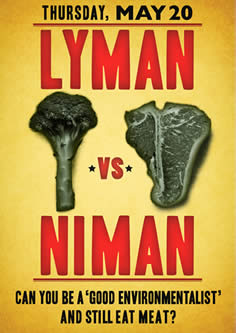
“Lyman vs. Niman: Can you be a good environmentalist and still eat meat?”
Raising livestock is resource-intensive and, we are beginning to learn, a significant contributor to greenhouse gas emissions. Nicolette Hahn Niman, a Marin rancher and author of Righteous Porkchop, will argue that there is an ecologically sustainable way to eat meat against Howard Lyman, the author of Mad Cowboy: Plain truth from a cattle rancher who won’t eat meat.
7 p.m., $10-$20
David Brower Center
Richard & Rhoda Goldman Theater
2150 Allston, Berk.
(510) 859-9100

Friday, May 21

To Teach: The Journey, In Comics
Graphic artist Ryan Alexander-Tanner brings William Ayers’ memoir To Teach: The journey of a teacher to life in this new graphic novel.
7 p.m., free
Green Arcade
1680 Market, SF
(415) 431-6800

Saturday, May 22

“Shanghai”
Attend an Asian Art Museum docent talk featuring a lecture and slideshow presentation about the museum’s exhibition “Shanghai.” The talk will be in English and Cantonese.
2:30 p.m., free
Chinatown Branch Library
Community Room
1135 Powell, SF
(415) 355-2888

Very Good-Looking Seeks Same
Author Robert Philipson will read from his new book, Very Good-Looking Seeks Same: Gay profiles in search of love, a new volume of transgressive, internet inspired poems, at this event featuring refreshments and live jazz music.
5 p.m., free
San Francisco LGBT Center
4th floor
1800 Market, SF
(415) 865-5555

Sunday, May 23

Broken Promises, Broken Dreams
Hear author Alice Rothchild explore the complexities of Jewish Israeli attitudes and the hardships of Palestinians living in the West Bank and Gaza through personal narratives based on work with medical delegations in the region.
3 p.m., free
Modern Times Bookstore
888 Valencia, SF
www.mtbs.com

Monday, May 24

Sunnyside
Bay Area author Glen David Gold discusses his new American epic, Sunnyside, starring Charlie Chaplin, about dreams, ambition, and the birth of modern America.
7:30 p.m., free
The Booksmith
1644 Haight, SF
(415) 863-8688


War: As Soldiers Really Live It

Hear Sebastian Junger discuss his new book about the reality of combat, the fear, honor and trust among men in an extreme situation whose survival depends on their absolute commitment to one another. His on-the-ground account follows a single platoon through a 15 month tour of duty in the most dangerous outpost in Afghanistan’s Korengal Valley.
7:30 p.m., $12
First Congregational Church of Berkeley
2345 Channing, Berk.
(510) 848-6767

Tuesday, May 25


A Poem for Mother Earth

Attend this poetry sharing and community healing ceremony featuring poetry, spoken word, and music from migrant Raza, indigenous youth, adults, and elders in poverty focused on the impacts of climate change  on indigenous peoples and poor people of color.
Noon, free
Galleria de la Raza
2857 24th St., SF
www.poormagazine.org

Film listings

0

Film listings are edited by Cheryl Eddy. Reviewers are Kimberly Chun, Michelle Devereaux, Max Goldberg, Dennis Harvey, Johnny Ray Huston, Erik Morse, Louis Peitzman, Lynn Rapoport, Ben Richardson, and Matt Sussman. The film intern is Peter Galvin. For rep house showtimes, see Rep Clock. For first-run showtimes, see Movie Guide.

OPENING

The City of Your Final Destination In James Ivory’s latest literary adaptation, Omar (Omar Metwally), an Iranian American graduate student of Latin American literature, precipitously descends on a rural estate in Paraguay, hoping to petition the relatives of deceased writer Jules Gund for authorization to write his biography. Numbering among the somewhat complicated ménage are Gund’s widow, Caroline (Laura Linney), his mistress, Arden (Charlotte Gainsbourg), their child, Portia (Ambar Mallman), the author’s brother, Adam (Anthony Hopkins), and Adam’s lover, Pete (Hiroyuki Sanada), a household that the film depicts as caught in a sedative isolation obstructing any progress or flourishing or change. But where Gund’s violent suicide has failed to produce a cataclysmic shift, the somewhat hapless Omar manages to interrupt their idle routines and mobilize them, stirring up sentiment and ambition. The notion of redirected fate is telegraphed by the title, but what the film does best is show the calm before the storm (really more of a heavy downpour) — and showcase the fineness of Hopkins’s and Linney’s dramatic abilities. In the final act, we see the characters being moved about rather than moved, and the sound of screeching brakes applied as the film reaches its conclusion undoes much of the subtlety invested in their performances. (1:58) Embarcadero, Shattuck. (Rapoport)

*Dirty Hands The 1990s-ish iconoclastic, workaholic breed of Asian hipster is obsessively worked by David Choe in Dirty Hands. Exhaustively documenting the Los Angeles-born artist for eight years as he matures before our eyes, director Harry Kim charts the growth spurts: from mischievous tot to shoplifter and graf artist to porn illustrator to street-art superstar to spiritual penitent after a stint in a Tokyo jail. The filmmaker doesn’t seem to know quite when to stop, but then neither does his subject: an obviously intelligent, playful talent who specializes in compulsively analyzing himself and pushing himself to the limits of the law, his work, and his own (r)evolution as a human being. So driven in his pursuit of edge-skating experiences that he comes off as less hipster than haunted, Choe and his Bukowskian tendencies, Vice aesthetics, and "deep" thoughts rivet long after the bodily fluids and sensory overload murals congeal. (1:33) Roxie. (Chun)

Kites This Bollywood action-romance is "presented by" Brett Ratner (apparently, he helped re-edit this English version). (1:30)

MacGruber Will Forte’s bemulleted, MacGyver-biting Saturday Night Live character gets his own movie. (1:39)

Paper Man Though certainly offbeat enough to fall into the quirky indie category, Paper Man reminds us that weird is not always good. There’s very little original about the main conceit: plagued by writer’s block, Richard Dunn (Jeff Daniels) rents a house in Montauk where he befriends outcast Abby (Emma Stone), a teenage girl with a tragic past. The film’s unique addition is Richard’s imaginary friend Captain Excellent, played by Ryan Reynolds in full-on superhero attire. But Captain Excellent is so absurdly campy that he’s almost too much to take — which wouldn’t be such a problem if Paper Man weren’t asking us to take it seriously. The wacky superhero scenes are mostly out-of-place, and all the heavy drama moments fall flat. But even without the muddled tone, Paper Man is riddled with clichés. We’ve seen enough of the zany manchild learning valuable life lessons, and the troubled teen forming an unlikely bond. At this point, there’s nothing super about it. (1:50) Lumiere. (Peitzman)

Shrek Forever After 3D Mike Myers has sure gotten a lot of longevity out of his Scottish accent. (1:33) Four Star, Presidio.

ONGOING

Alice in Wonderland Tim Burton’s take on the classic children’s tale met my mediocre expectations exactly, given its months of pre-release hype (in the film world, fashion magazines, and even Sephora, for the love of brightly-colored eyeshadows). Most folks over a certain age will already know the story, and much of the dialogue, before the lights go down and the 3-D glasses go on; it’s up to Burton and his all-star cast (including numerous big-name actors providing voices for animated characters) to make the tale seem newly enthralling. The visuals are nearly as striking as the CG, with Helena Bonham Carter’s big-headed Red Queen a particularly marvelous human-computer creation. But Wonderland suffers from the style-over-substance dilemma that’s plagued Burton before; all that spooky-pretty whimsy can’t disguise the film’s fairly tepid script. Teenage Alice (Mia Wasikowska) displaying girl-power tendencies is a nice, if not surprising, touch, but Johnny Depp’s grating take on the Mad Hatter will please only those who were able to stomach his interpretation of Willy Wonka. (1:48) SF Center. (Eddy)

*Babies Thomas Balmes’ camera records the first year in the lives of four infants in vastly different circumstances. They’re respectively born to hip young couple in Tokyo’s high-tech clutter; familiar moderately alterna-types (the father is director Frazer Bradshaw of last year’s excellent indie drama Everything Strange and New) in S.F.’s Mission District; a yurt-dwelling family isolated in the vast Mongolian tundra; and a Namibian village so maternally focused that adult menfolk seem to have been banished. Yes, on one level this is the cutest li’l documentary you ever saw. But if you were planning to avoid thinking that is all (or most) of what Babies would be like, you will miss out bigtime. Void of explanatory titles, voice-over narration, or subtitle translations, this is a purely observatory piece that reveals just how fascinating the business of being a baby is. There’s very little predictable pooping, wailing, or coddling. Instead, Balmes’ wonderful eye captures absorbing moments of sussing things out, decision-making, and skill learning. While the First World tykes firstborns both — are hauled off to (way) pre-school classes, the much less day planned Third Worlders have more complex, unmediated dealings with community. Those range from fending off devilish older siblings to Mongol Bayarjargal’s startlingly casual consorting with large furry livestock. (Imagine the horror of parents you know were their baby found surrounded by massive cows — a situation that here causes no concern whatsoever for adults, children, or bovines.) So accustomed to the camera that it doesn’t influence their behavior, the subjects here are viewed with an intimacy that continually surprises. Babies is getting a wider-than-usual release for a documentary, one cannily timed to coincide with Mother’s Day. But don’t be fooled: this movie is actually very cool. (1:19) Albany, Empire, 1000 Van Ness, Piedmont, Smith Rafael, Sundance Kabuki. (Harvey)

The Back-Up Plan (1:40) SF Center.

*Casino Jack and the United States of Money Casino Jack is big-budget documentary filmmaking, glossy and prone to expensive music cues, but I suppose you get a license to be flashy when you’ve proven to be as good at it as Alex Gibney. The director of Enron: The Smartest Guys in the Room (2005) and Academy Award winner Taxi to the Dark Side (2007), Gibney sets his sights on Washington lobbyist Jack Abramoff with an abundantly in-depth exploration of government greed and fraud. Investigating Abramoff’s indiscretions, from his introduction as chairman of the College Republicans, to his illegal selling of House votes for sweatshops in the Mariana Islands and over-billing of numerous Indian casinos, Gibney solidly serves Abramoff his just desserts. The director is equally interested in questioning the kind of government America has fostered that turns a blind eye to this sort of behavior. (2:02) Opera Plaza, Shattuck. (Galvin)

*City Island The Rizzo family of City Island, N.Y. — a tiny atoll associated historically with fishing and jurisdictionally with the Bronx — have reached a state where their primary interactions consist of sniping, yelling, and storming out of rooms. These storm clouds operate as cover for the secrets they’re all busy keeping from one another. Correctional officer Vince (Andy Garcia) pretends he’s got frequent poker nights so he can skulk off to his true shameful indulgence: a Manhattan acting class. Perpetually fuming spouse Joyce (Julianna Margulies) assumes he’s having an affair. Daughter Vivian (Dominik García-Lorido) has dropped out of school to work at a strip joint, while the world class-sarcasms of teenager Vinnie (Ezra Miller) deflect attention from his own hidden life as an aspiring chubby chaser. All this (plus everyone’s sneaky cigarette habit) is nothing, however, compared to Vince’s really big secret: he conceived and abandoned a "love child" before marrying, and said guilty issue has just turned up as a 24-year-old car thief on his cell block. Writer-director Raymond De Felitta made a couple other features in the last 15 years, none widely seen; if this latest is typical, we need more of him, more often. Perfectly cast, City Island is farcical without being cartoonish, howl-inducing without lowering your brain-cell count. It’s arguably a better, less self-conscious slice of dysfunctional family absurdism than Little Miss Sunshine (2006) — complete with an Alan Arkin more inspired in his one big scene here than in all of that film’s Oscar-winning performance. (1:40) Lumiere, Shattuck. (Harvey)

Clash of the Titans The minds behind Clash of the Titans decided their movie should be 3D at the last possible moment before release. Consequently, the 3D is pretty janky. I don’t know what the rest of the film’s excuse is. Clash of the Titans retreads the 1981 cult classic with reasonable faithfulness, though Ray Harryhausen’s stop-motion effects have been (of course) replaced with CG renderings of all the expected monsters, magic, gods, etc. Liam Neeson and Ralph Fiennes — as other reviews have pointed out: Schindler’s List (1993) reunion! — glow and glower as Zeus and Hades, while Sam Worthington (2009’s Avatar) once again fills the role of bland hero, this time as a snooze-worthy Perseus. You might have fun in the moment with Clash of the Titans, but it’s hardly memorable, and certainly nowhere near epic. (1:58) SF Center. (Eddy)

Date Night By today’s comedy standards, Date Night is positively old-fashioned: a case of mistaken identity causes a struggling married couple (Steve Carell and Tina Fey) to be tangled in a ransom plot for a stolen flash drive that belongs to a local mob boss. Unfussy plots are par for the course for films belonging to the all-but-lost "madcap all-nighter" genre, and in this case the simplicity of the set-up becomes Date Night‘s greatest asset, allowing Carell and Fey free reign to joke and ad lib lines. Like it or loathe it, the pair’s trademark senses of humor are the movie, and they arrange some pretty gleefully entertaining bits on the fly. Toss in a bunch of cameos from the likes of Ray Liotta and Mark Wahlberg and you’ve got yourself a bona fide movie-film, but it’s difficult not to see what Date Night might have been with just a smidge more effort. (1:27) 1000 Van Ness, SF Center. (Galvin)

*Exit Through the Gift Shop Exit Through the Gift Shop is not a film about the elusive graffiti-cum-conceptual artist and merry prankster known as Banksy, even though he takes up a good chunk of this sly and by-no-means impartial documentary and is listed as its director. Rather, as he informs us — voice electronically altered, face hidden in shadow — in the film’s opening minutes, the film’s real subject is one Thierry Guetta, a French expat living in LA whose hangdog eyes, squat stature, and propensity for mutton chops and polyester could pass him off as Ron Jeremy’s long lost twin. Unlike Jeremy, Guetta is not blessed with any prodigious natural talent to propel him to stardom, save for a compulsion to videotape every waking minute of his life (roughly 80 percent of the footage in Exit is Guetta’s) and a knack for being in the right place at the right time. When Guetta is introduced by his tagger cousin to a pre-Obamatized Shepard Fairey in 2007, he realizes his true calling: to make a documentary about the street art scene that was then only starting to get mainstream attention. Enter Banksy, who, at first, is Guetta’s ultimate quarry. Eventually, the two become chummy, with Guetta acting as lookout and documenter for the artist just as the art market starts clambering for its piece of, "the Scarlet Pimpernel of street art," as one headline dubs him. When, at about three quarters of the way in, Guetta, following Banksy’s casual suggestion, drops his camcorder and tries his hand at making street art, Exit becomes a very different beast. Guetta’s flashy debut as Mr. Brainwash is as obscenely successful as his "art" is terribly unimaginative — much to the chagrin of his former documentary subjects. But Guetta is no Eve Harrington and Banksy, who has the last laugh here, gives him plenty of rope with which to truss himself. Is Mr. Brainwash really the ridiculous and inevitable terminus of street art’s runaway mainstream success (which, it must be said, Banksy has handsomely profited from)? That question begs another: with friends like Banksy, who needs enemies? (1:27) Embarcadero, Shattuck, Smith Rafael, Sundance Kabuki. (Sussman)

Furry Vengeance (1:32) SF Center.

*The Ghost Writer Roman Polanski’s never-ending legal woes have inspired endless debates on the interwebs and elsewhere; they also can’t help but add subtext to the 76-year-old’s new film, which is chock full o’ anti-American vibes anyway. It’s also a pretty nifty political thriller about a disgraced former British Prime Minister (Pierce Brosnan) who’s hanging out in his Martha’s Vineyard mansion with his whip-smart, bitter wife (Olivia Williams) and Joan Holloway-as-ice-queen assistant (Kim Cattrall), plus an eager young biographer (Ewan McGregor) recently hired to ghost-write his memoirs. But as the writer quickly discovers, the politician’s past contains the kinds of secrets that cause strange cars with tinted windows to appear in one’s rearview mirror when driving along deserted country roads. Polanski’s long been an expert when it comes to escalating tension onscreen; he’s also so good at adding offbeat moments that only seem tossed-off (as when the PM’s groundskeeper attempts to rake leaves amid relentless sea breezes) and making the utmost of his top-notch actors (Tom Wilkinson and Eli Wallach have small, memorable roles). Though I found The Ghost Writer‘s ZOMG! third-act revelation to be a bit corny, I still didn’t think it detracted from the finely crafted film that led up to it. (1:49) Opera Plaza, Presidio. (Eddy)

*The Girl With the Dragon Tattoo By the time the first of Stieg Larsson’s so-called "Millennium" books had been published anywhere, the series already had an unhappy ending: he died (in 2004). The following year, The Girl With the Dragon Tattoo became a Swedish, then eventually international sensation, its sequels following suit. The books are addicting, to say the least; despite their essential crime-mystery-thriller nature, they don’t require putting your ear for writing of some literary value on sleep mode. Now the first of three adaptive features shot back-to-back has reached U.S. screens. (Sorry to say, yes, a Hollywood remake is already in the works — but let’s hope that’s years away.) Even at two-and-a-half hours, this Girl With the Dragon Tattoo by necessity must do some major truncating to pack in the essentials of a very long, very plotty novel. Still, all but the nitpickingest fans will be fairly satisfied, while virgins will have the benefit of not knowing what’s going to happen and getting scared accordingly. Soon facing jail after losing a libel suit brought against him by a shady corporate tycoon, leftie journalist Mikael Blomkvist (Michael Nyqvist) gets a curious private offer to probe the disappearance 40 years earlier of a teenage girl. This entangles him with an eccentric wealthy family and their many closet skeletons (including Nazi sympathies) — as well as dragon-tattooed Lisbeth Salander (Noomi Rapace), androgynous loner, 24-year-old court ward, investigative researcher, and skillful hacker. Director Niels Arden Oplev and his scenarists do a workmanlike job — one more organizational than interpretive, a faithful transcription without much style or personality all its own. Nonetheless, Larsson’s narrative engine kicks in early and hauls you right along to the depot. (2:32) Bridge, Piedmont, Shattuck. (Harvey)

The Greatest Lofty title aside, there’s nothing particularly extraordinary about The Greatest. In many ways, it’s your standard grief porn, in that it focuses on a group of characters mourning a dead teenager for an hour and a half. On the other hand, the cast is tremendous — Susan Sarandon and Pierce Brosnan are solid as the parents of the broken Brewer family, but the young actors give the most memorable performances. Fresh off her Oscar nomination for An Education (2009), Carey Mulligan continues to mingle precociousness and naiveté. The Greatest also showcases the very talented Johnny Simmons, whose past films — Hotel for Dogs (2009) and Jennifer’s Body (2009) — haven’t exactly earned him exposure. For its genre, then, The Greatest is actually quite good. It has plenty of charm mixed with moments of genuine emotion, often marked by much welcome restraint. But even with a slight twist on the convention (Mulligan’s Rose is pregnant with the dead kid’s baby), it’s still just a well-made tearjerker. (1:36) Smith Rafael. (Peitzman)

Harry Brown Shades of Dirty Harry (1971) for the tea cozy and tweed set: elegantly rendered and very nicely played, Harry Brown might be the dark, late-in-the-day elder brother to 1971’s Get Carter, in the hands of eponymous lead Michael Caine. He’s a pensioner mourning the passing of his beloved wife, his mysterious life as a Marine stationed in Northern Ireland firmly behind him. Then his chess-playing pal Leonard (David Bradley) is terrorized and killed by the unsavory gang of heroin dealing hoodlums who lurk near their projects in a tunnel walkway like gun-toting, foul-mouthed, sociopathic trolls. Harry Brown is, er, forced to forsake a vow of peace and go commando on the culprits’ asses, triggering some moments of ultraviolence that are unsettling in their whole-hearted embrace of vigilante justice. Like predecessors similarly fixated on vengeance in their respective urban hells, a la Hardcore (1979) and Taxi Driver (1976) (Harry Brown echoes key moments in the latter, in particular — see, for instance, its keenly tense, eerily humorous gun shopping scene), Harry Brown is essentially an arch-conservative film, if good looking and even likable with Caine meting out the punishment. The overall denouement just might make some seniors feel very, very good about the coiled potential for hurt embedded in their aging frames. (1:42) Embarcadero, Shattuck, Sundance Kabuki. (Chun)

How to Train Your Dragon (1:38) 1000 Van Ness.

The Human Centipede (First Sequence) Director Tom Six had a vision, a glorious dream of surgically connecting three human beings via their gastro-intestinal systems, or as Kevin Smith would say — "ass to mouth." When two girlfriends on a road trip across Europe get a flat tire, they stumble upon the home of a mad doctor (Dieter Laser) with a similar dream, who drugs them and ties them up in his basement laboratory. The Human Centipede is an entry into the torture porn arena, but it feels especially icky because you just know that the girls have zero chance of escaping the "100 percent medically accurate!" surgery. Once hooked up, there’s nowhere for the film to go and two out of three actors can’t talk because they are sewn to someone else’s anus. Still, as one-note as The Human Centipede is, I think we’d do well to encourage more films to be as batshit insane as this one. (1:30) Bridge. (Galvin)

*Iron Man 2 Tony Stark (Robert Downey Jr.) returns, just as rich and self-involved as before, though his ego his inflated to unimaginable heights due to his superheroic fame. Pretty much, he’s put the whole "with great power comes great responsibility" thing on the back burner, exasperating everyone from Girl Friday Pepper Potts (Gwyneth Paltrow); to BFF military man Rhodey (Don Cheadle, replacing the first installment’s Terrence Howard); to certain mysterious Marvels played by Samuel L. Jackson and Scarlett Johansson; to a doofus-y rival defense contractor (Sam Rockwell); to a sanctimonius Senator (Garry Shandling). Frankly, the fact that a vengeful Russian scientist (Mickey Rourke) is plotting Tony’s imminent death is a secondary threat here — for much of the film, Tony’s biggest enemy is himself. Fortunately, this is conveyed with enjoyable action (props to director Jon Favreau, who also has a small role), a witty script (actor Justin Theroux — who knew? He also co-wrote 2008’s Tropic Thunder, by the way), and gusto-going performances by everyone, from Downey on down. Stay for the whole credits or miss out on the geek-gasm. (2:05) California, Castro, Empire, Four Star, Marina, 1000 Van Ness, Presidio, Sundance Kabuki. (Eddy)

Just Wright (1:51) 1000 Van Ness.

*Kick-Ass Based on a comic book series by Mark Millar, whose work was also the model for 2008’s Wanted, Kick Ass is a similarly over-the-top action flick that plays up its absurdity to even greater comedic effect. High school nerd Dave (Aaron Johnson) decides to become the world’s first real superhero. Donning a green wetsuit he bought on the internet and mustering some unlikely courage, he takes to the streets to avenge wrongdoing. Unsurprisingly, Dave is immediately beaten almost to death because he’s just a kid who has no idea what he’s doing, but Kick-Ass‘ greatest achievement is knowing exactly how to subvert audience expectations. Scenes that marry the film’s innocent story with enormously exaggerated violence enhance the otherwise Superbad-lite high-school comedy unfolding around them, and a parallel plot-line involving Nicolas Cage instructing his 12-year-old daughter to commit grievous murders will probably end up being the most gratifying aspect of the film. Though too much set-up and spinning gears mars the middle act, it’s hard to fault the film for competently setting up one of the most crowd-pleasing endings in recent memory. (1:58) 1000 Van Ness, SF Center. (Galvin)

Letters to Juliet If you can stomach the inevitable Barbara Cartland/Harlequin-romance-style clichés — and believe that Amanda Seyfried as a New Yorker fact-checker — then Letters to Juliet might be the ideal Tuscan-sunlit valentine for you. Seyfried’s Sophie is on a pre-honeymoon trip to Verona with her preoccupied chef-restaurateur intended, Victor (Gael Garcia Bernal), who’s more interested in sampling cheese and purchasing vino than taking in the romantic attractions of Verona with his fiancée. Luckily she finds the perfect diversion for a wannabe scribe: a small clutch of diehard romantics enlisted by the city of Verona to answer the letters to Juliet posted by lovelorn ladies. They’re Juliet’s secretaries — never mind that Juliet never managed to maintain a successful or long-term relationship herself. When Sophie finds a lost, unanswered letter from the ’50s, she sets off sequence of unlikely events, as the letter’s English writer, Claire (Vanessa Redgrave), returns to Verona with her grandson Charlie (Christopher Egan), in search of her missed-connection, Lorenzo. Alas, Lorenzo’s long gone, and the fact-checker decides to help the warm-hearted, hopeful Claire find her lost lover. Unfortunately Sophie’s chemistry with both her matches isn’t as powerful as Redgrave’s with real-life husband Franco Nero — after all he was Lancelot to her Guenevere in 1967’s Camelot and the father of her son. Still, Redgrave’s power as an actress — and her relationship with Nero — adds a resonance that takes this otherwise by-the-numbers romance to another level. (1:46) Marina, 1000 Van Ness, Piedmont, SF Center, Sundance Kabuki. (Chun)

The Little Traitor Lynn Roth’s film is set in 1947 Palestine, shortly before Israel became a state. Young Proffi Liebowitz (Ido Port) wasn’t yet born when his parents fled the Holocaust in Poland, but he’s politically tuned-in enough to form a mini-resistance group with his neighborhood pals, who plot against the occupying British forces (sample act of rebellion: "British Go Home" graffiti). Caught one night scampering home after the citywide curfew, Proffi meets Sergeant Dunlop (Alfred Molina), whose kindness makes the boy realize his black-and-white view of the enemy might have some room for color after all. Of course, Proffi’s friendship with the Brit, who teaches him to play snooker and pronounce complicated English words like "flatulence," is not received well by his community (see: film’s title). Despite its political undertones, this is a pretty standard coming-of-age tale (including the de rigueur "peeping on the sexy neighbor" subplot). Too bad the director decided to film so much of it in English — kid actor Port is far less cloying when he’s speaking his native Hebrew. (1:29) Opera Plaza. (Eddy)

*Mid-August Lunch Gianni Di Gregorio’s loose, engaging comedy is about an aging bachelor still living with his ancient mum in their Rome flat. When his landlord offers to forgive some debts in return for briefly taking in his own elderly ma, Gianni (played by the director himself) soon finds himself in cat-herding charge of no less than five old ladies who delight in one another’s company while running him ragged. Gomorrah (2008) screenwriter Di Gregorio used nonprofessionals to play those parts in this semi improvised miniature, which is as light and flavorful as a first course of prosciutto and mozzarella. It’s a solid addition to the canon of palate-pleasing culinary flicks such as Big Night (1996) and Babette’s Feast (1987), as opposed to the repulsive ones like Super Size Me (2004) or Monty Python’s The Meaning of Life (1983). (1:15) Opera Plaza, Shattuck. (Harvey)

La Mission A veteran S.F. vato turned responsible — if still muy macho — widower, father, and Muni driver, fortysomething Che (Benjamin Bratt) isn’t the type for mushy displays of sentiment. But it’s clear his pride and joy is son Jess (Jeremy Ray Valdez), a straight-A high school grad bound for UCLA. That filial bond, however, sustains some serious damage when Che discovers Jes has a secret life — with a boyfriend, in the Castro, just a few blocks away from their Mission walkup but might as well be light-years away as far as old-school dad is concerned. This Bratt family project (Benjamin’s brother Peter writes-directs, his wife Talisa Soto Bratt has a supporting role) has a bit of a predictable TV-movie feel, but its warm heart is very much in the right place. (1:57) Opera Plaza, Shattuck, SF Center. (Harvey)

Mother and Child Adoption advocates who railed against Orphan (2009) should turn their sights on Mother and Child, a ridiculous melodrama with a thoroughly vile message. I’d wager writer-director Rodrigo García didn’t set out to make an anti-adoption film: this is a movie about the relationship between mothers and daughters. But the undertones are impossible to miss. Annette Bening plays Karen, a miserable woman consumed by regret for putting her daughter up for adoption 37 years ago. That biological daughter is Elizabeth (Naomi Watts), who — despite having been adopted at birth — speaks dismissively of her "adoptive" parents as though they were never really hers. She’s cold and manipulative, sleeping with her boss and married neighbor because she can. Mother and Child offers no real explanation for why these women are so unpleasant, so we’re forced to conclude it’s the four decades-old adoption. Despite a stellar cast, which also includes Kerry Washington, Samuel L. Jackson, and S. Epatha Merkerson, the film’s misguided politics are too distracting to ignore. (2:06) Shattuck, Sundance Kabuki. (Peitzman)

A Nightmare on Elm Street I’ll say this about the remake of A Nightmare on Elm Street: it could have been worse. Yes, it’s pointless and unimaginative and producer Michael Bay should still be ashamed, but I didn’t hate every minute of it. Don’t get me wrong, the movie is not good. It’s not terrible, if only because it has a few decent scares — all of which are, of course, shamelessly lifted from the original. Mostly, however, A Nightmare on Elm Street is a waste of time, updating Freddy Krueger with an icky twist (which I won’t spoil here) and culling together more jump scares than should ever be shoved into one film. The cast is passable, with relative newbie Rooney Mara taking on Nancy — she’s fine but forgettable. Jackie Earle Haley does a solid job with Freddy, but he was doomed from the start, just by virtue of not being Robert Englund. This Freddy is more brutal, to be sure, but he’s also far less fun. One pun in the entire movie? He might as well be Jason Voorhees. (1:42) 1000 Van Ness. (Peitzman)

*October Country In taking on the subject of family in the documentary October Country, co-directors Michael Palmieri and Donal Mosher face some imposing specters, and I’m not just talking about the varied stories of the Mosher family. If there’s any micro-genre within documentary that has become embattled over the past decade, it’s the family portrait, thanks to controversial or contentious works such as Andrew Jarecki’s Capturing the Friedmans and Jonathan Caouette’s Tarnation (both from 2003), son-of-Grey Gardens freakouts which incited claims of exploitation and sensationalism on their paths to a larger public profile. Palmieri’s and Mosher’s movie is a quieter work, yet it isn’t folksy in a complacent Sundance manner, either. The list of the maladies plaguing the Mosher clan — physical abuse, drug abuse, war trauma, custody battles, and abortion, to name a handful — would provoke an ambulance-chasing impulse in some filmmakers, blood ties be damned. But Palmieri (who edited and did cinematography) and Mosher (a former San Francisco resident whose photo essays on his family were shown at Artists’ Television Access) realize these are common American problems, and their treatment of them is at once deeper and more ephemeral. They use the passage of a year from one Halloween to the next to reveal the changes wrought — or evident — on a person’s face, and when they can, a person’s life. (1:20) Roxie. (Huston)

*OSS 117: Lost in Rio The Cold War heated up a public appetite for spy adventures well before James Bond became a pop phenomenon. In fact, Ian Fleming hadn’t yet created 007 in 1949, when Jean Bruce commenced writing novels about Hubert Bonisseur de La Bath, a.k.a. Agent OSS 117. This French superspy was ready-made to join the ranks of umpteen 007 wannabes, appearing in somewhere between six and 11 films (it’s unclear whether all involved de La Bath, or were just Bruce-based) through 1970, played by at least four actors. The series remained well-known enough to get a new life in 2006 when director Michel Hazanavicius and top French comedy star Jean Dujardin sought to spoof 1960s espionage flicks a la Austin Powers: International Man of Mystery (1997). That was a big hit, so now we’ve got a sequel. OSS 117: Lost in Rio isn’t as fresh or funny as the preceding Cairo, Nest of Spies. But it’s still a whole lot fresher and funnier than Austin Powers Nos. two (1999) and three (2002). Dujardin’s de La Bath is the very model of jet-set masculinity, twisting the night away at a ski chalet with umpteen soon-to-be-machine gunned "Oriental" lovelies in the opening sequence. Of course such pleasure pursuits take place strictly between car chases, shootouts, and karate fights. Agreeably silly, Lost in Rio doesn’t go for Hollywood-style slapstick and grossout yuks. Instead, its biggest laughs are usually droll throwaways, as when 117 explains a shocking sudden costume change with the unlikely declaration "I sew," or during an LSD-dosed hippie orgy proves quite willing to go with the flow — even when that involves another guy’s groovy finger breaching security up the pride of French intelligence’s derriere. (1:37) Lumiere, Shattuck, Smith Rafael. (Harvey)

*Please Give Manhattan couple Kate (Catherine Keener) and Alex (Oliver Platt) are the proprietors of an up-market vintage furniture store — they troll the apartments of the recently deceased, redistributing the contents at an astonishing markup — and they’ve purchased the entire apartment of their elderly next-door neighbor (Ann Guilbert). As they wait for her to expire so they can knock down a wall, they try not to loom in anticipation in front of her granddaughters, the softly melancholic Rebecca (Rebecca Hall) and the brittle pragmatist Mary (Amanda Peet). Filmmaker Nicole Holofcener has entered this territory before, examining the interpersonal pressures that a sizable income gap can exert in 2006’s Friends with Money. Here she turns to the pangs and blunderings of the liberal existence burdened with the discomforts of being comfortable and the desire to do some good in the world. The film capably explores the unexamined impulses of liberal guilt, though the conclusion it reaches is unsatisfying. Like Holofcener’s other work, Please Give is constructed from the episodic material of mundane, intimate encounters between characters whose complexity forces us to take them seriously, whether or not we like them. Here, though, it offers these private connections as the best one can hope for, a sort of domestic grace accrued by doing right, authentically, instinctively, by the people in your immediate orbit, leaving the larger world to muddle along on its axis as best it can. (1:30) Clay, SF Center, Shattuck. (Rapoport)

Princess Kaiulani Well-meaning and controversial (the independent’s first title, Barbarian Princess, and the tragic events it depicts has distressed some native Hawaiians) in its own inoffensive way, Princess Kaiulani is unfortunately overshadowed by star Q’orianka Kilcher’s first film, 2005’s The New World, in which she portrayed Pocahontas. The Hawaii-raised Kilcher appears to be getting typecast as a tragic, romanticized native royal. Still, if you can get past director Marc Forby’s weak attempts to match New World director Terrence Malick’s searingly poetic montages and the clunky History Channel-by-the-numbers screenplay, you might give a little credit to the makers for bringing to the screen the tale of Hawaii’s last intelligent, beautiful, and accomplished princess — a young woman determined to fight an overthrow of the Hawaiian monarchy and battle its annexation against the white land owners and descendents of missionaries who tried to block the voting rights of native Hawaiians. Kilcher possesses some of the noble charisma claimed by the real Kaiulani, but the obligatory romance superimposed on the narrative and the neglect of some of genuinely promising threads, such as Kaiulani’s friendship with Robert Louis Stevenson, make Princess Kaiulani feel as faux as those who pretended to Hawaii’s rule. (2:10) Embarcadero. (Chun)

Robin Hood Like it or not, we live in the age of the origin story. Ridley Scott’s Robin Hood introduces us to the outlaw while he’s still in France, wending his way back to Albion in the service of King Richard III. The Lionheart soon takes an arrow in the neck in order to demonstrate the film’s historical bona fides, and yeoman archer Robin Longstride (Russell Crowe) — surrounded by a nascent band of merry men — accidentally embroils himself in a conspiracy to wrest control of England. The complications of this intrigue hie Robin to Nottingham, where he is thrown together with Maid Marion (Cate Blanchett), a plucky rural aristocrat who likes getting her hands dirty almost as much as she likes a bit of smoldering Crowe seduction. A lot of hollow medieval verisimilitude ensues, along with a good bit of slow-mo swordplay, but the cumulative effect is tepid and rote. (2:20) Empire, 1000 Van Ness, Presidio, Sundance Kabuki. (Richardson)

The Secret in Their Eyes (2:07) Albany, Embarcadero.

Touching Home Hometown boys (Logan and Noah Miller) make good in this based-on-a-true-story tale of identical twins who must divide their time at home between training for major league baseball and looking after their alcoholic father. The brothers, who also wrote and directed the film, aim for David Gordon Green by way of Marin, but fall short of mastering that director’s knack for natural dialogue. Ed Harris is, unsurprisingly, compelling as the alcoholic father, but the actors in the film who are not named Ed Harris tend to contribute to the script’s distracting histrionics. Touching Home has some amazing NorCal cinematography, and I could see how family audiences might enjoy its "feel bad, then feel good" style of melodrama. But while it’s awkward to say that someone’s real-life experiences come off as trite, there are moments here that feel as clichéd as a Lifetime movie. (1:48) Smith Rafael. (Galvin)

Vincere Given the talent involved, Vincere should be a better film that it is. Director Marco Bellocchio has a lengthy track record of successes, and star Giovanna Mezzogiorno is one of the biggest names in contemporary Italian cinema. The based-on-a-true-story plot is certainly worthy of being filmed: Mezzogiorno plays Ida Dalser, secret wife of Mussolini and mother of the dictator’s first-born son. When Ida begins to make trouble for Il Duce by publicly proclaiming their marriage, she is locked away in a mental hospital. But while Vincere‘s subject is compelling, the film as a whole falls flat. Moments of greatness are few and far between, and the rest of the movie gets by on mediocrity. It’s likely the fault lies with the script, which is too scattered and unfocused to maintain an audience’s focus. Why after almost two hours of watching Ida’s struggle are we suddenly left with her son’s descent into madness? How depressing that a film about a woman forgotten by history is, itself, mostly forgettable. (2:02) Smith Rafael. (Peitzman)

Make hotels pay their share

2

By Martha Hawthorne


OPINION If you ride Muni, educate your children in public schools, or rely on city services, you’ve already felt the impact of cuts to the city budget over the past few years, and it could get worse. San Francisco is facing a $522 million deficit this year. It’s expected to swell above $700 million in the next two years. Current budget balancing proposals include laying off teachers and nurses and cutting after-school programs, youth job training, street cleaning, public safety, recreation, and health services for San Franciscans and visitors alike.

While city residents and employees have sacrificed, certain Internet hotel booking sites are trying to evade more than $70 million in legally required hotel taxes. Additionally, airline companies that use San Francisco hotels to house their flight crews overnight are attempting to escape paying the hotel tax, depriving the city of millions of dollars in revenue annually.

At the same time, 5 million visitors to the city each year are not being asked to shoulder their share of the rising costs for services including public transit, public safety, and infrastructure. In fact, the hotel room surcharge in San Francisco hasn’t increased in 14 years, while costs have skyrocketed. Currently visitors to San Francisco pay the same or lower surcharge than they do in many other large cities, including New York, Los Angeles, Boston, and Houston.

That’s why we have come together to create the Stand up for San Francisco Coalition, a group of teachers, nurses, parents, public employees, and concerned citizens who believe the city needs to find new ways to fund our highest priorities. Together, we are headed to the street to collect signatures to place on the ballot an initiative that would close loopholes and make hotels pay their fair share.

This proposed measure would do three things. It would ensure that Internet hotel booking sites pay the full amount of hotel surcharge they owe — bringing millions of dollars each year into the city. It would end a practice by which airlines are attempting to not pay hotel room taxes they legally owe. And finally, it would impose a temporary visitor surcharge of 2 percent, costing the average visitor $3 per night, to support the infrastructure and services that help draw visitors and serve them during their stay, which would sunset in four years.

We are committed to thinking creatively about ways to fix our city’s budget problems, beginning with ensuring the city collects what it is owed from big hotels. Our initiative asks visitors contribute a few dollars more per night to help guarantee San Francisco is a city that lives up to its progressive values. In order to save the jobs of teachers, protect HealthySF, care for our seniors, stop service cuts to Muni, and hold the line for public safety, hotels and visitors need to pay their fair share.

Martha Hawthorne, a public health nurse, is a founder of Stand up for San Francisco and one of the official proponents of the Hotel Fairness Initiative.

Watch out sexy Oysters! The Raveonettes are gonna eat you…

0

When I saw that the Danish rock-duo, The Raveonettes, are playing this weekend’s SF Oyster Fest— Sat/15 at Fort Mason– I was quite curious how the two band members felt about the animal/food at the heart of the party. Strangely enough, I found a blog post that lifted the mystery and erected another.

Sune Rose Wagner and Sharin Foo are an interesting pair of slightly awkward and wonderful creatures who pluck out stellar ’50s summer-style pop hooks, add in tainted surf guitar and sweetly sing lyrics that aren’t afraid to address the shitty things in life: rape, drugs addiction, betrayal and other Debbie Downers. I can imagine their sound blasting under the San Francisco sun to an outdoor crowd, but thought it was funny to imagine them strumming at an event created for the consumption of bivalve molluscs, or easier known as oysters or shelled ocean friends. I wondered if their publicist/tour manager had to ask them if they liked eating these slimy things before agreeing to take the stage?

raveonettes dining

Due to the fact that a quick internet browse came up with a blog post from Wagner and Foo themselves, I’m guessing there were no hesitations. The post explains an evening dining experience in New York, chomping on none other than oysters. The photos were obviously taken via camera phone and apparently their waitress “was the best part about the meal.” But here’s what the post had to say about shells:

Foo: “We love oysters. It’s always so interesting to try different oysters at different restaurants.”

Wagner: “They were really great! Well served, fresh, with a nice little sauce that went with them.” 

Foo: “Well also, the fact they’re an aphrodisiac, we’ll have to deal with that later on too…”

raveonettes oysters

Have to “deal with that later?” Aphrodisiacs? What??? Foo didn’t believe him either and writes something about not “feeling anything yet” while chugging her glass of wine. But with another quick interweb click, I discover that oysters are in fact a sexy food. Here’s how LiveScience.com described this weird fact:

“Many foods (bananas, asparagus, carrots, avocados) are considered aphrodisiacs because they resemble the penis or testicles. Oysters resemble a vagina. The Romans placed the oyster high on their list of prized aphrodisiacs. Casanova, the legend goes, would eat 50 raw oysters for breakfast. Yet interestingly, oysters (and pine nuts, another ancient aphrodisiac) are high in zinc, which is necessary for sperm production. Raw oysters are also high in D-aspartic acid and N-methyl-D-aspartate, which increased testosterone levels in one study on male rats, which could in theory increase libido, according to Karen Boyle of Johns Hopkins Hospital. “The data is questionable and mixed, but oysters do make a nice appetizer,” she said.”

Oysters resemble the female genitalia? Well, ok yes. Eat up San Francisco…

oyster vag


The Raveonettes w/Cake, Jackie Greene, Thao & The Get Down Stay Down

Sat/15, 11am, $30

The Great Meadow at Fort Mason

(Intersection of Bay and Laguna Streets)

www.oreillysoysterfestival.com/


The Daily Blurgh: Globish With Attitude

0

Curiosities, quirks, oddites, and items from around the Bay and beyond

Don’t worry, San Franciscans: Your Internet friends don’t hate you and you will be followed once again

******

Speaking of friends, whatever happened to N.W.A..’s posse?

******

Me talk pretty one day, indeed. Do you speak Globish? You probably have. And so does the rest of the world.

******

RIP Ms. Horne

*****

Newsflash! Oversharing online can come back to bite you in the ass: “While participation in social networks is still strong, a survey released last month by the University of California, Berkeley, found that more than half the young adults questioned had become more concerned about privacy than they were five years ago — mirroring the number of people their parent’s age or older with that worry.”

*******

This brave, local blogger waited four and a half hours for a bowl of fancy “test ramen” so you wouldn’t have to.

******

Today in corporate sponsorships: Wynnona Judd to shill for Cracker Barrel. I want a pair of the sunglasses. “I love the rocking chairs and I feel really good when I go to Cracker Barrel,” she says. Sparkle Winnie! Sparkle!

Our 2010 Small Business Awards

culture@sfbg.com

The mallification of America continues apace, with faceless conglomerates training new generations of shoppers to look for the cheapest deals at bland big box outlets, regardless of what “cheap” might actually mean in terms of pollution, transportation, labor, and the local economy. (For starters, out of every $100 dollars spent at a big box, only $43 remains in the local economy, compared to $68 if you buy local.) But in San Francisco at least, the little guys keep on swinging, maintaining unique shops and service companies with a vibrant local feel and contributing to the patchwork of optimism, individuality, and community effort that make the city great. Each year, we honor several of them for sticking to their guns and pursuing their visions.


WOMEN IN BUSINESS AWARD

DEENA DAVENPORT, GLAMA-RAMA SALON

“The higher the hair, the closer to God,” a wise Southern drag queen once said. Here in San Francisco, one of our own heavenly salons, Glama-Rama, is about to get a whole lot more divine, expanding from its homey kitsch digs in SoMa to a new 2500 square foot space on Valencia Corridor, creating 16 new jobs. The driving force behind that expansion is owner Deena Davenport, who combined her hairdressing talent, natural business acumen, and deep connection to the local arts scene into a formula for sheer success when she opened Glama-Rama 11 years ago.

“My dream was not to have a business, but a community space,” Davenport told me. “I wanted a place for all my gifted friends to express themselves. Not just our excellent stylists, but artists, designers, musicians, event producers — we all came together to make this happen. I think that’s the key to our success. We work with all kinds of styles and we don’t price ourselves out of the nonprofit sector. That allows a great mix of clientele, and an element of comfort for everyone.”

Davenport, a creative blur, plans to kickstart a Valencia Corridor merchants association once she gets settled in, and dreams of a future in politics. (She currently hosts a show on Pirate Cat Radio and appears onstage in local productions.) “I’m fortunate to have always had great friends and great landlords — and to be in a business the Internet can’t compete with,” she says.

“By the way, the new space will be two shades of cream with gold accents,” Davenport adds, ever the stylish professional. “We’re taking off our Doc Martens and putting on some heels.” (Marke B.)

GLAMA-RAMA

304 Valencia, SF

415-861-4526

www.glamarama.com


GOLDEN SURVIVOR AWARD

CAFÉ DU NORD

It’s no secret that nightlife in San Francisco has taken a big hit lately. A combination of economic woes and persistent crackdowns by the Department of Alcoholic Beverage Control and local police, a.k.a. the War on Fun, has taken its toll — even on 100-year-old live-venue mainstays like Café Du Nord.

“It’s been tough for us and for everyone out there,” says Guy Carson, who took over the space with Kerry LaBelle in 2003. “They don’t call it ‘hard times’ for nothing. But we love what we do, and we know how to run a quality business. I’ve been promoting live shows since I was nine years old, so you know it’s what I love. You have to be willing to weather the storms.”

The intimate basement space retains its speakeasy vibe and velvet-curtained, cabaret-like setting, while playing host to mighty big names and burgeoning local upstarts. As a “venue with a menu” that serves food and puts on all ages and 18+ shows, Café Du Nord has been specifically targeted by the city and ABC for what Carson calls “differing interpretations of the law.” He looks forward to the upcoming launch of the new California Music and Culture Association, which will bring together several local venues and nightlife activists to fight the tide of local nightlife repression. “When we all work together, we can return the city’s nightlife to its former glory,” Carson says. (Marke B.)

CAFÉ DU NORD

3174 Market, SF

(415) 861-5016

www.cafedunord.com


GOOD NEIGHBOR AWARD

OPPORTUNITY FUND

Eric Weaver put his first nonprofit loan package together in 1995. His small startup, called Opportunity Fund, helped brothers who wanted to expand their pet shop borrow $17,000 for aquariums and fish. The deal worked out well; the pet store prospered, the money got repaid, and Opportunity Fund was on its way to becoming one of the most successful microlending outfits in California.

Weaver, a Stanford MBA and the fund’s CEO, now oversees a staff of 35 that makes loans to small businesses, most of them minority owned, that might have trouble getting financing from a traditional bank. And the nonprofit continues to grow by helping entrepreneurs in the Bay Area get the financing they need to create jobs and build community businesses. “We just made our 1,000th loan,” he told me. “We’re on target to make 200 loans this year, more than ever.”

Unlike most banks, Opportunity Fund sees its clients almost as partners. The staff takes time to help borrowers work up a successful business plan and learn how to manage their finances. “We do one-on-one business counseling with almost all of our clients,” Weaver said.

The group also helps finance affordable housing developments and offers individual development accounts (IDAs)— special savings accounts that come with financial training and grants — for everything from education to home purchases to putting aside the cash it now takes to become a U.S. citizen.

A recent study showed that Opportunity Fund has created or retained 1,200 in the Bay Area. “With a median loan size of $7,000, and a focus on making loans to people who have historically been underserved by banks, Opportunity Fund has been a particularly valuable resource for women, minority, and low-income entrepreneurs,” Weaver noted. He added that 73 percent of Opportunity Fund borrowers are members of an ethnic minority, and 90 percent of borrowers have incomes at or below 80 percent of area median income.

Imagine a traditional bank making a statement like that. (Tim Redmond)

OPPORTUNITY FUND

785 Market Street, Suite 1700, SF

408-297-0204

opportuityfund.org


CHAIN ALTERNATIVE AWARD

NORTHERN CALIFORNIA INDEPENDENT BOOKSELLERS ASSOCIATION

Independent booksellers are a wonder. Up against giant chains like Wal-Mart, facing technological changes like Kindle and online behemoths like Amazon.com (which doesn’t even have to pay state sales taxes), it’s hard to believe they can even survive. Yet they do — in fact, the Northern California Independent Booksellers Association keeps growing.

“The mainstream press wants to write about bookstores closing,” Calvin Crosby, NCIBA’s vice president, told me. “But actually, stores are opening. We have two new members this year.”

The booksellers group keeps the small, community-based stores in the public eye, with promotions, events like the annual NCIBA awards (see page 28) and political lobbying (NCIBA is a big supporter of a bill by Assembly Member Nancy Skinner, D-Berkeley, that would force Amazon to pay sales tax).

One of the group’s biggest tasks is education — reminding the public that local bookstores serve a critical function. “I was at a book-signing recently with a major author, and a bunch of people showed up with books they bought on Amazon and they wanted to trade them for signed copies,” Crosby, who is community relations director at Books Inc., recalled. “I had to explain to all of them that Amazon doesn’t pay taxes and hurts the locals.”

And with 300 bookseller members, NCIBA is helping preserve the notion that buying a book from someone who actually cares about books is an idea whose time will never pass. (Redmond)

NCIBA

1007 General Kennedy, SF.

415-561-7686

www.nciba.com


SMALL BUSINESS ADVOCATE AWARD

KEITH GOLDSTEIN

“Money spent in a small business — far, far more of it stays here in the neighborhood than with a chain store,” says Keith Goldstein, president of the Potrero Hill Association of Merchants and Businesses. A Potrero Hill resident since 1974, and owner of Everest Waterproofing and Restoration, Inc., Goldstein has spent the last six years with the merchant’s association promoting a sense of community in the inclined blocks of Potrero.

He’s overseen the growth of the Potrero Hill Festival from what he calls “a small affair” to a yearly event that’s “great for residents and businesses,” and also serves on the Eastern Neighborhood Advisory Committee, where he works on issues, like new transit plans, that affect local businesses.

Somehow he has found the time to start SEEDS (www.nepalseeds.org), a group that provides infrastructure and health support to underserved Tibetan villages, and is involved in Food Runners (www.foodrunners.org), an organization that links homeless shelters to food sources.

The superlative community member incorporates the ‘buy local’ mentality into every aspect of his life, even placing the administration of the health care plan for his 50 employees into the hands of a fellow Potrero Hill Merchant’s Association member. “It’s all richly rewarding,” Goldstein says of his hands-on role in his neighborhood’s economic viability. “I like to walk around the hill and be able to chat with my neighbors about quality of life issues.” (Caitlin Donohue)

KEITH GOLDSTEIN

Potrero Hill Association of Merchants and Businesses

1459 18th St., SF.

(415) 341-8949

www.potrerohill.biz


EMPLOYEE-OWNED BUSINESS AWARD

RED VIC MOVIE HOUSE

“Once it got going, it was like a perpetual-motion machine. And I have to say, I think it was the collective nature of the thing that’s kept the Red Vic going this long,” says Jack Rix, long time worker and cofounder of the Red Vic Movie House, which celebrates its 30th anniversary this year.

The Red Vic’s employees put a lot into the neighborhood theater’s showings of unique and classic flicks. Each worker-owner does a little of everything, from sweeping the lobby floor to washing dishes. “We’re all utility players here, this is very much a labor of love,” Rix says. Launched in 1980 by community organizers, the theater’s focus has not only been on providing great movies but doing it sustainably, installing solar paneling on the roof and eschewing paper products. “Back then I don’t think the phrase ‘green’ existed,” Rix recalls. “We were trying to be ‘green’ and we didn’t even know it!”

The Red Vic’s workers aren’t the only ones with a certain affection for the theater’s bench seating, environmentally friendly ceramic coffee mugs, and wooden popcorn bowls. Rix says some Upper Haight residents will wait for blockbusters to make their way out of “corporate” movie cinemas to the Red Vic’s second-run screen. “We’re very much a community theater,” he says proudly. (Donohue)

RED VIC MOVIE HOUSE

1727 Haight, SF

(415) 668-3994

www.redvicmoviehouse.com


CHAIN ALTERNATIVE AWARD

OTHER AVENUES

Nestled in a part of the city best known for its tiny pastel homes and bracing sea breezes, Ocean Beach’s Other Avenues is everything you could desire in a neighborhood grocery store: Warm atmosphere, vast swaths of bulk food bins, and a well-edited health food selection, including vitamins, medicines, and cheery shelves of produce. Plus health insurance for all its knowledgeable employees.

Trader who? No need for big box stores near Other Avenues, which has earned a loyal clientele in the 36 years since it first opened its doors. “Since we’re a co-op, I like to think of us as a giant organism,” says Other Avenues worker Ryan Bieber. “Occasionally we lose parts and regrow them. A lot of customers have been coming here for 10, 20 years.” Their loyalty might be in response to Other Avenues’ commitment to keeping its beachside clientele healthy and well. “The aim is to make sure that people have access to things like this,” says Bieber.

Asked what he thinks would happen if one of the chain grocery behemoths encroaches on the shop’s territory, Bieber is unconcerned. “I think people will come here regardless. [We] have been doing this forever and we take pretty good care of ourselves. I think our customers really respond to that. We wouldn’t want a world where there was only Whole Foods — that’d be too boring!” (Donohue)

OTHER AVENUES

3930 Judah, SF

(415) 661-7475

www.otheravenues.coop


ARTHUR JACKSON DIVERSITY IN SMALL BUSINESS AWARD

RAYMOND OW-YANG

Raymond Ow-Yang tends to downplay the impact he’s had on the North Beach-Chinatown artistic landscape. The owner of New Sun Hong Kong restaurant, Ow-Yang put up the funds to have the iconic Jazz Mural painted on the Columbus and Broadway walls of his Chinese restaurant. The artist Bill Weber approached him in 1988 — securing an approximately $70,000 aesthetic gift to the community that Ow-Yang has never sought public recognition for.

“Back then you’re young, you have no brain. I thought, this is nice — it’s something you do because you feel like it,” Ow-Yang recalls dismissively.

“Nice”is an understatement. The mural, which depicts famous San Francisco figures and scenes, has become one of the neighborhood’s visual joys, stopping tourists in their photo-snapping tracks. The gift reflects Ow-Yang’s commitment to the streets he grew up on

He immigrated to Chinatown from Canton in 1962, at age 13. A lifelong entrepreneur, Ow-Yang owned a photo studio, a floral shop, and a restaurant in Oakland’s Chinatown (the original Sun Hong Kong) before opening at 606 Broadway in 1989. The restaurant is open until 3 a.m. every day — a timetable residents can appreciate for more reasons than just Ow-Yang’s post-bar won ton soup. “Before, people were afraid to walk through this area,” says the businessman. “Now there’s a lot more foot traffic — the city even put up traffic lights. With the bright lights [from New Sun Hong Kong], it’s a lot safer in this area.” (Donohue)

RAYMOND OW-YANG

New Sun Hong Kong

606 Broadway, SF

(415) 956-3338


A roar from underground

0

arts@sfbg.com

MUSIC When asked if it’s a good time in history to be in a sludgy, uncompromising heavy metal band, High on Fire’s Matt Pike stifles a chuckle: “It is for me, man!” Reached by phone in Los Angeles as he prepares for a show at the El Rey Theatre, Pike is far from loquacious, but clearly enjoying the arrival of hard-earned, well-deserved success. His band, a thunderous, heavily-distorted power trio, bastard son of St. Vitus and Slayer, just signed on for a string of European dates opening for Metallica.

Before they set off across the Atlantic, High on Fire will appear at Oakland’s Fox Theater to play a concert called the Missing Link, a weighty omnibus of a heavy metal bill that brings together two potent touring packages, their itineraries cleverly fused into one mammoth night of music. Pike’s band is joined by tour-mates Priestess, Bison B.C., and Black Cobra. Headliners Mastodon deploys its own retinue of support: Between the Buried and Me, Baroness, and Valient Thorr.

The bands at the top of the bill are living proof of this epoch’s friendly attitude toward challenging, underground heavy metal. Mastodon charted at No. 11 with 2009’s Crack the Skye (Warner Bros.) and Between the Buried and Me hit No. 36 with The Great Misdirect (Victory). Oakland native sons High on Fire stormed into the limelight in February 2010; Snakes for the Divine (E1 Music) debuted at No. 62. Baroness’ Blue Record (Relapse) was the critical darling of 2009 — Decibel magazine named it album of the year — and it peaked at No. 117.

Those still working their way up from the bottom are no less optimistic. Speaking on the phone while peregrinating around L.A., Jason Landrian, singer/guitarist for crushing S.F. duo Black Cobra, is loving life. “I think it’s a great time to be in a heavy band. There are a lot more people paying attention and taking the music a lot more seriously.” Black Cobra, which was recently signed by legendary label Southern Lord Records, has ample experience with and appreciation for the bands it will share the stage with at the Fox. “For us,” Landrian says, “it’s a thrill to be involved with what seems like a cross-section of what’s going on right now in the underground scene.”

Superficially, the bands on the bill are easy to circumscribe within geographical boxes. Mastodon and Baroness both hail from Georgia, a state that is quickly becoming one of the nation’s most fertile breeding grounds for independent metal. Between the Buried and Me and Valient Thorr are also from Dixie, storming out of North Carolina university towns Greensboro and Chapel Hill, respectively. Priestess was founded in Montreal, and Bison B.C. in Vancouver (in the eyes of American rock critics, everything Canadian seems related). Black Cobra and High on Fire represent the Bay Area.

Yet this sort of convenient compartmentalization is redolent of a scene-based musical analysis that is rapidly becoming obsolete. A generation that came of age during the sodden triumph of the “Seattle sound” has matured into an army of bands that defy physical space. The insidious tentacles of social networking and the exponentially expanding capacity of cheap bandwidth have enabled independent musicians to bridge vast distances, to identify kindred spirits and isolated fans. Early Black Cobra material was written while the band’s two members resided on different coasts, swapped back and forth methodically with the click of a mouse. The Internet has been a boon to concert bookers and promoters as well, allowing them to ferret out undeserved markets and spread the digitized word.

Looking back through lists of past tour dates, the connections and inter-pollinations among this underground army of heavily distorted road warriors are practically infinite. It seems as if every band has toured with every other band on the Missing Link roster at least once. “We’ve known those guys forever,” Pike says when asked about Mastodon, and it’s only partly hyperbole — the members of Mastodon met at an Atlanta High on Fire show in 1999.

Though today’s metal vanguard takes advantage of technological innovations, it’s the relentless touring that reaps rewards. And while life on the road has its costs, the new century’s burgeoning crop of itinerant headbangers can depend on a tight-knit nomadic community — bearded and unwashed — that grows stronger by the day. “It’ll be a reunion with friends, which is a cool thing,” says Landrian. “You end up meeting all these people, touring around, and when you get a show like Missing Link happening, everybody knows each other.”

Armed with vans, smart phones, and arsenals of crushing riffs, the bands of Missing Link have the entire continent at their disposal. It’s a far cry from the specter of the 1980s, poisoned by feuding thrash titans and the internecine, hair-sprayed fist-fight for scraps from the Sunset Strip table. “That’s the thing about this underground metal scene,” Landrian says beatifically. “Everyone’s working together. There’s not a lot of ‘Oh, we’re competing with these bands to be in a position of honor.’ There’s a lot of camaraderie. Everybody sees each other in the same light.”

THE MISSING LINK

Mastodon, Between the Buried and Me, High on Fire

with Baroness, Priestess, Valient Thorr, Black Cobra, Bison BC

Sat/8, 4 p.m., $35

The Fox Theater

1807 Telegraph, Oakl.

(510) 302-2277

www.thefoxoakland.com


The Daily Blurgh: But do they eat Meow Macs?

0

Curiosities, quirks, oddites, and items from around the Bay and beyond

The Internet has always been made of cats!

*****

An 82-year old Indian man has survived for 70 years without food or drink. Meanwhile, a 54 year-old Chinese man claims to have eaten 1,500 light bulbs over 42 years. We’ll just stick to popcorn, thanks (but only with real butter).

*****

“A witch hunt for men with tanned and muscular bodies on the beach is the last thing anybody wants.” Indeed.

*****

For African Clawed Frogs, is it easier being green knowing that they share at least 1,700 genes with humans?

*****

Bacon has not jumped the shark (at least in San Francisco).

*****

And on a more serious note, this brief profile of Peter B. Howard, owner of the renowned Serendipity Books in Berkeley, is a sobering must-read. It’s not just Howard’s bracing stoicism in the face of a pancreatic cancer diagnosis, that marks his store’s end as much as it does his, that gets you (“There’s nothing to say,” Howard is quoted as saying. “People die. We all die. Businesses end”). It is also the melancholy realization that the Bibliophile, is to some extent, becoming an endangered species as the dematerialization of the book continues.

Let’s talk

0

SUPEREGO The last time I got on the horn with scaldingly hilarious comedian Sandra Bernhard — one of the few people who can make me blush without pulling down their pants — it was the tail-end of that heady year, 2007. Remember then? Baby electro-hipsters were tiring of Justice, shutter shades caused several horrible traffic accidents, and Sandra was just about to blossom into a full-fledged political scandaleuse, among the first to publicly call out Sarah Palin for her anti-woman stance. (“A turncoat bitch whore in cheap-ass fucking New Vision plastic glasses” — those were fightin’ words back then.) I seem to recall we ranted about tight-fisted lesbians who won’t pay for extra corn bread. Things seemed so innocent …

Sandra’s coming into town to host a star-studded fundraiser for one of my favorite HIV/AIDS charities, Maitri, which cares for people severely debilitated by the disease. Although she’s settled down in New York City with her partner, daughter, and new dog, George, her sharp sense of outrage hasn’t dimmed one whit. This time, our goats were got and blazing over the just-passed, heinous Arizona “immigration law” that effectively criminalizes walking while brown. I love Real America! It’s like a marshmallow with a mullet. And not the hip kind of pony-hair mullet with shaved patches all the kids in Mexico are rocking this year.

“What the fuck is wrong with these people?” Sandra warmed up. “Nobody wants to say that these Teabaggers are racist, but, honey, let there be no question, they are racists. Here we have a handsome, incredibly intelligent black man as president, with a smart, beautiful wife and two great children — and these people are fucking losing their shit over it. They just can’t deal! All these creepy white men in their little super-secret militias who are freaking out because there are so many hot, chic people of color around them.

“Seriously, it makes me want to hurl. ‘Brown people get out!’ All I can say is, they better look into their family tree. We all started brown, honey. You want to take your country back? Back to what? Slavery? When women had to shut up? When we were all sharecroppers? Go have your little fantasy backwards country on the Internet or something. Look, I pay a lot more money in taxes than most of these tea people, and I am just fine with helping people afford health care, helping people get educated, fixing the infrastructure. Whatever happened to compassion? The world is so out of balance. We need to pull together and do what we can to make things better for everyone.”

BLISS

Hosted by Sandra Bernhard

Sunday, May 2, 6 p.m.–10 p.m., $150

Golden Gate Club

135 Fisher Loop, SF

www.maitrisf.org

MEAT VS. DEATH GUILD

Retro madness will surely be the fly on the windscreen, the fetus on your breath when SF’s biggest goth and industrial nights black-celebrate four years of unnerving collaboration. DJs Decay, BaconMonkey, Melting Girl, and more are your skinny puppies.

Fri/30, 8:30 p.m.–late, $8. DNA Lounge, 375 11th St., SF. www.meatsf.com

QUEENSDAY 2010

Did you know that, on one magical day a year, Dutch kids wear bright orange and dance around to Tiësto trance and Hollandaise hip-hop in honor of Queen Beatrix van Oranje-Nassau’s birthday? Neither-lands did I. DJ Marcus brings the hiep hiep hoera.

Fri/30, 8 p.m., $10/$20. Apartment 24, 440 Broadway, SF. www.mjdjevents.com

DEVOTION

Old school househeds will be in soul heaven when this long-awaited reunion of local rhythm giants Ruben Mancias and David Harness smokes out the EndUp, in honor of the ninth anniversary of Mancias’ Devotion party. Peace in the valley, people.

Sunday, May 2, 8 p.m.– 4 a.m., $12. The EndUp, 401 Sixth St., SF. www.theendup.com


ENDORSEMENTS: National and state races

15

Editor’s note: the file below contains a correction, updated May 5 2010. 


National races


U.S. SENATE, DEMOCRAT


BARBARA BOXER


The Republican Party is targeting this race as one of its top national priorities, and if the GOP can dislodge a three-term senator from California, it will be a major blow for the party (and agenda) of President Obama. The pundits are happily talking about how much danger Barbara Boxer faces, how the country’s mood is swinging against big-government liberals.


But it’s always a mistake to count out Boxer. In 1982, as a Marin County supervisor with little name recognition in San Francisco, she trounced then-SF Sup. Louise Renne for an open Congressional seat. Ten years later, she beat the odds and won a hotly contested primary and tough general election to move into the Senate. She’s a fierce campaigner, and with no primary opposition, will have a united party behind her.


Boxer is one of the most progressive members of the not-terribly progressive U.S. Senate. She’s been one of the strongest, most consistent supporters of reproductive rights in Washington and a friend of labor (with 100 percent ratings from the AFL-CIO and National Education Association). We’ve had our disagreements: Boxer supported No Child Left Behind, wrote the law allowing airline pilots to carry guns in the cockpit, and was weak on same-sex marriage when San Francisco sought to legalize it (although she’s come around). But she was an early and stalwart foe of the war in Iraq, split with her own party to oppose a crackdown on illegal immigration, and is leading the way on accountability for Wall Street. She richly deserves reelection, and we’re happy to endorse her.


CONGRESS, 6TH DISTRICT, DEMOCRAT


LYNN WOOLSEY


It’s odd that the representative from Marin and Sonoma counties is more progressive by far than her colleague to the south, San Francisco’s Nancy Pelosi. But over the years, Lynn Woolsey has been one of the strongest opponents of the war, a voice against bailouts for the big Wall Street banks, and a foe of cuts in the social safety net. We’re proud to endorse her for another term.


CONGRESS, 7TH DISTRICT, DEMOCRAT


GEORGE MILLER


George Miller has been representing this East Bay district since 1974, and is now the chair of the Education and Labor Committee and a powerhouse in Congress. He’s too prone to compromise (with George W. Bush on education policy) but is taking the right line on California water (while Sen. Dianne Feinstein is on the wrong side). We’ll endorse him for another term.


CONGRESS, 8TH DISTRICT, DEMOCRAT


NANCY PELOSI


We’ve never been terribly pleased with San Francisco’s most prominent Congressional representative. Nancy Pelosi was the author of the bill that created the first privatized national park at the Presidio, setting a horrible standard that parks ought to be about making money. She was weak on opposing the war, ducked same-sex marriage, and has used her clout locally for all the wrong candidates and issues. But we have to give her credit for resurrecting and pushing through the health care bill (bad as it was — and it’s pretty bad — it’s better than doing nothing). And, at a time when the Republicans are trying to derail the Obama presidency, she’s become a pretty effective partner for the president.


Her fate as speaker (and her future in this seat) probably depends on how the Democrats fare in the midterm Congressional elections this fall. But if she and the party survive in decent shape, she needs to take the opportunity to undo the damage she did at the Presidio.


CONGRESS, 9TH DISTRICT, DEMOCRAT


BARBARA LEE


Barbara Lee, who represents Berkeley and Oakland, is co-chair of the Progressive Caucus in the House, one of the most consistent liberal votes in Congress, and a hero to the antiwar movement. In 2001, she was the only member of either house to oppose the Bush administration’s Use of Force resolution following the 9/11 attacks, and she’s never let up on her opposition to foolish military entanglements. We’re glad she’s doing what Nancy Pelosi won’t — represent the progressive politics of her district in Washington.


CONGRESS, 13TH DISTRICT, DEMOCRAT


PETE STARK


Most politicians mellow and get more moderate as they age; Stark is the opposite. He announced a couple of years ago that he’s an atheist (the only one in Congress), opposed the Iraq war early, called one of his colleagues a whore for the insurance industry, and insulted President Bush and refused to apologize, saying: “I may have dishonored the commander-in-chief, but I think he’s done pretty well to dishonor himself without any help from me.” He served as chair of the House Ways and Means Committee for exactly one day — March 3 — before the Democratic membership overruled Speaker Pelosi and chucked him out on the grounds that he was too inflammatory. The 78-year-old may not be in office much longer, but he’s good on all the major issues. He’s also fearless. If he wants another term, he deserves one.


State races


GOVERNOR, DEMOCRAT


EDMUND G. BROWN


Jerry Brown? Which Jerry Brown? The small-is-beautiful environmentalist from the 1970s who opposed Pacific Gas and Electric Co.’s Diablo Canyon nuke and created the California Conservation Corps, the Office of Appropriate Technology, and the Farm Labor Relations Board (all while running a huge budget surplus in Sacramento)? The angry populist who lashed out at corporate power on a KPFA radio talk show and ran against Bill Clinton for president? The pro-development mayor of Oakland who sided with the cops on crime issues and opened a military academy? Or the tough-on-crime attorney general who refuses to even talk about tax increases to solve the state’s gargantuan budget problems?


We don’t know. That’s the problem with Brown — you never know what he’ll do or say next. For now, he’s been a terribly disappointing candidate, running to the right, rambling on about preserving Proposition 13, making awful statements about immigration and sanctuary laws, and even sounding soft on environmental issues. He’s started to hit his stride lately, though, attacking likely GOP contender Meg Whitman over her ties to Wall Street and we’re seeing a few flashes of the populist Brown. But he’s got to step it up if he wants to win — and he’s got to get serious about taxes and show some budget leadership, if he wants to make a difference as governor.


LIEUTENANT GOVERNOR, DEMOCRAT


JANICE HAHN


Not an easy choice, by any means.


Mayor Gavin Newsom jumped into this race only after it became clear that he wouldn’t get elected governor. He sees it as a temporary perch, someplace to park his political ambitions until a better office opens up. He’s got the money, the statewide name recognition, and the endorsement of some of the state’s major power players, including both U.S. Senators and House Speaker Nancy Pelosi. He’s also been a terrible mayor of San Francisco — and some progressives (like Sup. Chris Daly) argue, persuasively, that the best way to get a better person in Room 200 is to ship Newsom off to an office in Sacramento where he can’t do much harm and let the supervisors pick the next mayor.


But it’s hard to endorse Newsom for any higher office. He’s ducked on public power, allowing PG&E to come very close to blocking the city’s community choice aggregation program (See editorial, page 5). His policies have promoted deporting kids and breaking up families. He’s taken an approach to the city budget — no new revenue, just cuts — that’s similar to what the Republican governor has done. He didn’t even bother to come down and talk to us about this race. There’s really no good argument for supporting the advancement of his political career.


Then there’s Janice Hahn. She’s a Los Angeles City Council member, the daughter of a former county supervisor, and the sister of a former mayor. She got in this race way before Newsom, and her nightmare campaign consultant, Garry South, acts as if she has some divine right to be the only Democrat running.


Hahn in not overly impressive as a candidate. When we met her, she seemed confused about some issues and scrambled to duck others. She told us she’s not sure she’s in favor of legalizing pot, but she isn’t sure why she’s not sure since she has no arguments against it. She won’t take a position on a new peripheral canal, although she can’t defend building one and says that protecting San Francisco Bay has to be a priority. She won’t rule out offshore oil drilling, although she said she has yet to see a proposal she can support. Her main economic development proposal was to bring more film industry work to California, even if that means cutting taxes for the studios or locating the shoots on Indian land where there are fewer regulations.


On the other hand, she told us she wants to get rid of the two-thirds threshold in the state Legislature for passing a budget or raising taxes. She supports reinstating the car tax at pre-Gov. Arnold Schwarzenegger levels. She supports a split-roll measure to reform Prop. 13. She wants to see an oil-severance tax to fund education. She’s one of the few statewide candidates who openly advocates higher taxes on the wealthy as part of the solution to the budget crisis.


We are under no illusions that Hahn will be able to use the weak office of lieutenant governor to move on any of these issues, and we’re not at all sure she’s ready to take over the top spot. But on the issues, she’s clearly better than Newsom, so she gets our endorsements.


SECRETARY OF STATE, DEMOCRAT


DEBRA BOWEN


Debra Bowen is the only Democrat running, a sign that pretty much everyone in the party thinks she’s doing a fine job as Secretary of State. She’s run a clean office and we see no reason to replace her.


CONTROLLER, DEMOCRAT


JOHN CHIANG


Like Bowen, John Chiang has no opposition in the primary, and he’s been a perfectly adequate controller. In fact, when Gov. Schwarzenegger tried two years ago to cut the pay of thousands of state employees to the minimum wage level, Chiang defied him and refused to change the paychecks — a move that forced the governor to back down. We just wish he’d play a more visible role in talking about the need for more tax revenue to balance the state’s books.


TREASURER, DEMOCRAT


BILL LOCKYER


Bill Lockyer keeps bouncing around Sacramento, waiting, perhaps, for his chance to be governor. He was attorney general. Now he’s treasurer seeking a second term, which he will almost certainly win. He’s done some good things, including trying to use state bonds to promote alternative energy, and has spoken out forcefully about the governor’s efforts to defer deficit problems through dubious borrowing. He hasn’t, however, come out in favor of higher taxes for the rich or a change in Prop. 13.


ATTORNEY GENERAL, DEMOCRAT


KAMALA HARRIS


There are really only two serious candidates in this race, Kamala Harris, the San Francisco district attorney, and Rocky Delgadillo, the former Los Angeles city attorney. Harris has a comfortable lead, with Delgadillo in second and the others far behind.


Delgadillo is on his second try for this office. He ran against Jerry Brown four years ago and got nowhere. And in the meantime, he’s come under fire for, among other things, using city employees to run personal errands for him (picking up his dry-cleaning, babysitting his kids) and driving his car without insurance. On a more significant level, he made his reputation with gang injunctions that smacked of ethnic profiling and infuriated Latino and civil liberties groups. It’s amazing he’s still a factor in this race; he can’t possibly win the general election with all his baggage.


Harris has a lot going for her. She was among the first California elected officials to endorse Barack Obama for president, and remains close to the administration. She’s a smart, articulate prosecutor and could be one of the few women atop the Democratic ticket this year. We were never comfortable with her ties to Willie Brown, but he’s no longer a factor in state or local politics. These days, she’s more closely allied with the likes of State Sen. Mark Leno.


That said, we have some serious problems with Harris. She’s been up in Sacramento pushing Republican-style tough-on-crime bills (like a measure that would bar registered sex offenders from ever using social networking sites on the Internet) and forcing sane Democrats like Assembly Member and Public Safety Committee Chair Tom Ammiano to try to tone down or kill them (and then take the political heat). If she didn’t know about the problems in the SFPD crime lab, she should have, and should have made a bigger fuss, earlier.


But Harris has kept her principled position against the death penalty, even when it meant taking immense flak from the cops for refusing to seek capital punishment for the killer of a San Francisco police officer. She’s clearly the best choice for the Democrats.


INSURANCE COMMISSIONER, DEMOCRAT


DAVE JONES


Two credible progressives are vying to run for this powerful and important position regulating the massive — and massively corrupt — California insurance industry. Dave Jones and Hector De La Torre are both in the state Assembly, with Jones representing Sacramento and De La Torre hailing from Los Angeles. Both have a record opposing insurance industry initiatives; both are outspoken foes of Prop. 17; and either would do a fine job as insurance commissioner. But Jones has more experience on consumer issues and health care reform, and we prefer his background as a Legal Aid lawyer to De La Torre’s history as a Southern California Edison executive. So we’ll give Jones the nod.


BOARD OF EQUALIZATION, DISTRICT 1, DEMOCRAT


BETTY T. YEE


Betty Yee has taken over a job that’s been a stronghold of progressive tax policy since the days of the late Bill Bennett. She’s done well in the position, supporting progressive financial measures and even coming down, as a top tax official, in favor of legalizing (and taxing) marijuana. We’re happy to endorse her for another term.


SUPERINTENDENT OF PUBLIC INSTRUCTION


TOM TORLAKSON


Two prominent Democratic legislators are running for this nonpartisan post, state Sen. Gloria Romero of Los Angeles and Assembly Member Tom Torlakson of Martinez. It’s a pretty clear choice: Romero is a big supporter of charter schools who thinks parents should be able to move their kids out of one school district and into another (allowing wealthier white parents, for example, to abandon Los Angeles or San Francisco for the suburban districts). She’s been supported in the past by Don and Doris Fisher, who put a chunk of their GAP Inc. fortune into school privatization efforts. Torlakson wants more accountability for charters, opposes the Romero district-option bill, and has the support of every major teachers union in the state. Vote for Torlakson.


STATE SENATE, DISTRICT 8, DEMOCRAT


LELAND YEE


Sen. Leland Yee can be infuriating. Two years ago, he was hell-bent on selling the Cow Palace as surplus state property and allowing private developers to take it over. In the recent budget crisis, he pissed off his Democratic colleagues by refusing to vote for cuts that everyone else knew were inevitable (while never making a strong stand in favor of, say, repealing Prop. 13 or raising other taxes). But he’s always been good on open-government issues and has made headlines lately for busting California State University, Stanislaus over a secret contract to bring Sarah Palin in for a fundraiser — and has raised the larger point that public universities shouldn’t hide their finances behind private foundations.


Yee will have no serious opposition for reelection, and his campaign for a second term in Sacramento is really the start of the Leland Yee for Mayor effort. With reservations over the Cow Palace deal and a few other issues, we’ll endorse him for reelection.


 Correction update: Yee’s office informs us that the senator suports an oil-severance tax and a tax on high-income earners and “believes that Prop. 13 should be reformed,” although he hasn’t taken a position on Assemblymember Tom Ammiano’s reform bill. 


STATE ASSEMBLY, DISTRICT 12, DEMOCRAT


FIONA MA


Fiona Ma’s a mixed bag (at best). She doesn’t like Pacific Gas and Electric Co. and supports public power, but comes up with strange bills that make no sense, like a 2009 measure to limit rent control in trailer parks. Why does Ma, who has no trailer parks in her district, care? Maybe because the landlords who control the mobile home facilities gave her some campaign cash. She faces no opposition, and we’re not thrilled with her record, but we’ll reluctantly back her for another term.


STATE ASSEMBLY, DISTRICT 13, DEMOCRAT


TOM AMMIANO


When the history of progressive politics in modern San Francisco is written, Tom Ammiano will be a central figure. His long-shot 1999 mayoral campaign against Willie Brown brought the left to life in town, and his leadership helped bring back district elections and put a progressive Board of Supervisors in place in 2000. As a supervisor, he authored the city’s landmark health care bill (which Newsom constantly tries to take credit for) and the rainy day fund (which saved the public schools from debilitating cuts). He uses his local influence to promote the right causes, issues, and candidates.


And he’s turned out to be an excellent member of the state Assembly. He forced BART to take seriously civilian oversight of the transit police force. He put the battle to reform Prop. 13 with a split-role measure back on the state agenda. And his efforts to legalize and tax marijuana are close to making California the first state to toss the insane pot laws. As chair of the Public Safety Committee, he routinely defies the police lobbies and the right-wing Republicans and defuses truly awful legislation. We’re glad Ammiano’s still fighting in the good fight, and we’re pleased to endorse him for another term.


STATE ASSEMBLY, DISTRICT 14, DEMOCRAT


NANCY SKINNER


Nancy Skinner has taken on one of the toughest, and for small businesses, most important, battles in Sacramento. She wants to make out-of-state companies that sell products to Californians collect and remit sales tax. If you buy a book at your local bookstore, you have to pay sales tax; if you buy it from Amazon, it’s tax-free. That not only hurts the state, which loses hundreds of millions of dollars in tax revenue, it’s a competitive disadvantage to local shops. Skinner’s a good progressive vote and an ally for Ammiano on the Public Safety Committee. We’re happy to endorse her for another term.


STATE ASSEMBLY, DISTRICT 16, DEMOCRAT


SANDRE SWANSON


Sandre Swanson represents the district where BART police killed Oscar Grant, but he wasn’t the one out front pushing for more civilian accountability; that was left to SF’s Ammiano. And while Swanson was generally supportive of Ammiano’s bill, he was hardly a leader in the campaign to pass it. This is too bad, because Swanson’s almost always a progressive vote and has been good on issues like whistleblower protection (a Swanson bill that passed this year protects local government workers who want to report problems confidentially). We’ll endorse him for another term, but he needs to get tougher on the BART police.

Regime genie

0

arts@sfbg.com

FILM While his unauthorized appearance in Team America: World Police (2004) was surely disillusioning, Kim Jong-il is known to be a foreign film fanatic as well as someone with a keen interest in his own country’s popular media. Popular meaning propagandic, and vice versa — distinctions being useless in North Korea’s case. Inappropriate TV and radio signals are jammed; Internet access is scant; lively arts expressions are strictly “official.” Worldwide, only Eritrea rates lower for freedom of the press.

But why complain when a government-supervised communications realm allows the flourishing of such refined entertainment as Let’s Trim Our Hair In Accordance With the Socialist Lifestyle? Thanks to which broadcast series we know that shorter hair is not only more stylish, patriotic, and hygienic, but improves intelligence — because long locks drain the brain of needed nutrients. (Thus explaining the intellectual reputations of hippies and metalheads.)

The “Dear Leader” has also overseen numerous big-screen productions with alluring titles like A Faithful Servant, A Single Mind, Brigade’s Political Commissar and Let’s Go to Mt. Kumgang. In a 50-page pamphlet titled “Great Man and Cinema: Anecdotes,” he spills all about this fabulous showbiz sideline. Well, perhaps not all: one doubts, for instance, that he comes clean about the 1978 kidnapping of leading South Korean director Shin Sang-ok, who after an attitude-improving prison stint was compelled to make 1985’s nationalistic Godzilla-slash-Golem monster saga Pulgasari.

Other Cinema’s “Mayday Parade(e)” program offers a full dose of propagandic kitsch from the Democratic People’s Republic and beyond. Its centerpiece is The Juche Idea, an hour-long exploration of today’s united-front wonderland. There are excerpts from colossal choreographed Pyongyang patriotic displays, lugubrious dramas, poems (“O bureaucratic capitalism!/ Wet slug to be suffocated in eggshells and beer”) and other materials illustrating the regime’s titular essential ideology. Offering outside perspective is the lengthy interview with a South Korean film student who’s expatriated to an artists’ agricultural collective here after unimpressed stopovers in the U.S. and Japan.

You can stop dialing that local Tea Party hotline right now. The Juche Idea is not quite what it appears to be — though so nearly so it’s ingenious. The final section in an ultra deadpan mockumentary trilogy by plain old American Jim Finn, it mixes actual archival and faked footage to satirize revolutionary snowblindness so subtly you might well be fooled. Following his prior efforts’ send-ups of Peruvian Shining Path militants and a nonexistent East German space program, he again shoots and scores.

The most hilariously ersatz segments are those providing lessons in English as both a Socialist and Capitalist language. Speaking their dialogue with genius stiltedness is Oleg Mavromatti as a Russian visitor no doubt impressed to learn that as far as agricultural and other advancements are concerned, “The manure we’re spreading is just the beginning.”

Moving farther eastward, the ATA program offers fun from another People’s Republic. Great Advancement of Chairman Mao Tse-tung’s Thought (1966), better known hereabouts as Mao’s Little Red Video, is a half-hour newsreel/pep rally focusing mostly on China’s first atomic and nuclear bomb tests. These are triumphant, natch; but more important is the fact that the people themselves are “a spiritual atomic bomb” who will inevitably blow decadent capitalist aggressors to smithereens by their sheer purity of rhetoric.

Early arrivals will be greeted by the turntablings of DJ Onanism and partial screening of Situationist prankster René Viénet’s 1977 Peking Duck Soup, or One More Effort, Chinamen, If You Want to Be Revolutionaries! This cheeky collage uses official imagery in service of an illustrated lecture enumerating all the lies, backstabbings, and massacres throughout Mao’s “visionary” rule. Any regime without humor is bound to generate a lot of the unintentional kind, but Viénet can’t help adding his own particular brand of aesthetic snark. Particularly felicitous are the uses of Serge Gainsbourg’s “Je t’aime … moi non plus” and the Singing Dogs’ “Jingle Bells.”

OTHER CINEMA

Sat/1, 8:30 p.m., $6

Artists’ Television Access

992 Valencia, SF

www.othercinema.com

The Daily Blurgh: Are brown people still legal on YouTube?

1

Curiosities, quirks, oddites, and items from around the Bay and beyond

Sarcasm fail at Canada’s National Post?

*****

When a Furry marries a Juggalo you get

******

It’s a bird! It’s a plane! It’s Banksy (Again. And this time, it’s apparently legit)

*****

Hey, Arizona Governor Jan Brewer: Fuck you very much.

******

One of this week’s Guardian cover stars, Peaches Christ, dishes (as her boy alter-ego, Joshua Grannell) about his new film, All About Evil, and why the Victoria Theater is San Francisco’s unsung movie palace.

*****

M.I.A ghost rides Suicide

*****

This is Spinal Tape!

*****

In honor of the Internet’s great black hole (aka YouTube) turning five, here is that compilation of the site’s 100 greatest hits crammed into just 4 minutes from last year (so, pardon the missing memes).

If you don’t feel like sitting through four minutes — or forever times infinity squared in Internet years — of wrap-up, here’s really what YouTube has meant in the past half-decade:

(It has been viewed 268,000 268,0001 times)