Internet

Snap Sounds: Wavves

0

WAVVES
King of the Beach
(Fat Possum)

With King of the Beach, Nathan Williams, Billy Hayes, and Stephen Pope have finally stopped adding “v”s to their name. After Wavves (2008) and Wavvves (2009) of unpolished lo-fi, these San Diego-based upstarts have elevated to a dreamier, more whimsical sound (re: “When Will You Come”). Yet Wavves also hearkens back to Blink-182, Sum 41, and the bygone days of summer in the ’90s. The new album’s delightful pastiche is thanks, in part, to Dennis Herring, who’s produced the likes of Counting Crows, Elvis Costello, Modest Mouse, and the Hives. Goodbye dissonant noise; hello pop punk!
Williams has been Pitchforked to on- or maybe even above-the-radar status, and the media frenzy brought to cold, hard light his alleged substance abuse issues. Druggy themes are present within the music (or at least the song titles), especially “Post Acid,” whose nasally croon and carbonated licks quite literally scream DeLonge, Hoppus, and Barker. “Green Eyes” displays a similar harum-scarum musical attitude, where Williams doesn’t care how derivative he sounds. The freewheeling “Convertible Balloon,” with its effervescent chorus and prickly percussive textures that just stick to you – as any fizzy-lifting-thing does – is pure PG-rated fun.

A reference to a Nintendo game in “Linus Spacehead” makes the heart grow even fonder for the ’90s. There’s an esoteric boyishness at large that makes King of the Beach, strangely, more precious than the band’s previous releases. The tinges of melancholy and nostalgia in a song like “Mickey Mouse,” along with some chilling vocal reverbs, reflect a band that’s still young, still having fun, and yet starting to grow up. Even if at the end of the beach, Wavves crash on an overproduced note (“Baby Say Goodbye”), Williams is among the least pretentious of a current breed of rockers who can be found on the corner of Indie and Internet.

http://www.youtube.com/watch?v=cjdfEvzBPz0

Our Weekly Picks: July 7-13, 2010

0

WEDNESDAY 7

EVENT

The Butterfly Mosque reading

Journalist and author G. Willow Wilson is familiar to comics fans for her Vertigo-published modern fantasy series Air and graphic novel Cairo, both with artist M.K. Perker, as well as her work on various superhero properties. A woman in mainstream comics is unusual enough, but Wilson is also a Muslim. Her new prose memoir, The Butterfly Mosque: A Young American Woman’s Journey to Love and Islam, treats the experiences that led her from her home in Denver through Boston University to time spent teaching in Cairo. Much of her comics work deals with the collision of the West with the Middle East, often in fictionalized political contexts, and this reading and Q & A should include plenty of her uniquely positioned insights on this cultural dynamic. (Sam Stander)

7:30 p.m., free

Booksmith

1644 Haight, SF

(415) 863-8688

www.booksmith.com


DANCE

The Foundry

When words fail, a turn of a cheek or small shift in stance can signify a world of meaning. Choreographer, dancer, and director of the Foundry Alex Ketley is hyperconscious of the subtle secrets our bodies both hide and reveal. This consciousness allows him to deconstruct and reconstruct movement in such a way as to capture the emotional unknown that lies beyond words. Enlisting a cast of captivating dancers and former Ballet Frankfurt media artist Les Stuck, Ketley’s newest project, Please Love Me, explores how we relate to others and investigates the contradictory nature of love and relationships. (Katie Gaydos)

8 p.m., $20

Z Space at Theater Artaud

450 Florida, SF

www.conservatoryofdance.org


THURSDAY 8

FILM

Mulholland Dr.

Lucid dreams, fever dreams, wet dreams — what’s the difference in Mulholland Dr., David Lynch’s 2001 apocalyptic vision of Hollywood? Above all else, the film is a love story doomed from the very start as Rita (Laura Herring) stumbles out of a car wreck and into the arms of Betty (Naomi Watts, in a performance somewhere between Pollyanna and Patty Hearst). What follows is a Pandora’s box — and Rita’s got the key to a blue one of those you definitely shouldn’t open — of Bergmanesque female trouble, and some surrealist hell to boot: the jitterbug, Roy Orbison, and bite-size geriatrics, to name a few. In every dread-drenched scene, Lynch has our undivided attention even when we have no idea what the hell is going on. (Ryan Lattanzio)

2 and 7 p.m., $7.50–$10

Castro Theatre

429 Castro, SF

(415) 621-6120

www.castrotheatre.com


COMEDY

David Alan Grier

Although he got his start in acting by tackling serious roles and earning a master’s at the Yale School of Drama, David Alan Grier got his first taste of mainstream exposure and success as a cast member on the classic 1990s TV show In Living Color, where he brought to life hilarious characters such as Antoine from “Men on Film” and the crazy blues singer Calhoun Tubbs. In the years since, Grier has lent his considerable talents to several other projects, more recently Comedy Central’s show Chocolate News and his 2009 book Barack Like Me: The Chocolate Covered Truth. Here’s your chance to check out Grier live, uncensored, raw, and on stage. (Sean McCourt)

Through Sun/11

8 p.m. (also Fri/9-Sat/10, 10:15 p.m.)

$22.50–$23.50

Cobb’s Comedy Club

915 Columbus, SF

(415) 928-4320

www.cobbscomedyclub.com


EVENT

Cybernet Expo

It would seem like a no-brainer, filling a webmaster job at an adult Internet company. Geeks love porn, right? True as that may be, they still need a conference to link them up to the pervy, techie job of their dreams. Never fear, Cybernet Expo is here! The trade show has been linking sticky palms since 1997, and offers seminars, panel discussions, networking opportunities — and a convention-closing get down among the chains and whips of the SF Armory. “Oh yeah, it’s gonna be a fun party,” says Terry Mundell, business development manager of Kink.com, who will be organizing Saturday night’s after hours good times. Even better than a night on his website? (Caitlin Donohue)

Through Sat/10, $199

Golden Gateway Hotel (most events)

1500 Van Ness, SF

www.cybernetexpo.com


FRIDAY 9

DANCE

“Symbiosis: A Celebration of Dance and Music”

Kara Davis seems to be able to do it all. A trained ballet dancer, she has danced for the last 14 years with who’s who of modern dance in San Francisco. No matter the style and the challenge, she eats it up. Now she is also developing a strong, independent voice as a choreographer for her project agora company. This program, presented as part of Dance Mission Theater’s “Down and Dirty Series,” is half dance and half music. It reprises Davis’ two substantial ensemble pieces, A Softened Law and one Tuesday afternoon, first seen at ODC in December, and the gorgeous 2006 duet, Exit Wound, choreographed for herself and Nol Simonse. Exit‘s music was written by Sarah Jo Zaharako, whose Gojogo quartet, in the evening’s second half, will play more of Zaharako’s compositions. The lineup culminates in a premiere, Symbiosis, which features — no surprise here — Davis as a solo dancer. (Rita Felciano)

Through Sun/11

8 p.m., $20

Dance Mission Theater

3316 24th St., SF

www.dancemission.com


EVENT

Pantheon

The Temple is Burning Man’s sacred space. And this year, the Temple of Flux is really something special, among other reasons for its massive collaboration of various Bay Area tribes to build the biggest and most unusual and ambitious temple in the event’s long history (something I know from embedding myself with the project for an upcoming Guardian cover story). But to pull this off, the Temple crew has embarked on an equally aggressive and unprecedented fundraising campaign, the centerpiece of which is Pantheon, featuring Elite Force, Soul of Man, 21 of SF’s best DJs, transformative décor, and a slew of sexy gods and goddesses roaming the temple grounds. So don a toga or other Greek or Roman attire and join this bacchanalian celebration. (Steven T. Jones)

9 p.m.–5 a.m., $20–$25

103 Harriett, SF

www.pantheonsf.eventbrite.com

www.temple2010.org


SATURDAY 10

VISUAL ART

“Alien/ation”

A showcase of illustrators whose work has appeared in Hyphen magazine, “Alien/ation: An Illustration Show” will open at SPACE Gallery in SF with DJ sets by B-Haul and Gordon Gartrell and live painting from participating artists, in what is billed as “an art riot extravaganza.” Currently on its 20th issue, Hyphen is a San Francisco-based publication focusing on Asian American culture, and the crossover of its featured art into a gallery setting is a welcome development. Magazine illustration is generally frequented by talented cartoonists and fine artists, and the artists featured here are excellent and stylistically diverse enough to keep things interesting. Particularly exciting is the inclusion of oddball cartoonist Rob Sato, lush illustrator Kim Herbst, and distinctive portraitist Jon Stich. (Stander)

7 p.m. (artists’ reception, 5:30 p.m.), $5

SPACE Gallery

1141 Polk, SF

(415) 377-3325

www.spacegallerysf.com


SUNDAY 11

MUSIC

“Simcha! The Jewish Music Festival’s 25th Anniversary Party”

Rabbi Nachman, a 14th century Chassidic scholar, counted in his teachings the importance of displaying simcha (Hebrew for joy), like, all day every day so that you could effectively carry out God’s commandments. The translation for all you pagan sinners remains salient: you gotta be loose to enjoy the flow. Take simcha as your mantra when you head to the Jewish Music Festival’s 25th anniversary party, where tunes from Glenn Hartman and the Klezmer Playboys, the Red Hot Chacklas, Eprhyme, and oh so much more will trip happily through the Yerba Buena Gardens. Duck next door to the Yerba Buena Center for the Arts Sculpture Court (Third Street at Mission) to check out Jewlia Eisenberg and Charming Hostess’ “The Bowls Project: Secrets of the Apocalyptic Intimate,” an odd blending of sustainable architecture, the domestic sacred, and haunting evocations of secrets held and shared. (Donohue)

Noon–5 p.m., free

Yerba Buena Gardens

Mission at Fourth St., SF

(510) 848-0237, ext. 119

www.jewishmusicfestival.org


MUSIC

Gipsy Kings

It might seem ridiculous to argue that the Gipsy Kings are underrated, but bear with me. Sure, they’ve sold millions and millions of albums worldwide, and sure, they contributed a key cut to the iconic Big Lebowski (1998) soundtrack (their music is also featured in Toy Story 3). Despite this, or perhaps because of it, they still don’t seem to get much respect. The Gipsy Kings aren’t anyone’s favorite band. People rarely argue about the extent of their cultural influence or whether they’re “important.” This is a shame, really, because their covers reveal an unexpectedly sly, parodic impulse, while their standard flamenco tracks are actually relatively innovative in their merging of traditional Spanish dance with more modern pop influences. (Zach Ritter)

8 p.m., $85

Fillmore

1805 Geary, SF

(415) 346-3000

www.thefillmore.com


MUSIC

Weed Diamond

Though Weed Diamond hails from Denver, its conspicuous name alone suggests a sentiment we San Franciscans can relate to. Despite an insistently lo-fi, reverb-soaked gamut — like putting a beautiful indie rock seashell to the ears — these guys aren’t afraid of an infectious chorus. They also aren’t afraid of paying due respect to their influences, especially in the trippy shoegaze and heavy-on-the-feedback noise pop elements. Now on tour with Dash Jacket and Tan Dollar, Weed Diamond evolved from the solo project of Tim Perry to a full five-piece band and has since played SXSW and up and down the West. It’s like a psychoactive bonbon: delicious yet intoxicating. (Lattanzio)

With Tan Dollar and Dash Jacket

4 p.m., free

Milk Bar

1840 Haight, SF

www.milksf.com


MONDAY 12


PERFORMANCE

“What’s Cookin’ With Josh Kornbluth”

Monday special at the Contemporary Jewish Museum café: Josh Kornbluth on wry. Popular monologist Kornbluth, fresh from his latest solo flight, Andy Warhol: Good For the Jews?, is once again hanging out on the border of fine art and cultural critique, only this time there’s matzo ball soup and a Cobb salad option. It’s also more interactive. From noon to 2 p.m. (each Monday over the next five weeks) Kornbluth will be offering conversation to museum patrons bold or clueless enough to enter his well-appointed lair. It’s as simple as that. But then, if you know Kornbluth, nothing is ever that simple. (Robert Avila)

Through Aug. 9

Mondays, noon-2 p.m., free (museum admission not included)

Contemporary Jewish Museum

736 Mission, SF

(415) 655-7800

www.thecjm.org 

The Guardian listings deadline is two weeks prior to our Wednesday publication date. To submit an item for consideration, please include the title of the event, a brief description of the event, date and time, venue name, street address (listing cross streets only isn’t sufficient), city, telephone number readers can call for more information, telephone number for media, and admission costs. Send information to Listings, the Guardian Building, 135 Mississippi St., SF, CA 94107; fax to (415) 487-2506; or e-mail (paste press release into e-mail body — no text attachments, please) to listings@sfbg.com. We cannot guarantee the return of photos, but enclosing an SASE helps. Digital photos may be submitted in jpeg format; the image must be at least 240 dpi and four inches by six inches in size. We regret we cannot accept listings over the phone.

Sicily unbound

0

arts@sfbg.com

FILM Francesco Rosi once remarked to an interviewer, “A film is always a testimony of the age in which it lives.” It’s one thing to recognize this as an incipient truth and quite another to enact it as a code of filmmaking. Rosi’s films from the 1960s and ’70s evince the common roots of aesthetic and ethic, exhibiting what can only be called an ardor for the analysis of social conditions — both their mechanisms and mentalities. Though still relatively unsung among the major Italian auteurs, of which he is certainly one, a career-spanning retrospective at the Pacific Film Archive makes the case for the writer-director’s staying power.

Rosi studied law at school and film with the Italian directors of the 1940s and ’50s. In his own early features, he placed additional demands upon the conventions of neorealism. Putting aside the tempting notion that the camera will discover a transcendent truth if only stripped of the artifices of professional actors and sets, Rosi’s films are concerned with inventing a public sphere for argument and questioning — this before the age of the Internet and 24-hour news.

Take Salvatore Giuliano (1961), his sophisticated dissembling of the tangled (and at that time recent) history of the eponymous gangster, a Robin Hood figure in the postwar Sicilian imagination who aided the area’s separatist movement. “He took from the rich and gave to the poor,” a local tells a bored reporter. When he finds out the newsman is from Rome, he adds, “What can you understand about Sicily?”

Rosi’s out-of-joint narration of events from before and after Giuliano’s death in 1950 takes at least a couple of viewings to puzzle together, and even then, much remains pointedly obscure. The film recalls Borges’ description of Citizen Kane (1941) as “a labyrinth without a center,” and, as such, contains an implicit disavowal of neorealist orthodoxy (if such a thing ever existed). If “reality” is transparent, why the confusing jumps in time? Why go to such lengths to keep Giuliano himself in the shadows? Why leave so much basic plot material unclear, from major events (the motivation behind Giuliano’s orchestration of a massacre of communists at Portella della Ginestro, for instance) to minor gestures (like when, at the end, one of Giuliano’s associates palms the bottle of medicine that has apparently just poisoned the bandit’s right-hand man)?

The answer has to do with Rosi’s desire to replace the “not knowing” of complacency with that of skepticism. The subject of the film is not Giuliano so much as the Sicilians who presume to know him. We begin with the bandit’s death, in Kane fashion, but even before the plot has insinuated a cover-up, Rosi visually undermines any easy sense of certitude. We watch the inspection of Giuliano’s prone corpse from several striking bird’s-eye-view shots, but soon discover these compositions are not as omniscient as we might first (complacently) assume. In fact, they represent the vantage point of the reporters hounding the carabinieri and citizens for a story quite separate from Rosi’s. Here the director insinuates how difficult it is to find your footing in the Sicilian situation. Taking aim at collusion, he formally imbricates us in its grip.

Rosi’s neorealism is one of provocation. He obsessively stages recent history in the actual locations in which it unfolded, employing eyewitnesses as themselves. Testimony is activated, not relegated to incidental afterthought. Even in later, more traditionally allegorical films like Three Brothers (1981), in which Rosi seems to move toward seeing political discourses as being channeled and contained by subjective experience, his visual and narrative designs mirror the macro controls at work in complex social systems. Watching Rosi’s work, we realize that the news lives inside us, whether we like it or not.

MODERNIST MASTER: THE CINEMA OF FRANCESCO ROSI

July 8-Aug 28, $5.50–$9.50

Pacific Film Archive

2575 Bancroft, Berk.

(510) 642-5249

www.bampfa.berkeley.edu

Can do: Malcolm Mooney discovers a Tenth Planet in SF

0

Since recording debut album Monster Movie with seminal Krautrock band Can back in 1969, vocalist and visual artist Malcolm Mooney has mostly made his home in the States. More recently, he has recorded with San Francisco-based band Tenth Planet, with whom he takes the stage Thurs/1 at Bottom of the Hill.

Mooney is up there in years (though the Internet fails to provide me with his actual age), and in some ways a relic of a very odd moment in musical history — the birth of Can — but his broad artistic pursuits suggest he’ll have something new and different to offer.

http://www.youtube.com/watch?v=hWl7qSXEuV4

http://www.youtube.com/watch?v=8BP-RU2Ckuk

MALCOLM MOONEY AND TENTH PLANET
With Stephen Kent, Extra!
9 p.m., $10
Bottom of the Hill
1233 17th St, SF
(415) 621-4455
www.bottomofthehill.com

An online defense of print—and a plug for the Public Press’ first print edition

2

I spent my lunch hour yesterday indulging in what media critics say could soon be a lost experience: reading the first print issue of a newspaper.

As I turned the pages of a pilot print edition of the San Francisco Public Press, which has been in existence online since March 2009, I was surrounded by folks who were tapping out messages on plastic coated cell phones or sitting scrunched at table trying to read stuff on laptops.

And I began to wonder, will there be a print renaissance in my life time as upcoming generations begin to feel the impacts of too much screen and keyboard time? And begin to realize the benefits of having a print presence in this increasingly digital world? Or is print really going to go the way of the dinosaurs?

Maybe it’s because I’m old school, but I actually believe there’s a future for print journalism, though it may be a limited one. To my mind you can’t beat the sensation that comes from leafing through a newspaper, while sipping morning coffee, or the welcome relief of reading the news in hard copy, after staring at computer screens all day. And then there’s the fact that I’m never going to get mugged, or have my car broken into, because someone wants to steal a newspaper–something that can’t be said if you leave your Kindle or Blackberry or fancy laptop around.

Yeah, I never have to worry about sand at the beach, or water in the bath, when I read a print newspaper. And I can rest assured that when I am done with my paper, and leave it in a coffee shop, someone else can read it, or recycle it in their blue bin or reuse it as the proverbial bird cage liner or fish wrap.

Now, what’s especially interesting about the San Francisco Public Press—and distinguishes it from most other print newspapers currently available—is that it’s free of advertisements. Or, as the folks at the Public Press like to say, it’s “ad-free news in the public interest.”

    “Why no ads?” the Public Press asks. “As the newspaper advertising market has drained to Internet competitors, we need to search for other sources of income to support quality journalism. Advertising has also warped the content of the newsroom, both explicitly and subtly, encouraging newspapers to shift their coverage to topics of interest to businesses and wealthy readers—the target of ads. Noncommercial news, while often less lucrative, has the luxury of independence.”

The Public Press also devotes some wordage to explaining why they have turned to ink:
    “Newspapers help bridge the digital divide,” they state, noting that San Francisco’s 2009 City Survey showed that more than 34 percent of households with income under $50,000 cannot access the Internet at home via personal computers.
    “Newspapers serve as communal touchstones,” they continue, observing how isolating digital widgets can be, compared to reading a print newspaper in public.
    “We want to pay our hardworking staff for the work they do,” they add, reminding us that folks buy 50 million newspapers everyday in the US, but are still averse to paying for news online.
    “People use paper and electronic devices differently,” they conclude. “There are times and places when even the most tech-savvy Bay Area digerati enjoy some screen relief.”

I got my hands on a copy of the San Francisco Public Press’ first print edition, because Lila Lahood, SFPP’s director of operations, and SFPP contributor Christopher D. Cook, who wrote a timely piece about Lennar using federal taxpayer funds to balance its books, stopped by the Guardian with a stack of papers.

And while they were in newspaper delivery mode, Lahood and Cook also shared their thoughts on “Lessons Learned” from their first foray into print.

“We missed our deadline,” Lahood admitted, observing how, in future, the Public Press plans to focus less on breaking news and more on timely features to avoid deadline stress. The plan going forward, Lahood said, is to publish a print edition on a quarterly basis, with the hope of becoming a monthly print publication at some point next year.

“Some of us we stayed up the whole night, filings our full package at 6 in the morning,” Lahood added, tipping her hat to the “strong and committed core” of Public Press workers that made this first print edition possible.

‘Though most of us are journalists, we worked for publications that were already in existence before we arrived,” Lahood continued, acknowledging that the team had much to learn about putting out a print edition from start to finish this first time around.

‘But we showed it could be done,” Cook added.  “There is a solid professional publication now in the public sphere, making a dent in the San Francisco community.”

Available in 35 bookstores and newsstands in the Bay Area, the Public Press’ print edition is also available on the street for $2 a pop—an exercise in sales that isn’t as easy as the guys who peddle the Street Sheet (a monthly tabloid written primarily by homeless and formerly homeless people) make it look.

“It’s hard to sell newspapers on the street,” Cook acknowledged. “We knew it was going to be challenging. When you are out there, standing on the corner in the urban crunch, no one has an interest, but the minute you connect to folks, on an individual level, it changes.”

On June 22, the Public Press’s first pilot newspaper hit the streets. At 28 pages long, it includes two sections, three investigative reports, a full-page graphic novel and 50 articles from staff members and a broad spectrum of public media and civic groups, including KALW, KQED, Commonwealth Club, World Affairs Council, California Watch and Consumers Union.

I found the Public Press’ special section on Treasure Island intriguing and informative—the kind of in-depth investigation that’s hard for one journalist to pull off, but is crucial if the city of San Francisco and all its many residents are going to make informed planning and development decisions.

I appreciated the wide-range of articles in the Public Press’ main section, including items on the ongoing battle over the future of the open-air sewage digesters that have been stinking up the Bayview for decades now.

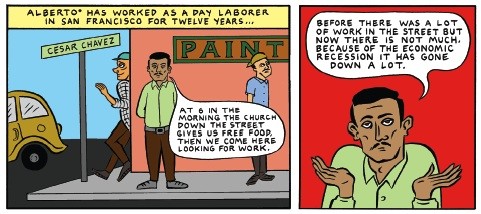
I loved the “Sit, Lie, Get Deported” comic strip that merges photos with hand-drawn illustrations and uses the actual words of politicians, city officials, activists and gadflies to help illustrate its point.

And I’m still trying to finish the crossword. In fact,  I plan to read the SFPP’s first printedition from front to back over the July 4 holiday weekend, when I’ll have the time to really absorb and enjoy it.

“Ideally, news will appear in print first, then online, so there’s interest in seeking out the print edition,” Lahood told me, noting that the Public Press’ first edition amounts to about 70,000 words. “So, it a novel, in length,” Lahood laughed. “People are, if not starving, at least very hungry for news analysis and investigative reporting. There are a lot of online sites that aggregate other publications content, and then there’s the corporate model of the Chronicle, but while there is some good reporting in town, there are fewer reporters.”

No kidding. All the more reason for this reporter to write an online defense of print, in the hope that you rush out to secure your copy of the Public Press’s first print edition and evaluate this new model of journalism. I think you’ll be glad you did.

Quick Lit: June 23-June 29

0

Literary readings, book tours, and talks this week

The Cheesemonger, William Dalrymple, Tim Wise, skating on the margin of error, the Golden Age of Chinese nightclubs, and more.


Wednesday, June 23

Cheesemonger: My Life on the Wedge
Former punk rock activist turned cheese connoisseur Gordon Edgar will pass around some cheese and discuss his new book about the amazing world of artisan cheeses that he discovered while working at Rainbow grocery.
7 p.m., free
Get Lost Travel Books
1885 Market, SF
(415) 437-0529

Nine Lives: In Search of the Sacred in Modern India
British historian and travel writer William Dalrymple explores how modernity is changing India’s oldest traditions and the human pursuit of the divine.
6 p.m., $12
Mechanics’ Institute
57 Post, SF
(415) 393-0100
www.milibrary.org 

This is Where We Live
New York Times, Vogue, and Elle journalist Janelle Brown discusses her new novel.
7:30 p.m., free
Books Inc. Marina
2251 Chestnut, SF
(415) 931-3633

Tim Wise
Prominent antiracist essayist, educator, and activist Tim Wise will discuss his new book, Colorblind: The Rise of Post Racial Politics and the Retreat From Racial Equity.
7 p.m., free
City Lights Bookstore
261 Columbus, SF
(415) 362-8193‎

Thursday, June 24

Being Wrong: Adventures in the Margins of Error
Journalist Kathryn Schulz explores why we find it so gratifying to be right and so maddening to be mistaken, and how this attitude toward error corrodes our relationships.
7 p.m., free
Modern Times Bookstore
888 Valencia, SF
www.mtbs.com

Ex-GayNo Way
Jallen Rix discusses this new novel tackling the topic of “Reparative Therapy” and the after-effects this cult movement has on it’s victims.
7:30 p.m., free
Books Inc. Castro
2275 Market, SF
(415) 864-6777

Forbidden City: The Golden Age of Chinese Nightclubs
Author Trina Robbins reads from her new book which uses interviews, photos, momentos, and Art Deco posters to tell tales of the dancers and singers of Chinatown nightlife from the 1930’s to the 1960’s.
6:30 p.m., free with $15 museum admission
Asian Art Museum
200 Larkin, SF
(415) 581-3500
www.asianart.org

Hand Bookbinders Anniversary Exhibition
The 38th Annual Hand Bookbinders of California exhibition features the work of professional, amateur, and student bookbinders that range from the traditional to the very contemporary. Enjoy a special tour of the show led by members of the Hand Bookbinders of California on every other Thursday through August 12.
11 a.m., free
San Francisco Public Library Main Branch
100 Larkin, SF
(415) 557-4277

Hitch 22
Author and journalist Christopher Hitchens discusses his new book, which draws on his experience as a U.S. and U.K. citizen, as a socialist opposed to the war in Vietnam, and as a supporter of the U.S. war against Islamic extremism in Iraq.
7 p.m., free
Borders
400 Post, SF
(415) 399-1633

No Cartoon Left Behind: The Best of Rob Rogers
Political cartoonist Rob Rogers offers an interactive combination of live drawing and a cartoon slide presentation that takes the audience behind his creative process. His new book features cartoons documenting five presidencies, the end of the Cold War, 9/11, 25 years of health care, and economic and political scandals of every shape and size.
7 p.m., $5
Cartoon Art Museum
655 Mission, SF
(415) CAR-TOON

The Particular Sadness of Lemon Cake
Author Aimee Bender discusses her new novel about a girl whose magical gift is really a devastating curse.
7:30 p.m., free
Books Inc. Marina
2251 Chestnut, SF
(415) 931-3633

Right Here on Our Stage Tonight!: Ed Sullivan’s America
Author Gerald Nachman, joined in conversation by SF Chronicle columnist Leah Garchik, discusses his novel that traces the history of the 23 year run of the Ed Sullivan Show, that introduced America to a diverse array of performers.
6 p.m., $12
Mechanics’ Institute
57 Post, SF
(415) 393-0100
www.milibrary.org 

“The Shallows: What the Internet is Doing to Our Brains”
Hear journalist and author Nicholas Carr discuss how the internet is rewiring our synapses and dangerously upending our cultural priorities and other mental and social transformations that are being created by our new electronic environment.
7:30 p.m., $12
Berkeley Hillside Club
2286 Cedar, Berk.
(510) 848-6767

Saturday, June 26

Gene Yang
Award-winning comics artist Gene Yang, author of American Born Chinese, Gordon Yamamoto and The King of the Geeks, discusses his creative process and his love for the comic medium. Yang will also share his personal history as a Chinese-American, the inspiration for many of his books.
Sat. and Sun. Noon, free with $15 museum admission
Asian Art Museum
200 Larkin, SF
(415) 581-3500
www.asianart.org

Monday, June 28

Penguin Books 75th Anniversary
Celebrate a quarter of a century of Penguin publishing at this event hosted by Micheal Pollan, featuring Penguin’s collection of 75th anniversary favorites.
7 p.m., free
Books Inc. Berkeley
1760 4th St., Berk.
(510)525-7777

Summer Poetry Festival
All poets, painters, musicians, and arts and crafts people are invited to participate in this two-day, day-long festival in North Beach. Registration at 11 a.m.
Mon.-Tues. 11 a.m.-6 p.m., free
Rouge Ales Public House
673 Union, SF
hackett.philip@gmail.com

Tortured: When Good Soldiers Do Bad Things
Journalist and author Justine Sharrock brings us an eyewitness account of what it feels like to torture based on interviews with young, low-ranking soldiers who worked at Abu Ghraib and Guantanamo.
12:30 p.m., free
Alexander Book Company
50 2nd. St., SF
(415) 495-2992
www.alexanderbook.com

 
Tuesday, June 29

Understanding the Crash
Graphic artist Seth Tobocman and journalist and writer Eric Laursen offer progressive account of how bad mortgages turned into a financial meltdown and how we can get out of this mess.
7 p.m., free
Modern Times Bookstore
888 Valencia, SF
www.mtbs.com

Before I die, if printing still exists: An interview with Daniel Clowes

0

By Sam Stander

Daniel Clowes has made the leap over the past decade from underground comics hero to a more mainstream identity, with an Oscar nomination for screenwriting, several New Yorker covers, and a comic serialized in the New York Times Magazine under his belt. Despite his raised profile, his newest work, Wilson (Drawn and Quarterly, 80 pages, $15.37), comes closer to home than ever before. The cynical comic strip-based book is largely set in Oakland, of which he is a proud denizen. Clowes recently appeared at Diesel in Oakland, in conversation with McSweeney’s editor Eli Horowitz and the audience. On the setting of the comic, he proclaimed, “I’m pro-Oakland, I’m not sure Wilson is.” He also discussed his forays into film, his debt to Charles M. Schulz and R. Crumb, and the slight controversy over his recent New Yorker cover, among other things.

A lengthy signing followed, where fans presented everything from freshly purchased copies of Wilson to old favorites like David Boring to collector’s items like Lout Rampage for signing. Once the line had dwindled, Clowes sat down for a one-on-one interview.

San Francisco Bay Guardian One of the things I wanted to ask you, if the Oakland observations haven’t been beaten into the ground, was that you also used to live in Berkeley, right? When you were writing Ghost World?
Daniel Clowes Yeah, I was living up by College and Ashby.

SFBG Why are you explicitly writing about Oakland now, and why did you choose to live in Oakland? What do you see as the differences between the different areas?
DC It’s funny, I sort of wound up in Oakland by default. We were living in Berkeley, because my wife was going to Berkeley, and our landlord doubled our rent one month, which I actually didn’t think was legal. And so we said, well, maybe we should try to buy a house. This was years ago. We looked all around Berkeley and it was really expensive, and we found this neighborhood in Oakland that we didn’t even know about, over where we live now, and wound up buying a house there.
You know, I never really thought about Oakland. Even living there for two or three years, I thought, well, we’re near San Francisco and Berkeley. Then I started to walk around and embrace the idea of Oakland. I kind of learned to like Oakland above all its other surrounding cities. I’ve gotten to the point where I almost never go to San Francisco. It’s like, I go to LA more than I go to San Francisco. I just don’t relate to San Francisco at all, and somehow Oakland feels — I grew up in Chicago, and Oakland has this kind of second-tier quality that I find appealing.

SFBG Second-tier?
DC It’s not San Francisco. It’s [its] ugly sister across the Bay, and I prefer that somehow. I was in New York recently, and I was on a block in the Upper East 70s, I think, and I was looking around and I realized every building on the block was a beautiful art deco building built in the ’20s. And I thought, well, Oakland has one building like that. It has the Bellevue-Staten down by Lake Merritt. That’s it. But I’d prefer that, because, to see 20 of them, it has no impact anymore. It’s just, wow, a lot of buildings, and your brain can’t grasp that. But somehow I’m obsessed with this one building in Oakland and I know all about it. I can fixate on that one thing, so I like a city that has one of everything rather than hundreds of the same thing.

SFBG One of the strips in Wilson is him talking about all the bookstores closing down. I was wondering if that was you speaking through him at all, and if so, what bookstore are you saddest to see close down?
DC Well, that was really all about Cody’s. My wife worked at Cody’s, and when I moved here, I sort of agreed to move to Berkeley with my wife because of Cody’s. I thought that [was] something I needed, this world-class bookstore. It was sort of the focal point of my life for many years. I would go there two, three times a week and see what was new, and it just felt like the focus of my world in a way. And when it closed down, it was really hard for me to accept. It was like, you know, you always hear stories of guys who talk about their baseball team leaving town. The guys from Brooklyn are like, “The Dodgers left town in 1958,” or whenever it was. It felt like that to me…Still, when I go to downtown Berkeley and see that empty building, it seems so awful. It seems just like an awful thing that the world couldn’t support that.

SFBG At least it didn’t become a CVS.
DC Exactly.

SFBG [There] was a brief interlude where it was going to be a CVS.
DC Yeah, that’s true. There is that. At least the tomb of Cody’s is still there. And you think, “Well, somebody could just reopen it. Why not? Nobody’s paying rent.”

SFBG Looming over Moe’s.
DC Yeah, I should count my blessings. At least Moe’s is still around, and this place. Better than most cities.

SFBG You were talking about Wilson sort of materializing as a character, [that] you didn’t know who he was at first, but that it was you interacting with him. I was wondering if you’ve ever had experiences with a character who you didn’t have such a productive relationship with, or if you’ve ever had characters who worked against you?
DC Oh, that’s a good question. It’s more that they just run out of — it’s usually a character that I’ve kind of predetermined. Like, I need a character who’s a certain type of person to fit into a story, like, “I need a comic relief character.” Something where you have a role for them, and then they’re never that interesting. I find the best way to do it is to just let the characters come naturally. If they’re forced at all, they tend to [be] artificial. They have to seem like real people. There are characters that I’ve written the hell out of for page after page and they never quite are real people to me. Those are the things that never work, and that I usually have the good sense to throw away before they see print. [Laughs]

SFBG You’ve always had a really strong interest in perversity and human weirdness, and that’s not so central in Wilson. Was that a conscious move away or a permanent move away, or just a change in interests?
DC I think that’s true, you know. I always had a real interest in outsider culture. When I first began doing comics, that kind of thing was so inaccessible. I had a little group of friends who would send me all these weird things. You’d find out about little groups of people who were all linked together by some really odd interest, but they were so segregated. They’d maybe have some little newsletter that they all communicated through, but it felt like the world was filled with these little secret societies. And ever since the Internet has taken hold, it doesn’t feel like that anymore. It feels like the minute anybody hears about any weird little perversion or interest or anything like that, that everybody finds out about it and they know all about it, so it’s sort of lost its interest.
Also, having a child, you sort of reassess what you’re interested in, and you think, would this make me proud for my son to find my collection of books of pictures of freaks, or whatever? You just think, “Ehhh, I’m not sure I want to stand behind that.” Certain [times], you [decide] “I really do think this is cool and I will defend this,” but you weed out a lot of things that were just there because they would get a good reaction out of people.

SFBG Possibly spinning off from that question, but on another angle: You said [during the Q&A] that, specifically, no filmmaker has a strong specific influence on you, but certain films or certain scenes do. Are there any films or scenes you have in mind for Wilson or any of your other works?
DC I feel like Wilson is very non-filmic as far as most of my books go. It’s not about the images at all. A lot of my comics come from ideas that are images, that then turn into stories. Like David Boring and the Velvet Glove thing, and even a little bit of Ghost World. But Wilson was really all about this guy. If it were a movie, it would be more like a Mike Leigh movie or something than a Stanley Kubrick movie. [Laughs]

SFBG And you were saying that to make it into a film would be a strange format for a film.
DC It would be a strange format. I mean, you could certainly rethink it as a story about a guy, and sort of have the same elements, but to replicate the feel of the book would be a very odd thing. That’s the beauty of comics, is you can do all those different styles and they actually resonate off of each other, and even a really amateurish reader, a non-reader of comics, can tell the difference between the styles, whereas in a movie it’d be very hard to do different styles. Only film experts would get that you’re doing, you know, Michael Bay and then Alfred Hitchcock, or whatever.

SFBG Have you seen Natural Born Killers?
DC Yeah, that’s a perfect example.

SFBG Where it’s kind of off-putting at the end of the movie.
DC Right, it’s just a little irritating. Although I think that was the idea, I suppose. I haven’t seen that movie in a long time, I bet it’s really irritating now.

SFBG I’ve never seen all of it, actually. I’ve had friends show me parts.
DC I barely could tolerate it in theaters.

SFBG Woody Harrelson and Juliette Lewis are —
DC Yeah, she’s great. I like him, too.

SFBG In the right role.
DC Yeah, yeah.

SFBG Somebody was asking you about drawing eyes and mouths and conceiving of how people look in each panel, and you were saying that you do [stick-figure] sketches beforehand. How much do you script or plan out or storyboard versus just drawing a comic?
DC It depends on, not even the story, but just on my mood before I start. I usually try to do each story somewhat consistently, but I’m always trying to come up with a new way to do things. Not to be different or to give myself a challenge, but [because] I’m looking for a better way to work. And I always have this carrot dangling in front of me that there’s some other way, that if I could only find that way, it’ll make everything easy. And then it never does, and it always comes out exactly the same, no matter if I script the thing carefully or if I make it up off the top of my head. I could show those comics to a hundred people, and they would have no idea what was the planned-out one and what was the one I just made up. It all turns out the same. And I think that’s true of most artists. You can’t really tell what they’re going through, it’s just their work is always them, you know.

SFBG Do you always get a stack of other people’s works [at signings]?
DC [Holding a thick stack of various printed matter presented by fans] This was a good stack, I’d have to say. Often it’s much more, like, Xeroxed stuff. This actually looks like some pretty decent stuff that people have actually printed up. But yeah, usually you get a big pile of stuff, although not as much anymore, because a lot of people don’t print anything. So now I get business cards, like, “Check out my webcomic.” I have to go type it in at home.

SFBG You have the thing in the little author’s bio in Wilson about [how] you have danielclowes.com reserved.
DC That’s right.

SFBG Do you have any ideas for using that, or anything you want to use it for?
DC Well, my publisher actually said, “Now you have to put something on there, since you said that in the book.” So they just put an ad for Wilson that links right back to their website. I don’t want to get into doing, like, a blog or responding to people, ’cause my life is already so taken up by just responding to e-mails from my friends that I can’t imagine introducing a whole ’nother element of that. But it would be good to make announcements, and just to clarify things. I feel like the average reader doesn’t understand that I used to do a comic called Eightball and the stories were serialized — I figure if there’s some way [to] really concisely explain my career, then I won’t have to explain it to everybody over and over. [Laughs]

SFBG Are the original sequences of Eightball ever going to be made available again, and things that aren’t collected?
DC One of these days we’re going to do the complete Eightball, and do like a hardcover thing, but that’s nine projects down the road or something. But before I die, if printing still exists.

SFBG As far as film projects, is there anything on the horizon or anything you’re excited about working on?
DC With Ghost World, I learned, don’t tell anybody about your film projects until they have a release date. I used to tell people, “Oh, they’re going to make a Ghost World movie,” and then five years later, they finally actually made it. I felt like such a chump. But I wrote a screenplay for this thing that Michel Gondry came up with, this crazy dystopian sci-fi epic. I wrote a script based on his ideas. His son is going to do the drawings for it. I’m not animating it, but I think he wants to do that as his next film, so that should be fun, if that actually happens.

SFBG Have you ever done any animation?
DC I did a video for the Ramones in 1995, and that was it.

SFBG Would you ever do it again?
DC Yeah, I’d like to, I’d like to. I need to sort of come up with an idea that’s only appropriate for animation, and then actually try to get somebody interested in producing it. So there’s lots of hurdles there. [Laughs] But yeah, I’d love to. I feel like I should do that one of these days.


Our Weekly Picks: June 16-22, 2010

0

WEDNESDAY 16

THEATER/DANCE

The Tosca Project

American Conservatory Theater artistic director Carey Perloff and San Francisco Ballet choreographer Val Caniparoli have teamed up with an all-star cast of ACT actors and San Francisco Ballet principal dancers (Lorena Feijoo, Pascal Molat, and Sabina Allemann) to bring theater and dance to one stage. Tracing the history of SF’s famous Tosca Café, The Tosca Project at ACT journeys through the love, loss, and popular dances of the past century to a soundtrack (featuring everything from Stravinsky to Hendrix) as diverse as the café’s ever-changing clientele. (Katie Gaydos)

Through June 27

Tues.–Sat., 8 p.m. (also Wed. and Sat., 2 p.m.); Sun, 2 p.m., $15–$85

American Conservatory Theater

415 Geary, SF

(415) 749-2228

www.act-sf.org/0910/tosca/index

THURSDAY 17

PERFORMANCE

Fresh Meat Festival

It’s that time again when Sean Dorsey brings tranny and queer performers for a love feast of dance, humor, music theater, and just about any other form of performance you could want. Most remarkable perhaps is how the Fresh Meat Festival — a tiny, local event only a few years ago — has grown into a national forum for often very polished performers who stick their necks out in every direction. Part of the festival’s fun is people-watching; some audience members’ get-ups nearly rival what’s seen on stage. Highlights from the lineup include world premieres of Dorsey’s take on Craigslist’s Missed Connections, Annie Danger’s media-style life coaching session, and SoliRose’s music-theater reflections about life in the Middle East. (Rita Felciano)

Thurs/17-Sat/19, 8 p.m.; Sun/20, 7 p.m., $17–$20

Z Space @ Theater Artaud

450 Florida, SF

www.brownpapertickets.com

MUSIC

U.S. Bombs

Boasting one of the most unpredictable, energetic, and enthralling bandleader of any punk band ever to set foot in front of an audience, U.S. Bombs has cultivated an incendiary reputation thanks to singer, legendary skateboarder, and all-around “master of disaster,” Duane Peters. Combining sounds culled from old school influences like the Clash and mixing them with the raw, adrenaline-pumping attitude needed while attacking a half-pipe, the band’s lineup has gone through several variations. But no matter which members of punk rock royalty he has behind him, Peters is guaranteed to steal the spotlight and make for a show you won’t likely soon forget. (Sean McCourt)

With the Forgotten, Druglords of the Avenues, and Cunt Sparrer

8 p.m., $14

Slim’s

333 11th St., SF

(415) 255-0333

www.slims-sf.com

EVENT

Decomposition reading

It’s sometimes said that, like pop songs, all good poems are ultimately about either love or death. Instinctively, I think most of us know this to be incorrect. Sometimes, though, we need a little reminder, which is where events like this one come in handy. Decomposition is an anthology of fungi-themed poetry from throughout the ages — apparently, many of America’s most seminal wordsmiths, including Sylvia Plath and Emily Dickinson, drew tremendous inspiration from the lowly mushroom (and no, not like that). Leading this tour of verse’s dark, dewy reaches will be editor Kelly Chadwick and poet Charlotte Innes. (Zach Ritter)

7–9 p.m., free

Ecology Center Store

2530 San Pablo, Berk.

(510) 548-3402

www.ecologycenter.org

FRIDAY 18

DANCE

Great Integration: A Chamber Hip-Hop Opera

By calling Great Integration — an allegory about the end of times — a hip-hop opera, choreographer Raissa Simpson and composer-pianist JooWan Kim may be on to something. Hip-hop is music, it’s dance, it’s poetry, and above all it’s a way of being. It means living on the edge, on unstable ground and embracing the subversive. Longtime East Bay activist and Integration contributor MC Kirby Dominant can attest to that. As far as the opera part is concerned, the Chinese and the Italians discovered centuries ago that opera is a messy, all-encompassing form of theater splendidly suited for big topics. Sounds just about right for all aspects of Integration. On opening night, jazz vocalist Christopher Nicholas joins Kim’s Ensemble Mik Nawooj and Simpson’s Push Dance Company. (Felciano)

Fri/18–Sat/19, 8 p.m., $15–$25

ODC Commons

351 Shotwell, SF

(415) 863-9834

www.brownpapertickets.com/event/104653

MUSIC

QM

Do you like hip-hop? Do you like cheap booze? Get your ass down to Hotel Utah for a stiff double dose of both and party like your parents are outta town. Local rapper QM of the Rec-League, self-described as “your favorite rapper’s favorite rapper to drink with,” is finally releasing his latest album, Happy Hour, and is throwing his own happy hour to celebrate. QM’s clever punch lines and West Coast sound may not change your political views, but they just might leave you hung over. Throw in $1 PBRs and Happy Hour grab bags filled with the album, a beer koozie, and other surprises, and Hotel Utah’s guaranteed to get wild. Be prepared for a drunken good time, and keep some aspirin and water ready for the morning after. (Ben Hopfer)

With Rec-League, Adverse, and Parable Paul

9 p.m., $10

Hotel Utah

500 Fourth St., SF

(415) 546-6300

www.routinefly.com

EVENT

“Cultural Encounters: Friday Nights at the de Young”

If you’re one of those people for whom a croissant is a “kwah-sahn,” then this week’s Friday Soirée at the de Young Museum, presented in partnership with the Alliance Française, should cater to your Francophiliac tastes. Though not French himself, Rich Kuhns accompanies the “Birth of Impressionism” exhibit as a strolling accordionist. The Bay Area monsieur of musette hearkens back to traditional French sounds — he plays Jacques Brel and Edith Piaf, of course — while also adding some contemporary flair to the fête. Following his performance, Dr. Alexandra Amati-Camperi lectures on the Fête de la Musique, French singer-songwriter Eric John Kaiser performs, and you can make your own found object instrument with Kim Erickson, described as an “art diva” by the de Young website. It’s no coincidence that the word “cliché” is French,” but zut alors, clichés never sounded so good. (Ryan Lattanzio)

5–8:45 p.m., free

de Young Museum

50 Hagiwara Tea Garden Drive, SF

(415) 750-3600

www.deyoung.famsf.org

FILM

Top of the Food Chain

Bluntly retitled Invasion! for its American release, Canadian filmmaker John Paizs’ homage to 1950s sci-fi films, Top of the Food Chain (1999), is the second of his films to screen at Artists’ Television Access in as many months. Previously, the auteur worked on beloved Canadian comedy series Kids in the Hall, but his films have a miniscule presence on the Internet — a few blog reviews here and there, and only two relevant YouTube clips. However, both of those clips are of hilariously non sequitur musical numbers, so that’s a promising sign. Indeed, Paizs’ fetishization of a seemingly outdated genre should be right at home alongside ATA’s usual assemblage of experimental video art. (Sam Stander)

8 p.m., $6

Artists’ Television Access

992 Valencia, SF

(415) 824-3890

www.atasite.org

PERFORMANCE

Miriam’s Well

This cultural and artistic mashup tells the stories of Mary, Maryam, and Miriam from the Christian, Muslim, and Jewish traditions connecting across time and distance at an ancient water well, the source of life and strife in a world that has yet to come to terms with how we can come together around our most basic shared needs. The performance involves dance, live music, poetry, and readings of sacred texts by a variety of acclaimed artists, from creator and dancer Miriam Peretz to musicians the Qadim Ensemble and master percussionist Pezhham Ackavass to spoken word artist Lana Nasser. It’s a story of visionary women leading all us past our historical and still-growing divisions and toward the realization that “without peace the well will soon run dry.” (Steven T. Jones)

8 p.m., $20

Grace Cathedral

1100 California, SF

(415) 749-6355

www.brownpapertickets.com/event/97354

SATURDAY 19

EVENT/PERFORMANCE

Birthfest and The Dynamite Show

FouFouHa!, San Francisco’s uniquely zany clown dance troupe, wants to take you on a strange journey all the way from a woman’s womb to a glitzy reality show set in Hollywood. That may seem like a long road to travel, but with troupe founder and performance director/choreographer Maya Culbertson-Lane, a.k.a. MamaFou, behind the wheel, it’s sure to be a fun ride. The play, which runs at Brava June 17-26, follows the Fous as they audition to be humiliated on television, exploring the role of the fool in society. But this show is preceded by a film festival on midwifery, with proceeds benefiting the Foundation for the Advancement of Midwifery, which recently helped MamaFou deliver her second child. What’s the connection? As she explains, it’s about power, “the power to not give into social fears created by a system run by money — in this case Hollywood and insurance companies.” With live music by the Gomorrans Social Aide and Pleasure Club and a photo exhibit by Eric Gillet. (Jones)

Birthfest, noon-6 p.m.; The Dynamite Show, 8 p.m., $20–$40

Brava Theater

2781 24th St., SF

www.foufouha.com

www.birthfest.com

EVENT

StreetSmARTS Community Extravaganza

It’s afternoon in the Tenderloin, and muralist Jet Martinez has been sponsored by the SF Arts Commission to paint traditional Oaxacan embroidery flowers in Cedar Alley. His audience: a man who has been yelling “I’m gonna kill you!” to no one in particular all day. The guy starts to approach him, and when he gets close enough says this to Jet in a low, articulate voice: “We really appreciate what you’re doing for the community.” Don’t ever let them tell you art doesn’t matter. Celebrate the beautiful walls created through StreetSmARTS with b-boys, DJs, and a midnight unveiling of “The Elements of Hip Hop,” a indoor gallery of works by the muralists themselves. (Caitlin Donohue)

Sat/19, 6 p.m., free

African American Art and Culture Complex

762 Fulton, SF

(415) 252-2598

www.sfartscommission.org

MONDAY 21

MUSIC

Brian Jonestown Massacre

Who Killed Sgt. Pepper? the Brian Jonestown Massacre asks in the title of its latest album. It’s possible bandleader Anton Newcombe did, if you recall how insane he was in Ondi Timoner’s documentary Dig! (2004). The San Francisco-bred band returns to the Fillmore in conjunction with its new release — a rather disquieting listen with plenty of dissonant space noise and expletives to make for a psychedelic headbanger’s wet dream. Newcombe, steeped in notoriety since Dig! and its frenetic portrait of the artist as a disturbed man, has been honing his sound since 1990. If you can separate art and artist (or don’t even bother — it makes things more interesting), BJM is one of today’s only bands that should be allowed to remain as prolific as it is. (Lattanzio)

9 p.m., $22.50

Fillmore

1805 Geary, SF

(415) 346-6000

www.livenation.com The Guardian listings deadline is two weeks prior to our Wednesday publication date. To submit an item for consideration, please include the title of the event, a brief description of the event, date and time, venue name, street address (listing cross streets only isn’t sufficient), city, telephone number readers can call for more information, telephone number for media, and admission costs. Send information to Listings, the Guardian Building, 135 Mississippi St., SF, CA 94107; fax to (415) 487-2506; or e-mail (paste press release into e-mail body — no text attachments, please) to listings@sfbg.com. We cannot guarantee the return of photos, but enclosing an SASE helps. Digital photos may be submitted in jpeg format; the image must be at least 240 dpi and four inches by six inches in size. We regret we cannot accept listings over the phone.

Reel groundbreaking

0

FRAMELINE Appropriately enough, Kathy Wolfe — founder and CEO of this year’s Frameline Award winner, Wolfe Video — realized her calling while attending a Frameline screening.

“Somewhere around 1979, I went to a Frameline screening of [pioneering 1977 doc] Word is Out. Within the body of that film, there’s a challenge to make a difference,” she remembers, speaking from her San Jose office. “I started working in my local public access television station, and for four years I studied and worked in every aspect of video production. At the end of that, I actually had a few documentary-style pieces and some women’s music videos I wanted to sell. In order to get more serious, I took out a business license, and that was in 1985. But I very much was inspired by the challenge in the movie. Our mission today is very similar to the mission we had at that time: to make these images more available to the world at large so that people would feel empowered to come out.”

Today, Wolfe Video is the leading exclusive distributor of LGBT films, which they do via film festivals, video stores, video on demand, and the Internet, including their website, Wolfevideo.com. Their catalog includes hits like Big Eden (2000) and Claire of the Moon (1992), as well as the entire performance catalog of Lily Tomlin — whose early support helped the company make key contacts with distribution networks and retail outlets. According to president Maria Lynn, who joined in 1993, the fact that Wolfe Video is celebrating its 25th anniversary is a testament to the increasing popularity of LGBT films.

“[In 1985] the gay genre, as it were, was considered small and unknown. Now it’s a very significant genre in independent film. Between Wolfe distributing them, and filmmakers making them, and festivals like Frameline screening them, it has created its own category within independent film,” she says. “We have a lot of movies now that have a more mainstream appeal, for example Undertow, which is going to be a centerpiece at Frameline, is a beautiful film from Peru. And the way people talked about Brokeback Mountain as being about love — people will talk about this one similarly. It touches people very deeply and it is not limited to a gay and lesbian audience as well. That’s one of the biggest things that’s changed: the filmmakers have really been able to branch out, whether it’s with casting, or better stories, or bigger budgets.” 

FRAMELINE AWARD: WOLFE VIDEO

With Undertow Tues/22, 7 p.m., Castro

Get thee to the gym

2

arts@sfbg.com

FRAMELINE It’s a little-noted fact that the gay community is absolutely thick with twins. Not biological, but the kind that grow more identical when they take their shirts off.

Whoever said opposites attract clearly never went to the Folsom Street Fair, where every body type runs in packs of two (or several). Sure, mom said looks aren’t everything. But was she a gay man? It’s brutal out there. Combine a sophisticated, compartmentalized urban gay scene like San Francisco’s own with the Internet’s heightened judging-book-by-cover — no actual book reading implied — and you’ve got a recipe for looks obsessiveness that can snare even the safely off-market.

An older friend who said at 40 he’d eventually retire from gym habituation because “I don’t want to be a 50-year-old face on a 25-year-old body” is now a 60-year-old with a 35-year-old bodybuilder’s torso — plus the blown-out knees and other ailments decades of body-sculpting punishment have wrought. What for? Not for his committed partner, one assumes, but for the accustomed thrill of feeling the breeze shift from swiveling heads.

A number of films in Frameline’s 34th edition (Skinnyfat, BearCity, The Adonis Factor, Bear Nation) address the complicated landscape of gay male body image issues. They’re not always pretty — at least emotionally. Although it is generally also the business of people in movies to be pretty. It is also the business of these particular movies to question just what pretty is, and why the hell it has to be so important.

The topic is taken head-on — if also superficially, which is ironically apt — by The Adonis Factor. Its interviewees from various gay terrariums (SF, Palm Springs, West Hollywood) say things like “Gay men tend to have more of an appreciation for beauty in all aspects, whether it is other male bodies or just antiques.”

Leafing through relevant issues magazine-style, from circuit parties to surgery to eating disorders, Christopher Hines’ documentary ponders endemic, sometimes compulsive shallowness while providing a lot of eye candy. “If you’re gonna be gay, you’re just gonna have to experience the wrath of the A crowd,” one perfect 10 in search of an 11 attests. Some of us are just too allergic to house music to hazard that.

A mutable “culture of desire” has spawned myriad subdivisions based on body type, the greatest latest boom being bear-ish. But Malcolm Ingram’s documentary Bear Nation finds fissure in a movement supposedly all about including the excluded. One specialty magazine publisher bluntly insists “bear” means hairy, not big (save musculature), and who asked these fat fucks to the party anyway? If there was a fetish mag focused on the proudly obnoxious, he’d rate the cover.

Frameline34 — so old! who’d sleep with that?! — features a lot of films that in one way or another uphold a beauty standard. Among them are conventional gay romcoms like Is It Just Me?, whose John Cusack-y protagonist — torso more rectangle than triangle — is appalled by the looks-ist superficiality of the L.A. gay scene he’s just moved into. But of course there’s a selfless hunk who, amid Cyrano de Bergerac-inspired contrivances, is eager to love him for his mind.

Foreign films — like such excellent Frameline entries as Undertow, Children of God, or Francois Ozon’s Hideaway — tend to be less rigidly codified in terms of physical casting. Their protagonists are attractive but natural, not conspicuously pumped by hours of gym devotion. Still, their soft-pedaled sexy glamour seems contrite alongside the futurist masculinity line-blurring of Frameline flicks like tranny-band survey Riot Acts: Flaunting Gender Deviance in Music Performance. Or Jake Yerra’s Open, whose ethereal dramatic panoply encompasses a femmy boi in love with a pregnant FTM as well as an intersex couple undergoing surgery to become identical. “Being average in a world of physical perfection is the worst kind of gay purgatory,” a character says in Is It Just Me? Maybe worse: being slave to that sensibility.

FRAMELINE34: SAN FRANCISCO INTERNATIONAL LGBT FILM FESTIVAL

June 17–27, most shows $8–$15

Castro, 429 Castro, SF; Roxie, 3117 16th St., SF; Victoria, 2961 16th St, SF; Rialto Cinemas Elmwood, 2966 College, Berk.

Editor’s Notes

0

 Tredmond@sfbg.com

I went through the house the other day and sorted out all the old toys my kids never play with any more. They’re 8 and 11 now, so they’ve outgrown a lot of stuff. Some of it went to Goodwill, some of it went to friends who have younger children, some of it went out on the sidewalk with a “free” sign — and still, there was a pile left over.

Broken plastic. Shit nobody wants. Can’t be recycled. It went in the trash.

And now, as Sarah Phelan reports in this issue, it’s probably sitting in a landfill across the bay, taking up space and waiting a couple thousand years until it becomes the archeological remnants of our civilization. Stuff from the ancient world is valuable because it’s fragile, and there’s not much left; our society is leaving an excellent record. That plastic will never decompose.

And now two private companies are fighting for the right to pile up my trash in a landfill, either at Altamont or in Yuba County. It’s a high-stakes battle; there’s a lot of money in garbage. And it’s a little disturbing to realize that in San Francisco, the entire process of collecting, recycling, composting, and dumping our solid waste stream is controlled by private companies.

What if we actually succeed in reducing our waste stream to zero? What if we reach the point where we’re buying less, tossing less, reducing the 1,800 tons of crap that flows into landfills from SF every day? Isn’t that what we ought to be doing? And what interest does a private landfill owner, who makes money from my kids’ broken toys, have in seeing the flow of detritus — and thus the flow of money — cut off?

I’m not arguing that we municipalize the trash system (not today, anyway; let’s do electric power, cable TV, and Internet first). But while she was working on the story, Phelan kept telling me that the city ought to look at keeping all the trash in town. If you could see that horrible mountain of crap right out your window, maybe you wouldn’t throw so much of it away.

She was kidding, of course. Sort of.

SFBG Radio: Johnny and Tim on American Tories

1

Today, Johnny and Tim talk about why so many of the internet trolls — and conservatives in general — are writing and acting against their own interests. You can listen after the break.

sfbgradio6/11/2010 by sfbgradio

Hot sexy events June 9-15

0

Ohhhh baby yeah, stroke that compound tubuloalveolar exocrine gland! That’s right, transmit my sperm from the ductus deferens into my urethra! Yeah, yeah… I love it when you understand my anatomy. Science = so hot right now. Well, especially when scientifical edumacation can school you on how to make you partner come harder, better, faster. With that in mind, I give you Good Vibrations’ Ask Our Doc series, a weekly meet and great with a legitimate, PhD holding medical professional that knows dirty, dirty things about what you’ve got going on down there. This week’s smarty pants; Dr. Charles Glickman, who can tell you all about the prostate gland, that underutilized hot spot. Oh, doctor…

——————————————-

Prostate Play and Pleasure

You would think that something the size of a chesnut nestled at the base of your penis would little need an instruction manual, but you know what? The human body is a complex and multi-layered entity. Sometimes you need a doctor to tell you how to get off. Charles Glickman is happy to oblige – the doc will be advising on how to facilitate that happy little gland, and the toys and tricks that can take your prostate productions up a notch.

Wed/9 6-7 p.m., free

Good Vibrations

603 Valencia, SF

(415) 522-5460

www.goodvibes.com

——————————————-

Effective Flogging Playshop

Does your wrist flick not get quite the whip crack you’re looking for? Are your lashings lacking luster? Not a worry, my sweet, sweet dominatrix. Come on down to the Citadel for Edukink’s monthly Paideia munch/class/play time, which focuses on 12 basic skill flogging techniques for the month of June.

Thurs/10 7:30-10:30 p.m., $15-25

SF Citadel

1277 Mission, SF

(415) 626-1746

www.edukink.org

——————————————-

thread | bare

Hot models strutting down the runway in flash local indie fashion. Hot, yes – but is it sexy? It is when the clothes on their backs are available for you to grab in your sweaty little hands — like, right now. The show is a benefit for the Lab, and those involved are fairly star studded. Comedian Philip Huang, and vocalist Lily Taylor are among the soon to be naked, and hair will be done by 2010 SFBG Small Business Award winner, Glam-A-Rama.

Fri/11 7-10 p.m., $10-20

The Lab

2948 16th St., SF

(415) 864-8855

www.thelab.org

——————————————-

Hot Tears of Shame

Those Japanese, they’re naughty, aren’t they? They’ve pretty much cornered the market when it comes to absolutely unique ways to make filth (tentacle porn, anyone?). Tonight, film experts from the Land of the Rising Sun talk trash, showing films from the schools of “Roman Porno,” and “Pinky Violence,” as well as those ever popular short skirted schoolgirls.

Fri/11 7 p.m., $10

Viz Cinema at New People

1746 Post, SF

(415) 525-8631

www.newpeopleworld.com

——————————————-

Robert Philipson

Ah, the gay Internet personal ad. The married man who wants to “keep it simple,” the single guy who self describes as “public property,” that ever elusive “VGL” – if it means “very good looking” then where, oh where darling, is that photo? Poet Philipson has read them all, and channeled the Interweb romantical rondelay into a new book of verse, Very Good Looking Seeks Same: Gay Profiles in Search of Love, which he’ll be reading today at A Different Light.

Sat/12 4 p.m., free

A Different Light bookstore

489 Castro, SF

(415) 431-0891

www.adlbooks.com

——————————————-

Beginning Pole 101

I just went into detail about how awesome stripping is for the ego, but apparently it’s good for the love handles, as well. This particular class pitches itself as poleside workout. And with only four to nine budding exotic dancers per class, you’re getting lots of hands-on attention from the instructor.

Sat/12 and Sun/13 2-4 p.m., $126

Center for Sex and Culture

1519 Mission, SF

(415) 552-7399

www.sexandculture.org

——————————————-

Tease

Kick off Pride with one of its official parties; Trigger’s post brunch, dance off that eggs benedict, moveathon. Djs Calalo and Motive keep you dancing right into Saturday club night with hip hop, electro… and if their website sets any precedent, Ke$ha. Oh, Ke$sha.

Sat/12 5-10 p.m., $5-8

Trigger

2344 Market, SF

(415)

www.movementinthebay.com

——————————————-

Show Me Mine, Show Me Yours: Modern Porn and Pinup Photography

Local queer porn icon Courtney Trouble tells you how to take a pretty picture. She’ll demo porn/pinup photography with a special surprise guest, then set you on your own personal road to pixelated glory. Pose yourself up with props, costumes, partners, and special lighting – all of which will be available, even though you’re more than welcome to bring ’em if you’ve got ’em.

Sun/13 5 p.m., $25

Femina Potens

2199 Market, SF

(415) 864-1558

www.feminapotens.org

——————————————-

Our Lady of Burning Dreams

Penny Slinger first emerged in the London art scene of the 1960s, but her career didn’t hit its screaming, sheet clawing climax until her emergence as a force in erotic art in the early ’80s. Nowadays, she makes florid digital kalidescopes of sensual human form and goddess imagery. Good Vibes is teaming her up with Carol Queen and Bobby Morgan, two more who use the wonders of technology to express physical ecstasy.

Closing reception Tues/15 5:30-7:30 p.m., free

Good Vibrations

1620 Polk, SF

(415) 345-0400

www.goodvibes.com

How safe is your cell phone?

5

By Brittany Baguio

news@sfbg.com

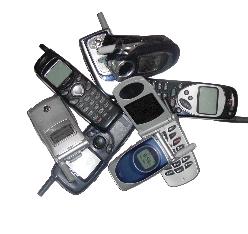
GREEN CITY In the wake of recent studies suggesting that extensive cell phone use might be linked to some types of cancer, consumer advocates are pushing to require phone companies to publicize the level of radiation their devices emit.

It seems like a simple idea. If fast-food restaurants are required to post the calories and fat content of their junk food, why shouldn’t cell phone companies post the level of radiowave energy coming out of their products? But it’s proving to be a tough fight — in part because the scientific studies are so complex, and also because the industry is fighting furiously against disclosure rules.

The California State Senate narrowly rejected June 4 a bill by Sen. Mark Leno (D-SF) that would have taken a modest step toward better disclosure. Leno’s measure, SB 1212, would have mandated that manufacturers and phone providers disclose radiation levels, or specific absorption rate (SAR), on their Internet websites and online user manuals. They would also be required to state the maximum allowable SAR value, and what it means.

“The federal government has set a standard for this type of radiation and already requires reporting,” Leno told us, “At the very least, consumers should have the right to know about the relative risks of the products they’re buying.”

There’s a similar measure in the works in San Francisco. On May 24, the Board of Supervisors City Operations and Neighborhood Services Committee passed Mayor Gavin Newsom’s plan to require retailers in the city to reveal the amount of radiation released by cell phones. That would make San Francisco the only city in the United States mandating that retailers acknowledge radiation information.

The most recent and largest study focusing on cell phone radiation, the Interphone Study, was released this year. Conducted by 21 scientists in 12 participating countries, the study looked at the long-term risks of certain brain cancers.

The results are mixed. The study found some results of increased risks of tumors, although the authors could not agree on how to interpret the data.

The researchers surveyed 5,000 brain cancer patients, and found that people who were “heavy” cell-phone users (defined as using the phone 30 minutes or more a day) had a slightly higher risk of some kinds of cancer. But, as an Environmental Working Group analysis of the study noted, “most of the people involved … used their cell phones much less than is common today.”

Cell phones emit radiowaves through their antennas, which in newer models are often embedded in the phone itself. The closer the distance from the antenna to a person’s head, the more exposed he or she is to radio frequency energy.

However, as the distance between the antenna and a person’s body increases, the amount of radio frequency energy decreases rapidly. Consumers who keep their phones away from their body while doing activities such as texting are absorbing less radio frequency energy.

The Federal Communications Commission has set a safety level for a phone’s SAR — a measure of radiation energy — at 1.6 watts per kilogram of body mass. All cell phone manufacturers must produce phones at or below this level.

Renee Sharp, director of California’s Environmental Working group, says the evidence doesn’t have to be conclusive to warrant caution. “We aren’t trying to say that cell phones are dangerous because we don’t have definite answers yet and we need more research,” Sharp said. “But when you look at studies with long-term use of 10 years of longer, you see increases in certain kinds of brain tumors. We are trying to give people as much information as we can to make informed decisions because it may or may not impact their health.”

Cell phone manufacturers aren’t required to disclose SAR information directly to phone buyers; they send the data to the FCC. Although the FCC makes this information available on its website, the information is incomplete and hard to find. A list of cell phone SARs information compiled by the Environmental Working Group is at www.ewg.org/cellphoneradiation/Get-a-Safer-Phone.

The telecommunications industry strongly oppose Leno’s bill. Joe Gregorich, a lobbyist for Tech America, an industry group, told us that the requirement in Leno’s bill “has an assumption that a lower SAR is safer than a higher SAR. The FCC, FDA, and Inter Agency Working Group regulate the SAR and have set a SAR threshold where cell phones are considered safe. All cell phone manufacturers make cell phones below this SAR threshold.”

According to Sharp, the FCC’s standards are out of date. “The FCC set SAR standards 14 years ago and has not updated them since,” Sharp said. “This was before we found out that children have thinner skulls and are more susceptible to radiation effects, and before phones developed and exploded into what they are now.”

Another bloody budget

6

rebeccab@sfbg.com

In the days since June 1, when Mayor Gavin Newsom unveiled his proposal for San Francisco’s $6.48 billion budget for the next fiscal year, public sector employees and community organizations have been poring over the hefty document to determine how their jobs, services, and programs survived cuts made to close a $483 million shortfall.

For police and firefighters, a key Newsom constituency, the news is good. There were no layoffs to San Francisco firefighters, and while members of the Police Officer’s Association gave up $9.3 million in wage concessions under the lucrative contract Newsom gave them a few years ago, police officers will still receive a 4 percent wage increase on July 1.

For others, the release of the mayor’s budget signified a tough fight looming before the Board of Supervisors, one with high stakes. Cuts to homeless services, mental health care, youth programs, and housing assistance, along with privatization proposals, have raised widespread concern among labor and liberal advocacy organizations. Public input on the budget will continue at the Board of Supervisors Budget and Finance Committee until July 15, when the amended document is considered by the full board.

At a June 1 announcement ceremony, Newsom asserted that the budget was balanced “without draconian cuts,” saying, “We were able to avoid the kind of cataclysmic devastation that some had argued was inevitable in this budget.”

Nearly a week later, Board President David Chiu told the Guardian that sort of cataclysm wouldn’t be staved off for long if the city continues on the course of repeatedly making deep budget cuts without proposing any significant new sources of revenue.

“Now that the smoke has cleared, it is clear that the mayor’s proposed budget is perfect for a mayor who is only going to be around for the short term, but it does not address the long-term fiscal crisis that our city is in,” Chiu said. “Next year, we’re looking at over a $700 million budget deficit. The year after that, we’re looking at almost an $800 million budget deficit. The budget proposal that Newsom put out balances the … deficit on many one-time tricks and assumptions of uncertain revenue.”

Meanwhile, advocates said even the cuts proposed this time would bring serious consequences, especially with unemployment on the rise, state programs being cut in Sacramento, and families feeling the pinch more than ever.

“Poor and working class families, and families of color in San Francisco, are facing kind of an assault on funding and on safety net services on multiple levels,” said Chelsea Boilard, family policy and communications associate for Coleman Advocates for Children and Youth. “I think a lot of it is that families are concerned about their ability to stay in the city and raise their kids here.”


“NO NEW TAXES”

During the budget announcement, Newsom emphasized the positive. He found $12 million in new revenue simply by closing a loophole that had allowed Internet-based companies to avoid paying that amount in hotel taxes. He said 350 currently occupied positions would be cut, but noted that it was less than a cap of 425 that public sector unions had agreed to. Cuts were inevitable since the ailing economy inflicted the city’s General Fund with significant losses, particularly from business and property tax revenues.

Nonetheless, Newsom’s budget is already coming under fire from progressive leaders. For one, there are no new revenue-generating measures in the form of general taxes, which could have averted the worst blows to critical safety-net services and might help remedy the city’s economic woes in the long-term.

“There are no new taxes in this budget,” Newsom declared. “I know some folks just prefer tax increases. I don’t.”

Yet Chiu said many of Newsom’s assumptions for revenue were on shaky ground, prompting City Controller Ben Rosenfield — Newsom’s former budget director — to place $142 million on reserve in case the projected revenues don’t pan out.

“These budget deficits continue as far as the eye can see,” Chiu noted. “Even if those amounts come in, something like 90 percent of them are one-time fixes. So even if the mayor is right, it doesn’t solve next year’s problem, or the year after. Which is why many of us at the board believe that we have to consider additional revenue proposals to think about the long-term fiscal health of the city.”

Sup. John Avalos, chair of the Budget and Finance Committee, described Newsom’s budget as “pretty much an all-cuts budget,” noting that he and Chiu planned to introduce revenue-generating measures. They were expected to introduce proposals — including an increase in the hotel tax and a change in the business tax — at the June 8 board meeting.

Because despite Newsom’s rosy assessment, many of his proposed cuts are deep and painful: the Recreation and Park Department would be cut by 42 percent (with its capital projects budget slashed by 90 percent), Economic and Workforce Development by 34 percent, Ethics Commission by 23 percent (basically eliminating public financing for candidates), Department of the Environment by 14 percent, Emergency Management by 10 percent, and the list goes on.


CUTS TO SOCIAL SERVICES

Progressives say Newsom’s budget reflects skewed priorities. While relatively little is asked of public safety departments, health and human services programs face major staffing and funding losses. “Poor people are being asked to shoulder the burden,” noted Jennifer Friedenbach, director of the Coalition on Homelessness.

Nearly $31 million would be slashed from the Department of Public Health, and more than $22 million would be cut from the Human Services Agency under Newsom’s proposed budget. While this reflects only 2–3 percent of the departmental budgets, there’s widespread concern that the cuts target programs designed to shield the most vulnerable residents.

Proposals that deal with housing are of special concern. “We have more and more families moving into SRO hotel rooms. We have families in garages. We have a really scary situation for many families,” Friedenbach said.

Affordable housing programs within the Mayor’s Office of Housing would get slashed from $16.8 million currently down to just $1.2 million, a 92 percent cut. Other cuts seem small, but will have big impacts of those affected. Newsom’s budget eliminates 42 housing subsidies, which boost rent payments for families on the brink of homelessness, for a savings of $264,000. Meanwhile, a locally funded program that subsidizes housing costs for people with AIDS would be cut, for a savings of $559,000.

Transitional housing would be affected, too, such as 59 beds at a homeless shelter on Otis Street, which Friedenbach says would be lost under Newsom’s budget proposal. “We’ve already lost more than 400 shelter beds since Newsom came to office, so that’d be a huge hit,” she said. Since the recession began, she added, the wait-list at shelters has tripled. The Ark House, a temporary housing facility that serves LGBT youth, would also be closed.

Overall, homeless services delivered by HSA would take a $12 million hit in Newsom’s budget, or about 13 percent, offset slightly by homeless services being increased by $2 million within the Mayor’s Office budget, a 71 percent increase.

Outpatient mental health services, such as Community Behavioral Health Services, would also be affected (See “Cutting from the bottom”), in violation of current city law. Several years ago, then-Sup. Tom Ammiano introduced legislation establishing a “single standard of care” to guarantee access to mental health services for indigent and uninsured residents.

“If timely, effective, and coordinated mental health treatment is not provided to indigent and uninsured residents who are not seriously mentally ill, those residents are at risk of becoming seriously mentally ill and hence requiring more expensive and comprehensive mental health care from San Francisco,” according to the ordinance, which was passed in June of 2005. Newsom’s budget proposes changing this legislation to enable cuts to those services, which would result in 1,600 people losing treatment, according to Friedenbach.

Unfortunately, advocates for the poor has gotten used to this ritual of trying to restore cuts made by Newsom. “There are some sacred cows that seem to survive year after year, and then we’re left fighting over what we can get,” said Randy Shaw, executive director of the Tenderloin Housing Clinic (THC).

The Central City SRO Collaborative, which supports tenants living in single-room occupancy hotels in the mid-Market Street area and is operated through THC, is slated to be cut by 40 percent along with three other similar programs — a replay from last year when the mayor proposed eliminating funding and the Board of Supervisors restored the cut.

“I think you’d see more fires, more people dying from overdoses. You’d see really bad conditions,” Jeff Buckley, director of the program, told us of the potential consequences of eliminating the inspections and resident training that is part of the program.

Funding was also eliminated for THC’s Ellis Eviction Defense Program, the city’s only free legal defense program with capacity to serve 55 low-income tenants facing eviction under the Ellis Act.


THREAT TO RENTERS

One of the most controversial proposals to emerge from Newsom’s budget is a way for property owners and real estate speculators to buy their way out of the city lottery that limits conversion of rental properties and tenants-in-common (TICs) to privately-owned condos if they pay between $4,000 and $20,000 (depending on how long they have waited for conversion), a proposal to raise about $8 million for the city.

“I went back and forth because I know the Board of Supervisors can’t stand this,” Newsom said as he broached the subject at the June 1 announcement. “I still don’t get this argument completely. Except it’s a big-time ideological discussion. It’s so darn ideological that I think it gets in the way of having a real discussion.”

Yet Ted Gullicksen, director of the San Francisco Tenants Union, said the argument is quite clear: making it easier to convert rental units into condos will accelerate the loss of rental housing in a city where two-thirds of residents are tenants, in the process encouraging real estate speculation and evictions.

“It will encourage TIC conversions and evictions because it makes the road to converting TICs to condos that much easier,” Gullicksen said. “It’s going to be a huge gift to real estate speculators.”

Newsom press secretary Tony Winnicker disputes that impact, saying that “these units were going to convert anyway, whether next year or six years. This merely accelerates that conversion without altering the lottery to protect jobs and services.”

But Gullicksen said the proposal obviously undermines the lottery system, which is the only tool tenant advocates have to preserve the finite supply of rent-controlled apartments, noting that even if the condos are later rented out, they will no longer to subject to rent control. That’s one reason why the Board of Supervisors has repeatedly rejected this idea, and why Newsom probably knows they will do so again.

Avalos said he and other progressive supervisors will oppose the proposal, despite the difficulties that will create in balancing the budget. “It’s kind of like putting a gun to our heads,” Avalos said of Newsom’s inclusion of that revenue in his budget.

To offset that revenue loss, Avalos has proposed a tax on alcohol sold in bars and Gullicksen is proposing the city legalize illegal housing units that are in habitable condition for property owners willing to pay an amnesty fee.

Some housing advocates were also struck by the timing of proposing condo conversion fees while also eliminating the Ellis Eviction Defense Program. “We’re really the only ones doing this,” Shaw noted. He said the program is crucial because it serves low-income tenants, many of whom are monolingual Chinese or Spanish speakers who lack the ability to pay for private attorneys to resist aggressive landlords.


PRIVATIZATION PROPOSALS RETURN

The Department of Children, Youth. and Families budget would be reduced by 20 percent under Newsom’s budget, with the greatest cuts affecting after school and youth leadership programs. Roughly a $3 million cut will result in the loss of around 300 subsidized slots for after school programs, said Boilard of Coleman Youth Advocates. Another $3 million is expected to come out of violence-prevention programs for troubled youth; an additional $1 million would affect youth jobs programs.

Patricia Davis, a Child Protective Services employee who lives in the Mission District with her two teenage sons, said she was concerned about the implications for losses to youth programs, particularly during the summer. “You can imagine what’s going to happen this summer,” she said. “I feel that a lot of kids are going to do a lot of things that they have no business doing.”

Davis, who says she’ll have to look for a new job come Sept. 30 because the federal stimulus package funding that supports her position will run out, said she was not happy to hear that police officers would be getting raises just as that summer school programs are being threatened with closure. “Couldn’t the 4 percent [raise] go somewhere else — like to the children?” she wondered.

Meanwhile, privatization proposals are causing anxiety for SEIU Local 1021 members, who recently gave millions in wage concessions and furloughs along with other public employees to help balance the budget. A proposal to contract out for jail health services cropped up last year and was shot down by the board, but it’s back again.

“When you make it a for-profit enterprise, the bottom line is the profit. It’s not about the health care,” SEIU Local 1021 organizer Gabriel Haaland told us. “It isn’t the same quality of care.”

Haaland said he believes the mayor’s assumption that the proposal could save $13 million should be closely examined. Other privatization schemes would contract out for security at city museums and hospitals.

Institutional police in the mental health ward at SF General Hospital and other sensitive facilities are well trained and experienced with difficult situations so, Haaland said, “the workers feel a lot safer” than they would with private contractors.

Regarding Newsom’s privatization proposal, Avalos said the board was “opposed last year and the year before, and we’ll oppose [them] this year.”

In the coming weeks, Avalos and other members of the Budget and Finance Committee will carefully go over Newsom’s proposed budget — which is now being sized up by Budget Analyst Harvey Rose’s office — and solicit input from the public. Chances are, they’ll get an earful.

“People are scared. They are scared to death right now,” Boilard said. “As it is, people’s hours are being reduced. And it’s getting harder and harder to find a job because so many people are out of work that the level of competition has gotten really fierce. This is the time that we need to invest in safety net services for young people and families more than ever — and all those services and programs and relationships that people depend on are disappearing.”

Steven T. Jones and Kaitlyn Paris contributed to this report.

Bongtastic!

0

Science: it brought us non-stick saute pans, the Internet, timed traffic lights — and now, once again, it is making our lives better through the advancement of empirical knowledge. Of course, I’m referring to the findings enclosed in the new publication from Berkeley’s Ten Speed Press, Bongology.

Author Chris Stone is hardly one to rest on his laurels. Indeed, he has made significant contributions to the world of science, art, and culinary wisdom. The fruits of his endeavors can easily be referenced by his three publications; Spliffgami, Bongology, and the upcoming Baked: Marijuana Munchies to Make and Bake. A true renaissance man, a man for our time.

In honor of his achievements, I’ve assembled here a top ten list of his most illustrious designs for the scientifically correct consumption of herbals. You too, can be a scientist. By making bongs, people, lots of bongs. (*Insert golf claps)

  1. “Mini Liquor Bottle Vaporizer”: Airplane people, you tell me I can’t bring my pipe on the plane. So, whatever, that’s cool. I’m just gonna smoke out of your in flight service refreshments. Thanks, Dr. Stone! Ba-bam!

  2. “The Party Hookah”: What to do when the entire party wants to get high at once? Emily Post, to my knowledge, has never codified etiquette for the situation. The smart hostess will have at least one of these homemade beauties on hand, which can accommodate five super buddies at once.

  3. “Office Bong”: Again, big ups Doc Stone, this time for helping me understand the world around me. I finally grok the “caffeine addiction” of my Guardian editors. (No one in particular, mind you. Cough Marke B. cough.) This little gem of creativity needs only your standard to-go coffee cup, some everyday office supplies, and a healthy regard for creativity in the workplace.

  4. “Jam Jar Hookah”: God I love precious things. This has immense potential to be, scientifically speaking, the cutest fucking thing ever.

  5. “Earth Pipe”: Dude, I love the Earth. Wanna smoke out of it? No lie people, Dr. Stone (his real name, fancy!) has pioneered a way to use the very dirt beneath your feet to get lifted.

  6. “The Lung”: Actually, the illustration of the finished product of this particular model makes my stomach turn a little. But a large plastic bag inflating and collapsing into a liter bottle is just… so… sciencey — it makes the top ten!

  7. “Teapot Bong”: Granny will love it! I hear this is how they smoke in England.

  8. “Backyard Bong”: Finally, put those watering cans to use! I hear this is how they smoke in Berkeley.

  9. “Recorder Pipe”: Everyone was required to learn “Three Blind Mice” on their recorder in fifth grade. Didn’t they know that music is a gateway drug?    

  10. “The Bathroom Bong”: Don’t get squeamish on me now, people! We’re just delving deep into the realms of science. The first step to deployment of this specimen requires making your toilet cistern air tight. And that’s all I’m authorized to release.  

aaaand my least favorite: “The Mask”: No, no, no! I refuse to put a gas mask on my face and fill it with weed. I don’t care what cutting commentary it is on the futility of war, it’s just freaky and vaguely unsafe.

Leno cell-phone bill faces crucial test

7

By Brittany Baguio


The State Senate is set to vote as soon as June 3rd on legislation that could require cell phone companies to disclose the level of radiation their devices emit. The bill, by Sen. Mark Leno, is the latest effort to expand consumer awareness of a potential problem that become the center of a heated scientific debate.


Leno’s measure, SB 1212, would mandate that manufacturers and phone providers disclose radiation levels, or Specific Absorption Rate (SAR), on their Internet websites and online user manuals. The SAR would be placed next to the purchasing price. They would also be required to state the maximum SAR value, and what it means.


“The federal government has set a standard for this type of radiation and already requires reporting,” Leno told us, “At the very least, consumers should have the right to know about the relative risks of the products they’re buying.”
       
There’s a similar measure in the works in San Francisco. The Board of Supervisors City Operations and Neighborhood Services Committee May 24th passed Mayor Gavin Newsom’s plan to require retailers in the city to reveal the amount of radiation released by cell phones. That would make San Francisco the only city in the United States mandating that retailers acknowledge radiation information.


Leno’s bill is a response to studies suggesting that radiation levels emitted from cell phones have potential to cause brain tumors and other health problems.


The most recent and largest study focusing on cell phone radiation, the Interphone Study, was released this year. Conducted by 21 scientists, with Australia, Canada, Denmark, Finland, France, Germany, Israel, Italy, Japan, New Zealand, Norway, Sweden, and the United Kingdom all participating, the study looked at the long-term risks of certain brain cancers.


The results are mixed and a bit confusing. The study found some results of increased risks of tumors, although the authors could not agree on how to interpret the results


The researchers surveyed 5,000 brain-cancer patients, and found that people who were “heavy” cell-phone users (defined as using the phone 30 minutes or more a day) had a slightly higher risk of some kinds of cancer. And, as an Environmental Working Group analysis of the study noted, “most of the people involved …. used their cell phones much less than is common today.”


Cell phones emit radio waves through their antennas, which in newer models are often embedded in the phone itself. The closer the distance from the antenna to a person’s head, the more exposed he or she is to radiofrequency energy.


However, as the distance between the antenna and a person’s body increases, the amount of radiofrequency energy decreases rapidly. Consumers who keep their phones away from their body by doing activities such as texting are absorbing less radiofrequency energy.


The Federal Communications Commission has set a safety level for Standard Absorption Rate —  a measure of radiation energy — at 1.6 watts per kilogram of bady mass. All cell phone manufacturers must produce phones at or below this level.


The intensity of radiofrequency energy also depends on signal strength. When a person makes a call, the antenna sends a signal to its closest base station antenna and is then transferred to another person’s cell phone. The further the distance between the cell phone and the base station, the more power it takes to keep the call going.


A study done by Joachim Schuz in Germany in 2006 found a 120% increased risk for a brain tumor, glioma, among people who had used cell phones for at least 10 years. In addition, a study done in 2005 by MJ Schoemaker in Sweden suggested an 80% increased risk of acoustic neuroma, an intracranial tumor, on the side of the head of people who continually used cell phones for at least 10 years.


A study done by Siegal Sadetzki in Israel in 2008 suggested that there was a 49 to 58% increased risk of salivary gland tumors among frequent cell phone users on the same side of the head where the phone is used.


But there are some studies that suggest that cell phones pose no significant health effects to its users. According to California’s Environmental Working Group director, Renee Sharp, those studies produced such results because they focused on acute and medium term effects rather than long term effects. “We aren’t trying to say that cell phones are dangerous because we don’t have definite answers yet and we need more research done,” Sharp told the Guardian, “But when you look at studies with long term use of 10 years of longer, you see increases in certain kinds of brain tumors. We are trying to give people as much information as we can to make informed decisions because it may or may not impact their health.”


Part of the reason consumers are unaware of the radiation levels emitted from their cell phones is that cell phone manufacturers aren’t required to disclose that information directely to phone buyers. Instead they send the data to the FCC. Although the FCC makes this information available on its website, the information is not easily locatable and some links direct visitors to a manufacturer’s website that contains no SAR information. A list of cell phone model SAR information compiled by the Environmental Working Group can be found here.


Based on the Environmental Working Group’s cell phone list, some of the most popular cell phones emit the most SAR. For example, the Apple iPhone 3G can emit from 0.24 W/kg to 1.04 W/kg. The HTC Droid Eris emits 1.19 W/kg. The T-Mobile Sidekick emits 1.34 W/kg. But the award for the cell phone that emits the most radiation goes to the Blackberry 8820, which emits 1.28 to 1.58 W/kg — just below the federal safety limit. The more power a cell phone requires to load extra features and applications, the more radiation the cell phone emits.


According to Sharp, another part of the problem is the FCC’s standards are not protective enough. “The FCC set SAR standards 14 years ago and has not updated them since then,” Sharp told us. “This was before we found out that children have thinner skulls and are more susceptible to radiation effects and before phones developed and exploded into what they are now.”


Other countries echo Sharp’s concern for public safety. Although no country in the world has officially adopted a law requiring a disclosure of cell phone radiation information, some countries have already taken steps make consumers more aware of the potential danger radiation can cause. Consumer advocates in France a pushing a law that would ban advertisements promoting the sale of cell phones to children younger than 14. Countries such as the United Kingdom, Canada, Israel, and Finland have all created recommendations to prohibit children from using cell phones, only use cell phones if necessary, and to use hands free devices to talk on the phone.


The cell phone industry is strongly opposing Leno’s bill. Representatives from Tech America, which represents the industry, and AT&T, a major political player in Sacramento, could not be reached for comment.

Viva La Peña

0

Here’s to you, Salvador Allende. Our governmental baddies-that-were may have helped assassinate you over the copper-nationalizing ways of your democratically elected Chilean presidential administration. But in your passing, you inspired the birth of an East Bay community center focused on the use of art for social awakening. Which we’re happy to tell you continues to be an integral part of our area’s radical cultural milieu to this day. I’m talkin’ about La Peña Cultural Center, which is celebrating its 35th anniversary Sat., June 5 — a day that will henceforth known as La Peña Day in Berkeley.

You should check it out, Mr. A. Oh wait — you’ve long since shuffled off this mortal coil. My bad. Pero no importa, mi amigo, I’ll tell you about it.

Back in 1975, things were much as they are today, with bullheaded “leaders” encroaching on the sovereignty of other countries. Rankled over the turmoil in Chile, Panama, and Nicaragua, a cadre of political activists took over the rent of a defunct French restaurant in Berkeley.

And just what were these hippies and reds up to? The budding La Peña’s aim was to disseminate information about the conflicts in a way that was not just educational but entertaining. “The core was to use art and music, because you can reach more people that way. It’s much more accessible than political speeches,” executive director Paul Chin tells me. Their model was the Chilean peñas where Allende began his political campaign — salons where art, politics, and community flowed comfortably.

I’m having this conversation with Chin in the center’s lobby. On the walls around us is the center’s 35th anniversary mural, painted by local artists collective Trust Your Struggle. It’s a contemporary take on La Peña’s frontal façade on Shattuck Avenue, an eye-popping 3-D work the center is known for. We’re light-years and several generations from the center’s first years, back before the Internet, before Bushes I and II (and Reagan!), before Shakira, even before Ricky Martin.

Back then, Chin tells me, art and music from the developing world was considered less sophisticated than their Western counterparts. So La Peña began bringing in acts from around the world, artists who could communicate the struggle in their own countries. For some, the fact that they were gracing an American stage was a political statement in and of itself. Over the years, a few got famous: Eddie Palmieri, Los Lobos, Julieta Venegas, and Isabel Allende have performed there — even folk legend Pete Seeger played a La Peña-sponsored show at Berkeley Community Theater.

The center has grown, offering art courses for youth and adults, gallery shows that include international and local artists, weekly jam sessions for immigrant communities. It has hosted cultural series in conjunction with numerous community groups, on Arab culture, on the black lesbian experience, on hip-hop. The center has multiple stages and one of the region’s few Chilean restaurants attached to the lobby so “we can provide food for the body as well as the spirit,” Chin said.

It’s a successful exercise in cross-cultural understanding through art. “I’m proud to say that our stage has been reflective of most of the oppressed communities in the U.S.,” Chin said. But it’s an ongoing process. He recounts an incident with a male-dominated weekly drum session that was reported to be excluding women from hitting the skins. The artists were told to let the ladies play or leave. (Happily, they decided the space for their music was more important than their machismo).

The kaleidoscopic lineup planned for La Peña’s 35th anniversary party, which also serves as the celebration for the newly designated La Peña Day, is a fitting tribute to the center’s accomplishments. A Friday night concert of infectious cumbia beats by Chilean musician-activists Chico Trujillo. A free Saturday street festival featuring dancers, classes, and singing. And, later that evening, a performance by Las Bomberas de la Bahia, local percussionists who play classic Puerto Rican bomba music. Las Bomberas, by the way, is an all female group.

¿Te gusta, Señor Allende?

LA PEÑA 35TH ANNIVERSARY CELEBRATION

Chico Trujillo: Fri/4, 8–10 p.m., $15–$18

La Peña Day Street Carnival and Fair: Sat/5, 12–6 p.m., free

Las Bomberas de la Bahia and Rebel Diaz: Sat/5, 9 p.m., $10–$12

La Peña Cultural Center

3105 Shattuck, Berk.

(510) 849-2568

www.lapena.org


Film listings

0

Film listings are edited by Cheryl Eddy. Reviewers are Kimberly Chun, Michelle Devereaux, Max Goldberg, Dennis Harvey, Johnny Ray Huston, Erik Morse, Louis Peitzman, Lynn Rapoport, Ben Richardson, and Matt Sussman. For rep house showtimes, see Rep Clock. For first-run showtimes, see Movie Guide. Due to the Memorial Day holiday, theater information was incomplete at presstime.

OPENING

*Best Worst Movie See "Green is Good." (1:33)

Get Him to the Greek At this point movie execs can throw producer Judd Apatow’s name on the marquee of a film and it’s a guaranteed blockbuster. It’s hard to say whether this Forgetting Sarah Marshall (2008) spin-off benefits from the Apatow sign of approval or if it would be better off standing on its own, but it definitely doesn’t benefit from comparisons to its predecessor. Russell Brand returns as the British rock star Aldous Snow, and Jonah Hill, playing a different character this time, is given the task of chaperoning the uncooperative Snow from London to LA in 48 hours. Despite a great cast, including a surprisingly animated P. Diddy, the story is pretty bland and can’t match the blend of drama and comedy that Marshall achieved. Of course, none of that matters because the movie execs are right: if you like Apatow’s brand of humor, you’re going to have a good time anyway. (1:49) (Galvin)

Killers Katherine Heigl and Ashton Kutcher star in this comedy about marriage and hired assassins. (1:40)

Living in Emergency Filmmakers follow four volunteers of Médecins Sans Frontiéres (MSF) in Liberia and the Congo, from the initial shock of a first-timer to the overwhelming exhaustion of a veteran. Morally ambiguous decisions have left many of them arrogant and bitter and it’s apparent that these people are not the inflated heroes that we might wish, but normal people who were drawn to test themselves in circumstances of little hope. Some fail. Living in Emergency is an interesting glimpse into a provocative world, and the morally icky stuff is sometimes worse than the blood and death on screen. But a glimpse is all it is. The filmmakers clearly have an agenda that doesn’t include time for exploring the lives of any of the doctors, patients or procedures, and they leave the audience wondering whether there might be more lurking beneath the surface. (1:33) (Galvin)

Marmaduke Big. Talking. Dog. (1:27)

Micmacs See "Cute Is What He Aims For." (1:44) Smith Rafael.

*Ran Akira Kurosawa’s 1985 historical epic Ran brings the old adage that absolute power corrupts absolutely to life with such veracity and ambition, such magnificence and devastation, that its like has never been equaled since. Storyboarded by Kurosawa in paintings a decade prior to filming and equipped with the largest budget for a Japanese film up until that time, Ran is gorgeous to behold (in no small part to Emi Wada’s Oscar-winning costumes and thousands of extras) and harrowing to experience. Kurosawa fuses the premise of Shakespeare’s King Lear with historical accounts of Warring States-era general Mori Motonari to tell the tragedy of Lord Hidetora (Tatsuya Nakadai), the senile patriarch of the once powerful Ichimonji clan who erroneously decides to divide his kingdom among his three sons. Like his Shakespearean counterpart, Hidetora is certainly a fool, but unlike Lear, he’s also a merciless despot who learns firsthand, as his empire crumbles around him and he sinks further into dementia, that bloodshed can only be repaid with further bloodshed. Nakadai, his face made up to resemble the furrowed intensity of a Noh mask, turns out a performance as resplendent as it is terrifying, equaled only by Mieko Harada’s turn as the Lady MacBeth-like Lady Kaede, who welcomes Hidetora’s downfall with vengeful relish.Catch this 35mm restored print while you can, since no home entertainment system, no matter how pimped out, can truly do Kurosawa’s late masterpiece justice. (2:42) (Sussman)

Solitary Man Michael Douglas has a (post?) midlife crisis. (1:30)

*Splice See "In the Cut." (1:45)

*Trash Humpers What is Trash Humpers? Is it filmmaker Harmony Korine’s rage against his experiences making 2007’s Mister Lonely? Despite being characteristically bizarre, with tales of celebrity impersonators and flying nuns, Mister Lonely was Korine’s most technically polished (i.e., expensive-looking) film to date. By contrast, Trash Humpers, shot on the quick and mega-cheap, literally looks like "an old VHS tape that was in some attick [sic] or buried in some ditch," per the film’s charmingly lo-fi press kit. There’s also Trash Humpers’ rather, uh, subversive content. Basically, it’s 78 minutes of shenanigans, starring a trio of ne’er-do-wells who are either wearing elderly-burn-victim masks or are actually supposed to be elderly burn victims. The creepy crew and their pals cavort through an unidentified Nashville, smashing TVs, slipping razor blades into apples, guzzling booze, spanking hookers, setting off firecrackers, cracking racist and/or homophobic jokes, eating pancakes doused in dish soap, and humping trash cans. Lots of trash cans. Primitive video technology (the film was edited on two VCRs) makes everything look even worse, if that’s even possible. Now, if you or I submitted Trash Humpers, the programmers at the Toronto International Film Festival would chuckle condescendingly and fling it into the nearest (humpable) trash bin. But you have to consider the source: Salon recently dubbed Korine "the most hated man in art-house cinema," which if true is probably the director’s most cherished triumph. (1:18) Yerba Buena Center for the Arts. (Eddy)

Women Without Men Potent imagery has always been at the forefront of photographer and installation artist Shirin Neshat’s explorations of gender in Islamic society, and her debut feature Women Without Men certainly has its share. Loosely based on Shahrnush Parsipur’s novel of the same name, the film follows four Iranian women (down from the novel’s original five) — Fakhri, an upper-class military wife who longs to reconnect with an old lover; Zarin, a traumatized prostitute who escapes captivity; Munis, a housebound young woman reborn as a political dissident; and her friend, Faezeh, who longs to marry Munis’ domineering brother — in the days leading up to the 1953 coup d’etat that overturned democracy and restored the Shah to power. From the suicidal leap — filmed so as to suggest flight as much as falling — which opens the film, to the mist-shrouded groves of a rural orchard that becomes a refuge for the women, each shot is as striking for its beauty as it is uneven in conveying the allegorical significance behind all the lushness. The casts’ largely stilted performances don’t help much in this regard either. "All that we wanted to was to find a new form, a new way," says Munis in voiceover. As a creative act of mourning for Iran’s short-lived experiment in democracy — a moment, Neshat acknowledges in the film’s postscript, that clearly resonated with last year’s Green revolution — Women Without Men ambitiously attempts, albeit with mixed success, to envision just that. (1:35) (Sussman)

ONGOING

Alice in Wonderland Tim Burton’s take on the classic children’s tale met my mediocre expectations exactly, given its months of pre-release hype (in the film world, fashion magazines, and even Sephora, for the love of brightly-colored eye shadows). Most folks over a certain age will already know the story, and much of the dialogue, before the lights go down and the 3-D glasses go on; it’s up to Burton and his all-star cast (including numerous big-name actors providing voices for animated characters) to make the tale seem newly enthralling. The visuals are nearly as striking as the CG, with Helena Bonham Carter’s big-headed Red Queen a particularly marvelous human-computer creation. But Wonderland suffers from the style-over-substance dilemma that’s plagued Burton before; all that spooky-pretty whimsy can’t disguise the film’s fairly tepid script. Teenage Alice (Mia Wasikowska) displaying girl-power tendencies is a nice, if not surprising, touch, but Johnny Depp’s grating take on the Mad Hatter will please only those who were able to stomach his interpretation of Willy Wonka. (1:48) (Eddy)

*Babies Thomas Balmes’ camera records the first year in the lives of four infants in vastly different circumstances. They’re respectively born to hip young couple in Tokyo’s high-tech clutter; familiar moderately alterna-types (the father is director Frazer Bradshaw of last year’s excellent indie drama Everything Strange and New) in SF’s Mission District; a yurt-dwelling family isolated in the vast Mongolian tundra; and a Namibian village so maternally focused that adult menfolk seem to have been banished. Yes, on one level this is the cutest li’l documentary you ever saw. But if you were planning to avoid thinking that is all (or most) of what Babies would be like, you will miss out big time. Void of explanatory titles, voice-over narration, or subtitle translations, this is a purely observatory piece that reveals just how fascinating the business of being a baby is. There’s very little predictable pooping, wailing, or coddling. Instead, Balmes’ wonderful eye captures absorbing moments of sussing things out, decision-making, and skill learning. While the First World tykes firstborns both — are hauled off to (way) pre-school classes, the much less day planned Third Worlders have more complex, unmediated dealings with community. Those range from fending off devilish older siblings to Mongol Bayarjargal’s startlingly casual consorting with large furry livestock. (Imagine the horror of parents you know were their baby found surrounded by massive cows — a situation that here causes no concern whatsoever for adults, children, or bovines.) So accustomed to the camera that it doesn’t influence their behavior, the subjects here are viewed with an intimacy that continually surprises. Babies is getting a wider-than-usual release for a documentary, one cannily timed to coincide with Mother’s Day. But don’t be fooled: this movie is actually very cool. (1:19) Smith Rafael. (Harvey)

*Big River Man Some people are just larger than life. Martin Strel is 53-year-old overweight, alcoholic, endurance swimmer from Slovenia who has made it his calling to swim the world’s longest rivers. Borut Strel, his son and primary publicist, might say his father does it to increase awareness about pollution or, in the Amazon’s case, deforestation, but we quickly see that there is a deeper compulsion that goes into Martin’s swims. Big River Man chronicles Martin’s descent down the Amazon river, from Peru to Brazil, as he scoffs at piranhas and alligators, all while drinking two bottles of wine a day. Martin is definitely a funny guy and he helps make Big River Man a funny film, but most impressive is the subtle shift from quirky human interest documentary to Heart of Darkness-style thriller when too many days in the sun cause Martin to lose his grip on reality. (1:34) Roxie. (Peter Galvin)

*City Island The Rizzo family of City Island, N.Y. — a tiny atoll associated historically with fishing and jurisdictionally with the Bronx — have reached a state where their primary interactions consist of sniping, yelling, and storming out of rooms. These storm clouds operate as cover for the secrets they’re all busy keeping from one another. Correctional officer Vince (Andy Garcia) pretends he’s got frequent poker nights so he can skulk off to his true shameful indulgence: a Manhattan acting class. Perpetually fuming spouse Joyce (Julianna Margulies) assumes he’s having an affair. Daughter Vivian (Dominik García-Lorido) has dropped out of school to work at a strip joint, while the world class-sarcasms of teenager Vinnie (Ezra Miller) deflect attention from his own hidden life as an aspiring chubby chaser. All this (plus everyone’s sneaky cigarette habit) is nothing, however, compared to Vince’s really big secret: he conceived and abandoned a "love child" before marrying, and said guilty issue has just turned up as a 24-year-old car thief on his cell block. Writer-director Raymond De Felitta made a couple other features in the last 15 years, none widely seen; if this latest is typical, we need more of him, more often. Perfectly cast, City Island is farcical without being cartoonish, howl-inducing without lowering your brain-cell count. It’s arguably a better, less self-conscious slice of dysfunctional family absurdism than Little Miss Sunshine (2006) — complete with an Alan Arkin more inspired in his one big scene here than in all of that film’s Oscar-winning performance. (1:40) (Harvey)

The City of Your Final Destination In James Ivory’s latest literary adaptation, Omar (Omar Metwally), an Iranian American graduate student of Latin American literature, precipitously descends on a rural estate in Paraguay, hoping to petition the relatives of deceased writer Jules Gund for authorization to write his biography. Numbering among the somewhat complicated ménage are Gund’s widow, Caroline (Laura Linney), his mistress, Arden (Charlotte Gainsbourg), their child, Portia (Ambar Mallman), the author’s brother, Adam (Anthony Hopkins), and Adam’s lover, Pete (Hiroyuki Sanada), a household that the film depicts as caught in a sedative isolation obstructing any progress or flourishing or change. But where Gund’s violent suicide has failed to produce a cataclysmic shift, the somewhat hapless Omar manages to interrupt their idle routines and mobilize them, stirring up sentiment and ambition. The notion of redirected fate is telegraphed by the title, but what the film does best is show the calm before the storm (really more of a heavy downpour) — and showcase the fineness of Hopkins’s and Linney’s dramatic abilities. In the final act, we see the characters being moved about rather than moved, and the sound of screeching brakes applied as the film reaches its conclusion undoes much of the subtlety invested in their performances. (1:58) (Rapoport)

Clash of the Titans The minds behind Clash of the Titans decided their movie should be 3D at the last possible moment before release. Consequently, the 3D is pretty janky. I don’t know what the rest of the film’s excuse is. Clash of the Titans retreads the 1981 cult classic with reasonable faithfulness, though Ray Harryhausen’s stop-motion effects have been (of course) replaced with CG renderings of all the expected monsters, magic, gods, etc. Liam Neeson and Ralph Fiennes — as other reviews have pointed out: Schindler’s List (1993) reunion! — glow and glower as Zeus and Hades, while Sam Worthington (2009’s Avatar) once again fills the role of bland hero, this time as a snooze-worthy Perseus. You might have fun in the moment with Clash of the Titans, but it’s hardly memorable, and certainly nowhere near epic. (1:58) (Eddy)

*Exit Through the Gift Shop Exit Through the Gift Shop is not a film about the elusive graffiti-cum-conceptual artist and merry prankster known as Banksy, even though he takes up a good chunk of this sly and by-no-means impartial documentary and is listed as its director. Rather, as he informs us — voice electronically altered, face hidden in shadow — in the film’s opening minutes, the film’s real subject is one Thierry Guetta, a French expat living in LA whose hangdog eyes, squat stature, and propensity for mutton chops and polyester could pass him off as Ron Jeremy’s long lost twin. Unlike Jeremy, Guetta is not blessed with any prodigious natural talent to propel him to stardom, save for a compulsion to videotape every waking minute of his life (roughly 80 percent of the footage in Exit is Guetta’s) and a knack for being in the right place at the right time. When Guetta is introduced by his tagger cousin to a pre-Obamatized Shepard Fairey in 2007, he realizes his true calling: to make a documentary about the street art scene that was then only starting to get mainstream attention. Enter Banksy, who, at first, is Guetta’s ultimate quarry. Eventually, the two become chummy, with Guetta acting as lookout and documenter for the artist just as the art market starts clambering for its piece of, "the Scarlet Pimpernel of street art," as one headline dubs him. When, at about three quarters of the way in, Guetta, following Banksy’s casual suggestion, drops his camcorder and tries his hand at making street art, Exit becomes a very different beast. Guetta’s flashy debut as Mr. Brainwash is as obscenely successful as his "art" is terribly unimaginative — much to the chagrin of his former documentary subjects. But Guetta is no Eve Harrington and Banksy, who has the last laugh here, gives him plenty of rope with which to truss himself. Is Mr. Brainwash really the ridiculous and inevitable terminus of street art’s runaway mainstream success (which, it must be said, Banksy has handsomely profited from)? That question begs another: with friends like Banksy, who needs enemies? (1:27) (Sussman)

*The Father of My Children Grégoire Canvel (Louis-Do de Lencquesaing) is a perpetual motion machine: a Paris-based veteran film producer of complicated multinational whose every waking moment is spent pleading, finessing, reassuring, and generally putting out fires of the artistic, logistic, or financial kind. But lately the strain has begun to surpass even his Herculean coping abilities. Debtors are closing in; funding might collapse for a brilliant but uncommercial director’s already half-finished latest. After surviving any number of prior crises, Gregoire’s whole production company might finally dissolve into a puddle of red ink and lawsuits. He barely has time to enjoy his perfect family, with Italian wife Sylvia (Chiara Caselli) and three young daughters happily ensconced in a charming country house. Something’s got to give — and when it does, writer-director Mia Hansen-Love’s drama (very loosely based on the life of a late European film producer) drastically shifts its focus midway. Her film’s first half is so arresting — with its whirlwind glimpse at a job so few of us know much about, yet which couldn’t be more important in keeping cinema afloat — that the second half inevitably seems less interesting by comparison. Still, for about 55 minutes The Father of My Children offers something you haven’t quite seen before, an experience well worthwhile even if the subsequent 55 are less memorable. (1:50) (Harvey)

*The Ghost Writer Roman Polanski’s never-ending legal woes have inspired endless debates on the interwebs and elsewhere; they also can’t help but add subtext to the 76-year-old’s new film, which is chock full o’ anti-American vibes anyway. It’s also a pretty nifty political thriller about a disgraced former British Prime Minister (Pierce Brosnan) who’s hanging out in his Martha’s Vineyard mansion with his whip-smart, bitter wife (Olivia Williams) and Joan Holloway-as-ice-queen assistant (Kim Cattrall), plus an eager young biographer (Ewan McGregor) recently hired to ghost-write his memoirs. But as the writer quickly discovers, the politician’s past contains the kinds of secrets that cause strange cars with tinted windows to appear in one’s rearview mirror when driving along deserted country roads. Polanski’s long been an expert when it comes to escalating tension onscreen; he’s also so good at adding offbeat moments that only seem tossed-off (as when the PM’s groundskeeper attempts to rake leaves amid relentless sea breezes) and making the utmost of his top-notch actors (Tom Wilkinson and Eli Wallach have small, memorable roles). Though I found The Ghost Writer‘s ZOMG! third-act revelation to be a bit corny, I still didn’t think it detracted from the finely crafted film that led up to it. (1:49) (Eddy)

*The Girl With the Dragon Tattoo By the time the first of Stieg Larsson’s so-called "Millennium" books had been published anywhere, the series already had an unhappy ending: he died (in 2004). The following year, The Girl With the Dragon Tattoo became a Swedish, then eventually international sensation, its sequels following suit. The books are addicting, to say the least; despite their essential crime-mystery-thriller nature, they don’t require putting your ear for writing of some literary value on sleep mode. Now the first of three adaptive features shot back-to-back has reached U.S. screens. (Sorry to say, yes, a Hollywood remake is already in the works — but let’s hope that’s years away.) Even at two-and-a-half hours, this Girl With the Dragon Tattoo by necessity must do some major truncating to pack in the essentials of a very long, very plotty novel. Still, all but the nitpickingest fans will be fairly satisfied, while virgins will have the benefit of not knowing what’s going to happen and getting scared accordingly. Soon facing jail after losing a libel suit brought against him by a shady corporate tycoon, leftie journalist Mikael Blomkvist (Michael Nyqvist) gets a curious private offer to probe the disappearance 40 years earlier of a teenage girl. This entangles him with an eccentric wealthy family and their many closet skeletons (including Nazi sympathies) — as well as dragon-tattooed Lisbeth Salander (Noomi Rapace), androgynous loner, 24-year-old court ward, investigative researcher, and skillful hacker. Director Niels Arden Oplev and his scenarists do a workmanlike job — one more organizational than interpretive, a faithful transcription without much style or personality all its own. Nonetheless, Larsson’s narrative engine kicks in early and hauls you right along to the depot. (2:32) Smith Rafael. (Harvey)

Harry Brown Shades of Dirty Harry (1971) for the tea cozy and tweed set: elegantly rendered and very nicely played, Harry Brown might be the dark, late-in-the-day elder brother to 1971’s Get Carter, in the hands of eponymous lead Michael Caine. He’s a pensioner mourning the passing of his beloved wife, his mysterious life as a Marine stationed in Northern Ireland firmly behind him. Then his chess-playing pal Leonard (David Bradley) is terrorized and killed by the unsavory gang of heroin dealing hoodlums who lurk near their projects in a tunnel walkway like gun-toting, foul-mouthed, sociopathic trolls. Harry Brown is, er, forced to forsake a vow of peace and go commando on the culprits’ asses, triggering some moments of ultraviolence that are unsettling in their whole-hearted embrace of vigilante justice. Like predecessors similarly fixated on vengeance in their respective urban hells, a la Hardcore (1979) and Taxi Driver (1976) (Harry Brown echoes key moments in the latter, in particular — see, for instance, its keenly tense, eerily humorous gun shopping scene), Harry Brown is essentially an arch-conservative film, if good looking and even likable with Caine meting out the punishment. The overall denouement just might make some seniors feel very, very good about the coiled potential for hurt embedded in their aging frames. (1:42) (Chun)

How to Train Your Dragon (1:38)

The Human Centipede (First Sequence) Director Tom Six had a vision, a glorious dream of surgically connecting three human beings via their gastro-intestinal systems, or as Kevin Smith would say — "ass to mouth." When two girlfriends on a road trip across Europe get a flat tire, they stumble upon the home of a mad doctor (Dieter Laser) with a similar dream, who drugs them and ties them up in his basement laboratory. The Human Centipede is an entry into the torture porn arena, but it feels especially icky because you just know that the girls have zero chance of escaping the "100 percent medically accurate!" surgery. Once hooked up, there’s nowhere for the film to go and two out of three actors can’t talk because they are sewn to someone else’s anus. Still, as one-note as The Human Centipede is, I think we’d do well to encourage more films to be as batshit insane as this one. (1:30) (Galvin)

*Iron Man 2 Tony Stark (Robert Downey Jr.) returns, just as rich and self-involved as before, though his ego his inflated to unimaginable heights due to his superheroic fame. Pretty much, he’s put the whole "with great power comes great responsibility" thing on the back burner, exasperating everyone from Girl Friday Pepper Potts (Gwyneth Paltrow); to BFF military man Rhodey (Don Cheadle, replacing the first installment’s Terrence Howard); to certain mysterious Marvels played by Samuel L. Jackson and Scarlett Johansson; to a doofus-y rival defense contractor (Sam Rockwell); to a sanctimonius Senator (Garry Shandling). Frankly, the fact that a vengeful Russian scientist (Mickey Rourke) is plotting Tony’s imminent death is a secondary threat here — for much of the film, Tony’s biggest enemy is himself. Fortunately, this is conveyed with enjoyable action (props to director Jon Favreau, who also has a small role), a witty script (actor Justin Theroux — who knew? He also co-wrote 2008’s Tropic Thunder, by the way), and gusto-going performances by everyone, from Downey on down. Stay for the whole credits or miss out on the geek-gasm. (2:05) (Eddy)

Just Wright (1:51)

*Kick-Ass Based on a comic book series by Mark Millar, whose work was also the model for 2008’s Wanted, Kick Ass is a similarly over-the-top action flick that plays up its absurdity to even greater comedic effect. High school nerd Dave (Aaron Johnson) decides to become the world’s first real superhero. Donning a green wetsuit he bought on the internet and mustering some unlikely courage, he takes to the streets to avenge wrongdoing. Unsurprisingly, Dave is immediately beaten almost to death because he’s just a kid who has no idea what he’s doing, but Kick-Ass‘ greatest achievement is knowing exactly how to subvert audience expectations. Scenes that marry the film’s innocent story with enormously exaggerated violence enhance the otherwise Superbad-lite high-school comedy unfolding around them, and a parallel plot-line involving Nicolas Cage instructing his 12-year-old daughter to commit grievous murders will probably end up being the most gratifying aspect of the film. Though too much set-up and spinning gears mars the middle act, it’s hard to fault the film for competently setting up one of the most crowd-pleasing endings in recent memory. (1:58) (Galvin)

Kites As randomly exuberant, shamelessly cheesy, and as garishly OTT as an amalgam of Bollywood song-and-dance flash and ’80s Hollywood blockbuster can get, Kites is a lovable mutt through and through — ready for its stateside close-up with by way of a forthcoming Brett Ratner English-language "remix" treatment. But first the two-hour original: J (Hrithik Roshan) is a poor but studly, V-chested dance teacher who hits the jackpot in Vegas with Gina (Kangna), his besotted student and the daughter of a powerful and deadly casino owner. Their dance competition number — jumpily cut like a hybrid of Dancing With the Stars, Saturday Night Fever (1977), and Fame (1980) — lands J in the bosom of Gina’s family, where he meets her sadistic bro, Tony (Nick Brown), and his fiancée, Natasha (Barbara Mori), an illegal immigrant from Mexico. But J and Natasha have met briefly before, when she hired him to marry her for a green card. How can a connected, killer family possibly get in the way of true love — between two leads who resemble a youthful, performance-enhanced, manically happily Nicolas Cage and Megan Fox? Smoothly integrating the dance numbers into the predictable narrative, Kites has polished off any possible edge from its high-energy Bollywood riff on the movies of Michael Bay and Ridley Scott, but that doesn’t mean you can tear your eyes from the screen, or stop the music. (1:30) (Chun)

Letters to Juliet If you can stomach the inevitable Barbara Cartland/Harlequin-romance-style clichés — and believe that Amanda Seyfried as a New Yorker fact-checker — then Letters to Juliet might be the ideal Tuscan-sunlit valentine for you. Seyfried’s Sophie is on a pre-honeymoon trip to Verona with her preoccupied chef-restaurateur intended, Victor (Gael Garcia Bernal), who’s more interested in sampling cheese and purchasing vino than taking in the romantic attractions of Verona with his fiancée. Luckily she finds the perfect diversion for a wannabe scribe: a small clutch of diehard romantics enlisted by the city of Verona to answer the letters to Juliet posted by lovelorn ladies. They’re Juliet’s secretaries — never mind that Juliet never managed to maintain a successful or long-term relationship herself. When Sophie finds a lost, unanswered letter from the ’50s, she sets off sequence of unlikely events, as the letter’s English writer, Claire (Vanessa Redgrave), returns to Verona with her grandson Charlie (Christopher Egan), in search of her missed-connection, Lorenzo. Alas, Lorenzo’s long gone, and the fact-checker decides to help the warm-hearted, hopeful Claire find her lost lover. Unfortunately Sophie’s chemistry with both her matches isn’t as powerful as Redgrave’s with real-life husband Franco Nero — after all he was Lancelot to her Guenevere in 1967’s Camelot and the father of her son. Still, Redgrave’s power as an actress — and her relationship with Nero — adds a resonance that takes this otherwise by-the-numbers romance to another level. (1:46) (Chun)

*Looking for Eric Eric Bishop (Steve Everts) is a single dad, frustrated at his inability to bond with his teenage sons and heartbroken over his failed marriage to Lily (Stephanie Bishop), the woman he walked out on 20 years ago but never managed to get over. Just when things are looking dire, Eric is delivered in surprising, magical fashion by hallucinatory visitations from Eric Cantona, his favorite soccer player, a philosophical Frenchman who was as renowned for his inscrutable press conferences as he was for his scintillating goals. Cantona plays himself, and passes pensive joints with Bishop as they slowly piece his shattered life back together. American viewers might be have trouble deciphering the intricacies of soccer culture or the molasses-thick Mancunian accents, but at its heart the movie (by Brit director Ken Loach) is an amusing, tautly crafted fable of middle-aged alienation giving way to hope and gumption. (1:57) Smith Rafael. (Richardson)

MacGruber Mudflaps, moptops, box-office flippity-flops, such is the sad transition Saturday Night Live skits make to the big screen. Handicapped as such MacGruber also has a very specific demographic in mind: the Gen-Xers who popularized the use of MacGyver as a verb and harbor a picture-tube-deep ironic affection for the lousy ’80s TV action shows of their youth. Does anyone younger — or older — than that population get MacGruber‘s interest in Howard Stern-style transgressive humor, its "Cunth"/dick/poop/butt jokes, and its shameful identification with badly dated hair styles? That said, MacGruber isn’t half bad if one keeps expectations nice ‘n’ low, much like its hero’s brow, and one enjoys a comic antihero who uses his buds as human shields and can’t MacGyver a weapon out of a tennis ball and rubber-band to save his life. Laughs can be had — as long as your bad Gen-X self is still in touch with your inner 13-year-old. MacGruber won’t make the Bay Area-born-and-bred Will Forte a superstar, but at least it gives Kristen Wiig fans another, if somewhat inexplicable, chance to glimpse their heroine in action, with little to do — someone get this smart, likable actress into a Nicole Holofcener comedy ASAP. (1:39) (Chun)

*Mid-August Lunch Gianni Di Gregorio’s loose, engaging comedy is about an aging bachelor still living with his ancient mum in their Rome flat. When his landlord offers to forgive some debts in return for briefly taking in his own elderly ma, Gianni (played by the director himself) soon finds himself in cat-herding charge of no less than five old ladies who delight in one another’s company while running him ragged. Gomorrah (2008) screenwriter Di Gregorio used nonprofessionals to play those parts in this semi improvised miniature, which is as light and flavorful as a first course of prosciutto and mozzarella. It’s a solid addition to the canon of palate-pleasing culinary flicks such as Big Night (1996) and Babette’s Feast (1987), as opposed to the repulsive ones like Super Size Me (2004) or Monty Python’s The Meaning of Life (1983). (1:15) (Harvey)

La Mission A veteran S.F. vato turned responsible — if still muy macho — widower, father, and Muni driver, fortysomething Che (Benjamin Bratt) isn’t the type for mushy displays of sentiment. But it’s clear his pride and joy is son Jess (Jeremy Ray Valdez), a straight-A high school grad bound for UCLA. That filial bond, however, sustains some serious damage when Che discovers Jes has a secret life — with a boyfriend, in the Castro, just a few blocks away from their Mission walkup but might as well be light-years away as far as old-school dad is concerned. This Bratt family project (Benjamin’s brother Peter writes-directs, his wife Talisa Soto Bratt has a supporting role) has a bit of a predictable TV-movie feel, but its warm heart is very much in the right place. (1:57) Roxie. (Harvey)

Mother and Child Adoption advocates who railed against Orphan (2009) should turn their sights on Mother and Child, a ridiculous melodrama with a thoroughly vile message. I’d wager writer-director Rodrigo García didn’t set out to make an anti-adoption film: this is a movie about the relationship between mothers and daughters. But the undertones are impossible to miss. Annette Bening plays Karen, a miserable woman consumed by regret for putting her daughter up for adoption 37 years ago. That biological daughter is Elizabeth (Naomi Watts), who — despite having been adopted at birth — speaks dismissively of her "adoptive" parents as though they were never really hers. She’s cold and manipulative, sleeping with her boss and married neighbor because she can. Mother and Child offers no real explanation for why these women are so unpleasant, so we’re forced to conclude it’s the four decades-old adoption. Despite a stellar cast, which also includes Kerry Washington, Samuel L. Jackson, and S. Epatha Merkerson, the film’s misguided politics are too distracting to ignore. (2:06) (Peitzman)

*OSS 117: Lost in Rio The Cold War heated up a public appetite for spy adventures well before James Bond became a pop phenomenon. In fact, Ian Fleming hadn’t yet created 007 in 1949, when Jean Bruce commenced writing novels about Hubert Bonisseur de La Bath, a.k.a. Agent OSS 117. This French superspy was ready-made to join the ranks of umpteen 007 wannabes, appearing in somewhere between six and 11 films (it’s unclear whether all involved de La Bath, or were just Bruce-based) through 1970, played by at least four actors. The series remained well-known enough to get a new life in 2006 when director Michel Hazanavicius and top French comedy star Jean Dujardin sought to spoof 1960s espionage flicks a la Austin Powers: International Man of Mystery (1997). That was a big hit, so now we’ve got a sequel. OSS 117: Lost in Rio isn’t as fresh or funny as the preceding Cairo, Nest of Spies. But it’s still a whole lot fresher and funnier than Austin Powers Nos. two (1999) and three (2002). Dujardin’s de La Bath is the very model of jet-set masculinity, twisting the night away at a ski chalet with umpteen soon-to-be-machine gunned "Oriental" lovelies in the opening sequence. Of course such pleasure pursuits take place strictly between car chases, shootouts, and karate fights. Agreeably silly, Lost in Rio doesn’t go for Hollywood-style slapstick and gross out yuks. Instead, its biggest laughs are usually droll throwaways, as when 117 explains a shocking sudden costume change with the unlikely declaration "I sew," or during an LSD-dosed hippie orgy proves quite willing to go with the flow — even when that involves another guy’s groovy finger breaching security up the pride of French intelligence’s derriere. (1:37) (Harvey)

*Please Give Manhattan couple Kate (Catherine Keener) and Alex (Oliver Platt) are the proprietors of an up-market vintage furniture store — they troll the apartments of the recently deceased, redistributing the contents at an astonishing markup — and they’ve purchased the entire apartment of their elderly next-door neighbor (Ann Guilbert). As they wait for her to expire so they can knock down a wall, they try not to loom in anticipation in front of her granddaughters, the softly melancholic Rebecca (Rebecca Hall) and the brittle pragmatist Mary (Amanda Peet). Filmmaker Nicole Holofcener has entered this territory before, examining the interpersonal pressures that a sizable income gap can exert in 2006’s Friends with Money. Here she turns to the pangs and blunderings of the liberal existence burdened with the discomforts of being comfortable and the desire to do some good in the world. The film capably explores the unexamined impulses of liberal guilt, though the conclusion it reaches is unsatisfying. Like Holofcener’s other work, Please Give is constructed from the episodic material of mundane, intimate encounters between characters whose complexity forces us to take them seriously, whether or not we like them. Here, though, it offers these private connections as the best one can hope for, a sort of domestic grace accrued by doing right, authentically, instinctively, by the people in your immediate orbit, leaving the larger world to muddle along on its axis as best it can. (1:30) (Rapoport)

Prince of Persia: The Sands of Time It takes serious effort to make a movie with a story dumber than the video game it’s based on. Director Mike Newell somehow accomplishes this feat with Prince of Persia: The Sands of Time, a Disneyfied flop that flails clumsily in the PG-13 demilitarized zone, delivering sanitized violence, chaste romance, and dreary drama. Jake Gyllenhaal plays Dastan, an urchin boy — one jump, ahead of the bread line — adopted by the king and raised to be the wise-cracking black sheep in a family of feuding princes. He’s got Middle East ninja skills — one swing, ahead of the sword — and his infiltration of a sacred city nets him the magical Dagger of Time, a gilded rewind button coveted by his evil uncle Nizam (Ben Kingsley), who wants to use it for, well, evil, and Princess Tamina (Gemma Arterton), who’s sworn to protect it. Pressing a button on the dagger’s hilt allows its wielder to undo past events. If you have the misfortune of seeing this movie, you’ll want one for yourself. (2:10) (Richardson)

Princess Kaiulani Well-meaning and controversial (the independent’s first title, Barbarian Princess, and the tragic events it depicts has distressed some native Hawaiians) in its own inoffensive way, Princess Kaiulani is unfortunately overshadowed by star Q’orianka Kilcher’s first film, 2005’s The New World, in which she portrayed Pocahontas. The Hawaii-raised Kilcher appears to be getting typecast as a tragic, romanticized native royal. Still, if you can get past director Marc Forby’s weak attempts to match New World director Terrence Malick’s searingly poetic montages and the clunky History Channel-by-the-numbers screenplay, you might give a little credit to the makers for bringing to the screen the tale of Hawaii’s last intelligent, beautiful, and accomplished princess — a young woman determined to fight an overthrow of the Hawaiian monarchy and battle its annexation against the white land owners and descendents of missionaries who tried to block the voting rights of native Hawaiians. Kilcher possesses some of the noble charisma claimed by the real Kaiulani, but the obligatory romance superimposed on the narrative and the neglect of some of genuinely promising threads, such as Kaiulani’s friendship with Robert Louis Stevenson, make Princess Kaiulani feel as faux as those who pretended to Hawaii’s rule. (2:10) (Chun)

Robin Hood Like it or not, we live in the age of the origin story. Ridley Scott’s Robin Hood introduces us to the outlaw while he’s still in France, wending his way back to Albion in the service of King Richard III. The Lionheart soon takes an arrow in the neck in order to demonstrate the film’s historical bona fides, and yeoman archer Robin Longstride (Russell Crowe) — surrounded by a nascent band of merry men — accidentally embroils himself in a conspiracy to wrest control of England. The complications of this intrigue hie Robin to Nottingham, where he is thrown together with Maid Marion (Cate Blanchett), a plucky rural aristocrat who likes getting her hands dirty almost as much as she likes a bit of smoldering Crowe seduction. A lot of hollow medieval verisimilitude ensues, along with a good bit of slow-mo swordplay, but the cumulative effect is tepid and rote. (2:20) (Richardson)

The Secret in Their Eyes (2:07)

Sex and the City 2 Sex and the City 2 couldn’t be anymore brazenly shameless, dizzyingly shallow, or patently offensive if it tried. This is aspiration porn, pure and simple, kitted out in the Orientalist trappings of a Vogue spread and with all the emotional intelligence of a 12 year-old brat. As the first SATC film nearly made short work of any shred of nuance or humanity that Carrie, Samantha, Charlotte, and Miranda carried over from their televised selves, SATC 2 fully embraces the bad pun-spewing, couture-clad clichés the girls have hardened into. Sure they have kids, husbands, career changes, and menopause to deal with, but who cares about those tired signposts of middle age when there is more shit to buy, more champagne to swill, private airlines to fly on, $22,000-a-night luxury suites to inhabit, Helen Reddy songs to butcher, and whole other peoples — specifically, the people of Abu Dhabi, who speak funny, dress funnier, and have craaazy notions about what it means to be "one of the girls" — to alternately boss around, offend, and pity? (Fun SATC2 fact: did you know that in the "new Middle East" women secretly wear designer duds underneath their abayas?) Oh, that one tiny pang of sympathy you feel during the tipsy confessional between Charlotte and Miranda in which they bond over how being a mother and giving up one’s life ambition is difficult? A mirage. Because really, the greater concern is flying back to JFK first class or bust. And let’s not even get into the few bones the film tosses to the homos, such as the opening set piece: a gay wedding only a straight man could’ve thought up, replete with a shopworn Liza Minnelli having her Gene Kelly-in-Xanadu moment. But seriously, Michael Patrick King, don’t get it twisted: Stanford may call it such, but it’s not "cheating" if you’re already in an open relationship. Then again, if being a foil for your straight BFF’s insecurities about the luxe confines of monogamy gets you a gift registry at Bergdorf’s, why not? The laughs are cheaper this time around, but SATC 2‘s fuckery is strictly price-upon-request. (2:24) Castro. (Sussman)

Shrek Forever After 3D It’s easy to give Dreamworks a hard time for pumping out a fourth sequel to a film that never really needed a sequel in the first place. But Shrek Forever After isn’t all that bad — it’s mostly just irrelevant. The film does begin on an interesting note, with Shrek discovering the consequences of settling down with a wife and kids: serious ennui. It’s refreshing to see a fairy tale in which "happily ever after" is revealed to be rather mundane. But soon there are wacky magical hijinks that spawn an alternate universe, a cheap way to inject new life into tired old characters. (You like Puss in Boots? Well, he’s fat now.) Luckily, the voice actors are still game and the animation remains top-notch. The 3D effects are well used for once, fleshing out Shrek’s world rather than providing an unnecessary distraction. The end result is a mildly entertaining addition to the franchise, but like the alternate universe in which Shrek finds himself stranded, there’s no real reason it should exist. (1:33) (Peitzman)

Survival of the Dead George A. Romero’s 2007 Diary of the Dead was a surprise hit, and with an eye toward delivering similar results, Survival of the Dead spins off one of its predecessor’s minor characters. Amid a zombie attack that already seems like old news by movie’s start, a disaffected soldier (Alan Van Sprang) goes AWOL with a few comrades and a teenage drifter they meet along the way. A possible refuge from the undead presents itself in the form of Plum Island, which despite being in the United States is populated by two extremely Irish families with a long-standing hillbilly-style feud that simply won’t be mended, zombies be damned. Props to Romero for finding a way to make movies on his own terms; the horror legend is back to working with a small budget and enjoying the kind of creative control that shaped his earliest films. But Survival of the Dead is tonally uneven, and its Western-inspired story veers into the ridiculous (surprise twins?!) End result: there’s more human drama than zombie fun. (1:30) (Eddy)

Touching Home Hometown boys (Logan and Noah Miller) make good in this based-on-a-true-story tale of identical twins who must divide their time at home between training for major league baseball and looking after their alcoholic father. The brothers, who also wrote and directed the film, aim for David Gordon Green by way of Marin, but fall short of mastering that director’s knack for natural dialogue. Ed Harris is, unsurprisingly, compelling as the alcoholic father, but the actors in the film who are not named Ed Harris tend to contribute to the script’s distracting histrionics. Touching Home has some amazing NorCal cinematography, and I could see how family audiences might enjoy its "feel bad, then feel good" style of melodrama. But while it’s awkward to say that someone’s real-life experiences come off as trite, there are moments here that feel as clichéd as a Lifetime movie. (1:48) Smith Rafael. (Galvin)


Tasty bytes at the Guerilla Dining Collective

3

“You’re experiencing a dish crawl in a single room,” chirped the beguiling CEO of Battledish, Tracy Lee. Lee’s Interweb gig entails cataloguing SF dish-by-dish for the pleasure of adventurous food obsessed individuals, a Sisyphean task she says has her organizing the city’s restaurants’ specialties down to taste. To highlight this spirit of culinary safari, Battledish was taking part in and helping to organizing a dinner assembled by graffEats of some of the finest underground food purveyors in the Bay last night to create eight courses of delicately prepared plates, each paired with glasses of Phelps Creek, Oregon wines hitherto unreleased on the Californian market.

In attendance was Canvas Underground, Radio Africa Kitchen, guys and gals into the “anti-restaurant,” community noshes with friends you never met yet. Most of the chefs are used to preparing meals for 25 meant to be consumed sitting on the ground of a stranger’s living room. But tonight the whole, safari embarking lot of us are sitting at three long tables in the middle of a drafty Dogpatch warehouse.

A kitchen space smaller than what I have in my apartment (that’s small!) somehow accommodates the marinating and tossing of the three culinary enterprises, who are pumping out more food than you woulda thunk possible, really. I guess they’re used to less than ideal cooking facilities; Canvas Underground has even been known to whip up spreads for their doting fans in a grassy field.

Lee addresses what is clearly a source of consternation in her office. “You know, salty, sweet, crunchy, bitter. There’s really not that many bitter dishes out there.” I am not surprised by this. I nod energetically to keep her talking through her vast knowledge of restaurants, both known and new. Besides her sits a smart phone, an equally intelligent looking video camera, and an SLR, which she rotates through in a steady bid to capture the moment for tomorrow’s web surfers.

Flips are brandished right and left to catch the crowd’s reaction to the lavender cumin roasted duck, and Tracy’s occasional flash bulb generates a gentle frisson of technology that belies the gluttony we are gracefully acquiesing to.

Ever since Paper magazine came out with its social networking issue, I’ve been feeling vastly, isolatingly, computer illiterate. (And don’t trip, I realize the irony of writing this on the blog I regularly contribute to.) But really, last night amidst the foodies, techies, and foodie-techies, I needed the reassurance that at the advanced age of 25 I could still be integrated into this brave new world of point-click, point-click, eat.

Should I be tweeting this? What taste category does the green melon gazpacho poured over ceviche of prawn, fennel, and vanilla fall into? Can I perhaps slip mention of the saffron almond cake with the roasted loquat and cinnamon crème fraiche into a html coded round up of the city’s best pop-up pastries?

There’s also a resplendent honey and cheese plate, and an Alaskan halibut kitfo – a word they must have used on the menu because it is more elegant than the one I’d have opted for; halibut poke loaf. We need more loafs these days.

But as the folksy tunes of The Shants swept through the high celinged warehouse-cum-drunk tank (four glasses of good wine go far, even when you’re eating your wieght to accompany it), I relaxed and let go of my Luddite, anti-tech mental ramblings. Sites like Battledish are just making more ways to connect for people that want it like that.

Amiably gripping their wine glasses in the pleasant fog between dessert courses, Tracy and my free spirited dinner companion debate the merits of Internet dating versus leaving love to that ever elusive “fate” thing. “It’s all about maximizing serendipity,” Tracy sagely intones before once again she is gone in a whirl of gastronomic experimentation. A fine philosophy for the information age, indeed.