International

Sound and environment: Moving beyond tropical bass with Chief Boima

0

A couple weeks ago I shot a long-winded email to former Bay Area DJ and producer Chief Boima. I had just finished speaking to Dun Dun of the Los Rakas crew for what eventually became this article, and he mentioned an upcoming EP with former Bay Area DJ and producer Boima. Now, if you don’t know about Boima, you need to get acquainted with the Banana Clipz digital funk on Ghetto Bassquake (for free download, too). It’s a joint instrumental album between Boima and Oro 11 of Bersa Discos that merges electronic architectonics with rhythms, melodies, and sound bits from the African diaspora.
Enough of that, though — Boima withstood my long-windedness, and after a couple exchanges, he did all the explaining.

SFBG Dun said that you do with instrumentals what Los Rakas does with lyrics. Do you see similarities in your respective styles? Your backgrounds and influences?
Chief Boima Well, when I first came across Los Rakas I had just come back from Panama, and I was on this high from hearing all the big carnaval tunes and the mix of sounds that reflected my musical and cultural background, but in a Spanish-speaking world. I grew up on the stuff that a lot of Panamanians grew up on, zouk, dancehall, soca, etc. So I was at the SF Carnaval and I heard Panamanian reggae but with this Bay Area flavor to it. (Check my initial reaction here, and I had been posting stuff like this.) I identified with what they were doing immediately.
Also, my father is from Sierra Leone, and I grew up with West African cultural influences, so I try to incorporate that musically into my electronic and hip-hop beats. I feel like Los Rakas do the same thing with Panama, and what Dun said is a great compliment.

SFBG Dun also mentioned a future EP coming up. What’s your process working with Los Rakas? What are some of your thoughts on this upcoming EP?
CB Well I linked up with Rico and Dun after not seeing them for maybe a year. I had given Rico some instrumentals and I never had gotten the chance to record on them. At that point I had a little studio set up in my spot in Oakland, so I invited them down to work on stuff. I think it was a real natural collaboration because we knocked out a lot of different stuff in like 6 months. They would come over and just freestyle or write. A lot of songs came out through different processes. Like one song they gave me an acapella and I constructed a beat around it. Other songs, I played them the beat and they’d just start writing to it, and we’d record. This would all happen after work and on weekends, so it was cool because the sessions were real compact but productive. I’m real excited about the EP. I think the material is strong and unique, so I can’t wait to see the reception.

SFBG “Tropical” or “tropical bass” seems to be the new term which has emerged to cover the range of new electronic music informed by both American and Afro-Latin styles of music, and their many convergences and hybrids. Do you see yourself as part of this tropical movement? Would you trace its form or define it differently?
CB I get the name tropical bass, but I see it akin to a label like world music that’s just kind of vague. I think the styles that are included under the genre are diverse musically, but they share similarities in the production process that is informed by increased access to technology and information across the world. It’s also really related to urban environments, like hip-hop and house were in their beginning stages. So I see all this music as a kind of continuum of hip-hop and electronic music from Detroit and Chicago. I see myself as part of that production process, more than a musical genre.
The genres I enjoy and work with are informed by their local environments and have names like hip-hop, dancehall, coupe decale, house, soca, and kuduro. They come out of specific regions, and their environments inform the music. A lot of the most popular rhythms are related to Africa and its diaspora, people who are generally scattered around the tropics. So that’s why people use tropical, but I wouldn’t necessarily describe myself or anyone else that way. It doesn’t really work anymore when you get [sounds like] Balani in Mali, or UK Funky, which are not tropical [in setting], but are still informed by the same aesthetics and production processes.

SFBG Do you try to digitize or transfer Afro-Latin/Caribbean folk sounds, genres, or ideas into electronic form?
CB Yes, but I don’t explicitly set that as a goal. I add in all my influences, which are informed by growing up in the Midwest and spending time on the West Coast as much as “folk” music. I was into hip-hop and electronic music growing up, and my older relatives would get down to music that was recorded by live instruments. I love those older tunes, they make me nostalgic, and make me feel connected to my culture, so I wanted to bring the feelings that I have when I hear them to a contemporary club space.

SFBG Our sense of place is now more amorphous than it was maybe thirty years ago. The Internet has in many ways uprooted us, and with regards to music, given us access to all sorts of folk genres, sonic forms of indigenous culture, traditional sounds and instruments, beforehand only accessible perhaps by being there or coming into contact with someone who was indeed there. To what extent do you think the open source availability of the Internet influences the way you channel folk forms of music and older sonic traditions in your production? In what way does place or region (whether the Bay, Cuba, NY, or online places, even the temperate range of tropical) inform your music?
CB I think the Internet has facilitated interactions and dialogue, but you can’t overlook things like increased immigration and traveling. A New York Times article recently said that New York is as diverse as it’s ever been. It claims that NY has more people born in other countries living there than ever before. The whole United States is changing. Europe is changing. The feedback loop to global centers of production in the “South” is super influential. International travel is becoming cheaper, so it’s easier to see the whole world. I think we’re going to reach an energy crisis in the near future where all that will be curbed a little, and the Internet will keep those interactions going, but we’re really living at the apex of an empire, just like the Romans, and the Ottomans, and the Greeks were super diverse civilizations informed by cultures from all over the world. So the Internet is just our current means of achieving those interactions. It takes the place of the role that sailors and desert caravans and conquerors had before. It’s just faster, and totalizing across the globe.
I travel a lot, and I have a diverse cultural background with multiple influences. That puts me in a certain position of influence because of my experience, but someone who has never traveled can have the same influences because I post about it on the Internet. But that doesn’t mean that it’s a new thing. Cotton and sugar comes from India. Potatoes come from Peru. Coffee comes from Ethiopia. These are things that are fundamental to our cultural identity today, but we don’t necessarily think about them as coming from other places. I feel like these things seep into everyday life, and they become a part of wherever they end up whether NY, London, Rio, Kampala, etc. But when they get to those places I think they change. In other words, environment’s influence is fundamental and if you listen hard you can tell the difference.

Love, Gainsbarre

0

FILM/INDIEFEST “Oh, it’s a problem with women,” Serge Gainsbourg says in an interview clip only a few seconds into Pascal Forneri’s entertaining and energetic made-for-TV documentary Gainsbourg, The Man Who Loved Women. For Gainsbourg, the problem was a rewarding one — women were the vehicle by which he moved from a brooding writer of chanson into a national and international provocateur and icon. On an artistic front, Gainsbourg arranged and delivered one musical bouquet after another for a multitude of female singers, to a degree that Forneri’s movie has to adopt a breakneck pace just to include some of his best songs. As time goes on, his accomplishment seems equal to, if not greater than, that of the Beatles, Stones, Beach Boys, and other English-language rock icons.

Opening with over-the-top Gallic narration and arranged into a series of commercial-ready chapters, Gainsbourg, The Man Who Loved Women isn’t pretentious, and it takes care to deliver some of Gainsbourg’s most infamous televised moments, such as a talk show where he — by that time fully and fatalistically given over to his messy, dissolute evil “Gainsbarre” mode — informed a young and imperial Whitney Houston he’d like to fuck her. We also get to enjoy young France Gall naively telling an amused and appreciative Gainsbourg that his latest hit song for her, “Les sucettes,” is about “a young girl named Annie who loves lollipops.”

But Forneri’s movie also reveals the sensitivity beneath Gainsbourg the provocative “women’s tailor” of French songwriting. After all, it was Gainsbourg who had Gall sing of herself as “a lonely singing doll.” In one interview excerpt, Gainsbourg says that he prefers writing songs for actresses because they are “more spontaneous than your typical moron,” then criticizes a market that celebrates and throws away young starlets as inherently “fucked.” “It’s very hard to find work, and they don’t do it for the money,” he says bluntly.

Aside from the bombastic narration, Gainsbourg, The Man Who Loved Women‘s primary commentary comes from the women who worked with and knew Gainsbourg, an illustrious group that includes Brigitte Bardot, Jane Birkin, Juliette Greco, Francoise Hardy, and Vanessa Paradis. One of Forneri’s chief stylistic gambits is to leave these interviews off-screen — aside from appearances within archival footage, Gainsbourg’s women are present only as voices. In one sense this sharpens a critical view of Gainsbourg the man, but it also masks the individuality of the women’s perspectives, turning them all into a single femme.

Nonetheless, there are numerous moments where the likes of Birkin assert their personality. Hardy states that writing for women allowed Gainsbourg to express his “sensitivity” and “sentimentality,” an idea that might not be as true when applied to the partnership of Christopher Wallace and Lil’ Kim half a decade after Gainsbourg’s death. Hip-hop’s Bonnie and Clyde duos only follow in the footsteps of Gainsbourg and Bardot, even if Bardot would rather think of herself as George Sand to his Chopin.

Gainsbourg, The Man Who Loved Women is a story that tells itself. There’s an epic’s worth of turbulent romanticism in the still photos of a blissful and radiant Gainsbourg and Bardot recording the original, suppressed version of “Je t’aime … moi non plus,” and the television footage of a cynical Gainsbourg and a brash, irrepressibly coltish Birkin discussing their version of the song. The man himself says that he came up with both “Je t’aime” and “Bonnie and Clyde” in a single night after Bardot said (commanded?), “Write me the most beautiful song you can imagine.” Thanks to “Je t’aime,” Gainsbourg’s name is irrevocably associated with sex. But as anecdotes from Greco and Birkin make clear, he’d just as soon stay up all night talking and drinking with a woman. Instead of orgiastic pleasures, Gainsbourg and Birkin’s first night in a hotel concluded with her gifting a 45 of Ohio Express’ “Yummy Yummy Yummy” (as in “I got love in my tummy”) to Gainsbourg as he slept.

In focusing on Gainsbourg’s relationships with female singers, Gainsbourg, The Man Who Loved Women ignores his musical partnerships with men, most notably Jean-Claude Vannier, with whom he composed and arranged many of his greatest works. But Forneri’s movie arrives at a time when another wave of interest in Gainsbourg is growing in the U.S. and other countries outside France. The past few years have seen Light in the Attic reissue some of Gainsbourg’s greatest recordings, such as 1971’s Histoire de Melody Nelson, the 1969 album version of Je t’aime (which contains Birkin’s “Jane B,” the model for vocals by Blonde Redhead, Deerhoof, and countless others), and Birkin’s 1973 solo debut, Di Doo Dah. This month, a new compilation of Gainsbourg’s pre-starlet compositions, Discograph’s Le claquer de mots, shines light on the big-eared outsider right before he hit the pop jackpot. If the 1990s saw a surface-level revival of Gainsbourg the cult icon, today, his eternal return runs deeper.

GAINSBOURG, THE MAN WHO LOVED WOMEN

Sat/5, 2:30 p.m., Roxie;

Sun/6, 9:15 p.m., Roxie

www.sfindie.com


Landmark to loudness

0

MUSIC Happy Sanchez’s office is above the cafe, by the entrance. There are only a couple of windows. One opens onto the parking lot, where a car alarm blares during our interview. The other is dark; below it are the building’s two hourly rehearsal rooms. Aside from the vibration of a double bass revving, we’re cut off from the activity going on at Secret Studios. As the owner, Happy makes up for this isolation with a wall of closed-circuit TVs showing the hallways and common areas tying the Studio’s 130 monthly rehearsal spaces together.

“Mostly it’s just about dealing with the headaches of running a business,” Sanchez says. The headaches, when your clients are all musicians, can be numerous. Bands arrive at 2 a.m., fresh from a gig, and decide to toss utility carts down the stairs. People try to smoke inside, piss in the parking lot, live in their units. Watch out for speed freaks. Make sure women aren’t being harassed. “Sometimes I feel like I’m the principal of the school,” Sanchez says.

Sometimes it’s just plain traumatic. “The one thing that upset me the most, this fucking guy was pissed at his girlfriend, took her cat, put it in the [rehearsal] room, and left it for weeks. Fucking poor cat was skin and bones by the time the girlfriend came and asked me to look for it. Most I’ve ever been upset at anyone. He was banned.”

“But most of the time people are pretty cool,” Sanchez is quick to add. “The people who are on the lease are level-headed. It’s always the friend or the guy that’s just hanging out that makes problems.” There is reason for me to doubt this statement, having just heard Sanchez tell another story about being held up at gunpoint by a rapper who wants his demo tape. But I’m still inclined to believe him, given the sheer number of clients he’s come in contact with in the 25 years since he took a job as a studio manager at Secret Studios, back when it was a small two-room operation.

At the time, Secret, like most of the studios in town, was about hourly rehearsal and recording space. The two units of Secret Studios were originally at Third St., before a mid-1980s move to 215 Napoleon St. in a building with lots of neighbors. “Mostly we did a lot of punk rock recordings, back in ’87,” Sanchez remembers. “This guy David [Pollack], who I later bought the studio from, at the time I was just working for him and he set me up with all these gigs.” They’d rent the place out for parties, for extra money. “Metallica rented it, back in the days when I guess they were big in Europe but they weren’t really that big, yet. Before the Black Album [1991’s Metallica] came out, when they blew up.”

Those involved in Secret during the Napoleon Street era attempted to confine major sessions to nighttime, but it eventually became clear — as the neighbors bitched — that a different location was needed. After the owner sold the business to Sanchez (“Basically, he gave it to me at minimal cost”), he was able to expand and then move into 50 units at the current location on 2200 Cesar Chavez St. The large warehouse with a single floor of small rooms was previously the sound stage for the talk radio TV drama Midnight Caller.

Sanchez credits some of his success to timing. “I got in at the right time. It’s just more expensive to build nowadays. People have tried to build big studios like this and it’s just not affordable anymore. They see it as easy money, but it’s not easy to pull off.”

One person who tried — and succeeded — was Greg Koch, who developed the nearly 180-unit Downtown Rehearsal in 1992. Earlier, Sanchez had passed on its Third Street location. “It was shady at night when most of my clients would be around,” he says. “That building was cheap, though. They couldn’t give it away.”

Downtown was a major competitor until the summer of 2000, when Koch attempted to evict all of his tenants without notice in an attempt to flip the property for a huge profit. In the process, he instigated a musical community revolt, resulting in a large cash settlement and the formation of a then-hopeful, now apparently stagnant nonprofit, SoundSafe. At the time of the turmoil, Secret Studios was still expanding to its current size of 130 units. “I basically opened my units and saw a huge influx of bands,” Sanchez says.

Sanchez has had many models for what Secret Studios should — and shouldn’t — be. He recalls that Francisco Studios, a Turk Street basement space, had a bathroom out of Trainspotting. He’s quick to admit that since he’s taken over the business, there have been mistakes and failures. A plan to start the International DJ Academy in the front offices of the building, with a partner who managed Invisibl Skratch Piklz, fizzled. “They never could quite get it off the ground,” he says. “It was a good concept, but I think they needed someone to run it as a business.” Along with a rap studio that was going at the time, the academy devolved into something that included a barber shop and a night club before Sanchez had to shut it down.

Which, technically, makes two rap studios Sanchez had to end. Back in the late 1980s, at Secret’s old location, there was a lot of money to be made from hip-hop. “These rappers were coming in and you could pretty much just charge them anything,” Sanchez says. “I think there was always the drug dealer in the background financing it. I swear, we had like three clients over time that got murdered. The first time it was kind of a shock. They found the guy in a trunk in Oakland. The second guy got murdered on the night of the earthquake in 1989. The scene just got too crazy. Gangster rap came out, and the whole vibe changed. It got really hardcore.” After a hold-up occurred at the studio and an expensive keyboard was stolen, Sanchez stepped away from the rap game in 1991.

Many artists have come through Secret Studios, but it’s not something Sanchez brags about. In part this stems from his respect for overall security, a high priority when theft is a concern. But it also has to do with his respect for confidentiality. The music business exposed him to a lot of drugs in the ’80s, and he himself struggled with addiction. From 1989 until 1992, he hosted a Narcotics Anonymous gathering — the Straight Edge Rockers meeting — in the studio on Sunday nights. “There were a couple people there that you would definitely know their names,” he says. “I’m actually thinking about getting it going again. It’s not as easy to pull off, but I always thought that meeting was so cool. There are a lot of people in the music industry that need that.”

Sanchez is desensitized to stardom. He’ll say that no one really big has ever been at Secret Studios, then rattle off a long list of names: the Dead Kennedys, Michael Franti, the Go-Gos, EPMD, Romeo Void, Chris Isaak, Mike Pistel, Toots Hibbert. Some of these connections are long relationships, some are incidental. MC Hammer rehearsed at Secret before he was big (but had the parachute pants). Gene Simmons came down in a limo.

Sanchez is happy with his success so far and grateful for the freedom to be a musician with a stable business. With another 10 years on the lease (which he hopes to extend to when his two-and-a-half-year-old son reaches adulthood), he’s satisfied with assuming a more administrative role at Secret. He does the books, handles the day-to-day issues, and makes his own music, composing for movies and television as the Latin Soul Syndicate.

For a lot less drama, Sanchez is a little less in the know about his clients and their role in the scene of the moment. A while ago, for example, he needed to contact a band about a bill. But the band was on tour, and he was referred to its business manager. He went online to look it up. He had no idea who the band was until he Googled “The Dodos” and a video popped up showing the band playing on The Late Show with David Letterman.

www.secretstudios.com

arts@sfbg.com

Activists and former prisoner call for Obama to close Guantánamo

0

The second anniversary of President Obama’s promise to close the Guantánamo Bay detention center was recognized this week at an event about torture and human rights abuse that continue to take place there.

“There doesn’t seem to be an end in sight…as far as we can tell the [Obama] administration has no intention to close it at this point.,” Rini Chakraborty, Western Regional Director of Amnesty International USA, said at a panel discussion about Guantánamo Bay human rights abuses Wednesday at UC Berkeley.

That conclusion contradicts the assertion by White House spokesperson Adam Abrams that closing Guantánamo is still a “national security imperative.” While the White House says President Obama remains unwavering in his commitment to eventually close the center, more than a hundred detainees remain locked up for years without so much as charges brought against them, according to Chakraborty.

Among those featured at the Amnesty International event was former detainee Omar Deghayes who spoke via video conference from the United Kingdom, where he is a citizen. He spent six years at Guantánamo and was released in what even United States officials eventually considered a case of mistaken identity. He was living in Pakistan in 2002 when one night he was abducted from his home by Pakistani security personnel and later taken into American custody.

“They didn’t know anything about us, ” he said, recalling his first interrogations by Americans at the U.S detention center in Bagram, Afghanistan. “They never accused us of anything…then every year they alleged something and then realized it is completely false…then the next year they would make something up that was more believable.”

What led to Deghayes’ release was a deal with the United Kingdom, where his family conducted a wide campaign to pressure British politicians into action. President Obama has made two recent statements about Guantánamo, stressing the importance of and difficulties inherent in closing Guantánamo Bay, but neither statement gave any indication of when the closure would happen.

“[We need to close it] to make sure that we’re also living up to our values and our ideals and our principles. And that’s what closing Guantánamo is about — not because I think that the people who are running Guantánamo are doing a bad job, but rather because it’s become a symbol,” Obama said in a Dec. 22 news conference.

He failed to specify what Guantánamo might symbolize. It is fair to assume President Obama was referring to widespread allegations of torture and human rights abuse that take place in Guantánamo and U.S. facilities all over the world.

Deghayes shared horrid details of his treatment at the hand of U.S. prison guards. He lost vision in one eye in a beating and had his nose, finger and ribs broken in other instances of abuse. “There were physical beatings, interrogations, chains…we were not allowed to speak to anyone for days and months,” he said.

He also said other cases were worse than his. “Some died under torture, some were sexually abused, they were raped.”

Chakraborty said that Guantánamo’s closing would not spell an end to torture and abuses because there is an unknown number of overseas and secret U.S. interrogation and detention facilities. But she called closing Guantánamo “one very important first step,” adding that it would “show we have the kind good political will to ensure justice for detainees.”

Currently, Deghayes works with lawyers and activists to fight for accountability. “We want help from lawyers in the United States to bring cases [to trial] and help accountability…not just damages to rebuild shattered lives of [former prisoners],” he said.

Next month, the Berkeley City Council will vote on a resolution to welcome Guantánamo detainees who have been released and cleared as not posing a threat. Many such detainees have no country to be released to because of political circumstances. So far, the United States has refused to let these former detainees live in the United States and so a vote in favor of the resolution would have only symbolic value.

Getting free

3

rebeccab@sfbg.com

Shane Bauer and Josh Fattal have been held captive in Evin Prison in Tehran for more than 540 days, and their friends and supporters in the Bay Area have been mounting an extraordinary campaign pushing for their release.

On July 31, 2009, Bauer and Fattal were hiking with Sarah Shourd, who is Bauer’s fiancée, through green mountains in Iraqi Kurdistan. The three UC Berkeley graduates had traveled from Damascus for a recreational visit. They were wandering nearby Ahmed Awa, a popular tourist destination where hundreds of people had flocked to camp, to visit a waterfall and enjoy the peace and quiet of the mountains.

They say they didn’t realize how close they were to Iran, which has no diplomatic ties to the United States.

Shourd told the Guardian she’s not sure whether they accidentally traversed the Iranian border, because it was unmarked. “We had no intention of being anywhere near Iran,” she said. “And if we were, we’re very sorry.”

Iranian officials surrounded them, speaking in Farsi, which they couldn’t understand. They were arrested on suspicion of spying and taken into custody. Before being taken to prison, one phoned a friend, Shon MeckFessel — who had been traveling with them but opted not to go on the hike because he wasn’t feeling well — to alert him that something had gone wrong. That would be the last communication any of them would have with close friends or family members for months.

Shourd was finally released on bail Sept. 14, 2010 on humanitarian grounds after spending 410 days in solitary confinement. She was reunited with family and friends — but Bauer and Fattal have remained in detainment ever since.

Since returning to the United States, Shourd has thrown her energy into advocating for their release — and she’s not alone. “Everyone in the family has been working tirelessly for all 18 months,” she said, “which is far, far longer than we ever imagined in our worst nightmares.”


FIGHTING FOR FREEDOM

While Shourd was still in prison, her mother, Nora, gave up her home and job to move in with Bauer’s mother, Cindy Hickey, and work for their release full-time. Fattal’s older brother, Alex, suspended his graduate studies at Harvard to dedicate himself to the campaign. His mother, Laura Fattal, stopped working to devote herself to the campaign.

“That’s just family alone,” Shourd noted. “If you start to look to how many people have contributed to our campaign and how many ways, it just blows your mind.” Soon after her release, Shourd put out a call for people to hang banners proclaiming the innocence of Bauer and Fattal and calling for their release. In response, nearly 60 banners were unfurled in 25 different countries.

Shourd has made countless media appearances since her release, and even put out an MP3 of a song she composed while in solitary confinement, which can be downloaded as a way to support the Free the Hikers campaign. Their story has drawn the interest of prominent figures. On Jan. 19, Noam Chomsky released a video offering to testify on their behalf if a trial is held, saying Bauer and Fattal “have dedicated themselves to advocating for social and environmental justice in Africa and elsewhere, and they truly embody the spirit of humanitarianism.”

Others who have publicly defended the trio include President Barack Obama, who issued a statement in July saying none of the hikers ever worked for the U.S. government, addressing Iranian accusations that they were there to commit espionage. United Nations Secretary General Ban Ki-Moon and the Archbishop Desmond Tutu have called for their release. A documentary has been produced about their plight, and a second one is in the works.

In San Francisco, artists and musicians have responded in droves to a call for support. An art auction that will benefit the campaign is planned for Jan. 29, featuring the work of more than 80 artists, plus live musical performances. As a nod toward Bauer’s work in photojournalism, the event will emphasize photography, and notables such as Mimi Chakrova, Taj Forer, Roberto Bear Guerra, Ken Light, the LUCEO Photo Collective, Susan Meiselas, Lianne Milton, Mark Murrmann, Alec Soth, and others have donated work. Among the artists who donated pieces are Marianne Bland, Mark Brecke, Teresa Camozzi, Andreina Davila, Eric Drooker, and former Board of Supervisors President Matt Gonzalez.

In early February, a music benefit will be held at the Bottom of the Hill to benefit the campaign. Titled “They Sing These Songs In Prison,” the event will feature performances of The Nightwatchman — that’s Tom Morello of Rage Against the Machine — plus Jolie Holland, accordionist Jason Webley, and Ryan Harvey & Lia Rose.

“The funding is to support the campaign to free Shane and Josh, and it goes to a wide array of needs that we have, like translation into Farsi, travel for media, and meeting with some various embassies and governments that are involved in advocating for Shane and Josh’s release,” Shourd explained. “Also, some of the money will probably go toward legal fees, and website fees, and materials for the campaign from flyers to business cards to t-shirts.”


WHO ARE THE HIKERS?

The campaign to advocate for their release has been tagged Free the Hikers, but the identities of the three young people (Bauer and Fattal are both 28, Shourd is 32) go much deeper than that. They’re social-justice advocates, antiwar activists, writers, environmentalists, travelers, and creative thinkers with deep ties to the Bay Area.

Shourd, who lives in Oakland, was teaching English to Iraqi refugees when she was in Syria, as well as practicing some journalism. Fattal, who taught at Aprovecho — an education center in Oregon focused on sustainability and permaculture — had been traveling to India, South Africa, and other places through the International Honors Program to lead workshops on health and sustainable technology before visiting his friends in Syria.

“Josh is an environmentalist, he’s a teacher, he’s an incredible, incredible, generous and selfless man,” Shourd said. “As soon as you meet him, you feel what an extraordinary and unique human being he is. I was friends with him for years before he came to visit us in Damascus, and he decided to travel with us to Northern Iraq to Iraqi Kurdistan to learn about Kurdish culture, to see another diverse aspect of the Middle East.”

Bauer wrote for publications such as The Nation, Mother Jones, and the Christian Science Monitor. A photojournalist who has won multiple awards and had his work published internationally, Bauer has documented everything from tenant conditions in San Francisco SROs to conflict-ridden regions in Africa and the Middle East. Bauer also wrote an article for the Guardian about an Oakland residence that is famous among East Bay anarchists (See “Hellarity burns,” May 27, 2008).

“Shane has an incredible passion for pursuing truth and complicating our ideas about other parts of the world, about conflicts around the world and at home,” Shourd noted. She added that many of his stories serve to highlight “some of the very specific ways that the U.S. presence in Iraq has taken a toll on innocent people.”

Before their ill-fated excursion, Shourd said she’d heard from multiple westerners and her Arabic tutor that Iraqi Kurdistan was a safe and enjoyable place to visit. “It’s often referred to as ‘the other Iraq’ because it’s a semiautonomous region designated as a no-fly zone by the U.S. government,” she explained. “It’s actually a part of the Middle East that has a very positive fingerprint from the U.S. government because they helped protect the Kurdish people from Saddam Hussein. So Northern Iraq is not a dangerous place for Americans or westerners to go, and no American has ever been killed in Northern Iraq, which is just phenomenal after a decade of war and occupation.”

She said Bauer, Fattal, and MeckFessel were all enthusiastic about the trip, and after researching it online, the four felt they had enough information to travel there. “We ordered a special Lonely Planet guide of Northern Iraq, and a friend of ours who went a month before we did borrowed it and lost it, so we didn’t have the Lonely Planet guide,” she noted. “But we still felt we had enough information about it to travel there and really believed we had nothing to fear.”


SOLITARY

Shourd credits her fiancé and her friend with helping her through “every minute of prison,” even though she was alone in her cell for 23 hours a day. At first she wasn’t allowed to see them at all, but after some time had passed, guards allowed her to visit with them in an outdoor courtyard for 30 minutes a day. Later, that brief time together was increased to an hour.

“There’s no way I could have maintained hope and maintained my own sanity and the strength that it took to get through every day of isolation and depravity and uncertainty and fear,” she said. “The emotional strength that that took, and the discipline that it took, really Shane and Josh and I all created together in the little time that we had, through the unconditional support and love we had for each other.”

Since they didn’t speak Farsi and the guards spoke very little English, it was difficult to communicate basic needs, and Shourd described the experience as being surrounded by hostility.

“Whenever I just started to slip away mentally, Shane and Josh would bring me back, and the knowledge that they were going to be there for me was the only thing that got me through 410 days of solitary confinement,” she said. The three thought up activities to give themselves something to look forward to, like marking time with small courtyard celebrations and special food they saved to share together or discussing topics in an organized format. “We had almost like a curriculum that we followed of study, and sort of intellectual exploration,” she explained.

They were only allowed to have pens for one month — that was the easiest month, Shourd said. But the rest of the time, even though they weren’t permitted to write things down, they were allowed to read. “Books were our lifeline. We read the same books in concert, we took turns reading books and passed them back and forth when we saw each other in the courtyard. And we would memorize dates and memorize poetry and recite poetry to each other and test each other on dates,” Shourd said.

“Josh would give me math problems to do in my head because he knew I was trying to get better with algebra. We had a dictionary that we passed back and forth, and we would make stories from words in the dictionary and tell each other these really intricate fantastical stories that we came up with. Anything to keep your mind busy.”

Beginning in her second month in prison, Shourd also passed the time by composing songs. A month went by before she was able to share the first one with Bauer and Fattal, but when she did finally sing it for them, they learned the words and sang it with her. “When we were together in the outdoor courtyard, they would just tell me to sing louder,” Shourd said. “I know they’re singing those songs now.”

The intellectual drills, storytelling, math problems, and singing weren’t merely a remedy for boredom. “You have to really keep your mind strong and busy so that you don’t get sort of swallowed up by the abyss of fear and loneliness that encroaches on you day by day in that kind of situation,” she said.


LOOKING AHEAD

Despite the time, energy, and effort spent on the campaign to free all three, no one can say for sure just when Bauer and Fattal will finally be reunited with family and friends. In November, Iranian authorities said that a trial previously scheduled for that month had been postponed, but the Free the Hikers campaign is calling for them to be released without a trial.

“They don’t deserve to be there one minute longer than I was, and they never deserved to be there in the first place,” Shourd said. “They should be shown the same kind of humanitarianism that they have put into action in their lives, through their work.”

Amnesty International is among many of the groups that have called for the Iranian government to release the two young men. “One year after their arrest, the Iranian authorities’ failure to charge them with illegal entry into Iran or more serious charges, such as espionage, has fueled speculation that the Iranian authorities are holding them as a bargaining chip,” notes a statement released July 2010 by Amnesty International, an international human rights organization.

Meanwhile, Shourd has been contemplating what her experience would have been like if the U.S. and Iran actually maintained diplomatic ties, and she published an opinion piece on CNN International calling for greater communication between the governments.

“I think it’s their responsibility to their people to do that, and I think it’s a tragedy that there’s been 30 years of practically no relationship between Iran and the U.S.,” Shourd said. “It’s a tragedy for countless Iranian Americans in this country who have a hard time visiting their relatives in Iran, sending them money, even just getting information about them or visiting their homeland.”

She began her opinion piece by recounting the time that a prison guard brought her freshly picked roses, an uncommon gesture of kindness during her incarceration. “In the worst of circumstances, the most extraordinary acts of human kindness emerge,” she told the Guardian. “They were rare. The vast majority of my experience was empty and desolate. But the times that the guards were kind to me … will stay with me for the rest of my life.” *

ART AUCTION TO FREE ALL THREE

Saturday, Jan. 29, 7 p.m.

SomArts Cultural Center

934 Brannan, SF

Musical performances by The Ferocious Few, Devon McClive and Sons, Grant Hazard and Lorin Station

www.artforssj.tumblr.com/#about

THEY SING THESE SONGS IN PRISON

Featuring The Nighwatchman, Jolie Holland, Jason Webley, Ryan Harvey & Lia Rose

Thursday, Feb. 10, 8:30 p.m., $12–$18

Bottom of the Hill

1233 17 St., SF

www.bottomofthehill.com

To learn more, visit www.freethehikers.org, www.freeourfriends.eu

Why is Guantánamo Bay still open?

5

Amnesty International reminds us that despite President Obama’s promise two years ago to shut down the Guantánamo Bay detention center, it remains open. The activist organization will hold a panel discussion on torture and human rights tomorrow (Wed/26), which is the second anniversary of his promise.

The event is free and open to the public will take place at 7:30 p.m. at 2050 Valley Life Sciences Building on the UC Berkeley Campus. The panel will provide detailed summary of human rights crimes that continue to take place at the detention center. Among the panelists participating is former Guantánamo detainee Omar Deghayes, who has never been charged with or convicted by the United States. (Asaf Shalev)

Alerts

0

alert@sfbg.com

WEDNESDAY, JAN. 19


Money and politics

Alex Gibney’s 2010 documentary Casino Jack: The United States of Money discusses the relationship between politics and money and how the almighty dollar is used to manipulate government decisions. The film uses the well known story of lobbyist Jack Abramoff to illustrate the greed, lies, and corruption in U.S. politics by following Abramoff’s money trail around the world.

7:30–9:30 p.m., $5 suggested

Humanist Hall

390 27th St., Berk.

(510)681-8699


March for Oscar Grant

Join the struggle for justice and reparations for the family of Oscar Grant, who was killed by a BART cop on New Year’s Eve 2009. Meet at the West Oakland BART station and march through the historic sites of Marcus Garvey and the Black Panther movement. A rally is planned for after the march.

Noon ( 2 p.m. rally), free

West Oakland BART station

1451 Seventh St., Oakl.

www.inpdum.org

THURSDAY, JAN. 20


Become a climate leader

Free training for anyone interested in providing climate change workshops. Receive the tools and materials to lead community members in calculating and reducing their carbon footprint and in creating positive change throughout their communities.

6:30–9 p.m. The Ecology Center

2530 San Pablo, Berk. www.ecologycenter.org/climatechange

SATURDAY, JAN. 22


Pro-choice parade

Celebrate and defend the 37th anniversary of Roe v. Wade. March through downtown and rally for the cause — which also happens to be a counter demonstration for the annual pro-life Walk for Life parade. Bring your signs, costumes, creativity, and SF pride.

11a.m.–1 p.m.

Harry Bridges Plaza (in front of the Ferry Building)

Market and Embarcadero, SF

www.bacorr.org


Commemorate the Triangle Fire

Help build and plan the March 2011 events for the 100th anniversary of the Triangle Shirtwaist Factory fire, the most disastrous industrial event in New York City history. The fire led to legislation requiring improved factory safety standards and helped spur the growth of the International Ladies Garment Workers Union.

11a.m.–1 p.m., free

City College of San Francisco, Mission campus

1125 Valencia, Room 277, SF

(415) 867-0628


Talking truth

Cambiz A. Khosravi’s film A Really Inconvenient Truth goes a step beyond Al Gore’s popular documentary by framing the current climate crisis within the context of capitalism.

7–9 p.m., free

Niebl-Proctor Marxist Library

6501 Telegraph, Oakl.

(510) 595-7417

SUNDAY, JAN. 23


Radical roots sing-a-long

Sing along to your favorite old-timey songs of struggle and dissent. This session focuses on songs from the civil rights and labor movements. Don’t know the words? Lyric sheets provided.

5 p.m., donation

Modern Times Book Store

888 Valencia, SF

(415) 282-9246


To Haitian women

Ayana Lobossiere, Judith Mirkinson, and Leslie Mullin — who recently visited Haiti and interviewed hundreds of Haitian women — report on the remarkable grassroots women’s groups working to rebuild Haiti, end the cholera epidemic, fight for democracy, and advocate for the people.

5:30–8:30 p.m., free

Albany United Methodist Church

980 Stannage, Albany

(510) 526-7346 2

Mail items for Alerts to the Guardian Building, 135 Mississippi St., SF, CA 94107; fax to (415) 437-3658; or e-mail alert@sfbg.com. Please include a contact telephone number. Items must be received at least one week prior to the publication date.

Here, kitty kitty

0

VINTAGE SEXY CINEMA “Ooh-la-la!” For decades this nonsense phrase personified “Continental” knowingness of a nature heavily suggestive to Yanks and yoinks raised under the buzz-kill shadow of a nation founded by Puritans. Just what did it mean? Oral knowledge unbeknownst to Oral Roberts? Sneaky-Pete glimpses of furry minx? Houses of ill repute and burgundy upholstery? Whatever: for long decades, Americans figured Old Europe knew sensual pleasures we were too nouveau to grasp, let alone grapple with.

Hollywood evinced salacious interest in exotic European sirens from early days — seminal silent vamp Theda Bara was credited with all kinds of exotic origin, though her actual city of birth was not-so-decadent Cincinnati. Soulful exported sensuality spanned subsequent decades from Garbo and Dietrich to “heady” Hedy Lamarr and driven-snow Scandinavian (till she got pregnant and left her husband for Rossellini) Ingrid Bergman.

These celluloid goddesses were afforded regal glamour and mystique, as if the Atlantic crossing kept foreign emotions remote. But after World War II, something happened. For one thing, Silvana Mangano exposed substantial melons in the florid post-neorealist melodrama of 1949’s agricultural potboiler Bitter Rice. She ignited a craze for voluptuous Euro-babes that lasted at least two decades, until censorship’s downfall rendered merely-hinted nudity as chaste as Mary Poppins.

Those glory days of international starlet innuendo are commemorated in “Love Kittens,” a new First Run Features DVD box comprising four vintage features of maximum retro spiciness. Two-star Agnès Laurent, which the sage L.A. Times then proclaimed had “a better figure than Mademoiselle Bardot!” Form-fitting duds notwithstanding, she now seems as merely cute as squeaky-clean contemporary Sandra Dee. Her first exported sensation was 1957’s The Nude Set, a.k.a. Mademoiselle Striptease, in which she’s a provincial student pressed to impress her fiancé by practicing the ecdysiast art form in a Parisian basement jazz club. Fear not: this delicious dunce is soon ushered safe back to bourgeois complacency by her stalwart if questionably faithful betrothed.

That same year, she guest-starred in Les Collegiennes, released in the U.S. as The Twilight Girls. The real star is Chanel model and Life magazine cover girl Marie-Hélène Arnaud, playing a newly arrived teacher at a girls academy. One of her charges is Catherine Deneuve — a barely recognizable 13-year-old making her screen debut in scenes restored from their originally cut U.S. release. Laurent is the high-born adolescent whose arrival at the school triggers scandalous entanglements.

Defined by another girl’s line “Please stop crying … whatever it is you’re thinking of now!” this melodramatic curio is like 1969’s The Prime of Miss Jean Brodie meets 1931’s Mädchen in Uniform meets you-name-it. (Lesbian sentiments are signaled by theremin noodling. Why? Because they’re weird!) Yet it’s largely a smart, sophisticated, just-sporadically-lurid tale that might’ve been better appreciated had it not been billed as “sexy, secretive, seductive” exploitation. It probably didn’t help that scenes crudely inserted after principal photography added two dormitory dwellers much inclined to shed bras and bounce a lot.

Laurent’s vogue was brief — she retired from the screen a half-century ago, dying just last year at age 74 — in contrast to “Teutonic temptress” Elke Sommer, who still occasionally acts in one of her purported seven language fluencies. She had planned, in fact, on becoming a diplomatic translator when modeling called instead. Winning a pageant on vacation in Italy, she got discovered by neorealist pioneer Vittorio De Sica and was soon hopping around the continent as the latest blonde bombshell dropped in Bardot’s wake. By 1963 she’d hit Hollywood, prettying up increasingly dismal mainstream dreck like Boy, Did I Get a Wrong Number! (1966) and Deadlier Than the Male (1967).

But first she impersonated a Frenchwoman in her two “Love Kittens” opuses, both directed by semi-forgotten Gallic sexploitation expert Max Pecas. She was just 21 — though already very worldly, not to mention curvy — in 1961’s Daniella by Night, playing a model whose work travel sinks her in a Roman potboiler of espionage, blackmail, and murder. (This intrigue’s gist is summed up by one character’s great line: “Apparently, everyone’s jealous of everyone else.”) Our heroine’s virtue is mortally endangered in several circumstances that threaten to separate her from clothing. It would take too long here to explain the pretzel logic by which Danielle must strip before a nightclub audience, then exit with horny American sailors, in order to escape assassination.

In Pecas’ 1963 Sommer vehicle Sweet Ecstasy — one should note certain territories saw it as Sweet Violence — she’s a crass seductress willing to play free-trade merchandise amid a yachtload of quasi-beatnik spoiled rich kids. Eventually she’s redeemed by caring enough to discourage a boy from participating in the craziest variation ever on a chicken contest, involving blindfolded leaps from construction-site cranes.

The difference between these European “sex” flicks and those coming just a few years later is remarkable. There’s so much plot, so many name actors (at least ones familiar to arthouse audiences at the time), and so much production gloss floating the tame exploitation elements, with their ludicrous excuses for toplessness. When heavily painted Sommer was steaming up screens as still import-only Eurobabe (“Nudest Elke Sommer is filmdom’s friskiest frisk!” Playboy exhaled), her movies weren’t exactly classy, but they weren’t Z-grade trash, either.

Her Pecas films remain treasure troves for Francopop enthusiasts: the first was co-scored by Charles Anzavour, the second featured songs by Johnny Halladay. By 1968 — still well before hardcore’s advent — collapsing censorship standards meant racy stuff could predominate, with only a slender g-string of narrative coverage required. Sommer might have been cheesecake — but she was too famous to give it up that freely.

Static at KUSF – station sold, public meeting planned

12


Today the University of San Francisco (USF) announced that its radio station, KUSF, is moving to an online-only classical music format.

Before its transmission unceremoniously went to dead air and static, KUSF had been on air for 34 years. An important independent media source, it’s been one of the Bay Area’s chief sites for new and innovative music, with DJ-informed playlists devoted to local, experimental, international, “loud,” and “other” music, in addition to genres such as rock/pop and hip-hop.

Some volunteers and staff members discovered the change in-person. “When I came in [this morning] they’d just shut things off,” said Miranda Morris, the station’s Marketing and Advertising Coordinator. “They proceeded to have facility management change the locks, and I was asked to go home for the day.”

According to a statement from the university, the FCC license for 90.3 FM has been assigned to the USC-owned Classical Public Radio Network, which plans to launch a Bay Area non-commercial classical musical station. “The move to online-only distribution gives KUSF a powerful opportunity to grow its worldwide audience,” the statement declares.

USF’s President, Rev. Stephen A. Privett, would not comment on the sale. His office directed calls to Gary McDonald, USF’s Assistant Vice President for Public Affairs, who did not respond by press time.

Before the sale, “there’d been rumblings in terms of a possible move [of the office],” said Irwin Swirnoff, the KUSF DJ behind “Sleeves on Hearts,” a weekly music show that frequently includes guest spots and interviews with local and touring musicians. “Our monthly staff meeting [in January] was eagerly anticipated because the move would be discussed. But on Monday we got an email that the meeting was canceled.

“We as volunteers decided we would meet anyway, even if it was outside. Right before the meeting, we got an email from the station manager that said staff were forbidden to meet because [the University] wasn’t ready to present details about the move, that we were moving within campus, and it would be business as usual. We took that statement at face value.”

At the moment, the amount that KUSF was sold for is unverified, as is the impetus behind the sale. “Steve Runyon, the station’s general manager, thinks the station and its transmitter were sold for about 5 million dollars,” said Andre Torrez, a KUSF volunteer. “The call letters were not sold.”

A meeting at which questions regarding the sale will be addressed is planned for 7 p.m. on Wed., Jan. 19, at Fromm Hall in the USF Campus at 2130 Fulton St., SF.

“We want to show the university the cultural and community importance of KUSF, and we want listeners to show their support of KUSF and independent media,” said Swirnoff.

“First of all this a school that prides itself on its Jesuit beliefs and values. Right now the values they are acting on are greed and dishonesty.”

Faces of debt

0

caitlin@sfbg.com

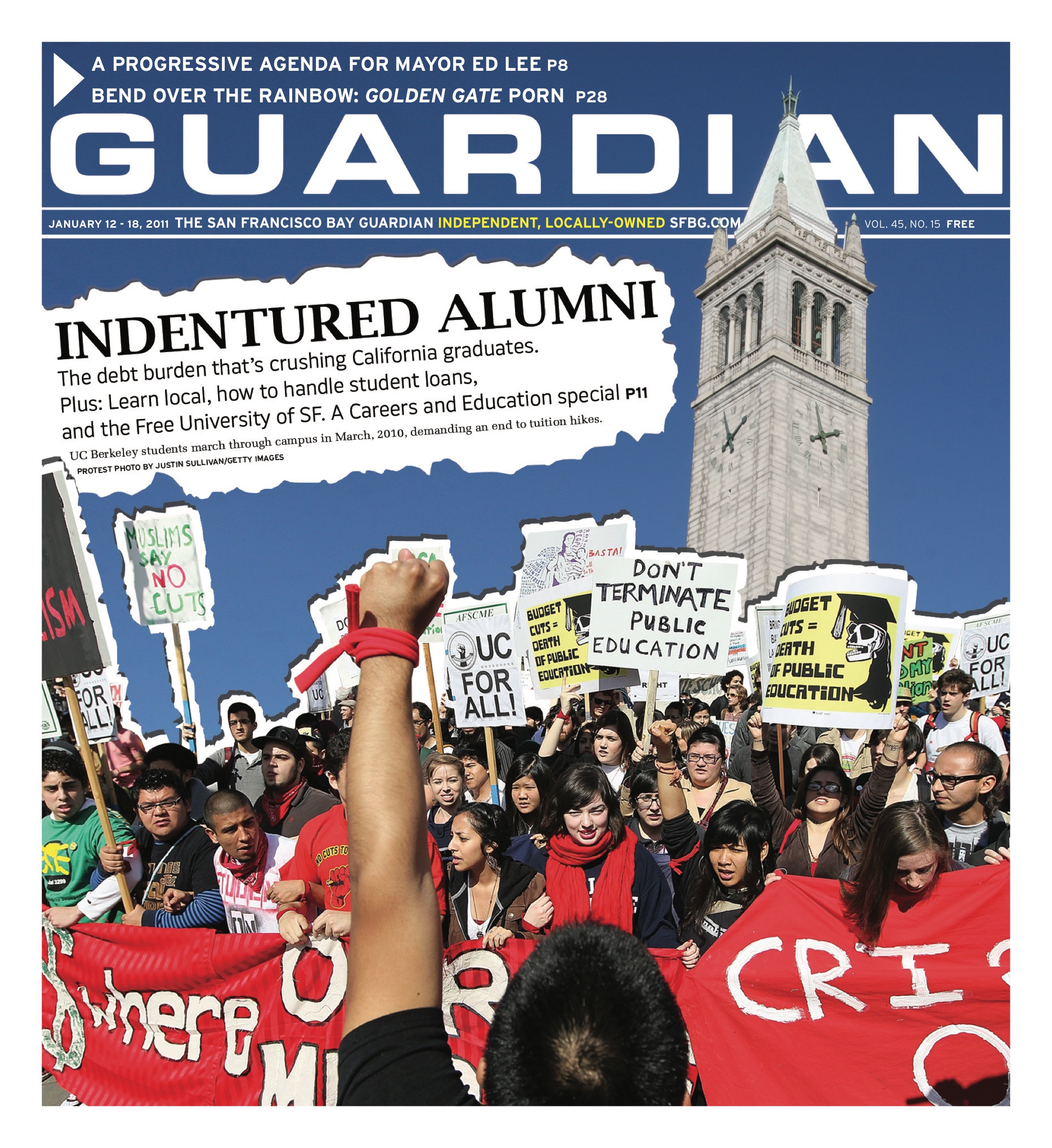
CAREERS AND ED In this weeks’ issue, Rebecca Bowe examines rising tuition and its effect on this generation of Californian students. Here, we profile three scholars that are dealing with very real repercussions from their student debt load.


BEN GLEASON, 31

Mills College, teaching credential

Oberlin College, American literature major

Total debt: $25,000

Ben Gleason remembers the day that he applied for his $10,000 student loan from Citibank to finance his teaching credential tuition. “I got it done online within a half hour. I didn’t have to talk to anybody or write an essay — easy money with severe consequences.” The consequences of such a serious financial decision — sans the aid of any counseling from either his school or bank? Gleason’s eventual decision to leave classroom teaching.

It’s not an uncommon story for this generation of teaching school graduates, in a state where teaching salaries are hardly keeping pace with rising tuition. Gleason started working as an ESL teacher in Richmond’s underfunded West Contra Costa Unified School District right after graduating from Mills College. His student loans were overwhelming — a problem that was exacerbated when he took a trip to Guatemala to work and improve his ability to communicate with his Spanish-speaking pupils. To remain afloat financially, Gleason applied for a forbearance on his loans and was surprised to return home after two years to a loan that had gone up by 25 percent due to interest. “I was really, really screwed,” he recalls.

Gleason didn’t feel like there was any way he could go back to his teaching salary, so to support his new wife (the two met in Guatemala) and daughter, he decided to start his own business with the help of an old boss — a private firm that helps reeducate state government workers on sustainability issues.

That means one less qualified teacher for low-income Californian children. And Gleason still has 15 to 20 years left of debt payments. “I wish that there was a more systemic way to solve this problem,” says the former public educator.


ANNE MOSTAD-JENSEN, 28

Santa Clara University, law degree

College of St. Catherine St. Paul, library sciences

Concordia University St. Paul, international studies and history major

Total debt (estimated at graduation): $120,000

Anne Mostad-Jensen and her twin sister grew up in a small Minnesota town. They attended the same college, Concordia St. Paul, where they both majored in history and international studies. After that, they went on to College of St. Catherine (also in St. Paul) to get their master’s degrees in library science. But then their paths diverged. Her sister traveled to Denmark in pursuit of her Danish citizenship — their father is Danish — and was able to complete her master’s in a country where the government pays for most of its citizens’ educations. Mostad-Jensen remained in Minnesota, to continue on in the American university system.

What kind of difference has the move made in these women’s lives? Try $65,000 of student debt. That’s because Mostad-Jensen’s sister, even after completing her master’s and attending one of the Icelandic languages programs she’s currently applying for, will only owe roughly $55,000 worth of loans — all from her time at American schools. Mostad-Jensen, who is now attending law school at Santa Clara University, will owe $120,000 by the time she graduates. “I’ve never had any consumer debt, but I’ve always told myself not to pass up educational opportunities just because I didn’t have the cash on hand,” she says.

Mostad-Jensen wants to work at the intersection of international copyright and technology law, possibly in a law library, a specialty career that benefits from degrees in multiple areas of study. She counts herself lucky that homeownership and a family aren’t her immediate goals. “Having a family — I just don’t understand how people do it with debt these days.” Her Midwestern community values come to the fore when she talks about the U.S. government’s inability to provide Americans with affordable education. “Isn’t the government an extension of the community? Europeans, the lack of stress they have by not having to pay out of pocket for health care and education — I mean they can actually live their lives.”


RAMON QUINTERO, 32

UC Berkeley, geography major

Total debt: $25,000

Ramon Quintero is a UC Berkeley student activist, but he wasn’t always radicalized around debt issues. “I didn’t come to Berkeley because of its activist reputation. I became an activist because of my situation,” he says. Quintero could no longer pay for his student housing and wound up living in his 1979 Toyota truck with camper shell on the streets of Berkeley, sending his baby daughter home to live with her grandmother.

Quintero came to Berkeley via Southern California, where his family landed after immigrating from Sinaloa, Mexico, when he was 11. He attended community college to get his core credits before coming to Berkeley, where rapidly rising tuition fees are putting a strain on the student community. Although he is a legal resident, Quintero was especially concerned about the effect that the rising cost of education was having on undocumented students.

And, of course, on his leaky camper shell roof. He sprang into action, driving a truck that he calls Santa Rita, to all nine UC campuses, encouraging fellow students to paint art on it that spoke to their concerns for the future of public education. Quintero was arrested twice for his roles in campus protests and he and Santa Rita were profiled in The New York Times and several California newspapers. Suddenly, the university found space for him in student housing.

“I saw the hypocrisy in the system,” says Quintero, who has fulfilled all his UC coursework for graduation but has convinced a professor to hold credit for one of his courses for another semester so he could go on a research fellowship to Madrid. The fellowship, he says, is crucial for his application to grad schools — another step toward fulfilling life goals he doesn’t think would be possible if he has to begin assuming the burden of his student debt. 


Alerts

0

alert@sfbg.com

WEDNESDAY, JAN. 12


Bradley Manning rally

Take the streets to protest the Berkeley City Council for backing down on plans to demand the freedom of Bradley Manning, the U.S. Army soldier imprisoned for exposing U.S. war crimes in Iraq by allegedly leaking documents to WikiLeaks. Legendary whistleblower Daniel Ellsberg speaks.

11:30 a.m.–1:30 p.m., free

Berkeley Old City Hall

2134 MLK Jr. Way, Berk.

THURSDAY, JAN. 13


Free the Hikers benefit

Lia Rose, a former classmate of one of the hikers still held hostage in Iran, chose to make her album release show a benefit to help free Josh Fattal and Shane Bauer. Joining her on stage will be Tim Marcus and Andrew Macguire, among others.

9:30 p.m., $12 (proceeds benefit Free the Hikers)

Roxie

3117 16th St., SF

www.roxie.com


Fiery Feminists of Color

Join Radical Women and the editors of Shout out! Women of Color Respond to Violence, as they discuss and analyze the violence against Native American, South Asian, and Afghan women. A winter buffet with a vegetarian option will be served.

6:15 p.m., $7.50 suggested donation

New Valencia Hall

625 Larkin, Suite. 202, SF

www.radicalwomen.org


Protesters fundraiser

Help JR Valrey and Holly Works, the last two of the Oakland 100 (those arrested during the protests following the murder of Oscar Grant last year) raise legal defense funds for their upcoming trials.

7 p.m., $10–$1,000 suggested donation

Black Dot Café

1195 Pine, Oakl.

SUNDAY, JAN. 16


Arrested protestors hearing

Show support for the dozens of protesters arrested at the recent rallies demanding justice for Oscar Grant as they attend their hearings.

9 a.m, free

Wiley M. Manuel Courthouse, Dept. 112

661 Washington, Oakl.


Capitalism doc

Richard Wolff explains in his documentary, Capitalism Hits the Fan: The Global Economic Meltdown and What to Do About It, how deep economic structures contributed to the global financial crisis and several depressions and recessions over the last 75 years.

7:30 p.m., $12 advance ($15 at the door)

Berkeley Hillside Club

2286 Cedar St, Berk.

www.hillsideclub.org

MONDAY, JAN. 17


Protest SFPD actions

Protest the San Francisco Police Department’s treatment of the disabled and people with mental health issues. Meet outside the SF Behavioral Health Center — where SFPD recently shot and killed a mentally disabled man in a wheelchair — and march to City Hall where a rally with speakers will be held by the Polk Street entrance.

12–3 p.m., free

Meet at 10th and Howard streets, SF

djasik87.9@gmail.com

TUESDAY, JAN. 18


Reigniting the Climate Justice Movement

Join environmentally focused nonprofits from around the Bay Area as they discuss climate change and what to expect in terms of U.S. legislation after the recent international climate negotiations in Cancun.

7 p.m., free

David Brower Center, Tamalpais Room

2150 Allston Way, Berk.

(510) 486-0286 

Mail items for Alerts to the Guardian Building, 135 Mississippi St., SF, CA 94107; fax to (415) 437-3658; or e-mail alert@sfbg.com. Please include a contact telephone number. Items must be received at least one week prior to the publication date.

Beyond Berlin and Beyond

0

arts@sfbg.com

FILM In 1996 Ingrid Eggers cofounded Berlin and Beyond, that annual Castro Theatre showcase for all things celluloid (or digital) and German-language. Fourteen years later she retired from the San Francisco Goethe-Institut after two decades of service. B and B soldiers on without her, but Eggers now has her own weekend-long independent festival at that same art-deco movie palace.

Why a second S.F. German language film festival? “Because I think that German films are not really well-represented in the various film festivals in the Bay Area, especially not in the [San Francisco] International [Film Festival],” she says. “There was always a focus on French films, particularly under [ex-SFIFF chief] Peter Scarlet. We had French and Italian film weeks, but nothing German. The other thing is that with Berlin and Beyond having a [current] director who is, I guess, going into a more international direction with lots of coproductions, I think there are enough films that come from Germany that deserve an audience here.”

German Gems part zwei is hella heavy on debuts — six out of 10 features — which Eggers says “wasn’t intentional, but came about because lots of the bigger productions are very expensive [to book] these days. It’s not unusual to pay 1,000 euros for a single screening.” Plus, Germany is admirably generous when it comes to funding not just film production, but film schools and graduation feature projects.

One such gem showing this weekend, Philipp J. Pamer’s two-hour-plus Mountain Blood, is the sort of thing even veteran commercial talents might have a hard time getting bankrolled. It’s a 19th-century epic shot high in the Tyrolean Alps, involving romantic and military intrigue between sophisticated Bavarians and rough-edged Tyrols during a period of attempted French occupation. Eggers allows that kind of budgetary challenge would be “unheard of here for a first feature, but in Germany you can pull it off.”

Opening the festival is a movie by one far-from-new director. A quarter-century ago Percy Adlon (another Bavarian) ruled the arthouse circuit with Zuckerbaby (1985) and Bagdad Café (1987). There followed a gradual slide into obscurity suggesting Adlon wasn’t a maturing talent so much as a permanently immature one who got lucky a couple times early on.

Yet his Gems-launching historical fantasia Mahler on the Couch is wise, antic, over-the-top, and controlled. It portrays last-great-musical-Romantic Gustav Mahler (Johannes Silberschneider) as a neurotic egomaniac driven to the upholstery of Sigmund Freud (Karl Markovics) by worry over the professed infidelity of spouse Alma Mahler (Barbara Romaner).

This Freud is sometimes harshly insightful, to Gustav’s frequent distress. Yet this very trickily structured, farcically winking, incongruously picturesque film is less concerned with either of them than horny, tempestuous Alma — “the most beautiful girl in Vienna, from a good family, and very rich.” How disappointing, then, that she spends most of her adult life as wedded servant to a cultural behemoth. She, too, wanted to make music. But even had she turned out something well short of a genius in that regard, Adlon (cowriting and codirecting with son Felix) sympathizes with the fact that she was never allowed to discover that for herself.

Other German Gems highlights include Ina Weisse’s black comedy The Architect, in which a jaded, dysfunctional nuclear unit travels to an ancestral hamlet for a matriarch’s funeral and promptly falls apart in all kinds of unpredictable ways. Another bad dad is the subject of Lara Juliette Sanders’ documentary Celebration of Flight, about a 78-year-old ex-pilot and amateur airplane builder living on a Caribbean isle — though the film is too shy about probing the estranged family he’s basically exiled from. David Sieveking’s non-aerial nonfiction David Wants to Fly finds the incessantly onscreen director seeking an artistic father-mentor in David Lynch, though this patriarchal worship is soon torpedoed by the director’s skepticism toward his idol’s favorite cause, Transcendental Meditation.

Elsewhere, Thomas Stiller’s She Deserved It offers lurid teenage-bullying moral instruction à la Larry Clark, without the graphic sex. Andreas Pieper’s Disenchantments interweaves four stories about variously unhappy Berliners coping with “the dialectics of enlightenment.” (Now that is German.) For some welcome absurdism, there’s Björn Richie Lob’s Keep Surfing, which is Cali fragi-licious: its real-life subjects ride stationary river waves in the middle of Munich, which is like “water skiing in a wind tunnel.” Cowabunga, freunde!

GERMAN GEMS

Jan. 14–16, $11–$20

429 Castro, SF (415) 695-0864 www.germangems.com

The music library

1

arts@sfbg.com

MUSIC “They wanna give you it all at the library.”

Dade Elderon’s come up with a perfect promotional catchphrase for the SF Public Library’s Main Branch. We’re IMing about the library, where he sets up his gear and writes and records songs on a 9-to-5 schedule. “One part of the library is a very high-tech, clean learning environment. It’s a temple. Then you go down to the [first-floor] bathroom and it’s like a dirty, filthy circus. There is a lot going on in that bathroom. Every stall is a different challenge.”

A few days later, I meet Elderon on the library’s fourth floor. As is his practice, he’s reserved one of the private rooms and has set up his equipment, most notably a Korg Electribe EMX-1 and ESX-1. “This is what I bring to the library — I have a [Roland] TR-606 and other gear at home and at a friend’s house,” he says, handing me a spare pair of headphones. “I use this [the ESX-1] strictly as a drum machine, and load up different sounds depending on what kind of song I want to make. I program the melodies on the EMX-1 because if you run too many parts at once on the ESX-1, it will make the sound muddy.”

For the next half-hour, Elderon — long bangs spilling out from the right side of his SF Giants cap — gives me a brief tutorial, explaining polycyclic wave forms, saw waves, and different hi-hats while running through a variety of sounds, from hip-hop to trance to freestyle. Sitting with him, I can see how the room, with its soundproof clear glass and stylish card-catalog wallpaper, is an ideal readymade recording studio. “I really like the tables and the glass setup,” Elderon says. “It’s peaceful. Sometimes people will stand outside with a ‘What are you doing?’ look on their faces, but I just ignore it. I don’t know what people might think these things [the Electribes] are — some people are suspicious of them, maybe.”

Contrary to a paranoiac’s sense of appearance, Elderon isn’t working with explosives, though he is hoping some of his projects will blow up. Party Effects, the Oakland techno bass crew he helped figurehead, has disbanded, and these days he’s working with a number of different recording artists. “This is a track I’m making with Dz MC’s, a Brazilian freestyle singer,” he says, as a percolating, skittering melody dances around a haunted-sounding female vocal.

Along with Dz MC’s, who has a following in Brazil, Elderon has been making tracks with aspiring Stateside singers such as Gloria Hernandez, a local vocalist whose voice possesses freestyle-ready sass and snap, and Nikki Marx, whose sexy photos and real-life story have intrigued Elderon and his roommate and former Party Effects partner, Alexis Penney. “She’s German, lives in New York City, and works on Wall Street as a day trader,” Elderon explains, as we look at some of Marx’s provocative photos. “Alexis is obsessed with her, and we can’t figure her out.”

At the moment, Elderon is also in the early stages of some remix projects for 679 Artists, a Warner Music Group label based in London that represents Little Boots, Marina and the Diamonds, and Streets. Along with his other roommate, Myles Cooper, he’s also contributing a track to an upcoming album by H.U.N.X., the “gayest music ever” electropop side project of Hunx and His Punx’s Seth Bogart. “I guess Myles’s idea is to make the most annoying song anyone has ever made, and I think he’s doing it,” Elderon says appreciatively. “Seth and I are making a gay freestyle song. He wants it to be over the top. I sampled him making a bunch of sex noises, and I’m going to sprinkle them throughout the track.”

Elderon’s adept way with genre suits one of his recording monikers, Adeptus. He chose the name because — along with invoking “to attain” in Latin, a quest he likens to Afrika Bambaataa’s search for the perfect beat — he likes its “Gothic, occult, and dark-sounding” qualities. On the one hand, he’s a fan of Ace of Base’s 1990s Euro dance pop — in fact, he’s competing against eight other remixers in an Ace of Base-sponsored contest in which the person who comes up with the best mix of “The Sign” wins a car. But on his own tracks, he’s drawn to seductive somber sounds. As he puts it, “I’m attracted to minor scales.”

The public library as a recording studio and potential pop gold mine — it’s all in a day’s music-making for Elderon, who cut his teeth recording with the eccentric, literally offbeat Tarythyas in Party Effects. “His bedroom is the craziest room I’ve ever been in,” Elderon says, when asked to describe Tarythyas’s home dwelling. “There’s no less than 20 to 30 fish tanks in the room, all lit up. There are crazy toys and lights everywhere, and six different computer workstations.”

The strange is familiar to Elderon, whose past includes a military stint and studies in cellular microbiology, and whose current day job involves flying to Turkey once a month to rescue street animals for a fledgling animal-rights crusader in Beverly Hills. He shows me some passports of pets he’s recently flown back to the U.S., including a cat that possesses a mack’s satisfied smile. “The animals freak out on the plane, so they give me a ketamine spray,” he says.

For now, Elderon is the one traveling, but he’s hoping his music will be going international soon as well. At one point he describes Turkey as a “nexus of weird cultures,” and the same description could be applied to his music, which has pop immediacy, but allows room for wild personality. He’s out to attain something special, and it’s just beginning to materialize.

Going commando

0

CHEESY, SLEAZY CINEMA Last year found Jack Abramoff a peculiarly hot commodity at the movies, especially if you consider he spent most of the year in federal prison and hadn’t exercised his own Hollywood ambitions in nearly a quarter-century.

But then his recent on-screen exposure was not of an ilk he’d have chosen for himself: as subject of a documentary (2010’s Casino Jack and the United States of Money) and biographical drama (plain Casino Jack, also 2010) both depicting the now-infamous Washington, D.C., lobbyist as personification of that Shrub Era conservative jingoism, corrupt backdoor business deals, egomania, and greed that helped land us in our current economic craphole. And which got him four years, ending last month even as former Republican House Majority leader and BFF Tom DeLay faced the start of his own money-laundering slammer stint.

Abramoff was not likely to have enjoyed either portrait, not even as semi-sympathetically (albeit poorly) portrayed by Academy Award-winning thespian Kevin Spacey in the weaker film. If he’d been able to invent his own starring vehicle, no doubt it would have been more a flatteringly bold cross of 1987’s Wall Street (the Michael Douglas part), 1960’s Exodus (the Paul Newman as he-man crusader for Israel part) and 1980s Rocky-Rambo Stallone (the whole enchilada, from bulging biceps to rippling Old Glory and Commie-wasting weaponry). In the Reagan America of his physical if not yet political prime, he really was a bit of all those things: bodybuilder, Zionist, rabid anti-Red.

Whether he ever harbored dreams of being a celluloid hero, or was always content to become a real-life Supermensch, Abramoff did once make a movie — exactly one — exemplifying his beliefs and self-image in suitably cartoonish fashion, before realizing Hollywood’s corridors of power were puny game for a real man. So he moved on to the more hallowed halls of D.C. and Manhattan. But first, there was Red Scorpion.

This 1988 actioner starred 6-foot, 5-inch Swedish meatball Dolph Lundgren, hot from playing the robo-Russkie villain in Rocky IV (1985) and He-Man in Masters of the Universe (1987), as a “perfect killing machine” sent by evil Soviet commanders to assassinate a resistance leader in a fictive African nation under the thumb of Communist oppressors.

Tending not to play well with others, Lt. Nikolai Rachenko spends his first night here in jail for “disorderly conduct” — after a few drinks he’d kicked open a saloon door, beat up half the patrons, and machine-gunned the joint. Boys will be boys. He shares a cell with a local freedom fighter (Al White) and an American reporter (M. Emmet Walsh at his formidably most-obnoxious). For no obvious reason our steroid miracle of a KGB enforcer decides moments later to switch sides and help them escape. This effort requires killing about a million extras playing Russian and Cuban military occupiers to the tune of Little Richard’s “Good Golly Miss Molly.” (Because nothing says “Democracy rocks!” like the orgasmic trills of an African American queen.)

Slowly-dawning ability to feel empathy for suffering peoples indicated by the heavings of his perpetually oiled torso and completely unintelligible mutterings, Nikolai is recaptured by former masters and made to endure homoerotic torture. He escapes again, staggering through the desert alone, shirtless and shiny. Bushmen rescuers teach this Golden Bwana something or other — like Billy Jack, he sweats, grunts, and hallucinates toward enlightenment — and give him a scorpion tattoo as diploma.

Now armed spiritually as well as abdominally to do good, his reappearance in civilization spurs Walsh to call this juiced Russki “the gutsiest goddamn sonuvabitch I ever met.” (Arne Olsen’s screenplay, from the brothers Jack and Robert Abramoff’s story idea, is seldom even this articulate.)

The climactic triumphant popular uprising at one point hinges on Lundgren lifting a truck out of a sandtrap with his bare bulging guns, a bit included purportedly because Jack Abramoff was an iron-pumping addict himself at the time. (What makes the scene funnier is that it evidently occurred to no one that Nikolai’s load would be lightened if Walsh got his fat ass out of the truck cab for a minute.)

A movie rife with bad dialogue badly spoken — you’ll gulp as White seemingly enthuses “When we arrive there will be a celebration and much fisting!” — ends aptly with the worst pronunciation ever of “Fucken’ A.” Our heroes are then freeze-framed while strolling over another umpteen freshly killed Commies.

Red Scorpion was shrugged off as what it basically was, yet another Rambo ripoff arriving toward the tail end of that subgenre’s lifespan. (A theatrical flop, it did well enough on tape and cable to prompt 1994’s in-name-only sequel Red Scorpion 2, on which the Abramoffs got executive producer credits.) There certainly are more cheap, inept, laughable, senseless, just plain dumb films of its ilk — though this one does excel at dumbness — and unlike many it does have one good joke, involving a grenade and a decapitated hand. Otherwise, if not for its primary motivator’s subsequent antics, Red Scorpion would be just another forgotten B-grade cultural relic.

But the Beverly Hills-raised Abramoff — who spent the earlier part of the 1980s as an aggressive far-right youth activist — intended this first-last cinematic venture as a stealth combo of dynamite popular entertainment and anti-Red Menace propaganda. He modeled the character of “Mombaka’s” resistance savior Sundata (played by Ruben Nthodi) on real-life Angolan anti-Marxist rebel warlord Jonas Savimbi, a darling of later Cold War hawks. (Others would soon call him “a charismatic homicidal maniac.”)

It is still debated whether Red Scorpion‘s $16 million budget was secretly funded primarily by the South African government and/or military. Abramoff denies it — though he had already spearheaded support of the apartheid regime as College Republican National Committee chairman and founder of the dubiously named think tank, International Freedom Foundation. In any case, once protestors got wind of the production shooting in South Africa-controlled Namibia — defying an international boycott — a skittish Warner Bros. pulled out as distributor. (Scorpion was then picked up in the U.S. by Shapiro-Glickenhaus, who later gave us 1990’s Frankenhooker and 1992’s Basket Case 3: The Progeny.)

The shoot was fraught. Some actors and crew complained they were never paid; production was suspended for three months when money ran out; star attraction Lundgren was apparently quite the hulking handful on and off set. Afterward, Abramoff — who’d converted to Orthodox Judaism at age 12 after seeing Fiddler on the Roof (1971) — blamed the film’s potty-mouthed and violent excesses on director Joseph Zito (of future Tea Party fan Chuck Norris’ own 1985 anti-Commie classic Invasion U.S.A.) He founded something called the Committee For Traditional Jewish Values in Entertainment as penance.

That noble latter endeavor was abandoned about five seconds later, however, since by then Abramoff realized he had better things to do than mess around with pansy-ass showbiz. Among his future, better-known achievements — the ones that got him top billing as Inmate 27593-112 — were bilking casino-owning Native American tribes, keeping third world factory sweatshops safe from investigation, pimping Congress to myriad corporations, and otherwise pedaling corruption ’round the globe, all while clutching family values and raving against the Godforsaken liberals. He was ever so righteous about doing wrong.

Today, he’s free, if uncharacteristically silent, having finished both his hoosegow stint and a halfway-house stay during which he worked for below minimum wage at a Baltimore kosher pizzaria. One suspects he will not be flippin’ pie in the future, however. Sibling Robert Abramoff is still in the biz, producing such fascinating-sounding recent projects as 2009’s Pauly Shore and Friends, 2009’s Jesus People: The Movie, and 2010’s Dino Mom.

Lundgren, recently looking fine (if downsized) in 2010’s all-star Expendables, now directs his own direct-to-DVD action vehicles. Still fighting the good fight, alongside Israeli special forces and South African mercenaries, Savimbi died in a hail of machine-gun fire eight years ago. That event helped end Angola’s civil war after nearly three decades. And Red Scorpion lives on, more or less. I found my used VHS copy at Rasputin Music for 50 cents. Fucken’ A!

Light fantastic

0

arts@sfbg.com

VISUAL ART/MUSIC Suzy Poling greets me by the half-open front gate of Queen’s Nails Projects and hands me a Sapporo tallboy. It’s freezing outside, and not much warmer inside. And dark. But not for long: within moments, she’s turning on a projector at the top of a tall ladder, running tape through a bulky Pioneer tape deck on top of a giant Moog, and spinning transparent mobiles that are suspended from the spaces’ ceiling, all while explaining her thoughts on making art and the ideas behind her current show, “Zone Modules.” Analog sound growls like an electric beast. The big square room expands to an outer space with rough edges, as projector light refracted from glass and mirrors floats like electric stars across a gray-silver moon on one a wall.

“I think I’m into it,” Poling wonders out loud, looking at the wall fixture. “In this exhibition, there’s an overall idea of future decay.” She’s telling the truth, not spinning an artist’s statement, and yet there’s also a current of energy and motion coursing through the room. At a certain point I realize that things are moving all around me, including behind my shoulder, a corner-of-the-eye feeling that is disconcerting and exciting — in terms of immersion, it evokes Bruce McClure’s and Anthony McCall’s explorations of live cinema, or an inverted version of the effects created by Yayoi Kusama’s infinity rooms. “I think people want to get in touch with infinity rooms [right now],” Poling agrees, when I mention Kusama. “It makes sense to get in touch with the planet we’re on and everything around it.”

This is just the beginning of “Zone Modules,” and just a hint of the constantly intersecting sonic and visual energies at play in Poling’s broader art endeavors, a growing and morphing constellation that connects colorfully primordial photos of geysers to layered, artificial experiments in grayscale. We walk to the next room, a small black space with an old black-and-white television in one corner tuned to an eternal 1920s movie dreamscape. “Everyone really liked this room for some reason [at the opening],” Poling says with a shrug, as swirling fog gives way to a close-up of a cut jewel on the small screen. “It’s like hanging out in a black room with a boob tube — it’s a classic hypnosis.”

The relaxed humor and pleasure in this room, though “experiential,” as Poling put it, is not common in today’s art world. It puts me in mind of Cary Loren, a friend of Poling’s from Detroit (and a member of the influential noise band Destroy All Monsters), whose viewpoint possesses a similar enjoyment of pop culture mutation — one that’s not kitschy, but imaginative in a raw, imperfect, individual manner. Poling’s years growing up and exploring the abandoned spaces of Detroit and then Chicago are central to what she’s making today. “It’s so cold and there’s some strange individuals there,” she says affectionately, when I bring up the Midwest. “I drew a lot of my inspiration from the Congress Theatre, this old movie palace from the 1920s on Milwaukee Avenue. I used to live inside it. I started [ the musical project] Pod Blotz there, because I could bring an organ up onto the stage.”

For around a decade, Poling has lived in Oakland, perhaps the closest thing that California has to offer to those kinds of urban autonomous zones. As we move to another room in “Zone Modules” and she talks about a geometric costume she used to wear to early Pod Blotz shows — “I thought, ‘I love theater of Bauhaus, I love Dada, I love the Vienna actionists, and I’m going for this !” — I’m struck by the unashamed enthusiasm for different periods and styles of art, some outre or out of fashion, within her work. To say it’s refreshing in these jaded times would be an understatement. But this isn’t naïve art — it’s gradually formulating a personal vision informed by everything from optics and opthamology to Russian avant-garde posters. “I’m not going to deny these things — I like [Laszlo] Moholy-Nagy!,” Poling exclaims at one point.

“I could reinstall this installation a bazillion different ways and it would always be different,” Poling says, as a characterful projected object darts like a dragonfly around the corner of an adjacent room. Not all artists could make such a claim, and fewer still could say it and have the idea be exciting. Poling credits the endless potential for combinations present in “Zone Modules” to curator Julio Cesar Morales’s insights about what to leave out of the show, but I think it also has something to do with the her experiences collaborating with artists on an international scale, and her kinship with them. Along with her best friend Kamau Patton, she was part of Official Tourist, an artist group that included members from Bosnia and Japan. “I’ll relate to a friend in Belgium in Dolphins into the Future who makes psychedelic spacey new age music,” she says, when talking about the music of Pod Blotz. “But then I also really relate to Haters in Los Angeles. They make totally different kinds of music, but they have a deep respect for each other.”

In the back room of “Zone Modules,” Poling’s paintings — which layer paint over vinyl and and paper to create interruptions in form and shape — share space with geometric sculptural and light experiments. I stare into the triangular eye of a metallic sculpture in the center of the room and through a tetrahedral passageway, spy another trangle, this time painted. “I like having the ability to just go into making art with people,” Poling says. “That feeling that the creation station is out there.” 

SUZY POLING: ZONE MODULES

Fri.–Sat., 11 a.m.–6 p.m.

Closing performance with Death Sentence: Panda, Chen Santa Maria

Fri/7, 8–11p.m.

Queen’s Nails Projects

3191 Mission, SF

www.queensnailsprojects.com

Boogie blows up

2

“It was an honor to be a part of history. The rest is history.” Spray paint artist Chor Boogie (www.chorboogie.com) is hanging out amid spurts of December rain in Clarion Alley, standing before his mural debut in the heralded Mission community art space. But he’s talking about a different piece, on a different chunk of creative community space, in a city halfway around the world: The Eyes of the Berlin Wall, which Boogie painted on an actual section of the Berlin Wall and was reported to have sold for 500,000 euros this fall.

The real story is a bit more complicated — and perhaps speaks to the uncertain position in which street art finds itself. After all, we’re at the close of a few years of pop culture re-ascendance, during which Banksy made a stencil art photographer of every major city tourist and that are ending with Brazilian muralist Blu’s commission of a massive mural facing a World War II memorial by Los Angeles’ Museum of Contemporary Art that was subsequently whitewashed when he painted a wall of coffins draped with dollar bills.

What is street art’s role today? A form once used by inner city youth to reintroduce their stifled voices into their surroundings is now heralded in the upper echelons of the art world and hipsterdom alike. Still, many so-called street artists are getting stuck in stale, reductive modes of being presented to the public — stale because many do public art as a form of getting known, fluidly moving back and forth between the corner and the gallery. What are we to call these artists?

I know one name for them: Chor Boogie. After a tough youth spent tagging in San Diego, Boogie, borne on the wings of a technique and style that pushes the capabilities of the aerosol can (he never paints without it) has achieved artistic notoriety. His low pressure, inverted style of spraying and rejection of stencils and other tools gives birth to kaleidoscopic psychoscapes — but why don’t we let Boogie describe Boogie?

“A surrealistic expressionism of a street romantic voodoo. Emotional landscapes of a melodic symphony through color therapy — that’s my style in a nutshell,” he tells me, pointing up at the twisted face-in-purgatory that he recently completed in Clarion, a piece that extends a full foot above the boundary delineated by the alley’s mural collective and onto the high priced condo above.

Boogie has painted at the Beijing Olympics, done portraits for Hugh Hefner and Jay-Z, has vast, stained glass-cosmos murals all over town, and gallery shows up and down the coast. His name gained widespread recognition when some kids tried to steal a few of his cans while he painted a Market Street mural in late 2009. He chased them into a dark alley and was stabbed twice. “I didn’t feel it at all because I was drawing,” he says, despite one wound landing an inch from his lower intestine.

His distinctive style may have been what drew the fateful attention of Patrice Lux at Berlin’s Stroke Urban Art Fair. For two days, the German art collector had scrutinized Boogie while painting at his festival booth. Boogie had no idea who the guy was. “He was studying my every move — finally, he walked up to me, asked me what my name was, and asked me if I’d like to paint the Berlin Wall. He took me up to his studio and he had a piece of the wall with Michael Jackson painted on it. I was like, ‘You want me to paint over that? Because I will!’ I think he thought it was kind of cool to have an American artist painting over this American pop star.”

Boogie was signing up to paint on a piece of graffiti history. When first erected, artists came from around the world to cover the western side of the wall in color, often working under the ominous gaze of East Berlin patrollers who kept the eastern surface sterile. “Artists risked their lives painting that wall. You went there at night and painted quickly,” says James Prigoff, an international street art photographer.

But by his visit in 1985, Prigoff was underwhelmed by what he saw. “It had become a funny zoo,” he remembers, tourists gawking at East Berliners and tagging the wall with shout-outs to relatives in Des Moines.

Although Keith Haring and Quick subsequently created memorable pieces on the wall, Prigoff thinks the site’s sociopolitical significance has shrunk. “Chor Boogie is a great artist, he deserves all the attention he gets. But [his painting on the wall] doesn’t do anything for me in the context of art. There are a lot of walls in the world, and that’s just one of them.”

Not everyone agrees. Lux tipped off Die Bunte Zeitung, one of Berlin’s major newspapers, that he would be looking for 500,000 euros for the piece of the wall Boogie had painted — dwarfing sales of individual wall pieces in the past. The day after the article ran, they had an offer. The piece still wasn’t finished. After that, Boogie had an audience of 100-plus people watching him complete his cash cow.

Back in San Francisco among the streets he’s helped to make more beautiful, Boogie’s not sure what’s going on with the deal — and perhaps almost as important, all that cash — vagaries of “contracts and commissions,” he says. Improbably, he’s washing his hands clean of the matter, for now.

“What’s the next one?” He smiles, possibilities dancing across his face. “The Great Wall of China!” He’s joking, but the future for Boogie — and street art in general — will invariably include larger canvasses. 


CHOR BOOGIE’S URBAN OSMOSIS NYE OPENING PARTY

Fri/31 7 p.m.–late, free

Space Gallery

1141 Polk, SF

www.spacegallerysf.com

Does Mayor Newsom represent SF workers or San Mateo politicians?

2

“Does Newsom represent local workers or San Mateo politicians?” That’s the question being asked  at City Hall today. And it’s threatening to deliver an unwelcome kick to Mayor Gavin Newsom on his way out of City Hall’s revolving doors, as dozens of unemployed construction workers deliver 1,000 Christmas cards that residents of Bayview Hunters Point, Chinatown, the Mission, the Tenderloin and South of Market have signed. The cards urge Mayor Gavin Newsom to “put the Merry into Christmas and the Happy back into New Year” and sign local hire law that the Board passed a week ago.

This special holiday season delivery has been in the works since Dec. 14, when Bayview-based job advocates Aboriginal Blackmen United (ABU) tried to meet with Newsom and get his signature on legislation that a super-majority on the Board support.

But after Newsom was a no-show and his chief of staff Steve Kawa refused to give ABU any assurances, community advocates Brightline Defense Project printed up a thousand of the cards urging Newsom to “put the Merry into Christmas”. And Brightline, ABU, Chinese for Affirmative Action, PODER, and the A. Philip Randolph Institute then asked unemployed workers, activists, and concerned citizens to sign this unusual set of greeting cards.

The move comes a day after the San Mateo County Board of Supervisors voted unanimously to urge Newsom to veto Avalos local hire policy. Local hire advocates suspect this counter-move was orchestrated to give Newsom political cover, should he choose to make the seemingly Scrooge-like move of vetoing, just before the holiday season, legislation that would help San Francisco residents secure work on billions of dollars worth of local tax-payer funded construction projects .

But the San Mateo supervisors claim that San Francisco’s plan, which would mandate that 50 percent of workers on city-funded projects are local residents, threatens to hurt an already sluggish regional economy.

“This is not the time to put isolation around a community,” San Mateo Sup. Carole Groom reportedly said at a hastily convened Dec. 21 special session.
 “If this is rejected, it would be time for all of us to sit down and talk about this,” fellow San Mateo County Sup. Adrienne Tissier reportedly said.

Newsom has until Christmas Eve to either sign or veto the law, though the Board can still override his veto, provided Avalos still has eight votes in the New Year. And if Newsom doesn’t sign or veto the law by week’s end, it will go into effect in 60 days.


San Mateo officials are arguing that the local hire legislation particularly impacts their county, because the law contains a “70-mile” clause that includes the San Francisco Airport, the Hetch Hetchy water system and the San Bruno jail.

Sup. John Avalos previously told the Guardian that project labor agreements protect workers at the airport and working on projects that the San Francisco Public Utilities Commission funds. But Tissier reportedly claimed that San Francisco’s local hire policy would kick in, once new contracts are negotiated.

Reached by phone, Avalos said it’s not clear if the San Mateo supervisors have actually read his legislation
‘If they had, they’d see a lot of ways that is supports San Mateo workers,” Avalos said.

San Francisco’s local hire legislation, which is the nation’s strongest, requires that 20 percent of workers within each construction trade be local residents starting in 2011. That number increases 5 percent annually for seven years, as local workers join trades where community representation is lacking, before reaching 50 percent. In other words, 80 percent of the workforce could be non-city residents in 2011, and even at 50 percent local hire, half of the jobs will still be available to workers who don’t live in San Francisco.
 
“That’s hardly an exclusion especially when you consider that San Francisco taxpayers are making the investments on these projects,” Avalos stated.
He believes that the San Mateo County Building Trades Council pressured the San Mateo Board to pass their Dec. 21 resolution urging a veto on his measure. Either way,  Victor Torreano, vice president of the San Mateo County Building Trades Council was quoted in media coverage of the Dec. 21 vote, saying, “the need for housing in San Francisco and the Peninsula make it impossible for many blue collar workers from sinking family roots in the area.”

Avalos acknowledges that San Francisco International Airport is in San Mateo County, and its workers understandably wants jobs there,
“San Mateo County has to put up with the sound of the airport, and its residents deserve to have jobs there, but this is much ado about nothing,” Avalos said. “But it’s the Building Trades that are uncomfortable with changing slightly their practices.”

Mike Theriault, Secretary-Treasurer of the San Francisco Building Trades Council, acknowledged that his group has never been pleased with Avalos’ legislation.

“But we are resigned to seeing how it plays out,” Theriault told the Guardian. “We think there are better things they could have done to guarantee access of San Francisco residents to careers in our trades.”

Theriault believes that Avalos may not understand the project labor agreement are of limited duration.
“So, they will require an extension of the existing labor agreement,” Theriault said,  noting the legislation states that future extensions would have to comply with the new law.

But Theriault acknowledged that with or without Newsom, Avalos’ legislation still has a chance to move forward.
“If he vetoes it, I understand that the Board will have another crack at it, Jan. 4,” THeriault said, referring to the current Board’s last meeting in January.
 
The Bay Area Council has also announced its opposition to Avalos’ legislation,
 “This troubling trend of intra-county battles being started by the San Francisco Board of Supervisors needs to stop,: Bay Area Council President and CEO Jim Wunderman said in a Dec. 21 statement. “The Bay Area is one regional economy, not nine island states. We need to focus on nurturing the fragile economic recovery in our region, not setting bad policies that pit county against county.  The Bay Area Council urges Mayor Newsom to veto this foolhardy piece of legislation.  Right now, we do not need any more incentives for businesses to leave any county, the Bay Area, or California.”

But advocates for the legislation note that the San Francisco Controller recently estimated that the law will pump $270 million into the local economy over the next 10 years. They hope Newsom will emerge from his warren-like office today and sign the law, delivering a historic Christmas present to the city’s growing ranks of unemployed workers.


But even if he doesn’t, Avalos isn’t sweating it.


“Newsom probably won’t sign it, and he’ll write a letter saying he’s opposed to it,” Avalos predicted. “And even if the new mayor is [SFPUC director] Ed Harrington, he’s been supportive of the measure. So Newsom has to answer his own conscience and ask himself, if he’s going to represent local residents or San Mateo politicians.”


According to Brightline’s Joshua Arce, ABU led about 30 to 40 workers from Bayview, Chinatown, and the Mission up to Room 200 today to drop off 1,000 signed  cards from residents in every neighborhood asking the Mayor to sign the community’s local hiring law by Christmas.
 
“Room 200 was locked, but we kept knocking,” Arce told the Guardian. “Eventually the doors opened and out came [Mayor Gavin Newsom’s chief of staff] Steve Kawa. We showed him all of the Christmas cards that we had for his boss and he thanked us. Ashley Rhodes of ABU explained that since we heard how much the Mayor liked the ABU holiday card last week, we printed up 1,000 more and got them signed by people from every community in San Francisco.”
 
“We asked where the Mayor was in terms of making his decision, he said that the Mayor was still studying all of the issues,” Arce continued. “He brought up the opposition from the San Mateo County Board of Supervisors, so we asked him to tell the Mayor to support us, the thousands of unemployed and job-hungry San Franciscans, over four San Mateo politicians.”
 
“Steve Kawa said that they will be working around the clock to make sure all concerns are addressed, and we showed Steve a card signed by Sup. Bevan Dufty just moments before we came upstairs,” Arce addded. “Sups. John Avalos and Eric Mar also signed Christmas cards to the Mayor.”

According to Arce, ABU left the two huge Santa bags full of cards with Kawa, who picked them up, commenting “These bags are awfully heavy.” 

“I asked him to make sure to tell his boss that the cards were printed on 100% recycled paper,” Arce concluded. “Let’s hope that Mayor Newsom puts the Merry into Christmas and the Happy back into New Year!”

San Francisco activists denounce WikiLeaks crackdown

3

A small group of protesters gathered outside the British Consulate in San Francisco’s financial district Dec. 16 to speak out against the recent crackdown on WikiLeaks founder Julian Assange, who is out on bail after being imprisoned for nine days by British authorities.

Assange, whose organization recently created an international stir with the release of secret diplomatic cables, could be extradited to Sweden to be tried on sex crimes charges following a hearing in January.

According to a recent New York Times article, U.S. government officials are trying to build a case against Assange for conspiracy. In the wake of the leak, Sen. Joe Lieberman was calling for the New York Times to be investigated for espionage for publishing information provided by WikiLeaks, and last week, a Fox news pundit even said he thought Assange should be assasinated.

Among the small crowd that gathered before twilight were representatives from Veterans for Peace, Courage to Resist, and the Electronic Frontier Foundation.

Rainey Reitman, an activist with the Electronic Frontier Foundation — a legal firm and nonprofit that defended WikiLeaks against a 2008 lawsuit from Swiss bank Julius Baer — called the recent backlash a threat to Internet freedom and freedom of speech.

“Let me be clear. Here in the United States of America, WikiLeaks has a fundamental right to publish truthful political information. And equally important, Internet users have a fundamental right to read that information and voice their opinions about it. We live in a society that values freedom of expression and shuns censorship. Unfortunately, those values are only as strong as the will to support them — a will that seems to be dwindling now in an alarming way,” Reitman said.

Reitman said the case touched on broader issues. “This isn’t just about WikiLeaks. It never was. It’s about the future of the Internet and the future of free speech.”

Among several other speakers, Reitman was joined by Jeff Patterson of Courage to Resist, which has mounted a support campaign for U.S. Army Private Bradley Manning. Manning has been accused of acting as WikiLeaks’ source for 250,000 secret government documents and classified military footage, which has now been made available to the general public.

Patterson noted that the Bradley Manning Support Network had raised $100,000 for Manning’s legal defense. Although many activists have sent letters of support to Manning, who is being held in solitary confinement in a prison outside of Washington, D.C., “the military is rejecting letters pretty much arbitrarily,” Patterson claimed.

To read more about the WikiLeaks saga, check out the blog of the Electronic Frontier Foundation.

Holy high whoreiday

0

caitlin@sfbg.com

SEX It started with a serial killer. Porn star-feminist Annie Sprinkle was reading about mass murderer Gary Ridgeway slaughter of, on his count, 71 prostitutes in the 1980s and ’90s. She came across this in Ridgway’s explanation of his choice of victims: “I picked prostitutes because they were easy to pick up without being noticed. I knew they … might never be reported missing. I thought I could kill as many of them as I wanted without getting caught.”

It was a wake-up call for Sprinkle. “We don’t have equal protection,” says the busty self-termed “ecosexual,” who was a sex worker for 20 years and now serves as a role model to many in the radical sex community. Sprinkle reacted by organizing the first International Day to End Violence Against Sex Workers on Dec. 17, 2003. It’s an event that is now recognized in cities around the world.

In San Francisco, Sprinkle’s “whore holy high holiday” will be marked by a City Hall vigil for all the sex workers affected by discrimination and violence this year and performance art, followed by a march to the Center for Sex and Culture (sexandculture.org). All the events are free and open to anyone who wants to stand up for those that get paid to lay down.

This year, event organizers have a dangerously prude city policy in their sights: the toxic San Francisco Police Department practice of checking suspected prostitutes’ pockets for condoms to serve as proof of intent to have sex for money. It’s a policy that Mayor Gavin Newsom and the state’s first Latina attorney general, Kamala Harris, support. Sprinkle finds it completely at odds with the mission of promoting safe sex among anyone who could be walking down the street with a rubber in their pocket, as well as dangerous to sex workers. “It’s nasty, and really stupid, and so counterproductive — is that the message that we want to be sending?”

Which is not to say that Friday will be devoid of sweet, sexy joy entirely. After all, where would be the fun in gathering up SF’s sex-positive community if no one got naked? Later that evening, the Center for Sex and Culture will host a special edition of the national literary series Naked Girls Reading showcasing — yep — naked girls reading literature written by those who spread their legs to make their living.

“It’s a great opportunity for feminism and art,” says event organizer Lady Monster, who heard about Miss Erotic World 2005 Michelle L’amour’s original Naked Girl Chicago series and thought it a perfect fit for our pervy-intellectual burg. She held the first event in April and “it took off like wild blazes,” packing venues across town.

An ex phone sex operator who dabbled in private peep shows in her home state of Ohio without being told that the work was illegal, Lady Monster notes that the poor economy and demise of Craigslist escort ads in response to outside pressure has introduced even greater risks to sex workers, pressure that can lead them to accept unsafe working conditions. She feels that the nationwide observance of Dec. 17 “is a way to give people an opportunity to celebrate sex workers’ rights.”

On stage, her reading event will celebrate their contribution to arts and literature. Sexologist Dr. Carol Queen will be leafing through a book at the night’s nudie show; as well as burlesque star Dottie Lux; sex worker activist Robyn Few; Lady Monster herself (who’ll be reading from Some Girls, the memoir of Jillian Lauren, the American who lived and worked in a Brunei harem); and Sprinkle, among others. Lady Monster says the requirements needed to be onstage fall into three categories: readers must be accomplished writers, have public speaking experience, and — perhaps the most obvious — they’ve got be down to make the scene in the all together.

“Three hundred and sixty-four days a year we talk about how much we like our work, and one day a year we take time to realize that there are real victims out there,” Sprinkle says. It may be the oldest profession, but even in Gomorrah by the Bay, sex work is still a far cry from society’s respected elder.

INTERNATIONAL DAY TO END VIOLENCE AGAINST SEX WORKERS

Fri., Dec. 17

4 p.m., free

City Hall

Civic Center, SF

www.swopusa.org

NAKED GIRLS READING

9 p.m., $15–$20

Center for Sex and Culture

1519 Mission, SF

(415) 552-7399

www.nakedgirlsreading.com/sanfrancisco


Our weekly Picks: December 15-21, 2010

0

WEDNESDAY 15

MUSIC

Buzzov*en

Legendary sludge metal band Buzzov?en has been wandering the wilderness since the early ’90s, its members ping-ponging between different down-tuned, drugged-out projects. Sludge, an ugly-sounding offshoot of stoner metal, can be traced back to the Melvins, and it was relatively big business in 1994 when Buzzov?en’s second album, Sore, was picked up by Roadrunner Records. That honeymoon was over quickly, and the band’s career has been peripatetic since. Famous for the violence of its live shows and squalling, pummeling riffs, the band is likely to incite a frenzy wherever its brand-new tour may take them. (Ben Richardson)

With Brainoil, Neurotoxicity, No Statik, K. Lloyd

8:30 p.m., $16

DNA Lounge

375 11th St., SF

(415) 626-1409

www.dnalounge.com


MUSIC

John Grant

After the decade he spent fronting dreamy indie-pop group the Czars, John Grant has since gone on record saying he never really felt all that satisfied with the band’s albums. As crazy as that might sound to Czars fans, Queen of Denmark, his new solo album backed by Texas folk-rockers Midlake, is indeed a markedly personal album — and perhaps the type he wanted to make all along. Grant’s 1970s soft rock-inspired arrangements and rich baritone vocals are excellent; but it’s the emotional vulnerability and snarky humor of his lyrics that really define him as a songwriter who is very much deserving of some more attention. (Landon Moblad)

With Jessica Pratt

8 p.m., $15

Swedish American Hall

2170 Market, SF

(415) 861-5016

www.cafedunord.com


MUSIC

Del the Funky Homosapien

The Bay Area’s ambassador of hip-hop, not to the planet but the galaxy and beyond, Del the Funky Homosapien came out of Oakland’s Hieroglyphics crew before lending his unmistakable voice to projects of a stranger variety. A fetish for ginormous words and out-of-this-world concepts culminated in the future blap of 2000’s space jamming album Deltron 3030. A follow-up is supposedly in the can, reportedly ready for release in 2010. At this intimate event, fans will have the opportunity to remind Del that it is mid-December. (Ryan Prendiville)

 With Simple Citizens

Wed/15–Thurs/16, 8 p.m., $30

Yoshi’s San Francisco

1330 Fillmore, SF

(415) 655-5600

www.yoshis.com


THURSDAY 16

DANCE

“DANCEfirst! Modernity/Humanity: The Nzoto Installation

Often the very act of preserving an artifact distances it from its daily meanings. The “Art/Object: Recontextualizing African Art” exhibit now gracing the halls of the Museum of the African Diaspora seeks to right this wrong, inserting ancient costumes, tools, and accessories back into the flourishes of life they once accentuated. The integration of ritual and modernity is also the theme of an upcoming MoAD dance performance, The Nzoto Installation, presented by dance-community bridge-building organization see.think.dance, and featuring international performance artist Byb Chanel Bibene using the nzoto (“the body” in Bantu) of dancer groups to meld abstract thought and tradition with motion and emotion you can feel, now. (Caitlin Donohue)

6–9 p.m., free with admission ($5–>$15)

Museum of the African Diaspora

685 Mission, SF

(415) 358-7200

www.moadsf.org MUSIC


MUSIC

Om

The demise of Sleep marked a sad day for metal fans, but from the resin-soaked ashes of that vaunted South Bay trio emerged two bands that have done much to cheer them up. The success of Matt Pike and High on Fire is a topic to be considered elsewhere; Om is the order of the day. Founded by Sleep’s bassist and drummer, Al Cisneros and Chris Haikus, the meditative metal outfit has taken advantage of the former’s mellifluous playing to craft songs that are at once crushingly heavy and fuzzily embracing. Cisneros is now paired with new drummer Emil Amos, and they’re prepared to rock you into reverie. (Richardson)

With Lichens, Barn Owl, DJ Britt Govea

8 p.m., $16

Independent

628 Divisadero, SF

(415) 771-1422

www.independentsf.com.


FRIDAY 17

THEATER

Mr. Yoowho’s Holiday

In conjunction with Noh Space, Moshe Cohen presents Mr. Yoowho’s Holiday, a story fusing the spirit of adventure with the warmth of the season. Mr. Yoowho embarks on an international journey across geographical borders as well as the borders of the imagination. He meets Taro-kaja, the prototypical spirited trickster hero of Japanese Kyogen Theater, as well as encountering elements of the European circus and Yiddish absurdism. Drawing on aspects of traditional Japanese Noh Theater and Kyogen Theater, Cohen returns to SF after touring extensively through Europe to meld humor, poetry, and absurdity in this heartwarming tale. (Emmaly Wiederholt)

Through Jan. 2, 2011

Preview tonight, 8 p.m., $10

Fri.–Sat., 8 p.m., Sun., 3 p.m., $10–$18

Theatre of Yugen

2840 Mariposa, SF

1-800-838-3006

www.theatreofyugen.org


EVENT

“Hubba Hubba Revue’s Christmas Hanukkah Spectacular”

Who will be the next mayor? What will the new year bring? Which corporate Death Star will the WikiLeaks cabal take down next? The Guardian doesn’t have all the answers to these quandaries of the abyss yet — but we sure as sugar have the inside skinny on who will be taking off their clothes at Hubba Hubba Revue’s holiday burlesque spectacular (you’re welcome). To wit: the winner of “best variety act” at Las Vegas’ Burlesque Hall of Fame, Chicago’s Amazing Bendable Poseable Dolls of Doom, and boylesque troupe the Stage-Door Johnnies. Also, don’t miss (yes!) Hubba’s annual visit from the hang-10 Hasids themselves, Jewish surf band Meshugga Beach Party. (Donohue)

9 p.m., $10–$15

DNA Lounge

375 11th St., SF

(415) 626-1409

www.dnalounge.com


THEATER

Sweet Can Productions

Combining aerial silks, acrobatics, juggling, contortion, hula hoops, traditional circus, physical theater, dance, and live music, Sweet Can Production’s newest show Candid takes its audience into a charming topsy-turvy world where anything can happen. The limits of human imagination are stretched as mundane objects and everyday life transform into a breathtaking circus. Directed by Joanna Haigood and Wendy Parkman with new music by Eric Oberthaler, lighting designed by Tad Shannon, and performances by Beth Clarke, Natasha Kaluza, Kerri Kresinski, and Matt White, Candid aims to reveal the magic inherent in the ordinary. (Wiederholt)

Through Jan. 9, 2011

Schedule varies (opens tonight, 7 and 9 p.m.)

$15–$60

Dance Mission Theater

3316 24th St., SF

www.sweetcanproductions.com


MUSIC

Sub Swara

Bay Area dubstep freaks sometimes forget that the gateway to their bass addiction was a curious mutation of global funk — one that came to prominence in the mid-late ’00’s and mixed Jamaican dread, glitchy electronics, and bhangra flourishes into a heady, invigorating stew. Ground zero for this sound was the excellent Surya Dub party, much missed since its players went off to conquer the world. With a happy rumble, the Surya Dub crew is reuniting at Public Works, teaming up with Bay woofer-killers Slayers Club to bring in New York City duo Sub Swara, keepers of the international bass flame (with a cosmic-funky twist on their latest CD, Triggers). It’ll be a global-eared rumble that reunites seminal Bay influences while leaving you quaking in your Timberlands. (Marke B.)

10 p.m., $10

Public Works

161 Erie, SF

(415) 932-0955

www.publicsf.com


MUSIC

“Monsters of Accordion 2010”

The accordion: for many, it’s the runner-up for most annoying musical instrument (after bagpipes). When used outside of polka, zydeco, cumbia, and other “traditional genres” (read: mainstream pop), it has an attention-drawing, anachronistic quality. To rock it, a player must possess a superhuman degree of cool, like They Might Be Giants and, of course, Weird Al Yankovic. To that list add Jason Webley, the howling one-man band and mind behind Monsters of Accordion, known above all for his ability to convert nonbelievers to the squeezebox. (Prendiville)

With Corn Mo, Renee de la Prade, Petrojvic Blasting Co., and Duckmandu

9 p.m., $14

Slim’s

333 11th St., SF

(415) 255-0333

www.slims-sf.com


SATURDAY 18

MUSIC

Cyndi Lauper

With her string of recent successes, one could say that new wave chanteuse Cyndi Lauper is back. But that really wouldn’t be accurate — the independent firebrand never really went away. Starting with her smash breakthrough 1983 album She’s So Unusual and the string of hit singles that followed, including “Girls Just Want To Have Fun,” “She Bop,” and “Time After Time,” Lauper has continued to release a variety of music, along with appearing in films and being involved with human rights causes. She comes to the city tonight for an intimate club gig — here’s to hoping she can be persuaded to play “The Goonies ‘R’ Good Enough”! (Sean McCourt)

9 p.m., $65

Independent

628 Divisadero, SF

(415) 771-1422

www.independentsf.com


DANCE

Labayen Dance

It’s fun to watch artists who consistently surprise. Enrico Labayen is one of them. For a while, he dropped off the radar — turns out he went home to the Philippines to study native mythologies. When he returned, his first major endeavor became an ambitious Carmina Burana. Now he is taking on the Greeks. Icarus at the Edge of Recession promises to offer a fresh perspective on Daedalus as a CEO and Icarus as a young trader. He is showing this parable of a father sacrificing his son for his own ambition as a work in progress during what he calls a “holiday fun(d)raising event.” (Rita Felciano)

8 p.m., $20 (with pre-show party, 7 p.m., $25)

Garage

975 Howard, SF

(415) 509-3129

www.brownpapertickets.com


TUESDAY 21

MUSIC

Danny B. Harvey

Guitar slinger extraordinaire Danny B. Harvey has played with everyone from the Rockats, Nancy Sinatra, and Wanda Jackson to Bow Wow Wow and the Head Cat. This current tour stop finds him teaming up with his friend and “Rockabilly Filly” Rosie Flores. Harvey’s frantic finger-picking and tasty solos are truly a sight to behold live — especially when you look up from watching his fingers dancing on the fret board and see his expression — he often looks as if he’s enjoying a Jack and Coke at the bar, a big grin on his face and giving almost no indication of the difficulty of making the incredible sounds coming out of his guitar. (McCourt)

With Rosie Flores

9 p.m., $12–$15

Hotel Utah

500 Fourth St., SF

(415) 546-6300

www.thehotelutahsaloon.com

The Guardian listings deadline is two weeks prior to our Wednesday publication date. To submit an item for consideration, please include the title of the event, a brief description of the event, date and time, venue name, street address (listing cross streets only isn’t sufficient), city, telephone number readers can call for more information, telephone number for media, and admission costs. Send information to Listings, the Guardian Building, 135 Mississippi St., SF, CA 94107; fax to (415) 487-2506; or e-mail (paste press release into e-mail body — no text attachments, please) to listings@sfbg.com. Digital photos may be submitted in jpeg format; the image must be at least 240 dpi and four inches by six inches in size. We regret we cannot accept listings over the phone.

Rep Clock

0

Schedules are for Wed/15–Tues/21 except where noted. Director and year are given when available. Double and triple features are marked with a •. All times are p.m. unless otherwise specified.

ARTISTS’ TELEVISION ACCESS 992 Valencia, SF; www.atasite.org. $3-6. “Videocracy,” works from the film department at City College, Thurs, 7. La Vendedora de Rosas (Gaviria, 1998), Fri, 8. “Other Cinema: New Experimental Works,” Sat, 8:30. “Altered Statehood,” shorts program, Sun, 8.

CASTRO 429 Castro, SF; (415) 621-6120, www.castrotheatre.com. $7.50-12. “Noir City Xmas:” •Remember the Night (Leisen, 1940), Wed, 7:15, and Mr. Soft Touch (Douglas and Levin, 1949), Wed, 9:15. “San Francisco Gay Men’s Chorus 21st Annual Home for the Holidays Concert,” Thurs, 8 (this event, $20; tickets at www.sfgmc.org). Tron: Legacy (Kosinski, 2010), Dec 17-23, 1, 4, 7, 9:45 (also Fri/17, 12:01am).

CHRISTOPHER B. SMITH RAFAEL FILM CENTER 1118 Fourth St, San Rafael; (415) 454-1222, www.cafilm.org. $6.50-10.25. The Girl Who Kicked the Hornet’s Nest (Alfredson, 2009), call for dates and times. Inside Job (Ferguson, 2010), call for dates and times. Today’s Special (Kaplan, 2009), call for dates and times. “San Francisco Grand Opera Cinema Series:” La Bohème, Thurs, 7 and Sat, 10am. “Buddhist Film Festival Showcase 2010,” Wed-Thurs. These shows, $12. Remembering Playland (Wyrsch, 2010), Sun, 4:15. Director Tom Wyrsch in person. Ghost Bird (Crocker, 2010), Sun, 6:30.

HUMANIST HALL 390 27th St, Oakl; www.humanisthall.org. $5. The Mind is a Liar and a Whore (Alli, 2003), Wed, 7:30.

OAKS 1875 Solano, Berk; (510) 526-1836. $7. Power Trip: Theatrically Berkeley (Tomeoni), Sat, noon.

PACIFIC FILM ARCHIVE 2575 Bancroft, Berk; (510) 642-5249, www.bampfa.berkeley.edu. $5.50-9.50. Closed until Jan. 13.

PIEDMONT 4186 Piedmont, Oakl; www.landmarktheatres.coom. $8. The Room (Wiseau, 2003), Sat, midnight.

RED VIC 1727 Haight, SF; (415) 668-3994. $6-10. The Triplets of Belleville (Chomet, 2003), Dec 14-15, 7:15, 9:15 (also Dec 15, 2). Vincent: A Life in Color (Burns, 2010), Thurs, 7:15, 9:30. Howl (Epstein and Friedman, 2010), Fri-Sat, 7:15, 9:30 (also Sat, 2, 4). The Room (Wiseau, 2003), Sat, midnight. Seven Samurai (Kurosawa, 1954), Sun-Mon, 7:30 (also Sun, 2). The Nightmare Before Christmas (Selick, 1993), Dec 21-22, 7:15, 9:15 (also Wed, 2).

ROXIE 3117 and 3125 16th St, SF; (415) 863-1087, www.roxie.com. $5-9.75. No Tomorrow (Weisberg and Roth, 2010), Wed, 7, 9:15. Ghost Bird (Crocker, 2010), Thurs, 7, 9. Modus Operandi (Latina, 2010), Fri-Sat, 11.

SAN FRANCISCO MUSEUM OF MODERN ART 151 Third St, SF; www.sfcinema.org. $10. “Nathaniel Dorsky: Winter Light,” Thurs, 7. YERBA BUENA CENTER FOR THE ARTS 701 Mission, SF; (415) 978-2787, www.ybca.org. $6-8. “International Buddhist Film Festival Showcase 2010:” Lucia Rijker: Boxer, Buddhist (Schouten, 2005), Thurs, 7:30; Seeing Searching Being (Burns, 1992-99), Sun, 2. “Go to Hell for the Holidays:” •Night Train to Terror (Schlossberg-Cohen, 1985), Fri, 7, and A Night to Dismember (Wishman, 1983), Fri, 9; Life and Death of a Porno Gang (Djordjevic, 2009), Sat, 7:30.