Independent

City contractors plunk down for Lee

Representatives from Stellar Services, an IT infrastructure services provider that also does business as 4 U Services, contributed a total of $7,500 in support of Mayor Ed Lee’s bid for a full term, filings with the San Francisco Ethics Commission show. The New York-based company holds a contract with the San Francisco Public Utilities commission (SFPUC) and has been paid $91,737.80 to date for programming and coding services.

Lee also received a maximum $500 contribution from a senior vice president at AECOM, another city contractor. While the contributions may have squared with campaign finance law, significant support from companies doing business with the city nevertheless give the impression of businesses attempting to advance their own interests through political influence.

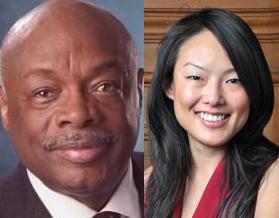
The majority of the contributions from Stellar came in the form of a $5,000 donation from 4 U Services to the Committee for Effective City Management, an independent expenditure committee created in support of Lee that recently hosted a Lee fundraiser in Millbrae honoring special guests Sup. Jane Kim and former Mayor Willie Brown.

4 U, according to its website, also does business as Stellar Services, a company based in New York that has an office in San Francisco. “Stellar is currently a sub-consultant that is working to develop our new online invoicing system called SOLIS,” SFPUC spokesperson Tyrone Jue told the Guardian. “The invoicing system centralizes and streamlines the invoicing process, makes invoicing transaction transparent to all users, increases reporting and transparency, and makes invoicing completely paperless.” Jue noted that the contract was signed in July 2009, and the SOLIS pilot program is underway.

The remainder of contributions from Stellar were made to Lee’s official mayoral campaign. Five individuals who listed Stellar Services or 4 U Services as their employer, including company founder and president Liang Chen, made maximum contributions of $500, according to a report filed with the San Francisco Ethics Commission.

Shaista Shaikh of the Ethics Commission noted that it is legal for city contractors to make contributions to independent expenditure committees formed in support of a candidate for public office. City contractors run afoul of ethics law if they make campaign contributions to an elected official who must approve the contract at any time during contract negotiations or until six months have passed from the date of contract approval, she explained. Since the contract with Stellar was approved in 2009, the contribution would have been made well past the six-month mark  — so it apparently squares with the campaign finance reform ordinance.

Reached by phone, Lee spokesperson Tony Winnicker told the Guardian that if the contract was approved in 2009, it would not be included in a database of city contractors maintained by the campaign, since “there’s no prohibition” against accepting campaign money after the six-month ban has passed. “So that should not be a concern to the Guardian,” he said.

On Sept. 17, Lee received a maximum $500 contribution from Joseph G. Moss, Jr., who listed his occupation as a senior vice president of AECOM in Atlanta, according to an Ethics filing. Lee received another $875 in contributions from AECOM employees, Ethics records show. According a press release on the AECOM website which seems to have been taken down since the Guardian highlighted it, an AECOM joint venture was awarded a $150 million contract for program management services for the SFPUC’s wastewater improvement program on Aug. 16. AECOM is also a partner in a joint venture working on construction of the controversial Central Subway project.   

Since the contractor contribution ban (Section 1.126 of the city’s campaign finance reform ordinance) sets a number of parameters for determining the legality of contributions, it wasn’t immediately clear whether the contributions from AECOM were in line with the ordinance.

Regardless of whether the campaign cash falls on the right side of the law, however, substantial support for Lee from city contractors is likely to raise eyebrows, especially in light of concerns progressives have raised that San Francisco is about to witness a resurgence of the pay-to-play politics that characterized City Hall under Brown.

Breaking free

20

rebeccab@sfbg.com

An ordeal that began with a hiking trip on July 31, 2009 in Northern Iraq came to a close Sept. 21 when Shane Bauer and Josh Fattal were released from Tehran’s Evin Prison. They’d languished in an 8-by-13-foot cell for 781 days while their friends and supporters waged a creative, behind-the-scenes campaign to free them.

Bauer and Fattal were ferried out in a convoy with Swiss and Omani officials and flown to Oman, where news cameras captured their joyful reunion with loved ones. Waiting on the tarmac with their family members was Sarah Shourd, Bauer’s fiancée, who’d been arrested with them and was released last September after spending 410 days in solitary confinement. It was the first time since their arrest that “the hikers” — as the trio came to be labeled in the campaign calling for their release — were together outside prison walls, free at last.

Watching their reunion from Seattle, their friend Shon Meckfessel — who went to Northern Iraq with them but hadn’t felt up to hiking that day — was overjoyed. “It’s like I’ve collapsed from relief,” he told us by phone. “I just feel like I’ve been asphyxiated for the last two years, and suddenly I remember what air smells like.”

In the Bay Area, friends who’d pulled together to work toward their release breathed a huge, collective sigh of relief. “It was just a crazy, amazing adrenaline rush of happiness,” said Jennifer Miller, who befriended Shourd years earlier while doing human rights work focused on violence against women in Juarez.

Bauer and Fattal had stood trial only weeks earlier in an Iranian court, on charges of espionage and illegally crossing an unmarked border between Iraq and Iran. They were found guilty and sentenced to eight years each in prison. Their release coincided with Iranian President Mahmoud Ahmadinejad’s visit to the United States for the United Nations General Assembly conference.

As Bauer, Shourd, and Fattal remained isolated at the mercy of guards they could barely communicate with, their family and supporters kept up a steady drumbeat calling for their release. They recruited actors, intellectuals, and foreign diplomats to urge the Iranian government — which has not had diplomatic ties with the U.S. Since 1979 — to let the Americans go. Once Bauer and Fattal were free and wandering around New York City, they’d morphed into minor celebrities — strangers approached them in the streets to wish them well.

In the end, nobody can say just what persuaded the Iranian government to release Bauer and Fattal. “Sarah was talking with diplomats in all kinds of countries. The thing is, none of us really knows what the calculus was,” said Liam O’Donoghue, a friend who helped out with the campaign.

The campaign was multi-faceted, with friends and family coordinating parallel efforts from various locales. While Bauer and Fattal’s group of friends in the Bay Area are quick to note that their work reflected just one slice of the overall push for the young men’s freedom, the grassroots organizing effort they created clearly had some effect in the end.

“If Shane, Sarah, and Josh were just three random people who didn’t have this group of friends who were so proficient at organizing, I think they would have still been in jail,” O’Donoghue mused.

Shortly after Bauer and Fattal were freed, Iran’s foreign ministry issued a statement acknowledging the involvement of the Sultan of Oman, United Nations Secretary General Ban Ki-Moon, Iraqi President Jalal Talabani, and — more surprisingly, given his adversarial relationship with the U.S. — Venezuelan President Hugo Chavez, who enjoys a close relationship with Ahmadinejad.

Once reports surfaced emphasizing Chavez’s involvement, the news broke that actor Sean Penn had played a role, too — by flying to Venezuela to encourage Chavez to approach Ahmadinejad about the case.

Yet the stage had already been set by friends of the hiking trio, a small crew of passionate social justice activists based in San Francisco and Oakland. They possessed skills as organizers, but this time the goal was more personal — they wanted nothing more than for their friends to be free.


TIME TO ORGANIZE

Based on the 17 alarmed messages on his voicemail, David Martinez knew something terrible had happened involving Bauer and Shourd. An independent filmmaker, Martinez was close to both and had collaborated with Bauer in 2007 to produce a film about Darfur.

Soon after learning that they were being detained in Iran, he found himself swept into a whirlwind, ad-hoc grassroots organizing effort as friends and family of the hikers contacted one another, fired off rapid emails, and organized conference calls to try and determine how to respond.

“We created this working group, this conference group — we wanted everybody’s expertise,” explained attorney Ben Rosenfeld, who has known Shourd for more than a decade and offered free legal representation to Shourd’s mother. “We set out to build a brain trust, essentially, and we did that very, very quickly.”

Shourd and Bauer had been living in Damascus, Syria, at a Palestinian camp when they decided to take a short trip to Iraqi Kurdistan. Shourd was teaching English to Iraqi refugees, and Bauer — a photojournalist — was writing articles about the Middle East. Fattal, an environmental educator, was visiting them. They journeyed along with Meckfessel to Kurdistan, a forested region of Iraq known as a safe destination for U.S. citizens. But once they arrived, Meckfessel felt groggy, so he opted to stay behind while the other three went off in search of a waterfall.

“I was on a bus to meet them and got a call from Shane that they were being arrested by Iranian authorities,” Meckfessel told the Guardian. After notifying their families, he flew to Istanbul to stay with a friend.

Back in the Bay Area, word of the hikers’ plight was starting to make news. “I had producers from morning shows like Good Morning America ringing my doorbell from the beginning,” Rosenfeld said.

Martinez was on a conference call with the core group of organizers when Meckfessel contacted him via Skype from Istanbul — and by that point, the national media was hungry for a statement from the elusive fourth hiker. So the group worked with Meckfessel to craft a statement for the press.

The first challenge they faced was this: Should they emphasize that Bauer, Shourd, and Fattal were humanitarian activists, or should they downplay their political leanings by casting them as adventuresome Americans with a love of the outdoors? Both portrayals were true, but the most important audience, as Rosenfeld pointed out, was ultimately their captors.

Meckfessel said he thought highlighting their politics would help their case. “The first minute after I got the phone call [from Bauer] … I thought that basically our involvement in the region as journalists, as academics, and as educators, and our long public record speaking out for human rights and as critics of US foreign policy in the area … would get them out,” he said.

Meckfessel later created a website, FreeOurFriends.eu, to emphasize the humanitarian and journalistic work that the three were engaged in. In the summer of 2010, he maxed out two credit cards to go on a 30-city European tour to drum up support overseas.

Despite the group’s initial contact with the Committee to Protect Journalists as well as Bauer’s editors at The Nation and Mother Jones, some were opposed to emphasizing the journalism aspect. “Think back to July 2009 in Iran,” Martinez said, referencing the popular uprising known as the Green Revolution that had sent shockwaves through Iran just months earlier. “Our friends were and are journalists involved in social movements and people’s movements. I’m pretty sure if you did a Google search with ‘Iran, July, 2009, activists,’ you’d come up with something like torture, prison. That is why we thought … let’s just say they’re hikers.”

So they came to be known as “the hikers,” and a website was created to go along with the campaign, called Free the Hikers.

“We wanted to make sure we weren’t divulging details about them that they weren’t divulging to their interrogators,” Rosenfeld said. “We wanted to be careful not to piss off the U.S. or the State Department. And, if we seemed too orchestrated, it might feed into Iran’s paranoid theories that they were spies. So we had to try to solve for all of these variables at the same time.”

It began to dawn on them that they were contending not only with the soured relationship between the U.S. and Iran, but an internal power struggle within Iran that had intensified in the wake of mass internal dissent. “The government that grabbed Shane, Josh, and Sarah was at war with its own people,” Martinez reflected. “They were prisoners of the historical moment.”

Nor was the trio the first in their circle of friends to stumble into a horrendous situation overseas. Tristan Anderson, of Berkeley, was attending a nonviolent protest of the Israeli occupation in a Palestinian village at the beginning of 2009 when he was hit by a high-velocity teargas projectile fired by Israeli Defense Forces, and sustained serious brain injuries.

“Tristan’s like a minor celebrity in Iran,” Meckfessel noted. “He’s known not only for initially getting shot … but Tristan’s whole case got a lot of sympathetic media in Iran.” When his three friends were captured, “the first thought I had was, we have proof that we’re all friends with Tristan,” he said.

On Feb. 10, 2010, Anderson’s parents, Nancy and Mike Anderson, sent a letter to Ahmadinejad. “It pains us greatly, on top of the tragedy we have already suffered, to see Tristan’s close friends made to bear the burden of grievances between nations,” they wrote.


GAME OF DIPLOMACY

The idea to approach the Venezuelan government started when Raymor Ryan, an Irish author who lives in Chiapas, phoned Martinez. “He said, ‘The only thing that’s going to really affect them is state power — this is a game of diplomacy,'” Martinez recounted. He suggested Venezuela — a country that is not only on friendly terms with Iran, but has connections with social movements. Martinez liked the idea, but first he ran it by another friend, famed academic Immanuel Wallerstein.

In an email, Wallerstein summarized for the Guardian the advice he gave. “The Iranians are using this as part of their struggles with the United States,” he wrote. “The least likely way to obtain their release is to allow U.S.-Iranian relations to be the issue, or to allow the virtues of the Iranian regime to be the issue. I suggested that they try to work with various left-of-center governments in Latin America, which have friendly relations with Iran, and see if they will intervene with the Iranian government. I did not single out Venezuela. After that, I was out of the picture.”

In October of 2009, Rosenfeld reached out to an attorney he knew through the National Lawyers Guild, Eva Golinger, who’s authored seven books, lives in Caracas, and occasionally serves as an adviser to Chavez. She agreed to help.

Nicolas Maduro, Venezuela’s foreign minister, told her he thought Chavez would be open to helping. “The foreign minister went to Tehran, and they told me they were going to broach the subject,” Golinger said. “When they came back, they told me unfortunately, it wasn’t a topic that was received favorably by the Iranians.”

Rosenfeld and Martinez were crazed, but they had another idea. Perhaps Chavez would be more responsive to appeals from lefty luminaries. Thanks to behind-the-scenes arrangements made by campaign organizers working every connection they could muster, a letter dated Feb. 26, 2010 was sent to Chavez on behalf of Noam Chomsky, Angela Davis, and Harry Belafonte.

“All three of the hikers are dedicated to improving living conditions for poor and oppressed people throughout the world, and to fostering a better understanding among their fellow citizens of the U.S.’s hegemonic role in global politics and economic privation,” they wrote.

Soon after, Golinger had a chance to speak with Chavez directly, when she was invited to join him on a trip to Uruguay to attend the presidential inauguration. “He said, ‘do you think they’re spies?’ I said, look, I don’t think they’re spies. I think they were gringos in the wrong place at the wrong time,” she recounted. “Chavez said, yeah, no problem. I’ll help.”

Soon after, the campaign recruited anti-war activist Cindy Sheehan to write to Chavez, too. But the months rolled by without word of a trial date, let alone a release. Rosenfeld thought up a new way to reach Chavez — by encouraging actor Sean Penn to speak with him.

Penn enjoyed a good relationship with the Venezuelan president and had been regularly traveling to the region to aid in earthquake relief efforts in Haiti, which Venezuela was deeply involved in. Rosenfeld asked Matt Gonzalez, chief attorney of the San Francisco Public Defender’s Office and a friend of Penn’s, to mention it to him.

Within months, Penn discussed the hikers’ case with Chavez, according to Golinger. Then, in September of 2010, Shourd was finally released. Bay Area friends described it as a moment of sheer joy, but also bittersweet, because Bauer and Fattal remained behind bars. Miller invited friends and organizers over to her place in Oakland to join her in the surreal experience of watching their friend deliver a speech on television.

Meckfessel was in Rome as part of his “Free Our Friends” tour through Europe. “I got a text message from somebody that she had been released, and I burst into tears of relief,” he said. “Then, just as I was preparing to do my presentation in Rome, I got a call — and it was Sarah. I just shouted and cried in front of this big group of Romans, and everyone was applauding.”

Upon her return, Shourd wasted no time throwing herself into the campaign. “I just have so much admiration and respect for Sarah,” Miller said. “She went from coming out of prison, and needing time to heal from that, to becoming a full-force, 24/7 international diplomacy worker.”

Shourd, Bauer, and Fattal were unavailable for an interview for this article, but their families emailed a statement. “As Josh and Shane said when they got home, many of their friends put their own lives on hold to fight for their freedom,” they wrote. “We are grateful to the many people who worked in many different ways to help Shane and Josh. Every single effort mattered and made a difference.”


INEXCUSABLE ACTS

When the day of their release finally came, Golinger watched in Caracas as television broadcasts showed Bauer and Fattal bounding down the steps of the plane and leaping into the arms of their loved ones. She sent a text to Maduro, the Venezuelan foreign minister, who was in New York for the UN General Assembly. “I asked … were we involved?” Minutes later, she received a text in response. “He said, fundamentally, yes.” The Iranian foreign minister had told him that the release went through because of Chavez’s request.

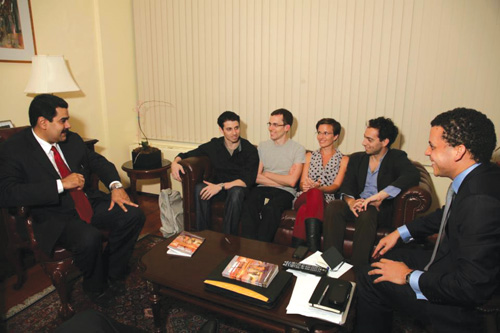
Days later, in New York, the hikers visited the Venezuelan consulate. And on the same trip, their first time back on U.S. soil, Bauer and Fattal held a press conference.

“The only explanation for our prolonged detention is the 32 years of mutual hostility between America and Iran,” Bauer said. “The irony is that Sarah, Josh, and I oppose U.S. policies towards Iran which perpetuate this hostility. We were convicted of espionage because we are American. It is that simple.”

He went on: “In prison, every time we complained about our conditions, the guards would immediately remind us of comparable conditions at Guantanamo Bay. They would remind us of CIA prisons in other parts of the world, and the conditions that Iranians and others experience in prisons in the U.S. We do not believe that such human rights violations on the part of our government justify what has been done to us, not for a moment. However, we do believe that these actions on the part of the U.S provide an excuse for other governments, including the governments of Iran, to act in kind.”

Don’t say CANT

0

arts@sfbg.com

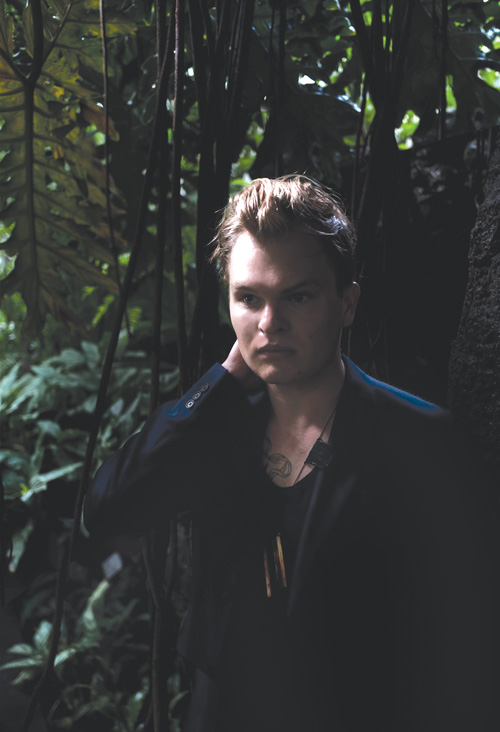
MUSIC It’s tough to pin down a busy bee like Chris Taylor — Grizzly Bear’s bassist, an in-demand producer, and now the leader of his own pack called CANT — but once you manage to, he’s as disarmingly engaging as his new dispatch from a darkling, excruciatingly personal plain, Dreams Come True, released on his own Terrible Records.

So it shocks him when he hears critics describe his music as cold, even chilly. “When people say it’s impersonal, it’s like, wow, man,” Taylor marvels from Portland, Ore. “If anything, you should be saying, ‘This record is too emo.’ That was what I was expecting, that people would say, ‘This guy is way too emotional. Go see a therapist and cool out.’

“I was intentionally trying to figure out the worst kind of fears, fears of falling in love and not being able to let go, or fears of losing it when you think you have it. Scary, unpleasant realities.”

But realities rendered far from heartlessly. A probing soulfulness runs throughout Dreams Come True, which often sounds more like a wrenching, pitch-black nightmare than a blissful reverie. Yet the LP teems with pleasures, and the deeper you penetrate, the harder its pull. It’s in the way that Taylor beautifully couples gristly, screeching scads of industrial noise, reminiscent of both Nine Inch Nails and horror-movie violins, with celestial synth in the title track and “Rises Silent.” Skittish electronic beats bang up against gamelan-like percussion in the echoey, prog-pop opening track, “Too Late, Too Far,” while Satie-esque (and Thom Yorke/Radiohead-like) impressionism is paired with an undercurrent of ’90s-era post-punk dissonance in “Bericht.” Brass that cues wee-hours soul bounces off elastic bass notes in “The Edge,” and a softly insinuating Velvet Underground-ish guitar vamp adds menace to “She Found a Way Out” — a song that makes one wonder if that way out was, akin to Joy Division’s “She’s Lost Control Again,” something like a permanent check-out.

“It’s about the sort of feeling you feel when the biggest love of your life walks out the door, and you deserve it, and she’s better off for it — it makes you want to scream,” explains Taylor with a rueful chuckle. “No, she didn’t die! She went to grad school. She’s getting smarter by the day.”

Taylor’s education into solo music-making began with his forays into singing with Grizzly Bear — CANT’s name plays off that definition, among angles. After completing production on Twin Shadow’s Forget (4AD/Terrible, 2010), he sat down with TS’s George Lewis Jr. for about two weeks to work on Dreams, playing most of the instruments themselves. Work continued after Lewis departed, contributing to the music’s sense of ratcheted-up intimacy. “I was by myself, and it’s just the worst, especially not having written lyrics before,” says Taylor. “You’re like, does this suck? And it’s just crickets.”

Songs such as “Answer” — with its pacing synth line, moodily ascending string sounds, and brooding refrain, “It’s been a while since you needed me / It’s been a while since I needed you, too” — spoke directly to old demons. “It’s about my ongoing and often difficult relationship with my dad — one of the more trying relationships in my life,” confesses Taylor, whose parents divorced when he was 5.

“It’s about feeling loved, and at the same time, there’s so much, like, meanness. It’s really confusing when a kid is told they’re loved and then treated so badly…” And it’s mystifying, and maybe a relief, that the track’s inspiration has no idea what role he played in its making — and that pain can be transformed so completely into pop. “I think,” says Taylor with disbelief, “when the song premiered on Pitchfork, [my dad] said, ‘I like that!'” CANT With Mirror Mirror and Blood Orange Wed/5, 8 p.m., $15 Independent 628 Divisadero, SF (415) 771-1422 www.theindependentsf.com

Rep Clock

0

Schedules are for Wed/5-Tues/11 except where noted. Director and year are given when available. Double and triple features are marked with a •. All times p.m. unless otherwise specified.

ARTISTS’ TELEVISION ACCESS 992 Valencia, SF; www.atasite.org. $6. “Other Cinema:” program on the politics of social media, with works by Dominic Gagnon, Hrman Asselbergh, and others, Sat, 8:30.

CASTRO 429 Castro, SF; (415) 621-6120, www.castrotheatre.com. $7.50-15. We Were Here (Weissman and Weber, 2011), Wed-Thurs, 7, 9:15 (also Wed, 2:30, 4:45). “Midnites for Maniacs: Monsters in Your Own Backyard:” •The Goonies (Donner, 1985), Fri, 7; The Hole 3D (Dante, 2009), Fri, 9:30; Gremlins 2: The New Batch (Dante, 1990), Fri, 11:59. Director Joe Dante in person; $15 for one or all three films. Pam Ann live performance, Sat, 7:30. This event, $35-30 at www.biggaycomedy.com. •Brighton Rock (Boulting Brothers, 1947) Sun, 1:15, 5:05, 9, and The Third Man (Reed, 1949), Sun, 3:05, 7. CHRISTOPHER B. SMITH RAFAEL FILM CENTER 1118 Fourth St, San Rafael; (415) 454-1222, www.cafilm.org. Mill Valley Film Festival, Oct 6-16. Tickets (most shows $13.50) and more info at www.mvff.com.

MECHANICS’ INSTITUTE 57 Post, SF; (415) 393-0100, rsvp@milibrary.org. $10 (reservations required as seating is limited). “CinemaLit Film Series: Discovering Myrna Loy:” The Animal Kingdom (Griffith, 1932), Fri, 6.

NINTH STREET INDEPENDENT FILM CENTER 145 Ninth St, SF; www.whatisloveproject.com. $10. “What Is Love Project Launch Party:” Who Leads and Love is Not Enough, Sat, 7:30.

PACIFIC FILM ARCHIVE 2575 Bancroft, Berk; (510) 642-5249, bampfa.berkeley.edu. $5.50-9.50. “Paul Sharits: An Open Cinema:” “Paul Sharits: Early Work” (1966-1971), Wed, 7:30. “A Theater Near You:” Went the Day Well? (Cavalcanti, 1942), Thurs, 7. “The Outsiders: New Hollywood Cinema in the Seventies:” Loose Ends (Morris and Wozniak, 1975), Fri, 7; Killer of Sheep (Burnett, 1977), Fri, 9; Badlands (Malick, 1973), Sat, 6:30; Mean Streets (Scorsese, 1973), Sat, 8:25. “UCLA Festival of Preservation:” Eve’s Leaves (Sloane, 1926), Sun, 4. “Anatolian Outlaw: Yilmaz Güney:” The Poor (Güney and Yilmaz, 1974), Sun, 5:35. “Kino-Eye: The Revolutionary Cinema of Dziga Vertov:” “Kino-Week Nos. 31-35” (Vertov, 1919), Tues, 7. ROXIE 3117 and 3125 16th St, SF; (415) 863-1087, www.roxie.com. $5-9.75. “TV Noir:” •”Test Flight: Program One,” Wed, 6:15, 9:45, and “Program Two,” Wed, 8; •”Sex, Drugs, and Dragnet,” Thurs, 6:15, 9:50, and “CrimeBusters!”, Thurs, 8. American Teacher (Roth, 2011), Oct 7-13, check website for showtimes. Sleep Furiously (Koppel, 2008), Oct 7-13 (no shows Tues/11), 7, 9 (also Sat-Sun, 3 and 5). “Bioneers Film Night:” !Women Art Revolution (Hershman Leeson, 2011), Tues, 8:15; YERT (Your Environmental Road Trip) (Dixon and Evans, 2011), Tues, 8:45. Tickets ($6.50-8) and more info at bioneers.org/conference. SAN FRANCISCO FILM SOCETY NEW PEOPLE CINEMA 1746 Post, SF; www.sffs.org. $15. “An Evening with Susan Orlean and Rin Tin Tin:” Clash of the Wolves (Smith, 1925), Sun, 7:30. Author Orlean in person with her book Rin Tin Tin: The Life and the Legend. VORTEX ROOM 1082 Howard, SF; www.myspace.com/thevortexroom. $5 donation. “The Vortex Incarnate:” •The Devil’s Rain (Fuest, 1975), Thurs, 9, and Invitation to Hell (Craven, 1984), Thurs, 11. YERBA BUENA CENTER FOR THE ARTS 701 Mission, SF; (415) 978-2787, www.ybca.org. $6-8. “Cruel Cinema: New Directions in Tamil Films:” Naan Kadavul (I Am God) (Bala, 2009), Thurs, 6 and Sun, 9; Subramaniapuram (Sasikumar, 2008), Sat, 7 and Sun, 4.

Beirut brings the county fair to the Fox

0

We teased you with the show mention in the Hangover column,  now here’s the goods:

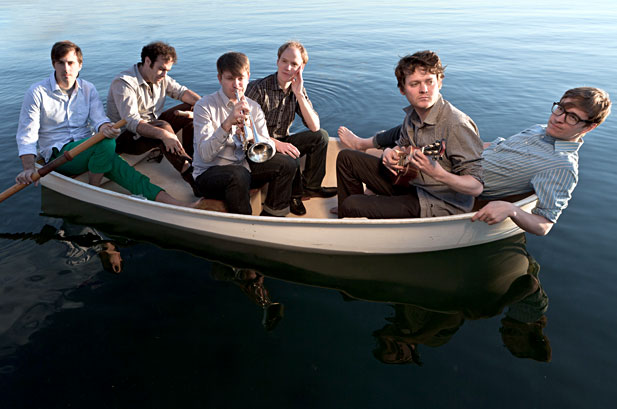
With flickering string lights strung from the center of the grand ballroom and splayed out brass instruments across the stage, Beirut’s performance at the Fox Theater in Oakland on Saturday warmed liked a fancy indoor county fair. The sound, which can be bass-problematic at the Fox, was good this evening, near perfect for the otherworldly folk-marching band from Santa Fe. Ringleader Zach Condon switched back and forth from ukulele to his beloved trumpet, singing in deep baritone throughout, once stepping to his newly rediscovered favorite, the keys.

The setting was such that you could almost conjure a sea of couples waltzing in calico, Condon with a bolo-tie and trio of fiddles. However that was just a daydream while I waited in a very long line for the ladies room. In truth, hip couples were smashed against one another at the sold-out show, raising cups of beer and whooping for nearly every song, Condon wore his typical Communist-muted button-up and slacks, and sang backed by a trio of powerful horns — not fiddles — and a talented accordionist. As Condon pointed out via our conversation a few weeks back, “my accordion player can run circles around me blindfolded, so there’s kind of no point” (…in picking that up mid-performance in addition to all the other instruments he plays).

A few crowd-pleasers (excessive applause and energy): Gulag Orkestar‘s “Scenic World” and  “Postcards from Italy,” The Flying Club Cup‘s “A Sunday Smile,” the tuba-heavy, mariachi-oom-pah of “The Shrew.” The best moments of the night came when all horns would swell together, like the aforementioned Shrew. But those slow, melancholy songs were perked up by the shorter cuts off new album The Ripe Tide. A new favorite, and the first single off The Ripe Tide, “Santa Fe” garnered less of an enthusiastic response than I expected, though some hollers nonetheless. In a few years, it will gain even more claps. Though Condon did remark, “There must be a few Santa Feans here.” At least, I think that’s what he said, his few words were muffled in my corner of the room.

After a tight, hour-and-some-change-long set, the band returned, as expected, for a requisite encore (side note: can someone please explain to me why the encore has become so requisite?). After playing two songs they again retreated. This time, for the second encore, Condon came out on stage alone, holding just a uke, spotlit and beaming. This is, after all, where Beirut started. A man alone with his instrument. Really, pretty epic stuff. He knows how to work a crowd, but minus the schmaltz. While the songs sometimes hint maudlin, Condon maintains a cool-cucumber presence of stage.  After his moment alone, the rest of the band swarmed around him again and we were treated to a satisfying tuba solo.

True story: the next night, after Beirut played a far more intimate set at the Independent that I did not attend, the tuba player stood out on Divisadero blowing his horn at near midnight. I woke up from the sound, threw on a peacoat and slippers and hazily asked “where did you come from?” (It was the only sentence my deep sleep-addled brain could form.) He cocked an eyebrow and said “My mother’s uterus.” He, and a few stray musicians, then marched off to another corner, still playing.

The lights go on, the lights go off.

Note: I did not shoot this video, clearly, but I do love it:

The instruments of my life: Q&A with Beirut’s Zach Condon

1

Zach Condon, the pied piper of Beirut, is known for a great many things – his quavering voice and heart-tugging music (watch the new video for “Santa Fe” and try not to weep, I dare you), the global journeys on which he embarked to gain such a worldly sound, and, perhaps above all else, his skilled takes on an array of string and horn instruments. He employs their use to enable listeners an audio-vacation: the far corners of Eastern Europe and the Balkans, to the chateaus of French chansons, to his mariachi-filled hometown of Santa Fe, New Mexico.

As Beirut’s two Bay Area shows this weekend (at the Fox Theater in Oakland and the Independent in SF) are very, very sold out, I’m assuming there are a few of you out there grasping tickets as you read this. And if not, there are always scalpers (note: we do not condone buying from scalpers).

In a phone call a few weeks back from his current home of Brooklyn, Condon gave me the rundown on the instruments of his life:

San Francisco Bay Guardian: What’s the first instrument you ever played?
Zach Condon: I have to be honest, even though it makes for a jarring twist in the story. It was actually a guitar. When me and my two brothers were really young, my dad bought us an electric guitar. A Peavey Raptor if I remember correctly – it’s kind of a generic Stratocaster or something? I don’t know, I really don’t know guitars very well. And then some sort of cheap amp for it. Then he signed us up for some lessons. And I just remember thinking distortion was really funny and interesting but hating the lessons that I was taking.
SFBG: Why weren’t you interested?
ZC: I guess I’ve always had some sort of problem with authority. But it also felt like I hadn’t chosen the instrument. My dad, it’s really great that he did that, but he was really intense about us learning to play an instrument because his grandfather was a multi-instrumentalist. My dad was an obsessive guitar player so it always felt like, oh I don’t want to do that, that’s what my dad does.
SFBG: So what was the first instrument that you chose?
ZC:
That’s the funny part, I was also supposed to play saxophone, which is what [my dad] also played. My older brother and I signed up for band – this was probably about fifth grade – and I walked in the first day and they asked me what I was going to play. I said trumpet. I went home and told my parents some bullshit story about how they had too many saxophone players and they wanted a trumpet player. I don’t think they believed me but you know how when you’re a kid you kind of think that you got away with something? I think they were just like ‘well if he wants the instrument whatever, let’s just get him an instrument.’ They took me to a shop and I bought a pawn shop box student model trumpet That was an immediate love.
SFBG: What specific instruments did you play on 2006’s Gulag Orkestar?
ZC:
I played my grandmother’s accordion. She had died three or four years before that, and I had asked my grandfather to send me all her instruments that he could pack, which ended up only being the accordion. But she also played bagpipes, piano, organ. She was a good singer too. So he sent me her accordion and I had it fixed up a little, and I had a better trumpet at that point. At this point the family had finally gotten a real piano in the house and I had first bought a ukulele a year before that. Just this really janky little soprano uke from a guitar shop. I bought it as a joke at first then I totally fell in love with it.
Outside of that I had some percussion that I’d assembled from friends and neighbors – weird things. I remember thinking at the time, if I’m going this route then I probably shouldn’t use a general rock drumkit. So I was collecting tambourines and little hand drums. My neighbor in Santa Fe had this really funny conga djembe drum, which ended up being the basis for most of the percussion that Jeremy Barnes didn’t play on the record. Every songs is like eight tracks of me hitting the conga drum and then a bunch of tambourines.
SFBG: And 2007’s The Flying Club Cup?
ZC:
A bunch of the songs were written on this organ that someone had actually donated to me. There was a movie theater I worked at for quite a while, and I ended up developing a relationship with the people there. They were also attached to a theater that would have these weird traveling acts and there was this faux-circus cabaret act that had come through at some point and while they were there, they were taking this beautiful Farfisa organ which had broken down in Santa Fe and the guy just left it. They said, ‘if you can fix it, you can have it.’ I was able to fix it just enough. There are still notes on there that don’t work, so I had to write every song around certain notes, the entire album is almost in the same key. The rest was me picking up new brass instruments, phoneom and French horn, trying to open up on the brass front a little bit. And of course my grandmother’s accordion, although I bought a new one later that year from this mariachi shop, I don’t even remember the brand, because my accordion player can run circles around me blindfolded, so there’s kind of no point.
SFBG: Most recently, on The Rip Tide, what were some of the instruments you picked up for that?
ZC:
Not so much picked up, but went back to. The main one there would be the piano. I actually bought my first piano –I’d never had one of my own. I bought this Yamaha upright from this guy in Jersey and I had it shipped to upstate New York where I was writing, and I just spent a lot of time with this piano, writing these loops and chord progressions and melodies. A lot of this was based on me hammering around on the piano until I felt like I was sufficient. There’s just something cool about the piano, being next to it, it just wraps you up like a warm blanket. It’s such a big instrument. When you start playing the big chords on it, the acoustics are so interesting.
SFBG: Which instrument stands out as the most important to you? Your grandma’s accordion?
ZC:
To an extent yes, because it’s part of me writing songs. But I can’t help but feel like it was the trumpet that made me fall in love with writing and making music in the first place. As a kid it was the first instrument that I connected with. It was the first time I was proud of making a new note. There were a few false starts, between guitar and saxophone, it may never have happened if I hadn’t just randomly stumbled upon an instrument that immediately spoke to me.

Sat/1, sold out
Fox Theater
1807 Telegraph, Oakl.
www.thefoxoakland.com

Sun/2, sold out
The Independent
628 Divisadero, SF
www.theindependentsf.com

Progressives battle downtown over economic and political reforms

63

Battles between progressive members of the Board of Supervisors and downtown power brokers such as the San Francisco Chamber of Commerce defined City Hall politics for much of the last decade, until the new politics of “civility” and compromise took hold this year, a dynamic that has favored downtown interests. But now, a pair of important, high-profile issues headed to the full board on Tuesday has revived the old dynamic. And in both cases, wealthy interests are putting enormous pressure on the board.

The first involves a proposal – put forward by Sups. Sean Elsbernd and Mark Farrell, the two most conservative supervisors – to gut the city’s system for publicly financing campaigns because downtown is threatening a lawsuit. They propose to end San Francisco’s program of giving publicly financed candidates more money when a privately funded candidate exceeds the spending cap because the Supreme Court recently struck down similar provisions in Arizona.

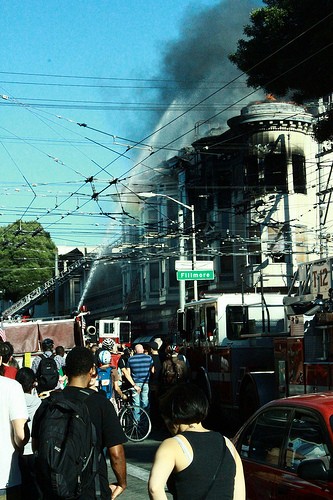
This week, after convening in closed session to discuss the threat of litigation by downtown groups, the board voted 7-3 – with Sups. David Campos, Jane Kim, and Eric Mar opposed, and Sup. Ross Mirkarimi absent because he rushed out to large structure fire in his district – for the Elsbernd/Farrell measure, one vote short of the supermajority needed to amend the current city law.

Campaign finance reform advocates such as Steven Hill argue that it’s unfair to modify the city program right in the middle of an election season in which Mayor Ed Lee and the wealthy independent expenditure groups supporting him are poised to spend millions of dollars to defeat a large field of mostly publicly funded mayoral candidates.

Hill and his allies are appealing to Mirkarimi – who told the Chronicle that he is leaning toward supporting the amendment when the measure returns to the board on Tuesday – not to support what they consider an overly broad capitulation to downtown’s threats. They’re also lobbying Sup. John Avalos to switch his vote, while downtown players are putting the screws to supervisors as well.

In an interview with the Guardian, Mirkarimi clarified his stance, noting that he was the sponsor of the original public financing law and his goal is to protect it, even if it needs to be modified to withstand a legal challenge. “I’m looking for alternatives to fortify San Francisco’s program,” he told us, noting that he missed some of this week’s discussion and he’s hoping something can be done to retain provisions that level the financial playing field with wealthy candidates.

Meanwhile, downtown forces are pulling out the stops to kill Sup. David Campos’ legislation that would prevent San Francisco businesses from pocketing money they set aside for their employees’ health care under a city mandate that they provide health coverage – totaling about $50 million last year – legislation that gets its first hearing tomorrow (Friday/30) at 10 am.

Board President David Chiu has put forward competing legislation that is more to the Chamber’s liking, letting businesses (mostly restaurants that are even placing surcharges of customers’ bills, ostensibly to subsidize their legal obligations) keep the money. But Campos and his labor allies believe they have the six votes they need to pass the legislation, thanks largely to moderate Sup. Malia Cohen’s pledge to support the measure.

While even some supporters have quibbled with the timing of this measure, Campos notes the urgency of keeping money intended for workers in their hands. “It’s an outrage and the longer we wait, the worse it gets,” Campos tells us, noting that the practice, “is what many of us consider fraud.”

Unfortunately, even if the board approves the measure this Tuesday, it will still need the signature of Mayor Lee to become law. While he hasn’t formally taken a position, given that his political base is the downtown crowd, he’s expected to veto the measure. But we’ll ask him about it tomorrow when he’s scheduled to meet with the Guardian for an endorsement interview at 2 pm.

Our Weekly Picks: September 28-October 4

0

THURSDAY 29

We Don’t Belong Here Do we belong in our bodies, our skin, our families, this public space, this architectural space, this city space, the Milky Way, the planet, our species, the universe? Inquiring minds want to know. In We Don’t Belong Here, collaborators Katie Faulkner, choreographer and artistic director of little seismic dance company, and multimedia artist Michael Trigilio, along with a robust cast of 20 dancers, premiere a dance and media response to these questions as an impromptu renegade, do-it-yourself sideshow. The free performances, commissioned by Dancers’ Group as part of their Onsite series, take place at San Francisco’s Union Square and Yerba Buena Lane. Be sure to wear your San Francisco layers. (Julie Potter)

Through Fri/29, also Sun/2, 8 p.m., free

Union Square

Powell and Geary, SF

(415) 920-9181

www.dancersgroup.org


Quick Billy

Bruce Baillie’s high masterpiece moves from wounded channeling of The Tibetan Book of the Dead to metaphysical Western in the span of four reels. Baillie had thoroughly mastered his sentient film language of dissolves and superimpositions by the time of this 1970 effort. As Baillie noted then, “All of the film was recorded next to the Pacific Ocean in Fort Bragg, California, from dreams and daily life there; all of it given its own good time to evolve and become clear to me.” It still has that mysterious air of something slowly clarifying itself. Baillie, who founded Canyon Cinema fifty years ago, will be in attendance with a newly restored print of the film. (Max Goldberg)

7 p.m., $7-10

San Francisco Museum of Modern Art

151 Third St., SF

415-337-4000

www.sfmoma.org


Faustin Linyekula/Studios Kabako

“I am an African dancer. I tell exotic stories. Which one would you like today?” Congolese choreographer Faustin Linyekula does have stories to tell. Yet they have little to do with prettified harvest dances and initiation rituals. His tales are gritty, urban, and razor sharp. As a performer Linyekula is mesmerizing, a tornado of rage and vulnerability. For “more, more, more..future”, in addition to his fabulous male dancers, Linyekula is bringing a Congolese band with an indigenous pop style, ndombolo that mashes Western and African influences. Also integral to this local premiere are poems by political prisoner Antoine Vumilia Muhindo, Lineykula’s childhood friend. (Rita Felciano)

Through Sat/1, 8 p.m., $20–$25

Novellus Theater, Yerba Buena Center for the Arts

701 Mission, SF

(415) 978-2787

www.ybca.org


Weedeater

Weedeater is technically a power trio, but when the band performs, all eyes are on “Dixie” Dave Collins, its inimitable bassist-singer. With his instrument slung so low it threatens tangle between his legs, the manic North Carolingian stands cross-eyed at the mic, screaming so vehemently that it often looks like he’s about to swallow it whole. Though guitarist Dave “Shep” Shepard and drummer Keith “Keiko” Kirkum form a potent partnership, it’s Collins’ pungent bass tone that drives the music. Waves of down-tuned punishment and caterwauling fuzz seem to pour forth unabated from his amps, made musical only through Dixie’s nimble-fingered intercession. Channeled into riff after thundering riff, the onslaught is impossible to ignore. (Ben Richardson)

With Fight Amp, Bison, Saviours

8 p.m., $18

The Independent

628 Divisadero, SF

(415) 771-1421

www.theindependentsf.com


FRIDAY 30

Chicken John’s Book Release and Street Party

Chicken John Rinadi — a legendary local showman, provocateur, and one-time mayoral candidate — has written a book: The Book of the IS: Fail…To WIN! Essays in engineered disperfection. And in true Chicken fashion, he’s throwing an over-the-top book launch party featuring a stellar lineup of artists (56 of whom are designing custom book covers, including Swoon, Brian Goggin, and Rosanna Scimeca); installation art pieces by Michael Christian, Charlie Gadeken, and some Flaming Lotus Girls; live performances by Spacecraft and the Art of Bleeding; art cars and Doggie Diner heads; readings by special guests; and all manner of strange countercultural and cacophonic creations, all spilling out of the gallery into a closed-down Minna Street. This one is not to be missed. (Steven T. Jones)

7 p.m.-2 am, free

111 Minna, SF

(415) 974-1719

bookoftheis.com


FRIDAY 30

Saxon

Though they have since been overshadowed by Iron Maiden and Judas Priest, there was a time when Saxon rode on the foam-flecked crest of the New Wave of British Heavy Metal. Members have come and gone throughout the years, but a hard-rocking core formed by singer Peter “Biff” Byford and guitarist Paul Quinn dates back to the band’s beginnings in Yorkshire, in 1976. Eschewing the operatic excesses of its better-known competitors, the band has penned a vast repertoire of hard-charging, blue collar anthems. When Saxon takes the stage in Santa Clara, the fans will be wearing “Denim and Leather,” and they will expect some “Heavy Metal Thunder.” (Richardson)

With Haunted by Heroes, Hatchet, Borealis

8:30 p.m., $20

The Avalon

777 Lawrence Expressway, Santa Clara

(408) 241-0777

www.avalonsantaclara.com


SATURDAY 1

Alternative Press Expo

Although the ranks of off-the-beaten-cape comic artists swell each year at the mega-convention that is Wonder Con, the indie comic crown in San Francisco is reserved for Wonder’s younger sister, the Alternative Press Expo. At APE, special guests include not Stan Lee and Ryan Reynolds, but instead Daniel Clowes, creator of edgily neurotic texts like Wilson; Kate Beaton and her feminist re-takes of the days of the American revolution and Nancy Drew book covers; Adrian Tomime, who masterminds the Optic Nerve series. The convention also places an emphasis on pairing illustrators and writers, a useful tool for those that wish to traverse the underground tunnel to indie fame. (Caitlin Donohue)

Also Sun/2, 11 a.m.-7 p.m., $10 one day/$15 weekend pass

Concourse Exhibition Center

635 Eighth St., SF

www.comic-con.org/ape


World Vegetarian Day

Are you tentatively eying the nutritional yeast bins and blocks of jalapeño smoked tofu in the grocery store, unsure if you’re ready to take the leap beyond an animal product-dependent lifestyle? What you need is a heaping serving of vegetarian community. Enter the SF Vegetarian Society’s World Vegetarian Day expo, a meat-free miracle for those with a craving for more information on the veggie life. Two days of environmental, nutritional, and anti-paleo diet speakers have been scheduled, and those looking for a more experiential weekend can nosh on Saturday’s raw and vegan dinners — or even check out that day’s rounds of vegan speed dating. (Donohue)

Also Sun/2 10 a.m.-6 p.m., $8 suggested donation

County Fair Building

Ninth Ave. and Lincoln, SF

(415) 273-5481

www.sfvs.org/wvd


The Beat Is the Law: Fanfare for the Common People

It’s a musical fairytale story so good it could be a bad Mark Wahlberg movie: a lesser known band (Pulp) gets tapped to replace a headlining act (The Stone Roses) at a music festival (Glastonbury) and ends up blowing the non-existent roof off the place. Okay, so maybe it’s not a Wyld Stallyns level achievement, but it was supposed to be a helluva show and breakthrough in 1990s Britpop. Beyond myth-making in just the one moment, Eve Wood’s documentary, The Beat Is the Law, focuses on the decade building up to Glastonbury, in which Pulp seemed to be the little band that couldn’t. (Ryan Prendiville)

7:30 and 9:30 p.m., $10

Roxie Theater

3117 16th St., SF

(415) 863-1087

www.roxie.com


DARK PASSAGE

Celebrating the 10th anniversary of their “Film In The Fog” series, The San Francisco Film Society is presenting Dark Passage, the classic 1947 film noir thriller starring Humphrey Bogart and Lauren Bacall that was both set and filmed in San Francisco. Follow the exploits of Bogey as the wrongfully-convicted man on the run through the city at this special free outdoor screening, where audience members can set up blankets and lawn chairs and get cozy under the stars — or the city’s signature layers of fog. The movie will be preceded by a performance by local rockers Grass Widow, along with screenings of a ’50s era newsreel and a cartoon. (Sean McCourt)

5:30 p.m., free

Outside of Presidio Main Post Theater

99 Moraga, SF

www.sffs.org


SUNDAY 2

The Hades Channel

Sure, Gwyneth Paltrow just won an Emmy for guest-starring on Glee. Though she’s objectively the personification of modern evil, sinister stunt casting is actually nothing new. The Devil himself has graced the idiot box multiple times, and I’m not just talking South Park. The Vortex Room collects some of his best work (and some of the best work themed around his ominous deeds) for “The Hades Channel,” a marathon screening of episodes of classic shows like Lost in Space, Night Gallery, and Starsky and Hutch — seems Satanic Panic was a ripe plot device back in the day. Can’t get enough Beelzebub? Following “The Hades Channel,” the Vortex unleashes six weeks of hellzapoppin’ double features (sourced from the trashiest depths of the 1960s-80s), “The Vortex Incarnate,” starting October 666. Er, sixth. (Cheryl Eddy)

6:66 p.m.-1:45 a.m., $6.66

Vortex Room

1082 Howard, SF

Facebook: The Vortex Room


TUESDAY 4

John Lithgow

With a career that includes a wide spectrum of artistic output, John Lithgow has proven himself to be a versatile and talented actor, author ,and much more. His film credits such as The World According To Garp (1982) and Harry and The Hendersons (1987), television roles on shows like 3rd Rock From The Sun, and his series of stage performances and children’s books have entertained and enlightened for nearly four decades. Catch Lithgow tonight in an intimate talk about his new book, Drama (HarperCollins), focusing on his life lessons and his craft. (McCourt)

7:30 p.m., $12–$44

Sundance Kabuki Theater

1881 Post, SF

(800) 838-3006

www.booksmith.com


TUESDAY 4

Dum Dum Girls

Only In Dreams, the sophomore album from leatherette rockers Dum Dum Girls is a flavor at first consistent with the bubble gum pop of last year’s I Will Be. Half the album mechanically swings between the theme of romantic obsession, from the person you can’t bear to be without (“Bedroom Eyes”) to the one who needs to go away (“Just A Creep”). But the saccharine sweetness fades in the second half (and real substance) of the album, as singer-songwriter Dee Dee turns somber, reflecting on a loss that’s not just the sort of seasonal regularity she’s used to, but something more permanent. (Prendiville)

With Crocodiles and Colleen Green 9 p.m., $17-19

Great American Music Hall

859 O’Farrell, SF

(415) 885-0750

www.gamh.com


The Guardian listings deadline is two weeks prior to our Wednesday publication date. To submit an item for consideration, please include the title of the event, a brief description of the event, date and time, venue name, street address (listing cross streets only isn’t sufficient), city, telephone number readers can call for more information, telephone number for media, and admission costs. Send information to Listings, the Guardian Building, 135 Mississippi St., SF, CA 94107; fax to (415) 487-2506; or e-mail (paste press release into e-mail body — no text attachments, please) to listings@sfbg.com. Digital photos may be submitted in jpeg format; the image must be at least 240 dpi and four inches by six inches in size. We regret we cannot accept listings over the phone.

Censorship — or something else?

8

Project Censored highlight stories that didn’t make the national mainstream news media. And in this issue, we’ve got a story that shows something about how news judgments are made in two of San Francisco’s largest newsrooms.

Journalist Peter Byrne (who once worked at SF Weekly and wrote some critical stories about us) shares the tale of what happened to a story that the San Francisco Chronicle assigned him — but never published. The people at the Chron and the Bay Citizen (a nonprofit whose work runs in the New York Times) have different perspectives on what happened in this case — and whether powerful people like Richard Blum influence whether critical stories end up in print. Readers can decide for themselves how to see this situation.

But what was striking to us at the Guardian — and why we chose to print both Byrne’s account and the final story that the Chronicle chose not to print below — was that the suppressed story was actually quite tame and well-balanced after Chronicle writers, editors, and lawyers spent months working on it (Bay Citizen also invested weeks of work and never published anything relating to the story).

It simply raised the issue of whether the University of California should be doing private equity investment deals that are overseen by wealthy, politically connected people like Blum, whose own funds were also involved. It ultimately wasn’t a screaming indictment or accusation of illegal activity, but just a modest peek behind the curtain of an important institution whose focus has strayed from its core mission of serving college students.

We reviewed email exchanges that confirm the basic outline of Byrne’s story, conducted some interviews that guided our editing of this story, and included responses from the Chronicle and Bay Citizen at the end of the story. Ultimately, whether this is a case of censorship or something else, we thought it deserved to find its way into print. (Steven T. Jones)


BlumGate

Why two Bay Area newsrooms dismissed my story about conflicts of interest in UC investment deals


By Peter Byrne

news@sfbg.com

In September 2010, the journalism website Spot.us published my investigative series, “The Investors Club: How University of California Regents Spin Public Money into Private Profit.” It detailed how members of the UC Board of Regent’s investment committee oversaw the investment of nearly $1.5 billion of UC’s money into business deals in which they themselves held significant stakes.

One of the conflicted regents was Richard Blum, the financier husband of U.S. Sen., Dianne Feinstein (D-CA); another was Paul Wachter, a business partner of then-Gov. Arnold Schwarzenegger (who is also a regent).

The story caused a stir, particularly at a time when student groups were protesting draconian cuts and tuition hikes. Several newsweeklies published the series. The Los Angeles Times ran a story about my findings. And the investigation was honored with journalism awards by several local, state, and national organizations. So I was not surprised when Nanette Asimov, the higher education beat reporter for the San Francisco Chronicle, called me last October.

“I know it’s a Herculean task, but is it possible to charbroil your opus down to 800 words?” she asked. The paper offered to pay me $350 for the story.

Intrigued, I squeezed the investigation that Spot.us had paid $7,000 to produce into a few paragraphs. Little did I know that Asimov and I would be expanding and cutting and tweaking this story for the next eight months, as publication was delayed again and again by foot-dragging editors.

But I was patient. Even after Metro Editor Audrey Cooper told me that Blum had “threatened” Chronicle editors if they ran the tale, I waited several more months before going public. It is my belief that journalists must as accountable for what we do not print as for what we do print.

When Elizabeth Lesly Stevens, a staff writer at the Bay Citizen, inquired about the delay in publishing the story, I told her what I knew and gave her dozens of emails between myself and Chronicle staff. Ironically, the Bay Citizen never ran the story about the story.


THE GORY DETAILS

It quickly became obvious that the complex financial story would not easily squeeze into a few paragraphs. But since the Hearst Corporation had cut the Chronicle’s reportorial throat several years ago by laying off its investigative enterprise staff, there appeared to be no one left capable of editing it. Asimov had to constantly badger editors to work on the story.

Shortly before Thanksgiving 2010, Chronicle business reporter Tom Abate got involved. He sent me an outline indicating places where I should insert a “FIRE BREATHING QUOTE” and then a “QUOTE OF OUTRAGE.” The idea of daily news writing, he told me, was “make the readers spit up their coffee.” Okay! I dreamed that the streets of San Francisco would soon flow with rivers of regurgitated java.

By early January 2011, Asimov and I had worked up a coherent version, focusing on Blum and Wachter’s conflicts of interest. On January 31, Assistant City Editor Terry Robertson emailed, “I’m aiming to get it in the paper by the end of the week.” A few days later, he backtracked, “Well, I just found out that the story needs to be lawyered. That throws a bit of a wrench into the works. Sorry.”

By mid-February, Robertson had evidently lost interest. Determined to see it in print, Asimov recruited a veteran Chronicle reporter, John Wildermuth, to edit it. He whipped it into shape at 1,600 words. Now it was time for Asimov to call Blum for comment, since he refuses to talk to me.

According to Asimov, Blum was “spitting nails.” He called the allegations of conflicts of interest made by an array of ethics experts “obscene.” He said, “Nobody has ever told me that we had to ask UC for an OK before we invested in something. I wouldn’t be on the Board of Regents if I have to ask for permission to go to the bathroom.” And I was told he threatened the Chronicle with legal action if the story was published.

In late March, the copy was again sent to Cooper. On April 11, she decided it needed yet more attention from the lawyers.


COOPER GETS MAD

On April 14, the Daily Nexus, which is the student newspaper at UC Santa Barbara, reported on a group of students who had gathered hundreds of signatures on a petition to the state Attorney General asking for an investigation based upon the conflicts of interest identified in the Spot.us investigation. In the article, UC scholar Gray Brechin opined that the Chronicle was failing to print my story due “to the political influence of Blum and Feinstein.”

Shortly after the story was posted online, Cooper called Daily Nexus Editor Elliot Rosenfeld. She complained that Brechin’s comment about the Chronicle was “libelous.” The student editor removed the quote from the newspaper’s website.

When I asked Cooper about this, she emailed, “As for the Nexus, I think it’s a learning experience for them. As I told the paper’s editor and Dr. Brechin, I have never been intimidated into publishing anything—nor to refrain from publishing an article. And it won’t happen in the future, regardless of whether the pressure comes from a scientist, another journalist, or a senator.”

Then Cooper stopped responding to my emails.


THE PLOT THICKENS

On May 6, I received an email from the Bay Citizen’s Stevens. She had been at a dinner party with Brechin. She asked me why the Chronicle story was languishing. She said the Bay Citizen might publish it. I told her I was not ready to go public.

On May 18, I emailed Asimov about the status of the story. She said the lawyer had it.

I called Cooper. She told me, “I would like to get [the story] in for Memorial Day because we need the copy. … I am not responding to emails because I don’t want any of this shit in print. … Dick Blum can go fuck himself! Excuse my language. I don’t know the guy. I am not afraid of him. If he is doing something shady I want to publish that … [but] I am not going to be bullied into not printing it by Dick Blum and I’m not going to be bullied into printing it. … The fact that he’s called the editor and has an attorney in waiting makes us want to do it more. … I absolutely want to run it. I would like to run it next weekend.”

I asked if Blum was threatening the newspaper.

Cooper replied, “Yeah. The only people who know that are me and the executive editor and the managing editor. I don’t think Nanette knows that. So you are now like the fourth person that knows that besides Dick Blum. … People threaten to sue us all the time. But if we are going to mess with, you know, a billionaire, we are going to be a little cautious.”

A few weeks later, on June 2, I asked Asimov if she knew about Blum’s threat. She replied, “Of course, I knew. Heck, Blum told me as well. The presence of Blum’s lawyers won’t influence whether we run the piece, however. But this is getting increasingly ridiculous, and I’ve asked someone to find out the status for us.”

On June 27, Asimov told me that the “final version” of the story would “run over the weekend” and that it had been cut to 1,200 words. It did not run.

On July 6, I asked Asimov what was going on. She replied, “What happened is that the lawyer looked at it, and made some tweaks. Most were minor, but a small number of them struck me as simply wrong—like he didn’t understand the point. So I told Audrey, and its been the big chill ever since. So I don’t currently know what’s happening.”

That same day, July 6, the Chronicle ran a profile of Feinstein praising her as “the most effective politician in California.” Her well-documented conflicts of interest with her husband’s various businesses were not mentioned.

A week later, July 12, the Chronicle printed an op-ed by Blum in which he said online education is the future. He did not mention that Blum Capital has a multi-billion-dollar stake in two of the nation’s largest for-profit education corporations, each with a growing online component. Nor did the oped note that UC had invested $53 million in these companies after Blum joined the investment committee in 2004.

On July 19, Asimov told me, “The story was re-sent to the attorneys last night with the latest edits.” She said that nothing was likely to happened for at least two weeks since people were going on vacation. She said she would “leave [Cooper] a note saying that if the lawyer approves it, you must approve the final version.” And that was the last time I heard from anyone at the Hearst Corporation.

A few days later, Stevens contacted me again. She wanted to write about my story for the Bay Citizen’s section in The Sunday New York Times. Not being gifted with second sight, I did not know if the Chronicle would ever run the story, but they damn sure had let it get rigor mortis. So, I gave Stevens the email trail. I warned her that she might run into a similar problem at the Bay Citizen, which was founded by Wall Street financier Warren Hellman. It turns out that Hellman sits on the Board of Directors of the Berkeley Endowment Management Company, which controls half a billion dollars in UC Berkeley Foundation investments. Public records show that Hellman’s investment bank is partnered with the same two private equity funds that count both UC and Blum Capital as limited partners. And one of the Founding Patrons of Bay Citizen is the Blum Family Foundation. And one of the board members of the nonprofit Bay Citizen is Jeffery Ubben, a former managing partner of Blum Capital. But I digress.

[Editor’s Note: The Bay Citizen’s newsroom is run independently of its board members, and journalists there say none of the funders have influenced the selection or editing of news stories.]

A week later, Stevens informed me that the story was being pushed to the following week. And then she went on a month-long vacation and the story died. Go figure.

But Stevens did alert the Chronicle staff to my complaints, and the fact that I had provided her with emails and documentation to back up my claim that the Chronicle had bowed to Blum’s threat.

On August 8, Asimov emailed a UC instructor, Kathryn Klar, who had inquired about the status of my story. Asimov recounted, “I worked for nearly a year to get Peter Byrne’s—frankly awful—story in good enough shape to run in the Chronicle. It was poorly written and confusing. He will tell you how hard I worked to get that thing ready for publication. … By the end of July, the story was in great shape and the lawyers were taking a final look.

“And then Peter did the unthinkable. He forwarded a year’s worth of my private correspondence to another journalistic organization—not a newspaper—who then contacted me and others at the paper threatening to write a story about how the Chronicle had suppressed Peter’s story. … They behaved like blackmailers. Of course they had no story to write, and they didn’t. Needless to say, Peter’s story will not run in the Chronicle now. But it was his actions, not ours, that led to its death. We, my editors included, liked the story and were pleased that it was finally in great shape. Even the lawyers agreed.

“Its such a shame.”

Editors note: We asked Chronicle Managing Editor Steve Proctor for his response. He told us:

“The decision not to publish the story was made by the paper’s two top editors, me and Ward Bushee. After reviewing Mr. Byrne’s previously published articles and his interactions with the Chronicle, we decided that we were not comfortable publishing his work.

“The story was brought to the Chronicle after having been previously published on a journalism web site. The editors here who worked with Mr. Byrne decided that his reporting would need to be double-checked if the piece were to appear in some form in the Chronicle. This was done intermittently, over a period of time, as there was no urgency to publish given that a version of the story had already appeared.

“We want to be clear on one point. The Chronicle is never intimidated by threats made prior to the publication of a newspaper story — and they are hardly infrequent. We make all of our decisions about publishing stories based on the high standards for journalism that we seek to uphold in the newspaper every day.” Bay Citizen reporter Elizabeth Lesly Stevens told us: “After much reporting we ultimately decided that Peter’s story was a lot less interesting than he thought it was, and wouldn’t make for a very worthwhile column in the NY Times.”

Editors note: This is the final version of the story that was supposed to run in the Chron:

By Peter Byrne

news@sfbg.com

The University of California has invested hundreds of millions of dollars in business deals in which two regents who have helped oversee UC’s investment portfolio also had financial interests, records show.

Since 2003, UC has invested in five private equity deals in which Regent Richard Blum also had investment interests, according to federal, state and university documents. Regent Paul Wachter had a substantial financial interest in one of those deals.

In such cases, Blum and Wachter were in a position to benefit — or lose — from university investments they oversaw. Blum served on the investment committee from 2004 to February 2010. Wachter joined in 2004 and is its current chairman.

Both regents deny any wrongdoing. The university’s chief attorney has examined the investment overlap and concluded they were likely coincidental.

Yet some ethics experts say the overlapping investments create an appearance of conflicted interests. Critics say the deals may violate state and UC ethics guidelines.

Blum, an investment banker and financier who was appointed to the regents in 2002 by then-Gov. Gray Davis, is the husband of Sen. Dianne Feinstein. Wachter is CEO of Main Street Advisors,?a financial management company. He was named to the board by Gov. Arnold Schwarzenegger in 2004.

The regents’ 10-member investment committee sets policy for and oversees the management of UC’s $70.8 billion as of March 2011 portfolio of investments, which includes the retirement, endowment and campus foundation funds. UC’s chief investment officer, Marie Berggren, regularly reports to the committee, explaining where the money is being invested and how well the investments are doing.

The investment committee’s conflict-of-interest policy prohibits committee members from telling the investment officer what specific funds to invest in. But they can, and do, direct her to invest greater or lesser amounts in certain categories of funds.

Committee members must also adhere to conflict-of-interest guidelines established by the state and UC, both of which prohibit officials from influencing or voting on matters in which there is even an appearance of a personal conflict of interest. In particular, UC’s policy says a conflict exists “if it is reasonably foreseeable that the decision will have a material financial effect on one or more of your economic interests.” A material interest is defined as being worth more than $2,000.

DEALS EXAMINED

Blum had investments of more than $1 million in a number of the business partnerships that UC put money into, while Wachter had up to $1 million invested in one of the deals.

UC’s general counsel, Charles Robinson, examined these investments in 2010. Robinson concluded that the investment overlap was probably coincidental, and that neither Blum nor Wachter improperly steered public funds.

“Any overlap is substantially more likely to be the result of independent decisions by like-minded investors than the result of coordination,” Robinson reported.

Blum called the idea that he would coordinate investments and profit from UC’s financial dealings “ridiculous” and even “obscene.”

“Nobody has ever told me that we had to ask the UC for an OK before we invested in something,” Blum told The Chronicle. “I wouldn’t be on the Board of Regents if I have to ask for permission to go to the bathroom.”

Wachter also dismissed the idea that the overlapping investments represent a conflict. “It just doesn’t make sense at all,” Wachter said, adding that he’s surprised that he and Blum had so few overlapping investments over the years, given the extent of their holdings. “The key thing is that you’re not telling each other what to do.”

But ethics experts say conflict of interest laws and regulations do not allow for such overlaps. “The regents’ overlapping investments pose clear conflicts of interest,” said Kirk Hanson, executive director of the Markkula Center for Applied Ethics at Santa Clara University. “It is really striking that members of the investment committee stood to gain so significantly from co-investing with UC.”

Robert Weissman, president of the government watchdog group Public Citizen, was more direct: “A third-grader can see that what the regents on the investment committee were doing is unethical.”

FINANCIAL DETAILS

Minutes from committee meetings show Blum and Wachter consistently voted to instruct the investment officer to increase the amount of money invested in private equity funds, a sector in which the two regents have substantial financial interests.

More importantly, some of those investments were tied to private equity deals in which Blum and Wachter held financial stakes.

In one example, Blum, Wachter, and UC all invested in private equity funds that partnered to buy the Las Vegas casino corporation Harrah’s Entertainment in 2008.

It worked this way: The regents’ investment committee oversaw an investment of $199 million in four private equity funds that helped finance the $30 billion Harrah’s deal, according to documents filed with the U.S. Securities and Exchange Commission and UC financial records.

Blum held “more than $1 million” in one these funds, called TPG Capital V, according to Feinstein’s economic disclosure statement. Wachter owned “up to $1 million” in two of the funds that financed the Harrah’s buyout, according to his financial disclosure statements.

Blum denied any conflict. He said the money resulted from a 2006 merger between Blum’s Newbridge Capital and TPG Capital. Newbridge became TPG Asia, with Blum as its co-chairman.

As a result of the merger, “I wound up having some extremely minor — less than 1 percent — interest in some of (TPG Capital’s) funds,” Blum said, referring to his $1 million-plus asset.

Blum said he did not engineer the arrangement, and is never consulted on matters concerning TPG Capital, which did the deal with Harrah’s.

“You couldn’t pay me to invest in a casino,” he said. Wachter agreed that the Harrah’s case presents no conflict. “With investors, there will always be overlap. The point is, if one of the regents told the UC to invest in a particular fund, manager or company, that would be a different conversation. But that’s what our policy prohibits.”

OTHER DEALS

During his six years on the investment committee, Blum had a financial interest in four other deals in which UC was involved, according to SEC filings and UC records.

They involved Univision and Freescale Semiconductor in 2007, Sungard Data Systems in 2005, and Kinetic Concepts in 2004.

Blum said he had no control over any of the deals involving TPG Capital, but said his firm, Blum Capital Investments, was very involved with Kinetic Concepts.

He scoffed at the idea that he engineered any UC investment to enrich himself. “This is how ridiculous it is,” Blum said. “So someone’s going to whine because of $1 million? And somehow I’m taking advantage of the UC? I probably give away a bigger percentage of my net worth” than many people.

Private equity, in any case, has not been a cash cow for the university. In February, investment officer Berggren reported that the 10-year rate of return on the private equity portion of the UC retirement fund was averaging less than 1 percent annually, far less than the 6.5 percent return of UC’s fixed-income portfolio during the same period. Nanette Asimov contributed to this report.

Alerts

0

alert@sfbg.com

WEDNESDAY 21


Guardian Mayoral Forum

This Guardian-sponsored mayoral forum caps a series of five events this summer in which community members, policy experts, and progressive groups have created an agenda that serves all San Franciscans (see “A new progressive agenda, 9/13/11). All the major mayoral candidates have been asked to review that agenda and they’ll publicly weigh in with where they stand on the issues and solutions it addresses.

6 p.m., free

LGBT Center

1800 Market, SF

www.sfbg.com


Medicaid matters

Join the Independent Living Resource Center of San Francisco and other groups representing seniors, the disabled, and social justice advocates in a demonstration against the deep cuts to Medicaid that are now being discussed by Congress and the White House. Attendees will be asked to write their names and stories on a blank strip of paper that will be linked together in a long chain.

Noon, free

Civic Center Plaza

Polk and Grove, SF

www.ilrcsf.org/Rally/rally.htm


Rev. Billy at Revolution Books

Writers and performance artists Savitri D and Bill Talen will discuss their new book, The Reverend Billy Project: From Rehearsal Hall to Super Mall with the Church of Life After Shopping, which chronicles their creation of an effective and inspiring anti-consumerist group in New York City. Talen assumes his evangelical alter ego of Reverend Billy to preach against the evils of everything from corporate-controlled sweatshops and chain stores to mountain-top removal coal mining, delivering heavy message with a fun and engaging flair, backed by a large choir.

7 p.m., free

Revolution Books

2425 Channing, Berk.

www.revolutionbooks.org


FRIDAY 23

The ARTery Project

The San Francisco Arts Commission and various City Hall officials have been trying to enliven the Central Market area with series of arts initiatives they’ve dubbed the ARTery Project, ranging from the Art in Storefronts effort to the recent placement of artist Karen Cusolito’s Dandelion sculpture (originally created for Burning Man) in United Nations Plaza. The commission’s 2011 photography interns will display their work on the project during this reception.

5-7 p.m. Free

Sup. Jane Kim’s office

City Hall

1 Dr. Carlton B. Goodlett, SF

www.sfartscommission.org/artery


Mail items for Alerts to the Guardian Building, 135 Mississippi St., SF, CA 94107; fax to (415) 437-3658; or e-mail alert@sfbg.com. Please include a contact telephone number. Items must be received at least one week prior to the publication date.

On the eve of our 45th anniversary–a new progressive agenda

1

(The new progressive agenda is at the bottom of this blog.)

In our second issue of Nov. 1, 1966, the Guardian endorsed then Gov. Pat Brown over Ronald Reagan in what we called “the most important gubernatorial election in California history.” We wrote in a front page editorial that “the repudiation of Brown and the election of Reagan would mean that a generation of progressive legislation—in medicare, in education, in welfare, in conservation, in water resources, in bringing to account the dreadful problems of growth, population and sprawl—would be in grave jeopardy.”

We were much too prescient when we wrote that “Reagan rides the crest of the latest Califorrnia breakers of ‘conservation’–like Gatsby, it looks for fulfillment in another time–”boats against the current, borne back ceaselessly into the past.” Reagan’s stands, we noted, “typify the temper of this cause: he is on record at various times, in opposition to the progressive income tax, social security, medicare, the anti-poverty program, farm subsidies, TVA, the city rights act, the voting rights, public housing, federal aid to education and veterans housing for other than service-connected disabilities”

And we asked the obvious question: “How can a man or a movement govern the state of California, from 1966-70, with such a political philosophy?”

Well, Reagan won, he became governor and then president and it seems as if the Guardian has ever since been fighting Reaganonics in one form or another and its deadly legacy of deregulation, ever  lower taxes, laissez-faire economics, ever higher  fees for California colleges, the me-first-and-last  culture, the pernicious idea that government is the problem and  that corporate interests are the solution, on  and on. It’s still the case and we point to the concluding Guardian forum on issues for the mayor’s race.

It’s Wednesday night (9/21) at the LGBT Center. All but one of the major mayoral candidates will be there (Mayor Ed Lee has not confirmed). And the candidates will be asked whether they support key elements of the new progressive agenda developed by several progressive organizations in five forums over the past several months. An independent blue ribbon all-star panel of experts will judge whether the would-be mayors answered yes, no—or waffled. It should be lively, fun,  instructive, and very San Franciscan.  On guard! B3

See you there: Wednesday, Sept. 2l, from 6 to 7:30 p.m., at the LGBT Center, 1800 Market St., (at Octavia) in San Francisco. And here’s the new progressive agenda: http://www.sfbg.com/2011/09/13/new-progressive-agenda


The mud flies

24

Dennis Herrera is out with an ad attacking Ed Lee — and it’s just the beginning of what we’re going to see as the top-tier candidates try to knock the front-runner down.

All the credible polls show Lee at least 10 points out in front. They also show that he has about 30 percent of the voters — which means 70 percent are either undecided or like another candidate. So he’s hardly invincible.

But with so many candidates in the race — most of them competing in the mashup in the middle, without strikingly different policy ideas — the strategists for Leland Yee, Jeff Adachi and Herrera have all decided that attack ads are in order. And the ads all seem to have the same basic theme: Lee is controlled by outside interests.

“Ed Lee says he gets things done,” the new Herrera ad says. “But what’s he doing — and who’s he doing it for?”

There’s a picture of Lee and Rose Pak. There’s a swipe at the Central Subway. There’s a pretty damning charge about Lee trying to raise garbage rates and then getting campaign help from Recology, the local garbage monopoly. And there’s an obvious shot at Lee for calling PG&E “a great corporation.”

The ad ends with some odd Republican lapel pins on the jackets of some unidentified dark-suited gentlemen as the voice-over says:

“Ed Lee’s getting it done — for his friends and his contributors, not for us.”

Hmmm. I didn’t see the Republican connection, but Matt Dorsey, Herrera’s press person, told me that one of the independent expenditure committees raising soft money for Lee is run by a big Republican player. Not sure how many people will get that — but on the other hand, there’s just so much in this ad. The Herrera camp has to figure some of it will stick.

Nothing new, really,  nothing others haven’t brought up. But it’s just the start; expect a lot more trash talk over the next few weeks as Lee tries to stay above the fray and his opponents try to force him to fight.


Guardian forum: The candidates on the issues

5

Don’t miss the final Guardian forum on the mayor’s race — featuring the candidates. It’s going to be fun — so far, eight candidates have confirmed, and we’re going to ask them to talk about the progressive agenda that we’ve developed over the summer. Among other things, we’re going to ask the candidates whether they support some of the key elements of the program — and an independent blue-ribbon all-star panel of experts (not including me) will judge whether the would-by mayors answered yes, answered no — or waffled.

We’ll see you there.

6 p.m., Wed. Sept. 21, at the LGBT Center, Market and Octavia.

Rep Clock

0

Schedules are for Wed/14-Tues/20 except where noted. Director and year are given when available. Double features are marked with a •. All times p.m. unless otherwise specified.

ARTISTS’ TELEVISION ACCESS 992 Valencia, SF; www.atasite.org. $8-10. “Mission Eye and Ear: A Live Cinema Series,” featuring new film and video and music collaborations by Cory Wright and Bill Basquin, Graham Connah and Kathleen Quillian, and more, Fri, 8.

BALBOA 3620 Balboa, SF; www.balboamovies.com. $20. “Opera and Ballet at the Balboa:” The Flames of Paris, performed by the Bolshoi Ballet, Wed, 7:30; La Traviata, performed at the Royal Opera House, Sat-Sun, 10am.

CASTRO 429 Castro, SF; (415) 621-6120, www.castrotheatre.com. $7.50-10. The Strange History of Don’t Ask, Don’t Tell (Bailey and Barbato, 2011), Wed, 7. Reservations required; call (415) 765-7793. •Taxi Driver (Scorsese, 1976), Thurs, 3:30, 7:15, and Blast of Silence (Baron, 1961), Thurs, 5:35, 9:20. “Midnites for Maniacs: Colonizing ‘R’ Us Triple Bill:” •Aliens (Cameron, 1986), Fri, 7; Starship Troopers (Verhoeven, 1997), Fri, 9:30; and Dark Star (Carpenter, 1974), Fri, 11:59. Triple feature, $12. Mary Lou (Fox, 2010), Sept 17-21, 5:15, 8:15 (also Sat/17-Sun/18 and Sept 21, 2).

CHRISTOPHER B. SMITH RAFAEL FILM CENTER 1118 Fourth St, San Rafael; (415) 454-1222, www.cafilm.org. $5.50-10.25. The Hedgehog (Achache, 2010), call for dates and times. Love Crime (Corneau, 2010), call for dates and times. Senna (Kapadia, 2011), call for dates and times. The Whistleblower (Kondracki, 2010), call for dates and times. A Boy Called Dad (Percival, 2010), Thurs and Sun, 7. Mozart’s Sister (Féret, 2010), Sept 16-22, call for times. “Donizetti’s Elixir of Love for Families — The Movie,” presented by San Francisco Opera Education and CFI Education, Sat, 11am. Free event. Miss Representation (Siebel Newsom, 2011), Tues, 7. Tickets, $15; proceeds benefit Huckleberry Youth Programs.

“GOOD VIBRATIONS INDEPENDENT EROTIC FILM FEST” Various venues, SF; www.gv-ixff.org. This year’s fest kicks off with Susie Bright’s clip show and presentation, “How to Read a Dirty Movie,” and includes erotic shorts, a porn panel, the ever-popular short film competition, and more, Sept 17-22.

JACK LONDON SQUARE 66 Franklin, Oakl; www.jacklondonsquare.com. Free. “Waterfront Flicks:” No Reservations (Hicks, 2007), Thurs, sunset.

LOOKOUT BAR 3600 16th St, SF; www.skinnyfatmovie.com. Free. Skinnyfat (Bydalek), Tues, 8. Official DVD release party with screenings, giveaways, drag entertainment, and more.

MECHANICS’ INSTITUTE 57 Post, SF; (415) 393-0100, rsvp@milibrary.org. $10 (reservations required as seating is limited). “CinemaLit Film Series: Euro Passages:” Congorama (Falardeau, 2006), Fri, 6.

OPERA PLAZA 601 Van Ness, SF; www.mayaindieseries.com. “Maya Indie Film Series,” festival of seven Latino-themed films, Sept 16-23.

PACIFIC FILM ARCHIVE 2575 Bancroft, Berk; (510) 642-5249, bampfa.berkeley.edu. $5.50-9.50. “The Outsiders: New Hollywood Cinema in the 70s:” Ice (Kramer, 1970), Wed, 7:30; Dusty and Sweets McGee (Mutrux, 1971), Thurs, 7; Mikey and Nicky (May, 1976), Fri, 8:45. “Sounding Off: Portraits of Unusual Music:” We Don’t Care About Music Anyway (Dupire and Kuentz, 2009), Fri, 7; Intangible Asset Number 82 (Franz, 2009), Sun, 6:30. “Anatolian Outlaw: Yilmaz Güney:” Hope (1975), Sat, 6:30; Bride of the Earth (1968), Sat, 8:45. “UCLA Festival of Preservation:” This is Your Life: Holocaust Survivors (Gruenberg and Gottlieb, 1953, 1955, 1961), Sun, 4.

LA PEÑA CULTURAL CENTER 3105 Shattuck, Berk; www.lapena.org. $5. “FistUp Hip-Hop Film Festival:” Furious Force of Rhymes (Litle), Thurs, 7:30.

PIEDMONT 4186 Piedmont, Oakl; (510) 464-5980, www.landmarktheatres.com. $8. The Room (Wiseau, 2003), Sat, midnight.

ROXIE 3117 and 3125 16th St, SF; (415) 863-1087, www.roxie.com. $5-9.75. Bellflower (Glodell, 2011), Wed-Thurs, 7. Little Rock (Ott, 2010), Wed-Thurs, 7, 8:45. Shut Up Little Man! An Audio Misadventure (Bate, 2011), Wed-Thurs, 9. “Good Vibrations Indie Erotic Film Festival:” “Sexy Euro Cinema!”, short films, Sun, 7:30. This event, $10; www.gv-ixff.org for more info. “First Annual City College Festival of the Moving Image,” Mon-Tues, 7:30. Cold Fish (Sono, 2011), Sept 16-22, call for times.

“SAN FRANCISCO LATINO FILM FESTIVAL” Various venues in SF, Marin, San Jose, and Berk; (415) 826-7057, www.sflatinofilmfestival.org. Most events $10-12. Documentary and narrative films from Mexico, Guatemala, Chile, Brzil, Cuba, Panama, Chile, Argentina, Venezuela, and the US, Sept 16-25.

YERBA BUENA CENTER FOR THE ARTS 701 Mission, SF; (415) 978-2787, www.ybca.org. $6-8. Scrappers (Ashby, Kolak, and Prokopas, 2010), Thurs, 7:30. Waste Land (Walker, 2010), Sun, 2.

Our Weekly Picks: September 14-20

0

WEDNESDAY 14

MUSIC

Fake Your Own Death

A few years back, local indie rockers Elephone received an infusion of new life via a teenage singer. Unfortunately, the procedure didn’t stick and the band met its demise. But if someone has to die, let it be the group. At least then the members can go on to new lives like the Downer Party and Kill Moi. Elephone guitarist Terry Ashkinos has found a survivor’s group in Fake Your Own Death. “Open my mouth to speak, but it’s old technology. Fake your own death, watch it on TV,” the band sings on one listless, sonorous track recalling the National. Dying is easy, what comes after is harder. (Ryan Prendiville)

With Bruises, Excuses for Skipping, DJ Neil Martinson (SMiLE!)

9:30 p.m., $10

Cafe Du Nord

2170 Market, SF

(415) 861-5016

www.cafedunord.com


MUSIC

Kylesa

Set your head to banging as Kylesa returns to San Francisco. The Savannah, Ga. double-drummed metal titans have taken music to its heaviest extremes, defying genre boundaries in favor of sheer crushing aggression. Formed by members of 90s sludge innovators Damad, Kylesa obliterates the boundaries between punk and metal, drawing fans of loud and heavy from all over the spectrum — its Pushead-designed logo is practically required adornment on black denim vests worn by crusties and longhairs alike. Last year’s Spiral Shadow, the band’s fifth full length album, proves that Kylesa shows no sign of mellowing out, even as they explore new horizons and incorporate increasingly psychedelic twists to their booming Southern sound. (Cooper Berkmoyer)

With Deafheaven and Castle

8 p.m., $15

859 O’Farrel, SF

(415) 885-0750

www.gamh.com


THURSDAY 15

DANCE

“Extinction Burst: a dance of lost movement”

How refreshing! For once we don’t have to feel guilty about contributing to the extinction of so many threatened species. Think those bottom-of-the-ocean crawlers who will be gone before we have even discovered them. Thank you, Chris Black. Her latest five-person dance installation, “Extinction Burst: a dance of lost movement” brings back to life — sort of — animals who are gone. She is a smart, experienced choreographer who can peek below of just about anything and twist her findings into dance theater that smiles as it informs. (Rita Felciano)

7:30 p.m., $10–$12

California Academy of Sciences

55 Music Concourse, Golden Gate Park, SF

(415) 379-8000

www.calacademy.org


EVENT

Bonny Doon Press Club

Attention local oenophiles! As part of Press Club’s Visiting Vintner Series, Randall Grahm, the founder of Bonny Doon Vineyards (located just to our south in Santa Cruz County) will be on hand tonight for a meet and greet — and to lead tastings of his outstanding wines. The independent owner and author of Been Doon So Long (University of California Press, 2009) has gained a well-earned reputation for innovative ideas in several areas of his business, including the introduction of screw cap bottles and unique labels. His delicious wines, however, remain the real reason for his success, and he’ll be bringing along several limited production varieties for aficionados to enjoy. (Sean McCourt)

6-9 p.m, free admission, tasting flight $21

Press Club

20 Yerba Buena Lane, SF

(415) 744-5000

www.pressclubsf.com


MUSIC

Part Time

Part Time, San Francisco’s lo-fi darling of the moment, is a visitor from another time, a dimension in which the early 80s never soured and the party lived on forever. The debut album What Would You Say?, released by Mexican Summer earlier this year, plays like some fabled bedroom pop gem, thought lost for decades until rediscovered one sunny day at a flea market, wedged between a Barbra Streisand Christmas album and The Return of Bruno. Don’t be fooled into thinking it’s just a novelty band, though. The vintage aesthetic belies Part Time’s innovation on a retro template and the captivating pop goodness it crafts — danceable tunes that sound like home recorded Prince demos with a teenage goth edge. (Berkmoyer)

With Pamela, Surf Club, and Permanent Collection

9 p.m., $5

Thee Parkside

1600 17th St., SF

(415) 252-1330

www.theeparkside.com


DANCE

Project Bandaloop A vertical dance floor ain’t no thing for Project Bandaloop. They’ve been soaring across mountains, skyscrapers, and other breathtaking sites for two decades with work inspired by the possibilities of climbing and rappelling. For the group’s 20th anniversary season, it will take on the Great Wall of Oakland in Bound(less), a multimedia event, synthesizing years of creativity under the direction of Amelia Rudolph. The free performance features a live band in addition to fearless physicality and grace. After years of interacting with environments and audiences around the world, Project Bandaloop’s aerial dance brings a daring artistic edge to the notion of climbing as the vertical ballet. (Julie Potter)

Thurs/15-Sat/17, 8:30 p.m., free

The Great Wall

West Grand Ave. at Broadway, Oakl.

(415) 421-5667

www.projectbandaloop.com


FRIDAY 16

MUSIC


Bayonics

On a cold San Francisco summer night in a Bayview recording studio, Bayonics were talking about when they knew they’d made it big. It happened on Craigslist actually. Members of the Latin-hip-hop-soul-funk-reggae-country (yeah, it goes there) big band spotted an ad from an SF high school bandleader that was looking for new musicians “with a Bayonics-style sound.” Such a tale could only come from a crew with a strong sense of place — and the group (which shares tonight’s bill with Samoa-via-Compton island reggae smoothie J. Boog) sure enough struts its Bay cred during its live shows. Guaranteed to be an ass-shaker, the long-awaited release party for the new album Mission Statement celebrates urban SF sound. (Caitlin Donohue)

With J. Boog 9 p.m., $25

Mezzanine

444 Jessie, SF

www.mezzaninesf.com


SATURDAY 17

EVENT

Rock Make Street Festival

There are so few things in this life that are truly good and free without some sort of hitch. The Rock Make Street Festival — now in its fourth year — is a genuinely fun (and free) outdoor party in the Mission, presented by the Bay Bridged blog, the band Tartufi, and accessory makers Cookie and the Dude. Live bands this year include mainstay Tartufi, along with Birds & Batteries, Bare Wires, Battlehooch, Cannons & Clouds, and more ampersand-less acts. There also will be not-free food truck eats and crafts made by local merchants. True story: I bought my brother a heather gray shirt with a huge California screen-print at the first Rock Make Street Festival and he’s worn that thing into the ground — it’s nearly threadbare. (Emily Savage)

Noon-7 p.m., free

Treat at 18th St., SF

www.rockmake.com


MUSIC

Bring Your Own Queer

You can either load your favorite rainbow-flavored, gender-hopping, sexually transgressive buddy into your bright red Radio Flyer wagon and haul zhim down to this wild free daytime outdoor dance party and arts festival at the Golden Gate Park bandshell — or you can just polish the unicorn horn on your own inner Q until it becomes a blinding beacon and go mingle with a planetload of other fabulosities. (Say, is “Planet Unicorn” retro yet?) In any case: come here, be queer, get shoes for it. DJs Juanita More, the Honey Soundsystem queens, and very special person DJ Bus Station John will provide diverse sounds. Appearances by Adonisaurus, Chica Boom, Philip Huang, the Vagine Regime from Bay Area Derby Girls, and Titland will surely tickle. There will be a fashion forest OMG hi. (Marke B.)

Noon-6 p.m., free

Golden Gate Park Music Concourse

50 Hagiwara Tea Garden Dr., SF

www.byoq.org


MUSIC

Peter Hook and the Light performing Closer

The odd thing about New Order’s disintegration in 2007, with Peter Hook leaving seemingly for good, is that he would tour on Joy Division material. Perhaps it’s simply a commentary on the state of affairs: Hook has attributed illegal downloading to shrinking royalties and live performance are the way to work the back catalog. In any case, his band will perform Joy Division’s final album Closer, a highly acclaimed, darker work that appears on t-shirts less often than Unknown Pleasures, which he played to a packed crowd last year. Obviously, it’s no more Joy Division than upcoming New Order dates without Hook will be New Order, but it will be a showcase for the man’s influential bass style. (Prendiville)

With Oona, DJ Tomas Diablo (Strangelove) 9 p.m., $22

Mezzanine

444 Jessie, SF

(415) 625-8880

www.mezzaninesf.com


MUSIC

Basscenter III

Tempo-mashing electronic artist Bassnectar returns to the Bay Area for the first time since last year’s sold out show at the Fox Theater. This time, however, he’s bringing his Basscenter event started in 2010, previously held in Broomfield, Colo. and Asheville, NC. Bass-ically it’s a three ring circus (no really — the Vau de Vire Society will be performing) with an eclectic lineup of support. With a more straightforward electro sound, it should be interesting to hear how Wolfgang Gartner works the crowd. And while I don’t generally think of wobbly bass when I think of Dan Deacon, his Tim and Eric musical aesthetic brings a certain ADHD liveliness that only the headliner can match. (Prendiville)

With Bassnectar, Big Gigantic, Wolfgang Gartner, Dan Deacon 7 p.m., $40

Bill Graham Civic Auditorium

99 Grove, SF

www.apeconcerts.com


SUNDAY 18

MUSIC

Rorschach

Listening to Rorschach is like being held down and methodically punched in the face. The powerviolence progenitor from New Jersey paved the way for the last two decades of hardcore, alternating between breakneck blast-beat assaults and almost unbearably heavy breakdowns. The 1991 Rorschach/Neanderthal split is a classic of the genre: four songs in under five minutes that helped launch the race to make the meanest music in the world. Although Rorschach called it quits in 1993 after only four years, the band’s varied catalogue has remained an important influence in both the punk and metal scenes; after jumpstarting 90s hardcore, Rorschach went on to lay the foundations of metalcore. Reformed in 2009 for a short East Coast tour, Rorschach is making its way to the bay for what’s sure to be a memorable, if brutal, night. (Berkmoyer)

With Early Graves, Kowloon Walled City, and Kicker

9 p.m., $10

Thee Parkside

1600 17th St., SF

(415) 252-1330

www.theeparkside.com


TUESDAY 20

MUSIC

Laudanum

Laudanum is the East Bay king of doom and gloom, a four piece of the most crushing proportions that features members of Asunder, the other heaviest band in the bay, as well as the now defunct Graves at Sea. If a regent of hell ever enslaved the earth, or a zombie monarch rose to reclaim its throne, it would make sense for Laudanum to compose the coronation march. The slow atmospheric drone is notably more sinister sounding that most contemporaries, drawing black metal influences into the rigor of stoner metal with tortured vocals and dissonant progressions. It’s what an evil bearded wizard riding on the shoulders of a club wielding giant puts on his iPod to jam out to as he lays waste to his enemies and slaughters the innocent. Or, ya’ know, it could be a Zune: evil wizards don’t have brand loyalty. (Berkmoyer)

With the Body and Braveyoung

9 p.m., $7

Hemlock Tavern

1131 Polk, SF

(415) 923-0923

www.hemlocktavern.com