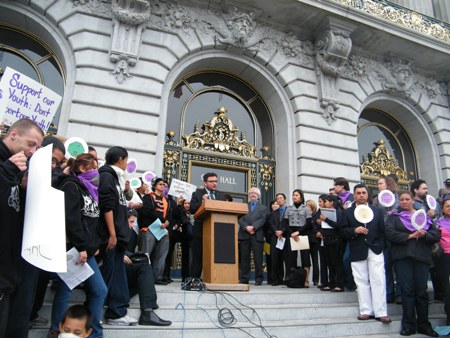
Immigration

ICE’s one step forward, two steps (ass) backwards

2

It’s hard to find the logic in ICE’s announcement that it is going to use quotas, again, coming relatively so soon after that other announcement that it was ending quotas.

Especially in the wake of a spate of crazy stories about folks who were threatened with deportation even though they were hardly seasoned criminals.

No wonder that the ACLU is calling for transparency, due process and detention reform.

The whole sorry saga brings us back to the central question of who profits from our federal immigration policy?

Ross on the road: The great white north

1

Editors note: Guardian correspondent John Ross is traveling across the nation pomoting his new book, El Monstruo — Dread & Redemption in Mexico City, and is sending us dispatches from the road. This week: Twin Cities, Madison and Northern Michigan.


 1. BLUE IGLOO


As I deplaned the Southwest Shuttle from Denver wrapped in my blue igloo, a puffed up garment that doubles my skeletal girth, a sudden spasm of panic punched me in the gut. Had I slept through my stop and disembarked in Fargo, North Dakota instead?
Minneapolis might just as well have been Fargo. The dead winter landscape lay frozen under week-old snowdrifts and the Twin Cities shivered in negative wind chill numbers beneath a leaden sky from which a cold hard rain would pelt down for a week. Fargo or Minneapolis? It didn’t much matter where I had landed – just don’t toss me into the wood chipper.


On my first evening in this desolate region, I was invited to dialogue with the Minnesota Immigrant Freedom Network at a community center in St. Paul. About 15 transplanted Mexicans, many of them related by marriage or friendship, pulled together in a circle in the gymnasium while the kids romped in the other room. Each called out his or hers’ “patria chica,” their home state or region or town. I talked about Mexico down on the ground today in the cheerless winter of 2010, the 100th anniversary of a distant revolution. How four out of every ten heads of households are out of work. 10,000 farmers and their families forced to abandon their milpas as millions of tons of NAFTA corn inundate the country. 19,000 dead in Felipe Calderon’s disastrous attempt to beat down the drug cartels. Who will be next?


Those in the circle leaned forward on their folding chairs, bending into my words as if I was a messenger bringing bad news from home. One woman began to weep and another rose to comfort her.


Later, I pulled out my book, El Monstruo – Dread & Redemption in Mexico City to show them what I had written. Families who would probably not eat meat for a week if they bought one snapped up three Monsters and asked me to sign them for their children — Alejandra, Yesica, Jeni, Alfonso, Jonaton — so that they could learn about the country they had been forced to abandon, in their new language.


As the session wound down, Mariano (not his real name) invited the families to a Jewish Seder the next week at a progressive Minneapolis schul. Then they would get on the buses and head for Washington D.C., a 150 hour round trip, to march for immigration reform on March 21st, the first day of spring. In the nooks and crannies of Obama’s America, Mexicans were beginning to come out of four years of social hibernation to rally for immigration reform, not a hot button issue in this economically strewn landscape.


I hung up with my old camarada Tomas Johnson, one of the apostles of fair trade Zapatista coffee — similar dispensaries like Just Coffee in Madison and Higher Grounds in Michigan are sprinkled over the frigid Midwest. Café has played a diminished role in the slender Zapatista economy ever since Muk’Vitz, a Tzotzil Indian cooperative, imploded when coffee prices soared — coyotes, bottom-feeder speculators, started showing up on the members’ doorsteps offering a few pesos more than the fair trade price.


Coffee is not an ideal resource upon which to build Zapatista autonomy — the price is set far away on commodity exchanges in London and New York and the product itself is destined for the jaded palettes of the connoisseur class in the cities of the north. Moreover, the coffee crop soaks up corn land and adds nothing to indigenous nutrition.


I marked my journey into my 73rd year at a house fiesta hosted by Tomas’s steady squeeze, an audiologist who gifted me with a hearing aid so that I might be able to decipher that questions hurled at me from the small audiences I address. This time last year, I was being wheeled into a green, antiseptic operating room for a round of chemotherapy that would k.o. the tumor that had taken over my liver. This birthday is the real gift.


I entertained privileged white students at several universities during my stay in the Twin Cities, got hopelessly lost in a frigid wasteland trying to find a Lutheran college, told tall tales to a handful of Raza at the U. of Minn, and attended a showing of the Benny More bio-pic at a jam-packed local theater. Benny’s scintillating calor radiating from the screen in waves of tropical heat juxtaposed oddly against the backdrop of the frozen north. Minneapolis-St Paul, with their new populations of color – Somalis, Ethiopians, Eritreans, Hmung, and Latinos – spice up this staid old state with exotic flavors. The music has changed: Reggaeton and Rancheros have replaced Spider John Koerner. I drink in the Albert Ayler-like contortions of a longhaired white boy at a jam session downstairs at the Clown Lounge.


Politics too are not as usual in this once-upon-a-time farmer-labor socialist paradise: Keith Ellison is the nation’s first Muslim congress person and a middle-of-the-road Democrat comedian stands small in the shoes of Paul Wellstone. In the other corner, the pit viper Michelle Bachman spits her venom into the black lagoons of Obamalandia.


II. TURKEY MOLE


I’m back on the Big Dog — there are plenty of Mexicans here but no Mexican bus. On the jump over to Madison, I chat with a well-seasoned black man during a smoke break. He wants to know where I’m headed. I’m on a low-rent book tour, I explain, I move from city to city to sell my books. “I’m on a book tour myself,” he laughs, “I get off where I want to and see if I like it or not. Hung up in Oswego for eight days but wasn’t anything there for me…”


There is a down-at-the-heels traveling class — the evicted and foreclosed, laid off and uprooted — rolling around the underbelly of this damaged country with no fixed destination in mind, looking for a place to light, some place that feels like home.


Norm Stockwell, who keeps WORT-FM, the Voice of Madison’s Voiceless, choogling, picks me up at the Greyhound depot, a furniture-less warehouse that resembles an immigrant detention center on the outskirts of town, and drives me over to the once-a-month Socialist pot-luck, but only scraps and few stained paper plates are left. A few hours earlier, the Madison P.D. visited the premises at the behest of the Wisconsin Socialist Party to remove a truculent member who had been abruptly expelled from its ranks, an astonishingly unpolitical resolution to a political dispute.


Madison is a city that doesn’t leave much up to chance. Cops are ever at the ready to surveil radical meetings. One cannot post a hand-scrawled street sign protesting injustice without first obtaining a permit from the city. No household is allowed to house more than three chickens (no roosters), a law that necessitates chicken inspectors and has given birth to the Chicken Liberation Front.


The State Capitol, a knock-off the Nation’s, is forever on the eyeline in Madison to remind one of the power of the State, I expect. The city is laid out on a grid so that all avenues spoke off from its monstrous dome – you have to move out of town to escape the radiation.


On Saturday, March 20th, a fistful of eternal protestors gathered at the foot of this granite beast to mark the start of the eighth year of the illegal invasion and occupation of Iraq and the decimation of millions of its people. As I trudged up State Street towards the Capitol, I flashed back to our feverish days as Human Shields in Baghdad in March 2003 and thought about Sasha for whom the war never goes home, climbing the hills of Amman, delivering collateral repair from dawn to dusk to the million Iraqi refugees that forgotten war has exiled to the Jordanian capitol.


Our presidents invade so many foreign countries that they can’t even remember the name of the last one they destroyed. Iraq has been erased from the North American mind screen in favor of Afghanistan, the Good War on Obama’s agenda. Last month, Sasha and Mary’s Collateral Repair Project took in just $50 in donations and CRP is in danger of folding. Send them some Yanqui shekels at (www.collateralrepairproject.org.)


The annual commemoration of the Iraqi genocide draws smaller and smaller knots of humanity each year — 80 or so souls in Madison, 500 in San Francisco, not 10,000 in Washington. But the next day, as Baracko’s Dems braved the racist jibes and hard fruit of the Teabaggers to enter the hallowed halls of Congress and narrowly vote up a phony health care reform bill that excludes immigrants from coverage and leaves the insurance congloms on top, 200,000 assembled outside to back up a proposed immigration reform that smells just as cheesy as Obamacare.


The rally proved to be the largest confluence of immigrant workers since that miraculous May 1st four years ago when millions came out of the shadows to shout “aqui estamos y no nos vamos.” After that milestone moment, the immigrant rights movement was driven into the underground by Bush’s ICE raids, Lou Dobbs, the Minutemen, real-time Mexico bashing with knives and bottles, Sheriff Joe’s Arizona storm troopers, good ol’ American-as-apple-pie racism, and the squeamish response of the official Latino leadership.


Now the indocumentados are taking their first baby steps back into the maelstrom of U.S. politics. Hundreds of grassroots groups like the Minnesota Immigration Freedom Network rented buses and drove off to Washington on the first day of spring and May 1st, the day on which immigrant workers first took to the streets of America 124 years ago in the battle for the eight hour day, now looms large on the calendar of resistance.


Lester Dore is a graphic artist who operates under the influence of the king of the calaveras Jose Guadalupe Posada, the brothers Flores Magon, and the breathtaking explosion of popular art that detonated on the walls of Oaxaca during the 2006 uprising in that southern city. Lester whips up a pair of prints to celebrate the publication of “El Monstruo” and the life after death of Praxides G. Guerrero, the first anarchist to fall in the 100 year-old-this-year Mexican revolution. He serves up a big pot of Mole de Guajalote (Turkey) and invites us over. Three compas from Toluca in Mexico State share the sumptuous repast and the conversation quickly slides into Mexican. I learn the origin of the Chilango-ismo “teparocha” (falling down drunk) but eschew the vino (the liver lives on.)


III. SANCTUARY IN THE HEARTLAND


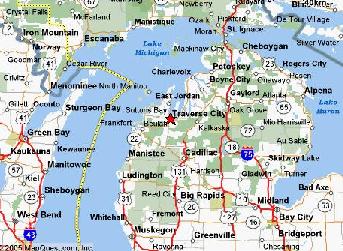
Driving the long route around Lake Superior into northern Michigan, the first tentative fingers of spring have brought a thawing to the land. The cherries that draw thousands of migrant workers to the Lower Peninsula are threatening to burst into bud. Gladys Munoz (her real name) directs Migrant Health Services for seven northern Michigan counties. She is based in Traverse City, a comfortable upper crust enclave — the billion buck mansions out on the peninsula are in the El Chapo Guzman category of ostentation (Michael Moore is rumored to be in residence in the environs ensconced in a lavish log cabin roughly the size of downtown Flint.)


Gladys knows where the bodies are buried. We ply the backroads to the labor camps hidden away down in the dank gullies. Guatemalans and Mexicans stream into this region each spring to do the stoop labor no gringo will do and pick the Maraschinos that top off the parfaits of the few upwardly mobile Americans left in the wake of the ravaged economy (Michigan unemployment clocks in around 15%.) Gladys tells me about three babies born without brains — she suspects pesticides. She speaks about a man from Chiapas who hung himself when he found out that he had contacted AIDS — a priest was called upon to perform an exorcism at the house where he expired. And a young Triqui Indian mother from Oaxaca picking cucumbers for a Vlasic pickle contractor who was stranded in a country that doesn’t recognize her language after her husband went fishing for supper without a license and Fish & Game turned him over to the Migra.


We visit with Liliana (not her real name) from the drug war-riddled hot lands of Guerrero state. The patron is a kindly old farmer who has installed cable TV for the workers and we watch Barack Obama extol the wonders of his tarnished health care bill. Liliana’s husband is picking oranges in Florida but will soon return to work the cherry. She says he doesn’t much believe that an immigration reform measure will make it out of congress – “just some more blahblahblah…” But Liliana will march this May 1st if she can get a ride — undocumented workers are not permitted drivers’ licenses in the state of Michigan.


Traverse City is good to me. I perform at a local organic coffee roaster for a roomful of social change agents. The next morning, Jody T. who gave up her life to drive this garrulous old gaffer around the bioregion, steers the Viva into a trepidatious triangle. Cadillac was once the home base for Timothy McVeigh and the Michigan Militia, a recent flashback on the Ten O’clock News after a Christian posse purportedly targeted cops for blood sacrifice in preparation for the appearance of the Anti-Christ. To the west, small towns with Dutch-inflected names like Holland and Zeeland and Vreland dot the lakeside.


White clapboard outposts of the Dutch Reform Church, the architect of South African apartheid, their steeples spiring piously into the spring breeze, hug the highway. The Dutch Reform Church is the spiritual home of the Prinz family whose most celebrated spawn, Eric, is the go to guy at Blackwater. Further south we slide into Grand Rapids where the similarly affiliated DeVos dynasty’s Amway holds sway. The Prinzes and the DeVoses (a good reason not to root for the Orlando Magic) finance such repositories of right-wing fanaticism as Focus On The Family and Operation Rescue. The largesse of Dick DeVos rivaled the Mormon Church in putting California’s homophobic Proposition 8 over the top.


Grand Rapids, once the furniture capitol of the known universe and now the home of the Gerald Ford Museum of Presidential Imbeciles, is a good boxing town (Buster Mathis and Roger Mayweather have gyms here) and a swelling Latino population has changed the complexion of the city. Despite the downturn, Grand Rapids is trying to upgrade its downtown but the further one gets from the core of the city, the seedier things look.


Koinonia House is a sanctuary near the old demolished heart of Grand Rapids — in fact, it is the only structure left standing on its block. Established by disaffected seminarians like Jeff Smith in the early 1980s when the U.S. waged war on Central America, K House became a station on the underground railroad built by the Sanctuary Movement. The first refugees were Guatemalan Indians fleeing the scorched earth genocide of Efrain Rios Montt. In recent years, K House has taken in Mexicans fleeing that “desgraciada pobreza” back home, like Carlos and Alynn (their real names) who have brought their remarkable art with them to El Norte.


Jeff kicks back and reminisces about the fates of former tenants. The big-bellied wood stove belches out waves of warmth on a chill late March morning. The big arms of the fluffy old lounger envelop a weary traveler and hold him close. K House remains a sanctuary deep in the heart of a wounded land.


Stay tuned. Chicago, St Louis, Jackson Mississippi – there is still a whole lot of traveling to do as the Monstruo tour moves eastwards.               


FIN


John Ross and “El Monstruo – Dread & Redemption in Mexico City” will visit St. Louis April 4th-7th, and Millsaps College Jackson Mississippi April 9th for a symposium on Mexico City – he will tour Baltimore, Washington, New York, and Boston April 19th through May 1st. For details write johnross@igc.org.

Alerts

0

alert@sfbg.com

WEDNESDAY, MARCH 24

"Lynching Then, and Lynching Now"


Attend this teach-in about the historic link between the death penalty and lynching in the U.S. Speakers include former and current death row prisoners, activists from the justice for Oscar Grant movement, a member of the Laney Black Student Union, and more.

7 p.m., free

Laney College

Room D200

900 Fallon, Oakl.

(510) 589-6820

Mammalian good


Train to become a volunteer at the Marine Mammal Center’s Education Department in the Marin Headlands in Sausalito. Learn how to greet visitors, talk to the public, and lead tours about the center’s seal and sea lion patients. Training consists of a series of Wednesday or Saturday four classes in April.

Wednesday classes 4/7, 4/14/ 4/ 21, and 4/28

Saturday classes 4/10, 4/17, 4/24, and 5/1

Fort Cronkhite

2000 Bunker Road, Sausalito

(415) 289-7361

FRIDAY, MARCH 26

Arundhati Roy


Attend this fundraiser for the International People’s Tribunal on Human Rights and Justice, based in Kashmir, India. Author and human rights activist Arundhati Roy reads from her latest collection of essays, Field Notes on Democracy: Listening to Grasshoppers. Roy will be introduced by Alice Walker.

7 p.m., $35

Mission High School

Auditorium

3750 18th St., SF

www.haymarketbooks.org

SATURDAY, MARCH 27

Immigration legal advice


Learn about the immigration services provided by API Legal Outreach from staff attorney Cindy Liou and get free legal advice on immigration questions such as petitioning for family members and how to naturalize (program in English and Mandarin Chinese).

2:30 p.m., free

Chinatown Branch Library

Community Meeting Room

1135 Powell, SF

(415) 355-2888

"Stand Against Sit-Lie"


Take part in this citywide celebration of public space and help stop SF Police Chief George Gascón’s proposal to criminalize sitting or lying on sidewalks. Just occupy a space on your nearest sidewalk and do what you love; barbecue, make music, do yoga, read, relax, make art, dance, play chess — anything!

Go to www.standagainstsitlie.org for information about how to educate others on the Sit/Lie Ordinance. Meet at 4 p.m. for an end of the day celebration at the Market/Castro plaza.

All day, free

A sidewalk near you

www.standagainstsitlie.org

SUNDAY, MARCH 28

Kids’ Clothing Swap


Exchange gently-used, unstained infant and toddler clothing for the size you need now and help support Help a Mother Out (HAMO), a local grassroots campaign to improve the lives of families in need, one diaper at a time.

2 p.m., $10 or a package of size 4–6 diapers or pull-up’s

Natural Resources

1367 Valencia, SF

www.helpamotherout.org

Uhuru Pies’ Delicious Revolution


Become a community organizer, baker, graphic artist, or socially conscious volunteer at this launch meeting for Uhuru Pies’ November 2010 bake sale fundraiser. The bake sale benefits the African People’s Education and Defense Fund, founded in Oakland in 1981.

10 a.m., free

World Ground Café

Backroom

3726 MacArthur, Oakl.

(510) 851-4492

Mail items for Alerts to the Guardian Building, 135 Mississippi St., SF, CA 94107; fax to (415) 255-8762; or e-mail alert@sfbg.com. Please include a contact telephone number. Items must be received at least one week prior to the publication date.

From Beijing to Oakland

0

arts@sfbg.com

LIT In 2005, after dropping out of a PhD program in immunology, Chinese writer Yiyun Li debuted her first book of fiction, A Thousand Years of Good Prayers. A collection of stories exploring the aftershock of the Cultural Revolution on mainland and overseas Chinese, it won the Frank O’Connor International Short Story Award, PEN/Hemingway Award, Guardian First Book Award, and California Book Award. Li’s story “Immorality” won the Paris Review Plimpton Prize.

Afterward, Li’s green card application was rejected by the U.S. Citizenship and Immigration Services — twice. Her “extraordinary ability” as an artist (Title 8, Code of Federal Regulations, Part 204.5) could not be proven until she won, on top of those accolades, a Pulitzer Prize.

Fortunately for the status of fiction in America, Li’s extraordinary ability was finally recognized in 2007, 11 years after her arrival to the United States. In a journey that has taken her from Beijing to Iowa, Li now resides in Oakland with her family. Li left China in 1996 to pursue a doctorate in immunology at the University of Iowa. Living in China, she had no interest in writing fiction, and her natural affinity and aptitude for telling stories in English took her by surprise. Her second language in speaking, she discovered, was really a “first language in creating and thinking.”

Li has a scientist’s eye toward precision and a gifted storyteller’s ability to extract meaning from the mad fracas of human circumstance. Last year, she published a well-received first novel called The Vagrants. Set in China during 1979, in a fictional provincial city called Muddy River, the novel provides an unflinching view into the era’s brutality and violence. The novel also reveals, carefully and without sentiment, the unexpected moments of transcendence that result when love, empathy, and human emotions bloom in the harshest of environments.

Li spoke with the SFBG about The Vagrants, released in paperback by Random House a few weeks ago.

SFBG You write in English, which you learned as an adult. Does this have to do with any innate differences linguistic between English and Chinese? Does it have anything to do with your associations with China?

YIYUN LI I wasn’t trained as a writer in China, and even though I widely read Chinese literature when I was in China, I never had the urge to write in Chinese until I came to America, picked up English, and felt it a natural way to express myself. I think it is a more personal decision than I may have indicated, though honestly I myself sometimes feel mystified by this switch of languages too. I feel much more like myself when I write in English, which is to say English is really my first language in creating and thinking. In a way I do censor myself less when I write in English — again, that censoring is not from others, but from myself.

SFBG Do you think in Chinese?

YL I no longer think in Chinese. Of course as my mother tongue, Chinese is still used in my everyday life — I still count and do my math in Chinese, but when I think about literature, art and philosophy I think in English.

SFBG As an international student, your decision to forgo a promising medical career and become a writer was extremely brave. During the process of writing your first book, did you experience great anxiety or doubt? Were you ever tempted to give up and go back to medicine?

YL I didn’t feel self-doubt — I think by the time I gave up my immunology career, I was certain I wouldn’t go back. There was a certain level of anxiety but I would say at the time it was minimal. I probably just lived with a tunnel vision and all I thought about was to write, and write well. I was certain that I needed some time to improve myself, so it did not occur to me to give up.

SFBG When you write, do you find you draw any lessons from your experiences studying medicine?

YL Medical knowledge, like any kind of knowledge, is helpful and useful for a fiction writer. I think my training perhaps helps me look at the world and its many violences without being sentimental.

SFBG In The Vagrants, even small children in Muddy River are completely unmoved by public executions. This strikes me as devastating and true. My mother told me that when she was growing up in China during the early 1970s, she saw a man bleed to death on the side of the road. The real horror of the experience didn’t dawn on her until decades later. You were seven years old in 1979, the year in which The Vagrants takes place. Writing about violence from the perspective of children, do you recall events from your own childhood in China?

YL Your mother’s experience was quite close to my own experience, and indeed for most children, empathy and sympathy come not naturally, but with some help from grownups and education. When violence is prevalent, as one sometimes finds in life, not only children but adults too stop questioning the injustice. I did draw from my own memories of the time, but like your mother, I had to look back as a different person to understand the tie.

SFBG Have you gone back to China since you’ve left? How are you received?

YL Yes, I have been back visiting. I keep a very low profile when I visit China. so there is not much trouble for me.

SFBG You’ve mentioned that your biggest literary influence is William Trevor. You’ve named Chekhov, Tolstoy, and Greene as influences, too. Do you draw any influences from Chinese literature?

YL My favorite Chinese author — Shen Congwen — influenced me a lot, not in the way of how he wrote stories and how he used language but how he looked at the world as a storyteller.

SFBG Speaking of Chinese novels, some of your characters in The Vagrants, like Teacher Gu, are quite literary. I enjoyed that Kai and Kialin hold their clandestine meetings in the library. I also liked that Jialin’s mother steals books for him from the shelves she’s supposed to guard. What books are these characters reading? If you could pick a book for each Gu, Kai, and Jialin, what might be a book that affected the way each viewed the world at that time?

YL This is a great question. For Jialin and Kai, I imagine they would be reading Gadfly, a little-known novel in the West but a hugely popular novel in China (and Soviet Union) written by the Irish author Ethel Voynich. I also thought Jialin might be interested in reading French authors. For Teacher Gu, I would imagine he would read Tolstoy.

Thawing ICE

0

sarah@sfbg.com

Top San Francisco officials are still refusing to implement legislation approved by the Board of Supervisors that requires due process to play out before immigrant youth accused of felonies are turned over to the federal government, despite recent developments that call into question arguments that have been made against that policy.

Mayor Gavin Newsom, whose veto of the legislation was overridden by the board in November 2009, has been the main obstacle to putting the new policy in place. He has argued that it violates federal law, that the city faces civil liability for harboring undocumented immigrants accused of crimes, and that only serious criminals have been affected by his unilateral 2008 decision to turn minors over to federal authorities before they have been convicted.

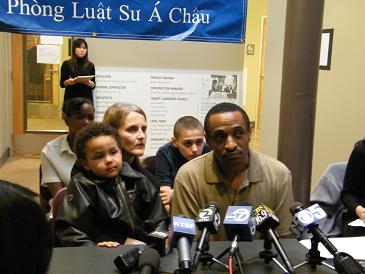
But then Muni bus driver Charles Washington’s wife, Tracey Washington, and 13-year-old stepson, undocumented immigrants from Australia, were placed under the control of U.S. Immigration and Customs Enforcement and ordered deported after the boy got into a fight at his middle school.

The case generated sympathetic media coverage because the felony charges and deportation order seemed excessive, so the federal government issued a 60-day reprieve to allow the family to finish applying for green cards and so the boy could have his day in juvenile court.

“All this got triggered by the non-implementation of a law that the board duly enacted last year,” Washington said March 11, a week after getting his reprieve, expressing exasperation with city officials. “The police are overcharging kids and waiting for someone else to whittle the charges down, and the probation officers are referring the kids to ICE, waiting for someone else to deal with the situation.”

Newsom’s policy required the city’s juvenile probation department to refer Washington’s stepson to federal immigration authorities after local police charged the boy with felony robbery, assault, and extortion in a dispute over 46 cents. Authorities then required his mother, rather than his stepfather, to come pick him up and placed an electronic monitoring device on her pending a deportation hearing.

Newsom’s policy has had a big impact in the city’s immigrant communities. Since July 2008 when the mayor ordered changes to Sanctuary City policies that had been in place for two decades, 125 youths have been referred to ICE, according to a March 9 report from the city’s Juvenile Probation Department.

In addition to the Mayor’s Office, the JPD has refused to enforce policies enacted through legislation by Sup. David Campos that are technically supposed to be the new city policy on referring undocumented youth, and the City Attorney’s Office has not required city employees to follow the new law, arguing it can only give advice and not compel departments to take action.

“With the benefit of legal advice provided by the City Attorney’s Office and outside legal counsel, and in light of current restrictions imposed by federal law, particularly the position taken by federal law enforcement authorities, the department has concluded that it cannot modify its policies and practices,” probation chief William Siffermann said at a March 4 hearing of the Board of Supervisors Rules Committee on why his department didn’t implement the legislation.

Grilled by Campos, Siffermann could not identify a federal law that requires city officials to report kids to federal immigration authorities upon arrest. Instead, Sifferman pointed to what many in the criminal justice community see as U.S. Attorney Joseph Russoniello’s overly broad interpretation of federal immigration laws, including his allegation that transporting arrested juveniles to court hearings amounts to “harboring aliens.”

But the Washingtons’ case struck a raw nerve at City Hall, and the Obama administration’s conciliatory response, along with other recent legal developments, indicate that it isn’t the feds that are preventing implementation of Campos’ legislation.

In February, Superior Court Judge Charlotte Woolard ruled in a civil case that the Bologna family — of which three members were murdered in 2008, allegedly by Edwin Ramos, an undocumented immigrant who had been in city custody as a juvenile — can’t hold the city liable for failing to prevent the murders.

That crime had been sensationalized by the San Francisco Chronicle, the San Francisco Examiner, and nativist groups, putting pressure on Newsom to change the Sanctuary City policy. Newsom’s spokespeople repeatedly have referred to it as an example of the civil liability the city faced.

On March 1 (the same day Washington first went public), City Attorney Dennis Herrera replied to allegations that his office has not done enough to implement Campos’ amendment by citing its victory in the Bolognas’ civil case, which sought punitive damages and to invalidate the city’s sanctuary ordinance.

Herrera also asked Gary Grindler, acting deputy attorney general at the U.S. Department of Justice, to direct the U.S. Attorney’s Office in the Northern District of California to “not use its limited resources to criminally prosecute local officials and employees who abide by California and local laws regarding the reporting of undocumented juvenile immigrants to the federal immigration authorities.”

Herrera based his March 12 request on an Oct. 19, 2009 memo that Grindler’s predecessor, David Ogden, issued curtailing federal action against medical marijuana dispensaries, which Herrera argued could serve as the model for clarifying the federal position on the city’s sanctuary law.

“If city officials and employees follow the mandates of state law, including those regarding the confidentiality of records of juvenile detainees, and the requirements of the amendment permitting the reporting to ICE of juveniles only after they have been adjudicated as wards of the court for criminal conduct, then the U.S. Attorney should not make it a priority to use its scarce federal resources to prosecute those city officials on the theory that by not reporting them at an earlier point, the city officials or employees are guilty of harboring,” Herrera wrote.

Campos said he welcomes any effort to get clarification from the feds, but believes such clarification is not necessary — and may not be forthcoming anyway. “So San Francisco should move forward. The law, in my view, allows us to do so, and it’s the right thing to do.”

Who profits from ICE’s electronic monitoring anklets?

1

One of the many troubling things to emerge from the threatened deportation of the wife and stepsons of Muni bus driver Charles Washington is the extent to which the Department of Homeland Security (DHS) is using electronic monitoring bracelets to track immigrants–and is turning to private contractors to deliver these services.
Take the Washingtons’ case. Charles Washington told reporters that US Immigration and Customs Enforcement (ICE) told him they would release his teenage stepson, if his wife Tracey, went to ICE’s Sansome Street office in San Francisco and agreed to wear an electronic anklet (pictured below).

Tracey's anklet
Tracey Washington agreed to the deal, worried about her 13-year old son, who had spent close to a week in detention at juvenile hall, after he got into a fight at school over 46 cents, and who was now in the hands of federal immigration authorities. And she had cause to worry. The feds have been known to transfer teenage immigrants arrested in San Francisco to detention facilities in Florida, Virginia and Oregon, while their deportation is pending.
So, the Washingtons hurried down to Sansome Street to retrieve their son.  And, there Tracey Washington was given deportation orders for herself and her son, and an electronic monitoring device, which contains a GPS device to monitor her movements 24/7, was placed around her ankle.
Tracey says the device was too tight at first, and, though it has since been adjusted, wearing it makes her feel as if she has committed a serious crime. But so far, no one in her family has actually been found guilty of a crime in this Kafkaesque episode.
Instead, her 13-year-old son has been charged with felony robbery, assault and extortion, charges that sound serious but have yet to be adjudicated in a juvenile justice court, and that were made in the wake of a schoolyard fight, which did not involve weapons, after the parent of the victim called the police.
But these felony charges are the reason why a juvenile probation officer called ICE, who picked up the boy, and, within 5 hours, released him to his mother, once they’d locked an electronic monitoring device on her ankle.
As for the question of the Washingtons’ visa overstay, which is ICE’s grounds for the anklet, the couple say they called the US Citizenship and Immigration Service (US CIS), not once, but twice, two days after they got married in April 2009, when Tracey, who met Charles on vacation six years ago, was midway through a 90-day visa waiver.
The couple say they were given misinformation on the phone about the urgency of applying for a green card, and that’s how they came to be only at the beginning of that process when their son got nabbed—a lag that Charles Washington attributes to the time it took for his family to save up the thousands of dollars that green card applications cost.
And apparently there is no way for the Washingtons or the US government to verify what happened when the couple called US CIS, and spoke to an operator. US CIS spokesperson Sharon Rummery told the Guardian that it is impossible to ascertain if a contractor with the US government misinformed the family.
‘I can’t say that it’s true or not, because it was a private conversation between one of the operators who works on our customer service line,” Rummery said. “Our operators are highly trained and are backed up by our trained officers,” Rummery continued, confirming that the operators are contractors, not US CIS staff.
Either way, Tracey Washington is left wearing an anklet. And as a hard-working, bus-driving US citizen, her husband Charles is not pleased that his tax dollars are being put to use in a way that leaves his wife stressed and feeling like a criminal.

“It’s my belief they are wasting tax payer money,” Washington said, eight days after US ICE granted his wife and stepson 60-day deportation reprieve. “With all the publicity this case has received, and the fact that our green card application has been sent in, I don’t see why she needs to be on the anklet. Everything that immigration has requested, we have complied with.”

So, just how widely spread is the use of anklets to track immigrants?

In 2002, federal immigration authorities created a $3 million Alternatives to Detention (ATD) program, to ensure that “aliens released from detention appear for their court hearings,” according to a 2010 ICE report.Fast forward to 2010 and the program’s FY 2010 budget is set at $69.9 million.
And somewhere along the way, the program began requiring immigrants who are in the process of applying for residency to wear electronic monitoring ankle bracelets 24/7—a requirement otherwise reserved for rapists, child molesters and other convicted criminals on parole.
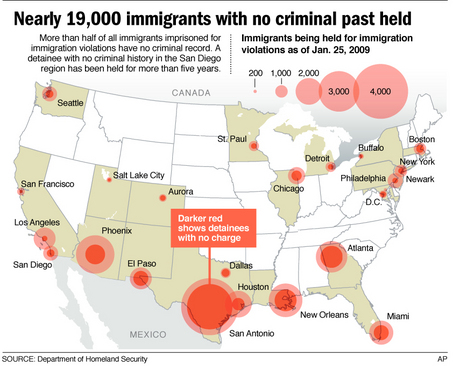
This pilot program, which began in eight cities, including San Francisco, has since grown to a nationwide multimillion opportunity for contractors and now involves at least 30 cities: Atlanta, Charlotte, Baltimore, Boston, Hartford, Buffalo, Chicago, Kansas City, Dallas, Denver, Detroit, El Paso, Houston, Los Angeles, Delray Beach, Miami, Orlando, Newark, New Orleans, New York, Philadelphia, Phoenix, Portland, Seattle, San Francisco, Salt Lake City, San Antonio, San Diego, St. Paul and Washington.
In July 2009, DHS/ICE’s office of Detention and Removal Operations (DRO) awarded a $372 million, 5-year contract to BI Incorporated, a Boulder Colorado-based company, to provide support services for its Intensive Supervision Appearance Program  (ISAP) 11, as the federal government previously called its electronic monitoring program.
G4S Government Services of Atlanta, Georgia, which held the previous ISAP’s pilot contract, and put in a S489 million bid for ISAP 11, protested the BI award, arguing that DHS’ evaluation and BI’s price proposal were “unreasonable.”
Either way, DHS’ “statement of work” documents, which were posted online as part of that contract bid, suggest that ICE plans to use ATD on an even wider basis, in future.
“Approximately, 32,000 persons are held in secure detention by DRO each day,” the contract’s statement of work (SOW) section states, noting that this figure includes “aliens in the United States who are in violation of the Immigration and Nationality ACT (INA) who pose a threat to community safety, national security, and/or may be a flight risk, in addition to those aliens required to be detained under specific provisions of the INA.”
“Limited detention capacity and an increasing detainee population coupled with the need to lower alien absconder rates have sparked national efforts over the past several years to integrate into DRO’s general practices the use of various alternatives to detention for aliens who do not require mandatory detention in accordance with the INA,” the contract continues. “Alternatives to detention offer the prospect of a considerable cost savings over secure detention for eligible aliens.”
“Depending on available funding during the execution of the ISAP 11 contract, DRO intends to expand its ISAP coverage,” the contract notes. An attached appendix shows a list of 165 cities in which the program would operate nationwide. In addition to San Francisco and Los Angeles, California cities on the list include Bakersfield, San Diego, El Centro, Fresno, Imperial, Lancaster, Lompoc, Sacramento, San Jose, San Pedro, Santa Ana, Stockton, and Ventura.
Under the current contract, BI was expected to be fully prepared with sufficient staff and equipment to fulfill all statement of work requirements for 16,750 ISAP II slots, within two months of assuming control of the program. San Francisco was expected to fill 850 of these slots, putting it in fourth place behind Los Angeles (3,400 slots), New York, (1,500 slots) and Washington, D.C., (1,025).
And by the end of the five-year contract, the numbers of slots are expected to rise to 27,237 slots—a 10,487 increase, along with a steady increase in participating cities. Under those estimates, San Francisco is expected to have 957 slots five years from now,
The federal government touts ISAP, which relies on telephonic reporting, unannounced home visits, and regular face-to-face interviews, as well as electronic GPS monitoring devices, as a “cost-effective alternative to detention for aliens being processed through the Immigration Court system.”
ICE’s Lori Haley stressed that the program, with its focus on alternatives to detention, is part of the department’s “commitment to immigration reform.”
“Our mission is to ID non-citizens here without legal status and move them through the immigration process how the court sees fit,” Haley said.
She also stressed that the anklet program is preferable to detention and is suitable for folks with families who are not posing a danger to their community.
“We also found that as people get closer to the conclusion of the process, they may need a stronger level of monitoring,” Haley added, alluding to the reaction of folks on realizing that they are going to be deported after all.
These statistics paint a perhaps surprising picture to the average American, who likely wasn’t aware that there are thousands of immigrants in the US, who haven’t committed a serious crime, yet are walking around wearing these onerous, privacy-invading devices, hidden beneath their pants, or while they shower, or go to bed, while they await a ruling from the courts on their request to stay here permanently.
And these numbers are only going to grow bigger, if ICE has its way.
“Depending how long an alien remains in the ATD program and the number of individuals enrolled in the ATD program, implementing ATD nationwide would require between $88 million and $513 million,” ICE stated in its 2010 report to Congress. “The most realistic scenario for expansion requires a reduction in the average length in the ATD program to 180 days, down from the current average of 310 days. Reducing the average length on the program requires significant coordination within the Department of Justice, Executive Office for Immigration Review.”
“310 days in an anklet” sounds like the name of a funny film. Unfortunately for the 800 people in San Francisco, including Tracey Washington, who are apparently walking around wearing these devices in any given year, the situation is not funny, but it is all too real. And is this really the way to reform the federal immigration system in a humane and meaningful way?

Behind the Mexican drug war

1

Editors note: The killings of three U.S. consular employees in Ciudad Juarez has brought increased press attention in this country to the violence of Mexico’s drug gangs.  Our Mexico City correspondent, John Ross, reports on the background story.

MEXICO CITY – Last July, in a meticulously planned raid reminiscent of the classic guerrilla jail breakouts that are legend in Latin America, a commando force of 20 heavily armed fighters freed 53 comrades from a prison in the northern state of Zacatecas. Were the perpetrators in fact guerrilleros from some as-yet unknown revolutionary foco or narcos emulating a guerrilla-style jailbreak intent on freeing their own?


Recent assassination attempts against high-ranking state officials — Sinaloa’s Secretary of Tourism (successful), Coahuila’s Attorney General (the restaurant at which he was dining with a Texas mayor was sprayed with automatic weapon fire), and a Baja California finance undersecretary (hung by the neck from a Tijuana freeway overpass) — suggest revolutionary retribution in a year that marks the 100th anniversary of the Mexican Revolution in which jitters of new uprisings are legion. January 1st was welcomed in with anarchist bombs, sabotage, and “expropriations” in Mexico City and Tijuana on the northern border.

Although the incidents cited suggest revolutionary subversion, they were all the handiwork of Mexico’s five narco cartels, which are locked in an intractable war with both President Felipe Calderon’s military and federal police — and reportedly hundreds of U.S. drug warriors — that has now taken more than 19,000 lives since December 2006.

The jail breakout in Zacatecas and the Sinaloa and Coahuila shootings are attributed to the syndicates headed by Joaquin “El Chapo” Guzman, his former associates in the Beltran Leyva gang, and the notorious Zeta cartel.

The hanging of Baja California state finance official Rogelio Sanchez Jimenez was charged to a blood-drenched capo Teodoro Garcia Simentel, a.k.a. “El Teo” or “Three Letters” who is deemed responsible for hundreds of hangings, beheadings, and excessively violent homicides — an associate, Santiago Meza (“El Pozalero”) has reportedly confessed to dissolving 300 victims in vats of acid. Most of the victims were allies of the fading Arellano Felix clan, with whom El Teo is contesting Tijuana.

Simentel was captured this past January 14th in an upscale residential neighborhood of La Paz in adjourning Baja California Sur state, the second top-rung narco purportedly taken down by Mexican authorities in a month. The bust earned bouquets of kudos from Washington, which is financing Calderon’s drug war under the $3,000,000,000 Merida Initiative.

The U.S. role in the capture of El Teo and Arturo Beltran Leyva, “the Boss of Bosses,” who was gunned down by Mexican marines December 16th, appears to have been purposefully downplayed. According to an unidentified member of Calderon’s Security Cabinet as reported by Gustavo Castillo, a La Jornada correspondent with exceptional sources, Simentel was located by the U.S. Department of Homeland Security’s Immigration & Customs Enforcement, a first indication that ICE is now being deployed in Mexico’s drug war.

The Drug Enforcement Administration and the FBI are also thought to have armed agents on the ground here under provisions of the Merida Initiative and the North American Security and Prosperity Agreement.    

The Calderon government vehemently denies that participation of U.S. agents led to the capture of El Teo or Beltran Leyva, although it acknowledges enhanced cooperation between the two nations’ drug fighters. The suggestion that Washington has assets on the ground here is not acceptable to many Mexicans, whose country has been repeatedly invaded and even annexed by U.S. troops, and is regarded as a violation of national sovereignty.

The number of U.S. security agents working in Mexico is closely held, but observers of Washington’s presence here such as specialist Jorge Camil affirm that it has been rising dramatically since the 9/11 terror attacks on New York and Washington and now totals in the hundreds. The DEA and the FBI now have offices in provincial capitals such as Tuxtla Gutierrez Chiapas, close to the Guatemalan border and multiple smuggling routes.

Mexico is not only in the crosshairs of the U.S. security apparatus because of the flourishing drug trade — the infiltration of terrorists across the porous border also excites attentions, although all reported incidents to date have proven to be false alarms.

Of increasing interest to Washington is the possible alliance of narco gangs with Mexico’s fledgling guerrilla cells, an interpolation of the Colombian model.

The concept of narco-guerrilla coalescence was first proffered in the mid-1980s, soon after Ronald Reagan officially proclaimed the War on Drugs. Then-veep George H.W. Bush, a Navy man, was placed in charge of overseeing interdiction efforts in the Caribbean to stop the Colombian cocaine flow into the southern United States.

Under Bush’s watch, intelligence reports placed the onus on the Marxist-Leninist Revolutionary Armed Forces of Colombia (FARC), the Army of National Liberation (ELN), and M-19, a left nationalist movement later decimated by the Colombian army, for extending protection to such world-class kingpins as Pablo Escobar.

The truth was, however, more diffuse: paramilitary units such as the United Auto-Defenders of Colombia (AUC) armed by right-wing rural “terratenientes” (rich land owners) and the Colombian military were the big players in the so-called “narco-guerrillas,” although several FARC fronts openly provided protection to the druglords.

The narco-guerrilla thesis eventually became the underlying reason d’etre for Plan Colombia, in which the twin wars on drugs and terrorism were married. Since the late 1990s, Washington has pumped billions into Colombia to sustain this counter-insurgency strategy. The Merida Initiative, signed in that Yucatan city by George Bush and Felipe Calderon in 2007, is often referred to as Plan Mexico.

As recipients of billion-dollar boodles in U.S. drug war largesse, Colombia’s Alvaro Uribe and Mexico’s Calderon are Washington’s most significant allies on a continent where the left has taken power in a majority of countries.

Today, despite a decade of Plan Colombia, Colombian cocaine production has held steady and the FARC ranks as Latin America’s most powerful narco-guerrilla group. Although Mexico has no known counterpart, FARC activities here are closely monitored. FARC offices were shuttered during the presidency of Vicente Fox (2000-2006) — the FARC and Colombian president Andres Pastrana entabled negotiations in Mexico City in the 1990s.

A Colombian-born National University graduate student was deported to Bogotá last year on terrorism charges for sympathizing with the FARC, and Uribe has issued extradition warrants for a Mexican student who survived the bombing of the Ecuadorian jungle camp of FARC leader Raul Reyes (not his real name) in 2008.

One connection: FARC operators are said to consort with the Valle del Norte Cartel, the main Colombian supplier for El Chapo’s Sinaloa Cartel. A purported 2007 jungle tete a tete between Reyes, and an unidentified cartel representative suggested the possibility that the Sinaloa boys would buy cocaine directly from the Colombian rebels rather than deal with a series of middlemen suppliers.

Mexico’s armed leftists take pain to steer clear of association with drug gangs. Military intelligence first identified the Zapatista Army of National Liberation (EZLN) as drug and gunrunners on the Guatemalan border, an estimate said to have been backed up by CIA satellite overflights. The Zapatistas have dodged the stigma by waging a vigilant crusade against drugs in their autonomous communities in southeastern Chiapas. Cultivation of marijuana by militants is severely punished by banishment from the EZLN. Nonetheless, the Mexican Army has repeatedly stormed into Zapatista villages on the pretext of marijuana patch sightings.

Mexico’s homegrown guerrilla bands have their roots in the north of the country where this distant neighbor nation’s 1910-1919 revolution first germinated. Revolutionary martyrs Francisco Madero, Pancho Villa, Venustiano Carranza, and Alvaro Obregon were all northerners who marched their armies south to seize power. In 1965, Arturo Gamiz, a disaffected rural schoolteacher, and 12 rebels laid siege to army barracks in Ciudad Madero, Chihuahua; all were killed in the assault. Six years later, the September 23rd Communist League based in the northern industrial city of Monterrey took its name from the date of the assault; 15 armed groups of which the September 23rd league was the most prominent operated throughout Mexico in the 1970s. The Forces of National Liberation (FLN), also based in Monterrey, gave birth to the EZLN in Chiapas. A sister guerrilla group, the Villista Army of National Liberation in Chihuahua, was never consolidated.

Conditions in the north of Mexico where both the narco cartels and the military concentrate their forces are propitious for a resurgence of guerrilla activity.

Unemployment in the region, driven by the decline of the maquiladora industry (many assembly plants have moved to China), is at a 15-year high. The rural economy has been eclipsed by neo-liberal adventures such as the North American Free Trade

Agreement and the deepening recession, the worst in 80 years, is forcing campesinos to abandon their land. A hundred years ago in this vast, mineral-rich region of deserts and scarred mountains, landless peasants and displaced farmers formed the nucleus of Pancho Villa’s revolutionary army.

In 2010, many survive the economic crisis by turning to drug cropping — a half million Mexicans are said to earn their living in the drug economy. One indication of increasingly close ties between militant farmers and the drug cartels was the slaying of Margarito Montes Parra, longtime leader of the leftist UGOCEP (General Popular Union of Workers and Farmers) who was ambushed by cartel gunmen in Ciudad Obregon last fall.

Widespread human rights abuses by federal troops who combat the narcos along the northern border has provoked a wave of anti-army, anti-government anger in many northern states and conditions for a Gamiz-like assault on military installations cannot be discounted should drug gangs and armed radicals find common cause.

For prospective guerrilla formations, alliance with narcos has its perks: weapons and money. Both the narcos and the radicals are interested in subverting the state, although their motives may be distinct. For anti-imperialist revolutionaries, poisoning the Yanquis with drugs is a weapon of class war. But negatives abound: everything the cartels touch is corrupted by profit-driven mercantile greed that is at odds with revolutionary ideals, although there are always those who will argue that the end justifies the means.

For Homeland Security and Washington’s security apparatus, the nightmare prospect of a coalition of narcos and guerilleros cruising the border is reason enough to sustain agents on the ground south of the border whether or not Mexican authorities are prepared to admit their presence. Indeed, this January, Obama’s Justice Department announced the merger of its International Terrorism and Narcotics investigation units to prepare for just such an eventuality. The vision of Mexico as a potentially failed narco-state advanced by the Pentagon and the Joint Chiefs of Staff in a 2008 evaluation is a five-star national security issue for Washington and the option of a U.S. preventative invasion is always on the table.          

John Ross continues to slog across Obama’s America now in the second month of his monster book tour with “El Monstruo – Dread & Redemption In Mexico City” (“gritty and pulsating” – NY Post.) The author will be in Madison Wisconsin, Traverse City, Grand Rapids Michigan and Chicago (Heartland Café March 31st) during the final two weeks of March.  Consult johnross@igc.org or www.nationbooks.org for local dates.

U.S. Census begins, officials work to quell fears

14

By Adrián Castañeda

Federal Census forms are being mailed out today, March 15. It’s a massive government effort to count everyone who lives in the United States that comes every 10 years, and it’s being matched by an equally strong effort by nonprofit groups to ensure that even marginalized residents get counted.

In a country that once counted slaves as 3/5 a person and did not count Native Americans at all, it appears that the 2010 census will come the closest to counting all people living in the U.S. Millions of dollars are being spent to inform people of the importance, and the function, of responding to the decennial census – and saving the feds from spending further millions on door-to-door enumerating. 

Among other things, the population count is used to determine the apportionment of public funds to various communities and of seats in the U.S. House of Representatives. Despite all the immigrant-bashing by right-wingers who claim to revere the U.S. Constitution, that guiding document requires that all persons, not just citizens, be counted. It is for this reason that special care is being taken to include the historically undercounted communities such as low-income families, non-English speakers, and immigrants both undocumented and documented.

For Alex Darr, office manager of the San Francisco census office that covers all of the Mission and Bayview districts, the task is difficult but familiar. A veteran of the 2000 census, when some estimates say as many as 100,000 San Francsicans were not counted, Darr says the census has evolved in both form and execution. 

What used to be a multi-page document with as many as 52 questions per person has now been whittled down to just 10. “Ten questions in ten minutes, we like to say around here,” says Darr. The questions are of the most basic sort, requesting the age, sex and race of every member of a household. It does not ask about citizenship. Even more reassuring to immigrants, 2010 is the first census that will be available en Español. Spanish language forms will be arriving in the Mission, but that and the laws that require participation may not be enough to encourage people to respond.

 The U.S. Census Bureau is actively recruiting bilingual speakers to work in the Mission and educate residents of the importance of the census for things like social services and infrastructure. Employing residents of the area, Darr says, will reassure people that responding to the census is not a risk when census-takers begin knocking on doors in late May because, “it’s easier to hear this from your neighbor.”

A document released by the census bureau estimates that for each percentage point of the population that does not return its census form by the April 14th deadline, the government will spend $80-90 million sending out census-takers to visit homes. Darr says that his office’s efforts will, “save [residents] some trouble, save the government some money as well.” San Francisco’s census-takers, with a starting salary of $22 per hour, will be among the highest paid in the country.

In addition to the boost in recruitment, Darr’s office has teamed up with a variety of community organizations to form the Mission Complete Count Committee and build on the existing relationships with residents. Rosario Anaya of the Mission Language and Vocational School (MLDS) says students at the center are being urged to pass on information about the census to their families and the building is being used as a training center for census workers. Anaya says the response has been good but there is hesitation. Some residents have told her, “We get counted but there’s no services coming back to us.”

Joel Aguiar of the SF Day Laborer program says his group trained day laborers and domestic workers to go out and engage their friends in discussion about the census. “When they think of the census, they’re not going to think of somebody knocking on their door,” Aguiar says of their program. Many of the workers are worried that by responding to the census, they would put their housing at risk by inadvertently revealing to the landlord or housing authorities how many live in their crowded homes.

But Aguiar says the laborers found that, “really a lot of their fears are unfounded.” Many of the community groups in the Mission will also be hosting Questionnaire Assistance Centers starting March 19th, with multilingual staffs to help anyone who needs help filling out forms. Information on individual QAC sites and much more on the census will be printed in El Tecolote’s late March issue.

MLDS is one of several groups who participated in conjunction with the city and the SF Recreation and Parks Department in a community soccer tournament over the weekend at Garfield Park. The tournament featured both adult and children’s teams representing the various social justice groups as well as a team fielded by the census bureau. Aguiar says the soccer games strengthened the census education effort by “associating it with something which is already a community event.”

The Mission is also home to a number of single room occupancy hotels, or SROs, that are another community that was vastly undercounted by the last census. “Many SROs don’t have buzzers, have absent managers, or have managers who will not let us in,” says Kendra Froshman of the Mission SRO Collaborative. In response, the Mission SRO has joined a citywide coalition formed by the Community Housing Partnership to push for legislation that would change SRO visitor policies to allow census workers to enter.

The Mission is not the only area on Darr’s agenda. While citizenship is not a major issue in Bayview-Hunter’s Point, investigation into the low mail-back rate after the 2000 census found that many residents did not return their forms simply because they did not have a mailbox on their street. It remains unclear if mailbox distribution is one of the many things the government uses census data to calculate, but for the 2010 census, the Postal Service and the Housing Authority have set up various locations in the neighborhood where people can drop off their completed forms to be mailed.

“We are starting at a new beginning point for people to understand the importance of being counted,” Bayview Census representative Omar Khalif says of the outreach effort he has been working on since last July. Khalif attributes the low return rate to misinformation, saying many of the people in the area are hesitant to divulge personal information to the government despite being on government assistance and living in government housing.

As part of the effort, many different groups, such as the SF Housing Development Corporation, have come together to form the Bayview Complete Count Committee and host a series of community events such as a Gospel feast on March 28, giving residents a chance to win prizes for turning in their forms early. Flyers posted in community centers urge residents that being counted could mean thousands of government dollars in funding for their neighborhood. Working with all the established groups has given the census office better access to an often-disenfranchised community, Khalif says: “This is something that benefits us as a whole.”

The first census since the 9/11 attacks and the federal government crackdown that followed has many has many people understandably worried about giving too much personal information to the government. Census data is used by a variety of government agencies as well as private entities for everything from allocating federal funds to academic research and even advertising.

Many undocumented people fear that participating in the Census will tip off ICE agents. However, personal census information, including names, is strictly confidential even to other agencies within the government. “If the president asked me for your census form, I can say ‘No, you can’t get it,'” U.S. Census Bureau Director, Robert Groves recently told a crowd of immigrants in a Texas bordertown.

The long form of the 2000 census asked a variety of questions including employment, living expenses, and citizenship. These questions are now found on the American Community Survey (ACS), which is sent out every year to a small percentage of homes and gives the Department of Commerce more up to date and in depth data on how Americans live. Yet fears on both sides of the issue persist.

Some Latino advocacy groups such as the National Coalition of Latino Clergy and Christian Leaders (CONLAMIC) have launched a campaign urging Latinos to boycott the census until Congress passes comprehensive immigration reform. “Before you count us you must legalize us,” proclaims the president and founder of CONLAMIC, Rev. Miguel Angel Rivera, on his website. Similarly, several conservative politicians have spoken out about counting non-citizens, as it will shift Congressional power and federal money to areas with high populations of immigrants.

Conservative U.S. Rep. Michelle Bachman (R-Minnesota) briefly called for a boycott of the census, saying on air that the survey is intrusive but does not ask the right questions. “This would be your perfect opportunity to find out how many illegal aliens are in [the] United States,” she suggested. She also cited the internment of Japanese-Americans in World War II as a misuse of Census data. Census Bureau officials have stated that the USA Patriot Act does not override the explicit, legally mandated confidentiality of the census. Government assurances do little to quell public fears, but it is possible that the boots on the ground work done by census takers and their partners in the various community groups around the city will make the 23rd census a success.

Place of refuge?

0

LIT If you’ve been tracking the battle over San Francisco’s sanctuary ordinance, or you’re simply interested in the fight for immigration reform at the federal level, then check out Just Like Us: The True Story of Four Mexican Girls Coming of Age in America (Scribner, 400 pages, $27.99). Written by Helen Thorp, a journalist married to Denver mayor and Colorado gubernatorial candidate John Hickenlooper, Just Like Us is the true story of four young girls whom Thorp tracked for five years, starting with their senior year in high school.

“All had at least one parent who entered the country from Mexico without the right documentation,” Thorp says over the phone. “One was born here; one had a green card; and two didn’t have papers, so they were split down the middle on their legal status — through no fault of their own — but because of a situation they inherited.” This split led to differing experiences as all four girls came of age in the United States, even though all excelled in public high school.

“Two of them didn’t have the same opportunities, privileges, or even ways to pay for college as the two with papers had,” Thorp explains, noting that she changed the names of all four students to protect their identities. The main narrative of Thorp’s book sticks closely to the experiences of these four exemplary girls — including the political firestorm that broke out in Denver (and spread statewide) after an undocumented Denver resident committed a violent crime.

The echoes for San Francisco are obvious. The slaying in 2008 of three members of the Bologna family by the alleged killer Edwin Ramos, an immigrant who repeatedly passed through the city’s justice system as a juvenile, increased the heat in a political firestorm that had been crackling since the city passed its City of Refuge ordinance in 1989 and burst into flames in December 2007. That was when federal agents intercepted San Francisco probation officers at a Houston airport as they tried to repatriate Honduran teenagers by flying them home instead of reporting them for formal federal deportation.

In the Denver-based story Thorp recounts in Just Like Us, a young man who never had much schooling and was in Colorado without the necessary paperwork shot two police officers at a party, killing one. To add to the intrigue, the man was employed as a dishwasher at a restaurant owned in part by Thorp’s husband.

“It certainly was a heinous crime, since this young man shot two police officers in the back,” Thorp recalls. “Even the Mexican immigrant community was horrified, and no one rallied to his side. He was disrupting a baptismal party for a Mexican family in a popular social hall. He destroyed the celebration and he had a young daughter, who he essentially ended up abandoning, when he went to jail. He had lived in Los Angeles — that’s where he purchased the gun — and may have had gang ties. That, at least, was what was alleged at his sentencing. He shot the police officers because he felt one of them had insulted him and allegedly had mishandled him. His pride was wounded, but his response was so aggravated, there was no justification for it.”

As a result of this tragedy, which touched one of the high school students she was tracking, Thorp ended up becoming close to the widow of the police officer. “His family had an immigrant background, and he grew up in a Spanish-speaking family — though that was not reported in the media — and his widow’s mother was an immigrant from England who kept her green card and never became a citizen,” Thorp continues. “So the widow ended up having an incredibly nuanced point of view and would comment on what happened to her family with more grace and generosity than you would ever expect a human being to muster in those circumstances.”

Thorp feels that heated debates between advocates on opposing sides of the immigration equation is a result of what she calls “a collision of different beliefs.”

“We believe strongly that you are innocent until proven guilty, and we believe in the United States as a nation founded by immigrants. But we also believe in the value of law and order, so we don’t have a favorable view of illegal immigrants, and definitely not of illegal immigrants who commit crimes,” Thorp observes. She also noted that people tend to view juvenile immigrants in a kinder light: “They are morally in a different category than people who made the decision to come here without documents.”

But Thorp suggests that tackling immigration locally may be a losing proposition. “I understand why people want to tackle the subject at a local level since the federal government continues not to resolve the issue,” she says. “But you run into the fact that, peculiarly, this issue needs a federal solution even though we feel the impacts at the local level.” She believes the Obama administration needs to create reform that clarifies whether the feds are offering people a path to citizenship and that involves penalties for those who knowingly broke the law when they came here without papers,

“I understand that San Francisco is on the cutting edge of many things, but I can’t imagine that my husband, as mayor, would adopt a sanctuary policy in Denver,” she says. “And that’s because the concept of a sanctuary city in Colorado is only used by social conservatives with derision. The way ‘sanctuary city’ is used here signals a flagrant disrespect for law and order.”

That said, Thorp notes that the question of whether local police should become an arm of U.S. Immigration and Customs Enforcement (ICE) and an enforcer of federal immigration laws has been debated, and that people generally agree that this is not the job of the local police. “Local police department budgets are exhausted simply by doing the other tasks we’ve given them. If you add to that locking up nonviolent offenders [accused of being here illegally], it would break the bank.”

Guardian reporter’s inside story on arrested protesters

17

Story and photos by Jobert Poblete

I thought I was keeping a safe distance, observing Day of Action protesters as they went onto Interstate 880 to block traffic rather than participating, until a line of riot cops came barreling towards where I stood by the side of a freeway offramp. But my flight instinct took over, and I found myself running along northbound 880 with my notebook and pen still in my hands. What had been an impressive but otherwise peaceful protest was taking a surreal turn. But maybe I should start from the beginning.

As a recent UC Berkeley grad, I had been on campus many times in the last few months, invited by friends to support the occupations and protests that were fueling an extraordinary movement to defend public education. So I was excited to go out on March 4th to cover the Day of Action in the East Bay. This was a new experience for me. Like any good Berkeley grad, I’ve participated in my share of protests, but now I was a Bay Guardian news intern and this was the first time I was going out as a reporter.

There was a lot to be impressed with that day. In Berkeley, activists had succeeded in creating a broad coalition made up of graduate and undergraduate students, faculty, union members, lecturers, and campus workers and staff. These constituencies were well-represented Thursday morning.

Berkeley organizers were also working to expand their movement beyond the university. Callie Maidhof, a graduate student in anthropology, told me that March 4th is the “first attempt to organize beyond a single system, to organize across California, across the public education systems, and across the nation.”

On the four and a half mile march from Berkeley to downtown Oakland, there was plenty of evidence that they were succeeding. As the Berkeley contingent marched down Telegraph Ave., it was joined by middle school and high school students who brought their own concerns about teacher layoffs and program cuts.

At the rally in Oakland, I spoke to high school students who had walked out of their schools to participate. Sophomore Sienee Dakina from Oakland’s Envision Academy told me that her school lost three teachers because of budget cuts. “We feel like it’s not right,” Dakina said. “We’re losing our teachers.” Ninth graders Victoria Romero and Andrea Barba from Life Academy told me that they were protesting so that the school district would “not take our dreams away.”

When the rally ended, some people were headed to San Francisco to take part in the big rally at Civic Center. I knew that there would already be Guardian reporters there, so I decided to stay in Oakland for what was being billed as an after-protest dance party and “snake march.”

The dance party started around 4:30 with a couple hundred people taking Broadway accompanied by a mobile sound system, black flags, and large banners that declared “We Have Decided Not to Die” and “Occupy Everything.” For the first time that day, I saw riot cops in full force. I read these as signs that something dramatic was probably in store. The dance party wound its way through downtown Oakland, stopping in front of the UC Office of the President before heading towards West Oakland.

I was at the back of the march, talking to an Oakland teacher who was telling me about layoffs at his school, when the police started warning the crowd that they could face arrest. I fell behind and was playing catch-up as a group of around 150 people took to the freeway. I decided to stick by the offramp and watched as a bicyclist, who appeared to be riding on the freeway away from the march, got violently tackled by a fast-moving line of cops.

It was at this point that another line of cops started up the offramp and I fled up the freeway. An officer on a motorcycle yelled at me to continue and join the protesters or face arrest. I ran to catch up with the crowd, which was in chaos as the police approached. (I later learned that, in the chaos, a local high school student fell off the elevated highway and was taken to Highland Hospital with serious injuries.) I saw two kids – perhaps as young as 12 or 13 – trying to get away on skateboards. I was with a cluster of journalists as a line of cops and a blur of batons fell upon a group on the far side of the southbound lanes. We retreated to the dividing wall, me still clutching my pen and notebook, holding my hands in the air.

We were ordered to lay on the ground. My pen was still out so I continued taking notes. An officer noticed me and ordered me up. I explained that I was a reporter and offered to show him proof of my affiliation with the Guardian. “But you’re on a freeway,” he said. “You’re under arrest.” He did help me secure my notes and camera.

I was handcuffed and ordered to kneel on the side of the highway with the protesters, next to a friend from Berkeley, a graduate student at the journalism school. We knelt for hours waiting for the buses that would take us to Glenn Dyer jail in Oakland and Santa Rita jail in Dublin. A handful of stranded motorists cheered, presumably for the protesters, and in one of the lofts next to the freeway, a resident had posted a sign that said “FUCK U Protesters.”

I was sent to Santa Rita with around 100 of those arrested on the freeway. We were informed that we would be charged with misdemeanors and released, but it was clear that our numbers had overwhelmed the jail’s systems. Deputies told us that we would be in there for 10 hours. Ten hours turned into 20, most of that time spent in a cold concrete cell, seven feet long and seven feet wide, with 14 other inmates. There wasn’t room for all of us to lie down at the same time. The fluorescent lights were kept on all night, and I was disoriented, groggy.

The sheriff’s deputies joked about IEDs and half-heartedly threatened us with prison clichés. An agent with U.S. Immigration and Customs Enforcement visited my cell and questioned me and another person of color, asking us for our names and where we were born. My cell mates, worried about the possibility that an undocumented student had been arrested, discussed whether we should refuse to answer their questions. An inmate in a nearby cell hurled obscenities at the “protesters.” But most of the other inmates were merely curious. A few held up their fists in solidarity as they were led past our cell.

I shared cells with a diverse group of people, some I had known for years: a teacher’s aid, a Berkeley freshman computer science major, a veteran, an older man who called himself a communist, and a handful of community college students from Modesto. There were a number of other journalists: two stringers working for Democracy Now!, a reporter from the Daily Californian, and a friend who was covering the protest for Indybay.org. I had seen other journalists with big video rigs on the freeway, but one of the other arrestees told me that they had been allowed to leave.

We passed the time as best we could. The Berkeley computer science major taught us how to fold origami cranes. One of the other reporters gave an impromptu teach-in about some Bay Area residents imprisoned in Iran. We took advantage of the concrete cell’s unique acoustic properties by humming harmonies. A few cells over, the women agitated for food and we got bologna sandwiches and a strange powdered juice that tasted like the color yellow. Mostly, we tried to sleep, in fetal positions, sitting up, or curled around the toilet using our arms, shoes, and rolls of TP for pillows.

There were also discussions about the movement: how to make it broader, how best to organize and make decisions, and what should come next. It was clear to me that many of the people I was with did not know that they would end up on a freeway, but if there were any regrets, no one in my cell let that on. One man commented that the movement was getting bigger – earlier protests had resulted in dozens of arrests, but this one had 150 people taking a freeway. Another said that only the movement “intellectuals” were taking militant action. A community college student objected to that point. Earlier, he had joked about the $6 increase in his fees, but now he spoke bitterly and passionately about how he considered himself working class and not an intellectual. The budget cuts had made him feel that a quality education at a UC was getting further from his grasp.

I was not released until around 4 p.m. on Friday, charged with two misdemeanors – unlawful assembly and obstructing a public place – and ordered to appear in court April 5. Outside the jail, a small crowd of supporters had been gathered all day and it did not take long to find a familiar face and a ride back home.

A friend who had worked through the night to rally support and secure attorneys told me that a lot of students were upset about what had happened. They were critical about what they called a lack of planning and angry that protesters had been led into an action they did not fully understand and did not fully prepare for.

But the freeway action also showed how far the movement has come. Resistance to the budget cuts has spilled out of the universities and gotten bigger, broader, and, yes, perhaps more foolhardy. From my vantage point on that elevated highway, the movement has definitely upped the ante and more and more people are calling the bet.

MUNI driver: luck, not system, saved my family

3

MUNI bus driver Charles Washington says it was luck that won his family a reprieve from a federal deportation order. His Australian bride Tracey, who he married in Reno last April, and her 13-year-old son were served deportation orders after the boy got into a schoolyard fight and a police officer wrote him up with three felony charges. Under the city’s current policy, felony charges against undocumented youth triggers an immediate referral to ICE before the youth can prove their innocence.

Charles and Tracey Washington hug outside a hearing on the city’s policy towards immigrant youth. After the hearing, the juvenile probation department dropped language from its policy that advocates say could lead to racial profiling, but JPD Chief William Sifferman said the department cann’t allow kids due process for fear of being accused of harboring and transporting aliens.

Washington’s family won a reprieve after the media learned of their plight, an outcome Charles puts down to luck, not evidence that the system is working. He believes the nightmare his family is going through proves that the city’s policy towards immigrant youth isn’t working. And he wants those responsible for setting that policy to take responsibility and fix what’s broken,  not pass the buck by trying to hide behind federal laws they claim prevent them from fixing their own policy.

“The problem with the policy is that is doesn’t allow for due process,” Washington said during a March 4 hearing on the city’s policy which Mayor Gavin Newsom ordered in 2008.”The policy is based upon the original charges that a police officer made, a  field officer who has to make a quick decison based upon a couple of known facts,” Washington said. “Kids get treated as if they are guilty before they are proven innocent. There has to be a better way for the system to work.”

Washington doesn’t blame the city’s police or probation officers for his stepson getting referred to the feds before he could prove he was innocent of felony-level charges.

Gabe Calvillo, president of the city’s probation officers union, congratulated the Washington family on their reprieve, but repeated concerns that giving kids their day in court would put his members at risk.

And Washington does not blame city workers for the fact that federal immigration agents used his stepson as bait to get his wife to come in to their Sansome Street office where they handed her and her son deportation orders and slapped an electronic monitoring device on her ankle–a device she is still wearing to this day.

 Tracey Washington demonstrates the device that the feds are forcing her to wear, making her feel like a “murderer,” even though the couple say federal contractors gave them misinformation about when to apply for a green card, after she got married to  Charles Washington while she and her two sons were here on a visa waiver.

As a city worker, Washington gets that these city workers were simply following orders. But as a husband, father and US citizen who is still fighting to keep his family intact, he believes that those responsible for the policy that led to this nightmarish sequence of events are hiding behind claims that their hands are tied by federal law. And he wants them to get off their hands and back to the drawing board, so other families don’t have to go through what his family just experienced.

And unlike many families that feel they were unnecessarily ripped apart by the city’s policy towards immigrant kids, Washington can articulate his concerns without fear of being deported himself.

“It’s unbelievable how any family could have been put in that position,” Washington said, recalling how his son landed in ICE’s hands, after a SFPD officer wrote him up for three felony charges, following a schoolyard fight over 46 cents.

When an SFPD officer charges a juvenile with a felony, juvenile probation is required to refer the kid to US Immigration and Customs Enforcement (ICE), if they suspect the youth is here without legal documentation.

Once Washington’s stepson was referred to ICE, under a policy that Mayor Gavin Newsom ordered in 2008, the feds ordered him and his mother deported, without waiting to see if local courts actually find the boy guilty of any felony charges.

It was only when Washington went public with his family’s nightmare and the media started making calls that ICE backed off.

But while it was the city’s flawed policy that landed the Washingtons in this dilemma, the Mayor’s Office did not offer to try and help. Instead, the Mayor’s office claimed that their case proves that Newsom’s policy is “not draconian.” (You can read Newsom’s full statement at the end of this post.)

“The Mayor’s Office could have contacted me, tracked me down,” Washington said. “But they just sat back and waited to jump on the band wagon, whichever way it went.”

Mayoral spokesperson Tony Winnicker said the Mayor’s Office was sympathetic to the family’s plight but could see no reason to get involved in what he described as “a federal immigration matter.”

But Washington notes that it was Newsom’s policy that led to his stepson being referred to ICE, and the feds would have deported his family this week, if they hadn’t gone public with their case,a step most immigrant families are afraid to take.

“The bottom line is that we got lucky,” Washington said. “How many families wouldn’t know what to do in this situation? When I spoke at the press conference at the Asian Law Caucus,  I didn’t know what to do either. What if the Asian Law Caucus had been too busy, or the media hadn’t come to the press conference? Does everybody have to contact a lawyer. Our story shows that the system failed, and that it was luck that saved us.”

While folks are acting as if the Washingtons’ problems are over, the family still faces huge financial and legal challenges.

“For the time being, we’ve had a huge burden lifted off of us, but the next huge problem is that we are bing requested to have one-way plane tickets ready for the first part of April, though we are not being asked to leave now until May 4, that’s several thousand dollars that we have to lose,” Washington said, noting that it will cost over $4,000 to apply for green cards.
“Meanwhile, It looks like everyone wants to point the finger at someone else instead of focusing on the fact that there is a problem.”

Washington made his comments after a hearing that Sup. David Campos called to determine why the Juvenile Probation department hasn’t implemented an amendment that Campos introduced in 2009 to address the Catch 22 situation that’s  hidden within Newsom’s current policy and that ensnared the Washingtons’ kid.

Campos’ amendment instructed probation officers to wait until kids have had their day in court before referring them to ICE. But Mayor Newsom said he will ignore the amendment, and JPD Chief Sifferman has refused to implement it.

Either way, Campos’ March 4 hearing offered a rare insight into the, some would say, dysfunctional dynamics within the city’s juvenile justice department since it came under the microscope of US Attorney Joe Russoniello in 2008.

A Bush appointee, Russoniello has been ideologically opposed to the concept of sanctuary ever since the city enacted its City of Refuge ordinance in the 1980s, when he was first US Attorney for Northern California.

After Kevin Ryan was fired as US Attorney in 2006 and hired as Newsom’s director of criminal justice in 2007, Russoniello resumed his post as top federal prosecutor, a position of power that let him launch a federal Grand Jury investigation in 2008 to determine if JPD’s former practices violated federal law.

Ryan has since resigned from the Mayor’s Office, and the Obama adminstration is vetting Russoniello’s replacement, but the City claims it can’t give immigrant kids their day in court for fear of federal retaliation. And some believe the unresolved tension between the city’s sanctuary policy and the federal immigration laws will continue, unless national immigration reform occurs.

Juvenile Probation Department Chief William Sifferman said today that his department is eliminating language from its juvenile immigrant policy that could be an invitation to racial profiling.

JPD Chief William Sifferman told Campos that his department looked into Campos’ amendment, which directs JPD to modify its policies and practices to the “extent permitted by federal law”‘and concluded that it cannot modify them.

Sifferman recalled what happened when JPD used to return immigrant youth to their country of origin or place them in group homes, with no notification to ICE.

“Many of these youth were arrested for selling crack cocaine in the Tenderloin, were placed in group homes, ran away, were rearrested, selling drugs again,” Sifferman testified.

He recalled how JPD officers were interrogated and threatened with arrest by federal agents who intercepted them at Houston airport as they were accompanying minors to Honduras. And that Russoniello subsequently convened a Grand Jury to investigate JPD’s actions.

“That investigation continues to this day,” Sifferman said. “The department’s current policy was adpoted becoasue of these concerns.”

“Until a court rules otherwise, the department must conclude that [federal] law would not allow the city to change its policy,” Sifferman said.

He said probation officers are trained not to directly question juveniles or their parents about their immigration status. And hee noted “a marked reduction” in the number of unaccompanied Honduran minors who have been arrested for selling crack cocaine.

“We believe our policy has significantly reversed a 15-year trend in the city’s history,” he said.

Sifferman said he did not receive Campos’ request for time estimate information until 48 hours before the March 4 hearing, though Campos said he made his request weeks ago.

But he offered some statistics, including the fact that “since July 2008, JPD has released 107 unduplicated youth to ICE, 125 times.”

“This means that 17 were referred to ICE twice, that they returned to country of origin, then reoffended,” Sifferman explained.

He also noted that 92 percent of the youth are released to ICE after a felony finding.

“Only a small number are released to ICE without having determined if they had committed a felony,” Sifferman said.

The monthly average of kids referred to ICE for the first four months of the city’s new policy was ten, Sifferman said.

“And for the past 16 months, it’s been five,” he said. “We attribute this decline to undocumented Honduran youth no longer returning to the Tenderloin to sell crack with the same frequency.”

But he claimed that while there has been a reduction in releases to ICE, there had been no measurable decline in probation officer’s case or work load.

‘They continue to supervise kids who have not been referred to ICE,” he said.

“We have dedicated none of our resources to working with ICE,” he added.

Contact with ICE is limited to fax transmissions, follow-up phone calls, and follow-up responses, Sifferman said.

“Probation officers do not arrest or detain youth based on their undocumented status nor do they assist in taking youth into ICE custody,” Sifferman said. “We must always recognize the public safety impliations of our policy.”

Asked what kind of resources JPD spends on this contact, Sifferman said, “De minimus.”

Pressed  for more details,  Sifferman said, “It’s difficult to estimate given that our staffing level functions are ministerial—a fax being sent a record placed in a file, a phone call about a potential release date. We haven’t done a time study.”

Campos noted that unlike JPD’s former policy, the amendment he enacted last fall does not call for prior policing and actual transport of youth across the country. But Sifferman countered that if youth are released back into the community, JPD could be aked to transport them “to various locales.”

Campos questioned Sifferman as to the origin of language in Newsom’s current policy that immigrant advocates believe could lead to racial profiling (language that, as the Guardian learned today, has now been deleted from the policy).

“In determining whether there is reasonable suspicion that youth is undocumented, one of the criteria listed in the policy says, ‘presence of undocumented persons, ‘ but how would you know when a person is undocumented?” Campos asked.

“There could be information in the arresting report describing the conditions,” Sifferman suggested.

“How did you decide to include this language in the policy?” Campos asked.

“It was based on research and advice we received from the City Attorney’s office,” Sifferman said. “The entire policy is based on review and approval of the City Attorney’s office.”

“Can you see how something as open-ended as this could lead to racial profiling?” Campos asked.

‘It could, it requires vigilant oversight, if that criterion was taken alone, we’d have  a problem wth that,” Sifferman said.

Sup. Eric Mar said he was “very upset,” that Sifferman did not have the cost estimates available.
Mar also voiced concerns that the policy sounded “like a justification for racial profiling.”

“I really respect you, but it sure sounds like you’re flying in the face of San Francicso values when you are not implementing a policy to protect due process,” Mar said.

“I disagree that we have been intentionally stalling,” said Sifferman, who has been hit with budget cuts and staffing reductions in the past couple of years like other department heads.

Campos took issue with Sifferman citing Title 8, Section 1373 of the US code as justification for not implementing his policy amendment.

That section of the US code states that, “Notwithstanding any other provision of Federal, State, or local law, a Federal, State, or local government entity or official may not prohibit, or in any way restrict, any government entity or official from sending to, or receiving from, the Immigration and Naturalization Service information regarding the citizenship or immigration status, lawful or unlawful, of any individual. “

“Can you point to a section of the federal law that requires you to report?” Campos said
“No, I can’t,” Sifferman said.

But Sifferman subsequently noted  that there is a prohibition against “transporting and harboring any person known to be undocumented,” a position that leaves JPD officers feeling vulnerable given that the department has received three federal Granf Jury subpoenas related to JPD’s previous policy towards juveniles.

During public comment, UC Davis Law Professor Bill Ong Hing addressed the fact that a bunch of misinformation continues to swirl around the city’s immigrant juvenile policy.

“I would encourage the Board, Chief Sifferman, the Mayor’s Office and City Attorney’s office to sit down together,” Hing said. “A lot of misinformation is floating around.”

Hing noted that there is nothing in the Campos amendment that prohibits reporting kids to ICE.

“But you do not have to volunteer information to them, if it’s not required,” Hing said.

“The vast majority of jurisdictions don’t contact ICE [before kids have day in court], they recognize that’s not good policing, ” Hing continued. “Under the rules of federalism, there is nothing that prohibits this ordinance.”

“And there has never been a prosecution of a city worker [for following a city’s sanctuary policy], and [a prosecution of a city worker for that] wouldn’t be authorized by the Obama admininstration,” Hing claimed.

He also said that a confidential memo that Mayor Newsom leaked to the Chronicle was ‘laughable”.

“It exagerrates the likelihood of a successfully overruling the sanctuary ordinance,” Hing said.

Hing concluded that City Attorney approved language in Newsom’s current policy, “is a complete inviation for racial profiling.”

City Attorney spokesperson Matt Dorsey responded forcefully to these accusations.

“Racial profiling is illegal, and something we take very seriously,” Dorsey wrote in an email.” Part of the City Attorney’s duty is to advise against illegal conduct. If a client department informs us that a policy could risk illegality, we will work with our clients to make sure laws aren’t broken, and that no one’s rights are violated. That’s a job lawyers do every day.  And that’s especially true here, where the matter involves litigation, threats of litigation, and a federal criminal investigation.”

And today, JPD decided to eliminate the language that was triggering racial profiling concerns.

Meanwhile, mayoral spokesperson Tony Winnicker noted that of the 125 reports to ICE since July 2008, 97 percent were for felony arrests, and the other 3 percent were “misdemeanors with priors.”

Winnicker also emailed a statement from Newsom that reads as follows:

“I have long supported our sanctuary policy and a range of policies and programs designed to assist our immigrant community. I believe San Francisco continues to be an international leader with our efforts to protect immigrants in our community. However, the sanctuary ordinance as originally conceived and adopted was designed to protect all residents of our city, not as a shield for felons and criminal behavior. I will not put City staff, our sanctuary city policy and thousands of residents at risk to shield felony criminal behavior by a few. Immigration and Customs enforcement is a federal responsibility. San Francisco cannot be the arbiter of immigration cases that take place within the City. That’s why many other counties in California have a similar policy of reporting suspected juvenile felons to Immigration and Customs Enforcement at the booking stage. The recent example of the Washington family validates that our current policy is appropriate. Juvenile Probation officials report undocumented felony arrests to Immigration & Customs Enforcement, and Immigration & Customs Enforcement officials determine the appropriate response. In this case, once President Obama’s Immigration and Customs Enforcement office became aware of the exceptional circumstances around the case, they took commendable action to ensure that the young boy and his family were given time to resolve their residency status.San Francisco’s Sanctuary Ordinance continues to strike the appropriate balance between offering a welcoming hand to our immigrant community and protecting the public safety of law-abiding residents of our City.”

That’s a fine statement, and I’m sure the mayor cares about youth, whatever their nationality and immigration status. But  immigrant youth still face a  Catch 22 trap within his policy that has led kids who haven’t committed felonies being referred to ICE for deporation. The question now becomes, can a miracle happen? Will everyone involved–at the city and federal level–sit down and hash out an equitable solution? Will heads of other city departments acknowledge their role in this process or will Sifferman be hung out to dry all on his lonesome? And will a bunch more kids get thrown under the bus before we as a nation find our way towards a saner and more equitable immigration process? Stay tuned.


ICE postpones deporting SF MUNI worker’s family

2

I just got a call from US Immigration and Customs Enforcement advising me that ICE has decided to postpone deporting the wife and son of MUNI bus driver Charles Washington for 60 days.

“We’re hoping that postponing their removal will afford them the opportunity to get their affairs in order and address outstanding legal issues,” ICE spokesperson VIrginia Kice told me. Kice said this extension should give the family time to deal with their “pending adjustment application,” and determine “whether they have the opportunity to gain legal status.”

That’s great news for the Washingtons and another sign that may be hope, after all. (Angela Chan, staff attorney for the Asian Law Caucus, is now trying to get ICE to give the family 6 months, since this is how long US Citizenship and Immigration Service (US CIS) has told her it would take for them to process the Washingtons’ green card applications, and hopefully all the federal agencies involved are going to coordinate their efforts on this case.)

Meanwhile, Sup. David Campos is still trying to get the Juvenile Probation Department to implement his amendment to the sanctuary ordinance to stop nightmares like this from happening. Campos has scheduled a hearing at 10 a.m., Thursday March 4. So, stay tuned.

Family’s deportation illustrates why Campos’ amendment is needed

7

The case of MUNI bus driver Charles Washington, whose wife Tracey and her 13-year old son face deportation on Friday after the boy tried to take 46 cents from another kid, helps illustrate why Sup. David Campos spent over a year working with local immigration experts to figure out a way to amend the city’s sanctuary policy. Under the Campos amendment, which Mayor Gavin Newsom has refused to implement, kids like Charles Washington’s 13-year-old stepson would only be referred to US immigration and Customs Enforcement after a juvenile justice determined that they were actually guilty of a felony.

Unfortunately, the city’s juvenile probation department, under Mayor Gavin Newsom’s orders, and running scared of rightwing nuts who have unsuccesfully tried to sue the city, has refused to implement Campos amendment. Campos, who spent over a year working with immigration experts to develop a measured and legally defensible amendment, has called a hearing to determine why juvenile probation is refusing to implement his amendment, which a super majority of the Board supported last year,thereby overriding Newsom’s mayoral veto.

And now, with the face of the Washingtons all over the local media, city officials are either rushing to clarify their positions, or avoiding reporters altogether, as the Washingtons fight to keep their family intact–and in San Francisco.

Sgt Tomioka of the San Francisco police Department left me a message this morning to clarify that the SFPD doesn’t refer immigrant youth to US Immigration and Customs Enforcement (ICE).

“That is not a function of the SFPD,” Tomioka said in a voice message.
And she’s right. That job is left to the city’s probation officers. But the city’s probation officers are required, under Newsom’s policy, to refer kids to ICE if the arresting SFPD officer charges them with a felony. So, in that sense the SFPD is involved in the ICE referral process, albeit indirectly.

As the SFPD’s Sgt. Wilfred Williams explained, SFPD officers make the arrests, write up the charges and transport suspected juvenile felons to the Juvenile Justice Center.

And it’s at the Juvenile Justice Center that members of the city’s Juvenile Probation Department are required, under Newsom’s orders, to pick up the phone and refer kids to US Immigration and Customs Enforcement (ICE) when kids they suspect of being undocumented are booked with felony charges.

In the case of Charles Washington’s skinny 13-year-old stepson, the kid was arrested by the SFPD on Jan. 25 and charged with felony assault, extortion and robbery. I haven’t seen a police report of the incident, yet. But Washington said it was based on what the other kid’s family told the police, and that there were no witnesses to the incident. And felony charges are all that’s needed, under Newsom’s current policy to require a probation officer to refer a kid to ICE.

And once juveniles are in the hands of ICE, a nightmarish Catch 22 kicks in, in which local protections no longer apply, and ICE’s deportation orders can trump any legal immigration application, including green card applications.

In the case of the Washingtons, the family was applying for green cards–applications that cost thousands of dollars. And US Citizenship and Immigration Services had agreed to review their case. But then came their son’s arrest by the SFPD who charged him with three felonies and transported him to Juvenile Probation, whose officers were required to refer him to ICE. And ICE, according to Washington, then used his son “as bait” to get his wife to show up at their office, where they slapped an electronic monitoring device on her ankle and gave her and her son their deportation marching orders.

Angela Chan, staff attorney at the Asian Law Caucus, and the lawyer helping the Washingtons’ negogiate their way through this immigration nightmare, clarified that USCIS isn’t refusing to consider their case, because of the stepson’s referral.
Instead, the problem is that USCIS  won’t be able to finish that process before Friday, when the Washingtons are due to be deported.

“Unfortunately, the mother and her child will be deported by ICE well before their greencard application can be processed by USCIS, which can take months,” Chan said.

Further compounding the Washingtons’ legal problems is the fact that their 13-year-old is supposed to appear before a juvenile justice on Monday (March 8) to review the charges against him.Chan said it’s likely that a juvenile justice would review the boy’s case and reduce the charges, probably requiring him to do six months informal probation. In other words, the felony charges that led to his referral to ICE likely wouldn’t be upheld in court.

Now, under the amendment that Sup. Campos authored and the Board approved last fall, but Newsom is refusing to implement, the boy’s probation oficer would not be required to refer him to ICE if the felony charges aren’t upheld. In which case, the boy would go free, his parents could continue applying for green cards, and the family could remain intact

But since ICE want to deport Washington’s stepson before his March 8 hearing, the boy won’t have his day in court. Even worse, he will likely be slapped with a bench warrant by the juvenile justice department–the kind of Catch 22 detail that will play havoc with future attempts to apply for green cards from outside the US.

I asked Lori Haley of US ICE what’s the big hurry to deport the Washingtons by Friday.
“They overstayed their visas,” was all Haley would say, along with the comment that “We don’t confirm when someone is going to be deported.”

Asked who was responsible for telling the Washingtons that they needn’t rush to apply for green cards, which is what Charles Washington said happened, Haley referred me to UC CIS, whose spokesperson Sharon Rummery said it was impossible to ascertain if a contractor with the US government misinformed the family.

‘I can’t say that it’s true or not, because it was a private conversation between one of the operators who works on our customer service line,” Rummery said. “Our operators are highly trained and are backed up by our trained officers,” Rummery continued, confirming that the operators are contractors, not US CIS staff.

Rummery offered that folks who are deported to their native country can file for a waiver of deportation and also a waiver of a ban on reentering the country.

“They have to demonstrate that an immediate relative, who has legal status, in this case the husband, will suffer severe hardship,” Rummery said. “When they are sent away, then they can apply for a waiver and return with a green card.”

But Rummery said she could not provide a reliable time estimate as to how long all this would take, nor did she know how the stepson’s felony charges and possible bench warrant would impact the family’s chances of getting a green card through this process.

So, I called Sens. Barbara Boxer, Dianne Feinstein, Speaker of the House Nancy Pelosi, and President Barack Obama’s press office to see if any of them are aware of this case and whether they would consider a private bill. As the Asian Law Caucus’ Chan explained to me, earlier today, “A private bill is when a bill is passed to grant immigration relief for an individual.  It doesn’t change SF’s policy or the way the feds are bullying us, but it may help this family.
  
No one in Boxer, Feinstein, Pelosi or Obama’s press offices was aware of this case when I called, but they all said they’d look into it,and the folks in Feinstein’s office sounded horrified that a kid could be deported thanks to a schoolyard fight over 46 cents. So, maybe there is hope after all.

To date, Mayor Gavin Newsom’s new media spokesperson Tony Winnicker hasn’t returned my calls.

But I did read that Winnicker had told the Chronicle that it was “‘an unfortunate situation for the family, and we’re sympathetic to it.”

“But [Winnicker] said the mayor is actually protecting ‘hard-working, law-abiding residents of this city, including undocumented residents’ by reporting youths after felony arrests,” the Chronicle continued.

Somehow, I don’t think that Charles Washington, a hard-working law-abiding resident of San Francisco, would agree that anybody is protecting him by deporting his wife and her two kids. Especially since the 13-year old hasn’t even had his day in court to determine if he is even guilty as charged.

And while the Chron wrote that Washington “hopes to visit them in Australia,” the Chron’s reporter must have left the press conference by the time Washington explained  how often he is likely to get to visit Australia. As Washington noted,  if you are deported, you typically have to wait 3-10 years to visit the US again.
“So, if it’s a 10-year ban, I’ll get to visit them 3 times, and if it’s a 3-year ban, I’ll get to visit them once,” Washington, who drives a MUNI bus, said.

“I refer to them as my sons, because I’m still going to be their dad,” continued Washington, who is praying for a miracle.

In the meantime, Sup. David Campos is holding a March 4 hearing before the Board’s rules committee to explore why the City’s Juvenile Probation Department has refused to implement Campos’ amendment to Newsom’s sanctuary policy. Up unitl now, Newsom’s office has claimed that taking this extra precaution would violate the US Constitution. I wonder how many families like the Washingtons are going to have to be destroyed before someone in the Mayor’s Office decides that it’s time to revaluate their position and prevent local families from get ripped apart, simply because their kids, green cards or not, insist on acting like kids.


Newsom’s sanctuary policy destroys MUNI worker’s family

12

“They used our son as bait, just to get the mother to come in,” Washington said.

When San Francisco native and MUNI bus driver Charles Washington married Tracey, his Australian girlfriend in Reno last April, he never imagined that she and her sons would be deported after her 13-year-old bullied another kid at school for 46 cents.

But that’s what will happen Friday, March 5, almost a year after their wedding, unless a miracle happens. And this travesty is happening thanks to Mayor Gavin Newsom’s overreaching juvenile sanctuary policy, a broken federal immigration system, and a couple who tried to do the right thing, but were told they didn’t need to apply for a green card in a hurry, when they called an immigration number for information last year.

‘What more could we have done other than call the number?” Washington asked, noting that once they were told it wasn’t urgent, they began saving up, so they could afford the several thousand dollars a green card for his wife and two kids was going to cost.


But now, thanks to a bullying incident at school, and the city’s overly draconian policy towards immigrant youth, Washington’s wife and her 13-year-old son will be deported to Australia on Friday, and her 5-year-old boy will accompany them, while Washington  stays in San Francisco to look after his 12-year old daughter (pictured in a photograph taken at the March 1 press conference at Asian Law Caucus).

“There are no laws that prevent me from going to Australia, but I have joint custody of my daughter from a previous marriage and her mother is not going to authorize the child to move, so I’m hoping for a miracle,” Washington explained.

His wife Tracey, who has been forced to wear a federal electronic monitoring bracelet since February, looked on in silence, flanked by her sons and step-daughter.

Washington, who grew up on Mt. Davidson Terrace, and was formerly in the military, had been driving a MUNI bus for a year and a half, when he woke one morning after he got home from his late-night MUNI shift, to hear the phone ringing with a call from his stepson’s school to say there where problems between him and a sixth grader.

“The school told me it was their policy to call the parents any time the police are going to talk to a child,” Washington said. Twenty minutes later, he and his wife were at the school, talking to an SFPD officer, who said a report had been filed by another parent about the incident and the police now wanted to talk to their kid.

After the interview with the police, Washington thought the worst thing that could happen was that the officer would write a citation to say his son needed to appear at juvenile court. Instead, the police arrested his stepson, putting him in handcuffs and saying that they were going to take him to the Juvenile Justice center.

“I think my son was in shock, as I was, “ Washington said. “What he actually did, and what the actual charges are, they are universes apart. Back when I was in school, at worst, a bully was sent home for the day, creating problems for them at home, when they explain to their parents why they’ve been sent home.”

Instead, Washington’s stepson was charged with felony robbery, extortion and assault after the parents of a sixth-grader at his school called the police, but his case has yet to be adjudicated by a juvenile justice, –and a bench warrant will be issued if he fails to attend a March 8 hearing in San Francisco—3 days after he and his mother are deported.

According to Washington, (pictured here (left) with Angela Chan, (right) staff attorney for the Asian Law Caucus) no weapons, no injuries and no witnesses were involved in his stepson’s incident. “And it was strictly one kids’ words against the other,” Washington said.

So, why did the police decide to refer his stepson to the federal immigration authorities?

“I think the officer picked up on the fact that he had an accent,” Washington said. “And when asked where he was born, my stepson said, ‘Australia.’ He is 13 years old. He doesn’t know if he is undocumented or not. As far as he is concerned, he was born in Australia, moved to San Francisco, and this is his family, his new family.”

Washington said his stepson was held for a week at Juvenile Hall for a week, during which the atmosphere at home became tense and stressful.

“We did not understand why this was happening,” Washington said. “Kids on my bus get on and do way worse things than he actually did, and the police usually make their presence known, but there is no worry about going to Juvenile Hall.”

But the worst was yet to come.
After his stepson had been at Juvenile Hall for about a week, Washington got a call from his stepson’s probation officer, saying that he was going to have to contact federal Immigration and Customs Enforcement (ICE).

“He said he had to contact ICE, that he was just doing his job, that it’s what’s required under his job title,” Washington said.

Under a new policy that Mayor Gavin Newsom ordered in the summer of 2008, the city’s juvenile probation officers are required to contact the feds when a juvenile is booked on suspected felony charges. This means, the probation officers are required to contact ICE before immigrant kids have even had a hearing before a juvenile judge to determine if they are in fact, guilty, as charged.

‘They didn’t say, ‘he might be deported,’” Washington said.” I was just told that there might be a ‘ICE hold put on him,’ but at this point I was still not understanding the importance of ICE.”

Once ICE picked up his stepson and transferred him to ICE’s facility on Sansome Street, Washington got a call from his stepson, who said he was OK.

“At this point, we were aware of the immigration issue, so I told my wife to stay at home and I went down there with a lawyer, and I was able to meet with my son,” Washington recalled.

But when he got back home, he received a call from his lawyer who notified him that if his wife was willing to go in and put on an electronic monitoring ankle bracelet, the feds would release their son.

“So, I drove my wife to Sansome Street, and that’s when we were informed that she was being handed her deportation orders, along with our 13-year-old son,” he said

His wife has been wearing the electronic monitoring ankle bracelet ever since.

“She wore pants today because it makes her feel ashamed, and she cries nightly over the fact that she feels like she’s being treated like an animal,” Washington said. “She says, ‘I feel like they think I’m a murderer, but I’m not, I haven’t done anything wrong.’”

According to Washington, his wife arrived in the country along with her kids on a 90-day visa-waiver, and the couple got married about 45 days into that visa.

“We had known each other for seven years, and we looked into getting a green card, two days after we were married, and we were told, not once, but twice, that if you enter on a visa-waiver, there is no deadline to apply for your green card. We were misinformed.”

But while Washington notes that the office that he spoke to was a contractor for the federal government and had its information wrong, he still can’t get over the fact that the federal government would treat him and his wife this way, using their son as bait.

‘This is all shocking to me,” Washington said. “I never dreamed America would treat not only someone from America, but someone not from America, this way. All we want is for our application to be reviewed based upon the facts. We are being told it’s too late.”

Equally upsetting for Washington was the experience of seeing his stepson used as bait.

‘They used our son as bait, just to get the mother to come in,” he said. “ Our son wasn’t there for more than 4 or 5 hours ,and we had no clue that the deportation papers would be served until we walked in. They hadn’t even put the monitoring bracelet on her. She could easily have run, but we still don’t want to break the law, regardless of the outcome. Even though we did something wrong according to ICE, it wasn’t intentionally. If we had been given the correct information, we wouldn’t be here. Yes, we couldn’t afford the money at that time, but we’d have made sacrifices.”

Washington said he is reaching out to the media in a last ditch effort to save his family.

“I don’t know any other way but to network, maybe someone might know someone else who can save my family,” he said. ‘My stepson, he’s just a nerd, he’s not a violent person, he’s not aggressive at all, he’s just being a boy, and he really hasn’t had a father figure in his life, until he moved here.”

Angela Chan, staff attorney for the Asian Law Caucus, which has been helping the Washington family try to get their green cards, said that if the son had never been reported to ICE, then the family likely would have received green cards.

“But now they are refusing to consider it, because of the ICE referral,” Chan said.

Chan also explained that if the boy was able to appear before a juvenile justice, he’d likely get informal probation for a first-time minor offense.

“He only had a hearing, but the juvenile proceedings were halted, when he got handed off to ICE,” Chan said. “The District Attorney had filed charges, but they had not yet been adjudicated, and a judge had not yet reduced the charges.”

Jane Kim, President of the San Francisco United School District said the School Board unanimously supported the amendment to Newsom’s policy that Sup. David Campos introduced last year and which a supermajority of the Board of Supervisors supports.

“We have seen how changes in the Juvenile Probation Department as of August 2008 have been used as a blunt tool to separate family members, regardless of whether the juvenile is convicted of the charges, and regardless of the family’s circumstances. And we don’t believe that the Campos amendment violates the US Constitution.”

“Newsom’s policy has put a lot of burden on our staff,’ Kim said, explaining how schools are now worried about calling the police, lest students end up being deported because the police referred them to ICE, based merely on accusations, 

“For those worried about public safety, I think this type of situation encourages under reporting,” Kim said.

Washington for his worries that his wife and her kids will be homeless in Australia.

‘My wife sold her furniture and gave up her apartment in Melbourne to come here, and her mother and father have a one-bedroom apartment, so there is no space for her and two kids,” he said

He also worries that if they ever manage to come back, his stepson will have a warrant out for his arrests:
 ‘Today we were notified that if my stepson doesn’t show up for his March 8 pre-hearing (in the juvenile justice system where the DA’s office is pressing charges), we’ll have to worry about a warrant for his arrest, which will make it even more difficult for him to move back” Washington said.

If a person is deported, they are barred from reentering the country for 3-10 years.

The Washingtons’ federal deportation will occur the day after the Board of Supervisors holds a hearing into why the city’s Juvenile Probation Department has failed to implement the city’s new policy towards immigrant youth: under the new policy, which the Board passed in 2009, a teenager like Tracey Washington’s son would get his day in court before being referred to federal immigration.

Since July 2008, when Newsom first began requiring probation officers to report all suspected undocumented youth for deportation right after arrest – before the youth  receives an attorney or a hearing on the alleged charges, over 160 children have been reported to ICE without regard to their innocence or how minor the offense.

In November 2009, a community-based based campaign resulted in the passage of a new policy that restores due process to immigrant youth. The new policy gives youth an opportunity to have a hearing and requires a finding that the youth committed a felony before any referral to ICE. If implemented, the new policy would boost public safety for all residents because it would put an end to the Mayor’s policy, which has caused immigrant residents to be afraid to have contact with city employees.

 “Until Mayor Newsom restores due process to all youth in San Francisco, many more hard-working families like the Washingtons will be torn apart,” said Chan.
On Thursday, March 4, the Board’s’ Rules Committee will hold a 10.30 am hearing at City Hall regarding Juvenile Probation Department’s refusal to implement the Campos amendment which would restore due process to youth.

Connecting flights

0

arts@sfbg.com

DANCE The buzz surrounding the Akram Khan Company’s second Bay Area visit — they first appeared in 2003 as part of the San Francisco International Arts Festival — proved that sometimes pre-performance excitement is not the result of marketing hype. A copresentation by San Francisco Performances and Yerba Buena Center for the Arts, Khan’s bahok (2008), a 75-minute evocation of displacement in a world constantly on the move, proved witty, humane, and haunting, despite its sentimental ending.

Though bahok (“carrier” in Bengali) is set for an international cast of eight, this was of less interest than the way Khan peeled away each dancer’s anonymity. The piece showed individuals who tease, love, fight, and ultimately find commonality despite linguistic and cultural differences. Each, some more clearly than others, was a “carrier” of the cultural forces that shaped them. But that’s not all they were.

Tall Taiwanese ballerina Cheng-Fang Wu’s character was an image-obsessed show-off. Her duet with the much shorter Indian Saju was pure Marx Brothers. Seoul-born Young-Jin Kim appears hopelessly lost in an interview with an immigration official but becames a determined peacemaker when breaking up a fistfight. And what about the neurotically self-possessed Spaniard Eulalia Ayguade Farro? She’s the one who breaks the ice by picking up a bag dropped by the catatonically staring Sung-Hoon Kim.

bahok is set in a place of transit, an airport, a bus station — but also, perhaps, a center for processing migrants. In Fabiana Piccioli’s somber lighting, the sense of nowhere numbs spirits as well as limbs, as those assembled wait for their numbers to come up. From anonymity and suffocating stasis, Khan built bahok into something like a community of hope — still waiting, but bathed in what looked suspiciously like a sunrise.

With an immaculate sense of timing, Khan layers individual dramatic episodes with fiercely physical dancing that rebounds from the floor even as it gives into it. The work started slowly with tiny movements from the seated dancers. A leg opens; an arm drops; papers are rustled. The immobile Sung-Hoon Kim seemed planted in front of a babbling electronic message-board, yet he had the first big solo, in which he sliced space with fractured fury only to melt into the ground. Then, one by one, the dancers opened themselves.

Among the most complex characters was a gymnastically flipping Farro, who raced around like an errant firecracker and turned into an attack dog when somebody dared to touch her precious papers. She just about ate the glued-to-his cell phone Saju when he didn’t seem to know all that much about Indian mythology. The dynamic Saju, who has a flair for the deadpan, later defended himself in a hilarious, but matter-of-factly delivered, pan-Asian solo.

Khan doesn’t shy away from metaphors; he slips them unobtrusively into his physical language. South African dancer Shanell Winlock, who tried to facilitate the interview with the non-English-speaking Young-Jin Kim, tells the invisible interrogator that she carries her father’s shoes in her bag. Later, having donned a man’s jacket, she stepped into them and haltingly performed a half-remembered version of an over-boot dance invented by South African miners.

One of bahok‘s wonderfully humorous duets showed Slovak Andrej Petrovic trying to wake up his floppy-doll Korean girlfriend, Set-Byeol Kim. Her resistance drives him to distraction, but they make a go of it, her still-sleeping form sitting on top of him as they try to find a common rhythm for their competing arms. Their bumbling was touching, funny, and all too believable.

I just wish Khan’s ending had not literally spelled out bahok‘s meaning on that otherwise well-used message-board. There was no need for that. We got it just fine.

Bay Area faith leaders gather to call for immigration reform

2


By Rebecca Bowe

An event will be held this evening (2/18) at the Mission Dolores Basilica to urge Sens. Barbara Boxer and Diane Feinstein to push for nationwide immigration reform. The gathering of people from the immigrant community and faith-based organizations, which is being put together by the San Francisco Organizing Project, will be held in conjunction with the national Reform Immigration for America campaign.

Pat Bregant of SFOP told the Guardian that a turnout of around 1,000 is expected. Several families whose lives have been turned upside down by deportations will share their stories.

More than 35 clergy members from throughout the Bay Area will attend, including Bishop William Justice, Archdiocese of San Francisco. Others who are expected include Jim Molinari, state director for the office of Sen. Diane Feinstein, and San Francisco Supervisors David Chiu and David Campos.

Myrna Godinez, who came to the United States from war-torn El Salvador 26 years ago, said immigrants face steep challenges such as accessing health care and obtaining education. “They come here to work,” she said, “and to live in peace.” She said she faced many challenges trying to build a life here, but in her case, coming to the United States also meant being able “to go outside without being afraid of getting killed.”
The Mission Dolores Basilica is located at 3321 16th Street in San Francisco.

The event will be held from 7 to 8:30 p.m. and is free and open to the public.

“Whatever happened to my sanctuary city amendment?”

0

Yesterday, Sup. David Campos called for a status report on steps taken by San Francisco’s Juvenile Probation Department to implement an ordinance that the Board passed last fall to protect the confidentiality of juveniles’ immigration status.

And it already sounds like JPD has done nothing to implement it—and isn’t planning to, either, any time soon.

Campos announced that he met with Juvenile Probation Department (JPD) Chief William Siffermann today, and Siffermann told him that he had no intention of complying with the ordinance, which the Board passed Nov. 10, 2009.


JPD has had three months to figure out how best to implement the ordinance, which Campos helped author last year, and which seeks to give kids their day in court before handing them over tofederal immigration authorities for possible deportation.

Campos said he called the hearing so all the folks who worked to pass the legislation, and those it impacts, “have a public forum to hear about the decision not to implement it.”

Campos also requested a report on the impacts of JPD’s current policy towards suspected undocumented juvenile felons—a policy that Newsom ordered without public review and that JPD implemented on August 2008.

The report, Campos said, will include but is not limited to, the following:

1.    Determinations of cases of undocumented immigrant youth—original changes and final determination by the courts.

This will involve exploring not only what these youth were originally charged with at booking, but also what the local juvenile courts ultimately determined in their cases. So, expect to see a pattern in which the courts throw out or reduce the charges that resulted in these juveniles being reported to the feds at the moment of booking. Only, by the time the courts reach this determination, these kids have already been nabbed by the feds and transferred to detention facilities outside the city and/or state—a practice that has already resulted in the needless ripping apart of immigrant families.

2.    Policies, procedures and training provided to staff regarding inquiry into the immigration status of youth and compliance with the 1989 City of Refuge ordinance.

This exploration will likely lead to some eye-opening revelations as to how juvenile probation officers are expected, under the policy that Newsom ordered in 2008,  to question youth suspected of being undocumented, and how that contrasts/compares with the city’s original sanctuary ordinance which the Board implemented in 1989.
3.    The numbers of undocumented immigrant youth that have been reported to US Immigration and Customs Enforcement (ICE) since Newsom ordered his change in sanctuary policy direction in 2008.

Up until now, it’s been almost impossible to discover exactly how many kids the city has handed over to ICE under Newsom’s new policy. Yes, even though the city is now spending local tax payer dollars to hand local immigrants’ kids over to the feds, the city has not told the public how many kids have been handed over or their current whereabouts. This information, coupled with information about the final determinations that local courts made in these kids’ cases, will likely be another mind blower.

4.    Changes in caseload and staffing as a result of implementing Newsom’s new sanctuary policy direction in 2008.
Again, expect to see some interesting patterns emerge. Has the city saved money by referring kids to ICE at the moment of booking? How about time? And just how well trained are juvenile probation officers in the intricacies of immigration law, anyway?

5.    Information about department financial and human resources dedicated to collaboration with ICE.

This is where the proverbial shit may truly start hitting the fan. Are we needlessly alienating the immigrant community?  Are we doing so in counter productive ways?

As chair of the Rules Committee, Campos promised to schedule this hearing as soon as possible, so watch the Board’s committee calendar and expect to see sparks fly.

State of the immigration crisis rally

0

Text by Sarah Phelan

sfilen.jpg

As President Barack Obama prepares to make his annual State of the Union address, local immigrant advocates are calling on Obama to mention the need for national immigration reform in his address and to uphold campaign promises to pass comprehensive immigration reform.

Describing themselves in a press release as “a diverse group of African, Asian, European, and Latino immigrants” the organizers of today’s protest rally, (from 4-6 p.m at the Federal Building at 7th and Mission Street, thunder and lightning notwithstanding) promised to urge Obama, Speaker of the House Nancy Pelosi and Sen. Feinstein and Boxer to make immigration reform a priority because of local crises in the immigrant communities.

“The time for reform is now,” Eric Quezada, Executive Director of Dolores Street Community Services, said in a press release. ” The President promised immigration reform on the campaign trail and we are here today to make sure that he keeps his word,”

Quezada noted that Obama pledged on his 2008 campaign campaign trail to pass humane changes to US immigration laws if he were elected President, including a legalization program for undocumented immigrants.
“Immigrants are part of the fabric of our communities, and we need to fix our immigration system so everyone who lives here can contribute as full members of society,” said Biniam Fantay with the African Advocacy Network.

Today’s demonstration is part of “100 days of action” campaign for immigration reform that began in December and is led locally by the SF Immigrant Legal and Education Network and the San Francisco Organizing Project.

Dennis Herrera’s (mostly) most excellent swearing-in

0

Text, photos and video by Sarah Phelan

Dennis Herrera’s son believes his dad will do a great job–and here he says so in Mandarin.

There were a lot of things to like about City Attorney Dennis Herrera’s Jan. 7 swearing-in ceremony.

tourkpeskin.jpg
Alex Tourk and Aaron Peskin chat each other up.

It brought together a who’s who of Democratic elected officials, past and present, a string of supervisorial candidates, department heads, union leaders and other party cling-ons. In other words, prime feeding ground for sharky journalists in search of juicy pieces of chum.

lockeyer.jpg
State treasurer (and former State Attorney General) Bill Lockeyer did a good job of kicking off the event.

And it ended with cupcakes–in other words, prime feeding ground for snarky journalists in desperate need of calories.

chiunewha.jpg
Board President David Chiu, Mayor Gavin Newsom and City Attorney Dennis Herrera await the swearing-in.

And, as an unexpected bonus, we got to see Herrera’s eight-year-old son Declan get up and say, “I know you’ll do great, Dad,” (amongst other things) in English–and then switch into seemingly fluent Mandarin–a skill he apparently picked up by attending Chinese school, according to his obviously proud dad.

Dek.jpg
Declan wows the crowd with his bilingual prowess (and we suspect he speaks Spanish, too.)

But there was a protest action that marred Herrera’s otherwise flawless swearing-in–and it bothered the City Attorney no end, even though it was a silent protest and did not interrupt his ceremony.
ICEadvice.jpg

Organized by the San Francisco Immigrant Legal and Education Network (SFILEN), (oops, supporters of the action subsequently contacted me to say it was organized by the San Francisco Immigrant Rights Defense Committee) the protest sought to keep the limelight on the city’s newly amended sanctuary legislation, which the Board of Supervisors approved with a veto-proof majority last fall, but which Mayor Gavin Newsom has repeatedly said he intends to ignore.

Hererra, for his part, says he will doing everything he can to defend the amended legislation, which seeks to ensure that juveniles get their day in court before being referred to federal immigration authorities.

The legislation was amended in fall 2009, 16 months after Newsom ordered city officials to start referring suspected undocumented juveniles to ICE, when they are booked on felony charges.

Since then, immigrant advocates have documented how Newsom’s policy has needlessly ripped families apart and had a chilling effect on the local immigrant community. And they believe it’s within Herrera’s powers to tell the mayor that he must implement the new policy, which Sup. David Campos authored, personal preferences notwithstanding.

This is why a string of immigrant rights advocates showed up at Herrera;s swearing-in and silently held up signs that, pieced together, read, “Herrera’s advice sends kids to ICE”. But while their message was intended to goad Herrera into pressuring Newsom into implementing the newly amended sanctuary law, it obviously succeeded in exasperating the City Attorney, who says he is doing everything within his powers around this legislation,

Reached by the cupcakes, Herrera told me that “nothing could be farther from the truth” than the protestors’ message.

“I just say what the law is and what the risks are,” Herrera said. “Folks spreading misinformation are doing a disservice to a very serious issue. The policy objective is important. We don’t want innocent kids deported. I’ve had good meetings with immigrant advocates and lawyers. We are working with them to see what sort of arenas that might allow us some possible implementation.”

Herrera also noted that the letter his office sent to the US Attorney Joseph Russoniello, warning of possible legal action, was simply laying out a standard legal option.

“It’s not saying we are going to do it,” Herrera explained, addressing advocates’ concerns that the City was going to enter into a legal suit instead of implementing duly-enacted legislation.

Meister: Union rights for airport screeners

0

Airport screeners and other vital employees of the
Transportation Safety Agency should finally have the basic rights and protections they have so long needed and deserved

(Dick Meister, former labor editor of the SF Chronicle and KQED-TV Newsroom, has covered labor, politics and other matters for a half-century.)

The underpaid, overworked and otherwise poorly treated airport screeners who are essential to air passenger safety may finally be winning their long struggle for the badly needed union rights guaranteed other federal employees.

There are more than 40,000 screeners –- a first line of defense against terrorism — posted at X-ray machines, checkpoints and elsewhere in air terminals throughout the country. They work for the Transportation Safety Agency (TSA) that was set up in the wake of the terrorist attacks of Sept. 1, 2001.

Such related workers as federal border guards and immigration and Custom Service employees are unionized. But in 2003, President Bush denied union rights to screeners and other TSA employees on grounds that their unionization would somehow “threaten national security.”

A majority in the House and Senate voted in 2007 to restore the screeners’ union rights. But the congressional majority wasn’t large enough to overturn a veto threatened by the president, and the attempt was abandoned.

Denying the fundamental right of unionization to the screeners, as the United Nations’ International Labor Organization ruled, violates “core labor standards.”

The screeners’ need for unionization should be as obvious as the nation’s need for their invaluable service. Their complaints are widespread and numerous. They cite, for instance, inadequate pay, low morale, a high rate of workplace injuries, unfair promotion and scheduling policies, arbitrary work rules and high turnover rates.

The screeners’ hope for wining union rights rests primarily with President Obama, who voted as a senator to grant screeners union rights and promised during his presidential campaign to make granting them the rights “a priority for my administration.”

Winning congressional approval won’t be easy, but is also expected, despite stiff opposition expected to be led by a notably anti-labor Republican senator, John DeMint of South Carolina. He argues, much as George Bush had argued, that unionizing TSA employees would amount to putting air security and safety in the hands of those old right-wing bugaboos, “union bosses.”

Senator DeMint and his reactionary colleagues probably will lose their attempt to deprive some of our most deserving workers their basic rights. But they undoubtedly will cause some damage along the way to their ultimate defeat.

DeMint already has managed to stall Senate confirmation of Obama’s nominee to head the Transportation Safety Agency and carry out the reforms sought by Obama and TSA‘s employees. He’s invoked Senate rules to postpone the vote on whether to confirm the president’s appointment of a well-regarded former FBI agent and assistant chief of the Los Angeles Airport Police, Erroll Southers, to run the agency.

In the meantime, two government employee unions are competing for the right to represent TSA employees once they are granted union rights. The competition undoubtedly will result in more and stronger employee demands for improved conditions as the two unions vie vigorously to represent them.

One of the unions is the largest of federal employee unions, the 600,000-member American Federation of Government Employees, the other the 150,000-member National Treasury Union. But despite its much smaller size, the Treasury Union won three years ago in competing with the Federation of Government Employees to represent airport Customs and border protection officers.

The unions have been waging a vigorous campaign , signing up members, establishing union locals at airports nationwide, helping workers appeal unfair disciplinary actions, filing grievances against employer mistreatment and other actions. Both unions have promised to press hard for pay raises, better promotion policies and work rules and other matters important to TSA employees.

No matter which union wins, it’s certain that the airport screeners and other vital employees of the Transportation Safety Agency should finally have the important basic rights and protections they have so long needed and so long deserved.

Dick Meister, former labor editor of the SF Chronicle and KQED-TV Newsroom, has covered labor, politics and other matters for a half-century. Contact him through his website, www.dickmeister,com, which includes more than 250 of his recent columns.

Russoniello has to go

0

EDITORIAL When you look behind the problems San Francisco has had with its sanctuary city policy — the arrest and threatened deportation of kids as young as 15, the threats to city officials trying to protect juveniles, the threats to the new policy Sup. David Campos won approval for — there’s one major figure lurking: U.S. Attorney Joe Russoniello.

He’s the same one who was behind the raids on medical marijuana clubs. He’s a Republican whose former law firm, Cooley, Godward, gets hefty legal fees from representing Pacific Gas and Electric Co. — one of the biggest federal criminals in the land. He served under Presidents Ronald Reagan and George W. Bush.

And it’s a mystery to us why this holdover from a discredited administration is still running the Justice Department in one of the most liberal parts of the United States.

The Obama administration has been slowly replacing Bush appointees with more progressive U.S. attorneys. Some say the process has been dragging on too long — after all, Bill Clinton fired every one of the nearly 100 U.S. attorneys shortly after taking office and started putting his own people in place right away. But in many states, the process has moved forward; 20 jurisdictions have new U.S. attorneys, and nominations are pending in about 10 more.

So why is the process taking so long in California?

Choosing a top federal prosecutor isn’t entirely the job of the president. Under long-held Washington traditions, the senior U.S. senator of the president’s party has tremendous influence over the selection process, and in California, Sens. Barbara Boxer and Dianne Feinstein have split up the duties. Boxer is screening candidates for the Northern District, and Feinstein is handling the Central and Southern Districts. So for all practical purposes, Russoniello’s replacement is going to be chosen by Boxer.

The senator ought to be asking all the candidates the same question San Francisco City Attorney Dennis Herrera recently asked Russoniello: Will you promise not to prosecute individual city workers who follow the San Francisco Sanctuary Ordinance? And she should finalize her choice quickly and send that name to the White House with all due dispatch. Russoniello has to go, and his departure is way overdue.

Herrera, meanwhile, has his own Sanctuary Ordinance challenges: Sup. David Campos has asked Herrera to formally advise the supervisors on the legality of Mayor Newsom’s refusal to follow the immigration policies that a veto-proof majority of the board passed. Newsom claims that the Campos law, which overturns Newsom’s policy of mandating that all juvenile offenders be reported to immigration authorities at the time of arrest, violates federal statutes.

In a Dec. 10 letter to Herrera, Campos warned that Newsom’s move would "establish the dangerous precedent that a mayor can disregard legislation that the board has properly passed.

"To say that this would undermine the board’s authority is an understatement. This is to say nothing of the fact that it would mean that undocumented children would continue to lack basic rights in San Francisco."

So that puts the city attorney — who is almost certainly going to run for mayor himself — on the hot seat. He needs to make a clear ruling that the mayor can’t just ignore city law. And he and Newsom should both be in touch with Boxer to urge her to move rapidly on a new U.S. attorney who will be more favorable to progressive immigration policies.

Russoniello to Herrera: No Way. Kinda.

5

Text and photos by Sarah Phelan

Russo11a.jpg
The City Attorney’s office has been trying to smoke out Russoniello for weeks on the city’s sanctuary ordinance.

And finally, US Attorney Joe Russoniello has replied in writing to City Attorney Dennis Herrera’s Nov. 10 request that Russoniello provide “reasonable assurance” that his office won’t prosecute local officials who follow the city’s new sanctuary policy.

And it seems that Russoniello’s answer is “no way,” though it’s qualified by conditions that suggest that the feds are only interested in deporting convicted juvenile felons, even as their policies rip innocent kids from their families.

“I have no authority, discretionary or otherwise, to grant amnesty from federal prosecution to anyone who follows the protocol set out in the referenced ordinance,” Russoniello wrote in his Dec. 3 letter to Herrera.

Dorseysmi215.jpg
Meanwhile, a group of community advocates shared their concerns that the sanctuary legislation be duly enacted with City Attorney spokesperson Matt Dorsey (left) today. (See end of this post for further details.)

“We present a case for indictment when there is a reasonable basis for believing that a federal crime has been committed and a conviction can be obtained,” Russoniello wrote, noting that, ”not every case that meets this test is necessarily brought.”

“A number of factors may come into play… including, as you correctly referenced with respect to so-called ‘medical marijuana’ cases, our need to prioritize cases, given our limited resources,” Russoniello stated.

Under the city’s new sanctuary policy, juveniles will get their day in court before being referred to federal immigration authorities in an effort to prevent needless deportations.

This new policy, which takes effect Dec. 10, gives the city’s Juvenile Probation Department 60 days (Feb. 8, 2010) to figure out how to implement the new legislation.

But Mayor Gavin Newsom has said he intends to ignore the policy, claiming it violates federal law, as has Gabe Calvillo, president of the city’s probation officers union. They also cite a federal Grand Jury that Russoniello convened last year to investigate the actions of Juvenile Probation Department officers, who tried to repatriate Honduran teenagers accused of selling drugs, instead of referring them to the feds forl deportation.

conference15.jpg
City Attorney spokesperson Matt Dorsey listens as community advocates express frustration over Newsom’s comments that he intends to ignore the sanctuary legislation, even as Herrera has promised to aggressively defend the policy.

Russoniello has claimed that JPD’s former activities were tantamount to “harboring.” But that procedure was discontinued last year, and it won’t be reinstated, when the city’s amended policy kicks in, in February.

But while Sup. David Campos has repeatedly stated that his sanctuary policy amendments won’t shield anyone found guilty of a felony, Russoniello claims the new policy violates federal law, even as he admits that cases are typically prosecuted by his office in the belief that a conviction can be obtained, and on a priority basis.

Cinthya15.jpg
Dorsey (second right) listens as Cynthia Muñoz-Ramos of the St. Peter’s Housing Committee (far right) requests that Herrera provide the local community with written assurances that the new sanctuary policy will be duly implemented.

Out of reach

0

news@sfbg.com

On a sunny afternoon in Civic Center Plaza, a remarkable bounty covered a buffet table: coconut quinoa, organic mushroom tabouli, homemade vegan desserts, and an assortment of other yummy treats. The food and event were meant to raise awareness about public school lunches, although it was hard to imagine these dishes, brought by well-heeled food advocates, sitting under the fluorescent lights of a San Francisco public school cafeteria.

The spread was for the Slow Food USA Labor Day “eat-in,” a public potluck meant to publicize the proposed reauthorization of the Child Nutrition Act, national legislation that regulates the food in public schools. The crowd was in a festive, light-hearted mood. There was a full program of speeches by sustainability experts and a plant-your-own-vegetable-seeds table set up in one corner of the plaza.

A bedraggled couple who appeared homeless made their way through the jovial crowd and started scooping up the food in a way that suggested it had been a long time since their last roasted local lamb shish kebob. Their presence shouldn’t have been a surprise; most events involving free trips down a food table are geared toward a different demographic in this park, which borders the Tenderloin.

In a flash, an event volunteer was on the case, nervous in an endearingly liberal manner. “Sir,” she began. “This food is for the Child Nutrition Act.” And then she paused, searching for what to say next. I imagined her thinking: “Sir, this food is to raise awareness about the availability of sustainable food to the lower classes, not to be eaten by them,” or, “Sir, this good, healthy, local food is not for you.”

But there was no good way to say what she meant to convey. She knew it, and delivered her final line hurriedly before walking away. “If you could just, well, just don’t take like 25 things, okay?” Indifferent to the volunteer’s unspoken reprimand, the couple continued to eat, ignoring the whispers and stares of the social crusaders around them, who all seemed to take issue with their participation in this carefully planned political action.

It was a telling scene from a movement that has yet to really confront its class issues. Though organic grocery stores and farmers markets have sprung up on San Francisco’s street corners, it remains to be seen whether our current mania for sustainable, local food will positively affect the lower classes, be they farm workers or poor families.

Even iconic food writer Michael Pollan acknowledges the challenge the sustainability movement faces in widening its relevance for the poor, citing the high cost of local and organic food as just one of the issues that Slow Foodies and their allies must tackle before they can count the “good food” movement a success.

LOCAL ORGANIC LABOR

For the average heirloom tomato eater, the words “organic farm” often conjure up an idyllic agrarian picture: happy communes of earnest farmers growing veggies straight from the goodness of their hearts. In reality, a lot of the people who plant, tend, and harvest produce are poorly paid Latino immigrants. And it might come as a surprise that those who work on small or organic farms often face the same exploitative working conditions as those in conventional agriculture.

To learn how organic farm workers should be treated, consider Swanton Berry Farm, whose fields stretch out along the coastal highway just north of Santa Cruz. Swanton was the first organic farm in California to sign a contract with the United Farm Workers, a move that highlights the owners’ conviction that farm workers be viewed as skilled professionals. Employees are offered ownership shares in the farm and are provided health insurance, retirement plans, comfortable housing, and unlimited time off to attend to pressing family matters.

“Organic is a lot cleaner. Working with pesticides, you have to worry about wearing gloves and covering your skin. Here, you can pick that strawberry right off the plant and eat it,” Adelfo Antonio told the Guardian. He has worked these fields for 20 years, the last five as a supervisor. His high regard for his job and employers is apparent. As we talked, he kept at least one eye fixed on his coworkers, who stretched plastic sheets across the dirt of the field to protect their rows of seed from the coming autumn winds.

Antonio said he appreciates the culture of mutual respect on this farm. “People like how they are treated here. When conflicts come up, our management is open to working through them,” he said. A few minutes later, a break was called, illustrating his point. There had been some disruptive behavior in the company housing and a discussion ensued between the crew and one of the farm’s owners about house rules. The group formulated a plan to avoid trouble in the future.

But Swanton’s egalitarian fields are the exception among American organic farms. The average salary of the estimated 900,000 farm workers in California — the birthplace of the organic and farm labor movements in the U.S. — is around $8,500, more than $2,000 below the federal poverty line.

In 2006, the California Institute for Rural Studies put out a rare study of working conditions on the state’s 2,176 organic farms that suggested that in some respects, workers are better off on conventional farms. Although the average wage was higher on organic fields — $8.20 for entry-level work, compared with $7.91 on conventional farms — traditional agriculture outstripped organic on certain employee benefits. A mere 36 percent of organic businesses were found to provide health insurance to their employees, as opposed to 46 percent on conventional farms.

Unable to rely on chemicals for pest control, organic farms often face higher labor costs in the fields. “Wages and benefits should always be viewed in the wider context of sustainability, and that includes a farm’s ability to stay in business from one year to the next, i.e. its profitability,” said Jane Baker, a spokesperson for California Certified Organic Farmers, the state’s major organic certification agency.

The inequity faced by farm workers belies the fact that the organic movement began as an alternative to the industrialized food system. “Back then, we never would have imagined that you’d be buying an organic product that was built on the backs of workers. For us, social justice was every bit as important as the environmental part,” said Marty Mesh, an organic farmer since 1973 and executive director of Florida Certified Organic Growers & Consumers.

Mesh was involved in the debates over the U.S. Department of Agriculture’s first codification of the National Organic Program. He said that although many farmers advocated for regulations surrounding working conditions, the federal government found it hard to stomach labor stipulations. Many involved felt their inclusion would hurt the growth of the organic industry. So the social movement aspect of organic farming was left on the cutting room floor.

That has not been the case overseas. The International Federation of Organic Agriculture Movements, whose organic label is recognized worldwide, adopted explicit social justice language in its basic standards in 2003, stating in their “Principles of Organic Agriculture” document that “organic agriculture should provide everyone involved with a good quality of life and contribute to … reduction of poverty.”

CCOF now offers a dual track certification process wherein California farms can forgo specific IFOAM requirements. The lack of guidelines of worker treatment has led to some problems. “We’ve seen many of the same issues on organic farms that we do in conventional agriculture, on small and big farms alike,” Michael Marsh, directing attorney of California Rural Legal Assistance, told us. CRLA is an organization that regularly provides low cost legal assistance to agricultural workers, whom Marsh has seen bring charges against organic farmers for cases of sexual harassment, underpayment, and job safety concerns.

Sometimes the organic label is even used to justify vioutf8g workers rights. In 2003, the California Legislature considered a bill that would ban “stoop labor,” activities like hand-weeding which require working in bent positions that can cause musculoskeletal degeneration. Organic farmers’ associations lobbied against the bill, claiming that pesticide-free agriculture would suffer under such restrictions. Also, although chemical pest-killers are banned from organic farming, some popular natural pesticides like copper and sulfur have been known to cause irritation of the throat, eyes, and respiratory system.

“This is one of the hardest nuts to crack in the sustainable food world,” said Michael Dimock, executive director of Roots of Change, a San Francisco-based foundation that has developed campaign strategies for improving agricultural working conditions. Three years ago, Dimock left his post as chairman at Slow Food USA, at a time when farm labor conditions “were generally not at the top of the list. Slow Food as an organization is just beginning to figure out what it can do in a meaningful way on this issue.”

Roots of Change has found some success in identifying farm labor challenges and possible solutions through a series of worker-grower forums. It has pinpointed immigration reform as one key to progress. Anywhere from 50 to 90 percent of farm workers in California are undocumented, which puts even fair bosses at risk of being prosecuted for employing illegal immigrants.

Many farm owners turn to labor contractors — essentially agricultural temp agencies — to supply field hands. Use of these middle men largely shields the owner from legal responsibility for illegal hiring, but “the bad farm labor contractors cheat workers, take their pay, and risk their health and safety,” Dimock said.

Some Californian farm labor contractors have become notorious for their disregard of minimum wage and other labor standards, taking advantage of workers who are discouraged to seek help for fear of deportation. The role played by irresponsible contractors is one of many issues that can remain unseen by the buyers of food from farms that rely on the inadequate public information available on agricultural working conditions.

WHEN BUSINESS AND LABOR COLLABORATE

Food management company Bon Appetit in Palo Alto has built a good reputation as a sustainable company, buying its produce and other foodstuffs as locally and organically as possible. “I’ve learned a lot working here,” said Jon Hall, head chef of Bon Appetit’s University of San Francisco cafeteria. “In other kitchens, if you can get something for five cents a pound cheaper, that’s what you buy. If I did that here, people would notice. [My bosses at Bon Appetit] would say, ‘Why’d you buy that?’ ”

But when Bon Appetit executives decided to take on the issue of worker treatment on the farms that supplied their food, they found it difficult to find reliable information on the subject. “We always felt like there was something there that needed to be done and change that needed to take place,” said vice president Maisie Greenwalt. “But we didn’t know who to talk to.”

Her cue to act came from the Coalition of Immokalee Workers, a group from Immokalee County, Fla. The farm workers’ organization brought nationwide publicity to the slavery-like conditions in the area’s tomato fields. Greenwalt accompanied the group on an information-gathering trip to Immokalee and saw firsthand the places where recent immigrants were held to work against their will, living in squalor and being paid little as $20 a week.

Greenwalt saw the travesty as a wake-up call. Collaborating with the Immokalee activists, Bon Appetit developed a workers’ rights contract that all their tomato suppliers must now sign. “After Bon Appetit sent me the contract, I sort of at first didn’t see the point. But then I spoke with the [Coalition of Immokalee Workers] and it made sense. Worker abuse has been around for centuries,” said Tom Wilson of Alderman Farms, one of the company’s tomato growers.
Greenwalt says Bon Appetit cafeterias were prepared to eliminate tomatoes from their menus. “Every chef and manager I talked to said they would rather not serve tomatoes than serve the tomatoes that were coming from these conditions.” But every one of their suppliers signed, agreeing to conditions such as a mandatory worker-controlled safety committee and a “minimum fair wage.”

The success convinced Bon Appetit that this style of food buyer participation is crucial to making positive progress on farm worker treatment. The company is now conducting a nationwide survey of working conditions on organic farms. “Labor’s not a new issue,” said Carolina Fojo, one of the company’s researchers. “But for some reason, people are just now talking about it. We’ve found it can be a sensitive topic for a lot of farmers.”

Visually, Hall’s USF food court is similar to traditional college eateries. But plate-side, Bon Appetit’s commitment to sustainability is clear; specials vary seasonally and food is sourced locally whenever possible. The price for a semester’s meal plan is $3,810, more than twice that of San Francisco State University. Hall’s customers, college students who may eat three meals a day here, often approach him with questions about their food. Queries range from where to how the food was grown, but in no instances that Hall has been aware of, about the workers who grew it.

Labor issues are not the popular cause these days, at least in the sustainable food movement. Unlike the “eat local” and organic food movements, equitable treatment of farm workers has yet to spawn trendy slogans for tote bags or a book on the best-seller list.

One UC Santa Cruz study found that, when asked to rank their concern about food system related topics, Central Coast grocery shoppers assigned higher concern levels to animal treatment on farms than that of humans. But Hall is confident this will change as Bon Appetit and others continue to bring attention to the economically disadvantaged on the front lines of our local and organic food systems.

“This is the next frontier,” he said. “I can see it brewing.”

SERVING THE CHILDREN

In school cafeterias across the city, a different low-income group has its own challenges fitting into the sustainable food movement. San Francisco Unified School District manages one of the city’s most important food sources.

Every school day, Student Nutrition Services dishes out 31,000 cafeteria meals; of those, 84 percent go to students who qualify for free lunch or for the reduced price of $2 for elementary school students. It is not a stretch to say that for many of these kids, this is their one chance at healthy food for the day — certainly their only chance to learn about local and organic food. But the school district faces one of the major issues the sustainability movement has yet to resolve. Local and organic food costs a lot to produce, which makes it more expensive. If pricing was more socially equitable and accounted for living wages for farm workers, costs might rise even more. This is a problem. Federal funds supply about $2.49 for each free student lunch in San Francisco and less for the meals of students who do not qualify for reduced prices. After logistical costs like labor and transportation are accounted for, 90 cents per meal is left over for the food itself.

This is not enough to fund a menu like Hall’s. Given the numbers, it should come as no surprise that examining an average SFUSD school lunch — as San Francisco Chronicle food critic Michael Bauer did in his Oct. 29 “Between Meals” online column — turns up a lot of recently thawed, bland food matter. But this is not to say that cafeteria meals have not seen progress. Student Nutrition Services eliminated junk food in 2003, signaling a new attention to nutrition on a menu previously dominated by pizza and french fries.

Unlike working conditions for farm workers, school lunches have the benefit of visibility to middle class consumers and activists. Demonstrable efforts are being made to send some of that 90-cent budget toward local food. But with such a limited budget, institutions like SFUSD can only address a small slice of what is important about sustainable food. Yes, efforts are being put toward buying kids local, pesticide-free food that doesn’t further jeopardize their future by using excessive fossil fuel on transportation. But these limited efforts do nothing to affect the social aspect of sustainability — those who produce the food are again left invisible.

The school salad bar program, started in 2007, uses organic and local vegetables in its buffet line as much as possible. The majority of the bars are strategically located in schools where more than half the student body qualifies for free and reduced-price lunches, a response to a Community Healthy Kids survey that put the number of ninth-graders who had eaten a single vegetable in the last week at 29 percent. Student reaction to the bars has been encouraging. Many poor families credit them with increasing the amount of produce in their kids’ diets.

“This program is an anomaly,” said Paula Jones, director of San Francisco Food Systems. “Other schools around the country just don’t see things like this.”

But a generation’s worth of antitax sentiment has limited the variety of the salad bars and other attempts at getting fresh food onto kids’ lunch trays. Due to high labor costs, the school district buys pre-chopped vegetables, severely limiting sourcing options. In the meantime, another generation of low-income kids is growing up on processed, packaged foods. Jones said making sustainable food available to all children is an issue the community must help take on. “The bottom line is, it’s going to take a lot of people talking about this to realize this is not just the school district’s problem.”

Jones’ organization works on getting healthy food to the city’s underserved populations. Nutritionally, this is the salient mission of our age. Despite its current vogue, only 10 percent of Americans buy organic, and shoppers who consistently choose healthy foods usually find themselves spending 20 percent more. Several California studies have indicated that socioeconomically depressed neighborhoods have disturbingly high rates of food insecurity and obesity.

Despite the enormity of the challenge, Jones remains positive. “We lead in this issue. San Francisco is ready, and we have the will.” She counts among the city’s biggest successes in this area the fact that all farmers markets, typically more expensive than average supermarkets, now accept food stamps.

THE FRESHEST FOR THE POOREST

On a bright autumn Wednesday, market assistant manager John Fernandez stands outside his “office,” a white van with the Heart of the City logo. The Heart of the City Farmers Market takes place in a plaza just between City Hall and the Tenderloin twice a week, year-round. Fernandez said it has the highest food stamp sales — second only to that of the Hollywood market — in California and has played a role in allowing low income families and individuals in the area to fit local and organic food into their budget.

Fernandez has worked here for 13 years, and said that the use of food stamps has doubled since last summer. Most of his food stamp customers are families and individuals coming back week after week. They pass by the van to have Fernandez swipe their food stamp cards through a machine and hand them the yellow plastic coins used to buy everything from persimmons to what is far and away the market’s most popular item: the live chickens that squawk from cages at one end of the line of stalls.

Efreh Ghanen was one of the shoppers we talked to who felt that being able to use her food stamps at the farmers market had improved the health of her family. Ghanen, who shops with her mother and sister, likened Heart of the City to the Yemeni markets where they bought their food growing up. “The honey, fruit, and vegetables here are fresher,” she said. “They just taste better.”

“I definitely wouldn’t be able to shop here if it weren’t for the food stamp program,” echoed Shana Lancaster. She teaches at Paul Revere Elementary School in Bernal Heights, a position funded through AmeriCorps whose low pay automatically qualifies her for the food stamp program. She selects an armful of organic Gala apples while noting the value of shopping local for working people like herself. “I like supporting the farmers. Everyone here at the market has a story. These days, everyone is struggling.”

But both Lancaster and Ghanen tell us that when they can’t afford to shop at the farmers markets, they head straight for corporate retailers like Safeway and Walgreens, buying whatever they need to get by.

Programs like these are essential if the sustainability movement is to remain relevant and widen its reach. Just as the environment will degrade if industrial agriculture continues unabated, so too will local and organic food sources falter if the majority of our society cannot afford to buy their wares.

In the end, the obstacles are about class. Low-income groups, be they the people who grow the organic food or the schoolchildren who benefit from eating it, need to become more of a focus of the “good food” movement. What Slow Foodies and other activists must keep in mind is that over-accessorizing a cause (as with esoteric artisan products and exclusive dining experiences) makes it less a vehicle for change and more like reshuffling of the same old injustices. Social change, by definition, has to be for everyone. Because elitism tastes as bad as it always has.

For more information, check out “Fair Food: Field to Table,” a multimedia project recently released by the California Institute for Rural Studies. CIRS is one of the leading researchers of working standards on Californian farms and its data is found throughout this article. Watch the Fair Food documentary for free at www.fairfoodproject.org.

Adieu, Amuse Bouche guy

0

By Rachel Sadon
amusebouche.jpg
Street-food vendor Murat Celebi-Ariner, owner of the Amuse Bouche cart and a beloved local figure in the Mission, was deported last week back to his native France, but you still have one last chance this Saturday to sample his wares and support his family.

The mini-muffin whiz was picked up by Immigration and Customs Enforcement (ICE) agents on Oct. 28 for overstaying the 90 day Visa Waiver Program. Though recently married to an American citizen, Murat failed to file for Adjustment of Status. After his detention, the couple filed for deferred action and belatedly applied for a green card, while locals united in support. However, their requests were denied and Celebi-Ariner flew back to France on Nov. 12.

His wife, Pelin, will be joining him and recently sent out an e-mail announcing a moving-out sale. She writes:

Dear Friends, Home is where the heart is. Thus, this home must change hands, along with everything in it. This Saturday from 10am to 2pm, stop in to browse our moving out sale and have some complimentary muffins and chai. We will even have Amuse Bouche memorabilia for sale 😉

3269 22nd St. #1
between Mission and Valencia

see you then,
Pelin

The popular proprietor was an early participant in the growing food cart scene and could be found around the neighborhood selling a variety of tarts, quiches, and pita pockets. For one dollar Murat would provide you with “the ultimate recession buster breakfast” – chai and a mini-muffin – alongside a sign with the sage advice to “make your mouth happy.”

Au revoir Murat… good luck charming the French with your tasty treats.