Immigration

Released, Steve Li urges passage of DREAM Act

8

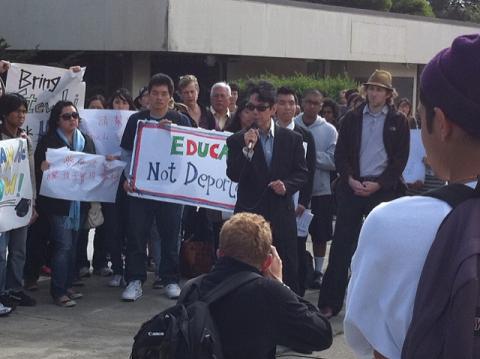
On a cold and sunny morning in late November, as sharp winds stirred up fallen leaves, and most folks were beginning to slow down in anticipation of Thanksgiving, Shing Ma “Steve” Li, a 20-year-old nursing student from San Francisco who narrowly avoided deportation to Peru, whipped the local media into a energized frenzy by advocating for the passage of the DREAM Act during a press conference at the Asian Law Caucus, whose offices sits close to the Transamerica Pyramid, and a stone’s throw from the lantern-decorated streets of Chinatown and the neon-lit strip clubs of North Beach, in San Francisco.

The purpose of the press conference was to give thanks for Li’s release four days earlier from a federal detention facility in Arizona, outline why a hardworking student who has lived in San Francisco since he was 12, has no criminal record, and speaks Cantonese, English, French and Spanish, was incarcerated for two months and threatened with deportation. And ultimately, the event was aimed to stir up support for the DREAM ((Development, Relief and Education for Alien Minors) Act, bi-partisan legislation that leading congressional Democrats plan to put to a vote this month.

Senate Majority leader Harry Reid and House Speaker Nancy Pelosi have promised to move to a vote on the DREAM Act on November 29, during Congress’ lame duck session, a brief window of opportunity to complete action on stalled bills, before Republicans take charge of the House, and Democrats see their majority in the Senate shrink, come January 2011.

Li, his family and his legal counsel Sin Yen Ling, a senior staff attorney at the Asian Law Caucus, kicked off the press conference by acknowledging the many supporters whose phone-calling, letter writing and protesting outside Sen. Barbara Boxer’s offices in San Francisco, helped secure Li’s Nov. 19 release from a federal detention center in Arizona, after Sen. Dianne Feinstein introduced a private bill to delay Li’s deportation.

“I believe his removal would be unjust before the Senate gets to vote on the DREAM Act,” Feinstein said in a Nov. 19 press statement. Feinstein’s bill guarantees Li protection for 75 days after Congress’ lame-duck session end. And Li’s attorney Ling says Feinstein may reintroduce her private bill next year, and that ICE isn’t likely to deport Li in future, now that he is no longer considered a fugitive.

“We don’t feel that Feinstein’s private bill will pass, because of the result of the Nov. 2 election and the reality of partisan politics, but it’s unlikely that Steve will get deported again,” Ling said.

If passed, the DREAM Act would grant undocumented immigrants a pathway to citizenship, if they entered the United States before age 15 and have attended college or served in the military for two years.

Li’s ordeal—and his ensuing conversion to an ardent DREAM Act advocate—is happening against the backdrop of an increasingly anti-immigrant mood in the United States, as witnessed in Arizona, where state legislators passed SB 1070 earlier this year, and now in California, where a Tea Party member from Belmont wants California voters to weigh in on a similar initiative in 2012. And then there’s the sobering reality that come January, congressional Republicans, who are facing challenges from the far right-wing Tea Party,  take control of the House and are unlikely to advocate for immigration reform.

But Li, who is ethnically Chinese, and was born and raised in Peru until he was eleven years old, after his parents left China in the 1980s to escape its one-child policy, remained optimistic, as he drew on his recent experience to illustrate why Congress needs to passes the bi-partisan DREAM Act now.

“I’m still at risk of being deported,” Li said, noting that, each year, about 65,000 U.S.-raised students graduate from high school and would qualify for the DREAM Act, which addresses the fact that federal immigration law has no mechanism to consider the circumstances of youth who were brought here as minors and call the U.S. home, but can’t work legally, face barriers to accessing higher education, and live in constant fear of deportation.

“We have to work to do something to stop these students from being deported,” said Li, who wasn’t aware that a final deportation order had been issued against his family, when he was 14 years old and the U.S. denied his parents’ application for political asylum. “It’s important we push Congress, so no other student has to go through the same thing I did.”

“How many future doctors, engineers and scientists will the US lose,” Li added, questioning whether the US could end up deporting geniuses who might otherwise have discovered a cure for cancer, or invented ground-breaking sustainable energy technologies. “We are America’s future and we want to make a difference,” he said. “I still believe America is a great nation, a moral nation, and that Americans, if given all the information, will do the right thing.”

Li’s legal counsel Ling, recalled how Li and his parents were arrested on Sept. 15 by Immigration and Customs Enforcement (ICE) agents, and detained at ICE’s offices in downtown San Francisco, before being transferred to a jail in Sacramento County. “They were arrested as part of ICE’s fugitive operations program, which targets people who have failed to comply with final deportation orders,” she said.

The family was held there for three weeks, Ling said, before Li’s parents were released back to San Francisco, wearing electronic monitoring anklets. But Li was involuntarily transferred to a federal detention facility in Florence, Arizona, where he remained until mid-November. His transfer also made it impossible for his parents to visit, since, under the terms of their electronically monitored release by ICE, they are not allowed to leave San Francisco.

Ling said ICE blames a lack of bed space in the Bay Area for why they must transfer folks from San Francisco to Arizona, Texas or a facility near Bakersfield, California. But either way, the practice serves to isolate immigrant detainees from family and friends as they await deportation.

“Steve was released from Florence, Arizona, on Friday, Nov. 19, and then took a Greyhound bus, which arrived in San Francisco Saturday afternoon,” Ling said, noting that ICE wasn’t planning to notify her or Li’s family of his release, and that they typically drive folks to Phoenix and drop them off at the bus station.

Li’s mother Maria addressed the media in Cantonese, as she thanked Sen. Feinstein for allowing her son “to return to his mother’s embrace.”

And then Li, who says he is “a huge Giants fan” and “grew up reciting the pledge of allegiance at school, just like everybody else”, described his ordeal
.
“I always viewed myself as an American,” Li said, recalling how that perception was challenged when ICE raided his home and threw him in jail, this fall.
“I was shocked and confused, I felt it must have been a mistake” Li said, recalling that he was in the bathroom getting ready for school when the doorbell rang on Sept. 15.
“I didn’t expect anyone, so I woke up my mother, and she answered the door,” Li said.“Next thing, immigration agents came into the house. I didn’t know what was going on.They said they had to take me somewhere, that I had to be deported. “

Li said he was immediately separated from his mother and not allowed to ask ICE questions.
‘They searched me, threw me in the car, handcuffed me and took me to the immigration center,” Li said, referring to ICE’s office in downtown San Francisco.
“It was intimidating. I was scared of what was going to happen to me,” Li continued, describing how he was held for the rest of the day in a cell that contained 20 other people, some of whom had been transferred from other detention facilities and were already wearing prison clothing.

“I was fingerprinted, my photograph was taken and my situation was explained to me,” Li said, describing his shock at then being transferred in handcuffs and shackles by bus to a jail in Sacramento County with his parents, who were also handcuffed and shackled.
“It was traumatic to see my parents, who are hard-working people, be treated like that,” he said,

In Sacramento County, Li and another detainee were placed in a cell that contained bunk beds, a small table, a toilet and a sink.
“We could only go to the day room and watch TV for one hour a day,” he said. “The immigration authorities didn’t tell me anything, they just threw me from place to place.”

After three weeks, Li thought he was going to be released, when the prison authorities returned his clothes and got him to sign some paperwork. But instead, he was transferred to ICE’s San Francisco office on Sansome Street, put him in a holding cell, and told him he was being sent to Arizona to be processed for deportation,

“My whole world came down,” Li said. “I couldn’t talk to my parents, who had already been released. I thought of never being able to see my family and friends again. It was depressing.”

Things got worse when he was shackled, handcuffed, and loaded onto a bus which took him to Oakland airport, where he was put on a plane with a bunch of other deportation detainees.
“We were handcuffed and shackled to our seats, and I wondered what would happen if the plane went down,” Li said, describing a seemingly interminable journey to Arizona, which involved making landings in Los Angeles and San Diego.
“In San Diego, they took Mexicans off the bus, presumably to drive them to the border,” Li said.

Arriving in Arizona the following morning, Li was driven to an isolated federal detention facility in Florence, which is about 800 miles from San Francisco, where he was only allowed outside his cell for an hour a day.
“We were incarcerated all day and body searched multiple times in a facility, where there were three toilets and four showers between 64 people,” he said.

Locked up with 400 fellow detainees, Li heard a lot of stories that were similar to his: students who’d received a higher education and were very talented, but didn’t have legal status.

In particular, Li remembers one student he met during his Arizona incarceration.
“Like me, he came here with his parents and had no say in that decision, but was picked up as a result of new legislation in Arizona, “ he said.

Li’s arrest means he missed a semester of school, but he vows to continue his studies. And despite his traumatic experience, Li says he is not bitter.
“It went through my mind,” he said, “But I have learned a lot, including the fact that we have a broken immigration system. I urge everyone who qualifies for the DREAM Act to use their voice. They need to find the courage to use it and fight to change the law.”


Radical diplomacy: an interview with Guillermo Gómez-Peña

3

“It welcomes hipsters, but advocates for a more intelligent hipsterism.”

Performance artist Guillermo Gómez-Peña is sitting in his unexpectedly luxurious Outer Mission live-work space, surrounded by walls of fake masonry, stacks of props for his work, and velvet paintings of lucha libre wrestlers, police officers, and John Wayne that have accumulated in the 16 years that Gómez-Peña has rent-controlled the place. In anticipation of his upcoming performance at Galeria de la Raza‘s 40th anniversary gala (Sun/21), we’re trying to figure out a few minor details about life in 21st century America.

On the table is our two shot glasses of cachacha (he’s recently returned from a performance in Brazil) immigration politics, the fate of artistic San Francisco, the role of current events in art – just the sort of small talk one always embarks upon when meeting a stranger best known to you for crucifying himself on Ocean Beach and spending time in traditional indigenous Amerindian garb, trapped in a cage stationed in the lobbies of fine art museums’. Gómez-Peña is letting me hold his chihuahua Babalú while he (Gómez-Peña, that is) chain smokes, wearing a black cowboy shirt, bolo tie, and traces of kohl smudged along his lower eyelids.

His hipster comment is about la Galeria. Gómez-Peña has been involved there for 26 years, ever since moving up from Mexico City via Los Angeles. He had heard San Francisco was good for artists, and in Galeria de la Raza, he found spiritual resonance.

“It is one of the most original Chicano-American spaces in the country,” he tells me. Gómez-Peña, whose wife, Carolina Ponce de León, is now the executive director of the gallery, says that he feels a “sentimental connection” with the place. Ever since 1984, when then-director Rene Yañez invited his Border Arts Workshop to stage their first performance in the gallery, he has made a point to bring some version of each of his projects at la Galeria. 

“The Chicano Vampire” shreds border politics, Sun/21

It’s the space’s anti-nationalist viewpoint that draws him. Gómez-Peña, a native of Mexico City, is a man who has made his life on the border, examining the border, erasing the border. In the mid ’90s, the fake masonry that now dominates his ruby-red living room formed a part of “Temple of Confessions,” for which the artist, attired in tribal splendor, and a man dressed as a cholo gang member, sat ensconsed in Plexi-glass – end of the century saints incarnate. They encouraged visitors to approach their “confessionals” and divulge their secret thoughts about Mexico, Mexicans, race, nation.  

I ask him what secrets they told him, how he thinks those secrets would be different now, in the age of SB 1040 and yet another peak of anti-immigrant hysteria. “At that time,” he begins, drawing on his Marlboro, “the pop culture views about Mexico were much more varied. Nowadays the dominant opinion is one of a country of ingovernability, a potential trampoline for drug smugglers and terrorists. There are no longer any redeeming mythologies.”

Gómez-Peña tells me that he thinks that in the age of strife in the Middle East and grave problems within both their interiors, the United States and Mexico are no longer looking at each other. “There is a lot of silence, indifference at the border,” says the man who has staged elaborate stunts at the nations’ fracture point, including a “border wedding” in which the bride and groom stood on either sides of the wall separating us from our neighbors to the south. He says people can’t – or don’t – tell the difference between narco traficantes and migrant workers.

It’s this miasma which makes the art done at Galeria de la Raza all the more important. The space has always been a place where cultures mixed, and where Latinos found ways to enter the psyche of the American zeitgeist. Gómez-Peña says the Chicano spoken word movement got its start there on the corner of 24th Street and Bryant, as did Frida Kahlo-mania. 

But things have been changing, even for this stalwart of the San Francisco neighborhood art scene. For one thing, it’s not so neighborhood anymore. The Mission has transformed into what Gómez-Peña calls, in his typically luminous style, “a bohemian theme park.” Many of the young Chicano artists that “inform the Galeria’s aesthetics” have hightailed it out of here for the easel space and relatively easy rent checks of the East Bay and beyond. 

Obama has disappointed Gómez-Peña. In the wake of a campaign that everyone believed in, wanted to believe in, the arts funding promised hasn’t been delivered. Nowadays, the artist sees fellow creatives having to work two times as hard for their paycheck, even a brain drain of people leaving for the more affordably fertile soils of Buenos Aires and Lisbon. It’s one of the subjects of his performance piece on Sunday, which he calls Strange Democracy. The program will also honor Yañez, House on Mango Street author Sandra Cisneros, and Tomas Ybarra-Frausto, the acclaimed Chicano Studies professor.

But through the slings and arrows of political misfortune, Gómez-Peña has found ways to be proactive. His Pocha Nostra group is one way, a program that hosts artists in both Tempe, Arizona and Oaxaca in forming multi-cultural, politically striking performance pieces – and, as he riffs, contributes to the “trafficking of artists across the border – we’re intellectual coyotes!” 

And on Sunday, he can contribute his unique style to that of Galeria — a place where he says there is “radical cultural diplomacy, a place for different cultures to meet in a time in which the whole country is becoming divided ideologically and when Latinos are being demonized.” A place where we can all meet and talk in the kingdom of confessions, cachaca, and Babalú.


“40 Years Adelante!”: Galeria de la Raza benefit performance and awards ceremony

Sun/21 4-9 p.m., $40-65

Brava Theatre Center

2781 24th St., SF

(415) 826-8009

www.galeriadelaraza.org


Questions for the next mayor

4

EDITORIAL The progressives on the Board of Supervisors are a long way from united on a possible mayoral candidate, and if they can’t come together, the person who finishes Gavin Newsom’s term will be a compromise candidate, either a short-term caretaker (not the greatest option) or someone who’s more in the moderate camp but a candidate the left can work with — for 2011 and possibly four years after that.

We’re glad to see the proposal by Sup. John Avalos to begin the mayoral selection process early. Picking a mayor in a mad scramble on the day Newsom steps down is a recipe for chaos — and potentially a bad outcome. And as the process begins, the last thing the city needs is a mayor chosen through a backroom deal.

But it’s entirely appropriate for progressive board members to set some standards and to ask the people who are angling for the job to make clear exactly what their positions would be on key policy issues.

In other words, anyone who wants to be the interim mayor — and possibly mayor for the next five years or longer — should have to answer, directly and without hedging, question like these:

How much new revenue does San Francisco need to solve its budget problems, and where, specifically, should it come from? This is the central issue facing the city, now and for the indefinite future. San Francisco’s budget has a structural deficit of at least $250 million, and it simply can’t be closed by cuts alone. What taxes will you pledge to support — and put political capital and fundraising clout behind when they go on the ballot?

What specific programs ought to be cut? Everyone likes to talk about the city living within its means, but that ends up leading to a series of death-by-1,000-cuts decisions that year after year devastate services to the poor. Don’t tell us you need to look at budget figures and work it out later; the big-ticket items are no secret. What’s on the chopping block — and what isn’t?

Will you work to promote public power? How will you expedite community choice aggregation, and will you support a ballot measure to replace Pacific Gas and Electric Co. with a full-scale municipal electric utility?

What are your law enforcement priorities? If money’s tight, should the San Francisco police be hassling nightclubs, or should more resources go into the homicide division? How important are foot patrols, and which neighborhoods should get them? Will the SFPD and juvenile authorities continue to turn young people over to federal immigration authorities?

Who should pay to fix Muni? Should the burden of paying for the transit system fall primarily on the riders (through fare increases and reduced services) or should big downtown businesses and retailers (the major beneficiaries of the system) pay more? Should car owners pay higher fees (including parking fees and congestion management fees) to subsidize transit? Which specific fees would you be willing to push for?

Who should the city build housing for? Right now, much of the new housing stock is aimed at the very rich — and San Francisco is turning into a bedroom community for Silicon Valley. Would you set housing policy to conform with the city’s General Plan assertion that more than half of all new housing should be below market rate? How would you make that balance happen? Should the city spend a significant amount of money for affordable housing, and who should pay for it?

Do you agree that public sector jobs are as important as private sector jobs in San Francisco? Would you support the tax plan proposed by Sup. David Chiu?

Do you support giving the supervisors appointments to all major commissions?

Do you think the city should be doing more to stop TICs and condo conversions and to preserve existing rental housing?

That’s just the beginning of a long list of questions — but the progressives on the board should make sure they have answers before agreeing to support anyone, as a caretaker or interim mayor.

SF local artist’s purpose within reach

0

“I wanted to teach people, tell them how to do it. I always dream about taking back the city through art.” Reynaldo Cayetano Jr. is showing me his photographic prints in a Lower Haight coffee shop. He’s explaining to me how a guy who grew up in San Francisco came to be on the brink of his third art show in San Francisco (Purpose: Beyond Reach, coming up on Sat/20 at Rancho Parnassus).

Is it weird that this trajectory needs explaining? Common sense says that growing up in a world-class art city would give you a leg up on an career amidst darkrooms and gallery openings. But that’s not the case in cities, really. Local kids get the boot for all kinds of reasons in today’s 21st century – especially creative types who aren’t ready to divest their days to the rat race necessary to stay and live in our great urban spaces.

Maybe to look for real, SF-grown artists you have to see beyond the standard downtown gallery scene. Cayetano’s art shows take place at non-traditional venues – the most recent of which was Bayanihan Community Center on Sixth Street, in the neighborhood that Cayetano grew up. The 23 year old populates the shows half with friends he grew up with and half simpatico souls he meets around the city (full disclosure: my boyfriend falls into this category for the upcoming Sat/20 show). 

Cayetano (Rey to friends) says he’s always been “a spectator of art.” He began sketching as a teen, copying his older brothers who liked to draw. “But soon I was getting better than they were,” he tells me, smiling over coffee and a pastry at the round table we’re sitting at with fellow Inks of Truth artist, photographer Chris Beale (whose shots illustrate this article). 

We’re passing around the portfolio of the two men, who met in a City College photojournalism class and bonded over being the only ones working with film in a digital world (“making it, like, twice as hard on ourselves,” they tell me, clearly relishing the challenge). Cayetano’s folder of prints shows street scenes from his recent trip to the Phillipines — a journey he’s made only twice since his father, mother, two brother, and he moved to California in 1993. 

Real talk: Reynaldo Cayetano and a new friend downtown. Photo by Chris Beale

I turn the page and there is a black and white closeup of his uncle’s knotted hands, then photos from his life in SF: friends, protesters at immigration rallies, corners and streets he’s walked for years. Beale, a long time SF resident originally hailing from Baltimore, has crisply developed shots of Rey in his own book, a dissenter giving the finger to City Hall’s golden cupola, an image of the two’s friend – and emcee who’ll be playing his new album at Saturday’s event – Patience the Virtuous, gazing into the MUNI bus yards. 

Rey started curating his group shows — which display the work of a loosely bound collective called Inks of Truth — to fight ignorance in the SF community. Ignorance of pedestrians, that is. Spurred by a good friend’s death on the Alemany and San Jose S-curve (the young woman for whose 21st birthday present the camera he shoots with was intended), he brought together creative acquaintances for an event that “was supposed to be an art show, but leaned towards awareness.”

Photos from that show and Rey’s second depict a crowd of young people enjoying themselves amidst the physical evidence of their collective creativity, at one point clearing the floor for some b-boys to get in on the show and tell. It’s hardly the scene you see at many wine and cheese receptions that mark the debut of an artist’s work at other places around the city.

The events’ orchestration were big moves for a guy that has trouble seeing himself as a professional artist. “As soon as I call myself that, it comes with… I don’t want to say baggage, but it implies a lot of knowledge,” Rey tells me. “At first I thought that I shouldn’t have a show because I’m not a photographer, but then I thought no – that’s why I should do it.” When I ask him whether he sees a lot of the peers he grew up with in the Sixth Street neighborhood getting in on the SF art scene, he’s hesitant to make sweeping statements. “I feel like it’s lagging, but it’s not to the point where it’s hopeless.”

Perhaps this lag is what gives Cayetano the motivation for his inclusive shows. Saturday’s will feature works by sixteen artists in a variety of mediums. Cayetano is hungry to give others the adrenaline rush and fufillment that comes from finally, seeing one’s work on the wall. 

But it’s not always easy. In the midst of his own worry over producing events without professional guidance, Rey’s dealing with the varying levels of commitment of artists showing their beloved creative mindsprings for the first time. But overall, the process is one he seems to take inspiration in. “It’s great to give them that kind of anxiety, it’s a good stress. If you’re not stressing in the process, it’s not explosive,” he reasons.

In addition to bringing a taste of artistic involvement to the talented around him, the upcoming Purpose: Beyond Reach show at the Sixth Street cafe has another, even more salient community connection. It’s a food drive for Martin de Porres House of Hospitality, a place that Beale says is the soup kitchen of choice for many of the homeless people he’s spoken with. 

Cayetano elected Martin de Porres as the beneficee for its relatively small capacity. After speaking with representatives from larger shelters like Glide, he discovered “even if you raise a lot of cans, for a big shelter it will be gone within a meal.” Art show attendees are expected to load down their backpacks for entrance: those over the age of 21 are expected to donate at least five cans of food. 

For Cayetano, it was important that his third show reflect the entirety of the community where he was raised.  “It’s a testament of growing up on Sixth Street. The people out on the street now are the same ones that were there when I was growing up.” All the better to reflect the real community of San Francisco — if not that, then what are we painting for?


“Purpose: Beyond Reach”

Sat/20 4-10:30 p.m., free with can donation (21 and up, five to seven; 20 and younger three to five) 

Rancho Parnassus

132 Sixth St., SF

(415) 503-0700

www.wix.com/purposebeyondreach/inksoftruth


Questions for the next mayor

19

 The progressives on the Board of Supervisors are a long way from united on a possible mayoral candidate, and if they can’t come together, the person who finishes Gavin Newsom’s term will be a compromise candidate, either a short-term caretaker (not the greatest option) or someone who’s more in the moderate camp but a candidate the left can work with for 2011 and possibly four years after that.

We’re glad to see the proposal by Sup. John Avalos to begin the mayoral selection process early. Picking a mayor in a mad scramble on the day Newsom steps down is a recipe for chaos and potentially a bad outcome. And as the process begins, the last thing the city needs is a mayor chosen through a backroom deal.

But it’s entirely appropriate for progressive board members to set some standards and to ask the people who are angling for the job to make clear exactly what their positions would be on key policy issues.

In other words, anyone who wants to be the interim mayor and possibly mayor for the next five years or longer should have to answer, directly and without hedging, question like these:

How much new revenue does San Francisco need to solve its budget problems, and where, specifically, should it come from? This is the central issue facing the city, now and for the indefinite future. San Francisco’s budget has a structural deficit of at least $250 million, and it simply can’t be closed by cuts alone. What taxes will you pledge to support and put political capital and fundraising clout behind when they go on the ballot?

What specific programs ought to be cut? Everyone likes to talk about the city living within its means, but that ends up leading to a series of death-by-1,000-cuts decisions that year after year devastate services to the poor. Don’t tell us you need to look at budget figures and work it out later; the big-ticket items are no secret. What’s on the chopping block and what isn’t?

Will you work to promote public power? How will you expedite community choice aggregation, and will you support a ballot measure to replace Pacific Gas and Electric Co. with a full-scale municipal electric utility?

What are your law enforcement priorities? If money’s tight, should the San Francisco police be hassling nightclubs, or should more resources go into the homicide division? How important are foot patrols, and which neighborhoods should get them? Will the SFPD and juvenile authorities continue to turn young people over to federal immigration authorities?

Who should pay to fix Muni? Should the burden of paying for the transit system fall primarily on the riders (through fare increases and reduced services) or should big downtown businesses and retailers (the major beneficiaries of the system) pay more? Should car owners pay higher fees (including parking fees and congestion management fees) to subsidize transit? Which specific fees would you be willing to push for?

Who should the city build housing for? Right now, much of the new housing stock is aimed at the very rich and San Francisco is turning into a bedroom community for Silicon Valley. Would you set housing policy to conform with the city’s General Plan assertion that more than half of all new housing should be below market rate? How would you make that balance happen? Should the city spend a significant amount of money for affordable housing, and who should pay for it?

Do you agree that public sector jobs are as important as private sector jobs in San Francisco? Would you support the tax plan proposed by Sup. David Chiu?

Do you support giving the supervisors appointments to all major commissions?

Do you think the city should be doing more to stop TICs and condo conversions and to preserve existing rental housing?

That’s just the beginning of a long list of questions but the progressives and other supervisors  on the board should make sure they have answers before agreeing to support anyone, as a caretaker or interim mayor.


Only a miracle can save Steve Li now

41

Supporters of Shing Ma “Steve” Li, a 20-year-old nursing student, gathered outside the offices of Sen. Barbara Boxer today to urge her to sponsor a private bill in a last ditch effort to halt Li’s deportation to Peru, which is scheduled to take place Monday, November 15—two months after ICE (Immigration and Customs Enforcement) agents arrested Li in San Francisco.

“While we do not introduce private bills, our staff is happy to meet with Mr. Li’s family and his attorneys to discuss his case,” Boxer spokesperson Zachary Coile emailed the Guardian, as protesters delivered stack of letters to Boxer’s office, asking that she intervene in Li’s case.

Unlike Sen. Dianne Feinstein who has sponsored private bills in the past, Boxer has no record of intervening in this way. But advocates were hopeful that now that she has survived the November 2010 election, Boxer will pull off a miracle before Monday.

This afternoon, Li’s attorney Sin Yen Ling texted the Guardian that her request for deferred action had been denied, meaning that Li will be on a plane to Peru on Monday, baring some last minute miracle.

“Our office has been in touch with ICE and is exploring the options,” Gil Duran, media spokesperson for Sen. Dianne Feinstein told the Guardian, half an hour after Li’s request for deferred action was denied.

And Boxer spokesperson Zachary Coile said the senator’s staff met with Li’s mother, his attorney, his City College professor and others, this afternoon.

“While we do not introduce private bills, our staff was happy to meet with Steve Li’s family and his attorney to discuss his case,” Coile stated. “We reiterated Senator Boxer’s strong support for the DREAM Act, which would provide a path to citizenship for tens of thousands of undocumented students who go to college or serve in the military. Senator Boxer will keep working in the Senate until it becomes law.”

And tonight, Drew Hammill, press secretary to Speaker Nancy Pelosi emailed the following statement to the Guardian:

“Speaker Pelosi believes that Steve Li’s case is a textbook example of the pressing need for comprehensive immigration reform and passage of the DREAM Act. Speaker Pelosi is working with other Members to recommend that ICE grant deferred action in this case.”

Boxer, Feinstein and Pelosi, who have both been strong supporters of the DREAM Act, have vowed to keep working until it is passed.

Earlier this fall, on Sept. 14—the day before ICE arrested Li– Senate Majority Leader Harry Reid announced plans to add the DREAM Act as an amendment to the Department of Defense authorization bill.

But that effort was blocked by Senate Republicans. And after the bloodbath that congressional Democrats endured this November, it’s unclear if the DREAM Act has a prayer, though Nancy Pelosi vowed to move it forward during Congress’ upcoming lame-duck session, and it has continued to attract bi-partisan support since it was first introduced in 2001 by Senators Richard Durbin (D-Il) and Richard Lugar (R-IN).

At today’s protest, Li’s legal counsel, Sin Yen Ling, decried the federal government’s decision to deport her client.

“A 20-year-old City College student is not a threat to our national security,” Ling said. “We need to bring Steve Li home as soon as possible.”

According to Ling, Li has not seen his mother Maria, who divorced Li’s dad for years and lives with Li in San Francisco, since his Sept. 15 arrest, when  ICE picked up Li and his mother in Ingleside on Sept. 15 and placed them in separate cars. The car carrying Li then picked up Li’s  father in the Richmond, and all three family members were processed at ICE’s Sansome Street office in downtown San Francisco, before being transferred to Sacramento County Jail. But Li was then involuntarily transferred to an ICE detention facility in Arizona. Meanwhile, Li’s parents were released from detention when ICE determined that China does not want them back because they left China seeking political asylum. But they are now required to wear cumbersome electronic monitoring anklets, because they are deemed a flight risk, and are not allowed to leave San Francisco.

As a result, Li’s parents have been unable to visit their son in Arizona. And should he be deported to Peru, it’s not clear if they will be permitted to follow. And should if they decide to travel to Peru, they will not be allowed to reenter the U.S. for at least ten years, further complicating a complex situation.

At today’s rally, Li’s mother Maria spoke in public for the first time,  breaking down into tears, as she begged Sen. Boxer and the U.S. government to help.

“He has no money, no clean clothes, how will he get by?” she asked, referring to ICE’s plan to put her son on a plane to Lima, Peru, where he reportedly knows no one.  “Sen. Boxer, will you just watch and pretend you didn’t see anything? Today, when you see all of us standing here begging you, will you respond to us? I hope you can understand it from a mother’s perspective and meet with me to discuss how we can help Steve.”

Ling said Li’s mother decided to speak because of the direness of her son’s situation, even though she was wearing a federally-mandated monitoring anklet.
“She felt it was now or never,” Ling said.

Li’s teacher Sang Chi also spoke, praising Li as a model student and a prime example of the kind of person that should be eligible for the DREAM Act. And then the Rev. Norman Fang led Li’s supporters in a prayer.

‘We ask that a miracle take place and that Steve’s mom and San Francisco can be happy again, that the heart and soul of what is morally right can overcome regulations,” Fang said, noting that 100 years, his family members were detained at Angel Island “for no other reason than they were Chinese. ‘There is only one border in our world—the one that separates Heaven and Earth.”

Li’s attorney Sin Yen Ling clarified that she doesn’t believe that ICE singled Li out.
“He’s just been swept up as part of a larger program,” Ling said, noting that actions that split families apart and target folks who came to this country as undocumented children have inspired a movement of DREAMers—folks who support the DREAM Act.

Every year, about 65,000 U.S. raised students, who would qualify for the DREAM Act’s proposed benefits, graduate from high school, according to the National Immigration Law Center (NILC).

“These include honor roll students, star athletes, talented artists, homecoming queens, and aspiring teachers, doctors and U.S. soldiers,” states a NILC press release. “They are young people who have lived in the U.S. for most of their lives and desire only to call this country their home. Even though they were brought to the U.S. years ago as children, they face unique barriers to higher education, are unable to work legally in the U.S. and often live in constant fear of detection by immigration authorities.”

Asked how ICE caught up with Li, who does not have a criminal record, Ling pointed to modern technology
“In this day and age, you can track anyone down,” Ling said.” And it’s a priority for ICE to identify people with final deportation orders,” she continued. Ling was referring to the fact that Li’s parents were denied their request for political asylum from China and issued a removal order, unbeknownst to their son Steve, who was born in Peru, came to the U.S. when he was 12 and was 14, when his parents’ asylum request was denied.

But Ling did not blame President Barack Obama, who promised to bring millions of undocumented residents out of the shadows, when he was running for president in 2008.
“It’s tough to criticize the president when he had five different priorities coming into office, including healthcare. His administration probably miscalculated how long it would take to pass healthcare. And part of the problem is partisan politics around immigration.”

Ling estimates that there are two million young people currently in the U.S. who would benefit from the passage of the DREAM Act, but blamed partisan politics for why the legislation failed to pass by only 3 votes in the Senate in September.

Sup. David Campos showed up at the rally and told Li’s supporters that the Board of Supervisors unanimously approved a resolution Nov. 9 calling for ICE to defer Li’s deportation.

“The Board is not always on the same page, but on this issue we were unanimous,” Campos said. “We get it, we understand the tragedy that this deportation would result in. And we remain hopeful that something will happen. There are millions of young people in the same predicament, and the solution is not deportation. The solution is passing comprehensive immigration reform. Until then, we need an intervention.”

Meanwhile, somewhere in Arizona, Steve Li sits in a jail cell, hoping, praying and dreaming…

Steve Li to be deported to Peru on Monday

12

Immigrant advocates report that the deportation of Steve Li, an honors student who was studying at City College until  ICE (immigration and Customs Enforcement) picked him up in September, has been scheduled for Monday, November 15.

Advocates have argued that Li, who has lived here since he was 12 and apparently knows no one in Peru, where ICE plans to deport him, is eligible for the DREAM Act. So, they were especially upset when news of Li’s scheduled deportation hit the same day that Nancy Pelosi announced that she wants to move the DREAM Act during the lame duck session

In response, Li’s supporters are planning an all-day action at Sen. Barbara Boxer’s office at 1700 Montgomery Street on Friday November 12.

“People will be dressing in caps and gowns or nursing scrubs (Steve is a nursing student)” states a press release from Li’s supporters, who promise to phonebank ICE/Boxer/Feinstein and deliver letters to Boxer’s office tomorrow.

“Time is of the essence, we need Boxer or Feinstein to sponsor a private bill, or for John Morton at ICE to grant the deferred action before Steve is scheduled to aboard the plane on Monday,” the statement, which lists the phone numbers of Feinstein, Boxer and ICE’s John Morton, concludes.


How to fight the GOP

0

OPINION Now what?

Now we need to build a grassroots progressive movement — wide, deep, and strong enough to fight the right and challenge the corporate center of the Democratic Party.

The stakes are too high and crises too extreme to accept “moderate” accommodation to unending war, regressive taxation, massive unemployment, routine foreclosures, and environmental destruction.

A common formula to avoid is what the Rev. Martin Luther King Jr. called “the paralysis of analysis.” Profuse theory + scant practice = immobilization.

It’s not enough to denounce what’s wrong or to share visionary blueprints. Day in and out, we’ve got to organize for effective and drastic social change, in all walks of life and with a vast array of activism.

Yes, electioneering is just one kind of vital political activity. But government power is extremely important. By now we should have learned too much to succumb to the despairing claim that elections aren’t worth the bother.

Such a claim is false. For instance, consider the many hundreds of on-the-ground volunteers who rejected the paralysis of analysis by walking precincts and making phone calls to help reelect progressive Rep. Raul Grijalva (D-Arizona). Grijalva won a tight race in the state’s southwestern district and will return to Congress next year — much to the disappointment of the corporate flacks and xenophobes who tried to defeat him because of his strong stance against the state’s new racial-profiling immigration law.

The mass-media echo chamber now insists that Republicans have triumphed because President Obama was guilty of overreach. But since its first days, the administration has undermined itself — and the country — with tragic under-reach.

It’s all about priorities. The Obama presidency has given low priority to reducing unemployment, stopping home foreclosures, or following through with lofty pledges to make sure that Main Street recovers along with Wall Street.

Far from constraining the power of the Republican Party, the administration’s approach has fundamentally empowered it. The ostensibly shrewd political strategists in the White House have provided explosive fuel for right-wing “populism” while doing their best to tamp down progressive populism. Tweaks aside, the Obama presidency has aligned itself with the status quo — a formula for further social disintegration and political catastrophe.

The election of 2010 is now grim history. It’s time for progressives to go back to the grassroots and organize with renewed, deepened commitment to changing the direction of this country. If we believe that state power is crucial — and if we believe in government of, by, and for the people — it’s not too soon to begin planning and working for change that can make progressive victories possible in future elections. 

Norman Solomon is co-chair of the Healthcare Not Warfare campaign, launched by Progressive Democrats of America. His books include War Made Easy: How Presidents and Pundits Keep Spinning Us To Death.

Advocates say Steve Li is DREAM Act eligible

4

The Board of Supervisors plans to introduce a resolution at their Nov. 9 meeting denouncing the deportation of Shing Ma “Steve” Li, a  20-year-old DREAM Act student at City College of San Francisco, calling for Immigration and Customs Enforcement to grant him deferred action status, and urging Congress to pass the DREAM (Development, Relief and Education for Alien Minors) Act.

The move comes the same day San Francisco Unified School District Board President Jane Kim (leading in the as yet unresolved race to replace termed-out D6 Sup.Chris Daly) plans to introduce a similar resolution at the SFUSD Board meeting, and a week after City College Board Trustee Lawrence Wong introduced a resolution supporting Li, who has lived in California since 2002 and is studying to be a nurse , but is now in an immigration detention center in Arizona.

“It’s unreal how fast things change”, Li said in a statement made from Arizona, just seven weeks after ICE raided his home and arrested him.

Li, who is ethnically Chinese, was born in Peru as his parents fled political persecution in China. And  ICE is allegedly preparing to deport him to Peru, which he left when he was 12. (Calls to ICE had not been returned as of blog post time, but I’ll update this blog, when I get a reply.)

“He knows no one in Peru,” said Li’s lawyer, Sin Yen Ling, senior staff attorney at the Asian Law Caucus, as she described how Li’s grandma returned to China, when his grandfather died.

Five years ago, the U.S. denied Li’s parents political asylum from China and issued a removal order. But Li says he was unaware of his immigration situation until his home was raided, and advocates and community members believe his case illustrates how the U.S.’s immigration system tears up families and targets contributing members of society.

Li’s Sept. 15 arrest occurred one week before Congress failed to vote on the DREAM Act, which would provide a pathway to legalization to undocumented students who’ve grown up in the US and atten two years of college or served two years of the military.

“It’s critical to pass the DREAM Act before the new Congressional session, but Steve literally cannot wait and is set for deportation any day now, that’s why we need our Senators’ leadership today,”  Li’s attorney Sin Yen Ling told me, noting that so far their has been no response from Sen. Dianne Feinstein, and that advocates are planning to target Sen. Barbara Boxer, now that the election is over.

In their resolution, Board President David Chiu and Sups. Eric Mar, John Avalos, David Campos and Ross Mirkarimi note that the DREAM Act is “bipartisan legislation that addresses the situation faced by young people who were brought to the United States years ago as undocumented immigrant children, and who have since grown up here, stayed in school, and kept out of trouble.”

These five supervisors note that each year, 65,000 U.S.-raised students who qualify from the DREAM Act’s benefits graduate. They also note that Democratic Sen. Dick Durbin and Republican Sen. Richard Lugar asked Department of Homeland Security Secretary Janet Napolitano on April 21, 2010 to halt the deportation of immigrant students who could earn legal status under the DREAM Act, which has the support of the House and Senate leadership, all of the relevant committee chairs, the nation’s military leaders, and President Barack Obama.

“I will do whatever it takes to support efforts to pass this bill so I can sign it into law on behalf of students seeking a college education and those who wish to serve in our country’s uniform. It’s the right thing to do,” Obama told the Congressional Hispanic Caucus on September 15, 2010—the same day that Li was arrested in San Francisco.

Update: Since writing this blog, I got a call back from ICE’s Lori Haley, who said she was limited in how much information she could share, but sent me this statement concerning Li:

“Shing Ma Li was taken into custody by ICE Fugitive Operations team officers on September 15, 2010, based upon a final order of removal issued by an immigration judge in 2004.  In 2005, the Board of Immigration Appeals (BIA) reviewed his case and upheld the immigration judge’s decision.  Shing Ma Li currently remains in ICE custody while the agency seeks to make arrangements for his removal.”


The attack on Latinos

0

OPINION The San Francisco-based Ninth Circuit Court of Appeals heard oral arguments on Monday for United States v. State of Arizona. Latinos in California were watching closely.

The case addresses the constitutionality of Arizona’s SB1070 law. SB1070 is one of the broadest and strictest immigration enforcement measures ever enacted by any state in the nation. The court’s decision will send a strong signal not just to Arizona, but to the 13 other states considering similar laws. As an immigration lawyer and a first-generation Mexican American from Orange County, laws like SB1070 remind me of how much history repeats itself.

Every day I see families face deportation due to minor encounters with the law. When a broken tail light is used as a reason to stop, overcharge, and deport an individual, then something is seriously wrong with our law enforcement priorities, our laws, and even our morals.

After the Great Depression, Operation Wetback, a strategy enforced by the INS, expedited the deportation of 80,000 “Mexican-looking” Americans, including many Mexicans and Latinos born in the United States — and some Native Americans.

The movement by states to enact immigration laws and scapegoat Latinos started in California with Proposition 187. Passed in November 1994, Prop. 187 sought, among other things, to require police, health care professionals, and teachers to verify and report the immigration status of all individuals, including children. Well-funded anti-immigrant groups like FAIR created a blueprint for states and cities to become immigration law enforcement agents. In light of the discrimination that ensued — even though Prop. 187 was ultimately found unconstitutional — many view this period as one of the worst moments for Latinos in recent California history.

In the wake of SB1070, other states are attempting to pass similar or more extreme laws at an alarming rate. Republican state legislator Randy Terrill, who coauthored Oklahoma’s strict 2007 immigration bill (HB1804), has promised to pursue an even stricter second-generation version of the bill that he has called an “Arizona-plus” law. He is undeterred by the fact that key provisions of HB1804 were ruled unconstitutional by the U.S. Tenth Circuit Court of Appeals.

Arizona’s Republican state Sen. Russell Pearce recently announced that state legislators will propose a bill to deny U.S. citizenship to children born of undocumented immigrants. Even though many, if not all, of these bills will be struck down as unconstitutional, they testify to the current anti-immigrant — and anti-Latino — climate.

There is little political will for immigration reform. Both the Democratic and Republican parties see Latinos largely as a source of votes, but show scant interest in ensuring that the law treats our community fairly. Even President Obama, who during his race for the presidency promised to bring change we can believe in and co-opted the United Farm Workers’ slogan “Yes We Can!,” has turned his back on us. Obama has earned the label “deportation czar.” Under his watch, more immigrants have been deported than at any time since Operation Wetback.

As long as the nation lacks comprehensive immigration reform, laws similar to SB1070 will continue to be introduced in states across the country. Right now it is up to our judicial branch to uphold the Constitution. We, Latinos who are able to vote, must vote for those candidates whose track records show a commitment to fairness for our community — regardless of party affiliation.

Laura Sanchez is staff attorney for the Central American Resource Center (CARECEN) in San Francisco.

Alerts

0

news@sfbg.com

WEDNESDAY, NOV. 3


SPUR’s Election Wrap-up

The San Francisco Planning and Urban Research Association’s post-election discussion and analysis session is popular with political junkies of all ideological stripes. Although it’s hosted by a knowledgeable duo — Barbary Coast Consulting founder Alex Clemens and political consultant David Latterman — a wide variety of political analysts always show up to create a lively, insightful discussion. Bring a bag lunch and your two cents.

12:30 p.m., $5 or free for members

SPUR office

654 Mission, SF

381-8726


Revolution is not a Tea Party

As the dust begins to settle on the midterm elections battlefield, come discuss how the country’s political fervor affected the national discourse on issues like immigration and civil rights. Was the Tea Party an actual grass roots revolution or merely a large angry mob? How long will the virulent xenophobia and nativism continue, and what can be done to counter it?

7-9 p.m., free

Revolution Books

2425 Channing Way

Berkeley

revolutionbooks@sbcglobal.net

THURSDAY NOV. 5


“Tranny Fest: San Francisco Transgender Film Festival”

Come one, come all: ladies and gentlemen, transgender, and gender queer. Now in its 12th season, Tranny Fest will open Thursday, with performances by Landa Lakes, Butch Tap, Thisway Thataway, and Psychobabble, among others. The festival continues Friday and Saturday with short films and videos by transgender and gender variant artists. Advance tickets will be available for the event.

Thurs.–Sat., 8–10 p.m.

$12–$15 sliding scale

CounterPULSE, SF

1310 Mission, SF

www.freshmeatproduction.com


Evening with our poet laureate

In addition to California poet laureate emeritus Al Young, Revolution Books will also host jazz/blues music, guitarist Trevor Michaels, and other poems and song.

7 p.m.–9 p.m., free

Revolution Books

2425 Channing Way, Berk.

510-848-1196

SATURDAY NOV. 6


Green Festival San Francisco

Here’s more proof that green is the new black. One of the largest sustainability events in the country will be held at the San Francisco Concourse. The eco-confab includes lectures from Bill McKibben, Daniel Pinchbeck, Amy Goodman, and others. Vendors, workshops, music and an array of organic beer, wine, and vegetarian cuisine will also be on hand. Admission discounts are also available to students, seniors, cyclists and public transit riders.

Sat.–Sun., 10 a.m.–7 p.m.

$10–$25

Concourse Exhibition Center

635 Eighth St., SF

www.greenfestivals.org/sf

Arizona Gov. Jan Brewer comes to San Francisco

Arizona Governor Jan Brewer came to San Francisco Nov. 1 to attend a federal hearing on SB 1070, the controversial immigration law that critics say will encourage racial profiling. The law was partially struck down this past July when District Court Judge Susan Bolton ruled that it was unconstitutional. U.S. Attorney General Eric Holder brought the case against the state of Arizona and Brewer.

The U.S. Court of Appeals for the Ninth Circuit in San Francisco began hearing arguments Nov. 1 concerning Arizona’s appeal of the ruling. Apparently, word spread far and wide that Brewer would be in the city, and a boisterous crowd of SB 1070 opponents crowded outside the federal courthouse. They chanted, displayed signs, and some wore black-and-white face paint in honor of the Day of the Dead, a Mexican holiday celebrated Nov. 1 and 2.

At one point, SB 1070 opponents rushed into the middle of the street and unfurled a giant banner which read, “Stop Family Separations.” Representatives from immigrant rights coalitions, social-justice groups, and labor unions joined hands, sang chants, jumped up and down, and cried out in Spanish that they were all together in the struggle. Camera people and police officers wove through the crowd.
 
Rev. Jacqueline Duhart, a Unitarian Universalist, joined Rev. David Takahashi Morris in displaying a bright yellow banner proclaiming, “Stand on the Side of Love.”
 
Duhart said she was against SB 1070 because it “causes hate to be a primary motivator,” and “denies the worth and dignity that we all have.”

Supporters of Arizona’s law showed up to wave signs, too. They were outnumbered by opponents, but voiced their opinions at high volume. One woman, gesturing toward protesters who waved banners denouncing SB 1070 as racist and a modern-day version of Jim Crow, leaned backward and belted out, “This is nothing like the civil rights movement!” and let out a peal of laughter. She was holding one side of a giant Arizona flag that had been altered with a picture of a rattlesnake and the words, “Bite Me.”

Critics of the law say it law would open the door to racial profiling and result in tearing families apart.

Civil rights groups demand Secure-Comm documents from ICE

1

In a turnabout from the usual immigration-related situation (in which ICE demands documents from immigrants) civil rights groups in Washington, DC. Arlington, VA. Santa Clara, CA. and San Francisco are requesting the release of documents concerning opt-out procedures in Immigration and Customs Enforcement’s controversial “Secure Communities” program.

Signed by the Arlington Coalition Against “Secure Communities” (S-Comm) Program, Asian Law Caucus, Asian Law Alliance, Bernal Heights Neighborhood Center, Causa Justa: Just Cause (CJJC), Center for Employment Training- San Jose, Central American Resource Center, Chinese for Affirmative Action, Community Legal Services in East Palo Alto, Communities United Against Violence, DC Jobs with Justice, Empower DC, Immigrant Legal Resource Center, Instituto Familiar de la Raza, La Raza Centro Legal , National Lawyers Guild San Francisco Bay Area Chapter, Plymouth Congregational UCC Board of Social Action, Sacred Heart Community Services, San Francisco Day Labor Program Services, Immigrant Rights, and Education Network, Silicon Valley Alliance for Immigration Reform, Silicon Valley DeBug, Somos Mayfair, Steering Committee for Immigration Reform, JFI San Jose Tenants and Workers United and Young Workers United, the statement that these groups released today reads as follows:

”We are four municipalities that have formally requested to opt-out of the federal immigration enforcement, “Secure Communities” (i.e., “S-Comm”) program,” their press release stated. “We did so after participating in town hall meetings, debate, testimony, research, and democratic processes that culminated with representatives in Washington DC, Santa Clara, California, Arlington, Virginia, and San Francisco clearly voting to opt-out of sharing information with ICE. “

“We did so because we believe in preserving public safety for everyone in our diverse cities, and also because we reject a program that disguises a record number of deportations (392,862) as a safety initiative rather than a humanitarian and moral crisis.”

”To be clear, our counties never ‘opted-in’ to this dangerous ICE program in the first place. This program, which has been shrouded in secrecy, was imposed on our counties without the input of our local government, communities, local law enforcement and in the case of San Francisco against their explicit written requests. Now that Washington DC has formally opted out, we ask that ICE immediately and without further delay let our counties and any other counties requesting to do so out of S-Comm.”

”We are committed to moving ahead with the opt out process despite ICE now contradicting itself and claiming the program is compulsory. We support CCR, NDLON, and Cordozo Law School going to court today to demand release of what ICE has refused to divulge. The emergency injunction filed today does what should be automatic in any democracy, it seeks to make public information on S-Comm and our ability to opt-out by stopping the sharing of any fingerprints by these jurisdictions with ICE.. This necessary injunction comes at the beginnings of negotiations with ICE and local jurisdictions scheduled for Nov. 5 to Nov. 9.”

A Celtic violinist Jimi Hendrix?

0

“Can you tell me why they call you the Jimi Hendrix of the violin?” I’m chatting with Eileen Ivers, Bronx-born one-time house blue electric violinist for Riverdance. One must admit, it seems like a curious moniker. Over the phone, Ivers dissolves in laughter. 

“I wish I could,” she finally continues. “One wonderful gentleman from some paper put that. I’d love to think that in some way — he had such a love of blues and roots — I don’t know, I won’t even go there, but I feel so connected to the instrument.” Oh, plus she integrates into her concerts (one of which will be rocking Freight and Salvage Thu/4) liberal doses of jams, electric violin, wah-wah pedal, and, dare we say, soul? “I love to put that to an audience to open their minds — this instrument can rock out as well.” The pieces are beginning to come together…

Perhaps I’m fixating on the comparison because at first glance, there is very little to tie together the lives of Hendrix and Ivers, who was born to immigrant parents used to the hardship and poverty in their birthland of County Mayo, Ireland. “There’s no Gaelic word for immigration — just for exit,” Ivers tells me. “It shows culturally they never wanted to leave, but they had to in the mass exodus.” She talks like an Irish person, falling into discussions of my Gaelic name as those of her (our) ethnic persuasion are wont to do and converses with a hint of that sing-song lilt that is the mark of the Emerald Isle. 

Eileen Ivers and Immigrant Soul, sans Photoshop butchering. Photo by Luke Ratray

Ivers learned her craft through a man in the New York neighborhood she grew up who delighted in teaching the young people in the area how to play the tunes of their cultural legacy. Love of the instrument buoyed her through years at Iona College spent studying mathematics and into a career that’s seen her play with Celtic legends The Chieftains, the international touring company of Riverdance, over 40 symphonic orchestras, and on soundtracks for films like Gangs of New York (2002).

It was through the multitudinous nature of the city’s music scene that the influences audible in her new tracks like “Paddy in Zululand” came to the fore. That tune in particular features an Irish melody plucked out by Iver’s violin which emerges from a background of upbeat African percussion – testament to the connections that Ivers sees between the divergent cultures’ musical forms. 

Which isn’t a particularly unique thing in and of itself – the Bay Area’s Markus James performs similar transmutations with African string music and Americana blues (vocalist Tommy McDonnell of Ivers’ touring band, Immigrant Soul, was a member of the original Blues Brothers band with Dan Akroyd and John Goodman). What may be unique is the bubbling sense of happiness that is exuded from Ivers when she imparts her art upon a listening crowd – or jaded local journalist, who she gracefully includes in her comments regarding the musical resonance she finds in these cross-continent musical similarities. “It’s in our heart — you hear these grooves and it feels right,” she says.

Lost in the music, you might say. Just like Jimi, right?

Eileen Ivers and Immigrant Soul

Thu/4 8 p.m., $23.50-$22.50

Freight & Salvage

2020 Addison, SF

(510) 644-2020

www.thefreight.org


The soul of the city

23

tredmond@sfbg.com

44th ANNIVERSARY SPECIAL We all arrived in San Francisco broke: Paulo and me in the ’73 Capri, crawling over Donner Pass with a blown valve and three cylinders firing; Tracy and Craig in the back of a VW van, behind in the payments and on the run from the repo men; Tom and Sharon hitching across the Southwest after Tom, who could bullshit with the best, talked himself out a jail cell in New Orleans. Moak showed up in a rusty Datsun with the wheels falling off. Jane and Danny came on the old hippie bus, the Green Tortoise, $69 across the country.

But we all had a friend who knew a friend where you could crash for a little while. And in the early 1980s you got food stamps the first day and it only took a couple of weeks to get a job waiting tables or canvassing or selling trinkets on the Wharf. And once you’d scraped together a couple hundred dollars — maybe two weeks’ work — you could get a place to live. My first room in a flat in the Western Addition was $120 a month.

We did art and politics and writing and music. After a while, some of us went to law school, some of us became journalists, some of us went into government and education. A few of us fled, and Paulo died in the plague (dammit). But in the end, a lot of us were — and are — San Franciscans, part of a city that welcomed us and gave us a chance.

It was a very different time to be young in San Francisco.

I’m not here to get all nostalgic, really I’m not. There were serious problems in 1982 — raging gentrification was creating clashes in the Mission and the Haight and south of Market that were more violent than anything going on today. And frankly, broke as we were, most of my friends were from middle class homes and were college educated and had a leg up. We weren’t going to starve; we didn’t have to make really ugly choices to eat.

Most of the stories in this special anniversary issue are about marginalized youth — young people trying to survive and make their way against all odds in an increasingly hostile city and a bitter, harsh economy.

But there’s an important difference about San Francisco today, something earlier generations of immigrants didn’t face. The cost of housing, always high, has so outstripped the entry-level and nonprofit wage scale that it’s almost impossible for young people to survive in this town — much less have the time to add to its artistic and creative culture.

I met the 21-year-old daughter of a college friend the other day. She’s as idealistic as we all were. She wants to move to San Francisco for the same reasons we did and you did — except maybe she won’t. Because she felt as if she had to come visit first, to use her dad’s network, see if she could line up a job and figure out if her likely earnings would cover the cost of living. When I mentioned that I’d just up and left the East Coast and headed west, planning to figure it out when I got here, she gave me a look that was part amazement and part sadness. You just can’t do that anymore.

The odds are pretty good that San Francisco won’t get her — her talent and energy will go somewhere else, somewhere that’s not so harsh on young people. I wondered, as I do every once in a while when I’m feeling halfway between an angry political writer and an old curmudgeon: would I come to San Francisco today?

Would Harvey Milk? Would Jello Biafra? Would Dave Eggers? Would you?

If you were born here, would you stay?

Are we squandering this city’s greatest resource — its ability to attract and retain creative people?

The two people who started the Bay Guardian 44 years ago were young arrivals from the Midwest. Bruce Brugmann looked around the city room at the Milwaukee Journal, where he worked as a reporter, and realized there wasn’t any job he wanted there in 10 years. With two young kids and a dream of starting a weekly newspaper in one of the world’s most exciting cities, Bruce and his wife, Jean Dibble, settled in a $130-a-month flat. The Guardian’s first office was a desk in the printers shop. When they paper could finally afford its own space, Bruce and Jean moved the staff into a $60-a-month four-room place on Ninth and Bryant streets.

From the start, the paper was a “preservationist” publication — both in terms of environmental issues like saving the bay and in the larger political sense. The San Francisco Bay Guardian was out to save San Francisco.

The city was under assault — by the developers who were making fast money tossing high-rises into downtown; the speculators making fast money flipping property, ducking taxes, and driving up rents; the unscrupulous landlords who were letting their buildings fall apart while they charged ever higher rent. For the Guardian, fighting this urbicide meant protecting San Francisco values, preserving the best of the city from what Bruce liked to call “the radicals at the Chamber of Commerce.”

For the Guardian, progress wasn’t measured in the number of new buildings constructed, but in the ability of the city to remain a place where artists and writers and community organizers and hell-raisers — and the young people who were always bringing new life to the city — could survive. We supported rent control, and growth limits, and affordable housing policies, and limits on condo conversions, and minimum-wage and sanctuary city laws — and a long list of other things that together amounted to a progressive agenda.

And in 2010, the assault on the young, the poor, the nonconformists, the immigrants, is still on, at full force. The mayor and his allies are pushing a ballot measure that would make it illegal just to sit on the sidewalk. He’s also turning the local juvenile authorities into immigration cops, breaking up families in the process. He’s cut funding for youth services, and wants to make it easier for speculators to evict tenants, take affordable rental housing (especially the flats that young people share to save money) off the market, and create high-priced condos. Virtually all of the new housing he’s pushing is for rich people. He’s shutting down parties and arresting DJs and, in effect, declaring a War on Fun.

What he’s doing — and what the downtown forces want — is the transformation of San Francisco from a welcoming city where the weird is the normal, where the young and the crazy and the brilliant and the broke can be part of (or even drivers of) the culture, to one where profit and property values are all that matter. And that’s a recipe for urban doom.

Richard Florida’s 2004 bestseller The Rise of the Creative Class shook up political thinking by pointing out that cities thrive with iconoclasts, not organization people. Everyone likes to talk about that now, even Mayor Gavin Newsom. But the missing piece, from a policy perspective, is that the creative class — particularly the young people who are going to be the next generation of the creative class — needs space to grow. And that means the most important thing a creative city can do is nurture the very people Newsom and his allies want to drive away.

If Prop. L, the “sit-lie” law, passes, if the rental flats in the Mission that have been home to several generations of young artists, writers, musicians and future civic leaders vanish in the name of condo conversions, if 85 percent of all the new housing in San Francisco is affordable only to millionaires, if the money that helps foster kids and runaways and at-risk youth dries up because this rich city won’t raise taxes, if nightlife becomes an annoyance to be stifled…then we’re in danger of losing San Francisco.

Our 44th Anniversary Issue also includes stories by Sarah Phelan on SF’s disadvantaged youth, Caitlin Donohue’s account of the Haight street kids, and Rebecca Bowe’s look at ageing out of the foster care system

How Team Whitman blew the housekeeper story

5

The folks at Calbuzz are asking the same questions that have been bothering me for a while now: How could Team Whitman, with its legions of high-paid political consultants, have bungled the Nicky Diaz story so badly?


If her campaign team knew about the problem a year ago (and she swears she told her consultants), why didn’t they go public themselves, control the damage and eliminate the story as an October Surprise?


Calbuzz:


According to Political Consulting 101, this is standard operating procedure: control the bad news, put it out yourself, do it early to inoculate against a late hit. It borders on campaign consultant malpractice to have handled it as it was handled.


Of course, campaign consultants can’t be sued for malpractice; there’s no regulatory body, no disciplinary association. But it’s astounding that so many professionals who are earning so much money did such a bad job here.


More important, it borders on criminal arrogance (alas, that’s not a crime) that Whitman didn’t give Diaz some sort of decent severance:


Why not spend $20,000 or so (or more, if need be) to hire her the best immigration attorney she could find to help her see what could be done to stay in the country or ease her return or whatever?


Why not offer her a year’s severance (about $18,000) or help her with re-settlement costs in Mexico? She was, in eMeg’s words, “a member of our extended family” (or as Meg said in one press conference, Freud never sleeping, “an extended member of our family”).


Okay, so Whitman and Harsh had to fire Diaz once they knew she was here illegally, if you buy their story. But they didn’t have to kick her to the curb.


I was pretty sure Whitman was on track to lose even before this happened, but I think the Diaz fiasco has sealed the deal. And it’s not so much the fact that she hired an undocumented worker (LOTS of Californians do that every day) but the fact that she was such an asshole to her employee.


And the $120 million campaign to create a carefully crafted image couldn’t deal with that basic problem.

Chron drops the “i” bomb, again

2

Today’s article on the front page of the Chronicle’s Bay Area section doesn’t use  “illegals” in its actual story about undocumented students and in-state college fees.

But it does use it in its headline.

This headline-text disconnect suggests that Chron reporter Bob Egelko wasn’t part of the decision to run today’s “Tuition break for illegals targeted” headline.

That’s the good news. The bad news is that it’s 2010, but some folks still don’t get what’s offensive about using the “i” word when referring to immigrants without paperwork—a situation that doesn’t make them “illegal,” no matter what right wing fear-mongers say.

As the National Association of Hispanic Journalists points out, in its guidelines for covering immigration, being here without paperwork is a civil violation, not a crime.

In an article published in September 2009, NAHJ said it was troubled with a growing trend in the news media to use the word “illegals” as shorthand for “illegal aliens”.

“Using the word in this way is grammatically incorrect and crosses the line by criminalizing the person, not the action they are purported to have committed,” NAHJ stated, as it called on the media to never use “illegals” in headlines.

“Shortening the term in this way also stereotypes undocumented people who are in the United States as having committed a crime. Under current U.S. immigration law, being an undocumented immigrant is not a crime, it is a civil violation,” NAHJ continued. “Furthermore, an estimated 40 percent of all undocumented people living in the U.S. are visa overstayers, meaning they did not illegally cross the U.S. border. In addition, the association has always denounced the use of the degrading terms ‘alien’ and ‘illegal alien’ to describe undocumented immigrants because it casts them as adverse, strange beings, inhuman outsiders who come to the U.S. with questionable motivations. Aliens is a bureaucratic term that should be avoided unless used in a quote.”

I’m pretty sure there’d be an uproar if the Chron used the “n” word to describe black people or the “f” word to describe gays—unless they were quoting racists or homophobes. So, please, guys, get a clue and stop dropping the “i” word, even if it takes up less room in your headlines.


Endorsements 2010: State races

24

GOVERNOR

EDMUND G. BROWN

We have issues with Jerry Brown. The one-time environmental leader who left an admirable progressive legacy his first time in the governor’s office (including the Agricultural Labor Relations Board, the California Conservation Corps, and the liberal Rose Bird Supreme Court) and who is willing to stand up and oppose the Diablo Canyon nuclear power plant has become a centrist, tough-on-crime, no-new-taxes candidate. And his only solution to the state budget problems is to bring all the players together early and start talking.

But at least since he’s started to debate Republican Meg Whitman face to face, he’s showing some signs of life — and flashes of the old Jerry. He’s strongly denouncing Whitman’s proposal to wipe out capital gains taxes, reminding voters of the huge hole that would blow in the state budget — and the $5 billion windfall it would give to the rich. He’s talking about suing Wall Street financial firms that cheated Californians. He’s promoting green jobs and standing firm in support of the state’s greenhouse-gas emissions limits.

For all his drawbacks (his insistence, for example, that the Legislature shouldn’t raise any taxes without a statewide vote of the people), Brown is at least part of the reality-based community. He understands that further tax cuts for the rich won’t solve California’s problems. He knows that climate change is real. He’s not great on immigration issues, but at least he’s cognizant that 2 million undocumented immigrants live in California — and the state can’t just arrest and deport them all.

Whitman is more than a conservative Republican. She’s scary. The centerpiece of her economic platform calls for laying off 40,000 state employees — thereby greatly increasing the state’s unemployment rate. Her tax plan would increase the state’s deficit by another $5 billion just so that a tiny number of the richest taxpayers (including her) can keep more of their money. She’s part of the nativist movement that wants to close the borders.

She’s also one of the growing number of candidates who think personal wealth and private-sector business success translate to an ability to run a complex state government. That’s a dangerous trend — Whitman has no political experience or background (until recently she didn’t even vote) and will be overcome by the lobbyists in Sacramento.

This is a critically important election for California. Vote for Jerry Brown.


LIEUTENANT GOVERNOR


GAVIN NEWSOM

Why is the mayor of San Francisco running for a job he once dismissed as worthless? Simple: he couldn’t get elected governor, and he wants a place to perch for a while until he figures out what higher office he can seek. It’s almost embarrassing in its cold political calculus, but that’s something we’ve come to expect from Newsom.

We endorsed Newsom’s opponent, Janice Hahn, in the Democratic primary. It was hard to make a case for advancing the political career of someone who has taken what amounts to a Republican approach to running the city’s finances — he’s addressed every budget problem entirely with cuts, pushed a “no-new-taxes” line, and given the wealthy everything they wanted. His immigration policies have broken up families and promoted deporting kids. He’s done Pacific Gas and Electric Co. a nice favor by doing nothing to help the community choice aggregation program move forward.

Nevertheless, we’re endorsing Newsom over his Republican opponent, Abel Maldonado, because there really isn’t any choice. Maldonado is a big supporter of the death penalty (which Newsom opposes). He’s pledged never to raise taxes (and Newsom is at least open to discussion on the issue). He used budget blackmail to force the awful open-primaries law onto the ballot. He’s a supporter of big water projects like the peripheral canal. In the Legislature, he earned a 100 percent rating from the California Chamber of Commerce.

Newsom’s a supporter of more funding for higher education (and the lieutenant governor sits on the University of California Board of Regents). He’d be at least a moderate environmentalist on the state Lands Commission. And he, like Brown, is devoting a lot of attention to improving the state’s economy with green jobs.

We could do much worse than Newsom in the lieutenant governor’s office. We could have Maldonado. Vote for Newsom.


SECRETARY OF STATE


DEBRA BOWEN

California has had some problems with the office that runs elections and keeps corporate filings. Kevin Shelley had to resign from the job in 2005 in the face of allegations that a state grant of $125,000 was illegally diverted into his campaign account. But Bowen, by all accounts, has run a clean office. Her Republican opponent, Damon Dunn, a former professional football player and real estate agent, doesn’t even have much support within his own party and is calling for mandatory ID checks at the ballot. This one’s easy; vote for Bowen.


CONTROLLER


JOHN CHIANG

Chiang’s been a perfectly decent controller, and at times has shown some political courage: When Gov. Arnold Schwarzenegger tried to cut the pay of state employees to minimum-wage level, Chiang refused to go along — and forced the governor to back down. His opponent, state Sen. Tony Strickland (R-Los Angeles), wants to use to office to promote cuts in government spending. Vote for Chiang.


TREASURER


BILL LOCKYER

Lockyer’s almost certain to win reelection as treasurer against a weak Republican, Mimi Walters. He’s done an adequate job and pushed a few progressive things like using state bonds to promote alternative energy. Mostly, though, he seems to be waiting for his chance to run for governor — and if Jerry Brown loses, or wins and decides not to seek a second term, look for Lockyer to step up.


ATTORNEY GENERAL


KAMALA HARRIS

This is going to be close, and it’s another clear choice. We’ve had our differences with Harris — she’s trying too hard to be a tough-on-crime type, pushing some really dumb bills in Sacramento (like a measure that would bar sex offenders from ever using social networking sites on the Internet). And while she shouldn’t take all the blame for the problems in the San Francisco crime lab, she should have known about the situation earlier and made more of a fuss. She’s also been slow to respond to serious problem of prosecutors and the cops hiding information about police misconduct from defense lawyers that could be relevant to a case.

But her opponent, Los Angeles D.A. Steve Cooley, is bad news. He’s a big proponent of the death penalty, and the ACLU last year described L.A. as the leading “killer county in the country.” Cooley has proudly sent 50 people to death row since he became district attorney in 2001, and he vows to make it easier and more efficient for the state to kill people.

He’s also a friend of big business who has vowed, even as attorney general, to make the state more friendly to employers — presumably by slowing prosecutions of corporate wrongdoing.

Harris, to her credit, has refused to seek the death penalty in San Francisco, and would bring the perspective of a woman of color to the AG’s office. For all her flaws, she would be far better in the AG’s office than Cooley. Vote for Harris.


INSURANCE COMMISSIONER


DAVE JONES

Jones, currently a state Assemblymember from Sacramento, won a contested primary against his Los Angeles colleague Hector de la Torre and is now fighting Republican Mike Villines of Fresno, also a member of the Assembly. Jones is widely known as a consumer advocate and was a foe of Prop. 17, the insurance industry scam on the June ballot. A former Legal Aid lawyer, he has extensive experience in health-care reform, supports single-payer health coverage, and would make an excellent insurance commissioner.

Villines pretty much follows right-wing orthodoxy down the line. He wants to replace employer-based insurance with health savings accounts. He argues that the solution to the cost of health insurance is to limit malpractice lawsuits. He wants to limit workers compensation claims. And he supports “alternatives to litigation,” which means eliminating the rights of consumers to sue insurance companies.

Not much question here. Vote for Jones.


BOARD OF EQUALIZATION, DISTRICT 1


BETTY YEE

The Board of Equalization isn’t well known, but it plays a sizable role in setting and enforcing California tax policy. Yee’s a strong progressive who has done well in the office, supporting progressive financial measures. She’s spoken out — as a top tax official — in favor of legalizing and taxing marijuana. We’re happy to endorse her for another term.


SUPERINTENDENT OF PUBLIC INSTRUCTION


TOM TORLAKSON

We fully expected a November runoff between Torlakson and state Sen. Gloria Romero. Both Democrats had strong fundraising and political bases — and very different philosophies. Romero’s a big charter school and privatization fan; Torlakson has the support of the teachers unions. But to the surprise of nearly everyone, a wild-card candidate, retired Los Angeles educator Larry Aceves, came in first, with Torlakson second and Romero third. Now Aceves and Torlakson are in the runoff for this nonpartisan post.

Aceves is an interesting candidate, a former principal and school superintendent who has the endorsement of the San Francisco Chronicle and the San Francisco Green Party. But he’s too quick to take the easy line that the teachers’ unions are the biggest problem in public education, and he wants the unilateral right to suspend labor contracts.

Torlakson wants more charter-school accountability and more funding for primary education. He’s the far better candidate.


STATE SENATE


DISTRICT 8

Leland Yee

Yee’s got no opposition to speak of, and will easily be re-elected. So why is he spending money on a series of slick television ads that have been airing all over San Francisco, talking about education and sending people to his website? It’s pretty obvious: The Yee for state Senate campaign is the opening act of the Yee for San Francisco mayor campaign, which should kick into high gear sometime next spring. In other words, if Yee has his way, he’ll serve only a year of his next four-year term.

Yee infuriates his colleagues at times, particularly when he refuses to vote for a budget that nobody likes but everyone knows is necessary to keep the state afloat. He’s done some ridiculous things, like pushing to sell the Cow Palace as surplus state property and turn the land over to private real estate developers. But he’s always good on open-government issues, is pushing for greater accountability for companies that take tax breaks and then send jobs out of state, has pushed for accountability at the University of California, and made great progress in opening the records at semiprivate university foundations when he busted Stanislaus State University for its secret speaking-fees deal with Sarah Palin.

With a few strong reservations, we’ll endorse Yee for another term.


STATE ASSEMBLY, DISTRICT 12


FIONA MA

A clear hold-your-nose endorsement. Ma has done some truly bad things in Sacramento, like pushing a bill that would force the San Francisco Unified School District to allow military recruiters in the high schools and fronting for landlords on a bill to limit rent control in trailer parks. But she’s good on public power and highly critical of PG&E, and she has no opposition to speak of.


STATE ASSEMBLY, DISTRICT 13


TOM AMMIANO

Ammiano’s a part of San Francisco history, and without his leadership as a supervisor, we might not have a progressive majority on the Board of Supervisors. Ammiano was one of the architects of the return to district elections, and his 1999 mayoral campaign (against Willie Brown) marked a turning point in the organization, sophistication, and ultimate success of the city’s left. He was the author of the rainy day fund (which has kept the public schools from massive layoffs over the past couple of years) and the Healthy San Francisco plan.

In Sacramento, he’s been a leader in the effort to legalize (and tax) marijuana and to demand accountability for the BART Police. He’s taken on the unpleasant but critical task of chairing the Public Safety Committee and killing the worst of the right-wing crime bills before they get to the floor. He has four more years in Sacramento, and we expect to see a lot more solid progressive legislation coming out of his office. We enthusiastically endorse him for reelection.


STATE ASSEMBLY, DISTRICT 14


NANCY SKINNER

Skinner’s a good progressive, a good ally for Ammiano on the Public Safety Committee, and a friend of small business and fair taxation. Her efforts to make out-of-state companies that sell products in California pay state sales tax would not only bring millions into the state coffers but protect local merchants from the likes of Amazon. We don’t get why she’s joined with Berkeley Mayor Tom Bates to try to get rid of Kriss Worthington, the most progressive member of the Berkeley City Council, but we’ll endorse her for re-election.


STATE ASSEMBLY, DISTRICT 16


SANDRE SWANSON

Swanson’s a good vote most of the time in Sacramento, but he’s not yet the leader he could be — particularly on police accountability. The BART Police murdered Oscar Grant in Swanson’s district, yet it fell to a San Franciscan, Tom Ammiano, to introduce strong state legislation to force BART to have civilian oversight of the transit cops. Still, he’s done some positive things (like protecting state workers who blow the whistle on fraud) and deserves another term.


>>BACK TO ENDORSEMENTS 2010

Endorsements 2010: National races

10

 U.S. SENATE

BARBARA BOXER

The San Francisco Chronicle made a stunning — and utterly irresponsible — statement when it refused to endorse either candidate in this race, saying that neither Boxer, the three-term incumbent, nor challenger Carly Fiornia, was qualified for the job. That’s insane — this one’s as clear and obvious a choice as you could ask for in American politics.

Boxer’s one of the leading voices for the progressives in the U.S. Senate. She was an early and stalwart foe of the war in Iraq; she’s been good on immigration (even when other Democrats have been ducking); and she’s a leading voice for accountability in financial companies. She’s finally come around on same-sex marriage and has a perfect record on reproductive rights and labor issues.

Fiornia’s chief claim to fame is that she ran one of the nation’s top companies, screwed up its history of excellent labor relations, outsourced 30,000 jobs, orchestrated a train wreck of a merger, and was fired. She left with enough of a golden parachute to help finance her campaign for Senate.

Fiorina’s anti-choice. She strongly supported Prop. 8 and opposes marriage equality. She’s so rabidly seeking the support of the gun nuts that she actually said that people on the federal “no-fly” list should be able to buy handguns. She supports the Arizona anti-immigration law. She’s for tax cuts for the rich and can’t even figure out if she’s supporting or opposing Prop. 23.

This one is a no-brainer. Vote for Boxer.


CONGRESS, 6TH DISTRICT

LYNN WOOLSEY

Woolsey was against the war when her colleague to the south, Nancy Pelosi, was still waffling. She’s a consistent voice against cuts in the safety net (and has the distinction of being the only member of Congress who was once on welfare). We’re happy to endorse her for another term.


CONGRESS, 7TH DISTRICT

GEORGE MILLER

Miller’s an East Bay institution, now seeking his 18th term. He’s been good and bad on issues — weak at first on the war, bad on education (he supported No Child Left Behind), but generally sound on environmental issues. And this spring, he was willing to publicly challenge Sen. Dianne Feinstein (D-Calif.) on a terrible water bill.


CONGRESS, 8TH DISTRICT

NANCY PELOSI

It’s odd that Pelosi’s become such a symbol of liberal Democrats and fodder for the right-wing attack machine. When you look at her record, she’s hardly a San Francisco liberal and certainly no progressive. She’s not even a strong supporter of same-sex marriage. She was bad on the war for too long and seems far more interested in raising money than representing her constituents. But she did salvage the health care bill, and she’s held up as Obama’s chief Capitol Hill ally under enormous pressure, and if the Democrats survive with control of the House, she’ll stay speaker. If not, she should think about retiring.


CONGRESS, 9TH DISTRICT

BARBARA LEE

Lee became a hero to the peace movement worldwide when she refused after 9/11 to vote to authorize then-President Bush to go to war. She was the only member of either house willing to stand up against what would become the costly and bloody invasions of Iraq and Afghanistan. But she’s also been a strong supporter of HIV funding, is one of the few members of Congress to show much leadership on poverty issues, and has been elected to chair the Progressive Caucus. We’re happy to endorse her for another term.


CONGRESS, 13TH DISTRICT

PETE STARK

Stark is the Sup. Chris Daly of Congress, a fearless progressive who’s not afraid to ruffle feathers — or even insult the president — when he thinks it’s necessary. At 78, he’s an outspoken atheist (the only one in Congress), a staunch foe of the wars in Iraq and Afghanistan, and a progressive on all the major issues. He’s not terribly popular among his colleagues, who allowed him to serve for only one day as chair of the Ways and Means Committee before dethroning him for his inflammatory statements. But on balance, we’re glad he’s around.


>>BACK TO ENDORSEMENTS 2010

SFBG Radio: Whitman’s immigration problem

14

Today Johnny and Tim talk about why Meg Whitman won’t recover from her immigration problems — and whether the roomate who drove a gay college student to suicide should wind up in prison. Listen up after the break.

sfbgradio1012010 by endorsements2010

Arlington & Santa Clara join SF in requesting S-Comm opt-out

1

The County Board in Arlington, Virginia and the Santa Clara Board of Supervisors both voted unanimously September 28 to opt out of S-Comm, a controversial Immigration and Customs Enforcement (ICE) data-sharing program also known as Secure Communities.

This means San Francisco is no longer the only municipality requesting to opt out of ICE’s S-Comm program. (Washington, D.C’s metropolitan Police Department is the only jurisdiction to date to successfully terminate its S-Comm Memorandum of Agreement with ICE.) The program automatically shares fingerprints with ICE that are taken by local law enforcement immediately after individuals are arrested, even if criminal charges are eventually dismissed or were the result of an unlawful arrest.

The opt-out resolutions in Santa Clara and Arlington came a day before 578 national and local organizations delivered a letter to President Barack Obama condemning the merger of criminal justice and immigration systems and demanding an end to practices that harm diverse communities throughout the country.

S-Comm has already met with opposition from civil rights organizations, law enforcement, and city officials from Washington, D.C. to San Francisco, over concerns it is being forced on hundreds of counties without oversight or accountability.

As a result of this opposition, ICE issued a statement in August that confirmed that local jurisdictions have a right to opt out by sending a written request.

And recently, Homeland Security Secretary Janet Napolitano and U.S. Attorney General Eric Holder also confirmed in writing that local jurisdictions can opt of S-Comm by requesting to do so in writing.

San Francisco Sheriff Mike Hennessey has already submitted this request in writing on at least two occasions, most recently on August 31st. And on May 18, San Francisco’s Board of Supervisors passed a resolution to opt out of S-Comm.

And Angela Chan, staff attorney at the Asian Law Caucus in San Francisco, repeated her request that ICE comply with its own opt-out procedure for all requesting counties.

“SF has done everything required of us to opt out,” Chan said in a press release. “Sheriff Hennessey and our Board of Supervisors have voiced our request to opt out of S-Comm loud and clear. It’s now ICE’s turn to follow through on their word and allow counties to do what has been within our right all along. Only then will we be able to focus our local resources back on local law enforcement. S-Comm has no place in our counties because it makes immigrant victims and witnesses afraid to come forward and cooperate with local law enforcement.”

In response to Santa Clara’s opt-out request, ICE’s Assistant Director David Venturella sent a letter to Santa Clara’s legal counsel Miguel Marquez in which he sought to clarify how S-Comm works:

“Secure Communities is ICE’s comprehensive strategy to improve and modernize the identification and removal of criminal aliens from the United States,” Venturella wrote. “As part of this strategy, ICE uses a federal biometric information sharing capability to more quickly and accurately identify aliens when they are booked into local law enforcement custody.”

“ICE uses a risk-based approach that prioritizes immigration enforcement actions against criminal aliens based on the severity of their crimes, focusing first on criminal aliens convicted of serious crimes like murder, rape, drug trafficking, national security crimes, and other “aggravated felonies,” Venturella continued.

But critics of S-Comm have noted that the majority of folks identified by this program are not criminal aliens at all. These critics argue that the program is undermining community policing efforts, since a person who has not committed a serious crime can now be referred to ICE simply because they were arrested (perhaps falsely) of a crime—and ICE can initiative deportation proceedings before that person can prove that they aren’t a felon.

And as Venturella acknowledges in his letter to Santa Clara, “Under this strategy, ICE maintains the authority to enforce immigration law.”

But Venturella confirmed that local municipalities have the right to request that their jurisdictions S-Comm program not be activated. And he clarified that ICE won’t be requiring local jurisdictions to sign statements of intent, or any other document to participate in S-Comm.

He also explained that ICE defers to the California State Attorney General on how state, county and local law enforcement agencies within California will share biometric data.

Venturella clarified that the purpose of local law enforcement receiving a fingerprint “match message” is to provide any additional identity information about the subject, including aliases, from the Department of Homeland Security’s biometric database. This database stores over 100 million records that, according to Venturella’s letter, “may not have been available based only on a criminal history check.”

But he noted that “receiving a ‘match message’ does not authorize or require any action by local law enforcement.”

“ICE views an immigration detainer as a request that a local law enforcement agency maintain custody of an alien, who may otherwise be released, for up to 48 hours (excluding Saturdays, Sundays and holidays),” Venturella explained. “This provides ICE time to assume custody of the alien.”

Venturella noted that ICE is not responsible for the incarceration costs of such individuals and does not reimburse localities for detaining any individual until ICE assumes custody.

But he points out that there is no statutory requirement that localities notify ICE if a subject is to be released 30 days in advance of any release or transfer.
‘The notification of ICE of inmate transfer or release within 30 days is pursuant to ICE’s request for such information,” Venturella stated.

Venturella clarifies that there is a legal basis for requiring ICE officers to conduct inmate interviews “to determine alienage and any possibilities for relief or protection from removal.”

But he also points out that local officials are not required to assist the feds in acquiring information about detainees.
“Assisting ICE in acquiring detainee information is not a legal requirement,” Venturella states.

Whitman calls out SF and immigrants, and karma calls back

22

During last night’s gubernatorial debate, Republican nominee Meg Whitman bashed “illegal” immigrants and singled out San Francisco as the state’s worst coddler of those without proper immigration papers. But today, it was revealed that Whitman employed an undocumented Mexican immigrant as her housekeeper and nanny from 2000 until last year. Ah, karma, the great leveler.

After being asked what California should do about immigration issues, Democratic nominee Jerry Brown gave a reasonable answer that should have appeal to people of all political stripes, calling for halting illegal immigration by securing the border with fences and modern technology that electronically verifies the status of visitors, but bringing the state’s 2 million undocumented immigrants out of the shadows by creating a way for them to achieve legal residency status.

“We can’t just round them up and deport them like they did in Eastern Europe,” Brown said, an incendiary analogy that was nonetheless true, reminding voters of the police state implications of the right-wing approach to the immigration issue.

Yet Whitman then essentially called for doing just that with increased enforcement, albeit with a slightly more polished approach than most angry nativists, saying the presence of “illegal immigrants” was a serious threat to California. “We have got to eliminate sanctuary cities,” Whitman said, naming San Francisco as the worst culprit, and saying, “We have to hold employers accountable for hiring undocumented workers.”

So should Whitman be held accountable for employing Nicandra Diaz-Santillan for almost a decade? Maybe not to legal authorities, but certainly to voters who will now question her integrity and whether she has been hypocritically grandstanding on such a politically divisive issue.

Whitman’s excuse is that she didn’t know her housekeeper was undocumented because she was provided false paperwork, an excuse that most California employers could also offer, showing just how ridiculous Whitman is for pretending that being “tough” can solve this “problem.”

That was one of many Whitman forays into fantasyland, such as equating with “independence” a campaign funded almost entirely with her Wall Street windfalls, one she is using to advocate for aggressively cutting taxes on big business and the rich. And then pretending that’s somehow a plan to close the state’s massive budget deficit. Pure nonsense.

By contrast, Brown seemed firmly grounded in reality, leveling with viewers that the state faces difficult problems that will require hard work and experience fighting with the “sharks in Sacramento” and calling for “the powerful to sacrifice first.” On the whole, the debate made clear the stark differences between these two candidates, which is perhaps the best we can hope for during a dismal political year.