Housing

Another bloody budget

6

rebeccab@sfbg.com

In the days since June 1, when Mayor Gavin Newsom unveiled his proposal for San Francisco’s $6.48 billion budget for the next fiscal year, public sector employees and community organizations have been poring over the hefty document to determine how their jobs, services, and programs survived cuts made to close a $483 million shortfall.

For police and firefighters, a key Newsom constituency, the news is good. There were no layoffs to San Francisco firefighters, and while members of the Police Officer’s Association gave up $9.3 million in wage concessions under the lucrative contract Newsom gave them a few years ago, police officers will still receive a 4 percent wage increase on July 1.

For others, the release of the mayor’s budget signified a tough fight looming before the Board of Supervisors, one with high stakes. Cuts to homeless services, mental health care, youth programs, and housing assistance, along with privatization proposals, have raised widespread concern among labor and liberal advocacy organizations. Public input on the budget will continue at the Board of Supervisors Budget and Finance Committee until July 15, when the amended document is considered by the full board.

At a June 1 announcement ceremony, Newsom asserted that the budget was balanced “without draconian cuts,” saying, “We were able to avoid the kind of cataclysmic devastation that some had argued was inevitable in this budget.”

Nearly a week later, Board President David Chiu told the Guardian that sort of cataclysm wouldn’t be staved off for long if the city continues on the course of repeatedly making deep budget cuts without proposing any significant new sources of revenue.

“Now that the smoke has cleared, it is clear that the mayor’s proposed budget is perfect for a mayor who is only going to be around for the short term, but it does not address the long-term fiscal crisis that our city is in,” Chiu said. “Next year, we’re looking at over a $700 million budget deficit. The year after that, we’re looking at almost an $800 million budget deficit. The budget proposal that Newsom put out balances the … deficit on many one-time tricks and assumptions of uncertain revenue.”

Meanwhile, advocates said even the cuts proposed this time would bring serious consequences, especially with unemployment on the rise, state programs being cut in Sacramento, and families feeling the pinch more than ever.

“Poor and working class families, and families of color in San Francisco, are facing kind of an assault on funding and on safety net services on multiple levels,” said Chelsea Boilard, family policy and communications associate for Coleman Advocates for Children and Youth. “I think a lot of it is that families are concerned about their ability to stay in the city and raise their kids here.”


“NO NEW TAXES”

During the budget announcement, Newsom emphasized the positive. He found $12 million in new revenue simply by closing a loophole that had allowed Internet-based companies to avoid paying that amount in hotel taxes. He said 350 currently occupied positions would be cut, but noted that it was less than a cap of 425 that public sector unions had agreed to. Cuts were inevitable since the ailing economy inflicted the city’s General Fund with significant losses, particularly from business and property tax revenues.

Nonetheless, Newsom’s budget is already coming under fire from progressive leaders. For one, there are no new revenue-generating measures in the form of general taxes, which could have averted the worst blows to critical safety-net services and might help remedy the city’s economic woes in the long-term.

“There are no new taxes in this budget,” Newsom declared. “I know some folks just prefer tax increases. I don’t.”

Yet Chiu said many of Newsom’s assumptions for revenue were on shaky ground, prompting City Controller Ben Rosenfield — Newsom’s former budget director — to place $142 million on reserve in case the projected revenues don’t pan out.

“These budget deficits continue as far as the eye can see,” Chiu noted. “Even if those amounts come in, something like 90 percent of them are one-time fixes. So even if the mayor is right, it doesn’t solve next year’s problem, or the year after. Which is why many of us at the board believe that we have to consider additional revenue proposals to think about the long-term fiscal health of the city.”

Sup. John Avalos, chair of the Budget and Finance Committee, described Newsom’s budget as “pretty much an all-cuts budget,” noting that he and Chiu planned to introduce revenue-generating measures. They were expected to introduce proposals — including an increase in the hotel tax and a change in the business tax — at the June 8 board meeting.

Because despite Newsom’s rosy assessment, many of his proposed cuts are deep and painful: the Recreation and Park Department would be cut by 42 percent (with its capital projects budget slashed by 90 percent), Economic and Workforce Development by 34 percent, Ethics Commission by 23 percent (basically eliminating public financing for candidates), Department of the Environment by 14 percent, Emergency Management by 10 percent, and the list goes on.


CUTS TO SOCIAL SERVICES

Progressives say Newsom’s budget reflects skewed priorities. While relatively little is asked of public safety departments, health and human services programs face major staffing and funding losses. “Poor people are being asked to shoulder the burden,” noted Jennifer Friedenbach, director of the Coalition on Homelessness.

Nearly $31 million would be slashed from the Department of Public Health, and more than $22 million would be cut from the Human Services Agency under Newsom’s proposed budget. While this reflects only 2–3 percent of the departmental budgets, there’s widespread concern that the cuts target programs designed to shield the most vulnerable residents.

Proposals that deal with housing are of special concern. “We have more and more families moving into SRO hotel rooms. We have families in garages. We have a really scary situation for many families,” Friedenbach said.

Affordable housing programs within the Mayor’s Office of Housing would get slashed from $16.8 million currently down to just $1.2 million, a 92 percent cut. Other cuts seem small, but will have big impacts of those affected. Newsom’s budget eliminates 42 housing subsidies, which boost rent payments for families on the brink of homelessness, for a savings of $264,000. Meanwhile, a locally funded program that subsidizes housing costs for people with AIDS would be cut, for a savings of $559,000.

Transitional housing would be affected, too, such as 59 beds at a homeless shelter on Otis Street, which Friedenbach says would be lost under Newsom’s budget proposal. “We’ve already lost more than 400 shelter beds since Newsom came to office, so that’d be a huge hit,” she said. Since the recession began, she added, the wait-list at shelters has tripled. The Ark House, a temporary housing facility that serves LGBT youth, would also be closed.

Overall, homeless services delivered by HSA would take a $12 million hit in Newsom’s budget, or about 13 percent, offset slightly by homeless services being increased by $2 million within the Mayor’s Office budget, a 71 percent increase.

Outpatient mental health services, such as Community Behavioral Health Services, would also be affected (See “Cutting from the bottom”), in violation of current city law. Several years ago, then-Sup. Tom Ammiano introduced legislation establishing a “single standard of care” to guarantee access to mental health services for indigent and uninsured residents.

“If timely, effective, and coordinated mental health treatment is not provided to indigent and uninsured residents who are not seriously mentally ill, those residents are at risk of becoming seriously mentally ill and hence requiring more expensive and comprehensive mental health care from San Francisco,” according to the ordinance, which was passed in June of 2005. Newsom’s budget proposes changing this legislation to enable cuts to those services, which would result in 1,600 people losing treatment, according to Friedenbach.

Unfortunately, advocates for the poor has gotten used to this ritual of trying to restore cuts made by Newsom. “There are some sacred cows that seem to survive year after year, and then we’re left fighting over what we can get,” said Randy Shaw, executive director of the Tenderloin Housing Clinic (THC).

The Central City SRO Collaborative, which supports tenants living in single-room occupancy hotels in the mid-Market Street area and is operated through THC, is slated to be cut by 40 percent along with three other similar programs — a replay from last year when the mayor proposed eliminating funding and the Board of Supervisors restored the cut.

“I think you’d see more fires, more people dying from overdoses. You’d see really bad conditions,” Jeff Buckley, director of the program, told us of the potential consequences of eliminating the inspections and resident training that is part of the program.

Funding was also eliminated for THC’s Ellis Eviction Defense Program, the city’s only free legal defense program with capacity to serve 55 low-income tenants facing eviction under the Ellis Act.


THREAT TO RENTERS

One of the most controversial proposals to emerge from Newsom’s budget is a way for property owners and real estate speculators to buy their way out of the city lottery that limits conversion of rental properties and tenants-in-common (TICs) to privately-owned condos if they pay between $4,000 and $20,000 (depending on how long they have waited for conversion), a proposal to raise about $8 million for the city.

“I went back and forth because I know the Board of Supervisors can’t stand this,” Newsom said as he broached the subject at the June 1 announcement. “I still don’t get this argument completely. Except it’s a big-time ideological discussion. It’s so darn ideological that I think it gets in the way of having a real discussion.”

Yet Ted Gullicksen, director of the San Francisco Tenants Union, said the argument is quite clear: making it easier to convert rental units into condos will accelerate the loss of rental housing in a city where two-thirds of residents are tenants, in the process encouraging real estate speculation and evictions.

“It will encourage TIC conversions and evictions because it makes the road to converting TICs to condos that much easier,” Gullicksen said. “It’s going to be a huge gift to real estate speculators.”

Newsom press secretary Tony Winnicker disputes that impact, saying that “these units were going to convert anyway, whether next year or six years. This merely accelerates that conversion without altering the lottery to protect jobs and services.”

But Gullicksen said the proposal obviously undermines the lottery system, which is the only tool tenant advocates have to preserve the finite supply of rent-controlled apartments, noting that even if the condos are later rented out, they will no longer to subject to rent control. That’s one reason why the Board of Supervisors has repeatedly rejected this idea, and why Newsom probably knows they will do so again.

Avalos said he and other progressive supervisors will oppose the proposal, despite the difficulties that will create in balancing the budget. “It’s kind of like putting a gun to our heads,” Avalos said of Newsom’s inclusion of that revenue in his budget.

To offset that revenue loss, Avalos has proposed a tax on alcohol sold in bars and Gullicksen is proposing the city legalize illegal housing units that are in habitable condition for property owners willing to pay an amnesty fee.

Some housing advocates were also struck by the timing of proposing condo conversion fees while also eliminating the Ellis Eviction Defense Program. “We’re really the only ones doing this,” Shaw noted. He said the program is crucial because it serves low-income tenants, many of whom are monolingual Chinese or Spanish speakers who lack the ability to pay for private attorneys to resist aggressive landlords.


PRIVATIZATION PROPOSALS RETURN

The Department of Children, Youth. and Families budget would be reduced by 20 percent under Newsom’s budget, with the greatest cuts affecting after school and youth leadership programs. Roughly a $3 million cut will result in the loss of around 300 subsidized slots for after school programs, said Boilard of Coleman Youth Advocates. Another $3 million is expected to come out of violence-prevention programs for troubled youth; an additional $1 million would affect youth jobs programs.

Patricia Davis, a Child Protective Services employee who lives in the Mission District with her two teenage sons, said she was concerned about the implications for losses to youth programs, particularly during the summer. “You can imagine what’s going to happen this summer,” she said. “I feel that a lot of kids are going to do a lot of things that they have no business doing.”

Davis, who says she’ll have to look for a new job come Sept. 30 because the federal stimulus package funding that supports her position will run out, said she was not happy to hear that police officers would be getting raises just as that summer school programs are being threatened with closure. “Couldn’t the 4 percent [raise] go somewhere else — like to the children?” she wondered.

Meanwhile, privatization proposals are causing anxiety for SEIU Local 1021 members, who recently gave millions in wage concessions and furloughs along with other public employees to help balance the budget. A proposal to contract out for jail health services cropped up last year and was shot down by the board, but it’s back again.

“When you make it a for-profit enterprise, the bottom line is the profit. It’s not about the health care,” SEIU Local 1021 organizer Gabriel Haaland told us. “It isn’t the same quality of care.”

Haaland said he believes the mayor’s assumption that the proposal could save $13 million should be closely examined. Other privatization schemes would contract out for security at city museums and hospitals.

Institutional police in the mental health ward at SF General Hospital and other sensitive facilities are well trained and experienced with difficult situations so, Haaland said, “the workers feel a lot safer” than they would with private contractors.

Regarding Newsom’s privatization proposal, Avalos said the board was “opposed last year and the year before, and we’ll oppose [them] this year.”

In the coming weeks, Avalos and other members of the Budget and Finance Committee will carefully go over Newsom’s proposed budget — which is now being sized up by Budget Analyst Harvey Rose’s office — and solicit input from the public. Chances are, they’ll get an earful.

“People are scared. They are scared to death right now,” Boilard said. “As it is, people’s hours are being reduced. And it’s getting harder and harder to find a job because so many people are out of work that the level of competition has gotten really fierce. This is the time that we need to invest in safety net services for young people and families more than ever — and all those services and programs and relationships that people depend on are disappearing.”

Steven T. Jones and Kaitlyn Paris contributed to this report.

Appetite: 3 delectable events for June

0

6/5-6/6 – SUNSET CELEBRATION Cruise down to Menlo Park this weekend for Sunset Magazine’s annual celebration weekend, a key South Bay event for foodies and wine lovers. Plenty of the Bay Area’s best will make an appearance, with a street food spirit pervading this year’s line-up. Our own Ryan Farr grills up special dogs for the event: Crispy Crunch FrankaRoni (deep fried mac n’ cheese squares with franks) and cheddar brats (pork/bacon/cheddar sausage). Food trucks are parked on-site, like Liba’s Falafel Truck, Sam’s Chowder House, and two of my tops: Seoul on Wheels and Gelateria CiCi. Chefs and Food Network stars host cooking demos, such as Roy Choi of the insanely popular Kogi Korean BBQ in LA. There’s wine seminars (for an additional $10; sign up ahead of time), live bands, Sunset’s special glam camping exhibit of tricked-out, funky campers, and an Artisan Food Pavilion housing cheeses, breadmakers, cured meats, sweets (like 479 Popcorn and NeoCocoa truffles) for sampling or purchase.
$16
Saturday (6/5) and Sunday (6/6), 10am-5pm
80 Willow Road, Menlo Park
More info here

6/12 – SLOW FOOD’S GOLDEN GLASS WINE EVENT Seven years running, The Golden Glass Wine Event (www.thegoldenglass.com) is Slow Food’s (www.slowfood.com) annual fundraiser with over 100 sustainable international wine producers. Napa, Sonoma and Mendocino counties all represent, but so do South Africa, France, South America, Italy, Spain, Greece, Australia, and so on. Golden Glasses are awarded to the best “slow” wines in the world, those that follow Slow Food principles of “good, clean and fair” production practices. Sample-size plates of local charcuterie, cheeses and other bites will flow, as will food from restaurants like Delfina, Il Cane Rosso, One Market, Thirsty Bear, A16, Perbacco, and the much-anticipated Plum Restaurant. And, yes, proceeds benefit the “Slow Food in School” programs, so you’re imbibing for a good cause.
$60 pre-purchase; $70 at door ($55 for Slow Food members) – includes unlimited wine and five food tickets (additional at $20 for 5 tickets)
Saturday, 6/12, 1-5pm

Fort Mason Center, the Festival Pavilion
www.thegoldenglass.com

6/16 – BAY AREA RISING STARS AWARDS CEREMONY StarChefs.com (www.starchefs.com/tickets) hosts their Rising Stars Revue and Awards Ceremony for this year’s Bay Area Rising Star winners at Ghirardelli Square. Hosted by Gary Danko’s (http://www.garydanko.com) chef de cuisine, Martin Brock, the night is a walk-around tasting gala featuring signature dishes and cocktails from Rising Star chefs, pastry chefs, sommeliers, restaurateurs and mixologists. Celebrate (and sample the best from) the winners, many of our local favorites, who were chosen from more than 90 candidates:

Chefs
Matthew Accarrino, SPQR
John Paul Carmona, Manresa
Maximilian DiMare, Wood Tavern
Louis Maldonado, Aziza
Thomas McNaughton, Flour + Water
Scott Nishiyama, Chez TJ

Pastry Chefs
Melissa Chou, Aziza
Catherine Schimenti, MICHAEL MINA

Mixologists
Erick Castro, Rickhouse
Brian MacGregor, Jardinière

Sommelier
Sarah Valor, Commis

Concept
Joshua Skenes, Saison

Restaurateur
Shelley Lindgren, A16 and SPQR

Hotel Chef
Josh Thomsen, The Claremont Hotel Club & Spa

$95; $150 VIP tickets, including pre-event reception with champagne and Petrossian Caviar
Wednesday, June 16; 7:30-10pm
Ghirardelli Square, 900 N. Point Street
www.starchefs.com/tickets

Newsom and his commissioners just love Candlestick/Shipyard report

4

 Text by Sarah Phelan, photos by Luke Thomas

Today, I’m dedicating Michael Franti’s  “Say hey, (I love you)” to the entire Redevelopment Commission and the four Planning Commissioners who approved the City’s final Environmental Impact Report plan for Lennar’s Candlestick/ shipyard development. I’m doing so, not because I love these commissioners, who are  all mayoral appointees, but because they all seem to love everything about the final report, despite ongoing concerns about building a bridge over an environmentally sensitive slough, taking park land for luxury condos and unresolved questions about the Navy’s cleanup of the shipyard.(Yes, the EIR doesn’t address the toxic cleanup, but does it make sense to approve it before the Navy has completed its cleanup assessment plan?)

I’m also dedicating Franti’s bubbly soul-lifting song to Planning Commissioners Christina Olague. Kathrin Moore and Hisashi Sugaya for refusing to rubberstamp the final EIR or the related CEQA findings. Thanks guys for having some moral backbone!

Mayor Gavin Newsom, presumably tweeting while leaving town again on the Lt. Governor campaign trail, hailed yesterday’s rubberstamping process as a critical milestone.
“This is a major milestone for our efforts to transform the shipyard from an environmental blight to a showcase of jobs, affordable housing, parks and green-technology investment for the Bayview and our entire City,” Newsom said in a press release. “The approvals of the EIR and Redevelopment Plan reflect the years of hard work, rigorous study and extensive community involvement invested in revitalizing our City’s Southeastern Waterfront…our progress today is a testament to their leadership and commitment to thoroughly cleaning up the Shipyard so we can forge ahead towards a new vision for Hunters Point.”

One of the key points to emerge from last night’s hearing is the bifurcated nature of the process, which yesterday let the city push the EIR certification through, before the Navy completes a related EIS (environmental impact statement) about the cleanup on the shipyard—including areas of land where Lennar hopes to develop homes if the 49ers leave.

Fog City Journal’s Luke Thomas told me today that during public comment, the Nation of Islam’s Minister Christopher Muhammad called the commissioners “paid prostitutes” and “political whores” and said there would be a “political earthquake” if the commissioners go forward with EIR. 

“However, I don’t think he understood that the EIR and the EIS (which deals with the toxic cleanup) are two separate documents,” Thomas said, accurately noting that the joint commission was only voting on the EIR yesterday.

(According to Thomas, the Minister also promised that coalition of activists that would dog Newsom up and down the State during his campaign for Lt. Governor to expose Newsom’s record, so expect more fireworks along the campaign trial this summer.)

Another key fact to emerge from yesterday’s hearing was the lack of public comment on the part of almost all the candidates running to replace D. 10 Sup. Sophie Maxwell, whose district includes this massive development. Only Kristine Enea, Tony Kelly and Espanola Jackson spoke on the record—with Enea in favor of the plan with amendments, and Kelly and Jackson opposed as things currently stand.

Now, you’d think that everyone running in this race would be eager to show D. 10 constituents (and beyond) that they were at the meeting, not only silently tracking, but also publicly expressing their opinions. And while it’s true that Marlene Tran and DeWitt Lacy filled in speaker cards, Chris Jackson showed up during the proceedings, and Lynette Sweet got ushered into the press box by Sup. Bevan Dufty, none of these D. 10 candidates got their thoughts in the public record. Now, no doubt Cedric Akbar, Bill Barnes, Isaac Bowers, James Calloway, Malia Cohen, Ed Donaldson, Marie Franklin, Rodney Hampton Jr., La Vaughan Moore, Geoffrea Morris, Steve Moss, Jacqueline Norman, Nina Pickerrell, Dwayne Robinson, Diane Wesley Smith, Eric Smith, (and the many others rumored to be running) had their reasons for not being there, and I’d be happy to hear all about it from all of them between now and the November election.

But it doesn’t instill confidence in candidates when they won’t say in public what they are only too willing to say off the record. So, kudos to Enea, Kelly and Jackson for taking that leap and refusing to act like politicians before they have even been elected.

“So much of it was shocking but not surprising,” Tony Kelly told me today, after he recovered from last night’s meeting which lasted until 2 a.m. ‘Everyone knew there would be a snappy 4-3 decision by the Planning Commission on the stuff that mattered. And in a way, I can see why the mayoral appointees on the Commission would decide that they would leave it to the elected officials on the Board to stop this plan. But there was zero excuse for the lameness of the Redevelopment Commission [who are all mayoral appointees]. Still, it showed what the Planning Commission [which today consists of four mayoral appointees, and three Board appointees] must have been like  before it was reformed [and still consisted solely of mayoral appointees].”

“It was heartbreaking to see the endless parade of Bayview Hunters Point residents saying, ‘I need a job,’ or ‘ I need to live in a new house,’ as they argued in favor of certifying the project’s final EIR, despite all the flaws,” Kelly acknowledged.

Still, as Kelly points out, the city could have pushed to acquire foreclosed housing in D. 10 so residents in substandard public housing could be relocated into decent units now, instead of having to stay at least another five years, or longer, in rat, cockroach and sewage inundated units, under Lennar’s plan.

Kelly also notes that the city could have used the Redevelopment Agency’s “massive power” to do stuff up and down Third St, where unemployment is especially visible.

“Having done planning elsewhere, this plan [for Candlestick and the shipyard] is like planning on Mars,” Kelly said. ‘This is a bigger badder version of 555 Washington.”

Last but not least, Kelly voiced concern that a couple of peaker plants will be built within Lennar’s project area.
.“There are going to be two combustion turbines generating steam heat, but not electricity within the project boundaries,” Kelly clarified. “That means they don’t have to register as a power plant, but they will be generating greenhouse gases. The only difference is they won’t be generating electricity.”

So, now the charade of approvals heads to the Port Commission, which has got some folks asking whether Port Commissioner Stephanie Shakofsky, another Newsom appointee should recuse herself , given that her non-profit is clearly such a fan of the project.


Nevius family values

6

The Chron’s C.W. Nevius has made a big deal of moving back into town from the suburbs — and the offhand comment by Steve Jones in an email to Nevius has almost become a sticky nickname. In fact, his own newspaper’s website, sfgate, headlined his column “Suburban twit moves to city.”

But Chuck’s got some work to do before he starts to understand San Francisco values.

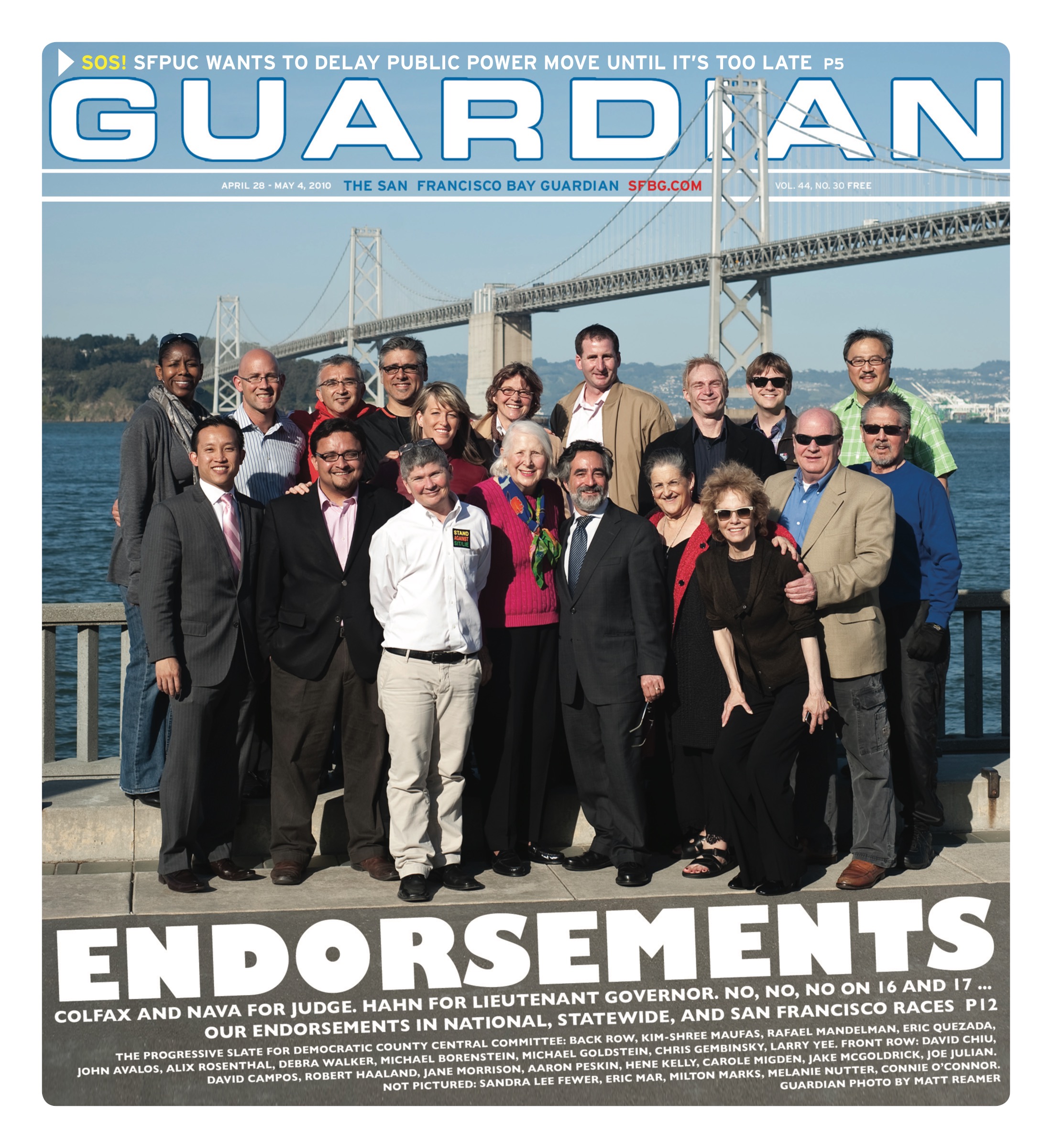
Take his latest column, about the Democratic County Central Commitee. Now, any Chron columnist (or anyone else) has the right to endorse and advocate for any candidates he or she wants. And Nevius is absolutely right to point out that the DCCC race is crucial, that control of the committee will have a significant impact on the fall supervisorial elections.

Here’s what made me want to scream:

“So, if you’re happy with the far-left agenda, check out the Bay Guardian. (Progs with name recognition like Peskin, David Campos, David Chiu, and John Avalos are probably shoo-ins. Daly is not running.) For those who’d like to see a swing to families, kids, and civility on the streets, here are some suggestions.”

 A swing to families and kids? You must be kidding.

The single greatest issue facing families and children in this city is the cost of housing. That’s why Coleman Advocates for Children and Youth, which almost everyone agrees is the premier family-advocate group in the city, has made affordable housing a huge priority.

Some of what a recent Coleman report says:

 “Two-thirds of all children in the city do not have a secure future in San Francisco

More families in San Francisco are low-income (43%) than middle-income (23%), and face economic hardship even when working full-time jobs.

Extreme racial disparities in family income and access to opportunity mean that the majority of children who do not have a secure future in SF are children  of color, and the majority of children who do have a secure future are white.”

Coleman’s recommendations: Build and preserve affordable housing for families — not market-rate condos, not condo conversions, but below-market-rate housing.

From the report:

“1. Prioritize the needs of 45,000 children growing up in 20,000 extremely-poor and low-wage working families.  trategies must combine investing in a stronger social safety-net for families now, and investing in anti-poverty strategies that will prepare today’s poor children to become economically secure San Franciscans of the future. The city’s housing and educational policies must focus on the children and families with the greatest need, and not get sidetracked by the demands of middle-income or upper-income families whose needs are legitimate but not as urgent.

 2. Invest in affordable homeownership programs for middle-income families, but focus the vast majority of limited housing resources on building permanently affordable family rental housing.”

That is exactly what the progressives — the “far left” folks that Nevius decries — have been talking about all these years. The candidates Nevius endorses are of the political camp that advocates more market-rate housing, more condo conversions, fewer tenant protections — more of the kind of things that drive lower-income families out of the city.

The next priority is education. Families that don’t have a lot of money have no option other than the public schools, and a lot of us who might be able to afford private schools still think public education is the way to go. What the schools need in San Francisco is pretty simple: They need more money. The “moderates: Nevius endorses — who actually count as fiscal conservatives, by San Francisco standards — are generally against raising taxes, as is our mayor. The San Francisco city government doesn’t oversee the schools, and most of the education money in California comes from the state — but San Francisco’s Rainy Day Fund, and the willingness of the supervisors to put money into the local schools, has saved hundreds of teacher layoffs and helped the quality of the local public schools.

 Where did that idea come from? Progressive leader Tom Ammiano.

I’m a San Francisco parent with two kids, and I have a lot of friends who are San Francisco families, and none of us see the Nevius agenda as family-friendly. That’s why we’re supporting the progressives.

Should Antonini recuse himself from Lennar vote?

1

As a Newsom appointee, Planning Commissioner Michael Antonini is expected to be a key vote today in favor of Lennar’s massive redevelopment plan at Candlestick Point-Hunters Point Shipyard.

And then there’s the fact that he wrote an op-ed for the San Francisco Business Times in December 18, 2009, suggesting that business, civic, labor and government leaders can keep the 49ers in town by “joining forces to assist in needed repairs and improvements to Candlestick Park and to expedite development of the Candlestick Point Hunters Point Shipyard, a project that features a “state-of-the art,” 69,000-seat football stadium.”
(The full text of Antonini’s op-ed is included at the end of this post to put his words into full context.)

But Antonini’s cheerleading has got some folks questioning his impartiality when it comes to the decisions that members of the Planning and Redevelopment Commissions will make today around certifying the project’s Final Environmental Impact Report (FEIR) and adopting related environmental findings.

In a June 2 letter to Planning Commission president Ron Miguel, Arthur Feinstein of the Sierra Club, Mike Lynes of the Golden Gate Audubon Society, Jennifer Clary of San Francisco Tomorrow and Jaron Browne of POWER (People Organized to Win Employment Rights) claim that “Commissioner Antonini has clearly prejudged the proposed project and become a strong advocate for locating a football stadium for the 49ers at the Hunters Point site as part of this project.”

“He has publicly urged others to support that stadium and cannot impartially review the record before him to determine whether the EIR is adequate, accurate and objective and whether adequate measures are required to protect the environment,” the foursome continue.

 Noting that he could have chosen to sign the December 2009 op-ed as a Member of the Republican County Central Committee, Feinstein, Lynes, Clary and Browne observe that Antonini “ instead identified himself in the capacity where the law requires him to act impartially – as a Planning Commissioner.”

With others arguing that Antonini’s right to express his opinion is protected by the First Amendment, and Antonini planning to read a rebuttal into the record at 1 p.m. today, it sounds like there’ll be plenty of drama at today’s hearing.

Antonini’s Op Ed in San Francisco Business Times

Friday, December 18, 2009
Business leaders can save the Niners
San Francisco Business Times – by Michael J. Antonini

“The 49ers are deeply and historically identified with San Francisco. San Franciscans Vic and Tony Morabito founded the team in 1946, many years before the Giants moved from New York and the Warriors from Philadelphia.

Hence business, civic, labor and government leaders are joining forces to assist in needed repairs and improvements to Candlestick Park and to expedite development of the Candlestick Point Hunters Point Shipyard, a project that features a “state-of-the art,” 69,000-seat football stadium. Leaders from the Committee on Jobs, the San Francisco Chamber of Commerce, Recreation and Park and others are asking businesses and individuals to help with funding of improvements at Candlestick in return for advertising. These improvements could translate into increased revenue for the contributor, the city and the team. Replacement of aging seats and a highly visible new luxury section are two concepts being studied.

Naming rights to Candlestick Park is an attractive opportunity for a company or an entity to gain nationwide exposure and local acclaim — and, perhaps, position itself to be a key contributor when a new stadium is built at Hunters Point. No new stadium can be built anywhere without significant private investment, in addition to $100 million assured from Lennar Corp. as a precondition of development rights and the amount which the 49ers ownership would invest.

On Thursday, Dec. 17, the San Francisco Planning Commission was to hear comment on the Draft Environmental Impact Report for the Candlestick Point Hunters Point Shipyard Plan. Because this plan features many diverse uses, particularly huge amounts of housing, funding is being rapidly obtained for greatly improved transit and traffic access.

San Francisco must avoid the errors of the past, when we failed to build an arena for indoor sporting, major conventions and entertainment events. Such a facility could have brought huge amounts of revenue to San Francisco businesses.

Leaders have twice stepped up to save the San Francisco Giants. One would expect no less from our leaders when dealing with our home grown, five- time Super Bowl champion San Francisco 49ers!

Michael J. Antonini is a planning commissioner for the City and County of San Francisco.”


Newsom’s budget includes a few ideas “Supervisors can’t stand”

City department heads, members of the San Francisco Board of Supervisors, representatives from major news outlets, and others crowded into the Luggage Store Art Gallery at 6th and Market streets on June 1 to hear Mayor Gavin Newsom discuss his proposed 2010-2011 budget.

Colorful artwork, such as a collage fashioned from cereal boxes, adorned the walls, and Newsom said he’d selected the venue to emphasize his commitment to improving the blighted mid-Market area.

Newsom’s $6.48 billion budget is being put forth in the face of a roughly $480 million deficit, which places the city in a similar financial situation to last year, when the mayor’s budget proposal sparked an outcry from progressive supervisors and a wide array of advocacy organizations for its deep blows to public health programs and critical services.

At first glance, the Department of Public Health seems to have fared better this time around, as a partial result of outside funding through federal programs. However, Newsom proposed slashing $22 million from DPH, compared with a total department budget of approximately $1.4 billion.

Newsom’s budget eliminates a total of 993 positions that are filled and unfilled, though the mayor said he anticipated 350 actual layoffs, bringing the total number of city employees to the lowest level in more than a decade. He thanked those he referred to as “enlightened city employees” for wage concessions that made fewer layoffs possible. There were no layoffs in the San Francisco Police Department or the San Francisco Fire Department, Newsom noted. The mayor also announced that an additional $5.9 million would be allocated to remedy the plagued crime lab.

The most contentious issue to emerge from the budget announcement was a proposal to generate $8 million through condo-conversion fees, under a system that would make it easier for people to turn rental units and tenancy-in-common units into condominiums.

Newsom accounted for funding from this proposal despite a lack of support from the Board of Supervisors. “I know the Board of Supervisors can’t stand this,” he said. “But I can’t stand the alternative. … This is a debate that I want to have, because I think this is principled and right.” He added that he thought supervisors’ resistance to accelerated condo conversions was “so darn ideological that it gets in the way of having a real discussion.”

Sup. John Avalos, who chairs the Budget & Finance Committee, said that he and other supervisors fear this could lead to more owner move-in evictions, a trend that would upend tenants’ lives and ultimately deplete the city’s affordable housing stock. “That’s been a concern of mine for months,” Avalos noted. Newsom’s decision to go forward with including it in the budget means that if the Supes reject it, they’ll have to find an additional $8 million to make up for the gap. “It’s kind of like putting a gun to our heads,” he said.

Newsom asserted that the budget was balanced “Without draconian cuts,” saying, “We were able to avoid the kind of cataclysmic devastation that some had argued … was inevitable in this budget.”

Yet Avalos described it as “pretty much an all-cuts budget,” because it contained no new revenue generating measures. “There are no new taxes in this budget,” Newsom said. “I know some folks prefer tax increases. I don’t.”

Avalos said he and other members of the board were working on a number of revenue-generating measures, including a nickel-per-drink tax on alcoholic beverages that would be aimed at the level of distributors, not small independent businesses.

Expect more on the mayor’s budget in coming weeks.

Political juggernaut

3

sarah@sfbg.com

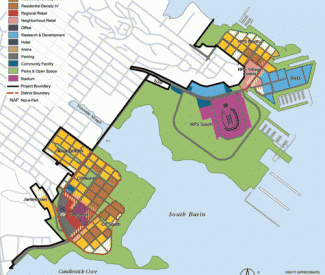
City officials are scrambling to secure final approvals to allow Lennar Corp. to move forward with its 770-acre Candlestick/Hunters Point Shipyard redevelopment of San Francisco’s impoverished and polluted southeast sector. But the community remains divided on the project, raising concerns that wary residents will end up being steamrolled by this politically powerful juggernaut.

Some groups say the project needs major amendments, but fear it will be rushed to the finish for political reasons. Others say they are hungry to work and desperate to move into better housing units, so they don’t want all the myriad project details to slow that progress. And Mayor Gavin Newsom’s administration is arguing that approving the project’s final environmental impact report by June 3 is crucial if San Francisco wants to keep the San Francisco 49ers in town.

But many observers fear Lennar wants its entitlements now before its project can be subjected to greater scrutiny that could come with the November elections. Newsom, who made Lennar’s project the centerpiece of his housing policy, will be replaced as mayor if he wins the lieutenant governor’s race. And a crowded field of candidates, many of them progressives concerned about the project’s impacts on the poor and the environment, are vying to replace termed-out Sup. Sophie Maxwell, whose district includes Lennar’s massive territory.

“It’s 180 percent about the 49ers,” land use attorney Sue Hestor told the Guardian, referring to the city’s proposed rush job, as evidenced by a rapid entitlement schedule that the Newsom’s administration wants city commissions and the board to follow.

Under that schedule, which Hestor procured from the Mayor’s Office, Planning and Redevelopment commissioners are expected to certify the project’s final 6,000-page EIR, adopt California Environmental Quality Act findings, approve amendments to the project’s original disposition and development agreement, and authorize land trust and open space reconfigurations — all during a June 3 meeting where public comment will likely last for many hours.

Saul Bloom, executive director of Arc Ecology, a community-based nonprofit that tracks the development, says this schedule stretches the credulity that this is a deliberative process. “There’s no way anyone could make a functional reasoned assessment,” Bloom told us. “How do you have any meaningful public conversation under those circumstances?”

Michael Cohen, Newsom’s chief economic advisor, asserted in an April 29 article in The New York Times that Lennar’s plan is a “really, really good project,” echoing the glowing praise he’s heaped on the project since its conception.

“But there’s nothing new in their proposal,” Bloom told us. “That’s because they haven’t been listening to the public’s concerns. [Cohen] says, ‘Haven’t we talked enough? The community’s been waiting all these years!’ But waiting to get what done?”

Lennar’s project — which had early backing from Newsom, U.S. Sen. Dianne Feinstein, and other political power brokers — was sold as creating “jobs, housing, and parks” and “revitalizing the abandoned shipyard” when voters approved the Lennar-financed Proposition G in 2008.

“Proposition G is from the community and for the community,” Lennar’s campaign promised. “You can turn the abandoned Hunters Point Shipyard into a clean, healthy, sustainable, livable neighborhood — a place where people can raise their children.”

The shipyard once employed thousands of workers, including African Americans who were recruited from the South in the 1940s and ’50s. But the district’s economic engine fell into disrepair when the military left in 1974. Today the neighboring Hunters Point and Bayview neighborhoods have the highest unemployment and crime rates and the largest concentration of African American families in the city.

But the city’s final EIR for the project, which the Planning Department released mid-May, shows that 68 percent of the developer’s proposed 10,500 new housing units will be sold at market rates unaffordable to area residents, and that many of these units will be built on state park land at Candlestick Point.

Lennar is also proposing to build a bridge across the environmentally sensitive Yosemite Slough, significantly changing the southeast waterfront. Lennar says it plans to develop the project’s remaining 3,000 units at below market prices, including one-for-one replacement of rundown Alice Griffith public housing units. Its proposal includes a dozen high-rise towers, 2.7 million square feet of commercial space, 1 million square feet of retail space, a performing arts theater, and an artists colony.

Lennar claims its proposal will create 1,500 construction jobs annually during the project’s 20-year build-out, along with 10,000 permanent jobs, thanks to a United Nations Global Compact Sustainability Center and a vaguely defined green technology office park.

The project and its impacts are already an issue in this year’s District 10 supervisor’s race (see “The battle for the forgotten district,” Feb. 23). Candidate Chris Jackson says Lennar’s proposal is weak when it comes to creating well-paying, low-skilled green collar jobs. He supports Arc’s proposal to including green maritime industrial use at the shipyard.

Arc recommends that the city’s final EIR allow recycling and repairing of ships, including the Suisun Bay Ghost fleet — decommissioned U.S. Navy, cruise, and ferry ships — arguing that “ship recycling and repair are resurgent strategic industrial activities yielding employment opportunities for our existing pool of skilled and unskilled workers.”

Jackson, who was elected to the Community College Board in 2008 and recently jumped into the District 10 race, wants the city to assert that the project is not a regional housing plan.

“It’s a local housing plan for local residents,” Jackson asserts. “It’s not here to provide housing for Silicon Valley. It’s for Bayview-Hunters Point and District 10 residents.”

Jackson understands why some local residents want no delays on final EIR approval: “I can never blame folks in Alice Griffith public housing for coming out and saying ‘no delays.’ They really want something real, housing that is not rat and cockroach infested.”

As a policy analyst (a position he’s quitting to focus on the District 10 race) for the San Francisco Labor Council — which gave key backing to the project in the 2008 election — Jackson knows labor is frustrated by all the project meetings. “I try to tell them it’s better to get this project right than rush it through and find out later that it goes against the interests of labor,” Jackson said.

In May 2008, the Labor Council signed a community benefits agreement (CBA) with Lennar. Since then labor leaders have urged no delays on the project’s draft EIR review. But Jackson believes the city must demand that financial consequences, such as liquidated damages, be a project approval condition if the developer reneges on the CBA.

“Right now the only push-back the city has is to threaten to kill the whole project if Lennar doesn’t meet its timeline,” Jackson said. “But people are really invested in this project, and I don’t believe anyone would pull the trigger and end the entire development. We don’t need to throw everything out; we just need to change them.”

Jackson wants to see the inclusion of a special-use district that would create a cooperative land trust to ensure affordability and home ownership opportunities for local residents. “I love open space and sustainability, but I also want affordable housing and real light-industrial opportunities that can employ people living in the district now.”

Special-use districts, Jackson argues, give city commissioners a way to amend this project to make it more acceptable.

Jackson wants to see strong tenant protections for public housing residents. “The vast majority of those residents are African American. At the end of the day, I want to see economic and environmental justice, so we can say we brought the right change to our community.”

Jackson also would like to see a more independent Mayor’s Office. “Don’t you feel like its 2002/2003, and that if you speak out against the project, it’s like you are speaking out against the Iraq war, and all of a sudden you are not patriotic?”

Fellow District 10 candidate Eric Smith concurred. “The powers that be are definitely moving this thing forward,” he said. “And this is a monster train, a juggernaut that is gathering steam. But how it shakes out down the road remains to be seen. My whole mantra is that there needs to be greater transparency down the line. If I become the sheriff, I’ll be shining a light on all this stuff.”

Smith warned that the community needs to work together or it won’t win a better deal. “It’s clear that folks in the city are hoping against all odds that Lennar can pull this stuff off so they can prove all the naysayers wrong and these community benefits can be realized, and that scrutiny of the projects can go on while all this happens,” he said.

But Arthur Feinstein, the Sierra Club’s political chair, worries that the city’s rush job is resulting in seriously flawed documents and decision-making. “It’s difficult for folks to digest 6,000 pages of comments and responses on the draft EIR in the three weeks since planning posted them online,” Feinstein said. “And nothing has changed despite all the comments, which is why it continues to be a nonsense process.”

Feinstein says the Sierra Club’s top concerns are the Parcel E-2 cleanup on the shipyard, a deal to transfer 23 acres at Candlestick Park for development, and the bridge over Yosemite Slough.

“You can cover most of the site,” he said. “But when it comes to Parcel E-2, where the dump burned for six months in 2002, that’s only 20 acres, it could and should be removed. This is the environmental justice issue that has the community up in arms.”

Feinstein worries about the precedent that selling a state park for condos sets. “This is our park, and they are shrinking it.” He is also concerned that the developer wants to bridge Yosemite Slough for cars.

How many of these concerns will be addressed at the June 3 hearing, which is just days before Santa Clara County voters decide whether to try to lure away the 49ers with a new publicly financed stadium? We’ll see.

Triumph of tenacity

rebeccab@sfbg.com

Nearly four years after City Attorney Dennis Herrera filed suit against Frank and Walter Lembi and their dizzying array of companies affiliated with CitiApartments for “an outrageous pattern of corporate lawlessness,” the powerful and notorious San Francisco landlords have watched their empire crumble.

The Lembi empire consisted of more 300 apartment buildings in San Francisco at its peak. Four Lembi subsidiaries that owned 16 buildings filed for Chapter 11 bankruptcy in February. Twenty Lembi properties were taken over by Lennar spin-off LNR in late May; another 24 buildings are slated to be foreclosed in early June; 51 were deeded back to UBS bank in lieu of foreclosure early last year; and still others are now held by court-appointed receivers and managed by Laramar, an unaffiliated property-management company.

CitiApartments still owns and manages a large portion of the buildings it controlled in its heyday, but it’s had to either restructure loans or get payment extensions to hold onto many of them, according to general counsel Ed Singer. The Lembi Group staff has dwindled, and a team of 18 dedicated solely to relocating tenants is now long gone.

For many renters in foreclosed units who managed to ride out what San Francisco Tenants Union director Ted Guillicksen has labeled CitiApartments’ “war of terror” against its occupants, the dust has finally settled. Gullicksen says that living in limbo is better than living under Lembi.

There are no more harassing phone calls pressuring them to move. No more sudden utility shutoffs. No armed agents showing up at the doorstep unannounced. No illegal construction projects clamoring away on the other side of paper-thin walls, destroying any hope of tranquility at home.

These are tactics CitiApartments used to drive people out, according Herrera’s 2006 complaint and an award-winning Guardian series (“The Scumlords,” March 25), in order to vacate units so they could be renovated and removed from rent control protections. A San Francisco Rent Board roster of 174 current and former Lembi properties as of May 25 lists no fewer than 1,890 cases associated with those buildings, the majority of them now settled.

While the sordid history of CitiApartments’ strong-arm tactics has been well-documented, tenant-rights advocates say the untold story of the Lembis’ rise and demise is that its entire business model hinged on evicting and relocating existing tenants — but that strategy failed, in large part because of a grassroots organizing effort that emboldened renters to stand their ground.

“The economic downturn played a role in it because the money stopped flowing,” says Gullicksen, who helped form the CitiStop Campaign in 2004 in response to reports of outrageous tactics. “But if the money kept flowing, I think they would have failed anyway. The end result was inevitable, given the tenant resistance.”

Darin Dawson moved into his apartment at 2 Guerrero St. in 1994 on a lease secured through the federal Housing Opportunities for People With AIDS program. Dawson, who was diagnosed in 1987, said things turned sour in 1998 when Trophy Properties I DE LLC — one of the Lembis’ dozens of subsidiaries — snapped it up.

Their first contact was to inform him that he would have to move “because we don’t allow those kinds of leases in our buildings,” he recalled. He fought it with the help of the Housing Authority and managed to stay put. It was the first in a series of standoffs that ultimately stopped last September when the property was repossessed.

“Basically, I just dug my heels in and knew that I couldn’t get evicted,” Dawson said. Nonetheless, he spent years embroiled in conflict with the Lembi subsidiary while also battling AIDS-related illnesses.

There was the time he was ordered to vacate his apartment for two weeks during a seismic retrofit only to find it trashed when he returned. “The floors were ripped up,” he said. “The ceiling was hanging in some places. There was black grease smeared all over the walls.” He repaired it himself. Then came the constant phone calls, which started off artificially cheerful but turned threatening if he refused to accept money to relocate.

Dawson pays a base amount of $635 per month for his rent-controlled studio, so he suspected he might be a target. Once a residential manager discreetly warned him that his name was on a “hit list” of tenants whom the owners wanted gone, he said.

According to a confidential document leaked to advocates by an anonymous source, tenants who paid the least came under the greatest pressure to relocate since San Francisco rent-control laws prohibit raising existing occupants’ rents to market rate. The document outlines how loan repayment and estimated profits were calculated wholly on the expectation that existing tenants would vacate, rather than relying on normal projections like natural turnover.

“Tenants with significantly below market rents are chosen for thorough screening to see if they might be relocated,” according to the document, a 2008 Credit Suisse prospectus concerning a pool of 24 buildings under Lembi ownership that have since been foreclosed. “Those tenants most below market and/or with the longest history are the priority for relocation.”

All 24 buildings in question — including properties on Larkin, Market, Cesar Chavez, Post, and Leavenworth streets, in addition to others — were subject to rent control. “At acquisition [Aug. 30, 2007], the portfolio was approximately 5 percent vacant,” it notes. “As of May 2008 the portfolio was 19 percent vacant, as a result of Lembi successfully executing their business plan of vacating units and rolling them to market.”

Although the paperwork spelling this out in stark terms didn’t surface until recently, advocates who worked on the CitiStop campaign essentially figured it out years ago. A collaboration between the Tenants Union, Pride at Work, and other advocacy groups, the campaign sent organizers door-to-door to inform tenants of their rights, hosted potlucks where people could swap horror stories and forge alliances, and staged demonstrations outside CitiApartments’ Market Street offices.

They tracked public records from the Assessor-Recorder Office and swooped in to warn tenants whose buildings had fallen into the Lembis’ clutches. It didn’t always work. According to the Credit Suisse document, Lembi had relocated 2,500 units as of August 2008, a fact pointed to as evidence of its “successful track record.” But the relocation team only drove out a small number of the lowest-paying tenants; the vast majority of those who took buyout offers left units that paid closer to market rate.

“They really needed to get more turnover than what they accomplished,” Gullicksen said. “The fact that they couldn’t is attributable to the CitiStop campaign.”

Singer rejected this assessment, saying the real problem was the economic downturn and the loss of capital availability. “I can see why they want to say that, why they want to take credit for bringing down the Lembis,” he said. “But I don’t think it would have made any difference if [tenants] left or not.”

A common complaint nowadays is that former tenants haven’t gotten their security deposits back, a matter that has spurred a class-action lawsuit against 57 corporate defendants associated with the Lembi Group.

“They’re claiming that they have no money,” Brian Devine, an attorney with Seeger Salvas LLP, told the Guardian. Devine estimates that he will end up representing several thousand tenants who are entitled to their deposits. In March, a judge awarded sanctions of $30,000 to Devine’s firm because the Lembi Group refused to cooperate with discovery, withholding documents necessary for the case to proceed.

Herrera has encountered a similar recalcitrance in his own suit and won court sanctions of $50,000 in February for the same reason. “We have been engaged in discovery for a long, long time,” noted city attorney spokesperson Matt Dorsey. “We’re hoping that the judge is at the edge of his patience.”

Singer said the problem was that there wasn’t enough “people power” to photocopy thousands of documents. The Lembis were never up to any nefarious purpose, Singer insisted — they only wanted to make the buildings nicer. As for the tenants who endured the most brutal relocation tactics? “I can understand why they didn’t want to leave,” he said. “Some of them didn’t leave — and they’re still there.”

Public employees step up; when will Newsom and downtown?

7

With news that Muni union leaders are backing salary givebacks to help close San Francisco’s $483 million budget deficit, all city employees are now making sacrifices to preserve city services that we all rely on. But as we eagerly await the release of the mayor’s budget on June 1 – in which some city departments have been asked to make cuts of up to 30 percent – the question is whether Mayor Gavin Newsom will find the courage to ask other San Francisco entities to help.

For example, will he support the 2 percent increase in the hotel tax that labor is pushing (and which polls show would probably pass muster with voters if Newsom backed it), a real estate transfer tax that would hit the comfortably rich, or a downtown transit assessment district that would make corporations finally help pay for the transit services their employees rely on?

So far, it’s doesn’t look like it (and his Communications Office won’t respond to the question). Instead, Newsom has cynically engaged in deceptive blame games that scapegoat public employees for a problem he created (for example, by approving bloated police and fire contracts to win political support and then blocking efforts to seek new revenue sources), while still pushing gimmicky new spending programs designed to burnish his political image as he runs for state office.

This could be Newsom’s last chance to finally show some leadership, and now is the time when it’s needed most. After offering cuts-only city budgets his entire tenure in office, most city departments are unable to go any further without sacrificing needed services.

The situation has become dire, as workers said Wednesday during a budget rally outside City Hall. Guardian news intern Kaitlyn Paris was there covering the action and offers this report:

Community groups from around San Francisco rallied in front of City Hall on Wednesday to protest the drastic reductions that health and human services face in the Governor’s proposed state budget and Mayor Newsom’s impending city budget.

A graveyard of tombstones representing each of the organizations stuck out of the sand next to the grassy square where participants gathered. Identifiable by their maroon sweatshirts, the largest faction present was the Community Housing Partnership. The proposed budget would cut over $100,000 from the agency and its programs that provide help with employment, substance abuse, and habitation development.

“Supervisors need to be constantly reminded of the merits of these services,” CHP employee Gabriel Haywood told us.

The partnership runs a jobs retention program that Haywood says has exceeded its city-mandated job retention rate by 25 percent, keeping 75 percent of the people it serves employed for longer than three months. Still, Cameron McHenry told the Guardian the city thinks the groups services are duplicative. [Editor’s Note: information in this paragraph has been corrected since his article was posted].

The city’s OneStop employment service is suited to workers displaced by the recession, not the multiple-burdened clients helped by CHP, said McHenry: “We can’t take a 30 percent cut and still do the work we do.”

After speakers from various groups addressed the crowd from a flatbed truck, District 5 Sup. Ross Mirkarimi took to the stage to demand alternative ways of generating revenue. The progressive revenue tactics championed mainly involved increased hotel tax to reduce the budget burden felt by community service groups. Mirkarimi and members of the crowd also criticized the city for its continued funding of Sharp golf course in Pacifica.

“We’re trying to force the Mayor to have a fair budget,” Coalition on Homelessness Director Jennifer Fredenbach told us. “We believe he can do it through alternative revenue like the hotel tax, a more progressive tax base, and a property transfer tax on high end real estate. It has real consequences for poor San Franciscans, not only in quality of life, but in the ability to live.”

An extraordinarily good man

0

Dick Meister, former labor editor of the SF Chronicle and KQED-TV Newsroom, has covered labor and politics for a half-century. Contact him through his Web site, www.dickmeister.com, which includes more than 250 of his recent columns.

It was 40 years ago this month that Walter Reuther died in a plane crash. Forty years. Yet the auto workers leader remains an important inspirational figure – a man whose life holds crucial lessons for those who are today seeking to revitalize the American labor movement.
 
I came upon him late in his career, and to me he seemed verbose, distant and a bit pompous: a do-gooder who didn’t smoke, didn’t drink, didn’t wench; who did only good things, and always in the artfully arranged glare of publicity.
 
He couldn’t possibly be as good as those who had known the man for a long time claimed him to be. But they were right. Walter Reuther was an extraordinarily good man.
 
He was truly the conscience of organized labor – a crusader struggling very, very hard against the stagnation he found in a movement he had helped found, lead, and, finally, had tried to reform.
 
Reuther was the conscience as well of a lot of people who never paid union dues in their lives. I mean those who saw him as the embodiment of their hopes to change this imperfect society in ways that would better the lives of those at the bottom of its social, economic and political ladder.
 
It was Reuther, as much as any union leader, who brought dignity and economic security to the mass of Americans, expanding the country’s major concerns beyond the elementary economic concerns that preoccupied most people in the years before World War II.
 
Reuther’s specific contributions were many. There was the central role he played in establishing the United Auto Workers Union, over which he eventually presided.  There was his role in forging together the country’s industrial unions and in leading them, as president of the Congress of Industrial Organization – the CIO – in struggles for broad economic and social causes.
 
There was Reuther’s exceptional success in negotiating better wages, hours and working conditions for the auto workers that were pace-setting marks for workers in all industries and all occupations.
 
And there were Reuther’s many efforts to shift the labor movement in new directions.  His last attempt, and surely his boldest, came in 1969 when he led the United Auto Workers out of the AFL-CIO and into an “Alliance for Labor Action” with the then-unaffiliated Teamsters Union.
 
Reuther hoped the alliance of the country’s two largest unions could begin carrying out the programs he had suggested repeatedly to the AFL-CIO, only to be rebuffed by the former American Federation of Labor leaders who dominated the federation.
 
The alliance planned organizing drives among white-collar workers and other groups, particularly in the South, that the AFL-CIO had been neglecting. But the new organization hoped to go beyond organizing the unorganized, as important as that was.
 
The goals of the alliance were nothing less than a summary of the great needs of the country: Helping build low-cost housing, for instance; developing new job training programs; unifying the poor and minority groups; vastly improving education and health services; effectively attacking racial discrimination, poverty,  consumer fraud, and the particular problems of the young and the aged, and attacking urban decay, pollution and other environmental problems.
 
The alliance never really got going before Reuther’s death and dissolved shortly afterward.  Some of Reuther’s fellow labor leaders had scoffed, in any case, that it was actually nothing more than an attempt by Reuther to satisfy the ambitions for broad union leadership he had been unable to realize within the AFL-CIO.
 
“Walter,” they would tell you, “is just being Walter – all talk and no action.”
 
Well, they were right about one thing at least. The man could talk. Others were accustomed to it, after three decades of Reuther-watching, But he was new to me, and I marveled to see him hold audiences of thousands for an hour and more while speaking without a single note – strictly off the top of his head – and doing so with great and forceful eloquence.
 
I especially remember a talk he gave in 1966, in a dilapidated little auditorium in Delano, California, where vineyard workers led by Cesar Chavez just a few months before had begun the strike that someday would capture the attention of the entire country.
 
I played the sophisticate and smiled knowingly over Reuther’s wordy and dramatic promises to the farm workers. But then came the terrible news, four years later, of a plane down in Michigan, and I thought back to that cold December day in the grape country.
 
I remembered what those words had meant to the penniless, obscure and powerless band of farm workers who had gathered in the auditorium. There he was, one of the great leaders of America, promising to “stand with you until the end.”
 
I may have been fooled, but the farm workers were not fooled.  They knew that Walter Reuther meant exactly what he said.  He always did.
 
Dick Meister, former labor editor of the SF Chronicle and KQED-TV Newsroom, has covered labor and politics for a half-century. Contact him through his website, www.dickmeister.com, which includes more than 250 of his recent columns.

That strange DCCC tenant mailer

2

Paul Hogarth at Beyond Chron has a nice piece on all the money being poured into the Democratic County Central Committee races — and the odd mailer from the Affordable Housing Alliance that talks about “renters choice” but then gives to nod to some candidates who couldn’t even meet AHA’s own standards:


One slate card that has attracted some attention is from the Affordable Housing Alliance – which touts the “renters’ choice” for the June ballot. While urging a “yes” vote on the pro-tenant Proposition F and a few progressive candidates, the mailing also encourages a vote for DCCC moderates Scott Wiener on the East Side and Mary Jung on the West Side. Which raises the question who exactly the Affordable Housing Alliance really is.


Well, we got into this ten years ago, when AHA was fronting for the Brown machine. Hogarth quotes from the story (which predates our current web system), but I’ve posted it here in case you want to read the whole thing. We’ll see more of this in the next week or so as the race heats up; slate cards are a big business.


Affordable housing group’s shady, “shameless” endorsements

0

Editors note: This article orginally ran in October, 2000.T


he Brown machine’s soft money operation is churning out some very
duplicitous propaganda. While we haven’t seen many mailers attacking
independent candidates yet (they’re usually deployed in the final days
of the campaign, when the targets don’t have a chance to respond), we’ve
come across flyers that aim to portray business-friendly machine
candidates as champions of progressive causes.


Perhaps the most egregious comes from an organization called the
Affordable Housing Alliance.


Once a legitimate tenant advocacy group, the AHA does little these days
except endorse candidates and send out mailers during election season.
Numerous well-known tenant activists say the AHA reflexively promotes
the candidates of the Willie Brown machine — no matter where they
stand on tenant issues.


And from what we’ve learned about the group’s endorsement process, AHA
director Mitchell Omerberg isn’t even trying to give the group the
appearance of legitimacy.


Omerberg, who works as a deputy city attorney for San Francisco, was
active in the 1979 fight for rent control. We called him several times
and left messages at the AHA, at his home, and at his city office. He
never called us back or faxed us a copy of the group’s endorsements.
The shenanigans began when Omerberg invited candidates to speak at the
AHA’s endorsement meeting. Chris Daly, the District Six hopeful who has
inspired more enthusiasm from tenant activists than any other candidate
in the city, wasn’t even invited. Daly told us his campaign called
Omerberg to ask when the meeting was scheduled, and Omerberg never
called back.


At the Sept. 28 meeting, the candidates whom Omerberg did invite made
their speeches. Then the group’s supposed members voted on the club’s
endorsements. But it’s not clear who most of those members are or where
they came from.


Progressive activist Richard Ow, who probably attends more political
meetings than anyone in San Francisco, told us he didn’t recognize a
single other tenant activist among the voting members. Ow sits on the
boards of the San Francisco Tenants Union, the Housing Rights Committee,
and the Senior Action Network and is active in dozens of other tenant
groups.


The most egregious maneuver came at the end of the meeting. According
to District One supervisorial candidate Jake McGoldrick (one of the few
people who stayed until the end) Omerberg refused to open the ballot box
and tally up the votes there and then.


Instead, he insisted on taking the ballot box home with him.
Apparently Omerberg prefers to count the ballots alone: one former AHA
member, who asked to remain anonymous, told us he did the same thing
after at least two endorsement meetings in years past.


Alex Wong, chair of the Democratic County Central Committee, helped
Omerberg run the meeting, introducing the candidates and watching the
clock as they spoke. Wong, a Brown ally, told us he didn’t know if Omerberg had taken the ballots home with him; he says he, too, had left the meeting by that point. Then he got off the phone, saying he’d call
us back. He never did.


With Omerberg and Wong keeping mum, we couldn’t track down a copy of
the group’s endorsement list. (McGoldrick campaign manager Jerry Threet
says he asked Omerberg for a copy and Omerberg flat out refused.) But an
AHA mailer sent to tenant voters in the Richmond provides a clue.
“Renters have two choices in the November election,” the flyer
proclaims. “Michael Yaki will preserve rent control. Rose Tsai wants to
repeal it.”


Of course, Richmond renters have more than two choices. There are five
candidates on the District One ballot, including McGoldrick. McGoldrick
has been active on tenant issues for decades, including a term as a San
Francisco Rent Board commissioner from 1988 to 1992 and another as
cochair of the now defunct Housing and Tenants Council, an umbrella
coalition for the movement.


“Jake has a long history of being pro-tenant, from his days on the Rent
Board to doing grassroots work on every tenant campaign and every piece
of tenant legislation,” said Ted Gullicksen of the Tenants Union. The
city’s preeminent renters’ advocacy group, the Tenants Union gave
McGoldrick its enthusiastic endorsement. If you believe the AHA’s
mailer, he’s not even in the race.


On the other hand, Gullicksen said, “Yaki initiated legislation to stop
owner move-in evictions — but then, under pressure from landlords,
killed it himself. Since then he has consistently been against tenants
and with the real estate industry.”


That’s the candidate of the Affordable Housing Alliance. Yaki has a
strong claim on AHA support: he is backed by Willie Brown, of whom he
has been a stalwart ally, and Omerberg worked on Yaki’s 1998 campaign
for the board.


“As a tenant who went through an owner-move-in eviction, I strongly
believe in protecting our rent-control laws and stringently enforcing
protections for seniors and the disabled,” Yaki told us through his
consultant Ellie Schafer. “I am proud to have supported all the measures
which passed the Board of Supervisors expanding OMI and Ellis Act
protections.” (Note Yaki’s careful phrasing: he supported the measures
that passed, and opposed the measures that failed. The same can be said
for most of Willie Brown’s other appointees; that’s why those measures
passed and the others failed.)


The AHA also endorsed Meagan Levitan in District Three, according to a
Levitan mailer. Her opponent Aaron Peskin, who spoke at the endorsement
meeting, has the support of the Tenants Union and just about every other
legitimate tenant activist. Yaki and Levitan are both endorsed by the
Small Property Owners Association and the San Francisco Apartment
Association, which lobby for landlords.


The AHA’s endorsements of Yaki and Levitan were no surprise to longtime
members of the tenant movement. “Historically, the Affordable Housing
Alliance hasn’t endorsed credible pro-tenant supervisors,” Robert
Haaland of the Housing Rights Committee told us. “It’s a group that’s
used to perpetuate machine candidates. It’s another shameless example of
how the machine stays in power.”

Realtors send deceptive mailer to SF renters

0

The San Francisco Association of Realtors, which has a long history of actively opposing the protection of tenants and rental housing, now wants tenants to believe it is on their side. The Realtors even recently formed and funded the Committee to Preserve Rental Housing to alert tenants about a ballot measure that they say favors dreaded rich people.

The only problem: It’s complete bullshit.

“Wealthy tenants will benefit most if Proposition F passes,” warns a mailer that landed this week in the mailboxes of San Francisco apartment dwellers, referring a local ballot measure that would allow renters to delay rent increases if they lose their job or their salaries dip by 20 percent or more.

But the mailer warns that the measure would somehow favor rich renters, citing this example: “Take a tenant whose annual income has dropped, for any reason, from $250,000 to $200,000. Under Proposition F, that tenant would be able to apply for financial hardship status and, at the discretion of a public official, qualify for financial relief.”

Yet the measure doesn’t really allow that scenario. Ted Gullicksen, director of the San Francisco Tenants Union, which helped draft the measure, points out that it only applies to renters who pay 33 percent or more of their incomes in rent, which in the Realtors’ example, would be a $5,500 per month home.

“Which, even in San Francisco, is pretty high,” he said. Plus, the Rent Board (that “public official” the mailer darkly warns of) could still tell that poor rich guy, sorry, you’re denied, perhaps it’s time to find a slightly cheaper place to live. But Gullicksen said he’s not surprised at such a deceptive attack from the Realtors (which formed the group on April 30 using campaign attorney Jim Sutton, downtown’s usual dirty trickster, according to an Ethics Commission filing).

“The Realtors over the years have increasingly taken the lead in fighting rent control measures, so they are now even more active than groups like San Francisco Apartment Association,” Gullicksen said, noting the Realtors have also pushed hard on ending condo conversion limits and other efforts to protect rental housing. “The individual Realtors are also landlords and speculators to a great degree.”

I called the Association of Realtors for comment and am waiting for a return call, but I’ll add their response as a comment if and when I hear back.

Gullicksen was confident renters would see through the mailer, particularly because it was required by law to include the line “major funding by San Francisco Association of Realtors.” He’s more worried about voter turnout, which could be low for the June 8 election. And even though two-thirds of San Franciscans are renters, they aren’t the most reliable voters and could constitute as low as 40 percent of voters in this election.

So if you rent, don’t be fooled and don’t forget to vote.

What happens when Lennar doesn’t have a say

1

Today the Planning Commission holds a hearing about Lennar’s massive development plan for Candlestick and Hunters Point Shipyard, a plan the Guardian has been critically tracking for years, but the Mayor’s Office and a non-profit called the Center for Creative Land Recycling have been busily promoting (check out the above video clip). But one thing they won’t be talking about is the Alternatives For Study that Arc Ecology proposed, Bionic developed and Urban Strategies reviewed two years ago, in an effort to improve the developer’s otherwise Foster City-like vision for the heart of District 10 in the city’s southeast sector.

And that’s ironic, because the AFS proposal just received an honor award.(Scroll to bottom of AFS proposal link to see award.)

Saul Bloom, Arc Ecology’s excutive director, explains why Bionic got the award, and who was involved in the AFS proposal.
“Bionic is our landscape architectural and planning consultant,” Bloom said. “We do the conceptual planning and they do the detail, design and associated planning work. So in AFS, I worked with Bionic to develop the land use plans and analysis. I conceptualized where they would put various features of the plan, they either agreed, offered alternatives, or argued why I didn’t know what I was talking about. It was then my decision as to what went forward to the draft document.Once the draft document was produced Eve Bach [recently deceased], Ruth Gravanis, Arthur Feinstein, Junious and Anne from Urban Strategies and a number of other folks reviewed the materials and edited text. Bionic then finalized the design, I gave final approval and the document was published.  As such it really was a team planning effort.However because Bionic is the landscape architecture firm – they get the fame.  Because of Arc’s karma we get the infamy.”

So, is it fair to say that none of the AFS proposal are in the plan that will be the subject of today’s hearing, which promises to focus on the below-market rate housing plan, the community benefits plan, workforce development and local hiring policies?

 “Not entirely,” Bloom quipped. “They have been integrated into the study in order to reject them.”

Ammiano property tax bill passes key committee

12

A bill by Assemblymember Tom Ammiano that would have a huge impact on the state’s budget and close a serious loophole in Prop. 13 cleared the Revenue and Taxation Committee today. AB 2492 won approval on a strict party-line 6-3 vote, with every Democrat in favor and every Republican opposed.


The measure is brilliant: It doesn’t undo Prop. 13 (which a lot of us would love to see, but is politically almost impossible). Instead, it simply defines property transfer in a way that forces commercial property owners to play by the same rules as everyone else.


It would bring in billions for the state — and has a great political twist. Homeowners, for better or for worse, are a powerful voting bloc — and although there hasn’t been much talk about it, over the years, residential property has had to shoulder more and more of the total tax burden. So if Ammiano can keep this debate alive, those more conservative homeowners who would never accept a change in Prop. 13 that might undermine their precious tax break might slowly come to realize that the law, as it’s written, is screwing them. (It’s particularly screwing people who brought property at the height of the boom, and are paying taxes far higher than their neighbors who bought a few years earlier.)


Ammiano told me he was encourged by the vote. The bill now goes to Appropriations, which shouldn’t be a problem since it won’t cost the state anything. And in a few weeks, it will be on the Assembly floor.


I don’t expect this governor to sign it, but if he vetos, it could be a great campaign issue — the Republicans are on the side of big landlords — and against homeowners.


By the way, our old pal Matt Smith at SF Weekly decided to take a swipe at me and the Guardian for our support for AB 2492, arguing that somehow it would benefit those of us who own homes. It’s a refrain I’ve heard from Smith before, and in the caption on his blog picture he talks about “getting in the game early and pulling up the ladder behind you.” I guess that’s about my opposition to more condos for millionaires, which has nothing to do with anything and no basis in reality. Building market-rate housing isn’t going to do anything to help middle-class people (and I assume Matt Smith falls in that category) buy homes in San Francisco.


The point of his blog is that we’re somehow pushing to protect our privileged position under Prop. 13. But anyone who knows me (and reads the Guardian) knows that’s nuts: I have long advocated the complete repeal of Prop. 13, and I’m one of the few people in town who wants higher taxes on myself. Besides, the Guardian’s owners, Bruce Brugmann and Jean Dibble, also own the commerical office building where we do business. So anything that could raise taxes on commerical landlords would directly affect the paper –and we still support it.


I called Smith today to give him a hard time about his item; you can accuse me of a lot of things, and attack my political positions (that’s easy; there are a lot of them, and some are pretty far out there). But don’t say I want to preserve my own (relatively) low property taxes, because that’s demonstrably wrong.


I’ll give Smith credit — he listened to me and reported my comments. But we could have avoided all of this if he’d just called me first.

Our 2010 Small Business Awards

culture@sfbg.com

The mallification of America continues apace, with faceless conglomerates training new generations of shoppers to look for the cheapest deals at bland big box outlets, regardless of what “cheap” might actually mean in terms of pollution, transportation, labor, and the local economy. (For starters, out of every $100 dollars spent at a big box, only $43 remains in the local economy, compared to $68 if you buy local.) But in San Francisco at least, the little guys keep on swinging, maintaining unique shops and service companies with a vibrant local feel and contributing to the patchwork of optimism, individuality, and community effort that make the city great. Each year, we honor several of them for sticking to their guns and pursuing their visions.


WOMEN IN BUSINESS AWARD

DEENA DAVENPORT, GLAMA-RAMA SALON

“The higher the hair, the closer to God,” a wise Southern drag queen once said. Here in San Francisco, one of our own heavenly salons, Glama-Rama, is about to get a whole lot more divine, expanding from its homey kitsch digs in SoMa to a new 2500 square foot space on Valencia Corridor, creating 16 new jobs. The driving force behind that expansion is owner Deena Davenport, who combined her hairdressing talent, natural business acumen, and deep connection to the local arts scene into a formula for sheer success when she opened Glama-Rama 11 years ago.

“My dream was not to have a business, but a community space,” Davenport told me. “I wanted a place for all my gifted friends to express themselves. Not just our excellent stylists, but artists, designers, musicians, event producers — we all came together to make this happen. I think that’s the key to our success. We work with all kinds of styles and we don’t price ourselves out of the nonprofit sector. That allows a great mix of clientele, and an element of comfort for everyone.”

Davenport, a creative blur, plans to kickstart a Valencia Corridor merchants association once she gets settled in, and dreams of a future in politics. (She currently hosts a show on Pirate Cat Radio and appears onstage in local productions.) “I’m fortunate to have always had great friends and great landlords — and to be in a business the Internet can’t compete with,” she says.

“By the way, the new space will be two shades of cream with gold accents,” Davenport adds, ever the stylish professional. “We’re taking off our Doc Martens and putting on some heels.” (Marke B.)

GLAMA-RAMA

304 Valencia, SF

415-861-4526

www.glamarama.com


GOLDEN SURVIVOR AWARD

CAFÉ DU NORD

It’s no secret that nightlife in San Francisco has taken a big hit lately. A combination of economic woes and persistent crackdowns by the Department of Alcoholic Beverage Control and local police, a.k.a. the War on Fun, has taken its toll — even on 100-year-old live-venue mainstays like Café Du Nord.

“It’s been tough for us and for everyone out there,” says Guy Carson, who took over the space with Kerry LaBelle in 2003. “They don’t call it ‘hard times’ for nothing. But we love what we do, and we know how to run a quality business. I’ve been promoting live shows since I was nine years old, so you know it’s what I love. You have to be willing to weather the storms.”

The intimate basement space retains its speakeasy vibe and velvet-curtained, cabaret-like setting, while playing host to mighty big names and burgeoning local upstarts. As a “venue with a menu” that serves food and puts on all ages and 18+ shows, Café Du Nord has been specifically targeted by the city and ABC for what Carson calls “differing interpretations of the law.” He looks forward to the upcoming launch of the new California Music and Culture Association, which will bring together several local venues and nightlife activists to fight the tide of local nightlife repression. “When we all work together, we can return the city’s nightlife to its former glory,” Carson says. (Marke B.)

CAFÉ DU NORD

3174 Market, SF

(415) 861-5016

www.cafedunord.com


GOOD NEIGHBOR AWARD

OPPORTUNITY FUND

Eric Weaver put his first nonprofit loan package together in 1995. His small startup, called Opportunity Fund, helped brothers who wanted to expand their pet shop borrow $17,000 for aquariums and fish. The deal worked out well; the pet store prospered, the money got repaid, and Opportunity Fund was on its way to becoming one of the most successful microlending outfits in California.

Weaver, a Stanford MBA and the fund’s CEO, now oversees a staff of 35 that makes loans to small businesses, most of them minority owned, that might have trouble getting financing from a traditional bank. And the nonprofit continues to grow by helping entrepreneurs in the Bay Area get the financing they need to create jobs and build community businesses. “We just made our 1,000th loan,” he told me. “We’re on target to make 200 loans this year, more than ever.”

Unlike most banks, Opportunity Fund sees its clients almost as partners. The staff takes time to help borrowers work up a successful business plan and learn how to manage their finances. “We do one-on-one business counseling with almost all of our clients,” Weaver said.

The group also helps finance affordable housing developments and offers individual development accounts (IDAs)— special savings accounts that come with financial training and grants — for everything from education to home purchases to putting aside the cash it now takes to become a U.S. citizen.

A recent study showed that Opportunity Fund has created or retained 1,200 in the Bay Area. “With a median loan size of $7,000, and a focus on making loans to people who have historically been underserved by banks, Opportunity Fund has been a particularly valuable resource for women, minority, and low-income entrepreneurs,” Weaver noted. He added that 73 percent of Opportunity Fund borrowers are members of an ethnic minority, and 90 percent of borrowers have incomes at or below 80 percent of area median income.

Imagine a traditional bank making a statement like that. (Tim Redmond)

OPPORTUNITY FUND

785 Market Street, Suite 1700, SF

408-297-0204

opportuityfund.org


CHAIN ALTERNATIVE AWARD

NORTHERN CALIFORNIA INDEPENDENT BOOKSELLERS ASSOCIATION

Independent booksellers are a wonder. Up against giant chains like Wal-Mart, facing technological changes like Kindle and online behemoths like Amazon.com (which doesn’t even have to pay state sales taxes), it’s hard to believe they can even survive. Yet they do — in fact, the Northern California Independent Booksellers Association keeps growing.

“The mainstream press wants to write about bookstores closing,” Calvin Crosby, NCIBA’s vice president, told me. “But actually, stores are opening. We have two new members this year.”

The booksellers group keeps the small, community-based stores in the public eye, with promotions, events like the annual NCIBA awards (see page 28) and political lobbying (NCIBA is a big supporter of a bill by Assembly Member Nancy Skinner, D-Berkeley, that would force Amazon to pay sales tax).

One of the group’s biggest tasks is education — reminding the public that local bookstores serve a critical function. “I was at a book-signing recently with a major author, and a bunch of people showed up with books they bought on Amazon and they wanted to trade them for signed copies,” Crosby, who is community relations director at Books Inc., recalled. “I had to explain to all of them that Amazon doesn’t pay taxes and hurts the locals.”

And with 300 bookseller members, NCIBA is helping preserve the notion that buying a book from someone who actually cares about books is an idea whose time will never pass. (Redmond)

NCIBA

1007 General Kennedy, SF.

415-561-7686

www.nciba.com


SMALL BUSINESS ADVOCATE AWARD

KEITH GOLDSTEIN

“Money spent in a small business — far, far more of it stays here in the neighborhood than with a chain store,” says Keith Goldstein, president of the Potrero Hill Association of Merchants and Businesses. A Potrero Hill resident since 1974, and owner of Everest Waterproofing and Restoration, Inc., Goldstein has spent the last six years with the merchant’s association promoting a sense of community in the inclined blocks of Potrero.

He’s overseen the growth of the Potrero Hill Festival from what he calls “a small affair” to a yearly event that’s “great for residents and businesses,” and also serves on the Eastern Neighborhood Advisory Committee, where he works on issues, like new transit plans, that affect local businesses.

Somehow he has found the time to start SEEDS (www.nepalseeds.org), a group that provides infrastructure and health support to underserved Tibetan villages, and is involved in Food Runners (www.foodrunners.org), an organization that links homeless shelters to food sources.

The superlative community member incorporates the ‘buy local’ mentality into every aspect of his life, even placing the administration of the health care plan for his 50 employees into the hands of a fellow Potrero Hill Merchant’s Association member. “It’s all richly rewarding,” Goldstein says of his hands-on role in his neighborhood’s economic viability. “I like to walk around the hill and be able to chat with my neighbors about quality of life issues.” (Caitlin Donohue)

KEITH GOLDSTEIN

Potrero Hill Association of Merchants and Businesses

1459 18th St., SF.

(415) 341-8949

www.potrerohill.biz


EMPLOYEE-OWNED BUSINESS AWARD

RED VIC MOVIE HOUSE

“Once it got going, it was like a perpetual-motion machine. And I have to say, I think it was the collective nature of the thing that’s kept the Red Vic going this long,” says Jack Rix, long time worker and cofounder of the Red Vic Movie House, which celebrates its 30th anniversary this year.

The Red Vic’s employees put a lot into the neighborhood theater’s showings of unique and classic flicks. Each worker-owner does a little of everything, from sweeping the lobby floor to washing dishes. “We’re all utility players here, this is very much a labor of love,” Rix says. Launched in 1980 by community organizers, the theater’s focus has not only been on providing great movies but doing it sustainably, installing solar paneling on the roof and eschewing paper products. “Back then I don’t think the phrase ‘green’ existed,” Rix recalls. “We were trying to be ‘green’ and we didn’t even know it!”

The Red Vic’s workers aren’t the only ones with a certain affection for the theater’s bench seating, environmentally friendly ceramic coffee mugs, and wooden popcorn bowls. Rix says some Upper Haight residents will wait for blockbusters to make their way out of “corporate” movie cinemas to the Red Vic’s second-run screen. “We’re very much a community theater,” he says proudly. (Donohue)

RED VIC MOVIE HOUSE

1727 Haight, SF

(415) 668-3994

www.redvicmoviehouse.com


CHAIN ALTERNATIVE AWARD

OTHER AVENUES

Nestled in a part of the city best known for its tiny pastel homes and bracing sea breezes, Ocean Beach’s Other Avenues is everything you could desire in a neighborhood grocery store: Warm atmosphere, vast swaths of bulk food bins, and a well-edited health food selection, including vitamins, medicines, and cheery shelves of produce. Plus health insurance for all its knowledgeable employees.

Trader who? No need for big box stores near Other Avenues, which has earned a loyal clientele in the 36 years since it first opened its doors. “Since we’re a co-op, I like to think of us as a giant organism,” says Other Avenues worker Ryan Bieber. “Occasionally we lose parts and regrow them. A lot of customers have been coming here for 10, 20 years.” Their loyalty might be in response to Other Avenues’ commitment to keeping its beachside clientele healthy and well. “The aim is to make sure that people have access to things like this,” says Bieber.

Asked what he thinks would happen if one of the chain grocery behemoths encroaches on the shop’s territory, Bieber is unconcerned. “I think people will come here regardless. [We] have been doing this forever and we take pretty good care of ourselves. I think our customers really respond to that. We wouldn’t want a world where there was only Whole Foods — that’d be too boring!” (Donohue)

OTHER AVENUES

3930 Judah, SF

(415) 661-7475

www.otheravenues.coop


ARTHUR JACKSON DIVERSITY IN SMALL BUSINESS AWARD

RAYMOND OW-YANG

Raymond Ow-Yang tends to downplay the impact he’s had on the North Beach-Chinatown artistic landscape. The owner of New Sun Hong Kong restaurant, Ow-Yang put up the funds to have the iconic Jazz Mural painted on the Columbus and Broadway walls of his Chinese restaurant. The artist Bill Weber approached him in 1988 — securing an approximately $70,000 aesthetic gift to the community that Ow-Yang has never sought public recognition for.

“Back then you’re young, you have no brain. I thought, this is nice — it’s something you do because you feel like it,” Ow-Yang recalls dismissively.

“Nice”is an understatement. The mural, which depicts famous San Francisco figures and scenes, has become one of the neighborhood’s visual joys, stopping tourists in their photo-snapping tracks. The gift reflects Ow-Yang’s commitment to the streets he grew up on

He immigrated to Chinatown from Canton in 1962, at age 13. A lifelong entrepreneur, Ow-Yang owned a photo studio, a floral shop, and a restaurant in Oakland’s Chinatown (the original Sun Hong Kong) before opening at 606 Broadway in 1989. The restaurant is open until 3 a.m. every day — a timetable residents can appreciate for more reasons than just Ow-Yang’s post-bar won ton soup. “Before, people were afraid to walk through this area,” says the businessman. “Now there’s a lot more foot traffic — the city even put up traffic lights. With the bright lights [from New Sun Hong Kong], it’s a lot safer in this area.” (Donohue)

RAYMOND OW-YANG

New Sun Hong Kong

606 Broadway, SF

(415) 956-3338


GOP debate sets up Brown for gov campaign

0

I don’t know how many people were watching a Sunday afternoon Republican gubernatorial debate, but it hardly matters: All that Steve Poizner and Meg Whitman did was help the Democrats.


This race is over — Poizner can’t win. He’s too far down, with too little money against a candidate who will spend every penny it takes, and has the pennies to do it. All he can do now — and he’s getting really good at it — is create soundbites for the Jerry Brown campaign (or more likely, for the well-funded independent expenditure effort that we all know is coming).


Whitman’s greatest vulnerability is her background as a rich businesswoman with ties to Goldman Sachs and a fortune built and expanded at a time when much of the state is badly hurting. Every time you say the words “Whitman” and “Goldman Sachs” in the same sentence, she loses votes.


And Poizner did that wonderfully during the debate:


“Meg Whitman has massive investments in Goldman Sachs, made huge amounts of money from the collapse of the housing market, and then, when it was time for Goldman Sachs to get bailed out by taxpayers, Meg Whitman actively campaigned for a taxpayer funded (bailout). The question is, did she let people know?”


And:


Wow, you really don’t get this Meg…You were the CEO of eBay receiving investment banking services from Goldman Sachs, then you joined the Goldman Sachs board and their compensation committee, then Goldman Sachs started to feed you these sweetheart deals, not one, not two but 100 of them, and you made a fortune, a separate fortune from your eBay fortune and then until you got caught you didn’t think anything was wrong. But the fact is, Congress investigated what you did, they called it corrupt, the SEC investigated what you did and immediately declared what you did illegal, and the eBay shareholders investigated what you did and they sued you. They sued you for a huge conflict of interest and the only reason why you paid back any of this money is because you had to settle the lawsuit.


None of that is going to elect Poizner (who essentially ceded the Latino vote by announcing he supports the Arizona immigration law), but it’s going to make great copy for the attack ads on Whitman this fall.


That’s the problem with primaries that become entirely negative — they come back to get you in the general election.


Reupholstering “Defenestration”

0

 all photos by Erik Anderson

“Can you wait about fifteen minutes?” Brian Goggin asks as he climbs into the harness that will lift him up to the fourth floor of the abandoned building on Sixth and Howard. Out of respect for this remarkable artist (and rapt awe his elevation has on the observer), we wait, standing to the side on the pavement below. Goggin’s restoration of his iconic piece of public art, “Defenestration,” bears witnessing.
Since its installation in 1997, the piece has become a Fellini-esque addition to its rough SOMA street corner. Its canvas is large, rundown building, its doors and windows boarded up since the owner’s renovations stalled in the ‘80s from permit violations. Pieces of furniture — chairs, lamps, coffee tables with their telephones still clinging to them — fling themselves from the roof and windows, causing passer-bys to gaze upward, wary of falling sofas. It’s like a free for all from a sinking ship.

But the wooden legs are beginning to rot, the upholstery fraying and tearing from 13 years of exposure to the elements. The area’s been targeted in a beautification campaign, and the city recently seized the property, citing eminent domain. There are vague plans to tear it down to make way for more low income housing, along the lines of the flashy edifice that stands kitty corner to “Defenestration.” Goggin is determined to give the piece a last hurrah. “If the wrecking ball does come, at least it will be dressed up for the occasion,” he says, looking up at his masterpiece.

It’s a labor of love. Goggin had done other public art before, and since “Defenestration” (the flying books on Columbus and Broadway, “The Language of the Birds,” is another one of his works), but few pieces have captured the city’s imagination like the building on Sixth and Howard. He estimated it would take $75,000 to fully restore the work.

“I had done similar pieces before “Defenestration.” my piece “Herd Mentality” in the Yerba Buena Gardens is a bunch of Queen Anne tables climbing up a wall, jumping over, and running across the lawn — like a herd of wild buffalo roaming through the plains,” says Goggin of the providence of the leaping living room sets at Sixth and Howard. “This one I wanted to do in a neighborhood where people were finding creative ways to uplift their life.”

He originally envisioned the work on an occupied building, explaining to property owners in the area “all I wanted to do was drill big holes in their walls and stick furniture to them. None of them were interested.” Eventually, walking down Sixth Street he saw a sign with a number to call regarding interest in an abandoned building there. He called. The owner was away on a trip to Gujurat, but his daughter was intrigued by Goggin’s preliminary sketches of the project. “She told me I could install the piece if I could do it by the time her dad got back,” the artist remembers.

Eight months later, with the help of somewhere between 30 to 70 volunteers, “Defenestration” was up, making an impression on Sixth Street residents in the process.

One neighbor put a sign in their window that said “get out of the neighborhood art fags,” but for the most part, people were curious about Goggin’s leaping tables. “Everyone seemed to understand [“Defenestration”] without question,” says the artist. “They even started bringing me furniture. I appreciated their eccentricities, and they appreciated mine.”

We chat on the sidewalk while Goggin and his assistant, Valerie Levy, mix epoxy with rubber gloved hands. We are interrupted sporadically by people walking by with questions about all the pulleys and caution tape surrounding us.

“What, you’re tearing this down?” one man asks us in disbelief. “It’s been here for 35 years! It’s a landmark!” “102 years! We‘re putting up condos!” Goggin calls after him with a grin. It must be rewarding to see one’s work become such an accpeted feature in it’s environment.

Though he was working on the site nearly every day when he started in December, Levy and Goggin have cut back to two days a week after a beautiful exhibit of photos taken of the site that was held across the street at 1AM Gallery failed to raise sufficient funds. He’s collected $20,000 now, with an adjusted goal of $10,000 more. “The dream is to rent a boom lift,” Levy confides as she shows us around the interior of the building.

Entering into the gloom inside the metal door, the magic of the site is easy to absorb. Save for the original hotel lobby on the ground floor, it’s an absolute mess. Orange spray paint marks the rotten spots in the floorboards, walls have been knocked down, debris is everywhere. But the filth creates a certain, raw magic.

Large porcelain tubs remain from the SRO’s original residents. A natural camera obscura from holes in a boarded up window projects an image of the sky and buildings across the street, upside-down, on the wall. Pigeons have laid claim to entire floors, particularly the room with the dining room set one of Goggin’s friends arranged for a formal dinner party as a surprise birthday present for his girlfriend. The vast, “over engineered,” steel frames that secure the hanging furniture seem to be the only solid parts of the structure (“they had to do that,” explains Levy. “otherwise, you can’t really have sofas hanging over peoples’ heads”). The squatters that occupied the building before Goggin returned for restoration have cleared out, ingratiating his project to the managers of the property.

The whole thing has an air of the absurd.

Goggin has nurtured, and embraced the oddness of it all. Sideshow freak panels from the “Urban Circus” he threw in 1997 for the piece’s debut still cling to the walls outside and sit in stacks within the workshop.

“The question of restoration was one I pondered for a number of years,” he tells us, a bit tired from another trip up the wall to fix a coffee table. “I liked the idea of revisiting it, of going back to the community to see whether this was something they wanted, if it was important to them.”

But it’s clear, from the smile on his face, and they way he lights up to discuss the job, that “Defenestration” is important to Goggin, as well — a feeling that is contagious to those around him. “I’m interested in perpetuating the joy, fun, and absurdity of it all,” he concludes, and we leave him to his work.

To donate to the “Defenestration” restoration project, go here.

Newsom’s puppet show

0

Mayor Gavin Newsom, who has been doing exactly what Pacific Gas and Electric Co. wants at City Hall, is complaining that some of the supervisors are Bay Guardian puppets.


Housing relief – for tenants

1

OPINION Since the burst of the housing bubble, we’ve seen a lot of attention paid to the plight of homeowners hit hard by the recession and facing foreclosure. Indeed, President Obama recently enacted a protection for homeowners that requires banks to let unemployed homeowners delay their mortgage payments. But until now there has been little talk and even less action on how we can help tenants who are also in danger of losing their homes.

Tenants need economic relief too. Renters have been particularly hard hit by the housing bubble and the ensuing recession. During the bubble, real estate speculation caused San Francisco rents to increase by an average of 50 percent. When the bubble burst, tenants saw their jobs disappear and incomes drop — but rents remained at record high levels. Evictions for nonpayment of rent shot up as renter after renter found it impossible to keep up with San Francisco’s housing costs.

The June 8 election will give voters a chance to change that. Proposition F will give tenants the right to postpone rent increases when they’ve lost their jobs or seen their wages or hours cut.

Many tenants struggle to pay San Francisco’s sky-high rents in the best of times and, when hit with a layoff or reduction in pay, it becomes even more difficult. Any further rent increases would be devastating and put their housing at risk. Prop. F will provide needed relief to those tenants trying to pay high rents with vastly reduced incomes. Unemployed tenants or those who have seen their wages cut by 20 percent or more will be able to get any rent increase delayed simply by filing a petition with the San Francisco Rent Board and documenting that they are unemployed or have had wages cut.

With the difficulties renters face in one of the country’s most expensive housing markets, Prop. F is a mild and measured response to a very real crisis. Prop. F essentially does what any decent landlord would do anyway: give a break to tenants who’ve just lost their jobs and hold off on rent increases until back on their feet.

San Francisco voters should also give a break to tenants on the verge of losing their homes. Vote Yes on Prop. F.

Ted Gullicksen runs the San Francisco Tenants Union.

War — or a million more teachers?

1

I love these kinds of statistics. You want a reminder of why this country seems so broke all the time? It’s right here, in this nifty Consumer Federation of California report, brought to you by Calitics. California taxpayers have spent $38 billion supporting the war in Afghanistan — a war that has little point and that we can’t possibly win. No outside power ever wins in Afghanistan; it’s a country only in name, a collection of tribal fiefdoms that’s nearly impossible to govern, impossible to conquer and very, very costly to engage on a military level.


Remember what Kipling said about 100 year ago, when Great Britain was (foolishly) trying to fight where we’re (foolishly) trying to fight:


When you’re wounded and left on Afghanistan’s plains,
And the women come out to cut up what remains,
Jest roll to your rifle and blow out your brains
An’ go to your Gawd like a soldier.


And here’s what we could be doing instead with $38 billion in California:


•    15.6 million people with health care;
•    5.7 million scholarships and 7 million Pell Grants for university students;
•    4.5 million Head Start placements for children;
•    500,000 new elementary school teachers;
•    676,649 public safety officers;
•    535,058 music and arts teachers;
•    113,373 affordable housing units;
•    And 67.4 million homes with renewable electricity.


Just worth remembering every time our distinguished representatives in Washington vote to continue spending money in Afghanistan.


The message of 555 Washington

16

The San Francisco supervisors not only rejected the environmental impact report for the condo tower next to the Transamerica building; they did it unanimously. And although the developer could still go back and write a new EIR — one that takes into account all the many, many issues this one ignored — that seems unlikely:


The developer, Andrew Segal, said he does not plan to go forward. “If we have to recirculate the EIR, I think we’re done,” Segal said.


There are a couple of important lessons here.


For starters, I hope the folks at the Planning Department who allowed this steaming turd of a project to go forward, and the commissioners who voted to certify the EIR, got the message: Just because a developer wants to do something, and the mayor thinks it’s a dandy idea, doesn’t mean that it’s good planning policy. The 555 Washington project was more than twice the size that current zoning allows on the site, and internal emails from frontline planning staffers showed that the folks who did the actual analysis of the thing were pretty darn dubious. But Planning Director John Rahim pushed it for approval anyway.


I think the supervisors made clear that the days of developer-driven planning on this scale, with this magnitude of arrogance and absurdity, are over. Let’s hope Planning Dept. management is paying attention.


Then there’s the wonderful fact that, after insisting for years that this project would only work if the city allowed the developer to build a 430-foot tower in a slot with a 200-foot height limit, the project sponsor suddenly backed down at the last minute and said, hey, 200 feet would actually be fine. That’s something that city officials too often forget: Developers lie, and demand concessions and say that they can’t build anything unless we give them tax breaks, and waive fees, and allow spot zoning, and offer all sorts of other goodies. But when you tell them no, they often seem to have a sudden moment of clarity — and announce that, hey, we didn’t really need all that.


Back in the late 1980s, Southern Pacific Railroad’s land development subsidiary insisted that nothing could be built at Mission Bay unless the city allowed multiple 50-story office towers and mandated only limited affordable housing. Then-mayor Art Agnos told the voters that he’d cut the best deal the city could ever get, and the future of the southeast neighborhoods was at stake. Then the proposal lost at the ballot — and immediately, SP came back with a much better option.


How many times did the San Francisco Giants tell us they couldn’t build a ballpark without public money? Guess what — when the city said no, the team came back with a privately financed plan. 


As the lawyers say, so too here. If a 200-foot tower was a viable option, why didn’t the developer offer that from the start? Here’s why — you get richer if you build taller. But that’s not a particularly good reason for the city to make planning decisions.

Pioneers! O Urban Pioneers!

0

By Robyn Johnson

culture@sfbg.com

People are returning to land like it’s the 1970s all over again, but they’re not packing up for Vermont, letting their hair go au naturel, and unplugging from the grid to do it. Urban agriculture is sprouting up like, well, sprouts. And while we all feel strongly about sustainability and pay a lot of lip service to higher ideals, the majority of us probably aren’t willing to adopt the radical homemaker lifestyle and sacrifice cell phone coverage, The Colbert Report, or regular social interactions. The following cursory guide highlights a few urban farms in SF and immediate environs where you can volunteer or access food, as well as resources for cultivating your space in the concrete tangle (even if you live in a third-story apartment) and options for the time-honored tradition of gleaning.


MANY FARMHANDS MAKE LIGHT WORK

Community farms offer support not always available for the individual plots of community gardens (which typically have astronomically long wait-lists anyway), or even your own cramped Bay Area backyard. And for 60-hour-work-weekers, it might be taxing to grow more than a bit of basil or mold on that cheese in the back of the fridge. If you don’t have the time, energy, space, or inclination to follow famed urban farmer Novella Carpenter’s fantastic example (ghosttownfarm.wordpress.com), consider volunteering at the following places to satisfy your green thumb’s bidding.

As Chris Burley, the director of Hayes Valley Farm (www.hayesvalleyfarm.com) told me, “People are looking for a tangible way to get their hands dirty and address the impacts of our ecologically destructive, industrialized food system while doing something meaningful and connecting with their community.” And that’s exactly the goal that the farm, located off Laguna and Fell steets, has been aiming to fulfill since its inception as a way to revitalize an unused lot, once a freeway onramp, into a shared space.

Although the farm is still taking root, so to speak, the plan is to eventually grow enough fresh and organic food to feed the neediest nearby members plus the volunteers working to cultivate the space. Education also plays a major part in the function of the project, with Thursday and Sunday “work parties” where people can get that hand-dirtying experience, as well as regular classes on urban gardening and permaculture.

Altho Quesada Gardens Initiative (www.quesadagardens.org) primarily operates as a community-directed organization that seeks to strengthen the social systems of Bayview-Hunters Point, local food production has become one of the top concerns of the neighborhood. The resident-led nonprofit connects and maintain backyard farms and free food-producing community gardens throughout the area. In one of the neater facets of its food justice work, the group also helps maintain the kitchen garden of roving supper club Old Skool Café (www.oldskoolcafe.org), which employs at-risk or previously incarcerated youth. With such kick-ass people, it’s no wonder that urban farm hero Will Allen adopted one of the satellite gardens on his visit to the Bayview. Community volunteer meetings and gardening days tend to be informal, so e-mail for specific opportunities.

Sometimes the best things in life really are free. Located at Gough and Eddy on land kindly lent by the Lutheran Church, The Free Farm (www.thefreefarm.org) intends to give away 100 percent of its produce. Still in its initial development stages, the fledgling project welcomes volunteers every Saturday and Wednesday from 10 a.m.-2 p.m. to help with the launch. Working in tandem with its sister organization, The Free Farm Stand in the Mission also offers fresh fruits and vegetables donated by other local urban farmers. Although places like Little City Gardens (www.littlecitygardens.com) and folks who glean from public land contribute, the bulk of the produce comes from the 18th Street and Rhode Island (www.18thandrhodeisland.org) farm maintained by the SF Permaculture Guild, which offers volunteer opportunities as well. With a goal to sextuple the farm’s output within the next five years, it could probably use a little bit more help. Work days are on Friday.

For West Oakland residents, two nonprofits have been power-housing to combat the food desert that plagues the area. City Slickers Farms (www.cityslickerfarms.org) operates several all volunteer-run farms throughout the neighborhood that could always use a few extra work hands. Collectively these six lots cultivate ducks and chickens, bee hives, veggies, fruit trees, and medicinal herbs, the produce of which are distributed through the Saturday Farm Stand on a sliding scale or work-trade basis — no one’s turned away. And if you still have a mighty urge for some composting, weeding, planting, and mulching, People’s Grocery (www.peoplesgrocery.org) runs three farms that constantly need tending. The 55st Street location tends fruit trees, culinary herbs, and vegetables; 59th Street is a slightly less cultivated space in collaboration with Berkeley’s Spiral Gardens Community Food Security Project (www.spiralgardens.org), which runs its own food garden off Oregon and Sacramento streets for you West Berkeleyites. People’s Grocery’s newest land acquisition, the plot behind the California Hotel off of 35th and Chestnut streets, hosts a greenhouse and a biointensive microfarm that replaced its 3.5 acre Sunol site last January.


HOME SWEET URBAN HOMESTEAD

If you have access to private land to cultivate, or even if you don’t, the following resources will set you on the path to food freedom. These classes, demonstration sites, and professional landscaping services will help you turn backyards, rooftops, and even windows into humming generators of small-scale urban agriculture.

Before you even think to take a shovel to your virgin backyard or start a worm bin, visit Garden for the Environment (www.gardenfortheenvironment.org). A one-acre demonstration garden in the heart of Golden Gate Heights that also teaches organic food production and sustainable landscaping with weekly workshops, you can see how it’s done before trial-and-erroring on that graywater irrigation system or chicken coop. The resource directory on its Web site also serves as an invaluable aid for at-home troubleshooting. Hotlines for gardening and composting issues, where to find recycled lumber, how to test your soil, manure suppliers, wasp removal companies — it’s all there.

DIY food production classes abound everywhere in the Bay Area but the one-stop shopper won’t find a better resource than the Institute of Urban Homesteading (www.iuhoakland.com) in Oakland. It offers a comprehensive curriculum ranging from beekeeping, butchery, goat farming, brewcraft, herbal medicine, bread making, fermentation, berry patches, and other topics of the same ilk. It’s a real crash course in manifesting your inner Laura Ingalls Wilder. With no central location, classes are taught in the teachers’ homes, which presents a neat opportunity to see real-time urban homesteading and the different ways people create sustainable places in an urban setting. Also consider Urban Kitchen SF (www.urbankitchensf.com) and BioFuel Oasis (www.biofueloasis.com) in Berkeley for supplementary courses.

If you’re feeling overwhelmed and green behind the ears, several services will landscape your yard into a cornucopia of organic delectables and even continue the maintenance if you just can’t do anything with that black thumb of death. Star Apple Edible Gardens (www.starappleediblegardens.com) provides a range of services throughout the Bay Area, the simplest being consultations and composting tutorials. You also can order ready-made kitchen gardens or go whole kit and caboodle and have customized “garden design and installation, pathway and hardscape installation, irrigation design and installation, planting, plant feeding and cultivation, regular harvesting of your garden crops, and design, installation, and maintenance of composting systems.” Other similar businesses include All Edibles (www.alledibles.com), which specifically works with East Bay dwellers, and Chris Sein of Wildheart Gardens (www.wildheartgardens.com), who also consults on backyard chickens and mushrooms.

For a lot of us in the Bay Area, the dream of having a backyard is about as likely as Glenn Beck admitting that Obama is not a herald of an impending Orwellian dictatorship. So what can the more dispossessed among us do to return to the soil? Popular in Europe and becoming more so here, rooftop gardens are a great solution to space issues. Graze the Roof (www.grazetheroof.blogspot.com), the community vegetable patch on top of Glide Memorial Church, hosts rooftop gardening workshops. You can also gain experience by volunteering on work days every Thursday or first Saturdays. For those feeling less than philanthropic or sociable, pop over to your local bookstore to pick up the Use Your Roof Guidebook by Bay Area Localize (www.baylocalize.org). Seven bucks and four easy chapters gets you on your way to a more edible roof.

For balcony-less apartment dwellers, and maybe those with vaulted ceilings, window farms have become the new rooftop gardens. An open-source project that’s evolved over the past year, Windowfarms (www.windowfarms.org) gives how-tos for its innovatively cheap and space-conscious hydroponics system — jerry-rigged from repurposed plastic water bottles, tubing, and fish tank pumps that hangs in vertical columns in the window — as free PDFs on its Web site. It also hosts community boards where members share improvements to the system, which is constantly being updated. Alas, window farms can only really successfully raise leafy greens, but having a homegrown salad in a studio apartment is still pretty darn amazing.

If you already have your urban farm bustling along — or even just a prolific citrus tree — then yard-sharing is a great way to spread the fruit of your labor throughout the community. Neighborhood Fruit (www.neighborhoodfruit.com), SF Glean (www.sfglean.org), and Produce to the People (www.producetothepeople.org) will gladly help you to unload the excess bounty and distribute it to the hungry.