Housing

Hotel Fairness Initiative qualifies for fall ballot

10

By Brittany Baguio

The Department of Elections has announced that the Hotel Fairness Initiative was approved for the November ballot. Labor and community groups last week turned in 10,544 signatures, a little more than the required 7,168 signatures needed to put an initiative on the ballot. The Department of Elections did a sample of 500 signatures to check the validity and reported that 478 of the 500 signatures sampled were valid, resulting in a 95.6 percent accuracy rate.

The Hotel Fairness Initiative would increase revenue by imposing a 2 percent hotel tax on San Francisco hotel rooms temporarily for 4 years, with an average surcharge of $3 per hotel room per night, and close loopholes that let some visitors avoid paying the hotel tax. The hotel tax is currently 14 percent. According to the Controller’s Office, if the Hotel Fairness Initiative passes, it is expected to raise $25 million a year in revenue.

The hotel tax is one of five measures proposed to help close the budget deficit, which we discuss in more detail in this week’s paper. Mayor Gavin Newsom has also placed a measure of the ballot to also close the loopholes that lets airline employees and those who book hotels online avoid paying hotel taxes, as the Hotel Fairness Initiative would also do, but it includes a provision that would invalidate the hotel tax if his measure gets more votes.

Supporters of the Hotel Fairness Initiative claim that online booking companies and airline companies have been using corporate loopholes that have cost the city about $6 million per year. In total, online booking companies have escaped paying $70 million in hotel taxes through its loophole of taking the hotel tax out of a portion of the money the hotel receives, rather than the total amount the customer pays.

For example, Internet booking companies would charge customers $200 for a room and then pay the hotel $170. Internet booking companies argue that the hotel tax comes from a portion of $170, instead of $200. Similarly, airlines have avoided paying hotel taxes by renting blocks of rooms for its flight crews and claiming that airline companies are protected by the Permanent Resident Exclusion law. This law was originally intended to help the homeless and states that individuals who occupy a room for at least 30 days are tax exempted. However, airlines have been taking advantage of this law by moving different flight crews in and out of their hotel rooms rather than an individual person occupying the room for 30 consecutive days that is implied by the law.

Opponents of the Hotel Fairness Initiative, such as the San Francisco Chamber of Commerce and the Hotel Council, contend that the hotel tax would hurt tourism to San Francisco as well as cause job cuts. In a press release, Steve Falk, President & CEO of the San Francisco Chamber of Commerce said, “This misguided effort will discourage travel to San Francisco, hurt our city’s largest industry, and eliminate many of the union jobs the Labor Council seeks to protect. Raising city revenue at the expense of hotels and hospitality workers is not the answer to the city’s fiscal problems.”

A Hotel Council press release states that “the Hotel Fairness Initiative will lead to 7.3 jobs lost for every million dollars in revenue gained.” If this is true, about 182 jobs could be lost as a result of this initiative, offset by the city being able to save many public sector jobs and services with the revenue. The hotel industry already fluctuates in the number of positions available as a result of the market. According to California Labor Market Info’s latest data, the average amount of hotel jobs lost per month in 2009 was 143 jobs.

Although the Hotel Council and the Chamber of Commerce claim that the initiative would eliminate jobs, one of the biggest supporters of the hotel tax is UNITE HERE LOCAL 2, a union of hotel workers. UNITE HERE representative Ian Lewis emphasized that opponents of the issue are conveniently ignoring the lack of fairness in current hotel booking practices. “Hotel workers live in San Francisco,” Lewis told the Guardian, “We’re taxpayers like everyone else. We are in a severe budget crisis and everyone needs to carry their fair share.”

Community groups, retirees, and hospital workers all volunteered their time to collect signatures supporting the Hotel Fairness Initiative. Community groups such as UNITE HERE collected 1700 signatures, Keep the Arboretum Free collected 1000, and a collection of nonprofit groups collected more than 4000. With the efforts of these community groups, the coalition was able to collect an estimated 15,000 signatures.

Family health advocate for the Tenderloin Housing Clinic, Bobbi Lopez, said she found that those who signed the petition saw the hotel tax as a necessary step in closing the budget deficit, “They understood that the necessity of fighting the cuts, particularly the cuts to MUNI, to parks, and to hospitals,” Lopez told us, “I think that they were getting the idea that in desperate budget times, we need a temporary solution and long term solution and that’s exactly what the Hotel Fairness Initiative is.”

Community groups remain optimistic that this grass roots effort will pass. Brenda Barrows, a health care provider at San Francisco General Hospital, told the Guardian, “My hope is that in November it passes and the city’s financial situation gets better so that people who live in the city don’t have to suffer and also people who work for the city don’t have to suffer.”

Lopez told us she thinks that the initiative will pass if there is an ongoing effort on the issue. “We want to remind folks that this is just the beginning and now we have to embark on a long term campaign,” Lopez told us, “so it’s really about sustaining the energy that we had on June 1 when we kicked off and reminding folks that its going to necessitate all the same volunteers to work together and make it reality.”


Group think

0

arts@sfbg.com

HAIRY EYEBALL “Calder to Warhol,” San Francisco Museum of Modern Art’s giant introductory survey of the Fisher collection, isn’t the only big summer show happening right now. With its wanted poster-style flyer design and a menacing title that could have come from a hardboiled paperback, “They Knew What They Wanted” is an exquisite corpse of a group show, pieced together and then strewn across town by four artists at four different galleries: Shannon Ebner at Altman Siegel, Robert Bechtle at John Berggruen, Katy Grannan at Fraenkel Gallery, and Jordan Kantor at Ratio 3.

Allusions to criminality aside, the artists/curators of “They Knew What They Wanted” would more likely be found on the forensics team than the wrong side of the law. All are steely observers whose art could broadly be said to share a focus on the dynamics of surveillance at work within postwar portrait and landscape photography, particularly photography that looked at what was booming outside of America’s urban centers. Although Grannan is the sole photographer in the group, Ebner’s temporary installations of handmade signage placed in public settings — which she then photographs in black and white — and Bechtle and Kantor’s photo-based oil paintings also fall under the sign of the photography.

It’s not surprising then that multiple pieces by each of the curators can be found across all four galleries, as well as certain names (Lee Friedlander, Miriam Böhm, Trevor Paglen, and Ed Ruscha in particular) whose work shares an aesthetic affinity with that of the curators. This form of cross-gallery display gives “They Knew What They Wanted” a cohesion that is often rare in group shows, while still not being so insular as to make it hard to differentiate each artist-curator’s own aesthetic sense.

Bechtle’s selections offer the least surprises, summoning the same post-1960s Western suburban milieu evoked by his photorealistic paintings of driveway-bound vintage cars. After a few rounds of viewing, though, Robert Adams’ vintage snaps of Colorado ‘burbs, Friedlander’s skewed takes on small town architecture, Isca Greenfield-Sanders’ aquatint etchings of backyard swimmers, and Tom McKinley’s oils of cool modernist interiors start to add up to the visual equivalent of tract housing.

Ebner and Kantor’s picks are more interior-minded than the mainly street-level and exterior scenes crowding John Berggruen. They also veer the furthest from each artist’s own work. For example, Sol LeWitt’s blink-and-you’ll-miss-it painted electrical wall plate at Altman Siegel is just a few Home Depot aisles away from Rachel Whiteread’s stainless steel castings of light switches over at Ratio 3. Back at Altman Siegel, Fletcher Benton’s 1983 bronze tennis racket, “Adjustable Racket for Short Heavy Hitters,” leans dejectedly in a corner, in wait for a yard sale that will never come. Grannan’s grab bag at Fraenkel is the most photo-heavy, and her selection ventures furthest — with mixed success — from the thematic territory staked out by Bechtle, Ebner, and Kantor.

In a way, Ebner, Bechtle, Grannan, and Kantor have beat SFMOMA to the punch. The museum is set to restage the landmark 1975 photography exhibit “New Topographics: Photographs of a Man-Altered Landscape” — which presented dispassionate documentation of parking lots, construction sites, and other forms of ex-urban development — at the end of the month. But for a sustained exploration of the meteor-like impact of “New Topographics” on the photography and painting that followed in its wake, one couldn’t ask for a better art historical crash-course than “They Knew What They Wanted.” *


THEY KNEW WHAT THEY WANTED

Through July 31, free

John Berggruen Gallery

228 Grant, SF

(415) 781-4629

www.berggruen.com

Through Aug. 7, free

Altman Siegel Gallery

49 Geary, SF

(415) 576-9300

www.altmansiegel.com

Through Aug. 13, free

Ratio 3

1447 Stevenson, SF

(415) 821-3371

www.ratio3.org

Through Aug. 21, free

Fraenkel Gallery

49 Geary, SF

(415) 981-2661

www.fraenkelgallery.com

Bad faith

3

steve@sfbg.com

Mayor Gavin Newsom and his business allies are actively trying to sabotage the various revenue measures that have been put forth by the labor movement and progressive members of the Board of Supervisors, employing deceptive rhetoric, sneaky tactics, and a refusal to bargain in good faith.

In fact, Newsom — the Democratic nominee for lieutenant governor — is so averse to supporting anything that could be called a “tax” that he rejected a hard-won compromise measure created by powerful developers, affordable housing advocates, a pro-business think tank, the building trades, and his own directors of housing and economic development.

Just as that story was breaking in the New York Times (produced by Bay Citizen) on July 9, members of the Board of Supervisors Budget and Finance Committee discovered that Newsom’s proposed ballot measure to close loopholes in the city’s hotel tax that favored airline employees and online travel companies — a widely supported change, but one worth just $6 million per year — contains language that would nullify any increases in the hotel tax. Earlier in the week, labor unions turned in signatures on an initiative to increase the hotel tax by 2 percent, which would bring in more than $30 million per year.

“This poison pill is an intentionally deceptive, underhanded move,” Gabriel Haaland, an organizer with Service Employees International Union Local 1021, which sponsored the hotel tax, told us. “It’s so frustrating. It’s not even a good faith fight. He’s trying to create confusion and fool the voters. If our measure passes fair and square, it should be implemented.”

Meanwhile, Newsom and business groups have been attacking a reform measure by Board President David Chiu that would make the currently flat payroll tax more progressive, exempt more small businesses from paying it, and create a commercial rent tax to spread the tax burden more widely than the 10 percent of businesses who now pay tax to the city.

Critics complained that the measure would hurt local businesses — but that’s just not true. The city’s Office of Economic Analysis concluded that Chiu’s original proposal would have no effect on private sector jobs and would generate $34 million annually for the city, preserving some government jobs and spending.

Then Chiu amended the measure to spare even more small businesses. Now the OEA says that the measure would actually create private sector jobs — and still bring $28 million in to the city. Yet Newsom and the business community are still withholding their support.

This trio of Machiavellian moves comes just a week after Newsom pulled out of budget negotiations with board progressives concerning about $40 million in board add-backs to programs that Newsom proposed to cut after they wouldn’t agree to his precondition that they withdraw unrelated measures proposed for the November ballot, such as splitting appointments to the Rent, Recreation and Park, and Municipal Transportation Agency boards and requiring police officers to do foot patrols.

The series of events has led many progressives to say that conservative ideological blinders — a knee-jerk opposition to anything that saves government jobs and services or that Republicans might criticize — is the only logical explanation for the intransigent stance adopted downtown and by Newsom.

“It’s ideological. It’s not economic, and it’s not even political,” said Calvin Welch, the affordable housing activist who helped negotiate the transfer tax compromise with developer Oz Erickson, San Francisco Planning Urban Research Association director Gabriel Metcalf, Mayor’s Office of Housing Director Doug Shoemaker, and others.

That measure would have created a transfer tax on sales of properties over $875,000 and generated approximately $50 million annually for affordable housing (funds that were drastically reduced in Newsom’s proposed 2010-11 budget) while cutting in half the current requirements and fees on market-rate developers to create below-market-rate units. The plan would have stimulated both types of housing and created desperately needed construction work — an approach those involved called an elegant solution to several problems.

“To me, this was a win-win, solving two problems that are each a big deal,” Metcalf told us. “I don’t know what his reasons were for not supporting it. I was surprised.”

But Welch said, “It collapsed straight up because the mayor didn’t want to support a tax.” Although Newsom told the Times it was because there wasn’t broad enough consensus yet, “the mayor’s reason is whole-cloth bullshit,” Welch said, noting the role of the Mayor’s Office in brokering the deal. “The mayor walks away from it because everyone wasn’t in the room? Well, it’s your room, motherfucker. Show some leadership.”

Newsom Press Secretary Tony Winnicker refused to discuss these issues by phone, responding to our written inquires by noting that Newsom opposes taxes and thinks the best way to address budget deficits are privatizing city services and pension reform (although he opposes Public Defender Jeff Adachi’s initiative, the only pension reform measure on the fall ballot).

“The mayor is opposed to the Board of Supervisors’ proposals to increase taxes because they’re not needed to balance the budget and they will strangle our still young economic recovery,” Winnicker wrote, refusing to answer follow-up questions or support a statement about Chiu’s measure that the OEA concludes is not accurate.

Like many political observers of all stripes, those from downtown and progressive circles, Welch criticized Newsom for his lack of engagement with city business and its long-term fiscal outlook, contrasting him with former Mayor Willie Brown, who met regularly with former Board of Supervisors President Tom Ammiano even as the two ran a bitter campaign for mayor against one another in 1999. “They dealt with the city’s business like two adults who cared about the city,” he said.

Welch acknowledged that there was still work to be done building political support for the transfer tax measure. He and other progressives would have had to win over city employee unions who wouldn’t like the budget set-aside aspect, and Erickson and Metcalf would need to placate some of their downtown allies who oppose taxes on ideological grounds. But given how downtown groups are behaving right now, that might not have been an easy sell.

“There are members of the small business community that are averse to any taxes,” said Regina Dick-Endrizzi, director of the city’s Office of Small Business and staffer to the Small Business Commission, which was withholding a recommendation on the Chiu measure but planned to meet again to consider it July 12 (look for an update on the sfbg.com Politics blog). She said the small business community is having tough times and “they are just not sensitive to keeping city workers employed.”

Larger commercial interests are being even more forceful in opposing the revenue measures. While a parade of workers, social service providers, and progressive activists testifying at the July 9 Budget Committee hearing implored supervisors to place all the proposed revenue measures on the ballot, representatives from the Building Owners and Managers Association (BOMA) and San Francisco Chamber of Commerce were the only two speakers urging supervisors to drop the measures and focus instead on creating private sector jobs.

“You’re trying to create a little revenue here and it’s not going to work,” said Ken Cleaveland, director of BOMA SF, arguing that big banks and financial services companies — entities exempt from the payroll tax that Chiu is hoping to target with the commercial rent tax — will buy their buildings to avoid paying the tax. “They aren’t going to create more jobs and they really aren’t going to create more revenue.”

Yet Chiu noted that it was the business community and fiscal conservatives who pushed to create the Office of Economic Analysis, whose work they have regularly used to attack progressive legislation. Now that the office has concluded that a piece of progressive legislation is good for the local economy, Chiu told Cleaveland and the Chamber spokesperson Rob Black at the hearing, “I ask you to respect the work this office has done.”

Black said the Chamber board will consider Chiu’s amended legislation, but said businesses are in no mood to help the city. “How many times have you gone to your neighborhood merchant and had them say, ‘Gee, my rent’s too cheap’?<0x2009>” he said during his testimony.

Yet Chiu said landlords of small tenants (those paying less than $65,000 in rent per year) are exempt from the rent tax and only 26 percent of SF businesses would pay any city business tax under his plan. “I hope the mayor will support this proposal and the business community will give it a good look,” Chiu said as the hearing ended.

At the beginning of the hearing, Chiu framed the dire situation facing San Francisco, citing Controller’s Office figures showing this year’s $500 million budget deficit (out of a $6 billion total budget) will be followed by a $700 million deficit next year and a $800 million gap the following budget cycle as a result of a deep structural budget imbalance.

“We have budget deficits as far as the eye can see,” Chiu said at the hearing. “We have to consider measures that will provide more stable sources of revenue.”

He also noted that city employee unions have agreed to give back about $250 million in salary and had their ranks reduced by about 2,000 workers in the last two years. So he and the other progressive supervisors say it’s time for the rest of San Francisco to help address the problem.

“We, as a city, should not be trying to balance this budget simply through cutting,” Sup. David Campos said.

Sup. John Avalos, the committee chair, amended his transfer tax measure in the wake of Newsom’s rejection of the deal by making it a simple 2 percent tax on properties that sell for more than $5 million, and 2.5 percent tax on properties over $10 million. He estimates it will bring in about $25 million per year from the city’s wealthiest corporations and landlords.

“That’s who we’re socking it to,” Avalos told us, saying he was disappointed the compromise fell through. “The amendment is going to be more progressive than what was originally planned.”

Even Sup. Sean Elsbernd, a strong fiscal conservative who announced early in the hearing, “You want to do that [balance future budgets] by adding taxes, but I want to do it through ongoing service cuts,” later told the Guardian that he was intrigued by the amendments Avalos and Chiu made to their measures and has not yet taken a position on them.

Sup. Ross Mirkarimi is also sponsoring a measure to increase the city’s tax on parking lot operators from 25 percent to 35 percent, the first change to that tax in 30 years, and will include valet parking for the first time. The measure would bring in up to $24 million per year, and OEA analysis shows it would decrease the number of cars trips by 1.3 percent, another benefit.

SFMTA supports the measure, with board member Cameron Beach testifying that the money will be used to subsidize Muni and “it links the use of private automobiles and is consistent with the city’s transit-first policy.” Mirkarimi, who chairs the Transportation Authority, also has proposed a $10 local vehicle license fee surcharge that would bring in another $5 million per year for Muni.

All the revenue measures require six votes by the full Board of Supervisors, which is scheduled to consider them July 20, after which they would need a simple majority approval by voters in November to take effect.

The mayor has the authority to directly place measures on the ballot, so the committee hearing on his hotel tax loophole measure and a $39 million general obligation bond that he’s proposing to create a revolving loan fund for private sector seismic improvements were mere formalities, so supervisors criticized aspects of each but were unable to make changes.

Avalos even grudgingly acknowledged the hotel tax poison pill was an effective way to kill that revenue source, saying at the hearing, “This is very smart. I don’t agree with it, but it’s very smart.”

Haaland was less charitable, criticizing a provision designed to confuse voters. “This kind of move means both measures won’t pass because now we have to oppose [Newsom’s measure],” he said, criticizing the mayor for running away from the hard decisions facing the city. “He won’t be around next year, when we have an even bigger structural budget deficit, to clean up this mess. Absent new revenue sources, this city starts to fall apart.”

Get rid of the water bond, now

0

OPINION A Field Poll released last week showed decent support among progressives for Proposition 18, the $11 billion water bond on the November ballot. We shouldn’t let the bond’s cheery name fool us. Prop. 18 is a con job.

Sold as the Safe, Clean, and Reliable Drinking Water Act, Prop. 18 has been getting a lot of press recently for the “pork” that was added to it to gain votes when it went before the Legislature last November. But for progressives, the real concern isn’t the pork; it’s the other meat in the bond. Prop. 18 would maintain a status quo that’s bad for our budget and water supply.

With polls showing lagging support for the bond, Gov. Schwarzenegger asked the Legislature to delay the measure until 2012. Bay Area residents have nothing to gain from the measure — this year or in two years. We need our legislators to fight for the bond’s termination, now.

Prop. 18 provides a $2 billion downpayment for a peripheral canal to send more water from the Sacramento Delta to deep-pocketed interests to the south. In 1982, Northern Californians overwhelmingly rejected the peripheral canal; we should do the same with the bond. The Westlands Water District, Beverly Hills billionaire-owned Paramount Farms and other megafarms stand to gain immensely from any additional water these projects might bring. The Bay Area does not.

Worse, some of these landholders skip farming altogether in order to resell the water we’ve subsidized at a huge profit to real estate developers. They pay about $25 to $50 per acre-foot of water, but can easily resell the water for over $200 per acre-foot. Corporate giant Cargill is looking to buy water from landowners in Kern County to supply its proposed 12,000-unit housing development on bay salt marshes in Redwood City.

The meat of Prop. 18 is $3 billion for the construction of more dams, an expensive and inefficient way to manage water. California’s rivers already have hundreds of dams. The water that evaporates from them each year is enough to supply 4 million people.

With interest, Prop. 18 would add $24 billion in debt to the state’s General Fund — roughly $16 million a week for 30 years. Already facing a $19 billion deficit, California has made drastic cuts to vital public services like education, housing, and healthcare — and this bond will make things worse.

Although there is some money in the bond for projects that could actually benefit us, it’s too little, too late. And the state still has $7 billion available from past water bonds that has not been spent. When the Legislature passed a bill in 2009 to invest that money in regional water projects, the governor vetoed the bill. The same will likely be true here. And even if we do see that money someday, will the trade-offs be worth it?

There is no question that California needs to invest billions in rebuilding and upgrading our vital water infrastructure. Here in the Bay Area, we are already spending billions on rebuilding our sewer and drinking water systems. Unfortunately, the bond provides only a trickle of money for such important investments or to boost conservation and efficiency in the urban and agricultural sectors. It’s no wonder that the Sierra Club, Food & Water Watch, San Francisco Baykeeper, Clean Water Action, the California Teachers Association, and United Farm Workers all oppose the bond.

Fortunately, state Sens. Mark Leno, Leland Yee, and Ellen Corbett and Assembly Members Tom Ammiano, Loni Hancock, and Nancy Skinner all voted against placing this bond on the ballot. We now need them to step up and urge their colleagues not just to delay but to repeal this bond, now. *

Elanor Starmer is the western region director for the consumer advocacy nonprofit Food and Water Watch (www.foodandwaterwatch.org).

Board votes on Candlestick-Shipyard project EIR appeal today

3

All images by Luke Thomas

The Chronicle’s suggestion that the city’s massive Candlestick-shipyard project may be facing smoother sailing seems like wishful thinking to those who attended a July 12 noontime rally that was organized by POWER (People Organized to Win Employment Rights) and featured two Louisiana-based advocates who protested the project’s EIR and shared many of the longstanding concerns about project cleanup, infrastructure and financing.

The Chronicle was of course referring to five amendments to the city’s massive redevelopment proposal that Board President David Chiu introduced during yesterday’s July 12 meeting of the Board’s Land Use committee. The Chron interpreted these amendments as a sign that Chiu plans to approve the project’s environmental impact report, which comes before the Board today, after several groups appealed the final EIR that the Planning Commission approved last month.

But while city officials fear the developer will walk, if the Board does not approve the final EIR, some environmental advocates hope a better plan could be reached.

At POWER’s July 12 rally, nationally acclaimed environmental scientist Wilma Subra called on the District Attorney’s environmental justice department to “step up.” Subra claimed that the project’s final EIR “failed to evaluate and assess the cumulative impacts of exposure to children, adults and the environment as a result of exposure to all of the chemicals at the site.”

Monique Harden, co-director and attorney for Advocates for Environmental Health Rights (AEHR) of New Orleans, Louisiana, pointed to “deep flaws in the environmental regulation system,” as a reason why low-income communities of color should be concerned about the proposed plan.
“Why in the middle of an environmental crisis caused by BP in the Gulf am I coming to San Francisco?” Harden asked. “Because San Francisco is providing unequal environmental protection to its residents. As a resident of New Orleans, I’m concerned that San Francisco is careening towards making a decision that can crush the future of Bayview Hunters Point,”

But as local Bayview resident Jose Luis Pavon began talking about seeing gentrification occur in his lifetime within San Francisco, he and others got shouted down by a group of yellow and green-shirted project supporters, who were led by a guy calling himself Bradley Bradley and Alice Griffith public housing resident Stormy Henry.
“This is the devil’s trick in the last hour,” Henry said of the POWER rally.

Henry shared her heartfelt belief that if the Board approves the project’s final EIR, she and other Alice Griffith residents will get desperately needed new housing units. even if it takes some years to build them. Others in her group were unable to answer media questions: they had difficulty speaking in English, but were clutching neatly written statements in support of the project that they later read aloud at the Board’s Land Use Committee hearing.

As these project supporters prepared to move inside to attend the Land Use Committee meeting and lobby supervisors for their suppor, D. 10 candidate Tony Kelly shared his concerns that the Navy has a demonstrated history of finding nasty things at the shipyard years after they say everything’s clean, and that this pattern could jeopardize the plan.

“This happened at Parcel A,” Kelly said, referring to the first and only parcel of land that the Navy transferred to the city for development in 2004. “Since then, Parcel A has gotten smaller and as they found stuff on sites they then renamed as new parcels, like UC-3, which has radiological contamination in a sewer line that goes into the Bayview. So, that means the contamination is now in the Bayview.”

Kelly is concerned that the city is trying push through EIR certification before the Navy completes an environmental impact statement (EIS) related to shipyard cleanup activities. “The EIS is supposed to go before the EIR, as far as I know,” Kelly said

At the Land Use Committee meeting, Sup. Sophie Maxwell, whose district includes Candlestick and the Shipyard,said, the project was about “revitalization and opportunity.”

She noted that the certification of the project’s final EIR has been appealed to full Board’s July 13 meeting. She further noted that she intends to introduce legislation next week to address concerns that Ohlone groups have expressed.

The next two hours were full of testimony from a bevy of city officials, beginning with Michael Cohen, Mayor Gavin Newsom’s top economic advisor in the Office of Workforce and Economic Development.

“Every single element [of this project] has been discussed and debated at countless meetings,” Cohen claimed, as he sought to quell fears that the community had not been properly consulted with over the plan. “As we get closer to a vote, all of a sudden pieces of paper start circulating, criticizing project and suggesting that community involvement just began,” he continued. ” That’s factually untrue.”

He also sought to reassure the supervisors that the Board will have a say-so as to whether the city accepts early transfer of shipyard parcels from the Navy.
“Neither the city nor the developer have any specific authority over the cleanup,” Cohen said, noting that the cleanup is governed by specific rules set out in CERCLA [Comprehensice Environmental Response, Compensation and Liability Act, aka Superfund].

“Regardless of what we do, CERCLA will continue to be the regulatory tool,” Cohen said. ” I urge you not to be confused by CEQA and CERCLA.”

So, how can the city implement Prop. P, which voters overwhelmingly supported in 2000, urging the Navy to clean up the shipyard to highest attainable standards.
“Prior to any transfer, US EPA and DTSR have to concur in writing that the shipyard is safe,” Cohen explained, noting that, thanks to Speaker of the House Nancy Pelosi, the Navy has already spent over $700 million on shipyard cleanup efforts.

“We have 250 artists at the shipyard….but not a shred of scientific evidence to say that the shipyard is not safe,” Cohen claimed. “It’s safe to develop the shipyard in precisely the manner we are proposing.”

When Sup. Eric Mar raised the question of radiological contamination on Parcel UC-3, Cohen downplayed Mar’s concerns.
“The exposure levels are lower than watching TV,” Cohen claimed. “The primary source is very low level radiation from glow-in-the-dark dials.”
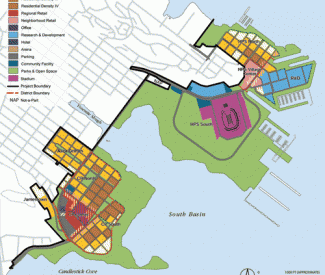
Indicating a map that showed a network of old sewers (in blue) and old fuel lines (in red) under the entire development area, Cohen said, “The radiological contamination that has and will be addressed at the shipyard is quite low level. You have radiation, you get nervous. We asked EPA to come out and do a scan to deal with the issue.”

IBI Group’s David Thom, the lead architect and planner for the project said the plan is designed “to connect new development back into the Bayview.”
“And this plan connects the Bayview through to the water.”

Tiffany Bohee, Cohen’s deputy in the Mayor’s Office of Economic and Workforce Development, insisted that project’s proposed bridge is better than Arc Ecology’s proposed alternative route, which would not involve constructing a bridge over an environmentally sensitive slough.
“The non-bridge route increases the number of intersections,” Bohee said, seeking to turn an environmental question (the impact of bridge on wildlife and nature experience) into a public safety issue.”
She claimed the BRT route over bridge was 5-10 minutes faster than Arc’s proposed alternative, “because there are fewer turns, it can go at higher speeds.” But Arc’s studies suggest the BRT route over the bridge is only a minute faster, and would cost over $100 million.

Bohee noted that $50 million from the sale of 23 acres of parkland for condos at the Candlestick Point State Recreation Area (CPSRA) will be “set aside for the state, and won’t be able to be raided by the city,” with $40 million going to improvements, and $10 million to ongoing operation and maintenance costs.

She also cited additional benefits that the project would bring to the community, including thousands of construction job opportunities.

“We are working with City Build to make sure they are for local residents,” Bohee said.“And there is absolutely no displacement for the rebuild,” Bohee continued referring to proposal to place current Alice Griffith public housing iresidents n new units, on a 1-1 basis

Eric Mar said he was impressed by many elements of the plan, but continued to express reservations.
“I’m still concerned that is seems to serve newcomers as proposed to existing residents,” he said. “And I’m still not convinced that the bridge is the best for existing residents.”

Rhonda Simmons, who works in Cohen’s Office of Economic and Workforce Development,  tried to flesh out details of the project’s job creation promises.
“The most immediate workforce is related to the construction site, and as you know, this project goes over a 15-20 year span,” Simmons said, pointing to green tech and retail as job opportunities that will exist once the project is built.

Mar expressed concern that the jobs may not be at the level of D.10 residents
“How is this gonna bring their skill level up?” he asked.
“The idea is that training gives first level entry at a variety of building trades,” Simmons said, pointing to the project’s large solar component.

“What about women?” Sup. Maxwell asked
Simmons pointed to retail opportunities,
“The idea of the training is to give folks job readiness skills, like getting there and showing up on time,” she said

Mar wanted to know who would have oversight of monitoring and compliance.
“In the city we have a tapestry of folks who do contract compliance,” she said. “The oversight will come from a variety of places.”

After Kurt Fuchs of the Controller’s Office listed the estimated economic benefits of the project, Board President David Chiu observed that the city is “at a crossroads.”

“I do not plan to prejudge,” Chiu continued, as he introduced his five amendments to regulate the Parcel E-2 cleanup, the size of a proposed bridge over the Yosemite Slough, expand healthcare access in the Bayview, create a workforce development fund and lay the groundwork for bringing public power to the project.

During public comment, Bayview resident Fred Naranjo pleaded for project support.  

“Please don’t let the train leave the station,” Naranjo said. “If Lennar leaves, the Bayview will never be developed.”

And Tim Paulson, executive director of the San Francisco Labor Council expressed hope that an agreement was getting closer.
“There really is a path to getting this done,” Paulson said. “This really is a model project in many ways for the rest of the United States.”
But D. 10 resident Linda Shaffer with the Yerba Buena chapter of the California Native Plant society indicated the huge pressure exerted on folks to support the project
“I do not want to be classified as an opponent, but we have concerns,” Shaffer said, noting that her group has filed an appeal of the project’s final EIR.

And while the Sierra Club’s Arthur Feinstein thanked Chiu for proposing to reduce the size of the bridge, he pointed out that Chiu’s amendment wasn’t really a compromise.
“That’s because it’s still a bridge,” Feinstein said, as he explained how noisy the area surrounding the slough will become as traffic whizzes by.

Connie Ford of the Labor Council accused some project critics of being “disrespectful.”
Ford took particular issue with claims that the project will gentrify the area
“The neighborhood is changing,” she said. “Since 1990, African American families have been leaving the Bayview in huge numbers. I encourage you to see this project as a good plan.”

Gabe Metcalfe of SPUR expressed his unconditional support for the plan,
“This plan is being asked to fix a huge number of problems,” he said.
Noting that the bridge continues to be a sticking point, Metcalfe said he sees opposition to every transportation project these days.
“We seem to be in a moment when you can’t build anything without it being opposed.”

But other speakers from the Sierra Club reiterated their stance that there are better and viable options to the bridge, noting that it is too costly, and that the surrounding community and wildlife would be better off without it.”

All these competing viewpoints suggest that whatever decision the Board makes today, it will take some time and create plenty of uproar. So, here’s hoping the Board votes in a way that will truly benefit the D. 10 community, not career politicians, city officials and out-of-state developers. It’s about time.

Buyer beware of Candlestick-Shipyard project

0

Board President David Chiu has introduced five amendments to the city’s Candlestick Point-Hunters Point Shipyard redevelopment proposal. All five are a good start, but longtime observers question if they are too little, too late, in the face of intense lobbying by a city and a developer intent on getting project approvals before a new Board and possibly a new mayor occupy City Hall in January 2011.

Chiu’s amendments address key concerns with the city’s proposed redevelopment plan, and they come as the Board prepares for its July 13 hearing into three separate appeals of the project’s final EIR certification, as well as amendments to the Bayview Hunters Point and Shipyard redevelopment plans.

Two of Chiu’s amendments seek to address concerns about the clean-up of radiologically impacted waste at Parcel E-2 on the shipyard, and environmental impacts of a proposed bridge over Yosemite Slough.

Chiu’s other three amendments seek to finance the expansion of the Southeast Health Center, create a workforce development fund and analyze the feasibility of providing public power, including natural gas at the site.

But while all five amendments are welcome, some observers worry they do not fully address concerns about the project’s sustainability, financing and infrastructure.  But before we get to those concerns, let’s review Chiu’s five amendments in greater detail:

1. The Parcel E-2 amendment.
This amendment declares that the Board’s adoption of CEQA findings for the project “shall not in any way imply support of a cap for Parcel E-2.” 

As such, this amendment is a critical step towards insisting that the parcel get completely cleaned up, not just capped, as the Navy is currently proposing. On the other hand, it’s not a watertight demand to excavate and haul away all contamination from this parcel, which is the cleanup alternative that many in the community would prefer..

Instead, Chiu’s Parcel E-2 amendment declares that the U.S. EPA, California EPA and the Navy, “should pursue the highest practicable level of cleanup for Parcel E-2.”
And that the San Francisco Redevelopment Agency “should not accept the property unless and until that cleanup is satisfied.”

It also establishes that the Board shall conduct a hearing regarding final cleanup strategies for Parcel E-2 before a final remedy is selected, urges the U.S. EPA, California EPA and the Navy to participate in such a hearing, and further establishes that the Board shall conduct a separate hearing prior to any transfer of Parcel E-2 to Redevelopment.”

(There was some question as to why the Board was saying “should” in some parts of this amendment, and “shall” in others. The reason I heard was, you can’t force the Navy to do anything, but you can urge them, and you certainly can refuse to accept the property, if it is not cleaned up a city’s requirements.But this needs to be clarified.)

2. The Yosemite Slough Bridge amendment
Chiu notes that the city’s EIR for the project analyzed a non-49ers-stadium alternative that “includes an approximately 41 ft. wide bridge spanning the Yosemite Slough which is limited to bike, pedestrian and transit use.”
“However, in the event the San Francisco 49ers elect to build a new stadium on the shipyard site, the project will include a bridge spanning Yosemite Slough that is wider than 41 ft. across to accommodate game-day traffic,” Chiu’s amendment states.
(So, Chiu’s amendment doesn’t throw the bridge entirely out with the 49ers’ stadium, and that leaves environmental groups uneasy, afraid that the anticipated 25,000 new residents in the proposed development will subsequently push for legislation to allow for a wider, car-accessible bridge.)

3. The Southeast Health Center amendment
Chiu’s Southeast Health Center amendment demands that the developer contribute $250,000 to the Redevelopment Agency for a needs assessment study regarding the need to expand the center and the ongoing health needs of local residents, and, to the extent such expansion is needed, to help pay for predevelopment expenses associated with this expansion.
The capital costs for expanding the center would be funded through a combination of  tax increment dollars, a $2 million Wellness Contribution paid by the developer, and the City’s ability to finance savings that would accrue to the Department of Public Health by moving from leased space into owned space at the expanded center.

4. The Workforce Development Fund amendment
Chiu’s amendment would modify language in the current community benefits agreement to require the developer to contribute $8,925,000 to a workforce development fund to be used for programs “designed to create a gateway to career development, fiirst for residents of District 10 and secondly for “at-risk job applicants.”
(A member of the public suggested that veterans be specified as “at-risk job applicants,” an idea D. 10 Sup. Sophie Maxwell seemed to support during yesterday’s July 12 Land Use Committee hearing, which was where Chiu introduced his five proposed amendments.)

 5. The Public Power amendment 
Chiu’s public power amendment notes that the SFPUC confirmed the feasibility of providing electric service to the shipyard sire, but requires the agency to update this study and include the Candlestick site and include “an analysis of the feasibility of providing natural gas to the project site.”

But will these steps be enough to ensure that the development actually delivers on its promises of thousands of jobs, and hundreds of affordable housing units,? And is a bridge really necessary across Yosemite Slough, if the 49ers go to Santa Clara as planned?

Long-term observers of the project point to the first phase of the project, which began on the shipyard’s Parcel A, as a warning of where things might end up.

“We approved the fast-tracking of Parcel A based on a bevy of assurances and enthusiastic endorsements from the best and brightest this administration has to offer,” said a source who wishes to remain anonymous. “But what has happened since then, and what are we to learn from this experimental test case?”

This source noted that recent maps of the shipyard show that Parcel A, which the Navy conveyed to the city in 2004, has since been carved up into several new pieces.

“How did Parcel A get divided into two areas that don’t even border one another?” my source asked.

The answer appears to be that sections of the shipyard, including Parcel A,  have since been renamed as new and separate parcels, after it was discovered that shipyard sewers on those parcels contained radiologically contaminated material.

One of these sewer lines, as indicated on recent project maps, leads from a site now known as Parcel UC-3, into the Bayview. In other words, it appears to lead off the shipyard site and into the surrounding community. If so, this raises concerns that shipyard contamination is no longer limited to the shipyard in the Bayview, and could be impacting residents and businesses that are not covered by the Navy’s clean-up commitments.

Either way, it seems that the Board could use an update on what happened on Parcel A, since it was conveyed, what’s the deal with UC-3, and other recently renamed parcels, before they consider an early transfer of the rest of the shipyard.

“How can we start Phase 2 of the project, when we haven’t completed Phase 1?” my source asked.

And since the Navy is still tasked with cleaning up the rest of the shipyard parcels, it would be helpful if the Navy updated the Board on what the Navy is proposing in its Records of Decisions for each of these parcels, including UC-3, before the Board votes on Phase 2 of the project.

My source also noted that since the project plans to use 100 percent recycled water at the site, it would be helpful to have an update as to how issues with sewer contamination and groundwater concerns might impact the project’s sustainability plans.

“These issues touch on half of the documents that make up the EIR, but are now obsolete, because of the issue of radioactive contamination on UC-3,” my source claimed.

And then there’s the question of fproject financing and who the developer for the project actually is, these days.

“The city’s exclusive negotiating agreement (ENA) was with Lennar, so who is CP Development and why do we have an ENA with them?” my source asked.”What happened to Lennar? And why would we be obligated to negotiate solely with this CP Development group?”

Now, hopefully the Board has greatly reassuring answers to all these questions, so that the community can rest assured that the supervisors really do understand the ramifications of a project that they are being asked to approve in what appears to be an awful hurry.

Yes, there are plenty of project supporters who keep on urging “no delays.” I understand their concerns. They want jobs, housing, parks and other promised community benefits. And I don’t blame them.

But it’s up to the Board to ensure that it doesn’t get rushed into approving a project that perhaps doesn’t guarantee any or all of these things. So, let’s keep asking questions so the Board of Supervisors doesn’t end up with buyer’s remorse, but instead can truly claim to having secured a deal that really helps all the folks who currently live and work in the city’s southeast sector. Stay tuned.


T


Newsom’s ambitions trump local needs

1

I guess that’s nothing new, and I could have written the same headline dozens of times over the past couple of years. But in this case, the Bay Citizen has a nice scoop — Newsom personally scuttled a deal that would have created a $50 million annual stream of affordable housing money because he didn’t want to be on record supporting any new taxes.


The Bay Citizen story, which also ran in the New YorkTimes, doesn’t go quite as far as to say that the tax issue scuttle the whole thing, but I think it’s pretty clear that’s what happened. The deal — a highly unusual agreement between warring parties — involved an increase in the real-estate transfer tax on high-end buildings. The private developers agreed to support it — if the housing advocates would allow some of the money to be used to subsidize the requirement that developers build affordable housing along with market-rate units.


I’m no so into subsidizing private housing developers, but the money would be coming from people who sell high-end properties. At any rate, whether it was a good deal in the end or not, Newsom’s own staff was involved in making it happen — and the mayor only killed it for one reason.


He doesn’t want his Republican opponent this fall to accuse him of raising taxes.


That’s a hell of a way to run a city. 

Snap Sounds: Björk and Dirty Projectors

1

BJÖRK AND DIRTY PROJECTORS
Mount Wittenberg Orca

Mount Wittenberg Orca is neither the first nor last time Björk sings about oceans, mothers, and plant life (re: “Oceania”). But now, she has the genius of the Dirty Projectors ­– in particular, producer and Dirty frontman David Longstreth – looking at Mother Nature, too.

On Orca – and I don’t mean Bitte Orca, the Dirty Projectors’ 2009 indie instant-classic  – the Icelandic songstress and Longstreth have teamed up to produce an album for charity. This is a 20-minute, seven track release – short, but oh how sweet ­– whose proceeds all go to the National Geographic Society. It’s the first time we’ve been able to hear studio recordings of these tracks since Dirty/Björk played a benefit concert last year at Housing Works in New York.

Perhaps the titular mountain is our very own, in Marin. Either that or, judging by the album art, it’s some Middle Earthian alternate world. The eponymous orca – a killer whale – holds especially pertinent ground for Björk since, back in the Aughts, she developed some kind of maritime obsession on Medulla and the Drawing Restraint 9 soundtrack. It’s also interesting to note that, back in 2005, Björk’s hubby Matthew Barney gave ambergris, aka whale shit ­– one of his many fetishized materials – a starring role in Drawing Restraint 9. If you want to connect the dots even more, Barney was born in San Francisco.

Reminisicent of Medulla, Orca is like an epic chamber piece: harmony-heavy, flippantly sliding up and down scales, often ending up in a round of disparate melodies. Both Björk and the Dirty Projectors foreground imaginative vocal arrangements, and thus, the vocals here are strong and full of nuance.

The opening track, aptly titled “Ocean,” features some frightening feedback and disquieting vocals that wouldn’t be out of place in Krzysztof Penderecki’s scariest nightmares. Later, the bouncy “Sharing Orb” showcases the Dirty girls’ piquant “eh eh eh”s to match Björk’s Yoko-like, banshee-wailing “waaaaw.” “How do you say ‘love’?” she asks. Well, I know how I say it, Björk, and it’s definitely not the same way you do (“laaaaaave”). But as on the rest of her canon, her Neanderthalic cadence is totally successful in the context of the album’s conceit: A return to nature and the elements, a vision of an a priori universe of sound, to create modern, tightly woven aural textures.

“No Embrace” sounds like typical Dirty Projectors fare: spooky, yet wistful. Longstreth and his leading ladies – Angel Deradoorian, Hayley Dekle, and Amber Coffman – never clash with Björk’s typically dominant voice. The two work well in concert (both in the literal and figurative sense if you’ve seen the performances) yet you can still tell who’s singing and when.

The best song is “All We Are,” the final track and also the Björkiest. It almost sounds like a b-side from Medulla or the separated Siamese twin of “Sonnets/Unrealities XI.” The choir-like incantations, offering plenty in the way of falsetto, wax ethereal beneath Longstreth’s romantic lyricism. But like the best of Bjork’s Icelandic-to-English words, beauty is met by danger, and emotions are met with undermining qualifications (“I looked out for you/But looking never meant less”).

Mount Wittenberg is a pleasant, lovely climb, both brisk and a breath of fresh air. It’s enough to satisfy fans of either Bjork or Dirty Projectors, and you’ll most likely freak out if you’re a follower of both like myself. Yet at 20 minutes, it still leaves you wanting more. You can purchase the mp3s at mountwittenbergorca.com for pretty cheap, or you can stream the album on YouTube.

RENE CAZENAVE, 1941-2010

5

Rene M. Cazenave died at home June 27 in the company of his wife, Sylvie, and sister, Denise. He is also survived by his son, Lucien, and two-week-old granddaughter, Drew. He was 69.

A native San Franciscan, Rene was instrumental in the creation of the community empowerment movement in the city from its modern inception in the 1970s. He was at the center of community politics for nearly 40 years. He was a key member of Citizens for Representative Government, the community-based coalition that devised and successfully campaigned for district election of supervisors in 1977, a move that led to the election of the first directly elected African American, Chinese American, and gay supervisors. He helped organize and found the Council of Community Housing Organizations, a coalition of faith- and community-based nonprofits that produce permanently affordable housing. Over the past 30 years, members of the group have developed or acquired and rehabilitated some 25,000 affordable homes and apartments in one of the most expensive housing markets in the U.S. He helped create and then save KPOO community radio. He loved his family, jazz, old San Franciscans (indeed, he became one himself), dogs and cats, and reading and debating history.

His dad, also Rene and also a native, spent his working life in newspapers, retiring as a Hearst Examiner editor. Rene learned from his dad — and mom, who was also a native — every parish, every street, every neighborhood, and every bar in San Francisco. He was invaluable to a movement centered on community organizing, but made up of folks who hailed from everywhere but San Francisco. He shared his knowledge of the city — and his love for the people of the city as well.

Rene’s special genius was in raising funds for the creation of a community controlled infrastructure, empowering residents of low-income neighborhoods in San Francisco. He was the master in the use of the federal Community Development Block Grants program (CDBG), and was an important part of a community effort to restructure the Redevelopment Agency, leading to the use of the agency’s tax-increment financing mechanism. At a conservative estimate, these two public sources — CDBG and tax increment financing — have poured more than $1 billion into low-income San Francisco communities since 1975. Thousands of lower- and fixed-income San Franciscans who didn’t even know Rene’s name found a home, got critical job training, played in a gym, ate a hot meal at a senior center, got treatment for an illness at a community clinic, and had an opportunity to vote for a supervisor who represented their interests as a result of his skillful and tireless advocacy.

Rene was a fully integrated political being. To an astounding degree, his moods were set by the politics of his city. He held a deep and unshakable belief in socialism and humanism. He was heartsick at the decline of working class San Francisco. But his depression and disappointment over political events never caused him to give up or give in. He loved the fight, he loved the action, and he worked harder than most to the very end.

We all know that we stand on the shoulders of giants. But every now and then we are lucky enough to actually stand shoulder-to-shoulder with them. Those of us who knew Rene Cazenave were that lucky. Services are pending.

Calvin Welch worked with Rene Cazenave for 39 years doing community organizing, advocacy, and politics together. He, along with hundreds of others, misses the hell out of him already.

A new New Deal for San Francisco

15

OPINION On Thursday and Friday, July 8 and 9, San Franciscans concerned about the future of their city will have a unique opportunity to devise practical, locally actionable proposals to shape and direct future policy affecting the local economy and the provision of critical human services.

On July 8, starting at 3:30 p.m. at SF Lighthouse Church (1337 Sutter at Van Ness), a New Deal for the City economic development summit will be held to address set of issues ranging from municipal reform to community-based economic development proposals. A copy of the draft positions can be found at www.sfcommunitycongress.wordpress.com.

The next day, the San Francisco Human Services Network, a 110-member organization of human and health service nonprofits, will host its New Realities summit starting at 9 a.m. at the McClaren Center at the University of San Francisco. More details about topics at the summit can be found at www.sfhsn.org/index.

The results of these two summits, along with proposals on Muni reform and affordable housing, will form the basis for a citywide meeting of “The New, New Deal for San Francisco” Congress, scheduled for Aug. 14 and 15 at USF.

The summits and congress offer a chance to discuss, adopt, and plan the implementation of a comprehensive response to the assault on the provision of critical public services and the clear failure of the local economy to respond to the current and future needs of San Franciscans. Over the past decade, San Francisco has lost, and never replaced, more than 70,000 permanent jobs as first the dot-com bust and now the implosion of the financial sector have shredded the city’s “new” economy. In a total reversal of its historic role, San Francisco is no longer the employment center of the Bay Area, but simply the high-end bedroom of a commuting workforce based outside the city.

This historic shift has meant that the primary form of development in San Francisco has gone from commercial, employment-based enterprises to high-end residential development — development that, because of Proposition 13 limits on local property taxes, simply fails to pay for the city services needed to support the existing and new residential population.

San Franciscans built a system of local governance that was unique in the state, and not often matched in the nation, in providing a level of municipal services based on the premise that we share a special place and a common future. These services were provided by a robust mixture of traditional public sector departments and innovative, community-based nonprofits. That system was itself based on an economy that mainly employed San Francisco residents in a diverse mix of economic activities with opportunities open to a wide array of people.

That economic base has been reduced to a mere shell of its former diversity, with few opportunities for even fewer people. Our current mayor has no desire to address this historic shift; instead, he is content to endlessly campaign for other offices, issue press releases on mythical achievements, and pit one portion of San Francisco against another in hopes that all forget the decline of the city under his leadership.

Progressive forces cannot again allow needed changes to be held hostage to the election of a particular candidate. We must put on the table a comprehensive, integrated set of locally actionable policies that make sense in the realities we face in the second decade of the 21st century — no matter who wins. After all, it’s our city.

Karl Bietel is a worker advocate; Fernando Marti is a community planner; and Calvin Welch is a balanced growth and affordable housing advocate.


D. 10 candidates DeWitt Lacy, Tony Kelly and progressive planners blast Lennar’s plan

8

Recently, I spent some time talking with D. 10 candidates DeWitt Lacy and Tony Kelly about Lennar’s redevelopment plan for the shipyard and Candlestick Point. I also attended a Progressive Planners forum that addressed the massive development proposal. Those conversations and the issues they raised seem timely in light of the city’s crazily tight schedule for trying to ram final approvals for the project past government agencies this summer. And in light of three appeals that have been filed against the city’s recently certified final environmental impact report for the plan, raising concerns that the city will get bogged down in expensive and time-consuming litigation if it doesn’t get the plan right, while it still can.

(Lest other D. 10 candidates complain that they weren’t interviewed, too, I’d like to clarify that I’ll be covering the race between now and November, and I look forward to hearing what they all think at the Board’s July 13 meeting to hear appeals of the city’s final environmental impact report (FEIR) for the project. )

Both Lacy and Kelly are critics of Lennar’s plan, but not in a knee-jerk obstructionist way. Instead, they bring considered and informed critiques to the table at a time when the community desperately needs good advice and a workable strategy, if residents are to get needed amendments and concessions, before the developer get the green light, or before the Board puts  a moratorium on the project until the city’s FEIR flaws are ironed out.

Lacy is a bright and earnest candidate who learned lessons from the school of life, while growing up in San Jose in a working class family. Lacy says his father worked in an Adidas warehouse until he was injured on the job, and his mother worked as a secretary in Atari’s corporate office, but was laid off after two years.

Lacy recalls how his parents opened their own janitorial business, in the hope of making a better life for their six children.  He says that it was while cleaning homes alongside his mother, that he began to recognize the need for working class improvement and growth.

 In 1995, Lacy moved to San Francisco, where he has worked in the District Attorney’s office and formed his own law practice—experience that could serve District 10 well, since it’s home to many working-class residents and will be ground zero in the battle for construction-related contracts and environmental and economic justice, if Lennar’s massive redevelopment plan goes ahead,

“I know how to craft legislation for social justice,” Lacy said.

Lacy observes how Michael Cohen, Gavin Newsom’s top economic advisor in the Mayor’s Office of Economic and Workforce Development, has repeatedly told folks that land transferred to Lennar will be subject to a “right of reverter.”
This means the Redevelopment Agency may re-take ownership of the land, if the developer fails to substantially complete the infrastructure in the time frame set forth in the city’s development and disposition agreement (the DDA)

But Lacy observes that this “nuclear option” isn’t likely to happen with so much riding on the Lennar deal, and he stresses that additional controls are needed, if the city is to ensure that the deal remains in the best interest of San Francisco, not just the developer.

Lacy’s probably right about that. (Remember how hard the community had to fight to just get an extra 15 days to read and comment on the project’s six volume draft EIR over the winter holidays?)

And how much political pressure was exerted to ram the city’s EIR for this project across the certification line on June 3, five days before Santa Clara voters decided to support a stadium for the 49ers near Great America.

“What’s needed is an impartial arbiter,” Lacy said. “The city needs regulatory controls and the capacity to fine Lennar if it breaks promises to build affordable housing, create jobs and hire locals. You’re not going to be able to hold their feet to the fire without that.”

“I’m not saying that we should be obstructionists, critics who are trying to prevent stuff for the sake of a political battle,” Lacy added. “But we need new blood. The benefit of my campaign is that I’m not downtown’s candidate. I’m a civil rights attorney, who can help the district by figuring out what battles we need to be fighting and which battles are winnable. And I want to make sure there are jobs and business opportunities for working-class folks in San Francisco. You shouldn’t have to be a doctor or lawyer to afford to live here.”

Lacy believes the Navy should remove the radiologically impacted landfill on the shipyard’s Parcel E2.
“That ground has to be taken out of there,” Lacy said. “I would hope the City Attorney’s Office would get involved and advocate for the people. But leadership is about taking a stance when no one else is.”

With the city suggesting that it can still win back the 49ers, Lacy said that he too, would love it if the 49ers decided to stay.
 
“But not at the cost of our health and safety,” Lacy said, referring to the city’s repeated claim that it needed to rush certification of the final EIR for Lennar’s project, if there was to be any hope of winning back the team.

“ I don’t think the solution is the rush,” Lacy said. “I say, let’s make sure we clean up the shipyard properly—and bring back the Warriors [a professional basketball team that relocated to San Francisco in 1962, until 1971, when it moved to Oakland].”

I also hung out with D. 10 candidate Tony Kelly, at an event that POWER hosted as part of a Progressive Planners Forum, the day after Lacy and I unsuccessfully tried to access the shipyard, and the same day that POWER was also blocked from the yard.

Kelly has been tracking issues in and around District 10 for years, and, much like Lacy,  he’s not afraid to speak his mind on the issues.

For instance, Kelly is incensed by the city’s attempt to ram through approval of the final EIR for Lennar’s development, when the Navy has yet to complete an environmental impact statement related to its proposed clean up activities at the shipyard..
“Is the EIS ever a trailer to the EIR?” Kelly asked. “It’s like planning on Mars.”

Kelly has also expressed concern over the developer’s plan to build two peaker plants in the community.

And he is worried about the consequences of the city’s plan to turn the entire Bayview into a project survey area for Lennar’s Candlestick/Shipyard plan.

“How do you pay for any other improvements in the Bayview, when the shipyard redevelopment plan sucks all the air out of the room?” Kelly said

But Kelly’s biggest concern right now is that once Lennar gets its final approvals this summer, “the developer will never talk directly to the community again.”

At the Progressive Planners Forum that Kelly attended, speakers also voiced measured criticisms of Lennar’s plan.

“The plan has some important elements, especially in the job areas, but I think it adds up to gentrification, which is disruptive to the surrounding community, families and the last bastion of the black community in San Francisco,” said Chester Hartman, who has authored over 18 books on race and urban planning, including the acclaimed City For Sale: The Transformation of San Francisco.

“There is a need for a response in terms of an alternative approach,” Hartman advised.
“It doesn’t have to be a detailed, but it should include a basic philosophy and goals, and retain good parts of the original plan.”

Peter Marcuse, Professor of Urban Planning at Colombia University, said the situation at the shipyard reminded him of the ongoing oil disaster in the Gulf.

“Cap the land sounds like cap the spill,” Marcuse said, noting that in both cases the community is fighting to get folks who dumped toxins to clean them up.

Marcuse criticized the privatization of the planning process, as illustrated by the City’s claim that it has entered into a “public-private” partnership with Lennar,  and the community’s experience that the city and the developer keep ignoring or dismissing the public’s feedback and opinions.

 “There should have been a range of alternatives open for discussion,” Marcuse said. “Instead, there is a sense, of this mega project’s inevitability. And once the developer has title to the land, the city has to negotiate what should be a public matter.”

Marcuse critiqued the use of tax increment financing, which will use increased taxes on property throughout the Bayview to finance improvements in one relatively small area, the 770 acres of land that, as Marcuse put it, “got sold to Lennar for $1.”

“This is a form of government subsidy,” Marcuse warned.

“There have been some negotiations,” Marcuse continued. He pointed to the community-led Prop. F, which in the spring of 2008 sought to establish 50 percent affordable housing in the development. And the community benefits agreement (CBA) that the San Francisco Labor Council hammered out at in May 2008, in an attempt to nail down benefits for the community in exchange for the Council’s support for the Lennar-financed Prop. G in June 2008.

“But these negotiations with Lennar start on basis that Lennar’s interests have to be protected equally with those of the City and its residents,” Marcuse commented. “It ought to be a public responsibility to show the community what the alternates to Lennar’s vision are.”

Marcuse concluded by suggesting a moratorium on Lennar’s plan to allow for a community-based visioning process, in which residents could express their desire for housing, diversity, open space and protection against environmental hazards

‘The City should then come up with an alternative to Lennar’s plan—and listen to Lennar,” he said. “But this is a public responsibility, rather than a private negotiation with a corporation that has been a beneficiary of a huge subsidy and starts to make a huge profit, the minute its housing units begin to sell.”

Miriam Chion, who works for the Association of Bay Area Governments (ABAG), also expressed concerns with Lennar’s massive plan, which proposes to build thousands of mostly luxury condos at Candlestick Point, with a smaller number on the shipyard.

“We are in the 21st century, how can we continue to use same mechanisms of displacement?” Chion said. “And how can we do that to the African American community, which we have displaced over and over, and which has managed to build a community here, in spite of everything?”

According to Lennar’s plan, 68 percent of its proposed 10,000 units will be built at market rate. Of the remaining 32 percent of units, only 15 percent will be built at truly affordable rates, with an additional 15 percent geared towards the working middle-class income levels, such as those enjoyed by police, fire fighters, nurses and teachers.

But two Bayview residents who attended POWER’s progressive planners’ forum expressed frustration at what they perceived as outsiders trying to tell locals what’s best.

“If you haven’t lived here, you don’t know about the Bayview,” one resident said. “If they are going to do what they are going to do, they should do it all the way, and change things for the better. I’m tired of seeing kids under 12, playing outside at 11 p.m. So, if you are not from here, you can’t come on my ground and pass judgment. If you’d been and lived here, I don’t think you’d see this negatively.”

“$700 million has been spent on cleaning up shipyard, and producing highly technical reports on it,”  another local resident said. “Highly intellectual discussions are not helping, we need some action today.”

“No one here is against development,” countered long-term Bayview resident Espanola Jackson, while a Bayview resident named Nyese resurrected longstanding concerns that the developer fatally broke community trust when it failed to control asbestos dust at the site, when it began grading the shipyard’s Parcel A .

“Four years ago, I found out that they were sending home workers at the shipyard, without informing the surrounding community,” Nyese recalled. “My son was having excessive nosebleeds, so it was phenomenally insulting that they didn’t not notify us.”
“Lennar is just a name, a conglomeration of shareholders,” Nyese further noted. “We need development. But we don’t need it on chemically toxic land.”

These competing concerns indicate that all the candidates in the D. 10 race are going to have to be asking critical questions as they track the progress of Lennar, the city and the Navy’s plans this summer. Failure to do so will cost them credibility within the community—and possibly the supervisor’s race this fall, though downtown money will pour in to support whichever candidate is deemed most likely to rubberstamp present and future development and contracting plans. Stay tuned. It’s going to be a (politically) hot July.


Political litmus test for Hunters Point Shipyard access?

4

Even though the U.S. Navy abandoned the Hunters Point Shipyard in 1974, the military has continued to control access to the shipyard that helped launch the A-Bomb. That’s because the Navy still owns most parcels of land on the shipyard and remains on the hook for cleaning up pollutants on these sites, including a radiologically impacted dump on Parcel E2, which has been deemed to be the dirtiest land on the site.

Currently, the Navy is proposing to cap, not excavate this landfill, despite repeated requests from the local community, and a citywide vote in support of Proposition P in 2000, which urged the Navy to clean up the land to the best extent possible, which would mean excavating the Parcel E2 landfill and replacing it with clean uncontaminated soil. And oddly, the City appears to want government agencies and officials to sign off on its final EIR for Lennar’s massive 770-acre redevelopment plan for the shipyard and Candlestick Point, even though the Navy has not yet completed an environmental impact statement (EIS) related to its proposed shipyard cleanup activities.

Currently, the Navy controls access to the facility beyond a couple of trailers that the city’s Redevelopment Agency has set up just within the yard’s main gate. And to gain access to the shipyard these days, you need to call or visit Redevelopment’s trailer and get a pass. Or, alternatively, if you know any of the artists who continue to rent studios at shipyard, you can call them to try and get the city to give you a pass.

Underlying these limits to accessing the shipyard are some legitimate safety concerns related to equipment and excavations on what is now an active clean up and construction site, along with fears that untoward characters could break into the abandoned buildings or bother the artists who still have studios in operation at the shipyard. But has an additional political litmus test been put in place when it comes to critics of Lennar’s redevelopment plan, who want to access to the yard? If so, does it mirror the tap dancing that the local community has had to undergo to get its voices heard as Lennar pushes to get final approval for its shipyard/ Candlestick Point redevelopment plan.

Those questions resurfaced last week when a private security guard manning the shipyard’s front gate denied access to D. 10 supervisor candidate DeWitt Lacy, who had dropped by hoping to take this reporter around the yard as part of an ongoing conversation about Parcel E2, which Lacy believes needs to be excavated completely, and how best to hold the Navy accountable for cleaning up a mess it created decades ago. The security guard told Lacy that folks who want to visit must get a pass at the Redevelopment Agency trailer.

At the Redevelopment trailer, Micah Fobbs, administrative assistant for W.B. Kennedy and Associates, which has a contract with Redevelopment’s Citizen’s Advisory Committee. told Lacy that without a preauthorized pass, he couldn’t let us onto the site. Fobbs added that he would be happy to take us on a tour himself, but he could not leave the trailer unmanned, since he was the only staff member there at the time. Fair enough. Though the rebuff gave us the feel that the City doesn’t want pesky investigative reporters that have been critical of the development running around the site. “And if they found out I was a civil rights attorney, they probably wouldn’t want me out here, either,” Lacy joked.

But the next day, I encountered what sounded like overt hostility to other critics of Lennar’s plan, when I tried to ride along on what had been billed as a “Toxic Tour of the Navy Shipyard” by POWER (People Organizing to Win Employment Rights). POWER had advertised its tour in an email which said it would involve 23 expert urban planners, who happened to be in the Bay Area for a Progressive Planning Forum. The tour was billed as happening on the morning of June 17, before an afternoon discussion at POWER’s Third Street office in the Bayview, which was to focus “on alternative approaches to the city’s current plan for development at the Shipyard/ Candlestick Point.”

Caught in traffic, I didn’t arrive at the Boys and Girls Club on Kiska Road in Bayview Hunters Point in time to join POWER’s kick-off get together. So, I headed direct to the shipyard, a move that meant I arrived alone and ahead of the school bus that POWER had rented for the occasion. At the gate, I was told by the security guard that I couldn’t get in, that another guard lost his job for letting unauthorized individuals onto the site, that POWER didn’t have a pass and that they’d been warned to watch for POWER “because they want to stop the development.”

“If you are not authorized with badges, you are not let through,” the guard said, giving me the telephone number of the Hunters Point Duty police officer, who in turn said I needed to call the San Francisco Redevelopment Agency, which in turn told me to call the folks at the Redevelopment Agency’s shipyard trailer. And so I called Fobbs again, who confirmed that the Navy still controls all the property, except Parcel A which has already been conveyed to the City which in turn has granted developer Lennar the right to develop thousands of condos on that particular parcel.

“As far as viewing the rest of the property, you have to put in a request, and no photography or videography is allowed,” Fobbs said. This stated ban on photography came as a surprise, given recent photos of the shipyard that ran in a New York Times article about Lennar and the city’s vision for the 770-acre property.

And the sudden difficulties in gaining media access seemed odd, given that Lennar’s PR firm, Sitrick and Company, offered to take the media on a tour on the morning of June 3—the day the Redevelopment and Planning Commissions subsequently approved the final EIR for Lennar’s plan to redevelop the rest of the shipyard, plus Candlestick Point, a FEIR that has now been appealed to the Board, on the grounds that it was rushed for political reasons, leading to fatal flaws in the final document.

“Well, if folks come here through Redevelopment or the Mayor’s Office, then they have been able to take photographs,” Fobbs said. “But we have had people trying to climb fences and get through doors of some of the buildings.” (Fobbs last comment was a reference to a recent climbing of the fence that the Nation of Islam’s Leon Muhammad engaged in, in an effort to determine if air quality monitoring devices near the Nation’s school and Oakdale public housing site were operating. (After Muhammad scaled the fence and reported that he’d found an empty bin where monitoring equipment was supposed to be, a kafuffle ensued, with the US EPA saying Muhammad was looking in the wrong place for the monitors which, it claimed, were in operation.)

Ultimately, Fobbs told me to call Redevelopment’s Audrey Kay if I wanted a tour, and several shipyard artists told me they would be happy to arrange a day pass so I can visit their studios and hear concerns that they will be required to move from a couple of shipyard buildings before replacement studios have been completed–an arrangement that would amount to a breach of promise that Lennar and the city previously made to the shipyard artists.

Shortly after I was turned away for a second time, POWER’s bus arrived at the gate, only to be blocked–a denial of access that meant 23 progressive planners were forced to view the shipyard from various remote viewing spots atop the hills that surround the site.

Together these episodes left me wondering what kind of political litmus test could end up being enforced at the site, if Lennar’s mega project gets the green light this summer, and what will happen if the Board decides to kick the plan back to the drawing board until the Navy completes a environmental impact statement and all of the community’s ongoing environmental and economic justice concerns are addressed.

So stay tuned, and don’t forget to mark July 13 on your calendar when the full Board of Supervisors is tentatively to hear appeals of the project’s final EIR, which the Planning and Redevelopment Commissions rubberstamped June 3. And, as always, it will be revealing to see which candidates in the hotly contested race for D. 10 supervisor, show up and speak truth to power.


La Briciola

0

paulr@sfbg.com

DINE Seven years ago — I long to say, “four score and seven years ago” but that would be stretching a point — I considered an Italian restaurant, Vino e Cucina, on a SoMa stretch of Third Street notable for its grit. After dark, in the shadows of the crumbling viaduct carrying traffic to and from the Bay Bridge, you could easily imagine yourself being inside one of Tim Burton’s Batman movies, and to step into Vino e Cucina was to find refuge.

These days the neighborhood’s aspect is quite different. The viaduct has been rebuilt, tony-looking housing has popped up all over, and Vino e Cucina is now La Briciola. The refuge angle is less sharp now, but La Briciola is still welcoming in that distinctive Italian way that manages to be informal and formal at the same time. The interior is done in shades of brown and cream; if it were a cup of coffee, it would be a macchiato, an espresso marked with some foamed milk. And the service staff practices a well-mannered demonstrativeness that will probably seem familiar to anyone who’s ever eaten at a trattoria in Rome.

The food, rooted mostly in the cuisines of Tuscany and Piemonte, tells us a nuanced tale about Italian cuisine’s complex relationship with innovation. If a dish has been made the same way for generations — has, in effect, been perfected — then why tamper or fiddle around with it? Yet this is America, where newness is celebrated with an almost religious fervor. So which will it be, perfection or newness?

Executive chef Gian Luca Toschi’s best dishes are the traditional ones, though these aren’t necessarily old warhorses. For instance, I’ve never seen fagottini ($14) or Italian crepes on a menu before; these turned out to resemble a pair of giant dim sum pouches, wrapped up like gunny sacks and filled with chopped mushrooms and carrots. The earthiness of the filling was enhanced (and that’s putting it mildly) by a cream sauce of mushroom and truffle oil.

Veal, on the other hand, tends to be ubiquitous in north Italian cooking, and La Briciola offers a lovely version “alla valdostana” ($22), the name referring to an alpine region known for its fontina cheese. The veal was cutlets, pounded thin and rolled around a core of fontina cheese and speck (smoked prosciutto) into stubby cigars. If you like chicken kiev, you’d like this.

At the side of the plate lay a berm of vegetables, lightly steamed but still bright with color — broccoli, carrots, quartered new potatoes. If food were a game of chess, they would be pawns, worthy but not of enormous interest. These pawns did attract my interest, though, because they were exactly the same as those on a plate of food across the table, seared tuna with sesame sauce ($22).

The fish was fine. The sauce, like liquid amber dotted with black sesame seeds, was beautiful rather than flavorful despite the presence of shallots and vin santo. Sesame belongs mainly to the cuisines along the rim of the Indian Ocean; it’s not a natural part of the Italian kitchen, so it wasn’t shocking that the kitchen didn’t do much with it. But it was the sameness of the vegetables that captured my attention. It was as if they’d been slung onto passing plates in some kind of hash line. Of course restaurant kitchens are assembly lines, and of course economies of scale are important — but so too is the illusion that each plate has been carefully and lovingly assembled by hand, like a Louis Vuitton bag. And the illusion is so easy to create; a single variation — green beans instead of broccoli — would do it.

And speaking of green: green is a color, and a little color would have been welcome in the octopus salad ($12), which consisted of pale white octopus flesh, (white) cannellini beans, and whitish barley kernels. Some color was provided by pickled carrot shavings, but these were ungainly and awkward to eat. Still, the salad, as amended with squeezes of fresh lemon, satisfied, and it did reflect the Italian ethic of simplicity.

Chocolate volcano cake ($8) has been widely done, but it seemed strangely appropriate to find it in an Italian restaurant since Italy is among the more volcanic of lands, and Italians do love their chocolate. An issue with these cakes is that the chocolate magma can sometimes be molten enough to burn your tongue, but here it was pleasantly very warm, not hot. This was a welcome variation.

LA BRICIOLA

Dinner: Sun.–Thurs., 5:30–10 p.m.; Fri.–Sat., 5–10:30 p.m.

Lunch: Mon.–Fri., 11:30 a.m.–2:30 p.m.

489 Third St., SF

(415) 512-0300

www.labriciola-sf.com

Beer and wine

AE/DC/DS/MC/V

Reasonable noise

Wheelchair accessible


Powder keg

5

news@sfbg.com

Ask any pollster, political consultant, or academic who studies the American electorate about the mood of the voters this year and you’ll get the same one-word answer: Angry.

Everyone’s pissed — the liberals, the conservatives, the moderates, the people who don’t even know where they fit in. It’s an unsettled time and, potentially, very bad news for a progressive agenda that seeks to address issues ranging from poverty and war to the long-term health of the public and the planet.

The Democrats, who swept into power with an enormously popular president just 18 months ago, may lose control of Congress. The tea partiers have driven the Republicans so far to the right that some candidates for Senate are openly talking about eliminating Social Security. The unemployment rate — the single most important factor in the politics of the economy — remains high and doesn’t show any signs of improving.

And the progressive left seems frustrated and demoralized, particularly in California. The Golden State, which once led the nation in innovation and enlightened social policy, now seems to be leading the politically dysfunctional race to the bottom.

The nation could be headed for a dangerous era, rife with the potential for right-wing demagoguery and other nasty political schisms. The state of the economy could easily fuel a more powerful movement to shrink the scope of government and a continuing backlash against the public sector — and the financial backers of the antitax and antiregulation movement are drooling at the prospect.

But there’s also a chance for progressives to seize a populist narrative and shift the discussion away from traditional disagreements and toward those areas, particularly the destructive influence on government by powerful corporations, where the grassroots right and grassroots left might actually agree.

The anger that voters feel toward a government that isn’t meeting their needs is starting to find other outlets. People are as mad about the abuses of big business — the Wall Street meltdown, the bailouts, the BP oil spill, the political manipulation — as they are about the failures of Congress and the president. If you ask Americans of every political stripe who they least trust — big government or big business — even conservatives aren’t so sure anymore.

For 30 years, the central narrative of American politics has revolved around the size and effectiveness of government. Now there’s a chance to shift that entire debate in American politics toward the largely unchecked power of corporations. It is, populist writer Jim Hightower told us, “an enormous opportunity handed to us by the bastards.”

But so far, none of the Democratic leaders in California are taking advantage of it to start dispelling damaging myths and crafting political narratives that might begin to create some popular consensus around how to deal with society’s most pressing problems.


THE PEOPLE WANT TAXES

There have been many polls gauging voter anger, but one of the most comprehensive and interesting recent ones was “Californians and Their Government,” a collaborative study by the Public Policy Institute of California and the James Irvine Foundation that was released in May.

It shows that Californians are mad about the state’s fiscal problems, disgusted with their political leaders, divided by ideology, and deeply conflicted over the best way forward. An astounding 77 percent of respondents say California is headed in the wrong direction and 81 percent say the state budget situation is a “a big problem.”

But the anti-incumbent message isn’t necessarily an anti-government message. Most Californians are willing to put more of their cash into public-sector programs, even during this deep recession. When asked to name the most important issues facing the state, 53 percent mentioned jobs and the economy . The state budget, deficit, and taxes only got the top billing of 15 percent.

And contrary to the conventional wisdom espoused by moderate politicians and political consultants, most voters say they are willing to pay higher taxes to save vital services. “Californians tell us they continue to place a high value on education and want education to be protected from cuts. And they’re willing to commit their money to help fund that,” PPIC director Mark Baldassare told the Guardian.

The survey found that 69 percent of respondents say they would pay higher taxes to protect K-12 education from future cuts, while 54 percent each say they would pay higher taxes to prevent cuts to higher education and to health and human services programs. In other words, voters seem to recognize where we’ve cut too deeply — and where we haven’t cut enough: only 18 percent of respondents would be willing to pay higher taxes to prevent cuts to prisons and corrections.

Baldassare said the June primary results also showed that people are willing to pay more in taxes for the services they value. “Around the state, there was a lot of evidence that people responded favorably to requests by their local governments for money, particularly for schools,” he said.

Both the California Legislature and Gov. Arnold Schwarzenegger are held in very low esteem with voters, according to the PPIC study, and Schwarzenegger’s 23 percent rating is the lowest in the poll’s history.

Barbara O’Connor, political communications professor who heads the Institute for the Study of Politics and the Media at Sacramento State University, told us that voter unhappiness with elected leaders is no surprise. Right now, most people are afraid that their basic needs won’t be met over the long run.

“The common narrative is fear, and fear channels into anger,” O’Conner said.

And that fear is being tapped into strongly this year by the Republican candidates, who are trying to scare voters into embracing their promises to gut government and keep taxes as low as possible.

“If there’s any lesson to be learned from Meg and Carly’s early ads, it’s fear-mongering, fear-mongering all the time — and that doesn’t create a very positive narrative,” O’Connor said of gubernatorial candidate Meg Whitman and U.S. Senate candidate Carly Fiorina.

O’Connor noted that Barack Obama’s campaign had great success in using a positive, hopeful message and said she believes the right leader can also do so in California. “I talked to Jerry [Brown]’s people about it and said you can’t just run a negative campaign because that’s what Meg is doing.”

Despite the tenor of the times, O’Connor said she’s feeling hopeful about hope. She also believes Californians would respond well to a leader like Obama who tried to give them that hope — if only someone like Brown can pick up that mantle. “I think the environment is right for a positive message. But the question is: do we have people capable of delivering it?”

She said the no-new-taxes, dismantle-government rhetoric has started to wear thin with voters. “The real fiscal conservatives are badly outnumbered in Californian,” O’Connor said. As for the corporate sales jobs, O’Connor said voters have really started to wise up. “They aren’t going to be scammed.”

The results of the June primary election showed that voters across the spectrum were also disturbed by big special-interest money. Proposition 16, backed by $46 million from Pacific Gas and Electric Co., went down to defeat — even in counties that tend to vote Republican.

And this fall, with two rich former CEOs spending their personal wealth to win two of California’s top elected offices and energy companies pushing a measure to roll back California’s efforts to combat global warming, there could be great opportunity in a narrative targeting those at the top of our economic system.


THE TOP AND THE BOTTOM

Some observers say that whatever their shared feelings about corporate scams, conservatives and liberals in the state are just too far apart, and that there’s little hope for any substantive agreement. “People are becoming more polarized,” said consultant David Latterman, who often works for downtown candidates and interests. “I think we’re beyond compromise.”

Allen Hoffenblum, a Los Angeles-based Republican strategist, agreed. “The voter are all mad, but they’re mad at different things. I just don’t see where they come together.”

But Hightower, who has spent a lifetime in politics as a journalist, elected official, author, and commentator, has a different analysis.

“As I’ve rambled through life,” he wrote in a recent essay, “I’ve observed that the true political spectrum in our society does not range from right to left, but from top to bottom. This is how America’s economic and political systems really shake out, with each of us located somewhere up or down that spectrum, mostly down.

“Right to left is political theory; top to bottom is the reality we actually experience in our lives every day — and the vast majority of Americans know that they’re not even within shouting distance of the moneyed powers that rule from the top of both systems, whether those elites call themselves conservatives or liberals.”

In an interview, he told us he sees a lot of hope in the fractured and potentially explosive political ethos. “There’s all this anger,” he said. “People don’t know what to do. And I think the one focus that makes sense is the arrogance and abuse of corporate executives.”

In fact, Hightower pointed out, the teabaggers didn’t start out as part of the Republican machinery. “Wall Street and the bailouts sparked the tea bag explosion,” he said. It wasn’t until big right-wing outfits like the Koch brothers, who own oil and timber interests and fund conservative think tanks, started quietly funding tea party rallies that the anti-corporate, anti-imperial edge came off that particular populist uprising.

“At first, the teabaggers didn’t even know where the money was coming from,” Hightower said. “You can’t be mad at the teabaggers; we should have been out there organizing them first.”

There’s plenty of evidence that anger at big business is growing rapidly — and rivals the distrust of big government that has defined so much of American politics in the past 30 years. The bailouts were “the first time in a long time that people have been slapped in the face by collusion between big business and its Washington puppets,” Hightower noted.

Then there’s the Supreme Court decision in Citizens United v. Federal Elections Commission. In January, a sharply divided court ruled 5-4 that corporations had the right to spend unlimited amounts of money supporting or opposing political candidates. Progressives were, of course, outraged — but conservatives were, too.

Polls show that more than 80 percent of Democrats think the decision should be overturned. So do 76 percent of Republicans. “This is a winner for our side,” Hightower noted. “But our side’s not doing anything about it.”

Sure, President Obama denounced the ruling in his State of the Union speech and promised reform. But the bill the Democrats have offered in response does nothing to stop the flow of money; it would only increase disclosure requirements. And in response to furor from the National Rifle Association, it’s been amended and is now so full of holes that it doesn’t do much of anything.

Political consultants advising Whitman are clearly looking for ways to direct the voter unhappiness into a demand for lower taxes and smaller budgets. She’s already vowed to fire 40,000 state workers, and her most recent campaign ad attacks Brown for expanding public programs and raising the state deficit.

So far Brown hasn’t challenged that narrative — and some Democrats say he shouldn’t. It would be safer, they say, for Brown to get out front and demand his own cuts in Sacramento. “Going after public-sector pensions is a winner,” one Democratic campaign consultant, who asked not to be named, told us. “If Whitman beats Brown on those issues, she wins.”

But that approach is never going to be effective for Democrats. If the argument is over who can better cut government spending, the GOP candidates will always win. The better approach is to see if progressives can’t shift the debate — and the anger — toward the private sector.

As Hightower put it: “You can yell yourself red-faced at Congress critters you don’t like and demand a government so small that it’d fit in the backroom of Billy Bob’s Bait Shop and Sushi Stand, but you won’t be touching the corporate and financial powers behind the throne.”

That’s where the discussion has to start. And there’s no better place than California.

The Golden State is a great example of what happens when the tax- cutters win. In 1978, the liberals in Sacramento, operating with a huge state budget surplus, couldn’t figure out how to derail the populist anger of property tax hikes. So Proposition 13, the beginning of the great tax revolt, passed overwhelmingly. Over the next decade, more antitax initiatives went before the voters, and all were approved.

Now the state is heading toward fiscal disaster. The schools are among the worst-funded in the nation. The world-famous University of California system is on the brink of collapse. Community colleges are turning away students. The credit rating on California bonds have fallen so far that it’s hard for the state to borrow money. And there’s still a huge budget gap.

The tax-cut mentality that led to the so-called Reagan revolution started in California; a political movement that shifts the blame for many of the state’s problems away from government and onto big business ought to be able to start here as well. And it’s potentially a movement that could bring together people who normally find themselves on opposite sides of the fence.

A case in point: the measure the oil companies have put on the November ballot to repeal the state’s greenhouse gas limits. The corporations backing the initiative, led by Valero, argue that California’s attempts to slow climate change will cost jobs. That’s a line we’ve heard for decades. Every tax cut, every move toward deregulation, is defended as helping spur job growth.

But the past four presidents have done nothing but cut taxes and reduce regulations — and the result is facing Americans on the streets every day. There is also growing evidence that even Republican voters don’t believe everything big businesses tell them anymore. And they’re starting to grasp that sometimes deregulation leads to outcomes like larcenous CEOs and unstoppable oil leaks.

So the potential for a successful progressive populist movement is out there. But it’s not going to happen by spontaneous combustion.


SF SHOWS THE WAY

On the national level, one of the factors creating this gloomy electorate is the failure of President Obama to keep the coalition that elected him active and engaged. The intense partisanship in Washinton has turned off many independent Obama voters, while his progressive supporters have been disappointed by issues ranging from his escalation in Afghanistan to tepid reforms on health care and Wall Street.

“One of the narratives now is where are the Obama voters and will they participate?” Jim Stearns, a San Francisco political consultant who works mostly on progressive campaigns, told us. “They still love Obama but they’re not moved by him anymore.”

Perhaps more important, they have lost the sense of hope that he once instilled. The Republican Party’s descent into right-wing extremism and the strong anticorporate narratives that have emerged in the last year — from BP’s oil spill to PG&E’s political manipulation to Goldman Sachs’ self-dealing to the prospect of unrestricted corporate campaign propaganda unleashed by the Citizens United ruling — have created the possibility that the negative narratives by the left may crowd out the positive ones.

“Meg Whitman is someone you can hate. She’s the rich Republican CEO trying to buy her way into office,” Stearns said. “But it’s a depressing message.”

But Stearns said there is another, most hopeful political narrative that is emerging in San Francisco, one that might eventually grow into a model that could be used at the state and federal levels. “We’re lucky in San Francisco. Progressive voters are engaged.”

He noted that San Francisco’s voter turnout was higher than expected in the June primary, and far higher than the record low state number, even though there really weren’t any exciting propositions or closely contested races on the local ballot — except for the Democratic County Central Committee, where progressives maintained their newfound control. And it’s because of the organizing and coalition-building that the left has done.

“What you’ve seen over the last few years is a coalition of labor, neighborhood groups, environmentalists, and the progressives now operating through the Democratic Party. That’s a great coalition with a lot for people to trust,” Stearns said.

Meanwhile, downtown has all but collapsed as a unified political force. “They don’t really have a political infrastructure,” Stearns said of downtown. “Normally it would be the mayor who gets everyone in line and working together.”

Even Latterman, the downtown-oriented consultant, agrees that the business community is no longer setting San Francisco’s agenda because it’s become fractured and unable to push a consistent political narrative: “There’s certainly been a lack of coordination.”

He also agrees that progressives have become more organized and effective. “Clearly, the Democratic Party of San Francisco has become a conduit for progressive politics and politicians, but not issues,” Latterman said. “What a lot of people get wrong in the city is the difference between politics and policy.”

Part of the reason is economic. With scarce resources, a high threshold for approving new revenue sources, and a fiscally conservative mayor unwilling to talk taxes, it’s been difficult to move a progressive agenda for San Francisco. And in Sacramento, it’s barely part of the discussions.

“The people of California have been held hostage by a handful of Republicans who are making us cut everything we care about,” while in San Francisco “Newsom is taking an entirely Republican approach to the budget,” Stearns said.

Looking toward the fall races, Stearns said the progressive coalition and majority on the Board of Supervisors will be tested on issues such as Muni reform, and the question will be whether fiscal conservatives like Sup. Sean Elsbernd can blame Muni’s problems on drivers, or whether progressives can create and sell a broader package that includes new revenue and governance reforms.

“The drivers are going to get their guarantee taken out of the charter, that’s going to happen. But people know that isn’t all that’s wrong with Muni,” Stearns said.

But to craft a more comprehensive solution, he said the progressives are going to need to use their growing coalition to connect the dots for voters. “We need to run a citywide campaign around a whole constellation of issues,” Stearns said, citing Muni, schools, taxes, resistance to mean-spirited measures like sit-lie, and the larger issues raised by the Brown and Barbara Boxer campaigns. “We need to figure out a way to put all that in the same coalition and run one campaign around it. And we can do that because progressives retained control of the DCCC.”


THE STRUGGLE AHEAD

Although they’ve made great strides, San Francisco progressives are still struggling with a mayor who sees the solution to every budget crisis as cuts — and with a growing number of efforts to blame public employees for the city’s fiscal problems. Even Jeff Adachi, the public defender once considered a standard-bearer for progressive causes, is pushing a ballot measure that would require city workers to pay more for their pensions.

Gabriel Haaland, who works with Service Employees International Union Local 1021, made the right point in the pension debate. “Big financial institutions crashed the stock market,” he said recently, “and now they want to blame city workers.”

In a blog post on the political website Calitics, Robert Cruickshank put it clearly: “The notion that ‘everyone needs to give back’ just doesn’t make sense given our economic distress. We’ve already given back too much. We gave back our wages. We gave back our ability to afford health care and housing and transportation. We gave back the robust public- sector services that created widespread prosperity in the 1950s and 1960s. We gave back affordable, quality education. And too many of us have given back our future.

“No, it’s time for someone else to give back. It’s time for the wealthiest Californians and the large corporations to give back. For 30 years now they have benefited from economic policy designed to take money and benefits from the rest of us and give it to those who already have wealth and power.”

That’s a message that ought to appeal to anyone who’s hurting from this recession. It ought to cross red and blue lines. It ought to be the mantra of a new progressive populism that can channel voter anger toward the proper target: the big corporations that created the problems that are making us all miserable.

If Jerry Brown could adopt that narrative, he could change the state of California — and the state of the nation.

Lennar’s litmus test

3

sarah@sfbg.com

None of the many stakeholders tracking the progress of Lennar Corp.’s massive Candlestick Point-Hunters Point Shipyard redevelopment plan registered surprise when the Board of Supervisors received three appeals to the Planning Commission’s June 3 certification of the project’s final environmental impact report (FEIR).

Instead, everybody who has been watching the political juggernaut that has been pushing for quick approval of the project over the past month said they anticipated that the FEIR would be appealed, and perhaps litigated. But the real question is whether the project will be substantially changed.

In the seven months since the project’s draft EIR was released, the Planning and Redevelopment Commissions have repeatedly rejected all arguments and recommendations made by its critics to improve or delay the plan, rushing the approval along on a tight schedule (“The Candlestick Farce,” 12/21/09).

The rush job occurred even as numerous groups and individuals warned that the DEIR comment period was too short, (“DEIR in the headlights,” 02/03/10) and complained that the city and the developer had dismissed crucial data and testimony while exploiting fears the San Francisco 49ers would leave town if the city didn’t act quickly (“Political juggernaut,” 06/02/10).

What’s less clear is whether the Board of Supervisors has the political will to heed these appeals and correct what opponents say are serious flaws in the city’s FEIR. The appeal that the Sierra Club, Golden Gate Audubon Society, California Native Plant Society, and San Francisco Tomorrow filed June 21 lists nine deficiencies.

These included the FEIR’s failure to look into an alternate Bus Rapid Transit (BRT) route around Yosemite Slough or adequately assess impacts resulting from the landfill cap on Parcel E2 and the transfer of 20 acres of public shoreline land in Candlestick Point State Recreation Area (CPSRA) to build high-end housing.

“The FEIR failed to analyze those elements of the project’s sustainability plan that could have significant environmental impacts, including two proposed heating and cooling plants (which appear to be power plants) to serve 10,500 housing units and a projectwide recycling collection system,” the coalition further charged.

The appeal also voiced concern that the FEIR failed to adequately assess impacts resulting from the construction and maintenance of the development’s underground utility matrix, impacts to the bird-nesting in the proposed 34-acre wetland restoration project at the state park, and delays to eight Muni lines.

But the Sierra Club-led coalition also indicated that by removing provisions for a bridge over Yosemite Slough, transfer of land in the state park, and compromised clean-up efforts at Parcel E2, resolution of many of these disputed issues could be expedited.

“If the Board of Supervisors acts promptly, revisions to the EIR may be made quickly and result in a minimal delay in the progress of the project,” the coalition stated.

The Sierra Club’s Arthur Feinstein told the Guardian that the coalition’s top three concerns are “very important, but the six other issues are also very real.”

“Here we have a city cutting 10 percent of its bus service while saying that eight bus routes will need to be improved because of the project, and admitting that the development will increase air pollution in a district that has the highest rates of asthma and cancer without identifying mitigations such as reducing parking spaces in the proposal,” Feinstein said.

POWER (People Organized to Win Employment Rights) also filed an FEIR appeal June 21 listing a broader range of environmental and economic justice-related concerns.

These included the FEIR’s failure to analyze and mitigate for displacement that would be triggered in the surrounding neighborhood by developing 10,500 mostly market-rate housing units in the area and “failure to provide for adequate oversight and enforcement of the terms of the early transfer” of the shipyard from the Navy.

POWER also cited the FEIR’s failure to adequately mitigate against the impact of sea level rise, the risks associated with potential liquefaction of contaminated landfill at the shipyard in the event of an earthquake, and health risks related to chemicals of concern at the shipyard. The group also faulted the city’s failure to get the Navy to prepare an environmental impact statement on its clean-up plan before the FEIR was completed.

Finally, Californians for Renewable Energy (CARE) filed a five-point appeal June 23 charging that the project contravened the intent of Proposition P (which voters approved in 2000, urging the Navy to remediate shipyard pollution to the maximum extent possible), that the project’s FEIR is incomplete because the Navy (which still retains jurisdiction over the project lands) has not yet completed its EIS, and that the FEIR approval process was tainted by 49ers-related political pressure.

“The pre-set goal of maintaining the 49ers in San Francisco has colored the environmental analysis of this decision,” CARE noted, referring to the city’s rush to get the project’s FEIR certified on June 3 — five days before Santa Clara County voters approved a new stadium for the 49ers near Great America .

The appeal filings mean the Board of Supervisors is required to hold a hearing within 30 days, a move that places a roadblock, at least temporarily, in the way of the city’s tight schedule to secure final approvals for Lennar’s megaproject before summer’s end.

Board President David Chiu told the Guardian that the Board’s Land Use Committee will move forward with a July 13 meeting to hear a list of proposed amendments related to the underlying plan along with the FEIR appeals.

“We are back at the board Land Use Committee July 12 with 10 items related to the project,” said Chiu, who is a member of the Land Use Committee. The three-member committee is chaired by Sup. Sophie Maxwell, who represents the project’s District 10; Sup. Eric Mar is vice-chair.

“The next day, July 13, has been tentatively set for a full meeting of the full board,” Chiu continued. He acknowledged that the FEIR related materials are dense and complex, telling us that “they form the largest pile on my desk, and it’s about five inches high.”

But he wasn’t about to prejudge the outcome. “We do need to clean up the area and rebuild it in such a way that it will dramatically increase affordable housing and jobs and support a livable diverse community,” Chiu said. “Obviously there are still a lot of questions and concerns about the proposed project and the board will push to make sure all these issues are adequately addressed.”

CARE president Michael Boyd said he hoped the board would take his group’s appeal seriously and fix the plan’s fundamental shortcomings. “That means going back to square one,” he said.

But others were less sure that the board would seek to overturn the entire plan. “Everyone in the community would like the best level of clean-up,” said Saul Bloom, whose nonprofit Arc Ecology has tracked the proposed shipyard clean-up for three decades. “But what’s possible and practical? And will the city be supportive of that or the most expeditious solution?”

Bloom reserved gravest concern for plans to cap, not remove, the contaminants from the shipyard’s Parcel E2. “The concern is that if you put a cap on E2 without a liner then contaminants could scootch out during a seismic event, or over time, and cause problems because of the parcel’s close proximity to surrounding groundwater and the San Francisco Bay,” he said. “But to place a liner in there is very expensive because you’d have to excavate E2, at which point you might as well replace it with clean soil.”

Bloom acknowledged that the Navy has argued that excavation would cause a nasty smell and nobody knows what is going to be released in the process.

“But long-term Bayview residents like Espanola Jackson have made the point that the community already lives within nose-shot of the southeast sewage treatment plant and would rather put up with a few years of nasty smells, given the relative benefits of cleaning the yard up,” he said. “And how do we know a cap will be protective given the Navy’s argument that we don’t know what’s down there?

“The thing that makes the most sense here is to clean up the shipyard to the best possible extent, but the city isn’t planning to do that,” Bloom added. “And the environmental community’s bottom line has always been the bridge [over Yosemite Slough, which the Sierra Club opposes]. So the sense is that if the bridge goes away, so does their problem.”

Fiscal solidarity

0

OPINION As Mayor Gavin Newsom prepares to skip town for the bleak limelight of Sacramento, he has left a resounding parting shot with massive budget cuts to those San Franciscans most in need of public aid: seniors, youth, homeless people, folks with mental illnesses, health clinic patients … the list goes on.

Newsom has balanced his final budget (and his campaign for lieutenant governor) largely on the backs of the poor, working-class, multiracial, and immigrant San Franciscans, as well as the nonprofits and city workers who deliver vital services.

The Newsom budget actually adds costs: by cutting services for the treatment and prevention of substance abuse and for youth crime prevention and supportive housing, for instance, it destabilizes lives and forces people right back into the treatment systems that are being cut — adding new human and fiscal costs.

"Every cut has a constituency," Newsom’s PR people say repeatedly. And that’s precisely what the mayor is counting on — that each "constituency" will fight on its own, for its own fiscal scraps. He’s wrong.

As members of a broad coalition of community and neighborhood-based organizations, labor unions, and civic leaders and residents across the city, we stand together in opposition to Newsom’s cuts-only budget and his attempts to divide "constituencies."

Fiscal solidarity means we recognize that an injury to one is an injury to all. "Constituencies" are in fact people whose lives cut across multiple budget line items. Cutting city parks is also a senior issue, as well as a youth issue. Closing mental health programs for the poor is not only an unnecessary moral outrage — it’s a public health and safety issue.

As members and supporters of unions and nonprofits, which are sometimes pit against each other in budget cut wars, we declare mutual support. The mayor’s cuts will mean drastically reduced services for those who need them most and deep staff cuts for city employees and nonprofit workers. We may work for different institutions under different budget line-items, but we’re fighting together as one community — one big "constituency."

Budget wars artificially divide communities that overlap and intermingle. Expressions of unity are put to the test by the budget "add-back" process that forces community groups to scuffle for scraps of cash — groups serving populations in critical need are set against each other, and whole communities are reduced to line-items.

We’re standing against fiscal wedge politics and demanding a real alternative. The budget must protect those most in need and be balanced by cutting first from the top instead of the bottom.

We are united for solutions — progressive tax measures on key wealth sectors that can and must pay their fair share to keep San Francisco the beautiful, thriving, diverse, and culturally rich city it is. We’re standing up for the city Newsom’s leaving, for the communities he’s cutting, and for progressive revenue — a tax to make downtown hotels pay their fair share, and a gross receipts tax on large businesses for starters.

Mayor Newsom: if you cut one of us, you cut us all.

This statement was signed by Christopher Cook, Budget Justice Coalition; Gabriel Haaland, SEIU 1021*; Gordon Mar, Jobs with Justice*; Eric Quezada, Dolores Street Community Services*; N’Tanya Lee, Coleman Advocates for Children and Youth*; Jennifer Friedenbach, Coalition on Homelessness; Guiliana Milanese, Jobs with Justice*; Christina Olague, Senior Action Network*; Sheila Tully, California Faculty Association, SF State*; Chelsea Boilard, Coleman Advocates for Children and Youth*; Joseph Smooke, Bernal Heights Neighborhood Center*; Carl Finamore, delegate, SF Labor Council*

* names for ID purposes only

Raising revenues on the backs of the East Bay/working class

32

If you are one of the many thousands of people who commute the Bay Bridge each day, then you already know that the  toll is going to increase on Thursday, July 1 to $6 during commute hours, and that the car pool is going to stop being free and start costing $2:50 (and you’ll need a Fastrak pass to use it). Tolls will also rise to $5 on Antioch, Benicia-Martinez, Carquinez, Dumbarton, Richmond-San Rafael and San Mateo-Hayward bridges. What you may not know is that San Francisco is also planning to start charging fees this summer to  “out-of-towners” to access certain facilities.

http://www.youtube.com/watch?v=pCivf4OMuqY

As an East Bay resident and a member of San Francisco’s workforce, I understand the logic behind all these toll and fee increases: raise tolls to get cars off roads, people onto public transit, and spare the air in the process. And raise entrance fees for tourists, so as to generate revenue for cash-strapped city departments.

And yet, it feels like working-class folks who can’t afford to raise their families in San Francisco keep getting stuck with the bill for the excesses of the city’s real estate market, while the folks who made money gaming the real estate market in the ’90s and the Noughties keep leading the “no new taxes, lots of new fees” mantra.

That extra $2 a day to get to work is going to cost working folks about $500 more a year, at a time when wages are either stagnant or being cut. So, don’t be surprised if we stop spending any money on buying food in the city, to make ends meet. But should we also plan to stop visiting fee-charging city facilities?

I ask because a recent article in the Chronicle pointed out that “Out-of-town visitors will have to start paying an admission fee to San Francisco’s tranquil and well-tended Botanical Garden in Golden Gate Park, now that the Board of Supervisors signed off on the proposal after months of heated public debate.”

San Francisco residents will continue to get free entry, the article reported, but other adults will have to pay $7 to get into the Botanical Garden, starting in late July or early August. (Discounts will be offered to seniors and youth.)

“The total price for a family will be capped at $15,” the Chron reported, ” and the money-making initiative is expected to generate $250,000 a year for the city’s strapped Recreation and Park Department, officials say.”

It’s not clear from that report whether the city’s commuters who now account for more than 50 percent of the city’s workforce) are classified as “out-of-towners?” And if it turns out that we are not, I’ll post an update here in short order. But I suspect we are, since we don’t actually live here, (even if we do spend half our lives working in a building within city limits).

Update: Lisa Van Cleef, public spokesperson for the Botanical Gardens (a former SFBG worker, when the Guardian was still on York Street) confirmed that Mayor Gavin Newsom is expected to sign the Botanical Gardens fee hike legislation by the end of this week.

“All San Francisco residents have free admission,” Van Cleef emailed. “Non-residents including those who work in SF, will pay the $7.00.”

In her email, Van Cleef made a great case for visiting the Botanical Gardens.

“It is very different than a park,” she wrote. “With 26 distinct gardens and collections, our visitors can experience incredible rarities from  Asia, Australia, New Zealand, Central and South America, and South Africa, plus our award-winning California Native Plant Garden 
complete with a century-old redwood forest. Hundreds of our plants are rare and/or endangered in the wild.Right now, the Passionflowers, Chilean, Australian and Perennial gardens are looking exceptionally great with lots in bloom.”

So, I guess I’ll be tempted to visit, fee or no, even as I wish for a more equitable way to generate new city revenues, in future.

Now, it’s easy to demonize folks who drive to work from the East Bay, as being irresponsible climate change inducing air polluters. But I can’t help noticing that many folks on the road alongside me each morning are driving beat-up pick-ups full of work tools and cars full of infant seats and toys. These are working class family-oriented folks who definitely pay their “entrance fee” into the city each day. (And then there’s the fact that we are paying to cross a bridge that no longer feels entirely safe to drive across, but that’s a whole other story.)

But when out-of-town commuters use public transit, it can take several hours each way–between bad connections and cut services–unless we live and work close to BART. And those hours spent waiting for the T-Third or changing buses adds up to precious time we don’t spend with our families, and costs a lot in child care.

That’s why I’m getting sick of the  “cyclists v drivers” debate in San Francisco. Because it’s a divisive, misleading debate. There are saints and sinners on both sides of that debate’s equation, but when it comes to actually getting folks off the road and onto public transit, the real issue continues to be the cost of housing and the lack of a truly comprehensive public transit system in San Francisco. And I’m not seeing the kind of planning in the pipeline that would allow working-class families to move back into town and/or make traveling to and from the East Bay less of a nightmare.

Instead, there are plans to build thousands and thousands of condos where a couple could possibly raise one child–until the crying and the constant bits of Lego underfoot in the condo’s swag carpetting get them fleeing to the Oakland hills, and beyond.

So, go ahead and bite me and the rest of the working class commuters with more fees, both at the toll booths and at the entrance gate to  the Botanical Gardens. We don’t have much choice but to pay them, if we want to keep our jobs in the city, and enjoy ourselves in our downtime before making the return commute. But milking us is not going to solve the underlying problem in a city that sold out to the highest bidder a long time ago. Yes, this is a bit of a “whine” piece, and it’s coming from someone who enjoys navigating her “London Taxi” as I like to call my anonomobile, through the roughest of city streets. But seriously folks, when is someone going to have the balls to raise taxes on the rich in this richest of cities and stop sticking it to the poor?

SF Human Services Agency occupied

7

“Human Services Agency occupied” was one of the premier tweets on the streets of San Francisco this afternoon, as members of Direct Action to Stop the Cuts DASC) occupied 170 Otis Street to pressure the city to find an adequate place to house sixty homeless people displaced by the closure of the night shelter at 150 Otis.

Folks with DASC reportedly say they applaud the fact that this shelter is slated to be converted into permanent housing for homeless veterans in 2012, but condemn that nearly five dozen people are being pushed onto the streets tonight. Stay tuned.

Environmental groups appeal final EIR on Lennar’s Candlestick/Shipyard plan

0

The Sierra Club, the Golden Gate Audubon Society, the California Native Plant Society’ and San Francisco Tomorrow have filed an appeal with the Board of Supervisor’s and the city’s Planning Department over the Planning Commission’s June 3 certification of the city’s controversial final environment report (FEIR) for Lennar’s Candlestick Point/ Hunters Point Shipyard redevelopment project.

The move means that the FEIR, which otherwise would not have come before the Board for review, now heads to the Board for a hearing within 30 days of the group’s June 21 appeal filing. The move also means that the City, which laid out an aggressive schedule for seeking approvals from a myriad of government agencies and departments, cannot seek further approval actions on the project until the Board holds a hearing, which will likely occur on or before July 20.

The San Francisco Bay chapter of the Sierra Club, the Golden Gate Audubon Society, the California Native Plant Society’s Yerba Buena Chapter and San Francisco Tomorrow cited nine major deficiencies in their appeal , but noted that by removing plans to a) build a bridge over Yosemite Slough, b)erect luxury condos on state parkland and b) compromise clean-up efforts at Parcel E2, which is the most polluted land at the shipyard, resolution of many of these disputed issues could be expedited.

“If the Board of Supervisors acts promptly, revisions to the EIR may be made quickly and result in a minimal delay in the progress of the project,” the appeal warns. “Alternately, resolution of many of these disputed issues may be expedited by a decision to remove from the FEIR and Project Plan the provisions for the bridge over the Yosemite Slough, the transfer of land in Candlestick Point State Recreation Area, and compromised clean-up efforts at Parcel E2.”

In their appeal, the four groups noted that they each group and its members represent “a sizeable constituency that has been actively participating in the development of the EIR” for almost a decade and that has conducted or funded studies to inform the Draft EIR and has filed comments to the DEIR and other planning documents.

“Unfortunately, the data, comments and testimony provided by the Appellants and their members have been dismissed or outright ignored by the Planning Department and the developer in this process, resulting in fatal flaws in the FEIR and necessitating this appeal,” the four groups state.

‘Because many portions of the FEIR are inaccurate and incomplete, the Planning Commission erred in adopting several findings and certifying the FEIR,” the appeal concludes. ‘Therefore, we are appealing the FEIR because:
1.    The FEIR failed to adequately analyze an alternate Bus Rapid Transit (BRT) router around Yosemite Slough;
2.    The FEIR failed to adequately assess impacts resulting form the landfill cap on Parcel E2, which is a lower standard for the clean-up than required by San Francisco voters as expressed in Proposition P;
3.    The FEIR inaccurately and incompletely assessed the impacts from transferring approximately 20 acres of public shoreline land in Candlestick Point State Recreation Area to the developer for construction of high-end housing;
4.    The FEIR failed to analyze those elements of the project’s Sustainability Plan that could have significant environmental impacts, including two proposed heating and cooling plants (which appear to be power plants) to serve at least 10,500 units in the Project and a Project-wide recycling collection system;
5.    The FEIR failed to adequately consider impacts to the bird-nesting island component of the Candlestick Point State Recreation Area’s proposed 34-acre Wetland Restoration Project, which is already permitted and planned for construction this year;
6.    The FEIR failed to adequately address impacts to eight MUNI lines, which would significantly increase transit times, increase delays during peak hours, potentially dissuade ridership, and/or require increased service, busses, or drivers;
7.    The FEIR failed to adequately assess impacts resulting from the construction and maintenance of the Project’s underground utility matrix;
8.    The FEIR failed to adequately address the fact that the Project will result in increases in air pollution that will exceed existing air quality standards—indeed even though the FEIR admits exceedences of air quality levels will occur, those statements are underestimates because the FEIR failed to consider that the development in combination with other development plans will result in significant traffic congestion on Highway 101 and Interstate 280 and fore more traffic onto surface streets; and
9.    The FEIR included conclusions based on false, inaccurate and/or biased statements as “evidence,” including (but not limited to) that one cannot have an ‘undisturbed nature experience” in an urban area as a rationale for dismissing impacts that will inevitably result from construction of the bridge over Yosemite Slough and/or the reduction of public land in the Candlestick Point State Recreation Area.

In their appeal, Mike Lynes, Conservation Director Golden Gate Audubon Society, Linda J.Shaffer, Vice President, California Native Plant Society, Yerba Buena Chapter, Jennifer Clary of San Francisco Tomorrow, and Arthur Feinstein, Sierra Club, San Francisco Bay Chapter, promised that each of the abovementioned deficiencies will be further documented by additional submissions to the record prior to a hearing on this appeal by the Board. So, stay tuned.

25 ideas for our queer future

1

What does the future hold in store for us? In an age of mainstream assimilation and aspiration, is there even such a thing as the queer future? We asked 25 queer leaders, artists, and activists to offer visions in their areas of expertise. The results — philosophical, poetic, practical, and priceless — are inspiring. One thing’s for sure, we’ll never lose our creative spark. Nor will we lose our motivational zeal. Fate is for the lazy: take action now. (Marke B.)

>>Click here for ideas from our amazing 2010 Hot Pink List

>>Click here for our Pride listings, and get out there!

THE FUTURE OF QUEER ACTIVISM We need to take back the power and stop being led by what the other side is doing. We need to empower ourselves enough so that we are no longer reacting but acting. We must use online social networks the way we used the streets and bullhorns to show our strength, speak out against wrongdoing, change minds, and win back our rights. We also must unite with our allies in other communities that are underrepresented and maligned in much of the same ways we are. When we stand with one another, we have that much stronger a voice.

Kelly Rivera Hart is the founder of Poz Activists Network (pansf.blogspot.com).

THE FUTURE OF QUEER COMMUNITY The difference between straight and gay cultures seems to be breaking down more and more, which is one of our goals, but we still need to support our own businesses, nonprofits, and leaders. We need to continue interacting with each other in the real world and not lose sight of who we are and what we share. Despite how the rest of the world sees us, there is still a lot of loneliness and isolation in the queer community. I think many of us have forgotten even simple things, like how to make actual friends, not just online. And it’s so easy! Renewing that spirit of interaction, freeing ourselves from fear of judgment, and moving outside our “safe zone” can lead to the greatest rewards.

Mark Rhoades is a charitable event planner and fundraiser who throws the annual Cupid’s Back and City Hall Pride parties.

THE FUTURE OF QUEER FASHION The past decade has witnessed an obsession with bulky, voluminous silhouettes disguised as “futuristic avant-garde” and inspired by GaGa and the ’80s. Let’s move on. Through clean lines, elegance, and wearable pieces, the future of queer fashion will shine light on socially relevant issues like bottom shame, positive-negative status reinforcement, and elite subcultures by using gay textiles and forgotten, non-era-specific imagery.

Allán Herrera is the design head of fashion house Homo Atelier (www.homoatelier.com) and a founder of HomoChic (www.homochic.com).

THE FUTURE OF QUEER FILM Future queer film will depend on the gays being at the forefront of distribution technology in the same way we pioneered social networking 15 years ago, spreading provocative and sexually honest/explicit films beyond the film festival circuit and toward a global audience. Special attention must be paid to the creeping homophobia of cultural and technological juggernauts like Apple. Our stories will need to bust through the pigeonhole, weaving our traditional themes (AIDS, coming-of-age) into larger storylines that are relevant to multicultural and transcontinental viewers.

Leo Herrera is a video artist, filmmaker, and a founder of HomoChic (www.homochic.com).

THE FUTURE OF QUEER YOUTH To be a true leader, one must envision the future. The future is a diverse society where LGBTQQ youth are embraced for who they are and encouraged to be who they want to be. In my pursuit for LGBTQQ youth rights, leadership has been about fostering the awareness in LGBTQQ young people about their own power as individuals and as a group, supporting them to access, develop, and master the skills and knowledge they need to transform their power into action, and building bridges to opportunities where their action can create just communities.

Jodi Schwartz is the executive director of LYRIC Lavender Youth Recreation and Information Center (www.lyric.org).

THE FUTURE OF QUEER LABOR Storm of protest drives Congress to pass trans-inclusive ENDA! Support by labor unions critical to passage of this landmark legislation. Screaming, “We’re too queer for this bullshit!” workers hold drag-runway picket lines at transphobic companies across the country. Activists redefine the crisis of trans poverty and unemployment as the most critical queer civil rights issue of our time.

Bad hotel boycott forces Hyatt to sign a fair contract and treat their employees with respect. LGBTQ organizations rally with labor unions for immigration reform, hold signs reading “No borders on my cunt, no border on our countries!

Jane Martin is a queer labor activist and community organizer with SF Pride at Work (www.sfprideatwork.org).

THE FUTURE OF QUEER DRAG (PART ONE) My vision for the future of queer drag requires you to take a moment, stop, look, and listen to our past. We have such a rich history of fierce and amazing queens to learn from. The key is to get involved with a queer family that supports and loves you and what you do. Next, figure out your niche — whether it’s high drag or low camp, just be sure to always do it like you don’t need the money! Then pull it together and serve it up with lots of love and generosity. And, of course, top it all off with a fabulous wig!

Juanita More! (www.juanitamore.com) is the queen. Attend her boisterous Pride party on Sun/27 (see Pride listings), benefiting Bay Area Young Positives (www.baypositives.org).

THE FUTURE OF QUEER DRAG (PART TWO) Meg Whitman will become president of the United States and hire Lady Bunny as one of her speech writers. Oprah and Gayle will finally come out, and gender illusionist shows will dominate the OWN Network — every other channel will follow. In 2050, Heklina will clone herself, twice, and perform the hospital-convalescent home circuit as the Del Rubio Triplets. Apple will come out with a product called the iDrag, that transforms anyone into anything.

Fudgie Frottage is the king. He puts on the annual, wonderful SF Drag King Contest (www.sfdragkingcontest.com).

THE FUTURE OF QUEER DANCE FLOORS Lets start with a nice, clean piece of paper. Black paper. A clean slate. Say, for example, a deliriously rich and tasteful daddy were to buy the Stud. Step one: a deep, five-stage gay cleaning. Step two: gut the interior, maybe keep the bar and choo-choo train intact, they are cute. Otherwise keep it simple. Step three: install an exact copy of the sound system used by Dave Mancuso at the Loft parties in New York City. The tasteful daddy would have a matte gray private jet at our disposal to bring guests of our choosing. For the launch party we would have an all Kenny line-up: Kenny Dixon Jr., Kenny Hawkes, Kenny Carpenter, and Ken Collier (back from the dead) would DJ. Live PA by Kenny Bobien. Oh, and Kenny Kenny on the door. At the end, everyone would get together and cry like they do on those exploitative renovation reality shows. Daddy would miss the ribbon-cutting, but that’s OK — he sent flowers and bought an $80 Diptyque candle for the new bathroom. That would be a good start.

Honey Soundsystem is a future-past DJ collective. Catch the old-school house Honey Pride party on Sun/27 (see Pride listings).

THE FUTURE OF QUEER COMEDY The future is here. And now that gay marriage is mandatory for everyone, queer and straight, the same goes for comedy. All comedians, regardless of sexual orientation, are now required to do at least 75 percent queer comedy in their acts unless they obtain Permit No. 758219B through the Comedy Board, allowing for the special provision to do only 50 percent queer material. That’s right: comedy is now regulated by law. No jokes are allowed to have homophobic content, especially if you’re performing for tourists. Remember, you are ambassadors now. If you’re straight and have no queer material, just ask your aunt or your second cousin or your bachelor uncle whose best friend of 40 years, Bruce, comes to all the family functions.

Lisa Geduldig (www.koshercomedy.com) is a comic and MC who puts on such shows as Kung Pao Kosher Comedy, Funny Girlz, and Comedy Returns to El Rio!

THE FUTURE OF QUEER HOUSING It is beyond time for us queers to focus our fabulous and substantial God-given talents toward a vision of the future of queer housing. We are the trailblazers, the social entrepreneurs, the avant-garde. Imagining and creating the future is what we do best. Let’s put those substantial talents to work to realize our very own “No Place Like Home” dream of a home for our LGBT elders, our homeless LGBT youth, our people with HIV/AIDS, our artists, our activists, and everything in between. I’ll show you mine: the largest affordable housing for people with HIV/AIDS in the nation next to the Castro Theater and an LGBT homeless shelter at Geary and Polk. Now you show me yours.

Brian Basinger is the director of AIDS Housing Alliance/SF (www.ahasf.org).

THE FUTURE OF QUEER COMICS The future of LGBT comics will be about creators moving out of the traditional queer media ghetto and into new digital undergrounds, indie markets, and even the publishing mainstream. Web comics, graphic novels, minicomics, and zines … Queer comics will have to continue to diversify their formats to survive. At the core, though, remains the need to tell good stories! Look for more poignant narratives about the intersection of queer identities and the human condition. Also, robo-dykes, super-powered trannies, bisexual Lotharios, and zombie fags!

Justin Hall, a queer and erotic comics artist, runs All Thumbs Press (www.allthumbspress.com).

THE FUTURE OF QUEER LAW We would like to see the law catch up with the reality of transgender lives. Your gender identity is an innate and deeply felt sense of who you are. Whether you feel male, female, both, or neither, we envision a future where your legal gender will be exclusively determined by you and not by doctors or lawyers. By respecting your autonomy and your ability to know yourselves better than anyone else, the law will finally reflect society at large. The law is not far from fully recognizing that fact of life, but there is still work to be done. So break out your queer legal briefs and join in the fight for transgender civil rights!

Executive Director Masen Davis and the staff of the Transgender Law Center (www.transgenderlawcenter.org)

THE FUTURE OF QUEER SPIRIT As I look toward the future, I want to see the consciousness shift that Harry Hay and other gay pioneers were pushing for manifest itself more fully in both the gay culture and the larger hetero culture. As queer liberationists, we’ve already taught the world that we are a people. I want to see us recognized as always having been a people. I want to see us given the opportunity to cocreate a new, more beautiful world. To paraphrase: what if there were no “faggots,” only master healers, teachers, shamans? I hope to see the end of shame.

Zac Benfield is the president of the radical faerie Church of Nomenus. Attend his “Woo 101 for Hipster Faggots” workshop, part of the Faetopia Festival (See “Ongoing” in our Pride listings)

THE FUTURE OF QUEER SCIENCE

The alien scientist pipettes liquid
Into a flask to be shaken vigorously.
The origins of gay life.

On Earth, planets align, exposing
Realities once thought to be utterly impossible:
Gays are outta this world!

Queer scientists make the future
Always brighter, cleaner, sexier, and more fabulous
Stopping only for a cocktail.

Quietly, the gay scientist works,
Inching closer to the final answer that
Will change the world forever.

In the future of science
We see the world with different eyes,
All judged by ability alone.

Chris Waddling is a PhD scientist at UCSF.

THE FUTURE OF THE QUEER PAST The future of the queer past has always been fragile — and despite some positive developments in the past 25 years, it remains fragile today. The legacy of LGBT people is still largely invisible in the settings where our society formalizes its history. Our stories are rarely told in high school classrooms, in the galleries of museums, on the plaques of public monuments. Supporting the efforts and the growth of such organizations as the GLBT Historical Society and other pioneering queer history institutions will be key to ensuring that the memory of LGBT lives, struggles, setbacks, and triumphs can inform and inspire future generations.

Writer, editor, and antiquarian book dealer Gerard Koskovich is a founding member of the GLBT Historical Society and a member of the board of directors of the Mémorial de la Déportation Homosexuelle, a French national group that commemorates the homosexual victims of the Nazis.

THE FUTURE OF THE QUEER FUTURE My future selves are always popping back from the year 2023 or 2034 for the weekend, mostly because they know I’ll be their sex slave. They remember what 2010-me was like. (And apparently in the mid-2020s, time-traveling self-flagellation becomes a big fetish.) They’re not supposed to tell me anything about The Future, but they let slip wee details here and there — the 20-teens are a troubling time, but then we discover queer telepathy, and everybody starts secreting empathy endorphins and building communal gardens in the upper atmosphere. Hang in there until we get the first queer president, they always say. Once she comes out during her second term, that’s when the government really starts building something.

Charlie Anders is the managing editor of science fiction-forward site io9.com

The insanity of cutting pensions

15


The New York Times has picked up the pension-reform banner, promoting the issue to the lead story on the front page of the June 20th issue.


If, as the Times reports, some of the reformers want to cap pensions – that is, go for the folks at the very top of the pile – it’s worth discussing. But most of the “reform” ideas involve either cutting the take-home pay of existing employees, cutting the take-home pay of pensioners or making sure that future workers don’t get as much of a pension.
The problem with that is simple: We’re in a deep recession. And the last thing we need to do is cut paychecks and encourage people not to spend money.


Let me quote from a brilliant blog post on Calitics.com from the always insightful Robert Cruickshank:


Cutting pensions would be like taking a shotgun, aiming it at our feet, and pulling the trigger. It would cause a cascade of economic problems that would dramatically worsen our economic crisis…


And yet the solution being proposed – slashing benefits – will do absolutely nothing to make state government fiscally solvent. It will mean there’s less money available to spend, meaning less sales tax revenue. Less consumer activity means there’ll be less jobs available, meaning less income tax revenue. With fewer jobs available, and wage stagnation, and now the added financial burden of paying the costs of retired family members that used to be borne by the pensions and other state services that have been cut, younger folks won’t be able to sustain the economy. Retirees and baby boomers will have to sell their homes for the cash, and in a recessionary environment where the young aren’t able to afford the present market value, home values will spiral downward, causing further economic ripple effects as well as reducing property tax revenues.
 
… The notion that ‘everyone needs to give back’ just doesn’t make sense given our economic distress. We’ve already given back too much. We gave back our wages. We gave back our ability to afford health care and housing and transportation. We gave back the robust public sector services that created widespread prosperity in the 1950s and 1960s. We gave back affordable, quality education. And too many of us have given back our future.
No, it’s time for someone else to give back. It’s time for the wealthiest Californians, and the large corporations, to give back. For 30 years now they have benefited from economic policy designed to take money and benefits from the rest of us and give it to those who already have wealth and power.
We are now experiencing the predictable outcome of such policies – the worst recession in 60 years, an intractable downturn. The way out isn’t to worsen the crisis by slashing pensions. The way out is to return to the sensible tax rates of the 1950s and 1960s and make the rich pay.


That’s what I’m talking about.

Tale of two landfills

2

Sarah@sfbg.com

Everyone should make a pilgrimage to the landfill where their city’s garbage is buried. For San Francisco residents to really understand the current trash situation — and its related issues of transportation, environmental justice, greenhouse gas reduction, corporate contracting, and pursuing a zero waste goal — that means taking two trips.

The first is a relatively short trek to Waste Management’s Altamont landfill in the arid hills near Livermore, which is where San Francisco’s trash has been taken for three decades. The next is a far longer journey to the Ostrom Road landfill near Wheatland in Yuba County, a facility owned by Recology (formerly NorCal Waste Systems, San Francisco’s longtime trash collector) on the fertile eastern edge of the Sacramento Valley, where officials want to dispose of the city’s trash starting in 2015.

Both these facilities looked well managed, despite their different geographical settings, proving that engineers can place a landfill just about anywhere. But landfills are sobering reminders of the unintended consequences of our discarded stuff. Plastic bags are carried off by the wind before anyone can catch them. Gulls and crows circle above the massive piles of trash, searching for food scraps. And the air reeks of methane, a potent greenhouse gas that is second only to carbon dioxide as a manmade cause of global warming.

It’s also a reminder of a fact most San Franciscans don’t think much about: The city exports mountains of garage into somebody else’s backyard. While residents have gone a long way to reduce the waste stream as city officials pursue an ambitious strategy of zero waste by 2020, we’re still trucking 1,800 tons of garbage out of San Francisco every day. And now we’re preparing to triple the distance that trash travels, a prospect some Yuba County residents find troubling.

“The mayor of San Francisco is encouraging us to be a green city by growing veggies, raising wonderful urban gardens, composting green waste and food and restaurant scraps,” Irene Creps, a San Franciscan who owns a ranch in Wheatland, told us. “So why is he trying to dump San Francisco’s trash in a beautiful rural area?”

Behind that question is a complicated battle with two of the country’s largest private waste management companies bidding for a lucrative contract to pile San Francisco’s trash into big mountains of landfill far from where it was created. This is big and dirty business, one San Francisco has long chosen to contract out entirely, unlike most cities that at least collect their own trash.

So the impending fight over who gets to profit from San Francisco’s waste, a conflict that is already starting to get messy, could illuminate the darker side of our throwaway culture and how it is still falling short of our most wishful rhetoric.


TALKING TRASH

The recent recommendation by a city committee to leave the Altamont landfill and turn almost all the city’s waste functions — collection, sorting, recycling, and disposal — over to Recology (see “Trash talk,” 3/30) angered Waste Management as well as some environmentalists and Yuba County residents.

WM claimed the contract selection process had been marred by fraud and favoritism, and members of YUGAG( Yuba Group Against Garbage) charged that sending our trash on a train through seven counties will affect regional air quality and greenhouse gas emissions and target a poor rural community. Observers also want details such as whether San Francisco taxpayers will have to pay for a new rail spur and a processing facility for organic matter.

Mark Westlund of the Department of Environment told the Guardian that negotiations between the city and Recology are continuing and the contract bids remain under seal. “Hopefully they’ll be concluded in the near future,” Westlund said. “I can’t pinpoint an exact date because the deal is still being fleshed out, but some time this summer.”

Under the tentative plan, Recology’s trucks would haul San Francisco’s trash across the Bay Bridge to Oakland, where the garbage would be loaded onto trains three times a week and hauled to Wheatland. Recology claims its proposal is better for the environment and the economy because it takes trucks off the road and removes organic matter from the waste before it reaches the landfill and turns into methane gas.

But WM officials reject the claim, noting that both facilities will convert methane to electricity, energy now used to fuel the trucks going to Altamont. The landfill produces 8.5 MW of electricity annually, some of which is converted into 4.7 million gallons of liquid natural gas used by 300 trucks. The Ostrom Road facility would produce far less methane, using it to create 1.5 MW of electricity annually.

Recology officials say removing organic matter to produce less methane is an environmental plus because much of the methane from Altamont escapes into the atmosphere and adds to global warming, although WM claims to capture 90 percent of it. Yet David Assman, deputy director of the San Francisco Department of the Environment, doesn’t believe WM figures, telling us that they are “not realistic or feasible.”

State and federal environmental officials say about a quarter of the methane gas produced in landfills ends up in the atmosphere. “But they acknowledge that this is an average. Some landfills can be worse, others much better if they have a good design. And there is no company that has done as much work on this as Waste Management,” company spokesperson Chuck White told us, citing WM-sponsored studies indicating a methane capture rate as high as 92 percent. “The idea of 90 percent capture of methane is very credible if you are running a good operation.”

Ken Lewis, director of WM’s landfills, said the facility’s use of methane to cleanly power its trucks has been glossed over in the debate over this contract. “We’re just tapping into the natural carbon cycle,” Lewis told us.

But Recology spokesperson Adam Alberti (who works for Singer & Associates, San Francisco’s premier crisis communications firm) counters that it’s better to avoid producing methane in the first place because some of it escapes and adds to global warming, which Recology claims it will do by sorting the waste, in the process creating green jobs in the organics recycling and reducing the danger of the gases leaking or even exploding.

“But what has Recology done to show us that the capture rate at their Ostrom landfill is on the high side?” Lewis asks. “Folks in San Francisco say it’s not possible, but we’ve got published reports.”

Assman admits that San Francisco won’t be able to ensure that other municipalities that use Ostrom Road will be focusing on organics recycling. While questions remain about how that facility will ultimately handle a massive influx of garbage, Altamont has been housing the Bay Area’s trash for decades. And even though San Francisco’s current contract will expire by 2015, this sprawling facility nestled in remote hillsides can still handle more trash for decades to come.


ZERO SUM

Perhaps the most striking aspect of the Altamont landfill is the 30-foot-tall fence that sits on a ridge on the perimeter of the facility. It’s covered with plastic bags that have escaped the landfill and rolled like demonic tumbleweeds along what looks like a desolate moonscape.

Wind keeps the blades turning on the giant Florida Power-owned windmills that line the Altamont hills, but it also puffs plastic bags up like little balloons that take off before the bulldozers can compress them into the fill. Lewis said he bought a special machine to suck up the bags, and employs a team of workers to collect them from the buffer zone surroundinge site.

Although difficult to control or destroy, plastic bags are not a huge part of the waste volume. San Francisco has already banned most stores from using them, and the California Legislature is contemplating expanding the ban statewide in a effort to limit a waste product now adding to a giant trash heap in the middle of the Pacific Ocean.

“Plastic bags are a visual shocker,” said Marc Roberts, community development director for the city of Livermore. “In that sense, they are similar to Styrofoam. It’s pretty nasty stuff, can get loose, and doesn’t break down. But they’re not a major part of the volume.”

Yet Roberts said that these emotional triggers give us a peek into the massive operations that process the neverending stream of waste that humans produce and don’t really think about that often.

“Our world is so mechanized,” Roberts observed. “Stuff disappears in middle of night, and we don’t see where it goes.”

San Francisco officials confirm that the trend of disappearing stuff in the night will continue, no matter which landfill waste disposal option the city selects.

“No matter what option, it’s going to involve some transportation to wherever,” Assman said. Currently, Recology and WM share control over San Francisco’s waste stream. But that could change if the waste disposal contract goes to Recology.

A privately-held San Francisco firm, Recology has the monopoly over San Francisco’s waste stream from curbside collection to the point when it heads to the landfill. Waste Management, a publicly-traded company that is the nation’s largest waste management operation, owns 159 of the biggest landfills in the nation, including Altamont, the seventh-largest capacity landfill in the nation.

San Francisco started sending its trash to Altamont in 1987, when it entered into a contract with Waste Management for 65 years or 15 million tons of capacity, a level expected to be hit by 2015, triggering the current debate over whether it would be better to send San Francisco’s waste on a northbound train.


TRAIN TO WHEATLAND

Creps, 76, a retired school teacher, warns folks to watch out for rattlesnakes as she shows them around this flood-prone agricultural community.

“This is an ancient sea terrace, and now it’s fertile grazing ground between creeks,” Creps said as we walked around the ranchland that Creps’ grandfather settled when he came to California in 1850. Today he lies buried here in a pioneer cemetery, along with Creps’ adopted daughter, Sophie, who was killed at age 27 after she witnessed a friend’s murder in Oakland in 2006.

Creps’ cousin, Bill Middleton, who grows walnuts on a ranch adjacent to hers, worries about the landfill’s potential impact on the groundwater. “The water table is really high here, so you’ve go a whole pond of water sitting under this thing,” Middleton said.

Wheatland’s retired postmaster, Jim Rice, recalled that when the landfill opened on Ostrom Road in the 1980s, individual cities had veto power over any expansion plans. “But Chris Chandler, who was then the Assembly member for Sutter County and is now a judge, carried a bill in legislature to do away with veto power,” Rice said.

“So we lost out and ended up with a dump,” Middleton said.

Creps believes the landfill should be for the use of local residents only. “There’s a lot of development going on around here and the population is going to grow,” she said. “But at this rate, this landfill will be used up before Yuba and the surrounding counties can use it. And that’s not fair. They think they can get a foothold in places off the beaten path.”

Yet not everyone in Yuba County hates San Francisco’s Ostrom Road plan. On June 7, the Yuba-Sutter Economic Development Corporation backed Recology’s plan to build a rail spur to cover the 100 yards from the Union Pacific line to the landfill site.

EDC’s Brynda Stranix said the garbage deal is still subject to approval by San Francisco officials, but will bring needed money to the county. “The landfill is already permitted to take up to 3,000 tons of garbage a day and it’s taking in about 800 tons a day now,” Stranix said.

If the deal goes through, it would triple the current volume at the landfill, entitling Yuba County to $22 million in host fees over 10 years.

Recology’s Phil Graham clarified that Ostrom Road is considered a regional landfill, one that has already grown to 100 feet above sea level and is permitted to rise another 165 feet into the air. “So even with the waste stream from San Francisco,” he said, “we’ll still be operating well under the tonnage limits.”

“The world has changed. Federal regulations come in, and landfill operations change,” Recology’s Alberti said as we toured the site. “And there really are no longer any local landfills. This one is already operating, accepting regional waste.”

He claimed that Livermore residents had similar concerns to those now expressed in Yuba County when San Francisco’s waste started going to Altamont. Livermore and Sierra Club brought a lawsuit around plans to expand the dump, a suit that forced WM to create an $10 million open space fund.

Alberti said he understands that people like Creps are concerned. “But we are not seeking an expansion. The only thing we are asking for is a rail track.

“From our point of view it’s simple,” he continued. “We have the facility; Ostrom Road is close to rail; and it’s not open to the public. So it’s a tightly contained working area.”

Graham, the facility’s manager, also dismissed concerns that the landfill might harm the groundwater or the health of the local environment. “A lot of people don’t know how highly regulated we are,” he said. “That’s why we are having public meetings. Our compass is out in the community. These are people we work and live with.”

Alberti said YUGAG and other opponents of the landfill aren’t numerous. “If we draw the circle wider to the two-county area, how many people even know a landfill is operating here?”

Graham takes that as a testament to how well the facility is operated. “I consider that a compliment. Obviously, we weren’t causing any problems.”


TRASH MONOPOLY

Those who run both landfills say they recognize that their industry’s heyday is over, and that the future will bring a more complicated system that sends steadily less trash to the landfills.

“Eventually we will be all out of business,” Alberti predicted. “One reason we changed our name was knowing that landfills are not sustainable. And that’s a significant difference. Waste Management is the largest landfill owner in the world. Recology is a recycling company that owns a few landfills and, for that reason, does innovative things like the food scraps program.”

But the company with the new green name has traditionally been a powerhouse in San Francisco’s trash industry, becoming a well-entrenched monopoly after buying out two local competitors — Sunset Scavenger and Golden Gate Disposal and Recycling — a triad that has long held exclusive rights over the city’s waste.

The 1932 Refuse Collection and Disposal Ordinance gave the company now calling itself Recology a rare and enviably monopoly on curbside collection, one that had no expiration date and would be difficult to change. “So legally, it’s not an option,” Assman said.

Retired Judge Quentin Kopp, a former member of the Board of Supervisors and California Legislature, got involved in an unsuccessful effort to break Recology’s curbside monopoly in the 1990s when the company then known as NorCal Waste asked for another rate increase. But he found the contractual structure to be almost impossible to break.

“The DPW director examines all the allowable elements and makes recommendations to the Rate Board,” Kopp said. “And the Rate Board consists of three people: the chief administrative officer, the controller, and the general manager of the San Francisco Public Utilities Commission.”

SFPUC General Manager Ed Harrington says Recology’s curbside monopoly is unusual compared to other places, but it also makes the company a strong contender to the landfill contract. “It comes down to economies of scale. If you don’t have a contract with a facility that does recycling or waste disposal, you can collect the garbage, but where are you going to take it?”

Harrington said the situation was better before Recology purchased Sunset Scavenger, which mostly handled residential garbage, and Golden Gate, which mostly handled commercial garbage. Today, he said, the city has little control over commercial garbage rates or Recology’s overall finances. “That made it more difficult, and we only set the rate of residential garbage collection,” Harrington observed. “They have never come before the rate appeal board over commercial rates. I have asked who subsidizes whom, the commercial or the residential, and they say they think the commercial. But we have no ability to govern or manage those rates.”

WM’s Skolnick said a positive outcome of the current contract negotiations would be to break Recology’s monopoly on curbside collection. “We have to work to keep our business. That’s the competitive process. But we have a competitor that can encroach into our area even though we can’t encroach on San Francisco. And they claim to have one of the most competitive rates in the country — but try getting those numbers,” he said.

WM’s David Tucker added: “We’d like if San Francisco jumped into the 21st century and had a competitive bid process.”


DIRTY BUSINESS

The battle between WM’s local landfill option and Recology’s plan for a longer haul but with more diversion of organic materials is complicated, so much so that the local Sierra Club chapter has yet to take a position.

Glen Kirby of the Sierra Club’s Alameda County chapter told the Guardian that the Sierra Club’s East Bay, San Francisco, and Yuba chapters are taking a “wait and see what becomes public next” stance for now. But insiders say the club’s national position is against landfill gas conversion projects like that at Altamont, possibly favoring Recology’s bid.

Recology proponents claim the Sierra Club didn’t initially oppose landfill gas conversions because its members in the East Bay benefit from an open space fund that WM pays into as mitigation for a 1980 expansion at the Altamont. And Alberti claimed that WM’s analysis of greenhouse gas emissions from the competing waste transportation plans was flawed.

“Their calculation is a shell game. And it relies on Recology using diesel when we are using green biodiesel trains. This is not your grandfather’s train any more. One train equals 200 trucks,” Alberti said.

But WM’s Lewis defends the company’s analysis, which showed Recology’s bid to be worse for greenhouse gas emissions than WM’s.

“Landfill gas is a byproduct of an existing system,” Lewis said, noting that 43 percent of the trash buried at Altamont comes from San Francisco. The implication is that a large part of the methane in the landfill comes from — and benefits — San Francisco.

“We are delivering waste products that contain organics,” he said. “We realized that we could flare methane [to burn it up] or produce electricity. California has very aggressive landfill gas requirements, and the collection rates are relatively good at most sites. But once you’ve collected it, what to do? Historically, they flared the gas. Twenty years ago, there was not a lot of technology to allow anything else.”

Lewis says WM began producing electricity from the gas in 1987. “What we do in the future is decoupled from what was giving us the methane in the past,” he said. “Today we are managing what was brought here 15-20 years ago. It’s your hamburger, cardboard, and paper that has been sitting up there since 1998. We’re doing something good with something that we used to flare.”

“If Altamont was closed today, the gas yield coming off it would be enough to produce 10,000 gallons a day for the next 25 years,” WM’s Bay Area president Barry Skolnick interjected.

And Lewis observed that if you take organics out of the waste stream, as Recology proposes, that matter has value, whether in a digester to produce energy or a composting operation. That complicates the comparison of the two bids.

“We agree that if you can get that waste out in a clean form, that’s a good thing,” Lewis said. “But composting is a very highly polluting approach. In the process of degrading, it gives off a lot of volatiles and carbon dioxide. So air districts have not traditionally been very positive on sitting aerobic composting facilities.”


WHAT’S NEXT?

The contract that San Francisco has tentatively awarded to Recology is for 5 million tons or 10 years, whichever comes sooner. As such, it’s a much smaller contract than the city’s 1987 contract with WM, mostly because the future is uncertain.

But trucks will remain a part of the equation. Recology is proposing to continue driving 92 truckloads of garbage over the Bay Bridge per day, possibly to keep the Teamsters happy, frustrating transportation advocates who believe direct rail haul or barges across the bay would be greener options.

In December 2009, Mayor Gavin Newsom and Bob Morales, director of the Teamsters Union Waste Division, cowrote an op-ed in the Sunday Sacramento Bee, in which they argued the case for increased recycling and composting as a “zero waste” strategy for California and as a way to generate green jobs and reduce global warming.

“Equally important for the future of our green economy is that recycling and composting mean jobs,” Newsom and Morales wrote. “The Institute for Local Self-Reliance reports that every additional 10,000 tons recycled translates into 10 new frontline jobs and 25 new jobs in recycling-based manufacturing.”

Newsom and Morales clarified that they do not support waste-to-energy or landfilling as part of their zero waste vision.

“It makes no sense to burn materials or put them in a hole in the ground when these same materials can be turned into the products and jobs of the future,” they stated.

Yet WM’s Skolnick sees a certain hypocrisy in San Francisco turning its back on the methane gas that its garbage helped create at Altamont over the past three decades. “Here’s a very progressive city, and we want to take their waste from the last 30 years and use gas from it to fuel their trucks,” he said. “But they want to haul waste three times as far to Wheatland. What does that say about San Francisco’s mission to become the greenest city?”

David Pilpel, a political activist who has followed the contract, agreed that San Francisco officials can’t simply walk away from Altamont and call it a green move, but he would like to see the city use rail rather than trucks. “Instead of putting stuff on long-haul trucks, put it on a rail gondola and haul it around the peninsula to Livermore,” he said. “The Altamont expansion was for San Francisco’s purposes. So to say now, ‘We’ll go elsewhere,’ is lame.”

Sally Brown, a research associate professor at the University of Washington, acknowledges that landfills have done a great job of giving us places to dump our stuff and can be skillfully engineered to release less methane and capture more productive biogases.

“However, we are entering a new era where resources are limited and carbon is king,” Brown wrote in the May 2010 edition of Biocycle magazine. “In this new era, dumping stuff may cease to be an option because that stuff has value. and that value can be efficiently extracted for costs that are comparable to or lower than the costs — both environmental and monetary — associated with dumping.”

The San Francisco Board of Supervisors will vote on the contract later this year, deciding whether to validate the Department of the Environment’s choice of Recology or go with WM. Either way, lawsuits are likely to follow.


Ruchi

1

paulr@sfbg.com

DINE The boomlet in south Indian cuisine that began a few years ago with the opening of Dosa has now given us Ruchi — and meanwhile Dosa itself is on the march, having toted its dosas from the Mission uphill to Pacific Heights. Ruchi, like Dosa, offers dosas — pan-fried disks made from rice and lentils — but the two restaurants’ dosa styles are quite dissimilar, about which more presently.

Ruchi opened about six months ago on a stretch of Third Street in SoMa that, like so many stretches of so many streets in SoMa, is flooded with speeding traffic. The automotive torrent is certainly a hazard and almost certainly a disadvantage; (the original) Dosa, by contrast, occupies the old Val 21 space at Valencia and 21st Streets, with tons of pedestrians and a big public parking garage around the corner.

But Ruchi’s location does have its advantages. What was once an industrial neighborhood, largely empty at night, is increasingly residential, with new housing developments popping up right and left. There is even — almost — a quaint village feel to Ruchi’s block of Third. Across the way is a nice Italian restaurant, La Briciola, and if you were to wave at its patrons, it might be a little like waving at your fellow villagers across a placid creek, once a mere trickle through your settlement, that abruptly somehow became a whitewater. Still, they could see you and they might wave back.

Inside, Ruchi is a tasteful, muted modern, in earth tones. Just past the door is a length of slatted fence that looks like something to keep Spot the dog penned up in the kitchen instead of letting him run around peeing on every rug in the house. On the one hand the design is a little generic, but on the other it stands patiently in the background while the food steps up to be noticed. Our server one evening described south Indian cooking to us as “aromatic,” which for me helped explain the wonderful, pungent presence of fresh ginger in so many of the dishes.

Ginger, when combined with garlic and scallions, is strongly redolent of the wok cuisines, and whether or not Ruchi’s greens pullakoora ($8), a spicy spinach dish, was cooked in a wok, it had the sharp freshness of stir-fried vegetables you might find in a Chinese or Vietnamese restaurant.

The utappam dosa ($8), a house favorite according to the menu, surely hadn’t been cooked in a wok, but it did carry a strong charge of ginger, along with scallion and green chili. If you are used to Dosa’s dosas — thin, crisp, and folded in half — then you might find Ruchi’s version, which resembles a slightly spongy pizza scattered with toppings, unexpected. We were told to cut it up like a pizza, and we did, satisfyingly.

South Indian cooking might indeed be aromatic rather than spicy, but Ruchi’s menu doesn’t lack for spicy items. The mirchi bajji ($5), in particular — serrano peppers coated in chickpea batter and fried to look like little corn dogs — is as blazing a dish as I’ve ever had. Although I like spicy food, I could only eat two before the heat, building slowly but inexorably, forced me to pull off the road with steam billowing from under the hood.

Chili overheating, like influenza, is an affliction that just has to play itself out, and there isn’t much you can do except be patient. Sips of water and beer offered moments of respite, but I had higher hopes for the yogurt sauce surrounding the lentil patties in a dish called dahi vada ($6), until we recognized that there was chili heat lurking in the apparently cool, creamy, wintry yogurt. When the water gushing from your fire hose turns out to be gasoline, you experience a setback.

Kebabs of chicken tikka ($9) — boneless cubes of a rather orange hue, like tandoori chicken — were expertly seasoned and wonderfully plump and tender. But a kachoomar salad ($5), though a colorful jumble of diced onions, cucumber, tomatoes, and cilantro, was a little too salty despite the advertised (and presumably acidic) lemon vinaigrette. The saltiness came from what seemed to me like fish sauce — another hint of southeast Asia.

And, for the second week in a row, a winning dessert makes an improbable appearance. I’ve had plenty of kulfi (a kind of ice cream) before and never been particularly wowed. But Ruchi’s pistachio version ($5), though possibly the least colorful item on the menu (it looked like a bit of ice floe), gave intense pleasure both as flavor and texture, the latter a fudgy denseness with the faintest hint of granularity. Housemade, too; accept no substitute.

RUCHI

Lunch: Mon.–Sat., 11:30 a.m.–2:30 p.m.

Dinner: Mon.–Sat., 5–9 p.m.

474 Third St., SF

(415) 392-8353

www.ruchisf.com

Beer and wine

AE/MC/V

Not noisy

Wheelchair accessible


Cutting from the bottom

7

By Alex Emslie

news@sfbg.com

When Mayor Gavin Newsom unveiled his proposed city budget on June 1, he downplayed the severity of cuts to the city’s Department of Public Health, noting that they amounted to less than 2 percent. But if Newsom’s uneven program chopping becomes a reality, critical social services for some of San Francisco’s poorest and most vulnerable residents will be cut by almost one-third.

The DPH was able to shrink its budget by nearly $31 million, according to a budget proposal currently before the Board of Supervisors, in part by slashing community nonprofit clinics providing outpatient mental health services to some of San Francisco’s most difficult to treat mental health cases.

“It’s very possible you could see more people who are homeless, people who are homeless not getting as much care — they’ll be sicker,” said Dr. Eric Woodard, medical director of psychiatric emergency services at San Francisco General Hospital. “And you could reasonably expect more deaths on the street to occur.”

State and federal matching funding to the DPH dwarfs the amount of money the department receives from the city. What isn’t spelled out in Newsom’s budget is that every dollar cut by the city results in more than another dollar lost in federal funding for social services.

The DPH proposed a nearly 9 percent cut to outpatient community-based health services, and an 11 percent cut to residential inpatient services to meet the mayor’s request that all city departments submit a 30 percent budget reduction to his office. Newsom reversed the proposed cuts to residential services but kept the outpatient cuts.

“I believe in the efficacy of residential [treatment],” Newsom said during his budget unveiling. “I believe there are a lot of question marks around outpatient drug treatment.”

But the cuts affect more than just outpatient drug treatment. While many of the clinics that were cut focus on treating mental illnesses, they are funded through the DPH category that includes substance abuse treatment. Newsom’s office declined to answer our inquiries about the reasons for and implications of his cuts, referring us to DPH.

Walden House CEO Vitka Eisen, whose organization serves people suffering from mental illness and substance abuse in inpatient and outpatient clinics, said she was relieved that residential funding was added back. However, she is concerned about the proposed $4.1 million cut spread across several nonprofit outpatient services.

“There’s a very large cut to outpatient services citywide, and that’s obviously problematic because outpatient services are an important part of our system of care in the city,” she told the Guardian. “You can’t really cut one or the other.”

DPH Community Behavioral Health Services Director Dr. Robert Cabaj is hoping the Board of Supervisors will restore some of the cuts to outpatient clinics. “Unfortunately, they [the Mayor’s Office] left these in,” he told the Guardian. “I’m not sure why — I’m not sure what the mayor was thinking at the time.”

Citywide Case Management and Community Focus, an outpatient clinic serving some of San Francisco’s most severely mentally ill, is one of the hardest hit nonprofit clinics in the mayor’s proposed budget. The agency will lose $1.22 in federal funding for every $1 cut from the city, division director Dr. David Fariello said.

That’s how its 15 percent, $1.3 million cut proposed by the DPH and accepted by the mayor, ballooned into a 33 percent, $2.8 million loss for one of the city’s most comprehensive and best-performing community behavioral health services.

Citywide, at 982 Mission St., boasts the facilities, network, and location to serve one of San Francisco’s most vulnerable populations. The typical Citywide client suffers from schizophrenia, bipolar disorder, borderline personality disorder, or severe depression. They are likely homeless, grappling with substance abuse, and many have posttraumatic stress disorder.

Citywide employees, doctors, and administrators, as well as physicians from outside the clinic, speculate that cutting outpatient mental health services in a city with one of the highest per capita populations of mentally ill homeless people will ultimately cost the city more money than it saves now. Use of expensive city services like psychiatric emergency rooms, jails, police, and ambulance could all rise.

“Frankly, a lot of these budget cuts do not seem to be very well thought out in terms of what the real cost is going to be,” Woodard said. “If you look into the not very distant future, you’re going to incur costs that are probably much greater than your savings were initially by making the cuts.”

Cabaj said that past funding cuts haven’t resulted in higher use of psychiatric emergency services because the DPH prioritizes funding for the most severe cases and screens for those who could possibly be moved into cheaper services. Citywide clients are consistently high users of San Francisco General Hospital acute inpatient psychiatric care, at an average cost to the city of $1,200 per patient, per day, if they don’t have insurance or Medical benefits.

Many end up in costly in-patient psychiatric care facilities or are arrested and land in the city’s Behavioral Health Court, which hears cases in which defendants have been diagnosed with a mental illness that is suspected of being a factor in their crime. More than 70 percent of the Behavioral Health Court’s mandated treatment slots are at Citywide.

“We can manage behaviors that get people thrown out of every other clinic in the city,” Fariello said. “Where is that capacity going to be picked up? These are not clients who, if they don’t get treatment, maybe their doctor will give them some medicine and it’ll be OK. These are clients who are going to continue to be high users unless we intervene.”

Citywide figures show a 40 percent decrease in violent reoffenses for clients referred to their clinic from the Behavioral Health Court. Nearly three-quarters who were homeless are able to maintain housing, and more than 25 percent of clients who were frequent users of inpatient psychiatric services have stayed out of the hospital.

“Citywide really is one of the best,” said Woodard, who works with Citywide’s Linkage Team to stabilize patients from SFGH’s psychiatric emergency room. “They provide excellent care for these really fragile, very ill patients. I would say of the community programs, they’re really at the top of the list.”

Fariello estimates having to reduce the 1,035 clients receiving treatment at his clinic by 400 if the cuts are finalized. He may have to scale back some of his clinic’s innovative and successful categories of service — such as employment support and dialectical behavioral therapy, a highly specialized form of therapy with proven success in treating borderline personality disorder. Citywide has the largest DBT team in San Francisco.

Citywide administrators are baffled by DPH’s decision-making process, given that it serves the city’s sickest, poorest, and homeless — characteristics that should have reduced its cuts, according to the department’s priorities outlined in its budget reduction proposal.

Since founding the agency nearly 30 years ago, Fariello has worked with the city to implement innovative techniques in treating San Francisco’s highest users of expensive psychiatric emergency services. And it has been consistently successful. In a review last year of 15 similar programs conducted by the DPH, Citywide received an average 92.1 out of 100, the highest score. It scored a 4.0 out of 4.0 on another recent program review.

Several divisions within Citywide contribute to its inclusive approach to mental health services. Citywide’s forensics program works exclusively with clients involved in the criminal justice system. Community Focus provides culturally sensitive therapy in several languages. The Linkage Team stabilizes emergency psychiatric patients from SFGH.

Employment support for Citywide clients helps them get and retain jobs, emblematic of the entire agency’s goal of treating clients as complete people, not just mental health patients. “What we’ve found out is that people who have an investment in purposeful activity have an investment in getting better,” Fariello said. “A lot of clients have a notion that their career is being a mental health client. What we’re trying to do is change that.”

Citywide supported employment services supervisor Greg Jarasitis told a story of one client who said she liked her job as a bookkeeper because while she was at work she felt like a “normy,” then added: “These are people who have been marginalized for so long.” *

Get involved: The Board of Supervisors holds a public comment hearing on the deep proposed health cuts, as state law requires, June 15 at 3 p.m. in Board Chambers at City Hall. The board’s Budget and Finance Committee departmental hearings for the DPH are scheduled for June 21 and June 28.