Housing

Editor’s notes

8

tredmond@sfbg.com

I’m tired of stories about poor San Francisco landlords. Because residential landlords in San Francisco have a great gig — and almost none have any right to complain about it.

The latest tale appeared in The New York Times May 1, with a longer version in the Bay Citizen the same day. It involves Wayne Koniuk, who owns a building on Divisadero Street. He has a shop where he makes prosthetic devices and two units upstairs.

Koniuk inherited the building from his father. He cleared out one of the units and moved in one of his sons. Now he wants to evict the tenant in the remaining unit — Robert Murphy, a senior citizen and retired union worker living on a fixed income — so he can move in his other son. Turns out that’s not easy. Koniuk is upset, and the Times presents his case: after all, Koniuk owns the building. Why can’t his children live there?

It’s an interesting question that drives a lot of passions in this town (the Bay Citizen has almost 100 comments on the story; my blog post on the subject has 65). And it gets to the heart of what rent control and regulations on property and land use are about.

See, by law — and public policy — the fact that Koniuk owns the building and Murphy rents is largely irrelevant. A long-term tenant in a protected class (in this case, someone over 60) who pays the rent on time every month and has created no nuisance has a right to stay there, except in limited circumstances. Yes, that’s an infringement on the “ownership” right of the landlord — but those rights are already strictly limited. I own a house — but not the right to demolish it, or the right to build a second unit in the basement and rent it out, or the right to add three stories to the top, or the right to turn it into a gas station or a Burger King. I knew those things when I bought the place — and if I didn’t, I should have. In San Francisco — a dense city with tight zoning laws and a legally certified housing crisis — property owners have limited rights.

They also have low property taxes (under Prop. 13), and the value of their investments keeps rising. Not a bad deal at all.

When you buy, or inherit, a building with a tenant who qualifies for protection under the city’s Rent Stabilization Ordinance, you don’t have the right to raise the rent more than a certain percentage every year. And you don’t have the right to evict the person, except for what the law calls just cause. (Just cause, by the way, typically does allow eviction to move in a relative — but it’s harder if you’ve already done one such eviction and if the tenant is a senior or disabled.)

Koniuk has a place to live (in Belmont); both his sons have places to live. They are, by definition, better off than Murphy, who is facing the prospect of no place to live at all. I’m not shedding any tears for the poor landlord. 


Editorial: Preserving preservation in San Francisco

0

 San Francisco has a terrible record preserving its past. In the past 50 years, so many parts of the city’s history have been demolished, bulldozed, flattened, or destroyed in the name of development. The number of landmarks that are gone vastly exceeds the number of buildings or landscape features saved by historic preservation laws.

So when Sup. Scott Wiener called a hearing May 2 to discuss possible changes in the city’s historic preservation policies, it got a lot of neighborhood activists nervous. And for good reason. In a city where developers always seem to call the shots, where blocking a bad project is a difficult and expensive process, anything that removes a weapon from the quivers of the neighborhoods is potentially dangerous.

And coming in the wake of a 6-5 February vote at the board to appoint an unqualified, pro-development candidate to the Historic Preservation Commission, there’s a disturbing trend here. And the supervisors should be careful not to dismantle the protections that the 2008 ballot measure, Proposition J, put in place to protect the city’s history.

Wiener assures us he’s not out to gut preservation he supported Prop. J and doesn’t think that the preservation movement has gone too far. “I just want to make sure that we are taking into account other policy priorities,” he said.

Wiener pointed to a few potential situations where historic preservation could get in the way of improvements to transportation and streetscapes. The street lights along Van Ness Avenue might have to be removed to make a bus rapid transit lane work and some people might consider them historic structures. Pedestrian safety improvements along Dolores Street might require minor changes in the tree-lined median, which is not a landmark but potentially could be. He’s looking at changes in the City Planning Code provisions dealing with historic preservation and potentially, with the way the Planning Department applies the California Environmental Quality Act.

There are always times when preservation conflicts with progress, and there will always be dubious uses of preservation law. But overall, in the course of many, many years, the pendulum has swung far in the other direction: historic preservation has been trumped again and again by the greed and political power of developers and the construction industry. And even well-meaning attempts to adjust city law will almost certainly become loopholes for more destruction.

Almost everything good in this city, from the cable cars to the Presidio, has been threatened with extinction at some point. Battling to save the city’s treasures is a full-time occupation.

There are ways to balance preservation against valid public policies like the need for affordable housing (almost never blocked by preservationists) and street improvements (one anti-bicycle character delayed new bike lanes for years, but not on the grounds of historic preservation). But there has to be a clear line: no changes or loopholes aimed at helping private, for-profit developers. Nothing that limits the ability of neighborhood groups to stop the destruction of city history.

The problem in San Francisco is not too much historic preservation, it’s that we allow too much to get lost. That’s why Wiener needs to tread lightly on this ground and his colleagues have to make sure he doesn’t go too far. 

The myth of the poor landlord

112

Early in my career at the Guardian, Bruce Brugmann, the editor, warned me about certain kinds of stories. “You know,” he said, “you can always find a welfare cheat.” It’s true: if you look hard enough, you can always find someone, somewhere, who’s getting an extra welfare check or scamming the system for a few bucks — and if that’s what you write about, you start to give the impression that everyone’s cheating on welfare, and that maybe we ought to crack down on the thieving bastards.


But the problem with welfare isn’t the handful of cheats — it’s the fact that most deserving people can’t get enough money to live on. And there are far more, bigger cheaters in the executive suites.


I thought about that when I read Elizabeth Lesly Stevens’ story in the Bay Citizen about poor Wayne Koniuk.


Listen:


By trade, Koniuk fashions artificial limbs for amputees. By habit, he fits prostheses at no charge for people who cannot pay. This has left him a less-than-wealthy man.


But he does have one substantial asset: a Divisadero Street building that his father, Walter, an orthotist, bought in 1970 and gave to his only son in 2001 so Wayne could run his business on the ground floor and Wayne’s adult children would always have a place to live.


For eternity,” Koniuk recalls his father saying, “my grandkids will always have a place they can go. No matter whatever happens, that building should stay in the family.”


A small problem has come up: Koniuk wants to evict his longtime tenant so his 24-year-old son can have the apartment. And since the tenant is over 60 — and has done nothing wrong, paid his rent on time and been well behaved for roughly 30 years — it’s not easy to get rid of him.


Koniuk, who himself lives in suburban Belmont, gave a half-interest in the building to his older son in 2007 so he could evict a tenant and move in himself. But under San Francisco’s extraordinarily pro-tenant housing laws, landlords can do this only once per building. 


I like that: extraordinarily pro-tenant housing laws.


The sob story of the poor landlord even registered with Sup. Ross Mirkarimi, who has never once voted against single piece of pro-tenant legislation:


Vacancy rates are going up because owners have decided to take their units off the market,” said Ross Mirkarimi, a progressive member of the Board of Supervisors. He attributes that response to “peaking frustrations in dealing with the range of laws that protect tenants in San Francisco that make it difficult for small property owners to thrive.”


Well: Where do I start?


Maybe with the obvious: San Francisco is, overall, an extraordinarily tough place to be a tenant right now — and an extraordinarily excellent place to be a landlord. Between soaring rents and Prop. 13, virtually anyone who owns rental housing in this city is doing well. The pitiful tales of the poor broke landlord who can’t afford the upkeep are, frankly, mostly tales. I have heard hundreds of them over the years. In every single case, it turns out the landlord was a lot better off than he or she claimed.


There’s a good reason for that: San Francisco residential property is immensely valuable. The city’s only 49 square miles, most of it is built up, and almost nobody’s building new rental housing. Yeah, there are dips, but over the past 50 years, property values have gone in only one direction — and thanks to Prop. 13, if you bought the building more than a week ago, your taxes are less than what they ought to be.


There are, indeed, tenants who pay less than market rent, mostly people who have lived in their apartments for a long time and have been protected by rent control — and have somehow avoided the fate that awaits Koniak’s tenant, Robert Murphy, which is eviction.


Murphy pays “only” $525 a month, which seems like nothing compared to the $2,000 or more that Koniuk could probably get for the unit today. But keep in mind: That rent was set 30 years ago, when it was more than adequate to cover his share of the landlord’s mortgage, property taxes and maintenance. When Koniak’s dad bought the place, the building was worth a fraction of its current value. I’m pretty sure the mortgage payments didn’t go up (not as many variable-rate deals back then) — and the property taxes are essentially frozen under Prop. 13. Why should Murphy’s rent go up?


That’s the whole idea of rent control — not to deny landlords a reasonable rate of return on their investments, but to ensure that tenants aren’t punished if property values soar out of control.


And let’s remember: Koniuk didn’t pay a penny for the place — he inherited it from his dad. And he owns it free and clear; he confirmed to me when we talked that the original mortgage was paid off long ago. He complained about the cost of maintenance, but read the story carefully — he gave one of the units to his son, which was lovely but was also his choice. He could have been getting rent from that unit if he wanted more maintenance money. By moving your kids into a building, you become in essence a single-family homeowner. When I have to do maintenance on my house, it comes out of my pocket. That’s just how it is.


And Stevens’ line about Koniuk being a “less than wealthy man” seems a bit of a stretch. He owns a home in Belmont. He owns (free and clear) a building in the city worth well over $1 million. His mother owns another rental building just down the street, as well as a home in the Sunset. “Over the years,” he told me, “my dad bought up properties in the city, and fixed them up and sold them or gave them to his kids.”


And why does he need to evict Murphy? Because, he told me, his son, who is now 24, has moved out of the family home, and Koniuk is paying $1,200 a month to cover his son’s rent. If he could just get more money out of Murphy, he said, he wouldn’t evict him — “I could just use that money to pay my son’s rent someplace else.”


Well: Good for Mr. Koniuk, paying his 24-year-old son’s rent. Again, though, it’s a choice — my parents didn’t pay my rent when I was 24. Most parents don’t. I’m glad this not-wealthy landlord feels he can afford it — but that doesn’t mean a 30-year tenant, a retired union worker who is living on a fixed income, should lose his home.


There’s a fundamental misunderstanding in all of this about the relations between a tenant and landlord and how rental housing is, and should be, treated in San Francisco. I’ll give you my bias, first: I believe that in a city with a world-class housing crisis, and that’s San Francisco, housing should be regulated like a public utility. Landlords should be allowed a reasonable rate of return on their investment, but should not be allowed speculative profit — and should have no financial incentive to evict long-term tenants.


That’s impossible thanks to state law, which bars rent controls on vacant apartments and allows landlords to evict tenants whenever they want and sell the units as tenancies in common, or backdoor condos.


So the best we can do is use the regulatory powers that we have — and they ought to start with the notion (well established in law, and not just in San Francisco) that a tenant who pays rent on time and creates no nuisance has as much right to his unit as the landlord does. It ought to be okay for people to rent apartments and live in them for 30 or 40 years — and know, just as homeowners do, what the monthly nut will be when they retire.


I feel bad for Wayne Koniuk, who seems like a nice guy and a good human being. I feel much worse for his tenant, who is decidedly NOT rich and will have a huge burden paying market rent in this city right now. In fact, if he’s evicted, I don’t know where he’s ever going to find a place to live. He certainly won’t find a comparable place.


Now onto the claim that landlords are holding units vacant because they don’t like tenant-protection laws. First, if that’s true, in this city, and this market, right now, it ought to be a crime — it’s like a store withholding food and water from local residents after an earthquake because it might be more valuable later. The city has the right in a housing emergency to make laws strongly discouraging landlords from keeping housing vacant. The Rent Board ought to study this, and the supervisors ought to act. At the very least, the city ought to have a special tax on vacant residential units.


But I’m not entirely sure how much of that is really going on. Ted Gullicksen at the San Francisco Tenants Union told me it’s pretty rare: “That’s always been a big myth that the property owners put out.” he said. (I remember in the early days of rent control, when landlords insisted that nobody would ever build new rental housing in a city with rent control laws. So San Francisco exempted all new housing from rent control. Didn’t make a damn bit of difference; nobody builds rental housing anyway, because condos are more profitable.)


Stevens, who was very nice and polite when I called her and is a professional reporter who has done some excellent work, told me she didn’t want to talk to me for the record but would be glad to respond to comments on the Bay Citizen website. She pointed to a map of census data showing vacant buildings in San Francisco.


Gullicksen says his read of the data shows that most of the vacant units tend to be unsold condos; the highest concentration is in the Soma/South Beach area where the new condos have been built (and it’s no secret that a lot of them are vacant).


Check it out for yourself. The map function isn’t easy to use, but unless I’m reading the data wrong, the census tract with the most vacant housing is in the Mission Bay area, and the tracts that cover the Mission, the Haight and other tenant-heavy areas have a much smaller percentage of vacancies.


Now, there probably are landlords who keep units vacant; as I say, that ought to be a crime, but it isn’t. But it’s a bid odd for Ross Mirkarimi to talk about this situation the way Stevens quoted him, particularly his line about laws that “make it difficult for small property owners to thrive.”


Mirkarimi told me that he got involved in the case because Koniuk is “a constituent.” (So, by the way, is Murphy.) He reminded me that he’s been one of the best pro-tenant votes on the board (absolutely true). And he told me, for the record, very clearly, that he does NOT favor any relaxation of tenant laws or changes in the restrictions on owner-move-in evictions. “I would never want to change the protections for tenants against evictions,” he said.


I reminded him of the bottom line: Small property owners in San Francisco ARE thriving. The vast majority are doing far better financially than their tenants. This myth of the poor starving property owner with the rich greedy tenants is, frankly, so much horsepucky it’s hard to hear it without screaming.


In the comments section of the story, Stevens goes further on her interview with Mirkarimi:


Mr. Koniuk showed Mr. Mirkarimi the letter demanding $70,000. Mr. Koniuk had offered $45,000. (TBC also has a copy of the letter, and I spoke with the attorney who wrote it). When speaking with me, Mr. Mirkarimi said that “my jaw dropped” when he read the letter. “That letter is negotiated extortion, legitimized,” he said, by the tenant/landlord laws as they have evolved in SF. The Koniuk episode “revealed how greed or special interest can shift [power] to the other [tenant] side.”


Mirkarimi and I went back and forth on this for a while, and in the end, he told me that the statements in the Bay Citizen story “do not reflect my views or my record.” I think that’s true; I think he just got caught up in this one story of this one guy with a situation that isn’t at all the way it looks at first.


I mean, “extortion?” Seriously? What’s wrong with Murphy asking for $70,000 to move out? I don’t think that’s anywhere near enough. As another commenter noted:


You portray the tenant as “greedy” for asking for $70k but is it fair to do so without also stating the fair market value of the property? $70k on a building worth 2 million doesn’t sound so “greedy” specifically when the displaced tenant has to try to find a equivalent unit at market rate; just a guess but that cost per month I’d estimate at close to $3,000/month… do the math $70/3= 2 years at the higher rent. Doesn’t appear so “greedy”, to me.


Here’s what’s fair: Koniuk wants Murphy out so he can move in his son (who presumably won’t be paying rent at all). Fine: he should offer his tenant enough money to rent a comparable apartment in the city for the rest of his life. That’s what Murphy has now — the right to live in his apartment, at a controlled rent, until he dies. And he has a legal, moral and public-policy right to stay there.


The way I see it, Koniuk wants to buy from Murphy the right to occupy that apartment. He wants to buy the unit for his son. He ought to pay fair market value — enough to allow Murphy to buy or rent a similar place at a similar monthly payment.


The commenters who says that’s not fair because Koniuk “owns” the building


Don’t forget Murphy does not OWN the building, he pays for the privilege to live there; he has no right to it otherwise.


are missing a fundamental point. Ownership of residential property in San Francisco is not a single, simple right. It’s a bundle of rights and restrictions. I, for example, own a house in Bernal Heights. I do not own the right to demolish it and replace it with a gas station. (In fact, I don’t have the right to demolish it at all unless I can make a very good case for doing so.) I don’t have the right to drill for oil under the house. I don’t have the right to open a dog kennel in the house. I don’t have the right to add a second unit in the basement and rent it out.


If you buy, or inherit, a building with a longtime tenant in it, your rights as an owner are restricted. You don’t have the right to evict that person or raise the rent except under very limited circumstances. Murphy’s right to live in that house is every bit as solid as the rights of my neighbors not to see my house torn down and replaced with a Burger King.


That’s been a basic principle of real property law for a long time now. Some libertarians don’t like it, but most of society has come to accept it.


It doesn’t matter what Koniuk’s dad wanted; he left his son a building with a tenant in it, and thus he left a property with use restrictions. His dad could have gone to his grave dreaming that his son would turn the place into an amusement park, but that wasn’t going to happen either.


If all of this makes it tough on the poor landlords, I’m sorry: they knew, or should have know, the rules when they got into the landlord business. And virtually all of them can get out easily by selling the building — at a profit — to somebody else who realizes that residential property in San Francisco is, and has always been, an excellent financial investment.


PS: Randy Shaw at Beyond Chron really went after Mirkarimi for his comments, which I understand — Shaw’s been a tenant lawyer all his life and he has every right to criticize an elected official who makes what appear to be anti-tenant comments. What disturbed me is that Shaw never called Mirkarimi for comment; that’s just basic journalistic practice (and always a good idea). I asked him why he didn’t call; my email said:


I have no complaint with what you wrote; as a longtime tenant advocate you have every right (and responsibility) to be critical of a politician who makes statements that appear to run counter to the tenant agenda. I just think it’s fair to call people before you go after them; sometimes, as you well know, quotes that appear in news accounts are incomplete or inaccurate. That’s why I always try to check before I write.


His response:


I see the issue very differently and disagree with your premise.


Which is really, really weak. Pick up the phone, Randy. It’s really not that hard.

Tourk’s clients sully Herrera’s mayoral campaign

22

Does anyone really believe that lobbyist and campaign consultant Alex Tourk isn’t talking to City Attorney Dennis Herrera, whose mayoral campaign Tourk is running, about the biggest clients and issues that Tourk is representing? Honestly, do they believe the public is that stupid?


Apparently so, because that’s the story they were feeding to the Chronicle and its readers today, denying that the two men had ever talked about the Stow Lake Boathouse vendor contract or California Pacific Medical Center and its controversial plan to build a new hospital and housing project on Cathedral Hill.


I mean, c’mon, Tourk even filed documents with the Ethics Commission stating that they had talked about those issues and clients, only to now deny it after realizing that it’s actually illegal to lobby one of your campaign clients. Luckily, Herrera had the good judgment to refer the matter to the Oakland City Attorney’s Office to investigate, considering that this city’s hopelessly corrupt and ineffectual Ethics Commission has abdicated its watchdog responsibilities in favor of repeatedly rubber-stamping every ethics waiver that comes before it, making a mockery of itself and contributing mightily to culture of political corruption that has been on the rise in San Francisco.


This is a problem that runs far deeper that just the Recreation and Parks Department steering the Oretega family vendor to Tourk, who then used his insider connection to get them the contract, which is unseemly enough. No, that’s just the tip of the iceberg with a consultant who has deep connections to monied interests and who has been hired by a mayoral candidate who actually hopes to gain some progressive support.


Consider Tourk’s client list. CPMC is perhaps the most controversial project facing city approval this year, one in which a powerful corporation is making big demands that are being strenuously opposed by a wide swath of working class San Franciscans. Whether Herrera would support this project as mayor and what modifications he would make are important litmus tests to determine what kind of mayor he would be. Yet his campaign consultant is simultaneously advocating for CPMC.


How would Herrera be on police issues, ranging from officer accountability to pension reform to whether to retain new Police Chief Greg Suhr? And can we really have faith that whatever stands Herrera takes weren’t influenced by the fact that the San Francisco Police Officers Association is another Tourk client?


Other Tourk clients include Civil Sidewalks, which advocated for the sit-lie ordinance that police are now struggling with how to legally implement; CH2MHill, the Lennar subcontractor who exposed Hunters Point residents to carcinogenic construction dust; Medjool Restaurant, whose politically connected owner has pushed projects that clash with local planning codes; Prado Group, which has a number of development proposals in SF; Target Corp., which is doing a controversial remodel of the Metreon; and many others.


Is Tourk touting his inside access to man who may be the next mayor? Will Herrera’s campaign benefit from that cross-pollination? I’ve left messages with Tourk and Herrera to ask these questions and others, and I’ll update this post when the call back, but what do you think they’re going to say? And, based on their credibility-stretching comments to the Chron today, will anyone believe them?


UPDATE: Herrera called back, but he wouldn’t discuss these issues on-the-record, instead just giving me a quote similar to the one he gave the Chron: “I was surprised to read that Alex Tourk listed me on his lobbying disclosure forms because he never lobbied me on any of those clients and issues.”

Hundreds Protest Wells Fargo Shareholder Meeting in SF

6

The New Bottom Line, a national campaign to hold banks accountable for foreclosures, kicked off in San Francisco this week, as hundredsmarched through the Financial District to demand that Wells Fargo change corporate policies that bankrupt families, dismantle neighborhoods, and empty public coffers.
During the bank’s annual May 3 shareholder meeting, a group of homeowners and clergy addressed Wells Fargo CEO John Stumpf to demand a foreclosure moratorium.
According to protest organizers, which include Contra Costa Interfaith, ACCE (Alliance of Californians for Community Empowerment) and other members of the New Bottom Line Campaign, unlike other national banks, Wells Fargo has not changed its foreclosure procedures despite reports of “robo-signing” and other foreclosure irregulalities.
“Since 2005, I have been fighting Wells for wrongful foreclosure,” San Leandro resident Donna Vieira said in a press statement. “But through this process, I have learned that I am not alone. A quarter of foreclosures in this country happen right here in California and 700,000 families are in foreclosure right now. We need these banks to have a new bottom line that includes investing in our communities.”
The New Bottom Line Campaign notes that, according to the U.S. Departments of Treasury and Housing and Urban Development, 350,169 Wells Fargo homeowners were eligible for the Home Affordable Modification Program (HAMP) by the end of 2009. But as of Feb 2011, only 77,402 homeowners have received permanent modifications.
Protestors note this only amounts to a 22 percent modification rate, more than two years after the HAMP program began. They also charge that Wells Fargo has canceled 118,697 trial modifications and denied 175,336 homeowners from accessing HAMP.But during this same two-year period, Wells Fargo received nearly $43.7 billion in federal bailout funds, according to a study by the nonpartisan think tank, Nomi Prins of Demos.And in 2010, Wells Fargo reported to the Securities and Exchange Commission that it paid its CEO John Stumpf more than $17 million, including a $14 million bonus.
Protestors also claimed that, over the last ten years, Wells Fargo has paid the lowest worldwide tax rate of the top five biggest banks and did not pay federal taxes in 2009.
Protestors said the May 3 action was supported by a coalition of community organizations, congregations, labor unions, and individuals working to challenge established big bank interests on behalf of struggling and middle-class communities.
“Together, we work to restructure Wall Street to help American families build wealth, close the country’s growing income inequality gap and advance a vision for how our economy can better serve the many rather than the few,” campaign organizers stated.
The New Bottom Line campaign, whic includes National People’s Action, PICO National Network, Alliance for a Just Society, ACCE, and Industrial Areas Foundation of the Southeast (IAF-SE), is making five main demands of Wells Fargo.


1.KEEP FAMILIES IN THEIR HOMES:
“We are demanding that Wells Fargo establish a moratorium on all foreclosures until it negotiates with our coalition to establish comprehensive reforms to their loan modification practices, including offering principal reduction; affordable, fixed interest rates; and provide proof of ownership of the loan,” NBL said in a press release. “We are also calling on Wells Fargo to cease all illegal evictions of tenants in foreclosed properties and commit to working with real estate companies and servicers who follow local and state tenant protection laws.”


2. STOP PREDATORY LENDING:
“We are demanding that Wells Fargo stop financing predatory payday lending companies and stop providing predatory payday loans to their own customers,” NBL stated.


3. REBUILD OUR NEIGHBORHOODS:
“Cities and counties estimate that it costs approximately $34,000 per each foreclosed home that becomes vacant and a potential blight on our communities,” NBL continued. “We are demanding you maintain and PAY the fines on your blighted properties and help share in the cost to our cities and counties starting with Cities and Counties throughout California with Foreclosure Blight and Building Registration Ordinances.”


4. PAY YOUR FAIR SHARE:
“Wells Fargo needs to stop exploiting loop‐holes in property tax laws and federal tax shelters to avoid paying its fair share of local, state and federal taxes,” NBL stated.


5. RESPECT HUMAN RIGHTS:
“We are calling on Wells Fargo to stop investing in the GEO Group and other corporations that are profiting off of immigrant detention centers and private prisons that detain immigrants and separate families,” NBL concluded.


During the May 3 action, eight protestors were reportedly arrested for civil disobedience.

California isn’t losing jobs to Texas

11

Even Gavin Newsom, who the LA Times (with embarassing inaccuracy) calls “a poster boy for California liberalism” is buying, at least a little bit, the argument that California is losing jobs to Texas (and presumably other states) because of a “bad business climate.”

But a new study demonstrates, with excruciating accuracy, that the Texas argument is nothing more than bullpucky. California loses 25,000 jobs a year to other states, and gains 16,000 jobs a year from other states, and when you look at the 15 million jobs in the state, that’s just decimal dust.

Government – perhaps contrary to popular belief — cut 51,000 jobs last year. The construction industry, particularly hart-hit in California because of the housing bust, lost 26,000 jobs.

Remove those two sectors from the picture and California’s job growth was a respectable 1.5 percent in 2010. That’s a rate that compares favorably to the nation as a whole, which on the same measure grew by 1.3 percent. Professional services, health care, tourism and trade all posted job gains in California, as did the entertainment industry and Internet-related businesses.

In other words, public-sector layoffs (caused by low tax receipts) caused more economic pain than private-sector jobs moving to Texas for lower taxes — by far. More:

But even if a state’s tax code can lead to economic growth, other factors, including the state’s weather and its mix of industries, appear to be more influential than government policies, according to the PPIC study. So while California might do even better if it simplified its corporate tax code or restructured its welfare programs, the study found, those issues do not appear to be the reason for the recent doldrums.

That’s right — cutting taxes won’t create jobs in California.But cutting taxes so deeply that schools and police departments have to lay off employees will, indeed, cause job losses.


Ross for boss (of the sheriff’s department)

3

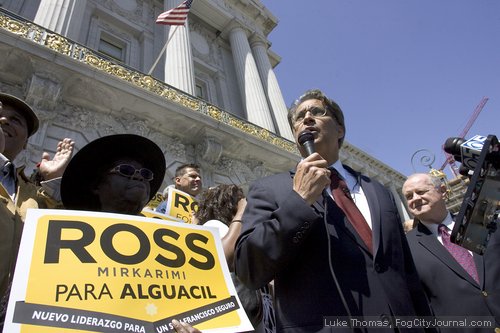
City Hall’s steps were awash in multi-lingual black and yellow “Ross Mirkarimi for Sherrif” signs at noon today, as Mirkarimi supporters watched Sheriff Mike Hennessey, who is stepping down after 31 years of service and eight elections, endorse Sup. Mirkarimi as the next sheriff.  “New Leadership for a Safe San Francisco” was printed on the English version of the signs that Mirkarimi’s supporters carried. They included former Mayor Art Agnos, Sups. David Campos and Eric Mar, Tim Paulson of the Labor Council, Debra Walker, Linda Richardson, Sharen Hewitt, Terry Anders, and Mirkarimi’s partner Eliana Lopez and their almost two-year old son Theo. And everyone had plenty of great things to say about outgoing sheriff Hennessey and sheriff candidate Mirkarimi. And Hennessey even pinned a shiny toy sheriff’s badge onto the T-shirt of Mirkarimi’s son Theo, making him the happiest kid in town. At least for the day.

Campos kicked off the event by honoring Hennessey as the “most progressive and most effective sheriff in the country.”
“Mike Hennessey is also my neighbor in District 9. I see him taking out the trash so I know he’s a good neighbor,” Campos joked, as he listed the many achievements in Hennessey’s long career as an elected official in San Francisco. These achievements included Hennessey’s pioneering innovations in criminal justice and culminated in his decision to blow the whistle in 2010 on the federal government’s plan to activate its controversial Secure Communities program in San Francisco—without telling the public.
“He’s not afraid to stand up for what’s right,” Campos said.

‘This is the time for me to move on,” Hennessey announced, as he laid out his reasons for endorsing Mirkarimi as Sheriff, over other candidates in the field.
Hennessey described the Sheriff’s Department as a “large enterprise” that has over 1,000 employees, a $150 million budget and whose jail houses an average population of 2,000 folks in custody, on a daily basis.
“It’s not something that can be handled lightly,” Hennessey said. “That’s why I’m here to endorse Ross Mirkarimi as the next sheriff.”

Hennessey listed the many endeavors that he and Mirkarimi have worked closely on, including a number of criminal justice issues, and he cited Mirkarimi’s extensive law enforcement background, his significant legislative accomplishments in the areas of criminal justice and public safety, and his ability to find innovative solutions and overcome obstacles to progress, as reasons to support Mirkarimi.

Hennessey observed that criminal justice is “one of the thornier issues” that members of the Board of Supervisors are often asked to get involved in, but often duck.”But Ross has not shied away from working on them,” Hennessey said, citing Mirkarimi’s involvement in shaping the “No Violence Alliance Project” and his leadership in creating the Safe Communities Re-entry Council.

Hennessey also noted that in face of AB 109, the Governor’s plan to transfer state inmates to county jails, “it’s vitally important to have person in charge of sheriff’s office that understands these alliances and can make them work more effectively.”

Hennessey concluded by observing that the Sherrif’s Department has to deal with a lot of bureaucracy, so it’s important to understand how the Board, the budget process and other city departments, including the District Attorney’s office and the police, work.
‘And that’s why I’m endorsing Ross as Sheriff,” Hennessey said

Then it was the turn of Mirkarimi, who graduated from the San Francisco Police Academy, did Naval Reserve training and worked for more than 8 years as an investigator for the District Attorney’s office, to speak.

“I have never been at a loss for words,” Mirkarimi acknowledged, as he launched into a speech that began by thanking everyone for showing up at short notice “for one of the most important occasions of my political career.”

Mirkarimi did a great job of giving Hennessey the praise he deserves.
“He is a living legend,” Mirkarimi said. “It’s completely impossible to fill his shoes.”
Citing Hennessey’s integrity and his ability to innovate, Mirkarimi warned that, “Maybe it’s come to the point where we have taken him for granted. He’s the longest serving elected official in the history of San Francisco, and he’s probably the most understated.”

“And the most important endorsement in this race is that of Mike Hennessey,” Mirkarimi added, as he gave Hennessey his commitment “to build upon your legacy as effectively as possible.”

Mirkarimi cited some of the most immediate and serious challenges that face the next sheriff. These include AB 109, which Gov. Jerry Brown just signed, which. Mirkarimi said, threatens to increase the reentry prisoner level by 30 percent in California. “It will take creative ingenuity and resources to make sure we are effective in taking care of this population,” he said.

Mirkarimi also touched on the rising number of veterans that are ending up in the prison system, talked more about the No Violence Alliance Project, and suggested that certified deputy sheriffs could help serve warrants, transfer prisoners, and patrol Muni, “when the police department finds itself understaffed” so as to ensure that San Francisco is safe.

“For every four people arrested and jailed in San Francisco, three out of four are repeat offenders in a three-year period,” Mirkarimi warned, by way of explaining why he wants to advance a more collaborative spirit between SPPD and the Sheriff’s department.

Mirkarimi also noted that one out of every 15 African American males are in jail, at any time in the year, compared to I out of 300 males who are not black or brown. “So, we must step up our game in dealing with poverty,” he said, as he recommended increased access to job training and good jobs, “so work doesn’t become a seasonal hope but a permanent job.” He also made the connections between a lack of good housing, childcare, and schools and a rise in poverty, crime and recidivism.

Mirkarimi concluded by crediting Hennessey for “walking that fine pirouette” between upholding the principles of public safety and understanding the power of redemption at the same time.

I asked Sheriff Mike Hennessey what he considers to be the biggest challenges of running for sheriff/
“Letting people know what you are going to do, and what your issues are,” Hennessey said, noting that San Francisco has an intelligent, issues-driven electorate.

And Mirkarimi’s supporters weren’t shy about letting folks know the issues that the current D5 Supervisor has helped them with, over the years.

“Ross, as a supervisor and me, as someone who comes from a community of color, we know the habits that ex-offenders can bring with them, if there are no safety nets,” said Terry Anders who sits with Mirkarimi on the Safe Communities Reentry Council. “And I believe in what Ross stands for and the integrity of his person. He’s one of the first people to show up when there are crimes and victims, and he attends basketball games and boxing matches.”

Paulette Brown, whose son Aubrey Abraska Jr, was murdered in August 2006, but whose killers have still not been brought to justice.
“We shouldn’t have to run and leave our families, we should be protected,” Brown said. “Ross is my district supervisor and if he can get in, and do something about crime and solve unsolved homicides, then I’m for him. Maybe if he gets in, he’ll have more pull to do something about these unresolved cases.”

And then it was back to work, which for Mirkarimi now includes the somewhat daunting task of trying to raise money in an election year that also includes a mayor’s race, but does not include the help of public financing, at least not for the sherrif’s race….

Evicting hoarders

2

news@sfbg.com

People who collect massive amounts of stuff in their apartments often suffer from a mental disability that causes them to become hoarders. Even so, they can face eviction — despite state laws that protect renters with disabilities. And when hoarders get evicted, they usually become homeless.

“Hoarding behaviors may result in a landlord issuing an eviction notice on the basis that the tenant has created a nuisance, fire hazard, or other danger in the building. If the tenant is diagnosed as disabled, the tenant may notify the landlord of the disability and request the landlord provide a reasonable accommodation to enable the tenant to remain in the apartment rather than being evicted,” reads a recent report from San Francisco’s Mental Health Association, which is seeking to educate renters, landlords, and the general public on the issue.

Evictions in San Francisco are on the rise. Between March 1, 2010 and Feb. 28, 2011, 1,370 evictions were filed, an 8 percent rise from 1,269 evictions the previous year. The Federal Fair Housing Act (FHA) and California Fair Employment and Housing Act (FEHA) offer protections to those who have a disability, but landlords say there are liability issues associated with excessive hoarding.

Tenants can fight evictions by asking their landlords for a “reasonable accommodation” whose duration depends on the situation. A reasonable accommodation could be a plan that requires 30 days of cleaning and support service for hoarders in an effort to avoid eviction.

According to Mayoclinic.com, hoarding is labeled an obsessive-compulsive disorder (OCD). But many researchers consider it a distinct mental health problem that can be treated with therapy or counseling. California law defines a disability as a physical or mental impairment that limits one or more life activities, such as walking, seeing, hearing, working, learning, or caring for oneself.

Sandra Stark, 66, hasn’t allowed anyone in her home for five years. She collects kitchenware and antiques. Like most hoarders, she started collecting after a traumatic event. It occurred when she was in her 30s and was gaining weight. Stark had never heard of the term “hoarder” until she watched a special on The Oprah Winfrey Show.

She claims her hoarding is a symptom of depression and disability, not OCD. “I feel like, with my weight, the clutter is a barrier between me and the world that hurt me,” she told us.

Before TV shows uncovered the lives of hoarders, family and friends often were the ones to call for help. These days, hoarders often seek help themselves. A&E’s Hoarders receives 1,000 submissions every month. After we spoke to some hoarders, they were all willing to seek change.

MHA recognized the problem and created a task force in 2007. Its goal was to build a plan of action to combat compulsive hoarding in San Francisco. The task force puts the costs of compulsive hoarding at more than $6 million per year. In 2009, the task force completed its report and estimated that between 12,000 and 25,000 residents in San Francisco struggle with this condition.

Most landlords try not to evict hoarding tenants right away. “Landlords may be compassionate and, in many cases, I believe, try hard to prevent evictions. However, they still have liability insurance and strict guidelines to follow,” said Tim Ballard, a social work supervisor for the city. “It is their responsibility to protect the other tenants, and the painful result used as a means of harm reduction is often the legal option of eviction proceedings.”

He said the heavy cleaning required on a hoarder’s home can cost between $6,000 and $8,000 and can include removing trash to create safety in their home. The largest amount spent was $16,000. Currently, Ballard has 300 clients who are hoarders or clutterers in San Francisco.

On March 10, MHA hosted its 13th Conference on Hoarding and Cluttering. Keynote speaker Christiana Bratiotis, who has her doctorate in social work and is director of the Hoarding Research Project, defined compulsive hoarding as the “acquisition of, and failure to discard, a large number of possessions that appear to be useless or of limited value.”

Michael Badolato, administrative assistant of Broderick Street Adult Residential Facility, attended to find a reasonable approach to deal with a hoarding resident living in his facility. “The challenge of hoarding is the mental health issue involved,” he said. Other attendees included educators, landlords, healthcare workers, attorneys, and hoarders themselves.

One panel discussion topic was how hoarding and cluttering are portrayed in the media. The panel included Michael Gause, associate director of MHA; Robin Zasio, a physician on A&E’s Hoarders; and Kari Peterson, an organizer from Hoarding: Buried Alive. Hoarders was created to show people in crisis and prevent the behaviors through the show.

The panelists claim that in order to show what the crisis is, a sensational aspect is involved. Ceci Garnett, whose mother was featured in an episode of Hoarders, says knowing that others are out there is “worth it to let people know they are not alone.

“And at least now there is treatment,” she continued. “We have to risk sensationalism to start a conversation.”

Ray Cleary, who was on season one of TLC’s Buried Alive, also appeared on the panel. Featured before and after treatment, he is still in the process of recovering. “I didn’t have to throw everything away,” he says. “I still have boxes and don’t know what to do with them.”

Another hoarder, who asked to remain anonymous to avoid eviction, was critical of the media attention on hoarding. “It’s a cult. People are going to make a career off my circumstance — making it a disease.”

These people have “already decided it’s a pre-mental disease,” she continued.

Inside her home near Van Ness Avenue, a small path led from the door to her living room. By the door hung green bead necklaces from years of parades; yellowing stacks of paper filled every space in the rooms. An information junkie, she collects newspapers and books. A San Francisco resident for 45 years, she used to be homeless and has suffered from a head injury. “Throwing something away is like throwing away memory — and that means it’s gone forever,” she says.

When she was homeless, her belongings went to storage. But when she got housing, she couldn’t throw anything away. Everyone she knows who has suffered from a head injury has this problem as well, she says, claiming it comes from gradually mixed emotional issues from losses and her health.

For years she tried to find someone to help her recycle or donate items, but she couldn’t find the help she needed, even from her case manager. Other hoarders claim that most caseworkers aren’t aware of their condition and assume they just need to throw everything out at once — something hoarders don’t feel they can easily do.

Her landlord isn’t involved with the property and doesn’t know of the situation. She would like someone to sit and accompany her as she cleans, but she doesn’t know of any service that provides this. During the interview, she picked up a phone call from someone who was going to stop by later to help. “But they usually flake on me,” she acknowledged. Her hoarding, she says, is part of a physical health issue, not a mental health problem.

But San Francisco does offer places such as the MHA conference to discuss the issue. Hoarders‘ Dr. Zasio says the show helps the people who are willing to go on TV. In exchange for going public, the network pays for six months aftercare, including services such as home repairs and therapy sessions. Although the network recognizes that it gains ratings by sensationalizing the condition for 44 minutes, it also wants to raise public awareness.

Of the 1,370 evictions in San Francisco in the past year, 442 cases were prompted by a breach of rental agreement and 271 cases were for committing a nuisance. These cases could include hoarding, but the city doesn’t specify that in its statistics.

As Teresa Friend from the Homeless Advocacy Project said: “If the person with a disability including hoarding is without family or friends to turn to or is not part of a legal intervention process and evicted, they will end up homeless.”


Homeowner defense groups to target Wells Fargo shareholders

8

“Foreclosures are the new F-Word.” So said Regina Davis, executive director of the San Francisco Housing Development Corporation, at an April 29 seminar at SFHDC’s office on Third Street that explored ways to prevent more foreclosures in San Francisco, California and beyond.

Since the economic meltdown in 2008, there have been 2,000 foreclosures in San Francisco. And the majority have impacted low-income folks and communities of color, who were sold more predatory loans than other groups, Davis and a panel of foreclosure experts warned
And as the recession drags on, another 2,000 foreclosures could be in the works, further destabilizing communities and draining more resources from the city, in terms of lost property values and related tax revenues.

And while deep-pocketed lobbyists have been making it hard to pass laws that would offer at-risk homeowners more protections, homeowner defender groups have decided to target, and now protest against, the group they believe stand directly in the way of equitable reforms: the banks.
 “Wells-Fargo CEO John Stumpf took home $21 million in 2009 while his bank received $25 billion in TARP funds,” stated a flier that ACCE (formerly ACORN) and the Home Defenders League are distributing to urge folks to meet at Justin Herman Plaza at 11: 30 a.m., May 3 and march to the Wells Fargo shareholder meeting where protesters plan to personally deliver a list of their demands to WF CEO Stumpf.

“He and his cronies fought tooth and nail to kill consumer protection bills in California and around the country and are currently trying to gut a 50-state Attorneys General settlement with homeowners that have been defrauded,” the flier concluded.
It noted that ACCE and the Home Defenders League sponsored this event, in partnership with the California State Labor Federation, the California Nurses Association, Contra Costa Interfaith Supporting Community Organizing, Causa Justa: Just Cause, ENLACE, Jobs for Justice, National Education Association, Oakland Education Association PICO California, PICO National Network, SEIU United Service Workers West and Local 1021 and Tenants Together.

“We are also part of The New Bottom Line, a national campaign focused on creating an economy that works for the many, and not the few,” the flier stated.

This place

0

arts@sfbg.com

LIT Begun in part as a series of maps accompanying public lectures, Rebecca Solnit’s Infinite City: A San Francisco Atlas (University of California Press, 167 pages, $24.95) is a remarkable act of gathering, one that presents myriad versions and visions of San Francisco and its surrounding areas that can inform a reader’s experience.

Infinite City was recently selected by the Northern California Independent Booksellers as one of its 2011 winners. Duality is a fundamental aspect of the book’s breadth and depth and sense of sharply critical appreciation — structurally, Solnit pairs distinct maps with corresponding chapter-length essays. In keeping with that characteristic, and also with the book’s group spirit (though admittedly on a much smaller and less intensive scale), I asked different Guardian contributors to share appraisals of one, or in most cases two, of the 22 sections. The result provides just a hint of what can be found within Infinite City. (Johnny Ray Huston)

MAP 3. “Cinema City: Muybridge Inventing Movies, Hitchcock Making Vertigo

The map for this chapter tracks the San Francisco life of Eadweard (sic) Muybridge, alongside landmarks from Alfred Hitchcock’s Bay Area masterpiece Vertigo. In “The Eyes of the Gods,” Solnit, who won the National Book Critics Circle award for her 2003 Muybridge bio River of Shadows, writes of the 19th century artist’s breakthrough high-speed photography, “It was as though the ice of frozen photographic time had broken free into a river of images.”

Many such rivers flowed all over this fair city when Vertigo premiered at the Stage Door Theatre at 420 Mason St. on May 9, 1958. Alas, only 10 of the more than 60 single-screen venues extant that year, all demarcated on Shizue Seigel’s fine map, are still functioning. Solnit rightly describes the shift to watching films on various digital delivery mechanisms as leaving contemporary culture with a “curious imagistic poverty.” As she concisely describes watching Milk and Once Upon a Time in the West on the Castro Theatre’s giant screen, we’re reminded that there is no comparison between enjoying cinema in such a grand setting and staring at a laptop. The great 20th century memoirist and observer Quentin Crisp wrote, “We ought to visit a cinema as we would go to a church. Those of us who wait for films to be made available for television are as deeply suspicious as lost souls who claim to be religious but who boast that they never go to church.”

That applies to you too, Netflix subscribers! The Roxie, Castro, Red Vic, Clay, and a small number of other houses of worship are still in business, so what are you waiting for? (Ben Terrall)

MAP 4. “Right Wing of the Dove: The Bay Area as Conservative/Military Brain Trust”

In “The Sinews of War are Boundless Money and the Brains of War Are in the Bay Area,” Solnit argues that antiwar, green, and left Bay Area hotspots are well known and don’t need to be charted again — unlike military contractors and assorted other forces of reaction in the region.

Solnit notes that many military bases that used to operate in the Bay Area are closed, “but the research, development, and profiteering continue as a dense tangle of civilian and military work, technological innovation, economic muscle, and political maneuvering for both economic and ideological purposes.”

Among the hard-right compounds providing counterevidence for that demonstration chestnut “the people united will never be defeated”: Lawrence Livermore National Labs (birthplace of Star Wars — the Reagan era money pit, not the George Lucas movie); Lockheed Martin, world’s largest “defense” contractor; the Hoover Institution, Stanford’s reactionary think tank; and Northrop Grumman, missile component designer. It’s useful to have so many of them in one place, if queasy-making.

On the lower left of the map sits Sandow Birk’s beautifully warped code of arms, which features the Cicero quote (Nervi belli pecunia infinita) that Solnit cites in her chapter title, under a half eagle/half dove, a rifle-toting soldier, and a scythe-clutching skeleton. It should be on the door of every U.S. military recruiting center. (Terrall)

MAP 6. “Monarchs and Queens: Butterfly Habits and Queer Public Spaces”

“How thoroughly the lexical landscape of gay history is invested with [a] paradigm of emergence,” notes poet Aaron Shurin in “Full Spectrum,” the chapter accompanying Infinite City‘s sixth map. Like one of the dazzlingly-named butterfly species rendered by Mona Caron on the map, Shurin flits gracefully between memoir and historiography as he tracks San Francisco’s ongoing evolution as a locus for queer emergence.

From North Beach to Polk Gulch, from Folsom to Castro, LGBT folk — be they American painted ladies, Satyr angel wings, or Mission blues — have continually migrated to and within the city to shed their cocoons and show their true colors. Local faux-queen Fauxnique traced this metamorphosis at the 2003 Miss Trannyshack Pageant when she climatically emerged as a regal butterfly to Elton John’s “Someone Saved My Life Tonight” (apropos to Shurin’s royalty motif, she won the crown). So too did the late Age of Aquarius painter Chuck Arnett, who often nestled butterfly imagery into his portraits of SoMa’s leather demimonde, and whose murals once adorned some of the many now-extinct bars also denoted by Ben Pease’s cartography. Only more than half a dozen of these “wildlife sanctuaries,” in Shurin’s parlance, have survived, with the Eagle Tavern’s announced closure marking another loss of habitat. Queers, though, are if anything adaptive, and my hope is that the future fluttering tribes of San Francisco will keep alighting on new ground to unfurl their wings. (Matt Sussman)

MAP 7. “Poison/Palate: The Bay Area in Your Body”

“Food is part of the Bay Area you hear about nowadays, exquisite upscale food at famous restaurants and gourmet markets. But it’s so boring we couldn’t stay focused on it in this map.” These refreshing, if rarely uttered words come two-thirds of the way through the chapter that accompanies the “Poison/Palate” map, Rebecca Solnit’s “What Doesn’t Kill You Makes You Gourmet.”

The phony Tuscany of Napa and the once-orchard-filled, now-EPA-Superfund-site-speckled Silicon Valley are wisely singled out for derision, a convenient duality in both geography and culture and the perfect framework on which to hang a critique of the local culinary community’s smug, myopic self-indulgence, by raising the not-so-elite-specters in Bay Area food history (the It’s It, the Popsicle, the Hangtown Fry, the Rice-a-Roni), and reintroducing the politics of food into the conversation, in the form of the chemical tonnage used to produce wine grapes, food giveaways at community gardens, Diet for a Small Planet, and Black Panther breakfast programs for school-kids. The sprawling topic is almost given too short a shrift, threatening to leap its mutant-mermaid-bedecked map.

Better is the 18th chapter, “How to Get From Ethiopia to Ocean Beach.” Solnit begins by loosely charting the ingredients that go into your cuppa joe: the water from Hetch Hetchy, the milk from West Marin, the coffee that courses through the port of Oakland, and, impishly, the leavings that flow toward the Southeast Water Pollution Control Plant. All that’s missing from the equation is the sugar that I need to make the darkest, brandy-and-cherry-tinged brew palatable. SF’s cafe culture is also deservedly lionized — though some might want to hurl china due to the exclusions on the accompanying map: why, for instance, call out Blue Danube Coffee House and not the grungier, more Chinese-populated Java Source? (Kimberly Chun)

MAP 8. “Shipyards and Sounds: The Black Bay Area since World War II”

Though author Joshua Jelly-Schapiro opens this chapter, subtitled “High Tide, Low Ebb,” with an eloquent invocation of Otis Redding’s “(Sittin’ on) The Dock of the Bay” — penned in Sausalito, by the way — it was the slight mention of Lowell Fulson’s “San Francisco Blues” that most resonated with me. “Ohh, San Francisco,” the lyric goes, “Please make room for me.” The facts presented in “Shipyards and Sounds” record The City’s answer as a genteel and progressive “No nigger.”

Beginning at the start of WWII, when Southern blacks migrated to the Bay Area to build ships in Hunters Point, Jelly-Schapiro points out that the main areas of wartime shipbuilding (Richmond, Hunters Point, Marin City) are “places that today remain centers of black population and of black poverty.” Indicating, to me, that little has changed since the 1940s in some significant ways. Don’t get mad at me, I didn’t say it. Jelly-Schapiro did.

Jelly-Schapiro also shows how terms like “redevelopment” displaced black Fillmore District residents to housing projects they’d been banned from during the war and land-grab euphemisms like “urban renewal” decimated black neighborhoods such as West Oakland. Electoral laws mandating that the SF Board of Supervisors be elected by citywide contests and not by district allowed a city that desegregated its schools and transit system in the 1860s to remain progressive and very, very white.

Jelly-Schapiro’s conclusion contains a critique of Bay Area celebrations when “Negro president” Barack Obama was elected in 2008. What he won’t say is covered in Shizue Seigel’s map. A sidebar shows the dwindling soul of a city, while the headers cover the founding of the Black Panthers and Sylvester’s solo debut at Bimbo’s. (D. Scot Miller)

MAP 9. “Fillmore: Promenading the Boulevard of Gone”

After the damned disheartening facts presented in the previous chapter, it’s both merciful and hopeful that “Little Pieces of Many Wars” — though just as rage-inducing — establishes some kind of equilibrium.

Gent Sturgeon’s incredible Rorschach-inspired artwork opens a thoroughly-researched piece on Fillmore Street and its many incarnations. Mary Ellen Pleasant’s abolitionist work and her eucalyptus trees — which still stand on the corners of Bush and Octavia streets — are a starting point for a leisurely stroll with Solnit, who runs the voodoo down, “The war between the states left its traces here,” she says, “as did the Second World War, and the war on poverty, the war on drugs, the stale and ancient war of racism, and the various forms of freelance violence.”

She remembers San Francisco as an abolitionist headquarters, and Fillmore Street as the first place Allen Ginsberg read “Howl.” Recalling the Fillmore’s rich heritage of jazz, poetry, and art, Solnit takes it even further, adding, “The wealthy sometimes claim to bring civilization to rough neighborhoods, but the Upper Fillmore neighborhood that was so culturally rich when it was the property of poor people in the 1950s is smoothed over in significance now.”

The tragedy of Japanese internment, and the cross-cultural exchange that was demolished by it and redevelopment loom like white sheets over the city to this day. But Solnit closes with an optimistic sense of resurgence, even though Nickie’s has gone Irish.

Ben Pease’s cartography shows the cross-currents of culture of yesterday’s Fillmore Street, but not much else. That’s not a complaint, really. (Miller)

 MAP 13. “The Mission: North of Home, South of Safe”

Two 2009 shootings on 24th Street pop out, in blood red, on the map accompanying Adriana Camarena’s “The Geography of the Unseen,” in much the same way that the spate of shooting deaths the previous year marked my brief time spent living in the Mission. In ’08, I lived in a Victorian flat at Treat and 23rd, distinguished by the fact that it was a favorite hang for the teenaged homies — its steps were slightly tucked back off the street, ideal when it came to hiding out, smoking dope, and snacking out — until my landlords installed a fence, ostensibly to keep the steps free of spit.

We were on the same block as an appliance-loaded junkyard; the last stop of an ancient Mission industrial railroad; and the Parque Niños Unidos, with its swampy, grassy corner, so often cordoned off to keep the tots from wading in the mud, its circling ice cream carts and its de facto refreshment stand, El Gallo Giro taco truck; and the community garden, where the feral kittens tumbled and hid and fresh produce was given away free every Sunday afternoon.

The Parque likely was the last thing 18-year-old poet Jorge Hurtado saw when he was shot and killed on our corner at 1 a.m. that year. I remember waking up that night to what sounded like a cannon boom, only the first of a slew that sweltering, ominous summer — Mark Guardado, president of the SF chapter of the Hells Angels, was killed a little over a week later, down Treat, in front of Dirty Thieves. The tension was thick and gooey in the air — who was next? The beauty of Shizue Seigel’s Mission map lies in how intimate it is, how it’s threaded around the shaggy-dog snatches of yarns Camarena catches among the day laborers waiting at Cesar Chavez and Bayshore, from the long litany of splintered families, time spent in the refuge of gangs at 24th and Shotwell, and then, in Frank Pena’s case, lives cut sadly short farther up 24th at Potrero. The included stories, rarely straying beyond the tellers’ voices and the facts they choose to reveal, stay with you — even if her sources’ internal lives remain, as the chapter’s subtitle goes, “the Geography of the Unseen.” (Chun)


NORTHERN CALIFORNIA INDEPENDENT BOOKSELLERS 2011 BOOK OF THE YEAR AWARDS


FICTION


Gold Boy, Emerald Girl, stories, Yiyun Li (Random House, 240 pages, $25)

Nonfiction

Packing for Mars: The Curious Science of Life in the Void, Mary Roach (W.W. Norton and Company, 336 pages, $15.95)

Honorable Mention: Autobiography of Mark Twain, Vol. 1, (University of California, 760 pages, $34.95)


POETRY

Come On All You Ghosts, Matthew Zapruder (Copper Canyon, 96 pages, $16)

Food Writing

My Calabria: Rustic Family Cooking from Italy’s Undiscovered South, Rosetta Costantino, Janet Fletcher, and Shelley Lindgren (W.W. Norton and Company, 416 pages, $35)

Children’s Picture Book

The Quiet Book, Deborah Underwood and Renata Liwska (Houghton Mifflin Books for Children, 32 pages, $12.95)

Honorable mention: Zero, Kathryn Otoshi (KO Kids, 32 pages, $17.95)


TEEN LIT

The Sky is Everywhere, Jandy Nelson (Dial, 288 pages, $17.99)

Honorable mention: The Mockingbirds, Daisy Whitney (Little, Brown Books for Young Readers, 352 pages, $16.99)


REGIONAL TITLE

Infinite City: A San Francisco Atlas, Rebecca Solnit (University of California, 167 pages, $24.95)

Honorable mention: A State of Change: Forgotten Landscapes of California, Laura Cunningham (Heyday, 352 pages, $50)


 

Approve affordable housing — for youth

1

OPINION Booker T. Washington, born as a slave, risked his life to learn to read and write and went on to found Tuskegee University. At his core, he believed that economic independence and access to education were the keys to equality. He put it best when he said: “There are two ways of exerting one’s strength: one is pushing down, the other is pulling up.”

Since 1919, the Booker T. Washington Community Service Center has worked to lift up San Franciscans of every background, with a particular focus on the African American community. To continue that vision, the center is embarking on a capital project that will provide 50 units of affordable housing to youth and families, along with new athletic and educational space.

The most critical part of the project is providing housing for transitional-age youth. Many of these young people age out of foster care with no family support, few job skills, and no chance to rent a market-rate apartment in this expensive city. The project represents a real commitment to these youth, who are overwhelmingly people of color. With affordable housing funding under threat at the federal and state levels, it’s essential that shovel-ready projects get the green light from City Hall.

That is why we were thrilled when Sups. Ross Mirkarimi, Eric Mar, and Mark Farrell introduced the necessary legislation to allow this project to move forward. Joining hundreds of community leaders, countless families, and prominent African Americans, these supervisors lent their support for a project that continues the ongoing fight for economic justice.

It’s also why we are concerned that a few neighbors are using their influence to push down on the hopes of San Francisco’s youth. Some neighbors have asked that we add additional parking, even though the site is just a few blocks from Geary Boulevard and most low-income youth don’t have cars. Others have suggested that we cut nine units to make the building shorter, even though San Francisco’s housing needs are so acute. As is often the case in San Francisco, those who support progressive values need to speak up to ensure that we can overcome this campaign of misinformation and fear.

On April 28, the Planning Commission will consider whether to certify the environmental impact report for this project, and whether to approve it. We are hopeful that progressive voices speak out so we can provide hope and a future to youth in our community. As Booker T. often said: “Success is to be measured not so much by the position one has reached in life as by the obstacles one has overcome.” 

Julian Davis is president of the board and Patricia Scott is executive director of the Booker T. Washington Community Service Center, located at 800 Presidio Ave. The Planning Commission hearing is Thursday, April 28 at City Hall, Room 400.


Last stand against Lennar

2

news@sfbg.com

Hunters Point, the last major swath of usable land in San Francisco, appears at first glance to be a developer’s dream — a prime piece of real estate with sweeping views of the bay, ample space, and a city government eager to capitalize on its potential.

But community groups have filed lawsuits challenging the project’s many uncertainties, such as the fate of the toxic stew beneath the former U.S. Navy base in the heart of the project area, and both sides are now awaiting a court ruling on whether more studies are needed.

As an EPA-designated Superfund site, the 500-acre plot is home to an abundance of buried chemical contaminants, radioactive waste, and other unknown toxins, and the Navy has been slow to clean it up. Concerned that development plans have been premature in the face of this lingering mess, opponents filed lawsuits against developer Lennar Corp. and the city last year.

The project, approved July 2010 by the Board of Supervisors, includes plans for a new stadium for the 49ers, 10,500 housing units, parks, and commercial retail space. It has received praise from city and state government agencies as an economic and cultural boon to the community. But activist groups say the cleanup should happen before development occurs.

The Sierra Club settled its lawsuit over the project after the developer made some design changes (see “Uncertain developments,” Jan. 18), so the lawsuit filed by People Organized to Win Employment Rights (POWER) and Greenaction is the last piece of litigation holding up the project. At the core of the legal challenge is whether the environmental impact report (EIR) properly analyzed the health impacts from toxic contamination at the site. After an April 18 hearing on the case, both sides are awaiting a ruling on whether the claims have merit and should be the subject of further study.

Activists claim the EIR violates California Environmental Quality Act protocols because it contains too much uncertainty, including the unknown fate of a large parcel of land slated for a stadium that is contingent on whether the 49ers decide to stay in San Francisco. POWER wants more details about the possible threats to human health before the 20-year project gets the final green light. But since the Navy is responsible for the cleanup, Lennar and the city have repeatedly countered that a full analysis is not their responsibility.

“The main issue that Greenaction and POWER have been concerned about throughout lawsuit is that it’s very unclear from the EIR what exactly is going to happen and what level of contamination will be left,” said attorney George Torgun with EarthJustice, which is representing the community groups. “What are the impacts of building on a federal Superfund site? There is a real lack of knowledge in the EIR.”

April 18 was the second of two recent hearings held on the case. On March 24, Judge Ernest H. Goldsmith listened to a full day of testimony before a packed courtroom. Subsequent settlement discussions weren’t successful, so both sides returned to court to seek a ruling that is expected sometime in the next two months.

Lennar attorneys offered to relinquish the possibility of a pre-cleanup early transfer of the property, which has been a major concern for POWER. Under this proposal, no development on any of the six parcels slated for transfer from the Navy could proceed until the federally mandated cleanup process was finished and certified. However, POWER does not believe this offer reduces the scope of the issues because final approval would still ultimately award control of the land to the developer based on what they believe is a flawed EIR.

“Severing any discussion of early transfer from this EIR would only serve to worsen the defects that petitioners have identified and would be contrary to the requirements of CEQA,” Torgun wrote in the April 13 letter to the court.

POWER’s counterproposal would allow large portions of the project to go through — rebuilding the Alice Griffith housing project and development on Candlestick Point — but Lennar considers it economically unfeasible. These portions of the project are not located on the shipyard but are included in overall plan.

“We want to see the project move forward with Alice Griffith and Candlestick Point,” said POWER organizer Jaron Browne. “They’ve rebuilt housing projects at Cesar Chavez and other areas in the city — why can they only rebuild this one if they can redevelop the shipyard? It’s a political game that Lennar has tied the rebuilding of it to this mammoth 770-acre development.”

Lennar representatives wouldn’t comment for this story. Community members have clashed with the megadeveloper over health issues in recent years. In 2008, Lennar was fined more than $500,000 by the Bay Area Air Quality Management District for allowing dust containing asbestos to settle on the surrounding neighborhoods. Then, in March, community organizations released a report showing e-mails from 2006 to 2009 between the EPA, the San Francisco Department of Public Health, and Lennar revealing a possible cover-up of the asbestos exposure.

“They underestimated our understanding of what is happening here,” Browne said. “The whole heart of this issue is that this is a Superfund site. Even if you remove the possibility of early transfer, they are still planning on doing work while remediation is still years to go on other parcels.”

Longtime Bayview resident and Greenaction member Marie Harrison said that not only is the EIR too fraught with uncertainty, it’s incomplete. “There are over 600 blank pages in that document,” she said. “How can you approve an EIR that is supposed to tell you what is there, what the effects will be, and what the project will be? We kept asking the supervisors: How do you convince the community that they are doing something that is good and safe when the history shows otherwise?

During both court hearings, it was evident no clear definition of the project exists since it contains many variables to account for unknowns. Attorneys for Lennar and the city argue that the EIR effectively addresses each potential use and demonstrates a full knowledge of possible contaminants.

Wilma Subra, an environmental scientist for New Orleans-based Environmental Health Advocates, has worked with POWER and Greenaction to understand the breadth of contamination and the typical process of cleanup of a Superfund site. She pointed out that the Navy’s cleanup plan is completely separate from the EIR submitted for the project.

“Those two documents don’t agree with what development will be,” Subra said. “Usually you wait much longer in the process to really know that the land is safe. In a normal Superfund process, you would first do an implementation of the remediation process, find out if it worked, then — years down the line — you would start thinking about development.”

If the EIR is deemed inadequate, Lennar and the city will be required to further analyze the contaminants, outline cleanup strategies, and resubmit a new EIR. If the judge rules the EIR satisfies CEQA, the project can move forward.

“CEQA is one of the few really democratic processes,” Browne said. “If you just have this one moment in 2011 when people are able to comment and weigh in, and then have 20 years where they are building within that, it’s not really fair.”

Editor’s notes

6

tredmond@sfbg.com

The candidates for mayor of San Francisco are already lining up endorsements — the Sierra Club held its interviews April 23, which seems awfully early to me, since some of the most interesting contenders in this town (Tom Ammiano, Matt Gonzalez) have a tendency to jump in at the last minute. And the filing deadline isn’t until August.

But the sooner the big names and organizations are lined up and the money is locked in, the harder it will be for anyone to pull off an August surprise. So unless the redistricting commission seriously messes with Mark Leno’s state Senate seat or Ed Lee bows to the pressure from Willie Brown, Rose Pak, and their allies and decides to go back on his promise and seek a full term, we’re probably looking at a rough approximation of what the voters will face in November.

With John Avalos in the race, the ballot’s become a lot more attractive to progressives. It’s not as if the other major candidates don’t have a lot to offer, and in some cases, they have a lot to offer to the left. There are smart, experienced, qualified people running.

But let’s be honest here: David Chiu, Dennis Herrera, Phil Ting, Leland Yee, and Bevan Dufty all operate somewhere in the squishy political center, a place where tax breaks for corporations are okay, where “homeownership opportunities” tend to trump the needs of tenants, where deals with big private developers are sculpted around the edges but never rejected outright, and where cuts in services are a larger part of the budget solution than taxes on the rich.

Michela Alioto-Pier is off on the far right of the San Francisco political world, and if she looks at all credible and gets any significant traction (and that’s a big if) she’ll be downtown’s favorite candidate. But until now, there was nobody holding the solid progressive banner.

I don’t think that means Avalos’ appeal is limited to the left; he’s in a swing district, and he’s very popular there, and he can talk about small business and community development and open, honest government. He doesn’t sound like a crazy radical; he’s polite and respectful and listens to people.

But I’m glad we have a candidate who won’t try to argue that 25 percent affordable housing at Treasure Island is something to be proud of, or that the Twitter tax break will create jobs, or that social inequality can’t be addressed through local policy. I’m glad there’s someone who can push the discussion and debate out of the middle, can force some of the others who want progressive support to take strong stands, and can liven things up a bit. Because without him, all of the candidates were sounding a lot alike — and I really don’t want to be bored this fall.

Reject the Treasure Island plan

18

EDITORIAL After a long, long hearing April 21, as the San Francisco Planning Commission prepared to vote on an ambitious development plan for Treasure Island, Commissioner Gwyneth Borden acknowledged that the plan wasn’t perfect. But, she said, on balance it ought to be approved: “Twenty five percent affordable housing is better than zero percent.”

That’s not necessarily true.

Treasure Island is an usual piece of real estate, 403 acres of artificial land created in 1937 by dumping sand and dirt on a shallow part of the bay. It’s less than two miles from downtown San Francisco — but there’s no rail service, no BART station. The only way off the island is by boat — or by driving onto a Bay Bridge that’s already jammed way beyond capacity every morning and afternoon.

The soil is unstable, prone to liquefying in an earthquake — and if sea levels rise as high as some predictions suggest, the whole place could be underwater in a few decades.

A strange hybrid agency called the Treasure Island Development Authority, created by former Mayor Willie Brown, cut a deal with Lennar Urban (the same outfit that has the redevelopment deal for Bayview Hunters Point) and several partners to construct a neighborhood of some 19,000 people on the island. Among the features: a 450-foot condominium tower and 6,000 units of high-end housing. The developers brag that a fleet of new ferries will offer a 13-minute ride to the city and that some streets will be designed for pedestrians and bicycles.

But the fact remains that the developers want to add 19,000 new residents — almost all of whom will work off the island somewhere — to a place that has no credible transportation system. City studies show that even with an extensive (and costly) ferry service, at least half the new residents would drive cars to work (and, presumably, to shop, and go to movies, and eat and drink), joining the mob of vehicles heading east or west on the bridge. That’s almost 10,000 new cars each day trying to jam onto a roadway that can’t handle the existing traffic. The backups would stretch well onto San Francisco surface streets and as far back as Berkeley.

A rail line on the Bay Bridge would solve part of the problem. So would bike lanes. Neither option is even remotely possible in the foreseeable future. Free, or heavily subsidized ferries could, indeed, be a positive alternative — but who is going to pay for that service? Nonsubsidized ferries would be far more expensive than current Muni or BART service, a particular burden on the residents of the below-market housing.) And does anybody really think there’s going to be enough ferry capacity to carry 10,000 people a day to downtown SF, the East Bay, and the Peninsula?

The bottom line: this isn’t a good deal for San Francisco. The affordable housing level is too low. The transportation problems are nightmarish. The last thing Treasure Island needs is a 450-foot tower.

There’s no rush to approve this — and no immediate downside to waiting for a better deal. The supervisors should tell Lennar to come back with a project that has fewer residents, better transit options, and more affordable housing. Because zero is looking a lot better than what’s on the table.

PS: The 4-3 Planning Commission vote demonstrated exactly why it’s important to have key commission appointments split between the mayor and the Board of Supervisors. The mayoral appointees all rolled over — but at least the board-appointed members made strong points, forced real debate, and gave the supervisors plenty of ammunition to demand a better deal.

Editorial: Reject the Treasure Island plan

1

After a long, long hearing April 21, as the San Francisco Planning Commission prepared to vote on an ambitious development plan for Treasure Island, Commissioner Gwyneth Borden acknowledged that the plan wasn’t perfect. But, she said, on balance it ought to be approved: “Twenty five percent affordable housing is better than zero percent.”

That’s not necessarily true.

Treasure Island is an usual piece of real estate, 403 acres of artificial land created in 1937 by dumping sand and dirt on a shallow part of the bay. It’s less than two miles from downtown San Francisco — but there’s no rail service, no BART station. The only way off the island is by boat — or by driving onto a Bay Bridge that’s already jammed way beyond capacity every morning and afternoon.

The soil is unstable, prone to liquefying in an earthquake — and if sea levels rise as high as some predictions suggest, the whole place could be underwater in a few decades.

A strange hybrid agency called the Treasure Island Development Authority, created by former Mayor Willie Brown, cut a deal with Lennar Urban (the same outfit that has the redevelopment deal for Bayview Hunters Point) and several partners to construct a neighborhood of some 19,000 people on the island. Among the features: a 450-foot condominium tower and 6,000 units of high-end housing. The developers brag that a fleet of new ferries will offer a 13-minute ride to the city and that some streets will be designed for pedestrians and bicycles.

But the fact remains that the developers want to add 19,000 new residents — almost all of whom will work off the island somewhere — to a place that has no credible transportation system. City studies show that even with an extensive (and costly) ferry service, at least half the new residents would drive cars to work (and, presumably, to shop, and go to movies, and eat and drink), joining the mob of vehicles heading east or west on the bridge. That’s almost 10,000 new cars each day trying to jam onto a roadway that can’t handle the existing traffic. The backups would stretch well onto San Francisco surface streets and as far back as Berkeley.

A rail line on the Bay Bridge would solve part of the problem. So would bike lanes. Neither option is even remotely possible in the foreseeable future. Free, or heavily subsidized ferries could, indeed, be a positive alternative — but who is going to pay for that service? Nonsubsidized ferries would be far more expensive than current Muni or BART service, a particular burden on the residents of the below-market housing.) And does anybody really think there’s going to be enough ferry capacity to carry 10,000 people a day to downtown SF, the East Bay, and the Peninsula?

The bottom line: this isn’t a good deal for San Francisco. The affordable housing level is too low. The transportation problems are nightmarish. The last thing Treasure Island needs is a 450-foot tower.

There’s no rush to approve this — and no immediate downside to waiting for a better deal. The supervisors should tell Lennar to come back with a project that has fewer residents, better transit options, and more affordable housing. Because zero is looking a lot better than what’s on the table.

PS: The 4-3 Planning Commission vote demonstrated exactly why it’s important to have key commission appointments split between the mayor and the Board of Supervisors. The mayoral appointees all rolled over — but at least the board-appointed members made strong points, forced real debate, and gave the supervisors plenty of ammunition to demand a better deal. *


Dick Meister: 11 Million a Year Bandits

5

Dick Meister, formerly labor editor of the SF Chronicle and KQED-TV Newsroom, has covered labor, politics and other matters for a half-century.

AFL-CIO President Richard Trumka has an important question for you.

“How much,” he asks, “did your pay go up last year? How about your friends and family?”

Before you answer, Trumka asks that you consider this: In 2010, the CEOs of major companies averaged $11.4 million for their year’s work. That was an increase of  an increase of 23 percent over their pay in 2009.

All told, the CEOs were paid $2 trillion last year.  That, of course. was during a recessionary time like now when working people were lucky to have jobs at all, whatever the pay. And the pay of those who did have jobs stayed pretty much the same, or actually went down.

The CEOs of major companies faced no such problems, obviously, with their pay increasing hugely to more than $11 million a year.  Which leads the AFL-CIO to wonder “how many firefighters, nurses, teachers or construction workers does it take to equal the pay of one CEO today?”

I’d also like to know how many CEOs do work as important as that of rank-and-file firefighters, nurses, teachers and construction workers?

The AFL-CIO’s Trumka notes that despite the collapse of financial markets three years ago at the hands of many of those same astronomically paid CEOs, the “disparity between CEO and workers’ pay has continued to grow to levels that are simply stunning.”

Think of it. Those CEOs collecting enormous pay were in charge when we sunk into the worst financial crisis since the Great Depression. When we lost 8 million jobs and millions of small businesses. When housing prices plummeted and millions of dollars in personal savings were wiped out.  Yet at the same time those in charge of the economy, notes Trumka, “still found a way to make out like bandits.”

Rich Trumka is a pretty outspoken guy, not known for understatement. But in this case, he probably is understating the situation.  The difference between CEO pay at major companies and workers’ pay is beyond stunning, beyond outrageous.

I’d say it’s virtually beyond human understanding. How could we let that happen? Is this not a democracy in which the great wealth generated here is spread more or less equally?

Hah!

OK, I’m asking foolish questions. But if ours was a true economic democracy, the spread between CEO and workers’ pay would be far less than it is. How many workers got pay raises of more than 20 percent last year? How many were paid more than $11 million?

How many needed that much money to live comfortably?

Trumka, notes that corporate CEOs “are hoarding $2 trillion in cash.” Indeed, the money-grubbing CEOs chose to take their $2 trillion in raises rather than use the money, or at least part of it, to create decent -paying jobs for their fellow citizens who are so much less fortunate than they.

To describe the CEOs as greedy would be a gross understatement.

I know I’m laying it on thick, but I’m mad – damn mad – and think you should be, too. The CEOs and their companies are stealing us blind and getting way with it.

The AFL-CIO’s Trumka does offer the possibility of better times, however. He says that “although pay is more out of balance than it has been during most of our lifetimes, for the first time there is hope that things are changing.”

That, says Trumka, is because of a new law, the Wall Street Reform and Consumer Protection Act. The act, as President Obama said when signing it into law last year, is “a sweeping overhaul of the United States financial regulatory system on a scale not seen since the reforms that followed the Great Depression.”

The lack of sufficient financial regulations sufficiently enforced was, or course, the main factor in the continuing Great recession, just as it was during the Great Depression of the 1930s.

The new law is already under attack by Congressional Republicans who have announced their intention to try to repeal it. They particularly object to provisions that would give shareholders a vote on CEO pay and require companies to publicly disclose the ratio between the pay of their CEOs and their workers.

Trumka says it truly shocks him that companies and their GOP allies “have the nerve to argue against those provisions in public, and lobby against them – after the companies drove our country off an economic cliff.”

Trumka says the AFL-CIO “is ready to have this debate. We will take on Wall Street and we will win.”

Strong words, but the AFL-CIO has the powerful political allies, the funding and the troops to carry out Trumka’s bold promise. Let’s hope fervently that labor and its supporters can indeed win the debate, If not, we could be in line for more serious Wall Street-based troubles  – an extended recession for sure, maybe worse.

Dick Meister, former labor editor of the SF Chronicle and KQED Newsroom, has covered labor and politics for a half-century. Contact him through his website, www.dickmeister.com, which includes more than 300 of his columns.

Green today, gone tomorrow

1

culture@sfbg.com

URBAN FARMING Green thumbs may soon be mourning the partial removal of Hayes Valley Farm. The urban agriculture education project is facing the prospect of condos being built on one of its two sections of city-issued property by Bay Area development company Build Inc., as early as February 2012. The company has been slated to build on the property since before the farm project began in January 2010, but was delayed by the recession of 2008 and its wet-blanket effects on new construction projects.

Today the farm sits on 2.2 shady acres near the heart of the Hayes Valley neighborhood. Visit on a typical day and you’ll find volunteers planting fava beans, school-age kids wandering through crops and trees on a school tour, perhaps a instructor teaching a beekeeping class, and on Sundays, a group of volunteers distributing free produce to anyone who stops by. All the while, plant and animal life buzz amid the fertile urban enclave.

But while volunteers have put hundreds of hours into making the farm what it is today — even going so far as to purify the car exhaust-infused soils to make the land arable — this green space was never intended for long-term use. Hayes Valley Farm is among a handful of ventures around the city — another one is interdisciplinary collective Rebar’s Showplace Triangle, a street at the base of Potrero Hill that has been turned into a pedestrian zone with repurposed benches and planter beds as part of the group’s Pavement to Parks project — that are aimed at making interim public space out of underutilized properties.

The current story of the land that the farm occupies starts with the 1989 Loma Prieta earthquake. The quake’s damage to the Central Freeway resulted in the city acquiring major parcels of land where the thoroughfare once stood. Since then, the city has relied on sales of those properties — which it designated as Parcels A to V — to build Octavia Boulevard and redevelop the Hayes Valley-Market Street neighborhood. Half the land was to be made into affordable housing.

But at one point, the neighborhood noticed that some of the parcels awaiting sale were attracting crime, graffiti, dumping, and otherwise unsavory activities. The Hayes Valley Neighborhood Association teamed up with the Mayor’s Office of Economic and Workforce Development to go looking for potential projects that could put these spaces to constructive use during the time that they awaiting development.

“We went out and actually sought a user for this. We got in contact with Jay Rosenberg and Chris Burley, who were interested in doing the farm, and we brought them here and asked them if this was doable,” says Rich Hillis of the Office of Economic and Workforce Development. “We were 100 percent clear that it was going to be for interim use only, and they embraced that.” Hillis and colleague Ken Rich ensured that Hayes Valley Farm received a $50,000 grant from the Mayor’s Office to get started on the work of clearing the property and setting up community programming on the land.

While it’s clear that the farm project was meant from the get-go to be an interim use for Parcels O and P, some members of the community are upset to see Parcel P turned over so soon to Build Inc. “As a citizen, I have the freedom of being able to ask what’s better for the community, this farm or more developments?” says Morgan Fitzgibbons, head of the neighborhood sustainability group the Wigg Party and farm volunteer. “The farm is an anchor of a burgeoning sustainability movement, and after seeing all the good it can do, are we still going to go in there and build? I think the issue is bigger than one city block.”

But Booka Alon, who is part of the 10 core farm volunteers who manage and run the farm, says they will not be putting up a fight. “We are very grateful to the Mayor’s Office and we’re ready to leave when asked. That’s part of our agreement.”

Alon says that the farm gives a sense of hopefulness and accomplishment to many young volunteers who are otherwise underemployed during the economic downturn, but turning Hayes Valley Farm into a long-term career commitment is not something many volunteers are itching to take on. “Planting and farming are hopeful acts, but not very lucrative in an urban setting.”

Many community members who championed the farm in the first place hope that the transition of Parcel P to Build Inc. will go smoothly so that other interim-use projects will be supported in the future. “We love the farm,” says Hayes Valley Neighborhood Association member Jim Warshell. “What they’ve done has been spectacular and wonderful, but that doesn’t mean that you don’t honor your commitment. The way we respond to Parcel P will affect how people trust us with future deals.” And while the farm’s popularity among city residents can’t be denied, some look forward to the fruition of the city’s promise that the area will be converted into homes that residents can afford.

But the sun hasn’t set on the work of Hayes Valley Farm. The group is collaborating with the city on finding another location to continue planting and teaching. And the future of Parcel O appears to be some shade of green. For now, there are no imminent development plans for the space and, unlike Parcel P, Parcel O is under the auspices of the city’s Redevelopment Agency, not a private company.

Alon says that some of the plant beds and flowers on Parcel O might someday be incorporated into the mixed-income housing developments that will eventually stand around — and possibly on — it. As for the permaculture soil that the farm hands have diligently created, she hopes it can be recycled along with the knowledge that was shared through the project. “Maybe we’ll give the soil to neighbors when it’s over. They can use it in their own gardens.”

For more information on how to support the farm, visit www.hayesvalleyfarm.com.


The Treasure Island nightmare

83

There are times when people like me, who think development should be driven by public needs, not private profit, are in something of a bind. I don’t like the Lennar plan for Bayview Hunters Point — but I agree that doing nothing isn’t a very good alternative. Sometimes, the “no-project” alternative isn’t an alternative at all — which gives the developers a huge hand up in negotiations with the city. Gee, you want affordable housing? We can give you 15 percent — or we can walk away and you’ll get nothing.


But when it comes to Treasure Island, I think we’re in a different situation. The proposed development is so out of whack, so looney, that it makes no sense to me — and the alternative of doing nothing, at least for now, isn’t so bad at all.


The plan calls for 19,000 new residents on the 403-acre artificial island in the Bay. At most, 25 percent of the units would be below-market. Which means some 13,700 rich people, virtually all of them with jobs in San Francisco, the Peninsula or the East Bay, would be plunked into a place with no viable transportation alternatives.


I wonder if any of these planners have ever tried to leave TI by car; it’s a nightmare. And there’s no way to fix it: Even if they build a new acceleration ramp (the current stop-and-go into 60-mile-an-hour traffic is a death trap), the Bay Bridge is already at full capacity during a very long rush hour in the morning and evening. And does anybody really think those 13,700 people will all take the ferry to work every day?


Impossible: There’s no way to provide enough ferry service for that population at anything resemble the cost the developers are willing to pay. How about all the Google and Yahoo and Genentech employees (and that’s a big part of the population buying new high-end condos in San Francisco)? You think they’re all going to take a ferry to downtown SF then hop on a bus or train then take another bus to the office? Not these folks. A lot of them will want to drive.


And the bridge, which is already backed up, will back up further, driving more traffic onto the streets of SOMA and creating a slowdown all the way back to Berkeley.


Meanwhile, the island is sinking, and water levels are rising. Forget the fancy engineering plans to sink stone columns deep into the clay under the Bay; what happens when the water rises? Are we going to surround the entire place with seawalls?


And here’s the bottom line: The current situation isn’t all that awful. There’s a small amount of housing out there, some of it affordable. There’s lots of open space. A little effort and the playing fields and parkland could be upgraded and TI could, for the intermediate term, be a day-use area for the city. Not a terrible alternative.


At some point, either the island’s going to sink back into the Bay or it’s going to have to be completely redeveloped. But right now, with no public money available, we’re at the whims of private developers. And what they’re offering doesn’t even remotely meed the city’s needs — and will create a catastrophic transportation problem.


So the supervisors are in a great position to negotiate. We want 50 percent affordable housing, we want the developer to pay for substantially increased bus and ferry service (or maybe we want to add a rail line to the Bay Bridge). And if that’s not something the developers want to do, fine: we’ll wait. Nothing wrong with that.


It’s not so easy building green

34

OPINION The Parkmerced project developers like to talk about how environmentally sound their plans are, but a harder look suggests otherwise.

At a March 29 hearing on the project, Green Pary member Eric Brooks presented graphic evidence of the environmental impacts of the destruction of the garden units and the landscape, and the proposed increase in parking on- site. As a transit-first city, it seems ludicrous to spend so much on below-grade parking. And regrading and replanting the entire site will allow toxins in the soil to become airborne.

Then there’s the question of whether the site is really “blighted,” as the developer claims — and whether so much housing needs to be torn down in the first place. Sup. Eric Mar questioned the issue of the deterioration of the existing units; he said he’d visited the site and noted that many units appear to be in fine shape.

I agree that the western side of town needs more density — but dumping that density disproportionately on one community seems to be a biased approach. Parkmerced is a renter community. Other areas dominated by homeowners seem to be off the table.

San Francisco should take a broader look at west-side zoning. That would include looking seriously at corridors with light-rail lines — Ocean Avenue, West Portal Avenue, Taraval Street, Geary Boulevard, Judah Street, and others — where some one-story buildings are far more deteriorated than the buildings at Parkmerced.

City officials should look at alternatives that allow other sites to be upzoned or allow owners to build on side sites. This would lessen the effects on one community by sharing the growing pains of a city limited on three sides by water.

We all want the projects, work, housing, jobs, and an expanded tax base for the city. But many of us question whether the current plan for Parkmerced does justice environmentally and sustainably when it ignores infill and preservation-based alternatives that could create more jobs and a better long-term green solution.

I have submitted a proposal to the Planning Commission that shows how to improve transit linkages, how infill housing can be done, and how the 11 towers at Parkmerced can be redesigned (the initial concept was to design new, pencil-thin replacement towers and structurally-reinforced new buildings). I suggest that more infill housing can be built by removing parking garages throughout the site — which would lessen displacement and allow a significant density increase.

Assurances by the developer should not placate the city or the supervisors. If the supervisors lean toward approval, they need to be reminded of the transit, sustainability, and open-space concerns of the project to ensure that the design is changed either through revisions of portions or the whole to make more clear the concerns that the project has been greenwashed to promote the developer’s interests.

Aaron Goodman is an architect and Bay Area native.

Working on it

4

caitlin@sfbg.com

GREEN ISSUE With the recession fast seeping into the everyday fabric of American life (or at least Monday through Friday’s fabric), the enthusiasm that the term “green jobs” generates can be well understood. But can we really call a $10 hourly pay rate for installing solar panels sustainable? And what would be the bigger of the two triumphs: creating a carbon-free country or a more equitable nation? With partnerships springing up across the country like the Blue Green Alliance, created by the United Steelworkers and the Sierra Club, maybe the two goals aren’t so separate after all. Here are some West Coast organizations fighting to make sure that the environmentally-friendly jobs that do exist — and have yet to be created — pay a decent wage.


OAKLAND GREEN JOBS CORPS

Created by the long-time civil rights champions at the Ella Baker Center and other community partners, this program recruits poor young adults to a 38-week course of study that recognizes what it takes to break the cycle of unemployment. Participants begin with classes in basic job skills, literacy, and substance abuse counseling, then continue on to classes at Laney College in basic construction skills, eco-literacy, and specialized green building practices. At graduation, participants are hooked up with well-paying jobs in the green construction sector or traditional building trade union apprenticeships — where their newfound environment-saving skills will make them leaders in the years to come.

www.ellabakercenter.org


CALIFORNIA INTERFAITH POWER AND LIGHT

Pray for change — or change the way you pray? Created 10 years ago in SF, CIPL, whose work has since spread to 38 state affiliates, aides faith communities of all denominations in greening their place of worship. Greatest hits include installing a geothermal heating system in a Berkeley synagogue, work on First Chinese Baptist Church in San Francisco, and tricking out a Bayview-Hunters Point church with solar panels on the congregation’s extremely limited budget. Workers hired to make the holy places sing a song of sustainability are usually sourced from organizations like Richmond Build, which provides training to many people living in public housing and with criminal records.

www.interfaithpower.org


APOLLO ALLIANCE

Apollo Alliance, another nationwide coalition-building organization that got its start in SF, is making green jobs happen in Los Angeles — with or without federal dollars. The group sponsored the city’s Green Retrofit and Workforce ordinance, which required that municipal buildings achieve LEED certification at the silver level or higher, prioritizing updates on the buildings that were near areas with low income and high unemployment rates. Linked directly to workforce training programs, the ordinance is already under attack in Washington by H.R.1, a bill that would strip its funding. But L.A. is making the first move on the threat — the city is hoping to fund the successful program through energy conservation bonds.

www.apolloalliance.org


GREEN FOR ALL

Erstwhile Obama appointee, environmental rock star, and Ella Baker Center founder Van Jones started this organization in 2008 to place the war on poverty at the heart of the sustainability movement. Sure, with offices around the country, it’s not exactly local. But the group plays an important role supporting nationwide policies that will make green jobs fair and just for workers. Plus, it led the charge against last year’s Prop. 23 challenge to the growth of green technologies, taking to the road in a bus that interviewed community members and green energy experts in 10 Californian cities. Plus, it kicked ass with a media campaign smart enough to best the bummers at PG&E and other public utilities.

www.greenforall.org


Rent control is sticking point in Parkmerced debate

After a marathon debate at the March 29 Board of Supervisors meeting lasting several hours, a vote to certify the environmental impact report (EIR) for the masssive Parkmerced overhaul was pushed back until May 24.

Sup. David Campos raised concerns about the plan, saying the outstanding issue for him was questions surrounding whether a provision of the development agreement guaranteeing preservation of rent control could be enforced. He said he did not feel supervisors could rule on the EIR without having that issue settled. Campos made the motion to continue, which was seconded by Sup. Sean Elsbernd and agreed upon unanimously.

“I have to say that for me, there is still a question that remains that has to do with the potential loss of rent control housing,” Campos said. “I understand that there are differences of opinion with respect to that issue, but I am still puzzled as to whether or not we have all the information that needs to be had to make an informed decision here. I think that something as important as this project requires that we have as much information as we can.”

Elsbernd, whose District 7 includes Parkmerced, raised concerns about the impact to residents of living in a long-term construction zone, but he said he was convinced that the project could help improve public transit and serve to limit congrestion on the western side of the city. “It’s one step backward to get two steps forward,” he said of the increase in roughly 6,000 parking spaces that would go along with the project. “The west side is dramatically underserved when it comes to public transit, and it’s only going to improve with a project like this.”

But Campos, who sparred with Elsbernd at many turns throughout the lengthy discussion, said it was hard to see how traffic along 19th Avenue would improve with the addition of so many more cars. “You’re talking about 9,450 parking spaces, plus 1,681 street parking spaces, so the total number is 11,131. … So I’m trying to understand how such a significant increase will actually help congestion, which is what was said earlier. How’s that something that will actually make things better, not worse?”

Editor’s Notes

7

Tredmond@sfbg.com

The San Francisco City Planning Department is revising its housing plan, and there’s a lot of indignation on the west side of town. See, the Housing Element of the city’s General Plan calls for a little bit of increased density in some of the neighborhoods that have fought density for years.

The unwritten law of San Francisco housing politics is that you don’t even talk about density west of 19th Avenue, and it’s pretty hard to talk about it anywhere beyond the western borders of Districts 3, 5, 8 and 11. So all the new housing gets pushed into the eastern neighborhoods — and all the rational planning people agree that the other side of town should absorb at least some of it. Density doesn’t always mean big, tall buildings, by the way — legalizing in-law units would create more housing, and more density, in single-family-home areas. But you run into the problem of everyone wanting a car — and turning garages into apartments means more cars fighting for that almighty parking space. Housing cars in this town sometimes seems more important than housing people.

So we’re going to hear some squawking — and a lot of it’s going to be misplaced. Because the real issue in the Housing Element isn’t density — it’s affordability.

The city acknowledges, in its own documents, that based on local needs, more than 60 percent of the new housing in the city has to be available at below-market-rate prices. The planners also admit they have no idea how to make that happen:

“The city will not likely see the development 31,000 new units, particularly its affordability goals of creating over 12,000 units affordable to low and very low income levels projected by the [city’s needs assessment] … [But] realizing the city’s housing targets requires tremendous public and private financing, [which] given the state and local economy and private finance conditions, is not likely to be available during the period of this Housing Element.”

Translation: we can’t afford to do what everyone agrees we have to do.

San Francisco city planning has been driven for decades by the needs of the private sector. It’s made good money for the developers (building housing in SF is still highly lucrative). But as public policy, the model has failed.

Until we set clear policies saying that the needs of local residents come first — and that high-end housing isn’t meeting those needs — we’re going to keep living with a serious disconnect.

The Parkmerced investors

8

rebeccab@sfbg.com

Parkmerced is one of the largest rental properties west of the Mississippi, and with more than 1,500 rent-controlled units, it’s an important piece of the city’s affordable-housing stock. Among the residents who live in the neighborhood-scale apartment complex are seniors, young families, and working-class San Franciscans, some of whom have called it home for decades.

A plan for an extraordinary overhaul of the property envisions tearing down the existing low-rise apartments and nearly tripling the number of units with a construction project that could take up to 30 years. On March 29, after Guardian press time, the Board of Supervisors was scheduled to vote on whether to uphold the plan’s environmental impact report (EIR), a key milestone of the approval process.

The Planning Commission voted 4-3 to certify the EIR, and if the board followed suit by rejecting four different appeals filed against it, Parkmerced would be on track to clear final approval sometime in May.

San Francisco Tomorrow was among the groups that filed appeals against the Parkmerced plan. “They want to destroy a neighborhood without sufficient justification or mitigation,” said Jennifer Clary, the group’s president, citing concerns about traffic congestion, loss of an historic landscape, and the destruction of rent-controlled housing.

Julian Lagos, a resident of 18 years, filed an appeal on behalf of the Coalition to Save Parkmerced. “It’s a very blue-collar community, and they want to replace it with wall-to-wall luxury high-rise condos,” said Lagos, who lives in a unit that would be targeted for demolition under the development plan. “I call it ground zero,” he said. “And I tell my neighbors, ‘You’re living at ground zero.’ “

Mayoral development advisor Michael Yarne noted that most points highlighted in the EIR appeals had already been addressed, except one charging that there hadn’t been adequate consideration over whether a Pacific Gas & Electric Co. gas pipeline running underground near Parkmerced could be jeopardized by construction activity. “The answer to that is, that’s a really good question for PG&E,” Yarne said. But he asserted that it wasn’t a project EIR issue.

Elected officials’ reactions to the overall plan were mixed. Lagos noted that campaign filings showed that Sups. Carmen Chu and Sean Elsbernd had accepted donations from people related to the project, and he predicted that Board of Supervisors President David Chiu would be a swing vote on the issue. Chiu spent several hours touring Parkmerced the Friday before the vote. He did not return Guardian calls seeking comment.

A development agreement between the city and the developer, Parkmerced Investors LLC, promises that existing tenants will keep their rent control at the same monthly rates — even after the apartments they now reside in are razed to make way for new residential towers.

Such a plan typically wouldn’t fly under state law because the Costa-Hawkins Act prohibits a city from imposing rent control on newly constructed housing. Yet city officials, with input from the City Attorney’s Office, say they’ve constructed this deal so that it falls within one of the exceptions written into the state law, offering a legal defense in the event of a court challenge and a guarantee against affordable housing loss.

“The development agreement is like a constitution for land use,” said Yarne. “You can’t get rid of it.” If the project changed hands or the developer went bankrupt, the new owner would be bound by the same terms, Yarne said.

However, Mitchell Omerberg of the Affordable Housing Alliance cautioned that he didn’t believe there was any guarantee that rent-control housing qualified as an exception under Costa-Hawkins. “Like parking a semitruck in a motorcycle space, it’s a poor fit and a risky bet — even before you consider the antipathy to rent control of the California courts,” Omerberg wrote in an argument against the plan.

Tenants advocacy groups have pointed to recent court decisions negating affordable-housing agreements in development projects, saying the legal precedent makes the Parkmerced pact vulnerable to a court challenge. In response, Yarne said those cases had strengthened the city’s legal strategy for formulating the agreement to guard against such a challenge. “This agreement is actually greatly improved because of those cases,” he said.

Nevertheless, there’s a clear financial incentive for the developer to strip away the rent-control unit replacement and other valuable community benefits it is required to deliver under the terms of its agreement with the city. An independent analysis of the project’s financial plan found that if Parkmerced Investors LLC adheres to all the terms of the agreement as planned, its financial rate of return would be less than ideal.

Drafted by consultant CB Richard Ellis (CBRE) to provide an objective financial picture for the city, the report found that the developer’s estimated 17.8 percent rate of return was “slightly below the threshold required to attract the necessary private investment” because investors aim for at least 20 percent in this market. “This means that, based on current and reasonably foreseeable short-term market conditions, the project may not be economically feasible,” the report noted. It added a disclaimer saying that cash flow from rent payments could offset that risk.

That lower rate of return isn’t a cause for concern, Yarne said, but rather a sign of the city’s negotiating prowess, since “we’ve gotten as much as we can in terms of public benefits. That 17.8 percent rate of return shows that we’re probably at the max.”

At the same time, the financial analysis showed that the developer’s prospects improved under hypothetical “tested scenarios” where the expensive community benefits promised in the development agreement weren’t a factor. As part of the analysis, CBRE looked at how the numbers would change if the developer decided to build new market-rate units instead of replacing all the existing rent-controlled units, and found it would fetch a 19 percent rate of return. In a scenario where it stripped out additional costs such as a community garden and new transit line, the rate of return would jump to an eye-catching 23 percent.

But those scenarios are just a hypothetical way to arrive at conclusions about a project’s value, said consultant Mary Smitheran, who drafted the report. “The development agreement specifies that those items need to be provided,” she said.

City officials have given the impression that they’re nailing down a set of requirements that the developer, or any future property owner, cannot get out of. But the people behind this project are some savvy Wall Street investors who are no strangers to controversy.

Fortress Investment Group, a New York City-based hedge fund and private equity firm with directors hailing from Lehman Brothers and Goldman Sachs, gained a controlling interest in Parkmerced last year after Stellar Management couldn’t make the payment on its $550 million debt.

Stellar jointly purchased the property in 2005 with financial partner Rockpoint Group, setting up Parkmerced Investors LLC as the official ownership company. Stellar still manages the property, but Fortress has seized financial control. A recent report on the Commercial Real Estate Direct website noted that its $550 million debt had been modified recently with a five-year extension to 2016.

Fortress made headlines in 2009 after it stopped providing funds to Millennium Development Corp. for the Olympic Village project in Vancouver, British Columbia leaving the city on the hook for hundreds of millions to finish the job in time for the winter games. Meanwhile, Fortress CEO Daniel Mudd recently got formal notification from the U.S. Securities & Exchange Commission (SEC) that he could potentially face civil action relating to his former job as CEO of Fannie Mae, the government-backed mortgage giant, for allegedly providing misleading information about subprime loans.

Stellar, a New York City company run by real-estate tycoon Larry Gluck, was profiled in a 2009 Mother Jones article about Riverton Homes, a 1,230-unit Manhattan rental housing project built in a similar style to Parkmerced, which Stellar purchased in 2005. Although Stellar assured residents that their affordable rental payments would remain unaffected, hidden from view was its business plan estimating that half the tenants would be paying almost triple the rental rates by 2011. Since rents couldn’t ultimately be raised high enough to cover the debt payments, the complex went into foreclosure — but Stellar was shielded against loss because, on paper, Riverton was owned by a separate LLC.

Linh Le, a 36-year resident of Parkmerced and former Chevron employee, wrote to the Board of Supervisors in advance of the March 29 hearing to warn of the financial troubles the investors had experienced before.

“This project reflects a pipe dream that was hatched during an era of reckless spending, fake prosperity, and seemingly limitless money that has since crashed and nearly destroyed America,” he wrote. “The business model that Parkmerced based this plan on has failed and nearly ruined their enterprise. That era is over and the world has changed.”