Aireez Taylor, a 15-year-old Mission High School student and a resident of the Alice Griffith public housing project in Bayview, was shot seven times on Dec. 29.
It happened around 6:30 p.m. She was with several friends at a house just a few blocks from her home in Alice Griffith, also known as Double Rock. They were standing on the porch talking, her mother, Marissa, told the Guardian. Then two men armed with guns hopped out of a parked car. One of Aireez’s friends, a 17-year-old boy who lived at the house with his family, saw them coming. He ran for the door and was shot once in the foot. Aireez, fleeing after him, was shot seven times.
Residents of Alice Griffith interviewed by the Guardian described an intensification in the violent crime at and around their community in recent months. Several attributed the violence to a conflict between African American and Samoan gang members. Whatever the cause, the shooting of a 15-year-old girl stands as evidence of the ongoing danger in San Francisco’s public housing developments. Aireez’s father, Roger Blalark, said that his daughter wasn’t the intended target of the shooting. She was in the wrong place at the wrong time, he said.
But for Aireez, who survived the attack, the wrong place at the wrong time is her home in Alice Griffith. Her parents have applied for emergency relocation with the San Francisco Housing Authority, but after two months—and amid the recent scandal surrounding Director Henry Alvarez and federal reports that have rated the agency as one of the worst in California—they are still waiting for the agency to locate and repair a unit in a new housing development. In the meantime, Roger and Marissa continue to fear for their daughter’s life. “What if they find the guy and ask her to testify?” asked Roger.
Aireez made a steady recovery from the gunshot wounds inflicted upon her in the December attack. But the trauma of the event has not been as easily healed. She spent three weeks at San Francisco General Hospital. During that time, an unknown intruder tried to snap a photo of her as she lay in her hospital bed, Roger said. Later, a man claiming to be her father came to inquire about her, while Roger himself was at her bedside.
A police officer met with Roger and Marissa on the Monday following the attack. Aireez reportedly had not seen the shooters. An investigation is underway, though no arrests have been made and the police have no suspects, according to SFPD spokesperson Gordon Shyy.
The journey home from the hospital was a return to the place where she had nearly been killed, a community where the shooters presumably were still at large. “She gets shakes, every time she comes home,” said Roger. “She has to come by the corner where she got shot.”
SFPD Bayview District Captain Robert O’Sullivan said that relocation is an important part of protecting the victims of violent crimes. Ultimately, the choice to relocate a tenant rests with the Housing Authority. “There needs to be an assessment done when something like a shooting occurs in public housing,” said O’Sullivan. Alice Griffith, he pointed out, has a significant number of people in a relatively small space.
“It’s always something that is in the front of people’s mind, anyone that has a stake in this, in investigating or assisting—is this going to be a risk for this person or their family in continuing to stay here?” O’Sullivan said.
Marissa and Roger applied for an emergency transfer on Jan. 2. There was paperwork to fill out, then the Housing Authority had to search for a vacant unit that could accommodate a family of their size. Housing Authority spokesperson Rose Marie Dennis said that she could not give out confidential information regarding specific tenants, but confirmed that the majority of the Housing Authority’s holdings are studios, one-, or two-bedroom apartments.
Roger and Marissa needed something bigger. A unit that could accommodate their family was finally located in another housing development by the third week of January. Marissa was initially told that the unit would be ready in two weeks. But two weeks turned into five, and now six, and Marissa still doesn’t know the status of the unit or when it will be ready for move in.
Dennis told us the Housing Authority tries to accommodate all requests for relocation, and prioritizes tenants with emergencies. Victims of a violent crime that request a transfer are moved as soon as possible, she said. But the process of relocating a victim is often hindered by a variety of factors, including Housing Authority’s ability to allocate resources toward fixing up vacant units. The length of the wait is a matter of resources and cooperation between all the parties involved in preparing the new unit. Once a suitable place has been found, teams of custodians and craftsmen and women must work to clear, clean, and repair the unit. Preparing a unit for move in costs on average $12,000, she said.
The problem is not that there aren’t empty units. According to Dennis, vacant housing stock is in a constant state of flux, with the current occupancy rate estimated to be 96.3 percent. Since the Housing Authority manages a total of 6,476 units over 45 development projects, that would indicate that as many as 240 units now lie empty. Dennis said that some units are kept vacant by the Housing Authority for a variety of reasons, while many others are only made available as the agency finishes the repairs and renovations necessary to make the units livable by the U.S. Department of Housing and Urban Development’s (HUD) strict standards.
Roger and Marissa’s experiences would appear to dovetail with recent media scrutiny that suggests the Housing Authority has reached a critical state of dysfunction. The agency made the U.S. Department of Housing and Urban Development’s list of troubled agencies after it received a 54 out of 100 on their latest evaluation. Scandal has dogged the agency’s leadership—three lawsuits alleging discrimination and retaliation were recently filed against Alvarez, who was also accused in a lawsuit of steering contracts to political allies. And it’s long-term capital outlook is looking increasingly bleak, as buildings accumulate decades of wear and tear and infrastructure becomes obsolescent. Stuck with a federal budget that remains constant, the Housing Authority is put in the position of maintaining outdated infrastructure that would, in the long run, be more cost effective to replace, said Dennis.
But Dennis nevertheless assured the Guardian that the agency addresses emergencies as quickly as possible—irrespective of larger, structural financial deficits. “We get bogged down in anecdotes that aren’t reflective of what’s ahead of us,” said Dennis. “We don’t have time for politics, that really doesn’t add up to positive change.”
So what is positive change for the residents of San Francisco’s public housing? With Alvarez on leave, Mayor Ed Lee has stated his intention to revamp the agency’s leadership and has appointed five new commissioners to oversee the city’s public housing. “Being on a constant treadmill of troubled lists and repair backlogs that are structurally underfunded is not working for our residents or our City,” Lee said in a press release.
Lee spoke of a “better model” through HOPE SF, a massive redevelopment plan that began under former Mayor Gavin Newsom and which hinges on public-private partnerships. Alice Griffith is one among several sites that is being rebuilt as part of HOPE SF, with construction scheduled to begin in 2014. The plan is to create mixed-income neighborhoods where 256 new affordable rental units are interspersed in a larger community of market-rate homes.
But in the meantime, the day-to-day reality of the violence and dysfunction faced by tenants continues. “It’s not about tearing down the projects, you got to revitalize what’s already here,” said Roger.
Roger knows that a relocation won’t necessarily solve their problems. He worries about the persisting presence of gang members at the new housing development, about the fact that he will be trying to protect his family in a community that he is much less familiar with. At Alice Griffith, Roger has connections within the community. He helps direct the Run, Ball & Learn Program, which provides basketball and tutoring programs for community youth. So they wait.
“They’re gonna have their own process,” says Marissa. “In the meantime we’re still sitting here.”
The massive development projects being proposed along San Francisco’s central waterfront – from the proposed Warriors Arena at Pier 30 through the Giants’ housing/retail project at Pier 48 down to Forest City’s sprawling proposal around Pier 70 – will create huge challenges for the city’s already overtaxed transportation system.
Nobody is more aware of that issue than Warriors President Rick Welts as he seeks approval to build a 17,500-seat arena with just a smattering of parking spaces. “We’re investing a billion dollars in this property, and if people aren’t comfortable getting to it and leaving it, we have a problem,” Welts told a gathering of the California Music and Culture Association on Tuesday night, responding to a local resident who raised the concern. “We have to get that right, it’s at the top of our list.”
With Muni and BART already at capacity during peak hours, and thousands of new housing units being built in the coming years both along the waterfront and from nearby SoMa down through the Eastern Neighborhoods Plan area, city transportation planners are trying to get ahead of potential problems created by the development boom.
“We’re now taking a step back and looking at the long-term needs from the Exploratorium down to Pier 70,” says San Francisco Municipal Transportation Agency planner Peter Albert, who is leading a comprehensive waterfront transportation study that will inform the environmental studies done for each of these projects. “What we get is an environmental review that is much smarter because we have all this advanced planning….EIRs are important, but they aren’t really planning.”
Albert is looking at everything from working with various transportation agencies to beef up bus, train, and ferry services to the area; using these projects to complete the ambitious but underfunded and long-stalled Blue-Greenway bicycle path along the waterfront; accelerating capital projects that are already in the SFMTA’s queue; and exploring a dozen or so new ideas.
“What’s also coming out of this are new ideas we’re coming up with, things we weren’t even thinking of that may make sense,” Albert told us, noting that he’ll be doing his first presentation of some of these ideas to the SFMTA Board of Directors on March 5.
They include extending new streetcar service along the Embarcadero to the Caltrain station at 4th and King or possibly all the way out to the Anchor Steam Brewing-anchored project at Pier 48 (which would probably involve construction of new streetcar turn-arounds); better integrating the Central Subway project into Mission Bay and the Embarcadero with new bus and rail connections around 20th and 3rd streets; and expansion of the Embarcadero BART station to increase its peak capacity.
Welts said BART will be an important connector to the new Warriors Arena, noting that the walking distance from Pier 30 to the Embarcadero station is actually about the same distance as the Coliseum BART station is from the entrance to the Warriors’ current arena. He said that he’s excited about Albert’s work and wants to cooperate with helping the city meet its transportation needs: “We have a lot of process to go through and we’re embracing that process.”
Funding the needed improvements will be a challenge, particularly because new development projects generally don’t pay for their full impacts to the transportation system, as SFMTA head Ed Reiskin and Sup. Scott Wiener have told the Guardian. On Monday, Wiener amended the Western SoMa Community Plan to increase how much developers would pay in transportation impact fees.
Albert said funding for the needed improvements to the area’s transportation system would come from a combination of mitigation fees from the developers, reprioritizing the SFMTA’s existing capital budget, and securing state and federal transportation grants by developing impactful projects that are shovel-ready, thanks to this advanced planning effort.
These three waterfront development projects alone could have huge impacts. The Warriors Arena would host more than 200 concerts and sporting events per year, drawing anywhere from a few thousand to more than 17,500 people. The Giants’ Pier 48 proposal involves 27 acres of new development, including retail, office, Anchor Brewing, and about 1,500 homes. And Forest City’s proposal for Pier 70 involves about 1,000 homes, 2.2 million square feet of office space, and 275,000 square feet of retail and light manufacturing.
Addressing the waterfront’s transportation challenges, Board of Supervisors President David Chiu told the Guardian, “It is possibly the most difficult and important question surrounding the Warriors project, and I’ve encouraged all parties to make sure they get it right.”
Chuck Nevius is big into gentrification these days. He thinks it’s a dandy thing and “no longer a dirty word,” says the even longtime residents of the Mission love it, and has a nice photo of a person walking in Dogpatch, where two really cool dive bars just shut down — thanks to the gentrication that’s such a great thing.
Nevius quotes Randy Shaw, who has a bizarre statement:
In the ’70s and ’80s there was massive displacement of residents in the Haight, Noe Valley and the Castro,” says Randy Shaw, executive director of the Tenderloin Housing Clinic. “But now you are seeing a massive influx of upper-income people into previously unoccupied areas.”
What? “Previously unoccupied?” Like the Mission and Soma and Dogpatch? Unoccupied by the wealthy, maybe, but there are people living in almost every square inch of San Francisco, and in some parts of town, they are low-income people, and richer people force them out. That’s happening on the same scale today that it did in the 1980s, except worse: In the 80s, if you werer priced out of the Haight or Noe Valley or the Castro you could move to the Western Addition or the Mission or Soma. Now prices are so high everywhere in town that your only move is out of San Francisco altogether.
And while ol’ Chuck does admit there are downsides, he seems to think that somehow you can move wealthier people and more upscale establishments into existing lower-income areas without anything bad happening, as long as you respect “the delicate balancing act.”
But it isn’t a balancing act at all — it’s a zero-sum game. There’s finite space in this city, and when when something or someone comes in, something or someone has to leave. (Yes, you could build a lot more housing, but nobody’s building housing for working-class people.) But you can’t build more storefronts on Valencia or Mission; force out the existing community serving businesses and they have noplace else to go.
San Francisco has failed spectacularly at the fundamental challenge facing a city under this kind of pressure. First, before you allow more development, more upscaling, more of what C.W. Nevius loves, you have to protect existing vulnerable populations. That’s not a balancing act; that’s a mandate. If you don’t do it, you lose the character of the city and San Francisco becomes another sterile, corporate community.
Jesus. Why is this so hard to understand? I’ve lived through it several times, these booms that people like Mayor Lee and Nevius always celebrate, and every time, the pattern has been the same, the city has been damaged, and community institutions have been lost. I’m not one of those preservationists opposed to all change, but again: First protect existing vulnerable populations.
While the looming federal budget cuts known as sequestration were designed to equally hit Democratic and Republican party priorities, from social services to the military budget, in the Bay Area they would disproportionately target society’s most vulnerable citizens and strain already-stretched local agency budgets.
If Congress and the White House fail to forge a budget deal by March 1, the cuts could begin to withdraw $9-10 billion of federal support from the California. In the Bay Area, these cuts would have the biggest impact on low-income families, the homeless, victims of domestic violence, adults living with AIDS, and children ages 3-5.
Back in September, San Francisco Mayor Ed Lee signed a U.S. Conference of Mayors’ letter that called on federal lawmakers to resolve the budget conflict before the sequestration cuts could take effect, labeling the budget cuts “a threat” to local economies nationwide. Now, with the deadline looming, city officials and social service providers across the Bay Area are bracing for the impact.
Depending to how the cuts are eventually allocated, San Francisco alone could lose more than $10 million in critical social services. “All across the city, the sequestration hurts those most in need of services and support,” Gentle Blythe, spokesperson with the San Francisco Unified School District, told the Guardian.
San Francisco Unified stands to lose $3.8 million in funding, over 5 percent of the district’s federal education dollars. The cuts would strain an already-tight education budget, which has suffered from the slow economy and the corresponding dip in tax revenue. “We’ve been in a climate of cuts for years,” Blythe said. “There is a definite sense of fatigue.”
The pending round of cuts would force San Francisco district officials to make a series of uncomfortable decisions. The bulk of San Francisco’s federal education funding comes from Title I and Title III grants, money specifically earmarked for low-income students and English-language learners. If the state does not step in to fill the hole, the $3.8 million shortfall will translate into a significant rollback of services for the city’s most at-risk students and potential layoffs of teachers and resource officers.
Early childhood programs are especially vulnerable to the impact of the sequester. San Francisco Head Start Director Marjorie Weiss told us the demand for these federal education programs is spiking as more San Francisco children are living in poverty.
US Census figures show 13.8 percent of San Francisco residents were living below the federal poverty line in 2011, up from 12.2 percent in 2005. Over the last decade, 850 additional children became eligible for SF Head Start, which operates federally funded preschool programs in 19 classrooms at 9 different centers across the city.
These programs significantly improve the long-term employment and educational prospects of children living in or near poverty. But as the need for these early-childhood services grows, the money is drying up. Over the last two years, state and local funding for early-childhood education has be cut by nearly 20 percent.
Now, with the sequestration looming, San Francisco Head Start providers are worried about their ability to continue providing services. “At Head Start, we have already been dealing with years of budget cuts,” Weiss told us. If the sequester comes through, the program will lose an additional $1.1 million and will be forced to eliminate programming for more than 100 low income children ages 3-5.
“This will be devastating. These cuts will have a crippling effect on low-income children in the community and their ability to be ready for school” says Weiss. The funding cuts will take effect June 1st and directly impact the incoming class of 3-year-old preschool students.
Although education will absorb a significant impact from the sequestration, social services across the city will be cut back. San Francisco homeless advocates are forecasting a $1 million cut in federal assistance and AIDS groups have warned that nearly $800,000 dollars in housing vouchers for AIDS patients are on the chopping block. Federal funding for the AIDS Drug Assistance Program (ADAP), which subsidized medical care for AIDS patients, is set to be slashed by nearly 8 percent across the board.
Advocates for the victims of domestic abuse are also worried about the sequester’s impact on local survivors of domestic violence. In San Francisco, federal money provides crucial services for victims of domestic violence through nationally-mandated Family Violence and Prevention Services (FVPS). The city’s three primary domestic violence shelters rely on this revenue stream for outreach programming, translation services, and extended operating hours. The pending sequester would cut nearly 10 percent of FVPS grants, forcing shelters to tighten their belts.
“The sequester is going to dramatically impact the funding for lifesaving services for domestic violence shelters and rape crisis centers, as well as legal service, and children’s programs,” Beckie Masaki, the founder and former executive director of San Francisco’s Asian Women’s Shelter, told the Guardian. Masaki now works with the Asian and Pacific Island Institute (APIDV) on Domestic Violence, where she advocates for more federal funding for domestic violence service providers.
Masaki is worried that the cuts will disproportionately impact the city’s most vulnerable women: low-income and non-English speaking victims of domestic violence, as cash-strapped shelters lay off translators and cut back on outreach and group therapy.
“In the past, when we were facing cuts, we did our best to minimize the impact on survivors,” she explains. “But in this era of constant cuts, it’s going to mean layoffs, and ultimately fewer services for the most vulnerable survivors”. As lawmakers in Washington scramble to pass a budget deal before the March 1 deadline, the climate of uncertainty leaves local service agencies in a state of limbo. With future funding in doubt, long-term planning and strategizing become increasingly difficult. Yet for many local service providers, the most recent threat of sequestration is a familiar consequence of an increasingly fragile social safety net. According to Masaki, the sequestration should motivate Congress to rethink its budgeting priorities: “If they invest in these baseline life-saving services for those that are most vulnerable in our community, in the end that is the path to better economic and social sustainability for our whole nation.”
While the looming federal budget cuts known as sequestration were designed to equally hit Democratic and Republican party priorities, from social services to the military budget, in the Bay Area they would disproportionately target society’s most vulnerable citizens and strain already-stretched local agency budgets.
If Congress and the White House fail to forge a budget deal by March 1, the cuts could begin to withdraw $9-10 billion of federal support from the California. In the Bay Area, these cuts would have the biggest impact on low-income families, the homeless, victims of domestic violence, adults living with AIDS, and children ages 3-5.
Back in September, San Francisco Mayor Ed Lee signed a U.S. Conference of Mayors’ letter that called on federal lawmakers to resolve the budget conflict before the sequestration cuts could take effect, labeling the budget cuts “a threat” to local economies nationwide. Now, with the deadline looming, city officials and social service providers across the Bay Area are bracing for the impact. Depending to how the cuts are eventually allocated, San Francisco alone could lose more than $10 million in critical social services.
“All across the city, the sequestration hurts those most in need of services and support,” Gentle Blythe, spokesperson with the San Francisco Unified School District, told the Guardian.
San Francisco Unified stands to lose $3.8 million in funding, over 5 percent of the district’s federal education dollars. The cuts would strain an already-tight education budget, which has suffered from the slow economy and the corresponding dip in tax revenue. “We’ve been in a climate of cuts for years,” Blythe said. “There is a definite sense of fatigue.”
The pending round of cuts would force San Francisco district officials to make a series of uncomfortable decisions. The bulk of San Francisco’s federal education funding comes from Title I and Title III grants, money specifically earmarked for low-income students and English-language learners. If the state does not step in to fill the hole, the $3.8 million shortfall will translate into a significant rollback of services for the city’s most at-risk students and potential layoffs of teachers and resource officers.
Early childhood programs are especially vulnerable to the impact of the sequester. San Francisco Head Start Director Marjorie Weiss told us the demand for these federal education programs is spiking as more San Francisco children are living in poverty.
US Census figures show 13.8 percent of San Francisco residents were living below the federal poverty line in 2011, up from 12.2 percent in 2005. Over the last decade, 850 additional children became eligible for SF Head Start, which operates federally funded preschool programs in 19 classrooms at 9 different centers across the city.
These programs significantly improve the long-term employment and educational prospects of children living in or near poverty. But as the need for these early-childhood services grows, the money is drying up. Over the last two years, state and local funding for early-childhood education has be cut by nearly 20 percent.
Now, with the sequestration looming, San Francisco Head Start providers are worried about their ability to continue providing services. “At Head Start, we have already been dealing with years of budget cuts,” Weiss told us. If the sequester comes through, the program will lose an additional $1.1 million and will be forced to eliminate programming for more than 100 low income children ages 3-5.
“This will be devastating. These cuts will have a crippling effect on low-income children in the community and their ability to be ready for school” says Weiss. The funding cuts will take effect June 1st and directly impact the incoming class of 3-year-old preschool students.
Although education will absorb a significant impact from the sequestration, social services across the city will be cut back. San Francisco homeless advocates are forecasting a $1 million cut in federal assistance and AIDS groups have warned that nearly $800,000 dollars in housing vouchers for AIDS patients are on the chopping block. Federal funding for the AIDS Drug Assistance Program (ADAP), which subsidized medical care for AIDS patients, is set to be slashed by nearly 8 percent across the board.
Advocates for the victims of domestic abuse are also worried about the sequester’s impact on local survivors of domestic violence. In San Francisco, federal money provides crucial services for victims of domestic violence through nationally-mandated Family Violence and Prevention Services (FVPS). The city’s three primary domestic violence shelters rely on this revenue stream for outreach programming, translation services, and extended operating hours. The pending sequester would cut nearly 10 percent of FVPS grants, forcing shelters to tighten their belts.
“The sequester is going to dramatically impact the funding for lifesaving services for domestic violence shelters and rape crisis centers, as well as legal service, and children’s programs,” Beckie Masaki, the founder and former executive director of San Francisco’s Asian Women’s Shelter, told the Guardian. Masaki now works with the Asian and Pacific Island Institute (APIDV) on Domestic Violence, where she advocates for more federal funding for domestic violence service providers.
Masaki is worried that the cuts will disproportionately impact the city’s most vulnerable women: low-income and non-English speaking victims of domestic violence, as cash-strapped shelters lay off translators and cut back on outreach and group therapy.
“In the past, when we were facing cuts, we did our best to minimize the impact on survivors,” she explains. “But in this era of constant cuts, it’s going to mean layoffs, and ultimately fewer services for the most vulnerable survivors”.
As lawmakers in Washington scramble to pass a budget deal before the March 1 deadline, the climate of uncertainty leaves local service agencies in a state of limbo. With future funding in doubt, long-term planning and strategizing become increasingly difficult. Yet for many local service providers, the most recent threat of sequestration is a familiar consequence of an increasingly fragile social safety net.
According to Masaki, the sequestration should motivate Congress to rethink its budgeting priorities: “If they invest in these baseline life-saving services for those that are most vulnerable in our community, in the end that is the path to better economic and social sustainability for our whole nation.”
I’m not really sure what the connection is between “homeless czar” and former Castro district supe Bevan Dufty embracing pescetarianism on his 58th birthday and raising money for an LGBT-friendly homeless shelter, but Sliderbar is certainly making it.
Tonight, Tue/26, 6-10:30pm, the Castro burger joint is hosting a fundraiser celebrating Dufty’s birthday and creating a “shrimp sandwich” especially for him. (In case you’re not up on such things, every successful restaurant opening in the Castro lately has been burger-based — not sure if it’s something to do with mainstreaming of gay culture or what but it’s sizzling red meat everywhere — so a seafood option is certainly welcomed. No horsemeat, please! j/k, Sliderbar, j/k)
Accidental equestrivorianismy aside, this is a great cause — many queer homeless people have reported harassment at shelters due to their sexual orientation, and the creation of an LGBT-friendly shelter would be a relief — especially as, well, evictions are rising in the Castro (and everywhere else). Dolores Street Community Services is on it, and 50% of the proceeds from food and drink tonight go to the cause (plus $1 from every pescatarian slider throughout March).
UPDATE: The sandwich is actually called a Pickled Pink.
So grab a slidey piece of our Director of Housing Opportunities, Partnerships and Engagement tonight, it promises to be a bit of a scene. Shrimp sliders, ahoy! I am not going to tell you what shrimping means.
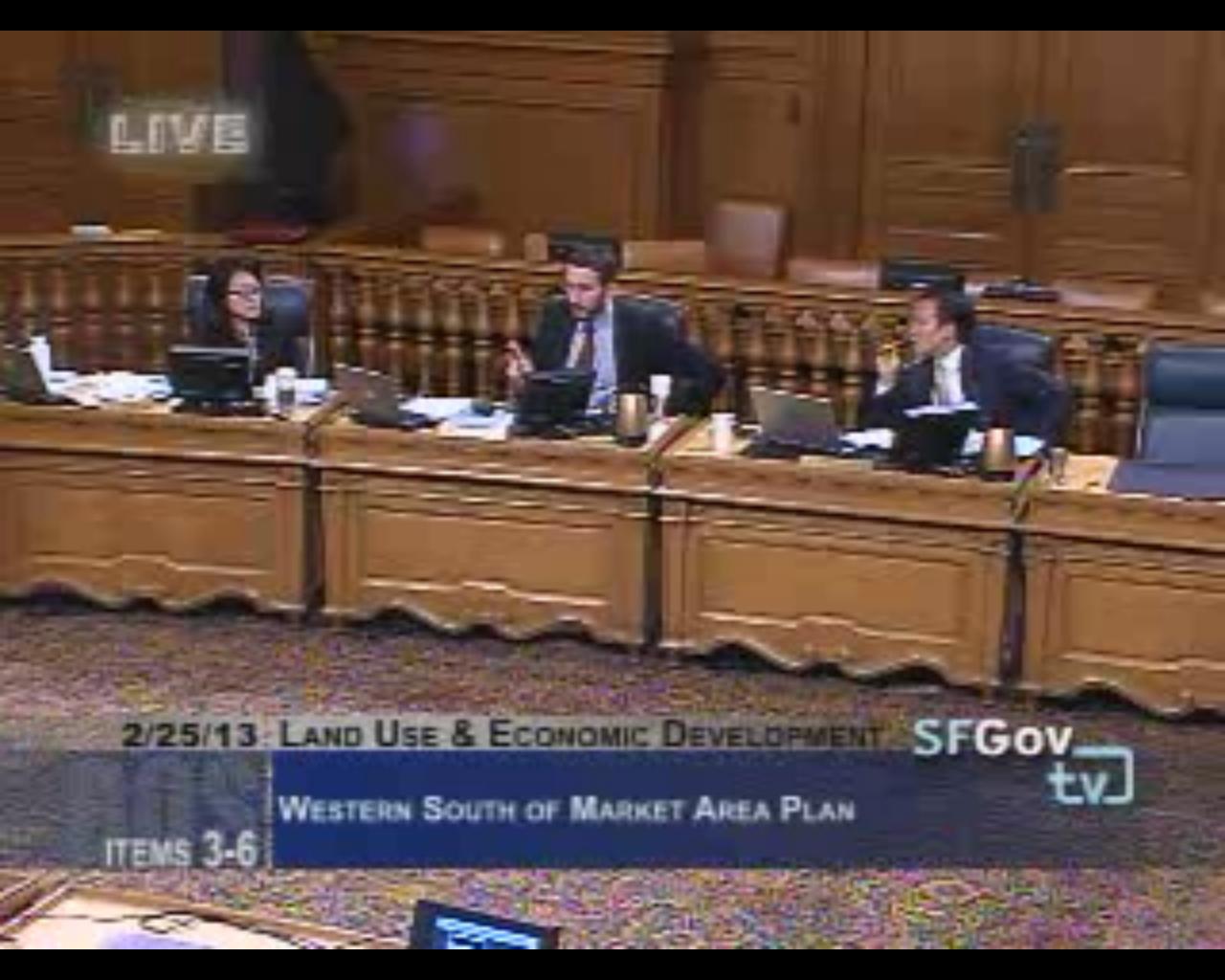
The Western SoMa Community Plan had its first hearing before the Board of Supervisors Land Use and Economic Development Committee today, with dozens of speakers praising the eight-year citizen-based planning effort that developed it but with much of the testimony criticizing the plan’s emphasis on facilitating housing development to the exclusion of other goals.
As we’ve reported, the nightlife community has in recent months been pushing for changes to the plan that would better protect nightclubs from complaints and pressure from nearby residents, particularly along 11th Street. Area Sup. Jane Kim has supported that effort and those concerns were echoed by Sup. Scott Wiener, the committee chair and a strong nightlife advocate.
“I have had significant concerns about this plan…and I’m hoping we can address them over the course of this hearing,” Wiener said.
Wiener also opened another front of attack on the plan by noting that it doesn’t adequately pay for the impact that thousands of new housing units would have on Muni and other aspects of the transportation system. In particular, he criticized a policy in the plan that would let 13 large properties get increased density in exchange for higher affordable housing fees that would be offset by lower transit and other impact fees paid to the city.
“What are we doing to make sure our transportation system keeps pace?” Wiener asked of Planning Department staff, later asking again, “Where would we get the money to improve transit for these increased residents?” Wiener didn’t get back any answers that seemed to satisfy him, so he asked for a more detailed report when the plan returns next week for a second hearing. That concern was echoed by the third committee member, Board President David Chiu, who said, “Building housing without money for transit will lead to long-term problems.”
The concern seemed to revive a losing fight that Wiener led in December over expanding who pays the city’s Transit Impact Development Fee, which pitted transportation advocates against affordable housing activists. Fernando Marti of the Council of Community Housing Organizing rued the revival of that conflict. “We’ve been here before, pitting [transportation against affordable housing needs] as if it were a zero sum game,” Marti told the committee, noting the importance of policies to balance out market rate housing and calling it a “plan for stability in a neighborhood facing large-scale gentrification.”
Marti’s COCHO colleague Peter Cohen, who was closely involved with the plan’s creation, also urged the committee not to tweak the housing policies or the revenues it creates for affordable housing. “This is a major upzoning,” Cohen said. “In 20 years, perhaps all the market rate stock [of housing in the plan area] will be gentrified.”
But the issue raised most often during more than two hours of public testimony involved nightlife and the need to strike a better balance between housing development and entertainment, much of the input stirred up by the California Music and Culture Association, a industry-backed trade group that formed largely in response to crackdowns on clubs in SoMa.
“It’s often said San Francisco can plan more for fun, and this is a great opportunity to do that,” said Guy Carson, a CMAC founder who owns Cafe du Nord. Longtime nightlife advocate Terrence Alan took part in the Western SoMa Task Force for four years before resigning in frustration, and he told the committee, “We are bringing up issues we felt marginalized in bringing up earlier.”
But several people involved with the task force, as well as speakers representing development interests, urged supervisors to pass the place without significant modifications. “There are dozens or hundreds of compromises in this plan,” Cohen said, urging supervisors not to upset that careful balance.
Task Force Chair Jim Meko – whose leadership was widely praised in the testimony – detailed the extensive outreach and detailed work that went into the plan, and offered a simple plea to the committee: “Please pass this plan so we can get on with our lives.”
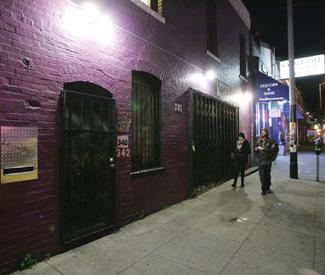
The committee unanimously voted to support the change made to the plan by the Planning Commission to ban new residential development on the raucous 300-block of 11th Street, but to reverse the commission’s decision to grandfather in one final 24-home residential project on that block, in the so-called “purple building” at 340 11th Street. A number of other small changes to the plan were also unanimously approved.
But Kim objected to Wiener’s motion to eliminate the plan provision that would reduce the transit and open space fees and raise the affordable housing fees that developers of those 13 large parcels would pay. “I don’t think it’s good policy to reduce transit impact fees when we’re increasing population,” Wiener said.
“This has gone through an extensive community process,” Kim countered, adding that, “I hate that we’re always having this discussion about transit versus affordable housing.”
But Chiu sided with Wiener and the amendment was approved on a 2-1 vote with Kim in dissent. Yet Chiu held open the possibility of changing his mind next week when the plan returns to committee for a final vote – the delay prompted by the other revisions in the plan – when Planning staff will provide more information on the fee structure and its impacts.
If the committee gives final approval to the plan next Monday, it could be before the full board for approval the next day.
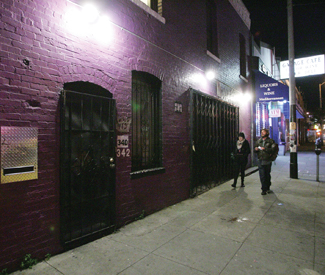
The fate of the “purple building” – which has become caught up in the clash between nightlife and residential interests on the clubgoer-saturated 300-block of 11th Street – remains undecided as the Western SoMa Community Plan heads into its first hearing before the Board of Supervisors Land Use and Economic Development Committee on Monday.
As we reported in this week’s paper, a unique citizen-based task force has spent the last eight years developing the plan, which will allow thousands of units of new housing – most of it along Folsom Street – to move forward once the plan gets final approval from the board. But the California Music & Culture Association and other nightlife advocates successfully amended the plan to ban new housing on that 11th Street block as the Planning Commission approved it in December.
Yet the commission also decided to grandfather in a 24-home project at 340 11th Street, the so-called purple building, which nightlife advocates say would put those new residents on a collision course with Slim’s, DNA Lounge, and other big nightclubs on that busy block. As we went to press, both sides and District 6 Sup. Jane Kim were all hopeful that a compromise was imminent, likely involving switching from residential to office.
But with just days to go before that hearing, building owner Tony Lo still hasn’t decided whether to make the change or fight it out in front of the supervisors. His architect John Goldman – whose residential design for the site was placed on hold by the city since shortly after he submitted it in 2005 – had hoped to hear by now but he’s still waiting for Lo to make the call.
“Based on my analysis, it looks feasible to change to offices if you want to do it, and I mean feasible financially and architecturally and planning-wise,” Goldman today told the Guardian, referring to what he told Lo.
Meanwhile, Western SoMa Task Force Chair Jim Meko – who has not been supportive of tweaking the plan after all the work he oversaw – yesterday sent out an email blast to stakeholders and supporters urging them to attend Monday’s hearing and show support for the plan.
“You don’t often get a chance to participate in making decisions about your own neighborhood from start to finish. Some special interest groups are expected to come out of the woodwork to take pot shots at the Plan so the hundreds of participants in this process need to make their voices heard. Your testimony at the hearing next week will make all the difference,” Meko wrote.
The hearing starts at 10am in board chambers in City Hall. This item might have been heard later in the day considering the agenda opens with a continuation of the controversial condo lottery bypass legislation, on which Board President David Chiu and others have been trying to forge a compromise between tenant advocates and homeowner groups. But committee Chair Scott Wiener just told us that item “will be continued. No compromise yet.”
No politically savvy San Franciscan has ever really bought the rhetoric espoused by the so-called “moderate” political action group Plan C that it’s all about finding middle ground between what its website calls “a ‘downtown’ machine, and a far-left, dogmatic, so-called ‘progressive’ machine.” As if that unbalanced labeling wasn’t enough of a indicator, the fact that its funding comes from all the biggest cogs in the downtown machine should be.
But now, as the group’s members aggressively work to open the flood gates on converting San Francisco’s rent-controlled apartments into privately controlled condominiums, it’s become more clear than ever that the C stands for Condo and that the financially motivated group is moving the agenda of the real-estate and investment interests that dominate its Board of Directors.
City Hall sources connected to the ongoing meetings that Sups. David Chiu and Mark Farrell have been holding with stakeholders on the controversial condo lottery bypass legislation sponsored by Farrell and Sup. Scott Wiener say there were indications of possible compromise that came out of the first mediation meeting.
That one primarily involved the tenant advocates who have led the charge against the legislation and the representatives for tenancy-in-common owners seeking to buy a bypass to the city’s condo conversion lottery that only allows 200 new condos per year. There were whispers that came from that meeting of a compromise that would allow a one-time bypass in exchange for shutting down the lottery for several years, or indexing it to the construction of new housing for low-income San Franciscans.
Since then, the sources say, Plan C and their partners in the real-estate industry have dominated the meetings with their dogmatic advocacy for indefinitely allowing the maximum number of condo conversions. Despite public statements by Farrell and Wiener that they just want to clear out some backlog without encouraging more landlords to convert apartments to TICs in the future, Plan C just wants to feed more affordable apartments into the expensive real estate market.
Some basic research on the group and its Board of Directors seems to show that this position is about financial self-interest rather than values or ideology.
Plan C Co-Chair Steve Adams is a regional manager for Sterling Bank & Trust, which has consistently been one of the city’s top TIC lenders and which recently sponsored a forum encouraging more conversion of apartments, promising to increase its loan volume, and painting a rosy picture of the TIC financing market that belies Wiener’s claims that TIC owners can’t get financial relief and need the city’s intervention.
One of the key presenters at that symposium was TIC attorney Lyssa Paul, who is also a Plan C board member and someone who makes her living creating more TICs. Other members of the 12-member board who make their living in the real estate industry and benefit directly for TICs conversions are Amanda Jones and Brian Hecktman. Other bankers or investment managers on the board that benefit from the TIC business are Ashley Lyon and Bob Gain.
Co-Chair Mike Sullivan is a venture capital attorney who created Plan C in 2001 and used it to help then-Sup. Gavin Newsom sell his Care Not Cash homelessness plan and run for mayor. Randy Brasche is in software marketing and got involved in the issue being frustrated with the condo lottery and [[CORRECTION/DELETION: last year]] forming the San Francisco TIC Coalition.
Board member David Fix is [[CORRECTION/ADDITION: the former]] president of the Small Property Owners of San Francisco, so it’s possible that his interest is as much ideological as financial, particularly given his past public statements against rent control. That may also be the case with Baha Hariri, a principal at A&F Properties and the former political director of the downtown-funded-and-created Committee on Jobs.
Among the downtown players that fund Plan C, which was sitting on $73,872 in the bank as of the start of this year, are the Committee on Jobs, the San Francisco Association of Realtors, PG&E, San Francisco Apartment Association, Small Property Owners of San Francisco, Shorenstein Realty, the San Francisco Chamber of Commerce, and venture capitalist Ron Conway.
So Plan C appears to be little more than Plan A’s deceptive effort to push Plan Condo. BTW, I’ve been waiting more than 24 hours now to get a call back from the Plan C board, after leaving a message with its only paid administrator, Richard Magary, who told me Sullivan and his colleagues are all quite busy now. But I’ll be happy to update this post if and when I hear back.
2/22 UPDATE: Still no call back from Plan C, but Fix made a comment requesting the two minor corrections above. C’mon, Plan C, gimme a call, what are you so afraid of?
Dick Meister, former labor editor of the San Francisco Chronicle, is co-author of A Long Time Coming: The Struggle to Unionize America’s Farm Workers (Macmillan)
There’s still time, if you hurry, to join a nationwide campaign to posthumously award the Presidential Medal of Freedom to legendary organizer Fred Ross. For more than a half-century he was among the most influential, skilled, dedicated and successful of the community organizers who have done so much for the underdogs of American society.
Most people have never heard of Fred Ross, which is exactly how he wanted it. He saw his job as training others to assume leadership and the public recognition that accompanies it. And train them he did, hundreds of them, including farm worker leaders Cesar Chavez and Dolores Huerta, who were previously awarded the Presidential Medal of Freedom.
Chavez and Huerta were typical Ross trainees poor, inexperienced members of an oppressed minority who were inspired to mobilize others like them to stand up to their oppressors.
“Fred did such a good job of explaining how poor people could build power I could taste it,” Chavez recalled.
Chavez was among the Mexican Americans living in California’s barrios in the 1950s that Ross, then with Saul Alinsky’s Industrial Areas Foundation, was helping form political blocs to demand improvements in the woefully inadequate community services provided them.
Ross’ approach was, as always, to get people to organize themselves, and he sensed correctly that young Chavez was “potentially the best-grass-roots leader I’d ever run into.”
Within just a few years, the small organizations formed by the residents of the particular barrios joined into a potent statewide group, the Community Services Organization, headed by Chavez.
A few years later, Chavez and Huerta founded what became the United Farm Workers Union. It was the country’s first effective organization of farm workers precisely because it was built in accord with Ross’ principles from the ground up by farm workers relying heavily on such non-violent tactics as the boycott.
Ross had started out to be a classroom teacher after working is way through the University of Southern California in 1936. But he could find no teaching jobs in that dark year of the Great Depression. He took other public work, eventually managing the federal migratory labor camp near Bakersfield, California, that novelist John Steinbeck used as a model for the camp that had a central role in “The Grapes of Wrath.”
Fiction though it was, Steinbeck’s account was accurate. Conditions in the camp were deplorable. So were the conditions imposed on the migrants by the local growers for whom they worked.
But the migrants organized themselves to win better living and working conditions, thanks to young Fred Ross. He went from cabin to cabin and tent to tent every morning after daybreak, encouraging camp residents to form the organizations that helped improve their conditions,
Ross had found his life’s work. He would become a full-time organizer, a task he described as being “a social arsonist who goes around setting people on fire.” Never was Ross paid more than a marginal salary, sometimes no more than room, board and expenses, but never would he falter.
His goal was “to help people do away with fear fear to speak up and demand their rights to push people to get out in front so they could prove to themselves they could do it.”
Ross left the migrant group to work with the Japanese Americans on the West Coast who were herded into internment camps during World War II. Ross, then with the American Friends Service Committee, helped internees win release by finding them jobs in the manpower-short steel plants and other factories in the Midwest that produced vital war materials.
After the war, he returned to southern California, to help African Americans and Mexican Americans fight against housing and school segregation. They fought effectively, too, against police brutality and helped elect Los Angeles’ first Hispanic city councilman.
Ross also worked in Arizona, helping Yaqui Indians get sewers, paved streets, medical facilities and other basic needs that had been denied their communities.
Ross’ most ambitious and probably most satisfying work came during his 15 years of training hundreds of organizers and negotiators for the United Farm Workers from the UFW’s inexperienced and long-oppressed rank-and-file members.
Ross kept at it for virtually the rest of his life, joining his son, Fred Jr., a highly regarded organizer himself, in grass-roots campaigns for liberal politicians and progressive causes. He actively supported a wide variety of international as well as domestic issues, much of the time working with anti-nuclear and peace groups.
It was not until four years before his death in 1992, when Alzheimer’s Disease struck, that he finally stopped.
Fred Ross was an organizer’s organizer, a trailblazer, a pioneer. He was and he remains a vitally important model for those seeking to empower the powerless and to truly reform, if not perfect, this imperfect society.
“Fred fought more fights and trained more organizers and planted more seeds of righteous indignation against social injustice than anyone we’re ever likely to see again,” noted Jerry Cohen, formerly the UFW’s general counsel.
House Minority Leader Nancy Pelosi noted that Ross “left a legacy of good works that have given many the courage of their convictions, the powers of their ideals, and the strength to do heroic deeds on behalf of the common person.”
Honoring Ross, said his son, would be recognizing “the foot soldiers in all struggles that do the day to day work but rarely get acknowledged for their labors. It’s about honoring the farm workers, low- wage urban workers, and all those fighting for social justice against what many see as insurmountable odds.”
To add your voice to those urging President Obama to award the Presidential Medal of Freedom to Fred Ross, send an email before Feb. 28 to presidential aide Julie Chavez Rodriquez at Julie_C_Rodriguez@who.eop.gov. Please send a blind copy to Fred Ross Jr. at fredross47@gmail.com. You might also ask your House and Senate representatives to join others in Congress who have signed a letter urging the President to act.
Dick Meister, former labor editor of the San Francisco Chronicle, is co-author of A Long Time Coming: The Struggle to Unionize America’s Farm Workers (Macmillan)
Not so much the disease itself — although the rate of HIV infections has been rising again in young gay men, according to a report last year by the Centers for Disease Control and Prevention, and African Americans continue to be the hardest hit population in the US. And California, especially the Internet of California, has been gripped by another paroxysm of debate about barebacking porn, one that reached all the way to the ballot box in November with the passage of Measure B in Los Angeles, requiring all porn actors to wear condoms when filming in the city.
However, it’s the vibrant culture that grew up in resistance to the disease in the 1980s and ’90s that’s capturing the attention of a new generation, sparking a revival of interest that goes beyond typical retro-cycle nostalgia. For many young queers and allies frustrated by HIV discrimination, evictions, predatory pharmaceutical companies, sex-work criminalization, and immigration policy failures, it’s a newfound inspiration.
Rowdy AIDS resistance, defined by the loud-mouthed, street-closing, bridge-blocking, cathedral-occupying international AIDS Coalition to Unleash Power activist network, has been thrust back in the cultural spotlight after being overshadowed by more recent, conservative fights for marriage equality and military service rights. Initiated by NYC rabblerouser Larry Kramer in 1987, ACT UP defined queer politics for almost a decade and successfully changed the way government policy and the medical industry approached AIDS. (There would be no life-sustaining HIV drug combination therapy without ACT UP’s in-your-face civil disobedience.)
In San Francisco, the homegrown AIDS Action Pledge organization, started in 1985, laid the foundation for nonviolent yet radically confrontational AIDS activism, before partnering with ACT UP/New York and changing its name to ACT UP/San Francisco, helping to create a coast-to-coast juggernaut of information- and strategy-sharing. In its early ’90s heyday, thousands of virile ACT UPpers (and participants in related groups like Queer Nation, Gran Fury, and Boy With Arms Akimbo) from Kansas City to Copenhagen took to the streets, scaled walls, pilloried politicians, got arrested, and yes, got laid, too — it was a heady, cruisey time.
https://www.youtube.com/watch?v=wwhFS1mUaVY
During the past two years four documentaries about the period have been released to critical acclaim — How to Survive a Plague, nominated for a 2013 Academy Award, which documents the enormous influence ACT UP and its offshoot Treatment Action Group had on the development of life-saving combination drug therapies by major pharmaceutical companies; United in Anger, director Jim Hubbard’s eye-opening ode to the diverse membership, complex infrastructure, and social issue agenda of ACT UP in New York, which draws on the immense ACT UP Oral History Project archives Hubbard started 10 years ago with writer Sarah Schulman; Vito, an HBO documentary about outspoken AIDS activist and Celluloid Closet author Vito Russo; and We Were Hereby director David Weissman (currently being Ellis Act evicted from his Castro apartment), which focuses on San Francisco at the very beginning of the epidemic leading up to ACT UP’s founding, and the development here of innovative treatments.
Kramer’s own polemical, overwhelming 1985 play about the dawn of the disease in New York, The Normal Heart, was revived on Broadway in 2011 (it played here at A.C.T. last year), snagged three top Tony Awards, and is being made into a movie with Mark Ruffalo, Alec Baldwin, and possibly Julia Roberts. The artwork of hyperkinetic grafitti artist Keith Haring, who designed some of the most recognizable anti-AIDS iconography before succumbing to the disease in 1990, was everywhere in 2012, from Google Doodles and iPhone cases to collectible sex toys and a retrospective at the Brooklyn Academy of Music. Dangly pink triangle earrings and “Silence = Death” t-shirts and buttons, emblems of ACT UP, are popping up on hipsters all over.
And, um, Justin Bieber wore an ACT UP T-shirt to the 2012 CMT Country Music Awards?
FANNING THE FLAMES
Last year, a 28-year-old sex worker and activist named Cyd Nova, along with others who had been involved with the Occupy movement, started contacting ACT UP veterans about the upcoming 25th anniversary of ACT UP that March.
“My friend Kentaro and I had developed a common obsession with ACT UP because we saw it as reflection of what is missing in our community,” he told me. Nova had discovered ACT UP when he was 17, as he made an attempt to “understand who I was in the world I was living in.” When he began researching the ACT UP Oral History Project online and watching New Queer Cinema classics like the 1993 HIV-themed musical Zero Patience he “found it all incredible.”
“The emergence of ACT UP represented to us this time when queers stood together when faced with a genocide of indifference, devoting their lives to fighting for the those of their friends, lovers, family and themselves. This stands in contrast to gay and lesbian culture of the 2000s — the focus on marriage and class climbing. For people of color, sex workers, drug users, and transgender people HIV still exists. I wanted to get involved in some deeper way.”
Kentaro updated ACT UP graphics with a new “Act the Fuck Up” design, and there was enough traction about the anniversary idea among curious young people and elders to plan a “NOT OVER: 25 Years of ACT UP” panel at the Women’s Building in March, followed by a march in April through the Castro and Mission protesting the evictions of people living with HIV/AIDS, condoms being used as evidence to prosecute sex workers, and the Catholic Church’s homophobic and sex-phobic policies.
Both the panel and the march were well-attended, and another panel — this time featuring ACT UP veteran Sarah Schulman reading from The Gentrification of the Mind, her impassioned memoir of how queer rebellion to the AIDS crisis vanished into conservatism and consumerism, — overflowed its Luggage Gallery setting. Several of the attendees decided to start holding regular meetings and full-on reactivate the movement, reviving the name ACT UP/San Francisco.
The new ACT UP/SF joining with OccuPride at the 2012 Pride Parade. Photo by Liz Highleyman
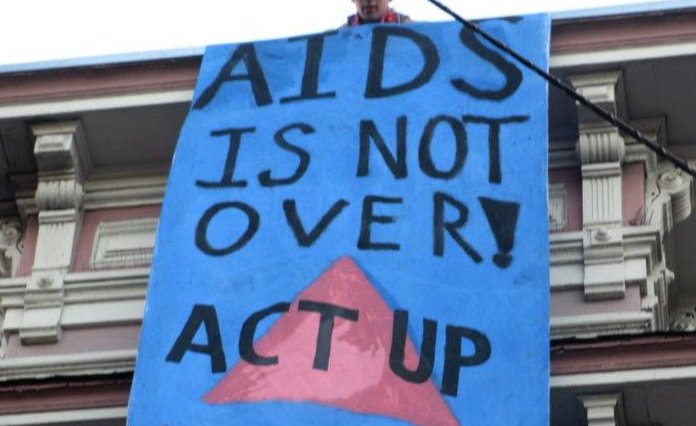
These events were followed by more old school-style ACT UP actions: slogan-bearing banner drops at Pink Saturday in the Castro, guerilla street art bombs, a “Cumdumpsters of the GOP” condom toss at Folsom Street Fair. A nexus of affiliation emerged among fellow radical queer groups like OccuPride, Homonomixxx, and active ACT UP chapters in other cities. In December, a small group managed to enter Bay Area-based pharmaceutical giant Gilead’s headquarters to protest the exorbitant pricing — $28,500 per year — of its new, more convenient HIV drug Stribild. An action is planned for February 25 to deliver letters protesting Stribild’s price to Gilead, and another for ACT UP’s 26th anniversary in March.
One of the less-emphasized aspects of ACT UP was its reverence for procedure and attention to order, its organization into multiple affinity groups and action committees: a trick learned from classical anarchism and the Civil Rights Movement. The young ACT UP/SF members I’ve met — there are about 25-30 core members — seem to have absorbed these techniques: they speak calmly and deliberately but candidly, seeking out consensus but unafraid to disagree. Their actions, too, seem deliberately organized and calmly executed.
The delicately butch-featured Nova joined me at Church Street Cafe, along with fellow ACT UP/San Francisco revivalists Mayra Lopez, 24, a poised yet vivacious nonprofit worker with striking red lips, and Alan Guttirez, 23, the kind of soft-voiced, sharply intelligent sex worker who somehow survives Dennis Cooper novels.
“I was 18 and taking a summer sociology class at SF State with this flaming faggot professor,” Guttirez told me. “Usually queer teachers like to talk about themselves a lot, and at some point he mentioned ACT UP. No one knew what he was talking about, that there was this whole radical movement here that had been almost completely buried. I was immediately curious about the possibilities.”
Lopez told me, “I grew up in Sonoma — for half my life, HIV wasn’t even on my radar. You never talked about sex in the Latino community I’m from, nevermind queer issues or HIV. Then, in high school, I watched a documentary about HIV and wanted to do a history of the disease for a project. I picked up a book of posters, included ones from ACT UP, that’s how I found out about it. From there I went to work for a nonprofit — but nonprofits have a problem with being able to address issues about migrant workers and HIV, which is my focus. They have to be so P.C. I feel like ACT UP is a tool to address those issues openly.”
A 2012 ACT UP/SF die-in outside Mission Dolores Basilica, protesting the Catholic Church’s homophobic and sexphobic policies. Photo by Liz Highleyman
Is any of the motivation for the ACT UP renewal a matter of trendy nostalgia? “We’re too busy for nostalgia,” Guttirez says. “We wish the people wearing ACT UP things or looking back at the ’90s would dig deeper into the meanings to know what those things stood for, that we’re still fighting against the same shit. Categorizing people on hookup sites as ‘clean’ or ‘dirty’ according to their HIV status or making fun of poor people is just perpetuating behaviors that were once used against us, and killed us.”
A BROADER AGENDA
One of the original ACT UP’s main goals was access to life-sustaining drugs. What’s the agenda of a new ACT UP? Besides addressing the prohibitively high costs of AIDS meds — something most HIV-positive people with insurance may take for granted, a lack of awareness that drug companies can take advantage of by price gouging or delaying more cost-effective treatments, and leaving uninsured people scrambling and dangerously stressed as public programs are increasingly cut — and the lack of an HIV safety net for many immigrants, the new ACT UP/SF also gives priority to sex worker and housing issues.
ACT UP/SF joined a coalition of local organizations, including Nova’s employer St. James Infirmary, to successfully demand that the San Francisco Police Department ban the use of condoms found on someone suspected of prostitution from being used evidence against them. (On January 14, however, Police Chief Greg Suhr announced that the ban would remain “temporary” for 90 days.)
And ACT UP/SF is also agitating around a provision in the $15 billion, George W. Bush-initiated PEPFAR international AIDS relief program, which forces organizations to pledge to oppose prostitution in order to receive funds. The US Supreme Court has agreed to hear a case against the provision this year.
A more local, immediate concern, however, one that ACT UP/SF places at the top of its list, is the skyrocketing cost of rent in San Francisco and the increasing numbers of evictions and stressful threat of evictions that many people living with HIV/AIDS face today.
“Evictions are killing us, they’re murder,” Lopez said, as Guttirez and Nova voiced their agreement. “People think medication is the number one priority for people with HIV — but it’s not, it’s housing. SROs are being pushed out, affordable housing stock is shrinking, people are being forced to leave. Without stability, it’s very hard to comply with your drug regimen, which is already complicated enough.
“I hear people all the time say, well if you can’t afford it here, then just move. They don’t understand that San Francisco is still one of the few places where queer people feel safe, that there’s a network of services here with proven results that you can’t find anywhere else, especially places many people living with HIV can afford to live. And there are support networks here, too, that aren’t available anywhere else.”
In fact, one of the most valuable things ACT UP/SF may be doing right now is offering a community for people, especially young people, with HIV to connect beyond the isolation of computer screens, to share information, enter into a positive dialogue, and receive support in a sympathetic environment geared toward changing the status quo.
Guttirez sums it up: “We’re for people who realize an angry Facebook post isn’t enough.”
BACK IN THE DAY
Have any old-guard feathers been ruffled by the ACT UP revival?
“The only real resistance we’ve had is to the name ACT UP/San Francisco — our intention is to reclaim the name from the mess that happened in the past,” Cyd told me. He’s referring to perhaps the most acrimonious legacy of local queer history. In 1990, after a phenomenally successful year of protest and media attention, several people left ACT UP/San Francisco to form ACT UP Golden Gate, intending to focus specifically on advocating for drug development and treatment, rather than address broader social issues like economic justice and gay equality.
The split was amenable at first, until things got really weird. Two men, David Pasquarelli and Michael Bellefountaine, moved here from Florida in 1993 and took over Act Up San Francisco. They quickly went from questioning the wisdom of poisoning one’s body with chemicals from the medical industry to flat out denying that HIV was the cause of AIDS, telling HIV-positive followers to forego medications altogether, saying that’s what was really killing them. Many panicked young people were swept into the new ACT UP/SF’s cultlike atmosphere, and to their doom.
“They were whackadoos!” old school ACT UP member Waiyde Palmer exclaimed when I brought up Pasquarelli and Bellefountiane. “They killed hundreds of people — and now they’re dead. Of AIDS. But the bitterness still lingers.”
I met the svelte and sassy Palmer, contributing editor of the Castro Biscuit news website and longtime survivor of AIDS, at Church Street Cafe, along with other ACT UP veterans Dean Ouellette, bushy-bearded gardener and musician, and respected journalist and activist Liz Highleyman. The three formed an uncanny, silver-haired mirror image of their younger counterparts I’d met with earlier.
A lively conversation careened among several milestones of queer radical AIDS activist history. The major early, roof-climbing takeover of pharmaceutical giant Burroughs Wellcome’s Burlingame office in 1987. The packed week of successful demonstrations around the sixth International AIDS Conference in 1990. Protesting a 1989 episode of NBC program “Midnight Caller,” which featured a murderous bisexual HIV-positive character. The 1989 day that Stop AIDS Now or Else blockaded the Golden Gate Bridge, two weeks after members of ACT UP/SF chained themselves to the Pacific Stock Exchange.
Juicy tidbits dropped: owner Marty Blecman of Megatone Records, Sylvester’s label, bankrolled ACT UP until he died in 1991; a fresh-faced Rachel Maddow, member of the AIDS Legal Referral Panel in 1994, stole some other cute dyke’s look. We tried to pin down a timeline of everything, but memories were fuzzy, exact dates had faded.
“I’m pleased to be a part of what’s happening, and I’m glad that it’s so intergenerational,” said Palmer (all three are active in the new ACT UP/SF) “but we need to maintain a momentum, and the motivation is different than when people were dying around you every day. Back then, the movement had members from every walk of life — yuppies, deadheads, people I never would have dreamed of associating with as a punk — united by this life-threatening illness.”
Highleyman agreed. “HIV has been taken over by the medical industry, we’re narcotized. A lot of ACT UP was based on exchanging information on these bewildering scientific things. Now people just ask their doctor what medicine to take. But who’s monitoring the doctors or watching the drug companies?”
“And the economics of the city have changed so much,” she continued. “I wonder if there are the resources anymore to support a protest movement. It’s just so expensive to live here, who has time to organize and follow through? The fact that these kids are taking it on is incredible and rare.”
“Back then we all worked three jobs, too” Palmer said. “But our rent was only $300 dollars — and if you had to leave one job to go to a protest, something else would pop up. I’m not sure if that can happen now.”
TIME PASSAGES
What happened to ACT UP? Leafing through the mesmerizing ACT UP Golden Gate files in the GLBT Historical Society archives in SoMa (especially those of its young star activist, Edward Zold, who succumbed to AIDS in 2009 at 38), a blizzard of drug names zips past: liposomal, foscarnet, fluconzole, sp-pg, TNP470, D4t, clarithromycin, AZT, Deovythymidine, xylocaine.
Every week it seemed, a new hope rose with a new drug name, only to be quashed when that drug failed. As several of the recent AIDS movies posit, the overwhelming amount of death just became too much, people couldn’t handle it anymore. Activists began turning on each other, the movement faded, and activist queer culture sank into despair. Until 1997, that is, when everyone began to realize the new anti-retroviral drug therapies would actually work. They were going to live, and then it was the best Folsom Street Fair ever.
Maybe more importantly, whatever happened to radical queer activism in general? I met with writer K.M. Soehnlein, who’s working on a novel based on his experiences of the ACT UP period — he was there from the very beginning in New York. He’s featured in United in Anger, and Queer Nation, an ACT UP offshoot formed to combat gay-bashing and promote queer visibility through renegade tactics, began in his living room in 1990.
“Occupy was a blip on the everyday gay person’s radar screen — and the police response to it was enormously more brutal and scary than when we protested in the ’90s and police usually worked with us,” he said. “But honestly, most gay people now are happy to see their president onscreen saying the word ‘gay’ before the word ‘marriage’ and that’s good enough for them.”
Soehnlein also has thoughts about why ACT UP may be resonating again. “There’s been talk about AIDS PTSD, and it really was a war. ACT UP felt like the only thing you could do to stay sane. Many people had to shut themselves off from that time in order to move on, and activism may be included in that.
“But 20, 25 years is a long time. It could just be a matter of waking people back up.”
ACT UP/SF meets at 7pm every first, third, and fifth Thursday — including Thu/21 at Alley Cat Books, 3036 24th St., SF. www.facebook.com/ACTUPSF
The Western South of Market area is ground zero for the city’s War on Fun, a place where nightlife often comes into conflict with residential expectations, particularly on the raucous 300 block of 11th Street and, to a lesser degree, Folsom Street’s old “miracle mile” of predominantly gay bars.
As the city’s Planning Department and its development community looks to accommodate another 4,000 homes for 10,000 new residents on less than 300 acres of Western SoMa — most of it along Folsom Street between 7th and 13th streets — that potential for conflict could grow in the coming years as funky old buildings give way to shiny new stacks of expensive condos.
And efforts to sort it out may hinge on the future of a 105-year old purple building.
After nearly eight years of work by a unique citizen-led task force, the Western SoMa Community Plan is now before the Board of Supervisors, with the Land Use Committee set to hold its first hearing on Feb. 25. Despite dozens of task force meetings seeking to strike the right balance between residential and entertainment interests, the plan is still being tweaked.
When the Planning Commission approved the plan and some related projects on Dec. 6, it followed King Solomon’s approach of cutting the 11th Street baby in half. The commission heeded the recent recommendation of the nightlife community and District 6 Sup. Jane Kim to modify the plan to prohibit new residential development on the 11th Street block where tipsy visitors to Slim’s, DNA Lounge, and other big clubs clog the sidewalks every weekend. But it also voted to grandfather in a 24-unit residential project at 340 11th Street, which everyone now involved in closed-door negotiations simply calls “the purple building,” a two-story masonry structure built in 1907 that is awaiting demolition.
The building houses light industrial businesses and is the former home of Universal Electric, whose owner, Tony Lo, wants to develop the property. Along with architect John Goldman, Lo submitted a residential project application in 2005, only to have it placed on hold pending adoption of the Western SoMa Community Plan.
“It was well along when the Planning Department put the project on hold,” Goldman told us.
City officials and even many of the nightlife advocates say they sympathize with the long wait that Lo and Goldman have endured, even if many oppose housing on the site and have been urging Lo to find another use for the site, such as an office building.
“They would have no idea what they’re getting into until that first Saturday night,” nightlife advocate Terrance Alan said of the would-be residents of the building, envisioning a young couple who had only visited during daytime hours trying push a baby stroller past the throngs of club-goers. Alan took part in recent meetings Kim facilitated with Lo and Goldman, and Alan told us, “There was, for the first time, a very frank discussion about the problems that owners would experience and the pressure they would put on clubs in the area.”
For example, just one neighbor of Slim’s — a popular live music venue on the block owned by singer Boz Scaggs — has waged a relentless campaign that has forced temporary shutdowns and cost the club more than $750,000 in mediation costs, Alan said, despite the club’s sound buffering and general compliance with local codes.
Alan said that it’s simply unthinkable to add more than two dozen new homeowners to that busy block in a condominium building that only allows access on 11th Street. Alan is hopeful for a negotiated compromise with Lo, something that Kim told us she also thinks is likely.
“I’m hoping we can come to a consensus of the property owners and business owners on 11th street, including the purple building,” Kim said, echoing Alan’s point that, “Just one resident can really shut down a business and hurt its financing.”
Goldman said he understands the concern and “my client is considering alternatives to housing.” While he was a little frustrated that it wasn’t until November that they first heard about a proposal to ban residential projects on the block, “We’ve definitely heard the concerns of the nightlife entertainment folks…No decision has been made yet, but it’s the goal of my client to decide fairly soon.”
A ban on housing is just one of the changes that Alan and other members of the California Music And Culture Association (CMAC) are pushing the supervisors to make to the plan, provisions he was unable to get into the plan as a member of the Western SoMa Task Force for four years before resigning in frustration.
“The task force was made up of people primarily interested in residential development,” Alan told us. “The plan is pretty much about protecting residential.”
That perspective irritates task force chair Jim Meko, who said he held about 60 meetings on entertainment and nightlife issues and bent over backward to accommodate that community. “Overall, the Western SoMa Plan is very friendly to the entertainment industry,” Meko said, noting that the plan grandfathers in all existing nightclubs, even after a building is demolished, and requires new residential construction to buffer against street noise. “They’re never satisfied.”
But Meko does concede that accommodating existing residents and new residential development was central to the task force’s work, as it was charged with doing by the Planning Department. “The most important thing was to do no harm to anyone,” Meko said was the guiding philosophy behind the task force’s approach. “We’re the real test case for a mixed use community in the city.”
While Folsom Street has more bars that 11th street, and those bars will be protected under the plan, Meko said the idea was to keep them limited in scale and prevent the proliferation of large clubs that operate into the wee hours.
“Folsom Street is where the residential growth will go,” Meko said. “That’s the area where we want to add the most residential growth and it seems dumb to add more nightclubs there.”
But he also doesn’t think it makes economic sense for many clubs to open there anyway. With allowable height limits in that corridor being increased from 50 feet now up to 65 feet, and with the plan’s approval allowing development projects to move forward, many of what he called the “old junky buildings” where clubs could find cheap rent will likely be demolished.
“With the height increases, those buildings are going to be history in five years,” Meko said.
Kim said she is supportive of both nightlife and the plan’s facilitation of residential development.
“It’s transit-first and a good place to be able to handle the density that’s close to downtown,” Kim said, noting that she’s supportive of even the massive residential project proposed for 801 Brannan Street, mostly because it includes units with up to two and three bedrooms and an elegant design by architect David Baker.
That project would have 432 housing units with a total of 606 bedrooms, 22,124 square feet of retail, and a 422-car parking garage on a site of just over four acres. In many ways, it is typical of the housing density that will begin to crowd into Western SoMa.
Meko was critical of how the entertainment community was able to make changes to the plan after all the hard work of the task force, and he told us, “It was a choice Jane Kim had to make, and she will have to answer to her constituents in the future.”
But Kim said the change on 11th Street made sense and that it’s important to strike a balance. “Entertainment is clearly an important part of Western SoMa and 11th Street is unique in showcasing that community,” Kim said.
Alan and Glendon Hyde — an LGBT activist who, like Meko, ran against Kim for D6 supervisor two years ago — are also pushing for other changes in the rules governing nightlife in SoMa, including who can get the limited live music permits that the city issues and extending the 10pm curfew in those permits.
“I think small businesses throughout the district should be able to use the limited live music permits, and they’re available only on Folsom Street under the plan,” Hyde told us, noting that otherwise he thinks nightlife fares well until the plan, particularly after Kim’s intervention on 11th Street.
Kim said that she in reluctant to start tweaking too many provisions of the plan, which she characterized as a separate discussion that doesn’t have to happen now: “I’m open to further discussions after we get the plan passed.”
The Western SoMa Plan was broken off from the larger Eastern Neighborhoods Plan by then-Sup. Chris Daly in 2005 to let a citizen-based effort tackle this area’s unique challenges, and Kim said the plan is a testament to the diligent efforts of Meko and a diverse set of members.
“I think it was a really good process with lots of stakeholders involved,” Kim said. “I like the balance. I’m happy.”
Some San Francisco supervisors are scrambling to find an acceptable compromise that would prevent condo-conversion legislation by Sups. Scott Wiener and Mark Farrell from becoming a bitter battle that could be a no-win situation for centrists.
Board President David Chiu is meeting with tenant groups and trying to craft an alternative to the proposal, which would allow some 2,000 tenancy in common units to convert to condominiums. Wiener says the legislation is needed to provide housing stability to people in the almost-but-not-quite-a-condo world of TICs. Tenant activists who have met with Chiu say he’s discussing ways to limit speculation, which might include a five-year ban on the resale of converted condos. But that won’t be anywhere near enough for the tenant groups.
In fact, tenant and landlord groups are both talking to Sup. Norman Yee, who will be one of the swing votes, and who could introduce a series of amendments to the Wiener/Farrell bill that would be more palatable to tenants.
“They’ve had a couple of meetings,” Yee told me. “We’re just examining the issues to see if there’s a compromise. It would be great if we could work something out so the supervisors could feel better about voting on this.”
But any deal, Ted Gullicksen of the San Francisco Tenants Union told me, would require “structural reform of the future condo-conversion process.”
Yee could probably get away with that — he’s never relied on landlords or real-estate interests for his campaign money, and there aren’t that many TIC owners in his district, which is largely single-family homes. This won’t be a vote that will make or break his future in District 7.
On the other hand, it could be a huge issue for Sup. London Breed, who represents a district with a huge majority of tenants and the most progressive voting record in the city. Breed insists that she hasn’t made up her mind on the issue, and she told me she agrees she’s on the hot seat here: Much of her political and financial support came from Plan C and real-estate interests that want more condo conversions, but she would face furious policial fallout if she voted against tenants. “I am open to a compromise, but only if it’s good policy for the city,” she said.
Supervisors David Campos and John Avalos are strongly against the TIC bill, and it’s likely that Sups. Eric Mar (who got immense support from tenants in his recent re-election) and Jane Kim (who didn’t support the measure in committee) will oppose it unless it’s altered in a way that tenants can accept.
Naturally, Farrell and Wiener are on the yes side, as is, almost certainly, Sup. Carmen Chu.
That leaves Breed, Chiu, Yee, and Sup. Malia Cohen — and three of them have to vote Aye for the bill to pass. Chiu wants to run for state Assembly from the tenant-heavy side of the city, but, as always, he’s looking for a way to avoid an ugly fight.
The problem is that the tenants aren’t going to sign off on anything modest; if they’re going to accept the conversion of 2,000 units that used to be rental housing, they’re going to want to be absolutely certain it doesn’t happen again — and that there are new rules in place that halt the rampant assault on existing rent-controlled housing.
So either the folks in the center — Yee, Breed, Chiu, and Cohen — are going to have to force the landlords to accept some long-term reforms that they won’t like, or politicans like Breed are going to be forced to take a yes or not vote that could come back to haunt them.
Mayor Ed Lee had to do something radical with the Housing Authority, and I’m glad he did. The commissioners who oversee this mess, particularly the chair, Rev. Amos Brown, were nothing but syncophants for Director Henry Alvarez, who clearly has to go. Firing all but one of the commissioners was the right way to go.
(Although technically, the mayor must have gotten them all to resign. The City Charter says a Housing Authority Commission member can only be removed “for inefficiency, neglect of duty, or misconduct in office, after serving written charges and providing an opportunity for a hearing.”)
That said, his replacement commissioners raise an interesting question. Every one of them is a city employee. Four of the five are either department heads or senior staffers, all of whom work for the mayor or one of his appointees. The other is a deputy district attorney.
Commissions are set up to provide a degree of indepedent oversight over city agencies; there’s a reason the mayor doesn’t directly hire and fire the police chief, the fire chief, the planning director, etc.; there are commissions to give members of the public some role in monitoring those departments. Obviously, the mayor appoints most of the commissioners, and most mayors expect a degree of loyalty, but there’s a least a chance that appointees will speak up when the mayor is doing the wrong thing. (Planning Commissioner Dennis Antennore used to defy Mayor Willie Brown routinely; he ultimately got fired for it, but at least the public got a chance to hear another point of view.)
Now we have people whose day job — and income — depends directly on the mayor’s will (these are not civil servants; they’re all high-level workers who can be fired any time) running a commission. The idea that any of them will ever cross the mayor is now out of the question.
Oh — and do you think there might ever be a time when the District Attorney’s Office has to investigate the Housing Authority for criminal conduct? Maybe? Could that ever happen? And how would Deputy D.A. and Commissioner Eric Fleming handle that?
It’s perfectly legal for city employees to be commissioners, according to a detailed 2010 memo from the City Attorney’s Office. Former Sup. Aaron Peskin tried before he left the board to change that, but he fell short (in part because labor didn’t like the idea; why should city workers be deprived of the ability to participate in the public process?) But we’re not talking about rank-and-file workers who have union protections and can speak their minds and engage in political action freely; we’re talking about direct appointees of the mayor and the city administrator who have no choice but to do the bidding of their bosses.
Texas Guv Rick Perry made a spectacle of himself trying to take businesses away from California, but as everyone with any sense predicted, his trip was a bust. Fact is, very few businessess anywhere make major relocation decisions because of taxes and regulations. But as Calitics points out (with a nice chart), the real reason people have left California of late is the cost of housing.
The so-called “job creators” have enough money to afford to live here, so they aren’t going anywhere. What’s happening is that the rest of the workforce, particularly the middle-class workforce, is finding the gap between the amount they can earn and the amount they have to pay for a home is getting so radical that they’re leaving altogether.
That’s happening in San Francisco, as evictions are driving people out of the city. Some may move to other parts of the Bay Area, creating what most environmentalists and economists agree is an unsustainable situation: Workers living so far from their jobs that vast amounts of energy have to be expended getting them back and forth. But the data shows that people are leaving California altogether. Calitics:
If we are to really continue our growth, we must address the housing crunch that is going on, especially along the coast. That isn’t accomplished through slashing services and budgets, but rather working to create new affordable housing solutions and ways for young families to stay here in California, where most would rather stay.
And let’s remember: One of the biggest factors that does drive business location decisions is the availability of skilled labor. If people are leaving the state because they can’t afford to live here, who’s going to work in the industries that are the biggest employers in San Francisco (hint: It’s not tech)? Tourism is this city’s greatest economic engine, and jobs in the hospitality industry don’t pay enough for housing in the city that depends on it.
That’s a dilemma we all ought to be talking about — and Rick Perry trying to get businesses to go to Texas is not.
EDITORS NOTES This is how dysfunctional the San Francisco housing market has become:
The Chron reported in late January that young people who are just arriving in San Francisco are paying exorbitant rents for tiny spaces — $500 for a laundry room, $600 for an upper bunk — and often living in substandard conditions.
And on Feb. 11, The New York Times reported that a significant number of high-end condos in that city were vacant almost all the time, owned by the uber-rich who used them as pieds a terre — something that’s going on increasingly in San Francisco.
The Times notes:
“The higher up you go in price, the higher the concentration is likely to be of owners who spend only a few months, a few weeks or even just a few days each year in their apartments. This very costly form of desolation means that some of the city’s most expensive residential buildings stand mostly dark, lonesome and empty on the inside.”
I called Brad Paul, a former deputy mayor for housing and a longtime expert on development in San Francisco and read him that quote. “As my nine-year-old son would say, ‘You think?'” he said. My kids would be shorter: “Duh.”
The more housing you build that only multimillionaires can afford, the more likely your serving a population that has three or four other houses and just wants this one for the couple of weeks a year that they jet into San Francisco.
Planning Commission member Katherine Moore has mused about the problem in public, noting that in her Nob Hill neighborhood, there are more and more dark apartments.
Who cares? Everyone should — for a couple of reasons. For one, empty neighborhoods are no good for small businesses. They’re also not as safe. And it just seems so ass-backward: A city that can’t provide decent affordable housing for current residents, much less for the next generation of immigrants who keep the place lively, is giving up valuable land to build housing for people who aren’t going to live here at all.
That’s what the fight over the new condo projects on the waterfront, 8 Washington and 75 Howard, ought to be about.
At the very least, the city ought to get some data here. It’s not that hard — just check property records against the tax documents filed for homeownership exemptions. As Sup. David Chiu told me, “It would be good for us to know if San Francisco’s high-end condos are actually being used.”
Maybe we should find that out before we build any more. You think?
UPDATED When Mayor Ed Lee appears before the Board of Supervisors this afternoon (Tues/12) for the voter-mandated monthly “Formal Policy Discussions” (aka Question Time), he will be asked a couple of good, relevant questions with no easy answers. This is exactly what voters and progressive supervisors intended, a serious policy discussion, rather than sterile, hollow ritual that our current crop of politicians have turned it into.
The first question is by Sup. Eric Mar, who asks, “The Municipal Transportation Agency recently released its Draft Bicycle Strategy, which lays out an aggressive plan to upgrade San Francisco’s bicycle facilities. It supports biking for everyone, including seniors, families, and persons with disabilities. However, I am hearing growing concerns both in my district and city-wide about the mismatch between verbal commitments to better bicycling and budget realities. Currently, bicycle projects account for just 0.46 percent of all MTA capital. This is not enough to get us to the goals laid out in the Bicycle Strategy. How will you fund the Bicycle Strategy to make San Francisco a national leader in bicycling safety and use?”
Great question! This report, which came out in December, has the modest, realistic goal of increasing the share of vehicle trips taken by bike from 3.5 percent last year up to 8-10 percent by 2018. That already seems to abandon the official city goal – heavily touted by Lee and Board President David Chiu – of 20 percent by 2020. But even this new plan isn’t fully funded, so the question is simply asking the mayor whether he will put his money where his mouth is.
The second question comes from Chiu, who is trying to find a way to mediate the very real and challenging dispute between the city’s renters and those trying to convert more apartments into condos. Understanding where Lee stands on the issue is important to solving this problem, and Chiu’s question seems to genuinely seek guidance from the chief executive.
He asks, “Mr. Mayor, the Board of Supervisors is considering legislation to allow existing owners of Tenancies in Common (TICs) to bypass the condominium conversion lottery and be converted after the payment of a fee. I recently asked supporters of the legislation and tenant advocates to engage in negotiations, which Supervisor Farrell and I are hosting.
“What is your position on this pending legislation? What protections would you support to prevent the loss of rent-controlled housing in our increasingly unaffordable city? How would you address the concern that if we allow the current generation of TIC owners to convert, we will replace then with a new generation of TIC owners and additional real estate investments that will lead us right back to an identical debate within a short time?”
Again, excellent questions that go right to heart of one of the central struggles facing this city: Who gets to live here? And given Lee’s role in relentlessly promoting taxpayer-subsidized economic development strategies that are gentrifying the city and fueling this clash, one could argue that he has a moral obligation to help find a solution to this problem, or at the very least to say where he stands so voters can judge him accordingly.
Mayor Lee received these questions last week, so he and his staff have had plenty of time to think about them and prepare real, substantive answers. Will we get real answers or just the normal political platitudes that kick the can down the road in dealing with these pressing problems? We’ll see. Tune in at 2 pm to SFGOVTV to watch yourself, or check back here later and I’ll tell you what Mayor Lee said.
4PM UPDATE: And the winner is…meaningless political platitudes, misleading data, and shameless fence-sitting.
“I can’t say that I have a magic solution to this issue that will make everyone happy,” was how Mayor Lee answered Chiu’s question about the condo lottery bypass legislation, after saying he understood the positions of TIC owners who want to convert to condos and tenant groups concerned about the loss of what he called “the precious few rent-controlled units.”
Lee said he hopes that the two sides can find a “consensus solution” to the problem, which seems to indicate that he does indeed believe in magic considering the diametrically opposed viewpoints of the two sides and the zero sum game this issue represents. Afterward, I told the mayor that he didn’t seem to take a position on the issue and asked him to elaborate on what should be done, and he maintained that, “I actually did take a position, even though it didn’t sound like it, because I actually believe they have good points on both sides.”
Yet when KCBS reporter Barbara Taylor tried to help discern what that position may be, asking whether we could at least say that Lee didn’t support the legislation in its current form, he wouldn’t even agree to that weak stance. No, his position was that both sides have good points, even though they’re opposing points, and he’s hoping for the best. Next question.
Lee didn’t provide a clear or responsive answer on the bike question either. He reiterated his support for cycling improvements and said, “SFMTA’s prime responsibility is to ensure the streets are safe for all San Franciscans, and that includes bicyclists.” And he tried to dispute Mar’s point about how less than a half of 1 percent of the agency’s capital budget goes to bicycling improvements.
“To look at the percentage might not tell the whole story,” Lee said, citing how the SFMTA and the Transbay Joint Powers Authority are now seeking about $40 million in state and federal grants for transportation projects that would include cycling infrastructure improvements.
And that might have seemed like a somewhat responsive answer to the casual listener who isn’t aware that the price tag for improvements identified in the SFMTA Bicycle Strategy total about $200 million, of which the agency has only identified about $30 million in available funding. So the question of “How will you fund the Bicycle Strategy?” remains unanswered.
Perhaps it was too much to expect straight answers from a politician.
Interesting piece in the NY Times about the growing number of high-end condos in the city that are empty most of the year. Thurns out that the more expensive the housing, the more likely it will be owned by somebody who hardly ever lives there:
Pieds-à-terre exist throughout the New York City condo market, a separate little world of vacation homes and investment properties. But the higher up you go in price, the higher the concentration is likely to be of owners who spend only a few months, a few weeks or even just a few days each year in their apartments. This very costly form of desolation means that some of the city’s most expensive residential buildings stand mostly dark, lonesome and empty on the inside.
Worth thinking about as the voters prepare to weigh in on the 8 Washington project, which will be the most expensive new condos in the city’s history, and 75 Howard, another set of high-end condos.
New York City has no idea how many of these fancy properties are occupied on only a very part-time basis:
There are no reliable statistics on the number of pieds-à-terre in New York City, but real estate experts say that global economic jitters have drawn more and more astonishingly wealthy people into the market in recent years. They come from all over, whether Monaco, Moscow or Texas, looking for a safe place to put their money, as well as a trophy, and perhaps a second — or third or fourth or fifth — home while they’re at it.
And as far as I know, and I’ve been watching this for a long time, the city’s never done that sort of study, either. We’re getting ready to turn over large, valuable portions of the waterfront to developers who want to build housing for the very rich — and we don’t even know if the people who buy this units are actually going to live here.
Got a fascinating letter from a local lawyer named Richard Hurlburt, who has some thoughts on the TIC-condo conversion legislation sponsored by Sups. Scott Wiener and Mark Farrell. He writes:
I’m a tenant’s rights lawyer and real estate broker. Whenever possible I help tenants facing eviction buy their TIC units. I also own and reside in a TIC unit. My building has twelve units and would not be affected by the proposed law.
I just read the actual text of the legislation sponsored by Sups. Farrell & Wiener and I’m against it.
TIC financing isn’t that difficult anymore. Fractional loans are the norm and not that much more expensive than condominium loans. It does cost a little more to finance a TIC, but the units cost less to begin with. So I don’t really see a hardship on the part of TIC owners who generally have smaller mortgages because they paid less for their units to start with.
The supposed $20,000 per unit condo conversion impact fee to benefit low-income housing is largely illusory. The proposed law contains a reduction for each year the building has participated in the lottery, so a building that participated in the lottery for five years, which is the majority, would get an 80% reduction and pay only $4,000.
Although the law would provide lifetime leases for the few tenants occupying converted units, this benefit is seriously disproportionate. For the tenants getting lifetime leases, good for them but that is a huge windfall for a very few lucky individuals. For tenants generally the legislation is actually quite bad. Once any of the affected units becomes vacant, all future tenants would be exempt from the rent increase protections of the Rent Ordinance. And allowing certain owners to bypass the condo lottery will only encourage more Ellis-TIC conversions.
The BART Board of Directors will next week consider rival private development proposals for property it owns adjacent to BART’s Millbrae station, the latest step in a long and potentially lucrative process that has been highly politicized and marred by accusations of unethical behavior.
As we reported in November, BART Director James Fang was criticized for his close ties to developer Lawrence Lui and his Justin Development Corp., whose hotel and office building proposal for the site Fang had lobbied the Millbrae City Council to support without fully disclosing his relationship with Lui or the existence of another proposal for the site that BART is still considering.
The rival proposal by Republic Urban Properties is a housing and office project with some high-profile backers, including BART Director Joel Keller, that have been leading an aggressive legal and public relations effort coordinated by Singer Associates, which is insisting that the board’s discussion of the item on Feb. 14 be done in open session.
“We think an open session is vital to the transparency of this project given its history,” Singer’s Adam Alberti told the Guardian. He claims the Republic Urban proposal is a “transit-oriented project” that is best suited to the site and more lucrative to BART than the hotel-based proposal. “We hope they consider the project on its merits.”
Because the project involves real estate negotiations, the board is allowed under state law to consider the matter in closed session, and it has been placed on the agenda in both open and closed session. Board President Tom Radulovich told us, “At least some part of it will be open, and there is an interest in having as much of it open as possible.”
Keller also said that he will push for a full open discussion of the project merits. “I think the discussion of the proposal should be done in public, in open session, and there’s nothing that requires it to be in closed session,” Keller told us, adding that while he has long-supported Republican Urban project, he is keeping an open mind. “Whichever way the discussion goes, the public will be well-served.”
BART staff hasn’t prepared recommendations or a staff report for the board to consider, and part of the problem so far is that they have been too deferential to Fang and Keller, both longtime directors. Radulovich is critical of how BART staff has handled this project.
“Staff did everything they could to make this as political and non-fact-based as possible,” Radulovich said. “It’s just a really corrupt process and the people who are going to lose on this is the public….They’ve turned this into a lobbying contest because BART let them do that.”
While Republic Urban may have the inside track on that lobbying contest with the BART board, Lui’s team might have recently pulled ahead with the Millbrae City Council, which would ultimately have to approve any project at the site.
In a Jan. 30 letter to Radulovich signed by four of the five council members, including Mayor Gina Papan, Millbrae officials say they want a hotel and retail outlets at the site. “In moving forward, the Council agrees that the most beneficial use of BART Sites 5 and 6 is a mixed-use development which includes a hotel element. This type of project is ideal for this location and our city,” they wrote, noting that it is a key transportation hub. “A mixed-use development including hotel will bring much needed revenue to our city and BART, and establish Millbrae as a destination to do business, eat, shop, recreate, or stay and sleep. This is an exciting opportunity for everyone.”
Yet the letter also reiterates the city’s position that it is not willing to share transient occupancy tax revenues with BART, which Fang and Lui had previous said was a possibility and which could be key to making that project pencil out for BART, which uses long-term leases of its properties to subsidize it operating revenues.
Neither Fang — who previously told us he’s done nothing wrong and blamed Urban Republic for politicizing the process — nor a BART spokesperson returned our calls for comment. Keller said that the Republic Urban project seems to be better for BART, but he said, “If I can be persuaded the hotel project is better for BART, I’m open to it.”
The Millbrae BART station connects with Caltrain and other San Mateo County public transit systems, and it could become an even more important station once the California High-Speed Rail Project gets built, making Millbrae station the first access point to the greater Bay Area via BART for riders coming from Southern California.
Bay Guardian columnist Dick Meister, former labor editor of the SF Chronicle and KQED-TV Newsroom, has covered labor and politics for more than a half-century. Contact him through his website, www.dickmeister.com, which includes more than 350 of his columns.
It’s Black History Month, a good time to honor the Brotherhood of Sleeping Car Porters, one of the most important yet too often overlooked leaders in the long struggle for racial equality and union rights.
The union, the first to be founded by African Americans, was involved deeply in political as well as economic activity, joining with the NAACP to serve as the major political vehicle of African Americans from the late 1930s through the 1950s.
Together, the two organizations led the drives in those years against racial discrimination in employment, housing, education and other areas that laid the groundwork for the civil rights movement of the1960s.
The need for a porters’ union was painfully obvious. Porters commonly worked 12 or more hours a day on the Pullman Company’s sleeping car coaches for less than $100 a month. And out of that, they had to pay for their meals, uniforms, even the polish they used to shine passengers’ shoes. And they got no fringe benefits.
In order to meet their basic living expenses, most porters had to draw on the equally meager earnings of their wives, who were almost invariably employed as domestics.
It was a marginal and humiliating experience for porters. They were rightly proud of their work, a pride that showed in their smiling, dignified bearing. But porters knew that no matter how well they performed, they would never be promoted to higher-paying conductors’ jobs. Those jobs were reserved for white men.
Porters knew most of all that their white passengers and white employers controlled everything. It was they alone who decided what the porters must do and what they’d get for doing it.
When a passenger pulled the bell cord, porters were to answer swiftly and cheerfully. Just do what the passengers asked – or demanded. Shine their shoes, fetch them drinks, make their beds, empty their cuspidors, and more. No questions, no complaints, no protests. No rights. Nothing better epitomized the vast distance between black and white in American society.
Hundreds of porters who challenged the status quo by daring to engage in union activity or other concerted action were fired. But finally, the administration of President Franklin D. Roosevelt granted workers, black and white, the legal right to unionize. And finally, in 1937 the Brotherhood of Sleeping Car Porters won a union contract from Pullman.
The contract was signed exactly 12 years after union president and founder A. Philip Randolph had called the union’s first organizing meeting in New York City. It was a long arduous struggle, but it brought the porters out of poverty. It won them pay at least equal to that of unionized workers in many other fields, a standard workweek, a full range of employer financed benefits. Most important, porters won the right to continue to bargain collectively with Pullman on those and other vital matters.
Union President Randolph and Vice President C.L. Dellums, who succeeded Randolph in 1968, led the drive that pressured President Roosevelt into several key actions against discrimination. That included creation of a Fair Employment practices Commission in housing as well as employment.
FDR agreed to set up the commission – a model for several state commissions – and take other anti-discrimination steps only after Randolph and Dellums threatened to lead a march on Washington by more than 100,000 black workers and others who were demanding federal action against racial discrimination.
Randolph and Dellums struggled as hard against discrimination inside the labor movement . . . particularly against the practice of unions setting up segregated locals, one for white members, one for black members.
Randolph, elected in 1957 as the AFL-CIO’s first African–American vice president, long was known as the civil rights conscience of the labor movement, often prodding federation President George Meany and other conservative AFL-CIO leaders to take firm stands against racial discrimination.
The sleeping car coaches that once were the height of travel luxury have long since disappeared. And there are very few sleeping car porters in this era of less-than-luxurious train travel. The Brotherhood of Sleeping Car Porters is gone, too. But before the union disappeared, it had reached goals as important as any ever sought by an American union or any other organization.
Bay Guardian columnist Dick Meister, former labor editor of the SF Chronicle and KQED-TV Newsroom, has covered labor and politics for more than a half-century. Contact him through his website, www.dickmeister.com, which includes more than 350 of his columns.
The fate of 8 Washington, a luxury high-rise project planned for San Francisco’s northern waterfront, remains uncertain after landing at the center of a political firestorm last year. Yet a whopping $42 million, invested by the California State Teachers Retirement System (CalSTRS), is currently tied up in the project.
Months from now, in the November 2013 election, San Franciscans will vote on a building height-limit variance crafted for this particular development. If the variance goes down, the luxury development – in spite of winning entitlements last June with an 8-3 vote of the Board of Supervisors – will be toast. That outcome could jeopardize CalSTRS’ $42 million contribution, and some retired teachers are beginning to ask questions.
“We have been watching with particular concern what appears to be an incredibly risky investment by CalSTRS,” four retired CalSTRS members from San Francisco wrote in a letter to the pension fund’s investment committee last October, requesting information about how project developer Pacific Waterfront Partners had made use of the funds.
Investment amount increased
In response to the teachers’ request for information, CalSTRS indicated that the investment committee had actually increased its contribution up from $31.7 million last March, when final project approval seemed imminent.
The CalSTRS investment committee added the project to its investment portfolio in 2006 with an initial $26.7 million commitment. Prior to that, the pension fund had partnered with Pacific Waterfront Partners in a different venture to refurbish San Francisco Piers 1 ½, 3 and 5. That development was well received by the community, and since CalSTRS earned a healthy return on investment, the 8 Washington project seemed like a safe bet at the time.
But now that it’s frozen for months and faces possible reversal, pressure is mounting on the CalSTRS investment committee.
Earlier this week, a Change.org petition created to ask the CalSTRS board to reconsider its investment garnered 150 online signatures in the first 24 hours. The online petition website lists the initiator as “Lorraine Honig, Retired Teacher,” but could just as easily read No Wall on the Waterfront, the name of the opposition campaign created last year to amass signatures for a voter referendum on 8 Washington. Honig and several retired teachers initially queried the pension fund’s investment committee in league with Jon Golinger, a key driver behind No Wall on the Waterfront and chairman of the Telegraph Hill Dwellers, a neighborhood organization.
Honig, who is actually a retired social worker, explained that she used to be a member of the Golden Gateway Tennis and Swim Club, a community fitness center that would be razed to make way for 8 Washington. She’s since moved away from the neighborhood, but feels the planned 8 Washington waterfront housing complex is the wrong kind of development for San Francisco.
“The thing I object to is, it’s high end luxury housing,” she said. “There’s nothing that’s going to cost under a million. A lot of it is going to be absentee owners.” As for the CalSTRS investment, Honig said she felt worried: “I’m concerned that our money will be used to influence the voting.”
Funding used to counter signature gathering campaign
CalSTRS’ response letter also revealed that project developer Pacific Waterfront Partners had used nearly $31,000 to counter No Wall on the Waterfront’s efforts to gather enough signatures to qualify for a referendum. An expense roster showed that funds were used to cover graphic design, flyer printing, legal and compliance advice and “outreach personnel” costs.
A flurry of news reports from last July, however, indicated that some “outreach personnel” did no more than stand on the streets and physically block signature gatherers from asking passersby to sign the petition against 8 Washington. According to one account, when a signature gatherer approached project principal Simon Snellgrove to complain about this behavior, he responded: “That’s their job.”
At the end of the day, Pacific Waterfront Partners’ $31,000 expenditure to try and derail No Wall on the Waterfront’s bid for the ballot is decimal dust compared with the full investment in a building that has not been constructed, and may never be.
CalSTRS spokesperson Michael Sicilia declined to offer comment to the Guardian, instead pointing to the CalSTRS letter of response to its members. That letter stated in part: “CalSTRS is optimistic that the successful development of the underutilized space along the San Francisco waterfront will provide benefits to CalSTRS members in the form of investment income, as well as many direct benefits to the neighboring community and the city.”
So far, CalSTRS has not provided documents in response to a public records request submitted by the Guardian seeking more information about the investment. And neither CalSTRS nor Pacific Waterfront Partners has answered questions about just what would become of that significant investment if the project were ultimately killed. When we put this question Pacific Waterfront Partners spokesperson PJ Johnston, he responded: “I certainly would not speculate on what happens after the outcome of the election.”
How is the money being spent?
All of this leaves some open questions. Will that investment be washed away if voters effectively reject the project? Is the rest of the money still sitting in Pacific Waterfront Partners’ accounts, or was it eaten up by pre-construction costs? Is Snellgrove’s firm biding its time until November, when some of the funding can be tapped as a war chest to respond to No Wall on the Waterfront’s ballot referendum with an oppositional blitzkrieg?
“I don’t have a breakdown of their investment costs,” Johnston told the Guardian when posed with questions about how the funds had been used. “All pre-development phases require funding,” he added, referencing environmental impact studies, permitting, and other pre-construction hurdles that major developments must clear. “This process was drawn out over a number of years.”
Johnston also criticized the No Wall on the Waterfront campaign, saying, “A small band of corporate and really, really rich neighbors have put this on the ballot.”
And the project opponents who have deep pockets know a thing or two about investment, Golinger suggested in a letter to CalSTRS. He wrote, “The supporters of No Wall on the Waterfront who have experience with institutional investing warn that some money managers resist learning from their mistakes and, instead, double down on them, trying to prove they were right all along. The beneficiaries of the funds with which you are entrusted are sensitive to warning signs … that may be happening here.”
CalSTRS is the nation’s second largest pension fund and a source of financial support for retired educators throughout the state. About 70 percent of the money used to provide benefits is derived from investment income, and the $152.1 billion pension fund had $21.8 billion invested in real estate as of July 2, 2012. The Sacramento Bee reported earlier this week that the pension fund faces a $64 billion deficit, and would need $4.5 billion per year to become fully solvent.
Uncertain outlook
With the fate of 8 Washington now hitched to the unpredictable forces of San Francisco politics and voter sentiment, this luxury high-rise investment looks far riskier than it likely did when Pacific Waterfront Partners approached CalSTRS’ investment committee years ago.
On a broader scale, there are signs that higher-risk investments are becoming problematic for pension funds across the board. An academic study released by researchers from Yale University and Maastricht Univeristy in the Netherlands tracked public pension systems in the U.S. and elsewhere, and determined that major U.S. funds like CalSTRS are trending toward higher risk investments.
“Gradually, U.S. public funds have become the biggest risk-takers among pension funds around the globe,” the authors concluded. “A major worry is that their increased risk-taking is reckless and could lead to substantial future costs to taxpayers or public entities if their more volatile risky investments fail to meet the expected rates of return.”
At this stage of the game, it’s too soon to say whether CalSTRS’ investment in 8 Washington will ultimately become a statistic backing up that worrisome finding. Early polling results from David Binder Research showed that voters would likely reject the height-limit increase by 56 percent. But November is still many months away.
Has your cat spit fire recently? Exhibited fluency in multiple languages simultaneously? Levitated? Flown? If so, your furry feline may be experiencing the troublesome symptoms of housing a demon. And fire can really do a number on those expensive drapes.
Luckily for you, occult expert Paul Koudounaris is coming to SF this Friday, and as part of David Normal’s “Crazyology” art exhibit will be shedding light on the dark world of demonry in his lecture series, looking at both historical and modern accounts of devilish domestics.
Koudounaris stumbled upon this cryptic world of bedeviled kitties during research for his upcoming book Heavenly Bodies. Initially seeking evidence of angelic cat spirits, like the fluffy white Swiss apparition rumored to protect both the town Bürglen and the remains of St. Maximus, Koudounaris realized that the wealth of information on supernatural kitties was located on the dark side.
Even the goddess Bast, one of the most enduring Egyptian cat figureheads, was revered for her dark side. According to records from Herodotus, Koudouanris explains in an email interview with the Guardian. “Debauchery was part of the celebration of Bast. One source I found indicated that rapes and assaults were totally acceptable during the celebration of Bast, because it was believe that the spirit of Bast had taken over the perpetrators during the festival. ”
While the how’s and why’s of cats becoming possessed remain unexplained, accounts of these Luciferian faring felines are centuries-old.
And given the responses to Koudounaris’ lectures, still relevant today. “I started doing this lecture as a kind of series” he says, “People who had not been to it would come to me and say, ‘oh, you should talk about my roommate’s cat, that thing is a total demon.’ But [they didn’t] mean bad kitty, [they meant] possessed by demons, or at least suspected of it.” Throughout his research Koudounaris has seen enough bones that he doesn’t spook at just any apparition.
After completing his Ph.D. in art history at UCLA in 2004, Koudounaris was left waiting for some kind of otherworldly inspiration to direct and supplement his extensive training. Inspiration struck in 2006, in the seedy lobby of a Czech hostel.
“I had spent a day in Melnik , where I visited an extraordinary charnel house in the crypt under the Church of Sts. Peter and Paul,” wrote Koudounaris on his website, “It was gritty and dirty — decidedly not sanitized for tourists — but the arrangements of the bones showed genius, not just in formal artistic principles, but also in their understanding of philosophy and theology.”
For the next four years, his interest in the bizarre left him mausoleum-bound and underground, photo-documenting his journey into innumerable holes, crypts, and churches around Europe.
The Empire of Death, his recently-released book, documents this journey in rich color printed photographs, visually raising from the dead the largely forgotten history of ossuaries.
While he’s by no means a bone collector, Koudounaris, is certainly an archaeologist of sorts, exhuming the forgotten, the unbelievable, and even the seemingly bizarre. His work breathes new life into forgotten chapters of history, like that of devil cats.
One such chapter belongs to the United States, and a cat that haunts the Presidential homestead.
D.C., short for the District of Columbia (but also Demon Cat) has been purportedly haunting the White House since the Civil War days. Legend has it that General Nathan Bedford Forest, who was also the Grand Wizard of the Ku Klux Klan, was responsible for invoking this common cat with demonic duties. D.C. was “initially related to the death of Lincoln,” says Koudounaris, “hence the suspicion that the confederacy was involved, apparently as an attempt to undermine the Union through a decidedly guerrilla tactic of sending in a demonically-possessed cat.”
D.C.’s historic haunting’s have even garnered him his own Wikipedia page. According to Koudounaris, D.C. “has a tendency to reappear and presage national disasters — the last account of it was right before the 9/11 attacks. It also appeared before Pearl Harbor and the Kennedy assassination, when it appeared and told JFK to “go fuck off.”
Koudounaris muses, “Do you think they have to brief every new president? ‘Sir, now that you have taken the Oath of Office, there is something we must tell you. If you happen to see a black cat that metamorphs, disappears, and speaks to you in tongues, it’s a demon, sir.'”
Humor is clearly unfiltered when one deals with darkness daily.
A cat owner himself, he notes that chances of actually encountering a demonically-possessed cat is rather rare, but rogue demons have been known to take form in even the most docile of kitties. ‘I don’t consider this something most of us should be worried about. But if your cat starts spitting fire–well, get the hell away from it.”
Not to go all gloomy on a day when it’s finally not cold and the sun is out and San Francisco was just named the happiest city in America, (based on things like the number of shopping centers and cultural events), but really: Let’s not all jump up and down and celebrate. This is a very happy city for people who have money; it’s becoming a very anxiety-filled city for everyone else.
I’ve gotten quite a few comments and emails from friends on our cover story this week, and most of them go something like this:
“Great story. Really scary. I hope they don’t Ellis Act my building or I won’t be able to stay here, either.”
If you’re a renter in San Francisco, and you’ve been here a while, and you’re under rent control, chances are you’re nervous about your future. Because if you get evicted, you’re almost certainly leaving town. Maybe you can find a place in Oakland that’s smaller than what you currently have at twice the price, or maybe you can’t.
This is a city under immense pressure, and while the economically secure can happily go to shopping centers and see the Opera, I would say a majority of the current residents of San Francisco are more stressed about their future than they have been in years. And that doesn’t seem to be addressed in the happiness calculus.