Homeless

Do public health cuts make sense?

0

By Melanie Ruiz

The Examiner’s front-page headline decries cuts to the San Francisco Police Department (it’s going to be harder to patrol North Beach with all that overtime reduced). But there’s been a lot less press attention to the midyear cuts to public health.

DPH proposed $7.4 million in cutbacks, with some of the biggest losses to be suffered by HIV prevention programs. The mayor, however, rejected these program cuts, instead using HIV/AIDS reserve money to the programs going.

So the cuts will come elsewhere — and may leave the city in worse shape over time.

Gregg Sass, chief financial officer of the public health department, presented the news to the Health Commission Dec. 15th, arguing that the proposed plan operated in large part by increasing program efficiencies and reducing or eliminating San Francisco’s support for programs cut in the state budget bloodbath. Sass said “there are a few, isolated instances of some very targeted program reductions.”

Those targeted programs reductions include two substance abuse residential treatment programs, yet to be named, which will be closed. The plan also cuts the backfill funds for state proposition 36 services, which are “provided to individuals charged with non-violent drug violations who choose drug treatment and counseling in lieu of incarceration,” according to the health department’s program change request.

The people who run these programs that will be cut testified for more than an hour, making the case that the cuts are financially foolish — because prevention is cheaper than treatment.

Representatives from the Homeless Youth Alliance (HYA), a harm reduction coalition for homeless youth in the Haight-Ashbury, were out in full force. “Twice a year our budget is up for cuts, and twice a year we have to stand up here and beg you to keep allowing us to save lives,” said Lani Riccobuono. Supporter after supporter came up, cheered on by an entire back section of the room, to testify to the vital role the HYA plays in the future of at-risk individuals. It’s a thriving, supportive community of people who explained that they have only found help and hope after walking through the drop-in center’s doors.

And the infuriating level of the cuts was on display, too — It costs only $58,729 to keep HYA’s doors open – less than the cost of just one of Newsom’s five press spokespeople.

To be fair, the mayor’s office is taking cuts, too — a total of $201,520. Those reductions will come through attrition, unfilled vacancies and salary reductions for top earners.

Supervisor Chris Daly has been drawing attention to the different growth rates of the police and health departments’ budgets. According to Daly, the health department received $410 million in General Fund money last year, which fell to $343 million this year. The police department received $332 million, which rose to $345 million. In other words, public health received 16 percent less – and the police received four percent more.

Newsom’s proposed cuts include $6 million in reductions for the police department — which is hardly enough to balance out past years of health cuts.

At the onset, Commission President James Illig noted that this was only a small step: “We want to hear how we’re going to face the future, because more cuts are going to have to be made.” Next year the health department faces $101 million in cuts.

The main idea offered by speakers for the next round of cuts was simple – look elsewhere.

As Riccobuono sees it, the current strategy “is not only bad public health, it is balancing the budget on the backs of the most vulnerable population in San Francisco.”

State of the art displacement

0

OPINION What does the loss of 11 residences and a few jobs matter if it means a state-of-the-art hospital will be built?

That’s the question Examiner columnist Ken Garcia asked Oct. 20. The line cut like sharp knives into my eyes and heart as I read about Sutter Health/California Pacific Medical Center’s proposal to put a billion-dollar hospital subsequently displacing elder and disabled tenants and low-income workers at Geary and Van Ness streets, on the edge of one of the poorest neighborhoods in San Francisco.

As I read and reread the hypothetical question, I knew it could only have been written by someone who hadn’t witnessed countless low-income elders die or become seriously ill after they were evicted or displaced or hundreds of poor migrant workers and their families struggle and go hungry because they couldn’t find a steady job with a living wage.

How do you quantify the importance of even one decent job for a poor person struggling to survive? Or one business owned by a small business owner who treats his or her employees with respect and love? Or the loss of one long-term residence of a disabled and elder tenant?

How do you rationalize the pain of relocation and job eradication in lieu of the building of a huge structure supposedly there to “heal people?”

And then there is the question of the building of a “state of the art” hospital – read: rich people’s hospital – in a community where the majority of people are poor. And the issue of how the corporation funding the building made another, perhaps more devastating, decision to leach resources and support from St. Luke’s, a truly community-based hospital.

“I won’t be able to sit in Mama Dee’s chair anymore.” My six-year-old son looked down as he spoke. We were sitting in the Van Ness Bakery & Cafe at the corner of Van Ness and Geary, one of the many small businesses facing displacement.

When my son and I heard about the pending proposal to demolish and build, not only did we know that the spirit of my Mama Dee, cofounder of POOR Magazine who passed on her spirit journey in March 2006, was very angry with the demolition of her favorite spot. But more important, as someone who struggled with poverty, racism, and gentrification her entire life, I knew my mama was also mad, as I was, at the lie of California Pacific Medical Center, for proposing to build a hospital that isn’t really needed, in a community it isn’t really geared toward, and in the process dismantling the jobs, homes, and livelihoods of tenants, poor workers, and small business owners.

“This is a bad economy, and I really have no other job options. I don’t know what we workers will do” said Ruthie Seng and Oy, two of the workers at the family-owned and humanely-operated Van Ness Bakery.

As we consider granting the plans for this $1.7 billion dollar hospital proposal, perhaps we should reassess what hospitals are there to do and whom, they are doing it for.

Tiny a.k.a. Lisa Gray-Garcia is a poverty scholar and daughter of Dee, coeditor of POOR Magazine and the author of Criminal of Poverty: Growing Up Homeless in America.

Our Weekly Picks

0

WEDNESDAY 2

MUSIC
Baroness
Baroness became one of the most promising bands in heavy music with the release of 2007’s The Red Album (Relapse), generating high expectations for its new monochromatic opus, The Blue Album (Relapse), released this fall. Driven by the squalling vocals and versatile technique of guitarist John Baizley (who also has made a name for himself as a visual artist) the band has exceeded the high hopes of their fans with an offering that combines muscular riffing, allusive Southern flair, and affecting dynamics. Those gathered at Bottom of the Hill will rock out to standouts like “Ogeechee Hymnal” and “The Sweetest Curse.” (Ben Richardson)
With Earthless, Iron Age
9 p.m., $14
Bottom of the Hill
1233 17th, SF
(415) 626-4455
www.bottomofthehill.com

THURSDAY 3

EVENT
Handmade Ho-Down
Over 55 crafty bitches will participate in the Handmade Ho-Down, SoMa’s first craftstravaganza urban street fair. This means you will have 55 very good reasons to blow some cash. From pillows to wall prints, there will be something precious for everyone. Forget the stench of mothballs, this ain’t your grandmother’s fluorescent-lit craft show. And what’s a street fair in San Francisco without booze and music? There will be a full holiday bar along with a DJ so you can drink, dance, and shop to your heart’s content. Bring unused art supplies to benefit Drawbridge, a nonprofit art program for homeless and at-risk youth, and get there early for a free SWAG bag. (Lorian Long)
6 p.m., free
1015 Folsom
1015 Folsom, SF
www.handmadehodown.com

FILM
Black Christmas
Some call 1974’s Black Christmas the first-ever slasher film — it predates Halloween by four years, and its sorority-sister victims are picked off one by one as the movie progresses. (It also beat 1979’s When a Stranger Calls to the creepy prank-caller punch.) With an incredible cast (Olivia Hussey! Margot Kidder! John Saxon! Keir Dullea!) and atmospheric direction by the late, great Bob Clark (who also helmed that other holiday classic, 1983’s A Christmas Story), Black Christmas remains legitimately spooky, as well as one of the greatest holiday-horror flicks ever made. Traveling moviemeister Will the Thrill presents the film tonight with live music by Project Pimento; check the Thrillville Web site for deets on the Dec. 10 show in San Jose. (Cheryl Eddy)
8 p.m., $10
Four Star
2200 Clement, SF
(415) 666-3488
www.thrillville.net

FILM/MUSIC
Joshua Churchill and Paul Clipson
In conjunction with NOMA Gallery’s current “Until the Bright Logic is Won/Unwishpering as a Mirror is Believed” exhibit by artists Peggy Cyphers and Joshua Churchill, Churchill and Paul Clipson are presenting a this one-off sound and film performance. I’m imagining two hours filled with Brian Eno-y abstractions and spiritual glosses of nature’s lovely things. If that isn’t unclear enough, maybe the curious misspelling in the show’s title, lifted from Hart Crane’s poem “Legend,” might help. I’m referring to switcheroo of the h in “Unwishpering” (the original being “Unwhispering”). Assuming it was intentional, we now have a new word that undoes the whispering of a wish. Come witness this etymological birthing as Churchill and Clipson unwishper in your eyes and ears. (Spencer Young)
7-9 p.m., free
NOMA Gallery
80 Maiden Lane, 3rd floor, SF
(415) 391 0200
www.nomagallerysf.com

THEATER
Golden Girls: The Christmas Episodes
Dreading December’s inevitable mall trip? Consider Golden Girls’ Dorothy your inspiration: “You know Robbie wants a Batman hat. I went to six different stores, they were all sold out … Ugh, I cannot believe a person would push a perfect stranger out of the way, step on her hand, and give her an elbow to the forehead just for a Batman hat. But I did it anyway.” Ah Bea Arthur, what ever will we do without you? But although our favorite sassy grandmas may no longer be churning out the pithy one-liners they once were, their torch has happily been plucked and held aloft by San Francisco drag queens. The ladies will be performing two of the original series’ very special Christmas episodes line-for-line — rumor has it the fearsome foursome takes on a soup kitchen in one. Get some silver-haired sass for your holiday soul. (Caitlin Donohue)
7 and 9 p.m. (also Fri.-Sat., through Dec. 26), $20–$25
Mama Calizo’s Voice Factory
1519 Mission, SF
www.trannyshack.com
www.cookievision.com
www.ticketweb.com

FRIDAY 4
EVENT/VISUAL ART
The 13th Small Format Art Sale
My grandma did beautiful paintings of Texas hill country, but nowadays I’ve only got one ’cause the durn things are too large to qualify as carry-on luggage. Would that Grandma had lived in the age of the The Lab’s small-work-and-postcard art show. The space’s 13th annual celebration of all things tiny and beautiful is perfect for that nomadic creative type on your shopping list. And as a nomadic creative, I’m fully ready to celebrate some innovative, postal service-friendly designs, accumulated during an egalitarian open submissions call. If while there you are shoulder-tapped by a man or woman who wants to show you what’s in their pocket, be not alarmed. They’re a representative of the Museum of Pocket Art, a group that piggybacks larger gallery events to show wallet-sized works. Or they’re a total perv. Only one way to find out … (Caitlin Donohue)
6–-9 p.m. reception (continues through Sun/6), free
The Lab
2948 16th St., SF
(415) 864-8855
www.thelab.org
www.mopaonline.com

MUSIC
The Dead Hensons Finale Extravaganza
While cuddly Muppets and innovative creature designs are probably the first things that pop into most people’s minds when they hear the name Jim Henson, the late creative genius also incorporated wildly catchy music into his productions, using songs that still have the power to transport listeners back to their youth when hearing just a few bars of tunes such as “Pinball Number Count.” Capturing that unbridled sense of joy and innocence, The Dead Hensons perform selections from the early days of The Muppet Show and Sesame Street, and are known to cause spontaneous bouts of dancing and sing-alongs with their rockin’ interpretations. Tonight the eight-piece band will joined by several special guests, including members of Rogue Wave, No Doubt, and more. (Sean McCourt)
9:30 p.m., $12
Bottom of the Hill
1233 17th St., SF.
(415) 621-4455
www.bottomofthehill.com

EVENT/VISUAL ART
Lower Haight Art Walk
Whether you like it or not, the holidays are here. Avoid the bloated shopping malls and the schizophrenia of Union Square, and hit up the Lower Haight for its “Holiday Edition” Art Walk instead. The event takes place between the 400 and 700 blocks, and nearly 30 merchants will participate with live music, art shows, live painting, and waistband-threatening holiday munchies. There will be window and tree display contests, which means you might see Baby Jesus robotripping with a pacifier in his mouth, or Santa and Rudolph getting bestial under the mistletoe. This is the Lower Haight, after all, and one should expect something subversive and oddly charming from such a crazy yet cozy spot in the city. Fuck Macy’s and fuck carolers, the Xmas spirit thrives with the freaks and geeks of Haight Street. (Long)
7–10 p.m., free
Haight (between Pierce and Webster), SF
www.lowerhaight.org/events

SATURDAY 5

MUSIC
The Cranberries
Before emo came along and turned 13-year-olds into crybabies, there was the Cranberries. Dolores O’Riordan was the mouthpiece for many angst-ridden adolescent girls in the mid-1990s. Say what you will about the band, there’s no denying the sense of dreamy giddiness one feels whenever “Linger” or “Dreams” plays on the radio. Memories of flannel dresses, cassette tapes in your backpack, and the anticipation of another glorious episode of My So-Called Life can overwhelm you with sugary-sweet nostalgia. Following in the footsteps of such holy-shit! reunions like Pavement, Jesus Lizard, and Sunny Day Real Estate, the Cranberries — performing with the original lineup — could name their tour “Everyone Else Is Reuniting, So Why Can’t We?” It’s been seven years since the band last toured, so let’s hope “Zombie” still has sharp teeth. (Long)
8 p.m., $36
Regency Ballroom
1290 Sutter, SF
(415) 673-5716
www.theregencyballroom.com

EVENT/LIT/VISUAL ART
“Exercises in Seeing”
Wish you could give up the heavy-lidded responsibility of having eyeballs day in day out? Hate having to constantly gaze, blink, scan, squint, divert, and cry? And tired of going to art shows where all you do is look at things? Or maybe you just hate art altogether? Well, tonight’s your lucky night. You can wear two eye-patches if you want, because those pesky wet balls will be useless at this exhibit. For one night only, poet David Buuck will audibly walk you through artwork in the dark by 30 local and international artists — artwork even he hasn’t seen! All you have to do is listen or sleep or walk around and relive your first sexual experiences by “accidentally” groping people. (Young)
9 p.m.–6 a.m.
Queen’s Nails Projects
3191 Mission, SF
(415) 314-6785
www.queensnailsprojects.com

SUNDAY 6

FILM
Om Shanti Om
Om my gawd, y’all — Om Shanti Om is playing the Yerba Buena Center for the Arts! Set within the world of Bollywood, this 2007 monster hit from director-choreographer Farah Khan (she choreographed 2001’s Monsoon Wedding) works cameos galore into the tale of good-hearted, 1970s-era bit player Om (Shah Rukh Khan), who falls for movie star Shanti (Deepika Padukone), not realizing she’s already entangled with sinister producer Mukesh (Arjun Rampal). Stuff — betrayals, tragedy, reincarnation, revenge plots, haunting — happens, but you know you wanna see Om Shanti Om primarily for the glorious musical numbers, and for the mighty SRK, gloriously corny here (as always). (Eddy)
2 p.m., $6–$8
Yerba Buena Center for the Arts
701 Mission, SF
(415) 978-2787
www.ybca.org

MUSIC
Marduk
Formed in Sweden in 1990, legendary black metal group Marduk was designed, in the words of founding member Morgan Hakansson, to be “the most blasphemous metal act ever.” Although it draws from similar lyrical themes as other groups in its genre, such as the requisite references to Satanism and gore, Marduk adds several other diabolical layers, notably imagery and historical content from World War II. Marduk had to cancel its opening slot appearance for Mayhem earlier this year due to visa issues — this is the first chance in years for Bay Area metal fans to see one of the most brutal acts in our neck of the woods. (McCourt)
With Nachtmystium, Mantic Ritual, Black Anvil, Merrimack and DJ Rob Metal
8 p.m., $20
DNA Lounge
375 11th St., SF
(415) 626-1409
www.dnalounge.com

MONDAY 7
MUSIC
A Multimedia Event with Califone
The lonesome crowded West has an apt soundtrack in the music of Califone, whose very name evokes rustic Americana. Some groups never let a good song get in the way of atmosphere, while others are guilty of just the opposite. In contrast, Califone frequently manages to combine strong songcraft with an attention to scene-setting detail. And that it should — its new album All My Friends are Funeral Singers (Dead Oceans) shares the same title as the feature film directorial debut of the group’s Tim Rutili. In fact, tonight the band supplies a live score to Rutili’s movie, which stars Angela Bettis, the petite-but-tough-as-nails presence at the core of low-budget horrors such as May (2002) and Tobe Hopper’s not-bad 2003 remake of Toolbox Murders. A throwback to a time when actual actresses rather than Hollywood fembots had lead roles in U.S. movies, Bettis plays a fortune-teller who lives in an old house at the edge of the woods. Califone plays the music. (Johnny Ray Huston)
8 p.m., $16
Great American Music Hall
859 O’Farrell, SF
(415) 885-0750
www.gamh.com
The Guardian listings deadline is two weeks prior to our Wednesday publication date. To submit an item for consideration, please include the title of the event, a brief description of the event, date and time, venue name, street address (listing cross streets only isn’t sufficient), city, telephone number readers can call for more information, telephone number for media, and admission costs. Send information to Listings, the Guardian Building, 135 Mississippi St., SF, CA 94107; fax to (415) 487-2506; or e-mail (paste press release into e-mail body — no text attachments, please) to listings@sfbg.com. We cannot guarantee the return of photos, but enclosing an SASE helps. Digital photos may be submitted in jpeg format; the image must be at least 240 dpi and four inches by six inches in size. We regret we cannot accept listings over the phone.

Out of reach

0

news@sfbg.com

On a sunny afternoon in Civic Center Plaza, a remarkable bounty covered a buffet table: coconut quinoa, organic mushroom tabouli, homemade vegan desserts, and an assortment of other yummy treats. The food and event were meant to raise awareness about public school lunches, although it was hard to imagine these dishes, brought by well-heeled food advocates, sitting under the fluorescent lights of a San Francisco public school cafeteria.

The spread was for the Slow Food USA Labor Day “eat-in,” a public potluck meant to publicize the proposed reauthorization of the Child Nutrition Act, national legislation that regulates the food in public schools. The crowd was in a festive, light-hearted mood. There was a full program of speeches by sustainability experts and a plant-your-own-vegetable-seeds table set up in one corner of the plaza.

A bedraggled couple who appeared homeless made their way through the jovial crowd and started scooping up the food in a way that suggested it had been a long time since their last roasted local lamb shish kebob. Their presence shouldn’t have been a surprise; most events involving free trips down a food table are geared toward a different demographic in this park, which borders the Tenderloin.

In a flash, an event volunteer was on the case, nervous in an endearingly liberal manner. “Sir,” she began. “This food is for the Child Nutrition Act.” And then she paused, searching for what to say next. I imagined her thinking: “Sir, this food is to raise awareness about the availability of sustainable food to the lower classes, not to be eaten by them,” or, “Sir, this good, healthy, local food is not for you.”

But there was no good way to say what she meant to convey. She knew it, and delivered her final line hurriedly before walking away. “If you could just, well, just don’t take like 25 things, okay?” Indifferent to the volunteer’s unspoken reprimand, the couple continued to eat, ignoring the whispers and stares of the social crusaders around them, who all seemed to take issue with their participation in this carefully planned political action.

It was a telling scene from a movement that has yet to really confront its class issues. Though organic grocery stores and farmers markets have sprung up on San Francisco’s street corners, it remains to be seen whether our current mania for sustainable, local food will positively affect the lower classes, be they farm workers or poor families.

Even iconic food writer Michael Pollan acknowledges the challenge the sustainability movement faces in widening its relevance for the poor, citing the high cost of local and organic food as just one of the issues that Slow Foodies and their allies must tackle before they can count the “good food” movement a success.

LOCAL ORGANIC LABOR

For the average heirloom tomato eater, the words “organic farm” often conjure up an idyllic agrarian picture: happy communes of earnest farmers growing veggies straight from the goodness of their hearts. In reality, a lot of the people who plant, tend, and harvest produce are poorly paid Latino immigrants. And it might come as a surprise that those who work on small or organic farms often face the same exploitative working conditions as those in conventional agriculture.

To learn how organic farm workers should be treated, consider Swanton Berry Farm, whose fields stretch out along the coastal highway just north of Santa Cruz. Swanton was the first organic farm in California to sign a contract with the United Farm Workers, a move that highlights the owners’ conviction that farm workers be viewed as skilled professionals. Employees are offered ownership shares in the farm and are provided health insurance, retirement plans, comfortable housing, and unlimited time off to attend to pressing family matters.

“Organic is a lot cleaner. Working with pesticides, you have to worry about wearing gloves and covering your skin. Here, you can pick that strawberry right off the plant and eat it,” Adelfo Antonio told the Guardian. He has worked these fields for 20 years, the last five as a supervisor. His high regard for his job and employers is apparent. As we talked, he kept at least one eye fixed on his coworkers, who stretched plastic sheets across the dirt of the field to protect their rows of seed from the coming autumn winds.

Antonio said he appreciates the culture of mutual respect on this farm. “People like how they are treated here. When conflicts come up, our management is open to working through them,” he said. A few minutes later, a break was called, illustrating his point. There had been some disruptive behavior in the company housing and a discussion ensued between the crew and one of the farm’s owners about house rules. The group formulated a plan to avoid trouble in the future.

But Swanton’s egalitarian fields are the exception among American organic farms. The average salary of the estimated 900,000 farm workers in California — the birthplace of the organic and farm labor movements in the U.S. — is around $8,500, more than $2,000 below the federal poverty line.

In 2006, the California Institute for Rural Studies put out a rare study of working conditions on the state’s 2,176 organic farms that suggested that in some respects, workers are better off on conventional farms. Although the average wage was higher on organic fields — $8.20 for entry-level work, compared with $7.91 on conventional farms — traditional agriculture outstripped organic on certain employee benefits. A mere 36 percent of organic businesses were found to provide health insurance to their employees, as opposed to 46 percent on conventional farms.

Unable to rely on chemicals for pest control, organic farms often face higher labor costs in the fields. “Wages and benefits should always be viewed in the wider context of sustainability, and that includes a farm’s ability to stay in business from one year to the next, i.e. its profitability,” said Jane Baker, a spokesperson for California Certified Organic Farmers, the state’s major organic certification agency.

The inequity faced by farm workers belies the fact that the organic movement began as an alternative to the industrialized food system. “Back then, we never would have imagined that you’d be buying an organic product that was built on the backs of workers. For us, social justice was every bit as important as the environmental part,” said Marty Mesh, an organic farmer since 1973 and executive director of Florida Certified Organic Growers & Consumers.

Mesh was involved in the debates over the U.S. Department of Agriculture’s first codification of the National Organic Program. He said that although many farmers advocated for regulations surrounding working conditions, the federal government found it hard to stomach labor stipulations. Many involved felt their inclusion would hurt the growth of the organic industry. So the social movement aspect of organic farming was left on the cutting room floor.

That has not been the case overseas. The International Federation of Organic Agriculture Movements, whose organic label is recognized worldwide, adopted explicit social justice language in its basic standards in 2003, stating in their “Principles of Organic Agriculture” document that “organic agriculture should provide everyone involved with a good quality of life and contribute to … reduction of poverty.”

CCOF now offers a dual track certification process wherein California farms can forgo specific IFOAM requirements. The lack of guidelines of worker treatment has led to some problems. “We’ve seen many of the same issues on organic farms that we do in conventional agriculture, on small and big farms alike,” Michael Marsh, directing attorney of California Rural Legal Assistance, told us. CRLA is an organization that regularly provides low cost legal assistance to agricultural workers, whom Marsh has seen bring charges against organic farmers for cases of sexual harassment, underpayment, and job safety concerns.

Sometimes the organic label is even used to justify vioutf8g workers rights. In 2003, the California Legislature considered a bill that would ban “stoop labor,” activities like hand-weeding which require working in bent positions that can cause musculoskeletal degeneration. Organic farmers’ associations lobbied against the bill, claiming that pesticide-free agriculture would suffer under such restrictions. Also, although chemical pest-killers are banned from organic farming, some popular natural pesticides like copper and sulfur have been known to cause irritation of the throat, eyes, and respiratory system.

“This is one of the hardest nuts to crack in the sustainable food world,” said Michael Dimock, executive director of Roots of Change, a San Francisco-based foundation that has developed campaign strategies for improving agricultural working conditions. Three years ago, Dimock left his post as chairman at Slow Food USA, at a time when farm labor conditions “were generally not at the top of the list. Slow Food as an organization is just beginning to figure out what it can do in a meaningful way on this issue.”

Roots of Change has found some success in identifying farm labor challenges and possible solutions through a series of worker-grower forums. It has pinpointed immigration reform as one key to progress. Anywhere from 50 to 90 percent of farm workers in California are undocumented, which puts even fair bosses at risk of being prosecuted for employing illegal immigrants.

Many farm owners turn to labor contractors — essentially agricultural temp agencies — to supply field hands. Use of these middle men largely shields the owner from legal responsibility for illegal hiring, but “the bad farm labor contractors cheat workers, take their pay, and risk their health and safety,” Dimock said.

Some Californian farm labor contractors have become notorious for their disregard of minimum wage and other labor standards, taking advantage of workers who are discouraged to seek help for fear of deportation. The role played by irresponsible contractors is one of many issues that can remain unseen by the buyers of food from farms that rely on the inadequate public information available on agricultural working conditions.

WHEN BUSINESS AND LABOR COLLABORATE

Food management company Bon Appetit in Palo Alto has built a good reputation as a sustainable company, buying its produce and other foodstuffs as locally and organically as possible. “I’ve learned a lot working here,” said Jon Hall, head chef of Bon Appetit’s University of San Francisco cafeteria. “In other kitchens, if you can get something for five cents a pound cheaper, that’s what you buy. If I did that here, people would notice. [My bosses at Bon Appetit] would say, ‘Why’d you buy that?’ ”

But when Bon Appetit executives decided to take on the issue of worker treatment on the farms that supplied their food, they found it difficult to find reliable information on the subject. “We always felt like there was something there that needed to be done and change that needed to take place,” said vice president Maisie Greenwalt. “But we didn’t know who to talk to.”

Her cue to act came from the Coalition of Immokalee Workers, a group from Immokalee County, Fla. The farm workers’ organization brought nationwide publicity to the slavery-like conditions in the area’s tomato fields. Greenwalt accompanied the group on an information-gathering trip to Immokalee and saw firsthand the places where recent immigrants were held to work against their will, living in squalor and being paid little as $20 a week.

Greenwalt saw the travesty as a wake-up call. Collaborating with the Immokalee activists, Bon Appetit developed a workers’ rights contract that all their tomato suppliers must now sign. “After Bon Appetit sent me the contract, I sort of at first didn’t see the point. But then I spoke with the [Coalition of Immokalee Workers] and it made sense. Worker abuse has been around for centuries,” said Tom Wilson of Alderman Farms, one of the company’s tomato growers.
Greenwalt says Bon Appetit cafeterias were prepared to eliminate tomatoes from their menus. “Every chef and manager I talked to said they would rather not serve tomatoes than serve the tomatoes that were coming from these conditions.” But every one of their suppliers signed, agreeing to conditions such as a mandatory worker-controlled safety committee and a “minimum fair wage.”

The success convinced Bon Appetit that this style of food buyer participation is crucial to making positive progress on farm worker treatment. The company is now conducting a nationwide survey of working conditions on organic farms. “Labor’s not a new issue,” said Carolina Fojo, one of the company’s researchers. “But for some reason, people are just now talking about it. We’ve found it can be a sensitive topic for a lot of farmers.”

Visually, Hall’s USF food court is similar to traditional college eateries. But plate-side, Bon Appetit’s commitment to sustainability is clear; specials vary seasonally and food is sourced locally whenever possible. The price for a semester’s meal plan is $3,810, more than twice that of San Francisco State University. Hall’s customers, college students who may eat three meals a day here, often approach him with questions about their food. Queries range from where to how the food was grown, but in no instances that Hall has been aware of, about the workers who grew it.

Labor issues are not the popular cause these days, at least in the sustainable food movement. Unlike the “eat local” and organic food movements, equitable treatment of farm workers has yet to spawn trendy slogans for tote bags or a book on the best-seller list.

One UC Santa Cruz study found that, when asked to rank their concern about food system related topics, Central Coast grocery shoppers assigned higher concern levels to animal treatment on farms than that of humans. But Hall is confident this will change as Bon Appetit and others continue to bring attention to the economically disadvantaged on the front lines of our local and organic food systems.

“This is the next frontier,” he said. “I can see it brewing.”

SERVING THE CHILDREN

In school cafeterias across the city, a different low-income group has its own challenges fitting into the sustainable food movement. San Francisco Unified School District manages one of the city’s most important food sources.

Every school day, Student Nutrition Services dishes out 31,000 cafeteria meals; of those, 84 percent go to students who qualify for free lunch or for the reduced price of $2 for elementary school students. It is not a stretch to say that for many of these kids, this is their one chance at healthy food for the day — certainly their only chance to learn about local and organic food. But the school district faces one of the major issues the sustainability movement has yet to resolve. Local and organic food costs a lot to produce, which makes it more expensive. If pricing was more socially equitable and accounted for living wages for farm workers, costs might rise even more. This is a problem. Federal funds supply about $2.49 for each free student lunch in San Francisco and less for the meals of students who do not qualify for reduced prices. After logistical costs like labor and transportation are accounted for, 90 cents per meal is left over for the food itself.

This is not enough to fund a menu like Hall’s. Given the numbers, it should come as no surprise that examining an average SFUSD school lunch — as San Francisco Chronicle food critic Michael Bauer did in his Oct. 29 “Between Meals” online column — turns up a lot of recently thawed, bland food matter. But this is not to say that cafeteria meals have not seen progress. Student Nutrition Services eliminated junk food in 2003, signaling a new attention to nutrition on a menu previously dominated by pizza and french fries.

Unlike working conditions for farm workers, school lunches have the benefit of visibility to middle class consumers and activists. Demonstrable efforts are being made to send some of that 90-cent budget toward local food. But with such a limited budget, institutions like SFUSD can only address a small slice of what is important about sustainable food. Yes, efforts are being put toward buying kids local, pesticide-free food that doesn’t further jeopardize their future by using excessive fossil fuel on transportation. But these limited efforts do nothing to affect the social aspect of sustainability — those who produce the food are again left invisible.

The school salad bar program, started in 2007, uses organic and local vegetables in its buffet line as much as possible. The majority of the bars are strategically located in schools where more than half the student body qualifies for free and reduced-price lunches, a response to a Community Healthy Kids survey that put the number of ninth-graders who had eaten a single vegetable in the last week at 29 percent. Student reaction to the bars has been encouraging. Many poor families credit them with increasing the amount of produce in their kids’ diets.

“This program is an anomaly,” said Paula Jones, director of San Francisco Food Systems. “Other schools around the country just don’t see things like this.”

But a generation’s worth of antitax sentiment has limited the variety of the salad bars and other attempts at getting fresh food onto kids’ lunch trays. Due to high labor costs, the school district buys pre-chopped vegetables, severely limiting sourcing options. In the meantime, another generation of low-income kids is growing up on processed, packaged foods. Jones said making sustainable food available to all children is an issue the community must help take on. “The bottom line is, it’s going to take a lot of people talking about this to realize this is not just the school district’s problem.”

Jones’ organization works on getting healthy food to the city’s underserved populations. Nutritionally, this is the salient mission of our age. Despite its current vogue, only 10 percent of Americans buy organic, and shoppers who consistently choose healthy foods usually find themselves spending 20 percent more. Several California studies have indicated that socioeconomically depressed neighborhoods have disturbingly high rates of food insecurity and obesity.

Despite the enormity of the challenge, Jones remains positive. “We lead in this issue. San Francisco is ready, and we have the will.” She counts among the city’s biggest successes in this area the fact that all farmers markets, typically more expensive than average supermarkets, now accept food stamps.

THE FRESHEST FOR THE POOREST

On a bright autumn Wednesday, market assistant manager John Fernandez stands outside his “office,” a white van with the Heart of the City logo. The Heart of the City Farmers Market takes place in a plaza just between City Hall and the Tenderloin twice a week, year-round. Fernandez said it has the highest food stamp sales — second only to that of the Hollywood market — in California and has played a role in allowing low income families and individuals in the area to fit local and organic food into their budget.

Fernandez has worked here for 13 years, and said that the use of food stamps has doubled since last summer. Most of his food stamp customers are families and individuals coming back week after week. They pass by the van to have Fernandez swipe their food stamp cards through a machine and hand them the yellow plastic coins used to buy everything from persimmons to what is far and away the market’s most popular item: the live chickens that squawk from cages at one end of the line of stalls.

Efreh Ghanen was one of the shoppers we talked to who felt that being able to use her food stamps at the farmers market had improved the health of her family. Ghanen, who shops with her mother and sister, likened Heart of the City to the Yemeni markets where they bought their food growing up. “The honey, fruit, and vegetables here are fresher,” she said. “They just taste better.”

“I definitely wouldn’t be able to shop here if it weren’t for the food stamp program,” echoed Shana Lancaster. She teaches at Paul Revere Elementary School in Bernal Heights, a position funded through AmeriCorps whose low pay automatically qualifies her for the food stamp program. She selects an armful of organic Gala apples while noting the value of shopping local for working people like herself. “I like supporting the farmers. Everyone here at the market has a story. These days, everyone is struggling.”

But both Lancaster and Ghanen tell us that when they can’t afford to shop at the farmers markets, they head straight for corporate retailers like Safeway and Walgreens, buying whatever they need to get by.

Programs like these are essential if the sustainability movement is to remain relevant and widen its reach. Just as the environment will degrade if industrial agriculture continues unabated, so too will local and organic food sources falter if the majority of our society cannot afford to buy their wares.

In the end, the obstacles are about class. Low-income groups, be they the people who grow the organic food or the schoolchildren who benefit from eating it, need to become more of a focus of the “good food” movement. What Slow Foodies and other activists must keep in mind is that over-accessorizing a cause (as with esoteric artisan products and exclusive dining experiences) makes it less a vehicle for change and more like reshuffling of the same old injustices. Social change, by definition, has to be for everyone. Because elitism tastes as bad as it always has.

For more information, check out “Fair Food: Field to Table,” a multimedia project recently released by the California Institute for Rural Studies. CIRS is one of the leading researchers of working standards on Californian farms and its data is found throughout this article. Watch the Fair Food documentary for free at www.fairfoodproject.org.

Alerts

0

alerts@sfbg.com

Wednesday, Dec. 2

Battle for Whiteclay
Attend a screening and discussion of this documentary, which follows Native American activists to Nebraska’s state capitol to end alcohol sales to residents of the Pine Ridge Indian Reservation by stores in the neighboring town of Whiteclay. The film serves as an inside look at the conflict between Native Americans’ rights and state and local governments’.
7:30 p.m., $6 suggested donation
Artists’ Television Access
992 Valencia, SF
(415) 821-6545

Thursday, Dec. 3

Die-in for Bhopal
Join a die-in to commemorate the 25th anniversary of Union Carbide’s (now Dow Chemical) gas tragedy in Bhopal, India. Honor the thousands who died in the tragedy and protest the abandoned chemicals that continue to pollute the groundwater.
Noon, free
Union Square
Powell at Geary, SF
Bhopal.net
Prison Reduction Plan
Michael Bien, lead counsel in Coleman vs. Schwarzenegger, answers questions about the implementation of the California Prison Population Reduction plan. Judges in the case ordered the state to reduce its inmate population because of prison overcrowding. Sponsored by the Californians United for a Responsible Budget (CURB) Coalition.
6 p.m., free
CURB Office
1904 Franklin, # 504, Oakl.
(510) 444-0484

Friday, Dec. 4

Oaktown on wheels
Participate in a community bike ride through Oakland to display, promote, and celebrate healthy transportation. Ride ends at the Art Murmur community street party
6 p.m., free
Meet at Frank Ogawa Plaza
14th and Broadway BART station, Oakl.

Saturday, Dec. 5

Celebrate free clinic opening
Attend opening day of the Mabuhay Health Clinic and its services, a free, student-run community health clinic that aims to reduce health disparities in the SoMa district. The clinic is in partnership with the South of Market Health Center, the Bayanihan Community Center, and UCSF. Sup. Chris Daly and staff from Mayor Gavin Newsom’s office will be present. Also features food and entertainment.
2 p.m., free
Mabuhay Health Clinic
1010 Mission, SF
(415) 336-5277
Backpacks for the people
Help assemble "warm wishes" packs filled with gloves, socks, scarves, and more to be distributed to 4,000 homeless men, women, and children in the Bay Area.
8 a.m., free
Unity in Marin
600 Palm Drive, Novato
(415) 472-0211

Sunday, Dec. 6

Help class-war prisoners
Attend this fundraiser for the Partisan Defense Committee’s Class-War Prisoners Stipend Fund, which helps victims of racist prison and death sentences. Featuring a buffet, door prizes, silent art auction, and more.
3 p.m., $10
Women’s Building
3543 18th St., SF
(510) 839-0852
Fast for our climate
Send a message to the U.N. Conference on Climate Change in Copenhagen that the world needs to make a strong commitment to reduce emissions at this afternoon of fun sans food. Show solidarity with 21 other countries staging hunger strikes.
1 p.m., free
U.N. Plaza
Market at Hyde, SF
(484) 319-1115<0x00A0><cs:5>2<cs:>
Mail items for Alerts to the Guardian Building, 135 Mississippi St., SF, CA 94107; fax to (415) 255-8762; or e-mail alerts@sfbg.com. Please include a contact telephone number. Items must be received at least one week prior to the publication date.

Good work

0

culture@sfbg.com

The phrase "less fortunate" takes on new meaning in times like these, when everyone’s bank accounts and job opportunities seem more bleak than they used to. But according to the clichéd-yet-still-beneficent spirit of almost every holiday story ever told, this is the perfect time of year to contemplate those who truly are less fortunate than we are. (Cupboards full of ramen? Sucks. But having cupboards in which to put ramen? Rocks.) Why not get some perspective by giving your time and energy to those whose straits are even more dire than yours? Check out some of our favorite volunteer opportunities below, or visit www.volunteerinfo.org for an extensive list of Bay Area organizations that need manpower.

CAFÉ GRATITUDE


This Bay Area institution gives patrons yet another way to find personal affirmation with its five-year-old tradition of offering free Thanksgiving meals served by volunteer community members and staff. This year, four locations are participating, each expecting to feed at least 300 people. Want to get involved? No need to RSVP. Just show up at one of the restaurants below with friends and family any time between 11 a.m. and 3 p.m., ready to work — and eat — until the food is gone.

2400 Harrison Street, SF. (415) 830-3014; 1730 Shattuck, Berk. (510) 725-4418; 2200 Fourth St., San Rafael. (415) 578-4928; 206 Healdsburg Ave, Healdsburg. (707) 723-4461; www.cafegratitude.com

GLIDE MEMORIAL UNITED METHODIST


There are plenty of ways to support this noble — and notable — organization year-round, including volunteering at any one of Glide’s daily free meals. (Just visit the Web site and sign up for a breakfast, lunch, or dinner shift. Larger groups also can e-mail lgraybill@glide.org.) If you’d like to get involved in other Glide programs — which need everything from nurses and doctors to clerical assistants and ensemble singers — all you need to do is attend a Volunteer Information Session, held the first Wednesday of select months. But the holidays are an especially important time to support the nonprofit founded by philanthropist Lizzie Glide in 1929 and reborn under the Rev. Cecil Williams during the 1960s. Though all Thanksgiving shifts are filled, Glide still needs volunteers to help with the Toy Sort and Transfer on Dec. 16, 17, 19, and 20; Christmas Eve meal prep; Christmas Day meal service; and especially breakfast and lunch shifts in the days after Christmas, when volunteers are notoriously scarce.

330 Ellis, SF. (415) 674-6000, www.glide.org

FOOD RUNNERS


Founded by Mary Risley of Tante Marie’s Cooking School, this organization’s goal is to help alleviate hunger and waste by delivering excess food from restaurants to local shelters and food programs. The award-winning nonprofit can always use groups and individuals to commit to regular or on-call deliveries — or phone and computer work — year-round, including the holiday season.

2579 Washington, SF. (415) 929-1866, www.foodrunners.org

HANDS ON BAY AREA


Want to help your local community, but not sure where or what you want to do? HandsOn Bay Area specializes in linking potential volunteers with local nonprofits, schools, and parks for high-impact, group-based volunteer projects (though there are plenty of opportunities for individuals too). To get involved, register as a HOBA volunteer at its Web site, complete the online orientation, and then sign up for any open opportunity on the Project Calendar. You can search more than 100 options by project attributes, impact area, or county. Open projects in San Francisco in November and December include working with seniors at Canon Kip Senior Center, sprucing up the Conservatory of Flowers, helping at the Harbor House, and working with families at the Ronald McDonald House.

www.hoba.org

ONE BRICK


Like HandsOn Bay Area, this nonprofit connects volunteers with opportunities. But this Bay Area-based organization (with other branches in New York, Chicago, D.C., Minneapolis, and Seattle) adds a twist: "commitment-free volunteering" and post-event gatherings at restaurants or cafes, all of which appeals particularly to those in their 20s and 30s. Opportunities range anywhere from prepping outreach supplies for the homeless to ushering audience members during a special Berkeley Rep program. Or you can get involved on the ground level. As a 100 percent volunteer-run operation, One Brick can always use help with event management, PR and marketing, development and fundraising, and web design.

237 Kearny, SF. www.onebrick.org

ROCKET DOG RESCUE


This all-volunteer nonprofit’s mission is to save homeless and abandoned animals from euthanasia at overcrowded Bay Area shelters. Even if you can’t help by fostering a dog, you can support the organization by providing animal transportation, getting involved with outreach, helping to host a fundraising happy hour (a recent event featured free makeovers and spa pampering at the Body Shop in the Castro), working at weekend adoption fairs (held the first three Sundays of every month), or signing up for one of the many tasks it takes to keep such an operation running.

(415) 642-4786, www.rocketdogrescue.org

Seizing space

0

steve@sfbg.com; molly@sfbg.com

San Francisco’s streets and public spaces are undergoing a drastic transformation — and it’s happening subtly, often below the radar of traditional planning processes. Much of it was triggered by the renegade actions of a few outlaw urbanists, designers, and artists.

But increasingly, their tactics and spirit are being adopted inside City Hall, and the result is starting to look like a real urban design revolution — one that harks back to a movement that was interrupted back in the 1970s.

One of the earliest signs of the new approach emerged in 2005 on the first Park(ing) Day, the brainchild of the hip, young founders of the urban design group Rebar. The idea was simple: turn selected street parking spots around San Francisco into little one-day parks. Just plug some coins in the meter to rent the space, then set up chairs or lay down some sod, and kick it.

It was a simple yet powerful statement about how San Franciscans choose to use public space — and the folks at Rebar expected to get in trouble.

“When we did the first Park(ing) Day in 2005, JB [a.k.a. John Bela] and I were just prepared to be arrested and hauled into court,” Rebar’s Matthew Passmore told us at a recent interview in the group’s new Mission District warehouse space. “But nothing like that happened.”

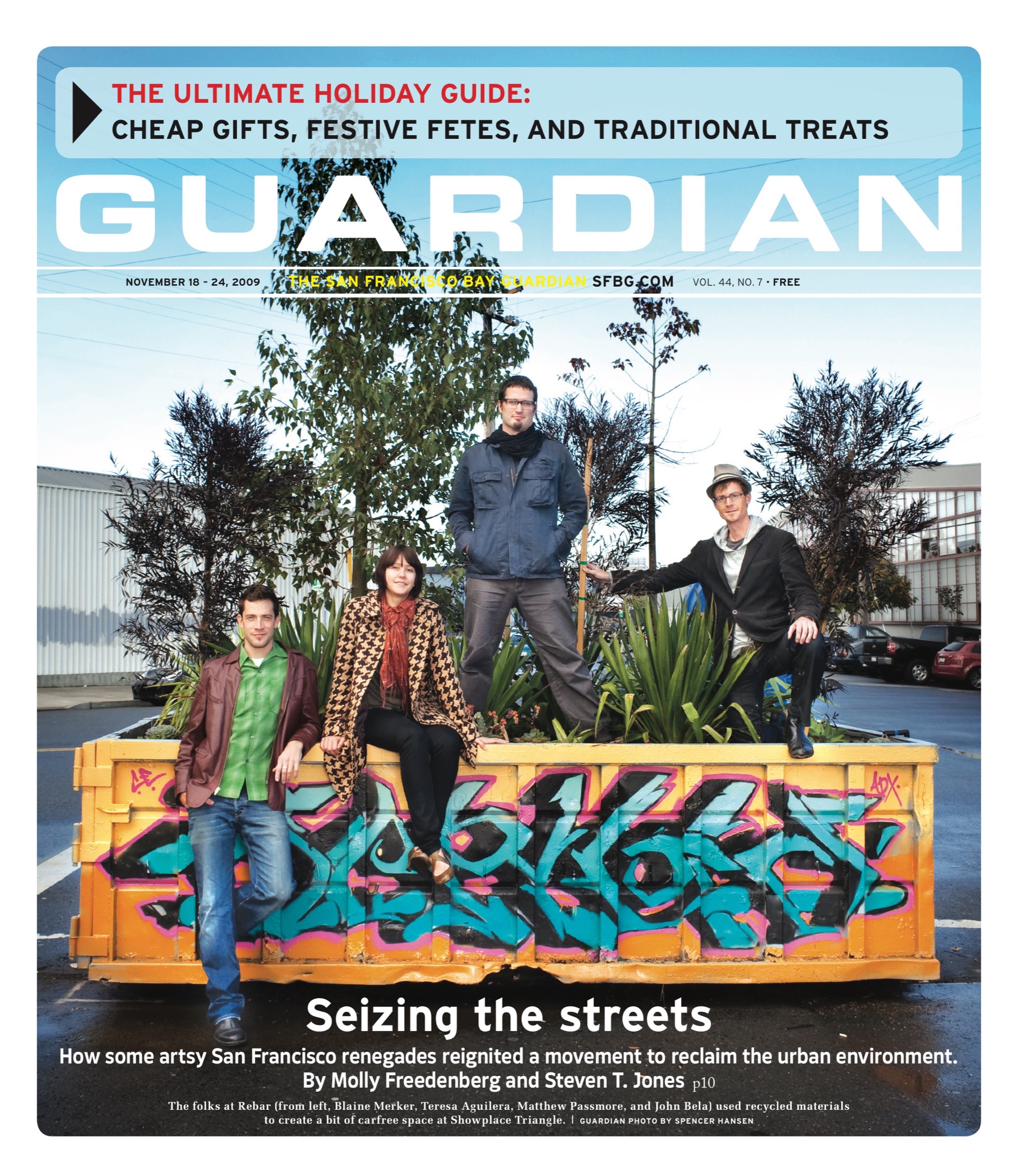
Instead, City Hall called. 079_realcover.jpg Rebar’s Blaine Merker, Teresa Aguilera, Matthew Passmore, and John Bela at their carfreee space at Showplace Triangle

“We got a call from the director of city greening, who said this is great, I want to meet with you guys and talk about how the city can support this kind of activity,” Passmore said. “Much to our surprise, the city was totally responsive as opposed to shutting us down and imprisoning us.”

Bela said the group discovered that Mayor Gavin Newsom’s administration was looking for just the sort of innovative, cool, environmental ideas that were Rebar’s focus. And that connection merged with other people’s efforts — like sidewalk-to-garden conversions being pioneered by Jane Martin, the urban gardening and bicycling movements, and the unique public art that was making its way back from Burning Man. That created a catalyst for a wide array of city initiatives, from the Sunday Streets road closures to temporary art installations that began popping up around the city to the Pavement to Parks program that creates short-term parks in underutilized roadways.

“It was a single interaction five years ago, and now we have things like Sunday Streets,” Bela told us on Sept. 18’s Park(ing) Day, in which various individuals and groups took over more than 50 parking spots around town. “It’s about reclaiming the streets for people.”

Park(ing) Day itself blew up, becoming a worldwide phenomenon that is now in 151 cities on six continents, and one that the Mayor’s Office is planning to turn into a more permanent plan, with the regular conversion of some parking spots on commercial corridors into outdoor seating areas.

“You had a few guys and a girl who had an idea and now it’s an international event,” Mike Farrah, a longtime Newsom lieutenant who now heads the Office of Neighborhood Services and has been the main contact in City Hall for Rebar and similar groups, told the Guardian.

Locally, the success of events like Park(ing) Day have changed San Francisco’s approach to urban spaces, particularly on land left dormant by the economic downturn. Rebar, the permaculture collective Upcycle, and former MyFarm manager Chris Burley plan to turn the old Hayes Valley freeway property near Octavia, between Oak and Fell streets, into a massive community garden and gathering space. Plans are being hatched for temporary uses on Rincon Hill properties approved for residential towers. “Green pod” seating areas are sprouting along Market Street and there are plans to extend the Sunday Streets road closures next year. And, perhaps most amazingly, most projects are being accomplished with very little funding.

How has San Francisco suddenly shifted into high gear when it comes to creating innovative new public spaces? The key is their common denominator: they’re all temporary. As such, they don’t require detailed studies, cumbersome approval processes, or the extensive outreach and input that can dampen the creative spark.

But San Francisco is starting to prove that dozens of short-term fixes can add up to a true transformation of the urban environment and the citizenry’s sense of possibility.


EVOLUTION OF THE PRANK

Rebar began as a group of friends and artists who came together to enter a design contest in 2004. Passmore was a practicing lawyer and Bela was a landscape architecture student at UC Berkeley. They chose the name Rebar for future collaborations, the first of which was Park(ing) Day.

Passmore, who had a background in conceptual art before going to law school, discovered a legal loophole that might allow for anything from a burlesque performance to a temporary swimming pool to be installed in metered parking spaces. Bela recruited Blaine Merker, a fellow landscape architecture student with whom he’d won a design competition, to join the effort.

Park(ing) Day was a hit, getting great press and igniting people’s imaginations. “We realized after we did it, like, oh, people are really getting this,” Merker said. And Rebar was off. In the following years they added a fourth principal, graphic designer Teresa Aguilera, and took on a number of acclaimed projects: planting the Victory Garden in Civic Center Plaza, building the Panhandle Bandshell from old car hoods and other recycled parts, creating COMMONspace events (from “Counterveillance” to the “Nappening”) in privately-owned public spaces, and designing the Bushwaffle (commissioned for the Experimenta-Design biennale in Amsterdam) to help soften paved urban spaces and create a sense of play.

Through it all, the group maintained its prankster spirit. When they were invited to present the Bandshell project at the prestigious Venice Biennale festival, Rebar members showed up costumed as Italian table-tennis players (a joke that mostly baffled other attendees, they said).

They told us every project needed to have a “quotient of ridiculum.” Or as Bela put it, “That’s how we know project has evolved to the right point — when we’re on the floor laughing.”

As Rebar found success, it was still mostly a side project for members who had other full-time jobs. “We were all playing hooky all the time,” said Merker, who, like Bela, joined a landscape architecture firm after he finished school. “It just got worse and worse.”

So now, they’re trying to turn their passion into a profession, recently moving into a cool warehouse office and workspace in the Mission. “We’re shifting our practice a little to have the same sort of spirit but trying to figure out how we can make that an occupation,” Merker said.

It’s also about moving from those short-lived installations to something a little more lasting, even while working within the realm of temporary projects. As Aguilera said, “A lot of the projects we started with were creating moments to maybe think about. But we’re shifting into more permanent ways to interact with the city.”

They may not be sure where they’re headed as an organization, but they have a clear conception of their canvas, as well as the traditions they draw from (including movements like the Situationists and artists such as Gordon Matta-Clark, who worked in urban niche spaces) and the fact that they are part of an emerging international movement to reclaim and redesign urban spaces.

“We’re not the originators of any of this stuff,” Bela said. “It’s like emerging phenomena happening in cities all over the world. We just happened to have plugged into it early on and we continue to push it.”


EXPANDING THE POSSIBLE

Rebar is strongly pushing a reclamation of spaces that have been rather thoughtlessly ceded to the automobile over the last few decades. “Street right-of-way is 25 percent of the city’s land area. A quarter of the city is streets,” Bela said. “And those streets were designed at the time when we wanted to privilege the automobile.

“So basically, there’s all this underutilized roadway,” he continued. “It’s asphalt and it’s pavement, and the city wants to reclaim some of those spaces for people. That’s a thread we’ve been exploring in our work for a long time, and now it’s elevated up to a citywide planning objective.”

The short-term nature of the projects comes in part from political necessity: temporary projects are usually exempt from costly, time-consuming environmental impact reports. Demonstration projects also don’t need the extensive public input that permanent changes do in San Francisco. But there’s more to the philosophy.

“It stands on this proposition that temporary or interim use does actually improve the character of the city,” Passmore said. “People used to think that if something is temporary or ephemeral, what good is it? It’s just here today, gone tomorrow. But I think now people are realizing that the city can be improved like this.”

And it goes even deeper than that. When people see parking spaces turned into parks, vacant lots blossoming with art and conversation nooks, or old freeway ramps turned into community gardens, their sense of what’s possible in San Francisco expands.

“What we’re remodeling is people’s mental hardware. It’s like stretching. You have to bend something a little more than it wants to go, and the next time you do that, it’s that much easier,” Merker said.

“There’s also a psychological aspect to that. When people see a crack in the Matrix open up, if you will, it can open up a whole lot more than just that one moment,” he said.

For those who have been working on urbanism issues in San Francisco for a long time, like Livable City director Tom Radulovich, this new energy and the tactic of conditioning people with temporary projects is a welcome development. “There is a huge resistance to change in San Francisco, no matter what the change is, and a lot of that stems from fear,” Radulovich said. But with temporary projects, he said, “you can establish what success looks like from the outset.”


BUILDING ALLIANCES

The Rebar folks have been fairly savvy in their approach, making key friends inside City Hall, people who have helped them bridge the gap between their idealism and what’s possible in San Francisco.

“We are a process-driven city, and temporary allows you to create change without fear,” Farrah told us. He said the partnership between the Mayor’s Office and community groups that want to do cool, temporary public art really began in the summer of 2005 with the Temple at Hayes Green by longtime Burning Man temple builder, David Best.

Farrah had connections to the Burning Man community, so he facilitated the placement of the temple along Octavia Boulevard, then one of the city’s newest and least developed public spaces. Next came the placement of another Burning Man sculpture, Flock by Michael Christian, in Civic Center Plaza that fall. Both projects got funding and support from the Black Rock Arts Foundation, a public art outgrowth of Burning Man.

“I saw, after some of the temporary art and special events, how it’s changed people’s ideas about what’s possible,” Farrah said. “There has been a change in the way people view the streets.”

That got Farrah thinking about what else could be done, so he approached BRAF’s then-director Leslie Pritchett and Rebar’s Bela, telling them, “I need you to look at San Francisco like a canvas. Tell me the things you want to do, and I’ll tell you if it’s possible or not. And that’s led to a lot of cool stuff.”

Livable city advocates like Radulovich — progressives who are generally not allied with Newsom and who have battled with him on issues from limiting parking to the Healthy Saturdays effort to create more carfree space in Golden Gate Park — give the Mayor’s Office credit for its greening initiatives.

He credits Greening Director Astrid Haryati and DPW chief Ed Reiskin with facilitating this return to urbanism. “He’s really responsive and he gets it,” Radulovich said of Reiskin. “This is really where a lot of energy is going in the mayor’s office. It seems to have captured their imaginations.”

Another catalyst was last year’s visit by New York City transportation commissioner and public space visionary Janette Sadik-Khan, who met with Reiskin and Newsom on a trip sponsored by Livable City and the San Francisco Bicycle Coalition. Radulovich said her message, which SF has embraced, is that, “There are low-cost, reversible ways you can reclaim urban space in the near term.”

The Mayor’s Office, SFBC, and Livable City partnered last year to create Sunday Streets, which involved closing streets to cars for part of the day. The events have proven hugely successful after overcoming initial opposition from merchants who now embrace it.

Then there’s the Pavement to Parks program — which involves converting streets into temporary parks for weeks or months at a time — that grew directly from the Sadik-Khan visit. Andres Power, who directs the program for the Planning Department, told us the visit was a catalyst for Pavement to Parks: “She came to the city a year ago and inspired my director, Ed Reiskin.”

“We’re rethinking what the streets are and what they can be,” Power said. “It’s rewarding to see this stuff happen and to be at the forefront of a national effort to imagine what our streets could be.”


DE-PAVE THE CONCRETE

Pavement to Parks launched last year, a multiagency effort with virtually no budget, but the mandate to use existing materials the city has on hand to turn underutilized streets into active parks. “It looks at areas where we can reclaim space that’s been given over to cars over the decades,” Power told the Guardian.

At the first site, where 17th Street meets Market and Castro, the city and volunteer groups used planters and chairs to convert a one-block stretch of street that was little-used by cars because of the Muni line at the site.

“We bent over backward to make the space look temporary,” Power said, noting the concern over community backlash that never really materialized, leading to two time extensions for the project. “But we’re now ready to revamp that whole space.”

Another Pavement to Parks site at Guerrero and San Jose streets was created by Jane Martin, whom Newsom appointed to the city’s Commission on the Environment in part because of the innovative work she has done in creating and facilitating sidewalk gardens since 2003.

As a professional architect, Martin was used to dealing with city permits. But her experience in obtaining a “minor sidewalk encroachment permit” to convert part of the wide sidewalk near a building she owned on Shotwell Street into a garden convinced her there was room for improvement.

“At that point, I was really jazzed with the result and response [to her garden] and I wanted to make it so we could see more of it,” she said. So she started a nonprofit group called PlantSF, which stands for Permeable Lands As Neighborhood Treasure. Martin worked with city agencies to create a simpler and cheaper process for citizens to obtain permits and help ripping up sidewalks and planting gardens.

“We want to de-pave as much excess concrete as possible and do it to maximize the capture of rainwater,” she said.

Martin said the models she’s creating allow people to do the projects themselves or in small groups, encouraging the city’s DIY tradition and empowering people to make their neighborhoods more livable. More than 500 people have responded, creating gardens on former sidewalks around the city.

“We’ll get farther faster with that model,” she said. “It’s really about engaging people in their neighborhoods and helping them personalize public spaces.”

San Francisco has always been a process-driven city. “We in San Francisco tend to plan and design things to death, so as a result, everything takes a very long time,” Power said.

But with temporary projects under Pavement to Parks, the city can finally be more nimble and flexible. Three projects have been completed so far, and the goal is to have up to a dozen done by summer.

“We’re working feverishly to get the rest of the projects going,” Power said.

One of those projects involves an impending announcement of what Power called “flexible use of the parking lane” in commercial corridors like Columbus Avenue in North Beach. “We’re taking Park(ing) Day to the next level.”

The idea is to place platforms over one or two parking spots for restaurants to use as curbside seating, miniparks, or bicycle parking. “The Mayor’s Office will be announcing in the next few weeks a list of locations,” Power said. “There have been locations that have come to us asking for this.”

“The idea is to do a few of these as a pilot to determine what works and what doesn’t. The goal is to use their trial implementation to develop a permanent process,” Power said. “We want to think of our street space as more than a place for cars to drive through or park.”

Rebar was responsible for the last of the completed Pavement to Parks projects. Known as Showplace Triangle, it’s located at the corner of 16th and Eighth streets in the Showplace Square neighborhood near Potrero Hill. For Rebar, it was like coming full circle.

“We started doing this stuff about five years ago, finding these niches and loopholes and exploring interim use as a strategy for activating urban space,” Bela said. “And to our surprise, what we perceived as a tactical action is now being embodied by strategic players like the Planning Department.”


REUSE, RECYCLE, REINVENT

The Rebar crew was like kids in a candy store picking through the DPW yard.

“These projects are all built with material the city owns already, so we had the opportunity to go down to the DPW yard and inventory all of these materials they had, and figure out ways to configure them to make a successful street plaza,” Bela said.

So they turned old ceramic sewer pipes into tall street barriers topped by planter boxes, and built lower gardens bordered by old granite curbs.

“We are trying to be as creative as possible with the use of materials the city already has on hand,” Power said. In addition to the DPW yard that Rebar tapped for Showplace Triangle, Power said the Public Utilities Commission, Port of SF, and the Recreation and Parks Department all have yards around the city that are filled with materials.

“They each have stockpiles of unused stuff that has accumulated over the years,” he said.

For her Pavement to Parks project on Guerrero, Martin used fallen trees that originally had been planted in Golden Gate Park — pines, cypress, eucalyptus — but were headed for the mulcher. Not only were they great for creating a sense of place, they offered a nod to the city’s natural history.

But perhaps the coolest material that had been sitting around for decades was the massive black granite blocks that Rebar incorporated into Showplace Triangle. “One of the most interesting materials that we used in Showplace Triangle was the big granite blocks from Market Street that were taken off because merchants didn’t like people encamping there. They were too successful as spaces, so they got torn out,” Merker said.

Bela said they couldn’t believe their eyes: “We saw these stacks of five-by-five by one-foot deep black granite. Just extraordinary. If we were to do a public project today, we could never afford that stuff. There’s no way. But the taxpayers bought that stuff back in the ’70s and now it’s just sitting there in the DPW yard. It’s a crime that it’s not being used, so it was great to get it back out on the street.”

Radulovich said the return of the black granite boxes to the streets represents the city coming full circle. He remembers talking to DPW manager Mohammad Nuru as he was removing the last of them from Market Street in the 1970s, citing concerns about people loitering on them.

“To see them put up again in JB’s project was symbolic of where the city went and where it’s coming back from,” Radulovich said. “It’s almost like the livability revolution got interrupted and we lost two decades and now it’s picking up again.”

Back in the 1970s, Radulovich said the city was actively creating new public spaces such as Duboce Triangle. It was also creating seating along Market Street and generally valuing the creation of gathering places. But in the antitax era that followed, public sector maintenance of the spaces lagged and they were discovered by the ever-growing ranks of the homeless that were turned loose from institutions.

“The fear factor took over,” Radulovich said. “We did a lot to destroy public spaces in the ’80s and ’90s.”

But by creating temporary public spaces, people are starting to realize what’s been lost and to value it again. “These baby steps are helping us relearn what makes a good public space,” Radulovich said.

For much of the younger generation, building public squares is a new thing. As Aguilera noted, “We don’t have a lot of public plazas anymore or places for people to gather. When Obama was elected, where did everyone go in the city? Into the streets. So we’re trying to give that back to the city.”


CARS TO GARDENS

Perhaps the most high-profile laboratory for these ideas is the Hayes Valley Farm, a temporary project planned for the 2.5 acres of freeway left behind after the Loma Prieta earthquake. The publicly-owned land between Oak and Fell streets is slated for housing projects that have been stalled by the slow economy.

“The site’s been vacant for 10 years. They came up with a beautiful master plan. And the moment they’re ready to move on the master plan, there’s an economic collapse, so nothing is happening,” Bela said.

In the meantime, the Mayor’s Office and Hayes Valley Neighborhood Association pushed for temporary use of the neglected site. They approached the urban farming collectives MyFarm and Upcycle. Later, Rebar was brought in to design and coordinate the project.

Now the group known as the Hayes Valley Farm Team has an ambitious plan for the area: part urban garden, part social gathering spot, and part educational space. There will be an orchard of fruit trees, a portable greenhouse, demonstrations on urban farming, and a regular farmers market.

“The different topography of ramps allows for different growing conditions. These ramps are prime exposure to the south,” Merker said. “They create these areas that can produce some really great growing conditions, so it’s kind of funny that this freeway is responsible for that. The ramps actually create different microclimates.”

Most remarkably, the whole project is temporary, designed to be moved in three years. “We’re interested in developing infrastructure and tools and machinery and implements that are sort of coded for the scale of the city: a lot of pedal-powered things, a lot of mobile infrastructure, and smaller things that are designed to be useful in a plot that is only 2.5 acres,” Bela said. “Then when we need to move on, we’ll be able to do that. It’s about being strategic with some of the investments so we can take some of the tools we develop here and move it to the next vacant lot down the street.”

The project has lofty goals, ranging from creating a social plaza in Hayes Valley to educating the public about productive landscaping. “We’re getting away from ideas of turning parks into food production — it can be both,” said David Cody of Upcycle. “We want to just crack the awareness that cities can be multi-use and agriculture doesn’t mean farm.”

This is perhaps the most ambitious temporary project the Mayor’s Office has taken on. “Rebar pushed the envelope on what is possible. I told them it would be a tough one,” Farrah said of the project. But he loves the concept: “You can argue that putting gardens in temporary spaces changes attitudes.”

Symbolically, this land seems the perfect place for such an experiment. “This really is a special spot. If you look at a map of the city, Hayes Valley is in the very center, and this is right in the heart of Hayes Valley,” Aguilera said. “And right now, in the heart of a neighborhood in the heart of the city, there’s this vacant, fallow reminder of what used to be there. We’re looking to turn it into a new beating heart that brings together lots of different parts of the community.”


ACTIVATING DORMANT SPACES

Activating dormant spaces in the city isn’t easy, particularly for properties with pending projects. In Hayes Valley, for example, the Rebar crew was required to develop a detailed takedown plan.

“A lot of development is hesitant to get involved with these interim uses because at the end, they’re worried that it’s going to be framed as the evil, money-hungry developer coming in to kick out artists or farmers,” Passmore said. “But the reality is, they are very generously opening up their space is the first place.”

With last year’s crash of the rental estate and credit markets, development in San Francisco stalled, leaving potentially productive land all over the city. “As the city has gone through an economic downturn, like now, the city has a lot of vacant lots with developer entitlements on them, but nothing is being built right now. Those are spaces the public has an interest in,” Merker said, citing Rincon Hill as a key example.

Michael Yarne, who facilitates development projects for the Mayor’s Office of Economic Development, has been working on how developers might be encouraged to adopt temporary uses of their vacant lots.

“How can we credit them to do a greening project on a vacant lot?” Yarne asks, a problem that is exacerbated by the complication that neither the developers nor local government have money to fund the interim improvements.

He looked at the possibility of using developer impact fees on short-term projects, but there are legal problems with that approach. The courts have placed strict limits on how impact fees are charged and used, requiring detailed studies proving that the fees offset a project’s real cost and damage.

“But there is other value we can give as a city without spending a dollar — and that is certainty,” said Yarne, a former developer. He said developers value certainty more than anything else.

Right now, developers have to return to the Planning Commission every year or so to renew project entitlements, something that costs time and money and potentially places the project at risk. But he said the city might be able to enter into developer agreements with a project proponent, waiving the renewal requirement for a certain number of years in exchange for facilitating short-term projects.

“Everyone wins. We get a short-term use, and the developer gets certainty that they won’t lose their rights,” Yarne said, noting that he’s now developing a pilot project on Rincon Hill. “If that works, that could be a template we could use over and over.”

Radulovich is happy to see the new energy Rebar and other groups are infusing into a quest to remake city streets and lots, and with the use of temporary projects to expand the realm of the possible in people’s minds: “Let’s get people reimagining what the streets could be.”

www.rebargroup.org

Am I illegal mama?

0

OPINION "Am I illegal mama?" My mixed-race, Mexican, Chinese, Puerto Rican, and Irish six-year-old son gazed up at me with the largest of puppy eyes after we watched a corporate media television report on Mayor Gavin Newsom’s rejection of the legislation by David Campos that would give due process to migrant youth caught up in the criminal in-justice system.

After recovering from my sorrow at my son’s logical interpretation of our criminalizing, dehumanizing society, I went on to explain that as far as I was concerned no human is illegal — or an alien, for that matter. I told him that the whole concept of "illegal people" is rooted in our society’s attempt to create more products for the ever-hungry prison-industrial-complex by criminalizing poor youth of color, migrant workers, and houseless adults and elders in poverty for the sole act of being poor, seeking work not having housing, and so on. (Yes, I do talk to my son with truth and candor about such things because that is how my African-Boricua-Taina mama raised me.)

His discovery, albeit terrible, did not shock me. Rather, it was the final nudge I needed to release a public statement from all the multiracial, multicultural, multilingual mamas, grandmothers, aunties, uncles, fathers, and grandfathers I write with, make art with, co-mama with, co-teach with, and am in relationships with at POOR Magazine/Prensa POBRE. We are people who believe that not only is no human being illegal, but that all these borders are false constructs of imperialism. We believe in the rights of children, if you believe that all children, and all people, deserve basic due process rights — which is all the sanctuary legislation by Sup. David Campos grants.

So Mayor Newsom, why reject this modest legislation? Have you become so blinded by your desire to be tough on crime that you don’t even recognize the voices and desires of your voting public in San Francisco, who overwhelmingly organized and spoke in favor of this?

But you can’t blame Newsom alone. Corporate media and corporate government fuels this notion of illegality in relation to human beings and has so ingrained the terms "illegal" and "alien" as ways of describing human beings that many people use these words without direct malice or intent to harm. So, like most insidious racially unjust policies and practices in American culture, these terms and notions roll along, gaining steam and power.

In an attempt to address this ongoing disinformation campaign about migration and immigrants, POOR Magazine launched the Voces de Inmigrantes en Resistencia Project to ensure that the silenced voices of immigrants in poverty are not only heard but are redefined as journalists, poets, media producers, and scholars.

After our talk, my son looked up at me and said, "Mama, I have an idea — if all us people, kids, and adults in the world all stand together holding hands, then they won’t be able to separate us or hurt any of us." Then he stopped and very slowly and carefully added, "Or crim-in-alize us." *

Tiny a.k.a. Lisa Gray-Garcia is the coeditor, cofounder and co-madre of POOR Magazine. She is also the author of Criminal of Poverty: Growing Up Homeless in America, published by City Lights.

Not for beginners: Goodwill ‘As Is’ gets put on notice

2

Text and photos by Caitlin Donohue

Goodwill 3 1009.JPG
Shop til you drop at your local prison… I mean- Goodwill!

“This is the best kept secret in San Francisco,” explains a gentleman who is shoving trash bags full of used clothes into his car. To his side, a bevy of homeless folk rummage through a newly dropped off pallet of purses, most of them spilling to the 11th St. sidewalk. They make it clear I am not to join them. Perhaps this place is a diamond in the rough, but there’s no way in hell I’m getting my Halloween costume here.

I’ll tell you what I don’t need; a hermetically sealed, corporately engineered, vastly overpriced sexy witch/hippie/dinosaur getup from Target. Not my bag. A good ‘stume is all about craft. I love the thrill of the hunt and on any day, for whatever reason, I love thrift stores.

But SF ain’t an easy town for used clothes- you find a lot of ‘vintage’ prices under the ‘thrift’ moniker. So I was all a-flutter to go to the Goodwill As Is store, located around the corner from their mega shop on South Van Ness. The As Is store is a “donation outlet,” a Goodwill warehouse supplying humanity’s offerings direct to you, without the unnecessary bother of employees “sorting,” “fixing,” or “cleaning” the items.

Goodwill 1 1009.JPG
Right this way for endless haggling and questionable business motivation!

Now, I am not what you’d call a “squeamish” person. I’ve trawled places where regular shoppers wear rubber gloves and unproven urban legends swirl about of dead cats found in the clothing trolleys. But this store struck me as something between the black market and a Greyhound bus station.

Global informing

0

arts@sfbg.com

DANCE For too many years ethnic dance, traditional dance, folk dance, culturally-specific dance — whatever label you stick on it — has been a stepchild on American stages. Considered of little interest to observers beyond the cultural groups in which its practitioners were based, general audiences admired its colorfulness and derided its lack of innovation. Yet with increased exposure, traditional dance forms have become more respected and have done their part to make the world more of a global village.

With the art form less under siege, stirrings have been coming from within the genre by dancers pushing at the traditions’ parameters. It’s a worldwide phenomenon. In the mid-1990s flamenco dancer Joaquín Cortés bared his chest and started performing to pop and jazz. Purists shuddered when Kathak dancer Akram Khan started to integrate modern dance practices into his performances. At the SF Ethnic Dance Festival this year, winds of change can also be felt at the venerable Ethnic Dance Festival. This year Los Lupeños de San José, one of the Bay Area’s oldest Mexican companies, performed a hot mambo with the women in anything but long flouncy skirts, and Indonesian dancer Sri Susilowati’s mourning dance was full of contemporary accents.

Traditional dancers who want to rethink conventions often feel homeless because they don’t fit into any established performance categories. That’s where Performing Diaspora steps in. CounterPULSE’s two-year initiative culminates in three weeks of performances starting November 5.

Debbie Smith, cultural program coordinator at the Arab Cultural and Community Center, is one of the three curators who chose 13 artists from the more than 60 who applied from throughout California. As "a little white girl from Texas" (as she calls herself) who speaks Arabic and is trained in Egyptian folk dance, she has learned to live with the sensitivities that surround fears about dilution of content and about perceptions of being less than respectful to well-defined art forms.

Since Performing Diaspora is the first festival of its kind, the curators had to feel their way into this new arena. It was a delicate process because "the need for support in dance is so great," Smith explains. "We did not know what we would get, though we were looking for artists who served traditions without wanting to be confined by them."

What the Festival got were artists like Charlotte Moraga, the primary dancer of the Chitresh Das Dance Company. Twenty years ago at San Francisco State University, the jazz dancer from Florida stumbled into her first Kathak class when the jazz class she wanted was full. The festival also got Devendra Sharma from Fresno, who learned Nautanki, a traditional folk music theater style from northern India, from his father.

At a recent work-in-progress showing, Moraga’s A Conference in Nine, based on a Sufi poem, A Conference of Birds, was performed with jazz, North Indian, and South Indian musicians. It looked as traditional and contemporary as you would want. The same was true for Sharma’s Mission Suhani, a reinterpretation of one spunky woman’s refusal to be cheated out of her dowry.

Almost half Performing Diaspora’s lineup hails from beyond the Bay Area, with artists who have made rethinking traditions a core element of their work, and those who only recently entered this wobbly territory. But the most unexpected participant in Performance Diaspora is a local: Kunst-Stoff’s Yannis Adoniou, best known for his ballet-based postmodernism. He will present Rembetiko, a work-in-progress based on the underground culture of Greeks who returned from abroad at the turn of the 20th century. "My uncle was a rembetiko musician", Adoniou says. "I used to dance to his music when I was five."

Performing Diaspora

Nov 5-22 (Thurs-Sat, 8 p.m.), $15–$25

CounterPULSE, 1310 Mission, SF

(415) 626-2060, www.counterpulse.org

Brütal odyssey

0

>>Read Ben Richardson’s full interview with Tim Schafer here

arts@sfbg.com

GAMER "The first time we pitched it, they wanted us to change the genre, to make it about country or hip-hop or something."

Game designer Tim Schafer is sitting in his SoMa office, in his favorite chair — appropriately, a rocking chair — and talking about his masterpiece. "They were saying, ‘Why don’t you open it to all music?’ We said, ‘Look — this is a game about epic battles, good vs. evil, Braveheart-type moments. And heavy metal is the musical genre that focuses heavily on folklore. It sings about medieval combat. It’s really the only genre that makes sense for it.’"

The game is Brütal Legend (Double Fine/EA), and in the end, Schafer got his way. Taking control of Eddie Riggs, a grizzled roadie voiced by Jack Black, the player journeys through a metal landscape inspired by the album covers the designer studied in his youth. Wielding a massive battle-ax and a magical guitar, Riggs encounters righteous friends and fiendish foes, including characters voiced by luminaries like Lemmy Kilmister, Ozzy Osbourne, Rob Halford, and Lita Ford. The soundtrack is a carefully compiled list of headbang-inducing classics.

Schafer agrees that the game is his most personal creation to date. "All games are wish fulfillments. All games are about fantasy. This is a game where I’ve been able to make my own wish fulfillment. I would like to go back in time with a cool car and a battle-axe while listening to heavy metal."

THE TROOPER

Growing up in Sonoma, the designer escaped his suburban life by rocking out to Ozzy Osbourne, Black Sabbath, Judas Priest, and Iron Maiden. He would drive down to San Francisco for shows, catching sets at Mabuhay Gardens or the Stone. The music introduced him to a mythic world of horned hell-monsters, glistening chrome, and mortal combat, a world he never quite left behind.

He attended both UC Santa Cruz and UC Berkeley, dividing his attention between computer programming and creative writing, two talents he would later fuse. At Berkeley, he took a class on folklore from Alan Dundes, a provocative professor whose belief in the power of folklore influenced Schafer’s work tremendously. In 1989, he got a job in San Rafael at Lucasfilm Games, now LucasArts. He was assigned to The Secret of Monkey Island, a comedic adventure game by designer Ron Gilbert. Monkey Island was the perfect vehicle for Schafer’s talents, taking full advantage of his boundless imagination, storytelling sense, and biting wit. It is best remembered for its "insult sword fighting" section, in which dueling buccaneers trade verbal jabs in lieu of physical ones.

Mitch Krpata, game critic for the Boston Phoenix and author of the blog Insult Swordfighting, identified the defining quality of Schafer’s LucasArts output via e-mail: "Character. There are a few archetypes that most games go to again and again: silent man of action, easygoing everyman, tormented soul out for revenge. Schafer’s protagonists aren’t like that. They’re individuals. They’re good guys, but they have flaws, and their flaws aren’t things like they just care too much, dammit."

BE QUICK OR BE DEAD

After finishing the biker-themed Full Throttle in 1995, Schafer hunted inspiration. It came to him as an unlikely combination of themes, both closely tied to his San Francisco home. Initially, he was devouring classic noir films at the Lark and Castro theatres. A trip to the Day of the Dead parade in the city’s Mission District delivered the epiphany. The higher-ups at LucasArts had been agitating for a game with 3-D graphics, a prospect he did not relish. "I really hated the look of 3-D art back then, because it looked like a nylon stretched over a cardboard box," he remembers.

Picking through a table of Day of the Dead ephemera, the idea came: "I saw those calavera statues. Instead of modeling all of the bones in papier-mâché, they’ll just make a tube and paint the bones on the outside. I was like, ‘This is just like bad 3-D art. This is great!’"

Additional fodder was provided by doctor visits to 450 Sutter — a building that combines Art Deco architecture with Mayan motifs — and Schafer began work on his most ambitious project to date. Drawing on his collegiate folklore training, he and his team wove together elements of Day of the Dead tradition, Aztec folk tales, and noir cinema to create 1998’s Grim Fandango (LucasArts), a sprawling epic of crime and love in which all the characters were stylized, calavera-style skeletons "living" in the Land of the Dead. Featuring a labyrinthine, affecting story, delectable hard-boiled dialogue, and stunning art direction, it is still ranked among the best games of all time.

RUNNING FREE

Schafer left LucasArts in 1999, concerned that the company would exercise its ownership of his beloved characters without his participation. He wanted to found his own studio in San Francisco. As he told me over the phone, "Working at a company where you can look out the window and see the city outside is just so inspiring. It’s not just about having great restaurants at lunch, though that’s part of it." Starting in his living room "in a bathrobe and flip-flops," the nascent Double Fine Productions — named after a "double fine zone" sign on the Golden Gate bridge — jumped from location to location, including an unheated warehouse with a rodent problem and a toilet that often unleashed an "ocean of human waste" into the office.

The first Double Fine game was 2005’s Psychonauts, an ambitious project about a summer camp for psychic kids that failed to reach the wide audience it deserved. Even in this rarefied setting, Schafer included bits of the city’s lore. A character named Boyd was based on a homeless man who hung out near the team’s offices, doing odd jobs and enlightening the Double Fine crew with his extensive conspiracy theories.

"Sometimes he would just be on a rant about [how] the government would be trying to read his mind using satellites, or using the broken glass in the streets to bend their optics around," Schafer recalls. "He just produced great quotes: ‘I don’t want to be liquid, I want to be a turtle with rockets strapped to my back!’" Deciding to include him in the game, the designer painstakingly created a flow-chart that would procedurally generate conspiracy theories for Boyd to spout onscreen. "He constructs it by coming up with a conspirator, what their plan is, what the victim of it is, and strings it all together with a bunch of coughing and stuff."

FROM HERE TO ETERNITY

Brütal Legend, Double Fine’s latest game, was released Oct. 13, and gamers across the country will have the opportunity to play through the piece of San Francisco folklore most familiar to Schafer: the one based on himself. By making a game about a character transported from our familiar world into an ax-happy metal battleground, the designer has turned his story, the story of a misfit headbanger from a city steeped in metal history, into a new kind of 21st century myth.

Collective growth

0

arts@sfbg.com

MUSIC Last December, Anticon celebrated its 10th anniversary with a concert at the Knitting Factory in New York. It was an emotional reunion. Many fans flew from around the world to see a hip-hop collective that hadn’t performed together since a 2002 concert at Slim’s in San Francisco. Peter Agoston, the event’s promoter, says it took a year to pull it together.

This was a far cry from 1999, when most of the original Anticon seven (along with more than a few couch-surfers) lived communally in an East Oakland warehouse. Tim "Sole" Holland, Adam "Dose One" Drucker, Yoni "WHY?" Wolf, Brendon "Alias" Whitney, Jeffrey "Jel" Logan, David "Odd Nosdam" Madson and James Brandon "the Pedestrian" Best sought to revolutionize hip-hop, injecting the art form with absurdist humor and beatnik poetry. Every month, they held court at Rico’s Loft in San Francisco, performing college radio hits like "It’s Them" and "Rainmen" as throngs of Bay Area backpackers shouted along. Doseone, Anticon’s madcap poet, says, "We were crew, posse, label, brotherhood, and boys-club."

A decade later, Anticon has become a brand and a myth. Baillie Parker, who faithfully attended those Rico’s Loft showcases, became an eighth member, label manager, and co-owner in 2001. Slowly (and sometimes painfully), he steered the label toward solvency, streamlining the collective’s unpredictable adventures into a small business. Then he ceded day-to-day responsibilities to his former intern Shaun Koplow, a student at UC Berkeley. After Koplow graduated, he moved back to his native Los Angeles, and now runs the label there.

Today, Anticon Records is surprisingly durable and stylistically varied. Recent albums include melancholy rock (Anathallo’s Canopy Glow, 2008), wintry indietronica (Son Lux’s At War With Walls and Mazes, 2008) and punchy, synthesized instrumental beats (Tobacco’s Fucked Up Friends, 2008).

Meanwhile, the collective that founded the label has splintered and scattered across the country. Some remained in the Bay Area (Dose One, Jel, Odd Nosdam, and Parker) while others moved elsewhere (Sole in Denver, Colorado; Alias in Portland, Maine; and the Pedestrian in Los Angeles; Yoni Wolf is currently "homeless" while he embarks on a months-long tour). They still own the label and make major decisions together. However, each pursues his individual career. Some collaborate, others do not.

What does it all mean? It doesn’t take a Rashomon-like investigation to figure it out. "We all send each other friendly [e-mail] messages every few months, but we’re not like this cult. And I think that’s good," says Sole. "When we tried to be a cult, we realized that none of us made very good cult members."

ORIGINS OF AN ICON

Anticon’s symbol is an ant, designed by Aaron Horkey of Burlesque Design. Ant-icon. The name comes from the Pedestrian, a Los Angeles native, and Sole, who grew up in Portland, Maine. The two met in 1992 on a Prodigy message board for cassette trading. Both were avid tape collectors, the lingua franca for music dispersion before the Napster era. They bonded over a love for the Los Angeles scene, where Freestyle Fellowship and the Shapeshifters pioneered speed-rapping and obtuse, free-associative rhymes; early Midwest battle-rap crews like Atmosphere and 1200 Hobos; and obscure Canadian groups like the Sebutones.

Anticon coalesced around a series of fortuitous happenings. Alias and Sole met when both lived in Portland; there was the 1997 Scribble Jam, famous in rap circles for its battle between Dose One and a pre-Slim Shady Eminem; Doseone’s frenzied networking skills brought him in touch with Jel, and then Sole; and Dose One made fast friends with WHY? and Odd Nosdam when he lived in Cincinnati in the late 1990s.

After Sole and the Pedestrian came up with the Anticon concept in 1998, Sole moved to Oakland to work for Listen.com. The rest of the crew eventually followed him there. "I was making $50,000 a year during the dot-com rush," he says. "I didn’t have any expenses, so I just put all the money into starting the label."

Anticon’s first release, 1999’s Music for the Advanced Hip Hop Listener EP was an invitation and a challenge, with Alias’ "Divine Disappointment," which imagines an argument between father and son, and "Holy Shit," a posse track marked by precociously off-kilter rap flows. A compilation, Music for the Advancement of Hip-Hop, followed later that year. "For me, it was about representing these underground aesthetic movements," says the Pedestrian.

But the only song anyone remembers from those records was Sole’s missive "Dear Elpee." On the surface, it was a battle record directed at El Producto, the incredibly talented rapper/producer whose group Company Flow recorded the 1997 opus Funcrusher Plus. El-P memorably coined the term "independent as fuck" to distance himself from mainstream rap, then lost in the throes of Puff Daddy’s hyper-commercial "jiggy" era. But Sole saw hypocrisy in East Coast tastemakers such as Rawkus Records, which distributed Company Flow’s records. He felt they excluded anyone who didn’t live in New York City, and was disgusted at how they extolled "independent" virtues while launching sophisticated marketing campaigns to promote themselves.

"Dear Elpee" wasn’t just a dis against a popular rapper, it was a distillation of Anticon’s scrappy, outsider stance. "Underground hip-hop is a mentality. It’s not supposed to be commercial. You’re supposed to spit an 80-bar verse and people are going to love it," says Sole. "I felt like [hip-hop] needed a little chin check."

On his subsequent two solo albums, 1999’s Bottle of Humans and 2001’s Selling Live Water, Sole honed his sarcastic and brutally honest persona. He criticized himself and attacked his unnamed enemies, exposing thoughts of paranoia and depression. With songs like the brilliantly melancholy title track, he sowed the seeds of what would later become known as "emo rap."

Meanwhile, Jel and Odd Nosdam (along with other producers such as Alias and DJ Mayonnaise) drew from a wide breadth of influences, from orchestral rock like Radiohead and Flying Saucer Attack to electronic acts like Boards of Canada. They made tracks using rudimentary equipment, including 4-track and 8-track recorders and SP-1200 sampling keyboards, resulting in songs that expounded a murky and intimate low-fi aesthetic.

Anticon’s recordings were imbued with a childlike playfulness. In 1998, Sole, Doseone, and Alias collaborated with Minneapolis rapper Slug [from Rhymesayers group Atmosphere] under the name Deep Puddle Dynamics. Alias explains the concept: "[The group name is] in reference to puddles … because of how they form, you sometimes can’t tell how deep they are until you stand in them or observe them really closely."

Deep Puddle Dynamics’ 1999 album, The Taste of Rain … Why Kneel (a title inspired by Jack Kerouac’s poem "Some Western Haiku"), mixed wide-eyed abstraction with introspective thoughts. On the yearning "June 26, 1998," they trade lines until their voices became a kind of Greek chorus. "What is the meaning of life?" they chant. "Fortune, health, knowledge, success / Woman, man, trust, progress / Culture, faith, healing, destiny / Endurance, family, science, society."

"It was so inspiring to be around those cats and see how they operate," says Alias of those recording sessions. His shy New England demeanor contrasted sharply with Doseone and Sole’s bravado. "It’s weird to go back and listen to it now. … It shows its age, and it shows its awkwardness."

However, Anticon’s precocious search for deeper truths through hip-hop, a genre often maligned for its lack of intellectual discourse, endeared them to listeners around the world. The collective helped spark a cottage industry of aspiring rappers, a sensibility built around tweaked flows and five-minute soliloquies, and nourished a brief, exhilarating moment of hip-hop experimentalism in the early 2000s.

Alias says, "I’ve been at shows and had kids come up and tell me how much my music has meant to them. They’ll tell me stories like when their father passed away, all they did was listen to ‘Watching Water’ [from The Other Side of the Looking Glass, 2002] for a week. Then they’ll show me that they have these Anticon-related tattoos or something. It’s crazy. It makes me feel embarrassed."

OFFBEAT STREET

If Sole is the blustery visionary who led Anticon into war, then Doseone is the eccentric who personifies its unfettered creativity. His catalog, issued via several record labels, ranges from the bleak tone poems of Circle, his 2000 album with producer Boom Bip; to Subtle, a band formed with Jel and keyboardist Dax Pierson. Over the course of three albums (including 2008’s Exiting Arm), Subtle molded rap, electronics, rock, jazz-fusion and whatever else they could find into a searing and dense whirlwind of word and sound.

"We were artists’ artists without a doubt. Still are," says Doseone. "It was DIY … and you could hear the flaws, the sensitivities, the trying-something-new, even when it was over the top or egregious."

Doseone’s strangely disembodied, half-sung raps epitomized Anticon’s greatness as an offbeat take on hip-hop culture. It should have made a bigger impact on the rap industry, and there are several reasons why it didn’t. First, Sole’s battle with the iconic El-P, whose music was just as experimental and groundbreaking as anything Anticon made, turned many people against him. And yes, Anticon was undoubtedly too weird for a generation raised on 2Pac and Jay-Z.

Most damaging were assumptions that Anticon was full of rich, ego-driven art-school snobs who made hip-hop for white people.

Those accusations struck Jel as funny. The Midwest native has been devoted to hip-hop for most of his life, and his placid, straightforward demeanor results from a staunchly lower-middle-class background. "All the shit that came out of nowhere about us not paying dues all comes from the racism that was involved," he says.

The Pedestrian admits that part of the problem was attitude. "When we were doing that whole pretentious ‘Music for the Advancement of Hip-Hop’ shit, for me it was about representing these underground aesthetic movements," he says. "I didn’t imagine we would look as white as we did. It really surprised the shit out of me. And in retrospect, we should have done things differently.

"In those early years, the crowd was pretty fucking white," he continued. "I know there was definitely a consciousness about it — we were thinking about it. But we were fucking kids. We didn’t know how to deal with these really difficult situations."

By the summer of 2002, when Anticon held a series of come-to-Jesus meetings to determine the label’s future, all of its members realized they weren’t a hive-mind group of crazy MCs à la Wu-Tang Clan (with Sole as the RZA), but eight very different people. Wolf, whose esoteric music masks a highly disciplined songwriting approach, felt those aspirations were "unrealistic." "There was almost a utopian idea about record-making, that it could almost be a socialist affair," he says.

As Anticon evolved from a movement into a traditional company, it meandered creatively and financially. Some released material that paled in comparison to past efforts (Sole’s Live from Rome, 2005). New signings, such as indie-pop multi-instrumentalist Dosh (self-titled, 2003) struggled to gain recognition for music that had nothing to do with hip-hop. Eventually, though, Anticon Records learned how to promote releases by its onetime collective as well as its growing indie-rock and electronic roster.

"The way it’s perceived by artists, particularly rock artists, I think they see it as a natural progression," says Sole of Anticon Records’ development. "All the outside-of-hip-hop-world friends we’ve made over the years see it as a natural evolution because what we’ve done has always been pretty melodic and rock and musical anyway."

Some of the onetime "cult" members who felt overshadowed during those early years forged individual identities. Alias, who always felt "awkward" when he rapped, moved back to Maine with his wife and focused on production instead. His efforts yielded 2007’s Brooklyn/Oaklyn, an evocative collaboration with Brooklyn singer Rona "Tarsier" Rapadas.

After a somewhat uneven solo debut (2003’s Oaklandazulasylum), Wolf formed a trio under his old WHY? moniker. Their next two albums (Elephant Eyelash, 2005; Alopecia, 2008) impressively blended Wolf’s prior talent for harmonies, loquacious wordplay, and poetic imagery with the band’s newly-minted melodic rock arrangements. By scoring rapturous national press, he epitomized Anticon Records’ new status as a fast-rising independent label.

WHY? just released its fourth album, Eskimo Snow, which consists of unused material from the Alopecia sessions. Wolf still does a fair amount of rapping, or rhyming in rhythm, even if the results can no longer be classified as strictly hip-hop. "I’ve incorporated it into my pantheon of musical styles," he says, adding that "the next record could be a disco record, for all I know."

BRAND OF OUTSIDERS


Anticon hasn’t abandoned hip-hop. Doseone and Jel just released their third album as the cryptically-named Themselves; their 2000 debut was notable for producing the indie-rap classic "It’s Them." With CrownsDown, Doseone returns to the arena he once flourished in. "There’s purity to the construction and presentation of this record that is derived from Guru and Premier," Doseone says, referring to the classic rap duo Gang Starr.

This year has also brought Chicago duo Serengeti & Polyphonic’s Terradactyl; and Bike for Three!, a collaboration between Buck 65 (formerly of Sebutones) and Belgian electronic musician Greetings from Tuskan. The difference between now and 10 years ago is that these albums aren’t the latest missives from Anticon the collective. They just enhance the label’s reputation for honest, lyrically-driven, complex music.

Amid all this activity, Anticon’s original theorists seem like the odd men out. Back in the day, the Pedestrian was the crew’s sardonic (and sometimes arrogant) prankster, sending out eloquent and confrontational press releases inspired by Dadaism and Situational Ethics. By 2002, however, the former high-school dropout went back to school, enrolling in Laney College. He transferred to UC Berkeley, earned a degree in literature, then enrolled at the University of Southern California, where he’s working on a PhD in ethnic studies.

"There was once an aesthetic collective. And now we’re a record label whose brand name has some lingering connection to that aesthetic," says the Pedestrian, who still treats hip-hop as a hobby and elaborate game theory. "But what we decide to put out and the music we all make is infused with those early years of collaboration. Those were important, foundational years for all of us."

Sole lives in Denver with his wife, and works as an IT technician for Denver Open Media, a public-access station. "It’s not my label anymore. I’m just one voice in it, and I try to contribute as meaningfully as I can to it," he says, adding that he wishes Anticon had a traditional rap profile. So for his new album, Plastique, he decided to work with Fake Four Inc., home to underground artists like Awol One and Mikah 9 (from Freestyle Fellowship).

With Plastique, he focuses on a wide-ranging critique of political injustice, capitalism, and Western hegemony, fed by radical works like Kurt Vonnegut’s Slaughterhouse Five and Guy Debord’s Society of the Spectacle. Sometimes, Sole fits the American lone wolf profile, railing about the world’s troubles.
"Do I wish it was still a crew? Yeah. I miss that. To me, that’s what it’s all about," he says. "But when you’re married, you don’t want to be hanging out all the time. You want to be home, making a stew and watching Heroes."

WHY?
With Mount Eerie, Au, Serengetti and Polyphonic
Sat/17, 9 p.m. (doors 8 p.m.), $16
Great American Music Hall
859 O’Farrell, SF
(415) 885-0750
www.gamh.com

SOLE
With Astronautalis, Sahib
Sat/17, 10 p.m. (doors 9 p.m.), $10-12
Uptown Nightclub
1928 Telegraph, Oakl
(510) 451-8100
www.uptownnightclub.com

Avalos tries to halt pending evictions of low-income families

6

By Rebecca Bowe

The toll that the economy is taking on low-income families was painfully apparent at yesterday’s Land Use and Economic Development Committee hearing, when single mothers with weary eyes asked city supervisors to help them stay in their homes.

The hearing was being held to discuss Sup. John Avalos’ proposed legislation to extend a rental-subsidy program administered by the city’s Human Services Agency (HSA) from two years to a maximum of five years. “We have a recession that’s pretty deep, and it is affecting a lot of families in a pretty hard way,” Avalos said. “Families, especially low-income families, are finding it more and more difficult to maintain their employment.”

With unemployment soaring, and many of the people in this program facing challenges such as having a lack of marketable skills, health problems, or language barriers, work prospects are dwindling. Many of the people who testified during public comment said that they were within days of losing their rental subsidies.

“I’m scared to wind up out on the street with my kids,” a woman who spoke in Spanish said via a translator. Many people who enrolled in the program in 2007 have received letters telling them that the city can no longer provide the subsidy, because they’ve reached the program time limit. A phone number for a homeless shelter was listed among the suggested alternatives in the letters, but the shelter has a six-month waiting list. Meanwhile, there are an estimated 17,000 people on the wait-list for public housing in the city.

Throughout the public hearing, small children could be heard crying in the background.

Godsend

0

a&eletters@sfbg.com

SONIC REDUCER God Is Good, the name of Om’s new long-player on Drag City, may run the risk of landing the heavy, heavy drone dealers in the gospel section of your clueless big-box retailer, but founder-bassist Al Cisneros couldn’t help the tug of title: "To me, at this point, in the journey of my life, that’s really all I can say."

The soft-spoken, spectacled musician, all in black with his instrument tucked beside him, laughs a little — and who can blame him? The longtime Bay Area fixture has been tackling some major changes in the past year. I almost don’t recognize him, now shorn of his long, black tresses, amid the bustling throng and espresso-machine groan of Muddy Waters at 16th and Valencia streets. He waves goodbye to his wife, whom he followed last year to San Luis Obispo, close to where she’s attending graduate school. In ’08 he also said farewell to the drummer he’s played with since high school, Chris Haikus, who quit in the middle of the last Om tour and retired from music. And after our chat, Cisneros will drive up to Portland, Ore., a commute he now makes regularly in order to practice with Om’s new drummer Emil Amos. Cisneros, who, with Hakius, once made up two-thirds of the legendary doom/stoner metal trio Sleep, is fully awake and in motion — and everything appears to be falling effortlessly into place.

"I have to keep playing," he explains. "I have music all the time, and it has to come out." To that end, Amos, who’s also in Grails, slipped into the drummer’s seat perfectly. "His playing style spoke my language directly when I first saw him playing drums," Cisneros murmurs. "The specific lyricism that he puts into his drumming, aside from the flow itself — which is beautiful. It was absolutely what I’d hear inside in many riffs and many parts I have, the complement of what I hear. There are certain fills, the way he’ll sit in a beat, the way he’ll be with a beat — it felt so familiar."

So he called up Amos on the chance that he would be able to work on a scheduled Sub Pop single. The two had already bonded during late-night rock-philosophy jam sessions while Om and the Grails were on tour a few years ago. After each show, Cisneros, Amos, and Hakius would hang out and analyze everything from dub to Billy Cobham — "the extremely nerdy academic aspects of the records we grew up with," the amicable Amos recalls by phone, taking a break from his day job at a Portland homeless shelter. "We’d get into philosophical debates, almost Platonic dissections of, when a verse ends and you go into chorus, what do you do on drums in this specific situation, in 1971? It was just this weird way of talking about music as a metaphor for spiritual education. We’re obsessed to that level. I think Al’s brain just thought, who can I trust?"

Remarkably, Cisneros — a man who has a Sanskrit passage from the Bhagavad-Gita tattooed on the left hand he uses for fingering — was right on, and though the two had never played together, a three-day rehearsal in Amos’ basement yielded the 7-inch. The Steve Albini-recorded God bears out the partnership, picking up the tempo, folding in tamboura and flute, and coming close to realizing the sounds in Cisneros’ head — the only other instance, he says, occurred with Sleep’s Holy Mountain (Earache, 1993), and "in the best way, we didn’t know what we were doing. It happened to us." Still, he offers, chuckling, "I don’t want to be in Sleep for the rest of my life."

For metal monks, as well as spiritual disciples of any order, the key is to focus on the practice — not fixate on whether or not Amos has a beard, a discussion the drummer says he’s found on some online forums. "I’ve never seen another band that gets so much attention about changing one bass guitar pedal or overdubbing one extra tambourine," Amos observes. "Nobody would say anything if Men at Work switched out a bass, but in this band, there’s the sense of trust between an artist and audience. It’s a delicate thing."

And it sounds like Cisneros has found an understanding new foil in his ever-evolving dialogue. "It’s a joy to work with Emil," he says softly. "The interplay between the instruments — the very premise of having a duo is to have a conversation between the instruments, and it literally happens nonstop when we play."

OM

With Lichens

Thurs/24, 8 p.m., $15

Independent

628 Divisadero, SF

www.theindependentsf.com

Invasion of the bedbugs

2

news@sfbg.com

Editor’s Note: The writer has penned this story under a pseudonym because of concerns about social stigma and backlash from his landlord, as he discusses below.

More than three weeks had passed since our hike through Yosemite, so my girlfriend and I were starting to worry that the festering egg-shaped welts appearing daily on her arms, legs, and stomach weren’t just a late reaction to mountain mosquitoes. We’d rationalized the problem away until now, but when a bump appeared on her face, we decided to get professional help.

"It doesn’t make sense," my girlfriend told her dermatologist. "It can’t be spiders or fleas because I sleep with my boyfriend and he’s not getting bit. Maybe I’m allergic to my new detergent?"

"Nope," the doctor said. "You’ve got bedbugs."

Then he took some pictures of her wounds "to document the epidemic," wrote out a prescription for an anti-itch medicine, and sent her home to deal with the diagnosis, adding that she shouldn’t freak out because bedbugs don’t transmit diseases. They just make your life miserable, causing rashes, sleeplessness, paranoia, and embarrassment — which is why they’re considered a health risk on par with roaches, scabies, and lice.

But how exactly were we supposed to deal with this? Neither of us had ever even seen a bedbug, and we’d never heard of anyone getting bit. We really didn’t even believe in them. I mean, we’d both heard the old "good night, sleep tight, don’t let the bedbugs bite" rhyme, but we thought it was about ticks or maybe some fantastical little boogiemen, not actual bugs that live in or near your bed. That’s because, like most San Franciscans the age of 70, my girlfriend and I had grown up in a mostly bedbug-free world. But that’s over now.

Bedbugs are back and they’re eating San Francisco alive, sticking their blood-hungry proboscises in transient gutter punks, international travelers, homeless people, doctors, lawyers, and yes … maybe even you. They’re crawling around in our walls as we speak, scuttling from basket to basket in Laundromats, and camping out on buses and trains, waiting for new victims.

But where did they come from? And why are they here now, creeping out residents of civilized American cities that include Cincinnati, New York, and, most recently, San Francisco, where the Department of Public Health has received 307 complaints this year alone — a figure that’s soon to surpass last year’s total count of 327, according to DPH special operations manager Dr. Johnson Ojo.

Well, there are plenty of theories, but the truth is that nobody knows for sure. What we do know is that bedbugs are here and they are hungry. And, by the look of things, they’re not going anywhere soon. As travelers, tenants, homeowners, and landlords, our first mode of action against the epidemic is to learn how to deal. We’ve got to know how to prevent infestations, understand our rights when they occur, and finally come to grips with what it means to live in an infested city.

Of course, to do all of this, it helps to know a thing or two about the nasty fuckers.

WHAT ARE BEDBUGS?


Bedbugs are parasitic insects that feed on the blood of sleeping humans. One of the reasons you’re probably not familiar with them, the reason you might think they’re a myth or some dead epidemic from the Dark Ages when nobody washed, is that bedbugs were virtually annihilated from the western world by about 1960.

"Exterminators back then were quite fond of an insecticide called DDT," explained Luis Agurto Jr., president of a local integrated pest management company called Pestec. The chemical was great because it killed every bug in sight. Unfortunately, the virulent toxin wreaked havoc on the environment, killing most bald eagles and a wide variety of plant and animal life, as well as causing cancer and birth defects in humans. Rachel Carson’s landmark book exposing DDT, Silent Spring (Houghton Mifflin, 1962), helped launch the modern environmental movement. Most uses of the chemical were later banned in the U.S. and other countries, even though it meant finding new ways to keep our bugs under control.

Less toxic sprays were developed after DDT was banned in the U.S. in 1972. They worked on roaches and other pests, but what exterminators didn’t know at that time was that the new chemicals weren’t doing much to the bedbug diaspora that was still thriving in remote parts of America and the world. And these little bastards were nothing to mess with.

"These critters had been hammered so hard that, by the 1980s, they were growing impervious to any insecticide on the market," said Michael Potter, an entomology professor at The University of Kentucky and former national technical director for Orkin. "But nobody really noticed because most of these bugs were far away."

In addition to rural parts of the United States, bedbugs could still be found in Eastern Europe, Southeast Asia, and Africa. But Potter rejects the theory that increased travel and immigration are entirely to blame for the global resurgence, as some scientists speculate. "It’s not like we just started flying 10 years ago," he said.

Potter concedes that population movement has a lot to do with the issue, but said that blaming travelers and immigrants ignores certain facts and doesn’t quite explain why bedbugs are coming back in such large numbers. The truth is that bedbugs never really went away. Pockets of extremely resistant survivor cells simply laid low until their offspring could flourish once again. It didn’t take long for that to happen.

"The thing about chemicals is that they only work for a given amount of time," Agurto said. "Everything develops a tolerance after a while." No matter. The commercial use of carbamates and other organophosphates, the classes of insecticides that replaced DDT, were soon restricted in the U.S. after they, too, exhibited nasty environmental side-effects.

After that, pest control managers were forced to switch to pyrethroid-based insecticides — which a bedbug could go swimming in, Potter said — and preventive measures like steam-cleaning, vacuuming, and bait. These methods targeted cockroaches and other pests, but they essentially allowed bedbugs to thrive in a chemical-free paradise. This was in the early 1990s and, according to Potter and Agurto, it’s probably no coincidence that the first major infestations in American cities came to light soon after. By the end of the century, a few years after DDT was restricted to malaria zones worldwide, bedbugs were becoming a problem in the eastern United States. By 2001, they had become a hot news topic in cities in America and around the world.

The bedbug resurgence in New York City has been covered extensively by The New York Times, starting in 2001 with an article about hotels and hostels titled "Bedbugs; Sleeping with the Enemy." Subsequent reports tracked the spread of infestations through homeless shelters, SROs, and eventually into condos, apartments, and houses. But the tiny vampires aren’t stopping there.

Bedbugs, once thought of as a byproduct of poverty, are moving up in the world. "We’re seeing them now in upscale condos and private residencies in the best neighborhoods in town," Agurto said. "Places where people never imagined they’d have to deal with this kind of thing." But that’s not where the infestations stop either, not in New York and probably not here.

They’ve even infiltrated the headquarters of large corporations. One of the latest infestations of this sort, at the Penguin Group in Manhattan, made headlines recently when employees of the publishing company were sent home while the building underwent treatment. The same thing happened at Fox News’ Manhattan office in March of last year, and again this month at Bill Clinton’s offices in Harlem.

Spokespersons for these three entities claim to have things under control. But the question is, does treating the building really solve anything? What about the employees? And, in the case of Penguin, what about all those books? Aren’t they infected too? It would certainly seem so. But perhaps you’re also wondering why, if the epidemic is getting so out of hand, you still haven’t encountered a problem. Well, the truth is, the bedbugs might be closer to you than you think.

INVISIBLE INVADERS


There are dozens of reasons why you might not have noticed the resurgence, but probably the biggest is that it’s embarrassing: people don’t want to discuss the issue because it’s gross. But this line of thinking works against us, and if we ever want to learn how to handle the situation, we’ve got to come to terms with the fact that bedbugs have nothing to do with social class or cleanliness.

That’s something my girlfriend hasn’t quite been able to come to grips with, which is why I’m writing under a pseudonym. She hasn’t told anyone but her mother and she can’t stand the idea of bosses, friends, and potential employers Googling her name or mine and somehow finding this story. Yet I’ve come to realize, while researching this issue, that there’s really no reason to be ashamed.

"This is really the first time in human history where people — all people — aren’t constantly on the lookout for bedbugs," Potter said. "And our first course of action is to get reacquainted." That’s not as easy as it sounds. But here are some tips.

First, you should get rid of the idea that bedbugs are microscopic. They’re not. When bedbugs are born, they look like milky-white flax seeds, but after the first feeding they grow to the size of chili flakes and develop a similar hue. Full-grown bedbugs are about the length of a Tic-Tac. They’re brown and flat and they have six legs — something like a two-dimensional, oval-shaped tick with stripes.

Second, don’t underestimate the cunning nature of bloodsucking insects. Bedbugs may not be able to communicate with one another or build intricate nests, but evolution has blessed the species with one sinister adaptive trait: near-invisibility. Bedbugs are masters of disguise. They live in tiny crevices in hard-to-find places — box springs, mattresses, baseboards, etc. — and usually only come out when people are sleeping. But nocturnal dining habits and the ability to hide aren’t the only tools in a bedbug’s arsenal.

The real reason we can sleep soundly while hordes of insects wriggle through our undergarments and suck our blood is that these particular insects are equipped with anesthetic. Simply put, bedbug bites do not hurt. What’s even worse is that, unless you happen to be allergic to the numbing agent found in bedbug saliva, there’s not going to be any evidence in the morning either.

That’s why I thought my girlfriend was either completely insane or perhaps the victim of some unknown skin disorder, even after she got back from the doctor. I just couldn’t understand how a colony of insects could repeatedly bite one person and not even touch the other as he slept inches away. My girlfriend still had her doubts as well, but for lack of any other plausible answer, we decided to look deeper into the issue. This is when things got nasty and when I learned that many people (about half the population, according to various sources) do not react to bedbug bites at all.

After reading everything we could about bedbugs, watching horrendous videos of elderly people swatting insects off their bodies, and perusing vomit-inducing pictures of telltale bedbug signs — smeared blood, fecal stains, and carcass buildups — we did a thorough search of our bedroom and found a cluster between the carpet and the baseboard behind our bed. Now the question was: what to do next? It’s what everyone asks when they encounter an infestation. And sometimes, it’s hard to answer.

DEALING WITH THEM


"Many of the people who come into our office with bedbug issues are afraid of retaliation," said Ted Gullicksen, head of the San Francisco Tenants Union. "They don’t want to tell their landlords because they don’t want to lose their apartments or get fined."

But in most cases, they’re wrong. City health codes specify that rental properties be free of "any public nuisance," a category that includes bedbugs. Because my girlfriend and I didn’t know that at the time, we worried that we’d somehow be blamed for the infestation.

When we found our nest, we did what most tenants fearing eviction and/or more bills would do. We tried to handle the problem on our own, turning to family and the Internet for advice. Folk remedies soon poured in and we tried them all. We threw out excess clothing, sprayed our bedroom with cedar oil, steam-cleaned our carpet, and then sprinkled diatomaceous earth, an organic powder that kills insects, into every nook and cranny we could find. Then we started sleeping on the couch to wait for the bugs in our bedroom to die. But after four days, the unthinkable happened: more bites.

Potter said it’s a common problem because bedbugs respond to store-bought pesticides by scattering into walls, often showing up a few days later in other rooms or units. "What’s worse," Potter added, "is that there’s nothing saying they can’t be reintroduced even after you’ve invested in professional treatment. And, depending on the size of the problem, that can cost more than $10,000." Indeed, the only method of eradication that most pest control companies, including Pestec, guarantee these days is heat treatment, which necessitates the use of expensive technology and requires multiple follow-ups to ensure success. Plus, it’s not cheap.

When my girlfriend and I realized that our problem wasn’t going to magically disappear, we looked into the cost of treatment and freaked out. We were prepared to pay a couple hundred bucks, but the quotes we got were crazy — thousands of dollars for two rooms. We’re not broke, but forking out that kind of money would hobble us. And besides, by then we were getting scared. What if our landlord found out we’d had bugs for weeks? Could our decision to go it alone be used against us? Could it be grounds for eviction?

We didn’t want to find out and, at that point, we didn’t understand how difficult bedbug eradication could be. So we decided to repeat home treatment and simply hoped for the best. The result? It seems to have worked. My girlfriend has been bite-free for over a month and we haven’t seen a bedbug since July.

But now I’m wondering if we just dug ourselves a deeper hole. I mean, up until about two weeks ago when I started doing heavy research for this article, we thought we were in the clear. That’s why we never reported the problem (which is another reason I decided to write this under a pseudonym). But now that I’m painfully aware of how resilient these fuckers are, I’m wondering if we made the right choice. Still, the thought of coming out with this now fills me with dread. Despite what the Tenant’s Union says, I just can’t imagine getting out of this without some sort of fine. And even if money isn’t an issue, I don’t want to get on my landlord’s bad side. But what now? Should we just move? And what about the tenants who follow us?

It’s probably not the most responsible choice, but this line of thinking is common among first time bedbug sufferers — something my girlfriend and I learned on Yelp.com’s local message boards. Despite all the coverage the bedbug resurgence has gotten in recent years, people on Yelp (a.k.a. everybody you know) seem to be in the dark when it comes to tenants’ rights and responsibilities, with many posters opting for temporary solutions to avoid the possibility of financial penalties.

The most revealing post to date comes from a Yelper named JU who got bedbugs in early August and decided to handle matters on his own. "I know I’m moving out in four months … I’m just trying to make it more livable until then," he wrote. Which raises the question: what about landlords? If a tenant neglects to blow the whistle on a blossoming infestation, can the property manager or building owner charge that tenant for treatment? Can JU be held responsible if his bugs move into neighboring units? Were my girlfriend and I right to think we might get evicted or fined for negligence? Maybe.

"The bedbug issue is complicated and it really boils down to cooperation," said Janna New, director of San Francisco Apartment Association. "If the problem is eradicated and then reoccurs due to a tenant’s negligence or refusal to abandon risky behavior, then the cost of remediation could be negotiable. And evictions could occur."

New says she hasn’t heard of anyone getting evicted for harboring bedbugs, but adds that it’s important for tenants to report infestations immediately because if they ignore the problem, their entire building could quickly become infested. "It’s like the flu," she said. "If you get sick, you talk to your doctor. You should do the same thing with your landlord. Teamwork is the only way to get rid of bedbugs."

That’s something I wish I knew a couple months ago and something Tiffinnie McEntire, a 43 year-old acupuncturist, intuited when she noticed bugs in her Cathedral Hill apartment in 2006. Rather than waste time with store-bought insecticides, she immediately called her landlord, who responded by sending an exterminator. When that didn’t work, he sent anotherm and another, until McEntire and the rest of his tenants felt safe. "It was a pain in the butt," McEntire said. "But in the end, we were all happy."

That’s how an infestation should be solved, and that’s probably how it’ll go down if you report one as soon as you notice it. Both the Tenant’s Union and the Apartment Association agree that the burden of eradication usually falls on the landlords. So if you find bugs, your best mode of action is to report the problem as soon as possible. And if you happen to be an apartment or hotel owner, you should do frequent checks and respond to reports immediately. It might cost thousands of dollars, but it could save you from a lawsuit or prolonged infestation.

THE FINAL STAGE: ACCEPTANCE


So what does it mean to live in an infested city, in an infested nation and world? Well, for one, it means that we all have some lifestyle changes to make. For Njon Weinroth, an out-of-work software salesman whose 14th floor condo has been infested for six months, that has meant staying away from friends and developing an amicable relationship with the little monsters. People without bedbugs can obviously skip this step, but Weinroth can’t afford professional treatment at the moment and feels like he has no other choice.

"I do what I can to control them, but I still kill at least two a night," he said. "When I squish ’em, my blood comes out. It’s gross and that’s really been the hardest part — overcoming the stigma." And that’s something everyone — my girlfriend and I included — need to do if we ever hope to get this problem under control. We have to accept that the only thing bedbugs care about is blood and that they will suck it from a bum as quickly as a movie star (just ask actress Mary Louise Parker from "Weeds," who recently had a bedbug scare in her home). Other than that, specialists recommend being wary of buying used clothing and furniture and avoiding clutter.

With that out of the way, we need to start talking about the problem so that first time bedbug sufferers like my girlfriend and I won’t feel so helpless and ashamed when their bodies and beds become infested and, more important, so they will report bedbug activity before it gets out of hand.

Last, we have to come to grips with how rampant this epidemic is. "I don’t want to be the one tooting the horn saying it’s doomsday and that bed bugs are falling from the sky," Agurto said. "But I can’t think of a person alive who doesn’t know someone — or at least know of someone — who has had a problem." But don’t take it from him alone. If you really want nightmares, take a look the Bedbug Registry (www.bedbugregistry.com).

Started in 2006 by a computer programmer living in San Francisco, the Bedbug Registry is an anonymous record of bedbug activity across North America. It has maps tracking the spread of infestations and a search engine that allows you to see how close the creatures are crawling toward your house, hotel, or workplace (36 reports within two miles of Guardian headquarters — yikes!).

Maciej Ceglowski got the idea for the service when he found bumps on his body and dying bugs in the coffeepot at a San Francisco motel. "I reported the problem and got a resigned shrug from the front desk," Ceglowski said. Then he researched the issue and realized that because it’s so hard to get rid of bedbugs, it would not be in a hotel owner or landlord’s interest to publicize an infestation. "I started the site because I thought it would be a good way to fight back against bedbugs."

But is that even possible? With bedbug activity steadily rising in all corners of the world, a simple solution seems doubtful. Which raises another question: how soon before we all have bedbugs?

"Well, that’s hard to answer," Potter said. "But there’s absolutely no reason to think that our problem is going to get better or go away. We’re in for a real struggle with this critter."
Great. What the hell am I supposed to do now? Under normal circumstances, I would have stopped worrying about these bloodsuckers after a week of not seeing them in my apartment. But now that I’ve done all this research, my girlfriend and I are faced with another tough decision: do we tell our landlord or do we just hope our last home treatment actually worked?
We’re still thinking about it.

Word on the street

0

news@sfbg.com

You see them everywhere. When you’re getting off Muni, when you’re crossing the street, in the corner of your eye: Street Sheets for sale. Behind every Street Sheet is a homeless person trying to legitimately make a buck and provide a voice for these frequently-ignored people and issues.

This month Street Sheet celebrates its 20th anniversary as the nation’s oldest, continuously operating street newspaper. Street Sheet is a newspaper focused solely on homelessness, poverty, and affordable housing issues and is distributed by homeless or formerly homeless vendors for a $1 donation.

The vendors keep the profits as a small source of income and, ideally, as a stepping-stone toward a a better life. Street Sheet, a project of the San Francisco-based Coalition on Homelessness, currently prints 16,000 copies twice a month with more than 200 vendors.

Lydia Ely, Street Sheet‘s editor for its first 10 years, believes that one of the paper’s strengths is the consistency of its mission. Bob Offer-Westort, the current coordinating editor, breaks down the mission into three objectives. The first is to provide supplemental income, in a dignified manner, to homeless men and women. Offer-Westort understands that this income is not a solution to homelessnees, but merely a stopgap measure.

Debbie, a vendor who has been selling the newspaper a couple times a week for eight years, uses the roughly $30 per day she earns to "make ends meet, pay for laundry and shampoo, or to go to the food bank."

The second mission, Offer-Westort says, is to "inform the broader public on issues that don’t make it into mainstream media." Even when homelessness, poverty, or housing issues seep into the news, they often are skewed, misinterpreted, or presented with a tone of judgment.

Andy Freeze, director of North American Street Newspaper Association, says street newspapers are "changing conversations around homelessness. Not everything revolves around drugs and alcohol," and street newspapers are bring the real issues of life on the streets to the forefront of discussion.

Despite pressure over the years to include positive stories for tourists, morality tales, horoscopes, and crosswords, Ely says Street Sheet continues to address serious news.

Last, Offer-Westort says, Street Sheet "creates a forum where an oppressed people get their voices heard." As of 2007, San Francisco’s official homeless count was 6,514; and in such a geographically small city, it is a community that is alternately ignored and vilified.

Even respectable vendors like Debby experience people who don’t understand Street Sheet. Debby says some people will "spit at you and call you names. They tell you to get a job." The irony in this is that the people yelling vulgarities at the vendors are the people in need of the education Street Sheet provides.

What those people don’t understand is that homelessness is not a choice and is not always drug or alcohol-related. In this economic crisis, Debby believes that a lot of the people who yell vulgarities "are just a paycheck away from being on the streets themselves."

But she doesn’t let the negativity get to her. "You learn a lot when you are on the other side of the fence. I have learned a lot about myself." Debby has an established spot to sell Street Sheet, a selling strategy, and has developed friendships with some of her regulars.

Offer-Westort, the coordinating editor for the past four years, says his role in the newspaper is not typical of editors in that he doesn’t write. Most of the stories are produced by homeless people. The Coalition on Homelessness includes three work groups — Civil Rights, Families and Immigration, and Right to a Roof — that work with volunteers and homeless or formerly homeless people to determine the content of each issue. Offer-Westort coordinates and "checks for spelling."

Much of what goes into print in street newspapers is "high quality journalism that is being recognized in their communities and nationally," according to Freeze. And while the mission of the paper hasn’t changed in 20 years, the material, as Ely says, has gotten better because of increased awareness and circulation.

When asked where Offer-Westort wants to see the paper in 20 years, he said he’d like to see it "going out of business because homelessness has ended."

Join Street Sheet‘s anniversary celebration Sept. 10 at 5:30 p.m. at SomArts Gallery, 934 Brannan, SF. Admission is $25 and includes food, drink, and entertainment. For more details visit www.cohsf.org/artauction.

Somers Town

0

PREVIEW Black and white photography born out of technical necessity transforms Somers Town into a stark and poignant portrait of the drudgery and displacement of two wayward youths in modern-day England. Tomo (Thomas Turgoose), a cheeky runaway who perhaps in a past life was a Dickensian street urchin, flees Nottingham and hops aboard a train bound for London, seeking refuge from the banality of life in the Midlands. Cornered in an alleyway, robbed, and beaten, Tomo finally finds a reluctant and unlikely friend in Marek (Piotr Jagiello), a Polish immigrant who just moved to the U.K. Unbeknownst to his father, Marek begins hiding his homeless friend in his flat. Joining forces, the two boys bond by working odd jobs for their cockney landlord, stealing clothes from a local launderette, and fighting for the affections of a charming French waitress. Director Shane Meadows (2006’s This is England) instills Somers Town with humanity and humor mined from class and culture shock, with his subtle comedic stylings springing from simple interchanges like when Marek’s landlord insists that he remove his Manchester United jersey to avoid getting roughed up by soccer hooligans. Despite these comedic moments, Meadows does not shy away from the pain of feeling adrift in a new city or country and beautifully captures the melting pot mentality that is London. From their low-rent apartment overlooking a train station that holds the promise of Paris and love and friendship, Tomo and Marek slowly but surely build a brotherly camaraderie, awakening a dreamlike, limitless world that, in the end, is a little less black and white.

SOMERS TOWN opens Fri/28 in Bay Area theaters.

Too vital to fail

0

OPINION The "too big to fail" rationale is a mystery to citizens forced to fund these billion-dollar ventures.

Suppose an entity is not too big but "too vital to fail"? Which power broker bestows standing to even ask for a bailout? I started thinking about "too vital to fail" when two seemingly unrelated incidents intersected in my consciousness, one a tragedy, the other simply heart-breaking.

The first incident happened in Oakland, eight blocks from where I teach journalism. A local editor was gunned down in a brazen daytime assassination. Chauncey Bailey was supposedly about to publish a story in the Oakland Post on the financial misdeeds of the local Your Black Muslim Bakery. Bay Area journalists (including the Guardian) formed the Chauncey Bailey Project, a group effort to dig up facts of the killing and keep the story prominent. Two years after Bailey’s slaying — with the shooter agreeing to testify against the man who ordered him to pull the trigger — the case is close to a trial date.

The second incident involved Daily Bread, a nonprofit for which I transported food each Tuesday from a Berkeley market to an AIDS center on Shattuck Avenue. In summer of 2008, the AIDS center closed, and reopened in new quarters on San Pablo Avenue in downtown Oakland.

The first day I delivered food I realized it was the old Black Muslim Bakery building, bought and renovated at huge expense by a local AIDS activist-philanthropist. Employees took pride in their new surroundings. Then came Tuesday, May 5. With my bags of food on the sidewalk, I tried the door and found the place locked up. "We’re closed," announced Peggy, executive director of Vital Life Services. "Today?" I asked. "For good," she replied. "Our funding is no longer there."

This was a staggering loss to the community, the clients, and the employees. We agreed to continue the battle for funds. I suggested renaming the building the Chauncey Bailey Center, to which Peggy readily agreed. It would be Bailey’s perfect legacy (not to mention the irony).

A week later the Oakland Tribune ran the center’s obit. I was amazed at just how vital this place was. "The nonprofit … provided critical support, case management, mental health counseling, hot meals, and much more in one location to low-income and homeless clients with HIV and AIDS," the article said. In fact, the center was saving Alameda County millions of dollars since it prevented AIDS- and HIV-infected people from going to a hospital emergency room, which cost the county $10,000 a day.

My first crack at fundraising led me to a celebratory video made when the center opened last September. Local politicians were on hand, smiling radiantly and welcoming this wonderful addition to the Golden Gate neighborhood. When the funding dried up, none of our "public servants" was to be seen. One more irony was noted in the Tribune article: the Congressional representative of the district, Barbara Lee, "has made the fight against AIDS one of her biggest issues."

I continue my battle for funding in these financially perilous times. Do I qualify as merely a citizen to get a hearing in Washington for a bailout? Will someone (or foundation) step forward and launch the Chauncey Bailey Center, a place "too vital to fail"?

(The center video and more can be seen at www.vitalcalifornia.org.)

Burt Dragin teaches journalism at Laney College in Oakland and is the author of Six to Five Against: A Gambler’s Odyssey. (bdragin@peralta.edu)

Hittin’ the tube

0

THE DRUG ISSUE After watching hours of Intervention — A&E’s reality show that profiles addicts, their families, and their painful first steps toward recovery — I concluded that junkies don’t watch Intervention. But if the average non-junkie watches too much Intervention, he or she will without a doubt become addicted to Intervention. So proceed cautiously.

With the exception of special "follow-up" entries, the structure of every episode (seven seasons’ worth) is similar. First you meet the addict (alcoholic, crack smoker, heroin injector, bulimic, huffer, pill-popper, meth-taker, overshopper, excessive video gamer, etc.) and take stock of his or her increasingly fucked-up life (job and/or marriage lost, homeless, secret stripping gig, custody of children taken away, threat of jail, etc.) Then you meet the loved ones (weepy grandma, terminally ill father, adorably articulate pre-teen, resentful husband, etc.) who’ve been enabling the addict for years, but are now pushed to the edge. The more compelling stories hog an entire show, but most of the time Intervention‘s intrepid editors split the hour between two unrelated yet carefully calibrated cases (for example, the plight of an anorexic single mom is cross-cut with that of a hulking rageaholic).

Rock bottom looms. But what’s that knock at the door? Why, it’s one of three Intervention-ists — mustachioed Jeff VanVonderen, redhead Candy Finnigan, or raspy-voiced Ken Seeley — here to oversee what’s inevitably an extremely emotional sit-down with the addict, who is thereafter spirited away to a recovery center. A quick post-rehab update, in the form of a sober and smiling subject (or on-screen text, in case things don’t go so well), ends each ep.

The reason I say junkies don’t watch Intervention is that they never suspect what’s in store. They all "agree to be in a documentary about addiction," which explains why they allow a camera crew to peep in as they steal medication, forge checks, fall down drunk, and so forth. But the intervention itself is always a complete surprise, suggesting that crack addicts have better things to do than watch A&E all day, or scour A&E’s Web site for newly posted tidbits. Intervention‘s popularity can be pinpointed thusly: it’s got the dramatic lure of a sensational trainwreck, but with the immense appeal of seeing a person who’s hit rock bottom turn his or her life around. Does this show inspire people to get help? Maybe. Is it exploitative? Perhaps. But one thing’s for sure: after your first Intervention viewing, you’ll be jonesin’ for more.

www.aetv.com/intervention

Made in USA

0

a&eletters@sfbg.com

DRUG LIT You can go to these places. Reading Righteous Dopefiend (University of California, 392 pages, $24.95), I kept trying to pinpoint, via clues in the text, where on "Edgewater Blvd." — Bayshore — the homeless heroin addicts whose lives the book chronicles were encamped. You want to know if you’ve walked by them. Because what pulls you through this often dense ethnography are finely drawn portraits of the brutal lives of individuals.

Philippe Bourgois, a professor of anthropology and medicine who taught for a while at UCSF (he’s now at the University of Pennsylvania) and Jeff Schonberg, a photographer, spent nearly 12 years with a core group of 10 homeless drug addicts in and around the Bayshore area. In Righteous Dopefiend they’ve created a devastating, blow-by-blow indictment of the countervailing forces that conspire to keep these people — Hank, Petey, Tina, Carter, Felix — on the margins.

Of course, the authors recognize that the members of the group they’re following bear some responsibility for the day-to-day atrocity their lives have become. But they track these lines back carefully, conducting extensive interviews with family members, former employers, and ex-spouses who live more (or at least much less precariously) in the "mainstream." Part of what’s revealed in these back stories reminded me of William T. Vollmann’s argument, in his book Poor People (Ecco, 2007), about "accident prone-ness": that the cultures of poverty, addiction and marginalization have a snowball effect within individual lives. Meeting medical — or court — appointments becomes impossible without transportation; sores and open-container tickets turn into abscesses and bench warrants.

The book is divided into nine parts, each detailing an aspect of the everyday lives of the homeless addicts. In "Falling in Love," over the course of interviews, monologues, and Schonberg’s overwhelming black and white photographs, we watch the trajectory of Tina and Carter’s on-again, off-again romance. The chapter is bracketed by "Intimate Apartheid" and "A Community of Addicted Bodies," which illustrate the particulars of the group’s estrangements (from within and without) and its focal, primary romance — with heroin, crack, and alcohol.

In "Making Money," the few legal, and many more illegal, means of getting enough cash to fix are catalogued and considered. Bourgois considers the obsolescence of blue-collar manufacturing jobs, nationally and particularly in rapidly gentrifying cities like San Francisco. What interests the authors here, as elsewhere, are the ambiguously symbiotic, even parasitic relationships employers have with the homeless. One boss who relies on a member of the group pays him exactly enough for a bag of heroin, ensuring that he’ll be at work again first thing the next day.

Throughout the first-person narratives, Bourgois threads his argument: that the institutions, ostensibly set up to serve this body of addicts (from the police-state to community clinics) are, like the employers, both dependent on them (for government funding, menial labor, etc.) and ultimately at cross-purposes with them. The services senselessly undercut one another, forming a no-place for the homeless to barely survive in, characterized by the either/or of living purely by chance, in extreme squalor, or in a permanent maze of bureaucracy. So the Edgewater homeless carve out a life in between, under the freeways but with methadone treatment or an SRO perpetually on the horizon. It’s a shell game where the addict always loses.

There are plenty of good reasons to get this book and read it. If you’re interested in homelessness, addiction, or in the public health issues surrounding IV drug use, this is an excellent source of information. The authors treat their subject brilliantly and with great compassion. It is also a hell of a story, and it’s local. These people walk by you every day and should not remain invisible.

New SFPD chief sworn in

1

By Steven T. Jones
gascon.jpg
Newly sworn-in San Francisco Police Chief George Gascón addressed the media today, flanked by Mayor Gavin Newsom, mayoral crime adviser Kevin Ryan, and Police Commission President Theresa Sparks.

The Newsom Administration may still be exhibiting signs of brainlessness (today’s hastily arranged and poorly announced press conference with new Police Chief George Gascón was inexplicably moved up by 15 minutes just a half-hour before it was scheduled to start), but the new chief is already showing signs of being a better communicator than either his boss or his predecessor, shrinking violet Heather Fong.

While I missed the first half of the 20-minute press conference, Gascón seemed to offer direct, nuanced answers to the media questions, including fielding one in fluent Spanish, an important symbolic attribute for the head of a department that has often been at odds with the city’s Latino community.

“My goal is to take what is already a good organization and make it an excellent organization,” said Gascón, who hung around to answer more questions long after Newsom Press Secretary Nathan Ballard ended the official press conference, a cue that Newsom usually takes to bolt for the door.

Gascón also told me that he will soon come to meet with the Guardian’s editorial board to discuss a wide range of issues – such as abusive conduct by officers, harassment of the homeless and immigrants, inflexible and heavy-handed policies regarding protests and special events, and unnecessary secrecy and deception – that have long strained relations between the two entities.

Editor’s Notes

0

tredmond@sfbg.com

I am done talking about Chris Daly’s personal life. It’s been a nasty, ugly discussion this past week or so, and if you want a taste, you can go to the Guardian politics blog and read dozens and dozens of comments attacking Daly, attacking me, attacking progressives in general, and raging about hypocrisy.

Okay, I’m almost done. I want to say a word about hypocrisy. I’m not so into buying foreclosed houses; it does stink of profiting off someone else’s misery. But the banks are the ones doing the foreclosure and eviction, not the buyer.

Which is not the case with Ellis Act evictions and tenancy-in-common purchases/condo conversions. You buy a TIC, you’re evicting someone, some tenant who is not quite as well-off as you. It’s legal, and not everyone who buys a TIC is evil, and I know all the caveats — but nearly all the people who have been attacking Daly (and me) in the online comments I’ve read (and in print articles, witness Michela Alioto-Pier) are supporters of TICs and condo conversions, which they refer to as homeownership opportunities.

Yes: homeownership opportunities. Yes: evictions. I’m not defending Daly here, I’m just saying.

Now then: The thing I’m not done talking about is the constant, implied, and often direct supposition that the suburbs are better places than San Francisco to raise kids. I beg to differ.

I grew up in a suburb, mostly white, mostly middle class. (More middle class than the suburbs today because the middle class was bigger and doctors, plumbers, and factory workers lived in the same subdivisions — but still, pretty homogenous.)

Today’s suburbs are more racially mixed, slightly. But they’re still essentially homogenous.

My kids go to a wonderful public school (McKinley Elementary) where everyone isn’t just like them. Some kids have one parent, or two, or are raised by relatives. Some kids go on nice fancy vacations for spring break, and some kids get their main caloric intake from the subsidized breakfast and lunch. A lot of kids don’t speak English as a first language. And for my son and daughter, they are all classmates and friends.

Yes, Chuck Nevius: Michael and Vivian see homeless people on the streets. Usually we give them money. And we talk, my kids and I, about why there are people who have no place to live, and why it’s important not just to give to charity but to try to change the conditions that allow billionaires to pay low taxes while people sleep on the streets.

And last Friday, Vivian and the other seven-year-old campers at Randall Museum camp (public, city-funded, open to all) finished a two-week session on hip-hop dance with a performance that literally made me cry.

My kids are city kids, San Francisco kids. We kick suburban ass. *

Best of the Bay 2009: Classics

0

>>CLICK HERE TO SEE THIS LIST ON ONE PAGE
>>BEST OF THE BAY HOME

449-classics.jpg

Editors Picks: Classics

BEST LEFTOVER HEROES

Hey, are you gonna eat that? If the answer is "no," and you have a commercial kitchen of any kind, call Food Runners, the nonprofit associated with Tante Marie’s Cooking School and its matriarch at the helm, Mary Risley. The volunteer-powered organization picks up leftovers from caterers, delis, festival vendors, hotels, farmers markets, cafeterias, restaurants, and elsewhere, and delivers still-fresh edibles to about 300 soup kitchens and homeless shelters. For more than 30 years, everything from fresh and frozen foods such as produce, meat, and dairy, to uneaten boxed lunches and trays of salads and hot food, to pantry staples ordered overzealously and nearing expiration has been saved from the compost heap and delivered to those who could use a free meal or some gratis groceries. The result has yielded untold thousands of meals and a complete cycle that reduces food waste, feeds the hungry, and preserves resources all around.

(415) 929-1866, www.foodrunners.org

BEST DARKEST KISS

Remember those freaky goth kids your church leaders warned you against in high school? The ones who wore black lipstick, shaved off all their eyebrows, and worshipped Darkness? Well, they grew up, moved to San Francisco, and got really effin’ hot. If you don’t believe it, head to the comfortingly named Death Guild party at DNA Lounge. Every Monday night, San Francisco’s sexiest goths (and baby goths — this party is 18+) climb out of their coffins and don their snazziest black vinyl bondage pants for this beastly bacchanal, which has decorated our nightlife with leather corsets and studded belts since 1992. And even if you dress more like Humbert Humbert than Gothic Lolita, the Guild’s resident DJs will have you industrial-grinding to Sisters of Mercy, Front 242, Bauhaus, Throbbing Gristle, and Ministry. Death Guild’s Web site advises: "Bring a dead stiff squirrel and get in free." Free for you, maybe, but not for the squirrel.

Mondays, 9:30 p.m., $5. DNA Lounge, 375 11th St., SF. (415) 626-1409. www.deathguild.com

BEST BLACKBOARD THESPIANS

A completely adorable acting troupe made up of schoolteachers and schoolteacher look-alikes, the Children’s Theatre Association of San Francisco — a cooperative project of the Junior League of San Francisco, the San Francisco Board of Education, and the San Francisco Opera and Ballet companies — has been stomping the boards for 75 years. What the players may lack in Broadway-caliber showmanship, they widely make up for with enthusiasm, handcrafted costumes and sets, and heart. For decades, the troupe has entertained thousands of public school students during its seasonal run every January and February at the Florence Gould Theater in the Palace of Legion of Honor. This year’s production was a zany take on "Snow White and the Seven Dwarfs," which included a wisecracking mirror and rousing original songs. We applaud the CTASF’s bravery for taking on some of the toughest critics in the business — those who will squirm and squawk if the show can’t hold their eye.

www.ctasf.org

BEST AUTO REPAIR QUOTES

We’re not sure if you can get a lube job at Kahn and Keville Tire and Auto Service, located on the moderately sketchy corner of Turk and Larkin. And if you can, we can’t vouch for the overall quality, or relative price point of the procedure. But the main reason we can’t say is also why we love the place so much. Instead of sensibly using the giant Kahn and Keville marquee to advertise its sales and services, the 97-year-old business has been using it since 1959 to educate the community with an array of quotations culled from authors as varied as Ralph Waldo Emerson and Gore Vidal — plus occasional shout-outs to groups it admires, such as the Quakers during their peace vigils a block away. Originally collected by founder Hugh Keville, the quotes range in tone from the political to the inspirational and tongue-in-cheek, and the eye-catching marquee was once described by Herb Caen as the city’s "biggest fortune cookie."

500 Turk, SF. (415) 673-0200, www.kk1912.com

BEST EVERYTHING ALL AT ONCE

The cozy Molinari Delicatessen in North Beach has been in business since 1896, just enough time to figure out that the secret to a really kick-ass sandwich is keeping it simple — but not too simple. The little piece of heaven known as the Molinari Special starts with tasty scraps, all the odds and ends of salamis, hams, and mortadella left over from the less adventurous sandwiches ordered by the customers who came before you. The cheese of your choice comes next, topped generously with lettuce, tomatoes, pickles, onions, roasted red peppers, and even pepperoncini, if you ask nicely. As for bread: we’re partial to Dutch crunch, but rosemary, soft white, and seeded rolls are available. Ecco panino: you get a sandwich approximately as big as a baby’s head — for only $6.25. It’s never quite the same item twice, but always sublime.

Molinari Delicatessan, 373 Columbus, SF. (415) 421-2337

BEST PASSED-ON JEANS

Most clothes turn to garbage over time — but there are a few notable exceptions, timeless garments that actually gain value after being used up, tossed aside, and then rediscovered. Leather jackets are like that, so are cowgirl dresses and butt rock T-shirts. But none of that stuff maintains its integrity, or becomes more appealing when salvaged, like a great pair of jeans. And there’s no place more in tune with this concept than the Bay Area. Why? Well, it’s easy to say that we lead the thrifting pack simply because denim apparel was born here, but the truth is that we wouldn’t be anywhere without Berkeley’s denim guru, Carla Bell, who’s been reselling Levi’s and other denim products for 30 years. What began as a side project in Bell’s garage has grown into a palace of fine thrifting: Slash Denim the first and last stop when it comes to pre-worn pants and other new and used articles of awesome.

2840 College, Berk. (510) 841-7803, www.slashdenim.com

BEST BALLER’S PARADISE

When you think about baseball and food, hot dogs inevitably come to mind, but that’s just because marketers have been pumping them at stadiums for decades. Real baseball fans can see through the bull. Sure, they might shove a wiener in their mouth every now and again out of respect for tradition. But when a true fan gets hungry, she or he wants real food, not mystery meat. Baseball-themed restaurant and bar Double Play — which sits across from the former site of Seals Stadium and is celebrating its 100th birthday this year — makes a point of thinking outside the bun. D.P.’s menu features everything from pancakes and burritos to seafood fettuccine and steak, with nary a dog in sight. Otherwise, the place is as hardcore balling as it gets. Ancient memorabilia decks the walls, television sets hang from the ceiling, and the backroom contains a huge mural depicting a Seals versus Oakland Oaks game — you can eat lunch on home plate.

2401 16th St., SF. (415) 621-9859

BEST TSUNAMI OF SWEETS

Most small businesses fail within the first year of operation, so you know if a spot’s been around a while it must be doing something right. For Schubert’s Bakery that something is cakes and they’ve been doing them for almost 100 years. To say they’re the best, then, is a bit of an understatement. When you purchase a cake from the sweet staff at Schubert’s, what you’re really getting is 98 years’ worth of cake-making wisdom brought to life with eggs, sugar, flour, and some good old S.F. magic. Schubert’s doesn’t stop with cakes — no way. There are cherry and apple tarts, pies, coffee cakes, Danish pastries, croissants, puff pastries, scones, muffins, and more. If it’s sinfully delicious, Schubert’s has your back. Just be careful not to peruse their menu in the aftermath of a breakup or following the loss of a job. Schubert’s may seem nice and sugary on the outside, but it gets a sick thrill out of sticking you where it hurts: your gut.

521 Clement, SF. (415) 752-1580, www.schuberts-bakery.com

BEST ARCHITECTURAL XANADU

If you compete in a category where you’re the only contestant, does it still matter if you win? In the case of the Xanadu Gallery building, yes, it does. The building that houses the gallery is Frank Lloyd Wright’s only work in San Francisco and provides a fascinating glimpse of him evolving into a legendary architect. The structure’s most prominent feature is the spiral ramp connecting its two floors, a surprisingly organic structure that reminds viewers of the cochlear rotunda of a seashell and presages Wright’s famous design for New York’s Guggenheim Museum. Visitors are delighted and surprised upon entering the Maiden Lane building, as a rather small and cramped walkway into the gallery expands into an airy, sun-filled dome: the effect is like walking out from a dark tunnel into a puff of light. The Xanadu Gallery itself features an extensive collection of international antiquities, which perfectly complements this ambitious yet classic gem.

140 Maiden Lane, SF. (415) 392-9999, www.xanadugallery.us

BEST FIRST CUP OF COFFEE

As the poor departed King of Pop would say, "Just beat it" — to ultimate Beat hangout Caffe Trieste in North beach, that is. And while Pepsi was the caffeinated beverage that set Michael Jackson aflame, we’re hot for Trieste’s lovingly created coffee drinks. Founded in 1956 by Giovanni "Papa Gianni" Giotta, who had recently moved here from Italy, Trieste was the first place in our then low-energy burg to offer espresso, fueling many a late night poetry session, snaps and bongos included. Still a favored haunt of artists and writers, Trieste — which claims to be the oldest coffeehouse in San Francisco — augments the strident personal dramas of its Beat ghosts with generous helpings of live opera, jazz, and Italian folk music. You may even catch a member of the lively Giotta family crooning at the mic, or pumping a flashy accordion as part of Trieste’s long-running Thursday night or Saturday afternoon concert series. Trieste just opened a satellite café in the mid-Market Street area, which could use a tasty artistic renaissance of its own.

601 Vallejo, SF. (415) 392-6739; 1667 Market, SF. (415) 551-1000, www.caffetrieste.com

BEST ON POINT EN POINTE

We’re fans of the entire range of incredible dance offerings in the Bay, from new and struggling companies to the older, more established ones (which are also perpetually struggling.) But we’ve got to give tutu thumbs up to the San Francisco Ballet for making it for 76 years and still inspiring the city to get up on its toes and applaud. Those who think the SF Ballet is hopelessly encrusted in fustiness have overlooked its contemporary choreography programs as well as its outreach to the young and queer via its Nite Out! events. For those who complain about the price of tickets, check out the ballet’s free performance at Stern Grove Aug. 16. This year the company brought down the house when it performed Balanchine’s "Jewels" (a repertory mainstay) in New York. We also have to give it up for one of the most important (yet taken for granted) element of the ballet’s productions: the San Francisco Ballet Orchestra, which provides the entrancing accompaniment to the oldest ballet company in America.

www.sfballet.org

BEST INTENTIONAL MISNOMER

If the Spinsters of San Francisco have anything to say about it, spinsterhood isn’t the realm of old women who cultivate cat tribes and emit billows of dust when they sneeze. Instead it’s all about stylish young girls who throw sparkling galas, plan happy hours, organize potlucks, and do everything in their power to have a grand ol’ time in the name of charitable good. Founded alongside the Bachelors of San Francisco, the Spinsters first meeting was held in 1929. In the eight decades that followed, the Spinsters evolved into a philanthropic nonprofit that supports aid organizations and channels funds back to the community. Specifications for prospective spinsters are quite rigorous: applicants must be college-educated, unmarried, and somewhere in the prized age bracket of 21 to 35. At the end of the year, members decide by ballot vote to heap their wealth and plenty into the coffers of a single chosen charity. Past recipients include City of Dreams, the Multiple Sclerosis Foundation, and the Center for the Education of the Infant Deaf.

www.sfspinsters.com

BEST GHOSTS IN THE WOODWORK

Situated on the shore of Lake Merritt in Oakland, the Scottish Rite Center boasts hand-carved ceilings, grand staircases, and opulent furnishings — hardly the typical ambiance of your average convention center. But if the ornate woodwork isn’t enough to distract you from whatever you came to the center to learn about, its history should: following San Francisco’s 1906 earthquake, the East Bay saw a population explosion that quickly outgrew Oakland’s first Masonic temple and led to cornerstone laying ceremonies at this shoreline site in 1927. Today the center’s ballroom, catering facilities, and full-service kitchens — along with an upstairs main auditorium and one of the deepest stages in the East Bay — make it a favorite setting for weddings and seminars. It’s also the perfect place to wonder how many ghosts crawl out of the woodwork at night, and trace the carved wooden petals that decorate the hallways with the tip of a chilly finger.

1547 Lakeside Dr., Oakl. (510) 451-1903, www.scottish-rite.org

BEST GEM OF A FAMILY

For more than seven decades, the name Manis has meant that a jewel of a jewelry store was in the neighborhood. Lou Manis opened Manis Jewelers in l937 at l856 Mission St. Three months after the Kennedy assassination in l963, he moved the store to 258 West Portal Ave. Manis Jewelers is still at this location, still a classic family-owned store with an excellent line of watches and jewelry, and still offers expert watch and clock repair, custom design, and reliable service. Best of all, that service is always provided by a Manis. Lou, now 89, retired six years ago, but his son Steve operates the store and provides service so friendly that people drop by regularly just to chat. Steve’s daughter, Nicole, works in the store on Saturdays, changing batteries in watches and waiting on customers. She was preceded in the store by her two older sisters, Anna and Kathleen, and Steve’s niece and nephew.

258 West Portal Ave., SF. (415) 681-6434

BEST NEVER FORGET
Since 1984, the Holocaust Memorial at the Palace of the Legion of Honor has been a contemplative and sad reminder of one of the biggest genocides in human history. The grouping of sculptures — heart-wrenching painted bronze figures trapped and collapsed behind a barbed-wire fence — sits alongside one of the city’s most breathtaking views and greatest example of European-style architecture. Yet it has never, in our opinion, fully received its due as an important art piece and historical marker. The memorial was designed by George Segal, a highly decorated artist awarded numerous honorary degrees and a National Medal of Honor in 1999. Chances are that many Legion of Honor patrons — plus the myriad brides posed in front of the palace’s pillars for their photo shoot — overlook this stark homage to the six million people exterminated by the Nazis during World War II. But it’s always there as a reminder that as we look to the future, we must remember the past.
100 34th Ave., SF. www.famsf.org/legion

————

BEST OF THE BAY 2009:
>>BEST OF THE BAY HOME
>>READERS POLL WINNERS
>>EDITORS PICKS: CLASSICS
>>EDITORS PICKS: CITY LIVING
>>EDITORS PICKS: FOOD AND DRINK
>>EDITORS PICKS: ARTS AND NIGHTLIFE
>>EDITORS PICKS: SHOPPING
>>EDITORS PICKS: SEX AND ROMANCE
>>EDITORS PICKS: OUTDOORS AND SPORTS
>>LOCAL HEROES