Homeless

Still defying gravity

0


By Brady Welch

news@sfbg.com

For more than a decade, a curious scene has greeted viewers looking upon the old Hugo Hotel at Sixth and Howard streets. A bright green couch lurches precipitously from the building’s corner window. Packs of reading lamps are scaling the building’s outer walls. A floor or two up, another couch, some coffee tables, and one of those old and impossibly heavy television cabinets appear to contemplate jumping from the fourth-story rooftop. No prank of the homeless, this precarious assemblage — wow, that’s a dangling claw-foot bathtub three stories up — is the Defenestration Project, the work of Bay-Area artist Brian Goggin.

“I never thought it would last,” Goggin recently admitted to us. In fact, the project wasn’t supposed to last for more than six months. “The clock and armoire were built for the project. But the bathtub is an original from the Hugo, and all the others were salvaged from the street or found in thrift stores.” It is a testament to the project’s sheer fortitude against the elements — and its quirky appeal — that Defenestration will celebrate its 13th anniversary March 5 at 1:AM Gallery, located directly across the street from the installation.

The event will be a retrospective-cum-fundraiser for a proposed $75,000 restoration Goggin has titled “Project Restore Defenestration” that includes illuminating the lamps and installing an LED strobe in the hulking television set. “We’re making sure that all the pieces are looking good and in some cases even better than they originally looked,” he said.

A few pieces of furniture already have been removed, many needing to be entirely rebuilt. Others will be restored while remaining affixed to the building, requiring boom lifts and scaffolding. Overall, these will require resealing, repainting, fiberglassing in some instances, and in the case of the couch, getting covered in a new gloss of latex (as a preservative). Goggin estimates the restoration will take from one to three months, and he may even add some entirely new pieces to the installation.

“We want to see it vibrant again,” he said. For the gallery show, he plans to have individual pieces of furniture on view with the intent that patrons will sponsor them. “We’re hoping to get the funding and support, so by the time the rain stops, we’re funded and ready to go. If we don’t, maybe it’s time for it to come down.”

And come down it eventually will, though not for lack of funding and support. In October 2009, a court ruled that the San Francisco Redevelopment Agency could condemn and acquire the building under eminent domain for $4.6 million. Though the agency’s plan is to build much-needed affordable housing in the area, the sale represented the retreat of any protective cover the building’s original owners, the I.M. and S.I. Patel Living Trust, inadvertently provided for the artwork.

The Guardian spoke to Jeremy Sugerman, Goggin’s legal adviser, who was able to confirm that the artist always had a loose agreement with the Patels whereby they reserved the right to notify the artist to take down the work for any reason or lose title to it. So when the Redevelopment Agency purchased the building, the notice from the Patels came due.

Sugerman and Goggin then went directly to the Redevelopment Agency and pleaded with them to let the building and art stay until a new development was solidly in the works. A raggedy Hugo Hotel with couches and reading lamps welded to its side, they argued, is easier on the eye than an empty hole in the ground. Sugerman told us that the agency was immediately receptive. A month after the purchase, SFRA commissioners approved a permit stipulating that the work could stay hanging for a minimum of 18 months.

Then again, any demolition of the building will require a litany of proposal reviews, permits, and budgeting that could take longer than the 18-month lifeline. In other words, Defenestration will continue to occupy the same conspicuously abandoned and, depending on whom you ask, dilapidated building at the corner of Sixth and Howard.

Originally funded by a combination of maxed-out credit cards, a $3,500 grant from the National Endowment for the Arts, “sweat equity” from more than 100 volunteers, and a staggering $14,000 raised on the project’s opening night, Goggin — understandably — doesn’t envision the same type of institutional support existing in today’s economy for his present renovation. Still, he’s positive. “I feel like this can be done,” he said, adding that $75,000 “is not an outrageous amount to be raised. It’s much less than Burning Man projects that only stay up for a few days.”

Which got us to wondering how in the heck Goggin came up with the idea of Defenestration — a word that means throwing someone or something out a window — in the first place. “I was an apprentice to a sculptor in Europe for a number of years, helping him set up shows, and he invited me to go create an installation in Paris,” Goggin told us. “There was this one area where they were demolishing 18th-century buildings, and I could see remnants of the walls and portions of the staircases and tiled elements of the bathrooms and old shelving. Through the course of imagining what could fill that vacant space that so many had lived in, life and form created a drama.”

For years, it was a drama that played out solely within the artist’s head. But Goggin eventually received the NEA grant, and like a kid who just received his allowance, went shopping around. “I just started knocking on doors, asking people who had buildings if they’d be interested as a base for this installation,” he told us. “Most owners were interested in the idea but then, when they found out what would be involved in installing the piece, became less interested. After I was told off a 16th time, I was riding my bicycle by the Hugo Hotel and I noted the sign.” The sign Goggin is referring to is still there. Posted for potential buyers of the building, it reads: “LOT & BUILDING for SALE. Limit ‘130’ ZONED: RC. 3 HEIGHT,” and lists a fax number.

“It looked vacant, so it seemed like a good option,” he said. “I sent them a proposal.”

Sumati Patel, the daughter of the buildings owner, loved the idea, and over the course of a few weeks, convinced her father that having Goggin work on the building would ultimately be advantageous to the real estate. Squatters had become a problem since renovations on the building had stalled in the 1990s. “Lots of squatters,” Patel told us. “Tons. They’re pooping and peeing. They would have rallies. It gets tiring. It gets expensive.” Under the artist’s agreement with the owners, Goggin sort of took responsibility for the building. “If a squatter got it in, Brian would go over there and take care of it,” Patel said. And how does she feel the project turned out? “I remember once picking up my AAA magazine and seeing an article about Defenestration and showing my dad, like, ‘See?'”

The agreement between Goggin and SFRA to keep the work hanging certainly testifies to the success of the project. It has become part of the neighborhood, and although its days are numbered, perhaps they will be brighter than ever before.

Newsom’s sanctuary policy destroys MUNI worker’s family

12

“They used our son as bait, just to get the mother to come in,” Washington said.

When San Francisco native and MUNI bus driver Charles Washington married Tracey, his Australian girlfriend in Reno last April, he never imagined that she and her sons would be deported after her 13-year-old bullied another kid at school for 46 cents.

But that’s what will happen Friday, March 5, almost a year after their wedding, unless a miracle happens. And this travesty is happening thanks to Mayor Gavin Newsom’s overreaching juvenile sanctuary policy, a broken federal immigration system, and a couple who tried to do the right thing, but were told they didn’t need to apply for a green card in a hurry, when they called an immigration number for information last year.

‘What more could we have done other than call the number?” Washington asked, noting that once they were told it wasn’t urgent, they began saving up, so they could afford the several thousand dollars a green card for his wife and two kids was going to cost.


But now, thanks to a bullying incident at school, and the city’s overly draconian policy towards immigrant youth, Washington’s wife and her 13-year-old son will be deported to Australia on Friday, and her 5-year-old boy will accompany them, while Washington  stays in San Francisco to look after his 12-year old daughter (pictured in a photograph taken at the March 1 press conference at Asian Law Caucus).

“There are no laws that prevent me from going to Australia, but I have joint custody of my daughter from a previous marriage and her mother is not going to authorize the child to move, so I’m hoping for a miracle,” Washington explained.

His wife Tracey, who has been forced to wear a federal electronic monitoring bracelet since February, looked on in silence, flanked by her sons and step-daughter.

Washington, who grew up on Mt. Davidson Terrace, and was formerly in the military, had been driving a MUNI bus for a year and a half, when he woke one morning after he got home from his late-night MUNI shift, to hear the phone ringing with a call from his stepson’s school to say there where problems between him and a sixth grader.

“The school told me it was their policy to call the parents any time the police are going to talk to a child,” Washington said. Twenty minutes later, he and his wife were at the school, talking to an SFPD officer, who said a report had been filed by another parent about the incident and the police now wanted to talk to their kid.

After the interview with the police, Washington thought the worst thing that could happen was that the officer would write a citation to say his son needed to appear at juvenile court. Instead, the police arrested his stepson, putting him in handcuffs and saying that they were going to take him to the Juvenile Justice center.

“I think my son was in shock, as I was, “ Washington said. “What he actually did, and what the actual charges are, they are universes apart. Back when I was in school, at worst, a bully was sent home for the day, creating problems for them at home, when they explain to their parents why they’ve been sent home.”

Instead, Washington’s stepson was charged with felony robbery, extortion and assault after the parents of a sixth-grader at his school called the police, but his case has yet to be adjudicated by a juvenile justice, –and a bench warrant will be issued if he fails to attend a March 8 hearing in San Francisco—3 days after he and his mother are deported.

According to Washington, (pictured here (left) with Angela Chan, (right) staff attorney for the Asian Law Caucus) no weapons, no injuries and no witnesses were involved in his stepson’s incident. “And it was strictly one kids’ words against the other,” Washington said.

So, why did the police decide to refer his stepson to the federal immigration authorities?

“I think the officer picked up on the fact that he had an accent,” Washington said. “And when asked where he was born, my stepson said, ‘Australia.’ He is 13 years old. He doesn’t know if he is undocumented or not. As far as he is concerned, he was born in Australia, moved to San Francisco, and this is his family, his new family.”

Washington said his stepson was held for a week at Juvenile Hall for a week, during which the atmosphere at home became tense and stressful.

“We did not understand why this was happening,” Washington said. “Kids on my bus get on and do way worse things than he actually did, and the police usually make their presence known, but there is no worry about going to Juvenile Hall.”

But the worst was yet to come.
After his stepson had been at Juvenile Hall for about a week, Washington got a call from his stepson’s probation officer, saying that he was going to have to contact federal Immigration and Customs Enforcement (ICE).

“He said he had to contact ICE, that he was just doing his job, that it’s what’s required under his job title,” Washington said.

Under a new policy that Mayor Gavin Newsom ordered in the summer of 2008, the city’s juvenile probation officers are required to contact the feds when a juvenile is booked on suspected felony charges. This means, the probation officers are required to contact ICE before immigrant kids have even had a hearing before a juvenile judge to determine if they are in fact, guilty, as charged.

‘They didn’t say, ‘he might be deported,’” Washington said.” I was just told that there might be a ‘ICE hold put on him,’ but at this point I was still not understanding the importance of ICE.”

Once ICE picked up his stepson and transferred him to ICE’s facility on Sansome Street, Washington got a call from his stepson, who said he was OK.

“At this point, we were aware of the immigration issue, so I told my wife to stay at home and I went down there with a lawyer, and I was able to meet with my son,” Washington recalled.

But when he got back home, he received a call from his lawyer who notified him that if his wife was willing to go in and put on an electronic monitoring ankle bracelet, the feds would release their son.

“So, I drove my wife to Sansome Street, and that’s when we were informed that she was being handed her deportation orders, along with our 13-year-old son,” he said

His wife has been wearing the electronic monitoring ankle bracelet ever since.

“She wore pants today because it makes her feel ashamed, and she cries nightly over the fact that she feels like she’s being treated like an animal,” Washington said. “She says, ‘I feel like they think I’m a murderer, but I’m not, I haven’t done anything wrong.’”

According to Washington, his wife arrived in the country along with her kids on a 90-day visa-waiver, and the couple got married about 45 days into that visa.

“We had known each other for seven years, and we looked into getting a green card, two days after we were married, and we were told, not once, but twice, that if you enter on a visa-waiver, there is no deadline to apply for your green card. We were misinformed.”

But while Washington notes that the office that he spoke to was a contractor for the federal government and had its information wrong, he still can’t get over the fact that the federal government would treat him and his wife this way, using their son as bait.

‘This is all shocking to me,” Washington said. “I never dreamed America would treat not only someone from America, but someone not from America, this way. All we want is for our application to be reviewed based upon the facts. We are being told it’s too late.”

Equally upsetting for Washington was the experience of seeing his stepson used as bait.

‘They used our son as bait, just to get the mother to come in,” he said. “ Our son wasn’t there for more than 4 or 5 hours ,and we had no clue that the deportation papers would be served until we walked in. They hadn’t even put the monitoring bracelet on her. She could easily have run, but we still don’t want to break the law, regardless of the outcome. Even though we did something wrong according to ICE, it wasn’t intentionally. If we had been given the correct information, we wouldn’t be here. Yes, we couldn’t afford the money at that time, but we’d have made sacrifices.”

Washington said he is reaching out to the media in a last ditch effort to save his family.

“I don’t know any other way but to network, maybe someone might know someone else who can save my family,” he said. ‘My stepson, he’s just a nerd, he’s not a violent person, he’s not aggressive at all, he’s just being a boy, and he really hasn’t had a father figure in his life, until he moved here.”

Angela Chan, staff attorney for the Asian Law Caucus, which has been helping the Washington family try to get their green cards, said that if the son had never been reported to ICE, then the family likely would have received green cards.

“But now they are refusing to consider it, because of the ICE referral,” Chan said.

Chan also explained that if the boy was able to appear before a juvenile justice, he’d likely get informal probation for a first-time minor offense.

“He only had a hearing, but the juvenile proceedings were halted, when he got handed off to ICE,” Chan said. “The District Attorney had filed charges, but they had not yet been adjudicated, and a judge had not yet reduced the charges.”

Jane Kim, President of the San Francisco United School District said the School Board unanimously supported the amendment to Newsom’s policy that Sup. David Campos introduced last year and which a supermajority of the Board of Supervisors supports.

“We have seen how changes in the Juvenile Probation Department as of August 2008 have been used as a blunt tool to separate family members, regardless of whether the juvenile is convicted of the charges, and regardless of the family’s circumstances. And we don’t believe that the Campos amendment violates the US Constitution.”

“Newsom’s policy has put a lot of burden on our staff,’ Kim said, explaining how schools are now worried about calling the police, lest students end up being deported because the police referred them to ICE, based merely on accusations, 

“For those worried about public safety, I think this type of situation encourages under reporting,” Kim said.

Washington for his worries that his wife and her kids will be homeless in Australia.

‘My wife sold her furniture and gave up her apartment in Melbourne to come here, and her mother and father have a one-bedroom apartment, so there is no space for her and two kids,” he said

He also worries that if they ever manage to come back, his stepson will have a warrant out for his arrests:
 ‘Today we were notified that if my stepson doesn’t show up for his March 8 pre-hearing (in the juvenile justice system where the DA’s office is pressing charges), we’ll have to worry about a warrant for his arrest, which will make it even more difficult for him to move back” Washington said.

If a person is deported, they are barred from reentering the country for 3-10 years.

The Washingtons’ federal deportation will occur the day after the Board of Supervisors holds a hearing into why the city’s Juvenile Probation Department has failed to implement the city’s new policy towards immigrant youth: under the new policy, which the Board passed in 2009, a teenager like Tracey Washington’s son would get his day in court before being referred to federal immigration.

Since July 2008, when Newsom first began requiring probation officers to report all suspected undocumented youth for deportation right after arrest – before the youth  receives an attorney or a hearing on the alleged charges, over 160 children have been reported to ICE without regard to their innocence or how minor the offense.

In November 2009, a community-based based campaign resulted in the passage of a new policy that restores due process to immigrant youth. The new policy gives youth an opportunity to have a hearing and requires a finding that the youth committed a felony before any referral to ICE. If implemented, the new policy would boost public safety for all residents because it would put an end to the Mayor’s policy, which has caused immigrant residents to be afraid to have contact with city employees.

 “Until Mayor Newsom restores due process to all youth in San Francisco, many more hard-working families like the Washingtons will be torn apart,” said Chan.
On Thursday, March 4, the Board’s’ Rules Committee will hold a 10.30 am hearing at City Hall regarding Juvenile Probation Department’s refusal to implement the Campos amendment which would restore due process to youth.

Let’s all read Sand Paper

0

Charmingly disheveled Adobe Books, strung as it is on the alcoholic’s crucifix known as the cross-section of 16th and Valencia, has become a beloved sanctuary for readers, drunkards, and occasionally homeless individuals alike. I always look forward to Adobe Books’ events because you can never predict who among the circus just outside will enter and join the fun. Not many bookstores on this dry earth permit customers to imbibe openly from brown bags of Colt 45 during poetry readings. Adobe Books’ Dickensian squalor places it fondly in my heart even as its floorboards sink beneath the weight of dusty overladen bookshelves — and when the smell of stale beer and, somehow, cats, forces me to breathe through my mouth while I peruse.

On Monday, March 1, Adobe Books will host the San Francisco launch party of three new books from Sand Paper Press. It’ll be worth holding my nose to dive in.

Known for featuring and promoting the works of writers associated with Key West Florida, Sand Paper is not as provincial as it may seem. Key West is like Iowa City in that both localities are marked by a disproportionately high writers-to-population ratio. Elizabeth Bishop, Wallace Stevens, Tennessee Williams, and Earnest Hemingway have all served as pro tem Floridians. This upcoming Monday, books by Stuart Krimko, Shawn Vendor, and Arlo Haskell will be presented and read at Adobe.

Stuart Krimko, currently based in Los Angeles, is the author of The Sweetness of Herbert, a collection of poems loosely inspired by the works of Welsh poet George Herbert (1593-1633). Herbert was remembered for his fancifully monastic poems about the existence of God, and his influence is most evident in lines by Krimko like “(As God in the form of a nauseous wave cast Jonah out.)/ That’s what aggressive living is about.” Readers should note that the collection’s title is intentionally misleading; Herbert’s allusion is tangentially related to a work that is richly imbued with Krimko’s own personality.

Key West poet Arlo Haskell’s collection Joker is lovely. John Ashbery once commented that Haskell’s poems “conjure an ambiance as temperate and welcoming as ocean air.” Ashbery was correct in the sense that Haskell’s poems have a flowing and pellucid quality to them, best seen in phrases like “Imagination is our hard respite/ and the birds in the trees are one of a kind: loneliness./ Our law, like love and lust, is liquid”. However, Haskell’s work is not always temperate nor welcoming; they are frequently political and incisive. Despite Haskell’s aptitude for a pretty turn of phrase, he is not afraid to stir the water. Nor is he apprehensive in revealing what lies beneath.

Along with Haskell and Krimko, young writer Shawn Vandor will also be at Adobe, reading from his collection of stories Fire at the End of the Rainbow.

Sand Paper Press launch party
Mon/1, 7pm, free
Adobe Books
3166 16th Street, SF.
www.myspace.com/adobebooks

Underground and proud

0

THEATER It’s difficult enough to want to perform in San Francisco without the added hardship of not quite fitting into someone else’s concept of “performance.” And the unclassifiable Dan Carbone must surely be one of the hardest acts to shoehorn into a hapless festival curator’s vision. As a performer who regularly skirts the way-out edge between the surreal and the downright schizophrenic, he’s had the dubious honor of being shut out of the comedy club circuit, kicked off the stage at San Francisco’s now-defunct Dadafest, and not selling out the house of numerous local and national “standard” venues.

But Carbone’s ability to evoke the most unconventional of worlds — beginning with his classic one-act Up From the Ground, involving a mysterious giant flower in a Southern cornfield, and most recently with his “one man space opera” Kingdom of Not — has been discomfiting and astonishing audiences and critics on for more than 10 years, and he has the accolades, if not the ticket sales to prove it.

“The SF theater world has no idea what I’m about,” Carbone confesses via e-mail. “They don’t know what to do with me.” Originally an experimental filmmaker, Carbone’s off-kilter performance aesthetic and penchant for dream logic meshes more readily with his silver screen collaborators (including the inimitable Kuchar brothers) than with his more traditionally linear solo show peers. So what’s a decidedly noncommercial, genre-shredding, avant-gardian to do to widen the scope of his influence? Start his own damn performance series, of course.

To kick start this series with a serious bang, Carbone is hosting professional provocateur-comedian Rick Shapiro in his second San Francisco appearance. A former drug addict and homeless rent boy, Shapiro’s own slow rise (literally, up from the ground) serves as ample fodder for his mercurial rants against the status quo, and his unstructured, stream-of-consciousness performance style once earned him the moniker “the James Joyce of comedy.” Or as Carbone puts it, “He’s the only guy on the circuit who not only tells dick jokes but also riffs on Sartre and Kierkegaard — and does so simultaneously.” Their shared inability to write for the mainstream, which has precipitated this joining of forces, will test the theory that art is at its best when designed to suit its creators — not its curators.

March 6, Carbone performs his two most celebrated solo shows, Up from the Ground and Here be Monsters, and premiere a show of works April 3 (both at the Dark Room Theater; check Web site for details). But his ultimate goal is collaboration. “The lesson,” he concludes, “is I need to start my own scene.” Dan Carbone and Rick Shapiro Sat/27, 10 p.m., $8 Dark Room Theater 2263 Mission, SF (415) 401-7987

www.darkroomsf.com

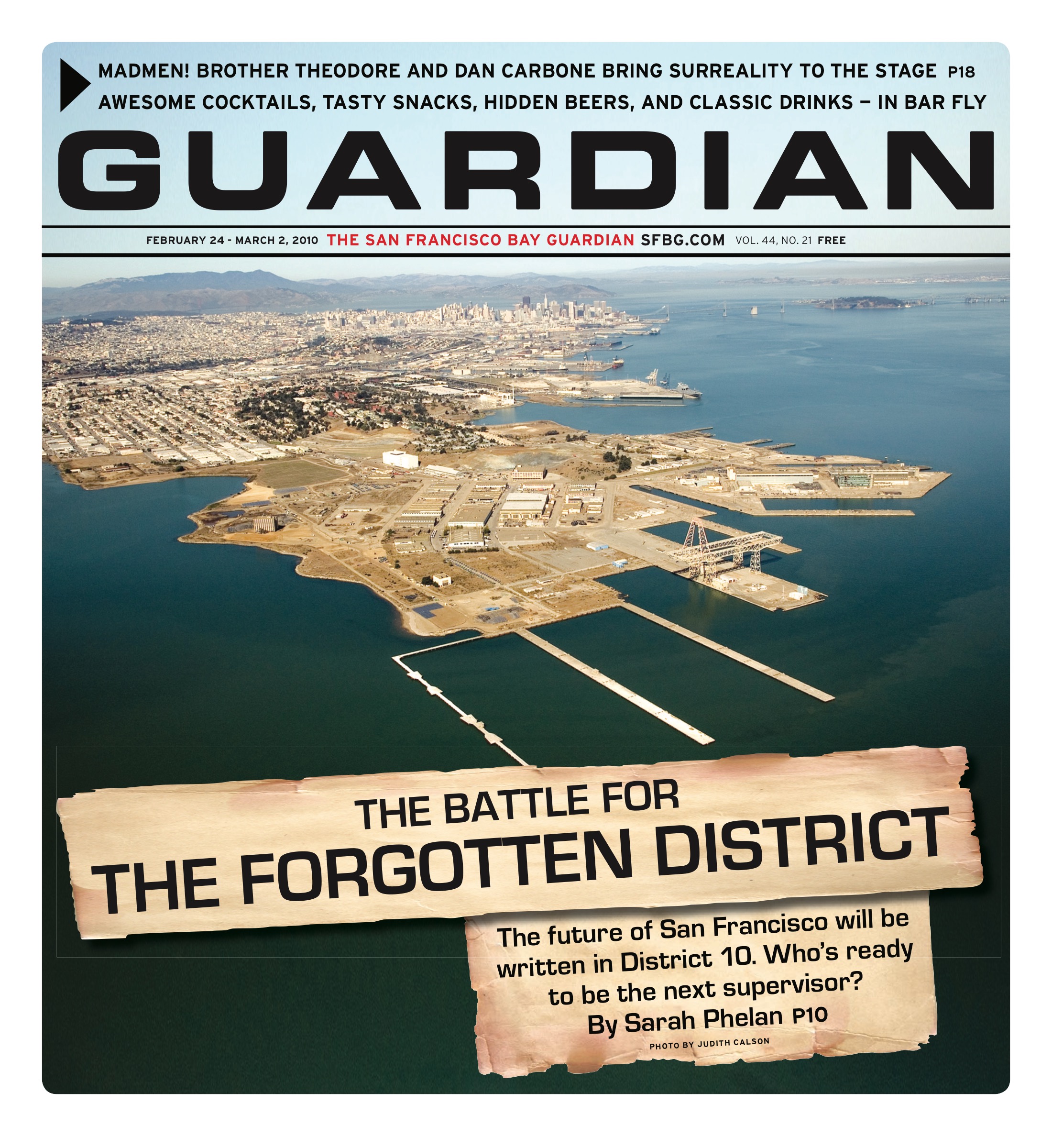
The battle for the forgotten district

24

sarah@sfbg.com

This November, when voters in District 10 — the largest, sunniest, and most diverse of the city’s 11 supervisorial districts — replace termed out Sup. Sophie Maxwell, they’ll be making a selection that could have pivotal implications for the entire city.

That’s because the next supervisor from southeast San Francisco inherits a district that is home to some of the city’s biggest environmental and public health challenges, as well as the most potential for development that will determine what kind of city San Francisco becomes.

District 10 is where you’ll find the most polluted and most underdeveloped lands in San Francisco, areas that could either be transformed into models of a sustainability or, in the words of Tony Kelly, the president of Potrero Boosters Neighborhood Association, “be turned into a toxic Foster City.”

District 10 is where the slaughterhouses, tanneries, and glue factories set up shop and used the bay as a dumping ground. It’s where the smokestacks of coal and oil fired power plants polluted the air. It’s where the Navy filled the Bay, built a shipyard at Hunters Point and loaded parts of the first atomic bomb onto the USS Indianapolis in 1945.

District 10 is where the bottom fell out of this industrial economy in 1974, when the Navy left, taking with it people’s jobs, pay, and hopes for a home of their own and a better future, particularly for what was then a predominantly African American population.

And District 10 is ground zero for plans that will triple the population and double the number of homes — homes that likely will only be “affordable” to Google executives and retirees from Marin, forever changing the face of San Francisco’s southeast sector. Critics fear that will accelerate what has been a steady exodus of black residents, replaced by megadeveloper Lennar’s vision for a new D10.

It’s against this dark history and difficult present that a wide open field of more than a dozen candidates are vying to replace Maxwell, who came to power in 2000 and has had a mixed voting record in her decade on the board. Sometimes, Maxwell was the eighth vote that let the progressive majority on the Board override Mayor Gavin Newsom’s veto and pass trailblazing legislation. Other times, she was the swing vote that allowed the moderate minority to carry Newsom’s water.

So, in addition to D10’s many internal challenges, this seat could determine the political balance of power on the Board of Supervisors, placing all the more importance on voters in this long-marginalized part of town.


DISTRICT OF DISCONTENT

Eric Smith, a biodiesel activist who has thrown his hat in the D10 ring, says that there is a lot of frustration in the air, and looking at the problems the district is facing, it’s hardly surprising that it has what nearly every candidate agrees is a fractured political culture.

“The Bayview, the Hunters Point Shipyard’s toxic Superfund site, the homicide rate, unemployment, poor public transportation, dwindling services and community resources have made D10 one of the city’s largest melting pots of discontent,” Smith said.

Smith’s words were spoken while the Elections Department was verifying signatures earlier this month on a second failed effort to qualify a petition to recall Maxwell.

Bayview resident and D10 candidate Marie Franklin didn’t support the attempt to recall Maxwell, but she understood it as “a frustration movement.”

“People are sinking in the sand, we’ve already lost so many of them, and they felt Sophie wasn’t doing anything for them,” said Franklin, who praised Maxwell for helping get Franklin’s apartment building complex renovated — a job that was completed 18 months ago, at a cost of $65 million, creating 500 local jobs.

“There are 654 units here, and they were uninhabitable,” Franklin said. “There was black mold, rain falling inside. We had people living worse than Haiti.”

Franklin, who said she is running because she “knows the history,” came here in 1978, when she and her son were living in a car after a fire left them homeless. She said the Bayview was a totally isolated area, barely part of mainstream San Francisco.

“There were no taxis, no services,” she recalled. “Nobody would come here, it was the stigmatized area where no one was accountable to provide services.”

The Bayview — which in some ways is the heart of D-!0 — wasn’t always a black community. But African Americans have been living here for 70 years, dealing with all the racism, denial of services, poverty, and pollution. And it bothers Franklin that 85 percent of the 10,500 homes that Lennar plans to develop won’t be affordable to the elderly, disabled, unemployed and low-income people who currently live in the Bayview.

“We need to preserve the diversity of the community and make sure their issues and information will flow to City Hall,” she said. “You must give the people a handle. If you don’t reach out, they’ll slip. That’s why folks out migrated.

Whoever succeeds Maxwell will be a central player in addressing some very big and dirty issues: the future of the Navy’s radiologically impacted shipyard at Hunters Point, Lennar’s massive redevelopment plan for the Shipyard and Candlestick Point, the polluting power plants, replacement of stinky digesters at the sewage plant, and the SF Hope public lousing rebuild.

There’s also the chance to address violence and crime. James Calloway, a candidate who has long worked in Bay Area schools, told us he believes that education and jobs are part of the keys to rejuvenating the district.

“Job opportunities are not as plentiful in the district,” Calloway said. “When I was a kid, you could walk down Third Street at 2 a.m. Now I wouldn’t walk down it at 9 p.m., and I know the area.”

Calloway is hopeful that the massive redevelopment plan, if done correctly, could start the district’s comeback. “Not a lot of black folks stay here when they have extensive education,” he said. “But it’s not only them. Many were displaced by redevelopment and had no way to go back.”


ELECTION UP FOR GRABS

The largest of the city’s 11 electoral districts, D10 is a huge triangular piece of land in the city’s southeast sector that was used as an industrial dumping zone for decades. Today, the district runs from the Giants stadium at AT&T Park to the 49ers stadium at Candlestick Point and encompasses Mission Bay, Potrero Hill, Dogpatch, India Basin, Portola, Little Hollywood, and Visitacion Valley. It’s also crossed by two freeways that isolate it from the rest of the city, and is home to a large number of crumbling housing projects that are in the process of being rebuilt.

Candidate Ed Donaldson grew up in the projects until he was 10 years old, when the Redevelopment Agency kicked his family out in the 1970s. “We landed on our feet, but others weren’t so lucky,” said Donaldson, who works as a housing counseling director at the San Francisco Housing Development Corporation.

“There is a sense that the Bayview and Visitacion Valley have not been included within the San Francisco family,” Donaldson said. “There is a sense of being forgotten.”

In 2007, Donaldson co-founded the Osiris Coalition to tackle the city’s dormant Certificate of Preference program, in which the Redevelopment Agency issued a document to displaced residents and businesses in the 1960s promising that they could return.

He also tried to rescue some 700 foreclosed properties and recycle them as affordable housing stock. And now he is trying to prevent the city from bulldozing seven SF Hope projects without guaranteeing residents that they have right to remain.

In 2007, Mayor Gavin Newsom and Maxwell convened an African American Outmigration Task Force that didn’t get a public hearing about its findings until August 2008. The timing angered some, who questioned why the report’s findings and implications for urban planning weren’t released before June 2008, when the residents of San Francisco voted for the Lennar-led Proposition G, a proposal to build 10,000 market rate homes at one of San Francisco’s last remaining black communities, which Newsom and Maxwell endorsed.

The taskforce didn’t publish its recommendations until the end of 2009, allegedly because of insider squabbling. Meanwhile, gentrification was going on actively, and many blamed Newsom, and by extension Maxwell, for failing to do anything with the group’s findings as D10 residents continued to suffer from high rates of asthma, cancer, unemployment and an ongoing black exodus.

It wasn’t always this way. In the 1940s, the district’s black population exploded when migrants from the south and World War II veterans came to work at the Hunters Point Naval Shipyard. Some moved to Alice Griffith Public Housing complex, or Double Rock, which was built as military housing in 1962. Others relocated to the Bayview when the Redevelopment Agency took over the Fillmore/Western Addition in the ’60s and ’70s as part of a controversial urban renewal effort.

But when the Navy abandoned the shipyard in 1974, unemployment hit the black community hard. Today, hundreds of the city’s lowest income residents live in Alice Griffith’s crumbling units and endure sewage backups, no heat, cloudy drinking water and leaking ceilings, as they wait for the projects to be rebuilt.

“Generations have been trapped in the silo of public housing and cannot get out, because of lack of opportunity and education, so when we legislate, we need to take that into consideration,” said candidate Malia Cohen, whose grandfather came from Texas to work at the shipyard where he met her grandmother, whose family came from New Orleans.

“My grandfather’s father was a longshoreman. He worked with the infamous Leroy King [a commissioner at the city’s Redevelopment Agency] and he has fantastically vivid stories of racism,” said Cohen, who works for the Federal Reserve Bank of San Francisco, previously served on the executive staff of Mayor Gavin Newsom, and has already raised over $18,000 in the D10 race and qualified for public matching funds.

“My family came here to work hard, they lived on Navy road in the projects, and then they bought a house here. My parents were born here, and we were all public schooled,” Cohen recalled as she took me on a tour of D10 that ended up in Visitacion Valley, an increasingly Chinese-American neighborhood that reflects a district-wide trend.

Census data show that by 2000, Asians were the largest racial group in the district (30 percent), followed by blacks (29 percent), whites (26 percent), and Latinos (19 percent). By 2003, according to the California Urban Issues project, the trend continued. Asians were the largest racial group (32 percent), followed by blacks (27 percent), whites (21 percent) and Latinos (17 percent) of the population.

This means that D10 candidates will have to garner support from more than one ethnic group to win. Over a dozen candidates have already filed papers in the race, but so far there is no clear front-runner.

Also frustrating the prognosticators is that fact that D10 has had the lowest voter turnout in the city, so the winner will also depend on who goes to the polls.

D10 candidate Geoffrea Morris, who is the grand daughter of longtime Bayview activist Charlie Walker, has been knocking on doors and participating in voter registration drives.

“We need new blood,” Morris said

Getting elected will be a complicated equation. Although Bayview’s population was 50 percent African American at the time of the 2000 census, it didn’t turn out the vote. In the 2006 election, only 14,000 of the district’s 37,000 registered voters went to the ballot, and 50 percent were from whiter, richer, and more Asian neighborhoods.

“It’s very important to the future of the city that the ethnicity diversity of the board be maintained and that the African American community have representation,” former Board President and current Democratic Party chair Aaron Peskin told the Guardian.

Maxwell recently told the Guardian that she’s not ready to endorse any D10 candidates yet. “I’m waiting for people to have a better understanding of what this community is, what the common thread running through it is, and how to use rank choice voting,” she told us.

The only candidate who currently holds elected office is BART director Lynette Sweet, who had her answers down pat when we reached her by phone, and even used wording that was eerily similar to Maxwell’s words.

“D10 is a pretty diverse district, but there is only one common thread: the need for economic development,” Sweet told me. “That’s true in Potrero Hill, Portola, Dog Patch and the Bayview. It’s the same mantra: a lot of small businesses need help, and the only way to help them is through economic development. In Potrero Hill it’s about land use. In the Bayview, it’s about the shipyard and better transportation and truancies.”


THE COMMON THREAD

District 10 is ground zero for the Lennar’s $2.2 billion plan to develop 10,500 market rate condos at the Shipyard and Candlestick Point. The plan will allegedly create thousands of jobs and new parks, deliver on an historic community benefits agreement that labor groups claim is so “lawyered up” that the developer can’t renege on its promises.

The package is framed as the one and only way to revitalize the southeast’s formerly vibrant economic engine. Indeed, any time anyone tries to slow down the process—to take time to thoroughly read the draft EIR and see if it adequately addresses the impacts of this massive urban reengineering project — a chorus of “no delays” starts up, either from residents of the housing projects desperate to see their homes rebuilt, or the labor contractors who hope to get jobs.

“It’s as if the city is playing checkers, while Lennar is playing three-dimensional chess,” Eric Smith observed.

Lennar has stated that it will contribute $711 million to finance this massive project. The remainder will be leveraged by Mello-Roos bonds, state taxes based on the use and size of a property and intended to raise money for needed services, and tax increment financing, which creates funding for projects by borrowing against future property tax revenues.

The conceptual plan won Maxwell’s backing but environmental groups are critical of the draft EIR.

During DEIR hearing, environmentalists questioned the wisdom and the cost of filling the Bay to build a bridge over Yosemite Slough, and building condos on Candlestick Point state recreation area, the only open major open space in the district.

But the city’s Planning Department also has 20,000-30,000 units of housing in its pipeline. This means that if all these plans get approved in the next decade, they’d account for 80 percent of residential development citywide. And D10’s population could triple, further skewing the district’s already shifting demographics.

In other words, D10 as we know it could become nothing more than a historic relic in a few years, and the next supervisor will play a key role in deciding whether that happens. SFHDC’s Ed Donaldson warns that any supervisor who does not understand the complexity of the city’s largest district can expect a similar recall backlash in future.

“There is no one homogenous voice in the community,” Donaldson said. “The grass-roots organizing that brought about the recall effort was a result of a changing political structure in the area, but is not yet on par with other districts in town. We still allow our politics to be controlled from downtown.”

Fellow candidate Eric Smith warns that the issues—and politics—are complex.

“People were emotional, angry, and desperate because they feel no one listens to them,” Smith said. “That’s part of the problem here; they would rather have a supervisor go down swinging for them, rather than watch one seemingly side with Lennar, PG&E and the mayor on issues contrary to their interests. That’s the terrible irony and one of the biggest problems in District 10. Folks are so mad, they’re willing to do whatever it takes to make them feel they have a voice in the outcome, even if it’s potentially worse.”

Smith cited the sequence of events that culminated last year in the Navy dissolving the community-based shipyard Restoration Advisory Board (RAB), which for years has reviewed technical documents and commented on the Navy’s clean-up proposals. But in December, the Navy made its official decision to disband the RAB, citing dysfunctional behavior and off-topic discussions that got in the way.

“Some of the same folks who were frustrated by the process, tried to send a signal to the Navy that they weren’t being heard and for all their well-intentioned efforts got the RAB dissolved,” Smith said. “I truly feel for them, it’s absolutely heartbreaking, but at times, they can be their own worst enemy.”

One of the looming issues about the shipyard is that the land has been polluted and needs to be cleaned. The shipyard contains radioactive debris from ships towed to the shipyard, after a 90-foot wave washed over them during an atomic test gone awry. The Navy burned 610,000 gallons of radioactively contaminated ship fuel at the shipyard, and workers showered on the shipyard, raising concerns that radioactive materials got into the drains and sewers. And questions have been raised about radiological tests on animals at the yard.


LEAKS AND FLOODS

It’s not just the shipyard that’s toxic. Even the buildings that were constructed to house workers 50 years ago are a serious mess.

Realtor Diane Wesley Smith, who grew up in public housing projects, took me on a walking tour of Alice Griffith last week to see conditions that tenants will likely have to endure until at least 2014, if the city sticks to its plan to relocate people into a new replacement unit in the same geographical area, if not the exact same site.

What we found was pretty messed up.

“The water sometimes comes out brown and feels like sand. It’s been like that for a year,” one resident said.

“The water is cloudy, the bath tub isn’t working and the sink keeps stopping up,” said another.

A woman named Silvia showed us how the water from the tap in her elderly mother’s kitchen flows out cloudy and then doesn’t settle properly, like foamy beer.

“The roof’s been leaking for years, the sewage backs up, but they just fixed the lights,” Silvia said. A neighbor named Linda was using her oven as a heater.

“The toilet backs up a lot, and my grandson’s been coughing a lot from asthma,” Linda said.

“Roaches is always a problem,” said a woman named Stormi, dressed in black sweats and a black T-shirt that read, “Can’t knock the hustle.”

“They’re trying,” said Stormi, a member of the Alice Griffith Residents Association, as a couple of Housing Authority trucks pulled up to do repairs.

“They promise that you will not have to leave your unit, but if they try to move us down to the waterfront, well, there’s a reason there’s no housing there, and it’s because the land will flood,” Stormi said.

“If we don’t end up at the table, we’ll end up on the menu,” Wesley Smith warned, as she stopped to chat with a group of young men, who were worried they would pushed out of the Alice Griffith rebuild through the criteria being established.

“Fred Blackwell, the executive director of the Redevelopment Agency, assures me that’s not the case, but Alice Griffith is a Housing Authority property, and empty promises have the potential to be great promises provided they are made in writing,” Wesley Smith said as we walked out of the projects and onto the road where a yellow and black sign announced “flooded” next to Candlestick Point park, where Lennar wants to build.

Malia Cohen expressed concern about Hope SF residents, as we drove through the Sunnydale housing project.

“We have to be diligent and mindful that people are not pushed out,” Cohen said, noting the sweeping views at Gleneagles golf course above Sunnydale, and the value of housing for a golf course community. “When public housing gets taken offline, we must work with Redevelopment and the Housing Authority to make sure no one is changing the rules halfway. We have to make sure the talks and walks line up. We need to be equal partners. We cannot be bulldozed by City Hall.”

Geoffrea Morris is a Calworks employee, at the Southeast Community College facility on Oakdale, which was built to mitigate the city’s expansion of the sewage plant in 1987. She cited concerns about the literacy levels of people who live in the 2200 public housing units that cluster D10. “A lot of people in Alice Griffith don’t even know the dates or when it’s going to be reconstructed,” Morris said. “Folks like to be told stuff like that, but the city gives you a stack of papers. Some will read them, but others rely on folks they think are trustworthy. They need stuff in layman’s terms written on one sheet of paper.”

Morris is a fan of the Internet who posted a community survey online, and made sure every housing project got some literature telling people to get informed. She worries about the digital divide in D10:

“A lot of folks don’t have computers and access to important information,” Morris said. “And let’s talk about the way ‘affordable’ is used to trick people.”

Michael Cohen, Newsom’s top economic adviser, recently stated in a memo that over the expected 15-20 year phased build out, Lennar’s Candlestick-Shipyard development would include, “up to 10,500 residential units, about 32 percent of which (3,345) will be offered at below market rates.”

“But 892 units of this ‘affordable category’ will be sold to folks earning $100,000,” Morris said. “So if you subtract 892 units from affordable unit category, you’re back to 25 percent affordable.”

Candidate Kristine Enea, an attorney and a former RAB member, chairs the India Basin Neighborhood Association, which administers a US EPA grant to hire experts to translate the Navy’s cleanup documents into plain English and comment on them She was frustrated by the Navy’s decision to dissolve the RAB.

“The lack of a forum does nothing to bolster the community’s trust in the cleanup or the redevelopment process,” Enea said.

Enea generally supports the Lennar project, but has concerns about whether it will adequately mitigate increased car traffic, or result in commercial development that benefits her neighborhood.

“India basin is a pocket of Hunters Point right along the shoreline,” Enea said. “Right now, we have no shops or restaurants, no ATM, no groceries, nothing beyond one liquor store and a few industrial businesses.

Potrero Boosters president Tony Kelly told us that District 10 residents can think for themselves. “D10 residents don’t need to rely on corporations to solve their problems,” he said.

“Folks in the eastern neighborhoods came up with a better revitalization plan than what the city proposed and community activists managed to close the power plant, after the city said it was impossible,” Kelly recalled.

And there’s no shortage of good ideas.

Kelly suggested that an urban agriculture center could immediately put low-skilled folks to work by erecting greenhouses on unused land. Smith said the industrial zone could be “incredible eco-park made from sustainable sources.

‘D 10 is the dumping ground for everything, including all the city’s waste,” he said. “We could be a shining example, not just for D 10, but the rest of the state.”

The D 10 candidate line up includes Calloway, Cohen, Donaldson, Smith, Enea: civil rights attorney Dewitt Lacy, Morris, Potrero View publisher Steve Moss; District 7 BART director Lynette Sweet, Wesley-Smith. Bill Barnes, who works for Sup. Michela Alioto-Pier, and Linda Richardson, who was appointed to the Human Rights Commission in 2007 by Mayor Newsom, have also expressed interest in the race.

In such a huge field, name identification will play a major role. Sweet is in office, but BART Board is not a high-profile job and won’t give her a huge advantage.

Cohen has a slight edge right now in that she’s raised $18,505, including $500 from former Newsom flak Peter Ragone, making her the first D. 10 candidate to qualify for campaign financing. The oldest of five girls, Cohen recalls how her mother got laid off from her city job as a school-based mental health worker and then rehired, as part of the city’s budget cuts.

“We felt that pinch and the frustrating games that are played out between the leadership and the rank and file,” she said.

Cohen who worked for Newsom in his first term as mayor, but has since left his administration , said she is uncomfortable at being framed as Newsom’s candidate.

“Because I’m not, but I am one of the few candidates who has seen how the mayor and the Board work—and don’t work—together,” she said.

Moss sees the city’s southeast as a “district in transition.” Over coffee at Farley’s in Potrero Hill, he told me that the southeastern neighborhoods could be “launching pads for environmentally sustainable growth.”

“The district’s been in a frozen period for 30 years, But despite the problems, people are deeply committed to and in love with their community.

“This district is the future of San Francisco and its social fabric—the diversity, income –and its problems are leftovers from the city’s industrial age.”


DISTRICT 10, BY THE NUMBERS

Total Acres: 5,650

Average household income: $85,000

Population: 73,000

Registered voters: 37,700

Average housing price: $335,000

Ethnicity (2003 figures): Asian 32%, African American, 27%, white 21%, Hispanic 17%

Development status of land: 18% residential, 38% is commercial, 38% undevelopable

All figures the latest available. Sources: SFGIS, Association of Bay Area Governments, U.S. Census, California Urban Issues Project. Ethnicity and income data is from 2003 and almost certainly has changed.

The attack on the SF left

20

If I were a political consultant hired by the San Francisco Chamber of Commerce and the big developers and the landlords and Mayor Newsom, and my job was to launch an effective attack on the progressive movement in the city and undermine progressive control of the Board of Supervisors, here’s what I’d do:


1. I’d attack district elections. See, every time the downtown folks have tried to run candidates in swing districts under the existing system, they’ve lost. That’s in part because the business types can’t seem to find decent candidates, and part because money doesn’t rule in districts, so progressives who can mobilize at the grassroots level have a better chance.


So when you can’t win the game you try to change the rules. You can’t do it too directly, because the polls show that people like having district supervisors, so I’d come up with a “hybrid” plan — say, seven districts and four at-large supervisors. Since anyone who runs at large in this city needs gobs of campaign cash, that would pretty much guarantee that four board members would be accountable to downtown. Then draw the districts to create two moderate-conservative seats, and the progressives have lost control.


I’d launch this by planting stories in the San Francisco Chronicle about a “growing movement” to change the way the supervisors are elected — even thought there is no real grassroots movement.


But that creates the appearance that’s needed to begin raising money and preparing for a ballot initiative. It’s not hard to get the Chron to bit on something like this; C.W. Nevius, the local columnist who lives in the East Bay suburbs, never liked district elections, so he’ll play along and the Chron’s corporate ownership, which is close to the Chamber folks, never liked the system either. You can expect an editorial from the Chronicle Feb. 28th calling for a partial repeal of district elections.


The argument won’t have anything to do with the fact that the Chron doesn’t like the policies this particular board has passed; it will be all about the need for a “citywide perspective.” Now, that’s just horseshit, since the district boards have done an immense amount of work on citywide issues (like mininum wage and health care) that the at-large boards would never do.


But “citywide perspective” is a term that’s been focus-group tested and sounds good.


2. I’d look for a nice wedge issue for the November elections — something that could be used against progressives in swing districts. When Newsom ran for mayor the first time, he used “care Not Cash” — a well-funded attack on homeless people.


And gee, guess what? There’s another nice anti-homeless measure that’s recently been floating around, and it comes from the media-savvy police chief, George Gascon. It’s called a “sit-lie” law — legislation that would criminize the act of sitting on the sidewalk. It’s got a lot of populist zing to is, particularly since Gascon is talking about the need to clean up Haight Street, where some ill-behaved young people have been bothering the merchants and shoppers.


A November ballot initiative on a sit-lie law would allow downtown to raise a lot of money — and attack people like Rafael Mandelman and Debra Walker, candidates for supervisor in districts where a simplistic attack on the homeless might play. 


3. I’d try to split the city’s labor movement and drive labor away from the progressives. The obvious tactic: Construction jobs. I’d get every construction trade union member to campaign in District 10 for a supervisor who will support Lennar Corp.’s redevelopment project, and I’d attack any supervisor or candidate who supports limits on, say, buildings that shadow the parks and call them anti-jobs.


4. I’d launch a quiet effort to raise a big chunk of money to push pro-downtown candidates for the Democratic County Central Committee. The DCCC used to be something of a political backwater, but under progressive control, it’s become a significant force in local elections. The DCCC controls the local Democratic Party endorsements and money — which can be a big factor in district supervisorial races.


Now: I have no evidence that any individual consultant has created any such plan — but it’s sure an interesting coincidence, isn’t it?


What I see right now is a coordinated, orchestrated attack on the left — and I’m getting a little nervous that our current leadership on the Board of Supervisors isn’t doing enough about it.


Loose in Obamalandia: Dead man walking through CA

1

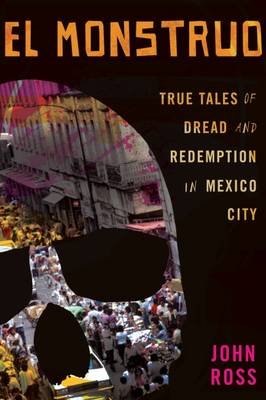
I am on a low-rent book tour with my new cult classic El Monstruo – Dread & Redemption In Mexico City.  For the next three months, I will stumble across this land from sea to stinking sea probing the underbelly of Obama’s America.  The findings will be posted on these pages.

1.
First stop was the near north woods, Humboldt County USA, to wheedle the medicos into granting me a clean bill of health before I hit the road.  A year ago this February, my doctor who has poked and probed my old broken cadaver for nearly 20 years, pronounced me dead. “Liver Cancer” he parsed gravely — but I am still alive and kicking. The class enemy be warned: I am not dead yet.

Humboldt had just been wracked by a 6.5 earthquake that cut a swath through Oldtown Eureka’s antique shops but was not quite Haiti.  Nonetheless, the shake-up worked its usual bad mojo and implanted the seeds of fear and loathing in every soul.  On January 22nd, three separate police agencies shut down the north end of Arcata and evacuated hundreds of residents after a scruffy hippie-type tried to fed ex a suspicious package to Berkeley that leaked, according to the clerk at Kinko’s, “a chemical odor.” The offending package was blown up in a back alley.

The next day, the local rag commonly known as the Times-Slander conceded in front-page headlines that the “bomb” was “Actually a brake light.” The paranoia was symptomatic.  A commercial jetliner to Kentucky was forced down by air force jet fighters after an orthodox Jewish kid pulled out his Tefillin to pray and, in a spasm of extreme religious irony, the panicked stewardess took him for some Muslim terrorist and confused the leather straps and little prayer boxes with bomb components that would blow the paying customers to kingdom come. 

Nine years ago, just weeks after 9/11, I got on the road to preach Zapatismo to the North Americanos. Flags flew from every home, a sort of Talisman against the terrorist devils.  It was not a healthy ambiance for spreading revolution and resistance in Amerikkka.  Prospects for the Monster Tour suddenly turned ominous.

2.  
San Francisco’s Mission District gets shabbier day by day as the “Great Recession” (read “Depression”) gallops towards economic Armageddon. The Miracle Mile is lined with empty storefronts and 98 Cent Stores (marked down from 99.)  The homeless sleep under their shopping carts – the Mission Local reports that 40 homeless families are living in 16th Street Single Room Occupancy hotels, twice the occupancy rate of a year ago.  In this Sanctuary City for the rich, the yuppie Mayor, who now aspires to be nothing more than a yuppie clerk in a yuppie wine store, is deporting undocumented teenagers convicted of no crime and the class divide seems more brutal than ever.

We posted up on Market Street in front of the Commonwealth Club, where torture enabler John Yoo was hawking his new book to the City’s elite. Financial District drones en route back to the ‘burbs asked Yoo Who?
I checked my watch.  It was time to hit the rails.

3.
The Central Valley was the first stop on the Monster Tour, the most deadly stretch of soil in North American California. The water plumes are all poisoned by agrochemicals and when one turns on the faucet on the west side of the valley, deformed babies pop out. 

This cesspool of chemical effluvia is populated by perhaps the most ethnically diverse crazyquilt in all of Obama’s America.  Anglo bigwigs and white Armenians rule the roost but down below Mixteco is spoken on the radio, communicating the bad news to the out-of-work Oaxacans who once toiled in the fields and packing sheds. The humongous Hmung community is up in arms over the FBI’s harassment of their spiritual leader, General Vang Pau who authorities accuse of conspiring to overthrow the doctrinaire Communist government of Laos.  Unemployed Palestinians and Pakistanis, Filipinos, white trash, and historic enclaves of Blacks, survive in this fulminating chemical stew by their wits. On every street corner, the down-at-the-heels don shabby green gowns and sagging Styrofoam Statue-of-Liberty crowns, holding up cardboard arrows pointing towards strip mall tax return scammers.

I stepped out into Catherine Campbell’s unplanted garden.  Police helicopters hovered overhead, searching out suspected gangbangers. Catherine is a veteran prison rights attorney who pays particular attention to what goes on behind bars at Corcoran and Chowchilla, two of the cruelest his & her lock-ups in the state. Recently, she put her know-how to work defending anarchists who had been beaten into the sidewalk by the Fresno pigs for handing out graphic leaflets depicting the torture of elephants during Ringling Brothers Barnum & Bailey’s annual visit to town, and she and a gaggle of advocates have been trying to keep the cops off a venerable homeless encampment. Now the City Council is seeking to felonize panhandling on Fresno’s median strips as a “safety hazard.” 

The Fresno gendarmes are particularly keen on persecuting young adults of color for alleged gang activities. An article in the Morning Bee reported on the so-called “Bulldog Gang” (the bulldog is the icon of the Fresno State football team so gang colors are readily available) whose members were accused of smashing windows and barking at the cops over on the decrepit west side.  Catherine says the bulldogs’ bark is more a growl.  Such are the sounds of hope in the second year of Obama’s lacerated reign.

Sam Stoker is a child of the Valley. One night last summer, I bought him a beer at the counter of my beloved Café La Blanca back home in the Centro Historico of Mexico City.  Sam, an acculturated Chicano, had journeyed to Mexico to connect with his family in Tamaulipas and bum around, sniffing out what was left of the 2006 rebellion in Oaxaca. When he went home to Winton near Merced, he spoke enough Spanish to delight his grandma. 

Sam is also an anarchist and a budding journalist who has been up to his neck in the struggle for justice for Oscar Grant in Oakland. Now he had come to the Valley to spread the virus of anarchism. Rebellion in the fields could bring California to its knees, he confided. I was only too happy to help out. 

Anarchism has a beachhead in Fresno at the Infoshop where 70 folks turned out to hear me preach revolution. Not all of the fellow workers were young punks. One gentleman in attendance told me he had been an organizer for Cuauhtemoc Cardenas’s foiled presidential campaign in 1988 in Sinaloa and fled Mexico when dozens of his companeros were gunned down by the mal gobierno.  He was still here, still waiting for the revolution. 

Over in Merced, I shouted out my poems in a long dark bar, The Partisan, on Superbowl Sunday.  A “digital remix” of Guy Debord’s “Society of The Spectacle ” preceded my incendiary words.  Maybe Sam Stoker’s pipedream is not as wacky as it sounds.

4.
So it was goodbye to Fresno and hello to Hollywood. I accessed the City of Fallen Angels over the Grapevine with a pit stop at Bob Hope airport and a bar in Santa Monica to watch the Lakers kick booty. My gigs were spread out all over this pedestrian unfriendly megalopolis and the signs of hard times were hard to avoid.  On the beach in Santa Monica, excruciatingly gaunt old men jogged against debilitating cancers and aging hippies scoured the sands with metal detectors for spare change.

Even out in ritzy Claremont, where I hobnobbed with a Palestinian restaurateur about the Nakba, Obama’s America seemed out of synch.  A student at Pomona College where I spieled had just been handcuffed and interrogated by transit security cops in Philadelphia for transporting 200 Arabic-English flashcards across state lines and some cad ripped off my cane down at the train station.  The Inland Empire, which abuts this restricted enclave, has the fifth highest mortgage foreclosure rates in the nation.

In Hollywood, where I spent a night on my favorite sofa, the glitz was tempered by the homeless with all their possessions piled high atop their shopping carts around the new Metro station. How many of them were out-of-work script doctors is not yet known.

Down in South Central, where anger is endemic, I spoke to a handful of Afro-Americans at Eso Won, an admirable black bookstore. The proprietor sported a prototypical pork pie hat and told me that when he sees the Mexicans coming over the border, he sees black people. We talked animatedly for a few hours about Afro-Mexicans who were a third of the population of Mexico at liberation from Spain in 1810 and whose history has been pointedly ignored south of the border.             

L.A. is gearing up for the trial of killer BART cop Johannes Mehserle, Oscar Grant’s assassin, that will be held in the same court house where O.J. won acquittal — if it’s not moved to Ensenada, taking a cue from outgoing Governor Terminator’s plan to build California prisons south of the border.

Students at Cal State L.A., the most Chicano university in Califas, honed in attentively when I expounded on the revolution that is brewing down south.  1810-1910-2010 – every hundred years on the tenth year of the century, Mexico explodes in violent social upheaval and even the Wall Street Journal is worried (see WSJ front pager January 15th.)

Looking at Obamalandia through the eyes of students is a useful handle for understanding what comes next.  Classes and services have been bludgeoned by budget cuts and the profs at Cal State furlough one day a week to make ends meet in this damaged economy that the President lies is booming again because only a half a million workers filed first time unemployment claims last month.  The light at the end of the tunnel is a bullet train pointed straight at the heart of the people.

All of this bad news is healthy for fightback.  The day I hit El Ley, Muslim students at U.C.-Irvine rose up against the Israeli consul ten times in a single speech until the university president sicced the campus cops on them. The next day a whole coast away, kids at Georgetown shouted down General Betrayus. Throw in the cutbacks and the furloughs and the hopelessness and it could be a long, hot spring semester and it won’t be just because of global warming.  I will do my best to fan the flames as I stumble front one campus to the next in the coming months.

On my last days in the late great golden state, I slept in a yoga house under a colorful banner of Ganesh, the elephant guy who gets fat eating others’ obstacles.  Lets hope he’s on my side. A year ago I was sentenced to death and although I’m still kicking, the future is laced with sharpened punji sticks, not the least of which incubates on my liver.

Talking truth to power is still the best medicine to beat back Nuestra Senora Santa Muerte.

John Ross and The Monstruo will be visiting the Narciso Martinez Cultural Center in the heart of the Rio Grande Valley Sat. Feb 20th. The Monster Tour plays El Paso, Las Cruces, and Albuquerque from Feb. 21st-28th.  Consult the Nation Books page for details or write johnross@igc.org

Sitting boundaries

0

Aggressive lobbying efforts by the San Francisco Police Department and some of its allies who are pushing a proposed sit/lie ordinance have irked some current and former members of the Board of Supervisors.

The legislation was privately created by new Police Chief George Gascón and then played up in the mainstream media. It would make it illegal to sit or lie down on public sidewalks. Supporters say it would make it easier for cops to target people who harass neighborhood residents.

But in other cities where similar laws have been passed, protests have erupted from homeless-advocacy organizations and civil liberties groups, which say criminalizing this behavior unfairly (and unconstitutionally) targets homeless people who have nowhere else to go.

In Portland, Ore., a similar law was enacted then overturned by the courts. In Los Angeles, an ordinance against sleeping on the sidewalk was challenged by the American Civil Liberties Union, resulting in the 9th Circuit Court of Appeals ruling in 2006 that unless adequate shelter is available for homeless people in L.A., arresting them for sleeping on the sidewalk amounted to cruel and unusual punishment.

But an e-mail action alert included in SFPD Central Station Capt. Anna Brown’s monthly community newsletter encouraged people to contact the mayor and the Board of Supervisors to support the creation of a sit/lie ordinance. “Naturally, there is resistance from the left-leaning Board of Supervisors who feel this is an attack on the homeless population,” it noted.

That unusually overt political plea caught the eye of Aaron Peskin, former president of the Board of Supervisors and current chair of the San Francisco Democratic Party, who called it “funky.” Peskin told us he’d never seen an advocacy pitch like this go out in a captain’s newsletter before, and he questioned whether this was an appropriate use of city resources.

But the City Attorney’s Office says this doesn’t fall under city laws banning electioneering by city employees, who are barred from using government resources to endorse a candidate or ballot initiative, or from doing any campaign-related work on city property.

Yet this kind of pitch “is not considered political activity,” Jack Song, a spokesperson for City Attorney Dennis Herrera, told the Guardian.

But Sup. David Campos, a former police commissioner, frowned upon it nonetheless. “Something like this is not really helpful to the Board of Supervisors and the Police Department working together,” Campos said.

Sup. Ross Mirkarimi took a similar view. At a recent Board of Supervisors meeting, he requested a hearing about the ordinance because he said the media-driven public debate had occurred without formal discussion. Anti-loitering and public nuisance laws are already on the books, Mirkarimi pointed out.

“What makes those laws inadequate?” he asked. “How would the proposed law augment what is already in effect?”

The alert wasn’t actually written by Capt. Brown, who included it in her newsletter. It was drafted by the Community Leadership Alliance, an organization headed by David Villa-Lobos, a longtime resident of the Tenderloin and a candidate for the District 6 Supervisor seat.

Since Gascón floated the idea of creating a sit/lie ordinance, CLA has kicked into high gear to mobilize support, most recently issuing its action alert e-mail to 8,000 recipients. Police captains were included in the e-mail blast, Villa-Lobos told us, but each captain decides independently what to include in his or her newsletter.

People sitting and lying on sidewalks is “a really, really big problem, especially in the crime-ridden areas,” Villa-Lobos said. “God bless the homeless, but it’s a big problem there too.” Several years ago, his organization tried to mount a campaign for a sit/lie ordinance, but it didn’t go anywhere. “People came out and said we were trying to violate civil rights,” he said.

The Community Leadership Alliance is active in the Tenderloin, SoMa, and the mid-Market Street area, and the group occasionally holds monthly meetings at the Infusion Lounge, an upscale nightclub owned by Scott Caroen, the chair of the organization.

Gascón worked with deputy city attorneys to draft the ordinance and all district police stations have submitted to their commanders a list of areas that they feel could benefit from the law, according to a Tenderloin district newsletter. Mirkarimi told the Guardian that some supervisors were kept in the dark for weeks about the fact that an ordinance had been drafted. “This wasn’t collaborative at all,” Mirkarimi told us. “We never received it until we demanded to see it.”

The Haight-Ashbury, where residents and visitors have been complaining about harassment from wayward traveling youth, has been ground zero for discussion about a sit/lie ordinance. A small group of irate residents there and the Park Station Capt. Teresa Barrett have rallied in support of the law, saying it would give police a new tool to target these disruptive street kids.

But it’s clear that the ordinance’s supporters want to see it applied broadly and to be used to roust the homeless in neighborhoods throughout the city.

“CLA feels that our sidewalks should be enjoyable and a place of social gathering, and that the ordinance could go a long way in helping our neighborhoods feel safer,” reads the Community Leadership Alliance alert that was included in the police captain’s newsletter. “It may also reduce the overall homeless population in San Francisco by discouraging people from coming to the city to beg for money.”

Newsom and O’Reilly celebrate conservatism

0

By Steven T. Jones

Anyone who still thinks that Mayor Gavin Newsom is a liberal who has been unfairly maligned by the Bay Guardian and other wild-eyed San Francisco lefties should watch his appearance on Bill O’Reilly’s Fox News show last night, in which Newsom praises O’Reilly (a right-wing reactionary if there ever was one) as a political moderate, correctly calls himself an economic conservative, and said he watches O’Reilly’s show every night and agrees with much of what he hears.

While Newsom meekly disagrees with O’Reilly’s ridiculous main premise that the situation in Sacramento and San Francisco proves that “liberal governance just don’t work,” he spends far more time agreeing with O’Reilly than challenging any of O’Reilly’s ludicrous and inaccurate assertions.

For example, O’Reilly blames California’s fiscal mess on liberals (actually, the main problem is our Republican governor and a two-thirds budget vote threshold that has let conservatives hold the state hostage) and casts San Francisco as increasingly overrun with homeless people and pot clubs (both of which have declined, leaving SF with just 22 licensed and well-regulated cannabis dispensaries).

Instead of defending traditional Democratic Party values (those that existed before Bill Clinton and others allowed them to be coopted by big corporations and anti-government crusaders) and his party’s current leaders, Newsom bends over backward to highlight his no-new-taxes stance and says, “We operate in a fiscally conservative manner.”

As the Chronicle reports today, San Francisco is facing a $522 million and growing budget deficit, which Newsom is only trying to increase with his proposed tax cuts and embrace of Reaganomics, while steadfastly refusing to work with others on finding new revenue sources. This is a recipe for disaster, but at least Newsom is sure to be invited back on his buddy Bill’s show, where he they can together celebrate the crash of civil society as we know it.

Haight real-estate does fine without sit-lie law

0

By Tim Redmond

The drumbeat for a law against sitting on the sidewalk continues. (And I still don’t get the point — if a cop comes up to a thuggish punk who’s sitting down, the perp is just going to stand up. Most aggressive panhandlers are standing, not sitting. The ones who will get hit by this are the old, the disabled and the homeless trying to get some sleep.)

Oh, and it’s supposed to be working really well in Berkeley. But I was on Telegraph Ave. this weekend and there were lots of people sitting on the sidewalk, pretty much everywhere, some of them panhandling, some just chilling out.

But somehow, despite all the horrible problems that are supposedly devastating the neighborhood, Haight Ashbury real estate is doing just fine, thanks.

Queer and present

0

DANCE In the middle of Keith Hennessy’s “A Queer 20th Anniversary” performances — which end this weekend with the Bay Area premiere of his 2008 Crotch (all the Joseph Beuys references in the world cannot heal the pain, confusion, regret, cruelty, betrayal, or trauma …) — the reprise of his two-part How to Die (2006) nearly filled Dance Mission Theatre. At the end of the evening, he asked for donations to help him defray a looming $5,000 deficit. Just about everyone gave.

Perhaps Hennessy didn’t mind begging. Stepping out of a persona and addressing the audience directly, after all, is part of his artistic make-up. Still, I winced. After two decades of investigating theater as a locus for truth-seeking, of innovating formal structures, of honing performance skills and creating work that is serious and thought-provoking, an artist deserves better.

Although Hennessy has a sizable, loyal audience, primarily in the queer community, his theatrically pungent work rattles everyone’s cage; injustice, poverty, violence, and hypocrisy set him off. Broadway it ain’t. Compelling — and sometimes uncomfortable — dance theater it is. You don’t have to agree with Hennessy’s perspective on sex’s redemptive power to appreciate the richness of his references, the skill with which he translates ideas to the stage, and the force of his commitment to what he does.

Hennessy is a stripper, not because he often performs in the nude, but because he tears off the blinders that protect him and us from what we don’t want to see. The question, of course, is what remains. Vulnerability for sure. But perhaps Hennessy is also a romantic, hoping to find something pure underneath all the garbage we accumulate.

In Homeless USA, part one of How to Die, he makes us look at the homeless in front of our noses. In part two, American Tweaker, he conjures up the drug-addled sexual abandon of the early 1980s. Even on second viewing, neither work was easy to watch. There is something of the fleshy rawness of a Francis Bacon canvas about them. But Hennessy also pushes theatrical verisimilitude to the point of absurdity, which allows an audience to step back from the emotional onslaught.

Homeless USA was derived from research on homeless men — many of them veterans — who commit suicide by being decapitated by passing trains. Hennessy started out gently, with Jules Beckman as a pugnacious sidekick, but turned up the heat by “masturbating” on the train tracks, and stumbling over the list of reasons to commit suicide. While “drowning” himself in a bucket, he became his own lighting designer. Attached to a string threaded through his nose, he recalled a delicate Petrouchka. In these scenes, Hennessy’s intensity — he often approaches a kind of religious fervor in his performances — was riveting.

At the core of the manic American Tweaker, a train-wreck evocation of a sex-obsessed disco and bathhouse scene, was a prolonged, extremely violent (though simulated) scene of anal intercourse. It ended with Hennessy whimpering on the floor. Addressing the audience, he confessed that at this point “I usually don’t know what to say.” Neither did I. The final healing ritual had Hennessy hanging upside down, Seth Eisen as an apparition from A Thousand and One Nights, and Beckman’s wondrous music. Rituals necessitate a community of believers. I wish I could have been one of them.

In Crotch, Hennessy draws props from his performance theory studies and (as the piece’s full title suggests) the work of the late German artist and philosopher Joseph Beuys. Among the most clearly referential are a tub of lard and a piece of felt: Beuys claimed after his Luftwaffe plane crashed on the Crimean Front in 1944, Tatar tribes people saved his life by wrapping him in lard and felt. The way Hennessy uses the lard is simultaneously freaky and profound.

CROTCH (ALL THE JOSEPH BEUYS REFERENCES IN THE WORLD CANNOT HEAL THE PAIN, CONFUSION, REGRET, CRUELTY, BETRAYAL, OR TRAUMA …)

Fri/29–Sun/31, 8 p.m., $15–$25

Dance Mission Theatre

3316 24th St, SF

www.brownpapertickets.com/event/82278

East Bay Depot finds treasure in our trash heaps

0


depot 1 0110.jpg
One man’s junk… Photo by Erik Anderson

It doesn’t bear thinking about. This tray for making heart-shaped ice cubes (50 cents), that “Tamales of the World” poster (two for $3), the pile of fabric swatches over yonder- what would have become of them if not for the East Bay Depot for Creative Reuse? The Temescal neighborhood donation center/junk store was started in 1979 by a pair of teachers as a place where educators could find cheap classroom supplies. It’s since become a mecca for the creative, the industrious and the very, very cheap. We’re talking shelves and buckets of loosely organized ephemera, priced at costs that encourage you to stock up on… whatever. Turkey basters to vintage postcards.


But East Bay Depot is more than just a thrift shopper’s wet dream. It is also the site of a massive project in trash diversion- over 200 tons a year rescued from becoming landfill muck through donations from individuals, manufacturers and businesses. They’ve even got a partnership with the Contra Costa county solid waste authority that shunts items that have been dumped curbside right into your grubby little, deal-seeking mitts.

Win-win? Actually, it’s more win-win-win. The Depot “has been approved by the Department of Defense to ship to any area that is in need of humanitarian aide,” says director Linda Levitsky. The center has sent shipments including warm used clothing and blankets to Contra Costa homeless shelters, cast-off parkas to Pakistan and job training supplies to Afghani women. Levitsky is currently in planning with Rep. Barbara Lee‘s office to ship a 24-foot trailer of shoes to Haiti. “Shoes are needed in Haiti with all the rubble. It seems like the logical thing to do,” says Levitsky.


So humor your inner pack rat and do something swell for the global community. Drop by the store this month for a recent shipment of light fixtures, garden tools and sewing equipment, including some older pieces of vintage costume flair from the 1970s and ‘80s.


East Bay Depot for Creative Reuse
4695 Telegraph, Oakland
(510) 547-6470
www.creativeresuse.org

Why foot patrols make sense

0

By Tim Redmond

I had lunch with the chief of police yesterday. George Gascon is far sharper than the past few people to occupy that office, and seems to understand the need to reach out to the news media and to people who don’t agree with him. He’s actually a pretty skilled politician — which is a bit scary to folks who think he’s going in the wrong direction

And on a lot of things, I think he is.

We talked a lot about the sit-lie law that he’s been pushing, which I wrote about this week. Gascon insisted that he doesn’t want to use the law as a way to sweep homeless people off the streets; in fact, he told me, he doesn’t want to put anyone in jail, not at first, anyway. He’s rather use the law as a tool to get the young bullies and thugs (who are, by the way, a real problem on Haight St.) into the criminal justice system, where they might get access to services that could help them change their behavior.

I don’t see it working. What I see is either (a) the troublemakers will simply stand up when the cops arrive and walk to another part of the street or (b) some will get arrested, released, arrested, released, etc. — rejecting or ignoring all possible services — then ultimately, on the fourth or fifth offense, wind up in jail.

And all of of those arrests and court hearings are expensive.

In fact, Gascon and I agreed on two central points: (1) Putting two cops on foot patrol on Haight Street, between Buena Vista Park and Golden Gate Park, 13 hours a day, would end the problem pretty quickly and (2) the cost of doing that, which he put at close to $1 million a year (a bit high, I think), is probably lower than the cost of arresting, prosecuting, defending and incarcerating the Haight bullies.

This is something to look at.

Sup. Ross Mirkarimi wants to hold a hearing on the issue, and I think he ought to ask the controller or the budget analyst to examiner the real costs: What’s the price tag of foot patrols in the Haight? What’s the cost to the district attorney, the public defender, the courts and the Sheriff’s Office of implementing a sit-lie law? And could the foot patrols be a cheaper way of solving this problem?

And whatever Gascon says about his intent, once you pass a law like this — a law making it a crime to sit or lie on the sidewalk — it’s there, on the books, ripe for abuse. Gascon won’t be the chief forever. And he has to answer to the mayor, who may want to use the law a little differently.

So before we go that route, why not try foot patrols? According to Gascon, the department can’t afford it; with a huge budget deficit and cuts on the way for every agency, spending a million bucks on Haight Street doesn’t make sense. But the supervisors should look at this citywide; spending $1 million on preventing crime with foot patrols (if that’s what it would really cost) may be a lot more cost-effective than spending $2 million arresting, prosecuting, defending, sentencing and incarcerating people.

It’s at least worth a try.

Clouds and mirrors

1

Carl Fisher turned a mosquito-plagued, malarial sandbar into Miami Beach, “The Sun and Fun Capital of The World,” in less than a decade — dredging up sea bottom to build the island paradise, an all-American Las Vegas-by-the- Sea, where Frank Sinatra and Jackie Gleason partied and Richard Nixon received two Republican nominations for president. Art Deco hotels lined the beach, bold as Cadillacs, defiant in the path of hurricanes, their confident Modern lines projecting postwar American power. Morris Lapidus, the architect of the Fontainebleau Hotel, understood that the skin-deep city Fisher conjured out of neon and sunshine was a stage for the leisure fantasies of the ruling class. When his iconic Collins Avenue hotel opened in 1954, Lapidus said he wanted to design a place “where when (people) walk in, they do feel ‘This is what I’ve dreamed of, this is what we saw in the movies.'”

For many years in Miami, that movie was Scarface, as Colombian drug lords shot it out in mall parking lots. A shiny new downtown skyline of banks and condos emerged during a recession economy from the laundered proceeds of drug smuggling. Today the cocaine cowboys have all died, or done their time and moved on. Their descendents are selling art.

Art Basel came to Miami Beach in 2002, and the rise of Miami as an international art world capital neatly coincided with the glory days of the housing bubble. According to Peter Zalewski of Condovulture.com, around 23,000 new condo units were built in and around downtown Miami during the Art Basel era — twice the amount built in the 40 previous years. The success of the international art exhibition has inspired a fever dream among city leaders, in which Miami’s skyline and neighborhoods are radically transformed by art world-related real estate development.

Cesar Pelli’s $461 million, 570,000-square-foot Carnival Center for the Performing Arts opened in 2006 in a moribund section of downtown known for its proximity to the faded 1970s-era mall, the Omni. That same year, the Miami Art Museum (MAM) hired as its new director Terence Riley, the former curator for architecture and design at the New York Museum of Modern Art. Heralded in his new city as “the Robert Moses of the new Miami millennium,” Riley initiated the development of Museum Park. This 29-acre complex would be home to new buildings for the Miami Art Museum and the Miami Museum of Science and Planetarium. It was to be built on the site of Miami’s last public waterfront park, Bicentennial Park, long a sort-of autonomous zone for Miami’s homeless residents. While the new MAM is not scheduled for completion until 2013, by 2007, a 50-floor, 200-unit luxury condo development, 10 Museum Park, had already been finished across the street.

Art Basel Miami Beach brings an estimated 40,000 people to Miami each year to look at art, party, and more important, look at celebrities as they look at art and party. The art fair, once dubbed “the planet’s highest concentration of wealth and talent,” generates an estimated $500 million in art sales each year. Yet while Miami leaders seek to present to the world Basel’s image of wealth and glamour, the iconic image of South Florida today has abruptly become the newly built and entirely empty condo development. Zalewski estimates that 40% of the condo units built since 2003 remain unsold. Florida’s foreclosure rate is the second-highest in the nation, and for the first time since World War II, people are leaving Florida faster than they are arriving. Just months before this year’s Art Basel Miami Beach, a New York Times cover story told of the lone occupant in a towering Broward County condo that had gone entirely into foreclosure. As the fair approached, I wondered: can art really save a city like Miami? Or is its reliance on art world money part of the city’s collapse?

ATLANTIS CITY

At this year’s Art Basel, the glitz was, of course, played down, what with the global economic collapse and Art Basel’s main corporate sponsor, top Swiss bank UBS, now the subject of an FBI probe on charges of helping billionaire clients evade taxes. In the weeks before the opening of the fair, it was announced that the legendary UBS free caviar tent would not be open this year. One could not help but notice that the ice sculptures on the beach itself, hallmarks of the recent boom, were gone, already as fabled as the lost city of Atlantis.

Still, the epic “Arts and Power” issue of Miami magazine hit the stands on time, luxurious full-color spreads on oversize glossy pages. Press from all over the world wrote a month’s worth of previews leading up to the event, and on the day of the VIP vernissage, TV news reporters from all continents were there to dutifully record the arrivals of billionaires, celebrities, and fashion models at the Miami Beach Convention Center. As Art Basel Miami Beach 2009 opened, the floor of the convention center was eerily quiet, with hardly a sound except a hushed, determined whisper a bit like paper money being rubbed together. It seemed to me like everyone was doing her or his part, as if the whole art fair was a sort of performance art piece demonstrating the vigor of the free market in dark times.

This murmur ceased completely, and the air filled with the muted clicking of camera shutters, as Sylvester Stallone passed me on the convention floor. Stallone, too, was stoic, his expression hidden by dark sunglasses at mid-day. He stopped next to me and began to talk to TV news cameras about his own paintings on display, presented by the gallery Gmurzynska. Close-up and in person, clumps of the actor’s face, now just inches from mine, seemed to lay inert and dead like the unfortunate globs of oil paint he had arranged on his own canvasses. Pieces of puffy cheek hung limp and jowly under taut eyebrow skin, Botox and facelifts fighting age for control. For a paparazzi flashbulb moment, I thought I saw in Rambo’s sagging face a metaphor for the doomed efforts to prop up a whole failing way of life.

The Miami Beach Convention Center’s 500,000 square feet had been blocked out into booths and concourses that comprised a pseudo-city of art. As a city, it most resembled some parts of the new Manhattan — crowded yet curiously hollowed out and lifeless, under relentless surveillance, full of nostalgia for its former, more vital self. Groundbreaking art that once had the power to shock, move, or startle — Rauschenberg’s collages, Richard Prince’s Marlboro men, Barbara Krueger’s text block barrages — were presented here as high-priced real estate. In the city of art, time stood still; Matisse, de Kooning, and Duchamp had all retired to the same street. A sailor portrayed in a 2009 life-size portrait by David Hockney seemed to gaze wistfully across the hall toward a 1981 silk-screened print of a dollar sign by Andy Warhol. The life-size portraits by Kehinde Wiley felt just like the city in summer, how the radio of every passing car seems to be blasting the same song. A print of a photo of Warhol and Basquiat together in SoHo stood catty-corner to a 1985 Warhol paining of the text, “Someone Wants To Buy Your Apartment Building.”

I wondered if this city of art offered clues as to the kind of city that developers imagined Miami might become.

ART MAUL

Across Biscayne Bay, away from Miami Beach in the city of Miami, the fever dream of art was turning a down-and-out neighborhood in the poorest city in America into an outdoor art mall. Fifteen satellite art fairs and 60 galleries staged simultaneous exhibitions in Miami during the week of Art Basel Miami Beach. Virtually all this art was crammed into about 80 square blocks north of downtown Miami, bisected by North Miami Avenue. The area included Miami’s African American ghetto, Overtown, the warehouse district of the low rent Puerto Rican neighborhood, Wynwood, and the resurgent Miami Design District up to its shifting borders with Little Haiti.

Walking up North Miami Avenue and Northwest Second Avenue the night before the exhibitions began, I could see the usually moribund main drags transforming before my eyes. Warehouses vacant the other 50 weeks of the year were hastily being turned into galleries or party spaces. Solely for Art Basel week, the Lower East Side hipster bar Max Fish had built an exact replica of its Ludlow Street digs in an Overtown storefront. In Wynwood, the paint still appeared wet on a fresh layer of murals and graffiti running up and down the streets.

The modern-day Carl Fisher most perhaps most responsible for dredging this new art world Miami up from the bottom of the sea is Craig Robins. “I transformed the image of my city from Scarface into Art Deco,” is how Robins put it when I talked to him in the Design District offices of his development firm, Dacra. Widely considered to be the person who brought Art Basel to Miami Beach, Robins is, at a youthful 46, the man who perhaps more than anyone embodies the values and tastes of a new Miami where art and real estate have become as inseparable as fun and sun. Robins takes art seriously — he is a major collector of artists like John Baldessari, Elizabeth Peyton, Rirkrit Tiravanija, and Richard Tuttle — and he made his name and fortune by restoring the derelict Art Deco motels on his native Miami Beach during the early 1990s into the international high-end tourist destination now known as South Beach. Today Robins is one of the principal owners of the warehouses in the Miami Design District and Wynwood.

With his casual dress, shaved head, and stylish Euro glasses, Robins could easily fit in as one of the German tourists who flock to the discos on the South Beach that he developed. His offices offer a rotating display of the works of art in his collection. Around the time of Art Basel, his staff had installed many works by the SoCal conceptual artist John Baldessari, in honor of Baldessari’s upcoming career retrospective at the Tate Gallery in London. Robins was friendly and projected a relaxed cool; when I’d met him on the convention center floor and asked for an interview, he gave me an affectionate shoulder squeeze and said, “Call my assistant and we’ll hang, OK?” A few days later, he grinned somewhat impishly when I sat down said, “I notice you sat in the Martin Bas chair,” as if it was a Rorschach test. Honestly, it was the only piece of furniture in the design collector’s office that looked dependably functional.

Not surprisingly, Robins was adept at explaining the art theory behind his development projects, and the ways Dacra is bringing art, design, and real estate together “to make Miami a brand name.” He said he learned from the successful preservation of historic buildings in his South Beach projects that consumers were starting to reject the cookie-cutter commodities of the mall and “starting to value unique experiences” made from “a combination of permanent and temporary things.” On the streets of the Design District and Wynwood, Robins sought to bring together restaurants, fashion showrooms, and high-end retail stores, surrounded by parties, international art shows, and public art. “This gives a richness to the experience of Miami,” Robins said. “That is the content that Miami is evolving toward right now.” I thought of Lapidus, the Godfather of Art Deco, and his quote about the Fontainebleau: In Wynwood, Robins wanted to turn not just a hotel lobby but an entire neighborhood into a place where visitors feel they have entered a movie.

Robins grew more excited as he discussed his vision. “With my work at Dacra, I build communities,” he told me. “When we brought Art Basel here, Miami immediately became recognized as a world-class city.”

Others are skeptical. “Miami will always be an attractive place for people to visit in December, but you can’t graft culture onto a city,” says Alan Farago of the widely read blog Eye On Miami. “It’s a mistaken belief that art can be a totem or a symbol of a great city without there being any substance. Miami will continue to be a pretender because there is no investment in local culture beyond building massive edifices like the Performing Arts Center.”

Indeed, the center — now renamed the Adrienne Arsht Performing Arts Center, in honor of a wealthy benefactor — has become perhaps another in a long line of tragicomic failed improvements for the area. Bunker-like, it has been likened by some architecture critics to an upside-down Jacuzzi. Though 20 years in the making and long heralded by boosters as a building that would instantly make Miami a “world-class city,” the center has operated at a deficit and suffered from poor attendance since its opening. The future of Museum Park suddenly turned cloudy a month before the opening of this year’s Art Basel, when Miami Art Museum director Terrence Riley unexpectedly resigned days after unveiling the architects Herzog and de Meuron’s final model for the new buildings. Riley sited a desire to return to private practice as an architect, but online speculation had it that he already knew cash-strapped Miami would ultimately be unable to raise the money to build the museum.

Farago wonders what would change if the city did have the money. “In Miami on one hand, we have public school teachers using their own salaries to buy art supplies for their students,” he says. “Then we have these one-off art events and a performing arts center that brings us road shows of Rent, Annie, and 101 Dalmatians.”

When I asked Robins what lasting benefits Art Basel provided to the community, he cited a roster of new restaurants opened by star chefs and fashion showrooms. “It encourages people to come down here year-round,” he said. It was clear that Robins was discussing amenities designed for tourists, or for a speculative community of future residents who might be enticed to come to Miami.

I suggested that there were actually two different communities in Wynwood with potentially opposing interests. I told Robins I’d attended a community meeting held by the activist groups Power University and the Miami Workers Center. There, Wynwood residents discussed how their rents had doubled, how the city continued to neglect the facilities at Roberto Clemente Park, and how the increased presence of police escorting the art patrons to the new galleries had made them feel like they didn’t belong in their own neighborhood.

Robins, who had been very loose and calm during the first 45 minutes of our talk, became visibly upset. He launched into a sustained rant. “Well, look, active communities are a good thing,” he said, shaking his head. “But just because a community is active doesn’t mean it is rational. You go and sit in these meetings and half the people are nuts. Half are just there because they are miserable people and they have some soapbox to go and rant about all these things that they think they have some entitlement to attack government about when they never do anything themselves for anyone. I find that 20 percent of these people are totally irrational, mean-spirited people who would never agree with anyone about anything good.”

“What kind of people do you mean?” I asked.

“People who feel disenfranchised! They’re very angry. They have psychological problems and they want a forum to vent. I’m not implying we should stifle democracy — I’m a big believer in it! I’m saying these people should not be taken seriously by enlightened people!”

Robins rose to look at a clock on his desk. Not surprisingly, our time was up. I politely excused myself to the restroom. When I returned it was like no tantrum had ever happened. Robins’ impish grin even returned as I asked him to pose for a photo in front of one of his Baldessari prints. I had him stand in front of Cigar Smoke to Match Clouds That are Different (By Sight/ First Version), a 1972-3 triptych of photos. As the artist looks into a mirror at clouds over his shoulder in the sky, he blows out a mouthful of twisting cigar smoke, trying to match their elusive shape in the air.

GIMME DANGER

Out on the streets of Wynwood, it was still mostly quiet, expectant, but the scene at David Lynch’s art opening gave one a sense of what the coming weekend would be like. Lynch was presenting photos from a book of staged stills he is releasing with a CD of music by Danger Mouse. Hundreds of hipsters, mostly locals, guzzled free booze and gawked when new Miami resident Iggy Pop showed up, shirtless as usual, in a Miami Vice-style blue blazer. As I watched the Godfather of Punk pose for pictures with his arm around Danger Mouse, I thought of the city of art, the Jackson Pollacks and Donald Judds together at last, on the convention center floor. I had the eerie feeling that the Internet had come to life.

I left the opening and walked at random through the streets of Wynwood at 2:00 a.m. While looking at murals and thinking about the changes Art Basel had wrought, I unexpectedly came upon a small street party of people I knew. The side street intersection was lit up like a stage with an enormous floodlight. Street artist SWOON stood high on a scissor lift, painting a mural on a warehouse wall, while below a couple of kids dressed like old tramps wrestled with a big, brown stuffed bear.

The bear split open, and thousands of tiny white particles of stuffing poured out into a warm Miami breeze, swirling high into the air and reflecting the glow from the floodlight. I ran to join the kids, who were now playing and laughing in the sudden snowstorm. A guy I recognized from Brooklyn rode by on a tall bike. Bay Area artist Monica Canilao went careening by on a scooter with no helmet. A cop drove by and smiled and waved. Guys from Overtown with cornrows and gold teeth were laying out a spread of huge chicken legs on a flaming grill. Some punk kids from Brooklyn sat on the curb, drinking beer. A girl in the group laid her head on a boy’s shoulder as they all watched SWOON work.

For a second, I flashed back to the Stallone scene earlier in the day, back on the convention floor. Here, in this intersection, I had found something living and breathing. This could be the real city of art. But I also knew the SWOON mural was commissioned by Jeffrey Deitch. I stood and watched the painting and the dancing and laughing and eating in the fake December snowstorm and contemplated what the city would be like if we all had the free time, resources, and permission to take to the streets and transform the city any way we pleased. Was this a window to a different world where anything might be possible?

Or was it just art?

The second half of this essay will run in the Jan. 27 Guardian. *


Editor’s Notes

0

I was in the Haight the other day, and saw something that would have made Police Chief George Gascón and Chronicle columnist C.W. Nevius apoplectic. A group of young people, mostly men, were sitting right in the middle of the sidewalk. The scofflaws weren’t blocking my path since I was on Haight and they were a ways up Ashbury. But if I had wanted to walk in that direction, they would have been in the way. Which means they were already breaking the law, and if I’d complained and a cop had come along, they probably would have stood up and walked away. I can’t imagine they would have been arrested. In fact, if a beat officer had been walking Haight Street, they wouldn’t have been sitting there in the first place.

Gascón and Nevius are beating the drums for a “sit-lie” law, which would make it a crime to sit or lie on a public sidewalk. Since young thugs hassling residents, tourists, and shoppers in the Haight have become a problem, the sit-lie thing has legs; it could become this year’s version of Care Not Cash, the utterly bogus but politically catchy slogan that put Gavin Newsom in the Mayor’s Office.

There’s a populist anger about the poor behavior of a relatively small number of losers who are making life difficult for the generally upscale residents of the Haight, and progressives can’t ignore it. Frustration over decades of failed homeless policies made Newsom’s tough-love measure attractive. Explaining that it would never work, that it wasn’t a rational policy response, didn’t get the left anywhere.

That’s what we’re dealing with here. I can tell you, after watching Haight Street and its various generations of problems for more than 25 years, that a sit-lie law won’t solve anything. I can tell you that as soon as an officer approaches the troublemakers sitting on the street, they’ll do what any sane small-time crook would do: they’ll stand up. Then they’ll walk a few blocks away. If it keeps up, they’ll stop sitting down altogether. You can threaten, bully, and hassle people just as easily from a standing position.

And if they do get arrested, they’ll be released quickly (the city’s overcrowded jails, packed to the gills with the folks Gascón has rounded up in his Tenderloin sweeps, has no room for people charged with a minor crime like sitting on the sidewalk). Then they’ll be back.

I can tell you that the cost of arresting, charging, prosecuting, defending, and incarcerating these jerks would be way higher than the cost of having two cops walk up and down Haight Street all day, in uniform — a move that would absolutely solve the problem.

But this isn’t about rationality — it’s about emotion. Gascón has done a brilliant job, with the help of the Chron, of framing this as hard-headed law enforcement against the liberal supervisors.

Sup. Ross Mirkarimi, no fan of street crime, wants a hearing on the issue, to get some rational facts on the table. That’s a good start — but we need an alternative proposal. How about a test: try having two cops walk the beat every day for three months, a visible community policing presence on Haight Street. If that doesn’t work, we can always try something else.

Outdoors & Sports

0

BEST NONPROFESSIONAL SPORTS TEAM

SF Fog Rugby

The Fog is one of the only rugby clubs in the world that actively recruits people of color, gay men, and women — and somehow only incredibly hunky ones apply.

(415) 267-6100, www.sffog.org

BEST GYM

Gold’s Gym

It’s the gayest, classiest, most fresh-smelling gym in the city. Get buff. Get ripped. Get Gold.

Various locations. www.goldgym.com

BEST YOGA STUDIO

Monkey Yoga Shala

Bend, breathe, burn. Go bananas. Be like the monkey at Monkey Yoga Shala, the Bay Area’s premier simian yoga studio.

3215 Lakeshore, Oakl. (510) 595-1330, www.monkeyyoga.com

BEST DANCE STUDIO

ODC

Learn how to bust moves and join the Rhythm Nation with the professional booty shakers at ODC — or just watch them in amazing performances.

351 Shotwell, SF. (415) 863-6606, www.odcdance.org

BEST PUBLIC SPORTS FACILITY

Kezar Stadium

It’s not as glamorous as it was back in the day, but Kezar is still the best place to kick balls and soak up vibes left over from the Summer of Love.

755 Stanyan, SF.

BEST PERSONAL TRAINER

Hoop Girl

Shake off that flab, grind your pelvis, and work that ass with Christabel Zamor, the sexiest hula-hooping heroine in the world.

www.hoopgirl.com

BEST SKATE SPOT

The Embarcadero

Embarco is the best place in the world for street skating. Just don’t tell the cops.

Pier 1, Embarcadero and Market, SF

BEST PUBLIC POOL

Mission Pool

An impeccably maintained, old-school outdoor pool tucked into the heart of the Mission. The last of a dying breed.

1 Linda, SF. (415) 641-2841, www.sfgov.org

BEST SURF SPOT


Linda Mar, Pacifica: Best Surf Spot
GUARDIAN PHOTO BY CHARLES RUSSO

Linda Mar, Pacifica

The water’s cold, the waves are rough, and the weather is screwy, but our readers love a challenge.

Cabrillo Hwy. at Linda Mar Blvd., Pacifica.

BEST PARK FOR HIKING

Tilden Park

Trek through winding trails full of trees and wildlife at the oldest and most beautiful park in the East Bay.

Grizzly Park Blvd., Berk. (510) 562-PARK, www.ebparks.org

BEST NUDE BEACH

Baker Beach

Rock out with your cock out or jam out with your clam out at the best nude beach in the West.

Off Lincoln Blvd., Presidio, SF. www.nps.gov

BEST CLOTHED BEACH

Stinson Beach

Amazing (if often fog-drenched) views, cool spontaneous sand sculptures, and tons of hidden nooks and crannies for a private feel.

1 Calle del Sierra, Stinson. (415) 868-1922, www.nps.gov

BEST NATURE SPOT FOR PEOPLE WITH DISABILITIES; BEST PUBLIC PARK

Golden Gate Park

Accessibility is key at this beloved multifaceted venue, which offers several services specifically for the disabled.

www.parks.sfgov.org

BEST PICNIC SPOT

Dolores Park

Panoramic views of the city, half-naked hotties, beer, sausage, and pot brownies. This ain’t your daddy’s picnic spot (well, maybe your sugar daddy’s)!

Dolores between 18th and 20th Sts., SF.

BEST DOG PARK

Fort Funston

Where else can a pup frolic in Pacific Ocean waves and then chill with his bitch on a grassy knoll when he’s done? Nowhere.

Skyline Blvd. at John Muir Dr., SF. www.fortfunstondog.org

BEST CAMPGROUND

Angel Island

Wind-sheltered and semiprivate, the campsites at Angel Island are the perfect remedy for the Fog City blues.

www.angelisland.org

BEST PLACE TO WATCH THE SUNRISE; BEST CITY VISTA

Twin Peaks

You can see everything from Twin Peaks: the sky, the city, the tourists, the tweakers!

Top of Twin Peaks Blvd., SF.

BEST PLACE TO WATCH THE SUNSET

Ocean Beach

The sun may rise in the eastern skies, but it settles in a fine location: just off the shore of the O.B.

Great Hwy. between Geary and Sloat Blvds., SF.

BEST PLACE TO SEE THE STARS

Mt. Tamalpais

Your roof might be awesome, but if your landlord catches you up there, you’ll be homeless in no time. Skip the eviction and head to Mt. Tam.

801 Panoramic Hwy., Mill Valley. www.parks.ca.gov

Outdoors & Sports

BEST CEREBRAL WORKOUT

OK, you know when you’re doing the elliptical at the gym, flipping idly through an US Weekly between fighting with some meathead over whether you’ve really been on the machine for 30 minutes? That’s your body getting stronger while your mind’s getting weaker. Combat your brain’s slow atrophy at vibrantBrains, the only gym devoted exclusively to the oft-ignored muscle inside your skull. Instead of sweat-drenched Nautilus machines, vibrantBrains is composed of computer stations with software to challenge different parts of your mind. Happy Neuron works out your cognitive and language skills, while Lumosity’s exercises work out your memory and attention capabilities. In between “workouts,” the vibrantBrains lounge offers tea, reading material, and a community of newly intelligent peers. Classes like “Minding Your Mind” and “Neurobics” are also offered. All software is proven scientifically to improve brain function, but vibrantBrains’ owners, Lisa Schoonerman and Jan Zivic, provide a personal touch that eases your wits into fitness.

3235 Sacramento, SF. (415) 775-1138, www.vibrantbrains.com

BEST DRINKING CLUB WITH A RUNNING PROBLEM

Banish preconceived notions about running clubs: people whose less-than-1-percent body fat is shellacked in sweat-wicking, high-tech fabrics; New Balance slaves to a stopwatch and heart monitor. Not so with the Hash House Harriers (or H3), a running club fueled more by beer and sexual innuendo than Gu and Cytomax. The Harriers’ motto is “A drinking club with a running problem.” A hash run is based on hare hunting, with the leading hasher laying out a trail that the rest follow. This entails more than improvising a route, however: the hasher must set up the keg and beer stops along the way. Punishments are doled out for not following the route, and they’re not just sore muscles. Down-downs, as they’re called, involve drinking all the alkie in your cup. Booze consumption along the way isn’t the only unorthodoxy; members choose some very interesting nicknames, which range from “Wet Nurse” to “Cum Guzzling Cockaholic.” If Bay to Breakers comes 51 times less a year than you’d like, join up now.

(415) 5-ON-HASH, www.sfh3.com

BEST WAY TO GO

When most people hear “go,” they think of the opposite of “stop” or that middling ’90s rave movie. Well, there’s a lot more to “go” than green lights and Katie Holmes. Take, for example, Go, the 4,000-year-old Chinese board game. Go, or “Eastern Chess,” involves two players facing off over a wooden board with small black and white stones as their weapons. The game, once used in military training schools to teach strategy, is challenging, complex, and addictive. Where can you go to Go in San Francisco? You go to the San Francisco Go Club, where you can enter Go tournaments, get Go ranking verification, receive Go lessons, or simply throw down a challenge (“You wanna Go?!”). Go-ing since 1935, this organization, headquartered in an intimate little Richmond District space, is perfect for Go fanatics and first-time Go-phers alike. Even if chess, backgammon, and checkers aren’t doing it for you anymore, don’t give up on board games — Go further.

500 Eighth Ave., SF. (415) 386-9565, www.sfgoclub.com

BEST PLACE TO POLISH YOUR STUNTS

Fear not, action stars. Just because you lost your stuntman (they’re first to go in a recession) doesn’t mean your movie has to suck. Head over to the Tat Wong Kickboxing Academy and learn those kung fu moves for yourself. Founded by Master Tat Wong — one of Inside Kung Fu magazine’s 100 Most Influential Martial Artists of the 20th century and host of TV’s “Kung Fu Theater” — the academy uses a combination of Chinese San Shou, American kickboxing, and Muay Thai techniques to instruct students of all ages in a huge former bank building on Clement Street. What does that all mean? It means that whether you’re an action star or an extra, you’ll be arrow-punching and tornado-kicking your way to tighter buns, mental discipline, and badass self-defense skills. And even if you’re not the next Jean-Claude Van Damme, Tat Wong’s cardio kickboxing classes may ensure you outlive him.

601 Clement, SF. (415) 752-5555, www.tatwong.com

BEST UPPERCUTS


Michael the Boxer: Best Uppercuts
GUARDIAN PHOTO BY CHARLES RUSSO

If you thought You Don’t Mess with the Zohan was just another escapist summer film fantasy, think again. Ass-kicking hairstylists really do exist. Witness Michael Onello, the owner of Michael the Boxer, the only boxing gym and barbershop in the Bay Area. Michael is a third-generation barber and professional boxing trainer, highly qualified to dish out both buzz cuts and uppercuts. From the barber chair to the boxing ring, Onello’s SoMa shop is a blend of old-school service and new-school fitness. You can peruse Onello’s book, Boxing: Advanced Tactics and Strategies, during a hot lather shave and then, afterward, head into the ring to learn how to throw a haymaker. It’s boxing and barbering, all under one roof. But don’t let the Zohan comparisons give you the wrong idea. Michael’s not working — as a boxer or barber — for laughs. He’s simply the best double-threat in town. As Muhammad Ali said, “It’s not bragging if you can back it up.”

96 Lafayette, SF. (415) 425-3814, www.michaeltheboxer.com

BEST NET PROFIT

On a late-night talk show, five-time Wimbledon champion Venus Williams recently referred to herself as a “tennis nerd,” meaning that when she isn’t playing tennis, she likes to watch it. All Bay Area tennis nerds should know about the Centre Court Pro Shop at San Francisco Tennis Club. For once you won’t have to trek through a maze of equipment for other sports to get to the array of shoes, clothes, and racquets. And if you glance at the TV by the front counter, you’ll likely see a recording of a classic match. Casual onlookers who were wowed by the epic “Greatest Match Ever” between Rafael Nadal and Roger Federer can show their allegiance to the players associated with the sport’s renaissance by buying some new Babolat or Wilson gear. The shop has a ton of demo racquets, so any player — from weekend hacker to daily tennis nerd — can figure out through trial and error (and fun) which stick works best for hitting winners and upping their game.

645 Fifth St., SF. (415) 777-9010

BEST GAME IN TOWN

When you’re winning, it doesn’t matter where you watch. “The Catch” in ’82 could have made prison walls disappear. Super Bowl XXIX (Niners 49, Chargers 26) gave that boiler-room sublet in the Tenderloin charm. Yes, winning throws a glow on your surroundings, but when you’re losing — the 49ers have finished below .500 for the last five seasons; the Giants, for the last three — it’s a different story. You want comfort. You want character. You want beer. Thankfully, there’s Green’s Sport’s Bar on Polk. It’s got all the essentials: 17 high-definition TVs, 18 draft beers, and vintage Sports Illustrated swimsuit editions on the walls. Friendly staff, fanatical patrons, and an interior covered with flags, jerseys, pucks, pictures, and pennants — your game at Green’s is a guaranteed “W” regardless of the score, and a perfect reminder that just because your team’s losing, you don’t have to be a loser.

2239 Polk, SF. (415) 775-4287

BEST EXPLOSION OF AQUA

We’re perhaps a little too, er, unbalanced to stand upright enough on a surfboard and guide it through the roiling waves, but that doesn’t mean we’re not suckers for hotties in wetsuits. Often you’ll find us curled up with a cup of joe in the dunes of Ocean Beach or Pacifica (or, hell, southern Baja — we’re enthusiasts!) appreciating fine-bodied curler-tamers from afar and merrily offering freshly laundered towels and the pitiful results of our amateur clambake to those who return from the breakers unbroken. But enough about us. This award goes to Aqua Surf Shop for not only outfitting our heroic tsunami-herders with affordable boards, suits, and accessories, but also taking the whole surfwear trend in charitable directions with glamorous fashion shows at 111 Minna that benefit the Edgewood Center for Families and Children and feature the work of several primo local stylists and music makers. With a new Haight Street location to complement its original Ocean Beach store, Aqua keeps growing and growing, proving that surfers really are the gift that keeps on giving.

2830 Sloat, SF. (415) 282-9243; 1742 Haight, SF. (415) 876-2782, www.aquasurfshop.com

BEST TRUE SCHOOL SKATE COMPANY

Skateboarding may be the coolest sport in the world, but its popularity has come with a price: the loss of authenticity and soul. The subculture used to be underground and dangerous, but thanks to corporate buyouts, heavy MTV coverage, and the X Games, it’s become as innocent as lacrosse. Luckily, Deluxe, a.k.a. DLX, the parent distribution company for Real Skateboards, Thunder Trucks, Spitfire Wheels, Krooked, and Antihero, keeps it real. With a focus on localized production — all boards, trucks, wheels, and clothes are actually made right here in the city — and a dedication to a distinctly San Franciscan brand of skate culture (flannels, beers, and raw street), Deluxe has managed to maintain some integrity as an alternative for the small sect of people who like to skate but hate the mall. Deluxe pros like Mark Gonzales, Dan Drehobl, and Peter Ramondetta are as far as you can get from corporate whores like Tony Hawk and Bam Margera, and the products Deluxe makes bear almost no resemblance to the shit they stock at Westfield Centre.

1111A 17th St., SF. (415) 468-7845, www.dlxsf.com

BEST GIANT FITNESS CLUB THAT ATE ALAMEDA

The Bladium isn’t joking when it bills itself as “big club, big energy.” Situated in a former aircraft hangar on an abandoned naval base, the 120,000-square-foot sports and fitness club has stellar views of the aircraft carrier USS Hornet and San Francisco. Inside, airy dance studios, two indoor soccer fields, an in-line hockey rink, a rock climbing wall, a boxing ring, basketball and volleyball courts, and a kids center mean there are plenty of ways to get hot and sweaty. Did we mention the well-stocked bar and grill where you can offset any potential weight loss from all that working out? The club’s belief in cross-training as the best way to stay healthy translates into plenty of exercise options for one low monthly fee. But beware the darling clothing store situated inside the club. That’s where you may lose the shirt off your back, in exchange for a racy lacy sports bra — all the better to show off your nascent abs.

800 West Tower Ave., Bldg 40, Alameda. (510) 814-4999, www.bladium.com

BEST TWO-WHEELED COMMUTE

All the transportation experts say that when it comes to riding bicycles through big-city streets, there is safety in numbers. So if you’re among the majority of San Franciscans who still don’t pedal their way to work, there’s no better day to try it than Bike to Work Day, which occurs each May. This year, for the first time in San Francisco history, official traffic surveys that day counted more bicycles than automobiles during the morning commute on Market Street, a particularly astounding feat given that a court injunction has prevented the city from creating any new bike lanes or making improvements for the past couple of years. The day also features free coffee and other goodies from “energizer stations” (often staffed by very attractive “energizers”) around town and a Bike Home from Work afterparty, where you can flirt with the steel buns set and toast your merry mileage.

www.sfbike.org

BEST NON-KINKY ROPE SKILLS


SFC Double Dutch: Best Non-Kinky Rope Skills
GUARDIAN PHOTO BY CHARLES RUSSO

San Francisco has never been known for its wholesome use of rope — check Kink.com for a taste of “normal” SF-style rope play — but that’s all changing now that the Double Dutchesses are back on the scene. The DD girls, four supersexy city girls with mind-boggling rope skills, made a big splash a few years ago with their quirky jump rope routines and blood-drenched performance art skits. But despite DD’s efforts, the great double dutch resurgence never quite took off, probably because choreographed jump roping is hard as hell. The girls laid low for a while, working diligently on their routines, but now they’re back. Their new jump rope instruction organization, SFC Double Dutch, is dedicated to spreading the joy of jump rope. So untie your bondage slave and sign up for classes at CELLspace or Studio Garcia before they fill up. Uptown, downtown; everybody’s gettin’ down.

214 Clara, SF. (415) 618-0992, www.sfcdoubledutch.com

BEST SWINGIN’ ON A STAR


McKinley Park: Best Swingin’ on a Star
GUARDIAN PHOTO BY CHARLES RUSSO

You might not have had the need — or the opportunity — to plan an over-the-top, no-holds-barred romantic date recently. Let’s face it: it’s hard to get a date in this city, let alone get one you’re actually excited about. But just when you’re least expecting it, someone wonderful lands in your lap, and you find yourself frantically trying to come up with something that will impress. May we suggest McKinley Park, a hidden gem atop Potrero Hill. It’s an ideal date stop: the swing set at the edge of the sleepy playground stunningly overlooks the entire city. Soaring through the night air, you feel as though you’ll launch into the stars. It’s even better to bike up to the park, despite the major hill climb required, as the rolling hills sloping down toward Third Street provide the best cycling roller coaster this city has to offer — with an ocean view.

20th Street at Vermont, SF

BEST BIG LEBOWSKI

Even though the Presidio is gradually entering a slow hostile takeover by corporations (vanity museums, Lucasfilm) and big parking lots, it’s still San Francisco’s throwback to the past. The farther you get from the fancy park gates, the further back in time you travel. Near the coastal bluffs, time becomes completely irrelevant, making the Presidio the perfect place to reenact scenes from the greatest slacker movie of all time: The Big Lebowski. With a bowling ball, some beers, and a few other geeky friends, the Presidio Bowl becomes your personal set for faux nihilism and cutting repartée. Twelve lanes and a bangin’ snack bar (bacon-and-egg cheeseburgers, anyone?) sate you while the doobie wears off. And who can’t appreciate the value of an endless fountain of warm, imitation nacho cheese? Sadly, you’ll have to make the film’s emblematic White Russians yourself — the Bowl only serves beer, wine, and malt liquor. But there’s nothing wrong with ordering a glass of half-and-half on the rocks and doctoring it with your flask, is there?

93 Moraga, SF. (415) 561-2695. www.presidiobowl.com

BEST CYCLOCROSS-DRESSERS

If you don’t do a double take when you see a six-foot-four female impersonator screaming at a Muni driver on Market Street because he rear-ended her ’57 Chevy, congratulations. You’ve officially arrived as a proper San Francisco citizen. Where else is it considered commonplace to see a trolley hit a tranny? Yet even the most seasoned SF residents might turn their heads at this: grown men, dressed in skintight spandex and frilly lingerie, sprinting through Golden Gate Park with bikes hiked over their shoulders. This occasion, the Outlaw Cyclocross Race, is the unofficial annual opener for Northern California’s October–February cyclocross race season, in which dozens of hardcore, or ridiculous, cyclists cross-dress to avoid an entry fee. Zooming off in a cloud of dust, the froofy men (and a few tie-wearing women) race through a closed-circuit loop filled with steep hills and insurmountable logs. This slightly nonlegal event has kept itself well-hidden from permit-demanding eyes for almost 15 years. To find it, you’ll have to listen in the fall for strident yodels and ripping lace.

BEST HEAD START

You celebrate the same birthday over and over. You’ve begun to contemplate Botox. And let’s not even talk about your waistline: Your muffin top runneth over. In our youth-centric, waif-y culture, where are the breaks for the older or plumper folks? The Double Dipsea Race is one. This 14.2-mile footrace, a round-trip between Stinson Beach and Mill Valley held in June, is age-handicapped: the oldest runners are given up to a 25-minute advantage over a scratch group of younger pups. The race has a few more swerves from convention. Women over 140 pounds and men over 200 can take special prizes. And runners who frequent those North Bay trails would do well to take note of the race’s permissible shortcuts. The race offers these corner-cutters because founder Walt Stack wanted to encourage women and older folks to participate. The course is still grueling — a 2200-foot nongradual elevation gain, uneven, rocky footing, and yes, the infamous 600-plus Mill Valley steps. Yet it offers a gorgeous and breathtaking (if you have any left to take) vista of the Pacific.

www.doubledipsea.com

BEST HIGH BACKSIDE OLLIE COMEBACK

There was a time when San Francisco was ground zero for skate culture. Spots like the Justin Herman Plaza, Hubba Hideout, and Pier Seven cranked out pro after pro and bred a scene more stylish and full of big-city attitude than the world had ever seen. It was great for the city’s skaters who enjoyed fame, money, and industry-wide respect, but the corporations that owned the plazas, ledges, and staircases were unanimously pissed off. Ledges were capped, security guards were hired, and special laws were created to make sure San Francisco became as undesirable for skaters as an empty swimming pool for Olympian dog-paddlers. Most of the SF skate scene may have vanished since the attack, but it never died. The new Portero Del Sol Skatepark is proof. New pros, up-and-comers, and established vets like Max Schaff and Karma Tsocheff have been tearing that shit up since the cement dried back in April.

Utah and 25th St., SF.

BEST STEEL CITY BRO-DOWN

If you’ve ever met someone from Pittsburgh, you’ve met a Steelers fan. Steel City natives are serious about sports. San Francisco has a surprisingly large number of Steelers bars, where transplants and trend-followers throw back brewskis at 10 a.m. on football season Sundays. But Giordano Bros. sandwich shop in North Beach makes you genuinely feel like you’re back in the ‘Burgh itself. It’s not uncommon to hear the hoots of former elementary school classmates running into each other, beer is available in buckets — and authentic Primanti Bros.–style sandwiches are served. These wonders are stacked with your choice of Italian meat (try the hot cappicola) and slathered with cheese, oil and vinegar, and french fries between thick-sliced Italian bread. (Add boiled egg for the full experience.) Four large TVs ensure everyone can see the game. When the Steelers win, Giordano’s proprietors pass around Iron City, a brew found only in Pittsburgh. Because, in Pittsburghese: “Every one of yinz Stillers fans gets a victory swig dahn ‘ere.”

303 Columbus, SF. (415) 397-2767, www.giordanobros.com

BEST BODY SLAMS

The folks at Fog City Wrestling want you to watch a luchador slam a Tom Cruise impersonator into the floor. They want you to see a Samoan take-down team (combined weight: 1,100 pounds) take on the “Reno Punks” in a swirling, convoluted drama of independent pro-wrasslin’. Sweaty, in-your-face, “maybe knock you over if you’re in the front row” wrestling has come back to San Francisco after what promoters Caesar Black and Steve Armani claim has been a 30-year absence. Fog City’s shows are packed with so many acts, highlights, and subplots that things get raucously confusing. With a full-size ring and professional sound and lights, it brings a high level of showmanship with a big ol’ plate of athleticism on the side. Wrestlers like Rikishi, the Mexican Werewolf, and Mister Primetime pull big-show moves — flying back flips, body slams, and pile drivers — just like them whut you see on the tee-vee.

www.fogcitywrestling.com

BEST FLYCATCHIN’

As a San Francisco resident, it’s your born (or inherited, or adopted) duty to be a Giants fan. It doesn’t matter that baseball is boring or that scandal rocks the team every year that they don’t completely suck. But just going to a Giants game can be as sporty as playing baseball — and you don’t even have to enter the ballpark. Grab a pony keg and some friends, don your orange fright wig, set up camp on the stone benches across from the waterway by AT&T Park, and while away the afternoon or evening watching the kayakers on the bay wait to catch fly balls. You’ll almost be able to see the big screen where the game is projected. Or, if you actually care about what’s going on inside, press your eyeballs up to the right of the bicycle-parking check-in and you’ve got the best field-side seats in the park. Why pay $6 per Bud to watch the Giants lose when you can drink your own beer, listen to the cheers and jeers, and enjoy some amateur watersports?

City Living

0

BEST LOCAL BLOG

N Judah Chronicles

Crazies, crashes, coins! Public transportation is way more exciting than the freeway. Share your tales of Muni woe (and whoa!) with blogger Greg Dewar.

www.njudahchronicles.com

BEST LOCAL WEB SITE

BeyondChron.org

Politics, current events, and culture coverage for people smart enough to distrust “the Voice of the West.” BeyondChron.org is the FUBU of local news sources.

www.beyondchron.com

BEST TATTOO ARTIST

Freddy Corbin, Temple Tattoo

Corbin’s work can be found on the arms and necks of hipsters from here to China. Intricate, original, and flawless. In a word: gangsta.

384 17th St., Oakl. (510) 451-6423, www.templeoakland.com

BEST TATTOO SHOP

Black and Blue

The renowned female artists at B&B may not be able to pee while standing (we think), but they’ll man up to the needles any day. The best tattoos in town.

381 Guerrero, SF. (415) 626-0770, www.blackandbluetattoo.com

BEST POLITICIAN YOU LOVE TO HATE

Gavin Newsom

Is it his creepy smile, his perfect hair, or his questionable policies and personal life that irritates everyone so much? Whatever it is, the dude fucking sucks.

BEST POLITICIAN

Gavin Newsom

Er, time out. Newsom’s not that bad. He’s kind of sexy in a Zoolander sort of way, and he did stand up for gay marriage. Plus, he’s related to Joanna. Thumbs up, dude. You win.

BEST LOCAL NONPROFIT

Homeless Prenatal Program

Being homeless sucks, but homeless and pregnant? Come on! Luckily, HPP has been assisting homeless mothers-to-be with their situation since 1998.

2500 18th St., SF. (415) 546-6756, www.homelessprenatal.org

BEST EMERGING ARTIST

Nanci Price Scoular

Scoular’s abstract painting style is like an onion, revealing layer after layer of the artist’s struggle to belong.

www.pricescoular.com

BEST ART COLLECTIVE

Liberation Ink

Liberation Ink designs T-shirts and accessories for liberal arts majors, cute activists, and hippies with fashion sense. All profits support local grassroots organizations.

(415) 294-3196, www.liberationink.org

BEST TOURIST SPOT LOCALS SHOULD VISIT

Alcatraz

Wading through hordes of blissfully ignorant, clam-chowder-chomping tourists is never much fun, but sometimes the destination is worth it. Alcatraz is such a place — the best, in fact.

www.nps.gov/alcatraz

BEST LOCAL AUTHOR

Broke-Ass Stuart

Stuart’s city guidebooks may fly off the shelves these days, but the dude’s still broke as shit. It doesn’t stop him from having fun, though, and it shouldn’t stop you either.

www.brokeassstuart.com

BEST LOCAL ZINE (PRINT)

The Loin’s Mouth

Read about the ups and tragic downs (plus anonymous sexcapades!) of Tenderloin dwellers every month in The Loin’s Mouth.

www.theloinsmouth.com

BEST LOCAL ZINE (WEB)

Big Top Magazine

Circus freaks, sideshow performers, exhibitionists, and straight-up weirdos. Big Top Magazine gives a voice to them all. Finally!

www.bigtopmagazine.com

BEST LOCAL RECORD LABEL

Six Degrees

Dedicated to the sweet and sexy sounds of international genre-bending, Six Degrees offers the best in contemporary music from across the globe.

www.sixdegreesrecords.com

BEST LOCAL PUBLISHING HOUSE

McSweeney’s

Like books? Pirates? Clever writing with a socially conscious twist? Dave Eggers and McSweeney’s wants you!

www.mcsweeneys.net

BEST TV NEWSCASTER

Dennis Richmond

In a perfect world, all news anchors would be like newly retired Richmond: cool, composed, and confident enough to rock the same mustache through decades of facial hair trends.

www.ktvu.com

BEST LOCALLY PRODUCED TV SHOW

Check, Please! Bay Area

Regular Bay Area residents review San Francisco’s finest restaurants. No pretense, no expertise, no bullshit. Genius!

www.blogs.kqed.org/food

BEST RADIO STATION

Energy 92.7 FM

Indie rock’s cool and all, but sometimes you just wanna bump Rihanna, Britney Spears, or Gunther. Cut a rug at Energy 92.7, the ass-movingest radio station in the Bay.

www.energy927fm.com

BEST STREET FAIR

Folsom Street Fair

More cock than a chicken fight! More ass than a donkey show! Break out those chaps and grab some lube when the sprawling granddaddy of leather events hits in September.

www.folsomstreetfair.org

BEST DOG-WALKING SERVICE

Mighty Dog

Most dog walkers stop after a stroll, but Mighty will take Fido to the beach, give him a trim, and maybe even introduce him to some hot tail.

1536 Alabama, SF. (415) 235-5151, www.mightydogwalking.com

BEST PET GROOMER


Little Ark
Grooming Shop: Best Pet Groomer
GUARDIAN PHOTO BY CHARLES RUSSO

Little Ark Grooming Shop

Dogs make nice child substitutes, but they can get dirty as hell. Clean ’em up at Little Ark, the best groom shop in town.

748 14th St., SF. (415) 626-7574

BEST VETERINARIAN

Pets Unlimited

Sick pets suck. They whine all day, smell nasty, and repel potential lovers. Get them fixed up at Pets Unlimited.

2343 Fillmore, SF. (415) 563-6700, www.petsunlimited.org

BEST CAMP FOR KIDS

Camp Galileo

Art, science, and outdoor activities for students from prekindergarten to entering fifth grade. Summer camp for creative types.

(415) 595-7293, www.campgalileo.com

BEST DENTIST

Dr. Natasha Lee, Better Living Through Dentistry

Drugs and alcohol will do the trick temporarily, but if you really want a better life, fix your grill at Dr. Lee’s.

1317 Ninth Ave., SF. (415) 731-9311

BEST DOCTOR

Dr. Scott Swanson, Parkside Chiropractic

Need a backiotomy? Head to Parkside Chiropractic, where Dr. Swanson will snap your spine back into action.

2394 31st Ave., SF. (415) 566-7134, www.parksidechiro.com

BEST MASSAGE THERAPIST

Joshua Alexander, CMT

He will listen to your body and honor what he hears with a plethora of techniques, including energy work modalities ranging from Swedish and deep tissue to shiatsu and polarity.

Castro and Market, SF. (415) 225-3460, www.joshuaalexandercmt.com

BEST MECHANIC

Pat’s Garage

Cars may never be as environmentally friendly as bicycles, but they get substantially closer at Pat’s, San Francisco’s premier green auto shop. Plus, organic coffee!

1090 26th St., SF. (415) 647-4500, www.patsgarage.com

BEST PLACE FOR A HAIRCUT

Dekko Salon

If you’re looking for a truly individualized experience, get your hair styled at swanky Dekko, San Francisco’s most luxurious hair and art gallery.

1325 Indiana, SF. (415) 285-8848, www.dekkosalon.com

BEST DAY SPA

Blue Turtle Spa

Cruelty-free skin products and beauty services for your worldly vessel. Animals shouldn’t have to suffer just so you can look pretty.

57 West Portal, SF. (415) 699-8494, www.blueturtlespa.com

BEST SHOE REPAIR

Anthony’s Shoe Repair

There’s nothing worse than showing up to a party in a scuffed-up pair of kicks. Anthony will restitch, resole, and stretch your shoes back to freshness.

30 Geary, SF. (415) 781-1338

BEST TAILOR

Cable Car Tailors

Throw your thrift store finds in a bag with some oversize slacks and wait for CC Tailors to work their magic.

200 O’Farrell, SF. (415) 781-4636

BEST ROOMMATE REFERRAL SERVICE

Craigslist

Where else can you find someone actively seeking a “sex-positive, 420-friendly, artsy-fartsy new housemate who likes cats and cooks vegan”?

www.craigslist.com

BEST LOCAL ANIMAL RESCUE

San Francisco SPCA

Rescuing distressed pooches and wayward felines since 1868, this SPCA outpost offers a stunning array of humane services.

2500 16th St., SF. (415) 554-3000, www.sfspca.org

BEST LAUNDROMAT

Brainwash

Drink beer, eat food, and wash duds with stand-up comedians, SoMa punks, live bands, and swingers from nearby One Taste Urban Retreat Center.

1122 Folsom, SF. (415) 861-3663, www.brainwash.com

BEST BICYCLE MECHANIC

Bike Kitchen

Give a man a bike; he’ll ride until it breaks. Give him the tools to fix a bike (the Bike Kitchen’s raison d’être); he’ll ride for life.

1256 Mission, SF. (415) 255-2453, www.bikekitchen.org

City Living

BEST PIRATES ON THE DIAL

We love the independents, and it doesn’t get much more independent than pirate radio. West Add Radio, on 93.7 FM, features some of the most adventurous musical programming in the city — from minimal techno crew Kontrol and Green Gorilla Lounge’s M3 to Cobain in a Coma, a show about music, celebrity gossip, and homo drug culture with a cult following, and Pancake Radio, with prolific DJ Ryan Poulsen. The advantage to flying under FCC radar? Anything goes — the seven dirty words, explicit lyrics, inappropriate banter, obscure kraut rock — if you’re lucky enough to pick up the signal. Otherwise, you can access the live stream and podcast archive online. (Hurray for the Internet.) In addition to its radio programming, West Add has become known for its parties, most significantly the monthly Italo-disco Ferrari at Deco Lounge, but also quirky nights such as “Merry Crass-mas,” a tribute to CRASS. West Add has also started releasing the free zine WAR in collaboration with Aquarius Records. Radio’s not dead!

www.westaddradio.com

BEST DRIVEWAY OF DESTINY

Driving in these eco-conscious times may be unfortunate, but since 2002, when artists Harrell Fletcher and Jon Rubin stenciled fortunes into each of its parking spaces, the North Beach Parking Garage has offered a curious kind of hope. Some fortunes are cookie classics (“Opportunity is fleeting”). Others are enticingly bawdy (“There is a party inside you” abutting “Your lovers [plural] will never wish to leave you”). Some contain road rage management tips (“It is often better to not see insult than to avenge it”) or reality checks (“Your trouble is that you think you have time”). The best of ’em trigger intriguing dilemmas for the superstitious — do you cast a shadow over your day by parking in “A whisper separates friends”? Do you wait for “You are not a has-been” to become free? If you need to come up for air, hit the garage’s roof: its lovely view of Saints Peter and Paul Church and the Transamerica Pyramid (along with nearby Chinatown clotheslines) will wipe your mind clear of ontological philosophizing.

735 Vallejo, SF. (415) 399-9564

BEST AMAZING JOURNEY INWARD


The Melvin M. Sweig Interfaith
Memorial Labyrinth: Best Amazing Journey Inward
GUARDIAN PHOTO BY CHARLES RUSSO

The ancient mystical tradition of the labyrinth lives on in front of Grace Cathedral with the ostentatiously named Melvin M. Swig Interfaith Memorial Labyrinth. Laid out in terrazzo in the meditation garden to the left of the cathedral entrance is a replica of the medieval 11-circuit labyrinth on the floor of Chartres Cathedral. A labyrinth is not a maze; there is but one path, and it leads to the center. Yet as with so many other things in life (childhood, religion, partying), the point is the journey. The walk through the labyrinth is surprisingly long and circuitous, one well suited to embodying your preferred metaphor. It’s difficult not to be contemplative as you slowly wend your way through the three stages of the labyrinth: purgation (the walk in), illumination (standing at the center), and finally, union (walking out). You may not have achieved perfect spiritual balance by the time you exit, but you can’t help feeling slightly more enlightened.

1100 California, SF. (415) 749-6300, www.gracecathedral.com

BEST MICROWAVE TOSS

Most people just throw their broken electronics in the trash. If your conscience won’t let you contribute to the 220 tons of e-waste dumped annually in the United States alone, consider hauling the dot matrix printer you’ve been guiltily hiding in the basement for the past 15 years to an electronics recycling service. Green Citizen boasts of its ability to recycle “anything with a plug.” CEO James Kao acknowledges that the actual output of reusable material is often small — consider alkaline batteries, which must be carefully broken down to get at a mere 3 mg of zinc. But the larger advantage is the safe disposal of the toxic substances within your cast-off gadgets, which can leach into the soil if left in landfills. Green Citizen even assigns a unique serial number to every item it recycles, so its various parts can be traced all the way to their final destinations. There’s a small fee for certain items, usually well under $10, but you’ll be a bit more free of guilt. Now about all that consumption …

591 Howard, SF. (415) 287-0000, www.greencitizen.com

BEST NO-NONSENSE KNOT REMOVAL

Forget the soothing new age music, bubbling indoor waterfalls, and arcane aromatherapy. Sometimes you’re broke, your back is full of knots, and all you want at the end of a rough week is a no-nonsense deep-tissue massage. At Jin Healing for Women a 60-minute full body will set you back $39 — or $30 if you buy a six-hour package. For that price, who cares if they don’t serve cucumber water or slather you in organic clay? The massage style falls somewhere between shiatsu and Swedish: the masseurs use oil, acupressure, and plenty of strength. The best part of the massage is arguably the hot towel treatment at the end. Some may complain that the place is too noisy — it’s not uncommon to hear the receptionist answering the phone or people talking outside — but it’s nothing that earplugs or an iPod can’t block out. While Jin Healing for Women is advertised as serving women only, some have found that men are not turned away if accompanied by a female friend or family member.

999 Powell, SF; 3557 Geary, SF. (415) 986-1111

BEST BUDGET SHRINKS

It’s not easy being blue — especially if you’re short on green and your health insurance doesn’t cover mental health services. Or if you don’t have health insurance at all. Luckily, the California Institute for Integral Studies offers “mind-body-spirit” counseling and psychotherapy on a sliding scale based on your income. The friendly CIIS therapists are graduate students and postgraduate interns working under the supervision of an instructor. With five counseling centers across the city, each with its own specialty, CIIS has expertise in a wide range of “therapeutic orientations,” including somatic, transpersonal, psychodynamic, and gestalt, as well as more conventional modes of psychotherapy. The holistic approach and alternative fee system make CIIS an ideal counseling center for a city like San Francisco.

www.ciis.edu/counseling

BEST BEATS KEEP BOPPIN’

North Beach has come a long way since the days when Lawrence Ferlinghetti et al. drank gallons of cheap red wine at Caffe Trieste. Though it’s now more frat boy than the best minds of a generation starving, hysterical, and naked, North Beach does sometimes remember its poetic beat heritage. For a weekend each May, Kerouac Alley — recently repaved with cobblestones and stone tablets engraved with quotes by Western and Chinese poets — is home to dozens of emerging and established artists showcasing their recent work in the open air for Art in the Alley. Live music, painting, poetry, and sculpture bring back the creative bohemian buzz that enveloped North Beach before the blonde beer haze did, and the art is always on display at fab sponsor Vesuvio bar for a couple of weeks before the festival. Perhaps best of all, at the end of the alley is surreal karaoke bar Bow Bow’s, where bartender Mama Candy serves a mean Tokyo Tea. After some heady art and a couple of those, you’ll be shouting lines from Howl yourself.

Kerouac Alley, between Columbus and Broadway, SF. www.vesuvio.com

BEST [EUPHEMISM] WAX

Women’s products and services are all about euphemism. Douche becomes a feminine cleansing product; a period becomes “celebrating one’s femininity.” And of course, the bikini wax, or Brazilian, is really a way to get hair off your cha-cha. Lonni of Lonni’s Punani dispenses with all niceties with the candid name of her Potrero Hill waxing service. Her motto? “Keeping San Francisco smooth one pussy at a time.” The name and motto may be blunt, even crass, but the end results will indeed leave a woman’s naughty bits smooth and ingrown-free. Lonni, a certified aesthetician and a pastry chef with a degree in sociology, forgoes mood lighting and new age music for bright environs, a rocking soundtrack, and fingers quick enough to make you forget she’s ripping hair off your most sensitive regions. (House calls are also offered.) And she doesn’t just stick to the punani: “manzilians” are happily performed as well.

1756 18th St., SF. (415) 215-7678, www.lonnispunani.com

BEST PUPIL PAINTER

Master artists don’t always work on canvas or paper. Steven R. Young, BCO, uses little plastic orbs as his canvases. And his work never appears in museums: you see it on people’s faces, and most of the time, he’s so good you never know it’s there. Young paints eyes — false eyes, replacements for people who have lost a real eye to accidents, disease, or surgery. The ocularist gets referrals from the top surgeons in the Bay Area, but his studio hardly looks like a doctor’s office: he has the TV blaring much of the time, and he jokes around with his customers, particularly kids. In the end, though, he’s all business as he replicates, by hand, with tiny, fine brushes, the exact look of a customer’s companion eye, restoring much comfort and confidence. His shop also handles the fabrication and custom fitting. The results can be uncanny — we’ve known people who went to Young for a prosthesis, and even from very close you couldn’t tell the fake eye from the real one.

411 30th St., Oakl. (520) 836-2123, www.stevenryoungocularist.com

BEST DRUG-FREE ALTERED STATE


Kelly Vogel at Float: Best Drug-Free Altered Stat
GUARDIAN PHOTO BY CHARLES RUSSO

Sometimes other people are just too much to bear. And it’s always their fault, isn’t it? The guy at the liquor store forgets to stock your brand of cigarettes. Some yuppie in a fancy car nearly runs you off the road. Your manager fires you, your landlord evicts you, your friends diss you. Don’t you wish you could just make them all disappear for a while? Well, if you’ve ever seen the movie Altered States, you know all about sensory deprivation chambers, those weird water tanks psychology students use to study brain chemistry and sleep cycles. In a deprivation chamber you are utterly alone. Your body is suspended in warm water, your ears are submerged so you can’t hear a thing, and it’s totally dark, odorless, and soundproof. The entire world melts away, and you’re left with raw brain waves. Outside of a ketamine trip, it’s the most detached experience humanly possible. Lose yourself at Float, then, an art gallery with a room full of deprivation tanks.

1091 Calcot Place, Unit 116, Oakl. (510) 535-1702, www.thefloatcenter.com

BEST LOOK TIGHT, HAIR DID

Everybody’s meetin’ Down at Lulu’s — for new clothes and a new hairdo. Co-owners Seth Bogart (of raunchy electro-rap band Gravy Train!!!) and Tina Lucchesi set up shop two years ago and describe the Down at Lulu’s ambience as “Beyond the Valley of the Dolls takes a field trip to the candy factory.” Which is another way of saying that this is a place for hot-blooded people who aren’t afraid of color or taking a dare. They’ll cut you — and you’ll like it! They’ll bleach you and they’ll blow you — dry — and you’ll come back for more! If you’re a girl, you can find the purse you love while you’re waiting for your dye job to set. If you’re a pouty-lipped boy with shaggy hair, ask them to style you like Matt Dillon circa 1979 and you’ll be sure to send a rebel army of crushes over the edge. Down at Lulu’s, that’s where it’s at.

6603 Telegraph, Oakl. (510) 601-0964, www.downatlulus.com

BEST REVOLUTION ON WHEELS


Clancy Fear of Pedal Revolution:
Best Revolution on Wheels
GUARDIAN PHOTO BY CHARLES RUSSO

You know, the hippies weren’t just dirty, fatuous potheads with annoying slogans and bad taste in clothes. They were also big into causes. You say you want a revolution? Well, c’mon — we all wanna change the world. There’s got to be an easier way than adopting a baby from Mali, you know? I mean, you’re gonna have to feed and water that kid for, like, 18 years — without the benefit of Brangelina’s army of nannies. How about this for a solution? Not only is Pedal Revolution a full-service bike shop, with both new and used rides, but it’s also a nonprofit that helps at-risk youth gain valuable skills to keep them off the streets. It accepts tax-deductible donations of bicycles, and for $30 a year you can become a member and work on your bike at the Community Membership Workbench, which will give you some skills and save you a bundle on repair costs. Also, the shop’s got really cool logo T-shirts, which means you can show you care without, you know, growing dreadlocks and playing hacky sack in Golden Gate Park.

3085 21st St., SF. (415) 641-1264, www.pedalrevolution.org

BEST STROBOSCOPIC ZOETROPER

Burning Man has inspired and elevated some amazing Bay Area artists over the years, but Peter Hudson, a.k.a. Hudzo, has become a star both on and off the playa using a unique medium: stroboscopic zoetropes. Hudzo is a San Francisco carpenter and stagehand who has designed sets for the San Francisco Opera, Kink.com porn flicks, and the upcoming Milk movie. His first piece for Burning Man, Playa Swimmers, used strobe lights and precise molds of the human form to give the appearance of figures swimming in the desert sands. He’s returned every year with steadily more ambitious projects, which culminated last year in Homouroboros: a bicycle- and drum-powered carousel that conjured up the vision of a monkey swinging from limb to limb, then taking a bite from an apple delivered by a snake slithering down a vine. Installations in San Jose, Minneapolis, and other cities followed. Now Hudzo is busy putting together his next piece, Tantalus, working with a huge group of committed volunteers out of his SoMa home.

www.hudzo.com

BEST PURIFICATION SCRUB-DOWN


Imperial Spa: Best Purification Scrub-down
GUARDIAN PHOTO BY CHARLES RUSSO

Housed in a fortresslike former bank building with a forbiddingly windowless exterior, Imperial Spa is easy to mistake for a more, ahem, sensual retreat than it is. This traditional Korean spa, however, turns out to be a model citizen, complete with hot and cold pools; an array of sauna rooms, including an ultratoasty “yellow clay fomentation” space; and its own unforgettable twist: a “purification” body scrub that essentially takes off the top layer of epidermis. Women lie on plastic-lined tables with little to hide behind apart from a teensy towel draped over the booty, while industrious ladies in black bras and panties soak them down, then proceed to zealously scrub every single part of the body with what feels like a scouring pad. And that means every part — parts that you never imagined being attacked with such vigor. Don’t be afraid; don’t be very afraid — you’ll never feel silkier than when you emerge, after an application of milky essential oils, cleaner than you’ve ever felt. Men are also welcome, although their purification scrub is administered by a man, minus the bra and panties.

1875 Geary, SF. (415) 771-1114, www.imperialspa.biz

BEST TIBETAN FREEDOM FIGHTER

It’d be far too easy and predictable for the Guardian to give Chronicle columnist C.W. Nevius a sarcastic Best of the Bay award for spending the last year beating up the homeless and their advocates in a succession of articles. But Nevius reached a new level of hilarity April 10. When the controversial Olympic torch made its way to San Francisco, Mayor Gavin Newsom was so worried pro-Tibetan demonstrators would clash with supporters of Beijing and the Olympic Games that he clandestinely diverted the torch’s route at the last minute. The result, according to Nevius, is that the swelling crowds of people who were defending China near the ballpark, where the torch was originally expected to pass, didn’t threaten the critics of China’s human rights record. In other words, Nevius seemed to imply that Newsom saved free speech. Uh, yeah. All the red flags in the world are no match for the colossal figures who appeared in San Francisco to support Tibet and condemn Beijing — including actor Richard Gere and motherfucking Archbishop Desmond Tutu. Tutu, you might recall, sleeps with a Nobel Peace Prize around his neck. The pro-Tibet movement doesn’t need Gavin Newsom. Nice try, though, Nevius.

BEST MOVING ONWARD AND UPWARD

Ever-lurking danger in the streets means that many city kids barely leave their own block, let alone experience the pleasure of long bike rides. But thanks to Cycles of Change, East Bay youth are learning how to venture through the urban jungle and beyond safely on two wheels. The 10-year-old collective, headed by Maya Carson and Grey Goykolevzon, draws inspiration from the famed Bikes Not Bombs project and other like-minded organizations. Run in the basements of approximately 13 Alameda County schools, COC takes kids on training rides and shows them how to obey the rules of the road and navigate safe routes from home to school. Serious bike club members pedal up into the hills on longer rides and also learn marketable skills like bicycle repair and how to run their own after-school programs. The organization, soon to be a nonprofit, would love you to donate any unwanted nonrusty, functional bikes to its bike shop in Alameda.

(510) 595-4625, www.cyclesofchange.org

BEST GIRL-TO-GIRL SUPPORT

It takes a girl to understand the issues other girls face today regarding relationships, body image, pregnancy, and parents who don’t understand, or can’t help, or worse, abuse them. It also takes a girl who’s worn those shoes to know how to help another girl get where she wants to go. For the past 10 years, the young women who run GirlSource have been training local low-income teens for their future, by teaching them how to build a Web site, digitally edit photos, take leadership roles, and express themselves through writing. The results are impressive. After receiving SAT prep and counseling on all the teen issues that can thwart potential co-eds, most of the girls participating in the program go on to attend college, where GirlSource continues to support them. Some of them come back to offer peer counseling to new girls coming up, thus completing an important cycle in creating better community.

1550 Bryant, Ste. 675, SF. (415) 252-8880, www.girlsource.org

BEST BLING RECYCLING

Before you run down to Best Buy for a new laptop or television set, check out Midtown Loan, San Francisco’s most respected and experienced (50 years in the biz!) pawnshop and cash-advance boutique, for better deals. Conveniently located on beautiful Sixth Street, right where the Civic Center and Tenderloin neighborhoods join up with SoMa at Market Street, Midtown Loan stocks only the finest used jewelry, timepieces, diamonds, tools, and electronics. But that’s not all. Midtown Loan is a working person’s dream come true: a place where you can actually trade your unwanted luxury items for cold hard cash and even get a cash advance on your next paycheck while you’re at it. Got an extra MacBook Pro lying around? A Rolex you never wear? Throw the whole bundle into a dirty backpack and run down to Midtown Loan before your snooty neighbors catch on.

39 Sixth St., SF. (415) 362-5585, www.midtownloan.net

BEST TORCHBEARER FOR THE ’60S

The Unity Foundation, a lively nonprofit, was founded in 1976 to keep the flames of the l960s alive and “promote world peace, cooperation, and unity.” Its founder and president, Bill McCarthy, is a classic ’60s entrepreneur, renowned for producing the stunningly successful 20th- and 30th-anniversary Summer of Love celebrations in Golden Gate Park. Unity accomplishes its ambitious mission through cultural and educational events, media campaigns, and a monthly television program on SF Access, channel 29, called Positive Spin, which is produced by McCarthy himself. Unity hosts annual Thanksgiving and Christmas dinners for children in the Mission District, organizes a weekly street-cleaning program, and has thrown three Unity Fairs in the Mission. The foundation also puts together special public service announcements for the United Nations and presents UN-specific segments on its TV program. McCarthy recently set up his own camera crew to get exclusive coverage of a speech by UN Secretary-General Ban-Ki Moon at San Francisco’s World Affairs Council. The United Nations Association, a grassroots UN support group, has recognized Unity with its top national citizenship award.

744 Treat, SF. (415) 550-1092, www.unityfoundation.org

BEST WAY TO SUSTAIN YOURSELF

Isn’t it time you stopped just eating healthy and started eating with a conscience? Eat with the Seasons can help you do just that. The community-supported agriculture program, developed a few years ago by farm-family descendant Becky Herbert, delivers locally grown, sustainably produced, high quality organic foods to a drop-off point near you. In conjunction with farms located in San Benito and Santa Cruz counties, Eat with the Seasons assembles personalized produce boxes stamped and sealed with your name on them. Every week you choose what seasonal fresh produce you feel inclined to graze on, how many cage-free eggs you want to fry up, the amount of fair trade coffee you can slurp down, and how much grass-fed beef you fancy barbecuing. Then the Seasons folks collect it all, wrap it up, and deliver it to various drop-off locations in the Bay Area. That means next Sunday you can sleep in without worrying about being late to the farmers market snatch-and-grab.

(831) 245-8125, www.eatwiththeseasons.com

BEST KIDS IN THE ALLEY

Owing to an unfortunate blip in city zoning laws, alleyways less than 32 feet wide don’t count as — or get spruced up as — streets, and for years Chinatown’s alleys were dark, dirty, and dangerous. Enter Adopt-an-Alleyway, whose youthful volunteers, all from local high schools and colleges, beautify and monitor the neighborhood’s walkways, issuing regular “alleyway report cards” to the local press. AAA also runs the Chinatown Alleyway Walking Tour, which squires you along the back streets under the guidance of locals aged 16 through 23. You’ll get a dose of sightseeing and some interesting nuggets of history — such as the fact that Waverly Place was once known as Fifteen-Cent Lane because of its multiplicity of cheap, queue-braiding barbers, and that Spofford Alley was home to Sun Yat-sen’s secret revolutionary headquarters. You’ll also get honest opinions about an aging neighborhood from young people interested in civil rights and housing issues, and who provide an emotional connection and a real sense of place to tourists, of all people. You may, however, also get a good-natured lecture on litter (meddling kids).

(415) 984-1478, www.chinatownalleywaytours.org

BEST SERENITY FOR YOUR BUCK

When you walk into the lovely surroundings of the Mindful Body holistic health, fitness, and well-being studio in Pacific Heights, the first thing you notice is the silence. The receptionists speak like calm kindergarten teachers, and you find yourself moving more carefully and opening doors as if they might break. The place oozes relaxation — even the bathrooms, equipped with shower stalls and clean robes, smell ultra-aromatherapeutic. “Through a consistent practice of ‘mindful’ or focused activities, we learn how to tap into our inner intelligence and make choices leading to a life of integrity, fulfillment, peace and harmony,” says founder Roy Bergmann. OK, then! As long as it comes with a back rub. Yoga classes for $15 (with price breaks for memberships and packages) and $70-per-hour massages are definitely a draw here, and the services offered, including the not-as-scary-as-it-sounds Chinese organ massage, or chi nei tsang, are top-notch and myriad. But it’s the highly qualified and serenity-minded staff that really make the Mindful Body a bargain. The friendly teachers, facilitators, and masseurs are worth their weight in Zen.

2876 California, SF. (415) 931-2639, www.themindfulbody.com

BEST SYMPHONY OF INSTRUCTION

In an ideal world, every public school in America would have a music program, complete with appreciation classes, live performances, instruction in playing instruments, and a full curriculum of classical, contemporary, and multicultural styles. Until this utopian vision is realized, though, at least we have Adventures in Music, the San Francisco Symphony’s fantastic community education program. Operating in partnership with the San Francisco Unified School District, the program has been working with students in first-through-fifth grades for five years, training teachers to integrate music into their classrooms, providing kids with instruments and educational supplies, presenting participatory in-school performances four times a year, and bringing classes on a field trip to Davies Symphony Hall for a special concert. AIM encourages students to learn musical concepts and terminology, to become familiar with the sight and sound of different musical instruments, and to understand critical listening as well as music as a medium of artistic expression. And yes, AIM’s education bridges musical genres, ranging from Western classical to traditional Chinese.

(415) 552-8000, www.sfsymphony.org

BEST QI TO HIGHER LEARNING

Western medicine is great for acute problems — like, say, restarting your ticker after a heart attack. But for chronic, systemic, or difficult-to-diagnose ailments, the Eastern approach still seems to have the market cornered on treatments that actually work. (This statement has not been evaluated by the Food and Drug Administration.) Acupuncture, acupressure, herbal remedies, medical qigong, and a variety of movement and body work techniques ease the pain of sleep disorders, headaches, chronic fatigue, and joint injuries for many. Which is why we love Acupuncture and Integrative Medicine College, a Berkeley institution that not only trains future practitioners but also provides consistent, affordable clinic services to the community. Student workers are skilled and well supervised — but if you’re still not comfortable with them, you can work with a pro for a slightly higher price. The relief you may find from your migraines or your tennis elbow, though, will be priceless.

2250 Shattuck, Berk. (510) 666-8234, www.aimc.edu

BEST DIY DEMYSTIFICATION

They say that once you learn how to ride a bike, you’re pretty much set for life — until the tire pops, your bar tape frays, and the shifting gets a little funky. A bicycle repair class can be a daunting thing, but Dan Thomases’s Bike Maintenance in Three Parts,” offered every three months or so, clears an essential path toward demystifying your rock hopper or 10-speed. The three-part series is run out of Box Dog Bikes, a Mission shop co-owned by Thomases, and takes you from repairing flats to replacing cables and trueing wheels. The Sunday-evening classes are cheap, and more important, small — making for lots of individualized instruction and talk therapy between you, Thomases, and your bike. Thomases says he was inspired by his dentist dad, who schools his patients on preventative maintenance. “I’m hoping the classes will give people an idea of what it takes to be responsible for your bike.”

494 14th St., SF. (415) 431-9627, www.boxdogbikes.com

Outside SF Federal Building, freedom of assembly is carefully controlled

0

By Rebecca Bowe

fed-uncle-sam.jpg
GSA’s denial of a permit for an event outside the SF Federal Building inspired some art.

Paul Boden, executive director of the Western Regional Advocacy Project (WRAP), a homeless advocacy group based in San Francisco, says he’s got busloads of people from cities up and down the West Coast headed into San Francisco Jan. 20 for a rally designed as a plea to the Obama Administration to make affordable housing a priority. But the estimated 1,500 participants in the event, dubbed “Homelessness Ends With a Home,” were left without a home base after word came down from the San Francisco Federal Building that the permit to hold it there had been revoked.

The event has since been changed to a permitted march that will go by the building, but Boden says the message he’s getting from the feds is essentially that freedom of assembly outside the new federal building will only be granted on narrowly defined terms, and with restrictions on the number of people who can attend. The San Francisco Federal Building, a green-design tower on Mission and 7th streets that opened in 2007, houses the offices of senators Barbara Boxer and Diane Feinstein, and Speaker of the House Nancy Pelosi.

Jean Gibson, Regional Public Affairs Officer at General Services Administration (GSA), a government agency that manages the new federal building, says the permit denial was “no effort to silence the group,” but purely a decision to ensure functional operation and public access to the building.

WRAP had initially applied to hold the event in the plaza outside the building, and Boden says he specified in his permit application back in October that roughly 1,500 people were expected to attend, and that they planned to use a sound system. GSA approved the application and sent the nonprofit an event permit on Nov. 30, according to Boden. But a couple days later, after he called to ask where the port-o-potties should be placed, he says GSA responded with a disheartening email.

“After further review, General Services Administration (GSA) has made the decision to deny the use of the San Francisco Federal Building plaza area on January 20, 2010,” the email stated. “Thanks in advance for your understanding regarding this matter.”

Lilies Beach

2

Rating: A

Mendocino’s Lilies Beach, one of Northern California’s top swimming holes, has more water than the last few years. “And,” adds Jeanne Coleman, the affable education director of the nearby Mendocino Woodlands Camp Association, “people can’t drive to it because of a fallen bay tree, so it’s never crowded.” Coleman’s never seen more than 30 people there, and that group was on a field trip from the Woodlands. “I’m looking forward to going there right now,” she told us last summer. “I like it because it keeps getting sunlight late into the day and has a nice gravel sand bar.” Plus, when we spoke with her, Lilies’ stream orchids were in full bloom.

Lilies is great to visit in summer or early fall, when temperatures often rise into the 80’s, even though it may be only in the 50’s just down the street in nearby Mendocino village. Depending on the previous winter’s storms, roads leading from Little Lake Road near Highway 1 in Mendo may be rutted, but usually passable. Expect a nice, fairly mellow crowd with a mix of men and women with up to half of them nude, a drop from 10 years ago. There’s usually a sprinkling of youths, who deputies sometimes cite for underage drinking. In the past, some visitors have complained about trash and noise from adjacent homeless camps, but the campers have only occasionally been spotted in recent years. “Nobody cares whether you have clothes on,” adds Coleman. “And it gets less traffic and trash than anywhere else nearby. I often see people stop off who have been mountain biking.” 


Legal status:

Part of the Big River unit of Mendocino Headlands State Park. According to a park planning document, the hole at Lilies is considered a “local gathering spot” and swimming there is “currently not restricted,” a sign that nudity may be permitted to continue.


How to find it:

From Albion, take Highway 1 north to Mendocino, then turn right on Little Lake Road, the first right turn past the main Mendocino turnoff sign. Drive four or five miles east on Little Lake until you see a sign for Mendocino Woodlands. Follow the dirt road that starts there for about three miles. When you see the Woodlands retreat, go right about .3 miles, until the dirt road ends next to Big River. Park just off the road, where you see other cars pulled over. Follow the trail that begins there a quarter mile to the beach. Or, to save 1.5 miles, from Mendocino drive 3.5 miles east on Little Lake until you spot a dirt road with a yellow Forest Service gate. Follow the road to a second yellow gate. Just past the gate, at the juncture of several roads, turn right and take the dirt road to the parking area.  The walk from the Woodlands only takes about 20 minutes.


The beach:

Are you ready to enjoy a beautiful forest riverbank with nice water for swimming? If so, then you’ll probably like Lilies. Bring flip-flops or old shoes to wear in the rock-strewn creek. To reach the beach from the path, wade across the water to a site that’s part sand and also has some gravel.  


The crowd:

Anywhere from a few (more the norm) to 20 people can usually be found at Lilies, depending on the time of year and weather, according to frequent visitor Henry. That’s quite a plunge from the crowds that came in the ’80s and ’90s, when some 50 to 200 users would appear on hot summer days, nine out of 10 of them usually going nude. Nudists, including small groups and families who often come in the summer, enjoy the town’s favorite swimming hole along with swimsuit-wearing teens and adults.


Problems:

Increased ticketing of off-road drivers and underage drinkers reported; bumpy, rutted roads after heavy winter rains; trash near parking area; poison oak may be present; rocky river bottom; cold water; long walk to beach.

Editorial: The mayor’s race starts now

2

Ross and Jeff and any other progressive candidates need to decide soon if they are serious about running for mayor and either announce that they are running or step out of the way so someone else can step forward

EDITORIAL Back in 2007, when no leading progressive stepped in to run against Gavin Newsom, Sup. Chris Daly called a convention in the hope that someone would come forward and take up the challenge. All the major potential candidates showed up and spoke, but none announced a campaign.

Let’s not go there again.

We’re two years into Newsom’s second term, and the city’s a mess. After absorbing a round of brutal cuts last year, the budget’s still half a billion dollars out of whack. The mayor’s only answer at this point is to cut more (then raffle off to landlords the right to get rich by evicting tenants and turning apartments into condos). The Newsom agenda hasn’t created jobs or addressed the housing crisis or resolved the unfairness of the tax code or taken even the first steps toward energy self-sufficiency. Over the past year, he’s been largely inaccessible and hostile to the press, a mayor who won’t even tell the public where he is and what he does all day.

A candidate who wants to change the direction at City Hall should have no problem getting political traction in 2011. But the progressives are still floundering. And while the race is two years away, the more centrist candidates are already out the door. Sup. Bevan Dufty has announced he’s in the race, and state Sen. Leland Yee might as well have announced since everyone knows he’s running. Same for City Attorney Dennis Herrera. And at a certain point — in the not-too-distant future — those candidates will be starting to line up endorsers and making promises to major financial backers and constituency groups, which aren’t going to wait around forever for the progressives to settle on someone willing to make the immense effort to mount a serious campaign for mayor.

So the potential candidates — starting with Sup. Ross Mirkarimi and Public Defender Jeff Adachi — need to decide, soon, whether they’re serious about this or not, and either announce that they’re running or step out of the way so someone else can step forward.

With public financing, a candidate in San Francisco doesn’t have to be as well-heeled as Newsom was his first time around. It won’t take $6 million in contributions to win. But a progressive who wants to be the next mayor needs to demonstrate he or she can do a few key things, including:

<\!s>Motivate and unite the base. Labor (or at least the progressive unions), the tenants, the left wing of the queer community (represented to a great extent by the Harvey Milk LGBT club), the environmentalists, and the progressive elected officials have to be fairly consistent in backing a candidate or downtown’s money will carry the day. So Mirkarimi and Adachi (and anyone else who’s interested) ought to be making the rounds, now. If that critical mass isn’t there, the campaign isn’t going to work.

<\!s>Develop and promote a signature issue. Newsom won in part because he came up with the catchy “care not cash” initiative. Voters frustrated with years of failed homeless policies (and an incumbent, Willie Brown, who said the problem could never be solved) were willing to try something new (however bogus it turned out to be). Nobody’s developed a populist way to approach city finance. Nobody’s got a workable housing or jobs plan. What’s the central issue, or set of issues, that’s going to define the next progressive mayoral campaign?

<\!s>Put together a central brain trust. This city’s full of smart progressives who have experience and ideas and can help put together a winning platform and campaign strategy. A good candidate will have them on board, early.

<\!s>Herrera, Yee, Dufty, and others who might run (including Assessor-Recorder Phil Ting) are already out there looking for progressive supporters and allies, but none has yet offered an agenda the city’s left can support. Dufty pissed off the tenants by refusing to back stronger eviction protections. Herrera pissed off immigrant advocates by refusing to be as aggressive in supporting the city’s sanctuary law as he was in defending same-sex marriage (and because he hasn’t officially announced yet, he’s still not taking stands on political issues). Yee tried to sell off the Cow Palace. Ting has taken some great initiatives (forcing the Catholic Church to pay its fair share of property transfer taxes), but hasn’t developed or spoken out on the broader issues of city revenue. More of those candidates have been leaders in the public power movement.

It would be inexcusable if the progressives, who control the Board of Supervisors, are forced to pick a mayoral candidate by default. It’s time to end the speculation and dancing and find a candidate who can carry the progressive standard in 2011.

Best of the Bay 2009: Classics

0

Editors Picks: Classics

BEST LEFTOVER HEROES

Hey, are you gonna eat that? If the answer is “no,” and you have a commercial kitchen of any kind, call Food Runners, the nonprofit associated with Tante Marie’s Cooking School and its matriarch at the helm, Mary Risley. The volunteer-powered organization picks up leftovers from caterers, delis, festival vendors, hotels, farmers markets, cafeterias, restaurants, and elsewhere, and delivers still-fresh edibles to about 300 soup kitchens and homeless shelters. For more than 30 years, everything from fresh and frozen foods such as produce, meat, and dairy, to uneaten boxed lunches and trays of salads and hot food, to pantry staples ordered overzealously and nearing expiration has been saved from the compost heap and delivered to those who could use a free meal or some gratis groceries. The result has yielded untold thousands of meals and a complete cycle that reduces food waste, feeds the hungry, and preserves resources all around.

(415) 929-1866, www.foodrunners.org

BEST DARKEST KISS

Remember those freaky goth kids your church leaders warned you against in high school? The ones who wore black lipstick, shaved off all their eyebrows, and worshipped Darkness? Well, they grew up, moved to San Francisco, and got really effin’ hot. If you don’t believe it, head to the comfortingly named Death Guild party at DNA Lounge. Every Monday night, San Francisco’s sexiest goths (and baby goths — this party is 18+) climb out of their coffins and don their snazziest black vinyl bondage pants for this beastly bacchanal, which has decorated our nightlife with leather corsets and studded belts since 1992. And even if you dress more like Humbert Humbert than Gothic Lolita, the Guild’s resident DJs will have you industrial-grinding to Sisters of Mercy, Front 242, Bauhaus, Throbbing Gristle, and Ministry. Death Guild’s Web site advises: “Bring a dead stiff squirrel and get in free.” Free for you, maybe, but not for the squirrel.

Mondays, 9:30 p.m., $5. DNA Lounge, 375 11th St., SF. (415) 626-1409. www.deathguild.com

BEST BLACKBOARD THESPIANS

A completely adorable acting troupe made up of schoolteachers and schoolteacher look-alikes, the Children’s Theatre Association of San Francisco — a cooperative project of the Junior League of San Francisco, the San Francisco Board of Education, and the San Francisco Opera and Ballet companies — has been stomping the boards for 75 years. What the players may lack in Broadway-caliber showmanship, they widely make up for with enthusiasm, handcrafted costumes and sets, and heart. For decades, the troupe has entertained thousands of public school students during its seasonal run every January and February at the Florence Gould Theater in the Palace of Legion of Honor. This year’s production was a zany take on “Snow White and the Seven Dwarfs,” which included a wisecracking mirror and rousing original songs. We applaud the CTASF’s bravery for taking on some of the toughest critics in the business — those who will squirm and squawk if the show can’t hold their eye.

www.ctasf.org

BEST AUTO REPAIR QUOTES

We’re not sure if you can get a lube job at Kahn and Keville Tire and Auto Service, located on the moderately sketchy corner of Turk and Larkin. And if you can, we can’t vouch for the overall quality, or relative price point of the procedure. But the main reason we can’t say is also why we love the place so much. Instead of sensibly using the giant Kahn and Keville marquee to advertise its sales and services, the 97-year-old business has been using it since 1959 to educate the community with an array of quotations culled from authors as varied as Ralph Waldo Emerson and Gore Vidal — plus occasional shout-outs to groups it admires, such as the Quakers during their peace vigils a block away. Originally collected by founder Hugh Keville, the quotes range in tone from the political to the inspirational and tongue-in-cheek, and the eye-catching marquee was once described by Herb Caen as the city’s “biggest fortune cookie.”

500 Turk, SF. (415) 673-0200, www.kk1912.com

BEST EVERYTHING ALL AT ONCE

The cozy Molinari Delicatessen in North Beach has been in business since 1896, just enough time to figure out that the secret to a really kick-ass sandwich is keeping it simple — but not too simple. The little piece of heaven known as the Molinari Special starts with tasty scraps, all the odds and ends of salamis, hams, and mortadella left over from the less adventurous sandwiches ordered by the customers who came before you. The cheese of your choice comes next, topped generously with lettuce, tomatoes, pickles, onions, roasted red peppers, and even pepperoncini, if you ask nicely. As for bread: we’re partial to Dutch crunch, but rosemary, soft white, and seeded rolls are available. Ecco panino: you get a sandwich approximately as big as a baby’s head — for only $6.25. It’s never quite the same item twice, but always sublime.

Molinari Delicatessan, 373 Columbus, SF. (415) 421-2337

BEST PASSED-ON JEANS

Most clothes turn to garbage over time — but there are a few notable exceptions, timeless garments that actually gain value after being used up, tossed aside, and then rediscovered. Leather jackets are like that, so are cowgirl dresses and butt rock T-shirts. But none of that stuff maintains its integrity, or becomes more appealing when salvaged, like a great pair of jeans. And there’s no place more in tune with this concept than the Bay Area. Why? Well, it’s easy to say that we lead the thrifting pack simply because denim apparel was born here, but the truth is that we wouldn’t be anywhere without Berkeley’s denim guru, Carla Bell, who’s been reselling Levi’s and other denim products for 30 years. What began as a side project in Bell’s garage has grown into a palace of fine thrifting: Slash Denim the first and last stop when it comes to pre-worn pants and other new and used articles of awesome.

2840 College, Berk. (510) 841-7803, www.slashdenim.com

BEST BALLER’S PARADISE

When you think about baseball and food, hot dogs inevitably come to mind, but that’s just because marketers have been pumping them at stadiums for decades. Real baseball fans can see through the bull. Sure, they might shove a wiener in their mouth every now and again out of respect for tradition. But when a true fan gets hungry, she or he wants real food, not mystery meat. Baseball-themed restaurant and bar Double Play — which sits across from the former site of Seals Stadium and is celebrating its 100th birthday this year — makes a point of thinking outside the bun. D.P.’s menu features everything from pancakes and burritos to seafood fettuccine and steak, with nary a dog in sight. Otherwise, the place is as hardcore balling as it gets. Ancient memorabilia decks the walls, television sets hang from the ceiling, and the backroom contains a huge mural depicting a Seals versus Oakland Oaks game — you can eat lunch on home plate.

2401 16th St., SF. (415) 621-9859

BEST TSUNAMI OF SWEETS

Most small businesses fail within the first year of operation, so you know if a spot’s been around a while it must be doing something right. For Schubert’s Bakery that something is cakes and they’ve been doing them for almost 100 years. To say they’re the best, then, is a bit of an understatement. When you purchase a cake from the sweet staff at Schubert’s, what you’re really getting is 98 years’ worth of cake-making wisdom brought to life with eggs, sugar, flour, and some good old S.F. magic. Schubert’s doesn’t stop with cakes — no way. There are cherry and apple tarts, pies, coffee cakes, Danish pastries, croissants, puff pastries, scones, muffins, and more. If it’s sinfully delicious, Schubert’s has your back. Just be careful not to peruse their menu in the aftermath of a breakup or following the loss of a job. Schubert’s may seem nice and sugary on the outside, but it gets a sick thrill out of sticking you where it hurts: your gut.

521 Clement, SF. (415) 752-1580, www.schuberts-bakery.com

BEST ARCHITECTURAL XANADU

If you compete in a category where you’re the only contestant, does it still matter if you win? In the case of the Xanadu Gallery building, yes, it does. The building that houses the gallery is Frank Lloyd Wright’s only work in San Francisco and provides a fascinating glimpse of him evolving into a legendary architect. The structure’s most prominent feature is the spiral ramp connecting its two floors, a surprisingly organic structure that reminds viewers of the cochlear rotunda of a seashell and presages Wright’s famous design for New York’s Guggenheim Museum. Visitors are delighted and surprised upon entering the Maiden Lane building, as a rather small and cramped walkway into the gallery expands into an airy, sun-filled dome: the effect is like walking out from a dark tunnel into a puff of light. The Xanadu Gallery itself features an extensive collection of international antiquities, which perfectly complements this ambitious yet classic gem.

140 Maiden Lane, SF. (415) 392-9999, www.xanadugallery.us

BEST FIRST CUP OF COFFEE

As the poor departed King of Pop would say, “Just beat it” — to ultimate Beat hangout Caffe Trieste in North beach, that is. And while Pepsi was the caffeinated beverage that set Michael Jackson aflame, we’re hot for Trieste’s lovingly created coffee drinks. Founded in 1956 by Giovanni “Papa Gianni” Giotta, who had recently moved here from Italy, Trieste was the first place in our then low-energy burg to offer espresso, fueling many a late night poetry session, snaps and bongos included. Still a favored haunt of artists and writers, Trieste — which claims to be the oldest coffeehouse in San Francisco — augments the strident personal dramas of its Beat ghosts with generous helpings of live opera, jazz, and Italian folk music. You may even catch a member of the lively Giotta family crooning at the mic, or pumping a flashy accordion as part of Trieste’s long-running Thursday night or Saturday afternoon concert series. Trieste just opened a satellite café in the mid-Market Street area, which could use a tasty artistic renaissance of its own.

601 Vallejo, SF. (415) 392-6739; 1667 Market, SF. (415) 551-1000, www.caffetrieste.com

BEST ON POINT EN POINTE

We’re fans of the entire range of incredible dance offerings in the Bay, from new and struggling companies to the older, more established ones (which are also perpetually struggling.) But we’ve got to give tutu thumbs up to the San Francisco Ballet for making it for 76 years and still inspiring the city to get up on its toes and applaud. Those who think the SF Ballet is hopelessly encrusted in fustiness have overlooked its contemporary choreography programs as well as its outreach to the young and queer via its Nite Out! events. For those who complain about the price of tickets, check out the ballet’s free performance at Stern Grove Aug. 16. This year the company brought down the house when it performed Balanchine’s “Jewels” (a repertory mainstay) in New York. We also have to give it up for one of the most important (yet taken for granted) element of the ballet’s productions: the San Francisco Ballet Orchestra, which provides the entrancing accompaniment to the oldest ballet company in America.

www.sfballet.org

BEST INTENTIONAL MISNOMER

If the Spinsters of San Francisco have anything to say about it, spinsterhood isn’t the realm of old women who cultivate cat tribes and emit billows of dust when they sneeze. Instead it’s all about stylish young girls who throw sparkling galas, plan happy hours, organize potlucks, and do everything in their power to have a grand ol’ time in the name of charitable good. Founded alongside the Bachelors of San Francisco, the Spinsters first meeting was held in 1929. In the eight decades that followed, the Spinsters evolved into a philanthropic nonprofit that supports aid organizations and channels funds back to the community. Specifications for prospective spinsters are quite rigorous: applicants must be college-educated, unmarried, and somewhere in the prized age bracket of 21 to 35. At the end of the year, members decide by ballot vote to heap their wealth and plenty into the coffers of a single chosen charity. Past recipients include City of Dreams, the Multiple Sclerosis Foundation, and the Center for the Education of the Infant Deaf.

www.sfspinsters.com

BEST GHOSTS IN THE WOODWORK

Situated on the shore of Lake Merritt in Oakland, the Scottish Rite Center boasts hand-carved ceilings, grand staircases, and opulent furnishings — hardly the typical ambiance of your average convention center. But if the ornate woodwork isn’t enough to distract you from whatever you came to the center to learn about, its history should: following San Francisco’s 1906 earthquake, the East Bay saw a population explosion that quickly outgrew Oakland’s first Masonic temple and led to cornerstone laying ceremonies at this shoreline site in 1927. Today the center’s ballroom, catering facilities, and full-service kitchens — along with an upstairs main auditorium and one of the deepest stages in the East Bay — make it a favorite setting for weddings and seminars. It’s also the perfect place to wonder how many ghosts crawl out of the woodwork at night, and trace the carved wooden petals that decorate the hallways with the tip of a chilly finger.

1547 Lakeside Dr., Oakl. (510) 451-1903, www.scottish-rite.org

BEST GEM OF A FAMILY

For more than seven decades, the name Manis has meant that a jewel of a jewelry store was in the neighborhood. Lou Manis opened Manis Jewelers in l937 at l856 Mission St. Three months after the Kennedy assassination in l963, he moved the store to 258 West Portal Ave. Manis Jewelers is still at this location, still a classic family-owned store with an excellent line of watches and jewelry, and still offers expert watch and clock repair, custom design, and reliable service. Best of all, that service is always provided by a Manis. Lou, now 89, retired six years ago, but his son Steve operates the store and provides service so friendly that people drop by regularly just to chat. Steve’s daughter, Nicole, works in the store on Saturdays, changing batteries in watches and waiting on customers. She was preceded in the store by her two older sisters, Anna and Kathleen, and Steve’s niece and nephew.

258 West Portal Ave., SF. (415) 681-6434

BEST NEVER FORGET

Since 1984, the Holocaust Memorial at the Palace of the Legion of Honor has been a contemplative and sad reminder of one of the biggest genocides in human history. The grouping of sculptures — heart-wrenching painted bronze figures trapped and collapsed behind a barbed-wire fence — sits alongside one of the city’s most breathtaking views and greatest example of European-style architecture. Yet it has never, in our opinion, fully received its due as an important art piece and historical marker. The memorial was designed by George Segal, a highly decorated artist awarded numerous honorary degrees and a National Medal of Honor in 1999. Chances are that many Legion of Honor patrons — plus the myriad brides posed in front of the palace’s pillars for their photo shoot — overlook this stark homage to the six million people exterminated by the Nazis during World War II. But it’s always there as a reminder that as we look to the future, we must remember the past.

100 34th Ave., SF. www.famsf.org/legion

Woodyland

0

YEAR IN FILM The defining adjective for Woody Harrelson is hard to pin, but I’d nominate … limber. Not just because he’s a deft physical comedian — in The Late Henry Moss, a star-encrusted but not very good Sam Shepard play that premiered in San Francisco in 2000, he stole the show from the likes of Sean Penn, Nick Nolte, and Cheech Marin with a 20-minute bit as a cabbie stuck in a front door. But also because he undergoes gymnastic changes from one screen role to another without ever seeming to break a sweat, or lose

his essential congeniality.

He appears to be a laid-back guy, and he’s a certainly a laid-back actor — one never sees the heavy Actor Man gears rotating (unlike with Sean Penn). It all seems to be pure pleasure and/or instinct. Maybe because he makes it look so easy — and because he’s so good a goofball — Harrelson has seemed kinda taken for granted, a guy who lucked out in TV (Cheers), then movies. He’s had a haphazard career by the usual upwardly-mobile standards, mixing leads, support parts, cameos, mainstream and indie projects, network guest spots, heavy drama and low comedy. One suspects he takes work because he likes the people involved or it sounds like fun. No wonder he’s not the possessor of a screen image as carefully calibrated (and, at least until recently, lucrative) as Tom Cruise.

I’m sure there was no intentionality involved — dig the randomness of his 2008 output — but 2009 turns out a year that insisted attention be paid. Closet Harrelson fans (why would you hide that love?) emerged. How could they not? His conspiracy theorist was the sole spontaneous note in humungous idiot’s-delight 2012. He gave the sublime Steve Zahn a run for his scene-owning money in undervalued indie flop Management, as principal rival for Jennifer Aniston’s affections.

More significantly, he ruled as brokenhearted macho blowhards in two wildly different films. In Zombieland, his joyriding undead hunter has gorgeous comic rapport with Jesse Eisenberg’s shambling teen coward, improving their material considerably. That surprise box-office triumph was followed by underachiever The Messenger, in which Harrelson plays the officer who trains-partners Ben Foster in the terrible task — considered by many the military’s worst job — of informing home-front families their loved ones

have been killed.

Harrelson’s role in that was sarcastic, hostile, loutish, hilarious, tender, tragic — a tribute to director-coscenarist Oren Moverman, for sure, but especially to the actor he rightly figured as best possible choice. It’s a beautiful performance. But in a toss-up between that and Zombieland, I’d be hard-pressed to choose a favorite.

Yet even those movies don’t let Harrelson dominate as in Defendor, a 2009 Toronto International Film Festival premiere not due theatrically until next year. In that, he plays a near-homeless schizophrenic who imagines himself a superhero. That tricky role brings out nearly all his colors, especially the loopy, athletic, and pathos-driven ones.

It’s another small film in a career whose highlights are often under-the-radar, like his gay Southerner escort to Manhattan socialites in 2007’s The Walker; the quiet hired gun in 2007’s No Country For Old Men; guess-who in 1996’s The People vs. Larry Flynt; the grenade recipient in 1998’s The Thin Red Line; and so forth. Not to mention such funny-farm swerves as Natural Born Killers (1994), Kingpin (1996), Wag the Dog (1997), and (in drag) Anger Management (2003).

To his credit, Harrelson has also been a high-profile spokesman for hemp, veganism, and overall greening. At his Mill Valley Festival tribute in October, he was charmingly abashed by his own success and serious about attributing achievement to others. All this overcoming a most unfortunate familial background fictionalized in fellow-Texan-turned-local-playwright Octavio Solis’ brilliant Santos & Santos.

Will he age out? Unlikely — already straddling Steve Buscemi and Matthew McConaughey terrain, he can be our next Jeff Bridges for another 30 years.

Editorial: Sitting on the sidewalk is no crime

0

Passing the new law might make the supervisors look tough on crime–but it’s not going to make Haight Street any safer

EDITORIAL The recent San Francisco Police Department crackdown on street kids in the Haight Ashbury conclusively proves two things:

1. Chief George Gascón is a media hound who will shift policy and priorities in an instant in response to a couple of newspaper stories, and

2. There’s no need for any new law against sitting on the sidewalk.

Even before the ink was dry on a column by the Chronicle’s C.W. Nevius, who lives in the East Bay suburbs, decrying the “aggressive punks” in the Haight, the Park Station had stepped up foot patrols in the neighborhood. Cops walking beats began making arrests, targeting young people who allegedly had threatened shoppers and residents.

And the crackdown has had an impact. “It proves exactly what I’ve been saying,” Sup. Ross Mirkarimi, who represents the district, told us. “When you put cops out on the streets, walking beats on foot, you get results.”

One of the reasons you get results is simple deterrence: Beat cops may not be able to stop every gangland shooting in the Western Addition or the Mission or Bayview. But when you’ve got enough uniformed officers walking up and down Haight Street, life becomes a lot more unpleasant for small-time thugs. And while not every case will get prosecuted, not every case has to — this isn’t murder we’re talking about. It’s bad behavior by a group of people that will continue only as long as it’s tolerated.

Haight Street has attracted more than its share of social problems over the years, and neighborhood organizing has helped address many of them. Community leaders, merchants, and residents worked with the cops in the 1970s to drive heroin dealers out. A decade or so later, neo-Nazi skinheads met the same fate. In no case has the problem been solved by long jail sentences or tougher laws.

Yet with Nevius pushing the issue, there’s a call for a ban on sitting and lying on the sidewalk — a move to criminalize behavior that, for the most part, over many years, has not been a serious law-enforcement problem. We’ve seen this siren song before — in the early 1980s, when Dianne Feinstein was mayor, San Francisco police began conducting massive sweeps, arresting homeless people who congregated on the sidewalk and charging them with violating a law that banned blocking a thoroughfare. The ACLU took the city to court, the Guardian wrote several stories about it, homeless advocates complained loudly — and while the courts ultimately upheld the law, the sweeps came to an end.

And the misdirected law-enforcement did nothing to address the problem of homelessness. It didn’t make the streets safer — or put one more person in an affordable housing unit.

A law banning sitting on the sidewalk would have similar problems. “It gives the police a way to arrest people based entirely on the way they look,” said Alan Schlosser, legal director for the ACLU of Northern California. Homeless people, people who have no intention of doing anything violent or dangerous — anyone who happens to be sitting in the wrong place could be swept up and charged with a crime.

Passing a new law might make the supervisors look tough on crime — but it’s not going to make Haight Street any safer. There’s no reason to outlaw the nonviolent, non-threatening act of sitting on a public sidewalk — particularly when simply enforcing existing laws against harassment, assault, threats, and other violent behavior is a lot more effective. The supervisors should resist any move to pass a “sit/lie” law that will be hard to enforce, ripe for abuse, and probably won’t survive the inevitable (expensive) court challenge.