History

Where the Magik happens

0

arts@sfbg.com

MUSIC Because of the rusty pieces of corrugated sheet metal crudely affixed to its exterior, I almost mistake Tiny Telephone, a recording studio, for a very large, dilapidated storage unit. But on a brick-red door, alphabet letter magnets spell out “tiny,” and only bits of dried glue and fragments of “telephone” remain. This must be it.

Through the door, a two-wall art installation made of reclaimed redwood (by resident artist Claire Mack) in the lounge/kitchen area catches my eye. I’ve seen pictures of it on the studio’s website. This is it. It’s easy to imagine Death Cab For Cutie or San Francisco songstress Thao drinking beer, shooting the shit, and jamming in this room.

Once I plop down on the couch, pop-folk icon John Vanderslice, owner and manager of Tiny Telephone, pulls up a chair. Minna Choi, the artistic director of Magik*Magik Orchestra, the studio’s official house orchestra, takes a seat on a tan area rug.

“It’s probably like how everyone feels when you’re from San Francisco and you move to the East Coast and there are no good taquerias,” Vanderslice says, laughing, when I ask him about the history of Tiny Telephone. “I was in a small local band,” he elaborates. “We wanted to make a record. We toured every local studio. It was like there were only either rehearsal places with garbage on the floor, or posh, unaffordable, hardwood-floor, uptight-owner situations. There was nothing in the middle.”

In September 1997, Vanderslice opened Tiny Telephone to give independent musicians the opportunity to make affordable hi-fi recordings. Magik*Magik Orchestra entered the picture in 2008. “We wanted to simplify the process of incorporating classically-trained musicians into a nonclassical environment,” Choi says. “So I e-mailed [John].”

“It was like genius!” Vanderslice blurts out.

Adding the orchestra to Tiny Telephone is in tandem with Vanderslice’s evolution as an artist. On 2004’s Cellar Door (Barsuk), he strayed from electric guitar and used acoustic guitar and keyboards. “[Electric guitars] really take up a lot of territory,” he explains. “It’s a little bit like a cock-block. [Keyboards] can sit in one area, and then you can put something directly above them and below them in the frequency spectrum, so there’s plenty of room for, like, a French horn.” This year’s White Wilderness (Dead Oceans), finds Vanderslice’s tenor accompanied by acoustic guitar and a 19-piece ensemble gleaned from Magik*Magik Orchestra’s roughly 180-person membership.

“It’s great to go in a different direction,” Vanderslice says. “It’s great to move on.”

We all stand to start the tour. As I walk across the aqua blue floor, my hand grazes Fender amps that line the walkway to the main recording room. Inside, it’s dimly lit. When Vanderslice flips a switch, a white deer head becomes illuminated — like a statue of an idol — by Christmas lights strung on a pump organ. In one breath, he enumerates some of the equipment that is available: 14 guitar amps, a Hammond b3, a grand piano, keyboards, an EMT reverb plate. The lexicon of music recording equipment is dizzying. Vanderslice points to the walls: “These are all untreated cedar panels. This is cotton batting.” As we leave the room, he pauses to mention that the studio has been booked for more than 400 days in a row.

We climb a few rickety stairs to enter the control room, where we’re joined by Ian Pellicci, Tiny Telephone’s house engineer. With its UV meters, faders, and colored knobs, the room’s Neve console, built in 1976 for the BBC in London, looks like a prop taken from the bridge of the original Star Trek‘s Enterprise. This is the tape machine,” says Choi. “I’m proud to say that I was here when they put all of the light bulbs in, then all of a sudden it came alive like Wall-E.”

To encourage analog recording, Tiny Telephone provides free two-inch tape to clients. “Not that digital is terrible. But the technology has a ways to go,” Pellicci says. “There’s a greater dimension to the sound [of analog].”

Next we shuffle into the isolation room. “We’re basically in an anechoic isolation room where people can do vocals, drums — ” Vanderslice begins to explain. But with the room’s door open, I can hear the raucous sounds of construction taking place down the hallway.

Next door, what once was an auto shop is being converted into a separate studio, a “B Room” Opening in June, the B Room will be set up as an arts nonprofit modeled after The Bay Bridged and 826 Valencia. Unlike Tiny Telephone, which costs $350 per day plus engineers, the B Room will cost $200 daily. “We wanted to give bands a low-cost option to record on a tape machine, on a real console with microphones, in a space where they can make as much noise as they want,” says Vanderslice.

“With this other price point, [Vanderslice] is tapping into another group of bands and artists,” Choi adds. “There are probably so many diamonds in the rough — crazy talent waiting to be discovered.”

As the tour winds down, Vanderslice shares his vision of Tiny Telephone and the B Room: “We’re going to put a picnic table outside, a basketball hoop — we’re going to build community. And that’s what it’s all about.”

Delicious love

0

V-DAY What if this year Valentine’s paired romance with a visit to one of SF’s best new restaurants? Here are new additions to the local dining scene in 2010 that will please food lovers (and who isn’t, in this city?) while offering a range of price points in love-worthy settings.


FOR AMOROUS EXPERIMENTALISTS: COMMONWEALTH

Anthony Myint and chef Jason Fox are reinventing fine dining. Your edgy foodie date will be impressed. Myint was a mastermind behind Mission Street Food and Mission Chinese Food. Here at Commonwealth with Chef Fox, he delves into deliciously experimental creations with a fresh, unpretentious approach. And shockingly, no dish costs more than $16. Dine on goat cooked in hay while sipping a liquid nitrogen aperitif, finish with porcini thyme churros with huckleberry jam. You may be packed in tight in the spare, modern space, but you’ll both leave glowing from stimulating flavors and presentation.

2224 Mission, SF. (415) 355-1500, www.commonwealthsf.com


FOR OLD WORLD ROMANTICS: COMSTOCK SALOON

The Barbary Coast comes alive in this bar-restaurant gem that feels like a timeless classic … and isn’t too taxing on the wallet. From Victorian wallpaper to restored dark woods, the spirit and history of the space entice. Filling up on rich beef shank and bone marrow potpie or bites like whiskey-cured gravlax on rye toast is happy respite on chilly nights. Pair with a perfect Martinez cocktail or a barkeep’s whimsy (bartender’s creation based on your preferences), and see if your date doesn’t cozy up with you next to that wood-burning stove. Comstock exemplifies the best of what a modern-day saloon with Old World sensibilities can be.

155 Columbus, SF. (415) 617-0071, www.comstocksaloon.com


FOR LOVING LOCAVORES: GATHER

Gather is the best thing to come along in Berkeley in ages, and ideal for your local or locavore-y date. It reads typical Bay Area yet goes further: local, sustainable, organic everything, including spirits, wine, and beer. A rounded room with open kitchen is holistically casual and urban. All the raves you’ve heard about the vegan “charcuterie” are true. Marvel at the artistic, affordable array of five different vegetable presentations on a wood slab, like roasted baby beets with fennel, dill, blood orange, horseradish almond puree, and pistachio. Executive chef Sean Baker and team do meat right, too, whether sausage/pork belly/chile pizza or house-cured ham topped with crescenza cheese. Gather displays an ethos and presentation one can only dream of becoming a standard everywhere.

2200 Oxford, Berk. (510) 809-0400, www.gatherrestaurant.com


FOR BEEF-LOVING BEAUS: THE SYCAMORE

Skip the Valentine’s Day’s hoopla and take your sweetie out for a night that will make you feel like kids again — to the Sycamore, which offers a delicious “famous” roast beef sandwich. A glorified Arby’s staple on grocery store-reminiscent sesame buns with BBQ sauce and mayo, the sandwich salutes the native Bostonian owners’ roots. But the roast beef sandwich isn’t the only item that shines at this humble Mission eatery, which doubles as a cozy beer and wine bar. Pork belly-stuffed donut holes in Maker’s Mark bourbon glaze are pretty near orgasmic. A slab of pan-fried Provolone cheese is enlivened by chimichurri sauce and roasted garlic bulb. I applaud its all-day hours and prices under $9.

2140 Mission, SF. (415) 252 7704, www.thesycamoresf.com


FOR PURIST PARAMOURS: HEIRLOOM CAFÉ

The menu (less than 10 starters and entrees) is so simple I almost got bored reading it. But each dish served in this Victorian-yet-modern dining room was so well executed that my skepticism vanished. More than a little Chez Panisse in its ethos, Heirloom will delight that special someone with a purist take on food, with ultra fresh, pristine ingredients, impeccably prepared. Savor a mountain of heirloom tomatoes piled over toasted bread with pickled fennel, cucumbers, and feta, or a flaky bacon onion tart loaded with caramelized onions. Heirloom’s added strength is owner Matt Straus’ thoughtfully chosen wine lists covering wines from Lebanon to Spain.

2500 Folsom, SF. (415) 821-2500, www.heirloom-sf.com


FOR SENTIMENTAL GOURMANDS: SONS & DAUGHTERS

Like Commonwealth, Sons and Daughters is another opening where young, visionary chefs create fine molecular fare at reasonable prices ($48 for four-course prix fixe, à la carte from $9-$24). But this space particularly lends itself to romance: intimate, black and white, with shimmering chandeliers and youthful, European edge. Dishes are inventive and ambitious, like the highly acclaimed eucalyptus herb salad of delicate curds and whey over quinoa, or the seared foie gras accompanied by a glass of tart yogurt and Concord grape granita. It’s a place to hold hands and gaze into each other’s eyes while never neglecting your taste buds.

708 Bush St., SF. (415) 391-8311, www.sonsanddaughterssf.com


FOR NEW YORKER HEARTS: UNA PIZZA NAPOLETANA

Yes, this one’s casual, and you’ll have to wait outside in line. But if your sweetie has New York roots, she will thank you. Pizzaiolo Anthony Mangieri closed his beloved New York City institution, Una Pizza, and moved west. As in NYC, Una Pizza is a one-man show with Mangieri single-handedly crafting each pie (which partly explains the no take-out policy and long waits; popularity accounts for the rest). All this may make it hard to frequent Una Pizza, but if you make the commitment, you will be rewarded with doughy heaven. With only five vegetarian pies, I dream of the Filetti: cherry tomatoes soaking in buffalo mozzarella, accented by garlic, extra-virgin olive oil, basil, and sea salt. On the plus side: all that waiting in line for a hand-made pie will give you and your sweetie pie plenty of time to talk.

210 11th St., SF. (415) 861-3444, www.unapizza.com/sf


FOR AMORE ITALIANO: BARBACCO

True, Barbacco can get obnoxiously noisy and crowded. But it’s a good alternative to its parent restaurant, Perbacco, offering the same outstanding quality at a great value ($3-$14 per dish). For a bustling Italian enoteca-style date, this is the place. Heartwarming food and a thoughtful wine list make it an ideal urban trattoria and a comfortably affordable night out. Order a glass of Lambrusco, the fried brussels sprouts, and raisin and pine nut-accented pork meatballs in a tomato sugo, then marvel at the minimalist bill.

220 California, SF. (415) 955-1919, www.barbaccosf.com


FOR YOUR SWEETIE PIE: BAKER AND BANKER

With dark brown walls and booths, the space exudes a warm elegance. Husband and wife team Jeff Banker and Lori Baker get it right from start to finish with his dishes (vadouvan curry cauliflower soup, brioche-stuffed quail in a bourbon-maple glaze) and her memorable desserts (XXX triple dark chocolate layer cake, pumpkin cobbler with candied pumpkin seed ice cream). Extra points if you buy him a box of pastries to go for the next morning from Baker and Banker bakery next door.

1701 Octavia, SF. (415) 351-2500, www.bakerandbanker.com

Meet-cute 2011

1

V-DAY Maybe your hands brushed while browsing the vinyl jazz bins at Amoeba. Maybe she caught up with you on the new Valencia Street bike lanes to compliment your ride. Or perhaps your kite strings got entangled on Marina Green one windy afternoon …

For this year’s Valentine’s Issue, we asked our readers in relationships to submit their “meet-cute” stories — the improbable, mystifying, funny, weird, or, yes, mushy ways they met their snuggle bunny. We received dozens of responses, from the heartwarming to the bizarre. It was incredibly hard to choose, but below are our 10 favorites.

We also chose one lucky entrant at random to win a date (dinner for two and a live show) at Yoshi’s San Francisco. Congratulations, Sam Dahan!


MISTAKEN MAKE-OUT

Friday the 13th. Full Moon. Make-Out Room in the Mission. I was supposed to meet my roommate’s cute single friends in the front booth, but they were long gone. So I accidentally introduced myself to this pretty lady, thinking she was one of them. Bought drinks. Flirted. “So how long have you worked with Dana?” “Who the heck is Dana?” “Ummm … wanna go out sometime?” Now we’ve been married for seven years.


CELL IT, SWEETIE

My cell phone just wouldn’t charge anymore, and I needed a replacement. I walked into my cell phone carrier’s local storefront and spotted a hot “must have” at the end of the counter, who just happened to be matched with me for support on the floor. Due to the nature of the transaction, he didn’t get a commission. But after giving me his card, he soon got a call. Thank goodness my battery was charged! Two years and at least four phones later, he’s still in my cell phone “top five” and he’s No. 1 in my heart.


CARNAVAL OF LOVE

There was a big Carnaval party in the Mission, and a friend promised to fix me up with a cute Brazilian musician. They arrived well past midnight, when the party was winding down. The musician was starving after playing a gig. His English was minimal, but so cute with the accent. “There is no food in this house,” he said. “I’ll cook you breakfast,” I said. “To have breakfast, I must sleep in your home,” he said — to which I replied, “I don’t think you’re gonna get much sleep.” Our 20th anniversary is June 21. And yes, I cooked him breakfast … eventually!


MORE THAN A-PEELING

He was a San Francisco native, and so was she. They went separately to see live music at the Edinburgh Castle. Sitting next to one another at the bar, they began to chat. In the first 10 minutes, they discovered they had the same favorite movie, Wings of Desire. Before leaving, she gave him her number written on the only thing she had handy — a banana. This March, 10 years later, they will celebrate their tenth “Banana Day”: the anniversary of the day they met.


TWO SNAPS UP

I was a nightlife photographer. He was a nightlife promoter and manager. One day, we found ourselves venting to each other about all the drunk people we had to baby-sit all the time. Just as our eyes met, someone threw up at the bar across from us. The rest is history!


BOOKED FOR LOVE

It was a normal Saturday afternoon as I took my post at the front desk of a library at Cal. A few hours into my shift, a guy passed me by on his way to the exit, tossing a small folded note onto my desk before quickly boarding the elevator. I looked up and said, “Thanks!” not really thinking. I opened the note to find, “Hey, you’re cute.” Blushing, I folded it up and, four days later, finally decided to go for it. Three years later, I couldn’t be any happier or more thankful that I did.


CORNY?

On the first Saturday of March Madness, my buddy hosts an annual Corn Dog Day party in Oakland. Although it’s an unlikely place for vegetarians to get together, I first met Kerry at CDD 2004. While other partygoers tried to score a triple-double of 10 dogs, 10 servings of tots, and 10 beers, I tried to score a glance from the adorable redhead. We chatted briefly while waiting for veggie dogs during halftime of the Stanford-Alabama game. I was smitten; she was mostly just hungry. But seven years later, we’re preparing to celebrate our first CDD as husband and wife!


SHACKED UP

I can say without much exaggeration that I met the man of my dreams in a dirty shack. My first October in San Francisco, a friend invited me over for Sukkoth, the Jewish harvest celebration involving a temporary structure made of branches and flora — a sukkah. On arrival, his roommate Carlton greeted me. We talked all night in that sukkah. I’ve been smitten since! In our four years, Carlton’s inspired me to song many times. As I wrote in a song for my band, My First Earthquake: “Starry night in a twig hut/ Man, did I have the pot’s luck!”


PORN AGAIN

My then-boyfriend and I filmed an artistic amateur porn as a birthday gift for a friend of mine. We wound up hooking up together with the director, an insanely cute and talented nightclub videographer. After my BF and I broke up and I moved overseas for a couple years, I came back and reconnected with the videographer over a camping trip. We’ve been cuddle bunnies ever since.


NEVER GIVE UP

“Cute Fat Girl Seeks Cute Fat Boy for Romance and Companionship” was the headline. I was ready to give up searching, but a friend talked me into placing a personal ad (probably my umpteenth at that point) on Craigslist. I met Dub on a Thursday night and I was smitten from the start. Two weeks later, he presented me with a beautiful handmade garnet necklace as a token of his affection. Seven years later, we are happily married, still cute and fat, and I’m just as smitten — if not more.

Rep Clock

0

Schedules are for Wed/9–Tues/15 except where noted. Director and year are given when available. Double and triple features are marked with a •. All times are p.m. unless otherwise specified.

ARTISTS’ TELEVISION ACCESS 992 Valencia, SF; www.atasite.org. $6. “Black History Month Film Showing:” Freedom on My Mind (Field and Mulford, 1994), Thurs, 7:30.

BERKELEY FELLOWSHIP OF UNITARIAN UNIVERSALISTS 1924 Cedar, SF; www.bfuu.org. Donations accepted. Chisholm ’72: Unbought and Unbossed (Lynch, 2004), Thurs, 7.

CASTRO 429 Castro, SF; (415) 621-6120, www.castrotheatre.com. $7.50-10. •Se7en (Fincher, 1995), Wed, 2:20, 7, and Memento (Nolan, 2000), Wed, 4:45, 9:25. “Buzz on Parade:” •Gold Diggers of 1933 (LeRoy, 1933), Thurs, 1:25, 4:55, and 8:55, and 42nd Street (Bacon, 1933), Thurs, 3:15, 7; •Dames (Enright, 1934), Fri, 1:25, 5:05, 9:10, and Footlight Parade (Bacon, 1933), Fri, 3:10, 7. “San Francisco Silent Film Festival Winter Event:” “It’s Mutual: Charlie Chaplin Shorts,” Sat, 1; L’argent (L’Herbier, 1928), Sat, 3:30; La Bohéme (Vidor, 1926), Sat, 8. For advance tickets ($15-17) or more info, visit www.silentfilm.org. “Scary Cow’s 13th Independent Film Festival,” Sun, 3. “A Victor/Victoria Valentine:” Victor/Victoria (Edwards, 1982), Mon, 9:30. With a tribute to star Lesley Ann Warren; for advance tickets and info on pre-show reception (8pm, $25), visit www.ticketfly.com.

CHRISTOPHER B. SMITH RAFAEL FILM CENTER 1118 Fourth St, San Rafael; (415) 454-1222, www.cafilm.org. $6.50-15. The Illusionist (Chomet, 2010), call for dates and times. “Mostly British Film Festival:” Boy (Waititi, 2010), Wed, 7; Beneath Hill 60 (Sims, 2010), Thurs, 7. Peter Pan (Brenon, 1924), Sun, 3. With the Mont Alto Motion Picture Orchestra.

FRAENKEL GALLERY 1453 Valencia, SF; www.believersfilm.com. Free. “The Believers” (Grannan, 2011), film installation, through Feb 26 (gallery hours Wed-Sun, noon-7).

HUMANIST HALL 390 27th St, Oakl; www.humanisthall.org. $5. The War on Democracy (Pigler and Martin, 2007), Wed, 7:30.

MECHANICS’ INSTITUTE 57 Post, SF; (415) 393-0100, rsvp@milibrary.org. $10. “CinemaLit Film Series: New Year’s Revolutions:” Yesterday, Today and Tomorrow (de Sica, 1963), Fri, 6.

PACIFIC FILM ARCHIVE 2575 Bancroft, Berk; (510) 642-5249, www.bampfa.berkeley.edu. $5.50-9.50. “Film 50: History of Cinema: Fantasy Films and Realms of Enchantment:” Aelita, Queen of Mars (Protanzanov, 1924), Wed, 3:10. “Radical Light: Alternative Film and Video in the San Francisco Bay Area:” Tongues Untied (Riggs, 1989) with “Binge” (Hershman, 1987), Wed, 7:30. “World Cinema Foundation:” Trances (El Maanouni, 1981), Thurs, 7. “Suspicion: The Films of Claude Chabrol and Alfred Hitchcock:” Rope (Hitchcock, 1948), Fri, 7; Inspector Lavardin (Chabrol, 1986), Fri, 8:40; Madame Bovary (Chabrol. 1991), Sat, 7; Story of Women (Chabrol, 1989), Sun, 5. “Cruel Cinema: New Directions in Tamil Film:” Subramaniapuram (Sasikumar, 2008), Sun, 3. “The Lunch Love Community Documentary Project,” Sun, 2:30.

RED VIC 1727 Haight, SF; (415) 668-3994; www.redvicmoviehouse.com. $6-10. The Jerk (Reiner, 1979), Wed, 2, 7:15, 9:20. “Nine Nation Animation,” Thurs-Fri, 7:15, 9:15. “A Special Fundraiser for the Red Vic: Lovers + Liberators:” •Bold Native (Hennelly and Suchan, 2010) and All Power to the People (Lee, 1996), Sat, 7, 9:30. Annie Hall (Allen, 1977), Sun-Tues, 7:15, 9:20 (also Sun, 2, 4).

ROXIE 3117 and 3125 16th St, SF; (415) 863-1087, www.roxie.com. $5-9.75. San Francisco Independent Film Festival, through Feb 17. See film listings or www.sfindie.com for more info. YERBA BUENA CENTER FOR THE ARTS 701 Mission, SF; (415) 978-2787, www.ybca.org. $6-8. “Volume 14: Middle East,” nine videos focusing on the Middle East compiled by ASPECT: The Chronicle of New Media Art, Jan 13-March 27 (gallery hours Thurs-Sat, noon-8; Sun, noon-6). “Revolución,” short films from Mexican directors, Thurs-Fri, 7:30. Shoah (Lanzmann, 1985), Sun, 11am (complete film with one-hour break). 

Music Listings

0

WEDNESDAY 9

ROCK/BLUES/HIP-HOP

*Cradle of Filth, Nachmystium, Turisas, Daniel Lioneye Regency Ballroom. 8pm, $27.

Expendables, Hold Up, B Foundation, Mordor Slim’s. 8pm, $24.

My Revolver, Rosa Grande, Days of High Adventure Elbo Room. 9pm, $6.

Oh Sees, Sic Alps Great American Music Hall. 8pm, $16. Benefit for the Coalition on Homelessness.

7 Orange ABC, Cash Pony, Maiden Lane Rickshaw Stop. 8pm, $10.

Al B. Sure! Yoshi’s San Francisco. 8pm, $26.

Times of Grace, War Of Ages, Straight Line Stitch Bottom of the Hill. 8pm, $13.

Travis Johns-Liz Meredith Holiday Heart, Head-Head Hemlock Tavern. 9pm, $6.

JAZZ/NEW MUSIC

Cat’s Corner with Christine and Nathan Savanna Jazz. 7:30pm, $5.

Dink Dink Dink, Gaucho, Michael Abraham Amnesia. 7pm, free.

Ben Marcato and the Mondo Combo Top of the Mark. 7:30pm, $10.

“Meridian Music: Composers in Performance” Meridian Gallery, 535 Powell, SF; www.meridiangallery.org. 7:30pm, $10. “Natural History” by dancer Heloise Gold and duo Gusty Winds May Exist.

Spaceheater Revolution Café, 3248 22nd St, SF; (415) 642-0474. 8:30pm, free.

Paula West and George Mesterhazy Quartet Rrazz Room. 8pm, $35.

DANCE CLUBS

Booty Call Q-Bar, 456 Castro, SF; www.bootycallwednesdays.com. 9pm. Juanita Moore hosts this dance party, featuring DJ Robot Hustle.

Cannonball Beauty Bar. 10pm, free. Rock, indie, and nu-disco with DJ White Mike.

Hands Down! Bar on Church. 9pm, free. With DJs Claksaarb, Mykill, and guests spinning indie, electro, house, and bangers.

Jam Fresh Wednesdays Vessel, 85 Campton, SF; (415) 433-8585. 9:30pm, free. With DJs Slick D, Chris Clouse, Rich Era, Don Lynch, and more spinning top 40, mashups, hip hop, and remixes.

Mary-Go-Round Lookout, 3600 16th St, SF; (415) 431-0306. 10pm, $5. A weekly drag show with hosts Cookie Dough, Pollo Del Mar, and Suppositori Spelling.

No Room For Squares Som., 2925 16th St, SF; (415) 558-8521. 6-10pm, free. DJ Afrodite Shake spins jazz for happy hour.

Respect Wednesdays End Up. 10pm, $5. Rotating DJs Daddy Rolo, Young Fyah, Irie Dole, I-Vier, Sake One, Serg, and more spinning reggae, dancehall, roots, lovers rock, and mash ups.

Synchronize Il Pirata, 2007 16th St, SF; (415) 626-2626. 10pm, free. Psychedelic dance music with DJs Helios, Gatto Matto, Psy Lotus, Intergalactoid, and guests.


THURSDAY 10

ROCK/BLUES/HIP-HOP

Badfish: A Tribute to Sublime, My Peoples, Impalers Independent. 8pm, $20.

Jefre Cantu-Ledesma, Higuma, Jon Porras Hemlock Tavern. 9pm, $6.

Expendables, Hold Up, B Foundation, Mordor Slim’s. 8pm, $24.

*Finntroll, Ensiferum, Rotten Sound, Barren Earth DNA Lounge. 7:30pm, $25.

Kegels, Dead Panic, Bombpops, Penny Dreadfuls Thee Parkside. 9pm, $6.

Nightwatchman, Jolie Holland, Jason Webley, Ryan Harvey and Lia Rose Bottom of the Hill. 8:30pm, $12-18. Benefit for Sarah Shourd’s work to free Shane Bauer and Josh Fattal; visit www.freethehikers.org for more info.

Unauthorized Rolling Stones Biscuits and Blues. 8 and 10pm, $15.

Vir, Manatee, Wait.Think.Fast, Dandelion War Red Devil Lounge. 8pm, $6.

JAZZ/NEW MUSIC

Sheldon Forrest Savanna Jazz. 7:30pm, $5.

“Martha Wainwright Sings Piaf” Great American Music Hall. 8pm, $25.

Pete Escovedo Latin Jazz Orchestra with Sheila E. Yoshi’s San Francisco. 8 and 10pm, $20-26.

Alex Pinto Revolution Café, 3248 22nd St, SF; (415) 642-0474. 8:30pm, free.

SF Jazz Hotplate Series Amnesia. 9pm.

Stompy Jones Top of the Mark. 7:30pm, $10.

Paula West and George Mesterhazy Quartet Rrazz Room. 8pm, $40.

FOLK/WORLD/COUNTRY

Peter Himmelman, Bonfires Café Du Nord. 8pm, $18.

Jeanne and Chuck Atlas Café. 8pm, free.

Kardash Red Poppy Art House. 7pm, $15.

DANCE CLUBS

Afrolicious Elbo Room. 9:30pm, $5. DJs Pleasuremaker and Señor Oz spin Afrobeat, tropicália, electro, samba, and funk.

CakeMIX SF Wish, 1539 Folsom, SF; www.wishsf.com. 10pm, free. DJ Carey Kopp spinning funk, soul, and hip hop.

Caribbean Connection Little Baobab, 3388 19th St, SF; (415) 643-3558. 10pm, $3. DJ Stevie B and guests spin reggae, soca, zouk, reggaetón, and more.

Drop the Pressure Underground SF. 6-10pm, free. Electro, house, and datafunk highlight this weekly happy hour.

Guilty Pleasures Gestalt, 3159 16th St, SF; (415) 560-0137. 9:30pm, free. DJ TophZilla, Rob Metal, DJ Stef, and Disco-D spin punk, metal, electro-funk, and 80s.

Jivin’ Dirty Disco Butter, 354 11th St., SF; (415) 863-5964. 8pm, free. With DJs spinning disco, funk, and classics.

Kissing Booth Make-Out Room. 9pm, free. DJs Jory, Commodore 69, and more spinning indie dance, disco, 80’s, and electro.

Mestiza Bollywood Café, 3376 19th St, SF; (415) 970-0362. 10pm, free. Showcasing progressive Latin and global beats with DJ Juan Data.

Motion Sickness Vertigo, 1160 Polk, SF; (415) 674-1278. 10pm, free. Genre-bending dance party with DJs Sneaky P, Public Frenemy, and D_Ro Cyclist.

Nachtmusik Presents Knockout. 9:30pm, $4. Dark, minimal electronic with DJs Omar, Josh, and Justin.

1984 Mighty. 9pm, $2. The long-running New Wave and 80s party has a new venue, featuring video DJs Mark Andrus, Don Lynch, and celebrity guests.

Peaches Skylark, 10pm, free. With an all female DJ line up featuring Deeandroid, Lady Fingaz, That Girl, and Umami spinning hip hop.

Popscene Rickshaw Stop. 9pm, $10. Emerging artist showcase with Mona, Lesands, and DJs Aaron Axelsen and Nako.


FRIDAY 11

ROCK/BLUES/HIP-HOP

Ryan Bingham and the Dead Horses, Silent Comedy, Liam Gerner Great American Music Hall. 9pm, $21.

“Captain Beefheart Symposium” Independent. 9pm, $20-50. Conducted by Gary Lucas.

Jarrod Gorbel, Mansions, John Thatcher Hotel Utah. 9pm, $12.

Grayceon, Worm Ouroboros, Hollow Mirrors Bottom of the Hill. 10pm, $12.

Meat Beat Manifesto, Not Breathing Red Devil Lounge. 9pm, $20.

Monophonics, Cambo and the Life, DJs Effective and Ism Rickshaw Stop. 9pm, $12.

Tainted Love, Private Idaho Bimbo’s 365 Club. 9pm, $23.

Those Unknowns, Hounds and Harlots, Sydney Ducks Hemlock Tavern. 9:30pm, $6.

Tokyo Raid, Young Rapscallions, Paranoids Kimo’s. 9pm, $8.

Trombone Shorty and Orleans Ave, Los Amigos Invisibles Fillmore. 9pm, $25.

Unauthorized Rolling Stones Biscuits and Blues. 8 and 10pm, $15.

Yoya, Greenhorse Amnesia. 8pm, $5.

JAZZ/NEW MUSIC

Black Market Jazz Orchestra Top of the Mark. 9pm, $10.

Tommy Emmanuel, Sels Cuerdas: Ezequiel and Martin Etcheverry Palace of Fine Arts, 3301 Lyon, SF; www.omniconcerts.com. 8pm, $41.

Hurd Ensemble Red Poppy Art House. 8pm, $15-20.

Pete Escovedo Latin Jazz Orchestra with Sheila E. Yoshi’s San Francisco. 8 and 10pm, $24-28.

Karen Segal Savanna Jazz. 7:30pm, $8.

Paula West and George Mesterhazy Quartet Rrazz Room. 8pm, $45.

FOLK/WORLD/COUNTRY

Wiyos, Good Luck Thrift Store Outfit, Possum and Lester Slim’s. 9pm, $15. Part of the San Francisco Bluegrass and Old Time Festival.

Zoyres Revolution Café, 3248 22nd St, SF; (415) 642-0474. 9pm, free.

DANCE CLUBS

Alcoholocaust Presents Riptide Tavern. 9pm, free. With DJ What’s His Fuck and guests Micahel Beller and Brian Richards spinning old-school punk rock and other gems.

Black Valentine’s Masquerade Mighty. 10pm. Wear your anti-Valentine’s best to this party with DJs Krafty Kuts, Ill Gates, Motion Potion, and more.

Blow Up DNA Lounge. 10pm, $20. Dance party with Jeffrey Paradise, Tenderloins, and Midnight Conspiracy.

DJ Mei Lwun Medjool, 2522 Mission, SF; (415) 550-0955. 10:30pm, $10.

Fo’ Sho! Fridays Madrone Art Bar. 10pm, $5. DJs Kung Fu Chris and Makossa spin rare grooves, soul, funk, and hip-hop classics.

Fubar Fridays Butter, 354 11th St., SF; (415) 863-5964. 6pm, $5. With DJs spinning retro mashup remixes.

Good Life Fridays Apartment 24, 440 Broadway, SF; (415) 989-3434. 10pm, $10. With DJ Brian spinning hip hop, mashups, and top 40.

Heartical Roots Bollywood Café. 9pm, $5. Recession friendly reggae.

Hot Chocolate Milk. 9pm, $5. With DJs Big Fat Frog, Chardmo, DuseRock, and more spinning old and new school funk.

Indy Slash Amnesia. 10pm. With DJ Danny Slash.

Rockabilly Fridays Jay N Bee Club, 2736 20th St, SF; (415) 824-4190. 9pm, free. With DJs Rockin’ Raul, Oakie Oran, Sergio Iglesias, and Tanoa “Samoa Boy” spinning 50s and 60s Doo Wop, Rockabilly, Bop, Jive, and more.

Smile! Knockout. 9pm, $7. Psych, soul, glam, bubblegum, and more with DJ Neil Martinson.

Some Thing Stud. 10pm, $7. VivvyAnne Forevermore, Glamamore, and DJ Down-E give you fierce drag shows and afterhours dancing.

Tim Burton Ball Café Du Nord. 8pm, $15. With Imaginary Daughter, Vernian Process, the Tiger Club, and swing lessons by Swing Goth.

Treat Em Right Elbo Room. 10pm, $5. Hip-hop, funk, and reggae with DJs Vinnie Esparza, B. Cause, and guest Roger Mas.

Vintage Orson, 508 Fourth St, SF; (415) 777-1508. 5:30-11pm, free. DJ TophOne and guest spin jazzy beats for cocktalians.


SATURDAY 12

ROCK/BLUES/HIP-HOP

Aquabats! Slim’s. 8pm, $20.

*Drunk Horse, Hot Lunch, Carlton Melton El Rio. 10pm, $8.

Gentry Bronson Band, Alice Rose, Return to Mono, Dirtybirdz Hotel Utah. 5pm, $10.

Derek Hughes Biscuits and Blues. 8 and 10pm, $20.

Karl Denson’s Tiny Universe, Chali 2na, House of Vibe + Lynx Fillmore. 9pm, $25.

Murder By Death, Builders and the Butchers, Damion Suomi and the Minor Prophets Bottom of the Hill. 10pm, $15.

Need, Nerv, Stand Fight Resist Thee Parkside. 3pm, free.

Night Horse, Electric Sister, Binges Hemlock Tavern. 9:30pm, $7.

Quick and Easy Boys Grant and Green. 9pm.

Tainted Love, This Charming Band Bimbo’s 365 Club. 9pm, $23.

Tumbledown, Tater Famine, Northern Son, Ari Shine Thee Parkside. 9pm, $8.

JAZZ/NEW MUSIC

Cottontails Revolution Café, 3248 22nd St, SF; (415) 642-0474. 9pm, free.

Carol Luckenbach Savanna Jazz. 7:30pm, $8.

Pete Escovedo Latin Jazz Orchestra with Sheila E. Yoshi’s San Francisco. 8 and 10pm, $28.

Paula West and George Mesterhazy Quartet Rrazz Room. 7 and 9:30pm, $45.

FOLK/WORLD/COUNTRY

Beth Longwell, Nicolas Kouzouyan El Rio. 6pm, free.

Ricardo Peixoto Trio Red Poppy Art House. 8pm, $20.

SF Balalaika Ensemble Seventh Avenue Performances, 1329 Seventh Ave, SF; www.sevenperforms.org. 7:30pm, $15-20.

Craig Ventresco and Meredith Axelrod Atlas Café. 4pm, free.

Bucky Walters, Whiskey Puppy, Erik Clampitt, Dirt Floor Band Café Du Nord. 8:30pm, $15. Part of the San Francisco Bluegrass and Old Time Festival.

DANCE CLUBS

Bootie SF: Valentine’s Party DNA Lounge. 9pm, $6-12. Mash-ups with Adrian and Mysterious D, Smash-Up Derby with guest singer Trixxie Carr, DJ Mykill, and Dada.

Club Gossip Cat Club. 9pm. Lots of Depeche Mode with Randy Maupin, Hollie Stevens, and more.

Cockblock Rickshaw Stop. 10pm, $7. Queer dance party with DJ Nuxx and guests.

DJ Duserock Medjool, 2522 Mission, SF; (415) 550-0955. 10:30pm, $10.

Frolic Stud. 9pm, $3-7. DJs Dragn’Fly, NeonBunny, and Ikkuma spin at this celebration of anthropomorphic costume and dance. Animal outfits encouraged.

HYP Club Eight, 1151 Folsom, SF; www.eightsf.com. 10pm, free. Gay and lesbian hip-hop party, featuring DJs spinning the newest in the top 40s hip hop and hyphy.

Little Heartbreaker’s Ball Li Po Lounge. 8pm, $5. Disco and house with Dr. Sleep, Lel Ephant, Sergio, and the L’Elephant Sound System.

Rock City Butter, 354 11th St., SF; (415) 863-5964. 6pm, $5 after 10pm. With DJs spinning party rock.

Same Sex Salsa and Swing Magnet, 4122 18th St, SF; (415) 305-8242. 7pm, free.

Smithsfits Friend Club Knockout. 9:30pm, $4. Smiths and Misfits with DJs Josh Yule and Jay Howell.

Spirit Fingers Sessions 330 Ritch. 9pm, free. With DJ Morse Code and live guest performances.

Spotlight Siberia, 314 11th St, SF; (415) 552-2100. 10pm. With DJs Slowpoke, Double Impact, and Moe1.

Tormentas Tropical Elbo Room. 10pm, $5-10. Electro-cumbia with Uproot Andy, Jubilee, and DJs Disco Shawn and Oro 11.


SUNDAY 13

ROCK/BLUES/HIP-HOP

*High on Fire Slim’s. 8pm, $18.

Ky-Mani Marley, DJ Funklor Independent. 9pm, $22.

Parkway Drive, Set Your Goals, Ghost Inside, Warriors, Grave Maker DNA Lounge. 7:30pm, $18.

Ash Reiter, Cowboy and Indian Hemlock Tavern. 9pm, $6.

Smith Westerns, Yuck, Grand Lake Bottom of the Hill. 9pm, $12.

“Voice of the Wetlands All-Stars” Great American Music Hall. 8pm, $27. With Tab Benoit, Anders Osborne, Cyril Neville, Big Chief Monk Boudreaux, and more.

JAZZ/NEW MUSIC

Bijou Martuni’s, Four Valencia, SF; (415) 241-0205. 7pm, $5. Loungey love songs.

Manny Moka Biscuits and Blues. 8 and 10pm, $20.

Pete Escovedo Latin Jazz Orchestra with Sheila E. Yoshi’s San Francisco. 5 and 7pm, $5-28.

Savanna Jazz Trio and jam session Savanna Jazz. 7:30pm, $5.

Paula West and George Mesterhazy Quartet Rrazz Room. 5pm, $40.

Faith Winthrop Bliss Bar, 4026 24th St, SF; www.blissbarsf.com. 4:30pm, $10.

FOLK/WORLD/COUNTRY

Gen-11, Revtones Thee Parkside. 2pm, free.

DANCE CLUBS

Dub Mission Elbo Room. 9pm, $6. Dub, roots, and classic dancehall with DJs Sep, Maneesh the Twister, and guest Jah Yzer.

DiscoFunk Mashups Cat Club. 10pm, free. House and 70’s music.

Gloss Sundays Trigger, 2344 Market, SF; (415) 551-CLUB. 7pm. With DJ Hawthorne spinning house, funk, soul, retro, and disco.

Honey Soundsystem Paradise Lounge. 8pm-2am. “Dance floor for dancers – sound system for lovers.” Got that?

Kick It Bar on Church. 9pm. Hip-hop with DJ Zax.

La Pachanga Blue Macaw, 2565 Mission, SF; www.thebluemacawsf.com. 6pm, $10. Salsa dance party with live Afro-Cuban salsa bands.

Religion Bar on Church. 3pm. With DJ Nikita.

Swing Out Sundays Rock-It Room. 7pm, free (dance lessons $15). DJ BeBop Burnie spins 20s through 50s swing, jive, and more.


MONDAY 14

ROCK/BLUES/HIP-HOP

Cake Fillmore. 8pm, $36.50.

Honeycomb, Chloe Makes Music, Magic Leaves Café Du Nord. 8pm, $10.

Radio Dept., Young Prisms, DJ Aaron Axelson Independent. 8pm, $15.

Smith Westerns Amoeba, 1855 Haight, SF; www.amoeba.com. 6pm, free.

JAZZ/NEW MUSIC

Lavay Smith and Her Red Hot Skillet Lickers Biscuits and Blues. 8 and 10pm, $20.

Paula West and George Mesterhazy Quartet Rrazz Room. 7pm, $65.

DANCE CLUBS

Club Neon Knockout. 9pm, $5. Seventh annual Valentine’s Day Underwear Party with DJs Jamie Jams, Aidan, and more.

Death Guild DNA Lounge. 9:30pm, $3-5. Gothic, industrial, and synthpop with Joe Radio, Decay, and Melting Girl.

Krazy Mondays Beauty Bar. 10pm, free. With DJs Ant-1, $ir-Tipp, Ruby Red I, Lo, and Gelo spinning hip hop.

The Look of Love Elbo Room. 10pm, $5-8. Soul, latin, hip-hop, and dancehall with Hot Pocket, 40 Love, and DJ Whooligan.

M.O.M. Madrone Art Bar. 6pm, free. With DJ Gordo Cabeza and guests playing all Motown every Monday.

Manic Mondays Bar on Church. 9pm. Drink 80-cent cosmos with Djs Mark Andrus and Dangerous Dan.

Network Mondays Azul Lounge, One Tillman Pl, SF; www.inhousetalent.com. 9pm, $5. Hip-hop, R&B, and spoken word open mic, plus featured performers.

Sausage Party Rosamunde Sausage Grill, 2832 Mission, SF; (415) 970-9015. 6:30-9:30pm, free. DJ Dandy Dixon spins vintage rock, R&B, global beats, funk, and disco at this happy hour sausage-shack gig.

Skylarking Skylark. 10pm, free. With resident DJs I & I Vibration, Beatnok, and Mr. Lucky and weekly guest DJs.


TUESDAY 15

ROCK/BLUES/HIP-HOP

Alcoholocaust Presents Argus Lounge. 9pm, free. With DJ Crystal Meth and DJ What’s His Fuck.

Nicole Atkins and the Black Sea, Cotton Jones, That Ghost Café Du Nord. 9pm, $15.

Boyce Avenue, Megan and Liz, Tiffany Alvord Great American Music Hall. 8pm, $18.

Cake Fillmore. 8pm, $36.50.

Gashcat Café Royale, 800 Post, SF; (415) 641-6033. 8pm, free.

Gerritt, Forked, Cribdeath Hemlock Tavern. 9pm, $5.

Glitter Wizard, Seventeen Evergreen, Naked Lights, Group Rhoda Slim’s. 8pm, $5.

Hello Monster, Resurrection Men, Pony Pony Pony! Bottom of the Hill. 9pm, $8. Chuck Johnson, Jameson Swanagon Amnesia. 9pm, $5. Symbol Six, Corruptors, Soul Trash, Off By An Inch Thee Parkside. 8pm, $6. JAZZ/NEW MUSIC Ricardo Scales Top of the Mark. 6:30pm, $5. DANCE CLUBS Brazilian Wax Elbo Room. 9pm, $7. Samba with Brazil Vox plus DJs Carioca and P-Shot. Eclectic Company Skylark, 9pm, free. DJs Tones and Jaybee spin old school hip hop, bass, dub, glitch, and electro. Extra Classic DJ Night Little Baobab, 3388 19th St, SF; www.bissapbaobab.com. 10pm. Dub, roots, rockers, and reggae from the 60s, 70s, and 80s. Share the Love Trigger, 2344 Market, SF; (415) 551-CLUB. 5pm, free. With DJ Pam Hubbuck spinning house. Womanizer Bar on Church. 9pm. With DJ Nuxx.


Richard Johns is closer to developers than preservationists

2

The controversial mayoral appointment of attorney Richard Johns to historian’s seat on the Historic Preservation Commission is being challenged in court by Gertrude Platt and a group of local preservationists calling itself The Prop. J Committee. They are asking the judge to remove Johns from his post.

“Voters approved Proposition J creating the Historic Preservation Commission for the clear and distinct purpose of protecting San Francisco’s historic resources. To erode the voter-mandated qualifications and expertise on the Commission undermines the will of the voters and the intent of the law,” Platt, a 14-year member of the city’s Landmarks Preservation Advisory Board (which 2008’s Prop. J replaced with the commission), said last week in a prepared statement.

The group’s press release noted that “Johns is a business attorney and husband to Eleanor Johns, former Mayor Willie Brown’s longtime senior staffer and confidante dating back to his tenure as Speaker of the California Assembly. Mr. Johns is not an historian….No testimony or material was presented to the Board of Supervisors to establish otherwise.”

In fact, Johns’ resume and comments to the Guardian two weeks ago (when he dismissed concerns about his connections to Brown as “lame” and “silly”) indicate that his only experience in historic preservation has been working for almost 20 years to preserve the Old Mint, by serving on the San Francisco Museum and Historical Society Board of Directors. But a review of that body doesn’t inspire much confidence that he’ll stand for historic preservation in the face of pressure from developers.

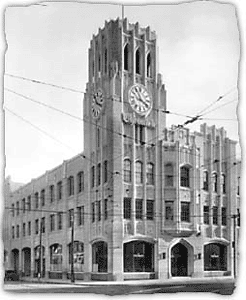
The president of the board is Jim Lazarus, who is the senior vice president for public policy at the San Francisco Chamber of Commerce and a regular advocate for greater development of the city. There are other real estate and corporate representatives on that board as well, most notably Martin Cepkauskas, director of real estate for the Western Properties Division of Hearst Corporation, which is the middle of seeking city permits and approval to redevelop its historically significant Chronicle Building, where the paper has been since 1924, adjacent to Mint Plaza.

So we asked Lazarus, Johns, and Cepkauskas about what would seem to be a conflict of interests between board members who are pushing for development and John’s new role as a guardian of historically significant buildings. After I e-mailed the trio, Lazarus responded to the group “I will respond to this guy,” to which Johns wrote “good” and refused to answer further Guardian inquiries.

In a phone interview, Lazarus said there was no conflict because “nobody has any financial interest in the Mint Project. It’s a pure nonprofit board.” He also made the distinction that “we’re concerned with preserving San Francisco history, not buildings.” But in the name preserving history, the society helped create Mint Plaza, a welcoming plaza across from the Chronicle Building that is ringed by restaurants, retail, and office space.

Lazarus personally bought Cepkauskas onto the society’s board last year because the Hearst project “will have to do community mitigation and I want the Mint to be the beneficiary of that mitigation.” Yet he denies that there is a conflict between the interests of his board and the Hearst project and that of historic preservation and the public interest.

Lazarus also said “I assume Richard would like to stay on our board,” and Lazarus sees no reason why Johns should resign even though the Hearst project is likely to come before the commission later this year.

Dick Meister: Black Porters Led the Way

0

Dick Meister, formerly labor editor of the SF Chronicle and KQED-TV Newsroom, has covered labor, politics and other matters for a half-century.


February is Black History Month, a good time to honor the Brotherhood of Sleeping Car Porters, one of the most important yet too often overlooked leaders in the long struggle for racial equality.

The union, the first to be founded by African Americans, was involved deeply in political as well as economic activity. It joined with the NAACP to serve as the major political vehicle of African Americans from the late 1930s through the 1950s.

Together, the two organizations led the drives in those years against racial discrimination in employment, housing, education and other areas, and in doing so, laid the groundwork for the civil rights movement of the 1960s.

The need for a porters’ union was painfully obvious. Porters commonly worked 12 or more hours a day on the Pullman Company’s sleeping car coaches for less than $100 a month. And out of that, they had to pay for their meals, uniforms, even the polish they used to shine passengers’ shoes. They got no fringe benefits, although they could ride the trains for half-fare on their days off – providing they were among the very few with the time and money to do so. And providing they didn’t ride a Pullman coach.

In order to meet their basic living expenses, porters had to draw on the equally meager earnings of their wives, who were almost invariably employed as domestics.
 
It was a marginal and humiliating experience for porters. They were rightly proud of their work, a pride that showed in their smiling, dignified bearing. But porters knew that no matter how well they performed, they would never be promoted to higher-paying conductors’ jobs. Those jobs were reserved for white men.

Porters knew most of all that their white passengers and white employers controlled everything. It was they alone who decided what the porters must do and what they’d get for doing it.

When a passenger pulled the bell cord, porters were to answer swiftly and cheerfully. Just do what the passengers asked – or demanded. Shine their shoes, fetch them drinks, make their beds, empty their cuspidors. And more. No questions, no complaints, no protests. No rights. Nothing better epitomized the vast distance between black and white in American society.

Hundreds of porters who challenged the status quo by daring to engage in union activity or other concerted action were fired. But finally, the administration of President Franklin D. Roosevelt granted workers, black and white, the legal right to unionize. And finally, in 1937, the Brotherhood of Sleeping Car Porters won a union contract from Pullman.

The contract was signed exactly 12 years after union president and founder A. Philip Randolph had called the union’s first organizing meeting in New York City. It was a long arduous struggle, but it brought the porters out of poverty. It won them pay at least equal to that of unionized workers in many other fields , a standard workweek, and full range of fringe benefits. Most important, porters won the right to continue to bargain collectively with Pullman on those and other vital matters.

Union President Randolph and Vice President C.L. Dellums, who succeeded Randolph in 1968, led the drive that pressured President Roosevelt into several important actions against discrimination, including the creation of a Fair Employment Practices Commission in housing as well as employment. FDR agreed to set up the commission – a model for several state commissions – and take other anti-discrimination steps only after Randolph and Dellums threatened to lead a march on Washington by more than 100,000 black workers  and others who were demanding federal action against discrimination.

Dellums and Randolph struggled as hard against discrimination inside the labor movement, particularly against the practice of unions setting up segregated locals, one for white members, one for black members.

Randolph, elected in 1957 as the AFL-CIO’s first African-American vice president, long was known as the civil rights conscience of the labor movement, often prodding federation President George Meany and other conservative AFL-CIO leaders to take stands against racial discrimination.

The sleeping car coaches that once were the height of travel luxury have long since disappeared, and there are very few sleeping car porters in this era of less-than-luxurious train travel. The Brotherhood of Sleeping Car Porters is gone, too. But before the union disappeared, it had reached goals as important as any ever sought by an American union – or by any other organization anywhere.

Dick Meister, former labor editor of the SF Chronicle and KQED-TV Newsroom, has covered labor and politics for a half-century. Contact him through his website, www.dickmeister.com, which includes more than 250 of his columns.

Black history, local hire, living color

31

City Hall kicked off its annual Black History month celebrations with a talk by Los Angeles philanthropist and former Xerox Corp. VP Bernard Kinsey about the importance of debunking myths about the absence of blacks in American history. And Mayor Ed Lee, who had just met with five dozen unemployed black construction workers from the Bayview, revealed how, when he was growing up in the projects in Seattle, his neighbors were black, and an African American named Darnell was one of the most loyal patrons of the restaurant that Lee’s father was trying to make succeed.


“And when my dad suddenly died of a heart attack, Darnell was the first person to offer my brother a job at his gas station,” Lee said. “So, this is not just about recognizing African American history, but recognizing what they did for us, and  making sure that no there are jobs and we protect the family structure. I know what it is to be helped by the African American culture.”


Lee’s recollections of Darnell came less than an hour after he met with Aboriginal Blackmen United, a group that represents unemployed construction workers in the Bayview, to discuss how its members can get hired at UCSF’s $1.5 billion hospital complex at Mission Bay and other local building sites.


At that meeting, ABU President James Richards thanked Lee for getting UC to clarify the details of its voluntary local hire plan at the Mission Bay hospitals.
But he warned that the fight is just starting. “We’ve got the unions to deal with,” Richards told Lee, referring to the reality that the unions also want their members to get work at the UCSF site.


Lee said he’d do his best to help.
“The African American community in San Francisco has not got its fair share,” he said. “I can’t say that everyone in the room is going to get a job, but I’ll open up doors and do my best.”


And then Lee confirmed that local hire is one of his top five priorities.
“My top priorities are the budget, pension reform, the America’s Cup, finding a good police chief and local hire,” he said. “I said that directly to every union leader yesterday. Some unions will be there, others will resist.”


ABU’s Richards said the need to have a G.E.D. to get into the city’s ob training programs is a barrier to employment for many in the Bayview.
“We have a lot of people, who are not able to get into CityBuild because they don’t take folks anymore who don’t have their G.E.D,” he said.


And he warned that the city’s black community is in crisis.
“I know there is a budget crisis, but this is a life crisis,” Richards said. “Young people are dying and it’s not even newsworthy any more.”


Lee suggested ABU work with the City to avoid the need to hold protests at construction sites in future,
“Let’s plan together, so you don’t have to go to all the sites,” Lee said. “I am for people getting their GED. But if someone has evidence that they are making an attempt to get their GED, we need to reward that with jobs. So that the GED is not a barrier, it’s a hope.”


And then Lee was off to attend his next round of meetings, which included the city’s Black History month event, where speakers noted that during Bernard Kinsey’s career with Xerox, he helped increase the hiring of blacks, Latinos and women,


Kinsey told the audience that he and Shirley Kinsey, his wife of 44 years, share a passion for African-American history and art. And that their world-famous Kinsey Collection, which contains art, books and manuscripts documenting African American triumphs and struggles from 1632 to the present, is currently on display at the National Museum of American History in Washington D.C, and a number of pieces are at the San Francisco African American Historical and Cultural Society. He noted that the posters of African Americans in the Civil War were reproductions of some of the art in those exhibits. 


Sup. Malia Cohen noted that about 200,000 African Americans participated in that war. Sup. Ross Mirkarimi, who represents the city’s Western Addition, where redevelopment triggered massive displacement of the black community in the 1960s, noted that eight members of the current Board of Supervisors, who selected Lee as the city’s first Chinese American mayor, are people of color.


“This is true representation,” Mirkarimi said, noting that the fact that the city’s African American population continues to drop (reportedly down from 6 percent to 3.9 percent, according to the 2010 Census) to “is a reminder that even the most forward-thinking cities have a lot of work to do.”


And Kinsey urged African Americans to start describing their ancestors as “enslaved.”


‘It will change how you look at your ancestors,” he said, “You don’t have a clue about what they sacrificed to get you to where you are today. We don’t tell you the ‘ain’t-it-awful’ story about slavery. We tell you the story of how we overcame.”


“You need three things for a successful life,” Kinsey added “Something to do. Someone to love. And something to look forward to.”


Kinsey said he and his wife have espoused two life principles, ‘To whom much is given much is required” and live “A life of no regrets.” And then he told a story about an eagle who was raised by a chicken.


The eagle ended up ashamed of his feathers, because the chickens never told him he was an eagle because they were afraid he’d end up ruling the barnyard.“He even grew up ashamed of his daughters,” Kinsey said.


Eventually, the eagle met another eagle, who told him the truth. “You ain’t no chicken,” the other eagle said.


“And this is the message,” Kinsey said. “Don’t think chicken thoughts, or dream chicken dreams. Think like an eagle.”


He warned the audience to be careful of buying into myths that would have them believe that African Americans played no role in building the U.S.
“There are stories that made America and stories that America made up,” Kinsey said. “And too often, the myth becomes the choice.”


And then he concluded by expounding on “the myth of absence.”
‘”African Americans are not seen, not because of their absence, but because of the presence of a myth that prepares and requires their absence,” Kinsey said. “And the manipulation of the myth changes the color of the past. It’s no accident that the dominate images from the past are white. And many of us have swallowed the pill.”


Speed Reading: Matt Furie’s Hot Topik and boy’s club 4

0

I got an orange Pepe T-shirt at Needles and Pens’ release party for Matt Furie‘s new comic Hot Topik. What better way to also celebrate the fourth and latest issue of Furie’s boy’s club, in which Pepe and pals Andy, Brett, and Landwolf are joined by two new characters, Whitey (a zit), and Bird-Dog? Somewhat reminisicent of a stoned Big Bird, Bird-Dog lectures Pepe on the history of weed in one of the comic’s highlights, though I’m also fond of the episode in which a Vaporizer turns Landwolf into a viper with a craving for pepperoni pizza. Here are some of the characters in Hot Topik, as well as a few pieces by Furie on the walls of Needles and Pens.

Panabay rising

4

MUSIC Last year was a big one for Los Rakas. The Oakland-by-way-of-Panama duo, Raka Rich and Raka Dun, have been hustling their frenetic Panabay stylings since they banded together as high school students in 2005. But on the cusp of their second mixtape, La Tanda Del Bus, the arresting diversity of their influences and musical ideas began to coalesce. The far reaches of the blogosphere and the streets took notice.

Los Rakas’ “Abrazame” — a song reworked from Gyptian’s crossover hit “Hold You” and remixed into sure shot form by Brooklyn producer Uproot Andy — overcrowded year-end lists as the pinnacle summer jam of 2010. In the video, parallel love stories unfold and collapse over the backdrop of San Francisco’s Carnaval Festival. Shuffling polyrhythms swarm underneath simple Casio chords as Raka Rich moves effortlessly from trading syrupy verses with guest songstress Faviola to bursts of rapid-fire lyricism.

Meanwhile, the video for Los Rakas’ “Soy Raka” — a youthful ode to turfin’ in the streets of Oakland — has surpassed 250,000 hits on YouTube. What other rap groups spit a chorus like “Tengo mi pistola y diente de oro” on the same playlist as a sweltering love ballad? The video not only helped spawn the syncopated dance movement in Panama, but also inspired kids to prefix their names with Raka — “you know, like Raka Miguel” — Dun tells me excitedly in a thick Spanish accent. “In Panama, ‘That’s raka’ or ‘We’re from raka’ means ‘that’s ghetto’ or ‘we’re from the ghetto.’ But it’s an empowering term. It means that we’re proud of who we are and where we come from.”

This sort of community-centered spirit has inspired Los Rakas since the beginning of its rhapsodic ventures. In 2006, Rich and Dun released their first Panabay Twist mixtape with the help and studio support of local outreach organizations Youth Uprising, BUMP (Bay Unity Music Project), and Youth Movement Records. Its single, “Mi Barrio,” in many ways a precursor to the anthemic “Soy Raka,” is driven by the standard hip-hop commandment to represent where you’re from. But the song also honors a more difficult and subtle hip-hop ideal: one love. Los Rakas might boast about Oakland and Panama stomping grounds, but the duo also calls out for us to be “orgulloso and put your flag in the air.” Which flag, exactly?

“Oakland influenced us,” says Dun, who moved to the Bay when he was 14. “It didn’t just shape our instrumentals and lyrical style, from Zion I to E-40—Oakland has the history of the Black Panthers and politicism, so we naturally put that content in our music too.”

Los Rakas sound a bit different from, say, any other Bay Area rapper, because Rich and Dun’s music is informed by the infectious rhythms and punctuated Spanish flows heard in Panama’s pop music of the day, plena. A sprawling folk genre that originated in the Caribbean and related regions of Central America, plena has recently been digitized for a new generation, becoming a Panamanian spin on reggaeton.

But the influences don’t stop there. “In Panama we listen to all types of music: reggae, dancehall, salsa, meringue,” says Dun. “When I met Rico, he was listening to Tupac and we traded music. Hip-hop caught my attention fast. I found out about Tribe [Called Quest], Lil Kim, Nas. I researched where it came from, and how it evolved, and just fell in love with it.” Although the connections aren’t obvious at first, hip-hop and plena have a lot in common. They’re both hybrid genres, forms of pastiche that draw from a wide range of sonic traditions and background, computerizing folk and funk for the bass-hungry children of the always-evolving soundsystem.

Unsurprisingly, Los Rakas garnered attention from an emerging scene of enthusiasts, producers, DJs, writers, and musicians concerned with the musical diaspora of the Afro-Caribbean, or more acutely, what British sociologist Paul Gilroy has called the Black Atlantic. The term denotes the webbed network of the African diaspora culture that is not so much organized by a clear conception of roots but by a rhizomatic set of exchanges and networks: migrations, ships, trade, Creole, European miscegenation, flights, origin myths, stories of repatriation, and now the most diffusive cross-cultural exchange device of them all, the Internet.

Keep in mind that 2010 was the year that Diplo and Switch’s over-the-top dancehall project, Major Lazer, took clubs by storm, and even Rihanna finally started reppin’ roots, rhythm, and wires with “Rude Boy” and multicolored neon booty shorts. Even if MIA’s third full-length was lackluster, something of her world-town swagger has penetrated our times, while her “Bird Flu” call to arms has circulated through our quickly multiplying musical economies. Check the formula: add world genre to rap and uptempo dancehall/Bmore/house/techno; reconfigure percussion patterns in a drum machine; loop melodic fragments of a regional instrument; add inner-city noise, gunshots, chants, or field recordings of aggressive animal life; manipulate with a swill of static, fuzz, and a heavy dose of low end. Bump loud. Call it third world democracy.

Los Rakas, without even asking for it, has popped up in countless mixes and blog posts loosely labeled under the category of tropical bass. Rich and Dun contributed the steady banger “Afro Latino” to the recent Banana Clipz EP, produced by tropical harbingers Chief Boima and Ora 11 of Bersa Discos, and released on their Ghetto Bassquake blog and upstart. Speaking of Bersa, it hosts the crazy monthly Tormenta Tropical, which spotlights new sounds of electro-cumbia and related frontiers arising from the Black Atlantic. “That movement, I’m not sure what to call it, embraced us,” says Dun. It only makes sense that Los Rakas — navigating Oakland and Panama, turfin’ and plena, hiphop and digital polyrhythms, the new and the old — has returned the favor.

AUDYSSEY PRESENTS THE NEIGHBORHOOD: LOS RAKAS

with Roach Gigz

Wed/2, 9 p.m.–-2 a.m.; free

111 Minna Gallery

111 Minna, SF

(415) 974-1719

www.111minnagallery.com

Short takes on Indiefest ’11

1

So much to see, independently! Below are some quick reviews of flicks that caught our attention …

SAN FRANCISCO INDEPENDENT FILM FESTIVAL Feb 3–17, most shows $11. Roxie Theater, 3117 16th St., SF. 1-800-838-3006, www.sfindie.com

Bloodied but Unbowed (Susanne Tabata, Canada, 2010) “Nobody tells you that by the time you’re 25 half your friends will be gone” is just one of the memorable lines in Bloodied but Unbowed, director-writer Susanne Tabata’s affectionate and probing doc on the Vancouver punk-hardcore scene. It could have been any scene from around the U.S. in the early 1980s — except most weren’t as politicized and didn’t birth bands like the perpetually touring D.O.A., with speed-demon-in-the-pocket drummer Chuck Biscuits, who the Clash called the best, and the Subhumans, who made an impact with such songs as “Slave to My Dick” and whose vocalist Gerry “Useless” Hannah ended up serving five years in the pen for his involvement in the anarchist group Direct Action. Culling telling quotes from the musicians, managers, and knowledgeable onlookers like Jello Biafra, Henry Rollins, and Duff McKagen, Tabata contextualizes the scene up north, while also capturing the moment with the still-vital music, genuine-article photos and footage from Dennis Hopper’s Out of the Blue (1980), and those ironclad anecdotes, ending with the images of a road-worn D.O.A. and an encounter with the vanquished hope of the punk scene, Art Bergmann. What came after hardcore? Heroin is the bittersweet, inevitable punch line. But as narrator Billy Hopeless of the Black Halos offers at Bloodied but Unbowed‘s close, the memories and the music survive — and continue to inspire others to write their own chapters. Feb. 11 and 14, 7 p.m. (Kimberly Chun)

We Are What We Are (Jorge Michel Grau, Mexico, 2010) Hewn from the same downbeat, horror-in-the-cruddy-apartment-next-door fabric as 2008’s Let the Right One In, Mexican import We Are What We Are is a disturbing, well-crafted peek into the grubby goings-on of a family of urban cannibals. In the opening minutes, the patriarch collapses and dies in a shopping center; the rest of writer-director Jorge Michel Grau’s film follows the frantic actions of his widow and three kids, notably oldest son and apparent heir-to-the-hunt Alfredo (Francisco Barreiro), who seems way to timid to become the resident Leatherface. With Lady MacBeth-ish sis Sabina (Paulina Gaitán) urging him on — and volatile younger brother Julián (Alan Chávez) doing his best to blow the family’s tenuously-held cover — Alfredo grapples with the gory task at hand. (And I do mean gory.) If you miss this must-see at IndieFest (it’s sure to be a hot ticket), stay tuned for a theatrical release later in 2011. Fri/4, 7 p.m. (Eddy)

The Drummond Will (Alan Butterworth, U.K., 2010) For a quirky, fast-paced comedy, The Drummond Will has a high body count. It’s a mystery in the vein of Edgar Wright’s Hot Fuzz (2007), but it’s a much more subtle enterprise overall. Straight-laced Marcus (Mark Oosterveen) and charming Danny (Phillip James) travel from the city to the country for their father’s funeral. They soon learn that they stand to inherit his house, which — as it turns out — comes with a set of bizarre complications. Shot in black-and-white, The Drummond Will transitions seamlessly from fish-out-of-water comedy to bloody whodunit. As the deaths escalate, so do the laughs. Because, yes, sometimes it’s funny when people keep dying. I don’t know why the English seem to have a particular talent for gallows humor — the aforementioned Hot Fuzz, 2008’s In Bruges, the original Death at a Funeral (2007) — but let’s be glad they do. And here’s hoping first-time director Alan Butterworth (who co-wrote the film with Sam Forster) has more farce up his sleeve. Fri/4, 7 p.m.; Sun/6, 2:30 p.m. (Louis Peitzman)

Food Stamped (Shira Potash and Yoav Potash, U.S., 2010) Indeed, this is a doc by and about a Berkeley couple who temporarily set aside their Whole Foods-y ways and take the “food stamp challenge,” spending no more than $50 on a week’s worth of groceries (roughly $1 per meal, they figure). And they’re gonna eat only healthy meals, dammit, if they have to dumpster-dive to do it. But Food Stamped is, thankfully, not a self-righteous yuppie safari into po’ town — the Potashs’ experiment provides the framework for an investigation into ways diets could be improved among lower-income families, including visits to farmers’ markets and a farm in Maryland where food is grown for an entire school system. At a slim 60 minutes, Food Stamped is the ideal length to make its point succinctly, without getting preachy — though (and the filmmakers acknowledge this) their food-stamp project is merely a temporary stunt designed to open the eyes of those who’ve never actually needed food stamps to survive. These IndieFest screenings are copresented by the San Francisco Food Bank, which will be accepting donations on-site. Feb. 13, 4:45 p.m.; Feb. 15, 7 p.m. (Cheryl Eddy)

Free Radicals (Pip Chodorov, France, 2010) There’s a paradox at the core of Pip Chodorov’s feature, in that it employs perhaps the most commonplace and programmatic form of contemporary commercial moviemaking — documentary — to explore perhaps the most unique and expressive manifestation of film: experimental cinema. Free Radicals takes its title from a film by Len Lye, and one of the best aspects of Chodorov’s approach is that it doesn’t mercilessly chop up avant-garde works in the service of generic contemporary montage. He’s willing to show a work such as Lye’s film in its entirety, without intrusive voice-over. Chodorov is the son of filmmaker Stephan Chodorov, and his familiar and familial “home movie” approach to presentation is both an asset and a liability. It’s helpful in terms of firsthand and sometimes casual access to his subjects — he largely draws from and focuses on a formidable, if orthodox male, canon: Stan Brakhage, Robert Breer, Peter Kubelka. But it also opens the door for a folksy first-person approach to narration that can err on the side of too-cute. It’s subtitle — A History of Experimental Cinema — to the contrary, Free Radicals functions best as a celebration or appreciation of some notable and vanguard filmmakers and their efforts, rather than as an overview of experimental film. Feb. 13, 8:30 p.m.; Feb. 17, 7 p.m. (Johnny Ray Huston)

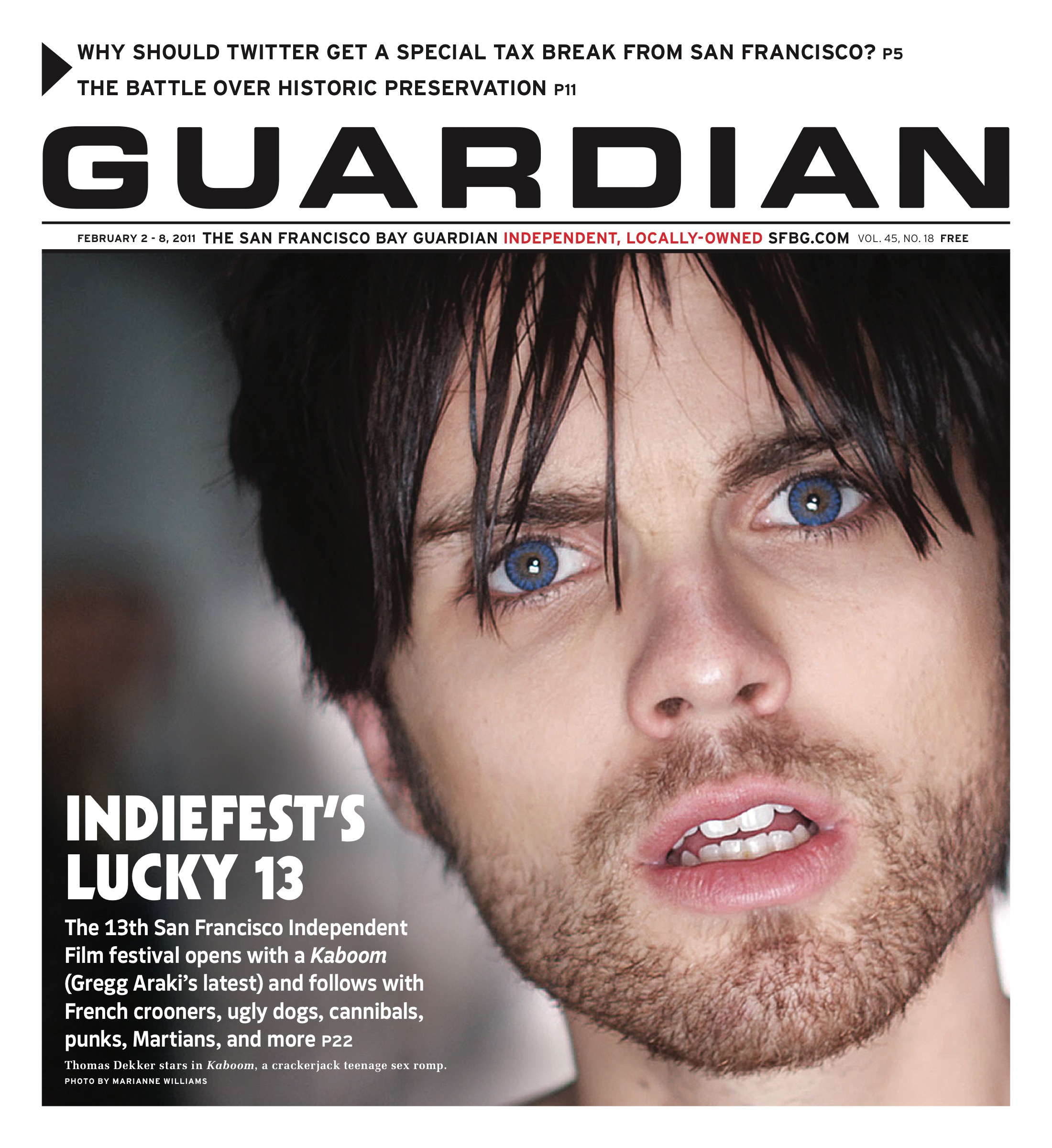
Kaboom (Gregg Araki, U.S.-France, 2010) Gregg Araki’s crackerjack teen sex romp is pure verve — a return to devil-may-care form for fans of The Doom Generation (1995) and Nowhere (1997). Kaboom is right: besides sneaking under the blue velvet rope for a classical mindfuck death trip (there’s even a good part for Jennifer Lynch), Araki and his winning cast let loose a fusillade of dorm-room chatter that runs metaphorical language to its limits. The cult-bidden mystery is too squarely accounted for, but then Kaboom is really as much The Palm Beach Story (1942) as Twin Peaks. Our coed heroes are Stella (Haley Bennett) and Smith (Thomas Dekker), and they’re the only platonic thing in the movie. Taken with Araki’s lasting affection for 1990s culture jamming, this rock-solid friendship is actually quite touching, but Kaboom works best when sliding up and down the Kinsey scale, huffing comic book paranoia for the fun of it. Thurs/3, 7 p.m. (Max Goldberg)

Mars (Geoff Marslett, U.S., 2010) Thanks to Mars, the question “Can mumblecore survive in outer space?” has been answered. (And it’s actually less annoying out there than it is on Earth!) Austin, Texas, writer-director Geoff Marslett’s rotoscope-animated tale follows three astronauts (including m-core heavy Mark Duplass) on a Mars mission, two of whom(Duplass and Zoe Simpson) spark romantically en route. Meanwhile, a solo robot delegation lands ahead of them, discovering new life forms and new emotions, as it sparks romantically, á la Wall-E (2008), with a Mars explorer thought lost a decade before. All the squee gets a little dippy toward the end, but the contrast between slacker and sci-fi genres mostly works. Added points for casting Texas hero Kinky Friedman as the POTUS; Giant Sand’s Howe Gelb did the film’s music and plays the sarcastic head of mission control. Fri/4, 9:15 p.m.; Mon/7, 7 p.m. (Eddy)

Special Treatment (Jeanne Labrune, France, 2010) Let’s get this out of the way first: Isabelle Huppert can do no wrong. That’s not to say she doesn’t occasionally pick terrible projects — she’s just never the thing that’s wrong with them. Special Treatment isn’t so much terrible as it is terribly misguided, contrasting the worlds of psychiatry and prostitution with broad, cartoonish strokes. Huppert plays Alice, a lady of the night who’s thinking about giving up the trade. I don’t blame her; the clients Special Treatment presents her with are the dullest of perverts. One wants her to dress up like a Japanese schoolgirl with a teddy bear and a giant lolly. Another goes the collar and dog bowl route. It’s 2011 — can’t we be a bit more creative with our fetishes? On the opposite end, there’s disenchanted therapist Xavier (Bouli Lanners). And wouldn’t you know it? His patients are photocopies from psychiatry textbooks. There’s a point to be made about the link between paying for sex and paying for someone to listen, but Special Treatment lacks the depth to drive it home. Sat/5 and Feb. 9, 7 p.m. (Peitzman)

Superstonic Sound: The Rebel Dread (Raphael Erichsen, U.K., 2010) “Everything I am came out of music,” says Don Letts — the second-generation Jamaican British DJ, director, and entrepreneur credited with turning punks on to reggae in the late 1970s — in this documentary about his life and work. Much like his contemporary, the late Malcolm McLaren, Letts was a cultural cross-pollinator, working in different mediums while encouraging subcultures to feedback into and off of each other to create something explosive and new. While this serviceable doc lets Letts himself retrace ground that’s been extensively covered elsewhere (it’s worth noting, though, that nearly all the archival footage used was shot by Letts himself), the scenes with his formerly estranged son, who’s also a DJ, are tender and unexpected. Feb. 12, 7 p.m.; Feb. 16, 9:15 p.m. (Matt Sussman)

Transformation: The Life and Legacy of Werner Erhard (Robyn Symon, U.S., 2010) The last thank you in the end credits of this documentary, in bold, is for Werner Erhard. The exiled former est leader and “personal growth” preacher or pioneer should thank director Robyn Symon — I think? – for Transformation, since it’s a 77-minute advertisement for him. Certainly, Erhard is a potentially rich choice in terms of subject matter, but very early on, it’s clear that Symon is out to paint a romantic, positive portrait: testimonials on his behalf are coupled with a low-volume acoustic guitar musical backdrop, and Erhard is even interviewed on the beach. Every once in a while an offhand moment — such as a brief mention of Scientology figurehead L. Ron Hubbard’s predatory view of Erhard — disrupts the soothing flow and opens the possibility of a broader, critical look at the “personal growth” phenomenon. (For the most part, it’s only been dramatized, usually through parody, in films such as 1999’s Magnolia and 1995’s Safe.) As a cultural and even historical figure, Erhard is worthy of an appraisal that’s neither enraptured nor utterly damning. This isn’t it. Thurs/3, 9:15 p.m.; Sat/5, 7 p.m.; Tues/8, 9:15 p.m. (Huston)

Worst in Show (Don Lewis, U.S., 2010) All films about animals in the competitive arena must acknowledge the fundamental truth that the animals themselves are nowhere near as entertaining as their owners. A dog just wants to play, eat, crap, sleep, and maybe have its belly rubbed. The dog’s owner, on the other hand, wants other things — titles, media attention, perhaps an endorsement deal — because they have convinced themselves (as they must convince the judges, and to some degree, the public) that their dog does not just want to play, eat, crap, sleep, and maybe have its belly rubbed. No! Their dog is special. Doc Worst in Show understands this basic drama and finds plenty of eager players in the canine and bipedal contenders, both new and returning, at Petaluma’s annual Ugliest Dog in the World Competition. Amid all the patchy fur, bad eyes, underbites, and malformed legs, it’s the big hearts and outsized egos that truly stand out in this portrait of pageant motherhood at its most extreme. Feb. 9, 9:15 p.m.; Feb. 13, 2:30 p.m. (Sussman)

Je T’aime, I Love You Terminal (Dani Mankin, Israel, 2010) It’s unfair to judge a film by its title, but Je t’aime, I Love You Terminal lets you know exactly what you’re in for. This twee indie romance is Before Sunrise (1995) meets Once (2006) meets every other twee indie romance you’ve ever seen. The film is more mediocre than it is bad, exploring the single-day love affair between two strangers stranded in Prague. Ben is moving from Israel to New York to marry the one that got away. Naturally, he also sings and plays guitar. Emily, an impulsive free spirit, teaches Ben a valuable lesson about living in the moment. Saying this story has been done before is an understatement: Je t’aime packs on indie cliché after indie cliché, without really bothering to develop Ben or Emily into interesting characters on their own. This is a retread without anything to distinguish it from the rest, dragging it down from shrug-worthy to eye-rolling. Feb. 12, 4:45 p.m.; Feb. 14, 9:15 p.m. (Louis Peitzman)

Our Weekly Picks: February 2-8

0

WEDNESDAY 2

MUSIC

Billy and Dolly

Have you noticed? Like clockwork, the buds on the ornamental plum trees are starting to power pop their thin pink petals, making sidewalks more poetic all across the city. Ephemeral yet impressive, the changing season awakens melodies of Billy and Dolly, the local singing and songwriting duo formerly of the Monolith. The guy-girl combo is backed by the Tell-Tale Hearts, a sonic unity of 20 Minute Loop’s rockin’ guitar-bass team and the Monolith’s drummer. The harmonies are deliciously poppy and achingly bittersweet, reminiscent of Elliott Smith, were he not so chronically bummed and had a lovely lady voice as a complement. Beware: between the trees and the tunes, it’s all so pretty, it just might hurt your heart. (Kat Renz)

With Tristen and the Corner Laughers

8 p.m., $10

Rickshaw Stop

155 Fell, SF

(415) 861-2011

www.rickshawstop.com


MUSIC

Hymn For Her

You think living in a studio apartment with two roommates is cozy? Well, think again. ‘Cause you’ve got nothing on Lucy Tight and Wayne Waxing, of Americana duo Hymn For Her that live, record, and tour in their 16-foot, 1961 Bambi Airstream trailer — along with a baby and dog. And they somehow manage to fit a three-stringed, broom-handle cigar box, banjo, dobro, bass drum, hi-hat, and harp in there, too. In true Hymn For Her fashion, its newest release, the cleverly spelled Lucy and Wayne and the Amairican Stream, was recorded at various campgrounds and friends’ driveways while on tour. Better catch them before they pack up Bambi and hit the road. (Jen Verzosa)

With Tippy Canoe

Wed/2, 7 p.m., free

Mama Buzz Café

2138 Telegraph, Oakl.

(510) 465-4073

www.mamabuzzcafe.com

With That Ghost

Thurs/3, 9 p.m., call for price

Amnesia

853 Valencia, SF

(415) 970-0012

www.amnesiathebar.com

Sun/6, 9 p.m., $6

Hemlock Tavern

1131 Polk, SF

www.hemlocktavern.com


THURSDAY 3

DANCE

Jess Curtis/Gravity

Jess Curtis/Gravity is a company that lives up to, and defies, the connotations in that noun attached to the name of its artistic director. Choreographer-performer Curtis and his eclectic collaborators display an alternately cool and passionate, always irreverent intelligence, wholly immersed in the unfathomable ocean of the human body. They’re the Jacques Cousteaus of this deep: its champions and endlessly curious, enthralled students. For audiences, that means a good time, a weird time, a heavy-breathing and emotionally up-heaving time, and a time to question things we thought we knew. The company’s latest voyage, Dances for Non/Fictional Bodies, is a sprawling work whose central event — a subjectivity-shifting convergence of “nontraditional” dancer-bodies — sets sail this weekend. (Robert Avila)

Thurs/3–Sat/6, 8 p.m., $25

Yerba Buena Center for the Arts

701 Mission, SF

(415) 978-2787

www.ybca.org


MUSIC

Ozzy Osbourne

Though he’s backed by a new lead guitarist (Greek virtuoso Gus G.) and brandishing a new album, Ozzy Osbourne isn’t likely to conquer much new territory on his 2011 Scream tour. Nor does anyone want him to. The Prince of Fucking Darkness is still revered by a healthy portion of the headbanging public, a polity that will undoubtedly spend the show demanding a hearty helping of songs from his ant-snorting, dove-decapitating, “Crazy Train”-riding salad days. Whatever your opinion on the world’s most incomprehensible celebrity, his charisma can still get an arena rocking. Whether that’s because of — or in spite of — his infallible propensity for mooning the audience, no one can say. But as the Blizzard of Ozz would no doubt put it: “who fucking cares?” (Ben Richardson)

With Slash featuring Myles Kennedy

7:30 p.m., $44–$92

H.P. Pavilion

525 West Santa Clara, San Jose

(408) 287-7070

www.hppsj.com


FRIDAY 4

EVENT

“San Francisco Bike Party February 2011 Ride: Love Your Bike”

It’s prettiest much the buzziest thing on SF bikes since American-made handlebar beer can — uh, cup — holders: the SF Bike Party, spawned from the San Jose Bike Party and a member of the same family as the East Bay Bike Party. Sources say the mass bike ride, which makes complete stops for traffic lights and the occasional drink-and-mingle sidewalk party, marks a logical evolution for the city bike activism. Despite what the comments on SF Gate say, cycles in the city are no longer the purview of a handful of iron-calved fixie followers — there’s room for a little softness among the two-wheeled, which explains this month’s V-Day-ready ride theme: “love your bike.” A map of the route will be available on the group’s website closer to push-off. (Caitlin Donohue)

7:30 p.m., free

www.sfbikeparty.wordpress.com


MUSIC

Madlib

Titles are de rigueur in hip-hop. O.D.B. once attended a debutante ball that ended before his introduction finished. (His date was devastated.) Otis Jackson Jr., best known as Madlib and other variations (Madvillain with fellow schizo MF Doom, Jaylib with late sobriquet champion J Dilla) has racked up numerous names over the last two decades. For Madlib, the aliases are appropriate given the diverse projects he tackles as DJ, producer, MC, and uber stoner (expect at least a contact high.) His latest release, Madlib Medicine Show, is a gargantuan monthly series of 12 albums that attempt to fill in the blanks on your understanding of hip-hop. (Ryan Prendiville)

With Robot Koch, Change the Beat, and more

10 p.m., $15

103 Harriet, SF

(415) 431-1200

www.1015.com


DANCE

“Rotunda Dance Series: Leung’s White Crane Chinese Lion Dancing”

Just a day after Chinese new year begins, the blaring drums, clashing cymbals, soaring lions, and dancing dragons of Leung’s White Crane Chinese Lion Dancing appear in San Francisco City Hall, bringing the colorful ancient tradition to the free lunchtime Rotunda Dance Series, copresented by Dancers’ Group and World Arts West. The three Leung brothers — Kuen, Kwan and Allen — moved to SF in the 1970s, carrying the Lion Dancing teachings of their master Kwong Boon Fu from Hong Kong. Performing internationally and teaching in Chinatown for more than 35 years, they are treasured for their larger-than-life performances in the city’s Chinese New Year Parade. (Julie Potter)

Noon, free

San Francisco City Hall

One Dr. Carlton B. Goodlett Place, SF

(415) 720-8830

www.dancersgroup.org


SATURDAY 5

EVENT

“Free University of San Francisco Teach-in”

An idea this crazy just might work! Sick of the gouge-y tuition hikes in our public and private education systems, a band of merry SF radicals have decided to launch an ambitious campaign to free learnin’. After a surprisingly light number of planning meetings, this is the first of the Free University’s offerings: a weekend of classes to inspire and hopefully serve as a community-builder for those who think our current university system is broken. On the lectern: beat poet Diane di Prima on 19th century visionary poetry, revolutionary poet Bobby Coleman on SF labor history, classes on criminal procedure, paganism, Kerouac, and more. (Donohue)

Sat/5, 9:30 a.m.–4 p.m.;

Sun/6, 9 a.m.–4 p.m., free

Viracocha

998 Valencia, SF

www.fusf.wordpress.com


SUNDAY 6

FILM

Every Man for Himself

Forever the enfant terrible of cinema, Jean-Luc Godard is skipping the lifetime achievement lineup at this year’s Oscars. This has stirred up a predictably dumb controversy in the American press over bullshit claims that Godard is anti-Semitic. Never mind the philistines — we’re still awaiting a local screening of the maestro’s 2010 Film Socialism. In the meantime, a 35mm restoration of 1980’s Every Man for Himself at the Red Vic does nicely. Godard called this lyrical examination of art and commerce intertwined his second first film, and its formal ingenuities and philosophical knots remain refreshing. Support the Red Vic by ponying up for extra popcorn! (Max Goldberg)

Sun/6–Mon/7, 7:15 and 9:15 p.m.

Also Sun/6, 2 and 4 p.m., $6–$9

Red Vic Movie House

1727 Haight, SF

(415) 668-3994

www.redvicmoviehouse.com


MONDAY 7

EVENT

Replikaaa Silent Happening: A Multimedia Performance Art Event”

Sometimes you just don’t have much to say. Or perhaps your ears are ringing from all those noisy bars. To exercise the other senses visit this chic silent cocktail party where guests practice the art of nonverbal communication, watching and connecting without words. The unusual and participatory social experience presented by Al’Myra Communications includes a preview screening of Tayeb Al-Hafez’s silent film Replikaaa, a mysterious and futuristic work about five DNA and organ traffickers, to be followed by local artist performances. Reserve a free ticket online and then shut your mouth. Whether you wink, gesticulate, or show some funky dance moves is up to you. Chatty Cathys discouraged. (Potter)

7 p.m., free

Z Space

450 Florida, SF

(415) 891-9544

www.replikaaathemovie.com


TUESDAY 8

MUSIC

Sebadoh

In the vein of Guided By Voices and Pavement, Sebadoh has been dubbed “the quintessential indie rock band of the 1990s” — and like that decade’s flannel-shirt trend, they’re back. After getting the heave-ho in 1988 as bassist of alt-rock band Dinosaur Jr. (he rejoined in 2005), multi-instrumentalist Lou Barlow focused on the DIY project he had started with Eric Gaffney. Sebadoh soon became infamous for its bipolar swings from lo-fi, touchy-feely folk to experimental noise rock. With the addition of bassist Jason Loewenstein, the three-piece became a hit among the hip. Eventually Gaffney jumped ship (he rejoined in 2007) and was replaced by drummer Bob Fay. This lineup recorded the band’s most accessible albums, 1994’s Bakesale and 1996’s Harmacy, both of which are being re-released by Sub Pop Records this year and are the reason for the current tour. (Verzosa)

With Quasi

7 p.m., $20

Great American Music Hall

859 O’Farrell, SF

www.gamh.com


FILM

The Ipcress File

Move over, Christopher Walken: there’s a new star du jour for celebrity imitation freaks. You can’t help but try your hand at Michael Caine’s Cockney accent after watching the hilarious clip from the BBC show The Trip of comedians Steve Coogan and Rob Brydon engaging in a rousing round of dueling Caine-jos. (Search “This is how Michael Caine speaks” on YouTube. You’re welcome.) Polish your early-period Caine impersonation by checking out a rare screening of 1965 secret-agent thriller The Ipcress File, which showcases the legendary actor in his first starring role. The film plays as part of four nights of highlights from the “Mostly British Film Festival,” with other entries hailing from New Zealand and Australia. (Cheryl Eddy)

7 p.m., $10.25

Christopher B. Smith Rafael Film Center

1118 Fourth St., San Rafael

(415) 454-1222

www.cafilm.org


The Guardian listings deadline is two weeks prior to our Wednesday publication date. To submit an item for consideration, please include the title of the event, a brief description of the event, date and time, venue name, street address (listing cross streets only isn’t sufficient), city, telephone number readers can call for more information, telephone number for media, and admission costs. Send information to Listings, the Guardian Building, 135 Mississippi St., SF, CA 94107; fax to (415) 487-2506; or e-mail (paste press release into e-mail body — no text attachments, please) to listings@sfbg.com. Digital photos may be submitted in jpeg format; the image must be at least 240 dpi and four inches by six inches in size. We regret we cannot accept listings over the phone.

Rep Clock

0

Schedules are for Wed/2–Tues/8 except where noted. Director and year are given when available. Double and triple features are marked with a •. All times are p.m. unless otherwise specified.

ARTISTS’ TELEVISION ACCESS 992 Valencia, SF; www.atasite.org. $6-10. “Reagan’s 100th Birthday,” a collection of the former Prez’s finest and most ironic on-screen moments curated by Bryan Boyce, Sun, 7:30.

CASTRO 429 Castro, SF; (415) 621-6120, www.castrotheatre.com. $7.50-10. “SF Sketchfest Great Collaborators Series: Tribute to Murphy Brown,” with Candice Bergen and Diane English in person for a Q&A moderated by Connie Chung, Wed, 7. For more info on this event (tickets, $25), visit www.sfsketchfest.com. “Anne Francis: 1930-2011:” •Bad Day at Black Rock (Sturges, 1955), Fri, 1:30, 5:05, 8:55, and Forbidden Planet (Wilcox, 1956), Fri, 3:10, 7. “SF Sketchfest: True Stories 25th Anniversary: David Byrne in Conversation with Paul Myers:” True Stories (Byrne, 1986), Sat, 5. For more info on this event (tickets, $35), visit www.sfsketchfest.com. “SF Sketchfest and Midnight Mass present Idol Worship: An Evening with Cloris Leachman hosted by Peaches Christ:” High Anxiety (Brooks, 1977), Sat, 8:30. For more info on this event (tickets, $25), visit www.sfsketchfest.com.

CHRISTOPHER B. SMITH RAFAEL FILM CENTER 1118 Fourth St, San Rafael; (415) 454-1222, www.cafilm.org. $6.50-10.25. The Illusionist (Chomet, 2010), call for dates and times. Nuremberg: Its Lesson for Today (Schulberg, 1948/2010), call for dates and times. “Mostly British Film Festival:” Topp Twins: Untouchable Girls (Pooley, 2009), Mon, 7; The Ipcress File (Furie, 1965), Tues, 7.

COUNTERPULSE 1310 Mission, SF; www.counterpulse.org. $5-10. “50Faggots: How Gay Do You Want to Be Today,” Sat, 3. Screening of online documentary series followed by discussion with director Randall Jenson.

GRAY AREA FOUNDATION FOR THE ARTS 55 Taylor, SF; www.cinemaspeakeasy.com. $5. “Cinema Speakeasy: San Francisco Presents Shorts!”, Thurs, 8.

HUMANIST HALL 390 27th St, Oakl; www.humanisthall.org. $5. South of the Border (Stone, 2009), Wed, 7:30.

MECHANICS’ INSTITUTE 57 Post, SF; (415) 393-0100, rsvp@milibrary.org. $10. “CinemaLit Film Series: New Year’s Revolutions:” Libeled Lady (Conway, 1936), Fri, 6.

PACIFIC FILM ARCHIVE 2575 Bancroft, Berk; (510) 642-5249, www.bampfa.berkeley.edu. $5.50-9.50. “Film 50: History of Cinema: Fantasy Films and Realms of Enchantment:” The Cabinet of Dr. Caligari (Wiene, 1920), Wed, 3:10. “Radical Light: Alternative Film and Video in the San Francisco Bay Area:” “Found Footage Films,” Wed, 7:30; “Versions of Veracity: Video, the 1980s,” Sun, 5:30. “African Film Festival 2011:” Shirley Adams (Hermanus, 2009), Thurs, 7; Beyond the Ocean (de Latour, 2008), Sat, 6:30. “Suspicion: The Films of Claude Chabrol and Alfred Hitchcock:” La Femme Infidèle (Chabrol, 1969), Fri, 7; Violette Nozière (Chabrol, 1978), Fri, 9; Vertigo (Hitchcock, 1958), Sat, 8:35. “School Days:” “Screenagers: 13th Annual Bay Area High School Film and Video Festival,” Sat, 3:30. “Cruel Cinema: New Directions in Tamil Film:” Paruthiveeran (Sultan, 2007), Sun, 2.

RED VIC 1727 Haight, SF; (415) 668-3994; www.redvicmoviehouse.com. $6-10. Ziggy Stardust and the Spiders from Mars (Pennebaker, 1973), Wed-Thurs, 2, 7:15, 9:15. Unstoppable (Scott, 2010), Fri-Sat, 7:15, 9:20 (also Sat, 2, 4). Every Man For Himself (Godard, 1980), Sun-Mon, 7:15, 9:15 (also Sun, 2, 4). The Jerk (Reiner, 1979), Feb 8-9, 7:15, 9:20 (also Feb 9, 2).

ROXIE 3117 and 3125 16th St, SF; (415) 863-1087, www.roxie.com. $5-9.75. Lemmy (Olliver and Orshoski, 2010), Wed, 7, 9:30. San Francisco Independent Film Festival, Feb 3-17. See film listings or www.sfindie.com for more info.

WAR MEMORIAL VETERANS BUILDING 401 Van Ness, SF; www.upheavalproductions.com. Free. Occupation Has No Future: Militarism and Resistance in Israel/Palestine (Zlutnick, 2020), Thurs, 7:30. Screening followed by a discussion with director David Zlutnick and members of Dialogues Against Militarism. YERBA BUENA CENTER FOR THE ARTS 701 Mission, SF; (415) 978-2787, www.ybca.org. $6-8. “Volume 14: Middle East,” nine videos focusing on the Middle East compiled by ASPECT: The Chronicle of New Media Art, Jan 13-March 27 (gallery hours Thurs-Sat, noon-8; Sun, noon-6). Shoah (Lanzmann, 1985), Sat, 1 (first half); Sun, 1 (second half); Feb 13, 11am (complete film with one-hour break). 

5 things you didn’t know about cable cars

6

Get it out of the way now: roll those eyes. The cable cars are something no native San Franciscan would ever bring up in polite (that is, local) company, let alone write about in a blog post. But fact is, there’s a reason why these things are iconic. Those cars have as speckled and quirky a history as the City by the Bay. 

San Franciscans steeped in facts and figures about the tourist-movers probably know that ours is the last operating cable car system in the world and that its design hasn’t changed much since Andrew Hallidie devised it upon seeing an overloaded horse-car slip down a hill in the rain. Perhaps you’ve heard that the four remaining lines each rely on a continuous loop of cable running under your feet at a constant 9.5 miles per hour, powered by electrical motors and a system of pulleys and huge wheels. If you’ve ever visited the Cable Car Museum (c’mon folks, it’s free) you’ve seen the sheaves pulling the cable along, and you’ve learned that the cars operate by grabbing the cable with giant pliers that reach through the floor and into a slot in the street where the cable runs. 

Bored yet? Stifle that yawn, we’re just getting started. Read on for five things you haven’t heard about those postcard pretties.


I know why the caged bird . . . rings?

The famous author, poet, and social activist Maya Angelou dropped out of Mission High School at 15 to work the cable cars. “The thought of sailing up and down the hills of San Francisco in a dark-blue uniform, with a money changer at my belt, caught my fancy,” she later recalled in 1969’s I Know Why the Caged Bird Sings. Angelou won the job as San Francisco’s first African American (and female) cable car conductor by heckling reluctant company managers until they caved and she was hired to ring the cars’ bells and swing “on the back of the rackety trolley, smiling sweetly and persuading [her] charges to ‘step forward in the car, please.’”

Smokin’ tracks

Ever noticed a certain funk riding in a cable car? It wasn’t the guy next to you. It’s caused by two materials that play a critical role in starting and stopping the car: the pine resin that greases the cable and the wooden brake shoes, made from Douglas fir, that press against the tracks to stop the car. Friction causes the wooden brakes to smoke, meaning they must be replaced every three days with new ones milled locally at a shop on 22nd Street and Indiana. Friction from the pliers-like grip grabbing the cable likewise melts and then vaporizes the pine tar. This results in a smooth, lubricated start-up, but is also responsible for the burning and odor. (And if that sounds a bit too familiar, perhaps you should call your doctor…) Like the wooden brakes, the grip that grabs the cable must be replaced every three days for wear.

The cable car: the Imelda Marcos of public transportation. (Stack of brake shoes at the Cable Car Museum). Photo by Emily Appelbaum

Move over, men

Working as a grip operator requires incredible dexterity and also the nuanced ability to feel the cable, picking it up slowly to ease the car to full speed. Though well over half of trainees drop from the teaching program each year, the required combination of subtlety and strength make gripping the perfect job for powerful women like Fannie Mae Barnes, who became the city’s first female grip in 1997. 

“A lot of guys will try to muscle the grip, but it’s really more a finesse thing – you have to leverage it with your body weight,” Barnes told the Guardian in an interview last fall. Barnes retired in 2007, but when San Francisco’s second female grip, Willa Johnson, took the post last April, Barnes presented her with a pair of custom-made pink leather grip gloves, emblazoned with her name.

Beyond the bells

The Slot Blades, named for the cars’ emergency braking system, is a band composed entirely of SF Muni workers who conduct and grip the city’s cable cars. Their moniker is a tongue of metal that, when deployed, wedges itself so tightly against the tracks it must be removed with a torch. The cable-proud band gets together for practices and jam sessions in addition to playing at Muni and cable car-related events like the annual Cable Car Bell Ringing Contest – now in its 49th year.

Falling cars and free love

Forget stranded cables and smashed cars: San Francisco’s most infamous cable car victim may be Gloria Sykes, who claimed that a 1964 accident left her with a black eye, bruises, and an unquenchable sex drive.

When a mechanical failure caused the car she was riding to slide backwards down a hill, Sykes – later dubbed the “cable car nymphomaniac” by the daily newspapers — sued the City of San Francisco for a half million dollars. Her lawyers argued that the sexual abuse she suffered as a child combined with the stress of the accident caused her to seek the company of up to 50 sexual partners a week. After listening to 44 taped transcripts of an electrically hypnotized Sykes, the jury awarded the insatiable (ha) plaintiff $50,000 in damages. Sykes’ case is cited as one of the earliest court-recognized examples of post-traumatic stress disorder.


San Francisco Cable Car Wheelhouse from Emily Appelbaum on Vimeo.

Check out the inner wheelings and dealings of the SF Cable Car Museum. Here, the whirling electric motors that power the cars. Video by Emily Appelbaum


Aerial revolution

0

Consider the rise of the extreme athlete: generations of youngsters (and increasingly, brave older folks) competing to see who could pull the sweetest stunts and survive. Ever wonder how is it that a person can make the transition from earthbound and bipedal to gravity-be-damned dare-devilry? When exactly is the moment that a skater, skier, or snowboarder just lets go and trusts their body to take them up, over, around, and (hopefully) gracefully down to the ground?

Last Tuesday, I attended a press event at House of Air – the newest member of Crissy Field’s collection of renovated airplane hangars in San Francisco’s historic Presidio – where I was treated to a glimpse of how such a transformation might become reality. Not to mention a new way that a public sports facility can play with its community.

Given the Presidio’s military history, you may have been tempted to think the newly opened space at 926 Mason is home to helicopters and jets. But the pilots in House of Air aren’t crew-cutted cadets, and the only high-tech equipment in the corrugated steel hangar is an impressive array of custom-made trampolines. Every day in this house-of-bounce, tomorrow’s extreme sportsters are earning their wings – and there isn’t a major commander in sight.

House of Air is the brainchild of Dave Schaeffer and Paul McGeehan, two extreme sports aficionados who trained together on the Lake Tahoe snowboarding circuit. Their concept was helped off the ground (so to speak) by former Olympic skier Jonny Moseley. All three use trampolines to perfect their aerial artistry, and could commiserate over the difficulty of finding a facility where they could train with their respective equipment. According to Moseley, who raised eyebrows as a youth by flipping over his skis in a gymnastics studio, trampolines were few and far-between and most were used for coaching gymnasts and tumblers.

Large-scale trampolines provide the air time necessary for an athlete to teach his body to do tricks like corkscrews and 360s, serving as crucial incubators before a pro takes to the water, pavement, or snow with a new trick. But until House of Air, the idea of a dedicated facility for extreme athletes was unheard of. Now, the studio fills the void with over 2,000 square feet of trampoline space where serious athletes can perfect their skills in a safe (and soft) environment – and where, I was thrilled to find, even the not-so-extreme can have a blast.

House of Air provides lessons to beginners and more serious students of all ages. Instructors with backgrounds in everything from professional snowboarding to circus acrobatics use a specially designed high-performance trampoline deck to teach techniques to budding athletes. The center’s growing team also supervises two segmented jumping arenas, each about the size of a regulation basketball court, complete with angled trampoline enclosures that extend the bounce factor right up the walls. The facility also includes a kiddy bounce house for the younger set, special event rooms, lockers, and showers.

An average person arriving on the scene would begin their foray into the art of flight by checking out a pair of special House of Air shoes – modified wrestling shoes that provide ankle support. They would then have the option of renting some basic bounce time, participating in an organized game (think P.E. classics gone crazy: dodgeball or volleyball are both served up with a side of spring), or taking a class on the foundations of flying, which is where I wound up bouncing on my visit.

I was a bit apprehensive (read: terrified) as Moseley ushered me up to the trampoline deck and demonstrated a few tricks. He flopped through some sick twists, turns, and flips without missing a beat in our conversation. Then it was my turn.


Our intrepid reporter takes to the air at SF’s bounce palace. Photo courtesy of Jonny Moseley

I started with the aptly named “butt-drop”: a move in which the trampolinist replaces a single bounce with a fall on their bum and then – this is the crucial part – returns to her feet without missing a beat. After that, I moved onto “swivel-hips,” wherein the butt-drop is supplemented by a 180 degree revolution on the up-swing. For my final trick, I tried my hand at the sequence that leads up to a front flip: a jump, a fall to all fours, and then a forward rotation that landed me flat on my back. All in all, I wasn’t quite ready for the X Games, but it was killer on the knees and had my quads burning. I had new respect for the little groms busting board-grabs and aerials — and for the brave adults who come to House of Air for the “air conditioning” classes and company team-building sessions. Trampoline dodgeball: a fantastic way to build office camaraderie, or at the very least a good excuse to pummel that passive-aggressive co-worker with a deluge of flying foam rubber.  

Final impressions from the House of Air? Besides the sore thighs, of course? The center seems to be re-thinking the role of the public sports facility, from its boardrooms for the business set to its specially-manufactured props that emulate sports equipment for practicing athletes, like lightweight foam snowboards and a tow rope akin to what a wakeboarder would utilize on the waves. Even the layout of the building itself, which makes use of those large hangar doors to provide jumpers with such an excellent view of the bay one gets the feeling that with one wild leap one might land in the waves, helps to make House of Air a unique resource for the SF community.  

Given the chance to train in a facility like this one as a child, Moseley says he would have been thrilled – and possibly less banged-up in the bargain. “This is the way kids learn to be professionals — without getting hurt.”


House of Air, 926 Mason, SF. (415) 345-9675, www.houseofairsf.com


More John Ross poems

2

Thanks to some of the many John Ross fans out there, I’ve begun to collect a treasure trove of his poetry, much of it either unpublished or published in limited-circulation chapbooks. Even John didn’t have all of his work when he died, and there’s no central collection. So I’m going to post a couple more of my favorites here — and at somepoint, we have to figure out a way to publish the whole collection.


Here’s one from Running Out of Coast Lines (1985) called “Ohio.”


The snow is sooted


with the scrapings of burnt toast


and the crumbs of industry.


There are citizens asleep beneath it,


buried alive inside dark cocoons,


out of work and under the quilts


alarm clocks left unwound


to roll back the boozy winter,


just a deep snooze in February


the drifted fields and streets,


unscuffed, untraveled,


unhitched trailers,


going nowhere, no one


can find their car in Toledo anymore.


Snow is stasis, it sticks in Cleveland,


it freezes the veins of venom


inside the Cayahuga, gases


are suspended until further notice.


A man who once turned tractor tires


big as a house both of them


rolls over in the white bed


in Sandusky and tries to dream


only of the good parts.


Here’s “Kansas City” from The Daily Planet (1981)


Just when we absolutely had to split


she stepped up


like she owned a piece of history


and meant to lease it to us


right there on the spot.


I never knew Charlie Parker she said


slipping Bish the pic


in which she looked so slick


in a tophat and tuxedo


but I danced in the line


with June Williams


at the Jockey Club


before she run crazy in the streets


buckass naked up 18th


my she had a beautiful figure


June Williams


she said standing alone


in the doorway of the peeling porch


in the spring thundershower


pelting the helpless shrubbery outside.


O I toedance and play the vibes


and I can dance on tabletops too


only isn’t no work in Kansas City


since they merged the unions


the black union and the white one.


She wore a red beret and talked slow


loke she’d been slipping sweet-toothed wine


or else jamming skag, one.


Nope no work here in Kansas City


the machines play all the music now


they got a clique down at the union hall


things ain’t what


they used to be.


And one of my all time favorites, from The Daily Planet, is called “Wanted.”


 She is wanted


Catherine Louise Como


also known as


Kathleen May Wright


Manon Minette


Catherine Ann James


Manon James


Cathy Wright


Minon Manette


She is wanted


also known as


Catherine Share


Catherine Louise Share


Janice Thompson


Betty Cox


Darleen Cook


also known as


Suzanne Bronson


Donna Todd


Mary Thomas


Janet Gross


Betty Bowers


Jessica Daniels


also known as


Gypsy


she is wanted


born Xmas ’42


France a tough war


a known Caucasian


she is wanted.


She is wanted


and she has


brown eyes, brown hair


and small bullet wound scars


on her right sholder


and her right hip.


In two of the mug shots


taken several years ago


Sacramento Calif


her hair is pulled too taut


atop her ears


and her swollen lower lip


curls defiantly


at the police photographer.


In the third, taken months later,


the unbraided hawsers of her hair


tumble wantonly to her shoulders


and she looks like she wants to bite


the arresting officer


on the fat white folds


of his throat.


There are two sets of


small dangerous fingerprints,


checkforging fingerprints,


mail fraud fingerprints,


tilltapping fingerprints.


She is wanted by the FBI


she is wanted by the federal marshalls,


she is wanted in the U.S. Mails,


she is wanted in California, Oregon, Nevada,


and 47 other states.


She is wanted


and she is armed


and considered to be dangerous


and that small I think crescent-shaped scar


on her smooth white hip


drives me 74 way bananas


every time


I try to buy


a 20-cent stamp.


Now and then

0

arts@sfbg.com

VISUAL ART “My ideal world [while making art] is to be on a comfortable chair by a sunny window listening to a baseball game,” says Lauren DiCioccio. For DiCioccio, such a setting is possible, because sewing is an integral part of her work, whether she’s hand embroidering The New York Times, creating cotton facsimiles of 35mm film slides and currency, or making organza replicas of plastic bags and bottles.

The new exhibition “Remember the Times” moves DiCioccio’s unique collection of handmade-readymade hybrids from the “wundercabinet” (to use DiCioccio’s term) of Jack Fischer Gallery to Yerba Buena Center for the Arts. On the second floor, she’s arranged a variety of objects on three shelves, adapting the acute vision and evocative perception of still-life painting, vanitas, and memento mori to today’s flurries of consumption and erasure. “Remember the Times” is the only current show at YBCA that can be photographed by visitors, and to be sure, adopting a photographer’s point is an ideal way of appreciating the individuality and interaction of DiCioccio’s pieces, and — especially — her attention to detail. I recently met with her at the museum.

SFBG What drew you to newspaper as a material? The ways in which you use it are unconventional — what are the challenges of working with it?

Lauren DiCioccio All of the work I’m making right now began with the newspaper. For about two years before I was showing my work or thought I could be an artist, I was making paintings. I began painting on newspaper as a material I felt comfortable about using, and that transformed into making sculptures with newspaper. At a certain point with the paintings, I realized I was more interested in the materials.

It hit me after college, when I traveled in Australia, and for six months lived in a town in the outback. It was 12 hours down a dirt road, with a 360-degree view of nothing, and 250 people, mostly aboriginal, lived there. It was a secluded world. We would get our mail twice a week, on Tuesday and Thursday, so we were one step up from the horse and buggy. The days the mail came, they would bring the newspapers, and even though they were two days old, people would just gather around and pore over them.

I became interested in the material as this trusted resource and definition of time and physical embodiment of a day. When I came home and unpacked all my paintings, I realized I was more interested in the way the newspaper itself located me in time and place.

When I moved to the Bay Area in 2004, I began working as the resident manager for the Djerassi Resident Artists Program in Woodside. I lived on site there, on a cattle ranch, pretty much isolated, and getting the newspaper delivered every day. Again, it was a situation where the newspaper was connected to how people would socialize and gather in the morning. People would really welcome it: “A newspaper! Let’s read that!”

I decided that painting wasn’t doing it for me — I wanted to do something more tactile and physical and also approachable. I set out this challenge to make a sculpture out of one newspaper every day for as long as I could. Then I made a quilt out of the newspaper, and that triggered my interest in the craft medium, which has always been a part of my life. It made me realize that craft and the newspaper have the same language, and I started to explore that more through sewing.

SFBG How did you come to select The New York Times as one subject? Also, the tactile emphasis you’re mentioning extends to the “Thank You” bags you’ve made.

LDC They are definitely specific materials — the plastic of a shopping bag, the soft paper of the newspaper are so unique to those objects, and are familiar feels and sounds and experiences for us. They’re disposable in nature, but they’re engrained in our human memory.

SFBG The “Thank You” bags are so commonplace, but they carry a lot of connotations.

LDC When I began making them, it started a divergent path in my work that I think I’m still in the fork of — I’m making these very loving recreations of both types of objects, and they both have disposable or waste aspects. The newspaper is more of a renewable resource, so the work is also about the loss of the form itself. But with the “Thank You” bags, in making them to talk about their obsolescence, I kind of think of them as ghosts of the actual object — I’m hoping for that.

I use bridal organza for the “Thank You” bag sculptures. When I first bought some, I expected it would fray and fall apart and be too delicate to embroider, but it actually stands up well. I just overlay the organza on the beg and draw with a waterproof pen on the surface before I embroider.

With the newspaper, the main series of works actually has a day’s newspaper in it. That introduces a sense of history or time. It’s important to me that the actual paper is in those pieces. It creates all these issues about conservation, and the newspaper not being acid-free, God forbid. The question would be asked, “What if 100 years the newspaper is just crumbly dust inside a bag?” — as if it that were a problem in terms of presenting it as art. But I actually think that it’s the most interesting thing about those pieces, how they’ll age and evolve.

SFBG Artists who work with paper today face those kinds of problems when dealing with those who view art primarily in economic terms.

LDC It’s so hard as an artist when you’re broached with that problem. When someone buys my work, that’s so special to me — I want them to have it as long as they want to have it, looking exactly like how they want it to look. But at the same time, conceptually, anyone who looks at [one of the newspaper pieces] should understand that it’s about decay and the life cycle and the way we all age — though now with plastic surgery, everyone wants to look as scary as possible [laughs].

SFBG How do you choose a particular page to spotlight? Is it the stories, the images, or both?

LDC It’s a combination. It’s an instinctive decision. I look for something that leaps off the page and speaks to me. At first I was only doing people who were communicating — politicians gesturing, or caught mid-speech. But I’ve loosened up the reins on that. I like sports images because they lend themselves to the way trailing thread can show the blur of time.

With all of my work I try to ride this line between precious and pathetic. There’s something somewhat pathetic about even creating these objects in such an obsessive way. It’s excessive, almost an overly tender act to sew this detailed work through functionless media.

SFBG It creates odd keepsakes.

LDC They’re happy and sad. I’m interested in the bittersweet, and nostalgia contains feelings of joy and sadness. With the images, I try to finish them up to the point where it looks like you could pull one of the threads and the whole thing would unravel.

LAUREN DICIOCCIO: REMEMBER THE TIMES

Through March 27, $5–$7

701 Mission, SF

(415) 978-2787

www.ybca.org

Film Listings

0

Film listings are edited by Cheryl Eddy. Reviewers are Kimberly Chun, Michelle Devereaux, Peter Galvin, Max Goldberg, Dennis Harvey, Johnny Ray Huston, Louis Peitzman, Lynn Rapoport, Ben Richardson, and Matt Sussman. For rep house showtimes, see Rep Clock. For first-run showtimes, see Movie Guide at www.sfbg.com. For complete film listings, see www.sfbg.com.

OPENING

Biutiful See “Que Tristeza.” (2:18) California.

*Ip Man 2: Legend of the Grandmaster There’s an ounce of irony that the Wing Chun master who ended up popularizing martial arts throughout the world by way of his most famous pupil, Bruce Lee, would still be the subject of contention (see dueling biopics like Wong Kar-wai’s forthcoming The Grandmasters) and the center of passionate nationalism. In 2008’s Ip Man, the modest master (Donnie Yen) pit his considerable skills against the karate of the invading Japanese army, and here, in ’50s Hong Kong, he tests his skills against the British colonists’ boxing champion. Imperial villainy is painted in broad strokes, but that’s the only predictable stumble in this otherwise step-above effort, with its handsome, sepia-toned art direction and its martial arts choreography by Sammo Hung. As 2 opens, the noble Ip Man has survived the tribulations of WWII only to find himself tussling with rival martial arts groups in rough-and-tumble HK in his efforts to start a Wing Chun school. His most formidable opponent is the powerful master Hung Chun-nam (Hung, who threatens to steal scenes from an earnest if adept Yen), until the two are finally brought together by shared Chinese family values in the ugly face of colonial injustice. The focus of this sequel, once pegged to Ip Man and Lee’s relationship, shifted when director Wilson Yip and company failed to finalize film rights with the star’s descendants, yet much like its near-saintly subject, Ip Man 2 succeeds despite all obstacles. (1:48) Four Star, Shattuck. (Chun)

*Lemmy: 49% Motherfucker, 51% Son Of A Bitch One thing is certain: Motorhead’s Lemmy Kilmister is a total badass. Greg Olliver and Wes Orshoski’s adoring portrait is strongest when it captures the legend going about his everyday business: rocking out onstage before thousands; obsessing over a video game at his favorite Sunset Strip hangout, the Rainbow; kicking it at his humble, jam-packed, rent-controlled apartment. The seemingly ageless Lemmy (he’s 65!) is a fascinating character, a complete original who does whatever he likes (gambles, collects Nazi memorabilia as an offshoot of his military-history fascination, speed) and doesn’t particularly give a fuck what anyone thinks. This lifestyle works only because he is such an inherently cool cat, with a mystifying ability to put away endless amounts of booze and drugs. As such, he’s worshiped not just by average-human Motorhead fans, but also a huge array of celebrities, many of whom were apparently lining up to appear in this film. Some participants make sense (Ozzy Osbourne), others (Billy Bob Thornton?) just pad the doc’s already overlong running time. Still, despite quite a bit of unnecessary fawning, Lemmy offers an entertaining look at the man behind the myth — and pretty leads one to believe that the myth is, indeed, 100 percent real. (1:57) Roxie. (Eddy)

The Mechanic B-movie bros Jason Statham and Ben Foster play assassins with revenge on the brain. (1:40)

Nenette Veteran French documentarian Nicolas Philibert’s latest spends just over an hour gazing into the infinitely weary visage of its title figure, a Bornean orangutan who’s spent nearly all of her 40 years as a star resident at the zoo within Paris’ Jardin des Plantes. Now very old by the species’ standards, she’s “had three husbands and wore them all out” — as her longest-running attendant says — along with four babies, one of whom still lives with her. As Nenette can’t speak for herself, the director lets humans try to do so while revealing much about themselves, from the institution’s multinational visitors (one child regards the doughy, pendulant-breasted subject and says “She’s almost as big as Mum!”) as well as her professional keepers, who reveal some surprising insights into Nenette’s personality. One of the latter waxes philosophic about the “life in captivity” that has left Nenette so inert and seemingly depressed: “she spends her whole life doing nothing. Everything comes to her. She doesn’t have to fight or resist or come up with ways to deal with things. She’s like a kept woman, a hairy one. A victim of her rarity.” In its wry and modest way, Philibert’s film ponders the relationship between keepers and kept, wondering if in response to an endless parade of spectator curiosity Nenette might simply be thinking “When are they going to leave me alone?” It is preceded by the director’s 11-minute Night Falls on the Menagerie. (1:17) Lumiere, Shattuck. (Harvey)

The Rite Anthony Hopkins plays a priest whose exorcism-y past comes back to haunt him. (1:47) Shattuck.

ONGOING

*Another Year (2:09) Albany, Embarcadero.

Barney’s Version (2:12) Embarcadero, Shattuck, Sundance Kabuki.

Bhutto (1:51) Opera Plaza.

*Black Swan (1:50) California, Empire, 1000 Van Ness, Piedmont, Presidio, Sundance Kabuki.

*Blue Valentine Sometimes a performance stands out and grabs attention for embodying a particular personality type or emotional state that’s instantly familiar yet infrequently explored in much depth at the movies. What’s most striking about Derek Cianfrance’s Blue Valentine is the primary focus it lends Michelle Williams’ role as the more disgruntled half of a marriage that’s on its last legs whether the other half knows that or not. Ryan Gosling has the showier part — his Dean is mercurial, childish, more prone to both anger and delight, a babbler who tries to control situations by motor-mouthing or goofing through them. But Williams’ Cindy has reached the point where all his sound and fury can no longer pass as anything but static that must be tuned out as much as possible so that things get done. Things like parenting, going to work, getting the bills paid, and so forth. It’s taken a few years for Cindy to realize that she’s losing ground in her lifelong battle for self-improvement with every exasperating minute she continues to tolerate him. Williams’ bile-swallowing silences and the involuntary recoil that greets Dean’s attempts to touch Cindy are the film’s central emotional color: that state in which the loyalty, obligation, fear, pity, or whatever has kept you tied to a failing relationship is being whittled away by growing revulsion. Gosling’s excellent stab at an underwritten part is at a disadvantage compared to Williams, who just about burns a hole through the screen. (1:53) 1000 Van Ness, SF Center, Shattuck, Sundance Kabuki. (Harvey)

Casino Jack (1:48) Opera Plaza.

Country Strong (1:51) 1000 Van Ness.

The Dilemma (1:58) 1000 Van Ness, SF Center.

Evangelion 2.0: You Can (Not) Advance (1:52) Viz Cinema.

The Fighter (1:54) Marina, 1000 Van Ness, SF Center, Sundance Kabuki.

*The Girl Who Kicked the Hornet’s Nest (2:28) Opera Plaza.

*The Green Hornet (1:29) 1000 Van Ness, SF Center, Sundance Kabuki.

*I Love You Phillip Morris (1:38) Lumiere.

*The Illusionist (1:20) Clay, Shattuck, Smith Rafael.

Inside Job (2:00) Lumiere, Shattuck.

The King’s Speech (1:58) Albany, Embarcadero, Empire, Marina, 1000 Van Ness, Piedmont, Sundance Kabuki.

No Strings Attached The worst thing about No Strings Attached is its advertising campaign. An eyeroll-worthy tagline — “Can sex friends stay best friends?” distracts from the fact that this is a sharp and satisfying romantic comedy. Perhaps it’s not the most likely follow-up to Black Swan (2010), but Natalie Portman is predictably charming, and Ashton Kutcher proves he’s leading man material after all. They’re aided by an exceptional supporting cast, including indie darlings Greta Gerwig and Olivia Thirlby, and underrated comic actors Lake Bell and Mindy Kaling. No Strings Attached is a welcome return to form from director Ivan Reitman, who gave us classics like Ghostbusters (1984) before tainting his image with Six Days Seven Nights (1998) and My Super Ex-Girlfriend (2006). There are likely going to be many who will dismiss Reitman’s latest out of hand — and with those misleading trailers and posters, it’s hard to blame them. But I advise you to give No Strings Attached a chance: at the very least, it’ll counter the image of Portman tearing at a stubborn hangnail. (1:50) 1000 Van Ness, Presidio. (Peitzman)

*Nuremberg: Its Lesson For Today (1:18) Opera Plaza, Shattuck, Smith Rafael.

127 Hours (1:30) Presidio.

*Rabbit Hole (1:32) Embarcadero.

Season of the Witch (1:38) 1000 Van Ness.

*The Social Network (2:00) Four Star, Shattuck.

Somewhere (1:38) SF Center, Shattuck.

Tangled (1:32) 1000 Van Ness.

Tron: Legacy (2:05) 1000 Van Ness.

*True Grit (1:50) California, Empire, Four Star, 1000 Van Ness, Presidio, SF Center, Sundance Kabuki.

*Two in the Wave Emmanuel Laurent chronicles the hugely influential French nouvelle vague through the lives of its flagship auteurs in Two in the Wave. Raised in hardscrabble poverty, Francois Truffaut made films that reflected an increasingly sentimental yearning for the middle class. Jean-Luc Godard was raised in Swiss bourgeois comfort — yet he gravitated toward a Marxist proletarianism perversely avant-garde in the extreme. Both shared (and fought over) onscreen muse Jean-Pierre Léaud, plucked from Parisian streets to star in Truffaut’s 1959 The 400 Blows. One might reasonably conclude from evidence here that Truffaut, dead from a brain tumor in 1984, was the greater artist — or at least humanitarian. Yet coldly intellectual, ever-more-bilious Godard continues into his 80s, last year’s abstract Film Socialisme restoring him to rarefied critical if not popular favor. This dual portrait reaches an ingratiating zenith toward its end, when we see surviving interviewee Léaud growing up onscreen, anxious to please twin mentors. The Roxie’s weeklong showcase is double-billed with all five films in which the actor played Truffaut alter ego Antoine Doinel, from Blows to 1979’s Love on the Run. (1:33) Roxie. (Harvey)

The Way Back Master director Peter Weir returns to the man-versus-nature-and-each-other canvas of his previous film, 2003’s Master and Commander: The Far Side of the World, for this truth-based tale about a multinational crew of gulag escapees during the early days of World War II. Figuring he’d rather take his chances battling the elements (bitter cold, extreme heat, wolves, bounty-hunting natives, would-be cannibals) than face certain death doing back-breaking work in Siberia, Polish prisoner Janusz (Jim Sturgess from 2007’s Across the Universe) organizes a breakout. Joining him are a ragtag group, most of whom have been incarcerated for minor offenses that nonetheless rankled the ruling Communists. (One exception: Colin Farrell’s heavily tattooed, knife-wielding career criminal.) As the men, including taciturn American Mr. Smith (Ed Harris), slog across treacherous terrain, they lose some of their own numbers, and pick up another fugitive, fragile teenager Irina (Saoirse Ronin). The Way Back is a high-quality production, and certainly one of recent years’ most successful attempts at this kind of survivalist epic. But it throws exactly no curveballs (see: Werner Herzog’s 2006 Rescue Dawn, similar but far less predictable), and like its characters trudges toward a dutifully noble finish. (2:13) Bridge, Shattuck. (Eddy)<\!s>


Rep Clock

0

Schedules are for Wed/26–Tues/1 except where noted. Director and year are given when available. Double and triple features are marked with a •. All times are p.m. unless otherwise specified.

ARTISTS’ TELEVISION ACCESS 992 Valencia, SF; www.atasite.org. $6-10. Broken Windows, Open Doors (Karewicz), Thurs, 8. “ATA Art and Action FUNraiser,” with live music by Grass Widow, an art auction, and more, Sat, 5.

CASTRO 429 Castro, SF; (415) 621-6120, www.castrotheatre.com. $7.50-20. “Noir City 9:” •The Woman on the Beach (Renoir, 1947), Wed, 7:30, and Beware My Lovely (Horner, 1952), Wed, 9; •The Two Mrs. Carrolls (Godfrey, 1947), Thurs, 7:30, and My Name is Julia Ross (Lewis, 1945), Thurs, 9:30; •Crashout (Foster, 1955), Fri, 7:30, and Loophole (Schuster, 1954), Fri, 9:30; •Blind Alley (Vidor, 1939), Sat, 1, 4:30, and Secret Beyond the Door (Lang, 1948), Sat, 2:30; •The Strange Affair of Uncle Harry (Siodmak, 1945), Sat, 7:30, and So Evil My Love (Allen, 1948), Sat, 9:15; •Angel Face (Preminger, 1952), Sun, 1, 5, 9, and The Hunted (Bernhard, 1948), Sun, 3, 7. For complete program information, visit www.noircity.com. “SF Sketchfest Great Collaborators Series: Airplane! Tribute to Jim Abrahams, David Zucker and Jerry Zucker,” Mon, 7; “SF Sketchfest Comedy Writing Award:” Broadcast News (Brooks, 1987), with James L. Brooks in person, Tues, 7. For more info on these events (tickets, $25), visit www.sfsketchfest.com.

CHRISTOPHER B. SMITH RAFAEL FILM CENTER 1118 Fourth St, San Rafael; (415) 454-1222, www.cafilm.org. $6.50-10.25. The Illusionist (Chomet, 2010), Wed-Thurs, call for times. August to June (Valens and Valens, 2010), Thurs, 7. Filmmakers Amy and Tom Valens in person. Nuremberg: Its Lesson for Today (Schulberg, 1948/2010), Jan 28-Feb 3, call for times.

EXPLORATORIUM McBean Theater, 3601 Lyon, SF; www.asifa-sf.org. Free. “Open Screening for Animators,” Fri, 7:30.

MECHANICS’ INSTITUTE 57 Post, SF; (415) 393-0100, rsvp@milibrary.org. $10. “CinemaLit Film Series: New Year’s Revolutions:” Sade (Jacquot, 2000), Fri, 6.

PACIFIC FILM ARCHIVE 2575 Bancroft, Berk; (510) 642-5249, www.bampfa.berkeley.edu. $5.50-9.50. “Film 50: History of Cinema: Fantasy Films and Realms of Enchantment:” The Thief of Baghdad (Powell, Berger, and Whelan, 1940), Wed, 3:10. Free Radicals: A History of Experimental Film (Chodorov, 2010), Wed, 7:30. “African Film Festival 2011:” One Small Step (Vaughan-Richards, 2010) with “Me Broni Ba” (Owusu, 2008), Thurs, 7; Kirikou and the Wild Beasts (Ocelot and Galup, 2005), Sat, 4:30. “Suspicion: The Films of Claude Chabrol and Alfred Hitchcock:” Strangers on a Train (Hitchcock, 1951), Fri, 7; Les Cousins (Chabrol, 1959), Fri, 9; Le Boucher (Chabrol, 1970), Sat, 8:20. “World Cinema Foundation:” Touki Bouki (Djop-Mambéty, 1973), Sat, 6:30. “Radical Light: Alternative Film and Video in the San Francisco Bay Area:” “Punk, Attitudinal: Film and Video, 1977-1987,” Sun, 5:30.

RED VIC 1727 Haight, SF; (415) 668-3994. $6-10; www.redvicmoviehouse.com. Tiny Furniture (Dunham, 2010), Wed-Thurs, 7:15, 9:25 (also Wed, 2). “The Good Old Naughty Days,” vintage porn from the early 1900s, Fri-Sun, 7:15, 9:15 (also Sat-Sun, 2, 4). The Room (Wiseau, 2003), Sat, midnight. Ziggy Stardust and the Spiders from Mars (Pennebaker, 1973), Feb 1-3, 7:15, 9:15 (also Feb 2, 2).

ROXIE 3117 and 3125 16th St, SF; (415) 863-1087, www.roxie.com. $5-9.75. Two in the Wave (Laurent, 2009), Wed-Thurs, 7, 9. “Bringing Up Léaud: The Antoine Doinel Cycle:” Love on the Run (Truffaut, 1979), Wed, 6:45, 8:45. “By, For, and About George Kuchar,” film series, Fri, 7; Sat, 6:45; Sun, 4. Bad Blood: A Cautionary Tale (Ness), Mon, call for time. “SF Film Society Education presents: Herzog in Focus,” Mon, 7. Educational program; visit www.sffs.org for additional info. Lemmy (Olliver and Orshoski, 2010), Feb 1-2, call for times.

SAN FRANCISCO PUBLIC LIBRARY 100 Larkin, SF; www.sfpl.org. Free. A Sea Change: Imagine a World Without Fish (Ettinger, 2009), Wed, 6; Sat, 2.

VIZ CINEMA New People, 1746 Post, SF; www.vizcinema.com. $10-12. Evangelion 2.0: You Can (Not) Advance (Anno, 2011), Wed-Thurs, 5, 7:15.

YERBA BUENA CENTER FOR THE ARTS 701 Mission, SF; (415) 978-2787, www.ybca.org. $6-8. “Volume 14: Middle East,” nine videos focusing on the Middle East compiled by ASPECT: The Chronicle of New Media Art, Jan 13-March 27 (gallery hours Thurs-Sat, noon-8; Sun, noon-6). “British Television Advertising Awards 2010,” Thurs-Sun, 2, 4, 6 (also Thurs-Sat, 8).

Alerts

0

alert@sfbg.com

WEDNESDAY, JAN. 26

Free clinics aren’t free

Nothing like eating and drinking for a cause. To help raise needed funds for the Berkeley Free Clinic, Saturn Cafe will donate 10 percent of your bill to this worthy endeavor.

10 a.m.–midnight, cost of food and drink purchase

Saturn Cafe

2175 Allston, Berk.

pccbfc@gmail.com

FRIDAY, JAN. 28


UNIFEM fundraiser

The United Nations Development Fund for Women is holding a fundraiser for Ninel Babcinschi, a lawyer and advocate for trafficked women in Moldova whose life has been threatened because of her work defending these women. The fundraiser includes an informative lecture and a film screening.

6:30–9:30 p.m., $15 Artists Television Access

992 Valencia, SF www.atasite.org


Rally for Guy Jarreau

Attend a rally demanding a full investigation into the shooting by Vallejo police that resulted in the death of Guy Jarreau, a student and active community member. The Dec. 11 shooting of Jarreau, an unarmed black man, is said to be having a “Mehserle effect” on the community because of its parallels to the Oscar Grant shooting.

1–3 p.m., free Solano County District Attorney’s Office

321 Tuolumne, Vallejo www.northbayuprising.blogspot.com


SATURDAY, JAN. 29

Seattle Solidarity Network discussion

SeaSol, a support group for rights for workers and tenants, holds a discussion about the importance of building solidarity networks and small-scale collective action. Add your two cents to the debate and learn how you may not be getting all that you are entitled to as a worker or tenant.

7–9:00 p.m., free

Station 40

3030B 16th St., SF

www.seattlesolidarity.net


Go, Caltrain

Join the discussion on how to increase Caltrain ridership, improve service, and create sustainable funding. The event offers speakers, panels and workshops. Featured speakers include Sierra Club Executive Director Michael Brune, SF Sup. Sean Elsbernd, and others.

9:00 a.m.–2:30 p.m.

Registration begins at 8:30 a.m., free (RSVP required)

SamTrans Auditorium

1250 San Carlos, San Carlos

www.greencaltrain.com/summit


SUNDAY, JAN. 30

Fred Korematzu Day celebration

In December 2010, California signed a bill into law declaring Jan. 30 the first day in U.S. history named after an Asian American. Honor national civil rights hero and Oakland native Fred Korematzu in at the country’s first Korematzu Day celebration. There will be a reception and film screening, as well as spoken word performance by artist Beau Shea and a keynote speech by the Rev. Jesse Jackson.

1- 5 p.m., $15-100

Wheeler Hall

101 Zellerbach Hall #4800

UC Berkeley, Berk.

(415)882-4673


MONDAY, FEB. 1

Book Club: Trotsky discussion

Read and discuss Leon Trotsky’s History of the Russian Revolution Vol. 1, the Bolshevik revolutionary’s classic book that tells the story of how poor and working class people combined efforts to start the first socialist revolution in history. An optional light supper will be provided.

1–5 p.m., $2/6 donation

625 Larkin, SF

www.socialism.com/sanfrancisco

(415) 864-1278


Mail items for Alerts to the Guardian Building, 135 Mississippi St., SF, CA 94107; fax to (415) 437-3658; or e-mail alert@sfbg.com. Please include a contact telephone number. Items must be received at least one week prior to the publication date.