History

Camera lucida

0

Film is not really a medium for perfection — too many moving parts, too much equipment. But then, Robert Beavers isn’t your typical filmmaker. For 40 years, he’s done everything by hand, off in the hinterlands of the avant-garde. It’s not every day, or year, that you encounter a retrospective like SF Cinematheque and the Pacific Film Archive’s co-presentation of Beavers’ 18-film cycle, made between 1967 and 2002, "My Hand Outstretched to the Winged Distance and Sightless Measure." The title is more literal than you might expect.

The evident perfectionism of the films (all blown up from Bolex 16mm to luminous 35mm) and Beavers’ relative obscurity are not coincidental. In 1967, he and Gregory Markopoulos fled the New York scene for Europe, where they could better exact a cinematic language in view of art history. One of the earliest chronological entries in the cycle, "Early Monthly Segments" (1968-70, revised in 2002), dates from these teenage years and threads a beguiling, if fragmentary, ode to love at the limits, filtered through the auburn and aqua scrims of Mediterranean sky and sea, with in-camera effects wavering the eye.

Though most of the "Winged Distance" cycle depends on a uniquely synesthetic coordination of sound and image, the silent "Early Monthly Segments" already demonstrates Beavers’ thrilling capacity for poetic association, mnemonic arrangements, and sensual representations and enactments of the filmmaking apparatus. In later work, the arresting beauty of his cross-fertilized cinematography and field recordings calms the mind; the alliterative rhythms of color, composition, and touch that multiply and encode that beauty make it race.

Besides being, in his words, "protected by solitude and the spirit that came from our dedication to filmmaking" in his life with Markopoulos, Beavers was able to immerse himself in the long trails of European classicism — its painting, music, literature, architecture. Scholar P. Adams Sitney writes of Beavers, "Nothing is more American than [his] fascination with the monuments of European culture." But the elegant still lives of these monuments are endowed with a weirdly interior, hieroglyphic weight that unbinds the visual patterns of tourism, whether aesthetic or geographic. In Beavers’ work, material touch conducts thought, the human body landscape.

Of all Beavers’ inspirations, it is architecture that best helps me begin to grasp his visionary artisanship. As with a cathedral or ruin, his films possess a beauty to behold and one that beholds you: you admire a curving wall, at a distance, and the space itself takes measure of your senses, curving sight and sound.

"MY HAND OUTSTRETCHED TO THE WINGED DISTANCE AND SIGHTLESS MEASURE"

Thurs/15, 7 p.m.; Sun/18, 2 p.m.; Tues/20, 7:30 p.m.

$5.50–$-9.50

Pacific Film Archive

2757 Bancroft, Berk

(510) 642-5249

www.bampfa.berkeley.edu

Secret history

0

superego@sfbg.com

You say that you love women, you say that you love men … but do you love your robot children?

— "Robot Children" by Catholic

SUPER EGO Thanks to the mid-decade rediscovery, by young people at least, of ’70s gay bathhouse disco and the Hi-NRG club scene it spawned, the Bay is back on international electronic music nerds’ radar. Gay San Francisco wiz Patrick Cowley (1950-1982) — the man behind such essential touchstones as "Menergy," "Megatron Man," Paul Parker’s "Right on Target," and Sylvester’s "Do You Wanna Funk" — is now often mentioned in the same breath as Giorgio Moroder in terms of pioneering electronic dance music. Nightlife historians fetishize Cowley’s early ’80s Menergy parties at EndUp, and his unabashedly homoerotic output is embraced as both the prime source and an exciting alternative to all the gay-centric techno that followed.

In terms of retro styles — our digital century’s shameless obsession — Hi-NRG may well be the final frontier. Buried by AIDS, wondrously reeking of wanton gay sexuality, and lodged for decades in the "utter cheese" category of musical taste, it could only become acceptable in our post-rock, pro-gay, retro-viral moment. No one dared touch this stuff before. Now, straight fans get brownie points for enjoying "gay music," gay fans can relish a period previously blacked out by sadness, and everyone looks cool dancing to bang-up tunes they’ve never heard before. It’s a pretty apolitical revival so far. No one’s agitating for our bathhouses to be reopened, and I’ve yet to attend an underground retro disco party that donates its proceeds to AIDS research. But in terms of audio-archeological exploration, it’s a stunner.

Take the story of Catholic, the genre-exploding act Cowley formed with Indoor Life vocalist Jorge Socarras. From 1975-79, the duo recorded a batch of songs that improbably melded krautrock, synthpop, proto-punk, and electro experimentalism with bluntly gay lyrics ("Don’t you recognize me!" Socarras commands on "I Am Your Tricks.") The tunes were so far-out for their time that Cowley’s legendary label, Megatone, couldn’t handle them, and they languished in label head John Hedges’ basement for decades.

Enter Honey Soundsystem who, along with DJ Bus Station John, are our prime bathhouse boosters. When Honey’s members heard in 2007 that Hedges was planning to retire to Palm Springs, they gained access to his literally underground repository and loaded up a truck’s worth of Megatone tapes and acetates. Among the treasure were the stunning Catholic sessions. The rumor of a golden cache of lost, weird Cowley lit up Europe’s rarified techno scene, and the Catholic tapes found their way to German minimalist Stefan Goldmann, who with partner Finn Johannsen decided to release them on their recently formed Macro label. The result, Catholic, is jaw-droppingly prescient and fills in a wealth of subcultural blanks. (You can stream the album at www.honeysoundsystem.com and www.myspace.com/cowleysocarras.)

But there may be a danger here. "This stuff is so much more popular in Europe with the straight crowd," says Honey’s DJ Pee Play. "Of course the music is for everyone, but a lot of gay people here don’t even know that this is their history." Accordingly, Honey Soundsystem, in association with the GLBT Historical Society and others, is curating a special monthlong exhibit called "Megatron Man: The Life and Times of Patrick Cowley" at Mama Calizo’s Voice Factory. The exhibit incorporates memorabilia, audio interviews, and musical tributes inspired by Cowley, sent in from around the world.

Honey’s Josh Cheon has been painstakingly recording the interviews with key figures of the era, including Cowley’s roommate and sister. "It’s been incredibly emotional," he told me. "Everything is still so wrapped up with AIDS. Patrick died of it, and this is the first chance most people have had to open up about that, to cry about it. That’s the bigger story for us as gay people with this music. It’s a resurrection not just of Patrick’s contributions, but of a whole period that’s never been truly brought to light."

Adds Pee Play, "There were so many sprits at work with this project. Just the way everything worked out, we could feel them watching over us. The whole thing — the exhibit, the release, the parties we’re planning around it — we just wanted to acknowledge that. Before it becomes something else, we want to have our time with it, for San Francisco to dance around with the spirits and reconnect."

MEGATRON MAN

Opening reception, Sun/18, 6 p.m.–10p.m.;

Exhibit through Nov. 18), free

Mama Calizo’s Voice Factory

1519 Mission, SF.

www.voicefactorysf.org

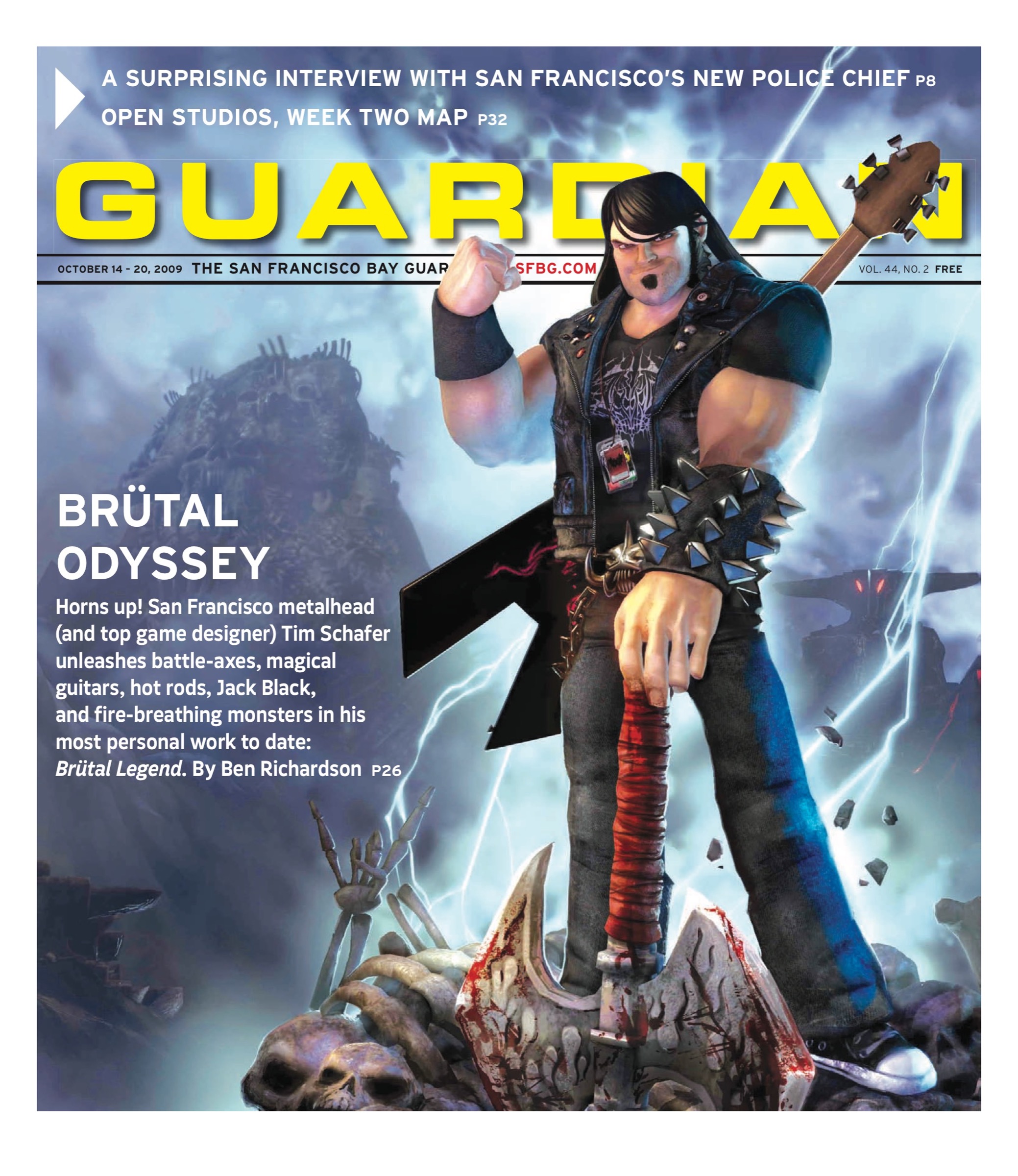
Brütal odyssey

0

>>Read Ben Richardson’s full interview with Tim Schafer here

arts@sfbg.com

GAMER "The first time we pitched it, they wanted us to change the genre, to make it about country or hip-hop or something."

Game designer Tim Schafer is sitting in his SoMa office, in his favorite chair — appropriately, a rocking chair — and talking about his masterpiece. "They were saying, ‘Why don’t you open it to all music?’ We said, ‘Look — this is a game about epic battles, good vs. evil, Braveheart-type moments. And heavy metal is the musical genre that focuses heavily on folklore. It sings about medieval combat. It’s really the only genre that makes sense for it.’"

The game is Brütal Legend (Double Fine/EA), and in the end, Schafer got his way. Taking control of Eddie Riggs, a grizzled roadie voiced by Jack Black, the player journeys through a metal landscape inspired by the album covers the designer studied in his youth. Wielding a massive battle-ax and a magical guitar, Riggs encounters righteous friends and fiendish foes, including characters voiced by luminaries like Lemmy Kilmister, Ozzy Osbourne, Rob Halford, and Lita Ford. The soundtrack is a carefully compiled list of headbang-inducing classics.

Schafer agrees that the game is his most personal creation to date. "All games are wish fulfillments. All games are about fantasy. This is a game where I’ve been able to make my own wish fulfillment. I would like to go back in time with a cool car and a battle-axe while listening to heavy metal."

THE TROOPER

Growing up in Sonoma, the designer escaped his suburban life by rocking out to Ozzy Osbourne, Black Sabbath, Judas Priest, and Iron Maiden. He would drive down to San Francisco for shows, catching sets at Mabuhay Gardens or the Stone. The music introduced him to a mythic world of horned hell-monsters, glistening chrome, and mortal combat, a world he never quite left behind.

He attended both UC Santa Cruz and UC Berkeley, dividing his attention between computer programming and creative writing, two talents he would later fuse. At Berkeley, he took a class on folklore from Alan Dundes, a provocative professor whose belief in the power of folklore influenced Schafer’s work tremendously. In 1989, he got a job in San Rafael at Lucasfilm Games, now LucasArts. He was assigned to The Secret of Monkey Island, a comedic adventure game by designer Ron Gilbert. Monkey Island was the perfect vehicle for Schafer’s talents, taking full advantage of his boundless imagination, storytelling sense, and biting wit. It is best remembered for its "insult sword fighting" section, in which dueling buccaneers trade verbal jabs in lieu of physical ones.

Mitch Krpata, game critic for the Boston Phoenix and author of the blog Insult Swordfighting, identified the defining quality of Schafer’s LucasArts output via e-mail: "Character. There are a few archetypes that most games go to again and again: silent man of action, easygoing everyman, tormented soul out for revenge. Schafer’s protagonists aren’t like that. They’re individuals. They’re good guys, but they have flaws, and their flaws aren’t things like they just care too much, dammit."

BE QUICK OR BE DEAD

After finishing the biker-themed Full Throttle in 1995, Schafer hunted inspiration. It came to him as an unlikely combination of themes, both closely tied to his San Francisco home. Initially, he was devouring classic noir films at the Lark and Castro theatres. A trip to the Day of the Dead parade in the city’s Mission District delivered the epiphany. The higher-ups at LucasArts had been agitating for a game with 3-D graphics, a prospect he did not relish. "I really hated the look of 3-D art back then, because it looked like a nylon stretched over a cardboard box," he remembers.

Picking through a table of Day of the Dead ephemera, the idea came: "I saw those calavera statues. Instead of modeling all of the bones in papier-mâché, they’ll just make a tube and paint the bones on the outside. I was like, ‘This is just like bad 3-D art. This is great!’"

Additional fodder was provided by doctor visits to 450 Sutter — a building that combines Art Deco architecture with Mayan motifs — and Schafer began work on his most ambitious project to date. Drawing on his collegiate folklore training, he and his team wove together elements of Day of the Dead tradition, Aztec folk tales, and noir cinema to create 1998’s Grim Fandango (LucasArts), a sprawling epic of crime and love in which all the characters were stylized, calavera-style skeletons "living" in the Land of the Dead. Featuring a labyrinthine, affecting story, delectable hard-boiled dialogue, and stunning art direction, it is still ranked among the best games of all time.

RUNNING FREE

Schafer left LucasArts in 1999, concerned that the company would exercise its ownership of his beloved characters without his participation. He wanted to found his own studio in San Francisco. As he told me over the phone, "Working at a company where you can look out the window and see the city outside is just so inspiring. It’s not just about having great restaurants at lunch, though that’s part of it." Starting in his living room "in a bathrobe and flip-flops," the nascent Double Fine Productions — named after a "double fine zone" sign on the Golden Gate bridge — jumped from location to location, including an unheated warehouse with a rodent problem and a toilet that often unleashed an "ocean of human waste" into the office.

The first Double Fine game was 2005’s Psychonauts, an ambitious project about a summer camp for psychic kids that failed to reach the wide audience it deserved. Even in this rarefied setting, Schafer included bits of the city’s lore. A character named Boyd was based on a homeless man who hung out near the team’s offices, doing odd jobs and enlightening the Double Fine crew with his extensive conspiracy theories.

"Sometimes he would just be on a rant about [how] the government would be trying to read his mind using satellites, or using the broken glass in the streets to bend their optics around," Schafer recalls. "He just produced great quotes: ‘I don’t want to be liquid, I want to be a turtle with rockets strapped to my back!’" Deciding to include him in the game, the designer painstakingly created a flow-chart that would procedurally generate conspiracy theories for Boyd to spout onscreen. "He constructs it by coming up with a conspirator, what their plan is, what the victim of it is, and strings it all together with a bunch of coughing and stuff."

FROM HERE TO ETERNITY

Brütal Legend, Double Fine’s latest game, was released Oct. 13, and gamers across the country will have the opportunity to play through the piece of San Francisco folklore most familiar to Schafer: the one based on himself. By making a game about a character transported from our familiar world into an ax-happy metal battleground, the designer has turned his story, the story of a misfit headbanger from a city steeped in metal history, into a new kind of 21st century myth.

Endorsements

0

San Francisco is facing the worst budget crisis in modern history. More than 1,000 employees, mostly front-line workers in the Department of Public Health, have been laid off, and the red ink continues. Yet the only measure on the November ballot that would raise any money for the city is Sup. Bevan Dufty’s plan to sell off naming rights for Candlestick Park.

That’s pathetic. During the summer budget discussions, Mayor Newsom vowed to work with business, labor, and the supervisors to come up with a reasonable plan to bring in some new cash for the city. But that collapsed — largely because state law would have made it hard to raise taxes this fall without a unanimous vote of the supervisors. And while eight members were willing to put a revenue measure on the ballot, the three supervisors closest to the mayor — Sean Elsbernd, Carmen Chu, and Michela Alioto-Pier, all Newsom appointees — refused to go along. And the mayor made only a weak effort to change their minds.

So while Democrats everywhere decry Gov. Arnold Schwarzenegger’s insistence on a cuts-only budget, the Democratic mayor of San Francisco has forced essentially the same approach on this city. The only revenue increases we’re seeing are fees, like Muni fare hikes, that amount to taxes on the poor.

That’s the state of San Francisco as we head into what will almost certainly be a low-turnout election. Only two elected officials are on the ballot, and both are unopposed. Five ballot measures — several fairly significant — round out the local ballot. And with no big-name races at the top, they will win or lose on the votes of a small majority.

That’s too bad, because the issues matter. Vote Nov. 3 — and let’s hope next year’s ballot actually includes some new, progressive taxes.

OUR RECOMMENDATIONS


City Attorney

Dennis Herrera

San Francisco hasn’t always had a good track record with city attorneys. George Agnost, who ran the office in the 1970s and 1980s, was a dour, secretive, conservative lawyer who let downtown call all the shots. Louise Renne, who took over from Agnost, ran the office in the 1990s as if it was a wholly-owned subsidiary of Pacific Gas and Electric Co. Herrera, who took over in 2001, has been a major improvement. He’s turned the office into a modern operation, professionalized the administration, and taken on an activist role on consumer, environmental, and public-interest issues. He’s been a big supporter of marriage equality and of the city’s landmark health-care legislation. On his own initiative, he sued to end gender rating in health insurance and crack down on predatory payday lenders. He also moved to enforce health codes in housing and has been out front going after corrupt landlords like Skyline Realty.

We have some concerns about Herrera. Although he’s been far more sunshine-friendly than his predecessors, open-government activists are still sometimes forced to sue the city to get access to records. He won’t use his power as city attorney to enforce the Raker Act and bring public power to San Francisco. And during the current budget crisis, he cut the number of city attorney hours the supervisors can use to draft legislation.

And if, as rumored, he wants to run for mayor, Herrera needs to start taking public stands on major issues — like the unfairness of the local tax code and the need for new revenue.

But we’re happy to endorse him for another term.

Treasurer

Jose Cisneros

The incumbent treasurer is running unopposed, and we see no reason not to endorse him. He’s done some very positive things: Cisneros worked to get the big downtown law firms and other partnerships to pay their fair share of city taxes. He closed a tax loophole exploited by the big airlines that put up flight crews in local hotels.

He also convinced local banks and credit unions to accept consular identification cards to allow immigrants to open accounts and has pushed those institutions to offer "second-chance banking" to people with past credit problems. During his tenure, more than half of the 50,000 households in the city that lacked bank accounts have been able to get away from predatory check-cashing outfits and open legitimate accounts.

As an elected official, however, he could be doing a lot more. The city still keeps all its short-term accounts in one bank — Bank of America, which isn’t even local. Cisneros has promised to open that deal up to competitive bidding, but doesn’t have a timeline. And although nobody knows better than the treasurer how unfair and regressive the city’s tax codes are, he has never spoken out or offered any solutions. Cisneros says he wants his office to be apolitical, but city money is, by its nature, a political issue, and we’d like to see a little more leadership from the person who handles it. But overall, he’s a professional money manager who’s done a decent job and deserves another term.

Proposition A

Budget process

YES

We’re a little nervous about Prop. A, which would institute a two-year budget cycle for the city. Sup. Chris Daly, who opposes it, points out that the city controller’s budget projections are often wrong — badly wrong — and trying to plan 24 months ahead when economic conditions (and thus the city’s revenue stream) can change so quickly and unpredictably is a dangerous game.

But on balance, the approach in Prop. A makes sense. The budget debates would still take place every year, and the supervisors would still have to approve an annual budget — although the budget would be a rolling two-year projection. So next year, the board would approve a budget for 2010 and 2011, the following year for 2011 and 2012, and so on — leaving plenty of room for adjusting to meet economic changes. And two-year cycles might make it easier for nonprofits that rely on city funding to do some serious long-term planning.

Equally important, Prop. A requires the police and firefighters to negotiate their union contracts the same time the other unions do — before the budget deadline. The current system allows those unions to make demands that are unrelated to — and often outside — the current year’s budget realities.

Every progressive on the board except Daly supports this, and Sups. Alioto-Pier, Elsbernd and Chu oppose it.

Proposition B

Board of Supervisors aides

YES

This one’s a no-brainer. The City Charter mandates that each supervisor be allowed to hire two aides. The requirement dates back to a long-ago era when city budgets were far smaller, problems were less pressing and complex, and the supervisors worked part-time. It makes perfect sense to take such an archaic law out of the City Charter and allow the supervisors to set their own budgets — and staffing levels — the same way the mayor does. Vote yes.

Proposition C

Candlestick Park Naming Rights

NO

You have to give Sup. Bevan Dufty, the author of Prop. C, credit for trying. He’s looking for any angle he can use to help keep the 49ers in town, and allowing a corporate sponsor to pay for naming rights might possibly help cover the immense cost of substantially renovating aging Candlestick Park. And, like Prop. D (see below), this measure has a nice beneficiary: part of the money from naming rights would go to save the jobs of recreation directors, many of whom have faced budget-driven layoffs.

We agree that rec directors play a crucial role, particularly in neighborhoods with large numbers of at-risk youth. And we wish the Chamber of Commerce, Sup. Elsbernd, and other supporters of Prop. C were willing to accept some progressive tax hikes to fund those jobs.

But this isn’t a good deal. The city owns the stadium; the taxpayers financed its construction and spent 30 years paying off the bonds. But the 49ers, a private outfit owned by a very wealthy family, would get half the money from any naming deal. And the money that would come in would be radically short of what the team would need to rebuild the ‘Stick. Vote no.

Proposition D

Mid-Market special sign district

NO

Again: credit for the effort. David Addington, who owns the Warfield Theater and several other properties on mid-Market Street, accurately notes that the city’s main thoroughfare, between Fifth and Seventh streets, is rundown, ignored, and badly in need of an economic boost. He argues that allowing new digital billboards would create something of a Times Square in San Francisco, attracting tourists and turning mid-Market into a thriving theater district. Nothing else the city has done has worked — why not give this a try?

We aren’t necessarily opposed to digital billboards and we’d love to see mid-Market reinvigorated. But Prop. D would give too much authority to an unelected, unrepresentative group. It would amount to privatizing city planning and set a terrible precedent.

Under the measure, the Central Market Community Benefits District, a private group of property owners, organizations, and residents, would be authorized to approve new general advertising billboards as large as 500 square feet. The ads would have to meet city codes, but the Planning Department and supervisors would have no ability to block new installations. And the money — potentially millions of dollars a year — would go entirely to the property owners and the CBD, which would decide how to distribute it.

Yes, like Prop. C, this measure would help a worthy group: some of the new money would go to youth programs in the Tenderloin. But the process this measure describes isn’t at all democratic. The CBD board selects its own members, and the only oversight the city has is the ability of the Board of Supervisors to abolish the agency and start over.

We’re open to new ideas for central Market Street. We’re open to lights and ads and maybe even billboards. But we’re not willing to turn over zoning and public finance decisions to a private group. Vote no.

Proposition E

Advertisements on city property

YES

Proposition E, written by former Sup. Jake McGoldrick, would freeze new commercial billboards and ads on street furniture at 2008 levels and outlaw advertising on public buildings. It’s an extension of existing city policy, which seeks to limit the increasing blight of commercial ads in public space. Vote yes.

Squeeze my box

0

By Dan Abbott

accordionskyfell_1009.jpg
Skyler Fell, who performed at the SF Accordion Club’s September gathering.

In an age of accelerating cultural fusion and mutation, it should come as no surprise that the accordion has undergone something of a renaissance. A staple of musical traditions from as far afield as Eastern Europe, Mexico, and Italy, the various permutations of the squeezebox has resurfaced with renewed vigor. The San Francisco Bay Area has become something of a hub for this rebirth, aided by both its location at the hub of cultural ley lines and its rich history as – believe it or not – an accordion exporting powerhouse.

Frank Montoro, president of the, San Francisco Accordion Club has watched accordion culture wax and wane with the times. Until the middle of the 20th century, there were at least five accordion factories churning out instruments in North Beach alone, Montoro says, mostly by Italians who’d brought generations of craft knowledge over from the Old Country.

“I watched my accordion being built, back in the ‘40s,” he remembers fondly. The advent of rock’n’roll and mass culture swept much of the accordion’s prestige (and visibility) away, Montoro says, until it seemed an ethnic relic, the obscure province of nerds, wedding music and Weird Al Yankovic. “Times have changed,” the octogenarian Montoro says. “If you like Swedish music, where are you going to go?”

Writers Issue: Eric Haven

0

By Johnny Ray Huston

Lots to enjoy about Eric Haven’s The Aviatrix (Buenaventura Press, 32 pages, $4.95): killer anteaters, male masochism, surveillance run amok, a tiny but buxom beauty named Protona, a large monster named Melgor, noxious human odors that might even make George Kuchar blush, and a truly imaginative mind taking advantage of the kind of hilarious and radical shifts in perspective that can only happen in the frames of a comic strip. In conjunction with the appearance of a Haven comic in this week’s Writers Issue, I recently asked the Bay Area resident about his characters, his interesting day job, and his past connection to this rag.

SFBG You have a long-ago connection to the Guardian. Can you tell me the details?
Eric Haven Almost exactly 20 years ago, I entered the Guardian‘s annual cartoon contest. I won first place in the “best comic strip parody” category, and was quoted in the accompanying article as saying, “I hope to be a professional comic book artist by the time I’m 24!” or some such nonsense. I was incredibly naive and thought I could make money with my comics. Ha!

SFBG What books and artists did you like growing up, and today? What are your favorite B-movies?
EH In terms of comics, I was a Marvel zombie growing up. I would pick ’em
up for 10 cents each at a used bookstore in town. Their covers were torn off but I didn’t care… I could go in with a couple bucks and come out with a stack of comics.
Nowadays I tend to read stuff by single creators… not produced by a system which divides the chores among writers, pencilers, letterers, and colorists. I’ve recently enjoyed reading Prison Pit by Johnny Ryan, the “Sulk” series by Jeffrey Brown, and The Red Monkey Double Happiness Book by Joe Daly.
My favorite B-movies are ones where you can see budget constraints. Attack of the Crab Monsters, It Conquered the World, The Colossus of New York, etc. If it looks like the creature was cobbled together in someone’s garage, out of spare parts and supplies found in the attic, and then shot in someone’s back yard, I love it.

SFBG Tales to Demolish seems to cover any range of time and place, from prehistoric eras to present-day Oakland. Are there particular settings or periods you prefer rendering or are you drawn to drawing all manner of realms?
EH I enjoy rendering weird topographies, whether it’s ice-strewn glacial sheets or ancient dinosaur-infested forests or the wilds of my own kitchen. I’ve recently become obsessed with the history of Upstate New York, and have begun work on a comic which has many pages devoted purely to its geography and geology.

SFBG If the Aviatrix came across and read The Aviatrix, what would she think and have to say? How about Protona — what would her view of the book be?
EH The Aviatrix is well aware what’s going on, as I feel her looking over my shoulder when I draw. Who knows what she thinks? She’s inscrutable, unknowable. Protona would wonder why I drew her so tiny.
She’s actually not that small… close, though.

Writers Issue: Steve Rotman

2

By Johnny Ray Huston

The cover image of this week’s Writers Issue and some of the photos accompanying the writing itself come courtesy of Steve Rotman, whose dedication to photographing work by local painters is evident in his amazingly vast and comprehensive Flickr contributions under the name funkandjazz. It’s also on display in a pair of recent books, Bay Area Graffiti (Mark Batty, 208 pages, $29.95) and San Francisco Street Art (Prestel Publishing, 91 pages, $14.95). I recently threw some questions Rotman’s way, and his answers were characteristically generous. Read up, then scope out his work.

SFBG What got you started taking graffiti and street art pics?
Steve Rotman In early 2004, I was spending a lot of time roaming around the city with my camera. At some point, I got inspired to shoot photos of all the incredible murals spread around San Francisco just because I really liked the art. I also enjoyed the process of searching for the murals — it became a fun new way to explore the city. Eventually, I came across some stunning murals created by graffiti artists, and they blew me away. I got curious about graffiti and began to look for it more and more and I also started to research the subculture and its history. Pretty quickly I got hooked! I’ve been photographing graffiti and street art ever since. I totally dig the art and to me it’s especially compelling because of its outlaw nature.

SFBG How did the funkandjazz moniker come about?
SR Years before Flickr, I was active on another photo-sharing site and needed a moniker. I spur-of-the-moment picked funkandjazz just because at that time I was listening to a lot of classic funk music and I’ve always been heavily into jazz — I was a jazz dj for years. No deeper meaning to it than that. When I joined Flickr, I kept the name and for some reason — inertia I suppose — I’ve stuck with it.

SFBG How would you say SF street art varies from street art in other cities featured within the series?
SR I don’t notice huge differences. Graffiti and street art today are worldwide forms of expression and styles are less regional than they used to be. San Francisco attracts artists from all over the world, so there’s a lot of variety and experimentation here. That melting-pot quality keeps the scene fresh. There does seem to be a little more playfulness or weirdness here, and that’s especially reflected in the city’s rich tradition of character-based graffiti.

SFBG Within the graffiti documentation realm, who do you have a kinship with or admire?
SR There are so many fantastic graffiti photographers out there. I’m a huge fan of the groundbreaking work of Martha Cooper and Henry Chalfant. Steve Grody does inspiring work covering the scene in Los Angeles. Jim and Karla Murray‘s documentation of New York and Miami is outstanding. And there are many others. Honestly, before I began to shoot graffiti, I was mainly into landscape photography, and I think my style and approach often reflects that, for better or worse. Many of my favorite photographers are landscape people. I tend to be influenced a lot by criticism and advice from friends and the other photographers I shoot with.

Seamy dreams

0

arts@sfbg.com

Sex and violence are old bedfellows in art cinema. A line can be drawn from the sliced eyeball in Un Chien Andalou (1929) through A Clockwork Orange (1971), Bonnie and Clyde (1967), and David Cronenberg’s earlier films, right up to Charlotte Gainsbourg’s clitoridectomy in Lars von Trier’s latest provocation Antichrist. The quickest way to expose the hypocrisies of bourgeois morality still seems to be the willful conflation and graphic depiction of bodily harm and bodily pleasure.

The late ’60s and early ’70s films of Koji Wakamatsu — showcased in Yerba Bunea Center for the Arts’ thrilling retrospective, "Pink Cinema Revolution" — present a fascinating case for the political uses of gratuity. Extremely low-budget, alternately frenetic and plodding, frontloaded with sexualized violence, grizzly killings, S&M and rape, and pulsing with the radical politics of their era, Wakamatsu’s films are disturbing, messy, and electric. When, by a fluke, Secrets Behind the Wall (1965) got past Japan’s film rating board and screened at the Berlin International Film Festival that year, the audience couldn’t have prepared themselves for the sight of a stifled housewife hungrily licking the keloid scars of her lover, a Hiroshima survivor.

Although he was a contemporary of Seijun Suzuki, Shohei Imamura, and Nagisa Oshima, Wakamatsu doesn’t slot so easily into the cannon of the nuberu bagu, Japan’s response to the cinematic new waves churning across Europe at the time (noted Japanese film scholar Donald Richie still contends that Wakamatsu "makes embarrassing soft-core psychodramas"). A farmer’s son who had worked odd construction jobs and served time before ever stepping behind a camera, Wakamatsu fell into filmmaking without the formal training or academic background held by many of his peers. Hired by Nikkatsu in 1963, he quickly started churning out pinku eiga or "pink films," the highly profitable genre of soft-core quickies that often displayed wild creativity in the face of a the (still-standing) taboo against onscreen genital realism.

Wakamatsu eventually quit Nikkatsu (after the studio, fearing government action, gave the potential embarrassment Secrets a low-profile domestic release despite the acclaim it received in Berlin) and formed his own studio, Wakamatsu Pro, using the pink film industry mainly as a distribution network for his increasingly extreme experiments, which could barely be described as "soft-core." In Violent Virgin (1969), men and women brutally subject a young couple to all manner of sexual degradations, resulting in the woman’s crucifixion; Violated Angels (1967), based on Richard Speck’s 1966 killing spree, ends with the killer surrounded by a bloody rosette of his flayed victims; Go, Go Second Time Virgin (1969) follows the strange, nihilistic love that develops between two abused teenagers.

Paralleling the growing output of Wakamatsu Pro was the off-screen rise of the radical left wing and student movements. Extremist political groups like the Red Army Faction, and the closely related Japanese Red Army and United Red Army (whose twisted genealogy and downfall Wakamatsu follows in his most recent feature United Red Army (2007), which closes out the series), held the Japanese government accountable for aiding and abetting the U.S. in Vietman and demanded a complete overhaul of the standing social and political structure by any means necessary.

While one can see in the radical assaults on the status quo of sexual relations, filmmaking, and normative citizenship staged in Wakamatsu’s films as being in concert with the rhetoric of the extreme political left, he was not above pointing out its ridiculousness as well. More often than not, the leftists in Wakamatsu films are a confused bunch whose political motives are frequently (and humorously) cross-wired to their libidinal impulses. In Ecstasy of the Angels (1970) the hormonal militants (named, perhaps in a nod to G.K. Chesterton’s anarchist satire The Man Who Would be Thursday, after the days of the week) spout secret code meaningless even to them in between having sex at the drop of a hat.

A fitting close to the series, United Red Army finds Wakamatsu taking a sober look back over the era that fuelled his most prolific years as a filmmaker, accounting for both the revolutionary promises and grim dissolution of Japan’s student protest movement. Combining documentary footage with staged reenactments, United Red Army is a stylistic 360 from Wakamatsu’s earlier work. The grueling, three-hour history lesson spares no detail in documenting the titular faction’s descent from idealism into the sadistic purging of its own members to its highly publicized last stand at a mountain ski resort.

Much like Uli Edel’s The Baader Meinhof Complex, another recent film that examines ’60s political terrorism, United Red Army is difficult to watch because of the factual nature of its exposition and its refusal to judge, even when depicting the URA’s darkest hours. It’s a surprisingly objective coda to the wild, dark films that precede it in "Pink Cinema Revolution," which are as much documents as products of their time. As Jasper Sharp writes in his recent survey of pink cinema, Behind the Pink Curtain, Wakamatsu’s films are, "not only visual testimonies to an era of new sexual frankness and a deep uncertainty in which oblivion seemed to lurk around the corner," but they also offer, in retrospect, prescient glimpses of the underlying forces that would propel the radical left to its own dissolution.


"Pink Cinema Revolution: The Radical Films of Koji Wakamatsu"

Oct 8-29, $8

Yerba Buena Center for the Arts

701 Mission, SF
(415) 978-2787, www.ybca.org

Saving the bay

0

rebeccab@sfbg.com

GREEN CITY When three women from the Berkeley Hills banded together in 1961 to halt monstrous development plans that would have filled in huge swaths of the San Francisco Bay, it became what some have characterized as the first-ever grassroots environmental campaign in the Bay Area.

Critics dismissed Catherine Kerr, Sylvia McLaughlin, and Esther Gulick as "enemies of progress, impractical idealists, do-gooders, posy pickers, eco-freaks, enviro-maniacs, little old ladies in tennis shoes, and even almond cookie revolutionaries," Gulick once told a crowd at UC Berkeley. But their critics were defeated in the end, and popular support for preserving the bay prevailed.

Organizing initially over almond cookies and tea, the trio of housewives forged ahead with the Save San Francisco Bay Association, which later evolved into Save The Bay. They drummed up widespread support for stronger coastal protections to curb rampant bay fill and garbage dumping along the waterfront.

Their efforts eventually helped spur the creation of the San Francisco Bay Conservation and Development Commission (BCDC), which later served as a template for the creation of the California Coastal Commission and influenced the push for federal coastline protection.

This bit of history is the key narrative to Saving The Bay, a four-part documentary series produced by filmmaker Ron Blatman, KQED, and KTEH to tell the story of the San Francisco Bay. Narrated by Robert Redford and featuring luminaries like oceanographer Sylvia Earle, former Secretary of the Interior Stewart Udall, and renowned California historian Kevin Starr, the four-hour documentary is the most comprehensive history of the bay ever produced.

The filmmaker refers to it as "the project that ate my life," since it took seven years to complete. His production crew amassed about 1,000 images from 70 different institutions, he says, and even collected historic film clips to illustrate the story through the lens of various eras. The funding was provided by a host of public agencies and corporate donors.

"The title comes from the three women in the Berkeley Hills," explains Blatman. But the series begins at a much earlier point in history: the time when the Miwok and Ohlone were the only people who inhabited the area, which was rich with natural wonder and teeming with fish and wildlife.

In some ways, the story of the San Francisco Bay is depressing. Viewers are confronted with the dramatic impacts that 160 years of industry and development have had on the region’s once-thriving ecosystem. From the loss of native tribes to the collapse of fisheries, to fill projects that permanently altered wetlands to lingering toxic byproducts of heavy industry, San Francisco’s transformation from a sleepy little town before the Gold Rush era into today’s thriving metropolitan hub has brought no shortage of irreversible environmental consequences.

Still, Blatman says that in the end, it’s a feel-good story. "If you went back 40 years and drew a projection of what the bay would look like today, you’d never get this picture," he points out. The Save the Bay movement revolutionized the way people thought about the San Francisco Bay, he says, and the preservation mindset has marked a positive turnaround. Today, wetland restoration projects abound, and people are accustomed to the idea that the shoreline is a resource that is equally shared by all members of the public — even though these were radical concepts several decades ago.

The inception of this documentary project was accidental, Blatman says. It started because Will Travis, executive director of BCDC, needed something better than the low-quality educational slideshow he used to bring new BCDC commissioners up to speed on the natural history of the bay. A mutual friend introduced the two, and the filmmaker agreed to produce a half-hour educational piece. But the project grew deeper, wider, and much longer.

Lately, Travis says his focus has shifted from educating people about the past to warning them about the future. As a consequence of climate change, sea levels are rising, and the bay is projected to expand. "I hate to tell Ron," Travis jokes, "but he’s going to have to make another film."

Saving the Bay premieres on KQED Channel 9 Thursday evenings Oct. 8 and 15 from 8-10 p.m. (repeating overnight and Sundays Oct. 11 and 18 noon-2 p.m.). The series will then run on KTEH four successive Thursday evenings Oct. 22 to Nov. 12 from 9-10 p.m. For more, visit www.savingthebay.org.

The Monster

0

El Monstruo: Dread & Redemption In Mexico City is a perverse love letter to the most contaminated, crime-ridden, corrupt and conflictive urban stain on the western side of the planet, where I have been touched to live for the past quarter of a century. My life is now hopelessly entangled with the life of this monster of a megalopolis.

El Monstruo was indeed a monstrous book to write. The slagheap of materials that I sucked up — hundreds of volumes of history, slagheaps of newspapers, mountains of personal recollections — fill my threadbare room at the Hotel Isabel in the old quarter of this city from floor to ceiling. The narrative I have assembled spans 50,000,000 years give or take a few minutes, dating from the Paleocene to last spring’s Swine Flu panic with significant stops for the doomed Aztec empire, the war of liberation from Spain, the Mexican revolution of 1910-1919, the student massacres of the ’60s, the Great 1985 earthquake, and the erratic governance of the electoral left for the past 12 years.

It is a long story.

The Mexican Revolution was in many ways a war against Mexico City, a capital for which the rest of the country was named and from which all power continues to radiate. The great revolutionary leaders Emiliano Zapata and Pancho Villa viewed Mexico City as a Sodom & Gomorrah that had to be destroyed if the country was to be redeemed and they did their best to do so. The excerpt that follows speaks to the Monstruo on the eve of the downfall of dictator Porfirio Diaz and the inception of the first great revolution of the landless in the Americas.

WHAT THE LAND WAS LIKE

Back home in Morelos, Emiliano Zapata was elected village leader, entrusted to recover Anenecuilco’s lost lands, granted to the Indians by the Crown in the 17th century. The sugar planters, many of whom were foreigners, had gobbled up the Nahuas’ land and water without remorse.

“Land and Water” was in fact the slogan of Madero ally Vicente Leyva’s campaign for governor of Morelos in 1909 against Díaz’s gallo (rooster), Pablo Escandón, the scion of an immensely wealthy criollo family that had first struck it rich in real estate during Juárez’s Reform, and also a sugar planter who rarely bothered to visit the tiny state. Zapata aligned Anenecuilco’s fortunes with Leyva and Madero. Escandón won by a landslide of course, without ever having to leave El Monstruo. To Zapata, Escandón WAS El Monstruo.

By 1910, 2 percent of all Mexicans owned all the land—save for 70 million hectares held by foreigners with family names like Rockefeller and Hearst and Morgan. One hundred percent of the good farming land in Morelos was occupied by 17 haciendas operated by absentee patrones (bosses). The haciendas sucked up all the groundwater, leaving villages like Anenecuilco dry as a bone. The unequal distribution of water continues a century hence. Wealthy Chilangos have overrun Morelos with their golf courses and palatial second homes, leaving the villages just as thirsty as they were in 1910.

Years ago, I rented a large house in Olintepec, a colonia that shares ejido land (communal farmland) with Anenecuilco, and was able to see how the land must have looked to Zapata when he rode through these fields. I walked out through the tall sugar cane along the irrigation canals to the Caudillo’s humble adobe home, now a museum, on a back street in Anenecuilco, and each young horseman barreling down the country lanes could have been the Caudillo all over again.

But an hour and fifty-five minutes later, when I stepped down off a bus in the belly of the Monstruo, the urban hurly-burly swirling all around me, I always got a whiff of the profound culture shock Emiliano Zapata must have suffered when he was forced to visit this city he so detested.

MADERO’S REVOLUTION

Francisco Madero’s call for the revolution to commence November 20, 1910, stirred sparse response. Up in Puebla, Díaz’s agents murdered Madero’s lieutenant, the revolutionary shoemaker Aquiles Serdán, and his family, two nights before the festivities were slated to kick in. In Morelos, Zapata and the peasant army he had assembled bided their time, waiting to see who would make the first move first.

Mexicans are never on time. Finally, in January, Doroteo Arango AKA Francisco “Pancho” Villa, a popular Chihuahua desperado of Hobsbawmian proportions, and his ruthless cohort Pascual Orozco, declared themselves in revolt and were immediately joined by the Maderista governor of Coahuila, Venustiano Carranza and his “Constitutionalist” Army. Díaz’s Federales were beaten back at Ciudad Guerrero, Mal Paso, and Casas Grandes. Villa laid siege to Ciudad Juárez on the border, the vital railhead that linked Mexico City to the United States and was the lifeblood of the country’s commercial transactions.

By February 1911, with the synchronicity that sometimes made the Mexican Revolution work, the Zapatistas had advanced to Xochimilco. Workers in the heart of the city suffering from what the Porfirian rag El Imparcial tagged ”huelga-manía” or strike fever, declared seven major strikes that paralyzed the Monstruo in 1910–1911. Demonstrators were emboldened enough to assemble in the Zócalo and shout “Death to the Dictator!” beneath Don Porfirio’s balcony by spring. Others menaced his mansion on Cadena Street in the Centro Histórico and were repelled by the gendarmes.

Pablo Escandón fled Mexico for Europe, kvetching to the press that Mexico had fallen into “niggerdom.” Don Porfirio’s class of people was stunned by this threat to their carefree lives and comforts. Indeed, the leisure class had not changed all that much from when the criollos and Gachupines cowered inside the city as Hidalgo’s Indiada advanced on El Monstruo.

After three and a half decades in power, the Dictator remained a figure of adoration in the mansions of La Condesa. For the university students, largely the sons of the ruling class, Don Porfi was the epitome of modernity. To them, Villa and Orozco and Carranza were the Barbarians of the North, Zapata the Attila of the South, and they cast the Dictator as the savior of civilization as they knew it.

But the old man was 81, and it hurt just to keep a stiff upper lip. The medals weighed heavily on his chest. He knew in his heart of hearts what his adorers could not admit—the jig was really up. Ciudad Juárez was days away, even via the modern rail system he had built, and the army’s mobility to supply his troops was restricted. Don Porfiriopochtli, as political cartoonists were drawing him now, had, like the Aztecs, expanded his empire to a point where he could no longer defend it.

In May, the Dictator sent his vice president, Francisco León de la Barra, to the north to negotiate an easy exit to his 34 years on the throne of Mocuhtezuma, and on May 24, 1911, having brokered an agreement with Madero that León de la Barra would remain as provisional president for the next six months, the old man set sail from Puerto, México, for Paris, France, aboard the German steamer Ypringa with this famous caution: “The wild beasts have been loosed. Let us see who will cage them now.”

Wild celebrations broke out in Mexico City as if to underscore the old man’s dictum—15,000 workers invaded the Chamber of Deputies and marched on the National Palace, where the Dictator’s police opened fire, wounding scores. The offices of the Porfirian mouthpiece El Imparcial were set afire. By July, the Monstruo was shut down by a general strike. The wrath of the Mexicans had indeed been loosed, and Madero’s intentions to cage it up again would dictate the next phase of Mexico’s cannibal revolution.

THE GODS ARE SKEPTICAL

After a discreet pause to make sure the old man was really gone, Francisco Madero started off on the long train ride from Ciudad Juárez to Mexico City in early June. There were many treacheries up ahead and he had plenty of time to consider his options as the train lurched from state to state. As he passed through Zacatecas and Aguascalientes, jubilant mobs overran the train depots waving Mexican flags and shouting “¡Vivas!” until they were hoarse and Madero’s train long out of sight.

The presumptive president of Mexico arrived in the capital at Buenavista terminal, the great northern station, on the morning of June 9, and the tumult was overwhelming. Kandell compares it to Juárez’s return to rekindle the republic. I stare at the news photographs. People are excited, even exhilarated. They push and jostle for a view of the little Lenin look-alike. But some are more reserved. They stand back from the jubilant throng. They have come more out of curiosity than conviction. Their faces seem to ask, what next?

From Buenavista, Madero rode through the city in a Dupont motorcar, the sidewalks bursting with well-wishers and flag wavers. Many residents of the metropolis were relieved not so much because of the hope the little man brought with him as for the fact that this change of power had taken place with a minimum of damage to themselves and their city.

When Madero entered the old city for the final jog to the National Palace, he mounted a white horse. In the Palacio, he met with León de la Barra and they reaffirmed their bargain—Porfirio’s stooge would govern for the next six months while Madero campaigned for presidential elections set for November 2. The two emerged on the president’s balcony and “¡Vivas!” erupted from the joyous mob that filled the Zócalo below.

But the old Gods of Tenochtitlán were skeptical about Francisco Madero’s grasp on the presidency. At 6:00 that afternoon they rendered their verdict, upstaging his triumphal arrival in the capital with a deadly earthquake that surged out of the Pacific Ocean along the Jalisco coast and wrought havoc throughout that western state, killing 400 in Zapopan and setting off the Volcano of Colima before smashing into the north of Mexico City and leveling Santa María de la Ribera and San Cosme. There were no Richter scales in those days to measure the quake, but an uncounted number of lives were lost in the capital—perhaps hundreds, reported El Imparcial, which published three extras that day but paid scant attention to Madero’s arrival, burying the story beneath the fold.

Hear Ross read from El Monstruo and sign copies Nov. 18 at Modern Times, 888 Valencia, 7:30 p.m.

Film listings

0

Film listings are edited by Cheryl Eddy. Reviewers are Kimberly Chun, Michelle Devereaux, Max Goldberg, Dennis Harvey, Johnny Ray Huston, Louis Peitzman, Lynn Rapoport, Ben Richardson, Matt Sussman, and Laura Swanbeck. The film intern is Fernando F. Croce. For rep house showtimes, see Rep Clock. For first-run showtimes, see Movie Guide.

MILL VALLEY FILM FESTIVAL

The 32nd Mill Valley Film Festival runs October 8-18 at the Century Cinema, 41 Tamal Vista, Corte Madera; CinéArts@Sequoia, 25 Throckmorton, Mill Valley; 142 Throckmorton Theatre, 142 Throckmorton, Mill Valley; and Smith Rafael Film Center, 1118 Fourth St, San Rafael. Tickets (most shows $12.50) available by calling 1-877-874-MVFF or visiting www.mvff.org. For commentary, see article at www.sfbg.com. All times p.m. unless otherwise noted.

THURS/8

Sequoia The Boys Are Back 7 and 7:15. The Road 9:40.

Smith Rafael Precious: Based on the Novel Push By Sapphire 7.

FRI/9

Sequoia An Education 6:30. Saint Misbehavin’: The Wavy Gravy Movie 6:45. The Bass Player: A Song for Dad 9. Ricky 9:15.

Smith Rafael Aching Hearts 6. Bomber 6:30. "Spotlight on Clive Owen: Croupier" 7. Eat the Sun 8:30. Original 8:45.

SAT/10

Sequoia Ricky Rapper 1:30. Breath Made Visible 2. Race to Nowhere 3:30. Awakening from Sorrow 4:30. Here and There 6. Soundtrack for a Revolution 7. Fish Tank 8:30. Guy and Madeline on a Park Bench 9:30.

Smith Rafael The Ten Lives of Titanic the Cat 1. Stalin Thought of You 1:15. Miracle in a Box: A Piano Reborn 3. Four of a Kind 3:30. Aching Hearts 3:45. "Tribute to Uma Thurman: Motherhood" 6. Original 6:15. Passengers 6:30. Superstar 8:30. Imbued 9. Dark and Stormy Night 9:15.

Throck Zombie Girl: The Movie 1. Concert for a Revolution 9:30.

SUN/11

Sequoia Stella and the Star of the Orient 10:30am. Homegrown 1. Jim Thorpe, the World’s Greatest Athlete 1:15. Ricky 3:30. Icons Among Us: jazz in the present tense 4. Tapped 6. Motherhood 6:30. The Maid 8:15. Sorry, Thanks 9.

Smith Rafael The Letter for the King 12:30. Shylock 1:15. "New Movies Lab: Girl Geeks" 1. "Insight: Henry Selick and the Art of Coraline" 3:15. Guy and Madeline on a Park Bench 3:30. The Red Machine 3:45. Elevator 5:30. The Private Lives of Pippa Lee 5:45. Room and a Half 6. The Bass Player: A Song for Dad 7:30. The Eclipse 8:15. Imbued 9.

Throck "Children’s FilmFest Party" 12:30. "Live Show: Jazz Icons Among Us" 8.

MON/12

Sequoia "5@5: America is Not the World" (shorts program) 5. Barking Water 6. Storm 6:45. The Private Lives of Pippa Lee 7. Four of a Kind 8. Sparrow 9:30.

Smith Rafael Room and a Half 4. The Red Machine 4:30. "5@5: Oscillate Wildly" (shorts program) 5. Breath Made Visible 6:45. Linoleum 7. Jermal 7:15. A Year Ago in Winter 9. Here and There 9:15. Sorry, Thanks 9:30.

TUES/13

Cinema Youth in Revolt 7.

Sequoia "5@5: The More You Ignore Me, the Closer I Get" (shorts program) 5. The Horse Boy 6:30. Skin 6:45. Fish Tank 9. Passengers 9:15.

Smith Rafael "5@5: Sister I’m a Poet" 5. Pierrot le fou 6. HomeGrown 6:45. Saint Misbehavin’: The Wavy Gravy Movie 7. Shameless 8:45. Superstar 9. The Maid 9:15.

OPENING

The Boys Are Back "Inspired by a true story," as its poster trumpets, The Boys Are Back is truly all about inspiration. It hopes to propel its parenting-age demographic to be their better selves, wooing them with elusive shots of adorable, floppy-haired youngsters whooping it up — or at least to make them feel good about their own attempts at child-rearing. Director Scott Hicks (1996’s Shine) positively luxuriates in Australia’s countryside — its rippling, golden waves of grass, dazzling vistas of ocean — in way that seems to simulate the honey-hued memories of an adult looking back fondly on his or her own childhood. But alas, despite some lyrical cinematography, The Boys Are Back doesn’t rise far beyond its heart-tugging TV movie material. Clive Owen is a sports writer who finds his life torn asunder when his wife dies of cancer: like a true sportsman, he’s game to the task of learning to care, solo, for the scrumptiously shaggy 7-year-old Arthur (Nicholas McAnulty) as best he can — all is permissible in his household except swearing and do whatever dad says. And when his guarded older son Harry (George MacKay) jets in from boarding school in England, it’s as if The Dangerous Book for Boys has come to cinematic fruition, with a few mildly tough lessons to boot. Owen does his best to transfigure that scary, albeit sexy, rage lurking behind blue eyes into the stuff of parental panic, but for half the audience at least, that can’t save this feel-gooder designed for women about a man among boys. The gender breakdown at my screening could be encapsulated by the woman quietly sobbing at the start and the man gently snoring through two-thirds. (1:45) California, Embarcadero. (Chun)

Chelsea on the Rocks Abel Ferrara’s first documentary should be a sure thing: a storied New York extremist contemplates the place where others before him went to push the edge in a kind of ritualized bohemia. The Chelsea Hotel is a long poem of death at an early age, with a registry that includes Dylan Thomas’s chasers, Harry Smith’s debts, Warhol’s superstars, Leonard Cohen and Janis Joplin in a room, and Sid and Nancy at the end. One doesn’t expect a straight-laced historical record from the prowling Ferrara; what disappoints about Chelsea on the Rocks isn’t the film’s loose, marinating narration, but rather Ferrara’s refusal to pursue any conversational threads past a convivial but stultifying, "No fucking way." One wants more of the longtime residents’ molasses-slow anecdotes and further investigation of their own private Xanadus. The film is a fount of New York conversation, but it’s also teeming with irritating "wish you were here" postcards from a bygone underground. The question isn’t one of self-regard — the Chelsea wouldn’t exist without it — so much as editing. Milos Foreman’s Cheshire grin is fun, but do we really need to watch him network with Julian Schnabel’s daughter? At the heart of Chelsea on the Rocks is a fairly conventional underdog story: longtime manager and patron Stanley Bard has been cut out by a new board looking to cash in on the Chelsea’s legend, leaving the "real" bohemians in the lurch. But then, pace Ethan Hawke, hasn’t this hipster haunted house been cannibalizing its own past all along? (1:28) Lumiere, Shattuck. (Goldberg)

Couples Retreat Vince Vaughn heads up an ensemble cast in this comedy about four couples who unwittingly vacation at a resort for couples who need relationship therapy. (1:47) Grand Lake, Marina.

Eating Out 3: All You Can Eat A third entry in the low-budget gay franchise that goes mano-a-mano for crassness with mainstream teen sex comedies, this latest ages past even collegiate youth. That’s doubtless due to the expired jeune-fille status of series fave Rebekah Kochan, whose character Tiffani is a bitchy, potty-mouthed, horndoggie drag queen improbably inhabiting the person of an actual heterosexual born-female. Who operates a nail shop in West Hollywood, yet. That she bears no resemblance to credible real-world womanhood doesn’t entirely erase the line-snapping panache of Kochan herself, a gifted comedienne. If only she had better material to work with. After a truly horrific opening reel — duly tasteless but so, so unfunny — director Glenn Gaylord (is that really his name?) and scenarist Phillip J. Bartell’s sequel mercifully goes from rancid to semisweet. There’s little surprise in the Tiffani-assisted pursuit of slightly nelly dreamboat Zack (Chris Salvatore) by pseudo-nerdy, equally bodyfat-deprived new kid in town Casey (Daniel Skelton). But there is a pretty amusing climax involving a three-way (theoretically four) recalling the original’s hilarious phone-sex-coaching highlight. (1:23) Roxie. (Harvey)

*Paranormal Activity In this ostensible found-footage exercise, Katie (Katie Featherson) and Micah (Micah Sloat) are a young San Diego couple whose first home together has a problem: someone, or something, is making things go bump in the night. In fact, Katie has sporadically suffered these disturbances since childhood, when an amorphous, not-at-reassuring entity would appear at the foot of her bed. Skeptical technophile Micah’s solution is to record everything on his primo new video camera, including a setup to shoot their bedroom while they sleep — surveillance footage sequences that grow steadily more terrifying as incidents grow more and more invasive. Like 1999’s The Blair Witch Project, Oren Peli’s no-budget first feature may underwhelm mainstream genre fans who only like their horror slick and slasher-gory. But everybody else should appreciate how convincingly the film’s very ordinary, at times annoying protagonists (you’ll eventually want to throttle Micah, whose efforts are clearly making things worse) fall prey to a hostile presence that manifests itself in increments no less alarming for being (at first) very small. When this hits DVD, you’ll get to see the original, more low-key ending (the film has also been tightened up since its festival debut two years ago). But don’t wait — Paranormal‘s subtler effects will be lost on the small screen. Not to mention that it’s a great collective screaming-audience experience. (1:39) Metreon. (Harvey)

*A Serious Man You don’t have to be Jewish to like A Serious Man — or to identify with beleaguered physics professor Larry Gopnik (the grandly aggrieved Michael Stuhlbarg), the well-meaning nebbishly center unable to hold onto a world quickly falling apart and looking for spiritual answers. It’s a coming of age for father and son, spurred by the small loss of a radio and a 20-dollar bill. Larry’s about-to-be-bar-mitzvahed son is listening to Jefferson Airplane instead of his Hebrew school teachers and beginning to chafe against authority. His daughter has commandeered the family bathroom for epic hair-washing sessions. His wife is leaving him for a silkily presumptuous family friend and has exiled Larry to the Jolly Roger Motel. His failure-to-launch brother is a closeted mathematical genius and has set up housekeeping on his couch. Larry’s chances of tenure could be spoiled by either an anonymous poison-pen writer or a disgruntled student intent on bribing him into a passing grade. One gun-toting neighbor vaguely menaces the borders of his property; the other sultry nude sunbather tempts with "new freedoms" and high times. What’s a mild-mannered prof to do, except envy Schrodinger’s Cat and approach three rungs of rabbis in his quest for answers to life’s most befuddling proofs? Reaching for a heightened, touched-by-advertising style that recalls Mad Men in look and Barton Fink (1991) in narrative — and stooping for the subtle jokes as well as the ones branded "wide load" — the Coen Brothers seem to be turning over, examining, and flirting with personally meaningful, serious narrative, though their Looney Tunes sense of humor can’t help but throw a surrealistic wrench into the works. (1:45) Embarcadero. (Chun)

The Wedding Song Continuing the examination of Muslim-Jewish tensions and female sexuality that she started in La Petit Jerusalem (2005), writer-director Karin Albou’s sophomore feature places the already volatile elements in the literally explosive terrain of World War II. Set in Tunis in 1942, it charts the relationship between Nour (Olympe Borval), a young Arab woman engaged to her handsome cousin, and Myriam (Lizzie Brocheré), the outspoken Jew she’s known since childhood. Bombs rain down from the sky and toxic Nazi propaganda fills the air, but to Albou the most trenchant conflict lies between the two heroines, who bond over their place in an oppressive society while secretly pining for each other’s lives and loves. Jettisoning much of the didacticism that weighted down her previous film, Albou surveys the mores, rituals, and connections informing the thorny politics of female identity with an assured eye worthy of veteran feminist filmmaker Margarethe von Trotta (1986’s Rosa Luxemburg). (1:40) Smith Rafael. (Croce)

ONGOING

Amreeka Dreaming of freedom and white picket fences in the US, West Bank transplants Muna (Nisreen Faour) and son Fadi (Melkar Muallem) instead get racist slurs and White Castle. Despite being overqualified with previous experience as a banker, Muna must work at the restaurant chain to make ends meet while Fadi struggles with bigotry and culture shock in school. Set in the days following September 11, Amreeka (the Arabic word for "America") details the backlash against innocent, unsuspecting minorities who many labeled as terrorists. Cherien Dabis’ feature film debut is smart and enticing (a sign outside White Castle meant to spell "Support Our Troops" drops the "tr" to display a clever preternatural clairvoyance) and creates a lively debate on immigration and discrimination. Ending with a symbolic dance between two nationalities, Dabis recognizes that while people may be bombarded with empty promises of freedom and hope on the Internet, the real American Dream doesn’t exist online but, instead, in small pockets of the community where a Palestinian and a Polish Jew can dance side by side. (1:37) Opera Plaza. (Swanbeck)

*The Baader Meinhof Complex "The Baader Meinhof gang? Those spoiled, hipster terrorists?" That was the response of one knowledgeable pop watcher when I told her about The Baader Meinhof Complex, the new feature from Uli Edel (1989’s Last Exit to Brooklyn). The violence-prone West German anarchist group, otherwise known as the Red Army Faction (RAF), still inspires both venomous spew and starry-eyed fascinatio; Edel’s sober, clear-eyed view of the youthful and sexy yet arrogant and murderous, gun-toting radicals at the center of Baader-Meinhof’s mythology — a complex construct, indeed — manages to do justice to the core of their sprawling chronology, while never overstating their narrative’s obvious post-9/11 relevance. The director’s far from sympathetic when it comes to these self-absorbed, smug rebels, yet he’s not immune to their cocky, idealistic charms. Cool-headed yet fully capable of thrilling to his subjects’ eye-popping audacity, the filmmaker does an admirable job of contextualizing the group within the global student and activist movements and bringing the viewer, authentically, to the still timely question: how does one best (i.e., morally) respond to terrorism? (2:24) Opera Plaza. (Chun)

*Bright Star Is beauty truth; truth, beauty? John Keats, the poet famed for such works as "Ode on a Grecian Urn," and Jane Campion, the filmmaker intent on encapsuutf8g the last romance of the archetypal Romantic, would have undoubtedly bonded over a love of sensual details — and the way a certain vellum-like light can transport its viewer into elevated reverie. In truth, Campion doesn’t quite achieve the level of Keats’ verse with this somber glimpse at the tubercular writer and his final love, neighbor Fanny Brawne. But she does bottle some of their pale beauty. Less-educated than the already respected young scribe, Brawne nonetheless may have been his equal in imagination as a seamstress, judging from the petal-bonneted, ruffled-collar ensembles Campion outfits her in. As portrayed by the soulful-eyed Abbie Cornish, the otherwise-enigmatic, plucky Brawne is the singularly bright blossom ready to be wrapped in a poet’s adoration, worthy of rhapsody by Ben Whishaw’s shaggily, shabbily puppy-dog Keats, who snatches the preternaturally serene focus of a fine mind cut short by illness, with the gravitational pull of a serious indie-rock hottie. The two are drawn to each other like the butterflies flittering in Brawne’s bedroom/farm, one of the most memorable scenes in the dark yet sweetly glimmering Bright Star. Bathing her scenes in lengthy silence, shot through with far-from-flowery dialogue, Campion is at odds with this love story, so unlike her joyful 1990 ode to author Janet Frame, An Angel at My Table (Kerry Fox appears here, too, as Fanny’s mother): the filmmaker refuses to overplay it, sidestepping Austenian sprightliness. Instead she embraces the dark differences, the negative inevitability, of this death-steeped coupling, welcoming the odd glance at the era’s intellectual life, the interplay of light and shadow. (1:59) Marina, Piedmont, Sundance Kabuki. (Chun)

*Capitalism: A Love Story Gun control. The Bush administration. Healthcare. Over the past decade, Michael Moore has tackled some of the most contentious issues with his trademark blend of humor and liberal rage. In Capitalism: A Love Story, he sets his sights on an even grander subject. Where to begin when you’re talking about an economic system that has defined this nation? Predictably, Moore’s focus is on all those times capitalism has failed. By this point, his tactics are familiar, but he still has a few tricks up his sleeve. As with Sicko (2007), Moore proves he can restrain himself — he gets plenty of screen time, but he spends more time than ever behind the camera. This isn’t about Moore; it’s about the United States. When he steps out of the limelight, he’s ultimately more effective, crafting a film that’s bipartisan in nature, not just in name. No, he’s not likely to please all, but for every Glenn Beck, there’s a sane moderate wondering where all the money has gone. (2:07) California, Empire, Grand Lake, Marina, 1000 Van Ness, SF Center, Sundance Kabuki. (Peitzman)

Cloudy With a Chance of Meatballs (1:21) Grand Lake, 1000 Van Ness.

Coco Before Chanel Like her designs, Gabrielle "Coco" Chanel was elegant, très chic, and utterly original. Director Anne Fontaine’s French biopic traces Coco (Audrey Tautou) from her childhood as a struggling orphan to one of the most influential designers of the 20th century. You’ll be disappointed if you expect a fashionista’s up close and personal look at the House of Chanel, as Fontaine keeps her story firmly rooted in Coco’s past, including her destructive relationship with French playboy Etienne Balsar (Benoît Poelvoorde) and her ill-fated love affair with dashing Englishman Arthur "Boy" Capel (Alessandro Nivola). The film functions best in scenes that display Coco’s imagination and aesthetic magnetism, like when she dances with Capel in her now famous "little black dress" amidst a sea of stiff, white meringues. Tautou imparts a quiet courage and quick wit as the trailblazing designer, and Nivola is unmistakably charming and compassionate as Boy. Nevertheless, Fontaine rushes the ending and never truly seizes the opportunity to explore how Coco’s personal life seeped into her timeless designs that were, in the end, an extension of herself. (1:50) Albany, Clay, SF Center. (Swanbeck)

*District 9 As allegories go, District 9 is not all that subtle. This is a sci-fi action flick that’s really all about racial intolerance — and to drive the point home, they went and set it in South Africa. Here’s the set-up: 20 years ago, an alien ship arrived and got stuck, hovering above the Earth. Faster than you can say "apartheid," the alien refugees were confined to a camp — the titular District 9 — where they have remained in slum-level conditions. As science fiction, it’s creative; as a metaphor, it’s effective. What’s most surprising about District 9 is the way everything comes together. This is a big, bloody summer blockbuster with feelings: for every viscera-filled splatter, there’s a moment of poignant social commentary, and nothing ever feels forced or overdone. Writer-director Neill Blomkamp has found the perfect balance and created a film that doesn’t have to compromise. District 9 is a profoundly distressing look at the human condition. It’s also one hell of a good time. (1:52) Four Star, 1000 Van Ness, Sundance Kabuki. (Peitzman)

Fame Note to filmmakers: throwing a bunch of talented young people together does not a good film make. And that’s putting it mildly. Fame is an overstuffed mess, a waste of teenage performers, veteran actors, and, of course, the audience’s time. Conceptually, it’s sound: it makes sense to update the 1980 classic for a new, post-High School Musical generation. But High School Musical this ain’t. Say what you will about the Disney franchise — but those films have (at the very least) some semblance of cohesion and catchy tunes. Fame is music video erratic, with characters who pop up, do a little dance, then disappear for a while. The idea that we should remember them is absurd — that we should care about their plights even stranger. It doesn’t help that said plights are leftovers from every other teen song-and-dance movie ever: unsupportive parents, tough-love teachers, doomed romance. "Fame" may mean living forever, but I give this movie two weeks. (1:45) 1000 Van Ness. (Peitzman)

(500) Days of Summer There’s a warning at the tender, bruised heart of (500) Days of Summer, kind of like an alarm on a clock-radio set to MOPEROCK-FM, going off somewhere in another room. Tom (Joseph Gordon-Levitt), a student of architecture turned architect of sappy greeting card messages, opts to press snooze and remain in the dream world of "I’m the guy who can make this lovely girl believe in love." The agnostic in question is a luminous, whimsical creature named Summer (Zooey eschanel), who’s sharp enough to flirtatiously refer to Tom as "Young Werther" but soft enough to seem capable of reshaping into a true believer. Her semi-mysterious actions throughout (500) Days raise the following question, though: is a mutual affinity for Morrissey and Magritte sufficient predetermining evidence of what is and is not meant to be? Over the course of an impressionistic film that flips back and forth and back again through the title’s 500 days, mimicking the darting, perilous maneuvers of ungovernable memory, first-time feature director Marc Webb and screenwriters Scott Neustadter and Michael H. Weber answer this and related questions in a circuitous fashion, while gently querying our tendency to edit and manufacture perceptions. (1:36) Shattuck. (Rapoport)

*Five Minutes of Heaven Most bad guys were good guys once — it’s a process, not a natal condition. It’s unpleasant but valuable work to imagine exactly how fanaticism can create a sense of righteousness in violence. Who really knows what we’re be capable of after a few weeks, months, years of deprivation or indoctrination? It took Patty Hearst just 71 days to become machine-gun-wielding Tania. Who can blame her if she chose a life of John Waters cameos and never discussed the matter afterward? Alistair, the character played by Liam Neeson in Five Minutes of Heaven, deals with his terroristic youth in precisely the opposite fashion — it’s become both penitentiary cause and ruination of his life. At age 17, he assassinated a young Catholic local to prove mettle within a midsize Irish city’s pro-England, Protestant guerrilla sect. He served 12 years for that crime. But in mind’s eye he keeps seeing his young self committing murder — as witnessed by the victim’s little brother, Joe. Directed by Oliver Hirschbiegel, German director of 2004’s Downfall, Five Minutes of Heaven — the ecstatic timespan James Nesbitt’s flop-sweating adult Joe figures he’d experience upon killing Alistair — is divided into three acts. The first is a vivid, gritty flashback. The second finds our anxious protagonists preparing for a "reconciliation" TV show taping that doesn’t go as planned. Finally the two men face each other in an off-camera meeting that vents Joe’s pent-up lifetime of rage. Heaven has been labeled too theatrical, with its emphasis on two actors and a great deal of dialogue. But there’s nothing stagy in the skillful way both rivet attention. This very good movie asks a very human question: how do you live with yourself after experiencing the harm fanaticism can wreak, as perp or surviving victim? (1:30) Opera Plaza, Smith Rafael. (Harvey)

*Food, Inc. Providing a broader survey of topics already covered in prior documentaries like 2004’s Super Size Me and 2007’s King Corn, Robert Kenner’s feature taps the expertise of authors Eric Schlosser (Fast Food Nation), Michael Pollan (The Omnivore’s Dilemma), and others to explore how agribusiness’ trend toward "faster, fatter, bigger, cheaper" is bad news for your health, and that of the planet. Corporations have monopolized factory farming, slaughterhouses, and processing plants — and made themselves largely immune from regulatory agencies while creating more risks of food poisoning and diabetes through the use of food engineering, antibiotics, pesticides, and even ammonia. Lobbyists, in-pocket legislators (Clarence Thomas is just one of the many policy-setters still loyal to their behemoth ex-employer Monsanto), immigrant worker exploitation, grotesque livestock conditions, and much more figure among the appetite-suppressing news spread here. This informative, entertaining documentary with slick graphics ends on an upbeat note, stressing that your own consumer choices remain the most powerful tool for changing this juggernaut of bad culinary capitalism. (1:34) Roxie. (Harvey)

*In the Loop A typically fumbling remark by U.K. Minister of International Development Simon Foster (Tom Hollander) ignites a media firestorm, since it seems to suggest war is imminent even though Brit and U.S. governments are downplaying the likelihood of the Iraq invasion they’re simultaneously preparing for. Suddenly cast as an important arbiter of global affairs — a role he’s perhaps less suited for than playing the Easter Bunny — Simon becomes one chess piece in a cutthroat game whose participants on both sides of the Atlantic include his own subordinates, the prime minister’s rageaholic communications chief, major Pentagon and State Department honchos, crazy constituents, and more. Writer-director Armando Iannucci’s frenetic comedy of behind-the-scenes backstabbing and its direct influence on the highest-level diplomatic and military policies is scabrously funny in the best tradition of English television, which is (naturally) just where its creators hail from. (1:49) Lumiere, Shattuck. (Harvey)

Inglourious Basterds With Inglourious Basterds Quentin Tarantino pulls off something that seemed not only impossible, but undesirable, and surely unnecessary: making yet another of his in-jokey movies about other movies, albeit one that also happens to be kinda about the Holocaust — or at least Jews getting their own back on the Nazis during World War II — and (the kicker) is not inherently repulsive. As Rube Goldbergian achievements go, this is up there. Nonetheless, Basterds is more fun, with less guilt, than it has any right to be. The "basterds" are Tennessee moonshiner Pvt. Brad Pitt’s unit of Jewish soldiers committed to infuriating Der Fuhrer by literally scalping all the uniformed Nazis they can bag. Meanwhile a survivor (Mélanie Laurent) of one of insidious SS "Jew Hunter" Christoph Waltz’s raids, now passing as racially "pure" and operating a Paris cinema (imagine the cineaste name-dropping possibilities!) finds her venue hosting a Third Reich hoedown that provides an opportunity to nuke Hitler, Himmler, Goebbels, and Goering in one swoop. Tactically, Tarantino’s movies have always been about the ventriloquizing of that yadadada-yadadada whose self-consciousness is bearable because the cleverness is actual; brief eruptions of lasciviously enjoyed violence aside, Basterds too almost entirely consists of lengthy dialogues or near-monologues in which characters pitch and receive tasty palaver amid lethal danger. Still, even if he’s practically writing theatre now, Tarantino does understand the language of cinema. There isn’t a pin-sharp edit, actor’s raised eyebrow, artful design excess, or musical incongruity here that isn’t just the business. (2:30) Lumiere, 1000 Van Ness, SF Center, Shattuck. (Harvey)

*The Informant! The best satire makes you uncomfortable, but nothing will make you squirm in your seat like a true story that feels like satire. Director Steven Soderbergh introduces the exploits of real-life agribusiness whistleblower Mark Whitacre with whimsical fonts and campy music — just enough to get the audience’s guard down. As the pitch-perfect Matt Damon — laden with 30 extra pounds and a fright-wig toupee — gee-whizzes his way through an increasingly complicated role, Soderbergh doles out subtle doses of torturous reality, peeling back the curtain to reveal a different, unexpected curtain behind it. Informant!’s tale of board-room malfeasance is filled with mis-directing cameos, jokes, and devices, and its ingenious, layered narrative will provoke both anti-capitalist outrage and a more chimerical feeling of satisfied frustration. Above all, it’s disquietingly great. (1:48) Bridge, Empire, Four Star, Marina, Oaks, 1000 Van Ness, SF Center. (Richardson)

The Invention of Lying Great concept. Great cast. All The Invention of Lying needed was a great script editor and it might have reached classic comedy territory. As it stands, it’s dragged down to mediocrity by a weak third act. This is the story of a world where no one can lie — and we’re not just talking about big lies either. The Invention of Lying presents a vision of no sarcasm, no white lies, no — gasp —creative fiction. All that changes when Mark Bellison (Ricky Gervais) realizes he can bend the truth. And because no one else can, everything Mark makes up becomes fact to the rubes around him. If you guessed that hilarity ensues, you’re right on the money! Watching Mark use his powers for evil (robbing the bank! seducing women!) makes for a very funny first hour. Then things take a turn for the heavy when Mark becomes a prophet by letting slip his vision of the afterlife. Faster than you can say "Jesus beard," he’s rocking a God complex and the audience is longing for the simpler laughs, like Jennifer Garner admitting to some pre-date masturbation. (1:40) 1000 Van Ness, Piedmont, Shattuck. (Peitzman)

Irene in Time With a scheduled limited release following Father’s Day, Irene in Time no doubt hoped to capitalize on its father/daughter sob stories of altruism and abandonment alike. Set in modern-day L.A., the film opens with Irene, a neurotic, self-absorbed singer, listening eagerly to recollections of her late father, a compulsive gambler and philanderer whom she nonetheless idealizes. Plagued by "daddy issues," Irene believes that her father’s inconsistent presence has left her unable to form a mature and lasting relationship. When not strung along by a procession of two-timing suitors, she is scaring them away with her manic bravado. Additionally, her fundamental need to recapture her father in the form of a lover (can you say "Electra complex"?) comes across as creepy and borderline incestuous. This self-indulgent endeavor of epic proportions finally descends into soap-opera kitsch when a family secret surfaces (explaining Irene’s pipes but not her grating personality) and sinks further still with a slow-mo musical montage using old footage of Irene and her father frolicking in the surf. (1:35) Opera Plaza. (Swanbeck)

Julie and Julia As Julie Powell, disillusioned secretary by day and culinary novice by night, Amy Adams stars as a woman who decides to cook and blog her way through 524 of Julia Child’s recipes in 365 days. Nora Ephron oscillates between Julie’s drab existence in modern-day New York and the exciting life of culinary icon and expatriate, Julia Child (Meryl Streep), in 1950s Paris. As Julia gains confidence in the kitchen by besting all the men at the Cordon Bleu, Julie follows suit, despite strains on both her marriage and job. While Streep’s Julia borders on caricature at first, her performance eventually becomes more nuanced as the character’s insecurities about cooking, infertility, and getting published slowly emerge. Although a feast for the eyes and a rare portrait of a female over 40, Ephron’s cinematic concoction leaves you longing for less Julie with her predictable empowerment storyline and more of Julia and Streep’s exuberance and infectious joie de vivre. (2:03) Oaks, Piedmont. (Swanbeck)

My One and Only (1:48) Opera Plaza, Shattuck.

*9 American animation rarely gets as dark and dystopian as the PG-13-rated 9, the first feature by Shane Acker, who dreamed up the original short. The end of the world has arrived, the cities are wastelands of rubble, and the machines — robots that once functioned as the War of the Worlds-like weapons of an evil dictator — have triumphed. Humans have been eradicated — or maybe not. Some other, more vulnerable, sock-puppet-like machines, concocted with a combination of alchemy and engineering, have been created to counter their scary toaster brethren, like 9 (voiced by Elijah Wood), who stumbles off his worktable like a miniature Pinocchio, a so-called stitch-punk. He’s big-eyed, bumbling, and vulnerable in his soft knitted skin and deprived of his guiding Geppetto. But he quickly encounters 2 (Martin Landau), who helps him jump start his nerves and fine-tune his voice box before a nasty, spidery ‘bot snatches his new friend up, as well a mysterious object 9 found at his creator’s lab. Too much knowledge in this ugly new world is something to be feared, as he learns from the other surviving models. The crotchety would-be leader 1 (Christopher Plummer), the one-eyed timid 5 (John C. Reilly), and the brave 7 (Jennifer Connelly) have very mixed feelings about stirring up more trouble. Who can blame them? People — and machines and even little dolls with the spark of life in their innocent, round eyes — die. Still, 9 manages to sidestep easy consolation and simple answers — delivering the always instructive lesson that argument and dialogue is just as vital and human as blowing stuff up real good — while offering heroic, relatively complicated thrills. And yes, our heros do get to run for their little AI-enhanced lives from a massive fireball. (1:19) Four Star, 1000 Van Ness, SF Center. (Chun)

*Oblivion We go to documentaries to learn about the lives of others, but rarely are we put in touch with the patience, sensitivity, and grit required of listening. Heddy Honigmann’s films privilege the social aspect of these encounters and are the emotionally richer for it — I’d bet her hard-earned humanism would appeal to a wide cross-section of audiences if given the chance, but her documentaries remain woefully under-distributed. Oblivion is her first set in Lima since 1992’s Metal and Melancholy, still my favorite film of hers. Honigmann, who was born in Lima to Holocaust survivors but left the city to study and work in Europe, made that first film to clarify the everyday reality of Peru’s economic ruin. In Oblivion, Honigmann reverses angle, following children and adolescents as they flip cartwheels for stopped traffic, the crosswalk their stage. She also zeroes in on the more established service class, from a stunned shoeshine boy up to a dexterous master of the pisco sour. Slowly, we realize Honigmann’s interviews are an exercise in political geography: she talks to people in the near proximity of the presidential palace, the long shadow of Peru’s ignominious political history framing their discreet stories. Oblivion exhibits both class consciousness and formal virtuosity in its coterminous realizations of an Altman-numbered array of characters. As ever, Honigmann’s ability to transform the normally airless interview format into a cohesive band of intimate encounters is simply stunning. History consigned them to oblivion, but as Honigmann adroitly shows by periodic cut-aways to past presidential inaugurations, personal memory often outlasts the official record. (1:33) Sundance Kabuki. (Goldberg)

Pandorum (1:48) 1000 Van Ness.

*Paris Cédric Klapisch’s latest offers a series of interconnected stories with Paris as the backdrop, designed — if you’ll pardon the cliché — as a love letter to the city. On the surface, the plot of Paris sounds an awful lot like Paris, je t’aime (2006). But while the latter was composed entirely of vignettes, Paris has an actual, overarching plot. Perhaps that’s why it’s so much more effective. Juliette Binoche stars as Élise, whose brother Pierre (Romain Duris) is in dire need of a heart transplant. A dancer by trade, Pierre is also a world-class people watcher, and it’s his fascination with those around him that serves as Paris‘ wraparound device. He sees snippets of these people’s lives, but we get the full picture — or at least, something close to it. The strength of Paris is in the depth of its characters: every one we meet is more complex than you’d guess at first glance. The more they play off one another, the more we understand. Of course, the siblings remain at the film’s heart: sympathetic but not pitiable, moving but not maudlin. Both Binoche and Duris turn in strong performances, aided by a supporting cast of French actors who impress in even the smallest of roles. (2:04) Albany, Embarcadero. (Peitzman)

*Passing Strange: The Movie Spike Lee should do more concert films. His records of theatrical events like the all-star stand-up gathering in The Original Kings of Comedy (2000) or Roger Guenveur Smith’s one-man show in A Huey P. Newton Story (2001) are not without the director’s trademark stylistic bombast, yet they show how, when serving the material, Lee’s overheated camera tricks become rollicking rather than overbearing. So it goes with this kinetic filmed performance of the Tony-winning Broadway rock musical, shot during its last two nights at New York’s Belasco Theater. Starting slow but building to a cheering frenzy, the show takes its timbre from the rich rumble of writer-composer-narrator Stew (nee Mark Stewart), who regales the audience with an autobiographical tale of restless youth (energetically embodied by Daniel Breaker), clinging motherhood (Eisa Davis), and burgeoning artistic identity. Performed and directed with celebratory vigor, this is Lee’s most purely enjoyable work in nearly a decade. (2:15) Shattuck. (Croce)

*The September Issue The Lioness D’Wintour, the Devil Who Wears Prada, or the High Priestess of Condé Nasty — it doesn’t matter what you choose to call Vogue editor-in-chief Anna Wintour. If you’re in the fashion industry, you will call her — or at least be amused by the power she wields as the overseer of style’s luxury bible, then 700-plus pages strong for its legendary September fall fashion issue back in the heady days of ’07, pre-Great Recession. But you don’t have to be a publishing insider to be fascinated by director R.J. Cutler’s frisky, sharp-eyed look at the making of fashion’s fave editorial doorstop. Wintour’s laser-gazed facade is humanized, as Cutler opens with footage of a sparkling-eyed editor breaking down fashion’s fluffy reputation. He then follows her as she assumes the warrior pose in, say, the studio of Yves St. Laurent, where she has designer Stefano Pilati fluttering over his morose color choices, and in the offices of the magazine, where she slices, dices, and kills photo shoots like a sartorial samurai. Many of the other characters at Vogue (like OTT columnist André Leon Talley) are given mere cameos, but Wintour finds a worthy adversary-compatriot in creative director Grace Coddington, another Englishwoman and ex-model — the red-tressed, pale-as-a-wraith Pre-Raphaelite dreamer to Wintour’s well-armored knight. The two keep each other honest and craftily ingenious, and both the magazine and this doc benefit. (1:28) Presidio, Shattuck, Sundance Kabuki. (Chun)

*Still Walking Hirokazu Kore-eda’s 1998 After Life stepped into a bureaucratic beyond. His 2001 Distance probed the aftermath of a religious cult’s mass suicide. Likewise loosely inspired by fact, Nobody Knows (2004) charted the survival of an abandoning mother’s practically feral children in a Tokyo apartment. 2006’s Hana was a splashy samurai story — albeit one atypically resistant to conventional action. Despite their shared character nuance, these prior features don’t quite prepare one for the very ordinary milieu and domestic dramatics of Still Walking. Kore-eda’s latest recalls no less than Ozu in its seemingly casual yet meticulous dissection of a broken family still awkwardly bound — if just for one last visit — by the onerous traditions and institution of "family" itself. There’s no conceptually hooky lure here. Yet Walking is arguably both Kore-eda’s finest hour so far, and as emotionally rich a movie experience as 2009 has yet afforded. One day every summer the entire Yokohama clan assembles to commemorate an eldest son’s accidental death 15 years earlier. This duty calls, even if art restorer Ryota (Hiroshi Abe) chafes at retired M.D. dad’s (Yoshio Harada) obvious disappointment over his career choice, at the insensitivity of his chatterbox mum (Kiri Kirin), and at being eternally compared to a retroactively sainted sibling. Not subject to such evaluative harshness, simply because she’s a girl, is many-foibled sole Yokohama daughter Chinami (Nobody Knows‘ oblivious, helium-voiced mum You). Small crises, subtle tensions, the routines of food preparation, and other minutae ghost-drive a narrative whose warm, familiar, pained, touching, and sometimes hilarious progress seldom leaves the small-town parental home interior — yet never feels claustrophobic in the least. (1:54) Roxie. (Harvey)

Surrogates In a world where cops don’t even leave the house to eat doughnuts, Bruce Willis plays a police detective wrestling with life’s big questions while wearing a very disconcerting blond wig. For example, does it count as living if you’re holed up in your room in the dark 24/7 wearing a VR helmet while a younger, svelter, pore-free, kind of creepy-looking version of yourself handles — with the help of a motherboard — the daily tasks of walking, talking, working, and playing? James Cromwell reprises his I, Robot (2004) I-may-have-created-a-monster role (in this case, a society in which human "operators" live vicariously through so-called surrogates from the safe, hygienic confines of their homes). Willis, with and sans wig, and with the help of his partner (Radha Mitchell), attempts to track down the unfriendly individual who’s running around town frying the circuits of surrogates and operators alike. (While he’s at it, perhaps he could also answer this question: how is it that all these people lying in the dark twitching their eyeballs haven’t turned into bed-sore-ridden piles of atrophied-muscle mush?) Director Jonathan Mostow (2003’s Terminator 3) takes viewers through the twists and turns at cynically high velocity, hoping we won’t notice the unsatisfying story line or when things stop making very much sense. (1:44) Empire, 1000 Van Ness, Sundance Kabuki. (Rapoport)

Toy Story and Toy Story 2 Castro, Grand Lake, 1000 Van Ness, SF Center, Sundance Kabuki.

*We Live in Public Documentarian Ondi Timoner (2004’s DiG!) turns her camera on a longtime acquaintance, internet pioneer Josh Harris, as talented and maddening a subject as DiG! trainwreck Anton Newcombe. From the internet’s infancy, Harris exhibited a creative and forward-thinking outlook that seized upon the medium’s ability to allow people to interact virtually (via chat rooms) and also to broadcast themselves (via one of the internet’s first "television" stations). Though he had an off-putting personality — which sometimes manifested itself in his clown character, "Luvvy" (drawn from the TV-obsessed Harris’ love for Gilligan’s Island) — he racked up $80 million. Some of those new-media bucks went into his art project, "Quiet," an underground bunker stuffed full of eccentrics who allowed themselves to be filmed 24/7. Later, he and his girlfriend moved into a Big Brother-style apartment that was outfitted with dozens of cameras; unsurprisingly, the relationship crumbled under such constant surveillance. His path since then has been just as bizarre, though decidedly more low-tech (and far less well-funded). Though I’m not entirely sold on Timoner’s thesis that Harris’ experiments predicted the current social-networking obsession, her latest film is fascinating, and crafted with footage that only someone who was watching events unfurl first-hand could have captured. (1:30) Roxie. (Eddy)

Whip It What’s a girl to do? Stuck in small town hell, Bliss Cavendar (Ellen Page), the gawky teen heroine of Drew Barrymore’s directorial debut, Whip It, faces a pressing dilemma — conform to the standards of stifling beauty pageantry to appease her mother or rebel and enter the rough-and tumble world of roller derby. Shockingly enough, Bliss chooses to escape to Austin and join the Hurl Scouts, a rowdy band of misfits led by the maternal Maggie Mayhem (Kristin Wiig) and the accident-prone Smashley Simpson (Barrymore). Making a bid for grrrl empowerment, Bliss dawns a pair of skates, assumes the moniker Babe Ruthless, and is suddenly throwing her weight around not only in the rink, but also in school where she’s bullied. Painfully predictable, the action comes to a head when, lo and behold, the dates for the Bluebonnet Pageant and the roller derby championship coincide. At times funny and charming with understated performances by Page and Alia Shawcat as Bliss’ best friend, Whip It can’t overcome its paper-thin characters, plot contrivances, and requisite scenery chewing by Jimmy Fallon as a cheesy announcer and Juliette Lewis as a cutthroat competitor. (1:51) 1000 Van Ness, Presidio, SF Center, Sundance Kabuki. (Swanbeck)

A Woman in Berlin As titles go, A Woman in Berlin is rather vague. A clearer option, to borrow from a popular children’s books series, would be A Series of Unfortunate Events. Based on a true story published anonymously by, well, a woman in Berlin, the film recounts the tribulations faced by German women at the end of World War II. As the Russian army occupies Berlin, these ladies must defend themselves against rape and domination while they await their husbands’ return. It’s a dark chapter in history—and a frequently forgotten one at that. But though A Woman in Berlin may be an important film, it’s not a good one. Without the cinematic flair required to handle a story of this magnitude, writer-director Max Färberböck turns the movie into something monotonous and draining. The characters are morally ambiguous but not interesting; the plot is depressing but tedious. I’m reminded of a quote from The History Boys (2006), another film that touches on (albeit briefly) the atrocities of the second world war: "How do I define history? It’s just one fuckin’ thing after another." (2:11) Four Star. (Peitzman)

*Zombieland First things first: it’s clever, but it ain’t no Shaun of the Dead (2004). That said, Zombieland is an outstanding zombie comedy, largely thanks to Woody Harrelson’s performance as Tallahassee, a tough guy whose passion for offing the undead is rivaled only by his raging Twinkie jones. Set in a world where zombies have already taken over (the beginning stages of the outbreak are glimpsed only in flashback), Zombieland presents the creatures as yet another annoyance for Columbus (Jesse Eisenberg, who’s nearly finished morphing into Michael Cera), a onetime antisocial shut-in who has survived only by sticking to a strict set of rules (the "double tap," or always shooting each zombie twice, etc.) This odd couple meets a sister team (Emma Stone, Abigail Breslin), who eventually lay off their grifting ways so that Columbus can have a love interest (in Stone) and Tallahassee, still smarting from losing a loved one to zombies, can soften up a scoch by schooling the erstwhile Little Miss Sunshine in target practice. Sure, it’s a little heavy on the nerd-boy voiceover, but Zombieland has just enough goofiness and gushing guts to counteract all them brrraiiinss. (1:23) 1000 Van Ness, Shattuck, Sundance Kabuki. (Eddy)

REP PICKS

*"Pink Cinema Revolution: The Radical Films of Koji Wakamatsu" See article at www.sfbg.com. Yerba Buena Center for the Arts.

Quintessence

0

THEATER San Francisco’s Brava Theatre is mostly dark, except for the spotlights on stage. Under the white light, singer Nomy Lamm’s face peers out from under the beak of a vulture headpiece. She flaps her feathered wings and thrusts her hips, like she is working a hula hoop in slow motion.

"I remember the feel of your hands on my body," Lamm sings. "Makes me scream, ‘Am I broken?’"

It is three weeks before the premiere of this year’s Sins Invalid’s performance art show of the same name, and artistic director Patty Berne sits near the back of the theater. She watches Lamm’s rehearsal intently, and as the performance ends, her face splits into an approving smile. "Oh Nomy, I am so frickin’ excited," Berne exclaims. "That was so hot — you don’t even know!"

Currently in its fourth year, Sins Invalid is an annual performance project about sexuality and disability. The upcoming show, which runs for three nights at Brava, showcases 12 performances from local and international artists, including Oakland’s Seeley Quest and the U.K.’s Mat Fraser. The collection of theatrical, musical, spoken word, and multimedia performances includes passages that are confrontational and provocative and moments that are soft and sweet.

According to Berne, who is also the cofounder of Sins, the show’s dimensions reflect the diverse issues that people with disabilities face, living in societies where they are traditionally perceived as unsexy, or even sexless. "[People with disabilities] are thought of as asexual and [it’s assumed] that our lives are defined by our disabilities," she says. "Thinking that we are neutered is absurd. It’s like assuming parents stop having sex because they have a child."

According to the Sins Invalid mission statement, the performance project not only supports artists with disabilities, it also strives to centralize "artists of color and queer and gender-variant artists." The goal of the organization, explained cofounder Leroy Moore, has been to create a community of historically marginalized artists and to provide a mirror for those who are disabled, queer, or of color.

The tone of this year’s two-hour show is set with Lamm’s opening act, "a sexy monster rock opera" called The Reckoning. Dressed as a vulture, Lamm plays a dejected animal that struggles to know itself and its place in the universe. In the more intimate Bird Song, she is an abandoned baby bird that sings from a nest made of stuffed panty hose and prosthetic legs.

"[Bird Song] is about quiet power. It’s like, ‘I know what I have, and when you’re ready to see it, come say hi,’" said Lamm.

Other artists, among them Fraser and choreographer/dancer Antoine Hunter, use their bodies to create powerful performances. In the solo act No Retreat, No Surrender, Fraser taps into his martial arts training to simulate being physically beaten to a soundtrack of insults commonly hurled by ableists. In The Scene, theater marries film in a sexually explicit and tense performance about a man who visits a dominatrix and unexpectedly undergoes an inner transformation.

Moore, who plays the visitor in The Scene, explained that in addition to flipping the notion of who visits a dominatrix, the piece is about loving oneself. "In the beginning [of the scene, the man going to the domme] is not sure what to expect. At the end, he comes to love himself and know ‘I am beautiful.’"

Since the inaugural Sins Invalid showing at Brava in 2006, what once was a one-night annual event has blossomed into a three evenings of performance. According to Berne, previous shows have packed full houses. The public’s reaction to the project, many Sins artists say, has been a validating — if not overwhelming — experience.

For Sins performer Quest, who lives day-to-day as a "broke-ass artist schlep," receiving shout-outs from past audience members is one of the most rewarding parts of the experience. "All year ’round, people are like, ‘I saw you at the show, and I told about my friend about you guys!’ People are circuutf8g the news and it’s totally gratifying."

By helping to create new dialogue among the disabled and able-bodied communities, many of those involved with Sins feel like they are making history — and as Moore states, rewriting the books as well. "[Being involved in Sins] feels like I’m correcting history for people with disabilities," says the Berkeley activist. "History is not written from us — it’s always about others. Now we get to speak our own stories."

Houston-based Maria Palacios, a spoken word artist who has been with Sins for three years, feels that the project passes the torch of hope to the next generation of people with disabilities. "When I was growing up, I didn’t have a Barbie with a wheelchair," Palacios said. "But now kids will have us as heroes to look up to — they will have a history in place already."

SINS INVALID

Fri/2–Sat/3, 8 p.m.; Sun/4, 7 p.m.

Brava Theatre

2789 York, SF

(510) 689-7198

www.brownpapertickets.com, www.sinsinvalid.org

Lemmy caution

0

arts@sfbg.com

MUSIC At an age when most rock ‘n’ roll veterans are content to retire from performing live or trade in their electric guitars for acoustics and change the way they approach their material, Lemmy Kilmister continues to tour the world, bringing his blistering blend of hard rock to fans. The 63-year old leader of Motorhead has been playing music for nearly five decades and shows no signs of slowing down anytime soon. He and the band have hit the road for another tour.

Getting his start in a series of local bands in his native England in the early 1960s, Kilmister eventually moved to London, served a stint as a roadie for Jimi Hendrix, and performed with Hawkwind before founding his own, now legendary band in 1975. Boasting the slogan "Everything Louder Than Everything Else," Motorhead has gained the reputation for being one of the most thunderous groups ever measured in concert.

"We never planned to be the loudest band in the world, we just liked playing that way — I wasn’t trying for any titles," Kilmister explains by phone after a recent sound check in Orlando, Fla.

Though Motorhead has always revolved around Kilmister, the current lineup has been together for some time now; guitarist Phil Campbell joined in 1984 and drummer Mikkey Dee came on board in 1992. But Matt Sorum — who has played with Guns N’ Roses, the Cult, and Velvet Revolver — is filling in on drums for the band’s current tour. Dee is on a hiatus while filming a reality TV show, the Swedish version of I’m A Celebrity, Get Me Out of Here.

"We saw Mikkey on it last night, he was riding a bike on a rope bridge 30 feet up. Unfortunately, they had a safety harness on him," Kilmister chuckles.

A documentary about the iconic frontman, simply titled Lemmy, is set for release later this year. It explores the history of a singer whose penchant for uncompromising rock ‘n’ roll and passions for drugs and women have become the stuff of legend. The film includes live performances, and interviews with various people who have played and worked with Kilmister, who is known for being affable and laid-back when offstage.

"They’ve got a lot of interviews with different people saying what a nice guy I was. It was very flattering. I had no idea I was held in such high esteem," Kilmister laughs.

Following the San Francisco show, Motorhead will be on tour until around Christmas. The group heads back into the studio to record its next album — the follow up to last year’s ferocious Motorizer (Steamhammer/CPV) — in February. That release undoubtedly will be followed by yet another whirlwind trek across the globe to play in front of faithful fans. The elder statesman of hard rock takes on a serious tone when asked if he ever tires of the relentless rock ‘n’ roll lifestyle.

"This is where I belong, I’m supposed to do this," Kilmister says emphatically. "I’m lucky I’ve found my place — a lot of people don’t ever find theirs. This is mine."

MOTORHEAD

With Reveren Horton Heat, Nashville Pussy

Mon/5, 8 p.m., $36–$38

Warfield

982 Market, SF

(415) 775-7722

www.thewarfieldtheatre.com

Higher ground

0

arts@sfbg.com

LIT What Susan Sontag wrote about illness in 1978’s Illness as Metaphor and 1989’s AIDS and Its Metaphors holds for disaster as well: all too often, widespread devastation is made to serve moralistic meanings. Perhaps the primary virtue of Rebecca Solnit’s clear-headed new book, A Paradise Built in Hell: The Extraordinary Communities That Arise in Disaster (Viking, 353 pages, $27.95), is that it does not simply swap one interpretation of disaster — as anticonsumerist reckoning, for instance — for another, such as Jerry Falwell-style damnation. Solnit is interested in how people act in the aftermath, for better and for worse.

By tallying stories from a century’s worth of disasters, Solnit mounts a passionate argument that altruism and solidarity are the norm, no matter what the media or authorities might report. Early in A Paradise Built in Hell, she reflects on the unexpected joy found in the wake of the Loma Prieta earthquake in 1989: "We don’t even have a language for this emotion in which the wonderful comes wrapped in the terrible, joy in sorrow, courage in fear. We cannot welcome disaster, but we can value the responses, both practical and psychological."

Solnit collects evidence of commonplace resilience from bottom-up accounts of earthquakes in San Francisco and Mexico City, the London Blitz, 9/11, Katrina, and the Halifax Explosion of 1917. She marshals these anecdotes against the Hobbesian view, often taken by those in power, that ordinary people will backslide into chaotic violence without strict social controls. A ruling class’s authority is disrupted in disaster, and this tends to put them in a preemptive, paranoid mood. The helpful term for this displacement is "elite panic." The predictability of warrantless crackdowns is depressing. In Solnit’s history, we see Louisiana governor Kathleen Blanco ("These troops know how to shoot and kill, and they are more than willing to do so if necessary, and I expect they will") echoing the brutal edict issued by San Francisco’s mayor, Eugene Schmitz, in 1906 ("The Federal Troops, the members of the Regular Police Force, and all Special Police Officers have been authorized by me to KILL any and all persons engaged in looting"). People matter more than property, except when they don’t.

It’s to Solnit’s credit as a journalist that she departs from her script in New Orleans for a harrowing account (with an assist from former Guardian reporter A.C. Thompson) of the murder of several black men by heavily armed white vigilante groups. One wonders, however, if these ragtag brigades—which certainly cannot be called "elite" — aren’t filling a similar vacuum, in their way, as the informal groups that set to feeding the hungry. How does Solnit’s goodness match up with the mass-complicity required of genocide? It’s telling, after all, that Jan T. Gross’ 2001 book about a massacre of Jews in World War II was titled Neighbors.

A Paradise Built in Hell is a little didactic and a lot repetitious in the typical nonfiction style, and for someone obviously concerned with the impact of words, Solnit never really explains the Christian tuning of her title. But these are only chinks in the book’s broad spirit of inquiry. Solnit’s sources include Carnival, Russian anarchist thinker Peter Kropotkin, the reactionary politics of disaster movies like Dante’s Peak (1997), and William James, who was visiting Stanford during the ’06 quake. Her most intriguing proposition is that the civic temper — James’ phrase — loosed by disaster represents a kind of desire. We’re so used to thinking of desires, both as they’re expressed and repressed, as a private matter of sexuality and identity that it’s almost shocking to hear the word in this social context.

One can easily think of Solnit’s look at hope regained as a kind of parable of the Bush-Obama transition, but if A Paradise Built in Hell is a product of its time, it’s not because it channels our new president’s good tidings. Instead, Solnit’s work is best read as a sustained critique of the degraded view of ordinary citizens taken by the Bush administration: in its eyes we were craven, greedy, vindictive, and worse. Solnit says no, not when it counts. It takes real imagination to answer the intellectual crisis provoked by the reign of W with a study in altruism. What’s even more surprising, she succeeds.

My country, my country

0

FILM We go to documentaries to learn about the lives of others, but rarely are we put in touch with the patience, sensitivity, and grit required of listening. Heddy Honigmann’s films privilege the social aspect of these encounters and are the emotionally richer for it — I’d bet her hard-earned humanism would appeal to a wide cross-section of audiences if given the chance, but her documentaries remain woefully under-distributed. Oblivion is her first set in Lima since 1992’s Metal and Melancholy, still my favorite film of hers. Honigmann, who was born in Lima to Holocaust survivors but left the city to study and work in Europe, made that first film to clarify the everyday reality of Peru’s economic ruin. Instead of submitting a top-down exposition of the situation, she interviews taxi drivers. This was an ingenious maneuver for at least two reasons: it admits the contingencies of her inquiry and floats a matter-of-fact portrait of the people’s despair on the motor-mouthed musings of actual people. Their informal testimonies are too flush with colloquial wisecracking, cynical tirades, idiosyncratic performances, amateur ingenuity, and tender confessions to qualify for pity.

In Oblivion, Honigmann reverses angle, following children and adolescents as they flip cartwheels for stopped traffic, the crosswalk their stage. She also zeroes in on the more established service class, from a stunned shoeshine boy up to a dexterous master of the pisco sour. Slowly, we realize Honigmann’s interviews are an exercise in political geography: she talks to people in the near proximity of the presidential palace, the long shadow of Peru’s ignominious political history framing their discreet stories. Oblivion exhibits both class consciousness and formal virtuosity in its coterminous realizations of an Altman-numbered array of characters. As ever, Honigmann’s ability to transform the normally airless interview format into a cohesive band of intimate encounters is simply stunning. History consigned them to oblivion, but as Honigmann adroitly shows by periodic cut-aways to past presidential inaugurations, personal memory often outlasts the official record.

OBLIVION opens Fri/2 at the Sundance Kabuki.

The Kajagoogoo of Jacques Attali

0

arts@sfbg.com

MUSIC For those of you who missed the memo, it all hasn’t exactly been smooth sailing for the good people of the ol’ U.S. of A over the last year or so. You don’t have to be Noam Chomsky to realize that if the national unemployment rate is hovering right around 10 percent, that’s not good. If you toss in a confusing war that we are still involved in, the polar icecaps melting faster than Joan Rivers’ face in a boiling torrential downpour, and the small matter of a monster flu pandemic, it’s quite clear: Americans have a right to feel a trifle downcast at the moment.

Yet while we face some strains of a musical slump (screamo, ringtone rap etc.) that is just as woeful as our current financial state, 20th century American history tells us that there may be hope for the future. If you look back through the 1900s, there is a constant byproduct of periods of American crisis. We get some pretty damn awesome music.

Financially speaking, the past year or two has been dominated by scary words like recession and downturn, yet you and I have largely avoided the most bone-chilling term of all. To encounter it, you need to set your DeLorean to the 1930s, where you will find our country in the midst of the most terrifying 10 letters in our economic lexicon — depression.

Beginning with some dramatic leaps in 1929, the Great Depression is the benchmark for what happens when things go horribly wrong. In the U.S., unemployment rates reached an unprecedented 25 percent, and the country, not to mention the rest of the planet, was wallowing in the unpleasant waters of the River Styx.

But something curious happened. As folks were dealing with the decade’s bleakest times, Americans were also writing, recording, and performing some of the finest music in the nation’s history. Legendary jazz artists like Louis Armstrong, Duke Ellington, and Billie Holiday released some of the best material of their careers, while the roots of country music were sowed by musicians like Jimmie Rodgers, Lead Belly, the Carter Family, and Woody Guthrie. Much of the Depression-era work of these artists combines palpable, affecting melancholy with surprising overtones of faith, hope, and celebration. Music served as a window into the pain of the average American, and also as an escape from the real-life problems people were facing.

This phenomenon returned in many ways during the late 1960s. While thousands of Americans were fighting a war that nobody seemed to understand, those left behind faced widespread inflation and high interest rates. America again turned to its musicians to air frustrations and fears. Taking cues from artists like Pete Seeger and Doc Watson (who were still active during the generation), a new generation of protest music exploded. The new folk of singers-songwriters such as Bob Dylan and Joan Baez gripped the nation. So did the socially-conscious soul of troubadours like Marvin Gaye, Gil-Scott Heron, and Sam Cooke.

Though these are perhaps the two most obvious instances of great music being created during hard times in America, they aren’t the only ones. Deep in the 1980s, as white suburbanites were loving Reaganomics and rocking out to Kajagoogoo and Huey Lewis, residents of inner cities across America were stuck smack-dab in GOP-perpetrated trickle-down hell. Groundbreaking artists such as NWA, Ice-T, and KRS-One sprang out of the cities, further igniting the massive cultural and commercial force that is hip-hop.

Which brings us to the big question — can we do it again? While you may call it naiveté, I’m optimistic about the chances of history repeating itself. In just the last year, folk has made quite a resurgence, with Fleet Foxes, Bon Iver, the Avett Brothers and others gaining massive followings and selling out venues wherever they play. Also, due to file-sharing, the rise of easily-streamable digital music, and well-run independent labels, artists are able to get their music out to larger audiences without interference from conservative and controlling corporate entities. The rise of independent music is apparent in the lineup of the upcoming Treasure Island Music Festival, widely expected to be one of San Francisco’s biggest concert events this year. Though tickets aren’t cheap, people haven’t minded shelling out for a bill that features only five bands currently signed to a major label.

Not so long ago, in the late 1990s and early 2000s, the economy was booming. Things were great for everyone — except the American pop music fan, who was subjected to overproduced boy bands, toothless pop rock (Sugar Ray, Smashmouth), nu-metal, and countless other forms of forgettable garbage. So while your pockets may be empty now, it might be a good thing. Hold out a hope that maybe, just maybe, in 30 years, the music of the next decade will be lauded much like the tunes of the 1930s and the 1960s.

Until then, just sit tight and keep praying for the death of auto-tune.

Censored!

0

news@sfbg.com

Peter Phillips, director of Project Censored for 13 years, says he’s finished with reform. It’s impossible, he said in a recent interview, to try to get major news media outlets to deliver relevant news stories that serve to strengthen democracy.

"I really think we’re beyond reforming corporate media," said Phillips, a professor of sociology at Sonoma State University and director of Project Censored. "We’re not going to break up these huge conglomerates. We’re just going to make them irrelevant."

Every year since 1976, Project Censored has spotlighted the 25 most significant news stories that were largely ignored or misrepresented by the mainstream press. Now the group is expanding its mission — to promote alternative news sources. But it continues to report the biggest national and international stories that the major media ignored.

The term "censored" doesn’t mean some government agent stood over newsrooms with a rubber stamp and forbid the publication of the news, or even that the information was completely out of the public eye. The stories Project Censored highlights may have run in one or two news outlets, but didn’t get the type of attention they deserved.

The project staff begins by sifting through hundreds of stories nominated by individuals at Sonoma State, where the project is based, as well as 30 affiliated universities all over the country.

Articles are verified, fact-checked, and selected by a team of students, faculty, and evaluators from the wider community, then sent to a panel of national judges to be ranked. The end product is a book, co-edited this year by Phillips and associate director Mickey Huff, that summarizes the top stories, provides in-depth media analysis, and includes resources for readers who are hungry for more substantive reporting.

Project Censored doesn’t just expose gaping holes in the news brought to you by the likes of Fox, CNN, or USA Today — it also shines a light on less prominent but more incisive alternative-media sources serving up in-depth investigations and watchdog reports.

Phillips is stepping down this year as director of Project Censored and turning his attention to a new endeavor called Media Freedom International. The organization will tap academic affiliates from around the world to verify the content put out by independent news outlets as a way to facilitate trust in these lesser-known sources. "The biggest question I got asked for 13 years was, who do you trust?" he explained. "So we’ve really made an effort in the last three years to try to address that question, in a very open way, in a very honest way, and say, these are [the sources] who we can trust."

Benjamin Frymer, a sociology professor at Sonoma State who is stepping into the role of Project Censored director, says he believes the time is ripe for this kind of push. "The actual amount of time people spend reading online is increasing," Frymer pointed out. "It’s not as if people are just cynically rejecting media — they’re reaching out for alternative sources. Project Censored wants to get involved in making those sources visible."

The Project Censored book this year uses the term "truth emergency."

"We call it an emergency because it’s a democratic emergency," Huff asserted. In this media climate, "we’re awash in a sea of information," he said. "But we have a paucity of understanding about what the truth is."

The top 25 Project Censored stories of 2008-09 highlight the same theme that Phillips and Huff say has triggered the downslide of mainstream media: the overwhelming influence of powerful, profit-driven interests. The No. 1 story details the financial sector’s hefty campaign contributions to key members of Congress leading up to the financial crisis, which coincided with a weakening of federal banking regulations. Another story points out that in even in the financial tumult following the economic downturn, special interests spent more money on Washington lobbyists than ever before.

Here’s this year’s list.

1. CONGRESS SELLS OUT TO WALL STREET


The total tab for the Wall Street bailout, including money spent and promised by the U.S. government, works out to an estimated $42,000 for every man, woman, and child, according to American Casino, a documentary about sub prime lending and the financial meltdown. The predatory lending free-for-all, the emergency pumping of taxpayer dollars to prop up mega banks, and the lavish bonuses handed out to Wall Street executives in the aftermath are all issues that have dominated news headlines.

But another twist in the story received scant attention from the mainstream news media: the unsettling combination of lax oversight from national politicians with high-dollar campaign contributions from financial players.

"The worldwide economic meltdown and the bailout that followed were together a kind of revolution, a coup d’état," Matt Taibbi wrote in "The Big Takeover," a March 2009 Rolling Stone article. "They cemented and formalized a political trend that has been snowballing for decades: the gradual takeover of the government by a small class of connected insiders who used money to control elections, buy influence, and systematically weaken financial regulations."

In the 10-year period beginning in 1998, the financial sector spent $1.7 billion on federal campaign contributions, and another $3.4 billion on lobbyists. Since 2001, eight of the most troubled firms have donated $64.2 million to congressional candidates, presidential candidates, and the Republican and Democratic parties.

Wall Street’s spending spree on political contributions coincided with a weakening of federal banking regulations, which in turn created a recipe for the astronomical financial disaster that sent the global economy reeling.

Sources: "Lax Oversight? Maybe $64 Million to DC Pols Explains It," Greg Gordon, Truthout.org and McClatchey Newspapers, October 2, 2008; "Congressmen Hear from TARP Recipients Who Funded Their Campaigns," Lindsay Renick Mayer, Capitol Eye, February 10, 2009; "The Big Takeover," Matt Taibbi, Rolling Stone, March 2009.

2. DE FACTO SEGREGATION DEEPENING IN PUBLIC EDUCATION


Latinos and African Americans attend more segregated public schools today than they have for four decades, Professor Gary Orfield notes in "Reviving the Goal of an Integrated Society: A 21st Century Challenge," a study conducted by UCLA’s Civil Rights Project. Orfield’s report used federal data to highlight deepening segregation in public education by race and poverty.

About 44 percent of students in the nation’s public school system are people of color, and this group will soon make up the majority of the population in the U.S. Yet this racial diversity often isn’t reflected from school to school. Instead, two out of every five African American and Latino youths attend schools Orfield characterizes as "intensely segregated," composed of 90 percent to 100 percent people of color.

For Latinos, the trend reflects growing residential segregation. For African Americans, the study attributes a significant part of the reversal to ending desegregation plans in public schools nationwide. Schools segregated by race and poverty tend to have much higher dropout rates, more teacher turnover, and greater exposure to crime and gangs, placing students at a major disadvantage in society. The most severe segregation is in Western states, including California.

Fifty-five years after the Supreme Court’s Brown vs. Board of Education ruling, Orfield wrote, "Segregation is fast spreading into large sectors of suburbia, and there is little or no assistance for communities wishing to resist the pressures of resegregation and ghetto creation in order to build successfully integrated schools and neighborhoods."

Source: "Reviving the Goal of an Integrated Society: A 21st Century Challenge," Gary Orfield, The Civil Rights Project, UCLA, January 2009

3. SOMALI PIRATES: THE UNTOLD STORY


Somali pirates off the Horn of Africa were like gold for mainstream news outlets this past year. Stories describing surprise attacks on shipping vessels, daring rescues, and cadres of ragtag bandits extracting multimillion dollar ransoms were all over the airwaves and front pages.

But even as the pirates’ exploits around the Gulf of Aden captured the world’s attention, little ink was devoted to factors that made the Somalis desperate enough to resort to piracy in the first place: the dumping of nuclear waste and rampant over-fishing their coastal waters.

In the early 1990s, when Somalia’s government collapsed, foreign interests began swooping into unguarded coastal waters to trawl for food — and venturing into unprotected Somali territories to cheaply dispose of nuclear waste. Those activities continued with impunity for years. The ramifications of toxic dumping hit full force with the 2005 tsunami, when leaking barrels were washed ashore, sickening hundreds and causing birth defects in newborn infants. Meanwhile, the uncontrolled fishing harvests damaged the economic livelihoods of Somali fishermen and eroded the country’s supply of a primary food source. That’s when the piracy began.

"Did we expect starving Somalians to stand passively on their beaches, paddling in our nuclear waste, and watch us snatch their fish to eat in restaurants in London and Paris and Rome?" asked journalist Johann Hari in a Huffington Post article. "We didn’t act on those crimes — but when some of the fishermen responded by disrupting the transit-corridor for 20 percent of the world’s oil supply, we begin to shriek about ‘evil.’"

Sources: "Toxic waste behind Somali piracy," Najad Abdullahi, Al Jazeera English, Oct. 11, 2008; "You are being lied to about pirates," Johann Hari, The Huffington Post, Jan. 4, 2009; "The Two Piracies in Somalia: Why the World Ignores the Other," Mohamed Abshir Waldo, WardheerNews, Jan. 8, 2009

4. NORTH CAROLINA’S NUCLEAR NIGHTMARE


The Shearon Harris nuclear plant in North Carolina’s Wake County isn’t just a power-generating station. The Progress Energy plant, located in a backwoods area, bears the distinction of housing the largest radioactive-waste storage pools in the country. Spent fuel rods from two other nuclear plants are transported there by rail, then stored beneath circuutf8g cold water to prevent the radioactive waste from heating.

The hidden danger, according to investigative reporter Jeffery St. Clair, is the looming threat of a pool fire. Citing a study by Brookhaven National Laboratory, St. Clair highlighted in Counterpunch the catastrophe that could ensue if a pool were to ignite. A possible 140,000 people could wind up with cancer. Contamination could stretch for thousands of square miles. And damages could reach an estimated $500 billion.

"Spent fuel recently discharged from a reactor could heat up relatively rapidly and catch fire," Robert Alvarez, a former Department of Energy advisor and Senior Scholar at the Institute for Policy Studies noted in a study about safety issues surrounding nuclear waste pools. "The fire could well spread to older fuel. The long-term contamination consequences of such an event could be significantly worse than Chernobyl."

Shearon Harris’ track record is pocked with problems requiring temporary shutdowns of the plant and malfunctions of the facility’s emergency-warning system.

When a study was sent to the Nuclear Regulatory Commission highlighting the safety risks and recommending technological fixes to address the problem, St. Clair noted, a pro-nuclear commissioner successfully persuaded the agency to dismiss the concerns.

Source: "Pools of Fire," Jeffrey St. Clair, CounterPunch, Aug. 9, 2008

5. U.S. FAILS TO PROTECT CONSUMERS AGAINST TOXICS


Two years ago, the European Union enacted a bold new environmental policy requiring close scrutiny and restriction of toxic chemicals used in everyday products. Invisible perils such as lead in lipstick, endocrine disruptors in baby toys, and mercury in electronics can threaten human health. The European legislation aimed to gradually phase out these toxic materials and replace them with safer alternatives.

The story that has gone unreported by mainstream American news media is how this game-changing legislation might affect the U.S., where chemical corporations use lobbying muscle to ensure comparatively lax oversight of toxic substances. As global markets shift to favor safer consumer products, the U.S. Environmental Protection Agency is lagging in its own scrutiny of insidious chemicals.

As investigative journalist Mark Schapiro pointed out in Exposed: The Toxic Chemistry of Everyday Products and What’s at Stake for American Power, the EPA’s tendency to behave as if it were beholden to big business could backfire in this case, placing U.S. companies at a competitive disadvantage because products manufactured here will be regarded with increasing distrust.

Economics aside, the implications of loose restrictions on toxic products are chilling: just one-third of the 267 chemicals on the EU’s watch list have ever been tested by the EPA, and only two are regulated under federal law. Meanwhile, researchers at UC Berkeley estimate that 42 billion pounds of chemicals enter American commerce daily, and only a fraction have undergone risk assessments. When it comes to meeting the safer, more stringent EU standard, the stakes are high — with consequences including economic impacts as well as public health.

Sources: "European Chemical Clampdown Reaches Across Atlantic," David Biello, Scientific American, Sept. 30, 2008; "How Europe’s New Chemical Rules Affect U.S.," Environmental Defense Fund, Sept. 30, 2008; "U.S. Lags Behind Europe in Reguutf8g Toxicity of Everyday Products," Mark Schapiro, Democracy Now! Feb. 24, 2009

6. AS ECONOMY SHRINKS, D.C. LOBBYING GROWS


In 2008, as the economy tumbled and unemployment soared, Washington lobbyists working for special interests were paid $3.2 billion — more than any other year on record. According to the Center for Responsive Politics, special interests spent a collective $32,523 per legislator, per day, for every day Congress was in session.

One event that triggered the lobbying boom, according to CRP director Sheila Krumholz, was the federal bailout — with the federal government ensuring that the lobbyists got a piece of the pie. Ironically, some of the first in line were the same players who helped precipitate the nation’s sharp economic downturn by engaging in high-risk, speculative lending practices.

"Even though some financial, insurance and real estate interests pulled back last year, they still managed to spend more than $450 million as a sector to lobby policymakers," Krumholz noted. "That can buy a lot of influence, and it’s a fraction of what the financial sector is reaping in return through the government’s bailout program."

The list of highest-ranking spenders on Washington lobbying reads like a roster of some of the most powerful interests nationwide. Topping the list was the health sector, which spent $478.5 million lobbying Congress last year. A close runner-up was the finance, insurance, and real-estate sector, spending $453.5 million. Pharmaceutical companies plunked down $230 million; electric utilities spent $156.7 million; and oil and gas companies paid lobbyists $133.2 million.

Source: "Washington Lobbying Grew to $3.2 Billion Last Year, Despite Economy," Center for Responsive Politics, Open Secrets.org

7. OBAMA’S CONTROVERSIAL DEFENSE APPOINTEES


President Barack Obama’s appointments to the Department of Defense have raised serious questions among critics who’ve studied their track records. Although the news media haven’t paid much attention, the defense appointees bring to the administration controversial histories and conflicts of interest due to close ties to defense contractors.

Obama’s decision to retain Robert Gates, Secretary of Defense under President George W. Bush, marks the first time in history that a president has opted to keep a defense secretary of an outgoing opposing party in power.

Gates, a former CIA director, has faced criticism for allegedly spinning intelligence reports for political means. In Failure of Intelligence: The Decline and Fall of the CIA, author and former CIA analyst Melvin Goodman described him as "the chief action officer for the Reagan administration’s drive to tailor intelligence reporting to White House political desires." Gates also came under scrutiny for questions surrounding whether he misled Congress during the Iran-contra scandal in the mid-1980s, and was accused of withholding information from intelligence committees when the U.S. provided military aid to Saddam Hussein during the Iran-Iraq war.

Critics are also uneasy about the appointment of Deputy Defense Secretary William Lynn, who formerly served as a senior vice president at defense giant Raytheon Company and was a registered lobbyist for Raytheon until July 2008. Lynn, who previously served as Pentagon comptroller under the Clinton administration, came under fire during his confirmation hearing for "questionable accounting practices." The Defense Department failed multiple audits under Lynn’s leadership because it was unable to properly account for $3.4 trillion in financial transactions made over the course of several years.

Sources: "The Danger of Keeping Robert Gates," Robert Parry, ConsortiumNews.com, Nov. 13, 2008; "Obama’s Defense Department Appointees- The $3.4 Trillion Question," Andrew Hughes, Global Research, Feb. 13, 2009; "Obama Nominee Admiral Dennis Blair Aided perpetrators of 1999 church Killings in East Timor," Allan Nairn, Democracy Now! Jan. 7, 2009; "Ties to Chevron, Boeing Raise Concern on Possible NSA Pick," Roxana Tiron, The Hill, Nov. 24, 2008


8. BIG BUSINESS CHEATS THE IRS


The Cayman Islands and Bermuda are magnets for Bank of America, Citigroup, American International Group, and 11 other financial giants that were the beneficiaries of the federal government’s 2008 Wall Street bailout. It’s not the balmy weather that inspires some of America’s wealthiest companies to open operations in the Caribbean archipelago: the offshore oases provide safe harbors to stash cash out of the reach of Uncle Sam.

According to a 2008 report by the Government Accountability Office, which was largely ignored by the news media, 83 of the top publicly-held U.S. companies, including some receiving substantial portions of federal bailout dollars, have operations in tax havens that allow them to avoid paying their fair share to the Internal Revenue Service. The report also spotlighted the activities of Union Bank of Switzerland (UBS), which has helped wealthy Americans to use tax schemes to cheat the IRS out of billions.

In December 2008, banking giant Goldman Sachs reported its first quarterly loss, and promptly followed up with a statement that its tax rate would drop from 34.1 percent to 1 percent, citing "changes in geographic earnings mix" as the reason. The difference: instead of paying $6 billion in total worldwide taxes as it did in 2007, Goldman Sachs would pay a total of $14 million in 2008. In the same year, it received $10 billion and debt guarantees from the U.S. government.

"The problem is larger than Goldman Sachs," U.S. Representative Lloyd Doggett, a Texas Democrat who serves on the tax-writing House Ways and Means Committee, told Bloomberg News. "With the right hand out begging for bailout money, the left is hiding it offshore."

Sources: "Goldman Sachs’s Tax Rate Drops to 1 percent or $14 Million," Christine Harper, Bloomberg News, Dec. 16, 2008; "Gimme Shelter: Tax Evasion and the Obama Administration," Thomas B. Edsall, The Huffington Post, Feb. 23, 2009

9. U.S. CONNECTED TO WHITE PHOSPHOROUS STRIKES IN GAZA


In mid-January, as part of a military campaign, the Israeli Defense Forces fired several shells that hit the headquarters of a United Nations relief agency in Gaza City, destroying provisions for basic aid like food and medicine.

The shells contained white phosphorous (referred to as "Willy Pete" in military slang), a smoke-producing, spontaneously flammable agent designed to obscure battle territory that also can ignite buildings or cause grotesque burns if it touches the skin.

The attack on the relief-agency headquarters is just one example of a civilian structure that researchers discovered had been hit during the January air strikes. In the aftermath of the attacks, Human Rights Watch volunteers found spent white phosphorous shells on city streets, apartment roofs, residential courtyards, and at a U.N. school in Gaza.

Human Rights Watch says the IDF’s use of white phosphorous violated international law, which prohibits deliberate, indiscriminate, or disproportionate attacks that result in civilian casualties. After gathering evidence such as spent shells, the organization issued a report condemning the repeated firing of white phosphorus shells over densely populated areas of Gaza as a war crime. Amnesty International, another human rights organization, followed suit by calling upon the United States to suspend military aid to Israel — but to no avail.

The U.S. was a primary source of funding and weaponry for Israel’s military campaign. Washington provided F-16 fighter planes, Apache helicopters, tactical missiles, and a wide array of munitions, including white phosphorus.

Sources: "White Phosphorus Use Evidence of War Crimes Report: Rain of Fire: Israel’s Unlawful Use of White Phosphorus in Gaza," Fred Abrahams, Human Rights Watch, March 25, 2009; "Suspend Military Aid to Israel, Amnesty Urges Obama after Detailing U.S. Weapons Used in Gaza," Rory McCarthy, Guardian/U.K., Feb. 23, 2009; "U.S. Weaponry Facilitates Killings in Gaza," Thalif Deen, Inter Press Service, Jan. 8, 2009; "U.S. military resupplying Israel with ammunition through Greece," Saed Bannoura, International Middle East Media Center News, Jan. 8, 2009.

10. ECUADOR SAYS IT WON’T PAY ILLEGITIMATE DEBT


When President Rafael Correa announced that Ecuador would default on its foreign debt last December, he didn’t say it was because the Latin American country was unable to pay. Rather, he framed it as a moral stand: "As president, I couldn’t allow us to keep paying a debt that was obviously immoral and illegitimate," Correa told an international news agency. The news was mainly reported in financial publications, and the stories tended to quote harsh critics who characterized Correa as an extreme leftist with ties to Venezuelan President Hugo Chavez.

But there’s much more to the story. The announcement came in the wake of an exhaustive audit of Ecuador’s debt, conducted under Correa’s direction by a newly created debt audit commission. The unprecedented audit documented hundreds of allegations of irregularity and illegality in the decades of debt collection from international lenders. Although Ecuador had made payments exceeding the value of the principal since the time it initially took out loans in the 1970s, its foreign debt had nonetheless swelled to levels three times as high due to extraordinarily high interest rates. With a huge percentage of the country’s financial resources devoted to paying the debt, little was left over to combat poverty in Ecuador.

Correa’s move to stand up against foreign lenders did not go unnoticed by other impoverished, debt-ridden nations, and the decision could set a precedent for developing countries struggling to get out from under massive debt obligation to first-world lenders.

Ecuador eventually agreed to a restructuring of its debt at about 35 cents on the dollar. Nonetheless, the move served to expose deficiencies in the World Bank system, which provides little recourse for countries to resolve disputes over potentially illegitimate debt.

Sources: "As Crisis Mounts, Ecuador Declares Foreign Debt Illegitimate and Illegal," Daniel Denvir, Alternet, November 26, 2008; "Invalid Loans to Ecuador: Who Owes Who," Committee for the Integral Audit of Public Credit, Utube, Fall 2008; "Ecuador’s Debt Default," Neil Watkins and Sarah Anders, Foreign Policy in Focus, Dec. 15, 2008

——–

OTHER STORIES IN THE TOP 25

11. Private Corporations Profit from the Occupation of Palestine

12. Mysterious Death of Mike Connell—Karl Rove’s Election Thief

13. Katrina’s Hidden Race War

14. Congress Invested in Defense Contracts

15. World Bank’s Carbon Trade Fiasco

16. US Repression of Haiti Continues

17. The ICC Facilitates US Covert War in Sudan

18. Ecuador’s Constitutional Rights of Nature

19. Bank Bailout Recipients Spent to Defeat Labor

20. Secret Control of the Presidential Debates

21. Recession Causes States to Cut Welfare

22. Obama’s Trilateral Commission Team

23. Activists Slam World Water Forum as a Corporate-Driven Fraud

24. Dollar Glut Finances US Military Expansion

25. Fast Track Oil Exploitation in Western Amazon

Read them all at www.projectcensored.org

How an online newspaper can succeed

0

EDITORIAL Dave Iverson, host of KQED’s Friday Forum show, introduced the Sept. 25 program with a pretty obvious comment: "Conversations about the future of journalism, and newspapers in particular, are rarely optimistic affairs." He went on to describe the new effort by Warren Hellman, KQED, and the UC Berkeley journalism school to create a new media outlet in San Francisco (a story that broke first in the Guardian‘s politics blog).

The guests, including Neil Henry, dean of the j-school; Carl Hall, the former San Francisco Chronicle reporter; and Jeff Clarke, president of KQED; talked in vague platitudes about the big new plans — and then spent much of the time defending and lauding the Chronicle, which one guest called "a great paper."

But that’s not how the callers saw it — and not how much of the Bay Area perceives San Francisco’s major daily newspaper. And therein is a critical lesson for the new journalistic effort.

For the record: we would hate to see the San Francisco Chronicle fail. A daily newspaper plays a crucial role in urban life, politics, and society. No number of part-time bloggers and citizen journalists will ever be able to perform the watchdog role of a fully-staffed newspaper.

And we welcome the new effort by Hellman and his crew. With the dramatic decline in the Chron‘s fortunes, there’s less and less coverage of crucial news in the city, and an aggressive new outlet could be very good news for San Francisco.

But the people who manage the new venture need to understand that the problems the Chronicle faces are not entirely due to the economy and changes in the newspaper business. Frankly, the Chron has consistently spurned, ignored, trivialized, and sought to discredit the entire progressive movement and a wide range of progressive issues. It’s been a conservative newspaper in one of the nation’s most liberal cities. It’s been a cautious publication, wary of serious challenges to the city’s power structure. There’s not a single liberal or progressive columnist at the paper. Opinion writers like C.W. Nevius seem to disdain everything about San Francisco and urban life in general. The political coverage tends to treat the left as something to be mocked. There’s no real labor reporting any more, no aggressive consumer reporting, little pursuit of big structural corruption issues.

It’s little wonder then that a significant percentage of San Franciscans (in particular, younger people) see no reason whatsoever to pick up the San Francisco Chronicle. And KQED (which gets big donations from some of the city’s biggest corporations and the social and political elite) is hardly the voice of young, progressive San Francisco. (Pacific Gas and Electric Co., for example, is one of the greatest corporate criminals in San Francisco history — and also a major KQED donor.)

As one local media observer told us, this new Web-based publication "can’t just be about getting the old band back together for another tour."

If a new online city newspaper is going to succeed, it’s going to have to take San Francisco — with all its diverse communities — seriously. It’s going to have to be willing to offend the big-business power structure. It’s going to need a strong, independent, editorial voice that includes, rather than marginalizes, the progressive point of view. And it’s going to have to attract writers who are interested in communicating to a generation that has abandoned the Chron.

That means Hellman and the gang have to hire a respected editor — and vow not to interfere if the stories and editorials don’t support the agendas of the members of the nonprofit board.

The nonprofit model is tricky for newspapers: foundations and big donors have their own interests, and they often want the organizations they bestow their largesse upon to behave in ways that are antithetical to good journalism. If this new group can make it work (and produce a locally- operated product — unlike the Chron, which is owned by Hearst Corporation in New York) we’re all for it. But a new model of journalism in San Francisco will require more than a new publishing technology. That’s going to be the hardest part.

Music listings

0

Music listings are compiled by Paula Connelly and Cheryl Eddy. Since club life is unpredictable, it’s a good idea to call ahead to confirm bookings and hours. Prices are listed when provided to us. Submit items at listings@sfbg.com.

WEDNESDAY 30

ROCK/BLUES/HIP-HOP

Alma Desnuda, Lady Danville, Davey G Project, Ilaya, Brett Hunter Café du Nord. 8pm, $10.

Little Junior Davis and the All-Star Blues Hounds Rasselas Jazz. 8pm, free.

Hamilton Loomis Biscuits and Blues. 8pm, $15.

Hammerlock, Holley 750 Annie’s Social Club. 8pm, $7.

Ida Marie, Natalie Portman’s Shaved Head Fillmore. 8pm, $20. Hosted by Perez Hilton.

Mason Jennings, Crash Kings Great American Music Hall. 8pm, $20.

Mo’Fone, Brothers Goldman Boom Boom Room. 9:30pm, $5.

Publish the Quest, Radioactive Elbo Room. 9pm, $7.

Gil Scott-Heron, Ise Lyfe, Orgone Regency Ballroom. 9pm, $35.

Sermon, Blank Stares Hemlock Tavern. 9pm, $7.

Sonos, Austin Hartley-Leonard Hotel Utahl. 9pm, $10.

Stripmall Architecture, Sweet Trip, Boy in Static Bottom of the Hill. 9pm, $8.

Tell-Tale Heartbreakers, Green Lady Killers, Hooray for Everything Knockout. 10pm, $6.

Works Progress Administration, Molly Jenson Independent. 8pm, $15.

BAY AREA

Kylie Minogue Fox Theater. 8pm, $58.50-99.50.

JAZZ/NEW MUSIC

"B3 Wednesdays" Coda. 9pm, $7. With Nick Rossi Trio.

Cat’s Corner Savanna Jazz. 7pm, $5-10.

Ben Marcato and the Mondo Combo Top of the Mark. 7:30pm, $10.

Swing With Stan Rite Spot, 2099 Folsom, SF; www.ritespotcafe.net. 8pm, free.

Tin Cup Serenade Le Colonial, 20 Cosmo Place, SF; (415) 931-3600. 7pm, free.

FOLK/WORLD/COUNTRY

49 Special Climate Theater, 285 9th St., SF; (415) 704-3260. 8pm, $7-15 sliding scale. Part of the Music Box Series.

Soja, Kapakahi, Movement Slim’s. 9pm, $21.

DANCE CLUBS

Booty Call Q-Bar, 456 Castro; www.bootycallwednesdays.com. 9pm. Juanita Moore hosts this dance party, featuring DJ Robot Hustle.

Hands Down! Bar on Church. 9pm, free. With DJs Claksaarb, Mykill, and guests spinning indie, electro, house, and bangers.

Jam Wednesday Infusion Lounge. 10pm, free. DJ Slick Dee.

Qoöl 111 Minna Gallery. 5-10pm, $5. Pan-techno lounge with DJs Spesh, Gil, Hyper D, and Jondi.

RedWine Social Dalva. 9pm-2am, free. DJ TophOne and guests spin outernational funk and get drunk.

Respect Wednesdays End Up. 10pm, $5. Rotating DJs Lonestar Sound, Young Fyah, Sake One, Serg, and more spinning reggae, dancehall, roots, lovers rock, and mash ups.

Synchronize Il Pirata, 2007 16th St.; (415) 626-2626. 10pm, free. Psychedelic dance music with DJs Helios, Gatto Matto, Psy Lotus, Intergalactoid, and guests.

THURSDAY 1

ROCK/BLUES/HIP-HOP

Abe Vigoda, Psychic Reality, Mi Ami DJs Knockout. 9:30pm, $6.

David Bazan, Say Hi Independent. 8pm, $15.

Heather Combs, Aiden James, David Greco, Francesca Lee Hotel Utah. 7:30pm, $8.

Datarock, Esser, Kav Slim’s. 8:30pm, $16.

Glenn Labs, Mark Matos and Os Beaches, TV Mike and the Scarecrows Café du Nord. 9pm, $10.

Hot Fog, Private Dancer, Careerers Hemlock Tavern. 9pm, $6.

Hot Toddies, Foxes!, Ian Fays, DJs from Your Latest Crush Bottom of the Hill. 9pm, $10.

*Kylesa, Saviours, Bison BC, Kowloon Walled City DNA Lounge. 7pm, $15.

Maldroid, We Should Be Dead, Hooks Thee Parkside. 9pm, $7.

Mass Fiction, DoubleDouble, Dubious Ranger Grant and Green. 9pm, free.

Please Do Not Fight, Bird by Bird, Ghost and City, Finish Ticket Rickshaw Stop. 7:30pm, $10.

Boz Scaggs and the Blue Velvet Band Great American Music Hall. 8pm, $100. Benefit for the Richard de Lone Special Housing Fund.

Seconds on End Boom Boom Room. 9:30pm, $5.

Johnny Vernazza Biscuits and Blues. 8pm, $15.

*Gillian Welch Fillmore. 8pm, $29.50.

BAY AREA

Kylie Minogue Fox Theater. 8pm, $58.50-99.50.

JAZZ/NEW MUSIC

Debashish Bhattacharya Yoshi’s San Francisco. 8 and 10pm, $15.

Eric Kurtzrock Trio Ana Mandara, Ghirardelli Square, 891 Beach, SF; (415) 771-6800. 7:30pm, free.

Laurent Fourgo Le Colonial, 20 Cosmo Place, SF; (415) 931-3600. 7:30pm, free.

"Full Moon Concert Series: Blood Moon" Luggage Store Gallery, 1007 Market, SF; www.luggagestoregallery.org. 8pm, $6-10. With James Kaiser and AC Way, and Past-Present-Future.

Lisa Lindsley and Walter Bankovitch Trio Shanghai 1930. 7pm, free.

Marlina Teich Trio Brickhouse, 426 Brannan, SF; (415) 820-1595. 7-10pm, free.

Oz Noy Coda. 9pm, $15.

Stompy Jones Top of the Mark. 7:30pm, $10.

FOLK/WORLD/COUNTRY

Dark Hollow Band Atlas Café. 8pm, free.

Shannon Ceili Band Plough and Stars. 9pm, free.

Whisky Richards Maggie McGarry’s, 1353 Grant, SF; (415) 399-9020. 9pm, free.

DANCE CLUBS

Afrolicious Elbo Room. 9:30pm, $5-6. DJs Pleasuremaker, Señor Oz, J Elrod, and B Lee spin Afrobeat, Tropicália, electro, samba, and funk.

Bingotopia Knockout. 7:30-9:30pm, free. Play for drinks, dignity, and dorky prizes with Lady Stacy Pants.

Caribbean Connection Little Baobab, 3388 19th St; 643-3558. 10pm, $3. DJ Stevie B and guests spin reggae, soca, zouk, reggaetón, and more.

Club Jammies Edinburgh Castle. 10pm, free. DJs EBERrad and White Mice spinning reggae, punk, dub, and post punk.

Drop the Pressure Underground SF. 6-10pm, free. Electro, house, and datafunk highlight this weekly happy hour.

Funky Rewind Skylark. 9pm, free. DJ Kung Fu Chris, MAKossa, and rotating guest DJs spin heavy funk breaks, early hip-hop, boogie, and classic Jamaican riddims.

Heat Icon Ultra Lounge. 10pm, free. Hip-hop, R&B, reggae, and soul.

Holy Thursday Underground SF. 10pm, $5. Bay Area electronic hip hop producers showcase their cutting edge styles monthly.

Kick It Bar on Church. 9pm. Hip-hop with DJ Jorge Terez.

Koko Puffs Koko Cocktails, 1060 Geary; 885-4788. 10pm, free. Dubby roots reggae and Jamaican funk from rotating DJs.

Lacquer Beauty Bar. 10pm-2am, free. DJs Mario Muse and Miss Margo bring the electro.

LovEvolution Pre-Party Supperclub. Dinner 7-9:30pm, $55; afterparty 9pm, $10. Join the LovEvolution staff for dinner and performances at 7pm, or get down at the after party to some dance beats.

Mestiza Bollywood Café, 3376 19th St., SF; (415) 970-0362. 10pm, free. Showcasing progressive Latin and global beats with DJ Juan Data.

Mizra Party and Soul Movers Infusion Lounge. 9pm, free. Featuring DJ Cams.

Popscene 330 Rich. 10pm, $10. Rotating DJs spinning indie, Britpop, electro, new wave, and post-punk.

Represent Icon Lounge. 10pm, $5. With Resident DJ Ren the Vinyl Archaeologist and guest. Rock Candy Stud. 9pm-2am, $5. Luscious Lucy Lipps hosts this electro-punk-pop party with music by ReXick.

Studio SF Triple Crown. 9pm, $5. Keeping the Disco vibe alive with authentic 70’s, 80’s, and current disco with DJs Peeplay, Pat Les Stache, and Marnacle.

Toppa Top Thursdays Club Six. 9pm, $5. Jah Warrior, Jah Yzer, I-Vier, and Irie Dole spin the reggae jams for your maximum irie-ness.

FRIDAY 2

ROCK/BLUES/HIP-HOP

Armagideons, Eric McFadden, Hooks, Two Timin Hussies, Interchords Bottom of the Hill. 9pm, $10. Seventh annual SF Joe Strummer Tribute and benefit for Strummerville.

Asobi Seksu, Loney, Dear, Anna Ternheim Slim’s. 9pm, $17.

L’Avventura, Music Lovers, Honneycombs Hotel Utah. 9pm, $6.

Chris Cain Biscuits and Blues. 8 and 10pm, $20.

Clipd Beaks, Experimental Dental School Hemlock Tavern. 9:30pm, $6.

Dark Star Orchestra Fillmore. 9pm, $31.

Destroyer 666, Accused, Witchhaven, Wietus Mortuus, DJ Rob Metal Thee Parkside. 9pm, $15.

Digital Bliss, Return to Mono, Divasonic, Celeste Lear, Weather Pending 111 Minna. 9pm.

John Predny, Fleeting Trance, Andy Mason Retox Lounge. 9pm, $5.

Boz Scaggs and the Blue Velvet Band Great American Music Hall. 9pm, $100. Benefit for the Richard de Lone Special Housing Fund.

Tartufi, Geographer, Judgement Day Rickshaw Stop. 9pm, $10.

Tornado Rider, My Revolver, Stirling Says Red Devi Lounge. 9pm, $10.

Wicked Mercies, Hi-Nobles, I Love My Label Annie’s Social Club. 9pm.

Zony Mash, Horns Boom Boom Room. 10pm, $12.

JAZZ/NEW MUSIC

Audium 9 1616 Bush, SF; (415) 771-1616. 8:30pm, $15.

Black Market Jazz Orchestra Top of the Mark. 9pm, $10.

Broun Fellinis Coda. 9pm, $10.

"Cultural Encounters: Friday Nights at the deYoung presents Jazz at Intersection" Wilsey Court, de Young Museum, 50 Hagiwara Tea Garden Dr, SF; www.deyoungmuseum.org. 6:30pm, free. With Will Bernard/Beth Custer Ensemble.

Duo Gadjo Shanghai 1930. 7:30pm, free.

Eric Kurtzrock Trio Ana Mandara, Ghirardelli Square, 891 Beach, SF; 771-6800. 8pm, free.

Lucid Lovers Rex Hotel, 562 Sutter, SF; (415) 433-4434. 6-8pm.

Plays Monk Red Poppy Art House. 8pm, $10-20.

Ramsey Lewis Trio Yoshi’s San Francisco. 8pm, $35.

FOLK/WORLD/COUNTRY

Christopher Dallman Dolores Park Café. 7pm, free.

*"Hardly Strictly Bluegrass 9" Speedway, Marx, and Lindley Meadows, Golden Gate Park, SF; www.hardlystrictlybluegrass.com. 2-7pm, free. Today’s performers include MC Hammer, Fireants, Poor Man’s Whiskey, Tom Morello: The Nightwatchman, John Prine, and Lyle Lovett and His Large Band.

Jon Langford and the Pine Valley Cosmonauts, Rosie Flores, Sadies, Sally Timms, Rico Bell Swedish American Hall (upstairs from Café du Nord). 7:30pm, $20.

Mild Colonial Boys Plough and Stars. 9pm, $5.

Montana Slim String Band, Bucky Walters, Innapropriaters Café du Nord. 9pm, $12.

Tin Cat, Apple Orange, Avi Vinocur, Grace Woods Red Vic, 1665 Haight, SF; (415) 864-1978. 7:15pm, $2.

DANCE CLUBS

Activate! Lookout, 3600 16th St; (415) 431-0306. 9pm, $3. Face your demigods and demons at this Red Bull-fueled party.

Alcoholocaust Presents Riptide Tavern. 9pm, free. DJ What’s His Fuck spins old-school punk rock and other gems.

Bar on Church 9pm. Rotating DJs Zax, Zhaldee, and Nuxx.

Exhale, Fridays Project One Gallery, 251 Rhode Island; (415) 465-2129. 5pm, $5. Happy hour with art, fine food, and music with Vin Sol, King Most, DJ Centipede, and Shane King.

Fat Stack Fridays Koko Cocktails, 1060 Geary, SF; (415) 885-4788. 10pm, free. With rotating DJs Romanowski, B-Love, Tomas, Toph One, and Vinnie Esparza.

Gay Asian Paradise Club Eight, 1151 Folsom, SF; www.eightsf.com. 9pm, $8. Featuring two dance floors playing dance and hip hop, smoking patio, and 2 for 1 drinks before 10pm.

Jam on It Elbo Room. 10pm, $10. Hip-hop with host Z-Man and DJs Quest, Roy Two Thousand, Tyra from Saigon, and Lady Fingaz.

Look Out Weekend Bambuddha Lounge. 4pm, free. Drink specials, food menu and resident DJs White Girl Lust, Swayzee, Philie Ocean, and more.

Lovesick Etiquette Lounge, 1108 Market, SF; (415) 863-3929. 9pm, $10. A pre-party for LovEvolution hosted by South Sound Collective featuring DJs DRC, Alland Byallo, Dizzy Dave and more.

Martinez Brothers Mighty. 10pm, $15. Get your dancing legs warmed up for Saturday’s LovEvolution parade and festival at this pre-party hosted by Pink Mammoth.

M4M Fridays Underground SF. 10pm-2am. Joshua J and Frankie Sharp host this man-tastic party.

Oldies Night Knockout. 9pm, $2-4. DJs Primo, Daniel, and Lost Cat spin doo-wop, one-hit wonders, and soul.

Punk Rock and Shlock Karaoke Annie’s Social Club. 9pm-2am, $5. Eileen and Jody bring you songs from multiple genres to butcher: punk, new wave, alternative, classic rock, and more.

Tyrant Club 525. 7pm, $25. London DJ duo Lee Burridge and Craig Richards spin the Love at this LovEvolution festival pre-party.

Undead Wedding Cat Club. 9pm; $10, $3 for zombie brides and grooms. Featuring goth, industrial, and death rock music along with wedding ceremonies, cake, and photographers.

Upper Playground and Sonic Living Happy Hour Laszlo. 6-9pm, free. Resident DJs Amplive and Tourist with special guests. Drink specials and giveaways.

SATURDAY 3

ROCK/BLUES/HIP-HOP

Bugs, Dadfag, Sad Horse Hemlock Tavern. 9pm, $6.

Dark Star Orchestra Fillmore. 9pm, $31.

Fat Bottom Girls, Sassy, Yes Gos, Bloody Hells, Horror-X Annie’s Social Club. 9pm.

Horrors, Japanese Motors, Rocket Independent. 9pm, $20.

Love Songs, Ed Mudshi, Cobra Skulls, Airfix Kits El Rio. 10pm, $7.

Monophonix Deluxe Boom Boom Room. 10pm, $10.

Sunny Rhodes Biscuits and Blues. 8 and 10pm, $20.

Schande, Who Cares, Belly of the Whale, Sleeptalks Thee Parkside. 9pm, $8.

Shinedown, Sick Puppies, Adelitas Way Regency Ballroom. 7pm, $30.

*Slim Cessna’s Auto Club, Pine Box Boys, Tiny Television Café du Nord. 9:30pm, $12.

Miike Snow, Jack Peñate, Loquat Bottom of the Hill. 9pm, $10.

Stone Foxes, Soft White Sixties, Courtney Janes, Anna Troy, DJ Joel Selvin Hotel Utah. 8:30pm, $10.

JAZZ/NEW MUSIC

Audium 9 1616 Bush, SF; (415) 771-1616. 8:30pm, $15.

Ralph Carney and friends Rite Spot, 2099 Folsom, SF; www.ritespotcafe.net. 8pm, free.

Eric Kurtzrock Trio Ana Mandara, Ghirardelli Square, 891 Beach, SF; (415) 771-6800. 8pm, free.

Mads Tolling Trio Shanghai 1930. 7:30pm, free.

Ramsey Lewis Trio Yoshi’s San Francisco. 8pm, $35.

Ricardo Scales Top of the Mark. 9pm, $10.

FOLK/WORLD/COUNTRY

Bluegrass Bonanza Plough and Stars. 9pm, $5.

Jordan Carp Caffe Trieste, 1667 Market, SF; (415) 551-1000. 8pm, free.

Danny Cohen, Jonah Kit, Magic! Magic Roses House of Shields. 9pm, $5.

Folk4Parks Rock-It Room. 8pm, $10. Help stop the impending closure of over 100 California State Parks at this benefit featuring Sioux City Kid and the Revolutionary Ramblers, Kristina Bennett, Better Maker, and more.

*"Hardly Strictly Bluegrass 9" Speedway, Marx, and Lindley Meadows, Golden Gate Park, SF; www.hardlystrictlybluegrass.com. 11am-8pm, free. Today’s performers include Okkervil River, Boz Scaggs and the Blue Velvet Band, Old 97s, Steve Earle and the Bluegrass Dukes, Marty Stuart and His Fabulous Superlatives, Richie Havens, and many more.

Belle Monroe and Her Brewglass Boys, Shut-Ins, Gayle Lynn and Her Hired Hands Plough and Stars. 9pm, $10.

Pladdohg Ireland’s 32. 9pm.

DANCE CLUBS

BADNB Lovelution Afterparty Club Six. 9pm, $15. Featuring three stages of drum and bass with DJs KJ Sawka, Gridlok, Bachelors of Science, Method One, Maneesh the Twister, and more.

Bar on Church 9pm. Rotating DJs Foxxee, Joseph Lee, Zhaldee, Mark Andrus, and Niuxx.

Debaser Knockout. 9pm, $5. Wear a flannel, get in free before 11pm to this 90s alternative dance party with DJs Jamie Jams and Emdee.

Everlasting Bass 330 Ritch. 10pm, $5-10. Bay Area Sistah Sound presents this party, with DJs Zita and Pam the Funkstress spinning hip-hop, soul, funk, reggae, dancehall, and club classics.

Fire Corner Koko Cocktails, 1060 Geary; 885-4788. 9:30pm, free. Rare and outrageous ska, rocksteady, and reggae vinyl with Revival Sound System and guests.

Gemini Disco Underground SF. 10pm, $5. Disco with DJ Derrick Love.

Get Loose! Beauty Bar. 10pm, free. With DJ White Mike spinning dance jams.

HYP Club Eight, 1151 Folsom, SF; www.eightsf.com. 10pm, free. Gay and lesbian hip hop party, featuring DJs spinning the newest in the top 40s hip hop and hyphy.

Leisure Paradise Lounge. 10pm, $7. DJs Omar, Aaron, and Jet Set James spinning classic britpop, mod, 60s soul, and 90s indie.

LovEvolution Parade starts at Market and 2nd St. and ends at Civic Center Plaza for a dance music festival, SF; www.sflovevolution.org. Parade starts at noon, free; festival from noon-8pm, $10. Featuring a diverse and extensive line up of dance music DJs.

Rebel Girl Rickshaw Stop. 10pm, $5. "Electroindierockhiphop" and 80s dance party for dykes, bois, femmes, and queers with DJ China G and guests.

Saturday Night Soul Party Elbo Room. 10pm, $10. DJs Lucky, Phengren Oswald, and Paul Paul spin 60s soul on 45s.

So Special Club Six. 9pm, $5. DJ Dans One and guests spinning dancehall, reggae, classics, and remixes.

Spirit Fingers Sessions 330 Ritch. 9pm, free. With DJ Morse Code and live guest performances.

Summer Saturdays Bar On Church. 9pm, free. With DJ Mark Andrus spinning top 40, mashups, hip hop, and electro.

SUNDAY 4

ROCK/BLUES/HIP-HOP

Blakes, Music for Animals, Lucky Jesus Bottom of the Hill. 9pm, $10.

Trevor Childs and the Beholders, Echo Falls, Cyndi Harvell Café du Nord. 8pm, $10.

Dark Star Orchestra Fillmore. 8pm, $31.

*John Doe, Sadies, Brothers Comatose Annie’s Social Club. 8pm, $12.

Jolie Holland, Michael Hurley Independent. 8pm, $20.

Dr. MoJo Boom Boom Room. 9:30pm, free.

Lloyd Gregory Biscuits and Blues. 8pm, $15.

Liquid Indian, Mujaheddin Bernstein Affair, North Fork, White Pee Hemlock Tavern. 9pm, $6.

New Model Army, Salty Walt and the Rattlin’ Ratlines DNA Lounge. 7:30pm, $12.

Soulfly, Prong, Cattle Decapitation Regency Ballroom. 7pm, $24.

JAZZ/NEW MUSIC

"Contemporary Insights: Music and Conversation" ODC Dance Commons, 351 Shotwell, SF; www.sfcmp.org. 4:30pm, $5-10. Performance and discussion of John Harris’ "The Seven Ages."

Imani Winds with Stefon Harris Herbst Theater, 401 Van Ness, SF; www.performances.org. 7pm, $27-39.

Mr. Lucky, Ramshackle Romeos Rite Spot, 2099 Folsom, SF; www.ritespotcafe.net. 8pm, free.

Rob Modica and friends Simple Pleasures, 3434 Balboa, SF; (415) 387-4022. 3pm, free.

Ramsey Lewis Trio Yoshi’s San Francisco. 7pm, $35.

FOLK/WORLD/COUNTRY

*"Hardly Strictly Bluegrass 9" Speedway, Marx, and Lindley Meadows, Golden Gate Park, SF; www.hardlystrictlybluegrass.com. 11am-8pm, free. Today’s performers include Billy Bragg, Chieftains, Old Crow Medicine Show, Marianne Faithfull, Emmylou Harris, Rodney Crowell, Earl Scruggs, Hazel Dickens, Robyn Hitchcock and the Venus 3, Mavis Staples, Neko Case, Dr. Dog, and many more.

Mucho Axé Coda. 8pm, $7.

Quin and friends Plough and Stars. 9pm free.

DANCE CLUBS

Body and Soul Mighty. 8pm, $25. A nonstop dance fest featuring DJs Francois K, Joaquin "Joe" Claussell, and Danny Krivit.

DiscoFunk Mashups Cat Club. 10pm, free. House and 70’s music.

Dub Mission Elbo Room. 9pm, $6. Dub, roots, and classic dancehall with DJ Sep, Maneesh the Twister, and Vinnie Esparza.

5 O’Clock Jive Inside Live Art Gallery, 151 Potrero, SF; (415) 305-8242. 5pm, $5. A weekly swing dance party.

Gloss Sundays Trigger, 2344 Market, SF; (415) 551-CLUB. 7pm. With DJ Hawthorne spinning house, funk, soul, retro, and disco.

Honey Soundsystem Paradise Lounge. 8pm-2am. "Dance floor for dancers – sound system for lovers." Got that?

Jock! Lookout, 3600 16th; 431-0306. 3pm, $2. This high-energy party raises money for LGBT sports teams.

Kick It Bar on Church. 9pm. Hip-hop with DJ Zax.

Religion Bar on Church. 3pm. With DJ Nikita.

Shuckin’ and Jivin’ Knockout. 10pm, free. DJs Dr. Scott and Oran spin rock, doo-wop, jive, stomp, and more on 78rpm records.

Stag AsiaSF. 6pm, $5. Gay bachelor parties are the target demo of this weekly erotic tea dance.

MONDAY 5

ROCK/BLUES/HIP-HOP

Billy Bragg Great American Music Hall. 8pm, $30.

*God Dethroned, Abigail Williams, Woe of Tyrants, Augury, DJ Rob Metal Thee Parkside. 8pm, $15.

Fever Ray, Vuk Regency Ballroom. 8pm, $30.

*Motorhead, Reverend Horton Heat, Nashville Pussy Warfield. 8pm, $38.

Serious Bees, Ms Cloud Hemlock Tavern. 7pm, $5.

69 Eyes, Dommin, Becoming Bottom of the Hill. 8:30pm, $17.

JAZZ/NEW MUSIC

"From the Top" Herbst Theatre, 401 Van Ness, SF; www.sfcmp.org. 8pm, $10-28. San Francisco Contemporary Music Players present five pieces by American composers Harbison, Reich, Wuorinen, Feldman, and Campion.

Lavay Smith Trio Enrico’s, 504 Broadway, SF; www.enricossf.com. 7pm, free.

Project, Classical Revolution Café du Nord. 8pm, $12.

Wayne Wallace Latin Jazz Quintet Yoshi’s San Francisco. 8pm, $14.

DANCE CLUBS

Black Gold Koko Cocktails, 1060 Geary; 885-4788. 10pm-2am, free. Senator Soul spins Detroit soul, Motown, New Orleans R&B, and more — all on 45!

Dubstep/DNB Underground SF. 9pm, $5. With DJs Tromaone, Qzen, Rastatronics, and more.

Going Steady Dalva. 10pm, free. DJs Amy and Troy spinning 60’s girl groups, soul, garage, and more.

King of Beats Tunnel Top. 10pm. DJs J-Roca and Kool Karlo spinning reggae, electro, boogie, funk, 90’s hip hop, and more.

Manic Mondays Bar on Church. 9pm. Drink 80-cent cosmos with Djs Mark Andrus and Dangerous Dan.

Monster Show Underground SF. 10pm, $5. Cookie Dough and DJ MC2 make Mondays worth dancing about, with a killer drag show at 11pm.

Network Mondays Azul Lounge, One Tillman Pl; www.inhousetalent.com. 9pm, $5. Hip-hop, R&B, and spoken word open mic, plus featured performers.

Spliff Sessions Tunnel Top. 10pm, free. DJs MAKossa, Kung Fu Chris, and C. Moore spin funk, soul, reggae, hip-hop, and psychedelia on vinyl.

TUESDAY 6

ROCK/BLUES/HIP-HOP

Chris Ayer, Steph Johnson Hotel Utah. 8pm, $10.

Bane, Trash Talk, Foundation, Grace Alley Thee Parkside. 8pm, $12.

Billy Bragg Great American Music Hall. 8pm, $30.

Busdriver, Themselves, Nocando Bottom of the Hill. 9pm, $12.

Cave Singers, Lightning Dust Independent. 8pm, $14.

Elm, Higuma, New Red Sun Hemlock Tavern. 9pm, $6.

Fat Tuesday Band Biscuits and Blues. 8pm, $15.

School of Seven Bells, Warpaint, Phantogram Slim’s. 8pm, $15.

Stratovarius, Pagans Mind Regency Ballroom. 8pm, $30.

JAZZ/NEW MUSIC

Dave Parker Quintet Rasselas Jazz. 8pm.

"Jazz Mafia Tuesdays" Coda. 9pm, $7. With Joe Bagale.

Kaweh Yoshi’s San Francisco. 8pm, $22.

Ricardo Scales Top of the Mark. 6:30pm, $5.

FOLK/WORLD/COUNTRY

Suzanne Cronin and friends Plough and Stars. 9pm, free.

Gema, Terroritmo Elbo Room. 9pm, $7.

Tim Holt West Portal Library, 190 Lenox, SF; (415) 355-2886. 6:30pm, free. A performance of American history through folk songs.

Tina Dico Café du Nord. 8:30pm, $15.

DANCE CLUBS

DJ Ism Boom Boom Room. 9:30pm, free.

Drunken Monkey Annie’s Social Club. 9pm, free. Rotating DJs and shot specials.

Eclectic Company Skylark, 9pm, free. DJs Tones and Jaybee spin old school hip hop, bass, dub, glitch, and electro.

La Escuelita Pisco Lounge, 1817 Market, SF; (415) 874-9951. 7pm, free. DJ Juan Data spinning gay-friendly, Latino sing-alongs but no salsa or reggaeton.

Mixology Aunt Charlie’s Lounge, 133 Turk, (415) 441-2922. 10pm, $2. DJ Frantik mixes with the science and art of music all night.

Rock Out Karaoke! Amnesia. 7:30pm. With Glenny Kravitz.

Share the Love Trigger, 2344 Market, SF; (415) 551-CLUB. 5pm, free. With DJ Pam Hubbuck spinning house.

Womanizer Bar on Church. 9pm. With DJ Nuxx.

Events listings

0

Events listings are compiled by Paula Connelly. Submit items for the listings at listings@sfbg.com.

WEDNESDAY 30

Where the Wild Things Are Metreon Theater, 101 4th St., SF; www.826valencia.org. 7pm, $75. Enjoy a special screening of Where the Wild Things Are followed by a Q and A discussion with director Spike Jonze and screenwriter Dave Eggers. All proceeds to benefit 826 Valencia.

THURSDAY 01

BAY AREA

Night Bazaar Jack London Square, Broadway at Embarcadero, Oak; oaklandunwrapped.org. 5:30pm, free. Enjoy this nighttime market organized in the festive tradition of Italian village fairs, German holiday markets, and Moroccan bazaars. Featuring local artisans, merchants, music, ice skating, and more.

FRIDAY 02

Clash of the Heroes Bayfront Theater, Building B, Fort Mason Center, SF; (415) 474-6776. Fri.-Sat. 8pm, Sun. 7pm; $20. Join BATS Improv troupe for a competition between improve teams performing scenes, games, and musical numbers which will be scored by judges.

Gandhi Birthday Poetry Reading Gandhi Statue, San Francisco Ferry Building, foot of Mission and Market Streets, SF; (510) 845-5481. 4:30pm, free. Attend a poetry reading on the bay to celebrate the 140th anniversary of Gandhi’s birth followed by a walk to the Martin Luther King, Jr. memorial in Yerba Buena Gardens.

Oktoberfest By the Bay Pier 48, San Francisco Waterfront, across from AT&T park, SF; 1-888-746-7522. Fri. 3pm-Midnight, Sat. 11am-5pm, Sat. 6pm-Midnight, Sun. 11am-6pm; $30-35. Bring the spirit of Germany to the Bay Area at this festival featuring great beer, German food, and authentic German music. Tickets cover admission and entertainment only.

Redefining the Universe Herbst Theater, 401 Van Ness, SF; (415) 392-4400. Fri. 8pm, Sat. 10am, Sat. 1:30pm; $20-100. In honor of the 400th anniversary of Galileo’s first use of the telescope, Humanities West is presenting a two-day program of lectures, discussions, music, and dance presentations titled, Copernicus, Galileo, and Kepler: Redefining our Place in the Universe.

SATURDAY 03

Fall Garden Festival Strybing Arboretum, San Francisco Botanical Garden, 9th Ave. at Lincoln, Golden Gate Park, SF; (415) 661-1316. 10am, free. Garden lovers and gardeners can enjoy a full day of activities and demonstrations about plants and gardening from local horticultural and conservation organizations.

Heroes of the Environment Green Arcade, 1680 Market, SF; (415) 431-6800. 5pm, free. Hear author Harriet Rohmer discuss her new book Heroes of the Environment: True Stories of People Who Are Helping to Protect Our Planet with special guest Erica Fernandez, the 14 year old who helped stop an offshore mining operation.

Hispanic Heritage Day Mission Branch Library, 300 Bartlett, SF; (415) 355-2800. Noon, free. Celebrate Hispanic Heritage Month at the Mission Branch library with dance and music from Mexico, a presentation about the history of Argentinean tango, bilingual poetry, and more.

LovEvolution Parade starts at Market and 2nd St. and ends at Civic Center Plaza for a dance music festival, SF; www.sflovevolution.org. Parade starts at noon, free; festival from noon-8pm, $10. If you like to dance, people watch, and dress colorfully, check out this celebration of music and love featuring a diverse line up of dance music DJs.

Open Studios Preview SOMArts Main Gallery, 934 Brannan, SF; (415) 861-9838. 7:30pm, $60. Get your Open Studios engine revving by being the first to view the SF Open Studios Exhibition, featuring work from over 400 SF Open Studios artists. Admission includes open bar and creative cuisine.

Original Plumbing Seventh Heart, 1593 Market, SF; www.originalplumbing.com. 3pm, free. Attend the release party for the first issue or Original Plumbing magazine titled The Bedroom Issue. The magazine seeks to document the diversity within the female-to-male transgender community with photos, essays, personal narratives, and more.

Sandcastle Contest Ocean Beach, near Cliff House, SF; (415) 512-1899. 10am, free. This year’s theme, Stories in the Sand: Classic Children’s Books, promises to unearth giant monsters and characters. Participate in the community sandcastle building area for a $5-10 suggested donation and help raise money for the arts in Bay Area schools.

SUNDAY 04

Castro Street Faire Castro at Market, SF; (415) 841-1824. 11am, $5 suggested donation. "Come Get Hitched" at this years Castro Street Fair and enjoy a wedding party, music and dance performances, art, a dating game, and more. Proceeds from admission and vendors go toward charitable causes important to the Castro Community.

TUESDAY 06

Margaret Atwood Herbst Theater, 401 Van Ness, SF; (415) 392-4400. 8pm, $20. Poet, novelist, and social historian Margaret Atwood is hosting an evening of music, performance, and readings from and inspired by her new novel The Year of the Flood.

Noam Chomsky Commonwealth Club, 2nd floor, 595 Market, SF; (415) 597-6700. 6pm, $18. Hear world-renowned intellectual Noam Chomsky discuss how the masses are kept in line and how to remain a freethinking, active citizen.


Spank-tastic ambiguous nymphs butter the muffin

0

By D. Scot Miller

eroticcomics2.jpg

EROTIC COMICS 2: A GRAPHIC HISTORY FROM THE LIBERATED ’70S TO THE INTERNET
Tim Pilcher
(Abrams ComicArts)

The lord works in mysterious ways.

My impassioned plea to the publishers of Best Erotic Comics 2009 to please expand their tasty tome inspired something in the ether, and my request for a bigger erotic comic collection as come to me in the form of Erotic Comics 2: A Graphic History from the Liberated ’70s to the Internet.

Tim Pilcher, author of Erotic Comics: A Graphic History from Tijuana Bibles to Underground Comix has pulled together a comprehensive and illuminating retrospective on the genre, its relevance, and how it has both mirrored and transformed our sexuality.

barry blair.jpg
Barry Blair’s hot ambi-nymphs

From the pre-code days of Wally Wood’s Weird Sex Fantasy and the tantalizing soft-core of the early days of Heavy Metal Magazine, Pilcher brings both sub-genres and individual artists into focus, creating a time-line that not only examines the art, but the supporters and detractors of pornography, free-speech, and free-love.
Alan Moore — the genius behind Watchmen, V is for Vendetta, and (along with partner Melinda Gebbie) the $75 slip-covered piece of indulgent psycho-sexual sensuousness that is The Lost Girls — writes a pro-porn polemic worthy of The New Yorker (or this fine blog) that catapults us into high-weirdness and beyond.

LostGirls.jpg
Moore and Gebbie’s Blake-meets-Darger sextravaganza, The Lost Girls

Like many of you out there, for the longest time I thought adult comics were reserved for 40-year-old virgins.

Dick Meister: Here come the women!

0

Women now hold half the country’s jobs and will hold more than half by year’s end

By Dick Meister

(Dick Meister, former San Francisco Chronicle labor editor and labor reporter for KQED-TV’s “Newsroom,” has covered labor and politics for a half-century as an author, reporter, editor and commentator.)

Good news for women: Despite the recession – or because of it women workers will very soon outnumber male workers for the first time in U.S. history.

After many, many years of minority status, many years of generally being paid less than men and otherwise treated as second-class workers by male bosses, women now have the numbers to more effectively combat workplace discrimination.

New data from the Federal Bureau of Labor Statistics show that at mid-year, women held half the country’s jobs and undoubtedly will hold more than half by year’s end.

‘San Francisco Bay Blues’ revisited: Moving back to Jesse Fuller

0

jesse fuller sml 092709.jpg

JESSE FULLER
Move on Down the Line
(Fledg’ling)

By Kimberly Chun

He was “the Lone Cat,” for sure. Bay Area blues-folk 12-string guitarist and vocalist Jesse Fuller went by that moniker back in the day — he died in 1976 at 80 — when he plied his one-man band (including his fotdella, a foot-operated hammer-and-pedal string bass of his own invention, and harmonica-kazoo-cymbals-washboard setup) on the streets of San Francisco.

The self-described “folk songster” spent years riding the rails after leaving his native Georgia, arrived in SF to work its shipyards as a wartime welder, and later opened an Oakland shoeshine parlor. He also penned blues-folk standard “San Francisco Bay Blues,” which went on to be covered by everyone from Ramblin’ Jack Elliott and Bob Dylan to Eric Clapton and Paul McCartney. Fuller certainly displays an inviting feline ease on the original version of that number on the lovingly assembled Move on Down the Line, supplemented by notes by music maven Joe Boyd and filled out with a number of tracks that aren’t on other Fuller discs in print. The songwriter’s version is the definitive ode to the city: brisk, breezy, driven by his evocative, supple drawl and bring-it-all-home kazoo solo. It’s the finale to a quirky, compelling, and essential document of a now-less-than-recognized piece of SF music history — a part of the Southern blues tradition that carved out his own place by the Bay.

Solidarity shown during UC walkout

2

Story and photos by Sarah Morrison
uc-4.jpg
“No cuts, no fees, education should be free,” chanted thousands of UC Berkeley faculty, staff, workers and students as they protested in Sproul Plaza against state budget cuts, increased fees, lay-offs, and poor management of the UC system during yesterday’s campus-wide walkout.

While the protests began at 7.15 am yesterday with strikes initiated by the University Professional and Technical Employees union (UPTE) and the Coalition of University Employees (CUE) throwing up a picket line at the campus, by midday the plaza was crammed full with an estimated 5000 protestors in a scene reminiscent of the Free Speech Movement of the 1960s.

Outlining how budget cuts have led to staff shortages, reduced pay, and a lack of vital university services, UC Berkeley professor of art history Timothy Clark, who has taught at the university for more than 21 years, stressed how the Berkeley community felt they had been let down by the UC Board of Regents and the California Legislature.

“The UC won’t wear us down and if they think we won’t fight back then they are mistaken,” he said. “The crisis is real but from crises comes choices. The fight is begun and the fight will continue.”
uc-1.jpg