History

Occupation! exhibit highlights racism at SF businesses

1

By Cécile Lepage

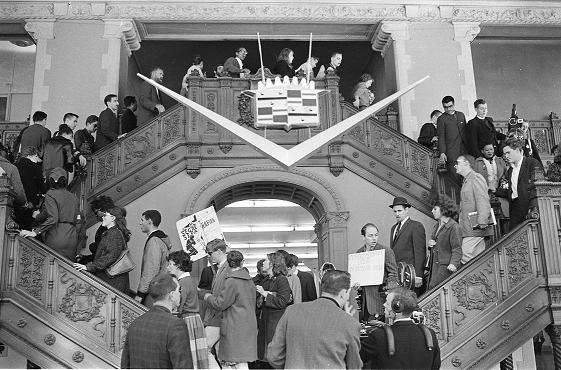
San Francisco has always had a liberal streak, but not so its business community, as a current exhibit highlights. In 1963 and ‘64, San Francisco was hit with massive demonstrations that denounced businesses’ discriminatory hiring practices and demanded equal work opportunity for African-Americans. Crowds picketed on Auto Row, in front of Mel’s Drive-In, Lucky Store, the Sheraton Palace Hotel, and Bank of America.

The Main Library exhibit “Occupation! Economic Justice as a Civil Right in San Francisco, 1963-64” retraces a struggle for economic justice that was specific to the city by the Bay, where thousands of African-Americans had moved to during World War II to work on the shipyards. When the war effort wound down, they were the first to be fired. Only direct actions—sit-ins, sleep-ins, and shop-ins—were able to shake the status quo: they led to more than 260 employment agreements for minority workers. There’s only a few days left to discover this important yet underrepresented piece of SF history: the display ends on March 27.

We spoke with curator Nancy J. Arms Simon about the exhibit and its relevance:

SFBG: How did this exhibition come to be?

NAS: It was actually the brainchild of Susan Goldstein, from the San Francisco History Center, and Catherine Powell, the director of the Labor Archives and Research Center. They had talked about collaborating on an exhibit related to labor, drawing from both collections.

In the meantime, I had fallen in love with the photographs of the photojournalist Phiz Mezey that I had discovered at the Labor Archives. She documented the April ‘64 demonstrations on Auto Row. So, it was a perfect blending. Those pictures are amazing because esthetically they’re incredible. On every single one of them, the layout just keeps your eyes circling. And the other part is that Phiz Mezey had been removed from her position at San Francisco State University, where she had been a professor. She had refused to sign the Communist Levering Act that all public employees were required to sign. In the 1950s, anyone who worked for a state agency had to sign an anti-communist oath.

While she was petitioning San Francisco State for years to get her job back, which she did in 1978, she was also trying to support herself and her kids. And so she became a documentary photographer. So I had become intrigued with her and with that story. When I started the project, I thought it would be an exhibit on the Auto Row protests. I didn’t even realize that this was part of a greater series of events that had spanned for two years.

SFBG: What were people asking for?

NAS: What they wanted was jobs, what I refer to as front-end jobs. I don’t like the idea of using the terms skilled and unskilled labor, because too many things that are very skilled get lumped under unskilled labor.

Blacks in San Francisco were assigned to jobs where they didn’t interact with the public. Basically, they weren’t allowed to. So they were allowed to be mechanics, janitors, but they weren’t allowed to be service people: bank tellers, waitresses, salesmen. There were two big pushes conjointly going on. There was the push for equality in housing, to end the segregation in housing, and also this push for jobs. If you don’t have access to jobs, there’s so much that you lose along with that. There’s that compounded effect of not saving to send your kids to college or provide for your own retirement… 

SFBG: But during the Second World War, [President] Roosevelt had enacted the Fair Employment Practices Act that made discrimination unlawful with companies that held government contracts.

NAS: But it was slated to end once the war was over. It was voted through to continue slowly across the country state by state, but it wasn’t nationwide until ‘64, when LBJ signed the Civil Rights Act. So for 20 years, from 1945 to 1964, people who had known a certain quality of life were fighting just to maintain it. Laws to promote equality might have been enacted, or agreements might have been signed, but having the law didn’t mean anything. There was this understanding that you can never let out the pressure; you have to keep pushing to make sure that that equality is actually enacted.

SFBG: How did the protesters organize their actions?

NAS: There’s a lot of lessons on how you effectively make change. There was a lot of unity amongst the groups, CORE, the WEB Du Bois Club, and the Ad-hoc Committee to End Discrimination. They had lawyers in place. Before a protest, they would decide who could afford to get arrested, and who couldn’t. So the people who could afford to get arrested would go to a certain level, they would maybe go inside the building. And all the leaders always made a point to get arrested, because they knew that that would get more press. And they also intentionally clogged the courts. They made sure that hundreds of people would get arrested just to slow things down and make it more difficult on the system.

It was really effective. And I think there’s a lot of these lessons that we miss today. They started with Mel’s Diner and they did get the owner to sign the agreements. Over at Lucky Store grocery, they did a shop-in. This is non-violent protest at its most beautiful! They went in and filled their shopping carts, they got to the counter and got them all run through. Remember, this is all scanned by hand. And then, once everything was scanned, they would say, “I will pay for these groceries once you give better jobs to Blacks,” and then they would leave. And all these bagged groceries filled the entire floor! All this stuff had to be put away. Plus people were picketing outside the store. So not only are you creating this major headache and throwing this wrench in the wheel, you’re also blocking people from shopping. So they were significantly cutting into their income.

SFBG: The Sheraton Palace Hotel rally was the biggest protest to take place.

NAS: It was really hard to narrow it down to a few statements to get into a showcase! About 1,500 protesters surrounded the hotel on March 6, 1964. There were other events leading up to that, though, they had tried negotiations, they had started smaller pickets outside. There would have been a court order to end the picket. So this is all building up.

During the major protest, I think 450 people entered the building and wouldn’t leave the lobby. The police carried them out, but they came back. They slept in overnight. And then the mayor, Jack Shelley, stepped in. He worked on the negotiation process and made it happen. After that, literally, the day they signed the agreement, they started picketing on Auto Row. This is how well organized they were. At the same time, other businesses were signing agreements for hiring Blacks, because they didn’t want this kind of press to happen. Remember, this is all happening in “liberal” San Francisco, so the fact that this is not good press for them counted.

SFBG: In the outcomes, you were careful to underline how these events had an impact on individuals’ lives.

NAS: It’s so easy for us in hindsight to know that civil rights were the right thing to fight for. But just think about what it would take out of somebody to get arrested. Tracy Sims, who later became Tamam Tracy Moncur, basically took the fall for her group. Because there were so many people arrested, they sent them to court in groups of 10 to12 people. She ended up getting 60 days in jail, plus a $200 fine. It was horrible for her. She was an idealistic 18-year-old. She knew she was doing the right thing. They were successfully changing laws just to confirm she was doing the right thing. And then she’s punished. After she served her time, her mother was already back on the East Coast, and she went to live with her mom.

SFBG: You were able to gather artifacts to tell this story, pins in particular.

NAS: These are all part of the Labor Archive collection. Graphically, they’re so simple, easy to read. You see them in photographs and they absolutely pop out. My favorite one is this “= Quality” one. It’s timeless. You’ve got the word play of equality equals quality. It’s got the silhouettes of a white child and a black child. What does equality really mean? It means equal quality for everybody. It’s not just a word. I really love that one, because it’s still so contemporary. Objects have got a power of their own. If you can stop and think of what’s involved, why they were created, and all the places they’ve been to… Some of the old pins will have the printer’s union stamp and the sheet metal workers’ stamp Look at that! That’s pride in your work right there.

Rep Clock

0

Schedules are for Wed/17–Tues/23 except where noted. Director and year are given when available. Double features are marked with a •. All times are p.m. unless otherwise specified.

ARTISTS’ TELEVISION ACCESS 992 Valencia, SF; www.atasite.org. $6. "Other Cinema:" "Extreme Animation," works by Paper Rad, Nate Boyce, Martha Colburn, and more, Sat, 8:30.

BERKELEY FELLOWSHIP OF UNITARIAN UNIVERSALISTS 1924 Cedar, Berk; (510) 841-4824. Awakening from Sorrow: Buenos Aires 1997 (Epperlein and Knoop, 2009), Fri, 7.

CAFÉ OF THE DEAD 3208 Grand, Oakl; (510) 931-7945. Free. "Independent Filmmakers Screening Nite," Wed, 6:30.

CASTRO 429 Castro, SF; (415) 621-6120, www.castrotheatre.com. $7.50-10. Alice in Wonderland (Burton, 2010), through April 1, 1, 4, 7, 9:45.

CENTER OF LIGHT 2944 76th Ave, Oakl; (510) 207-6593. Free. The Age of Stupid (Armstrong, 2009), Fri, 7:30.

CHRISTOPHER B. SMITH RAFAEL FILM CENTER 1118 Fourth St, San Rafael; (415) 454-1222, www.cafilm.org. $6.50-10. An Education (Scherfig, 2009), call for dates and times. The Art of the Steal (Argott, 2009), call for dates and times. The Most Dangerous Man in America: Daniel Ellsberg and the Pentagon Papers (Ehrlich and Goldsmith, 2009), call for dates and times. North Face (Stölzl, 2008), call for dates and times. A Prophet (Audiard, 2009), call for dates and times. The Girl With the Dragon Tattoo (Oplev, 2009), March 19-25, call for times. Live! (Guttentag, 2007), with director Bill Guttentag in person, Sun, 7.

FOUR STAR 2200 Clement, SF; www.thrillville.net. $10. "Thrillville:" •Monsturd (Popko and West, 2003) and Retardead (Popko and West, 2008), Thurs, 7:30. Local cult classics with filmmakers and cast in person, plus live music by Meshugga Beach Party.

GOETHE-INSTITUT 530 Bush, SF; www.goethe.de/sanfrancisco. $7. "New German Cinema:" Parkour (Rensing, 2009), Wed, 6:30.

HUMANIST HALL 390 27th St, Oakl; www.humanisthall.org. $5. The Secret of Oz, Wed, 7:30.

MECHANICS’ INSTITUTE 57 Post, SF; (415) 393-0100, rsvp@milibrary.org. $10. "CinemaLit Film Series: Star Power, A Month of Meryl Streep:" A Cry in the Dark (Schepisi, 1988), Fri, 6.

ODDBALL FILMS 275 Capp, SF; (415) 558-8117, info@oddballfilm.com. $10. "India Films: The Naked Eye," Fri, 10. "Under the Sea: Maritime Movies from the Archives," Sat, 10.

PACIFIC FILM ARCHIVE 2575 Bancroft, Berk; (510) 642-5249, www.bampfa.berkeley.edu. $5.50-9.50. "Film 50: History of Cinema:" Last Year at Marienbad (Resnais, 1961), Wed, 3. "Joseph Losey: Pictures of Provocation:" The Servant (1963), Sun, 5; These Are the Damned (1965), Sun, 7:20. San Francisco International Asian American Film Festival, Wed-Sat. See film listings for schedule.

PARAMOUNT 2025 Broadway, Oakl; 1-800-745-3000, www.oebs.org. $20-65. "The Mighty Wurlitzer: Music at the Movies:" The General (Keaton and Bruckman, 1926), Fri, 8; Sun, 2.

PIEDMONT 4186 Piedmont, Oakl; (510) 464-5980. $5-8. "Cult Classics Attack 5:" The Neverending Story (Petersen, 1984), Fri-Sat, midnight; Sun, 10am.

PLAYHOUSE THEATER 40 Main, Tiburon; www.tiburonfilfestival.com. "Tiburon International Film Festival," March 18-26. Check web site for program information.

RED POPPY ART HOUSE 2698 Folsom, SF; www.redpoppyarthouse.org. $8-12. Marina of the Zabbaleen: Portrait of a Child Recycler (Wassef, 2008), Sun, 7.

RED VIC 1727 Haight, SF; (415) 668-3994. $6-10. Night of Lust (Bénazéraf, 1963), Wed-Thurs, 7:15, 9:30 (also Wed, 2). Fantastic Mr. Fox (Anderson, 2009), Fri-Mon, 7:15, 9:15 (also Sat-Sun, 2, 4). The Road (Hillcoat, 2009), March 23-25, 7, 9:20 (also March 24, 2).

ROXIE 3117 and 3125 16th St, SF; (415) 863-1087, www.roxie.com. $5-9.75. Closed for renovation until April 1.

YERBA BUENA CENTER FOR THE ARTS 701 Mission, SF; (415) 978-2787, www.ybca.org. $6-8. "Human Rights and Film:" Petition (Zhao, 2009), Thurs, 7:30. "2009 British Television Advertising Award Winners," Sat-Sun, 2, 4 (also Sat, 6, 8).

Film listings

0

Film listings are edited by Cheryl Eddy. Reviewers are Kimberly Chun, Michelle Devereaux, Max Goldberg, Dennis Harvey, Johnny Ray Huston, Erik Morse, Louis Peitzman, Lynn Rapoport, Ben Richardson, and Matt Sussman. The film intern is Peter Galvin. For rep house showtimes, see Rep Clock. For first-run showtimes, see Movie Guide.

SF INTERNATIONAL ASIAN AMERICAN FILM FESTIVAL

The 28th San Francisco International Asian American Film Festival runs through Sun/21 at the Sundance Kabuki, 1881 Post, SF; Viz Cinema, 1746 Post, SF; Clay, 2261 Fillmore, SF; Pacific Film Archive, 2575 Bancroft, Berk; and Camera 12 Cinemas, 201 South Second St, San Jose. Tickets (most shows $12) available at www.asianamericanmedia.org. All times pm.

WED/17

PFA Agrarian Utopia 7. Mundane History 9:20.

Sundance Kabuki "Classic Filipino American Shorts" (shorts program) 4:15. God is D_ad 4:30. "FutureStates" (shorts program) 6:45. Wo Ai Ni Mommy 7. You Have Been Weighed and Found Wanting 9:15. Aoki 9:30.

Viz "Memory Vessels and Phantom Traces" (shorts program) 4:45. Ninoy Aquin and the Rise of People Power 7. Dear Doctor 9:15.

THURS/18

PFA Hana, Dul, Sed… 7. Bayan Ko: My Own Country 9.

Sundance Kabuki Mundane History 5. "Wandering, Wondering" (shorts program) 5. "Blueprints for a Generation" (shorts program) 5. Au Revoir Taipei 7. "FutureStates" (shorts program) 7:15.

Viz "Sweet Dreams and Beautiful Nightmare" (shorts program) 5. Tehran Without Borders 7:30.

FRI/19

Camera Au Revoir Taipei 7.

PFA What We Talk About When We… 7. The Forbidden Door 9:10.

SAT/20

Camera Dear Doctor noon. "3rd I South Asian International Shorts" (shorts program) 2:45. Aoki 3. The People I’ve Slept With 4:45. A Village Called Versailles 5:30. Make Yourself at Home 7:15. Like You Know it All 7:45. Prince of Tears 9:15.

PFA Manila in the Claws of Neon 6. About Elly 8:30.

SUN/21

Camera "Wandering, Wondering" (shorts program) noon. Talentime 2. State of Aloha 2:15. Cooking With Stella 4:30. Fog 4:45. In the Matter of Cha Jung Hee 6:45. The Forbidden Door 7. The Message 9.

OPENING

The Bounty Hunter Gerard Butler and Jennifer Aniston play a formerly married couple who … zzzzz. Huh? Oh, whatever. (1:50)

Diary of a Wimpy Kid The agonies of middle school come to life in this kid-friendly comedy. (2:00)

The Girl on the Train André Téchiné’s beautifully photographed, ripped-from-the-headlines film explores the events that led a young Parisian girl to lie about being the victim of an anti-semitic attack. Téchiné’s dramatization fails as an account of the incident, but the film manages to evoke a powerfully mysterious tone due largely to two stellar performances, by Émilie Dequenne as the 20-something Jeanne and Catherine Deneuve as her persistent mother. Much of the running time follows Jeanne’s experiences before the fabrication, as she falls for (and moves in with) a young wrestler named Franck, before a tragic event causes Jeanne to invent the famous lie. An arty exploration into the psychology of victimization that happens to be anchored by a real-life event, The Girl on the Train may disappoint those looking for easy answers but is undeniable as a showcase for some outstanding acting. (1:42) Embarcadero, Shattuck. (Galvin)

*The Girl With the Dragon Tattoo See "Life After Death." (2:32) Albany, Embarcadero.

Mother Bong Joon-ho’s latest is a crime drama about a mentally challenged murder suspect and his formidable mother. See review at www.sfbg.com. (2:09) Clay, Shattuck.

*Neil Young Trunk Show As loose as Jonathan Demme’s prior Neil doc Heart of Gold (2006) was tidy, with a taste for rave-ups where that film emphasized the mellower country-rock side, this neck-deep wade into Young’s four-decade-plus songbook is pretty dang nirvanic. Shot at the Tower Theater in Upper Darby, PA —exactly the kind of funky old midsized venue you’d want to see him at — it’s assembled via camera and editorial choices as seemingly random yet astute as Young’s grab bag of tunes. The latter range from historic hits ("Cinnamon Girl," "Harvest," "Cowgirl in the Sand") to more recent compositions ("The Believer," "No Hidden Path") and some real obscurities from the bottom of that trunk, including a few acoustic heartbreakers. Even shown out of concert order — there’s never any sense just where we are in the audience’s evening — they meld seamlessly, the epic half-hour oceanics of "Path" just as well as something small and plaintive like "Sad Movies." Never in better voice (qualify that as you will) at age 65, surrounded by an assured band of five plus scattered oddball props and one live canvas painter, Young is the eye of this particular hurricane — even if "Like a Hurricane" is the one performance that feels a tad uninspired. If you’re a fan, this will be pretty close to sheer ecstasy. If not … well, frankly, I have absolutely no idea whether
you’ll be converted, mildly entertained, or bored to death. (1:22) Lumiere, Shattuck. (Harvey)

Repo Men Nope, not a sequel to the 1984 cult classic. Jude Law and Forest Whitaker will, however, relieve you of your futuristic mechanical organs if you can’t pay for them post-transplant. (1:53) Shattuck.

The Runaways In Floria Sigismondi’s tale of the rise and fall of a 1970s all-girl band, LA producer Kim Fowley (Michael Shannon) proclaims that the Runaways are going to save rock and roll. It’s hard to gauge the sincerity of this pronouncement, but you can certainly hear, in songs like "Cherry Bomb" and "Queens of Noise," how the band must have brightened a landscape overrun by kings of prog rock. Unfortunately, a handful of teenagers micromanaged by a sleazy, abusive nutcase proved not quite up to the task, though the band did launch the careers of metal guitarist Lita Ford (Scout Taylor-Compton) and, more famously, Joan Jett (Kristen Stewart). Sigismondi’s film entertainingly sketches the Runaways’ beginnings in glam rock fandom and gradual attainment of their own rabid fan base. We get Currie lip-synching Bowie to catcalls at the high school assembly, Jett composing "Cherry Bomb" with Fowley, glamtastic hair-and-wardrobe eye candy, pills-and-Stooges-fueled intra-band fooling around, and five teenage girls sent off sans chaperone on an international tour with substantial quantities of hard drugs in their carry-on luggage. What follows is less pretty: a capsule version of the band’s disintegration after the departure of bottoming-out 16-year-old lead singer Cherie Currie (Dakota Fanning). In a film darkened by Currie’s trajectory, Jett’s subsequent success is a feel-good coda, but it’s awkwardly attached and emblematizes one of The Runaways‘ main problems. When the band begins to fall apart, the film doesn’t know which way to turn and ends up telling no one’s story well. (1:42) Bridge. (Rapoport)

ONGOING

Ajami You may recognize the title of Yaron Shoni and Scandar Copti’s debut collaboration as one of five films nominated for a 2010 Academy Award in the Foreign Category. Though it didn’t bring home the grand prize, Ajami remains a complex and affecting story about desperation and its consequences in a religiously-mixed town in Israel. As we follow the lives of four of Ajami’s residents the narrative shifts perspective almost maddeningly, switching characters seemingly at the height of each story’s action. But once all of the stories fully intersect, the final product has the distinction of feeling both meticulously calculated and completely natural. I was most impressed to learn that Shani and Copti prepared their actors with improvised role-playing rather than scripts. By withholding what was going to happen in a scene before shooting, we are treated to looks of surprise and emotion on actor’s faces that never feel unnatural. Attaining such a level of realism may be Ajami‘s crowning achievement; it can’t have been easy to make a foreign world feel so familiar. (2:00) Embarcadero, Shattuck. (Galvin)

Alice in Wonderland Tim Burton’s take on the classic children’s tale met my mediocre expectations exactly, given its months of pre-release hype (in the film world, fashion magazines, and even Sephora, for the love of brightly-colored eyeshadows). Most folks over a certain age will already know the story, and much of the dialogue, before the lights go down and the 3-D glasses go on; it’s up to Burton and his all-star cast (including numerous big-name actors providing voices for animated characters) to make the tale seem newly enthralling. The visuals are nearly as striking as the CG, with Helena Bonham Carter’s big-headed Red Queen a particularly marvelous human-computer creation. But Wonderland suffers from the style-over-substance dilemma that’s plagued Burton before; all that spooky-pretty whimsy can’t disguise the film’s fairly tepid script. Teenage Alice (Mia Wasikowska) displaying girl-power tendencies is a nice, if not surprising, touch, but Johnny Depp’s grating take on the Mad Hatter will please only those who were able to stomach his interpretation of Willy Wonka. (1:48) Castro, Cerrito, Empire, 1000 Van Ness, SF Center, Sundance Kabuki. (Eddy)

*The Art of the Steal How do you put a price on something that’s literally priceless? The Art of the Steal takes an absorbing look at the Barnes Collection, a privately-amassed array of Post-Impressionist paintings (including 181 Renoirs) worth billions — and the many people and corporate interests who schemed to control it. Founder Albert C. Barnes was an singular character who took pride in his outsider status; he housed his art in a specially-constructed gallery far from downtown Philadelphia’s museum scene, and he emphasized education and art appreciation first and foremost. But he had no heirs, and after his death in 1951, opportunists began circling his massive collection; the slippery political and legal dealings that have unfolded since then are nearly as jaw-dropping as Barnes’ prize paintings. Philly documentarian Don Argott has a doozy of a subject here, and his skillful, even suspenseful film does it justice. (1:41) Elmwood, Opera Plaza, Smith Rafael. (Eddy)

Avatar James Cameron’s Avatar takes place on planet Pandora, where human capitalists are prospecting for precious unobtainium, hampered only by the toxic atmosphere and a profusion of unfriendly wildlife, including the Na’vi, a nine-foot tall race of poorly disguised cliches. When Jake Sully (Sam Worthington), a paraplegic ex-marine, arrives on the planet, he is recruited into the "Avatar" program, which enables him to cybernetically link with a part-human, part-Na’vi body and go traipsing through Pandora’s psychedelic underbrush. Initially designed for botanical research, these avatars become the only means of diplomatic contact with the bright-blue natives, who live smack on top of all the bling. The special effects are revolutionary, but the story that ensues blends hollow "noble savage" dreck with events borrowed from Dances With Wolves (1990) and FernGully: The Last Rainforest (1992). When Sully falls in love with a Na’vi princess and undergoes a spirit journey so he can be inducted into the tribe and fight the evil miners, all I could think of was Kevin Bacon getting his belly sliced in The Air Up There (1994). (2:42) 1000 Van Ness. (Richardson)

The Blind Side When the New York Times Magazine published Michael Lewis’ article "The Ballad of Big Mike" — which he expanded into the 2006 book The Blind Side: Evolution of a Game — nobody could have predicated the cultural windfall it would spawn. Lewis told the incredible story of Michael Oher — a 6’4, 350-pound 16-year-old, who grew up functionally parentless, splitting time between friends’ couches and the streets of one of Memphis’ poorest neighborhoods. As a sophomore with a 0.4 GPA, Oher serendipitously hitched a ride with a friend’s father to a ritzy private school across town and embarked on an unbelievable journey that led him into a upper-class, white family; the Dean’s List at Ole Miss; and, finally, the NFL. The film itself effectively focuses on Oher’s indomitable spirit and big heart, and the fearless devotion of Leigh Anne Tuohy, the matriarch of the family who adopted him (masterfully played by Sandra Bullock). While the movie will delight and touch moviegoers, its greatest success is that it will likely spur its viewers on to read Lewis’ brilliant book. (2:06) Elmwood, Oaks. (Daniel Alvarez)

Brooklyn’s Finest "Really? I mean, really?" asked the moviegoer beside me as the final freeze-frame of Brooklyn’s Finest slapped our eyeballs. Yes, that’s the sound of letdown, despite the fact that Brooklyn’s Finest initially resembled a promisingly gritty juggling act in the mode of The Wire and Cop Land (1997), Taxi Driver (1976) and Training Day (2001). Bitter irony flows from the title — and from the lives, loves, bad habits, pressure-cooker stress, and unavoidable moral dilemmas of three would-be everyday cops, all occupying several different rungs on a food chain where right and wrong have an unpleasant way of switching sides. Eddie (Richard Gere) is the veteran officer just biding his time till he gets his pension, all while comforting himself with the meager sensuous attentions of hooker Chantel (Shannon Kane). Sal (Ethan Hawke) is the bad detective, stealing from the dealers to fund a dream home for his growing family with Angela (Lili Taylor). Tango (Don Cheadle) is the undercover detective who has cultivated friendships with dealers like Caz (Wesley Snipes) and sacrificed his marriage for a long-promised promotion from his lieutenant (Will Patton) and his superior (Ellen Barkin, in likely the most misogynist portrayal of a lady with a badge to date). You spend most of Brooklyn’s Finest waiting for these cops to collide in the most unfortunate, messiest way possible, but instead the denouement leaves will leave one wondering about unresolved threads and feeling vaguely unsatisfied. In any case, director Antoine Fuqua and company seem to pride themselves on their tough-minded if at times cartoonish take on law enforcement, with Hawke in particular turning in a memorably OTT and anguished performance. (2:13) 1000 Van Ness, Shattuck. (Chun)

The Crazies Disease and anti-government paranoia dovetail in this competent yet overwhelmingly non-essential remake of one of George A. Romero’s second-tier spook shows. In a small Iowa hamlet overseen by a benevolent sheriff (Timothy Olyphant) and his pregnant wife (Radha Mitchell), who’s also the town doctor, a few odd incidents snowball into all-out chaos when a mysterious, unmarked plane crashes into the local water supply. Before long, the few residents who aren’t acting like homicidal maniacs are rounded up by an uber-aggressive military invasion. Though our heroes convey frantic panic as they try to figure out what the hell is going on, The Crazies never achieves full terror mode. It’s certainly watchable, and even enjoyable at times. But memorable? Not in the slightest. (1:41) 1000 Van Ness. (Eddy)

Crazy Heart "Oh, I love Jeff Bridges!" is the usual response when his name comes up every few years for Best Actor consideration, usually via some underdog movie no one saw, and the realization occurs that he’s never won an Oscar. The oversight is painful because it could be argued that no leading American actor has been more versatile, consistently good, and true to that elusive concept "artistic integrity" than Bridges over the last 40 years. It’s rumored Crazy Heart was slotted for cable or DVD premiere, then thrust into late-year theater release in hopes of attracting Best Actor momentum within a crowded field. Lucky for us, this performance shouldn’t be overlooked. Bridges plays "Bad" Blake, a veteran country star reduced to playing bars with local pickup bands. His slide from grace hasn’t been helped by lingering tastes for smoke and drink, let alone five defunct marriages. He meets Jean (Maggie Gyllenhaal), freelance journalist, fan, and single mother. They spark; though burnt by prior relationships, she’s reluctant to take seriously a famous drunk twice her age. Can Bad handle even this much responsibility? Meanwhile, he gets his "comeback" break in the semi-humiliating form of opening for Tommy Sweet (Colin Farrell) — a contemporary country superstar who was once Bad’s backup boy. Tommy offers a belated shot at commercial redemption; Jean offers redemption of the strictly personal kind. There’s nothing too surprising about the ways in which Crazy Heart both follows and finesses formula. You’ve seen this preordained road from wreckage to redemption before. But actor turned first-time director Scott Cooper’s screenplay honors the flies in the windshield inherited from Thomas Cobb’s novel — as does Bridges, needless to say. (1:51) Lumiere, Piedmont, 1000 Van Ness, Shattuck, Sundance Kabuki. (Harvey)

*An Education The pursuit of knowledge — both carnal and cultural — are at the tender core of this end-of-innocence valentine by Danish filmmaker Lone Scherfig (who first made her well-tempered voice heard with her 2000 Dogme entry, Italian for Beginners), based on journalist Lynn Barber’s memoir. Screenwriter Nick Hornby breaks further with his Peter Pan protagonists with this adaptation: no man-boy mopers or misfits here. Rather, 16-year-old schoolgirl Jenny (Carey Mulligan) is a good girl and ace student. It’s 1961, and England is only starting to stir from its somber, all-too-sober post-war slumber. The carefully cloistered Jenny is on track for Oxford, though swinging London and its high-style freedoms beckon just around the corner. Ushering in those freedoms — a new, more class-free world disorder — is the charming David (Peter Sarsgaard), stopping to give Jenny and her cello a ride in the rain and soon proffering concerts and late-night suppers in the city. He’s a sweet-faced, feline outsider: cultured, Jewish, and given to playing fast and loose in the margins of society. David can see Jenny for the gem she is and appreciate her innocence with the knowing pleasure of a decadent playing all the angles. The stakes are believably high, thanks to An Education‘s careful attention to time and place and its gently glamored performances. Scherfig revels in the smart, easy-on-eye curb appeal of David and his friends while giving a nod to the college-educated empowerment Jenny risks by skipping class to jet to Paris. And Mulligan lends it all credence by letting all those seduced, abandoned, conflicted, rebellious feelings flicker unbridled across her face. (1:35) Oaks, Smith Rafael. (Chun)

*The Ghost Writer Roman Polanski’s never-ending legal woes have inspired endless debates on the interwebs and elsewhere; they also can’t help but add subtext to the 76-year-old’s new film, which is chock full o’ anti-American vibes anyway. It’s also a pretty nifty political thriller about a disgraced former British Prime Minister (Pierce Brosnan) who’s hanging out in his Martha’s Vineyard mansion with his whip-smart, bitter wife (Olivia Williams) and Joan Holloway-as-ice-queen assistant (Kim Cattrall), plus an eager young biographer (Ewan McGregor) recently hired to ghost-write his memoirs. But as the writer quickly discovers, the politician’s past contains the kinds of secrets that cause strange cars with tinted windows to appear in one’s rearview mirror when driving along deserted country roads. Polanski’s long been an expert when it comes to escalating tension onscreen; he’s also so good at adding offbeat moments that only seem tossed-off (as when the PM’s groundskeeper attempts to rake leaves amid relentless sea breezes) and making the utmost of his top-notch actors (Tom Wilkinson and Eli Wallach have small, memorable roles). Though I found The Ghost Writer‘s ZOMG! third-act revelation to be a bit corny, I still didn’t think it detracted from the finely crafted film that led up to it. (1:49) California, Embarcadero, Piedmont, Sundance Kabuki. (Eddy)

Green Zone Titled for the heavily-guarded headquarters of international occupation in Baghdad, Green Zone reunites director Paul "Shaky-Cam" Greengrass with star Matt Damon, the two having previously collaborated on the last two Bourne films. Instead of a super-soldier, this time around Damon just plays a supremely insubordinate one as he attempts to uncover the reason why his military unit can’t find any of Saddam’s WMDs. With the aid of the CIA, a Wall Street Journal reporter and a friendly Iraqi, Damon goes rogue in order to suss out the source of the misinformation. The Iraq War action is decent if scarce, but an overindulgence in (you guessed it) shaky-cam and political jargon cannot hide the fact that Green Zone‘s plot is simplistic and probably light on actual facts. Damon makes a fine cowboy-cum-hero, but the effectiveness of the mix of patriotism and Pentagon paranoia will vary based on your penchant for such things. Still, Green Zone moves fast enough that it remains worth a matinee for conspiracy thriller aficionados. (1:55) California, Empire, 1000 Van Ness, Piedmont, Sundance Kabuki. (Galvin)

The Hurt Locker When the leader of a close-knit U.S. Army Explosive Ordnance Disposal squad is killed in action, his subordinates have barely recovered from the shock when they’re introduced to his replacement. In contrast to his predecessor, Sgt. James (Jeremy Renner) is no standard-procedure-following team player, but a cocky adrenaline junkie who puts himself and others at risk making gonzo gut-instinct decisions in the face of live bombs and insurgent gunfire. This is particularly galling to next-in-command Sanborn (Anthony Mackie). An apolitical war-in-Iraq movie that’s won considerable praise for accuracy so far from vets (scenarist Mark Boal was "embedded" with an EOD unit there for several 2004 weeks), Kathryn Bigelow’s film is arguably you-are-there purist to a fault. While we eventually get to know in the principals, The Hurt Locker is so dominated by its seven lengthy squad-mission setpieces that there’s almost no time or attention left for building character development or a narrative arc. The result is often viscerally intense, yet less impactful than it would have been if we were more emotionally invested. Assured as her technique remains, don’t expect familiar stylistic dazzle from action cult figure Bigelow (1987’s Near Dark, 1989’s Blue Steel, 1991’s Point Break) — this vidcam-era war movie very much hews to the favored current genre approach of pseudo-documentary grainy handheld shaky-cam imagery. (2:11) Cerrito, Opera Plaza, Shattuck. (Harvey)

*The Last Station Most of the buzz around The Last Station has focused on Helen Mirren, who takes the lead as the Countess Sofya, wife of Leo Tolstoy (Christopher Plummer). Mirren is indeed impressive — when is she not? — but there’s more to the film than Sofya’s Oscar-worthy outbursts. The Last Station follows Valentin Bulgakov (James McAvoy), hired as Tolstoy’s personal secretary at the end of the writer’s life. Valentin struggles to reconcile his faith in the anarchist Christian Tolstoyan movement with his sympathy for Sofya and his budding feelings for fellow Tolstoyan Masha (Kerry Condon). For the first hour, The Last Station is charming and very funny. Once Tolstoy and Sofya’s relationship reaches its most volatile, however, the tone shifts toward the serious — a trend that continues as Tolstoy falls ill. After all the lighthearted levity, it’s a bit jarring, but the solid script and accomplished cast pull The Last Station together. Paul Giamatti is especially good as Vladimir Chertkov, who battles against Sofya for control of Tolstoy’s will. You’ll never feel guiltier for putting off War and Peace. (1:52) Albany, Opera Plaza. (Peitzman)

*The Most Dangerous Man in America: Daniel Ellsberg and the Pentagon Papers For many, Daniel Ellsberg is a hero — a savior of American First Amendment rights and one of the most outspoken opponents of the Vietnam war. But as this documentary (recently nominated for an Academy Award) shows, it’s never an an easy decision to take on the U.S. government. Ellsberg himself narrates the film and details his sleepless nights leading up to the leak of the Pentagon Papers — the top secret government study on the Vietnam war — to the public. Though there are few new developments in understanding the particulars of the war or the impact the release of the Papers had on ending the conflict, the film allows audiences to experience the famous case from Ellsberg’s point of view, adding a fresh and poignantly human element to the events; it’s a political documentary that plays more like a character drama. Whether you were there when it happened or new to the story, there is something to be appreciated from this tale of a man who fell out of love with his country and decided to do something about it. (1:34) Shattuck, Smith Rafael. (Galvin)

*North Face You’ll never think of outerwear the same way again — and in fact you might be reaching for your fleece and shivering through the more harrowing climbing scenes of this riveting historical adventure based on a true tale. Even those who consider themselves less than avid fans of outdoor survival drama will find their eyes frozen, if you will, on the screen when it comes to this retelling/re-envisioning of this story, legendary among mountaineers, of climbers, urged on by Nazi propaganda, to tackle the last "Alpine problem." At issue: the unclimbed north face of Switzerland’s Eiger, a highly dangerous and unpredictable zone aptly nicknamed "Murder Wall." Two working-class friends, Toni Kurz (Benno Fürmann of 2008’s Jerichow) and Andi Hinterstoisser (Florian Lukas) — here portrayed as climbing fiends driven to reach summits rather than fight for the Nazis — take the challenge. There to document their achievement, or certain death, is childhood friend and Kurz’s onetime sweetheart Luise (Johanna Wokalek, memorable in 2008’s The Baader Meinhof Complex), eager to make her name as a photojournalist while fending off the advances of an editor (Ulrich Tukur) seeking to craft a narrative that positions the contestants as model Aryans. But the climb — and the Eiger, looming like a mythical ogre — is the main attraction here. Filmmaker Philipp Stölzl brings home the sheer heart-pumping exhilaration and terror associated with the sport — and this specific, legendarily tragic climb — by shooting in the mountains with his actors and crew, and the result goes a way in redeeming an adventure long-tainted by its fascist associations. (2:01) Smith Rafael. (Chun)

Our Family Wedding America Ferrera and Lance Gross play a couple of lovebirds who must jump through some serious family hoops before they get married in the mostly serviceable Our Family Wedding. What begins as a dual Guess Who’s Coming to Dinner, with the differences in each family’s traditions forcing complications and compromises, soon loses sight of its matrimonial plot as the focus steers towards a childish rivalry between the fathers. While it’s being marketed as a goofy comedy, the final product seeks a relatively sentimental tone, which makes the few slapstick moments — like a goat trying to rape Academy Award-winning actor Forest Whitaker — seem pretty inappropriate. Still, for some audiences the well-tread plot will act as comfort food: they fight, they make up, and it all ends in a big wedding where we watch the characters dance for damn near ten minutes. (1:41) 1000 Van Ness. (Galvin)

*Percy Jackson and the Olympians: The Lightning Thief It would be easy to dismiss Percy Jackson and the Olympians: The Lightning Thief as an unabashed Harry Potter knock-off. Trio of kids with magic powers goes on a quest to save the world in a Chris Columbus adaptation of a popular young adult series — sound familiar? But The Lightning Thief is sharp, witty, and a far cry from Columbus’ joyless adaptation of Harry Potter and the Sorcerer’s Stone (2001). Logan Lerman stars as Percy Jackson, the illegitimate son of Poseidon and Catherine Keener. Once he learns his true identity at Camp Half-Blood, he sets off on a quest with his protector, a satyr named Grover, and potential love interest Annabeth, daughter of Athena. Along the way, they bump into gods and monsters from Greek mythology — with a twist. Think Percy using his iPhone to fight Medusa (Uma Thurman), or a land of the Lotus-Eaters disguised as a Lady Gaga-blasting casino. A worthy successor to Harry Potter? Too soon to say, but The Lightning Thief is at least a well-made diversion. (1:59) 1000 Van Ness. (Peitzman)

*A Prophet Filmmaker Jacques Audiard has described his new film, A Prophet, as "the anti-Scarface." Yet much like Scarface (1983), A Prophet bottles the heady euphoria that chases the empowerment of the powerless and the rise of the long-shot loner on the margins. In its almost-Dickensian attention to detail, devotion to its own narrative complexity, and passion for cinematic poetry, A Prophet rises above the ordinary and, through the prism of genre, finds its own power. The supremely opportunistic, pragmatically Machiavellian intellectual and spiritual education of a felon is the chief concern of here. Played by Tahar Rahim with guileless, open-faced charisma, Malik is half-Arab and half-Corsican — and distrusted or despised by both camps in the pen. When he lands in jail for his six-year sentence, he’s 19, illiterate, friendless, and vulnerable. His deal with the devil — and means of survival — arrives with Reyeb (Hichem Yacoubi), temporarily locked up before his testifies against the mob. Corsican boss Cesar Luciani (Niels Arestrup) wants him dead, and Malik is tagged to penetrate Reyeb’s cell with a blade hidden in mouth. After Malik’s gory rebirth, it turns out that the teenager’s a seer in more ways than one. From his low-dog position, he can eyeball the connections linking the drugs entering the prison to those circulating outside, as well as the machinations intertwining the Arab and Corsican syndicates. It’s no shock that when Cesar finds his power eroding and arranges prison leaves for his multilingual crossover star that Malik serves not only his Corsican master, but also his own interests, and begins to build a drug empire rivaling his teacher’s. Throughout his pupil’s progress, Audiard demonstrates a way with Henri Cartier-Bresson’s decisive moment, and when Malik finally breaks with his Falstaffian patriarch, it makes your heart skip a beat in a move akin to the title of the director’s last film. This Eurozone/Obama-age prophet is all about the profit — but he’s imbued with grace, even while gaming for ill-gotten gain. (2:29) Embarcadero, Shattuck, Smith Rafael. (Chun)

Remember Me Ominously set in New York City during the summer of 2001, Remember Me, starring Robert Pattinson (of the Twilight series) and Emilie de Ravin (of TV’s Lost), pretty much answers the question of whether it’s still too soon to make the events of September 11 the subject of a date movie. Or rather, not the subject so much as the specter waiting just off-camera for its walk-on while brooding 21-year-old Tyler Hawkins (Pattinson) quotes Gandhi, gets into brawls, gets drunk, writes letters to his dead brother, and otherwise channels despondency and rage into various salubrious outlets. One of these is romancing (under circumstances severely testing the viewer’s credulity) de Ravin’s Ally Craig, grappling somewhat more constructively with her own familial tragedy. Ally is the sort of self-possessed, strong-willed young woman whose instincts, shortly after she’s been backhanded by her drunk father (Chris Cooper), tell her to placate and have sex with her drunk boyfriend when he comes home enraged after battling his own father (Pierce Brosnan). She is there to teach Tyler, through quirky habits like eating dessert first, what director Allen Coulter (2006’s Hollywoodland) wishes to teach us: that time is short and one must fill one’s life with meaningful actions — like throwing a fire extinguisher through a window to convince a classroom of tweens to stop bullying one’s little sister. The film is seeded with allusions to an impending catastrophe that feels less integrated than exploited. And it’s uncomfortable seeing the fall of the towers used to make the ground shake under a sweet, fairly depthless depiction of love and grief. (2:08) Empire, 1000 Van Ness, Sundance Kabuki. (Rapoport)

She’s Out of My League From the co-writers of the abysmal Sex Drive (2008), She’s Out of My League could be another 90-minute assemblage of gross-out humor, dick jokes, and unabashed homophobia. As it turns out, the latest offering from Sean Anders and John Morris is legitimately funny — far better than the trailer (and that half-assed title) would have you believe. The adorkable Jay Baruchel stars as Kirk, a hapless loser who finds himself dating bonafide hottie Molly (Alice Eve). Once you get past the film’s silly conceit — Kirk’s only "movie ugly," and personality goes a long way — you’re left with a surprisingly charming comedy. The characters are amusing and the wit is sharp. Not to mention the fact that She’s Out of My League offers a downright heartfelt message. There’s a sincerity here that feels genuine instead of just tacked-on: yeah, yeah, it’s about what’s inside that counts, but there’s more to it than that. Ignore the dreadful "jizz in my pants" scene, and the movie’s almost an old-fashioned romcom. (1:44) Elmwood, Oaks, 1000 Van Ness, SF Center. (Peitzman)

Shutter Island Director Martin Scorsese and muse du jour Leonardo DiCaprio draw from oft-filmed novelist Dennis Lehane (2003’s Mystic River, 2007’s Gone Baby Gone) for this B-movie thriller that, sadly, offers few thrills. DiCaprio’s a 1950s U.S. marshal summoned to a misty island that houses a hospital for the criminally insane, overseen by a doctor (Ben Kingsley) who believes in humane, if experimental, therapy techniques. From the get-go we suspect something’s not right with the G-man’s own mind; as he investigates the case of a missing patient, he experiences frequent flashbacks to his World War II service (during which he helped liberate a concentration camp), and has recurring visions of his spooky dead wife (Michelle Williams). Whether or not you fall for Shutter Island‘s twisty game depends on the gullibility of your own mind. Despite high-quality performances and an effective, if overwrought, tone of certain doom, Shutter Island stumbles into a third act that exposes its inherently flawed and frustrating storytelling structure. If only David Lynch had directed Shutter Island — it could’ve been a classic of mindfuckery run amok. Instead, Scorsese’s psychological drama is sapped of any mystery whatsoever by its stubbornly literal conclusion. (2:18) California, 1000 Van Ness, Sundance Kabuki. (Eddy)

A Single Man In this adaptation of Christopher Isherwood’s 1964 novel, Colin Firth plays George, a middle-aged gay expat Brit and college professor in 1962 Los Angeles. Months after the accidental death of Jim (Matthew Goode), his lover for 16 years, George still feels worse than bereft; simply waking each morning is agony. So on this particular day he has decided to end it all, first going through a series of meticulous preparations and discreet leave-takings that include teaching one last class and having supper with the onetime paramour (Julianne Moore) turned best friend who’s still stuck on him. The main problem with fashion designer turned film director Tom Ford’s first feature is that he directs it like a fashion designer, fussing over surface style and irrelevant detail in a story whose tight focus on one hard, real-world thing — grief — cries for simplicity. Not pretentious overpackaging, which encompasses the way his camera slavers over the excessively pretty likes of Nicholas Hoult as a student and Jon Kortajarena as a hustler, as if they were models selling product rather than characters, or even actors. (In fact Kortajarena is a male supermodel; the shocker is that Hoult is not, though Hugh Grant’s erstwhile About a Boy co-star is so preening here you’d never guess.) Eventually Ford stops showing off so much, and A Single Man is effective to the precise degree it lets good work by Goode, Moore and especially the reliably excellent Firth unfold without too much of his terribly artistic interference. (1:39) 1000 Van Ness, Opera Plaza. (Harvey)

*Sweetgrass Recorded between 2001-03 by Lucien Castaing-Taylor and Ilisa Barbash, Sweetgrass immerses us in sheep farming before taking off after a pair of latter-day cowboys on a 150-mile drive through Montana’s Absaroka-Beartooth range — a journey with deep historical roots and no practical future. As its rugged scenery beggars (but ultimately unseats) projections of the pastoral, so too do its mild sheep trigger myriad symbolic associations. Sweetgrass is finally about the relationship between farmhands and their flocks, and in this, it is notably unsentimental. During long takes of shearing and birthing, the correspondent displays of violence and tenderness, much of it erotic and seemingly reflexive, speaks to the human-animal encounter Berger eulogized in 1977. The lonesome cowboys whisper sweet nothings to the dogs and hurl fantastically mismatched streams of curses at the sheep (the absence of women being the common link). Through it all, Castaing-Taylor’s camera is an embodied presence, and hard work at that. Compared with Planet Earth‘s impossible views and spectacular displacements, Sweetgrass has its feet planted on the ground. (1:41) Lumiere, Shattuck. (Goldberg)

REP PICKS

The Female Bunch Al Adamson was the Ed Wood Jr. of the late 60s and 1970s, albeit a version without any delusions of grandeur — in it for the money, he knew his ultra-cheap films were crap. This one, titled to cash in on The Wild Bunch and made the same year (though there were no distribution takers until 1971, two years later), is closer to an unacknowledged, soporific remake of Herschell Gordon Lewis’ great ’68 She-Devils on Wheels, with the deadly dames on horseback rather than motorcycles. When Sandy (Nesa Renet) is dumped by her faithless Vegas lounge singer boyfriend — and no wonder, since she behaves like a Velcro doormat — her showgirl friend Libby (peroxide-blonde perennial Adamson star and subsequent spouse Regina Carroll) recommends she join a "club" of women on a secret ranch. They smuggle drugs, have soft-core orgies (with Mexican men and each other), abuse the local "wetbacks," and enforce a strict "no men" rule on ranch property whose violation can lead to the poor sod getting branded, dragged to death, or worse. One such unfortunate is Russ Tamblyn, who sure fell hard and fast from being third-billed in Best Picture winner West Side Story just eight years prior; another is pathetic ranch hand Lon Chaney, Jr. in one of his last roles, seeming even more pathetic than called for because he was undergoing debilitating cancer treatments at the time. The "she-devil" here is serious man-hater Grace, whose thespian Jennifer Bishop also appeared in such greats as 1970’s Bigfoot (as one of the pretty girls it keeps chained in its cave), 1974’s Impulse (imperiled by William Shatner), 1969’s The Maltese Bippy, and two Hee Haw episodes. The Female Bunch was advertised with slogans including "Hot Pants — and a Fast Draw! They Treat Their Horses Better Than Their Men!" It was partially shot at the Spahn Ranch, also home at the time to Charlie Manson and company. This grade-Z opus is preceded at the Vortex Room by the very big-budget Candy (1968), an abysmal stab at Terry Southern’s porn satire whose all-star cast included everyone from Brando and Burton to Ringo Starr, Sugar Ray Robinson, John Huston, and Anita Pallenberg. Thurs/18, 9 p.m., $5, Vortex Room, 1082 Howard, SF; www.myspace.com/thevortexroom. (Harvey)

Melissa Febos whips it good

0

Whip Smart
By Melissa Febos
(Thomas Dunne Books)

In her new memoir, Whip Smart, Melissa Febos — who’ll be reading at Eros on April 4 — examines, with frankness, generosity, and unexpected grace, the four years she spent working as a dominatrix in a midtown Manhattan dungeon. Readers are invited into the world of high-price humiliation, in dungeon rooms decked to the nines in the accoutrements of masochistic fantasy, where Wall Street types pay huge sums to be flogged, diapered, and pissed on. Her revelations are often funny, occasionally sad, and fearlessly candid. Febos also writes of the heroin habit that led her to accept the job, and details the emotional strain and psychological effort of kicking addiction. She speaks with the SFBG about life as a professional domme and the process of turning that life into memoir.


SFBG: What is the single most frequent question you get asked when people confront your history as a dominatrix?

Melissa Febose: There’s really a list, and they usually come in rapid succession, and they are basically the same questions I answered repeatedly when I was a domme: What did your clients most commonly want? What did you wear? Did your parents know? How much money did you make?  People are pretty predictable.  I get really excited when people ask original questions, when people ask about the writing process, or the experience of publishing such a personal story.  It has been so long since I was a domme, and all the questions are answered very quickly in the actual book.  To me, the process of creating art out that experience is much more interesting than the actual job was. 

SFBG: Before your sessions, you write that you’d be in a state of “happy absence, whose vacancy made room for some other, unnamed thing”. You were free of all sexual desire and you “reveled in its absence”. This seems to me almost like a description of Zen, a sort of ’emptying out’ of ones desires. As you were writing about your experiences.

MF: Well, I don’t think my mental state pre-session could most accurately be described as Zen. I think of a Zen state as actually being a very present state.  There was a way that working as a domme necessitated a kind of presence, a clearheadedness, but I also think I was pretty detached emotionally from a lot of those experiences.  When I showed people early versions of chapters, they all loved the material, were intrigued and compelled, but felt there was an emotional element missing; they sensed that absence.


SFBG:
How did you access the highly specific memories, both physical and emotional, that you describe in your book? What was it like to enter, from a state of “absence”, one of presence?

MF: So when I really dug into writing it, I knew I had to enter, as you say, a state of presence with the experiences I was recounting.  Essentially, I had to experience them emotionally for the first time.  I think this was possible only with the distance I had from those years.  I had thawed out a lot between quitting and writing the book.  Frankly, I wouldn’t have been able to write this book, do the story justice, without a good therapist.  People don’t imagine memoirists doing much research, but that’s a misconception.  I did a lot of research for this book, and some of it was internal.

SFBG: What were the things you enjoyed the most about being a dominatrix, and what did you enjoy the least?

MF: I loved the feeling of power that it gave me, that having a secret life gave me.  I genuinely enjoyed the work, a lot of the time, and I loved many of the women whom I worked with.  Now, I love how much I learned about myself, and the way it made my heart bigger. I didn’t love a lot of the sessions – the way that I compromised what I was comfortable with in some of them. Clients who topped from the bottom also drove me bananas.

SFBG: Judging from the experiences you describe in your book, you pretty much saw the extremes of human sexual behavior. What was the craziest thing you saw during your days as a pro-domme? Does anything surprise you in the bedroom anymore?

MF: Well, I’ve always kept my personal sex life and my work in the sex industry pretty separate. Many of the things I did in session never came up in my own bed, and probably never will.  And if they do, it’s a very different experience. At work, I saw pretty much everything – sweater fetishes, bug fetishes, poop fetishes. You have to read the book for the goods on that front.

SFBG: Have any of your former clients contacted you since your memoir was published?

MF: Yeah, I’ve gotten a couple emails. All friendly. Though they haven’t read the book yet.

SFBG: Once you made the decision to publish your work under your real name, was there a moment between when you signed the contracts and before the book hit the stands, that you had a legitimate freak out?

MF: No, actually that moment didn’t happen until the book hit the stands.  Intellectually, I understood that the book was very, very candid, and that it would probably end up being a lightening rod for all sorts of opinions, judgments, projections, assumptions, and more.  But when the fact of that really hit my heart, it was pretty staggering.  I’m actually a very sensitive person; I want to be liked, I want to be considered for my full complexity as a human being, and when you publish a book about a single narrative from your past, inevitably, the public’s perception of you will be reductive.  That’s unavoidable.  But still pretty painful. 

I seriously considered publishing it under a pseudonym, but I couldn’t stomach the irony of publishing a book partly about eschewing secrecy under a secret identity.  Also, it was important to me that it be clear that I saw my experiences as valuable, not something to be ashamed of.  I love the fact that I am a living example that you can be a sex worker, a heroin addict (now former heroin addict), and also a college professor, a writer, a thoughtful person, an emotionally balanced person, a feminist – these identities are not in conflict. My past and present are all part of a continuum that makes perfect sense.  I want that to be visible.

SFBG: What are you working on now that we should keep our eyes out for?

MF: I’ve got a few novels gestating – when I have time to delve into a long-term project, I’ll see which one calls the loudest. In the meantime, I’ve been working on a bunch of short essays, which will probably be enough in number for a collection at some point. I blog regularly for The Nervous Breakdown, which is a fabulous site, full of great writing.


Those interested can meet the author in person during one of her upcoming San Francisco book readings. She will be reading at Eros (2501 Market, SF) on Sunday, April 4, as part of the K’vetsh Reading Series, at 8pm. On Tuesday, April 6, she will read at a RADAR Reading Series event at the San Francisco Public Library, Main Branch, at 7pm.

Editorial: Needed — some teeth for the San Francisco sunshine law

2

EDITORIAL The San Francisco Sunshine Ordinance is a national model for open government, the first and strongest local sunshine law in the country. It was written to improve public access to government records and meetings, and to clear up some of the problems and loopholes in state law. On paper, it makes San Francisco a shining example of how concerned residents can come together and eliminate secrecy at City Hall.

But 17 years after its passage, it’s still not working. That’s because city officials routinely ignore the law — and the city attorney, the district attorney, and the Ethics Commission have utterly failed to enforce it.

Here’s how it works, in theory: A San Franciscan makes a request for records in the office of a public official. The official is supposed to make the documents available promptly — within 48 hours for immediate disclosure requests and within 10 working days for routine requests. If the records aren’t forthcoming, the resident can complain to the Sunshine Ordinance Task Force, which brings both sides in, holds a hearing, gets legal advice, and determines whether the complain is valid. If the task force finds that the official should have made the records available, the matter gets referred to the Ethics Commission, which can file charges of official misconduct.

Here’s how it happens in practice: Some officials, like Mayor Gavin Newsom, simply ignore sunshine requests, or delay responding well beyond the statutory limit, or refuse to release records on grounds that clearly violate the law. The task force holds a hearing, and nobody from the Mayor’s Office shows up. Then the task force finds in favor of the person seeking the records, sends the file to the Ethics Commission — and the whole thing dies.

Not once in the history of the ordinance has the Ethics Commission actually filed misconduct charges. Not once. Violating the Sunshine Ordinance is a crime, but D.A. Kamala Harris has never once prosecuted a miscreant. And public officials who disobey the law hide under the protection of advice from the city attorney — although that advice itself is secret.

The message to City Hall is clear: you can defy the sunshine law with impunity; nothing will ever happen.

The task force is offering a series of amendments to the law that would improve enforcement and give the measure some teeth. The supervisors ought to support those proposals — but the board ought to go even further.

The proposals would turn the task force into a commission, which is a fine idea. But more important, the new commission would have something extraordinary: a $50,000 litigation fund to pay for an outside lawyer — not the city attorney — to sue officials who flout the law. If those lawsuits succeed, the city would have to pay attorneys’ fees, which would replenish the fund. And the very threat of that could have a huge impact on the way City Hall responds to sunshine requests.

We support the plan — and since nobody else will enforce the law, we think the task force (or commission) needs the authority to do it. The body overseeing sunshine complaints should be able to force public officials to release records or open meetings; rulings from that body should have the force of law. That works well in Connecticut, where a state Freedom of Information Commission has the authority to order anyone, from the governor to a city council, to open up files. Government in that state hasn’t become unwieldy; officials secrets haven’t fallen into the hands of terrorists. But ordinary citizens who can’t afford a lawsuit have a forum to force reluctant public officials to do their business in public.

San Francisco should adopt that model, and the sooner the better.

Snap Sounds: Rollercoaster Project

0

ROLLERCOASTER PROJECT
Revenge
(Absolutely Kosher)

A Dickens quote culled from A Child’s History of England and the note, “All songs made with careful horror and loving attention” accompany the second album, Revenge, by The Rollercoaster Project (ne Johnny White). Spectral, spooked, and downright epic in its use of tweaked audio, cassette tapes, samples, synthesizers, and piano, it gently tags the film score work by Popul Vuh, sending a listener off on mind travel, far from petty retribution.

http://www.youtube.com/watch?v=yg9JZLaVLCk

Then, just when you’re settling into a meditative reverie, it starts to rage — a splatter of vokills is tossed artfully across the silken tundra of synths — with faint echos of the White Zombie and Sepultura that play into its musician’s makeup, along with Black Flag, whose classic hardcore number partly inspired RP’s project. White claims that the Rollercoaster Project is “a vain attempt to make an audio version of the film Manhunter. ”Sans the “In-A-Gadda-Da-Vida,” one presumes — and genre labels like post-rock or post-hardcore. Revenge or no, Rollercoaster Project wins.

Hydrolyzed vegetable protein paste — now with more salmonella!

0

By Robyn Johnson

If you love hydrolyzed vegetable protein paste and/ or powder — you know, that savory flavoring that is nearly ubiquitous in processed foods — then you might want to check out this list just put out by the FDA. It’s a growing product recall for possible salmonella contamination. 

Basic Food Flavors, the Nevada-based manufacturer of the bad-batch HPV in question, recently issued the recall and its extensive client list has begun to follow suit, including PepsiCo Inc., Pringles, Proctor and Gamble, and Nestle, (and a whole host to come). As of right now the FDA lists 149 products, with a wide range of foods from dressing mix to corn bread stuffing, but Business Week is reporting that the number could soon reach 10,000 — making it the one of, if not the, largest recall of processed foods in history.

Before we panic, the same article also reports that the risk to the consumer is low considering most foods using HPV are cooked before consumption. No illnesses have been reported, but you still might want to hedge your bets and over-microwave those Jose Ole taquitos or refrain from eating ready to eat products, like Taco Night-flavored Pringles.

And while it’s all very fine and well that the consumer will probably not be subjected to mass salmonella-poisoning, people, including well-regarded people like Marion Nestle, are taking a very dim view that Basic Food Flavors waited approximately one month after FDA testing found the potentially fatal bacteria in their processing plant to issue the recall. Is it time to expand the FDA’s power in the face of a less than conscientious corporate food culture?

Dare you take offense at Steven Wolf Fine Arts?

4

Keith Boadwee is a fascinating artist. Known for his outrageous self-portraits — which combine media that include but are not limited to photography, performance art, painting, self-administered enemas, and pornography — his work is unorthodox to say the least. Boadwee has photographed himself in situations that 99.999% of the world would probably rather die (like for real die) than experience for themselves, and he kills himself fearlessly (see NSFW — I repeat NSFW — images on his Web site). Viewing Boadwee’s work in a gallery setting, such as that of Steven Wolf Fine Arts, is like experiencing the collision of someone’s private world with your own public forehead.

Boadwee’s “Denim on Ice” exhibit there — consisting of works he made with his former students Erin Allen and Issac Gray — evokes the demented scribblings of a disturbed child, albeit one with a great sense of humor. In a more hostile environment, these painting would be legitimately disturbing. Seen together as they are, crowded onto a single gallery wall, the effect is still one of something totally crazy, though overall harmless. Even weirder: the paintings in this exhibit, with their wholly unsophisticated content, evoke the high expressionism of artists like Matisse and Muehl. My favorite piece in “Denim on Ice” was the still-life rendering you see above, “Titties and Milk,” a strange composition of breasts, a glass of milk, and a hat-wearing cactus (who has a face).

“Lincoln Log Bong” by Boadwee, Allen, and Gray

The gallery describes “Denim on Ice” as “paintings that take low humor and bad taste so far they come around again as refinement.” To me this feels accurate. The paintings are in such absurdly bad taste that it’s difficult to imagine how taste level can possibly go lower. While I wouldn’t call any of the work particularly “refined,” the collection displays its subterranean brow so cheerfully that you can’t help but smile and enjoy the ride.

“Birmingham I” by Rives Granade

Paintings “Birmingham I” and “Birmingham II” by Rives Granade — also on display in the gallery in a collection called “Love Force” — pluck figures from famous civil rights photos and transpose them into the sterility of corporate architecture. The effect is uncanny in the strictest Freudian sense. The old black and white photographs of the Birmingham freedom marches, with their nightmarish displays of police brutality, disturb and shame us deeply. In light of the past, the instinctive reaction upon viewing these new paintings is to cry blasphemy. Upon further examination, viewers will note that these paintings are not actually politically irresponsible.

“Birmingham II” by Rives Granade

The images, which draw from the firmament of political history, invite viewers to draw new moral comparisons. The past is still present in Granade’s re-contextualized paintings, camouflaged but not erased. The brutality of that past is obvious, even in an ahistorical setting that seems, for all its artifice and architecture, like a Hobbesian state of nature.

Keith Boadwee, Erin Allen, and Isaac Gray: “Denim on Ice”
Rives Granade: “Love Force”
Through March 20
Steven Wolf Fine Arts
49 Geary Street
www.stevenwolffinearts.com

Steampunk convention tinkers mightily

0

Steampunk has been described as a “step sideways in time.” It’s certainly not a regressive subculture- one peek at the kinds of clockwork corsetry and hydraulics operated moving machines that steampunk tinkerers fashion will convince you of that- but rather, a rethinking of where technology could have led us. It’s a topic that’s figuring prominently in the minds of many these days, which means this year’s New Albion Steampunk Exhibition (begins Fri/12) promises to be more whiz-bang than ever.

Picture, if you will, a mass of punks and nonconventional individuals in Victorian garb and laboriously created wings, monocles, wrist weaponry and whatnot, all milling about to waltz music in a very conventional hotel convention space. Surely, unsuspecting squares of Emeryville will be freaked.

Three tracks will guide tinkerers through the exhibition; one for DIY-ers, one for those with an ear for scholarly discussions of steampunk and another that focuses on the give-and-take of expert panel discussions on the culture. Participants can also pick and choose among the bounty- after all, who could miss discussions on steampunk philosophy featuring the movement’s great literati, James Blaylock? Or a rundown of the history of man powered submarines, classes on leather working, the regal history of steampunk, a panel who will dissect and illuminate “steampunk garb for life on a budget,” a look at the observatory as “science temple”, a museum of curiousities? Impossible, you must go to all.

After the learning, ballrooms galas and drink and meets will keep participants busy, just like at any other convention. Well, except for the fact that this gala will include prizes for the “most workable wearable invention” and meet and greets will center around self propelled three story Victorian houses and feature drinks served by robots.

Just a simple step sideways, really. 

Now Albion Steampunk Exhibition

Fri/12 (through Sun/14), $20-50

Hilton Garden Inn

1800 Powell, Emeryville

www.steampunkexhibition.com

Feel the ‘Love

0

kimberly@sfbg.com

SONIC REDUCER How to reconcile an ultra-catchy, hooligan-cozy chorus like “These girls fall like dominos!” with the unpretentious, Dennis Cooper-idolizing music lover who dreamed it up — namely Milo Cordell of the rosily buzzing U.K. outfit the Big Pink?

It helps to have a little distance from your unreliable narrator, according to Cordell, son of producer Denny Cordell (the Moody Blues, Procol Harum, Joe Cocker). “I kind of see it, in a way, as kind of dumb and quite crass and slightly throwaway, really. But it’s got this bubblegum sugar-coated layer on it, though underneath it’s pretty dark,” says Cordell matter-of-factly of “Dominos,” while tucking into dinner at a Turkish restaurant in his Dalton hood in London. The unpretentious keyboardist’s home “twiddling his thumbs,” waiting for a replacement for a lost passport while the rest of the band tours Australia.

“The whole subject matter is about the weakness of man, really, and then it’s made to be quite jubilant. I think it’s throws a lot of people people who think it could be misogynistic, but I think it’s quite honest.”

At least a few critical people understand: he recently e-mailed Carly Simon to get permission for a version of “Dominos” that the Big Pink put together for NME, which included a portion of “You’re So Vain,” sung by Lily Allen, in its bleak candy center. Fortunately, Simon got it. “I get a bit freaked out about it sometimes,” Cordell confessed. “That people will get it all wrong.”

Tossed-off one-night stands, MDMA massives (“Crystal Visions”), late nights spent battling back that fiery orb (“At War With the Sun”), youthful rebellion (“Too Young to Love”), and Dennis Cooper-style entanglements (“Frisk”) crop up, judgement or no, on the Big Pink’s debut, A Brief History of Love (4AD). The disc’s big hooks, up-close ruminations, and ear-teasing sounds, ranging from the 8-bitty to the Congotronic, are defined as poppier and punchier than, say, Crystal Castles, whose early recording Cordell released on his Merok label — a smudgy amalgam of “digital Velvet Underground” mixed with “Timberland and Ministry,” as he puts it.

“I think at the moment there’s a lot of bands that are bored by every other band in England,” he offers, when asked about the clouds of noise and experimentation creeping into U.K. rock. “Every other band trying same licks, all these shit bands referencing the Kinks and Beatles, which is all fair enough, but there’s so many of them! You flip through NME, and it’s the same band on every page, wearing the same checkered shirt. There’s a bunch of people who are bored by that and are creating their own sonic atmospheres. Whether it’s the Klaxons or the xx — there’s something similar between all of us because perhaps we don’t want to sound like the Kooks.”

Cordell started the project with his teenage friend and vocalist-guitarist Robbie Furze after tinkering in Furze’s studio one day. “We both had come out of relationships and were a bit lost,” recalls Cordell, “and I think we kind of found each other and found something to do as well. We filled a void of a lover with each other and making music.” Furze also supplied Cordell with one major revelation: “‘You don’t have to be a musician to make music,’ he said. ‘You’ve got an amazing ear.’ He knew all the bands I worked with [via Merok, like Titus Andronicus]. We started playing around with noise through pedals, chopping it up and layering sound.”

And as for the band name, Cordell explains, “We probably couldn’t be further apart from the Band in terms of musical styles, but there’s a certain ideology we share with them: knuckling down and having a good time on tour, the sense of grandeur and being slightly phallic-like.”

Or a vulvic, I add. “I never even thought of it as female privates till somebody said it a few months ago,” he marvels. “You just translate it as you translate it. I think it’s great. I bet Oasis doesn’t get asked that much about their name.”

THE BIG PINK

Wed/10, 8 p.m., $17

Great American Music Hall

859 O’Farrell, SF

www.gamh.com


GUNSLINGERS AND BEACHES

Bloody digits mark the the French three’s darkabilly creations, and the all-girl latter’s promise souped-up garage psych. Fri/12, 9:30 p.m., $7. Hemlock Tavern, 1131 Polk, SF. www.hemlocktavern.com

SURF CITY AND THE ART MUSEUMS

The Kiwis blend the Flying Nun swirl of the Clean with riptide licks, whereas Glenn Donaldson’s lo-fi jangle rumbles off a new Woodsist release. Sun/14, 8 p.m., $10. Rickshaw Stop, 155 Fell, SF. www.rickshawstop.com

Wild yonder

0

arts@sfbg.com

FILM Fortuitous bookings bring two remarkable American films standing at the crossroads of avant-garde cinema and sensory ethnography to the Bay Area this week: Sweetgrass and Let Each One Go Where He May. Both works adapt effective strategies to work against the slide toward unexamined realism endemic to their troubled genres (the wildlife film and standard anthropological ethnography). First and foremost among them is a coherent program of intense artfulness. One can immediately point to Ernst Karel’s sound design (Sweetgrass) and Chris Fawcett’s 16mm Steadicam cinematography (Let Each One) as virtuoso performances opening the films to beauty and doubt, an unlikely ethnographic tandem.

Short descriptions are bound to fail these films’ experiential stakes, but here are the basic outlines. Recorded between 2001-03 by Lucien Castaing-Taylor and Ilisa Barbash, Sweetgrass immerses us in sheep farming before taking off after a pair of latter-day cowboys on a 150-mile drive through Montana’s Absaroka-Beartooth range — a journey with deep historical roots and no practical future. Let Each One Go Where He May‘s title refers to a Surinamese proverb in which the gods emancipate the native population from slavery. Ben Russell’s film unfolds as 13, 10-minute takes depicting two brothers (Benjen and Monie Pansa) retracing an ancestral slavery route toward a ritual site. As far as global capital is concerned, the nominal “remoteness” of both films’ locations (and the accompanying visual lexicon) is a mirage.

As Sweetgrass‘ rugged scenery beggars (but ultimately unseats) projections of the pastoral, so too do its mild sheep trigger myriad symbolic associations. But in the intensified apprehension of the animals themselves, which occasionally return the camera’s gaze and are heard like Zidane is seen in 2006’s Zidane: A 21st Century Portrait, these abstractions are restored to the dualistic cradle John Berger pinpoints in his essay, “Why Look At Animals?”

Sweetgrass is finally about the relationship between farmhands and their flocks, and in this, it is notably unsentimental. During long takes of shearing and birthing, the correspondent displays of violence and tenderness, much of it erotic and seemingly reflexive, speaks to the human-animal encounter Berger eulogized in 1977. The lonesome cowboys whisper sweet nothings to the dogs and hurl fantastically mismatched streams of curses at the sheep (the absence of women being the common link). Through it all, Castaing-Taylor’s camera is an embodied presence, and hard work at that. Compared with Planet Earth‘s impossible views and spectacular displacements, Sweetgrass has its feet planted on the ground.

Russell also unwinds the notion of a comfortable vista of things as they were, though his long-take structure pushes the edge of hallucination. Russell’s history as a development worker in Suriname helps account for his film’s understanding of the way a sense of place is above all enactive, simultaneously engaging seemingly disparate stages of history, economy, and identity. Thus, Let Each One‘s modernist migration traverses a rural dwelling, country roads, urban bustle, an illegal goldmine, a mythic river, and a baffling reenactment of a clown-masked ritual dance — the ambiguity of whether it’s the brothers motivating the camera or vice versa is posed not as a riddle, but as a dance.

Let Each One‘s formal parameters make it a challenging viewing experience, especially given the paucity of explicatory titles or subtitled language. But then the fact that both filmmaking teams eschew exposition should be viewed in light of all those documentaries that are nothing but context. Even when necessary, these kinds of films tend to substantiate what we already know. Sweetgrass and Let Each One do something very different. In the hours after watching each, my own semi-urban environment seemed quite alien to me, but my feelings were more intact for it.

SWEETGRASS opens Fri/12 in Bay Area theaters

BEN RUSSELL: LET EACH ONE GO WHERE HE MAY

Fri/12, 7:30 p.m., $10

Yerba Buena Center for the Arts

701 Mission, SF

www.sfcinema.org

Raya’s light

0

FILM Like only the very best filmmakers, 25-year-old Raya Martin knows that a movie screen in a theater is a site for waking dreams — and also a window into forms of sleep. Martin’s first feature-length effort A Short Film About the Indionacional (2005) commenced with an extended foray into one woman’s nocturnal restlessness. His new and stunning work Independencia (2009) is sprinkled with stark sequences of characters lying down to fight or embrace their dream lives.

The second entry in a trilogy devoted to the history of the Philippines, Independencia takes place during the first American occupation, and is set and shot in a manner evocative of American studio films of the time. Its lush jungles are largely lensed in stunning black-and-white by Jeanne Lapoirie, and foliage commingles with painted backdrops. A young man (Sid Lucero) and his mother Allesandra De Rossi) flee to the forest when invasion by American troops is imminent. There, they encounter a young woman (Tetchie Agbayani) who has been raped by soldiers, and in time, the young man and woman raise a son born from colonialist violence.

If the forest domain and its invocation as a place of temporary respite and sensuality calls the films of Apichatpong Weerasethakul to mind, Martin is the first director who doesn’t come up entirely wanting in comparison to Apichatpong. This is partly because his use of these elements is distinct, and also because his recreation of early cinema techniques isn’t mere stylistic whimsy but a alluring, barbed form of commentary, a prodigious act of imagination in zones of erased or abandoned memory. At 78 minutes, Indepedencia‘s braiding of incident and interlude is light in feel and heavy in content in a manner that lingers within and teases the mind after viewing. As a writer (with Ramon Sarmiento) and director, Martin uncovers and reimagines the folk tales and myths buried beneath official histories. His feat, as his late friend Alexis Tioseco wrote, is akin to that of an inventive jazz musician. This movie’s siren call — embodied by Lutgardo Lubad’s stark and lovely score — is strong, and will remain for years to come.

INDEPENDENCIA

Fri/12, 7 p.m.

Pacific Film Archive

Sun/14, 4:30 p.m.

Sundance Kabuki 5

Snapshots

0

City of Life and Death (Lu Chuan, China, 2009) There have been a number of recent works about the "rape of Nanking," but perhaps none tackles the brutal nature of Nanjing’s fall with as much beauty as City of Life and Death. Shot in striking black and white, the film depicts the invasion of China’s capital by Japanese forces from a number of points of view, including that of a Japanese soldier. It can be difficult at times to become emotionally attached to characters within such a restless narrative, but the structure goes a long way toward keeping the proceedings balanced. The stunningly elaborate sets and cinematography alone are worth the price of admission, and it’s amazing that such detail was achieved with a budge of less than $12 million. But it is the unflinching catalog of the some 300,000 murders and rapes that took place between 1937 and 1938 in Nanjing that will remain with you long after watching. (Peter Galvin) Fri/12, 6:30 p.m., Sundance Kabuki; Sat/13, 8 p.m., PFA.

The Forbidden Door (Joko Anwar, Indonesia, 2009) This year’s midnight screening at SFIAAFF is The Forbidden Door, a surreal genre throwback from Indonesia. It’s hard to describe exactly what this film is about beyond basic character descriptions — it concerns Gambir, a sculptor of pregnant female figures and doormat for his friends and family. Less clear are matters like why Gambir inserts aborted babies into his sculptures, or the significance of his wife’s secret room in the basement. As inorganic as some of the plot points feel initially, the tangential nature of the film is leading somewhere. Joko Anwar has succeeded in shaking the loose and shaggy nature that plagued his 2007 breakthrough Dead Time, and The Forbidden Door is a sturdy showcase for the director’s ambition. His keen handle on the film’s eerie Jakartan atmosphere and his follow-though in the riveting, bloody climax should be enough to secure The Forbidden Door a place in cult cinema. Still, it’s ultimately apparent that the film’s standout moments are a sign that Anwar’s best work is yet to come. (Galvin) Fri/12, 11:59 p.m., Clay; March 19, 9:10 p.m., PFA; March 21, 7 p.m., Camera 12.

Aoki (Mike Cheng and Ben Wang, USA, 2009) This stirring, dynamic portrait of Black Panther Party founding member Richard Aoki makes use not only of historical footage from his rabble-rousing days, but also of blunt and hilarious speeches and interviews conducted during the last five years of his life (he died at last year at age 70). After being held in an internment camp during World War II, Aoki’s family returned to the Bay Area; soon, as he recalls, the teenage Aoki "got the reputation as the baddest Oriental to come out of West Oakland." He enlisted in the Army at 17, but became disenchanted with the military due to the Vietnam War. He was already well on his way toward becoming a radical when he befriended Huey Newton and Bobby Seale at Merritt College; post-Panthers, he remained an activist and charismatic community leader. Directors Mike Cheng and Ben Wang do an admirable job condensing such a full life into 90 educational, entertaining, and enlightening minutes. (Cheryl Eddy) Sat/13, 3:30 p.m., Viz; March 17, 9:30 p.m., Sundance Kabuki; March 20, 3 p.m., Camera 12.

A Moment in Time (Ruby Yang, USA, 2009) The decline of the filmgoing experience is one of the more depressing cinematic developments of the past decade. There was a time when going to the movies was a momentous event — and it is this era that A Moment in Time captures, from the unique perspective of the residents of San Francisco’s Chinatown. Accompanied by great period footage and rare film clips, the doc features interviews with a number of local figures who were raised in a Chinatown that at one time had as many as five movie theaters. What began as a source of pride in the 1930s soon proved to have far-reaching effects in shaping the identities of those who grew up in the neighborhood. It’s appropriate that A Moment in Time (directed by Ruby Yang, who won an Oscar for her 2006 short doc, The Blood of Yingzhou District) is showing at a festival, perhaps the last of the true film-going experiences. (Galvin) Sat/13, 7 p.m., Sundance Kabuki; Tues/16, 5 p.m., Sundance Kabuki.

The Oak Park Story (Valerie Soe, USA, 2010) The Oak Park Story is a nice piece of local interest, a document of the struggle by an Oakland apartment community to improve their living conditions. As a piece of film, Valerie Soe’s short film is a little rough around the edges, but it feels like such a deeply personal undertaking that it’s easy to get caught up in the lives of its deeply-bonded residents. At a scant 22 minutes, The Oak Park Story is the perfect length, and the gamut of emotions the filmmakers are able elicit in such a short amount of time is impressive. But should you find yourself interested in hearing more, just ask, since director Soe is expected to appear in person. The film screens with the feature-length Manilatown is in the Heart: Time Travels With Al Robles. (Galvin) Sun/14, 2 p.m., Sundance Kabuki; Mon/15, 7 p.m., Sundance Kabuki.
Lessons of the Blood (James T. Hong and Yin-Ju Chen, USA, 2010) The latest experimental work from sometimes San Francisco resident James T. Hong is his first feature-length documentary. It’s also his most accessible film to date, which is not to say that Hong’s unconventional style, bold opinions, and fascination with controversial subject matter have been dulled in the slightest. Codirected by Hong’s frequent collaborator (and wife) Yin-Ju Chen, Lessons of the Blood uses archival clips, old educational films, current interviews, and not a small amount of hidden-camera footage to explore the topic of revisionist history, specifically as it relates to Japanese cruelty in China circa World War II. Stark, artful visuals — plus a grim travelogue’s worth of shots taken at significant sites, including Japan’s Yasukuni Shrine, the northeastern Chinese city of Harbin (once occupied by the Japanese), and the Nanjing Massacre Memorial — contrast with a curious, furious tone. Lessons‘ lessons are harrowing, and unforgettable. (Eddy) Sun/14, 3 p.m., PFA; Tues/16, 7 p.m., Sundance Kabuki. *

The 28th San Francisco International Asian American Film Festival runs March 11–21 at the Castro, 429 Castro, SF; Sundance Kabuki, 1881 Post, SF; Viz Cinema, 1746 Post, SF; Clay, 2261 Fillmore, SF; Pacific Film Archive, 2575 Bancroft, Berk.; and Camera 12 Cinemas, 201 South Second St., San Jose. Tickets (most shows $12) available at www.asianamericanmedia.org.

SOC it to ’em

1

sarah@sfbg.com

On the same evening the Police Commission shot down Chief George Gascón’s plan to arm his officers with Tasers, a Sunshine Ordinance Task Force (SOTF) committee reviewed a proposal to give itself a set of enforcement tools that, if approved, could help nail governmental agencies and officials that violate public information laws.

These proposals include the right to appoint outside counsel to enforce serious, willful violations of the voter-approved Sunshine Ordinance against respondents who fail to comply with SOTF orders, thereby allowing enforcement actions to be brought in civil court.

Despite the potential significance of these amendments to the cause of open government and the history of SOTF findings being blatantly ignored by Mayor Gavin Newsom and other officials who have refused to release public documents, only a small posse of regular sunshine advocates attended the March 4 meeting of SOTF’s Compliance and Amendments Committee.

This lack of public interest underscores how the inability to enforce its findings has undercut its power, and why its members believe the legal equivalent of a stun gun is needed if people are going to start taking the work of this Board of Supervisors appointed body seriously.

Erica Craven-Green, an attorney who has served on SOTF for six years, has seen a number of departments not take the body’s proceedings seriously.

“There are very few penalties for individuals and departments that choose not to comply with the ordinance,” Craven-Green observed. “We’ve had numerous instances where representatives from city departments and the offices of elected officials failed to show up at our hearings and explain how they did or did not comply with the ordinance.”

Angela Chan, staff attorney of the Asian Law Caucus, filed a complaint with SOTF in October 2009 after the Mayor’s Office refused to explain why it gave a confidential City Attorney’s Office memo about sanctuary city reforms to the San Francisco Chronicle but not her organization for two full weeks, despite her requests.

At a December 2009 SOTF hearing, Brian Purchia of the Mayor’s Office of Communications handed SOTF a note that read, “I had to leave to respond to the press,” shortly before Chan’s complaint was heard. As a result, the task force decided to continue the matter to January so someone from the Mayor’s Office could attend. Yet despite repeated requests, no mayoral representatives attended that or subsequent SOTF’s meetings about Chan’s complaint.

“It is deeply disappointing that the Mayor’s Office has not shown any respect for the Sunshine Ordinance Task Force, which works hard to try to improve government transparency and accountability for the residents of San Francisco,” Chan told the Guardian. “The mayor appears to be acting like a monarch rather than a democratically-elected official who is accountable and responsive to the people. Reform is needed to ensure all city officials comply with our Sunshine Ordinance and heed [SOTF’s] orders.”

And it’s not just members of the public who feel their time is being wasted. “I think it is very frustrating and, quite frankly, a waste, not only of the task force’s [time], but of city resources as well, to have a hearing on a matter that the city decides not to reply to and/or show up for,” said Craven-Green, who steps down from SOTF later this year.

SOTF is seeking to address this sense of powerlessness by renaming SOTF the Sunshine Ordinance Commission (SOC), giving it the ability to hire an attorney and propose fines, and requiring that departments post notices of sunshine violations on their Web sites. The amendments also expand the list of public officials required to keep working calendars and clarify access requirements for electronic records and systems.

Craven Green said changing the SOTF’s name is a “nonsubstantive” amendment, but that it “makes it sound more permanent.”

The key difference between SOTF and SOC is that, under the proposed amendments, SOC could, with a two-thirds vote, appoint outside counsel to enforce serious and willful violations of the ordinance by bringing action against them in civil court. Right now, only the Ethics Commission and District Attorney’s Office can enforce SOTF decisions, and neither has been willing to do so.

Retired attorney and sunshine advocate Allen Grossman recently won a $25,000 settlement to cover legal fees in a lawsuit he brought against the Ethics Commission and its executive director John St. Croix to force the city to provide him with previously withheld public records about why Ethics dismissed 14 sunshine cases SOFT had referred to it. The amendment would give SOC that same authority.

“Where we feel there hasn’t been sufficient action by the Ethics Commission or sufficient compliance on issues we think are very important for public access, we could instigate outside counsel to prosecute serious and willful violations,” Craven-Green said.

The amendments also lay out penalties for officials who willfully flout sunshine laws. Government officers and employees found to have committed official misconduct would be required to personally pay $500 to $5,000, while public agency violations would have that amount taken from their budgets.

SOC would recommend the level of these fines, and any fines that Ethics decided to impose would be placed in SOC’s litigation fund. “That should be enough for most departments to comply,” Craven-Green said.

Terry Francke, general counsel of Californians Aware, a Sacramento-based center for public forum rights, has been consulting with SOTF on the changes. He says the Achilles’ heel of the Sunshine Ordinance, which the board enacted in 1993 and voters amended in 1999 through Proposition G, has been what happens to a department or official who refuses to comply with what SOTF thinks is required.

Under the state’s Brown Act open meeting law and the California Public Records Act, correcting the unlawful withholding of public information requires a civil lawsuit. “You go into court, tell them this or that practice violates the Brown Act and ask the court to order a correction,” Francke said. “Or you go to court with a request for public records that you believe are being unlawfully withheld.”

But now SOTF is folding Francke’s recommendations to hire a litigator into the SOC amendment package, along with establishing a $50,000 annual litigation fund. The amendments would require voter approval and the willingness of four members of the Board of Supervisors to place them on the ballot.

Francke acknowledges that this litigation fund could sound odd, “but it’s a kick start that’s needed” to encourage compliance. “It’s not so much a net outflow of funds as a kind of transfer of funds from the operating fund of a particular agency that violated law to the litigation fund of the SO commission.”

Francke says Grossman’s lawsuit is a good example of a successful effort to take the city to court. “But the difference, under the proposed amendments, is that $25,000 payment would go into SOC’s litigation fund,” Francke said. “If the lawsuit by Mr. Grossman had been filed by SOC with its enforcement attorney, that would not have meant a net loss by the city, it would mean a net gain to the commission’s litigation fund.”

The problem now, Francke observes, is that Ethics dismisses most complaints on the grounds that it was not official misconduct or willful failure because employees or officials were acting on City Attorney’s Office advice.

“It’s less important that the occasional willful violation of the Sunshine laws gets punished personally than that the violation gets stopped,” Francke said. “And someone saying, ‘Harry/Judy, what you did there cost $25, 000’ is not a career morale builder.”

Craven-Green agrees that the problem to date has been that departments rely on the advice of the City Attorney’s Office, and SOTF often disagrees with its positions. “One of the reasons we referred these cases to Ethics was so it would take a neutral look,” she explained. “What’s been frustrating is that the Ethics Commission has not done that. It’s simply sided with the City Attorney’s Office.”

Last year, following a joint meeting between the Ethics Commission and SOFT to discuss difficulties those bodies have had with one another, Ethics’ St. Croix introduced changes in how the agency handles SOTF referrals, including defining when he may simply dismiss a referral and allow some documents from its investigations to be made public.

“We are really working to resolve these difficulties,” St. Croix told us. “The core of the conflict has been that when they refer complaints, we investigate. But from their point of view, they’ve done an investigation, and our response should be to assign penalties.”

Grossman is hopeful that SOTF’s proposed amendment package will resolve some problems. As he told us, “It substantially reduces Ethics’ ability to dismiss cases arbitrarily.”

Our weekly picks

0

WEDNESDAY 10th

DANCE

Alvin Ailey American Dance Theater


Today, Alvin Ailey American Dance Theater is as much Judith Jamison’s company as it was Ailey’s. Having reluctantly taken on the company’s artistic directorship after Ailey’s death, Jamison has led the troupe for the last 20 years with remarkable perspicacity and skill. Jamison may not be a great choreographer, but she is a great company director and dance visionary. This anniversary season sports three Bay Area premieres. Borrowing the title from Jamison’s autobiography, Ronald K. Brown, something of a visionary himself, set his new Dancing Spirit in her honor. Company dancer-choreographer Matthew Rushing’s Uptown looks to the Harlem Renaissance for inspiration. Finally, Jamison contributes Among Us (Private Spaces: Public Places), a series of vignettes set to a jazz score by Eric Lewis. (Rita Felciano)

8 p.m. (through Sat/13), $36–$62

Zellerbach Hall

UC Berkeley campus, Berk.

(510) 642-9988

www.calperformances.org

THURSDAY 11th

VISUAL ART

Pepe Moreno


Exploring the life of one of the most iconic characters in the history of comic books, the new "Batman: Yesterday and Tomorrow" exhibit at the Cartoon Art Museum spotlights Bruce Wayne and his crime-fighting alter-ego, starting from his creation by artist Bob Kane and running through his many transformations over the years. Groundbreaking artist Pepe Moreno will be on hand tonight to discuss his revolutionary 1990 graphic novel Batman: Digital Justice, which was written and illustrated using computer hardware and software — one of the first such endeavors undertaken in the comics world. (Sean McCourt)

7 p.m., $5 donation requested

Cartoon Art Museum

655 Mission, SF

(415) 227-8666

www.cartoonart.org

EVENT

Thirsty Bear Beer Tasting


I’m hardly the first person to hop on the eat-everything-organic bandwagon. But when you live in San Francisco, it’s only a matter of time before you start shopping at farmers markets in hopes of finding the perfect toxin-free mango or avocado. Now you can add "organic beer connoisseur" to your list of titles by attending Thirsty Bear’s free organic beer tasting and workshop. You’ll learn all there is to know about sustainable brewing techniques, and get to sample some of the tastiest beers immediate area has to offer. (Elise-Marie Brown)

12-1:30 p.m., free

Green Zebra Environmental Action Center

50 Post, SF

(415) 346.2361

www.thegreenzebra.org

MUSIC

A Sunny Day in Glasgow


A Sunny Day in Glasgow wants you to rethink shoegaze. The Philadelphia trio layers their instruments in a manner that resembles a 21st-century Cocteau Twins, but their wall of sound is never as heavy, aiming instead for a sunny pop atmosphere you wouldn’t expect from the genre. Sometimes the accompanying vocals by Annie Fredrickson and Josh Meakim are maddeningly hard to make out beneath the waves of sound, but then they emerge clearly at just the right moment, like a breath of fresh air. Last year’s sophomore album Ashes Grammar (Mis Ojos Discos) was a sprawling mega-mix of moods, with songs bleeding into songs willy-nilly, and it’s safe to figure that their live show would reflect such a singular aural experience. If the critical reactions to Ashes Grammar are any indication, chances are good A Sunny Day in Glasgow won’t be performing in spaces as tiny as the Hemlock for long. (Peter Galvin)

With the Gold Medalists and Apopka Darkroom

9 p.m., $8

Hemlock Tavern

1131 Polk, SF

(415) 923-0923

www.hemlocktavern.com

EVENT/MUSIC

Free Party for Experience Hendrix Tour


Inspired by Jimi Hendrix’s significant contributions to the music world, his father formed Experience Hendrix, a series of tribute concerts. Debuting in 1995 at Seattle’s Bumbershoot Arts and Music Festival, the show has been on the road ever since. The tour comes to the Warfield tonight with a lineup that includes Band of Gypsys’ original bassist Billy Cox, along with Joe Satriani, Kenny Wayne Shephard, Eric Johnson, Susan Tedeschi, and Jonny Lang. Before the show, Hard Rock Café hosts a party with a raffle for tickets and transportation to the show. (Lilan Kane)

4 p.m., free

Hard Rock Café

Pier 39, SF

(415) 956-2013

www.hardrock.com/sanfrancisco

FRIDAY 12th

MUSIC

The Temper Trap


Although these guys were featured in (500) Days of Summer, don’t let that fool you into thinking they’re strictly light and whimsical. Just reminiscing on the first time I saw them gets me giddy inside. Drumsticks flew everywhere, and Dougy Madagi whaled uncontrollably in the mic as the crowd absorbed every drop of their soaring energy. Let’s just say these guys know how to put on a serious show. Now the Melbourne, Australia rockers are making their second trip here as headliners. (Brown)

9 p.m., $22.50

The Fillmore

1805 Geary, SF

(415) 346-6000

wwwvenation.com

COMEDY

Dave Attell


You wanna know why you’ve never seen television commercials for Jägermeister? Dave Attell knows a few good reasons. Attell is perhaps best known to mainstream audiences for his stint hosting Comedy Central’s Insomniac, a hilarious late-night, booze-fueled TV program where he explored what to do in various cities while on tour. This weekend the sometimes abrasive but always gut-bustingly funny comedian brings his high-proof standup to the city for the weekend, covering a variety of topics, including the aforementioned elixir and its propensity for instigating debauchery. (McCourt)

8 p.m. and 10:15 p.m. (also Sat/13) , $35.50

Cobb’s Comedy Club

915 Columbus, SF

(415) 928-4320

www.cobbscomedyclub.com

DANCE

ODC/Dance


How many modern dance companies do you know with two in-house choreographers? These ensembles usually swim an eclectic rep or feature the work of a single artist. ODC/Dance is very much the exception because of KT Nelson and Brenda Way, two dance-makers who couldn’t be more different in terms of style, artistic temperament, musicality, and sources of inspiration. Every season offers at least one new piece from each. This year, Way is working with composer/performer Pamela Z on Waving Not Drowning (A Guide to Elegance), a response to a 1963 manual on etiquette. Nelson turns to Mozart’s glorious Piano Concerto No. 20 in D minor for Labor of Love, in which she explores what she calls "committed adult love" — the stresses and joys experienced by couples in relationships. (Felciano)

March 12/ 7 p.m. (through March 28), $15–$45

Novellus Theater

Yerba Buena Center for the Arts

701 Mission, SF

(415) 978-ARTS

www.odcdance.org

SATURDAY 13th

COMEDY

Martin Lawrence


Damn, Gina! Even if he’s fallen off your radar after donning the "Eddie Murphy fat suit" in Big Momma’s House (2000), you have fond memories of Martin Lawrence from such early comedic ventures as the TV series Martin, the host of HBO’s Def Comedy Jam or the tabloid field-day "Running Down Ventura Boulevard Yelling at Cars." In 2010, Lawrence is taking a break from film and returning to his roots with a stand-up tour, where his manic delivery really has room to breathe. Though he often finds himself an easy target, there is no doubt Lawrence is a huge star and these tickets are going to sell out — so get to steppin’! (Galvin)

8 p.m. (also Sun/14), $42.75–$77.50

Paramount Theatre

2025 Broadway, Oakl.

(510) 465-6400

www.paramounttheatre.com

MUSIC

E.C. Scott


E.C. Scott works a crowd, inciting laughter and tears. Atlantic Records’ cofounder Jerry Wexler praised her as "one honest-to-God soul singer." She’s become a major staple in the blues circuit in the Bay Area and beyond. Scott grew up singing in St. John’s Missionary Baptist Church in Oakland and cites gospel as a major influence. She’s shared the stage with Lou Rawls, Ray Charles, Patti Labelle, and John Lee Hooker, and in 1994, signed a multirecord deal with Blind Pig Records that resulted in a Downbeat award and W.C. Handy nomination for Soul/Blues Female Artist of the Year. (Lilan Kane)

8 p.m., $20

401 Mason, SF.

(415) 292-2583

www.biscuitsandblues.com

MUSIC

Youth Brigade


Formed by brothers Adam, Mark, and Shawn Stern in 1980, Youth Brigade made its mark on the early California punk scene with empowering anthems like "Fight to Unite" and DIY action. The trio started the Better Youth Organization to promote shows and put out records for themselves and their friends’ bands. Thirty years later, the group still plays with raw, rebellious energy and spirit. The sprawling new box set Let Them Know: The Story of Youth Brigade and BYO Records chronicles their efforts. (McCourt)

9 p.m., $18

Slim’s

333 11th St., SF

(415) 255-0333

www.slims-sf.com

SUNDAY 14th

MUSIC

Scarlett Fever


Local fans of punk, rockabilly, hot rods, burlesque, and more join together today for a very special cause — the annual "Scarlett Fever" show, an all-day benefit for Scarlett James, teenage daughter of Rosa and Bob James, who suffers from Rett syndrome, a childhood neurodevelopmental disorder that leads to the loss of many motor skills. The annual event helps pay for her care and raises money for research into the disorder. Her father is a veteran musician (playing in Del Bombers) and each year has enlisted the help of some stellar talent. Today’s event includes Big Sandy and the Fly Rite Boys, Three Bad Jacks, Stigma 13, Ghost Town Hangmen, plus live burlesque — courtesy of Hubba Hubba Revue — and raffles, including one for a new custom motorcycle. (McCourt)

1 p.m., $15

DNA Lounge

375 11th St., SF

(415) 626-1409

www.dnalounge.com

TUESDAY 16th

FILM

Remembering Playland at the Beach


If you haven’t yet met Laffing Sal, it’s time for you to take a trip to (dreaded) Fisherman’s Wharf and the (free) Musée Mécanique. As every self-respecting San Franciscan knows, Sal once presided over the Funhouse at Playland at the Beach, an amusement park along Ocean Beach that had its heyday in the 1910s and ’20s (but didn’t close until 1972). The most famous film to feature Sal’s terrifying cackle is 1948’s The Lady From Shanghai — but no doubt you’ll get an earful in Tom Wyrsch’s brand-new doc, Remembering Playland at the Beach, which is stuffed with archival footage, photographs, and interviews. Appropriately, the film debuts at the Balboa, just blocks from the former site of Playland’s famous midway. (Cheryl Eddy)

7 and 9:15 p.m., $6.50–$9

Balboa Theatre

3630 Balboa, SF

(415) 221-3117

www.balboamovies.com

FILM

Palestine Cinema: A Shorts Program


The Red Vic has partnered with the Arab Film Festival for a tempting "second look" at a series of short works by a new and international generation of Palestinian filmmakers, originally screened as part of AFF 2009. Topping the lineup is Riyad Deis’ Swesh Swesh, set during the Arab Revolt in Palestine in 1936–39, as a farming family reluctantly harbors a revolutionary fugitive and finds its traditional beliefs challenged in the resulting exchange. The one-night-only program also includes Lesh Sabreen by Bay Area–trained Muayad Alayan (and shot by SF filmmaker Christian Bruno). It focuses on a young couple trapped, literally, between the wall of Israeli occupation and their families’ own conservative mores. (Robert Avila)

7:15 and 9:15 p.m., $6-9

Red Vic Movie House

1727 Haight, SF

(415) 668-3994

www.redvicmoviehouse.com

The Guardian listings deadline is two weeks prior to our Wednesday publication date. To submit an item for consideration, please include the title of the event, a brief description of the event, date and time, venue name, street address (listing cross streets only isn’t sufficient), city, telephone number readers can call for more information, telephone number for media, and admission costs. Send information to Listings, the Guardian Building, 135 Mississippi St., SF, CA 94107; fax to (415) 487-2506; or e-mail (paste press release into e-mail body — no text attachments, please) to listings@sfbg.com. We cannot guarantee the return of photos, but enclosing an SASE helps. Digital photos may be submitted in jpeg format; the image must be at least 240 dpi and four inches by six inches in size. We regret we cannot accept listings over the phone.

Film listings

0

Film listings are edited by Cheryl Eddy. Reviewers are Kimberly Chun, Michelle Devereaux, Max Goldberg, Dennis Harvey, Johnny Ray Huston, Erik Morse, Louis Peitzman, Lynn Rapoport, Ben Richardson, and Matt Sussman. The film intern is Peter Galvin. For rep house showtimes, see Rep Clock. For first-run showtimes, see Movie Guide.

SF INTERNATIONAL ASIAN AMERICAN FILM FESTIVAL

The 28th San Francisco International Asian American Film Festival runs March 11-21 at the Castro, 429 Castro, SF; Sundance Kabuki, 1881 Post, SF; Viz Cinema, 1746 Post, SF; Clay, 2261 Fillmore, SF; Pacific Film Archive, 2575 Bancroft, Berk; and Camera 12 Cinemas, 201 South Second St, San Jose. Tickets (most shows $12) available at www.asianamericanmedia.org. All times pm.

THURS/11

Castro Today’s Special 7.

FRI/12

Clay In the Manner of Cha Jung Hee 6:45. Raspberry Magic 9. The Forbidden Door 11:59.

Pacific Film Archive Independencia 7. The Message 8:40.

Sundance Kabuki Agrarian Utopia 3:45. Talentime 4:30. City of Life and Death 6:30. Fog 7. "Scene/Unseen" (shorts program) 9:15. "Sweet Dreams and Beautiful Nightmares" (shorts program) 9:30.

SAT/13

Clay China Sings! 1:30. "An Afternoon with Aasif Madvi" (on-stage interview) 4. Dear Lemon Lima 6:15. Prince of Tears 8:45.

Pacific Film Archive In the Matter of Cha Jung Hee 3:30. Like You Know it All 5:30. City of Life and Death 8.

Sundance Kabuki "3rd I South Asian International Shorts" (shorts program) noon. State of Aloha 1. A Village Called Versailles 2:15. Insiang 3:15. Ninoy Aquino and the Rise of People Power 4:30. God is D-ad 6. A Moment in Time 7. Agrarian Utopia 8:30. "Wandering, Wondering" (shorts program) 9:15.

Viz "Up Close and Personal with the Asian American Film Industry" (workshop) 1. Aoki 3:30. "Classic Filipino American Shorts" (shorts program) 6. Make Yourself at Home 8:30.

SUN/14

Castro The Housemaid noon. The Message 2:45. The People I’ve Slept With 6. Love Aaj Kal 9.

Clay What We Talk About When We… 1. Lt. Watanda and conversation with director Freida Lee Mock 3:15. Cooking with Stella 6. Like You Know It All 8:45.

Pacific Film Archive Lessons of the Blood 3. Dear Doctor 5:30. Prince of Darkness 8.

Sundance Kabuki "Blueprints for a Generation" (shorts program) 1. Manilatown is in the Heart 2. Wo Ai Ni Mommy 3:30. Independencia 4:30. Take Me Anywhere 6. Tehran Without Permission 6:30. Mundane History 8:15. Talentime 8:30.

Viz Hold the Sun 1:15. The Mountain Thief 6. Seven Intellectuals in a Bamboo Forest: Part 4 8:15.

MON/15

Sundance Kabuki Take Me Anywhere 4. Raspberry Magic 4:30. "Memory Vessels and Phantom Traces" (shorts program) 6:45. Manilatown is in the Heart 7. About Elly 9. Dear Lemon Lima 9:15.

Viz Fog 4:30. Hold the Sun 6:45. Seven Intellectuals in a Bamboo Forest: Part 5 9.

TUES/16

Pacific Film Archive Tehran Without Permission 7. The People I’ve Slept With 8:45.

Sundance Kabuki "Scene/Unseen" (shorts program) 4:15. A Moment in Time 5. State of Aloha 6:45. Lessons of the Blood 7. The Mountain Theif 9. Hana, Dul, Sed… 9:30.

Viz Make Yourself at Home 4:15. The Bonesetter’s Daughter (work-in-progress) 6:40. A Village Called Versailles 9.

OPENING

Ajami You may recognize the title of Yaron Shoni and Scandar Copti’s debut collaboration as one of five films nominated for a 2010 Academy Award in the Foreign Category. Though it didn’t bring home the grand prize, Ajami remains a complex and affecting story about desperation and its consequences in a religiously-mixed town in Israel. As we follow the lives of four of Ajami’s residents the narrative shifts perspective almost maddeningly, switching characters seemingly at the height of each story’s action. But once all of the stories fully intersect, the final product has the distinction of feeling both meticulously calculated and completely natural. I was most impressed to learn that Shani and Copti prepared their actors with improvised role-playing rather than scripts. By withholding what was going to happen in a scene before shooting, we are treated to looks of surprise and emotion on actor’s faces that never feel unnatural. Attaining such a level of realism may be Ajami‘s crowning achievement; it can’t have been easy to make a foreign world feel so familiar. (2:00) Embarcadero. (Galvin)

*The Art of the Steal How do you put a price on something that’s literally priceless? The Art of the Steal takes an absorbing look at the Barnes Collection, a privately-amassed array of Post-Impressionist paintings (including 181 Renoirs) worth billions — and the many people and corporate interests who schemed to control it. Founder Albert C. Barnes was an singular character who took pride in his outsider status; he housed his art in a specially-constructed gallery far from downtown Philadelphia’s museum scene, and he emphasized education and art appreciation first and foremost. But he had no heirs, and after his death in 1951, opportunists began circling his massive collection; the slippery political and legal dealings that have unfolded since then are nearly as jaw-dropping as Barnes’ prize paintings. Philly documentarian Don Argott has a doozy of a subject here, and his skillful, even suspenseful film does it justice. (1:41) Embarcadero, Shattuck, Smith Rafael. (Eddy)

*The Good Guy Romantic comedies often have very simple premises predicated on familiarity — you know why you go to see them, and they make sure to deliver. Much of the early goings of The Good Guy feel clichéd, but as it turns out, that’s kind of the point. Tommy (Scott Porter), a charming Wall Street investment banker, has been dating Beth (Alexis Bledel), and they’re taking things slow and sweet. When he loses one of his top sellers to another firm, Tommy decides to be a nice guy and give bumbling temp Daniel (Bryan Greenberg) a chance to shine; he also takes the time to teach him how to dress and pick up girls. But when Daniel decides to use his newfound skills on Beth &ldots; well, you see the triangle coming a mile away. How it all unfolds, however, proves far less obvious. In his writing-directing debut, Julio Depietro delivers what is very much a writer’s film, an experiment in form and expectation. Attempts to capture the culture of a Wall Street investment firm fare less well, but as a skewing of movie archetypes and presumptions, The Good Guy is surprisingly satisfying. It won’t change the rom-com game, but it’s something a little different in a genre that could use a kick in the pants. (1:31) Opera Plaza. (Galvin)

Green Zone Nope, it’s not a new Jason Bourne movie, but it is an action thriller directed by Paul Greengrass and starring Matt Damon. (1:55) California, Piedmont.

Our Family Wedding This multi-culti comedy boasts an all-star cast, including Forest Whitaker, America Ferrara, Regina King, Taye Diggs, and Carlos Mencia. (1:41) tk.

Remember Me Robert Pattinson attempts to prove his range beyond suckin’ blood. (2:08) tk.

She’s Out of My League Tale as old as time: beauty and the geek. (1:44) Oaks.

*Sweetgrass See "Wild Yonder." (1:41) Lumiere, Shattuck.

ONGOING

*"Academy Award-Nominated Short Films: Animated" Just because it’s animation doesn’t mean it’s just for kids. Like the live-action Oscar-nominated shorts, this year’s animated selections have got range, from the traditionally child-friendly to downright vulgar. Skewing heavily towards CG fare, the shorts vary from a Looney Tunes-style chase for an elderly woman’s soul (The Lady and the Reaper) to the Wallace and Gromit BBC special, A Matter of Loaf and Death. Most entertaining by far is Logorama, an action-packed tale set in a world populated by familiar trademarked logos. Any film that casts the Michelin man as a garbage-mouthed cop on the case of a renegade Ronald McDonald deserves to win all the awards in the universe. (1:35) Shattuck. (Galvin)

*"Academy Award-Nominated Short Films: Live Action" Aren’t you tired of wondering what all the fuss is about when the Academy awards their Oscar for Best Short? In an effort to give audiences a chance to play along, Shorts International is screening these less-seen works together. Though one or two of the five nominated films threaten to adhere to the Academy’s penchant for either heartbreaking or heartwarming, the majority are surprisingly oddball picks. Perhaps most odd of all is Denmark/U.S. submission The New Tenants. Feeling a tad forced but no less funny for it, Tenants draws on celebrities like Vincent D’Onofrio and comedian Kevin Corrigan to bring life to this surreal adaptation by Anders Thomas Jensen (2006’s After the Wedding). My pick would be Sweden’s gloriously goofy Instead of Abracadabra, which stars a stay-at-home slacker as he puts on a magic show for his father’s birthday. Obviously, some selections are going to be better than others, but hey, they’re shorts. If you don’t like one, just wait 10 minutes and you’ll find yourself somewhere completely different. (1:35) Shattuck. (Galvin)

Alice in Wonderland Tim Burton’s take on the classic children’s tale met my mediocre expectations exactly, given its months of pre-release hype (in the film world, fashion magazines, and even Sephora, for the love of brightly-colored eyeshadows). Most folks over a certain age will already know the story, and much of the dialogue, before the lights go down and the 3-D glasses go on; it’s up to Burton and his all-star cast (including numerous big-name actors providing voices for animated characters) to make the tale seem newly enthralling. The visuals are nearly as striking as the CG, with Helena Bonham Carter’s big-headed Red Queen a particularly marvelous human-computer creation. But Wonderland suffers from the style-over-substance dilemma that’s plagued Burton before; all that spooky-pretty whimsy can’t disguise the film’s fairly tepid script. Teenage Alice (Mia Wasikowska) displaying girl-power tendencies is a nice, if not surprising, touch, but Johnny Depp’s grating take on the Mad Hatter will please only those who were able to stomach his interpretation of Willy Wonka. (1:48) Castro, Empire, 1000 Van Ness, SF Center, Sundance Kabuki. (Eddy)

Avatar James Cameron’s Avatar takes place on planet Pandora, where human capitalists are prospecting for precious unobtainium, hampered only by the toxic atmosphere and a profusion of unfriendly wildlife, including the Na’vi, a nine-foot tall race of poorly disguised cliches. When Jake Sully (Sam Worthington), a paraplegic ex-marine, arrives on the planet, he is recruited into the "Avatar" program, which enables him to cybernetically link with a part-human, part-Na’vi body and go traipsing through Pandora’s psychedelic underbrush. Initially designed for botanical research, these avatars become the only means of diplomatic contact with the bright-blue natives, who live smack on top of all the bling. The special effects are revolutionary, but the story that ensues blends hollow "noble savage" dreck with events borrowed from Dances With Wolves (1990) and FernGully: The Last Rainforest (1992). When Sully falls in love with a Na’vi princess and undergoes a spirit journey so he can be inducted into the tribe and fight the evil miners, all I could think of was Kevin Bacon getting his belly sliced in The Air Up There (1994). (2:42) 1000 Van Ness, Sundance Kabuki. (Richardson)

The Blind Side When the New York Times Magazine published Michael Lewis’ article "The Ballad of Big Mike" — which he expanded into the 2006 book The Blind Side: Evolution of a Game — nobody could have predicated the cultural windfall it would spawn. Lewis told the incredible story of Michael Oher — a 6’4, 350-pound 16-year-old, who grew up functionally parentless, splitting time between friends’ couches and the streets of one of Memphis’ poorest neighborhoods. As a sophomore with a 0.4 GPA, Oher serendipitously hitched a ride with a friend’s father to a ritzy private school across town and embarked on an unbelievable journey that led him into a upper-class, white family; the Dean’s List at Ole Miss; and, finally, the NFL. The film itself effectively focuses on Oher’s indomitable spirit and big heart, and the fearless devotion of Leigh Anne Tuohy, the matriarch of the family who adopted him (masterfully played by Sandra Bullock). While the movie will delight and touch moviegoers, its greatest success is that it will likely spur its viewers on to read Lewis’ brilliant book. (2:06) Oaks. (Daniel Alvarez)

Brooklyn’s Finest "Really? I mean, really?" asked the moviegoer beside me as the final freeze-frame of Brooklyn’s Finest slapped our eyeballs. Yes, that’s the sound of letdown, despite the fact that Brooklyn’s Finest initially resembled a promisingly gritty juggling act in the mode of The Wire and Cop Land (1997), Taxi Driver (1976) and Training Day (2001). Bitter irony flows from the title — and from the lives, loves, bad habits, pressure-cooker stress, and unavoidable moral dilemmas of three would-be everyday cops, all occupying several different rungs on a food chain where right and wrong have an unpleasant way of switching sides. Eddie (Richard Gere) is the veteran officer just biding his time till he gets his pension, all while comforting himself with the meager sensuous attentions of hooker Chantel (Shannon Kane). Sal (Ethan Hawke) is the bad detective, stealing from the dealers to fund a dream home for his growing family with Angela (Lili Taylor). Tango (Don Cheadle) is the undercover detective who has cultivated friendships with dealers like Caz (Wesley Snipes) and sacrificed his marriage for a long-promised promotion from his lieutenant (Will Patton) and his superior (Ellen Barkin, in likely the most misogynist portrayal of a lady with a badge to date). You spend most of Brooklyn’s Finest waiting for these cops to collide in the most unfortunate, messiest way possible, but instead the denouement leaves will leave one wondering about unresolved threads and feeling vaguely unsatisfied. In any case, director Antoine Fuqua and company seem to pride themselves on their tough-minded if at times cartoonish take on law enforcement, with Hawke in particular turning in a memorably OTT and anguished performance. (2:13) 1000 Van Ness, Shattuck. (Chun)

Cop Out I think there was a plot to Cop Out — something involving a stolen baseball card and a drug ring and Jimmy (Bruce Willis) trying to pay for his daughter’s wedding. Frankly, it’s irrelevant. Kevin Smith’s take on the buddy cop genre, which partners Willis with Tracy Morgan, is more a string of dick jokes and toilet humor than anything else. Not that there’s anything wrong with that. Sometimes it’s nice to sit back and turn off your brain, as Morgan’s Paul describes his bowel movements or when hapless thief Dave (Seann William Scott) begins imitating everything our heroes say. At the same time, Cop Out is easily forgettable: Smith directed the film, but writing duties went to the Cullen Brothers of TV’s Las Vegas. All judgments about that series aside, the script lacks Smith’s trademark blend of heart and vulgarity. Even Mallrats (1995) had a beginning, a middle, and a satisfying end. Without Smith as auteur, Cop Out is worth a few laughs but destined for the bargain bin. (1:50) 1000 Van Ness. (Peitzman)

The Crazies Disease and anti-government paranoia dovetail in this competent yet overwhelmingly non-essential remake of one of George A. Romero’s second-tier spook shows. In a small Iowa hamlet overseen by a benevolent sheriff (Timothy Olyphant) and his pregnant wife (Radha Mitchell), who’s also the town doctor, a few odd incidents snowball into all-out chaos when a mysterious, unmarked plane crashes into the local water supply. Before long, the few residents who aren’t acting like homicidal maniacs are rounded up by an uber-aggressive military invasion. Though our heroes convey frantic panic as they try to figure out what the hell is going on, The Crazies never achieves full terror mode. It’s certainly watchable, and even enjoyable at times. But memorable? Not in the slightest. (1:41) 1000 Van Ness. (Eddy)

Crazy Heart "Oh, I love Jeff Bridges!" is the usual response when his name comes up every few years for Best Actor consideration, usually via some underdog movie no one saw, and the realization occurs that he’s never won an Oscar. The oversight is painful because it could be argued that no leading American actor has been more versatile, consistently good, and true to that elusive concept "artistic integrity" than Bridges over the last 40 years. It’s rumored Crazy Heart was slotted for cable or DVD premiere, then thrust into late-year theater release in hopes of attracting Best Actor momentum within a crowded field. Lucky for us, this performance shouldn’t be overlooked. Bridges plays "Bad" Blake, a veteran country star reduced to playing bars with local pickup bands. His slide from grace hasn’t been helped by lingering tastes for smoke and drink, let alone five defunct marriages. He meets Jean (Maggie Gyllenhaal), freelance journalist, fan, and single mother. They spark; though burnt by prior relationships, she’s reluctant to take seriously a famous drunk twice her age. Can Bad handle even this much responsibility? Meanwhile, he gets his "comeback" break in the semi-humiliating form of opening for Tommy Sweet (Colin Farrell) — a contemporary country superstar who was once Bad’s backup boy. Tommy offers a belated shot at commercial redemption; Jean offers redemption of the strictly personal kind. There’s nothing too surprising about the ways in which Crazy Heart both follows and finesses formula. You’ve seen this preordained road from wreckage to redemption before. But actor turned first-time director Scott Cooper’s screenplay honors the flies in the windshield inherited from Thomas Cobb’s novel — as does Bridges, needless to say. (1:51) Embarcadero, Empire, Piedmont, 1000 Van Ness, Shattuck, Sundance Kabuki. (Harvey)

*An Education The pursuit of knowledge — both carnal and cultural — are at the tender core of this end-of-innocence valentine by Danish filmmaker Lone Scherfig (who first made her well-tempered voice heard with her 2000 Dogme entry, Italian for Beginners), based on journalist Lynn Barber’s memoir. Screenwriter Nick Hornby breaks further with his Peter Pan protagonists with this adaptation: no man-boy mopers or misfits here. Rather, 16-year-old schoolgirl Jenny (Carey Mulligan) is a good girl and ace student. It’s 1961, and England is only starting to stir from its somber, all-too-sober post-war slumber. The carefully cloistered Jenny is on track for Oxford, though swinging London and its high-style freedoms beckon just around the corner. Ushering in those freedoms — a new, more class-free world disorder — is the charming David (Peter Sarsgaard), stopping to give Jenny and her cello a ride in the rain and soon proffering concerts and late-night suppers in the city. He’s a sweet-faced, feline outsider: cultured, Jewish, and given to playing fast and loose in the margins of society. David can see Jenny for the gem she is and appreciate her innocence with the knowing pleasure of a decadent playing all the angles. The stakes are believably high, thanks to An Education‘s careful attention to time and place and its gently glamored performances. Scherfig revels in the smart, easy-on-eye curb appeal of David and his friends while giving a nod to the college-educated empowerment Jenny risks by skipping class to jet to Paris. And Mulligan lends it all credence by letting all those seduced, abandoned, conflicted, rebellious feelings flicker unbridled across her face. (1:35) SF Center, Shattuck, Smith Rafael. (Chun)

Formosa Betrayed The turbulent modern history of Taiwan is certainly deserving of increased international attention, but writer-producer Will Tao’s strategy of structuring Formosa Betrayed as a political thriller is too often at odds with imparting facts and information. Set in the early 80s, the film thrusts viewers into an unraveling government conspiracy that has FBI agent Jake Kelly (James Van Der Beek) trailing the suspected murderers of a Chicago professor to Taipei. Initially, selling Dawson’s Creek alum Van Der Beek as an FBI agent seems a strange choice, but undoubtedly his name will fill seats, and Formosa Betrayed is shooting for maximum awareness. There are some scenes of real tension, but just when you are beginning to get wrapped up in the inherent drama of conspiracy and murder, the suspense is interrupted by a long-winded bout of soapboxing. Formosa Betrayed might enlighten some audiences about Taiwan’s controversial history, but it too often does so at the expense of its own watchability. You start to wonder why Tao didn’t just make a documentary. (1:43) SF Center. (Galvin)

*The Ghost Writer Roman Polanski’s never-ending legal woes have inspired endless debates on the interwebs and elsewhere; they also can’t help but add subtext to the 76-year-old’s new film, which is chock full o’ anti-American vibes anyway. It’s also a pretty nifty political thriller about a disgraced former British Prime Minister (Pierce Brosnan) who’s hanging out in his Martha’s Vineyard mansion with his whip-smart, bitter wife (Olivia Williams) and Joan Holloway-as-ice-queen assistant (Kim Cattrall), plus an eager young biographer (Ewan McGregor) recently hired to ghost-write his memoirs. But as the writer quickly discovers, the politician’s past contains the kinds of secrets that cause strange cars with tinted windows to appear in one’s rearview mirror when driving along deserted country roads. Polanski’s long been an expert when it comes to escalating tension onscreen; he’s also so good at adding offbeat moments that only seem tossed-off (as when the PM’s groundskeeper attempts to rake leaves amid relentless sea breezes) and making the utmost of his top-notch actors (Tom Wilkinson and Eli Wallach have small, memorable roles). Though I found The Ghost Writer‘s ZOMG! third-act revelation to be a bit corny, I still didn’t think it detracted from the finely crafted film that led up to it. (1:49) California, Embarcadero, Piedmont, Sundance Kabuki. (Eddy)

The Hurt Locker When the leader of a close-knit U.S. Army Explosive Ordnance Disposal squad is killed in action, his subordinates have barely recovered from the shock when they’re introduced to his replacement. In contrast to his predecessor, Sgt. James (Jeremy Renner) is no standard-procedure-following team player, but a cocky adrenaline junkie who puts himself and others at risk making gonzo gut-instinct decisions in the face of live bombs and insurgent gunfire. This is particularly galling to next-in-command Sanborn (Anthony Mackie). An apolitical war-in-Iraq movie that’s won considerable praise for accuracy so far from vets (scenarist Mark Boal was "embedded" with an EOD unit there for several 2004 weeks), Kathryn Bigelow’s film is arguably you-are-there purist to a fault. While we eventually get to know in the principals, The Hurt Locker is so dominated by its seven lengthy squad-mission setpieces that there’s almost no time or attention left for building character development or a narrative arc. The result is often viscerally intense, yet less impactful than it would have been if we were more emotionally invested. Assured as her technique remains, don’t expect familiar stylistic dazzle from action cult figure Bigelow (1987’s Near Dark, 1989’s Blue Steel, 1991’s Point Break) — this vidcam-era war movie very much hews to the favored current genre approach of pseudo-documentary grainy handheld shaky-cam imagery. (2:11) Opera Plaza, Shattuck. (Harvey)

*The Last Station Most of the buzz around The Last Station has focused on Helen Mirren, who takes the lead as the Countess Sofya, wife of Leo Tolstoy (Christopher Plummer). Mirren is indeed impressive — when is she not? — but there’s more to the film than Sofya’s Oscar-worthy outbursts. The Last Station follows Valentin Bulgakov (James McAvoy), hired as Tolstoy’s personal secretary at the end of the writer’s life. Valentin struggles to reconcile his faith in the anarchist Christian Tolstoyan movement with his sympathy for Sofya and his budding feelings for fellow Tolstoyan Masha (Kerry Condon). For the first hour, The Last Station is charming and very funny. Once Tolstoy and Sofya’s relationship reaches its most volatile, however, the tone shifts toward the serious — a trend that continues as Tolstoy falls ill. After all the lighthearted levity, it’s a bit jarring, but the solid script and accomplished cast pull The Last Station together. Paul Giamatti is especially good as Vladimir Chertkov, who battles against Sofya for control of Tolstoy’s will. You’ll never feel guiltier for putting off War and Peace. (1:52) Albany, Empire, Sundance Kabuki. (Peitzman)

*Leonard Cohen: Live at the Isle of Wight 1970 The dawn of the Me Decade saw the largest-ever music festival to that date —albeit one that was such a logistical, fiscal and hygenic disaster that it basically killed the development of similar events for years. This was the height of "music should be free" sentiments in the counterculture, with the result that many among the estimated six to eight hundred thousand attendees who overwhelmed this small U.K. island showed up without tickets, refused to pay, and protested in ways that included tearing down barrier walls and setting fires. It was a bummer, man. But after five days of starry acts often jeered by an antsy crowd — including everyone from Joni, Hendrix, Dylan, Sly Stone, the Who and the Doors to such odd bedfellows as Miles Davis, Tiny Tim, Voices of East Harlem, Supertramp, and Gilberto Gil — Canadian troubador Cohen appeared at 4 a.m. on a Monday to offer balm. Like director Murray Lerner’s 1995 Message to Love, about the festival as a whole, this footage has been shelved for decades, but it bounces right back from the dead — albeit soothingly. Cohen seems blissed out, pupils like black marbles, his between-song musings are as poetical as those fascinating lyrics, and his voice is suppler than the rasp it would soon become. Kris Kristofferson, Judy Collins, Joan Baez, and bandmate Bob Johnson offer reflections 40 years later. But the main attraction is obviously Cohen, who is magnetic even if an hour of (almost) nothing but ballads reveals how stylistically monotone his songwriting could be. (1:04) Roxie. (Harvey)

*The Most Dangerous Man in America: Daniel Ellsberg and the Pentagon Papers For many, Daniel Ellsberg is a hero — a savior of American First Amendment rights and one of the most outspoken opponents of the Vietnam war. But as this documentary (recently nominated for an Academy Award) shows, it’s never an an easy decision to take on the U.S. government. Ellsberg himself narrates the film and details his sleepless nights leading up to the leak of the Pentagon Papers — the top secret government study on the Vietnam war — to the public. Though there are few new developments in understanding the particulars of the war or the impact the release of the Papers had on ending the conflict, the film allows audiences to experience the famous case from Ellsberg’s point of view, adding a fresh and poignantly human element to the events; it’s a political documentary that plays more like a character drama. Whether you were there when it happened or new to the story, there is something to be appreciated from this tale of a man who fell out of love with his country and decided to do something about it. (1:34) Lumiere, Shattuck, Smith Rafael. (Galvin)

*North Face You’ll never think of outerwear the same way again — and in fact you might be reaching for your fleece and shivering through the more harrowing climbing scenes of this riveting historical adventure based on a true tale. Even those who consider themselves less than avid fans of outdoor survival drama will find their eyes frozen, if you will, on the screen when it comes to this retelling/re-envisioning of this story, legendary among mountaineers, of climbers, urged on by Nazi propaganda, to tackle the last "Alpine problem." At issue: the unclimbed north face of Switzerland’s Eiger, a highly dangerous and unpredictable zone aptly nicknamed "Murder Wall." Two working-class friends, Toni Kurz (Benno Fürmann of 2008’s Jerichow) and Andi Hinterstoisser (Florian Lukas) — here portrayed as climbing fiends driven to reach summits rather than fight for the Nazis — take the challenge. There to document their achievement, or certain death, is childhood friend and Kurz’s onetime sweetheart Luise (Johanna Wokalek, memorable in 2008’s The Baader Meinhof Complex), eager to make her name as a photojournalist while fending off the advances of an editor (Ulrich Tukur) seeking to craft a narrative that positions the contestants as model Aryans. But the climb — and the Eiger, looming like a mythical ogre — is the main attraction here. Filmmaker Philipp Stölzl brings home the sheer heart-pumping exhilaration and terror associated with the sport — and this specific, legendarily tragic climb — by shooting in the mountains with his actors and crew, and the result goes a way in redeeming an adventure long-tainted by its fascist associations. (2:01) Smith Rafael. (Chun)

*Percy Jackson and the Olympians: The Lightning Thief It would be easy to dismiss Percy Jackson and the Olympians: The Lightning Thief as an unabashed Harry Potter knock-off. Trio of kids with magic powers goes on a quest to save the world in a Chris Columbus adaptation of a popular young adult series — sound familiar? But The Lightning Thief is sharp, witty, and a far cry from Columbus’ joyless adaptation of Harry Potter and the Sorcerer’s Stone (2001). Logan Lerman stars as Percy Jackson, the illegitimate son of Poseidon and Catherine Keener. Once he learns his true identity at Camp Half-Blood, he sets off on a quest with his protector, a satyr named Grover, and potential love interest Annabeth, daughter of Athena. Along the way, they bump into gods and monsters from Greek mythology — with a twist. Think Percy using his iPhone to fight Medusa (Uma Thurman), or a land of the Lotus-Eaters disguised as a Lady Gaga-blasting casino. A worthy successor to Harry Potter? Too soon to say, but The Lightning Thief is at least a well-made diversion. (1:59) 1000 Van Ness. (Peitzman)

*Precious: Based on the Novel Push By Sapphire This gut-wrenching, little-engine-that-could of a film shows the struggles of Precious, an overweight, illiterate 16-year-old girl from Harlem. Newcomer Gabourey Sidibe is so believably vigilant that her performance alone could bring together the art-house viewers as well as take the Oscars by storm. But people need to actually go and experience this film. While Precious did win Sundance’s Grand Jury and Audience Award awards this year, there is a sad possibility that filmgoers will follow the current trend of "discussing" films that they’ve actually never seen. The daring casting choices of comedian Mo’Nique (as Precious’ all-too-realistically abusive mother) and Mariah Carey (brilliantly understated as an undaunted and dedicated social counselor) are attempts to attract a wider audience, but cynics can hurdle just about anything these days. What’s most significant about this Dancer in the Dark-esque chronicle is how Damien Paul’s screenplay and director Lee Daniels have taken their time to confront the most difficult moments in Precious’ story –- and if that sounds heavy-handed, so be it. Stop blahging for a moment and let this movie move you. (1:49) Roxie, Shattuck. (Jesse Hawthorne Ficks)

*Prodigal Sons Some of the best documentaries in recent years have been hijacked by their subject — or even by another subject the filmmaker wasn’t planning on. Prodigal Sons was supposed to be Kimberly Reed’s story about a high-school quarterback, basketball captain, class president, and valedictorian born to a family of Montana farmers, returning for a reunion 20 years later — albeit as a fully transitioned male-to-female transgender person attending with her female lover. That would have made for an interesting movie. What makes Sons a fascinating one is that Reed finds the camera focus stolen almost right away by a crisis in progress. Its name is Marc, adopted "problem child" of the McKerrow family (Kimberly changed her surname post-op). It’s not so much that Marc grabs the spotlight out of a jealous need for attention, though that may be a factor. It’s that he’s still trapped in a sibling relationship that for her ceased to exist — at least in its original form — decades ago. Running a gamut from harrowing to miraculous, the remarkable Prodigal Sons grows stranger than fiction when abandoned-at-birth Marc discovers something jaw-dropping about his ancestry. Suffice it to say, this results in a trip to Croatia and biological link to some of Hollywood’s starriest legends. If Kimberly’s story is about repression forcing a mentally healthy transformation, Marc wrests us away from that inspirational self-portrait. He renders Sons a challenging, head-on glimpse of mental illness with no easy answers in sight. (1:26) Lumiere, Shattuck. (Harvey)

*A Prophet Filmmaker Jacques Audiard has described his new film, A Prophet, as "the anti-Scarface." Yet much like Scarface (1983), A Prophet bottles the heady euphoria that chases the empowerment of the powerless and the rise of the long-shot loner on the margins. In its almost-Dickensian attention to detail, devotion to its own narrative complexity, and passion for cinematic poetry, A Prophet rises above the ordinary and, through the prism of genre, finds its own power. The supremely opportunistic, pragmatically Machiavellian intellectual and spiritual education of a felon is the chief concern of here. Played by Tahar Rahim with guileless, open-faced charisma, Malik is half-Arab and half-Corsican — and distrusted or despised by both camps in the pen. When he lands in jail for his six-year sentence, he’s 19, illiterate, friendless, and vulnerable. His deal with the devil — and means of survival — arrives with Reyeb (Hichem Yacoubi), temporarily locked up before his testifies against the mob. Corsican boss Cesar Luciani (Niels Arestrup) wants him dead, and Malik is tagged to penetrate Reyeb’s cell with a blade hidden in mouth. After Malik’s gory rebirth, it turns out that the teenager’s a seer in more ways than one. From his low-dog position, he can eyeball the connections linking the drugs entering the prison to those circulating outside, as well as the machinations intertwining the Arab and Corsican syndicates. It’s no shock that when Cesar finds his power eroding and arranges prison leaves for his multilingual crossover star that Malik serves not only his Corsican master, but also his own interests, and begins to build a drug empire rivaling his teacher’s. Throughout his pupil’s progress, Audiard demonstrates a way with Henri Cartier-Bresson’s decisive moment, and when Malik finally breaks with his Falstaffian patriarch, it makes your heart skip a beat in a move akin to the title of the director’s last film. This Eurozone/Obama-age prophet is all about the profit — but he’s imbued with grace, even while gaming for ill-gotten gain. (2:29) Embarcadero, Shattuck, Smith Rafael. (Chun)

Shutter Island Director Martin Scorsese and muse du jour Leonardo DiCaprio draw from oft-filmed novelist Dennis Lehane (2003’s Mystic River, 2007’s Gone Baby Gone) for this B-movie thriller that, sadly, offers few thrills. DiCaprio’s a 1950s U.S. marshal summoned to a misty island that houses a hospital for the criminally insane, overseen by a doctor (Ben Kingsley) who believes in humane, if experimental, therapy techniques. From the get-go we suspect something’s not right with the G-man’s own mind; as he investigates the case of a missing patient, he experiences frequent flashbacks to his World War II service (during which he helped liberate a concentration camp), and has recurring visions of his spooky dead wife (Michelle Williams). Whether or not you fall for Shutter Island‘s twisty game depends on the gullibility of your own mind. Despite high-quality performances and an effective, if overwrought, tone of certain doom, Shutter Island stumbles into a third act that exposes its inherently flawed and frustrating storytelling structure. If only David Lynch had directed Shutter Island — it could’ve been a classic of mindfuckery run amok. Instead, Scorsese’s psychological drama is sapped of any mystery whatsoever by its stubbornly literal conclusion. (2:18) California, 1000 Van Ness, Sundance Kabuki. (Eddy)

A Single Man In this adaptation of Christopher Isherwood’s 1964 novel, Colin Firth plays George, a middle-aged gay expat Brit and college professor in 1962 Los Angeles. Months after the accidental death of Jim (Matthew Goode), his lover for 16 years, George still feels worse than bereft; simply waking each morning is agony. So on this particular day he has decided to end it all, first going through a series of meticulous preparations and discreet leave-takings that include teaching one last class and having supper with the onetime paramour (Julianne Moore) turned best friend who’s still stuck on him. The main problem with fashion designer turned film director Tom Ford’s first feature is that he directs it like a fashion designer, fussing over surface style and irrelevant detail in a story whose tight focus on one hard, real-world thing — grief — cries for simplicity. Not pretentious overpackaging, which encompasses the way his camera slavers over the excessively pretty likes of Nicholas Hoult as a student and Jon Kortajarena as a hustler, as if they were models selling product rather than characters, or even actors. (In fact Kortajarena is a male supermodel; the shocker is that Hoult is not, though Hugh Grant’s erstwhile About a Boy co-star is so preening here you’d never guess.) Eventually Ford stops showing off so much, and A Single Man is effective to the precise degree it lets good work by Goode, Moore and especially the reliably excellent Firth unfold without too much of his terribly artistic interference. (1:39) Bridge, 1000 Van Ness, Shattuck. (Harvey)

Up in the Air After all the soldiers’ stories and the cannibalism canards of late, Up in the Air‘s focus on a corporate ax-man — an everyday everyman sniper in full-throttle downsizing mode — is more than timely; it’s downright eerie. But George Clooney does his best to inject likeable, if not quite soulful, humanity into Ryan Bingham, an all-pro mileage collector who prides himself in laying off employees en masse with as few tears, tantrums, and murder-suicide rages as possible. This terminator’s smooth ride from airport terminal to terminal is interrupted not only by a possible soul mate, fellow smoothie and corporate traveler Alex (Vera Farmiga), but a young tech-savvy upstart, Natalie (Anna Kendrick), who threatens to take the process to new reductionist lows (layoff via Web cam) and downsize Ryan along the way. With Up in the Air, director Jason Reitman, who oversaw Thank You for Smoking (2005) as well as Juno (2007), is threatening to become the bard of office parks, Casual Fridays, khaki-clad happy hours, and fly-over zones. But Up in the Air is no Death of a Salesman, and despite some memorable moments that capture the pain of downsizing and the flatness of real life, instances of snappily screwball dialogue, and some more than solid performances by all (and in particular, Kendrick), he never manages to quite sell us on the existence of Ryan’s soul. (1:49) Oaks, 1000 Van Ness, SF Center, Sundance Kabuki. (Chun)

Valentine’s Day Genre moviemaking loves it a gimmick — and nothing gets more greeting-card gimmicky or sell-by-date corny than the technique of linking holidays and those mandatory date nights out. You’re shocked that nobody thought of this chick flick notion sooner. Valentine’s Day is no My Bloody Valentine (1981, 2009) — it aspires to an older, more yupscale lady’s choice-crowd than the screaming teens that are ordinarily sought out by horror flicks. And its A-list-studded cast — including Oscar winners Julia Roberts, Jamie Foxx, and Kathy Bates as well as seemingly half of That ’70s Show‘s players — is a cut above TV tween starlets’ coming-out slasher slumber parties. It partly succeeds: bringing Valentine’s haters into the game as well as lovers is a smart ploy (although who believes that the chic-cheekbones-and-fulsome-lips crew of Jessica Biel and Jennifer Garner would be dateless on V-Day?), and the first half is obviously structured around the punchlines that punctuate each scene — a winning if contrived device. Juggling multiple storylines with such a whopping cast lends an It’s a Mad Mad Mad Mad World (1963) quality to the Jessica- and Taylor-heavy shenanigans. And some tales get a wee bit more weight than others (the charisma-laden scenes with Bradley Cooper and Roberts cry out for added screentime), creating a strangely lopsided effect that adds unwanted tedium to an affair that should be as here-today-gone-tomorrow as a Whitman’s Sampler. (1:57) 1000 Van Ness, Sundance Kabuki. (Chun)

*The White Ribbon In Michael Haneke’s The White Ribbon, his first German-language film in ten years, violence descends on a small northern German village mired in an atmosphere of feudalism and protestant repression. When, over the course of a year, a spate of unaccountable tragedies strikes almost every prominent figure as well as a powerless family of tenant farmers, the village becomes a crucible for aspersion and unease. Meanwhile, a gang of preternaturally calm village children, led by the eerily intense daughter of the authoritarian pastor, keep appearing coincidentally near the sites of the mysterious crimes, lending this Teutonic morality play an unsettling Children of the Corn undertone. Only the schoolteacher, perhaps by virtue of his outsider status, seems capable of discerning the truth, but his low rank on the social pecking order prevent his suspicions from being made public. A protracted examination on the nature of evil — and the troubling moral absolutism from which it stems. (2:24) Opera Plaza. (Nicole Gluckstern)

The Wolfman Remember 2000’s Hollow Man, an update of 1933’s The Invisible Man so over-the-top that it could only have been brought to you by a post-Starship Troopers (1997) Paul Verhoeven? Fear not, Lon Chaney, Jr. fanclub members — The Wolfman sticks fairly true to its 1941 predecessor, setting its tale of a reluctant lycanthrope in Victorian England, where there are plenty of gypsies, foggy moors, silver bullets, angry villagers, and the like. Benicia Del Toro plays Lawrence Talbot, who’s given an American childhood backstory to explain his out-of-place stateside accent (and a Mediterranean-looking mother to make up for the fact that he’s supposed to be the son of Anthony Hopkins). Soon after returning to his estranged father’s crumbling manor, Lawrence is chomped by a you-know-what. Next full moon, Lawrence realizes what he’s become; murderous rampages and much angst ensue. (He’s kind of like the Incredible Hulk, except much hairier). Director Joe Johnston (a tech whiz who worked on the original Star Wars movies, and helmed 2001’s Jurassic Park III), doesn’t offer much innovation on the werewolf legend (or any scares, for that matter). But the effects, including transformation scenes and claw-tastic gore, are predictably top-notch. (2:05) 1000 Van Ness, SF Center. (Eddy)

The Yellow Handkerchief The Yellow Handkerchief is one of those quiet, character-driven dramas that get mistaken for subtle classics. It’s not bad, just bland. In fact, there’s something pleasant about the way the film’s three unlikely friends forge a lasting bond, but the movie as a whole is never quite that cohesive. William Hurt stars as Brett Hanson, an ex-con with a dark past. (The Yellow Handkerchief tries to make this mysterious by way of vague flashbacks, but the audience gets there faster than the film does.) His inadvertent sidekicks are the troubled Martine (Kristen Stewart) and the awkward Gordy (Eddie Redmayne). The talented cast, rounded out by Maria Bello as the wife Brett left behind, does solid work with the material, but no one really stands out enough to elevate The Yellow Handkerchief to greatness. Redmayne is perhaps the most impressive, ditching his British accent to play a character so quirky, he’s almost Rain Man. But after taking a step back, the big picture is muddled. People are fascinating, but what does it all mean? (1:36) Shattuck, Sundance Kabuki. (Peitzman)

REP PICKS

*"Ben Russell: Let Each One Go Where He May" See "Wild Yonder." San Francisco Cinematheque.<\!s>

Events listings

0

Events listings are compiled by Paula Connelly. Submit items for the listings at listings@sfbg.com. For further information on how to submit items for the listings, see Picks.

WEDNESDAY

Women in Publishing Intersection for the Arts, 446 Valencia, SF; (415) 626-2787. 7pm, $5-15 sliding scale. Learn more about the history and current state of feminist publishing at this panel discussion with current and former publishers and editors from the Bay Area.

THURSDAY 11

Claim the Block Contemporary Jewish Museum, 736 Mission, SF; (415) 252-4655. 7pm, free. Attend this reading by young Bay Area writers from Mission High School, Hilltop High School, and the San Francisco Public Library as part of a WritersCorps museum reading series. Visit www.sfartscommission.org/WC for info on other readings.

Original Plumbing Books Inc., 2275 Market, SF; (415) 864-6777. 7:30pm, free. Celebrate the release of the second issue of Original Plumbing magazine, a trans male quarterly that gives trans men the opportunity to express themselves in words and images. Editors Amos Mac and Rocco Kayiatos will be present.

BAY AREA

Celebrate Copwatch Ashkenaz, 1317 San Pablo, Berk; (510) 548-0425. 7:30pm, $10-20 sliding scale. Celebrate the 20th anniversary of Copwatch, founded by three women in 1990 to monitor police actions, at this Women’s Day event featuring a live performance by Sisters in the Pit, special guests, poets, and speakers.

Paper Politics Pegasus Books Downtown, 2349 Shattuck, Berk.; (510) 649-1320. 7:30pm, free. Attend this book release for Paper Politics: Socially Engaged Printmaking Today with editor Josh Macphee and others discussing politically and socially engaged printmaking and a book that showcases print art that uses themes of social justice and global equality.

Thrillville Forbidden Island, 1304 Lincoln, Alameda; (510) 749-0332. 8pm, free. Watch Forbidden Planet (1956) on Forbidden Island’s indoor drive-in at this retro pop culture cabaret featuring prizes, futuristic cocktails, and a live performance by the Tomorrowmen.

FRIDAY 12

BAY AREA

"State of Public Education" Education Public Library, UC Berkeley, 2600 Tolman Hall, Berk.; stateofeducationsymposium.eventbrite.com, registration requested. 8:15am, free. Take part in this day-long symposium bringing together scholars and policy-makers in education from across California to discuss economic, political, and social issues related to public education today.

SATURDAY 13

Bay Area Anarchist Book Fair San Francisco County Fair Building, Golden Gate Park, Lincoln and 9th Ave., SF; (415) 431-8355. Sat. 10am-6pm, Sun. 11am-5pm; free. Featuring over 55 vendors and author events featuring San Francisco poet laureate Diane di Prima, John Zerzan, Tommi Avicolli Mecca, and many more.

Queericulum Mama Calizo’s Voice Factory, 1519 Mission, SF; www.playajoy.org/queericulum. 10am, $20. Attend this day-long educational , regenerative, homocentric retreat featuring homo-focused workshops, dinner theater cabaret, and a celebratory dance party with DJs Lord Kook, Samnation, and StudlyCaps. Dinner, refreshments, and raffle tickets available for purchase. Suggested attire is "fabulous comfortable pajamas."

St. Patrick’s Day Festival and Parade Festival at Civic Center Plaza, SF. 10am-5pm, free. Parade starts at 2nd St. at Market and proceeds to Civic Center Plaza, SF. 11am, free. Celebrate Irish history and culture with a full day of performances, live music, arts and crafts, food, drinks, and more. Everyone’s Irish on St. Patrick’s Day.

Writers with Drinks Make Out Room, 3225 22nd. St., SF; 7:30pm, $5-10 sliding scale. Enjoy a spoken word variety show that helps raise money for local causes featuring Mary Gaitskill, Jerry Stahl, Michael Shea, Dylan Landis, and Alli Warren.

BAY AREA

"Artist Residencies" Berkeley Art Center, 1275 Walnut, Berk.; (510) 644-6893. 4pm, $5-10 sliding scale. Learn about the different types of artist residencies and how to research, locate, and apply for them at this panel discussion led by artist and CCA lecturer Susan Martin.

Empowering Women of Color Conference MLK Jr Student Union, UC Berkeley, Bancroft at Telegraph, Berk.; ewocc.berkeley.edu. Sat. 9:30am-5:30pm, Sun. 9:30am-2:30pm; $25 one day, $45 both days. Honor the legacy of women of color in the U.S. at this conference titled, "Intergenerational Wisdom: Celebrating Our Past, Present, & Future," dedicated to issues affecting women at every stage of their lives with workshops, speakers, panels, performances, networking, and vendors of interest to all age groups.

SUNDAY 14

Pi Day Exploratorium, 3601 Lyon, SF; (415) EXP-LORE. 1pm, $15. Celebrate Pi, the never ending number, and Einstein’s birthday by creating Pi puns, taking part in activities, rituals, and Pi-related antics, and eating a slice of pie prepared by the museum staff.

Sex Furniture and Bedroom Olympics Good Vibrations Polk Street Gallery, 1620 Polk, SF; (415) 345-0400. 5:30pm, free. Let Dr. Carol Queen, PhD show you how to incorporate sex furniture into the bedroom including instructions on how to use "the Ramp" and "the Wedge" and a contest to win a new "Axis."

The Vegetarian Myth San Francisco Public Library, Main Branch, 100 Larkin, SF; (415) 557-4484. 12:30pm, free. Hear author Lierre Keith discuss her new book, The Vegetarian Myth: Food, Justice, and Sustainability, which examines the destructive history of agriculture, champions eating locally, and reveals the risk of a vegan diet.

MONDAY 15

BAY AREA

Re:Imagining Change Pegasus Books Downtown, 2349 Shattuck, Berk.; (510) 649-1320. 7:30pm, free. Hear author Patrick Reinsborough discuss his new book that provides resources, theories, hand-on tools, and case studies which outline practical methods for amplifying progressive causes in popular culture.

"We Need a Total Revolution" Pacific Film Archive Theater, 2575 Bancroft, Berk.; (510) 848-1196. 4pm, $10-$20. Hear Sunsara Taylor, writer and activist, make the case for why there is no biological, god-given, or man made reason why the oppression of women throughout the world has to remain this way and how we can change things through communist revolution.

TUESDAY 16

Persian New Year Persian Center, 2029 Durant, Berk.; (510) 548-5335. 6pm, free. Welcome spring by taking part in the Persian custom of jumping over a bonfire to welcome spring. Featuring Persian food, music, and dance.

Stage listings

0

Stage listings are compiled by Molly Freedenberg. Performance times may change; call venues to confirm. Reviewers are Robert Avila, Rita Felciano, and Nicole Gluckstern. Submit items for the listings at listings@sfbg.com. For further information on how to submit items for the listings, see Picks. For the complete listings, go to www.sfbg.com.

THEATER

OPENING

Death Play EXIT Theatre, 156 Eddy; 673-3847, www.theexit.org. $15-$20. Opens Thurs/11. Runs Thurs-Sat, 8pm. Through March 27. Thunderbird Theatre Company presents the third installment in the comedy series by Sang S. Kim.

…And Jesus Moonwalks the Mississippi Cutting Ball Theater, 277 Taylor; (800) 838-3006, cuttingball.com. $15-$30. Previews Fri/12-March 18. Opens March 19. Runs Thurs-Sat, 8pm; Sun, 5pm. Through April 11. Cutting Ball presents this deeply personal fantasy play inspired by the myth of Demeter and Persephone and directed by Amy Mueller.

KML Preaches to the Choir Jewish Theater, 470 Florida; www.killingmyblobster.com. $15-$20. Opens Thurs/11. Runs Thurs-Fri, 8pm; Sat, 7 and 10pm; Sun, 7pm. Through March 28. The award-winning sketch comedy group takes aim at the higher powers in this piece directed by Paco Romane.


ONGOING

Beauty of the Father Phoenix Theatre, 414 Mason; (800) 838-3006, www.offbroadwaywest.org. $30. Thurs/11-Sat/13, 8pm. Off-Broadway West’s season opener offers the Bay Area a first look at the somewhat messy but ultimately rewarding 2006 drama by Cuban American Pulitzer Prize–winner Nilo Cruz ("Anna in the Tropics"). (Avila)

Caddyshack: Live! Dark Room, 2263 Mission; 401-7987, www.brownpapertickets.com/event/99361. $20. Fri-Sat, 8pm. Through March 27. The Dark Room presents Jim Fourniadis’ live adaptation of the iconic movie.

*The Caucasian Chalk Circle A.C.T., 415 Geary; www.act-sf.org. $10-$82. Tues-Sat, 8pm; Wed/10, Sat/13, and Sun/14, 2pm. After bringing his acclaimed pared-down "Sweeney Todd" to ACT in 2007, director John Doyle returns with Bertolt Brecht’s inspired take on the biblical Judgment of Solomon, a story whose faith in the essential decency of people—especially those not completely corrupted by power over, and under, others—is here counterpart to a damning and rousing dissection of war, politics and the justice system/racket. (Avila)

Death Play EXIT Theatre, 156 Eddy; 289-6766, www.thunderbirdtheatre.com. $15-$20. Thurs-Sat, 8pm. Through March 27. Thunderbird Theatre Company presents the third installment in the critically acclaimed sketch comedy series "Serve By Expiration" by Sang S. Kim.

Desperate Affection Royce Gallery, 2901 Mariposa; www.expressinproductions.com. $28. Thurs-Sat, 8pm. Through April 10. Expression Productions presents a dark comedy by Bruce Graham.

Eat, Pray, Laugh! Off-Market Theaters, 965 Mission; www.brownpapertickets.com. $20. Wed, 8pm. Through March 31. Off-Market Theaters presents stand up comic and solo artist Alicia Dattner in her award-winning solo show.

*Loveland The Marsh, 1074 Valencia; 826-5750, www.themarsh.org. $15-$50. Sat, 8:30pm; Sun, 7pm. Through April 11. Los Angeles–based writer-performer Ann Randolph returns to the Marsh with a new solo play partly developed during last year’s Marsh run of her memorable Squeeze Box. Randolph plays loner Frannie Potts, a rambunctious, cranky and libidinous individual of decidedly odd mien, who is flying back home to Ohio after the death of her beloved mother. The flight is occasion for Frannie’s own flights of memory, exotic behavior in the aisle, and unabashed advances toward the flight deck brought on by the seductively confident strains of the captain’s commentary. The singular personality and mother-daughter relationship that unfurls along the way is riotously demented and brilliantly humane. (Avila)

*Mirrors In Every Corner Intersection for the Arts, 446 Valencia; 626-2787, www.theintersection.org. Thurs-Sun, 8pm. Through March 21. Try to ask someone who’s ever felt marked by the color (any color) of their skin if they believe in a post-racial society, and see what kind of a response you elicit. That there is no tidy answer to this potentially messy question is a conundrum well-illustrated by playwrite Chinaka Hodge’s hypothetical fable of a white-skinned baby born into an African-American family. Each member of the family has a different reaction to and relationship with the mysterious blonde-haired changeling Miranda, dubbed "Random". Her father, who dies when she is young, is reported to have hated her. Her oldest brother Watts (Daveed Diggs) claims to understand her best, but in trying to get her to unravel what it means to be "black" vs. "white", reveals himself to be as confused as anyone by the lack of a single definition. Her mother Willie—played tough and no-nonsense by Margo Hall (who also plays the teenaged Miranda)—loves her unconditionally, yet ultimately sacrifices her for the well-being of the greater family unit. Hodge’s first full-length play, Mirrors succeeds in strong performance, warm humor, and crackling, poetic dialogue, but fails to adequately resolve how it is that the otherwise uncompromising Willie lets the low card of an unfortunate accident trump her otherwise strong hand of "colorblind" maternal loyalty. With Dwight Huntsman and Traci Tolmaire. (Gluckstern)

Now and at the Hour EXIT Stage Left, 156 Eddy; 673-3847, www.theexit.org. $15-$25. Fri-Sat, 8pm. Through March 27. EXIT presents the subtly unnerving show by theatrical magician Christian Cagigal.

Oedipus el Rey Magic Theatre, Building D, Fort Mason Center; 441-8822, www.magictheatre.org. $20-$55. Days and times vary. Through Sun/14. Luis Alfaro transforms Sophocles’ ancient tale into an electrifying myth, directed by Loretta Greco.

Pearls Over Shanghai Hypnodrome, 575 Tenth St.; 1-800-838-3006, www.thrillpeddlers.com. $30-69. Sat, 8pm; Sun, 7pm. Through April 24. Thrillpeddlers presents this revival of the legendary Cockettes’ 1970 musical extravaganza.

The Real Americans The Marsh, 1062 Valencia; 826-5750, www.themarsh.org. $15-$50. Thurs-Fri, 8pm; Sat, 5pm. Through April 18. The Marsh presents the world premiere of Dan Hoyle’s new solo show.

Shopping! The Musical Shelton Theater, 533 Sutter; (800) 838-3006, www.brownpapertickets.com. $27-$29. Fri-Sat, 8pm. SF’s longest running original musical begins its fifth year at Shelton.

Something You Might Want Stagewerx Theatre, 533 Sutter; catchynametheatre.org. $16. Fri-Sat, 8pm; Sun, 3pm. Through March 28. CatchyNameTheatre presents this dark comedy written and directed by Jim Strope.

Suddenly Last Summer Actors Theatre, 855 Bush; 345-1287, www.actorstheatresf.org. $15-$35. Thurs-Sat, 8pm. Through March 27. Actors Theatre presents one of Tennessee Williams’ finest and most famous plays.

The Sugar Witch New Conservatory Theatre Center, 25 Van Ness; 861-4914, www.nctcsf.org.

Various days and times through April 4. NCTC presents the premiere of Nathan Sanders’ crime story.

What Just Happened? The Marsh, 1062 Valencia; (800) 838-3006, www.themarsh.org. $20-$50. Fri/12-Sat/13, 8pm. The Marsh presents Nina Wise’s improvisation-based sow about personal and political events which have transpired over the previous 24 hours.

What Mama Said About ‘Down There Our Little Theater, 287 Ellis; 820-3250, www.theatrebayarea.org. $15-$25. Thurs-Sun, 8pm. Through July 30. Writer/performer/activist Sia Amma presents this largely political, a bit clinical, inherently sexual, and utterly unforgettable performance piece.


BAY AREA

Beebo Brinker Chronicles Brava Theater Center, 2781 24th St; 641-2822, www.brava.org. $20-$30. Thurs/11-Sat/13, 8pm. The regional premiere of Kate Moira Ryan and Linda S. Chapman’s play adapted from a series of pulp novels.

Concerning Strange Devices from the Distant West Roda Theatre, 2015 Addison, Berk; (510) 647-2949, berkeleyrep.org. $13.50-$27. Days and times vary. Through April 11. Berkeley Rep presents a sexy and intriguing new show from Naomi Iizuka.

*East 14th Laney College Theatre, 900 Fallon St, Oakl. www.east14thoak.eventbrite.com. $10-$50. Fri-Sat, 8:30pm. Through March 28. Also at the the Marsh Berkeley in March. Don Reed’s solo play, making its Oakland debut after an acclaimed New York run, is truly a welcome homecoming twice over. (Avila)

Handless Central Stage, 5221 Central, Richmond; (800) 838-3006, www.raggedwing.org.$15-$30. Thurs-Sat, 8pm. Through March 27. Ragged Wing Ensemble presents Amy Sass’ re-invention of the folk-tale The Handless Maiden.

*Learn to be Latina La Val’s Subterranean, 1834 Euclid, Berk. impacttheatre.com. $10-$20. Thurs-Sat, 8pm. Through March 27. Impact Theatre continues its 14th season with the world premiere of Enrique Urueta’s play.

Singin’ in the Rain Julia Morgan Center for the Arts, 2640 College, Berk; (510) 665-5565, www.berkeleyplayhouse.org. Check Web for days, times, and prices. Through March 21. Berkeley Playhouse presents this classic musical.


PERFORMANCE

"All Star Magic & More" SF Playhouse, Stage 2, 533 Sutter; 646-0776, www.comedyonthesquare.com. Sun, 7pm. Ongoing. Magician RJ Owens hosts the longest running magic show in San Francisco.

30th Anniversary Celebration of New Works African American Art and Culture complex, 762 Fulton; 292-1850, www.culturalodyssey.org/tickets. Thurs-Sat, 8pm; Sun, 3pm. $20. In celebration of Black History Month and National Women’s Month, Cultural Odyssey presents a festival featuring The Love Project, The Breach, and Dancing with the Clown of Love.

BATS Improv Theatre Bayfront Theater, Fort Mason Center, B350 Fort Mason; 474-6776, www.improv.org. Fri-Sat, 8pm. $17-$20. The Theatresports show format treats audiences to an entertaining and engaging night of theater and comedy presented as a competition.

"Cabaret Showcase Showdown" Martuni’s, 4 Valencia; www.dragatmartunis.com. Sun, 7pm. Katya Ludmilla Smirnoff-Skyy and Mrs. Trauma Flintstone are proud to continue the individual contests.

The Capitol Steps Kanbar Hall, JCCSF, 3200 California; 292-1233, www.jccsf.org/arts. Sun, 4 and 7pm. $46-$50. The musical political satire troupe made up of former Congressional staffers, return with a new administration to poke fun at.

"Death as a Salesman" Jellyfish Gallery, 1286 Folsom; deathasasalesman.org. Fri-Sat, 8pm. Teahouse of Danger Productions present Douglass Truth’s one-woman musical.

"Performance Art in Front of an Audience Ought to be Entertaining" The Garage, 975 Howard; 975howard.com. Fri-Sat, 8pm. Resident Art Workshop presents Sean Fletcher and Isabel Reichert in a sordid art-world drama.

PianoFight Studio 250 at Off-Market, 965 Mission; www.pianofight.com. Mon, 8pm. Through March 29. $20. The female-driven variety show Monday Night ForePlays returns with brand new sketches, dance numbers, and musical performances.

"Rocky Horror Picture Show" Roxie, 3117 16th St; www.barelylegal.rhps.org. Sat, 11:30pm. Barely Legal presents the cult classic.

"Sex and the Bible: The Opera (Part I)" Community Music Center, 544 Capp; (707) 474-7273, www.goathall.org. Fri-Sat, 8pm; Sun, 7pm. $10-$15. San Francisco Cabaret Opera presents the world premiere of Mark Alburger’s 8-=minute work-in-progress.

"Slaughter City" Zellerbach Playhouse, UC Berkeley Campus, Berk; (510) 642-8827, tdps.berkeley.edu. Fri-Sat, 8pm; Sun, 2pm. $10-$15. Naomi Wallace’s labor play plays, ingeniously, on the great tropes of history and labor struggle but it also labors, a little too hard, in accomplishing it all. Its poetical realism provocatively mingles the gritty, visceral, blood-and-cartilage realities of labor, laboring bodies and labor history (in all its racial and gendered complexity) with a supernatural time-tripping duo—something like the dialectic personified—to sometimes powerful, and sometimes muddled effect. Nevertheless, the 1996 work—about a group of meatpacking workers organizing, fighting, and flirting among themselves, and the odd outsider who joins them—has never seemed more timely, and the production offered by UC Berkeley’s theater department, directed by Catherine Ming T’ien Duffly, sports expansive and powerful aural and visual landscapes (courtesy of composer–sound designer Chris Huston, scenic designer Eric E. Sinkonnen, lighting designer David K.H. Elliott and video designer Kwame Braun) and competent, sometimes truly compelling acting from its student cast. (Avila)

"Unscripted: unscripted" Off-Market Theater, Studio 205, 965 Mission; 869-5384, www.un-scripted.com. Thurs-Sat, 8pm. The Un-Scripted Theater Company kicks off its eighth season with an improvised improv show.

Virgin Play Series Locations vary. Mon, 6pm. Through March 29. Magic Theatre presents Martha Heasley Cox’s series of staged readings of works currently in development.


BAY AREA
"Eemax and Zurno’s Amazing Circus Humans" Kinetic Arts Center, 785 7th St, Oakl; (510) 444-4800, www.kineticartscenter.com. Sat, 7pm; Sun, 2pm. $10-$15. Circus Spire presents a circus show featuring theatre, puppets, contortionists, acrobatics, circus aerials, and clowns.
"Flamefuze" Art House Gallery and Cultural Center, 2905 Shattuck, Berk; (510) 472-3170. Sun, 3pm. $10. Take a neo-gypsy trip through time and space with traditional flamenco and fusion with Dani Torres and Amigos.

Some teeth for the sunshine law

1

EDITORIAL The San Francisco Sunshine Ordinance is a national model for open government, the first and strongest local sunshine law in the country. It was written to improve public access to government records and meetings, and to clear up some of the problems and loopholes in state law. On paper, it makes San Francisco a shining example of how concerned residents can come together and eliminate secrecy at City Hall.

But 17 years after its passage, it’s still not working. That’s because city officials routinely ignore the law — and the city attorney, the district attorney, and the Ethics Commission have utterly failed to enforce it.

Here’s how it works, in theory: A San Franciscan makes a request for records in the office of a public official. The official is supposed to make the documents available promptly — within 48 hours for immediate disclosure requests and within 10 working days for routine requests. If the records aren’t forthcoming, the resident can complain to the Sunshine Ordinance Task Force, which brings both sides in, holds a hearing, gets legal advice, and determines whether the complain is valid. If the task force finds that the official should have made the records available, the matter gets referred to the Ethics Commission, which can file charges of official misconduct.

Here’s how it happens in practice: Some officials, like Mayor Gavin Newsom, simply ignore sunshine requests, or delay responding well beyond the statutory limit, or refuse to release records on grounds that clearly violate the law. The task force holds a hearing, and nobody from the Mayor’s Office shows up. Then the task force finds in favor of the person seeking the records, sends the file to the Ethics Commission — and the whole thing dies.

Not once in the history of the ordinance has the Ethics Commission actually filed misconduct charges. Not once. Violating the Sunshine Ordinance is a crime, but D.A. Kamala Harris has never once prosecuted a miscreant. And public officials who disobey the law hide under the protection of advice from the city attorney — although that advice itself is secret.

The message to City Hall is clear: you can defy the sunshine law with impunity; nothing will ever happen.

The task force is offering a series of amendments to the law that would improve enforcement and give the measure some teeth. The supervisors ought to support those proposals — but the board ought to go even further.

The proposals would turn the task force into a commission, which is a fine idea. But more important, the new commission would have something extraordinary: a $50,000 litigation fund to pay for an outside lawyer — not the city attorney — to sue officials who flout the law. If those lawsuits succeed, the city would have to pay attorneys’ fees, which would replenish the fund. And the very threat of that could have a huge impact on the way City Hall responds to sunshine requests.

We support the plan — and since nobody else will enforce the law, we think the task force (or commission) needs the authority to do it. The body overseeing sunshine complaints should be able to force public officials to release records or open meetings; rulings from that body should have the force of law. That works well in Connecticut, where a state Freedom of Information Commission has the authority to order anyone, from the governor to a city council, to open up files. Government in that state hasn’t become unwieldy; officials secrets haven’t fallen into the hands of terrorists. But ordinary citizens who can’t afford a lawsuit have a forum to force reluctant public officials to do their business in public.

San Francisco should adopt that model, and the sooner the better.

MUNI driver: luck, not system, saved my family

3

MUNI bus driver Charles Washington says it was luck that won his family a reprieve from a federal deportation order. His Australian bride Tracey, who he married in Reno last April, and her 13-year-old son were served deportation orders after the boy got into a schoolyard fight and a police officer wrote him up with three felony charges. Under the city’s current policy, felony charges against undocumented youth triggers an immediate referral to ICE before the youth can prove their innocence.

Charles and Tracey Washington hug outside a hearing on the city’s policy towards immigrant youth. After the hearing, the juvenile probation department dropped language from its policy that advocates say could lead to racial profiling, but JPD Chief William Sifferman said the department cann’t allow kids due process for fear of being accused of harboring and transporting aliens.

Washington’s family won a reprieve after the media learned of their plight, an outcome Charles puts down to luck, not evidence that the system is working. He believes the nightmare his family is going through proves that the city’s policy towards immigrant youth isn’t working. And he wants those responsible for setting that policy to take responsibility and fix what’s broken,  not pass the buck by trying to hide behind federal laws they claim prevent them from fixing their own policy.

“The problem with the policy is that is doesn’t allow for due process,” Washington said during a March 4 hearing on the city’s policy which Mayor Gavin Newsom ordered in 2008.”The policy is based upon the original charges that a police officer made, a  field officer who has to make a quick decison based upon a couple of known facts,” Washington said. “Kids get treated as if they are guilty before they are proven innocent. There has to be a better way for the system to work.”

Washington doesn’t blame the city’s police or probation officers for his stepson getting referred to the feds before he could prove he was innocent of felony-level charges.

Gabe Calvillo, president of the city’s probation officers union, congratulated the Washington family on their reprieve, but repeated concerns that giving kids their day in court would put his members at risk.

And Washington does not blame city workers for the fact that federal immigration agents used his stepson as bait to get his wife to come in to their Sansome Street office where they handed her and her son deportation orders and slapped an electronic monitoring device on her ankle–a device she is still wearing to this day.

 Tracey Washington demonstrates the device that the feds are forcing her to wear, making her feel like a “murderer,” even though the couple say federal contractors gave them misinformation about when to apply for a green card, after she got married to  Charles Washington while she and her two sons were here on a visa waiver.

As a city worker, Washington gets that these city workers were simply following orders. But as a husband, father and US citizen who is still fighting to keep his family intact, he believes that those responsible for the policy that led to this nightmarish sequence of events are hiding behind claims that their hands are tied by federal law. And he wants them to get off their hands and back to the drawing board, so other families don’t have to go through what his family just experienced.

And unlike many families that feel they were unnecessarily ripped apart by the city’s policy towards immigrant kids, Washington can articulate his concerns without fear of being deported himself.

“It’s unbelievable how any family could have been put in that position,” Washington said, recalling how his son landed in ICE’s hands, after a SFPD officer wrote him up for three felony charges, following a schoolyard fight over 46 cents.

When an SFPD officer charges a juvenile with a felony, juvenile probation is required to refer the kid to US Immigration and Customs Enforcement (ICE), if they suspect the youth is here without legal documentation.

Once Washington’s stepson was referred to ICE, under a policy that Mayor Gavin Newsom ordered in 2008, the feds ordered him and his mother deported, without waiting to see if local courts actually find the boy guilty of any felony charges.

It was only when Washington went public with his family’s nightmare and the media started making calls that ICE backed off.

But while it was the city’s flawed policy that landed the Washingtons in this dilemma, the Mayor’s Office did not offer to try and help. Instead, the Mayor’s office claimed that their case proves that Newsom’s policy is “not draconian.” (You can read Newsom’s full statement at the end of this post.)

“The Mayor’s Office could have contacted me, tracked me down,” Washington said. “But they just sat back and waited to jump on the band wagon, whichever way it went.”

Mayoral spokesperson Tony Winnicker said the Mayor’s Office was sympathetic to the family’s plight but could see no reason to get involved in what he described as “a federal immigration matter.”

But Washington notes that it was Newsom’s policy that led to his stepson being referred to ICE, and the feds would have deported his family this week, if they hadn’t gone public with their case,a step most immigrant families are afraid to take.

“The bottom line is that we got lucky,” Washington said. “How many families wouldn’t know what to do in this situation? When I spoke at the press conference at the Asian Law Caucus,  I didn’t know what to do either. What if the Asian Law Caucus had been too busy, or the media hadn’t come to the press conference? Does everybody have to contact a lawyer. Our story shows that the system failed, and that it was luck that saved us.”

While folks are acting as if the Washingtons’ problems are over, the family still faces huge financial and legal challenges.

“For the time being, we’ve had a huge burden lifted off of us, but the next huge problem is that we are bing requested to have one-way plane tickets ready for the first part of April, though we are not being asked to leave now until May 4, that’s several thousand dollars that we have to lose,” Washington said, noting that it will cost over $4,000 to apply for green cards.
“Meanwhile, It looks like everyone wants to point the finger at someone else instead of focusing on the fact that there is a problem.”

Washington made his comments after a hearing that Sup. David Campos called to determine why the Juvenile Probation department hasn’t implemented an amendment that Campos introduced in 2009 to address the Catch 22 situation that’s  hidden within Newsom’s current policy and that ensnared the Washingtons’ kid.

Campos’ amendment instructed probation officers to wait until kids have had their day in court before referring them to ICE. But Mayor Newsom said he will ignore the amendment, and JPD Chief Sifferman has refused to implement it.

Either way, Campos’ March 4 hearing offered a rare insight into the, some would say, dysfunctional dynamics within the city’s juvenile justice department since it came under the microscope of US Attorney Joe Russoniello in 2008.

A Bush appointee, Russoniello has been ideologically opposed to the concept of sanctuary ever since the city enacted its City of Refuge ordinance in the 1980s, when he was first US Attorney for Northern California.

After Kevin Ryan was fired as US Attorney in 2006 and hired as Newsom’s director of criminal justice in 2007, Russoniello resumed his post as top federal prosecutor, a position of power that let him launch a federal Grand Jury investigation in 2008 to determine if JPD’s former practices violated federal law.

Ryan has since resigned from the Mayor’s Office, and the Obama adminstration is vetting Russoniello’s replacement, but the City claims it can’t give immigrant kids their day in court for fear of federal retaliation. And some believe the unresolved tension between the city’s sanctuary policy and the federal immigration laws will continue, unless national immigration reform occurs.

Juvenile Probation Department Chief William Sifferman said today that his department is eliminating language from its juvenile immigrant policy that could be an invitation to racial profiling.

JPD Chief William Sifferman told Campos that his department looked into Campos’ amendment, which directs JPD to modify its policies and practices to the “extent permitted by federal law”‘and concluded that it cannot modify them.

Sifferman recalled what happened when JPD used to return immigrant youth to their country of origin or place them in group homes, with no notification to ICE.

“Many of these youth were arrested for selling crack cocaine in the Tenderloin, were placed in group homes, ran away, were rearrested, selling drugs again,” Sifferman testified.

He recalled how JPD officers were interrogated and threatened with arrest by federal agents who intercepted them at Houston airport as they were accompanying minors to Honduras. And that Russoniello subsequently convened a Grand Jury to investigate JPD’s actions.

“That investigation continues to this day,” Sifferman said. “The department’s current policy was adpoted becoasue of these concerns.”

“Until a court rules otherwise, the department must conclude that [federal] law would not allow the city to change its policy,” Sifferman said.

He said probation officers are trained not to directly question juveniles or their parents about their immigration status. And hee noted “a marked reduction” in the number of unaccompanied Honduran minors who have been arrested for selling crack cocaine.

“We believe our policy has significantly reversed a 15-year trend in the city’s history,” he said.

Sifferman said he did not receive Campos’ request for time estimate information until 48 hours before the March 4 hearing, though Campos said he made his request weeks ago.

But he offered some statistics, including the fact that “since July 2008, JPD has released 107 unduplicated youth to ICE, 125 times.”

“This means that 17 were referred to ICE twice, that they returned to country of origin, then reoffended,” Sifferman explained.

He also noted that 92 percent of the youth are released to ICE after a felony finding.

“Only a small number are released to ICE without having determined if they had committed a felony,” Sifferman said.

The monthly average of kids referred to ICE for the first four months of the city’s new policy was ten, Sifferman said.

“And for the past 16 months, it’s been five,” he said. “We attribute this decline to undocumented Honduran youth no longer returning to the Tenderloin to sell crack with the same frequency.”

But he claimed that while there has been a reduction in releases to ICE, there had been no measurable decline in probation officer’s case or work load.

‘They continue to supervise kids who have not been referred to ICE,” he said.

“We have dedicated none of our resources to working with ICE,” he added.

Contact with ICE is limited to fax transmissions, follow-up phone calls, and follow-up responses, Sifferman said.

“Probation officers do not arrest or detain youth based on their undocumented status nor do they assist in taking youth into ICE custody,” Sifferman said. “We must always recognize the public safety impliations of our policy.”

Asked what kind of resources JPD spends on this contact, Sifferman said, “De minimus.”

Pressed  for more details,  Sifferman said, “It’s difficult to estimate given that our staffing level functions are ministerial—a fax being sent a record placed in a file, a phone call about a potential release date. We haven’t done a time study.”

Campos noted that unlike JPD’s former policy, the amendment he enacted last fall does not call for prior policing and actual transport of youth across the country. But Sifferman countered that if youth are released back into the community, JPD could be aked to transport them “to various locales.”

Campos questioned Sifferman as to the origin of language in Newsom’s current policy that immigrant advocates believe could lead to racial profiling (language that, as the Guardian learned today, has now been deleted from the policy).

“In determining whether there is reasonable suspicion that youth is undocumented, one of the criteria listed in the policy says, ‘presence of undocumented persons, ‘ but how would you know when a person is undocumented?” Campos asked.

“There could be information in the arresting report describing the conditions,” Sifferman suggested.

“How did you decide to include this language in the policy?” Campos asked.

“It was based on research and advice we received from the City Attorney’s office,” Sifferman said. “The entire policy is based on review and approval of the City Attorney’s office.”

“Can you see how something as open-ended as this could lead to racial profiling?” Campos asked.

‘It could, it requires vigilant oversight, if that criterion was taken alone, we’d have  a problem wth that,” Sifferman said.

Sup. Eric Mar said he was “very upset,” that Sifferman did not have the cost estimates available.
Mar also voiced concerns that the policy sounded “like a justification for racial profiling.”

“I really respect you, but it sure sounds like you’re flying in the face of San Francicso values when you are not implementing a policy to protect due process,” Mar said.

“I disagree that we have been intentionally stalling,” said Sifferman, who has been hit with budget cuts and staffing reductions in the past couple of years like other department heads.

Campos took issue with Sifferman citing Title 8, Section 1373 of the US code as justification for not implementing his policy amendment.

That section of the US code states that, “Notwithstanding any other provision of Federal, State, or local law, a Federal, State, or local government entity or official may not prohibit, or in any way restrict, any government entity or official from sending to, or receiving from, the Immigration and Naturalization Service information regarding the citizenship or immigration status, lawful or unlawful, of any individual. “

“Can you point to a section of the federal law that requires you to report?” Campos said
“No, I can’t,” Sifferman said.

But Sifferman subsequently noted  that there is a prohibition against “transporting and harboring any person known to be undocumented,” a position that leaves JPD officers feeling vulnerable given that the department has received three federal Granf Jury subpoenas related to JPD’s previous policy towards juveniles.

During public comment, UC Davis Law Professor Bill Ong Hing addressed the fact that a bunch of misinformation continues to swirl around the city’s immigrant juvenile policy.

“I would encourage the Board, Chief Sifferman, the Mayor’s Office and City Attorney’s office to sit down together,” Hing said. “A lot of misinformation is floating around.”

Hing noted that there is nothing in the Campos amendment that prohibits reporting kids to ICE.

“But you do not have to volunteer information to them, if it’s not required,” Hing said.

“The vast majority of jurisdictions don’t contact ICE [before kids have day in court], they recognize that’s not good policing, ” Hing continued. “Under the rules of federalism, there is nothing that prohibits this ordinance.”

“And there has never been a prosecution of a city worker [for following a city’s sanctuary policy], and [a prosecution of a city worker for that] wouldn’t be authorized by the Obama admininstration,” Hing claimed.

He also said that a confidential memo that Mayor Newsom leaked to the Chronicle was ‘laughable”.

“It exagerrates the likelihood of a successfully overruling the sanctuary ordinance,” Hing said.

Hing concluded that City Attorney approved language in Newsom’s current policy, “is a complete inviation for racial profiling.”

City Attorney spokesperson Matt Dorsey responded forcefully to these accusations.

“Racial profiling is illegal, and something we take very seriously,” Dorsey wrote in an email.” Part of the City Attorney’s duty is to advise against illegal conduct. If a client department informs us that a policy could risk illegality, we will work with our clients to make sure laws aren’t broken, and that no one’s rights are violated. That’s a job lawyers do every day.  And that’s especially true here, where the matter involves litigation, threats of litigation, and a federal criminal investigation.”

And today, JPD decided to eliminate the language that was triggering racial profiling concerns.

Meanwhile, mayoral spokesperson Tony Winnicker noted that of the 125 reports to ICE since July 2008, 97 percent were for felony arrests, and the other 3 percent were “misdemeanors with priors.”

Winnicker also emailed a statement from Newsom that reads as follows:

“I have long supported our sanctuary policy and a range of policies and programs designed to assist our immigrant community. I believe San Francisco continues to be an international leader with our efforts to protect immigrants in our community. However, the sanctuary ordinance as originally conceived and adopted was designed to protect all residents of our city, not as a shield for felons and criminal behavior. I will not put City staff, our sanctuary city policy and thousands of residents at risk to shield felony criminal behavior by a few. Immigration and Customs enforcement is a federal responsibility. San Francisco cannot be the arbiter of immigration cases that take place within the City. That’s why many other counties in California have a similar policy of reporting suspected juvenile felons to Immigration and Customs Enforcement at the booking stage. The recent example of the Washington family validates that our current policy is appropriate. Juvenile Probation officials report undocumented felony arrests to Immigration & Customs Enforcement, and Immigration & Customs Enforcement officials determine the appropriate response. In this case, once President Obama’s Immigration and Customs Enforcement office became aware of the exceptional circumstances around the case, they took commendable action to ensure that the young boy and his family were given time to resolve their residency status.San Francisco’s Sanctuary Ordinance continues to strike the appropriate balance between offering a welcoming hand to our immigrant community and protecting the public safety of law-abiding residents of our City.”

That’s a fine statement, and I’m sure the mayor cares about youth, whatever their nationality and immigration status. But  immigrant youth still face a  Catch 22 trap within his policy that has led kids who haven’t committed felonies being referred to ICE for deporation. The question now becomes, can a miracle happen? Will everyone involved–at the city and federal level–sit down and hash out an equitable solution? Will heads of other city departments acknowledge their role in this process or will Sifferman be hung out to dry all on his lonesome? And will a bunch more kids get thrown under the bus before we as a nation find our way towards a saner and more equitable immigration process? Stay tuned.

Rep Clock

0

Schedules are for Wed/3–Tues/9 except where noted. Director and year are given when available. Double features are marked with a •. All times are p.m. unless otherwise specified.

ARTISTS’ TELEVISION ACCESS 992 Valencia, SF; www.atasite.org. $10. "Disposible Film Festival": Artist Spotlight: Buttons Vol 2 by Red Bucket Films," Fri, 8; "Artist Spotlight: Ben Slotover and Peter Waldeck," Sat, 2; "Artist Spotlight: Alex Itin," Sat, 3:30; "Disposible Film Workshop," Sun, noon. "Other Cinema: Cinéma Abattoir," Sat, 8:30. Co-presented by San Francisco Cinematheque.

CAFÉ OF THE DEAD 3208 Grand, Oakl; (510) 931-7945. Free. "Independent Filmmakers Screening Nite," Wed, 6:30.

CASTRO 429 Castro, SF; (415) 621-6120, www.castrotheatre.com. $7.50-10. The Red Shoes (Powell and Pressburger, 1948), Wed-Thurs, 7, 9:40 (also Wed, 1:30, 4:15). Alice in Wonderland (Burton, 2010), March 5-April 1, 1, 4, 7, 9:45. No screenings March 11 or 14.

CHRISTOPHER B. SMITH RAFAEL FILM CENTER 1118 Fourth St, San Rafael; (415) 454-1222, www.cafilm.org. $6.50-10. Broken Embraces (Almodóvar, 2009), call for dates and times. An Education (Scherfig, 2009), call for dates and times. Fish Tank (Arnold, 2009), call for dates and times. North Face (Stölzl, 2008), call for dates and times. "The Cinema of Jan Troell:" TBA, Wed, 7; As White as Snow (2001), Thurs, 7; Here is Your Life (1966), Fri, 7; The Emigrants (1971), Sat, 2; The New Land (1972), Sat, 7. The Most Dangerous Man in America: Daniel Ellsgerg and the Pentagon Papers (Ehrlich and Goldsmith, 2009), March 5-11, call for times. "Oscar Night America," Sun, 3:30. Live Academy Awards telecast; this event, $55.

ELMWOOD 2966 College, Berl; (510) 433-9730, www.rialtocinemas.com. $10. Until the Light Takes Us (Aites and Ewell, 2008), March 5-11. Call or check website for times.

EXPLORATORIUM 3601 Lyon, SF; www.exploratorium.edu. $15. "After Dark: Distortion," psychedelic animation by local filmmaker Kerry Laitala and "visual music" by the late musicologist Harry Smith, Thurs, 6.

GOETHE-INSTITUT 530 Bush, SF; www.goethe.de/sanfrancisco. $7. "Michael Haneke: Cinema of Provocation:" The Piano Teacher (2001), Wed, 6:30.

HUMANIST HALL 390 27th St, Oakl; www.humanisthall.org. $5. Money as Debt: Part One, Wed, 7:30.

MECHANICS’ INSTITUTE 57 Post, SF; (415) 393-0100, rsvp@milibrary.org. $10. "CinemaLit Film Series: Star Power, A Month of Meryl Streep:" The French Lieutenant’s Woman (Reisz, 1981), Fri, 6.

PACIFIC FILM ARCHIVE 2575 Bancroft, Berk; (510) 642-5249, www.bampfa.berkeley.edu. $5.50-9.50. "Film 50: History of Cinema:" Rashomon (Kurosawa, 1950), Wed, 3. "Jan Troell in Person:" Everlasting Moments (2008), Thurs, 7. "Love Letters and Live Wires: Highlights from the GPO Film Unit (1936-1939)," Fri, 7; Tues, 7:30. "Joseph Losey: Pictures of Provocation:" M (1951), Fri, 8:40 and Sat, 6:30; The Big Night (1951), Sat, 8:45; The Boy With Green Hair (1948), Sun, 3.

RED VIC 1727 Haight, SF; (415) 668-3994. $6-10. The Beaches of Agnès (Varda, 2008), Wed, 2, 7, 9:20. Precious: Based on the Novel Push By Sapphire (Daniels, 2009), Thurs-Sat, 7, 9:20 (also Sat, 2, 4:20). The Muppet Movie (Frawley, 1979), Sun-Mon, 7:15, 9:20 (also Sun, 2, 4). 35 Shots of Rum (Denis, 2008), March 9-10, 7:15, 9:25 (also March 10, 2).

ROXIE 3117 and 3125 16th St, SF; (415) 863-1087, www.roxie.com. $5-9.75. Leonard Cohen: Live at the Isle of Wight 1970 (Lerner), Wed-Thurs, 6:40, 8, 9:30. My Son, My Son, What Have Ye Done (Herzog, 2009), Wed, 8:50. Precious: Based on the Novel Push by Sapphire (Daniels, 2009), Wed, 6:45. "Disposible Film Festival: Competitive Shorts," Thurs, 8. Check website for Fri-Tues program information.

SAN FRANCISCO CINEMATHEQUE Dolby Screening Room, 100 Potrero, SF; www.sfcinema.org. Free. "Hey! A Dean Snider Birthday Celebration, Part One," Wed, 7:30. New Nothing Cinema, 16 Sherman, SF; www.sfcinema.org. Free. "Hey! A Dean Snider Birthday Celebration, Part Two," Wed, 8:30. San Francisco Museum of Modern Art, 151 Third St, SF; www.sfcinema.org. $5 or free with museum admission ($12). "75 Years in the Dark: Material and Illusion," Thurs, 7.

YERBA BUENA CENTER FOR THE ARTS 701 Mission, SF; (415) 978-2787, www.ybca.org. $6-8. "Human Rights and Film:" 8 (Various directors, 2009), Thurs, 7:30.

Stage listings

0

Stage listings are compiled by Molly Freedenberg. Performance times may change; call venues to confirm. Reviewers are Robert Avila, Rita Felciano, and Nicole Gluckstern. Submit items for the listings at listings@sfbg.com.

THEATER

OPENING

Caddyshack: Live! Dark Room, 2263 Mission; 401-7987, brownpapertickets.com. $5-$20. Opens Fri/5. Runs Fri-Sat, 8pm. Through March 27. The Dark Room presents Jim Fourniadis’ live adaptation of the iconic movie.

Death Play EXIT Theatre, 156 Eddy; 289-6766, www.thunderbirdtheatre.com. $15-$20. Opens Sun/7. Runs Thurs-Sat, 8pm. Through March 27. Thunderbird Theatre Company presents the third installment in the critically acclaimed sketch comedy series "Serve By Expiration" by Sang S. Kim.

Men Who Have Fallen In and Out of Love with Me Off-Market Theatre, 965 Mission; www.fallenmadlyinlove.com. Opens Fri/5. Runs Fri-Sat, 8pm. Through March 20. Award-winning SF playwright and journalist Beth Soloway teams up with her daughter for the world premiere of this comedy about romance.

Now and at the Hour EXIT Stage Left, 156 Eddy; 673-3847, www.theexit.org. $15-$25. Opens Fri/5. Runs Fri-Sat, 8pm. Through March 27. EXIT presents the subtly unnerving show by theatrical magician Christian Cagigal.

Something You Might Want Stagewerx Theatre, 533 Sutter; catchynametheatre.org. $16. Opens Fri/5. Runs Fri-Sat, 8pm; Sun, 3pm. Through March 28. CatchyNameTheatre presents this dark comedy written and directed by Jim Strope.

The Sugar Witch New Conservatory Theatre Center, 25 Van Ness; 861-4914, www.nctcsf.org.

Opens Sat/6. Runs various days and times through April 4. NCTC presents the premiere of Nathan Sanders’ crime story.

BAY AREA

Singin’ in the Rain Julia Morgan Center for the Arts, 2640 College Ave, Berk; www.berkeleyplayhouse.org. Opens Sun/7. Runs Fri-Sun, times vary. Through March 21. Berkeley Playhouse presents an exciting stage adaptation of the ’20s classic.


ONGOING

Bay One Acts Festival Boxcar Theatre, 505 Natoma; 776-7427, www.threewisemonkeys.org. $12-$24. Dates and times vary. Through March 13. Three Wise Monkeys presents eleven short plays by Bay Area playwrights, including Cris Barth, Stuart Bousel, and Lauren Yee.

Beauty of the Father Phoenix Theatre, 414 Mason; (800) 838-3006, www.offbroadwaywest.org. $30. Thurs-Sat, 8pm. Through March 13. Off-Broadway West’s season opener offers the Bay Area a first look at the somewhat messy but ultimately rewarding 2006 drama by Cuban American Pulitzer Prize–winner Nilo Cruz ("Anna in the Tropics"). Set in contemporary Andalusia, in the south of Spain, it’s the story of an aging painter named Emiliano (Durand Garcia) whose best friend and near-constant companion is the ghost of Federico García Lorca (Michael Carlisi), poet and playwright long ago murdered by the fascists during the Spanish Civil War. Emiliano also lives with his mostly platonic sweetheart (Jeanette Sarmiento), whom he plans to marry after she divorces his other housemate, a young Moroccan immigrant named Karim (Chris Holland) who is tied to her for the green card but is also Emiliano’s sometime lover. When his long-estranged ex-wife back in the U.S. dies, he invites his grown daughter (Natasha Chacon) to come live with him, feeling the urge "to father her" again. She arrives for an indefinite stay instead, shedding the gloom of her mother’s death in the embrace of life under the Andalucian sun—and a smitten Karim in particular. There’s some piquancy to the unraveling of this romantic ménage, and real poetry in the language and perspective afforded through the magical realistic presence of Lorca, but despite Cruz’s muscular writing and ambitious thematic canvas, the drama flags at points and sometimes seems unsure of where it would take us or even the proper tone or color to employ. Nevertheless, artistic director Richard Harder helms a strong cast, which helps make the going worthwhile. (Avila)

*The Caucasian Chalk Circle A.C.T., 415 Geary; www.act-sf.org. $10-$82. Tues-Sat, 8pm; Wed, Sat, and Sun, 2pm. Through March 14. After bringing his acclaimed pared-down "Sweeney Todd" to ACT in 2007, director John Doyle returns with Bertolt Brecht’s inspired take on the biblical Judgment of Solomon, a story whose faith in the essential decency of people—especially those not completely corrupted by power over, and under, others—is here counterpart to a damning and rousing dissection of war, politics and the justice system/racket. Newly translated in fresh and piquant tones by Domenique Lozano, the text rings with contemporary significance, including a chiding reference to "change we can believe in" that neatly updates Brecht’s radical insistence on popular action over hopeful acquiescence to powerful leaders. The set is a junk-strewn yard, with various bits of theater rigging doubling as stage properties (like a descending bank of stage lights during a battle sequence). The ensemble cast, meanwhile, sings profusely—a cappella or to its own spare accompaniment—and renders characters in a hodgepodge of accents not entirely arbitrary (rulers talking like New York mobsters, for example, or upper-class war refugees speaking like Southern belles). The comedy can veer distractingly toward the hammy, and there’s probably a bit too much stylized abstraction at the outset (hard to imagine anyone unfamiliar with the story understanding exactly what’s going on from the chorus), but despite faults this is a welcome, timely production, engagingly realized in Doyle’s winkingly "makeshift" staging and the bold, eclectic performances he garners from ACT’s core company members, conservatory students and associates. (Avila)

Eccentrics of San Francisco’s Barbary Coast: A Magical Escapade San Francisco Magic Parlor, Chancellor Hotel Union Square, 433 Powell; 1-800-838-3006. $30. Fri-Sat, 8pm. Ongoing. This show celebrates real-life characters from San Francisco’s colorful and notorious past.

The Gilded Thick House, 1695 18th St. www.thegilded.com. $18-$30. Thurs/4, 7pm; Fri/5-Sat/6, 8pm; Sun/7, 2pm. The Curiouser Group presents a new musical by Reynaldi Lolong.

The Greatest Bubble Show on Earth Marsh, 1062 Valencia. (800) 838-3006, www.themarsh.org. $7-$50. Sun, 11am. Through April 3. The Amazing Bubble Man returns with his extraordinary family-friendly show.

Hearts on Fire Teatro ZinZanni, Pier 29; 438-2668, www.zinzanni.org. $117-$145. Wed-Sat, 6pm; Sun, 5pm. Through May 16. Teatro ZinZanni celebrates its 10th anniversary with this special presentation featuring Thelma Houston, El Vez, and Christine Deaver.

*Loveland The Marsh, 1074 Valencia; 826-5750, www.themarsh.org. $15-$50. Sat, 8:30pm; Sun, 7pm. Through April 11. Los Angeles–based writer-performer Ann Randolph returns to the Marsh with a new solo play partly developed during last year’s Marsh run of her memorable Squeeze Box. Randolph plays loner Frannie Potts, a rambunctious, cranky and libidinous individual of decidedly odd mien, who is flying back home to Ohio after the death of her beloved mother. The flight is occasion for Frannie’s own flights of memory, exotic behavior in the aisle, and unabashed advances toward the flight deck brought on by the seductively confident strains of the captain’s commentary. The singular personality and mother-daughter relationship that unfurls along the way is riotously demented and brilliantly humane. Not to be missed, Randolph is a rare caliber of solo performer whose gifts are brought generously front and center under Matt Roth’s reliable direction, while her writing is also something special—fully capable of combining the twisted and macabre, the hilariously absurd, and the genuinely heartbreaking in the exact same moment. Frannie Potts’s hysteria at 30,000 feet, as intimate as a middle seat in coach (and with all the interpersonal terror that implies), is a first-class ride. (Avila)

Mirrors In Every Corner Intersection for the Arts, 446 Valencia; 626-2787, www.theintersection.org. Thurs-Sun, 8pm. Through March 21. Intersection for the Arts, Campo Santo, and the Living Word Project present the world premiere of Chinaka Hodge’s provocative show exploring race and identity from new perspectives.

Oedipus el Rey Magic Theatre, Building D, Fort Mason Center; 441-8822, www.magictheatre.org. $20-$55. Days and times vary. Through March 14. Luis Alfaro transforms Sophocles’ ancient tale into an electrifying myth, directed by Loretta Greco.

Pearls Over Shanghai Hypnodrome, 575 Tenth St.; 1-800-838-3006, www.thrillpeddlers.com. $30-69. Sat, 8pm; Sun, 7pm. Through April 24. Thrillpeddlers presents this revival of the legendary Cockettes’ 1970 musical extravaganza.

The Real Americans The Marsh, 1062 Valencia; 826-5750, www.themarsh.org. $15-$50. Thurs-Fri, 8pm; Sat, 5pm. Through April 18. The Marsh presents the world premiere of Dan Hoyle’s new solo show.

Suddenly Last Summer Actors Theatre, 855 Bush; 345-1287, www.actorstheatresf.org. $15-$35. Thurs-Sat, 8pm. Through March 27. Actors Theatre presents one of Tennessee Williams’ finest and most famous plays.

What Just Happened? The Marsh, 1062 Valencia; (800) 838-3006, www.themarsh.org. $20-$50. Fri-Sat, 8pm. Through March 13. The Marsh presents Nina Wise’s improvisation-based sow about personal and political events which have transpired over the previous 24 hours.

What Mama Said About ‘Down There Our Little Theater, 287 Ellis; 820-3250, www.theatrebayarea.org. $15-$25. Thurs-Sun, 8pm. Through July 30. Writer/performer/activist Sia Amma presents this largely political, a bit clinical, inherently sexual, and utterly unforgettable performance piece.

Wicked Orpheum Theatre, 1182 Market; 512-7770, www.shnsf.com. $30-$99. Tues, 8pm; Wed, 2pm; Thurs-Fri, 8pm; Sat, 2 and 8pm; Sun, 2pm. Ongoing. Assuming you don’t mind the music, which is too TV-theme–sounding in general for me, or the rather gaudy décor, spectacle rules the stage as ever, supported by sharp performances from a winning cast. (Avila)


BAY AREA

An Anonymous Story by Anton Chekhov Berkeley City Club, 2315 Durant, Berk; (510) 558-1381, centralworks.org. $14-$25. Thurs-Sat, 8pm; Sun, 5pm. Through March 28. Central Works presents a new play adapted from the Checkhov novella.

Beebo Brinker Chronicles Brava Theater Center, 2781 24th St; 641-2822, www.brava.org. $20-$30. Thurs-Sun, 8pm. Through March 13. The regional premiere of Kate Moira Ryan and Linda S. Chapman’s play adapted from a series of pulp novels.

Concerning Strange Devices from the Distant West Roda Theatre, 2015 Addison, Berk; (510) 647-2949, berkeleyrep.org. $13.50-$27. Days and times vary. Through April 11. Berkeley Rep presents a sexy and intriguing new show from Naomi Iizuka.

*East 14th Laney College Theatre, 900 Fallon St, Oakl. www.east14thoak.eventbrite.com. $10-$50. Fri-Sat, 8:30pm. Through March 28. Also at the the Marsh Berkeley in March. Don Reed’s solo play, making its Oakland debut after an acclaimed New York run, is truly a welcome homecoming twice over. It returns the Bay Area native to the place of his vibrant, physically dynamic, consistently hilarious coming-of-age story, set in 1970s Oakland between two poles of East 14th Street’s African American neighborhood: one defined by his mother’s strict ass-whooping home, dominated by his uptight Jehovah’s Witness stepfather; the other by his biological father’s madcap but utterly non-judgmental party house. The latter—shared by two stepbrothers, one a player and the other flamboyantly gay, under a pimped-out, bighearted patriarch whose only rule is "be yourself"—becomes the teenage Reed’s refuge from a boyhood bereft of Christmas and filled with weekend door-to-door proselytizing. Still, much about the facts of life in the ghetto initially eludes the hormonal and naïve young Reed, including his own flamboyant, ever-flush father’s occupation: "I just thought he was really into hats." But dad—along with each of the characters Reed deftly incarnates in this very engaging, loving but never hokey tribute—has something to teach the talented kid whose excellence in speech and writing at school marked him out, correctly, as a future "somebody." (Avila)

*Learn to be Latina La Val’s Subterranean, 1834 Euclid, Berk. impacttheatre.com. $10-$20. Thurs-Sat, 8pm. Through March 27. Impact Theatre continues its 14th season with the world premiere of Enrique Urueta’s play.


PERFORMANCE

AIRspace Queer Performance Showcase The Garage, 975 Howard; 885-4006, 975howard.com. Wed-Thurs, 8pm. $10-$20. Kirk Read, Philip Huang, Baruch Porras-Hernandez, Dominika Bednarska, Jorge De Hoyos, and Awilda Rodriguez Lora perform.

"All Star Magic & More" SF Playhouse, Stage 2, 533 Sutter; 646-0776, www.comedyonthesquare.com. Sun, 7pm. Ongoing. Magician RJ Owens hosts the longest running magic show in San Francisco.

30th Anniversary Celebration of New Works African American Art and Culture complex, 762 Fulton; 292-1850, www.culturalodyssey.org/tickets. Thurs-Sat, 8pm; Sun, 3pm. Through March 14. $20. In celebration of Black History Month and National Women’s Month, Cultural Odyssey presents a festival featuring The Love Project, The Breach, and Dancing with the Clown of Love.

BATS Improv Theatre Bayfront Theater, Fort Mason Center, B350 Fort Mason; 474-6776, www.improv.org. Fri-Sat, 8pm. $17-$20. The Theatresports show format treats audiences to an entertaining and engaging night of theater and comedy presented as a competition.

"Celestial Science" EXIT Theatre, 156 Eddy; 440-8825, www.stallionmagic.com. Wed-Sat, 8pm. $15-$25. Stallion presents an interstellar voyage designed to empower, enlighten, erich, and encourage.

Don Carbone Dark Room, 2263 Mission; 401-7987, darkroomsf.com. Sat, 10pm. $8. The absurdist writer and performer presents an evening of two award-winning solo performances.

"In the Loop" Space Gallery, 1141 Polk; audreyheller.com. Sat, 8pm. Space Gallery presents a multi-media event featuring looped photography, video, installations, dance, and music.

"A Musical Seance" Hypnodrome, 575 10th St; www.brownpapertickets.com. Sun-Mon, 7:30pm. $20. Jill Tracy and Paul Mercer present their latest collaboration.

PianoFight Studio 250 at Off-Market, 965 Mission; www.pianofight.com. Mon, 8pm. Through March 29. $20. The female-driven variety show Monday Night ForePlays returns with brand new sketches, dance numbers, and musical performances.

"Reply/catalog for circles and unfinished cities" The Garage, 975 Howard; 885-4006, 975howard.com. Fri-Sat, 8pm; Sun, 4pm. $10-$20. RAW presents this performance work by Tableau Stations/Floor of Sky.

"Sex and the Bible: The Opera (Part I)" Community Music Center, 544 Capp; (707) 474-7273, www.goathall.org. Fri-Sat, 8pm; Sun, 7pm. Through March 14. $10-$15. San Francisco Cabaret Opera presents the world premiere of Mark Alburger’s 8-=minute work-in-progress.

"Slaughter City" Ezellerbach Playhouse, UC Berkeley Campus, Berk; (510) 642-8827, tdps.berkeley.edu. Fri-Sat, 8pm; Sun, 2pm. Through March 14. $10-$15. UC Berkeley’s Department of Theater, Dance, and Performance Studies presents a play by Naomi Wallace.

"Unscripted: unscripted" Off-Market Theater, Studio 205, 965 Mission; 869-5384, www.un-scripted.com. Thurs-Sat, 8pm. Through March 13. The Un-Scripted Theater Company kicks off its eighth season with an improvised improv show.

Virgin Play Series Locations vary. Mon, 6pm. Through March 29. Magic Theatre presents Martha Heasley Cox’s series of staged readings of works currently in development.

Zambaleta Carnaval Zambaleta, 2929 19th St; www.zambaleta.org. Sat, 11am-11pm. Free. San Francisco’s new school for world music and dance will transform its campus into an eclectic all-day jam session celebrating the spirit of Carnaval.


BAY AREA

"Hamlet: Blood in the Brain" Oakland Tech Auditorium, 4351 Broadway, Oakl; (510) 548-9666, www.calshakes.org. Mon, 6:30pm. California Shakespeare Theater and Oakland Tech High School host an evening of select scenes from the Advanced Drama Department’s award-winning production moderated by Jonathan Moscone.
"Something to be Proud of" PMCCA, 1428 Alice, Oakl; www.ticketweb.com. Sat, 7pm. $10-$20. Malonga Casquelourd Center for the Arts Dimensions Extensions Performance Ensemble presents this youth performance.
Upright Citizens Brigade Pan Theater, 2135 Broadway, Oakl; www.pantheater.com. Fri, 8 and 9:10pm. Ongoing. $14-$18. Upright Citizens Brigade Touring Co. brings the NYC funny to Oakland with this improve comedy show with guest performing troupes.

Events listings

0

Events listings are compiled by Paula Connelly. Submit items for the listings at listings@sfbg.com.

WEDNESDAY 3

Confessions of a Teenage Jesus Jerk City Lights Bookstore, 261 Columbus, SF; (415) 362-8193. 7pm, free. Attend this reading and book signing with local author Tony DuShane about his experience growing up as a Jehova’s Witness, a novel which he anticipates will get him shunned from his family still involved in the church.

Susan Stamberg Jewish Community Center of San Francisco, 3200 California, SF; (415) 292-1233. 8pm, free with pre-registration. Listen to NPR Special Correspondent Susan Stamberg speak on everything from Jewish mothers to the little-known story of the Jews of Shanghai.

Understanding the Opposition to Same-Sex Marriage San Francisco Center for Psychoanalysis, 4th floor auditorium, 2340 Jackson, SF; (415) 563-5815. 7:30pm, free. Attend this lecture where Gary Grossman, Ph.D. will discuss the psychological impact of marriage on lesbian and gay couples, in addition to the role of homophobia, prejudice, and unconscious anxieties in arguments supporting traditional marriage.

BAY AREA

Practical Applications of Mythology Northbrae Community Church, 941 The Alameda, Berk.; (510) 526-3805. 7:30pm, free. Hear Dr. Carolyn West discuss the role myths play in the human psyche and in art, music, poetry, and ritual.

THURSDAY 4

Alfonso Gatto Italian Cultural Institute, Suite 200, 425 Washington, SF; (415) 788-7142 ext.18. 6:30pm, free. Celebrate the 100th anniversary of painter, poet, essayist, critic, editor, and film actor Alfonso Gatto. Jack Hirschman and actress Antonella Soldaini will read a selection of Gatto’s poems from the anthology Magma, the first major English translation of poems by Gatto.

My Refuge House Project 1, 251 Rhode Island, SF; (415) 938-7173. 6pm, free. Attend this fundraising event for My Refuge House, an organization devoted to the rehabilitation of people freed from sex trafficking.

FRIDAY 5

"Challenges and Possibilities in South Asia" California Institute of Integral Studies, 4th floor, room 425, 1453 Mission, SF; (415) 575-6254. 6:30pm, free. Hear Meenakshi Ganguly, from the Human Rights Watch, discuss the possibilities for advocacy in South Asia when examining the human rights violations that occur there and the possibilities for justice.

"Foursquared" Project 1, 251 Rhode Island, SF; (415) 938-7173. 7pm, free. Enjoy the work of local artists at this opening for this collaborative exhibit "Foursquared," featuring a mural created using differing mediums by artists Chorboogie, Jet Martinez, David Choong Lee and Apex.

Girldrive: Criss-crossing America, Redefining Feminism Modern Times Bookstore, 888 Valencia, SF; (415) 282-9246. 7pm, free. Hear Nona Willis Arnowitz and Emma Bee Bernstein discuss their cross country road trip where they chronicled the struggles, concerns, successes, and insights of young women grappling to define and fight for gender equality.

Monster Drawing Rally Verdi Club, 2424 Mariposa, SF; (415) 863-2141. 6pm, $10-$20 donation. Observe over 130 artists in the act of creation and get the opportunity to purchase each work of art for $60, minutes after its completion, at this fundraiser to support Southern Exposure’s exhibitions and artists in education programs.

SATURDAY 6

Babylon Salon Cantina SF, 580 Sutter, SF; (415) 398-0195. 7:30pm, free. Attend this reading and performance series featuring authors Peter Orner, Toni Mirosevich, Kemble Scott, and more reading and discussing their recent works.

"Beyond Breast Cancer" Golden Gate Club, 135 Fisher Loop, Presidio, SF; 1-888-315-5988. 8am, $20. Hear cancer experts and survivors controversial mammography guidelines, the latest treatments, side-effect management, and more at this conference for breast cancer survivors, their families and friends, and medical professionals.

Crystal Fair Fort Mason Conference Center, Building A, 99 Marina, SF; (415) 383-7837. Sat. 10am-6pm,Sun. 10am-4pm; $6. Enjoy this exhibition and sale of crystals, minerals, beads, jewelry, and other accessories of the healing arts.

"Embracing the Cycles of Womanhood" Women’s Building, 3543 18th St., SF; (415) 469-5425. 2pm, $10-$25 sliding scale. Join in a body, mind, and spirit celebration of being a woman at this Women’s Day celebration featuring information about menstrual cycle hormones, salsa dancing, first period stories, and how to go with the flow of your period.

Miraloma Cooperative Nursery School St. Mary’s Cathedral, St. Mary’s Event Center, 111 Gough, SF; (415) 585-6789. 6pm, $15. Help raise funds for this parent-run cooperative with an auction of items like getaways, tickets, and activities.

BAY AREA

March Madness Craft Sale Knit One One, 3360 Adeline, Berk.; (510) 420-8706. 10am, free. Find nifty, unusual gorgeous goodies from crafters including Bead Origami, Leon Leaf, Panoply, Eristotle, Kimono Momo, Papa Vert, and more.

SUNDAY 7

Heeb Magazine at the Oscars Elixir, 3200 16th St., SF; (415) 552-1633. 5pm, free. Celebrate the year in Jewish and Israeli cinema, including Inglourious Basterds, A Serious Man, and Ajami, at this Oscar- watching party sponsored by Heeb magazine featuring drink specials and a live broadcast of the Oscars.

BAY AREA

How to Defeat Your Own Clone Diesel, A Bookstore, 5433 College, Oak.; (510) 653-9965. 3pm, free. Hear Kyle Kurpinski and Terry D. Johnson, two bioengineering experts, discuss their new funny and informative book on how to survive and thrive in an age of weird science.

MONDAY 8

Howard Zinn Herbst Theater, 401 Van Ness, SF; (415) 392-4400. 8pm, $20. Join Alan Jones to celebrate the life and work of Howard Zinn, historian, activist, social critic, and award-winning author of A People’s History of the United States.