Health

Cal-ISO still won’t approve full shutdown of Potrero power plant

1

A group of San Franciscans who’ve been pushing for complete closure of the Mirant Potrero Power plant traveled to Folsom, Calif. today to testify before the California Independent System Operator (Cal-ISO), a quasi-governmental agency that has required the plant to stay open for reliability purposes despite longstanding opposition from elected officials and grassroots organizations.

“I keep hearing the word ‘stakeholders,’” noted Marie Harrison, an organizer with San Francisco-based Greenaction for Health and Environmental Justice, following comments delivered by the Cal-ISO’s Board of Governors. “I simply want to let you know that your biggest stakeholders are not at the table — and that be us,” she said. “I realize that the grammar is not quite correct, but I did that purposely, because I needed to have your attention when I say that. Unless we are at the table with, quote, the stakeholders, you don’t really have a true representation.”

The aging power plant has been opposed by multiple community organizations, Boards of Supervisors, and San Francisco mayors, but it remains in full operation. And as of today’s Board of Governor’s meeting, the most the Cal-ISO would commit to is removing the largest unit by the middle of next year, despite an agreement that the San Francisco City Attorney’s office struck with Mirant to shutter the entire plant by the end of 2010.

Others who turned out from San Francisco included John Lau, an aide to Sup. Sophie Maxwell; Theresa Mueller, representing the San Francisco City Attorney’s Office; and two representatives from the Brightline Defense Project, a nonprofit organization that focuses on environmental justice.

“We really are almost there,” Mueller told the ISO Board of Governors. “We would like to push you as much as we can on the Unit 3 closure.” As for the other units, “We’ve submitted comments to you over the course of the last few months based on work that PG&E has done, work that we’ve done, and work that the ISO staff has done, and we believe those units will not be needed after 2010,” she added.

Unit 3 is the primary electric generating unit at the plant. Powered by natural gas, it operates close to 24 hours a day, and community organizers say it has contributed to health problems in the city’s Southeast sector. At today’s meeting, Cal-ISO representatives said that Unit 3 could be released from a requirement to stay in operation by the middle of next year — provided the TransBay Cable comes online as scheduled. That’s much later than San Francisco activists and elected officials had hoped for.

Health insurers: eliminate antitrust exemption

1

Unlocking Competition: The Need to Eliminate the Antitrust Exemption for Health Insurers

By David Balt , Stephanie Gross

(The Center for American Progress is a nonpartisan research and educational institute dedicated to promoting a strong, just and free America that ensures opportunity for all.)

View the full memo (pdf)

Competition is the lodestar of the marketplace. Where competition thrives, consumers benefit from numerous choices, low prices, superior service, and innovation. But where competition is absent, consumers pay more for less, have fewer choices, and are at the mercy of market participants with unbridled power. Bringing competition to health insurance markets is essential to achieve meaningful health care reform, and as a first step Congress should eliminate the antitrust exemption that prevents effective federal enforcement against health insurers.

It is becoming clear in the health care debate that health insurance markets are broken. A tsunami of health insurance mergers has led to high levels of concentration in practically every market to the point where there are only one or two dominant insurers in many states. New companies face substantial entry barriers, and so these local monopolies go unchallenged.

Anti-doofus agenda

0

arts@sfbg.com

LIT/MUSIC With influences ranging from the Cuban Revolution and Malcolm X to musical orishas such as Ornette Coleman, John Coltrane, Thelonius Monk, and Sun Ra, Amiri Baraka is renowned as the founder of the Black Arts Movement in Harlem in the 1960s that became, though short-lived, the virtual blueprint for a new American theater aesthetic. The movement and his published work — such as 1963’s signature study on African American music Blues People and the same year’s play Dutchman — practically seeded "the cultural corollary to black nationalism" of that revolutionary American milieu.

Baraka lives in Newark, N.J., with his wife and author Amina Baraka; they have five children and head the word-music ensemble Blue Ark: The Word Ship and co-direct Kimako’s Blues People, an art space housed in their theater basement for some 15 years. I spoke with him on the eve of an upcoming visit.

SFBG What brings you to the Bay Area this time around?

AMIRI BARAKA We’re doing two sets at Yoshi’s with Howard Wiley. Those are the kinds of musical things we have a nice time doing. I hope to bring the poetry and music to Oakland, San Francisco, and Los Angeles. And I’m giving a talk at the library.

SFBG What will you be discussing?

AB Obama and his first 10 months, based on an essay I wrote a few months ago called "We’re Already in the Future." I support Obama and I think that the people who supported him initially should keep supporting him because they are forgetting the huge difficulty he faces. This society, they don’t want any kind of change. They do not want him, first of all. Only 43 percent of the white people even voted for him, and a lot those people resent the fact that white America is now mulatto. That election proved that it’s not white America, it’s multinational America, so they’ve set up this roadblock to almost anything he does.

Anytime you can, you see how doofus Americans are, to oppose their own quality of life improvement, their own health care. They’d rather mope along with little health care or none simply because the corporations have convinced them it’s bad for them — it shows you that we have a real education gap in America. Not to mention the racism, which is behind a lot of it, big time.

The people who support Obama need to stand together to fight the right wing. It’s the right wing that is the enemy. Those huge corporations including those mouthpieces they have. The media is just absurd, with [Sean] Hannity, [Bill] O’Reilly, [Glenn] Beck, Rush Limbaugh. These guys are just too much. If they’re not racist, there is no such thing as racism.

SFBG I know that you spent some time in SF. What are your impressions of our city?

AB I was a visiting professor at San Francisco State for about three or four months, that was the extent of my residency. I like San Francisco. I’m drawn to the vibe there. The last time I was in San Francisco, I was reading at Ferlinghetti’s bookstore [City Lights]. Most of my stuff is in Oakland, but whenever I’m in Oakland, I stop by San Francisco.

Seems to me that San Francisco is very expensive, like New York. I live in Newark, N.J., which is 12 miles outside of New York City — it’s got that Oakland-San Francisco relationship. When you’re dealing with New York, you have that high-rent district all the way around. San Francisco is a beautiful city, but going there and being there are two different things.

SFBG Happy birthday. I know you just turned 75. Any wisdom to impart from three-quarters of a century?

AB I’ve been 75 for about five days. I can say that you really need to take care of yourself. That’s the cliché: "If I knew I was going be this old, I would have taken better care of myself," but it’s some better wisdom than what you hear generally.

SFBG You coined the term "Afrosurreal Expressionism." Can you share your definition?

AB If you know the African tales or even African writers and African cultures, then you know they understand the concept of having relationships reversed, which exposes new concepts and dimensions. They understood the power of the conscious and unconscious mind to change the dimensions of the world. The various forces of nature that people developed, that people saw as gods, these elemental forces: the wind, the water, the sun, the moon. They understood how human beings interrelate to those forces. Henry Dumas’ work dealt with these changing dimensions, and people who do strange things in realistic situations. It was Surrealism that changed the relationship to things. Dumas influenced Toni Morrison, who was his editor at Random House. He was a strong writer and he went out of here in a tragic way, being murdered by the police. His stories and poems are Afrosurreal, with African psychology imposing these dimensions on reality.

SFBG What is the role of the artist in the current climate, and what are the tools we can use to bring about social change?

AB The way things work: cause and effect, action and reaction. The ’60s and the ’70s were a period of intense struggle. The Black Arts Movement and the antiimperialist movement laid the foundation to get Obama elected. But then you get a reaction, and it has been quite evident. Imperialist commerce has taken over the arts. Once we were struggling to get black movies made — now we see what kinds of movies are being made by black people, and they are very backward. Act, react. We have to struggle anew to do something about these backwards elements.

Black people have 27 cities: we need 27 theaters, 27 galleries, 27 periodicals. We need to have poets, rappers, painters, actors struggling to raise the consciousness of the people. That is the role of the artist. Black people still live in these ghettos and these ‘hoods. There may be more of a black middle-class, but they often are the ones helping to keep us duped and bamboozled. This is a struggle that has to be. This is reality — like they say, "Keep it real." This is a struggle that has to be.

AMIRI BARAKA WITH THE HOWARD WILEY TRIO

Nov. 9, 8 p.m., $16–$20

Yoshi’s San Francisco

1330 Fillmore, SF

www.yoshis.com

Sanctuary showdown

0

sarah@sfbg.com

City Hall echoed with delighted whoops of Si se puede! last week, as a veto-proof majority of the Board of Supervisors voted to give juvenile immigrants their day in court before referring them to federal immigration authorities.

But the battle over the civil rights of immigrant kids is far from over, as Mayor Gavin Newsom, Police Chief George Gascón and U.S. Attorney Joseph Russoniello all insist that they will ignore or defy the city ordinance.

That puts the city in a strange legal position: the supervisors have passed a law that the mayor won’t implement — so it’s not clear what will happen next.

But here’s what is clear — and alarming: under Newsom’s policy, which the sanctuary legislation by Sup. David Campos would overturn, large numbers of immigrant kids are facing possible deportation. U.S. Immigration and Customs Enforcement (ICE) spokesperson Virginia Kice told the Guardian that 150 juveniles from San Francisco have been referred to ICE since June 11, 2008 when Newsom began requiring that the city’s probation officials refer youth to ICE on arrest.Of those, 114 have come into federal custody (and may be facing deportation). Campos, who came to this country from Guatemala as an undocumented teen, said his legislation is a "balanced response" to the shift in sanctuary policy

Under Newsom’s policy, city probation officials are required to refer juveniles booked on a felony and appear undocumented to ICE at the time of arrest.

But under Campos’ amendment, ICE referral would not occur unless a juvenile justice court finds the youth guilty as charged.

Mayoral spokesperson Nathan Ballard short-circuited the immigrant community’s hopes for due process by announcing that Newsom simply plans to ignore Campos’ legislation.

"The Campos bill isn’t worth the paper it’s written on — it’s unenforceable and he knows that," Ballard told the San Francisco Chronicle.

Campos says that’s nonsense. "The whole point of having a sanctuary ordinance is that we choose not to be in the business of federal immigration enforcement," Campos said. "We are not an arm of ICE."

In a phone interview, Russoniello told the Guardian that Newsom’s policy accords juveniles due process at the federal level, and that federal immigration authorities are not interested in going after people who are obeying laws or are simply out of status.

"Our focus is guns, gangs, and drugs," Russoniello said. "But people who are detained should have no expectation that they will not be deported."

In other words, kids who are arrested on felony charges — who may not be guilty — could be deported anyway.

"Juvenile Probation Department alerts ICE when an individual comes in that they believe may be a deportable juvenile alien," Kice said. "We dispatch an officer to interview the juvenile, elicit biographical information, and do background checks to see if they have a legal basis for being in the country."

So where are the kids Newsom has turned over in the past year? Hard to say. Kice said the federal Human and Health Services’ Office of Refugee Resettlement is responsible for ensuring that kids receive appropriate care and protection. "We no longer deal with the custody issues related to juvenile cases," Kice added.

Russoniello said he doesn’t know the whereabouts of the 114 juveniles placed in federal custody since Newsom’s policy took effect in June 2008, but dismissed such concerns as "pretextual."

"Before June 2008, the city’s pretext for sending [Honduran teenagers] back home was to reunite them with their family. Now the complaints are they are being ripped away from their families," he said. "The Campos legislation is mute, it’s irrelevant, and it’s contrary to federal law, and I think the mayor and the chief of police both agree."

Chief Gascón, concerned about the lack of due process and kangaroo courts at the federal level that he experienced as police chief in Mesa, Ariz,, recently told the Guardian he hoped to see Campos and Newsom find a compromise.

Gascón, who was appointed by the mayor, now says he believes Newsom’s hands are tied because of federal laws. "I don’t think the mayor has a choice," Gascón told the Chronicle.

But Sheriff Mike Hennessey, whom ICE pressured to amend his department’s policy toward immigrant detainees last year, thinks the Campos amendment is reasonable. "I don’t think we want to be reporting people who aren’t worthy of prosecution," Hennessey said. "Federal law says that if a probation officer violated the Campos’ amendment, they could not be penalized, under federal law," Hennessey explained. "That’s different from saying they are mandated to report juveniles to the federal authorities."

Juvenile Probation Department Chief William Siffermann told the Guardian that his agency "will continue to discharge its duties and responsibilities in a manner that conforms with all laws and await the outcome of the San Francisco legislative process."

"At the conclusion of that, we will confer with the city attorney and outside legal counsel around any impacts this would have on existing protocols."

Chop from the top

0

rebeccab@sfbg.com

At the Oct. 23 groundbreaking ceremony for the rebuild of San Francisco General Hospital, Mayor Gavin Newsom sang the praises of the public hospital’s staff.

"To all the men and women who work in this remarkable place that changes people’s lives each and every day … every time I come here, I realize you’re not just saving patients, you’re taking care of families," the mayor said. "It’s so difficult to see someone in pain. But to see the smile and the pride their loved ones have because of the job you guys have done is something magical."

Yet some health care workers, marked by their signature purple and yellow T-shirts, clearly weren’t feeling the magic. As Newsom waxed poetic onstage, they stood clustered in the audience displaying a banner proclaiming, "Keep Public Health Healthy." It was meant as a reminder that SEIU Local 1021, the union that represents certified nursing assistants (CNAs) and clerical workers facing significant slashes in pay in the wake of a city budget cuts, is still pushing to have their salaries restored.

On Sept. 15, 500 CNAs and clerical workers received notice that they would be laid off, although some would be reclassified at lower-paying positions, effective Nov. 15. For the CNAs being demoted, the reductions amount to an average of $15,000 annual reduction in pay. For the clerical workers facing downgrades, the cuts reflect an average loss of $5,000.

It wasn’t the first time SEIU workers turned out at one of Newsom’s public appearances. Beginning in August, union members began vocally characterizing the layoffs and demotions as a civil ights issue because they disproportionately affect women and people of color. According to a Department of Public Health assessment, 96 percent of the affected employees are people of color and 79 percent are women.

Mayoral Chief of Staff Steve Kawa insisted this wasn’t an attack on the city’s comparable-worth policy, which guarantees equal pay for work done primarily by women. "We would not do anything against comparable worth, " Kawa told the Guardian. "Even with the change in status in the wage, these workers will be making 18 percent above market."

But Sup. John Avalos framed it differently. "These people are some of the lowest paid frontline workers in the city," he pointed out a recent Board of Supervisors meeting. "I have spoken to many of them in my district. They’re often single women who are raising children, who don’t know how they’re going to survive."

After angry SEIU members made a series of boisterous appearances at Newsom’s gubernatorial campaign events, the mayor finally agreed to meet with them in talks that were mediated by San Francisco Labor Council head Tim Paulson.

"[Newsom] complained at some length during the first meeting about us attacking him," noted SEIU member Ed Kinchley. "We responded that we’re really not attacking him. What we were criticizing was a policy that goes after classifications filled predominantly by women and people of color."

The ongoing flap took a new twist at the Oct. 22 Board of Supervisors meeting, when Sups. Avalos and Chris Daly each announced plans to find funding to restore the public health workers’ salaries. Avalos proposed skimming some excess from management positions, which have swelled in recent years.

"Before cutting vital city services … we should first look to those who have the most, not to those who have the least," Avalos noted. He said he plans to ask the city controller to draft an annual salary ordinance that would reclassify top management positions in order to free enough funding to stop the demotions and wage reductions for the CNAs and clerical workers.

According to a report issued by the city controller, citywide management positions have grown from 739 in budget year 1998-99 to 1,075 in 2008-09, a 68 percent increase. Some individuals were promoted with salary increases ranging from $20,000 to $40,000 annually.

"I don’t know how one does that," Kawa said when asked about Avalos’ proposal. "It doesn’t make any sense to me."

Daly, meanwhile, noted that Department of Public Health Chief Financial Officer Gregg Sass had highlighted a preliminary projection for an $8 million DPH budget surplus in a Sept. 15 memo. Daly announced that he plans to request the money be flagged to go back into the department to stave off deskilling of frontline workers.

When asked if this money was available to fund the CNAs and clerical workers, Sass responded, "I don’t think it is." Emphasizing that it’s a preliminary figure, he added that "any additional funding, should it exist, is a component of the city’s overall ability to stay on budget this year and offset any shortfalls in city revenue … and address the large projected deficit for next year. I don’t see how it could be seen as ‘available’ until the city has better projections of [other tax revenue]."

The union had planned for a lengthy session with mayoral staff to continue negotiations on the same day of the supervisors’ meeting. But when Kawa learned about Avalos’ proposed legislation, he got angry and walked out, according to one SEIU member.

Asked if proposed legislation detracted from the negotiations, Kawa told us that "it made the last one difficult because it was somewhat of a surprise. And usually when you’re in good-faith negotiations, you share with the other folks the activities you’re up to so that you know that they’re actually there to negotiate in good faith."

Back at SF General after the groundbreaking ceremony, Newsom posed for photos with top public health officials, scooping shovels full of loose dirt with golden spades. The giddy atmosphere dissipated when the mayor turned around to find himself ringed by a group of reporters vying for a chance to pepper him with questions. He responded to most of their queries in typical loquacious fashion. But when the Guardian asked him to comment on Avalos’ proposed legislation, his face darkened slightly. "I don’t have any comment," he responded gruffly. Then he was whisked away for more photographs.

We want free parking!

0

steve@sfbg.com

GREEN CITY The strong visceral reactions to extending parking meter hours in San Francisco and Oakland present a difficult challenge to those who seek to have motorists pay for more of their societal impacts and help offset declining public transit resources.

When the San Francisco Municipal Transportation Agency held an Oct. 20 public hearing on its proposal to extend parking meter hours to evenings and Sundays in order to better manage parking demand and raise $8.8 million for Muni in the process, the proposal was fiercely attacked as a tax on motorists and burden on businesses.

That outrage was expected from conservative factions — landlords, west side residents, and much of the business community — who consistently oppose progressive reforms. But it was surprising to hear the antiwar ANSWER coalition, an immigrant group, and self-described socialists also angrily opposing the proposal.

"The working class is being driven out, and I hope this is the straw that breaks the camel’s back," ANSWER’s Forrest Schmidt said at the hearing, calling for taxes on rich individuals and companies instead. "Someone else needs to pay for the budget deficit that giant corporations created."

"This is a class issue. The rich and the well-to-do don’t have to worry about where to park in this small and crowded city. They have garages or can afford to pay for parking. It is overwhelmingly working class people who are being hit and who will be hit much, much harder if the new policy goes into effect," ANSWER (which stands for Act Now to Stop War and End Racism) wrote in a press release the next day.

But it’s a demonstrably false statement that the working class will be disproportionately affected by the proposal. Average incomes for drivers are far higher than those of Muni riders, who have borne the brunt of MTA budget cuts and will be hit even harder if this proposal fails.

A recent Transportation Authority study associated with the stalled proposal to charge a congestion-pricing fee on motorists entering the city core found that only 6 percent of them earned less than $50,000 per year. And in the census tract around ANSWER’s Mission District office, where Schmidt said poor workers who need cars are being aggressively ticketed, less than half the households actually own cars.

Beyond the fact that drivers are generally richer than the carless, there’s the established fact that they don’t come anywhere close to paying for their full societal impacts, from road building and maintenance to health care costs from accidents and air pollution to global warming.

"These are facts that a lot of people ignore," said Tom Radulovich, executive director of Livable City, calling ANSWER’s position "just a very limited perspective that they haven’t thought through yet."

Indeed, when I discussed the campaign with ANSWER’s regional director, Richard Becker, his arguments were almost entirely anecdotal. "I participate in the scramble for parking on a daily basis," he said.

The emotional reactions to taking away free parking also cause critics to lose sight of the facts. The proposal only affects metered spots in commercial districts, not street parking in neighborhoods. And the study treats every neighborhood differently based on parking demand, with the goal of reaching 85 percent occupancy to make parking more available — the very thing many critics of the proposal are demanding.

"They don’t understand that if we don’t raise the price of parking, we’re going to raise the price of Muni. They are extremely naïve beyond all reason," said Jason Henderson, a San Francisco State University geography professor who has studied the politics of parking and is current writing a book on the subject.

"There are people who want to democratize unsustainable lifestyles," Radulovich said, calling it "a strategy without a future."

Transportation activist Dave Snyder got into a heated discussion with some ANSWER members outside the hearing room, faulting them for failing to oppose the Muni fare hikes and service cuts that were approved last spring and for refusing to accept the need to discourage environmentally damaging activities like driving cars.

"To use price to discourage that is indeed a regressive tax. It’s still worth doing, but we have to think about [ANSWER’s reaction]," Snyder later told us.

But Henderson, Snyder, and Radulovich see a silver lining in this discussion. "It’s a sign of progress," Henderson said. "The more this floats to the surface and we can deal with it now, the better we’ll all be in the long run."

Events listings

0

Events listings are compiled by Paula Connelly. Submit items for the listings at listings@sfbg.com.

FRIDAY 30

Bedbugs: Modern Vampires City College of San Francisco, Science Building, room 300, 50 Phelan, SF; (415) 239-3580. Noon, free. Hear Johnson Ojo, Ph.D. from the San Francisco department of health describe the life cycle of bedbugs, our 21st century vampires. Dr. Ojo will discuss the factors that have led to their reemergence and current public health measures to control infestations in San Francisco.

Ghost Walk Palace Hotel, 2 New Montgomery, SF; (415) 557-4266. 6:30pm, free. Learn about the spooky history of the historic Palace hotel, how King Kalakaua, the last king of Hawaii, died there in 1891, how it was rebuilt after burning in the 1906 quake, how President Warren G. Harding died in office there in 1923, and more tragedies and heartbreaks that keep the halls buzzing with spectral visions and mysterious occurrences.

Postmortem Legion of Honor, 100 34th Ave., SF; (415) 750-3548. 8pm, $85. Dance among the undead at this "Ghoulish Gala," combining complimentary potions and witches brews with the current mummy exhibit featuring Irethorrou, a 2,500 year old Egyptian mummy.

BAY AREA

Hallowmas Orinda Masonic Temple, 9 Altarinda, Orinda; (925) 787-9247. 6:30pm, $29. Join other women and girls from the Bay Area to celebrate the Pagan New Year at this annual Womyn’s Ritual and Spiral Dance accompanied by an artisan and craftswomen marketplace.

SATURDAY 31

Classic Ghost Stories North Beach Library, 2000 Mason, SF; (415) 355-5626. 2pm, free. Be a part of the Sitdown Readers’ Theater and help read aloud classic ghost stories like "The Turn of the Screw" by Henry James and "Thrawn Janet" by Robert Louis Stevenson or bring your own favorites.

Costume Walk Yerba Buena Children’s Garden, 4th St. at Howard, SF; (415) 543-1718. Noon, free. Children under 10 and their families are invited to participate in interactive performances and games for kids followed by a costume parade.

Creature Features Exploratorium, 3601 Lyon, SF; (415) 561-0360. 3pm; $10-16, discount in costume. Begin your Halloween festivities with creepy creatures, plants, giant insects, a haunted Victorian house on wheels, and more. Including candy for the kids and a cash bar for adults.

Drop Dead Sexy Block Party Broadway between Montgomery and Columbus, SF; www.megahalloweensf.com. 8pm, $35. Buy a wristband and gain access to multiple clubs for costume contests and DJs spinning hip hop, R&B, mashups, top 40, electro, and more.

End of the Night Justin Herman Plaza, Market at Embarcadero, SF; journey.totheendofthenight.com. 7pm, free. Be a part of this city wide game of tag spanning

San Francisco’s haunted cityscape on Halloween. Players try to make it through six checkpoints on foot or by public transportation, without being caught by chasers. Those caught become chasers themselves.

Freakshow Terra Gallery, 511 Harrison, SF; www.terrasf.com. 9pm, $30. Attend a 1930’s circus big top Halloween party featuring a freakshow with aerialists, jugglers, clowns, DJs spinning indie, pop, and alternative sounds, and more.

Halloween Party Cat Club, 1190 Folsom, SF; (415) 703-8964. 9pm, $15 with costume. In response to years of violence in the Castro, Peaches Christ and Helinka are hosting a fright-night featuring a costume contest, midnight drag show, classic horror films projected on screens, and DJs spinning creepy dance music.

Make Drag, Not War Dance Mission Theater, 3316 24th St., SF; www.againstmilitarism.org. 7:30pm, $20. Join Iraq Veterans Against War (IVAW) for a night of activist drag and dance theater featuring the drag debut of more than a dozen Iraq veterans as a benefit for Dialogues Against Militarism (DAM).

Spider Ball Bently Reserve, 400 Sansome, SF; spiderball.com. 10pm, $55. Dress to impress at this decadent Halloween party and fundraiser for the Black Rock Arts Foundation (BRAF) and enjoy DJs, live acts, and more.

Spiral Dance Ritual Kezar Pavilion, 755 Stanyan, SF; www.reclaiming.org. 7:30pm, $20-100. Honor the dead and celebrate renewal at this spiral dance ritual happening on the day of the year when the veil is thin between the worlds of the living and the dead.

SUNDAY 1

Dia de los Muertos Concert San Francisco Symphony, Davies Symphony Hall, 201 Van Ness, SF; (415) 864-6000. 2pm, $15-65. Celebrate Latino culture at this family concert featuring music, dance, art, and storytelling from the traditions of the Day of the Dead.

MONDAY 2

Dia de los Muertos 24th St. and Bryant, SF; www.dayofthedeadsf.org. 7pm, free. Join thousands of families, community members, artists, and activists for the annual Day of the Dead procession and public altar exhibit. Procession ends at a Festival of Altars in Garfield Park, located at 26th and Harrison.


PG&E ballot initiative clears a hurdle

2

By Rebecca Bowe

The Guardian has received several accounts that paid signature gatherers for a ballot initiative backed by Pacific Gas & Electric Co. that could darken prospects statewide for public-power programs were pitching it in a way that, at best, wasn’t entirely straightforward. And by several accounts, the petition has stopped circulating because proponents successfully gathered the 694,354 signatures needed before it can qualify for the ballot.

One voter wrote to say that a canvasser approached him in Pasadena seeking signatures for two different petitions: the PG&E-backed initiative, and a proposal to legalize and tax marijuana. Once he signed the petition to legalize pot, she asked him to sign the PG&E petition as if it were merely a second copy, he charged. She later stated that she had been instructed by her supervisor to do so, according to his account.

The Guardian also got reports that signature gatherers have denied that the petition was funded by PG&E, told people that signing it would result in lower utility rates, or described it as an initiative to promote clean energy in California.

In reality, the initiative, which was previously titled the Taxpayers Right to Vote Act, would require a two-thirds majority vote before any community choice aggregation program could be funded or implemented. This could jeopardize San Francisco’s fledgling CleanPower SF, a community choice aggregation program that would provide San Franciscans with electricity from cleaner energy sources. The Board of Supervisors voted 10-1 to oppose the initiative.

While voters can — and should — read the title and summary of a proposed initiative before signing on the dotted line, canvassers who are paid by the signature clearly have an incentive to speed the process along and frame a proposal in a favorable light. And if signature gatherers stand outside health food stores in the Bay Area asking voters to support legalizing marijuana and developing clean energy, it’s an easy sell.

A revealing Newsom interview

2

By Tim Redmond

It’s taken me a few days to find the time to listen to the whole thing, but the Calitics interview with Gavin Newsom is interesting — for what he says and for what he doesn’t.

Most of the time, Newsom talks in sound bites and platitudes, much as you would expect from a candidate for governor. (“We need order of magnitude change, I’m not running to fail more efficiently.”)

And he says, toward the end of the interview, that he supports and oil severance tax and a $1.50 a pack cigarette tax to fund education. He also says that California should tax services and lower the overall sales tax rate. And like many Democrats, he would restore the vehicle license fee that Gov. Schwarzenegger cut. Which all makes perfect sense.

But on the larger issue about revenue and services, he’s awfully squirrelly. He talks about how San Francisco funds universal health care and universal preschool — “we value these programs by funding them, finding the resources and funding them.” But then talks about “reform” — redirecting money from one program to another. (For example, right now he’s redirecting money away from front-line health-care workers).

And he proclaims:

“Let’s not accept the parameters that we have to tax or cut.”

Actually, that’s bullshit. Because in the end, you can find some waste and redirect it (we could, for example, release all drug offenders from prison and save a few billion dollars), but it’s almost impossible politically to do anything that saves that kind of money. The waste and redirection gets you pennies. In the end, the state’s actual spending hasn’t even kept up with population growth — and that’s at a time when federal services have been cut and state and local government has had to take up the slack.

So actually, Mr. Mayor, you DO have to tax or cut. And what I haven’t heard him say yet is exactly how he’s going to make those decisions.

I also really like this line: “My number on priority in San Francisco has been job creation.” This from a mayor who has been responsible for about 1,000 layoffs of public-sector workers. Guess those jobs don’t count.

Supes move to restore salary cuts to public health workers

0

By Rebecca Bowe

On Sept. 15, 500 certified nursing assistants (CNAs) and clerical workers with San Francisco’s Department of Public Health received pink slips informing them that they would be declassified out of their current jobs, and rehired at lower-paying positions.

The difference in terms of job responsibilities is slight, but money-wise, the downgrades represent a $15,000 annual pay cut on average for CNAs, and a $5,000 annual pay cut on average for clerical workers. Many of the people affected by the cuts are single moms who make less than $40,000 per year, so the income loss is significant.

At yesterday’s Board of Supervisors meeting, Sups. John Avalos and Chris Daly each pitched ideas that could bump those public health workers’ salaries back up. Avalos’ proposal would bolster the front-line workers’ salaries by skimming some excess from higher-ranking city jobs.

“Before cutting vital city services, if the city is going to reduce the wages of city workers, we should first look to those who have the most, not those who have the least,” Avalos said.

“Last year, a Controller’s report revealed that the city has become increasingly management-heavy, and revealed that over the last few years, MEA [Municipal Executive’s Association] has grown from around 700 positions to nearly 1,100 positions. After some scrutiny, it became clear that most of those new positions were actually mid-managers being promoted up from Local 21 to MEA positions. Many of these mid-managers received substantial wage increases, ranging from as much as $20,000 to $40,000 annually. In short, they were reclassified up.”

He then announced his request to the city controller to draft an annual salary ordinance, which would reclassify top management positions to free up enough funding to stop the demotions and wage reductions for the lower-paid Department of Public Health employees.

Brownell: Stress in Congress over the color blue

0

What happens when members of Congress get post traumatic stress syndrome and see blue, blue, blue

By Jess Brownell

(Jess Brownell is our Voice of the Heartland, a freelance writer who lives in Milwaukee.)

I know this was a while ago now in Andy Warhol Time, but good old Joe Wilson keeps popping into my mind. For me, the most interesting aspect of his “You lie” shout during the Obama speech to congress was its timing. To be fair, there are moments in any presidential speech when a shout of “You exaggerate,” or “You embellish,” or maybe even “You prevaricate” would be understandable, if out of order. But in this instance, Rep. Wilson chose a moment when the President was obviously telling the truth. Obama has advocated no health plan that would cover illegal immigrants, and the legislator from South Carolina must have known that.

Attack of the right-wing nuts

0

news@sfbg.com

In April 2006, with the approval ratings of President George W. Bush plummeting, his senior political advisor, Karl Rove, began discussing a plan to turn things around.

His strategy: attack progressive organizations that were registering low-income people to vote and helping them fight corporate power — and claim it was about voter fraud.

The main White House target, newly released records show, was the Association of Community Organizations for Reform Now (ACORN). By the end of 2006, Rove would oversee the removal of eight U.S. attorneys, including two who refused to press bogus charges against ACORN in New Mexico and Missouri, and a third under similar suspicions in Washington state.

ACORN made a convenient target for Rove and his gang — and the well-orchestrated attacks on that group, which have exploded into the headlines this year, provide a compelling case study in how the right wing operates in this country.

Although it was the GOP that removed tens of thousands of likely Democratic voters from the rolls in the 2000 and 2004, the Republicans and their allies were able to make the issue of voter fraud all about ACORN, using a handful of isolated problems to undercut an organization focused on giving a voice to poor people.

Founded in Little Rock, Ark. at the end of the 1960s, ACORN has grown into the nation’s top community-organizer group, thanks to success in improving poor people’s housing, wages, and educational access. By the eve of the 2008 presidential election, ACORN had helped register more than 1.3 million voters — mostly young, low-income minorities — in 21 states, including the battleground states of Florida, Pennsylvania, Michigan, and Ohio.

As The Nation put it, these successes made ACORN “something of a right-wing bogeyman.”

And while the recent furor over a conservative videographer secretly taping ACORN employees saying dumb things has somehow become one of the big political stories of the year, the major media have mostly ignored how this attack is part of a larger conservative strategy.

In August, hundreds of pages of e-mails and transcripts related to the 2006 U.S. attorney-firing scandal were released to the press and public — but few news outlets mentioned that Rove was focused on attacking ACORN’s voter registration efforts, even though ACORN and voter fraud are repeatedly mentioned in these documents.

“This is about a campaign that goes back a decade to big business and that people who don’t like what ACORN does and is effective at — namely, helping groups to organize and put pressure on banks around sub[prime] mortgage loans to stop racial discrimination,” Peter Dreier, a professor of politics at Occidental College, told us.

It wasn’t really about voter fraud. As former U.S. Attorney David Iglesias, a Republican from New Mexico, recently stated on The Rachel Maddow Show: “They were looking at numbers [and] didn’t like the demographic tidal wave that was coming their way so they wanted to engage the machinery of the Justice Department to stop that wave.”

After two years of investigating ACORN and other supposed perpetrators of left-wing voter fraud, Igelias said, “I couldn’t find one case I could prosecute.”

But for the right-wing attack machine, it didn’t matter — the damage was done.


THEIR MASTERS’ VOICE

White House communications strategist Anita Dunn created a stir in mid-October when she told CNN host Howie Kurtz that Fox News “is really more of a wing of the Republican Party. … Let’s not pretend they’re a news network like everybody else is.”

It didn’t take long for Fox commentator Glenn Beck to retaliate. In a series of broadcasts, he attacked Dunn, compared the Obama administration to a communist dictatorship, and likened the criticism to the Holocaust. “Ask yourself this question,” Beck said during a radio segment, vaguely addressing people he called “good journalists” at other mainstream news networks. “When they’re done with Fox, and you decide to speak out on something — it’s the old ‘first they came for the Jews, and I wasn’t Jewish.'” Beck concluded the segment by warning his audience, “this is how a dictatorship always starts.”

Beck’s comment may strike San Francisco progressives as outrageous, but given the rhetoric routinely issuing from the right-wing megaphone, it’s also 100 percent predictable.

But when Dunn called Fox News Channel an arm of the GOP, she was dead on. Consider the history of its chairman and CEO, Roger Ailes, who ran Richard Nixon’s 1968 presidential campaign and later those of presidents Ronald Reagan and George H.W. Bush, guiding them all to victory through his brilliant and successful media campaign strategies.

“Roger Ailes is a newsman with a profound disdain for newsmen,” according to a New York magazine profile. “Fox News is being promoted as an anti-network, a news channel designed to appeal to the people … who don’t trust [the others].” Portrayed in the story as a “self-described paranoid,” Ailes reportedly resigned from an earlier position as head of CNBC after questions were raised about his desire to use his position as a weapon against his enemies.

Fox News is an outgrowth of its parent company, Rupert Murdoch’s News Corporation. A look at the board of directors of this multinational giant yields some startling insight into who controls the “fair and balanced” news network. Ailes himself has a seat at the table — but not every board member has a background in media.

News Corp. board member Viet Dinh, for example, is an attorney who came to the United States as a boy from Vietnam. In a 2002 interview with the Los Angeles Times, Dinh, who then served as an assistant attorney general at the Department of Justice, recalled an exchange he had with then-Attorney General John Ashcroft in the wake of the Sept. 11 attacks. “He told me: ‘The art of leadership is the redefinition of the possible. I want you to be the think tank to help me redefine the possible for the Department of Justice.'”

Dinh successfully redefined “the possible” by acting as a primary author of the USA PATRIOT Act, quickly propelling himself to prominence as a darling of conservatives and an enemy of civil liberties watchdog groups. A law professor at Georgetown University, Dinh is also founder and chief of Bancroft Associates PLLC, a consulting firm that specializes in helping Fortune 500 companies “navigate the federal and state criminal or civil investigations, congressional investigations, and complex litigation,” according to the firm’s Web site. It also specializes in public relations.

Another board member is José Maria Aznar, former prime minister of Spain. Aznar was born into a politically active, conservative family in Spain in 1953, and both his father and grandfather held government jobs under Gen. Francisco Franco, the fascist dictator. Aznar was handpicked by Manuel Fraga, a minister under Franco, to succeed him in leading Spain’s center-right People’s Party (Partido Popular), according to an article in the U.K.’s The Independent.

Aznar now serves as president of the Foundation for Social Studies and Analysis, a right-wing think tank based in Spain that, according to its Web site, works closely with the CATO Institute, the Heritage Foundation, and other conservative U.S. think tanks.

Occupying other seats at News Corp.’s board table is an assortment of professors, attorneys, public-relations experts, and businessmen with their fingers in a variety of banks and multinational corporations. Among the more familiar names are Phillip Morris, Ford Motor Co., Hewlett Packard, Goldman Sachs, HSBC North America, and JP Morgan Chase. Lesser known are the investment banking firms that have stakes in the petroleum industry, utilities, mining companies, and real estate.

While the connections between corporate interests and the country’s leading conservative propagandist are extensive and obvious, there’s a stark contrast between the message delivered by Fox News and the interests of its parent company.

Fox News plays up the theme of patriotism and reinforces the idea that there is a distinction between “real Americans” and outsiders. But Fox’s board is made up of members whose lives and economic interests are scattered across the globe, but have one common thread: they all control extraordinary sums of concentrated wealth.


PROPAGANDA AND EMOTIONS

While Dunn called Fox News Channel an arm of the Republican Party, others have gone so far as to label its content pure propaganda — and incredibly effective propaganda at that.

“This is very, very sophisticated propaganda,” says Bryant Welch, a clinical psychologist, author, and expert on political manipulation. “I don’t think progressives really get it that it’s a technique being used all the time.”

Welch said when he began working as a Washington, D.C., lobbyist on behalf of the American Psychological Association years ago, he started observing the tricky political maneuverings at play in the nation’s capital through the eyes of a psychotherapist who had spent some 30,000 hours helping patients confront their deep-seated hang-ups.

To his surprise, Welch found that some of the most successful right-wing political operatives also seemed to have an understanding of psychology — although they use the knowledge very differently. “A lot of it is psychological manipulation,” Welch asserts.

George Lakoff, a professor of linguistics at UC Berkeley and author of Don’t Think of an Elephant: Know Your Values and Frame the Debate, offered a similar analysis. He said Republicans approach issues as a marketing challenge. “They’ve learned from the cognitive scientists. Even if they don’t understand the science, they know how to do marketing.”

Welch, who is also an attorney and Huffington Post blogger, provides an analysis of how the right wing gets its message across in his book, State of Confusion: Political Manipulation and the Assault on the American Mind. He argues that public relations professionals, right-wing commentators, and others in the business of shaping public opinion are skilled at tapping into widespread feelings of anxiety and uncertainty.

“In this world, things are confusing,” he explains. “You’ve got to be constantly adapting and assimiutf8g new information. When times get confusing, people have a hard time forming a sense of what’s real.”

Right-wing television and radio personalities like Sean Hannity, Glenn Beck, or Rush Limbaugh prey on this widespread uncertainty, Welch argues, by providing viewers and listeners with an absolute version of reality that is easily grasped, neatly divided into right and wrong, and spelled out in very certain terms.

“The thing that Bill O’Reilly and Sean Hannity do is, they sound very powerful, certain, and aggressive,” Welch told us. “[Viewers] identify with that strength. They draw a sense of security from someone who has certainty about what is real.”

Viewers who find that their anxiety subsides when they tune in are hard-pressed to go back and reexamine their views later on, Welch said, because they’re satisfied with the answers they’ve been given. And in right-wing messaging, those answers consistently cast government as the enemy.

On Fox and AM radio, the use of repetition helps drive home an idea until it becomes a conviction in the mind of a listener. Television reinforces those key phrases with patriotic color schemes. The whole package is designed to transform an audience’s sense of bewilderment over a complex world into trust in spokespeople helping them make sense of it.

The right-wing commentators’ success lies partly in their ability to harness core human emotions such as paranoia or envy, Welch said. He pointed to the health care debate as an example, noting how Fox News has repeatedly played up the false concept of “death panels” to create fear.

To counter this tactic, Lakoff suggests that the left would do well to learn how to frame things in moral terms instead of playing defense against right-wing spin masters.

President Obama’s problem, Lakoff said, is that he is still trying to unify the country. “More power to him, but I don’t believe it’s possible,” Lakoff said. “Republican presidential candidate Sen. John McCain got 47 percent of the vote, bad as he was, and given how terrible a campaign he ran, and given that Obama ran a perfect campaign. So Obama’s election was not a landslide, even though he had one of the best campaign organizations and one of the best framed campaigns ever.” Obama doesn’t play the same manipulative games, Lakoff noted. “Obama believes that if you just tell the truth, it’ll be OK, and every day have a truth squad to find the conservative lies,” Lakoff said. “What he didn’t understand was that by focusing on the conservative lies, he was in fact helping the conservative cause. It’s like Richard Nixon saying, ‘I’m not a crook.'” That why Lakoff says it’s so important for Obama, and for the progressive movement in general, to define the moral imperative behind empowering the people and their government to create a better world, then aggressively push a campaign to do so. “It’s the ‘this is the right thing to do’ approach,” Lakoff explained. “And once it’s been framed that way, then you can say what’s false or true. But you should never go on the defensive first. As soon as you go point by point, you are on the defensive.”

The lesson of California

0

news@sfbg.com

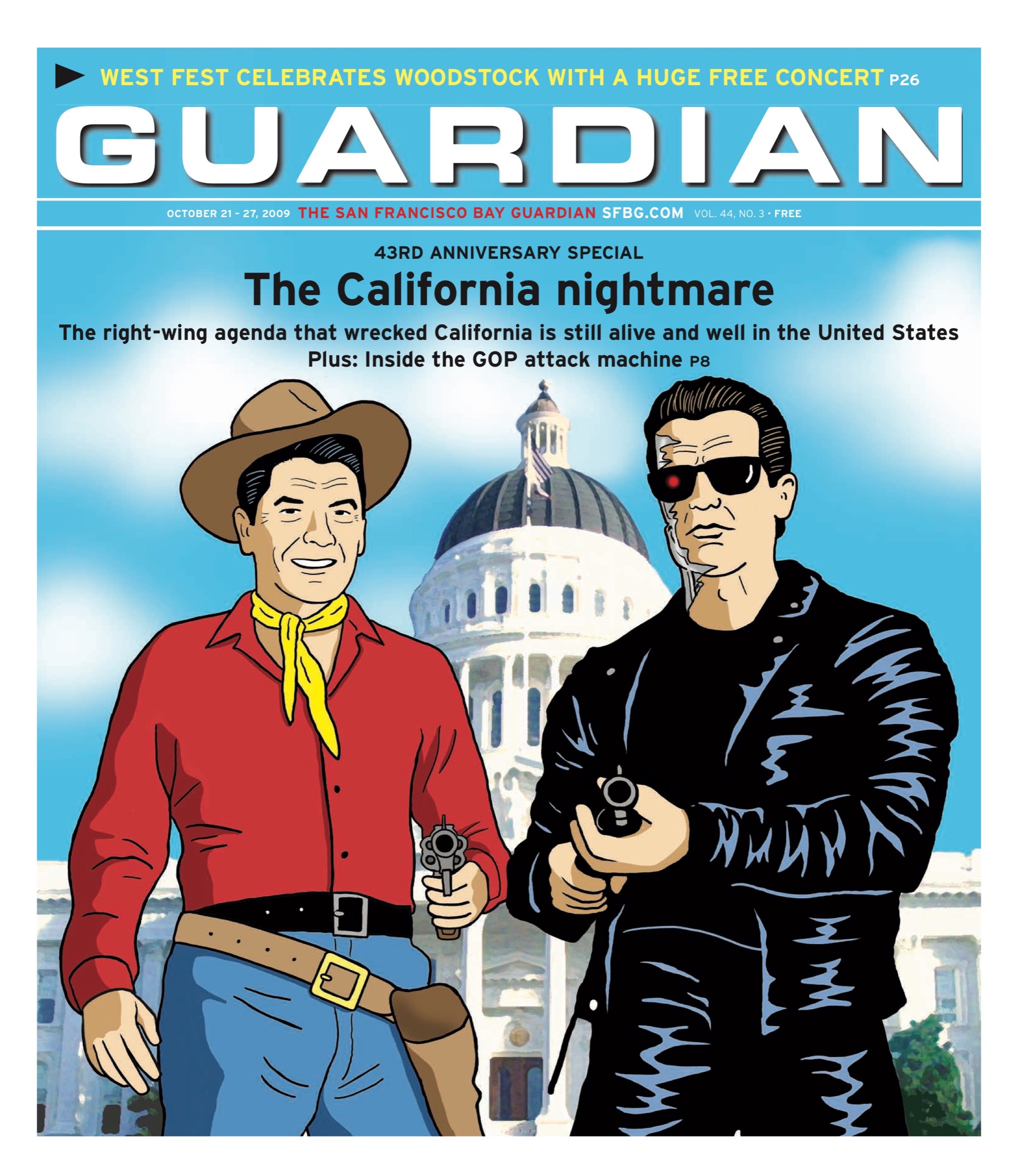
Much of the right-wing agenda that has thrown this nation into economic chaos can be traced back to what was once called the Golden State.

The tax revolts that started here under Gov. Ronald Reagan and continued to sweep the country and the world under President Reagan never abated. Indeed, they have only been strengthened by the big business power that created and benefited from them.

But now that California is showing signs of being the country’s first failed state — caught in fiscal freefall and mired in political gridlock as a generation’s worth of neglected problems surge to the surface — this state has become a cautionary tale for that anti-government ideology.

Trends in America tend to start out west, and the economic and political disaster that California has become contains critical lessons for the rest of the country.

Lewis Uhler — president and founder of the National Tax Limitation Committee — speaks candidly and proudly of his key early role in helping build a conservative movement to limit the size of government and do battle with those who want the public sector to actively promote social and economic justice.

Uhler, a UC Berkeley Boalt Hall School of Law graduate who did legal work for conservative causes in the 1960s, was tapped by then-Gov. Reagan in 1970 to be the director of the Office of Economic Opportunity, a federally-funded legal assistance program created as part of President Lyndon Johnson’s war on poverty.

While that may seem like a strange role for an avowed conservative and former member of the John Birch Society, Uhler says Reagan basically brought him in to wreck the program and fight the feds. “I was asked to put my money where my mouth was for my conservative philosophy,” Uhler told the Guardian. “OEO was set up to ensure conflict and confrontation … The mission of legal services was to change public policy through lawsuits they decided to file. I thought it was a corruption of the legal system.”

At the time, public-interest law and liberal economic and social policies were on the rise in California and spreading to the rest of the nation. So the Reaganites fought back.

Rather than helping poor plaintiffs file environmental, consumer protection, equal rights, or other types of lawsuits designed to level the playing field with powerful interests, Uhler blocked lawsuits brought by attorneys he calls “ambulance-chasers” and gutted the program. “Ultimately,” he said, “we vetoed funding for California Rural Legal Assistance.”

And for his efforts, Uhler was rewarded with a cabinet-level position: assistance secretary of the Health and Welfare Agency. Again, his role wasn’t to make the agency more effective, but to make it less effective in a realm where he believes government was too big and too active.

“The problem was uncontrolled state and local spending,” Uhler said. “Intuitively, everyone who gathered around Reagan shared the same philosophy that government doesn’t really contribute anything to economic growth.”

In 1972, Reagan gave Uhler the opportunity to work more directly on the mission of cutting taxes and shrinking the size of government, naming him chair of the Governor’s Tax Reduction Task Force. It was, in many ways, the beginning of the vast right-wing conspiracy.

“I asked to be given the chance to go across the country and find the best free market minds in the country to develop these policies,” Uhler said, explaining that he wanted to borrow the liberal strategy of giving an academic veneer to their ideas, as presidents Kennedy and Johnson had done in the realm of foreign policy. “Our side had never really done that.”

Uhler’s first stop was the University of Chicago School of Economics, where he met with noted free market economists Milton Friedman, James Buchanan, and George Stigler, who were brought into the cause.

Today’s vast network of conservative think tanks didn’t exist at that time, so Uhler tapped conservative thinkers from the American Enterprise Institute and the Hoover Institute at Stanford University, as well as other conservative economists such as Peter Drucker from Claremont McKenna College.

“There were 35 people who helped us design the first effort at a constitutional initiative in California to limit year-over-year growth of the state’s general fund,” Uhler said. “All of us as free market enthusiasts and economists all shared the belief that government beyond a certain level eats the seed corn of the nation and doesn’t produce anything.”

While voters narrowly rejected their group’s first effort to cap government growth — Proposition 1 on the November 1973 ballot — the ground had been prepared and the seeds had been sown for the tax revolts that would sweep the country in the late 1970s, with many of the campaigns coordinated by Uhler and the organization he formed for that purpose in 1975, the National Tax Limitation Committee, and a rapidly growing network of similar, interconnected organizations.

As Uhler worked with Reagan to weaken California’s government from within, his fellow travelers were developing national and international strategies to create aggressive, coordinated, well-funded campaigns to attack government and spread the free market dogma.

In August 1971, Lewis Powell — a conservative corporate attorney who President Richard Nixon had just nominated to the U.S. Supreme Court (where he served from 1972-87) — wrote a confidential memorandum to the leadership of the U.S. Chamber of Commerce titled “Attack on the American Free Enterprise System.”

He sounded the alarm that the ascendant environmental and consumer movements were going to destroy capitalism in the country unless corporate America aggressively fought back in a coordinated fashion, which he spelled out in great detail.

He called for all major corporations to develop aggressive legal and public relations strategies for fighting the left, creation of a network of think tanks and media outlets to push the conservative message, manipulation of the legal system, and sponsorship of university programs to study conservative ideas and incubate future leaders — which all came to pass in the coming decades.

“American business [is] ‘plainly in trouble’; the response to the wide range of critics has been ineffective and has included appeasement: the time has come — indeed, it is long overdue — for the wisdom, ingenuity, and resources of American business to be marshaled against those who would destroy it,” Powell wrote.

Part of that strategy involved having the federal government promote and popularize free market economic theories being developed by Friedman and his colleagues at the University of Chicago, a movement that is well-documented by journalist Naomi Klein in her book The Shock Doctrine: The Rise of Disaster Capitalism.

In 1971, Friedman and his colleagues began working with rich conservatives in Chile who were allied with Gen. Augusto Pinochet, who in turn were conspiring with the CIA to overthrow and assassinate the democratically elected, leftist President Salvador Allende, which they successfully did on Sept. 11, 1973.

Friedman’s economic theories called for a radical restructuring of society — slashing taxes and social spending; removing most regulation and trade restrictions; crushing labor unions; promoting economic growth at any cost — and Pinochet executed the strategy in brutal fashion, ordering the death of at least 3,200 of his political opponents, including the car-bomb assassination of economist Orlando Letelier in Washington, D.C., in 1976.

Friedman and Pinochet consulted openly and shared a basic disdain for social programs and progressive taxation. “The major error, in my opinion,” Friedman wrote in a letter to Pinochet in 1975, referring to the government antipoverty programs Pinochet dismantled, was “to believe that it is possible to do good with other people’s money.”

The model Pinochet and Friedman developed in Chile would eventually go global — promoted by its top cheerleaders, Reagan and British Prime Minister Margaret Thatcher — and be implemented (with disastrous results for most citizens but creating huge profits for wealthy individuals and corporations) in Indonesia, Bolivia, Argentina, Peru, Russia, Poland, South Africa, Japan, and elsewhere.

But with the corporate media and conservative opinion-shapers focused mostly on economic growth — ignoring persistent poverty and the brutal tactics used to suppress the popular movements that tried to resist Friedman’s “economic shock therapy” — Friedman had become a sort of free-market prophet by the time he died in 2006.

“In the torrent of words written in eulogy to Milton Friedman, the role of shocks and crises to advance his worldview received barely a mention,” Klein wrote. “Instead, the economist’s passing provided an occasion for a retelling of the official story of how his brand of radical capitalism became government orthodoxy in almost every corner of the globe.”

California’s fiscal shackles have been in place since 1978, when Proposition 13 and subsequent measures capped property taxes and required an undemocratic two-thirds vote to either raise taxes or pass the annual budget.

A Republican landlord lobbyist named Howard Jarvis charged onto the field that Reagan, Uhler, and their team had prepared and took advantage of a gaping hole in political leadership to set off a movement that would cripple the United States of America.

There was some logic to it then. Times were good in California in the 1970s, good enough that people were flocking to the state by the millions. That was driving up property values — and thus property taxes.

Jarvis bought his home for $8,000 in 1946; 30 years later, it was assessed at $80,000. In fact, inflation was running at close to 10 percent a year in California. Homeowners were getting huge tax hikes each year, and tenants were getting huge rent hikes at a time when state government had a budget surplus.

Homeowners saw millions of dollars sitting in the coffers in Sacramento while they couldn’t pay their tax bills. Yet nobody in the Legislature or governor’s office came up with a solution.

So when Jarvis showed up with petitions to roll back property taxes and prevent future increases, he found a broad base of support. Even tenants went along — Jarvis and his gang promised that property-tax cuts would be passed on to tenants and would mean the end of the escautf8g rent hikes.

Jarvis collected signatures for a radical measure that essentially blocked all property tax increases and allowed new assessment only when a parcel sold. It was, in the end, a huge tax giveaway to major corporations. Since commercial property turned over far less often than residential property (and since commercial sales could be hidden as stock transfers), big businesses wound up paying far less of the state’s tax burden. Corporations used to pay about two-thirds of the state’s property taxes, and individuals one-third; now that is reversed.

It didn’t help tenants, either. Few of the landlords who saw the benefits of Prop. 13 passed the money along to their renters. Most just kept it. San Francisco activist Calvin Welch likes to say that Howard Jarvis was “the father of rent control.”

The campaign against Prop. 13 warned of the dangers of cutting local government; police and fire chiefs appeared in ads opposing it. But the No on 13 folks never talked about the huge windfall big corporations would get from the measure, or the huge disparities in wealth that would be created by defunding government and dereguutf8g corporations.

If the goal was to skew the concentration of wealth in the state, it worked brilliantly. According to the California Budget Project (CBP) of the Franchise Tax Board, recent data taken before the current economic recession illustrates an ever-widening chasm between the wealthiest taxpayer and the working-class person.

The total adjusted personal income for Californians rose by nearly $64 billion in 2006-07 — with approximately three-quarters of that increase going to the top fifth of wealthiest taxpayers, and 30 percent going to the top 1 percent. That left only $19 billion for everyone else.

“The average taxpayer in the top 1 percent experienced a $128,261 increase in AGI [adjusted gross income] between 2006 and 2007, which was more than three times the total AGI of the average middle-income taxpayer in 2007 ($36,115),” stated the June 2009 report.

This continues a long-term trend in which the wealthy continue to leave the average income-earner behind in a trail of dollar-sign dust. From 1995 to 2007, income gains for that top 1 percent come to a whopping 117.3 percent increase — nearly 13 times more than the gains of the middle-income taxpayer.

The nation’s income gap has reached a “level higher than any other since 1917,” according to a paper by University of California, Berkeley economic professor Emmanuel Saez. According to Saez’s analysis of census data, there’s been a steady increase in the income gap since the 1970s, rising 20 percent over the years.

Yet even today, the defenders of Prop. 13 continue to sound the same consistent themes. “Those who are directly involved in government are a militant special interest,” Howard Jarvis Taxpayer Association executive director Kris Vosburgh told us. “They don’t like anything that limits their revenue stream.”

While that last statement could be applied equally to corporations or other private sector enterprises, as Vosburgh reluctantly admitted when asked, he continues to imply malevolence to those who defend government. He said the state’s current fiscal collapse can only be solved by slashing government expenditures.

“It is not valid to be talking about revenue-side solutions,” he said. “Our position is the state has enough money to accomplish its goals.”

People have never liked paying taxes, but the antitax movement is about far more than just that basic individual desire to hold onto our money.

The attacks were well planned, carefully targeted, and part of a much larger effort aimed at maintaining corporate and conservative power, undermining the New Deal, reducing taxes on the rich, and radically reducing the size and scope of the public sector.

As Powell called for, corporations have aggressively challenged, in legal courts and those of public opinion, every significant progressive advance — from San Francisco’s attempt at universal health care to California’s tentative first steps to address global warming.

With a level of discipline unheard of on the left, conservative opinion-shapers pound their talking points and enforce party unity through mechanisms like the “no new taxes” pledge that every Republican in the California Legislature has signed and heeded, under the very real threat of recall.

Opposition to taxes is now so deeply embedded into the psyche of the California electorate, and such a core tenet of today’s Republican Party, that elected officials who tout fiscal responsibility allowed the state’s debts to go unpaid (destroying its credit rating in the process) and its education and transportation systems to be decimated rather considering new revenues.

Gov. Arnold Schwarzenegger’s spokesperson Aaron McLear told us, “He believes we ought to live within our means and pay for only the programs we can afford.”

That simple talking point gets repeated no matter how the question is asked, or when we point out that it means we’re being forced to live within historic lows this year. But they claim the people support them.

“We had tax increases on the May ballot and they were rejected by a 2-1 margin. We should listen to the will of the voters,” McLear said.

Never mind that this regressive, dishonest package of temporary tax hikes was opposed by the Guardian and a variety of pro-tax progressive groups. McLear wouldn’t even admit that point or respond to it honestly.

And he’s certainly right that most polls show a majority of Californians don’t want new taxes. But these polls also show that people want continued government services, more investment in our neglected state infrastructure, and a whole bunch of other contradictory things.

That’s why newspapers and analysts around the world are looking at California, the world’s eighth largest economy, and wondering (as the Guardian of London headline asked Oct. 4): “Will California become America’s first failed state?”

In many ways, it already is. The question now is whether we’ll try to learn from and correct our mistakes. Ryan Riddle contributed to this report. ———–

THE CONSERVATIVE RELIGION

When I asked Lewis Uhler, one of the architects of the Reagan revolution, what Americans believed in these days — where the people he likes to talk about who hate the government (but are also admittedly disillusioned with Wall Street) turn — he answered simply: religion.

It should come as no surprise that many religious fundamentalists tend to side with the free market conservatives — both ideologies require a leap of faith and ignoring certain troubling facts, such as increasing disparities of wealth, natural resource depletion, and global warming.

Their arguments mostly make sense — until these inconvenient truths come up.

Certainly, turning over more public resources to free market capitalists, cutting taxes, and slashing government regulation will spur private sector economic growth, just as advocates claim.

But that growth has a cost. The wealth won’t be shared by everyone. Indeed, poverty has persisted even through even the economic boom of the 1990s — but almost everyone will be affected by underfunded road, education, public safety, and other essential systems.

As the conservative movement has successfully limited taxes and cut regulation over the last 40 years, working class wages have stagnated as the rich have gotten richer. Many of the world’s oil reserves have peaked and gone into decline, and rapidly increasing carbon emissions have collected in the atmosphere and caused global warming.

So how do conservatives respond to these realities as they argue for the continued dismantling of government, which is the only entity with the scope and incentive to deal with these problems? They simply deny them.

Uhler decried the “pseudoscience of climate change” as hindering economic progress and claimed that there’s actually been a global cooling trend in the last 10 years. (Actually the last 10 years have been some of the hottest on record, causing glaciers around the world to melt, according to data and observations from a consensus of the world’s climate scientists, including NASA, the Union of Concerned Scientists, and the United Nations Climate Change Conference.)

It’s the same story with the consolidation of wealth, which hurts the free market fantasy that letting the super-wealthy keep more money will eventually trickle down to benefit us all. Uhler simply denied the growing disparity of wealth, saying the “movement between quintiles is significant.”

He was talking about people’s ability to go from poor to rich with a little hard work and initiative, the core idea of free market conservatives. But data from the U.S. Census Bureau and many other entities indicate that median wages have been stagnant for decades (which wouldn’t be true if there was lots of upward mobility) and that most of the wealth created in the U.S. over the last 40 years has pooled with the top 1 percent.

In fact, when it comes to measuring social impacts, Uhler has simply one metric: “Governments at all levels are twice the size they should be to maximize economic growth.” (Steven T. Jones)


 

Park life — and 3,000 guitars

0

arts@sfbg.com

MUSIC Golden Gate Park has once again become a nexus for huge music concerts. The massive scope of events such as Outside Lands can’t help but evoke the legacy of San Francisco in the 1960s, when musical gatherings were not only abundant, but a definite inspiration behind concerts elsewhere — especially Woodstock. With West Fest, organizer Boots Hughston and an extensive lineup of musicians and participants are paying tribute to Woodstock’s 40th anniversary. But they’re also bringing a sense of living history to a place where new generations of music lovers — some of whom knowingly or unknowingly admire contemporary acts influenced by the Woodstock era — regularly congregate.

Politically speaking, it’s especially important to bridge a sense of then and now. One person who will be doing exactly that is David Hilliard, former chief of staff in the Black Panther Party, author of many books, and current-day teacher. "Our purpose was always to ensure that art was part of our revolutionary political process," says Hilliard. "I dispatched members of our chapter to Woodstock ’69 as a gesture of solidarity to the counterculture movement. We were the comrades of the hippies and yippies and Peace and Freedom Party. We had the support of people like John Lennon — that was our constituency. It makes sense that we should be included in a celebration of this momentous event."

Hilliard has no problem connecting his message to the present — especially because the present includes some tell-tale problems. "I have to talk about the contemporary issue of millions of people who have lost their homes to foreclosure," he says, when asked about the subjects of his West Fest speech. "And isn’t it ironic that universal health care is the chief issue of the day, because we were devoted to free health care — it was central to our program."

Hilliard isn’t especially inspired by contemporary hip-hop, aside from Talib Kweli and a few other conscious artists. When asked whether the music of the moment approaches the political intensity of hip-hop’s Public Enemy era, he answers with a "hell no" that is as strong as it is quick, adding, "The whole industry has been reduced to a few artists who make it because they come up with songs about the latest dance."

This doesn’t mean that Hilliard and his contemporaries don’t have a hand in politicizing popular culture and youth culture in ways big and small. Black Panther Minister of Culture Emory Douglas currently has a solo exhibition at the Museum of Contemporary Art in Los Angeles, and Hilliard takes part in projects like the South L.A. Road to College, which teaches South Central L.A. youth about the Panthers and their history while preparing them for college. HBO is developing a six-hour series on the Panthers based on Hilliard’s 1993 book This Side of Glory and Elaine Brown’s 1992 autobiography A Taste of Power: A Black Woman’s Story. "We are proud to be working with Carl Franklin," Hilliard says, referring to the series’ director, whose undersung 1992 classic One False Move renders in truly disturbing human terms the kind of drug violence that 1994’s Pulp Fiction treats as entertainment. "We need a year to tell this story [in a series], but we’ll take six hours and hope that it will inspire people to tell the story more often."

West Fest’s wildest musical element has to be an attempt to outdo the Guinness World Book of Records‘ current entry for Largest Guitar Ensemble via a 3,000-or-more-guitar rendition of Jimi Hendrix’s "Purple Haze." A chief force leading this effort, the producer and musician Narada Michael Walden, is also performing a set in honor of Hendrix later in the day. "Jimi Hendrix was the highest-paid performer at Woodstock, the most sought-after at the time," Walden points out from his base at Tarpan Studios in San Rafael. "A lot of the music he played at the festival — "Jam Back at the House," "Villanova Junction," "Isabella," "Fire" — is in obscurity because we only hear "Purple Haze" and "Foxy Lady." I wanted a chance to play some of the songs Jimi played at Woodstock that we don’t get to hear."

Moreover, working with musicians such as Vernon Ice Black, Hendrix’s bassist Billy Cox, and some special guests, Walden hopes to tap into the political subtext of Hendrix’s music at West Fest. "He didn’t just want white fans or black fans, he wanted to reach everybody," Walden says. "He tried his hardest by doing "The Star-Spangled Banner" in a way in which you heard the bombs exploding. He’d been a paratrooper jumping out of airplanes, and he wanted our nation to wake up to what we were doing, all the needless killing in Vietnam."

If anyone can corral 3,000-plus guitarists into making something musical, it’s the energetic Walden. He’s the producer behind the hits that made Whitney Houston and Mariah Carey into stars, and before that, the gorgeous pop R&B songs by teenage Stacey Lattisaw ("Let Me Be Your Angel," "My Love") that no doubt inspired those divas-to-be to work with him. "My first solo album [Garden of Love Light] in 1976 was produced with Tommy [Tom] Dowd," he remembers, when another legendary musical force who turned away from the U.S. military is mentioned. "I spent months and months recording with him and learned first-hand from him. He was really here to do what he did — only a few people understood how to compress music for radio in a way that it could still live and breathe. He knew how to take the queen of soul, Aretha, and give her a Southern sound with a vibrancy that allowed all people everywhere to feel it. That’s the genius — not just the musical side but the scientific side — of Tom Dowd."

The life stories of men such as Hendrix and Dowd — who abandoned atomic work on the Manhattan Project for the studios of Atlantic Records — are still applicable today. After all, this is an era in which Barack Obama calls for more troops in Afghanistan and wins the Nobel Peace Prize. Amid the potential and contradictions invoked by such a circumstance, Walden’s Hendrix-inspired endeavors and Hilliard’s speech at West Fest are worth hearing.

WEST FEST, 40TH ANNIVERSARY OF WOODSTOCK

Sun/25, 9 a.m.–6 p.m., free

Golden Gate Park, SF

www.2b1records.com/woodstock40sf

A tale of two hoaxes

1

by Rebecca Bowe

YesMen.jpg

Bonner & Ass 2.jpg

Politico has reported that the Yes Men, a left-leaning activist group that has created public-relations messes for big business before, fooled Reuters, CNBC, and the Washington Post this morning by issuing a fake press release from the U.S. Chamber of Commerce declaring that it had withdrawn its opposition to the climate-change bill.

This is from the fake press release:

“We believe that strong climate legislation is the best way to ensure American innovation, create jobs, and make sure the U.S. and the world are on track to reduce global carbon emissions, and to provide for the needs of the American business community for generations to come,” said the spokesman, Hingo Sembra.

“The new position is an about-face on climate policy for the Chamber, which previously lobbied against government action. The shift comes after the defection of several prominent members of the Chamber, including PG&E, Apple, PNM Resources, and Exelon.

Here’s the reaction from a Chamber of Commerce spokesman (as reported by Fox News) after the COC figured out they’d gotten punked:

“Public relations hoaxes undermine the genuine effort to find solutions on the challenge of climate change,” spokesman Thomas Collamore said. “These irresponsible tactics are a foolish distraction from the serious effort by our nation to reduce greenhouse gases.”

The Yes Men are self-styled pranksters, their media stunts are immediately recognized for being the bold political statements that they are, and they serve to amplify public pressure on crucial issues such as human rights or global warming. Although the Yes Men may have temporarily posed as Chamber of Commerce press contacts, it’s worth noting that there’s a huge difference between that media stunt and the AstroTurf hoax that PR firm Bonner & Associates evidently thought it could get away with this past summer.

The PR firm, which was tapped by the American Coalition for Clean Coal Energy (ACCCE), sent forged letters opposing the climate bill purporting to be from the National Association for the Advancement of Colored People (NAACP) and other minority groups. Bonner & Associates is now under Congressional investigation for the fake letters.

A popular term for this PR tactic is AstroTurfing: Creating the illusion of a grassroots campaign driven by ordinary people when in fact the campaign is a targeted attack powered by millions of dollars to advance a business agenda. And according to an article in the National Journal, AstroTurfing is on the rise.

According to a quote from a Congressional aide that appeared in that story:

“I think what we’ve seen, especially this summer with the energy and health care debates, is that AstroTurf has become much more widespread than I think we’ve ever seen it before … The American public is honestly confused about what is real and what is not.”

So while the Yes Men’s “foolish distraction” may have been successful in focusing attention on how big business is trying to block efforts to address climate change, don’t forget that they aren’t the only ones pulling a fast one — and the tricksters on the business side are trying to avoid the attention of the media, rather than attract it. By the way, there’s a movie coming out soon called The Yes Men Fix the World. It opens Oct. 30 in the Bay Area.

Treasure Island fest: Flaming Lips, Yo La Tengo, Decemberists

0

treas isle 101909 dec.jpg
Folk this: Decemberists’ Colin Meloy. All photos by Kimberly Chun.

By Kimberly Chun

Ah, washing up on Treasure Isle late in the day Sunday, Oct. 18, seemed like the way – though it was a bummer to miss Vetiver, Beirut, et al. The short and sweet stuff: it was considerably colder and foggier than Saturday, so it was in everybody’s best interest to huddle together en masse while Walkmen and then the Decemberists played. And wow, what fabulous animations accompanied the Portland, Ore., band’s set – tumbling with wild things, pyramids, geometrics, landscapes of jewel-like mountains and obelisks, star fields, and the like. The perfect accompaniment to the delicate Brit folk and outright psych-prog the band is purveying these days: the standout was the title track of this year’s The Hazards of Love album (Capitol).

trea isle 101909 ylt.jpg
Greening of YLT: Yo La Tengo’s Ira Kaplan, right, and James McNew.

The following set by Yo La Tengo seemed almost anticlimactic, though you had to appreciate the strenuous noise jams the band is rolling out. Ira Kaplan helmed the keyboard from the start then switched over to guitar as the combo abruptly segued into “Stockholm Syndrome,” with James McNew on falsetto vocals. Up next, just as quickly: the loveable, cacophonous “Here to Fall” off YLT’s new Popular Songs (Matador).

treas isle 101909 lips.jpg
Man in a bubble: Flaming Lips in utero.

The wait was completely worth it, as we tarried in the photo pit (and my camera decided to die on me) and Wayne Coyne and the Flaming Lips set up on the main stage. All-girl backup vocalists with bunny ears, the Lips busting through the pull-apart screen at the exact do-go-there spot where a massive go-go girl opened her legs. (Coyne rolled out in his big bubble, followed by a stage-diving bunny.) Ah, no one delivers a show like FL (though there was a health emergency up front where I was — the frontman later asked to see if the lady taken off was OK). Coyne offered an opening monologue about how the group is an honorary SF band of sorts since the first show they ever played was at the beloved ole I-Beam in the Haight. We’ll take ’em.

treas isl 101909.jpg

Michael Pollan’s modest proposals

0

By Sarah Morrison

While down-to-earth food expert and journalist Michael Pollan might not quite have offered the definitive “Omnivore’s Solution” — to cite the title of his talk — when he kick-started the 2009/10 Strictly Speaking series at Berkeley’s Zellerbach Hall (9/30/2009), he did provide an entertaining and accessible critique of what he called America’s “unhealthy obsession with healthy eating.”

“We are lost, really lost in the supermarket,” said the author of three New York Times bestsellers, shortly after he took the stage humorously laden down with Safeway bags, and enough packets of Twinkies, Fruit Loops, Soda and Wonder Bread to make even the most gluttonous in the audience start to feel queasy. Promising to “connect the dots between diet and health in food systems as a whole,” Pollan guided the enthusiastic audience through his easy-to-follow theory of food politics – a theory that he summed up in seven words: “Eat food, not too much, mostly plants.”

pollan.jpg
Michael Pollan

Satirising the nation’s obsession with “nutritionism,” a pseudo-science that Pollan compared to surgery in the 1650’s (“promising and fascinating to watch, but are you really ready to let them operate on your life?”), the lecture went on to critique the demonising of certain nutrients in American society (think trans fat, carbohydrates, sugars), and the intellectualising of food to the point where the regular American feels unable to eat anything without the help of an expert by their side.

Do you have to let it Linger?

1

By Juliette Tang

linger1009.jpg

A new mint called Linger is being marketed toward women who wish to improve the taste of their natural vaginal secretions. I first heard of Linger mints via Mother Jones, where writer Jen Philips revealed that Lingers have the same chemical composition of a sugary breath mint (and not even a good mint at that, but the cheap trade-show variety). Using a Linger, then, is essentially the equivalent of inserting a petri dish into the vaginal canal in terms of courting a yeast infection, though for women who wish to harvest kombucha by way of their genitalia these mints may have some utility.

Sadly, it’s not inconceivable that a female shopper might purchase this product, despite its $7.99 price tag and associated health risks. As a woman, I know that we justify embarrassing purchases in name of feminine modesty (or feminine shame, depending on how you look at it) all the time. The fact that “fish” has become a culturally normalized adjective in reference to the vagina is disturbing enough.

Turf war

0

news@sfbg.com

The signs around Kimbell Playground in the Western Addition announce the field’s closure for construction until April 2010. Although they detail the extensive renovations, there is no hint that controversy swirls around one particular aspect: replacing living grass with synthetic turf.

In 2004, the San Francisco Recreation and Park Department issued an assessment of the city’s recreation facilities that estimated the city needed 30 softball fields and 35 soccer fields to match demand from the city’s players. Looking to get the most playing time from existing facilities, Rec and Park officials turned to turf.

Yet concerned citizens, community groups, and environmental organizations are trying to stop the conversion until the impacts of turf are better understood. Both sides say they are fighting for the welfare of San Francisco’s children. City officials tout increased availability of fields and reduced maintenance costs, while activists cite a wide variety of health and environmental issues.

"No one is happy about taking natural grass away," Rec and Park project manager Dan Mauer told the Guardian, "but we’re trying to meet multiple demands with limited resources."

In fact, the department’s steadily dwindling budgets led it to privatize the transition. In 2005, Rec and Park began collaborating with the newly formed nonprofit City Fields Foundation, signing a formal memorandum of understanding in 2006. This public-private partnership determined that without the resources to buy real estate for new fields, putting artificial turf on existing fields was the best alternative.

The transition began in 2006 with Garfield Square and Silver Terrace Playground; the partnership deemed both a success, and pushed for more. In February 2008, voters passed Proposition A, a $185 million parks bond that included $8.5 million earmarked for "park playfields repair and reconstruction." The legal text makes no mention of synthetic turf, but the money was intended to match funds from City Fields for the installation of turf, lights, and other improvements to designated fields.

The project is estimated to cost $45 million, with $25 million coming from City Fields and $20 million from the city. Although cash-strapped Park and Rec department officials stress the financial benefits, environmental concerns prompted the department to create a Synthetic Playfields Task Force in March 2008 with 16 volunteer members.

The task force was charged with evaluating peer-reviewed data on a new generation of artificial turf that improved on the older variety, commonly referred to by the brand that popularized it, AstroTurf. The new turf was less likely to cause injury than its predecessor and could withstand higher levels of play than grass, which takes time to absorb rainfall and must rest and regrow after heavy use.

The Synthetic Fields Task Force identified 11 possible issues of public concern and made a number of emphatic recommendations on how to proceed, including avoiding products with lead and investigating alternatives to rubber infill. Despite this, it didn’t call for a moratorium and conversions continued.

The city has converted four sites, soon to be five, and added lights at a sixth as part of the Playfields Initiative. According to City Fields Foundation spokesperson Patrick Hannan, "These fields have gone from being fields of last resort to some of the most requested fields in the city." According to organization’s estimates, the addition of lights and turf has added more than 27,000 hours of playtime to the first five sites.

Perhaps no one is more enthusiastic about synthetic turf than the sons of the late Gap, Inc. founder Donald Fisher, a regular funder of conservative causes. Bill, John, and Bob Fisher founded and partially funded City Fields Foundation "to give back to the city and provide children with access to the same fields and opportunities they had as children," Hannan said.

Opponents argue that synthetic fields are not the same ones the Fishers played on as children. In January 2008, Pinky Kushner of the Sierra Club sent a letter asking the Recreation and Park Department to suspend the program until "it can be demonstrated that these projects will have no negative impacts on the environment or on human health and enjoyment of public open space."

Her letter references the city’s Precautionary Principle, a policy whereby the city seeks to avoid taking action that might harm the environment even when there is a "lack of full scientific certainty about cause and effect." SF’s Environment Deparment says the principle "does not advocate the avoidance of any and all potential environmental risks." Rather, it "advocates for a public process in which the benefits of an action or technology are weighed against potential risks."

Rec-Park and City Fields are confident the Synthetic Playfields Task Force inquiry meets the requirements. But Sup. Ross Mirkarimi has authored a resolution asking for a moratorium on turf conversion until the state completes a study on the issue. Gov. Arnold Schwarzenegger signed legislation in September 2008 tasking state agencies to study the turf question and submit a report by September 2010.

Even if it passes, Mirkarimi’s resolution is nonbinding and unlikely to halt the current conversion of Kimbell Field. But it does have support from activists who believe synthetic turf poses a health risk. In several parks, community members lobbied against the proposed conversions and successfully convinced City Fields and Rec and Park not to move forward.

Franco Mancini, president of Friends of McLaren Park, described how a few residents were initially opposed to the proposed fences and lighting but soon became embroiled in the larger issue of synthetic turf and "playing Russian roulette with our children’s safety."

The new synthetic turf consists of a polypropylene fabric backing, an infill of crumb rubber made from shredded tires, and polyethylene fibers that replicate blades of grass. One of the principal concerns is that the crumb rubber infill, made from up to 50,000 tires per field, contains hazardous materials that pose potential health risks. Other health concerns are the presence of lead as a color fixative and the possibility of zinc leaching into the groundwater.

There are also concerns about what to do with the fields when they wear out and whether particles leach into the environment, problems Rec and Park officials have promised to work with turf companies to address. But so far research into the environmental impacts of turf have yielded conflicting results.

Resident Kelley Watts is concerned the "research is only in the very beginning stages" and compares the situation to the 1940s and ’50s when conflicting research about cigarettes was emerging.

Concerns that turf overheats on hot days led to ongoing moratoriums in Los Angeles and New York City. San Francisco’s mild climate doesn’t create the same problem, although it does have the underlying issue that synthetic turf absorbs heat and replaces carbon-absorbing grass, contributing to what is known as the "heat-island effect," a factor in global warming.

The Athena Institute, an Ontario, Canada, nonprofit, estimates that for the average synthetic soccer field to be carbon-neutral, 1,861 trees would have to be planted and allowed to grow for 10 years.

Kimball Field is in the process of converting but the next project, and potential fight, will be at Golden Gate Park’s Beach Chalet soccer fields next year.

Collective growth

0

arts@sfbg.com

MUSIC Last December, Anticon celebrated its 10th anniversary with a concert at the Knitting Factory in New York. It was an emotional reunion. Many fans flew from around the world to see a hip-hop collective that hadn’t performed together since a 2002 concert at Slim’s in San Francisco. Peter Agoston, the event’s promoter, says it took a year to pull it together.

This was a far cry from 1999, when most of the original Anticon seven (along with more than a few couch-surfers) lived communally in an East Oakland warehouse. Tim "Sole" Holland, Adam "Dose One" Drucker, Yoni "WHY?" Wolf, Brendon "Alias" Whitney, Jeffrey "Jel" Logan, David "Odd Nosdam" Madson and James Brandon "the Pedestrian" Best sought to revolutionize hip-hop, injecting the art form with absurdist humor and beatnik poetry. Every month, they held court at Rico’s Loft in San Francisco, performing college radio hits like "It’s Them" and "Rainmen" as throngs of Bay Area backpackers shouted along. Doseone, Anticon’s madcap poet, says, "We were crew, posse, label, brotherhood, and boys-club."

A decade later, Anticon has become a brand and a myth. Baillie Parker, who faithfully attended those Rico’s Loft showcases, became an eighth member, label manager, and co-owner in 2001. Slowly (and sometimes painfully), he steered the label toward solvency, streamlining the collective’s unpredictable adventures into a small business. Then he ceded day-to-day responsibilities to his former intern Shaun Koplow, a student at UC Berkeley. After Koplow graduated, he moved back to his native Los Angeles, and now runs the label there.

Today, Anticon Records is surprisingly durable and stylistically varied. Recent albums include melancholy rock (Anathallo’s Canopy Glow, 2008), wintry indietronica (Son Lux’s At War With Walls and Mazes, 2008) and punchy, synthesized instrumental beats (Tobacco’s Fucked Up Friends, 2008).

Meanwhile, the collective that founded the label has splintered and scattered across the country. Some remained in the Bay Area (Dose One, Jel, Odd Nosdam, and Parker) while others moved elsewhere (Sole in Denver, Colorado; Alias in Portland, Maine; and the Pedestrian in Los Angeles; Yoni Wolf is currently "homeless" while he embarks on a months-long tour). They still own the label and make major decisions together. However, each pursues his individual career. Some collaborate, others do not.

What does it all mean? It doesn’t take a Rashomon-like investigation to figure it out. "We all send each other friendly [e-mail] messages every few months, but we’re not like this cult. And I think that’s good," says Sole. "When we tried to be a cult, we realized that none of us made very good cult members."

ORIGINS OF AN ICON

Anticon’s symbol is an ant, designed by Aaron Horkey of Burlesque Design. Ant-icon. The name comes from the Pedestrian, a Los Angeles native, and Sole, who grew up in Portland, Maine. The two met in 1992 on a Prodigy message board for cassette trading. Both were avid tape collectors, the lingua franca for music dispersion before the Napster era. They bonded over a love for the Los Angeles scene, where Freestyle Fellowship and the Shapeshifters pioneered speed-rapping and obtuse, free-associative rhymes; early Midwest battle-rap crews like Atmosphere and 1200 Hobos; and obscure Canadian groups like the Sebutones.

Anticon coalesced around a series of fortuitous happenings. Alias and Sole met when both lived in Portland; there was the 1997 Scribble Jam, famous in rap circles for its battle between Dose One and a pre-Slim Shady Eminem; Doseone’s frenzied networking skills brought him in touch with Jel, and then Sole; and Dose One made fast friends with WHY? and Odd Nosdam when he lived in Cincinnati in the late 1990s.

After Sole and the Pedestrian came up with the Anticon concept in 1998, Sole moved to Oakland to work for Listen.com. The rest of the crew eventually followed him there. "I was making $50,000 a year during the dot-com rush," he says. "I didn’t have any expenses, so I just put all the money into starting the label."

Anticon’s first release, 1999’s Music for the Advanced Hip Hop Listener EP was an invitation and a challenge, with Alias’ "Divine Disappointment," which imagines an argument between father and son, and "Holy Shit," a posse track marked by precociously off-kilter rap flows. A compilation, Music for the Advancement of Hip-Hop, followed later that year. "For me, it was about representing these underground aesthetic movements," says the Pedestrian.

But the only song anyone remembers from those records was Sole’s missive "Dear Elpee." On the surface, it was a battle record directed at El Producto, the incredibly talented rapper/producer whose group Company Flow recorded the 1997 opus Funcrusher Plus. El-P memorably coined the term "independent as fuck" to distance himself from mainstream rap, then lost in the throes of Puff Daddy’s hyper-commercial "jiggy" era. But Sole saw hypocrisy in East Coast tastemakers such as Rawkus Records, which distributed Company Flow’s records. He felt they excluded anyone who didn’t live in New York City, and was disgusted at how they extolled "independent" virtues while launching sophisticated marketing campaigns to promote themselves.

"Dear Elpee" wasn’t just a dis against a popular rapper, it was a distillation of Anticon’s scrappy, outsider stance. "Underground hip-hop is a mentality. It’s not supposed to be commercial. You’re supposed to spit an 80-bar verse and people are going to love it," says Sole. "I felt like [hip-hop] needed a little chin check."

On his subsequent two solo albums, 1999’s Bottle of Humans and 2001’s Selling Live Water, Sole honed his sarcastic and brutally honest persona. He criticized himself and attacked his unnamed enemies, exposing thoughts of paranoia and depression. With songs like the brilliantly melancholy title track, he sowed the seeds of what would later become known as "emo rap."

Meanwhile, Jel and Odd Nosdam (along with other producers such as Alias and DJ Mayonnaise) drew from a wide breadth of influences, from orchestral rock like Radiohead and Flying Saucer Attack to electronic acts like Boards of Canada. They made tracks using rudimentary equipment, including 4-track and 8-track recorders and SP-1200 sampling keyboards, resulting in songs that expounded a murky and intimate low-fi aesthetic.

Anticon’s recordings were imbued with a childlike playfulness. In 1998, Sole, Doseone, and Alias collaborated with Minneapolis rapper Slug [from Rhymesayers group Atmosphere] under the name Deep Puddle Dynamics. Alias explains the concept: "[The group name is] in reference to puddles … because of how they form, you sometimes can’t tell how deep they are until you stand in them or observe them really closely."

Deep Puddle Dynamics’ 1999 album, The Taste of Rain … Why Kneel (a title inspired by Jack Kerouac’s poem "Some Western Haiku"), mixed wide-eyed abstraction with introspective thoughts. On the yearning "June 26, 1998," they trade lines until their voices became a kind of Greek chorus. "What is the meaning of life?" they chant. "Fortune, health, knowledge, success / Woman, man, trust, progress / Culture, faith, healing, destiny / Endurance, family, science, society."

"It was so inspiring to be around those cats and see how they operate," says Alias of those recording sessions. His shy New England demeanor contrasted sharply with Doseone and Sole’s bravado. "It’s weird to go back and listen to it now. … It shows its age, and it shows its awkwardness."

However, Anticon’s precocious search for deeper truths through hip-hop, a genre often maligned for its lack of intellectual discourse, endeared them to listeners around the world. The collective helped spark a cottage industry of aspiring rappers, a sensibility built around tweaked flows and five-minute soliloquies, and nourished a brief, exhilarating moment of hip-hop experimentalism in the early 2000s.

Alias says, "I’ve been at shows and had kids come up and tell me how much my music has meant to them. They’ll tell me stories like when their father passed away, all they did was listen to ‘Watching Water’ [from The Other Side of the Looking Glass, 2002] for a week. Then they’ll show me that they have these Anticon-related tattoos or something. It’s crazy. It makes me feel embarrassed."

OFFBEAT STREET

If Sole is the blustery visionary who led Anticon into war, then Doseone is the eccentric who personifies its unfettered creativity. His catalog, issued via several record labels, ranges from the bleak tone poems of Circle, his 2000 album with producer Boom Bip; to Subtle, a band formed with Jel and keyboardist Dax Pierson. Over the course of three albums (including 2008’s Exiting Arm), Subtle molded rap, electronics, rock, jazz-fusion and whatever else they could find into a searing and dense whirlwind of word and sound.

"We were artists’ artists without a doubt. Still are," says Doseone. "It was DIY … and you could hear the flaws, the sensitivities, the trying-something-new, even when it was over the top or egregious."

Doseone’s strangely disembodied, half-sung raps epitomized Anticon’s greatness as an offbeat take on hip-hop culture. It should have made a bigger impact on the rap industry, and there are several reasons why it didn’t. First, Sole’s battle with the iconic El-P, whose music was just as experimental and groundbreaking as anything Anticon made, turned many people against him. And yes, Anticon was undoubtedly too weird for a generation raised on 2Pac and Jay-Z.

Most damaging were assumptions that Anticon was full of rich, ego-driven art-school snobs who made hip-hop for white people.

Those accusations struck Jel as funny. The Midwest native has been devoted to hip-hop for most of his life, and his placid, straightforward demeanor results from a staunchly lower-middle-class background. "All the shit that came out of nowhere about us not paying dues all comes from the racism that was involved," he says.

The Pedestrian admits that part of the problem was attitude. "When we were doing that whole pretentious ‘Music for the Advancement of Hip-Hop’ shit, for me it was about representing these underground aesthetic movements," he says. "I didn’t imagine we would look as white as we did. It really surprised the shit out of me. And in retrospect, we should have done things differently.

"In those early years, the crowd was pretty fucking white," he continued. "I know there was definitely a consciousness about it — we were thinking about it. But we were fucking kids. We didn’t know how to deal with these really difficult situations."

By the summer of 2002, when Anticon held a series of come-to-Jesus meetings to determine the label’s future, all of its members realized they weren’t a hive-mind group of crazy MCs à la Wu-Tang Clan (with Sole as the RZA), but eight very different people. Wolf, whose esoteric music masks a highly disciplined songwriting approach, felt those aspirations were "unrealistic." "There was almost a utopian idea about record-making, that it could almost be a socialist affair," he says.

As Anticon evolved from a movement into a traditional company, it meandered creatively and financially. Some released material that paled in comparison to past efforts (Sole’s Live from Rome, 2005). New signings, such as indie-pop multi-instrumentalist Dosh (self-titled, 2003) struggled to gain recognition for music that had nothing to do with hip-hop. Eventually, though, Anticon Records learned how to promote releases by its onetime collective as well as its growing indie-rock and electronic roster.

"The way it’s perceived by artists, particularly rock artists, I think they see it as a natural progression," says Sole of Anticon Records’ development. "All the outside-of-hip-hop-world friends we’ve made over the years see it as a natural evolution because what we’ve done has always been pretty melodic and rock and musical anyway."

Some of the onetime "cult" members who felt overshadowed during those early years forged individual identities. Alias, who always felt "awkward" when he rapped, moved back to Maine with his wife and focused on production instead. His efforts yielded 2007’s Brooklyn/Oaklyn, an evocative collaboration with Brooklyn singer Rona "Tarsier" Rapadas.

After a somewhat uneven solo debut (2003’s Oaklandazulasylum), Wolf formed a trio under his old WHY? moniker. Their next two albums (Elephant Eyelash, 2005; Alopecia, 2008) impressively blended Wolf’s prior talent for harmonies, loquacious wordplay, and poetic imagery with the band’s newly-minted melodic rock arrangements. By scoring rapturous national press, he epitomized Anticon Records’ new status as a fast-rising independent label.

WHY? just released its fourth album, Eskimo Snow, which consists of unused material from the Alopecia sessions. Wolf still does a fair amount of rapping, or rhyming in rhythm, even if the results can no longer be classified as strictly hip-hop. "I’ve incorporated it into my pantheon of musical styles," he says, adding that "the next record could be a disco record, for all I know."

BRAND OF OUTSIDERS


Anticon hasn’t abandoned hip-hop. Doseone and Jel just released their third album as the cryptically-named Themselves; their 2000 debut was notable for producing the indie-rap classic "It’s Them." With CrownsDown, Doseone returns to the arena he once flourished in. "There’s purity to the construction and presentation of this record that is derived from Guru and Premier," Doseone says, referring to the classic rap duo Gang Starr.

This year has also brought Chicago duo Serengeti & Polyphonic’s Terradactyl; and Bike for Three!, a collaboration between Buck 65 (formerly of Sebutones) and Belgian electronic musician Greetings from Tuskan. The difference between now and 10 years ago is that these albums aren’t the latest missives from Anticon the collective. They just enhance the label’s reputation for honest, lyrically-driven, complex music.

Amid all this activity, Anticon’s original theorists seem like the odd men out. Back in the day, the Pedestrian was the crew’s sardonic (and sometimes arrogant) prankster, sending out eloquent and confrontational press releases inspired by Dadaism and Situational Ethics. By 2002, however, the former high-school dropout went back to school, enrolling in Laney College. He transferred to UC Berkeley, earned a degree in literature, then enrolled at the University of Southern California, where he’s working on a PhD in ethnic studies.

"There was once an aesthetic collective. And now we’re a record label whose brand name has some lingering connection to that aesthetic," says the Pedestrian, who still treats hip-hop as a hobby and elaborate game theory. "But what we decide to put out and the music we all make is infused with those early years of collaboration. Those were important, foundational years for all of us."

Sole lives in Denver with his wife, and works as an IT technician for Denver Open Media, a public-access station. "It’s not my label anymore. I’m just one voice in it, and I try to contribute as meaningfully as I can to it," he says, adding that he wishes Anticon had a traditional rap profile. So for his new album, Plastique, he decided to work with Fake Four Inc., home to underground artists like Awol One and Mikah 9 (from Freestyle Fellowship).

With Plastique, he focuses on a wide-ranging critique of political injustice, capitalism, and Western hegemony, fed by radical works like Kurt Vonnegut’s Slaughterhouse Five and Guy Debord’s Society of the Spectacle. Sometimes, Sole fits the American lone wolf profile, railing about the world’s troubles.
"Do I wish it was still a crew? Yeah. I miss that. To me, that’s what it’s all about," he says. "But when you’re married, you don’t want to be hanging out all the time. You want to be home, making a stew and watching Heroes."

WHY?
With Mount Eerie, Au, Serengetti and Polyphonic
Sat/17, 9 p.m. (doors 8 p.m.), $16
Great American Music Hall
859 O’Farrell, SF
(415) 885-0750
www.gamh.com

SOLE
With Astronautalis, Sahib
Sat/17, 10 p.m. (doors 9 p.m.), $10-12
Uptown Nightclub
1928 Telegraph, Oakl
(510) 451-8100
www.uptownnightclub.com

Endorsements

0

San Francisco is facing the worst budget crisis in modern history. More than 1,000 employees, mostly front-line workers in the Department of Public Health, have been laid off, and the red ink continues. Yet the only measure on the November ballot that would raise any money for the city is Sup. Bevan Dufty’s plan to sell off naming rights for Candlestick Park.

That’s pathetic. During the summer budget discussions, Mayor Newsom vowed to work with business, labor, and the supervisors to come up with a reasonable plan to bring in some new cash for the city. But that collapsed — largely because state law would have made it hard to raise taxes this fall without a unanimous vote of the supervisors. And while eight members were willing to put a revenue measure on the ballot, the three supervisors closest to the mayor — Sean Elsbernd, Carmen Chu, and Michela Alioto-Pier, all Newsom appointees — refused to go along. And the mayor made only a weak effort to change their minds.

So while Democrats everywhere decry Gov. Arnold Schwarzenegger’s insistence on a cuts-only budget, the Democratic mayor of San Francisco has forced essentially the same approach on this city. The only revenue increases we’re seeing are fees, like Muni fare hikes, that amount to taxes on the poor.

That’s the state of San Francisco as we head into what will almost certainly be a low-turnout election. Only two elected officials are on the ballot, and both are unopposed. Five ballot measures — several fairly significant — round out the local ballot. And with no big-name races at the top, they will win or lose on the votes of a small majority.

That’s too bad, because the issues matter. Vote Nov. 3 — and let’s hope next year’s ballot actually includes some new, progressive taxes.

OUR RECOMMENDATIONS


City Attorney

Dennis Herrera

San Francisco hasn’t always had a good track record with city attorneys. George Agnost, who ran the office in the 1970s and 1980s, was a dour, secretive, conservative lawyer who let downtown call all the shots. Louise Renne, who took over from Agnost, ran the office in the 1990s as if it was a wholly-owned subsidiary of Pacific Gas and Electric Co. Herrera, who took over in 2001, has been a major improvement. He’s turned the office into a modern operation, professionalized the administration, and taken on an activist role on consumer, environmental, and public-interest issues. He’s been a big supporter of marriage equality and of the city’s landmark health-care legislation. On his own initiative, he sued to end gender rating in health insurance and crack down on predatory payday lenders. He also moved to enforce health codes in housing and has been out front going after corrupt landlords like Skyline Realty.

We have some concerns about Herrera. Although he’s been far more sunshine-friendly than his predecessors, open-government activists are still sometimes forced to sue the city to get access to records. He won’t use his power as city attorney to enforce the Raker Act and bring public power to San Francisco. And during the current budget crisis, he cut the number of city attorney hours the supervisors can use to draft legislation.

And if, as rumored, he wants to run for mayor, Herrera needs to start taking public stands on major issues — like the unfairness of the local tax code and the need for new revenue.

But we’re happy to endorse him for another term.

Treasurer

Jose Cisneros

The incumbent treasurer is running unopposed, and we see no reason not to endorse him. He’s done some very positive things: Cisneros worked to get the big downtown law firms and other partnerships to pay their fair share of city taxes. He closed a tax loophole exploited by the big airlines that put up flight crews in local hotels.

He also convinced local banks and credit unions to accept consular identification cards to allow immigrants to open accounts and has pushed those institutions to offer "second-chance banking" to people with past credit problems. During his tenure, more than half of the 50,000 households in the city that lacked bank accounts have been able to get away from predatory check-cashing outfits and open legitimate accounts.

As an elected official, however, he could be doing a lot more. The city still keeps all its short-term accounts in one bank — Bank of America, which isn’t even local. Cisneros has promised to open that deal up to competitive bidding, but doesn’t have a timeline. And although nobody knows better than the treasurer how unfair and regressive the city’s tax codes are, he has never spoken out or offered any solutions. Cisneros says he wants his office to be apolitical, but city money is, by its nature, a political issue, and we’d like to see a little more leadership from the person who handles it. But overall, he’s a professional money manager who’s done a decent job and deserves another term.

Proposition A

Budget process

YES

We’re a little nervous about Prop. A, which would institute a two-year budget cycle for the city. Sup. Chris Daly, who opposes it, points out that the city controller’s budget projections are often wrong — badly wrong — and trying to plan 24 months ahead when economic conditions (and thus the city’s revenue stream) can change so quickly and unpredictably is a dangerous game.

But on balance, the approach in Prop. A makes sense. The budget debates would still take place every year, and the supervisors would still have to approve an annual budget — although the budget would be a rolling two-year projection. So next year, the board would approve a budget for 2010 and 2011, the following year for 2011 and 2012, and so on — leaving plenty of room for adjusting to meet economic changes. And two-year cycles might make it easier for nonprofits that rely on city funding to do some serious long-term planning.

Equally important, Prop. A requires the police and firefighters to negotiate their union contracts the same time the other unions do — before the budget deadline. The current system allows those unions to make demands that are unrelated to — and often outside — the current year’s budget realities.

Every progressive on the board except Daly supports this, and Sups. Alioto-Pier, Elsbernd and Chu oppose it.

Proposition B

Board of Supervisors aides

YES

This one’s a no-brainer. The City Charter mandates that each supervisor be allowed to hire two aides. The requirement dates back to a long-ago era when city budgets were far smaller, problems were less pressing and complex, and the supervisors worked part-time. It makes perfect sense to take such an archaic law out of the City Charter and allow the supervisors to set their own budgets — and staffing levels — the same way the mayor does. Vote yes.

Proposition C

Candlestick Park Naming Rights

NO

You have to give Sup. Bevan Dufty, the author of Prop. C, credit for trying. He’s looking for any angle he can use to help keep the 49ers in town, and allowing a corporate sponsor to pay for naming rights might possibly help cover the immense cost of substantially renovating aging Candlestick Park. And, like Prop. D (see below), this measure has a nice beneficiary: part of the money from naming rights would go to save the jobs of recreation directors, many of whom have faced budget-driven layoffs.

We agree that rec directors play a crucial role, particularly in neighborhoods with large numbers of at-risk youth. And we wish the Chamber of Commerce, Sup. Elsbernd, and other supporters of Prop. C were willing to accept some progressive tax hikes to fund those jobs.

But this isn’t a good deal. The city owns the stadium; the taxpayers financed its construction and spent 30 years paying off the bonds. But the 49ers, a private outfit owned by a very wealthy family, would get half the money from any naming deal. And the money that would come in would be radically short of what the team would need to rebuild the ‘Stick. Vote no.

Proposition D

Mid-Market special sign district

NO

Again: credit for the effort. David Addington, who owns the Warfield Theater and several other properties on mid-Market Street, accurately notes that the city’s main thoroughfare, between Fifth and Seventh streets, is rundown, ignored, and badly in need of an economic boost. He argues that allowing new digital billboards would create something of a Times Square in San Francisco, attracting tourists and turning mid-Market into a thriving theater district. Nothing else the city has done has worked — why not give this a try?

We aren’t necessarily opposed to digital billboards and we’d love to see mid-Market reinvigorated. But Prop. D would give too much authority to an unelected, unrepresentative group. It would amount to privatizing city planning and set a terrible precedent.

Under the measure, the Central Market Community Benefits District, a private group of property owners, organizations, and residents, would be authorized to approve new general advertising billboards as large as 500 square feet. The ads would have to meet city codes, but the Planning Department and supervisors would have no ability to block new installations. And the money — potentially millions of dollars a year — would go entirely to the property owners and the CBD, which would decide how to distribute it.

Yes, like Prop. C, this measure would help a worthy group: some of the new money would go to youth programs in the Tenderloin. But the process this measure describes isn’t at all democratic. The CBD board selects its own members, and the only oversight the city has is the ability of the Board of Supervisors to abolish the agency and start over.

We’re open to new ideas for central Market Street. We’re open to lights and ads and maybe even billboards. But we’re not willing to turn over zoning and public finance decisions to a private group. Vote no.

Proposition E

Advertisements on city property

YES

Proposition E, written by former Sup. Jake McGoldrick, would freeze new commercial billboards and ads on street furniture at 2008 levels and outlaw advertising on public buildings. It’s an extension of existing city policy, which seeks to limit the increasing blight of commercial ads in public space. Vote yes.

City spanks Power Exchange

0

news@sfbg.com

"Power Exchange is currently closed due to unfair Fire Department restrictions," states the message on the telephone answering machine of the embattled sex club, which plans to open — and possibly reignite its battle with neighbors and city officials — as soon as this weekend, Oct. 11.

Owner Michael Powers had hoped to open Oct. 2 after being shut down for alleged Fire Code violations on Sept. 18, shortly after opening for business in its new home at 34 Mason St. in the Tenderloin. But things are taking longer than Powers expected after he failed another city inspection Oct. 1. The seemingly endless paperwork from the various city agencies and the bewildering bureaucratic process are causing Powers to lose money — and patience — with each passing weekend.

Power Exchange isn’t just a venerable sex club, it’s a popular gathering place for the transgender and BDSM communities and a hub for unfettered sexual fun of all types, drawing customers from all over the Bay Area. Yet along with its strong following, the club has garnered significant opposition that recently forced its closure.

For 13 years, business boomed at the previous location at 74 Otis St. But Powers’ landlord and business partner went into bankruptcy, so Powers tried to reopen on Gough Street. But the Brady Street Neighborhood Coalition mobilized an opposition campaign with flyers and phone calls and the lease was terminated. Powers says the closure wasn’t because of the neighbors, but because the area had undergone a zoning change, making it difficult to acquire necessary permits.

So Powers found the location at 34 Mason and claims he was told by the Planning Department that it had previously housed Crash nightclub with an assembly permit already in place, and that no conditional use permit hearings were required. As far as he knew, Power Exchange was good to go.

Then the San Francisco Chronicle starting agitating against Power Exchange, quoting opponents and linking the club’s opening to incidents at the Pink Diamond nightclub and Grand Liquor, two Tenderloin businesses plagued with violence and liquor license issues. In the Sept. 12 article, "Backlash Against Sex Club in Tenderloin," news columnist C.W. Nevius wrote, "The club’s workers just moved in, opened for business, and apparently assumed that no one would say a word. They are in for a surprise."

Yet a subsequent news article ("Sex Club’s Presence Raises Concern," Sept. 17) cited zoning administrator Lawrence Badiner from the Planning Department and Department of Public Health spokesperson Jim Soos as indicating Power Exchange was a legal use for the site. "Even though the club operates from 9 p.m. to 5 a.m., it does not need an after-hours permit or a public hearing before the Entertainment Commission, nor does it need a permit from the health department because it does not sell food or alcohol or operate whirlpool tubs," reporter Meredith May wrote, although she indicated that city officials were looking for ways to heed the concerns of some neighbors and stop the club from opening.

Powers was preparing to open when he was told that the building did not, in fact, have a permit for assembly. Fire Department spokesperson Mindy Talmage claims, "Crash never obtained a permit to operate. Nothing. So they were in there illegally."

Fire Department inspector Kathy Harold met with Powers in early August and gave him a list of improvements to acquire the proper permit. He completed all but two, and had a work order for the remaining items. Harold told Powers they could issue a conditional use permit, allowing him to open.

Powers eagerly awaited Harold’s follow-up visit on Sept. 16 when she was to issue the conditional use permit. But Harold was, unexpectedly, joined by inspector Donal Duffy from the Building Department. Instead of a conditional use permit, Powers was issued a "cease all operations" citation.

"Apparently the Building Department had an issue with Powers. They never called to say they did everything on the list. Normally we could issue them a conditional public assembly permit. However, the Building Department issued a cease operations permit, and they supercede us. We can’t overrule that," Talmage said. So the party was over before it had much of a chance to begin.

A frustrated Powers went ahead and opened Sept. 18, but city officials showed up to shut it down. He’s convinced that this is about more than a few building improvements or filing a change of use document for the appropriate permit. "It’s not about whether that building is safe. It’s safe as safe can be right now," he claims.

Tenderloin Station Police Capt. Gary Jimenez disagrees. "We want to prevent them from opening up because the location is dangerous. It’s a fire hazard, we’re not sure the sprinkler system is hooked up, and they don’t have an occupancy permit from the Fire Department. Nor will they be able to get one until they clear the building inspector violations."

Yet city officials seemed OK with the club until neighbors and the Chronicle turned up the heat.

"The feeling most residents have is that they’re already dealing with significant crime and quality of life issues. This is the last thing that they wanted to move into this largely residential neighborhood," says Daniel Hurtado, executive director of the Central Market Community Benefit District.

Patrons say the discreet club has gotten a bum rap. "Power Exchange has always had good security, a good relationship with its neighbors and customers, an open-door policy on concerns, and a sense of giving back to the community," Dori, a longtime Power Exchange patron, told us.

Powers, who ran for mayor in 2007, remains defiant: "Currently I look like I’m closed down because I’m defying the law. The reality? You’re not going to prohibit me from being open because of paperwork. If I need to file a new document, fine. Let’s move on."

But after failing to get the green light during an Oct. 1 inspection, Powers is feeling frustrated. "The Planning Department, again, is doing their hocus-pocus over their interpretation of the business. If you’re going to say we’re not restrained from going in there, what does it matter what type of business we are? If Badiner would just say we’re not prohibiting them from opening, the Fire Department will let us kick the doors open."

Devoted patrons of Power Exchange echo this frustration. "We all want a safe club and appreciate the need for inspections related to safety and expect the city to work quickly and fairly with the PE to remedy any safety issues so it may reopen for business soon for me and the whole community," Robin said.

Powers describes his "complete and utter frustration with the finger pointing of the different bureaucracies" as maddening. But the ball is rolling. When they do reopen, it remains to be seen if residents of San Francisco — known to be open-minded and accepting — will allow Powers to just settle in. For now, neighborhood groups wait with watchful eyes as Power Exchange patrons prepare to play once again.

After the peak

0

news@sfbg.com

To prepare for the inevitable decline in fossil fuel production, San Francisco’s Peak Oil Preparedness Task Force (see "Running on Empty," 1/30/08) has concluded the city needs to rapidly implement the community choice aggregation and its related renewable energy projects, beef up "buy local" programs, convert unused land (including some park and golf course property) into public food gardens, and consider implementing city carbon, gas, vehicle, and fast food taxes.

The task force presented its findings, contained in a 125-page report, to the Board of Supervisors’ Government Audit and Oversight Committee on Sept. 24. It notes the city’s weak current position with respect to the economy, food security, and transportation, yet it remains to be seen how the Board of Supervisors will answer the task force’s call. Sup. Ross Mirkarimi says he will look for ways to initiate some of the short- and long-term recommendations "to legitimize its most salient parts."

San Francisco is the largest U.S. city to produce a sweeping report on the potential impacts of peak oil, a term that refers to the point of maximum oil production, after which extracting dwindling supplies gets steadily more difficult and expensive. Although there isn’t consensus on when the peak will come, the task force’s message is clear: action must be taken now. "The transition cannot be done quickly; the city faces a limited window of opportunity to begin, after which adaptation will become enormously difficult, painful, and expensive," concludes the report. Without sufficient preparation, dwindling supplies of oil and fossil fuel could have dire impacts on San Francisco’s economy, food supply, and security.

Many actions recommended by the task force focus on developing local sustainability. For example, disaster planning needs to cover peak oil phenomena. If delivery of food is delayed or reduced due to fuel shortage, food prices could soar, creating a great need for local options, particularly for low-income families. So the report recommends maximizing the amount of time San Francisco can sustain itself locally.

Specifically, implementing an aggressive "Buy Local First" program that prompts public institutions to purchase regionally produced food when possible would encourage more local food production. A fast food tax could further support this goal. Other recommendations include establishing food production education programs and conducting a comprehensive evaluation of which public lands could be converted to food production. Although the Bay Area is capable of producing enough food to sustain itself, food currently being produced is not diverse enough, and much of it is exported.

The report also warns of the social unrest that could result from improper preparation. San Francisco’s economy depends heavily on travel and visitors, with about 18 percent of city revenue coming from tourism. Escautf8g energy costs and its myriad impacts could send the economy into a prolonged downward spiral.

"With food becoming increasingly expensive, travel and the distribution of goods significantly affected, and unemployment climbing, economically vulnerable populations — including a high percentage of people of color — could experience increasing malnutrition, and some may not be able to maintain health without government intervention," the report reads.

Such future scenarios should affect today’s decisions in all realms, including transportation. Tom Radulovich, executive director of Livable Cities and an elected BART board member, said at the Sept. 24 hearing that it doesn’t make sense to fund highway expansions when future resources might not be able to support even the current number of automobiles on the roads.

In fact, he said, there is a cultural shift already underway in which people want to move away from the car-dependant suburbs and into more pedestrian-friendly urban areas, although policymakers haven’t caught up with this trend yet. While BART and Muni fight uphill battles to expand public transit service with dwindling resources, Radulovich pointed out that the Bay Area Metropolitan Transport Commission (MTC) is proposing to direct $6.4 billion toward highway expansion, despite a decline in vehicle miles traveled. Livable Cities coauthored a resolution, recently approved by the Board of Supervisors, urging the MTC to redirect these funds toward improving transit.

As oil becomes scarcer, the need to create and improve communities where people can safely get around by foot or bicycle will be paramount. Ben Lowe, a task force member specializing in transportation security, noted how important it is to look for regional solutions that go beyond individual cities. There is no magic single solution, but dealing with limited-supply and cost-prohibitive oil requires numerous small solutions as we make this transition.

The main obstacle, as Mirkarimi sees it, is that the sense of urgency is not there. Public officials need to educate the public and "to find something, key pieces of legislation, to rally around," he said. He plans to look into formal ways to keep the seven task force members involved in this process, for example, by matching them with policy experts who can facilitate creation of pertinent legislation.

The task force’s mantra for dealing with forthcoming shortages in oil is to integrate peak oil consideration into government planning and all the decisions made by the mayor and Board of Supervisors. Mirkarimi warns that it would be myopic for San Franciscans not to deliberate on the dangers and opportunities outlined in this report.

Read the report at www.sfenvironment.org/our_policies/overview.html?ssi=20.

H1N1, round two

0

news@sfbg.com

The H1N1 virus has already taken a deadly toll in San Francisco, and is expected to hit young people harder than any other group this fall, San Francisco public health officials warned.

Although the virus, also known as swine flu, is reportedly no more serious than conventional strains of flu, health officials told the Guardian that the number of young patients contracting the illness could be significantly higher due to a lack of partial immunity against the strain.

"In terms of the severity of the illness, we are not seeing a difference at all between normal and H1N1 swine flu," said Susan Fernyak, director of communicable disease control and prevention at the San Francisco Department of Public Health. "Yet while a lot of people have partial immunity to seasonal influenza, most people have no immunity from this virus.

"It might not have a higher transmission rate or be any more severe, but we are predicting more illness in the community," she added.

According to Fernyak, vaccinations will soon become available for "high-risk individuals." These include pregnant women, health care workers, people between 25 and 64 with underlying chronic health disorders, and everyone between the ages of 6 months and 24 years.

In late August, the Castro District community was left in shock when 41-year-old Doug Murphy, co-owner of Moby Dick and the recently opened Blackbird bars, died after contracting the H1N1 virus.

Blackbird co-owner Shawn Vergara spent most of his working life with Murphy and shared the same birthday (Aug. 3) with his friend. He said the community was left speechless at the loss of such a prominent and important member.

"It is a tragic loss for us here at Blackbird, and we are suffering terribly from the death of our friend," Vergara said. "We thought he had a cold and had absolutely no idea how serious it was. People should be careful and just use good common sense when taking precautions from this virus."

Although people over 65 are usually the ones who require hospitalization or die from conventional strains of flu, younger people have been most affected by the H1N1 virus, local doctors said. "The difference with this virus is that people who are over 65 are underrepresented in the number of people getting sick, going to hospital, and dying," said Dr. Lisa Winston, an epidemiologist at San Francisco General Hospital.

Experts believe there might be some preexisting immunity among the older age groups, she added. Although initial data from Australia suggests people will be immune from the virus within 10 days of taking the vaccine, Winston is still concerned about the impact H1N1 will have within the community.

"Hopefully we can make the impact less if we get a lot of the vaccine and distribute it properly," Winston said. "But it could still impact a lot of areas, from schools to employment, and place a severe burden on the healthcare system.

"We are still concerned that even if we only have a small number of people having bad outcomes from the virus, there could still be a substantial number in hospitals," she said. "We know there is still some H1N1 circuutf8g and expect a peak, but we are not sure when it’s going to be. There is anxiety around it, and a lot of that is appropriate."

According to Winston, two-thirds of the people who have been hospitalized and died from H1N1 have had underlying medical conditions. Unlike with seasonal flu, those who are morbidly obese also have been highlighted as being possible high-risk patients.