Health

Chiu blocks health-care bill (for now)

22

Sup. David Chiu has blocked a health-care reform bill from advancing to the full Board of Supervisors. And it’s particularly ironic since he’s a cosponsor of the measure.


The bill, by Sup. David Campos, is a key labor priority this year. It modifies the Healthy San Francisco program, which requires businesses with more than 20 employees to either offer health insurance, pay about $1.09 an hour into a fund for the city’s own health-care system, or set aside money to reimburse workers for health-care expenses. The last option is the least effective; asthe Chron points out


Part of the problem, said Matt Goldberg of the city’s labor office, is that some individual employers tailor their plans so restrictively that it’s difficult for workers to tap into their accounts. At some businesses, he said, employees can’t get reimbursed for such expenses as dental work and health insurance premiums.


The other part of the problem: Employers set aside the money, and at the end of the year, if the workers haven’t used it, they simply take it back. The payments (which, frankly, are an alternative to benefits that an employee would consider part of his or her compensation) don’t roll over to the next year. Campos wants to change that (and in the process, perhaps, discourage businesses from using the benefits-account option, which doesn’t work very well for employees). The bill would require businesses to make the money they put aside in one year available for the next year.


The Chamber of Commerce hates it, of course, but Campos had six co-sponsors. Until July 14.


At the Government Audit and Oversight Committee, Campos — the committtee chair — sought to get the bill approved and sent on to the full board. Committee member Mark Farrell, of course, opposes it, so the swing vote was the third committee member, Chiu — who, to the surprise of Campos, insisted on holding it in committee.


Chiu told me that he still supports the idea of the legislation, but thinks it needs a little more work, and that it’s better to amend bills in committee than send them on to the full board with changes pending. His main concern, he said, was potential job loss.


The city’s economist, Ted Egan, concluded that there could be job loss — but not really. What he said was that the city could expect 20,000 new jobs next year, and 15,000 the year after — but this legislation might mean a loss of as many as 400. So instead of 20,000 new jobs, SF might wind up with 19,600. Since the 20,000 is clearly an estimate, the actual impact seems pretty minor. Chiu told me that 400 jobs lost out of 700 businesses wasn’t minor — but the reality is that this isn’t a huge economic deal for the businesses. Just for the employees.


Campos said he thinks Chiu “wants to water it down.”


Henoted: “from a public policy standpoint, the Health Care Security law was designed to relieve the burden on the taxpayers of coveirng the costs of uninsured employees, who wind up at the public hospital emergency room.” He noted that the health care accounts, which can amount to about $4,000 a year, are of only limited use for a lot of people — “that doesn’t even cover one night in the hospital.” (Tell me about it — when I broke my hand, I wasn’t even in the hospital overnight, but I had two surgeries, one to put pins in the bone and one to take them out, and the cost, before my insurance payments, was close to $20,000. I’d still be typing with one hand if I didn’t have real insurance.)


“I don’t know what the hesitation is,” Campos said. “That money is for the workers, it belongs to the workers, and in some restaurants, customers are being asked to pay extra fees to cover the cost of healthcare that isn’t being provided. The businesses that play by the rules are at a competitive disadvantage.”


It takes four votes to pull a measure out of committee and bring it to the board. Campos so far has three — himself, John Avalos and Eric Mar. I’ll keep you posted. 


Dismantle death row

0

The moment has arrived to eliminate the death penalty in California and, for the first time in decades, it is a goal we can accomplish.

My legislation, Senate Bill 490, would close death row and replace the death penalty with life imprisonment without the possibility of parole. Last week it passed its first legislative test by a vote of 5-2 in the Assembly Public Safety Committee.

The witnesses who appeared in support of the bill were most certainly not people we think of as the usual suspects. One of them — Don Heller — was the author of the 1978 initiative that reinstituted the death penalty in California. A former prosecutor and a Republican, Heller now believes it should be eliminated. He says it has been applied unequally, that at least one possibly innocent person has been executed, and that it is not making us safer in our communities.

More striking testimony came from Jeanne Woodford, who presided over four executions as the warden of San Quentin State Prison, where she worked for almost 27 years. She called the death penalty process a “broken, costly, failed system.”

Finally, Judith Kerr testified about the heartbreaking murder of her beloved brother in 2003. “I want Bob’s killer to be apprehended and punished — I do not want someone else’s brother to be killed and I do not want to wait 25 years for the case to finally close,” she said. “Public safety would be better served by spending the money solving the 46 percent of California murders that go unsolved every year.”

Reconsidering the death penalty is particularly important at a time when the state is making heartbreaking cuts to higher education, children’s health, help for the elderly and disabled, and all the great public institutions took decades to build and that are now being allowed to wither. The fact is, the death penalty is costing us a fortune.

Since 1978, California has spent approximately $4 billion on death penalty costs and has executed only 13 people. That’s $308 million per condemned inmate. And every year it costs Californians $185 million more to maintain the 714 prisoners on death row than if they were housed in a maximum-security prison.

We aren’t being tough on crime; we’re just being tough on the taxpayer.

Those stunning figures come from a study released earlier this week by U.S. Ninth Circuit Judge Arthur L. Alarcon and Loyola Law School professor Paula M. Mitchell. Their neutral analysis, based on previously unavailable data from the California Department of Corrections, estimates the state could save $1 billion every five years by replacing the death penalty with life in prison without parole.

It might seem counterintuitive that sentencing people to death is more costly than life in prison without parole. But death penalty cases require longer trials, careful investigation, heightened security, and legal reviews mandated by both the state and federal constitutions. A death penalty trial can cost as much as 20 times more than sentencing an inmate to life without parole.

It’s more likely for a death row prisoner in California to die of illness, suicide, or old age than execution.

As a state senator, a mother, and a grandmother, I cannot justify this expense. Not when we are all tightening our belts and accepting deep cuts to education, health care, and environmental protections — cuts that diminish the life prospects for us and for generations to come.

My bill would also eliminate the risk of wrongful execution. At least 138 people across the country have been released from death row after new evidence emerged proving they were innocent.

Opponents claim that public support for the death penalty is strong in California. However, a 2011 poll released by David Binder Research found that 63 percent of likely California voters support replacing the death penalty with permanent imprisonment without the chance of parole. It seems that voters have had enough.

Now is the time. Eliminating the death penalty will save hundreds of millions of dollars every year. It is the right thing to do.

State Senator Loni Hancock represents the East Bay.


BART service disruptions as protesters call for transit police to be disbanded (video)

Rush hour on the BART system in downtown San Francisco was royally screwed up for several hours July 11, and for protesters who paced along station platforms chanting “No justice, no peace!” and engaging in verbal clashes with transit cops, that was the point. The group, after all, is called No Justice, No BART, and they were there to pressure the agency in the wake of a BART police shooting.

The protesters were there to call attention to the fatal July 3 shooting of Charles Hill, a man who had no permanent address. The BART passenger was gunned down roughly a minute after two transit officers responded to a call from a station agent.

Things started heating up at around 5 p.m., when protesters who had gathered at Civic Center Station, the place where the shooting occurred, moved in a procession up and down the platform, chanting. According to fliers handed out to all the participants, the plan was for groups to board and exit the train cars together.

“None of this is really a question of public opinion — nobody here is in favor of people being shot down,” an organizer said into a megaphone at the beginning of the protest. “The question is, what is it going to take to make it stop?” To cheers and applause, he said, “We’re here today to take action to stop the BART police from killing. We don’t think the BART police should exist. There’s a mobilized angry public that isn’t going to take this shit anymore.”

Here’s what happened when the group tried boarding the first train:

http://www.youtube.com/watch?v=6axP9OO3sCc

The video was captured by Josh Wolf.

BART Deputy Police Chief Daniel Hartwig was in the thick of it all. The chaos prompted police to shut down Civic Center Station and order everyone to leave. Once a dispersal order was issued, protesters and media exited the station, and passed by a line of officers from the San Francisco Police Department that had formed on the street.

The march then proceeded down Market Street to Powell station, and many activists boarded a train there, then exited at the 16th and Mission Street Station. With police and media still trailing behind, they proceeded back downtown on foot.

A second standoff occurred around 7 p.m. at the cable car turnaround, just outside Powell Street Station, much to the bewilderment of shoppers who gathered outside The Gap and Forever 21, clutching their shopping bags. Wearing helmets and holding nightsticks ready, police stood in a line to block off Powell street, facing protesters who were congregating in the plaza.

Tensions ran high as chanting continued and people shouted at police. At one point, a young mother who held her three-year old son started shrieking at police, enraged. She said that an officer had taunted her by saying, “Bang, bang, we’ll come.”

No one was arrested while the crowd remained in the plaza, but after mostly everyone else had left, a man who had joined in the protest was taken into custody and charged with being intoxicated in public.

Earlier in the afternoon, at Civic Center Station, Laura Wolterstorff held a photograph of Hill that she had found online. “This happens often in our city, not only with BART police, but with the SFPD as well,” she said, adding that she works with people who are struggling with homelessness and mental health issues. In the case of transit cops, “Is it necessary to have a police force that carries guns?” she asked.

Another woman who joined the protest at Civic Center, who gave her name as Miriam, said flatly, “I think if he was wearing a suit, he wouldn’t have been killed.”

Details about why transit police fired at Hill three times about a minute after arriving on the scene are sketchy. While the police have justified the shooting by saying he was brandishing a knife, the agency has yet to release a surveillance video of the incident.

CPMC’s hospital dilemma

4

After summarily rejecting the city’s proposals for a community benefits agreement, Sutter Health, which owns the California Pacific Medical Center, is threatening to abandon its plans for a giant hospital on Van Ness. Randy Shaw at Beyond Chron thinks the nonprofit that acts like a robber baron corporation might be ready to pull the plug. The arrogant CEO, Warren Browner, is certainly acting that way.


But that would put CPMC is a tricky situation. State law mandates that hospitals complete seismic upgrades by 2013 — and while the deadline has been delayed in the past, time is eventually going to run out. Which means at some point CPMC is going to have to spend a lot of money renovating and bringing up to modern standards a hospital on California St. that it doesn’t want to use as a hospital any more. The plan calls for that building to become an administrative headquarters — which means it won’t have to meet the higher state seismic standards.


If Sutter walks away from the Cathedral Hill project, it’s going to have to spend hundreds of millions of dollars fixing up the California St. facility — and probably won’t get the same financial return.


The only really bad thing the health care outfit could do (and it would be really bad) is to shut down St. Luke’s in the Mission, saying that the seismic upgrade is too costly. But the city has made it very, very clear that shutting down the only hospital in that part of town would put so much pressure on SF General that it would be pretty close to unacceptable — and the end of CPMC’s ability ever to so much as install a flowerbox in this town.


So I think the city can hold firm here. It’s entirely in CPMC’s interest to do the Cathedral Hill deal. I think Shaw is absolutely right that the company doesn’t want to set the precedent of offering a city a decent benefits package — but in the end, the folks in the green eye shades are going to realize they have no choice.


So I think the city can just hold firm here — Sutter has to come back to the table.


Competing claims mark the final pension reform ballot push

43

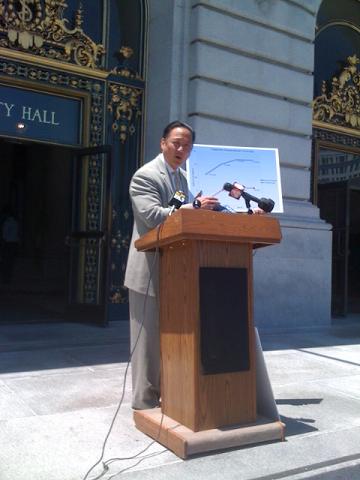
Public Defender Jeff Adachi held a press conference on the steps of City Hall this afternoon, talking about how his pension reform measure is on track to qualify for the November ballot, calling for the Board of Supervisors to strengthen a rival measure so he can drop his, and wielding a series of colorful charts showing how his measure would save the city far more money.

But those involved with crafting the measure that has come out of City Hall – including Mayor Ed Lee and Sup. Sean Elsbernd – tell the Guardian that Adachi is misrepresenting the numbers in a way that amounts to lying, and that he’s employing a legally risky strategy that could either sink pension reform for the year or set a troubling legal precedent that diminishes the vested rights of all public employees.

The conflict – with its complex claims and counter-claims and dizzying array of big numbers derived from speculative actuarial tables and predictions of future economic realities – offers a preview of what is likely to be a bruising yet bewildering battle if both measures make the ballot.

“We have to have real reform,” Adachi told assembled journalists and activists. “If we had real reform coming from this building, City Hall, I wouldn’t be standing here right now.”

But Elsbernd and Lee each told us that the event had more to do with grabbing headlines with sensational yet misleading claims during the final six days of signature-gathering than it did with Adachi’s claim that his measure will save $138 million annually by 2014-15 compared to a $84 million in the city’s plan.

“It is critical people understand the difference in these costs,” Adachi said.

Lee called the event “weak antics in trying to get a headline,” and said, “His claims are false.” Elsbernd said he spoke with Adachi on the phone for an hour yesterday trying to convince him that his fiscal claims were wrong, but to no avail. “Facts don’t seem to matter to him anymore,” Elsbernd said. “He’s not playing straight with the facts.”

Two issues are central to Adachi’s claims of a big cost savings: his plan’s requirement that employees pay more into their pensions without the city’ plan’s promise of lessening that burden during good years – which city officials say is legally dubious because it simply takes away something to which current employees are entitled to under their contracts – and the deal that the city cut last week with public safety unions to give them the 4 percent raise they were scheduled to receive this year but to increase their pension contributions by a similar amount.

“It’ll cost taxpayers even more than the amount of the raise,” Adachi argued, wielding charts and figures to show that the higher pension payouts due to the increased salaries of cops and firefighters will cost the city $45 million over the next 10 years, and as much as $381 million by 2042.

But Elsbernd said that the raises were part of a contract approved back in 2007 and can’t be just unilaterally taken away. “The raises have been incorporated into pension projections,” Elsbernd said, accusing Adachi of essentially double-counting them in his calculations. “He’s saying this action increases the costs, and that’s just wrong. This deal lowers those costs.”

When we asked Adachi about that point during the press conference, he argued that in these dire fiscal times, all public employee contracts should be renegotiated from scratch and therefore his fiscal claims were correct. “Why should we be talking about a 4 percent raise for anyone when we’re cutting basic services?” Adachi asked.

But simply invalidating approved contracts puts Adachi’s measure on shaky legal ground, Elsbernd said. But it’s ground that the wealthy funders of Adachi’s measure are anxious to plow because if the measure survives a legal challenge, it will weaken the ability of current employees to get the benefits they were promised.

“He wants to challenge the issue of vested rights, and in the end, that’s what this is about,” Elsbernd said, noting that if Adachi’s measure gets more votes and is invalidated, as he thinks it will be by the courts, than the city’s pension problem gets worse as the solution gets pushed back a year.

Adachi claimed during the press conference that he has privately been offered support by some union leaders who are attracted to the big cost savings and what it would mean to the city’s future fiscal health, but he wouldn’t name them or indicate whether they will go public at some point. But Lee said Adachi is just desperately looking for allies.

“He’s looking for someone to support his view of this, but we’re very confident that our proposal is better,” Lee told us, noting how important it was to develop the measure with input and help from the unions. “We’ve done it the right way. You do it with people, not to people.”

But Elsbernd also said Adachi’s pushing of pension reform last year and again this year is a big factor in the union givebacks that the city has received: “We would not be in the place we are with labor if not for Jeff Adachi.”

The board is set to consider the city plan next week, while Adachi says he has 60,000 signatures and plans to gather 5,000 more by the deadline of Monday at 5 pm, which should be enough meet the threshold of about 47,000 valid signatures.

Dick Meister: Farm workers need drastic change

0

No workers are more in need of union protection than the nation’s miserably treated farm workers. Yet a promising new effort to ease their path to unionization has been blocked by one of their former champions, Gov. Jerry Brown.

Brown was rightly hailed for signing, in an earlier term as governor, the 1975 law that granted farm workers in California the collective bargaining rights denied them nationwide. It’s the weapon farm workers must have if they are to escape poverty and the arbitrary and often harmful actions of grower employers.

But now, Brown has vetoed a bill sponsored by the United Farm Workers union, the UFW, that would have made it much easier for farm workers to unionize. Currently, they can be granted bargaining rights only if a majority working for a particular grower votes for unionization. The vetoed measure, the so-called Card-Check Bill, would have granted bargaining rights simply on the showing of union membership cards or petitions for union recognition signed by a majority of workers.

Farm workers, of course, are among our most important workers. They help feed us, after all. Their pay nevertheless averages less than $10,000 a year, and most lack employer-paid health care and other benefits. They work hard, frequently under the blazing sun, with few  – if any – rest breaks and without even such simple on-the-job amenities as fresh drinking water and toilets.

The UFW, which sponsored California’s 1975 law, has been trying for many years to remedy farm workers’ conditions by leading them in drives aimed at winning union contracts that promise them decent treatment and an effective voice in determining their wages, hours and working conditions.

 It’s not been easy for the UFW, even with the law in effect. Thanks mainly to employer intimidation and high worker turnover, the union has been able to sign up only a small part of California’s farm labor force and to win only a relatively few contracts from growers. But it’s an important start. Without the law, it would have been nearly impossible.

So why in the world did self-proclaimed farm worker advocate Jerry Brown veto the bill that would have strengthened the union rights granted farm workers in the bill he signed 36 years earlier?

Well, Brown didn’t say much, but did say he didn’t like the bill because it called for “drastic change.”  Which it did, of course. That, as Brown must know, is exactly what’s needed.

Requiring union rights to be granted only by elections gives growers a great opportunity to unfairly pressure workers into voting against unionization – and many take full advantage of the opportunity.

It’s common for growers faced with elections to require workers to attend meetings at which they rail against unions, threaten to fire union supporters and warn that they might have to go out of business if their farms are unionized, or at least greatly curtail operations and thus job opportunities.

“You’re talking about voting on the employer’s site, with foremen and supervisors making eye-contact with you after they’ve alluded to or flat out threatened you with the loss of your job or your housing,” notes a UFW vice president, Armando Elenes. “It takes a lot of strength to even vote.”

There’s plenty of evidence that employers do indeed put lots of pressure on workers to vote against unionization. UFW President Arturo Rodriguez notes, for example, instances of growers pulling guns on workers who were trying to organize.  That may seem exaggerated – but not to anyone who’s experienced the superheated grower-worker confrontation up close.

The UFW is not giving up the struggle for Card-Check recognition. The union will soon re-introduce the Card-Check bill in Congress with the strong backing of the nation’s labor leaders. Some of them call it the single most important labor bill in the country this year.

It certainly is for farm workers and should be for workers in other industries throughout the country who also seek Card-Check rights, and for anyone who wants decent treatment for those whose vital work helps put food on our tables.


Dick Meister is co-author of “A Long Time Coming: The Struggle to Unionize America’s Farm Workers” (Macmillan). He can be reached through his website, www. dickmeister.com.


Campaign for the Woolsey legacy

0

Rep. Lynn Woolsey (D-Marin, Sonoma counties) is a rarity on Capitol Hill. She’s a lawmaker with guts who speaks from the heart.

Whether focusing on children and seniors at home or the victims of war far away, Woolsey insists on advocating for humane priorities. Several hundred times, she has gone to the House floor to speak out against war. She stands for peace, social justice, human rights, a green future, and so much more.

Last week, after more than 18 years in the U.S. House of Representatives, Woolsey announced that she will not run for reelection next year.

She has set a high bar for representing the region in Congress. It’s a high bar that I intend to clear.

Back in January, I wrote in the Guardian that “if Rep. Woolsey doesn’t run in 2012, I will” (“Why I may run for Congress,” 1/25/2011).

At the time I noted that “alarm is rising as corporate power escalates at the intersection of Wall Street and Pennsylvania Avenue.” I cited such realities as “endless war, massive giveaways to Wall Street, widening gaps between the rich and the rest of us, erosion of civil liberties, outrageous inaction on global warming … “

Six months later — with war even more endless, giveaways to Wall Street even more massive, and overall conditions even worse — my grassroots campaign for Congress is well underway.

Redistricting lines are in flux this month, but the political lines are clear as corporate Democrats salivate for this congressional seat. They want it bad.

This is a grassroots vs. Astroturf campaign. I’m facing opposition with a long history of big corporate funding. But we have something much better going for us: a genuine progressive campaign that’s growing from the ground up.

Already, more than 750 people have made donations to my campaign (we topped $100,000 weeks ago) and nearly 300 have signed up as volunteers. You’re invited to join in at www.SolomonForCongress.com.

We have to hold the North Bay congressional seat for the values that Lynn Woolsey has represented. That means directly challenging the undue corporate power that stands in the way of real change.

As a member of Congress, I want to work on building coalitions to fight for a wide-ranging progressive agenda — including guaranteed health care, full employment, workers’ rights, green sustainability, full funding for public education, fundamental changes in federal spending priorities, and an end to perennial war.

On Capitol Hill, I will insist that we need to bring our troops and tax dollars home — and that caving in to Wall Street and polluters and enemies of civil liberties is unacceptable.

Every day, the ideals we cherish are up against what Martin Luther King Jr. called “the madness of militarism,” running amok in tandem with corporate greed.

Nuclear power is emerging as one of the big issues in this campaign. I reject the claim that we need to wait for more “studies” from nuclear-friendly federal agencies before closing down the likes of California’s Diablo Canyon and San Onofre reactors. We need to fight for serious public investment in renewable energy, conservation, and a nuclear-free future.

Overall, the obstacles to gaining electoral power for progressives may seem daunting. But the narrow definition of politics as “the art of the possible” has led to disaster. What we need is the art of the imperative. 

Norman Solomon is national co-chair of the Healthcare Not Warfare campaign, launched by Progressive Democrats of America. His books include War Made Easy: How Presidents and Pundits Keep Spinning Us to Death. For more information go to www.SolomonForCongress.com.


Biting the Big Apple

0

arts@sfbg.com THEATER The world’s largest arts festival, the now-venerable Edinburgh Festival Fringe, got its start in 1946 as a scrappy party-crasher outside the official Edinburgh International Festival. Thanks to its inspired blend of difficult-to-categorize, anything-goes performances, the Edinburgh Fringe helped create a definitive theatrical format that has since flourished in Fringe Festivals around the world. Among other things, Fringe is a catalyst for new works, new companies, and new interpretations of how theater can be made, and experienced.

Of all the Fringe Festivals in the United States, the one that generates the most buzz is by far the New York International Fringe Festival (this year’s dates are Aug. 12-28). That the New York Fringe is curated is a sticking point among festival purists because it violates one of the founding precepts of Fringe: that anyone with a story to tell and a willing venue can take part. Despite that breach, there still manages to be a pretty broad spectrum of representation.

Works originating in the Bay Area display a staggering variety: the tale of an Iranian-American woman striking a compromise with her Islamic family over her live-in atheist boyfriend; a provocative series of multigenerational monologues on body image and acceptance; a musical homage to a 19th century black opera pioneer; and a transcontinental coming-of-age story.

When Bay Area comedian Zahra Noorbahksh began developing her solo show All Atheists Are Muslim at the Bay Area’s Solo Performance Workshop in 2008, she discovered something about the material that she had previously worried about being alienating or inaccessible.

“The Muslim and non-Muslim public is [hungry] for a three-dimensional view of a mainstream Islamic-Iranian American family that isn’t some heavy-handed political discourse,” she shares over e-mail. “I love seeing that moment when the audience that came in with their arms crossed, ready to challenge me and my ‘ludicrous’ title, realize that by my father’s very mathematical equation, all atheists are in fact Muslim.”

For Noorbahksh, the fest offers not only the opportunity of performing in New York but of expanding on the very definition of Fringe.

“It gives a ‘fringe’ culture and religion like Islam a platform and an opportunity to open up a dialogue with the non-Islamic world,” she says. “[And it] has given me an opportunity to be a part of the healing that needs to happen between Muslim and non-Muslim Americans and the general image of Islam in the public consciousness today.”

Oakland native ‘rie Shontel (a.k.a. Anita Woodley) raises consciousness every week as a producer for syndicated North Carolina Public Radio show The Story in Chapel Hill. But it wasn’t until 2009 that Shontel was moved to tell her own story, initially to friends and family, and Mama Juggs was born. Inspired by the memory of her 100-year-old great-grandmother, Suga Babe, and her repertoire of breast-feeding songs, Shontel performs four interwoven monologues wrestling with body image and breast awareness (her mother, one of the characters portrayed, died of breast cancer at 47), and the cultural myopia surrounding both. What sounds on the page like potentially heavy-handed material reveals itself on the stage as a thoroughly engaging, irreverent take on “titty juggs,” her great-grandmother’s term.

August may mark Mama Juggs‘ first foray into Fringe, but Shontel has already been drumming up national support via her “100 Living Rooms” tour, performing in private homes across the U.S.

“The intimate parlor performances have raised many interesting discussions and encouraged many to get breast exams,” she reports. “My mission for Mama Juggs is to make breast health a topic for conversation.”

“I was inspired by this very accomplished woman of color and wanted to give voice to her story that has been largely forgotten.” Opening up an entirely different conversation, Oakland-based opera singer Angela Dean-Baham’s solo show The Unsung Diva traces the history of 19th- century black opera sensation Sissieretta Jones. In a format reminiscent of Tayo Aluko’s tribute production Call Mr. Robeson, Dean-Baham’s one-woman work of musical theater combines American folk and spirituals with operatic arias and character vignettes drawn from the life of a woman once so influential that she was the first African American to perform at the then-unnamed Carnegie Hall. Like her hero, Dean-Baham is excited about what a successful run in New York could mean for her future.

“NY Fringe offers its artists a tremendous opportunity to put work before NY agents, producers, press, diverse audiences at a reasonable cost to self-producing artists,” she said. “As a juried theater festival, they offer the immediate gratification that other artists find the work engaging and that there is an audience for the work.”

San Francisco-born Aileen Clark knows firsthand the universality of a good story. Raised speaking three languages on four continents, Clark nevertheless refers to herself as the “whitest Latinita” on the planet, and her solo show How I learned to Stop Worrying and Lost My Virginity has touched a nerve among audiences of all colors and persuasions.

“I’ve always loved telling stories and acting out everything I see and do,” she says, describing the impetus behind the show’s creation. “I set out to make a play that would feel like we were just hanging out at a party and talking.” With John Caldon of Guerrilla Rep and Claire Rice of AMP, she crafted a comedic coming-of-age memoir packed with 21 characters, which debuted at the EXIT Theatre in November 2009. Newly transplanted to Brooklyn, Clark hopes Virginity will help introduce her to New York audiences.

“This show definitely gives me a wonderful connection with the people who come to see it,” she enthuses. “I’m hoping Fringe can be a door that opens other doors to great opportunities.”

www.fringenyc.org

Sad day for San Francisco film fans

2

Two big bummers today, my fellow cinemaniacs.

The first bit of news is that it’s official, according to collective member Claudia Lehan: beloved Haight Street landmark the Red Vic Movie House will officially be closing its doors July 25, the theater’s 31st birthday (read my story about the Red Vic’s 30th birthday year here.) The last film to grace its screen will be perennial Red Vic favorite (and annual Red Vic birthday flick), Harold and Maude (1971). Stay tuned for more on this story.

And sad news from the San Francisco Film Society: charismatic executive director Graham Leggat will be stepping down from the post he’s held since 2005 due to health issues, according to a SFFS press release. (Chronicle columnist Leah Garchik has more on the story here.) Leggat wasn’t just a figurehead for the organization. He oversaw a huge expansion of SFFS’ programs — per the release: “Historic developments under Leggat’s direction include the launch of the country’s only daily independent regional online film magazine, SF360.org, in 2006; integration of the filmmaker services programs of Film Arts Foundation in 2008, which have since grown into a rich array of grants, residencies and project development services; the creation and expansion of SFFS’s annual Fall Season slate of festivals and events, which this year includes seven themed film series between September and November; and the recent announcement of the creation of the San Francisco Film Society New People Cinema, which provides a year-round theatrical home for the organization’s myriad activities for the first time in its 54-year history.” Best of luck to Leggat — a man whose charming, witty presence is familiar to all regular attendees of the San Francisco International Film Festival.

Feelmore510 is bringing sexy back to Oakland

0

The Bay’s east side can seem a little prudish, especially when compared to its slutty sister city. Until February, Oakland’s only retail resources for sex were a couple of trashy adult “superstores.” Those places can be fun and functional, but it’s safe to bet the cashier probably isn’t too concerned about answering a list of questions and making you feel comfortable with your purchase. Nenna Joiner, the owner of Oakland’s new sex-positive shop, Feelmore510, is quite the opposite and simply can’t wait to start friendly conversations about sex with everyone in her community.

Joiner, a sex educator and adult film director, has been dreaming about opening an Oakland shop for years, but her ideas go far beyond retail. From terminology to etiquette, Joiner says her community needs to start at the beginning, birds and bees style. “I love talking to people. People teach me new things everyday. I’m open and not judgmental. I’ll talk about anything,” she says after ushering a couple ladies out the door who had spent their lunch break browsing. 

From basic questions to the personal, Joiner is educating from the inside out. “A guy came by the other day asking if it was gay for him to want to play with his girlfriend’s butt,” she says. “San Francisco takes its sexual openness for granted — the community there is so exposed, probably overexposed,” she laughs, a playful swipe at the close-knit kink communities and accessible sex-positive resources she loves.

Joiner says Oakland residents may attend erotic events like Folsom or shop for dildos west of the bridge, but when they return home, the conversation goes flaccid. She puts partial blame on years of serious bedroom talk: preventative health and safe sex practices have been a priority due to the high number of HIV cases in the area. No one is contesting the importance of these topics, but in terms of fast, slutty fun they can be total Debbie Downers. Joiner wants to put the spunk back into conversations about sexuality. 

Before the shop opened, the surrounding neighborhood seemed nervous about the addition of a sex shop on the block, but Joiner has been extra careful to make sure people understand that her intentions are purely rooted in the revitalization of Oakland. She keeps up on local politics, attends city meetings, directs tourists to other neighborhood businesses, and even watches high school band concerts. She waves at people from across the street and welcomes anyone inside to chat and enjoy the space. Joiner feels supported by the city around her, which she thinks is happy to recognize her role as a successful business owner. She regularly gets friendly calls from the Alameda Small Business Association, casual check-ins to make sure she’s doing well.

“They know I’m a young woman of color, working my ass off. Maybe they don’t watch porn or have interest in the products I sell, but they support me because they know how hard I’m working.”

Nestled between downtown office buildings on Telegraph Avenue, Feelmore510 lures in its share of curious customers during the day with a modest store front that looks more art gallery than porn hub. Inside the store, Joiner loves to play her late grandmother’s vinyl collection, including Sinatra and Perry Como, which perfectly compliment the space’s glowing chandeliers and velvet curtains. The shop stays open until midnight, way past the bedtime of most of her neighbors’, but with the Fox Theater nearby and a collection of bars and clubs in walking distance, Joiner likes providing the night owls some after-party options.

“I stay open late because I want to help more people have great sex.” Getting people off the streets and under the sheets with body-safe, pleasurable accessories– now that’s community activism!


Feelmore510

1703 Telegraph Avenue, Oakland

(510) 891-0199

www.Feelmore510.com


Dick Meister: Paid sick leave is good for us all

5

The latest figures show that some 44 million workers in private employment  – more than 40 percent of the private sector workforce – do not have paid sick days that they could use to recover from illnesses, including contagious illnesses such as the flu, or worse.

It should be of particular concern that those occupations which are currently least likely to provide paid sick days include occupations most likely to have regular contact with the public – most importantly and most disturbingly, food service and food preparation.

That raises serious health problems – especially in these tight economic times, when workers need to stay on the job as much as they can, no matter how ill they are, to earn as much money as they can. Which, of course, endangers the health of those who come in contact with them, as well as delaying their recovery from their illness.

Public health experts note that the fewer the number of workers who are able to stay at home when sick, the more likely it is that diseases will spread. In addition to the increased suffering of the public and other workers which that causes, it also causes significant economic losses.

Laws have been proposed in several states and in Congress that would require employers to grant paid sick leaves to their employees, but it seems unlikely that the measures, however much they are needed, will pass any time soon – if at all.

But there has at least been a start, however slight, toward what’s broadly needed. That’s a paid sick leave law that was adopted by the city of San Francisco five years ago – the first citywide such law in the country. If nothing else, the San Francisco ordinance proves that such laws are quite feasible, and not the “job killers” that anti-labor forces contend they would be.

San Francisco business groups fought fiercely against adoption of the ordinance and thankfully lost big time. The ordinance was approved by 61 percent of the voters in a citywide election in 2006.

Under the ordinance, workers in businesses with fewer than 10 workers can earn up to five paid sick days a year, while workers in larger businesses can earn up to nine paid sick days.  Workers accrue one hour of paid sick leave for every 30 hours they work. They may use the sick time to recover from their own illnesses, care for a sick family member, or seek routine medical care.

A recent independent survey of nearly 1,200 San Francisco workers and nearly 700 employers by the Institute for Women’s Policy Research came up with findings that the city ordinance was, in the words of the California AFL-CIO, “overwhelmingly positive for workers, businesses and the public.”

The labor federation called the study “further evidence policies that help working families meet their responsibilities at work and at home are good for everyone.”

The study shows, in short, that the San Francisco ordinance has had a great impact on workers’ lives but little or no impact on the city’s businesses.  They overwhelmingly report that the law has not cut into their profits. Two-thirds of them reported no problems implementing the law.

It seems likely that the reason for the slight impact on businesses business can be attributed to the fact that most workers take sick leave days only when they need them.  Even though the law allows workers five to nine sick days a year, San Francisco workers used a median of just three days a year. And one-quarter of the workers didn’t take a single sick day.

Even the major opponent of the law prior to its passage, the local, politically powerful restaurant association that led the political fight against the city ordinance, now concedes it hasn’t led to employee abuses or hurt restaurants or other business.

Most important, as the state AFL-CIO noted, the survey proved that having paid sick days makes a substantial difference for working families.  More than half the workers surveyed said they’ve benefitted from the law. Among other important things, the law has given workers who need paid sick days the most, including parent and workers with chronic health conditions, the time they need to care for their health and that of their children.

The labor federation reports that it hears regularly “the stories of parents who are forced to choose between their children’s health and the financial well-being of their family . . . who have put off visits to the doctor and sacrifice their health to avoid losing their jobs.

Washington, D.C. and Milwaukee have followed San Francisco’s lead and adopted ordinances providing paid sick leave for workers.  And some states, California, New Jersey and Connecticut among them, have adopted similar though less extensive laws.

But what’s most needed is a federal law – a law that, if properly enforced, would grant sick leave pay to all workers, helping them, their families and anyone else who might be exposed to their illness.

It’s obviously the sensible thing to do.


Dick Meister, former labor editor of the SF Chronicle and KQED-TV Newsroom, has covered labor and politics for more than a half-century as a reporter, editor, author and commentator. Contact him through his website, www.dickmeister.com, which includes more than 300 of his columns.


Farmville

1

le.chicken.farmer@gmail.com

CHEAP EATS I probably could have picked a better route to the restaurant. Maybe if I’d gotten off at the Powell station instead of Civic Center. As it was, at not-even-9 a.m. on a Saturday, I had to step over piles of shit and vomit.

It was like reading one of my restaurant reviews; it’s part of life, yes, but not necessarily the part you want to happen before dinner. Or in this case, breakfast.

But, so you know, I would step over dead bodies and piles of fish guts to caffeinate and chew things up with my friend Kayday. Especially at farm : table, which I had heard about and have been meaning to get to for forever. High on my list of Things To Do this year is to find my way back to my former farmerliness. Because I miss the eggs, but also because I’m tired of myself in my shit-kicking city-fried people personhood. I long for the smell of a chicken coop.

Kayday, who was essentially nudged out of San Francisco for the same reason I will be one day — for not being the cool kind of queer — was down for the weekend from Seattle. Not for Pride — for the weekend before, to consign and collect her guitars and things.

I do hope everyone had a happy and proudful Pride month, and weekend, and parade. I encourage this forward-thinking bubble, being the self-proclaimed beacon of queer acceptance that it, um, proclaims itself to be, to start opening not only its mouth but its employment opportunities, its hearts, and even in some cases (gasp) its zippers to transwomen before we lose more good guitar players to Seattle.

Mine had about a gazillion job interviews in the one year she was here, but no job offers, whereas she was one-for-one in both Los Angeles and Seattle. Which reminds me of my romantical track record, home and away. Not that we talk about this. You just can’t help wondering.

“I feel like I was dumped by San Francisco,” Kayday said.

We were sitting at the inside table. That’s officially all there is, inside, at farm : table, is one pretty big square one, seats maybe eight, and then a couple more on the sidewalk.

“That sucks,” I said, biting into my fresh pea and pecorino quiche, which didn’t. It was light and fluffy, and I could almost hear the hens that laid those eggs, clucking softly in the kitchen. I was almost halfway done with it before Kayday figured out how to even approach her baguette-bacon-hard-boiled-egg pileup. By which time everyone else at the table had weighed in with their own techniques.

“Turn the egg over and smash it into the bread,” one woman offered. Another said she just takes the pieces off and eats them à la carte.

“Me, I get the quiche,” I said, chomping on clouds. Christ, I love San Francisco. And the Tenderloin.

One nice thing about sharing a table with a bunch of strangers: Kayday was spared the gory details of my recent bad butt health. I only told her what the surgeon told me: that if it doesn’t heal in two to four weeks, the next procedure is so uncomfortable they will have to put me to sleep. Those were his words.

“I hope he doesn’t come from a veterinary background,” Kayday said.

“I know. Right?” I said. “I’m getting my affairs in order, just in case.”

FARM : TABLE

Mon.–Fri. 7:30 a.m.–6 p.m.;

Sat. 8 a.m.–6 p.m.;

Sun. 9 a.m.–3 p.m.

754 Post, SF

(415) 292-7089

No alcohol

Cash only

Don’t privatize public safety

3

Four weeks ago, surgeon Dimitry Nikitin walked out of Florida’s Orlando Regional Medical Center to his car and was shot dead by a disgruntled patient who then turned his gun on himself and committed suicide. Last September, a doctor at Baltimore’s Johns Hopkins was shot and killed by a patient distraught over his mother’s terminal diagnosis.

There is an epidemic of violence in America’s health care facilities. Many of the scenarios are familiar — the news is full of stories of combatants in gang fights following wounded rivals into hospital emergency rooms to finish them off. But the full depth of the problem is largely unreported and extends to hospital wards, clinics, and long-term care facilities

A recent report from the U.S. Department of Labor based on 2009 statistics says health care providers rank third in the likelihood of being assaulted on the job — just behind police and correctional officers. In 2009, there were 38 assaults per 10,000 nurses aides.

Despite this troubling trend, the San Francisco Department of Public Health is asking the Board of Supervisors to approve its proposal to replace institutional police officers in some public health facilities with low-paid private security guards.

Here are two reasons this is a profoundly bad idea.

1. Health care is a stressful environment and growing more stressful every day.

As the providers of last resort, public hospitals and clinics often face a perfect storm of patients who are involved in violence, alcohol and drug abuse, or are suffering from untreated mental illness. But even outside emergency wards, health care workers must work up-close with patients and family members pushed to the breaking point by an overburdened delivery system.

As health care costs spiral, public health budgets shrink and access to high quality care dwindles, many hospitals and clinics are reporting assaults by patients and family members upset by long lines, half-day waits, and unaffordable care.

According to a September report by CNN on rising violence in health care facilities, violence caused by patients’ frustration with health care services is on the rise.

“People are just tired of waiting, or they are just angry that they’re not getting the care they feel is acceptable,” nurse Rita Anderson told CNN. “Instead of saying something, their response is yelling, hitting, screaming, and spitting.”

2. Well-screened and trained security officers reduce health care violence.

According to a study on reducing violence in hospitals by the National Crime Prevention Council, three top strategies for keeping health care facilities safe include reducing patient wait-times through well-organized and managed patient processing; controlling facilities through locked wards, staff ID badges, and security cameras; and hiring carefully selected and well-trained security personnel.

Currently, San Francisco’s hospitals and health care facilities are protected by highly trained San Francisco Sheriff’s deputies and institutional police officers. The Department of Public Health wants to replace some of these officers with private security guards.

But the private security industry is notoriously bad at screening recruits and plagued with turnover, in part because of low salaries. As a result, the use of private security creates unsafe working conditions for employees who deal with difficult or violent patients, such as those in San Francisco’s psychiatric emergency wards.

Unlike institutional police officers, private security guards cannot make arrests. Instead, they must involve the San Francisco Police Department, accumulating costs that quickly defeat the budget savings of using low-paid private guards to do work that should be done by highly trained officers.

Everyone who uses San Francisco’s public health system should contact the San Francisco Board of Supervisors and ask them to make the right choice to keep our hospitals, clinics, and long-term care facilities safe.

Ed Kinchley is an emergency room social worker at San Francisco General Hospital.


Our Weekly Picks: June 29-July 5, 2011

0

WEDNESDAY 29

FILM

Green  

Swedish-French filmmaker Patrick Rouxel’s Green documents the life and death of a female orangutan in a rainforest of Indonesia. The 48-minute film won the Natural History Museum Environment Award in Great Britain for its narration-free depiction of a habitat ravaged by loggers, forest fires, and dwindling biodiversity. Head to the San Francisco Main Library to see a free screening of Green; afterward, there will be an opportunity to speak with members of the Rainforest Action Network Forest Team and ask questions of activists from the Bay Area working in the field. If you can’t make it, Green streams for free at greenplanetfilms.org. (David Getman)

6 p.m., free

Koret Auditorium

San Francisco Main Library

100 Larkin, SF

(415) 557-4277

www.sfpl.org


MUSIC

Tera Melos

There are many bands formerly treasured for innovation and aggression that — as the members got older and actually learned how to play their instruments — suddenly got boring, like a crappy caterpillar emerging from a brilliant cocoon. Although it has undergone a dramatic sonic change, Tera Melos is, happily, not one of these bands. Since gaining a vocalist and switching around members, Tera Melos has blossomed into a jaw-droppingly technically adept (it always was) pop band that draws from the best of its math rock past to craft songs that are as catchy as they are challenging. Add to this an impressive stage presence, bolstered by the joy of watching everyone in the band shred on his respective ax of choice with mind-blowing ability, and a rare but winning combination is born. (Cooper Berkmoyer)

With Les Butcherettes and Adebisi Shank

8 p.m., $14

Great American Music Hall

859 O’Farrell, SF

(415) 885-0750

www.gamh.com


FRIDAY 1

MUSIC

Death Grips at Low End Theory SF

For almost any other hip-hop group out there, the sound of Sacramento’s Death Grips would be too much. It’s loud, it’s abrasive, and it’s rough around the edges. Even a relatively relaxed song on the debut album Ex-Military features a distorted power-chord sampled from Link Wray’s “Rumble.” But the lyrical ferociousness displayed by MC Ride, Mexican Girl, Info Warrior, and Flatlander manages to match the beat. With nonstop drummer Zach Hill of Hella performing live with this latest rap-rock hybrid, the show should be punk enough to make you forget about earlier, lesser experiments in the genre (i.e., Limp Bizkit). (Ryan Prendiville)

With TOKiMONSTA, Free the Robots, Bangers, Nobody, D-Styles, and Nocando

10 p.m., $15

103 Harriet, SF

(415) 431-1200

www.1015.com


PERFORMANCE

Circus Bella

As if all the hallmarks of the circus weren’t entertaining enough, Circus Bella sets performers to a live quartet playing New Orleans jazz, French waltz, klezmer, and other music from around the globe — along with plain old American circus marches. Circus Bella features nine artists who showcase the usual clowning along with trapeze, ropewalking, juggling, and contortion in open-air venues. The circus has been touring since 2008 and arrives for a brief stay of nine free performances in assorted Bay Area parks. After today’s show, there’s also the chance to meet the artists-musicians, including America’s Got Talent veterans Zoë Klein and Dave Paris, also known as Paradizo Dance. (Getman)

Fri/1–Sat/2, noon

Also Sat/2, 2:15 p.m., free

Yerba Buena Gardens

760 Howard, SF

(415) 543-1718

www.ybgf.org


MUSIC

Group Doueh

Bamaar Salmou (the Doueh of Group Doueh) is a guitarist like you’ve never heard before. Many have tried to incorporate African music into a rock rubric. Yet while a few succeed somewhat (notably Sun City Girls), most fail outright. Salmou’s strength is that the music seems to have emerged organically. Group Doueh is based in the Western Sahara where Salmou has been playing guitar for almost 30 years, drawing on the regional stylings of Saharan music as well as Western music that would filter into the area on cassette. The end result is something as heavy and raw as Jimi Hendrix (apparently of favorite of Salmou’s) and as vibrant as the western edge of North Africa, a tapestry of sound that no amount of orientalist posturing will ever be able to successfully imitate. (Berkmoyer)

With Nick Waterhouse and the Tarots, Mark Gergis DJ set

9 p.m., $14

Rickshaw Stop

155 Fell, SF

(415) 861-2011

www.rickshawstop.com


VISUAL ART

ColorFest

As the city gets buried under its pale gray seasonal shroud of fog, the Exploratorium is rebelling, giving a giant middle finger to the weather encroaching on its dome with its summer-long celebration of color. For two months, the hands-on museum is delving into the visible spectrum with ColorFest, featuring more 30 color-related exhibits, a six-part Chromatic Cinema series, and weekly demos on the science behind rainbow-riffic things like kaleidoscopes, prisms, and dye-making. Or sip cocktails, dance, and listen to live music during the adults-only “After Dark” events on the first Thursday of each month: July’s theme is red and August’s is blue. Wayward San Francisco spirits, this just might be the cure for the summertime blues. (Kat Renz)

Through Sept. 5

Tues.–Sun., 10 a.m.–5 p.m., $10–$15

Exploratorium

3601 Lyon, SF

(415) 561-0363

www.exploratorium.edu


SATURDAY 2

THEATER

2012: The Musical!

Okay, it’s officially summer: the San Francisco Mime Troupe, now in its 52nd season of confusing noobs who’re expecting actual mimes onstage, is opening its annual park-hopping musical production. At first glance, one might worry that 2012: The Musical! might be some kind of disaster-movie parody. Fear not — SFMT is smarter and way more hilarious than that. 2012 refers to the show-within-the-show being mounted by Theater BAM!, a fictional political theater company whose creative integrity is jeopardized when its members have to choose between selling out (and staying afloat) or staying staunchly idealistic (and going under). Written by Michael Gene Sullivan with Ellen Callas, with music by Bruce Barthol with Pat Moran, 2012 kicks off at Dolores Park and romps up and down California (Ukiah to Hollywood) throughout the summer. (Cheryl Eddy)

Various venues through Sept. 25

Sat/2–Mon/4, 2 p.m., free

Dolores Park

19th St. at Dolores, SF

www.sfmt.org


MUSIC

DJ MartyParty

Half of PANTyRAiD with Glitch Mob’s Ooah, DJ MartyParty is picking up where Prince left off: seemingly obsessed with purple. Not only is Purple the title of his new album, it’s also his genre, the aesthetic of his website, and presumably the shade of his mood ring 24/7. For those of you without a color-coded record collection, his “Twisted Summer Mixtape” online is a bit more descriptive: a promising soundtrack for warm nights. Eclectic vocal samples (Adele, Eleanor Rigby, Khia’s crack) and layered melodies combine with a measured amount of vibrato bass and soul-clappin’ hi-hats, ensuring that the mood stays hot (purple is the most sensual color) without overheating. (Prendiville)

With Bogl, Manitous, Shawna, Mozaic, Dax, and Napsty

10 p.m., $10–$12

Public Works

161 Erie, SF

(415) 932-0955

www.publicsf.com


MUSIC

Melodians

Chances are, you’ve probably heard the Melodians without even knowing it. The Kingston, Jamaica, trio’s biggest hit, “Rivers of Babylon,” is omnipresent as far as roots reggae goes, and as an early addition to the Trojan Records roster, it helped pioneer a musical genre that would become a movement. The Melodians’ catalog is widely covered by all manner of upstroke-friendly musicians, and although dwarfed in size by those of similar artists such as Desmond Dekker and Lee Perry, the early material is just as consistently great as any other late-1960s Kingston reggae music (does anyone else always read “reggae music” in a Jamaican accent?) Two of three original members remain, and although well into their 60s, they show no signs of letting up, having toured consistently since 2007 with the Yellow Wall Dub Squad. (Berkmoyer)

9 p.m., $20

Brick and Mortar Music Hall

1710 Mission, SF

(415) 800-8782

www.brickandmortarmusic.com


EVENT

Breastfest Beer Festival

The 11th annual Breastfest Beer Festival gives San Franciscans the chance to get tipsy and taste-test knowing that all those beers aren’t just supporting a habit, but also a good cause. The festival expands this year to include the unlimited sampling of drinks from 60 breweries, four cider companies, and three wineries. In addition, Breastfest features fresh food and live music from1980s cover band Metal Shop. So far, the festival has brought in more than $225,000 to the Charlotte Maxwell Complementary Clinic (CMCC), an innovative public health center that gives women in dire financial straits and others fighting cancer alternative medical and social services, free. (Getman)

5 p.m., $45

Fort Mason Center

Marina at Laguna, SF

(415) 461-4677

www.thebreastfest.org


MONDAY 4

EVENT

U.S.S. Hornet Fourth of July Family Party

The aircraft carrier U.S.S. Hornet was a major factor in World War II’s Pacific theatre — its 20,000-plus tons were instrumental in the Doolittle Raid, the Battle of Midway, and Guadalcanal, among others. The decorated ship was also on hand in 1969 to scoop up Neil Armstrong and company after Apollo 11 splashed down post-moon walk. Alas, the Hornet can’t talk (though its alleged ghost sightings might suggest otherwise), but it survived its many adventures to become part of a museum that also hosts occasional parties, including today’s suitably patriotic July 4 bash. Tour the carrier’s multiple decks, check out the Apollo Moon Mission exhibit, play carnival games, and boogie to live music (Celtic, retro, and classic rock). Guests are encouraged to stick around for a front-row view of the traditional fireworks over the bay. (Eddy)

1–9 p.m., $10–$25

707 W. Hornet

Pier 3, Alameda

(510) 521-8448, ext. 282

www.hornetevents.com 


The Guardian listings deadline is two weeks prior to our Wednesday publication date. To submit an item for consideration, please include the title of the event, a brief description of the event, date and time, venue name, street address (listing cross streets only isn’t sufficient), city, telephone number readers can call for more information, telephone number for media, and admission costs. Send information to Listings, the Guardian Building, 135 Mississippi St., SF, CA 94107; fax to (415) 487-2506; or e-mail (paste press release into e-mail body — no text attachments, please) to listings@sfbg.com. Digital photos may be submitted in jpeg format; the image must be at least 240 dpi and four inches by six inches in size. We regret we cannot accept listings over the phone.

Private cops at SF General?

26


Truly astonishing moment at the June 23 Budget Committee hearing. The director of Public Health, Barbara Garcia, actually testified that San Francisco General Hospital would be better off with private security guards instead of sheriff’s deputies — because the deputies were only able to follow the law.


You can watch the video here. The discussion starts at 4:49. It begins with Sup. Scott Wiener, is his quiet Scott Wiener way, asking Garcia to talk about the plan to contract out hospital security.


Garcia first insisted that this was a way to save $2 million that would prevent further cuts to health programs. That’s always the primary argument for contracting out.


But then she went a step further.  An outside company, she said, could provide better security — because the (low paid, poorly trained) guards will be able to operate without the restrictions of being peace officers. “There are some restrictions on [the deputy sheriffs’] ability to restrain patients,” she said.


That wasn’t a slip of the tongue — Gregg Sass, the chief financial officer, repeated it again. “If a patient isn’t breaking the law,” he said, “a deputy sheriff won’t intervene.” More: “Private security can intervene. They’re not bound by the same limits that a deputy sheriff is bound by.”


Both Garcia and Sass noted that they wanted security officers who reported directly to them, not to an elected sheriff.


Am I the only one who thinks this is a little weird?


The money thing I understand. I don’t agree — often these supposed savings don’t show up in the end, and besides, do we really want people who get paid $13 an hour without benefits handling security at SF General? But I understand the argument.


On the other hand, the notion that peace officers have to follow rules, and so we should have people who don’t have to follow rules instead strikes me as pretty disturbing. And I’m not sure how true it is: Can a security guard hold and restrain a patient who hasn’t broken the law and isn’t covered by a legal order like a 5150?


I don’t think so. The folks at SEIU Local 1021 don’t think so, either: A flier the group put out notes that:


The issue of Sheriff’s Dept. having legal restraints applies equally to all employees. If there is no 5150 or 5250, no-one has a right to restrain the patient against their will; but a well trained Institutional Policeman can gently persuade a patient with Alzheimer’s to return to their unit.


And I have to say, the notion of having the Department of Public Health oversee a security force (instead of the Sheriff or the Police Department) is disturbing, too. The worst problems in police abuse tend to come from little fiefdoms that aren’t propertly managed — the BART Police, for example, and housing and transit cops in other jurisdictions. Nobody at DPH is trained to manage a security force.


What, exactly, are these (low paid, poorly trained) security guards going to do — grab patients who complain about waiting six hours to see a doctor and “restrain” them? What happens when somebody actually does commit a crime (or brings a gun or a knife into the hospital)? The guards can’t make an arrest. So they call the cops — who come, in due time, but maybe not quickly enough to prevent a disaster. And, of course, we then pay the cops to come and make the arrest.


I haven’t been able to reach Eileen Shields, the public information officer at the Health Department, but I can tell you: The language that her boss used at the Budget and Finance Committee was pretty frightening.


UPDATE: Shields sent me over Garcia’s memo on this, which lays out the case. It pretty much says it all: 


There are times when  patients are unable to control their behavior due to acute medical       
 illness, such as delirium or brain injury. These patients may present a   
 serious risk to their own safety as well as to the safety of other       
 patients and hospital staff.                                             
                                                                           
 These situations are not the result of – nor do they result in – illegal 
 activity. This puts the Sheriff’s deputies, whose responsibility is to   
 uphold the law, in a difficult situation when they are confronted with   
 potentially harmful (but not illegal) situations caused by acute,         
 non-psychiatric medical conditions. Outside security firms do not operate 
 under the same constraints. Instead, they function as members of the     
 health care team whose responsibility is to enforce hospital policy. They 
 are charged with ensuring a safe environment and can act with greater     
 freedom to ensure safety within the limits of the law but without the     
 additional requirements and expectations placed upon a law enforcement   
 officer.
 

Civil Grand Jury slams shipyard development project

5

“The Civil Grand Jury concludes that the Hunter’s Point Shipyard redevelopment project will require more communication, more transparency, and more commitment from the City in order to achieve its goals of providing housing, jobs and economic development, tax revenue and open spaces to San Francisco and its residents, particularly those residing in the surrounding neighborhoods.”

So reads the conclusion of the Civil Grand Jury’s 2010-2011 report, which is titled, “Hunters Point Shipyard: a shifting landscape.” The report makes six findings and seven recommendation that city departments and the Board will have to respond to within the next 60-90 days. And some of these recommendations reflect problems the Guardian unearthed and highlighted during in its coverage of the development.

The jury found that the San Francisco Department of Public Health (SFDPH) is not in compliance with its pledge to the California Department of Public Health to keep residents informed of developments at the Hunters Point Shipyard. As the report’s authors note, the SFDPH’s website “is not regularly updated.”

The jury also found that the City has placed itself in a potentially compromising situation with developer Lennar where in essence, “the wolf is paying the shepherd to guard the flock.”

The jury further noted that by having developer Lennar reimburse the city for monitoring expenses associated with the shipyard project, SFDPH has created a situation that “could raise doubt in the public’s mind about its commitment to proactively and impartially enforce environmental health regulations even when it might adversely impact Lennar.”

Public trust in the SFPDH has been further jeopardized by its failure to update its website in a timely manner, and its apparent reluctance to comment publicly on the best method to deal with the clean-up of Parcel E-2, which is the site of a former dump and deemed one of the most polluted parcels of land on the shipyard.

The jury found that the above concerns were “further reinforced by the recent release of email messages that purportedly showed inappropriate communications between senior officials at the SFDPH and the U.S. Environmental Protection Agency and Lennar.”

The jury found that with the exception of Parcel A, the City has no legal control over the remaining shipyard property. “Consequently, in a technical sense, the City has no authority over matters dealing with deadlines and deliverables for environmental clean-up. However, the City does in fact have some standing in these matters via the 2004 conveyance agreement between the San Francisco Redevelopment Agency (SFRA) and the Navy. The agreement stipulates that the Navy will work collaboratively with the SFRA and share information about cleanup work.”

Last but not least, the jury found the previous efforts by the City to implement workforce policies at city-funded construction projects such as the shipyard have “largely proved ineffective” as they only require contractors to make good-faith efforts, but that earlier this year, a new local hire ordinance was implemented with stricter requirements and mandates.

Based on these findings, the jury recommended that SFDPH needs to update its shipyard project website on a weekly or monthly basis, immediately stop accepting money from Lennar to pay for monitors at the shipyard and cover the costs from its own resources, rigorously enforce conflict of interest guidelines governing deals between its officials and the companies they are monitoring, and conduct its own environmental assessment of the issue of capping Parcel E-2 and make its findings available to the public for comment.

The jury also recommended that because the Navy still owns the majority of the shipyard land and therefore the city has no direct control over deadlines and deliverables, it is critical that the Bay Area Air Quality Management District and SFDPH be “particularly vigilant in monitoring clean-up activities at the shipyard.”

The jury further recommended that the City and the SFRA should have “contingency plans in place” for continuing Redevelopment-related projects, including the shipyard, “in the event State redevelopment plans are cut or eliminated.”

Last but not least, the jury recommended that to ensure that promised job creation goals for the shipyard are realized, “the City should ensure that the Office of Labor Standards Enforcement has sufficient resources to allow it to effectively enforce the provisions of the new workforce laws.”

According to the conditions of the Civil Grand Jury’s report, for each finding the responding parties must report if the recommendation has been implemented or not, whether it requires further analysis, or was not implemented because it is either unwarranted or not reasonable.

So, expect to see some fireworks in the coming weeks, given that the Mayor’s Office, the Board, the Office of Economic and Workforce Development, SFDPH, the Office of Labor Standards Enforcement, the Redevelopment Agency and the BAAQMD have been named as the responding parties in this report…

Yearbook of heartbreak and outrage

0

news@sfbg.com

The giant commemorative AIDS ribbon that was up on Twin Peaks during the first half of June has been taken down, but the 30th anniversary of the epidemic, and how it changed San Francisco, is still reverberating throughout the city.

“It was like paradise,” Mark Ottman said as he guided me through the high-ceiling lobby, quiet as a library, of Union Bank on 400 California St. “For a few years. Then things got really scary.”

Ottman, the vice president of personal trust and estate services at the bank, recalled arriving in the city in 1981 as a 22-year-old Montana transplant. That year, the gay newspaper the Bay Area Reporter published the word AIDS for the very first time.

Although the paper has been at the forefront of reporting gay news for its 40 years — from White Night Riots of the 1970s through the Lavender Sweep of the 1990s, the Bowers vs. Hardwick decision through the “don’t ask, don’t tell” repeal — the way it straightforwardly handled the heartbreak of AIDS and the outrage that followed has become its lasting legacy.

“This was not stuff that was shown on the nightly news,” Ottman continued. “The B.A.R. was three or four months ahead in covering AIDS. In that sense, it was really the leader.”

This month, those with a thirst for history will need to look no further than newsprint. Union Bank’s LGBT Alliance has commissioned a retrospective exhibit highlighting the Bay Area Reporter’s coverage of the gay and lesbian community.

When the B.A.R. started in 1971, founders and friends Paul Bentley and Bob Ross had the intention of making it more than just a gossipy guide to bars and bathhouses. The newspaper focused on serious local news — even recruiting Harvey Milk as a political columnist.

“The founders weren’t journalists,” said Rick Gerharter, the longtime freelance photographer who curated the photo- and front page-filled exhibit at Union Bank. “But as the paper grew, it certainly became more professional.”

In 1981, when AIDS first appeared, the B.A.R. had no choice but to undergo a journalistic coming of age as it struggled to be first and be fair covering the mysterious disease that had begun to mow down gay men.


UNEASY EARLY AIDS COVERAGE

Yet the newspaper was not immune to the confusion and uneasiness that enveloped the community during the early days of the “gay cancer.”

“Me and my boyfriend both laughed — it must be another Anita Bryant plot against homosexuals,” said Robert Julian, recalling his first response to talk of the “gay-related immunodeficiency” or GRID.

“Gay people are united by sexual orientation, not genetics,” said Julian. Initially, the former B.A.R. entertainment editor and author of But the Show Went On: San Francisco 1987-1988 had his suspicions, thinking that a “physical ailment confined solely to gay people was a practical impossibility.”

It didn’t take long before the B.A.R. began reporting on the latest research, medical resources, and information about financial services available to the hundreds of gay men in San Francisco who had contracted the HIV virus.

Once researchers discovered that AIDS was being transmitted sexually, public opinion divided. Then-Mayor Diane Feinstein and Director of Public Health Mervyn Silverman wanted to close the bathhouses, but some members of the gay community considered this a violation of personal rights.

“There was this repression around gay people and sex, this hysteria around bathhouses,” said Gerharter. And the B.A.R. was hesitant to feed into that frenzy at first. “When it was clear what was really happening, how this thing was being spread around, then it clicked — and the paper really jumped to the forefront of covering what had tuned into an epidemic.”


STEAMY BATHHOUSE DEBATE

The paper not only began to cover the AIDS crisis extensively, but did it with an editorial slant that fostered debate in the community. Paul Lorch, then-managing editor, became a prominent voice arguing to keep the bathhouses open. Bathhouses don’t give you AIDS; unprotected sex gives you AIDS, Lorch expressed in strongly-penned editorials. Sometimes he even answered back to Letters to the Editor.

“Lorch and the publishers didn’t believe closing the bathhouses would solve it,” said Wayne Friday, who took over the paper’s political column after Harvey Milk was assassinated and continued it for 27 years. “But no one had an alternative. Diane [Feinstein] would call me at 5 a.m. asking me what we should do about this thing.”

The community was split. Some, including Friday, believed that the bathhouses were a public health hazard while others accused Feinstein of scapegoating. “Those people were being selfish and foolish,” Friday said. “Closing the bathhouses saved lives.”

In 1984 the San Francisco Health Department asked for a court order forbidding renting out private rooms in bathhouses. Without the luxury of privacy, most closed within months. “San Francisco became a blueprint of how to handle AIDS on the city level for the rest of the country,” Friday said.


OBITUARIES KEPT SAD TALLY

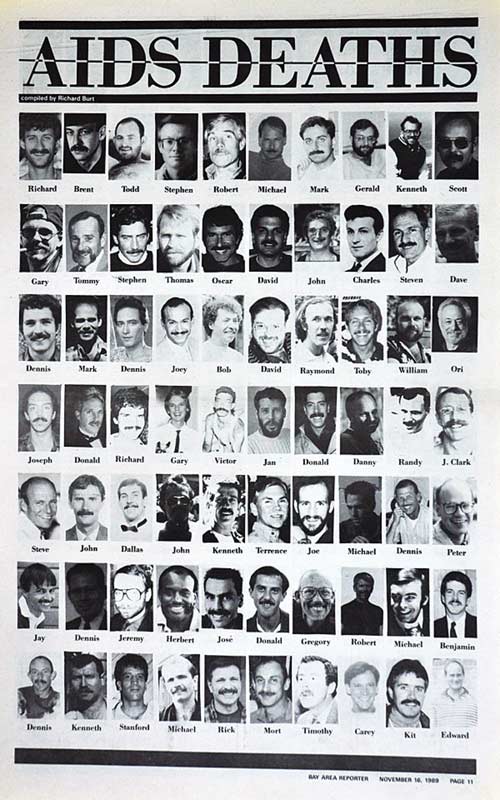
During this time, the B.A.R. was also keeping a more morbid type of tally: the obituaries. Each week the paper published two pages — 30 to 50 obituaries — until 1998.

“When you picked it up, it was the first thing you turned to,” Gerharter said. “It was just a name and a face. Maybe you recognized the person. Maybe someone you tricked with.”

In 1989, art director Richard Burt became so overwhelmed by the number of obituaries that had been turned in to the B.A.R. within the first 10 months that he wanted to convey the sinking feeling in the pages of the paper. The Nov. 16 issue included a four-page collage of everyone who had passed away due to AIDS that year. Just a name and a face.

“It was heartbreaking,” Julian said, “to see my friends and lovers pictured there.”

Through the efforts of Tom Burtch and the San Francisco GLBT Historical Society, a massive searchable online database of B.A.R. obituaries since 1979 was launched in 2009 (www.leifkerdesigns.com/olo/index.jsp).

During his tenure at the paper, Julian chose not to cover AIDS, feeling that the point of entertainment news was to distract away “from the soul-crushing presence of the grim reaper stalking our neighborhoods.”

Though AIDS was a heavily political newsbeat, Friday removed himself from covering it for different reasons. “I knew every elected official. I sat in on all the City Hall meetings about the bathhouses,” Friday said. “But I just couldn’t do it every week. It was too damned personal.”

“Thinking about turning the page to those obituaries even now is making me shiver,” Ottman said. “It’s like a high school reunion, except you don’t know which half made it.”


COVERING THE RISE OF ACTIVISM

The B.A.R. was also instrumental in covering the various political and protest actions that accompanied the disease, including the bloody police sweep of ACT-UP protesters the Castro and the Stop AIDS Now or Else blockade of the Golden Gate Bridge, both in 1989.

Gerharter remembers the blockade. “They arranged it for the morning commute. And thank God it was foggy or else the surveillance cameras would have stopped us.”

Gerharter would often be trusted with information about an upcoming demonstration and be the only photographer allowed to tag along. “You can document history better when you become a part of it. You get closer to the people — they’re not posing,” he said. “It was our job to be advocates and watchdogs.”

After consistently seeing the tragedy of AIDS on the front page for almost a decade, the B.A.R. became more active itself, inciting its readers to action. “We’d read the B.A.R. to find out about the rallies were happening so we could skip work and take a road trip to Sacramento,” Ottman said. “The Chronicle would never cover that.”

When the fight against AIDS became a war, the B.A.R.’s writers often felt like they had become war correspondents, complete with all the outsize personality conflict and drama of the classic stereotype.

“[Bob] Ross was a nightmare boss, a pain in the ass, and complete rageaholic,” Julian said of B.A.R.’s often conservative cofounder, who died in 2003. “But he was committed to keeping the paper and us running.”

THE BAY AREA REPORTER 40TH ANNIVERSARY EXHIBIT

Through June 30, 9 a.m.–5 p.m.

Union Bank Main Branch

400 California, SF

 

Alerts

0

ALERTS

 By Jackie Andrews


THURSDAY, JUNE 23


Radical Women meeting

Attend this round-up of radical women and LGBTQ organizers who work hard to improve their communities to fight against racism, sexism, homophobia, and labor exploitation. Tonight there will be a light summer supper followed by a discussion and brainstorming session inspired by the “It Gets Better” campaign — a national group that provides hope for queer youth around the country. Collaborate with like-minded people who want to make change happen at home and help hammer out a plan to translate the mission of the “It Gets Better” campaign to our local queer community’s needs.

6:15 p.m., $7.50

New Valencia Hall

625 Larkin, SF

(415) 864-1278

www.radicalwomen.org


Medicare for all

Many progressives around the country are less than enthusiastic with the current administration’s reform on health care, which they see as a sellout to corporate interests. The San Francisco chapter of the Progressive Democrats of America presents this public forum on the topic, where Don Bechler, a tireless organizer for single-payer healthcare since 1994, and clinical psychologist Stephen Berman will discuss just how close we are to having a truly universal healthcare.

7 p.m., free

Unitarian Universalist Center

Martin Luther King Room

1187 Franklin, SF

(415) 776-4580

www.pdaamerica.org


SATURDAY, JUNE 25


People’s Movement assembly

Attend this community forum and planning session for next year’s East Bay Social Forum — inspired by the U.S. Social Forum in Detroit last June where more than 20,000 diverse people came together to build strong progressive movements for housing, health, justice, education, immigration, ecology, and peace.

9:30 a.m.–4:30 p.m., free

Lutheran Church of the Cross

1744 University, Berk.

(510) 848-1424

www.eastbaysocialforum.org


TUESDAY, JUNE 28


Clean Air Act

Find out how the Clean Air Act, signed into law by President Nixon in 1970, is the U.S.’s most important and successful law for controlling air pollution and why it is our best hope in curbing climate change. If used effectively, it could significantly reduce greenhouse gases to a level deemed safe by climatologists. Learn how the Clean Air Act works, what kinds of threats it faces from Congress, and how it can be used to protect the planet and our future.

7–10 p.m., free

Unitarian Universalists’ Hall

1744 University, Berk.

(510) 841-4824

www.bfuu.org 


Mail items for Alerts to the Guardian Building, 135 Mississippi St., SF, CA 94107; fax to (415) 437-3658; or e-mail alert@sfbg.com. Please include a contact telephone number. Items must be received at least one week prior to the publication date.

Reminder: Guardian forum tonight

0

Come by the Local 2 hall, 209 Golden Gate, tonight for the second Guardian Forum on issues in the mayor’s race. We’ll be talking about budget, healthcare and social services, with a great lineup of speakers. And it’s all about audience participation — so bring your ideas. There will be plenty of time for discussion.


Panelists:


Gabriel Haaland, SEIU 1021


Brenda Barros, health care worker, SF General


Debbi Lerman, Human Services Network


Jenny Friedenbach, Budget Justice Coalition


the Unite Here Local 2 hall is at 209 Golden Gate, at Leavenworth. Couple of blocks from Civic Center BART. We start at 6 p.m. and run until 8 p.m. See you there.

Suhr: SFPD Tasers not a priority

Asked on June 17 for an update on a San Francisco Police Department bid to research and implement the use of Tasers, Police Chief Greg Suhr indicated that it was on the back burner for now.

“I know that the Tasers and all were a huge discussion in prior administrations,” Suhr said. “I think right now with everything else that we have going, and especially with budgetary constraints right now, that in all honesty we really haven’t gotten to that yet.”

Among community concerns surrounding Tasers earlier this year were fears that adopting the so-called nonlethal weapons would overshadow a parallel effort to improve police responses to calls involving the mentally ill.

Asked about progress on the implementation of Crisis Intervention Training (CIT), a program advocated by Police Commissioner Angela Chan to train officers to better respond to calls involving the mentally ill, Suhr noted that he backed CIT and had taken preliminary steps to improve the department’s response in those situations.

“Within the first week that I was here, we put in a new policy and a procedure where every single mentally ill call is to be treated as a mini-critical incident, so a sergeant responds, takes charge of the scene, a little perimeter is set up, and unless that person is a danger to someone other than themselves, we wait. It’s basically a slowdown,” Suhr explained.

Community advocates championed CIT as an important step forward in the wake of the Jan. 4 shooting of Randal Dunklin, a wheelchair-bound, mentally ill man who was brandishing a knife outside the city’s Department of Public Health building. Dunklin allegedly stabbed an officer and suffered a nonfatal gunshot wound to the groin after he had tossed the knife.

Easy steps to open government

1

I missed the mayoral candidates forum on open government and technology, but sfist had a lively and fun report on it. I like David Chiu’s idea of lighting up all the city’s fiber optic cable — but why not go further, and lay cable everywhere that we’re tearing up the streets for sewer replacement? The biggest cost of laying cable is trenching and filling — and we’re already doing that. Mayor Lee wants a big street-repair bond for the fall, but a bond act to run public fiber under all the city streets would be far more valuable in the long term.


Here’s an even easier one: Make the basic city finance and property records available on a searchable database.


Our reporter Rebecca Bowe has been trying for a week to get the SFPD or the controller’s office to give her salary and overtime information for a couple of cops. Everyone’s too busy. It’s too much of a hassle. They can’t get to the records. We hear that all the time.


So why do city employees have to bother with this sort of request? Why isn’t there a public database of all the salaries of all city employees? The Chronicle did its own in 2009. How hard would it be for the city to post that data?


Same goes for Assessor’s Office records. I can pay a private company like LexisNexis a monthly fee, and get instant, searchable access to public records of property ownership and transfers, but why should I have to? Why isn’t all that data on line, too?


The Health Department has a nifty database to search for restaurant inspection records. There’s a fun GIS system that lets you look an a parcel of land and find out who owns it and track all the building permits. But there’s no place to simply type in a name and get a list of all the property that person owns, or track ownership transfers or any of that other stuff that can be done easily with a paid service.


Some sunshine advocates, including Kimo Crossman, have gone even further, suggesting that every document that a city employee creates (with the exception of certain personnel, law-enforcement and other exempt records) be automatically stored in a publicly accessible database. 


There’s some expense, obviously, in setting this all up and maintaining it — but considering how overworked and harried the staff at SFPD and the Controller’s Office seem to be, the savings in the long run in worker time would be well worth it. 

Guardian Forum June 21: Budget, healthcare and social services

5

We’re doing the second in a series of Guardian forums on issues in the mayor’s race June 21. This one will focus on the budget, healthcare and social services. We’re looking for ideas — progressive approaches to the policy and process of setting the city budget, priorities in healthcare and social services, how to balance reveue and cuts, where new revenue should come from etc. The panelists will make some suggestions and outline some issues, but this is a community process and we want to hear from you. So come by, listen — and participate.

It’s at the Unite Here Local 2 hall, 209 Golden Gate. 6 pm. June 21.

panelists:


Gabriel Haaland, SEIU 1021

Brenda Barros, health care worker, SF General

Debbi Lerman, Human Services Network

Jenny Friedenbach, Budget Justice Coalition


The Local 2 hall is easy to get to, right near Civic Center. Join us.


Nat Ford’s contract isn’t the only problem

4

I’m glad Leland Yee and John Avalos are criticizing the $384,000 severance package for Muni chief Nat Ford. Yee’s even collecting signatures on a petition. None of which will matter, though — the MTA is going to approve this and Ford (who, in essence, appears to have been fired for doing a bad job) will walk away with the cash.


That’s because the MTA didn’t have a lot of choice. The guy had a contract. And it included, I’m sure, mandatory severance if he was dismissed for any reason before the end of the term.


Why do (some) department heads have employment contractsthat include severance payments? I don’t know. The police chief doesn’t have one. The director of public health doesn’t have one. In fact, most senior city employees don’t get guaranteed golden parachutes.


But the head of Muni does. The head of the Transbay Terminal project does. The last head of the SF Public Utilities Commission did; I don’t know if the current person has one, too, but it’s likely.


This is a problem.


Why should some selected department heads get special contracts, while your average department head gets nothing? Why should city employees at the top get severance when your average working city employee gets none?


There’s no clear definition of which department heads get special deals and which ones don’t. It’s up to the commissions. That’s what Yee and Avalos ought to be working on — changing the rules to get rid of these severance contracts in the first place.