Health

Serendipity, with saba

1

le.chicken.farmer@gmail.com

CHEAP EATS The number of severed duck heads in my compost bucket currently stands at eight, but I am open to more. Did anyone else accidentally go to Louisiana and shoot some ducks, bring them back, put them in the fridge, and then not have time to deal with them?

If so, I’m here for you. If you want, I’ll even share the resultant gumbo. Just ask the de la Cooters.

A lot of people don’t like to eat ducks. Especially wild ‘uns, which, in comparison to their domesticational counterparts, tend toward tough and gamey. That’s why you have to gumbo them.

Gumbo, by virtue of being gumbo, is good. Even health-food gumbo, like mine. I used okra and file instead of a roux, Hedgehog being essentially gluten free. I even used chicken-instead-of-pork andouille. From Trader Joe’s! And it was super spicy and delicious, so kudos to them.

Meanwhile, as much as I hate to dis the little guy: boo-hiss to RoliRoti for selling me an inedible half of a chicken yesterday at the Mission Market. What the? Everyone raves about this place, but I’ve had better chickens for half the price at the Safeway Deli. This poor li’l big bird was so dry, even the dark meat, we had to take it home and shred it into our now-giant gumbo.


CHEAP SPORTS

by Hedgehog

Months ago we bought $2 tickets for the A’s final regular season game, guessing it would be an important one. It turned out to be the importantest: not only was it a three-game sweep of the Rangers and a dramatic come-from-behinder, it also left the A’s in sole possession of first place in the AL West for the first and only time all season. Fortunately, it was the only day that first-place matters.

My orthopedist had declared my wrist re-unbroken mere days before that game, which was excellent timing on her part because I can’t even count how many high fives I gave to strangers on our way out of the Coliseum. And this may surprise you but some of the fans had impaired aim, so that the high fives were more like flunges and parries, but with wrists instead of foils. So a big Cheap Sports shout-out to my left radius, for getting its shit together in time for the big game.

Which doesn’t remind me: We made a five-minute movie last weekend. It was a lot of fun! So much so that another one or more will be in the can by the time you read this. We have a club! For making movies! A movie-making club! We are flush with writers and directors but if anyone wants to act, direct the photography, light, picture edit, or fund our endeavors, hit up the Farmer’s email addy above.

To see why we need you, “Finding Dee Dee” is now showing on a YouTube or Vimeo near you.

CHEAP EATS continued

Yeah, well, if Academy Awards were given for catering, I reckon I’d be working on my acceptance speech now. Instead of this.

But I do have a new favorite restaurant. It’s Tokyo Teriyaki, in Daly City, and we wound up there by accident with my Secret Agent Lady, who picked us up from the airport after last week’s column.

At rush hour! So 101 was bad, so we took 280, which was bad, but we were hungry anyway so we aimed ourselves toward Tani’s Kitchen. Which had a line with a 40-minute wait, it’s so cute in there. So we aimed ourselves toward Tokyo Teriyaki.

Which doesn’t sound as good as Tani’s Kitchen, and was only luke-warmly recommended by one of our fellow line-standers, but two-thirds of us were starving on East Coast time, so away we whisked.

Wow. If they’re waiting 40 minutes to eat at Tani’s, and the half-empty joint around the corner is this good … Wow. Daly City is my new favorite city.

Oshitashi made with napa cabbage instead of spinach: fantastic.

Seafood sunomono, which is a cucumber salad with raw shrimp, crab, and octopus: fantastic.

Tokyo Teriyaki is not expensive, precious, or popular; just friendly, great Japanese food, including sushi.

Best. Saba. Ever. I had to order it again, it was so dang good.

TOKYO TERIYAKI

Mon-Sat 11am-2pm; Mon-Thu 4:30-9:30pm; Fri 4:30-10pm; Sat 4-10pm; Sun 4-9pm

25 Southgate Ave., Daly City

(650) 755-3478

AE,D,MC,V

Beer and wine


Psychic Dream Astrology: October 10-16, 2012

0

Oct. 10-16, 2012

ARIES

March 21-April 19

This is not the time to figure your life out or to ruminate on how things came to be. Look for potential and opportunity all around you instead of wasting energy on wallowing in the past or trying to predict the future. There is much more possible than you are seeing this week, so open up your viewfinder.

TAURUS

April 20-May 20

I would never tell you to risk it all, but this week it’s a good idea to put at least a little bit on the line. Strive to be careful without being overprotective, Taurus. Your life is ready for some heartfelt action, and to pull this off you’re gonna need to be able to act in spite of your fears, no matter how pragmatic they are.

GEMINI

May 21-June 21

The secret to your success this week is in going with the flow. You are meant to put your plans aside and to affix your attention in the direction that your life is pointing you. Be willing to meet your circumstances, relationships or even health where they’re at, instead of trying to force them into someplace “better”.

CANCER

June 22-July 22

Sometimes it’s the stuff that feels like your biggest problems that turn out to be your greatest assets, Cancer. If you can get some perspective on what’s troubling you it’s likely that you’ll see opportunity developing right in front of your eyes. Don’t confuse feeling stuck with actually being trapped this week.

LEO

July 23-Aug. 22

Practice living in the moment this week, Leo. Nothing is permanent, and whether that’s good news or bad, you are meant to stop fiddling with things and just be where you’re at. Don’t let your present circumstances define you; learn from whatever you have going on, and be open to what comes next revealing itself to you.

VIRGO

Aug. 23-Sept. 22

You have to go through it to get to it. Strive to meet your demons head-on, because otherwise they will chase you down, Virgo. You’ll go farther by dealing honestly and directly with your life than by digging your heels in or throwing blame around. Get your hands dirty this week for best results.

LIBRA

Sept. 23-Oct. 22

You have to wrestle with your fears and pin them to the ground, Libra, there’s no way around it. Decide to take control of the part of your life that feels the most chaotic this week. You are capable of change but it won’t happen without a little elbow grease and a whole lot of willingness.

SCORPIO

Oct. 23-Nov. 21

No matter how engaging your relationships are and no matter what you’ve got going on, you need some downtime, Scorpio. Watch out for feeling that creepy crawly feeling that compels you to look for evidence of your life being crappy. Accept your feelings and support yourself through them this week.

SAGITTARIUS

Nov. 22-Dec. 21

Do not try to control, contain or commit to anything new this week, Sagittarius. If you are overwhelmed, the best course to take is to slow down and get a better assessment of what’s happening. If you know the nuances of where you’re at you, you will be better poised to avoid useless drama and pain.

CAPRICORN

Dec. 22-Jan. 19

Lucky you, Capricorn! This week you get to stare the things you’re oh-so-very scared of in the eyes and make them bow down to you. OK, not so much that, but you can make great headway if you deal directly with your troubles. Let your fears point you towards where you need to embody the most courage.

AQUARIUS

Jan. 20-Feb. 18

You should strive to understand what you need instead of expecting others to read your mind, or for the Universe to provide that insight, pal. Look at the places inside of yourself that you feel disconnected from your wants and intentions, Aquarius. Embody your truth without apologies this week.

PISCES

Feb. 19-March 20

Don’t panic! There’s a world of possibility and limitless options, Pisces. You should not try to fix or even make sense of things while you’re feeling anxious this week. Try to sit in whatever you’re feeling, even if it sucks. There is no escaping things, so deal with them only when you can, so you do it smartly.

Jessica Lanyadoo has been a Psychic Dreamer for 18 years. Check out her website at www.lovelanyadoo.com to contact her for an astrology or intuitive reading.


PROJECT CENSORED 2012

6

yael@sfbg.com

People who get their information exclusively from mainstream media sources may be surprised at the lack of enthusiasm on the left for President Barack Obama in this crucial election. But that’s probably because they weren’t exposed to the full online furor sparked by Obama’s continuation of his predecessor’s overreaching approach to national security, such as signing the 2012 National Defense Authorization Act, which allows the indefinite detention of those accused of supporting terrorism, even US citizens.

We’ll never know how this year’s election would be different if the corporate media adequately covered the NDAA’s indefinite detention clause and many other recent attacks on civil liberties. What we can do is spread the word and support independent media sources that do cover these stories. That’s where Project Censored comes in.

Project Censored has been documenting inadequate media coverage of crucial stories since it began in 1967 at Sonoma State University. Each year, the group considers hundreds of news stories submitted by readers, evaluating their merits. Students search Lexis Nexis and other databases to see if the stories were underreported, and if so, the stories are fact-checked by professors and experts in relevant fields.

A panel of academics and journalists chooses the Top 25 stories and rates their significance. The project maintains a vast online database of underreported news stories that it has “validated” and publishes them in an annual book. Censored 2013: Dispatches from the Media Revolution will be released Oct. 30.

For the second year in row, Project Censored has grouped the Top 25 list into topical “clusters.” This year, categories include “Human cost of war and violence” and “Environment and health.” Project Censored director Mickey Huff told us the idea was to show how various undercovered stories fit together into an alternative narrative, not to say that one story was more censored than another.

“The problem when we had just the list was that it did imply a ranking,” Huff said. “It takes away from how there tends to be a pattern to the types of stories they don’t cover or underreport.”

In May, while Project Censored was working on the list, another 2012 list was issued: the Fortune 500 list of the biggest corporations, whose influence peppers the Project Censored list in a variety of ways.

Consider this year’s top Fortune 500 company: ExxonMobil. The oil company pollutes everywhere it goes, yet most stories about its environmental devastation go underreported. Weapons manufacturers Lockheed Martin (58 on the Fortune list), General Dynamics (92), and Raytheon (117) are tied into stories about US prisoners in slavery conditions manufacturing parts for their weapons and the underreported war crimes in Afghanistan and Libya.

These powerful corporations work together more than most people think. In the chapter exploring the “Global 1 percent,” writers Peter Phillips and Kimberly Soeiro explain how a small number of well-connected people control the majority of the world’s wealth. In it, they use Censored story number 6, “Small network of corporations run the global economy,” to describe how a network of transnational corporations are deeply interconnected, with 147 of them controlling 40 percent of the global economy’s total wealth.

For example, Philips and Soeiro write that in one such company, BlackRock Inc., “The eighteen members of the board of directors are connected to a significant part of the world’s core financial assets. Their decisions can change empires, destroy currencies, and impoverish millions.”

Another cluster of stories, “Women and Gender, Race and Ethnicity,” notes a pattern of underreporting stories that affect a range of marginalized groups. This broad category includes only three articles, and none are listed in the top 10. The stories reveal mistreatment of Palestinian women in Israeli prisons, including being denied medical care and shackled during childbirth, and the rape and sexual assault of women soldiers in the US military. The third story in the category concerns an Alabama anti-immigration bill, HB56, that caused immigrants to flee Alabama in such numbers that farmers felt a dire need to “help farms fill the gap and find sufficient labor.” So the Alabama Department of Agriculture and Industries approached the state’s Department of Corrections about making a deal where prisoners would replace the fleeing farm workers.

But with revolutionary unrest around the world, and the rise of a mass movement that connects disparate issues together into a simple, powerful class analysis — the 99 percent versus the 1 percent paradigm popularized by Occupy Wall Street — this year’s Project Censored offers an element of hope.

It’s not easy to succeed at projects that resist corporate dominance, and when it does happen, the corporate media is sometimes reluctant to cover it. Number seven on the Top 25 list is the story of how the United Nations designated 2012 the International Year of the Cooperative, recognizing the rapid growth of co-op businesses, organizations that are part-owned by all members and whose revenue is shared equitably among members. One billion people worldwide now work in co-ops.

The Year of the Cooperative is not the only good-news story discussed by Project Censored this year. In Chapter 4, Yes! Magazine‘s Sarah Van Gelder lists “12 ways the Occupy movement and other major trends have offered a foundation for a transformative future.” They include a renewed sense of “political self-respect” and fervor to organize in the United States, debunking of economic myths such as the “American dream,” and the blossoming of economic alternatives such as community land trusts, time banking, and micro-energy installations.

They also include results achieved from pressure on government, like the delay of the Keystone Pipeline project, widespread efforts to override the US Supreme Court’s Citizens United ruling, the removal of dams in Washington state after decades of campaigning by Native American and environmental activists, and the enactment of single-payer healthcare in Vermont.

As Dr. Nafeez Mosaddeq Ahmed writes in the book’s foreword, “The majority of people now hold views about Western governments and the nature of power that would have made them social pariahs 10 or 20 years ago.”

Citing polls from the corporate media, Ahmed writes: “The majority are now skeptical of the Iraq War; the majority want an end to US military involvement in Afghanistan; the majority resent the banks and financial sector, and blame them for the financial crisis; most people are now aware of environmental issues, more than ever before, and despite denialist confusion promulgated by fossil fuel industries, the majority in the United States and Britain are deeply concerned about global warming; most people are wary of conventional party politics and disillusioned with the mainstream parliamentary system.”

“In other words,” he writes, “there has been a massive popular shift in public opinion toward a progressive critique of the current political economic system.”

And ultimately, it’s the public — not the president and not the corporations—that will determine the future. There may be hope after all. Here’s Project Censored’s Top 10 list for 2013:


1. SIGNS OF AN EMERGING POLICE STATE

President George W. Bush is remembered largely for his role in curbing civil liberties in the name of his “war on terror.” But it’s President Obama who signed the 2012 NDAA, including its clause allowing for indefinite detention without trial for terrorism suspects. Obama promised that “my Administration will interpret them to avoid the constitutional conflict” — leaving us adrift if and when the next administration chooses to interpret them otherwise. Another law of concern is the National Defense Resources Preparedness Executive Order that Obama issued in March 2012. That order authorizes the President, “in the event of a potential threat to the security of the United States, to take actions necessary to ensure the availability of adequate resources and production capability, including services and critical technology, for national defense requirements.” The president is to be advised on this course of action by “the National Security Council and Homeland Security Council, in conjunction with the National Economic Council.” Journalist Chris Hedges, along with co-plaintiffs including Noam Chomsky and Daniel Ellsberg, won a case challenging the NDAA’s indefinite detention clause on Sept. 1, when a federal judge blocked its enforcement, but her ruling was overturned on Oct. 3, so the clause is back.


2. OCEANS IN PERIL

Big banks aren’t the only entities that our country has deemed “too big to fail.” But our oceans won’t be getting a bailout anytime soon, and their collapse could compromise life itself. In a haunting article highlighted by Project Censored, Mother Jones reporter Julia Whitty paints a tenuous seascape — overfished, acidified, warming — and describes how the destruction of the ocean’s complex ecosystems jeopardizes the entire planet, not just the 70 percent that is water. Whitty compares ocean acidification, caused by global warming, to acidification that was one of the causes of the “Great Dying,” a mass extinction 252 million years ago. Life on earth took 30 million years to recover. In a more hopeful story, a study of 14 protected and 18 non-protected ecosystems in the Mediterranean Sea showed dangerous levels of biomass depletion. But it also showed that the marine reserves were well-enforced, with five to 10 times larger fish populations than in unprotected areas. This encourages establishment and maintenance of more reserves.


3. US DEATHS FROM FUKUSHIMA

A plume of toxic fallout floated to the US after Japan’s tragic Fukushima nuclear disaster on March 11, 2011. The US Environmental Protection Agency found radiation levels in air, water, and milk that were hundreds of times higher than normal across the United States. One month later, the EPA announced that radiation levels had declined, and they would cease testing. But after making a Freedom of Information Act request, journalist Lucas Hixson published emails revealing that on March 24, 2011, the task of collecting nuclear data had been handed off from the US Nuclear Regulatory Commission to the Nuclear Energy Institute, a nuclear industry lobbying group. And in one study that got little attention, scientists Joseph Mangano and Janette Sherman found that in the period following the Fukushima meltdowns, 14,000 more deaths than average were reported in the US, mostly among infants. Later, Mangano and Sherman updated the number to 22,000.


4. FBI AGENTS RESPONSIBLE FOR TERRORIST PLOTS

We know that FBI agents go into communities such as mosques, both undercover and in the guise of building relationships, quietly gathering information about individuals. This is part of an approach to finding what the FBI now considers the most likely kind of terrorists, “lone wolves.” Its strategy: “seeking to identify those disgruntled few who might participate in a plot given the means and the opportunity. And then, in case after case, the government provides the plot, the means, and the opportunity,” writes Mother Jones journalist Trevor Aaronson. The publication, along with the Investigative Reporting Program at the University of California-Berkeley, examined the results of this strategy, 508 cases classified as terrorism-related that have come before the US Department of Justice since the 9/11 terrorist attacks of 2001. In 243 of these cases, an informant was involved; in 49 cases, an informant actually led the plot. And “with three exceptions, all of the high-profile domestic terror plots of the last decade were actually FBI stings.”


5. FEDERAL RESERVE LOANED TRILLIONS TO MAJOR BANKS

The Federal Reserve, the US’s quasi-private central bank, was audited for the first time in its history this year. The audit report states, “From late 2007 through mid-2010, Reserve Banks provided more than a trillion dollars… in emergency loans to the financial sector to address strains in credit markets and to avert failures of individual institutions believed to be a threat to the stability of the financial system.” These loans had significantly less interest and fewer conditions than the high-profile TARP bailouts, and were rife with conflicts of internet. Some examples: the CEO of JP Morgan Chase served as a board member of the New York Federal Reserve at the same time that his bank received more than $390 billion in financial assistance from the Fed. William Dudley, who is now the New York Federal Reserve president, was granted a conflict of interest waiver to let him keep investments in AIG and General Electric at the same time the companies were given bailout funds. The audit was restricted to Federal Reserve lending during the financial crisis. On July 25, 2012, a bill to audit the Fed again, with fewer limitations, authored by Rep. Ron Paul, passed the House of Representatives. HR459 expected to die in the Senate, but the movement behind Paul and his calls to hold the Fed accountable, or abolish it altogether, seem to be growing.


6. SMALL NETWORK OF CORPORATIONS RUN THE GLOBAL ECONOMY

Reporting on a study by researchers from the Swiss Federal Institute in Zurich didn’t make the rounds nearly enough, according to Censored 2013. They found that, of 43,060 transnational companies, 147 control 40 percent of total global wealth. The researchers also built a model visually demonstrating how the connections between companies — what it calls the “super entity” — works. Some have criticized the study, saying control of assets doesn’t equate to ownership. True, but as we clearly saw in the 2008 financial collapse, corporations are capable of mismanaging assets in their control to the detriment of their actual owners. And a largely unregulated super entity like this is vulnerable to global collapse.


7. THE INTERNATIONAL YEAR OF COOPERATIVE

Can something really be censored when it’s straight from the United Nations? According to Project Censored evaluators, the corporate media underreported the UN declaring 2012 to be the International Year of the Cooperative, based on the coop business model’s stunning growth. The UN found that, in 2012, one billion people worldwide are coop member-owners, or one in five adults over the age of 15. The largest is Spain’s Mondragon Corporation, with more than 80,000 member-owners. The UN predicts that by 2025, worker-owned coops will be the world’s fastest growing business model. Worker-owned cooperatives provide for equitable distribution of wealth, genuine connection to the workplace, and, just maybe, a brighter future for our planet.


8. NATO WAR CRIMES IN LIBYA

In January 2012, the BBC “revealed” how British Special Forces agents joined and “blended in” with rebels in Libya to help topple dictator Muammar Gadaffi, a story that alternative media sources had reported a year earlier. NATO admits to bombing a pipe factory in the Libyan city of Brega that was key to the water supply system that brought tap water to 70 percent of Libyans, saying that Gadaffi was storing weapons in the factory. In Censored 2013, writer James F. Tracy makes the point that historical relations between the US and Libya were left out of mainstream news coverage of the NATO campaign; “background knowledge and historical context confirming Al-Qaeda and Western involvement in the destabilization of the Gadaffi regime are also essential for making sense of corporate news narratives depicting the Libyan operation as a popular ‘uprising.'”


9. PRISON SLAVERY IN THE US

On its website, the UNICOR manufacturing corporation proudly proclaims that its products are “made in America.” That’s true, but they’re made in places in the US where labor laws don’t apply, with workers often paid just 23 cents an hour to be exposed to toxic materials with no legal recourse. These places are US prisons. Slavery conditions in prisons aren’t exactly news. It’s literally written into the Constitution; the 13th Amendment, which abolished slavery, outlaws  slavery nor involuntary servitude, except as a punishment for crime whereof the party shall have been duly convicted.” But the article highlighted by Project Censored this year reveal the current state of prison slavery industries, and its ties to war. The majority of products manufactured by inmates are contracted to the Department of Defense. Inmates make complex parts for missile systems, battleship anti-aircraft guns, and landmine sweepers, as well as night-vision goggles, body army, and camouflage uniforms. Of course, this is happening in the context of record high imprisonment in the US, where grossly disproportionate numbers of African Americans and Latinos are imprisoned, and can’t vote even after they’re freed. As psychologist Elliot D. Cohen puts it in this year’s book: “This system of slavery, like that which existed in this country before the Civil War, is also racist, as more than 60 percent of US prisoners are people of color.”


10. HR 347 CRIMINALIZES PROTEST

HR 347, sometimes called the “criminalizing protest” or “anti-Occupy” bill, made some headlines. But concerned lawyers and other citizens worry that it could have disastrous effects for the First Amendment right to protest. Officially called the Federal Restricted Grounds Improvement Act, the law makes it a felony to “knowingly” enter a zone restricted under the law, or engage in “disorderly or disruptive” conduct in or near the zones. The restricted zones include anywhere the Secret Service may be — places such as the White House, areas hosting events deemed “National Special Security Events,” or anywhere visited by the president, vice president, and their immediate families; former presidents, vice presidents, and certain family members; certain foreign dignitaries; major presidential and vice presidential candidates (within 120 days of an election); and other individuals as designated by a presidential executive order. These people could be anywhere, and NSSEs have notoriously included the Democratic and Republican National Conventions, Super Bowls, and the Academy Awards. So far, it seems the only time HR 347 has kicked in is with George Clooney’s high-profile arrest outside the Sudanese embassy. Clooney ultimately was not detained without trial — information that would be almost impossible to censor — but what about the rest of us who exist outside of the mainstream media’s spotlight? A book release party will be held at Moe’s Books, 2476 Telegraph, in Berkeley, on Nov. 3. You can listen to Huff’s radio show Friday morning at 8pm on KPFA.

City to cease using condoms as evidence in prostitution cases

25

The San Francisco Police Department announced today that they will stop using condoms as evidence in prostitution cases.

This will address the issue of police searching prostitution suspects for packaged condoms and wrappers. Under current city policy, police cannot confiscate condoms to be used as evidence. They can, however, photograph condoms. But recent reports form the Bay Area Reporter found that police sometimes broke the policy, and did confiscate condoms. 

The SFPD, the District Attorney, the office of the Public Defender, and the office of Sup. David Campos spoke with groups that work with sex workers in meetings that led to the new policy, which will be in place for a three to six month trial period.

Public defenders also agreed to not use lack of condoms as proof of innocence for people facing prostitution charges.

A July report from Human Rights Watch criticized San Francisco, along with New York, Washington, DC and Los Angeles, for using condoms as evidence. Local sex worker health clinic the St. James Infirmary has also implored the police department to stop the practice.

It discourages sex workers from carrying condoms, they say, exposing prostitutes and clients to sexually transmitted diseases

“Cops in four of the major cities that we documented in this report are stopping sex workers on the street and harassing them for carrying too many condoms, and threatening to arrest them,” said Megan McLemore, senior health researcher at Human Rights Watch, in an interview about the report. “And this is a problem because it’s making sex workers less willing to carry and use condoms while they’re working.”

The Human Rights Watch report emphasized that many sex workers, as well as women and transgender people, fear carrying more than one or two condoms with them in public.

“Transgender people have terrible problems with being profiled by the police, being arrested falsely for prostitution, and just being equated with sex work in the mind of many, many police officers,” said McLemore. 

The San Francisco Department of Public Health actually distributes condoms to sex workers as part of the fight against HIV/AIDS and other STDs—and police then photograph and even take them, to use against them in court.

In 1994, city departments agreed on a similar trial period to test the policy of not confiscating condoms. After the trial period, then-District Attorney Arlo Smith declared that condoms could no longer be confiscated for use as evidence.

This trial period could lead to a similar policy change, which would permanently ban the use of condoms, physical of photographed, as evidence in prostitution cases.

Endorsements 2012: San Francisco propositions

85

PROPOSITION A

CITY COLLEGE PARCEL TAX

YES

The scathing accreditation report by the Western Association of Schools talks about governance problems at the San Francisco Community College District — a legitimate matter of concern. But most of what threatens the future of City College is a lack of money.

Check out the accreditation letter; it’s on the City College website. Much of what it says is that the school is trying to do too much with limited resources. There aren’t enough administrators; that’s because, facing 20 percent cuts to its operating budget, the college board decided to save front-line teaching jobs. Student support services are lacking; that’s because the district can barely afford to keep enough classes going to meet the needs of some 90,000 students. On the bigger picture, WASC and the state want City College to close campuses and concentrate on a core mission of offering two-year degrees and preparing students to transfer to four-year institutions. That’s because the state has refused to fund education at an adequate level, and there’s not enough money to both function as a traditional junior college and serve as the training center for San Francisco’s tech, hospitality and health-care industry, provide English as a second language classes to immigrants and offer new job skills and rehabilitation to the workforce of the future.

It’s fair to say that WASC would have found some problems at City College no matter what the financial situation (and we’ve found more — the nepotism and corruption under past boards has been atrocious). But the only way out of this mess is either to radically scale back the school’s mission — or to increase its resources. We support the latter alternative.

Prop. A is a modest parcel tax — $79 dollars a year on each property lot in the city. Parcel taxes are inherently unfair — a small house in Hunters Point pays as much as a mansion in Pacific Heights or a $500 million downtown office building. But that’s the result of Prop. 13, which leaves the city very few ways to raise taxes on real property. In the hierarchy of progressive tax options, parcel taxes are better than sales taxes. And the vast majority of San Francisco homeowners and commercial property owners get a huge benefit from Prop. 13; a $6 a month additional levy is hardly a killer.

The $16 million this tax would raise annually for the district isn’t enough to make up for the $25 million a year in state budget cuts. But at least the district would be able to make reasonable decisions about preserving most of its mission. This is one of the most important measures on the ballot; vote yes.

PROPOSITION B

PARKS BOND

YES

There are two questions facing the voters: Does the San Francisco Recreation and Parks Department need money to fix up badly decrepit, sometimes unsafe facilities, and build out new park areas, particularly in underserved neighborhoods? Has the current administration of the department so badly mismanaged Rec-Park, so radically undermined the basic concept of public access to public space, so utterly alienated neighborhoods and communities all over the city, that it shouldn’t be trusted with another penny?

And if your answer to both is yes, how the hell do you vote on Prop. B?

It’s a tough one for us. The Guardian has never, in 46 years, opposed a general obligation bond for anything except jail or prisons. Investing in public infrastructure is a good thing; if anything, the cautious folks at City Hall, who refuse to put new bonds on the ballot until old ones are paid off, are too cautious about it. Spending public money (paid by increased property taxes in a city where at least 90 percent of real estate is way under taxed thanks to Prop. 13) creates jobs. It’s an economic stimulus. It adds to the value of the city’s resources. In this case, it fixes up parks. All of that is good; it’s hard to find a credible case against it.

Except that for the past few years, under the administrations of Mayors Gavin Newsom and Ed Lee and the trusteeship of Rec-Park Directors Jared Blumenfeld and Phil Ginsburg, the city has gone 100 percent the wrong way. Parks are supposed to be public resources, open to all; instead, the department has begun charging fees for what used to be free, has been turning public facilities over to private interests (at times kicking the public out), and has generally looked at the commons as a source of revenue. It’s a horrible precedent. It makes us sick.

Ginsburg told us that he’s had no choice — deep budget cuts have forced him to look for money wherever he can find it, even if that means privatizing the parks. But Ginsburg also admitted to us that, even as chief of staff under Newsom, he never once came forward to push for higher taxes on the wealthy, never once suggested that progressive revenue sources might be an option. Nor did any of the hacks on the Rec-Park Commission. Instead, they’ve been busy spending tens of thousands of dollars on an insane legal battle to evict the Haight Ashbury Neighborhood Council’s recycling center — entirely because rich people in the Haight don’t want poor people coming through their elite neighborhood to cash in bottles and cans for a little money.

So now we’re supposed to cough up another $195 million to enable more of this?

Well, yes. We’re not happy to be endorsing Prop. B, but the bottom line is simple: The bond money will go for things that need to be done. There are, quite literally, parks in the city where kids are playing in unsafe and toxic conditions. There are rec centers that are pretty close to falling apart. Those improvements will last 50 years, well beyond the tenure of this mayor of Rec-Park director. For the long-term future of the park system, Prop. B makes sense.

If the measure fails, it may send Lee and Ginsburg a message. The fact that so many neighborhood leaders are opposing it has already been a signal — one that so far Ginsburg has ignored. We’re going Yes on B, with all due reservations. But this commission has to go, and the sooner the supervisors can craft a charter amendment to give the board a majority of the appointments to the panel the better.+

PROPOSITION C

AFFORDABLE HOUSING TRUST FUND

YES

This measure is about who gets to live in San Francisco and what kind of city this will be in 20 years. If we leave it up to market forces and the desires of developers, about 85 percent of the housing built in San Francisco will be affordable only by the rich, meaning the working class will be forced to live outside the city, clogging regional roadways and transit systems and draining San Francisco of its cultural diversity and vibrancy. And that process has been accelerated in recent years by the latest tech bubble, which city leaders have decided to subsidize with tax breaks, causing rents and home prices to skyrocket.

Mayor Ed Lee deserves credit for proposing this Housing Trust Fund to help offset some of that impact, even if it falls way short of the need identified in the city’s Housing Element, which calls for 60 percent of new housing construction to be affordable to prevent gentrification. We’re also not thrilled that Prop. C actually reduces the percentage of housing that developers must offer below market rates and prevents that 12 percent level from later being increased, that it devotes too much money to home ownership assistance at the expense of the renters who comprise the vast majority of city residents, and that it depends on the passage of Prop.E and would take $15 million from the increased business taxes from that measure, rather than restoring years of cuts to General Fund programs.

But Prop. C was a hard-won compromise, with the affordable housing folks at the table, and they got most of what they wanted. (Even the 12 percent has a long list of exceptions and thus won’t apply to a lot of new market-rate housing.) And it has more chance of actually passing than previous efforts that were opposed by the business community and Mayor’s Office. This measure would commit the city to spending $1.5 billion on affordable housing projects over the next 30 years, with an initial $20 million annual contribution steadily growing to more than $50 million annually by 2024, authorizing and funding the construction of 30,000 new rental units throughout the city. With the loss of redevelopment funds that were devoted to affordable housing, San Francisco is a city at risk, and passage of Prop. C is vital to ensuring that we all have a chance of remaining here. Vote yes.

PROPOSITION D

CONSOLIDATING ODD-YEAR LOCAL ELECTIONS

YES

There’s a lot of odd stuff in the San Francisco City Charter, and one of the twists is that two offices — the city attorney and the treasurer — are elected in an off-year when there’s nothing else on the ballot. There’s a quaint kind of charm to that, and some limited value — the city attorney is one of the most powerful officials in local government, and that race could get lost in an election where the mayor, sheriff, and district attorney are all on the ballot.

But seriously: The off-year elections have lower turnout, and cost the city money, and it’s pretty ridiculous that San Francisco still does it this way. The entire Board of Supervisors supports Prop. D. So do we. Vote yes.

PROPOSITION E

GROSS RECEIPTS TAX

YES

Over the past five years, Board of Supervisors President David Chiu estimates, San Francisco has cut about $1.5 billion from General Fund programs. It’s been bloody, nasty, awful. The budget reductions have thrown severely ill psych patients out of General Hospital and onto the streets. They’ve forced the Recreation and Parks Department to charge money for the use of public space. They’ve undermined everything from community policing to Muni maintenance.

And now, as the economy starts to stabilize a bit, the mayor wants to change the way businesses are taxed — and bring an additional $28.5 million into city coffers.

That’s right — we’ve cut $1.5 billion, and we’re raising taxes by $28.5 million. That’s less than 2 percent. It’s insane, it’s inexcusable, it’s utterly the wrong way to run a city in 2012. It might as well be Mitt Romney making the decision — 98 percent cuts, 2 percent tax hikes.

Nevertheless, that’s where we are today — and it’s sad to say this is an improvement from where the tax discussion started. At first, Mayor Lee didn’t want any tax increase at all; progressive leaders had to struggle to convince him to allow even a pittance in additional revenue.

The basic issue on the table is how San Francisco taxes businesses. Until the late 1990s, the city had a relatively rational system — businesses paid about 1.5 percent of their payroll or gross receipts, whichever was higher. Then 52 big corporations, including PG&E, Chevron, Bechtel, and the Gap, sued, arguing that the gross receipts part of the program was unfair. The supervisors caved in to the legal threat and repeal that part of the tax system — costing the city about $30 million a year. Oh, but then tech companies — which have high payrolls but often, at least at first, low gross receipts — didn’t want the payroll tax. The same players who opposed the other tax now called for its return, arguing that taxing payroll hurts job growth (which is untrue and unfounded, but this kind of dogma doesn’t get challenged in the press). So, after much discussion and debate, and legitimate community input, the supervisors unanimously approved Prop. E — which raises a little more money, but not even as much as the corporate lawsuit in the 1990s set the city back. It’s not a bad tax, better than the one we have now — it brings thousands of companies the previously paid no tax at all into the mix (sadly, some of them small businesses). It’s somewhat progressive — companies with higher receipts pay a higher rate. We can’t argue against it — the city will be better off under Prop. E than it is today. But we have to look around our battered, broke-ass city, shake our poor bewildered heads and say: Is this really the best San Francisco can do? Sure, vote yes on E. And ask yourself why one of the most liberal cities in America still lets Republican economic theory drive its tax policy.

PROPOSITION F

WATER AND ENVIRONMENT PLAN

NO, NO, NO

Reasonable people can disagree about whether San Francisco should have ever dammed the Tuolumne River in 1923, flooding the Hetch Hetchy Valley and creating an engineering marvel that has provided the city with a reliable source of renewable electricity and some of the best urban drinking water in the world ever since. The project broke the heart of famed naturalist John Muir and has caused generations since then to pine for the restoration of a valley that Muir saw as a twin to his beloved nearby Yosemite Valley.

But at a time when this country can’t find the resources to seriously address global warming (which will likely dry up the Sierra Nevada watershed at some point in the future), our deteriorating infrastructure, and myriad other pressing problems, it seems insane to even consider spending billions of dollars to drain this reservoir, restore the valley, and find replacement sources of clean water and power.

You can’t argue with the basic facts: There is no way San Francisco could replace all the water that comes in from Hetch Hetchy without relying on the already-fragile Delta. The dam also provides 1.7 billion kilowatt hours a year of electric power, enough to meet the needs of more than 400,000 homes. That power now runs everything from the lights at City Hall to Muni, at a cost of near zero. The city would lose 42 percent of its energy generation if the dam went away.

Besides, the dam was, and is, the lynchpin of what’s supposed to be a municipal power system in the city. As San Francisco, with Clean Power SF, moves ever close to public power, it’s insane to take away this critical element of any future system.

On its face, the measure merely requires the city to do an $8 million study of the proposal and then hold a binding vote in 2016 that would commit the city to a project estimated by the Controller’s Office to cost somewhere between $3 billion and $10 billion. Yet to even entertain that possibility would be a huge waste of time and money.

Prop. F is being pushed by a combination of wishful (although largely well-meaning) sentimentalists and disingenuous conservatives like Dan Lungren who simply want to fuck with San Francisco, but it’s being opposed by just about every public official in the city. Vote this down and let’s focus our attention on dealing with real environmental and social problems.

PROPOSITION G

CORPORATE PERSONHOOD

YES

If San Francisco voters pass Prop. G, it won’t put any law into effect. It’s simply a policy statement that sends a message: Corporations are not people, and it’s time for the federal government to tackle the overwhelming and deeply troubling control that wealthy corporations have over American politics.

Prop. G declares that money is not speech and that limits on political spending improve democratic processes. It urges a reversal of the notorious Citizens United vs. Federal Elections Commission Supreme Court decision.

A constitutional amendment, and any legal messing with free speech, has serious potential problems. If corporations are limited from spending money on politics, could the same apply to unions or nonprofits? Could such an amendment be used to stop a community organization from spending money to print flyers with political opinions?

But it’s a discussion that the nation needs to have, and Prop. G is a modest start. Vote yes.

On the Cheap Listings

0

Submit items for the listings at listings@sfbg.com. For further information on how to submit items for the listings, see Picks.

WEDNESDAY 3

Humpday Happy Hour! Good Vibrations Lakeshore Store, 3219 Lakeshore, Oakl. (510) 788-2389, www.goodvibes.com. 6:30-7:30pm, free. We’ve all faced the post-work dilemma: gym or happy hour? Stress no more because the good folks at Good Vibrations would like to invite you to come and work out those PC muscles by doing Kegel exercises. Remember, strong PC muscles are very beneficial regardless of age, gender and, sexuality.

Venus and Mars reading J. Paul Leonard Library, Room 121, 1600 Holloway, SF. (415) 338-2408, www.library.sfsu.edu. 4pm, free. SFSU professor of cinema Jan Millsapps reads from her new novel Venus and Mars, a story about the discoveries of a 20th century astronomer.

THURSDAY 4

“The Art of Conservation” The Bone Room, 1573 Solano, Berk. (510) 526-5252, www.boneroom.com. 7-9pm, free. Artist Jane Kim’s passion for the environment is her raison d’etre. Her environmental consciousness will be on display at this upcoming event hosted by Berkeley’s Bone Room. Featured will be life size murals of the endangered Sierra Nevada bighorn sheep, meant by Kim as a reminder of our own fragile ecosystem.

Hendrix on Hendrix Pegasus Books, 2349 Shattuck, Berk. (510) 649-1320, www.pegasusbookstore.com. 7:30pm, free. Jimi Hendrix historian and author Steven Roby will be a giving an audiovisual presentation on the storied and tragic career of one of rock’s most talented guitarists. This unique presentation will feature interviews with reporters in which Hendrix discusses his fraught childhood and his legacy. A cannot-miss for Hendrix enthusiasts.

“Circular Motion: Subverting Circumscription” Meridian Gallery, 535 Powell, SF. (415) 398-7229, www.merdiangallery.org. Through Nov.24. Opening reception: 5:30-8:30pm, free. Seven video installations from contemporary Cuban female artists will be display at the Meridian Gallery. The pieces of art each with its own distinct circular aspects form together to symbolize the much-troubled relationship between Cuba and United States.

FRIDAY 5

Pancakes and Booze Pop-Up Art Show Gallery 4n5, 863 Mission, SF. (415) 522-2440, www.galiara.com. Also Sat/6. 8pm-1am, free. If the name of this art show doesn’t convince you to show up then nothing will. But then again, don’t be that person and show up just for the food and beer — in addition to art from over 75 local and emerging artists, there will be a zombie fashion show, live music, and body painting.

SATURDAY 6

Frank Moore; Risk For Deep Love Temescal Art Center, 511 48th St., Oakl. (510) 526-7858, www.temescalartcenter.org. 8pm, free. Lauded and controversial shaman performance artist Frank Moore’s event at the Temescal Art Center will be sure to baffle your mind. Moore will attempt to reimagine human emotion through the use of musicians, actors, dancers, and members of the audience. It’s experimental performance art at its most experimental.

Garden Party White Walls, 835 Larkin, SF. (415) 931-1500, www.whitewallssf.com. Through Nov.5. Opening reception: 7-11pm, free. Artist Casey Gray will debut new works in his third exhibition with White Walls. This time around, the focus will be on paintings of 17th century Flemish life.

Cheeses of France Pop-Up Café Minna Gallery, 111 Minna, SF. (415) 974-1719, www.111minnagallery.com. 10am-5pm, free. Calling all cheeseheads! Famed chef Jason Fox of Commonwealth will be putting on a cheese dish clinic courtesy of the SOMA Pop-up Café. Five different French cheese producers will also be on hand to let you sample their delectable goods. Oh and there’ll be cheese art too.

SUNDAY 7

Japan Center Anime Fair: Sailor Moon’s 20th Anniversary Japantown Peace Plaza, Post and Buchanan, SF. www.japancentersf.com. 12:30-4:30pm, free. Bust out that Sailor Mercury ‘fit and head on over to Japantown to celebrate the 20th anniversary of the Sailor Moon anime classic series. There will be a performance that consists of a battle between Super Sentai and Kamen Rider and singing and dancing by Mari Watanabe, Yukie Dong, Ti@Mi, and Angel Hearts.

UCSF Taste for the Cure: A Taste of Science Jewish Community Center, 3200 California, SF. (415) 353-7672, www.jccsf.org. 11am-4pm, free. It’s nutrition meets education in UCSF’s popular event on how diet can have a significant effect on breast health. Breast cancer doctors from the university will be conducting presentations numerous breast cancer-related topics. Unique to this year’s event will be a demonstration of DNA extraction — after the strands have been extricated you’ll be able to view them via microscope on the spot.

MONDAY 8

Safeway World Championship Pumpkin Weigh-Off IDES Grounds, 735 Main, Half Moon Bay. www.miramarevents.com/weighoff. 7-11am, free. Cartoonishly fat pumpkins will be battling it out for the heavyweight title (no pun intended) at this year’s Safeway World Championship Pumpkin Weigh-Off. Defending champion Leonardo Urena of Napa will have to bring his A game if he’s going to break the state record that he set at last year’s competition. For the first time in the history of outlandish contest there will be a mega-prize of $25,000 offered to the pumpkin grower that can grow the world’s first one-ton pumpkin.

Panther medicine

1

caitlin@sfbg.com

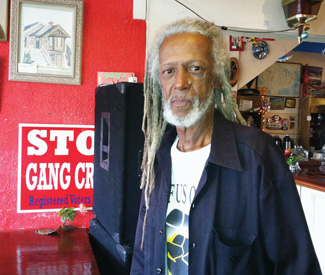
HERBWISE The night before our interview, Elder Freeman spoke alongside Peace and Freedom Party presidential candidate (and beloved sitcom sassmouth) Roseanne Barr, 2008 Green Party candidate Cynthia McKinney, and others about the political possibilities of marijuana at a panel discussion held inside Oaksterdam University.

As Black Panther History Month begins, commemorating the 46th anniversary of the party’s founding by Freeman and his peers — see info on events at the end of this article — it seems only fitting that the cannabis movement and the Panthers’ struggle for social justice and the right to control our own communities be connected. For Freeman, the two have become inextricably linked.

The morning of the day we met at West Oakland’s Revolution Cafe, the 67 year old original member of LA’s Black Panther Party had two doctors appointments. Freeman has colon cancer. Three years ago, he was diagnosed with prostate cancer. He smokes marijuana to improve his appetite — he’s used to eating a single meal a day, but that’s not enough to keep up his strength during treatment. As a long-time 215 card-carrier, the last year’s federal crackdown on cannabis dispensaries threatens to send him back to buying pot on the streets.

Is access to marijuana a Black Panther issue? Freeman thinks so. He tells me why over a cup of coffee (cream, no sugar), and between interruptions by well-wishers — the entire neighborhood knows him, it seems, they all want to pay their respects.

“It’s all connected. The simple fact is that the judicial system is inadequate. The whole idea that they want to keep it in an illegal state is so that they can criminalize people.” He became aware of cannabis, he says, when Bob Marley started talking about its connection to non-violence. “I identified with the Rasta community for awhile,” he tells me.

Freeman’s been told that this current bout of cancer is incurable. But he’s also been told that the Watts uprising in 1965 that was responsible for his political awakening was actually riots and that he deserved to spend those seven years in jail alongside many of his Panther cohorts on a laundry list of mostly trumped-up charges. He didn’t buy those things either.

In fact, at Oaksterdam he shared with the crowd that he plans on going to Cuba for a second opinion on his medical treatment. “There’s something about American medicine that seems to be lacking,” he says.

Last night’s event was actually the first time Freeman spoke as a cannabis activist. He spends most of his time as an advocate these days working for inmate rights — not surprising when you consider he spent the better part of a decade as a political prisoner. He works with All of Us or None (www.allofusornone.org), a national organization that works to “ban the box” — remove questions about past incarceration from employment applications — promote inmate voting rights, and build awareness in the communities most affected by mass incarceration. So although personally, access to cannabis is clearly a health concern, he tends to speak about it with more a law and order focus.

“People are doing a lot of time for something that they shouldn’t even be in jail for.” He wonders out loud to me about why we don’t lock up cigarette producers. “They got it backwards. But that’s capitalism.”

BLACK PANTHER HISTORY MONTH RALLY

Oct. 13, noon

Frank Ogawa Plaza, Oakl.

BLACK PANTHER HISTORY MONTH EXHIBIT

Oct. 13, 2pm, free

Geoffrey’s Inner Circle

410 14th St., Oakl.

www.itsabouttimebpp.com


Endorsements 2012: State and national races

25

National races

PRESIDENT

BARACK OBAMA

You couldn’t drive down Valencia Street on the evening of Nov. 4, 2008. You couldn’t get through the intersection of 18th and Castro, either. All over the east side of the city, people celebrating the election of Barack Obama and the end of the Bush era launched improptu parties, dancing and singing in the streets, while the cops stood by, smiling. It was the only presidential election in modern history that create such an upwelling of joy on the American left — and while we were a bit more jaded and cautious about celebrating, it was hard not to feel a sense of hope.

That all started to change about a month after the inauguration, when word got out that the big insurance companies were invited to be at the table, discussing health-care reform — and the progressive consumer advocates were not. From that point on, it was clear that the “change” he promised wasn’t going to be a fundamental shift in how power works in Washington.

Obama didn’t even consider a single-payer option. He hasn’t shut down Guantanamo Bay. He hasn’t cut the Pentagon budget. He hasn’t pulled the US out of the unwinnable mess in Afghanistan. He’s been a huge disappointment on progressive tax and economic issues. It wasn’t until late this summer, when he realized he was facing a major enthusiasm gap, that he even agreed to endorse same-sex marriage.

But it’s easy to trash an incumbent president, particularly one who foolishly thought he could get bipartisan support for reforms and instead wound up with a hostile Republican Congress. The truth is, Obama has accomplished a fair amount, given the obstacles he faced. He got a health-care reform bill, weak and imperfect as it was, passed into law, something Democrats have tried and failed at since the era of FDR. The stimulus, weak and limited as it was, clearly prevented the recession from becoming another great depression. His two Supreme Court appointments have been excellent.

And the guy he’s running against is a disaster on the scale of G.W. Bush.

Mitt Romney can’t even tell the truth about himself. He’s proven to be such a creature of the far-right wing of the Republican Party that it’s an embarrassment. A moderate Republican former governor of Massachusetts could have made a credible run for the White House — but Romney has essentially disavowed everything decent that he did in his last elective office, has said one dumb thing after another, and would be on track to be one of the worse presidents in history.

We get it: Obama let us down. But there’s a real choice here, and it’s an easy one. We’ll happily give a shout out to Jill Stein, the candidate of the Green Party, who is talking the way the Democrats ought to be talking, about a Green New Deal that recognizes that the richest nation in the history of the world can and should be doing radically better on employment, health care, the environment, and economic justice. And since Obama’s going to win California by a sizable majority anyway, a protest vote for Stein probably won’t do any harm.

But the next four years will be a critical time for the nation, and Obama is at least pushing in the direction of reality, sanity and hope. We endorsed him with enthusiasm four year ago; we’re endorsing him with clear-eyed reality in 2012.

UNITED STATES SENATE

DIANNE FEINSTEIN

Ugh. Not a pleasant choice here. Elizabeth Emken is pretty much your standard right-wing-nut Republican out of Danville, a fan of reducing government, cutting regulations, and repealing Obamacare. Feinstein, who’s already served four terms, is a conservative Democrat who loves developers, big business, and the death penalty, is hawkish on defense, and has used her clout locally to push for all the wrong candidates and all the wrong things. She can’t even keep her word: After Willie Brown complained that London Breed was saying mean things about him, Feinstein pulled her endorsement of Breed for District 5 supervisor.

It’s astonishing that, in a year when the state Democratic Party is aligned behind Proposition 34, which would replace the death penalty with life without parole, Feinstein can’t find it in herself to back away from her decades-long support of capital punishment. She’s not much better on medical marijuana. And she famously complained when then-mayor Gavin Newsom pushed same-sex marriage to the forefront, saying America wasn’t ready to give LGBT couples the same rights as straight people.

But as chair of the Senate Intelligence Committee, Feinstein was pretty good about investigating CIA torture and continues to call for the closure of Guantanamo Bay. She’s always been rock solid on abortion rights and at least decent, if not strong, on environmental issues.

It’s important for the Democrats to retain the Senate, and Feinstein might as well be unopposed. She turns 80 next year, so it’s likely this will be her last term.

HOUSE OF REPRESENTATIVES, DISTRICT 8

NANCY PELOSI

The real question on the minds of everyone in local politics is what will happen if the Democrats don’t retake the House and Pelosi has to face two more years in the minority. Will she serve out her term? Will her Democratic colleagues decide they want new leadership? The inside scuttle is that Pelosi has no intention of stepping down, but a long list of local politicians is looking at the once-in-a-lifetime chance to run for a Congressional seat, and it’s going to happen relatively soon; Pelosi is 72.

We’ve never been happy with Rep. Pelosi, who used the money and clout of the old Burton machine to come out of nowhere to beat progressive gay supervisor Harry Britt for the seat in 1986. Her signature local achievement is the bill that created the first privatized national park in the nation’s history (the Presidio), which now is home to a giant office complex built by filmmaker George Lucas with the benefit of a $60 million tax break. She long ago stopped representing San Francisco, making her move toward Congressional leadership by moving firmly to the center.

But as speaker of the House, she was a strong ally for President Obama and helped move the health-care bill forward. It’s critical to the success of the Obama administration that the Democrats retake the house and Pelosi resumes the role of speaker.

HOUSE OF REPRESENTATIVES, DISTRICT 9

BARBARA LEE

Barbara Lee represents Berkeley and Oakland in a way Nancy Pelosi doesn’t represent San Francisco. She’s been a strong, sometimes lonely voice against the wars in Iraq and Afghanistan and a leader in the House Progressive Caucus. While Democrats up to and including the president talk about tax cuts for businesses, Lee has been pushing a fair minimum wage, higher taxes on the wealthy, and an end to subsidies for the oil industry. While Oakland Mayor Jean Quan was struggling with Occupy, and San Francisco Mayor Ed Lee was moving to evict the protesters, Barbara Lee was strongly voicing her support for the movement, standing with the activists, and talking about wealth inequality. We’re proud to endorse her for another term.

HOUSE OF REPRESENTATIVES, DISTRICT 12

JACKIE SPEIER

Speier’s an improvement on her predecessor, Tom Lantos, who was a hawk and terrible on Middle East policy. Speier’s a moderate, as you’d expect in this Peninsula seat, but she’s taken the lead on consumer privacy issues (as she did in the state Legislature) and will get re-elected easily. She’s an effective member of a Bay Area delegation that helps keep the House sane, so we’ll endorse her for another term.

State candidates

ASSEMBLY DISTRICT 13

TOM AMMIANO

Tom Ammiano’s the perfect person to represent San Francisco values in Sacramento. He helped sparked and define this city’s progressive movement back in the 1970s as a gay teacher marching alongside with Harvey Milk. In 1999, his unprecedented write-in mayoral campaign woke progressives up from some bad years and ushered in a decade with a progressive majority on the Board of Supervisors that approved landmark legislation such as the universal healthcare program Ammiano created. In the Assembly, he worked to create a regulatory system for medical marijuana and chairs the powerful Public Safety Committee, where he has stopped the flow of mindless tough-on-crime measures that have overflowed our prisons and overburdened our budgets. This is Ammiano’s final term in the Legislature, but we hope it’s not the end of his role in local politics.

STATE ASSEMBLY, DISTRICT 19

PHIL TING

Phil Ting could be assessor of San Francisco, with a nice salary, for the rest of his life if that’s what he wanted to do. He’s done a good job in an office typically populated with make-no-waves political hacks — he went after the Catholic Church when that large institution tried to avoid paying taxes on property transfers. He’s been outspoken on foreclosures and commissioned, on his own initiative, a study showing that a large percentage of local foreclosures involved at least some degree of fraud or improper paperwork.

But Ting is prepared to take a big cut in pay and accept a term-limited future for the challenge of moving into a higher-profile political position. And he’s the right person to represent this westside district.

Ting’s not a radical leftist, but he is willing to talk about tax reform, particularly about the inequities of Prop. 13. He’s carrying the message to homeowners that they’re shouldering a larger part of the burden while commercial properties pay less. He wants to change some of the loopholes in how Prop. 13 is interpreted to help local government collect more money.

It would be nice to have a progressive-minded tax expert in the Legislature, and we’re glad Ting is the front-runner. He’s facing a serious, well-funded onslaught from Michael Breyer, the son of Supreme Court Justice Breyer, who has no political experience or credentials for office and is running a right-wing campaign emphasizing “old-style San Francisco values.”

Not pretty. Vote for Ting.

SENATE DISTRICT 11

MARK LENO

Mark Leno wasn’t always in the Guardian’s camp, and we don’t always agree with his election season endorsements, but he’s been a rock-solid representative in Sacramento and he has earned our respect and our endorsement.

It isn’t just how he votes, which we consistently agree with. Leno has been willing to take on the tough fights, the ones that need to be fought, and shown the tenacity to come out on top in the Legislature, even if he’s ahead of his time. Leno twice got the Legislature to legalize same-sex marriage, he has repeatedly gotten that body to legalize industrial hemp production, and he’s twice passed legislation that would give San Francisco voters the right to set a local vehicle license fees higher than the state’s and use that money for local programs (which the governor finally signed). He’s also been laying an important foundation for creating a single-payer healthcare system and he played an important role in the CleanPowerSF program that San Francisco will implement next year. Leno will easily be re-elected to another term in the Senate and we look forward to his next move (Leno for mayor, 2015?)


BART BOARD DISTRICT 9


TOM RADULOVICH

San Francisco has been well represented on the BART Board by Radulovich, a smart and forward-thinking urbanist who understands the important role transit plays in the Bay Area. Radulovich has played leadership roles in developing a plan that aims to double the percentage of cyclists using the system, improving the accessibility of many stations to those with limited mobility, pushing through an admittedly imperfect civilian oversight agency for the BART Police, hiring a new head administrator who is more responsive to community concerns, and maintaining the efficiency of an aging system with the highest ridership levels in its history. With a day job serving as executive director of the nonprofit Livable City, Radulovich helped create Sunday Streets and other initiatives that improve our public spaces and make San Francisco a more inviting place to be. And by continuing to provide a guiding vision for a BART system that continues to improve its connections to every corner of the Bay Area, his vision of urbanism is helping to permeate communities throughout the region

BART BOARD, DISTRICT 7

ZACHARY MALLETT

This sprawling district includes part of southeast San Francisco and extends all the way up the I-80 corridor to the Carquinez Bridge. The incumbent, San Franciscan Lynette Sweet, has been a major disappointment. She’s inaccessible, offers few new ideas, and was slow to recognize (much less deal with) the trigger-happy BART Police who until recently had no civilian oversight. Time for a change.

Three candidates are challenging Sweet, all of them from the East Bay (which makes a certain amount of sense — only 17 percent of the district’s population is in San Francisco). Our choice is Zachary Mallett, whose training in urban planning and understanding of the transit system makes up for his lack of political experience.

Mallett’s a graduate of Stanford and UC Berkelely (masters in urban planning with a transportation emphasis) who has taken the time to study what’s working and what isn’t working at BART. Some of his ideas sound a bit off at first — he wants, for example, to raise the cost of subsidized BART rides offered to Muni pass holders — but when you look a the numbers, and who is subsidizing who, it actually makes some sense. He talks intelligently about the roles that the various regional transit systems play and while he’s a bit more moderate than us, particularly on fiscal issues, he’s the best alternative to Sweet.

Nurses urge Pelosi and others to back the Robin Hood tax

13

Activists nationwide are pressuring Congress to pass a bill they say would generate hundreds of billions of dollars and stimulate economic growth on Main Street, targeting House Minority Leader Nancy Pelosi and other key congressional votes with a series of protests today.

The Inclusive Prosperity Act, or H.R. 6411, would establish a 0.5 percent tax on the trading of stocks, 50 cents on every $100 of trades and lesser rates on bonds, derivatives and currencies.  It’s being touted as the “Robin Hood tax” because it would generate an estimated $350 billion dollars annually that would go towards growing local economies, taking for the rich to help the poor.  

Supporters for the national campaign are knocking on the doors of their congressional representatives asking them to back the bill. Campaigners and members of National Nurses United today gathered at Pelosi’s office to ask her for support, but she was nowhere to be found.  Roughly two dozen nurses and activists attempted to enter the building when security promptly stopped them, allowing only four members to enter to speak to a Pelosi representative in the lobby. 

Inside, the four activists – including Deborah Burger, a registered nurse from Santa Rosa – were told that although the bill fits with her values, Pelosi is currently focused on the November election. 

“We were told that after the election she might use her influence to back the legislation,” says Burger.  “We do plan to go to Washington to push this bill and we’re going to do it with or without Nancy Pelosi.”  

Eighteen days after the stock market crashed in 2008 – four years ago today – Congress approved the Troubled Relief Asset Program, or T.A.R.P., that saved the “too-big-to-fail” banks from financial collapse.  Now, the national unemployment rate lingers above 8 percent.  HR 6411, introduced by Rep. Keith Ellison of Minnesota, is being promoted as a way to enforce accountability on the part of major Wall Street banking institutions.

“The destruction they’ve done to this country is enormous,” says Charles Idelson, communications director for the California Nurses Association. “They pay no tax when trading and all we’re asking for is Wall Street to pay us back and help local economies.”

When asked why nurses are interested in the bill, Scott Hornback, a nurse at UCSF, said people in his profession spend their days caring for those hit hardest by the recession: “We care about the health of the American worker and the people who make up this economy.”  

Supporters say the revenue generated from HR 6411 would also help strengthen Medicare and Medicaid, put more resources into the infrastructure and education, and help tackle climate change.   

The obvious question is whether or not such a tax would encourage financial institutions to move their transactions offshore.  Idelson rejected this possibility, saying, “When you have something totally computerized, like financial transactions, it’s easy to monitor and track.”

According to National Nurses United, more than 40 countries currently have some form of financial transaction tax in place.  Last week Germany and France urged the European Commission to draft FTT proposals for nine nations in the EU. 

Bad and good news from the Guv

14

First, the bad news: Jerry Brown has vetoed a couple of important bills by Assemblymember Tom Ammiano, showing that he’s still a strange and unpredictable guy. He rejected a measure that would have provided some basic labor protections to domestic workers and another that would have opened up state prisons to a modicum of media access. His message on domestic workers was confusing (gee, maybe it would cost more to make sure people get meal breaks); on the media access, it was just bizarre:

“Giving criminals celebrity status through repeated appearances on television will glorify their crimes and hurt victims and their families,” Brown wrote in his veto message for Assembly Bill 1270.

What? The notion that the press might be able to interview prisoners about conditions behind bars in an agency that consumes more than $10 billion a year in state funds will “glorify crimes?” Sorry, but Jerry is out of his mind.

From Ammiano’s press release:

“Press access isn’t just to sell newspapers. It’s a way for the public to know that the prisons it pays for are well-run,” Ammiano said. “The CDCR’s unwillingness to be transparent is part of what has led to court orders on prison health care and overcrowding. We should know when the California prisons aren’t being well run before it goes to court. I invite the Governor to visit the SHU [special housing unit/solitary confinement] to see for himself why media access is so important.”

Same goes for the TRUST Act, which had the support of a lot of local police chiefs, the mayor of Los Angeles and Assembly Minority Leader Nancy Pelosi.

On the other hand, Brown did sign a bill by Sen. Mark Leno that could turn out to be the best budget news San Francisco’s had in years. SB 1492 would allow the Board of Supervisors and the voters to reinstate, just in this city, the vehicle license fee that former Governor Arnold Schwarzenegger cut, to such disastrous effect, when he first took office. If the supervisors put it on the ballot and the voters approve, a two percent hike in the car tax could raise $70 million a year for the city — more than triple the amount that the mayor has agreed to raise in his weak gross receipts tax proposal.

That law goes on the books Jan. 1 — and the supes should immediately take up the challenge and approve the VLF hike for the next even-year ballot, November 2014.

Then the Guv vetoed Leno bills protecting cell phone users from warrantless searches and alloing the state to recognize more than two people as parents of a child.

Sen. Leland Yee’s bill allowing juveniles who were sentenced to life without parole to get a second chance made it passed Brown’s desk.

So what do we make of the governor? About the usual — he’s random.

‘LOOPER’ IS HERE! Plus: a boatload of other new movies

0

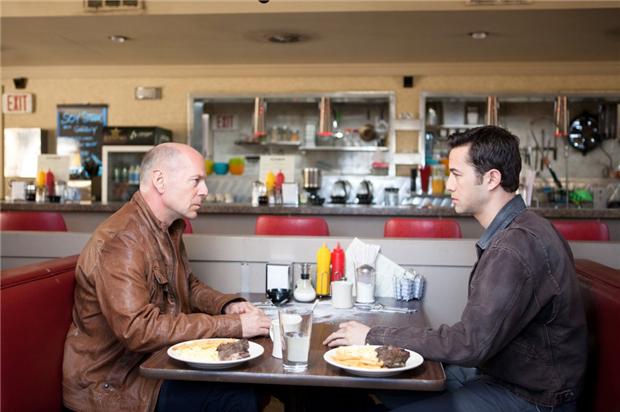
Wait, what are you doing reading this? Why aren’t you watching Looper, the best time-travel movie to come out of Hollywood in ages? Check out Lynn Rapoport’s review below, go see the damn thing (it’s gonna be huge, like Inception huge), and start planning your “Gat Man” Halloween costume this instant.

In this week’s film column, I check out the Northern California Action/Sports Film Festival (a new venture from SF IndieFest, which, by the way: just another month or so until DocFest!), let’s-talk-about-our-feelings indie Liberal Arts, and docs Diana Vreeland: The Eye Has to Travel and Peter Ford: A Little Prince

Marke B. takes on another doc, Detropia, and dubs this look at his hometown “important and beautiful;” full review here.

Two more from H-wood open this week (3D animated monster comedy Hotel Transylvania and YA young-angst tale The Perks of Being a Wallflower), as yet unreviewed — but there’s a bunch more short reviews, including Dennis Harvey’s take on the Vortex Room’s “Aerobicide” triple feature, after the jump.

http://www.youtube.com/watch?v=Y6G_AXzOJKY

“Aerobicide Sunday: A Marathon of Murder in Tights” Two things that made the 1980s taste great, slasher movies and aerobic exercise, were each too crassly, promiscuously commercial not to hook up a few times — even if the sub-sub-genre they created together is even less well remembered than the Lambada musical. Sun/30, however, it shall reign as king at the Vortex, where a triple bill of exer-psycho obscurities will really make you feel the burn. First up is 1987’s Aerobicide a.k.a. Killer Workout, in which the fitness emporium owned by Rhonda (Marcia Karrof of 1984’s Savage Streets) — as sour a grape as you’ll find in pastel spandex and pouf-shouldered Valley Girl dresses — experiences a rash of hard bodies being reduced to bloody pulp by an unknown killer wielding a large killer safety pin. Totally gross! We get many close-ups of overexposed thighs and over assisted cleavage gyrating to heinous dance tracks with inexplicable lyrics like “Hey baby! I’ve got your number! Red and juicy, warm and sweet” — plus some feathered-hair beefcake too — before the culprit turns out to be exactly who you think it is.

This was but an early effort among 32 features to date by writer-director David A. Prior, and based on the evidence present there’s a reason why you’ve never heard of any of them. Slightly slicker was 1990’s Death Spa (a.k.a. Witch Bitch), in which a computer automated gym goes all HAL-slash-The Shining, to the mortal danger of its highly toned staff and clientele. We’re talking death by blender, sauna paneling, and reanimated frozen fish products. The facility’s bitchy programmer is played by Merrick Butrick, who’d portrayed Captain Kirk’s son and a Square Peg earlier in the decade, and died of AIDS before this movie was released. Directed by Austrian Michael Fischa, it’s comparatively glossy but definitely senseless nonsense with a Eurotrash-genre feel. Lastly, in the same vein, and even slicker, there’s 1984’s Murder Rock: Dancing Death a.k.a. Giallo a Disco a.k.a. Slashdance (one of, incredibly, no less than three movies with that third name), a lesser exercise by that occasionally great horror director Lucio Fulci. Rather than a health club, the setting here is a dance school where choreography seems less indebted to Balanchine and Martha Graham than Jane Fonda and Shabba Doo. For that crime the punishment is, of course … death by hatpin? Whatever. If you survive this evening, you will be sore, winded, and desperate to sweat the toxins out of your system. Vortex Room. (Dennis Harvey)

http://www.youtube.com/watch?v=nrf8xoQJ5Ms

Backwards Athletic disappointment is not a new feeling for Abi (Sarah Megan Thomas, who also wrote the script), who has just learned she’s been named the alternate for the Olympic crew team — a bench warming role she was also relegated to in the last Olympics. But after she quits the team in a huff and moves home, it’s not long before she realizes that her life off the water is pretty depressing, too. Enter former boyfriend Geoff (James Van Der Beek), now the athletic director at the high school where Abi honed her rowing talents, who gives her a job coaching the talented but undisciplined girls who make up the current team. Will this new venture help Abi finally grow up and regain her self-confidence? Will she re-ignite her spark with Geoff? Will there be a last-act conflict involving yet another chance at the Olympics? Will there be multiple training montages? As directed by Ben Hickernell, Backwards hits all of the expected themes about following one’s heart and Doing the Right Thing. Thomas, a former rower herself, has an ordinary-girl appeal, but even Backwards‘ attention to authenticity can’t elevate what’s essentially a very predictable sports drama. (1:29) Sundance Kabuki. (Cheryl Eddy)

http://www.youtube.com/watch?v=eI3ju17W070

Looper It’s 2044 and, thanks to a lengthy bout of exposition by our protagonist, Joe (Joseph Gordon-Levitt), here’s what we know: time travel, an invention 30 years away, will be used by criminals to transport their soon-to-be homicide victims backward, where a class of gunmen called loopers, Joe among them, are employed to “do the necessaries.” More deftly revealed in Brick (2005) writer-director Rian Johnson’s new film is the joylessness of the world in which Joe amorally makes his way, where gangsters from the future control the present (under the supervision of Jeff Daniels), their hit men live large but badly (Joe is addicted to some eyeball-administered narcotic), and the remainder of the urban populace suffers below-subsistence-level poverty. The latest downside for guys like Joe is that a new crime boss has begun sending back a steady stream of aging loopers for termination, or “closing the loop”; soon enough, Joe is staring down a gun barrel at himself plus 30 years.

Being played by Bruce Willis, old Joe is not one to peaceably abide by a death warrant, and young Joe must set off in search of himself so that — with the help of a woman named Sara (Emily Blunt) and her creepy-cute son Cid (Pierce Gagnon) — he can blow his own (future) head off. Having seen the evocatively horrific fate of another escaped looper, we can’t totally blame him. Parsing the daft mechanics of time travel as envisioned here is rough going, but the film’s brisk pacing and talented cast distract, and as one Joe tersely explains to another, if they start talking about it, “we’re gonna be here all day making diagrams with straws” — in other words, some loops just weren’t meant to be closed. (1:58) (Lynn Rapoport)

http://www.youtube.com/watch?v=siEHekc-1oE

Pitch Perfect As an all-female college a cappella group known as the Barden Bellas launches into Ace of Base’s “The Sign” during the prologue of Pitch Perfect, you can hear the Glee-meets-Bring It On elevator pitch. Which is fine, since Bring It On-meets-anything is clearly worth a shot. In this attempt, Anna Kendrick stars as withdrawn and disaffected college freshman Beca, who dreams of producing music in L.A. but is begrudgingly getting a free ride at Barden University via her comp lit professor father. Clearly his goal is not making sure she receives a liberal arts education, as Barden’s academic jungle extends to the edges of the campus’s competitive a cappella scene, and the closest thing to an intellectual challenge occurs during a “riff-off” between a cappella gangs at the bottom of a mysteriously drained swimming pool. When Beca reluctantly joins the Bellas, she finds herself caring enough about the group’s fate to push for an Ace of Base moratorium and radical steps like performing mashups. Much as 2000’s Bring It On coined terms like “cheerocracy” and “having cheer-sex,” Pitch Perfect gives us the infinitely applicable prefix “a ca-” and descriptives like “getting Treble-boned,” a reference to forbidden sexual relations with the Bellas’ cocky rivals, the Treblemakers. The gags get funnier, dirtier, and weirder, arguably reaching their climax in projectile-vomit snow angels, with Elizabeth Banks and John Michael Higgins as grin-panning competition commentators offering a string of loopily inappropriate observations. (1:52) (Lynn Rapoport)

http://www.youtube.com/watch?v=XSDZNHYLDOY

Solomon Kane Conceived by Conan the Barbarian creator Robert E. Howard, this 16th-century hero is cut from the same sword-and-sorcery cloth, being a brawny brute of slippery but generally sorta-kinda upright morals. Solomon (James Purefoy) is slaughtering his way to a North African treasure trove when demons swallow up his likewise greedy, conscience-free cohorts and damn his soul for a lifetime of bad deeds. Suddenly committed to the greater good, he returns homeward to cold gray England, where Jason Flemyng’s evil sorcerer soon imperils both our protagonist and the Puritan family (complete with love interest) he’s befriended. This movie has been around a while — since 2009, to be exact, yet barely beating director Michael J. Bassett’s new Silent Hill: Revelation 3D to U.S. theaters — and is a good illustration of what can happen when you make a fairly expensive ($45 million) fantasy-action adventure without major stars nor any marketable novelty. Which is to say: not much. There is absolutely nothing wrong with the good-looking, watchable but generic-feeling Solomon Kane, save that nothing about it feels remotely original or inspired. It’s the perfectly okay, like-a-thousand-others mall flick you’ll forget you saw by Thanksgiving, despite being peopled with such normally interesting actors as Max Von Sydow, Alice Krige, and the late Pete Postlethwaite. (1:54) (Dennis Harvey)

http://www.youtube.com/watch?v=4mZIwD4K544

“Stars In Shorts” Outside of the festival circuit, it’s an uncommon feat for shorts to make it to the big screen, so it can’t hurt to make name recognition a prerequisite for selection. In writer-director Rupert Friend’s Steve, Keira Knightley plays an embattled Londoner under siege by her lonely, pathologically odd neighbor (Colin Firth). Written by Neil LaBute, Jacob Chase’s After School Special sets up a semi-flirtation between two strangers (Sarah Paulson and Wes Bentley) at a playground, only to deliver the kind of gut-level punch you might expect from the writer-director of 1998’s Your Friends and Neighbors. LaBute’s own Sexting is an entertaining exercise in stream-of-consciousness monologuing by Julia Stiles. As with most shorts programs, “Stars” is a mixed bag. Robert Festinger’s The Procession, in which Lily Tomlin and Modern Family’s Jesse Tyler Ferguson play reluctant participants in a funeral procession, sounds promising, but the conversation palls during the 10-plus minutes we’re stuck in the car with them. Benjamin Grayson’s sci-fi thriller Prodigal, starring Kenneth Branagh, reaches its predictable crisis points several minutes after the viewer has arrived. More successful are Jay Kamen’s musical comedy Not Your Time, starring Seinfeld’s Jason Alexander as an old Hollywood hand whose writing career has stalled out, and Chris Foggin’s Friend Request Pending, which treats viewers to the sight of Dame Judi Dench gamely wading into the social network in search of a date. (1:53) (Lynn Rapoport)

Won’t Back Down If talk of introducing charter schools into the public education mix tends to give you collective-bargaining-related hives, Daniel Barnz’s Won’t Back Down is unlikely to appeal, unless perhaps as the object of a boycott or a picket line. Two embattled mothers, Jamie Fitzpatrick (Maggie Gyllenhaal) and Nona Alberts (Viola Davis), both with children at a failing Pittsburgh elementary school and the latter a teacher there, join forces to change the institutional culture by leading a parent-teacher takeover, with the goal of creating a charter school. As the bureaucratic process for doing so is described by a school district employee, it should take them three to five years to discover that they’ve been hurling themselves at a brick wall; Jamie, an efficient combination of fireball and pit bull, is determined to pulverize the wall in about two months.

Watching her and Nona try to secure more than a third-rate, treading-water education for their kids, it’s hard not to root for the possibility of a transformation, and even an upper-level teachers’ union staffer played by Holly Hunter finds herself climbing the fence. The details of what lies on the other side (and inside Jamie and Nona’s 400-page proposal) stay fairly fuzzy, though. And while Barnz lets his warring factions — desperate mothers and educators, a union boss (Ned Eisenberg) watching the deterioration of the labor movement, a pro-union teacher (Oscar Isaac) ambivalently engaged in the chartering project — impassionedly debate their way through the film, a little more wonkiness might have clarified the arguments of those done waiting for Superman. (2:00) (Lynn Rapoport)

On the Om Front: A path with heart

0

I’ve been practicing yoga for 12 years. Over the years, my practice has changed depending on the basic conditions of my life: my age, my health, my schedule, my location, my physical and spiritual interests and needs, my romantic relationships, my relationship with chocolate chip cookies. Each time I’ve come to a point of transition in how I practice, or where I practice, or with whom I practice (and, more recently: how I teach, where I teach, and for whom I teach), I start to question why I’m doing what I am doing and what is the ultimate goal. 

The questioning is uncomfortable—who wants to question a thing they love? 

It feels dirty, disloyal. It creates murk in a stream that once felt swimmingly clear. But I’ve learned that it’s an inevitable part of any path. Whether we like it or not, questions arise—if they didn’t, we wouldn’t have some version of this symbol in every language: “?” Luckily (or unluckily), I come from Jewish heritage, so questioning is in my blood. In Judaism, it’s godly to question. 

So, I’m questioning.

And I’m reading this book right now called A Path With Heart. It’s by Jack Kornfield, one of the founders of Spirit Rock, a Buddhist meditation retreat center up in Marin that runs regular residential silent meditation retreats. (It’s a top local joint that I highly recommend, especially if you’re one of those people who thinks you “could never” sit in silence for a week, which is nearly everyone unless you’ve actually done it and know that you could, in fact, have.) 

Anyway: In the first few pages of his book, Jack gets down to the crux of the matter. He says that no matter what road you’re driving your spiritual chariot down, you’ve got to keep coming back to the question of whether or not your path has heart. To paraphrase, you could be touching your first metatarsal to your crown chakra or chanting Om Namah Shivaya until the cows come home (and if you’re doing that in India, it won’t be very long—the cows are always coming home), but if you’re not practicing from a place of love, there’s no point to it. Or, maybe there’s some point to it … but it’s not the point.

This isn’t just about yoga or meditation. The same is true for anything you do. Take art, for instance. If your art has no heart, it may look or sound pretty, but its cosmic shelf life is going to be shorter than a wink. Good art creates soul grooves. It has a ripple effect. It’s a rechargeable battery that powers up each time it connects with a new source. It needs to be infused with real juice, the kind that comes from that metaphorical, physiological blood pumper that sits just to the right of center—in your chest.

There’s a lot of heart in our city.

I went to see a play last weekend called Dogsbody at Intersection for the Arts by Erik Ehn, a gifted spiritual warrior who has crafted 17 poetic theatrical works on genocide as part of a project called Soulographie to wake us up to the realities of war. (The project is en route to NYC, so if you’re out there November 11-18, get in on it.) I also hit Martin Scott’s Saturday morning yoga class at Union Yoga, for which all proceeds generously go to Headstand.org, an organization that brings yoga to at-risk youth. Both Erik and Martin are heart-ists. 

Here’s a line from Kornfield’s book, which I’ve been reading to my own classes this past week. He’s quoting Carlos Castaneda who’s referring to a teaching by Don Juan: 

“Look at every path closely and deliberately. Try it as many times as you think necessary. Then ask yourself and yourself alone one question …. Does this path have a heart? If it does, the path is good. If it doesn’t, it is of no use.”

Not a bad one to pull out when faced with a moment of evaluation. Here’s to landing in a place where that question has the right answer.

********

Around the Bend 

(some upcoming events with heart)


Sweat and Study: Chants and Invocations for Yoga 

If you love chanting to Ganesh and the other colorful yoga deities, this workshop is the place to be this Sunday. You’ll learn several of the basic yoga mantras and—if you’re already a regular chanter—you’ll learn how to lead them. Sean Feit is a gem. It’s worth the trip to Berkeley.

9/30, 2-5, $20, Yoga Tree Telegraph


Sivananda Poetry Night

The Sivananda center in San Franciso has a new monthly poetry satsang. This week, hear Virginia Barrett (Vidya devi) read poems from her forthcoming  book, I Just Wear My Wings, and bring a short poem (your own or one from a spiritual teacher/writer). Tea and snacks available.

9/28, 7:30 – 9:15 p.m, suggested donation $5-$10, Sivananda Center in SF


Union Yoga’s Donation-Based Vinyasa for Headstand.org

This fun, challenging flow class taught by Martin Scott on Saturday mornings is entirely donation-based, and all of the profits support the non-profit organization Headstand.org, which brings yoga classes to at-risk youth in underserved schools. It fills up (as it should) so register online beforehand.  

Every Saturday, 9am, suggested donation $15, Union Yoga


KFOG Harmony by The Bay

KFOG shows some love to yogis in its Harmony by the Bay concert by offering a special yoga stage. (If you go, please report back on what this actually looked like—I’ve no idea!) Musical acts for the outdoor concert include The Shins, Tegan and Sara, and the holy rapper Matisyahu.

9/29, $40-$75, Shoreline Amphitheatre. More info: www.harmonybythebay.org/2012


Karen Macklin is a yoga teacher and multi-genre writer in San Francisco. She’s been up-dogging her way down the yogic path for over a decade, and is a lifelong lover of the word. To learn more about her teaching schedule and writing life, visit her site at www.karenmacklin.com.

Tonight, a film that will change how you see mental illness

0

What does it mean to be mentally ill? Mentally well? If a person feels debilitating rage and sadness faced with the realities of the world around them, does the problem lie with the person or with society? What exactly needs fixing?

These are some of the questions raised by Crooked Beauty, a 30-minute film that originated in San Francisco and has been translated and distributed internationally.

Filmmaker Ken Paul Rosenthal will screen Crooked Beauty tonight, along with other footage from his ongoing work exploring alternative ways of seeing mental health.The screening is part of the 10-year anniversary celebration of the Icarus Project, a network of support groups, discussion forums, writers and artists, challening the definition of mental health. In their own words, the Icarus Project “envisions a new culture and language that resonates with our actual experiences of ‘mental illness’ rather than trying to fit our lives into a conventional framework.”

It was some of that new language, lines in a book Rosenthal found lying around his Mission Distrtict apartment one day, that first inspired Crooked Beauty.

“The world seemed to hit me so much harder and fill me so much fuller than anyone else I knew,” the lines read. “Slanted sunlight could make me dizzy with its beauty and witnessing unkindness filled me with physical pain.”

The book was Navigating the Space Between Brilliance and Madness: A Reader and Roadmap of Bipolar Worlds, and the writer of the words was Jacks McNamara, one of the Icarus Project’s founders.

The lines made sense to him. “They spoke so much to my experience of the world,” Rosenthal told me in an interview. “They create such a vivid image for me of relating to the world in a skewed way, as opposed to a very bright, shiny, clear way.”

He found that McNamara lived just across the Bay in Oakland “two days later I was sitting with them, talking and proposing this film.”

Rosenthal did several interviews with McNamara that he used for the film’s narrative. McNamara’s storytelling is unscripted and strikingly poetic.  Images, all shot in San Francisco by Rosenthal, illustrate the story– fog rolling in over hills, birds flocking on power lines and trees shaking in the wind as if trying to escape.

The film, Rosenthal said, is “About using [McNamara’s] crucial and critical narrative as a touchstone for the much broader issue of madness, which is not just a biochemical knot from the neck up. That madness is also a reflection of a social condition.”

As McNamara says in the film: “Saying that it is nothing but a biological brain disorder let’s everybody off the hook. Then you don’t have to look at oppression, and you don’t have to look at poverty and injustice and abuse and trauma, and makes it this situation where it’s just the individual versus his of her inevitable biological madness”

Through getting involved in the Icarus Project, Rosenpaul said, “I’ve been radicalized. But that’s not to say that I’m out on the street burning my bra. Or, you know, burning my prescription bottles.”

Instead, he makes films that explore the complexities of mental health beyond the persciption bottle, what he calls “that idea that wellness exists in a pill.”

Rosenthal’s current project, Mad Dance: A Mental Health Film Trilogy, will use archival footage from educational mental health films, which distance the viewer from the patients that need to be “fixed.”

Tonight, Rosenthal will present some of that footage along with Crooked Beauty.

“Mad Dance film screening and Icarus Project benefit”

Thu/27, 8-10pm, $5-10 suggested donation

Artists’ Television Access

992 Valencia, SF

Facebook invite

Dick Meister: Danger and death in the tobacco fields

5

By Dick Meister


Dick Meister, who has covered labor and political issues for more than a half-century, is co-author of “A Long Time Coming: The Struggle To Unionize America’s Farm Workers” (Macmillan). Contact him through his website, www.dickmeister.com.

Amid all the well-deserved concern over the deadly effects of tobacco on smokers, we’ve largely overlooked  tobacco’s other major victims – the workers who harvest the damn stuff for the great profit of  tobacco companies, often because they have virtually no other way to make a living.

There are nearly 100,000 tobacco harvesters, some as young as 12, most of them Mexican immigrants. They work during the summer in the tobacco fields of North Carolina, the country’s leading tobacco producer. As the AFL-CIO, its Farm Labor Organizing Committee (FLOC), the human rights group Oxfam America and others have reported, the workers’ pay and working and living conditions are abominable.

The reports note that year after year, thousands of the workers are afflicted with “green tobacco sickness,” which is caused by overexposure to the highly toxic nicotine in tobacco leaves that ‘s absorbed into their bodies.

Victims feel a general weakness or shortness of breath, severe headaches, vomiting, dizziness, cramps, heightened blood pressure or speeded-up heart rates. At the least, they break out in rashes.  The symptoms frequently last for several days.

Workers’ body temperatures, already high because of the southern heat in which they work, are raised even higher by the nicotine, which sometimes leads to dehydration and heat strokes that kill them.

Yet many workers get little or no medical attention. They’re lucky if they even get rest breaks during working hours. Most work for growers who do not provide health care benefits and are exempt from the law that requires employers to make Workers Compensation payments for employees who are hurt on the job.

Workers whose productivity declines because of tobacco sickness face firing or being turned over to government authorities for deportation, as do those who dare complain about working conditions or demand union rights. There are many more desperately poor immigrants to take their places.

One-fourth of the workers are paid less than the federal minimum wage of $7.25 an hour, most of the others barely above the minimum.

Living conditions, described as “inhumane” in the recent reports by the AFL-CIO and others, generally are as bad as working conditions. Most workers live in crowded, dilapidated, frequently rat-infested shacks in labor camps or in stifling, broken-down trailers near fields that are sprayed regularly with dangerous pesticides.

Finally, however, there’s genuine hope for change. It rests primarily with the AFL-CIO’s FLOC, which has helped thousands of workers in other crops in North Carolina and elsewhere win decent treatment.

Backed by an array of community and religious groups, FLOC has been waging a nationwide drive seeking collective bargaining agreements from growers to improve pay and conditions.  They’ve pressed their demands by tactics such as threatening to lead boycotts of the companies that buy the growers’ crops for manufacturing cigarettes and other tobacco products. They’re aiming as well at the supermarket chains and others who sell the products.

The main target has been R.J. Reynolds, which alone manufactures just about one of every three cigarettes bought in this country. FLOC and its allies are attempting to force Reynolds and other tobacco companies to demand that their grower-suppliers improve pay and working conditions or lose their business.

But realistically, what are the chances of success in the drive to provide decent treatment for the highly exploited and until now virtually powerless tobacco workers?

FLOC President Baldemar Velasquez says the chances are good, despite the great political influence and wealth of those who are resisting the demands of the union and its growing numbers of supporters.

 As evidence that it can be done, Velasquez cites the union’s five-year long boycott that in 2004 finally forced a major North Carolina corporation, the Mount Olive Pickle Co., to raise the price it paid for cucumbers as a way to finance higher pay for the company’s workers. It also agreed to allow union organizers to circulate in its labor camps.

The struggle in behalf of the workers is certain to continue in any case, the struggle to erase what, as Velasquez notes, is a national shame – “the deplorable condition of the tobacco workforce that remains voiceless, powerless and invisible to mainstream America.”

Dick Meister, who has covered labor and political issues for more than a half-century, is co-author of “A Long Time Coming: The Struggle To Unionize America’s Farm Workers” (Macmillan). Contact him through his website, www.dickmeister.com.


Film Listings

0

OPENING

“Aerobicide Sunday: A Marathon of Murder in Tights” Two things that made the 1980s taste great, slasher movies and aerobic exercise, were each too crassly, promiscuously commercial not to hook up a few times — even if the sub-sub-genre they created together is even less well remembered than the Lambada musical. Sun/30, however, it shall reign as king at the Vortex, where a triple bill of exer-psycho obscurities will really make you feel the burn. First up is 1987’s Aerobicide a.k.a. Killer Workout, in which the fitness emporium owned by Rhonda (Marcia Karrof of 1984’s Savage Streets) — as sour a grape as you’ll find in pastel spandex and pouf-shouldered Valley Girl dresses — experiences a rash of hard bodies being reduced to bloody pulp by an unknown killer wielding a large killer safety pin. Totally gross! We get many close-ups of overexposed thighs and over assisted cleavage gyrating to heinous dance tracks with inexplicable lyrics like “Hey baby! I’ve got your number! Red and juicy, warm and sweet” — plus some feathered-hair beefcake too — before the culprit turns out to be exactly who you think it is. This was but an early effort among 32 features to date by writer-director David A. Prior, and based on the evidence present there’s a reason why you’ve never heard of any of them. Slightly slicker was 1990’s Death Spa (a.k.a. Witch Bitch), in which a computer automated gym goes all HAL-slash-The Shining, to the mortal danger of its highly toned staff and clientele. We’re talking death by blender, sauna paneling, and reanimated frozen fish products. The facility’s bitchy programmer is played by Merrick Butrick, who’d portrayed Captain Kirk’s son and a Square Peg earlier in the decade, and died of AIDS before this movie was released. Directed by Austrian Michael Fischa, it’s comparatively glossy but definitely senseless nonsense with a Eurotrash-genre feel. Lastly, in the same vein, and even slicker, there’s 1984’s Murder Rock: Dancing Death a.k.a. Giallo a Disco a.k.a. Slashdance (one of, incredibly, no less than three movies with that third name), a lesser exercise by that occasionally great horror director Lucio Fulci. Rather than a health club, the setting here is a dance school where choreography seems less indebted to Balanchine and Martha Graham than Jane Fonda and Shabba Doo. For that crime the punishment is, of course … death by hatpin? Whatever. If you survive this evening, you will be sore, winded, and desperate to sweat the toxins out of your system. Vortex Room. (Harvey)

Backwards Athletic disappointment is not a new feeling for Abi (Sarah Megan Thomas, who also wrote the script), who has just learned she’s been named the alternate for the Olympic crew team — a bench warming role she was also relegated to in the last Olympics. But after she quits the team in a huff and moves home, it’s not long before she realizes that her life off the water is pretty depressing, too. Enter former boyfriend Geoff (James Van Der Beek), now the athletic director at the high school where Abi honed her rowing talents, who gives her a job coaching the talented but undisciplined girls who make up the current team. Will this new venture help Abi finally grow up and regain her self-confidence? Will she re-ignite her spark with Geoff? Will there be a last-act conflict involving yet another chance at the Olympics? Will there be multiple training montages? As directed by Ben Hickernell, Backwards hits all of the expected themes about following one’s heart and Doing the Right Thing. Thomas, a former rower herself, has an ordinary-girl appeal, but even Backwards’ attention to authenticity can’t elevate what’s essentially a very predictable sports drama. (1:29) Sundance Kabuki. (Eddy)

Detropia See “We Were Here.” (1:30) Elmwood, Roxie, Smith Rafael.

Diana Vreeland: The Eye Has to Travel See “Chronic Youth.” (1:26) Embarcadero.

Hotel Transylvania Genndy Tartakovsky (TV’s Star Wars: The Clone Wars) directs this 3D animated comedy about a resort run by Dracula (voiced by Adam Sandler) for Frankenstein (Kevin James) and other monsters. (1:32) Shattuck.


Liberal Arts See “Chronic Youth.” (1:37) Bridge, Shattuck.

Looper Writer-director Rian Johnson reunites with Brick (2005) star Joseph Gordon-Levitt for this sci-fi thriller about time-traveling assassins. (1:58) Four Star, Piedmont, Presidio.

The Perks of Being a Wallflower Stephen Chbosky wrote and directed this adaptation of his best-selling YA novel, about a high-school misfit (Logan Lerman) comes out of his shell when he befriends a brother-sister duo (Ezra Miller, Emma Watson). (1:43) California, Embarcadero.

Peter Ford: A Little Prince See “Chronic Youth.” (:40) Delancey Street.

Pitch Perfect Anna Kendrick stars in this musical comedy set within the cutthroat world of competitive college a capella groups. (1:52)

Solomon Kane Conceived by Conan the Barbarian creator Robert E. Howard, this 16th-century hero is cut from the same sword-and-sorcery cloth, being a brawny brute of slippery but generally sorta-kinda upright morals. Solomon (James Purefoy) is slaughtering his way to a North African treasure trove when demons swallow up his likewise greedy, conscience-free cohorts and damn his soul for a lifetime of bad deeds. Suddenly committed to the greater good, he returns homeward to cold gray England, where Jason Flemyng’s evil sorcerer soon imperils both our protagonist and the Puritan family (complete with love interest) he’s befriended. This movie has been around a while — since 2009, to be exact, yet barely beating director Michael J. Bassett’s new Silent Hill: Revelation 3D to U.S. theaters — and is a good illustration of what can happen when you make a fairly expensive ($45 million) fantasy-action adventure without major stars nor any marketable novelty. Which is to say: not much. There is absolutely nothing wrong with the good-looking, watchable but generic-feeling Solomon Kane, save that nothing about it feels remotely original or inspired. It’s the perfectly okay, like-a-thousand-others mall flick you’ll forget you saw by Thanksgiving, despite being peopled with such normally interesting actors as Max Von Sydow, Alice Krige, and the late Pete Postlethwaite. (1:54) (Harvey)

“Stars In Shorts” Outside of the festival circuit, it’s an uncommon feat for shorts to make it to the big screen, so it can’t hurt to make name recognition a prerequisite for selection. In writer-director Rupert Friend’s Steve, Keira Knightley plays an embattled Londoner under siege by her lonely, pathologically odd neighbor (Colin Firth). Written by Neil LaBute, Jacob Chase’s After School Special sets up a semi-flirtation between two strangers (Sarah Paulson and Wes Bentley) at a playground, only to deliver the kind of gut-level punch you might expect from the writer-director of 1998’s Your Friends and Neighbors. LaBute’s own Sexting is an entertaining exercise in stream-of-consciousness monologuing by Julia Stiles. As with most shorts programs, “Stars” is a mixed bag. Robert Festinger’s The Procession, in which Lily Tomlin and Modern Family‘s Jesse Tyler Ferguson play reluctant participants in a funeral procession, sounds promising, but the conversation palls during the 10-plus minutes we’re stuck in the car with them. Benjamin Grayson’s sci-fi thriller Prodigal, starring Kenneth Branagh, reaches its predictable crisis points several minutes after the viewer has arrived. More successful are Jay Kamen’s musical comedy Not Your Time, starring Seinfeld‘s Jason Alexander as an old Hollywood hand whose writing career has stalled out, and Chris Foggin’s Friend Request Pending, which treats viewers to the sight of Dame Judi Dench gamely wading into the social network in search of a date. (1:53) Opera Plaza, Shattuck. (Rapoport)

Vulgaria Raunchy HK import about a film producer who convinces a gangster to finance his porn epic. (1:32) Metreon.

Won’t Back Down Determined mothers (Maggie Gyllenhaal, Viola Davis) become education activists in this based-on-true-events drama. (2:00)

ONGOING

Arbitrage As Arbitrage opens, its slick protagonist, Robert Miller (Richard Gere), is trying to close the sale of his life, on his 60th birthday: the purchase of his company by a banking goliath. The trick is completing the deal before his fraud, involving hundreds of millions of dollars, is uncovered, though the whip-smart daughter who works for him (Brit Marling) might soon be onto him. Meanwhile, Miller’s gaming his personal affairs as well, juggling time between a model wife (Susan Sarandon) and a Gallic gallerist mistress (Laetitia Casta), when sudden-death circumstances threaten to destroy everything, and the power broker’s livelihood — and very existence — ends up in the hands of a young man (Nate Parker) with ambitions of his own. It’s a realm that filmmaker Nicholas Jarecki is all too familiar with. Though like brothers Andrew (2003’s Capturing the Friedmans) and Eugene (2005’s Why We Fight), Jarecki’s first love is documentaries (his first film, 2006’s The Outsider, covered auteur James Toback), his family is steeped in the business world. Both his parents were commodities traders, and Jarecki once owned his own web development firm and internet access provider, among other ventures. When he started writing Arbitrage‘s script in 2008, he drew some inspiration from Bernard Madoff — but ultimately, the film is about a good man who became corrupted along the way, to the point of believing in his own invincibility. (1:40) Metreon, Presidio, Smith Rafael, Shattuck, Sundance Kabuki. (Chun)

Beasts of the Southern Wild Six months after winning the Grand Jury Prize at Sundance (and a Cannes Camera d’Or), Beasts of the Southern Wild proves capable of enduring a second or third viewing with its originality and strangeness fully intact. Magical realism is a primarily literary device that isn’t attempted very often in U.S. cinema, and succeeds very rarely. But this intersection between Faulkner and fairy tale, a fable about — improbably — Hurricane Katrina, is mysterious and unruly and enchanting. Benh Zeitlin’s film is wildly cinematic from the outset, as voiceover narration from six-year-old Hushpuppy (Quvenzhané Wallis) offers simple commentary on her rather fantastical life. She abides in the Bathtub, an imaginary chunk of bayou country south of New Orleans whose residents live closer to nature, amid the detritus of civilization. Seemingly everything is some alchemical combination of scrap heap, flesh, and soil. But not all is well: when “the storm” floods the land, the holdouts are forced at federal gunpoint to evacuate. With its elements of magic, mythological exodus, and evolutionary biology, Beasts goes way out on a conceptual limb; you could argue it achieves many (if not more) of the same goals Terrence Malick’s 2011 The Tree of Life did at a fraction of that film’s cost and length. (1:31) Shattuck, Smith Rafael. (Harvey)

Beauty is Embarrassing You may not recognize the name Wayne White offhand, but you will know his work: he designed and operated many of the puppets on Pee-Wee’s Playhouse, including Randy (the blockheaded bully) and Dirty Dog (the canine jazzbo). Neil Berkeley’s Beauty Is Embarrassing — named for a mural White painted on the side of a Miami building for Art Basel 2009 — charts the life of an artist whose motto is both “I want to try everything I can!” and “Fuck you!” The Southern-born oddball, who came of age in the early-1980s East Village scene, is currently styling himself as a visual artist (his métier: painting non-sequitur phrases into landscapes bought from thrift stores), but Beauty offers a complex portrait of creativity balanced between the need to be subversive and the desire to entertain. (1:27) Roxie. (Eddy)

The Bourne Legacy Settle down, Matt Damon fans — the original Bourne appears in The Bourne Legacy only in dialogue (“Jason Bourne is in New York!”) and photograph form. Stepping in as lead badass is Jeremy Renner, whose twin powers of strength and intelligence come courtesy of an experimental-drug program overseen by sinister government types (including Edward Norton in an utterly generic role) and administered by lab workers doing it “for the science!,” according to Dr. Rachel Weisz. Legacy‘s timeline roughly matches up with the last Damon film, The Bourne Ultimatum, which came out five years ago and is referenced here like we’re supposed to be on a first-name basis with its long-forgotten plot twists. Anyway, thanks to ol’ Jason and a few other factors involving Albert Finney and YouTube, the drug program is shut down, and all guinea-pig agents and high-security-clearance doctors are offed. Except guess which two, who manage to flee across the globe to get more WMDs for Renner’s DNA. Essentially one long chase scene, The Bourne Legacy spends way too much of its time either in Norton’s “crisis suite,” watching characters bark orders and stare at computer screens, or trying to explain the genetic tinkering that’s made Renner a super-duper-superspy. Remember when Damon killed that guy with a rolled-up magazine in 2004’s The Bourne Supremacy? Absolutely nothing so rad in this imagination-free enterprise. (2:15) 1000 Van Ness, SF Center. (Eddy)

The Campaign (1:25) 1000 Van Ness, SF Center.

Celeste and Jesse Forever Married your best friend, realized you love but can’t be in love with each other, and don’t want to let all those great in-jokes wither away? Such is the premise of Celeste and Jesse Forever, the latest in what a recent wave of meaty, girl-centric comedies penned by actresses — here Rashida Jones working with real-life ex Will McCormack; there, Zoe Kazan (Ruby Sparks), Zoe Lister Jones (Lola Versus), and Lena Dunham (Girls) — who have gone the DIY route and whipped up their own juicy roles. There’s no mistaking theirs for your average big-screen rom-com: they dare to wallow harder, skew smarter, and in the case of Celeste, tackle the thorny, tough-to-resolve relationship dilemma that stubbornly refuses to conform to your copy-and-paste story arc. Nor do their female protagonists come off as uniformly likable: in this case, Celeste (Jones) is a bit of an aspiring LA powerbitch. Her Achilles heel is artist Jesse (Andy Samberg), the slacker high school sweetheart she wed and separated from because he doesn’t share her goals (e.g., he doesn’t have a car or a job). Yet the two continue to spend all their waking hours together and share an undeniable rapport, extending from Jesse’s encampment in her backyard apartment to their jokey simulated coitus featuring phallic-shaped lip balm. Throwing a wrench in the works: the fact that they’re still kind of in love with each other, which all their pals, like Jesse’s pot-dealer bud Skillz (McCormack), can clearly see. It’s an shaggy, everyday breakup yarn, writ glamorous by its appealing leads, that we too rarely witness, and barring the at-times nausea-inducing shaky-cam under the direction of Lee Toland Krieger, it’s rendered compelling and at times very funny — there’s no neat and tidy way to say good-bye, and Jones and McCormack do their best to capture but not encapsulate the severance and inevitable healing process. It also helps that the chemistry practically vibrates between the boyish if somewhat one-note Samberg and the soulful Jones, who fully, intelligently rises to the occasion, bringing on the heartbreak. (1:31) Shattuck, Sundance Kabuki. (Chun)

The Dark Knight Rises Early reviews that called out The Dark Knight Rises‘ flaws were greeted with the kind of vicious rage that only anonymous internet commentators can dish out. And maybe this is yet another critic-proof movie, albeit not one based on a best-selling YA book series. Of course, it is based on a comic book, though Christopher Nolan’s sophisticated filmmaking and Christian Bale’s tortured lead performance tend to make that easy to forget. In this third and “final” installment in Nolan’s trilogy, Bruce Wayne has gone into seclusion, skulking around his mansion and bemoaning his broken body and shattered reputation. He’s lured back into the Batcave after a series of unfortunate events, during which The Dark Knight Rises takes some jabs at contemporary class warfare (with problematic mixed results), introduces a villain with pecs of steel and an at-times distractingly muffled voice (Tom Hardy), and unveils a potentially dangerous device that produces sustainable energy (paging Tony Stark). Make no mistake: this is an exciting, appropriately moody conclusion to a superior superhero series, with some nice turns by supporting players Gary Oldman and Joseph Gordon-Levitt. But in trying to cram in so many characters and plot threads and themes (so many prisons in this thing, literal and figural), The Dark Knight Rises is ultimately done in by its sprawl. Without a focal point — like Heath Ledger’s menacing, iconic Joker in 2008’s The Dark Knight — the stakes aren’t as high, and the end result feels more like a superior summer blockbuster than one for the ages. (2:44) Metreon. (Eddy)

Dredd 3D Cartoonishly, gleefully gruesome violence abounds in Dredd 3D, a pretty enjoyable comic-book adaptation thanks to star Karl Urban’s deadpan zingers. This is not a remake of the 1995 Sly Stallone flop Judge Dredd, by the way, though it might as well be a remake of 2011 Indonesian import The Raid: Redemption. The stories are identical. Like, lawsuit material-identical: supercop infiltrates (and then becomes trapped in, and must battle his way out of) a high-rise apartment tower run by a ruthless crime boss. Key difference is that Dredd has futuristic weapons, and The Raid had badass martial arts. Also Dredd‘s villain is played by Lena “Cersei Lannister” Headey, so there’s that. (1:38) Metreon, 1000 Van Ness. (Eddy)

End of Watch Buddy cop movies tend to go one of two ways: the action-comedy route (see: the Rush Hour series) or the action-drama route. End of Watch is firmly in the latter camp, despite some witty shit-talking between partners Taylor (a chrome-domed Jake Gyllenhaal) and Zavala (Michael Peña from 2004’s Crash) as they patrol the mean streets of Los Angeles. Writer-director David Ayer, who wrote 2001’s Training Day, aims for authenticity by piecing together much of (but, incongruously, not all of) the story through dashboard cameras, surveillance footage, and Officer Taylor’s own ever-present camera, which he claims to be carrying for a school project, though we never once see him attending classes or mentioning school otherwise. Gyllenhaal and Peña have an appealing rapport, but End of Watch‘s adrenaline-seeking plot stretches credulity at times, with the duo stumbling across the same group of gangsters multiple times in a city of three million people. Natalie Martinez and Anna Kendrick do what they can in underwritten cop-wife roles, but End of Watch is ultimately too familiar (but not lawsuit-material familiar) to leave any lasting impression. Case in point: in the year 2012, do we really need yet another love scene set to Mazzy Star’s “Fade Into You”? (1:49) Marina, 1000 Van Ness, SF Center. (Eddy)

The Expendables 2 (1:43) Metreon.

Finding Nemo 3D (1:40) 1000 Van Ness, SF Center, Shattuck, Sundance Kabuki.

For a Good Time, Call&ldots; Suffering the modern-day dilemmas of elapsed rent control and boyfriend douchebaggery, sworn enemies Katie (Ari Graynor) and Lauren (Lauren Miller) find themselves shacking up in Katie’s highly covetable Manhattan apartment, brought together on a stale cloud of resentment by mutual bestie Jesse (Justin Long, gamely delivering a believable version of your standard-issue young hipster NYC gay boy). The domestic glacier begins to melt somewhere around the time that Lauren discovers Katie is working a phone-sex hotline from her bedroom; equipped with a good head for business, she offers to help her go freelance for a cut of the proceeds. Major profitability ensues, as does a friendship evoking the pair bonding at the center of your garden-variety romantic comedy, as Katie trains Lauren to be a phone-sex operator and the two share everything from pinkie swears and matching pink touch-tone phones to intimate secrets and the occasional hotline threesome. Directed by Jamie Travis and adapted from a screenplay by Miller and Katie Anne Naylon, the film is a welcome response to the bromance genre, and with any luck it may also introduce linguistic felicities like “phone-banging” and “let’s get this fuckshow started” into the larger culture. The raunchy telephonic interludes include cameos by Kevin Smith and Seth Rogen (Miller’s husband) as customers calling from such unfurtive locations as a public bathroom stall and the front seat of a taxicab. But the two roomies supply plenty of dirty as Katie, an abashed wearer of velour and denim pantsuits, helps the more restrained Lauren discover the joys of setting free her inner potty mouth. (1:25) SF Center. (Rapoport)

Hello I Must Be Going Blindsided by her recent divorce, 35-year-old Amy (Melanie Lynskey) flees New York City for quaint Westport, Conn., where she nurses her wounds, mostly by sleeping and watching Marx Brothers movies. Amy’s protracted moping rankles her perfectionist mother (Blythe Danner, bringing nuance to what could have been a clichéd character) and concerns her workaholic father (John Rubenstein). Dad’s trying to land a big client so he can “make back some of the money we lost in the market” — a subtle aside in Sarah Koskoff’s script that suggests Amy’s parents aren’t as well-heeled as they used to be, despite the ongoing renovations to their swanky home, catered dinners, and expensive art purchases. Money woes are just one of Amy’s many concerns, though, and when a distraction presents itself in the form of 19-year-old Jeremy (Girls’ Christopher Abbott), she finds herself sneaking out at night, making out in her mom’s car, smoking weed, and basically behaving like a teenager herself. As directed by indie actor turned director Todd Louiso (2002’s Love Liza), Hello I Must Be Going is a nicely contained, relatable (self-loathing: we’ve all been there) character study — and props for casting the endearing Lynskey, so often seen in supporting roles, as the film’s messy, complex lead. (1:35) SF Center. (Eddy)

House At the End of the Street Tight T-shirts, a creepy cul-de-sac, couples in cars on lonely lanes, and the cute but weird loner kid — all the stuff of classic drive-in horror fare, revisited in this ambitious tribute of sorts. Don’t mistake House at the End of the Street for genre-reviving efforts by super fans like Eli Roth and Rob Zombie; Mark Tonderai’s mash up of Psycho (1960) and Last House on the Left (1972) lacks the rock ‘n’ roll brio and jet-black humor of, say, Cabin Fever (2002) or The Devil’s Rejects (2005). Instead House reads like an earnest effort to add a thin veneer of psychological realism and even girl power sincerity to a blood-spattered back catalog. Teenage musician Elissa (Jennifer Lawrence) and her overwhelmed mom Sarah (Elisabeth Shue) have found themselves quite a deal of a new rental home — a bit too good, since their next door neighbors were both brutally killed by their brain-damaged offspring who was obviously afflicted with the same greasy hair issues as the ghoulish gal in The Ring. Ryan (Bay Area native Max Thieriot), the boy who continues to live in the house where his parents were murdered, is ostracized, attractive, and much like his home, a fixer — making him mighty attractive to Elissa. A hearty, artistic soul who likes to venture where others fear to tread, she’s drawn to him despite the fact that she feels like she’s being watched from the woods that separate their homes. Switching back and forth between various perspectives — like that of a sputtering, spasmodically edited psychopath-cam and the steady, thoughtful gaze of a rebellious yet empathetic girl — House manages to effectively throw a few curveballs your way, while toying with genre conventions and upsetting your expectations. Shoring up its efforts is a talented cast, headed up by Lawrence’s feisty heroine and Shue’s sad-eyed struggling mom. (1:43) Metreon, 1000 Van Ness. (Chun)

How to Survive a Plague David France’s documentary chronicles the unprecedented impact political activism had on the course of AIDS in the U.S. — drastically curtailing its death toll within a few years despite considerable institutional indifference and downright hostility. As the epidemic here first surfaced in, and decimated, the gay male community, much of Reagan America (particularly in religious quarters) figured the death sentence was deserved. The President himself infamously refrained from even saying the word “AIDS” publicly until his final year of office, after thousands had died. Both terrified and outraged, the gay community took it upon themselves to demand treatment, education, and research. Most of this urgent 1980s overview is concerned with the rise of ACT-UP, whose angry young men successfully lobbied and shamed corporate, academic, medical, and pharmaceutical bodies into action, with the result that by the mid-90s new drugs existed that made this dreaded diagnosis no longer a necessarily terminal one. France is a journalist who’s been covering AIDS practically since day one, and his first feature (made with the help of numerous first-rate collaborators) is authoritative and engrossing. Just don’t expect much (or really any) attention paid to the contributions made by S.F. or other activist hotspots — like many a gay documentary, this one hardly notices there’s a world (or gay community) outside Manhattan. (1:49) Opera Plaza. (Harvey)

Lawless Lawless has got to be the most pretentiously humorless movie ever made about moonshiners — a criminal subset whose adventures onscreen have almost always been rambunctious and breezy, even when violent. Not here, bub. Adapting Matt Bondurant’s fact-inspired novel The Wettest County in the World about his family’s very colorful times a couple generations back, director John Hillcoat and scenarist (as well as, natch, composer) Nick Cave have made one of those films in which the characters are presented to you as if already immortalized on Mount Rushmore — monumental, legendary, a bit stony. They’ve got a crackling story about war between hillbilly booze suppliers and corrupt lawmen during Prohibition, and while the results aren’t dull (they’re too bloody for that, anyway), they’d be a whole lot better if the entire enterprise didn’t take itself so gosh darned seriously. The Bondurant brothers of Franklin County, Va. are considered “legends” when we meet them in 1931, having defied all and sundry as well as survived a few bullets: mack-truck-built Forrest (Tom Hardy); eldest Howard (Jason Clarke), who tipples and smiles a lot; and “runt of the litter” Jack (Shia LeBeouf), who has a chip on his shoulder. The local law looks the other way so long as their palms are greased, but the Feds send sneering Special Deputy Charlie Rakes (Guy Pearce), it’s an eye for an eye for an eye, etc. The revenge-laden action in Lawless is engaging, but the filmmakers are trying so hard to make it all resonant and folkloric and meta-cinematic, any fun you have is in spite of their efforts. (1:55) 1000 Van Ness, SF Center. (Harvey)

The Master Paul Thomas Anderson’s much-hyped likely Best Picture contender lives up: it’s easily the best film of 2012 so far. Philip Seymour Hoffman stars as Lancaster Dodd, the L. Ron Hubbard-ish head of a Scientology-esque movement. “The Cause” attracts Freddie Quell (Joaquin Phoenix, in a welcome return from the faux-deep end), less for its pseudo-religious psychobabble and bizarre personal-growth exercises, and more because it supplies the aimless, alcoholic veteran — a drifter in every sense of the word — with a sense of community he yearns for, yet resists submitting to. As with There Will Be Blood (2007), Anderson focuses on the tension between the two main characters: an older, established figure and his upstart challenger. But there’s less cut-and-dried antagonism here; while their relationship is complex, and it does lead to dark, troubled places, there are also moments of levity and weird hilarity — which might have something to do with Freddie’s paint-thinner moonshine. (2:17) Albany, Balboa, Embarcadero, 1000 Van Ness, Presidio, Sundance Kabuki. (Eddy)

Moonrise Kingdom Does Wes Anderson’s new film mark a live-action return to form after 2007’s disappointingly wan Darjeeling Limited? More or less. Does it tick all the Andersonian style and content boxes? Indubitably. In the most obvious deviation Anderson has taken with Moonrise, he gives us his first period piece, a romance set in 1965 on a fictional island off the New England coast. After a chance encounter at a church play, pre-teen Khaki Scout Sam (newcomer Jared Gilman) instantly falls for the raven-suited, sable-haired Suzy Bishop (Kara Hayward, ditto). The two become pen pals, and quickly bond over the shared misery of being misunderstood by both authority figures and fellow kids. The bespectacled Sam is an orphan, ostracized by his foster parents and scout troop (much to the dismay of its straight-arrow leader Edward Norton). Suzy despises her clueless attorney parents, played with gusto by Bill Murray and Frances McDormand in some of the film’s funniest and best scenes. When the two kids run off together, the whole thing begins to resemble a kind of tween version of Godard’s 1965 lovers-on the-lam fantasia Pierrot le Fou. But like most of Anderson’s stuff, it has a gauzy sentimentality more akin to Truffaut than Godard. Imagine if the sequence in 2001’s The Royal Tenenbaums where Margot and Richie run away to the Museum of Natural History had been given the feature treatment: it’s a simple yet inspired idea, and it becomes a charming little tale of the perils of growing up and selling out the fantasy. But it doesn’t feel remotely risky. It’s simply too damn tame. (1:37) Shattuck, Sundance Kabuki. (Michelle Devereaux)

ParaNorman (1:32) Metreon, 1000 Van Ness.

The Possession (1:31) Metreon.

Premium Rush “Fixed gear. Steel frame. No brakes. Can’t stop … don’t want to.” Thus goes the gear breakdown and personal philosophy of New York City bike messenger Wilee (Joseph Gordon-Levitt), an aggro rider who uses his law school-refined brain to make split-second decisions regarding which way to dart through Midtown traffic. Though bike messengers had a pop culture moment in the 1990s, Premium Rush is set in the present day, with one of Wilee’s numerous voice-overs explaining the job’s continued importance even in the digital era. One such example: a certain envelope he’s tasked with ferrying across the city, given to him by the troubled roommate (Jamie Chung) of the pretty fellow messenger (Dania Ramirez) he’s romantically pursuing. The contents of the envelope, and the teeth-gnashingly evil-cop-with-a-gambling-problem (Michael Shannon, adding some weird flair to what’s essentially a stock villain) who would dearly love to get his mitts on it, are less crucial to Premium Rush than the film’s many, many chase scenes featuring Wilee outwitting all comers with his two-wheeled Frogger moves. Silly fun from director David Koepp (2008’s Ghost Town), but not essential unless you’re a fixie fanatic or a JGL completist. (1:31) Metreon, 1000 Van Ness. (Eddy)

Resident Evil: Retribution (1:35) Metreon, 1000 Van Ness.

Robot and Frank Imagine the all-too-placid deadpan of Hal from 2001: A Space Odyssey (1968) coming out of a home-healthcare worker, and you get just part of the appeal of this very likable comedy debut with a nonrobotic pulse directed by Jake Schreier. Sometime in the indeterminate near future, former jewel thief and second-story man Frank (Frank Langella) can be found quietly deteriorating in his isolated home, increasingly forgettable and unable to care for himself and assemble a decent bowl of Cap’n Crunch (though he can still steal fancy soaps from the village boutique). In an effort to cover his own busy rear, Frank’s distracted son (James Marsden) buys him a highly efficient robotic stand-in (voiced by Peter Sarsgaard), much to his father’s grim resistance (“That thing is going to murder me in my sleep”) and the dismay of crunchy sibling Madison (Liv Tyler). The robot, however, is smarter than it looks, as it bargains with Frank to eat better, get healthier, and generally reanimate: it’s willing to learn to pick locks, participate in a robbery, and even plan a jewel heist, provided, say, Frank agrees to a low-sodium diet. Frank flourishes, like the garden the robot nurtures in a vain attempt to interest his human charge, and even goes on a date with his librarian crush (Susan Sarandon), though can the self-indulgent idyll last forever? A tale about aging as much as it is about rediscovery, Robot tells an old story, but one that’s wise beyond its years and willing to dress itself up in some of the smooth, sleek surfaces of an iGeneration. (1:30) Piedmont, Shattuck, Sundance Kabuki. (Chun)

Samsara Samsara is the latest sumptuous, wordless offering from director Ron Fricke, who helped develop this style of dialogue- and context-free travelogue with Koyaanisqatsi (1982) and Baraka (1992). Spanning five years and shooting on 70mm film to capture glimmers of life in 25 countries on five continents, Samsara, which spins off the Sanskrit word for the “ever-turning wheel of life,” is nothing if not good-looking, aspiring to be a kind of visual symphony boosted by music by the Dead Can Dance’s Lisa Gerrard and composers Michael Stearns and Marcello De Francisci. Images of natural beauty, baptisms, and an African woman and her babe give way to the madness of modern civilization — from jam-packed subways to the horrors of mechanized factory farming to a bizarre montage of go-go dancers, sex dolls, trash, toxic discarded technology, guns, and at least one gun-shaped coffin. After such dread, the opening and closing scenes of Buddhist spirituality seem almost like afterthoughts. The unmistakable overriding message is: humanity, you dazzle in all your glorious and inglorious dimensions — even at your most inhumane. Sullying this hand wringing, selective meditation is Fricke’s reliance on easy stereotypes: the predictable connections the filmmaker makes between Africa and an innocent, earthy naturalism, and Asia and a vaguely threatening, mechanistic efficiency, come off as facile and naive, while his sonic overlay of robot sounds over, for instance, an Asian woman blinking her eyes comes off as simply offensive. At such points, Fricke’s global leap-frogging begins to eclipse the beauty of his images and foregrounds his own biases. (1:39) Opera Plaza, Shattuck. (Chun)

Searching for Sugar Man The tale of the lost, and increasingly found, artist known as Rodriguez seems to have it all: the mystery and drama of myth, beginning with the singer-songwriter’s stunning 1970 debut, Cold Fact, a neglected folk rock-psychedelic masterwork. (The record never sold in the states, but somehow became a beloved, canonical LP in South Africa.) The story goes on to parse the cold, hard facts of vanished hopes and unpaid royalties, all too familiar in pop tragedies. In Searching for Sugar Man, Swedish documentarian Malik Bendjelloul lays out the ballad of Rodriguez as a rock’n’roll detective story, with two South African music lovers in hot pursuit of the elusive musician — long-rumored to have died onstage by either self-immolation or gunshot, and whose music spoke to a generation of white activists struggling to overturn apartheid. By the time Rodriguez himself enters the narrative, the film has taken on a fairy-tale trajectory; the end result speaks volumes about the power and longevity of great songwriting. (1:25) Clay. (Chun)

Sleepwalk with Me Every year lots of movies get made by actors and comedians who want to showcase themselves, usually writing and often directing in addition to starring. Most of these are pretty bad, and after a couple of festival appearances disappear, unremembered by anyone save the credit card companies that vastly benefited from its creation. Mike Birbiglia’s first feature is an exception — maybe not an entirely surprising one (since it’s based on his highly praised Off-Broadway solo show and best-seller), but still odds-bucking. Particularly as it’s an autobiographical feeling story about an aspiring stand-up comic (Mike as Matt) who unfortunately doesn’t seem to have much natural talent in that direction, but nonetheless obsessively perseveres. This pursuit of seemingly fore destined failure might be causing his sleep disorder, or it might be a means of avoiding taking the martial next step with long-term girlfriend (Lauren Ambrose, making something special out of a conventional reactive role) everyone else agrees is the best thing in his life. Yep, it’s another commitment-phobic man-boy/funny guy who regularly talks to the camera, trying to find himself while quirky friends and family stand around like trampoline spotters watching a determined clod. If all of these sounds derivative and indulgent, well, it ought to. But Sleepwalk turns a host of familiar, hardly foolproof ideas into astute, deftly performed, consistently amusing comedy with just enough seriousness for ballast. Additional points for “I zinged him” being the unlikely most gut-busting line here. (1:30) Balboa, Opera Plaza, Piedmont, Shattuck. (Harvey)

Somewhere Between Five years ago, when filmmaker Linda Goldstein Knowlton adopted a baby girl from China, she was inspired to make Somewhere Between, a doc about the experiences of other Chinese adoptees. The film profiles four teenage girls, including Berkeley resident Fang “Jenni” Lee, whose American lives couldn’t be more different (one girl has two moms and attends a fancy prep school; another, raised by devout Christians, dreams of playing her violin at the Grand Ole Opry) but who share similar feelings about their respective adoptions. The film follows the girls on trips to London (as part of an organized meeting of fellow adoptees), Spain (to chat with people interested in adopting Chinese babies, and where the question “What does it feel like to be abandoned?” is handled with astonishing composure), and China (including one teen’s determined quest to track down her birth family). Highly emotional at times, Somewhere Between benefits from its remarkably mature and articulate subjects, all of whom have much to say about identity and personal history. Lee and filmmaker Goldstein Knowlton will appear in person at select opening shows; visit www.landmarktheatres.com for more information. (1:28) Shattuck. (Eddy)

Ted Ah, boys and their toys — and the imaginary friends that mirror back a forever-after land of perpetual Peter Pans. That’s the crux of the surprisingly smart, hilarious Ted, aimed at an audience comprising a wide range of classes, races, and cultures with its mix of South Park go-there yuks and rom-commie coming-of-age sentiment. Look at Ted as a pop-culture-obsessed nerd tweak on dream critter-spirit animal buddy efforts from Harvey (1950) to Donnie Darko (2001) to TV’s Wilfred. Of course, we all know that the really untamable creature here wobbles around on two legs, laden with big-time baggage about growing up and moving on from childhood loves. Young John doesn’t have many friends but he is fortunate enough to have his Christmas wish come true: his beloved new teddy bear, Ted (voice by director-writer Seth MacFarlane), begins to talk back and comes to life. With that miracle, too, comes Ted’s marginal existence as a D-list celebrity curiosity — still, he’s the loyal “Thunder Buddy” that’s always there for the now-grown John (Mark Wahlberg), ready with a bong and a broheim-y breed of empathy that involves too much TV, an obsession with bad B-movies, and mock fisticuffs, just the thing when storms move in and mundane reality rolls through. With his tendency to spew whatever profanity-laced thought comes into his head and his talents are a ladies’ bear, Ted is the id of a best friend that enables all of John’s most memorable, un-PC, Hangover-style shenanigans. Alas, John’s cool girlfriend Lori (Mila Kunis) threatens that tidy fantasy setup with her perfectly reasonable relationship demands. Juggling scary emotions and material that seems so specific that it can’t help but charm — you’ve got to love a shot-by-shot re-creation of a key Flash Gordon scene — MacFarlane sails over any resistance you, Lori, or your superego might harbor about this scenario with the ease of a man fully in touch with his inner Ted. (1:46) Metreon. (Chun)

10 Years (1:50) Metreon.

Total Recall Already the source material for Paul Verhoeven’s campy, quotable 1990 film (starring the campy, quotable Arnold Schwarzenegger), Philip K. Dick’s short story gets a Hollywood do-over, with meh results. The story, anyway, is a fine nugget of sci-fi paranoia: to escape his unsatisfying life, Quaid (Colin Farrell) visits a company capable of implanting exciting memories into his brain. When he chooses the “secret agent” option, it’s soon revealed he actually does have secret agent-type memories, suppressed via brain-fuckery by sinister government forces (led by Bryan Cranston) keeping him in the dark about his true identity. Shit immediately gets crazy, with high-flying chases and secret codes and fight scenes all over the place. The woman Quaid thinks is his wife (Kate Beckinsale) is actually a slithery killer; the woman he’s been seeing in his dreams (Jessica Biel) turns out to be his comrade in a secret rebel movement. Len Wiseman (writer and sometimes director of the Underworld films) lenses futuristic urban grime with a certain sleek panache, and Farrell is appealing enough to make highly generic hero Quaid someone worth rooting for — until the movie ends, and the entire enterprise (save perhaps the tri-boobed hooker, a holdover from the original) becomes instantly forgettable, no amnesia trickery required. (1:58) Metreon. (Eddy)

Trouble with the Curve Baseball scout Gus (Clint Eastwood) relies on his senses to sign players to the Atlanta Braves, and his roster of greats is highly regarded by everyone — save a sniveling climber named Sanderson (Matthew Lillard), who insists his score-keeping software can replace any scout. Gus’ skill in his field are preternatural, but with his senses dwindling, his longtime-friend Pete (a brilliant John Goodman) begs Gus’ daughter Mickey (Amy Adams) to go with him — to see how bad the situation is and maybe drive him around. Ultimately, the film’s about the rift between career woman Mickey, and distant dad Gus, with some small intrusions from Justin Timberlake as Mickey’s romantic interest. Trouble with the Curve is a phrase used to describe batters who can’t hit a breaking ball and it’s a nuance — if an incontrovertible one — unobservable to the untrained eye. While Mickey and Gus stumble messily toward a better relationship (with a reasonable amount of compromise), Curve begins to look a bit like The Blind Side (2009), trading the church and charity for therapy and baggage. But what it offers is sweet and worthwhile, if you’re tolerant of the sanitized psychology and personality-free aesthetics. But it’s a movie about love and compromise — and if you love baseball you won’t have trouble forgiving some triteness, especially when Timberlake, the erstwhile Boo-Boo, gets to make a Yogi Berra joke. (1:51) Four Star, Marina, Metreon, 1000 Van Ness, Sundance Kabuki, Vogue. (Sara Vizcarrondo)

2 Days in New York Messy, attention-hungry, random, sweet, pathetic, and even adorable — such is the latest dispatch from Julie Delpy, here with her follow-up to 2007’s 2 Days in Paris. It’s also further proof that the rom-com as a genre can yet be saved by women who start with the autobiographical and spin off from there. Now separated from 2 Days in Paris‘s Jake and raising their son, artist Marion is happily cohabiting with boyfriend Mingus (Chris Rock), a radio host and sometime colleague at the Village Voice, and his daughter, while juggling her big, bouncing bundle of neuroses. Exacerbating her issues: a visit by her father Jeannot (Delpy’s real father Albert Delpy), who eschews baths and tries to smuggle an unseemly selection of sausages and cheeses into the country; her provocative sister Rose (Alexia Landeau), who’s given to nipple slips in yoga class and Marion and Mingus’ apartment; and Rose’s boyfriend Manu (Alexandre Nahon), who’s trouble all around. The gang’s in NYC for Marion’s one-woman show, in which she hopes to auction off her soul to the highest, and hopefully most benevolent, bidder. Rock, of course, brings the wisecracks to this charming, shambolic urban chamber comedy, as well as, surprisingly, a dose of gravitas, as Marion’s aggrieved squeeze — he’s uncertain whether these home invaders are intentionally racist, cultural clueless, or simply bonkers but he’s far too polite to blurt out those familiar Rock truths. The key, however, is Delpy — part Woody Allen, if the Woodman were a maturing, ever-metamorphosing French beauty — and part unique creature of her own making, given to questioning her identity, ideas of life and death, and the existence of the soul. 2 Days in New York is just a sliver of life, but buoyed by Delpy’s thoughtful, lightly madcap spirit. You’re drawn in, wanting to see what happens next after the days are done. (1:31) Smith Rafael. (Chun)

The Words We meet novelist Rory Jansen (Bradley Cooper) as he’s making his way from a posh building to a cab in the rain; it’s important the shot obscures his generally shiny exterior, because we’re meant to believe this guy’s a sincere and struggling novelist. Jeremy Irons, aged with flappy eye makeup, watches him vengefully. Seems Rory fell upon the unpublished novel Irons’ character wrote in sadness and loss — and feeling himself incapable of penning such prose, transcribed the whole thing. When his lady friend (Zoe Saldana) encourages him to sell it, he becomes the next great American writer. He’s living the dream on another man’s sweat. But that’s not the tragedy, exactly, because The Words isn’t so concerned with the work of being a writer — it’s concerned with the look and insecurity of it. Bradley and Irons aren’t “real,” they’re characters in a story read by Clay Hammond (Dennis Quaid) while the opportunistic, suggestive Daniella (Olivia Wilde) comes onto him. She can tell you everything about Clay, yet she hasn’t read the book that’s made him the toast of the town — The Words, which is all about a young plagiarist and the elderly writer he steals from. “I don’t know how things happen!”, the slimy, cowering writers each exclaim. So, how do you sell a book? Publish a book? Make a living from a book? How much wine does it take to bed Olivia Wilde? Sure, they don’t know how things happen; they only know what it looks like to finish reading Hemingway at a café or watch the sun rise over a typewriter. Rarely has a movie done such a trite job of depicting the process of what it’s like to be a writer — though if you found nothing suspect about, say, Owen Wilson casually re-editing his 400-page book in one afternoon in last year’s Midnight in Paris, perhaps you won’t be so offended by The Words, either. (1:36) SF Center. (Vizcarrondo)


On the Om Front: Honor what you love

0

It’s no surprise that we have days and weeks and months that are specifically designated to honoring things, like MLK day or Breast Cancer Awareness Month. To honor something, you have to name it and then give it some space in your life.

Sometimes we forget to give things space. I used to think days like Mother’s Day were just crafty inventions of the greeting card industry, but that’s too simplistic a view. Mother’s Day reminds us to show our mothers some love, and the sad — or maybe just practical — truth is that most of us need that reminder. Sure, we should be doing that every day, but we get all caught up in whatever it is that we get caught up in. If we want to say anything about the greeting card (and mega-billion-dollar gift) industry, we can say it capitalizes on our lack of day-to-day presence with the ones we love.

But it’s ok. We’re human, we need reminders. And if we’re smart, we’ll remind ourselves of lots of things, and often.

So here’s a big one: September is National Yoga Month. No, really.

A few years ago, the Department of Health and Human Services made this declaration to raise awareness around yoga and get people hip to the practice. This means we get to honor the practice of being present by being present to the practice for an entire month. (Say that 108 times fast.)

Even when we are passionate about something in our lives, whether it be a craft, an activity, or a contemplative practice, we can do it so much that we forget to honor it. Then, things lose luster, they lose oomph. If you’re already a regular practitioner — of yoga or anything, really — it’s a good time to consider what you do to honor your practice on a regular basis. Do you set a specific time aside for the thing you love each day or each week? Do you have a place in your home that you designate to it, an altar or bookshelf or a small strip of floor between the sofa and the wall heater?

Yoga, origami, calculus … honor the thing you love this month by naming it and giving it some extra space.

If you’re a celebrant of yoga month, there’s plenty to keep you on your toes. Check out the new listings section below.

Around the Bend
Upcoming yoga and conscious living events

**The yoga clothing store Athleta is offering a bunch of free classes this month, including two this weekend: Core Vinyasa with Debbie James and Chi Walk-Run Technique (OK, that’s not yoga, but it sounds cool). Check out the schedule here.

**Did you love Wanderlust in Tahoe? Did you never make it there? Either way, the Wanderlust folks are bringing their yoga love to the city this weekend. The one-day benefit (for Yoga Aid) event features a host of local talent including MC Yogi, Les Leventhal, Pete Guinosso, and Sianna Sherman.
Sat/23, 12:30-4:30, free (but donations to Yoga Aid requested), Little Marina Green, SF. sf.wanderlustfestival.com

**If you want to work hot springs into your celebration plan, head to Harbin for a sweet and affordable retreat with Pedro Franco and Chrisandra Fox. The theme of the weekend: connecting with your inner peace and calm. Oh, yes.
Fri-Sun, $480, Harbin Hot Springs, Middletown. Info here

———–

Have an event, story, or suggestion? Just want to say hi? Send me a note at OnTheOmFront@gmail.com

Karen Macklin is a yoga teacher and multi-genre writer in San Francisco. She’s been up-dogging her way down the yogic path for over a decade, and is a lifelong lover of the word. To learn more about her teaching schedule and writing life, visit her site at www.karenmacklin.com.

Locking down reforms

0

steve@sfbg.com

Realignment, California’s year-old program of diverting more inmates and parolees from state prison to county jails and probation offices, was borne of necessity: The state faced a severe budget crisis and had been ordered by the federal courts to reduce the population in its overcrowded prisons. But Realignment is proving to be a real opportunity to address inmates’ needs and reduce recidivism, particularly in San Francisco, where progressive notions of rehabilitation and redemption have deep roots.

“Realignment is the most significant criminal justice reform in decades,” says Assembly member Tom Ammiano, the San Francisco Democrat who chairs the Assembly Public Safety Committee and has helped oversee the process. “The motivation of many of us came from things that were thwarted, like sentencing and parole reform, in Sacramento for many years.”

San Francisco was uniquely positioned to thrive under the new system and to be a model for other counties that seek to improve on the 70 percent recidivism rate among state prison inmates, and the myriad problems and costs that spawns. Former Sheriff Michael Hennessey brought a variety of innovative educational and support services into the jail during his 32-year reign that ended last year (see “The unlikely sheriff,” 12/20/11).

“It’s more than an opportunity. It’s in line with the Michael Hennessey doctrine of enhancing public safety while elevating the idea of redemption, and I subscribe to that,” said suspended Sheriff Ross Mirkarimi, who successfully ran as Hennessey’s endorsed heir before Mayor Ed Lee ousted him over domestic violence allegations. “Michael Hennessey made famous the rehabilitation programs inside the jail and outside the jail.”

San Francisco was also in a good position as both a manageably sized city and county, and one that had room for the influx of inmates. It was ordered by the courts in the 1980s to reduce its crowded jail population – the peak jail population of 2,300 is now down to about 1,550 – and gained even more capacity last year when the SFPD’s crime lab scandal resulted in hundreds of drug cases being thrown out by the courts.

“It’s something that makes sense for San Francisco,” Acting Sheriff Vicky Hennessy told us. “We’re doing better than most other counties because we had the bed space and we had community programs. Michael Hennessey is a visionary…and he got these community programs out there.”

Undersheriff Ellen Brin, who oversees the jail, said the main difference among inmates that San Francisco is dealing with under Realignment – a total of 2,258 in the jail over the last year, staying an average of 60 days each, and another 306 convicts under post-release supervision – is that they’re in local custody longer than before.

“It’s sort of the same population we’ve always dealt with, but maybe we’re dealing with them on a longer term,” she said.

That creates some challenges – Brin said there are more inmates who are a little more hardened and “more sophisticated” – but it also gives local programs more of a chance to help the inmates. That was one of the arguments for Assembly Bill 109, the main legislation that created Realignment, along with five other related bills.

“That was the whole plan about AB 109 is the counties do it better,” Brin said. “For us, we’ve been doing these programs for so long, with reentry and other community programs, so it’s easy for us to manage this population because they’re here longer.”

Realignment has also prompted more collaboration among the affected local agencies – particularly the Sheriff’s Department, Adult Probation Services, and the District Attorney’s Office – and their counterparts on the state level.

“We haven’t had an overarching initiative that we’ve all been required to sit around a table and work on. This has kind of brought us together, and we’ve discovered other areas where we need to work together as well,” Hennessy said.

That has sparked new programs. For example, San Francisco just started to bring those about to be paroled from state prison into the local jail before their release in order to integrate them into the San Francisco rehabilitation system. “We’re creating a reentry cycle for them so they aren’t just getting off the bus and landing here and going directly to Probation for an interview,” Hennessy said. “Now, we’re going to try to bring them here 60 days early and provide them with wrap-around services, so that we can get them established, get them housing, give them the best opportunity we can for a successful reentry.”

With counties now responsible for the people local judges send to jail, there’s more interest in reforming sentencing laws and exploring more progressive and community-based alternatives to incarceration, which is the focus of the new San Francisco Sentencing Commission that held its first meeting last month.

“District Attorney [George] Gascon is very supportive of Realignment, DA’s Office spokesperson Stephanie Ong Stillman told us. “He has said it could have the greatest impact on justice reform in decades. San Francisco is on its way to being a model for the state.”

But the flip-side of San Francisco’s advantages has been a growing backlash against Realignment in conservative counties with disproportionately high incarceration rates and a lack of capacity in their jails – which is often a byproduct of combining tough-on-crimes policies with anti-tax attitudes, something Ammiano is now dealing with in Sacramento.

“There is a lot of push-back from the Republican Party and alarmism over Realignment,” Ammiano said, noting that he’s just waiting to be hit with anecdotal stories about a transferred inmate committing some horrific crime, even though Realignment only involves low-level convicts who committed non-violent and non-sexual crimes.

Ammiano will work with a newly constituted Board of State and Community Corrections that will distribute funds to counties that need to beef up each their jail capacities or their treatment programs. That mix hasn’t been set yet, but Ammiano said he won’t support counties that simply seek more state resources to maintain high incarceration rates.

“In one way, it’s perturbing and the other way, it’s exciting,” Ammiano said. “For me, the more the county has programs, the more sympathetic I’ll be.”

Yet in this era of chronically underfunded government entities, even San Francisco is strained. Hennessy and Brin say Realignment has brought more inmates with serious mental health issues into the jails for longer periods of time — and that has stretched their resources.

“That’s where we lack, even before AB 109, and I’d like to get more people in there who are experts in the mental health field,” Brin said.

Hennessy agreed, but added, “The mental health program we have is extremely good, it’s just overtaxed because we’re seeing many more people, and this is across the state.” Mental health isn’t the only issue. “The other thing that is a concern is housing for people,” Hennessy said, explaining that the city needs both supervised housing and regular low-income housing for former inmates returning to the community. Maintaining the Sheriff’s Department progressive legacy in the face of new challenges is one reason why Mirkarimi sees danger in Lee’s decision to overturn that election and consolidate more power in the Mayor’s Office. “It’s important that the independence of the Sheriff’s Department be preserved,” Mirkarimi said. “Programs can easily be changed by successive mayoral administration if there isn’t that check on power.” But for now, Brin said San Francisco’s various law enforcement officials have been working well to realize the potential of Realignment: “The collaboration between the criminal justice partners has just been really, really great. Everybody is working together to try to accomplish the same thing.”

In the face of protest, City College moves forward with tough decisions

11

The City College Board of Trustees passed the college’s budget and new mission statement yesterday, as well as a proposal to request a special trustee to work with the board as they face an accreditation process and dire financial situation.

The special trustee will advise the board on decision making. But they also have the power to overrule board decisions, something opponents called an undemocratic process.

About 40 of those opponents stormed the meeting. The activists, from the Save CCSF coalition, surrounded the trustees and, when several walked out of the room, sat down at their meeting table.

“I propose that we convene the People’s Board of Trustees. All in favor, say aye,” CCSF journalism student Alex Schmaus declared with a bang of the board’s gavel.

The “People’s Board of Trustees” then passed a few proposals. They passed a proposal that “students appoint ourselves special trustee and oppose any other kind of special trustee,” and that “we stand in solidarity with the teachers’ strike in Chicago.”

The dissenters left the table voluntarily, but were briefly confronted by campus police when they continued to march, chant and hold banners inside the meeting room.

Afterwards, the Board of Trustees resumed their meeting. Trustees William Walker and Chris Jackson voted against calling the question to vote on the special trustee, citing a lack of sufficient information about the powers of the special trustee, such as details about how and when their vote would supersede board decisions and the process for firing the special trustee.

The proposal to invite a special trustee passed 6-1, with Chris Jackson voting no.

“This is a monumental step for the lack of information we have in this process,” Jackson told the board concerning his vote.

http://www.youtube.com/watch?v=O25Xnjj4RmY&feature=youtu.be

Video by Joe Fitzgerald

Tension and passion at the meeting underlined the community’s commitment to CCSF and dismay at the situation it faces. As SEIU 1021 representative Angela Thomas said during public comment, “None of us are happy. None of us.”

Save CCSF certainly isn’t happy. Many students involved had already been fighting the Student Success Act, which prioritizes those students who get through school in two years rather than those who take longer, as well as those in non-credit classes, ESL classes, and lifelong learners. Now, they fear that the accreditation process will cause City College to make cuts along similar lines.

“We are not a junior college. We are a community college,” said Shanell Williams, Associated Students president at Ocean campus.

Teachers and staff are also hurting. The 2012-2013 budget, passed at last night’s meeting, includes reductions in pay for both groups of college employees. During public comment at the board meeting, American Federation of Teachers 2121 Alisa Messer engaged the protesters in dialogue.

“Difficult decisions are coming down on us. We need to fight against them when appropriate and work with them when appropriate,” said Messer.

“The faculty of this college has voted for the pay cut at 89 percent. We did it because we love this college and we want to turn it around,” she later added.

Thomas also made comments directed at the protesters. “I see the same things you guys see,” she said. But she added that the trustees were forced into difficult decisions, and called protesters’ anger towards the board misplaced.

“I don’t have time for fighting folk that ain’t my enemy,” said Thomas.

At the meeting, the board also approved a revised mission statement. The new mission statement does not mention lifelong learning as a goal of the college, a concern for some of the public present at the meeting.

“I’m a senior who found City College towards the end of my career. We have a lot of seniors who are lifelong learners. And the mission statement just got rid of them,” said Al Yates, Vice President of the Associated Students at the Southeast campus.

One of the disagreement that permeated the meeting was the choice between working together to meet the accreditation requirements or coming together to protest and somehow resist those requirements, which many in Save CCSF say could lead to austerity measures and privatization.

Board members delayed the vote on the issue of requesting a special trustee at their last meeting after a smaller protest. They were provided with a packet of documents with information about the special trustee, but some critical questions remained unanswered.

The special trustee will advise the board on decision making. But they also have the power to overrule board decisions–to “stay and/or rescind board actions where such actions are inconsistent with the developed recovery plan, accreditation standards, and the fiscal health of the district,” according to a letter from Executive Vice Chancellor for Programs Erik Skinner.

What process and criteria define that “inconsistency” remain unclear.

“We can only go on the language that we have in the letter. We don’t have any additional or special knowledge other than what the state chancellor has told us,” said City College spokesperson Larry Kamer.

Those questions may come to the forefront as the board selects and begins to work with a special trustee.

“Now that the vote passed, its important to have an open and transparent process to select the trustee,” said Jackson after the meeting.

Words and deeds

4

steve@sfbg.com

When Mayor Ed Lee appointed engineer and pro-development activist Rodrigo Santos to fill a vacant seat on the City College of San Francisco Board of Trustees, both men talked about the urgent need to save this troubled but vitally important institution.

“Our economic future is directly tied to the success of City College,” Lee said at a press conference, touting the school’s critical job-training role.

But when you cut through all the politics and hyperbole, the school’s biggest single problem is a lack of money — and the mayor and his new trustee aren’t doing much to help.

Neither Lee nor Santos have yet endorsed or publicly supported Proposition A, the $79-per-parcel tax that would stave off deep cuts to a district whose accreditation has been threatened over its anemic cash reserves and reluctance to scale back its course offerings (see “City College fights back,” July 17).

Nor have they appealed for support from their deep-pocketed allies in the business community, which City College supporters say should be doing more to support the district.

And while some say Lee is finally getting ready to endorse Prop. A, he’s done nothing to help the campaign.

“It’s a shame because [the mayor] has pledged to support City College,” John Rizzo, president of the Board of Trustees and a supervisorial candidate from District 5.

Lee also refused a request the trustees made last year to ease the more than $2.5 million in rent and fees that the district pays annually to the city. That’s a stark contrast to the city’s generous support of the San Francisco Unified School District, which gets an annual subsidy from the city of around $25 million, thanks to a ballot measure pushed by city officials of various ideological stripes.

“K-12 is important, but when we try to get help from the city, it falls on deaf ears and I don’t know why. Maybe little kids are cuter,” Rizzo told us.

Sup. Eric Mar said that dichotomy is a real problem, particularly given City College’s current challenges and the important role it plays in providing low-cost training to local workers. Mar has called for a hearing this month before the Joint City and School District Select Committee, which oversees SFUSD’s relationship with the city.

“I support stronger city support for City College,” Mar told us.

Asked about Lee’s unwillingness to help with City College’s fiscal situation, mayoral Press Secretary Christine Falvey said Lee has offered logistical support from city officials to help City College overcome the threats to its accreditation and has been carefully monitoring the situation, but she didn’t directly address why he has withheld financial support or endorsed Prop. A.

“The mayor has not taken a position on the parcel tax and is focusing his efforts on supporting the college’s need for serious fiscal and management changes and protecting its accreditation,” she told us by email Sept. 7. “The mayor knows it is more important than ever that the City support City College to make sure they get back on their feet for the sake of current and future City College students and for all San Francisco residents.”

But City College officials aren’t buying it. “Talk and nice words don’t mean anything anymore,” Rizzo said.

Other Prop. A supporters agree.

“The mayor needs to step up and support this,” Trustee Chris Jackson told the Guardian, arguing that most of the district’s problems stem from steadily declining financial support from the state. “We have a revenue problem.”

“It is the workforce training vehicle for the city,” said Rafael Mandelman, a candidate for trustee who has been actively supporting Prop. A. “Maybe now is the time when the city shouldn’t say no to that.”

Falvey responded by saying, “The City supports all of our public education institutions in some capacity. Each public education institution also pays the city for some of the required services it is provided.”

Other Prop. A supporters say they are hopeful that Lee may still come around. Alisa Messer, president of American Federation of Teachers Local 2121, which represents City College faculty, told us, “The mayor says he supports City College and we’re hoping he will support the measure soon.”

Gabriel Haaland, who has been working on the measure for SEIU Local 1021, also told us as we were going to press on Sept. 10, that Lee seems to be coming around: “From what I understand, the mayor is about to endorse it.”


PROMISE OF SUPPORT

When Lee appointed Santos — who has raised an unprecedented amount of money for his race, $113,153 as for July 1, mostly from the real estate and development interests he represents as president of Coalition for Responsible Growth — some argued that it would bring needed financial support for the district and the Prop. A campaign.

“He is expected to bring his allies in these fields into the fight to save City College, which faces a critical 2/3 vote on a parcel tax this November,” Tenderloin Housing Clinic Director Randy Shaw wrote on his Beyond Chron blog on Aug. 22, a day after telling the Guardian how the parcel tax was essential to City College’s future and Santos was uniquely positioned to support it.

But Santos, whose campaign didn’t return Guardian calls on the issue, hasn’t appeared at any Yes on A campaign events or offered any discernible support for the measure, whose supporters had only raised a little over $20,000 as of July 1. While there is little organized opposition to Prop. A, the fact that it needs approval by two-thirds of voters is a challenge that requires strong support.

Rizzo said Shaw’s argument doesn’t hold up. “It’s a nice theory,” he said, “but I haven’t seen evidence of that, and I haven’t seen Rodrigo at any Prop. A events.”

Santos hadn’t been involved with City College or educational issues before deciding to run for trustee, and he’s widely perceived as an ambitious politico setting himself up to run for the Board of Supervisors. At his press conference, Santos pledged to aggressively fight for City College.

“I join an institution that must be saved, and I’m absolutely committed to that goal,” Santos said.

Lee assembled a variety of representatives from “the city family” at his press conference, including trustees Natalie Berg and Anita Grier, Interim Chancellor Pamila Fisher, representatives from the Controller’s Office, Board of Education, Department of Children Youth and their Families, and the Mayor’s Budget Office.

“They, after all, need our help, need our support and they will not be able to accomplish it all by themselves,” said Lee, who pointedly didn’t say anything about the parcel tax at the event, even though he sang the praises of the district. “It empowers those economic sectors that we consider most valuable to our future, especially in the area of health care, hospitality, biotech, and now technology in general. We have become dependent on City College for their ability to prepare future workforces.”

Lee also sounded a tough love theme, saying “any improvement means a change from the status quo” and praising Santos as “someone who shares my vision of reform and will support the tough decisions ahead.”

Indeed, the board members face a number of tough decisions in the coming weeks, from whether to abdicate some of their authority to a special trustee empowered to make unilateral decisions about what programs to cut or campuses to close. The college is responding to a threat from the Accrediting Commission for Community and Junior Colleges to live within its means or lose its accreditation.

Santos didn’t mention Prop. A during the press conference that followed his swearing in, instead offering vague platitudes and promises that he’s willing to work hard and make tough decisions, while also making some puzzling statements about the district’s current situation.

“We must support the interim chancellor, Pamila Fisher,” he said. “Our primary duty is to ensure she enjoys the support and tools needed to implement difficult reforms. At the same time, we will hold her accountable, we will help her, we will challenge her.”

He appeared unaware that Fisher’s tenure ends in just a few weeks, well before any reforms could possibly be approved or implemented.

Some Prop. A supporters are hoping Santos will also challenge his allies in the business community to open their wallets and support both Prop. A and ongoing operations at City College.

“It would be great for the businesses to step up in a big way because they are really benefiting from our workforce training programs,” Messer said. “It’s clear to me the business community understands how important City College is to this city.”

Now, City College’s biggest supporters say it’s time for the city and the business community to put their money where their mouths are.

“City College certainly gives back to the people of San Francisco,” Rizzo said, “and it’s time for the city to give back to City College.”

A studied approach

2

caitlin@sfbg.com

HERBWISE In 1992, Donald Abrams was in an Amsterdam hotel room watching the arrest of a volunteer at his hospital, SF General, on TV. 73-year old Mary Jane “Brownie Mary” Rathburn was being taken to jail for providing AIDS patients with THC-infused pastries.

The fact that Abrams, an oncologist who had turned his attention to HIV/AIDS in the midst of the virus’ attack on San Francisco, learned of Rathburn’s plight via international news was particularly biting, given the circumstances. He was in the Netherlands attending the International AIDS Conference, which was originally slated to be held in Boston. The conference had to be moved when it became apparent that many of its most important participants would be unable to attend — in 1987, the US Senate unanimously passed a ban that prevented HIV-positive people from getting into the country. (Kudos to the government, by the way, for lifting that ban. Ahem, last year.)

One can imagine the questions that arose for Abrams regarding his country’s commitment to fighting the disease.

So later, when Rick Doblin of the Multidisciplinary Association for Psychedelic Studies (MAPS) wrote to General’s AIDS program suggesting that “Brownie Mary’s institution” take the lead in researching the effect of cannabis on AIDS wasting syndrome, Abrams swung into action.

He was watching his community waste away from the disease. And he wasn’t happy with existing treatments. The data supporting AZT’s efficacy was faulty, he thought, a quick fix by a government under pressure to come up with a solution to an epidemic.

In the pre-Proposition 215 era, large numbers of AIDS patients were getting pot from illegal cannabis clubs to combat the nausea and vomiting caused by AIDS wasting syndrome. The substance had to be studied, reasoned Abrams.

But organizing investigations into a federally-controlled substance is no easy matter. Since marijuana is a Schedule I drug with no officially-acknowledged medicinal use, research facilities have to get the go-ahead from several different government agencies (which focus on preventing drug abuse, not finding ways to use them to medical advantage) to be able to run experiments that use the stuff.

The process was interminable, though finally Abrams managed to complete important experiments with the drug which suggest marijuana is a useful tool in counteracting painful nerve damage, and that vaporization is just as effective a way to consume THC as smoking, among other findings.

After taking a break from researching pot for years, Abrams has once again submitted grant proposals for a few cannabis-related studies. He’s one half of a pot power couple — his husband, cannabis activist Clint Werner, is the author of 2011’s Marijuana: Gateway to Health and suggested at a June Commonwealth Club lecture that cannabis be as prevalent as ice packs in NFL locker rooms, so useful is the drug in ameliorating brain damage.

Of course, regardless of whether Abrams — who has since stepped down from AIDS research to focus on oncology — secures funding and permission for these new studies, and regardless of his findings thereafter, he hardly thinks his work will convince the government to legalize marijuana. He’s been a little disappointed with our elected officials lack of “backbone” in standing up to federal agencies that are making it harder for his older patients to access dispensaries.

Because see, the War on Drugs isn’t about the drugs at all, but politics. The man who has been researching the power of pot for decades is, sadly, resigned to the fact. Says Abrams one Thursday afternoon, sitting in his office in the SF General oncology ward: “It’s clear to me after doing this for 15 years that science is not driving the train.”

Even if the general public is of the 215-supporting sort — after all, he quips, “more people [in California] voted for marijuana than Meg Whitman.”