Green

Alerts

0

news@sfbg.com

WEDNESDAY, NOV. 3


SPUR’s Election Wrap-up

The San Francisco Planning and Urban Research Association’s post-election discussion and analysis session is popular with political junkies of all ideological stripes. Although it’s hosted by a knowledgeable duo — Barbary Coast Consulting founder Alex Clemens and political consultant David Latterman — a wide variety of political analysts always show up to create a lively, insightful discussion. Bring a bag lunch and your two cents.

12:30 p.m., $5 or free for members

SPUR office

654 Mission, SF

381-8726


Revolution is not a Tea Party

As the dust begins to settle on the midterm elections battlefield, come discuss how the country’s political fervor affected the national discourse on issues like immigration and civil rights. Was the Tea Party an actual grass roots revolution or merely a large angry mob? How long will the virulent xenophobia and nativism continue, and what can be done to counter it?

7-9 p.m., free

Revolution Books

2425 Channing Way

Berkeley

revolutionbooks@sbcglobal.net

THURSDAY NOV. 5


“Tranny Fest: San Francisco Transgender Film Festival”

Come one, come all: ladies and gentlemen, transgender, and gender queer. Now in its 12th season, Tranny Fest will open Thursday, with performances by Landa Lakes, Butch Tap, Thisway Thataway, and Psychobabble, among others. The festival continues Friday and Saturday with short films and videos by transgender and gender variant artists. Advance tickets will be available for the event.

Thurs.–Sat., 8–10 p.m.

$12–$15 sliding scale

CounterPULSE, SF

1310 Mission, SF

www.freshmeatproduction.com


Evening with our poet laureate

In addition to California poet laureate emeritus Al Young, Revolution Books will also host jazz/blues music, guitarist Trevor Michaels, and other poems and song.

7 p.m.–9 p.m., free

Revolution Books

2425 Channing Way, Berk.

510-848-1196

SATURDAY NOV. 6


Green Festival San Francisco

Here’s more proof that green is the new black. One of the largest sustainability events in the country will be held at the San Francisco Concourse. The eco-confab includes lectures from Bill McKibben, Daniel Pinchbeck, Amy Goodman, and others. Vendors, workshops, music and an array of organic beer, wine, and vegetarian cuisine will also be on hand. Admission discounts are also available to students, seniors, cyclists and public transit riders.

Sat.–Sun., 10 a.m.–7 p.m.

$10–$25

Concourse Exhibition Center

635 Eighth St., SF

www.greenfestivals.org/sf

Don’t nobody give a damn about us!

0

As Supervisor John Avalos’ proposal to mandate local hiring for publicly-funded construction projects heads for a committee hearing next week, local hiring protests continue to break out around UCSF’s Mission Bay groundbreaking celebrations for a $1.5 billion hospital project that the UC Board of Regent recently approved.

The problem, according to community advocates, revolves around UC’s apparent absence of a community hiring plan. Rumor has is that local residents will only get 12-13 percent of the construction jobs, even though the site is only a T-Third ride away from Bayview Hunters Point and other low-income communities where unemployment rates have risen steeply in the last four years.

Yesterday evening, I went to a university-community celebration where UCSF Chancellor Susan Desmond-Hellmann was in attendance. So, I asked her about UC’s local hiring plan. Desmond-Hellmann said I’d need to speak to UCSF’s Barbara French, who recently advised community-based organizations that construction at the site won’t start until December, and that the groundbreaking activities are happening now to take advantage of the weather.

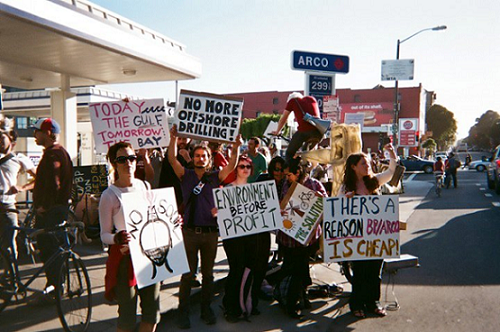
So, while I’m waiting to hear back from French, check out a slideshow (see above) of the Oct. 27 local hiring protest at UC Mission Bay. There’s been coverage of how MC Hammer talked to the protesters Oct. 26, when the Secret Service got upset about the local-hiring demonstration outside the groundbreaking that House Speaker Nancy Pelosi attended. And how Hammer came back with a “we want jobs” message.

But there has been no coverage of how filmmaker Kevin Epps (who is responsible for Straight Outta Hunters Point and Black Rock) was on hand filming the Oct. 27 protest, or how UC’s Terry Rawlins dropped by, or how Terry Anders of the Anders & Anders Foundation) took part in the local hiring protest saying, “This is the first piñata we want to crack open,” or how  Mindy Kener, who is also with Anders & Anders, added, “We want all the candy to fall out.” Or how Aboriginal Blacks United’s Alex Prince, who led the protest to demand fair and equal access to high-paying union jobs on the UC Mission Bay project near the economically depressed Third Street corridor, was accompanied by Heaven, ABU’s cuter than cute mascot dog.

“We want to make sure folks get trained and everything that’s necessary, so there is no dispute,” Prince told me. “UC has not really been helpful. They just said they want to meet with us.”

Osiris Coalition member Greg Doxey, who helped negotiate labor’s community benefits agreement with Lennar in 2008, emphasized the importance of passing local hiring legislation that has some teeth.
“We’ve found that no matter how much dollars is committed for training, it doesn’t help if developer is not committed to doing any training,” Doxey said. “That’s why we are supporting Local SF, Sup. John Avalos’ legislation. We want some teeth. All we have right now is a good faith policy. Avalos’ legislation will give us teeth to set fines to be put in place.”

Charles Hopkins, another local resident, said all the community wants is its fair share.
“It’s sustainable for San Francisco to have local hire,” Hopkins said.

A group of unemployed Asian-American members of the iron unions also participated in the ABU rally where they held up signs saying “Show us the $$$”.

An employee of Cambridge, which along with San Francisco-based DPR, is one of the prime contractors at the site, did come out to talk to the protesters.
“If folks want to put their names on the list, they can,” the Cambridge employee, who declined to give his name, said. “But the unions have their own procedures, when it comes to who they dispatch, including seniority.”

Mindy Kener of the BVHP-based Anders and Anders Foundation said she’d like to see more women hired on local construction sites.“The women want to work and get off the welfare lines,, they need to work and it’ll make a big difference in our neighborhood if we put people to work who live on the T-Third line,” Kener said. “All we need is for UC to give the green light to put our neighborhood to work.”Carlos Rodriguez, a Local 261 member who has been out of work for two years, worries that workers are being forgotten while deal making is going on.“I see how unions talk to management, they forget about the laborers,” Rodriguez said.

A man on a bicycle stopped to see what was going on.
“It’s not going to work, when they can get illegal aliens to work for $6.50 an hour,” the man said, as he resumed his peddling.

Across the street, filmmaker Kevin Epps also indicated that he thought part of the local hire problem is rooted in racism.
“Deeply rooted, institutionalized racism,” Epps said. “We are talking about power, and power doesn’t give up without another power taking it away.”
Standing nearby was UC contract compliance manager Terry Rawlins, who clarified that UC isn’t currently hiring folks to work on the construction site.
But doesn’t the university have leverage?

“Not directly,” Rawlins said, “We try to establish goals, based on cooperation with unions, and without violating any bargaining agreements.”

But UCSF Director of Design and Construction J.Stuart Eckblad told the Guardian that he thought the workers were asking for the right thing.
“I’m all for maximizing the opportunities and participation of the local community,” Eckblad said.” The question is what is realistic, and there are issues of what is really available with labor and the trades.”

Joshua Arce of the Brightline Defense Project noted that folks have been distracted by Lennar’s shipyard project from the reality that there are 6,000 jobs coming on line, a stone’s throw from the Bayview, the Mission and Market Street.
“What is equitable?” Arce asked. “A good faith approach, a market-based approach or a mandatory approach? At the end of the day, it’s about equity, and no one would dispute that this situation is inequitable. Let’s just agree that it’s not equitable [to have no local hiring plan] on a big project like this in a community that is facing such high unemployment levels.”

“There are hundreds of good-paying, union jobs on this projects while we have people in our communities that are dying for lack of work,” ABU president James Richards told me. “We have qualified union workers standing outside the job site that are ready, willing, and able to work and if the community doesn’t work, no one works.Good faith efforts have never worked and now they want us to be fooled again. So, we are going to step it up, and we don’t give a damn about the unions, either. The person who fights for these jobs, deserves these jobs. So, let’s begin to tell the truth. Many of the folks in the labor unions don’t speak English, they are not from San Francisco, and most are not even from this country. Everyone is dancing around the truth. Everyone knows the truth, but they don’t speak it.”

But ABU’s tent looked inclusive at the protest, Arce noted, as he pointed  out the power of teaming up with all marginalized groups in San Francisco.

“I could go for that,” Richards said.  “We got blacks, Mexicans, Asians, whites, everybody in ABU. It’s ain’t no racist thing.  But let us work, too. “Why do we always have to get in last? Don’t nobody give a damn about us! 

SF vote-by-mail provides early political snapshot

6

San Francisco’s Department of Elections had received 41,620 vote-by-mail returns so far That’s a fifth of the 210,993 vote-by-mail forms that were requested this year.
And while we don’t know which districts these folks voted in, we do know how they were registered: Over half were Democrats (24,153 votes), a quarter were decline-to-state (10,563 votes), and a fifth were Republican (5,565 votes).

I was surprised to learn that there are more vote-by-mail requests from folks registered with the American Independent Party (573) than with the Green Party, but not surprised to see that 200 folks were registered as Libertarians and 81 as Peace and Freedom Party.

Unfortunately, we can’t compare SF’s vote-by-mail snapshot with the statewide picture.
According to folks at the California Secretary of State’s office, votes won’t be broken down into vote-by-mail categories until after the election is certified…

FEAST: Distilled genius

1

It’s a thrilling time in Bay Area spirits. The same players who’ve made us proud in years past continue to reinvent themselves, while newcomers add flavor — literally — to the scene. In visits to four local distilleries, I came away inspired by their inventiveness and skill. And while none of the spirits I tasted use extracts or flavorings (like many of their big-brand counterparts), they do manage to fit in countless pounds of local, unexpected fruits, even natural herbs.

Even more exciting to the small batch booze enthusiast? Most of the following distilleries open their tasting rooms by schedule or appointment so the tippling public can discover for itself the motto emblazoned on the bottles of Old World Spirits: “Good stuff needs no special effects.”

ST. GEORGE’S SPIRITS

At the mighty St. George, inventiveness reigns, with a rock star attitude to boot. The distillery’s small staff experiments broadly and distillers Lance Winters and Dave Smith drive this license into genius. A behind-the-scenes journey through their labs unveiled nothing short of a wonderland apothecary: test tubes and bottles of spirits flavored with herbs, fruits, vegetables, foie gras — even beef jerky. You may (rightly) love their eaux de vie, absinthe, agave spirits, rum, vodkas, and whiskeys, but have you heard they’re toying with a carrot brandy? Clear and vegetal, it showcases the essence of the orange vegetable with a delicate hand. We can only pray they’ll bottle this one.

I also sampled St. George’s bourbon aging in charred American white oak that was a few years away from being officially bottled. Only five months young and made from the required minimum amount of corn (it needs at least 51 percent to qualify as bourbon) plus barley, crystal malt, wheat, and rye, it’s full of malty, rich promise. The same holds true of its white dog (clear-white whiskey) made from the same grains — one we could possibly see sooner on the shelves.

St. George’s next single malt whiskey, Lot 9, has been aging five to 12 years in barrels blended with 17 woods, including used American bourbon oak, sherry refills, port refills, and French oak. If you’re lucky, you soon may be able to purchase (in limited quantities) a single malt-single barrel selection that has been aged eight years in bourbon barrels then finished for four years in French oak apple brandy barrels. It is a wonder of complexity compared to their regular whiskey releases.

Only the brave attempt to down the scorching fire that is St. George’s in house habanero vodka. Grown men confessed of crying or throwing up just sipping it — only a handful of people have downed a legitimate amount and have been permitted to sign the distillery’s bottle of the burn. But my name is on that bottle — no tears, no throwing up, just a raging habanero sizzle.

2601 Monarch, Alameda. (510) 769-1601. www.stgeorgesspirits.com


CHARBAY

On a winding road above St. Helena and under peaceful Spring Mountain pines, there’s more going on than this distillery’s impeccable line of vodkas. Thirteen generations have gone into this family business, founded in 1983 and run by Miles and Susan Karakasevic, their son Marko, and his wife Jenni. The distillery’s lineage is evident to the discerning tippler who sips their port, rums, pastis, brandy, grappa, wines — even their herbaceous tequila. Charbay’s father-son distilling duo traveled to Mexico to painstakingly learn traditional tequila-making technique, which they expertly riff on to make their distinct blends.

Don’t even get me started on Release II of Charbay whiskey! 110 proof, aged six years with a pilsner beer base, it’s a stratospheric $325, but one of the most exceptional things I’ve ever tasted. From its astounding complexity, I caught everything from hops to echoes of the pine trees surrounding the distillery. I also sampled an unreleased 12-year version of Release II: higher proof, rich, a stunner.

But there’s no rest for the Karakasevics. Future whiskeys are already aging in French oak barrels — the one I’m most thirsty for, a stout whiskey, won’t be ready until 2012. If early tastes are any indication, it’s already brilliantly complex with coffee, spice, and dark chocolate notes. Made with neighboring Bear Republic’s stout in copper alembic stills, it’ll age for two years to reach 90 proof and is expected to retail around $90 — part of a younger, more affordable line of whiskeys compared with the divine but costly Release II. The bold explorer spirit that propels Charbay to Mexico to make a fine tequila shines in their future whiskeys.


TEMPUS FUGIT SPIRITS

These importers have already made waves with their Swiss-produced Gran Classico Bitter, which I hailed for reinventing classic cocktails like the Negroni. They also import some of the best French and Swiss absinthes in existence. Absinthe historians and spirits experts Peter Schaf and John Troia are the masterminds behind Tempus Fugit — and owners of one of the finest vintage absinthe poster collections in the world. It was a thrill to check out these rare pieces while tasting the history and forward-thinking vision in their bitters and liqueurs.

Tempus Fugit’s modus operandi is reinventing classic recipes and distilling them locally. Petaluma-produced Liqueur de Violettes is next up for the duo, a taste along the lines of Creme de Violette and other violet liqueurs yet somehow unlike any of them. Made with less sugar, the liqueur is a more appropriate cocktail ingredient — it’s less cloying, more purely floral and light. Each time I sample it, its bouquet blossoms like a layered wine: a sophisticated, botanical aperitif.

Tempus Fugit future project (a two-man team, after all, only has four hands) is Crème de Cacao-Chouva, a chocolate liqueur that will change chocolate cocktails the way St. George’s Firelit transformed coffee liqueur. It’s dark, lightly sweet, lush and earthy. Tasting it, I envision a resurgence of my guilty pleasure cocktail, the Grasshopper, refined and grown up with Crème de Cacao-Chouva and creme de menthe. It came alive with soda water — an elevated egg cream soda materialized in my cocktail windshield.

Keep an eye on these guys. They have more spirits and bitters as exciting as the ones I’ve listed in the works. Their dizzying knowledge of the history and intricacies of forgotten or neglected spirits, along with refined taste, suggests revelatory possibilities for the future pours of Tempus Fugit.

(707) 789-9660, www.tempusfugitspirits.com


OLD WORLD SPIRITS

Just north of San Carlos in a nondescript smattering of office buildings, is Old World Spirits, which has been in production since 2009. Davorin Kuchan, its third-generation distiller from Croatia, says family plays an irreplaceable part in the operation, as is evident from the photos lining the walls of the distillery. The whole clan is involved — Kuchan’s young daughter even drew the girl peeking out from foliage that graces Old World’s playful absinthe label. The output of both Davorin and business partner Joseph Karakas is astounding for a two-person operation, with two absinthes, a gin, a black walnut liqueur, three eaux de vie/brandies, and more liquors slotted for future release.

Old World uses custom-made German stills and local fruits like the Indian blood peach, which Davorin calls the “heirloom tomato” of stone fruit. As with the best natural fruits, the Indian blood has cracks and flaws, its lower sugar content imparting a lush understatement of taste. Though he grew the peaches himself in Croatia, in California Davorin orders in from Placerville’s Goldbud Farms. The clear blood peach eau de vie impresses with notes of ripe, juicy fruit flesh and spicy skin. I found Old World’s eaux de vies well-balanced, both the pear-inflected Poire Williams and the three- to seven-months oak-aged O’Henry Peach. I sipped a raspberry eau di vie it has yet to release: clear and lightly floral, free of the cloying sugar common in raspberry liqueurs.

Watch for Old World’s sold out dark black walnut liqueur — another batch is out in two years. Kuchan’s Blade Gin stocks the shelves of many a Bay Area bar, journeying down a nontraditional, California-inspired gin route with whispers of ginger, citrus, cilantro, lemon verbena, and black cardamom. Two kinds of absinthe, a green (verte) and clear blanche/white (referred to as Bleue, as in Switzerland), take cues from classic absinthes but resound with Davorin’s interpretation of 20 percent more herbs than what enlivens a traditional absinthe. Old World’s next release: a Cognac-style double barrel brandy aged in French and American oak and finished in Kentucky bourbon casks, which they hope to release soon. My early taste straight from the barrel yielded an already rich, spicy brandy.

Thirsty yet? Visit Davorin and Joseph during their monthly Friday Flight nights. Davorin will turn on some fine French pop tunes as both pour spirits, transforming the distillery into a warm familial party.

121 Industrial, Belmont. (650) 622-9222. www.oldworldspirits.com 

You can also find these spirits at Cask (17 Third St., SF), John Walker & Co. (175 Sutter, SF), and K&L Wine Merchants (638 Fourth St., SF).


FEAST: 6 hot C-cups

0

A funny thing happened on the way to adulthood: hot chocolate became interesting. Remembered by most Americans as the insipid, lukewarm, desiccated powder-based drink of ice rinks (often dispensed from a machine that simultaneously squirts water and dark matter into your cup), 21st century big-kid hot chocolate has heat, depth, spice, richness, variety. It is, in short, both hot and chocolate. And let’s not forget innovations in topping technology. Today’s hot chocolatiers don’t open a bag of petroleum-based white things or spray on the ReddiWip — they make their own marshmallows and whipped cream.

Hot chocolate is also one drink you never find yourself saying, “If only I hadn’t had that last (fill in cocktail) … ” Indeed, researchers at Cornell found that hot chocolate has more antioxidants per cup than red wine or tea. So as we enter hot chocolate season — our summer, which they call “autumn” on the rest of the continent — raise a cup to your health. 

BOULETTE’S LARDER

In the third season of Dexter, top cop Maria has a pair of bonding experiences with women that are consummated with two words “ganache frosting.” Ganache — that rich, delicious, thick, delicious, dense, delicious mix of chocolate and cream — is the base element of Boulette’s singular cup of Eastern European-style hot chocolate. All day long, Boulette’s chefs keep a pan of molten ganache simmering in anticipation of its HC fans. The result is hot chocolate so thick you almost need a spoon, and so satisfying you can omit that dollop of cream.

One Ferry Building # 48, SF (415) 399-1155. www.boulette’slarder.com


COCO LUXE

This pretty-in-pink Haight Street anomaly makes eight kinds of hot chocolate (including a green tea version for serious antioxidant-counters) plus a milk-free drink for all those people who can’t, won’t, or don’t swing bovine. Billed as warm chocolate pudding, the molten concoction blends dark chocolate and hot water until it’s only navigable by spoon. Like our beloved Earth, it also retains its molten core, so it can be toyed with for some time without losing any of its hot, thick mojo. Coco Luxe also has solid chocolates, gorgeous ones that look like mini wall art. And let’s face it, we all need a little solid food occasionally to add weight and depth to our c-cups.

1673 Haight SF. (415) 367-4012. www.coco-luxe.com


CHRISTOPHER ELBOW CHOCOLATES

When the abundant novelty of SF’s innovative hot chocolate scene has worn off, head to this sleek corner store for even more innovation. The boutique chocolatier, which originated in Kansas City, Mo., has all the customary spicy, dark, and milky brews you’ll find at many of our other HC providers — along with some never-before-seen variations spiked with ginger, curry, and coconut milk. Christopher Elbow also makes powdered versions of some of its best-selling drinking chocolates, which make a lovely nyah-nyah-nyah gift for friends still living in Hershey’s just-add-water-powdered-packet land.

401 Hayes, SF. (415) 355-1105. www.elbowchocolates.com


FIVE STAR TRUFFLES

You gotta love this under appreciated one-man operation, where the one man makes your cup by shaving generous helpings of his superlative block chocolate into every liquid cup. The price is right — $2.75 for 16 ounces — and the one man always offers one of his handmade truffles on the house. The one man also exhibits a sincere liberalism about how much milkfat is really necessary for hot chocolate. If you want nonfat hot chocolate (no judgments!), so be it. With base chocolate this good, you won’t miss the milkfat.

411 Divisadero, SF. (415) 552-5128, www.fivestartruffles.com

BI-RITE CREAMERY

Although most people waiting in line at Bi-Rite see only the ice cream and soft-serve, hot chocolate heads can’t help but notice, tucked as it is on the counter behind the cookies, la machine. A combination hot plate-whirligig, Bi-Rite’s single-purpose hot chocolate machine (rumored to have been developed by SF’s own Recchiuti) keeps its brew in a perpetual state of warmth and agitation. What does this mean, besides one terrific cup? No waiting! Traditionalists all the way, Bi-Rite uses only ground chocolate, cocoa, sugar, and milk. A word of warning, though: Bi-Rite only makes HC during the winter (other people’s winter) and on unusually cold or rainy days. Pray for rain.

3692 18th St., SF. (415) 626-5600. www.biritecreamery.com


CHILANGO

Most people come to this Mexican restaurant — and rightly so — for the food. But if you’re here and have postpriandial room, you’ll notice hot chocolate on Chilango’s dessert menu, right up there with flan and churros. But like any good dessert, Chilango’s hot chocolate takes time — the chefs stir each cup over the stove. Let’s face facts, all the delicious Mexican and spicy hot chocolate around town originated from … Mexican hot chocolate. Get the real deal here. And never forget that nothing brings out the flavor of churros like dipping them in hot chocolate.

5 Church, SF. (415) 552-5700. www.chilangococina.com 


FEAST: 5 sardinerias

0

When it comes to sardines, you have to think outside the earthquake shelter. On the flavor-o-meter, the tinned food of last resort (served on tarps with Saltines and stale water) bears no resemblance to its wild, fresh self. Even a humble sardine doesn’t deserve to be jammed in like a sardine, oil slicked, and left to age in the farthest reaches of the cupboard.

As several San Francisco eateries are ably proving, sardines, when treated with respect, are a tasty addition to the dining table. And healthy. And sustainable (they’re on the Monterey Bay Aquarium’s Super Green list!) Everyone from Andrew Weil to the Italian grandmother we all wish we had proclaim the virtues of the pungent silver herring. And with good reason: its tiny, 25-calorie body is packed with essential fatty acids, iron, protein, and calcium.

Let’s face it, the good people of Sardinia didn’t get their beautiful skin and convivial personalities from eating schweinebraten on spätzle. They’re all high on EFAs. Sardine EFAs.

PESCE

Pesce was one of the first and finest restaurants to introduce San Franciscans to the joys of sardine cuisine. The casual Russian Hill restaurant offers small plates of fish, pasta, and vegetables (and please, can we call it cicchetti, as they do, instead of “Italian tapas”?) patterned on the cooking of Venice. Pesce serves its sardines (all from Monterey Bay) simply — grilled, on a bed of mixed greens and pickled vegetables with a wedge of lemon. The result is tart, briny, and clean. If you’re still on the fence about sardines, Pesce is the place that will convert you to a bona fide a-fishyanado.

2227 Polk, SF. (415) 928-8025. www.pescesf.com

RAGAZZA

In Provence, shmear means aoli. They put it on meat; they put it on vegetables; they put it on fries; they put it on fish. Heck, they probably put it on ice cream. At Ragazza, the new relative of Glen Park’s Gialina Pizzeria on Divis, the chefs splat a huge dollop of it on its sardines. Apart from the aoli, Ragazza takes an Italianesque approach, stuffing them with an earthy mixture of breadcrumbs, olive oil, garlic, oregano, and onion and baking them in the restaurant’s gas-fired Wood Stone oven. The result is a crispy exterior over sardines that almost melt away on the fork. Add some mixed greens and a robust Italian red and you can practically feel your arteries unclogging. Oh, Ragazza also has pizza.

311 Divisadero, SF. (415) 255-1133. www.ragazzasf.com

NOPA

There’s locavore, 100-mile radius locavore, and there’s ultra-loca, five-mile radius locavore. While most of the city’s sardine-serving restaurants get their sardines from Monterey Bay, Nopa gets its from our very own San Francisco Bay. This is great news because our local sardines nearly went extinct in the 1950s. And — sardine cognoscenti consider the Pacific sardine as flavorful as those on the Sardinian coast (take that, overpriced cans from Norway). Speaking of flavorful, Nopa serves the little San Franciscans baked in its wood-fire oven with fingerling potatoes and frisee. The only thing missing is an order of flatbread, a gems salad, wine, and the burnt honey crème brulee.

560 Divisadero, SF. (415) 864-8643. www.nopasf.com

BARBACCO ENO TRATTORIA

You have to give Barbacco credit. Unlike most of the restaurants that have rediscovered the sardine, Barbacco doesn’t seem to be operating on the principle that sardines are an after-5 p.m.-only food. Although not exactly in the let’s-have-herrings-for-breakfast! camp, Barbacco at least believes that noon is a perfectly reasonable time to start the jonesing. The bustling, suits-heavy Financial District eatery is the creator of what may be the city’s only sardine sandwich (if this isn’t true, we’d like to know). Barbacco also breaks the don’t-get-too-weird-with-sardines taboo, pairing its sardines with a hefty piece of seared calamari. Not most people’s first choicem perhaps, but the two get along swimmingly, especially when served on an Acme torpedo roll and slathered with arugula and Barbacco’s housemade “roasted tomatoe condimento.”

220 California, SF. (415) 955-1919. www.barbaccosf.com

FERRY PLAZA SEAFOOD

When you don’t want others dictating what you can and can’t have on your sardines, duck into Ferry Plaza Seafood. This celebrated purveyor of all things aquatic sells wild, locally caught sardines (and by this we mean our our SF as well as Monterey bay) when available. “We love sardines,” said one salty staffer. “Especially the local ones. They just glisten.” They recommend bringing out the glisten by brushing with olive oil, salt, and pepper; grilling a few minutes on each side; and dressing with lemon. Call first for availability, these guys swim in and out of supply.

One Ferry Building, #11B, SF. (415) 274-2561. www.ferryplazaseafood.com 


Playlist

0

E.M.A.K.

A Synthetic History of E.M.A.K. 1982-88

(Universal Sound)

This banana-yellow retrospective comp devoted to a small collective-group of electronic musicians in Cologne, Germany offers a number of John Carpenter-like pleasures. E.M.A.K. member Kurt Mill provides two of the best. The vaguely sinister bass line, otherworldly organ, and synth stabs of “Bote des Herbstes” would fit in perfectly alongside tracks from Carpenter’s soundtrack for Christine (1983), and “Filmmusik” has a dancefloor as well as cinematic appeal. A fun document of a time when sampling was being invented and Commodore 64s were making music.


THE FRESH & ONLYS

Play It Strange

(In the Red)

A half-dozen or so listens in, this is shaping up to be the best album by SF’s Fresh & Onlys to date, thanks in part to its widescreen production (the album was recorded by Tim Green). With its Duane Eddy twang, ghost harmonies, propulsive rhythms, and dovetail lyric about bickering between dying forms of media, “Waterfall” is as terrific as it is catchy. I kinda wish the group would slow down the tempo from time to time for more variety, particularly because they seem more than capable of pulling off a big ballad. But not many groups can evoke both Morrissey and late-period Damned while sounding like themselves, and “I’m All Shook Up” offers exactly the kind of irresistible classic rock ‘n’ roll its title promises.


NICK GARRIE

The Nightmare of J B Stanislaus

(Cherry Red/Rev-Ola)

In 1970, when The Nightmare of J B Stanislas was released, Nick Garrie was young, blond, and beautiful. But one need only look to Scott Walker at the time to see that pop idol looks and ambitious melancholic talent didn’t necessarily equate to record sales. Garrie’s debut album isn’t as dramatically symphonic as Walker’s solo efforts of the time, but it features beautifully lush orchestration. His purple lyrical style — which bears some similarity to Donovan’s — and gentle choir-schooled voice meet up with strings to best effect on the plaintive “Can I Stay With You?,” a love song to a girl in his French lit class.


SMALL BLACK

New Chain

(Jagjaguwar)

Last summer I saw Small Black play after Pictureplane and before Washed Out on a chillwave triple bill of sorts that was disappointing in terms of how the sound translated to a live context. At the time, Small Black came off as the closest to an actual band, calling New Order to mind in terms of sound if not songwriting caliber. A year or so later, with a chillwave backlash in effect, Small Black’s debut album arrives amid a blogosphere’s worth of dodgy enthusiasm about the latest microgenre du jour: drag (or haunted house, or witch house). You can hear some trendy witch house elements in the production of New Chain, especially the album’s variety of woozy and wheezy speedball sounds, but Small Black is far more musical and melodic than the wretched hype-magnet Salem, and fond of vintage hi-NRG touches. A little pretty goes a long way, and at least “Search Party” and “Photojournalist” have incandescent moments.


T. REX

The Slider

(Fat Possum)

Kudos to Fat Possum for reissuing this hard-to-find 1972 T. Rex all-time great, which moves from high point to high point as quickly as Marc Bolan’s lyrics find new nicknamed characters to describe. Every once in a while — say, on “Baseball Ricochet” — Bolan’s playful language is a bit too nonsensical for its own good, but glam gems such as “Telegram Sam” and “Metal Guru” are matched by most of the album tracks. One peculiarity — how much the riff of “Chariot Choogle” resembles Led Zeppelin’s “Whole Lotta Love,” recorded two year earlier.


VARIOUS ARTISTS

Califia: The Songs of Lee Hazlewood

(Ace)

There are all kinds of treats and discoveries to be made within this grab-bag of Lee Hazlewood obscurities. Who else could write a song called “The Girl On Death Row,” not to mention deliver it with the authority of a winking Johnny Cash? (Turns out the song was for an American International Picture that went and changed its title.) Califia also includes some squalling girl-pop by Hazelwood’s early flame Suzi Jane Hokom and his later muse Ann-Margret, and a number of guitar-themed gems penned for his buddy Duane Eddy. It all closes with a song in German by the formerly “Little” Peggy March.


WEEKEND

Sports

(Slumberland)

To hear how extraordinary Weekend can be, check out “Age Class,” a rock song of instant classic status because of its furious guitar, ghost rider breakdown, and Shaun Durkan’s vocal, which builds to a crescendo that grasps extremes of love and death from the repeated line “There’s something in our blood.” Sportsis an always-promising and sometimes powerful debut album, with a peculiar track sequence — its first half is erratic and largely opaque, but it hits stride with “Age Class” and the songs that follow. The Bay Area group’s antecedents range from Joy Division to Ride to the Wedding Present but they’re already on their own path. I’m excited to hear where they go next.


D10 candidate Eric Smith on Local SF

22

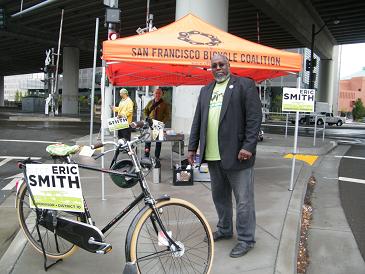
Coming into work this morning, I was greeted by the sight of D10 candidate Eric Smith standing under a San Francisco Bike Coalition tent near the railroad/freeway intersection at 16th and 7th Street in Potrero Hill.

Curious, I stopped by their tent where I was greeted by a hearty handshake from Smith, and plenty of input from the Bike Coalition’s Marc Caswell and League of Conservation Voters president Amandeep Jawa about why they support Smith.

“Eric is about integrity and sustainability,” Jawa said. “In a district like D10 that so desperately needs those things, Eric is the obvious choice.”

“D10 has a lot of really great street projects that are already approved by the MTA,” Caswell added. “So we are looking for strong leadership from Eric on the Board of Supervisors around biking, walking and transportation.”

Smith for his part chatted about Sup. John Avalos’ recently introduced Local SF legislation, which would require contractors to meet local hiring goals that will be phased in over the next few years.

Smith supports Avalos’ legislation—and thinks it needs to go even further.

“A lot of the folks who are clamoring for jobs don’t have the skills,” Smith said, noting that only John O’Connell High School of Technology has vocational training.

“Idle union workers could train folks for prime time, that’s the basic premise of the work that Raquel Pinderhughes did,” Smith said, referring to the efforts of Pinderhughes, an urban studies professor at San Francisco State, to secure truly green-collar local jobs.
“There has to be a mechanism to train folks who need skills, to get them truly trained and ready to take the union tests. That would be a sustainable approach and a huge part of the solution.”

Creative forces unite against Prop. 23

Proposition 23, bankrolled by out-of-state oil interests, threatens to reverse California’s environmental progress by suspending its landmark climate change legislation,  Assembly Bill 32. Titled the Global Warming Solutions Act, AB32 would place enforceable limits on major polluters and spur the creation of green businesses. But if voters approve Prop. 23, progress on transitioning to clean energy could be stalled for decades. The Guardian published in-depth coverage of Prop. 23 in the Oct. 13 issue.

A broad coalition of big green organizations, green-business associations, and others has formed to oppose Prop. 23 — but some of the most inspiring efforts have emerged from a coalition of environmental-justice advocates who are tapping their own creative genius to get the message out.

Hip hop artists Braelan B and Gammaray of the Los Angeles-based Beatrock Music label spearheaded the creation of a No on Prop 23 song, in collaboration with Otayo Dubb and T-Know (both of CounterParts with Braelan B and Gammaray), and artists Nomi of Power Struggle, Somos One of BRWN BFLO, and Damn Pete of Think Tank. Have a listen:

http://www.youtube.com/watch?v=QCR4QF7w7Aw

Braelan B told the Guardian that the artists were inspired by the efforts of Communities United Against Prop 23 — a coalition of environmental-justice organizations that is highlighting the impact the ballot measure would have on communities of color — as well as a voter-mobilization effort called the Clean Energy Tour, and the California Students Sustainability Coalition (CSSC), which is seeking online pledges for “no” votes against Prop. 23. Also known as Braelan Murray, he also serves as communications director at the Greenlining Institute, which is part of Communities United.

“We’re trying to use music as a catalyst,” he explained. “The youth vote and the of-color vote are really the swing votes.” To launch the music project, he said, “I just sort of got on the phone and said, California’s under attack, and I really want to send a strong message.” The idea caught on, and the YouTube video featuring the song already has more than 1,000 hits.

Meanwhile, Green for All has released a YouTube video about Prop. 23 set to the tune of the Beastie Boys’ “Sabotage,” featuring some rather hilarious oily cowboys smoking cigars and clutching fistfuls of money. Check it out:

http://www.youtube.com/watch?v=lCdTHrtU12Y

Hold onto yer Wiggs, change comin’ to Western Addy

0

Morgan Fitzgibbons isn’t thinking small when it comes to goals for his Western Addition sustainability group, the Wigg Party. “We want to make our community a leader in the transformation in resilience,” he tells me during our coffee date to discuss the group’s upcoming anti-boycott “carrotmob” at Matching Half Cafe (Sat/23). 

It’s no coincidence that his language sounds a little new age-y. The basis for Fitzgibbons’ vision for the Wigglers seems grounded in the PhD of Philosopy, Cosmology, and Consciousness he received at California Institute for Integral Studies. “We’re these sacred beings,” he tells me earnestly of his San Francisco community. “This is a sacred movement – I want people to look back in a hundred years and see that.”

Woo-woo? Well yeah, but hold your jaded mutterings until you hear what the guy’s done with his convictions in “cosmological evolution,” as he puts it. Fitzgibbons has assembled a core group of Western Addition residents who operate in four different arenas of turning the area around SF’s “Wiggle” (the well-trafficked bike route through the Panhandle and between the hills in Lower Haight and Duboce Triangle) into a leader in scaled-back, neighborhood-focused living.

Bicycling barristers: Morgan Fitzgibbons and Wigger Dave Bryson on a city-wide urban farms bike tour. Photo by Jenny Sherman

Their areas of attack, you ask? There’s a sustainable business group, who works on incentives for local outfits that find ways of greening their ways. For example, this Saturday’s carrotmob (you can read more about the nationally recognized concept here) is a concentrated effort to storm Matching Half’s doors with business in support of their pledge to buy a bike trailer to transport farmer’s market-purchased goods, switch to organic milk, and chuck the plastic wrap for reusable food containers. 

There’s also a local food group who works with local markets to freecycle unpurchased produce at the neighborhood’s Hayes Valley Farm, a “rescaling” group focusing on ways to limit commercial consumption, and the Wiggle Transformers, who are collaborating with the SF Bike Coalition on the Wiggle portion of their Connecting the City Initiative, a comprehensive plan to improve bike passage throughout San Francisco.

Like I said, comprehensive. And most of the core group – which Fitzgibbons pegs at around 20 party members – are under 30 years old. Which is neat-o, and most likely made possible by the group’s party ethos when it comes to fighting for what they believe. I mean, I say fighting but I think I really mean loving, or something equally hippie. A bunch of them live in a place called the Sunshine Castle, for god’s sakes, where they throw “shenanigans” (according to Fitzgibbons) after-parties for their events, like the recent 10/10/10 day of action that saw the Wigglers conduct a 50-60 person bike tour of the city’s urban farms and a coordinated garden plant in collaboration with Kitchen Garden SF

In the works are plans for a Bernal Bucks-esque local currency, which the group hopes will inspire Western Addition residents to patronize more heavily the wealth of small businesses along the Divisadero Corridor and surrounding areas (holler, happy hour at Bean Bag). 

Fitzgibbons says the hyper-localism of the Wigg Party is perfectly suited for the history and relative youth of the Western Addition neighborhood.

The Wiggle itself provides a apt symbol for the group. The Wiggle Transformers’ work is making bike traffic better for everybody, but also a physical passage that Fitzgibbons hopes will say “you’re stepping into a different place now” to bikers entering the Western Addition.

“San Francisco has always been a seed of revolution,” he reflects. “Of the younger neighborhoods – the Mission and Western Addition – Western Addition is a lot less nihilistic. With University of San Francisco near the area, there’s always going to be a lot of young people living out here, and that’s who our message resonates with. It’s such a new community.”

This last comment raises a red flag in my mind. The parties, the bike tours, it all sounds grand, but given that all this is coming from a twenty-something guy with a complicated mullet and a hoody, how much does the Wigg Party truly represent the Western Addition, an area that’s been wracked by recurring waves of gentrification and is subject, like everywhere else in the city these days, to ever-increasing rent prices and displacement of long time residents? Despite the free food at Hayes Valley, are we being sustainable, or are we being hipster-sustainable? 

“To be a truly successful movement, we’ll have to organize everybody,” Fitzgibbons says, who himself has lived in the neighborhood for three years. Among those that regularly attend Wigg meetings, there is but one long-time resident, he tells me, who plays an active role advising on how to better integrate with the neighborhood’s ongoing goals and activities. Past that, “there’s tacit support among the long-term residents, and we get a lot of family participation in our Wiggle events,” Fitzgibbons tells me.

But I trust that he’s learning as he goes. After all, in explaining his philosophy on activism to me, Fitzgibbons appropriates that sustainability champion himself: Socrates. “The only thing I know is I don’t know everything,” he smiles. “We don’t have to have all the t’s crossed and i’s dotted, but we can whip up excitement and hopefully inspire people to do this in their communities. Create that showcase.” And if figuring it all out looks like a party in the streets, sayeth the Wigglers, so be it. 

Wigg Party Carrotmob

Matching Half Cafe

Sat/23 3-6 p.m., free

1799 McAllister, SF

www.wiggparty.org


Epic Bush crawl, part one

5

ruggy@yelp.com

SUPER EGO Marke B.’s off getting hitched to Hunky Beau, so we asked the raffishly cute Ruggy, senior community manager at Yelp.com, to fill in as nightlife correspondent. Part two comes out Nov. 3.

What does your average Friday night look like? Does it involve catching up with old college friends over a 2007 Chateau Montelena Bordeaux blend? Maybe you’d rather snuggle up next to your boo on an EQ3 chaise longue with the remote in one hand and a Shake Weight in the other.

If you’re anything like me and my ragtag group of degenerate colleagues, nothing quite spells F-U-N like a bar crawl spanning seven different locations in less than five hours, complete with gratuitous heavy petting, nacho cheese Doritos, and warm Miller High Life. Now, what if I told you there was an unheralded bar route in the city that’s chock-full of sticky floors, intoxicated curmudgeons, and more bottom shelf liquor than you can shake a Polaroid at?

The stretch of self-reproach I reference is Bush Street between Stockton and Taylor. But beware — this challenge isn’t for the faint of heart. Being the altruist I am, I decided to document this fantastic, drunken journey on your behalf, to ensure you avoid a colossal case of bottle flu the following morning. You can thank me later.

Tunnel Top (601 Bush): From Union Square, take the stairs north at the entrance to the Stockton Tunnel (after a salacious afternoon romp at the Green Door if you want to up the ante), turn about face, and gallop roughly 10 paces west. Perfect for guest registration on a Bush Street crawl, since the T-Top offers a nifty happy hour with $3 drafts and $2.75 bottled beers as well as a slew of aging hipsters and law school dropouts (a.k.a. real estate brokers) enjoying glasses of Chimay and a hip playlist. Plenty of complicated haircuts at 6:30 p.m., but not a single raccoon tail in sight.

Chelsea Place (641 Bush): If you’re expecting skyline views of Manhattan and metrosexuals out the wazoo, you most certainly have the wrong Chelsea in mind. This is a cozy nook for true alcoholics, where one drink is too many, and 1,000 is never enough. A tiny push through the saloon-style wooden doors grants you access to the Emerald City of unglamorous horizons. One of the few bars in San Francisco that will still let you smoke inside (but the first of many we encountered this Friday night), the immediate rush of second-hand smoke is enough to give you flashbacks to the first time you choked on a Marlboro Red in your junior high bathroom stall. If you’re sensitive to environmental tobacco, you’ll just have to suck it up and enjoy those delightful, toxic fumes.

As is usually the case with these sorts of establishments, the bar was packed with nothing but men over 50 (plus us) cooing over the female Asian staff, who all looked like they were auditioning for a Britney Spears music video. Laissez-faire seems to be in full effect: cigars, graffiti, dice games, whiskey shots out of plastic bottles that just say “whiskey” on the label, cheap beer, snuff pipes, and free bags of Orville Redenbacher. ‘Nuff said.

RJ’s Sports Bar (701 Geary): Korean women behind the bar (it seems to be Bush corridor de rigueur) who speak excellent Spanish and have incredible dance moves (don’t ask me how I know, but this was the biggest surprise of all). Another bar that allows indoor smoking, despite a sticker, in plain sight, that contradicts such actions. A man came in and requested that the bartender fill up his empty Gatorade bottle with Anchor Steam for $5, and without a second thought, that call was answered.

High Tide Lounge (600 Geary): Free food ranging from kimchi, chicken wings, and sushi rolls to stuffed peppers, pad Thai, chow mein, and something that resembled an egg roll but looked more like a snuffed out cigar. I didn’t ask questions. In the midst of our revels, we happened upon a petite woman taking a little catnap in the corner of the bar. Despite sleeping on a cold linoleum floor, she looked quite peaceful. Definitely not dead, though … we checked her pulse.

Uptown Joe’s

0

paulr@sfbg.com

DINE Use of the word “downtown” in the American vernacular has always faintly troubled me. It’s a term that should be used only with respect to Manhattan, which really does have a downtown, along with a midtown and an uptown. The better phrase for the rest of us is “city center,” which is what you tend to see in European cities — signs reading “centrum” or (in German-speaking lands) “zentrum,” with a big arrow pointing you in the right direction.

Of course, in a city as hilly as San Francisco, “up” and “down” have meanings independent of any two-dimensional map. Uptown Joe’s, the successor to Café Majestic, might not be in any actual uptown anyone here would actually refer to, but the restaurant is pretty far up the southern face of Pacific Heights. So it can claim some real elevation, if not a view. It’s the “Joe” part of the name, interestingly, that’s been the occasion for some legal tussling in the past year between Uptown Joe’s and Original Joe’s, which burned down three years ago.

What’s most striking to me about the restaurant’s name is how inapposite it is. It sounds a diner-ish, Seinfeldian note — you can almost see Uncle Leo carping and gesturing in a booth over a bowl of chicken noodle soup — but the restaurant is in fact an elegant, high-ceilinged, cream-colored vault, almost fin de siècle Viennese in its quiet dignity. If you thought that the quiet restaurant was a thing of the past here, where the dominant trend in restaurant design is a noisy urban minimalism with concrete accents and patrons texting away because they can’t hear one another, you’ll find Uptown Joe’s to be a welcome surprise. It’s the sort of place that encourages that most retro of human practices, conversation.

In keeping with the vast dining room’s old world graciousness, the kitchen turns out a menu that might have been described as “continental” a generation ago. Many dishes have Italian roots — there are a number of pastas and several veal possibilities, including piccata and parmagiana — but many others seem generically occidental, such as charbroiled filet mignon or pork chops.

A nice touch on the antipasto platter ($14.95 for two) was the red-wine vinaigrette drizzled over everything. It lent a glamorous and inviting sheen. “Everything” meant ham, salami, and pepperoni, slices of white cheese, tomato quarters, black olives (pitted — thank you!), and red-onion rings atop chopped spears of romaine lettuce.

Minestrone ($5) was served in a tureen whose shape probably helped hold in heat but made access tricky. The soup itself had a sickly, gray-green color, perhaps because of a bounty of cabbage, and was dotted with kidney beans and macaroni tubes. Its flavor was dominated by the earthy bite of the stock (roasted vegetable?) and the heap of grated Parmesan our server spooned over the top, to give it a cap almost like that of French onion soup.

Fried chicken ($18.95 for a half-bird) had a crisp, brownish-bronze crust that was lovely to look at but, being gravely underseasoned, not much to taste. Some CPR administered via salt shaker did restore a faint heartbeat, and the meat itself was juicy. The real redeemer of the plate was the slew of vegetables — broccoli and cauliflower florets, zucchini, sheets of Swiss chard, chunks of baby carrot — apparently braised in stock, to judge by their flavorfulness. Steamed mixed vegetables so often taste like hospital food, but not these.

Calamari steak ($18.95) is sometimes said to be the poor man’s abalone, but it can be splendid in its own right if not overcooked to toughness. Uptown Joe’s batter-fried version was tender with just a hint of chewiness (can we say al dente in this context?) and doused with lemon butter for a fillip of decadence. On the side: a mound of rigatoni tossed with marinara sauce.

Uptown Joe’s prices strike me on the whole as not bargain-basement despite the restaurant’s folksy name. Neither are they through the roof, especially considering the ambiance, although the desserts did leaving me wondering. The chocolate mousse cake ($7.75) was light as whipped cream and not much else, while the apple pie ($7.50, with a pat of vanilla ice cream) was almost too hot to eat in spots despite a creditable crust. In a word: middling. 

UPTOWN JOE’S

Dinner: Tues.–Sun., 5–10:30 p.m.

Brunch: 9 a.m.–2 p.m.

1500 Sutter, SF

(415) 441-1280

Full bar

AE/DS/MC/V

Not noisy

Wheelchair accessible

The soul of the city

23

tredmond@sfbg.com

44th ANNIVERSARY SPECIAL We all arrived in San Francisco broke: Paulo and me in the ’73 Capri, crawling over Donner Pass with a blown valve and three cylinders firing; Tracy and Craig in the back of a VW van, behind in the payments and on the run from the repo men; Tom and Sharon hitching across the Southwest after Tom, who could bullshit with the best, talked himself out a jail cell in New Orleans. Moak showed up in a rusty Datsun with the wheels falling off. Jane and Danny came on the old hippie bus, the Green Tortoise, $69 across the country.

But we all had a friend who knew a friend where you could crash for a little while. And in the early 1980s you got food stamps the first day and it only took a couple of weeks to get a job waiting tables or canvassing or selling trinkets on the Wharf. And once you’d scraped together a couple hundred dollars — maybe two weeks’ work — you could get a place to live. My first room in a flat in the Western Addition was $120 a month.

We did art and politics and writing and music. After a while, some of us went to law school, some of us became journalists, some of us went into government and education. A few of us fled, and Paulo died in the plague (dammit). But in the end, a lot of us were — and are — San Franciscans, part of a city that welcomed us and gave us a chance.

It was a very different time to be young in San Francisco.

I’m not here to get all nostalgic, really I’m not. There were serious problems in 1982 — raging gentrification was creating clashes in the Mission and the Haight and south of Market that were more violent than anything going on today. And frankly, broke as we were, most of my friends were from middle class homes and were college educated and had a leg up. We weren’t going to starve; we didn’t have to make really ugly choices to eat.

Most of the stories in this special anniversary issue are about marginalized youth — young people trying to survive and make their way against all odds in an increasingly hostile city and a bitter, harsh economy.

But there’s an important difference about San Francisco today, something earlier generations of immigrants didn’t face. The cost of housing, always high, has so outstripped the entry-level and nonprofit wage scale that it’s almost impossible for young people to survive in this town — much less have the time to add to its artistic and creative culture.

I met the 21-year-old daughter of a college friend the other day. She’s as idealistic as we all were. She wants to move to San Francisco for the same reasons we did and you did — except maybe she won’t. Because she felt as if she had to come visit first, to use her dad’s network, see if she could line up a job and figure out if her likely earnings would cover the cost of living. When I mentioned that I’d just up and left the East Coast and headed west, planning to figure it out when I got here, she gave me a look that was part amazement and part sadness. You just can’t do that anymore.

The odds are pretty good that San Francisco won’t get her — her talent and energy will go somewhere else, somewhere that’s not so harsh on young people. I wondered, as I do every once in a while when I’m feeling halfway between an angry political writer and an old curmudgeon: would I come to San Francisco today?

Would Harvey Milk? Would Jello Biafra? Would Dave Eggers? Would you?

If you were born here, would you stay?

Are we squandering this city’s greatest resource — its ability to attract and retain creative people?

The two people who started the Bay Guardian 44 years ago were young arrivals from the Midwest. Bruce Brugmann looked around the city room at the Milwaukee Journal, where he worked as a reporter, and realized there wasn’t any job he wanted there in 10 years. With two young kids and a dream of starting a weekly newspaper in one of the world’s most exciting cities, Bruce and his wife, Jean Dibble, settled in a $130-a-month flat. The Guardian’s first office was a desk in the printers shop. When they paper could finally afford its own space, Bruce and Jean moved the staff into a $60-a-month four-room place on Ninth and Bryant streets.

From the start, the paper was a “preservationist” publication — both in terms of environmental issues like saving the bay and in the larger political sense. The San Francisco Bay Guardian was out to save San Francisco.

The city was under assault — by the developers who were making fast money tossing high-rises into downtown; the speculators making fast money flipping property, ducking taxes, and driving up rents; the unscrupulous landlords who were letting their buildings fall apart while they charged ever higher rent. For the Guardian, fighting this urbicide meant protecting San Francisco values, preserving the best of the city from what Bruce liked to call “the radicals at the Chamber of Commerce.”

For the Guardian, progress wasn’t measured in the number of new buildings constructed, but in the ability of the city to remain a place where artists and writers and community organizers and hell-raisers — and the young people who were always bringing new life to the city — could survive. We supported rent control, and growth limits, and affordable housing policies, and limits on condo conversions, and minimum-wage and sanctuary city laws — and a long list of other things that together amounted to a progressive agenda.

And in 2010, the assault on the young, the poor, the nonconformists, the immigrants, is still on, at full force. The mayor and his allies are pushing a ballot measure that would make it illegal just to sit on the sidewalk. He’s also turning the local juvenile authorities into immigration cops, breaking up families in the process. He’s cut funding for youth services, and wants to make it easier for speculators to evict tenants, take affordable rental housing (especially the flats that young people share to save money) off the market, and create high-priced condos. Virtually all of the new housing he’s pushing is for rich people. He’s shutting down parties and arresting DJs and, in effect, declaring a War on Fun.

What he’s doing — and what the downtown forces want — is the transformation of San Francisco from a welcoming city where the weird is the normal, where the young and the crazy and the brilliant and the broke can be part of (or even drivers of) the culture, to one where profit and property values are all that matter. And that’s a recipe for urban doom.

Richard Florida’s 2004 bestseller The Rise of the Creative Class shook up political thinking by pointing out that cities thrive with iconoclasts, not organization people. Everyone likes to talk about that now, even Mayor Gavin Newsom. But the missing piece, from a policy perspective, is that the creative class — particularly the young people who are going to be the next generation of the creative class — needs space to grow. And that means the most important thing a creative city can do is nurture the very people Newsom and his allies want to drive away.

If Prop. L, the “sit-lie” law, passes, if the rental flats in the Mission that have been home to several generations of young artists, writers, musicians and future civic leaders vanish in the name of condo conversions, if 85 percent of all the new housing in San Francisco is affordable only to millionaires, if the money that helps foster kids and runaways and at-risk youth dries up because this rich city won’t raise taxes, if nightlife becomes an annoyance to be stifled…then we’re in danger of losing San Francisco.

Our 44th Anniversary Issue also includes stories by Sarah Phelan on SF’s disadvantaged youth, Caitlin Donohue’s account of the Haight street kids, and Rebecca Bowe’s look at ageing out of the foster care system

Get angry and make ’em do it!

9

After crashing the country’s economy and turning the world against us, Republicans are clawing their way back into power by stoking voter anger at political and economic systems that are stacked against the common citizen, a tactic that progressives need to adopt if we ever hope to move our agenda forward.

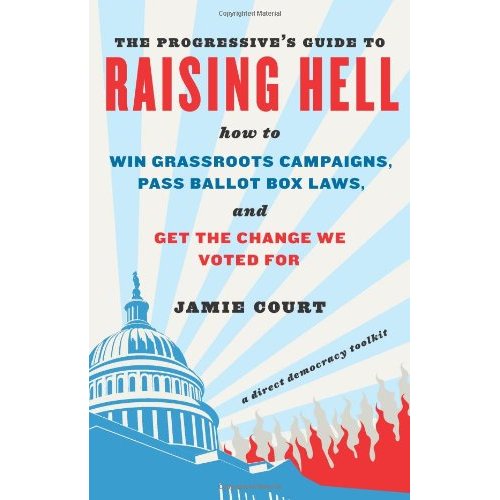
“Anger, not hope, is the fuel of political and economic change,” Jamie Court, head of Consumer Watchdog, writes in his new book, The Progressive’s Guide to Raising Hell: How to win grassroots campaigns, pass ballot box laws, and get the change we voted for (Chelsea Green Publishing, 2010).

Court writes that progressives are rightfully disappointed and disillusioned that after helping to elect President Barack Obama, he and Congressional Democrats turned around and gave Wall Street, the military-industrial complex, and the health insurance companies everything they wanted, with Obama even caving in on requiring all Americans to purchase health insurance, something he opposed as a candidate.


Yet Court said politicians never do the right thing and push progressive political change unless they’re forced to do so. He opened the book with a scene in which President Franklin Delano Roosevelt met with progressive political leaders, listened to their proposals, and then told them, “I agree. I am all for your plan. Now make me do it.”

It’s a concept that the conservative Tea Party movement understands well, and even though they may be crazy and wrongheaded in their utterly unsustainable and destabilizing policy agenda, they have effectively used anger as a political tool, and as a result, the NY Times reports they are poised to wield a disproportionate amount of political power after this election.

It’s the same story on the local level, where the only real anger in this election cycle is coming from those mad at public employee unions and their pension deals, and vagrants who sit uncivilly on sidewalks. These people will keep pushing for what they expect, but many progressives act as if it’s enough to prevent truly heinous Republicans like Meg Whitman from taking power, rather than trying to push Jerry Brown or Board of Supervisors’ progressives from day one to start empowering people over corporations.

“After the vote, power vacuums fill with familiar values, if not faces. Promises give way to fiscal realities, hope succumbs to pragmatism, and ambition concedes to inertia. The old tricks of interest group – confuse, diffuse, scare – prevail over the better angels of American nature,” Court writes, relaying a familiar electoral pattern.

Yet in this election, when the best outcome seems to be simply dodging a bullet, is there any hope for progressive political change? Isn’t the system just too broken? I asked Court these questions when he stopped by the Guardian office for a chat recently, and he retains a belief that with the right kind of tactics and agenda, progressives can still seize the political initiative and power.

http://www.youtube.com/watch?v=J3RD0YObHok

“I wrote it to reengage progressives because they are so despondent,” Court told me. “It’s about how to use anger and focus anger…Politicians don’t answer polite mobs, they only answer angry mobs and the Tea Party is the only angry mob in the room.”

Progressive have understandable doubts about the responsiveness of the current political system, but Court said, “I know if we don’t try to make it work, we’re never going to get there.”

And his book lays out the path to get there, step by step, based on some of the legislative and political successes that Consumer Watchdog and other progressives have had in recent years, such as rejecting the well-funded corporate con jobs in Propositions 16 and 17 earlier this year. Yet it involves an approach based on principle and not parties, and with being relentless in pursuing the kind of world we need.

“If you want to fight corporate power, you have to fight Democrats and Republicans,” Court said.

Specifically, Court is calling for progressives to push a California ballot measure that would establish a public health care option here, the very thing that Obama and the Democrats failed to include in their health reform package, and which will dash any hopes of it working if the people are forced to rely on unregulated insurance company products.

“The biggest thing is mandatory health insurance, which is a ticking time bomb,” Court said, one set to go off in 2014 when that aspect of Obama’s health care reform kicks in.

Corporate and political power working together seem to be a force too strong to overcome, but as Court writes, “Public opinion is the most powerful force in the world. While it can be muted, distracted, and co-opted, it cannot be controlled, except by the public.”

Appetite: WhiskyFest 2010 highlights, part one

0

“[Whisky] feels appropriately intellectual: a drink you can wrestle with, linger over, and appreciate with all its nooks and crannies.” – Victoria Moore, How to Drink

WhiskyFest turns into Whisky Week with many of the world’s great master distillers and brand ambassadors in town from the reaches of Scotland and Kentucky for a tasting event of nearly 300 whiskies. I had the privilege of meeting with seven different distillers – some met with me over coffee or lunch, others at intimate gatherings. Impressed by the wide range of approaches, styles and personalities, I could easily write an article about each one and their respective distilleries. I will share highlights, this time with Scotch master, Richard Paterson, from a Charbay whiskey dinner, and tastes from the event. Part two will be conversations with bourbon and rye distillers.

10/8 LUNCH WITH RICHARD PATERSONRichard Paterson, known as “the nose” for his impeccable nose and taste, has been Whyte & Mackay’s master blender for decades. He’s one of the world’s leading scotch experts, author of the book Goodness Nose (which I savored as “homework” all through Whisky Week). To be part of one his seminars (such as at WhiskyFest Friday night), is to be bombarded with dates, history, uproarious expertise, irreverence, drama, laughter. When one lucky member of the class samples Dalmore Sirius (which has sold at up to $60,000 a bottle!), Paterson sets off a mini-rocket filled with confetti. Fireworks. Revelation. Kind of like tasting it myself…

I had the privilege of an intimate three hour lunch over food and the Dalmore line with Paterson at Wayfare Tavern. We covered the range from 12 year to King Alexander III scotches (which I first had at Whiskies of the World). The chocolate, marzipan, tropical fruit of King Alexander III remains a Dalmore highlight for me. It’s the only single malt in the world finished in six different woods (Port, Bordeaux Cabernet Sauvignon, Marsala, Madeira, Matusalem sherry, small batch Knob Creek bourbon barrels). Dalmore’s Gran Reserva stood out more the second and third time I sampled it with spiced marmalade, crushed almonds, and sherry notes from the 60% Oloroso sherry casks it’s aged in.

Get Richard started on wood and he says, “The wood is, as far as I’m concerned, the be all, end all.” With a devotion to fine sherry casks (like Gonzales Byass), a key source of Dalmore’s elegant taste profile, they also use a generous amount of American white oak, bourbon casks from Heaven Hill and Jim Beam, which enriches the profile further.

A favorite, which I would happily sip on its own, isn’t bottled: the unaged distillate or, whisky base. It’s amazing how much you can tell of a spirit’s quality by its foundation. I was pleasantly assaulted with an array of tastes from spice and earth to lemongrass in the clear, strong distillate. I finished every drop.

Certainly a pinnacle is reached with the Sirius. The rare opportunity to sample highly aged spirits just a handful times (like two 1800s cognacs in New Orleans or Highland Park’s 40 and 42 year scotches) has opened doors of flavor I could not dream up – this scotch transported me to regions beyond. There are only 12 bottles of Sirius in existence, a ’51 vintage with a blend of Dalmore scotches from 1868, 1878, 1926, 1939. History courses through each drop, while Paterson’s expert blending skills are illuminated here. Rich chocolate earth gives way to licorice and a bonfire smokiness. I count myself lucky.

To drink with Paterson is to learn how to properly nose a glass, how to hold whisky in your mouth for maximum taste (from many seconds, up to 2-3 minutes). One learns how the dreaded phylloxera aphid (which wreaks havoc on vines) inadvertently aided whisky’s growth by making dominant cognac in short supply, creating demand for other drink (read chapter seven in Paterson’s book). But he doesn’t just talk aphids, he brings visuals: big, plastic bugs to illustrate whisky’s unexpected “friend”.

Quirky and colorful, whisky comes to life through Paterson’s interpretation. Intelligent and challenging though the whisky world can be, Paterson retains the intellect but makes it approachable, fun. A Paterson course in whisky education should be mandatory for all would-be and already-avid drinkers.

TASTES – As usual, VIP hour is the time for the rare, the old, the latest, though it was more packed than ever with a mad rush waiting at the door at opening time.  This meant less opportunity to chat with distillers and hear about what you were tasting. A lot can happen in a year and the number of whiskies I’ve had since the last WhiskyFest meant this year was a lot of re-tasting and confirming favorites. Of the whiskies I had not tried, there weren’t a slew of stand-outs.

One that jumped out was a special unlisted, under-the-table pour of George T. Stagg bourbon. Toasty, charred oak warms, rounded out by a raisin-vanilla sweetness. Out of many over-hyped whiskies in the 20-40 year range during VIP hour, Bowmore’s 25 year stood out with a robust profile of salty brine and baked pear sweetness. Glenfarclas 40 year made a statement with tobacco, elegant tannins, orange. But it was many of my usual favorites that remained at the top, including Highland Park’s 30 year, Pappy Van Winkle’s 20 and 23 year bourbons, Parker’s Heritage 27 year bourbon, and Charbay’s incomparable Release II 1999 Pilsner whiskey. It was good to see Wes and Lincoln Henderson (of Woodford Reserve fame) with their new, port barrel-finished Angel’s Envy bourbon – I sampled an early version from Wes way back in December. Also on the non-whisky tip, I was happy as ever to sip a couple Germain-Robin beauties, including their complex Varietal Grappa, and oaky Coast Road Reserve brandy.

10/6 CHARBAY SPIRITED DINNERWith a magnificent sunset from atop the Marriott’s View Lounge as our backdrop, Marko and Jenni Karakasevic of Charbay hold an intimate spirited dinner annually. With plenty of time to hang out with the Karakasevics and meet fervent food and drink lovers at the two tables, the highlight was, of course, drinking Charbay’s incomparable spirits. Starting off with refreshing Green Tea Aperitif paired with Kumamoto oysters on the half shell, we then moved to one of the stand-out white whiskeys in existence: Doubled & Twisted Light Whiskey.

We moved on to what qualifies as one of the best things I ever tasted in my life (now, and every time I taste it): Release II of Charbay Whiskey. This was the best food match of the night, paired with slow-smoked Berkshire Farms Pork Belly and a mini-tamale in Lagunitas chili mole. Surprise whiskey barrel tastings followed: the Release II, but aged 12 years instead of the 6 years of the current release. At a higher proof, it’s superb, complex, rich.

A Meyer Lemon Vodka  ice intermezzo was a refreshing palate cleanser over basil ice, imbuing tart lemon with almost absinthe-like notes. Dessert was paired with their Black Walnut liqueur. As with most Charbay spirits, it’s a stunning standard-setter in its genre.

-Subscribe to Virgina’s twice monthly newsletter, The Perfect Spot

Our Weekly Picks: October 13-19

0

WEDNESDAY 13

MUSIC

Vader

Vader’s history stretches back almost 30 years. Borrowing Darth’s moniker might not have been the world’s most original idea, but they were likely among the first to have done it. The Polish death metal stalwarts formed in 1983 in Olstzyn, deep behind the Iron Curtain. Successful demo recordings got them hooked with Earache Records, and the band has been pillaging the world’s stages ever since. Guitarist-singer Piotr Wiwczarek is the only original member left in the fold, but the band’s anthemic music is as potent as ever, mixing impossibly thick blast beats with heavy slabs of neoclassical melody. Their upcoming album Return to the Morbid Reich is a nod to the 1990 demo that made their name; this tour, they’re inviting you along for the ride. (Ben Richardson)

With Immolation, Abigail Williams, Lecherous Nocturne, and Pathology

6:30 p.m., $22

DNA Lounge

375 11th St., SF

(415) 626-1409

www.dnalounge.com


THURSDAY 14

DANCE

Lines Ballet

The story of Scheherazade and her 1,001 nights of tales to postpone her beheading by the Persian king has intrigued and captivated audiences for ages. Choreographer Alonzo King’s dance adaptation Scheherazade delves beyond the story to explore themes ranging from the symbolism of abused women to the transformative power imbued in the tales. The company of chiseled titans dance alongside tabla master Zakir Hussain’s score, which incorporates traditional Persian instrumentation into the original classical composition by Rimsky-Korsakov. The piece premiered in Monaco last December; San Franciscans can now experience King’s artistic rendering of Scheherazade’s classic tale for themselves. (Emmaly Wiederholt)

Through Oct. 24

Thurs/14, 7 p.m.; Fri.–Sat., 8 p.m.;

Sun., 5 p.m.; Oct. 20–21, 7:30 p.m., $25–$75

Yerba Buena Center for the Arts

Novellus Theater

700 Howard, SF

(415) 978-2787

www.linesballet.org


FILM

“Jim Henson and Friends: Inside the Sesame Street Vault”

Consider the Muppet. Made of foam and googly eyes, set atop spindly legs under a mop of primary-color hair, these brave figures have become our children’s teachers on a level unparalleled in the world of infotainment. We’re talking street, of course — Sesame Street, which since its 1969 debut has won 97 Emmy awards, more than any other show. Yerba Buena Center for the Art is running a series of Sesame clip collections, and today’s viewing pays homage to the contributions of the show’s early creative team, with a special furry hug to creator Jim Henson, and little-seen guest appearances from the show’s early days. (Caitlin Donohue)

7:30 p.m. (also Sat/16, 2 p.m.), $6–$8

Yerba Buena Center for the Arts

701 Mission, SF

(415) 978-2787

www.ybca.org


DANCE

“CounterPULSE’s Performing Diaspora: Sri Susilowati”

Stripping world dance of its trappings is quite the rage these days. But few have done it so radically as Indonesian classical dancer did Sri Susilowati at last year’s Performing Diaspora festival. Yet this was the same artist who, only a few months before at the Ethnic Dance Festival, had performed an exquisite, contemporary Javanese mourning dance. Now she is back, having been invited to expand on her 2009 piece. Susilowati may look one of those ethereal dance creatures whose bodies are so stylized that it’s difficult to think of them having earthly passions. Yet they do. Hint on Susilowati: food. Another Indonesian dancer, Prumsodun Ok, opens the show for her. (Rita Felciano)

Thurs/14–Sat/16, 8 p.m.; Sun/17, 3 p.m., $24

CounterPULSE

1310 Mission St./SF

(415) 626-2060

www.brownpapertickets.com


MUSIC

Fresh and Onlys and Kelley Stoltz

San Francisco-based artists the Fresh and Onlys and Kelley Stoltz will both have new albums on hand at this double CD release blowout. The new Fresh and Onlys disc, Play It Strange, showcases the band’s garage-rocky spin on 1960s pop, and was recorded for the first time outside of a DIY studio setup with Comets on Fire producer Tim Green. Stoltz releases his newest batch of throwbacks to the Beatles’ and Beach Boys’ style of sunny pop with To Dreamers. This is a perfect night to come out and support local music. (Landon Moblad)

With Carletta Sue Kay

9:30 p.m., $12

Café Du Nord

2170 Market, SF

(415) 861-5016

www.cafedunord.com


FRIDAY 15

DANCE

Dandelion Dancetheater

Known for its loud, provocative works merging dance, drama, and music, Dandelion Dancetheater turns its attention to motherhood in MamaLOVE: Seeds of Winter. The seven-women cast explores mom-related themes by diffusing fairy tales, myths, and lullabies to discover the context and relevance of the cultural archetypes and stereotypes surrounding motherhood. Each evening brings a rotating roster of guest mama-choreographers: Mary Carbonara, Tammy Cheney, Laura Elaine Ellis, Suzanne Gallo, Dana Lawton, Laura Renaud-Wilson, and Chingchi Yu. Directed by Kimiko Guthrie, the show promises to be haunting, hilarious, and not to be missed as the mom-artists address the complexities of love, loss, connection, and independence. (Wiederholt)

Though Oct. 24

Fri-Sat, 8 p.m.; Sun, 7 p.m. (also Oct. 24, 3 p.m.), $12-15

Shawl Anderson Dance Center

2704 Alcatraz, Berk.

(510) 654-5921

www.dandeliondancetheater.org


SATURDAY 16

MUSIC

Longplayer San Francisco: 1,000 Years in Three Simultaneous Acts”

As a founding member of legendary rabble-rousers the Pogues, Jem Finer helped the band deconstruct traditional Irish music and create a new musical creature out of its varied influences. Taking this willingness to experiment with different sounds and ideas and bringing it to another level, Finer composed Longplayer, a piece designed to last 1,000 years and played on instruments such as Tibetan bowl gongs. Today’s special performance will be a 1,000-minute excerpt performed by 18 musicians on a custom-built, 60-foot-wide circular “instrument” — so slow down and take some time to absorb some art that goes against today’s faster-is-better mentality. (Sean McCourt)

7 a.m.–11:40 p.m., $25–$28

Yerba Buena Center For The Arts Forum

701 Mission, SF

(415) 978-2787

www.ybca.org


EVENT

“ODC Theater’s JumpstART”

Several years and millions of bucks in the making, ODC is at last ready to unveil its new state-of-the-art “cultural campus” in the Mission in a celebratory free day of “dance, theater, performance, and community.” With more than 20 performers and organizations participating, there will be something for everybody — yes, even clogging — at this one-of-a-kind public offering. A glance at the roster includes such names as Scott Wells and Dancers, Robert Moses’ Kin, Killing My Lobster, Youth Speaks, and of course ODC/Dance, all curated by ODC Theater director Rob Bailis in collaboration with the likes of choreographer Joe Goode, world music expert Lilly Kharrazi, and playwright-director Mark Jackson. (Robert Avila)

Noon–11 p.m., free (tickets available one hour prior to each performance)

ODC Theater

3153 17th St, SF

(415) 863-9834

www.odcdance.org


DANCE

Trolley Dances

I still wish they’d call them Street Car Dances instead of Trolley Dances, because that’s what they are, but the name is a registered trademark and has its origins in San Diego (where they actually have trolleys). However, there is nothing else I would change on these annual easy-rider events. They are pure fun, and curator Kim Epifano always comes up with an intriguing lineup of entertainers. This year you’ll see, among others, dancers from Joe Goode Performance Group, Sara Shelton Mann, Ensohza Minyoshu (traditional Japanese folk music and dance), and Sunset Chinese Folk Dance Group. And do look out for a special treat on Ninth Ave for our animal friends, courtesy of brilliant maskmaker Mike Stasiuk. Boarding takes place at Duboce Park. (Felciano)

Through Sun/17

11 a.m. (runs every 45 minutes until 2:45 p.m.), free with Muni fare ($2)

Duboce at Scott, SF

(415) 226-1139

www.epiphanydance.org


EVENT

ArtSpan Open Studios

Do you ever want to stroll into other people’s homes simply from sweet curiosity? Perhaps you covet thy neighbor’s art, or maybe just appreciate light and shadow and like talking with the peeps who represent it? Do all three at the largest and oldest open studios event in the country. The self-guided art tour is ongoing through October, but this weekend doors will open in the artsy northern and eastern neighborhoods. From the nude drawings of Derriere Guard (ahem, Beavis) to the ultraviolet photos of South African succulents, it’s the best opportunity to get to know your local artists. And maybe take home a derriere or two. (Kat Renz)

Through Oct. 31

Sat.–Sun., 11 a.m.–-6 p.m., free

Bayview, Excelsior, Financial District, North Beach, Potrero, Russian Hill, SoMa,Tenderloin

(415) 861-9838

www.artspan.org


SUNDAY 17

MUSIC

BATUSIS

Featuring two of the founding architects of punk rock — guitarists Sylvain Sylvain from the New York Dolls and Cheetah Chrome from the Dead Boys — Batusis already has its street cred and headliner status firmly in place. Taking its name from the groovy dance that Adam West performed in the campy 1960s Batman TV show, the band came together and released a new self-titled EP earlier this year that’s steeped in the sounds that earned these six string slingers their place in the punk pantheon in the first place. This dynamic duo may not be so young anymore, but they’re sure as hell just as loud and snotty. (McCourt)

With Re-Volts

8 p.m., $12–$15

Thee Parkside

1600 17th St., SF

(415) 252-1330

www.theeparkside.com


MONDAY 18

MUSIC

David Bazan

Previously known for fronting the popular indie-rock project Pedro the Lion, David Bazan has returned to working under his own name. His most recent solo album, Curse Your Branches, covers some religious-themed lyrical ground that fans should be familiar with by now, like the tales of sinners losing their way and Bazan grappling with his own faith. But it also presents itself in a much more upbeat, poppier setting than we’re used to, often at odds with the reflective and sometimes dark themes of the songs. Moody, country-tinged Baltimore duo Wye Oak opens. (Moblad)

8 p.m., $15

Independent

628 Divisadero, SF

(415) 771-1421

www.theindependentsf.com 


The Guardian listings deadline is two weeks prior to our Wednesday publication date. To submit an item for consideration, please include the title of the event, a brief description of the event, date and time, venue name, street address (listing cross streets only isn’t sufficient), city, telephone number readers can call for more information, telephone number for media, and admission costs. Send information to Listings, the Guardian Building, 135 Mississippi St., SF, CA 94107; fax to (415) 487-2506; or e-mail (paste press release into e-mail body — no text attachments, please) to listings@sfbg.com. We cannot guarantee the return of photos, but enclosing an SASE helps. Digital photos may be submitted in jpeg format; the image must be at least 240 dpi and four inches by six inches in size. We regret we cannot accept listings over the phone.


Bar Agricole

1

paulr@sfbg.com

DINE At the risk of sounding like a grossly premature exit poll, I am willing to say that Bar Agricole, which opened mid-August on a rather grimy block of 11th Street, is already, and easily, the best restaurant on that block. Not that the bar (pardon my punnery) is set all that high. You might very well think that Butter, across the street, doesn’t represent serious competition. You might, if you have a long memory, remember Undici (later Eleven), a lofty, 1990s place across the street that might have been worthy of being mentioned in the same breath as Bar Agricole — but was also deafening. Bar Agricole is supremely worthy and not deafening.

The sonic detail deserves mention for several reasons, one of which is that the restaurant looks like it should be deafening. Once you gain the dining room (after a trek up a woody incline, past a semi-secluded open-air terrace), you find yourself in a onetime plumbing-supply shop remade in the sleek Euro-modern style that you might find in one of the more happening neighborhoods of Stockholm. Interior vistas consist of wood, plate glass, and seating that doesn’t look ergonomic. Noise is almost always the companion of these chic design elements.

But Bar Agricole’s tables are spaced widely enough to let the restaurant breathe, and, for a rustic-enviro touch, the long bar is made from wood recycled from an Ohio farm, if my eavesdropping ears heard the story right. The madding crowd is never far away, yet the sound is muted just enough not to become the center of attention. It’s like watching a big pot of simmering stock coming to a boil it never quite reaches. This kind of ambience management is a subtle but real triumph.

Agricole — as Francophiles might know — refers not only to agriculture but to a type of rum favored by the French. The chief impresario of the place, Thad Vogler, is a cocktail man, and the cocktail list is impressive. But you’d have a hard time finding any mixed drink to top the white, or unaged (“blanche”) armagnac, which, like my beloved grappa, is as clear as water but fruitier, more melodious, less openly fiery. Like agricole rum, it finds its way into a number of cocktails, but it’s splendid when taken straight.

Chef Brandon Jew’s cooking is also melodious and goes down easy. The theme is California eclectic, with, like a corniche, a fair number of tight twists and turns. The chopped liver on toast ($8), for instance, was warmed all the way through, which lent the dish an appealing melted-fused quality. Tomatoes with bottarga ($14) revealed itself to be a colorful salad of heirloom fruit with a heavy (and unannounced) scattering of shell beans. For seasoning, there were flecks of bottarga (salt-cured fish ovaries, a Mediterranean delicacy).

The kitchen’s eye for color is sharp. A plate of picalilli ($6), or pickled vegetables, was dominated by luminous yellow cauliflower florets and nearly as luminous quarters of red beet. Other players: halved baby carrots, long beans, skinny green peppers flushed with red as if by dawn, and whole okra pods. Altogether it looked like something Cézanne might like to paint, if he didn’t gobble it down first, which was what we did.

No menu is truly complete without at least one flop. At Bar Agricole, this would be the beguilingly named sardine roll mops ($6), which consisted of a large piece of fish wrapped pig-in-a-blanket-style around a pickle spear the color of radiator fluid, then laid on a board of flatbread and doused with crème fraîche. The overall effect was supposed to be, I guess, a variation on a Sunday-morning shmear, but the flatbread was uncooperative and difficult to eat and the fish-pickle pairing wasn’t much better, despite the cream’s attempts at reconciliation. If a dysfunctional family were turned into food, it might seem something like this.

On the other hand, we loved the tanginess of the olive-oil poached tuna ($14) mingled with fennel-root shavings and cilantro. And the corn pudding ($16) — like an eggy polenta, topped with corn kernels, okra halves, whole padrón peppers, and served in an earthenware crock — was original and sublime, while being at least plausibly vegetarian-friendly.

If you like lemon verbena cream, you’ll want dessert. A puffy cloud of it semi-salved the dryness of the blueberry shortcake ($8) — tons of blueberries, though — while another puff appeared, uncredited, with the wondrously glazed peach-pluot upside-down cake. If you had to bet the farm on one of these, you’d be wise to choose the latter. 

BAR AGRICOLE

Dinner: nightly, 6 p.m.–1 a.m.

355 11th St., SF

(415) 355-9400

www.baragricole.com

Full bar

AE/DS/MC/V

Tolerable noise

Wheelchair accessible


Big Oil’s false choice

0

rebeccab@sfbg.com

Tapping into voters’ economic insecurities at a time of record high unemployment rates, out-of-state oil interests say addressing global warming will cost California more jobs. But a broad coalition that includes environmentalists and top business groups argue that just the opposite is true, saying the economy will suffer if we suddenly kill the incentives now driving the clean energy industry, one business sector that actually grew during the recession.

Proposition 23 would indefinitely suspend Assembly Bill 32, California’s Global Warming Solutions Act. Texas oil companies are bankrolling the initiative, spending millions of dollars to convince voters that they must choose between saving jobs and saving the environment. Since jobs are more important right now, they argue, the environment will have to wait.

But the other side — which includes groups such as the Chamber of Commerce, whose top priority is always job creation — is promoting the compelling idea that the path to economic recovery lies in rising to the challenge of climate change. They argue that addressing global warming now isn’t just about avoiding more out-of-control wildfires, diminishing crop yields, prolonged intense droughts, coastal flooding, and other calamities that climate scientists say global warming will bring to California. It’s also about creating jobs now and trying to lower California’s 12.4 percent unemployment rate, the third highest nationwide.

The push to defeat Prop. 23 has brought together prominent business people, public-health advocates like the American Lung Association, big green organizations such as the Sierra Club, and environmental-justice advocates who are pushing for green jobs as a way to fend off poverty and tackle air quality problems in disadvantaged neighborhoods. If the coalition of unlikely allies is successful, Big Oil’s comfortable lock on the energy market could be thrown off balance by California’s emerging green economy.

“Ultimately, we think it’s going to be a David vs. Goliath battle, because they have very deep pockets,” said No on 23 campaign spokesperson Steve Maviglio. “The proponents are playing to the fears of those most affected by the economy.”

When voters decide on this one, it will signify a choice to proceed down one of two paths at an important crossroads. A global climate summit in Copenhagen late last year failed to produce an effective response to climate change. A push for a federal cap-and-trade system to combat global warming yielded similarly disappointing results. AB32 presents a third chance to set a new standard, and a precedent, for curbing greenhouse gas emissions. But if Prop. 23 passes, environmentalists will have struck out.

A report issued in July by the National Academy of Sciences lays bare the far-reaching implications of policy decisions around climate change. “Emissions reductions choices made today matter in determining impacts experienced not just over the next few decades,” the report notes, “but in coming centuries and millennia.”


CLOSE RACE

In 2006, Gov. Arnold Schwarzenegger signed AB32, mandating a statewide reduction of greenhouse gases to 1990 levels by the year 2020. The law is slated to go into full effect in January 2012, when a cap-and-trade system will make it more costly and burdensome for major polluters to continue burning high quantities of fossil fuels, among other strategies.

The law helps alternative energy companies and creates incentives for large and small businesses to green their operations. Prop. 23, deceptively titled the “California Jobs Initiative,” would suspend AB32 until the state’s unemployment rate drops to 5.5 percent for four consecutive quarters. A decade could pass before such a market condition is in place — in the past 40 years, it’s occurred just three times.

Speaking at the Commonwealth Club in Santa Clara in September, Schwarzenegger blasted Texas-based oil companies Tesoro Corporation and Valero Energy Corporation, which have contributed a combined $5.6 million to the Prop. 23 campaign, for trying to deceive California voters. “They are creating a shell argument that this is about saving jobs,” Schwarzenegger said. “Does anybody really believe that these companies, out of the goodness of their black oil hearts, are spending millions and millions of dollars to protect jobs? It’s not about jobs at all, ladies and gentlemen. It is about their ability to pollute and thus protect their profits.”

Prop. 23 has been unpopular even among many traditional right-wing and business interests. Oil giants Chevron and BP have remained neutral on it. Republican gubernatorial candidate Meg Whitman also renounced it, but straddled the fence by vowing to suspend AB32 for a year anyway.

According to a breakdown of campaign spending issued by opponents, oil interests contributed 97 percent of the funding for Prop. 23, while out-of-state interests were responsible for 89 percent. Kansas-based Koch Industries, run by billionaire siblings David and Charles Koch, dropped $1 million into the effort. The Koch brothers have been singled out as the financial backbone of the Tea Party.

Yet despite bipartisan opposition in Sacramento, polls suggest Prop. 23 could be a close race. A recent Los Angeles Times poll showed a dead heat among California voters, with 40 percent in favor, 38 percent opposed, and about one-fifth of likely voters undecided. The television commercials advocating Yes on 23 drive home a simple yet misleading message: “Save jobs. Stop the energy tax.” A spokesperson from the Yes on 23 campaign did not return the Guardian’s calls seeking comment.

Ironically, jobs are also the cornerstone of the No on 23 campaign’s arguments. “We have very heavy hitters who see this as a job killer,” Maviglio said. The campaign is highlighting the fact that the only economic area that has experienced growth amid the recession is green tech.

Democratic gubernatorial candidate Jerry Brown referenced green jobs as a bright hope for economic recovery in a televised debate against Whitman, and the prospect of green job creation as a way to alleviate poverty is clearly articulated in The Green Collar Economy, a widely influential book by Green for All founder Van Jones. Green for All has joined the Greenlining Institute and a host of 80 organizations statewide in a united front against Prop. 23, called Communities United Against Prop. 23, which is part of the larger opposition campaign dubbed Communities United Against the Dirty Energy Prop.

Low-income communities and communities of color will be disproportionately affected if Prop. 23 wins, said Orson Aguilar, executive director of the Greenlining Institute. “The communities we represent are feeling a double impact,” Aguilar noted. “They’re suffering from pollution,” since power plants and polluting industries tend to be sited in low-income communities, “and they’re suffering from unemployment and the economic crisis. There definitely is a double-whammy.”


LOCAL MOMENTUM

At a recent green business symposium hosted by Urban Solutions, a nonprofit that aids small businesses and seeks to create job opportunities in low-income communities, a Castro District merchant explained her decision to enter green-business certification process. “I’m dedicated to going green because, No. 1, it’s the right thing to do,” said Elaine Jennings, who runs Small Potatoes Catering & Events. “No. 2, it’s the right thing to do. And No. 3, it’s the right thing to do.”

But the moderator of the panel, a business reporter, wasn’t as interested in the moral rationale — instead, she followed up by asking whether going green was a wise financial move. Anthony Tsai, green business program manager at Urban Solutions, made the case that it is. Water bills have gone up 40 percent since 2000, Tsai said. Electricity costs have gone up 60 percent and waste disposal fees have increased 250 percent. By conserving energy and water and reducing waste, small businesses can save money during tough economic times.

Aguilar sees energy-efficiency building retrofits as an opportunity to create jobs for disadvantaged populations. In order to comply with the climate regulations under AB32, energy-efficiency retrofits would have to be completed to hit conservation targets. “We have thousands, if not millions, of buildings in California that need to be retrofitted,” he said. “A lot of people who are out of work are in the construction industry. Latinos and African Americans were hit hard when construction fell.” With energy retrofits and solar-panel installations on the agenda, AB32 could be good news for electricians, too, Aguilar said.

There are signs that AB32 is already giving green business a lift. A manufacturer of electric delivery trucks, for example, relocated from Mexico to California’s Central Valley late last year. A wind-energy company recently relocated to San Diego from Spain. The solar industry is growing faster in California, particularly in the Bay Area, than anywhere else nationwide. And in the past five years, roughly $9 billion in venture capital investment has gone into clean tech industries, with more going to California than any other state.

“Prop. 23 would essentially pull the rug out from under this explosive growth, which we’re experiencing during a recession,” Maviglio noted.

Jeanine Cotter, CEO of Luminalt, an independently owned San Francisco solar and installation company, is active in the campaign to defeat Prop. 23. “There is an entire ecosystem that feeds off of good policy,” Cotter said. If Prop. 23 passes, “we will lose the spark that we have and we will go backward.”

Despite the economic downturn, Luminalt experienced its best year in 2009 in the six-year history of the company, and if AB32 goes into effect in 2012 as planned, the demand for new solar installations will only grow. But with less than a month to go before the election, Cotter said she was alarmed by the lack of awareness about Prop. 23, even among environmentalists.

“We were at West Coast Green with No on 23 literature,” she said, referencing a widely attended green-business conference, “and I was shocked at how many people didn’t know what it is.”


RISKING IT

Small business owners and conscience-driven activists aren’t the only ones touting this theory of a new energy economy. The San Francisco Chamber of Commerce, a fiscally conservative business association that is often at odds with environmentalists and progressives, is actively campaigning against Prop. 23 — and it’s not out of any sense of moral duty.

If Prop. 23 succeeds, explained Chamber spokesperson Rob Black, it will scare off the venture capitalists. “For them, water’s like money,” he explained. “It will flow to the easiest place to invest.” Regulation like AB32 guarantees a return on investment for climate-friendly technology, he added. But if that regulatory structure is thrown into question, investors may flee overseas because investing would be too risky. “If we walk away from clean tech, the next Microsoft will be a Chinese company,” Black said.

Donnie Fowler, a political consultant who has worked for Al Gore and other top Democrats, is a senior adviser to the Clean Economy Network and a leader in the effort to defeat Prop. 23. Oil companies “went to Washington and spent hundreds of millions” lobbying against climate change regulations, Fowler pointed out. “Now they’ve opened up a second front. If California goes backward, all of those senators and Congressional representatives will say, ‘No way … I’m surely not taking a political risk. If they went backward, there’s no reason we should go forward.'”

Fowler said that for environmentalists, voting No on 23 could be seen as an affirmation of statewide efforts to address climate change in a meaningful way. “This is a real opportunity,” he said, “for Californians to stand up and say we’ve had enough. We are going to take a stand — right now.”

www.stopdirtyenergyprop.com

www.communitiesagainstprop23.com

East Bay endorsements 2010

31

BART BOARD DISTRICT 4

ROBERT RABURN

Incumbent Carole Ward Allen has been a disappointment, part of the moribund BART establishment that wastes money on pointless extensions, ignores urban cores, and can’t control its own police force. Robert Raburn, a bicycle activist with a PhD in transportation and urban geography, would be a great replacement. If he’s elected, and Bert Hill wins in San Francisco, BART will have two more progressive transit activists to join Tom Radulovich. Vote for Raburn.


BERKELEY CITY AUDITOR

ANN-MARIE HOGAN

Hogan’s running unopposed and we see no reason not to support her for another term.


BERKELEY CITY COUNCIL

DISTRICT 1

LINDA MAIO

Maio in the past has had a decent progressive track record, but lately she’s been something of a call-up vote for Mayor Tom Bates. We’re not thrilled with her more recent positions years (against raising condo conversion fees and for new high-rises downtown), but she has no strong credible opponents. Green Party Jasper Kingeter has never run for elective office before and needs more seasoning.

DISTRICT 4

JESSE ARREGUIN

Arreguin and Kriss Worthington hold down the progressive wing on the City Council. He’s pushed the Berkeley police to stop impounding the cars of undocumented immigrants and is a foe of the development-at-all costs mentality of the mayor.

DISTRICT 7

KRISS WORTHINGTON

It’s disappointing that Mayor Tom Bates and his allies are trying to get rid of Worthington, who by our estimation is the best, hardest-working, and most progressive member of the City Council. He’s been willing to stand up to the mayor when he’s wrong — and has managed to force developers to build more affordable housing. He’s against the mayor’s downtown plan, but sees a way forward to a compromise that includes all the positive elements without big high-rises. Vote for Worthington.

DISTRICT 8

STEWART JONES

Gordon Wozniak, the incumbent, is the most conservative member of the City Council and has been a bad vote on almost everything. He’s going to be tough to beat in this district, but we’re giving the nod to Jones, a teacher, Green Party member, and neighborhood activist. He lacks experience, but almost anyone would be better than Wozniak.


BERKELEY RENT BOARD

ASA DODWORTH

LISA STEPHENS

JESSE TOWNLEY

PAM WEBSTER

DAVE BLAKE

KATHERINE HARR

There’s a six-person tenant slate running, with endorsements from Worthington, Arreguin, and other progressive leaders. The members couldn’t find an easy mnemonic, so they’ve used the last letters of their last names, which, in the right order, add up to SHERRY. We’ve listed them in the order they’ll appear on the ballot.


OAKLAND CITY AUDITOR

COURTNEY RUBY

Ruby’s moved the office forward a bit, and we don’t see any argument to replace her.


OAKLAND MAYOR

1. REBECCA KAPLAN

2. JEAN QUAN

The danger in this race is Don Perata, the former state Senate president, longtime power broker, and friend of developers who has, at the very least, a checkered ethical record that led at one point to a five-year federal corruption investigation (the investigation ended with no charges filed). Perata wants to use the mayor’s office to continue his role as a regional kingpin, and he has the support of Pacific Gas and Electric Co. and the big developers. No thanks.

Two strong progressive challengers are taking him on. Our first choice is Rebecca Kaplan, an at-large City Council member who is full of great, innovative ideas for Oakland. She wants to enforce an Oakland-first hiring law, work on transit-oriented development, and encourage small businesses that can attract some of the $2 billion a year Oakland loses in retail sales from local residents who shop out of town.

Kaplan told us she thinks that if Proposition 19 passes and local government has the right to regulate legal marijuana, Oakland is perfectly situated to take advantage of the new law. By combining pot sales and possibly on-site consumption with new restaurants, bike lanes, and street-level amenities, the city could revitalize neighborhoods and bring in significant new tax revenue.

She’s a big bicycle advocate, would consider a progressive city income tax, and is a strong supporter of public power. She also has a practical sense of how to solve problems.

Jean Quan has been active in Oakland politics for decades. She served 12 years on the school board, eight on the City Council, and has the experience, skills, and vision to run the city. She’s also almost tied in the polls with Perata, despite being outspent dramatically (and being the subject of some nasty, inaccurate Perata hit pieces). She told us she wants to be a cheerleader for the public schools, to work with local businesses, expand the high school internship program, and add city wrap-around services to public schools. She’s had a long, impressive record on environmental issues (she worked with San Francisco on a plastic bag ban and wrote Oakland’s Styrofoam ban). She recognizes that much of the city’s budget problem comes from the police department and police pensions. But she’s a little less aggressive than Kaplan about raising new revenue, and while she fully supports Prop. 19 and the Oakland plan for allowing commercial marijuana operations, she is, in her own words, “relatively conservative” on how far Oakland should go to allow sales and use in the city.

Kaplan’s got more of the cutting-edge progressive vision. Quan’s got more experience and a longer track record. They’re the two choices to beat Perata and save Oakland’s future, and we’re happy that ranked-choice voting allows us to endorse them both.


OAKLAND CITY COUNCIL

DISTRICT 2

JENNIFER PAE

Patricia Kernighan is among the most conservative votes on the council. She’s also representing a wealthy, conservative hills district and will be hard to beat. We’re endorsing Jennifer Pae, community outreach director for the East Bay Voter Education Consortium. She has the backing of progressives like Supervisor Keith Carson and Berkeley City Council Member Kriss Worthington (as well as the Alameda County Green Party). She’s a long shot, but better than the incumbent.

DISTRICT 4

DANIEL SWAFFORD

The front-runners in this race are probably Libby Schaaf, a former aide to Ignacio de la Fuente; Melanie Shelby, a small business owner; and Daniel Swafford, a business consultant. Schaaf is too close to her old boss. We liked Shelby, but she’s awfully vague on solutions to Oakland’s problems — and she voted for Prop. 8. She now says her position on same-sex marriage is “evolving,” and she supports equal rights for all couples. But that’s an awfully big issue to have taken an awfully wrong stand on just two years ago.

This leaves Swafford, a neighborhood activist who grew up in Oakland and was City Council Member Jean Quan’s appointee to the Neighborhood Crime Prevention Council and is a strong advocate of community policing. He gets the nod.

DISTRICT 6

JOSE DORADO

Conventional wisdom says Desley Brooks is almost certain to get reelected to this seat. Her only competition comes from Nancy Sidebotham, whose platform is all cops all the time, and Jose Dorado, a bookkeeper with little political experience. Brooks is a fierce advocate for her district and has been tough on banks and good on pushing local hiring, but has too many ethical problems to merit our endorsement. She has never denied that she kept her boyfriend’s daughter on as a $5,000-a-month aide while the young woman was a full-time student at Syracuse University in New York. When San Francisco Chronicle columnist Chip Johnson challenged some of her ethical lapses, she sued him for libel (the case was dismissed).

Dorado is a neighborhood activist who is running a grassroots campaign and, while he needs more experience, he’s raising good issues (like public financing of elections). And unlike Sidebotham, he’s supporting the revenue measures on the ballot.


East Bay Ballot Measures

BERKELEY MEASURE H

SCHOOL FACILITIES TAX

YES

The East Bay cities have done a much better job than San Francisco at using parcel taxes — a poor substitute for property taxes but still a relatively progressive form of revenue — to support schools and other public services. Measure H would continue an existing tax on residential and commercial buildings — 6.3 cents per square foot on residences and 9.4 cents on businesses — to pay for maintenance on public school buildings. Vote yes.


BERKELEY MEASURE I

SCHOOL BONDS

YES

Measure I is a $210 million bond act to expand and upgrade the public schools. Vote yes.


BERKELEY MEASURE T

CANNABIS PERMITS

YES

Measure T is on the ballot as part of Berkeley’s effort to implement Prop. 19, the statewide pot-legalization measure. Berkeley and Oakland are both ahead of San Francisco in planning for legal marijuana. Prop. T would allow six medical cannabis clinics with cultivation permits, but restrict future industrial pot uses to industrial districts. Vote yes.


OAKLAND MEASURE L

SCHOOL TAX

YES

Another parcel tax for schools, this one $195 a year for 10 years, essentially to offset state cuts. There’s an exemption for low-income taxpayers. Vote yes.


OAKLAND MEASURE V

CANNABIS TAXES

YES

If Oakland goes ahead with its plans to allow large-scale cultivation and passes this tax hike on pot sales (to $50 per $1,000 of gross revenue for medical pot and $100 per $1,000 for recreational pot) the city could take in as much as $30 million a year — almost enough to offset the budget deficit. Vote yes.


OAKLAND MEASURE W

PHONE LINE TAX

YES

Another creative — if imperfect — way to raise some revenue, Measure W puts a modest $1.99 a month tax on phone lines to raise money for the general fund. Vote yes.


OAKLAND MEASURE X

POLICE PARCEL TAX

NO

We typically support any reasonable tax on property to pay for public services, but we can’t back this one. Measure X would impose a fairly high ($360 a year) parcel tax on single-family homes — entirely to pay for cops. The police union has been intractable, refusing to give back any of its generous pension benefits to help solve the budget deficit. We can’t see raising taxes for that department alone when so much of Oakland is hurting for money.


OAKLAND MEASURE BB

POLICE FUNDING

YES

Measure BB would allow Oakland to continue collecting violence-prevention money under a previous ballot measure even if the police department falls below a mandated staffing level. It would give the City Council more flexibility in addressing public safety. Vote yes.


>>VIEW OUR COMPLETE ENDORSEMENTS FOR THE 2010 ELECTION

On the cheap listings

0

On the Cheap listings are compiled by Paula Connelly. Submit items for the listings at listings@sfbg.com.

WEDNESDAY 13

“How to Cook Like a Scientist” Bazaar Café, 5927 California, SF; (415) 831-5620. 7pm, free. Meet Jeff Potter, author of Cooking for Geeks, who combines cooking with Mythbusters to create a food-as-science, cooking experience for those who like to know how things work.

THURSDAY 14

Sparring with Beatnik Ghosts Beat Museum, 540 Broadway, SF; (415) 399-9626. 7pm, free. This ongoing multimedia poetry series returns to the Beat Museum with host Daniel Yaryan and featuring readings by David Meltzer, San Francisco Poet & Beat Icon, Ellyn Maybe & Her Band, Steve Arntson, Jerry Ferraz, Martin Hickle, Richard Loranger, Whitman McGowan, Ginger Murray, Julie Rogers, Margery Snyder, and Chris Vannoy.

FRIDAY 15

Mark I. Chester Benefit Mark I. Chester Studio, 1229 Folsom, SF; (415) 621-6294. 7pm; free, donations encouraged. Celebrate Mark I. Chester’s 60th birthday while helping to raise funds for a new book. View Chester’s current exhibit, “Doing Time on Folsom St: a 30 year retrospective of fine art gay radical sex photography” and enjoy readings and performances by Carol Queen, Tom Orr, Seth Eisen and Jesse Hewitt and more. Sponsored by the Center for Sex and Culture.

“Writing Our Word, Speaking Our Minds, Telling Out Stories” San Francisco Main Library, Latino/Hispanic Community Meeting Room, 100 Larkin, SF; (415) 557-4400. 6pm, free. Featuring readings by and about lesbians with disabilities with Elana Dykewomon, Barbara Ruth, Teya Schaffer, Dominika Bednarska, and the Mothertongue Feminist Theater Collective.

SATURDAY 16

“The Classics” 1:AM Gallery, 1000 Howard, SF; (415) 861-5089. 5:30pm, free. Attend the closing reception for this exhibit, curated by Nate1, that brings together original vintage work from the artists that put San Francisco on the graffiti map and defined Bay Area graffiti style. Guest speaker Spie will give an informative tour of the exhibit on Bay Area graffiti.

Halloween Bazaar Modern Eden Gallery, 403 Francisco, SF; (415) 420-2898. 7pm, free. End your day of touring open studios in North Beach, as part of SF Open Studios’ weekend two, at this spooky-themed trunk show featuring wares by local artists JuJu by Sarah, Marya Zoya Taxidermy Courture, Blackbird Bazaar, Squid Rose designs, and more plus pumpkin carving and painting, music, drinks, and treats. Costumes encouraged.

Potrero Hill Festival 20th street between Missouri and Wisconsin, SF; www.potrerofestival.com. 11am-4pm, free. Soak up the best of Potrero Hill at this street fair with a view featuring local merchants and residents selling their wares, arts, and crafts, two stages with live music, food from Potrero Hill restaurateurs, information booths, and kids activities including a bouncy house, petting zoo, pony rides, and performances.

Taste of Fillmore Fillmore between Post and Jackson, SF; www.tasteoffillmore.com. 1pm-6pm; free admission, $20 for wrist band. Buy a wrist band and enjoy food and wine tastings at boutiques and restaurants, or just walk around and check out some live jazz, walk through home décor scenes installed on the sidewalks, watch cooking demonstrations, fashion shows, and more.

Trolley Dances Meet at the Harvey Milk Center for Recreational Arts at Duboce Park, Scott at Duboce, SF; www.epiphanydance.org. 11am-2:45pm, tours leave every 45 min.; free with MUNI fare. Get out of the theater and into the streets with traveling performances by Epiphany Productions SDT, Joe Goode Performance Group, Sara Shelton Mann, and more as they take you from Duboce Park to the SF Botanical Garden in Golden Gate Park for several unique performance locations.

“The Wild Kitchen” Omnivore Books on Food, 3885a Cesar Chavez, SF; (415) 282-4712. 3pm, free. Hear authors Connie Green and Sara P. Scott discuss their book, The Wild Kitchen: Seasonal Foraged Foods and Recipes, and the increasing popularity of wild delicacies. Green sells her gathered goods across the country to Napa Valley’s finest chefs, so before you buy that expensive meal, consider the free buffet that is California.

Writers with Drinks Make Out Room, 3225 22nd St., SF; (415) 647-2888. 7:30pm, $5-$10 sliding scale. This installment of the monthly spoken word variety show features Marcia Clark, Ken Scholes, Jamie Freveletti, Stephen O’Connor, Kirya Traber and Daniel Allen Cox. Proceeds to benefit the Center for Sex and Culture.

Yerba Buena Fair Yerba Buena Gardens, Mission between 3rd and 4th St., SF; (415) 644-0728. 11am-3pm, free. Celebrate the Yerba Buena neighborhood at the fair featuring live music, dancing, acrobats, neighborhood food vendors, street food vendors, art and history walks, prizes and giveaways, kids activities, and more.

SUNDAY 17

Capsule Hayes Valley Park, Octavia at Hayes, SF; www.capsulesf.com. 11am-6pm, free. Enjoy this fashion design open air market and community party where you can browse locally made clothing, upcycled jewelry and accessories, steampunk-inspired wear, graphic tees, kids clothes, and designer housewares while listening to live music by members of the Jazz Mafia, Brent Bishop and the Part Poopers, and more.

Fiesta on the Hill Cortland between Bocana and Folsom, SF; (415) 206-2140. 10am-6pm, free. Join your friends and neighbors for the 22nd annual Fiesta to benefit the Bernal Heights Neighborhood center, an organization that works to maintain the ethnic, cultural, and economic diversity of Bernal Heights. This alcohol free family event to feature a petting zoo, pony rides, a pumpkin patch, non-profit booths, live music, food vendors and more.


Trans action time

0

le.chicken.farmer@gmail.com

CHEAP EATS And then there was Kiz’s wedding, and I was honored to be a part of her get-ready team. Although: I had nightmares about branding her face with a curling iron or, worse, catching her hair on fire.

She must have had the same nightmares, because when the big day finally came, she barely let me touch her hair. This was probably for the best. She looked awesome and entirely unmismanaged by her get-ready team, and anyway the ceremony was held outside, at the lighthouse in Santa Cruz, in a wind so strong that the four women holding the chuppah damn near missed the vows for parasailing to Reno. Kiz’s naturally fantastic hair was pretty much horizontal the whole time anyway. It stayed fantastic, but horizontally fantastic.

Wind notwithstanding, both she and her dude went ahead and said they did, and that was it, give or take a lot of other things.

For example: three times in the past 30 days I have heard straight newlyweds include, as a part of their ceremony, shout-outs to California gays. Meaning straight people with a conscience are feeling increasingly weird about their participation in a bigoted and discriminatory system that excludes many of their close friends.

Cool!

Cooler yet will be when straight couples start to stop getting married, in protest. Proving beyond a shadow of a doubt that in fact antiquated marriage laws undermine marriage, whereas queerness might could rejuvenate it.

Coolest of all will be when I get married. Won’t that be a hoot? Won’t that change the cynical way everyone feels (or at least I feel) about the eroding, outmoded institution?

For the moment, of course, there is nothing preventing trans people in most states from being married — legally (as long as no nasty dispute ever arises inspiring someone to prove for the sake of financial gain or custody or some such that their marriage was never really valid — which, really, how often does anything like that happen in this neat, clean world we live in?)!

My more immediate concern is one no amount of legislation can ever redress, undress, or even approach: how to get on the menu. As it is, there are not a lot of guys willing to be seen in broad daylight with girls like me, let alone take us home to mother. Let alone stand on some windy precipice and say they do. I’m working on this. I have ideas. Big ‘uns.

But speaking of going behind a rock and yipping like a coyote, there’s Los Coyotes right there near the 16th Street BART station. I’ve walked by it a zillion times without it ever registering, until Earl Butter was kind enough to notice the picture in the window of meat and melted cheese all over a bed of french fries.

He did what you’re supposed to do: he told me, so at the next imaginable mealtime we were there, sharing a big plate of carne asada fries and a pretty small bowl of birria.

The birria was greasy and bare-bones. In this case, that means we found a lot of weird pieces of bone without any meat on them. But there was a lot of meat too. And nothing else. Oh well … that’s birria, as the saying goes. Just goat and goodness, and you gotta love that.

Well, I do. Points for serving it any old day of the week. And points for adding carne asada fries to the Mission District burrito scene. It wasn’t the best carne asada. Or the best cheese, or the best fries, for that matter. But somehow when you added them all up, it was a damn great thing to be eating.

And we each drank a lemonade and each ate some green chips with a variety of salsas, including a mango one. And one that was just strips of pickled nopales and onions, speaking (still) of coyotes.

The atmosphere is really good, too. A lot of cool, colorful tile work, and color and brightness in general, plus Mexican soap operas on TV.

New favorite taqueria? Next time I’ll get a burrito, and weigh back in.

Taqueria Los Coyotes

Mon.–Thu. 9:30 a.m.–10 p.m.;

Fri.–Sat. 9 a.m.–3 a.m.

3036 16th St., SF

(415) 861-3708

MC,V

Beer and wine