Government

The war on suburbs? Huh?

10

Joel Kotkin, the author and urban scholar, was on KQED’s Forum this morning talking about what he called “the war on the suburbs.” He’s got a new book out, called The Next Hundred Million: America in 2050, and he’s arguing, among other things, that the election of Scott Brown in Massachusetts signals that the Democratic Party and progressives in America have lost touch with the suburbs and are being mean to the poor suburbanites.


He talked, for example, about Tracy, California, and noted that a suburbanite living in Tracy doesn’t want to pay taxes because he doesn’t see what he’s getting for his money. Kotkin sugggestes that the state ought to go back to the Pat Brown era, and focus on spending money on infrastructure, instead of on “state employee pensions.”


Never mind that when Pat Brown was governor, the population of California was less than half what it is today — and the state was far less diverse, had far fewer immigrants, far fewer residents whose primary language is not English and, frankly, was a lot more tolerant of poverty.


That was also before the passage of Prop. 13, so the state didn’t have to spend money on schools and local government; local property taxes covered those things.


In fact, I think what’s going on is just the opposite of what Kotkin is talking about. (He, by the way, says that suburbs are going to be more and more sustainable as more jobs relocate and we start using natural gas in our cars.) I realize that suburban voters can easily shift to the Republican party if the Democrats aren’t careful, but I also think that what’s happening in the United States today is not a war on suburbs but a war on cities.


The state and federal governments have systematically defunded urban America for more than 30 years now, and we’re paying the price. The hypothetical suburbanite in Tracy may think he’s not getting his money’s worth, but the truth is just the opposite; the suburbs — typically, not always but typically — have better-funded schools, better maintained streets, better sewage systems, less crime … and less of an income gap among residents.


Cities are, and will remain, America’s future, and we ignore that at our peril.  


Tuareg rebel rock, the Tinariwen way

0

The awesome group of hypnotic rockers known as Tinariwen — from “Kel Tinariwen,” or “desert boys” — dress in traditional costume for performances, have one of the most amazing political and social backstories of any band, and write songs that seek to convey the sorrows, longing, and occasional joys of living in exile. (They’ll be performing Sun/21 at the Palace of Fine Arts as part of the SF Jazz Festival.) That backstory story begins:

In 1963, an uprising of the nomadic Tuareg people began in the Adrar des Iforas desert region against the new independent government of Mali. During the revolt, a mason and trader by the name of Alhabib Ag Sidi was executed for aiding the rebels. The army then destroyed his herd of camels, cattle, and goats while his four-year old son Ibrahim watched. Ibrahim and his family travelled into exile in Algeria with his family and their one remaining cow.

It goes on to incorporate a number of rebellions, several diasoporas, Muammar Gaddafi, and founding member Ibrahim Ag Alhabib’s love for American blues. 

But there’s something even more compelling going on about Tinariwen than any gonzo global-folk narrative, however remarkable, suggests.

These savvy Saharans, whose numbers encompass two generations of musicians (lIbrahim Ag Alhabib will make a rare appearance at the SF date), have a multi-tentacled Web presence that just won’t quit, enthusiastically embrace the psychedelic indie-god status bestowed upon them by Pitchfork and the Uncut Music Awards, and aren’t afraid to defy exotic expectations by dressing down a bit.

Those are the kinds of things that can still shock Westerners when it comes to “world music” — we like our Putumayo heroes to stay in their Starbucks-ready niche — but Tinariwen plays it cool, walking a deliciously fine line between cutting-edge musicality and encapsulation of the past. (Perhaps the pitch-perfect duality of their image is what’s prevented their releases from being subjected to dance remixes — a requirement for almost every other “world musician” to increase Western accessibility. Or maybe we’re just finally getting over all that.)

Enough image analysis — what about the music? We’re dealing with several bluesy electric guitars (no bass), some lovely and innovative percussion, a single woman’s voice that can sometimes sound like several, and a throaty main vocal by Ibrahim Ag Alhabib that chant-croons and sometimes soars. Grooves are shuffled into slowly, and then amped up to dynamic effect, although noisy catharsis is saved only for key moments. It’s a heady, jam-band-sounding combination that often enraptures, and even without the backstory trappings (live, the group sometimes greets audiences with “Welcome to the desert”) still tells a story rarely heard, one of a new, unselfconscious fusion of global styles.

For the group’s fourth album, Imidiwan: Companions (World Village, 2009), Tinariwen took a break from all the world travelling and got back to its roots, recording in its hometown of Tessalit in Mali and attempting to channel the desert blues on a more intimate scale. The result is communal and virtuosic, and although a bit less visceral than past releases, it exudes a sense of relief — to be home, to have seen the world, perhaps to have reaped so much acclaim. Opener “Imidiwan Afrik Temdam” is a chuffing sway that Neil Young could easily cover, and shoulder-shaker “Tahult In” is an earworm that could serve as an authentic riposte to Sade’s desert-chic “Soldier of Love.” “Tenhert” is a handclapping dose of Tuareg rap.  

Tinariwen’s vast-yet-intimate sound translates equally well to venues as huge as the Glastonbury Festival and as cozy(ish) as Yoshi’s and the Palace of Fine Arts, where they’ve performed several times before. Whether you’re there to expand your sonic horizons, take some technical notes from riff-pros, or just whirl about to great tunes, you’ll probably be surprised at how many parts of you the music takes hold of and transports, no anthropology course required.

Tinariwen

Sun/21, 7 p.m., $25-$65

Palace of Fine Arts Theater

3301 Lyon, SF.

www.palaceoffinearts.org

Click here for more details and tickets

Check out Kandia Crazy Horse’s article for the Guardian on Tinariwen

Marijuana really is medicine

5

Just in time for Medical Marijuana Week comes word that the first U.S. clinical trials on marijuana in more than 20 years has found that it is effective in relieving pain and treating multiple sclerosis and other ailments, potentially opening the way for the federal government to revisit its longstanding claim that pot has no medicinal value.

Most significant are findings that even low levels of marijuana offer significant pain relief with minimal health consequences. Unfortunately, the San Francisco Chronicle also reports that the UC San Diego researchers have almost run out of funding before all its planned tests have been completed.

San Francisco has long been a leader in the medical marijuana movement, both with its proactive approach to regulating cannabis clubs, and with the sponsorship of efforts to decriminalize pot by state legislators Tom Ammiano and Mark Leno. Oakland’s pot-cultivation school Oaksterdam University also bankrolled an initiative aimed for the November ballot that would legalize weed for even recreational use.

Rambling Jerry Brown speech raises fear among Dems

22

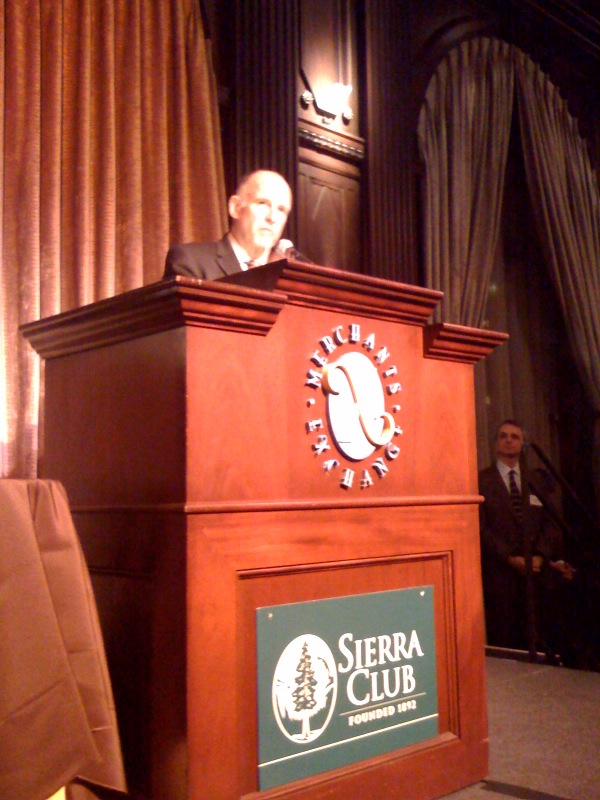
If Jerry Brown’s keynote speech last night to a gala environmentalist dinner is any indication, the Democratic Party faces an uphill battle to win this year’s governor’s race. The rambling, alternately vague and academic, and often pointless address did little to inspire or excite a large, sympathetic crowd that was loaded with top Democrats. In fact, some party luminaries were openly aghast at the poor performance, with one making this succinct (if off-the-record) assessment: “We’re fucked.”

Brown has never been a dynamic speaker, but the unscripted, half-hour speech – given at the Sierra Club San Francisco Bay Chapter’s David Brower Dinner in San Francisco, a $250 per head affair that drew top Bay Area Democrats – illustrates the danger of letting a primary be decided by legend and money rather than political persuasion.

Brown’s fundraising prowess and strong poll numbers chased Gavin Newsom and other potential rivals out of the Democratic Party gubernatorial primary, even though Brown hasn’t really outlined his political vision for California, given many extended speeches since being discussed as a candidate for governor, or even officially declared his candidacy (he and others have until March 12 to do so).

“This thing is really daunting,” Brown said of the governor’s race toward the end of the speech, seemingly unsure that he was ready to run, but saying he would make an announcement sometime in the next couple weeks.

Brown started his speech by telling the crowd that he didn’t know what he was going to talk about, so when he arrived (late) for the speech, he asked San Francisco Democratic Party chair Aaron Peskin what he should say, and Peskin told him to talk about how there were more salmon in the streams and better overall environmental health back when Brown was governor in the ‘70s.

But rather than taking that advice and giving a forceful call to strengthen environmental regulation or conjure up California’s better days, Brown meandered around and mused on that and other topics, feeding fears that the 71-year-old candidate might come off as a nostalgic, slightly senile former-Governor Moonbeam rather than an effective agent of needed change.

“During that period when I was governor, I’m not going to call it the golden age because some people think I’m in the golden age, so I don’t want to get people confused. That’s why I don’t want to talk about way back then, because there are a number of people I can see weren’t even born then, so it gets a little embarrassing and I like to pretend it was just yesterday. But in that period, California created almost twice as many jobs as the nation did. We created jobs at about 24 percent over eight years and the nation grew jobs at 13 percent, so almost twice as much. And then Deukmejian did pretty good, he had about the same, maybe half a percent more,” Brown rambled, ticking off statistics, hedging his point by noting how little governors can really do to create jobs, before working up to a decent line that was flatly delivered: “It was a time when the environment got its biggest boost, as far as public policy.”

Nobody applauded, so he continued. “I was thinking tonight, I was trying to figure out that if I did announce, what the hell would I say? And so I decided to go back and read my first announcement, January 24, 1974. I was 35 then, it was another time, I’m now a little older than that. But I talked about clean air, I talked about the energy crisis and getting new sources of energy. I talked about statewide land use planning” – that last item drawing some applause – “and I talked about jobs. And I was thinking, wow, we still got a jobs problem, we got an energy problem, we have a land use problem that feeds into the energy problem, and while the air is cleaner in many respects, it’s not clean enough, or it isn’t healthy enough.”

On substance, Brown had his moments. But even on the need for better statewide land use planning, he went off on a tangent, saying he didn’t even know what that meant when he filled out a Sierra Club questionnaire back in the ‘70s, and he’s not sure how to accomplish it now. 

“You have to make it easier to live closer to where you work,” Brown said in what of his few lines of the night that drew applause, although he didn’t begin to explain how he might achieve this goal. And on a controversial subject that is easily attacked by the right – big government wants more control over private property – Brown’s lackadaisical discussion of the issue was disconcerting.

He even rankled a few Sierra Club members by vaguely criticizing East Bay growth controls designed to reduce sprawl, which the Attorney General’s Office is seeking to overturn: “Pleasanton wants to create 50,000 jobs, but they have a housing cap – for all I know, Sierra Club probably supported that housing cap, so I want to just rub your nose in the housing cap for just a minute – the trouble with the housing cap is they want to create all these jobs.”

Brown tried to argue that allowing more housing in Pleasanton is a strategy for combating global warming because there are jobs there and it would reduce commutes, but he’s going to need to be more on his game than he is right now to win that argument. Instead, we get his fairly dismissive summary of this important issue: “Land use is a big deal, it’s difficult, lots to do on that.”

Against businesswoman Meg Whitman, the Republican gubernatorial primary frontrunner, there is real potential in Brown’s basic belief that markets need to be regulated and that running the government isn’t just like running a business. And somehow, Brown will need to find a way to better distill and deliver that message to counter the right’s pro-business sound bites. 

“There are people saying business knows best,” Brown said, meandering off about companies and widgets for a minute before continuing his point. “But when you look at what we really have to deal with, it’s not just about economics and the market. It’s also about ecology and morality, and morality is about customs, it’s about traditions, it’s about our deepest patterns of how we all relate to one another and that can’t just be assimilated into market incentives. The market assumes honesty, you meet your promises, and also assumes there’s a framework, because things can just run off the cliff and that’s exactly what’s happening. As you add more people, you have more cars, and when you have more cars, they burn fossil fuel and what’s happening in California is you have cars reproducing faster than people…That’s the real challenge here, that we’re trying to get the idea out that we’re trying to save the future.”

Loose in Obamalandia: Dead man walking through CA

1

I am on a low-rent book tour with my new cult classic El Monstruo – Dread & Redemption In Mexico City.  For the next three months, I will stumble across this land from sea to stinking sea probing the underbelly of Obama’s America.  The findings will be posted on these pages.

1.
First stop was the near north woods, Humboldt County USA, to wheedle the medicos into granting me a clean bill of health before I hit the road.  A year ago this February, my doctor who has poked and probed my old broken cadaver for nearly 20 years, pronounced me dead. “Liver Cancer” he parsed gravely — but I am still alive and kicking. The class enemy be warned: I am not dead yet.

Humboldt had just been wracked by a 6.5 earthquake that cut a swath through Oldtown Eureka’s antique shops but was not quite Haiti.  Nonetheless, the shake-up worked its usual bad mojo and implanted the seeds of fear and loathing in every soul.  On January 22nd, three separate police agencies shut down the north end of Arcata and evacuated hundreds of residents after a scruffy hippie-type tried to fed ex a suspicious package to Berkeley that leaked, according to the clerk at Kinko’s, “a chemical odor.” The offending package was blown up in a back alley.

The next day, the local rag commonly known as the Times-Slander conceded in front-page headlines that the “bomb” was “Actually a brake light.” The paranoia was symptomatic.  A commercial jetliner to Kentucky was forced down by air force jet fighters after an orthodox Jewish kid pulled out his Tefillin to pray and, in a spasm of extreme religious irony, the panicked stewardess took him for some Muslim terrorist and confused the leather straps and little prayer boxes with bomb components that would blow the paying customers to kingdom come. 

Nine years ago, just weeks after 9/11, I got on the road to preach Zapatismo to the North Americanos. Flags flew from every home, a sort of Talisman against the terrorist devils.  It was not a healthy ambiance for spreading revolution and resistance in Amerikkka.  Prospects for the Monster Tour suddenly turned ominous.

2.  
San Francisco’s Mission District gets shabbier day by day as the “Great Recession” (read “Depression”) gallops towards economic Armageddon. The Miracle Mile is lined with empty storefronts and 98 Cent Stores (marked down from 99.)  The homeless sleep under their shopping carts – the Mission Local reports that 40 homeless families are living in 16th Street Single Room Occupancy hotels, twice the occupancy rate of a year ago.  In this Sanctuary City for the rich, the yuppie Mayor, who now aspires to be nothing more than a yuppie clerk in a yuppie wine store, is deporting undocumented teenagers convicted of no crime and the class divide seems more brutal than ever.

We posted up on Market Street in front of the Commonwealth Club, where torture enabler John Yoo was hawking his new book to the City’s elite. Financial District drones en route back to the ‘burbs asked Yoo Who?
I checked my watch.  It was time to hit the rails.

3.
The Central Valley was the first stop on the Monster Tour, the most deadly stretch of soil in North American California. The water plumes are all poisoned by agrochemicals and when one turns on the faucet on the west side of the valley, deformed babies pop out. 

This cesspool of chemical effluvia is populated by perhaps the most ethnically diverse crazyquilt in all of Obama’s America.  Anglo bigwigs and white Armenians rule the roost but down below Mixteco is spoken on the radio, communicating the bad news to the out-of-work Oaxacans who once toiled in the fields and packing sheds. The humongous Hmung community is up in arms over the FBI’s harassment of their spiritual leader, General Vang Pau who authorities accuse of conspiring to overthrow the doctrinaire Communist government of Laos.  Unemployed Palestinians and Pakistanis, Filipinos, white trash, and historic enclaves of Blacks, survive in this fulminating chemical stew by their wits. On every street corner, the down-at-the-heels don shabby green gowns and sagging Styrofoam Statue-of-Liberty crowns, holding up cardboard arrows pointing towards strip mall tax return scammers.

I stepped out into Catherine Campbell’s unplanted garden.  Police helicopters hovered overhead, searching out suspected gangbangers. Catherine is a veteran prison rights attorney who pays particular attention to what goes on behind bars at Corcoran and Chowchilla, two of the cruelest his & her lock-ups in the state. Recently, she put her know-how to work defending anarchists who had been beaten into the sidewalk by the Fresno pigs for handing out graphic leaflets depicting the torture of elephants during Ringling Brothers Barnum & Bailey’s annual visit to town, and she and a gaggle of advocates have been trying to keep the cops off a venerable homeless encampment. Now the City Council is seeking to felonize panhandling on Fresno’s median strips as a “safety hazard.” 

The Fresno gendarmes are particularly keen on persecuting young adults of color for alleged gang activities. An article in the Morning Bee reported on the so-called “Bulldog Gang” (the bulldog is the icon of the Fresno State football team so gang colors are readily available) whose members were accused of smashing windows and barking at the cops over on the decrepit west side.  Catherine says the bulldogs’ bark is more a growl.  Such are the sounds of hope in the second year of Obama’s lacerated reign.

Sam Stoker is a child of the Valley. One night last summer, I bought him a beer at the counter of my beloved Café La Blanca back home in the Centro Historico of Mexico City.  Sam, an acculturated Chicano, had journeyed to Mexico to connect with his family in Tamaulipas and bum around, sniffing out what was left of the 2006 rebellion in Oaxaca. When he went home to Winton near Merced, he spoke enough Spanish to delight his grandma. 

Sam is also an anarchist and a budding journalist who has been up to his neck in the struggle for justice for Oscar Grant in Oakland. Now he had come to the Valley to spread the virus of anarchism. Rebellion in the fields could bring California to its knees, he confided. I was only too happy to help out. 

Anarchism has a beachhead in Fresno at the Infoshop where 70 folks turned out to hear me preach revolution. Not all of the fellow workers were young punks. One gentleman in attendance told me he had been an organizer for Cuauhtemoc Cardenas’s foiled presidential campaign in 1988 in Sinaloa and fled Mexico when dozens of his companeros were gunned down by the mal gobierno.  He was still here, still waiting for the revolution. 

Over in Merced, I shouted out my poems in a long dark bar, The Partisan, on Superbowl Sunday.  A “digital remix” of Guy Debord’s “Society of The Spectacle ” preceded my incendiary words.  Maybe Sam Stoker’s pipedream is not as wacky as it sounds.

4.
So it was goodbye to Fresno and hello to Hollywood. I accessed the City of Fallen Angels over the Grapevine with a pit stop at Bob Hope airport and a bar in Santa Monica to watch the Lakers kick booty. My gigs were spread out all over this pedestrian unfriendly megalopolis and the signs of hard times were hard to avoid.  On the beach in Santa Monica, excruciatingly gaunt old men jogged against debilitating cancers and aging hippies scoured the sands with metal detectors for spare change.

Even out in ritzy Claremont, where I hobnobbed with a Palestinian restaurateur about the Nakba, Obama’s America seemed out of synch.  A student at Pomona College where I spieled had just been handcuffed and interrogated by transit security cops in Philadelphia for transporting 200 Arabic-English flashcards across state lines and some cad ripped off my cane down at the train station.  The Inland Empire, which abuts this restricted enclave, has the fifth highest mortgage foreclosure rates in the nation.

In Hollywood, where I spent a night on my favorite sofa, the glitz was tempered by the homeless with all their possessions piled high atop their shopping carts around the new Metro station. How many of them were out-of-work script doctors is not yet known.

Down in South Central, where anger is endemic, I spoke to a handful of Afro-Americans at Eso Won, an admirable black bookstore. The proprietor sported a prototypical pork pie hat and told me that when he sees the Mexicans coming over the border, he sees black people. We talked animatedly for a few hours about Afro-Mexicans who were a third of the population of Mexico at liberation from Spain in 1810 and whose history has been pointedly ignored south of the border.             

L.A. is gearing up for the trial of killer BART cop Johannes Mehserle, Oscar Grant’s assassin, that will be held in the same court house where O.J. won acquittal — if it’s not moved to Ensenada, taking a cue from outgoing Governor Terminator’s plan to build California prisons south of the border.

Students at Cal State L.A., the most Chicano university in Califas, honed in attentively when I expounded on the revolution that is brewing down south.  1810-1910-2010 – every hundred years on the tenth year of the century, Mexico explodes in violent social upheaval and even the Wall Street Journal is worried (see WSJ front pager January 15th.)

Looking at Obamalandia through the eyes of students is a useful handle for understanding what comes next.  Classes and services have been bludgeoned by budget cuts and the profs at Cal State furlough one day a week to make ends meet in this damaged economy that the President lies is booming again because only a half a million workers filed first time unemployment claims last month.  The light at the end of the tunnel is a bullet train pointed straight at the heart of the people.

All of this bad news is healthy for fightback.  The day I hit El Ley, Muslim students at U.C.-Irvine rose up against the Israeli consul ten times in a single speech until the university president sicced the campus cops on them. The next day a whole coast away, kids at Georgetown shouted down General Betrayus. Throw in the cutbacks and the furloughs and the hopelessness and it could be a long, hot spring semester and it won’t be just because of global warming.  I will do my best to fan the flames as I stumble front one campus to the next in the coming months.

On my last days in the late great golden state, I slept in a yoga house under a colorful banner of Ganesh, the elephant guy who gets fat eating others’ obstacles.  Lets hope he’s on my side. A year ago I was sentenced to death and although I’m still kicking, the future is laced with sharpened punji sticks, not the least of which incubates on my liver.

Talking truth to power is still the best medicine to beat back Nuestra Senora Santa Muerte.

John Ross and The Monstruo will be visiting the Narciso Martinez Cultural Center in the heart of the Rio Grande Valley Sat. Feb 20th. The Monster Tour plays El Paso, Las Cruces, and Albuquerque from Feb. 21st-28th.  Consult the Nation Books page for details or write johnross@igc.org

The people vs. corporate power

2

steve@sfbg.com

The June 8 election is shaping up to be one that pits the people against powerful business interests, a contest that will demonstrate either that money still rules or that growing public opposition to corporate con-jobs has finally taken root.

On the state level, the five ballot measures include two brazen money-making schemes and two experiments in election reform, along with primary races that are still in flux. In San Francisco, where the ballot measures still have a few more weeks to shake out, the election will feature two rarely contested judges races, recession relief for renters, City Hall fiscal reforms, and a fight for control of the local Democratic Party.

So far, only four local measures have qualified for the San Francisco ballot, all placed there by members of the Board of Supervisors. Progressives qualified the Renters Economic Relief package (which limits rent increases during recessions and sets conditions for landlords passing costs to tenants), an initiative establishing community policing standards, and one affirming city support for making Transbay Terminal the northern high-speed rail terminus. Supervisors were unanimous in supporting a charter amendment governing the Film Commission.

But the board is still hashing out changes to the more controversial ballot proposals, a debate that will continue at its Feb. 23 meeting. They include an overhaul of how the city funds its pension program and an effort to remove Muni salary minimums from the city charter, both by Sup. Sean Elsbernd; a $652 million seismic safety bond proposed by Mayor Gavin Newsom; and a Sup. John Avalos charter amendment that would prevent the mayor from unilaterally defunding certain budget expenditures. All measures must be approved by March 5.

Also still forming up in the coming weeks are primary races for legislative seats (although no incumbents appear to be facing strong challenges) and all eight state constitutional offices, including governor (where Attorney General Jerry Brown seems poised to easily win the Democratic nomination), lieutenant governor, and attorney general (which District Attorney Kamala Harris is running for).

Candidates have until March 12 to declare themselves for statewide and legislative offices, as well as for the San Francisco Democratic County Central Committee, which could play a key role in this fall’s Board of Supervisors elections. Two years ago, a slate of progressives led by Aaron Peskin and Chris Daly launched a surprise attack to wrest control of the board away from the moderates who have long controlled it. Newsom, U.S. Sen. Dianne Feinstein, and their downtown allies are expected to try hard to regain control over their party’s purse-strings and endorsements.


JUDGING THE JUDGES

Another struggle from two years ago is also being replayed. In 2008, then-Sup. Gerardo Sandoval successfully challenged Superior Court Judge Thomas Mellon, arguing the Republican-appointed jurist was too conservative (and the entire court is not diverse enough) for San Francisco. This time the target is Judge Richard Ulmer, a conservative appointed by Gov. Arnold Schwarzenegger. Ulmer is being challenged by two LGBT attorneys, Daniel Dean and Michael Nava, the latter endorsed by Sen. Mark Leno, Assembly Member Tom Ammiano, and Peskin, who chairs the Democratic Party and could be helpful in the race. “He’s a brilliant guy,” Leno said of Nava.

Leno also has endorsed deputy public defender Linda Colfax, a Latina lesbian, in a four-way race to replace retiring Judge Wallace Douglass. The other candidates are Harry Dorfman, Roderick McLeod, and Robert Retana. If no candidate wins a majority of votes, the top two finishers square off in a runoff election in November.

Leno said he’s thrilled to see a diverse crowd of attorneys seeking judgeships: “This governor has failed horribly in his appointments, not only with the LGBT community, but with communities of color as well.”


TWO COMPANIES TRY TO BUY CALIF.

The struggle between the broad public interest and the wealthy power brokers that have long-dominated California politics is most apparent in the state propositions, which have been certified and for which ballot arguments are now being collected by the California Secretary of State’s Office.

Two of those ballot measures, Propositions 16 and 17, are blatantly self-serving efforts by a pair of powerful corporations to increase their profitability, however deceptively and with overwhelming amounts of campaign cash they are presented.

Prop. 16, sponsored by Pacific Gas & Electric Co., would require local governments to get two-thirds of voters to approve creation of energy programs like Clean Power SF, San Francisco’s plan for developing renewable energy projects and selling that power directly to citizens.

As we’ve reported (“Battle royale,” Jan. 13, and “PG&E attack mailer puts City Hall on defensive,” Dec. 22, 2009), PG&E placed the measure on the ballot to avoid having to repeatedly crush public power initiatives around the state with multimillion dollar campaigns, even though political leaders like Leno and Sup. Ross Mirkarimi say the measure violates the state’s community choice aggregation law. That law allows local governments to create energy programs and prohibits PG&E from interfering with those efforts.

“The unregulated behavior of corporate arrogance is killing our democracy. Prop. 17, sponsored by Mercury Insurance, would let companies increase car insurance premiums for a variety of reasons that are now prohibited by the 1988 measure Prop. 103. Mercury has continuously attacked that landmark law, using lawsuits, huge political contributions, sponsored legislation, and, according to newly released documents from the California Department of Insurance (see “The malevolence of Mercury Insurance,” Feb. 10, Guardian Politics blog), blatantly illegal activity in setting premiums and excluding certain customers, such as artists, bartenders, and members of the military.

“The Mercury initiative is even more pernicious than what it was doing before,” Harvey Rosenfield, who wrote Prop. 103 and works for Consumer Watchdog, told the Guardian. “Under Mercury’s initiative, if you’ve never had prior insurance, you can be surcharged for the first time. Then they’ve thrown in some other tricks and traps.”

Mercury spokesperson Coby King told us the company has been unfairly maligned and denies that the measure is simply about boosting its profits: “Prop. 103 is the law of the land, but to the extent there are improvements that can be made that are pro-business and pro-consumer, Mercury has not been shy about acting in the public interest.”

Yet few public interest groups or public officials believe the claims being made by Mercury or PG&E, and they hope that the public won’t be fooled.

“These are measures designed to give a financial advantage to a specific industry or company,” U.S. Rep. John Garamendi, who battled Mercury as California’s first insurance commissioner, told us. He strongly opposes both measures, but did say, “Money talks. It always has, particularly in propositions.”

Yet Leno said he’s a bit more hopeful: “Californians have been savvy in the past, and I do believe they’ll be able to see through the tens of millions of dollars in misleading ads.”

“To me, it’s a classic case study of what’s going on with the initiative process in California and with politics in general,” said Derek Cressman, western regional director of California Common Cause. “There are two initiatives literally sponsored by corporations to push very narrow interests.”

Yet Cressman said recent events could help. There’s been a big public outcry in recent weeks over the U.S. Supreme Court’s decision to allow unlimited corporate spending to influence elections, the role that insurance companies played in sinking federal health care reform efforts, and the way businesses interests are hindering efforts to deal with global warming.

“It makes people aware of the overwhelming role corporations are playing in dictating government policy,” Cressman said.


TAKE OUT THE MONEY

A pair of election reform measures might help lessen the influence of money and political parties. Prop. 14 is an open primaries measure that Sen. Abel Maldonado (R-Santa Maria) got placed on the ballot as a condition for breaking last year’s budget stalemate. It would create a single primary ballot and send the top two finishers to the general election, regardless of party.

Prop. 15, the California Fair Elections Act, takes direct aim at the corrupting influence of money in elections, creating a pilot public finance program in the secretary of state races for 2014 and 2018. The measure, which has broad support from politicians and good government groups in the Bay Area, is modeled on successful programs in Maine and Arizona.

“No elected official should be in the fundraising game the way they are now,” campaign chair Trent Lange told us. “This is a way to change how we fund elections.”

The idea is to create a model that will eventually be used for other offices. The campaign fund would be generated by a $350 annual fee on lobbyists, lobbying firms, and lobbyist employers. Currently lobbyists pay just $12.50 per year to register, which Lange said, “just shows the power of lobbyists in Sacramento.” *


Alerts

0

alerts@sfbg.com

WEDNESDAY, FEB. 17

Same Sex Marriage Forum

Attend this forum about which entity — the state or the federal government — should define marriage. The forum is led by a panel of experts from human rights organizations and SF Chief Deputy City Attorney Therese Stewart, attorney for the plaintiffs in the current court case challenging Proposition 8.

6:30 p.m., $20

Commonwealth Club

595 Market, 2nd floor, SF

(415) 597-6700


THURSDAY, FEB. 18

Human rights in Chiapas

Hear Victor Hugo López of Fray Bartolomé de las Casas Human Rights Center (Frayba) in San Cristóbal de las Casas, Chiapas, Mexico. López will discuss human rights and the prospects for political change in the region in 2010. Frayba produces human rights reports, defends cases in court, and supports indigenous communities under attack.

7:30 p.m., $5–$10 sliding scale

La Peña Cultural Center

3105 Shattuck, Berk.

(510 654-9587


Wreaking HavoQ

Attend this organizing meeting for Pride at Work, a queer advocacy group fighting for economic and social justice. The meeting will cover upcoming projects such as fighting the gentrification of queer neighborhoods, resisting attacks on immigrants, and advocating for queer workers’ rights.

6 p.m., free

UNITE HERE Local 2

209 Golden Gate, SF

sfprideatwork.org


SUNDAY, FEB. 21

Day of Remembrance

Commemorate the anniversary of Executive Order 9066, which led to the incarceration of 120,000 people of Japanese descent in 1942 during World War II. The event features a speech by California Assembly Member Warren Furutani (D-Long Beach), a performance by Purple Moon Dance Project, a candle- lighting ceremony, and more. Reception to follow at the Japanese Cultural and Community Center at 1840 Sutter.

2 p.m., free

Kabuki Sundance Cinema

1881 Post, SF

(415) 921-5007


Peacemas

Celebrate the anniversary of the peace symbol with an evening of entertainment that includes inspirational clown Wavy Gravy, Selma Vincent as Mrs. T. Bill Banks of the National Association of Rich People, jazz violinist India Cooke, and more.

7 p.m., free

Redwood Gardens

2950 Derby, Berk.

(510) 845-5481


Yeasayers for Prop. 15

Hear Sen. Mark Leno (D-SF), Assembly Member Tom Ammiano (D-SF), and other luminaries speak in support of the California Fair Elections Act, or Proposition 15, on the upcoming June ballot. The act would pilot a voluntary system of public financing for secretary of state campaigns, which means elected officials can spend less time fund-raising and more time solving California’s problems.

1 p.m., free

San Francisco Main Library

100 Larkin, SF

(415) 648-6740


TUESDAY, FEB. 23


A chicken in every yard

Learn the logistics of raising chickens in a urban environment at this workshop with Alexis Koefoed. The Soul Food Farm maven will answer questions about the legality of raising chickens in your area, what it costs to raise chickens, where to buy chicks, and more. There are two sessions.

6 p.m. and 7:30 p.m., $20

18 Reasons

593 Guerrero, SF email info@18reasons.org 2 Mail items for Alerts to the Guardian Building, 135 Mississippi St., SF, CA 94107; fax to (415) 255-8762; or e-mail alert@sfbg.com. Please include a contact telephone number. Items must be received at least one week prior to the publication date.

Film Listings

0

Film listings are edited by Cheryl Eddy. Reviewers are Kimberly Chun, Michelle Devereaux, Max Goldberg, Dennis Harvey, Johnny Ray Huston, Erik Morse, Louis Peitzman, Lynn Rapoport, Ben Richardson, and Matt Sussman. The film intern is Peter Galvin. For rep house showtimes, see Rep Clock. For first-run showtimes, see Movie Guide. Due to the Presidents’ Day holiday, theater information was incomplete at presstime.

SF INDIEFEST

The 12th San Francisco Independent Film Festival runs through Thurs/18 at the Roxie, 3117 16th St, SF. For tickets (most shows $11), visit www.sfindie.com. All times pm.

WED/17

Down Terrace 7:15. No One Knows About Persian Cats 7:15. Godspeed 9:30. At the Foot of a Tree 9:30.

THURS/18

Art of the Steal 7:15. TBA 7:15. Harmony and Me 9:30. TBA 9:30.

OPENING

*”Academy Award-Nominated Short Films: Animated” Just because it’s animation doesn’t mean it’s just for kids. Like the live-action Oscar-nominated shorts, this year’s animated selections have got range, from the traditionally child-friendly to downright vulgar. Skewing heavily towards CG fare, the shorts vary from a Looney Tunes-style chase for an elderly woman’s soul (The Lady and the Reaper) to the Wallace and Gromit BBC special, A Matter of Loaf and Death. Most entertaining by far is Logorama, an action-packed tale set in a world populated by familiar trademarked logos. Any film that casts the Michelin man as a garbage-mouthed cop on the case of a renegade Ronald McDonald deserves to win all the awards in the universe. (1:35) (Galvin)

*”Academy Award-Nominated Short Films: Live Action” Aren’t you tired of wondering what all the fuss is about when the Academy awards their Oscar for Best Short? In an effort to give audiences a chance to play along, Shorts International is screening these less-seen works together. Though one or two of the five nominated films threaten to adhere to the Academy’s penchant for either heartbreaking or heartwarming, the majority are surprisingly oddball picks. Perhaps most odd of all is Denmark/U.S. submission The New Tenants. Feeling a tad forced but no less funny for it, Tenants draws on celebrities like Vincent D’Onofrio and comedian Kevin Corrigan to bring life to this surreal adaptation by Anders Thomas Jensen (2006’s After the Wedding). My pick would be Sweden’s gloriously goofy Instead of Abracadabra, which stars a stay-at-home slacker as he puts on a magic show for his father’s birthday. Obviously, some selections are going to be better than others, but hey, they’re shorts. If you don’t like one, just wait 10 minutes and you’ll find yourself somewhere completely different. (1:35) (Galvin)

Happy Tears Director Mitchell Litchenstein’s second film attempts to take on the family drama in the similarly warped fashion that his 2007 debut Teeth skewed the horror genre. Unfortunately, his thoroughly offbeat humor continues to be as much of a liability as a asset, and in this case the genre isn’t nearly as forgiving of clumsiness. Parker Posey and Demi Moore star as dissimilar sisters tasked with caring for their father (Rip Torn), who copes with dementia. Posey turns in an animated performance that will gain her as many fans as it alienates, and Moore is surprisingly pleasant as a level-headed hippie. As the sisters interrogate a flighty nurse (Ellen Barkin) who may or may not be a crackhead, clean up after their incontinent father, and dig for treasure in the backyard, the restless plot creates a murky mix of flat humor, heavy drama and conventional whimsy. A subplot involving Posey’s fiance dealing with the legacy of his famous father’s art feels tangential, but may provide the most autobiographical moments in the film. The title Happy Tears is borrowed from the record-selling 1964 painting and Lichtenstein is indeed the son of legendary pop-art painter Roy Lichtenstein. Perhaps these moments function as catharsis for the director, but until he learns to better manage his impulses, his films will continue to be more awkward than funny. (1:36) (Galvin)

*Leonard Cohen: Live at the Isle of Wight 1970 The dawn of the Me Decade saw the largest-ever music festival to that date —albeit one that was such a logistical, fiscal and hygenic disaster that it basically killed the development of similar events for years. This was the height of “music should be free” sentiments in the counterculture, with the result that many among the estimated six to eight hundred thousand attendees who overwhelmed this small U.K. island showed up without tickets, refused to pay, and protested in ways that included tearing down barrier walls and setting fires. It was a bummer, man. But after five days of starry acts often jeered by an antsy crowd — including everyone from Joni, Hendrix, Dylan, Sly Stone, the Who and the Doors to such odd bedfellows as Miles Davis, Tiny Tim, Voices of East Harlem, Supertramp, and Gilberto Gil — Canadian troubador Cohen appeared at 4 a.m. on a Monday to offer balm. Like director Murray Lerner’s 1995 Message to Love, about the festival as a whole, this footage has been shelved for decades, but it bounces right back from the dead — albeit soothingly. Cohen seems blissed out, pupils like black marbles, his between-song musings are as poetical as those fascinating lyrics, and his voice is suppler than the rasp it would soon become. Kris Kristofferson, Judy Collins, Joan Baez, and bandmate Bob Johnson offer reflections 40 years later. But the main attraction is obviously Cohen, who is magnetic even if an hour of (almost) nothing but ballads reveals how stylistically monotone his songwriting could be. (1:04) Roxie. (Harvey)

*The Most Dangerous Man in America: Daniel Ellsberg and the Pentagon

Papers For many, Daniel Ellsberg is a hero — a savior of American First Amendment rights and one of the most outspoken opponents of the Vietnam war. But as this documentary (recently nominated for an Academy Award) shows, it’s never an an easy decision to take on the U.S. government. Ellsberg himself narrates the film and details his sleepless nights leading up to the leak of the Pentagon Papers — the top secret government study on the Vietnam war — to the public. Though there are few new developments in understanding the particulars of the war or the impact the release of the Papers had on ending the conflict, the film allows audiences to experience the famous case from Ellsberg’s point of view, adding a fresh and poignantly human element to the events; it’s a political documentary that plays more like a character drama. Whether you were there when it happened or new to the story, there is something to be appreciated from this tale of a man who fell out of love with his country and decided to do something about it. (1:34) (Galvin)

My Son, My Son, What Have Ye Done See “Ain’t No Iguana.” (1:31) Castro.

*North Face You’ll never think of outerwear the same way again — and in fact you might be reaching for your fleece and shivering through the more harrowing climbing scenes of this riveting historical adventure based on a true tale. Even those who consider themselves less than avid fans of outdoor survival drama will find their eyes frozen, if you will, on the screen when it comes to this retelling/re-envisioning of this story, legendary among mountaineers, of climbers, urged on by Nazi propaganda, to tackle the last “Alpine problem.” At issue: the unclimbed north face of Switzerland’s Eiger, a highly dangerous and unpredictable zone aptly nicknamed “Murder Wall.” Two working-class friends, Toni Kurz (Benno Fürmann of 2008’s Jerichow) and Andi Hinterstoisser (Florian Lukas) — here portrayed as climbing fiends driven to reach summits rather than fight for the Nazis — take the challenge. There to document their achievement, or certain death, is childhood friend and Kurz’s onetime sweetheart Luise (Johanna Wokalek, memorable in 2008’s The Baader Meinhof Complex), eager to make her name as a photojournalist while fending off the advances of an editor (Ulrich Tukur) seeking to craft a narrative that positions the contestants as model Aryans. But the climb — and the Eiger, looming like a mythical ogre — is the main attraction here. Filmmaker Philipp Stölzl brings home the sheer heart-pumping exhilaration and terror associated with the sport — and this specific, legendarily tragic climb — by shooting in the mountains with his actors and crew, and the result goes a way in redeeming an adventure long-tainted by its fascist associations. (2:01) Smith Rafael. (Chun)

Shutter Island Martin Scorsese directs Leonardo DiCaprio in this adaptation of the Dennis Lehane novel, a mystery set at an isolated 1950s insane asylum. (2:18)

ONGOING

Avatar James Cameron’s Avatar takes place on planet Pandora, where human capitalists are prospecting for precious unobtainium, hampered only by the toxic atmosphere and a profusion of unfriendly wildlife, including the Na’vi, a nine-foot tall race of poorly disguised cliches. When Jake Sully (Sam Worthington), a paraplegic ex-marine, arrives on the planet, he is recruited into the “Avatar” program, which enables him to cybernetically link with a part-human, part-Na’vi body and go traipsing through Pandora’s psychedelic underbrush. Initially designed for botanical research, these avatars become the only means of diplomatic contact with the bright-blue natives, who live smack on top of all the bling. The special effects are revolutionary, but the story that ensues blends hollow “noble savage” dreck with events borrowed from Dances With Wolves (1990) and FernGully: The Last Rainforest (1992). When Sully falls in love with a Na’vi princess and undergoes a spirit journey so he can be inducted into the tribe and fight the evil miners, all I could think of was Kevin Bacon getting his belly sliced in The Air Up There (1994). (2:42) (Richardson)

The Blind Side When the New York Times Magazine published Michael Lewis’ article “The Ballad of Big Mike” — which he expanded into the 2006 book The Blind Side: Evolution of a Game — nobody could have predicated the cultural windfall it would spawn. Lewis told the incredible story of Michael Oher — a 6’4, 350-pound 16-year-old, who grew up functionally parentless, splitting time between friends’ couches and the streets of one of Memphis’ poorest neighborhoods. As a sophomore with a 0.4 GPA, Oher serendipitously hitched a ride with a friend’s father to a ritzy private school across town and embarked on an unbelievable journey that led him into a upper-class, white family; the Dean’s List at Ole Miss; and, finally, the NFL. The film itself effectively focuses on Oher’s indomitable spirit and big heart, and the fearless devotion of Leigh Anne Tuohy, the matriarch of the family who adopted him (masterfully played by Sandra Bullock). While the movie will delight and touch moviegoers, its greatest success is that it will likely spur its viewers on to read Lewis’ brilliant book. (2:06) (Daniel Alvarez)

The Book of Eli The Book of Eli isn’t likely to win many prizes, but it could eventually be up for a lifetime achievement award in the “most sentimental movie to ever feature multiple decapitations by machete” category. Denzel Washington plays the titular hero, displaying scant charisma as a post-apocalyptic drifter with a beatific personality and talent for dismemberment. Eli squares off against an evil but urbane kleptocrat named Carnegie (Gary Oldman phoning in a familiar “loathsome reptile” performance). Convinced that possession of Eli’s book will place humanity’s few survivors in his thrall, Carnegie will do anything to get it, even pimping out the daughter (Mila Kunis, utterly unconvincing) of his blind girlfriend (Jennifer Beals, who should stick to playing people who can see). The two slumming lead actors chase each other down the highway, pausing for some spiritual hogwash and an exchange of gunfire before limping towards an execrable twist ending. At least there’s a Tom Waits cameo. (1:58) (Richardson)

Broken Embraces Pedro Almodóvar has always dabbled in the Hitchcockian tropes of uxoricide, betrayal, and double-identity, but with Broken Embraces he has attained a polyglot, if slightly mimicking, fluency with the language of Hollywood noir. A story within a story and a movie within a movie, Embraces begins in the present day with middle-aged Catalan Harry Caine (Lluís Homar), a blind screenwriter who takes time between his successful writing career to seduce and bed young women sympathetic to his disability. “Everything’s already happened to me,” he explains to his manager, Judit (Blanca Portillo). “All that’s left is to enjoy life.” But this life of empty pleasures is brought to a sudden halt when local business magnate Ernesto Martel (José Luis Gómez) has died; soon after, Ernesto Jr. (Rubén Ochandiano), who has renamed himself Ray X, visits Caine with an unusual request. The action retreats 14 years when Caine was a young (and visually abled) director named Mateo Blanco; he encounters a breathtaking femme fatale, Lena (Penelope Cruz) — an actress-turned-prostitute named Severine, turned secretary-turned-trophy wife of Ernesto Martel — when she appears to audition for his latest movie. If all of the narrative intricacies and multiplicitous identities in Broken Embraces appear a bit intimidating at first glance, it is because this is the cinema of Almodóvar taken to a kind of generic extreme. As with all of the director’s post-’00 films, which are often referred to as Almodóvar’s “mature” pictures, there is a microscopic attention to narrative development combined with a frenzied sub-plotting of nearly soap-operatic proportions. But, in Embraces, formalism attains such prominence that one might speculate the director is simply going through the motions. The effect is a purposely loquacious and overly-dramatized performance that pleasures itself as much by setting up the plot as unraveling it. (2:08) Smith Rafael. (Morse)

Crazy Heart “Oh, I love Jeff Bridges!” is the usual response when his name comes up every few years for Best Actor consideration, usually via some underdog movie no one saw, and the realization occurs that he’s never won an Oscar. The oversight is painful because it could be argued that no leading American actor has been more versatile, consistently good, and true to that elusive concept “artistic integrity” than Bridges over the last 40 years. It’s rumored Crazy Heart was slotted for cable or DVD premiere, then thrust into late-year theater release in hopes of attracting Best Actor momentum within a crowded field. Lucky for us, this performance shouldn’t be overlooked. Bridges plays “Bad” Blake, a veteran country star reduced to playing bars with local pickup bands. His slide from grace hasn’t been helped by lingering tastes for smoke and drink, let alone five defunct marriages. He meets Jean (Maggie Gyllenhaal), freelance journalist, fan, and single mother. They spark; though burnt by prior relationships, she’s reluctant to take seriously a famous drunk twice her age. Can Bad handle even this much responsibility? Meanwhile, he gets his “comeback” break in the semi-humiliating form of opening for Tommy Sweet (Colin Farrell) — a contemporary country superstar who was once Bad’s backup boy. Tommy offers a belated shot at commercial redemption; Jean offers redemption of the strictly personal kind. There’s nothing too surprising about the ways in which Crazy Heart both follows and finesses formula. You’ve seen this preordained road from wreckage to redemption before. But actor turned first-time director Scott Cooper’s screenplay honors the flies in the windshield inherited from Thomas Cobb’s novel — as does Bridges, needless to say. (1:51) (Harvey)

Creation Critically drubbed in its high-profile slot as the 2009 Toronto International Film Festival’s opening-night film, this handsome costume drama isn’t all that bad — but neither is it very good. Offscreen married couple Paul Bettany and Jennifer Connelly play Mr. and Mrs. Darwin in the mid-1850s, just as he’s about to incite a still-active public firestorm with The Origin of the Species. Charles is hardly in any shape to face such controversy, as the death of favorite daughter Annie (Martha West) has had a grave impact on both his psychological and physical health. That event has only strengthened wife Emma’s Christian faith, while destroying his own. Also arguing against the evolutionary tract’s publication is their close friend Reverend Innes (Jeremy Northam); contrarily urging Darwin to go ahead and “kill God” are fellow scientitific enthusiasts played by Toby Jones and Benedict Cumberbatch. Director Jon Amiel lends considerable visual panache, but Creation ultimately misses the rare chance to meaningfully scrutinize rationalism vs. religious belief perhaps the industrial era’s most importantly divisive issue — in favor of conventional dramatic dwelling on grief over a child’s loss. The appealing Bettany is somewhat straitjacketed by a character that verges on being a sickly bore, while Connolly is, as usual, a humorless one. (1:58) (Harvey)

Dear John As long as you know what you’re getting yourself into, Dear John is a solid effort. Not extraordinary by any means, it’s your standard Nicholas Sparks book-turned-film: boy meets girl — drama, angst, and untimely death ensue. Here, Channing Tatum stars at the titular John, a soldier on leave who falls in love with the seemingly perfect Savannah (Amanda Seyfried). Both actors are likable enough that their romance is charming, if not always believable. And Dear John‘s plot turns, while not quite surprising, are at least dynamic enough to keep the audience engaged. But at the end of the day, this is still a Nicholas Sparks movie — even with the accomplished Lasse Hallström taking over directorial responsibilities. There are still plenty of eye-roll moments and, more often than not, Dear John employs the most predictable tearjerking techniques. By the time you realize why the film is set in 2001, it’s September 11. Sad? Surely. Cheap? You betcha. (1:48) (Peitzman)

District 13: Ultimatum Often cited by the uninformed as a wellspring of all that is artsy and pretentious about film, France is also home to some quality action movies. District 13: Ultimatum is the second in a series of breezy, adrenalized crime capers about a Parisian housing project and the politicians that secretly crave its destruction, and it succeeds as a satisfying reprise of the original’s inventive stunt-work and good-natured self-mockery. Cyril Raffaeli (a sort of Frenchified Bruce Willis) returns as Captain Damien Tomasso, a principled super-cop whose friendship with hunky petty criminal Leito (David Belle) carries over from the first film. Belle is widely acknowledged as the inventor of parkour, the French martial art of death-defying urban gymnastics, and an avalanche of clever fight choreography ensues as the pair karate kick their way toward the bottom of the conspiracy and a showdown with the forces of evil: an American conglomerate called “Harriburton.” (1:41) (Richardson)

Edge of Darkness (1:57)

*An Education The pursuit of knowledge — both carnal and cultural — are at the tender core of this end-of-innocence valentine by Danish filmmaker Lone Scherfig (who first made her well-tempered voice heard with her 2000 Dogme entry, Italian for Beginners), based on journalist Lynn Barber’s memoir. Screenwriter Nick Hornby breaks further with his Peter Pan protagonists with this adaptation: no man-boy mopers or misfits here. Rather, 16-year-old schoolgirl Jenny (Carey Mulligan) is a good girl and ace student. It’s 1961, and England is only starting to stir from its somber, all-too-sober post-war slumber. The carefully cloistered Jenny is on track for Oxford, though swinging London and its high-style freedoms beckon just around the corner. Ushering in those freedoms — a new, more class-free world disorder — is the charming David (Peter Sarsgaard), stopping to give Jenny and her cello a ride in the rain and soon proffering concerts and late-night suppers in the city. He’s a sweet-faced, feline outsider: cultured, Jewish, and given to playing fast and loose in the margins of society. David can see Jenny for the gem she is and appreciate her innocence with the knowing pleasure of a decadent playing all the angles. The stakes are believably high, thanks to An Education‘s careful attention to time and place and its gently glamored performances. Scherfig revels in the smart, easy-on-eye curb appeal of David and his friends while giving a nod to the college-educated empowerment Jenny risks by skipping class to jet to Paris. And Mulligan lends it all credence by letting all those seduced, abandoned, conflicted, rebellious feelings flicker unbridled across her face. (1:35) Smith Rafael. (Chun)

*Fantastic Mr. Fox A lot of people have been busting filmmaker Wes Anderson’s proverbial chops lately, lambasting him for recent cinematic self-indulgences hewing dangerously close to self-parody (and in the case of 2007’s Darjeeling Limited, I’m one of them). Maybe he’s been listening. Either way, his new animated film, Fantastic Mr. Fox, should keep the naysayer wolves at bay for a while — it’s nothing short of a rollicking, deadpan-hilarious case study in artistic renewal. A kind of man-imal inversion of Anderson’s other heist movie, his debut feature Bottle Rocket (1996), his latest revels in ramshackle spontaneity and childlike charm without sacrificing his adult preoccupations. Based on Roald Dahl’s beloved 1970 book, Mr. Fox captures the essence of the source material but is still full of Anderson trademarks: meticulously staged mise en scène, bisected dollhouse-like sets, eccentric dysfunctional families coming to grips with their talent and success (or lack thereof).(1:27) (Devereaux)

*Fish Tank There’s been a string of movies lately pondering what Britney once called the not-a-girl, not-yet-a-woman syndrome, including 2009’s An Education and Precious: Based on the Novel Push By Sapphire. Enter Fish Tank, the gritty new drama from British filmmaker Andrea Arnold. Her films (including 2006’s Red Road) are heartbreaking, but in an unforced way that never feels manipulative; her characters, often portrayed by nonactors, feel completely organic. Fish Tank‘s 15-year-old heroine, Mia (played by first-time actor Katie Jarvis), lives with her party-gal single mom and tweenage sister in a public-housing high-rise; all three enjoy drinking, swearing, and shouting. But Mia has a secret passion: hip-hop dancing, which she practices with track-suited determination. When mom’s foxy new boyfriend, Connor (Michael Fassbender, from 2008’s Hunger) encourages her talent, it’s initially unclear what Connor’s intentions are. Is he trying to be a cool father figure, or something far more inappropriate? Without giving away too much, it’s hard to fear too much for a girl who headbutts a teenage rival within the film’s first few minutes — though it soon becomes apparent Mia’s hard façade masks a vulnerable core. Her desire to make human connections causes her to drop her guard when she needs it the most. In a movie about coming of age, a young girl’s bumpy emotional journey is expected turf. But Fish Tank earns its poignant moments honestly — most coming courtesy of Jarvis, who has soulfullness to spare. Whether she’s acting out in tough-girl mode or revealing a glimpse of her fragile inner life, Arnold’s camera relays it all, with unglossy matter-of-factness. (2:02) Smith Rafael. (Eddy)

44 Inch Chest You couldn’t ask for a much better cast than the one 44 Inch Chest offers. The film’s a veritable who’s who of veteran British actors: Tom Wilkinson, Ray Winstone, John Hurt, Ian McShane. The story’s a bit less exceptional, though kudos to director Malcolm Venville and co-writers Louis Mellis and David Scinto for subverting expectations. While the movie’s poster suggests a gritty crime thriller, 44 Inch Chest is actually a somewhat subtle character drama. Winstone stars as Colin, a man devastated after his wife Liz (Joanna Whalley) leaves him for a younger man. His mobster friends encourage him to kidnap her new squeeze, nicknamed Loverboy (Melvil Poupaud), as revenge. But don’t expect any Tarantino-esque torture scenes: 44 Inch Chest spends most of its time revealing what’s going on in Colin’s head while he struggles to make sense of his friends’ conflicting philosophies. Hurt’s Old Man Peanut is the obvious standout, but McShane should also be commended for playing a character who is suave and confident, despite being a gay man named Meredith. (1:34) (Peitzman)

From Paris with Love Every so often, I walk out of a film feeling like I’ve been repeatedly buffeted by blows to the face. Transformers 2: Revenge of the Fallen (2009) had this effect, and it is now joined by From Paris With Love, a movie so aggressively stupid that the mistaken assumption that it was adapted from a video game could be construed as an insult to video games. John Travolta shows up chrome-domed as Charlie Wax, a loose-cannon CIA operative with a lot of transparently screenwritten machismo and an endless appetite for violence. He is joined by Jonathan Rhys Meyers, sporting a risible American accent, and the two embark on a frantic journey across the French capital that is almost as racist as it is misogynistic. I could fill an entire issue of this newspaper eviscerating this movie —suffice to say, don’t see it. (1:35) (Richardson)

The Hurt Locker When the leader of a close-knit U.S. Army Explosive Ordnance Disposal squad is killed in action, his subordinates have barely recovered from the shock when they’re introduced to his replacement. In contrast to his predecessor, Sgt. James (Jeremy Renner) is no standard-procedure-following team player, but a cocky adrenaline junkie who puts himself and others at risk making gonzo gut-instinct decisions in the face of live bombs and insurgent gunfire. This is particularly galling to next-in-command Sanborn (Anthony Mackie). An apolitical war-in-Iraq movie that’s won considerable praise for accuracy so far from vets (scenarist Mark Boal was “embedded” with an EOD unit there for several 2004 weeks), Kathryn Bigelow’s film is arguably you-are-there purist to a fault. While we eventually get to know in the principals, The Hurt Locker is so dominated by its seven lengthy squad-mission setpieces that there’s almost no time or attention left for building character development or a narrative arc. The result is often viscerally intense, yet less impactful than it would have been if we were more emotionally invested. Assured as her technique remains, don’t expect familiar stylistic dazzle from action cult figure Bigelow (1987’s Near Dark, 1989’s Blue Steel, 1991’s Point Break) — this vidcam-era war movie very much hews to the favored current genre approach of pseudo-documentary grainy handheld shaky-cam imagery. (2:11) (Harvey)

*The Imaginarium of Doctor Parnassus From the title to the plot to the execution, The Imaginarium of Doctor Parnassus is the kind of movie you’re told not to see sober. This is a film in which Tom Waits plays the Devil, in which characters’ faces change repeatedly, in which Austin Powers‘ Verne Troyer makes his triumphant big-screen return. The story is your basic battle between good and evil, with Doctor Parnassus (Christopher Plummer) struggling to save souls from Mr. Nick (Waits) in order to protect his daughter Valentina (Lily Cole). Meanwhile, Valentina is wooed by the mysterious Tony, played by Heath Ledger in his final film role — along with Johnny Depp, Jude Law, and Colin Farrell. There are plenty of big important themes to be analyzed here, but it’s honestly more fun to simply get lost in Doctor Parnassus’ Imaginarium. Director and co-writer Terry Gilliam has created a world and a mythology that probably takes more than one viewing to fully comprehend. Might as well let yourself get distracted by all the shiny colors instead. (2:02) (Peitzman)

Invictus Elected President of South Africa in 1995 — just five years after his release from nearly three decades’ imprisonment — Nelson Mandela (Morgan Freeman) perceives a chance to forward his message of reconciliation and forgiveness by throwing support behind the low-ranked national rugby team. Trouble is, the Springboks are currently low-ranked, with the World Cup a very faint hope just one year away. Not to mention the fact that despite having one black member, they represent the all-too-recent Apartheid past for the country’s non-white majority. Based on John Carlin’s nonfiction tome, this latest Oscar bait by the indefatigable Clint Eastwood sports his usual plusses and minuses: An impressive scale, solid performances (Matt Damon co-stars as the team’s Afrikaaner captain), deft handling of subplots, and solid craftsmanship on the one hand. A certain dull literal-minded earnestness, lack of style and excitement on the other. Anthony Peckham’s screenplay hits the requisite inspirational notes (sometimes pretty bluntly), but even in the attenuated finals match, Eastwood’s direction is steady as she goes — no peaks, no valleys, no faults but not much inspiration, either. It doesn’t help that Kyle Eastwood and Michael Stevens contribute a score that’s as rousing as a warm milk bath. This is an entertaining history lesson, but it should have been an exhilarating one. (2:14) (Harvey)

It’s Complicated Allow me to spoil one line in It’s Complicated, because I believe it sums up — better than I ever could — everything right and wrong with this movie: “I prefer a lot of semen.” Bet you never thought you’d hear Meryl Streep say that. The thrill of movies like It’s Complicated (see also: Nancy Meyer’s 2003 senior romance Something’s Gotta Give) is in seeing actors of a certain age get down and dirty. There is something fascinating (and for audiences of that same age, encouraging) about watching Alec Baldwin inadvertently flash a webcam or Streep and Steve Martin making croissants while stoned. Once the novelty wears off, however, It’s Complicated is a fairly run-of-the-mill romcom. Sure, the story’s a bit more unusual: 10 years after their divorce, Jane (Streep) and Jake (Baldwin) begin having an affair. But the execution is full of the same clichés you’ve come to expect from the genre, including plenty of slapstick, miscommunication, and raunchy humor. It’s delightful to see such talented actors in a film together. Less delightful when they’re shotgunning weed and saying “oh em gee.” (2:00) (Peitzman)

*The Last Station Most of the buzz around The Last Station has focused on Helen Mirren, who takes the lead as the Countess Sofya, wife of Leo Tolstoy (Christopher Plummer). Mirren is indeed impressive — when is she not? — but there’s more to the film than Sofya’s Oscar-worthy outbursts. The Last Station follows Valentin Bulgakov (James McAvoy), hired as Tolstoy’s personal secretary at the end of the writer’s life. Valentin struggles to reconcile his faith in the anarchist Christian Tolstoyan movement with his sympathy for Sofya and his budding feelings for fellow Tolstoyan Masha (Kerry Condon). For the first hour, The Last Station is charming and very funny. Once Tolstoy and Sofya’s relationship reaches its most volatile, however, the tone shifts toward the serious — a trend that continues as Tolstoy falls ill. After all the lighthearted levity, it’s a bit jarring, but the solid script and accomplished cast pull The Last Station together. Paul Giamatti is especially good as Vladimir Chertkov, who battles against Sofya for control of Tolstoy’s will. You’ll never feel guiltier for putting off War and Peace. (1:52) (Peitzman)

Legion (1:40)

The Lovely Bones There comes a point when the boy with every toy should have some taken away, in order to improve focusing skills. Ergo, it seemed like a good idea when Peter Jackson became attached to The Lovely Bones. A (relatively) “small” story mixing real-world emotions with the otherworldly à la 1994’s Heavenly Creatures? Perfect. His taste for the grotesque would surely toughen up the hugely popular novel’s more gelatinous aspects. But no: these Bones heighten every mush-headed weakness in the book, sprinkling CGI sugar on top. Alice Sebold’s tale of a 1970s suburban teenager murdered by a neighbor is one of those occasional books that becomes a sensation by wrapping real-world horror (i.e. the brutal, unsolved loss of a child) in the warm gingerbread odor of spiritual comfort food. Susie Salmon (Saoirse Ronan of 2007’s Atonement) narrates from a soft-focus wish-fulfillment afterlife in which she can watch (and occasionally be seen by) those left behind. Bones is sentimentally exploitative in an ingenious way: it uses the protagonist’s violent victimization to stir a vague New Age narcissism in the reader. Susie is, yes, an “ordinary” girl, but she (and we) are of course so loved and special that all heavenly rules must be suspended just for her. Ultimately, divine justice is wrought upon her killer (Stanley Tucci, whose appropriately creepy scenes are the film’s best) — but why didn’t it intervene in time to save his prior victims? Guess they weren’t special enough. This is specious material — powerful in outline, woozy in specifics — that needed a grounding touch. But Jackson directs as if his inspirations were the worst of coproducer Steven Spielberg (i.e., those mawkish last reels) and Baz Luhrmann (in empty kitsch pictorialism). Seriously, after a while I was surprised no unicorns jumped o’er rainbows. (2:15) (Harvey)

Me and Orson Welles It’s 1937, and New York City, like the rest of the nation, presumably remains in the grip of the Great Depression. That trifling historical detail, however, is upstaged in Richard Linklater’s Me and Orson Welles (adapted from the novel by Robert Kaplow) by the doings at the newly founded Mercury Theatre. There, in the equally tight grip of actor, director, and company cofounder Orson Welles — who makes more pointed use of the historical present, of Italian fascism — a groundbreaking production of Shakespeare’s Julius Caesar hovers on the brink of premiere and possible disaster. Luckily for swaggering young aspirant Richard (High School Musical series star Zac Efron), Welles (Christian McKay), already infamously tyrannical at 22, is not a man to shrink from firing an actor a week before opening night and replacing him with a 17-year-old kid from New Jersey. Finding himself working in perilous proximity to the master, his unharnessed ego, and his winsome, dishearteningly pragmatic assistant, Sonja (Claire Danes), our callow hero is destined, predictably, to be handed some valuable life experience. McKay makes a credible, enjoyable Welles, presented as the kind of engaging sociopath who handles people like props and hails ambulances like taxicabs. Efron projects a shallow interior life, an instinct for survival, and the charm of someone who has had charming lines written for him. Still, he and Welles and the rest are all in service to the play, and so is the film, which offers an absorbing account of the company’s final days of rehearsal. (1:54) (Rapoport)

Nine Though it has a terrific concept — translating Fellini’s 1963 autobiographical fantasia 8 1/2 into musical terms — this Broadway entity owed its success to celebrity, not artistry. The 1982 edition starred Raul Julia and a host of stage-famed glamazons; the 2003 revival featured Antonio Banderas and ditto. Why did Rob Marshall choose it to follow up his celebrated-if-overrated film of 2002’s Chicago (overlooking his underwhelming 2005 Memoirs of a Geisha)? Perhaps because it provided even greater opportunity for lingerie-clad post-Fosse gyrations, starry casting, and production numbers framed as mind’s-eye fantasies just like his Chicago. (Today’s audiences purportedly don’t like characters simply bursting into song — though doesn’t the High School Musical series disprove that?) Daniel Day-Lewis plays Guido, an internationally famed, scandalous Italian film director who in 1965 is commencing production on his latest fantastical epic. But with crew and financiers breathing down his neck, he’s creatively blocked — haunted by prior successes, recent flops, and a gallery of past and present muses. They include Marion Cotillard (long-suffering wife), Penélope Cruz (mercurial mistress), Nicole Kidman (his usual star), Judi Dench (costume designer-mother figure), Sophia Loren (his actual mamma), Fergie (his first putana), and Kate Hudson (a Vogue reporter). All can sing, pretty much, though Nine‘s trouble has always been Maury Weston’s generic songs. This is splashy entertainment, intelligently conceived (not least by Michael Tolkin and the late Anthony Minghella’s screenplay, which heightens the structural complexity of Arthur Kopit’s original book) and staged. But despite taking place almost entirely in its protagonist’s head, psychological depth is strictly two-dimensional. One longs for the suggestive intellectual nuance Marcello Mastroianni originally brought to Fellini’s non-singing Guido — something Nine doesn’t permit the estimable Day-Lewis. (2:00) (Harvey)

*Percy Jackson and the Olympians: The Lightning Thief It would be easy to dismiss Percy Jackson and the Olympians: The Lightning Thief as an unabashed Harry Potter knock-off. Trio of kids with magic powers goes on a quest to save the world in a Chris Columbus adaptation of a popular young adult series — sound familiar? But The Lightning Thief is sharp, witty, and a far cry from Columbus’ joyless adaptation of Harry Potter and the Sorcerer’s Stone (2001). Logan Lerman stars as Percy Jackson, the illegitimate son of Poseidon and Catherine Keener. Once he learns his true identity at Camp Half-Blood, he sets off on a quest with his protector, a satyr named Grover, and potential love interest Annabeth, daughter of Athena. Along the way, they bump into gods and monsters from Greek mythology — with a twist. Think Percy using his iPhone to fight Medusa (Uma Thurman), or a land of the Lotus-Eaters disguised as a Lady Gaga-blasting casino. A worthy successor to Harry Potter? Too soon to say, but The Lightning Thief is at least a well-made diversion. (1:59) (Peitzman)

*Precious: Based on the Novel Push By Sapphire This gut-wrenching, little-engine-that-could of a film shows the struggles of Precious, an overweight, illiterate 16-year-old girl from Harlem. Newcomer Gabourey Sidibe is so believably vigilant that her performance alone could bring together the art-house viewers as well as take the Oscars by storm. But people need to actually go and experience this film. While Precious did win Sundance’s Grand Jury and Audience Award awards this year, there is a sad possibility that filmgoers will follow the current trend of “discussing” films that they’ve actually never seen. The daring casting choices of comedian Mo’Nique (as Precious’ all-too-realistically abusive mother) and Mariah Carey (brilliantly understated as an undaunted and dedicated social counselor) are attempts to attract a wider audience, but cynics can hurdle just about anything these days. What’s most significant about this Dancer in the Dark-esque chronicle is how Damien Paul’s screenplay and director Lee Daniels have taken their time to confront the most difficult moments in Precious’ story –- and if that sounds heavy-handed, so be it. Stop blahging for a moment and let this movie move you. (1:49) (Jesse Hawthorne Ficks)

*Saint John of Las Vegas Saint John of Las Vegas gives Steve Buscemi-philes a good long, yummy drink of our nerd overlord. His goofy Mr. Pink anti-cool has weathered nicely into a finely wrinkled facsimile of those nicotine-stained, pompadoured and comb-overed casino codgers you can find dug in on Vegas’ Fremont Street. Here, his John’s a gambler fed up with the long odds and late nights, running from a vaguely sketchy past, so he has decided to consciously choose the straight path. Read: a solid cubicle job at an auto insurance company. After summoning the courage to make a play for a raise (and sexy coworker Jill, played by Sarah Silverman), John is enlisted by his tough little man of a boss (Peter Dinklage) to become a fraud inspector. He’s placed under the tutelage of Virgil (Romany Malco of Weeds) — this is, after all, very, very loosely based a certain Divine Comedy. Off our would-be pals go on John’s tryout case, Virgil aloof and knowing and John empathizing with the many quirky characters they encounter. When their journey ends, you can’t help but be disappointed because you really don’t want this sweet-natured first film by director-writer and onetime Silicon Valley hotshot Hue Rhodes to end. It’s such a treat to watch Buscemi work, pulling the spooky-tooth tics and rattled nerves out of his bag of mannerisms. And it’s fitting that he has arrived here, because from its star to its bit players, Saint John offers a gentle Hail Mary to the usually less-than-visible guys and gals in the cameos. (1:25) (Chun)

*A Serious Man You don’t have to be Jewish to like A Serious Man — or to identify with beleaguered physics professor Larry Gopnik (the grandly aggrieved Michael Stuhlbarg), the well-meaning nebbishly center unable to hold onto a world quickly falling apart and looking for spiritual answers. It’s a coming of age for father and son, spurred by the small loss of a radio and a 20-dollar bill. Larry’s about-to-be-bar-mitzvahed son is listening to Jefferson Airplane instead of his Hebrew school teachers and beginning to chafe against authority. His daughter has commandeered the family bathroom for epic hair-washing sessions. His wife is leaving him for a silkily presumptuous family friend and has exiled Larry to the Jolly Roger Motel. His failure-to-launch brother is a closeted mathematical genius and has set up housekeeping on his couch. Larry’s chances of tenure could be spoiled by either an anonymous poison-pen writer or a disgruntled student intent on bribing him into a passing grade. One gun-toting neighbor vaguely menaces the borders of his property; the other sultry nude sunbather tempts with “new freedoms” and high times. What’s a mild-mannered prof to do, except envy Schrodinger’s Cat and approach three rungs of rabbis in his quest for answers to life’s most befuddling proofs? Reaching for a heightened, touched-by-advertising style that recalls Mad Men in look and Barton Fink (1991) in narrative — and stooping for the subtle jokes as well as the ones branded “wide load” — the Coen Brothers seem to be turning over, examining, and flirting with personally meaningful, serious narrative, though their Looney Tunes sense of humor can’t help but throw a surrealistic wrench into the works. (1:45) (Chun)

*Sherlock Holmes There is some perfunctory ass-kicking in director Guy Ritchie’s big-ticket adaptation of the venerable franchise, but old-school Holmes fans will be pleased to learn that the fisticuffs soon give way to a more traditional detective adventure. For all his foibles, Ritchie is well-versed in the art of free-wheeling, entertaining, London-based crime capers. And though Sir Arthur Conan Doyle’s legendary characters have been freshened up for a contemporary audience, the film has a comfortingly traditional feel to it. The director is lucky to have an actor as talented as Robert Downey Jr. in the title role, and the pair make good use of the American’s talents to create a Holmes resplendent in diffident, pipe-smoking, idiosyncratic glory. Though the film takes liberal creative license with the literary character’s offhand reference to martial prowess, it’s all very English, very Victorian (flying bowler hats, walking sticks, and bare-knuckle boxing), and more or less grounded in the century or so of lore that has sprung up around the world’s greatest detective. Jude Law’s John Watson is a more charismatic character this time around, defying the franchise’s tradition, and the byzantine dynamics of the pair’s close friendship are perfectly calibrated. The script, by Michael Robert Johnson, Anthony Peckham, and Simon Kinberg, suffers a little by borrowing from other Victorian crime fictions better left untouched, but they get the title character’s inimitable “science of deduction” down pat, and the plot is rife with twists, turns, and inscrutable skullduggery. (2:20) (Richardson)

A Single Man In this adaptation of Christopher Isherwood’s 1964 novel, Colin Firth plays George, a middle-aged gay expat Brit and college professor in 1962 Los Angeles. Months after the accidental death of Jim (Matthew Goode), his lover for 16 years, George still feels worse than bereft; simply waking each morning is agony. So on this particular day he has decided to end it all, first going through a series of meticulous preparations and discreet leave-takings that include teaching one last class and having supper with the onetime paramour (Julianne Moore) turned best friend who’s still stuck on him. The main problem with fashion designer turned film director Tom Ford’s first feature is that he directs it like a fashion designer, fussing over surface style and irrelevant detail in a story whose tight focus on one hard, real-world thing–grief–cries for simplicity. Not pretentious overpackaging, which encompasses the way his camera slavers over the excessively pretty likes of Nicholas Hoult as a student and Jon Kortajarena as a hustler, as if they were models selling product rather than characters, or even actors. (In fact Kortajarena is a male supermodel; the shocker is that Hoult is not, though Hugh Grant’s erstwhile About a Boy co-star is so preening here you’d never guess.) Eventually Ford stops showing off so much, and A Single Man is effective to the precise degree it lets good work by Goode, Moore and especially the reliably excellent Firth unfold without too much of his terribly artistic interference. (1:39) (Harvey)

*Terribly Happy The Coen Brothers’ Blood Simple (1984) is the obvious corollary for this coolly humorous Danish import, though director/co-writer Henrik Ruben Genz’s firmly dampened-down thriller of sorts is also touched by David Lynch’s parochial surrealism and Aki Kaurismäki’s backwater puckishness. Happy isn’t quite the word for handsome, seemingly upstanding cop Jakob (Robert Hansen), reassigned from the big city of Copenhagen to a tiny village in South Jutland. There he slowly learns that the insular and self-sufficient locals are accustomed to fixing problems on their own and that cows, trucks, and other troubles have a way of conveniently disappearing into the bog. When buxom blonde Ingerlise (Lene Maria Christensen) whispers to him that her husband Jørgen (Kim Bodnia) beats her, Jakob begins to find his moral ground slipping away from him — while his own dark secrets turn out to be not so secret after all. More of a winkingly paranoid, black-hearted comedy about the quicksand nature of provincial community and small-town complicity than a genuine murder mystery, Terribly Happy wears its inspirations on its sleeve, but that doesn’t stop this attractively-shot production from amusing from start to finish, never tarrying too long to make a point that it gets mired in the bog that swallows all else. (1:42) (Chun)

Up in the Air After all the soldiers’ stories and the cannibalism canards of late, Up in the Air‘s focus on a corporate ax-man — an everyday everyman sniper in full-throttle downsizing mode — is more than timely; it’s downright eerie. But George Clooney does his best to inject likeable, if not quite soulful, humanity into Ryan Bingham, an all-pro mileage collector who prides himself in laying off employees en masse with as few tears, tantrums, and murder-suicide rages as possible. This terminator’s smooth ride from airport terminal to terminal is interrupted not only by a possible soul mate, fellow smoothie and corporate traveler Alex (Vera Farmiga), but a young tech-savvy upstart, Natalie (Anna Kendrick), who threatens to take the process to new reductionist lows (layoff via Web cam) and downsize Ryan along the way. With Up in the Air, director Jason Reitman, who oversaw Thank You for Smoking (2005) as well as Juno (2007), is threatening to become the bard of office parks, Casual Fridays, khaki-clad happy hours, and fly-over zones. But Up in the Air is no Death of a Salesman, and despite some memorable moments that capture the pain of downsizing and the flatness of real life, instances of snappily screwball dialogue, and some more than solid performances by all (and in particular, Kendrick), he never manages to quite sell us on the existence of Ryan’s soul. (1:49) (Chun)

Valentine’s Day Genre moviemaking loves it a gimmick — and nothing gets more greeting-card gimmicky or sell-by-date corny than the technique of linking holidays and those mandatory date nights out. You’re shocked that nobody thought of this chick flick notion sooner. Valentine’s Day is no My Bloody Valentine (1981, 2009) — it aspires to an older, more yupscale lady’s choice-crowd than the screaming teens that are ordinarily sought out by horror flicks. And its A-list-studded cast — including Oscar winners Julia Roberts, Jamie Foxx, and Kathy Bates as well as seemingly half of That ’70s Show‘s players — is a cut above TV tween starlets’ coming-out slasher slumber parties. It partly succeeds: bringing Valentine’s haters into the game as well as lovers is a smart ploy (although who believes that the chic-cheekbones-and-fulsome-lips crew of Jessica Biel and Jennifer Garner would be dateless on V-Day?), and the first half is obviously structured around the punchlines that punctuate each scene — a winning if contrived device. Juggling multiple storylines with such a whopping cast lends an It’s a Mad Mad Mad Mad World (1963) quality to the Jessica- and Taylor-heavy shenanigans. And some tales get a wee bit more weight than others (the charisma-laden scenes with Bradley Cooper and Roberts cry out for added screentime), creating a strangely lopsided effect that adds unwanted tedium to an affair that should be as here-today-gone-tomorrow as a Whitman’s Sampler. (1:57) (Chun)

When in Rome From the esteemed director of Ghost Rider (2007) and Daredevil (2003) comes a romantic comedy about a New York workaholic (Kristen Bell) who drunkenly takes magic coins from a fountain of love while on a trip to Rome. She soon finds herself pursued by a gaggle of goons keen on winning her affection, incited by the ancient Roman magic. With a supporting cast that includes Danny DeVito, Will Arnett, and That Guy From Napoleon Dynamite, there’s way too much going on for anyone to get a decent amount of screen time to strut their stuff. The budding relationship between Bell and charming sports reporter Nick (Josh Duhamel) is largely predictable fluff but pleasant enough for those of you who like that sort of thing. However, if you’re looking for a romantic pre-Valentine’s Day date movie, be warned that When in Rome is generally more interested in slapstick than sweetness. (1:31) (Galvin)

*The White Ribbon In Michael Haneke’s The White Ribbon, his first German-language film in ten years, violence descends on a small northern German village mired in an atmosphere of feudalism and protestant repression. When, over the course of a year, a spate of unaccountable tragedies strikes almost every prominent figure as well as a powerless family of tenant farmers, the village becomes a crucible for aspersion and unease. Meanwhile, a gang of preternaturally calm village children, led by the eerily intense daughter of the authoritarian pastor, keep appearing coincidentally near the sites of the mysterious crimes, lending this Teutonic morality play an unsettling Children of the Corn undertone. Only the schoolteacher, perhaps by virtue of his outsider status, seems capable of discerning the truth, but his low rank on the social pecking order prevent his suspicions from being made public. A protracted examination on the nature of evil — and the troubling moral absolutism from which it stems. (2:24) (Nicole Gluckstern)

The Wolfman Remember 2000’s Hollow Man, an update of 1933’s The Invisible Man so over-the-top that it could only have been brought to you by a post-Starship Troopers (1997) Paul Verhoeven? Fear not, Lon Chaney, Jr. fanclub members — The Wolfman sticks fairly true to its 1941 predecessor, setting its tale of a reluctant lycanthrope in Victorian England, where there are plenty of gypsies, foggy moors, silver bullets, angry villagers, and the like. Benicia Del Toro plays Lawrence Talbot, who’s given an American childhood backstory to explain his out-of-place stateside accent (and a Mediterranean-looking mother to make up for the fact that he’s supposed to be the son of Anthony Hopkins). Soon after returning to his estranged father’s crumbling manor, Lawrence is chomped by a you-know-what. Next full moon, Lawrence realizes what he’s become; murderous rampages and much angst ensue. (He’s kind of like the Incredible Hulk, except much hairier). Director Joe Johnston (a tech whiz who worked on the original Star Wars movies, and helmed 2001’s Jurassic Park III), doesn’t offer much innovation on the werewolf legend (or any scares, for that matter). But the effects, including transformation scenes and claw-tastic gore, are predictably top-notch. (2:05) (Eddy)

The Young Victoria Those who envision the Victorian Age as one of restraint and repression will likely be surprised by The Young Victoria, which places a vibrant Emily Blunt in the title role. Her Queen Victoria is headstrong and romantic — driven not only by her desire to stand tall against the men who would control her, but also by her love for the dashing Prince Albert (Rupert Friend). To be honest, the story itself is nothing spectacular, even for those who have imagined a different portrait of the queen. But The Young Victoria is still a spectacle to behold: the opulent palaces, the stunning gowns, and the flawless Blunt going regal. Her performance is rich and nuanced — and her chemistry with Prince Albert makes the film. No, it doesn’t leave quite the impression that 1998’s Elizabeth did, but it’s a memorable costume drama and romance, worthy of at least a moderate reign in theaters. (1:40) (Peitzman)

Youth in Revolt At first glance, Youth in Revolt‘s tragically misunderstood teenage protagonist Nick Twisp is typical of actor Michael Cera’s repertoire of lovesick, dryly funny, impossibly sensitive and meek characters, although his particularly miserable family life does ratchet up the pathos. The Sinatra-worshipping Nick spends his time being shuttled between his bitter, oversexed divorced parents (Jean Smart and Steve Buscemi), who generally view him as an afterthought. When Nick meets Sheeni Saunders (newcomer Portia Doubleday), a Francophile femme fatale in training, she instructs him to “be bad.” Desperately in lust, he readily complies, developing a malevolent, supremely confident alter ego, François Dillinger. With his bad teenage moustache, crisp white yachting ensemble, and slow-burn swagger, François conjures notions of a pubescent Patricia Highsmith villain crossed with a dose of James Spader circa Pretty in Pink. While the film itself is tonally wobbly (whimsical Juno-esque animated sequences don’t really mesh with a guy surreptitiously drugging his girlfriend), Cera’s startlingly self-assured, deadpan-funny performance saves it from devolving into smarmy camp. In an added bonus, his split-personality character plays like an ironic commentary on Cera’s career so far — imagine Arrested Development‘s George-Michael Bluth setting fire to a large swath of downtown Berkeley instead of the family banana stand. (1:30) (Devereaux)

REP PICKS

*”For the Love of It: Seventh Annual Festival of Amateur Filmmaking” See “Playtime.” Pacific Film Archive.

La Maison de Himiko The second of two Isshin Inudou films screening at Viz Cinema, this 2005 entry is more assured and professional than previous offering Josee, the Tiger, and the Fish (2003). It carries similar trademarks — being prone to wandering and dilly-dallying — but at least it’s willing to make bold statements. A struggling receptionist follows the promise of money to a part-time position in a gay nursing home, forcing a confrontation with her estranged father who founded it. The characters that inhabit the home are exceedingly colorful, each with his own air of mystery, and none more than the head caretaker, played skillfully by Jô Odagiri. At once affecting and obvious, celebratory and critical, La Maison de Himiko plays a hard game and hits more than it misses. Moments of quirky comedy are reminiscent of the work or Katsuhito Ishii (2004’s The Taste of Tea) and Inudou’s past experience as a director of Japanese commercials has a pleasant effect on the crisp cinematography. (2:11) Viz Cinema. (Galvin)


Editorial: How to create jobs in San Francisco

3

If Newsom decides to solve the city’s $520 million deficit with cuts alone, he will be taking more than $1 billion out of the local gross domestic product

EDITORIAL If Mayor Gavin Newsom is serious about stimulating the San Francisco economy, he ought to start with a basic number that the city’s own economist, Ted Egan, passed along to us this week. The number is 2.11 — and Egan says that’s the multiplier effect of cuts in local public spending.
In other words, every dollar Newsom cuts from the city budget has a ripple effect of taking $2.11 out of the San Francisco economy. Which means that if the mayor decides to solve the city’s $520 million deficit with cuts alone, he’ll be taking more than $1 billion out of the local gross domestic product.
And that, in a nutshell, is the problem with the mayor’s economic stimulus package: it’s entirely aimed at the private sector, with no regard for how it will hit public spending.
A dose of reality here — public-sector jobs are also jobs. People who work in the public sector pay rent and mortgages and buy clothes and food for their kids and go shopping in local stores and go to local clubs and restaurants and pay taxes — and have the same economic impacts on the economy as private-sector workers. If you lay off nurses and recreation directors, those people stop spending money in town, and you continue the vicious cycle that has made this recession so deep and painful.
And if your entire economic stimulus program is aimed at cutting private sector taxes, it’s going to lead to public sector job losses. And those losses will undermine much of the impact of any gains you might get from private sector job growth.
Egan predicts that Newsom’s program of eliminating the payroll tax for new hires would create 4,330 new jobs in the city. We find that something of a stretch — it’s hard to imagine how any struggling small business would find eliminating a small tax enough reason to hire a new worker, and small businesses provide the vast majority of the private-sector jobs in San Francisco. But even if it’s accurate, it’s a fairly tiny gain. The city’s lost more than 35,000 jobs since 2007, and when the economy rebounds in the next two years, Egan predicts about 20,000 new jobs in the city even without the stimulus.
Egan also acknowledged to us last year that “the consensus among economists is that most of the time government spending stimulates the economy more” [than tax cuts].”
That’s particularly true in a city where the largest employers are all in the public sector (see opinion piece this page).
If the mayor and the supervisors actually want to create jobs in San Francisco, there are plenty of things they can do — starting with finding ways to close as much of the budget gap as possible without layoffs. Here are some possible approaches.
• Put a major revenue measure on the November ballot that saves city jobs without costing private sector jobs. There are several ways to do this, but all of them start with the well-demonstrated concept that transferring wealth from the rich to the poor and middle-class — that is, giving money to people most likely to spend it — is good for job creation. One option: shift the payroll tax to a gross receipts tax and charge bigger companies a higher rate. Another: a commuter tax on income earned above $50,000 a year would charge wealthier people who use city services and don’t pay for them.
• Issue infrastructure bonds. The notion that cities can’t borrow money the way the federal government does to fund economic stimulus programs is just wrong. San Francisco can sell bonds for a wide range of projects, from affordable housing to alternative energy projects to public works programs that are badly needed and could put San Franciscans directly to work. But it can’t be small-time projects; to make a difference, direct stimulus needs to be big, perhaps $1 billion. San Francisco’s property owners, who ultimately are on the hook for the bonds, are by and large (thanks to Prop. 13) entirely able to handle more payments.
• Lend more money to small businesses. The biggest obstacle to small business hiring isn’t taxes but a lack of credit. The $73 million Newsom is going to spend on tax cuts would create far more jobs as part of a city-sponsored microloan fund. Newsom’s efforts on that front are still very small scale.
There’s so much more the city can do — but cutting taxes and losing city jobs is the wrong way to turn around the economy.

How to create jobs in SF

10

EDITORIAL If Mayor Gavin Newsom is serious about stimulating the San Francisco economy, he ought to start with a basic number that the city’s own economist, Ted Egan, passed along to us this week. The number is 2.11 — and Egan says that’s the multiplier effect of cuts in local public spending.

In other words, every dollar Newsom cuts from the city budget has a ripple effect of taking $2.11 out of the San Francisco economy. Which means that if the mayor decides to solve the city’s $520 million deficit with cuts alone, he’ll be taking more than $1 billion out of the local gross domestic product.

And that, in a nutshell, is the problem with the mayor’s economic stimulus package: it’s entirely aimed at the private sector, with no regard for how it will hit public spending.

A dose of reality here — public-sector jobs are also jobs. People who work in the public sector pay rent and mortgages and buy clothes and food for their kids and go shopping in local stores and go to local clubs and restaurants and pay taxes — and have the same economic impacts on the economy as private-sector workers. If you lay off nurses and recreation directors, those people stop spending money in town, and you continue the vicious cycle that has made this recession so deep and painful.

And if your entire economic stimulus program is aimed at cutting private sector taxes, it’s going to lead to public sector job losses. And those losses will undermine much of the impact of any gains you might get from private sector job growth.

Egan predicts that Newsom’s program of eliminating the payroll tax for new hires would create 4,330 new jobs in the city. We find that something of a stretch — it’s hard to imagine how any struggling small business would find eliminating a small tax enough reason to hire a new worker, and small businesses provide the vast majority of the private-sector jobs in San Francisco. But even if it’s accurate, it’s a fairly tiny gain. The city’s lost more than 35,000 jobs since 2007, and when the economy rebounds in the next two years, Egan predicts about 20,000 new jobs in the city even without the stimulus.

Egan also acknowledged to us last year that “the consensus among economists is that most of the time government spending stimulates the economy more” [than tax cuts].”

That’s particularly true in a city where the largest employers are all in the public sector (see opinion piece this page).

If the mayor and the supervisors actually want to create jobs in San Francisco, there are plenty of things they can do — starting with finding ways to close as much of the budget gap as possible without layoffs. Here are some possible approaches.

Put a major revenue measure on the November ballot that saves city jobs without costing private sector jobs. There are several ways to do this, but all of them start with the well-demonstrated concept that transferring wealth from the rich to the poor and middle-class — that is, giving money to people most likely to spend it — is good for job creation. One option: shift the payroll tax to a gross receipts tax and charge bigger companies a higher rate. Another: a commuter tax on income earned above $50,000 a year would charge wealthier people who use city services and don’t pay for them.

Issue infrastructure bonds. The notion that cities can’t borrow money the way the federal government does to fund economic stimulus programs is just wrong. San Francisco can sell bonds for a wide range of projects, from affordable housing to alternative energy projects to public works programs that are badly needed and could put San Franciscans directly to work. But it can’t be small-time projects; to make a difference, direct stimulus needs to be big, perhaps $1 billion. San Francisco’s property owners, who ultimately are on the hook for the bonds, are by and large (thanks to Prop. 13) entirely able to handle more payments.

Lend more money to small businesses. The biggest obstacle to small business hiring isn’t taxes but a lack of credit. The $73 million Newsom is going to spend on tax cuts would create far more jobs as part of a city-sponsored microloan fund. Newsom’s efforts on that front are still very small scale.

There’s so much more the city can do — but cutting taxes and losing city jobs is the wrong way to turn around the economy.


Newsom’s $72 million corporate giveaway

1

City economist Ted Egan yesterday released his analysis of the payroll tax exemption for new hires that Mayor Gavin Newsom has proposed, one of several business tax cut proposals that we discuss in this week’s Guardian. Egan estimates that the net revenue loss (which takes into account taxes paid by the new hires) to the city would be $72 million over the next two years.

“The proposed policy will have a strong positive effect on local hiring, albeit at a steep costs the City’s General Fund,” Egan wrote, later adding, “The policy would also make the City’s serious current budget deficit worse, and likely lead to significant employment reductions in the City’s workforce.”

While the tax breaks amount to only about 1 percent of businesses’ payroll costs, Egan’s models predict they would spur the creation of 4,330 jobs, or about 5 percent of the jobs lost since 2007. Yet he also notes that the unemployment rate in San Francisco has been dropping in recent months and the economy is predicted to add about 20,000 jobs in the next two years even without this subsidy by taxpayers.

Both Newsom and Egan have tried to cast these tax breaks as similar to the approach being taken by President Obama. Egan writes, “The policy is a targeted tax cut that mirrors the President’s New Jobs Tax Credit, which is supported by a wide range of economists.”

But the big difference is that the federal government can deficit-spend and doesn’t have to reduce its own spending, which would have a negative impact on economy, as Egan’s report acknowledged a few pages later: “Because the City cannot run a fiscal deficit from one year to the next, the lost revenue would necessitate reductions in City staffing and services, like any revenue shortfall.”

The report specifically doesn’t analyze the impact of that reduced government spending on the local economy, with Egan writing that, “is not considered, because the City could adjust to that impact in many ways.” New taxes, for example, which Newsom has avoided proposing as a partial solution to the city’s gargantuan $520 million projected budget deficit.

In an interview with the Guardian this morning, Egan also affirmed what he has told us before, that the consensus among economists is that direct government spending stimulates the economy more than tax cuts, even though these tax cuts tied to new hiring are better than general tax cuts.

For example, Egan said that another current Newsom tax cut proposal – a $2,000 tax break for businesses that provide health care to employees – “would have a negative effect on the economy” because it doesn’t encourage hiring.

While the report is generally favorable to the notion of these targeted tax cuts, it doesn’t make a recommendation. And it does take away a key argument that Newsom and other believers in trickle down economics generally make, that the tax cuts will ultimately be paid for by increased economic activity. Instead, the report shows the cuts will cost $85 million of two years and the new hires will generate $12 million in increased sales, hotel, and other taxes. Even stretching that analysis out over 10 years, assuming the new hires remain employed after the tax exemption ends, the reports says the policy will still cost the city $42 million.

Sup. John Avalos, the chair of the Board of Supervisors Budget and Finance Committee who has been skeptical of Newsom’s tax cut proposals, has set a Feb. 24 hearing on the proposal.

Basically, this is a policy decision rooted in ideological beliefs: Should the city subsidize private companies at great cost to the public treasury, payroll, and services? Does the public sector exist solely to serve private corporations? Economic conservatives who are hostile to government generally think so, but progressives think it’s crazy to make deep cuts to government spending and services just to subsidize private sector economic growth, most of which is going to occur naturally anyway.

Clipboard clash

1

rebeccab@sfbg.com

When John Grubb switched jobs a few months ago to work for Repair California, a nonprofit that aims to remedy Sacramento’s political dysfunction by revising the state Constitution, he never imagined how ruthless the political world could be for a public figure advocating for reform.

“I got a death threat myself this morning,” Grubb confided in a recent telephone conversation with the Guardian. He declined to say from whom, and seemed to be wondering if he should have kept quiet about it. “Now we have our security guards at the building watching for this person,” he added, trying to laugh it off as if unfazed.

One day earlier, Grubb had distributed a press release charging that Repair California was being subjected to intimidation, blacklisting, and other “dirty tricks” and strong-arm tactics from representatives of the state’s major signature-gathering firms. These politically powerful companies are trying to quash Repair California’s campaign for a California constitutional convention, he charged.

Ironically, it seems an initiative campaign that could reform how initiative campaigns are conducted in California has provoked the ire of the initiative campaign industry.

Repair California is circulating petitions to get a pair of initiatives on the November ballot asking voters if a constitutional convention should be called to reform state government. Despite having a healthy $3.6 million in funding, it has encountered major stumbling blocks toward collecting the 1.1 million signatures needed to qualify.

Paid signature gatherers were shouted down in the streets, threatened with the prospect of never working in the industry again, and spied on by informants from signature-gathering firms that then placed them on blacklists, according to Grubb. The nonprofit also alleges that representatives from these firms were seen throwing stacks of signed constitutional convention petitions into the trash.

There are six major signature-gathering firms in California that contract with political campaigns to circulate petitions for ballot initiatives. Through a network of regional coordinators, they hire independent contractors who are paid by the signature to stand on the street with clipboards soliciting voters’ support.

The firms take in millions of dollars from each campaign, but for circulators who carry half a dozen petitions at once, the work comes in temporary bursts and moves from state to state. Paid signature gatherers who spoke with the Guardian said that being blacklisted could spell disaster — a hefty pay cut or being frozen out of a job completely.

Attorney Steven Miller, who works with the firm Hanson Bridgett and is representing Repair California, sent a cease and desist letter to at least three of the six major firms Feb. 2, a first step toward possible litigation. Miller told the Guardian that the firms’ activities constitute an illegal boycott and a violation of antitrust laws. Their tactics also interfere with rights guaranteed in the California Constitution to circulate petitions and place initiatives on the ballot. “Nothing surprises me anymore, but this really surprised me,” he said.

While Miller didn’t say exactly which firms he sent letters to, the three names that came up in various off-record conversations on this matter were Kimball Petition Management, run by Fred Kimball; National Petition Management, run by Lee Albright; and Arno Political Consultants, run by Michael Arno.

Grubb formerly served as a spokesperson for the Bay Area Council, a business group based in San Francisco and the primary force behind Repair California. The council’s push for a Sacramento shakeup generated a buzz last November when Clint Reilly, a renowned San Francisco political consultant who sits on the board of the Council, emerged from retirement to helm the campaign.

Repair California envisions the convention as a rare opportunity for Californians to reshape certain aspects of state government. After an extensive meeting, convention delegates would ask voters to approve suggested tweaks to California’s constitution. Proponents say issues begging for reform include the Legislature’s two-thirds majority vote requirement to pass a budget, government efficiency, the election process, and the initiative process itself.

“In California today … you basically need to get 1 million signatures in 150 days or less” to get an initiative on the ballot, Grubb said. “And the only way to do that is with several million dollars in your checking account, which is something most average citizens don’t have. That means that the initiative process has in effect been captured by special interest groups — moneyed interests.”

Therein lies the rub. It would be virtually impossible for Repair California to get a call for a constitutional convention on the November 2010 ballot without paying people to collect signatures — but many paid signature gatherers are afraid of putting themselves out of business by circulating the petition. Some are worried about getting blacklisted by major firms, while others are concerned that the entire industry could be overhauled as a result of a constitutional convention.

Given the serious allegations and potential lawsuit surrounding this matter, only Grubb and Miller were willing to be quoted for this story. Yet sources on both sides of the issue did speak with the Guardian on condition of anonymity.

Grubb said that Repair California never sought contracts from the big signature-gathering firms, preferring instead to amass its own force of clipboard-wielding petitioners. “We never had the intention of going to them,” he said.

But an industry insider told the Guardian that the nonprofit did approach two of the major companies to sign a contract, but got turned down due to a consensus that the petition would lead to an overhaul of the industry. This person also suggested that the pending lawsuit was way off the mark, and speculated that Repair California was concocting it to try and win money, media attention, and public support.

Another person familiar with the industry put it this way: “None of the petition people wanted to carry it because it would slit their own throats. They all agreed not to do it — it could kill the goose that laid the golden egg.”

So far, the campaign for a constitutional convention has gathered only about 100,000 of the 1.1 million signatures needed by the end of April to qualify for the November ballot. It will have to spend an estimated $1 million more than anticipated, Grubb said, because many of the paid petition circulators are being brought in from outside California’s initiative-industry network.

Despite the extra cost, Grubb says he feels confident the campaign will be a success. “Popularity hasn’t been a problem,” he said, “except for with the signature gathering firms.”

The “jobs” shell game

0

Written with Nima Maghame

news@sfbg.com

While many San Francisco city officials have been trying to figure out how to close a projected budget deficit of more than $520 million, Mayor Gavin Newsom has spent the last month trying to make that spending gap even larger by aggressively pushing a variety of business tax cuts that economists say will do little to improve the local economy and could actually make it worse.

Newsom first proposed his so-called “local economic stimulus package” a year ago during his ill-fated run for governor, just as President Barack Obama was pushing his own economic stimulus plan. But unlike the federal government’s $787 billion plan, about a third of which involved tax cuts demanded by conservatives, Newsom proposed to cut local business taxes while also deeply slashing local government spending and laying off hundreds of city workers.

Most economists say that’s a terrible idea. In fact, a report issued at the time by Moody’s Investor Services made it clear that every dollar of direct government spending adds about $1.60 into the economy (or $1.73 if it’s on food stamps, the most stimulative spending government can make), whereas business tax cuts add only about $1 to the economy for every dollar spent.

We clashed with the Mayor’s Office at the time on our Politics blog (see “Mayor Newsom doesn’t understand economics,” 2/13/09), with Newsom’s spokesperson telling us the mayor was relying on the input of City Economist Ted Egan. But when we interviewed Egan about the issue, he agreed that it’s a bad idea to slash government spending to pay for tax cuts.

“We were in no way saying you should cut taxes to stimulate the economy, particularly if it means reducing government spending,” Egan told us then. And when we asked directly whether it’s better for San Francisco’s economy for the city to directly spend a dollar on payroll or to give that dollar away in a private sector tax break, he told us, “The consensus among economists is that most of the time government spending stimulates the economy more.”

The Board of Supervisors basically ignored Newsom’s proposal. But he revived it last month, expanding the proposals with even more private sector subsidies and making them the centerpiece of his Jan. 13 State of the City speech, publicly pushing it since then with a series of public events at businesses located in the city.

And this time — with the local economy still slow, projected city budget deficits bigger than ever, and little serious talk about how the city can bring in more money — it appears the proposals will be the subject of a series of hearings before Board of Supervisors’ committees in the coming weeks.

Newsom’s tax cut proposals include a proposal to waive the 1.5 percent payroll tax (the city’s main business tax) for all new hires; extend and expand the payroll tax exemption for biotech companies (see “Biotech’s bonanza,” p. 12); give small businesses tax credits for their spending on health plans; and allow developers to pass one-third of their affordable housing in-lieu fees onto future homeowners.

Newsom and his Press Secretary Tony Winnicker have spoken euphorically about the proposals, saying they’re desperately needed to spur the local economy. “We believe that enacting these tax incentives, particularly the payroll tax credit for new hires, is one of the single biggest things we can do for economic growth,” Winnicker said.

Despite repeated questions about the economists’ concerns over financing tax cuts with government spending cuts, we couldn’t get them to address the tradeoff directly. “The mayor will support critical public services,” was all Winnicker would say about the deep cuts that Newsom is expected to announce in his June 1 budget.

Sup. John Avalos, who chairs the Board of Supervisors Budget and Finance Committee, expressed more skepticism about the mayor’s proposals. “Do tax breaks have the intended effect of stimulating the economy? As we underfund government services, are we getting a net gain or are we getting something taken away? For the very small businesses in my district, it’s going to be trickle-down economics. It’s very unrelated and unmeasurable in benefit,” he told us.

David Noyola, board aide to President David Chiu, said his boss is supporting the biotech tax credit but reserving judgment on the rest. “It’s going to be a cost-benefit analysis,” Noyola said. “When we’re talking about jobs, we’re talking about public and private sector jobs, always.”

While Egan’s economic analysis predicts tax cuts will encourage some economic growth, even he is circumspect about the good it will do, particularly without finding a way to avoid deep cuts in city spending. “The truth of the matter is that our stimulus efforts are small because the city has relatively small power to affect the local economy,” Egan told us.

That’s the consensus economic opinion. Huge federal spending can help a national economy a little bit, but local economies are just different animals that local governments are largely powerless to really alter, particularly through tax cuts.

“I agree with Egan: city government has little power over the local economy,” Mike Potepan, an urban development economist at San Francisco State University, told the Guardian.

Both economists agree that tying tax cuts to job creation or development stimulus is better than general tax cuts, but that neither is good if it means laying off more city workers.

“Research shows that by cutting taxes you have more business activity where studies show it is likely to effect employment,” Potepan said. “On the other side, you have to think about revenue. Cities are going to have to balance their budgets, which could mean a cut in services.”

Author Greg LeRoy expresses a more critical perspective in his book The Great American Jobs Scam: Corporate Tax Dodging and the Myth of Job Creation (1995, Berrett-Koehler), amassing evidence from economic studies and CEO surveys that corporate tax breaks, even those tied to new job creation, have almost no effect on private companies’ decisions about where to locate and whether to hire.

“How can companies get away with this? Because the system is rigged. Corporations have it down to a science. They have learned how to chant ‘jobs, jobs, jobs’ to win huge corporate tax breaks — and still do whatever they wanted all along,” LeRoy writes. “That’s the Great American Jobs Scam: an intentionally constructed system that enables corporations to exact huge taxpayer subsidies by promising quality jobs — and lets them fail to deliver. The other benefit often promised — higher tax revenues — often proves false as well.”

While proposing to forgo collecting millions of dollars in payroll taxes (the Controller’s Office is still working on a projected total for the tax cut package), the Mayor’s Office also wants to spur development of new housing with a proposal that would delay collection of needed affordable housing money by more than a decade.

After hearing mostly from a large crowd of desperate developers and construction workers during a Jan. 21 hearing on the proposal, the Planning Commission approved the package on a 4-3 vote, with the mayor’s appointees in agreement and the board’s appointees in dissent. It will be considered by the Board of Supervisors Land Use Committee sometime after Feb. 12.

The most controversial part of the fee reform package involves reducing the fee developers pay to support affordable housing by 33 percent, then charging a 1 percent transfer tax to subsequent buyers of those homes. Egan estimates developers would save almost $20,000 per housing unit, and that it would take an average of 16 years for the city to recover that money. But for high-rise luxury condos, the city would eventually recover about $27,000 per unit.

“It’s a classic make-an-investment-now-to-get-more-later strategy,” Michael Yarne, who crafted the policy for the Mayor’s Office of Economic and Workforce Development at Newsom’s direction, told the Guardian.

“If it makes it feasible for projects to be started, then it is worth passing,” Tim Colen, a representative of San Francisco Housing Action, said at the Planning Commission hearing, expressing hope that it will help create desperately needed construction jobs and new market rate housing.

But affordable housing advocates and some progressives criticize the policy as completely backward, saying that affordable housing development is desperately needed now, during these tough economic times, rather than a policy that encourages more market rate housing and bails out bad investments made at the height of the real estate bubble.

“What the city needs to do is directly build affordable housing, for which there is a demand,” affordable housing activist Calvin Welch told us. “The problem is that the banks don’t want to lend these guys money because they know nobody can afford to buy houses at the prices that these guys are demanding.”

Debra Walker, who is running for supervisor from District 6 and voted against the proposal when it came before the Building Inspection Commission (the sole vote on a commission dominated by mayoral appointees), agrees.

“The whole argument is that it stimulates development, but it doesn’t,” Walker said, arguing that the incremental gains (about 25 housing units per year, Egan estimates) will be offset by delayed affordable housing construction. “There would be more economic stimulus by using the fee to build more affordable housing.”

Instead, it simply shifts resources to favored entities: from home owners to developers, in the case of the affordable housing fees, or in the case of the tax credits, from the public to the private sector. But Newsom’s office just doesn’t see it that way.

“The Guardian believes in protecting public sector employees over private sector employees,” was how Winnicker formulated our understanding of what the economists are saying. “Most people don’t work for the city, and if we can support private sector jobs, that adds to sales tax revenues and benefits the economy. Despite a short-term impact of the tax credit, that’s a benefit.”

Adam Lesser contributed to this report


Biotech’s bonanza

0

By Adam Lesser

news@sfbg.com

It’s difficult to measure the value a biotechnology company receives from locating in San Francisco. Most measures are qualitative: scientists talk about synergy with other biotech companies in the area, the intellectual community that thrives at the University of California-San Francisco, and support offered at the California Institute for Quantitative Biosciences (QB3).

But the quantitative costs are easier to calculate, beginning with rents that often are two to three times higher than in the East Bay or South Bay. Add San Francisco’s 1.5 percent payroll tax, and companies can begin to attach a dollar figure to the premium of being in San Francisco.

To incentivize biotech companies to locate in San Francisco, Mayor Gavin Newsom is asking the Board of Supervisors to extend the six-year-old Biotech Payroll Tax Exemption. The exemption allows any new biotech company to get a full 7.5 years without paying local business taxes as long as it files for the exemption by Dec. 31, 2014.

At a time when San Francisco city officials are struggling to close a budget deficit of more than $500 million — for which Newsom hasn’t offered any significant revenue proposals to help bridge the gap — some are questioning why the city should continue giving millions of dollars in tax breaks to the thriving biotech industry.

The core question of whether the payroll tax credit has worked in bringing more biotech companies to San Francisco is complex. While Newsom boasted of attracting 54 new biotech companies in the last five years during his Jan. 13 State of the City address, analysis of the credit by Ted Egan, the city’s chief economist, indicated that only eight companies had applied for the credit by the end of 2008.

The thriving research environment at UCSF-Mission Bay and the establishment of the state taxpayer-funded California Institute for Regenerative Medicine have played significant roles in creating a favorable environment for young biotech companies. The last five years also have seen broad growth in biotech as scientific discoveries have accelerated. Would biotech companies have come to San Francisco regardless of the payroll tax exemption?

The city’s Office of Economic Analysis looked at the question of how effective the payroll tax exclusion actually has been in spurring biotech growth. Because the size of the incentive — an exemption from paying a 1.5 percent tax on its total payroll — is relatively small, Egan felt that there could not be a conclusive link between the exemption and biotech growth. But he did feel there was some benefit, writing in his analysis that “in fact, the primary worth of the incentive may lie in its marketing value and how it signals to the industry that San Francisco is a credible location for biotechnology.”

Between 2004 and 2008, the biotech tax credit cost the city $1.2 million. If costs stay on pace with 2008, the existing Biotechnology Tax Exclusion will cost at least an additional $2 million. There are no cost estimates yet on extending the credit to give all biotech companies the full 7.5 years of payroll tax exclusion.

The extension faces opposition. Sup. John Avalos, chair of the Board of Supervisors Budget and Finance Committee, has expressed concern about the effectiveness of tax credits.

“I’m not sure the city is going to be able to show a direct connection between taxes and the growth of the biotech industry. The verdict is still out for me,” Avalos told the Guardian. “We’ve created the whole infrastructure for the industry around Mission Bay. That could have a lot to do with companies coming to San Francisco.” The city donated a portion of the land the UCSF-Mission Bay campus was built on.

Allopartis Biotechnologies is a small biotech startup in QB3 at UCSF-Mission Bay that has received venture capital funding. It saved $3,670 in 2009 by qualifying for the payroll exclusion. Allopartis has six employees and focuses on developing technologies to convert biomass into sustainable fuels.

“You pay a premium to be in the city, and it’s worth it,” said Robert Blazej, cofounder of Allopartis. “We’d like to stay close to this nexus of innovation and collaborators. But it’s going to be challenging with the cost of square footage.”

Interviews with other growing San Francisco businesses showed that their biggest concern was the cost and availability of commercial real estate. Zynga, a social gaming company in Potrero Hill, plans to add 800 jobs over the next two years. Newsom has asked for an additional waiver on payroll taxes for all new hires over the next two years, regardless of industry.

“We considered moving out of San Francisco for a couple reasons. One is the availability of commercial real estate. The other is the payroll tax,” said Chief Financial Officer Mark Vranesh. “The large blocks of space we would be looking for are hard to find.”

But as the city tries to plug gaps in dwindling city services, concerns are mounting about how much the city can give away to companies under the premise that tax credits create new jobs. In the debate about the biotech tax credit, objections have been raised about the fundamental fairness of giving a tax break to one industry while others still pay their share. Similar next generation industries with large up-front research and development costs such as solar energy or fiberoptic Internet do not receive payroll tax waivers.

Economists such as the Tax Foundation’s Patrick Fleenor are quick to point out that there are no political advantages to taxing everyone equally. “The problem is a political one. If you tax everyone the same, there aren’t politicians creating little fiefdoms. There aren’t ribbon-cutting ceremonies,” he said.

Avalos has equated judging the effectiveness of tax credits at creating jobs to looking into a crystal ball. But the price tag of each tax credit is borne in the present as the city contemplates laying off hundreds of city workers.

Adding to the political infighting have been public complaints by Sup. Michela Alioto-Pier that Newsom is trying to take credit for the biotech payroll exclusion, which she originally proposed and helped legislate in 2004. She requested an extension for the biotech tax credit in November. Her office has defended the bill. “We’re creating a hub so that other biotech companies can come to San Francisco,” said Bill Barnes, Alioto-Pier’s legislative aide. “When she was courting biotech, she was hearing that the payroll tax was an impediment.”

But other cities charge local business taxes comparable to San Francisco’s payroll tax. And if there was ever an industry that has been heaped with support from the public sector, it is biotech.

Proposition 71 passed with 59 percent voter support in 2004 and established the CIRM, which provides grants and loans for stem cell research. Stem cell research is an area within biotech that has seen significant political support, particularly since the time of the Bush administration, when federal funding for embryonic stem cell research was heavily restricted.

But appearing to be doing something about the economy remains politically important, even if the actual benefits are somewhat dubious.

“It’s a big political game that the mayor is playing. He wants to paint progressives as anti-jobs, which is ridiculous, and paint himself as the mayor for jobs,” Avalos told us. “We would be cannibalizing government services for the private sector.”

Newsom has been vague about whether he accepts that tradeoff or even understands its implications to city coffers and the local economy. Newsom Press Secretary Tony Winnicker recently told us, “He thinks it’s good policy to spur private sector job growth.”

Later, he added: “While not every company has taken advantage of it, we feel extending it sends the right message,”

Our weekly picks

0

WEDNESDAY (10th)

EVENT

Electronic Frontier Foundation: 20 Years

With technology becoming ever more an integral part of our daily lives, important issues surrounding digital rights continue to arise in new forms, be they regarding net neutrality, government wiretapping, or downloading music. The Electronic Frontier Foundation, a nonprofit civil liberties organization, was founded in 1990 to defend people’s rights in the areas of free speech, innovation, privacy and more. EFF celebrates its 20th anniversary tonight with a party and fundraiser hosted by Mythbusters’ Adam Savage, featuring music, entertainment, and tech luminaries such as Apple cofounder Steve Wozniak and Lotus 1-2-3 program designer Mitch Kapor. (Sean McCourt)

8 p.m., $30

DNA Lounge

375 11th St., SF.

(415) 626-1409

www.dnalounge.com, www.eff.org

THURSDAY (11th)

VISUAL ART

ARTEMIO: “Gersamkunstwerk”; Frankie Martin: “Through the Vortex”

Nothing sounds more disparate than “guns, grenades, bombs, and machetes” assembled into a mandala; and video of a “1,000 mile, California coastal bicycle” voyage. But who knows, juxtapositions create funny things like frisson. What distinguishes Mexico City conceptual artist ARTEMIO from New York “nomadic inter-media artist” Frankie Martin could potentially create a third work where the paradoxical polarities and politics of drug wars infiltrate the narratives of mobile subjectivity this side of the leisure-born border. I’m thinking something like Road Rash, the 1991 Sega Genesis video game where motorcyclists beat each other with chains and baseball bats in a race to the champagne and bikini line. You might see something a bit more sophisticated. (Spencer Young)

7–11 p.m. (through March 13), free

Queen’s Nails Projects

3191 Mission, SF

(415) 314-6785

www.queensnailsprojects.com

FRIDAY (12th)

FILM

“A Valentine’s Tribute Weekend to John Hughes”

When the Oscars’ people-who-died montage rolls around in March, more than one child of the ’80s will raise a fist for John Hughes, the writer-director-producer of many of the era’s most beloved teen films. Midnites for Maniacs programmer and host Jesse Hawthorne Ficks feels your pain — he’s assembled seven of Hughes’ enduring classics for a two-day feast of class- and clique-disrupting romances, multiple Ringwalds, touchy-feely grandmas, homemade prom dresses, Ferraris, the best fucking movie about travel ever (you can bet your John Candy it ain’t Up in the Air), and Bueller … Bueller … Bueller. The marathon begins tonight with Some Kind of Wonderful . Angst ahead! (Cheryl Eddy)

7:30 p.m. (Some Kind of Wonderful), 9:30 p.m. (Ferris Bueller’s Day Off) and 11:45 p.m. (National Lampoon’s Vacation); through Sat/13, $10 per day

Castro Theater

429 Castro, SF

(415) 621-6120

www.ticketweb.com

MUSIC

San Francisco Bluegrass and Old-Time Festival

Old-timey — it’s not just for lemonade, hoop skirts, handlebar mustaches, and dial-ups. It’s also for the retro-coolly acronymed SFBOT, raising its analog arms and taking over dozens of the Bay’s venues with that sweet, sweet sound of everyone’s favorite time period: yore. Loudon Wainwright III, Stairwell Sisters, Water Tower Bucket Boys, Asylum Street Spankers, and a strummin’ army of fiddlers, yelpers, crooners, stompers, hoofers, and juggers blow wildly through the roots of this 11th annual harmonic convergence. Oh yes, there shall be banjos. (Marke B.)

Various times, venues, and prices (through Feb. 24)

Tonight: Red Molly, Stairwell Sisters

8 p.m., $19.50

Freight and Salvage

2020 Addison, Berk.

www.sfbluegrass.org

MUSIC

Mahogany Soul Series: Chico DeBarge, Martin Luther

It’s Friday night — time to mellow out to some old school soul sounds. Chico DeBarge is a charismatic and skilled songwriter and producer long known for making the ladies swoon with his sensual singing style. He’s joined by fellow R&B man Martin Luther. Also in the mix is DJ Sake-1. Part of Ineffable Music Group’s Mahogany Soul Series, this event is a trifecta for R&B lovers. (Lilan Kane)

9 p.m. $16–$20

Shattuck Down Low

2284 Shattuck, Berk.

(650) 291-1732

ineffablerecords.inticketing.com

MUSIC

Badfish: A Tribute to Sublime

Badfish, named after a song on Sublime’s 40 Oz. to Freedom (Gasoline Alley/MCA, 1992), has helped keep the Sublime spirit alive. The group formed in 2001 when they met at the University of Rhode Island, where they were computer science majors. They’ve quickly garnered a fanbase in the college music scene and have played to sold out crowds since 2006. The members are also in their own non-tribute band, Scotty Don’t, which usually serves as the opening act for Badfish shows. (Kane)

9 p.m., $65–$84

Regency Ballroom

1290 Sutter, SF

(415) 673-5716

www.theregencyballroom.com

SATURDAY (13th)

EVENT

Alameda Zombie Crawl

Movies (and music videos) have taught us that zombies can run, swim, operate amusement park machinery, and perform synchronized dances. It turns out the undead even enjoy exotic cocktails — ergo, the first annual Alameda Zombie Crawl, which kicks off with drink specials (including, duh, Zombies) at the Forbidden Island Tiki Lounge. The brain-chomping masses will then head to Scobies Sports Bar and Grill and Lost Weekend Lounge, before breaking off into smaller groups to terrorize shopping malls and farmhouses in rural Pennsylvania. Come dressed to kill — er, like you’ve already been killed; there’ll be makeup assistance ashore the Island for anyone who doesn’t have Tom Savini-style gore-and-latex skills. (Eddy)

7 p.m. (makeup starting at 5 p.m., $5–$50), free

Forbidden Island Tiki Lounge

1304 Lincoln, Alameda

alamedazombie@live.com

EVENT/DANCE

Black Choreographers Festival

The Black Choreographers Festival kicks off its three-weekend run in Oakland with workshops, public discussions, $10 master classes, and seminars. New this is year is a free film series presented in partnership with see.think.dance. Starting this Saturday in Oakland, it includes documentaries, feature films, and shorts from Africa and the diaspora. Also this weekend is a Sunday morning youth meet, after which the young dancers invite the public to an afternoon concert. Despite videos and all manner of documentation, dance still gets passed on directly from one body to the next. This is an opportunity to see the next generation. Participating groups include Dimensions Extensions Dance Ensemble, Destiny Arts, Oakland School of the Arts, San Francisco School of the Arts, and On Demand. (Rita Felciano)

1–6 p.m. (also Sun/14, 4 p.m.; festival through Feb 28), free–$10

Malonga Casquelourd Center for the Arts

1428 Alice, Oakl.

(888) 819-9106

www.bcfhereandnow.com

EVENT

Workshop: “DIY Valentine — Sexy Bedroom”

Extravagant gifts and pricey candlelit dinners for the big V day have, more or less, become a thing of the past. In this economy, many are having to craft new ways of celebrating the day dedicated to all things love. Fortunately Kelly Malone is giving a sultry tutorial on how the ladies, and even gents, can spice up their bedrooms for the big night. At Workshop, you’ll learn how perfect a seductive cocktail, tease your hair like Brigitte Bardot, create alluring smoky eyes, and transform your unadorned room into a lair fit for a sex kitten. (Elise-Marie Brown)

5:30 p.m., $40 (sign-up required)

Workshop

1798 McAllister, SF

(415) 874-9186

www.workshopsf.org

DANCE

Company C Contemporary Ballet

At nine, Company C Contemporary Ballet has found its groove. Two things stood out at last month’s Walnut Creek performances that will be repeated on this side of the Bay this weekend. These are beautifully alert dancers who can shine in a wide range of repertoire. Being in a small company, they switch gears rapidly and admirably. Also, founding Artistic Director Charles Anderson has a gift for programming. He commissioned Amy Seiwert in a hot nightclub number, brought Lar Lubovitch’s flowing Cavalcade to a tough Steve Reich score, introduced Charles Moulton’s ingenious Nine Person Ball Passing to a new generation, and choreographed his own Akimbo. He knows what’s he’s doing. (Felciano)

8 p.m. (also Sun/14, 2 p.m.), $18–$40

Yerba Buena Center for the Arts

Novellus Theater

701 Mission, SF

415 978-ARTS

www.ybca.org

SUNDAY (14th)

EVENT/FILM/MUSIC

Marc Huestis Presents “Justin Bond: Close to You” and Whatever Happened to Susan Jane?

“Did he beat you, girl? You got burned if he didn’t beat you, girl.” I can’t think of any better romantic advice than that, gleaned from a scene in Marc Huestis’ San Francisco new wave comedy from 1982, Whatever Happened to Susan Jane? Besides drag queen wisdom, the flick dispenses some great back-in-vogue music, including tunes from Tuxedo Moon and Indoor Life. A DVD release screening of it is just the prelude to a night with SF girl-gone-good Justin Bond, who’ll be singing Carpenters hits with a 10-piece orchestra, and hosting special guests the Thrillpeddlers. Trash the Ipecac and be my bloody, melancholy valentine. (Johnny Ray Huston)

Susan Jane: noon, $8

Justin Bond: 8:15 p.m., $25–$75

Castro Theatre

419 Castro, SF

(415) 621-6120

www.ticketweb.com

MUSIC

Girls, Smith Westerns

Girls were last year’s critical darlings, but their tour mates the Smith Westerns have perhaps a more interesting rise to fame. Hailing from Chicago, the four members range from 17 to 19 years old. They play the sort of Nuggets rock that went out of style 20 years before they were born. With songs like “Girl in Love” and “Be My Girl,” these guys wear their hearts on their sleeves — and really, isn’t that what Valentine’s Day is all about? (Peter Galvin)

With Magic Kinds, Hunx and the Punkettes

7 30 p.m., $16, sold out

Great American Music Hall

859 O’Farrell, SF

(415) 885-0750

www.gamh.com

MUSIC

The Damned

Planting its stake in music history as the first U.K. punk band to release a single and tour the U.S., the Damned turned heads with “New Rose” and “Neat Neat Neat.” But since today is Valentine’s Day, perhaps its tune “Love Song” is most appropriate to sing along to: “I’ll be the ticket if you’re my collector/ I’ve got the fare if you’re my inspector/ I’ll be the luggage, if you’ll be the porter/ I’ll be the parcel, if you’ll be my sorter.” Join founding members Dave Vanian and Captain Sensible for a chaotic romp through the old days and slam dance with your sweetheart. (McCourt)

With Hewhocannotbenamed and the Generators

8 p.m. (7 p.m. doors), $30 ($54.95 with dinner)

Slim’s

333 11th St., SF

(415) 255-0333

www.slims-sf.com

MUSIC

Leela James

Leela James’s debut album A Change Is Gonna Come (Warner Bros., 2005) received rave reviews from critics and comparisons to Aretha Franklin and Chaka Khan. After four years and a break from a major label, she’s returned with her self-produced sophomore record, Let’s Do It Again (Shanachie Records). The album was recorded using live takes, much like the original soul recordings created at Stax and Muscle Shoals. James pays homage to her musical influences with covers by Betty Wright, Bobby Womack, and the Staples Singers, to name a few. Attention soul lovers: let loose some raw emotion on V-Day. (Kane)

7 p.m. $30

Yoshi’s SF

1330 Fillmore, SF.

(415) 655-5600

www.yoshis.com

TUESDAY (16th)

MUSIC

Fat Tuesday Mardi Gras Party!: Dirty Dozen Brass Band, Zigaboo Modeliste & the New Aahkesstra, DJ Harry D

Oh Mardi Gras, the time of year where beads almost help people avert indecent exposure and jazz bands blare throughout the streets. It’s one of those rare moments that I find myself wanting to be in a city other than San Francisco. But since some of us can’t fly down to New Orleans for the week, the next best thing to the Southern goodness that is Louisiana is the Fat Tuesday party going down at the Independent. Listen to the sounds of the Dirty Dozen Brass Band while downing a glass of bourbon, and be transported to the place of deep, dark bayous and ambrosial gumbo. (Brown)

7:30 p.m., $22

Independent

628 Divisadero, SF

(415) 771-1421

theindependentsf.com

EVENT

“Ask a Scientist: Quantum Mechanics”

Although most of us are glad to be done with school and liberated from 10-page papers and final exams, every now and then it’s nice to learn something new. With the “Ask A Scientist” series anyone can unfold the scientific mysteries that make up the world we inhabit, at least on a level that can be taught in two hours. Discover how energy and matter make up quantum mechanics, how an object can be in two places at once, and other science stuff. (Brown)

7:00 p.m., free (excluding food or drinks)

Horatius

350 Kansas, SF

www.askascientistsf.com

The Guardian listings deadline is two weeks prior to our Wednesday publication date. To submit an item for consideration, please include the title of the event, a brief description of the event, date and time, venue name, street address (listing cross streets only isn’t sufficient), city, telephone number readers can call for more information, telephone number for media, and admission costs. Send information to Listings, the Guardian Building, 135 Mississippi St., SF, CA 94107; fax to (415) 487-2506; or e-mail (paste press release into e-mail body — no text attachments, please) to listings@sfbg.com. We cannot guarantee the return of photos, but enclosing an SASE helps. Digital photos may be submitted in jpeg format; the image must be at least 240 dpi and four inches by six inches in size. We regret we cannot accept listings over the phone.


Newsom’s perplexing attack on San Francisco’s economy

4

There’s a crazy disconnect in City Hall these days over how to help the local economy. Mayor Gavin Newsom has spent much of the last month focusing on “jobs” and “local economic stimulus,” proposing to give a few million dollars in tax breaks to local companies while refusing to discuss new tax measures to help close the city’s $522 million budget deficit.

As we explain in detail in tomorrow’s Guardian, economists just don’t think the tax cuts will help the economy much at all – particularly if the city is reducing its spending and payroll to do so — but even some progressive supervisors are playing along to appease the anxious business community. For example, Board of Supervisors President David Chiu supports an extension of the biotech tax, denying city coffers the benefit of efforts by the city and UCSF to become an important hub for the industry.

Then, in today’s Chronicle, Newsom floats the idea of unilaterally shortening the workweek for city employees in order to save $50 million in payroll costs, firing 10,000 workers and then rehiring most of them to do so. But let’s be clear about this: that means removing $50 million from San Francisco’s economy, or even more once you figure in the multiplier effect that would more than double that loss.

As much as Newsom and his Chamber of Commerce allies love to bash government, the city is one of San Francisco’s largest employers, a clean industry with good-paying jobs. And it just makes no sense why they prefer to inflict mass layoffs on that employer – not to mention the reduced city services that will hurt even private sector productivity — rather than increase taxes on large corporations that ship their profits out of the city and therefore offer minimal benefits to this city’s economy.   


Memorial for Charles Lee Smith (1925-2010), passionate pamphleteer

1

Memorial services for Charles Lee Smith, a classic liberal activist whose hero was Tom Paine and whose passion was pamphleteering, will be held at 3 p.m. on Friday, Feb. 12, at the Friends Meeting House, Walnut and Vine, in Berkeley. He died at his Berkeley home on Jan. 7 at 84.

His wife Anne said that Charlie, as we all called him, fell in December and never fully recovered. She brought him home under hospice care on Jan. 5 and she and his two sons Greg and Jay were with him his last three days.

Charlie first contacted me in the early days of the Guardian in the late l960s. I soon realized that he was my kind of liberal, always working tirelessly, cheerfully, and quietly to make things better for people and their communities. He was a remarkable man with a remarkable range of interests and causes that he pursued his entire life.

He campaigned endlessly for causes ranging from the successful fight to stop Pacific Gas and Electric Co. from building a nuclear power plant on Bodega Bay to integrating the Berkeley schools to third brake lights for cars to one-way tolls on bridges to disaster preparedness to traffic safety and circles to public power and keep tabs on PG@E and big business shenanigans.


When he first began sending tips our way, he was working with, among many others, UC Berkeley Professor Paul Taylor with his battles with the agribusiness interests. He was helping UC Berkeley professor Joe Neilands on his public power campaigns. I remember a key public power meeting that Joe and Charlie put together in a Berkeley restaurant. It brought together the sturdy public power advocates of that era. Charlie did much of the staff work and was seated at the speaker’s table next to the sign that read, Public Power Users Association.

I credit that event and its assemblage of public power activists as inspiring the Guardian to make public power and kicking PG@E out of City Halls a major crusade that continues to this day. Charlie and Joe rounded up, among others, then CPUC commissioner Bill Bennett, consumer writer Jennifer Cross, William Domhoff, the UC Santa Cruz political science professor who was the main speaker, and Peter Petrakis, a student of Neilands’ in biochemistry who researched and wrote the Guardian’s early pioneering stories on the PG@E/Raker Act scandal. (See Guardian stories and editorials since l969.) The room was also full of veteran public power warriors from PG@E battles in Berkeley, San Francisco, and around the bay.

Charlie was a lifelong volunteer for the Quakers and pamphleteered on many of their projects.

My favorite story was how he was helping Dr. Ben Yellen, a feisty liberal pamphleteer in Brawley. Yellen and Charlie were political and pamphleteering soulmates, but Charlie was operating in liberal Berkeley and Yellen was in very conservative Imperial County.

Yellen was blasting away at the absentee land owners who were cheating migrant laborers on health care, on high private power costs of city dwellers, and the misuse of government water subsidies. And so he had trouble getting his leaflets printed in Brawley. He would send leaflets up to Charlie and Charlie would get them duplicated and then send the copies back to Yellen. Yellen would distribute them, mimeographed material on legal-sized yellow construction paper, under windshield wipers during the early morning hours and into open car windows on hot afternoons.

Charlie relished promoting Yellen as a classic in the world of pamphleteering and loved to talk about how Yellen followed up his pamphleteering with several pro per lawsuits, an appearance on CBS’ 60 Minutes television show, and a case that went to the U.S. Supreme Court.

Charlie liked to talk about his triple play of information distribution. He pamphleteered on street corners, prepared more than 50 bibliographies of undiscussed issues (including the best bibliography ever done on San Francisco’s Raker Act Scandal), and circulated his personal essays and cut and pasted newspaper articles. Almost every day, he would take the newspapers from the sidewalk near his house and put them on the front porches of his neighbors. He got some exercise, since his house was on a Berkeley hill, and he endeared himself to his neighbors. He was given the title of “Mayor of San Mateo Road.”

Charlie pamphleteered on more than l50 “undiscussed subjects,” as he called them, in Berkeley, Oakland and San Francisco. He sometimes went out to Palo Alto, Santa Rosa, and Napa, with occasional excursions to Boston and London. His subjects were practical and straightforward but breathtaking in their range: humanizing bureaucracy, employee suggestions, penal reform, illiteracy, migant labor, water, energy, land reform, ombudsmen, coop issues, library use, land value taxation, transportation, disaster recovery planning. He handed out KPFA folios and an occasional Bay Guardian.

He often combined pamphleteering with doing bibliographies to spread the word about the undiscussed subjects.  On the first Earth Day in l970 at California State University, Hayward, Charlie spoke about the evils of automoblies. Then he distributed his bibliography of the Automobile Bureaucracy. In recognizable Charliese, he produced a blizzard of numbered citations on a summary of his speech so the audience could read further on his issues.

He considered pamphleteering as a noble form of communication that “went on during the colonial Period for a l00 years before the revolution and the arrival of Tom Paine in l775,” as he put it in his own pamphlet, “Pamphleteering: an old tradition.” He wrote that his main contribution “is the novel use of sandwich boards to screen out the disinterested while reaching the already-interested and open-minded persons with leaflets on the street, but not invading anyone’s privacy.”

Sometimes, Charlie had news close to home.

He said that giving out pamphlets to one or two people at a time was like holding a meeting with those persons and thus it was possible to have a “meeting” with several hundred people nearly anywhere within reasonable limits. He concluded that pamphleteering was “basic to building support for worthwhile projects” and claimes that it “may even be more effective than other forms of expensive communication.”

Charlie knew how to work the streets, but he also knew how to work inside the bowels of the bureaucracy. He worked for the California Division of Highways (now Caltrans) from l953 to 1987, mostly in an Oak Street office in San Francisco. I admit when Charlie talked to me about fighting bureaucracy, as he often did, I had trouble understanding how he was going about it. But Charlie had his ways.

Executive Editor Tim Redmond recalls that Charlie worked for Caltrans back in the days when the very thought there might be transportation modes other than highways was heresy.

He was an advocate of bicycles, carpools and public transit and Redmond thought that, when he first met Charlie in l984, “he must be like the monks in the middle ages, huddled in a corner trying to preserve knowledge. Nobody else at Caltrans wanted to talk about getting cars off the roads. Nobody wanted to shift spending priorities. Nobody wanted to point out that highrise development in San Francisco was causing traffic problems all over the Bay Area–and that the answer was slower development, not more highways.

“But Charlie said all those things. He told me where the secrets of Caltrans were hidden, what those dense environmental impact reports really showed, and how the agency was failing the public. I had a special card in my old l980s Rolodex labeled ‘Caltrans: Inside Source.’ The number went directly to Smith’s desk.” Charlie usually carpooled from Berkeley to his San Francisco office.

Charlie wrote a leaflet about the “Work Improvement Program” that then Gov. Pat Brown instituted in l960. It was, he wrote, a “novel program to get all state employees to submit ideas to improve their work.” Charlie labeled it “corrupt” and laid out the damning evidence. No appeal procedure. No protection for the employee making suggestions that the supervisor or organization didn’t want to use. No requirement for giving the employee credit for the idea or for following up the idea.

Charlie noted that he was a generalist with lots of ideas, read lots of publications, and was “sensitive to the problems that bother people.” He noted that there were l,500 employees in his Caltrans district who submitted 236 suggestions. Charlie submitted 35 of them.  But, he noted wryly, “my supervisor, Charles Nordfelt, did not respond at all to any of my suggestions.” And then, to make neatly make his point, Charlie listed a few of his suggestions, all of them practical and useful.

Many were adopted without Charlie ever getting credit. Others were adopted decades later. For example, he pushed the then-heretical idea of collecting tolls on a one-way basis only, instead of collecting them two ways. He noted that the tolls are now  being collected on the wrong side of the bridge. They should, he argued,  be collected coming from  the San Francisco side, where the few lanes of the bridge open up to many lanes. This would reduce or eliminate congestion. .

He listed other suggestions that showed his firm and creative grasp of the useful idea. Putting the third stop light on vehicles (which was finally put into effect in 1985). Numbering interchanges. Installing flashing red and yellow lights at different rates. (He  explained that his wife’s grandfather was color blind and drove through a flashing red light when she was with him.) Getting vehicle owners to have reflective white strips on the front bumpers of their cars, helping police spot stolen vehicles. Some of his suggestions are still percolating deep in the bureaucracies and may yet go into effect.

Charlie never got the hang of the internet but he covered more territory and reached more people in his personal face-to-face way than anybody ever did on the internet.

Charlie was born on a homestead farm eight miles from Weldona, Colorado. He attended a one-room school house and then moved on to a middle and high school in Ft. Morgan, Colorado. He got “ink in his blood,” as he liked to say, by working on the school paper called the Megaphone and then as a printer’s devil at the weekly Morgan Herald.

He was drafted into the army in l943 and served as an infantryman with the 343rd regiment, 86th Infantry Division. He was severely sounded in 1945 in the Ruhr Pocket battle near Cologne, Germany, the last major battle of the war. He suffered leg and hip injuries and had a l6 inch gouge  out of his right hip that cut within a quarter inch of the bone. He spent six months in the hospital. He was recommended for sergeant but he refused the promotion and ended the war as a private first class.

After his recovery, Charlie came to the Bay Area and took his undergraduate work at Napa Community College and San Francisco State, then did graduate work in sociology at the University of Washington, and in city and regional planning at the University of California-Berkeley.

In 1949, Charlie joined the American Friends Service Committee and became a lifelong volunteer, working on a host of projects. He did everything from helping with a clothing drive in Napa to being part of the crew that built the original Neighborhood House in Richmond.

Charlie met Anne Read in l954, a college student in Oregon, when she was on an AFSC summer project in Berkeley. Charlie visited the project, spotted Anne, and double dated with her. When she returned to Oregon State for her senior year, Charlie wrote her every single day. The two were married the following summer in June of l955.

Charlie is survived by Anne, two sons Greg and Jay, daughter-in-laws Karen Vartarian and Andrea Paulos, and granddaughter Mabel.

The family asks that, in lieu of flowers, please send a donation in Charlie’s name to the American Friends Service Committee, 65 9th St., San Francisco, Calif. 94l03.

I asked Anne why Charlie, the inveterate communicator, had not taken to the internet. Charlie, she replied, was a print guy and simply could not understand the internet. “He never ever used email,” she said. “He still thought he had to go to a library to make up a bibliography. I think Charlie was so sure that making a bibliography meant a lot of hard work, he couldn’t possibly do it on the internet.”

Well, Charlie, you may have missed the internet but you covered more territory and reached more people in your direct personal way with good ideas than anybody ever did on the internet.

Here are some of Charlie’s favorite pamphlets:
Governor Pat Brown’s Work Improvement Program
Pamphleteering: An Old Tradition
Short Statement on Plamphleteering

Joseph Stiglitz: Muddling Out of Freefall

0

Here is our monthly installment of Joseph E. Stiglitz’s Unconventional Economic Wisdom column from the Project Syndicate news series. Stiglitz is University Professor at Columbia University and the winner of the 2001 Nobel Prize in economics. His new book is Freefall.

NEW YORK – Defeat in the Massachusetts senatorial election has deprived America’s Democrats of the 60 votes needed to pass health-care reform and other legislation, and it has changed American politics – at least for the moment. But what does that vote say about American voters and the economy?

It does not herald a shift to the right, as some pundits suggest. Rather, the message it sends is the same as that sent by voters to President Bill Clinton 17 years ago: “It’s the economy, stupid!” and “Jobs, jobs, jobs.” Indeed, on the other side of the United States from Massachusetts, voters in Oregon passed a referendum supporting a tax increase.

The US economy is in a mess – even if growth has resumed, and bankers are once again receiving huge bonuses. More than one out of six Americans who would like a full-time job cannot get one; and 40% of the unemployed have been out of a job for more than six months.

As Europe learned long ago, hardship increases with the length of unemployment, as job skills and prospects deteriorate and savings gets wiped out. The 2.5-3.5 million foreclosures expected this year will exceed those of 2009, and the year began with what is expected to be the first of many large commercial real-estate bankruptcies. Even the Congressional Budget Office is predicting that it will be the middle of the decade before unemployment returns to more normal levels, as America experiences its own version of “Japanese malaise.” 

As I wrote in my new book Freefall, President Barack Obama took a big gamble at the start of his administration. Instead of the marked change that his campaign had promised, he kept many of the same officials and maintained the same “trickle down” strategy to confront the financial crisis. Providing enough money to the banks was, his team seemed to say, the best way to help ordinary homeowners and workers.

When America reformed its welfare programs for the poor under Clinton, it put conditions on recipients: they had to look for a job or enroll in training programs. But when the banks received welfare benefits, no conditions were imposed on them. Had Obama’s attempt at muddling through worked, it would have avoided some big philosophical battles. But it didn’t work, and it has been a long time since popular antipathy to banks has been so great.

Obama wanted to bridge the divides among Americans that George W. Bush had opened. But now those divides are wider. His attempts to please everyone, so evident in the last few weeks, are likely to mollify no one.

Deficit hawks – especially among the bankers who laid low during the government bailout of their institutions, but who have now come back with a vengeance – use worries about the growing deficit to justify cutbacks in spending. But these views on how to run the economy are no better than the bankers’ approach to running their own institutions.

Cutting spending now will weaken the economy. So long as spending goes to investments yielding a modest return of 6%, the long-term debt will be reduced, even as the short-term deficit increases, owing to the higher tax revenues generated by the larger output in the short run and the more rapid growth in the long run.

Trying to “square the circle” between the need to stimulate the economy and please the deficit hawks, Obama has proposed deficit reductions that, while alienating liberal democrats, were too small to please the hawks. Other gestures to help struggling middle-class Americans may show where his heart is, but are too small to make a meaningful difference.

Three things can make a difference: a second stimulus, stemming the tide of housing foreclosures by addressing the roughly 25% of mortgages that are worth more than the value the house, and reshaping our financial system to rein in the banks.

There was a moment a year ago when Obama, with his enormous political capital, might have been able to achieve this ambitious agenda, and, building on these successes, go on to deal with America’s other problems. But anger about the bailout, confusion between the bailout (which didn’t restart lending, as it was supposed to do) and the stimulus (which did what it was supposed to do, but was too small), and disappointment about mounting job losses, has vastly circumscribed his room for maneuver.

Indeed, there is even skepticism about whether Obama will be able to push through his welcome and long overdue efforts to curtail the too-big-to-fail banks and their reckless risk-taking. And, without that, more likely than not, the economy will face another crisis in the not-too-distant future.

Most Americans, however, are focused on today’s downturn, not tomorrow’s. Growth over the next two years is expected to be so anemic that it will barely be able to create enough jobs for new entrants to the labor force, let alone to return unemployment to an acceptable level.

Unfettered markets may have caused this calamity, and markets by themselves won’t get us out, at least any time soon. Government action is needed, and that will require effective and forceful political leadership.

Joseph E. Stiglitz, winner of the 2001 Nobel Prize in economics, served as Chairman of the Council of Economic Advisers from 1995 to 1997. He is the author of the recently published bestseller, Freefall: America, Free Markets, and the Sinking of the World Economy.

Copyright: Project Syndicate, 2010.
www.project-syndicate.org
For a podcast of this commentary in English, please use this link: http://media.blubrry.com/ps/media.libsyn.com/media/ps/stiglitz122.mp3


Drinking the tea, ignoring the facts

3

Listening to members of the Tea Party movement on KQED’s Forum this morning, I and many callers to the show were struck by the basic inaccuracy of their core beliefs, these revanchist delusions about what’s in the U.S. Constitution and how this country really operates.

There’s a lot of justifiable anxiety out there over the state of the country, and the Tea Party movement has tapped into that with bumper sticker slogans that are just broad enough to capture alienated Americans from across the political spectrum. One recent poll shows that 41 percent of respondents are sympathize with the movement, stronger support than either major political party now enjoys.

But facts should matter, and they just don’t to many teabaggers or their high priestess, Sarah Palin, who is headlining the current national Tea Party convention in Nashville. For example, the two self-described “patriots” on this morning’s show railed against all the unconstitutional actions of the runaway federal government in ways that reveal an astonishing ignorance about the document they claim to prize so highly.

An East Bay woman from Bay Area Patriots, Heather Gaas, complained that the “government takeover” of the health care system is specifically prohibited by the constitution, seemingly unaware that there is no takeover, and even if there was, the federal government is specifically empowered to “regulate commerce” and see to the country’s “general welfare.”

North Bay teabagger Gary Hahn claimed that a free market system with minimal government is enshrined in the Constitution, another false claim. The words “capitalism” or “free market” aren’t in the Constitution, which doesn’t prescribe an economic system for the country and would even allow socialism to exist if we had to votes to approve it.

Luckily, while host Dave Iverson did little to correct the teabaggers’ inaccuracies on the first half of the show, a series of callers did that work on the second half. One caller, who was a self-described Tea Party member and Ron Paul supporter, criticized the hypocrisy of the guests’ for criticizing “big government” while supporting its wars and imperial overreach, sounding the anti-war position that is also an element of this broad and unfocused movement.

And that’s really why we shouldn’t read too much into this movement’s power and its implications (check out this interview for an insightful take on why conservatism no longer contributes anything useful to American politics). The Tea Party is best understood as a primal scream rather than a political movement. I’m a big government progressive, yet I share the teabaggers’ outrage over the Wall Street bailouts and the corruption and unresponsiveness of the two major political parties.

We may even share a few revanchist impulses, concerns that powerful forces have steered this country away from what it once was. But my concern is with Big Corporations that have eroded basic egalitarian principles expressed from the Declaration of Independence (the right to “life, liberty and the pursuit of happiness,” talk about radical!) to the New Deal, not with Big Government (except for its biggest and most wasteful element, the bloated military budget).

But the revanchist fantasies of most tea baggers long for a time that is no longer possible, when there was still a frontier on which rugged individualists could stake their claim, for that “shining city on the hill” that their god, Ronald Reagan, once conjured up in the national mind’s eye. They want to smite their liberal enemies and restore this country to a position of deserved greatness, an attitude that frankly scares the crap out of me, with its echoes of 20th Century fascism.

The realities of today are much more complex than the teabaggers’ simplistic beliefs. They want to deeply cut government spending, despite the damage that would do to the fragile economy. They want us to get tough with the terrorists, unaware that every bomb we drop has the potential to create new enemies. They want more power for the “real Americans,” however racist and divisive that judgment is made.

Yet their primal scream shouldn’t be ignored because it is the manifestation of frustration that cuts across a wide swath of the country that is fed up with politics as usual. But in the teabaggers’ ignorance of the Constitution and the basic social contract on which any country or government is based, we can see just how much work there is to do before we have an educated and engaged citizenry that is even capable of participating in a democracy. So this is still a party worthy of our attention.


Trash Lit: Things are weird around ‘Mariposa’

0

Editor’s note: Guardian Executive Editor Tim Redmond has a bad 30-year addiction to mystery/crime/thriller books. He’s decided that he may as well put this terrible habit to productive use by writing about these sometimes awful, sometimes entertaining and — on rare occasion — significant works of mass-market literature. Read his last installment here

mariposa.jpg

Mariposa
By Greg Bear
(Vanguard Press, 340 pages, $25.95)

By Tim Redmond

Good science fiction has a moral, of sorts. Frank Herbert wrote about the scary power of a charismatic leader. Robert Heinlein gave us the fun of free love and the lie of religion. William Gibson outlined the weird dangers of a digital society. My favorite sci-fi movie ever, RoboCop (1987), was all about the perils of privatizing public services.

Mariposa is part science fiction and part action thriller, and the mix works. I liked this book a lot – it’s got creepy tech advances — digital storage devices that dissolve in your blood; tattoos that allow you to exchange information by skin-to-skin contact; monitoring chips that follow your every move; roller bots; a new drug that makes you a near-legendary fighter and totally fucks up your brain – as well as a message that’s eerily relevant.

Mariposa‘s opening is bizarre. The first chapter seduces you in a way that reminds me of Neuromancer. It’s the second decade of the 21st century. Oil prices have collapsed, destabilizing much of the Middle East. The United States is $30 trillion in debt and the president has had to accept IMF-style international receivership. “And it’s all our fault,” one character notes. “We do hate paying taxes, and we do love our government services.”

And the news media? “The dwindling national press – those journalists who still worked for networks or newspapers or the five prime news sites and could afford to travel rather than just sit in front of a screen and suck coffee and pontificate on what others saw and wrote – was as worn out and discouraged as the rest of the nation.”

Most of Texas is no longer under effective federal control. The FBI is in the process of being dismantled.The real, emerging power in the nation, and perhaps soon the world, is the head of a giant private security company that got rich off military contracts. In fact, he’s trying to prove how powerful he is by orchestrating the death sentence of a 15-year-old kid who has the misfortune to be the son of a federal agent.

Into this nightmare step a handful of still-loyal FBI operatives working directly for the dying president, who has been shot with a bullet laced with deadly engineered proteins. They’re trying to rescue a deep cover agent planted in the Talos Corporation — someone who is trying to sneak the explosive data in the company’s files out of a tightly controlled compound. They’re also out to save the 15-year-old’s life before the Texas corrections system, which pretty much reports to Talos, gets to stick him with a lethal injection.

Syntobe proteins that turn Coca Cola syrup into bombs. Desert car chase with hellfire missiles in drone planes. Robot snakes retrieving blood laced with digital downloads. Slightly lame FBI sex. Wicked drug-addled martial arts fighting. A hero who fights off powerful sedatives to take out six guys with a pole ax. I have to say: This one goes down as one of the best action books of the last year.

Alerts

0

WEDNESDAY, FEB. 3

No time to let up

Help raise money for the earthquake victims in Haiti at this fundraiser lunch and dinner where 100 percent of the proceeds go to the 3 million people in need of aid. Sen. Leland Yee (D-SF, San Mateo), SF Assemblywoman Fiona Ma, and Betty Yee, chair of the state Board of Equalization will be on hand.

Lunch 11 a.m.–3 p.m.;

dinner 5 p.m.–9 p.m.; $20 minimum

Moonstar Buffet Restaurant

383 Gellert, Daly City

(650) 992-2888

THURSDAY, FEB. 4

La Pelanga por Haiti

Help raise money for Partners in Health, an aid agency with more than 20 years’ experience in Haiti and more than 4, 000 Haitian employees, at this community street party featuring DJs Posoule, Papicultor, China tu Madre, and Juancho 3000 spinning cumbia, salsa dura, dancehall, hip-hop, Haitian kompa, and more. East Oakland artist Favianna Rodriguez will be selling prints; 100 percent of proceeds will be donated.

9 p.m., $5–$20 donation

Sub-Mission Arts

2183 Mission, SF

lapelanga.com

BayNVC workshop

Learn how to be a resource for your community at this workshop with Miki Kashtan from the Bay Area Nonviolent Communication and North American Leadership programs. Brush up on skills like how to stay present in a challenging situation and how to reflect understanding during conflict.

4:30 p.m., free

First Congregational Church of Oakland

2501 Harrison, Oakl.

(510) 433-0700 to register

Stand with Haiti

Attend “Stand with the People of Haiti: What the U.S. Government Isn’t Telling You,” a benefit dinner for Haiti. Pierre Labossiere of the Haitian Action Committee will discuss how U.S. policies contribute to chronic malnutrition and poverty in Haiti. The event is a Black History Month forum sponsored by the ANSWER Coalition.

7 p.m., $10–$20 donation

Centro del Pueblo

474 Valencia, SF

(415) 821-6545

SATURDAY, FEB. 6

Get on the march

Attend this organizing meeting for the March 20 antiwar protest in San Francisco. The meeting is open to all antiwar organizations and individuals and will be followed by mass outreach. A Jan. 9 meeting approved a plan for the protest to begin at Civic Center and march to downtown hotels in solidarity with the Local 2 hotel workers.

2 p.m., free

Centro del Pueblo, 2nd floor auditorium

474 Valencia, SF

(415) 821-6545

TUESDAY, FEB. 9

500 Years Later

Watch this award winning documentary directed by Owen ‘Alik Shahadah chronicling the struggle of people of African descent from enslavement through the continued fight for human rights, filmed in more than 20 countries.

7:30 p.m., $6 donation

Artists Television Access

992 Valencia, SF

(415) 821-6545

Mail items for Alerts to the Guardian Building, 135 Mississippi St., SF, CA 94107; fax to (415) 255-8762; or e-mail alert@sfbg.com. Please include a contact telephone number. Items must be received at least one week prior to the publication date.

Is the California Constitutional Convention campaign getting blacklisted?

0

By Rebecca Bowe
repair california logo 2.jpg
Repair California, a nonprofit organization leading the charge for a California constitutional convention, is preparing a lawsuit against signature gathering firms that it claims are illegally boycotting the campaign. The nonprofit hasn’t divulged exactly which firms it is going after.

In a letter sent yesterday to a signature-gathering company whose name was redacted, an attorney with the firm Hanson Bridgett charges that the company is part of a statewide boycott against Repair California. The letter also states that there is evidence that people acting on behalf of the company engaged in “dirty tricks” like intimidation tactics and throwing away petitions containing valid signatures.

Repair California is circulating petitions to gather enough signatures to ask voters on the November 2010 ballot if the state’s constitution should be opened up for revision at a statewide convention, the first time in 130 years that such a meeting would be called.

The Bay Area Council, a business group, is the driver behind the push for a constitutional convention. The idea has been endorsed by organizations across the political spectrum united by their conviction that California’s government is broken. A top priority for the campaign is to change the two-thirds majority vote requirement that makes it exceedingly difficult for the California Legislature to raise taxes and pass a state budget.

A letter prepared by Attorney Steve D. Miller on behalf of Repair California explains that the campaign tried to tap several different signature-gathering firms to circulate petitions, but the firms refused. Repair California has “reason to believe” that the refusal stemmed from an organized boycott against the campaign, the letter states, which drove up the price for the nonprofit’s signature gathering efforts.

“Their motivation is uncertain, but they are closely and undeniably tied with interest groups in Sacramento,” Repair California communications director John Grubb wrote in a widely disseminated email. “They have also cited fears about reform of the initiative process itself.”

Here’s an excerpt from the letter, prepared by Attorney Steven D. Miller:

We write to warn you to immediately stop engaging in a pattern of conduct that is not only in violation of State and Federal Antitrust law, but that also violates our client’s Constitutional rights. A failure to immediately cease these unacceptable activities will result in our taking appropriate legal steps to protect our client’s rights. To qualify its ballot measures for the ballot, Repair California has attempted to engage the services of several petition gathering firms and the firms have refused. We have reason to believe your firm has agreed with other State-wide signature gathering firms to boycott Repair California’s business. … In addition, we believe that people actually or apparently acting on your behalf are engaged in behavior intended to threaten and intimidate persons who are circulating petitions for Repair California.

Progressives should care about pension reform

2

OPINION In today’s failing economy, with double-digit unemployment and huge government deficits, progressives have a strong interest in ensuring that San Francisco’s pension system remains viable.

After years of working and contributing a percentage of their income to a pension fund, city employees receive a guaranteed annual pension based on an employee’s years of service and his or her pay level at retirement. In the private sector, most employees participate in a 401(k)-type of retirement plan, in which the pension is based on the amount contributed to the fund.

Under the city charter, the city is only required to pay into the pension fund when its liabilities exceed its income. When the fund loses money, as it has in recent years, the city is required to make up the difference.

In 2005, investments losses brought the fund below the break-even mark, requiring the city to pay $175 million in retiree pension and health premiums. Today, that number has grown to $525 million — an increase of 200 percent. Two years from now, in 2013, the amount will grow to $675 million, eclipsing what it costs to run San Francisco General Hospital for one year.

While headlines reporting pensioners who receive $100,000 or more raise the public’s ire, most retired city workers receive modest pensions. Still, there are abuses to the pension system that must be eliminated. A recent civil grand jury report found that some police and firefighters engage in pension “spiking” by promoting employees in their last year of service to increase the amount of their pensions. That practice has cost the city $132 million.

The question of how to address the city’s growing pension liability is now before the Board of Supervisors. A proposed charter amendment would change the contribution levels for police and fire employees hired after July 2010 from 7.5 percent to 9 percent and base pensions on the last three years of the employee’s salary to reduce pension spiking.

Some argue that the measure unfairly targets labor and city workers by eliminating pension formulas that have been used for decades. But with the city’s $522 million budget deficit, if San Francisco’s pension problem isn’t fixed, escalating pension costs will ultimately force city officials to confront this choice: make huge service cuts and layoffs or be unable to meet the city’s retirement obligations to its retired workers. That’s why we have to act now.

Other pension funds have faced this reality. One San Francisco union leader whose fund is paid by its workers told me that his union voted to reduce future pension benefits while increasing the amount of employees’ contributions. “It was a bitter pill, but we knew we had to do it,” he said.

The proposed charter amendment doesn’t go this far and only has a minimal impact on the city’s present pension liabilities since it only changes contribution levels for future employees. However, if the amendment reaches the June ballot, these modest reforms should not become a wedge issue.

Having a sustainable pension fund that protects the futures of workers without bankrupting the city is a progressive value. Progressives should also support ending pension abuses that only benefit a small number of workers at the expense of taxpayers and other workers who contribute to the fund. Pension reform is one step, among others, that must be taken to restore San Francisco’s fiscal stability.

Jeff Adachi is San Francisco’s public defender.

Big Brother Obama

0

The Federal Bureau of Investigation illegally collected thousands of telephone records between 2002 and 2006, a Jan. 20 Justice Department report revealed. Senate Judiciary Committee Chairman Patrick Leahy (D-Vt.) publicly scolded FBI Director Robert Mueller for the transgression, but the practice of secretly spying on Americans’ international communications has become standard practice, even under the new presidential administration.

In late 2005, The New York Times exposed how the George W. Bush administration authorized the National Security Agency (NSA) to spy on Americans’ e-mails and phone calls without then-required court orders. The scoop prompted retired AT&T technician Mark Klein to reveal the existence of a NSA-controlled secret room at a San Francisco AT&T facility, providing undisputed proof of this public-private spy operation and the extensive amount of personal data that is collected.

Not only was no one held accountable, but the Democrat-controlled Congress legalized the operation after the fact by passing the Foreign Intelligence Surveillance Amendments Act (FISA Amendments Act) in 2008. Klein responded last year with the self-published book Wiring Up the Big Brother Machine … And Fighting It to narrate his version of the civil liberties and privacy battle.

The creeping intrusion on Americans’ privacy continues unabated under the Obama administration, according to government watchdog groups and media pundits. “Things have changed slightly — for the worse,” said Rebecca Jeschke from the Electronic Frontier Foundation (EFF).

Barack Obama, while still a Senator, hinted what his later inclination might be when he voted for the FISA Amendments Act, arguing that it was needed to foil terrorist plots (after having previously stated his intention to oppose the bill). Now that the legislation is law, his administration is using the same rationale as its predecessor to fend off attempts to repeal it, namely that it is crucial to national security.

Yet the EFF and the American Civil Liberties Union (ACLU) deem the practice and the legislation that authorized it to be unconstitutional. They’re challenging it in courts but having a difficult time in light of executive branch opposition and national security claims.

The 1978 Foreign Intelligence Surveillance Act (FISA) was originally crafted to constrain and oversee the government’s spying activities on Americans after the Nixon administration abused its power to eavesdrop on Vietnam War protesters and political adversaries.

FISA required officials to obtain from a judge individual warrants with specific named individuals or specific phone numbers before it wiretapped phone calls or read e-mails in the U.S. Outside the borders, spying remained unrestricted. The FISA Amendments Act subtly blurs those lines and leaves loopholes whereby the government can intercept U.S. residents’ communications without having to notify the FISA court.

Under the new protocols, the FISA court can authorize NSA to conduct surveillance on U.S. soil as long as the target isn’t American and is “reasonably believed” to be located abroad, no matter who the interlocutor may be, foreigner or American. When information is incidentally collected on American citizens, “minimization procedures” are designed to prevent the unnecessary retention or dissemination of such information.

“Now under the new law, the FISA court is looking at bulk surveillance under which the government doesn’t specify who it’s going to wiretap, which phone numbers it’s going to monitor, or which e-mail addresses it’s going to surveil. All the government has to say to the court is that the targets of its surveillance are overseas. Once the government has said that, the court just checks a box and grants permission. So insofar as Americans engage in international communications, this is a law that gives the government carte blanche to monitor those communications,” explained ACLU National Security Project Director Jameel Jaffer.

Civil liberties advocates say this unchecked eavesdropping power violates the Fourth Amendment, which protects against unreasonable searches and seizures. Yet the Obama administration is “aggressively defending the FISA Amendments Act,” Jaffer said. It is arguing that the courts don’t even have a role in evaluating the constitutionality of the government’s surveillance activities.

A brief filed by the Justice Department in January 2009 maintains that the FAA “strikes a reasonable balance between the critical intelligence it serves and the privacy interests of Americans it indirectly affects,” and that “plaintiffs’ arguments from the start have rested on speculation and surmise.” In short: trust in the government’s good faith for not abusing its power.

Another worrisome aspect of the FISA Amendments Act is the immunity from liability it retroactively granted to telecommunications carriers that assisted the government in carrying out its warrantless wiretapping program before Congress consented to it.

In January 2006, Klein gave EFF critical engineering documents proving that AT&T, his former employer, let NSA access its 611 Folsom St. office building to tap into its Internet data flow to duplicate it and send it to a secret room the agency controlled. That included e-mails, Web browsing, voice-over Internet Protocol (VoIP) phone calls, pictures, and streaming video, be they international or domestic.

Thanks to this installation, anything transmitted on the AT&T network was swept by the NSA. And there were clues that the San Francisco secret room was just one in a series set up all over the country. In his book, available on Amazon, Klein gives an account of his personal protest and involvement in the case spearheaded by EFF against AT&T.

Klein tells how he figured out what the San Francisco room was about, how he struggled to get the story out, and how he tried in vain to inform Congress. But following approval of the FISA Amendments Act, the lawsuit was dismissed in June 2009, along with 32 other similar cases brought by customers against their telecommunications service providers.

“The surveillance system now approved by Congress provides the physical apparatus for the government to collect and store a huge database on virtually the entire population, available for data mining whenever the government wants to target its political opponents at any given moment — all in the hands of an unrestrained executive power. It is the infrastructure for a police state,” he wrote. According to his sources, the equipment is still in place. Security even has been beefed up at the Folsom Street building where he used to work: the entrance to the entire floor where the diversion device is inserted is now restricted.

EFF is appealing the dismissal of the AT&T lawsuit, arguing that the communications companies’ amnesty is unconstitutional in that it grants to the president broad discretion to block the courts from considering the core constitutional privacy claims of millions of Americans. Officials with the Justice Department told us they wouldn’t comment because of the ongoing litigation.

In the meantime, the current judicial and legal gridlock is barring the public from reviewing what took place under the Bush administration and what is going on right now. Can our communications channels be trusted? Klein says he won’t be appeased unless the equipment is torn out.