Government

A public power landmark — and the battle to come

1

EDITORIAL It’s been 97 years since Congress passed a landmark law mandating public power in San Francisco, 67 years since the U.S. Supreme Court ruled that the city was violating the law by allowing Pacific Gas and Electric Co. to operate a private monopoly in town, and 42 years since the Guardian first broke the story of the Raker Act scandal and launched a campaign to bring public power to the city. And now, even operating under a tight PG&E-imposed deadline, the San Francisco is moving very close to establishing a modest type of public power.

Community choice aggregation (CCA) isn’t what John Edward Raker and his supporters had in mind in 1913 when they allowed San Francisco to build a dam in Yosemite National Park, breaking John Muir’s heart. The idea — which the city explicitly accepted in a formal written agreement — was to use the dam not just for water but for electricity, specifically to create a public power beachhead in Northern California that would prevent any private company, specifically PG&E, from getting control of the electricity grid.

CCA leaves PG&E’s private grid in place and allows the investor-owned utility to continue to sell power in the region. But it also allows communities to offer an alternative — to buy cleaner power in bulk and resell it at comparable or cheaper rates to residents and businesses.

Since 2002, when the state Legislature passed a bill authorizing CCAs, the concept has slowly started to take hold. Marin County launched its CCA this spring. San Francisco last week reached an agreement with PowerChoice LLC, a vendor that will oversee the procurement of electricity, to begin service here, and the contract is headed to the SF Public Utilities Commission and the Board of Supervisors for approval.

That’s a huge step forward for public power — but the city faces a tight deadline. PG&E has placed Proposition 16 on the June 8 ballot, which would require a two-thirds vote before any local agency could get into the electricity business. That’s an almost impossible threshold (see: the state Legislature). Prop. 16 may still go down to defeat, despite PG&E’s $45 million campaign to pass it.

But even if it passes, any existing agency — that is, any community that has its CCA in place before the election is certified — will be grandfathered in.

City Attorney Dennis Herrera argues, with good authority, that San Francisco is already protected from Prop. 16. The city already has taken enough steps to implement CCA (the implementation plan has been approved by the supervisors) that the inevitable lawsuit by PG&E will probably fail. But every step the city takes to bring the process closer to completion provides more protection, and the stakes could not be higher.

With CCA, the city will have control of its own energy future, be able to offer power that doesn’t contribute to global warming — and be able, at long last, to take a step toward complying with the Raker Act. (And remember: the law says, and the Supreme Court confirmed, that the federal government can move at any time to seize the Hetch Hetchy dam and uproot the city’s entire water system for failure to comply with the 1913 agreement.)

It seems almost certain that by June 8 the city will have a contract with a vendor and state certification that defines San Francisco as a CCA. Then, whatever the outcome of Prop. 16, the city needs to move forward with the program. And if PG&E sues to block it, then every official in San Francisco will have to be prepared to wage the legal and political battle of all time. PG&E can and probably will take the city to court — and the city can immediately start talking about breaking the 1930s-era franchise agreement that gives PG&E a low franchise fee in perpetuity, and enforcing the Raker Act, and taking the corrupt utility to task on every possible front.

Beating the reaper

1

rebeccab@sfbg.com

The wholesome-looking woman in the Pacific Gas and Electric Co.-funded Yes on Proposition 16 commercial seems trustworthy. "Voters should have the final say," she intones over a background of soothing music, "because we’re paying the bills."

TV-friendly slogans aside, many have deemed PG&E’s $45 million (a new figure well over the $35 million initially committed by the company — paid for by ratepayers who had no say) Prop. 16 campaign to be a subversion of the democratic process and corporate deception at its worst. And it’s aimed in part at stopping San Francisco — one of PG&E’s most lucrative territories and the home of its central office — from implementing a modest public power program called community choice aggregation (CCA).

But San Francisco may be slipping under the deadline. With a last-minute push by Sup. Ross Mirkarimi and other public-power supporters, it appears that the city will have the legal underpinning of a CCA program in place before the June 8 election.

It’s still complicated and a bit tricky, but under questioning by Mirkarimi April 21, SF Public Utilities Commission general manager Ed Harrington said that the city is going to meet all the necessary deadlines.

Prop. 16 seeks to require a two-thirds majority vote before a local government can move forward with a municipal electricity program. Voter approval of the measure on June 8 would effectively weed out any potential competition within PG&E’s service territory, particularly given that PG&E overwhelms all campaigns with multimillion dollar propaganda blitzes.

Paul Fenn helped craft the state law that created CCA, which allows local governments to purchase power on behalf of their citizens, a vision for an alternative to PG&E that lies squarely in the crosshairs of Prop 16. "Unfortunately, it’s mostly up to Republicans in Southern California how it turns out," Fenn said, because this election will attract conservatives to the polls to decide between gubernatorial candidates in the GOP primary. "Unless people in the Bay Area become aware."

BEAT THE CLOCK


Public power advocates are fighting to stop Prop. 16 — but at the same time, in San Francisco, there’s a frantic effort to gets its own CCA in place. The city is poised to have completed a CCA contract by June 8 — election day.

Although the contract will not be finally approved by committees, the Board of Supervisors, and the mayor until after the election, City Attorney Dennis Herrera says the steps are solid enough to protect the city against the inevitable PG&E lawsuit.

The approaching election day has sent the SFPUC scrambling in a months-long race against the clock to seal the deal on CleanPower SF, the CCA program that envisions offering energy customers the choice of a climate-friendly, 51 percent renewable mix by 2019.

Had the city agency failed to strike a deal with Power Choice Inc. (PCI), the program’s service provider, before the June 8 election, years of effort to get the clean power program off the ground could have gone down the tubes. Mirkarimi, City Hall’s strongest advocate for CleanPower SF, urged the SFPUC to get into gear, nicknaming Prop. 16 "the grim reaper."
Things grew tense in April and May as contract negotiating sessions wore on without success, green-power advocates sparred publicly with the SFPUC, and the "grim reaper" approached. A breakthrough came May 21: the SFPUC announced at a meeting of the city’s Local Agency Formation Commission (LAFCo) that it had finally signed a term sheet agreement with PCI.

A contract based on the terms is expected to be prepared by early June, Harrington said, adding that it could be introduced to the Board of Supervisors on June 8. A month-long review period is expected to follow.

"Today was an announcement of a very critical milestone," Mirkarimi, who chairs LAFCo, noted after the meeting. "I’m delighted to see us turn a corner, and I think … having a term-sheet signed, having a CCA implementation plan approved by the CPUC, and having literature sent out in three different languages to 250,000 households in San Francisco is all a testament that we are, as a city, absolutely serious in implementing and delivering our clean power energy program."

He nonetheless kept cracking the whip on advancing the goals of the program during the meeting. "Any hiccup whatsoever on timelines is a dangerous hiccup," Mirkarimi said.

"We fully expect to meet all deadlines," Harrington responded.

Public power advocate Eric Brooks, who has helped move the CCA program forward since the outset, expressed trepidation at a stakeholders meeting about the SFPUC’s commitment to the program, saying he believed that the city could have cleared the deadline months earlier without having to worry about Prop. 16 as a deadline.

Brooks advocated for Local Power, Fenn’s firm and a city contractor, to play a more central role in program design, saying that as long as the SFPUC remained at the helm, the program would be shaped by "the same inside-the-box thinking" and limited enthusiasm.

LITIGATION LIKELY


Despite recent leaps forward, the common wisdom around City Hall is that CleanPower SF is nonetheless unlikely to escape PG&E’s litigious wrath — particularly if Prop. 16 gets a thumbs up at the polls. If it passed, Prop. 16 would become effective immediately, according to the City Attorney’s Office.

"It’s not a foregone conclusion that Prop 16 will pass," City Attorney’s Office spokesperson Matt Dorsey pointed out. And if it does? "In our view," he said, "San Francisco has already implemented its CCA program," making it capable of withstanding a legal challenge.

"We are talking to the city attorney every single day," Harrington noted during a recent SFPUC stakeholders meeting.

But Fenn warned that a complicated lawsuit could still inflict damage. "Litigation processes can outlast political possibility," he cautioned. "San Francisco may be caught up in the courts." Or, if Prop 16 passes and the program moves forward as planned, "[CCA] might be a weird new variant that only exists in San Francisco and Marin."

Marin County’s CCA program is already up and running, and the Marin Energy Authority recently began providing power to its customers. PG&E — which is bound by state law to "cooperate fully" with CCA implementation — fought it by contacting customers to persuade them to opt out of the program via mailers sent in violation of CPUC laws that only allow CCAs to solicit opt-outs. PG&E earned a sharp rebuke in a May 3 letter from CPUC executive director Paul Clanon, specifically warning the company to "refrain from sending any mailers of this nature in the future."

On May 12, Clanon was back with a second letter. "On May 4, PG&E mailed a letter to every customer that had not opted out of MEA’s service, formatted in a manner that directly conflicts with the direction I provided to PG&E just one day earlier," he wrote. This time, he warned the utility that it was "in danger of the commission’s imposing significant and continuing fines and other penalties."

PG&E responded by saying the mass mailing of illegal opt-out notices had been an accident, and apologized. "They accidentally licked envelopes, accidentally stuck the stamps, and accidentally sent them out?" asked an incredulous Ben Zolno, a Prop 16 opponent, in a phone conversation with the Guardian.

"Nobody quite remembers PG&E acting so outrageously," Sen. Mark Leno remarked to the Guardian in the wake of the debacle. The CPUC later determined that any opt-outs solicited by PG&E’s illegal mailers were void.

At a May 20 meeting, the CPUC bolstered restrictions prohibiting PG&E from printing false statements about CCA programs in mailers but made no move to impose penalty fines. City officials characterized the decision as falling short of the action needed to halt the utility’s attempts to sabotage Bay Area CCAs.

"We would expect the CPUC to tell them to cooperate," Harrington told the Guardian. "What the CPUC said was ‘you can’t lie.’"

Meanwhile it’s up to the CPUC to decide whether to honor PG&E’s request for a $4 billion rate hike, which will amount to an average 30 percent increase on customer bills over three years. "They’re not always guaranteed to get what they ask for," CPUC spokesperson Andrew Kotch noted. Public hearings on the increase are coming soon, with a final decision scheduled for December.

"There have been other sizable rate increases and PG&E keeps coming back for more," says Dwight Cocke of The Utility Reform Network (TURN), which is also part of the Prop. 16 opposition campaign. "Up until recently, PG&E was shutting off 15,000 customers per month" for nonpayment, forcing customers to pay extra deposits and reconnect fees to get their electric service back.

"For a lot of people on fixed incomes and low incomes," he said, "it spirals out of control."

Read up: www.prop16.org; www.powergrab.info

Media experiments

1

news@sfbg.com

With traditional journalism outlets still struggling through the Great Recession and into an uncertain future, some interesting new media experiments have been popping in San Francisco, including much-anticipated The Bay Citizen, an initially well-funded newsroom that launches this week.

It will join a media landscape filled with a wide range of new ventures: general news websites ranging from the nonprofit SF Public Press to the theoretically for-profit SF Appeal; niche sites such as the popular SF Streetsblog; the Spot.us media funding experiment; and the MediaBugs accountability project. And it isn’t all online — McSweeney’s magazine put out the one-time San Francisco Panorama newspaper in December and SF Public Press plans to print a similar demonstration newspaper next month.

But for all the high hopes and talk of using strategic partnerships and new funding models to overcome economic and readership trends that have hobbled the San Francisco Chronicle and other big media companies, those who run The Bay Citizen and other start-ups still need to prove their worth and sustainability.

Whatever The Bay Citizen becomes, it will break new ground — nobody has ever put this level of money into creating a nonprofit, online-only daily newspaper in a major market, or had such significant media partners, ranging from UC Berkeley’s Graduate School of Journalism to The New York Times, which will run the newsroom’s content as its twice-weekly Bay Area section.

Some people think this is the future of journalism; San Francisco-based financier Warren Hellman, who provided the seed money, thinks it’s worth $5 million or more to get the project off the ground. But since there’s no model out there, the crew at The Bay Citizen will be making it up as they go along. And at this point, even with what most Web publications would consider a huge amount of money, it’s clear that The Bay Citizen will not be replacing the Chronicle any time soon.

Jon Weber, the publication’s editor, knows the world of mainstream daily journalism (he was a writer for the Los Angeles Times); the world of high-paced big-money startups (he ran the Industry Standard); and the world of low-budget fledgling operations (he founded the small online magazine New West). And the first thing he had to figure was exactly what this new online daily was going to look like.

With a staff of just six news writers — and a regional focus — The Bay Citizen can’t try to cover breaking news the way the Chronicle, Examiner, or even Bay City News Service do. So the publication will be different from a traditional daily, with more enterprise reporting and less of the types of features dailies typically offer.

There will, for example, be no daily sportswriter. “There won’t be stories on every game, every day,” Weber told me. “We’ll pick our spots with enterprise reporting.” The Bay Citizen won’t try to compete with the Chronicle on national or international stories, either: “It’s a Bay Area focused site,” Weber said. “That doesn’t mean we won’t cover national stories when they impact the Bay Area. But that’s not part of our beats.”

The reporters will cover land use and environmental issues; health and science; education and social issues; business and finance; crime; and government and politics. The politics reporter won’t be able to cover San Francisco City Hall every day, either — he or she (that’s the one slot still open) will have to stay on top of local and statewide issues.

But what could make the Bay Citizen truly unusual is the extent to which Weber plans to partner with existing local bloggers and nontraditional news outlets. “We hope we can be a supporter of the local media ecosystem,” he said.

That could eventually set The Bay Citizen apart — and provide a new model for daily journalism. The publication has pending agreements with a dozen local Web sites and bloggers, some of them well-established and funded, and some more homegrown efforts. It’s also working with New American Media, which for many years has represented and encouraged ethnic news outlets.

Yet this isn’t exactly a new idea. SF Gate, the Chronicle’s Web site, has been running content from local blogs, including SF Streetsblog, for more than a year. But it doesn’t pay for that content and so far there have been few discernible benefits for either side of the equation.

“That’s been an experiment for us, but I’m not sure we see much of a return,” Streetsblog SF Editor Bryan Goebel told us. “The question is how you make these partnerships sustainable.”

That’s a question he’ll continue to explore with his newest partner, The Bay Citizen, which is promising to pay bloggers $25 for each post they run and to partner with them on larger projects. Although he’s still waiting to see a contract from Weber, Goebel said, “The model Bay Citizen is using could potentially work.”

Goebel needs something that will work. After 16 months in business, he said SF Streetsblog has 14,000 weekly readers and a loyal following among those interested in transportation and urbanism, but it’s funding (primarily from two rich individuals) has dried up to the point where he’s worried about the site’s future.

“I was hired to be the editor, but now the onus is on me to also keep it going,” Goebel said. “If the community likes this valuable resource … then the community needs to step up and support it.”

The Bay Citizen is also relying on that community-supported paradigm, using a four-part plan to pay the bills. At first The Bay Citizen will be heavily dependent on big donations. But Weber wants to see the operation transition to a more independent program that will rely on public broadcasting-style memberships (small donations), sponsorships (read: ad sales), and the sale of original content (syndication).

There’s already been some grumbling in the local blogosphere about Bay Citizen, from noting the outsized salary of the project’s president and CEO Lisa Frazier (a media consultant who led the search and then took the job at a reported $400,000 per year) to concerns about this big venture exploiting small local partners.

Frazier answered the salary question by noting that she has been working on the project for 14 months and emphasizing her business development experience. “This is a difficult problem we’re taking on and we need to put together a sustainable business model,” she told us. “It’s about results and our fundraising response has been fantastic.”

Another eyebrow-raiser is the background of The Bay Citizen’s Chief Technology Officer Brian Kelley, founder of the Web site ReputationDefender, which promises to remove negative items from the Internet searches of its paying clients — an antithetical mission for news organizations that expose the misdeeds of powerful figures.

Kelley downplayed his former company’s role in countering good journalism, telling us, “I do intend to take that knowledge here to promote our online content.”

Weber said the new venture won’t use its considerable initial resources to try to steal the show, and they’re bringing something truly valuable to the local media scene: a paid staff of journalists to counter the steep declines in local news-gathering.

“Listen,” Weber told us, “I was there for five years. I was running a little start-up with no resources. The last thing I want to do is hurt the smaller outfits. We think we can work together in ways that benefit everyone.”

SF Public Press has pursued a model like Bay Citizen’s for two years. But without millions of dollars in seed money, it’s still hobbling along as basically a volunteer newsroom despite getting around $35,000 from San Francisco Foundation, another Hellman-funded enterprise. “It’s an uncertain model. It’s a leap of faith for the writers to get involved with this,” said project manager Michael Stoll.

Yet Public Press is still moving forward with a newspaper (due out June 15) featuring content culled from a wide variety of local partners ranging from the Commonwealth Club and World Affairs Council to local public radio stations, local blogs, and The Bay Citizen. “We’re calling it both a pilot and a prototype,” Stoll said. “We want to get people’s reactions.”

Weber says he’s also eager to see how people react to The Bay Citizen when it launches May 26, because it will need to quickly establish itself. At the rate The Bay Citizen is spending, Hellman’s money won’t last more than a couple of years, and the financier told us he may be willing to put in a bit more, but he’s going to want to see a plan for financial stability that doesn’t involve him underwriting operations forever. It’s an experiment, but one most observers say is worth trying.

“We need to keep experimenting,” Goebel said, “because not every experiment is going to work.”

Insecure Sanctuary

9

Sarah@sfbg.com

The Board of Supervisors is urging San Francisco officials not to participate in Secure Communities, a controversial federal-local fingerprinting collaboration set to be activated June 1. But opting out of a program that threatens to make debates over “sanctuary city” protections of immigrants irrelevant may not be easy.

Speaking at a May 18 rally, Sup. Eric Mar warned that the use of Secure Communities by U.S. Immigration and Customs Enforcement (ICE) could cause the deportation of innocent residents and destroy local community policing efforts. “The police-ICE entanglement will hurt our communities and many people accused of minor crimes will see families torn apart,” Mar warned, as he urged the city to opt out of the Department of Homeland Security initiative, which identifies immigrants who are sitting in U.S. jails and may be deportable under federal immigration laws.

Cosponsored by Sups. John Avalos, David Campos, David Chiu, Chris Daly, Bevan Dufty, Sophie Maxwell, and Ross Mirkarimi, Mar’s resolution was scheduled for a May 25 vote that would make San Francisco the first jurisdiction in the nation to pursue withdrawing from the system.

“The shadow of Arizona is starting to cover other cities,” Mar said, referring to Arizona’s anti-immigrant legislation, SB 1070. “We can’t let Arizona come to San Francisco.”

ICE spokesperson Virginia Kice said the program’s focus is on criminal aliens. “These are folks who have been charged with or found guilty of felonies and have ignored deportation orders,” Kice said.

But ICE statistics show that the program mostly deports those with minor offenses. Between October 2008 and March 2010, Secure Communities submitted 1.9 million sets of digital fingerprints and deported 33,326 people nationwide. Fifteen percent of those deported (4,903 people) had criminal histories that included major drug and violent offenses such as murder, manslaughter, rape, robbery, and kidnapping (Level 1 crimes). The other 85 percent (28,423 people) were deported for less serious drug and property offenses (Level 2 crimes) and other minor charges (Level 3 crimes).

Kice admits that Level 2 and 3 offenders constitute the largest percentage of SC cases. “That’s because representatively more people are arrested for Level 2 and 3 offenses than Level 1,” she said. “That’s probably fortunate, because Level 1 crimes are very serious.”

But American Civil Liberties Union legislative counsel Joanne Lin warns that Secure Communities allows the federal government to circumvent local sanctuary policies and fast-track deportation. “It allows the Department of Homeland Security to identifty everyone who is booked, whether they are here lawfully or their charges are subsequently dropped or dismissed,” Lin said.

Mayor Gavin Newsom said he has no reservations about the program, which the Bush administration first announced in March 2008. “Sanctuary city policies were never meant to protect criminal behavior,” mayoral spokesperson Tony Winnicker said May 7, when San Francisco Sheriff Mike Hennessey blew the whistle on the federal-local fingerprinting collaboration. “At the end of the day, federal officials should enforce immigration laws. We report — we don’t deport.”

The program links local law enforcement databases to the Department of Homeland Security’s biometric system through interoperability agreements with states, allowing instantaneous information-sharing among local jails, ICE, and the FBI.

ICE implemented the program in North Carolina and Texas in October 2008. Under President Obama, the program has been activated in 169 jurisdictions in 20 states. ICE plans to have a Secure Communities presence in each state by 2011, and in each of the 3,100 state and local jails nationwide by 2013, according to its Web site.

Under the program, participating jails submit fingerprints of arrestees to immigration and criminal databases, thereby giving ICE a technological presence in prisons and jails. An overview conducted by the Washington, D.C.-based nonpartisan National Immigration Law Center observes that “the critical element” of the program is that, during booking in jail, arrestees’ fingerprints will be checked against DHS databases, rather than just against FBI criminal databases.

“ICE asserts that the purpose of the Secure Communities program is to target violent criminals for removal,” NILC observed. “Advocates had criticized the program’s operation because it took place at the beginning of the criminal process and therefore indiscriminately targeted persons arrested for crimes of all magnitudes, rather than persons convicted of serious crimes.”

“The underlying purpose may be to lay the groundwork for real immigration reform,” NILC concludes. “But the mechanisms put in place will be difficult to dismantle, and the civil rights violations they produce cannot be undone.”

Scott Lorigan of the California Department of Justice’s Bureau of Criminal Identification and Information signed an interoperability agreement with ICE’s John P. Torres in April 2009. Since then, the system has been activated in Alameda, Contra Costa, Fresno, Imperial, Los Angeles, Monterey, Orange, Sacramento, San Bernardino, San Diego, San Joaquin, San Luis Obispo, Santa Barbara, Solano, Sonoma, Stanislaus, and Ventura counties. Now it’s set to get switched on in San Francisco.

Campos thanks Hennessey for blowing the whistle, and lays the blame at Obama’s door. “None of us would have known this was happening,” Campos said. “This is the time for all San Francisco’s elected officials to stand up in support of the principles that led us to establish a sanctuary city. It’s not just the board, but also the mayor who needs to step up and say what just happened is not acceptable. This program eviscerates sanctuary city.”

Hennessey has written to California Attorney General Jerry Brown asking for assistance in opting out of the ICE program. Brown’s office is reviewing his request. “The California Department of Justice manages the statewide database of fingerprints that are essential to solving crimes, but we have no direct role in enforcing federal immigration laws,” Brown’s press secretary Christine Gasparac clarified. “We were informed by ICE that they will work with counties to opt out of their program. Because that is a process directly between the county and ICE, we’re advising local authorities who want to opt out to contact ICE directly.”

But it’s not clear what opting out will achieve. ICE’s Kice said jurisdictions can choose not to receive the immigration-related information on individuals who are fingerprinted, but that information will still be provided to ICE, which can act on it. Kice said that after an arrestee’s biometrics are forwarded to the feds, the information is bounced off FBI and DHS databases, and the information that comes back says if they have a record.

“What comes out is a recap of whatever relevant information is in the database,” she said. “For example, whether there has been a prior formal deportation or a prior arrest. It also shows if they have an adjusted status — whether they have legal permanent status. It will indicate if they are naturalized, in which case they are not subject to removal. That’s the information the community could cut off.”

“ICE always did these checks, but it was only available to local law enforcement agencies if they queried the system themselves, which required them to take a couple of extra steps,” Kice continued. “And it was name based. And that could be problematic, given duplicate names in system. That’s what fingerprints eliminate. Our concern is that municipalities are dependent to a large extent on information provided by the individual at the moment of arrest. We think the use of biometrics will ensure that folks who provide false information to local law enforcement officials don’t escape detection.”

Kice acknowledged that not everyone in the database is a violator. “The fact of having a record does not mean that you are a deportable alien,” she said. “And we understand that someone may get arrested and may not get convicted on their current charges. But what about a prior history? We know that folks have eluded detection, escaped, or been released from custody. So the individual may be someone who has other prior convictions. It’s the totality of their record that we are talking about here.”

At present, the San Francisco County Sheriff’s Department only reports noncitizens who are booked on felony charges. Hennessey expressed concerns about the unintended consequences of ICE technology interfacing with that of the Department of Justice’s fingerprint database.

He also warned that the 2,000 or so ICE referrals his office makes annually could explode. “We’ll be fingerprinting 35,000-40,000 persons annually,” Hennessey claimed. “And ICE has a record of secrecy. They won’t tell me what happened to folks they pick up. They won’t say if they are still in custody, been released or deported. The basis of sanctuary city is to protect immigrants who are not doing anything wrong or serious. When ICE grabs someone who failed to pay a traffic ticket and that person is supporting a family, I don’t think those crimes should rise to the level of deportation.”

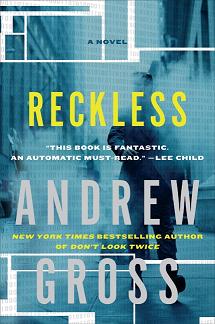
Trash Lit: ‘Reckless’ could be ripped from headlines (minus a couple murders)

0

Reckless
Andrew Gross
William Morrow, 404 pages, $25.99

Imagine if the head of a powerful banking company with close ties to the federal government conspired with some shady Saudi billionaires and a cruel Serbian ex-military thug to bring down the American financial system in a Darwinian plot that would allow the one firm with insider knowledge to emerge even stronger. How would it play out? Well, minus a few murders, more or less exactly the way the financial-sector meltdown of the past couple of years has played out.

That’s what makes this such a fun book. It’s not the most brilliant thriller ever – the structure involves a lot of flicking back and forth between parallel plots, and gets confusing at times. But the premise is delicious, and the execution is good enough to make it eminently enjoyable.

Reckless starts off nicely, with a Middle Eastern banker set to launch world economic ruin, an American private dick fucking his girlfriend as doom approaches, a Greenwich, Connecticut society divorcee fucking a sexy European stud with a dubious background and a brutal, bloody murder of a securities trader, his wife (who was an old pal of the PI) and one of their kids.

It slows down a bit after that, but not much.

Turns out the dead guy was way underwater in a complex deal. A few more traders, also underwater and scrambling, wind up dead, too. And then the economy really starts to fall – AIG goes under. Fanny Mae and Freddie Mac go under. There’s panic at every level of government.

Meanwhile, the bad guys try to kidnap the mildly retarded son of the PI’s girlfriend after a hockey game, leading to a spectacular hockey-stick-and-knife-in-the-locker-room fight that ends with the PI shoving a sharpened skate into the kidnapper’s chest (neat trick; I always wondered if that would really work).

By the time it all gets sorted out, there’s railroad trestle gun play, a federal agent who’s bleeding to death but still makes a spectacular shot, and an utterly predictable power-out, stuck-in-the-elevator sex scene. Maybe even worth forking over the hardcover price.

Lefty protesters greet Obama in SF

6

President Barack Obama arrives in San Francisco this afternoon (5/25) for a fundraiser at the Fairmont Hotel, where he’ll be greeted by protesters from at least two realms of the progressive movement: immigrant rights activists unhappy with his administration’s reluctance to take on immigration reform, and anti-war activists angry that Obama has continued President George W. Bush’s pro-war and anti-civil liberties policies.

Both groups have been increasingly unhappy with a president whose candidacy they supported for the most part. In particular, the coalition of immigrant rights groups that will gather on the steps of Grace Cathedral starting at 3:30 pm say Obama hasn’t done enough to counter rising nativist extremism or Arizona’s SB1070, and that his administration has essentially nullified sanctuary city ordinances by extending the federal government’s Secure Communities, which allows immigration officials direct access to information on arrestees in jails throughout the country (see our story in this week’s Guardian for more).

“We are gathering to lament the intolerance and extremism that are setting back the national discussion on immigration. We need real solutions that uphold our values of fairness and compassion, and we pray for the President to take leadership to stop this heart-breaking separation of families,” Rev. Debbie Lee of Interfaith Coalition for Immigrant Rights said in a press release.

Meanwhile, Code Pink, World Can’t Wait, and other groups will also gather near the hotel starting at 3:30 to protest what it calls ongoing war crimes by the administration, including the escalation of war in Afghanistan, predator drone assassinations in Pakistan, Obama’s continued use of extraconstitutional war powers claimed by Bush, opposition to efforts to expose and redress imperial excesses by the Bush Administration, and denial of due process rights to those labeled enemy combatants.

World Can’t Wait has even made a point of calling on Obama supporters to hold him accountable with the slogan, “Crimes are crimes not matter who does them.”

Attendees to Obama’s Fairmont fundraiser are shelling out $17,500 each to Sen. Barbara Boxer and the Democratic Senatorial Campaign Committee, while an even higher roller affair will be held later that night at the home of Ann and Gordon Getty.

Who’s afraid of taxes?

1

Well, the candidates for governor are, but apparently the people of California are not. The latest Public Policy Institute poll makes it pretty clear:


Of the four main spending categories of the state budget, Californians are the most willing to consider a tax increase to spare K–12 education from budget cuts (69%), while just over half would pay higher taxes to maintain current funding levels for higher education (54%) or for health and human services (54%). A large majority (79%) opposes paying higher taxes to spare prisons and corrections from budget cuts.


Californians would consider some other ways to raise revenues: 67 percent favor raising the top rate of the state income tax paid by the wealthiest Californians and 58 percent would favor raising state taxes paid by California corporations. Residents are much less likely to support extending the state sales tax to services that are not currently taxed (35%) or increasing the vehicle license fee (28%).


More than two-thirds of the voters want to raise the top tax rate for the rich. Almost 60 percent want to raise corporate taxes. Why is this not part of anyone’s platform?


I want to throw up

18

I’ve gotten a pretty strong stomach after 25 years of political reporting, but when I read stuff like this, I reall want to throw up. It’s not just pandering or corruption or sleaze — that shit’s common enough, and I can deal. It’s this utter, blatant, mind-boggling lack of reality that makes me start to lose my lunch.


(Pretty good lunch, too — I made myself a nice turkey sandwich with havarti cheese and mayo, on a crispy roll, bag o’ chips, bottle of sparkling Calistoga — hate to see it come back up again.)


But please, folks: Cannot anyone running for governor of California be remotely honest about the budget problem? These people are not fools; Meg Whitman and Steve Poizner have run businesses. Jerry Brown has been governor before, and has been a mayor. They know how budgets work. And they know this:


You cannot — cannot — solve a $19 billion budget deficit by reducing waste and fraud. Even Schwarzenegger admits that:


Shortly after taking office, Schwarzenegger also promised to find billions in fraud through a top-to-bottom review of state government. But after the 2006 review, Schwarzenegger admitted his advisers “did not find the kind of abuse that I thought there is.”


 There’s not $19 billion worth of bureaucratic waste, either. It’s just not there.


There are only two options to make this state fiscally sound again: Fundamentally restructure what the state of California does (that means, for example, eliminating most of the social safety net, giving up on public education and releasing about half the prison population), or raise taxes.


Only two options. Anyone with any sense knows that; as my friend and colleague Johnny Angel Wendell likes to say, it’s just simple math.


And yet nobody’s talking about it. Nobody’s even coming close. And the press isn’t pushing all that hard, either.


I was pleased to see that my old pal Jerry Brown saying that “those with the biggest belts” should tighten them. At least that has a tiny nod to the notion that some people are better off than others and the rich ought to pay more than the poor. But what the hell does it mean?


I called Jerry’s campaign office this afternoon and asked Sterling Clifford, his press person, to help me out a little. Is Brown saying that he thinks the wealthy should pay more taxes?


Actually, no: “I think he has been very clear that there will be no new taxes unless the people vote on them,” Clifford told me.


Okay, so does that mean he’s going to cut the budget of the biggest departments — say, the prison system? Well, no: “He intends to enter the budget negotiations with the Legislature with all options on the table.”


Shit. How about restoring the Vehicle License Fee to what it was before Schwarzenegger rolled it back? That a good Jerry Brown issue, environmentally sound. How about it? “I don’t know,” Clifford said. “I’ve never asked him about it.”


Well, you should, Sterling, and so should every reporter who sees him at every press event and every activist who sees him at every rally. And the same goes for Meg and Steve. These people are acting delusional — and we just have to call them on it.

Drills, baby, drills

2

rebeccab@sfbg.com

The disastrous Deepwater Horizon oil spill in the Gulf of Mexico should be viewed as a wakeup call for the San Francisco Bay Area, Pacific Environment’s Jackie Dragon noted at a May 11 forum on oil spill preparedness and prevention.

The forum was planned even before the April 20 explosion of BP’s rig, triggering the onset of an out-of-control oil spill that has continued to wreak havoc in the Gulf for nearly a month. Up to 100,000 barrels of oil a day could be gushing from undersea pipeline, according to the highest estimates, which would dwarf the damage caused by the 1989 Exxon Valdez spill in Alaska.

Investigative reports in the New York Times in the wake of the spill revealed that the Minerals Management Service (MMS) had issued deep water drilling permits in the Gulf without obtaining permits from a federal agency that assesses threats to endangered species — in violation of federal law — and that MMS routinely overruled staff biologists’ safety concerns. The reports suggest the failure of not only a mechanical device, but an entire regulatory system, in which oil company interests appeared to take precedent over public safety and environmental concerns.

Here in California, environmentalists breathed a sigh of relief when Gov. Arnold Schwarzenegger withdrew his support for Tranquillon Ridge, a controversial offshore oil drilling project planned off the coast of Santa Barbara. Yet the governor’s change of heart doesn’t safeguard California’s coastal territories from a spill. Millions of gallons of oil are transported in and out of the ports every year, and refinery infrastructure dots the coastline.

“It’s all about the initial timeframe,” noted Fred Felleman, an environmental consultant who spoke at the forum. Shaken by BP’s colossal blunder and wary of the string of failures that led up to last year’s Dubai Star oil spill, environmental groups are now pushing for legislation they hope will slash response time by requiring ships to deploy protective boom before pumping fuel, so potential spills could be sopped up immediately.

The precaution would do little to remedy a major spill, however, and it’s just a small piece of a wider response puzzle that entails coordination among volunteers, community groups, and multilevel government agencies to accomplish everything from containing the slick, to cleaning beaches, to caring for impacted wildlife.

Although established protocols and a chain of command are in place for responding to oil spills, several speakers at the forum noted that vigilance tends to wane between these catastrophes. The environmental devastation in the Gulf could prove to be a catalyst for investing more energy and resources into safeguarding against the worst.


LESSONS LEARNED?

Fortunately, the Bay Area has been spared from the sort of devastating blow that is blackening Gulf of Mexico waters, crippling fisheries, and sending tar balls ashore. However, the bay has weathered two comparatively minor oil spills in the last three years, which could be viewed as learning experiences for a bigger incident.

The Cosco Busan spill occurred in late 2007, when a cargo ship hit the Bay Bridge under foggy conditions and released 58,020 gallons of bunker fuel into the bay. According to a detailed account of the incident response, the vessel collided with the Bay Bridge at 8:30 a.m., and the fuel leaked out in a matter of minutes. Two hours later, the estimated amount spilled was reported at 10 barrels (420 gallons), and hours passed before the actual quantity was revealed. The state official who determined how much had leaked arrived at Yerba Buena Island at 9:45 a.m. to perform an assessment but had to wait more than two hours to be transported to the ship.

Speaking at the forum, Zeke Grader, of the Pacific Coast Federation of Fishermen’s Associations, said fishing boat captains with vessels at Fisherman’s Wharf were ready to be deployed instantly to help contain the spill — but the Coast Guard initially turned them away. “This was a relatively minor spill in a bay, and we were totally unprepared to deal with it,” Grader charged. “That is really egregious.” Commercial fishing vessels were finally deployed to help with efforts, most venturing out on day five — long after the damage had been done.

San Francisco Baykeeper, a pollution watchdog group, was inundated with thousands of phone calls from volunteers, but the lack of an overarching volunteer coordination plan between governmental agencies and community organizations made it difficult to plug people in, executive director Deb Self noted. The Office of Spill Prevention and Response (OSPR) is the state agency under the Department of Fish and Game that works in conjunction with the U.S. Coast Guard and the financially responsible polluter to react when a spill occurs. Carol Singleton, an OSPR spokesperson, acknowledged that better communication during the Cosco Busan would have made the response more effective.

The spill affected the Bay Area’s biologically rich ecosystem. Just 421 of the roughly 1,000 oiled birds recovered by volunteers were successfully rehabilitated and released back into the wild, according to the Golden Gate Audubon Society, while nearly 7,000 are estimated to have died. Even a small drop of oil on the feathers of a bird can destroy the animal’s natural insulation, resulting in hypothermia.

Singleton said a well-established oil-spill response strategy is in place. “Every vessel and every facility has a contingency plan,” she noted. “We’re constantly practicing.” Since the Cosco Busan, a volunteer coordination plan has been crafted, she said. Ecologically sensitive areas are mapped out and prioritized, and a network of wildlife care facilities stand ready to take in oiled animals.

Following the Cosco Busan spill, members of the Legislature put forth a suite of proposals that came to be known as the “spill bills,” resulting in a few stronger protections such as spill-response equipment stationed and ready for deployment in high-risk areas, enhanced funding to care for oiled wildlife, and grants to local governments for oil-spill response tools. However, some ideas for stronger protection got killed by Schwarzenegger’s veto pen.

Former Sen. Carole Migden proposed a mandatory spill response time of two hours, but that was vetoed. Sen. Loni Hancock proposed beefing up the state’s Oil Spill Prevention Administrative Fund, which is derived from fees on barrels of oil transported into California ports, by upping the charge from 5 cents to 8 cents per barrel. That was also struck down, as was Sen. Mark Leno’s proposal to establish grants to develop better containment and cleanup technology.

As the disaster in the Gulf continues to unfold, Dragon of Pacific Environment said grassroots environmental organizations might renew pressure for stricter regulations on some of these fronts.


TIMING IS EVERYTHING

Another piece of legislation, inspired by the Dubai Star oil spill, is expected to go before the Senate Environmental Quality Committee in early June. The Dubai Star mishap occurred last October when at least 400 gallons of bunker fuel was released into open water near Alameda.

Far smaller than the Cosco Busan incident, the Dubai Star spill still resulted in the deaths at least 100 shorebirds. It happened at Anchorage 9, two miles south of the Bay Bridge, during a fuel transfer — a routine fill-up that occurs roughly 800 times per year.

The official investigation report hasn’t been released, but U.S. Coast Guard Captain Paul Gugg noted that a faulty valve was to blame. Some 2,000 gallons of oil overflowed, but went unnoticed until someone aboard a tugboat pointed it out, according to Gugg’s account. Most of the oily mess was contained on board, but between 400 and 800 gallons spilled over the port side, instantly creating a toxic plume.

“This particular vessel is equipped with high-level alarms, and high high-level alarms, which did not activate,” Gugg noted.

Under state regulations, vessels are required to respond to spills by deploying 600 feet of boom within 30 minutes, and 600 more feet more within one hour. In the case of the Dubai Star, that didn’t happen, a report released by the San Francisco Estuary Partnership noted. Instead, the slick was allowed to spread.

Assembly Member Jared Huffman (D-San Rafael) introduced AB 234 to establish a requirement for vessels to deploy boom before beginning a fuel transfer, so that a spill could be contained without losing time. The state of Washington has a similar law, noted legislative aid Paige Brokaw, “and their current conditions are pretty similar to our current conditions.” Booming is only effective at slower currents, which makes things difficult since a fuel transfer can take more than eight hours, and currents may shift in that time.

Huffman’s office received a letter of opposition to the bill from OSPR. “Booming is a good method to contain a spill, but it’s not a foolproof method,” said Singleton, the OSPR spokesperson. “To use that one method, it just may or may not work in certain circumstances.” Nonetheless, proponents of the bill say that even partial oil containment in higher currents is better than having no precautionary measures at all.

While the lessons of the past can be instructive, forum participants noted that continuous coordination, communication, and vigilance is the surest path to being able to respond if another oil spill occurs in the Bay Area. Grader, meanwhile, said he knew the best solution of all. “The ultimate prevention,” he said, “is basically getting off our oil addiction.”

BP still claiming exploded oil rig was safe and reliable

0

The corporate communications industry has gotten so ridiculous, so disconnected from reason and a sense of shame, or an obligation to provide some semblance of truth or credibility, that it’s amazing we still listen to these people at all anymore. And the best example of that right now is BP, the oil giant that is well on its way being responsible for the worst oil spill in history.

Beyond the sheer magnitude of this Gulf of Mexico spill, there have been well-sourced media reports that political appointees in the regulator agencies ignored the warnings of Minerals Management Services scientists that a devastating spill was a real possibility and that even BP employees warned that a spill could happen and that internal documents were a mess.

But rather than simply accepting responsibility and their newfound infamy and humbly trying to make amends, BP’s flaks have instead been sending out regular press releases attacking the media reports and making claims that this rig was safe, well-operated, and aggressively regulated – all evidence to the contrary.

“As CEO Tony Hayward constantly makes clear, safe and reliable operations are his number 1 priority for BP and the company has a very strong record of safe and reliable operations in the Gulf of Mexico,” the company wrote. “It is completely erroneous to suggest that the minor internal process issue we identified and immediately amended last year on the Atlantis platform suggests anything different.”

Sure, our rig blew up and created an oil gusher that we have no idea how to stop, but that doesn’t mean we aren’t “safe and reliable,” right? Um, actually it does, otherwise this wouldn’t have happened. BP even tries to claim credit for the fact that this spill didn’t happen even earlier.

“The Atlantis field has been in service since October 2007 and has safely produced many million barrels of oil. The platform was successfully maintained through the course of two major hurricanes in 2008. Its safety, operations and performance record is excellent,” they wrote.

Sure, right up until it was terrible. But even now, with the irreparable devastation this company has caused, they are also trying to sound like good guys for generously offering to pay for some of the ancillary damage they caused. Here’s what the company sent out under the cheery heading, “BP Announces Tourism Grants to Four Gulf States”:

“BP is today announcing grants to each of the states of Florida, Alabama, Mississippi and Louisiana to help their Governors promote tourism around the shores of the Gulf of Mexico over the coming months. This is part of our ongoing commitment to help mitigate the economic impact of the oil spill.

BP is providing $25 million to Florida and $15 million each to Alabama, Mississippi and Louisiana. “The Gulf Coast is our home too. We are doing everything we can to plug the leak, contain the spill offshore and protect the shoreline.  With the deployment of the riser insertion tool yesterday, we made important progress in containing the spill, and that will further strengthen our ability to keep oil off the shore,” said Tony Hayward, BP’s Group Chief Executive.

Sure, BP and their allies in the oil industry and the conservative movement put a cap of $75 million on how much the U.S. government can make oil companies pay to clean up their messes, but they’re happy to promote the area they marinaded in crude oil as a tourist destination. This is a weird world we live in.

Film listings

0

Film listings are edited by Cheryl Eddy. Reviewers are Kimberly Chun, Michelle Devereaux, Max Goldberg, Dennis Harvey, Johnny Ray Huston, Erik Morse, Louis Peitzman, Lynn Rapoport, Ben Richardson, and Matt Sussman. The film intern is Peter Galvin. For rep house showtimes, see Rep Clock. For first-run showtimes, see Movie Guide.

OPENING

The City of Your Final Destination In James Ivory’s latest literary adaptation, Omar (Omar Metwally), an Iranian American graduate student of Latin American literature, precipitously descends on a rural estate in Paraguay, hoping to petition the relatives of deceased writer Jules Gund for authorization to write his biography. Numbering among the somewhat complicated ménage are Gund’s widow, Caroline (Laura Linney), his mistress, Arden (Charlotte Gainsbourg), their child, Portia (Ambar Mallman), the author’s brother, Adam (Anthony Hopkins), and Adam’s lover, Pete (Hiroyuki Sanada), a household that the film depicts as caught in a sedative isolation obstructing any progress or flourishing or change. But where Gund’s violent suicide has failed to produce a cataclysmic shift, the somewhat hapless Omar manages to interrupt their idle routines and mobilize them, stirring up sentiment and ambition. The notion of redirected fate is telegraphed by the title, but what the film does best is show the calm before the storm (really more of a heavy downpour) — and showcase the fineness of Hopkins’s and Linney’s dramatic abilities. In the final act, we see the characters being moved about rather than moved, and the sound of screeching brakes applied as the film reaches its conclusion undoes much of the subtlety invested in their performances. (1:58) Embarcadero, Shattuck. (Rapoport)

*Dirty Hands The 1990s-ish iconoclastic, workaholic breed of Asian hipster is obsessively worked by David Choe in Dirty Hands. Exhaustively documenting the Los Angeles-born artist for eight years as he matures before our eyes, director Harry Kim charts the growth spurts: from mischievous tot to shoplifter and graf artist to porn illustrator to street-art superstar to spiritual penitent after a stint in a Tokyo jail. The filmmaker doesn’t seem to know quite when to stop, but then neither does his subject: an obviously intelligent, playful talent who specializes in compulsively analyzing himself and pushing himself to the limits of the law, his work, and his own (r)evolution as a human being. So driven in his pursuit of edge-skating experiences that he comes off as less hipster than haunted, Choe and his Bukowskian tendencies, Vice aesthetics, and "deep" thoughts rivet long after the bodily fluids and sensory overload murals congeal. (1:33) Roxie. (Chun)

Kites This Bollywood action-romance is "presented by" Brett Ratner (apparently, he helped re-edit this English version). (1:30)

MacGruber Will Forte’s bemulleted, MacGyver-biting Saturday Night Live character gets his own movie. (1:39)

Paper Man Though certainly offbeat enough to fall into the quirky indie category, Paper Man reminds us that weird is not always good. There’s very little original about the main conceit: plagued by writer’s block, Richard Dunn (Jeff Daniels) rents a house in Montauk where he befriends outcast Abby (Emma Stone), a teenage girl with a tragic past. The film’s unique addition is Richard’s imaginary friend Captain Excellent, played by Ryan Reynolds in full-on superhero attire. But Captain Excellent is so absurdly campy that he’s almost too much to take — which wouldn’t be such a problem if Paper Man weren’t asking us to take it seriously. The wacky superhero scenes are mostly out-of-place, and all the heavy drama moments fall flat. But even without the muddled tone, Paper Man is riddled with clichés. We’ve seen enough of the zany manchild learning valuable life lessons, and the troubled teen forming an unlikely bond. At this point, there’s nothing super about it. (1:50) Lumiere. (Peitzman)

Shrek Forever After 3D Mike Myers has sure gotten a lot of longevity out of his Scottish accent. (1:33) Four Star, Presidio.

ONGOING

Alice in Wonderland Tim Burton’s take on the classic children’s tale met my mediocre expectations exactly, given its months of pre-release hype (in the film world, fashion magazines, and even Sephora, for the love of brightly-colored eyeshadows). Most folks over a certain age will already know the story, and much of the dialogue, before the lights go down and the 3-D glasses go on; it’s up to Burton and his all-star cast (including numerous big-name actors providing voices for animated characters) to make the tale seem newly enthralling. The visuals are nearly as striking as the CG, with Helena Bonham Carter’s big-headed Red Queen a particularly marvelous human-computer creation. But Wonderland suffers from the style-over-substance dilemma that’s plagued Burton before; all that spooky-pretty whimsy can’t disguise the film’s fairly tepid script. Teenage Alice (Mia Wasikowska) displaying girl-power tendencies is a nice, if not surprising, touch, but Johnny Depp’s grating take on the Mad Hatter will please only those who were able to stomach his interpretation of Willy Wonka. (1:48) SF Center. (Eddy)

*Babies Thomas Balmes’ camera records the first year in the lives of four infants in vastly different circumstances. They’re respectively born to hip young couple in Tokyo’s high-tech clutter; familiar moderately alterna-types (the father is director Frazer Bradshaw of last year’s excellent indie drama Everything Strange and New) in S.F.’s Mission District; a yurt-dwelling family isolated in the vast Mongolian tundra; and a Namibian village so maternally focused that adult menfolk seem to have been banished. Yes, on one level this is the cutest li’l documentary you ever saw. But if you were planning to avoid thinking that is all (or most) of what Babies would be like, you will miss out bigtime. Void of explanatory titles, voice-over narration, or subtitle translations, this is a purely observatory piece that reveals just how fascinating the business of being a baby is. There’s very little predictable pooping, wailing, or coddling. Instead, Balmes’ wonderful eye captures absorbing moments of sussing things out, decision-making, and skill learning. While the First World tykes firstborns both — are hauled off to (way) pre-school classes, the much less day planned Third Worlders have more complex, unmediated dealings with community. Those range from fending off devilish older siblings to Mongol Bayarjargal’s startlingly casual consorting with large furry livestock. (Imagine the horror of parents you know were their baby found surrounded by massive cows — a situation that here causes no concern whatsoever for adults, children, or bovines.) So accustomed to the camera that it doesn’t influence their behavior, the subjects here are viewed with an intimacy that continually surprises. Babies is getting a wider-than-usual release for a documentary, one cannily timed to coincide with Mother’s Day. But don’t be fooled: this movie is actually very cool. (1:19) Albany, Empire, 1000 Van Ness, Piedmont, Smith Rafael, Sundance Kabuki. (Harvey)

The Back-Up Plan (1:40) SF Center.

*Casino Jack and the United States of Money Casino Jack is big-budget documentary filmmaking, glossy and prone to expensive music cues, but I suppose you get a license to be flashy when you’ve proven to be as good at it as Alex Gibney. The director of Enron: The Smartest Guys in the Room (2005) and Academy Award winner Taxi to the Dark Side (2007), Gibney sets his sights on Washington lobbyist Jack Abramoff with an abundantly in-depth exploration of government greed and fraud. Investigating Abramoff’s indiscretions, from his introduction as chairman of the College Republicans, to his illegal selling of House votes for sweatshops in the Mariana Islands and over-billing of numerous Indian casinos, Gibney solidly serves Abramoff his just desserts. The director is equally interested in questioning the kind of government America has fostered that turns a blind eye to this sort of behavior. (2:02) Opera Plaza, Shattuck. (Galvin)

*City Island The Rizzo family of City Island, N.Y. — a tiny atoll associated historically with fishing and jurisdictionally with the Bronx — have reached a state where their primary interactions consist of sniping, yelling, and storming out of rooms. These storm clouds operate as cover for the secrets they’re all busy keeping from one another. Correctional officer Vince (Andy Garcia) pretends he’s got frequent poker nights so he can skulk off to his true shameful indulgence: a Manhattan acting class. Perpetually fuming spouse Joyce (Julianna Margulies) assumes he’s having an affair. Daughter Vivian (Dominik García-Lorido) has dropped out of school to work at a strip joint, while the world class-sarcasms of teenager Vinnie (Ezra Miller) deflect attention from his own hidden life as an aspiring chubby chaser. All this (plus everyone’s sneaky cigarette habit) is nothing, however, compared to Vince’s really big secret: he conceived and abandoned a "love child" before marrying, and said guilty issue has just turned up as a 24-year-old car thief on his cell block. Writer-director Raymond De Felitta made a couple other features in the last 15 years, none widely seen; if this latest is typical, we need more of him, more often. Perfectly cast, City Island is farcical without being cartoonish, howl-inducing without lowering your brain-cell count. It’s arguably a better, less self-conscious slice of dysfunctional family absurdism than Little Miss Sunshine (2006) — complete with an Alan Arkin more inspired in his one big scene here than in all of that film’s Oscar-winning performance. (1:40) Lumiere, Shattuck. (Harvey)

Clash of the Titans The minds behind Clash of the Titans decided their movie should be 3D at the last possible moment before release. Consequently, the 3D is pretty janky. I don’t know what the rest of the film’s excuse is. Clash of the Titans retreads the 1981 cult classic with reasonable faithfulness, though Ray Harryhausen’s stop-motion effects have been (of course) replaced with CG renderings of all the expected monsters, magic, gods, etc. Liam Neeson and Ralph Fiennes — as other reviews have pointed out: Schindler’s List (1993) reunion! — glow and glower as Zeus and Hades, while Sam Worthington (2009’s Avatar) once again fills the role of bland hero, this time as a snooze-worthy Perseus. You might have fun in the moment with Clash of the Titans, but it’s hardly memorable, and certainly nowhere near epic. (1:58) SF Center. (Eddy)

Date Night By today’s comedy standards, Date Night is positively old-fashioned: a case of mistaken identity causes a struggling married couple (Steve Carell and Tina Fey) to be tangled in a ransom plot for a stolen flash drive that belongs to a local mob boss. Unfussy plots are par for the course for films belonging to the all-but-lost "madcap all-nighter" genre, and in this case the simplicity of the set-up becomes Date Night‘s greatest asset, allowing Carell and Fey free reign to joke and ad lib lines. Like it or loathe it, the pair’s trademark senses of humor are the movie, and they arrange some pretty gleefully entertaining bits on the fly. Toss in a bunch of cameos from the likes of Ray Liotta and Mark Wahlberg and you’ve got yourself a bona fide movie-film, but it’s difficult not to see what Date Night might have been with just a smidge more effort. (1:27) 1000 Van Ness, SF Center. (Galvin)

*Exit Through the Gift Shop Exit Through the Gift Shop is not a film about the elusive graffiti-cum-conceptual artist and merry prankster known as Banksy, even though he takes up a good chunk of this sly and by-no-means impartial documentary and is listed as its director. Rather, as he informs us — voice electronically altered, face hidden in shadow — in the film’s opening minutes, the film’s real subject is one Thierry Guetta, a French expat living in LA whose hangdog eyes, squat stature, and propensity for mutton chops and polyester could pass him off as Ron Jeremy’s long lost twin. Unlike Jeremy, Guetta is not blessed with any prodigious natural talent to propel him to stardom, save for a compulsion to videotape every waking minute of his life (roughly 80 percent of the footage in Exit is Guetta’s) and a knack for being in the right place at the right time. When Guetta is introduced by his tagger cousin to a pre-Obamatized Shepard Fairey in 2007, he realizes his true calling: to make a documentary about the street art scene that was then only starting to get mainstream attention. Enter Banksy, who, at first, is Guetta’s ultimate quarry. Eventually, the two become chummy, with Guetta acting as lookout and documenter for the artist just as the art market starts clambering for its piece of, "the Scarlet Pimpernel of street art," as one headline dubs him. When, at about three quarters of the way in, Guetta, following Banksy’s casual suggestion, drops his camcorder and tries his hand at making street art, Exit becomes a very different beast. Guetta’s flashy debut as Mr. Brainwash is as obscenely successful as his "art" is terribly unimaginative — much to the chagrin of his former documentary subjects. But Guetta is no Eve Harrington and Banksy, who has the last laugh here, gives him plenty of rope with which to truss himself. Is Mr. Brainwash really the ridiculous and inevitable terminus of street art’s runaway mainstream success (which, it must be said, Banksy has handsomely profited from)? That question begs another: with friends like Banksy, who needs enemies? (1:27) Embarcadero, Shattuck, Smith Rafael, Sundance Kabuki. (Sussman)

Furry Vengeance (1:32) SF Center.

*The Ghost Writer Roman Polanski’s never-ending legal woes have inspired endless debates on the interwebs and elsewhere; they also can’t help but add subtext to the 76-year-old’s new film, which is chock full o’ anti-American vibes anyway. It’s also a pretty nifty political thriller about a disgraced former British Prime Minister (Pierce Brosnan) who’s hanging out in his Martha’s Vineyard mansion with his whip-smart, bitter wife (Olivia Williams) and Joan Holloway-as-ice-queen assistant (Kim Cattrall), plus an eager young biographer (Ewan McGregor) recently hired to ghost-write his memoirs. But as the writer quickly discovers, the politician’s past contains the kinds of secrets that cause strange cars with tinted windows to appear in one’s rearview mirror when driving along deserted country roads. Polanski’s long been an expert when it comes to escalating tension onscreen; he’s also so good at adding offbeat moments that only seem tossed-off (as when the PM’s groundskeeper attempts to rake leaves amid relentless sea breezes) and making the utmost of his top-notch actors (Tom Wilkinson and Eli Wallach have small, memorable roles). Though I found The Ghost Writer‘s ZOMG! third-act revelation to be a bit corny, I still didn’t think it detracted from the finely crafted film that led up to it. (1:49) Opera Plaza, Presidio. (Eddy)

*The Girl With the Dragon Tattoo By the time the first of Stieg Larsson’s so-called "Millennium" books had been published anywhere, the series already had an unhappy ending: he died (in 2004). The following year, The Girl With the Dragon Tattoo became a Swedish, then eventually international sensation, its sequels following suit. The books are addicting, to say the least; despite their essential crime-mystery-thriller nature, they don’t require putting your ear for writing of some literary value on sleep mode. Now the first of three adaptive features shot back-to-back has reached U.S. screens. (Sorry to say, yes, a Hollywood remake is already in the works — but let’s hope that’s years away.) Even at two-and-a-half hours, this Girl With the Dragon Tattoo by necessity must do some major truncating to pack in the essentials of a very long, very plotty novel. Still, all but the nitpickingest fans will be fairly satisfied, while virgins will have the benefit of not knowing what’s going to happen and getting scared accordingly. Soon facing jail after losing a libel suit brought against him by a shady corporate tycoon, leftie journalist Mikael Blomkvist (Michael Nyqvist) gets a curious private offer to probe the disappearance 40 years earlier of a teenage girl. This entangles him with an eccentric wealthy family and their many closet skeletons (including Nazi sympathies) — as well as dragon-tattooed Lisbeth Salander (Noomi Rapace), androgynous loner, 24-year-old court ward, investigative researcher, and skillful hacker. Director Niels Arden Oplev and his scenarists do a workmanlike job — one more organizational than interpretive, a faithful transcription without much style or personality all its own. Nonetheless, Larsson’s narrative engine kicks in early and hauls you right along to the depot. (2:32) Bridge, Piedmont, Shattuck. (Harvey)

The Greatest Lofty title aside, there’s nothing particularly extraordinary about The Greatest. In many ways, it’s your standard grief porn, in that it focuses on a group of characters mourning a dead teenager for an hour and a half. On the other hand, the cast is tremendous — Susan Sarandon and Pierce Brosnan are solid as the parents of the broken Brewer family, but the young actors give the most memorable performances. Fresh off her Oscar nomination for An Education (2009), Carey Mulligan continues to mingle precociousness and naiveté. The Greatest also showcases the very talented Johnny Simmons, whose past films — Hotel for Dogs (2009) and Jennifer’s Body (2009) — haven’t exactly earned him exposure. For its genre, then, The Greatest is actually quite good. It has plenty of charm mixed with moments of genuine emotion, often marked by much welcome restraint. But even with a slight twist on the convention (Mulligan’s Rose is pregnant with the dead kid’s baby), it’s still just a well-made tearjerker. (1:36) Smith Rafael. (Peitzman)

Harry Brown Shades of Dirty Harry (1971) for the tea cozy and tweed set: elegantly rendered and very nicely played, Harry Brown might be the dark, late-in-the-day elder brother to 1971’s Get Carter, in the hands of eponymous lead Michael Caine. He’s a pensioner mourning the passing of his beloved wife, his mysterious life as a Marine stationed in Northern Ireland firmly behind him. Then his chess-playing pal Leonard (David Bradley) is terrorized and killed by the unsavory gang of heroin dealing hoodlums who lurk near their projects in a tunnel walkway like gun-toting, foul-mouthed, sociopathic trolls. Harry Brown is, er, forced to forsake a vow of peace and go commando on the culprits’ asses, triggering some moments of ultraviolence that are unsettling in their whole-hearted embrace of vigilante justice. Like predecessors similarly fixated on vengeance in their respective urban hells, a la Hardcore (1979) and Taxi Driver (1976) (Harry Brown echoes key moments in the latter, in particular — see, for instance, its keenly tense, eerily humorous gun shopping scene), Harry Brown is essentially an arch-conservative film, if good looking and even likable with Caine meting out the punishment. The overall denouement just might make some seniors feel very, very good about the coiled potential for hurt embedded in their aging frames. (1:42) Embarcadero, Shattuck, Sundance Kabuki. (Chun)

How to Train Your Dragon (1:38) 1000 Van Ness.

The Human Centipede (First Sequence) Director Tom Six had a vision, a glorious dream of surgically connecting three human beings via their gastro-intestinal systems, or as Kevin Smith would say — "ass to mouth." When two girlfriends on a road trip across Europe get a flat tire, they stumble upon the home of a mad doctor (Dieter Laser) with a similar dream, who drugs them and ties them up in his basement laboratory. The Human Centipede is an entry into the torture porn arena, but it feels especially icky because you just know that the girls have zero chance of escaping the "100 percent medically accurate!" surgery. Once hooked up, there’s nowhere for the film to go and two out of three actors can’t talk because they are sewn to someone else’s anus. Still, as one-note as The Human Centipede is, I think we’d do well to encourage more films to be as batshit insane as this one. (1:30) Bridge. (Galvin)

*Iron Man 2 Tony Stark (Robert Downey Jr.) returns, just as rich and self-involved as before, though his ego his inflated to unimaginable heights due to his superheroic fame. Pretty much, he’s put the whole "with great power comes great responsibility" thing on the back burner, exasperating everyone from Girl Friday Pepper Potts (Gwyneth Paltrow); to BFF military man Rhodey (Don Cheadle, replacing the first installment’s Terrence Howard); to certain mysterious Marvels played by Samuel L. Jackson and Scarlett Johansson; to a doofus-y rival defense contractor (Sam Rockwell); to a sanctimonius Senator (Garry Shandling). Frankly, the fact that a vengeful Russian scientist (Mickey Rourke) is plotting Tony’s imminent death is a secondary threat here — for much of the film, Tony’s biggest enemy is himself. Fortunately, this is conveyed with enjoyable action (props to director Jon Favreau, who also has a small role), a witty script (actor Justin Theroux — who knew? He also co-wrote 2008’s Tropic Thunder, by the way), and gusto-going performances by everyone, from Downey on down. Stay for the whole credits or miss out on the geek-gasm. (2:05) California, Castro, Empire, Four Star, Marina, 1000 Van Ness, Presidio, Sundance Kabuki. (Eddy)

Just Wright (1:51) 1000 Van Ness.

*Kick-Ass Based on a comic book series by Mark Millar, whose work was also the model for 2008’s Wanted, Kick Ass is a similarly over-the-top action flick that plays up its absurdity to even greater comedic effect. High school nerd Dave (Aaron Johnson) decides to become the world’s first real superhero. Donning a green wetsuit he bought on the internet and mustering some unlikely courage, he takes to the streets to avenge wrongdoing. Unsurprisingly, Dave is immediately beaten almost to death because he’s just a kid who has no idea what he’s doing, but Kick-Ass‘ greatest achievement is knowing exactly how to subvert audience expectations. Scenes that marry the film’s innocent story with enormously exaggerated violence enhance the otherwise Superbad-lite high-school comedy unfolding around them, and a parallel plot-line involving Nicolas Cage instructing his 12-year-old daughter to commit grievous murders will probably end up being the most gratifying aspect of the film. Though too much set-up and spinning gears mars the middle act, it’s hard to fault the film for competently setting up one of the most crowd-pleasing endings in recent memory. (1:58) 1000 Van Ness, SF Center. (Galvin)

Letters to Juliet If you can stomach the inevitable Barbara Cartland/Harlequin-romance-style clichés — and believe that Amanda Seyfried as a New Yorker fact-checker — then Letters to Juliet might be the ideal Tuscan-sunlit valentine for you. Seyfried’s Sophie is on a pre-honeymoon trip to Verona with her preoccupied chef-restaurateur intended, Victor (Gael Garcia Bernal), who’s more interested in sampling cheese and purchasing vino than taking in the romantic attractions of Verona with his fiancée. Luckily she finds the perfect diversion for a wannabe scribe: a small clutch of diehard romantics enlisted by the city of Verona to answer the letters to Juliet posted by lovelorn ladies. They’re Juliet’s secretaries — never mind that Juliet never managed to maintain a successful or long-term relationship herself. When Sophie finds a lost, unanswered letter from the ’50s, she sets off sequence of unlikely events, as the letter’s English writer, Claire (Vanessa Redgrave), returns to Verona with her grandson Charlie (Christopher Egan), in search of her missed-connection, Lorenzo. Alas, Lorenzo’s long gone, and the fact-checker decides to help the warm-hearted, hopeful Claire find her lost lover. Unfortunately Sophie’s chemistry with both her matches isn’t as powerful as Redgrave’s with real-life husband Franco Nero — after all he was Lancelot to her Guenevere in 1967’s Camelot and the father of her son. Still, Redgrave’s power as an actress — and her relationship with Nero — adds a resonance that takes this otherwise by-the-numbers romance to another level. (1:46) Marina, 1000 Van Ness, Piedmont, SF Center, Sundance Kabuki. (Chun)

The Little Traitor Lynn Roth’s film is set in 1947 Palestine, shortly before Israel became a state. Young Proffi Liebowitz (Ido Port) wasn’t yet born when his parents fled the Holocaust in Poland, but he’s politically tuned-in enough to form a mini-resistance group with his neighborhood pals, who plot against the occupying British forces (sample act of rebellion: "British Go Home" graffiti). Caught one night scampering home after the citywide curfew, Proffi meets Sergeant Dunlop (Alfred Molina), whose kindness makes the boy realize his black-and-white view of the enemy might have some room for color after all. Of course, Proffi’s friendship with the Brit, who teaches him to play snooker and pronounce complicated English words like "flatulence," is not received well by his community (see: film’s title). Despite its political undertones, this is a pretty standard coming-of-age tale (including the de rigueur "peeping on the sexy neighbor" subplot). Too bad the director decided to film so much of it in English — kid actor Port is far less cloying when he’s speaking his native Hebrew. (1:29) Opera Plaza. (Eddy)

*Mid-August Lunch Gianni Di Gregorio’s loose, engaging comedy is about an aging bachelor still living with his ancient mum in their Rome flat. When his landlord offers to forgive some debts in return for briefly taking in his own elderly ma, Gianni (played by the director himself) soon finds himself in cat-herding charge of no less than five old ladies who delight in one another’s company while running him ragged. Gomorrah (2008) screenwriter Di Gregorio used nonprofessionals to play those parts in this semi improvised miniature, which is as light and flavorful as a first course of prosciutto and mozzarella. It’s a solid addition to the canon of palate-pleasing culinary flicks such as Big Night (1996) and Babette’s Feast (1987), as opposed to the repulsive ones like Super Size Me (2004) or Monty Python’s The Meaning of Life (1983). (1:15) Opera Plaza, Shattuck. (Harvey)

La Mission A veteran S.F. vato turned responsible — if still muy macho — widower, father, and Muni driver, fortysomething Che (Benjamin Bratt) isn’t the type for mushy displays of sentiment. But it’s clear his pride and joy is son Jess (Jeremy Ray Valdez), a straight-A high school grad bound for UCLA. That filial bond, however, sustains some serious damage when Che discovers Jes has a secret life — with a boyfriend, in the Castro, just a few blocks away from their Mission walkup but might as well be light-years away as far as old-school dad is concerned. This Bratt family project (Benjamin’s brother Peter writes-directs, his wife Talisa Soto Bratt has a supporting role) has a bit of a predictable TV-movie feel, but its warm heart is very much in the right place. (1:57) Opera Plaza, Shattuck, SF Center. (Harvey)

Mother and Child Adoption advocates who railed against Orphan (2009) should turn their sights on Mother and Child, a ridiculous melodrama with a thoroughly vile message. I’d wager writer-director Rodrigo García didn’t set out to make an anti-adoption film: this is a movie about the relationship between mothers and daughters. But the undertones are impossible to miss. Annette Bening plays Karen, a miserable woman consumed by regret for putting her daughter up for adoption 37 years ago. That biological daughter is Elizabeth (Naomi Watts), who — despite having been adopted at birth — speaks dismissively of her "adoptive" parents as though they were never really hers. She’s cold and manipulative, sleeping with her boss and married neighbor because she can. Mother and Child offers no real explanation for why these women are so unpleasant, so we’re forced to conclude it’s the four decades-old adoption. Despite a stellar cast, which also includes Kerry Washington, Samuel L. Jackson, and S. Epatha Merkerson, the film’s misguided politics are too distracting to ignore. (2:06) Shattuck, Sundance Kabuki. (Peitzman)

A Nightmare on Elm Street I’ll say this about the remake of A Nightmare on Elm Street: it could have been worse. Yes, it’s pointless and unimaginative and producer Michael Bay should still be ashamed, but I didn’t hate every minute of it. Don’t get me wrong, the movie is not good. It’s not terrible, if only because it has a few decent scares — all of which are, of course, shamelessly lifted from the original. Mostly, however, A Nightmare on Elm Street is a waste of time, updating Freddy Krueger with an icky twist (which I won’t spoil here) and culling together more jump scares than should ever be shoved into one film. The cast is passable, with relative newbie Rooney Mara taking on Nancy — she’s fine but forgettable. Jackie Earle Haley does a solid job with Freddy, but he was doomed from the start, just by virtue of not being Robert Englund. This Freddy is more brutal, to be sure, but he’s also far less fun. One pun in the entire movie? He might as well be Jason Voorhees. (1:42) 1000 Van Ness. (Peitzman)

*October Country In taking on the subject of family in the documentary October Country, co-directors Michael Palmieri and Donal Mosher face some imposing specters, and I’m not just talking about the varied stories of the Mosher family. If there’s any micro-genre within documentary that has become embattled over the past decade, it’s the family portrait, thanks to controversial or contentious works such as Andrew Jarecki’s Capturing the Friedmans and Jonathan Caouette’s Tarnation (both from 2003), son-of-Grey Gardens freakouts which incited claims of exploitation and sensationalism on their paths to a larger public profile. Palmieri’s and Mosher’s movie is a quieter work, yet it isn’t folksy in a complacent Sundance manner, either. The list of the maladies plaguing the Mosher clan — physical abuse, drug abuse, war trauma, custody battles, and abortion, to name a handful — would provoke an ambulance-chasing impulse in some filmmakers, blood ties be damned. But Palmieri (who edited and did cinematography) and Mosher (a former San Francisco resident whose photo essays on his family were shown at Artists’ Television Access) realize these are common American problems, and their treatment of them is at once deeper and more ephemeral. They use the passage of a year from one Halloween to the next to reveal the changes wrought — or evident — on a person’s face, and when they can, a person’s life. (1:20) Roxie. (Huston)

*OSS 117: Lost in Rio The Cold War heated up a public appetite for spy adventures well before James Bond became a pop phenomenon. In fact, Ian Fleming hadn’t yet created 007 in 1949, when Jean Bruce commenced writing novels about Hubert Bonisseur de La Bath, a.k.a. Agent OSS 117. This French superspy was ready-made to join the ranks of umpteen 007 wannabes, appearing in somewhere between six and 11 films (it’s unclear whether all involved de La Bath, or were just Bruce-based) through 1970, played by at least four actors. The series remained well-known enough to get a new life in 2006 when director Michel Hazanavicius and top French comedy star Jean Dujardin sought to spoof 1960s espionage flicks a la Austin Powers: International Man of Mystery (1997). That was a big hit, so now we’ve got a sequel. OSS 117: Lost in Rio isn’t as fresh or funny as the preceding Cairo, Nest of Spies. But it’s still a whole lot fresher and funnier than Austin Powers Nos. two (1999) and three (2002). Dujardin’s de La Bath is the very model of jet-set masculinity, twisting the night away at a ski chalet with umpteen soon-to-be-machine gunned "Oriental" lovelies in the opening sequence. Of course such pleasure pursuits take place strictly between car chases, shootouts, and karate fights. Agreeably silly, Lost in Rio doesn’t go for Hollywood-style slapstick and grossout yuks. Instead, its biggest laughs are usually droll throwaways, as when 117 explains a shocking sudden costume change with the unlikely declaration "I sew," or during an LSD-dosed hippie orgy proves quite willing to go with the flow — even when that involves another guy’s groovy finger breaching security up the pride of French intelligence’s derriere. (1:37) Lumiere, Shattuck, Smith Rafael. (Harvey)

*Please Give Manhattan couple Kate (Catherine Keener) and Alex (Oliver Platt) are the proprietors of an up-market vintage furniture store — they troll the apartments of the recently deceased, redistributing the contents at an astonishing markup — and they’ve purchased the entire apartment of their elderly next-door neighbor (Ann Guilbert). As they wait for her to expire so they can knock down a wall, they try not to loom in anticipation in front of her granddaughters, the softly melancholic Rebecca (Rebecca Hall) and the brittle pragmatist Mary (Amanda Peet). Filmmaker Nicole Holofcener has entered this territory before, examining the interpersonal pressures that a sizable income gap can exert in 2006’s Friends with Money. Here she turns to the pangs and blunderings of the liberal existence burdened with the discomforts of being comfortable and the desire to do some good in the world. The film capably explores the unexamined impulses of liberal guilt, though the conclusion it reaches is unsatisfying. Like Holofcener’s other work, Please Give is constructed from the episodic material of mundane, intimate encounters between characters whose complexity forces us to take them seriously, whether or not we like them. Here, though, it offers these private connections as the best one can hope for, a sort of domestic grace accrued by doing right, authentically, instinctively, by the people in your immediate orbit, leaving the larger world to muddle along on its axis as best it can. (1:30) Clay, SF Center, Shattuck. (Rapoport)

Princess Kaiulani Well-meaning and controversial (the independent’s first title, Barbarian Princess, and the tragic events it depicts has distressed some native Hawaiians) in its own inoffensive way, Princess Kaiulani is unfortunately overshadowed by star Q’orianka Kilcher’s first film, 2005’s The New World, in which she portrayed Pocahontas. The Hawaii-raised Kilcher appears to be getting typecast as a tragic, romanticized native royal. Still, if you can get past director Marc Forby’s weak attempts to match New World director Terrence Malick’s searingly poetic montages and the clunky History Channel-by-the-numbers screenplay, you might give a little credit to the makers for bringing to the screen the tale of Hawaii’s last intelligent, beautiful, and accomplished princess — a young woman determined to fight an overthrow of the Hawaiian monarchy and battle its annexation against the white land owners and descendents of missionaries who tried to block the voting rights of native Hawaiians. Kilcher possesses some of the noble charisma claimed by the real Kaiulani, but the obligatory romance superimposed on the narrative and the neglect of some of genuinely promising threads, such as Kaiulani’s friendship with Robert Louis Stevenson, make Princess Kaiulani feel as faux as those who pretended to Hawaii’s rule. (2:10) Embarcadero. (Chun)

Robin Hood Like it or not, we live in the age of the origin story. Ridley Scott’s Robin Hood introduces us to the outlaw while he’s still in France, wending his way back to Albion in the service of King Richard III. The Lionheart soon takes an arrow in the neck in order to demonstrate the film’s historical bona fides, and yeoman archer Robin Longstride (Russell Crowe) — surrounded by a nascent band of merry men — accidentally embroils himself in a conspiracy to wrest control of England. The complications of this intrigue hie Robin to Nottingham, where he is thrown together with Maid Marion (Cate Blanchett), a plucky rural aristocrat who likes getting her hands dirty almost as much as she likes a bit of smoldering Crowe seduction. A lot of hollow medieval verisimilitude ensues, along with a good bit of slow-mo swordplay, but the cumulative effect is tepid and rote. (2:20) Empire, 1000 Van Ness, Presidio, Sundance Kabuki. (Richardson)

The Secret in Their Eyes (2:07) Albany, Embarcadero.

Touching Home Hometown boys (Logan and Noah Miller) make good in this based-on-a-true-story tale of identical twins who must divide their time at home between training for major league baseball and looking after their alcoholic father. The brothers, who also wrote and directed the film, aim for David Gordon Green by way of Marin, but fall short of mastering that director’s knack for natural dialogue. Ed Harris is, unsurprisingly, compelling as the alcoholic father, but the actors in the film who are not named Ed Harris tend to contribute to the script’s distracting histrionics. Touching Home has some amazing NorCal cinematography, and I could see how family audiences might enjoy its "feel bad, then feel good" style of melodrama. But while it’s awkward to say that someone’s real-life experiences come off as trite, there are moments here that feel as clichéd as a Lifetime movie. (1:48) Smith Rafael. (Galvin)

Vincere Given the talent involved, Vincere should be a better film that it is. Director Marco Bellocchio has a lengthy track record of successes, and star Giovanna Mezzogiorno is one of the biggest names in contemporary Italian cinema. The based-on-a-true-story plot is certainly worthy of being filmed: Mezzogiorno plays Ida Dalser, secret wife of Mussolini and mother of the dictator’s first-born son. When Ida begins to make trouble for Il Duce by publicly proclaiming their marriage, she is locked away in a mental hospital. But while Vincere‘s subject is compelling, the film as a whole falls flat. Moments of greatness are few and far between, and the rest of the movie gets by on mediocrity. It’s likely the fault lies with the script, which is too scattered and unfocused to maintain an audience’s focus. Why after almost two hours of watching Ida’s struggle are we suddenly left with her son’s descent into madness? How depressing that a film about a woman forgotten by history is, itself, mostly forgettable. (2:02) Smith Rafael. (Peitzman)

Loving LaHood

0

By Jobert Poblete


news@sbg.com

GREEN CITY U.S. Department of Transportation Secretary Ray LaHood wowed urban cycling advocates at the National Bike Summit in Washington, D.C., in March when he climbed atop a table to praise them for their work promoting livable, bike-friendly communities. LaHood followed up that connection with a blog post in which he announced a "sea change" in federal policy, declaring: "This is the end of favoring motorized transportation at the expense of nonmotorized."

The groundbreaking post was accompanied by a DOT policy statement urging local governments and transportation agencies to treat walking and bicycling as equal to other modes of transportation. The statement concluded that "increased commitment to and investment in bicycle facilities and walking networks can help meet goals for cleaner, healthier air; less congested roadways; and more livable, safe, cost-efficient communities."

Since then, LaHood has come under fire for his pro-bike statements. The National Association of Manufacturers’ blog said that the policy would result in "economic catastrophe." At a House hearing, a representative implied that the secretary was on drugs.

But bike advocates, who were initially wary of having this key post occupied by one of the few Republicans in the Obama administration, have rallied to LaHood’s defense. In San Francisco, bike and livability advocates are optimistic that LaHood’s statements will be backed up with meaningful action.

"LaHood is not just talking the talk," San Francisco Bicycle Coalition program director Andy Thornley told the Guardian. "He seems to be actively moving federal transportation policy toward a broader, more sustainable program."

As DOT secretary, LaHood has enormous influence on how federal money is spent and on the Obama administration’s transportation policies. Thornley is hopeful the new policy direction will free more money for bikeways and other alternatives to the automobile. The federal government doles out billions of dollars for transportation, and beyond some direct funding of bike and transit projects, removing conditions that have forced recipients of federal transportation dollars to spend it on roads and highways could have a big impact on bike and pedestrian-friendly regions like the Bay Area.

"We’re already doing a good job regionally of prioritizing how we spend our money," Thornley said. "But on the federal end, the money comes out already conditioned and has to be spent on highways."

Tom Radulovich, executive director of Livable City, echoed Thornley’s enthusiasm for the DOT’s new policy direction. "If livable, walkable communities become a priority of the federal government, that could be really revolutionary," he said.

But Radulovich acknowledged that much of this depends on the outcome of a new surface transportation bill being drafted in Congress. The bill would allocate hundreds of billions in federal transportation dollars, and bike and transit advocates are already mobilizing to make sure it’s written in a way that promotes livability and sustainability. Transportation for America, a national coalition that includes a number of Bay Area groups, is lobbying Congress and the Obama administration to create a "21st century transportation system" that supports walking, biking, and sustainable development.

To succeed, advocates will have to overcome a number of other challenges. Thornley pointed out that outside of urban centers like the Bay Area and Seattle, bikes aren’t taken seriously as a form of transportation. He also warned that the industries that benefit from automobiles will be pushing back and telling the public that more bikes and transit will cost their industries jobs.

But Thornley is hopeful that other industries are getting the message that sustainable development is good for business. He said people are returning to cities and developers are taking note. "Developers are casting positive votes by investing in the city, building up residential options, and recognizing that the market wants these choices."

If new bike-friendly and pro-livability policies are to gain traction, Thornley said, "it will be about showing folks that spending money on transit, biking, and walking is just as productive for jobs and building communities. In the long run, it’s a much better investment."

UC, CSU chiefs need to quit the Chamber of Commerce board

1

The California Chamber of Commerce is one of the most consistently right-wing organizations in the state, particularly on economic issues. The Chamber’s against pretty much all taxes and supports pretty much all cuts in government spending.

So why are the heads of the three largest public educational institutions in California, the University of California, California State University, and the California Community Colleges, members of the Chamber board?

It’s a tradition at the Chamber to put the UC president and the CSU and CCC chancellors on the board, which has about 100 members. But the three educators came under fire recently when the Chamber put out a blatantly partisan ad attacking Jerry Brown

And in fact, UC President Mark Yudof told the Chamber’s fundraising chair last year that he couldn’t donate to the CalChamberPAC because that group was trying to make sure that Democrats don’t win enough seats in the Legislature to hold a two-thirds majority. “As president of a public institution that is both in practice and in policy nonpartisan, I must decline your request for a contribution,” Yudof wrote in an Oct. 9, 2009 letter, a copy of which I obtained under the state’s Public Records Act.

But Yudof also stated: “As a member of the Board of Directors, I appreciate the Chamber’s engagement in the political process and its advocacy for a strong and vibrant California economy.”

The truth is, the Chamber’s “engagement in the political process” is almost always adversarial to the interests of the state’s public education system. The fundraising letter Yudof was responding to specifically sought money to block Democrats from holding enough seats to raise taxes — and the refusal of the governor and his GOP colleagues to seek any new revenue sources has been the major reason the state’s budget is so horribly messed up. And that’s the main reason the University of California and CSU have faced such alarming budget cuts.

Why are the people in charge of promoting public higher education willingly putting their names, and their credibility, behind what’s really a Neanderthal institution? Because that’s what’s going on here — Yudof, CSU Chancellor Charles Reed and CCC Chancellor Jack Scott aren’t on the Chamber board to offer advice. They’re on the board to give the Chamber more credibility. They help make the organization seem more friendly, more concerned with the public interest.

They help make an organization devoted to reducing the role of the public sector in this state seem supportive of public education. They help propagate a political lie.

I asked Yudof, Reed and Scott why they’re still on the board, and got pretty weak responses. Here’s Yudof’s spokesperson, Peter King:

[President Yudof] considers the California business community to be one of several key constituency groups that are important to the University, which is why traditionally higher education leaders in California have held seats on the Chamber board. In general, President Yudof has found the Chamber to be highly supportive of higher education in California. He cannot recall in his tenure as President a single Chamber proposal to reduce funding for higher education.

Um, actually that’s not true at all. The Chamber just released its 2010 “job killer” list — a roster of bills that the organization will oppose on the grounds that they’re bad for business. Among them: Assemblymember Tom Ammiano’s bill to fix a loophole in Prop. 13 (and provide more money for public education), and a bill by Sen. Leland Yee that would allow the state to recapture tax-credit money if the company that got the credits (for increasing employment in the state, for example) winds up leaving California or shipping jobs elsewhere. That money would be available for higher education.

 Passage of those bills would allow the state to stop cutting UC and CSU. The Chamber wants to kill them.

King did say, however, that after the Brown ad aired, he “has informed the Chamber that he will continue to serve on the board only if his status is changed to that of an ex officio member.” But that doesn’t mean anything; it’s his name on the letterhead that matters.

Reed’s press person, Erik Fallis, was even more vague. He would only refer me to a statement Reed and Yudof issued after the Brown ad controversy, which said, in part:

We value our inclusion on the Chamber board, which provides an opportunity to interact with business leaders on issues that are of vital importance to the future of California. This is a dialogue that has been of great benefit to higher education, the business community and the state as a whole.

Actually, the inclusion of top state education officials  is detrimental to the public interest, detrimental to public education and really bad form. Particularly now, when the Chamber is going out of its way to make sure that the state budget crisis is solved with nothing but cuts.

Scott has been openly complaining about budget cuts (PDF) but his office hasn’t responded to my questions.

Yee, a frequent critic of UC management, responded, though, and he didn’t mince words:

It would be one thing if President Yudof and Chancellor Reed used their positions on the California Chamber of Commerce board to support more revenue for our beleaguered public universities.  Unfortunately, the CalChamber is categorical in its opposition to new revenues and has become nothing short of a mouthpiece for the Republican Party.  The Chamber benefits from the prestige that Yudof and Reed bring to the table, and uses it to advance a right-wing agenda that includes questioning the validity of global warming (AB 32, 2006) and the need to protect workers from discrimination (AB 793, Jones, 2009), blocking universal health care (SB 810, Leno, 2010), and holding corporations accountable to their promises to create jobs (SB 1391, Yee, 2010).  It is outrageous that Yudof and Reed would serve as accomplices to killing bills that would increase revenue for higher education.

The top education executives need to resign from the Chamber board, now.

Ending the crackdown is as easy as ABC

0

Sup. Bevan Dufty brought a surprise guest to the “Death of Fun” panel at SPUR that we each served on last night: Steve Hardy, director of the California Department of Alcoholic Beverage Control, an agency that has played a key role in the crackdown on San Francisco nightlife.

Hardy sounded a conciliatory tone, telling me that ABC agent Michelle Ott is no longer working with SFPD officer Larry Bertrand – the undercover duo has wreaked havoc on clubs and parties – and telling the large crowd that he’s trying to heed the criticisms and change his agency’s ways. Well, sort of.

“We’re working very hard to create an image that does not draw so much hostility,” Hardy said, later complaining about the state budget shortfall’s squeeze on his agency and saying, “It’s wearing thin and there’s no relief.”

Hardy said he was raised and still lives in San Francisco and served as an SFPD beat cop before a 25-year career staffing the California Legislature, mostly with the Senate Committee on Government Organization. Three years ago, he was appointed by Gov. Arnold Schwarzenegger to run the ABC, an agency that has cited many SF clubs for noise complaints and not serving enough food with their booze, and private parties for serving alcohol without permits.

“We do have a tremendous relationship with the SFPD,” he told the crowd, as if that weren’t already clear.

SFPD Inspector Dave Falzon of the Vice Crimes Division, another panelist, repeatedly emphasized the department’s desire to improve communications with the community, which has organized against the crackdown by forming the California Music and Culture Association. And Falzon announced a new SFPD initiative to centralize and streamline its permitting functions for clubs and special events.

But when I was answered a question about what we’d like to see in terms of improved communication by saying I wanted the SFPD to finally grant the Guardian’s longstanding request to interview Bertrand (whose brutal and illegal actions have been publicly condoned by his captain) and to directly address the community’s concerns about the SFPD’s hostility to nightlife, I didn’t get much of a responsive answer from Falzon.

Two separate legal teams who are suing the department for its overreaching tactics are also seeking to depose Bertrand and his superiors, and to review Bertrand’s personnel file, but the city has so far been stonewalling them. The consensus on the panel was that city leaders haven’t adequately valued nightlife or special events or sent the message to various city departments that protecting the urban culture from bureaucratic excess is important.

For example, in the current budget crisis, most departments that deal with clubs and special events have adopted full cost recovery policies, and then jacked up those costs with demands that promoters pay for excessive police protection and other services. Just a few weeks ago, the Municipal Transportation Agency approved a budget that made full cost recovery official policy, thus jacking up prices for all events that require street closures or Muni diversions.

Who’s to blame? Well, Dufty and Sup. Ross Mirkarimi (who also served on the panel) each laid the blame squarely on Mayor Gavin Newsom, who they say has abdicated his responsibility to lead city departments through the sometimes complicated balancing act between protecting the urban culture and being sensitive to neighborhood concerns, leaving the city essentially rudderless on an issue vital to maintaining San Francisco’s status as a world-class city.

Democratizing the streets

steve@sbg.com

It’s hard to keep up with all the changes occurring on the streets of San Francisco, where an evolving view of who and what roadways are for cuts across ideological lines. The car is no longer king, dethroned by buses, bikes, pedestrians, and a movement to reclaim the streets as essential public spaces.

Sure, there are still divisive battles now underway over street space and funding, many centered around the San Francisco Municipal Transportation Agency, which has more control over the streets than any other local agency, particularly after the passage of Proposition A in 2007 placed all transportation modes under its purview.

Transit riders, environmentalists, and progressive members of the Board of Supervisors are frustrated that Mayor Gavin Newsom and his appointed SFMTA board members have raised Muni fares and slashed service rather than tapping downtown corporations, property owners, and/or car drivers for more revenue.

Board President David Chiu is leading the effort to reject the latest SFMTA budget and its 10 percent Muni service cut, and he and fellow progressive Sups. David Campos, Eric Mar, and Ross Mirkarimi have been working on SFMTA reform measures for the fall ballot, which need to be introduced by May 18.

But as nasty as those fights might get in the coming weeks, they mask a surprising amount of consensus around a new view of streets. “The mayor has made democratizing the streets one of his major initiatives,” Newsom Press Secretary Tony Winnicker told the Guardian.

And it’s true. Newsom has promoted removing cars from the streets for a few hours at a time through Sunday Streets and his “parklets” in parking spaces, for a few weeks or months at a time through Pavement to Parks, and permanently through Market Street traffic diversions and many projects in the city’s Bicycle Plan, which could finally be removed from a four-year court injunction after a hearing next month.

Even after this long ban on new bike projects, San Francisco has seen the number of regular bicycle commuters double in recent years. Bike to Work Day, this year held on May 13, has become like a civic holiday as almost every elected official pedals to work and traffic surveys from the last two years show bikes outnumbering cars on Market Street during the morning commute.

If it wasn’t for the fiscal crisis gripping this and other California cities, this could be a real kumbaya moment for the streets of San Francisco. Instead, it’s something closer to a moment of truth — when we’ll have to decide whether to put our money and political will into “democratizing the streets.”


RECONSIDERING ROADWAYS

After some early clashes between Newsom and progressives on the Board of Supervisors and in the alternative transportation community over a proposal to ban cars from a portion of John F. Kennedy Drive in Golden Gate Park — a polarizing debate that ended in compromise after almost two acrimonious years — there’s been a remarkable harmony over once-controversial changes to the streets.

In fact, the changes have come so fast and furious in the last couple of years that it’s tough to keep track of all the parking spaces turned into miniparks or extended sidewalks, replacement of once-banished benches on Market and other streets, car-free street closures and festivals, and healthy competition with other U.S. cities to offer bike-sharing or other green innovations.

So much is happening in the streets that SF Streetsblog has quickly become a popular, go-to clearinghouse for stories about and discussions of our evolving streets, a role that the San Francisco Bicycle Coalition — itself the largest grassroots group in the city, with more than 11,000 paid members — recently recognized with its Golden Wheel award.

“I think we are at a tipping point. All these little things have been percolating,” said San Francisco Planning Urban Research Association director Gabriel Metcalf, listing examples such as the creative reuse of San Francisco street space by Rebar and other groups (see “Seizing space,” 11/18/09), experiments in New York and other cities to convert traffic lanes to bicycle and pedestrian spaces, a new generation of more forward-thinking traffic engineers and planning professionals working in government, and more aggressive advocacy work by the SFBC, SPUR, and other groups.

“I think it’s all starting to coalesce,” Metcalf said. “Go to 17th and Valencia [streets] and feel what it’s like to have a sidewalk that’s wide enough to be comfortable. Or go ride in the physically separated bike lane on Market Street. Or take your kids to the playground at Hayes Green that used to be a freeway ramp.”

Politically, this is a rare area of almost universal agreement. “This is an issue where this mayor and this board have been very aligned,” Metcalf said. Winnicker, Newsom’s spokesperson, agreed: “The mayor and the board do see this issue very similarly.”

Mirkarimi, a progressive who chairs the Transportation Authority, also agreed that this new way of looking at the streets has been a bright spot in board-mayoral relations. “It is evolving and developing, and that’s a very good thing,” Mirkarimi said.

Both Winnicker and Mirkarimi separately singled out the improvements on Divisidero Street — where the median and sidewalks have been planted with trees and vegetation and some street parking spaces have been turned into designated bicycle parking and outdoor seating — as an example of the new approach.

“It really is a microcosm of an evolving consciousness,” Mirkarimi said of the strip.

Sunday Streets, a series of events when the streets are closed to cars and blossom with life, is an initiative proposed by SFBC and Livable City that has been championed by Newsom and supported by the board as it overcame initial opposition from the business community and some car drivers.

“There is a growing synergy toward connecting the movements that deal with repurposing space that has been used primarily for automobiles,” Sunday Streets coordinator Susan King told us.

Newsom has cast the greening initiatives as simply common sense uses of space and low-cost ways of improving the city. “A lot of what the mayor and the board have disagreements on, some of that is ideological,” Winnicker said. “But streets, parks, medians, and green spaces, they are not ideological.”

Maybe not, but where the rubber is starting to meet the road is on how to fund this shift, particularly when it comes to transit services that aren’t cheap — and to Newsom’s seemingly ideological aversion to new taxes or charges on motorists.

“We’re completely aligned when it comes to the Bike Plan and testing different things as far as our streets, but that all changes with the MTA budget,” said board President David Chiu, who is leading the charge to reject the budget because of its deep Muni service cuts. “Progressives are focused on the plight of everyday people who can’t afford to drive and park a car and have to rely on Muni. So it’s a question of on whose back will you balance the MTA budget.”


WHOSE STREETS?

The MTA governs San Francisco’s streets, from deciding how their space is allocated to who pays for their upkeep. The agency runs Muni, sets and administers parking policies, regulates taxis, approves bicycle-related improvements, and tries to protect pedestrians.

So when the mayoral-appointed MTA Board of Directors last month approved a budget that cuts Muni service by 10 percent without sharing the pain with motorists or pursuing significant new revenue sources — in defiance of pleas by the public and progressive supervisors over the last 18 months — it triggered a real street fight.

The Budget and Finance Committee will begin taking up the MTA budget May 12. And progressive supervisors, frustrated at having to replay this fight for a second year in a row, are pursuing a variety of MTA reforms for the November ballot, which must be submitted by May 18.

“We’re going to have a very serious discussion about MTA reform,” Chiu said, adding, “I expect there to be a very robust discussion about the MTA and balancing that budget on the backs of transit riders.”

Among the reforms being discussed are shared appointments between the mayor and board, greater ability for the board to reject individual initiatives rather than just the whole budget, changes to Muni work rules and compensation, and revenue measures like a local surcharge on vehicle license fees or a downtown transit assessment district.

Last week Chiu met with Newsom on the MTA budget issue and didn’t come away hopeful that there will be a collaborative solution such as last year’s compromise. But Chiu said he and other supervisors were committed to holding the line on Muni service cuts.

“I think the MTA needs to get more creative. We have to make sure the MTA isn’t being used as an ATM with these work orders,” Chiu said, referring to the $65 million the MTA pays to the Police Department and other agencies every year, a figure that steeply increased after 2007. “My hope is that the MTA board does the right thing and rolls back some of these service reductions.”

Transit riders have been universal in condemning the MTA budget. “The budget is irresponsible and dishonest,” said San Francisco Transit Riders Union project director Dave Snyder. “It reveals the hypocrisy in the mayor’s stated environmental commitments. This action will cut public transit permanently and that’s irresponsible.”

But the Mayor’s Office blames declining state funding and says the MTA had no choice. “It’s an economic reality. None of us want service reductions, but show us the money,” Winnicker said.

That’s precisely what the progressive supervisors are trying to do by exploring several revenue measures for the November ballot. But they say Newsom’s lack of leadership on the issue has made that difficult, particularly given the two-third vote requirement.

“There’s been a real failure of leadership by Gavin Newsom,” Mirkarimi said.

Newsom addressed the issue in December as he, Mirkarimi, and other city officials and bicycle advocates helped create the city’s first green “bike box” and honor the partial lifting of the bike injunction, sounding a message of unity on the issue.

“I can say this is the best relationship we’ve had for years with the advocacy community, with the Bicycle Coalition. We’ve begun to strike a nice balance where this is not about cars versus bikes. This is about cars and bikes and pedestrians cohabitating in a different mindset,” Newsom said.

Yet afterward, during an impromptu press conference, Newsom spoke with disdain about those who argued that improving the streets and maintaining Muni service during hard economic times requires money, and Newsom has been the biggest impediment to finding new revenue sources.

“Everyone is just so aggressive on trying to raise revenue. We’ve been increasing the cost of going on Muni the last few years. I think people need to consider that,” Newsom said. “We’ve increased the cost of parking tickets, increased the cost of using a parking meter, and we’ve raised the fares. It’s important to remind people of that. The first answer to every question shouldn’t be, OK, we’re going to tax people more or increase their costs.

“You have to be careful about that,” he continued. “So my answer to your question is two-fold. We’re going to look at revenue, but not necessarily tax increases. We’re going to look at revenue, but not necessarily fine increases. We’re going to look at revenue, but not necessarily parking meter increases. We’re going to look at new strategies.”

Yet that was six months ago, and with the exception of grudgingly agreeing to allow a small pilot program in a few commercial corridors to eliminate free parking in metered spots on Sunday, Newsom still hasn’t proposed any new revenue options.

“The voters aren’t receptive to new taxes now,” Winnicker said last week. Mirkarimi doesn’t necessarily agree, citing polling data showing that voters in San Francisco may be open to the VLF surcharge, if we can muster the same kind of political will we’re applying to other street questions.

“It polls well, even in a climate when taxation scares people,” Mirkarimi said.


BIKING IS BACK

It was almost four years ago that a judge stuck down the San Francisco Bicycle Plan, ruling that it should have been subjected to a full-blown environmental impact report (EIR) and ordering an injunction against any projects in the plan.

That EIR was completed and certified by the city last year, but the same anti-bike duo who originally sued to stop the plan again challenged it as inadequate. The case will finally be heard June 22, with a ruling on lifting the injunction expected within a month.

“The San Francisco Bicycle Plan project eliminates 56 traffic lanes and more than 2,000 parking spaces on city streets,” attorney Mary Miles wrote in her April 23 brief challenging the plan. “According to City’s EIR, the project will cause ‘significant unavoidable impacts’ on traffic, transit, and loading; degrade level of service to unacceptable levels at many major intersections; and cause delays of more than six minutes per street segment to many bus lines. The EIR admits that the “near-term” parts of the project alone will have 89 significant impacts of traffic, transit, and loading but fails to mitigate or offer feasible alternatives to each of these impacts.”

Yet for all that, elected officials in San Francisco are nearly unanimous in their support for the plan, signaling how far San Francisco has come in viewing the streets as more than just conduits for cars.

City officials deny that the bike plan is legally inadequate and they may quibble with a few of the details Miles cites, but they basically agree with her main point. The plan will take away parking spaces and it will slow traffic in some areas. But they also say those are acceptable trade-offs for facilitating safe urban bicycling.

The city’s main overriding consideration is that we must do more to get people out of their cars, for reasons ranging from traffic congestion to global warming. City Attorney’s Office spokesperson Matt Dorsey said that it’s absurd that the state’s main environmental law has been used to hinder progress toward the most environmentally beneficial and efficient transportation option.

“We have to stop solving for cars, and that’s an objective shared by the Board of Supervisors, and other cities, and the mayor as well,” Dorsey said.

Even anti-bike activist Rob Anderson, who brought the lawsuit challenging the bike plan, admits the City Hall has united around this plan to facilitate bicycling even if it means taking space from automobiles, although he believes that it’s a misguided effort.

“It’s a leap of faith they’re making here that this will be good for the city,” Anderson told us. “This is a complicated legal argument, and I don’t think the city has made the case.”

A judge will decide that question following the June 22 hearing. But whatever way that legal case is decided, it’s clear that San Francisco has already changed its view of its streets and other once-marginalized transportation choices like the bicycle.

Even the local business community has benefited from this new sensibility, with bicycle shops thriving around San Francisco and local bike messenger bag companies Timbuk2 and Rickshaw Bags experiencing rapid growth thanks to a doubling of the number of regular bicyclists in recent years.

“That’s who we’re aiming at, people who bike every day and make bikes a central part of their lives,” said Mike Waffenfels, CEO of Timbuk2, which in February moved into a larger location to handle it’s growth. “It’s about a lifestyle.”

For urban planners and advocates, it’s about making the streets of San Francisco work for everyone. As Metcalf said, “People need to be able to get where they’re going without a car.”

John Ross: To stop is to die

1

Editors note: John Ross is finishing up a book tour across the United States, and sending us his impressions of Obamalandia. You can read some of his previous posts here, here and here.


I. Baltimore/Washington


The Amtrak rumbles into the back end of Baltimore past block after block of abandoned, boarded-up row houses ripe for burning. This city of such magnificent renegades as Edgar Allen Poe, John Wilkes Booth, and Billie Holliday is mapped by grimy pocket ghettoes that made Baltimore a perfect stage-set for “The Wire.” When contrasted against the gleaming, refurbished downtown, these crime-scene neighborhoods incubate urban uprising.  Red Emma’s is one of a skein of anarcho bookstores with names like Sedition, Monkeywrench, and Bluestockings that have welcomed me on this grueling odyssey across the underbelly of Obamalandia. I’m enlivened by the energies these oases exude. Contemporary anarchists seem to have little time for the crippling ideological jousting that drained the lifeblood of my generation. Those bad old days of Marxist Leninist Maoist Trotskyist Stalinesque backbiting seem an absurd nightmare on the barricades of change these days.  

Tiffany, a tenor saxophonist who day gigs at OSHA over in D.C. and puts in after hours at the bookstore-cafe, and I pitch in to unload a busload of Bread & Puppet props for a zany, Zen show at a cavernous performance space Red Emma’s maintains in a vacated church. I get to trundle in the head of Ben Franklin, the villain in B&P’s latest mini-extravaganza in which $100 bills are the most pertinent puppets. A half century after its founding even before Vietnam caught fire, the puppeteers are still serving bread and aoeli to grateful audiences.

In D.C., I speak at the Institute for Policy Studies, a perennial leftist sounding board four blocks north of the White House and a billion light years from power, about how Washington has hooked Mexico on drug war. It is my first visit to the nation’s capitol with a black president in residence in the house that slaves once built. The Capo de Tutti Capos of the most grotesque criminal conspiracy on earth is too overwhelmed by swelling catastrophe offshore in the Gulf that will make Katrina look like a summer squall, impending car bombs in Times Square, and an economy that continues in freefall, to take time out for a chitchat.

On the day I speak in Washington, Teabaggers and their ilk are massing across the Potomac in an open-carry anti-Obama rally — newspaper photos depict white American males with what look like rocket launchers slung over their shoulders. The threats of this nativist scum are not idle ones. The economic collapse has stoked the bumfires that burn fiercely in the dormant craters of the American volcano.


II. New York
My roots on the North American landmass snake under the lower east side of Manhattan. The Ross (nee Grossinsky) DNA is imprinted everywhere on these mean streets. My grandma Mamie Zief (Ellis Islandese for “Jew”) relocated from Poland to a Rivington Street tenement at the turn of the 20th Century. Although I grew up in the West Village, I went east at an early age; after fleeing the family nest I squatted in the Shastone Monument building on Essex and Houston before escaping to Mexico in the late 1950s. Two of my kids grew up on Second Street and Avenue A, and my son the hiphop mogul still lives 500 yards away from the old homestead (Dante and I are working on a book that bounces off our mutual addictions to black music.)  

My presentations in the Big Apple fit neatly into this geographical schema. I lecture at NYU’s King Juan Carlos Center, once the site of concrete basketball courts where I expanded oodles of adolescent energies. I talk to the Friends of Brad Will at the Sixth Street Community Center where the slain Indymedia journalist, a lower east side rabble-rouser during the darkest days of the Giuliani dictatorship, regularly practiced yoga. Justice for Brad Will remains undone.
And I am lured into Amy Goodman’s state-of-the-art lair for 20 minutes of fame. Democracy Now even sends a car to fetch me up to Chelsea and I induce the stern goddess of left radio to smile — but perhaps it was merely a grimace.  

New York is chockablock with “I Love/Hate New York” minutes. One morning I descend from Dante’s sixth story inferno for a double espresso and the Lowisaida is infested with cops. I approach one of New York’s Finest, an amiable Caucasian, and inquire about the blue plague: “it’s the Will Smith show,” he smiles mischievously. Just then a motorcade of 50 bullet-proofed black vehicles swings off Houston with their lights flashing and sirens screaming and heads down the Bowery to Cooper Union where our commander-in-chief is to make a major speech addressing financial “reform” (in Mexico, we call this “plugging up the hole after the baby has drowned.”)

Goldman Sachs vultures in dark suits and furrowed brows listen intently but go mum to the press when they deadhead downtown back to Wall Street to continue fleecing the public’s pocket.

I step around the corner onto Houston, where a large enigmatic Shepard Fairey montage that references climate change has just been tagged (Dante who is well-versed in such iconography, speculates that the culprit is a tagger named “Nah” who is dedicated to dissing the public art of the stars of this genre.) Gallery slaves have been bussed in to erase the offending stains.  I am wearing my Mexican Electricity Workers tee-shirt, whose black and red colors and clenched fist logo match Fairey’s throw-up, and I am suddenly surrounded by a bevy of documenterians, at least one of whom is just off the boat from Andalusia. They pose me against Fairey’s wall for a thousand-click fashion shoot. New York New York!

Ironically (a word that doesn’t have much scratch here in Gotham), the Banksy flick “Exit Through The Gift Shop” is playing at a grind house across Houston, a cheese ball mockumentary that destroys this world-famous outlaw’s once-pristine reputation for thumbing his nose at power. Indeed, the best thing about the movie is that it is playing right next door to the Yonah Schimmil knishery. I order a kasha knish and sign the guest book with Subcomandante Marcos’s rubric.  

Also a mandatory dining stop in the old neighborhood: the immortal Katz’s (“Send a salami to your boy in the Army”) where pushy New Yorkers of the Hebraic persuasion scuffle to be next in line at the counter of this now 100% Puerto Rican-run deli. The brisket is still to die for.

New York City and environs is now home to a half million Mexicans, mostly from Puebla state, whose slow country drawls are a foil for the tropical machine-gun accents of Puerto Ricans and Dominicans. The Poblanos work in the kitchens of yupped-up food palaces (16 Oaxaquenos were burnt to a crisp walloping pots up in “Windows On The World” on the 108th floor of the Twin Towers on 9/11 day) or slave in 24-hour grocery stores run by Arabs and Hindus and Koreans.  

Mexican elites who have fled here from their imploding fatherland do not much rub elbows with their impoverished compatriots, except when they employ them as maids and babysitters One of the few upsides of the new Arizona Breathing While Brown law is that former pundit and Foreign Minister Jorge Castaneda might be jailed by Sheriff Joe Arpaio and his storm troopers and forced to don pink underwear if he were to be stopped without papers in Maricopa County.

III. BOSTON

The new Boston Tea Party that catapulted Scott Brown into the suddenly Kennedy-less Senate is not an anomaly in a city where the name of Charles Stuart (Google him up) still rings a bell.  

I speak at the Harvard Coop to a handful of bedraggled Harvard Square denizens who have found sanctuary from a driving rainstorm in this hallowed readery. I am invited to the David Rockefeller Center for Latin American Studies to rant at the future leaders of Latin America — but none show up. I spend an engaging evening with Jack Womack, whose “Zapata & The Mexican Revolution” is still the definitive text on the struggle of the incorruptible revolutionary. Jack, now emeritus in Harvard Yard, recently rebuked the Mexican government by turning down a literary prize because of President Felipe Calderon’s role in the firing of 43,000 workers in an undisguised ploy to privatize electricity generation in Mexico, and is currently chipping away at his life work, a history of working class struggle in the state of Veracruz. Jack and I converse in an argot stippled with so many arcane references to social upheaval south of the border that FBI eavesdroppers could surmise we are planning a new Mexican revolution — which, 100 years to the date of the last one, is not such a bad idea.    

I warm up for May 1st rallies by urging attendees at community meetings at the UNITE building in Chinatown and a U-U church in Jamaica Plains to join the protests. There are two marches and rallies set for International Workers Day in Beantown, the bitter fruit of a split in the movement the seeds of which I could not divine.  

On the Boston Commons, I spiel about the first May 1st back in 1886 when 80,000 immigrant workers stomped through Chicago to demand the eight-hour day, a day of solidarity and struggle around the world everywhere except in the country where it was birthed. The Haymarket Martyrs join us for a stroll through the streets of downtown Boston, held aloft by the ubiquitous Bread & Puppet comrades.  

All across Amerikkka, immigrant workers, incensed by the enactment of a law that makes inhaling the air of Arizona a jailable crime if you are a person the color of the earth, were on the march, perhaps a half million (high end estimates) strong — as many as 200,000 in Los Angeles and another 100,000 in Chicago; 25,000 more in Dallas and significant turnouts in New York and Washington but only 6,000 or so in Boston to which Mexicans have migrated in smaller numbers.  

This year’s surge, which was dwarfed by the gargantuan outpourings of 2006, featured a marked absence of Mexican flags as undocumented workers chose to cloak themselves in the Stars and Stripes in response to the feeding frenzy of the Fox News lynch mob.  

Although the condemnation of Arizona Goddamn was vibrant, it must be noted that there have been as many ICE raids under the Obaminators as under Bush and the crackdown on employers is targeting union-organized janitors. David Bacon, whose reportage remains a light in this darkness, recently noted that 175 SEIU janitors are about to be fired in San Francisco, once a sanctuary city for labor.

The People the Color of the Earth rolled through the streets of east Boston with gusto. “No One Is Illegal!” Sandra, my displaced Chilanga guardian angel, and I yodeled in unison with the compas.  “Do I Look Illegal?” read the homemade banner draped around the shoulders of a skinny pre-teener. Many high schoolers wore caps and gowns to highlight the prohibitions on financial aid that doom their college educations to MacDonald’s Hamburger U.

Speaker after speaker in a park down by the harbor  — where, indeed a few hundred years back down the pike the original Boston Tea Party was staged — raged against a system that still consigns immigrant workers to the lowest step on the American food chain. “Justicia! Justicia!” they clamored and their cries were no less relevant than those uttered by the “Martires de Chicago,” as the Haymarket martyrs are known throughout Latin America. By the time I took the mic, all the words had already been spoken but I finished up with the chant of the pensioners’ movement in Mexico City in whose ranks I am enrolled: “Parar Es Morir!” — To Stop Is To Die!

Me and the Monstruo have come to the end of our three month 66 performance journey through Obamalandia but there’s one thing you can count on: “Parar Es Morir.”  I’m not planning on stopping (or dying) any time soon.
  
John Ross will be returning to Mexico in mid- May to begin work on a new book, “From Bebop To HipHop – Fathers & Sons.”  You can consult him on particulars at johnross@igc.org  
        

Is ICE planning to destroy sanctuary city?

10

Virginia Kice, spokesperson for the Department of Homeland Security’s Immigration and Customs Enforcement (ICE), sounded hopping mad at the way that ICE’s Secure Communities initiative is being represented as undermining San Francisco’s sanctuary policy and possibly creating an even worse federal immigration system.

“It’s just an information sharing system,” Kice told the Guardian. “Any time someone is electronically booked by local or state law enforcement agencies, their fingerprints will be compared up against biometrics in U.S. Department of Justice, the F.B.I. and the Department of Homeland Security (DHS) databases. “


If a match is found, then ICE will do the follow-up investigation, Kice said.

“Not everyone in the system has violated the law,” Kice explained. “They may have applied for an immigration benefit or they could already be naturalized [have become a U.S. citizen]. It just means that they have had an encounter with DHS.”

Alluding to the ongoing debate about immigration law and racial profiling, Kice stressed that this new system doesn’t selectively finger print.

“It finger prints everybody, and because this system uses biometrics, it’s going to be accurate in terms of i.d.ing people who have had prior encounters with D.H.S,” she said.
“Some people use multiple aliases and give misinformation about their history. We know people have escaped deportation this way in the past, but fingerprints don’t lie.”

Local law enforcement officials are concerned that though the new policy is supposed to target folks charged with serious crimes, including murder, rape, sex crimes, serious assault, and resisting arrest, it will also sweep up folks charged with minor infractions, such as being drunk in public, who could now fall into ICE’s hands for deportation, especially if they resist arrest at the time, which happens to be defined as a serious crime.

“Not everybody who is in the country illegally has ever been encountered by D.H.S. and because we don’t have their biometrics, the system would not detect a match,” Kice continued. “But that does not mean they won’t be referred for a follow-up investigation. And it ensures that we get their information shortly after an encounter occurs.”

But despite Kice’s rosy assessment of the federal government’s Secure Communities program which she says has already been set up in 15 other California communities, 20 states and about 160 municipalities nationwide, the San Francisco Sheriff’s Office continued to express unease at how the new program will shift the local landscape.

 “The ground rules in the jails have changed, but not due to any decision on our part,” Eileen Hirst, spokesperson for the San Francisco Sheriff’s Department told the Guardian.

The interlinking automated database will remove the firewall that used to protect folks booked with low-level crimes from being referred to federal immigration authorities.

“The firewall was the discretion of local law enforcement,” Hirst explained.

In San Francisco, the Sheriff’s Department developed laws that were consistent with federal laws, as well as San Francisco’s sanctuary ordinance, which was enacted in 1989.

Under San Francisco’s current “City of Refuge” ordinance, local law enforcement officials refer individuals who are booked on felony charges, or have a history of felony charges, and are foreign born and have previous deportation orders or ICE holds.

But now everyone who gets arrested will be fingerprinted and referred to ICE, not through human intervention, but through a fingerprint database that connects to similar databases in Canada, Mexico and within Interpol.

“DHS, of which ICE is part, has interoperability agreements with California’s Department of Justice, which maintains a fingerprint database for state,” Hirst said.” ICE now has complete access to the DOJ databases and vice versa.”

This fundamental change in policy means that any time anyone is booked in San Francisco, they will be fingerprinted and automatically reported, including folks charged with misdemeanors, such as minor drug possession, low level financial crimes and misdemeanor battery.

“What happens next will depend on DOJ’s response,” Hirst said. “We are putting the word out because it was clear that the immediate community did not know about this.”

Local law enforcement officials say they were verbally informed of the new initiative at a recent meeting at ICE’ office at 630 Sansome Street in San Francisco. Asked if the system will go into effect June, Kice said the agency doesn’t typically inform communities when the program will be deployed, but promised to get back to us.

David Venturella, who has been involved with ICE for years and is currently the head of ICE’s Secure Communities initiative was not available for comment, but Kice sent a fact sheet, which claims the program “is leading ICE’s efforts to modernize and transform its criminal alien enforcement model, through technology, integration and information sharing.”

“This is the first time that the Federal government has used biometric identification technology to enforce immigration laws at the state and local law enforcement level,” the fact sheet states. “This enables ICE to accurately identify dangerous criminal aliens much more efficiently, and in significantly greater numbers. This also helps local law enforcement officials get dangerous criminals off their streets, at little or no additional cost. If an individual’s fingerprints match those of a person in DHS’s biometric system, the new automated process will notify ICE and the participating agency submitting the fingerprints. ICE will evaluate each case to determine the individual’s immigration status and take appropriate enforcement action. Top priority will be given to offenders who pose a threat to the public safety, such as aliens with prior convictions for major drug offenses, murder, rape, robbery, and kidnapping.”

The ICE fact sheet notes that, “Deployment of this interoperable technology across the nation is now underway as is expected to be complete by 2012.”

“Congress has allocated $350 million for Secure Communities in FY 2008 and FY 2009,” the fact sheet continues.  “As of March 2009, Secure Communities has been deployed to 48 sites in seven states – Arizona, Florida, Massachusetts, North Carolina, Pennsylvania, Texas, and Virginia.”

And clearly, it’s already expanded beyond those boundaries and is about to kick in, right here in San Francisco and other Bay Area municipalities.

Moyers: Plutocracy and democracy can’t co-exist

0

The great public-interest journalist Bill Moyers, 75, ended his long-running Journal program on Friday with a warning: Plutocracy and democracy don’t mix. And these days, it appears that the former has all but destroyed the latter, turning American democracy into a cruel and deceptive farce. The fact that many readers will need to scramble to their dictionaries or computers to look up “plutocracy” is a good sign of how unaware the average citizen is of what ails this country and keeps them down. So let me save y’all the trouble, it means rule by the rich, and it’s what we now have in this country.

I got a lot of criticism last week when I raised the issue of how Meg Whitman, Goldman Sachs, and the other scions of our plutocracy have fatally undermined our democratic values, which used to involve taxing the rich adequately enough to fund our infrastructure, alleviate poverty, and protect the planet. So rather than repeating that point, I thought I’d just let Moyers carry the argument, as he did so effectively on his final Journal broadcast, calling for a kind of public-interest journalism, biased in favor of the people and the planet, that I firmly believe in. He’ll be missed, and we would all be wise to heed his words and his warning.

Moyers said: 

You’ve no doubt figured out my bias by now. I’ve hardly kept it a secret. In this regard, I take my cue from the late Edward R. Murrow, the Moses of broadcast news.

Ed Murrow told his generation of journalists bias is okay as long as you don’t try to hide it. So here, one more time, is mine: plutocracy and democracy don’t mix. Plutocracy, the rule of the rich, political power controlled by the wealthy.

Plutocracy is not an American word but it’s become an American phenomenon. Back in the fall of 2005, the Wall Street giant Citigroup even coined a variation on it, plutonomy, an economic system where the privileged few make sure the rich get richer with government on their side. By the next spring, Citigroup decided the time had come to publicly “bang the drum on plutonomy.”

And bang they did, with an “equity strategy” for their investors, entitled, “Revisiting Plutonomy: The Rich Getting Richer.” Here are some excerpts:

“Asset booms, a rising profit share and favorable treatment by market-friendly governments have allowed the rich to prosper…[and] take an increasing share of income and wealth over the last 20 years…”

“…the top 10%, particularly the top 1% of the US– the plutonomists in our parlance– have benefited disproportionately from the recent productivity surge in the US…[and] from globalization and the productivity boom, at the relative expense of labor.”

“…[and they] are likely to get even wealthier in the coming years. [Because] the dynamics of plutonomy are still intact.”

And so they were, before the great collapse of 2008. And so they are, today, after the fall. While millions of people have lost their jobs, their homes, and their savings, the plutonomists are doing just fine. In some cases, even better, thanks to our bailout of the big banks which meant record profits and record bonuses for Wall Street.

Now why is this? Because over the past 30 years the plutocrats, or plutonomists — choose your poison — have used their vastly increased wealth to capture the flag and assure the government does their bidding. Remember that Citigroup reference to “market-friendly governments” on their side? It hasn’t mattered which party has been in power — government has done Wall Street’s bidding.

Don’t blame the lobbyists, by the way; they are simply the mules of politics, delivering the drug of choice to a political class addicted to cash — what polite circles call “campaign contributions” and Tony Soprano would call “protection.”

This marriage of money and politics has produced an America of gross inequality at the top and low social mobility at the bottom, with little but anxiety and dread in between, as middle class Americans feel the ground falling out from under their feet. According to a study from the Pew Research Center last month, nine out of ten Americans give our national economy a negative rating. Eight out of ten report difficulty finding jobs in their communities, and seven out of ten say they experienced job-related or financial problems over the past year.

So it is that like those populists of that earlier era, millions of Americans have awakened to a sobering reality: they live in a plutocracy, where they are disposable. Then, the remedy was a popular insurgency that ignited the spark of democracy.

Now we have come to another parting of the ways, and once again the fate and character of our country are up for grabs.

So along with Jim Hightower and Iowa’s concerned citizens, and many of you, I am biased: democracy only works when we claim it as our own.

Oil spill secrecy: What’s in the dispersal chemicals?

3

One the major responses to the Gulf of Mexico oil spill has been the use of chemical dispersants, compounds that break up the oil before it gets to shore. But Propublica’s raising an important issue:


Dispersing the oil is considered one of the best ways to protect birds and keep the slick from making landfall. But the dispersants contain harmful toxins of their own and can concentrate leftover oil toxins in the water, where they can kill fish and migrate great distances.


And the sharp-eyed sunshine advocates at the Sunshine in Government blog picked up on another element of this: We don’t really know how dangerous the chemicals are — because even though BP is dumping vast amounts of the stuff into the ocean, the dispersant formulas are secret:


In situations where the public interest in knowing what science can tell us about the chemical product we’re blasting into the Gulf of Mexico in a vast, untested experiment to stop a petroleum hemmorage in deep waters that threatens life in nature and livelihood in the Gulf Coast, the federal government, private companies and the industry they are a part of ought to do the right thing and make public all  the science they’re holding that sheds light on how the government and private sector are responding to this very current environmental and economic crisis.


Now, the sources I have in this clean-up tell me that the dispersant is a lot less toxic than the oil itself — but there are no long-term studies on the damage it might do to deep-sea biota and to the larger ecosystem. Not that they should stop dumping the stuff — it’s probably the best alternative, given a lot of bad alternatives — but since BP is taking responsibility for the spill and cleanup, we ought to know what the impacts of this chemical solution are — because the company ought to be responsible for those, too.

The Chron just wants to cut transit

10

Interesting that the Sfgate.com poll running along with the Matier and Ross item on transit agency deficits only cites four possible solutions: Cut service, cut employee pay, raise fares or “get in the bailout line.” I realize that the Bay Area’s transit agencies don’t always work well together and duplicate some service, and that some managers are overpaid, and some money is wasted on consulting contracts. But I also know that in a recession, the price elasticity of demand for transit (warning — deadly report) is pretty high. That means when you raise prices, fewer people ride — and at a certain point, you wind up losing money by hiking fares.


And I also know that transit systems are one of those government services that, like schools, almost always get better when you throw more money at them.


We have been systematically underfunding public transit in this state and this country for decades — and now we’re surprised that the agencies are running out of money? Of course, the Sfgate readers all want to cut employee pay — that’s an easy scapegoat — but I wonder what would happen if the poll included “raise gas taxes and parking fees to fund fast, clean, efficient public transit.” I know what I’d vote for.


The invaluable legacy of Willard Wirtz

2

Dick Meister, formerly labor editor of the SF Chronicle and KQED-TV Newsroom, has covered labor and politics for a half –century.

Never has there been a greater champion of U.S. workers than former Secretary of Labor Willard Wirtz, who died on April 24 at 98. Certainly in more than a half-century of covering labor, I’ve never met anyone more dedicated – or more effective – in winning and preserving vital protections for working people.

That was the lifelong task of Wirtz, who served as secretary under presidents Kennedy and Johnson from 1962 to 1969, a brilliant, charming Harvard Law School graduate who spent his life helping ordinary Americans, especially the poor.

Much can be said of Wirtz’ long and distinguished career in government and academia, and his work in government and private practice as a mediator and arbitrator who helped prevent or settle many strikes and resolve many other serious labor-management disputes.

Wirtz expanded the Labor Department’s job-training and education programs that were developed especially for the underemployed and undereducated and at-risk youth, increased unemployment assistance for those who lost jobs to foreign trade, created literacy programs for workers and sharply and publicly chastised construction unions for their bias against African-American workers.

Wirtz was also a leader in the passage of laws that prohibit discrimination against women and older workers in pay and otherwise. And he was one of the first to call for laws protecting workers with disabilities from discrimination.

Wirtz clearly was what current Labor Secretary Hilda Solis calls “President Johnson’s general in the war on poverty.”

Wirtz himself said of his time as secretary that “If there was a central unifying theme . . . It was in the insistence that wage earners – and those seeking that status – are people, human beings for whom ‘work,’ but not just ‘labor’ . . . constitutes one of the potential ultimate satisfactions.”

I particularly remember a trip Wirtz made to California in 1965 in response to grower requests for creation of an “emergency program” that would in effect restore the highly exploitative Bracero Program that for more than two decades had enabled growers to hire underpaid, overworked and generally mistreated poverty-stricken Mexicans.

The Braceros had to silently accept the rotten conditions or be sent back to Mexico to be replaced by other poverty-stricken Braceros. And domestic workers had to uncomplainingly accept the conditions or be replaced by Braceros – if they were even hired, Growers much preferred the necessarily compliant Mexicans.

Wirtz did his utmost to enlighten the general public about the abysmal conditions of those who harvest most of our fruits and vegetables. He took a whirlwind tour of California’s lush farmlands with a planeload of reporters in a battered DC3, popping up unannounced at farms to ask embarrassing questions and point to conditions that most newspaper readers and television viewers associated only with the dim past recorded by John Steinbeck in “The Grapes of Wrath.” Growers tried to limit his agenda to farms where they had hastily and improved conditions for a token number of workers. But Wirtz would not be denied.

By closely examining the true conditions of Mexican and domestic workers alike, Wirtz was hoping to show the rest of the country the need for major reforms that would promise decent pay and working conditions and deny growers their request for Mexican workers under an “emergency program.”

On the ground, he sped with a busload of reporters over dusty roads from one huge square patch of green and brown to another. We had a hard time keeping up with Wirtz, Neither his good humor nor his seemingly inexhaustible energy lessened as he put probing questions to men and women working in the fields.

At one stop in Southern California, for instance, he strode briskly down one long dirt row after another, a pipe gripped tightly in his teeth, shoes covered with dust, to greet workers as they stooped painfully, grasping the short-handled hoes used to weed and otherwise prepare the strawberry, sugar beet and lettuce crops for harvest.

“Wirtz is my name, good to see you” was a typical icebreaker – first voiced at 5:30 a.m. – only five hours after Wirtz had gone to bed.

At another stop, he walked away shuddering from the communal lavatory in the center of a circle of a ramshackle two- and three- room buildings overrun with barefoot children.

He greeted me, his face twisted in disgust.

“Did you see it?” he asked. “God!”

At yet another stop, Wirtz stood in the center of a field, surrounded by workers, looking out over tall rows of asparagus that covered the land in all directions.

“Where,” he asked the grower, “are the toilets?” The grower, genuinely incredulous that the question would even be asked, explained that “there are none.”

Elsewhere, Wirtz paid a surprise visit to a farm labor camp at breakfast time, finding conditions that “make me ashamed anything of this kind exists in this country. Looking at the food, I wonder how anyone can eat it!”

Wirtz returned from California determined to greatly limit, if not halt, the flow of Mexican workers that growers hired in lieu of improving conditions to attract domestic workers.

As Wirtz and others predicted, curtailing grower use of Mexican workers forced growers to improve conditions in order to attract more domestic workers. The improvements were generally short-lived, however, as growers turned to the masses of undocumented Mexicans for workers.

Yet thanks in large part to Willard Wirtz, the country had seen clearly the great need to improve the conditions of some of our most necessary but most exploited workers. That helped lay the groundwork for Cesar Chavez and the United Farm Workers and others who are continuing the struggle today for decent farm labor conditions.

That’s but a small part of the invaluable legacy of Willard Wirtz, who helped guarantee decent conditions to millions of working people in a wide variety of fields.

What’s not generally known is Wirtz’ role in desegregating the Labor Department staff.  As former Labor Department Director of Information John Leslie notes, at the time that Wirtz became Labor Secretary in 1962, the only African Americans on the staff were messengers and drivers. Leslie recalls that “Bill decided to send a message by starting in the deep South . . .We went to Atlanta and called all the regional directors together . . . and immediately drew agitated opposition.

“Every excuse not to hire blacks in professional positions was given – history, local custom, no qualified Blacks, employee relations ” and more, including an assertion that “our female staff won’t go to the bathroom with Blacks “… Bill quietly answered, ‘Then they will be mighty uncomfortable by the end of the day.'”

Despite the objections of his regional directors, Wirtz prevailed. The Labor Department staffs were integrated, in the South and elsewhere.

We shouldn’t forget, either, Wirtz’ courageous stand against the Vietnam War, including the bombing of North Vietnam ordered by his boss, President Lyndon Johnson. That drew a demand from Johnson in 1968 that Wirtz resign. But two days later, Johnson relented, fearing that Wirtz’ resignation would embarrass him and hurt Hubert Humphrey, the Democratic presidential nominee. Wirtz stayed on, but didn’t mute his opposition to the war.

EVERY CRANNY AND CROOK

Among his other considerable talents, former Secretary of Labor Willard Wirtz was one of the country’s foremost collectors of malaprops. His collection, naturally, was studded with gems from Washington, that font of bureaucratese and other language butchery.

Wirtz, for instance, told of a Labor Department official who insisted that “it’s just a matter of whose ox is being goosed.” And there was:

A newspaperman who ‘d “been keeping my ear to the grindstone.”

A bureaucrat who was certain that “we’ve got to do something to get a toe hold in the public eye.”

A politician who demanded that “we hitch up our trousers and throw down the gauntlets.”

A corporate official who wanted to know “if you’ve got any plans underfoot.”

 Another official who warned that “if this keeps up, we’ll all go down the drain in a steamroller,” One official was concerned that “we’re being sold down the drain.”

But not to worry, said an optimistic official, “We can get this country out of the eight ball.”

“It may not work,” said a high union official, “but let’s take a flying gambit at it.” An Agriculture Department official insisted that “we have to deal with the whole gambit of this affair.”

And that wasn’t the half of it. Consider these gems, also uttered by labor and management leaders and, of course, bureaucrats:

“That kind of business gets my dandruff up.”

“When I smell a rat, I nip it in the bud.”

“That idea doesn’t have a Chinaman’s chance in hell.”

“Let’s don’t go off the deep end of the reservation.”

“If we try this we’re likely to have a bear by the horns.”

“Somebody’s going to think there’s dirty work behind the crossroads.”

“Let’s grasp this nettle by the horns.”

“Somebody’s likely to rear up on his back.”

Wirtz himself was no slouch at malaprops. For example, there was his, “We’ve got to be careful about getting too many cooks in the soup.”

But few men, the secretary included, are likely to top the explanation of an unsuccessful candidate for the Maryland Legislature that Wirtz recalled.

“I think I deserved to win,” he told a gathering of his supporters after his defeat. “I went to every cranny and crook in this district.”

Dick Meister, formerly labor editor of the SF Chronicle and KQED-TV Newsroom, has covered labor and politics for a half-century. Contact him through his website, www.dickmeister.com, which includes more than 250 of his recent columns.

Whitman and Goldman should be rich fodder for Democrats

12

Democrats are now benefiting from the confluence of the public’s outrage over reckless self-dealing on Wall Street, debate over a Democratic bill to regulate such casino-style financial practices, and prosecution of Goldman Sachs for profiting from an economic collapse it helped cause. But the bigger question is whether top Democrats are willing to make the sustained case that it’s the rich who have screwed over the vast majority of Americans, and it’s time to recover that plundered wealth to deal with pressing problems like poverty, global warming, and infrastructure needs.

Central to that question is Meg Whitman, the Republican gubernatorial candidate who should be a poster child for a campaign against the predatory rich, whose increasing wealth has come at the expense of the working class and public institutions. As the Sacramento Bee reports today, Whitman is a former Goldman Sachs board member who profited from insider trading deals that are now illegal. And now she’s using her ridiculously over-inflated net worth to try to buy the governor’s office with unprecedented spending, something that should profoundly offend our basic democratic values.

Presumptive Democratic gubernatorial nominee Jerry Brown and some union officials have tried to highlight Whitman’s extensive Wall Street connections, but Brown has been way too tepid. Maybe that’s because he has his own Goldman Sachs ties, as the Los Angeles Times reported this week, although they pale in comparison to Whitman’s, which continue to this day and help pay for her takeover of California airways with her deceptive yet poll-tested propaganda.

As we wrote in our endorsement of Brown this week, it’s frustrating that Brown has been so unwilling to go after the rich, whether it be raising income taxes on millionaires (who have weathered the Great Recession far better than working stiffs) or letting commercial property be assessed at fair market value (since Prop. 13 passed, corporations that used to pay about two-thirds of the property taxes in California now pay about one-third, with individual property owners now paying two-thirds).

This is fertile ground for some long-overdue class warfare on behalf of the vast majority of people whose livelihoods have been threatened by the greedy, self-dealing rich. Anger at Wall Street for destroying the economy and then being bailed out by the federal government cuts across traditional ideological lines. It is felt by progressives, by conservative members of the Tea Party movement, and even by many political moderates.

At this point, few people trust the Democratic Party to lead the way toward a real accounting for the financial collapse, a recovery of the money from those who profited from the disaster, and an application of that money toward the most pressing public problems.

That’s a shame, but it’s also a real opportunity for a Democrat-led populist movement that unites disaffected factions on the left and right. After all, the problem only lies with about the richest 5 percent of Americans, those who have used elaborate financial ruses and tax shelters to hoard the wealth this country needs, even as the rest of us have lost financial ground. If there is any real democracy left in this country, it shouldn’t be that difficult for 95 percent of Americans to act in their own best interests.

After all, just this afternoon, even the most stubborn Republican leaders relented on allowing debate on the Democrats’ financial regulatory legislation, bowing to the very political pressures that I’m talking about. But if the Democrats want to try to regain their status as the party of the people, and begin to finally deal with this country’s long-neglected needs, they’ll need to see this as just the first small step down a path they should have taken decades ago.