Government

What the “Defund ACORN Act” is really about

13

Last September, the US Congress approved the Defund ACORN Act without investigating the charges leveled against ACORN.

Bertha Lewis, ACORN’s CEO, claims that these charges were nothing more than a massive “propaganda campaign” and that ACORN was targeted because it was successful at organizing low-income communities–the very folks that rich corporate interests don’t want to see voting and otherwise standing up for their rights.

Now with a hearing scheduled for June 24, Lewis is asking folks to stand up and fight what she describes as an assault on the Constitution itself.

“Congress’ move, singling out one organization for sanctions without investigation, is called a “bill of attainder” and it is expressly prohibited by the Constitution of the United States,” Lewis stated in a press release issued today.

” If this attack is allowed to stand, then any other organization that displeases those with power in the United States can be similarly attacked and, potentially, destroyed,” Lewis said.

As she notes, ACORN has been investigated by four separate and independent, sources – former Massachusetts Attorney General Scott Harshbarger; the Brooklyn District Attorney’s office; the California Attorney General; and the Government Accountability Office (GAO).

“Each of them has cleared ACORN of any wrongdoing,” Lewis observed. “ Three investigations reviewing the videos used to attack ACORN determined that they were “splice jobs” in which “the truth is on the cutting room floor”. The fourth, from the GAO, concluded that ACORN had not misused any of the Federal funds it had received. In other words, the entire set of attacks was a witch hunt driven using modern propaganda techniques and with millions of dollars in dedicated air time on a “news” channel and talk radio.”

Lewis thinks she knows why these attacks happened.

” We were simply too good at what we did – engaging low- and moderate-income families and families of color in America’s democratic system,” she said. “ If we hadn’t helped 860,000 new voters get on the voter rolls since 2004 (we believe this is the largest non-partisan voter registration effort ever carried out by a single non-profit organization), if we hadn’t helped raise the minimum wage in seven states, if we hadn’t blown the whistle about predatory lending in the sub-prime market back in 1999, and if we hadn’t brought in over $15 billion in direct benefits to America’s low- and moderate-income neighborhoods from 1994 – 2004, then we wouldn’t have been the targets of smears and attacks going back to the 2004 election. Smears that were exposed during the height of the scandal surrounding the firing of US Attorneys like David Iglesias in New Mexico, who refused to trump up phony voter fraud charges against ACORN.”

Lewis comments that if the attacks leveled against ACORN had really been about misusing taxpayer dollars, then defense contractors like Xe (formerly Blackwater), Halliburton, and Kaman Dayron, all of whom have been found guilty of either committing actual crimes or of collectively defrauding the American people of hundreds of millions of dollars, would have been the subject of their own Defund Corporate Criminals Act.

”But, of course, they aren’t,” Lewis concluded.  Because, unlike ACORN’s low- and moderate-income membership, these corporations can buy influence in the highest levels of political power in the United States. So, our lawsuit against the unconstitutional Defund ACORN Act is not about ACORN and its past federal funding. It is about justice for all organizations that fight for the interests of regular folks against the most powerful interests in America.”

The real issue in Afghanistan

0

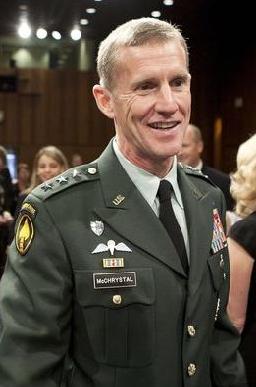
The Rolling Stone article on Gen. Stanley McChrystal has the blog and pundit world all atwitter, with calls for the general’s resignation, deep sighs of remorse, lofty comments about the sanctity of the commander in chief and the chain of command and lots more. The dude screwed up; you don’t let your aides dis the president like that. But that’s really off the point.


Frankly, if there were a way for the U.S. to be successful in Afghanistan, and McChrystal were the guy to do it, Obama shouldn’t care what the guy says. Whatever; you mean you never griped about your boss? It happens. Calling dinner with a French cabinet minister “fucking gay” is pretty fucking stupid, I admit. Overall, the interviews show astonishly bad judgment. (Oh, and General, sir: Don’t go out drinking and get shitfaced with a reporter if you don’t want to look bad in print.)


But the real point of the Rolling Stone story comes at the very end:


Whatever the nature of the new plan, the delay underscores the fundamental flaws of counterinsurgency. After nine years of war, the Taliban simply remains too strongly entrenched for the U.S. military to openly attack. The very people that COIN seeks to win over – the Afghan people – do not want us there. Our supposed ally, President Karzai, used his influence to delay the offensive, and the massive influx of aid championed by McChrystal is likely only to make things worse. “Throwing money at the problem exacerbates the problem,” says Andrew Wilder, an expert at Tufts University who has studied the effect of aid in southern Afghanistan. “A tsunami of cash fuels corruption, delegitimizes the government and creates an environment where we’re picking winners and losers” – a process that fuels resentment and hostility among the civilian population. So far, counterinsurgency has succeeded only in creating a never-ending demand for the primary product supplied by the military: perpetual war. There is a reason that President Obama studiously avoids using the word “victory” when he talks about Afghanistan. Winning, it would seem, is not really possible. Not even with Stanley McChrystal in charge.


In other words, who cares if the commanding general is a moron with a staff made up of armed frat boys? We can’t win anyway. And we don’t belong there. That’s the only thing that matters.


Hands Across the Sand says “No to offshore drilling, yes to clean energy”

0

I got an email today from Moveon.org advising me, “There’s a huge event happening this weekend at a beach near you.”
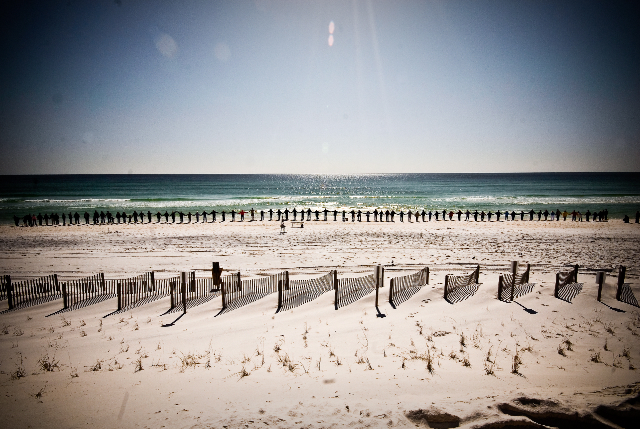
“In the wake of the giant BP oil spill in the Gulf, tens of thousands of people are getting together on beaches around the world for a massive event called “Hands Across The Sand,” the moveon.org folks said.
And so far, I’ve seen press advisories saying a Hands Across the Sand event is happening at Ocean Beach and China Beach In San Francisco, and at Crown Memorial Beach on Alameda Island, with folks gathering around 11 a.m. in preparation for non-violent hand-holding at 12 noon, on Saturday, June 26.
And the really cool and catchy part of this idea is that anyone on any beach anywhere in the world can join in, simply by grabbing the nearest person’s hand.

Dave Rauschkolb, who founded the first Hands Across the Sand event earlier this year, is a surfer and owner of three restaurants on the beach in Seaside, Florida, on the northern Gulf Coast between Pensacola and Panama City.
Rauschkolb spoke to me by phone today, shortly after US District Court Judge Martin Feldman ruled against  Obama’s deepwater drilling moratorium, claiming the Obama Admin “overreached”. and just the tar balls were starting to come up on the beach near Rauschkolb’s restaurants in Florida.

These incoming tar balls are an especially heartbreaking sight for Rauschkolb, given that he helped successfully organize the first Hands Across the Sand event on Feb. 13, 2010, when over 10,000 people joined hands on nearly 100 beaches along the coastline to stop the expansion of offshore oil drilling. But hopefully, terrible sights like this will be the impetus that finally gets U.S. citizens to break their addiction to oil.

“We gathered to stop the expansion of oil drilling in our coastal waters,” Rauschkolb said, referring to how folks protested efforts by the Florida Legislature and the U.S. Congress to lift the ban on offshore oil drilling.

“Now, just a few months later our entire Gulf of Mexico marine environment and
coastal economy is at risk from the very thing we tried to stop: offshore oil drilling off
our coast,” he continued. “The Deepwater Horizon disaster is a wake up call. Even as the Gulf disaster grows, British Petroleum and other oil companies continue to push for new offshore drilling anywhere oil might be found regardless of the risks they pose. The offshore drilling industry is a dirty, dangerous business and no one industry should be able to place entire coastal economies and marine environments at risk. Why is this allowed to happen?”

Rauschkolb said he blames BP to the extent that we should hold them accountable for what happened with the Deepwater Horizon disaster,
“However, I also hold the entire offshore oil industry accountable as well, because any company could have had this happen, “ he told me, pointing to a blow out off the Australian coast that took three months before a relief well could be drilled.

Concerned that the U.S. government and the oil industry will seek to make BP the scapegoat, in an effort to avoid imposing stricter regulations, Rauschkolb said such a response wouldn’t be a good outcome.

“America could be, should be one of the world’s leaders in expanding cleaner energy sources yet, our political process is paralyzed by oil money and influence. It is time for our leaders in all countries to take bold, courageous steps and open the door to clean energy and renewables and finally extend a hand to free our countries from our addiction to oil.”

“This is a critical turning point in finally changing our prehistoric energy policy towards the light of clean energy,” Rauschkolb concludes. “ Let us work together and share our passion and energies to protect our coastal economies, our oceans, our beaches, our waterfowl and our marine life. On behalf of those who have been and continue to be affected by this disaster of epic proportions in our Gulf of Mexico we extend our deepest appreciation to all of you for Joining Hands across America and the world on June 26.”

Rauschkolb invites folks to visit the Hands Across the Sand website and sign up to organize a beach or city.
Sounds like a great way to spend a Saturday. And if you do, you’ll be joining a movement that’s exciting interest around the world. According to Rauschkolb, as of today, 627 events are scheduled to take place on June 26 in 451 U.S. cities, with another 45 events scheduled outside the U.S. in 20 separate countries.

Think Global. Go clean energy.

The insanity of cutting pensions

15


The New York Times has picked up the pension-reform banner, promoting the issue to the lead story on the front page of the June 20th issue.


If, as the Times reports, some of the reformers want to cap pensions – that is, go for the folks at the very top of the pile – it’s worth discussing. But most of the “reform” ideas involve either cutting the take-home pay of existing employees, cutting the take-home pay of pensioners or making sure that future workers don’t get as much of a pension.
The problem with that is simple: We’re in a deep recession. And the last thing we need to do is cut paychecks and encourage people not to spend money.


Let me quote from a brilliant blog post on Calitics.com from the always insightful Robert Cruickshank:


Cutting pensions would be like taking a shotgun, aiming it at our feet, and pulling the trigger. It would cause a cascade of economic problems that would dramatically worsen our economic crisis…


And yet the solution being proposed – slashing benefits – will do absolutely nothing to make state government fiscally solvent. It will mean there’s less money available to spend, meaning less sales tax revenue. Less consumer activity means there’ll be less jobs available, meaning less income tax revenue. With fewer jobs available, and wage stagnation, and now the added financial burden of paying the costs of retired family members that used to be borne by the pensions and other state services that have been cut, younger folks won’t be able to sustain the economy. Retirees and baby boomers will have to sell their homes for the cash, and in a recessionary environment where the young aren’t able to afford the present market value, home values will spiral downward, causing further economic ripple effects as well as reducing property tax revenues.
 
… The notion that ‘everyone needs to give back’ just doesn’t make sense given our economic distress. We’ve already given back too much. We gave back our wages. We gave back our ability to afford health care and housing and transportation. We gave back the robust public sector services that created widespread prosperity in the 1950s and 1960s. We gave back affordable, quality education. And too many of us have given back our future.
No, it’s time for someone else to give back. It’s time for the wealthiest Californians, and the large corporations, to give back. For 30 years now they have benefited from economic policy designed to take money and benefits from the rest of us and give it to those who already have wealth and power.
We are now experiencing the predictable outcome of such policies – the worst recession in 60 years, an intractable downturn. The way out isn’t to worsen the crisis by slashing pensions. The way out is to return to the sensible tax rates of the 1950s and 1960s and make the rich pay.


That’s what I’m talking about.

The Gaza resolution

25

I know that the discussion over the John Avalos/Sophie Maxwell resolution on the Gaza flotilla took a long time, and kept the supervisors and assorted city employees at work until midnight, and Sweet Melissa says that cost the city some money. And she makes the same argument we hear all the time when these things come up:


Run for Congress. Jump onto a plane. Send money to a worthy organization. But don’t pat yourselves on the back for a job well done for getting a resolution passed at the San Francisco Board of Supervisors. No one cares what supervisors in San Francisco think about foreign policy — not other governments, not the U.S. government and especially not those of us who live here.


And while I agree that the Avalos/Maxwell resolution was long, and isn’t going to change anyone’s foreign policy, and a lot of the other supervisors wish the thing had never come up and consider it a terrible time suck, let me gently argue the contrary.


I remember back in 1984, when a group of Berkeley activists put a measure on that city’s ballot calling on the United States to reduce its aid to Israel by the amount that Israel was spending on settlements in the occupied territories. It bitterly divided the Berkeley City Council, stirred up a giant fuss on the city’s left and led to a long, dramatic meeting of the progressive coalition called Berkeley Citizens Action. BCA was at that point the equivalent of a political party that dominated city politics.


There were some BCA members who thought the measure was horrible, anti-semitic and needed to be killed. There were some who argued that the situation in the occupied territories was so bad that Americans needed to take a stand. There were others who said this was none of Berkeley’s business — much as a lot of San Francisco pundits say that the Avalos resolution was none of San Francisco’s business.


But I was there and I watched all of this come down — and in the end, it was a good thing for Berkeley, for progressive politics, and for the way the left in the Bay Area thought about the Middle East.


Lee Halterman, who was an aide to then-Rep Ron Dellums, chaired the BCA meeting where the measure was debated, and he did a fabulous job — everyone got a chance to speak, nobody was cut off, the discussion was remarkably civil and in the end, the group voted not to endorse either side. “This was healthy for BCA,” Halterman told me afterward. “This was a discussion that we needed to have.”


I didn’t know much of anything about the politics of Israel’s settlement policies back then, and I got quite an education. The Arab-American Anti-Discrimination committee folks came down to the Guardian and — calmly, without harsh rhetoric, explained why the continuing settlement construction was creating a serious obstacle to future peace (they were absolutely right). I learned that John B. Oakes, the former editorial page editor of the New York Times, had written a series of columns saying, in essence, that building all the new settlements was going to make a two-state solution almost impossible. Slowly, political observers who fully supported Israel on almost every issue were starting to question the Israeli government’s actions.


We heard the other side, too: Anna Rabkin, the Berkeley city auditor and an icon on the Berkeley left, came in and told us how painful this would be to progressive Jews and how harmful it would be to the progressive agenda. She made a powerful, impassioned argument. 


And all of this came to a head with a ballot campaign that generated both heat and light. We endorsed Measure E (I wrote the endorsement myself); it went down overwhelmingly, but it got a lot of people thinking. I think today it would pass overwhelmingly. And while the usual snipers complained the “Berserkeley” was wasting everyone’s time and money on a foreign policy statement that nobody would pay attention to anyway, I think a lot of us were glad it happened.


And I think that the members of Congress who represented the Bay Area were paying close attention.


So let’s not trash the Avalos/Maxwell resolution so quickly. Sometimes these debates are good; sometimes they help the local voters — who, after all, decide who to elect to Congress, the U.S. Senate and the White House — hear conflicting sides of a complicated story.


The Gaza flotilla wasn’t just about breaking the blockade; it was about getting people in the United States to pay attention to a terrible situation that the daily papers and TV stations typically ignore. I don’t see why it’s so bad for the San Francisco supervisors to help spread that word. 

Following Recology’s $$$ to Environment Commission and DCCC

7

If you’ve been looking for a financial connection between the city’s tentative decision to award the next landfill disposal contract to Recology, which plans to dispose of our trash in Yuba County, then you’ll be interested in this campaign finance item: Because records show that Recology contributed $5,000 last year to SF Forward, a San Francisco Chamber of Commerce political action committee, which also got Money  from Bechtel, Medjool, PG&E, Charles Schwab, and Shorenstein Realty.

Recology Vice President and Group Manager John Legnitto is Chamber’s Chair Elect.

In the last two years, the Chamber contributed $10,000 to Plan C, a political action committee that advocates for more condo conversions and less tenants’ rights.And Plan C gave Commission of the Environment President Matt Tuchow $3,300 for his failed 2010 Democratic CCC bid.

So, while the transactions were legal, with the money laundered twice in between, these dollar connections will probably have folks opposed to the city’s plan to dispose of its waste in Recology’s landfill in Yuba County asking if this explains why Tuchow decided to limit public comment to only one minute when folks wanted to voice concerns at a March 23 hearing at the Environment Commission about an alleged lack of fairness and transparency in the decision to award the contract to Recology.

Especially those folks who drove three hours from Yuba County, which is where Recology proposes to send our trash. And folks who helped negotiate the city’s current trash disposal contract and were shocked that the city would set a one-minute time limit on what they claim is a $1 billion contract, once you factor in the cost of transportation, new trash processing facilities and an as yet unbuilt rail spur that Recology needs inYuba County to transfer trash from the Union Pacific line to its landfill in Wheatland,

Tuchow, who works in the Global Compliance and Ethics Division of McKesson Corporation in San Francisco, had not returned calls as of blog post  time, but if and when he does, I’ll be sure to post an update here.

Meanwhile, it doesn’t look as if Recology’s bucks and/or Mayor Gavin Newsom’s powergrabbing antics, are going to be able to help shoehorn Tuchow onto the DCCC, even in light of Newsom’s newly hatched plan for dominion for the following reasons:

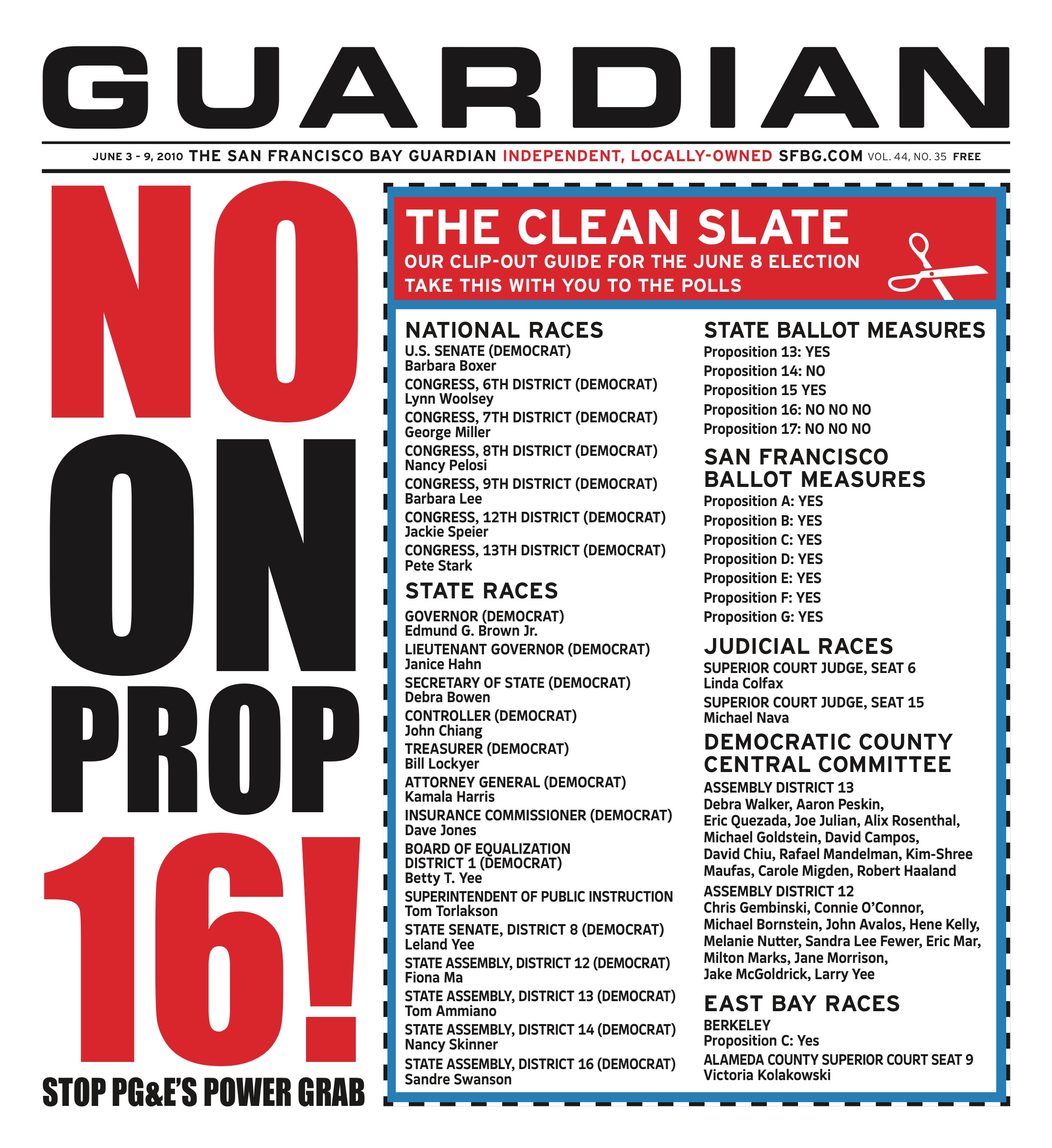
1. Results from the June 8 election show that Tuchow was fourth failed runner up in the DCCC 12th district. (Milton Marks, Sup. Eric Mar, Melanie Nutter, Arlo Smith, Connie O’Connor, Tom A. Hsieh, Jane Morrison, Mary Jung, Sandra Lee Fewer, Michael Bornstein, Sup. John Avalos and Bill Fazio were the top vote getters to win seats, beating out Larry Yee, Jake McGoldrick, Hene Kelly and then Tuchow, in that order.)

2.. It’s not clear if Newsom’s plan for the DCCC is even legal.

3. Even if Newsom’s plan survives a legal challenge, it’s not clear that the law would have the retroactive effect necessary to oust Mar and Avalos.

4. And even if it did, under state law,  DCCC Chair Aaron Peskin would get to appoint folks to fill those vacancies,
“This is about clean money and good government,” Newsom spokesman Tony Winnicker told reporters of Newsom’s DCCC plan.

So, let’s hope the Mayor’s Office applies the same standards when it comes to opening the landfill disposal contract bids this summer and shining light on the money that’s influencing the city’s garbage disposal contract. 

Meanwhile, Peskin, who was reached by cell phone somewhere near Moab, in Utah, where he’s taking his annual camping and hiking trip with his wife, told the Guardian that Newsom “is not thinking very far ahead” with his latest dominion scheme.


Newsom’s plan for DCCC domination

4

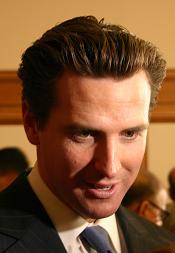
Gavin’s not quite ready to take over the world, or even California, but he’s not leaving office without trying to mess up the progressive majority on the Democratic County Central Committee. The plan he hatched June 15: Ban elected city officials from sitting on the DCCC. The idea: Get rid of Supervisors David Campos, David Chiu, John Avalos and Eric Mar. The overall plan: With the progressive supervisors — who have high name recognition and thus get easily elected — gone, the Newsom allies can take back control of the local Democratic Party.


It’s a pretty blatant move — far beyond Aaron Peskin’s so-called coup. And I must say, it’s a bit hypocritical.


See, the DCCC isn’t just made up of 24 elected members. Every San Francisco Democrat who holds state or national office — or who is a candidate for state or national office — is also an automatic member. So Senator Diane Feinstein is a DCCC member; so is House Speaker Nancy Pelosi, Assemblymember Tom Ammiano and Sen. Mark Leno. And guess who gets a seat this fall? Lt. governor candidate Gavin Newsom. People like Feinstein and Pelosi never show up; at best, they send a proxy. They rarely pay much attention to the local party, don’t help out much with party fundraising, don’t even come to the party’s annual dinner (Newsom didn’t show this year, even though he’s the mayor of a Democratic city.)


There have been members of the Board of Supervisors on the DCCC for years. The late Sue Bierman was always a member, and actually cared about and paid attention to the local Democratic Party. Leslie Katz was a member as a supe, and still is. It’s never been that big a deal to anyone — until the progressives starting winning seats. Then suddenly it’s a horrible conflict.


The real conflict has nothing to do with city officials sitting on the committee; it’s the fundraising issue. The city’s campaign finance rules don’t apply to DCCC races, so candidates for DCCC who are also running for supervisor — Scott Wiener, Rafael Mandelman, Debra Walker — can raise unlimited money for their DCCC races and use that additional name recognition for the fall elections. The thing is, I think most of the candidates who benefit from this loophole agree that it needs to be fixed; Mandelman certainly does, and he’s told me that several times. I couldn’t reach Walker or Wiener this morning, but I’d be very surprised if both of them wouldn’t endorse some kind of contribution limits for DCCC races.


I asked Newsom’s press spokesperson, Tony Winnicker, if the mayor would support fundraising limits. Apparently he doesn’t (or at least, he doesn’t want to push the issue):


“For this November’s local ballot, which the Mayor can place an initiative on, we propose eliminating the potential conflict that exists between City officeholders also holding office as elected County Party Committee members.”


How about getting rid of all the elected officials, and creating a real grassroots county committee? No, that won’t fly with Newsom either. Winnicker:


It’s appropriate for state and federal Democratic elected officials from San Francisco to serve on the Democratic County Central Committee.


The city/local offices — Mayor, Board, Treasurer, Assessor, City Atty, Sheriff, District Atty, Public Defender — are nonpartisan offices who have direct oversight over City business. That’s the difference and conflict. This is a local initiative, so our focus and concern is local good government and local conflicts or appearance of conflicts.


From everything I can figure, Newsom doesn’t want campaign-finance reform and doesn’t want to put the party in the hands of local activists; he just wants to get rid of the supervisors who take positions he doesn’t like. That seems like a pretty bad way to make public policy. 


UPDATE: Just talked to Scott Wiener, who told me he agrees that the whole issue of DCCC campaign spending ought to be on the table. And he said he is not at this point prepared to support Newsom’s initiative. “I have concerns with the number of elected officials on the DCCC,” he said, “but there are times when it’s entirely appropriate to have people who have a demonstrated commitment to the DCCC and then get elected supervisor to stay on it.”

And now, the race to replace Kamala Harris

2

David Onek, who has strong political connections and little courtroom experience, sent out a email today announcing that he wants to be San Francisco’s next district attorney:


As many of you know, District Attorney Kamala Harris is very likely to become California’s next Attorney General. DA Harris is a friend and I would never run against her, but her victory in November will open up the office as early as the end of this year. This means the time to get organized is right now.


He adds his name to the list of people, including former chief homicide prosecutor Jim Hammer, who want the job. But it’s going to be an unconventional campaign, to say the least. Because if Harris wins, her successor won’t be chosen by the voters of San Francisco.


There are three relevant scenarios here.


1. Harris loses the AG race. Entirely possible; she’s got a tough campaign ahead of her. Then all of this talk is moot; Onek clearly isn’t going to run against her, although Hammer might.


2. Harris wins the AG race, and Newsom loses his race for lieutenant governor. In that case, Newsom will be mayor of San Francisco when Harris resigns to move up to Sacramento — and under the City Charter, he will appoint someone to serve out the rest of Harris’s term.


3. Harris and Newsom both win — in which case there’s a fascinating legal issue. Do Harris and Newsom leave at the same moment — in which case the Board of Supervisors appoint the next mayor, who appoints the next DA? Or does Newsom try to fill Harris’s job before he resigns himself? In the end, Matt Dorsey, spokesperson for City Attorney Dennis Herrera told me, “that’s a question that will be answered by the attorney general. Theoretically, it could get very complicated.”


Under the state Constitution, the governor, lt. governor and attorney general all take office the same day, the first monday after Jan. 1st, which in this case is Jan. 3. The constitution doesn’t say what time of day that happens. In theory, then, Harris could take the oath of office at 9 am, Newsom could wait until 10 am, and appoint a new DA in between. Then somebody who didn’t get appointed (or, frankly, any angry citizen of San Francisco) could sue — because if Newsom’s term technically starts at 12:01 am Jan. 3d, then at that moment, by city law, the president of the Board of Supervisors instantly becomes mayor, meaning David Chiu should be the one making the DA appointment.


Or Harris and Newsom (and whatever other parties wanted to play ball) could cut a deal. Harris could resign a day early, and Newsom could appoint her replacement with no legal consequences at all. That would look sleazy as hell and be a rotten way for the mayor to start his term as lieutentant governor, but he could do it.


Of course, that will all depend on an interpretation from the attorney general on when the AG and lt. gov. terms actually begin — and the AG at that point will be Jerry Brown, who may have just been elected governor on a ticket with Newsom and Harris.


What a clusterfuck.


At any rate, David Onek now has to build a campaign aimed not really at winning an election, but at convincing either Newsom or Chiu (or, potentially, the next mayor, who would be named by the supervisors) that he ought to be district attorney. Part of that calculation will hinge on whether he can hold onto the job when it comes up for a real election in November.


If it’s a simple deal with Newsom, Onek will be relying on his political allies. He notes:


A broad range of leaders in government, in law enforcement and in the broader criminal justice community have already pledged their support – including former San Francisco City Attorney and Police Commission President Louise Renne, former state Treasurer Phil Angelides, Supervisor Carmen Chu, School Board Commissioner Hydra Mendoza, former Mayor Art Agnos, former Police Chief Heather Fong, Berkeley Law School Dean Christopher Edley, Jr., Police Commission President Joe Marshall and former Chief Probation Officer Jeanne Woodford. 


Although I’m not sure that Newsom cares much these days what Louise Renne, Art Agnos or Phil Angelides think.


So what Onek — and anyone else who wants to be the next DA — needs to do is convince the next mayor that he’s not only going to be a good chief prosecutor (already a hurdle for someone with no background as a prosecutor) but that he has the political ability to convince the actual voters that he’s qualified. Otherwise he’s just another Kim Burton waiting to happen.


I haven’t been able to reach Onek yet to discuss all of this, but the minute he calls me I’ll post an update.

Love stories, politics, yodeling, and more: Frameline 34 short takes

2

The Secret Diaries of Miss Anne Lister (James Kent, UK, 2010) A BBC production set in the northern English countryside of the early 19th century, James Kent’s The Secret Diaries of Miss Anne Lister depicts the amatory adventures of a gentlewoman landowner (Maxine Peake) in search of a “female companion” with whom to live out her days. The narrative is somewhat breathless, the seductions equally so and yet a bit anemic, and our strong-willed, fearless heroine is admirable without being entirely engaging. Still, besides tapping into the Jane Austen slash fiction demographic, this tale of pre-Victorian bodice ripping and skirt lifting among the female gentry offers the considerable thrill of being adapted from the actual secret diaries of the titular Miss Lister, decoded by a biographer 150 years after her death. A documentary in the festival, Matthew Hill’s The Real Anne Lister, offers a complementary version of her story. Thurs/17, 7 p.m., Castro. (Lynn Rapoport)

I Killed My Mother (Xavier Dolan, Canada, 2009) The title I Killed My Mother suggests a different kind of movie from what it actually is. But that’s OK: though not a crime thriller, the film is still a tightly wound, high stakes drama. Writer-director Xavier Dolan stars as Hubert, the angsty son of the titular mother. When you consider that Dolan’s script is autobiographical — and that he was only 20 when the film was made — his performance becomes all the more impressive. As the mother, Chantale, Anne Dorval is also a force to be reckoned with. Despite its presence as part of a queer film festival, I Killed My Mother is not all that “gay” in the traditional “gay movie” sense. Hubert’s relationship with Antonin (François Arnaud) is secondary — what’s important is how his refusal to share it with his mother affects her. That helps make the movie a refreshing alternative to many more mainstream offerings. Sat/19, 6:45 p.m., Castro. (Louis Peitzman)

The Owls (Cheryl Dunye, USA, 2010) Expectations are high for The Owls: writer-director Cheryl Dunye again collaborates with Guinevere Turner, V.S. Brodie, and other notable queer performers — you can’t not think of classics like Go Fish (1994) and The Watermelon Woman (1996). The Owls isn’t quite at that level, but it’s a fairly thought-provoking piece. Four middle-aged lesbians — played by Dunye, Turner, Brodie, and Lisa Gornick — accidentally kill a younger lesbian and try to cover up the murder. Their ages are central: the fear of getting older is a major thematic concern. So, too, ideas of gender identity, with the introduction of androgynous Skye (Skyler Cooper). But Dunye breaks the fourth wall, staging her film as a pseudo-mockumentary with both the characters and the actors offering commentary. At just over an hour, The Owls can’t sustain all the back-and-forth, and too many intriguing ideas are left unfinished. Fri/18, 7 p.m., Castro. (Peitzman)

The Topp Twins: Untouchable Girls (Leanne Pooley, New Zealand, 2009) It’s hard to name an American equivalent of New Zealand’s Topp Twins — a folk-singing, comedy-slinging, cross-dressing duo who’re the biggest Kiwi stars you’ve never heard of (but may be just as beloved as, say, Peter Jackson in their homeland). Recent inductees in the New Zealand Music Hall of Fame, the fiftysomething Jools and Lynda, both lesbians, sing country-tinged tunes that slide easily from broad and goofy (with an array of costumed personas) to extremely political, sounding off on LGBT and Maori rights, among other topics. Even if you’re not a fan of their musical style, it’s undeniable that their identical voices make for some stirring harmonies, and their optimism, even when a serious illness strikes, is inspiring. This doc — which combines interviews, home movies, and performance footage — will surely earn them scores of new stateside fans. Sun/20, 3:45 p.m., Castro. (Cheryl Eddy)

Out of the Blue (Alain Tasma, France, 2007) Wearily preparing for a dinner party on a day they’ve both forgotten is their anniversary, Marion (Mireille Perrier) suddenly realizes her 22-year-marriage to Paul (Robin Renucci) is dead. Her decision to end it, however, comes as an infuriating surprise to him and a destabilizing one to their teenage daughter Justine (Chloé Coulloud). They all get quite a surprise when Marion’s new friendship with younger, flamenco-dancing female antiques dealer Claude (Rachida Brakni) turns into something more. This latest in a long line of very good French made-for-TV dramas at Frameline typically handles its complex load of familial and sexual issues with grace and intelligence, if with an occasional excess of high dramatics. Sun/20, 9:30 p.m., Roxie. (Dennis Harvey)

The Consul of Sodom (Sigfrid Monleón, Spain, 2009) Late Spanish poet Jaime Gil de Biedma was many things: an intellectual, aesthete, hedonist, bohemian, discotheque owner, Communist sympathizer (though the Party wouldn’t have him), publisher, more-or-less out gay man, and an occasional lover of flamboyant women like Bel (played by pop singer Bimba Bose). Sheltered by wealth and privilege — to the extent possible in Franco’s Spain — he dabbled in ghetto flesh, sometimes on trips abroad for his family’s tobacco family. As portrayed by actor Jordi Mollá and director Sigfrid Monleon, he’s a mixture of arrogance,
compassion, self-destruction, and shark-like perpetual motion. Seldom missing a chance to drop some full-frontal nudity or a kitschy period song (from 1950s to 80s), this biographical drama — which has been decried as overly sensationalized by some Spanish cultural watchdogs, including a few of the subject’s surviving cronies — is a shamelessly flamboyant and entertaining portrait of a life lived large. Sun/20, 9:30 p.m., Castro. (Harvey)

Dzi Croquettes (Tatiana Issa and Raphael Alvarez, Brazil, 2009) Whatever magic fairy dust fuelled the Cockettes’ glitter-covered hippy drag must’ve drifted down south to Brazil to inspire the similarly named Dzi Croquettes. Of course, that’s not the real origin of the equally colorful cabaret troupe, whose fantastic story is told in Raphael Alvarez and Tatiana Issa’s riveting and rollicking documentary. Blending Ziegfeld Follies-style glamour with agitprop, Dzi Croquettes were more polished and more overtly political than their North American sisters; something which frequently landed the group in hot water with José Sarney’s dictatorship. Finding an unlikely and unexpected advocate in Liza Minnelli, Dzi Croquettes fled their homeland in the mid 70s, becoming the unexpected toast of Europe until AIDS began to take its toll. Filled with delightful archival footage and insightful interviews with alumni, Dzi Croquettes is a joyful affirmation of the power of art (and a feathered boa or two) to effect positive change. Mon/21, 11 a.m., Castro. (Matt Sussman)

Brotherhood (Nicolo Donato, Denmark, 2009) It’s hard to feel much sympathy for neo-Nazis. Perhaps that goes without saying, but Danish film Brotherhood asks us to do just that: Lars (Thure Lindhardt) and Jimmy (David Dencik) meet in the service of Hitler’s ideals, then find themselves drawn to each other. As they struggle to come to terms with their attraction, we’re supposed to care. Fat chance. Although Lars initially disproves of the neo-Nazis, he becomes quickly (read: unrealistically) interested in their cause. Soon, he’s writing his own anti-Pakistani propaganda. And Jimmy is devoted to the movement from the get-go, even condemning “faggots” despite his own same-sex attraction. Maybe I’d feel differently if either Lars showed any sign of internal conflict. Neither displays a sense of regret over being a racist, xenophobic, anti-semitic asshole. They’re down with the gay but only in relation to each other. Who gives a crap if these two make it work? Mon/21, 9:30 p.m., Castro. (Peitzman)

Plan B (Marco Berger, Argentina, 2009) It’s the oldest story in the book: boy meets girl, boy loses girl, boy seduces girl’s new boyfriend. OK, maybe not, but the set-up isn’t entirely unheard of either. It’s a credit to Plan B’s sharp aesthetic and strong performances that it still feels fresh. The Argentinean export stars Manuel Vignau as Bruno. When his girlfriend Laura (Mercedes Quinteros) breaks up with him, he decides to get revenge by making his move on Laura’s supposedly bisexual boyfriend Pablo (Lucas Ferraro). If you’ve seen any romantic comedy ever, you know that what begins as a game for Bruno becomes true love. But Plan B doesn’t go the comedy route, and instead offers a compelling, somewhat subtle drama. The love affair is slow but well-paced, so that the inevitable conclusion feels earned and completely satisfying. Mon/21, 9:30 p.m., Elmwood; June 24, 6:30 p.m., Victoria. (Peitzman)

Undertow (Javier Fuentes-León, Peru, 2009) This sexy and delicate drama is a bisexual triangle that continues beyond the grave. In a Peruvian coastal hamlet, fisherman Miguel (Cristian Mercado) loves his pregnant wife and fellow church leader Mariela (Tatiana Astengo). But he’s also having a secret, passionate affair with Santiago (Manolo Cardona), an urbanite who moved there to paint the land- and seascapes, and who chafes at the restrictions Miguel places on their relationship. At a certain point one character dies, and writer-director Javier Fuentes-León seamlessly handles Undertow’s transition to magical realism. The leisurely story doesn’t go where one expects, ending on a perfect grace note of bittersweet acceptance. Tues/22, 7 p.m., Castro. (Harvey)

Children of God (Kareem J. Mortimer, Bahamas, 2009) Likely the first gay-themed film not just shot in but produced by the Bahamas, Kareem J. Mortimer’s first feature is an occasionally heavy-handed but consistently engrossing mix of romance, religion, and homophobia. Johnny (Johnny Ferro) is a withdrawn Nassau art student who’s a target of gay taunts and bashers. A teacher who says his paintings lack emotion gives him keys to her cottage on the “ultimate landscape” of isle Eleuthera, where he promptly meets the aggressively friendly and inquisitive Romeo (Stephen Tyrone Williams). Also headed here is Lena (Margaret Laurena Kemp), righteous wife of pastor Ralph (Ralph Ford), with whom she shares a strong penchant to publicly denounce the moral threat of “the gays.” She has, however, just left her husband after he furiously denied giving her VD — to confess might reveal that he is, in fact, playing around on the downlow. That’s just the starting point for a complicated, perhaps over-ambitious but sometimes powerfully sensual and poignant film that is definitely amongst this year’s Frameline highlights. June 23, 9:30 p.m., Castro. (Harvey)

Spring Fever (Lou Ye, China, 2009) Shot surreptitiously and chock full of gay sex, Chinese director Lou Ye’s latest film isn’t likely to earn him any additional slack from Chinese government censors (his 2006 film, Summer Palace, got him banned from filmmaking for five years after he failed to preview it before it screened at Cannes). Using hand-held cameras, public settings, and natural lighting, Lou follows Wang Ping (Wu Wei), who’s been having a passionate, messy affair with travel agent Jiang Cheng (Qin Hao). Things get more complicated when the snoop Wang’s wife hires to follow her closeted husband winds up pursuing the two men in ways he never imagined. What Spring Fever lacks in continuity and psychological depth, it makes up for with sexual candor and a genuine frisson of risk, given the secretive conditions under which it was made. That thrill doesn’t quite last through the film’s duration, but as a document of defiance Spring Fever is commendable. June 24, 9:30 p.m., Castro. (Sussman)

The String (Medhi Ben Attia, France/Belgium, 2010) The cross-cultural coming out drama is a perennial at LGBT film festivals, but Medhi Ben Attia’s assured debut feature presents a familiar tale in new surroundings with flashes of charm. Handsome architect Malik (Antonin Stahly) returns to his posh, Tunisian homestead from France to lay his father to rest, fully intent on coming out to his overly doting, oblivious mother (former Fellini muse Claudia Cardinale). But when he falls for hunky house-boy Bilal (Salim Kechiouche), he finds that the truth has a way of outing itself. Although Attia unspools his film’s titular metaphor rather quickly (having hid his true feelings for so long, Malik feels continuously “tied-up” by a piece of imaginary string), he deserves credit for his nuanced portrayal of gay life in the Maghreb and his inspired casting of Cardinale, who can’t help but radiate an Auntie Mame-ish joie de vivre even when the script calls for “disappointed” over “daffy.” June 25, 7 p.m., Victoria. (Sussman)

Hideaway (Francois Ozon, France, 2009) The very French insouciance with which Francois Ozon usually treats his characters and narratives sometimes makes a film seem perilously slight — yet more often than not he manages to pull off a surprising climactic resonance. Which is the case with this latest. When they both overdose on heroin, Mousse (Isabelle Carré) wakes up pregnant in the hospital — but her boyfriend doesn’t wake at all. Declining his mother’s offer to pay for an abortion, she retreats to a friend’s empty seaside chateau. There she gets an unexpected visitor in Raul (Louis-Ronan Choisy), her late lover’s surviving sibling. Their prickly interplay (and his affair with a local handyman) sometimes seems to be drifting pleasantly nowhere in particular — yet it does end up somewhere, rather poignantly. June 25, 9:30 p.m., Castro. (Harvey)

From Beginning to End (Aluízio Abranches, Brazil/Argentina/Spain, 2009) Just about the definition of upscale gay male softcore, this “big brother” fantasy has nothing to do with George Orwell. Its protagonists are inseparable Brazilian half-brothers (played as adults by Joao Gabriel Vasconcellos and Rafael Cardoso) whose bond caves in to the physical once parental boundaries are removed by mom’s death. This over-the-top kinship is tested when the younger bro is invited to train as a swimmer in the Olympics … in Russia. Near-plotless and borderline senseless, this shamelessly sexy tale from The Three Marias (2002) director Aluízio Abranches succeeds as a guilty pleasure on the sheer, convincing ardor he and his actors bring to their “taboo” love story. June 26, 6 p.m., Castro. (Harvey)

Howl (Rob Epstein and Jeffrey Friedman, USA, 2010) Beatniks get the Mad Men treatment — with a cast that includes that AMC hit’s Jon Hamm, playing the lawyer who defended the publisher of Allen Ginsberg’s quintessential rebel yell, Lawrence Ferlinghetti, against obscenity charges in San Francisco’s most celebrated trial of the 1950s. It’s fun to see that anally nostalgic aesthetic translated to ramshackle North Beach apartments and sophomoric, filthy-mouthed literary heroes. Not so much fun: the overly literal animation chosen by the directors (famed documentarians Rob Epstein and Jeffrey Friedman). Yes, parts of “Howl,” the poem, are animated — unfortunately in a style that calls to mind bad 1980s French Canadian pseudo-spiritual arthouse schlock. Still, this brief slice of beats is juicy, confined to the trial and the tale of Ginsberg’s poetic and sexual awakening. James Franco is wonderful as the young, self-obsessed, epically needy yet still irresistible crank. It was the first time I found myself wishing to see more of Ginsberg naked. June 27, 7:30 p.m., Castro. (Marke B.)

Frameline34: San Francisco International LGBT Film Festival
June 17-27, most shows $8-15
Castro, 429 Castro, SF; Roxie, 3117 16th St, SF; Victoria, 2961 16th St, SF; Rialto Cinemas Elmwood, 2966 College, Berk
www.frameline.org

Voters are pissed

0

By Guardian News Staff

news@sfbg.com

After spending more than $70 million, two big corporations failed to convince Californians to vote their way. After spending nearly $70 million, the former head of a big corporation easily convinced Californians to vote her way. And that outcome is not as schizophrenic as it sounds.

On one level, the outcome of the June 8 election was a sign of the anti-corporate anger seething through the California electorate. “BP, Goldman Sachs, PG&E — anything that seems connected to a big corporation is in serious trouble right now,” one political insider, who asked not to be named, told us.

Yet two candidates who were very much corporate icons — Meg Whitman and Carly Fiorina — won handily in the Republican primaries and now have a real chance to become the state’s next governor and junior senator. What’s happening? It’s fascinating. The voters in the nation’s most populous state are pissed off — at big business, at government, at the oil spill, at 10 percent unemployment, at Washington, at Sacramento, at Wall Street. It’s an unsettled electorate, uncertain about its future and looking for something new, and definitely despising power.

There’s a populist fervor out there, and it’s going to define this fall’s expensive, dirty, and high-stakes battle for California’s future.


THE MAYOR GOES STATEWIDE

Addressing a crowd of supporters gathered at Yoshi’s San Francisco on election night, San Francisco Mayor Gavin Newsom — who easily beat opponent Janice Hahn to claim the Democratic nomination for lieutenant governor — said he was excited to be part of a crucial political year for the Golden State.

“We’re very proud to be in a position to be the Democratic nominee and to work with the other Democratic nominees,” Newsom told supporters. He lavished praise on the Democratic nominee for governor, Jerry Brown — the man who just last year he was trying to beat in a primary — telling stories about his father’s long relationship with the former governor and expressing his admiration. “I couldn’t be more proud to quasi- be on a ticket with Jerry Brown,” he said.

The race for lieutenant governor may prove one of the most interesting this election season — and not just because a victory for Newsom would transform San Francisco politics. Newsom’s opponent is Abel Maldonado, a moderate Republican who enjoys popularity among the growing, influential Latino community, and who Newsom’s team said will be a formidable challenge.

The campaign could revolve around an intriguing question. At a time when the Republican Party has been taken over by virulent anti-immigrant politicians — Whitman and Fiorina have both made harsh statements about illegal immigrants and vowed never to support “amnesty” (that is, immigration reform) — will Latino voters go for a white Democrat over a Latino Republican?

“You talk to them about all the same issues you talk to all voters about: jobs, education, and health care,” Newsom political strategist Dan Newman said when asked whether Newsom could win over Latino voters. “Latinos, like all voters, will appreciate someone with a proven record of success.”

Pollster Ben Tulchin also downplayed the trouble Newsom could encounter in winning the Latino vote. “With what’s going on in Arizona, they are very wary of Republicans,” Tulchin said, but then added: “We don’t want to underestimate the challenge we have. There’s never been a moderate Latino on the statewide ballot.”

Newsom sounded another alarm. If Whitman decides to help Maldonado, the race will get even tougher. “We’re running against Meg Whitman’s checkbook,” the mayor said.

“Expect to see Meg and Abel together a whole lot in the next few months,” one consultant predicted.

If Newsom wins, San Francisco will get a new mayor a year early — and the district-elected Board of Supervisors will choose the person to fill out the last year of Newsom’s term. Technically, the current board will still be in office then, but the task may well fall to the next board — which makes the local November elections even more important.

“Everyone is gaming this out and trying to figure out what happens,” political consultant Alex Clemens said during a post-election wrap-up at the San Francisco Planning and Urban Research Association office. “There will be a lot of dominoes to fall and deals to be cut.”

Meanwhile, Newsom’s nomination for lieutenant governor places many San Franciscans in an uncomfortable position, one that was illustrated well by Newsom’s victory speech, in which he proudly rejected taxes. Although most San Francisco progressives are disenchanted with their fiscally conservative mayor, few would rather vote for Maldonado.

Tim Paulson, the SF Labor Council president, was at the Newsom event gritting his teeth as he talked about the opportunity progressives now have to work with “a mayor of San Francisco we have issues with.” Now, he noted, “There is going to be a real campaign around this man. It could establish a narrative for what California is about.”


POWERFUL WOMEN

At Delancey Street on election night, San Francisco District Attorney Kamala Harris talked about getting “tough and smart on crime,” addressing gang-related criminal activity but also focusing on corporate criminals. She talked about cracking down on predatory lenders, supporting health care reform, and protecting California’s environment. And she made a point of dragging in BP.

“It must be the work of the next attorney general to ensure that the disaster and tragedy that happened in the Gulf of Mexico never happens in California,” she said, warning of attacks on AB 32, which set California’s 2020 greenhouse gas emissions reduction goal into law in 2006.

Of course, Harris now has to take on her southern counterpart, Los Angeles DA Steve Cooley, who is a moderate but comes in with much stronger law enforcement support. If Harris wins, it will go a long way to prove that opposition to the death penalty isn’t fatal in California politics, and that voters are finally ready for a women of color as the top law enforcement official — a first in state history.

But she and Newsom will both have to overcome likely attacks for the San Francisco’s crime lab scandal, one of many hits to be magnified by the size of Whitman’s war chest.

Whitman, who trounced opponent Steve Poizner in the primary, is riding the crest of a new wave of Republican-style “feminism,” starring her, Fiorina, and Fox news pundit Sarah Palin as female champions of the right-wing agenda. A few short months ago, it looked as if Brown was in serious trouble. But that was before Whitman and Insurance Commissioner Steve Poizner got into an $85 million bloodbath that left the winner of the GOP primary badly wounded. Whitman wants to play off the populist uprising by portraying herself as an outsider running against a career politician; Poizner gave her a huge scare by hammering her ties to Goldman Sachs.

That Wall Street narrative is one Democrats will push against Whitman and Fiorina. “I think it is stunningly politically tone deaf to nominate two Wall Street CEOs to the top of the ticket,” Newman said. Voters will decide whether they are fresh voices with new ideas or corporate hacks who laid off Californians and made fortunes with dubious stock market deals.

Brown leads in the polls — narrowly — but he’s vulnerable. He’s taken so many stands over so many years and Whitman’s fortune will hammer any openings they see. Brown is only slowly getting into campaign mode, but it’s no secret what he has to do. If the campaign is about Jerry Brown, unconventional politician, against Meg Whitman, Wall Street darling, then he wins.

But to take advantage of that, Brown has to offer some concrete solutions to the state’s problems — and he has to start acting like the progressive he once was. “If I were him, I’d run hard to the left,” a consultant who isn’t involved in any of the gubernatorial campaigns said.

The conventional wisdom had Barbara Boxer in trouble, too — but she’s a savvy campaigner who has beaten the odds before. And while the senator appears ripe for attack — almost 30 years in Washington, a voting record perhaps a bit more liberal than the state as a whole — her opponent, Fiorina, has baggage too.

For starters, Fiorina’s entire pitch is that she — like Whitman — would bring business-world savvy to politics. But as CEO of HP, “she was about perks and pink slips,” Newman said. “She laid off Californians and shipped those jobs overseas while enriching herself.”

Her own primary pushed her far to the right (at one point, in an embarrassing sop to the National Rifle Association, she actually argued that suspected terrorists on the federal no-fly list should be able to buy handguns). And speaking of feminist values, her anti-abortion positions won’t help her in a decidedly pro-choice state.


PROP. 16 GOES DOWN

The defeat of Proposition 16 will go down in history as one of the most remarkable campaigns ever. It was, Sup. Ross Mirkarimi noted, “a righteous win:” The No on 16 campaign spent less than $100,000 and still captured 52 percent of the vote. Another narrow corporate-interest measure, Mercury Insurance’s Prop. 17, faced a similar fate.

One reason: PG&E’s $50 million campaign backfired, making voters suspicious of the company’s propaganda. Another: it lost overwhelmingly in its own service area, the company rejected by those who know it best.

Now PG&E CEO Peter Darbee, who pushed to mount the expensive campaign, must return to his shareholders empty-handed — and that’s going to cause problems. “I assume the leadership of PG&E will be called to task,” Clemens said. “They truly rolled the dice.”

The day after the election, PG&E shares dropped 2.2 percent, a possible sign of shaken investor confidence. Mindy Spatt of the Utility Reform Network (TURN), a nonprofit that worked on the No on 16 effort, described the situation succinctly. “Peter Darbee’s got egg on his face,” she said. “Big-time.”

Mirkarimi has witnessed other battles with PG&E, and said this probably wouldn’t be the last. “PG&E, every time we want to have a seat at the table, tries to take us out, like assassins,” he said. “If they were smart, they would take us up on what we asked many years ago, and that is to abide by peaceful coexistence.”

On the statewide level, the bold and expensive deceptions pushed by PG&E and Mercury Insurance were countered by only a handful of super-committed activists and a broad cross-section of newspaper editorials, a reminder that newspapers — battered by the economy and technological changes — are neither dead nor irrelevant.

One of the wild cards of the election was Prop. 14, which will eliminate party primaries for state offices — and potentially shake up the state’s entire political structure. “This is a big deal even if we don’t know how it’s going to play out,” consultant David Latterman said at the SPUR event.

Interestingly, the only two counties that voted No on 14 were the most progressive — San Francisco — and the most conservative, Orange.

Progressives did well in San Francisco, expanding their majority on the Democratic County Central Committee. “In an environment where it was about hundreds of millions of dollars from PG&E and Meg Whitman and Chris Kelly outspending us, we showed that San Francisco is San Francisco and we support San Francisco values,” DCCC chair Aaron Peskin told us.

Money used to define the debates in San Francisco, but the dominant narratives are now being written by the coalition of tenants, environmentalists, workers, social justice advocates, and others who backed a progressive slate of DCCC candidates, which took 18 of the 24 seats on a body that makes policy and funding decisions for the local Democratic Party.

“This time it was the coalition that really made the difference,” DCCC winner Michael Bornstein said on election night. “Frankly, our people worked harder.”

Board of Supervisors President David Chiu agreed, telling us, “For the Central Committee, the message is people power wins.”

The lesson from this election is that people are starting to get wise to corporate deceptions. And they’re realizing that with hard work and smart coalition-building, the people can still prevail.

Steven T. Jones, Rebecca Bowe, Sarah Phelan, and Tim Redmond contributed to this report.

 

Editorial: PG&E’s greed backfires

1

The defeat of Prop. 16 showed that unlimited corporate spending on a ballot initiative doesn’t guarantee victory.

EDITORIAL The single most important number to come out of San Francisco on election night was this: 67.49 percent. That’s how many people in this city voted against Pacific Gas and Electric Co.’s monopoly measure, Proposition 16. It’s a statistic that ought to be posted somewhere on a wall at City Hall to remind everyone in local government that the voters sided overwhelmingly against PG&E and in favor of a public option for local electricity.

It’s a landmark victory. On the state level, the defeat of Prop. 16 showed that unlimited corporate spending on a ballot initiative doesn’t guarantee victory, that an underfunded coalition can defeat a giant utility — and that a majority of those in PG&E’s own service area are unhappy with their electricity provider. Public power activists all over the state should take this as a signal that PG&E, and its once-formidable political clout, are on the wane.

In San Francisco — the only city in the nation with a legal mandate for public power — the vote was the most lopsided of any California county. It was the strongest local mandate for public power since the passage of the Raker Act in 1913.

That should be a huge boost for the city’s community choice aggregation (CCA) program. Sup. Ross Mirkarimi, who has been leading the fight for CCA, was pushing hard to get a contract signed before the June 8 vote; like a lot of observers, he feared that PG&E’s vast war chest would overwhelm the opposition. But now that Prop. 16 is dead — and nothing like it will be back in the near future, if at all — the city has a bit of a breather.

That doesn’t mean all work on the contract should slow down. The San Francisco PUC has been mucking around with this deal for more than a year, and needs to bring it to a close. And the city needs to start preparing to answer PG&E’s propaganda campaign with a concerted effort — from the mayor’s office on down — to remind San Franciscans that CCA power will be greener, safer, and in the long run, cheaper than the energy we’re now forced to buy from PG&E.

Any San Francisco politician who stands with PG&E and opposes CCA will do so at his or her peril.

And while San Francisco is moving to implement a modest public power program, state Sen. Mark Leno is moving in Sacramento to limit PG&E’s ability to try another Prop. 16 move — or to spend tens of millions of dollars trying to block local power initiatives. Leno has introduced a bill that would limit the utility’s ability to use ratepayer money on political or public relations campaigns.

The measure doesn’t have a number yet, but the language is brilliant. It directs the California Public Utilities Commission to disallow any political spending that PG&E tries to add into its regulated rates. And since the company has no source of income other that the money it gets from ratepayers, the impact would be to deny PG&E the ability to spend money working against the interests of ratepayers and the public.

"Over the past 10 years, PG&E has probably spent $150 million on political campaigns — and that’s money that came from the ratepayers," Leno said. "This bill is to protect ratepayers."

PG&E will howl about its First Amendment rights — and, indeed, the Supreme Court has of late given corporations who want to influence political campaigns and legislative issues a good bit of leeway. But the fact remains that PG&E is a regulated utility in California, and the state has every right to determine how much the company can charge its customers and to limit how that money is used.

Leno’s bill, of course, could radically change local politics. If PG&E couldn’t spend millions to defeat public power measures, the city would have far more options — and activists should be thinking about how a future campaign to take over the company’s infrastructure might work.

The Board of Supervisors should pass a resolution endorsing Leno’s bill, and the coalition that worked to defeat Prop. 16 should be working to get other cities and counties around the state to sign on.

PG&E’s greed in putting Prop. 16 on the ballot is starting to backfire — and it can’t happen too soon.

PG&E’s greed backfires

0

EDITORIAL The single most important number to come out of San Francisco on election night was this: 67.49 percent. That’s how many people in this city voted against Pacific Gas and Electric Co.’s monopoly measure, Proposition 16. It’s a statistic that ought to be posted somewhere on a wall at City Hall to remind everyone in local government that the voters sided overwhelmingly against PG&E and in favor of a public option for local electricity.

It’s a landmark victory. On the state level, the defeat of Prop. 16 showed that unlimited corporate spending on a ballot initiative doesn’t guarantee victory, that an underfunded coalition can defeat a giant utility — and that a majority of those in PG&E’s own service area are unhappy with their electricity provider. Public power activists all over the state should take this as a signal that PG&E, and its once-formidable political clout, are on the wane.

In San Francisco — the only city in the nation with a legal mandate for public power — the vote was the most lopsided of any California county. It was the strongest local mandate for public power since the passage of the Raker Act in 1913.

That should be a huge boost for the city’s community choice aggregation (CCA) program. Sup. Ross Mirkarimi, who has been leading the fight for CCA, was pushing hard to get a contract signed before the June 8 vote; like a lot of observers, he feared that PG&E’s vast war chest would overwhelm the opposition. But now that Prop. 16 is dead — and nothing like it will be back in the near future, if at all — the city has a bit of a breather.

That doesn’t mean all work on the contract should slow down. The San Francisco PUC has been mucking around with this deal for more than a year, and needs to bring it to a close. And the city needs to start preparing to answer PG&E’s propaganda campaign with a concerted effort — from the mayor’s office on down — to remind San Franciscans that CCA power will be greener, safer, and in the long run, cheaper than the energy we’re now forced to buy from PG&E.

Any San Francisco politician who stands with PG&E and opposes CCA will do so at his or her peril.

And while San Francisco is moving to implement a modest public power program, state Sen. Mark Leno is moving in Sacramento to limit PG&E’s ability to try another Prop. 16 move — or to spend tens of millions of dollars trying to block local power initiatives. Leno has introduced a bill that would limit the utility’s ability to use ratepayer money on political or public relations campaigns.

The measure doesn’t have a number yet, but the language is brilliant. It directs the California Public Utilities Commission to disallow any political spending that PG&E tries to add into its regulated rates. And since the company has no source of income other that the money it gets from ratepayers, the impact would be to deny PG&E the ability to spend money working against the interests of ratepayers and the public.

"Over the past 10 years, PG&E has probably spent $150 million on political campaigns — and that’s money that came from the ratepayers," Leno said. "This bill is to protect ratepayers."

PG&E will howl about its First Amendment rights — and, indeed, the Supreme Court has of late given corporations who want to influence political campaigns and legislative issues a good bit of leeway. But the fact remains that PG&E is a regulated utility in California, and the state has every right to determine how much the company can charge its customers and to limit how that money is used.

Leno’s bill, of course, could radically change local politics. If PG&E couldn’t spend millions to defeat public power measures, the city would have far more options — and activists should be thinking about how a future campaign to take over the company’s infrastructure might work.

The Board of Supervisors should pass a resolution endorsing Leno’s bill, and the coalition that worked to defeat Prop. 16 should be working to get other cities and counties around the state to sign on.

PG&E’s greed in putting Prop. 16 on the ballot is starting to backfire — and it can’t happen too soon.

Bread and Circuses: Mexico and the World Cup

0

MEXICO CITY (June 11th) — The Caliente Sports Book down the street is buzzing with betters studying dog and horse races, Major League Baseball, even golf, on the multiple screens. Of particular interest are those channels running wrap-ups of the afternoon match between Mexico and 2006 World Cup champion Italy, from which the national team emerged victorious in a final prelim before this year’s edition of the Copa del Mundo gets underway later this week.


Italy, it may be remembered, won the much-coveted cup four years ago on penalty kicks after France was reduced to playing with ten men on the field when super-star Zenedine Zidane was disqualified for ferociously head-butting a rival who purportedly called his mother and sister “whores.” Beating Italy was a decided plus for Mexico’s downtrodden spirits as the Mundiales approach.


One group of aficionados was not much interested in Mexico’s fortunes in the upcoming fandango in South Africa. Instead, they gathered around a big screen in one corner of the betting parlor cheering on the Los Angeles Lakers in a National Basketball Association Finals match-up with the Boston Celtics. “Forget about football,” sneered “El Guerro” Gonzalez, a regular, “this is where the real money gets made.” Because pro basketball games routinely rack up hundred-point scores, betters have multiple opportunities to wager on winners and losers, over and under point spreads, total points in a quarter, and whether Kobe Bryant will hit the next three-pointer.


But the basketball euphoria will dissipate post haste as the World Cup takes center stage. Although the NBA’s despotic commissioner David Stern promotes his product as the world game, basketball hardly holds a candle to what the U.S. provincially terms “soccer” and the rest of the Planet Earth calls football.


Indeed, the “Copa del Mundo” (“Cup of the World”) will soon sweep every other sporting event from the screens — let alone political scandal, of which there is plenty in this distant neighbor nation, including the upcoming Super Sunday gubernatorial elections July 4th, and even droughts, floods, and other natural disasters. The interminable drug war that has taken 23,000 lives in the past three years will move to the backburner. Ditto an economy that is tailspinning out of control — a million workers lost their jobs in the first three months of this year alone despite President Felipe Calderon’s rosy claims of “recovery.”


Speculation about the disappearance of one of the nation’s most powerful politicians will fade from the primetime news, and the first year anniversary of the incineration of 49 babies in a government-run day care center owned in part by the first lady’s cousin will not even be noticed. The military takeover of the great Cananea copper mine and the dissolution of the miners union, is not news. New revolutions — this is, after all, the hundredth year anniversary of our landmark revolution — could rock the land, but for the next month, Mexico will live and die on what happens to the national team in South Africa.
“In football, we find our revenge against the adversaries of our lives,” philosophizes sociologist Jose Maria Candia in a recent Contralinea magazine interview, “if it goes badly at work, in the economy, politics, the project of the nation, when 11 boys put on the green jersey and do well in an international tournament, we feel vindicated by life.”
With 32 national teams from all five continents in the competition for the World Cup, the fate of the “seleccion” will have palpable impact on domestic tranquility. The political outfall of the Mundiales is unpredictable. Pumped up on toxic nationalism and xenophobia, football is a blood sport in southern climes. Honduras and El Salvador once fought a full-fledged war over soccer.


If the national team wins or acquits itself well, success will strengthen the government in charge no matter how poorly it has served the country. Likewise, a shoddy performance can topple rulers. In Mexico, increasingly unpopular president Felipe Calderon, who won high office in fraud-marred elections three years ago, is banking on the national selection’s triumphs in the opening round to invigorate his deteriorating image. Calderon’s bet is hardly a sure thing.


Mexico, Number 17 on the Federation of World Football Federation’s rankings (now the Coca Cola FIFA rankings), plays host South Africa in the inaugural match of the tournament, and “His Excellency” Felipe Calderon (dixit South African president Jacob Zuma) will be a guest of honor. The “Bafana Bafana” (“Boys Boys”) as the locals are worshipped, have won their last four prelim matches and in the 2009 Confederation Cup took Spain, which some football gurus fix as the best team in the world, into overtime. Their fanatics’ incessantly droning “vuvazelas” or plastic trumpets are said to drive opponents mad.


On the other hand, should Mexico beat sentimental favorite South Africa, it will make Calderon few friends on the African continent — five other African teams are in the draw, with war-torn Cote d’Ivoire the cream of the crop.


Aside from the Bafana Bafana, France and Uruguay are the real class of Mexico’s four-team group — while the French have appeared lackadaisical of late, whipping the South Americans is improbable. Anything less than reaching the quarterfinals will not rehabilitate Calderon’s popularity.


Mexico has a young team that fluctuates between indifference and playing out of control. It is anchored by seven Mexican players from the European and Turkish leagues, and the wily but slow-footed veteran Cuauhtemoc Blanco. Burned repeatedly by the national team’s poor performances in the Mundiales, many fans such as Manuel Garcia, a waiter at the old quarter Mexico City eatery Café La Blanca, consider that only divine intervention can save Mexico — and Calderon — from ignominious elimination.


When and if Mexico wins its matches though, wild celebrations are guaranteed to erupt around the gilded Angel of Independence on the bustling Paseo de Reforma — drunkenness, fisticuffs, and hooliganism are de rigor. Flag-draped caravans of honking cars will jam the boulevards of this conflictive megalopolis. On game days, half the population of Mexico, led by its president, will don green jerseys and play hooky from work and school. Saloons will fill to the brim with fans spilling out into the streets, jostling for a peek at the plasma screens. Masses to insure that God is on Mexico’s side will be pronounced from the altars and saints dressed up in the national colors.


Although football is tantamount to religion in this country where 70% of the population lives in and around the poverty line, only the super rich will have the wherewithal to jet off to Africa. Instead, the underclass will monitor the Mundiales at the “FIFA Fan Fest” on giant screens erected in the great Zocalo plaza from which nearly a hundred hunger-striking members of the Mexican Electricity Workers Union (SME), near death after a month of voluntary starvation, will no doubt be evicted so as not to dampen the fiesta.


Televisa and TV Azteca, Mexico’s two-headed television monopoly, which will transmit the games (the premium package includes 3-D) will have the nation eating out of its hands (and guzzling Corona beer.)  The TV monoliths have leased rights to broadcast the Mundiales from the Swiss-based FIFA, the absolute dictator of the sport for the past 106 years that counts 204 out of 208 football federations worldwide on its roster. FIFA TV revenues are expected to top $167,000,000 for the 2010 World Cup.


This year’s Copa del Mundo is awash with drama. Will the Argentine selection, a perennial favorite, graced by the world’s best player, Leonel “the Flea” Messi, blow up under their sometimes psychotic coach Diego Maradona, himself a Mundiales’ immortal? Will the first round match between England and the U.S. (14th on the FIFA listings with a world-class star, Landon Donovan, to prove it) invoke the star-crossed Yanqui upset of the Brits 60 years ago in 1950 in Brazil, the only time these two teams have ever met in the World Cup?


If the U.S. gets by England, a match between Mexico and its hated gringo rival would up the drama quotient here considerably. A face-off between South Korea and North Korea, both of which are in the draw albeit in separate groups, could lead to nuclear confrontation.


How will tiny, bruised Honduras, which played through a coup d’etat to qualify, fare against the big guns? What kind of karmic reward is in store for France, which slimed its way into the World Cup with mega-star Thierry Henry’s illegal hand-slap goal against the Irish? Will Germany be dispirited by the suicide of its troubled veteran goalie (is this a Wim Wenders’ film)? Will five-time champ Brazil, which is hosting both the 2014 World Cup and the 2016 Olympics, be so overloaded with hubris that the selection will forget to play football?


But unquestionably the drama of dramas is focused on host South Africa, the land of blood and gold, Nelson Mandela, Steve Biko, Joe Slovo, and the last great struggle for liberation from colonialism.


South Africa, an unlikely site for the World Cup, was promised the games by Swiss football impresario Joseph Batter during his 1998 campaign to become the czar of the FIFA. Blatter, who was said to have been backed by Middle East oil money, needed African votes to put him over the top. Although Nigeria and Morocco were also proposed to host the 2010 Cup, South Africa, the continent’s fastest-growing economy, was chosen both as a tribute to African football and to Nelson Mandela. Blatter even flew the frail, aging apostle of African liberation, to London to ballyhoo the designation.
Whether the beloved Mandiba will be well enough to attend the inauguration is the drama within the drama.


In his youth, Nelson Mandela was a keen amateur boxer and enthusiasm for sports has colored his life. Football is indeed the national sport of black South Africans, 75% of the population. During Mandela’s 28 years of imprisonment on Robbin Island for the crime of defying apartheid, his fellow prisoners and comrades in the African National Congress (ANC), played football incessantly, taping up rags into balls, and booting them up and down the narrow prison corridors. But Madiba was held in isolation and could never participate.


Nelson Mandela’s vision for the new South Africa encompassed sports as a path to racial reconciliation. If football was a black sport in South Africa, rugby is an Afrikaner obsession — the Springboks were the maximum icon of the apartheid regime. As president, Mandela brought the 1995 World Rugby Cup to Johannesburg, a story fictionalized in the film “Invictus,” and won the hearts and minds of his former persecutors. Now the World Cup 2010 is slated to project South Africa before the world as a dynamic, multi-racial powerhouse.


The truth is always more diffuse. Jacob Zuma, the country’s very corruptible third president, and his predecessors have sunk between $3.7 and $6 billion USD in infrastructure to burnish their images in a nation where 43% of South Africa’s 45.000.000 peoples live on $2 or less a day. The gleaming $300,000,000 Soccer City Stadium where the July 11th finals will be staged, abuts Soweto, the festering high-crime enclave of 3,000,000 mostly threadbare citizens, 30% of whom suffer from AIDS, according to the World Health Organization. Gangs of orphaned children rule the street.


Similarly, the stadium at Port Elizabeth on Nelson Mandela Bay, which came in at $287,000,000, was built over a slum from which hundreds were evicted. A school complex was demolished to make way for the Neusprot venue (only $140,000,000) — 13 such stadiums have risen from the dust amidst a storm of charges of kickbacks, bribery, and favoritism.
If recent history is any hint, the new stadiums will quickly become certifiable white elephants. Even Beijing’s much-praised “Birds’ Nest” coliseum designed for the 2008 Olympics is reportedly tenantless, and the Greek economy just collapsed in part thanks to  the burden of debt incurred for infrastructure for its Olympic Games. 


With a population scuffling just to feed itself, filling all this dazzling stadia with paying customers is problematic. Even the $18 cheap seats — a week’s wages in the cities and a month’s income in some rural areas — are mostly out of reach in a country where 50% of the work force is out of work. To deflect a grave social crisis in the making, the FIFA is offering 120,000 free admissions, about 2,200 seats for each of the World Cup’s 62 contests. Riots have already occurred at “friendly” preliminary games.


Ever since the bad old days of ancient Rome, bread and circuses have been a powerful formula for social control. In South Africa, as in Mexico, the World Cup is designed to make the discontented forget their discontent. For the next month, the violence, corruption, and class and race hatreds that dominate daily life in Mexico, South Africa, and the rest of what used to be called the third world will disappear beneath the social surface.


Although conflict is my bread and butter, I’m not going to miss the 2010 Mundiales for the world. 


John Ross is at home in the maw of the Monstruo watching the World Cup. You can complain to him at johnross@igc.org


Six impossible things before the sports bar: down the rabbit hole at Conspiracy Con 2010

0

All photos by Erik Anderson

“I’m talking about satanic Jews,” Texe Marrs announced from the stage of the Santa Clara Marriott. Well fuck me, now I need a drink. And so went the climax of my trip to Conspiracy Con 2010, the tenth annual convention of don’t-call-them-conspiracy-theorists-they’re-scientists, and dabblers in the world of trust no one. Damn it Marrs, you portly ex televangelist end days minister, why you gotta be so creepy?

I totally believe that Osama Bin Laden had little to do with those buildings falling down. The fact that our government is hypocritical is like, a total no duh for anyone who’s been outside the country, and processed food is for sure killing us. I came to “Con Con” in good faith. Things are getting crazy out there, and if nothing else, the “truthers” that I have known all foster a healthy sense of criticism towards the powers that be.

So I strapped on my most open mind, tipped my hat to the North America Chinese Semiconductor Association (sharing the Marriott that weekend), and got ready to hang with the paranoid wierdos. After all, the Red Queen told Alice it was healthy to believe in six impossible things each day before breakfast. Here, I could hit that mark within ten minutes of entering the vendor hall. I made the obligatory trip to the registration table, where I declined the chance to buy video footage of all the presentations for $60, and got over to the hawkers of conspiracy wares.

I find looking at what’s on sale is often the best, if possibly the most cynical way to get a bead on a gathering. At Conspiracy Con, aisles of devout truth seekers sold photos of your aura, magnetic jewelery, ghost meters, and mountains of home recorded DVDS on chem trails and secret warfare. A man in a leopard print hat blew into a didgeridoo, its bell inches from the ear of a blissful woman. She sat, eyes closed, absorbing its healing powers. A sign next to him read “Sonic Shamanic Tonic.” So. Groovy. I like it!

And overall, the paranoid weirdos are pretty awesome bunch. Eager to share, eager to listen. Outside the hotel, I watched an exhibition of an engine that can run on Pepsi and urine. I hear they sent one to BP, and they refused to use it in the Gulf clean up! Evangelo Kalemanis of Las Vegas stood beside me, wearing a sharp white blazer and fedora that made him stand out amidst the crowd, who was mainly older, many male, mainly white. Fashion wise, however, we were fairly diverse. Around me I saw T-shirts that read “If guns kill people, then… spoons made Rosie O’Donnell fat,” Republican monkey suits, and conversely, loose tunics and crystals.

Kalemanis told me that he ran across Conspiracy Con three days ago, while uncovering a conspiracy of his own. He is the founder of a website (www.conspiracycrazy.com) that consolidates useful links to information on different conspiracy theories, information he found elusive when he first started researching the subject. “When I was searching, it would take me hours.” The site started getting over a hundred hits a day — and he says his success cost him. Google the words “Conspiracy Crazy” today, and the site is impossible to find, buried pages deep in the results. But Conspiracy Con was showing up in his queries – and Evangelo made the snap decision to drive to California to check it out.

The conventioneers were an earnest bunch on the whole. Most had come to share what they’d found in their auto-didactic search for truth, and to be reassured that they weren’t the only one that thinks that information is being hidden from us purposefully. Answers were being looked for. Like the man in a straw hat from Santa Clara, who I met on a much needed break at the sports bar, and who would only identify himself as “George Carlin,” for fear of… I don’t know, SFBG being on some kind of a watch list maybe? I mean, not that we aren’t.

“George” told me he spends full time hours researching the Fed. “You know that it’s not run by Americans, right?” he said, conspiratorially (ha!). He gets riled up about the shadowy ownership of — and lack of legal precedent for– the Fed, a subject that will be familiar to anyone who has seen the viral cult movie Zeitgeist. Seconds later, he’s whipped out a series of dollar bills folded into the shape of paper airplanes. When lined up numerically, the $5, $10, $20, $50, and $100 depict the World Trade Center exploding, then falling along the center crease. “Who do you think prints the money?” he asks me with a small, weary smile.

“I know half this audience have their own lecture they could do,” says Mr. Lobo, host of the sci-fi series Cinema Insomnia, who emceed the convention, and who provided some much needed moments of levity on stage. We sat down after a particularly long-winded question and answer session, two semi-outsiders to this crazy scene. “These people wouldn’t be here if they weren’t passionate about an awakening of sorts,” he tells me. “It’s odd, because a conspiracy convention shouldn’t even be possible, it’s like herding cats. Everyone looks like they’re from whichever decade they blew their mind in — they just stopped buying clothes at that point.”

The enthusiasm and belief in the impossible that the attendees of Conspiracy Con showed was exhilarating. Self-motivated learning and critical thinking bodes well for the heterogeneity of democracy. But their openness made the “expert” profiteering on stage all the more of a bummer.

Like that god damn Texe Marrs. “I’m not trying to make a profit here, at all. But I do have a video out called Rothschild’s Choice: Barack Obama and and the Hidden Cabal Behind the Plot to Murder America.” It was available in the lobby for $25, besides his bestselling book, The Synagogue of Satan. I vacated for beers soon after his “satanic Jew” comment, but the numbers who remained in their seats was more disturbing to me than the rants themselves.

Signing books in the vendor room, I caught Dr. Michael S. Coffman, PhD. Coffman’s was the first presentation I watched that day, an assemblage of charts and graphs that highlighted why human caused global warming is a scam created by the government in order to control the world’s energy usage.

Attired in a navy blazer with gold buttons, Coffman lacked the vitriol of Marrs — even if his message that carbon dioxide “is not a pollutant,” did strike me as a little troubling. “I basically am a scientist leading a multi million dollar research outfit,” Coffman told me when I asked him how he made a living.

I asked him if all the conspiracy theorists here believed what everyone else was saying. “There’s many different factions here,” he said quickly. “I talk to people that vehemently disagree with me. I sat in on Texe Marrs’ presentation, and I don’t believe in all the the things he had to say.” I hardly my suppress my deep sigh of relief before the clock ticks back on truth time. “But we all agree that global warming is man made. Even if maybe some of us didn’t know before the conference,” Coffman concluded.

My six impossible things had grown to hundreds. Reptiles from other planets created the human race. Jackie O killed Kennedy. There’s poison in the tap water, Illuminati everywhere, and Neil Armstrong left the moon because the aliens that were already living there freaked him out. Somehow, Kobe Bryant’s face found its way onto a speaker’s graphic, which also includes Barack Obama, the all seeing eye, and the White House. The run through the rabbit hole had left my open mind totally fried, the air conditioning was on too high, and I’d only seen four of the ten featured speakers. Time to get the hell out of the Marriott. And that’s the truth. 

How safe is your cell phone?

5

By Brittany Baguio

news@sfbg.com

GREEN CITY In the wake of recent studies suggesting that extensive cell phone use might be linked to some types of cancer, consumer advocates are pushing to require phone companies to publicize the level of radiation their devices emit.

It seems like a simple idea. If fast-food restaurants are required to post the calories and fat content of their junk food, why shouldn’t cell phone companies post the level of radiowave energy coming out of their products? But it’s proving to be a tough fight — in part because the scientific studies are so complex, and also because the industry is fighting furiously against disclosure rules.

The California State Senate narrowly rejected June 4 a bill by Sen. Mark Leno (D-SF) that would have taken a modest step toward better disclosure. Leno’s measure, SB 1212, would have mandated that manufacturers and phone providers disclose radiation levels, or specific absorption rate (SAR), on their Internet websites and online user manuals. They would also be required to state the maximum allowable SAR value, and what it means.

“The federal government has set a standard for this type of radiation and already requires reporting,” Leno told us, “At the very least, consumers should have the right to know about the relative risks of the products they’re buying.”

There’s a similar measure in the works in San Francisco. On May 24, the Board of Supervisors City Operations and Neighborhood Services Committee passed Mayor Gavin Newsom’s plan to require retailers in the city to reveal the amount of radiation released by cell phones. That would make San Francisco the only city in the United States mandating that retailers acknowledge radiation information.

The most recent and largest study focusing on cell phone radiation, the Interphone Study, was released this year. Conducted by 21 scientists in 12 participating countries, the study looked at the long-term risks of certain brain cancers.

The results are mixed. The study found some results of increased risks of tumors, although the authors could not agree on how to interpret the data.

The researchers surveyed 5,000 brain cancer patients, and found that people who were “heavy” cell-phone users (defined as using the phone 30 minutes or more a day) had a slightly higher risk of some kinds of cancer. But, as an Environmental Working Group analysis of the study noted, “most of the people involved … used their cell phones much less than is common today.”

Cell phones emit radiowaves through their antennas, which in newer models are often embedded in the phone itself. The closer the distance from the antenna to a person’s head, the more exposed he or she is to radio frequency energy.

However, as the distance between the antenna and a person’s body increases, the amount of radio frequency energy decreases rapidly. Consumers who keep their phones away from their body while doing activities such as texting are absorbing less radio frequency energy.

The Federal Communications Commission has set a safety level for a phone’s SAR — a measure of radiation energy — at 1.6 watts per kilogram of body mass. All cell phone manufacturers must produce phones at or below this level.

Renee Sharp, director of California’s Environmental Working group, says the evidence doesn’t have to be conclusive to warrant caution. “We aren’t trying to say that cell phones are dangerous because we don’t have definite answers yet and we need more research,” Sharp said. “But when you look at studies with long-term use of 10 years of longer, you see increases in certain kinds of brain tumors. We are trying to give people as much information as we can to make informed decisions because it may or may not impact their health.”

Cell phone manufacturers aren’t required to disclose SAR information directly to phone buyers; they send the data to the FCC. Although the FCC makes this information available on its website, the information is incomplete and hard to find. A list of cell phone SARs information compiled by the Environmental Working Group is at www.ewg.org/cellphoneradiation/Get-a-Safer-Phone.

The telecommunications industry strongly oppose Leno’s bill. Joe Gregorich, a lobbyist for Tech America, an industry group, told us that the requirement in Leno’s bill “has an assumption that a lower SAR is safer than a higher SAR. The FCC, FDA, and Inter Agency Working Group regulate the SAR and have set a SAR threshold where cell phones are considered safe. All cell phone manufacturers make cell phones below this SAR threshold.”

According to Sharp, the FCC’s standards are out of date. “The FCC set SAR standards 14 years ago and has not updated them since,” Sharp said. “This was before we found out that children have thinner skulls and are more susceptible to radiation effects, and before phones developed and exploded into what they are now.”

Three words: Vote June 8

1

The problem with the June 8th ballot is that the Democrats aren’t fighting with each other.


I mean, it’s great that Jerry Brown and Barbara Boxer will emerge from the primary season unscathed, flush with money and ready to go after opponents who have been battered and beaten mercilessly in their own primaries. It’s great that Steve Poizner drove down Meg Whitman’s positives and made her look so bad that she’s now behind Jerry Brown (who isn’t even campaigning yet) in the polls. It’s great that Carly Fiorina was forced so far to the right that she had to endorse allowing people on the no-fly list to buy handguns. The expensive and ugly GOP primary battles may have saved Boxer’s job and put Brown in the governor’s office.


But around the state, Democrats don’t have as much reason to vote. Fiorina, Poizner, Whitman — they’re all spending millions to bring Republicans to the polls. There’s no similar statewide GOTV operation on the Democratic side. So the electorate could wind up skewing considerably to the right — and that’s going to hurt us on the ballot propositions.


Johnny Angel and I were talking on our radio show today about the fact that Republicans — those who aren’t complete idiots — ought to oppose Prop. 16 and Prop. 17. Those aren’t partisan measures; they’re just corporate scams. And nobody from any political party likes Pacific Gas and Electric Co. these days.


But the reality is, PG&E has aimed its Prop. 16 campaign directly at the heart of the more conservative electorate, with its anti-government message. And Mercury insurance has aimed its campaign at the better-off consumers who aren’t likely to drop their car insurance any time soon. I don’t see Prop. 16 winning big in any constituency — but it will do better among Republicans.


So Democrats have to get to the polls — and get their friends to the polls, and their families to the polls, and their neighbors to the polls, and a few dead people, too, if they can find them (just kidding, Arthur Evans, lighten up).


And in San Francisco, where there are no races for mayor or supervisor, it’s easy to want to sit this one out — but that would be a major mistake. The election for Democratic County Central Commitee alone is worth a trip to the polling place, since the makeup of that body will have a significant impact on the fall supervisorial races.


So you have to vote, folks. Here’s our endorsements.


Nevius family values

6

The Chron’s C.W. Nevius has made a big deal of moving back into town from the suburbs — and the offhand comment by Steve Jones in an email to Nevius has almost become a sticky nickname. In fact, his own newspaper’s website, sfgate, headlined his column “Suburban twit moves to city.”

But Chuck’s got some work to do before he starts to understand San Francisco values.

Take his latest column, about the Democratic County Central Commitee. Now, any Chron columnist (or anyone else) has the right to endorse and advocate for any candidates he or she wants. And Nevius is absolutely right to point out that the DCCC race is crucial, that control of the committee will have a significant impact on the fall supervisorial elections.

Here’s what made me want to scream:

“So, if you’re happy with the far-left agenda, check out the Bay Guardian. (Progs with name recognition like Peskin, David Campos, David Chiu, and John Avalos are probably shoo-ins. Daly is not running.) For those who’d like to see a swing to families, kids, and civility on the streets, here are some suggestions.”

 A swing to families and kids? You must be kidding.

The single greatest issue facing families and children in this city is the cost of housing. That’s why Coleman Advocates for Children and Youth, which almost everyone agrees is the premier family-advocate group in the city, has made affordable housing a huge priority.

Some of what a recent Coleman report says:

 “Two-thirds of all children in the city do not have a secure future in San Francisco

More families in San Francisco are low-income (43%) than middle-income (23%), and face economic hardship even when working full-time jobs.

Extreme racial disparities in family income and access to opportunity mean that the majority of children who do not have a secure future in SF are children  of color, and the majority of children who do have a secure future are white.”

Coleman’s recommendations: Build and preserve affordable housing for families — not market-rate condos, not condo conversions, but below-market-rate housing.

From the report:

“1. Prioritize the needs of 45,000 children growing up in 20,000 extremely-poor and low-wage working families.  trategies must combine investing in a stronger social safety-net for families now, and investing in anti-poverty strategies that will prepare today’s poor children to become economically secure San Franciscans of the future. The city’s housing and educational policies must focus on the children and families with the greatest need, and not get sidetracked by the demands of middle-income or upper-income families whose needs are legitimate but not as urgent.

 2. Invest in affordable homeownership programs for middle-income families, but focus the vast majority of limited housing resources on building permanently affordable family rental housing.”

That is exactly what the progressives — the “far left” folks that Nevius decries — have been talking about all these years. The candidates Nevius endorses are of the political camp that advocates more market-rate housing, more condo conversions, fewer tenant protections — more of the kind of things that drive lower-income families out of the city.

The next priority is education. Families that don’t have a lot of money have no option other than the public schools, and a lot of us who might be able to afford private schools still think public education is the way to go. What the schools need in San Francisco is pretty simple: They need more money. The “moderates: Nevius endorses — who actually count as fiscal conservatives, by San Francisco standards — are generally against raising taxes, as is our mayor. The San Francisco city government doesn’t oversee the schools, and most of the education money in California comes from the state — but San Francisco’s Rainy Day Fund, and the willingness of the supervisors to put money into the local schools, has saved hundreds of teacher layoffs and helped the quality of the local public schools.

 Where did that idea come from? Progressive leader Tom Ammiano.

I’m a San Francisco parent with two kids, and I have a lot of friends who are San Francisco families, and none of us see the Nevius agenda as family-friendly. That’s why we’re supporting the progressives.

Leno cell-phone bill faces crucial test

7

By Brittany Baguio


The State Senate is set to vote as soon as June 3rd on legislation that could require cell phone companies to disclose the level of radiation their devices emit. The bill, by Sen. Mark Leno, is the latest effort to expand consumer awareness of a potential problem that become the center of a heated scientific debate.


Leno’s measure, SB 1212, would mandate that manufacturers and phone providers disclose radiation levels, or Specific Absorption Rate (SAR), on their Internet websites and online user manuals. The SAR would be placed next to the purchasing price. They would also be required to state the maximum SAR value, and what it means.


“The federal government has set a standard for this type of radiation and already requires reporting,” Leno told us, “At the very least, consumers should have the right to know about the relative risks of the products they’re buying.”
       
There’s a similar measure in the works in San Francisco. The Board of Supervisors City Operations and Neighborhood Services Committee May 24th passed Mayor Gavin Newsom’s plan to require retailers in the city to reveal the amount of radiation released by cell phones. That would make San Francisco the only city in the United States mandating that retailers acknowledge radiation information.


Leno’s bill is a response to studies suggesting that radiation levels emitted from cell phones have potential to cause brain tumors and other health problems.


The most recent and largest study focusing on cell phone radiation, the Interphone Study, was released this year. Conducted by 21 scientists, with Australia, Canada, Denmark, Finland, France, Germany, Israel, Italy, Japan, New Zealand, Norway, Sweden, and the United Kingdom all participating, the study looked at the long-term risks of certain brain cancers.


The results are mixed and a bit confusing. The study found some results of increased risks of tumors, although the authors could not agree on how to interpret the results


The researchers surveyed 5,000 brain-cancer patients, and found that people who were “heavy” cell-phone users (defined as using the phone 30 minutes or more a day) had a slightly higher risk of some kinds of cancer. And, as an Environmental Working Group analysis of the study noted, “most of the people involved …. used their cell phones much less than is common today.”


Cell phones emit radio waves through their antennas, which in newer models are often embedded in the phone itself. The closer the distance from the antenna to a person’s head, the more exposed he or she is to radiofrequency energy.


However, as the distance between the antenna and a person’s body increases, the amount of radiofrequency energy decreases rapidly. Consumers who keep their phones away from their body by doing activities such as texting are absorbing less radiofrequency energy.


The Federal Communications Commission has set a safety level for Standard Absorption Rate —  a measure of radiation energy — at 1.6 watts per kilogram of bady mass. All cell phone manufacturers must produce phones at or below this level.


The intensity of radiofrequency energy also depends on signal strength. When a person makes a call, the antenna sends a signal to its closest base station antenna and is then transferred to another person’s cell phone. The further the distance between the cell phone and the base station, the more power it takes to keep the call going.


A study done by Joachim Schuz in Germany in 2006 found a 120% increased risk for a brain tumor, glioma, among people who had used cell phones for at least 10 years. In addition, a study done in 2005 by MJ Schoemaker in Sweden suggested an 80% increased risk of acoustic neuroma, an intracranial tumor, on the side of the head of people who continually used cell phones for at least 10 years.


A study done by Siegal Sadetzki in Israel in 2008 suggested that there was a 49 to 58% increased risk of salivary gland tumors among frequent cell phone users on the same side of the head where the phone is used.


But there are some studies that suggest that cell phones pose no significant health effects to its users. According to California’s Environmental Working Group director, Renee Sharp, those studies produced such results because they focused on acute and medium term effects rather than long term effects. “We aren’t trying to say that cell phones are dangerous because we don’t have definite answers yet and we need more research done,” Sharp told the Guardian, “But when you look at studies with long term use of 10 years of longer, you see increases in certain kinds of brain tumors. We are trying to give people as much information as we can to make informed decisions because it may or may not impact their health.”


Part of the reason consumers are unaware of the radiation levels emitted from their cell phones is that cell phone manufacturers aren’t required to disclose that information directely to phone buyers. Instead they send the data to the FCC. Although the FCC makes this information available on its website, the information is not easily locatable and some links direct visitors to a manufacturer’s website that contains no SAR information. A list of cell phone model SAR information compiled by the Environmental Working Group can be found here.


Based on the Environmental Working Group’s cell phone list, some of the most popular cell phones emit the most SAR. For example, the Apple iPhone 3G can emit from 0.24 W/kg to 1.04 W/kg. The HTC Droid Eris emits 1.19 W/kg. The T-Mobile Sidekick emits 1.34 W/kg. But the award for the cell phone that emits the most radiation goes to the Blackberry 8820, which emits 1.28 to 1.58 W/kg — just below the federal safety limit. The more power a cell phone requires to load extra features and applications, the more radiation the cell phone emits.


According to Sharp, another part of the problem is the FCC’s standards are not protective enough. “The FCC set SAR standards 14 years ago and has not updated them since then,” Sharp told us. “This was before we found out that children have thinner skulls and are more susceptible to radiation effects and before phones developed and exploded into what they are now.”


Other countries echo Sharp’s concern for public safety. Although no country in the world has officially adopted a law requiring a disclosure of cell phone radiation information, some countries have already taken steps make consumers more aware of the potential danger radiation can cause. Consumer advocates in France a pushing a law that would ban advertisements promoting the sale of cell phones to children younger than 14. Countries such as the United Kingdom, Canada, Israel, and Finland have all created recommendations to prohibit children from using cell phones, only use cell phones if necessary, and to use hands free devices to talk on the phone.


The cell phone industry is strongly opposing Leno’s bill. Representatives from Tech America, which represents the industry, and AT&T, a major political player in Sacramento, could not be reached for comment.

Should Antonini recuse himself from Lennar vote?

1

As a Newsom appointee, Planning Commissioner Michael Antonini is expected to be a key vote today in favor of Lennar’s massive redevelopment plan at Candlestick Point-Hunters Point Shipyard.

And then there’s the fact that he wrote an op-ed for the San Francisco Business Times in December 18, 2009, suggesting that business, civic, labor and government leaders can keep the 49ers in town by “joining forces to assist in needed repairs and improvements to Candlestick Park and to expedite development of the Candlestick Point Hunters Point Shipyard, a project that features a “state-of-the art,” 69,000-seat football stadium.”
(The full text of Antonini’s op-ed is included at the end of this post to put his words into full context.)

But Antonini’s cheerleading has got some folks questioning his impartiality when it comes to the decisions that members of the Planning and Redevelopment Commissions will make today around certifying the project’s Final Environmental Impact Report (FEIR) and adopting related environmental findings.

In a June 2 letter to Planning Commission president Ron Miguel, Arthur Feinstein of the Sierra Club, Mike Lynes of the Golden Gate Audubon Society, Jennifer Clary of San Francisco Tomorrow and Jaron Browne of POWER (People Organized to Win Employment Rights) claim that “Commissioner Antonini has clearly prejudged the proposed project and become a strong advocate for locating a football stadium for the 49ers at the Hunters Point site as part of this project.”

“He has publicly urged others to support that stadium and cannot impartially review the record before him to determine whether the EIR is adequate, accurate and objective and whether adequate measures are required to protect the environment,” the foursome continue.

 Noting that he could have chosen to sign the December 2009 op-ed as a Member of the Republican County Central Committee, Feinstein, Lynes, Clary and Browne observe that Antonini “ instead identified himself in the capacity where the law requires him to act impartially – as a Planning Commissioner.”

With others arguing that Antonini’s right to express his opinion is protected by the First Amendment, and Antonini planning to read a rebuttal into the record at 1 p.m. today, it sounds like there’ll be plenty of drama at today’s hearing.

Antonini’s Op Ed in San Francisco Business Times

Friday, December 18, 2009
Business leaders can save the Niners
San Francisco Business Times – by Michael J. Antonini

“The 49ers are deeply and historically identified with San Francisco. San Franciscans Vic and Tony Morabito founded the team in 1946, many years before the Giants moved from New York and the Warriors from Philadelphia.

Hence business, civic, labor and government leaders are joining forces to assist in needed repairs and improvements to Candlestick Park and to expedite development of the Candlestick Point Hunters Point Shipyard, a project that features a “state-of-the art,” 69,000-seat football stadium. Leaders from the Committee on Jobs, the San Francisco Chamber of Commerce, Recreation and Park and others are asking businesses and individuals to help with funding of improvements at Candlestick in return for advertising. These improvements could translate into increased revenue for the contributor, the city and the team. Replacement of aging seats and a highly visible new luxury section are two concepts being studied.

Naming rights to Candlestick Park is an attractive opportunity for a company or an entity to gain nationwide exposure and local acclaim — and, perhaps, position itself to be a key contributor when a new stadium is built at Hunters Point. No new stadium can be built anywhere without significant private investment, in addition to $100 million assured from Lennar Corp. as a precondition of development rights and the amount which the 49ers ownership would invest.

On Thursday, Dec. 17, the San Francisco Planning Commission was to hear comment on the Draft Environmental Impact Report for the Candlestick Point Hunters Point Shipyard Plan. Because this plan features many diverse uses, particularly huge amounts of housing, funding is being rapidly obtained for greatly improved transit and traffic access.

San Francisco must avoid the errors of the past, when we failed to build an arena for indoor sporting, major conventions and entertainment events. Such a facility could have brought huge amounts of revenue to San Francisco businesses.

Leaders have twice stepped up to save the San Francisco Giants. One would expect no less from our leaders when dealing with our home grown, five- time Super Bowl champion San Francisco 49ers!

Michael J. Antonini is a planning commissioner for the City and County of San Francisco.”


Editor’s Notes

0

Tredmond@sfbg.com

When I first heard that Arne Duncan, who hails from the charter-schools-are-great side of the educational spectrum, was going to be President Obama’s secretary of education, I figured: that’s too bad. But after all these years of Republicans, how bad can it be?

Well, pretty bad.

Duncan has discovered that he has a powerful tool to use to force some really terrible "reforms" onto school districts and states that really don’t want them. And he’s using it in a way that’s almost cruel.

See, every public school district in urban America is hurting right now. Everyone needs money; everyone’s desperate. Teachers are getting pink slips, schools are closing, class sizes are growing, programs are getting cut … and school boards and superintendents are reduced to begging for spare change to buy chalk and pencils.

And along comes Secretary Duncan with billions of dollars in grants, scraps of food for starving people — and all you have to do to get some of it is adopt an agenda that blames the problems of the education system on the teachers.

Get rid of teacher seniority. Get rid of tenure. Link teacher pay to student performance, as measured by standardized tests. Approve more charter schools (which suck money out of the public school system). Just do those things and you can compete in the beauty contest called "Race to the Top" — and maybe you’ll get some cash.

The New York Times Magazine had a fascinating story on this May 21. The writer, Steven Brill, marveled at how successful Duncan had been leveraging a fairly small amount of money into the most profound changes in educational policy this country has seen in 30 years. That’s because these days, school districts will do almost anything to keep the doors open.

But the problem is that the federal grants will run out, and some day the economy will recover, and maybe we’ll come to our senses and realize that government at every level should properly fund education — and the damage of the Duncan reforms will be done.

I can’t blame the SFUSD, which just agreed to apply for Race to the Top money, for seeking cash everywhere. And the SFUSD application doesn’t promise anywhere near what Duncan wants, so we won’t win anyway. But at some point, somebody’s got to say: this is a bad way to run the public schools.

Is Secure Communities opt-out still an option?

5

Immigrant rights attorney Francisco Ugarte, who works for SFILEN,  just talked to me about why it’s critical that folks raise their concerns about immigrant rights with their elected officials in the face of Secure Communities, a program ICE is planning to bring to San Francisco June 1, and to all U.S. jails by 2013, without the openness and transparency that we have come to expect under the Obama administration.

“There’s a rise in xenophobia and the economy is going down, so this is the time when people should be speaking up for immigrants,” Ugarte said. “ICE is among the least transparent governmental agency in the U.S. It’s hard enough for lawyers to get information about their clients, let alone a member of the public who is trying to get information about an ICE program like Secure Communities.”

Ugarte notes that ICE’s own MOA (Memorandum of Agreement) with individual states prohibits them from providing information about Secure Communities to the media, without first getting the consent of ICE.

“ICE needs to be asked, whose confidentiality are you protecting, your own, or that of the members of the public that are being detained under this program?” Ugarte said.

He believes ICE is being so secretive because it doesn’t want to tell the stories of deportations and trauma that have created in the local community.

I asked Ugarte if he’d support the idea of a national I.D. card, based on the premise that if ICE is going to fingerprint and I.D. everyone anyways, then why not parlay this into giving folks who aren’t found guilty of a felony some kind of I.D. Card as a first step towards amnesty? (Provided folks aren’t found guilty of a felon, in which case ICE would deport them.)

“I’m not sure if we can support a national I.D. card,” Ugarte said. ‘The point is that ICE is intent on removing folks who they deem ‘dangerous,’ but they are not offering any relief for the millions of people who work hard and pay taxes yet remain second-class citizens. We need some kind of commensurate relief.”

Ugarte worries that a national I.D. card program would allow the federal government to become an even bigger Big Brother.
“But it’s crystal clear that there has to be some relief provided for the millions who have worked hard and contributed to their communities,” Ugarte said.

He noted that ICE deported 400,000 folks last year alone.
‘That’s more folks than in any of the Bush administration’s years,” he said. “This is affecting us directly. We did not elect Obama to destroy our community.”

Ugarte said that he doesn’t believe that Obama is controlling ICE, but that he should start doing so now.
“Obama needs to assert more control. He has the power through executive order to stop the deportation of people who have U.S. citizens in their families. He has the power to reform the system to prevent the destruction of people who live here. Right now, we’re seeing enforcement only, and it’s creating a human rights crisis.”

And Ugarte has not given up on the notion that San Francisco can opt out of Secure Communities, no matter what AG (and gubernatorial candidate) Jerry Brown says.

“Right now, it appears that the Department of Justice is resisting the opt-out idea from San Francisco, but the Attorney General did not cite any legal authority in his letter,” Ugarte observed. “All he said was based on policy reasons, in contrast to San Francisco Sheriff Mike Hennessey’s concerns, which were based on the impact of the program on public safety.”

Summing up Jerry Brown’s missive as a “political letter,” Ugarte says folks need to double their efforts to ensure that folks in Sacramento understand the implications of local police-ICE collaborations and their similarities to Arizona’s immigration law.

“We need to ensure that our voices are heard. Three people in D. C. and three people in Sacramento should not be dictating policy for millions.”

Immigration update: good news, bad news

7

Yesterday, the Board of Supervisors unanimously appointed tireless immigrant rights advocate Angela Chan to the San Francisco Police Commission.
That’s the good news.
The bad news? Attorney General and gubernatorial candidate Jerry Brown declined San Francisco Sheriff Mike Hennessey request to allow San Francisco to opt out of Secure Communities, ICE’s latest federal-local law enforcement collaboration.
“I think this program serves both public safety and the interests of justice,” Brown said. “ICE’s program advances an important law enforcement function by identifying those individuals who are in the country illegally and who have a history of serious crimes or who have previously been deported.”
“ Before the inception of Secure Communities allowing fingerprint identification, if a county suspected an arrestee was in the country illegally, the county submitted the person’s name to ICE for a background check,” Brown stated.

What Brown’s letter didn’t say was that, up until now in San Francisco, the county only submitted folks’ names to ICE if they were charged with a felony. Nor did he address why the federal government is sneaking around, switching this program on, without openly and transparently announcing their intentions to the local community.

Eileen Hirst, spokesperson for the San Francisco Sheriff’s Office said that, as a result of Brown’s letter, “As far as we know, San Francisco will be a part of Secure Communities as of June 1.”
In a statement, Sheriff Hennessey said, “I am disappointed with the Attorney General’s position and continue to be concerned that U.S. citizens and minor offenders will be caught up in the broad net of Secure Communities, and I will be studying the issue further to see how this program can be applied as fairly as possible and in the spirit of the sanctuary ordinance.”

So far, ICE’s data reveals the number of folks caught up in the Secure Communities net, plus a brief breakdown of the deportees’ level of crime.

It would be helpful, as several immigrants rights groups have suggested, if ICE revealed the nationality of these deportees, clarified if these folks were convicted of crimes or simply charged with them, and had to make frequent reports to Congress in which they included this data along with evidence that the program actually deports convicted criminals rather than folks simply arrested. Otherwise, the program could potentially be abused by renegades who realize that all you have to do to get someone deported is arrest them on trumped up charges

Anyways, you can read the rest of AG Brown’s letter below. My favorite line from Brown’s letter is, “Many of the people booked in local jails end up in state prison or go on to commit crimes in other counties or states.”  

Hmm. Does that mean that folks charged with crimes in this state are presumed guilty then, until proven otherwise? Or is that just the presumption about immigrants?


AG Brown’s letter:
“Dear Sheriff Hennessey:

I am writing in response to your letter regarding the Secure Communities program developed by U.S. Immigration and Customs Enforcement (ICE). The program is scheduled to be rolled out in San Francisco next month. You requested that the California Department of Justice (DOJ) block ICE from running checks on the fingerprints collected in San Francisco. The Secure Communities program is up and running in 169 counties in 20 states, including 17 counties in California. Because I think this program serves both public safety and the interest of justice, I am declining your request.

The DOJ Bureau of Criminal Identification and Investigative Services is the entity designated by California law to maintain a database of fingerprints used in the state for law enforcement purposes. When someone is arrested, the county forwards the fingerprints to the DOJ to identify the person, determine his or her criminal history and to discover any outstanding warrants. As in every other state, the DOJ forwards those fingerprints to the FBI to check for a history of criminal activity outside of the state. Under the Secure Communities program, the FBI forwards fingerprints collected at arrest to ICE. If ICE finds a match to prints in its database, ICE notifies the county. ICE’s stated intent and practice is to place holds on those individuals who are in the country illegally and who have a history of serious crimes or who have been previously deported.

Prior to the Secure Communities program, the name, but not the fingerprint, provided by an individual on arrest was run through ICE’s database of people known by ICE to be in the country illegally. Often, individuals with a criminal history were released before their immigration status was discovered. Using fingerprints is faster, race neutral and results in accurate information and identification.

In these matters, statewide uniformity makes sense. This is not simply a local issue. Many of the people booked in local jails end up in state prison or go on to commit crimes in other counties or states.

I appreciate your concern. But I believe that working with the federal government in this matter advances important and legitimate law enforcement objectives.

Sincerely,

EDMUND G. BROWN JR.
Attorney General.”

Conspiracy Con will set you free

0

Hair standing up on the back of your neck when you watch the news these days? Perhaps a little shiver of doubt when it comes to how our world’s being run? Trust no one, baby – Conspiracy Con 2010‘s coming to town, Sat/5-Sun/6. Buy your tickets now, before the government’s drones read your thought patterns and freeze your computer.

A word of intro from the website from executive producer, Brian William Hall™ (thought you were going to steal his identity huh, you succubus! You thought wrong – that thing is trademarked!):

There is a bumper sticker out there that sums up the “waking-up” process on this planet perfectly… “The truth shall set you free, but first it’ll piss you off!” And, I for one am pissed off. If you aren’t, then you’re either dangerously ignorant as to the way this world is truly run and controlled; you’re in complete denial about this reality; or you are a willing pawn in this global game of chess played by the worst of tyrants.

If you fall under that last category, I feel compelled to quote a line to you from the TV miniseries “V” in which a rebel declares, “Congratulations on selling out your race to a bunch of night crawlers.”

Well, there’s just no way, no how I’m selling out to the night crawlers. You shouldn’t either, so here’s a handy rundown of the skeptical geniuses who’ve cracked the code that you’ll find at Conspiracy Con X (tenth anniversary!) this year, their scam of expertise, and time slot so you can plan your weekend included:


Time slot: Sat/5 10:45 a.m.-12:15 p.m.

Conspiracy cracker: Dr. Michael S. Coffman, PhD

Scam he’s wise to: The global warming scam


Time slot: Sun/6 3:15-4:45 p.m.

Conspiracy cracker: Dr. Bill Deagle, MD

Scam he’s wise to: The mankind-is-unadaptable-to-the-coming-apocalypse scam.


Time slot:Sat/5 5-6:30 p.m.

Conspiracy cracker: Dr. Leonard Horowitz

Scam he’s wise to: The H1N1 virus scam


Time slot: 10:45 a.m.-12:15 p.m.

Conspiracy cracker: Ron MacDonald

Scam he’s wise to: The federal reserve “total slavery” scam


Time slot: Sat/5 1:30 -3 p.m.

Conspiracy cracker: Texe Marrs

Scam he’s wise to: The Rothschild-Obama-Palin-McCain-Bush death cult scam.


Time slot: Sat/5 9 -10:30 a.m.

Conspiracy cracker: H. Michael Sweeney

Scam he’s wise to: The new identification cards-systems scam (or “The Mark of the Beast” scam)


Time slot: Sun/6 9 -10:30 a.m.

Conspiracy cracker: Michael Collins Piper, featuring a live call to expert Jim Tucker

Scam he’s wise to: The Bilderberg Group scam


Time slot: Sun/6 1:30-3 p.m.

Conspiracy cracker: Michael Tsarion

Scam he’s wise to: Mind control through popular media scam (or the “Don’t Watch Avatar” scam)


Time slot: Sat/5 3:15- 4:45 p.m.

Conspiracy cracker: William White Crow

Scam he’s wise to: Unclear from program – possibly the government-alien mind control scam? White Crow is also well versed in “waking up the sheep.”


Time slot: Sun/6 5-6:30 p.m.

Conspiracy cracker: Special surprise guest, who “must remain anonymous up until the time of the conference for his own protection because of the nature of his research.”

Scam he’s wise to: The scam to stop the use of alternative energies


Conspiracy Con X 2010

Sat/5 (through Sun/6) 8 a.m. – 9 p.m., $99-129

Santa Clara Marriott

2700 Mission College, Santa Clara

(408) 988-1500

www.conspiracycon.com

A public power landmark — and the battle to come

0

CCA allows communities to offer an alternative — to buy cleaner power in bulk and resell it at comparable or cheaper rates to residents and businesses

EDITORIAL It’s been 97 years since Congress passed a landmark law mandating public power in San Francisco, 67 years since the U.S. Supreme Court ruled that the city was violating the law by allowing Pacific Gas and Electric Co. to operate a private monopoly in town, and 42 years since the Guardian first broke the story of the Raker Act scandal and launched a campaign to bring public power to the city. And now, even operating under a tight PG&E-imposed deadline, the San Francisco is moving very close to establishing a modest type of public power.

Community choice aggregation (CCA) isn’t what John Edward Raker and his supporters had in mind in 1913 when they allowed San Francisco to build a dam in Yosemite National Park, breaking John Muir’s heart. The idea — which the city explicitly accepted in a formal written agreement — was to use the dam not just for water but for electricity, specifically to create a public power beachhead in Northern California that would prevent any private company, specifically PG&E, from getting control of the electricity grid.

CCA leaves PG&E’s private grid in place and allows the investor-owned utility to continue to sell power in the region. But it also allows communities to offer an alternative — to buy cleaner power in bulk and resell it at comparable or cheaper rates to residents and businesses.

Since 2002, when the state Legislature passed a bill authorizing CCAs, the concept has slowly started to take hold. Marin County launched its CCA this spring. San Francisco last week reached an agreement with PowerChoice LLC, a vendor that will oversee the procurement of electricity, to begin service here, and the contract is headed to the SF Public Utilities Commission and the Board of Supervisors for approval.

That’s a huge step forward for public power — but the city faces a tight deadline. PG&E has placed Proposition 16 on the June 8 ballot, which would require a two-thirds vote before any local agency could get into the electricity business. That’s an almost impossible threshold (see: the state Legislature). Prop. 16 may still go down to defeat, despite PG&E’s $45 million campaign to pass it.

But even if it passes, any existing agency — that is, any community that has its CCA in place before the election is certified — will be grandfathered in.

City Attorney Dennis Herrera argues, with good authority, that San Francisco is already protected from Prop. 16. The city already has taken enough steps to implement CCA (the implementation plan has been approved by the supervisors) that the inevitable lawsuit by PG&E will probably fail. But every step the city takes to bring the process closer to completion provides more protection, and the stakes could not be higher.

With CCA, the city will have control of its own energy future, be able to offer power that doesn’t contribute to global warming — and be able, at long last, to take a step toward complying with the Raker Act. (And remember: the law says, and the Supreme Court confirmed, that the federal government can move at any time to seize the Hetch Hetchy dam and uproot the city’s entire water system for failure to comply with the 1913 agreement.)

It seems almost certain that by June 8 the city will have a contract with a vendor and state certification that defines San Francisco as a CCA. Then, whatever the outcome of Prop. 16, the city needs to move forward with the program. And if PG&E sues to block it, then every official in San Francisco will have to be prepared to wage the legal and political battle of all time. PG&E can and probably will take the city to court — and the city can immediately start talking about breaking the 1930s-era franchise agreement that gives PG&E a low franchise fee in perpetuity, and enforcing the Raker Act, and taking the corrupt utility to task on every possible front.