Government

Goal difference

0

cheryl@sfbg.com

YEAR IN FILM Making a mistake on the playing field can haunt an athlete for the rest of his or her career. For Colombian soccer star Andrés Escobar, a particularly heartbreaking blunder — an own goal during the 1994 World Cup — proved fatal. Just two weeks after Colombia’s first-round defeat in the tournament they’d been favored to win, team captain Escobar was shot after leaving a nightclub in his hometown of Medellín. There were rumors the killer yelled “Goal!” as he unloaded.

Presented merely as a sports-history anecdote, Escobar’s demise is sad and senseless. But his murder wasn’t an isolated incident, just a particularly high-profile one; it was part of an unimaginable tide of violence that swept Colombia in the 1980s and ’90s. If you watched the 2010 World Cup on ESPN, you probably saw commercials for The Two Escobars, presented as part of the channel’s “30 for 30” documentary series. Participants included genre pioneer Albert Maysles, whose film was about Muhammed Ali; Ice Cube, who used his own South Central childhood to reflect on the Raiders’ 1982 move from Oakland to Los Angeles; and brothers Jeff and Michael Zimbalist, whose longer entry The Two Escobars sifted through years of Colombian history to trace the corresponding lives of Andrés “The Gentleman of Football” Escobar and drug kingpin Pablo Escobar.

At 32, Jeff, who lives in San Francisco, is the older brother by 17 months. In 2005, he codirected the award-winning Brazilian music doc Favela Rising. Michael, an actor and writer who ran a theater company in Mexico for several years, lives in New York City. Though they’re Americans, the Zimbalists feel a strong connection to Colombian culture. They were researching another film in the country (previous endeavors included a project with Colombian superstar Shakira) when ESPN asked them to pitch an idea for “30 for 30.” Though the shared last name of the unrelated Andrés and Pablo makes for a memorable title, the brothers didn’t use the coincidence as a starting point.

“We didn’t choose the title until really late, actually, because it felt like it was more of a portrait of a time period. It was about the hopes and dreams of the Colombian people as told through the vehicle of these two characters,” Jeff says. “The choice to use the two characters came about more organically than that, too. Initially we had the assignment to go find story ideas for the ESPN series that were about the impact of sports on society, and vice versa.”

After learning more about Andrés, they knew they’d found a captivating subject. They also realized that they would need to contextualize his story in order to tell it properly.

“We didn’t want to make a whodunnit about who pulled the trigger,” Jeff says. “It was a lot more interesting to ask the question of how an athlete gets killed for making a mistake. But in order to understand that, you need to understand what narco-soccer is. We quickly realized that hadn’t been covered before. And that meant that people were very reluctant to talk about it for a number of reasons: out of fear, shame, or they didn’t want to revisit a traumatic time period.”

The idea of “narco-soccer” led the filmmakers directly to their other subject. “You can’t really explain the whole context of narco without understanding Pablo Escobar. And it also felt unwieldy to not tie the societal story to a subject, or to a personal narrative,” Jeff explains. “So using Pablo as the tool through which we could explain society, and Andres as the tool through which we could understand sports, the next challenge was finding their overlaps. They only literally overlap a number of times in their lives. So how does the story justifies the use of these two characters? It has to be thematic — and there was tons of great, thematic overlap, and parallel and contrast, between the two Escobars.”

If you weren’t among the millions who watched The Two Escobars‘ repeat showings on ESPN (or caught it at the Sundance Kabuki as part of the San Francisco Film Society’s “SFFS Screen” programming), here’s a crash course in narco-soccer, as explained by the movie: during the ’80s and ’90s, Colombian drug lords invested in soccer teams as a way to launder their ill-gotten gains. As teams’ coffers grew, so did their ability to hire top-notch players. Sides flush with dirty cash racked up victories and corruption behind the scenes grew to outlandish proportions. Referees could easily be bought — or eliminated. A huge soccer fan who’d risen from poverty, then used his wealth to build fields in the slums, Pablo was one of these investors. Andrés, of course, was one of the league’s stars.

Using no narrator, The Two Escobars instead weaves its account with contemporary interviews (the exhaustive list of talking heads includes soccer legends, jailed gangsters, coaches, cops, and the sisters of both Escobars) and expertly edited archival footage that enables the viewer to witness just about everything discussed: the might of Colombia’s national team in the run-up to the 1994 World Cup; the sight of Pablo enjoying soccer on both his palatial estate and, incredibly, while incarcerated; the horrific violence that became an everyday occurrence during Pablo’s war on Colombia’s government.

Obtaining these hours of interviews and footage — only a fraction of which made it into the final cut — posed various challenges. “[Subjects] were reluctant to talk for many reasons: it’s taboo; it’s often felt to be dangerous still,” Jeff says. “So there is fear. And also, it is traumatic to go back and visit those emotions. A lot of people would rather bottle that up. I’m not one to judge because I didn’t live during the reign of Pablo Escobar and [anti-Escobar vigilante group] Los Pepes in Colombia. But I do believe that expressing that stuff and getting it out can be cathartic.”

Culling the archival footage used in The Two Escobars took months of plowing through broadcast vaults, the private archives of both Escobars, and films shot by military police and amateur videographers. “We knew it wasn’t gonna be as powerful a film, as accessible a film, if we just rooted it in present-day talking head interviews,” Jeff says. “We needed to transport the viewer back into that time period. A lot of our decision to tell both the narratives of Pablo and Andrés, and make it bigger than just the ESPN assignment, to make it a theatrical movie, was hanging on whether or not we were able to find enough compelling visuals to create real scenes. We had myself, my brother, and a team of people just going through tapes.”

Editing was a monumental task, proving both labor-intensive and emotionally trying. “It was very difficult to whittle down the story,” Michael says. “At one point, we had a film that was sort of focused on being the first exposé of this secret world of narco-soccer. We had hours of anecdotes that really blew our minds. We ended up reducing that whole part of the story to what you could call act one of the movie, and that was certainly difficult. You’re just sorry to see things go.”

Though The Two Escobars screened worldwide, not just on ESPN but at the Tribeca and Cannes film festivals, one place it hasn’t been seen is, ironically, Colombia. Due to the sensitive subject matter, and objections to the final product by Andrés Escobar’s family — who didn’t appreciate being associated with Pablo Escobar — “it’s been completely censored,” Jeff says, noting that he and his brother did not intend to mislead anyone during the filming.

“We always knew it was going to be extremely controversial,” Michael says. “I was nervous in terms of what the reactions from Colombians would be, because obviously it’s very delicate, very loaded subject matter. There’s so much visceral emotion for any Colombian who went through that period of time. Virtually everyone who lived there in the ’80s and ’90s was touched by that violence.”

Though the brothers are disappointed the film hasn’t been shown in Colombia, that doesn’t mean no Colombians have seen it.

“Everywhere we’ve shown the film and done a Q&A, there have been Colombians present,” Michael says. “That’s been a really rewarding experience.”

“For Colombians, it’s not an easy 100 minutes to sit through,” adds Jeff. “But by the end, [the Colombians we’ve met] do feel that it’s an accurate portrayal, that it’s balanced journalism, and that the message is an important one about Colombia moving forward. It presents a lot of hope through Andrés’ family. That was our goal, to create a portrayal of Andrés that was heroic. We made sure the voice of his family is the takeaway from the movie. I think it couldn’t be more clear once you see the film how opposite Pablo and Andrés are in terms of who they are and what they stand for. I hope that Colombians get a chance to see the film because they’ll realize that.” 

www.the2escobars.com

Deportation hotel

1

By David Bacon

news@sfbg.com

MEXICALI, Mexico — Last year, almost 400,000 people were deported from the United States. That’s the largest wave of deportations in U.S. history, even larger than the notorious Operation Wetback of the 1950s, or the mass deportations during the Great Depression.

Often the Border Patrol empties buses of deportees at the border gates of cities like Mexicali in the middle of the night, pushing people through at a time when nothing is open and no services are available to provide them with food or shelter. Most deportees are young people. They had no money in their pockets coming to the United States, and have nothing when they return to Mexico.

These are invisible people. In the wave of anti-immigrant hysteria gripping the United States, no one asks what happens to the deportees once they’re sent back to Mexico.

In Mexicali, a group of deportees and migrant rights activists have taken over an old abandoned hotel, formerly the Hotel Centenario (or Hundred Year Hotel). They’ve renamed it the Hotel Migrante, or the Migrant Hotel. Just a block from the border crossing, it gives people deported from the United States a place to sleep and food to eat for a few days before they go home or try to cross the border again. The government gives it nothing. Border Angels, the U.S.-based immigrant rights group, provides what little support the hotel gets. A cooperative of deportees cooks the food and works on fixing the building.

During the winter, about 50 or 60 people live in the hotel at any given time, while five or six more knock on its doors every night. Last summer, at the peak of the season when people try to cross the border looking for work, the number of deportees seeking shelter at the hotel rose to more than 300. “A lot of people get hurt trying to walk through the mountains around Mexicali,” says Benjamin Campista, a cooperative member. “It’s very cold there now, and when they get caught and deported, many are just wearing a T-shirt and tennis shoes. Some get sick — those we take to the hospital. The rest stay here a few days until their family can send them money to get home, or until they decide to try to cross again.”

Border Angels and the hotel collective agreed to pay the landlord 11,000 pesos a month in rent (about $900), but they’re already six months behind. Every day hotel residents go out to the long lines of people waiting to cross through the garita (the legal border crossing). They ask for money to support the hotel, and each resident gets to keep half of what he or she is given. The other half goes mostly for food for the evening meal. Deportees have plenty of time to explain their situation to people standing in line, since on a recent afternoon the wait to get through the garita was two hours.

Every day Campista hears deportees tell their stories. “Three brothers stayed here last summer, before they tried to cross. A month later, one came back. I saw him on the roof, crying as he looked at the mountains where the other two had died from the heat. A woman came here with her two-month-old baby. Her husband had died in the desert too.”

“We’re human beings!” Campista exclaims. “We’re just going north to try to work. Why should we die for this? Our governments should end these violations of human rights. Then our hotel wouldn’t even be necessary.”

David Bacon is the author of Illegal People — How Globalization Creates Migration and Criminalizes Immigrants (Beacon Press, 2008) and Communities Without Borders (Cornell University/ILR Press, 2006)


Newsom’s delay tactic would create a legal mess

22

In this week’s Guardian, I lay out the latest political dynamics surrounding who will become San Francisco’s next mayor. But in reporting out that story, I stumbled across some interesting potential implications to Mayor Gavin Newsom’s petulant promise to delay his swearing in as lieutenant governor.

There is little precedent and scant caselaw on the legality of Newsom’s gambit, as most lawyers and political observers have said, so Newsom would be taking the city and state into uncharted territory just the deny his nemesis, Sup. Chris Daly, a chance to vote on the successor mayor. And it could backfire on Newsom.

For example, what if the excitement of returning to the governor’s office gives Jerry Brown, 72, a fatal heart attack after he and the rest of the state constitutional officers (except Newsom) are sworn in on Jan. 3? If Newsom had taken the oath of office as he was supposed to, he would realize his dream of becoming governor.

Instead, here’s what California Government Code 12058 says would then happen: “In case of vacancy in the office of Governor and in the office of Lieutenant Governor, the last duly elected President pro Tempore of the Senate shall become Governor for the residue of the term,” so Darrell Steinberg would become governor. Having covered Steinberg when I worked in Sacramento, I think he’d make a far better governor anyway, so this is probably a good outcome.

Here’s another unlikely scenario I like even better: what if Gov. Jerry Brown suddenly remembers all the nasty things that Newsom said about him while running for the Democratic Party gubernatorial nomination and declares the lieutenant governor’s office vacant because of Newsom’s no-show at the constitutionally mandated swearing-in ceremony and decides to appoint a grown-up to the office.

Newsom’s stand also carries risks for San Francisco, beyond just the sudden transfer of power that Newsom and moderate supervisors have already created. The City Charter calls for the newly elected Board of Supervisors to be sworn into office at noon on Jan. 8. But, as I’ve learned in interviews with officials in the Clerk the Board of Supervisors Office, there’s a strange quirk in the charter that makes it unclear who the president of the board is between when the new supervisors are sworn in and when they elect a new president, which is their first order of business.

After all, oftentimes the outgoing president isn’t even a supervisor anymore, as was the case two years ago when Aaron Peskin yielded his D3 supervisorial seat to David Chiu. This year, the Clerk’s Office says Chiu will preside over the Jan. 8 meeting for ceremonial reasons until a new president is elected (which could take minutes, hours, or days depending on a nominee’s ability to get six votes).

Now, under normal circumstances, the city would have a duly elected or appointed mayor during that transition period, so it’s not terribly important that there is a gap in who serves as president of the board. Even when the mayor moves on to higher office, as is the case this year, the City Charter calls for the president to serve as acting mayor until the board can appoint an interim mayor.

But because of Newsom’s extralegal meddling in city affairs after his scheduled departure, Chiu doesn’t become acting mayor as he should for those five days. So what happens if Brown has his sudden heart attack at 12:05 pm on Jan. 8 and Newsom, seeing that his stunt may cost him the chance to be governor, rushed to Sacramento to take his oath of office before Brown flatlines?

In that circumstance, the Mayor’s Office would be vacant and so would the board presidency, leaving San Francisco leaderless until the board can come up with six votes each for a new mayor and board president.

Now, is any of this likely? No, but this and lots of other hypothetical possibilities illustrate just how selfish and irresponsible that Newsom and the downtown-based instigators of this drama are being, despite their hypocritical public claims to caring about the city and trying to prevent political games.

But as Sacramento Bee columnist Dan Walters recently wrote: “It’s impossible to predict how Newsom’s power play will turn out. It’s a stormy beginning for his new career in state politics – but given the irrelevance of his new office, it may also be the high point.”

Mayoral dynamics

5

steve@sfbg.com

Despite the best efforts of Sup. Chris Daly and some of his progressive colleagues to create an orderly transfer of authority in the city’s most powerful office, the selection of a successor to Mayor Gavin Newsom will come down to a frantic, unpredictable, last-minute drama starting a few days into the new year.

The board has convened to hear public testimony and consider choosing a new mayor three times, each time delaying the decision with little discussion by any supervisor except Daly, who pleaded with his colleagues on Dec. 14 to “Say something, the people deserve it,” and asking, “Are we going to take our charge?”

The current board will get one more crack at making the decision Jan. 4, a day after the California Constitution calls for Newsom to assume his duties as lieutenant governor — although Newsom has threatened to delay his swearing-in so Daly and company don’t get to the make the decision.

“I can’t just walk away and see everything blow up. And there are a few politicians in this town that want to serve an ideological agenda,” Newsom told KCBS radio reporter Barbara Taylor on Dec. 16, two days after praising the board for its “leadership and stewardship” in revising and unanimously approving the city’s bid to host the America’s Cup.

Newsom and his fiscally conservative political base fear that the board’s progressive majority will nominate one of its own as mayor, whereas Newsom told Taylor, “The board should pick a caretaker and not a politician — that’s my criteria.”

Some board members strongly disagree. “It’s not his to decide. Besides, what’s not ideological? That doesn’t make sense. Everyone’s ideological,” Sup. John Avalos told the Guardian, a point echoed by other progressives on the board and even many political moderates in town, who privately complain that Newsom’s stand is hypocritical, petty, and not in the city’s best interests.

The Guardian has interviewed a majority of members of the Board of Supervisors about the mayoral succession question, and all expect the board to finally start discussing mayoral succession and making nominations on Jan. 4.

But whether the current board, or the newly elected board that is sworn in on Jan. 8, ultimately chooses the new mayor is anyone’s guess. And at Guardian press time, who that new mayor will be (and what conditions that person will agree to) was still a matter of wild speculation, elaborate conspiracy theories, and backroom deal making.


GETTING TO SIX

A majority of supervisors say there’s a simple reason why the board hasn’t seriously discussed mayoral succession since it unanimously approved the procedures for doing so Nov. 23 (see “The process begins,” Nov. 30). Everyone seems to know that nobody has the required six votes.

Avalos said he thinks the current board is better situated to choose the new mayor because of its experience, even though he voted for the delay on Dec. 14 (in an 8-3 vote, with Daly and Sups. Ross Mirkarimi and David Campos in dissent). “I supported the delay because we were not closer to having a real discussion about it than we were the week before,” Avalos told us, noting that those who were pushing for Campos “didn’t do enough to broaden the coalition to support David Campos.”

For his part, Campos agreed that “the progressive majority has not figured out what it wants to do yet,” a point echoed by Mirkarimi: “I don’t think there’s a plan.” Sup. Sophie Maxwell, who made both the successful motions to delay the vote, told us, “There’s a lot more thinking that people need to do.”

“We do not yet have consensus,” Chiu said of his reasons for supporting the delay, noting that state conflict-of-interest and open government laws also make it difficult for the board to have a frank discussion about who the new mayor should be.

For example, Chiu is barred from even declaring publicly that he wants the job and describing how he might lead, although he is widely known to be in the running.

The board can’t officially name a new mayor until the office is vacant. Sup. Bevan Dufty, who is already running for mayor, told us the board should wait for Newsom to act. “I felt the resignation should be in effect before the board makes a move,” Dufty said.

Sups. Sean Elsbernd, Carmen Chu, Michela Alioto-Pier, and Eric Mar did not return the Guardian’s calls for comment.


PIECES OF THE PUZZLE

Adding to the drama of the mayoral succession decision will be the new Board of Supervisors’ inaugural meeting on Jan. 8, when the first order of business will be the vote for a new board president, who will also immediately become acting mayor if the office has been vacated by then and the previous board hasn’t chosen a new mayor.

While Newsom and his downtown allies are clearly banking on the hope that the new board will select a politically moderate caretaker mayor, something that three of the four new supervisors say they want (see “Class of 2010,” Dec. 8), the reality is that the new board will have the same basic ideological breakdown as the current board and some personal relationships that could benefit progressives Chiu and Avalos.

Daly said downtown is probably correct that the current board is more likely than the new one to directly elect a progressive mayor who might run for the office in the fall, such as Campos or former board President Aaron Peskin. But he thinks the new board is likely to elect a progressive as president, probably Campos, Chiu, or Avalos, and that person could end up lingering as acting mayor indefinitely.

“They really haven’t thought through Jan. 8. Downtown doesn’t like to gamble, and I think it’s a gamble,” Daly said. “There’s a decent chance that we’ll get a more progressive mayor out of the leadership vote for board president.”

Avalos said it “would be a disaster” for the board president to linger as acting mayor for a long time, complicating the balance of power at City Hall. But he wouldn’t mind holding the board gavel. “I think I would do a good job as board president, but I’m not going to scratch and claw my way to be board president,” Avalos said. “I’d be just as happy to be chair of the Budget Committee again.”

Avalos said he thinks it’s important to have a mayor who is willing to work closely with board progressives and to support new revenues as part of the budget solution, which is why he would be willing to support Chiu, Campos, or Mirkarimi for mayor, saying “All of them could do a good job.”

Given the progressive majority on the board, it’s also possible that there will be a lingering standoff between supporters for Chiu, a swing vote in budget and other battles who has yet to win the full confidence of all the progressive supervisors, and former Mayor Art Agnos, who has offered to serve as a caretaker. Some see Agnos as more progressive than the other alternatives pushed by moderates, including Sheriff Michael Hennessey and San Francisco Public Utilities Commission head Ed Harrington.

Moderates like Dufty are hopeful that a couple of progressives might break off to support Hennessey (“From the first minute, he knows everything you’d need to know in an emergency situation,” Dufty said) or Harrington (“I could see him stepping in and closing the budget deficit and finding a good compromise on pension reform,” Dufty said) after a few rounds of voting.

Mirkarimi is openly backing Agnos. “He has evolved, as I’ve known him, in the days since being mayor,” Mirkarimi said. “I think we’ve spent too much time on finding the progressive guy to be mayor than on setting up what a progressive caretaker administration would look like.” And then there are the wild cards, like state Sen. Mark Leno and City Attorney Dennis Herrera. Herrera’s a declared candidate and Leno has made it clear that he’d take the job if it were offered to him.

Given the fact that supervisors can’t vote for themselves, it’s difficult for any of them to win. “I don’t think it’s likely that a member of the Board of Supervisors will get enough votes to be mayor,” Avalos told us, although he said that Chiu is the one possible exception.

But to get to six votes, Chiu would have to have most of the progressive supervisors supporting him and some moderates, such as D10 Supervisor-elect Malia Cohen (whom Chiu endorsed), D8’s Scott Wiener, and/or Chu (who might be persuaded to help elect the city’s first Chinese American mayor).

That would be a delicate dance, although it’s as likely as any of the other foreseeable scenarios.

San Francisco activists denounce WikiLeaks crackdown

3

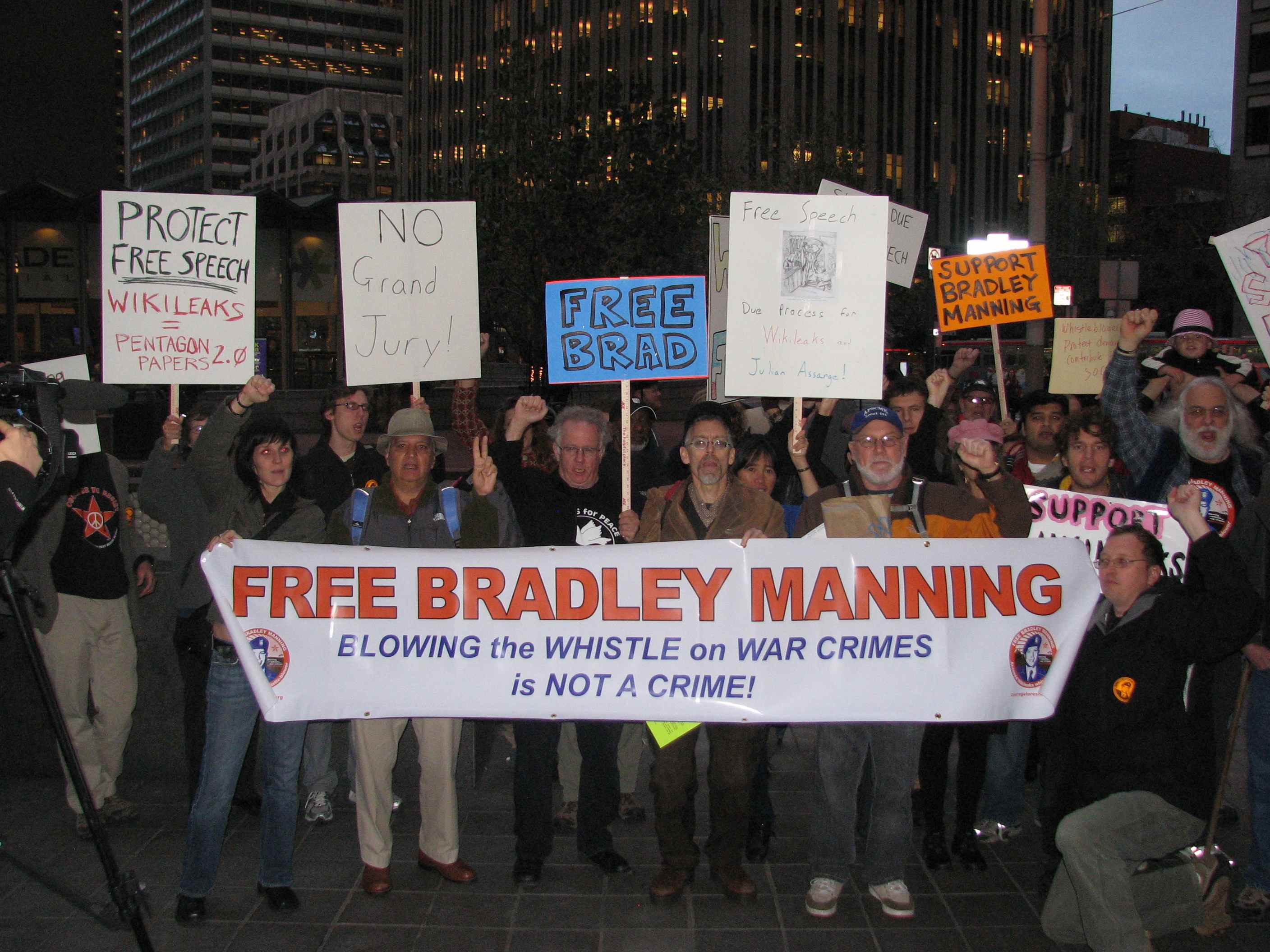
A small group of protesters gathered outside the British Consulate in San Francisco’s financial district Dec. 16 to speak out against the recent crackdown on WikiLeaks founder Julian Assange, who is out on bail after being imprisoned for nine days by British authorities.

Assange, whose organization recently created an international stir with the release of secret diplomatic cables, could be extradited to Sweden to be tried on sex crimes charges following a hearing in January.

According to a recent New York Times article, U.S. government officials are trying to build a case against Assange for conspiracy. In the wake of the leak, Sen. Joe Lieberman was calling for the New York Times to be investigated for espionage for publishing information provided by WikiLeaks, and last week, a Fox news pundit even said he thought Assange should be assasinated.

Among the small crowd that gathered before twilight were representatives from Veterans for Peace, Courage to Resist, and the Electronic Frontier Foundation.

Rainey Reitman, an activist with the Electronic Frontier Foundation — a legal firm and nonprofit that defended WikiLeaks against a 2008 lawsuit from Swiss bank Julius Baer — called the recent backlash a threat to Internet freedom and freedom of speech.

“Let me be clear. Here in the United States of America, WikiLeaks has a fundamental right to publish truthful political information. And equally important, Internet users have a fundamental right to read that information and voice their opinions about it. We live in a society that values freedom of expression and shuns censorship. Unfortunately, those values are only as strong as the will to support them — a will that seems to be dwindling now in an alarming way,” Reitman said.

Reitman said the case touched on broader issues. “This isn’t just about WikiLeaks. It never was. It’s about the future of the Internet and the future of free speech.”

Among several other speakers, Reitman was joined by Jeff Patterson of Courage to Resist, which has mounted a support campaign for U.S. Army Private Bradley Manning. Manning has been accused of acting as WikiLeaks’ source for 250,000 secret government documents and classified military footage, which has now been made available to the general public.

Patterson noted that the Bradley Manning Support Network had raised $100,000 for Manning’s legal defense. Although many activists have sent letters of support to Manning, who is being held in solitary confinement in a prison outside of Washington, D.C., “the military is rejecting letters pretty much arbitrarily,” Patterson claimed.

To read more about the WikiLeaks saga, check out the blog of the Electronic Frontier Foundation.

The politics of the last great depression

4

The American economy’s worse now than at any time since the Great Depression — and whatever the Republicans say in Congress (and the president signs on to) the private sector alone can’t possible pull us out. The only reason we’re not at 1930s levels of unemployment is that we’ve had some modest federal stimulus money over the past two years.


But we’ve got this dilemma: Although every smart economist agrees that it will take more massive federal spending to turn things around, all we’re getting out of Washington is the worst kind of spending — tax cuts for the rich, which will cost $900 billion and do very little to help the economy.


Part of what’s going on — and Jerry Brown talked about it at his education summit — is that the public doesn’t trust government to spend their money wisely. Brown cited a poll saying that nearly half of Californians still think we can solve most of the budget problems in the state by getting rid of government waste.


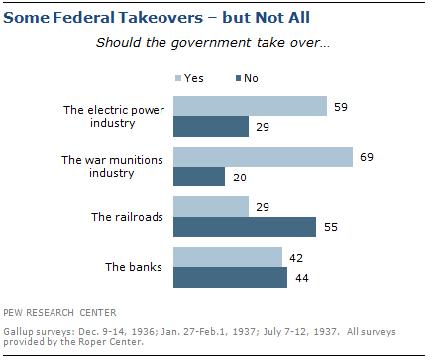
The Pew Research Center has put together a couple of fascinating papers on attitudes toward the public sector, and they’re worth a rad. (Thanks, Gabriel Metcalf at SPUR for tipping me off about this.) The first one is called “How a different America responded to the Great Depression.” Researcher Jodie Allen’s conclusion:


Quite unlike today’s public, what Depression-era Americans wanted from their government was, on many counts, more not less. And despite their far more dire economic straits, they remained more optimistic than today’s public. Nor did average Americans then turn their ire upon their Groton-Harvard-educated president — this despite his failure, over his first term in office, to bring a swift end to their hardship. FDR had his detractors but these tended to be fellow members of the social and economic elite.


More:


The most striking difference between the 1930s and the present day is that, by the standards of today’s political parlance, average Americans of the mid-1930s revealed downright “socialistic” tendencies in many of their views about the proper role of government.


True, when asked to describe their political position, fewer than 2% of those surveyed were ready to describe themselves as “socialist” rather than as Republican, Democratic or independent. But by a lopsided margin of 54% to 34%, they expressed the opinion that if there were another depression (and fears of one were mounting), the government should follow the same spending pattern as FDR’s administration had followed before.


And, those surveyed said they supported Roosevelt, the architect of the New Deal’s expansive programs, over his 1936 Republican opponent, Alfred Landon by more than two-to-one (62%-30%).


The charts are fascinating. A full 73 percent of Americans polled in 1936 thought government should provide free medical care to the poor. Sixty-four percent thought government should regulate and control war-time profits. In fact, 59 percent thought the government should take over the electric power industry and 69 percent favored nationalizing the wartime munitions industry.


And the people who were polled in these early surveys were overwhelmingly white, male and relatively well off. They were also socially conservative — 60 percent favored the death penalty and 67 percent wanted to deport all immigrants who were on public relief. Allen:


Is there a message in this for today’s America? Two possible lessons: First, it’s worth remembering that the social programs and banking controls that the New Deal era produced stood the nation in good stead over many decades of unprecedented prosperity. Second, Depression-era Americans’ faith in the country and its guiding institutions steeled them against the challenges of a double-dip recession and, years later, World War II. They had it worse, but they also expected it to get better, faster.


Compare that to a 1983 poll taken in the depth of the Reagan Recession, when 65 percent said that government had gone too far in regulating business, 62 percent rarely trusted the government in Washington and 78 percent opposed raising income taxes.


Fifty years, two generations, and the entire attitude of the American public toward government was turned on its head. It’s one of the fundamental dilemmas of American life, and one of the central reasons we’re in this mess.

Local hire, Steve Kawa, and the Americas Cup

2

Unemployed workers and community advocates hoping to secure Mayor Gavin Newsom’s support for Sup. John Avalos’ groundbreaking local hire legislation rallied at City Hall December 14 to meet with Newsom’s chief of staff Steve Kawa. But Newsom and Kawa were said to be in intense negotiations over the Americas Cup bid. So, James Richards, founder of Aboriginal Blacks United, waited until Kawa could see him, along with Florence Kong of the Bayview-based Kwan Wo Ironworkers. Joshua Arce of the Brightline Defense Project, and a group of local residents.

“‘Living in the city is so expensive,” Kong observed. “It’s not fair that a lot of local work is being done by workers from outside the city.”

Kawa finally emerged and shepherded folks out of the Mayor’s Office and into a meeting room close to the supervisors’ office. He was uncomfortable with having media at the meeting. But Richards said the group was OK with a reporter. And then he asked Kawa if Newsom would sign Avalos’ local hire law later that day.

“This is a very complex piece of legislation, and if it does become law, that’s when the work begins,” Kawa said, noting that Newsom will have ten days to review it, after its Dec. 14 reading. “Some folks are still concerned about it, partly on the trades union side,” Kawa added.

But Richards pressed his point. “After the Board acts today, we want to talk to the mayor,” Richards said. “We don’t want to wait around another ten days. We want him to assure us.”

But Kawa refused to give assurances. “At the end of the day, 42,000 San Francisco don’t have a job,” Kawa said, claiming the best local jobs program was Jobs Now, under Newsom.  “But the federal government is refusing to extend that program, and now we can’t hire anybody at City Hall and we have to get this economy growing,” he said.

When Joshua Arce of Brightline expressed concern that folks had met privately with Newsom to exert pressure against Avalos’ legislation, Kawa replied that Newsom had concerns that some folks could lose their jobs around San Francisco airport, because, technically, it’s in San Mateo.

“And are we sure this legislation will be successful?” Kawa continued. “The worst thing a government can do is over promise and under deliver. Our question is, you tell me how it will not fail. Because, yes, we want to have local hire, but don’t mislead anybody by saying, we pass this legislation, she gets a job. Our issue is making sure that we are not misleading anyone. Those are the concerns that people have. Will it be successful, as written? Because we can’t mislead your members, James.”

“Tell the mayor, we are here,” Richards said.
And then Kawa was shaking his hand and heading back to the Mayor’s Office, presumably to talk about cups and America.

“It’s a good thing, we are here today,” Richards said to the workers who remained sitting in the meeting room long after Kawa was gone. Many of them were young, black and male–and in search of a job. “Give a round of applause for your own self,” Richards continued. “It’s a good thing to let them know you come down here to take care of your own business.Because don’t nobody…”

He paused and the ABU members in the room immediately picked up the “don’t nobody give a damn” refrain, their voices ringing as one.

“Some times when we push too hard, when we get what we want, he get on a roll and tell all the reasons why he not going to sign. ‘I want to do this, but…” Richard added.

And then Richards turned to the issue of local hire at UC Mission Bay.“They gotta know today that we are hot on their trail,” he said. “Let them go tell that. Let Steve go tell that. Then they know we are fighting that.”

An hour later, when the Board gave Avalos’ legislation a veto-proof majority, Richards, Kong and the rest of the group burst into applause.
“It’s been quite a road to get here,” Avalos said.

“This is the most substantive policy San Francisco has passed in a generation,” Julian Davis observed, as local hire supporters rejoiced by the Tree of Hope, outside the Board’s Chambers.

Inside the Chambers, the Board was voting unanimously to support the city’s Americas Cup bid.

“To win a sailing race, every member of the crew has to work together,” Board President David Chiu said.  And his words could equally have applied to Avalos and the community’s effort to navigate treacherous political seas, get local hire legislation passed and, hopefully, lift everyone’s boat, in the process.

Thank you later

0

arts@sfbg.com

YEAR IN MUSIC The past year brought dozens of excellent albums, and hip-hop sounds topped the list. This wasn’t inevitable. Please recall 2009, when critics cited precious little rap in their favorites, save for Raekwon’s Only Built 4 Cuban Linx … Part 2 and Mos Def’s The Ecstatic. But in 2010, both rockists and heads reserved space for Kanye West’s My Beautiful Dark Twisted Fantasy, Big Boi’s Sir Lucious Left Foot: Son of Chico Dusty, the Roots’ How I Got Over, Drake’s Thank Me Later, and Flying Lotus’ Cosmogramma. And let’s not forget minor but important recordings such as Curren$y’s Pilot Talk and Yelawolf’s Trunk Muzik 0-60.

This winning slate confirmed that major label-backed rap is undergoing a renaissance. Nearly every artist made an impact by keeping their eye on the mainstream, from security guard-turned-bad actor Rick Ross recruiting Erykah Badu and Cee-Lo Green for his Teflon Don, to Bun B allowing Canadian teen idol Drake to call himself an “honorary member of UGK” on the former’s Trill O.G. Some complained that these rappers focused too much on claiming the hearts of soccer mama grizzlies and teens raised on Bratz dolls. But after years of boorish thugs peddling D-boy anthems and R&B gimmicks, this new pop sensibility sounded refreshing. (The sole exception may be Ludacris, who found success with Battle of the Sexes by offering a slick and familiar mix of strip club anthems and babymaker suites.)

B.o.B’s The Adventures of Bobby Ray was the most extreme product of these pop mirages. The Atlanta rapper scored two No. 1 hits (“Nothin’ but You” and “Airplanes”), but divided critics and fans by recruiting emo-rock burnout Rivers Cuomo and Hot Topic heroine Hayley Williams for his collection of gooey ballads. At its best, The Adventures of Bobby Ray had a charming innocence; at worst, it sounded like pandering. But at least it offered well-written tunes. In contrast, Nicki Minaj’s grating Pink Friday mashed bad 1980s John Hughes-approved synth-pop and soaring Rihanna choruses into a barely coherent mess. It proved that despite Nicki’s talent for ear-catching stunts, from her star turn as the bisexual chick who’ll do you and your man on Usher’s “Lil’ Freak” to her cipher-destroying rhymes on Kanye West’s “Monster” and Ludacris’ “My Chick Bad,” she was still a disappointingly underdeveloped songwriter.

Lost in the intense debate over the rap major domo was the demise of Definitive Jux. Once the mighty inheritor to the Fondle ‘Em tradition of B-boy nonconformity, and the source of key early-2000s works by Cannibal Ox, Aesop Rock, and Mr. Lif, it sagged under the weight of subpar and underpromoted releases before label head El-P mercifully pulled the plug last February. The news lit up the Internet for a day or two and then was seemingly forgotten. When Noz from cocaineblunts.com asked Yelawolf if he was “heartbroken” over Definitive Jux’s demise, the Alabama rapper answered: “I didn’t even know it ended. Well … I’m not heartbroken about it.” How ironic that Yelawolf was once a lyrical-minded backpacker too, before switching to gritty tales of deep South meth dealers.

There were other disturbing signs that Definitive Jux’s indie-rap scene was no longer ground zero for fledging MCs, from conscious rap advocates Little Brother breaking up, to Minneapolis freestyle ace Michael “Eyedea” Larsen dying at the tragically young age of 28. “Underground rap is dead,” noted Sean Fennessey in a Pitchfork essay hyping Los Angeles collective Odd Future. “In its stead, a different brand of homespun rappers have taken hold. Consider Lil B and Soulja Boy, who have been prolifically working the Web … to achieve their own kind of teenage heroism.”

Underground rap is not dead. It thrives with Bay Area imprints such as Interdependent Media (Truthlive’s Patience) and national players such as Duck Down Records (Skyzoo & Illmind’s Live from the Tape Deck) and Alpha Pup Records (Nocando’s Jimmy The Lock). Some of these labels subsist on scattershot independent distribution. Others recruit majors to achieve wider market penetration, including Stones Throw and EMI Label Services (Guilty Simpson’s OJ Simpson and Aloe Blacc’s retro-soul gem Good Things), and Decon and E1 Music (Black Milk’s Album of the Year). And who can blame them? These days, labels need all the help they can get. However, the principal philosophy of economic and artistic independence as an end unto itself has been forgotten.

In Robin D.G. Kelley’s 2002 book Freedom Dreams, a rapturous appreciation of 20th century black intellectualism, he writes, “Unfortunately, too often our standards for evaluating social movements pivot around whether or not they ‘succeeded’ in realizing their visions rather than on the merits or power of the visions themselves. … And yet it is precisely these alternative visions and dreams that inspire new generations.” Kelley could have referred to the many critics that marked Little Brother as hopelessly elitist for insisting that hip-hop should address more than the spoils of drug wars; dismissed the late Eyedea, Sage Francis, and others as silly white boys for addressing suburban middle-class concerns; and buried Definitive Jux as a repository of uncool, impossibly dense super-scientific lyricism.

By many measures, the indie-rap scene has been a failure. Unlike the network of homespun labels built by punks in the 1980s, the indie-rap scene didn’t create a thriving community without considerable financing from youth-targeting corporations, lifestyle brands, and advertising firms. And perhaps its denizens wrongly castigated dirty South rappers as ignorant, claimed that mainstream superstars like Jay-Z and Diddy were sell-outs, and turned the underground movement into a kind of purity test — all past conflicts that continue to bedevil it today. Yet these dreamers courageously imagined hip-hop culture as not only a way to entertain people and make money, but as a transformative experience that can help instill positive growth and change lives. They built a culture that holds key lessons for future rap generations.

The blog-rap generation doesn’t hold any illusions of being alternative, unless it’s manufacturing limp blasphemy like Odd Future’s use of Nazi imagery. (As Anti-Defamation League spokesman Abraham Foxman told The New York Times in a story on the Holocaust documentary Shoah, “To most kids growing up today, Hitler could be Genghis Khan.”) They’ll use any trope to be successful, from falsely claiming that they’re coke barons to bragging about their limited-edition sneaker collection and how much weed they smoke. There’s a gleeful egalitarianism in their digital miscellany. The beats bang but are same-y and indistinct, and the voices are barely distinguishable. As Wiz Khalifa simply said on his breakout single, “Black & Yellow”: “You can do it big.”

Some critics separated wheat from chaff with technical criteria such as internal rhyme schemes and double-time flow, as if MCs were ice skaters or guitar wankers. But the best artists simply illuminated their money hunger by any means necessary, effortlessly adding interesting twists to tired rap clichés. When Drake crooned on Thank Me Later, “I want this shit forever, man,” he evoked a poor man’s Nat King Cole. And when Curren$y ranted, “A gee is what I am, a jet is what I be” like a Southern Popeye on Pilot Talk II, he was insistent enough that you almost believed him.

And then there was Kanye West and My Beautiful Dark Twisted Fantasy. He created a spectacle out of an hour-long justification for his obnoxiousness, invited the genre’s biggest stars to support his meanderings on chauvinism and virility (or “my black balls”) and, most provocatively, continued a public call-and-response with Gil Scott-Heron. The conversation began with West’s sampling of Scott-Heron’s melancholy “Home Is Where the Hatred Is” for his 2005 album Graduation. Then Scott-Heron replied by using West’s “Flashing Lights” melody for “On Coming from a Broken Home,” the bittersweet coming-of age tale from Scott-Heron’s valiant yet muddled comeback, I’m New Here.

West ended Fantasy by sampling a large section from Scott-Heron’s 1970 spoken-word performance “Comment #1,” and retitling it “Who Will Survive in America?” The poem originally captured the COINTELPRO era and the U.S. government’s eradication of black radicals, but West seemed to use it for a different point. Perhaps he’s saying that fame serves as a protective armor against systemic racism and how “at the airport they check all through my bag and tell me that it’s random.” Or maybe he’s making a wry comment on celebrity culture as the only way to survive in America. Fantasy‘s cryptic epilogue perfectly summarized this year’s rap dreamers, lost in the pop Matrix.

Mysteries of the death-drug scramble

0

news@sfbg.com

The California prison system finally released some documents on its efforts to procure the chemicals it needs to execute prisoners, and the 1,000 pages show the desperate lengths state officials have gone to procure the death drugs.

At one point, the California Department of Corrections and Rehabilitation looked at importing drugs from Pakistan. In October, prison officials sent agents on a secret midnight mission to Arizona to acquire sodium thiopental, one of the drugs used in executions, from that state’s supply.

In the end, CDCR wound up buying an extraordinary quantity of the stuff from a supplier in London — potentially putting California in the disturbing position of serving as the death-drug dealer to the rest of the country.

The protocol for lethal injections in California, and 33 other states, calls for three drugs — sodium thiopental to put the condemned inmate in a coma; pancurium bromide to paralyze the muscles; and potassium chloride to stop the heart.

But sodium thiopental, also known as Sodium Pentothal, has been in short supply in this country, in part because the one company that currently makes it, Hospira, has production backlogs. There’s not a whole lot of need for the drug in modern medicine — it’s largely been replaced with other anesthetics — and Hospira has made it clear in repeated press statements that it doesn’t want its product used in executions.

So when the last batch of the stuff in the state’s hands expired in October, California had to put executions on hold while prison officials scrambled to find some more.


HIDING THE TRUTH

The whole process was cloaked in secrecy. Nobody at CDCR would tell us where they were looking for the sodium thiopental, who would be procuring it, or how the supply chain might work. That, of course, is crucial, in a grisly way: If the anesthetic didn’t perform properly (that is, if the state got a bad batch from an unregulated supplier), a prisoner could go through unspeakable agony as the second batch of drugs made it impossible to breathe.

The Guardian filed a request in October under the California Public Records Act seeking details on the purchase attempts, but CDCR stonewalled. The American Civil Liberties Union, also seeking the documents, filed a lawsuit, and a judge ordered the release of a large volume of material.

Those documents, now available at aclunc.org, is heavily redacted, and much of the material we expected to see is missing. But the documents contain some remarkable revelations.

For starters, there’s an internal timeline going back to 2007 showing that CDCR officials knew back then, while the drug protocol was being developed, that there would be problems. The Drug Enforcement Administration will only allow a doctor to order the class III controlled substances. And the federal receiver overseeing the prison system wouldn’t allow any of the three doctors on staff at San Quentin State Prison to sign the order forms, although the documents didn’t say why.

In January 2007, CDCR tried to recruit outside doctors to order the drugs — but physicians in California have traditionally declined to assist in executions. Indeed, the American Medical Association policy bars doctors from participating in capital punishment in any way, including “prescribing or administering tranquilizers.”

It wasn’t until May 2010 that CDCR was able to find doctors willing to order the deadly drugs; the names of those physicians are not in the documents.

The timeline shows that in June 2010, CDCR became aware that there was a shortage of sodium thiopental, but there was no public discussion of the situation. Plans to execute Albert Greenwood Brown, a convicted murderer set to die in September 2010, went forward.

But the courts weren’t rushing the execution — and the last batch of sodium thiopental in CDCR’s possession expired Oct. 1.

As the clock ticked down toward that expiration date, the documents show, CDCR officials — all the way up to Corrections Secretary Matthew Cate — were involved in an all-out scramble to get more of the drug.

At one point, a Sept. 16 e-mail — from an official whose name is blacked out — notes that CDCR had contacted between 80 and 100 hospitals to try to buy some sodium thiopental, but “none of them have a drop.”

The documents note that CDCR officials even suggested that there were supplies of sodium thiopental in Pakistan. An Aug. 17 e-mail from John McAuliffe, a contract worker helping CDCR with executions, says the agency is trying to get federal government approval to import the drug.

One e-mail even suggests that an unnamed CDCR employee was in the area and could make a side trip to Pakistan to pick up the stuff.


THE LONDON CONNECTION

There are, of course, serious issues with importing controlled substances into the United States, and the documents show efforts by CDCR to get the DEA to approve imports. The Pakistan deal apparently went nowhere — but later e-mails show CDCR officials contacting a supplier in London. The name of the supplier is blacked out on all the documents, but CDCR’s deputy press secretary, Terry Thornton, later confirmed that the manufacturer was Archimedes Pharma.

Immediately after the California order for 521 grams of sodium thiopental went through, Britain’s secretary of state for business, Vince Cable, issued an order barring any further exports of the drug for use in executions.

Like most of the civilized world, the United Kingdom does not allow the death penalty.

In the meantime, Scott Kernan, CDCR’s undersecretary for operations, was trying to get enough of the death drug domestically to carry out at least one execution. A series of e-mails show contacts between California and Arizona, which recently had imported its own supply — and there are indications that Gov. Arnold Schwarzenegger was willing to call his counterpart in Arizona to help consummate the deal.

“I’m sure either the secretary or even the governor could make a call,” a Sept. 9 e-mail from Kernan to McAuliffe notes.

Then on Sept. 29, Kernan sent an e-mail to Assistant Secretary Anthony Chaus discussing a “secret and important mission.” Kernan wanted Chaus to send a team to a state prison complex in Florence, Ariz., a desert town about 40 miles southeast of Phoenix, to pick up 12 grams of the death drug.

At midnight Sept. 30, the warden in Florence gave the CDCD agents 24 vials, each containing half a gram of sodium thiopental. The agents drove it to Bakersfield, where another team picked up the vials and drove the rest of the way to San Quentin.

In a stomach-turning e-mail, Kernan sent a note Sept. 29 to an unnamed Arizona official saying “you guys in Arizona are life savers” and offering to “by [sic] you a beer next time I get that way.”

By then, a federal judge had delayed Brown’s execution until 2011.

Among the most startling revelation was the sheer quantity of sodium thiopental California eventually ordered from the firm in London. Even with training supplies and backup, it only takes between six and 12 grams of sodium thiopental to render a prisoner unconscious — meaning that the 521 grams that CDCR purchased for $36,413 are enough to kill between 43 and 86 people. The expiration date on the chemical is 2014.

It’s highly unlikely, given the legal hurdles and time involved in even one execution, that California would schedule more than three over the next three years. What possible use could the state have for so much death drug?

Thornton, CDCR’s press person, wouldn’t respond to our queries. But Natasha Minsker, the director of the ACLU’s Death Penalty Project, said she’s concerned that California will try to become a supplier for other prison systems. “It certainly raises questions,” she told us.

There’s a lot missing from the documents. In many instances, the names of the officials who sent and received e-mails are redacted. And there are obvious pieces of the puzzle missing from the files CDCR has released.

“There’s no e-mail from the DEA or the FDA,” Minsker said, “although CDCR was clearly contacting them. There’s nothing from the governor’s office, although it’s likely they were also involved.”

Overall, Minsker said, the documents “show how sneaky CDCR was trying to be about all of this.”

The ACLU filed another suit Dec. 13 seeking the release of some of the redacted material as well as records of CDCR’s efforts between October and December.

If those documents are ever released, they may address some of the looming questions about the material the state uses to kill people.

Oooh, let’s have a border war

17

If San Francisco tries to enact a congestion management fee, San Mateo officials are going to fight back with their own. How fun; a border war. Since I’ve long suggested that our future may be in city-states, not nations, it strikes me as an interesting political moment.


But on a serious note: what would be wrong with a toll in both directions? What would be wrong with asking California motorists, who enjoy among the lowest gas tax rates in the western world and who for the past few years have had a dramatic reduction in annual registration fees, to pay a little more to local government? What’s wrong with making it cost more to drive your car during commute hours?


Yeah, that means it will cost more for a San Franciscan to go shop at Serramonte Mall (during rush hour; who shops then anyway?). So what? That might encourage San Franciscans to shop locally. Yeah, it will cost more to commute by car, in either direction; maybe more people will ride their bikes or take the bus. (Particularly if the money goes into improving transit.)


I’m not going all Smoot-Hawley here, but congestion-management fees — extra charges for driving in certain areas during certain times of day — are generally a good idea. And if San Mateo wants one, too, excellent.


Cities have been fighting for years over who can cut taxes more for big businesses. This seems a much more reasonable fight. So: Border war? Bring it on.


The true cost of local hire

12

Chronicle columnists Phillip Matier and Andy Ross are claiming it will cost $2.2 million annually to carry out Sup. John Avalos’ newly approved legislation that mandates local hire rates on city-funded construction projects,

And Human Rights Commission director Theresa Sparks is claiming it will actually cost $3 million to run the program.

Neither Sparks nor Matier and Ross are talking about the savings the program will create in terms of the need for less law enforcement, if more local residents are hired. Nor do they mention the economic benefit of tax payer dollars being funneled into the local economy, if more San Francisco residents are hired on city-funded construction projects.

As a result, their conversation sounds like an attack on local hire legislation that Sparks says she supports.

“Matier & Ross are about a million dollars off,” Sparks told the Guardian in a voice mail message three days after I first called asking if it was true that HRC was pissed that the Office of Economic and Workforce Development was being charged with monitoring Avalos’ newly approved program.

‘We tried to get them to leave it with us,” Sparks said, noting that HRC already has contract compliance officers overseeing every city contract.

“This will cost $2-3 million more, and it’s unnecessary,” Sparks continued, noting that during her (ultimately unsuccessful) D6 campaign she talked about “inefficiency in government” and here was yet another example of that very same wasteful phenomenon.

‘Rather than approve a project, the agency that creates a program wants to hire its own people and create a whole new infrastructure, “ Sparks said. “We tried to participate in the local hire ordinance, but we were excluded from all the meetings.”

Sup. John Avalos’ legislative aide Raquel Redondiez disagrees that Sparks was omitted from the discussion. And Redondiez has the emails to prove it.

In an Oct. 21 email sent to Redevelopment director Fred Blackwell, Rhonda Simmons in the Office of Economic and Workforce Development, and Sparks at HRC, six weeks before Avalos’ legislation passed on its first reading, Redondiez wrote that Avalos would like to meet with Blackwell, Simmons and Sparks.

“Supervisor Avalos would like to meet with your offices to learn about how current contracts are now tracked for local hiring, lbe [local business enterprises], and union hours,” Redondiez wrote. “As we move forward with the local hiring legislation, we would like to have a deeper understanding of the current tracking practices and possibilities.Please let us know when we can meet in the next 10 days.”

Redondiez email thread shows she got a reply from Guillermo Rodriguez in the Mayor’s Office the same day. But there was no reply from Sparks. Blackwell and Simmons attended local hire hearings at City Hall in November and December. This reporter does not remember Sparks at those hearings, but community advocates say they saw her outside at least one hearing, in November.

So, does this add up to HRC being deliberately excluded from the discussion about how best to monitor local hire, or something entirely different?

Community and worker advocates, who support the legislation, say they tried to reach out to Sparks, but got mixed messages. They say Sparks said she was supportive of the legislation, but that they were left with the impression that HRC wasn’t interested in monitoring the program.

Michael Theriault, Secretary-Treasurer of the Building Trades, which opposes Avalos’ legislation because it believes the measure will pit workers who live here against workers who don’t, didn’t sound like he was advocating to put HRC in charge of monitoring compliance with the mandatory local hire ordinance.
“There is a sense that HRC is about small business advocacy,” Theriault said.

Sparks hasn’t returned my latest call, but I’ll be sure to post her comments here. So stay tuned as we follow the latest twist in the local hire debate. And don’tforget to tune in to tomorrow’s Board meeting (Dec. 14, 2 p.m. at City Hall), when the local hire legislation has its second reading.

Live Shots: Roger Waters’ epic “The Wall,” HP Pavilion, 12/08/2010

4

In the minutes before Pink Floyd mastermind Roger Waters took to the stage at HP Pavilion earlier this week to perform the band’s epic 1979 double album The Wall, the playlist coming through the house speakers gave way to Billie Holiday’s “Strange Fruit,” a song that seemed well-matched for the impending performance. For an artist that is commonly known for romantic jazz ballads, Holiday’s “Strange Fruit” was a defining moment in her career, a point in which she ascended beyond the simplest manifestations of her identity and delved into the  darkest corners of her times.

In a similar sense, there is no easy way around The Wall. Pink Floyd’s last album during their monumental run in the ’70s — Dark Side of the Moon, Wish You Were Here, Animals — was not only their most artistically ambitious, but a lingering challenge to the nature of the band’s legacy. Longview attempts to define Pink Floyd in the realm of blacklight posters, spacey sounds, or a Dazed and Confused mindset, will inevitably get stuck at The Wall: a dark and confrontational album that is ultimately the most emblematic of Pink Floyd’s greatest characteristics.

So, with Waters (at age 67) suggesting that this will be his last tour, it is appropriate that he would finish with his masterpiece. And make no mistake – this was a concert for the ages.

Playing before an enthralled sold-out crowd, Waters put on a spectacle of acid-casualty-inflicting-potential that seemed peerless on numerous fronts. Musically, the material was as dynamic as it was seamless, deftly rendered by a world-class band of musicians over a juggernaut of a sound system. Visually, the staging seemed calibrated past “entertain” and set on “assault”, showcasing a sensory barrage of giant puppets, crashing airplanes, and flying pigs all amidst the construction (and eventual toppling) of a 40ft wall that also served as a towering projection screen for a dizzying array of images and video.

Yet the most notable aspect of the performance was the sheer relevance of the material. This was really an amazing feature, considering that Waters wrote The Wall in the run up to the Reagan-Thatcher era and was now performing it in the aftermath of Bush-Cheney. In this regard, Waters delved deeply into the confrontational aspect of the album’s material, challenging the audience with all-too-timely themes of war, ideology, government surveillance, and the general estrangement of modern human relations. During “Run Like Hell” the projections on the wall at one point showed the Wikileaks-released video of the 2007 Apache Helicopter massacre in Baghdad; not exactly light viewing material to accompany one of Floyd’s classic radio hits.

Waters looked and sounded formidable throughout the concert, stalking the stage with good-humored authority as the wall was erected in front of the band throughout the beginning half of the album. This first set was packed with striking moments, such as the ominous acoustic beauty of “Goodbye Blue Sky” beset by visuals of bomber planes dropping their payloads of -isms  (dollar signs, religious symbols, and corporate logos) on those below. “Another Brick in the Wall (Part 2),” with its re-occurring mantra – “We Don’t Need No Education” – was already a staggering spectacle as a three-story marionette school teacher with laser eyes dwarfed the musicians below, only to then be embellished by a choir of  local school kids filling the stage to sing the later verses.

However, the most poignant moment of the show came during the second set as Waters – who had lost his father as a boy during World War II – performed “Vera” and “Bring the Boys Back Home” beneath video spots of children reuniting with their fathers returning home from war. The final clip – of a young girl going from surprise to gut-wrenching emotion as she first sees her father – left audience members wiping back tears as Water’s sang the line, “Does anybody else in here/feel the way I do?”

The wall came toppling down after the more theatrical rock-opera moments of the second album, culminating with “The Trial” performed  beneath Gerald Scarfe’s hallucinatory animation from the 1982 film adaptation of the album. Waters and company finished the concert amongst the rubble, playing a wonderfully serene and hopeful version of “Outside the Wall.”

Much has been made of the fact that the original staging of this album was a logistical debacle when it was performed in only four cities some 30 years ago, and that the evolution of technology has now made it feasible. Yet, in a similar sense, the album’s material has matured in its own way in this time. Writing during a time of personal crisis in the late 70s, Waters conceived the album as an exploration of human relationships and the many obstacles that hinder them. The timeliness of these themes then — especially after a decade marred by war and a divided population – makes this tour less of a nostalgic throwback and more of manifested vision. Pink Floyd had always been far ahead their time, so there is a fitting logic that it would take three decades for The Wall to be properly realized in concert.

Of course, it’ll be interesting to see if this tour is in fact the last call on an original Pink Floyd experience. Altough the surviving band members are getting on in years (keyboardist Richard Wright died in 2008), they have made some steps at amends recently, and even expressed interest in collaborating again. Perhaps then, there is still time for those walls to come down. After all….when it comes to Pink Floyd, it’s well known that pigs will fly

The mayoral roulette

23

At the San Francisco Tomorrow holiday party Dec. 8th, David Chiu, Dennis Herrera, John Rizzo, Jake McGoldrick and a host of others who I’ve seen at these events for at least the past few years were doing their usual schmoozing — when Ross Mirkarimi, a former SFT board member, showed up with …. Art Agnos. I haven’t seen the former mayor at an SFT event since … I don’t know. Since a long long time ago.


Agnos made a short speech and talked about all of the rising stars in the San Francisco progressive movement — Mirkarimi, Chiu, Rizzo, David Campos, Eric Mar, John Avalos … and it was all very nice and low key. But there was a message in his appearance, in his connection with Mirkarimi, and even in the overall tone of his remarks, which amounts to this:


If the supervisors have trouble finding a progressive who can get six votes — and if they want an old hand, someone who has been through a brutal recession as mayor of San Francisco and dealt with awful budgets and nasty politics, someone who will serve for a year and then walk away — Agnos is open to being asked.


Well, maybe a little more than open to being asked. I wouldn’t say he’s actively, publicly campaiging for the job, but he has met with most of the supervisors, and dropped them all a 13-page memo listing all of his accomplishments, and his supporters (maybe his emissaries) are making the rounds and making the case for Agnos. Which amounts to this:


None of the progressives now more-or-less openly in the mix (Campos, Chiu, Mirkarimi, even Aaron Peskin) can realistically take on all the sacred cows (esp. police and fire), make a bunch of other cuts, and push for all sorts of revenue increases — and at the same time try to run for re-election in November (when the tax hikes would be on the ballot). The only way to do “what needs to be done” is to put in a progressive caretaker who can then take the political heat for the tough decisions — and help set up a campaign for another progressive in November.


I’m not sure I entirely agree — the right person, with the right leadership and agenda, could set up a five-year plan for fiscal stability, launch year one immediately and tell the public that he/she needs a full term to finish the job. But it’s true that it will be tough — and it’s also true that none of the obvious alternatives have ever run citywide.


If Tom Ammiano were interested, we wouldn’t be having this discussion. Tom has run citywide numerous times (for School Board, pre-district elections supervisor and mayor), has been elected by half the city (to the Assembly), and has the credibility to deal with the budget crisis and still win in November. But he’s not, and we have to respect that.


Right now, the progressives can’t seem to unite on a candidate. None of the current board members has six votes today. And Campos, Chiu, Mirkarimi and everyone else in the game knows full well how hard it will be to win in November, particularly against State Sen. Leland Yee, who will be a formidable candidate, and possibly City Attorney Dennis Herrera (who has won citywide), State Sen. Mark Leno (who is popular all over town) and others.


So if a couple rounds pass and there’s no winner, the “progressive caretaker” concept will be in play. It’s possible Mirkarimi would give up his seat two years early and take that job; it’s likely Peskin would agree to serve one year and then step down. But it’s also possible that neither scenario works out — at which point Sheriff Mike Hennessey and Agnos will be in play.


(I hear through the grapevine that Willie Brown is nosing around, too — and let’s remember that he became Assembly speaker by cutting a deal with the Republicans.)


Hennessey’s got a strong progressive record, but has never had to deal with anything remotely as awful as what the next mayor will face. So Agnos backers will make the case that their guy has the experience and gravitas to pull it off.


Given all of that, let me say a couple of things about Agnos, since I was around and watching City Hall when he was mayor (and some of the people who will be voting on this weren’t.)


Art’s a mixture. He was a great progressive member of the state Assembly. When he ran for mayor, we backed him strongly; he seemed to be the great progressive hope. Then his long list of wonderful promises ran into the buzz saw of a deep recession — and made things much worse with his arrogant, imperious style. His first major act in office was to sign a set of contracts that gave away the store to PG&E. He never lifted a finger for public power. And it quickly became clear that he wasn’t a fan of open government or public process. We were all supposed to “Trust in Art” and shut up if we didn’t like it.


That’s why — despite what was at the time and is in retrospect a pretty darn progressive record, a lot of solid accomplishments and absolutly no hint of corruption or scandal — the progressives just weren’t all that excited about his re-election. So he lost to Frank Jordan, who was way worse.


The thing is, Agnos these days is a lot more mellow. He’s 72, knows he’s not going anywhere else in politics, and has essentially admitted to me that he made a lot of mistakes, and his arrogance and closed-door attitude were top on the list. A reformed Agnos — willing to serve with a degree of humility and an acceptance that progressive politics in this town demands inclusiveness, and that even though he’s a former mayor, he’s not by definition the most important person in any room he walks into — would present an interesting option.


Of course, we still don’t know exactly where he would be on the issues, since, like Chiu, he hasn’t even publicly called himself a candidate for the job. I still think anyone who is a serious contender ought to be willing to appear before the supervisors and answer questions.


We all know where to start: What’s your plan for raising a quarter billion dollars in new revenue in 2011?    

Class conflict in DC and SF

12

There’s an unmistakable whiff of class warfare in the air this holiday season, most obviously on the national level where President Barack Obama and congressional Republicans are helping the ultra-rich steal hundreds of billions of dollars from future generations and the country’s current needs. But we’re also seeing it right here in San Francisco, subtly playing out around who will be our next mayor.

During yesterday’s scheduled discussion at the Board of Supervisors on choosing a new mayor, members of the public – from African-American mothers of slain youth to representatives of immigrant communities to those representing labor and progressive groups – urged the board to choose a mayor who would finally represent all of San Francisco, not just the wealthy and the business community.

Then the progressive supervisors who represent the city’s working class districts talked about getting the process underway and voiced some of the things they’d like to see in a new mayor, such as compassion and a willingness to work with the board and community groups. It seemed like a good faith effort at having an open public discussion about the city’s needs.

But on the other side of the aisle, the supervisors who represent the city’s wealthiest neighborhoods voted to delay the discussion without offering a reason why. Sup. Chris Daly made good points about how incoming mayors usually have time to prepare for assuming this powerful office at a time of pressing city needs and tricky political dynamics, arguing for making this decision sooner than later.

And from the Establishment representatives: nothing. Not a word. Instead, we have Mayor Gavin Newsom threatening to delay his swearing in as lieutenant governor to thwart the current board from picking a successor, and being overtly urged to do so in a San Francisco Chronicle editorial and in disingenous, sanctimonious ruses from SF Chamber of Commerce officials.

Why? Well, here’s the closest thing the editorial offered to a reason: “It makes all the sense in the world to have the supervisors who will be working with the interim mayor make the selection. They are the ones who will have to find common ground and develop a working relationship with Newsom’s successor.”

But does it really make any sense to have an inexperienced group of new supervisors (as our current cover stories shows, none of the four new supervisors have held municipal office and two are new to politics) pick a mayor on their first day on the job, and then have that person immediately take on the complicated job of running the city with no staff in place? And to do that by flouting the the California Constitution and the City Charter?

That sounds like a recipe for disaster – and an opportunity for downtown power brokers to make mischief and ensure their interests aren’t threatened as part of whatever backroom deal gets cut to choose a new mayor, district attorney, and board president. Why else would they so vehemently oppose a deliberative public process that would lead to a decision by those who know the workings of City Hall better than anyone?

As we saw in the last election, wealthy San Franciscans are scared to death of progressive malcontents like Chris Daly, and they’re doing whatever they can to prevent him from being involved in this decision. They see, probably correctly, that the current political dynamics of the city could lead to perhaps the most progressive mayor since George Moscone, or maybe ever, and they’ll do whatever they can to prevent that from happening.

The rich of this city and this country have overplayed their hands, crippled the public sector, and, as Sen. Bernie Sanders so eloquently said recently on the floor of the US Senate, shown a selfish disregard for the needs and interests of the vast majority of citizens. The only question now is this: are we ready to finally stand up, fight back, and really give them something to fear? Or are we going to take our cues from Obama and treat anti-government conservatives as good faith actors when they have shown only contempt for our most cherished democratic processes and values?

I suppose next week, when this board reconvenes to try to choose a successor mayor, we’ll find out.

Class of 2010: Mark Farrell

0

steve@sfbg.com

Mark Farrell is a 36-year-old venture capitalist and political newcomer who will represent the wealthy neighborhoods of District 2 (Pacific Heights, Sea Cliff, and the Marina) after narrowly beating Janet Reilly, whose extensive political endorsements ranged from the Guardian and local Democratic Party Chair Aaron Peskin to U.S. Sen. Dianne Feinsein and Mayor Gavin Newsom.

Challenging the city’s political power structure is why Farrell said he ran for office, playing up his outsider status and investment banking experience. He told visitors to his campaign website, “I am running for the Board of Supervisors to bring common sense back to City Hall” and railed against “career politicians who run for office again and again.”

In an interview with the Guardian, Farrell said he was motivated to make his first foray into politics by the dysfunction he has heard about at City Hall. “I’ve been frustrated with City Hall over the last few years, from the personal antics to the policies that have come out,” Farrell told us. “I humbly believe I have something different to bring to the table.”

Farrell calls himself a fiscal conservative who believes “our city government has gotten too large and we need to look at that,” a task he thinks he’s well-suited for given his background in finance. Yet when asked what government functions he would eliminate or cut deeply to help close a projected $700 million budget deficit over the next two years, Farrell said he can’t offer any specifics yet, saying only, “We need to make tough decisions.”

Would Farrell be open to new taxes or other revenue-side budget solutions? He told us that he won’t completely reject the idea of new taxes, but that he generally opposes them. “I don’t believe in raising taxes. We can’t raise enough revenue to get out of this problem,” Farrell said. “We need to learn to live within our means.”

Although he opposed Prop. B in this election, Farrell said public employee pension reform needs to be a part of the city’s budget solution, as well as scaling back how much the city gives to nonprofit groups, which provide many of the social services the city supports.

Farrell was born and raised in San Francisco — except for his college years, he’s spent his whole life in D2, where his parents still live — and has been friends with Sup. Sean Elsbernd since high school. Politically, Farrell also identifies with Elsbernd and fellow fiscally conservative Sups. Carmen Chu and Michela Alioto-Pier (who endorsed Farrell to replace her in D2), but he says that he doesn’t want to be politically pigeon-holed.

“I’m very much my own person and I look forward to working with everyone,” Farrell said. Indeed, part of Farrell’s frustration with City Hall politics has been the divisive relationship between the progressives and moderates, which he sees as a hindrance to finding “common sense solutions.”

“The progressive and moderate labels have been relatively destructive to San Francisco,” Farrell said. “We need to get beyond that to focus on issues.”

Yet people’s political values and worldview determine what issues they care about and the solutions they favor. For example, progressives decry the dearth of affordable being built for San Franciscans and cite city studies showing that deficit will get worse as developers build ever-more market rate housing (see “Dollars or sense?” Sept. 28), particularly in a city that is two-thirds renters.

Farrell said he supports rent control (saying he was unfairly attacked during the campaign as anti renter) and sees the dwindling rental stock and lack of new affordable units being constructed as problems, but he doesn’t have a solution to those problems. In fact, Farrell supports allowing more condo conversions, which would make the problem worse, telling us, “I believe home ownership is something we should promote.”

He was also vague about how he will approach land use issues and how tough he’ll be with developers in having them meet city design guidelines and provide affordable housing and other community benefits, saying only, “We need to have sustainable development in the city.”

Yet the issues that do animate Farrell are those typically focused on by conservative D2 voters. Farrell lists his top priorities as seeing to his district’s needs, promoting private sector job creation (“I think a lot of lip service has been paid to it, but not a lot of action by City Hall,” he said), public safety, and quality-of-life issues (he supported Prop. L, the sit-lie ordinance, calling it “very reasonable”). Generally Farrell sees San Francisco as a city in he midst of a serious fiscal crisis, “and I want to create a San Francisco that is secure for the future over the long haul.”

Stage Listings

0

Stage listings are compiled by Guardian staff. Performance times may change; call venues to confirm. Reviewers are Robert Avila, Rita Felciano, and Nicole Gluckstern. Submit items for the listings at listings@sfbg.com. For further information on how to submit items for the listings, see Picks. For complete listings, see www.sfbg.com.

THEATER

OPENING

Joyful Noise: A Gospel Celebration of Christmas Southside Theater, Fort Mason Center; 345-7575, www.LHTSF.org. $25-50. Previews Fri/10, 8pm. Opens Sat/11, 8pm. Call for dates and times. Through Dec 31. Lorraine Hansberry Theatre presents a rechristened version of their Black Nativity production.

Siddhartha, the Bright Path The Marsh Studio Theater, 1074 Valencia; (800) 838-3006, www.themarsh.org. $15-35. Previews Sat/11-Sun/12, 3pm; Thurs/16, 7:30pm. Opens Dec 17, 7:30pm. Call for dates and times. Through Jan 9. Marsh Youth Theater presents a holiday celebration, directed by Lisa Quoresimo.

BAY AREA

Arabian Nights Berkeley Repertory Theatre, Thrust Stage, 2025 Addison, Berk; (510) 647-2549, www.berkeleyrep.org. $34-73. Opens Sat/11, 8pm. Call for dates and times. Through Dec 30. Tony-winning Mary Zimmerman’s production makes a return to Berkeley Rep.

A Christmas Carol Center REPertory Company, 1601 Civic Drive, Walnut Creek; (925) 943-7469, www.centerREP.org. Previews Thurs/9, 8pm; Fri/10, 11am and 7:30pm. Opens Sat/11, 2pm and 7:30pm. Call for dates and times. Through Dec 19.Center REP presents the holiday classic.

ONGOING

Absolutely San Francisco Phoenix Theater Annex, 414 Mason, 4th floor; 433-1235, www.absolutelysanfrancisco.com. $28. Fri-Sat, 8pm. Through Dec 18. Karen Hirst’s one-person musical about lost love.

Babes in Arms Eureka Theatre, 215 Jackson; 255-8207, www.42ndstmoon.org. $24-44. Wed, 7pm; Thurs-Fri, 8pm; Sat, 6pm; Sun, 3pm. Through Dec 19. 42nd Street Moon presents John Guare’s adaptation of the musical by Rodgers and Hart.

Christmas in Hell: The Real and True Story About the Guys Who Saved Christmas Dark Room Theater, 2263 Mission; (800) 838-3006, www.brownpapertickets.com. $20. Fri-Sat, 8pm. Through Dec 18. An original holiday play, written and directed by Jim Fourniadis.

Caligari Studio 385, 385A Eighth St; www.brownpapertickets.com. $10-30. Fri, 8pm. Through Fri/10. Promising new company HurlyBurly stages its adaptation of the 1920 German expressionist film The Cabinet of Dr. Caligari in a Soma bondage club with productive and not-so-productive results. Production values are enjoyably thoughtful (including lighting designer Amanda Ortmayer’s moody use of small portable lights, laser pointers, and snatches of pure, delicious darkness) as the audience mills around a cement room in which actors stand or lie frozen, and in some cases encased, like some macabre wax museum. Daniel Korth’s script makes up in clever, fluid dialogue what it can lack in narrative coherence. But the doom-clouded storyline, featuring a fated romance between an ardent young man (a likeable Eddie Barol) and his somewhat aloof object of desire (a nicely detached yet powerful Shay Wisniewski), is familiar enough in sporadic outline that this isn’t a big deal. The play demands a certain over-the-top performance style, however, which few of co-directors Korth and Mikka Bonel’s otherwise capable actors really carry off (Gerri Lawlor is one of the more notable exceptions). The freedom to walk around the space as action unfolds on surrounding stages (or inaction in cages) is a visual and atmospheric plus. The production’s real limit is that its neo-expressionist dark-carnival invention comes across at times as too borrowed, as when a late-era Tom Waits song is heard. At least it wasn’t one from The Black Rider. (Avila)

Cavalia: A Magical Encounter Between Horse and Man White Big Top, adjacent to AT&T Park; www.cavalia.net. $39.50-239.50. Check website for shows and times. Through Sun/12. Over 100 performers, including 50 horses, take the stage in this circus-like show from Montreal.

Christian Cagigal’s Obscura: A Magic Show EXIT Cafe, 156 Eddy; 1-800-838-3006, www.brownpapertickets.com. $15-25. Thurs-Sat, 8pm. Through Dec 18. Magician Christian Cagigal presents a mix of magic, fairy tales, and dark fables.

Cinderella African American Art & Culture Complex, 762 Fulton; (800) 838-3006, www.brownpapertickets.com. $10-30. Fri/8pm; Sat, 3 and 8pm; Sun, 3pm. Through Dec 19. African-American Shakespeare Company presents the classic fairytale, starring Velina Brown.

Cora Values’ Christmas Corral Exit Cafe, 156 Eddy; 673-3847, www.brownpapertickets.com. $15-25. Fri-Sat, 8:30pm. Through Sat/11. There are Christmas Carol’s and then there are Christmas Carol’s. There are the no-expenses spared varieties with clever rigging and fabulous costumes and larger-than-life characterizations of those classic Christmastide archetypes—the lonely bastard, the beatific poor man, the lovable child. There are the more modest productions, community theatre affairs, with A-for-effort, fun-for-the-whole-family, casual appeal. And then there’s the Cora Values treatment, which throws the whole silly notion of family togetherness out the window and instead throws a party for the orphans of the holiday season—the bah-humbuggers and true unbelievers. In this rock-bottom budget “illiterary

adaptation” of Dickens’ classic in “the most authentic form we know how” a ragtag crew from the Gas ‘N’ Gulp in Rectal, Texas, bumble through a singular interpretation of the tale, punctuated by original comic songs penned by Cora (Sean Owens) and Emmett Cornpike (Don Seaver). Sticklers for textual authenticity or political correctness may cringe at the chorus of the solo song by Tiny Tim (Amanda Ortmayer), “This Won’t Be Another Lame Holiday,” but Dickens wrote a few head-scratching lines himself. Take this description of Marley’s face appearing in Scrooge’s doorknocker: “It&ldots;had a dismal light about it, like a bad lobster in a dark cellar.” “Charles Dickens’ immortal text” Cora remarks dryly. You said it sister. (Gluckstern)

Dirty Little Showtunes! A Parody Musical Revue New Conservatory Theatre Center, 25 Van Ness; 861-8972, www.nctcsf.org. $24-40. Wed-Sat, 8pm; Sun, 2pm. Through Jan 16. Tom Orr’s adults-only holiday show returns, with direction by F. Allen Sawyer and musical direction by Scrumbly Koldewyn.

Golden Girls: The Christmas Episodes CounterPULSE, 1310 Mission; www.ticketfly.com. $25. Thurs-Sat, 7 and 9pm. Through Dec 23. Heklina, Cookie Dough, Matthew Martin, and Pollo Del Mar return with their stage tribute to the sitcom.

The Lion in Winter Actors Theatre, 855 Bush; 345-1287, www.ticketweb.com. $26-38. Wed-Sat, 8pm. Through Dec 18. Actors Theatre of SF presents James Goldman’s play of palace intrigue.

Match Royce Gallery, 2901 Mariposa; 1-866-811-4111, www.matchonstage.com. $12-28. Thurs-Sun, 8pm. Through Dec 18. Expression Productions presents Stephen Belber’s new suspense drama.

The Oddman Family Christwanzaakuh Spectactular! Exit Stage Left, 156 Eddy; (800) 838-3006, www.brownpapertickets.com. $20. Thurs-Sat, 8pm. Through Dec 18. Guerrilla Rep and Beards Beards Beards present a new twisted musical farce.

Party of 2 – The New Mating Musical Shelton Theater, 533 Sutter; (800) 838-3006, www.partyof2themusical.com. $27-29. Sun, 3pm. Open-ended. A musical about relationships by Shopping! The Musical author Morris Bobrow.

*Pearls Over Shanghai Thrillpeddlers’ Hypnodrome, 575 Tenth St; 1-800-838-3006, www.brownpapertickets.com. $30-69. Sat, 8pm. Through April 9. Thrillpeddlers’ acclaimed production of the Cockettes musical continues its successful run.

A Perfect Ganesh New Conservatory Theatre Center, 25 Van Ness; 861-8972, www.nctcsf.org. $22-40. Wed-Sat, 8pm; Sun, 2pm. Through Dec 19. New Conservatory Theatre Center presents the Terrence McNally play, directed by Arturo Catricala.

Ruth and the Sea Stage Werx Theatre, 533 Sutter; www.ruthandthesea.com. $18-24. Thurs-Sat, 8pm. Through Dec 18. Wily West Productions presents Gwyneth Richards in a kooky holiday show, directed by Stuart Bousel.

Shrek The Musical Orpheum Theatre, 1192 Market; (888) SHN-1799, www.shnsf.com. $30-99. Tues, 8pm, Wed, 2 and 8pm; Thurs-Fri, 8pm; Sat, 2 and 8pm; Sun, 2pm (no performances Dec 24, Dec 25, and Dec 31). Through Jan 2. Eric Petersen stars in the stage version of the animated blockbuster.

A Tale of Two Genres SF Playhouse, Stage Two, 533 Sutter; www.un-scripted.com. $10-20. Thurs-Sat, 8pm (also Sat, 3pm; additional shows Dec 20-23). Through Dec 23. Un-Scripted Theater Company performs an improvised musical in the style of Charles Dickens.

The Tempest Exit on Taylor, 277 Taylor; 1-800-838-3006, www.cuttingball.com. $15-20. Thurs-Sat, 8pm; Sun, 5pm. Through Dec 19. In Cutting Ball’s latest foray into Shakespearean realms, three entangled subplots and eleven characters are enacted by just three actors, in order to explore the relationships between the principle characters by representing their internal characteristics through the actions of the more minor roles. Set on an enchanted island (or, in Cutting Ball’s interpretation, at the bottom of a swimming pool) The Tempest begins with stormy weather, but quickly grows into a full-blown hurricane of shipwrecked nobles, nymphs, and drunks, plus the turbulent awakenings of a teenage daughter’s libido, and the rumblings of her over-protective papa. The most effective dual-character is Caitlyn Louchard’s Miranda-Ariel, as both characters are quite under the stern control of Prospero (David Sinaiko) and equally deserving of release. Less affecting yet somehow equally congruous is Sinaiko’s comic turn as the buffoonish Stephano, who stumbles through the forest in his boxer shorts, yet somehow maintains an air of mock dignity that does parallel Prospero’s. Donell Hill’s Caliban-Ferdinand endures his lust-love for Miranda and servitude to Prospero alternating between raw physicality and social ineptness. But since “The Tempest” is littered with characters even more minor, the game cast is stretched too thinly to fully inhabit each, and the entire subplot involving King Alonzo, Gonzalo, and Antonio in particular suffers from this ambitious over-extension. (Gluckstern)

The Tender King Phoenix Theatre, 414 Mason, Sixth Flr; www.secondwindtheatre.com. $20-25. Fri-Sat, 8pm; Sun, 2pm. Through Sat/11. The current firestorm over leaked diplomatic cables and exposed government lies and imperial machinations are nothing new in The Tender King. Second Wind’s debut of Bay Area playwright Ian Walker’s new drama takes audiences back to 1945, a critical period in the structuring of the postwar world as dominated ever since by the American Empire. Walker explores the tensions and contradictions attendant on the countdown to American global hegemony in three characters, two rooms, and one fateful decision. President Harry Truman (Brian O’Connor), newly ensconced in office after FDR’s death, sits drinking in a darkened room (mood-inducing lighting by Rob Siemens) as an ambitious young functionary named Will (Stephen Muterspaugh) arrives to get his John Hancock on the order to drop the new A Bomb on two Japanese cities. In shades of Schiller’s Mary Stuart, Truman delays and evades cunningly, filled with the exuberant knowledge and burden of power. Meanwhile, a semi-romantic, semi-sadistic relationship between Will and a French-German prostitute (Natalie Palan) unfolds in a parallel scene—a complex echo of the shock-doctrine advantage Will advocates to Truman in the face of a stunned and helpless European population. Directed by Walker, the production relies not ineffectively on heightened vernacular language and performances, although the latter while sturdy can feel more rote than in-the-moment, and the neat narrative framework and effervescent dialogue strays into formulaic conceits. Nevertheless, the play’s well-researched and articulated detail as well as forceful conviction make it both worthwhile and generally engaging—not to mention as politically au courant as anything on stage just now. (Avila)

The Velveteen Rabbit Yerba Buena Center for the Arts, Novellus Theater, 700 Howard; 978-2787, www.ybca.org. Call for dates and times. Through Sun/12. ODC/Dance presents Margery Williams’ holiday favorite.

BAY AREA

Becoming Julia Morgan Berkeley City Club, 2315 Durant, Berk; (510) 984-3864, www.brownpapertickets.com. $24-30. Fri-Sat, 8pm; Sun, 5pm. Through Jan 9. Janis Stevens stars in Belinda Taylor’s play about the trailblazing architect.

A Christmas Carol: The Musical Novato Theater Company Playhouse, 484 Ignacio, Novato; 863-4498, www.novatotheatercompany.org. $10-18. Fri-Sat, 8pm; Sun, 3pm. Through Dec 17. Novato Theater Company presents a new adaptation of the holiday classic.

A Christmas Memory TheatreWorks at Lucie Stern Theatre, 1305 Middlefield, Palo Alto; (650) 463-1960, www.theatreworks.org. $19-67. Tues-Wed, 7:30pm; Thurs-Fri, 8pm; Sat, 2 and 8pm; Sun, 2 and 7pm (alos Thurs/23, 2pm and Fri/24, 7pm). Through Dec 26. TheatreWorks presents the seasonal tale by Truman Capote.

East 14th – True Tales of a Reluctant Player The Marsh Berkeley, 2120 Allston Way, Berk; (800) 838-3006, www.themarsh.org. $20-50. Call for times. Through Dec 19. Don Reed’s one-man show continues its extended run.

Lemony Snicket’s The Composer is Dead Berkeley Repertory Theatre, Roda Theatre, 2015 Addison, Berk; (510) 647-2949, www.berkeleyrep.org. Call for dates and times. Through Jan 15. Berkeley Rep premieres the new musical, written by Lemony Snicket, with music by Nathaniel Stookey.

Loveland The Marsh Berkeley, 2120 Allston Way, Berk; (800) 838-3006, www.themarsh.org. $20-50. Fri, 7pm; Sat, 8pm. Through Sat/11. Ann Randolph’s hit one-woman comic show continues its extended run.

Of the Earth – The Salt Plays: Part 2 Ashby Stage, 1901 Ashby; (510) 841-6500, www.shotgunplayers.org. $17-30. Thurs-Sat, 8pm; Sun, 5pm (beginning Dec 19). Through Jan 30. Shotgun Players present the second half of writer and director Jon Tracy’s Odyssey-inspired tale, with music by Brendan West.

*The Play About the Naked Guy La Val’s Subterranean, 1834 Euclid, Berk; (800) 838-3006, www.brownpapertickets.com. $10-20. Thurs-Sat, 8pm. Through Dec 18. Impact Theatre presents an off-Broadway hit, written by David Bell and directed by Evren Odcikin.

The World’s Funniest Bubble Show The Marsh Berkeley, 2120 Allston, Berk; (800) 838-3006, www.themarsh.org. $8-50. Sun, 11am (also Dec 20-23, 11am and Dec 26-30, 11am). The Amazing Bubble Man’s show presents flying saucer bubbles and other wonders.

PERFORMANCE/DANCE

Club Chuckles Hemlock Tavern, 1131 Polk; 923-0925. Wed/8, 9pm. $7. Club Chuckles turns seven with standup by David Liebe Hart and others.

Comedy Returns to El Rio! El Rio, 3158 Mission; (800) 838-3006, www.brownpapertickets.com. Mon/13, 8pm. $7-20. Lisa Gedulgig hosts a monthly comedy night.

Double-Wide White Trash Christmas Show Martuni’s, 4 Valencia; 241-0205, www.dragatmartunis.com. Sun/12, 7pm. $5. A holiday edition of the “Bijou” cabaret showcase.

FoolsFURY 12th Anniversary Gala Theater Artaud, 450 Florida; www.foolsfurygala.eventbrite.org. Sat/11, 7:30pm. $30-60. The local theater ensemble celebrates a birthday.

Forking II: A Merry Forking! Christmas Off-Market Theaters, 965 Mission; (800) 838-3006, www.pianofight.com. Call for dates and times (through Dec 30). PianoFight presents a holiday-themed choose-your-own-adventure play.

A Funny Night for Comedy Actors Theatre, 855 Bush; 345-1287, www.NatashaMuse.com. Sun/12, 7pm. Natasha Muse and Ryan Cronin host an evening of comedy.

Ironic/NOT Ironic! Viracocha, 998 Valencia; 374-7048, www.viracochasf.com. Thurs/9, 9pm. Harmon Leon performs.

Literary Death Match – Holiday Bloodbath Special Elbo Room, 647 Valencia; www.literarydeathmatch.com. Fri/10, 7pm. $7-10. An evening of yuletide literary mayhem.

Mischievous Maidens Christmas Skylark Bar, 3089 16th St; 621-9294. Fri/10, 8pm. Free. A Christmas-themed burlesque night.

Project. B. The Garage, 975 Howard; 518-1517, www.brownpapertickets.com. Fri/10-Sat/11, 8pm. $10-20. Tanya Bello’s company presents Triquetra, a work from this year.

Doug Stanhope Rickshaw Stop, 155 Fell; 861-2011, www.rickshawstop.com. Wed/10, 8pm. $20. The vulgar comedian hits the Bay.

Touring Cast of Shrek Theater 19, Pier 39; 273-1620, www.HelpIsOnTheWay.org. Mon/13, 7:30pm.$35-65. A one-night-only cabaret to raise funds for the Richmond/Ermet AIDS Foundation.

Trashina Cann The Garage, 975 Howard; 518-1517, www.brownpapertickets.com. Wed/8-Thurs/9, 8pm. $10-20. The company presents a new queer dance theater wok titled Legacy.

EDITORIAL: No PG&E caretaker

0

We’ve made it clear in several editorials that the Board of Supervisors would be wasting a great opportunity and making a political mistake by choosing a mayor who vows to serve only as a “caretaker” and not run in the fall. A caretaker would lack the authority to make the significant changes that are needed at City Hall — and a vow not to run again would deprive the voters of the right to choose the next chief executive of the city. What would happen if the interim mayor did a great job? What if the so-called caretaker turns out to be the perfect person to continue on in the role?

But the real danger is that the board might choose a caretaker who not only continues the dangerous and divisive policies of Mayor Gavin Newsom, but sends the city in the wrong direction on the key decisions that will come up in the next 12 months.

The budget crisis is going to be the central concern of both the mayor and the supervisors, but there’s plenty more on the agenda. For example, the city will be moving next year to implement community choice aggregation — and since Pacific Gas and Electric Co. fought bitterly (and apparently illegally) to block Marin County from implementing a similar program, the next mayor needs to be prepared to fight PG&E vigorously. So anyone who lacks a record of taking on PG&E, or is weak on CCA, should be disqualified.

There will be a significant number of commission appointments coming up — and since the members of some panels serve at the mayor’s pleasure, and other commissioners often resign to give a new mayor the chance to put his or her own people in charge, the next mayor can remake city government on a larger level. We just saw, in the atrocious vote to evict the Haight Ashbury Neighborhood Council’s recycling center, how badly the Recreation and Park Commission functions. The Public Utilities Commission has dragged its feet on CCA. The Port and Airports Commission need new blood. And quite a few department heads should be replaced. Anyone serving in the Mayor’s Office next year needs to be willing to make those moves.

A bad caretaker could do real, lasting damage to the city; allowing PG&E to torpedo CCA would set progressive energy policy back a decade. Let’s remember, the progressives have six votes on the board; if they’re unable to agree on a longer-term replacement and want a caretaker, that person needs to have strong progressive, anti-PG&E credentials. Otherwise San Franciscans will be regretting the decision for a long time to come

Mayor? Ammiano says no thanks

4

Assemblymember Tom Ammiano made it official today, Dec. 7th — despite the efforts of Sup. Chris Daly and others to get him to serve as the city’s interim mayor, he’s declining. I just got the official statement:


I sincerely appreciate and understand the recent public efforts asking that I seek the nomination for interim mayor when Mayor Newsom steps down in January to become Lt. Governor but I must respectfully decline any nomination from the Board of Supervisors.


I was sworn in yesterday for my second term in the California State Assembly and I believe that the same strong progressive values that have inspired my twenty years as an elected official are needed now more than ever in the State Capitol.  One of the weaknesses of our current state government is a lack of true investment in the various elected offices due to the revolving door syndrome caused by term limits but I am committed to finishing the work that I have begun in Sacramento, including reforming our antiquated marijuana laws, closing the corporate loopholes in Proposition 13, ensuring adequate funding for the on-going battle against AIDS and continuing the struggle for equal rights for our LGBT community.


Since the board meets this afternoon to start the process of choosing a new mayor, Ammiano clearly wants to be sure that his name isn’t placed into nomination — a move that would force his many allies and supporters on the board either to vote against him (a potential show of disrespect for a man who many see as the father of the modern progressive movement in San Francisco) for vote for him (and push him toward a job he doesn’t want).


I don’t know if Daly will still nominate Ammiano; he was quoted today in the Bay Citizen saying that Ammiano “knows the gravity of the situation … I think if he has to opportunity to let that sink in a bit he might change his mind.” But I do know that Ammiano isn’t happy about being pushed by Daly, and would like to get his name out of the mix and move on.


So with all due respect to the many folks I know who want to encourage Tom (and I personally think he’d be a great mayor), he’s made his decision, and we have to respect that.

Thrown under the bus, Arc sues Redevelopment

5

Arc Ecology filed suit today in federal court against the San Francisco Redevelopment Agency, citing First Amendment issues and the Commission’s alleged retaliation for Arc’s criticism of the Agency’s Candlestick Point/ Hunters Point Shipyard project

Represented by attorneys from the First Amendment Project, Arc said the purpose of the suit is to hold the Redevelopment Commission accountable on two counts. First, for attaching an unconstitutional condition to the contract that requires silence from its contractors on matters of public concern outside the scope of the contract and second, for taking reprisal actions against Arc Ecology for its award-winning critique of the Candlestick Point Hunters Point Shipyard Redevelopment Plan.

 Redevelopment commissioners threw Arc under the bus this September, when they rejected the recommendation of Agency staff, an independent interagency selection panel, the Hunters Point Citizens Advisory Committee and dozens of Bayview Hunters Point and San Francisco residents to rehire Arc to provide environmental technical and educational services for the cleanup of the shipyard.

At that same meeting, the Commissioners voted to award the contract to Circle Point, a San Francisco-based consulting company that Commissioner Francee Covington worked for, in support of a bridge project near Sacramento, several years earlier.

During the Commission’s Sept. 21 meeting, Commissioners Leroy King, Francee Covington and Darshan Singh joined Commission President Rick Swig in calling for Arc’s ouster, variously accusing Arc’s executive director Saul Bloom of disloyalty and dishonesty, but failing to support their claims with evidence related to the contract in question.

“I’m opposed to giving the contract to Arc,” Commissioner King said, accusing Bloom of talking, “against Lennar.” But Lennar is the developer for the city’s massive Candlestick Point/Shipyard project, and as such it is not in charge of the Navy’s clean-up of the shipyard.

Commissioner Covington pulled out the city’s response to comments on its EIR (environmental impact report) for Lennar’s redevelopment plans, as alleged evidence of Arc’s malfaisance, even though the non-profit’s  Redevelopment contract involved assessing environmental issues related to the Navy’s shipyard clean-up, and not assessing rLennar’s redevelopment proposal.Covington then pointed to, but did not identify, letters she claimed were from individuals who alleged their names were falsely included in a letter supporting Arc’s EIR comments.

(The Guardian subsequently discovered that these missives were form letters. Both were written in identical language. Naim Harrison, who works for Positive Directions, which sent the city one of the form letters, told the Guardian that he signed Arc’s EIR letter, which asked for more time to review the city’s draft EIR. “It seemed a reasonable request,” Harrison said. But Positive Directions director Cedric Akbar, who sent the form complaint letters and was running as a candidate in the hotly contested D10 race, did not return the Guardian’s repeated calls.)

Commission President Swig, a hotel and tourism industry consultant, sought to frame Arc, which was hired as an independent non-profit, as an ungrateful consultant. “As a consultant myself, I don’t agree with all my customers, but I don’t bite the hand that feeds me,” Swig said.
Then the Commission voted 4-0 to reject Arc and award the contract to Circle Point, instead.

“The Redevelopment Commission’s punishment of Arc Ecology sends a message to all contractors that they must now lie for the Commission.” Bloom stated in a Dec. 6 press release. “Just listen to the Agency’s own web-audio of the Commission’s September 21st meeting. This unelected, unaccountable legislative body, one of only a handful of such Commissions in California, is attempting to put responsible criticism in the deep freeze.”

“No matter that the subject of our commentary was outside the scope of our contract, no matter that purpose of the contract was to provide the community with an independent view of the decision-making regarding the Shipyard’s cleanup, and no matter that its own staff found our analysis helpful, the Commission’s action states clearly they prefer public relations to transparency,” Bloom continued. “This is a governmental body with a duty to uphold speech not their private business. The Commission has given notice that to contract with the Agency be prepared to kiss the First Amendment goodbye.”

Arc and the First Amendment Project say their lawsuit will also demonstrate that the Office of Economic and Workforce Development “clearly biased the applicant evaluation score against Arc Ecology but failed in its attempt to rig the recommendation of the Selection Panel” and that the Redevelopment Commissioners “falsely stated the Commission’s policy as always awarding contracts to the highest scoring applicant – even if the difference is only two tenths of one percent out of a possible score of 100.”

First Amendment Project staff attorney Geoffrey King told the Guardian that Arc’s suit focuses on two distinct areas of concern.

“First, there was the attachment of an unconstitutional condition to Arc’s contract, and then there was the taking of retalitory action,” King said. “We allege that statements that Arc made were wholly outside the scope of its contract. But even if its statements were inside the scope of its contract, Arc was hired to be a watch dog and not a lap dog. Arc’s role within that process was to be an independent voice. You can’t condition funding on someone’s silence over something they were not contracting for.”

You could impose conditions like that, King says, if the government hired a public relations firm to disseminate an approved message.

‘That’s where you can control the content,” King said. “But if the government is hiring you to be independent, it can’t get mad at you for providing answers it doesn’t like.”

“And nobody accused Arc of a breach of the duty of loyalty,” King continued, noting that Bloom asked Redevelpment Agency staffers if he was in a breach, and was told that he was not.

“It’s pretty stark when you look at the transcripts of that Redvelopment Commission meeting what the real issue was,” King said.

Can the U.S. be great again?

13

I know I’m getting a little obsessed with the NY Times and it’s sometimes amazing, sometimes utterly clueless analysis of what’s happening with tax policy and the American economy. But I had to comment on Matt Bai’s piece in the Sunday Times about the debt-reduction commission, also known as the cat-food commission. Bai’s thesis is that American’s don’t want to hear that they are going to have to sacrifice something because it runs against our national grain, our desire to be ever bigger and stronger and number one in the world:

What makes this case for sacrifice so much harder to embrace, perhaps, is that it goes to our national psyche, threatening our self-image as a land with limitless potential. While past generations have readily sacrificed for national greatness, debt reduction — at least in the gloomy way its advocates argue for it — feels like a call to sacrifice in the name of our national decline.

And, of course, like every writer who takes on this topic, he harkens back to the Good Old Days when America seemed to be on top of the world:

For much of the Industrial Age, and especially between World War II and the oil crises of the 1970s, this was, in fact, reality. Wages and profits rose, the social safety net and the nation’s military reach both expanded, and government lived largely within its means. College education, suburban lawns, good pensions and blissful security all became part of the pact with the middle class, as much a part of the constellation of entitlements as Medicare and Medicaid.

He says, of course, in the end, that by tighening its fiscal belt, America can pave the way for more greatness:

In fact, policy experts argue that steps along the lines of the commission’s recommendations could actually modernize outdated systems — making the country more competitive as a result — without profoundly affecting the American experience. A simpler, updated tax code for businesses might help spur entrepreneurship, while a hard line on inefficient spending (farm subsidies come to mind) might free up government to invest more in new technologies and infrastructure. A streamlined military of the kind championed by Robert Gates, the defense secretary, would probably be better prepared for the challenges ahead than a military burdened by the costs of obsolete weapons systems and bases left over from the cold war.

But he totally misses a key point: Between World War II and the 1970s (actually, until the election of Ronald Reagan in 1980) the American economy was driven in part by a stable middle class, created in part by trade unions but also — to a great degree — by a tax system built on socioeconomic equality. Rich people paid taxes in the good old days — in fact, the highest income earners paid around 60 percent or more of their income in taxes. and that money allowed the nation to build highways and watger systems and offer public education to all and to create the entitlements that kept old people out of dire poverty.

And because the public sector — the government — was largely able to live within its means, and offered quality public services, people were willing to pay taxes and not blame public employees for everything and demand that Santa Claus bring them goodies for free.

Yes, this country can be great again. It’s richer than ever. But as long as that wealth is so tightly controlled by such a small elite, we’re going to continue to slide down until we become another banana republic. There’s really no way around it.