Government

Faces of debt

0

caitlin@sfbg.com

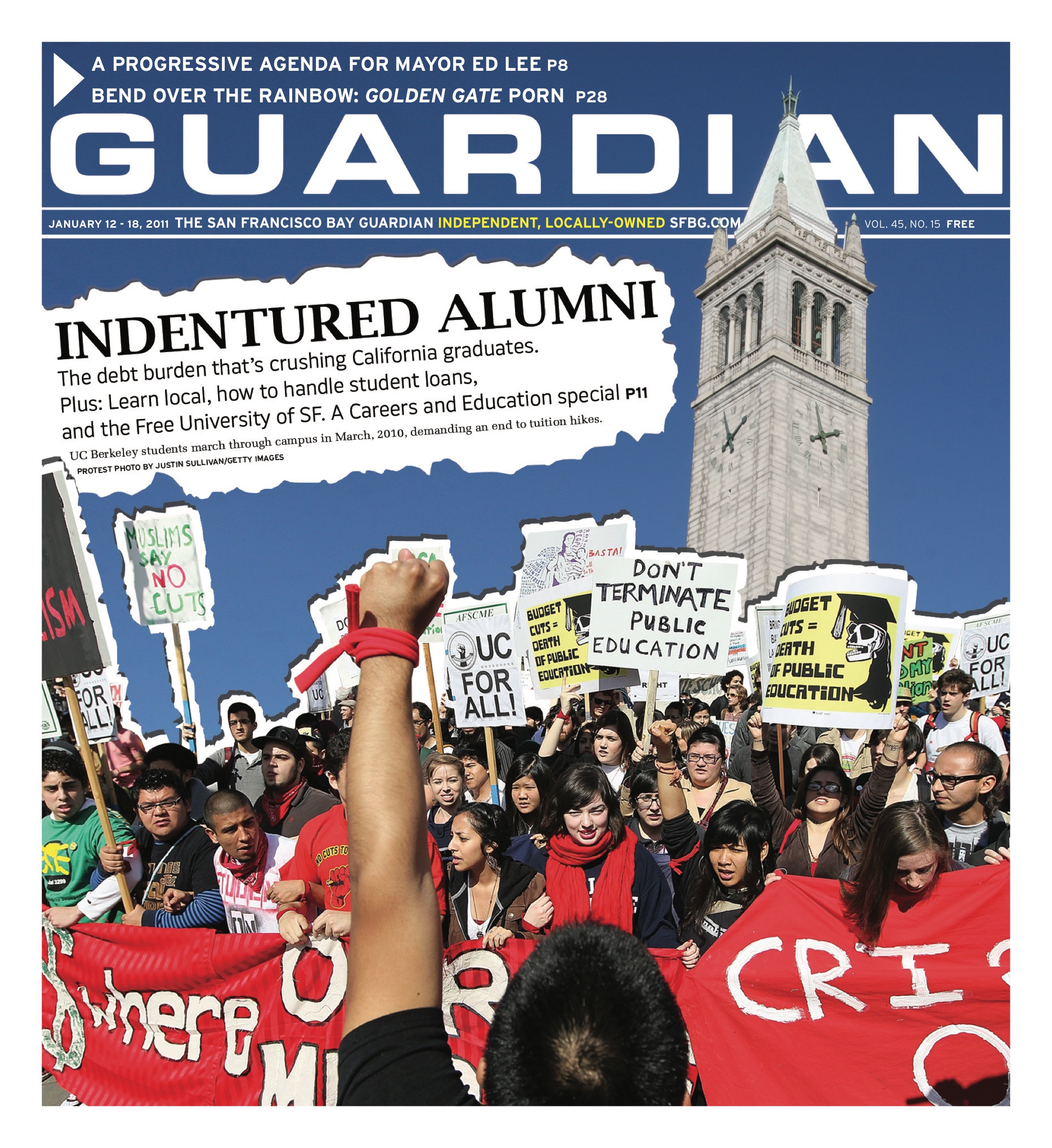
CAREERS AND ED In this weeks’ issue, Rebecca Bowe examines rising tuition and its effect on this generation of Californian students. Here, we profile three scholars that are dealing with very real repercussions from their student debt load.


BEN GLEASON, 31

Mills College, teaching credential

Oberlin College, American literature major

Total debt: $25,000

Ben Gleason remembers the day that he applied for his $10,000 student loan from Citibank to finance his teaching credential tuition. “I got it done online within a half hour. I didn’t have to talk to anybody or write an essay — easy money with severe consequences.” The consequences of such a serious financial decision — sans the aid of any counseling from either his school or bank? Gleason’s eventual decision to leave classroom teaching.

It’s not an uncommon story for this generation of teaching school graduates, in a state where teaching salaries are hardly keeping pace with rising tuition. Gleason started working as an ESL teacher in Richmond’s underfunded West Contra Costa Unified School District right after graduating from Mills College. His student loans were overwhelming — a problem that was exacerbated when he took a trip to Guatemala to work and improve his ability to communicate with his Spanish-speaking pupils. To remain afloat financially, Gleason applied for a forbearance on his loans and was surprised to return home after two years to a loan that had gone up by 25 percent due to interest. “I was really, really screwed,” he recalls.

Gleason didn’t feel like there was any way he could go back to his teaching salary, so to support his new wife (the two met in Guatemala) and daughter, he decided to start his own business with the help of an old boss — a private firm that helps reeducate state government workers on sustainability issues.

That means one less qualified teacher for low-income Californian children. And Gleason still has 15 to 20 years left of debt payments. “I wish that there was a more systemic way to solve this problem,” says the former public educator.


ANNE MOSTAD-JENSEN, 28

Santa Clara University, law degree

College of St. Catherine St. Paul, library sciences

Concordia University St. Paul, international studies and history major

Total debt (estimated at graduation): $120,000

Anne Mostad-Jensen and her twin sister grew up in a small Minnesota town. They attended the same college, Concordia St. Paul, where they both majored in history and international studies. After that, they went on to College of St. Catherine (also in St. Paul) to get their master’s degrees in library science. But then their paths diverged. Her sister traveled to Denmark in pursuit of her Danish citizenship — their father is Danish — and was able to complete her master’s in a country where the government pays for most of its citizens’ educations. Mostad-Jensen remained in Minnesota, to continue on in the American university system.

What kind of difference has the move made in these women’s lives? Try $65,000 of student debt. That’s because Mostad-Jensen’s sister, even after completing her master’s and attending one of the Icelandic languages programs she’s currently applying for, will only owe roughly $55,000 worth of loans — all from her time at American schools. Mostad-Jensen, who is now attending law school at Santa Clara University, will owe $120,000 by the time she graduates. “I’ve never had any consumer debt, but I’ve always told myself not to pass up educational opportunities just because I didn’t have the cash on hand,” she says.

Mostad-Jensen wants to work at the intersection of international copyright and technology law, possibly in a law library, a specialty career that benefits from degrees in multiple areas of study. She counts herself lucky that homeownership and a family aren’t her immediate goals. “Having a family — I just don’t understand how people do it with debt these days.” Her Midwestern community values come to the fore when she talks about the U.S. government’s inability to provide Americans with affordable education. “Isn’t the government an extension of the community? Europeans, the lack of stress they have by not having to pay out of pocket for health care and education — I mean they can actually live their lives.”


RAMON QUINTERO, 32

UC Berkeley, geography major

Total debt: $25,000

Ramon Quintero is a UC Berkeley student activist, but he wasn’t always radicalized around debt issues. “I didn’t come to Berkeley because of its activist reputation. I became an activist because of my situation,” he says. Quintero could no longer pay for his student housing and wound up living in his 1979 Toyota truck with camper shell on the streets of Berkeley, sending his baby daughter home to live with her grandmother.

Quintero came to Berkeley via Southern California, where his family landed after immigrating from Sinaloa, Mexico, when he was 11. He attended community college to get his core credits before coming to Berkeley, where rapidly rising tuition fees are putting a strain on the student community. Although he is a legal resident, Quintero was especially concerned about the effect that the rising cost of education was having on undocumented students.

And, of course, on his leaky camper shell roof. He sprang into action, driving a truck that he calls Santa Rita, to all nine UC campuses, encouraging fellow students to paint art on it that spoke to their concerns for the future of public education. Quintero was arrested twice for his roles in campus protests and he and Santa Rita were profiled in The New York Times and several California newspapers. Suddenly, the university found space for him in student housing.

“I saw the hypocrisy in the system,” says Quintero, who has fulfilled all his UC coursework for graduation but has convinced a professor to hold credit for one of his courses for another semester so he could go on a research fellowship to Madrid. The fellowship, he says, is crucial for his application to grad schools — another step toward fulfilling life goals he doesn’t think would be possible if he has to begin assuming the burden of his student debt. 


Debt-defying futures

4

CAREERS AND ED Student loans are a very special kind of debt. Like an armored car or an airplane’s black box, they are practically indestructible. While a person could sign up for a credit card, max it out on luxury items, and then wriggle off the hook of repayment by filing for bankruptcy, this escape hatch is blocked when it comes to taking out a nondischargeable student loan. Like tattoos, they stick to a borrower for life — or at least, until they are repaid.

“It’s almost impossible to discharge this debt in bankruptcy,” says Edie Irons, communications director for Oakland-based The Institute for College Access and Success (TICAS). “When you make that investment in a home, you have collateral, and you can use that asset. But when you invest in education, it’s not a guarantee. And if you can’t make those payments, the cost of collection can be pretty dear. They can garnish your wages. They can take your Social Security, your tax refunds. For federal loans, they have a lot of pretty scary powers of collection.”

Fortunately for those borrowers facing insurmountable debt, a few options (aside from feigning one’s own death) do exist for reducing, if not eliminating, the burden of student loans.

Volunteer opportunities through AmeriCorps, the Peace Corps, and Volunteers in Service to America (VISTA) provide stipends and money that can be put toward loan repayment in exchange for service. Graduates who serve through AmeriCorps (www.americorps.gov) for one year can receive up to $7,400 in stipends plus $4,725 toward loan repayment. Peace Corps volunteers can apply for deferment of Stafford, Perkins, and consolidation loans, and may receive cancellation of their Perkins Loans at a rate of 15 percent per year. Graduates volunteering with a nonprofit through VISTA can receive $4,725 for 1,700 hours of service.

Students who opt to become teachers in elementary or secondary schools serving students from low-income families can have portions of their Perkins Loan forgiven at increasing rates over the first five years of teaching, and members of the Teach for America corps program are eligible to receive a $5,350 award for each year of teaching plus postponed loan repayment with interest paid.

Two recently created programs also broaden the options for graduates facing insurmountable loan debt. The federal Income-Based Repayment (IBR) program is a new payment option for federal loans for borrowers who have enough debt relative to income to qualify for a reduced payment. Borrowers who earn less than 150 percent of the poverty level (that’s $16,245 for an individual) pay nothing; those who earn more can have loan payments capped at 15 percent of whatever they earn above that amount and forgiven entirely after 25 years of payments.

The Public Service Loan Forgiveness programs offer debt forgiveness for graduates entering certain fields. According to the program website (www.ibrinfo.org), eligible borrowers are people employed in nonprofit, 501(c)(3) organizations and people who work for federal, state, local, or tribal government. The program forgives remaining student loan debt on most federal loans after 10 years of eligible employment and qualifying loan payments. Law students entering public service can learn more about this program and others through Equal Justice Works (www.equaljusticeworks.org).

While these options may offer a boost for borrowers with federal student loans, those with private loan debt may not be as lucky. Irons notes that TICAS is engaged in efforts to encourage legislators in Washington to consider treating private loans “more like other consumer debt rather than this extra harsh treatment.”

“We want to see that changed,” she said. “People who are playing by the rules shouldn’t be punished when things go horribly wrong for them. Right now, there’s almost no way out of private loan debt.”

In the red

5

rebeccab@sfbg.com

CAREERS AND ED When the University of California Board of Regents met Nov. 17, 2010 to approve an 8 percent tuition hike, roughly 300 UC students who were furious about the decision converged outside the University of California, San Francisco (UCSF) campus at Mission Bay to rally in opposition, some traveling from as far away as Los Angeles.

“We had been organizing with all the campuses to get students to come up because we really wanted to be there to let them know that it’s not what we want, and it’s something they can’t just get away with doing year after year,” said UC Student Association President Claudia Magana. The protests were raucous, and police cracked down by discharging pepper spray and making 13 arrests.

Despite the palpable fury outside and impassioned student opposition delivered to the Regents inside, the 8 percent fee increase was approved. It came on the heels of a 32 percent tuition increase imposed the year before, and the price was ratcheted up by 9 percent and 7 percent in the years prior to that.

The tuition hikes were steep, but hardly new. Indeed, the cost of attending UC schools has been rising steadily for quite a while. According to a study by economist Peter Donohue, student tuition and fees increased 277 percent from 1990-91 to 2008-09, and that was prior to the 40 percent increase that followed. That trend is repeated in rising costs at the California State University and California Community College systems (See “Access Denied,” April 6, 2010).

Student protesters have sought to make it clear that their outrage isn’t rooted in selfish unwillingness to shell out more money, but instead is linked to a broader concern about privatization and the increasingly limited accessibility of public education.

Magana expressed concern that the climbing cost of instruction at UC, though still a relative bargain compared with private institutions, would ultimately start to affect who could and couldn’t attain higher education through the public university system. The question isn’t limited to UC — tuition is increasing at public and private colleges across the board, and as income inequality sharpens, more students seek higher education.

“Students will always pay to be here,” she noted. “The issue is going to be, which students are here? That’s really the big problem — the huge class issue that’s going to come up. Although there are some forms of support for low-income students, it’s not easy.”


DEEPER IN DEBT

Rising costs at UC mirror the upward trend at private nonprofit and for-profit postsecondary institutions nationwide, and those higher prices have triggered a dramatic increase in student borrowing. While students from low- or medium-income families can access higher education at any institution they’re admitted to as long as they’re willing to take out significant sums in student loans, many find themselves at a serious disadvantage once they have to start repaying their debt.

A study conducted by the Public Interest Research Group (PIRG) noted that hefty debt burdens often dissuade graduates from pursuing careers in teaching, social work, the nonprofit sector, or other low-paying occupations that foster social justice. PIRG found that 23 percent of public four-year college grads and 38 percent of private four-year college grads were saddled with too much debt to manage paying back student loans on a starting teacher’s salary.

For students pursuing careers as social workers, the economic bind looked even worse: 37 percent of public school grads and 55 percent of private school grads with student loans wouldn’t be able to manage repayment with starting salaries in that field, the study concluded.

“Because students with lower incomes are more dependent on student loans than higher income students, students who already face significant challenges to attending college will more strongly feel the effect of loan debt on career choice,” the report points out.

“It’s a serious problem for so many young people to be starting out their working life so deep in debt,” said Edie Irons, spokesperson for The Institute on College Access and Success (TICAS), an Oakland-based research organization. “It really does limit people’s ability to take advantage of the opportunities education is supposed to provide. In concrete terms, it can make it really hard to buy a house, or start a business, or start a family, or go back to grad school, or to save for retirement or your own children’s education. And that’s all assuming you can keep up with the payments.”

Student loan debt has intensified over the past two decades. In 1993, just one third of all four-year college students graduated with debt, owing on average slightly more than $9,000, according to PIRG.

Today, the majority of college students take out loans to finance their education. Around 62 percent of public university students graduate with student loans, as do 72 percent of students attending private nonprofit institutions, and 96 percent of students attending for-profit institutions such as the University of Phoenix or the Academy of Art University, according to TICAS. Nationally, students graduate owing an average of $24,000, not counting debt associated with advanced degrees.

While young people must invest more than ever before to obtain higher education, the return on investment isn’t showing signs of improvement. The expected median income for UC graduates has stayed the same over the last decade, even as the cost of tuition has ballooned.

What’s more, says Bob Meister, president of the Council of UC Faculty Associations and professor of Political and Social Thought at UC Santa Cruz, is that an estimated 40 percent of public university students entering the workforce will either be unable to find a job, or will land in a lower-paying job that doesn’t require a college degree.

“For college graduates under 25, the unemployment rate is nearly as high as the national unemployment rate,” around 10 percent, Meister notes. “Over the past decade, what’s happened is that the median hasn’t risen. The top has risen very fast, and the bottom has fallen.”


IN A DIFFERENT CLASS

There’s no doubt that diminished state funding is affecting California’s public universities.

“A lot of departments are being eliminated, and a lot of professors who are really amazing are leaving to other universities,” Magana says. “And the waiting lists for classes are just ridiculous.” Academic goals are being compromised — for example, students had to abandon their push for an ethnic studies program at UCSC, she added, because the American studies department that would have partially supported it was slashed.

While diminished public funding has been used to explain the need to raise tuition, Meister has published numerous essays suggesting that the root cause of rising tuition costs at UC goes deeper than that, and he has gone so far as to publicly encourage students not to accept higher tuition without first demanding financial information.

Meister previously served on the UC budget committee and has observed the institution’s evolving financial policies for years. He doesn’t seem surprised that tuition is going up, regardless of what condition the economy is in or what amount of public funding is available because, as he puts it, “the universities will cost as much as they can.” UC had long sought to boost revenue by raising tuition, he noted, yet its leaders feared a rollback in state funding in response. But that changed under Gov. Arnold Schwarzenegger, who agreed to increase state support only on condition of that UC in turn require students to contribute more.

Around the same time that Schwarzenegger provided this new incentive to raise tuition, UC pooled its various revenue streams into a consolidated general revenue fund, Meister said, a departure from the old way of keeping separate accounts. This new fund, which included all non-state revenue and funding that wasn’t legally required to be used for certain purposes, could be pledged entirely as collateral for bonds for new construction projects, greatly increasing the institution’s borrowing power and boosting its revenue with the addition of new facilities.

To maintain its stellar bond rating, UC had to ensure an increase in revenues, according to Meister’s explanation, and to do that, UC ratcheted up the one source of revenue it had full control over: tuition. Meister laid bare this financial play in a 2009 open letter to students, titled “They Pledged Your Tuition.” Since it was published, a small corps of student activists has become deeply engaged in studying campus finance documents and airing criticism of financial policies.

Just before the Nov. 17 protests at UCSF Mission Bay, Meister published another open letter, this one addressed to UC President Mark Yudof. This one contemplated, “Why they think they can increase revenues regardless of how fast the economy grows … and regardless of whether the income of graduates is stagnant.”

His answer is somewhat surprising: “Their ability to raise tuition is a function of the growth of income inequality,” he told the Guardian. In the letter, Meister charges, “In the 21st century, when almost all income growth has been in the top 1 to 2 percent of California’s population, UC is still marketing income inequality to students as its most important product. It now expects all students to pay more for an ever-shrinking chance of reaping the ever-growing rewards that our economy makes available to the few. Your plan to increase revenue through tuition growth is feasible, of course, only because the federal government still allows students to borrow more for education despite the greater likelihood that they will not be able to repay — student loans may be the last form of subprime credit available in our economy.”

His theory highlights a paradox. “Being in the have-not category is increasingly worse,” he explains, “and so they are willing to take on more debt, which actually dampens their prospects for income growth.”

The question now is what will happen under Gov. Jerry Brown, who is likely to take a different stance toward rising tuition than Schwarzenegger but nonetheless is expected to unveil harsh cuts to education as a way to address a $26 billion budget deficit.

In a recent interview with the San Francisco Chronicle, UC Regent Richard Blum indicated that it probably would not be feasible to raise tuition again, so the message was that students should brace for more cuts to education.

When Brown unveiled his proposed budget on Jan. 10, he announced further cuts to higher education in California to balance the state budget. Brown’s revised 2010-11 budget decreases the state funding for UC, CSU, the community college system, and other higher education programs by $1.7 billion for the 2011-12 budget. The UC system would take a 13.3 percent hit in general fund support; the proposed cut to the CSU system is 12.5 percent; and the community college system would be cut by 6.9 percent.

Brown, who also wants to hold a special election to ask voters to maintain the current level of tax rates for income, sales, and vehicle license taxes for five years rather than let them expire later this year, expressed regret about making cuts to higher education. But he emphasized the need to make tough decisions in the face of a bleak financial outlook, saying, “We need to face the music.”

The agenda for Mayor Lee

0

EDITORIAL San Francisco has its first Chinese American mayor, and that’s a major, historic milestone. Let’s remember: Chinese immigrants were among the most abused and marginalized communities in the early days of San Francisco. In 1870, the city passed a series of laws limiting the rights of Chinese people to work and live in large parts of the city. Chinese workers built much of the Transcontinental Railroad — at slave wages and in desperately unsafe conditions that led to a large number of deaths. The United States didn’t even repeal the Chinese Exclusion Act (an anti-immigration law) until 1943, and for years, Chinatown was one of the poorest and most neglected city neighborhoods.

So there’s good reason for Asians to celebrate that the last door in San Francisco political power is now open. And Mayor Ed Lee comes from a civil rights background; he got his start in politics working as a poverty lawyer and tenant organizer.

Unfortunately, his path to Room 200 was badly marred by some ugly backroom dealing involving Willie Brown, the most corrupt mayor in modern San Francisco history. Even Lee’s supporters agree the process was a mess and that it undermines Lee’s credibility. So it’s important for Mayor Lee to immediately establish that he’s independent of Brown and his cronies, that his administration will not just be a Gavin Newsom rerun, and that progressives can and should support him.

He has a tough job ahead. We urge him to make a clean break with the past and set the city in a new direction. Here are a few ways to get started.

Clear out the Newsom operatives and bring some new people with progressive credentials into the senior ranks. Newsom’s chief of staff, Steve Kawa, has been a shadow mayor for the past year while Newsom was on the campaign trail, and is the architect of much of what the outgoing administration has done to sow political division and cripple city government. Lee needs his own chief advisor.

Show up for question time and work with the district-elected supervisors. Newsom was openly dismissive of the board and refused to take the supervisors seriously as partners in city government. Lee should appear once a month to answer questions from the board in public, should meet regularly with all the supervisors and appoint a liaison that the board can work with and trust. He needs to make his administration as transparent and open as possible and ensure that everyone at City Hall follows the letter and spirit of the Sunshine Ordinance.

Make it clear that the next city budget includes substantial new revenue. Newsom offered nothing but Republican politics when it came to city finance; his only solutions to the massive structural deficit involved service cuts.

The deficit will be even worse than projected this year, since Gov. Jerry Brown wants to transfer much of the state’s responsibility for public safety and public health back to local government — and there won’t be enough state money attached to handle the new burden. Lee needs to publicly call on Brown and the Legislature to give cities more ability to raise taxes on the local levee. Then he should start planning for a June ballot package that will raise as much as $250 million in new revenue for the city.

A substantially higher vehicle license fee on expensive cars, a congestion management fee, a significant annual transit impact fee on downtown offices, a restructured business tax, and a progressive tax on income of more than $50,000 a year would more than eliminate the structural deficit.

There are plenty of other revenue ideas out there; not all can or would pass on a single ballot. But Lee needs to make it clear that revenue will be part of the solution — and that he will use all the political capital he can muster to convince the voters to go along.

<\!s> Get serious about community choice aggregation. Newsom loved to talk about his environmental agenda, but when it came to challenging the hegemony of Pacific Gas and Electric Co. and its dirty power portfolio, he ran for cover. His hand-picked Public Utilities Commission director, Ed Harrington, has been an obstacle to implementing the city’s CCA plan. Lee needs to get rid of Harrington or direct him to cooperate with the supervisors and get San Francisco on the path to clean public power.

<\!s> Establish a real affordable housing program. The city plans to build housing for as many as 60,000 new residents in the southeast neighborhoods — but only a fraction of them will be affordable. This city is already well on its way to becoming a high-end bedroom community for Silicon Valley; only a clear policy that limits new market-rate condos until there’s a plan for adequate affordable housing will turn things around.

<\!s> Support Sanctuary City and quit helping federal immigration authorities break up families. Newsom was just awful on this issue; Lee needs to work with Sup. David Campos to implement more humane laws.

<\!s> End the demonization of homeless people and public employees. Newsom came to power attacking the homeless (with Care Not Cash) and went out attacking the homeless (with the sit-lie law). Lee ought to tell the Police Department not to aggressively enforce the ordinance.

<\!s> Take on the sacred cows of the Police and Fire departments. The biggest salary and pension problems in the city are in the two public safety departments. The Fire Department budget has been bloated for years. If everyone else is taking cuts, so should the highest-paid cops and the overstaffed fire stations.

Some of Lee’s supporters insist he’s a solid progressive and that we shouldn’t hold the details of his selection — or the fact that he was chosen by people who are openly hostile to the progressive agenda — against him. We’re open to that — but the progressive community will judge him on his record. And he has to start right away.

Editor’s Notes

2

tredmond@sfbg.com

Former Mayor Willie Brown says that choosing a person of color for a leadership position should be a progressive value. Board of Supervisors President David Chiu says the new mayor, Ed Lee, is a progressive. Several supervisors and other political observers say the six-vote progressive majority on the board is gone.

And nobody really talks about what that word means.

Progressive is a term with a long political vintage, but it’s changed (as has the political context) since the 1920s. (Progressives these days aren’t into Prohibition.) So I’m going to take a few minutes to try to sort this out.

I used to tell John Burton, the former state senator, that a progressive was a liberal who didn’t like real estate developers. But that was in the 1980s, when the Democratic Party in town was funded by Walter Shorenstein and other developers who were happy to be part of the party of Dianne Feinstein, happy to be liberals on some social issues (Shorenstein insisted that the Chamber of Commerce hire and promote more women), and happy to promote liberal candidates like John and Phil Burton for state and national office — as long as they didn’t mess with the gargantuan money machine that was high-rise office development in San Francisco.

But these days it’s not all about real estate; it’s that the level of economic inequality in the United States has risen to levels unseen since the late 1920s. So I sat down on a Saturday night when the kids went to bed(yeah, this is my social life) and made a list of what I think represent the core values of a modern American progressive. It’s a short list, and I’m sure there’s stuff I’ve left off, but it seems like a place to start.

This isn’t a litmus test list (we’ve endorsed plenty of people who don’t agree with everything on it). It’s not a purity test, it’s not a dogma, it’s not the rules of entry into any political party … it’s just a definition. My personal definition.

Because words don’t mean anything if they don’t mean anything, and progressive has become so much of a part of the San Francisco political dialogue that it’s starting to mean nothing.

For the record: when I use the word "progressive," I’m talking about people who believe:
1. That civil rights and civil liberties need to be protected for everyone, even the most unpopular people in the world. We’re for same-sex marriage, of course, and for sanctuary city and protections for immigrants who may not have documentation. We’re also in favor of basic rights for prisoners, we’re against the death penalty, and we think that even suspected terrorists should have the right to due process of law.
2. That essential public services — water, electricity, health care, broadband — should be controlled by the public, not by private corporations. That means public power and single-payer government run health insurance.
3. That the most central problem facing the city, the state, and the nation today is the dramatic upward shift of wealth and income and the resulting economic inequality. We believe that government at every level — including local government right here in San Francisco — should do everything possible to reduce that inequality. That means taxing high incomes, redistributing wealth, and using that money for public services (education, for example) that tend to help people achieve a stable middle-class lifestyle. We believe that San Francisco is a rich city, with a lot of rich people, and that if the state and federal government won’t try to tax them to pay for local services, the city should.
4. That private money has no place in elections or public policy. We support a total ban on private campaign contributions, for politicians and ballot measures, and support public financing for all elections. Corruption — even the appearance of corruption — taints the entire public sector and helps the fans of privatization, and progressives especially need to understand that.
5. That the right to private property needs to be tempered by the needs of society. That means you can’t just put up a highrise building anywhere you want in San Francisco, of course, but it also means that the rights of tenants to have stable places for themselves and their families to live is more important than the rights of landlords to maximize return on their property. That’s why we support strict environmental protections, even when they hurt private interests, and why be believe in rent control, including rent control on vacant property, and eviction protections and restrictions on condo conversions. We think community matters more than wealth, and that poor people have a place in San Francisco too — and if the wealthier classes have to have less so the city can have socioeconomic diversity, that’s a small price to pay. We believe that public space belongs to the public and shouldn’t be handed over to private interests. We believe that everyone, including homeless people, has the right to use public space.
6. That there are almost no circumstances where the government should do anything in secret.
7. That progressive elected officials should use their resources and political capital to help elect other progressives — and should recognize that sometimes the movement is more important that personal ambitions.

I don’t know if Ed Lee fits my definition of a progressive. He hasn’t taken a public position on any major issues in 20 years. We won’t know until we see his budget plans and learn whether he thinks the city should follow Gavin Newsom’s approach of avoiding tax increases and simply cutting services again. We won’t know until he decides what to tell the new police chief about enforcing the sit-lie law. We won’t know until we see whether he keeps Newsom’s staff in place or brings in some senior people with progressive values.
I agree that having an Asian mayor in San Francisco is a very big deal, a historic moment — and as Lee takes over, I will be waiting, and hoping, to be surprised.

Sawako’s choice

0

arts@sfbg.com

FILM Sawako Decides, the most recent feature by the talented 27 year-old Japanese director Yuya Ishii, might not be the best film of 2010 that you never saw, but it certainly ranks as one of last year’s funniest — and perhaps more debatably, most feminist.

Yerba Buena Center for the Arts’ Ishii double feature “Lost in Japan,” which pairs Sawako with Ishii’s previous film To Walk With You (2009), is an all- too-brief introduction to a director whose modestly budgeted films about losers, misfits, and the socially marginalized in a Japan as depressed as they are have been garnering critical praise and catching the attention of festival programmers since his 2006 debut Rebel, Giro’s Love. Sawako Decides leaves no doubt that Ishii is one to watch (and to watch repeatedly).

Five years after winding up in Tokyo after a failed post-high school elopement, 20-something Sawako (a wonderful Hikari Mitsushima) has landed herself a thankless pink collar job serving tea at the offices of a toy manufacturer and an equally lame coworker boyfriend, whose young daughter from a previous marriage seems just as indifferent to Sawako as her father is. A human doormat in the extreme, Sawako is the first to agree the chorus of detractors that surround her that she’s, “not really much … a lower-middling type, really.” This routine existence is upended when her boyfriend arranges for Sawako to take over her estranged and terminally ill father’s freshwater clam packing business, and Sawako must face down the rural community — most notably, the pack of sniping older female employees she now oversees — who view her as a selfish deserter.

Although Sawako is a far cry from Emma Stone’s sass-spouting Olive in Easy A (2010), Ishii still wants his underdog to come out on top, and eventually the fates smile kindly, albeit crookedly, on her. By the time the film reaches the climactic scene in which a newly-emboldened Sawako leads her shocked employees in a rousing anti-government anthem, there is no denying that she has — to borrow the title phrase of another recent coming-of-age film anchored by a strong female character — true grit, and that Ishii is not only a wildly inventive filmmaker, but one who possesses a true heart.

Ishii — who also frequently edits and writes his films — combines humor and pathos in a way that mimics his bumbling antiheroes’ oft-failed attempts to integrate themselves within the world around them: jokes are frequently followed up a beat too late so as to go practically unnoticed or are delivered in a deadpan that verges on D.O.A. He also has a penchant for peppering his narratives with absurdist detours, out-of-the-blue dance numbers, and enough idiosyncratic supporting characters to make Miranda July proud.

Unlike July’s work, however, Ishii’s films leave no aftertaste of preciousness. Ishii’s characters are often as laughably insufferable as their peers make them out to be, but Ishii takes their funny-sad struggles to exist quite seriously, putting his work more in line with that of, say, Woody Allen or even Todd Solondz, than of anything Michael Cera has mumbled his way through. Ishii’s films are “existential” — a descriptor they’re frequently tagged with — to the extent that his characters, through much hilarious trial and error, transform their failure to achieve what society expects of them into a new ethics for living.

Thus, Sawako Decides‘ most radical proposition is that “nothing special” is not simply a demoted way of being, but grounds for collectivization. Japanese culture’s drive toward upper-middle class exceptionalism is exposed as a myth that should have died with the Bubble Economy (in To Walk With You, the protagonist discovers everybody’s mother wants them to be a lawyer largely for lack of imagination). Like Melville’s scrivener Bartleby, Sawako turns staying within one’s station into an act of defiance. To be the best at being a “lower-middling person” is not defeatist. Rather, it is to embrace one’s stunted potential as a generative constraint. If everyone’s a loser, than no one is. *


LOST IN JAPAN: THE EXISTENTIAL COMEDIES OF YUYA ISHII

Jan. 13–15, $6-$8

Yerba Buena Center for the Arts

701 Mission, SF (415) 978-2787 www.ybca.org

EDITORIAL: The Agenda for Mayor Lee

6

San Francisco has its first Chinese American mayor, and that’s a major, historic milestone. Let’s remember: Chinese immigrants were among the most abused and marginalized communities in the early days of San Francisco. In 1870, the city passed a series of laws limiting the rights of Chinese people to work and live in large parts of the city. Chinese workers built much of the Transcontinental Railroad at slave wages and in desperately unsafe conditions that led to a large number of deaths. The United States didn’t even repeal the Chinese Exclusion Act (an anti-immigration law) until 1943, and for years, Chinatown was one of the poorest and most neglected city neighborhoods.

So there’s good reason for Asians to celebrate that the last door in San Francisco political power is now open. And Mayor Ed Lee comes from a civil rights background; he got his start in politics working as a poverty lawyer and tenant organizer.

Unfortunately, his path to Room 200 was badly marred by some ugly backroom dealing involving Willie Brown, the most corrupt mayor in modern San Francisco history. Even Lee’s supporters agree the process was a mess and that it undermines Lee’s credibility. So it’s important for Mayor Lee to immediately establish that he’s independent of Brown and his cronies, that his administration will not just be a Gavin Newsom rerun, and that progressives can and should support him.

He has a tough job ahead. We urge him to make a clean break with the past and set the city in a new direction. Here are a few ways to get started.

Clear out the Newsom operatives and bring some new people with progressive credentials into the senior ranks. Newsom’s chief of staff, Steve Kawa, has been a shadow mayor for the past year while Newsom was on the campaign trail, and is the architect of much of what the outgoing administration has done to sow political division and cripple city government. Lee needs his own chief advisor.

Show up for question time and work with the district-elected supervisors. Newsom was openly dismissive of the board and refused to take the supervisors seriously as partners in city government. Lee should appear once a month to answer questions from the board in public, should meet regularly with all the supervisors and appoint a liaison that the board can work with and trust. He needs to make his administration as transparent and open as possible and ensure that everyone at City Hall follows the letter and spirit of the Sunshine Ordinance.

Make it clear that the next city budget includes substantial new revenue. Newsom offered nothing but Republican politics when it came to city finance; his only solutions to the massive structural deficit involved service cuts.

The deficit will be even worse than projected this year, since Gov. Jerry Brown wants to transfer much of the state’s responsibility for public safety and public health back to local government and there won’t be enough state money attached to handle the new burden. Lee needs to publicly call on Brown and the Legislature to give cities more ability to raise taxes on the local levee. Then he should start planning for a June ballot package that will raise as much as $250 million in new revenue for the city.

A substantially higher vehicle license fee on expensive cars, a congestion management fee, a significant annual transit impact fee on downtown offices, a restructured business tax, and a progressive tax on income of more than $50,000 a year would more than eliminate the structural deficit.

There are plenty of other revenue ideas out there; not all can or would pass on a single ballot. But Lee needs to make it clear that revenue will be part of the solution and that he will use all the political capital he can muster to convince the voters to go along.

Get serious about community choice aggregation. Newsom loved to talk about his environmental agenda, but when it came to challenging the hegemony of Pacific Gas and Electric Co. and its dirty power portfolio, he ran for cover. His hand-picked Public Utilities Commission director, Ed Harrington, has been an obstacle to implementing the city’s CCA plan. Lee needs to get rid of Harrington or direct him to cooperate with the supervisors and get San Francisco on the path to clean public power.

Establish a real affordable housing program. The city plans to build housing for as many as 60,000 new residents in the southeast neighborhoods but only a fraction of them will be affordable. This city is already well on its way to becoming a high-end bedroom community for Silicon Valley; only a clear policy that limits new market-rate condos until there’s a plan for adequate affordable housing will turn things around.

Support Sanctuary City and quit helping federal immigration authorities break up families. Newsom was just awful on this issue; Lee needs to work with Sup. David Campos to implement more humane laws.

End the demonization of homeless people and public employees. Newsom came to power attacking the homeless (with Care Not Cash) and went out attacking the homeless (with the sit-lie law). Lee ought to tell the Police Department not to aggressively enforce the ordinance.

Take on the sacred cows of the Police and Fire departments. The biggest salary and pension problems in the city are in the two public safety departments. The Fire Department budget has been bloated for years. If everyone else is taking cuts, so should the highest-paid cops and the overstaffed fire stations.

Some of Lee’s supporters insist he’s a solid progressive and that we shouldn’t hold the details of his selection or the fact that he was chosen by people who are openly hostile to the progressive agenda against him. We’re open to that but the progressive community will judge him on his record. And he has to start right away.

Judge Kopp to run for D.A.?

11

Yep: Quentin Kopp, the 82-year-old former supervisor, former state Senator, retired Superior Court judge and political fixture in this city for four decades, is being talked about as a potential challenger to the new district attorney, George Gascon.


I just talked to Kopp, and he confirmed that a lot of people have approached him about running in November, and while he’s not a candidate at this point, he hasn’t ruled it out. “If I do run — and I have to think about the rigors of a campaign — I would run on a platform of using the district attorney’s office to root out political corruption,” he said.


Kopp has always been fairly conservative on law-and-order issues and is a supporter of the death penalty. His political base has always been on the West side of town. But in a typically untraditional fashion, Kopp has become a bit more liberal in his later years — and has always been a strong supporter of open government and a foe of political sleaze.


And he seems to be in good health and certainly hasn’t lost his political vigor. (And, he reminds me, the legendary DA of New York, Robert Morgenthau, served past his 90th birthday.) So Kopp would be a formidable candidate in what’s shaping up to be a fairly large field.


Never a dull moment in this town.

What progressive means

85

Willie Brown says that choosing a person of color for a leadership position should be a “progressive” value. David Chiu says Ed Lee is a progressive. Several supervisors, and other political observers, say the six-vote progressive majority on the board is gone.

And nobody really talks about what that word means.

Progressive is a term with an excellent political vintage, but it’s changed (as has the political context) since the 1920s. (Progressives these days aren’t into prohibition.) So I’m going to take a few minutes to try to sort this out.

I used to tell John Burton that a progressive was a liberal who didn’t like real estate developers, but that was in the 1980s, when the Democratic Party in town was funded by Walter Shorenstein and other developers, who were happy to be part of the party of Dianne Feinstein, happy to be liberals on some social issues (Shorenstein insisted that the Chamber of Commerce hire and promote more women) and happy to promote liberal candidates like John and his brother Phil for national office – as long as they didn’t mess with the gargantuan money machine that was highrise office development in San Francisco.
Arguing that Shorenstein’s economic agenda was driving up housing prices, destroying low-income neighborhoods and displacing tenants was a waste of time; the liberals like Burton (who also represented real estate developers as a private attorney) weren’t interested.

But these days it’s not all about real estate; it’s about the fact that the level of economic inequality in the United States has risen to levels unseen since the late 1920s, and the impacts are all around us. And it’s about (Democratic) politicians in San Francisco blaming Sacramento, and (Democratic) politicians in Sacramento blaming Washington, and the Democratic Party in the United States abandoning economic equality as a guiding principle.

So I sat down on a Saturday night when the kids went to be (yeah, this is my social life) and made a list of what I think represent the core values of a modern American progressive. It’s a short list, and I’m sure there’s stuff I’ve left off, but it seems like a place to start.

For all the people who are going to blast me in the comments, let me say very clearly: This isn’t a litmus-test list (we’ve endorsed plenty of people who don’t agree with everything on it). It’s not a purity test, it’s not a dogma, it’s not the rules of entry into any political party … it’s just a definition. My personal definition.

Because words don’t mean anything if they don’t mean anything, and progressive has become so much of a part of the San Francisco political dialogue that it’s starting to mean nothing.
For the record: When I use the word “progressive,” I’m talking about people who believe:

1. That civil rights and civil liberties need to be protected for everyone, even the most unpopular people in the world. We’re for same-sex marriage, of course, and for Sanctuary City and protections for immigrants who may not have documentation. We’re also in favor of basic rights for prisoners, we’re against the death penalty, and we think that even suspected terrorists should have the right to due process of law.

2. That essential public services – water, electricity, health care, broadband – should be controlled by the public and not by private corporations. That means public power and single-payer government run health insurance.

3. That the most central problem facing the city, the state and the nation today is the dramatic upward shift of wealth and income and the resulting economic inequality. We believe that government at every level – including local government, right here in San Francisco – should do everything possible to reduce that inequality; that means taxing high incomes, redistributing wealth and using that money for public services (education, for example) that tend to help people achieve a stable middle-class lifestyle. We believe that San Francisco is a rich city, with a lot of rich people, and that if the state and federal government won’t try to tax them to pay for local services, the city should.

4. That private money has no place in elections or public policy. We support a total ban on private campaign contributions, for both politicians and ballot measures, and support public financing for all elections.

5. That the right to private property needs to be tempered by the needs of society. That means you can’t just put up a highrise building anywhere you want in San Francisco, of course, but it also means that the rights of tenants to have stable places for themselves and their families to live is more important than the rights of landlords to maximize return on their property. That’s why we support strict environmental protections, even when they hurt private interests, and why be believe in rent control, including rent control on vacant property, and eviction protections and restrictions on condo conversions. We think community matters more than wealth and that poor people have a place in San Francisco too — and if the wealthier classes have to have less so that the city can have socio-economic diversity, that’s a small price to pay. We believe that public space belongs to the public, and shouldn’t be handed over to private interests; we believe that everyone, including homeless people, has the right to use public space.

6. That there are almost no circumstances where the government should do anything in secret.

7. That progressive elected officials should use their resources and political capital to help elect other progressives – and should recognize that sometimes the movement is more important that their own personal ambitions.

I could add a lot more, but I think those six factors are at the heart of what I mean when I talk about progressives. We support a lot of other things; I put the right of workers to unionize under Number 3, since unions (along with public schools and subsidized higher education) are one of the major forces behind a stable middle class and a more equal society. We think racism and homophobia are never acceptable, and we support affirmative action, but that goes under Number 1.

This is not a socialist manifesto; I never mentioned worker control of the means of production. Progressives don’t oppose private enterprise; they just think that some things essential for the good of society don’t belong in the private sector, and that the private sector should be regulated for the good of all of us. We trust and support small businesses much more than big corporations – and we think their interests are not the same.

I don’t know if Ed Lee fits my definition of a progressive. We won’t know until we see his budget plans, and learn whether he thinks the city should follow Gavin Newsom’s approach of avoiding tax increases and simply cutting services again. We won’t know until he decides what the tell the new police chief about enforcing the sit-lie law. We won’t know until we see whether he keeps Newsom’s staff in place or brings in some senior people with progressive values. We know that the people who pushed him to take the job aren’t progressives by any definition, but you never know. I agree that having an Asian mayor in San Francisco is a very big deal, an historic moment — and when Lee takes office, I will be waiting, and hoping, to be surprised.

Elsbernd defends Lee (but ducks the Tapas)

4

Well, Sean didn’t stop by for tapas at Que Syrah last night, but he did take the time to send me a long letter answering my questions about why he “mysteriously”  nominated CAO Ed Lee for interim mayor in Tuesday’s Board of Supervisors meeting.

I appreciate the letter and it’s to Sean’s credit that this is his modus operandi with the Guardian (and others) in answering questions, even pesky ones.

I am printing his letter in full below and offering him the opportunity to continue this illuminating conversation since his letter raises even more questions about his nomination of Lee.

For example, the Bay Citizen section of today’s New York Times, on the morning of the followup supervisors’ meeting this afternoon, laid out a detailed story by Gerry Shih  of how former Mayor Willie Brown, Rose Pak, a powerful Chinatown political operative, and Mayor Newsom orchestrated the Lee nomination to keep the mayor’s office safe for PG&E, the downtown gang, and Willie/Pak’s clients and allies.

The headline: “Behind-the-Scenes Power Politics: The Making of a Mayor,” with  pictures of Newsom, Willie, and Pak. The motivation for the orchestration, according to the story, was that on Sunday afternoon “Word had  trickled out that the main contenders for the job were Sheriff Michael Hennessey, former Mayor Art Agnos and former board chairman Aaron Peskin” and the three were “deemed too liberal” by Pak, Brown and Newsom.

Then, the story said that over the next 48 hours, Pak, Brown and the Newsom administration “engaged in an extraordinary political power play, forging a consensus” on the board, “outflanking the board’s progressive wing” and persuading Lee at the last moment  shortly before he boarded  a plane to  Taiwan to agree “to become San Francisco’s first Asian-American mayor, even though he had told officials for months that he had no interest in the job.”

The story noted that Pak was “in a boastful mood the next day, several hours before she planned to have celebratory drinks with Brown at the Chinese Hilton,” (Willie, last time I checked, was on an annual PG&E retainer of $200,000 plus.) The story ended with a telling quote from Pak: “Now you know why they say I play politics like a blood sport.”

So the new questions I have for Sean (and other supervisors who voted for Lee) is what did they know and when did they know it? Or were they even informed about the deal and how it came down? Is this the West Portal supervisor’s idea of how to choose a mayor?

P.S. Sean and his fellow Lee supporters may not think it’s important for the Guardian (or other media or citizens) to be able to ask questions of Lee or other candidates  before making him mayor.

Well, I think  it’s important and I have some basic questions: What is Lee’s position on rent control? On progressive taxation to help solve the crushing budget crisis? On rubberstamping Newsom/Pak/Brown policies as mayor? And on community choice aggregation and public power and kicking PG&E out of the mayor’s office?  The last question on PG&E  is critical, because this is the key litmus test in political San Francisco.  Any politician, elected or appointed or emerging,  who supports PG&E and opposes public power/CCA is not to be trusted.  Did anybody get to ask Lee any of these questions or any others? Let’s lay out the questions and Lee’s answers before making him the reluctant mayor.

Here’s Elsbernds letter to me:

Bruce,

Good to hear from you.  As always, I enjoy the conversation, particularly
with those District 7 constituents who so often and consistently advocate
positions contrary to the vast majority of residents in District 7 (e.g.
the Guardian’s endorsement against Proposition G, which received over 70%
of the vote in District 7), but every now and then, present a fresh
perspective worth analysis.


I believe Ed Lee will make an outstanding Interim Mayor. You asked me the
following questions to justify this.  Let me give it my best shot.

Why did I nominate Ed Lee for Interim Mayor when he was out of town?  His
presence was immaterial to me.  I had the opportunity to discuss his
interest in the position with him prior to the vote, and I have worked with
him for nearly 10 years, and know where he stands on various positions.  I
did not need him in the room on Tuesday evening to answer questions as I
had done my homework before showing up to class.


Why did I nominate Ed Lee when he was not publicly “out there” or “in
public discussion” as a candidate or even known by the Supervisors to be a
legitimate candidate?  Whether or not Ed Lee’s name was known to you, your
readers, or other Supervisors, is not a fact to which I can speak.  After
all, I do not fit any one of those 3 criteria.  Ed was always a candidate
to me, and, most importantly, the qualities of an Interim Mayor were “in
public discussion.”  These qualities, which I heard from residents in
district 7 and throughout the City, were that the individual be someone not
wanting to run for re-election, someone, who had a demonstrated ability to
appeal to all cross sections of the political spectrum, someone who knows
the City (both how it functions as a government as well as its many
neighborhoods), and, someone with demonstrated experience in a variety of
areas of public policy.


Why did I nominate Ed Lee when he has not publicly stated his views on any
of the major issues coming before the Mayor?  Yes, it’s true he has not
filled out a Bay Guardian questionnaire, or been grilled by your editorial
Board.  However, an astute observer of Ed’s career can decipher well his
positions.  Moreover, Ed was most recently confirmed unanimously to serve
as CAO of the City and County, for the second time.  During that
confirmation process, I had the opportunity, as did every other member of
the Board and the public to present issues to Ed for his analysis.  The
tough issues facing the Mayor, are the same tough issues facing the CAO,
the Supervisors, and everyone else charged with the duty of serving the
public.


Why did I nominate Ed Lee when he was not available for questioning by the
Board when the discussion and vote came down?  Yes, Ed was not present.
However, as I stated earlier, Ed had always been available to talk prior to
his departure.  I was able to ask my questions before he left.


Why did I nominate Ed Lee when he is not as qualified for this tough post
in these tough times as the other public candidates?  Well, this question
implies a bit of a comparison to the other candidates.  I respect the other
candidates too much to say anything negative about them.  Simply put, I
believe Ed is the lone candidate with the sufficient breadth, most
relevant, and most timely experience across City government, and the one
who had the greatest ability to bring all sides of the political spectrum
together.


Why did I nominate Ed Lee when he was obviously part of a backroom deal
orchestrated by Mayor Newsom and his downtown allies?  I love questions
based on evidence and fact.  This question, however, is merely a question
based on your opinion.  I disagree with that opinion.  Ed Lee was elected
Interim Mayor because he is the most qualified candidate.


Finally, thanks for the invitation to Que Syrah this evening.
Unfortunately, as a working parent, my weeknight evenings do not belong to
me – they belong to my son.  I’ll be with him tonight.  I hope you’re still
able to enjoy yourself without me.


All the best,
Sean


P.S.  It’s the “Village Grill,” not the “Village Inn .”  Perhaps you need
to get out on West Portal a bit more and learn the name of the
establishments along the street.


Chiu rejects DA job and defends his support for Lee

22

Amid speculation that he was angling to be appointed district attorney – and questions about whether that goal influenced his support for Ed Lee to be named interim mayor – Board of Supervisors President David Chiu has issued a press release announcing that he’s withdrawing from consideration for the DA’s job.

“Right now my strong belief is that I can best serve San Francisco from City Hall. The challenges ahead of us will require a new level of collaboration between our elected leaders—many of them new to office—and all San Franciscans who care about the future of our incredibly diverse and inclusive City,” Chiu said in the prepared statement, thanking Mayor Gavin Newsom and Attorney General Kamala Harris for their consideration and for recent meetings with Chiu on the appointment.

When I spoke with Chiu yesterday afternoon, he said that he was leaning against taking the job, partly out of concern that Newsom would replace him with a fiscal conservative like Joe Alioto Jr. “I would not want to leave my seat to someone whose perspective on issues is drastically different than mine,” Chiu told me.

He also strongly emphasized that there was no connection at all between his discussion with Newsom over the DA appointment and with Chiu’s pivotal support for Lee, and Chiu said Newsom did not raise the issue during their conversations. On Tuesday, Chiu broke with his progressive colleagues to be the sixth vote in favor of Lee.

Chiu said that he has long been supportive of Lee and Chiu disagrees with the assertion that Lee is a less progressive pick than Sheriff Michael Hennessey, who had the support of five progressive supervisors. “He’s someone who has tremendous progressive roots,” Chiu said of Lee, noting that Chinese-American progressives have long considered him one of their own. “We have been working with Ed Lee for years and we know where his heart is.”

Chiu argued that Lee is experienced in a broad range of city functions and issues while Hennessey’s knowledge of city government issues is limited mainly to law enforcement. While the strong and sudden support for Lee among fiscal conservatives has been worrisome to many progressives, Chiu noted that “unfortunately, the moderates are far more disciplined than we are on the progressive side.”

“We have many competing and diverse constituencies that led us to be unable to get to consensus around one candidate,” Chiu said.

The current Board of Supervisors will convene for a final time at 3 p.m. tomorrow to vote on Lee after progressive supervisors successfully pushed for a delay in the vote on Tuesday. In addition to Chiu and the five supervisors to his ideological right, Sup. Eric Mar has announced that he will also support Lee, and Sups. John Avalos and David Campos said they are open to backing Lee after they get the chance to speak with him.

Hennessey, Lee and change

8

I’m not surprised that Randy Shaw is defending Ed Lee and arguing that either Lee or Mike Hennessey would be fine as interim mayor:


Ed Lee is not Gavin Newsom. Lee has dedicated his life to public service, spent years as a poverty lawyer, and has proved an outstanding administrator over the past two decades.


Shaw worked with Lee way back in the 1980s, when they were both young, underpaid lawyers doing housing work for some of the poorest San Franciscans. Both of them were doing crucial work that nobody else would handle; both of them were making San Francisco a better place. While I sometimes disagree with Shaw (and he seems to be all about attacking the Guardian these days) we have been close allies over the years on almost all the issues that matter. And I’m not going to attack Ed Lee or suggest that he’s forgotten his roots in immigrant rights and poverty law.


Here’s what I will say: If Ed Lee is interim mayor, you can expect very little change in Room 200. There’s a reason that Newsom wants Lee in office, and it’s not that he was a great progressive lawyer once. Newsom (and Sean Elsbernd, who nominated Lee) don’t want to see the mayor’s staff infrastructure — the people really running the city — dismantled. They don’t want any real changes in how business is done — and how the budget is addressed — from the way things worked the past seven years.


Lee hasn’t survived (and thrived) under so many different mayors by rocking the boat. He would be a cautious administrator who, I suspect, would avoid anything controversial (like tax increases on the wealthy or big cuts in the bloated Fire Department). Ed Lee is not Gavin Newsom — but his staff will be Gavin Newsom’s staff and, through the inertia that is San Francisco bureaucracy, not much will change in the next 11 months.


That’s what the conservatives on the board want, and I understand that. I don’t think Hennessey would make dramatic changes, either — the whole idea of a caretaker mayor is that the person who fills out Newsom’s term won’t try to put his own stamp on city government. (And let’s remember, Hennessey sided with Newsom on privatizing jail health services) But I think Hennessey would bring some new blood into the office and would be more likely to consider an approach to the budget that differs significantly from what Newsom has offered.


Everyone agrees that Lee is a smart, competent manager; that’s why he won unanimous approval as the City Administrator, an office that doesn’t involve major policy initiatives. So if you think things are basically okay in San Francisco, and you don’t want any major policy shifts out of the Mayor’s Office until after the next election, Ed Lee will do a fine job for you. That’s not demonizing him; that’s just explaining the reality here.


Me, I don’t think things are okay in this city at all. I’m looking for dramatic, profound, radical change in the next mayor. I’m not going to get it from either of these interim candidates, but after talking to Hennessey, I think if the supervisors pushed for a better, more progressive budget, he’d go along. I’m not so sure about Lee. And the fact that Newsom and every member of the conservative wing of the board wants Lee over Hennessey says something to me. These people aren’t fools; they don’t want any surprises. That’s why they’re making this move.


I’ve been wrong before. Hope I’m wrong this time. Maybe Mayor Ed Lee will support $250 million worth of new revenue measures, like a city income tax and a business tax overhaul that makes the biggest companies pay more. But if that was part of his agenda, I suspect Elsbernd and Newsom would have a clue — and then he wouldn’t be their choice.


So dreamy

0

Of all the indie bliss-bands to break through in the last year, Teengirl Fantasy — coming to town Sat/8 — is the dreamiest. Not just in the heart-dotted Tigerbeat vein, although TF’s spangly Angelfire website (teengirlfantasy.angelfire.com) certainly plays on giggle-driven hormone rushes.

No, Oberlin College students Logan Takahashi and Nick Weiss also meticulously tap into a subconscious slipstream of musical influences — 1990s R&B, ’70s soul, Balearic house, Windham Hill new age, bubblegum pop — that roils with allusive energy but never jolts upright into blunt nostalgia or jokey parody. The meticulously layered synth-and-sample compositions on debut album 7AM don’t lead directly to the dance floor either. Instead, they amble ecstatically down some long, spectral hallway toward a distant rave. When performing live, however, Teengirl Fantasy moves multitudes.

SFBG Are you guys still in the midst of your big tour? And did you really play the Great Wall of China?

Nick Weiss We still have one semester left of school, so we tour constantly during school breaks. We played a festival near the Great Wall in August. It was amazing — China was such a nuts place to be. Even though the government attempts to create such a restrictive environment, there are plenty of punks and people who party really out of control. One night we were taken to a Go Kart track around 1 a.m. The place where you bought your tickets was also a bar, so everyone was drunk driving!!! It ruled!!

SFBG You’ve mentioned before that one of the aims of your music is to capture a certain dreaminess or “half-asleep” sensation. There’s a rad sound art exhibition going on from L.A.’s 323 Projects right now that reminded me of you. It’s called “from one side to the other, I’ve dreamed that too.” Basically, you call this number, (323) 843-4652 from anywhere until Jan.17 and it plays an array of sound art pieces made by different people. What would you put on a Teengirl Fantasy Hotline?

Logan Takahashi My voicemail answering message is a recording of one of those Buddha Machines made by FM3. I’ve always thought that was a pretty clever idea for a product or a piece, just a bunch of simple, really pleasant infinite loops.

SFBG Speaking of dreaminess and loops, I think one of the best tracks of the year is “Dancing in Slow Motion” from 7AM. It totally reminds me of how everything sounds when you’re trying to say something in a dream and you wake yourself up — this kind of shivery mumbling. Guest singer Shannon Funchess’ sublimated diva delivery is right on.

NW We met Shannon through her Light Asylum bandmate Bruno Coviello, who coincidentally lived at the studio we were working in. However, we had already seen Light Asylum a bunch of times and knew how amazing her voice was. We wrote the song pretty quickly, but our initial impulse was to make a huge ballad, the size of The-Dream but with a dreamier twist …

SFBG: I also adore the “Dancing in Slow Motion” video, directed by Mark Brown. Between that and the “Cheaters” and “Portofino” videos, you’ve been tagged as adopting a “visualizer” aesthetic. How much input have you had with your videos and the visual manifestation of your music?  

NW: We really just choose an artist whose work we really love, give them the track, and let them do whatever they want. Working with Mark Brown, Kari Altmann, and the legendary IASOS has been so cool… we really love the videos each of them made. I wouldn’t call them pure “visualizer,” I’d say that their looks are pretty intentional rather than automated.  However maybe we just have a pretty high tolerance for rave graphix. I could watch fractals pulse to trance for hours.

LT: Honestly we never intentionally were looking for a unifying aesthetic between our videos, but it is kind of funny to go back and look at the things they have in common. I spent a lot of time watching ‘beyond the mind’s eye’ videos as a child and I think that had an effect on my threshold for abstract 3D FX.

SFBG The title of your album, 7AM is kind of an in-joke to old-school ravers, conjuring up both the kooky bombast of KLF’s “3AM Eternal” and warehouse bragging, as in “Dude, I was there at 7 a.m. when Richie Hawtin dropped ‘Pacific 707.'” Do you guys deliberately build references and concepts into your tracks beforehand, or do they come out of a more organic jamming process?

NW It really is an organic process. We won’t usually start talking about a track until after we’ve written and recorded it. Once we start mixing, we might talk references. But when we’re writing, it’s really more about capturing the live feeling and strengthening improvisations.

LT It helps for us to keep that element of viscerality and response as part of the songwriting process.

SFBG Detroit techno seems a touchstone for you …

LT Detroit!!!! Still trying to make it to the Detroit Electronic Music Festival, hopefully this year. Huge fan of the music that comes out of that city.

TEENGIRL FANTASY with Pictureplane, Tormenta Tropical, and Donuts DJs. Sat/8, 10 p.m., $5––$10. Elbo Room, 647 Valencia, SF. www.elbo.com.

Hot sexy events: January 5-11

0

Strutting his stuff as the leather parade marshall in last year’s Pride festivities, Steve Ward no doubt had many thoughts relating to the thriving kink community that cavorted about him. But one of those was surely that people need a guide to this crazy wonderland. After all, many of us crave a good spanking at the hand of an experienced master — or vice versa — but often that urge has trouble translating readily into one’s role in the sex community. 

Luckily, now we have a guide. Ward is organizing a class on Tues/11 entitled “The Crooked Path: Carving out your niche in the BDSM Communities,” a one-time course that will explore the difference in roles in the BDSM community from dungeon volunteers to leaders of events, and to those that adopt leather as a lifestyle versus those that do it on the studded side. The sociology of kink? Perhaps – give it a look to learn more about your sensual stylings. And hey, what’s the rest of all this? Oh, just another week of sexy SF events.


Beginner’s Dungeon Class

Angela and Iain, officers in the Society of Janus and dungeon masters extraordinaires teach this primer on how to rough up and get roughed up sexily and safely. There’s an art and etiquette to the SF BDSM scene – and being Emily Post ensures you’ll have plenty of friends to play with ’til that whippin’ wrist tires and your cheeks glow red.

Thurs/6 7:30-10:30 p.m., $10-20 sliding scale

SF Citadel 

1277 Mission, SF

(415) 626-2746

www.sfcitadel.org


Urge

For all those fond of house training, this play party is meant only for those kinky menfolk under the age of 40. Think of it – 5,400 square feet of naughty necessity, stocked with the younger half of kinky society! Does it get you hard? Does it polish your leather? Indulge those urges. 

Fri/7 8-11 p.m., $25 membership required

SF Citadel 

1277 Mission, SF

(415) 626-2746

www.sfcitadel.org


Naughty Nibbles

Femina Potens has lost its clunky shoulder pads – the sexy art gallery (arty sex gallery) has shuffled off its bricks and mortar coil and, for the time being, will be holding events here and there about the sex-positive venues of SF. Tonight, they’re hosting an art-bondage melting pot in the hour before Mission Control’s lady lovin’ Pink party. Femina founder Madison Young talks shop about merging ropes and art, and FiveStar does an arty, ropesy number of her own. Art!

Fri/7 9-10 p.m., free, members only

Mission Control 

2519 Mission, SF

www.missioncontrolsf.org


Perverts Put Out

I have a lot of favorite FOX News clips, truly. Hilarity. But one of my tippy-top most near and dears has got to be its segment on Perverts Put Out, the sluttiest reading series out there. I believe it had something to do with the organization receiving a government art grant – something along those lines. The fact is, this is SF at its finest. This week, emcee Simon Sheppard welcomes the “talents” of Philip Huang, Greta Christina, and Lady Monster, among others. 

Sat/8 7:30 p.m., $10-15 sliding scale

Center for Sex and Culture 

1519 Mission, SF

(415) 552-7399

www.sexandculture.org


Military

A particular poignant night of banging studs in a bar – don’t ask don’t tell has finally been stricken off the face of the earth! Surely, this will lead to legions of gays banging down army recruitment office doors – or at least great sales numbers for Raging Stallion’s newest release, Assghanistan (current SFBG office joke de rigueur, not actual impending release, sorry). This is Chap’s military fetish uniform night, so pack your camo jock.

Sat/8 6 p.m.-2 a.m., free

Chaps

1225 Folsom, SF

(415) 255-2427

www.chapsbarsanfrancisco.com


The Crooked Path

A panel discussion of SF leather luminaries, all members eager to share with you the story of their ascent into the leather community’s leadership roles. Heading up the charge is Steve Ward, who serves on the national Leather Leadership Conference. Wondering where you fit into the wild rumpus? Here’s a great place to hear some educated opinions.

Tues/11 8-10 p.m., $20

SF Citadel 

1277 Mission, SF

(415) 626-2746

www.sfcitadel.org


Jerry Brown and local government

1

So Jerry Brown wants to go back to the days before Prop. 13. He wants to do what a lot of people say, in retrospect, he should have done in 1978: Leave local government with the responsibility for all those things that property taxes used to fund.


His idea is being framed as a little more gentle than that:


“We’re going to shift funding to the local level, we’re going to make sure there’s enough responsibility and discretion to use the money in the wisest possible ways,” Brown told reporters after the meeting, adding that he does not believe it will be an easy change. “There will be controversies.”


But the reality is simple: the state doesn’t have the money to fund all the things that cities and counties need to do. And Brown would be solving (some of) Sacramento’s problems by adding to the burdens of local government.


He’s crazy like a fox, though, Jerry is. Back in June, 1978, when the voters approved Prop. 13, local officials said the results would be disastrous — schools closing, fire stations shuttered, police departments devastated by layoffs, bus service collapsing … and at first, none of those things happened. That’s because under Gov. Brown, the state was running a huge budget surplus — and Brown shared it with the cities and counties.


Now more than 70 percent of every dollar of state spending goes directly to local government. When people complain about the state’s budget increasing over the past few decades, they need to understand — not only has population expanded and the federal government cut back on programs that the state now has to pay for, but the state has taken on programs that used to be funded by local property taxes.


And Brown wants the cities and counties to take some of that responsibility again. In the process, he might wind up doing what no politician in the state has managed in in 32 years. He might show Californians how bad Prop. 13 really is.


Because unless the state gives local government significant new power to raise taxes (and I’d love to see that happen), the cuts over the next two years will hit particularly hard on the things that people see around them every day: Local government services.


It is, indeed, shock doctrine. And the only way it can possibly work is if local government is given the authority to raise enough money to pay for the services people want, need and expect — and if people start to realized that there’s nobody in Sacramento or Washington to bail them out, and that if they want good schools, safe streets, nice parks, etc. they’re going to have to pay for it.


It’s going to be a fascinating spring.


Going commando

0

CHEESY, SLEAZY CINEMA Last year found Jack Abramoff a peculiarly hot commodity at the movies, especially if you consider he spent most of the year in federal prison and hadn’t exercised his own Hollywood ambitions in nearly a quarter-century.

But then his recent on-screen exposure was not of an ilk he’d have chosen for himself: as subject of a documentary (2010’s Casino Jack and the United States of Money) and biographical drama (plain Casino Jack, also 2010) both depicting the now-infamous Washington, D.C., lobbyist as personification of that Shrub Era conservative jingoism, corrupt backdoor business deals, egomania, and greed that helped land us in our current economic craphole. And which got him four years, ending last month even as former Republican House Majority leader and BFF Tom DeLay faced the start of his own money-laundering slammer stint.

Abramoff was not likely to have enjoyed either portrait, not even as semi-sympathetically (albeit poorly) portrayed by Academy Award-winning thespian Kevin Spacey in the weaker film. If he’d been able to invent his own starring vehicle, no doubt it would have been more a flatteringly bold cross of 1987’s Wall Street (the Michael Douglas part), 1960’s Exodus (the Paul Newman as he-man crusader for Israel part) and 1980s Rocky-Rambo Stallone (the whole enchilada, from bulging biceps to rippling Old Glory and Commie-wasting weaponry). In the Reagan America of his physical if not yet political prime, he really was a bit of all those things: bodybuilder, Zionist, rabid anti-Red.

Whether he ever harbored dreams of being a celluloid hero, or was always content to become a real-life Supermensch, Abramoff did once make a movie — exactly one — exemplifying his beliefs and self-image in suitably cartoonish fashion, before realizing Hollywood’s corridors of power were puny game for a real man. So he moved on to the more hallowed halls of D.C. and Manhattan. But first, there was Red Scorpion.

This 1988 actioner starred 6-foot, 5-inch Swedish meatball Dolph Lundgren, hot from playing the robo-Russkie villain in Rocky IV (1985) and He-Man in Masters of the Universe (1987), as a “perfect killing machine” sent by evil Soviet commanders to assassinate a resistance leader in a fictive African nation under the thumb of Communist oppressors.

Tending not to play well with others, Lt. Nikolai Rachenko spends his first night here in jail for “disorderly conduct” — after a few drinks he’d kicked open a saloon door, beat up half the patrons, and machine-gunned the joint. Boys will be boys. He shares a cell with a local freedom fighter (Al White) and an American reporter (M. Emmet Walsh at his formidably most-obnoxious). For no obvious reason our steroid miracle of a KGB enforcer decides moments later to switch sides and help them escape. This effort requires killing about a million extras playing Russian and Cuban military occupiers to the tune of Little Richard’s “Good Golly Miss Molly.” (Because nothing says “Democracy rocks!” like the orgasmic trills of an African American queen.)

Slowly-dawning ability to feel empathy for suffering peoples indicated by the heavings of his perpetually oiled torso and completely unintelligible mutterings, Nikolai is recaptured by former masters and made to endure homoerotic torture. He escapes again, staggering through the desert alone, shirtless and shiny. Bushmen rescuers teach this Golden Bwana something or other — like Billy Jack, he sweats, grunts, and hallucinates toward enlightenment — and give him a scorpion tattoo as diploma.

Now armed spiritually as well as abdominally to do good, his reappearance in civilization spurs Walsh to call this juiced Russki “the gutsiest goddamn sonuvabitch I ever met.” (Arne Olsen’s screenplay, from the brothers Jack and Robert Abramoff’s story idea, is seldom even this articulate.)

The climactic triumphant popular uprising at one point hinges on Lundgren lifting a truck out of a sandtrap with his bare bulging guns, a bit included purportedly because Jack Abramoff was an iron-pumping addict himself at the time. (What makes the scene funnier is that it evidently occurred to no one that Nikolai’s load would be lightened if Walsh got his fat ass out of the truck cab for a minute.)

A movie rife with bad dialogue badly spoken — you’ll gulp as White seemingly enthuses “When we arrive there will be a celebration and much fisting!” — ends aptly with the worst pronunciation ever of “Fucken’ A.” Our heroes are then freeze-framed while strolling over another umpteen freshly killed Commies.

Red Scorpion was shrugged off as what it basically was, yet another Rambo ripoff arriving toward the tail end of that subgenre’s lifespan. (A theatrical flop, it did well enough on tape and cable to prompt 1994’s in-name-only sequel Red Scorpion 2, on which the Abramoffs got executive producer credits.) There certainly are more cheap, inept, laughable, senseless, just plain dumb films of its ilk — though this one does excel at dumbness — and unlike many it does have one good joke, involving a grenade and a decapitated hand. Otherwise, if not for its primary motivator’s subsequent antics, Red Scorpion would be just another forgotten B-grade cultural relic.

But the Beverly Hills-raised Abramoff — who spent the earlier part of the 1980s as an aggressive far-right youth activist — intended this first-last cinematic venture as a stealth combo of dynamite popular entertainment and anti-Red Menace propaganda. He modeled the character of “Mombaka’s” resistance savior Sundata (played by Ruben Nthodi) on real-life Angolan anti-Marxist rebel warlord Jonas Savimbi, a darling of later Cold War hawks. (Others would soon call him “a charismatic homicidal maniac.”)

It is still debated whether Red Scorpion‘s $16 million budget was secretly funded primarily by the South African government and/or military. Abramoff denies it — though he had already spearheaded support of the apartheid regime as College Republican National Committee chairman and founder of the dubiously named think tank, International Freedom Foundation. In any case, once protestors got wind of the production shooting in South Africa-controlled Namibia — defying an international boycott — a skittish Warner Bros. pulled out as distributor. (Scorpion was then picked up in the U.S. by Shapiro-Glickenhaus, who later gave us 1990’s Frankenhooker and 1992’s Basket Case 3: The Progeny.)

The shoot was fraught. Some actors and crew complained they were never paid; production was suspended for three months when money ran out; star attraction Lundgren was apparently quite the hulking handful on and off set. Afterward, Abramoff — who’d converted to Orthodox Judaism at age 12 after seeing Fiddler on the Roof (1971) — blamed the film’s potty-mouthed and violent excesses on director Joseph Zito (of future Tea Party fan Chuck Norris’ own 1985 anti-Commie classic Invasion U.S.A.) He founded something called the Committee For Traditional Jewish Values in Entertainment as penance.

That noble latter endeavor was abandoned about five seconds later, however, since by then Abramoff realized he had better things to do than mess around with pansy-ass showbiz. Among his future, better-known achievements — the ones that got him top billing as Inmate 27593-112 — were bilking casino-owning Native American tribes, keeping third world factory sweatshops safe from investigation, pimping Congress to myriad corporations, and otherwise pedaling corruption ’round the globe, all while clutching family values and raving against the Godforsaken liberals. He was ever so righteous about doing wrong.

Today, he’s free, if uncharacteristically silent, having finished both his hoosegow stint and a halfway-house stay during which he worked for below minimum wage at a Baltimore kosher pizzaria. One suspects he will not be flippin’ pie in the future, however. Sibling Robert Abramoff is still in the biz, producing such fascinating-sounding recent projects as 2009’s Pauly Shore and Friends, 2009’s Jesus People: The Movie, and 2010’s Dino Mom.

Lundgren, recently looking fine (if downsized) in 2010’s all-star Expendables, now directs his own direct-to-DVD action vehicles. Still fighting the good fight, alongside Israeli special forces and South African mercenaries, Savimbi died in a hail of machine-gun fire eight years ago. That event helped end Angola’s civil war after nearly three decades. And Red Scorpion lives on, more or less. I found my used VHS copy at Rasputin Music for 50 cents. Fucken’ A!

2010 Offies!

0

tredmond@sfbg.com

When a major conservative political movement starts using a name that typically refers to the act of scrotal fellatio, you know it’s morning again in America. In 2010, the teabaggers came home. They nominated candidates who think masturbation is selfish and wonder why monkeys aren’t still evolving into humans. They held rallies urging the government to “get out of my Medicare,” which happens to be a government program. Their leaders praised dictators and urged women who had been raped to look at the bright side of things.

And those were just the headlines.

It’s hard to imagine a year that could be worse than 2010 — but it was a great vintage for the Offies.

Presenting the Off Guard awards for the silliest, most insane, and absolute worst of the year that was.

AND SHE FIGURES IF WE ARREST EVERYONE WITH BROWN SKIN, WE CAN FINALLY GET THIS SORT OF BEHAVIOR UNDER CONTROL

Arizona Governor Jan Brewer told reporters that illegal immigration resulted in beheadings in the desert.

BUT AS LONG AS YOU DON’T TOUCH YOURSELF WHEN YOU THINK OF THE DEVIL, IT’S GOING TO BE OKAY

Christine O’Donnell, the Republican candidate for Senate in Delaware who decried masturbation as a “selfish act,” said she only dabbled in witchcraft and had just one date on a satanic altar.

EXCEPT THAT WE ALREADY ARE, AND WE ALREADY ARE

Jerry Brown said he opposed the state’s marijuana legalization measure because “we can’t compete with China if we’re all stoned.”

LOOK BUSY

A Pew Research Center poll showed that 41 percent of Americans think Jesus will return in the next 40 years.

HEY, IF WE’D JUST CREATED THE WORST ENVIRONMENTAL DISASTER OF THE DECADE, WE’D WANT A LITTLE BREAK, TOO

A few days after the worst oil spill in U.S. history, BP Chief Executive Tony Hayward complained that he wanted his life back.

BUT HE SWEARS HE’LL STOP AT BEHEADINGS

Insurance Commissioner Steve Poizner said if he were governor he’d give the National Guard live ammunition to shoot at immigrants on the border.

AFTER ALL, IF THEY’RE NOT IN AN AIRPLANE, THEY CAN’T DO ANY DAMAGE

GOP Senate candidate Carly Fiorina said that people on the federal no-fly list should have the right to own guns.

OOH, WHEN YOU TALK TOUGH LIKE THAT YOU ALMOST SOUND LIKE SOMEONE WHO COULD STAND UP TO THE REPUBLICANS. OR MAYBE NOT

President Obama asked whose ass he should kick at BP.

IT’S OKAY, THOUGH, AS LONG AS THEY WEREN’T ENGAGING IN ANY SELFISH ACTS

Staffers at the Securities and Exchange Commission got caught spending as much as eight hours a day downloading porn at the office.

AND SOMETIMES GOP CANDIDATES ARE NITWITS

Nevada GOP Senate candidate Sharron Angle praised Chilean dictator Augusto Pinochet for his efforts to privatize that country’s retirement system, saying “sometimes dictators have good ideas.”

YEAH, COME ON, WHY CAN’T YOU LOOK AT THE BRIGHT SIDE OF THINGS?

Sharron Angle said that women who have become pregnant as the result of rape or incest should “turn lemons into lemonade.”

DAMN GUMMINT TRYING TO INTERFERE WITH PRIVATE BIDNESS

GOP Congressman Joe Barton of Texas apologized to BP for a White House “shakedown.”

YES, AS A MATTER OF FACT I DO OWN THE WHOLE GODDAM SCHOOL

Meg Whitman’s son threw softball equipment over a fence to kick a group of computer science and physics students off the Princeton rugby field.

NICE, SINCE THOSE GROUPS ALL GOT ALONG SO WELL

GOP Senate candidate Chuck DeVore compared Palestinian activists to Nazis, Fascists, and Communists.

AND OF COURSE, THAT WORKS SO WELL WITH MODERN MANAGED CARE

Nevada banned chicken costumes from the polls after Nevada Senate candidate Sue Lowden said that people should barter with doctors for health care the way “our grandparents would bring a chicken to the doctor.”

ANOTHER GREAT MOMENT IN THEOLOGY FROM THE MAN WHO BROUGHT YOU THE PEDOPHILE PRIEST COVER UP

Pope Benedict said it was okay for male prostitutes to wear condoms.

SO HE’S GOT THAT GOING FOR HIM. WHICH IS NICE

Formerly classified State Department cables revealed that the premier of Korea is still an excellent drinker.

ACTUALLY, THEY TOOK ONE LOOK AT THE TEA PARTY AND DECIDED THEY WERE BETTER OFF AS THEY ARE

Senate candidate Christine O’Donnell said that evolution was a myth; after all, she wondered, “why aren’t monkeys still evolving into humans?”

THE CHURCH HAS ALWAYS BEEN KNOWN FOR ITS SENSE OF PERSPECTIVE

The Vatican announced that the ordination of women and the abuse of children were both “grave crimes.”

THAT’S OKAY, IT WILL LOOK GOOD ON HIS RESUME

Gavin Newsom decided to run for lieutenant governor after saying he didn’t know what the job was.

YOUR TAX DOLLARS AT WORK, CIA EDITION

The United States held high-level negotiations with a supposedly senior Taliban operative who turned out to be a Pakistani shopkeeper.

BUT WAIT — HOW WILL WE KNOW IF WE’RE SUPPOSED TO WORRY OR NOT?

The Department of Homeland Security abandoned color-coded safety alerts.

THE INTELLIGENCE AND CULTURAL TASTE OF THE AMERICAN PEOPLE IS SIMPLY STAGGERING

Sarah Palin’s daughter, Bristol, made it to the final round of Dancing with the Stars.

WHICH MAKES HIM ENTIRELY QUALIFIED TO SERVE AS A REPUBLICAN POLITICIAN

Dan Quayle’s son ran for Congress in Arizona and admitted that he had been posting on “dirty Scottsdale” under the name of Brock Landers, a sidekick to porn star Dirk Diggler.

IS HE ONE OF THE NAZI FASCIST COMMUNISTS, TOO?

Rand Paul said Obama’s criticism of BP was “un-American.”

WAIT — WAS THAT A BROWN ALERT?

The California Highway Patrol shut down its South Lake Tahoe office after officers found an anal vibrator and thought it was a bomb.

HONESTY IS JUST PART OF THE PROCESS OF RECOVERY

Tiger Woods admitted that he sucked.

EXCEPT THAT IT MOSTLY BENEFITS THE INSURANCE INDUSTRY

Vice President Joe Biden called the health reform bill “a big fucking deal.”

IT’S THOSE CUTE WOODEN SHOES, YOU SEE

NATO Commander John Sheehan said Dutch soldiers were too gay.

DAMN, AND HE’S SUCH AN ATTRACTIVE MAN. I’M SURE THE TSA FOLKS WERE REALLY LOOKING FORWARD TO IT

John Tyner told Transportation Security Administration officials in San Diego that if “you touch my junk, I’ll have you arrested.”

AND HE WASN’T EVEN TALKING ABOUT HER

Sarah Palin demanded that Rahm Emanuel apologize for using the term “fucking retarded.”


SINCE WE ALL KNOW THOSE PEOPLE DON’T KNOW HOW TO SPEAK IN PUBLIC

MSNBC Host Chris Matthews was so excited by an Obama speech that he said he “forgot he was black.”

THE CUSTOMER IS ALWAYS RIGHT

Pacific Gas & Electric Co. spent $50 million on a ballot initiative to stop public power, and lost after getting soundly defeated in every county where the utility has customers.

YOU MAY BE PART OF THE FAMILY, BUT WHEN IT COMES TO MY POLITICAL CAREER, HONEY, YOU’RE OUT THE DOOR

Meg Whitman fired her housekeeper when she found out she was in the country illegally.

BUT THEY’RE ALIKE ANYWAY, RIGHT?

Sharron Angle defended a campaign ad depicting menacing-looking Hispanic men by telling members of the Hispanic Student Union at the University of Nevada, Las Vegas that many of the members looked Asian.

OF COURSE, SHE SKIPPED THE FIRST FEW AMENDMENTS — BOOORING!

Christine O’Donnell said she couldn’t find anything about the separation of church and state in the Constitution.

BECAUSE IN A FIREFIGHT, THE FIRST THING ANYONE WOULD BE THINKING ABOUT IS HIS SERGEANT’S CUTE ASS

Sen. John McCain said he opposed ending “don’t ask, don’t tell,” talked about all the soldiers and Marines who lost limbs, and said that “when your life is on the line, you don’t want anything distracting.”

SINCE WE ALL KNOW THAT HEALTH INSURANCE MAKES YOUR PEE SMELL FUNNY

Federal judge Henry Hudson asked Obama administration officials whether the new health care plan was similar to forcing all Americans to eat asparagus.

SO IT’S JUST AS WELL THOSE PEOPLE ON THE NO-FLY LIST HAVE THE RIGHT TO KEEP AND BEAR ARMS

Sharron Angle said that the Obama administration’s policies might require “Second Amendment solutions.”

IT’S PERFECTLY FINE FOR HOMOSEXUALS TO ATTEND MARRIAGE CEREMONIES, AS LONG AS THEY’RE JUST THE HIRED HELP

Sir Elton John played at Rush Limbaugh’s wedding.

SURE, GREAT FUN. JUST LIKE SHOOTING YOUR FRIENDS WITH A HUNTING RIFLE

Dick Cheney said he had been a “big supporter of water boarding.”

DAMN, SUPERVISOR, THE OFFIES WILL MISS YOU

Chris Daly vowed to say “fuck” at every single board meeting in 2010.

Editor’s Notes

0

tredmond@sfbg.com

Social inequality is morally wrong, politically dumb, and economically unsustainable. It also makes you fat.

Seriously.

There’s a book by two British epidemiologists that argues the physical and mental health case for economic equality — and it’s full of great stuff. It’s a year old, but I read a nice analysis of it in Nicholas Kristof’s column in the Jan. 2 New York Times. Kristof notes that Richard Wilkinson and Kate Pickett, both British epidemiologists, cited vast and growing evidence that societies with greater equality are in general more healthy. And by that they mean not only that those societies have less crime and violence; the people who live with greater equality actually have less heart disease, mental illness, and obesity.

The book is called The Spirit Level: Why Greater Equality Makes Societies Stronger. A lot of it’s kind of touchy-feeley, but in the end, they come to a scientific conclusion: “The relationships between inequality and poor health and social problems are too strong to be attributable to chance.”

The two scientists also take on one of the great taboos of modern economics. They argue that growth isn’t necessarily good, that the standard goal of every official government policy in every major nation in the world — capitalist, socialist, or communist — over at least the past half-century, has been based on a flawed assumption.

There aren’t even that many progressives in this country who want to challenge the idea that the economy needs to grow to solve problems like unemployment and poverty. Sim Van Der Ryn, the visionary planner and architect, once told me that it makes no sense to have “a perpetually adolescent economy.” But in most polite company, that’s heresy.

But our new governor, who once employed Van Der Ryn as the director of the Office of Appropriate Technology, has a few heretical cells in his Jesuit-trained brain. And while I don’t expect him to turn the state’s growth frenzy on its head, he ought to be willing to think about this:

The solution to California’s problems may lie more with redistributing the pie than with making it larger.

I’m not arguing that we should abandon growth, particularly at a time of high unemployment. But keep in mind: corporate profits are already up, both here and nationwide — but the big companies are hoarding their cash and not hiring. Banks are making money again — but they’re not lending it out. We’re in a different sort of recovery here, one that may, for the moment, be structurally jobless. During the deep recession, businesses figured out how to survive with fewer employees, and they’re not about to start expanding the payroll.

And of course, the public sector has done nothing but shrink, and there’s little talk of anything but more shrinking.

So maybe the only way we’re going to get out of this is to inject more money into the economy, not by borrowing but by sending some of the idle wealth at the top back down to the level where it might become production. It might make us all a lot healthier. Because it turns out that you don’t have to eat the rich; just tax them.

How Brown can save California

4

EDITORIAL There are two things Gov. Jerry Brown has to do to get California back on track, and he needs to start right away. He has to restore at least a degree of public faith in state government — and he has to put a series of tax increases on the June ballot.

The first step ought to be right in the Brown playbook. The public is fed up with the secrecy, lies, machinations, and policy failures of the Schwarzenegger administration, and Brown can start off by telling people the truth. The budget situation is frightening; it can’t all be solved by cuts without destroying the state of California as we know it. But it also requires an understanding that the taxpayers don’t want to see their money wasted.

Brown has done the right thing by offering to cut his own staff by 25 percent and by denouncing the demands of the highest-paid University of California staffers who want even larger pensions. He might also take a look at some of the outmoded, expensive commissions in the state (do we really need a 21-member California Film Commission?) None of these are big money-savers, and none address the budget crisis in any meaningful way. But they’ll show that Brown’s cautious with a buck.

Then he needs to tell the voters that the state does, indeed, have a revenue problem, not just a spending problem. And he should start right away with a blue-ribbon panel of tax experts to look at what reforms ought to go on the June ballot.

It’s crazy to say that solving a $28 billion budget shortfall is easy, but a few basic changes could go a very long way to balancing the books. If the voters approve an oil severance tax (something every other oil-producing state in the nation has), an end to the commercial property loophole in Prop. 13, and the restoration of the vehicle license fee that Arnold Schwarzenegger abolished, the state would be about $10 billion richer. A modest increase in the income tax on the very richest Californians would add a few billion more. And suddenly the problem wouldn’t look so insurmountable.

Brown has an advantage: he’s taking over for a terribly unpopular governor. He will be able to work with a Legislature that now has the ability to pass a budget with a simple majority. And while his victory in November was hardly a landslide, it was substantial enough that he’s got a valid mandate for change.

He and the legislative leaders should adopt a budget that includes the expected revenue from a June tax package — and then offer an alternative budget that doesn’t. Give the voters a clear choice. Do they want to eliminate hundreds of public schools, raise elementary school class sizes to 40, shut down a couple of University of California campuses, shutter the state parks, and let 30,000 prisoners go free? Of do they want the oil companies and the richest Californians to pay a little bit more to keep the state functioning?

Brown can make history this spring. The passage of Prop. 13, during his last term as governor, set off a nationwide tax-cutting frenzy that’s damaged the entire country. By pushing back just a little bit, and demanding a little bit of tax fairness, he can demonstrate that California is still a leader in progressive public policy.

He’ll have to put his political capital, his credibility, and all the money he can raise behind the effort. If he doesn’t, his administration, and the state, will be a total failure.

Editorial: How Brown can save California

0

There are two things Gov. Jerry Brown has to do to get California back on track, and he needs to start right away. He has to restore at least a degree of public faith in state government and he has to put a series of tax increases on the June ballot.

The first step ought to be right in the Brown playbook. The public is fed up with the secrecy, lies, machinations, and policy failures of the Schwarzenegger administration, and Brown can start off by telling people the truth. The budget situation is frightening; it can’t all be solved by cuts without destroying the state of California as we know it. But it also requires an understanding that the taxpayers don’t want to see their money wasted.

Brown has done the right thing by offering to cut his own staff by 25 percent and by denouncing the demands of the highest-paid University of California staffers who want even larger pensions. He might also take a look at some of the outmoded, expensive commissions in the state (do we really need a 21-member California Film Commission?) None of these are big money-savers, and none address the budget crisis in any meaningful way. But they’ll show that Brown’s cautious with a buck.

Then he needs to tell the voters that the state does, indeed, have a revenue problem, not just a spending problem. And he should start right away with a blue-ribbon panel of tax experts to look at what reforms ought to go on the June ballot.

It’s crazy to say that solving a $28 billion budget shortfall is easy, but a few basic changes could go a very long way to balancing the books. If the voters approve an oil severance tax (something every other oil-producing state in the nation has), an end to the commercial property loophole in Prop. 13, and the restoration of the vehicle license fee that Arnold Schwarzenegger abolished, the state would be about $10 billion richer. A modest increase in the income tax on the very richest Californians would add a few billion more. And suddenly the problem wouldn’t look so insurmountable.

Brown has an advantage: he’s taking over for a terribly unpopular governor. He will be able to work with a Legislature that now has the ability to pass a budget with a simple majority. And while his victory in November was hardly a landslide, it was substantial enough that he’s got a valid mandate for change.

He and the legislative leaders should adopt a budget that includes the expected revenue from a June tax package and then offer an alternative budget that doesn’t. Give the voters a clear choice. Do they want to eliminate hundreds of public schools, raise elementary school class sizes to 40, shut down a couple of University of California campuses, shutter the state parks, and let 30,000 prisoners go free? Of do they want the oil companies and the richest Californians to pay a little bit more to keep the state functioning?

Brown can make history this spring. The passage of Prop. 13, during his last term as governor, set off a nationwide tax-cutting frenzy that’s damaged the entire country. By pushing back just a little bit, and demanding a little bit of tax fairness, he can demonstrate that California is still a leader in progressive public policy.

He’ll have to put his political capital, his credibility, and all the money he can raise behind the effort. If he doesn’t, his administration, and the state, will be a total failure.  


Past imperfect

0

arts@sfbg.com

YEAR IN FILM We’re all media scavengers now, but archival sounds and images remain a tantalizing lure for both the documentary profile and its surrealistic double, the found footage film. The first repackages capsules of the past while the second hijacks them — different economies of exchange, to be sure, though perhaps less starkly contrasted to those accustomed to hyperlinking their way through the dustbin.

The use of obscure footage as leverage is exceedingly clear in Jean-Michel Basquiat: The Radiant Child, a film structured around director Tamra Davis’ intimate camcorder interview with the artist in 1985. The close-up portrait gives us Basquiat’s sly intelligence, spacey charisma, and tragic oversensitivity to judgment — all to the good, but Davis’ inability to reckon with the exchange value of her insider access is disappointing. Selling and chronicling are inextricably linked with the celebrity artist, but Basquiat’s early graffiti partner Al Diaz is the only interviewee who addresses the issue of the golden goose frankly.

The Rolling Stones have always excelled at selling themselves, so it’s no surprise to see Mick and Keith’s executive producer credits on Stones in Exile. Fortunately for us, director Stephen Kijack (2006’s Scott Walker: 30 Century Man) recognizes 1972’s Exile on Main Street as a masterpiece of vibe and accordingly focuses great attention on the zonked record’s mise-en-scène. But the strictly MOR slate of interviewees — alas, no Pussy Galore here — makes the scraps of Robert Frank’s long suppressed Cocksucker Blues (1972) feel all the more bowdlerized.

The bankable aura of the rarely seen supplants Frank’s prickly immediacy, and the dream of a rock ‘n’ roll cinema is the poorer for it. If it’s easier to accept the brief stream of Jonas Mekas’ New York City film-diaries borrowed in LennonNYC, that’s because the footage serves a narrow expositional purpose in establishing the bohemian milieu that John Lennon and Yoko Ono embraced — and also because Mekas is himself interviewed. The PBS-produced doc’s failings are the conventional ones, but its archival trove does illuminate Lennon and Ono’s creative collaborations, especially insofar as their art hinged upon probing self-consciousness and the redemptive potential of intimacy.

On the other side of the archival aisle, the mad detectives and film theorists who whisper hidden truths in our ears have become increasingly ambitious storytellers. Johan Grimonprez’s inventive Double Take slips into the realms of the unreal by characterizing the Cold War as a literally Hitchcockian play of ciphers, while Yael Hersonski’s A Film Unfinished submits an oft-cited, little-understood Nazi propaganda film to ontological deliberation. Adam Curtis introduces his most recent raid of the archive, It Felt Like a Kiss, with print titles that speak for all these projects: “When a nation is powerful it tells the world confident stories about the future/ The stories can be enchanting or frightening/ But they make sense of the world/ But when that power begins to ebb the stories fall apart/ And all that is left are fragments which haunt you like half-forgotten dreams.”

As with Curtis’ earlier multipart films, It Felt Like a Kiss registers history as a shifting series of simultaneities and unforeseen consequences. The only slightly tongue-in-cheek cast includes Doris Day, Rock Hudson, Saddam Hussein, Enos the cosmonaut chimp, and everyone above level seven in the CIA. Initially conceived as a multichannel promenade, the film is named for the singularly disturbing pop song Carole King penned for Phil Spector and his Crystals. It’s one of four ’60s sides Curtis builds out as deeply personal, but emblematic chronicles of anguish and dread (the others are “I’ll Be Your Mirror,” “River Deep, Mountain High” and “Wouldn’t It Be Nice?”). In each case, Curtis surveys the decade’s interlocking horror shows with something like poignancy — a new feature of his work.

Atop all the uncanny déjà vus and dream-life convergences, It Felt Like a Kiss also serves up one of the greatest WTF endings in recent memory. After revealing a bunker’s worth of government computers (repurposed from Cold War fighting to credit card debt), Curtis cuts to Pillow Talk (1959). Doris Day is a vision of contentment going to bed, but then something disturbs her — on the soundtrack, a soaring engine noise is followed by a hard cut to black silence. Amazed at how economically Curtis suggests the coming impact, we cue the sequence up again and let our jaws drop when we see Day’s room number: 2001.

To be sure, there’s no rule that found footage films must generate conspiratorial heat. Jay Rosenblatt’s The Darkness of Day materializes a reserved contemplation of suicide using industrial discards — the forgotten nature of these older films itself becoming a token of loss in an elegiac context. Oblique images float upon fragmented suicide stories narrated from many different vantages: near and far, first-person and third, male and female, young and old, anonymous and notable. We hear excerpts drawn from 10 years of a diary of depression, read of an ancient Egyptian’s dispute with his own soul, and learn about the first man to jump off the Golden Gate Bridge.

This last story surfaces with a montage of the bridge’s construction — a monument, but to what? — and might be read as a critique of The Bridge (2006), which unaccountably turned us into voyeurs of suicide. The Darkness of Day travels the path of Night and Fog (1955), regarding trauma indirectly, as traces and shadows. Industrial footage is not the most obvious resource to make darkness visible, but Rosenblatt’s use of mass-produced materials subtly underscore the film’s suggestion that while suicide is always discrete and thus unknowable, it is also a social phenomenon.

For a more concrete cultural history glazed with Debordian wit, Andrei Ujica’s The Autobiography of Nicolae Ceausescu is matchless. After opening with a thoroughly demystified, inquisitorial video of Ceausescu and his wife Elena in 1989 — previously seen in Ujica’s 1992 collaboration with Harun Farocki, Videograms of a Revolution — we double back to the spectacular public funeral for the Romanian leader’s predecessor, Gheorghiu-Dej, in 1965. From here, Ujica proceeds more or less chronologically (and without voice-over) through Ceausescu’s decades in power, collecting speeches, press conferences, soft debates, home movies, inspections of factories and construction sites, and trips abroad to Communist countries and Hollywood (a letdown after the stupefying parades in China and North Korea).

One of the director’s most cunning insights is that since the totalitarian state stages reality to furnish proof of its own dominion — the problem with measuring Triumph of the Will (1933) as documentary — the resulting footage might be considered as if dictated by the leader. But by letting these “autobiographical” materials run at length, Ujica also opens a space for the accidents and lacunae that surely would have been excised from the official record. The fact that it’s so easy to imagine the propaganda version of this footage is part of the point: we calculate where the cuts would have been to “correct” Ceausescu’s diminutive posture and speechmaking, and in that gap lies much of 20th century history. The closest Ujica comes to giving the game away is when he cuts from one of Ceausescu’s baroque rhetorical performance (filmed in black-and-white, as with everything else we’ve seen up to this point) to his cheating at volleyball in a color home movie. It’s a wonderfully rude swipe at rulers everywhere and likely the single most smashing edit of the year.