Government

Campos urges Lee to implement entire due process law

12

Text by Sarah Phelan. Photographs by Luke Thomas


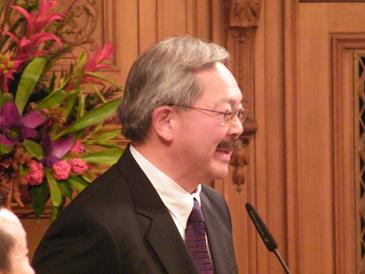
After the Guardian broke the news that Mayor Ed Lee was planning to only partially implement Sup. David Campos’ due process legislation, we headed to City Hall to witness Lee announce his partial shift during question time. And afterwards, Lee told reporters that he spent the months since he was appointed reviewing the policy and talking with leaders in the city’s juvenile justice departments.


“I looked at the difference between youth with family here and youth who did not,” Lee said, noting that his decision to let youth that have family here to have their day in court is in keeping with his policy of focusing on family reunification and getting families more involved.


Lee stressed that youth with family here will still need to be enrolled in school and not be repeat offenders in order to have their day in court.


“It will be decided upon on a case by case basis,” he said.


Lee said he has had conversations with the federal government and US Immigration and Customs Enforcement (ICE) about the policy shift. “We have discussed this,” Lee said. “And we did get a very strong feeling that the federal government is a bit confused.”


Asked how far he is willing to go to defend this latest policy shift, Lee said, “I’ll take that up as it comes. President Obama is struggling with immigration right now.”


Reminded that his predecessor Mayor Gavin Newsom refused to implement any aspect of Campos’ due process legislation, even though a super-majority of the Board passed the ordinance in 2009, Lee said, “I don’t compare myself with the former mayor.”


Asked what percentage of immigrant youth that end up getting booked are “unaccompanied,” Lee said he did not have those statistics. “Check with Siffermann,” he said, referring to the head of the city’s Juvenile Probation Department.”


Lee’s announcement was met with mixed reviews among immigrant advocates.


Civil rights groups applauded Lee’s decision to immediately begin implementation of Campos’ legislation, which was passed in November 2009, restores due process for immigrant youth in the city’s juvenile justice system and ensures that innocent youth are not torn from their families for deportation.  But they also expressed disappointment that Lee will only be implementing the policy for youth who have immediate family here, and not for unaccompanied youth.  And they all urge him to fully implement what they described as Campos’ “duly-enacting, common-sense law so that all innocent youth receive protections.”


They noted that implementation of Campos’ broadly-supported law, which has been endorsed by over 70 organizations, had been stalled until today due to former Mayor Newsom’s refusal to enact the law. 


Under Newsom’s direction, Juvenile Probation reported over 160 youth to ICE at the point of arrest, prior to the youth receiving due process, based only on a juvenile probation officer’s “reasonable suspicion” that a youth is undocumented. 


Civil rights advocates note that Newsom’s problematic policy was responsible for tearing innocent youth from their families and spreading fear among immigrant residents around coming forward to cooperate with police, either as witnesses or victims of crime.  


And they observe that the policy that Juvenile Probation Department has been enforcing since the summer of 2008, and which involved reporting youth for life-altering deportation at arrest, went well above and beyond any obligations under federal law. 


They noted that, as a cadre of legal scholars, including University of San Francisco Law Professor Bill Ong Hing, have repeatedly made clear, there is no requirement imposed on city officials under federal law to ask about immigration status or to report individuals suspected of being undocumented.”


Ana Perez, executive director of Central American Resource Center, agreed.“While we appreciate Mayor Lee taking action to finally begin implementation, we are concerned that he is only implementing the policy for accompanied youth and not for youth who may be unaccompanied because they are trafficked to this country, are orphans, or are escaping persecution.”


“I’m certain it’s not for all youth,” Pérez continued. “So, it’s a small win. But what about the kids who are victims of human trafficking? The fact is we spent so much time developing a policy that was approved by a majority of the Board. So, this is bitter sweet.”


Asked what became of the criminal grand jury investigation that then US Attorney Joe Russoniello initiated in 2008, when Mayor Gavin Newsom was running for governor, and news first broke that the city was accompanying youth who weren’t here with family back to their home country, Pérez suppressed a snort. “It seems that was a bunch of empty threats to try and get the city to move to a more conservative position,” she said. “It’s been a whole new day with Obama.”


Angela Chan, staff attorney at the Asian Law Caucus said that Juvenile Probation’s prior policy of reporting innocent youth exacerbated the impact of a broken federal immigration system on local immigrant families. “We appreciate that Mayor Lee has taken this long awaited step forward because he values family unity and due process for youth,” Chan said. “However, we ask that the Mayor not exclude unaccompanied youth from receiving due process protections.”


Patricia Lee, managing attorney in the Juvenile Unit at the Public Defender’s Office also supported the demand for complete implementation of Campos’ legislation. “If you want the immigrant community to feel safe enough to cooperate with police and probation, then those agencies should not be viewed as representatives of immigration,” she said. “My clients and their families are scared of probation, they are scared of police. Selective implementation of the due process policy for only accompanied youth and not to unaccompanied youth does not solve this problem.” 


And Charles Washington, the Muni bus driver and longtime San Francisco resident, whose wife and 14 year old son were almost separated from him as a result of the prior Juvenile Probation policy, expressed concern that the policy would only be implemented for some youth. “I’m glad to see Mayor Lee is doing the right thing by implementing the due process policy,” he said. “However, he should not leave any youth, especially those who are most vulnerable, behind.”


Sup. Campos applauded the Mayor for implementing the policy while expressing disappointment that it is only partial implementation. As Campos’ stated during the Board meeting, but after Lee had already left, “This body enacted that law and that law needs to be respected.  It is not up to the executive branch to second guess the legislative branch.” 


Sup. Eric Mar added that he supports full implementation for all youth.


 And Sup. Jane Kim, who asked the Mayor during the Board’s Question Time about his plans for implementation, stated, “My hope is that he will commit to full implementation of this policy.”


But in the end, the burden fell on Campos to explain why partial due process is unjust. “This is a good first step, but it doesn’t go far enough,” Campos explained. “As I understand it, the decision Mayor Lee has taken is, that if you are a minor, and are accused of a felony, you will be given due process if you have family here. But if you are charged with a felony, but don’t have family here, then you will not be given due process. Let me begin by thanking Mayor Lee for at least taking one step in the right direction. That said, we still will not have full compliance with a law that was duly enacted by this body. Full compliance means giving every child that interacts with the juvenile justice system due process. So, {Mayor Lee’s first step] is simply not sufficient.”


Campos noted that when mayors are sworn in, they agree to uphold laws that the Board enacts. “So, the law needs to be respected,” Campos said. “It’s not up to the executive branch to second guess the legislative body. That second guessing can only be done by the courts. Therefore, we, once again, ask the mayor of San Francisco to comply with full implementation.”


Noting that a bedrock of the U.S.’ justice system is the principle that we are innocent until proven guilty, Campos said that if the mayor does not fully implement the law, as approved by the Board, “There’s a very real possibility that children that we are reporting [to ICE for possible deportation] are not guilty of what they have been accused of. So, once again, I ask the mayor to reconsider his opinion.”


Campos also noted that there are already procedures in place, within the existing juvenile justice system, to ensure that “we do not have individuals released who should not be.”


After the meeting, Campos noted that the format for the Board’s question time with the mayor currently leaves something to be desired: an opportunity for the Board to reply.


“It would be better if it would allow for some exchange, though obviously, we don’t want it to be a ‘gotcha’ game. But at this moment, it’s too rigid.”


 Asked who drafted the current Question Time format, Campos replied, “Board President David Chiu.”

Boxed out

5

rebeccab@sfbg.com

The Board of Supervisors is gearing up to revisit whether telecommunications giant AT&T should be permitted to install 726 new metal boxes on city sidewalks for a communications network upgrade, without completing an environmental impact review.

At an April 26 meeting, the board spent several tedious hours listening to concerns such as whether the boxes would attract graffiti or clutter the sidewalks, and debated the finer points of whether the project could legally be considered exempt, ultimately resolving to take up the issue again May 24.

Meanwhile, a small cadre of tech-savvy San Franciscans has seized on this debate as an opportunity to drum up enthusiasm for an alternate vision of a citywide communications future, one with faster connection speeds that wouldn’t necessarily be controlled by the AT&T and Comcast duopoly.

At the meeting, AT&T California President Ken McNeely, dressed in a sharp suit, trumpeted the company’s proposed upgrade, part of a new system called U-verse. “This is the largest single upgrade to the San Francisco local phone network in more than a century,” he said. “Our network will provide the next-generation IP technologies that San Francisco needs to provide if it wants to continue to attract the best and brightest in the region.”

Yet Rudy Rucker, bearded and clad in a camouflage T-shirt, sounded a different note. “The U.S. is No. 30 in the world in Internet speed,” he said. “The boxes are not the way to go. What we need to do is rework the entire infrastructure of how we do communications in the city. We’re relying on copper lines. We need to pull all those out, recycle the copper, and put in fiber-optic cable.” Rucker is a cofounder of MonkeyBrains, an independent Internet service provider (ISP) based in San Francisco.

AT&T’s U-verse upgrade would enable it to offer connection speeds three times faster than current service — but not nearly as fast as what fiber proponents envision. Several members of the tech industry interviewed by the Guardian cautioned that another AT&T upgrade might be necessary after less than a decade to keep pace with technological advancement. At that point, it’s anyone’s guess whether those boxes would continue to be useful. AT&T did not respond to a query from the Guardian.

SPEED FREAKS

When it comes to Internet speeds, the United States trails Asia and some European countries. “We’ve fallen from first place,” said Ashwin Navin, who founded several tech startups including a file-sharing company called BitTorrent. “It’s really put our software and technology industry at a disadvantage.”

According to a website that compares connection speeds using data compilation, California ranks 23rd in the nation, while San Francisco doesn’t even clear the top 30 cities nationwide, Navin noted.

Yet much faster connection speeds are possible — even commonplace — in countries such as Japan and Singapore. “Right now, the average download speed in San Francisco is something around eight megabits,” explained Dana Sniezko, who’s emerged as a tech activist since creating a website called SF Fiber, which calls for a neutral, open, affordable community fiber network. “What U-verse is going to offer is about three times that. Something like fiber can offer service that’s 1,000 megabits [called a gigabit], or even much larger than that. Fiber allows you to really have a huge capacity for the future.”

Put in practical terms, Sniezko said, the difference between a connection speed of eight megabits and a gigabit amounts to downloading a full-length feature film in 90 minutes, versus several seconds. And since fiber also can deliver faster upload speeds, it opens the door to new possibilities. “It lets individuals potentially come up with really innovative and creative ideas,” Sniezko said. “If you wanted to have your own streaming TV channel from your house, you could. Or anything, really.”

Fiber already exists under San Francisco city streets — but most places lack the direct connections to homes or businesses, so the capacity is not realized. The city’s Department of Technology and Information Services (DTIS) convened a study in 2007 for developing the infrastructure to create a full-fiber network, deeming fiber “the holy grail of communications networking: unlimited capacity, long life, and global reach.”

Since then, progress has been slow. AT&T’s new system would also be based on fiber, but information would still travel to homes or offices over copper phone lines, resulting in slower speeds than a direct connection could supply.

On a recent afternoon, MonkeyBrains cofounder Alex Menendez scrambled up a ladder leading from his small Potrero Hill office space to show off some rooftop antennas and laser devices. There was a clear view from the flat, sunny roof to the office building the laser was pointed at, many blocks away. Secured to a hand-built metal stand, the gadgets were part of the company’s high-speed Internet network, which counts KQED among its roughly 1,000 subscribers.

Menendez was explaining how his small company is able to use these microwave devices in combination with fiber-optic cables to provide high-speed Internet by leapfrogging from node to node throughout San Francisco.

Menendez said he didn’t feel strongly one way or another about AT&T’s metal boxes. “But it raises a more interesting issue: what’s the 50-year-down-the-line solution? There’s much better technology out there. It could be super-affordable, with a wide-open, massive amount of bandwidth.”

But, he added, it won’t happen without the support of local government.

MISSED CONNECTIONS

The City and County of San Francisco owns an underground fiber-optic network spanning more than 110 miles, used mostly for municipal and emergency purposes. AT&T has its own fiber — and with a history going back more than a century in San Francisco, it also has a lock on the market.

AT&T owns underground cables, copper phone lines, and rights-of-way, making it necessary for small market players to interface with the corporation and pay fees. This makes it difficult for local ISPs to compete on any meaningful scale. “They have the right to trench the street,” Menendez explained. “We don’t.”

Mendendez and others are looking at micro-trenching as a possible way around this. Last summer, Google hosted an event at its Mountain View headquarters called the Micro-trenching Olympics (“A very Google-y thing to do,” according to a company representative speaking in a YouTube video) to find out which contractor could best slice a one-inch wide, nine-inch deep trench in a parking lot and install fiber-optic cable inside. The idea behind micro-trenching is that it’s fast and minimally disruptive — and best of all, it doesn’t interfere with existing infrastructure, so there’s no need to pay a fee to AT&T, or any other company.

Some in the tech community are hoping it will signify a new and efficient way to link fiber-optic cable directly to homes and businesses, ultimately resulting in the kind of Internet speed that would let you download a movie in less than ten seconds. With micro-trenching, there would be no need for utility boxes.

Navin, Mendendez, and several others have talked up the idea of micro-trenching a small area in the Mission District to bring fiber-optic, high-speed Internet to an entire neighborhood. Yet their early conversations with the city’s Department of Public Works suggest that it may be a slow process. “They were like, ‘What is this?'” Menendez recounted. “There’s no established permitting process.”

Meanwhile, Board of Supervisors President David Chiu recently asked DTIS to examine the possibility of leasing excess capacity on city-owned dark-fiber infrastructure, which is currently in place but not being used. This could boost bandwidth for entities such as nonprofits, health care facilities, biotech companies, digital media companies, or universities, Chiu said, while bolstering city coffers. “There are many places in town that need a lot more bandwidth, and this is an easy way to provide it,” he said.

Sniezko noted that other cities have created open-access networks to deploy fiber. “This is really effective because it’s a lot like a public utility,” she explained. “The city or someone fills a pipe, and then anyone who wants to run information or service on that pipe can do so. They pay a leasing fee. This has worked in many places in Europe, and they actually do it in Utah. In many cases, it’s really cool — because it’s publicly owned and it’s neutral. There’s no prioritizing traffic for one thing over another, or limitation on who’s allowed to offer service on the network. It … creates some good public infrastructure, and also allows for competition, and it sort of revives the local ISP. Chiu’s proposal is a little bit in that vein, it sounds like. But he hasn’t released a lot of details on it yet, so we’re still looking.”

Visit www.sffiber.info for more info


Mayor Lee to partially implement Campos’ due process ordinance

1

Today at question time, Sup. Jane Kim will ask Mayor Ed Lee what his plan is to implement a due process ordinance that Sup. David Campos authored and a super majority of the Board approved in 2009, prohibiting the Juvenile Probation Department from reporting undocumented youths at the time of arrest. And according to an anonymous source, Lee will say he has decided to implement the policy, if the youth in question are “accompanied,” which means they have family here.

Immigrant advocates say Mayor Lee should be commended for his leadership in implementing the due process policy to keep immigrant families together. But they believe that Lee needs to go the whole way. “Immigrant and civil rights groups are adamant that the policy must be implemented for all youth, accompanied and unaccompanied, and this has to be immediately,” our source said. “The due process policy does not discriminate between these two groups and the policy cannot be selectively enforced.”
 
As Kim planned to point out during the Board’s question time, voters approved San Francisco’s Sanctuary City Ordinance in 1989. That ordinance prohibits our Police Department and local government officials from assisting in the prosecution of immigration enforcement unless it is required under federal or state law.

In 2009, the Board, under Campos’ leadership, passed-by a supermajority-a clarification to that ordinance to prohibit local law enforcement from reporting undocumented youths unless they are convicted of a felony. To date, this ordinance has not been followed by the City.

But in a May 9 memo to the city’s Probation Department personnel, Juvenile Probation Department Chief Probation Officer William Siffermann and Assistant Chief Probation Officer Allen Nance wrote that since revising JPD’s policy 8.12 nearly three years ago [per Mayor Gavin Newsom’s instructions], they have closely monitored JPD’s implementation of its protocols.

And after considering all perspectives and after careful review, they have decided to “modify our existing policy in a manner that aligns our Departmental policies more closely with the values inherent within San Francisco’s Sanctuary City ordinance, without compromising our balanced commitment to public safety and the best interests of the minor.”

“Effective immediately, San Francisco Juvenile Probation Department notices to the federal authorities of minor/persons booked on felonies who are suspected of being undocumented AND are accompanied (lives with a verifiable parent, guardian or blood relative in the immediate Bay Area and is enrolled in school) will be made only upon a felony adjudication, upon apprehension on an outstanding warrant, or upon issuance of a new warrant following release from custody pending adjudication,” the JPD memo reads. “Minor/persons booked on felonies who are suspected as being undocumented, AND are verified adults or unaccompanied by any verifiable parent, guardian or blood relative residing in the Bay Area, whether or not enrolled in school, will continue to be reported to the federal authorities upon determination of this status.”

“Policy 8.12 will continue to ensure that all suspected undocumented minors booked and convicted of committing a felony will continue to be reported to the federal authorities,” the JPD memo continues. ‘While the Department will neither assist nor interfere with the federal authorities’ overwhelming duties and responsibilities related to the enforcement of immigration laws, we will continue to honor their lawful detainers regarding suspected illegal immigrants.”

“We are confident that your uniform compliance with this policy adjustment will continue to reflect the Department’s interest and your professional commitment to preserving families while we discharge all of our many duties that protect public safety,” the JPD memo concludes.

Legal scholars weigh in on Secure Communities

5

In face of statements by Secretary of Homeland Security Janet Napolitano, three legal scholars in California have offered their opinions on recent developments surrounding immigration enforcement in California and “Secure Communities” (S-Comm) a program run by U.S. Immigration and Customs Enforcement (ICE) that automatically shares fingerprints at the point of arrest by local law enforcement.

Napolitano recently asserted that states and localities have no power to decide whether to participate in S-Comm, raising serious concerns about overreaching by the federal government and intrusion into local police power. In response, Aarti Kohli Director of Immigration Policy at the Warren Institute on Law & Social Policy at UC Berkeley’s law school, and law professors Hiroshi Motomura and Bill Ong Hing have weighed in on the growing controversy to provide, “accurate and important analysis on the legal terrain surrounding S-Comm.”

Kohli said that the reason academics are weighing in now is to point out that just because the federal government is asserting that it has certain authority doesn’t mean that’s the case, and that there are people who are interpreting the law differently.
“It’s not a cut and dry situation,” Kohli said of the federal government’s current position. “Strong arguments can be made that the federal government is overreaching.”

Kohli notes that at least 60 percent of the people who are currently in the country unlawfully entered the United States before 2000. “So, they have been here for over 11 years,” she said, noting that the last legalization opportunity for folks who entered unlawfully occurred in 1986. “So, you are talking 26 years ago,” she said, noting that there used to be many more options for people to adjust their status. “So, now you have people who have lived in the country for two decades who have not been able to legalize their status.”

Kohli observed that given the economic crisis, cooperating with the feds’ controversial “Secure Communities” program also becomes a question of priorities. “It becomes a question of where do you want to put your enforcement dollars,” she said, noting that state and local governments facing restraints in terms of jail space and resources. “So, does it make us safer to lock up low-level offenders, people who we would otherwise never dream of locking up, particularly in face of the constraints at the state and local levels?”

Initial research conducted by UC Berkeley’s Warren Institute’s indicates that S-Comm does implicate the use of local resources. 
“Data indicates that the majority of non-citizens who are booked into ICE custody through Secure Communities have been accused of low-level offenses, including traffic-related misdemeanors,” Kohli said in a press statement. “ Under typical circumstances, localities would allow low-level arrestees to post bond soon after an arrest.  However, if ICE issues a request for the local jurisdiction to hold the person, then bond is often denied and the person must remain in the local jail until the case comes before a judge.  Because of ICE holds, local jurisdictions use their own limited resources to feed, detain, and manage low-level offenders who would ordinarily not remain in custody.  All of this occurs before the person is even taken into custody by ICE.  Secure communities has resulted in a dramatic rise in ICE holds issued to local jails, thereby overburdening local law enforcement with the detention of those arrested on minor offenses who would not normally be held for extended periods.

Hiroshi Motomura, a law professor at UCLA, asserted that S_Comm undermines trust between local law enforcement and immigrant communities, may overstep the constitutional authority of the federal government to tell local governments how to run their police departments—and has a more basic flaw that has  policy and constitutional dimensions. “It is that the program delegates to local police the discretion to decide who—through stops and arrests—will be put into the immigration enforcement system, and who will not,” Motomura said in a press statement. “Even if the federal government retains the theoretical power to decide not to deport some non-citizens, local police will become the gatekeepers. As a practical matter, their decisions to arrest some residents but not others, to get tough with some neighborhoods but not others, will drive and direct federal immigration policy.  The constitutional command that U.S. citizenship is national citizenship means that immigration enforcement decisions can’t be left to local preferences—and local prejudices.  The local government proponents of opt-out aren’t arguing that they should be allowed to make immigration decisions.  Instead, they are arguing that no local officials should be allowed to make what must ultimately be national policy.”

And Bill Ong Hing, a law professor at the University of San Francisco reacted to ICE’s stated position that states and local governments must participate in S-Comm: “In the immigration field, the concept of preemption is an appropriate check on over-zealous local enforcement efforts that directly affect immigration regulation, while the Tenth Amendment is a check on federal intrusion on a local jurisdiction’s attempt to be more protective of individual rights and when the locality has a legitimate non-immigration-related purpose such as public safety,” he said. “The central teaching of the Tenth Amendment cases is that ‘even where Congress has the authority under the Constitution to pass laws requiring or prohibiting certain acts, it lacks the power directly to compel the States to require or prohibit those acts.’ Congress may not, therefore, directly compel states or localities to enact or to administer policies or programs adopted by the federal government. It may not directly shift to the states enforcement and administrative responsibilities allocated to the federal government by the Constitution. Such a reallocation would not only diminish the political accountability of both state and federal officers, but it would also ‘compromise the structural framework of dual sovereignty,’ and separation of powers. Thus, Congress may not directly force states to assume enforcement or administrative responsibilities constitutionally vested in the federal government.”

Ong Hing also noted that S-Comm’s current Memorandum of Agreement (MOA) between ICE and the State of California provides that it may be ‘modified at any time by mutual written consent of both parties. “The implication of this provision is clear: the terms of the MOA are negotiable,” he said

The trio’s move comes as local authorities in California and across the nation are increasingly turning against S-Comm, arguing that it overburdens local law enforcement with civil immigration enforcement, and results in high budgetary and social costs. 
Community advocates and several elected officials have already asserted that S-Comm harms community policing strategies by eroding trust between victims and witnesses of crime and police who fear immigration consequences. They cite examples of domestic violence victims in San Francisco and Maryland who have been placed in deportation proceedings after they called local law enforcement agencies for help.

In San Francisco, Sheriff Michael Hennessey has already asked to opt out of S-Comm because it casts “too wide a net”. Under the current program, S-Comm calls for fingerprinting and federal immigration database checks of arrestees, including those jailed for minor offenses like a broken taillight. And community advocates warn that the program can result in deportation without conviction or a trial. But the federal government has stated that only states can opt out. Last week, shortly after Illinois announced that it was pulling out of S-Comm, and a bill that Assemblymember Tom Ammiano authored, requiring the Attorney General to allow California counties to opt out of the program passed out of a committee, Hennessey announced that he will start releasing from jail undocumented immigrants who have been arrested for low-level crimes, even if federal officials notified through S-Comm’s fingerprint identification program request that they be held for deportation hearings.

Hennessey’s new policy is set to begin June 1. It means that undocumented immigrants arrested for petty crimes such as disorderly conduct, drunk in public or shoplifting will not be held in jail until ICE come to collect them. And it will make San Francisco the first California county to implement such a policy.

Hennessey explained that local jails are not required to hold inmates if ICE has identified them as undocumented, so sheriff’s deputies won’t be violating the law. Currently, sheriff’s deputies hold undocumented immigrants who have been booked for low-level offenses until ICE picks them up. But under the new policy sheriff’s deputies will release them with a citation as they do in cases involving U.S. citizens.

Hennessey, who is retiring and has endorsed Sup.Ross Mirkarimi in the race to replace him this fall, says the shift is intended to uphold the city’s sanctuary ordinance, which prohibits local officials from assisting ICE unless a felony crime is involved.

ICE’s own statistics seem to support Hennessey’s concerns: From June 2010 until February, 111 people that S-Comm identified were deported without being convicted in criminal court. 85 people who committed the lowest two levels of crimes were deported, plus 45 who committed felonies, including rape and assault.

But ICE spokeswoman Virginia Kice decribed Hennessey’s decision as “unfortunate”.
“ICE detainers are an effective tool to ensure that individuals arrested on criminal charges, who are also in violation of U.S. immigration law, are not released back into the community to potentially commit more crimes,” Kice said in a statement.

Guardian poll: The secret Bin Laden photos

5

There’s a huge debate in journalism and open goverment circles about the wisdom of releasing the photos of the dead Bin Laden with bullets in his head. A lot of people who normally push open-government issues say this one’s dangerous; if the photos get circulated, it could incite violence around the world. On the other hand, they were taken by U.S. troops using U.S. tax dollars; we paid for this stuff, grisly as it is, and the public ought to be able to look at it.


But it’s complicated. And the topic of today’s poll. Check it out after the jump. 


Free polls from Go2poll.com

SF’s top cops differ on local control

7

The announcement by Sheriff Michael Hennessey that he won’t honor federal deportation holds for undocumented prisoners accused of low-level crimes is a great illustration of local control – which is the reason why we elect our sheriff and district attorney – but it is a concept that District Attorney George Gascon doesn’t seem to understand.

As the Guardian recently reported in a cover story by Sarah Phelan, Gascon ignored local control, civilian police oversight, and even standing police general orders as police chief by taking a highly deferential stance with the FBI and its domestic spying operations. Then, in a Chronicle op-ed on the death penalty last weekend, Gascon went even further in declaring himself to be merely a minion of higher government authorities.

While stating his opposition to capital punishment, Gascon said he wouldn’t rule out seeking the death penalty because he doesn’t think his own view or that of the vast majority of San Franciscans should determine his office’s actions. “I don’t believe district attorneys should be allowed to supplant the views of the state with those of their own,” he wrote.

That is a rather astounding statement that only an inexperienced prosecutor and an individual who has spent almost his entire career in the rigid hierarchies of police departments – rather than actually working as an attorney – would make.

“That’s where rookies make mistakes because they don’t have the experience to use their prosecutorial discretion,” said Sharmin Bock, a career prosecutor who works in the the Alameda County District Attorney’s Office, and who is running against Gascon (who did not return our calls for comment). “The DA has discretion over charging decisions and when you pick a DA it is for their discretion.”

For example, Bock cited the Three Strikes You’re Out law, which allows prosecutors to seek a sentence of 25 years to life even for the most minor crimes when they are committed by two-time felons. If all prosecutors used that full authority in every case, California’s severely overcrowded prison system would be even worse, which is one reason why prosecutors in places like San Francisco, Alameda County, and Los Angeles use their discretion and only seek Three Strikes sentencing standards for violent felons.

Similarly, in San Francisco, former DA Kamala Harris upheld her campaign pledge to never seek the death penalty, just as her predecessor Terence Hallinan used his prosecutorial discretion in dealing with local medical marijuana dispensaries or refusing to throw the book at those who committed low-level drug crimes.

Otherwise, the DA is nothing more than an administrative position, and San Francisco is forced to endure the same prosecutorial standards and values that are promulgated by intolerant conservatives from rural counties who have loaded up the Penal Code with costly and unjust new crimes and sentencing enhancements.

Hennessey understands that San Franciscans don’t want the same harsh treatment of our immigrant neighbors that the intolerant residents of Fresno, Orange, or Placer counties might demand. That why San Francisco’s elected officials made this a sanctuary city, and it’s why Hennessey told the Examiner, “I’m just doing our best to enforce local law. That’s my job.” But if Gascon thinks it’s his job to simply be an agent of the state and federal governments, perhaps San Francisco voters should cast their ballots accordingly.

Republican budget revolutionizes education

0

Ask anybody about education, and anybody will tell you that nothing is more important than education if our nation hopes to succeed in the highly competitive economic universe of the 21st century.  But is America keeping up?  Many might say no, but they are just behind the times.  There are places where progress is already being made, methods are being devised that will give our children the mental and emotional tools they will need to face tomorrow’s realities.  So don’t despair.  Today it is our good fortune to have at hand a representative transcription of a recent elementary school class:

     All right, students, pay attention now. As you know, we are on the cutting edge of reform in this school, and today we’re going to try something brand new that our principal informs me is bound to revolutionize primary education. Instead of more of that tiresome reading and writing, we are going to play a learning game called the Republican Budget. It was developed by some people known as the Heritage Foundation and is marketed by a sales representative named Paul Ryan.

     I know you kids are too young to care about that last part but the School Board tells me if I don’t mention them by name they’ll charge us more for the game.

     Anyway, it takes a really big class to play this game and luckily because of the cuts in government money for education we have a really big class.

     That doesn’t mean I can’t see you back there. Just be still.

     Now, the first thing we have to do is divide you into three groups. You see this big jar of marbles? The marbles represent wealth, and in order to start playing we have to have some people who own most of the wealth. That would be you, Tarquin and Bootsie.

     No, just Tarquin and Bootsie. They get to sit in the front of the room and guard their wealth.

     Next we have what they call the Middle Class. We’ll start with you, Lance, and then take the rest of the row. That should be enough.

     Don’t even think about it, Jesus. That goes for you, too, Consuelo. Stay right where you are.

     The Middle Class gets this much smaller jar of marbles, and they sit here, between Tarquin and Bootsie and the rest of you.

     The rest of you now represent Everybody Else. If you want to, for fun you can dress up as farmers and nurses and even teachers, but it really doesn’t matter to the game. You’re still just Everybody Else. Everybody Else gets one marble each.

     Everybody Else can now scatter around the room.

     You have a question, DeShawn? Oh, you want to stay with Tashika.

     That’s fine. You don’t have to, there’s no rule about it, but you can if you like. It will make it easier to find you.

     Why would we want to find you? Never mind.

     Now to start the game, the members of the Middle Class roll some of their marbles down the floor towards Everybody Else, and you children down at that end try to catch some of those marbles without losing the one you already have.

     (The sound of rolling marbles.)

     The good part is that anybody who accumulates five marbles gets to move into the Middle Class.

     (The sound of rolling marbles and the excited cries of children.)

     Oh, isn’t this cute? Michael and Myra have organized a little group to help one another accumulate marbles. Sorry, kids, but that’s a big no-no. No organizing.

     (A muttered protest, and the sound of rolling marbles.)

     The bad part, for some of you, is that whenever a member of Everybody Else moves into the Middle Class, anybody who only has one marble has to give that marble to Tarquin and Bootsie and start over with nothing.

     Sorry, that’s how it works. I don’t make the rules, I just administer them.

    (The sound of rolling marbles and the anguished cries of children.)

     What’s that, Joanie? You don’t think this is any fun and don’t see why you should bother to catch any marbles at all? I’ll tell you why you want to catch marbles. Because if you don’t have any marbles you won’t get a snack when break-time comes. And if you don’t have any marbles and you have an owie, you won’t get a Bandaid.

     Nobody’s going to kiss it and make it well, either. That went out with pensions.

     (The sound of rolling marbles and weeping children.)

     One thing, though. I’ve read these rules very carefully and I have to give the inventors of this game credit. They have been very scrupulous about preserving your Second Amendment rights. The Second Amendment is very important to them and their supporters.

     What’s the Second Amendment? Let’s just say that because of the Second Amendment all you kids who are Everybody Else can add a new element to the game tomorrow.

     What’s that?

     Bring slingshots.

Jess Brownell is a freelance writer living in Milwaukee.


California isn’t losing jobs to Texas

11

Even Gavin Newsom, who the LA Times (with embarassing inaccuracy) calls “a poster boy for California liberalism” is buying, at least a little bit, the argument that California is losing jobs to Texas (and presumably other states) because of a “bad business climate.”

But a new study demonstrates, with excruciating accuracy, that the Texas argument is nothing more than bullpucky. California loses 25,000 jobs a year to other states, and gains 16,000 jobs a year from other states, and when you look at the 15 million jobs in the state, that’s just decimal dust.

Government – perhaps contrary to popular belief — cut 51,000 jobs last year. The construction industry, particularly hart-hit in California because of the housing bust, lost 26,000 jobs.

Remove those two sectors from the picture and California’s job growth was a respectable 1.5 percent in 2010. That’s a rate that compares favorably to the nation as a whole, which on the same measure grew by 1.3 percent. Professional services, health care, tourism and trade all posted job gains in California, as did the entertainment industry and Internet-related businesses.

In other words, public-sector layoffs (caused by low tax receipts) caused more economic pain than private-sector jobs moving to Texas for lower taxes — by far. More:

But even if a state’s tax code can lead to economic growth, other factors, including the state’s weather and its mix of industries, appear to be more influential than government policies, according to the PPIC study. So while California might do even better if it simplified its corporate tax code or restructured its welfare programs, the study found, those issues do not appear to be the reason for the recent doldrums.

That’s right — cutting taxes won’t create jobs in California.But cutting taxes so deeply that schools and police departments have to lay off employees will, indeed, cause job losses.


Ross for boss (of the sheriff’s department)

3

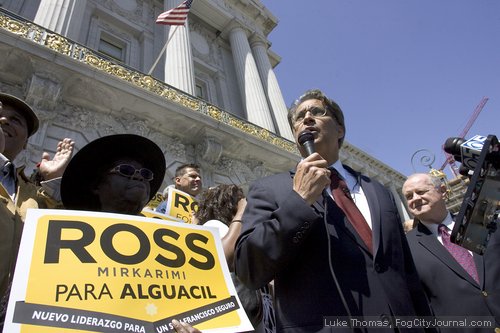
City Hall’s steps were awash in multi-lingual black and yellow “Ross Mirkarimi for Sherrif” signs at noon today, as Mirkarimi supporters watched Sheriff Mike Hennessey, who is stepping down after 31 years of service and eight elections, endorse Sup. Mirkarimi as the next sheriff.  “New Leadership for a Safe San Francisco” was printed on the English version of the signs that Mirkarimi’s supporters carried. They included former Mayor Art Agnos, Sups. David Campos and Eric Mar, Tim Paulson of the Labor Council, Debra Walker, Linda Richardson, Sharen Hewitt, Terry Anders, and Mirkarimi’s partner Eliana Lopez and their almost two-year old son Theo. And everyone had plenty of great things to say about outgoing sheriff Hennessey and sheriff candidate Mirkarimi. And Hennessey even pinned a shiny toy sheriff’s badge onto the T-shirt of Mirkarimi’s son Theo, making him the happiest kid in town. At least for the day.

Campos kicked off the event by honoring Hennessey as the “most progressive and most effective sheriff in the country.”
“Mike Hennessey is also my neighbor in District 9. I see him taking out the trash so I know he’s a good neighbor,” Campos joked, as he listed the many achievements in Hennessey’s long career as an elected official in San Francisco. These achievements included Hennessey’s pioneering innovations in criminal justice and culminated in his decision to blow the whistle in 2010 on the federal government’s plan to activate its controversial Secure Communities program in San Francisco—without telling the public.
“He’s not afraid to stand up for what’s right,” Campos said.

‘This is the time for me to move on,” Hennessey announced, as he laid out his reasons for endorsing Mirkarimi as Sheriff, over other candidates in the field.
Hennessey described the Sheriff’s Department as a “large enterprise” that has over 1,000 employees, a $150 million budget and whose jail houses an average population of 2,000 folks in custody, on a daily basis.
“It’s not something that can be handled lightly,” Hennessey said. “That’s why I’m here to endorse Ross Mirkarimi as the next sheriff.”

Hennessey listed the many endeavors that he and Mirkarimi have worked closely on, including a number of criminal justice issues, and he cited Mirkarimi’s extensive law enforcement background, his significant legislative accomplishments in the areas of criminal justice and public safety, and his ability to find innovative solutions and overcome obstacles to progress, as reasons to support Mirkarimi.

Hennessey observed that criminal justice is “one of the thornier issues” that members of the Board of Supervisors are often asked to get involved in, but often duck.”But Ross has not shied away from working on them,” Hennessey said, citing Mirkarimi’s involvement in shaping the “No Violence Alliance Project” and his leadership in creating the Safe Communities Re-entry Council.

Hennessey also noted that in face of AB 109, the Governor’s plan to transfer state inmates to county jails, “it’s vitally important to have person in charge of sheriff’s office that understands these alliances and can make them work more effectively.”

Hennessey concluded by observing that the Sherrif’s Department has to deal with a lot of bureaucracy, so it’s important to understand how the Board, the budget process and other city departments, including the District Attorney’s office and the police, work.
‘And that’s why I’m endorsing Ross as Sheriff,” Hennessey said

Then it was the turn of Mirkarimi, who graduated from the San Francisco Police Academy, did Naval Reserve training and worked for more than 8 years as an investigator for the District Attorney’s office, to speak.

“I have never been at a loss for words,” Mirkarimi acknowledged, as he launched into a speech that began by thanking everyone for showing up at short notice “for one of the most important occasions of my political career.”

Mirkarimi did a great job of giving Hennessey the praise he deserves.
“He is a living legend,” Mirkarimi said. “It’s completely impossible to fill his shoes.”
Citing Hennessey’s integrity and his ability to innovate, Mirkarimi warned that, “Maybe it’s come to the point where we have taken him for granted. He’s the longest serving elected official in the history of San Francisco, and he’s probably the most understated.”

“And the most important endorsement in this race is that of Mike Hennessey,” Mirkarimi added, as he gave Hennessey his commitment “to build upon your legacy as effectively as possible.”

Mirkarimi cited some of the most immediate and serious challenges that face the next sheriff. These include AB 109, which Gov. Jerry Brown just signed, which. Mirkarimi said, threatens to increase the reentry prisoner level by 30 percent in California. “It will take creative ingenuity and resources to make sure we are effective in taking care of this population,” he said.

Mirkarimi also touched on the rising number of veterans that are ending up in the prison system, talked more about the No Violence Alliance Project, and suggested that certified deputy sheriffs could help serve warrants, transfer prisoners, and patrol Muni, “when the police department finds itself understaffed” so as to ensure that San Francisco is safe.

“For every four people arrested and jailed in San Francisco, three out of four are repeat offenders in a three-year period,” Mirkarimi warned, by way of explaining why he wants to advance a more collaborative spirit between SPPD and the Sheriff’s department.

Mirkarimi also noted that one out of every 15 African American males are in jail, at any time in the year, compared to I out of 300 males who are not black or brown. “So, we must step up our game in dealing with poverty,” he said, as he recommended increased access to job training and good jobs, “so work doesn’t become a seasonal hope but a permanent job.” He also made the connections between a lack of good housing, childcare, and schools and a rise in poverty, crime and recidivism.

Mirkarimi concluded by crediting Hennessey for “walking that fine pirouette” between upholding the principles of public safety and understanding the power of redemption at the same time.

I asked Sheriff Mike Hennessey what he considers to be the biggest challenges of running for sheriff/
“Letting people know what you are going to do, and what your issues are,” Hennessey said, noting that San Francisco has an intelligent, issues-driven electorate.

And Mirkarimi’s supporters weren’t shy about letting folks know the issues that the current D5 Supervisor has helped them with, over the years.

“Ross, as a supervisor and me, as someone who comes from a community of color, we know the habits that ex-offenders can bring with them, if there are no safety nets,” said Terry Anders who sits with Mirkarimi on the Safe Communities Reentry Council. “And I believe in what Ross stands for and the integrity of his person. He’s one of the first people to show up when there are crimes and victims, and he attends basketball games and boxing matches.”

Paulette Brown, whose son Aubrey Abraska Jr, was murdered in August 2006, but whose killers have still not been brought to justice.
“We shouldn’t have to run and leave our families, we should be protected,” Brown said. “Ross is my district supervisor and if he can get in, and do something about crime and solve unsolved homicides, then I’m for him. Maybe if he gets in, he’ll have more pull to do something about these unresolved cases.”

And then it was back to work, which for Mirkarimi now includes the somewhat daunting task of trying to raise money in an election year that also includes a mayor’s race, but does not include the help of public financing, at least not for the sherrif’s race….

Power and shared wealth

0

rebeccab@sfbg.com

In the 1930s, political cartoonists often portrayed California’s monolithic Pacific Gas & Electric Co. as a giant octopus, its tentacles extending into every sphere of civic life. If money buys influence, the cephalopod analogy may still be apt today when considering the company’s tally of corporate giving, part of a detailed filing with the California Public Utilities Commission.

PG&E’s largesse, measured in thousands of dollars in donations, spills into a broad array of nonprofit organizations, educational institutions, chambers of commerce, and volunteer-led efforts throughout the state. PG&E’s corporate giving is so broad that it even extends to several organizations affiliated with appointees to the Independent Review Panel convened by the California Public Utilities Commission (CPUC) to investigate PG&E’s deadly San Bruno pipeline explosion.

While the utility undoubtedly advances worthy causes with its myriad donations to youth groups, cultural centers, organizations fighting AIDS and cancer, arts councils, environmental groups, and other charitable entities, corporate contributions always reflect a calculated decision, notes Bob Stern of the Center for Governmental Studies.

“They’re a big company, and they’re trying to, shall we say, ingratiate themselves with a wide swath of community interests, including nonprofit groups,” Stern told us. “The cigarette companies did that all the time, and it was very effective … because nonprofits then laid off on ballot measures, for example, or they would oppose ballot measures that would increase cigarette taxes. My bottom line is, businesses don’t just spend money gratuitously. There is a business reason a business spends money — campaign contributions or donations. And they have to justify that to their shareholders.”

In mid-October 2010, CPUC president Michael Peevey announced his selection of five expert panelists for the newly created advisory body on the San Bruno explosion. In an official filing, Peevey ordered PG&E to fund the panel, which would be tasked with gathering facts and making recommendations to the CPUC “as to whether there is a need for the general improvement of the safety of PG&E’s natural gas transmission lines, and if so, how these improvements should be made.” A report on the panel’s initial findings is expected in the coming weeks. The effort is on a parallel track with the federal investigation now underway at the National Transportation Safety Board.

The appointees bring a wealth of knowledge and expertise to the table. Panelist Karl Pister, for example, chairs the board of the California Council on Science and Technology, served as chancellor at UC Santa Cruz, and has taught civil engineering. Jan Schori has an insider’s understanding of how an energy company is run thanks to her past experience as CEO of the Sacramento Municipal Utility District (SMUD).

Yet some of Peevey’s appointees to the Independent Review Panel have ties to PG&E. Panelist Paula Rosput Reynolds formerly held positions at the investor-owned utility, according to her bio, including serving as an executive of the PG&E’s interstate natural gas pipeline subsidiary. An understanding of the company’s inner workings could be considered an asset, but it also raises questions about her independence.

Panelist Patrick Lavin serves as an executive council member of the International Brotherhood of Electrical Workers, which represents PG&E employees. He’s also on the board of directors of the California Foundation on the Environment and the Economy (CFEE), a nonprofit that counts PG&E among its membership. CFEE sponsored a two-week trip to Spain last November for government officials, energy industry representatives, and others to study “renewable energy, infrastructure, public private partnerships, desalination, and rail,” according to its website, picking up the $8,880 tab for Peevey to join the trip. The nonprofit received donations from PG&E totaling $45,000 in 2009, $45,000 in 2008, and $40,000 in 2006 — the three most recent years available.

Schori, meanwhile, has clearly held roles in the past that have placed her in an adversarial relationship with the utility considering that SMUD — a public power utility — has engaged in territorial battles against PG&E. Yet Schori also serves on the board of the Climate Action Reserve, a nonprofit that also counts former PG&E vice president of operations Nancy McFadden — the architect behind PG&E’s ill-fated ballot initiative Proposition 16 — on its board of directors.

Climate Action Reserve received $45,000 from PG&E in 2009, according to a CPUC filing. Schori also previously served on the board of directors of a nonprofit called the Alliance to Save Energy, which was co-chaired by former PG&E CEO Peter Darbee, who was expected to step down April 30 with a retirement package totaling nearly $35 million. The Alliance to Save Energy received $45,000, $35,000, and $35,000 in PG&E donations in 2009, 2008, and 2006, respectively. Schori did not respond to a request for comment.

The chair of the San Bruno Independent Review Panel is Larry Vanderhoef, former chancellor of UC Davis and a highly respected academic. As an ex-officio trustee of the UC Davis Foundation, Vanderhoef is engaged in soliciting private-sector contributions for the university. UC Davis has received an average of around $200,000 in philanthropic contributions from PG&E each year since 2005. In an e-mail to the Guardian, spokesperson Claudia Morain noted that Vanderhoef “has never been involved in PG&E solicitations.”

PG&E’s contributions to the two nonprofits and the university represent very small portions of the total budgets of these three entities, particularly in the case of UC Davis. At the same time, they are relatively large sums compared to the contributions the company generally makes. The city of Berkeley, for example, received just $2,500 from PG&E in 2009. Most organizations receive less than $10,000, but certain groups are given much more. The UC Regents, for example, received a $406,400 donation from PG&E in 2009.

“The panel members are all eminently qualified to perform the important job that has been entrusted to them.” CPUC spokesperson Terrie Prosper told us. “It is not surprising, or inappropriate, that the panel members also are involved in philanthropic activities of various kinds in California. Nor is it surprising that PG&E, California’s largest public utility company, in its own donations to various public and nonprofit institutions and its other philanthropic activities, supports some of these same worthy causes. These philanthropic activities in no way impair the independence, good judgment, or valued public service the members of the Independent Review Panel are giving to California.”

Stern, of the Center for Governmental Studies, said PG&E contributions to organizations affiliated with members of the Independent Review Panel did not necessarily raise a red flag. “Sure it has some impact, but not in terms of disqualification. That’s off the table as far as I’m concerned,” he said. “I have 15 members on my board of directors. I would never say that because we got a grant worth $200,000 from PG&E that that would affect my board member ruling on a PG&E matter,” he added, speaking hypothetically.

As members of an advisory group rather than public officials, he noted, the panelists would not be in violation of any conflict-of-interest rules. “Certainly there’s always a question of bias and appearance of impropriety. And the question is, how extensive is it? It’s a whole bunch of different factors. It’s all gradations. There is no rule on this, obviously, but it’s an appearance question, and whether or not the appearance looks like they’re going to be biased.” At the end of the day, he added, the question would be settled by “looking at the final results and seeing what the final results say.”

The case against consolidation

0

sarah@sfbg.com

With officials predicting that San Francisco will spend $500 million annually on health care costs for city employees and retirees, the Board of Supervisors Government Audit and Oversight Committee held an April 28 hearing to analyze why hospitals costs are higher in Northern California than Southern California, and why costs have escalated in the last decade.

A panel of experts outlined a list of cost drivers and identified hospital consolidation as the major culprit — a finding that fueled concerns that costs will skyrocket once Sutter Health, which operates the California Pacific Medical Center that took over St Luke’s in 2005, builds a 555-bed hospital on Cathedral Hill. The board will consider approving the project as soon as this summer.

Ellen Shaffer, codirector of the Center for Policy Analysis, said that the city’s recently approved Health Care Services Master Plan (“Critical Care,” 11/23/10) provides San Francisco with leverage to collect and analyze data and make informed health choices.

Shaffer noted that since 1960, when there were 26 hospitals in San Francisco, facilities consolidated so frequently that by 1990, only 12 hospitals remained. And by 1998, the three largest hospital networks controlled 43 percent of hospital beds — compared to 18 percent just four years earlier.

“Today in San Francisco, the most expensive of the northern counties hospitals get $7,349 per patient per day on average,” she said. “In Los Angeles County, the figure is $4,389.”

David Hopkins, a senior advisor at the Pacific Business Group on Health, said that Sutter Health, which reported a 30 percent increase in net income in 2010, already controls 44 percent of hospital beds in San Francisco. Catholic Healthcare West controls 28 percent, and UCSF controls 26 percent. “Insurance companies say Sutter’s size and dominant position give it an upper hand in contract negotiations,” Hopkins observed.

Healthcare planning and policy consultant Lucy Johns said technology is another key cost driver. “It’s a medical arms race,” Johns said. “Every hospital wants the latest everything.”

Jane Sandoval, a registered nurse at St Luke’s, said that what residents and workers need is access to affordable healthcare, not luxury care at overpriced rates.

“We’d rather have enough staff and the ability to care for all patients than work in a facility that’s likened to a five-star hotel,” Sandoval said. She noted that State Insurance Commissioner Dave Jones filed suit April 13 to intervene on behalf of the plaintiff in a whistleblower suit against Sutter Health, which has been accused of fraudulently charging insurers millions of dollars for anesthesia services that either weren’t provided or were billed higher than typical rates.

Anne McLeod, senior vice president of health policy for the California Hospital Association, an industry trade group, claimed that Northern California’s higher hospital prices are primarily due to higher labor and living costs in the Bay Area. “Wages are a huge component of hospital costs, and they represent the fastest growing component of costs,” she said.

But Glenn Melnick, a professor of health care finance at the University of Southern California, said that even if a hospital was airlifted from Los Angeles to San Francisco, its costs would still be 38 percent higher after adjusting for local differences. “When hospitals consolidate into large systems that dominate a specific region, that hospital system has the power to demand contracts from health plans that include high reimbursement rates for their services and limit the ability of health plans to offer low-cost products and share the data consumers need to compare costs across providers,” Melnick said

Sup. David Campos, who called for the hospital costs hearing, observed that the cost of creating jobs includes health care benefits. “So to the extent that things like hospital consolidation are increasing costs, the hospitals themselves are implicated,” he said.

But CPMC media relations manager Kevin McCormack noted that CPMC/Sutter has invested more than $7 billion since 2000 on technology, facility construction, and improvements to address medical needs and state seismic safety requirements.

“Sutter Health appreciates its role in ensuring that health care is affordable. And we realize that holding the line on prices without compromising quality will require additional cost reductions,” McCormack said. “To this end, doctors and nurses and support staff throughout our Sutter Health network are working aggressively to substantially reduce expenses.”

He denied that Sutter had engaged in inappropriate anesthesia billing practices. “The lawsuit paints a false and inaccurate picture,” McCormack said.

He also said that plenty of competition remains in Northern California. “The decision by the California Public Employees Retirement System in 2004 to shift a significant number of members away from Sutter-affiliated hospitals to other providers demonstrates there’s plenty of healthy competition,” McCormack said.

But Campos said the hearing clarified that, while there are different factors why costs are going up, one of the most important is hospital consolidation. “We need to ensure that we understand that, even in face of higher labor and cost of living costs, hospital costs in Northern California are still 30 percent higher than Southern California,” Campos said.

Noting that CalPERS excluded Sutter from its network, Campos added: “We need to follow suit in terms of saying that we’re only going to do business with hospitals that are responsive to our concerns and follow best practices.”


Editorial: Let counties raise taxes

3

The president of the state Senate, Darrell Steinberg (D-Sacramento), has a bill that could profoundly change that way California pays for government. At lot of insiders think it’s just a ploy, a way to force Republicans to come to the table and accept some tax measures, but Steinberg appears serious. He’s presenting the bill to the Governance and Finance Committee May 4, and a simple party-line majority vote could get it to the governor’s desk.

The bill, SB653, would allow counties and school districts to approve taxes — a wide range of taxes, the type that are now entirely under the control of the state. Local governments could impose an income tax, a transactions and use tax, an oil severance tax, a vehicle license fee, or a tax on alcohol, cigarettes, or marijuana. It’s part of what Gov. Jerry Brown calls “realignment” — returning more authority to local government, which is complicated and has advantages and disadvantages. But on its own, the tax measure makes perfect sense: if the residents of San Francisco want to pay a higher car tax, or income tax, or tax on booze, and use the money for better schools and public services, why shouldn’t they be allowed to do it?

San Franciscans pay far more in state taxes than the city gets in state money. That’s one of the great ironies of California finance: the more liberal counties, where the voters support adequate public services, wind up subsidizing the more conservative areas that demand tax cuts. A certain amount of that is inevitable, and even laudable: richer areas should be helping pay for schools, police, and roads in poorer areas. It’s certainly true in the arena of public education, where the courts have, properly, ruled that that state has to make sure every school district gets adequate funding so that kids in Marin County don’t get better educational opportunities than the kids in Tulare County.

And there’s always the risk that realignment will push the state back to the days when geographic inequality was even more dramatic, that California will wind up being, as Sen. Mark Leno (D-SF) once put it: “Hollywood next to Mississippi.”

But Steinberg’s bill doesn’t cut state funding at all; in fact, he’s among the Democrats working to avoid more budget cuts. SB653, properly administered, wouldn’t mean less money for any local agency. It would just remove the ceiling.

California is becoming too big to govern effectively with the current rules — and under the state Constitution, written in a very different era with a smaller, more homogeneous population, even a tiny number of Republicans can hold the budget process hostage. That means, for better or worse, that cities like San Francisco, where residents want decent services and a credible social safety net, are on their own. And if Brown’s proposals to put more of the service burden on the counties (for example, by shifting thousands of state prisoners into county jails) move forward, local governments are going to need the ability to raise their own resources.

Unfortunately, many of the taxes that state law currently allows local government to impose (sales taxes, for example) are regressive. Taxes on income and motor vehicles are far more fair and progressive, and ought to at least be available to cities and counties.

The Democrats in Sacramento need to take this seriously and work for its passage. It’s not the entire solution to the budget crisis and to economic inequality — but it’s an excellent start.

Let counties raise taxes

2

EDITORIAL The president of the state Senate, Darrell Steinberg (D-Sacramento), has a bill that could profoundly change that way California pays for government. At lot of insiders think it’s just a ploy, a way to force Republicans to come to the table and accept some tax measures, but Steinberg appears serious. He’s presenting the bill to the Governance and Finance Committee May 4, and a simple party-line majority vote could get it to the governor’s desk.

The bill, SB653, would allow counties and school districts to approve taxes — a wide range of taxes, the type that are now entirely under the control of the state. Local governments could impose an income tax, a transactions and use tax, an oil severance tax, a vehicle license fee, or a tax on alcohol, cigarettes, or marijuana. It’s part of what Gov. Jerry Brown calls “realignment” — returning more authority to local government, which is complicated and has advantages and disadvantages. But on its own, the tax measure makes perfect sense: if the residents of San Francisco want to pay a higher car tax, or income tax, or tax on booze, and use the money for better schools and public services, why shouldn’t they be allowed to do it?

San Franciscans pay far more in state taxes than the city gets in state money. That’s one of the great ironies of California finance: the more liberal counties, where the voters support adequate public services, wind up subsidizing the more conservative areas that demand tax cuts. A certain amount of that is inevitable, and even laudable: richer areas should be helping pay for schools, police, and roads in poorer areas. It’s certainly true in the arena of public education, where the courts have, properly, ruled that that state has to make sure every school district gets adequate funding so that kids in Marin County don’t get better educational opportunities than the kids in Tulare County.

And there’s always the risk that realignment will push the state back to the days when geographic inequality was even more dramatic, that California will wind up being, as Sen. Mark Leno (D-SF) once put it: “Hollywood next to Mississippi.”

But Steinberg’s bill doesn’t cut state funding at all; in fact, he’s among the Democrats working to avoid more budget cuts. SB653, properly administered, wouldn’t mean less money for any local agency. It would just remove the ceiling.

California is becoming too big to govern effectively with the current rules — and under the state Constitution, written in a very different era with a smaller, more homogeneous population, even a tiny number of Republicans can hold the budget process hostage. That means, for better or worse, that cities like San Francisco, where residents want decent services and a credible social safety net, are on their own. And if Brown’s proposals to put more of the service burden on the counties (for example, by shifting thousands of state prisoners into county jails) move forward, local governments are going to need the ability to raise their own resources.

Unfortunately, many of the taxes that state law currently allows local government to impose (sales taxes, for example) are regressive. Taxes on income and motor vehicles are far more fair and progressive, and ought to at least be available to cities and counties.

The Democrats in Sacramento need to take this seriously and work for its passage. It’s not the entire solution to the budget crisis and to economic inequality — but it’s an excellent start.


Alerts

0

ALERTS


By Jackie Andrews

alert@sfbg.com


WEDNESDAY, MAY 4


Robert Reich lecture

Robert Reich — UC Berkeley professor of public policy, former U.S. secretary of labor, and best-selling author — asks the question, “Will corporate social responsibility stop a race to the bottom in labor standards?” Come hear what the man The Wall Street Journal called one of the “most influential business thinkers” has to say.

4–6 p.m., free

SFSU Seven Hills Conference Center

1600 Holloway, SF

(415) 338-2885

www.sfsu.edu/~news


THURSDAY, MAY 5


Chabot College walk-out

Chabot College students, as well as middle and high school students and other community members in and around Hayward, will walk out in protest of the construction of the Russell City Power Plant. Meet at Chabot College and march en masse to the proposed site of the plant for a lively rally.

Noon–3 p.m., free

Meet at Chabot College main courtyard

25555 Hesperian, Hayward

Facebook: Powerplanttaskforce Hayward


Hecho en San Francisco

Commemorate the Battle of Puebla while supporting local food vendors at this benefit for La Cocina and CUESA. Taste fresh tortillas, authentic puebla cooking, and the best of las cocinas Nopailito, Mijita, y Tacolicious — not to mention top shelf tequila, beer, and wine.

5:30–8:30 p.m., $50

CUESA Kitchen

Ferry Building, North Arcade, SF

www.hechoensanfrancisco.eventbrite.com


FRIDAY, MAY 6


War-tax resistance conference

Any interest in cutting off your own personal funding of America’s wars? Join the club. War-tax resisters from around the country are sure to attend this three-day national conference, which begins tonight and ends Sunday (at differing locales, so check the website for more info). Tonight’s discussion — following dinner at 6 p.m. — is on strengthening resistance through social networking.

6–9:30 p.m., $15

Berkeley Friends Church

1600 Sacramento, Berk.

www.nwtrcc.org


SATURDAY, MAY 7


Beyond gang injunctions

Join this community discussion on gang injunctions — a new strategy for policing gangs that has been criticized for siphoning money away from community programs while increasing racial profiling and other attacks on civil liberties. You’ll hear from prominent community leaders such as Sagnitche Salazar of Stop the Injunction Coalition and Whitney Young of Critical Resistance, among others, followed by a Q&A.

2:30–4:30 p.m., free

EastSide Arts Alliance

2277 International, Oakl.

www.radioproject.org


TUESDAY, MAY 10


Activism is not terrorism

Attend this reading and discussion of Will Potter’s Green is the New Red: An Insider’s Guide to a Social Movement Under Siege. In it, the award winning journalist discusses the “green scare” trend in the media and popular culture, which portrays environmental and animal rights activists as so-called ecoterrorists. Even the federal government is flippant with its use the word “terrorism,” he says, and it recently convicted a group of animal rights advocates of “animal enterprise terrorism.”

7 p.m., free

City Lights Books

261 Columbus, SF

www.citylights.com 

Mail items for Alerts to the Guardian Building, 135 Mississippi St., SF, CA 94107; fax to (415) 437-3658; or e-mail alert@sfbg.com. Please include a contact telephone number. Items must be received at least one week prior to the publication date.

Norman Solomon: It’s Time to Close California’s Nuclear Power Plants

6

The facts all point to this “inconvenient truth” — the time has come to shut down California’s two nuclear power plants as part of a swift transition to an energy policy focused on clean and green renewable sources and conservation.

The Diablo Canyon plant near San Luis Obispo and the San Onofre plant on the southern California coast are vulnerable to meltdowns from earthquakes and threaten both residents and the environment.

Reactor safety is just one of the concerns. Each nuclear power plant creates radioactive waste that will remain deadly for thousands of years. This is not the kind of legacy that we should leave for future generations.

 In the wake of Japan’s Fukushima nuclear plant meltdown, we need a basic rethinking of the USA’s nuclear energy use and oversight. There is no more technologically advanced country in the world than Japan. Nuclear power isn’t safe there, and it isn’t safe anywhere.

The perils to people are clear. In a recent letter to the U.S. Nuclear Regulatory Commission, Senators Barbara Boxer and Dianne Feinstein noted that “roughly 424,000 live within 50 miles of the Diablo Canyon and 7.4 million live within 50 miles of the San Onofre
Nuclear Generating Station.”

 As someone who was an Obama delegate to the 2008 Democratic National Convention, I believe it would be a tragic mistake for anyone to loyally accept the administration’s nuclear policy. The White House is fundamentally mistaken in its efforts to triple the budgeting of federal loan guarantees for the domestic nuclear power industry, from $18 billion to $54 billion.

Our tax dollars should not be used to subsidize the nuclear power industry. Instead, we should be investing far more in solar, wind and other renewable sources, along with serious energy conservation.

The Nuclear Regulatory Commission is a nuclear-friendly fox guarding the radioactive chicken coop. The federal government has no business promoting this dangerous industry while safe and sustainable energy resources are readily available.

The fact that federal law imposes a liability cap of about $12 billion on a nuclear power accident is a reflection of the fact that those plants are uninsurable on the open market.

As a candidate for Congress in the district that includes Marin and Sonoma counties, I intend to make this a major campaign issue. It remains to be seen whether my one declared opponent, Assemblyman Jared Huffman, will join me in urging a rapid timetable for the closure of California’s nuclear power plants.

Huffman has ties to California’s nuclear-invested utility PG&E. Between 2007 and 2009, according to campaign finance data compiled by nonpartisan Maplight.org, he received $11,100 from PG&E, which owns and operates the Diablo Canyon nuclear plant.

 While Huffman and other state lawmakers in February signed a letter to a federal commission on America’s nuclear future citing seismic “concerns which deserve to be more closely examined,” the time for equivocation on nuclear power is long past. We don’t need yet more study on whether to operate nuclear plants on fault lines.

People want bold and responsible leadership as we face up to the well-documented realities of nuclear power on this fragile planet.

Norman Solomon was the director of the National Citizens Hearings for Radiation Victims in 1980 and co-authored “Killing Our Own: The Disaster of America’s Experience with Atomic Radiation,” which exposedthe health and environmental effects of the nuclear industry. For two years ending in late 2010, he served as co-chair of the Commission on a Green New Deal for the North Bay. For more information, go to: www.SolomonForCongress.com.


Dick Meister: The Real May Day

0

Dick Meister, formerly labor editor of the SF Chronicle and KQED-TV Newsroom, has covered labor, politics and other matters for a half-century.

May Day. A day to herald the coming of Spring with song and dance, a day for children with flowers in their hair to skip around beribboned maypoles, a time to crown May Day queens.

But it also is a day for demonstrations heralding the causes of working people and their unions such as are being held on Sunday that were crucial in winning important rights for working people. The first May Day demonstrations, in 1886,  won the  most important of tthe rights rever won by working people – the right demanded above all others by the labor activists of a century ago:

“Eight hours for work, eight hours for rest, eight hours for what we will!”

Winning the eight-hour workday took years of hard struggle, beginning in the mid-1800s. By 1867, the federal government, six states and several cities had passed laws limiting their employees’ hours to eight per day. The laws were not effectively enforced and in some cases were overturned by courts, but they set an important precedent that finally led to a powerful popular movement.

The movement was launched in 1886 by the Federation of Organized Trades and Labor Unions, then one of the country’s major labor organizations. The federation called for workers to negotiate with their employers for an eight-hour workday and, if that failed, to strike on May 1 in support of the demand.

Some negotiated, some marched and otherwise demonstrated.  More than 300,000 struck. And all won strong support, in dozens of cities – Chicago, New York, Baltimore, Boston, Milwaukee, St. Louis, San Francisco, Pittsburgh, Denver, Indianapolis, Cincinnati, Detroit, Washington, Newark, Brooklyn, St. Paul and others.

More than 30,000 workers had won the eight-hour day by April. On May Day, another 350,000 workers walked off their jobs at nearly 12,000 establishments, more than 185,000 of them eventually winning their demand. Most of the others won at least some reduction in working hours that had ranged up to 16 a day.

Additionally, many employers cut Saturday operations to a half-day, and the practice of working on Sundays, also relatively common, was all but abandoned by major industries.

“Hurray for Shorter Time,” declared a headline in the New York Sun over a story describing a torchlight procession of 25,000 workers that highlighted the eight-hour-day activities in New York. Never before had the city experienced so large a demonstration.

Not all newspapers were as supportive, however. The strikes and demonstrations, one paper complained, amounted to “communism, lurid and rampant.” The eight-hour day, another said, would encourage “loafing and gambling, rioting, debauchery, and drunkenness.”

The greatest opposition came in response to the demonstrations led by anarchist and socialist groups in Chicago, the heart of the eight-hour day movement. Four demonstrators were killed and more than 200 wounded by police who waded into their ranks, but what the demonstrators’ opponents seized on were the events two days later at a protest rally in Haymarket Square. A bomb was thrown into the ranks of the police who had surrounded the square, killing seven and wounding 59.

The bomb thrower was never discovered, but eight labor, socialist and anarchist leaders – branded as violent, dangerous radicals by press and police alike – were arrested on the clearly trumped up charge that they had conspired to commit murder.  Four of them were hanged, one committed suicide while in jail, and three were pardoned six years later by Illinois Gov. John Peter Altgeld.

Employers responded to the so-called Haymarket Riot by mounting a counter-offensive that seriously eroded the eight-hour day movement’s gains. But the movement was an extremely effective organizing tool for the country’s unions, and in 1890 President Samuel Gompers of the American Federation of Labor was able to call for “an International Labor Day” in favor of the eight-hour workday. Similar proclamations were made by socialist and union leaders in other nations where, to this day, May Day is celebrated as Labor Day.

Workers in the United States and 13 other countries demonstrated on that May Day of 1890 – including 30,000 of them in Chicago. The New York World hailed it as “Labor’s Emancipation Day.” It was. For it marked the start of an irreversible drive that finally established the eight-hour day as the standard for millions of working people.


Dick Meister, former labor editor of the SF Chronicle and KQED-TV Newsroom, has covered labor and politics for more than a half-century. Contact him through his website, www.dickmeister.com, which includes more than 300 of his columns.

Puke and privatization in Dolores Park

44

Editors note: the vow by Chicken John Rinaldi to vomit in Dolores Park has gotten a lot of media attention — but there’s a real story behind it that the press has missed. Chicken sent us this opinion piece presenting his side of the story.

By Chicken John Rinaldi

It happened pretty quickly, when privatization came to Doritos Park. Sorry; Dolores Park. I keep forgetting they haven’t sold the name yet.

It didn’t come like a wraith with icy fingers or an immense monster with an army of lawyers. Privatization came to Dolores Park in the form of a nonprofit incubator for immigrant women entrepreneurs called La Coucina. For a progressive city like San Francisco, you can’t get much more cuddly than that.

I hear the Trojan horse was adorable, too. It had a cute mane and soft eyes and was made of really high quality lumber. You’d be a fool to criticize that kind of craftsmanship. But it was privatization of a park, even so. Selling space on public land without the public’s consent.

And there was resistance, of course. But the resistance was met with the oddest enemy. The resistance didn’t find itself fighting against people who believed that the park should be privatized. The resistance debated with people who did not know what privatization was. The resistance debated with people who did not know it was coming. The resistance debated with people who knew what it was, but refused to recognize it.

“Yummy tacos!” they chirped, as though that actually was an answer. Enron served tacos, too. Every Tuesday. The problem wasn’t the tacos: it was Enron.

“It’s just a food truck!” they said. “For immigrant ladies! No one who gives work to immigrant ladies could ever be involved in something bad!” This kind of thinking, that anything is okay as long as it also raises money for a good cause, is what will sink our own City of Art and Innovation: San Francisco.

The people who resisted asked questions: Why can’t they park the taco truck on the curb, where cars belong? Why drive a truck on the grass? Why not rent a parking space for the truck? Ummmmmm….. “Yummy tacos!!!” They said, looking around the room for approval.

The people who resisted pointed out that the public outreach that was supposed to be done before this kind of thing is authorized was never done. They told us at the first meeting that it was too late to stop. They did that thing where they create the illusion of inevitability.

Some things are almost impossible to undo once they’ve happened. Sacking the city of Troy, for instance. Or detonating a neutron bomb. Or kissing your best friend. Or doing all the cocaine in the cab before you get back to the party. Privatization is like that. Once a government starts getting easy revenue from a public trust, it doesn’t want to go back. Then it starts taking everything else with it: once one park has a food concession, every park that doesn’t have a food concession starts to look like a drain on the budget. Once one park gets a gift shop, every park needs a gift shop. Pretty soon you end up with a city full of park-themed malls. Well, in the rich neighborhoods anyway. The poor neighborhoods will have fences around the parks. Because they can’t carry their weight.

This is what a class war looks like. Straight up. RPD (mainly the general manager, Philip Ginsburg) has declared class war on San Francisco.

We’ve seen where this leads before: like in the news industry. Back in 1967, network news was almost … almost … a public trust. There was tight regulation. There was no consolidated corporate ownership. The people who owned the stations had zero influence on what was broadcast. Most importantly, no one expected network news to turn a profit. It was something the networks did, for the public good, as a condition of getting access to the public airwaves. It wasn’t perfect, but it tended to be solid news about factual issues that were relevant to the times.

That began to change in 1968, when CBS started a show called “60 Minutes,” and for the first time in network history a news show made a profit. Suddenly all news had to make a profit. And then it had to make a bigger profit, and then a bigger profit. It was a slippery slope. By the 2000 election we had FOX news.

As part of this trend, facts got replaced with opinions – because opinions are cheap and profitable. You want to make more money? Cut your foreign reporters, replace them with a pundit who once visited France. Need to make more money? Cut your congressional reporters and replace them with a couple of hacks arguing about congress.

As a result of the rush to make a profit, news coverage has become completely tabloidized … which is why some idiot with a cause needs to throw a “Puke-In” to get attention to a relevant issue like the privatization of parks. And it worked.

A cleverly worded publicity stunt that claimed I was going to “Fill Dolores park with vomit and watch the trailer of privatization float away on a river of puke” got attention. News organizations that never would have run a headline like “parks department fails to consult with residents” were tripping over themselves to be the first to run headlines like “Incensed man vows to puke on immigrants” and “park activist to puke on vendors.” All told, 57 stories appeared online and in the papers.

 Eventually, most of them mentioned that the park was going to get privatized. It was ugly, but it was a win – and with the media the way it is, everything’s ugly.

After it had been going on for two weeks, I had to explain to people that my cheap and obvious publicity stunt was a cheap and obvious publicity stunt. This lead to more headlines. But come on – “puke in?” That’s funny! But for the record, no, I’m not going to throw up on immigrants. I do have $750 worth of novelty vomit, but all I’m really doing is collecting signatures for my petition: Did anyone really think I could puke on another human being … someone who I didn’t know … just because we had different opinions on the location of a taco truck? After I ran for mayor for second place? After Porneokie? After a career in San Francisco spent producing benefits and rallies and meetings and art incubators and pot luck dinners and bus trips to amazing places?

Well, actually… yes. People thought I was going to go assault someone. Welcome to San Fransandiego. Whatever. The point is: the Recreation and Parks department is trying to rent out public parks to make money, and they’re not consulting the neighborhoods. And while they’ve found the nicest, sweetest, bestest cause they could find to rent the first plot of your land too, the next time it might be FOX news. It might be Exxon. It might be Goldman Sachs. They don’t care: they’re just in it for the money.

Privatization came to Doritos Park. Shit, I did it again. Sorry. Privatization came to Dolores Park. And the progressive left of the Mission showed up. We showed up and we showed that we have a gag reflex. We let Mr. Ginsburg know that privatization makes us nauseous. If they’ve got budget problems, close a few golf courses, they’re horrible for our ecology anyway. Endangered species; frogs and what have you. Lowering kids services 30% and then raising your payroll 670% is not gonna work. Duh. You can’t fire all the kids’ teachers that were making $35K a year, close the clubhouses and then hire thirteen $120K a year bureaucrats and not start a class war. There should be 50 neighborhood groups at your door with torches and pitchforks!

If the Recreation and Parks Department needs more money, they should show good faith and manage what they have better first, before selling our future with privatization. And if they need more money from the General Fund, then lets find it! Lets partner with them to seek solutions or restructure how the financial system works so they get the money they need without ruining our city.

As for us eating each other alive over this issue? I think it’s worth our time to talk this out, argue it out. Work it out. It’s definitely worth poking taco truck sized holes in this moral justification for selfishness. Which is what I think we have here. I think fighting that is worth signing a petition, and worth protesting. And it’s worth a cheap publicity stunt. I bet I can think of another one, too.

Chicken John is a San Francisco showman. Here is the petition:

ACLU, Guardian sue over secret death drugs

1

The ACLU and the Bay Guardian have filed a federal lawsuit demanding the release of secret documents related to the scramble in California and other states to secure lethal-injection drugs for executions. And we’ve asked the court to issue a preliminary injunction ordering the Drug Enforcement Administration to release the documents quickly.


Both Arizona and Nebraska have recently scheduled executions — and apparently they plan to use drugs that were not obtained in the United States, may have been imported illegally and may not meet American medical standards.


Here’s the ACLU’s statement:


“The DEA has already acknowledged that the public has an urgent need to view records regarding states’ efforts to import execution drugs and the role of federal officials in that process,” said Linda Lye, staff attorney with the ACLU-NC. “We are dismayed that for nearly four months DEA has not released a single document.  The public has a right to these records before imported drugs that may have been illegally acquired are used to execute another inmate.”


Here’s the background:


On January 4, 2011, the ACLU-NC and The Guardian submitted FOIA requests to three federal agencies seeking records related to the federal government’s role in assisting – or failing to oversee – efforts by states to acquire controlled substances from outside the United States to carry out executions. The requests, submitted to the DEA, the Food and Drug Administration (FDA), and US Customs and Border Patrol (CBP), sought documents that would reveal whether state officials violated any laws in the states’ scramble to acquire execution drugs and the role of federal agents in the process.


The ACLU-NC and The Guardian sought these records after public records disclosed by the California Department of Corrections and Rehabilitation (CDCR) revealed that California prison officials engaged in a worldwide “secret mission” to acquire sodium thiopental, a controlled substance used in California’s execution process that is no longer legally available in the U.S. The records from the CDCR and other state prisons eventually revealed that six states imported sodium thiopental from Dream Pharma, a drug distributor that operates out of the back of a driving school in the United Kingdom. Records also revealed that two other states imported a controlled substance purporting to be sodium thiopental from an Indian Company that states publicly it is not authorized to import drugs into the U.S.


The DEA granted the ACLU-NC and The Guardian expedited processing of the FOIA request submitted in January. In so doing, the DEA acknowledged that the records relate to an issue of significant public importance and that the public had an urgent need for the information contained in the records. Yet, for nearly four months, the DEA failed to produce any records and failed to even provide a timeline for when records would be produced.


In the interim, based on questions surrounding the drug’s legality, the DEA has taken possession of the sodium thiopental imported from Dream Pharma from five states. This includes Georgia, Tennessee, and South Carolina, which imported the controlled substance directly from the United Kingdom. DEA also took possession of drugs from and Kentucky and Alabama, which acquired the illegal drug from other states. Only Arizona, California, and Arkansas continue to maintain possession of drugs imported from Dream Pharma, while Nebraska and South Dakota continue to possess drugs imported from India.


I’ll keep you posted.

Blast rocks Marrakech tourist restaurant: live report

4

Chaos here on the giant, tourist-packed Djemaa El Fna square in Marrakech, Morocco as an explosion has just rocked the Argana terrace restaurant two stories above the square at around noon local time.

We’ve seen apparent evidence of casualities being pulled from the wreckage of the dining room. A Reuters photographer has found out from the police that the source was gas, specifically reserve cannisters stored along the staircase (also, everyone here smokes a lot). Al Jazeera is reporting this now — as well as 10 dead. If we learn more we will update this post.

A previous large explosion at a Moroccan tourist cafe occurred in Casablanca in 2003, part of a series of Islamist suicide bombings that left 45 people dead.

UPDATE 1:56 p.m. local time: AP is now reporting 14 dead and word is still going around that the cause was a gas canister explosion, although AP is also reporting that the explosion resulted from a “concentration of gas in the basement” and that the state news agency MAP quotes an Moroccan interior ministry statement calling the explosion a “criminal act.” This raises concern among some observants, because two weeks ago in response to public demonstrations, King Mohammed VI “pardoned or reduced the sentences of 190, mainly Salafi jihadist, prisoners — roughly one in 10 of the 2,000 or so people tried, sentenced and jailed after the Casablanca bombings” according to the New York Times.

Our own observation of the damage suggests that a basement explosion is questionable. Damage appears to be concentrated on the second level (and the third floor windows were blown out), yet hawkers’ stalls on the square near the first floor seemed undamaged, although we were unable to get too close to the building. Also, the building itself is still standing.

Whatever the cause, after the concussive blast the scene itself was incredibly grisly, with injured staff and patrons, some visibly dismembered, being removed on yellow tablecloths or curtains, bodies strewn over railings, and members of the public frantically gesturing from the blackened terrace for assistance. Beams and sections of roofing were dangling from above the terrace, and crowds below watched helplessly until a fleet of ambulances tore through the packed square. Locals attempted to assure foreigners who had made their way to Cyber Parc Arsat Moulay Abdeselam — the city’s public wi-fi hotspot and rare green space — of their nation’s safety for tourism and lack of terrorist violence. 

UPDATE 7:15 p.m. local time: A tense and eventful day here in Marrakesh, as much of the Djemaa el Fna — usually writhing with snake charmers, storytellers, Berber musicians, and juice vendors — has been cordoned off by police for the blast investigation. A largely Moroccan crowd gathered to watch in silence; the tourists (a group of Welsh charity hitchhikers at our hotel, for example) mostly seemed to hole up in their hotels and share stories of near-misses and might-have-beens.

The word on the “Arab street” — literally, as we ate shwarma on Rue Bab Agnaou — veered from gas canisters as a cause to a basement water heater to a bomb. The Moroccan government is now officially investigating it as a bomb attack, but is stopping short from calling it terrorism. The death toll is now at 15, and the square is lined with police anti-riot vehicles. Shops remain open in the souks but the mood is somber, and even the more aggressive street vendors have dialed back their hustle, offering supportive words and plentiful information.

Both Al Qaeda in the Islamic Maghreb and the Polisario Front, which seeks to drive Morocco out of Western Sahara, are on the list of initial suspects in the explosion. Should the blast prove to be a terrorist bombing, it would be “the largest in Morocco since 2003, when 12 suicide bombers attacked five targets in Casablanca, killing 33 people,” the New York Times says in an article on the explosion. The King has promised a full investigation, as well as to pay for burial of the dead, according to the official Moroccan MAP news agency.

UPDATE AND WRAP-UP, May 1, Madrid, SpainWith the bombing now being blamed on Al Qaeda in the Maghreb, and the victims of this heinous attack all identified, I wanted to answer some readers’ questions. David and I were about 200 meters from the Argana Cafe, at a locutorio (cyber cafe), when we heard the blast. We finished up quickly and walked out onto the square, where we saw the immediate aftermath. We had spent the previous nine days traveling all over Morocco (it’s huge and incredibly diverse) and talking to people. Although we sensed much frustration with the country’s economic situation, and even a little with its politics, we never felt threatened in any way. Even after the explosion, Moroccan life proved especially resilient — there’s just too many people, including tourists, and too much going on to stop everything in its tracks for long.  Below is my original report.

Age against the Machine

1

arts@sfbg.com

THEATER Death-defying acts of autobiography enliven the main stage at the Marsh this week in Geoff Hoyle’s unadorned yet dazzling new solo show. Developed with director David Ford — and one of the very best things to come from the Marsh’s fertile performance breeding grounds all year if not longer — Geezer takes a serpentine course through the accomplished career of the longtime Bay Area actor and physical comedian to confront the challenges, epiphanies, and qualified, but nonetheless quality, opportunities of aging and mortality.

There’s something undeniably stirring already in an actor as protean as Hoyle talking about metamorphoses beyond his control or ken, but to watch the English-born 64-year-old master showman, without props or costumes, convert aging into a frenetic, heart-pounding, hilarious virtual-reality game of 3-D megaplex proportions lets you know his game, at least, is a long way from over.

But this is a clear-eyed confrontation with the inevitable, as well as a backward glance, half-bemused and half-knowing, at the accumulations of a life. As enthralling as the sure comedy on display are the memories and questions, political awakenings and philosophical musings, that buttress a beautifully crafted script, a fascinating and poignant memoir animated by flights of whimsy and physical poetry that few performers of any age can muster.

Dwelling with a mix of palpable emotions on his working-class roots in postwar Yorkshire, childhood Hoyle was the hyperactive class clown bursting with an unbridled but unguided desire to perform. He’d probably have been medicated anywhere else, but Yorkshire in those days could still provide class clowns with a fighting chance. Crucial assists come from a handful of role models and supporters (all deftly brought back to life before our eyes), one English university’s spanking-new drama department (a fine opportunity for Hoyle to relive for us his hysterically clueless audition), and the French government, which financed the young university graduate’s study with master of corporeal mime Étienne Decroux in Paris (where the uprising of May 1968 called the young, instinctively socialist artist to the barricades in his off-hours).

The journey of this journeyman artist ultimately lands in the Bay Area, where Hoyle becomes a Pickle Family Circus performer with a budding family of his own (including Marsh star Dan Hoyle, quite a chip off the old block). But the germ of his peripatetic career can be found in the pivotal half-intended gestures of his humble parents, especially those of his father, an otherwise reserved typesetter with a fondness for the jocular tunes of the English music hall — one of which winds its way cleverly through the narrative — who also bequeathed his son a volume of Shakespeare’s collected works. His father had little grasp of the Bard himself but a sure sense of the bulky tome’s importance as a cultural step up. Indeed, some key lines from Shakespeare — ruing life as “a walking shadow, a poor player that struts and frets his hour upon the stage” — form another of the play’s supple leitmotifs.

Macbeth’s soliloquy, committed to memory by the young Hoyle long before its full import could possibly accrue, is no gratuitous Bartleby citation either but lines deeply connected to his narrative — immortal lines, no less, and testament to the potential in art to simultaneously look without illusion at oblivion and still defy it anyway by the sheer projection, across many lifetimes, of such exquisite perfection and courage.

What a dissection this is — of a life, of an artist, of the purpose of art, and of the conundrum of memory and loss that gathers darkly over the heads of those blessed and cursed with longevity. The fusing of mesmeric physical performance, searching autobiography, subtle humor, raucous hilarity, and tender regard all come together to form a thematic whole of pronounced charm and beauty.

GEEZER

Wed.–Thurs., 8 p.m.;

Sat.–Sun., 5 p.m.; through July 10

The Marsh

1062 Valencia, SF

(415) 826-5750

www.themarsh.org


Last stand against Lennar

2

news@sfbg.com

Hunters Point, the last major swath of usable land in San Francisco, appears at first glance to be a developer’s dream — a prime piece of real estate with sweeping views of the bay, ample space, and a city government eager to capitalize on its potential.

But community groups have filed lawsuits challenging the project’s many uncertainties, such as the fate of the toxic stew beneath the former U.S. Navy base in the heart of the project area, and both sides are now awaiting a court ruling on whether more studies are needed.

As an EPA-designated Superfund site, the 500-acre plot is home to an abundance of buried chemical contaminants, radioactive waste, and other unknown toxins, and the Navy has been slow to clean it up. Concerned that development plans have been premature in the face of this lingering mess, opponents filed lawsuits against developer Lennar Corp. and the city last year.

The project, approved July 2010 by the Board of Supervisors, includes plans for a new stadium for the 49ers, 10,500 housing units, parks, and commercial retail space. It has received praise from city and state government agencies as an economic and cultural boon to the community. But activist groups say the cleanup should happen before development occurs.

The Sierra Club settled its lawsuit over the project after the developer made some design changes (see “Uncertain developments,” Jan. 18), so the lawsuit filed by People Organized to Win Employment Rights (POWER) and Greenaction is the last piece of litigation holding up the project. At the core of the legal challenge is whether the environmental impact report (EIR) properly analyzed the health impacts from toxic contamination at the site. After an April 18 hearing on the case, both sides are awaiting a ruling on whether the claims have merit and should be the subject of further study.

Activists claim the EIR violates California Environmental Quality Act protocols because it contains too much uncertainty, including the unknown fate of a large parcel of land slated for a stadium that is contingent on whether the 49ers decide to stay in San Francisco. POWER wants more details about the possible threats to human health before the 20-year project gets the final green light. But since the Navy is responsible for the cleanup, Lennar and the city have repeatedly countered that a full analysis is not their responsibility.

“The main issue that Greenaction and POWER have been concerned about throughout lawsuit is that it’s very unclear from the EIR what exactly is going to happen and what level of contamination will be left,” said attorney George Torgun with EarthJustice, which is representing the community groups. “What are the impacts of building on a federal Superfund site? There is a real lack of knowledge in the EIR.”

April 18 was the second of two recent hearings held on the case. On March 24, Judge Ernest H. Goldsmith listened to a full day of testimony before a packed courtroom. Subsequent settlement discussions weren’t successful, so both sides returned to court to seek a ruling that is expected sometime in the next two months.

Lennar attorneys offered to relinquish the possibility of a pre-cleanup early transfer of the property, which has been a major concern for POWER. Under this proposal, no development on any of the six parcels slated for transfer from the Navy could proceed until the federally mandated cleanup process was finished and certified. However, POWER does not believe this offer reduces the scope of the issues because final approval would still ultimately award control of the land to the developer based on what they believe is a flawed EIR.

“Severing any discussion of early transfer from this EIR would only serve to worsen the defects that petitioners have identified and would be contrary to the requirements of CEQA,” Torgun wrote in the April 13 letter to the court.

POWER’s counterproposal would allow large portions of the project to go through — rebuilding the Alice Griffith housing project and development on Candlestick Point — but Lennar considers it economically unfeasible. These portions of the project are not located on the shipyard but are included in overall plan.

“We want to see the project move forward with Alice Griffith and Candlestick Point,” said POWER organizer Jaron Browne. “They’ve rebuilt housing projects at Cesar Chavez and other areas in the city — why can they only rebuild this one if they can redevelop the shipyard? It’s a political game that Lennar has tied the rebuilding of it to this mammoth 770-acre development.”

Lennar representatives wouldn’t comment for this story. Community members have clashed with the megadeveloper over health issues in recent years. In 2008, Lennar was fined more than $500,000 by the Bay Area Air Quality Management District for allowing dust containing asbestos to settle on the surrounding neighborhoods. Then, in March, community organizations released a report showing e-mails from 2006 to 2009 between the EPA, the San Francisco Department of Public Health, and Lennar revealing a possible cover-up of the asbestos exposure.

“They underestimated our understanding of what is happening here,” Browne said. “The whole heart of this issue is that this is a Superfund site. Even if you remove the possibility of early transfer, they are still planning on doing work while remediation is still years to go on other parcels.”

Longtime Bayview resident and Greenaction member Marie Harrison said that not only is the EIR too fraught with uncertainty, it’s incomplete. “There are over 600 blank pages in that document,” she said. “How can you approve an EIR that is supposed to tell you what is there, what the effects will be, and what the project will be? We kept asking the supervisors: How do you convince the community that they are doing something that is good and safe when the history shows otherwise?

During both court hearings, it was evident no clear definition of the project exists since it contains many variables to account for unknowns. Attorneys for Lennar and the city argue that the EIR effectively addresses each potential use and demonstrates a full knowledge of possible contaminants.

Wilma Subra, an environmental scientist for New Orleans-based Environmental Health Advocates, has worked with POWER and Greenaction to understand the breadth of contamination and the typical process of cleanup of a Superfund site. She pointed out that the Navy’s cleanup plan is completely separate from the EIR submitted for the project.

“Those two documents don’t agree with what development will be,” Subra said. “Usually you wait much longer in the process to really know that the land is safe. In a normal Superfund process, you would first do an implementation of the remediation process, find out if it worked, then — years down the line — you would start thinking about development.”

If the EIR is deemed inadequate, Lennar and the city will be required to further analyze the contaminants, outline cleanup strategies, and resubmit a new EIR. If the judge rules the EIR satisfies CEQA, the project can move forward.

“CEQA is one of the few really democratic processes,” Browne said. “If you just have this one moment in 2011 when people are able to comment and weigh in, and then have 20 years where they are building within that, it’s not really fair.”

Editor’s notes

6

tredmond@sfbg.com

The candidates for mayor of San Francisco are already lining up endorsements — the Sierra Club held its interviews April 23, which seems awfully early to me, since some of the most interesting contenders in this town (Tom Ammiano, Matt Gonzalez) have a tendency to jump in at the last minute. And the filing deadline isn’t until August.

But the sooner the big names and organizations are lined up and the money is locked in, the harder it will be for anyone to pull off an August surprise. So unless the redistricting commission seriously messes with Mark Leno’s state Senate seat or Ed Lee bows to the pressure from Willie Brown, Rose Pak, and their allies and decides to go back on his promise and seek a full term, we’re probably looking at a rough approximation of what the voters will face in November.

With John Avalos in the race, the ballot’s become a lot more attractive to progressives. It’s not as if the other major candidates don’t have a lot to offer, and in some cases, they have a lot to offer to the left. There are smart, experienced, qualified people running.

But let’s be honest here: David Chiu, Dennis Herrera, Phil Ting, Leland Yee, and Bevan Dufty all operate somewhere in the squishy political center, a place where tax breaks for corporations are okay, where “homeownership opportunities” tend to trump the needs of tenants, where deals with big private developers are sculpted around the edges but never rejected outright, and where cuts in services are a larger part of the budget solution than taxes on the rich.

Michela Alioto-Pier is off on the far right of the San Francisco political world, and if she looks at all credible and gets any significant traction (and that’s a big if) she’ll be downtown’s favorite candidate. But until now, there was nobody holding the solid progressive banner.

I don’t think that means Avalos’ appeal is limited to the left; he’s in a swing district, and he’s very popular there, and he can talk about small business and community development and open, honest government. He doesn’t sound like a crazy radical; he’s polite and respectful and listens to people.

But I’m glad we have a candidate who won’t try to argue that 25 percent affordable housing at Treasure Island is something to be proud of, or that the Twitter tax break will create jobs, or that social inequality can’t be addressed through local policy. I’m glad there’s someone who can push the discussion and debate out of the middle, can force some of the others who want progressive support to take strong stands, and can liven things up a bit. Because without him, all of the candidates were sounding a lot alike — and I really don’t want to be bored this fall.