Gavin Newsom

The people vs. corporate power

2

steve@sfbg.com

The June 8 election is shaping up to be one that pits the people against powerful business interests, a contest that will demonstrate either that money still rules or that growing public opposition to corporate con-jobs has finally taken root.

On the state level, the five ballot measures include two brazen money-making schemes and two experiments in election reform, along with primary races that are still in flux. In San Francisco, where the ballot measures still have a few more weeks to shake out, the election will feature two rarely contested judges races, recession relief for renters, City Hall fiscal reforms, and a fight for control of the local Democratic Party.

So far, only four local measures have qualified for the San Francisco ballot, all placed there by members of the Board of Supervisors. Progressives qualified the Renters Economic Relief package (which limits rent increases during recessions and sets conditions for landlords passing costs to tenants), an initiative establishing community policing standards, and one affirming city support for making Transbay Terminal the northern high-speed rail terminus. Supervisors were unanimous in supporting a charter amendment governing the Film Commission.

But the board is still hashing out changes to the more controversial ballot proposals, a debate that will continue at its Feb. 23 meeting. They include an overhaul of how the city funds its pension program and an effort to remove Muni salary minimums from the city charter, both by Sup. Sean Elsbernd; a $652 million seismic safety bond proposed by Mayor Gavin Newsom; and a Sup. John Avalos charter amendment that would prevent the mayor from unilaterally defunding certain budget expenditures. All measures must be approved by March 5.

Also still forming up in the coming weeks are primary races for legislative seats (although no incumbents appear to be facing strong challenges) and all eight state constitutional offices, including governor (where Attorney General Jerry Brown seems poised to easily win the Democratic nomination), lieutenant governor, and attorney general (which District Attorney Kamala Harris is running for).

Candidates have until March 12 to declare themselves for statewide and legislative offices, as well as for the San Francisco Democratic County Central Committee, which could play a key role in this fall’s Board of Supervisors elections. Two years ago, a slate of progressives led by Aaron Peskin and Chris Daly launched a surprise attack to wrest control of the board away from the moderates who have long controlled it. Newsom, U.S. Sen. Dianne Feinstein, and their downtown allies are expected to try hard to regain control over their party’s purse-strings and endorsements.


JUDGING THE JUDGES

Another struggle from two years ago is also being replayed. In 2008, then-Sup. Gerardo Sandoval successfully challenged Superior Court Judge Thomas Mellon, arguing the Republican-appointed jurist was too conservative (and the entire court is not diverse enough) for San Francisco. This time the target is Judge Richard Ulmer, a conservative appointed by Gov. Arnold Schwarzenegger. Ulmer is being challenged by two LGBT attorneys, Daniel Dean and Michael Nava, the latter endorsed by Sen. Mark Leno, Assembly Member Tom Ammiano, and Peskin, who chairs the Democratic Party and could be helpful in the race. “He’s a brilliant guy,” Leno said of Nava.

Leno also has endorsed deputy public defender Linda Colfax, a Latina lesbian, in a four-way race to replace retiring Judge Wallace Douglass. The other candidates are Harry Dorfman, Roderick McLeod, and Robert Retana. If no candidate wins a majority of votes, the top two finishers square off in a runoff election in November.

Leno said he’s thrilled to see a diverse crowd of attorneys seeking judgeships: “This governor has failed horribly in his appointments, not only with the LGBT community, but with communities of color as well.”


TWO COMPANIES TRY TO BUY CALIF.

The struggle between the broad public interest and the wealthy power brokers that have long-dominated California politics is most apparent in the state propositions, which have been certified and for which ballot arguments are now being collected by the California Secretary of State’s Office.

Two of those ballot measures, Propositions 16 and 17, are blatantly self-serving efforts by a pair of powerful corporations to increase their profitability, however deceptively and with overwhelming amounts of campaign cash they are presented.

Prop. 16, sponsored by Pacific Gas & Electric Co., would require local governments to get two-thirds of voters to approve creation of energy programs like Clean Power SF, San Francisco’s plan for developing renewable energy projects and selling that power directly to citizens.

As we’ve reported (“Battle royale,” Jan. 13, and “PG&E attack mailer puts City Hall on defensive,” Dec. 22, 2009), PG&E placed the measure on the ballot to avoid having to repeatedly crush public power initiatives around the state with multimillion dollar campaigns, even though political leaders like Leno and Sup. Ross Mirkarimi say the measure violates the state’s community choice aggregation law. That law allows local governments to create energy programs and prohibits PG&E from interfering with those efforts.

“The unregulated behavior of corporate arrogance is killing our democracy. Prop. 17, sponsored by Mercury Insurance, would let companies increase car insurance premiums for a variety of reasons that are now prohibited by the 1988 measure Prop. 103. Mercury has continuously attacked that landmark law, using lawsuits, huge political contributions, sponsored legislation, and, according to newly released documents from the California Department of Insurance (see “The malevolence of Mercury Insurance,” Feb. 10, Guardian Politics blog), blatantly illegal activity in setting premiums and excluding certain customers, such as artists, bartenders, and members of the military.

“The Mercury initiative is even more pernicious than what it was doing before,” Harvey Rosenfield, who wrote Prop. 103 and works for Consumer Watchdog, told the Guardian. “Under Mercury’s initiative, if you’ve never had prior insurance, you can be surcharged for the first time. Then they’ve thrown in some other tricks and traps.”

Mercury spokesperson Coby King told us the company has been unfairly maligned and denies that the measure is simply about boosting its profits: “Prop. 103 is the law of the land, but to the extent there are improvements that can be made that are pro-business and pro-consumer, Mercury has not been shy about acting in the public interest.”

Yet few public interest groups or public officials believe the claims being made by Mercury or PG&E, and they hope that the public won’t be fooled.

“These are measures designed to give a financial advantage to a specific industry or company,” U.S. Rep. John Garamendi, who battled Mercury as California’s first insurance commissioner, told us. He strongly opposes both measures, but did say, “Money talks. It always has, particularly in propositions.”

Yet Leno said he’s a bit more hopeful: “Californians have been savvy in the past, and I do believe they’ll be able to see through the tens of millions of dollars in misleading ads.”

“To me, it’s a classic case study of what’s going on with the initiative process in California and with politics in general,” said Derek Cressman, western regional director of California Common Cause. “There are two initiatives literally sponsored by corporations to push very narrow interests.”

Yet Cressman said recent events could help. There’s been a big public outcry in recent weeks over the U.S. Supreme Court’s decision to allow unlimited corporate spending to influence elections, the role that insurance companies played in sinking federal health care reform efforts, and the way businesses interests are hindering efforts to deal with global warming.

“It makes people aware of the overwhelming role corporations are playing in dictating government policy,” Cressman said.


TAKE OUT THE MONEY

A pair of election reform measures might help lessen the influence of money and political parties. Prop. 14 is an open primaries measure that Sen. Abel Maldonado (R-Santa Maria) got placed on the ballot as a condition for breaking last year’s budget stalemate. It would create a single primary ballot and send the top two finishers to the general election, regardless of party.

Prop. 15, the California Fair Elections Act, takes direct aim at the corrupting influence of money in elections, creating a pilot public finance program in the secretary of state races for 2014 and 2018. The measure, which has broad support from politicians and good government groups in the Bay Area, is modeled on successful programs in Maine and Arizona.

“No elected official should be in the fundraising game the way they are now,” campaign chair Trent Lange told us. “This is a way to change how we fund elections.”

The idea is to create a model that will eventually be used for other offices. The campaign fund would be generated by a $350 annual fee on lobbyists, lobbying firms, and lobbyist employers. Currently lobbyists pay just $12.50 per year to register, which Lange said, “just shows the power of lobbyists in Sacramento.” *


 

The “Newsom wins” merry-go-round: What fun

10

Gavin Newsom still hasn’t said for sure that he’s in the race for lt. governor, although just about everyone in town now thinks he’s going for it.

But the very prospect of the mayor leaving office before his term is up has the political classes speculating: Who gets that job? And how does it happen?

It’s actually pretty interesting.

Under the City Charter, the president of the Board of Supervisors becomes acting mayor in the event that the mayor leaves office before the end of his or her term. Then the supervisors, by a six-vote majority, can appoint someone else to the job.

Melissa Griffin lays out one piece of the scenario, which is that the board could appoint a new mayor in advance, without anyone serving as acting mayor.

But there’s much more to the story.

According to a fascinating city attorney’s opinion issued in 1978 (PDF), when George Moscone and Harvey Milk were killed and Dianne Feinstein was board president, no supervisor is allowed to vote on his or her own appointment. Which would mean that if, say, Board President David Chiu wanted the job, he’d need six votes not including his own.

Now the plot thickens. Suppose nobody can round up six votes — that is, a majority of the supervisors can’t agree on a new mayor? Well, Chiu, as board president, would be acting mayor — potentially for the entire duration of Newsom’s term, roughly a year. He’d also remain as board president. It’s the same as if the mayor goes out of the state and names an acting mayor in his place; that person is still a supervisor. So Chiu would have all the powers of both the mayor and the board president — and immense amout of clout for one person at City Hall.

But wait, there’s more: Chiu is board president only until the board elected in November of this year takes office, which would be about five days after Newsom would become lite guv. So unless the current board can choose a new mayor, with six votes (not including the vote of any supervisor being nominated), the new board would elect a new board president — who would instantly become acting mayor at the same time.

And since supervisors are allowed to vote for themselves for board president, any member would be allowed to vote for him- or herself for acting mayor.

Confused yet? Clearly, the folks who wrote the City Charter never actually envisioned this scenario (or didn’t think about it very much).

Of course, what that means that with the current board split the way it is, with exactly six solid progressive votes, someone who isn’t currently on the board (say, Aaron Peskin — or Tom Ammiano, or Mark Leno, or whoever) would have a better chance of getting a majority than a current member, who would need at least one of the moderate bloc votes.

And if Newsom runs, it will make the fall supervisorial elections even more important, because potentially those newly elected supes will be choosing not only a board president but a mayor.

Here’s another fun twist: If District Attorney Kamala Harris is elected attorney general, the mayor gets to appoint a new D.A. But suppose Newsom also wins and is sworn in a few minutes before Harris. Presumably acting mayor David Chiu (a former prosecutor who rumor has it might like to be D.A. himself someday) would choose the new D.A. — and suppose Chiu knows he doesn’t have six votes to be mayor. There’s no reason why he couldn’t appoint himself D.A., leaving a vacancy on the board and a vacancy for board president, which would be filled by anyone who could get six votes, who would then be acting mayor and could appoint a new supervisor to Chiu’s seat. Who could then be the deciding vote on who gets to be mayor.

Whoa. I can’t wait. Run, Gavin, Run.

Labor’s love lost

4

Note: This file has been corrected from an earlier version.

rebeccab@sfbg.com

Two recent events could have major implications for Service Employees International Union Local 1021 — San Francisco’s largest public-sector union and an important ally for progressives — for better or for worse. And this union’s fate seems closely tied to that of the progressive movement in San Francisco.

The first event was likened to a “nuclear bomb in the morning paper” by one observer, and might be interpreted as the kickoff to a fierce budget battle. Mayor Gavin Newsom announced that he is considering a plan to help solve next year’s budget deficit by laying off 10,000 full-time city workers and rehiring them at 37.5 hours, which would amount to a sweeping 6.25 percent pay cut for workers and an estimated $50 million in savings for a fiscally impaired city.

Though it was framed by Newsom spokesperson Tony Winnicker as one preliminary cost-saving option among many, the proposal received prominent front-page coverage in the San Francisco Chronicle, even before official discussions were called between the mayor and public sector unions. Since SEIU Local 1021 represents 17,000 members in San Francisco and a majority of the city’s 26,000 total employees, it would likely absorb the greatest impact if such a plan went through.

At the same time the mayor’s startling announcement hit newsstands, SEIU was in the midst of mailing out ballots to its membership for union elections. “I don’t know whether it’s a coincidence, or if the city is taking advantage of the fact that SEIU is absorbed in its elections,” Sin Yee Poon, an SEIU chapter president for Human Services Agency workers, told us while pointing out that the events happened simultaneously.

With three separate slates of candidates vying for control of SEIU Local 1021, grudges between warring internal factions have intensified into bitter sparring matches. The timing is unfortunate — just as SEIU’s internal turmoil is coming to a head, one of its greatest battles is pending over an unprecedented $522 million budget shortfall that looms like a dark cloud over the city. The deficit will surely result in job losses, and the public sector union’s ability to mount resistance even as it wrestles with internal strife is shaping up to be a key question.

This pivotal moment carries wider political implications considering that the progressive organization has in the past helped seal an alliance between San Francisco’s left-leaning leaders and organized labor through the San Francisco Labor Council.

With SEIU besieged by infighting and soon to be hurting from wage slashes and layoffs, more conservative factions of the labor community, such as the San Francisco Firefighters Union and the Building and Construction Trades Council, have recently been butting heads with progressive members of the Board of Supervisors.

At the same time, forces on all sides are beginning to eye the coveted seats up for election in June at the Democratic County Central Committee, a Democratic Party hub that is a cornerstone of local political influence, as well as the seats that will open up on the Board of Supervisors in November. Negotiations between unions and the mayor are ongoing, and mayoral spokesperson Tony Winnicker was quick to note that Newsom is open to options, other than reconfiguring 10,000 city jobs, that organized labor brings to the table. At the same time, the Guardian heard from numerous sources that city workers felt outraged and blindsided by Newsom’s decision to air the plan in the Chronicle instead of bringing stakeholders to the table.

SEIU Local 1021 President Damita Davis-Howard told us she thinks the idea of taking $50 million out of the pockets of working people in a rocky economy is wrong-headed.

“This was devastating,” said Davis-Howard, who is running for a newly created union position called chief elected officer, which is different from the union president, and similar to an executive-director post. “The mayor might as well have raised their taxes, because if you decrease their pay by 6.25 percent, they will still have the same amount of work, they will still have to pay the same mortgage, they will still have to buy the same food, the same PG&E, and they’ll be doing it with a lot less money. If any idea like this were to go through, it would actually remove the very fabric or fiber of San Francisco. It would really cut to the core of the very being of San Francisco. … I don’t see how anybody could believe that we could continue being the city that we love being with this kind of action.”

Winnicker, the mayoral spokesperson, cast it as a plan that could avert hundreds or even thousands of layoffs. “This year the easy decisions are behind us,” he noted in a recent discussion with the Guardian.

Solving last year’s fiscal shortfall was far from easy — budget tussles between frontline city workers and the mayor got ugly, and even then, the city received millions in federal stimulus dollars to cushion the blow. A similar plan of sweeping hourly cuts was floated then too, but it didn’t gain enough traction to move forward.

“The mayor is facing a huge budget deficit, there’s no question about it — but he has not lifted one finger to raise a dime in revenue,” charged SEIU member Ed Kinchley, who works at San Francisco General Hospital. As for how the union might respond if such a proposal went through, he speculated, “I think it’s the kind of thing that could lead to a strike. A big fight.”

While the city charter bars strikes by public employees, Kinchley’s comment indicates the level of frustration among SEIU’s rank-and-file.


The proposal could present a common enemy and a rallying point for a union in disarray. Internal jockeying for elected positions can be fierce in any organization, but for San Francisco’s service-workers union, the rifts are particularly deep.

The elections, which will be decided Feb. 28, mark the first time since a radical restructuring in 2007 that members will collectively decide who should lead. In 2007, the face of SEIU was changed across California when the international president, Andy Stern, began consolidating dozens of far-flung locals into centralized, beefier entities in a bid to maximize political effectiveness (California comprises roughly one-third of the entire union’s membership).

Local 1021 came into existence when 10 locals were conglomerated into one 54,000-member giant — hence the “10-to-one” label — representing health care and frontline service workers from the Bay Area to the Oregon border. 

In San Francisco, where a large segment of its members are based, the shift was interpreted by some as a power grab, and it triggered a period of ongoing strife between those allied with Stern and the international wing on one side, and those dissatisfied with changes they saw as antithetical to the democratic ideals championed by Local 790, its predecessor, on the other.

In the years following the reorganization, Stern began trying to aggregate members by raiding other unions to consolidate power. But campaigns to bring in members from United Healthcare Workers (UHW) and fend off membership losses to the newly created National Union of Healthcare Workers (NUHW) have consumed money and resources that some members told the Guardian would’ve been better spent bolstering national support for health-care reform and the Employee Free Choice Act. According to one source, SEIU spent $10 million on a Fresno battle against NUHW.*

A fight waged between SEIU Local 1021 and UNITE HERE Local 2, a hotel-workers union that was historically allied with Local 1021’s predecessor, left some members especially stung because it marred a longstanding relationship between two groups of frontline workers.

“Andy Stern has concentrated more and more power into the hands of a group of so-called elite members of the union,” Kinchley told the Guardian. Stern’s top-down leadership style and growth-oriented objectives “run pretty harshly against what many of us believe is in the best interest of our workers locally,” he added.

In recent weeks, divisions have deepened further. A staff person who preferred not to be identified for fear of retribution filed charges with the U.S. Department of Labor against a supervisor, who is aligned with the international faction, for alleged harassment and bullying. Another complaint was filed with union leadership alleging that union bylaws were violated when membership money was authorized, but not spent, to conduct a poll without proper approval.*

“There’s a fiscal rogue-ness about it. [Davis-Howard] does whatever she wants, and she spends our dues money without authorization from anybody,” Kinchley charged.

Stern appointed Davis-Howard, and now she is running for election on a slate aligned with the international wing. When the Guardian tried to reach her to discuss union elections, spokesperson Carlos Rivera told us that Davis-Howard found it inappropriate to publicly discuss internal divisions.

Sin Yee Poon is running as her opponent on a reform slate, formed by members disaffected by the international’s modus operandi. “For the whole reform group, we’re disappointed with the general direction of corporate unionism,” Poon told the Guardian. Stressing that she believes grassroots, democratic ideals have eroded since the restructuring, she said members in her camp are agitated when they see resources siphoned into raids on other unions such as UNITE HERE and UHW. “We want it to be member-driven,” she said. “The raiding of other unions is absolutely not OK.”


The internal strife could have a wider ripple effect. SEIU Local 1021 has historically been influential in securing an alliance between the city’s labor community and San Francisco’s progressive leadership. During the last round of elections for San Francisco’s Board of Supervisors, Sups. John Avalos and Eric Mar campaigned and ultimately were elected with strong fundraising support from the labor council.

Yet in recent weeks, several skirmishes pitted certain factions of the labor community against progressive members of the Board of Supervisors. Outrage bubbled up from the firefighters — and ultimately the labor council as a whole — against a charter amendment proposed by Sup. John Avalos that would have extended the minimum number of work hours for firefighters.

Billed as a cost-saving measure, the proposal might have ultimately resulted in fewer firefighter jobs, but it was designed to spread the pain of budget cuts more equitably by grazing public safety departments instead of just inflicting blows on frontline and healthcare workers.

After Labor Council Executive Director Tim Paulson came out strongly against it, Avalos abandoned the idea. A source from within the labor council, who spoke on background only, described it as an opportunity for the labor council to come together and unite on class interests.

The political posturing that came out of that fight shook even Sup. David Campos, who vocally called for equitably sharing the pain during last year’s budget debacle. “This isn’t the way to do it,” Campos said when asked about Avalos’ failed charter amendment. “And I worry about the negative impact on labor and the progressive board. There are larger issues at play here. The entire progressive agenda is at stake. We need to think long-term about the specific issues plus the future of the progressive movement.”

Sup. Sean Elsbernd’s bid to reform the pension system to save money has provoked yet another fight with SEIU Local 1021. Union members argue that if they are asked to contribute to their own retirement funds, which would become mandatory under this proposal, then they should be given the same wage increase that other unions were granted when they agreed to similar terms.

But when Sup. Eric Mar tried to amend Elsbernd’s proposal by inserting language guaranteeing that pay increase, Elsbernd said it would cost the city millions more. If Mar’s amended version goes forward, “you’ll be going to the voters by yourself,” Elsbernd told the progressive-leaning supervisor at a Feb. 9 board meeting.


Another fight has erupted over 555 Washington, a tower proposed to go up beside the TransAmerica Pyramid, which was debated at a joint hearing Feb. 11 between the Planning Commission and the Recreation and Park Commission. For members of the Building & Construction Trades Council, which represents unionized carpenters, plumbers, and other workers in development-related trades, the project represented jobs — the screaming priority in an economy where funding for new construction has trickled to almost nil.

“There is, in general in San Francisco progressive politicians, a knee-jerk reaction to development projects,” Building & Trades Council Secretary Treasurer Michael Theriault told us. As a council representing people whose livelihoods depend on private sector construction, “We have a particular quandary,” he said. “We need politicians who at the same time are friendly to labor and understand that development is an economic tool that can help the city.”

The arm of labor representing Theriault’s council has been slammed with job losses due to the economic downturn, and he’s publicly expressed frustration when projects of this scale are shot down.

“What the mayor did, what Elsbernd did, and what Avalos did are all the same thing: They all staked out a position, put a provocative idea on the table, and forced unions to have a discussion with a gun to their head in a non-constructive way,” Mike Casey, president of UNITE HERE Local 2 and a member of the labor council’s Executive Committee.

A source familiar with the inner workings of the labor council said the tension between building trades and firefighters versus more left-leaning members of the labor community has been in existence for decades, and it isn’t anything new — particularly in the months preceding election season.

Casey challenged the very notion that there is a subculture of the labor council that isn’t progressive, pointing out that labor came together as whole to support Sups. Avalos, Mar, and David Chiu — “and I personally would do it again in a heartbeat,” he added. Internal catfights and struggles for control come with the territory in a democratic, diverse organization, he said. “As a group of working people, I have great regard for the membership [of SEIU Local 1021],” he said. “Occasionally there’s a dustup. In my experience, after the dust settles, more often that not, unions come out stronger for it.”.

*Corrections made to the original file.

Editorial: How to create jobs in San Francisco

3

If Newsom decides to solve the city’s $520 million deficit with cuts alone, he will be taking more than $1 billion out of the local gross domestic product

EDITORIAL If Mayor Gavin Newsom is serious about stimulating the San Francisco economy, he ought to start with a basic number that the city’s own economist, Ted Egan, passed along to us this week. The number is 2.11 — and Egan says that’s the multiplier effect of cuts in local public spending.
In other words, every dollar Newsom cuts from the city budget has a ripple effect of taking $2.11 out of the San Francisco economy. Which means that if the mayor decides to solve the city’s $520 million deficit with cuts alone, he’ll be taking more than $1 billion out of the local gross domestic product.
And that, in a nutshell, is the problem with the mayor’s economic stimulus package: it’s entirely aimed at the private sector, with no regard for how it will hit public spending.
A dose of reality here — public-sector jobs are also jobs. People who work in the public sector pay rent and mortgages and buy clothes and food for their kids and go shopping in local stores and go to local clubs and restaurants and pay taxes — and have the same economic impacts on the economy as private-sector workers. If you lay off nurses and recreation directors, those people stop spending money in town, and you continue the vicious cycle that has made this recession so deep and painful.
And if your entire economic stimulus program is aimed at cutting private sector taxes, it’s going to lead to public sector job losses. And those losses will undermine much of the impact of any gains you might get from private sector job growth.
Egan predicts that Newsom’s program of eliminating the payroll tax for new hires would create 4,330 new jobs in the city. We find that something of a stretch — it’s hard to imagine how any struggling small business would find eliminating a small tax enough reason to hire a new worker, and small businesses provide the vast majority of the private-sector jobs in San Francisco. But even if it’s accurate, it’s a fairly tiny gain. The city’s lost more than 35,000 jobs since 2007, and when the economy rebounds in the next two years, Egan predicts about 20,000 new jobs in the city even without the stimulus.
Egan also acknowledged to us last year that “the consensus among economists is that most of the time government spending stimulates the economy more” [than tax cuts].”
That’s particularly true in a city where the largest employers are all in the public sector (see opinion piece this page).
If the mayor and the supervisors actually want to create jobs in San Francisco, there are plenty of things they can do — starting with finding ways to close as much of the budget gap as possible without layoffs. Here are some possible approaches.
• Put a major revenue measure on the November ballot that saves city jobs without costing private sector jobs. There are several ways to do this, but all of them start with the well-demonstrated concept that transferring wealth from the rich to the poor and middle-class — that is, giving money to people most likely to spend it — is good for job creation. One option: shift the payroll tax to a gross receipts tax and charge bigger companies a higher rate. Another: a commuter tax on income earned above $50,000 a year would charge wealthier people who use city services and don’t pay for them.
• Issue infrastructure bonds. The notion that cities can’t borrow money the way the federal government does to fund economic stimulus programs is just wrong. San Francisco can sell bonds for a wide range of projects, from affordable housing to alternative energy projects to public works programs that are badly needed and could put San Franciscans directly to work. But it can’t be small-time projects; to make a difference, direct stimulus needs to be big, perhaps $1 billion. San Francisco’s property owners, who ultimately are on the hook for the bonds, are by and large (thanks to Prop. 13) entirely able to handle more payments.
• Lend more money to small businesses. The biggest obstacle to small business hiring isn’t taxes but a lack of credit. The $73 million Newsom is going to spend on tax cuts would create far more jobs as part of a city-sponsored microloan fund. Newsom’s efforts on that front are still very small scale.
There’s so much more the city can do — but cutting taxes and losing city jobs is the wrong way to turn around the economy.

How to create jobs in SF

10

EDITORIAL If Mayor Gavin Newsom is serious about stimulating the San Francisco economy, he ought to start with a basic number that the city’s own economist, Ted Egan, passed along to us this week. The number is 2.11 — and Egan says that’s the multiplier effect of cuts in local public spending.

In other words, every dollar Newsom cuts from the city budget has a ripple effect of taking $2.11 out of the San Francisco economy. Which means that if the mayor decides to solve the city’s $520 million deficit with cuts alone, he’ll be taking more than $1 billion out of the local gross domestic product.

And that, in a nutshell, is the problem with the mayor’s economic stimulus package: it’s entirely aimed at the private sector, with no regard for how it will hit public spending.

A dose of reality here — public-sector jobs are also jobs. People who work in the public sector pay rent and mortgages and buy clothes and food for their kids and go shopping in local stores and go to local clubs and restaurants and pay taxes — and have the same economic impacts on the economy as private-sector workers. If you lay off nurses and recreation directors, those people stop spending money in town, and you continue the vicious cycle that has made this recession so deep and painful.

And if your entire economic stimulus program is aimed at cutting private sector taxes, it’s going to lead to public sector job losses. And those losses will undermine much of the impact of any gains you might get from private sector job growth.

Egan predicts that Newsom’s program of eliminating the payroll tax for new hires would create 4,330 new jobs in the city. We find that something of a stretch — it’s hard to imagine how any struggling small business would find eliminating a small tax enough reason to hire a new worker, and small businesses provide the vast majority of the private-sector jobs in San Francisco. But even if it’s accurate, it’s a fairly tiny gain. The city’s lost more than 35,000 jobs since 2007, and when the economy rebounds in the next two years, Egan predicts about 20,000 new jobs in the city even without the stimulus.

Egan also acknowledged to us last year that “the consensus among economists is that most of the time government spending stimulates the economy more” [than tax cuts].”

That’s particularly true in a city where the largest employers are all in the public sector (see opinion piece this page).

If the mayor and the supervisors actually want to create jobs in San Francisco, there are plenty of things they can do — starting with finding ways to close as much of the budget gap as possible without layoffs. Here are some possible approaches.

Put a major revenue measure on the November ballot that saves city jobs without costing private sector jobs. There are several ways to do this, but all of them start with the well-demonstrated concept that transferring wealth from the rich to the poor and middle-class — that is, giving money to people most likely to spend it — is good for job creation. One option: shift the payroll tax to a gross receipts tax and charge bigger companies a higher rate. Another: a commuter tax on income earned above $50,000 a year would charge wealthier people who use city services and don’t pay for them.

Issue infrastructure bonds. The notion that cities can’t borrow money the way the federal government does to fund economic stimulus programs is just wrong. San Francisco can sell bonds for a wide range of projects, from affordable housing to alternative energy projects to public works programs that are badly needed and could put San Franciscans directly to work. But it can’t be small-time projects; to make a difference, direct stimulus needs to be big, perhaps $1 billion. San Francisco’s property owners, who ultimately are on the hook for the bonds, are by and large (thanks to Prop. 13) entirely able to handle more payments.

Lend more money to small businesses. The biggest obstacle to small business hiring isn’t taxes but a lack of credit. The $73 million Newsom is going to spend on tax cuts would create far more jobs as part of a city-sponsored microloan fund. Newsom’s efforts on that front are still very small scale.

There’s so much more the city can do — but cutting taxes and losing city jobs is the wrong way to turn around the economy.


The Gavin and Leah Show

0

With rampant rumors that Mayor Gavin Newsom will announce his candidacy for lieutenant governor as soon as today – and with San Francisco Bicycle Coalition executive director Leah Shahum today announcing a leave of absence – it’s interesting to see the two paired up in Newsom’s latest You Tube video.

While Newsom has been a terrible mayor in many ways – from his frustrating fiscal conservatism to his petulant approach to politics and working with progressive supervisors – he’s actually not too bad on some of the greening initiatives he discusses in this video (which was the subject of our Nov. 18 cover story, “Seizing space”).

Newsom’s war on the public sector

2


By Calvin Welch

OPINION With the Feb. 10 release of the Controller’s Office economic analysis of Mayor Gavin Newsom’s proposed tax cuts to businesses, combined with its December 2009 analysis of the Newsom administration’s proposed fee cuts to market-rate condo developers, we now have a clear and objective measurement of this administration’s response to the biggest economic collapse in San Francisco since the Great Depression: the mayor hopes to create 4,400 jobs (of the 39,000 jobs lost in San Francisco since the start of the downturn) and 40 to 50 new market-rate condos over the next two years at the cost of $72 million in lost tax revenues.

The plan includes no affordable housing — zero, zip, nada — below-market rate housing for moderate-income San Franciscans. Instead, the developer fees that fund parks, transit, and other critical neighborhood infrastructure projects promised for the Market Street, Octavia Street, and eastern neighborhoods plan areas will be postponed indefinitely.

Those impacts don’t include the loss of public sector jobs and services. The report rather coyly notes that “the potential impacts of the city revenue decline on public services, and indirectly on the economy, is not considered because the city could adjust to that impact in many ways.” The analysis warns: “However, if the stimulus does not directly incentivize job creation, it may not overcome the loss of public sector employment that the subsidy’s revenue would pay for.”

That last point that needs some attention.

Newsom’s “stimulus” is targeted solely at the private sector, with no requirement that the companies slated to get tax breaks and fee reductions actually perform — either through job growth or housing development. It cuts public sector employment and public sector-led infrastructure development — affordable housing, transit lines, parks and playgrounds — when it’s clear that both public employment and infrastructure development would be a direct stimulus to the local economy.

Quick, name the biggest employer in San Francisco. How about the second biggest — or fourth, sixth, or seventh? Well, they’re all in the public sector: the City and County of San Francisco, the University of California, San Francisco, the State of California, the San Francisco Unified School District, and the U.S. Postal Service top the list. As of 2008, some 85,000 jobs in San Francisco — 15 percent of all jobs in the city — were in the public sector. More than half were in education, and the bulk of the rest were in health and human services.

The Newsom administration’s war, and it is a war, on the public sector is economic suicide. We should look at stimulus as saving as many public sector jobs — especially in education and health and human services — as we can and finance as much local infrastructure development as we can afford. That’s real economic stimulus. What Newsom is proposing is the same old, inside-the-box, tried and failed trickle-down that got us in this ditch in the first place.

Calvin Welch has spent the last four decades working for sane economic development policies in San Francisco.

Newsom’s gonna run? That’s what we’re hearing

2

Gavin Newsom’s going to announce his campaign for Lt. Governor in a few days.

That’s what inside sources are telling us, anyway. (And the rumor’s been circulating for a bit.) The mayor has been making a lot of phone calls in the past few days, checking in with supporters and lining up allies. And he’s ready to make the leap.

(Other sources say just the opposite, but such is San Francisco politics.)

The move makes a lot of sense from Newsom’s point of view; he’ll be termed out of office in two years, with nothing much to do on the horizion. And for a politician with heavy ambitions, that’s a bad place to be.

In the Lite Gov’s spot, he can keep a high profile, push education issues (the Lt. Gv. is a member of the UC Regents), make a bunch of speeches — and have no responsibility at all for actual follow through, which was never his strong suit.

And he’ll be positioned to run for an office like U.S. Senate should Dianne Feinstein decide to retire.

The issue has always been the local impact: If Newsom wins — and he would enter the race as the odds-on favorite — then he’d have to resign his job as mayor with a year left, and the supervisors would pick an new mayor, who could then run for re-election as an incumbent. Newsom’s money guys have never been happy with the prospect of leaving the city in the hands of a mayor appointed by a progressive majority on a district-elected board, but Newsom’s over that, our sources say. He’s thinking of his own future, and it looks like Sacramento.

So no confirmation, this is still at the rumor stage, but I’m betting he goes for it.

Newsom’s $72 million corporate giveaway

1

City economist Ted Egan yesterday released his analysis of the payroll tax exemption for new hires that Mayor Gavin Newsom has proposed, one of several business tax cut proposals that we discuss in this week’s Guardian. Egan estimates that the net revenue loss (which takes into account taxes paid by the new hires) to the city would be $72 million over the next two years.

“The proposed policy will have a strong positive effect on local hiring, albeit at a steep costs the City’s General Fund,” Egan wrote, later adding, “The policy would also make the City’s serious current budget deficit worse, and likely lead to significant employment reductions in the City’s workforce.”

While the tax breaks amount to only about 1 percent of businesses’ payroll costs, Egan’s models predict they would spur the creation of 4,330 jobs, or about 5 percent of the jobs lost since 2007. Yet he also notes that the unemployment rate in San Francisco has been dropping in recent months and the economy is predicted to add about 20,000 jobs in the next two years even without this subsidy by taxpayers.

Both Newsom and Egan have tried to cast these tax breaks as similar to the approach being taken by President Obama. Egan writes, “The policy is a targeted tax cut that mirrors the President’s New Jobs Tax Credit, which is supported by a wide range of economists.”

But the big difference is that the federal government can deficit-spend and doesn’t have to reduce its own spending, which would have a negative impact on economy, as Egan’s report acknowledged a few pages later: “Because the City cannot run a fiscal deficit from one year to the next, the lost revenue would necessitate reductions in City staffing and services, like any revenue shortfall.”

The report specifically doesn’t analyze the impact of that reduced government spending on the local economy, with Egan writing that, “is not considered, because the City could adjust to that impact in many ways.” New taxes, for example, which Newsom has avoided proposing as a partial solution to the city’s gargantuan $520 million projected budget deficit.

In an interview with the Guardian this morning, Egan also affirmed what he has told us before, that the consensus among economists is that direct government spending stimulates the economy more than tax cuts, even though these tax cuts tied to new hiring are better than general tax cuts.

For example, Egan said that another current Newsom tax cut proposal – a $2,000 tax break for businesses that provide health care to employees – “would have a negative effect on the economy” because it doesn’t encourage hiring.

While the report is generally favorable to the notion of these targeted tax cuts, it doesn’t make a recommendation. And it does take away a key argument that Newsom and other believers in trickle down economics generally make, that the tax cuts will ultimately be paid for by increased economic activity. Instead, the report shows the cuts will cost $85 million of two years and the new hires will generate $12 million in increased sales, hotel, and other taxes. Even stretching that analysis out over 10 years, assuming the new hires remain employed after the tax exemption ends, the reports says the policy will still cost the city $42 million.

Sup. John Avalos, the chair of the Board of Supervisors Budget and Finance Committee who has been skeptical of Newsom’s tax cut proposals, has set a Feb. 24 hearing on the proposal.

Basically, this is a policy decision rooted in ideological beliefs: Should the city subsidize private companies at great cost to the public treasury, payroll, and services? Does the public sector exist solely to serve private corporations? Economic conservatives who are hostile to government generally think so, but progressives think it’s crazy to make deep cuts to government spending and services just to subsidize private sector economic growth, most of which is going to occur naturally anyway.

Public employees feel blindsided by Newsom’s layoff scheme

39

Mayor Gavin Newsom’s proposal to lay off 10,000 city employees and rehire them at lower pay is being met with outrage by some public-sector workers. The plan, crafted as a way of saving money to balance the city budget, would amount to sweeping pay cuts across the board for a significant number of city workers.

Formal discussions about it are in the earliest stages, and Tony Winnicker, the mayor’s press secretary, described it as “just one alternative that we’re investigating.” Nonetheless, some members of Service Employees International Union Local 1021 are furious that the mayor unveiled this plan in the San Francisco Chronicle instead of at a meeting with the city’s labor leaders.

“As far as we can tell, an idea he has ended up on the front page of the Chronicle that’s had a devastating ripple affect among the people who work for the city and county,” SEIU Local 1021 President Damita Davis-Howard told the Guardian. “We feel like we got a sucker-punch. … We really wish he had talked to us before he governed by press conference.”


Davis-Howard said she’s been inundated with phone calls from angry union members who read the article. “This is the same proposal he floated last year,” Davis-Howard said. “Most of our members believed that they gave up their holiday pay in order to avoid this very thing.”

The proposal, which was briefly considered last year but never moved forward, serves to illustrate just how hard financial woes are hitting San Francisco. The city is staring down a $522 million deficit, and Newsom’s proposal would make up for a mere $50 million in savings.

Winnicker declined to comment on Davis-Howard’s concerns about being blindsided by news of the layoff plan, brushing it off by saying the mayor did discuss it with “some folks in labor.” Instead, he suggested that Newsom is getting serious about solving the budget crisis while the Guardian is just focusing on irrelevant gripes.

“It is an unprecedented budget shortfall, and it is real,” Winnicker said, stressing that the gaping budget gap will have to be bridged without the infusion of federal stimulus dollars that cushioned the blow last year. “The easy choices are behind us.” This layoff plan could prevent “hundreds, if not thousands, of layoffs,” but the mayor is open to other ideas that labor brings to the table, he said.

“That logic is just flawed,” Davis-Howard said when asked about the assertion that the plan could prevent layoffs. “That’s not the way you re-stimulate the economy, by taking more dollars out of the economy. We can’t continue to balance the budget on cuts, because pretty soon the actual fiber of the city and county of San Francisco will be reeling because of the number of cuts that we sustained.”

When asked how SEIU Local 1021 would respond, she said, “I do believe we need to be open-minded, imaginative, and creative in coming up with some revenue-generating measures here.”

No doubt the mayor will receive plenty of suggestions as negotiations continue in the coming weeks.

Sunshine and shadows

2

tredmond@sfbg.com

It was, the San Francisco Chronicle proclaimed, the end of the world for development in the city, or at least something close to that. A ballot measure, sponsored by Sup. David Chiu, restricting new buildings from casting shadows on city parks “could imperil major development projects,” a Jan. 28 article by John Cote said. “Everything from a new wing at the San Francisco Museum of Modern Art to the expansion of the Moscone Center and creation of a new downtown core around a rebuilt Transbay Terminal could be affected.”

A lot of that is wildly exaggerated. The Chiu ordinance, which has since been pulled from the ballot pending a city study of the issue, would hardly have halted all development — or even all high-rises — in San Francisco. It wouldn’t have gutted the Transbay Terminal plan (although it might have forced planners to reduce the height of a tower that would soar 400 feet above the tallest building in San Francisco). In fact, the real story is how Chiu has managed — for now — to stop a backroom attempt by developers to undermine a 25-year-old environmental law. We found some fascinating evidence of how Mayor Gavin Newsom has been working with the San Francisco Chamber of Commerce to undermine Chui’s efforts — using broad threats to try to get his way.

Chiu’s legislation sought to clear up a couple of loopholes in a landmark 1984 law, which passed on the ballot as Proposition K. The measure, authored by then-Sup. Bill Maher, essentially barred any new construction that would cast a significant shadow on a city park.

In 1989, the final implementation guidelines were approved, and they’ve stopped literally hundreds of proposed projects from casting dark shadows on public open space.

But in the past year, city planners have been meeting with lawyers for big developers and looking for a way to change the rules. Citing new technology that better measures the curve of the earth and complex algorithms that calculate sunlight, the Planning Department has since proposed revising the Prop. K guidelines — in a way that would allow taller buildings and more shadows without getting the approval of voters or supervisors.

Chiu told us he’s been trying for months to find out exactly what the proposed guidelines would do — how many new buildings, at what heights, would be able to shadow which parks. “I was unable to get any answers,” he said.

The measure he drafted would have barred any new guidelines that allowed more shadows — and would have required the Board of Supervisors to sign off any changes. It would still allow the city to make case-by-case exemptions for projects that cast minor shadows but are otherwise deserving of approval — affordable housing developments, for example.

But downtown went nuts — and Newsom joined the fray.

The crux of the opposition came from the Chamber — and is outlined in an e-mail from Chamber Vice President Rob Black to members of the Chamber board.

“The mayor was very direct and clear about the need to defeat the measure,” the e-mail, which we obtained, states. “The mayor was also very clear that he was in no mood for deal-making on the issue and that he would look very unfavorably on any developer or anyone else who tries to cut a deal with David Chiu on the issue. He literally said, you will be on your own for the next two years if you go there.”

Black confirmed that the e-mail was in fact his — but said the version we’d obtained “has been edited. Some words were changed and other omitted.” He refused to say what the changes were, saying that the e-mail was meant to be a confidential communication to his board. However, he confirmed that the basic message and descriptions of a meeting with Newsom were accurate.

Tony Winnicker, Newsom’s press secretary, confirmed that Newsom had been directly involved in trying to scuttle the ordinance — and didn’t deny the mayor had made those threats.

“The mayor made clear the importance of asking the supervisor to withdraw the measure,” Winnicker wrote in an e-mail to us. “The mayor was clear that backroom deal-making should not be tolerated on the issue.”

Chiu was somewhat aghast at the mayor’s statements. “The context for all this is that the developers and their lawyers were trying to change the rules,” he said.

Aaron Peskin, the former supervisor and longtime North Beach neighborhood activist, told us that the “hysteria around this is factually untrue. This isn’t about stopping development — it’s about making sure development doesn’t have an adverse impact on the city’s common space.”

So now Chiu has agreed to hold off — but only if the key stakeholders (not just developers) have some input into how planning devises new shadow rules. And he’s ready to go back to the ballot in November if the developers try to play games again.

That makes sense, Gabriel Metcalf, executive director of the San Francisco Planning and Urban Research Association, told us. “There should be a heavy burden of proof on the people who want new rules,” he said. “And there should be a heavy burden of proof for anyone who wants a ballot measure.”

In other words, Prop. K — as it is, as it’s stood all these years — is working pretty well. And if the developers hadn’t tried to sneak in some big changes, none of this would have happened in the first place.

The “jobs” shell game

0

Written with Nima Maghame

news@sfbg.com

While many San Francisco city officials have been trying to figure out how to close a projected budget deficit of more than $520 million, Mayor Gavin Newsom has spent the last month trying to make that spending gap even larger by aggressively pushing a variety of business tax cuts that economists say will do little to improve the local economy and could actually make it worse.

Newsom first proposed his so-called “local economic stimulus package” a year ago during his ill-fated run for governor, just as President Barack Obama was pushing his own economic stimulus plan. But unlike the federal government’s $787 billion plan, about a third of which involved tax cuts demanded by conservatives, Newsom proposed to cut local business taxes while also deeply slashing local government spending and laying off hundreds of city workers.

Most economists say that’s a terrible idea. In fact, a report issued at the time by Moody’s Investor Services made it clear that every dollar of direct government spending adds about $1.60 into the economy (or $1.73 if it’s on food stamps, the most stimulative spending government can make), whereas business tax cuts add only about $1 to the economy for every dollar spent.

We clashed with the Mayor’s Office at the time on our Politics blog (see “Mayor Newsom doesn’t understand economics,” 2/13/09), with Newsom’s spokesperson telling us the mayor was relying on the input of City Economist Ted Egan. But when we interviewed Egan about the issue, he agreed that it’s a bad idea to slash government spending to pay for tax cuts.

“We were in no way saying you should cut taxes to stimulate the economy, particularly if it means reducing government spending,” Egan told us then. And when we asked directly whether it’s better for San Francisco’s economy for the city to directly spend a dollar on payroll or to give that dollar away in a private sector tax break, he told us, “The consensus among economists is that most of the time government spending stimulates the economy more.”

The Board of Supervisors basically ignored Newsom’s proposal. But he revived it last month, expanding the proposals with even more private sector subsidies and making them the centerpiece of his Jan. 13 State of the City speech, publicly pushing it since then with a series of public events at businesses located in the city.

And this time — with the local economy still slow, projected city budget deficits bigger than ever, and little serious talk about how the city can bring in more money — it appears the proposals will be the subject of a series of hearings before Board of Supervisors’ committees in the coming weeks.

Newsom’s tax cut proposals include a proposal to waive the 1.5 percent payroll tax (the city’s main business tax) for all new hires; extend and expand the payroll tax exemption for biotech companies (see “Biotech’s bonanza,” p. 12); give small businesses tax credits for their spending on health plans; and allow developers to pass one-third of their affordable housing in-lieu fees onto future homeowners.

Newsom and his Press Secretary Tony Winnicker have spoken euphorically about the proposals, saying they’re desperately needed to spur the local economy. “We believe that enacting these tax incentives, particularly the payroll tax credit for new hires, is one of the single biggest things we can do for economic growth,” Winnicker said.

Despite repeated questions about the economists’ concerns over financing tax cuts with government spending cuts, we couldn’t get them to address the tradeoff directly. “The mayor will support critical public services,” was all Winnicker would say about the deep cuts that Newsom is expected to announce in his June 1 budget.

Sup. John Avalos, who chairs the Board of Supervisors Budget and Finance Committee, expressed more skepticism about the mayor’s proposals. “Do tax breaks have the intended effect of stimulating the economy? As we underfund government services, are we getting a net gain or are we getting something taken away? For the very small businesses in my district, it’s going to be trickle-down economics. It’s very unrelated and unmeasurable in benefit,” he told us.

David Noyola, board aide to President David Chiu, said his boss is supporting the biotech tax credit but reserving judgment on the rest. “It’s going to be a cost-benefit analysis,” Noyola said. “When we’re talking about jobs, we’re talking about public and private sector jobs, always.”

While Egan’s economic analysis predicts tax cuts will encourage some economic growth, even he is circumspect about the good it will do, particularly without finding a way to avoid deep cuts in city spending. “The truth of the matter is that our stimulus efforts are small because the city has relatively small power to affect the local economy,” Egan told us.

That’s the consensus economic opinion. Huge federal spending can help a national economy a little bit, but local economies are just different animals that local governments are largely powerless to really alter, particularly through tax cuts.

“I agree with Egan: city government has little power over the local economy,” Mike Potepan, an urban development economist at San Francisco State University, told the Guardian.

Both economists agree that tying tax cuts to job creation or development stimulus is better than general tax cuts, but that neither is good if it means laying off more city workers.

“Research shows that by cutting taxes you have more business activity where studies show it is likely to effect employment,” Potepan said. “On the other side, you have to think about revenue. Cities are going to have to balance their budgets, which could mean a cut in services.”

Author Greg LeRoy expresses a more critical perspective in his book The Great American Jobs Scam: Corporate Tax Dodging and the Myth of Job Creation (1995, Berrett-Koehler), amassing evidence from economic studies and CEO surveys that corporate tax breaks, even those tied to new job creation, have almost no effect on private companies’ decisions about where to locate and whether to hire.

“How can companies get away with this? Because the system is rigged. Corporations have it down to a science. They have learned how to chant ‘jobs, jobs, jobs’ to win huge corporate tax breaks — and still do whatever they wanted all along,” LeRoy writes. “That’s the Great American Jobs Scam: an intentionally constructed system that enables corporations to exact huge taxpayer subsidies by promising quality jobs — and lets them fail to deliver. The other benefit often promised — higher tax revenues — often proves false as well.”

While proposing to forgo collecting millions of dollars in payroll taxes (the Controller’s Office is still working on a projected total for the tax cut package), the Mayor’s Office also wants to spur development of new housing with a proposal that would delay collection of needed affordable housing money by more than a decade.

After hearing mostly from a large crowd of desperate developers and construction workers during a Jan. 21 hearing on the proposal, the Planning Commission approved the package on a 4-3 vote, with the mayor’s appointees in agreement and the board’s appointees in dissent. It will be considered by the Board of Supervisors Land Use Committee sometime after Feb. 12.

The most controversial part of the fee reform package involves reducing the fee developers pay to support affordable housing by 33 percent, then charging a 1 percent transfer tax to subsequent buyers of those homes. Egan estimates developers would save almost $20,000 per housing unit, and that it would take an average of 16 years for the city to recover that money. But for high-rise luxury condos, the city would eventually recover about $27,000 per unit.

“It’s a classic make-an-investment-now-to-get-more-later strategy,” Michael Yarne, who crafted the policy for the Mayor’s Office of Economic and Workforce Development at Newsom’s direction, told the Guardian.

“If it makes it feasible for projects to be started, then it is worth passing,” Tim Colen, a representative of San Francisco Housing Action, said at the Planning Commission hearing, expressing hope that it will help create desperately needed construction jobs and new market rate housing.

But affordable housing advocates and some progressives criticize the policy as completely backward, saying that affordable housing development is desperately needed now, during these tough economic times, rather than a policy that encourages more market rate housing and bails out bad investments made at the height of the real estate bubble.

“What the city needs to do is directly build affordable housing, for which there is a demand,” affordable housing activist Calvin Welch told us. “The problem is that the banks don’t want to lend these guys money because they know nobody can afford to buy houses at the prices that these guys are demanding.”

Debra Walker, who is running for supervisor from District 6 and voted against the proposal when it came before the Building Inspection Commission (the sole vote on a commission dominated by mayoral appointees), agrees.

“The whole argument is that it stimulates development, but it doesn’t,” Walker said, arguing that the incremental gains (about 25 housing units per year, Egan estimates) will be offset by delayed affordable housing construction. “There would be more economic stimulus by using the fee to build more affordable housing.”

Instead, it simply shifts resources to favored entities: from home owners to developers, in the case of the affordable housing fees, or in the case of the tax credits, from the public to the private sector. But Newsom’s office just doesn’t see it that way.

“The Guardian believes in protecting public sector employees over private sector employees,” was how Winnicker formulated our understanding of what the economists are saying. “Most people don’t work for the city, and if we can support private sector jobs, that adds to sales tax revenues and benefits the economy. Despite a short-term impact of the tax credit, that’s a benefit.”

Adam Lesser contributed to this report


Biotech’s bonanza

0

By Adam Lesser

news@sfbg.com

It’s difficult to measure the value a biotechnology company receives from locating in San Francisco. Most measures are qualitative: scientists talk about synergy with other biotech companies in the area, the intellectual community that thrives at the University of California-San Francisco, and support offered at the California Institute for Quantitative Biosciences (QB3).

But the quantitative costs are easier to calculate, beginning with rents that often are two to three times higher than in the East Bay or South Bay. Add San Francisco’s 1.5 percent payroll tax, and companies can begin to attach a dollar figure to the premium of being in San Francisco.

To incentivize biotech companies to locate in San Francisco, Mayor Gavin Newsom is asking the Board of Supervisors to extend the six-year-old Biotech Payroll Tax Exemption. The exemption allows any new biotech company to get a full 7.5 years without paying local business taxes as long as it files for the exemption by Dec. 31, 2014.

At a time when San Francisco city officials are struggling to close a budget deficit of more than $500 million — for which Newsom hasn’t offered any significant revenue proposals to help bridge the gap — some are questioning why the city should continue giving millions of dollars in tax breaks to the thriving biotech industry.

The core question of whether the payroll tax credit has worked in bringing more biotech companies to San Francisco is complex. While Newsom boasted of attracting 54 new biotech companies in the last five years during his Jan. 13 State of the City address, analysis of the credit by Ted Egan, the city’s chief economist, indicated that only eight companies had applied for the credit by the end of 2008.

The thriving research environment at UCSF-Mission Bay and the establishment of the state taxpayer-funded California Institute for Regenerative Medicine have played significant roles in creating a favorable environment for young biotech companies. The last five years also have seen broad growth in biotech as scientific discoveries have accelerated. Would biotech companies have come to San Francisco regardless of the payroll tax exemption?

The city’s Office of Economic Analysis looked at the question of how effective the payroll tax exclusion actually has been in spurring biotech growth. Because the size of the incentive — an exemption from paying a 1.5 percent tax on its total payroll — is relatively small, Egan felt that there could not be a conclusive link between the exemption and biotech growth. But he did feel there was some benefit, writing in his analysis that “in fact, the primary worth of the incentive may lie in its marketing value and how it signals to the industry that San Francisco is a credible location for biotechnology.”

Between 2004 and 2008, the biotech tax credit cost the city $1.2 million. If costs stay on pace with 2008, the existing Biotechnology Tax Exclusion will cost at least an additional $2 million. There are no cost estimates yet on extending the credit to give all biotech companies the full 7.5 years of payroll tax exclusion.

The extension faces opposition. Sup. John Avalos, chair of the Board of Supervisors Budget and Finance Committee, has expressed concern about the effectiveness of tax credits.

“I’m not sure the city is going to be able to show a direct connection between taxes and the growth of the biotech industry. The verdict is still out for me,” Avalos told the Guardian. “We’ve created the whole infrastructure for the industry around Mission Bay. That could have a lot to do with companies coming to San Francisco.” The city donated a portion of the land the UCSF-Mission Bay campus was built on.

Allopartis Biotechnologies is a small biotech startup in QB3 at UCSF-Mission Bay that has received venture capital funding. It saved $3,670 in 2009 by qualifying for the payroll exclusion. Allopartis has six employees and focuses on developing technologies to convert biomass into sustainable fuels.

“You pay a premium to be in the city, and it’s worth it,” said Robert Blazej, cofounder of Allopartis. “We’d like to stay close to this nexus of innovation and collaborators. But it’s going to be challenging with the cost of square footage.”

Interviews with other growing San Francisco businesses showed that their biggest concern was the cost and availability of commercial real estate. Zynga, a social gaming company in Potrero Hill, plans to add 800 jobs over the next two years. Newsom has asked for an additional waiver on payroll taxes for all new hires over the next two years, regardless of industry.

“We considered moving out of San Francisco for a couple reasons. One is the availability of commercial real estate. The other is the payroll tax,” said Chief Financial Officer Mark Vranesh. “The large blocks of space we would be looking for are hard to find.”

But as the city tries to plug gaps in dwindling city services, concerns are mounting about how much the city can give away to companies under the premise that tax credits create new jobs. In the debate about the biotech tax credit, objections have been raised about the fundamental fairness of giving a tax break to one industry while others still pay their share. Similar next generation industries with large up-front research and development costs such as solar energy or fiberoptic Internet do not receive payroll tax waivers.

Economists such as the Tax Foundation’s Patrick Fleenor are quick to point out that there are no political advantages to taxing everyone equally. “The problem is a political one. If you tax everyone the same, there aren’t politicians creating little fiefdoms. There aren’t ribbon-cutting ceremonies,” he said.

Avalos has equated judging the effectiveness of tax credits at creating jobs to looking into a crystal ball. But the price tag of each tax credit is borne in the present as the city contemplates laying off hundreds of city workers.

Adding to the political infighting have been public complaints by Sup. Michela Alioto-Pier that Newsom is trying to take credit for the biotech payroll exclusion, which she originally proposed and helped legislate in 2004. She requested an extension for the biotech tax credit in November. Her office has defended the bill. “We’re creating a hub so that other biotech companies can come to San Francisco,” said Bill Barnes, Alioto-Pier’s legislative aide. “When she was courting biotech, she was hearing that the payroll tax was an impediment.”

But other cities charge local business taxes comparable to San Francisco’s payroll tax. And if there was ever an industry that has been heaped with support from the public sector, it is biotech.

Proposition 71 passed with 59 percent voter support in 2004 and established the CIRM, which provides grants and loans for stem cell research. Stem cell research is an area within biotech that has seen significant political support, particularly since the time of the Bush administration, when federal funding for embryonic stem cell research was heavily restricted.

But appearing to be doing something about the economy remains politically important, even if the actual benefits are somewhat dubious.

“It’s a big political game that the mayor is playing. He wants to paint progressives as anti-jobs, which is ridiculous, and paint himself as the mayor for jobs,” Avalos told us. “We would be cannibalizing government services for the private sector.”

Newsom has been vague about whether he accepts that tradeoff or even understands its implications to city coffers and the local economy. Newsom Press Secretary Tony Winnicker recently told us, “He thinks it’s good policy to spur private sector job growth.”

Later, he added: “While not every company has taken advantage of it, we feel extending it sends the right message,”

Newsom’s perplexing attack on San Francisco’s economy

4

There’s a crazy disconnect in City Hall these days over how to help the local economy. Mayor Gavin Newsom has spent much of the last month focusing on “jobs” and “local economic stimulus,” proposing to give a few million dollars in tax breaks to local companies while refusing to discuss new tax measures to help close the city’s $522 million budget deficit.

As we explain in detail in tomorrow’s Guardian, economists just don’t think the tax cuts will help the economy much at all – particularly if the city is reducing its spending and payroll to do so — but even some progressive supervisors are playing along to appease the anxious business community. For example, Board of Supervisors President David Chiu supports an extension of the biotech tax, denying city coffers the benefit of efforts by the city and UCSF to become an important hub for the industry.

Then, in today’s Chronicle, Newsom floats the idea of unilaterally shortening the workweek for city employees in order to save $50 million in payroll costs, firing 10,000 workers and then rehiring most of them to do so. But let’s be clear about this: that means removing $50 million from San Francisco’s economy, or even more once you figure in the multiplier effect that would more than double that loss.

As much as Newsom and his Chamber of Commerce allies love to bash government, the city is one of San Francisco’s largest employers, a clean industry with good-paying jobs. And it just makes no sense why they prefer to inflict mass layoffs on that employer – not to mention the reduced city services that will hurt even private sector productivity — rather than increase taxes on large corporations that ship their profits out of the city and therefore offer minimal benefits to this city’s economy.   


The attack on district elections begins

2

I knew it was coming. After ten years of district-elected supervisors promoting progressive policies (minimum wage and sick day laws, universal health care, tenant protections, public power, development limits, affordable housing etc.) downtown has finally figured out how to launch a counter-attack. It was announced this morning in the pages of the Chronicle

I knew it was coming. After ten years of district-elected supervisors promoting progressive policies (minimum wage and sick day laws, universal health care, tenant protections, public power, development limits, affordable housing etc.) downtown has finally figured out how to launch a counter-attack. It was announced this morning in the pages of the Chronicle

The idea is to replace some of the district supes with at-large representatives – say, four of the 11. That Chamber of Commerce is doing a poll on the issue. Expect a November ballot initiative.

C.W. Nevius chimed in, too, arguing in favor of the “hybrid” (sounds so much like an eco-friendly car) system.

The line is going to be this: District supervisors don’t pay attention to citywide issues.

“People like the idea of being able to talk to a district supervisor about neighborhood problems, but also feel that they want someone they can go to with broader, citywide concerns,” said Steve Falk, president and CEO of the San Francisco Chamber of Commerce.

Or as Nevius puts it:

The truth is that San Francisco has more supervisors than any county in California. Is it too much to ask that a few of them have the entire city’s best interest in mind?

Let’s consider for a moment what this is really about.

For starters, get rid of the nonsense about a “citywide perspective.” Even Nevius didn’t try to push that too hard when I emailed him with the facts, to wit: Over the past ten years, district-elected supervisors have devoted themselves to a long string of exceptional citywide reform measures and have been guilty of very little district pandering.

Consider a few examples:

Healthy San Francisco
The Rainy-Day Fund
Reforming the makeup of the Planning Commission, Police Commission and Board of Appeals
Restricting the use of plastic bags
Minimum wage and sick day laws
A citywide infrastructure plan and bond program
Community choice aggregation and green energy
Campaign finance reform
Sanctuary city protecting for immigrants

The list goes on and on.

You may agree or disagree with what this board has done, but nobody can honestly say that the district supervisors have ignored citywide issues or that they don’t have a citywide persoective. No: This has nothing to do with citywide issues vs. district issues. It’s entirely about policy – about the fact that district supervisors are more progressive. About the fact that downtown can’t possibly get a majority under a district system – because with those small districts that Nevius complains about, big money can’t carry the day.

In a district system, grassroots organizing – the stuff that labor and nonprofits and progressive groups are good at – is more important than raising money. So district supes are accountable to a different constituency.

I watched an at-large board for almost 20 years, and it was, by and large, a collection of sold-out hacks who did exactly what the mayor and the downtown donors said. It was really pathetic.

The polls have consistently shown that people like have district supes, so now there’s this “hybrid” effort.

Here’s what it means:

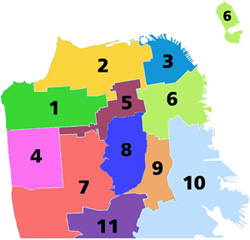
Right now, there are three districts that will generally elect a more conservative representative – D 2 (Michela Alioto-Pier) D- 4 (Carmen Chu) and D-7 (Sean Elsbernd). Districts 8, 10, 11 and 1 are swing districts, and the rest are going to go generally progressive.

So the odds are under this system that the left-leaning constituencies will have at least six votes, and in good times, as many as eight.

Now take four of those votes away, pretty much forever. Set it up so that four supervisors, elected citywide, will be guaranteed downtown call-up votes. Then add in one or two more from the more conservative districts, and you’ve got a majority.

That, my friends, is exactly what this is about, and any effort to frame it as anything else is just spin.

I asked Nevius what the hell he was doing buying the bogus argument that we need citywide perspective – since the district board has already demonstrated that, consistently. Here’s his response:

First, I’d envision the city-wide supes as made to order swing votes. When a district supervisor had a good idea, let’s say Healthy San Francisco, it might not be an issue of critical interest for a district supervisor. But it would be right in the wheelhouse for a city-wide official, who is looking for broad stroke issues to back. And, although you didn’t advance the idea, I’d reject the notion that whomever it was that was elected city-wide would be incredibly conservative and obstructionist. The most moderate politician we’ve elected in this city is Gavin Newsom. Although the Guardian doesn’t agree with him much of the time, he’s still advanced some very progressive ideas. Everyone jumps on the Chris Daly example as why district elections are a problem, but I think we can look beyond that. I think he’s been an aberration. District supes like David Campos and David Chiu have proved they can compromise and govern so I think that’s a good thing. I would never advocate that we get rid of representation in the neighborhoods. But c’mon, 11 little districts in a very small city? As Jim Stearns said, some of the districts are no more than a mile square. Combining some of them would still let residents have someone they could call to get the potholes fixed, but also spread out the areas.

Okay, I didn’t say citywide supes would be conservative. Sean Elsbernd is (relatively) conservative. He’s also independent of any big-money interest and does what he thinks is right. He doesn’t need half a million dollars to get elected in his district.

What I say is that citywide supes would be in hock to big money. I’ve seen it, lived with it. Suffered from it.

And guess what: Healthy San Francisco didn’t need any citywide supes; it passed just fine with the district board.

So what this is about is money and political control, and it’s about the political direction the city is going and who’s going to set that direction. Let’s get that straight and be honest about, and then we can have this discussion.

Recalling Sophie Maxwell

0

Written with Adrian Castañeda

maxwell.jpg
Does it make sense to try and recall termed-out D. 10 Sup. Sophie Maxwell?


A group of District 10 residents has turned in 8,008 signatures in an effort to recall Sup. Sophie Maxwell. Election department staff says that 7,529 signatures must be verified for the recall attempt to go forward.

‘We think it’s going to be a little tight,” said an election department worker, who preferred to remain anonymous.

Department of Elections staff have 30 days to count and verify the submitted signatures, but they predict the process could be completed as early as Thursday afternoon (Feb. 4) or Friday morning (Feb. 5).

Meanwhile, Maxwell is termed-out in January 2011–a mere 11 months away. And 15 candidates have already filed to enter the D. 10 race this fall, with a dozen others variously threatening to throw their hats in the ring.

But if the recall effort gets the green light and is placed on the June 8 ballot, and if Maxwell actually gets recalled as a result of that vote, Mayor Gavin Newsom would then get to appoint his choice of successor to her seat. And if that successor happens to be one of the candidates vying for Maxwell’s seat, wouldn’t that person have an enviable edge come the November election?

Bayview activist Daniel Landry insists the recall effort would be effective. 
“We’re sending a message to anyone who wants to be a supervisor of D-10, you must recognize the will of the voters,” Landry said.

D 10 candidate Ed Donaldson warns that any supervisor that does not understand the complexity of the city’s largest district can expect a similar backlash. He says the recall effort is evidence of District 10’s diversity.
“There is no one homogenous voice in the community,” Donaldson said.
He says that the current grass-roots organizing that brought about the recall effort is a result of changing political structure in the area, but is not yet on par with the other districts in town.
“We still allow our politics to be controlled from downtown,” Donaldson observed.

D 10 candidate Espanola Jackson warns that if Newsom appoints someone, that person had better listen to the wishes of the community, or else they will face a similar fate to Maxwell.

“What the mayor needs to understand is that if we can get the signatures in two weeks to recall Sophie, we can get them on whoever he appoints as well,” Jackson said.

But D 10 candidate Eric Smith worries that the recall effort will backfire. He cites a recent community meeting in the Bayview on the Department of Park and Recreation’s budget, as an example of why folks are turning to this seemingly desperate strategy.

“People were emotional, angry and desperate, because they feel no one listens to them,” Smith said. “That’s part of the problem here; they would rather have a supervisor go down swinging for them, rather than watch one seemingly side with Lennar, PG&E and the Mayor on issues contrary to their interests. At the DCCC [Democratic County Central Committee] last week, everyone except Chris Daly voted against the recall in support of Sophie.”

Smith added that Daly’s vote, “likely had more to do with his belief that this was a waste of time and had no chance of actually succeeding, but you’ll have to ask him.”

Daly, for his part, says he doesn’t believe the recall effort will qualify.

“Jake McGoldrick introduced an item in committee when he was a supervisor that the Board then passed that doubles the numbers of signatures required for a recall to qualify,” Daly said, noting that under the old recall rules the current effort would likely have succeeded in getting onto the ballot.

“And I don’t think the DCCC’s resolution against the recall effort was accurate,” Daly added. “It was long on the fact that Sophie isn’t guilty of malfeasance, but the truth is that a recall is a tool of democracy that is available and can be applied in cases where a representative is not being responsible to the needs of their district. So, while I’m not supportive of recalling Sophie, it would be patronizing for me to say that thousands of D. 10 residents don’t know what they are doing. The Democratic Party (with a capital D) is working against democracy (with a small d) in a patronizing way in a district that has a disproportionately high number of low-income folks and people of color. There is a significant level of disgruntlement, if that is a word, in District 10, and its residents have lodged a pretty real and significant complaint.”

Aaron Peskin, who chairs the DCCC’s executive board and is the former President of the San Francisco Board of Supervisors, also predicts that the effort to recall Maxwell is probably headed nowhere.

“There’s no way they got the numbers,” Peskin said. “You’re lucky if 50 percent of that shit runs.”

Peskin proffers three reasons why recalling Maxwell is against the community’s own interests.
“First, recalls are an instrument to be used when a representative has committed malfeasance, and not because you disagree with the political positions of a person who has been duly elected three times,” Peskin said. “Second, this elected official is in her last eleven months in office. So, it’s a huge waste of time and money. And third, for those not satisfied with their current supervisor, any representative that the mayor might nominate would be far, far worse.”

Smith also worries that the recall effort is akin to the community shooting itself in the foot.

“If Sophie gets recalled, (and that is a very big if), the Mayor will insert someone and we may be right back where we started from, or worse. That’s the terrible irony and one of the biggest problems in District 10. Folks are so mad, they’re willing to do whatever it takes to make them feel they have a voice in the outcome, even if it’s potentially worse. The same thing happened with the Navy and the Restoration Advisory Board. Some of the same folks who were frustrated by the process, tried to send a signal to the Navy that they weren’t being heard and for all their well- intentioned efforts, got the RAB dissolved. I truly feel for them, it’s absolutely heartbreaking, but at times, they can be their own worst enemy.”

To Smith’s mind, a recall has the potential for exacerbating the very problems the effort is purported to be about.

“This isn’t about malfeasance, or not showing up for work,” Smith observed. “It’s about being heard, respected and listened to. I don’t think any other Supervisor has ever had the challenges that Sophie has had to face here; the Bayview, the Hunters Point Shipyard’s toxic super-fund site, the homicide rate, unemployment, poor public transportation, dwindling services and community resources have made D10 one of the City’s largest melting pots of discontent. It’s just one of the reasons I’m running. The health, welfare, quality of life issues and the environment are the things I put above everything else out here, particularly above special interests and big money.”

“We will soon know how valid those signatures are; I can tell you that the many of the folks behind it feel very confident about it,” Smith continued. “But Sophie still has a lot friends in D10 who will not vote her out, so even if this makes the ballot, there is no guarantee it will carry. There are many, many folks who still love and support Sophie, so the folks who signed the recall petition will have to overcome the balance of the 37,000 D.10 voters who may not want to see her go and have a vested interest in seeing a fair electoral process in November, untainted by a Mayoral appointee, an appointee that would have implied advantage over any of the candidates in November.”

Smith has asked many folks why they are launching a recall when Maxwell only has 10 months left on the job.

“For them, it’s about making a statement; they want everyone to know that ‘They’re mad as hell and not going to take it anymore,’” Smith said. “They also want to send a signal to the D10 candidates that this is what you will face if you don’t listen to them. D10 is not for the squeamish, those easily intimidated or the faint of heart.”

On a side note, Smith observed that “we will need the world to come out to defeat Proposition 16″, the PG&E ballot measure in June. “And, depending on the turn out, many of the folks needed to come out for that, may also play a role as it relates to Sophie’s recall.”

Asked what she thought of the effort to recall her, Maxwell characterized it as “strange” and “destabilizing.”

‘It seems to me that this effort is destabilizing the community,” Maxwell said. “When you undercut the leadership, you destabilize a community in transition. At a time when these folks could have something to say about the future, they are looking at the past. It’s about backward thinking. It’s about not having the best interests of the community. It’s about egos. Because if this is for the community, then why not bring something to the table that’s about bringing some direction to the district?”

One of the last straws, in the minds of some recall signature gatherers, was Maxwell’s 2009 vote against a resolution that would have advised the Navy to restore its community-based Restoration Advisory Board. This board, which was established in 1994, had consistent access to the many technical and environmental documents surrounding the proposed clean-up of the heavily polluted Hunters Point Shipyard.

The RAB, whose primary fucntion was to share information on investigations and clean-ups at the shipyard, was also able to vote on the Navy’s proposed solutions and to request more information and/or speakers and experts so its members could educate themselves on related public health and safety issues. But early last year, the Navy announced that it was dissolving the RAB, citing dysfunctional behavior and off-topic discussions that were getting in the way of the RAB’s intended purpose.

The move to dissolve the RAB came just as the Navy was poised to take a series of important decisions on some of the most polluted and radiologically-impacted parcels on the shipyard. And many in the community saw the timing of the RAB’s dissolution as evidence that the Navy was going to ignore their wish to have these parcels dug out and hauled away, and not capped (a wish shared by the 87 percent of voters who supported Prop. P in 2000.)

But despite the outcry that followed the RAB’s 2009 dissolution, Maxwell voted to tell the Navy to either restore the RAB or find other ways to involve the community–thereby giving the Navy the choice, some felt, to ignore the community’s desire to reinstate the RAB.

And last night, the Navy, along with a flotilla of police and special agents, showed up at the Bayview YMCA to share its plan to reformulate the Navy’s original Community Involvement Plan—a plan that angered many meeting goers ( the majority of which were former RAB members,) since it didn’t appear to aim at reinstating the RAB. But to give the Navy credit, once it became clear that meeting attendees were underwhelmed by its plan, Navy officials scrapped their original agenda and allowed the community to speak instead about their wounds from the past and their hopes for the future. It remains to be seen where the Navy will go next, but those interested in tracking these developments can visit the Navy’s website for updates.

Maxwell for her part defended her vote–and pointed the finger at the Navy.

“The Navy has an obligation to get out its plans to the public,” Maxwell said. “People are getting information in many ways, these days, not just by coming to meetings. The Navy has just got another $92 million towards the shipyard clean up, but does anyone know what this means? It means that instead of taking years to clean up groundwater at the shipyard, we can spend that money on it, now. And if folks knew what capping really means, maybe they wouldn’t be against it. Mission Bay is capped. Schlage Lock will be. And all of them are brown fields.”

Maxwell worries that democracy is not currently being well served within her district, but not by her.
“There are folks who are trying to block real information from getting out, and if only your view can get out, that’s not democracy,” Maxwell said.

But so far, she’s not willing to publicly support anyone in the November D. 10 race.
“I’m waiting for people to have a better understanding of what this community is, what the common thread running through it is, and how to use rank choice voting,” she said.

And despite the current recall effort—and the insults regularly hurled her way with a voracity and meanness not generally seen in other supervisorial districts, Maxwell said she has truly enjoyed serving as D. 10 supervisor.

“When people say that it’s an honor to serve as an elected official, I really know what they mean, because I really feel that. Democracy is challenging, it’s messy and it’s invigorating. I think a lot of what’s going on in my district is about people using people. But what has changed for these folks? Their lives have gotten worse, not better. And they are going after me, because I am not part of their group. I have tried to stay focused on the issues.”


On pension reform, a way forward

0

EDITORIAL Sup. Sean Elsbernd is taking on one of the most complicated and politically tricky issues in San Francisco — reforming the pension fund and health care system for retired city employees. He’s right that the system needs reform — but his measure has some serious drawbacks and needs some significant amendments.

The problems facing the system are so confusing, and the legal and financial aspects so arcane, that it’s hard for anyone to grasp the full situation. But we can sum it up pretty simply:

San Francisco’s pension fund is in far better shape than pension funds in many cities and is a long way from any financial crisis. But over the next few years, thanks to weak stock market performance, the city’s cash obligation — the amount of general fund money that must be paid into the retirement system — is going to rise quickly into the hundreds of millions of dollars.

The retiree health care system is in a lot more trouble — with the rising cost of care, the city will be on the hook for a serious amount of money over the next decade or two. And since the obvious answer — a single-payer system that would cut costs immensely — isn’t anywhere on the immediate political horizon, the San Francisco supervisors need to address the problem.

Elsbernd’s proposed fix is also complicated; the main legislation runs 61 pages. But in essence, he wants to make sure all city employees pay directly into the system; raise the amounts new employees, cops, and firefighters contribute; and set up a rainy-day fund to divert excess pension revenue in good years into a trust that could fund health care pension obligations in down years. He’s also going after a scam common in the police and fire departments where people about to retire get sudden promotions and big salary bumps for a few months, then collect pensions based on the higher pay scale.

The first part is — and should be — almost certainly dead. Members of the Service Employees International Union local 1021 agreed several years ago as part of contract negotiations to give up a pay hike; in exchange, the city agreed to take over the workers’ obligation to pay into the pension fund. Changing that, and outlawing any similar deals in the future, is unacceptable to labor and could drag down the whole proposal.

It’s also tricky to raise pension contributions for “new employees” since Mayor Gavin Newsom has been firing people then rehiring them at lower pay rates. Do those people lose their pension seniority? That has to be fixed.

But given the sweet deal cops and firefighters have, it’s entirely appropriate to ask them to contribute more to retirement. And while some city employees actually get and deserve raises in their final year of work (and the language in Elsbernd’s bill doesn’t address this and needs work), pension spiking is a problem that tends to give extra cash to people who are on the higher end of the pay scale at the expense of lower-paid workers.

And the heart of his proposal — to set up a trust fund for excess money in good years — deserves serious consideration. Yes, it’s a set-aside, and yes, there are legal complications. But the cost of doing nothing is too high to ignore.

Elsbernd should have done this differently — he should have met in advance with all the stakeholders and sought to hammer out a compromise. Even so, there’s a lot for progressives to work with here. If Elsbernd is willing to engage with labor and the board majority, and the progressive supervisors are willing to acknowledge the problem and look for amendments that make this bill acceptable, there’s a way for the city to come out ahead.

Sup. David Campos has moved to “split the file” — that is, to turn the Elsbernd bill into two identical measures. The move gives the progressives a chance to make amendments even if Elsbernd doesn’t want to go along, and could wind up giving the supervisors a choice between two competing measures. We’d prefer that Elsbernd work with his colleagues on a measure everyone can back. But in the end, the best option is a charter amendment that fixes the problems Elsbernd has identified — without being unfair to city employees.

And if Elsbernd and the progressives can come to a deal, there’s a lesson here for the mayor: if you try to work with your opponents, you can actually get things done.

Editor’s Notes

0

The mayor of San Francisco is mad that the Board of Supervisors won’t even schedule a hearing on his proposals to stimulate business and job creation in San Francisco. He ought to be happy. If this loopy plan ever gets to the point of open, full discussion, Gavin Newsom will wind up with a real political embarrassment.

Let’s analyze, for example, the suggestion that the city waive payroll taxes for biotech companies. That’s supposed to make those companies more likely to hire new people. After all, any economist knows that taxing something discourages people from doing it, so taxing a payroll ought to make companies less likely to hire. And getting rid of that tax ought to create jobs.

Well, since one of the things I do is help run a small business in San Francisco, let me explain how it actually works.

Say you’re a biotech company that wants to hire a new entry-level worker at a modest $35,000 a year. Can you afford it? Let’s cost it out.

There’s the salary, of course. Then there’s the 7.5 percent you’re paying in federal Social Security tax. That’s $2,626 more. And since you’re in San Francisco, you’re paying for health insurance; that’s probably between $2,000 and $4,000 a year, depending on the plan, but let’s peg it at the city’s minimum mandate, which is $1.09 an hour, or $2,267.

So now your $35,000 worker costs $39,893. Then there’s unemployment and disability insurance and workers’ compensation. The person’s going to need a desk and a chair, or a lab bench and a stool (and they have to be ergonomically correct), and probably a computer, a phone line, and software. And you’re going to have to spend some money on training. You’re going to offer a couple weeks of paid vacation, right? And you have to give sick days. So you have to account for the money you’re spending to cover your new worker when he or she isn’t working. If it all pencils out at less than $42,000, you’re doing well.

Oh, wait, I forgot — there’s the damn city payroll tax. That job-killing factor that could make the difference between hiring and not hiring. Better account for that; it could be a deal breaker.

Are you holding your breath? Ready for the ax to fall? Here you go: the payroll tax on your new hire is a whopping $525 a year. About $10 a week. You probably spent more on the help wanted ads.

So let’s be honest — the payroll tax may sound awful (and actually, I think a gross receipts tax would be more fair, for a lot of reasons). But suspending it won’t create a single new job. It’s too small a factor to count as more than decimal dust in anyone’s hiring decisions.

Here’s what suspending the payroll tax for biotech companies will do: reduce city revenue, almost certainly by enough to force more program cuts, and that means more job cuts for city workers. So you gain no private sector jobs — zero — and you lose public sector jobs. How, exactly, is that encouraging employment growth?

Quit complaining, Mr. Mayor — the last thing your proposals need is real public scrutiny.

DEIR in the headlights

0

GREEN CITY Public comments on the city’s draft environmental impact report (DEIR) for Lennar Corp.’s massive redevelopment proposal on Candlestick Point and the Hunters Points Shipyard includes complaints that the comment period was too short (see “The Candlestick Farce,” 12/23/09), concerns that the city violated state requirements to notify the Ohlone Tribe, and frustration that the city’s preferred plan represents the most significant and substantial impacts of any of the five scenarios analyzed in the DEIR.

These and many other concerns about the impacts of the 10,500-home project will need to be addressed in the final EIR, which Mayor Gavin Newsom and other project proponents expect to be completed by June.

Some object that the city is considering an early transfer of the shipyard and would undertake activities that are currently the Navy’s responsibility (see “Eliminating Dissent,” 06/17/09), saying the final EIR should prominently reference Proposition P, which voters approved in 2000, establishing community acceptance criteria for the cleanup.

Saul Bloom, executive director of Arc Ecology, submitted his organization’s comments “under protest for the inadequate extension of the public comment period, which we believe unfairly penalizes the public review of the draft EIR.”

Land use attorney Sue Hestor called the public comment submission schedule “abusive” in comments submitted for POWER (People Organized to Win Employment Rights). “The schedule is being driven by an insane desire to have the final EIR certified and all local approvals done by June,” Hestor said.

Ohlone chairperson Ann Marie Sayers and Neil MacClean of the Ohlone Profiles Project wondered why the Planning Department did not contact anyone on the city’s list of official Ohlone representatives. “We want the SF Planning Department to follow Senate Bill 18, which requires them to include Ohlone people in the planning process,” MacClean said, noting that there are at least four Ohlone villages within the proposed development area.

Jaime Michaels, coastal program analyst for the San Francisco Bay Conservation and Development Commission, expressed concerns about the DEIR’s proposal to make a 23.5 acre reduction in existing state park boundaries (see “Can I buy your park?” 08/12/09).

Project proponents, Michaels said, “would need to demonstrate that the decreased area would not compromise or reduce its value as a park/beach facility.” Michaels also worries about the impact of adding a minimum of 1.7 acres of fill in the bay to accommodate a bridge at Yosemite Slough, a plan she described as “a significant amount of coverage, particularly for a facility where the large majority of its coverage is needed to serve vehicles accessing the new stadium only 12 days a year.”

Michaels expressed concerns that the project’s plans to address sea level rise would negatively affect bay views and public access to the shoreline.

The project includes a 9.6-mile trail and a variety of other public amenities directly adjacent to the shoreline. Proposed building structures located away from the immediate shoreline would accommodate a 36-inch sea level rise by 2075, and the DEIR promises to employ adaptive management strategies along the perimeter beyond 2050.

“Unfortunately, partly due to illegibility and the scale of the drawings, it is difficult to assess precisely how these adaptations would appear,” Michaels observed. “However, it can be assumed that over time levees would need to be raised and likely widened at the base, thereby partly or entirely obstructing the public’s view of the bay from inland areas, encroaching on and reducing the area devoted for public use and impacting the overall public access experience.”

Arc Ecology discussed the DEIR’s failure to provide a comprehensive sustainability plan, address adjacent development projects, justify a 49ers stadium on the shipyard, or evaluate the potential for the development of port-related heavy industrial activities.

“The city is determined to get this project passed right now, and the developer is afraid that if someone else comes along as mayor and District 10 supervisor, they may not be as sympathetic,” Bloom said. “But the project — as outlined in the DEIR and the city’s way of approaching the deal — is against the interests of San Francisco.”

Newsom and O’Reilly celebrate conservatism

0

By Steven T. Jones

Anyone who still thinks that Mayor Gavin Newsom is a liberal who has been unfairly maligned by the Bay Guardian and other wild-eyed San Francisco lefties should watch his appearance on Bill O’Reilly’s Fox News show last night, in which Newsom praises O’Reilly (a right-wing reactionary if there ever was one) as a political moderate, correctly calls himself an economic conservative, and said he watches O’Reilly’s show every night and agrees with much of what he hears.

While Newsom meekly disagrees with O’Reilly’s ridiculous main premise that the situation in Sacramento and San Francisco proves that “liberal governance just don’t work,” he spends far more time agreeing with O’Reilly than challenging any of O’Reilly’s ludicrous and inaccurate assertions.

For example, O’Reilly blames California’s fiscal mess on liberals (actually, the main problem is our Republican governor and a two-thirds budget vote threshold that has let conservatives hold the state hostage) and casts San Francisco as increasingly overrun with homeless people and pot clubs (both of which have declined, leaving SF with just 22 licensed and well-regulated cannabis dispensaries).

Instead of defending traditional Democratic Party values (those that existed before Bill Clinton and others allowed them to be coopted by big corporations and anti-government crusaders) and his party’s current leaders, Newsom bends over backward to highlight his no-new-taxes stance and says, “We operate in a fiscally conservative manner.”

As the Chronicle reports today, San Francisco is facing a $522 million and growing budget deficit, which Newsom is only trying to increase with his proposed tax cuts and embrace of Reaganomics, while steadfastly refusing to work with others on finding new revenue sources. This is a recipe for disaster, but at least Newsom is sure to be invited back on his buddy Bill’s show, where he they can together celebrate the crash of civil society as we know it.

How bad does Muni have to get

1

By Tim Redmond

Before Gavin Newsom is willing to consider extending parking meter hours to make drivers pay their fair share?

The budget picture is increasingly bleak, and Muni’s talking about some very unpleasant cuts that may wind up to be ineffective; if buses are slower, dirtier and cost more, then fewer people will ride, and Muni will collect less fare money.

So how bad does it have to get? Does the system have to reach total collapse before Newsom is willing to take a little political risk and raise some money from people who drive downtown and park their cars?

Scraping bottom

0

The job of scrubbing down a city bus after it’s gone out of service is no picnic. At a Jan. 20 Budget and Finance Committee hearing called by Sup. Chris Daly to discuss health and safety impacts related to Municipal Transportation Agency layoffs, supervisors took a virtual tour of a Muni bus that was trashed on multiple levels: tagged inside and out, soiled with vomit, and strewn with garbage. Among the roughly 100 Muni workers who will lose their jobs to midyear budget cuts are 10 “car cleaners” — those unsung heroes who scrub away late into the night, tackling the residue left behind by the Sharpie-wielding, litterbug masses.

“We do send out all of our vehicles clean,” MTA spokesperson Judson True told the Budget and Finance Committee members at the hearing. “We do not send out any of our vehicles with any health issues … and we will not.” Despite his assurances, members of the Board of Supervisors and some Muni staffers voiced fears that with fewer and more overworked car cleaners, the overall experience of riding public transit could suffer.

It’s just one small example of on-the-ground impacts of painful budget cuts inflicted to solve a steep shortfall affecting the city’s transit agency. The fiscal woes aren’t unique to Muni. In coming months, San Francisco city departments across the board will have to contend with revenue shortfalls and find ways to continue providing services with diminished resources.

But with layoffs and other proposals such as raising fares, reducing service, and charging more for discount passes on the table, many are raising objections — including several members of the MTA Board of Directors, a body that is wholly appointed by Mayor Gavin Newsom. In a rare show of defiance at a Jan. 19 MTA Board meeting, several directors even resuscitated the idea of extending parking-meter hours and raising meter fees to generate new transit revenue, an idea Newsom previously rejected.

$49 MILLION IN THE RED

Muni has lost $180 million in state funding over the last three years due to “the nightmare in Sacramento,” as True put it, and no one seems to believe the fiscal crisis can be resolved without some degree of pain.

At the Jan. 19 MTA Board meeting, transit agency Chief Financial Officer Sonali Bose outlined the dismal financial picture, explaining that Muni has been hit hard by declining parking and taxi fees and impacts to the city’s general fund, leaving it about $49 million in the hole for the current budget cycle. After the layoffs, Muni will still face a $17 million problem. To solve it, suggestions include jacking up the historic F Line trolley fare from $3 to $5, charging $30 for discount monthly passes for seniors and passengers with disabilities, and reducing service.

Even against the gloomy fiscal backdrop, the prospect of eliminating jobs to make up for the losses drew serious concerns from MTA directors. “Once somebody’s gone, they’re gone,” Director Shirley Breyer Black noted. “I think moving forward with cuts in these classifications will send us into deeper fiscal crisis.”

All the affected workers — most of them frontline employees — are slated to lose their jobs by May 1, and around one-third of them were dismissed Jan. 22.

Muni Executive Director and CEO Nathaniel Ford emphasized that the decision to cut jobs was not made lightly. But at a Budget and Finance Committee meeting the following day, progressive members of the Board of Supervisors expressed alarm after hearing union members sound off about how the cuts disproportionately affect lower-paid classifications. The majority of layoffs target members of Service Employees International Union Local 1021, San Francisco’s largest labor union, which represents frontline workers across city departments.

“I understand that there are no good decisions,” Daly told the Guardian, adding that a certain group of workers seem to bearing the brunt of the cuts. “What progressive supervisors are calling for is for the budget to be handled more evenly,” he said.

A single Municipal Executives’ Association (MEA) employee — an MTA manager earning between $105,950 and $135,200 per year — was let go during this latest round of about 100 Muni layoffs, according to an agency memo. In the past year, MTA reduced its upper-level management team from 108 to 96 employees. In contrast, 33 members of SEIU Local 1021 — the majority frontline workers earning between $45,656 and $64,272 a year — will be affected by the cuts.

“Unfortunately, when MTA discovered that they had a budget problem, they didn’t bring all parties to the table,” SEIU Organizer Leah Berlanga testified at the Budget and Finance Committee hearing. “The way we got invited was via pink slips. That’s the only time they will talk to people who do direct services.”

When asked whether Muni had assessed mid- and upper-management level jobs to even the scales, True responded that a few mid-level managers were included in the latest round of cuts. One reason the layoffs seem disproportionate, he added, is that there are so many more frontline workers than others. “The budget picture has affected the entire agency,” he said. “No one is happy about these decisions.”

But SEIU Local 1021 characterized the layoffs as misguided, and attempted to identify waste and mismanagement within the agency in a packet of alternative cost-saving measures it submitted to MTA. At the top of the list was the suggestion that the agency eliminate 35 retired Muni employees, who are allowed to work up to 960 hours per year and earn wages in addition to their pensions. And according to the union, there are 21 temporary workers in the agency who’ve exceeded a two-year limit for short-term employment. SEIU recommended that those temps be dismissed too.

SEIU also criticized the decision to lay off 24 parking control officers (PCOs) — uniformed workers who have the unenviable job of issuing parking citations to bring in revenue for the city. “To me, if you do the simple math, it doesn’t make any sense. They make most of the money for the MTA,” said a PCO who testified at the hearing.

According to SEIU’s calculations, eliminating 24 employees who dole out parking tickets could result in a $7.2 million loss for the city in parking revenue. But True said MTA disagrees with this figure, and pointed to an internal memo showing how revenue from parking citations dropped in recent years even as more PCOs were hired. Nonetheless, at the urging of SEIU, the MTA Board agreed to postpone those 24 layoffs until February to buy time to study the impact. For other positions, negotiations between MTA and the union are ongoing. The details on still more layoffs, which will affect transit operators, is yet to come.

Sup. David Campos is asking for a management audit to see if Muni is spending its money efficiently. “I think we should look at best practices and how we’re operating before we finalize any cuts,” he said.

THE PARKING POLITICS

During a round of MTA budget talks last fall, the idea of extending city parking meter hours and raising meter fees was floated as a means of recouping losses — but Newsom balked at the idea, saying higher parking fees could harm small businesses. Now MTA Director Bruce Oka has revived — and endorsed — the concept.

“I can hold my nose and vote on anything, but I refuse to vote on something when I believe we have not looked under a rock for every source of funding,” Oka said at the meeting. “We have to extend the parking meter hours — we have to find dollars. If Room 200 [i.e. Newsom] doesn’t want that to happen, well then … he’s got to come up with a way to do what we need to do. If he’s not going to raise parking meters or extend parking meter time, he’s got to come up with some money.”

Tom Radulovich, executive director of nonprofit Livable City and one of the individuals who helped to create MTA in 1999, summed up Oka’s comments with a note of surprise: “He really called out the mayor,” he said. “I haven’t seen MTA Board members do that — they usually cover for him.”

Radulovich — who is also on the BART Board — says targeting motorists for more revenue instead of transit riders would be more equitable, sustainable, and in keeping with the city’s Transit First goals in the long run. Proposition A, passed November 2007, established “a strong mandate to reduce transportation-related greenhouse gas emissions,” he pointed out. But, he noted, with layoffs that could affect the qualify of service and possibly deter people from riding, “We don’t see how MTA is going to get to those voter-mandated transit goals.” *

MUNI MEETINGS

PUBLIC MEETINGS ON SFMTA BUDGET

Saturday, Feb. 6, 10 a.m. to noon

Tuesday, Feb. 9, 6 p.m. to 8 p.m.

Saturday, Feb. 20, 10 a.m. to noon

One South Van Ness Ave. at Market Street, 2nd Floor Atrium

SFMTA BOARD MEETINGS

Friday, Jan. 29, 10 a.m.; discussion of FY10 options, including Muni service reductions

Tuesday, Feb. 16, 11 a.m.; public hearing on proposed FY10 budget actions

Tuesday, Mar. 2, 2 p.m.; public hearing and possible board approval of FY10 budget actions

Location: City Hall, 1 Dr. Carlton B. Goodlett Place, Room 400

Who will fight corporate America?

0

By Steven T. Jones
corpflag.jpg
This morning’s U.S. Supreme Court landmark decision overturning a 103-year-old law limiting corporate spending on elections is a huge setback for the people’s ability to counter the power of Wall Street and multi-national corporations, a development exacerbated by signals that the Democratic Party is retreating from even its nominally left-of-center initiatives in the wake of Tuesday’s loss of its Massachusetts seat in the U.S. Senate.

If this morning’s front page San Francisco Chronicle story is to be believed, Democratic congressional leaders are essentially abandoning health care reform and climate change legislation, shifting instead to focus on “creating jobs and cutting the enormous federal deficit.”

And if Mayor Gavin Newsom’s recent initiatives here are any indication, job creation is synonymous with corporate tax breaks, while deficit reduction probably means the elimination of even more government jobs, further enabling private sector excesses. Yes, the political climate in this country is turning as bleak and stormy as the California weather this week.

But at least downpours provide needed water. With progressive institutions from the anti-war movement to minor political parties at their weakest point in many years, it’s unclear who will unite and lead a public that is growing increasingly frustrated with this country’s political dysfunction and uneven economic recovery (that is, corporations are recovering but most people aren’t).

There are a few faint glimmers of hope. The Chron reports on an alliance between UC students and administrators to push for a reversal of deep cuts to education spending. And spending by labor unions was also unshackled by today’s court decision, which could be helpful if that movement wasn’t in such disarray right now and was willing and able to help lead a broad people’s movement.

But the question facing the country right now is this: who can effectively fight corporate America, and who is willing to do so?

Meet Gavin Newsom: whine clerk

0

Text by Sarah Phelan

newsomd.jpg
Sorry, Maureen, but you omitted more than a few details of the real trials of Mayor Gavin Newsom…

I’m usually a fan of Maureen Dowd’s finely pointed writing, but her interview with Mayor Gavin Newsom in today’s New York Times left me with the sinking feeling that she was writing with an uncharacteristically unsharpened pencil.

Yes, it was funny when Dowd wrote, “It’s easy to picture the lithe and charming Newsom–with the well-cut suits, the electric Telsa, the beautiful blonde wife and baby–advising a Pacific Heights couple on a cabernet with aromas of eucalyptus and mint.”

But beyond that delightful dig, Dowd kept her pencil on an unusually tight leash.

Maybe that’s because Dowd doesn’t know the ins and outs of San Francisco politics and was fooled into misrepresenting Newsom’s whining as the rueful ruminations of a man so very far ahead of his time.

But it’s hard to believe that the indomitable Dowd doesn’t know that Newsom’s political career has been short circuited for a million reasons above and beyond gay marriage.

Maybe the fact that Newsom slept with his campaign manager’s wife isn’t perceived as a deal breaker in circles where everyone always seems to be betraying every one else.

But how about Newsom’s failure to show backbone when then Sup. (and now State Assemblymember) Tom Ammiano was trying to launch San Francisco’s trailblazing health care program–yes, the same one that President Obama has recently and widely praised, and for which Newsom has been happy to take all the credit?

Instead of showing leadership on Healthy San Francisco, Newsom stood back and let Ammiano do the heavy lifting, in face of the threat of legal opposition from the Golden Gate Restaurant Association. Newsom’s cowardice on that issue seems entirely understandable, given that, as Dowd points out, “Before he got into politics, after all, he started a boutique wine shop in Napa Valley that blossomed into a multimillion-dollar business.” (Heaven forbid that the former owner of a wine boutique would be seen leading the charge to ensure that the restaurant industry helps employees go see a doctor instead of sneezing into the endive soup and eucalyptus-scented cabernet that the Pacific Heights mafia has come to enjoy.)

But Dowd doesn’t make that, or any other, connection.

Instead, she lets Newsom stick his not-so-subtle knives into Obama’s back on same-sex marriage, without pointing out that after Newsom rushed into gay marriage, he failed to launch a much needed statewide campaign to reach out, across the aisle of intolerance, and help defeat the Prop. 8 party poopers.

The final insult in Dowd’s puff piece is when she lets the current mayor of San Francisco get away unchallenged with his bogus claim that, “we’ve always fought for the rights of minorities and against the whims of majorities.” Try telling that to the immigrants whose families have been ripped apart because gubernatorial candidate Newsom failed to support giving undocumented kids their day in court, before reporting them to the feds for deportation.

But Dowd does at least gives us a preview of what to expect when we stumble unwittingly into a wine store, somewhere in the backwaters of Napa, and overhear the clerk complaining that no one really understood him, back when he was mayor of San Francisco. Meet Gavin Newsom: whine clerk.