

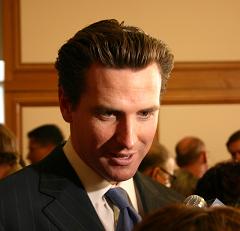
Today on SFBG.COM Radio: Tim and Johnny talk about why Nancy Pelosi isn’t more of a progressive — and how Gavin Newsom could follow the lead of a Republican from Utah and cut down dramatically on car use in San Francisco. You can listen after the jump.
SFBG.COM Radio 5/14/2010 by SFBGGavin Newsom
Ending the crackdown is as easy as ABC
Sup. Bevan Dufty brought a surprise guest to the “Death of Fun” panel at SPUR that we each served on last night: Steve Hardy, director of the California Department of Alcoholic Beverage Control, an agency that has played a key role in the crackdown on San Francisco nightlife.
Hardy sounded a conciliatory tone, telling me that ABC agent Michelle Ott is no longer working with SFPD officer Larry Bertrand – the undercover duo has wreaked havoc on clubs and parties – and telling the large crowd that he’s trying to heed the criticisms and change his agency’s ways. Well, sort of.
“We’re working very hard to create an image that does not draw so much hostility,” Hardy said, later complaining about the state budget shortfall’s squeeze on his agency and saying, “It’s wearing thin and there’s no relief.”
Hardy said he was raised and still lives in San Francisco and served as an SFPD beat cop before a 25-year career staffing the California Legislature, mostly with the Senate Committee on Government Organization. Three years ago, he was appointed by Gov. Arnold Schwarzenegger to run the ABC, an agency that has cited many SF clubs for noise complaints and not serving enough food with their booze, and private parties for serving alcohol without permits.
“We do have a tremendous relationship with the SFPD,” he told the crowd, as if that weren’t already clear.
SFPD Inspector Dave Falzon of the Vice Crimes Division, another panelist, repeatedly emphasized the department’s desire to improve communications with the community, which has organized against the crackdown by forming the California Music and Culture Association. And Falzon announced a new SFPD initiative to centralize and streamline its permitting functions for clubs and special events.
But when I was answered a question about what we’d like to see in terms of improved communication by saying I wanted the SFPD to finally grant the Guardian’s longstanding request to interview Bertrand (whose brutal and illegal actions have been publicly condoned by his captain) and to directly address the community’s concerns about the SFPD’s hostility to nightlife, I didn’t get much of a responsive answer from Falzon.
Two separate legal teams who are suing the department for its overreaching tactics are also seeking to depose Bertrand and his superiors, and to review Bertrand’s personnel file, but the city has so far been stonewalling them. The consensus on the panel was that city leaders haven’t adequately valued nightlife or special events or sent the message to various city departments that protecting the urban culture from bureaucratic excess is important.
For example, in the current budget crisis, most departments that deal with clubs and special events have adopted full cost recovery policies, and then jacked up those costs with demands that promoters pay for excessive police protection and other services. Just a few weeks ago, the Municipal Transportation Agency approved a budget that made full cost recovery official policy, thus jacking up prices for all events that require street closures or Muni diversions.
Who’s to blame? Well, Dufty and Sup. Ross Mirkarimi (who also served on the panel) each laid the blame squarely on Mayor Gavin Newsom, who they say has abdicated his responsibility to lead city departments through the sometimes complicated balancing act between protecting the urban culture and being sensitive to neighborhood concerns, leaving the city essentially rudderless on an issue vital to maintaining San Francisco’s status as a world-class city.
Democratizing the streets

steve@sbg.com
It’s hard to keep up with all the changes occurring on the streets of San Francisco, where an evolving view of who and what roadways are for cuts across ideological lines. The car is no longer king, dethroned by buses, bikes, pedestrians, and a movement to reclaim the streets as essential public spaces.
Sure, there are still divisive battles now underway over street space and funding, many centered around the San Francisco Municipal Transportation Agency, which has more control over the streets than any other local agency, particularly after the passage of Proposition A in 2007 placed all transportation modes under its purview.
Transit riders, environmentalists, and progressive members of the Board of Supervisors are frustrated that Mayor Gavin Newsom and his appointed SFMTA board members have raised Muni fares and slashed service rather than tapping downtown corporations, property owners, and/or car drivers for more revenue.
Board President David Chiu is leading the effort to reject the latest SFMTA budget and its 10 percent Muni service cut, and he and fellow progressive Sups. David Campos, Eric Mar, and Ross Mirkarimi have been working on SFMTA reform measures for the fall ballot, which need to be introduced by May 18.
But as nasty as those fights might get in the coming weeks, they mask a surprising amount of consensus around a new view of streets. “The mayor has made democratizing the streets one of his major initiatives,” Newsom Press Secretary Tony Winnicker told the Guardian.
And it’s true. Newsom has promoted removing cars from the streets for a few hours at a time through Sunday Streets and his “parklets” in parking spaces, for a few weeks or months at a time through Pavement to Parks, and permanently through Market Street traffic diversions and many projects in the city’s Bicycle Plan, which could finally be removed from a four-year court injunction after a hearing next month.
Even after this long ban on new bike projects, San Francisco has seen the number of regular bicycle commuters double in recent years. Bike to Work Day, this year held on May 13, has become like a civic holiday as almost every elected official pedals to work and traffic surveys from the last two years show bikes outnumbering cars on Market Street during the morning commute.
If it wasn’t for the fiscal crisis gripping this and other California cities, this could be a real kumbaya moment for the streets of San Francisco. Instead, it’s something closer to a moment of truth — when we’ll have to decide whether to put our money and political will into “democratizing the streets.”
RECONSIDERING ROADWAYS
After some early clashes between Newsom and progressives on the Board of Supervisors and in the alternative transportation community over a proposal to ban cars from a portion of John F. Kennedy Drive in Golden Gate Park — a polarizing debate that ended in compromise after almost two acrimonious years — there’s been a remarkable harmony over once-controversial changes to the streets.
In fact, the changes have come so fast and furious in the last couple of years that it’s tough to keep track of all the parking spaces turned into miniparks or extended sidewalks, replacement of once-banished benches on Market and other streets, car-free street closures and festivals, and healthy competition with other U.S. cities to offer bike-sharing or other green innovations.
So much is happening in the streets that SF Streetsblog has quickly become a popular, go-to clearinghouse for stories about and discussions of our evolving streets, a role that the San Francisco Bicycle Coalition — itself the largest grassroots group in the city, with more than 11,000 paid members — recently recognized with its Golden Wheel award.
“I think we are at a tipping point. All these little things have been percolating,” said San Francisco Planning Urban Research Association director Gabriel Metcalf, listing examples such as the creative reuse of San Francisco street space by Rebar and other groups (see “Seizing space,” 11/18/09), experiments in New York and other cities to convert traffic lanes to bicycle and pedestrian spaces, a new generation of more forward-thinking traffic engineers and planning professionals working in government, and more aggressive advocacy work by the SFBC, SPUR, and other groups.
“I think it’s all starting to coalesce,” Metcalf said. “Go to 17th and Valencia [streets] and feel what it’s like to have a sidewalk that’s wide enough to be comfortable. Or go ride in the physically separated bike lane on Market Street. Or take your kids to the playground at Hayes Green that used to be a freeway ramp.”
Politically, this is a rare area of almost universal agreement. “This is an issue where this mayor and this board have been very aligned,” Metcalf said. Winnicker, Newsom’s spokesperson, agreed: “The mayor and the board do see this issue very similarly.”
Mirkarimi, a progressive who chairs the Transportation Authority, also agreed that this new way of looking at the streets has been a bright spot in board-mayoral relations. “It is evolving and developing, and that’s a very good thing,” Mirkarimi said.
Both Winnicker and Mirkarimi separately singled out the improvements on Divisidero Street — where the median and sidewalks have been planted with trees and vegetation and some street parking spaces have been turned into designated bicycle parking and outdoor seating — as an example of the new approach.
“It really is a microcosm of an evolving consciousness,” Mirkarimi said of the strip.
Sunday Streets, a series of events when the streets are closed to cars and blossom with life, is an initiative proposed by SFBC and Livable City that has been championed by Newsom and supported by the board as it overcame initial opposition from the business community and some car drivers.
“There is a growing synergy toward connecting the movements that deal with repurposing space that has been used primarily for automobiles,” Sunday Streets coordinator Susan King told us.
Newsom has cast the greening initiatives as simply common sense uses of space and low-cost ways of improving the city. “A lot of what the mayor and the board have disagreements on, some of that is ideological,” Winnicker said. “But streets, parks, medians, and green spaces, they are not ideological.”
Maybe not, but where the rubber is starting to meet the road is on how to fund this shift, particularly when it comes to transit services that aren’t cheap — and to Newsom’s seemingly ideological aversion to new taxes or charges on motorists.
“We’re completely aligned when it comes to the Bike Plan and testing different things as far as our streets, but that all changes with the MTA budget,” said board President David Chiu, who is leading the charge to reject the budget because of its deep Muni service cuts. “Progressives are focused on the plight of everyday people who can’t afford to drive and park a car and have to rely on Muni. So it’s a question of on whose back will you balance the MTA budget.”
WHOSE STREETS?
The MTA governs San Francisco’s streets, from deciding how their space is allocated to who pays for their upkeep. The agency runs Muni, sets and administers parking policies, regulates taxis, approves bicycle-related improvements, and tries to protect pedestrians.
So when the mayoral-appointed MTA Board of Directors last month approved a budget that cuts Muni service by 10 percent without sharing the pain with motorists or pursuing significant new revenue sources — in defiance of pleas by the public and progressive supervisors over the last 18 months — it triggered a real street fight.
The Budget and Finance Committee will begin taking up the MTA budget May 12. And progressive supervisors, frustrated at having to replay this fight for a second year in a row, are pursuing a variety of MTA reforms for the November ballot, which must be submitted by May 18.
“We’re going to have a very serious discussion about MTA reform,” Chiu said, adding, “I expect there to be a very robust discussion about the MTA and balancing that budget on the backs of transit riders.”
Among the reforms being discussed are shared appointments between the mayor and board, greater ability for the board to reject individual initiatives rather than just the whole budget, changes to Muni work rules and compensation, and revenue measures like a local surcharge on vehicle license fees or a downtown transit assessment district.
Last week Chiu met with Newsom on the MTA budget issue and didn’t come away hopeful that there will be a collaborative solution such as last year’s compromise. But Chiu said he and other supervisors were committed to holding the line on Muni service cuts.
“I think the MTA needs to get more creative. We have to make sure the MTA isn’t being used as an ATM with these work orders,” Chiu said, referring to the $65 million the MTA pays to the Police Department and other agencies every year, a figure that steeply increased after 2007. “My hope is that the MTA board does the right thing and rolls back some of these service reductions.”
Transit riders have been universal in condemning the MTA budget. “The budget is irresponsible and dishonest,” said San Francisco Transit Riders Union project director Dave Snyder. “It reveals the hypocrisy in the mayor’s stated environmental commitments. This action will cut public transit permanently and that’s irresponsible.”
But the Mayor’s Office blames declining state funding and says the MTA had no choice. “It’s an economic reality. None of us want service reductions, but show us the money,” Winnicker said.
That’s precisely what the progressive supervisors are trying to do by exploring several revenue measures for the November ballot. But they say Newsom’s lack of leadership on the issue has made that difficult, particularly given the two-third vote requirement.
“There’s been a real failure of leadership by Gavin Newsom,” Mirkarimi said.
Newsom addressed the issue in December as he, Mirkarimi, and other city officials and bicycle advocates helped create the city’s first green “bike box” and honor the partial lifting of the bike injunction, sounding a message of unity on the issue.
“I can say this is the best relationship we’ve had for years with the advocacy community, with the Bicycle Coalition. We’ve begun to strike a nice balance where this is not about cars versus bikes. This is about cars and bikes and pedestrians cohabitating in a different mindset,” Newsom said.
Yet afterward, during an impromptu press conference, Newsom spoke with disdain about those who argued that improving the streets and maintaining Muni service during hard economic times requires money, and Newsom has been the biggest impediment to finding new revenue sources.
“Everyone is just so aggressive on trying to raise revenue. We’ve been increasing the cost of going on Muni the last few years. I think people need to consider that,” Newsom said. “We’ve increased the cost of parking tickets, increased the cost of using a parking meter, and we’ve raised the fares. It’s important to remind people of that. The first answer to every question shouldn’t be, OK, we’re going to tax people more or increase their costs.
“You have to be careful about that,” he continued. “So my answer to your question is two-fold. We’re going to look at revenue, but not necessarily tax increases. We’re going to look at revenue, but not necessarily fine increases. We’re going to look at revenue, but not necessarily parking meter increases. We’re going to look at new strategies.”
Yet that was six months ago, and with the exception of grudgingly agreeing to allow a small pilot program in a few commercial corridors to eliminate free parking in metered spots on Sunday, Newsom still hasn’t proposed any new revenue options.
“The voters aren’t receptive to new taxes now,” Winnicker said last week. Mirkarimi doesn’t necessarily agree, citing polling data showing that voters in San Francisco may be open to the VLF surcharge, if we can muster the same kind of political will we’re applying to other street questions.
“It polls well, even in a climate when taxation scares people,” Mirkarimi said.
BIKING IS BACK
It was almost four years ago that a judge stuck down the San Francisco Bicycle Plan, ruling that it should have been subjected to a full-blown environmental impact report (EIR) and ordering an injunction against any projects in the plan.
That EIR was completed and certified by the city last year, but the same anti-bike duo who originally sued to stop the plan again challenged it as inadequate. The case will finally be heard June 22, with a ruling on lifting the injunction expected within a month.
“The San Francisco Bicycle Plan project eliminates 56 traffic lanes and more than 2,000 parking spaces on city streets,” attorney Mary Miles wrote in her April 23 brief challenging the plan. “According to City’s EIR, the project will cause ‘significant unavoidable impacts’ on traffic, transit, and loading; degrade level of service to unacceptable levels at many major intersections; and cause delays of more than six minutes per street segment to many bus lines. The EIR admits that the “near-term” parts of the project alone will have 89 significant impacts of traffic, transit, and loading but fails to mitigate or offer feasible alternatives to each of these impacts.”
Yet for all that, elected officials in San Francisco are nearly unanimous in their support for the plan, signaling how far San Francisco has come in viewing the streets as more than just conduits for cars.
City officials deny that the bike plan is legally inadequate and they may quibble with a few of the details Miles cites, but they basically agree with her main point. The plan will take away parking spaces and it will slow traffic in some areas. But they also say those are acceptable trade-offs for facilitating safe urban bicycling.
The city’s main overriding consideration is that we must do more to get people out of their cars, for reasons ranging from traffic congestion to global warming. City Attorney’s Office spokesperson Matt Dorsey said that it’s absurd that the state’s main environmental law has been used to hinder progress toward the most environmentally beneficial and efficient transportation option.
“We have to stop solving for cars, and that’s an objective shared by the Board of Supervisors, and other cities, and the mayor as well,” Dorsey said.
Even anti-bike activist Rob Anderson, who brought the lawsuit challenging the bike plan, admits the City Hall has united around this plan to facilitate bicycling even if it means taking space from automobiles, although he believes that it’s a misguided effort.
“It’s a leap of faith they’re making here that this will be good for the city,” Anderson told us. “This is a complicated legal argument, and I don’t think the city has made the case.”
A judge will decide that question following the June 22 hearing. But whatever way that legal case is decided, it’s clear that San Francisco has already changed its view of its streets and other once-marginalized transportation choices like the bicycle.
Even the local business community has benefited from this new sensibility, with bicycle shops thriving around San Francisco and local bike messenger bag companies Timbuk2 and Rickshaw Bags experiencing rapid growth thanks to a doubling of the number of regular bicyclists in recent years.
“That’s who we’re aiming at, people who bike every day and make bikes a central part of their lives,” said Mike Waffenfels, CEO of Timbuk2, which in February moved into a larger location to handle it’s growth. “It’s about a lifestyle.”
For urban planners and advocates, it’s about making the streets of San Francisco work for everyone. As Metcalf said, “People need to be able to get where they’re going without a car.”
Immigrant rights – in Arizona and at home
By Angela Chan
Mayor Gavin Newsom and City Attorney Dennis Herrera have publicly opposed the anti-immigrant bill, SB 1070, in Arizona. A diverse coalition of civil rights organizations — including the Arab Resource and Organizing Center, Asian Law Caucus, Bernal Heights Neighborhood Center, Central American Resource Center, Community United Against Violence, Equal Justice Society, La Raza Centro Legal, National Lawyers Guild San Francisco Bay Area Chapter, POWER, and Pride at Work SF — applauds both city officials for taking a strong stand against the Arizona bill. At the same time, we urge Newsom and Herrera to firmly and unequivocally support the implementation of a local policy that protects the due process rights of immigrant youths in San Francisco.
As with SB 1070 in Arizona, the mayor’s policy of requiring juvenile probation officers to report young people to federal Immigration and Customs Enforcement (ICE) before they receive due process has opened the door to racial profiling and torn many innocent youth from their families.
Since July 2008, pursuant to Newsom’s draconian reporting policy, more than 160 youth have been reported to ICE right after arrest, before they even have had a chance to be heard in juvenile court. That means that youth who are completely innocent of any crimes and youth who are overcharged have been reported to ICE.
Despite the veto-proof passage of a policy by the Board of Supervisors last fall that moves the point of reporting from the arrest stage to after a youth is found to have committed a felony, Newsom has insisted on ignoring the new city law. Herrera, in turn, has yet to advise implementation of the new law.
Like the Arizona bill, Newsom’s policy requires reporting to ICE when local officials — in this case juvenile probation officers — merely have "reasonable suspicion" that an individual is undocumented. The factors that probation officers are required to use to determine reasonable suspicion have come under fire for codifying racial profiling into law.
In March, a year and a half after the mayor’s policy went into effect, Chief Probation Officer William Siffermann admitted before the Rules Committee of the Board of Supervisors that the latter factor could lead to racial profiling. A few days later, Herrera stated that this factor had been removed from the policy. However, if any changes have been made to the written policy, they have not been made available to the public.
Another similarity with the Arizona bill: probation officers in San Francisco have not been properly trained and do not have the expertise in immigration law to accurately determine which youth are actually undocumented. Rather, these officers rely on race, ethnicity, language ability, surnames, and accent as a basis for assuming immigration status.
Much like the Arizona bill, Newsom’s policy goes well beyond any obligations under federal law by requiring that probation officers report suspected undocumented youth to ICE. Finally, as with the Arizona bill, the mayor’s draconian policy only compounds the harm to immigrant families caused by an already flawed federal immigration system, which is in drastic need of comprehensive reform. We need humane reform at the federal level. But in the meantime, Newsom and Herrera need to take swift action to restore due process and protect family unity by ending San Francisco’s draconian policy. *
Angela Chan is a staff attorney with the Juvenile Justice and Education Project at the Asian Law Caucus.
Muni reform that might actually work
EDITORIAL The 2007 ballot measure that was supposed to give Muni more political independence and more money has failed to provide either. It’s time to say that Proposition A, which we supported, hasn’t worked — in significant part because the administration of Mayor Gavin Newsom hasn’t allowed it to work. It’s time for a new reform effort, one that looks at Muni’s governance structure, funding, and the way it spends money.
There are several proposals in the works. Sup. David Campos has asked for a management audit of the Municipal Transportation Agency, which runs Muni, and that’s likely to show some shoddy oversight practices and hugely wasteful overtime spending. Sup. Sean Elsbernd wants to change the way Muni workers get paid, and Sups. Ross Mirkarimi and David Chiu are talking about changing the way the MTA board is appointed. There are merits to all the reform plans, but in the end, none of them will work if they don’t address the fundamental fact that Muni doesn’t have enough money to provide the level of transit service San Francisco needs.
The basic outlines of what a progressive Muni reform measure would look like are pretty obvious. It ought to include three basic principles: work-rule and overtime reform; a change in the way other departments, particularly the police, charge Muni for work orders — and a sizable new source of revenue.
The work orders are, in many ways, the easiest issue. Last year, the San Francisco Police Department charged Muni more than $12 million in work orders. For what? Well, for doing what the Police Department gets paid to do anyway: patrolling Muni garages, putting cops on the buses, and dealing with Muni-related traffic issues. And a lot of that $12 million is police overtime.
The labor and revenue issues are trickier — mostly because they’re being addressed separately. Elsbernd, for example, wants to Muni workers to engage in the same collective bargaining that other city unions do, which makes a certain amount of sense. But he’s wrong to make it appear that the union and the workers are the major source of Muni’s financial problems — and that approach won’t get far. The bus drivers and mechanics didn’t make millions on large commercial developments that put a huge strain on the transit system — and the developers who profit from having bus service for the occupants of their buildings have never paid their fair share. Nor is it the fault of the union that car traffic downtown clogs the streets and makes it hard for buses to run on time.
We agree that the transit union needs to come to the table and talk, seriously, about work-rule changes. Every other city union, particularly SEIU Local 1021, whose members are among the lowest-paid workers in the city, has given something up to help the city’s budget problems.
But any attempt to change Muni’s labor contract needs to be paired with a serious new revenue program aimed at putting the transit system on a stronger financial footing — and traffic management plans that give buses an advantage over cars. The city can add a modest fee on car owners now, and if a Democratic governor wins in November, it’s likely that state Sen. Mark Leno’s bill to allow a local car tax will become law. That’s part of the solution, as is expanded parking meter hours. (And someone needs to talk about charging churchgoers for parking in the middle of the streets on Sundays.) But Muni also needs a regular stream of income from fees on developers.
And a seven-member MTA appointed entirely by the mayor does nothing for political independence; at the very least, the supervisors should get three of the appointments.
The city badly needs Muni reform — and the elements are all in place. But it can’t be a piecemeal approach.
Muni reform that might actually work
EDITORIAL The 2007 ballot measure that was supposed to give Muni more political independence and more money has failed to provide either. It’s time to say that Proposition A, which we supported, hasn’t worked — in significant part because the administration of Mayor Gavin Newsom hasn’t allowed it to work. It’s time for a new reform effort, one that looks at Muni’s governance structure, funding, and the way it spends money.
There are several proposals in the works. Sup. David Campos has asked for a management audit of the Municipal Transportation Agency, which runs Muni, and that’s likely to show some shoddy oversight practices and hugely wasteful overtime spending. Sup. Sean Elsbernd wants to change the way Muni workers get paid, and Sups. Ross Mirkarimi and David Chiu are talking about changing the way the MTA board is appointed. There are merits to all the reform plans, but in the end, none of them will work if they don’t address the fundamental fact that Muni doesn’t have enough money to provide the level of transit service San Francisco needs.
The basic outlines of what a progressive Muni reform measure would look like are pretty obvious. It ought to include three basic principles: work-rule and overtime reform; a change in the way other departments, particularly the police, charge Muni for work orders — and a sizable new source of revenue.
The work orders are, in many ways, the easiest issue. Last year, the San Francisco Police Department charged Muni more than $12 million in work orders. For what? Well, for doing what the Police Department gets paid to do anyway: patrolling Muni garages, putting cops on the buses, and dealing with Muni-related traffic issues. And a lot of that $12 million is police overtime.
The labor and revenue issues are trickier — mostly because they’re being addressed separately. Elsbernd, for example, wants to Muni workers to engage in the same collective bargaining that other city unions do, which makes a certain amount of sense. But he’s wrong to make it appear that the union and the workers are the major source of Muni’s financial problems — and that approach won’t get far. The bus drivers and mechanics didn’t make millions on large commercial developments that put a huge strain on the transit system — and the developers who profit from having bus service for the occupants of their buildings have never paid their fair share. Nor is it the fault of the union that car traffic downtown clogs the streets and makes it hard for buses to run on time.
We agree that the transit union needs to come to the table and talk, seriously, about work-rule changes. Every other city union, particularly SEIU Local 1021, whose members are among the lowest-paid workers in the city, has given something up to help the city’s budget problems.
But any attempt to change Muni’s labor contract needs to be paired with a serious new revenue program aimed at putting the transit system on a stronger financial footing — and traffic management plans that give buses an advantage over cars. The city can add a modest fee on car owners now, and if a Democratic governor wins in November, it’s likely that state Sen. Mark Leno’s bill to allow a local car tax will become law. That’s part of the solution, as is expanded parking meter hours. (And someone needs to talk about charging churchgoers for parking in the middle of the streets on Sundays.) But Muni also needs a regular stream of income from fees on developers.
And a seven-member MTA appointed entirely by the mayor does nothing for political independence; at the very least, the supervisors should get three of the appointments.
The city badly needs Muni reform — and the elements are all in place. But it can’t be a piecemeal approach.
ICE says it will automatically vet juvenile immigrants fingerprints

In what appears to be another fatal blow for San Francisco’s sanctuary laws–and due process in general— officials for U.S. Immigration and Customs Enforcement (ICE) say the fingerprints of juvenile immigrants charged with serious offenses will also be automatically forwarded to ICE
“My colleagues in SF advise that the fingerprints of juveniles arrested for criminal offenses will also be vetted through Secure Communities,” Virginia Kice, ICE’s Western Regional Communications Director, told the Guardian.
“If that’s the case, that’s pretty significant,” said Sup. David Campos, who was under the impression that the Secure Communities initiative would not touch juveniles. The thinking, Campos said, was that juveniles’ fingerprints were handled through a separate database and therefore would be exempt from the new federal initiative.
Sheriff Mike Hennessey, who does not handle juvenile detainees, told the Guardian, “If I had to guess, I would say that Ms. Kice is correct, but it’s possible that the computer could be bifurcated.”
Calls to Mayor Gavin Newsom, San Francisco Juvenile Probation Department Chief William Siffermann and California Attorney General Jerry Brown (whose office maintains fingerprinting databases) remained unanswered, as of blog posting time.
SF nightclubs fight back with new organization

In the ongoing War on Fun in San Francisco, a new combatant officially entered the battlefield last night with the launch of the California Music And Culture Association (which strangely goes by the acronym CMAC rather than CMCA). It aims to be a political advocacy organization and to provide members with services such as neighbor relations advice, group insurance, and discounted legal services.
“We’re here to celebrate a new era of nightlife and entertainment in San Francisco,” CMAC President Sean Manchester, owner of Mighty and Wish, told a crowd at Mezzanine that included club owners, lawyers, promoters, performers, and politicians ranging from supervisorial candidates Scott Wiener from D8 to Debra Walker in D6. California Sen. Mark Leno also sent a formal resolution of support for CMAC.
A video prepared for the event included an even wider array of local figures extolling the importance of nightlife to San Francisco, including SF Convention & Visitors Bureau chief Joe D’Alessandro and San Francisco Planning and Urban Research Association (SPUR) director Gabriel Metcalf, who said, “I think it’s great that the nightlife industry is getting organized.”
That organization was prompted by threats and harassment from the San Francisco Police Department, the California Department of Alcoholic Beverage Control, neighbors of some clubs, and Mayor Gavin Newsom and others who have been on a campaign to demonize the industry and its regulation by the Entertainment Commission.
It’s a trend that the Guardian has been writing about for years, and one that I’ll be discussing this Tuesday as part of a panel assembled by SPUR that includes representatives from the SFPD and Entertainment Commission, as well as Sup. Bevan Dufty, who spearheaded the cancellation of Halloween in the Castro.
Chiu moves to reject Muni budget
At the May 4 Board of Supervisors meeting, Board President David Chiu introduced a motion to reject the Municipal Transportation Agency budget, approved by the MTA Board on April 20.
Noting the deep service cuts that are scheduled to inflict the city’s public transportation system on Saturday, May 8, Chiu said riders could expect “longer wait times, more crowding, and people being passed up by full trains.”
Chiu has signaled his frustration with the MTA before and called for reform. “We will be having many conversations with the MTA and with the Mayor’s Office, but I do think at this time we can do better than the budget that we have in front of us,” he said.
Chiu also referenced a recently issued City Controller’s review of SFMTA work orders, conducted to find out if various city departments contracted to provide services for Muni are fairly and accurately billing the agency. The report indicated that MTA work order expenditures have been on the rise, while various city departments “did not often provide sufficient reporting documentation in their billings, and we don’t have a strong sense of whether these bills were paid appropriately for services rendered,” Chiu noted.
Accordingly, he introduced accompanying legislation requesting that the City Attorney draft legislation to implement key recommendations in the controllers’ review.
“It’s just not responsible,” said Tony Winnicker, press secretary to Mayor Gavin Newsom, when asked for a comment on the proposal to reject the Muni budget. “If they’ve got specific solutions … then that’s different. But for now it’s just political grandstanding of the worst kind, and it’s really irresponsible.”
According to section of the City Charter that deals with the public-transit system, however, the board doesn’t have the power to modify the MTA’s budget — it can only accept it or give it a thumbs down. According to Section VIII A 106 (c): “the Board of Supervisors may allow the Agency’s budget to take effect without any action on its part or it may reject but not modify the Agency’s budget by a seven-elevenths’ vote.”
Will Arizona trigger even worse federal immigration laws?

During interviews with civil and immigrant rights advocates about the complicated dynamics around immigration, several expressed concern that Arizona won’t be the ultimate game changer. Instead, they worried that it could result in the creation of an even worse federal immigration system. And President Barack Obama, who has been accused of not doing enough to push ahead with federal immigration reform since he came into office, came under renewed fire last week, when he told reporters that “may not be an appetite” in Congress to deal with immigration, after a tough legislative year.
At the time, Obama had already denounced the Arizona bill as “misguided” and outlined a series of steps that he believes needs to happen to bring millions of undocumented residents out of the shadows.
“We are a nation of immigrants,” Obama said. “But we are also a nation of laws. The truth is that 11 or 12 million folks, we’re gonna have to make them take responsibility for what they did. And the way to do that is to make them register, make them pay a fine, make them learn English, make them take responsibility for the fact that they broke the law.”
But when the president praised as “an important first step” an April 29 framework for reform that Sen. Charles Schumer and a handful of other Democratic senators put together within a week of SB 1070’s passage, civil rights advocates voiced concerns.
The Democratic senators proposal includes efforts to enhance border security and create fraud-resistant social security cards. But some immigrant advocates fear such steps will lead to a less democratic society, without addressing the underpinning causes of undocumented immigration such as international trade agreements and the appetite of U.S. employers for cheap, but legally unprotected and easily disposable, migrant workers.
Latino advocate Robert Lovato, who co-founded presente.org and led the successful “Basta Dobbs!” campaign, isn’t convinced that SB 1070 will be the ultimate game changer.
“SB 1070 gives a national platform to the kind of sinister policies that extremist hate groups like FAIR and the Minute Men have been pushing for some time in Arizona,” he warned. “Those policies that have been in effect at the border are now going statewide and perhaps nationally.”
“The Obama administration has expressed brief and tepid concerns but has not done anything to demolish the legal foundation on which these racist policies are built,” Lovato continued.
Lovato points to the Bush administration’s flawed Section 287(g) program, which authorizes local and state law enforcement officials to be enforcers of federal immigration law, and has led to serious civil rights abuses and public safety concerns.
‘Now Obama and the Democrats are going to try and pin the tail of failure for federal immigration reform on the Republicans, ” Lovato claimed, criticizing, amongst other things, the Democrats’ national I.D. card program proposal.
Lovato believes the immigrant rights community and Latinos will rise to the occasion and face “unprecedented sinister hate.”
But he is less confident in spineless Democratic officials.
‘Immigration is a thorny issue, especially for spineless Democrats,” Lovato said. “That Mayor Gavin Newsom would waffle and water down boycott attempts is no surprise.”
Lovato recalled how national Latino organizations begged and pleaded with Newsom not to require local probation officers to refer youth to U.S. Immigration and Customs Enforcement (ICE) before they had their day in court, a policy Newsom ordered in July 2008, when he was running for governor.
Lovato said Newsom’s subsequent failure to respond to the community and their concerns “reflects an utter lack of leadership.”
Meanwhile, the American Civil Liberties Union is urging senators to press Department of Homeland Security secretary Janet Napolitano to terminate the 287(g) programs, and to make sure that lawmakers don’t acquiesce on civil liberties and privacy concerns in their rush to respond to demands for comprehensive immigration reform.
ACLU legislative counsel Joanne Lin told the Guardian that while Northern California does not have any official 287(g) agreements in place, Newsom’s flawed juvenile immigrant policy is part of a bigger and equally worrisome trend.
“The city’s sanctuary ordinance collapses criminal justice and the law enforcement system into one process,” Lin said. “And if we look at the federal Secure Communities Initiative that is now in over 100 jails, primarily those in southwest border districts, everyone is fingerprinted and run through a DHS and FBI database. It’s basically a way for DHS to i.d. everyone who is booked, whether they are here lawfully or their charges as are subsequently dropped or dismissed, and to fast track deportation.”
The voice of fun

steve@sfbg.com
In the midst of a crackdown on San Francisco nightlife, club operators, promoters, entertainers, and supporters of a vibrant urban scene have formed a new lobbying group that seeks to offer a united voice in favor of fun.
The California Music And Culture Association (CMAC), a nonprofit advocacy and education group, launches its first chapter in San Francisco this week.
Discussions about the need to organize have been going on for years among the owners of local nightclubs such as Bottom of the Hill, Mighty, DNA Lounge, and Café Du Nord. They were initially triggered by arbitrary enforcement actions by the California Alcoholic Beverage Control (ABC) and persistent noise complaints by a handful of NIMBY neighbors (see “Death of fun,” 5/24/06 and “Death of fun, the sequel,” 4/24/07).
But in recent months, conflicts between the culture-creators and enforcement agencies have come to head, driven by an aggressive crackdown on parties and clubs led by ABC agent Michelle Ott and San Francisco cop Larry Bertrand (see “The new war on fun,” March 23) and efforts by Mayor Gavin Newsom and other officials to blame youth violence on the entertainment industry.
“This is certainly as bad as it’s ever been,” said Guy Carson, owner of Café Du Nord and a CMAC board member who has run San Francisco nightclubs for 26 years. “We needed an organization that can speak for us.”
So dozens of nightlife advocates have pooled their resources to create CMAC. The organization is supported by membership dues and aims to follow a model similar to the San Francisco Bicycle Coalition, which has more than 11,000 members and has been effective at advocating for their interests.
What’s at stake, Carson said, is San Francisco’s reputation as a vibrant, world-class city that nurtures its artists and welcomes those who come into town for parties and events.
“Do we want to look like Walnut Creek?” Carson asked rhetorically. “I came here because I like a vibrant arts scene, and that requires an infrastructure. It doesn’t happen in a void.”
He said City Hall and the enforcement agencies have lost sight of the important role nightlife plays in creating the city’s culture, and how aggressive enforcement efforts can push club owners — many who are “struggling to survive,” Carson said — over the edge.
“There is a void in the political and public perception of nightlife,” said Frieda Edgette, an employee of the politically connected firm Barbary Coast Consulting, which helped launch CMAC. Edgette added that the group’s goal is “to empower and provide a voice for a constituency that hasn’t had a voice.”
Beyond advocating for the interests of members at city and state levels, CMAC will serve as an information clearinghouse on best practices for maintaining good neighborhood relations and research into the importance of the industry to the economy.
“I’m not sure club owners do all they can to foster good relationship with their neighbors,” said Tim Benetti, owner of Bottom of the Hill, a former deputy city attorney, and current CMAC board member. “So we can play a big role in educating our members.”
Yet he said that a far bigger problem has been the polarization between the nightlife community and entities that try to demonize and scapegoat it for problems ranging from noise to drugs to violence. “There is an antagonism that has developed between nightclubs and enforcement agencies, and we want to end that antagonism,” Benetti said. “Right now, there’s no dialogue.”
Or as Edgette said, “We want to bring all the parties to the table to have a holistic discussion about nightlife.”
So far, efforts to open up that dialogue have gone nowhere. Attorney Mark Webb, who represents some of the victims of harassment and brutality by Bertrand and Ott, publicly called on Newsom to mediate the dispute in March. But he was rebuffed, so last month he filed a racketeering case against the city, arguing that police shakedowns of legal activities amount to a criminal enterprise.
“I was quite disappointed at the reaction to this case,” Webb said. “It’s fallen on deaf ears in terms of trying to get Newsom or others in power to deal with it. Now it’s just in the pile of lawsuits.”
Last week the City Attorney’s Office had the case bumped up to federal court, and Webb said he has subpoenaed police records and sought depositions from Bertrand and his supervisors. Another lawsuit, brought by promoter Arash Ghanadan after he was arrested and, he charges, brutalized by Bertrand in retaliation for filing an earlier complaint, is also being contested by the city.
“We are in a battle for Bertrand’s personnel file,” said Ghanadan’s attorney, Steve Sommers, who is also seeking to depose Police Chief George Gascón about the matter.
State Sen. Mark Leno has helped to mediate the disputes and has been in touch with ABC chief Steve Hardy. “I think we’re going to see some improvement,” Leno said. “I don’t know how aware he was of the activities at the local level.”
Those activities include citing nightclubs for not serving enough food, repeatedly harassing customers at certain disfavored clubs, pursuing noise complaints on behalf of particularly sensitive neighbors, and announcing a crackdown on bars serving infused liquors.
Leno welcomed the creation of CMAC and said that it will be an important voice for a vital and under-appreciated industry, both in San Francisco and in Sacramento, where Leno unsuccessfully pushed legislation to extend the operating hours of nightclubs a few years ago.
“I applaud this effort,” Leno said of CMAC. “There is great wisdom to advocating for this on a statewide basis.”
CMAC LAUNCH PARTY
With DJs J Boogie, Motion Potion, and more
Thu/May 6
7–11 p.m., $10
Mezzanine
444 Jessie, SF
Crossing over
news@sfbg.com
Tensions over the issue of how cities and states should treat undocumented immigrants have been simmering in San Francisco since the Board of Supervisors and Mayor Gavin Newsom began clashing over the issue almost two years ago. But they have recently boiled over in response to a draconian new law in Arizona, quickly altering the political dynamics of the issue, here and across the country.
Thousands flooded into the streets of San Francisco’s Mission District on May 1 to march for immigrant rights, part of a May Day celebration that seemed infused with collective outrage at Arizona’s Senate Bill 1070, an anti-immigration measure signed into law April 23 that has touched off a firestorm of protests nationwide.
The predominantly Latino crowd waved American flags and flew banners denouncing the law, which makes it a state-level crime to be in the country illegally and criminalizes the failure to carry immigration documents at all times. The march occasionally erupted into chants of “Si Se Puede!” (Yes we can), and “Obama, escucha: estamos en la lucha,” (Obama, listen: We’re in the struggle).
While immigrant rights marches are held every year on May 1, the 2010 rallies had a tremendous turnout. San Francisco’s immigrant rights movement seemed galvanized by the new legislation, which is widely perceived as racist and ill-advised. Yet it has also been seen by advocacy groups as an opportunity for federal immigration reform.
Despite the cultural and geographic chasms separating San Francisco and Phoenix, SB 1070 also has emerged as a pivotal issue in a big election year as Latino and progressive communities gauge politicians’ reactions to a bill that has made national headlines.
San Francisco was the first city in the country to call for a boycott of Arizona. But Newsom proved out of step with City Attorney Dennis Herrera and Sup. David Campos, who first independently called for the boycott. While Campos and Herrera sent a clear message urging city departments to boycott Arizona-based companies, Newsom warned of the “complicated” aspects surrounding this idea then put forth a proposal to form a working group to analyze the idea.
“What we need is action, swift action,” Campos told the Guardian when we asked what he thought of Newsom’s plan. “We did not need a working group deciding whether or not to do same-sex marriage. We don’t need a working group to tell us what we should do here.”
SPEAKING OUT
Campos delivered a rousing speech, in Spanish, at the May 1 rally at Civic Center Plaza, saying San Francisco had to send a clear message to Congress and emphasizing his support for a boycott. As he spoke, the high-energy, tightly packed crowd waved flags, banged on pots and pans, cheered and applauded.
Ramon Cardona, a Salvadoran who directs a San Pablo immigrant outreach organization called Centro Latino Cuzcatlan and helped organize the event, said the underlying message was to urge Congress to pass comprehensive immigration reform. “Deportations are creating so much suffering and pain,” he said. “The captures and deportations are dividing up families, and leaving children as orphans.”
Cardona noted that the number of people getting deported has increased — in 2006, more than 180,000 deportations were carried out; U.S. Immigration and Customs Enforcement (ICE) has declared a target of 400,000 for this year. But Cardona said he doubts if crackdowns or intensified border militarization would deter those with an eye toward illegally crossing the U.S. border because the economic conditions in Central America have decimated most alternative means of earning a living.
“If globalization policies were not so unbalanced, millions of campesinos [country people] and workers would not be in a position right now where they had to leave their families in order to work,” Cardona said. “When you have armies of unemployed people without a prospect … people will take desperate measures.”
Giselle Perez, a young woman who participated in the rally, said she was there in support of workers who risk their lives to come to the U.S. “As a child of immigrant parents, I feel our attention should be toward the forces that have created this destruction, and we shouldn’t be persecuting those … who are just coming here to work and to provide the services that we all benefit from,” Perez said.
But even in San Francisco, there were signs of how divisive the immigration issue is. As speakers and hip-hop groups took turns onstage at Civic Center Plaza, a crowd of at least 20 counter-protesters set up camp across the street in front of City Hall, standing behind police barricades and displaying banners which read “We need more ICE at this fiesta” and “Golden Gate Minute Men.”
A self-proclaimed white separatist organization calling itself the Bay Area National Anarchists (BANA) — pinpointed as a hate group by the Southern Poverty Law Center and bitterly hated by local anarchists — made its presence known. A scuffle occurred when BANA members wound up in a physical clash with a group of individuals as they left the rally, resulting in two arrests.
In the wake of the boycott announcement, Herrera was deluged with angry e-mails from throughout the country, expressing angry sentiments toward “illegal aliens” and threatening to boycott the city of San Francisco.
CHANGING DYNAMICS
SB 1070 empowers police officers to detain and arrest anyone they have “reasonable suspicion” to believe is in the country without immigration papers. The bill makes transporting and employing undocumented immigrants a crime. And it allows individuals to sue municipalities where they believe law enforcement is not pursuing undocumented immigrants.
Reactions to the Arizona law continue to reverberate nationwide. And the uproar has forced the debate about federal immigration reform into the headlines and created a string of potential pitfalls for politicians just ahead of the 2010 elections.
President Barack Obama immediately called the law “misguided” and ordered the U.S. Department of Justice to determine whether the new law violates people’s civil rights. Former Arizona governor Janet Napolitano — whose January 2009 decision to resign to become Obama’s Homeland Security Secretary caused then-Lt. Gov. Jan Brewer, a Republican, to ascend to the state’s top post — framed SB 1070 as a “cry of frustration” from state and local officials who need federal immigration reform.
“They’ve already amended the law over the course of the week, so even the Arizona Legislature is starting to recognize there are problems,” Napolitano said last week.
But the amended bill, which is scheduled to go into effect later this summer, has already opened up a Grand Canyon-sized rift within the Republican Party: GOP officials in at least seven other red states, including Texas, Colorado, and Oklahoma, have vowed to introduce similar legislation. Their pronouncements have forced even some conservative Republicans like strategist Karl Rove to make statements critical of the law.
In Phoenix, opponents of SB 1070 smeared the state building with swastikas made of refried beans. Around the nation, online social media networks rocked with a gale-force response. More than 1 million SB 1070 opponents banded together on a dozen Facebook pages clamoring for boycotts, a demand championed by a galaxy of civil liberties groups.
San Francisco political consultant Bob Brigham circulated an online petition urging California’s state pension fund to divest from Arizona. “I started thinking about the State of California’s role in helping end apartheid by pulling money out of South Africa,” Brigham said in an online statement. “Then I knew the move.”
The reaction to SB 1070 turned out to be a litmus test on leadership in San Francisco. Herrera, whose father is from Colombia, and Campos, who was born in Guatemala and came to the U.S. as an undocumented youth, separately called for a boycott of Arizona within days of the law’s approval.
But Newsom, in what turned out to be a major political miscalculation, waffled, first questioning the wisdom of a boycott, then scrambling to take baby steps when his opponent in the Democratic primary for lieutenant governor, Los Angeles City Council member Janice Hahn, authored a boycott resolution.
“The notion of boycotting a state and every business that does business in the state is an extraordinarily complicated matter,” Newsom said in an April 27 San Francisco Chronicle article.
That was the day Hahn held a press conference calling for L.A. to cut off all business ties with Arizona.
Seven L.A. City Council members and L.A. Mayor Antonio Villaraigosa endorsed the measure — and Hahn was invited to be a keynote speaker at a May 1 immigration rally in downtown L.A.
Newsom swiftly sought to save face, issuing a press release shortly after Hahn’s announcement stating that he had hatched a “smart, effective” response to the Arizona legislation: the mayor was immediately banning official city travel to the state, with exceptions for essential travel related to law enforcement and public health or safety.
Mayoral spokesperson Tony Winnicker told the Guardian that he did not have information on how much the city travels to Arizona. “Travel has been cut significantly, of course, because of the city budget situation. But Henry Alvarez from the Housing Authority did cancel a trip to Scottsdale set for this weekend for a housing authority conference,” Winnicker said.
Deputy Controller Monique Zmuda estimated that when it came to the annual number of official trips to Arizona, “I would doubt that it would be more than just a handful.” San Francisco has made payments to 81 companies headquartered in Arizona since 2007, totally roughly $16 million, according to a list compiled by the city purchaser.
But it was the message that seemed to matter more than the actual impact on Arizona, at least for the politicians involved.
Newsom also announced plans to assemble a working group to analyze the impact of potential boycott measures against Arizona. The working group includes city Purchaser Naomi Kelly, Controller Ben Rosenfield, Treasurer Jose Cisneros, Theresa Sparks of the Human Rights Commission, representatives from the City Attorney’s Office, the mayor’s Director of State and Federal Legislative Affairs Nancy Kirshner-Rodriguez, and Newsom’s Latino Community liaison Joaquin Torres.
“The purpose of the workgroup is to develop boycott recommendations that are smart and effective and that won’t hurt SF businesses and residents or hurt those who are the victims in Arizona of this terrible law,” Winnicker said.
City Attorney Matt Dorsey took offense at the implication that Herrera’s boycott call was premature or motivated by his own mayoral ambitions. “Dennis was thinking about doing this as early as April 23 because of the outrageousness of the legislation,” Dorsey said.
Michael Trujillo, Hahn’s campaign manager, faulted Newsom’s waffling. “If Arizona legalizes slavery, is he going to form a working group?” Trujillo asked. “It wasn’t a question of whether [Hahn] would do it or not do it. In L.A., it’s a no-brainer. In San Francisco, it requires a working group.”
The incident also served as a vivid reminder to those who support immigration reform and the city’s sanctuary city law that Newsom hasn’t been on their side for a long time.
OPENING OLD WOUNDS
Immigrant rights advocates are expressing renewed concern about Newsom’s failure to implement a Campos-authored and board-approved amendment to his policy on turning juvenile immigrants over to federal authorities before they’ve had their day in court.
Since Newsom ordered his new policy, more than 160 youth have been referred to federal immigration authorities for possible deportation. As a result, kids who subsequently see all felony charges against them dismissed or reduced, find themselves ripped from their families and in danger of being deported.
Advocates also noted that they have not seen any evidence that language they believe is an open invitation to racial profiling has been removed from the mayor’s policy, which Newsom ordered without public review in July 2008, the day after he announced his failed bid to become the next governor of California.
Juvenile Probation Department Chief William Siffermann assured the Guardian in March that such language was being removed following a contentious March 4 hearing. Campos questioned the JPD chief about the origin of language in Newsom’s policy. The language states that in determining whether there is reasonable suspicion that youth is undocumented, one of the criteria listed is the “presence of undocumented persons.”
Siffermann replied that the policy was based on review and approval of the City Attorney’s Office.
Campos asked if Siffermann could see “how something as open-ended as this could lead to racial profiling?”
“It could,” Siffermann replied. “It requires vigilant oversight. If that criterion was taken alone, we’d have a problem with that.”
That concern echoes those of critics of the Arizona law, which purports to ban racial profiling while requiring police officers who suspect people of being an undocumented immigrants to ask for their citizenship papers. Those parallels are uniting San Francisco officials on the otherwise divisive issue.
Tensions arose between Campos and Herrera’s office following Newsom’s refusal to implement Campos’ due process amendment for immigrant youth, with Campos and immigrant advocates saying Herrera should do more to force its implementation. Now Campos said a renewed push for action could be the silver lining in Arizona’s otherwise bad legal situation.
“I think there has been a respectful disagreement between my office and Herrera’s about just how far they could go,” Campos said. “We believe the city attorney can and should advise Newsom that the Mayor’s Office doesn’t have the authority to do what he is doing [requiring probation officers to notify ICE when juveniles suspected of being undocumented are arrested, in violation of Campos’s legislation]. But I appreciate what the city attorney is doing around Arizona.”
Campos and Herrera note that a boycott proved to be an effective model in forcing Arizona to rethink its refusal to observe Martin Luther King Jr. Day, 20 years ago.
Asked if Arizona’s SB 1070 will change the national immigration debate and the city’s local policy toward immigrant juveniles, Herrera said, “I don’t think anything with respect to the state of our immigration laws could get any worse. Otherwise, we’ll probably end up with draconian policies being put forward by other states.”
Herrera also believes the national debate could allow quicker implementation of San Francisco’s sanctuary city reform, telling us, “Obviously the debate will provide the vehicle to have the discussion to clarify the distinctions between state and federal law.”
Angela Chan, staff attorney at the Asian Law Caucus, an immigrant advocacy group, hopes the outcry in San Francisco and throughout the country will be the match that lights the fire for humane and comprehensive immigration reform. “We can no longer wait and allow states and local governments to try — often foolishly, like in the case of Arizona — to take matters in their own hands,” she told us.
Chan sees parallels between Arizona and what happened during the civil rights movement when police attacked African American demonstrators in Birmingham, Ala. “When there is gross injustice, the hearts and minds of Americans are moved by these images now, as they were then,” Chan said. “I do believe comprehensive immigration reform will come about, if not now then very soon, as a result.”
But she notes that what is happening in Arizona is not isolated.
“In San Francisco, for almost two years now, we have had a policy instituted by Mayor Newsom that requires probation officers to report youth to ICE based only on ‘reasonable suspicion’ that they are undocumented,” Chan explained, echoing language from the Arizona law. “The good news is, with the mayor’s strong stance against the Arizona bill, it is an opportunity for him to reevaluate his own policies in San Francisco and do the right thing here. San Francisco can and should be a leader on immigrant rights.”
A bit of fairness for Prop. 13
EDITORIAL Behind the crisis in the San Francisco schools, behind the city’s fiscal nightmare, behind the state’s intractable budget deficit is one gigantic policy mistake that dates back to 1978. It’s almost impossible to talk, even today, about repealing Proposition 13, the measure that limits property taxes. Millions of homeowners love their low taxes, and even the liberals among them are dubious about giving up their cherished perk.
But it’s entirely possible — and absolutely necessary — to look at amending the measure to end the most blatant inequalities and make the state’s property tax system a little more fair. AB 2492, a bill by Assembly Member Tom Ammiano, would do just that — and it deserves the support of every elected official, every community leader, and every voter who wants to save the state’s basic services and prevent the once-vaunted California education system from falling into irreparable collapse.
Ammiano’s bill starts with the basic premise that commercial and residential property should be taxed differently. There’s a good reason for that: Prop. 13 allows tax reassessments only when property changes hands, and residential property turns over far more often than commercial property. So over the past 32 years, homeowners have been taking on more and more of the property-tax burden.
Then there’s the popular scam big companies use to avoid higher assessments. The legal details are complicated, but the basic deal goes like this. A real estate investor or investment group sets up a corporation called, say, Big Building Inc. and buys a commercial office building. A few years later, when the property has doubled in value, the investors sell to a new group — by transferring 51 percent of the stock in Big Building Inc. There’s a new owner of the property, of course — but on the assessment roles, it still reads "Big Building Inc." — and the owners say that means no ownership transfer and no new assessment.
San Francisco Assessor-Recorder Phil Ting has been complaining about this for years, and a few of these investors have been busted and forced to pay the proper taxes. But it’s hard to keep track of every deal — and expensive to fight the legal battles every time some corporation sets up a convoluted structure to hide an ownership transfer.
Ammiano’s bill would put an end to that. AB 2492 would make state law clear: Any time 50 percent or more of the ownership interest in a company changed hands, all of the real property that company owned would be deemed to have changed hands and could be reassessed.
In fact, the bill would create a rebuttable presumption that all property owned by any publicly-traded corporation would be assumed to have changed hands every Jan. 1. If the company wanted to prove that its stock holdings were substantially unchanged in the past 12 months, it could make that case; otherwise, the buildings get reassessed.
The impact on the state’s finances would be massive, in the multiples of billions of dollars. Local governments would see their budget problems diminish; schools would get more money. And the property tax burden would start to shift back off of homeowners, who now pay far more than their fair share.
Ammiano told us that Speaker of the Assembly John Perez is supportive. Even so, passing even such an obvious, fair amendment to Prop. 13 will be a massive struggle. Mayor Gavin Newsom needs to make a strong public statement of support; so do the mayors of every other Bay Area city. School boards, city councils, county supervisors — this is going to be a battle royal, and they all need to be on board. With this reform, an oil severance tax and reinstating the vehicle license fee, California’s budget problems could be nearly solved. What are we waiting for?
A bit of fairness for Prop. 13
EDITORIAL Behind the crisis in the San Francisco schools, behind the city’s fiscal nightmare, behind the state’s intractable budget deficit is one gigantic policy mistake that dates back to 1978. It’s almost impossible to talk, even today, about repealing Proposition 13, the measure that limits property taxes. Millions of homeowners love their low taxes, and even the liberals among them are dubious about giving up their cherished perk.
But it’s entirely possible — and absolutely necessary — to look at amending the measure to end the most blatant inequalities and make the state’s property tax system a little more fair. AB 2492, a bill by Assembly Member Tom Ammiano, would do just that — and it deserves the support of every elected official, every community leader, and every voter who wants to save the state’s basic services and prevent the once-vaunted California education system from falling into irreparable collapse.
Ammiano’s bill starts with the basic premise that commercial and residential property should be taxed differently. There’s a good reason for that: Prop. 13 allows tax reassessments only when property changes hands, and residential property turns over far more often than commercial property. So over the past 32 years, homeowners have been taking on more and more of the property-tax burden.
Then there’s the popular scam big companies use to avoid higher assessments. The legal details are complicated, but the basic deal goes like this. A real estate investor or investment group sets up a corporation called, say, Big Building Inc. and buys a commercial office building. A few years later, when the property has doubled in value, the investors sell to a new group — by transferring 51 percent of the stock in Big Building Inc. There’s a new owner of the property, of course — but on the assessment roles, it still reads "Big Building Inc." — and the owners say that means no ownership transfer and no new assessment.
San Francisco Assessor-Recorder Phil Ting has been complaining about this for years, and a few of these investors have been busted and forced to pay the proper taxes. But it’s hard to keep track of every deal — and expensive to fight the legal battles every time some corporation sets up a convoluted structure to hide an ownership transfer.
Ammiano’s bill would put an end to that. AB 2492 would make state law clear: Any time 50 percent or more of the ownership interest in a company changed hands, all of the real property that company owned would be deemed to have changed hands and could be reassessed.
In fact, the bill would create a rebuttable presumption that all property owned by any publicly-traded corporation would be assumed to have changed hands every Jan. 1. If the company wanted to prove that its stock holdings were substantially unchanged in the past 12 months, it could make that case; otherwise, the buildings get reassessed.
The impact on the state’s finances would be massive, in the multiples of billions of dollars. Local governments would see their budget problems diminish; schools would get more money. And the property tax burden would start to shift back off of homeowners, who now pay far more than their fair share.
Ammiano told us that Speaker of the Assembly John Perez is supportive. Even so, passing even such an obvious, fair amendment to Prop. 13 will be a massive struggle. Mayor Gavin Newsom needs to make a strong public statement of support; so do the mayors of every other Bay Area city. School boards, city councils, county supervisors — this is going to be a battle royal, and they all need to be on board. With this reform, an oil severance tax and reinstating the vehicle license fee, California’s budget problems could be nearly solved. What are we waiting for?
Editor’s Notes
Tredmond@sfbg.com
I’m glad to see Mayor Gavin Newsom finally opposing the anti-immigrant bill in Arizona, and maybe, kinda, sorta, being willing to support some sort of boycott. He’s right that the Arizona law practically mandates racial profiling; he’s also right that it’s an utterly inappropriate way to address immigration and crime issues.
The problem is that the Arizona policy is awfully close to what Newsom has implemented in his own city.
As Angela Chan, staff attorney at the Asian Law Caucus, points out in an opinion piece at sfbg.com, the mayor’s policy — which mandates that juvenile probation officers report young people to federal immigration authorities if they suspect the youth may not be in the country legally — also pretty much mandates racial profiling. It also tears apart families. And makes no sense.
It’s easy to criticize a state like Arizona, run by right-wing nuts who follow the lead of nativist bigots. And that’s fine; I’m on board. But let’s not forget what’s happening right here in San Francisco, where the Democratic mayor is taking the same essential policy approach as the Republican governor of the Grand Canyon State.
Opinion: Immigration policy, in Arizona and at home

Editors note: This is an opinion piece the horrible immigration bill in Arizona — and its connections here in SF.
By Angela Chan
Mayor Gavin Newsom and City Attorney Dennis Herrera have publicly opposed the anti-immigrant bill, SB 1070 in Arizona. A diverse coalition of civil rights organizations – including the Arab Resource & Organizing Center, Asian Law Caucus, Bernal Heights Neighborhood Center, Central American Resource Center, Community United Against Violence, Equal Justice Society, La Raza Centro Legal, National Lawyers Guild San Francisco Bay Area Chapter, POWER, and Pride at Work SF — applauds both city officials for taking a strong stand against the Arizona bill. At the same time, we urge Newsom and Herrera to firmly and unequivocally support the implementation of a local policy that protects the due process rights of immigrant youth in San Francisco.
As with SB 1070 in Arizona, the mayor’s policy of requiring juvenile probation officers to report young people to federal Immigration and Customs Enforcement (ICE) before they receive due process has opened the door to racial profiling and torn many innocent youth from their families.
Since July 2008, pursuant to Newsom’s draconian reporting policy, more than 160 youth have been reported to ICE right after arrest, before they even have had a chance to be heard in juvenile court. That means that youth who are completely innocent of any crimes and youth who are overcharged have been reported to ICE.
Despite the veto-proof passage of a policy by the Board of Supervisors last fall that moves the point of reporting from the arrest stage to after a youth is found to have committed a felony, Newsom has insisted on ignoring the new city law. Herrera, in turn, has yet to advise implementation of the new law.
Like the Arizona bill, Newsom’s policy requires reporting to ICE when local officials – in this case juvenile probation officers – merely have “reasonable suspicion” that an individual is undocumented. The factors that probation officers are required to use to determine reasonable suspicion have come under fire for codifying racial profiling into law. Such factors as “length of time in the country” and “presence of undocumented persons in the same area where arrested or involved in the same illegal activity” have little to do with accurately determining an individual’s status, and much more to do with targeting the entire immigrant community and those who live in heavily immigrant communities.
In March, a year and a half after the mayor’s policy went into effect, Chief Probation Officer William Siffermann admitted before the Rules Committee of the Board of Supervisors that the latter factor could lead to racial profiling. A few days later, Herrera stated that this factor had been removed from the policy. However, if any changes have been made to the written policy, they have not been made available to the public.
Another similarity with the Arizona bill: probation officers in San Francisco have not been properly trained and do not have the expertise in immigration law to accurately determine which youth are actually undocumented. Rather, these officers rely on race, ethnicity, language ability, surnames, and accent as a basis for assuming immigration status.
Much like the Arizona bill, Mayor Newsom’s policy goes well beyond any obligations under federal law by requiring that probation officers report suspected undocumented youth to ICE. As a cadre of legal scholars, including University of San Francisco Law Professor Bill Ong Hing, have repeatedly made clear, federal law does not require that city officials ask about immigration status or report individuals suspected of being undocumented to ICE.
Finally, as with the Arizona bill, the mayor’s draconian policy only compounds the harm to immigrant families caused by an already flawed federal immigration system, which is in drastic need of comprehensive reform. We need humane reform at the federal level, but in the meantime, Mayor Newsom and City Attorney Herrera need to take swift action to restore due process and protect family unity by ending San Francisco’s draconian policy.
In standing up against racial profiling in Arizona, Mayor Newsom is back on the right track of defending immigrant rights — now is the time to give immigrant youth and families fairness and due process in San Francisco.
Angela Chan is staff attorney with the Juvenile Justice and Education Project at the Asian Law Caucus
Fun with political ads

Wowee wow, the political ads are getting strange.
Steve Poizner, desperate to find some kind of traction in the final weeks of the GOP primary campaign, has released a new attack on Meg Whitman that continues in a long line of weird Republican animal flicks. It’s not quite as odd as Carly Fiorina’s demon sheep, but still: There are vultures flying around, vulture squawks in the background, and at one point, a vulture lands on the ground and starts chowing on some carrion.
But there’s a serious point here, too. The ad attacks Whitman for her ties to Goldman Sachs, and points out that she was making big money on dubious insider stock deals just as the rest of the nation’s economy was going to hell. ANd if Poizner thinks this will play with conservative voters, imagine what the Democrats will be able to do with it in the fall.
Then there’s Gavin Newsom’s ad, which starts out reminding us all that his state of the city speech was seven hours long (this is something we want to remember?) then lists all the great accomplishments he’s taking credit for, even though none of them were his initiatives. He talks about San Francisco having the best urban school district in California (although the mayor has no control at all over the schools, and the main reason the district’s finances aren’t worse is because of the Rainy Day Fund, a project of Tom Ammiano). He talks about paid sick leave (which came from the Board of Supervisors, not the mayor’s office) and universal health care (which was sponsored by Ammiano, not Newsom).
Then the ad winds up with Newsom walking back to his office and finding that Willie Brown is sitting in his chair. That, I guess, is a joke — but it only serves to remind viewers that (1) Newsom owes his political life to Brown, one of the most corrupt mayors in San Francisco history and (2) if Newsom wins, he’ll be leaving office early, allowing the supervisors to vote in a new mayor.
Did Gavin’s people even make this ad?
Meet the proponents of sit / lie
It’s easy to find opponents of the city’s proposed sit /lie ordinance in San Francisco. This past Saturday, April 24, dozens of them organized over Facebook, inviting people to join in on events like drag shows, barbecues, and board game matches, all out on the sidewalk. The law’s proponents, meanwhile, haven’t been quite as visible since the great sit/lie debate began. But yesterday, April 28, the Guardian attended a press conference at the Tenderloin Police Station hosted by citizens who back the controversial law against sitting or lying down on the sidewalk.
The press conference was organized by a Tenderloin organization called the Community Leadership Alliance, led by David Villalobos, and billed as residents of the Haight and the Tenderloin standing together in support of the law. Six people offered comments, while eight others (including a police captain and six representatives from C-Two Hotels) stood there but didn’t say anything.
The star speaker was Arthur Evans, a vociferous supporter who says he has lived at the corner of Haight and Ashbury for 35 years (for a very detailed description of Evans’ opinion, you can browse the comment forums of Guardian articles on sit /lie). He characterized the idea that the law “criminalizes sitting on the sidewalk” as false, since the ordinance provides for issuing warnings before citations.
To us, it still sounds like the ordinance criminalizes sitting on the sidewalk. The text reads: “In the City and County of San Francisco, during the hours between seven a.m. and 11 p.m., it is unlawful to sit or lie down upon a public sidewalk, or upon a blanket, chair, stool, or any other object placed on a public sidewalk.”
Evans also charged that critics’ representations of the law as “an attack on the homeless” are false, because based on his own surveys of the Haight’s sidewalk occupants, he’s discovered that they did not become homeless in San Francisco at all. Instead, he’s determined that they are “migratory packs of addicts and alcoholics that move up and down the West Coast and look for places where there is weak law enforcement and an abundance of drugs.” (And here you thought they were troubled youths fleeing dysfunctional homes, drawn to historic icons of counterculture like the famous San Francisco intersection of Haight and Ashbury streets.)
Others who spoke included Edward Evans, a wheelchair-bound man who said seniors and disabled people should be able to “traverse our sidewalks in peace and harmony.” A woman from a new Tenderloin neighborhood group said she felt unsafe on the streets, and that the sit / lie ordinance “has nothing to do with human rights, but with human needs.” (The need to walk around on the sidewalk in peace, that is.) And Ted Loewenberg of the Haight Ashbury Improvement Association relayed a heart-wrenching story about a woman who, this one time, had to cross the street to get to her destination because she felt intimidated by people sitting on the sidewalk with their dogs and camping gear.
Another speaker was Community Leadership Alliance chair Scott Caroen, who runs a nightclub near the edge of the Tenderloin called the Infusion Lounge — “catering to both dancing hipsters and young professionals looking to relax in style,” according to its Web site. He said one of the main reasons he supports the ordinance is that “it may also reduce the overall homeless population in San Francisco, by discouraging people from coming to our city to beg for money.” Chatting with reporters after the press conference, Caroen — a young, well-dressed guy with sandy blond hair — noted that “tourists are shocked” by the behavior of people on the streets, and said his family members are just appalled by what they see in the Tenderloin when they come to visit. Caroen moved to San Francisco five years ago from Howell, Michigan (pop. 9,232), and said it took him awhile just to get comfortable walking down the city streets. “You get seasoned to it, you get hardened to it,” he said, adding that he, for one, has learned to not give money to panhandlers.
When we asked Caroen whether his group supports increased investment in homeless services, since that could help alleviate the problem of people sitting and lying in the streets with nowhere else to go, he said, “That’s a whole other topic.”
Tenderloin Police Station Captain Dominic Celaya was there in support, a representative from the mayor’s office came out, and C.W. Nevius made an appearance. Arthur Evans and Villalobos took jabs at Sups. Ross Mirkarimi and Chris Daly, who weren’t there, saying they deserved no thanks for addressing this source of outrage. (Apparently, they haven’t heard that that Daly has proposed his own ban on lying on the sidewalk.) Some politicians got the recognition they deserved, however, as Villalobos lauded Mayor Gavin Newsom as “one of the finest mayors we’ve ever had.” So there.
We have met the proponents of sit / lie, and we can safely say that they are not having as much fun on the city sidewalks as the law’s opponents.
Newsom’s puppet show

Mayor Gavin Newsom, who has been doing exactly what Pacific Gas and Electric Co. wants at City Hall, is complaining that some of the supervisors are Bay Guardian puppets.
Campos and Mirkarimi pushed the move after the San Francisco Bay Guardian posted an online editorial about two hours before the meeting that ended with:
Sups. Ross Mirkarimi and David Campos suggest that the board simply refuse to sign off on any contracts, appropriations, or other approvals for anything the SFPUC does until this contract is completed. That’s a fine idea; they should start today.
Newsom blamed the editorial for Tuesday’s parliamentary moves.
“That happened yesterday. Why? Because at (11:44 a.m.) the San Francisco Bay Guardian … wrote an online op-ed saying that’s what they should do,” Newsom said. “I’ve never seen puppeteering like this is my life.”
I’m glad to know we’re so immensely powerful, cuz man, do I have an agenda. Now that the supervisors are going to do everything we want, I’m going to pull some strings and get maybe $1 billion in new taxes on the rich, to fund free Muni for all, and take over not just PG&E’s sytem but Comcast, too — municipal broadband and cable TV! And a moratorium on all new market rate condos, and a massive bond act to build 10,00 new units of affordable housing … let’s do it! Now!
And as soon as the mayor starts doing what we say, too, it’s all possible!
Now then: Let’s be serious here for a moment. Our editorial simply endorsed an idea that Campos and Mirkarimi were already pushing; they were planning to introduce their measure anyway. We just said it was a good idea. And although I haven’t talked to Mirkarimi today, I know that Campos hadn’t even read the editorial when he went into the board meeting.
Not that the Guardian editorials aren’t brilliant,influential, and important, and I’d like to think that city officials read them and are impressed by the logic and cogency of our arguments, but I’m afraid we can’t take credit for everything good the progressive supervisors do.
And it’s a little odd for a mayor who is clearly doing PG&E’s will to be calling someone else a puppet.
ENDORSEMENTS: San Francisco ballot measures
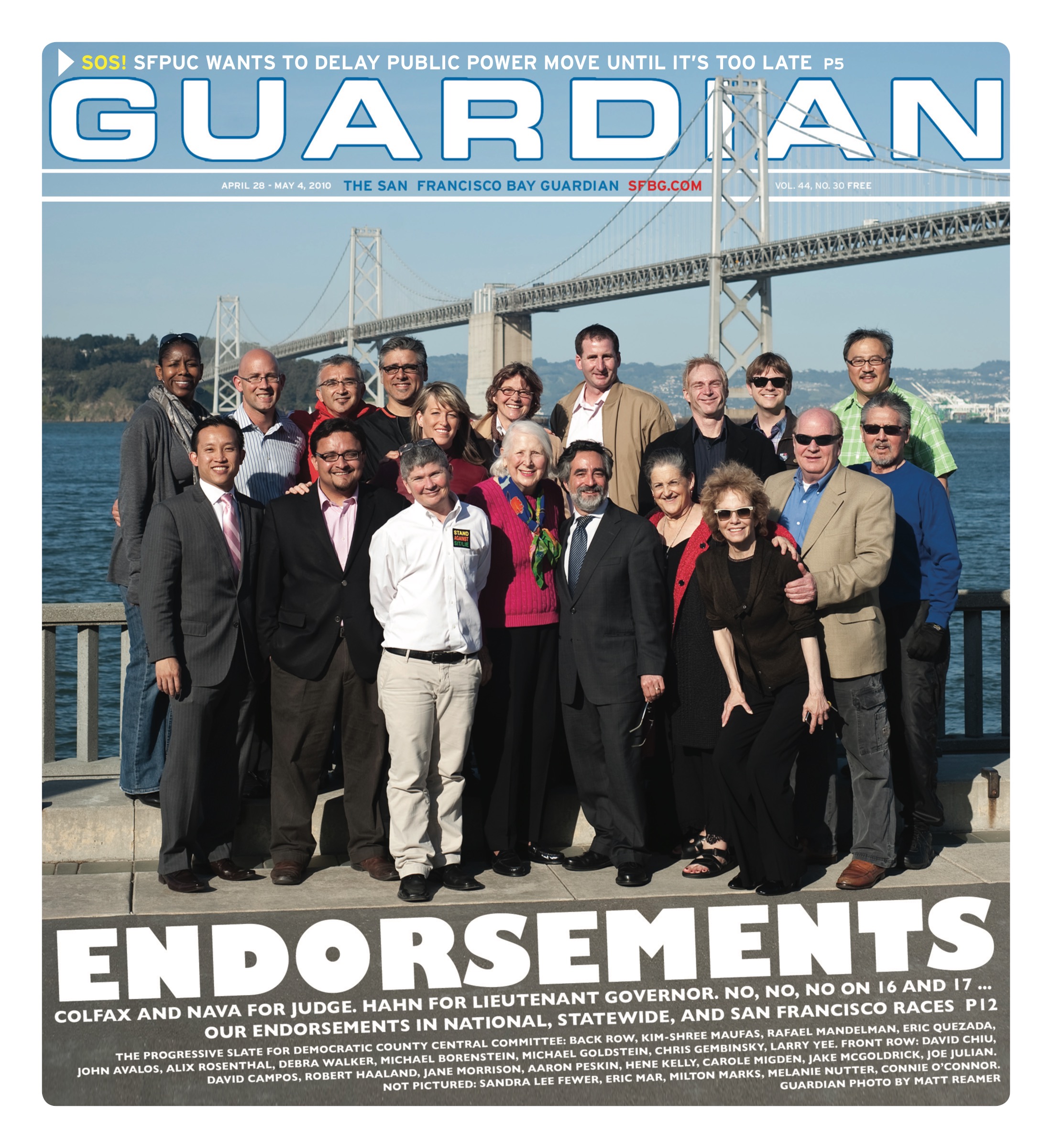
PROPOSITION A
SCHOOL FACILITIES SPECIAL TAX
YES
This measure would extend a 1990 parcel tax that expires in 2010 by another 20 years, keeping it at its current rate ($32 a year for single family homes and commercial enterprises, $16 a year per dwelling unit for mixed use buildings). The tax brings in $7 million a year for San Francisco school facilities and would finance seismic upgrades, structural strengthening and related improvements of its facilities, and child care centers. Vote yes.
PROPOSITION B
EARTHQUAKE SAFETY AND EMERGENCY RESPONSE BONDS
YES
It’s hard to argue against a $430 million bond act to upgrade police, fire, and water facilities to prevent a catastrophic collapse of the city’s most basic public safety infrastructure in the event of an inevitable earthquake. Hard — but not impossible: Sup. Chris Daly, the lone vote against Prop. B, points out that the bond money would be used to upgrade police stations but that the old County Jail at 850 Bryant St. wouldn’t get any help. Prisoners, it seems (even those who are awaiting trial and have been convicted of nothing) aren’t worth protecting. And the Fire Department has been very hazy about where it’s going to spend the cash. So we’ve got some concerns here — but on balance, we’re endorsing Yes on B.
PROPOSITION C
FILM COMMISSION
YES
By some accounts, this measure was put together in retaliation for Mayor Gavin Newsom’s November 2009 demand that Film Commission executive director Stefanie Coyote resign — shortly after her husband, actor Peter Coyote, supported Attorney General Jerry Brown over Newsom for governor. But Bill Barnes, who works as a legislative aide for Newsom ally Sup. Michela Alioto-Pier, the author of Prop. C, says Alioto-Pier was working on this measure even before Coyote got ousted.
Either way, it’s a positive step. Prop. C would streamline a convoluted permitting process for shooting films in San Francisco — a process that can involve multiple departments — and would create a one-stop shop. It would also split the power to appoint the film commissioners between the mayor and the board (6-5, respectively), and require that all 11 commissioners have specific qualifications or experience. Vote yes.
PROPOSITION D
RETIREMENT BENEFITS
YES
Prop. D is a compromise. Sup. Sean Elsbernd wanted to reform the city’s pension system by mandating higher employee contributions and an end to what’s known as “spiking” — giving some employees a big raise just before they retire. Under current law, that worker would get a pension based on the inflated salary.
Elsbernd wanted to change the calculation and base pensions on an average of the final three years of salary an employee earned. Labor countered that some lower-paid workers only reach their top pay at the end of their careers. The final deal would base pensions on a two-year average. Prop. D would also require future employees to contribute and extra 2 percent to their pensions and require the city to set aside some money every year for the pension and retiree health care systems. In the end, progressive Sups. David Campos and Eric Mar signed on, and the city employee unions aren’t opposed. Vote yes.
PROPOSITION E
BUDGET LINE ITEM FOR POLICE SECURITY
YES
Prop. E would make one simple tweak to the reporting requirements for San Francisco’s annual city budget: a line-item on how much is spent on security for city officials and visiting dignitaries. As things stand, the amount the police department spends to protect people like, oh, say Mayor Gavin Newsom while he is crisscrossing the state campaigning for (lieutenant) governor is kept secret. That’s information the public has a right to know. Vote yes.
PROPOSITION F
RENTERS’ FINANCIAL HARDSHIP APPLICATIONS
YES
Prop. F would allow a tenant facing a rent increase to file a petition with the Rent Board claiming financial hardship. If the tenant was unemployed, or had his or her wages cut by 20 percent or more, or didn’t get a cost of living increase in government benefits and was paying at least 33 percent of his or her income as rent, the rent hike would be delayed for 60 days pending a hearing. If the renter can establish hardship, the landlord would have to hold off on the increase until the tenant’s employment or benefit situation improved. Few San Francisco landlords would be hurt by the delay in what are typically modest rent hikes — but a lot of tenants could avoid eviction. Vote yes.
PROPOSITION G
TRANSBAY TRANSIT CENTER
YES
Prop. G, a policy statement, became a moot point earlier this year, but it’s still good for San Franciscans to affirm the city’s support for bringing high-speed rail service downtown. The California High-Speed Rail Project is moving to create bullet train service from SF to downtown Los Angeles using bond money approved by voters in 2008. Even though that bond measure named the Transbay Terminal as the northern terminus of the first phase, some officials raised doubts about whether the downtown location was the best choice. That rail service was integral to plans for the transit center, which is currently being rebuilt, so the Board of Supervisors placed this measure on the ballot to support that choice. Earlier this month, the California High-Speed Rail Authority considered other alternatives and voted to stay with the Transbay Terminal. That’s the right way to go; vote yes.
ENDORSEMENTS: National and state races
Editor’s note: the file below contains a correction, updated May 5 2010.
National races
U.S. SENATE, DEMOCRAT
BARBARA BOXER
The Republican Party is targeting this race as one of its top national priorities, and if the GOP can dislodge a three-term senator from California, it will be a major blow for the party (and agenda) of President Obama. The pundits are happily talking about how much danger Barbara Boxer faces, how the country’s mood is swinging against big-government liberals.
But it’s always a mistake to count out Boxer. In 1982, as a Marin County supervisor with little name recognition in San Francisco, she trounced then-SF Sup. Louise Renne for an open Congressional seat. Ten years later, she beat the odds and won a hotly contested primary and tough general election to move into the Senate. She’s a fierce campaigner, and with no primary opposition, will have a united party behind her.
Boxer is one of the most progressive members of the not-terribly progressive U.S. Senate. She’s been one of the strongest, most consistent supporters of reproductive rights in Washington and a friend of labor (with 100 percent ratings from the AFL-CIO and National Education Association). We’ve had our disagreements: Boxer supported No Child Left Behind, wrote the law allowing airline pilots to carry guns in the cockpit, and was weak on same-sex marriage when San Francisco sought to legalize it (although she’s come around). But she was an early and stalwart foe of the war in Iraq, split with her own party to oppose a crackdown on illegal immigration, and is leading the way on accountability for Wall Street. She richly deserves reelection, and we’re happy to endorse her.
CONGRESS, 6TH DISTRICT, DEMOCRAT
LYNN WOOLSEY
It’s odd that the representative from Marin and Sonoma counties is more progressive by far than her colleague to the south, San Francisco’s Nancy Pelosi. But over the years, Lynn Woolsey has been one of the strongest opponents of the war, a voice against bailouts for the big Wall Street banks, and a foe of cuts in the social safety net. We’re proud to endorse her for another term.
CONGRESS, 7TH DISTRICT, DEMOCRAT
GEORGE MILLER
George Miller has been representing this East Bay district since 1974, and is now the chair of the Education and Labor Committee and a powerhouse in Congress. He’s too prone to compromise (with George W. Bush on education policy) but is taking the right line on California water (while Sen. Dianne Feinstein is on the wrong side). We’ll endorse him for another term.
CONGRESS, 8TH DISTRICT, DEMOCRAT
NANCY PELOSI
We’ve never been terribly pleased with San Francisco’s most prominent Congressional representative. Nancy Pelosi was the author of the bill that created the first privatized national park at the Presidio, setting a horrible standard that parks ought to be about making money. She was weak on opposing the war, ducked same-sex marriage, and has used her clout locally for all the wrong candidates and issues. But we have to give her credit for resurrecting and pushing through the health care bill (bad as it was — and it’s pretty bad — it’s better than doing nothing). And, at a time when the Republicans are trying to derail the Obama presidency, she’s become a pretty effective partner for the president.
Her fate as speaker (and her future in this seat) probably depends on how the Democrats fare in the midterm Congressional elections this fall. But if she and the party survive in decent shape, she needs to take the opportunity to undo the damage she did at the Presidio.
CONGRESS, 9TH DISTRICT, DEMOCRAT
BARBARA LEE
Barbara Lee, who represents Berkeley and Oakland, is co-chair of the Progressive Caucus in the House, one of the most consistent liberal votes in Congress, and a hero to the antiwar movement. In 2001, she was the only member of either house to oppose the Bush administration’s Use of Force resolution following the 9/11 attacks, and she’s never let up on her opposition to foolish military entanglements. We’re glad she’s doing what Nancy Pelosi won’t — represent the progressive politics of her district in Washington.
CONGRESS, 13TH DISTRICT, DEMOCRAT
PETE STARK
Most politicians mellow and get more moderate as they age; Stark is the opposite. He announced a couple of years ago that he’s an atheist (the only one in Congress), opposed the Iraq war early, called one of his colleagues a whore for the insurance industry, and insulted President Bush and refused to apologize, saying: “I may have dishonored the commander-in-chief, but I think he’s done pretty well to dishonor himself without any help from me.” He served as chair of the House Ways and Means Committee for exactly one day — March 3 — before the Democratic membership overruled Speaker Pelosi and chucked him out on the grounds that he was too inflammatory. The 78-year-old may not be in office much longer, but he’s good on all the major issues. He’s also fearless. If he wants another term, he deserves one.
State races
GOVERNOR, DEMOCRAT
EDMUND G. BROWN
Jerry Brown? Which Jerry Brown? The small-is-beautiful environmentalist from the 1970s who opposed Pacific Gas and Electric Co.’s Diablo Canyon nuke and created the California Conservation Corps, the Office of Appropriate Technology, and the Farm Labor Relations Board (all while running a huge budget surplus in Sacramento)? The angry populist who lashed out at corporate power on a KPFA radio talk show and ran against Bill Clinton for president? The pro-development mayor of Oakland who sided with the cops on crime issues and opened a military academy? Or the tough-on-crime attorney general who refuses to even talk about tax increases to solve the state’s gargantuan budget problems?
We don’t know. That’s the problem with Brown — you never know what he’ll do or say next. For now, he’s been a terribly disappointing candidate, running to the right, rambling on about preserving Proposition 13, making awful statements about immigration and sanctuary laws, and even sounding soft on environmental issues. He’s started to hit his stride lately, though, attacking likely GOP contender Meg Whitman over her ties to Wall Street and we’re seeing a few flashes of the populist Brown. But he’s got to step it up if he wants to win — and he’s got to get serious about taxes and show some budget leadership, if he wants to make a difference as governor.
LIEUTENANT GOVERNOR, DEMOCRAT
JANICE HAHN
Not an easy choice, by any means.
Mayor Gavin Newsom jumped into this race only after it became clear that he wouldn’t get elected governor. He sees it as a temporary perch, someplace to park his political ambitions until a better office opens up. He’s got the money, the statewide name recognition, and the endorsement of some of the state’s major power players, including both U.S. Senators and House Speaker Nancy Pelosi. He’s also been a terrible mayor of San Francisco — and some progressives (like Sup. Chris Daly) argue, persuasively, that the best way to get a better person in Room 200 is to ship Newsom off to an office in Sacramento where he can’t do much harm and let the supervisors pick the next mayor.
But it’s hard to endorse Newsom for any higher office. He’s ducked on public power, allowing PG&E to come very close to blocking the city’s community choice aggregation program (See editorial, page 5). His policies have promoted deporting kids and breaking up families. He’s taken an approach to the city budget — no new revenue, just cuts — that’s similar to what the Republican governor has done. He didn’t even bother to come down and talk to us about this race. There’s really no good argument for supporting the advancement of his political career.
Then there’s Janice Hahn. She’s a Los Angeles City Council member, the daughter of a former county supervisor, and the sister of a former mayor. She got in this race way before Newsom, and her nightmare campaign consultant, Garry South, acts as if she has some divine right to be the only Democrat running.
Hahn in not overly impressive as a candidate. When we met her, she seemed confused about some issues and scrambled to duck others. She told us she’s not sure she’s in favor of legalizing pot, but she isn’t sure why she’s not sure since she has no arguments against it. She won’t take a position on a new peripheral canal, although she can’t defend building one and says that protecting San Francisco Bay has to be a priority. She won’t rule out offshore oil drilling, although she said she has yet to see a proposal she can support. Her main economic development proposal was to bring more film industry work to California, even if that means cutting taxes for the studios or locating the shoots on Indian land where there are fewer regulations.
On the other hand, she told us she wants to get rid of the two-thirds threshold in the state Legislature for passing a budget or raising taxes. She supports reinstating the car tax at pre-Gov. Arnold Schwarzenegger levels. She supports a split-roll measure to reform Prop. 13. She wants to see an oil-severance tax to fund education. She’s one of the few statewide candidates who openly advocates higher taxes on the wealthy as part of the solution to the budget crisis.
We are under no illusions that Hahn will be able to use the weak office of lieutenant governor to move on any of these issues, and we’re not at all sure she’s ready to take over the top spot. But on the issues, she’s clearly better than Newsom, so she gets our endorsements.
SECRETARY OF STATE, DEMOCRAT
DEBRA BOWEN
Debra Bowen is the only Democrat running, a sign that pretty much everyone in the party thinks she’s doing a fine job as Secretary of State. She’s run a clean office and we see no reason to replace her.
CONTROLLER, DEMOCRAT
JOHN CHIANG
Like Bowen, John Chiang has no opposition in the primary, and he’s been a perfectly adequate controller. In fact, when Gov. Schwarzenegger tried two years ago to cut the pay of thousands of state employees to the minimum wage level, Chiang defied him and refused to change the paychecks — a move that forced the governor to back down. We just wish he’d play a more visible role in talking about the need for more tax revenue to balance the state’s books.
TREASURER, DEMOCRAT
BILL LOCKYER
Bill Lockyer keeps bouncing around Sacramento, waiting, perhaps, for his chance to be governor. He was attorney general. Now he’s treasurer seeking a second term, which he will almost certainly win. He’s done some good things, including trying to use state bonds to promote alternative energy, and has spoken out forcefully about the governor’s efforts to defer deficit problems through dubious borrowing. He hasn’t, however, come out in favor of higher taxes for the rich or a change in Prop. 13.
ATTORNEY GENERAL, DEMOCRAT
KAMALA HARRIS
There are really only two serious candidates in this race, Kamala Harris, the San Francisco district attorney, and Rocky Delgadillo, the former Los Angeles city attorney. Harris has a comfortable lead, with Delgadillo in second and the others far behind.
Delgadillo is on his second try for this office. He ran against Jerry Brown four years ago and got nowhere. And in the meantime, he’s come under fire for, among other things, using city employees to run personal errands for him (picking up his dry-cleaning, babysitting his kids) and driving his car without insurance. On a more significant level, he made his reputation with gang injunctions that smacked of ethnic profiling and infuriated Latino and civil liberties groups. It’s amazing he’s still a factor in this race; he can’t possibly win the general election with all his baggage.
Harris has a lot going for her. She was among the first California elected officials to endorse Barack Obama for president, and remains close to the administration. She’s a smart, articulate prosecutor and could be one of the few women atop the Democratic ticket this year. We were never comfortable with her ties to Willie Brown, but he’s no longer a factor in state or local politics. These days, she’s more closely allied with the likes of State Sen. Mark Leno.
That said, we have some serious problems with Harris. She’s been up in Sacramento pushing Republican-style tough-on-crime bills (like a measure that would bar registered sex offenders from ever using social networking sites on the Internet) and forcing sane Democrats like Assembly Member and Public Safety Committee Chair Tom Ammiano to try to tone down or kill them (and then take the political heat). If she didn’t know about the problems in the SFPD crime lab, she should have, and should have made a bigger fuss, earlier.
But Harris has kept her principled position against the death penalty, even when it meant taking immense flak from the cops for refusing to seek capital punishment for the killer of a San Francisco police officer. She’s clearly the best choice for the Democrats.
INSURANCE COMMISSIONER, DEMOCRAT
DAVE JONES
Two credible progressives are vying to run for this powerful and important position regulating the massive — and massively corrupt — California insurance industry. Dave Jones and Hector De La Torre are both in the state Assembly, with Jones representing Sacramento and De La Torre hailing from Los Angeles. Both have a record opposing insurance industry initiatives; both are outspoken foes of Prop. 17; and either would do a fine job as insurance commissioner. But Jones has more experience on consumer issues and health care reform, and we prefer his background as a Legal Aid lawyer to De La Torre’s history as a Southern California Edison executive. So we’ll give Jones the nod.
BOARD OF EQUALIZATION, DISTRICT 1, DEMOCRAT
BETTY T. YEE
Betty Yee has taken over a job that’s been a stronghold of progressive tax policy since the days of the late Bill Bennett. She’s done well in the position, supporting progressive financial measures and even coming down, as a top tax official, in favor of legalizing (and taxing) marijuana. We’re happy to endorse her for another term.
SUPERINTENDENT OF PUBLIC INSTRUCTION
TOM TORLAKSON
Two prominent Democratic legislators are running for this nonpartisan post, state Sen. Gloria Romero of Los Angeles and Assembly Member Tom Torlakson of Martinez. It’s a pretty clear choice: Romero is a big supporter of charter schools who thinks parents should be able to move their kids out of one school district and into another (allowing wealthier white parents, for example, to abandon Los Angeles or San Francisco for the suburban districts). She’s been supported in the past by Don and Doris Fisher, who put a chunk of their GAP Inc. fortune into school privatization efforts. Torlakson wants more accountability for charters, opposes the Romero district-option bill, and has the support of every major teachers union in the state. Vote for Torlakson.
STATE SENATE, DISTRICT 8, DEMOCRAT
LELAND YEE
Sen. Leland Yee can be infuriating. Two years ago, he was hell-bent on selling the Cow Palace as surplus state property and allowing private developers to take it over. In the recent budget crisis, he pissed off his Democratic colleagues by refusing to vote for cuts that everyone else knew were inevitable (while never making a strong stand in favor of, say, repealing Prop. 13 or raising other taxes). But he’s always been good on open-government issues and has made headlines lately for busting California State University, Stanislaus over a secret contract to bring Sarah Palin in for a fundraiser — and has raised the larger point that public universities shouldn’t hide their finances behind private foundations.
Yee will have no serious opposition for reelection, and his campaign for a second term in Sacramento is really the start of the Leland Yee for Mayor effort. With reservations over the Cow Palace deal and a few other issues, we’ll endorse him for reelection.
Correction update: Yee’s office informs us that the senator suports an oil-severance tax and a tax on high-income earners and “believes that Prop. 13 should be reformed,” although he hasn’t taken a position on Assemblymember Tom Ammiano’s reform bill.
STATE ASSEMBLY, DISTRICT 12, DEMOCRAT
FIONA MA
Fiona Ma’s a mixed bag (at best). She doesn’t like Pacific Gas and Electric Co. and supports public power, but comes up with strange bills that make no sense, like a 2009 measure to limit rent control in trailer parks. Why does Ma, who has no trailer parks in her district, care? Maybe because the landlords who control the mobile home facilities gave her some campaign cash. She faces no opposition, and we’re not thrilled with her record, but we’ll reluctantly back her for another term.
STATE ASSEMBLY, DISTRICT 13, DEMOCRAT
TOM AMMIANO
When the history of progressive politics in modern San Francisco is written, Tom Ammiano will be a central figure. His long-shot 1999 mayoral campaign against Willie Brown brought the left to life in town, and his leadership helped bring back district elections and put a progressive Board of Supervisors in place in 2000. As a supervisor, he authored the city’s landmark health care bill (which Newsom constantly tries to take credit for) and the rainy day fund (which saved the public schools from debilitating cuts). He uses his local influence to promote the right causes, issues, and candidates.
And he’s turned out to be an excellent member of the state Assembly. He forced BART to take seriously civilian oversight of the transit police force. He put the battle to reform Prop. 13 with a split-role measure back on the state agenda. And his efforts to legalize and tax marijuana are close to making California the first state to toss the insane pot laws. As chair of the Public Safety Committee, he routinely defies the police lobbies and the right-wing Republicans and defuses truly awful legislation. We’re glad Ammiano’s still fighting in the good fight, and we’re pleased to endorse him for another term.
STATE ASSEMBLY, DISTRICT 14, DEMOCRAT
NANCY SKINNER
Nancy Skinner has taken on one of the toughest, and for small businesses, most important, battles in Sacramento. She wants to make out-of-state companies that sell products to Californians collect and remit sales tax. If you buy a book at your local bookstore, you have to pay sales tax; if you buy it from Amazon, it’s tax-free. That not only hurts the state, which loses hundreds of millions of dollars in tax revenue, it’s a competitive disadvantage to local shops. Skinner’s a good progressive vote and an ally for Ammiano on the Public Safety Committee. We’re happy to endorse her for another term.
STATE ASSEMBLY, DISTRICT 16, DEMOCRAT
SANDRE SWANSON
Sandre Swanson represents the district where BART police killed Oscar Grant, but he wasn’t the one out front pushing for more civilian accountability; that was left to SF’s Ammiano. And while Swanson was generally supportive of Ammiano’s bill, he was hardly a leader in the campaign to pass it. This is too bad, because Swanson’s almost always a progressive vote and has been good on issues like whistleblower protection (a Swanson bill that passed this year protects local government workers who want to report problems confidentially). We’ll endorse him for another term, but he needs to get tougher on the BART police.
Newsom’s opponent Hahn calls for LA boycott of Arizona
The Arizona legislation that has sparked fury nationwide and even prompted City Attorney Dennis Herrera to call for a boycott of all things Arizona has also served to highlight a difference in opinion between Mayor Gavin Newsom and his opponent in the Lieutenant Governor’s race, Los Angeles City Councilwoman Janice Hahn.
In a Chronicle story today, Newsom took a murky stance on the Arizona boycott idea:
“Newsom argued that a total boycott of Arizona businesses could bring the city a wide range of problems that haven’t even been considered. ‘The notion of boycotting a state and every business that does business in the state is an extraordinarily complicated matter,’ he warned.”
To Hahn, the matter isn’t so complicated. According to a press release we received from her campaign:
“In response to newly-enacted legislation in Arizona which will require immigrants to carry documents about their immigration status at all times, and will allow police officers to question residents about their immigration status, today, Councilwoman Janice Hahn will introduce a resolution calling on the City of Los Angeles to boycott the State of Arizona. The resolution will call for Los Angeles, and all of its departments, to end any and all contracts with Arizona-based companies and to stop doing business with the state.”
The CCA “conundrum”
The negotiations for the city’s green municipal power program still haven’t resulted in a finalized contract, and time is running out.
In 42 days, voters will decide whether Prop 16, the ballot initiative dubbed the “Taxpayers Right to Vote Act,” ought to be enshrined into state law. If a simple majority votes yes, the state constitution will be changed to require a two-thirds supermajority vote at the ballot before any municipal electricity program can move forward, effectively making it impossible for local governments to offer alternatives to investor-owned utility companies. Pacific Gas & Electric Co., the 105-year-old utility that gained infamy with the movie Erin Brockovich after it was accused of causing groundwater pollution which led to a cancer cluster in Hinkley, Calif., is poised to spend $35 million to pass Prop 16.
Here in San Francisco, where the vision for a green municipal power program goes back at least half a decade (and PG&E’s monopolistic grip dates back much farther), the plan’s most dedicated proponents have come to view Prop 16 as “the grim reaper.” At a meeting in City Hall last Friday about CleanPower SF, the community choice aggregation (CCA) program that could provide San Franciscans with 51 percent renewable electricity, Sup. Ross Mirkarimi repeated a mantra he’s intoned since approximately last year at this time: “All hands on deck.” Mirkarimi’s face looked tense, and his anxiety about the closing window of opportunity was plain even as he tried to display optimism. If a CleanPower SF program contract is not signed before June 8, when Prop 16 is decided, years of hard work and effort could be lost. With $35 million worth of carefully crafted PR messaging that reveals nothing about the sole financier of the measure or its anti-competitive intentions, Prop 16 has a decent shot at voter approval.
The race against the clock has been intensified by the fact that the San Francisco Public Utilities Commission, the city agency tasked with implementing CCA, has been unable (or unwilling, some critics charge) to broker a deal with Power Choice Inc., the energy service provider selected for CCA. Negotiating sessions have been ongoing since February, with SFPUC staff members, SFPUC General Manager Ed Harrington, three city attorneys, and staff of the Local Agency Formation Commission devoting hours to negotiations. “We are continuing to work hard to secure a contract,” SFPUC Assistant General Manager of Power Barbara Hale told the Guardian.
Yet as the days pass, the absence of a signed contract in hand has program advocates increasingly worried, frustrated, and suspicious of the SFPUC. “My sense, and my fear quite frankly, has been that the level of commitment [from the SFPUC] isn’t there, and if it were there … then we would have a finalized contract,” Sup. David Campos noted at a joint meeting between LAFCo and the SFPUC on Friday.
John Rizzo of the Sierra Club told the Guardian that Harrington approached the environmental group last week requesting that it join the SFPUC in issuing a press release blaming PG&E’s Prop 16 for marring CCA’s prospects. Harrington was ready to announce that the CCA had reached a preliminary contract, but not really a contract at all, since key terms such as a rate structure would not be hammered down till after the June 8 election. The Sierra Club declined to go along with that idea. Such a move would have jeopardized the program’s shot at success. Campos highlighted this problem at the meeting, saying, “Even though there are risks associated with CCA, the risk of not doing this and not having as concrete a contract by the election is greater.”
Green power advocate Eric Brooks noted that he had received a call from Nancy Miller, the executive director of LAFCo, notifying him that the SFPUC felt that Prop 16 had created a climate that made it too difficult to negotiate, and that a press release would be issued explaining as much. In the end, the SFPUC agreed to stay the course at the negotiating table. At Friday’s meeting, there was no mention of pushing the contract back to a later date. Instead, everyone nodded in polite agreement that all hands were, indeed, on deck.
But during his presentation to commissioners, Harrington emphasized the difficulty in meeting the twin program goals: green power on one hand, and competitive pricing on the other. He displayed charts showing how much more expensive wind and solar were than “brown power,” the fossil fuel and nuclear variety currently offered by PG&E. When challenged on the SFPUC’s commitment, Harrington responded tersely, “Staff commitment does not change the economic reality of the world.”
Brooks, who has weighed in and watched the process unfold since the beginning, later charged that Harrington was presenting a wholly different picture from what was originally agreed to as a way of subverting the program. “He purposely showed the numbers so that they would look worse,” Brooks said. “His key trick was … allowing the contractor the option of a 3-to-5 year contract. No one thinks you can pay renewable energy off in three years, that’s ridiculous. … He knows that the plan was to pay this off over 15 years. There’s no way he didn’t know that the idea is to pay it off in 15 years.”
Harrington was not available for comment. But Hale, who did speak with the Guardian, told us, “We’re absolutely open to a longer-term contract.” The problem, she said, has been determining a rate that makes sense both to guarantee the long-term viability of the program while meeting the renewable-energy program goals and the financial commitment necessary to make it worthwhile for the service provider. It’s like a big control board with multiple dials, and the problem seems to lie in twisting the knobs to find the appropriate setting. So far, they haven’t hit the sweet spot.
Meanwhile, the political backdrop of this “conundrum,” as Harrington called it, is that Mayor Gavin Newsom, now a candidate for Lieutenant Governor, would be placed in an awkward position if a Board-approved contract for the CCA program landed on his desk before June 8. If he endorsed the contract with his signature, he would earn the ire of PG&E, a moneyed political ally that could help him reach the office he aspires to. But if he vetoed CCA, it would amount to a stunning display of hypocrisy, since he would be a green mayor rejecting the greenest municipal power program ever attempted. Newsom, who wants to name a street after former Mayor Willie Brown even as Brown is publicly arguing in favor of Prop 16, could avoid that dilemma altogether if the contract negotiations just imploded, or were at least delayed till after June 8.
No more stalling on CCA
EDITORIAL There’s nothing wrong with city officials taking tough stands in negotiations with private contractors. Hundreds, thousands of times in the past few years, San Francisco department heads have rolled over and given away the store in sweetheart deals that put the city on the hook for all the money, make the public take all the risk, and give a private outfit all the profit. Pacific Gas and Electric Co. (remember the Tulock-Modesto sellout contract?), Lennar Corp., Recurrent Energy, and countless other developers, builders, suppliers, and service providers have easily taken the public to the cleaners with contracts that never seemed to get stuck in the due diligence process.
But when there’s a looming deadline, hundreds of millions of dollars, and the city’s energy future and environmental footprint at stake, why is the San Francisco Public Utilities Commission moving so incredibly slowly to hammer out a deal for the city’s community choice aggregation (CCA) program? And why is PUC general manager Ed Harrington doing everything in his power to make sure that nothing happens that might put the city in the power business until after PG&E’s initiative, Prop. 16 — which would block public power efforts — passes at the polls?
It’s infuriating — and the supervisors need to tell the PUC that they won’t approve anything the agency does or wants to do until this contract is completed.
Harrington’s shop has known for more than a year that it needed to work out a business deal with a supplier that could replace PG&E and manage a program to buy greener, cheaper power in bulk and resell it to San Francisco residents. Marin County is setting up a similar program and is far ahead of San Francisco. The city has chosen a vendor, Powerchoice Inc., run by people completely qualified to handle the business.
And now there’s a absolute, drop-deal mandate: the city has to complete negotiations and get the program underway before the June 8 election. That’s because PG&E is spending $35 million to try to pass an initiative that would mandate a two-thirds vote of the public before any new CCA can begin selling power to customers. If San Francisco wants to present a solid legal case that its CCA is already in business, the contract with Powerchoice needs to be completed and signed, now.
But Harrington has, to put it kindly, been dragging his feet. The negotiations are hung up on a few points, although none are deal-breakers; Powerchoice already has agreed to assume some of the financial risk, which was the biggest obstacle to a deal. Now it’s just a matter of hammering out the details — but the PUC staff isn’t acting as if there is any time pressure at all.
In fact, last week Harrington circulated a draft press release all but announcing that he was tossing the whole deal under the bus and postponing negotiations until after the June election. He wanted to say that the "uncertainly" surrounding Prop. 16 made a deal impossible.
But Powerchoice isn’t walking away or complaining about the initiative. The company’s CEO, Sam Enoka, made it clear to us in an interview April 26 that he is eager to move forward. If Harrington — an experienced negotiator with a large staff at his disposal — and his boss, Mayor Gavin Newsom, wanted a deal, it could be finished well ahead of the deadline.
Instead, Harrington showed up at the Local Agency Formation Commission meeting April 23 with charts and a PowerPoint presentation purporting to show that renewable energy is too expensive to sell at rates comparable to what PG&E charges local customers. That misses the point — PG&E’s rates are going up every year and renewables are coming down, and the greatest risk to the city, the ratepayers, and the planet is sticking with the unreliable private utility that relies on fossil fuels and nuclear power for much of its electricity portfolio.
If the city has legitimate issues with Powerchoice, fine: Sit down and begin working them out. Now. But the only thing we can see at this point is the administration of a mayor who wants to be lieutenant governor intentionally delaying the process and giving PG&E exactly what it wants. (We called the PUC April 26, our print deadline, to ask why there were no talks scheduled that day, but Harrington wasn’t available; he was taking the day off.)
Sups. Ross Mirkarimi and David Campos suggest that the board simply refuse to sign off on any contracts, appropriations, or other approvals for anything the SFPUC does until this contract is completed. That’s a fine idea; they should start today.