Films

Rep Clock

0

Schedules are for Wed/29–Tues/4 except where noted. Director and year are given when available. Double and triple features are marked with a •. All times are p.m. unless otherwise specified.

CASTRO 429 Castro, SF; (415) 621-6120, www.castrotheatre.com. $7.50-12. Check website for program information.

CHRISTOPHER B. SMITH RAFAEL FILM CENTER 1118 Fourth St, San Rafael; (415) 454-1222, www.cafilm.org. $6.50-10.25. “San Francisco Grand Opera Cinema Series:” Tosca, Thurs, 7. “Short Films from the 2010 Sundance Film Festival,” Dec 31-Jan 6, call for times.

PACIFIC FILM ARCHIVE 2575 Bancroft, Berk; (510) 642-5249, www.bampfa.berkeley.edu. $5.50-9.50. Closed until Jan. 13.

RED VIC 1727 Haight, SF; (415) 668-3994. $6-10; www.redvicmoviehouse.com. Check website for program information.

ROXIE 3117 and 3125 16th St, SF; (415) 863-1087, www.roxie.com. $5-9.75. Hadewijch (Dumont, 2009), Wed-Thurs and Sat-Tues, call for times.<\!s>*

Baby daddy drama

0

arts@sfbg.com

YEAR IN FILM Who’s your daddy? That tired line was more relevant ever in 2010, as big screens saw a firming trend in sperm-donor comedies. These films have attacked so-called family values from a much more commonplace front. After all, artificial insemination is an everyday occurrence. Thousands of multiple births happen in this country every year — according to the Centers for Disease Control and Prevention, there were almost 6,000 triplet births in 2007 — for mothers who are increasingly older and unmarried, and a good many of the multiples result from assisted reproductive therapies such as artificial insemination.

Many a hand has been wrung, historically, over the impact of childbearing among unmarried women: the CDC report’s author cites concerns about family structure and the economic security of children, stating that single moms have more limited financial resources than married breeders. But then what to make of such 2010 comedies as The Kids Are All Right, The Switch, and The Back-up Plan? — not to mention the small-screen tabloid shenanigans of Octomom and the arti-insem antics of the Gosselin family?

Coming on the heels of Baby Mama (2008), which saw two women surmounting class barriers to bond over surrogacy, and welfare-sploitation drama Precious (2009), which included possibly the most nightmarish single mom ever, 2010’s unmarried, artificially inseminated cinematic moms tellingly embody the idea of choice — though the repercussions of their decision to have a child by either an unnamed baby daddy or a known, accomplished stud donor, are still considered the stuff of laughs, both realistic and aspirational.

While The Back-Up Plan rings as the most by-the-book, tepid rom-com of the lot and The Switch feels like a curveball, focusing more on Jason Bateman’s drunken DNA switcheroo and his resulting sad-faced and neurotic offspring (implying a kind of ambivalence about artificial insemination), the best of the bunch is The Kids Are All Right. Grounded and realistic, the dramedy is confident enough to leave a few loose ends dangling, to give the power to the fruit of those supposedly unnatural unions. Just one teensy step beyond gay marriage, gay parenting in The Kids Are All Right is normative, even bourgeois, with one mom, Nic (Annette Bening), working as a doctor and the other, Jules (Julianne Moore), a stay-at-home searching for herself.

As open-minded as the narrator of the Who song that gives the film its title, kids Joni (Mia Wasikowska) and Laser (Josh Hutcherson) are piecing out their identities, in part by independently searching out their biological donor dad Paul (Mark Ruffalo), in part by making some very adult decisions about whether they want to have a relationship with him and whether they can trust him. Eons away from the classic messed-up single-mom offspring, Joni and Laser turn out to be more psychologically on-point and morally centered than their moms or bio pop Paul, a feckless Peter Pan charmer ready to jump into the family that life has presented him but irresponsible and thoughtless when it comes to embarking on an affair with Jules.

The painfully transparent, slowly-evolving hurt look on Nic’s face when she realizes the two are sexually involved turns our sympathies around to the side of the mom saddled with the bad cop-disciplinarian role, the uptight one seemingly at odds with the kickback California sunshine. A recent bitter, real-life custody battle between a U.K. lesbian couple and their sperm donor hasn’t sorted out quite so well. Family apparently has its limits — and its moments of forgiveness. The 1970s and ’80s TV and musical clans — à la the bunches Brady, Partridge, and Osmond — may have pushed a semi-subtextual message about togetherness in the face of social and generational upheaval, but these women and their kids are still working it out as they go.

Rate irate

0

arts@sfbg.com

YEAR IN FILM “Bloody bugger to you, you … beastly bastard. Shit. Shit shit shit shit shit shit shit shit. F-fornication. Fuck. Fuck fuck fuck fuck and fuck. Fuck, fuck, and bugger. Bugger, bugger, buggety buggety buggety fuck. Fuck ass. Balls! Balls! Fuckety shit. Shit, fuck and willy. Willy, shit and fuck, and … tits.”

The above is, in toto, the reason why The King’s Speech — a movie that might very well turn out Oscar’s idea of this year’s Best Picture next February — is rated R. This childish explosion of potty-mouth is coaxed from England’s future king (Colin Firth) by his speech therapist (Geoffrey Rush) to demonstrate that the former’s crippling stammer flies away whenever he’s unself-consciousness enough to cuss a bit. It’s a comic moment (one of few, and perhaps the film’s highlight in general) that, by reducing the words to sniggering playground naughtiness — this king is, after all, in a state of arrested development — robs them of any genuine scatology or shock value. They’re just words.

But those words (give or take a few fucks and shits — only the MPAA can or would bother to count every rapid-fire cuss) were still enough to get this otherwise very chaste, polite Masterpiece Theatre exercise classified with Saw 3D and The Human Centipede as viewable by minors only with parental accompaniment. Not that many teens are likely to be lining up for The King’s Speech — certainly far fewer than saw Saw 3D with or without adult chaperoning. But really, this is what they need protecting from?

This was a year in which the usual grousing undercurrent about arbitrary ratings-board standards started to seep overground. There were small hubbubs about two excellent documentaries, The Tillman Story and A Film Unfinished, getting R’s due to cursing on one hand and nudity (among Nazi concentration camp inmates) on the other. In both cases prudishness means these searing indictments of historical wrongs probably can’t be used for classroom educational purposes.

A larger controversy surrounded Blue Valentine, the acclaimed indie feature slapped with an NC-17 for a sex scene so subversive that no one who saw the film at Sundance could recall it; the MPAA rating mystified many. Turns out the scene in question is a happy flashback in this slow-agonizing-death-of-a marriage portrait, with Michelle Williams’ thrusty body language expressing clear enjoyment of Ryan Gosling’s mouthy activities downtown. Nonetheless, there’s nothing more explicit displayed than the outside of her thighs — as one colleague put it, “I’ve seen more of Britney Spears on the Internet.” The drama’s sobriety and its awards momentum finally won a rare MPAA reversal on appeal, reducing its rating to R.

But the case still underlines the injustice of our current system. As Kirby Dick’s This Film Is Not Yet Rated pointed out in 2006, as a tool of the Hollywood mainstream the MPAA routinely judges independent films more harshly than major studio releases. It also exercises double standards when it comes to gender nudity and gender-preference sexuality, and most crucially continues to heighten the American morality gap between depictions of sex and violence.

These complaints have prompted some vague hints of change afoot, albeit more toward hitting torture-porn horror harder than lightening up on the birds ‘n’ bees. In any case, it’s difficult to be very hopeful: for every progressive cultural step forward these days, there seem to be two Tea Party dance-steps back. It was announced earlier this month that Christian pastor and cable honcho Robert H. Schuller had contracted to broadcast G-rated versions of movies like the original Alien (1979) and Predator (1987). OK, so they’ll have bad language and explicit violence removed; but even these eviscerated edits will still offer entertainment predicated on the horrific (if now nongraphically suggested) murders of humans by icky monsters. Giving kids nightmares is more godly (and provides a more “positive message,” per the Rev. Schuller) than showing them (God forbid) a nipple.

Such hypocrisies run rampant in U.S. entertainment and society in general. Media outlets generally refuse to advertise NC-17 films, giving them and their modicum of sexual explicitness the commercial kiss of death while most kids freely access porn online. Screen violence grows ever more desensitizing; explosions of cars, buildings, entire cities, or planets are viewed as harmless while anything truly unpleasant enough to act as a deterrent sparks outrage. (By now the escapist Saw and Hostel movies get shrugged at, whereas the recent Killer Inside Me remake offended many because its protracted scenes of domestic violence were realistically painful to watch.)

Penises are now OK in small doses, albeit only in the clownish contexts of Forgetting Sarah Marshall (2008), Observe and Report (2009), etc. Ironically, any time sex is taken seriously, sans juvenile humor or lurid “erotic-thriller” type judgment, it becomes unfit for allegedly innocent eyes. Blue Valentine‘s good sex, and subsequent bad breakup sex, disturbs the MPAA because it is all too real-world relatable in both its pleasure and fallibility, something you won’t often find in porn, either.

The logic gap grows ever more ridiculous even as our culture wars’ battle lines harden. Imagine a Palin White House two years hence, presiding over a land in which sex education is nonexistent, abstinence clubs are the new Honor Society, and teenage pregnancy rates skyrocket. When in doubt as to the nation’s course, say grace, then settle down to dinner with the kids as you watch a “clean” tube edit of something like 1995’s Braveheart, its medieval spears through the chest trimmed but that humorous throwing of a prince’s homosexual BFF from the castle tower left intact. Then drift off to slumberland, family values affirmed.

Past imperfect

0

arts@sfbg.com

YEAR IN FILM We’re all media scavengers now, but archival sounds and images remain a tantalizing lure for both the documentary profile and its surrealistic double, the found footage film. The first repackages capsules of the past while the second hijacks them — different economies of exchange, to be sure, though perhaps less starkly contrasted to those accustomed to hyperlinking their way through the dustbin.

The use of obscure footage as leverage is exceedingly clear in Jean-Michel Basquiat: The Radiant Child, a film structured around director Tamra Davis’ intimate camcorder interview with the artist in 1985. The close-up portrait gives us Basquiat’s sly intelligence, spacey charisma, and tragic oversensitivity to judgment — all to the good, but Davis’ inability to reckon with the exchange value of her insider access is disappointing. Selling and chronicling are inextricably linked with the celebrity artist, but Basquiat’s early graffiti partner Al Diaz is the only interviewee who addresses the issue of the golden goose frankly.

The Rolling Stones have always excelled at selling themselves, so it’s no surprise to see Mick and Keith’s executive producer credits on Stones in Exile. Fortunately for us, director Stephen Kijack (2006’s Scott Walker: 30 Century Man) recognizes 1972’s Exile on Main Street as a masterpiece of vibe and accordingly focuses great attention on the zonked record’s mise-en-scène. But the strictly MOR slate of interviewees — alas, no Pussy Galore here — makes the scraps of Robert Frank’s long suppressed Cocksucker Blues (1972) feel all the more bowdlerized.

The bankable aura of the rarely seen supplants Frank’s prickly immediacy, and the dream of a rock ‘n’ roll cinema is the poorer for it. If it’s easier to accept the brief stream of Jonas Mekas’ New York City film-diaries borrowed in LennonNYC, that’s because the footage serves a narrow expositional purpose in establishing the bohemian milieu that John Lennon and Yoko Ono embraced — and also because Mekas is himself interviewed. The PBS-produced doc’s failings are the conventional ones, but its archival trove does illuminate Lennon and Ono’s creative collaborations, especially insofar as their art hinged upon probing self-consciousness and the redemptive potential of intimacy.

On the other side of the archival aisle, the mad detectives and film theorists who whisper hidden truths in our ears have become increasingly ambitious storytellers. Johan Grimonprez’s inventive Double Take slips into the realms of the unreal by characterizing the Cold War as a literally Hitchcockian play of ciphers, while Yael Hersonski’s A Film Unfinished submits an oft-cited, little-understood Nazi propaganda film to ontological deliberation. Adam Curtis introduces his most recent raid of the archive, It Felt Like a Kiss, with print titles that speak for all these projects: “When a nation is powerful it tells the world confident stories about the future/ The stories can be enchanting or frightening/ But they make sense of the world/ But when that power begins to ebb the stories fall apart/ And all that is left are fragments which haunt you like half-forgotten dreams.”

As with Curtis’ earlier multipart films, It Felt Like a Kiss registers history as a shifting series of simultaneities and unforeseen consequences. The only slightly tongue-in-cheek cast includes Doris Day, Rock Hudson, Saddam Hussein, Enos the cosmonaut chimp, and everyone above level seven in the CIA. Initially conceived as a multichannel promenade, the film is named for the singularly disturbing pop song Carole King penned for Phil Spector and his Crystals. It’s one of four ’60s sides Curtis builds out as deeply personal, but emblematic chronicles of anguish and dread (the others are “I’ll Be Your Mirror,” “River Deep, Mountain High” and “Wouldn’t It Be Nice?”). In each case, Curtis surveys the decade’s interlocking horror shows with something like poignancy — a new feature of his work.

Atop all the uncanny déjà vus and dream-life convergences, It Felt Like a Kiss also serves up one of the greatest WTF endings in recent memory. After revealing a bunker’s worth of government computers (repurposed from Cold War fighting to credit card debt), Curtis cuts to Pillow Talk (1959). Doris Day is a vision of contentment going to bed, but then something disturbs her — on the soundtrack, a soaring engine noise is followed by a hard cut to black silence. Amazed at how economically Curtis suggests the coming impact, we cue the sequence up again and let our jaws drop when we see Day’s room number: 2001.

To be sure, there’s no rule that found footage films must generate conspiratorial heat. Jay Rosenblatt’s The Darkness of Day materializes a reserved contemplation of suicide using industrial discards — the forgotten nature of these older films itself becoming a token of loss in an elegiac context. Oblique images float upon fragmented suicide stories narrated from many different vantages: near and far, first-person and third, male and female, young and old, anonymous and notable. We hear excerpts drawn from 10 years of a diary of depression, read of an ancient Egyptian’s dispute with his own soul, and learn about the first man to jump off the Golden Gate Bridge.

This last story surfaces with a montage of the bridge’s construction — a monument, but to what? — and might be read as a critique of The Bridge (2006), which unaccountably turned us into voyeurs of suicide. The Darkness of Day travels the path of Night and Fog (1955), regarding trauma indirectly, as traces and shadows. Industrial footage is not the most obvious resource to make darkness visible, but Rosenblatt’s use of mass-produced materials subtly underscore the film’s suggestion that while suicide is always discrete and thus unknowable, it is also a social phenomenon.

For a more concrete cultural history glazed with Debordian wit, Andrei Ujica’s The Autobiography of Nicolae Ceausescu is matchless. After opening with a thoroughly demystified, inquisitorial video of Ceausescu and his wife Elena in 1989 — previously seen in Ujica’s 1992 collaboration with Harun Farocki, Videograms of a Revolution — we double back to the spectacular public funeral for the Romanian leader’s predecessor, Gheorghiu-Dej, in 1965. From here, Ujica proceeds more or less chronologically (and without voice-over) through Ceausescu’s decades in power, collecting speeches, press conferences, soft debates, home movies, inspections of factories and construction sites, and trips abroad to Communist countries and Hollywood (a letdown after the stupefying parades in China and North Korea).

One of the director’s most cunning insights is that since the totalitarian state stages reality to furnish proof of its own dominion — the problem with measuring Triumph of the Will (1933) as documentary — the resulting footage might be considered as if dictated by the leader. But by letting these “autobiographical” materials run at length, Ujica also opens a space for the accidents and lacunae that surely would have been excised from the official record. The fact that it’s so easy to imagine the propaganda version of this footage is part of the point: we calculate where the cuts would have been to “correct” Ceausescu’s diminutive posture and speechmaking, and in that gap lies much of 20th century history. The closest Ujica comes to giving the game away is when he cuts from one of Ceausescu’s baroque rhetorical performance (filmed in black-and-white, as with everything else we’ve seen up to this point) to his cheating at volleyball in a color home movie. It’s a wonderfully rude swipe at rulers everywhere and likely the single most smashing edit of the year.

Goal difference

0

cheryl@sfbg.com

YEAR IN FILM Making a mistake on the playing field can haunt an athlete for the rest of his or her career. For Colombian soccer star Andrés Escobar, a particularly heartbreaking blunder — an own goal during the 1994 World Cup — proved fatal. Just two weeks after Colombia’s first-round defeat in the tournament they’d been favored to win, team captain Escobar was shot after leaving a nightclub in his hometown of Medellín. There were rumors the killer yelled “Goal!” as he unloaded.

Presented merely as a sports-history anecdote, Escobar’s demise is sad and senseless. But his murder wasn’t an isolated incident, just a particularly high-profile one; it was part of an unimaginable tide of violence that swept Colombia in the 1980s and ’90s. If you watched the 2010 World Cup on ESPN, you probably saw commercials for The Two Escobars, presented as part of the channel’s “30 for 30” documentary series. Participants included genre pioneer Albert Maysles, whose film was about Muhammed Ali; Ice Cube, who used his own South Central childhood to reflect on the Raiders’ 1982 move from Oakland to Los Angeles; and brothers Jeff and Michael Zimbalist, whose longer entry The Two Escobars sifted through years of Colombian history to trace the corresponding lives of Andrés “The Gentleman of Football” Escobar and drug kingpin Pablo Escobar.

At 32, Jeff, who lives in San Francisco, is the older brother by 17 months. In 2005, he codirected the award-winning Brazilian music doc Favela Rising. Michael, an actor and writer who ran a theater company in Mexico for several years, lives in New York City. Though they’re Americans, the Zimbalists feel a strong connection to Colombian culture. They were researching another film in the country (previous endeavors included a project with Colombian superstar Shakira) when ESPN asked them to pitch an idea for “30 for 30.” Though the shared last name of the unrelated Andrés and Pablo makes for a memorable title, the brothers didn’t use the coincidence as a starting point.

“We didn’t choose the title until really late, actually, because it felt like it was more of a portrait of a time period. It was about the hopes and dreams of the Colombian people as told through the vehicle of these two characters,” Jeff says. “The choice to use the two characters came about more organically than that, too. Initially we had the assignment to go find story ideas for the ESPN series that were about the impact of sports on society, and vice versa.”

After learning more about Andrés, they knew they’d found a captivating subject. They also realized that they would need to contextualize his story in order to tell it properly.

“We didn’t want to make a whodunnit about who pulled the trigger,” Jeff says. “It was a lot more interesting to ask the question of how an athlete gets killed for making a mistake. But in order to understand that, you need to understand what narco-soccer is. We quickly realized that hadn’t been covered before. And that meant that people were very reluctant to talk about it for a number of reasons: out of fear, shame, or they didn’t want to revisit a traumatic time period.”

The idea of “narco-soccer” led the filmmakers directly to their other subject. “You can’t really explain the whole context of narco without understanding Pablo Escobar. And it also felt unwieldy to not tie the societal story to a subject, or to a personal narrative,” Jeff explains. “So using Pablo as the tool through which we could explain society, and Andres as the tool through which we could understand sports, the next challenge was finding their overlaps. They only literally overlap a number of times in their lives. So how does the story justifies the use of these two characters? It has to be thematic — and there was tons of great, thematic overlap, and parallel and contrast, between the two Escobars.”

If you weren’t among the millions who watched The Two Escobars‘ repeat showings on ESPN (or caught it at the Sundance Kabuki as part of the San Francisco Film Society’s “SFFS Screen” programming), here’s a crash course in narco-soccer, as explained by the movie: during the ’80s and ’90s, Colombian drug lords invested in soccer teams as a way to launder their ill-gotten gains. As teams’ coffers grew, so did their ability to hire top-notch players. Sides flush with dirty cash racked up victories and corruption behind the scenes grew to outlandish proportions. Referees could easily be bought — or eliminated. A huge soccer fan who’d risen from poverty, then used his wealth to build fields in the slums, Pablo was one of these investors. Andrés, of course, was one of the league’s stars.

Using no narrator, The Two Escobars instead weaves its account with contemporary interviews (the exhaustive list of talking heads includes soccer legends, jailed gangsters, coaches, cops, and the sisters of both Escobars) and expertly edited archival footage that enables the viewer to witness just about everything discussed: the might of Colombia’s national team in the run-up to the 1994 World Cup; the sight of Pablo enjoying soccer on both his palatial estate and, incredibly, while incarcerated; the horrific violence that became an everyday occurrence during Pablo’s war on Colombia’s government.

Obtaining these hours of interviews and footage — only a fraction of which made it into the final cut — posed various challenges. “[Subjects] were reluctant to talk for many reasons: it’s taboo; it’s often felt to be dangerous still,” Jeff says. “So there is fear. And also, it is traumatic to go back and visit those emotions. A lot of people would rather bottle that up. I’m not one to judge because I didn’t live during the reign of Pablo Escobar and [anti-Escobar vigilante group] Los Pepes in Colombia. But I do believe that expressing that stuff and getting it out can be cathartic.”

Culling the archival footage used in The Two Escobars took months of plowing through broadcast vaults, the private archives of both Escobars, and films shot by military police and amateur videographers. “We knew it wasn’t gonna be as powerful a film, as accessible a film, if we just rooted it in present-day talking head interviews,” Jeff says. “We needed to transport the viewer back into that time period. A lot of our decision to tell both the narratives of Pablo and Andrés, and make it bigger than just the ESPN assignment, to make it a theatrical movie, was hanging on whether or not we were able to find enough compelling visuals to create real scenes. We had myself, my brother, and a team of people just going through tapes.”

Editing was a monumental task, proving both labor-intensive and emotionally trying. “It was very difficult to whittle down the story,” Michael says. “At one point, we had a film that was sort of focused on being the first exposé of this secret world of narco-soccer. We had hours of anecdotes that really blew our minds. We ended up reducing that whole part of the story to what you could call act one of the movie, and that was certainly difficult. You’re just sorry to see things go.”

Though The Two Escobars screened worldwide, not just on ESPN but at the Tribeca and Cannes film festivals, one place it hasn’t been seen is, ironically, Colombia. Due to the sensitive subject matter, and objections to the final product by Andrés Escobar’s family — who didn’t appreciate being associated with Pablo Escobar — “it’s been completely censored,” Jeff says, noting that he and his brother did not intend to mislead anyone during the filming.

“We always knew it was going to be extremely controversial,” Michael says. “I was nervous in terms of what the reactions from Colombians would be, because obviously it’s very delicate, very loaded subject matter. There’s so much visceral emotion for any Colombian who went through that period of time. Virtually everyone who lived there in the ’80s and ’90s was touched by that violence.”

Though the brothers are disappointed the film hasn’t been shown in Colombia, that doesn’t mean no Colombians have seen it.

“Everywhere we’ve shown the film and done a Q&A, there have been Colombians present,” Michael says. “That’s been a really rewarding experience.”

“For Colombians, it’s not an easy 100 minutes to sit through,” adds Jeff. “But by the end, [the Colombians we’ve met] do feel that it’s an accurate portrayal, that it’s balanced journalism, and that the message is an important one about Colombia moving forward. It presents a lot of hope through Andrés’ family. That was our goal, to create a portrayal of Andrés that was heroic. We made sure the voice of his family is the takeaway from the movie. I think it couldn’t be more clear once you see the film how opposite Pablo and Andrés are in terms of who they are and what they stand for. I hope that Colombians get a chance to see the film because they’ll realize that.” 

www.the2escobars.com

Babes in bondage

1

arts@sfbg.com

YEAR IN FILM ‘Tis the season to dismantle. For us film critic types, that means picking over the past year’s movie offerings with the ill-advised intensity of Natalie Portman working a hangnail in Black Swan. (That scene was so gross, yes?)

Speaking of sadomasochistic tendency (and La Portman), 2010 saw an intriguing mini-trend in psychological horror, most exemplified by a trio of films: Vincenzo Natali’s riotous sci-fi cheesefest Splice, Mark Romanek’s austerely devastating Never Let Me Go, and Darren Aronofsky’s aforementioned phenom Black Swan. Superficially, these movies couldn’t be more different. Splice is an homage to B exploitation and Cronenbergian body horror; Never Let Me Go is a pedigreed adaptation of a dead-serious study of emotional subtlety and Black Swan is a grandiose, visually exhilarating spectacle, not to mention one of the weirdest films ever to likely get an Oscar nod.

Dig a little deeper (perhaps with Winona Ryder’s Black Swan nail file?) and some surprisingly similar themes, motifs, and motivations become clear. This new breed of female-centered “body horror” challenges certain well-worn horror tropes, whether intentionally or not, along with the subject-object relationship of women in movies in general. And while female body horror is certainly nothing new (vaginas with teeth, anyone?) these movies do offer a refreshing new spin.

Genetic clones, genetic hybrids, and guano-crazy ballerinas, the female characters in these films exemplify the idea of the “other” superficially, but also collapse the traditional idea the “monstrous feminine.” Even if we aren’t meant to identify with them in totality, their terror is still our terror, not some janky Freudian nightmare of their otherness and our supposed repulsion to it. This kind of female subject-object horror revisionism has been seen before — Georges Franju’s 1960 French quasi-surrealist masterpiece Eyes Without a Face and the raucous little Canadian cult indie Ginger Snaps (2000) come to mind — but it hasn’t punctured mainstream Hollywood film in quite this way before.

All three movies work off the principle relationship of the matriarch and her offspring: Elsa (Sarah Polley) and Dren (Delphine Chaneac) in Splice; Nina (Natalie Portman) and her mother (Barbara Hershey, her plastic surgery–pummeled visage unintentionally representing the concept of “face horror”) in Black Swan; and Miss Emily (Charlotte Rampling) and later Madame (Nathalie Richard) and Kathy (Carey Mulligan) in Never Let Me Go.

Black Swan goes so far as to encourage a curiously gender-flipped Oedipal reading of Nina’s relationship with her (s)mother, who feverishly paints portraits of her daughter while Nina slaves away at ballet practice. Indeed, the movie’s true WTF moment comes when, at the behest of her tyrannical director Thomas (Vincent Cassel), Nina masturbates, almost violently so, until she realizes that her mother is watching her from the bedroom corner.

From her raw, toe-shoe ravaged feet to her undernourished frame to the intermittent appearances of blood oozing from imaginary sores, Nina experiences physical and psychological disturbances that lead to an eventual complete breakdown and physical metamorphosis in the classic body horror tradition. “I wanna be perfect,” she laments. That desire for perfection ultimately manifests itself in the masochistic self-infliction of physical pain to achieve transcendence. It’s a subject Aronofsky mined to great effect in his last film, 2008’s The Wrestler.

Psychological and physical metamorphoses are rampant in the movie, characterized by Nina’s overly precious pink butterfly wallpaper and Thomas’ uber-masculine Rorschach blotter–inspired living room. In a motif most reminiscent of David Cronenberg’s The Fly (1986), Nina begins to see nonhuman physical transformations in the form of scratches that elicit bristle-like feathers on her back, much in the same way The Fly‘s Seth Brundle grew coarse insect hairs as he slowly morphs into “Brundlefly.” Nina finally asserts her sexual independence by absorbing her “black swan” by way of sexually demonstrative doppelganger, Lily (Mila Kunis). In the process, she becomes something all-powerful and completely unknowable, achieving total perfection. She also ceases to be human.

Transcending the entrapment of biology plays a major role in Splice and Never Let Me Go as well. In Splice, Dren’s jacked-up DNA is a source of fear and revulsion to Elsa’s husband and coresearcher, Clive (Adrien Brody), and she is held captive while they study her in their pursuit of greater scientific truth. But her creator-mother can’t help but delight in her otherness, which mirrors her own in some perverse way. She even insists that Dren, who resembles something akin to a beautiful chicken-alien-minotaur, is “perfectly formed.” The moment Dren reveals her magnificent wings for the first time (wings she didn’t even know she possessed) recalls Nina’s crazed transformation in Black Swan. Both characters eventually embrace their outsider status, although it’s hard to say if it really works out for either of them. (Baby steps.)

Officially, Never Let Me Go isn’t really a horror film, but more of a Merchant Ivory–style sci-fi. In addition to being an exercise in stylistic restraint and melancholy, Romanek’s film is an affecting, straight-faced mediation on life and loss. But its core conceit can easily be read as a story of body horror as well. Kathy, the pretty, waifish clone-girl at the center of the narrative, grows up at a genteel English boarding school called Hailsham, a place she finds as warm and nurturing as the womb. But it’s also a place from which there is no escape. By virtue of her very birth, Kathy is bound by a grisly obligation, metaphorically and literally: eventually her body will be dismantled bit by bit, her organs redistributed, so that in her death (or “completion,” as its dubbed in a kind of gentle Newspeak) “real” people may live. But her body’s eventual betrayal is not Kathy’s ultimate source of horror. Her true other-ness isn’t represented by physicality, but by spirituality: like all her fellow clones, she must question the very idea that she is human, what it means to be human, and whether or not she even possesses that supposed essential blueprint, a soul. The audience shares Kathy’s existential horror at that most inner fear. Eventually, though, it’s virtually impossible to not acknowledge what makes Kathy, like Nina and even Dren, so potently human. Their humanity, of course, is in their very imperfection. Nobody’s perfect, except for maybe that little spitfire Natalie Portman. At this point, I think it’s safe to say she’s at least better than the rest of us.

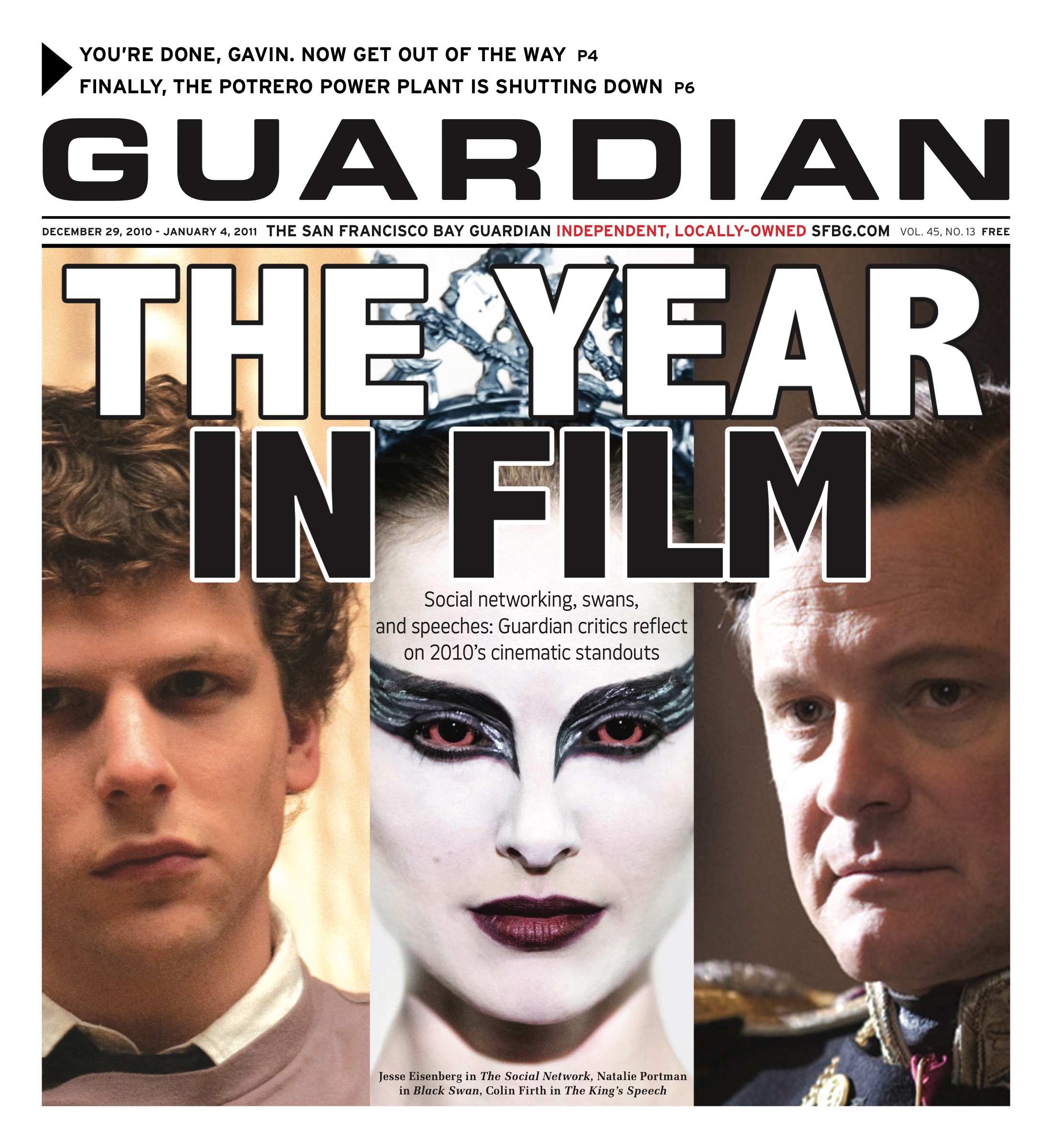
Year in Film: 2010

0

YEAR IN FILM To recap: 2010 was the year Oscar started dipping his golden fingers into the previous year’s pot of (mostly forgettable) big releases and fishing out 10 Best Picture nominees. Blue Pandora people were defeated at the podium, though they did leave a cultural stain behind — it’s safe to say, for example, that nobody’s been styling weddings after The Hurt Locker.

Predicting the next Academy Awards class requires looking past 2010’s top earners (Toy Story 3 and Inception aside) and focusing on films that pleased both critics and audiences (The Social Network, Winter’s Bone, Black Swan) — though if you’re in a betting mood, the carefully calibrated The King’s Speech seems exactly like the kind of movie the Academy will reward over anything achingly contemporary, staunchly gritty, or knowingly out-there. But as any true film fan knows, it’s usually not the movies that make the most money, or even win the most awards, that resonate and beg revisiting in the months and years that follow.

The Guardian’s annual Year in Film issue takes a look at some of 2010’s more notable trends, starring films you liked (The Kids Are All Right) and hated (I’m Still Here) — and films you wanted to see but forgot about and are now rushing to put on your Netflix queue (Splice). (Note: the “you” in the previous sentence is, uh, me.) And since I’m talking in the first person now, let me steer you toward my favorite documentary of the year (and 2010 boasted some great ones, including my second-favorite, The Tillman Story), made-for-ESPN tale The Two Escobars. I was lured in by heavy advertising during the World Cup — apologies to the Giants, but Landon Donovan’s ridiculous game-winner in USA versus Algeria is my pick for sports highlight of the year — and was unexpectedly mesmerized by its tragic story; only later did I learn of the film’s San Francisco connection. Read on, and pass the popcorn.

>>Babes in bondage

Or, 2010’s perfection-pursuing fatal femmes

>>Get “real”

The Social Network, Catfish, and I’m Still Here push the boundaries of truth and fiction

>>Past imperfect

Digging through the year in archival footage

>>Rate irate

Confidential to the Motion Picture Association of America: F-U

>>Baby daddy drama

Parsing 2010’s bumper crop of sperm donor comedies

>>Goal difference

Top 2010 doc The Two Escobars examines two sides of Colombian narco-soccer

>>Guardian critics pick their best movies of the year


The Year in Film: Guardian critics on 2010’s best!

0

Dennis Harvey’s Top 20 of 2010

Note: because this was generally such a crap year, a “best” list seemed too much of a stretch. Ergo this is a Top 20 list, in no particular order, of films I enjoyed most one way or the other (The Killer Inside Me, Everyone Else, and I Spit on Your Grave definitely representing the other). No doubt The King’s Speech, The Social Network, and several other currently awards-baiting titles have finer qualities than some here, but they’re not what I’d gladly watch again right now.

Fish Tank (Andrea Arnold, UK/Netherlands)
The Tillman Story (Amir Bar-Lev, USA)
The Killer Inside Me (Michael Winterbottom, USA/Sweden/UK/Canada)
The Desert of Forbidden Art (Tchavdar Georgiev and Amanda Pope, Russia/UK/Uzbekistan)
Mother (Bong Joon-ho, South Korea)
City Island (Raymond De Felitta, USA)
OSS 177: Lost in Rio (Michel Hazanavicius, France)
Daddy Longlegs (Ben Safdie and Joshua Safdie, USA/France)
The Kids Are All Right (Lisa Cholodenko, USA)
Let It Rain (Agnès Jaoui, France)

http://www.youtube.com/watch?v=G18Y-S8YrQ0

Anton Chekhov’s The Duel (Dover Koshashvili, USA)
Everyone Else (Maren Ade, Germany)
Babies (Thomas Balmès, France)
Prodigal Sons (Kimberly Reed, USA)
I Spit on Your Grave (Steven R. Monroe, USA)
Life During Wartime (Todd Solondz, USA)
Get Him to the Greek (Nicholas Stoller, USA)
MacGruber (Jorma Taccone, USA)
Genius Within: The Inner Life of Glenn Gould (Michèle Hozer and Peter Raymont, Canada)
[rec] 2 (Jaume Balagueró and Paco Plaza, Spain)

http://www.youtube.com/watch?v=bE_X2pDRXyY

Cheryl Eddy’s Top 10 of 2010

(1) Winter’s Bone (Debra Granik, USA)
(2) Fish Tank (Andrea Arnold, UK/Netherlands)
(3) Black Swan (Darren Aronofsky, USA)
(4) The Social Network (David Fincher, USA)
(5) True Grit (Ethan Coen and Joel Coen, USA)
(6) The Two Escobars (Jeff Zimbalist and Michael Zimbalist, Colombia/USA)
(7) The Tillman Story (Amir Bar-Lev, USA)
(8) The Ghost Writer (Roman Polanski, France/Germany/UK)
(9) Scott Pilgrim vs. the World (Edgar Wright, USA/UK/Canada)
(10) Toy Story 3 (Lee Unkrich, USA)

http://www.youtube.com/watch?v=cm-mfxOiUXI

Jesse Hawthorne Ficks’ top films of 2010

Jesse Hawthorne Ficks teaches Film History at the Academy of Art University and curates-hosts the film series “Midnites for Maniacs,” which emphasizes dismissed, underrated and overlooked films in a neo-sincere way.

(1) Meek’s Cutoff (Kelly Reichardt, USA)
(2) Another Year (Mike Leigh, UK)
(3) Alamar (Pedro González-Rubio, Mexico)
(4) Sweetgrass (Ilisa Barbash and Lucien Castaing-Taylor, France/UK/USA)
(5) Winter’s Bone (Debra Granik, USA) and True Grit (Ethan Coen and Joel Coen, USA)
(6) The Last Exorcism (Daniel Stamm, USA/France)
(7) Tiny Furniture (Lena Dunham, USA) and The Freebie (Katie Aselton, USA)
(8) Somewhere (Sofia Coppola, USA) and Daddy Longlegs (Ben Safdie and Joshua Safdie, USA/France)
(9) Shutter Island (Martin Scorsese, USA) and Blue Valentine (Derek Cianfrance, USA)
(10) White Material (Claire Denis, France/Cameroon)
(11) Life During Wartime (Todd Solondz, USA)
(12) Machete (Ethan Maniquis and Robert Rodriguez, USA)
(13) 127 Hours (Danny Boyle, USA/UK) and Buried (Rodrigo Cortés, Spain/USA/France)
(14) Trash Humpers (Harmony Korine, USA/UK/France) and Jackass 3D (Jeff Tremaine, USA)
(15) Cyrus (Jay Duplass and Mark Duplass, USA) and Greenberg (Noah Baumbach, USA)
(16) Scott Pilgrim vs. the World (Edgar Wright, USA/UK/Canada)
(17) Uncle Boonmee Who Can Recall His Past Lives (Apichatpong Weerasethakul,
Thailand/UK/Germany/France/Spain)

bonus round…

(18) You Will Meet a Tall Dark Stranger (Woody Allen, UK) and Film Socialism (Jean Luc Godard, France)
(19) Please Give (Nicole Holofcener, USA)
(20) Boxing Gym (Frederick Wiseman, USA)

http://www.youtube.com/watch?v=2fnojZw54ls

Louis Peitzman’s Top 10 of 2010

(1) The Social Network (David Fincher, USA)
(2) Blue Valentine (Derek Cianfrance, USA)
(3) Inception (Christopher Nolan, tk)
(4) Rabbit Hole (John Cameron Mitchell, tk)
(5) Black Swan (Darren Aronofsky, USA)
(6) Toy Story 3 (Lee Unkrich, USA)
(7) The Kids Are All Right (Lisa Cholodenko, USA)
(8) Never Let Me Go (Mark Romanek, UK/USA)
(9) Joan Rivers: A Piece of Work (Ricki Stern and Anne Sundberg, USA)
(10) The Ghost Writer (Roman Polanski, France/Germany/UK)

http://www.youtube.com/watch?v=Jk-EoUb0nvg

Max Goldberg’s Top Films of 2010

The Autobiography of Nicolae Ceausescu (Andrei Ujica, Romania)
Boxing Gym (Frederick Wiseman, USA)
Cold Weather (Aaron Katz, USA)
Foreign Parts (Verena Paravel and J.P. Sniadecki, USA)
In the Shadows (Thomas Arslan, Germany)
The Oath (Laura Poitras, USA)
The Social Network (David Fincher, USA)
Uncle Boonmee Who Can Recall His Past Lives (Apichatpong Weerasethakul,
Thailand/UK/Germany/France/Spain)
You Are All Captains (Olivier Laxe, Spain/France)
Wednesday Morning Two A.M. (Lewis Klahr, USA)/Union (Paul Clipson,
USA)/Pastourelle (Nathaniel Dorsky, USA)

Kimberly Chun’s Top 11 of 2010

True grit, girl style: Winter’s Bone (Debra Granik, USA), Easy A (Will Gluck, USA)
True camp, with a heaving side of eye candy: Black Swan (Darren Aronofsky, USA), Enter the Void (Gaspar Noe, France/Germany/Italy)
Indie family comedies for adults: Cyrus (Jay and Mark Duplass, USA), The Kids Are All Right, (Lisa Cholodenko, USA), Tiny Furniture (Lena Dunham, USA)
Indie crime family that eats its young: Animal Kingdom (David Michod, Australia)
Indie entrepreneurs run amok: The Social Network (David Fincher, USA)
“Made it, ma! Top o’ the world!” — border-crossing crime stories: A Prophet (Jacques Audiard, France/Italy, 2009), Carlos (330-minute version, Olivier Assayas, France/Germany)

In a lonely place

0

cheryl@sfbg.com

FILM A lonely Ferrari zooms around a deserted track, over and over and over again. The opening scene of Sofia Coppola’s latest, Somewhere, is such an obvious metaphor that at first I thought the director was joking. Actually, she’s not: Somewhere is indeed a repetitious movie about a very boring, very ennui-laden individual, who happens to be a movie star with the marquee-ready name of Johnny Marco (Stephen Dorff).

Now that you’ve been smacked over the head with metaphor, feel free to play spot the subtext: Johnny lives at Sunset Boulevard haunt the Chateau Marmont, legendary for its often-behaving-badly celebrity clientele. His life is an endless progression of blah (wake up, smoke, pop a Propecia, eyefuck and fuck random female admirers), broken up by job obligations — the tedium of a press conference here, the drudgery of a visit to the special-effects makeup studio there. Sigh.

Sorta like Bill Murray’s actor character in Coppola’s 2003 Lost in Translation, Johnny’s fame is approximately equal to Dorff’s. He’s had a steady career for the past 20-something years, with occasional high points (1998’s Blade, 2000’s Cecil B. DeMented) and interesting parts in smaller films (1996’s I Shot Andy Warhol), but nothing that elevated him to the A list. Mostly he’s known for appearing in throwaway titles and dating the likes of Pamela Anderson. One might be forgiven for assuming his home life quite resembles the bad boy he plays in Britney Spears’ “Everytime” video.

One might now suspect his home life resembles Somewhere. Can’t you imagine onetime hottie Dorff, well past scruffy and nearing haggard, hiring twin pole dancers to writhe along with Foo Fighters songs as he gazes on, barely registering amusement or a pulse? Coppola’s casting of Dorff is either totally inspired or totally lazy. We don’t know enough about the real guy, who is playing an actor much like himself, to know if he’s acting or not. Frankly, he’s such a blank, shallow canvas it’s hard to spend too much time wondering or caring.

Here’s another instance of subtext: would any director not as privileged as Coppola dare to focus on a character whose massive wealth can’t at all assuage his existential crisis? Money may not buy happiness, but it’s kind of hard to feel sorry for a guy whose depression plays out as he floats the day away at a luxury hotel. The pissy, anonymous text messages Johnny receives throughout the film (“Why are you such a fucking asshole?”) are either sent directly from his subconscious, or are a knowing nod to the feelings of the unwashed masses who spent all of Translation wishing evil on poor little rich girl Scarlett Johansson.

Fortunately, there is a bright spot in all this. Obviously Somewhere is Coppola’s “I have kids now and therefore will preach about the magical joys of parenting” film. Ergo, mostly-absentee dad Johnny has a kid, Cleo, a tween sprite played by the charming Elle Fanning. Cleo’s pretty blasé about the whole movie-star thing, but she is allowed a delighted squeal when she gets a peek at the swank-tastic hotel suite the pair is given during a promotional trip to Milan. She is the only meaningful thing in Johnny’s life, and the only interesting thing that happens in this glacially-paced, bellybutton-obsessed movie.

But, you say, Somewhere won the Venice Film Festival’s Golden Lion (due to the film’s Italy scenes and Coppola’s Coppola-ness, perhaps?). Surely it must have some merit beyond Fanning and the middling, voyeuristic pleasures of seeing exactly what a movie star does on his free time? Divergent tones and motives aside, Somewhere isn’t that far from Joaquin Phoenix’s agonizing faux-doc I’m Still Here. Neither place is any place I’d like to visit again.

SOMEWHERE opens Wed/22 in San Francisco.


Fight club

0

arts@sfbg.com

FILM Late in Boxing Gym, a pungent documentary even for Frederick Wiseman, an old-timer says something wise to his friend while lacing up. The friend doesn’t see the point of analogies. Our man admits that some only work on an intellectual level, but insists that others make intuitive sense of abstraction — the right metaphor can make all the difference in getting a particular movement. It’s hard to imagine that Wiseman would still be making his films if he didn’t think the same held true for a motion picture sequence.

Good thing, since boxing has been made to shoulder an awful lot of Hollywood hooey. Not much has changed since Manny Farber, writing in 1949, decried fight pictures for being “tightly humorless and supersaturated with worn-out morality … pure fantasy in so far as capturing the pulse of the beak-busting trade.” Wiseman isn’t interested in the trade so much as the discipline — though the big time’s spectacular images are plastered around the old-school Texas club. And yet even if Boxing Gym shrugs at the competitive elements of the sport, Wiseman’s squat compositions tune in the unglamorous business of keeping your dukes up when tired — the kind of matter-of-fact physical truth professional actors howl for.

By releasing Boxing Gym immediately after La Danse (2009), Wiseman ensures his own comparisons. The choreographer-dancer and trainer-boxer tandems are aligned not only in fancy footwork (Wiseman’s too), but also in their mirror-stretched studios. There are differences, of course — one can’t help but think of the Paris Ballet’s fundraising efforts when Richard Lord, the dexterous trainer-manager of the gym, explains membership dues. Perhaps because Wiseman is not beholden to an institutional cycle of rehearsals and performances in Boxing Gym, it’s the purer distillation of a kinetic education.

Watch Wiseman’s films together, and you’ll realize that different spaces register silence differently. The filmmaker’s musical ear is richly apparent in Boxing Gym‘s gloved rhythms and concrete echoes, to say nothing of the entrancing pendulum swings of side-by-side workouts. As in La Danse, Wiseman emulates the concentration of his subjects, but here he also picks up on their loose camaraderie in conversations about joblessness, the joy of getting hit and, closest to the bone, the Virginia Tech killings. The gym is still a masculine space, but one in which women (and children) are a significant presence. For more on the evolution of gender and “training,” one might well consult the filmmaker’s own catalog: Basic Training (1971), Manoeuvre (1979), and Missile (1987). Wiseman’s gym is finally a gathering place, one with atmosphere and history (and hardly any headphones) — all the more reason to see it in a movie theater.

BOXING GYM opens Wed/22 at the Roxie.


Our weekly Picks: December 15-21, 2010

0

WEDNESDAY 15

MUSIC

Buzzov*en

Legendary sludge metal band Buzzov?en has been wandering the wilderness since the early ’90s, its members ping-ponging between different down-tuned, drugged-out projects. Sludge, an ugly-sounding offshoot of stoner metal, can be traced back to the Melvins, and it was relatively big business in 1994 when Buzzov?en’s second album, Sore, was picked up by Roadrunner Records. That honeymoon was over quickly, and the band’s career has been peripatetic since. Famous for the violence of its live shows and squalling, pummeling riffs, the band is likely to incite a frenzy wherever its brand-new tour may take them. (Ben Richardson)

With Brainoil, Neurotoxicity, No Statik, K. Lloyd

8:30 p.m., $16

DNA Lounge

375 11th St., SF

(415) 626-1409

www.dnalounge.com


MUSIC

John Grant

After the decade he spent fronting dreamy indie-pop group the Czars, John Grant has since gone on record saying he never really felt all that satisfied with the band’s albums. As crazy as that might sound to Czars fans, Queen of Denmark, his new solo album backed by Texas folk-rockers Midlake, is indeed a markedly personal album — and perhaps the type he wanted to make all along. Grant’s 1970s soft rock-inspired arrangements and rich baritone vocals are excellent; but it’s the emotional vulnerability and snarky humor of his lyrics that really define him as a songwriter who is very much deserving of some more attention. (Landon Moblad)

With Jessica Pratt

8 p.m., $15

Swedish American Hall

2170 Market, SF

(415) 861-5016

www.cafedunord.com


MUSIC

Del the Funky Homosapien

The Bay Area’s ambassador of hip-hop, not to the planet but the galaxy and beyond, Del the Funky Homosapien came out of Oakland’s Hieroglyphics crew before lending his unmistakable voice to projects of a stranger variety. A fetish for ginormous words and out-of-this-world concepts culminated in the future blap of 2000’s space jamming album Deltron 3030. A follow-up is supposedly in the can, reportedly ready for release in 2010. At this intimate event, fans will have the opportunity to remind Del that it is mid-December. (Ryan Prendiville)

 With Simple Citizens

Wed/15–Thurs/16, 8 p.m., $30

Yoshi’s San Francisco

1330 Fillmore, SF

(415) 655-5600

www.yoshis.com


THURSDAY 16

DANCE

“DANCEfirst! Modernity/Humanity: The Nzoto Installation

Often the very act of preserving an artifact distances it from its daily meanings. The “Art/Object: Recontextualizing African Art” exhibit now gracing the halls of the Museum of the African Diaspora seeks to right this wrong, inserting ancient costumes, tools, and accessories back into the flourishes of life they once accentuated. The integration of ritual and modernity is also the theme of an upcoming MoAD dance performance, The Nzoto Installation, presented by dance-community bridge-building organization see.think.dance, and featuring international performance artist Byb Chanel Bibene using the nzoto (“the body” in Bantu) of dancer groups to meld abstract thought and tradition with motion and emotion you can feel, now. (Caitlin Donohue)

6–9 p.m., free with admission ($5–>$15)

Museum of the African Diaspora

685 Mission, SF

(415) 358-7200

www.moadsf.org MUSIC


MUSIC

Om

The demise of Sleep marked a sad day for metal fans, but from the resin-soaked ashes of that vaunted South Bay trio emerged two bands that have done much to cheer them up. The success of Matt Pike and High on Fire is a topic to be considered elsewhere; Om is the order of the day. Founded by Sleep’s bassist and drummer, Al Cisneros and Chris Haikus, the meditative metal outfit has taken advantage of the former’s mellifluous playing to craft songs that are at once crushingly heavy and fuzzily embracing. Cisneros is now paired with new drummer Emil Amos, and they’re prepared to rock you into reverie. (Richardson)

With Lichens, Barn Owl, DJ Britt Govea

8 p.m., $16

Independent

628 Divisadero, SF

(415) 771-1422

www.independentsf.com.


FRIDAY 17

THEATER

Mr. Yoowho’s Holiday

In conjunction with Noh Space, Moshe Cohen presents Mr. Yoowho’s Holiday, a story fusing the spirit of adventure with the warmth of the season. Mr. Yoowho embarks on an international journey across geographical borders as well as the borders of the imagination. He meets Taro-kaja, the prototypical spirited trickster hero of Japanese Kyogen Theater, as well as encountering elements of the European circus and Yiddish absurdism. Drawing on aspects of traditional Japanese Noh Theater and Kyogen Theater, Cohen returns to SF after touring extensively through Europe to meld humor, poetry, and absurdity in this heartwarming tale. (Emmaly Wiederholt)

Through Jan. 2, 2011

Preview tonight, 8 p.m., $10

Fri.–Sat., 8 p.m., Sun., 3 p.m., $10–$18

Theatre of Yugen

2840 Mariposa, SF

1-800-838-3006

www.theatreofyugen.org


EVENT

“Hubba Hubba Revue’s Christmas Hanukkah Spectacular”

Who will be the next mayor? What will the new year bring? Which corporate Death Star will the WikiLeaks cabal take down next? The Guardian doesn’t have all the answers to these quandaries of the abyss yet — but we sure as sugar have the inside skinny on who will be taking off their clothes at Hubba Hubba Revue’s holiday burlesque spectacular (you’re welcome). To wit: the winner of “best variety act” at Las Vegas’ Burlesque Hall of Fame, Chicago’s Amazing Bendable Poseable Dolls of Doom, and boylesque troupe the Stage-Door Johnnies. Also, don’t miss (yes!) Hubba’s annual visit from the hang-10 Hasids themselves, Jewish surf band Meshugga Beach Party. (Donohue)

9 p.m., $10–$15

DNA Lounge

375 11th St., SF

(415) 626-1409

www.dnalounge.com


THEATER

Sweet Can Productions

Combining aerial silks, acrobatics, juggling, contortion, hula hoops, traditional circus, physical theater, dance, and live music, Sweet Can Production’s newest show Candid takes its audience into a charming topsy-turvy world where anything can happen. The limits of human imagination are stretched as mundane objects and everyday life transform into a breathtaking circus. Directed by Joanna Haigood and Wendy Parkman with new music by Eric Oberthaler, lighting designed by Tad Shannon, and performances by Beth Clarke, Natasha Kaluza, Kerri Kresinski, and Matt White, Candid aims to reveal the magic inherent in the ordinary. (Wiederholt)

Through Jan. 9, 2011

Schedule varies (opens tonight, 7 and 9 p.m.)

$15–$60

Dance Mission Theater

3316 24th St., SF

www.sweetcanproductions.com


MUSIC

Sub Swara

Bay Area dubstep freaks sometimes forget that the gateway to their bass addiction was a curious mutation of global funk — one that came to prominence in the mid-late ’00’s and mixed Jamaican dread, glitchy electronics, and bhangra flourishes into a heady, invigorating stew. Ground zero for this sound was the excellent Surya Dub party, much missed since its players went off to conquer the world. With a happy rumble, the Surya Dub crew is reuniting at Public Works, teaming up with Bay woofer-killers Slayers Club to bring in New York City duo Sub Swara, keepers of the international bass flame (with a cosmic-funky twist on their latest CD, Triggers). It’ll be a global-eared rumble that reunites seminal Bay influences while leaving you quaking in your Timberlands. (Marke B.)

10 p.m., $10

Public Works

161 Erie, SF

(415) 932-0955

www.publicsf.com


MUSIC

“Monsters of Accordion 2010”

The accordion: for many, it’s the runner-up for most annoying musical instrument (after bagpipes). When used outside of polka, zydeco, cumbia, and other “traditional genres” (read: mainstream pop), it has an attention-drawing, anachronistic quality. To rock it, a player must possess a superhuman degree of cool, like They Might Be Giants and, of course, Weird Al Yankovic. To that list add Jason Webley, the howling one-man band and mind behind Monsters of Accordion, known above all for his ability to convert nonbelievers to the squeezebox. (Prendiville)

With Corn Mo, Renee de la Prade, Petrojvic Blasting Co., and Duckmandu

9 p.m., $14

Slim’s

333 11th St., SF

(415) 255-0333

www.slims-sf.com


SATURDAY 18

MUSIC

Cyndi Lauper

With her string of recent successes, one could say that new wave chanteuse Cyndi Lauper is back. But that really wouldn’t be accurate — the independent firebrand never really went away. Starting with her smash breakthrough 1983 album She’s So Unusual and the string of hit singles that followed, including “Girls Just Want To Have Fun,” “She Bop,” and “Time After Time,” Lauper has continued to release a variety of music, along with appearing in films and being involved with human rights causes. She comes to the city tonight for an intimate club gig — here’s to hoping she can be persuaded to play “The Goonies ‘R’ Good Enough”! (Sean McCourt)

9 p.m., $65

Independent

628 Divisadero, SF

(415) 771-1422

www.independentsf.com


DANCE

Labayen Dance

It’s fun to watch artists who consistently surprise. Enrico Labayen is one of them. For a while, he dropped off the radar — turns out he went home to the Philippines to study native mythologies. When he returned, his first major endeavor became an ambitious Carmina Burana. Now he is taking on the Greeks. Icarus at the Edge of Recession promises to offer a fresh perspective on Daedalus as a CEO and Icarus as a young trader. He is showing this parable of a father sacrificing his son for his own ambition as a work in progress during what he calls a “holiday fun(d)raising event.” (Rita Felciano)

8 p.m., $20 (with pre-show party, 7 p.m., $25)

Garage

975 Howard, SF

(415) 509-3129

www.brownpapertickets.com


TUESDAY 21

MUSIC

Danny B. Harvey

Guitar slinger extraordinaire Danny B. Harvey has played with everyone from the Rockats, Nancy Sinatra, and Wanda Jackson to Bow Wow Wow and the Head Cat. This current tour stop finds him teaming up with his friend and “Rockabilly Filly” Rosie Flores. Harvey’s frantic finger-picking and tasty solos are truly a sight to behold live — especially when you look up from watching his fingers dancing on the fret board and see his expression — he often looks as if he’s enjoying a Jack and Coke at the bar, a big grin on his face and giving almost no indication of the difficulty of making the incredible sounds coming out of his guitar. (McCourt)

With Rosie Flores

9 p.m., $12–$15

Hotel Utah

500 Fourth St., SF

(415) 546-6300

www.thehotelutahsaloon.com

The Guardian listings deadline is two weeks prior to our Wednesday publication date. To submit an item for consideration, please include the title of the event, a brief description of the event, date and time, venue name, street address (listing cross streets only isn’t sufficient), city, telephone number readers can call for more information, telephone number for media, and admission costs. Send information to Listings, the Guardian Building, 135 Mississippi St., SF, CA 94107; fax to (415) 487-2506; or e-mail (paste press release into e-mail body — no text attachments, please) to listings@sfbg.com. Digital photos may be submitted in jpeg format; the image must be at least 240 dpi and four inches by six inches in size. We regret we cannot accept listings over the phone.

Violence please!

0

Christmas is here early, horror geeks: not only is a brand-new print of 1980’s Maniac playing the Castro Theatre, but director William Lustig will be in attendance. After the big-screen experience, make sure Santa knows you want the extras-packed 30th anniversary DVD, released by Lustig’s own Blue Underground label, wrapped in bloody butcher paper under the tree.

For the uninitiated, Maniac — the tale of a mommy-haunted New York City creep who stalks and kills women, using their body parts to accessorize his mannequin collection — features a tour de force performance by the late Joe Spinell, who co-wrote the screenplay. Spinell was a grindhouse favorite who also appeared in the first two Rocky movies, the first two Godfather movies, and Taxi Driver (1976). Lustig directed Spinell in 1983’s Vigilante; he also helmed the Maniac Cop series. He hasn’t directed a feature since 1997’s horror comedy Uncle Sam (“I want you … DEAD!”), but he’s still very much involved in the world of genre films. Since I’m a Maniac maniac, I gave him a call at his New York City office to talk about exploding heads and other topics.

SFBG How long have you been planning Maniac‘s 30th anniversary celebration?

William Lustig About 18 months ago, the idea popped into my head that it was time to freshen up the movie. Six months ago, somebody came up with the idea of testing it as a theatrical release. We started playing it in Seattle, New York, and Los Angeles, and it’s done quite well, so we’re going to be rolling it out over the next three or four months in about 50 cities throughout North America.

SFBG Are most audiences already familiar with the movie, or are you getting some first-timers?

WL People who have seen it on video make up a good portion of the audience, but the other portion are seeing it for the first time. It’s amazing — you know, when you make a movie like this, I guess it’s like somebody who makes a comedy. After a while, you don’t find it funny anymore. As a person who made a horrific movie, I can’t imagine anybody finding it scary, and yet people do. They still respond as strongly as people did 30 years ago. It feels great!

SFBG Are you surprised that Maniac became such a cult favorite?

WL Somebody recently asked me, when did I realize it was a classic? I guess it must have been about 18 months ago when I realized that this movie continues to sell, continues to intrigue people. I think a portion of it is the mystique of its star, Joe Spinell, who’s become kind of a cult figure for people who are rediscovering movies from the ’70s. But Maniac is not a film that was lost and now it’s been found — it’s been around and it continues to attract audiences and to please them.

SFBG What was Joe Spinell like in real life?

WL Like any great actor, there was a part of Joe in every role he played. Joe was a loner, and he was an insomiac. He would roam the streets of New York and be at bars until all hours. He was a troubled soul, but at the same time, he was one of the most brilliant people I ever met. He had a charisma that would attract beautiful women even though he wasn’t a classically handsome guy. He had a magic about him. So when you see Maniac, there are aspects of his personality in there.

SFBG Maniac was quite controversial when it was released. Did that surprise you?

WL You know, when you’re making a movie and you’re throwing ketchup around, it’s almost kind of comical. It’s not intended to be serious — you intend it to be a kind of roller-coaster ride for an audience. And when people take a movie like that so seriously, and look at it as being a political statement, and look at it as being some kind an outcry for violence against women and things like that, it kind of takes you aback. When I made the film, I was 24 years old and I was just trying to survive the experience. I wasn’t thinking about the wider implications of what we were doing. And I think we’ve gone beyond that in the world today. I think we kind of look at it as being make-believe.

SFBG I have to ask you about the famous exploding head, courtesy of effects wizard Tom Savini. Did you realize that would be Maniac‘s defining moment?

WL I think after we made the movie, we realized it had a tremendous impact. But when we were doing it, we were like burglars in the night. First off, there is no permit in existence, in any part of New York City, or I would imagine in any part of the country, that allows to you fire a live gun on a movie set and on public streets. Which is what we did — we actually filmed that in that parking lot, under the Verrazano Bridge, with a live shotgun, double-loaded. That was our major concern: would we get busted? It wasn’t until later, when we saw the dailies, that we realized, “Holy shit! It actually turned out to be something!” We rigged up three cameras and we just went for it.

SFBG You’re the owner of Blue Underground, which has released top-notch DVDs and Blu-rays of Maniac and other grindhouse movies. Why did you become such a champion of these films?

WL It was kind of satisfying my own need. I always loved having people over to my house, showing them these obscure grindhouse movies that I had seen on 42nd Street in the late ’60s and early ’70s, and I would see their [enthusiastic] reactions. One of the things that bothered me back in the ’80s and the ’90s was that these movies were never really treated with any respect. So it was my intention to treat grindhouse movies the same way Criterion treats its Fellini movies.

MIDNITES FOR MANIACS: PUSH IT TO THE LIMIT TRIPLE FEATURE

Just One of the Guys (1985), Fri., 7:30 p.m.; Point Break (1991), Fri., 9:30 p.m.;

Maniac: The Restored Director’s Cut (1980), Fri., midnight, $12

Castro Theatre

429 Castro, SF

(415) 621-6120 www.castrotheatre.com

Rep Clock

0

Schedules are for Wed/8–Tues/14 except where noted. Director and year are given when available. Double and triple features are marked with a •. All times are p.m. unless otherwise specified.

ARTISTS’ TELEVISION ACCESS 992 Valencia, SF; www.atasite.org. $7. “Other Cinema: Dead Media,” innovative works using repurposed material, Sat, 8:30.

BALBOA 3630 Balboa, SF; www.brownpapertickets.com. $10. Pink Smoke Over the Vatican (Hart), Thurs, 7.

BRIDGE 3010 Geary, SF; www.peacheschrist.com. $15. “Midnight Mass:” Christmas Evil (Jackson, 1980), Sat, midnight. With director Lewis Jackson in person.

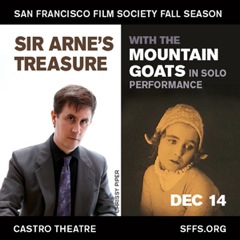
CASTRO 429 Castro, SF; (415) 621-6120, www.castrotheatre.com. $7.50-12. La Strada (Fellini, 1954), Wed, 2:30, 7. “Holiday Horrors:” Gremlins (Dante, 1984), Thurs, 7; Black Christmas (Clark, 1974), Thurs, 9:05. “Midnites for Maniacs: Push It to the Limit Triple Feature:” •Just One of the Guys (Gottlieb, 1985), Fri, 7:30; Point Break (Bigelow, 1991), Fri, 9:30; Maniac: The Restored Director’s Cut (Lustig, 1980), Fri, midnight. With director William Lustig in person. •Cabaret (Fosse, 1972), Sat, 2:35, 7, and Xanadu (Greenwald, 1980), Sat, 5, 9:30. The Nightmare Before Christmas (Selick, 1993), Sun, 2, 3:45, 5:30, 7:15, 9. “San Francisco Film Society Presents:” Sir Arne’s Treasure (Stiller, 1919), Tues, 8. With live score by the Mountain Goats; tickets for this event ($22.50) at www.sffs.org.

CERRITO 10070 San Pablo, El Cerrito; www.rialtocinemas.com. $7. “Cerrito Classics:” White Christmas (Curtiz, 1954), Thurs, check website for showtime.

CHRISTOPHER B. SMITH RAFAEL FILM CENTER 1118 Fourth St, San Rafael; (415) 454-1222, www.cafilm.org. $6.50-10.25. The Girl Who Kicked the Hornet’s Nest (Alfredson, 2009), call for dates and times. Inside Job (Ferguson, 2010), call for dates and times. Today’s Special (Kaplan, 2009), call for dates and times. “San Francisco Grand Opera Cinema Series:” The Elixir of Love, Thurs, 7 and Sat, 10am. “Buddhist Film Festival Showcase 2010,” Wed-Thurs. These shows, $12. Remembering Playland (Wyrsch, 2010), Sun, 4:15. Director Tom Wyrsch in person.

FORBIDDEN ISLAND TIKI LOUNGE 1304 Lincoln, Alameda; www.forbiddenislandalameda.com. Free. “Forbidden Thrills: Creepy Crazy Christmas Classics!:” •Santa Claus Conquers the Martians (Webster, 1964), and Santa Claus (Cardona, 1959), Mon, 7:30.

HUMANIST HALL 390 27th St, Oakl; www.humanisthall.org. $5. “More Bay Area Culture and Performance Art,” presented by video activist Steve Jacobson, Wed, 7:30.

ITALIAN CULTURAL INSTITUTE 814 Montgomery, SF; (415) 788-7142. $3. “Giallo:” Deadly Sweet (Brass, 1967), Tues, 6:30.

LUMIERE 1572 California, SF; www.landmarkafterdark.com. Free. Thurs, 7. “Anime Club:” “Space and Wolf,” Thurs, 7.

PACIFIC FILM ARCHIVE 2575 Bancroft, Berk; (510) 642-5249, www.bampfa.berkeley.edu. $5.50-9.50. “Days of Glory: Revisiting Italian Neorealism:” Il grido (Antonioni, 1957), Wed, 7; Accattone (Pasolini, 1961), Fri, 8:45; Bandits of Orgosolo (De Seta, 1961), Sun, 3. “Grin, Smile, Smirk: The Films of Burt Lancaster:” Birdman of Alcatraz (Frankenheimer, 1962), Thurs, 7; A Child is Waiting (Cassavetes, 1963), Sat, 6:30; The Swimmer (Perry, 1968), Sat, 8:40. “Carl Theodor Dreyer:” Two People (1944-45), Fri, 7; Gertrud (Dreyer, 1964), Sun, 5.

RED VIC 1727 Haight, SF; (415) 668-3994. $6-10. Saint Misbehavin’: The Wavy Gravy Movie (Esrick, 2009), Wed-Thurs, 7:15, 9:15 (also Wed, 2). Machete (Maniquis and Rodriguez, 2010), Fri-Sat, 7:15, 9:30 (also Sat, 2, 4:15). Breathless (Godard, 1959), Sun-Mon, 7:15, 9:15 (also Sun, 2, 4). The Triplets of Belleville (Chomet, 2003), Dec 14-15, 7:15, 9:15 (also Dec 15, 2).

ROXIE 3117 and 3125 16th St, SF; (415) 863-1087, www.roxie.com. $5-9.75. Howl (Epstein and Friedman, 2010), Wed, 7:15. The Temptation of St. Tony (Ounpuu, 2010), Wed-Thurs, 7, 9. “NorCal FreeFly Film Festival,” Thurs, call for times. Bad Santa (Zwigoff, 2003), Fri, 7:15, 9:15. “An Evening with John Waters,” Sat, 7:30. Fundraiser for the Roxie; tickets $250. Home Alone (Columbus, 1990), Sun, 4. Permanent Vacation (Jarmusch, 1980), Mon, call for times. Stranger Than Paradise (Jarmusch, 1984), Tues, call for times.

SUNDANCE KABUKI 1881 Post, SF; www.eggsploitation.com. $20. Eggsploitation (Lahl), Thurs, 7.

VICTORIA 2961 16th St, SF; www.sfcinema.org. $15-25. “Cinematheque Benefit:” Face (Warhol, 1965) and The Velvet Underground In Boston (Warhol, 1967), Wed, 6:30.

VIZ CINEMA New People, 1746 Post, SF; www.vizcinema.com. $10-12. Cast Me If You Can (Ogata, 2010), Dec 10-19, check website for times. YERBA BUENA CENTER FOR THE ARTS 701 Mission, SF; (415) 978-2787, www.ybca.org. $6-8. “International Buddhist Film Festival Showcase 2010:” Shugendo Now (Abela and McGuire, 2009), Thurs, 7:30; •Dream Window: Reflections on the Japanese Garden (Junkerman, 1991), and Inland Sea (Carra, 1992), Sun, 2. “Luminous Darkness,” transgressive videos focusing on erotic ritual and performance, curated by Daniel McKernan, Fri, 9pm-2am (screening continuously during YBCA’s “Noel Noir” fundraiser; tickets $25). “Go to Hell for the Holidays:” Meat Grinder (Moeithaisong, 2009), Sat, 7:30.<\!s>

Our Weekly Picks: December 8-14, 2010

0

WEDNESDAY 8

MUSIC

Holy Grail

Though you practically need a PhD in metal to keep track of Holy Grail’s ever-shifting lineup, one thing is obvious to anyone — even a layperson — when he or she first hears the band: singer James Paul Luna has one of the best young voices in rock ‘n’ roll, period. Ascending to falsetto heights with polished ease, the siren-lunged Pasadena, Calif., native fronts a band dedicated to the exuberant excess of early eighties speed metal, and his Halfordesque attack on the mic is complimented by the frenetic shredding and double-bass gallop of the band that backs him up. Touring in support of long-awaited debut LP Crisis in Utopia, Holy Grail is not to be missed. (Ben Richardson)

With Blind Guardian and Seven Kingdoms

8 p.m., $32

Regency Ballroom

1300 Van Ness, SF

1-800-745-3000

www.theregencyballroom.com

PERFORMANCE


David Liebe Hart

Along with James Quall and Richard Dunn (R.I.P.), David Liebe Hart is the cream of the crop of lovingly bizarre actors populating Adult Swim’s Tim and Eric Awesome Show, Great Job! The show takes pride in exposing the world to forgotten Hollywood street performers, bit actors, outsider musicians, and left-field comedians, all of which can be used to sum up Liebe Hart’s career. Armed with his trusty puppet and musical tales of being abducted by Corrinian aliens, he’ll be headlining Club Chuckles’ Seventh Anniversary Show lineup. Be sure to greet him with a friendly “Salame!” (Landon Moblad)

With Hot Panda, Chris Thayer, and Donny Divanian

9 p.m., $7

Hemlock Tavern

1131 Polk, SF

(415) 923-0923

www.hemlocktavern.com


FILM

“Andy Warhol: Face and The Velvet Underground in Boston Cinematheque Benefit”

An early look at recent restorations of two of Andy Warhol’s most obscure movies (both long out of circulation) is the hidden jewel of San Francisco Cinematheque’s fall season. Face (1965) is an hour-long expression of Edie Sedgwick’s superstar photogenie. The Velvet Underground in Boston (1967) collects rare footage of the Exploding Plastic Inevitable house-band in its prime. Taken together, the films should present an unusual view of Factory life. The screening benefits Cinematheque’s upcoming programming, so you’ll leave knowing you’ve done your part for underground movies. (Max Goldberg)

8 p.m., $15

Victoria Theatre

2961 16th St., SF

(415) 863-7576

www.sfcinematheque.org


PERFORMANCE

Legacy, A One Ho Show

Presented by the AIRspace residency program, Trashina Cann (real name: Randen Kane) stars in Legacy, A One Ho Show, a queer-friendly, autobiographical dance theater piece exploring the misfortunes and vices passed down through Kane’s family and their effects on her life today. Journeying through three generations of women and their struggles with abandonment, sexual abuse, unwanted motherhood, prostitution, and incarceration, Kane comes to understand that her troubling past can also save her. Using burlesque, song, dance, and video, Kane manifests her incredible life story and her will to overcome, all the while staying extraordinarily entertaining. (Emmaly Wiederholt)

Wed/8–Thurs/9, 8 p.m., $10–$20

Garage

975 Howard, SF

(415) 518-1517

www.975howard.com


THURSDAY 9

PERFORMANCE

Adam Carolla

What hasn’t funny guy Adam Carolla done in his show business career? He got his start in radio (Loveline), branched out into television (The Man Show), written and starred in a feature film (2007’s The Hammer), and expanded onto the Internet with his podcast talk show. Carolla’s latest foray finds him as the author of a new book, In Fifty Years We’ll All Be Chicks … And Other Complaints From An Angry Middle-Aged White Guy, which he’ll be promoting and signing during his “Christmas Carolla” tour of the West Coast, bringing his caustic yet sidesplitting and hilarious, stand-up to the raw and uncensored — as it should be — live stage. (Sean McCourt)

Thurs/9, 7:30 and 9:30 p.m.;

Fri/10–Sat/11, 8 p.m. and 10:15 p.m., $32.50–$35.50

Cobb’s Comedy Club

915 Columbus, SF

(415) 928-4320

www.cobbscomedyclub.com


FRIDAY 10

VISUAL ART


“Boom”

Art is made in all manners of cracks and crevices and four-bedroom apartments. How are we to know that what we have the pleasure of viewing gallery-side is the best of the best, the most succulent bit of Dungeness in San Francisco’s cioppino? Well, we don’t, and now I’m hungry. But events like “Boom” tend to help matters. The event is an entry fee-free juried art show, which means that a) artists don’t gotta have sold a $700,000 piece to kick it (congrats to Chor Boogie, by the way); and b) Southern Exposure has supplied an expert mind to deem said art worthy of your collection or not. (Caitlin Donohue)

Through Dec. 18

Opening reception tonight, 6–9 p.m., free

Southern Exposure

3030 20th St., SF

(415) 863-2141

www.soex.org


EVENT

“The Lusty Lady’s Kinky Kiss-Mass Party”

Ohhhhh! Uhhhhuh! Fuhkuhhhhhhh … there, no, therrrreee! Ahhhhhhh! Yesssssss! Can’t get enough? Don’t worry, babe, there’ll be plenty to get you off at the Lusty Lady’s ho-ho-holiday fundraiser. Love peppermint? Enter the Candy Cane Suck-Off Contest! Love cheeky 1960s garage rock and ’70s hard glam? See the Minks and Destroyer, covering two great bands named after two great things: the Kinks and Kiss, respectively. Love hot naked women who are unionized, lionized, organized, and revolutionized? Then raise your glass of cheap booze while you help raise funds to keep the shades raised, one hot dollar at a time. (Kat Renz)

With Trixxie Carr, Horror X, and DJ Omar

8 p.m.-3 a.m., $12–$15

DNA Lounge

375 11th St., SF

(415) 626-1409

www.dnalounge.com


SATURDAY 11

MUSIC

“The I Am Donald Tour” with Donald Glover + Childish Gambino

As the man-child Troy on NBC’s Community (and a former writer for 30 Rock), 26-year-old Donald Glover currently stands on the precipice of a breakout comedic acting career. So what’s he doing releasing a non-novelty rap album (under the name Childish Gambino)? Although his current celebrity makes it initially hard to take his music seriously, once you move past the indie-kid stroking (“H.O.V.A. with glasses/Weezy but nerdy”) and TV-star titillation (“NBC is not the only thing I’m coming on tonight”), Glover’s casual willingness to be introspective and examine uncomfortable personal struggles signals that he plans on doing more than vacationing in the genre. (Peter Galvin)

9 p.m., $15

Slim’s

333 11th St., SF

(415) 255-0333

www.slims-sf.com


THEATER

Siddhartha, The Bright Path

Performed entirely by kids and young adults, Siddhartha, The Bright Path chronicles Siddhartha’s epic journey to becoming the Buddha alongside the story of modern-day Chandra from San Francisco. Chandra finds herself amid a bounty of birthday presents posing questions about the real value of material goods in the face of human suffering. The two meet on the banks of the Ganges River under a bodhi tree where the Buddha helps Chandra find enlightenment relevant to her life. Fused with Indian music, art, and kathak dance, this play combines traditional Indian culture with the warmth of the holiday season. (Wiederholt)

Through Jan. 9

Previews Sat/11–Sun/12, 3 p.m.; Dec 16, 7:30 p.m.

Opens Dec 17, 7:30 p.m. (schedule varies), $10–$50

Marsh Youth Theater

1062 Valencia, SF

www.themarsh.org


MUSIC

Gama Bomb

The burgeoning retro-thrash movement has become so overcrowded that it’s hard to separate the wheat from the chaff, but hold onto your gigantic white Reebok hi-tops — Gama Bomb is coming. The Dublin, Ireland, quintet is among the best of an uneven bunch, cranking out gleeful, inventive ditties full of machine-gun picking and nerdy, caterwauled vocals. Tales from the Grave in Space (2009) picked up where its previous effort left off, drawing on the band’s love of booze, bawdiness, and pulpy pop culture to weave an adrenalized tapestry shot through with divebombing solos and single-stroke rolls. Hearing the blitzkrieg live will be another matter entirely, and the Bomb is making its first visit to the U.S., so expect an all-out assault. (Richardson)

With Forbidden, Evile, Bonded by Blood, and Fog of War

2:30 p.m., $20

DNA Lounge

375 11th St., SF

(415) 626-2532

www.dnalounge.com


SUNDAY 12

EVENT

Jeff Hoke

Alchemy, dreams, psychology, the stars — wrapped up in an enigmatic Myst-like museum and served to you in a picture book that aims to explain all four. Jeff Hoke is a unique mind. He’d have to be to hold his position as senior exhibits designer at Monterey Bay Aquarium, and we’re given an inside track to the inner workings of the man’s cerebellum with his new book, Museum of Lost Wonder (whose basic premise is explained above). On this day, he takes to the Exploratorium, where he plans to “merge the myths of science and nature,” according to the museum’s website. Screw on your thinking cap. (Donohue)

3–5 p.m., free with museum admission ($10–$15)

Exploratorium

3601 Lyon, SF

(415) 561-0360

www.exploratorium.edu


MONDAY 13

MUSIC

Tame Impala

Tame Impala describes itself as “the movement in Orion’s nebula and the slime from a snail journeying across a footpath.” Clearly, Tame Impala is a psychedelic rock band, complete with outrageous metaphor and hyperbole. But unlike a number of other noted bands in the resurging genre, its heavy sound derives more from a traditional hard groove than wild, in-studio manipulation. If at times the sound is evocative of the Flaming Lips, there’s good reason: Lips producer Dave Fridmann had his hand in Tame Impala’s debut, Innerspeaker. Adding to the vibe, this bill features Stardeath and White Dwarfs, contributors to the Lips’ 2009 Dark Side of the Moon remake and musical progeny of Wayne Coyne. (Ryan Prendiville)

With Stardeath and White Dwarfs

8 p.m., $15

Independent

628 Divisadero, SF

(415) 771-1421

www.theindependentsf.com


TUESDAY 14

FILM

The Triplets of Belleville

With luck, January 2011 will bring the release of the much-delayed animated picture The Illusionist. Originally intended for rollout in 2007, director Sylvain Chomet’s second film should be of particular interest to Francocinephiles, based on an unproduced script written by Jacques Tati. Until then, revisit The Triplets of Belleville, a showcase of Chomet’s unique gift for caricature and Tati’s influence, free of excessive dialogue. Nominated for Best Animated Film at the 2003 Academy Awards, it lost to Finding Nemo, but it should have at least won Best Animated Dog of All Time. (Prendiville)

Dec. 14–15, 7:15 and 9:15 p.m.;

Also Dec. 15, 2 p.m., $6–$9

Red Vic Movie House

1727 Haight, SF

(415) 668-3994

www.redvicmoviehouse.com


* The Guardian listings deadline is two weeks prior to our Wednesday publication date. To submit an item for consideration, please include the title of the event, a brief description of the event, date and time, venue name, street address (listing cross streets only isn’t sufficient), city, telephone number readers can call for more information, telephone number for media, and admission costs. Send information to Listings, the Guardian Building, 135 Mississippi St., SF, CA 94107; fax to (415) 487-2506; or e-mail (paste press release into e-mail body — no text attachments, please) to listings@sfbg.com. Digital photos may be submitted in jpeg format; the image must be at least 240 dpi and four inches by six inches in size. We regret we cannot accept listings over the phone.

Sound and silence

0

arts@sfbg.com

MUSIC/FILM In the latest chapter of the San Francisco Film Society’s ongoing efforts to present silent-era films with live musical accompaniment, John Darnielle — head honcho of the Mountain Goats — will be scoring the 1919 Mauritz Stiller film, Sir Arne’s Treasure. The beauty of this particular series, which has yielded original scores from Yo La Tengo (Science is Fiction: The Films of Jean Painleve), Stephin Merritt (20,000 Leagues Under the Sea), and Superchunk (A Page of Madness) among others, lies not only in the conceptual simplicity of marrying music and film, but in the freedom of approach given to each film’s handpicked composer. In Darnielle’s case, scoring a film meant digging up some relics of his own past.

“I don’t generally revisit stuff of mine that’s old,” he says. “But then I realized, soundtracking a silent movie is revisiting stuff that’s old.”

Digging through old notebooks full of unused songs and lyrics, Darnielle stumbled on the blueprints for an unfinished and unreleased collection of songs he’d written in the mid-1990s. The songs were originally to be used as a sequel of sorts to the Mountain Goats’ 1995 album, Sweden. But after rediscovering them, Darnielle realized that the songs’ moods and lyrics meshed well with the themes of the film.

Set in the 16th century, Sir Arne’s Treasure‘s story begins with the murder of a clergyman at the hands of three escaped mercenaries who are after his treasure. Eventually finding themselves trapped in the town — and among its vengeful inhabitants — one of the men becomes drawn to a survivor of their own killing spree, and the lines between justice and love blur.

After a few minor adjustments to his newly unearthed songs, Darnielle knew he’d found the material that would make up the bulk of his film score.

“It’s pretty exciting to dig up these old notebooks, very much like watching an old movie and seeing people dressing and doing things in a different manner,” he says. “Digging through those things for me at this point is like combing through public records or something. I tweaked them a little because I’m a better writer now than I was then. But yeah, I’m expanding this whole album I’d made about loss and catastrophe and incorporating it into the movie which is about loss and catastrophe [laughs].”

Darnielle will be pulling some other songs from the Mountain Goats catalog to use during the film, but he hopes his fans will understand that his approach to this project is different.

“I hope people don’t come expecting a sort of huge, surging Mountain Goats show type thing,” he says. “That’s my biggest fear, because it’s much more contemplative and patient in the presentation. I’ll be singing, but I won’t be stomping around or talking between songs.”

Darnielle’s got a couple tricks up his sleeve as well, only one of which he would reveal during our conversation. He’ll start the score solo on piano, but around the halfway mark he’ll switch to guitar as John Vanderslice joins him onstage for the remainder of the film. The two have worked together in the past, and Darnielle hopes Vanderslice and the two musicians he’s bringing along with him will help amp up the intensity in the latter stages of the film and bring it all to a nice “crescendo.”

His biggest challenge has been in finding that perfect balance between when a score should directly and forcefully impact the film, and when it should take more of a quieter backseat.

“Hopefully there will be sound almost the entire time, just because it’s hard for me to imagine dropping in and out of a silent movie completely,” he says. “When a soundtrack drops out of a current film, it’s fine because there’s dialogue. If the sound drops out of a silent movie, there’s dead silence.”

Whatever the result, Darnielle says this is a one-and-done type deal and has no plans to do anything with the score after this one live performance.

“I like things that exist and then stop,” he says. “So yeah, this will be it.”

SIR ARNE’S TREASURE, WITH THE MOUNTAIN GOATS IN SOLO PERFORMANCE

Tues/14, 8 p.m.; $17–$22.50

Castro Theatre

429 Castro, SF

(415) 561-5000

www.sffs.org

Hollywood ho-hum

0

FILM Some mainstream filmmakers grow so encumbered by the industry-within an-industry they’ve become that they profess yearning for those “small, personal” projects they started out with — often vowing they’ll get right back there just as soon as they’ve finished the obligatory Behemoth IV: The Next Generation in 3-D. (Coppola actually did it; Lucas needs to stop saying he will until he actually quits finding new ways to commercially reanimate the charred remains of Star Wars. Meaning never.)

It is exceedingly rare to find a director who over the long haul has managed to make nothing but small, personal projects, particularly if they’re American and within orbit of Hollywood influence. How could you resist admiring such a person’s determination and purity of intent?

Well, there may be exceptions. For nearly four decades, Henry Jaglom has been creating “personal” movies like other people make home movies — privately, prolifically, perhaps indiscriminately. He uses the same stable of cronies, some short-termers and some long, as well as their homes (or his own) as settings. His method (or Method — he did train under Lee Strasberg) echoes the semi-improv, amorphous ensemble feel of Robert Altman movies like Nashville (1975), albeit in a manner that seldom transcends the bubble of participants’ very Hollywood-centric perceptions of reality.

These features no doubt delight those actively involved — their self-satisfaction is tumescent — but can become an exasperating bore for anyone else forced to watch. The last good movie Jaglom made was the uncommonly disciplined Last Summer in the Hamptons 15 years ago. His new Queen of the Lot doesn’t change its status.

After her second DUI, improbable action-flick star Maggie Chase (Tanna Frederick) is placed under ankle-bracelet house arrest. She chooses to spend it at the impressive hilltop manse of her manager, along with a vain married actor boyfriend (Christopher Rydell) and a posse of personal assistants. Then she moves to the equally expansive digs of said BF’s historied showbiz family, all either industry players or dedicated wannabes. There, Maggie finds herself attracted to her ne’er-do-well mate’s supposedly worse brother (Noah Wyle, so thoughtfully restrained you wonder how he strayed into such company).

This shrill, shapeless enterprise lurches from feeble satire to clumsy melodrama, never seeming more credible or necessary than another excuse for Jaglom’s pals to indulge themselves in public. The cast includes faces from the past (like Dennis Christopher from 1979’s Breaking Away), Jaglom perennials, several children of stars, and miscellaneous industry insiders. When exactly was it that Jaglom decided anyone on his dinner party list was automatically fascinating enough to play a “character” onscreen? His first four features, all flawed but interesting, at least tried to be about other people. Since 1984, with a couple exceptions, they’ve become like the windbag who clears rooms upon arrival, because no matter whom he talks to or about, the overweening subject will be the World of Me and Mine.

Playing a famous director here is famous director Peter Bogdanovich, who once was criticized for making indulgent movies that foisted then-girlfriend Cybill Shepherd on the public in unsuitable roles. Yet he never made films as insular and irrelevant as most of Jaglom’s. Nor did he ever showcase a talent as effortful, unappealing, and limited as Frederick, “discovered” when she wrote Jaglom a fan letter some years ago — having heard that anyone who flattered his movies might get cast in one. (She pretended to worship the unerringly titled 1997 Déjà vu, which she hadn’t even seen.) Is that a cute story — both director and actor never tire of telling it — or the symptom of an atrophied imagination?

Queen of the Lot is a sequel to 2006’s Hollywood Dreams, in which Frederick’s hysterical eagerness to please was somewhat apt for the role of a delusionally ambitious, alarmingly pushy Hollywood newbie. Now we’re supposed to believe that toxic figure has “made it.” This is the actress’ third starring vehicle for Jaglom; a fourth is imminent. This creative partnership demonstrates a judgment-impaired loyalty that is perhaps one part chivalry to nine parts WTF.

QUEEN OF THE LOT opens Fri/10 in Bay Area theaters.

Highbrow-beaten

0

arts@sfbg.com

FILM It has been such a feeble year for movies overall that it’s easy to understand why The King’s Speech would incite near-rapture on the festival and Oscar-countdown beats. Films like The King’s Speech have filled a certain notion of “prestige” cinema since the 1910s: historical themes, fully-clothed romance, high dramatics, star turns, a little political intrigue, sumptuous dress, and a vicarious taste of how the fabulously rich, famous, and powerful once lived. Whether derived from literary classics or the historical record, they usually involve aristocracy and British accents, reflecting our perennial escapist jones for Old World gentility.

At its best, this so-called Masterpiece Theatre moviemaking can transcend formula — it would be stupid to lowball the merits of Merchant-Ivory’s Howards End (1992), Terence Davies’ House of Mirth (2000), or Stephen Frears’ The Queen (2006) simply because they’re exquisitely appointed, polite entertainments. At their less-than-best, however, these movies sell complacency, in both style and content.

The King’s Speech purveys a particular fantasy not unlike Cinderella‘s (or Twilight‘s): that of the unappreciated “commoner” whose very special qualities prove exactly what is needed by the remote, glamorous, extraordinary — but lonely and misunderstood! — prince or vampire or whatnot who plucks them from the madding crowd. Here, Colin Firth plays King George VI, forced onto the throne his favored older brother Edward abandoned. This was especially traumatic because George’s severe stammer made public address tortuous.

The special friend he acquires is matey Australian émigré Lionel Logue (Geoffrey Rush, mercifully controlled), a speech therapist whose unconventional methods include insisting his royal client treat him as an equal. This ultimately frees not only the king’s tongue, but his heart — you see, he’s never had anyone before to confide in that daddy (Michael Gambon as George V) didn’t love him enough. Aww.

David Seidler’s conventionally inspirational script and BBC miniseries veteran Tom Hooper’s direction deliver the expected goods — dignity on wry, wee orgasms of aesthetic tastefulness, much stiff-upper-lippage — at a stately promenade pace. Firth, so good in the uneven A Single Man last year, is perfect in this rock-steadier vehicle. Yet he never surprises us; role, actor, and movie are on a leash tight enough to limit airflow.

The stuffiness lifts when George, exasperated and egged on, lets loose a string of childish profanity, his priggish reserve dissolving at last. Absurdly, this sole moment of naughty-boy silliness earned The King’s Speech — a PG prestige picture if ever there was one — its R rating from our wise protector, the MPAA.

THE KING’S SPEECH opens Fri/10 in San Francisco.

SIR ARNE’S TREASURE AND THEMOUNTAIN GOATS

0
The San Francisco Film Society presents Mauritz Stiller’s 1919 silent film classic Sir Arne’s Treasure, with live musical accompaniment by indie rock icon John Darnielle of The Mountain Goats. The film is Swedish master Stiller’s haunting tale of murder, betrayal and divine redemption, and Darnielle, known for his poignant lyrics and low-fi aesthetic, will perform the world premiere of his score for Sir Arne’s Treasure as part of the Film Society’s ongoing project to present classic silent films with live scores performed by extraordinary contemporary musicians. 
For tickets and full program information, visit sffs.org.
Tuesday, December 14th at 8PM @ Castro Theater, 429 Castro Street, San Francisco

Rep Clock

0

Schedules are for Wed/1–Tues/7 except where noted. Director and year are given when available. Double and triple features are marked with a •. All times are p.m. unless otherwise specified.

ARTISTS’ TELEVISION ACCESS 992 Valencia, SF; www.atasite.org. $6-10. “Radical Lights: San Francisco Lines of Sight,” Wed, 7:30. Co-presented by San Francisco Cinematheque, Pacific Film Archive, and Prelinger Archives. “Other Cinema:” •D Tour (Granato, 2008) and Sleeping Nights Awake (Albright, 2010), Sat, 8. Calvin and Sweetpea (Fletcher, 2007), Sun, 8.

BRIDGE 3010 Geary, SF; (415) 668-6384. Free ($4 suggested donation). “Cowboy Bebop Appreciation Society and Landmark’s Bridge Theatre present Bebop Nights: Everybody Dies Edition” Fri, midnight.

CASTRO 429 Castro, SF; (415) 621-6120, www.castrotheatre.com. $10-15. The Sound of Music (Wise, 1965), Wed-Sun, 7 (also Sat-Sun, 1). Presented sing-a-long style.

CHRISTOPHER B. SMITH RAFAEL FILM CENTER 1118 Fourth St, San Rafael; (415) 454-1222, www.cafilm.org. $6.50-10.25. The Girl Who Kicked the Hornet’s Nest (Alfredson, 2009), call for dates and times. Inside Job (Ferguson, 2010), call for dates and times. Leaving (Corsini, 2009), call for dates and times. Today’s Special (Kaplan, 2009), call for dates and times. Vision: From the Life of Hildegard Von Bingen (von Trotta, 2009), call for dates and times. “San Francisco Grand Opera Cinema Series:” Lucia de Lammermoor, Thurs, 7; Sat, 10am. “Buddhist Film Festival Showcase 2010,” Dec 2-9. These shows, $12.

HUMANIST HALL 390 27th St, Oakl; www.humanisthall.org. $5. “Bay Area Culture and Performance Art,” presented by video activist Steve Jacobson, Wed, 7:30.

MECHANICS’ INSTITUTE 57 Post, SF; (415) 393-0100 (reservations required). $10. “CinemaLit:” Tristram Shandy: A Cock and Bull Story (Winterbottom, 2005), Fri, 6.

PACIFIC FILM ARCHIVE 2575 Bancroft, Berk; (510) 642-5249, www.bampfa.berkeley.edu. $5.50-9.50. “Radical Light: Alternative Film and Video in the San Francisco Bay Area:” Tribulation 99 (Baldwin, 1999) with ‘Disaster” (Millner, 1975-76), Wed, 7:30. “Carl Theodor Dreyer:” The President (1918), Fri, 7; Vampyr (1931), Fri, 8:40. “Grin, Smile, Smirk: The Films of Burt Lancaster:” The Crimson Pirate (Siodmak, 1952), Sat, 6:30; Sweet Smell of Success (Mackendrick, 1957), Sat, 8:40; Elmer Gantry (Brooks, 1960), Sun, 4:45. “Days of Glory: Revisiting Italian Neorealism:” Voyage in Italy (Rossellini, 1953), Sun, 3.

PARAMOUNT 2025 Broadway, Oakl; (510) 642-5249, www.bampfa.berkeley.edu. $25. The Passion of Joan of Arc (Dreyer, 1928), Thurs, 7:30. An oratorio with silent film featuring Mark Sumner’s Voices of Light libretto, performed by UC Berkeley’s Perfect Fifth and conducted by Mark Sumner.

RED VIC 1727 Haight, SF; (415) 668-3994. $6-10. Animal Kingdom (Michod, 2010), Wed, 2, 7, 9:25. Polack (Kenney, 2010), Thurs, 8. Saint Misbehavin’: The Wavy Gravy Movie (Esrick, 2009), Dec 3-9, 7:15, 9:15 (also Sat-Sun, 2, 4; Wed, 2).

ROXIE 3117 and 3125 16th St, SF; (415) 863-1087, www.roxie.com. $5-9.75. Prince of Broadway (Baker, 2010), Wed-Thurs, call for times. California Tango (Togliatti, 2010), Fri, 8. The Temptation of St. Tony (Ounpuu, 2010), Dec 3-9, call for times.

SAN FRANCISCO MUSEUM OF MODERN ART 151 Third St, SF; www.sfcinema.org. Free with museum admission ($9-18). Rara (film) (Bussotti), Thurs, 7. Presented with live piano accompaniment by Sylvano Bussotti. “Bussotti: Concert-Restrospective,” post-screening concert with Bussotti and sfSoundGroup, Thurs, 9.

SHATTUCK 2230 Shattuck, Berk; (510) 843-3699. Free. “Mathematics, Love, and Death:” “Rite of Love and Death” (Mishima, 1965) and “Rites of Love and Math” (Graves and Frenkel, 2010), Wed, 7.

VIZ CINEMA New People, 1746 Post, SF; www.vizcinema.com. $10-12. Kamu Gaidan (Sai, 2009), Wed, 4:45. “8x8x8 Film Fest,” eight short films presented by the San Francisco Jewish Film Festival, Thurs, 8. For info on this event, visit www.jccsf.org. “China Underground,” seven new films from China, Fri-Sun. YERBA BUENA CENTER FOR THE ARTS 701 Mission, SF; (415) 978-2787, www.ybca.org. $6-8. “Go to Hell for the Holidays:” Red White & Blue (Rumley, 2010), Thurs, 7:30; Feast of the Assumption: BTK and the Otero Family Murders (Levitz, 2008), Sat, 7:30; Wolf Creek (Maclean, 2005), Sun, 2.