Film

Welcome to Elm Street: Part Seven

0

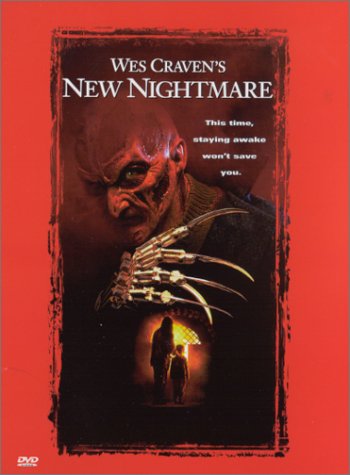
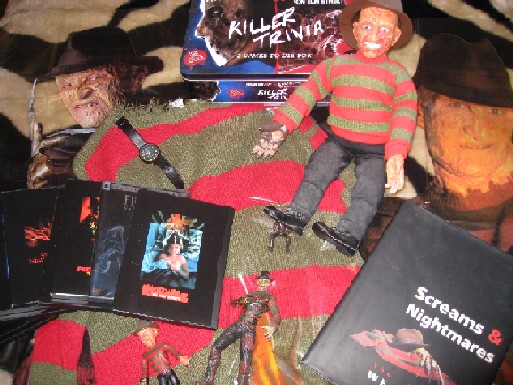
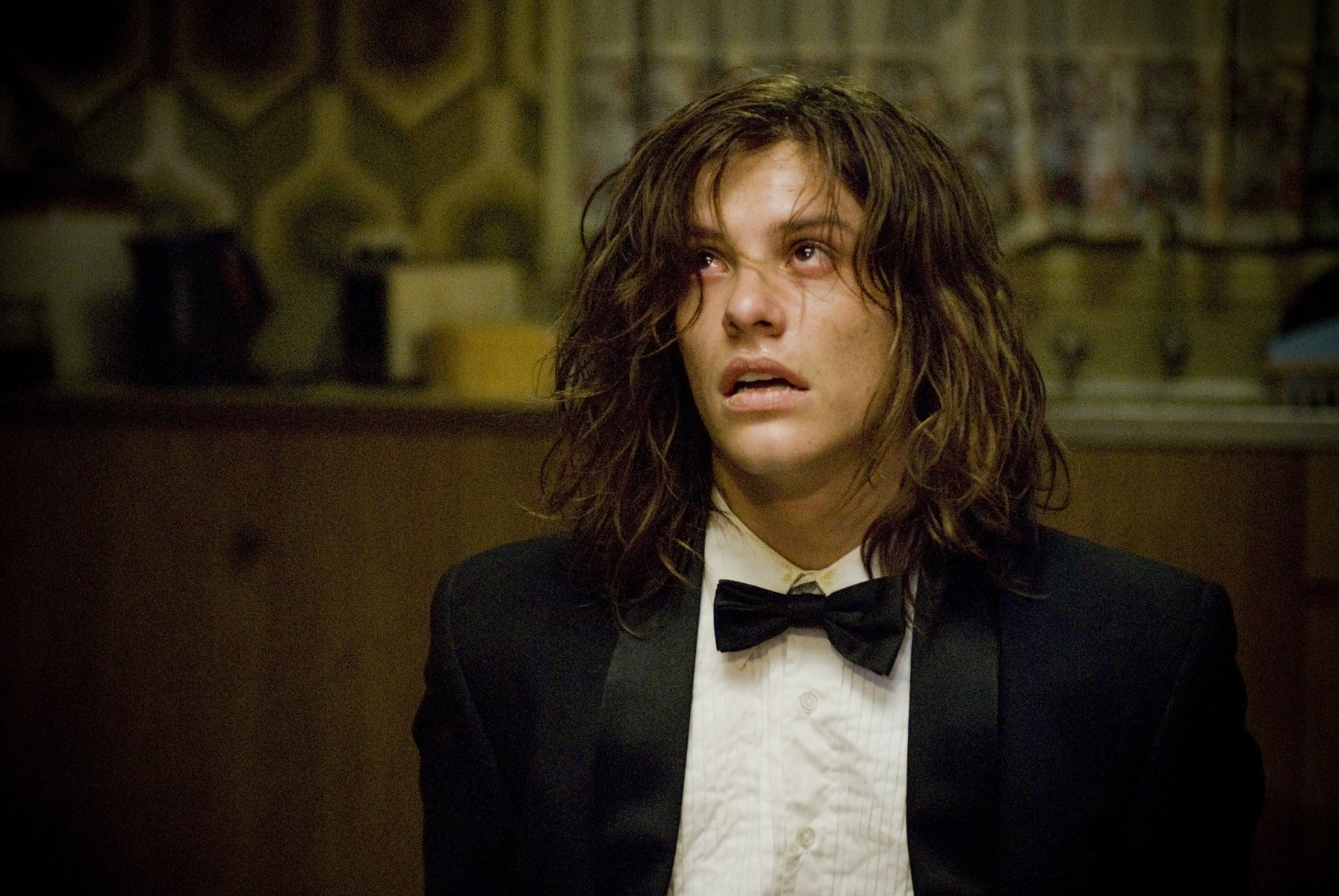
Before Wes Craven got meta with Scream (1996), he tried his self-referential hand at the Nightmare on Elm Street series. The result was New Nightmare (1994), which reunited Heather Langenkamp and Robert Englund as … Heather Langenkamp and Robert Englund. Also playing themselves: actor John Saxon, writer-director Wes Craven, producer Robert Shaye, and Freddy Krueger. Yep, that’s how he’s credited.

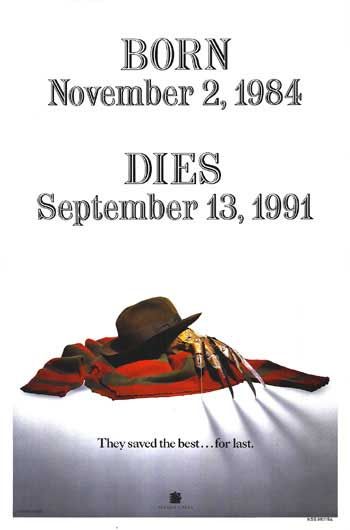
Where was there to go after the dreadful Freddy’s Dead (1991)? Not because of the title’s finality — see also: the so-called Final Chapter (1984) of Friday the 13th — but rather its inescapable shittyness. Part six offered more comedy than horror, with lazy deaths, bad acting, and weak puns — even by Freddy standards. But New Nightmare was a reinvention in the truest sense. It’s a film that, while far from perfect, was well ahead of its time. In fact, Craven pitched it as the plot for part three, but the studio decided against it.

That’s probably for the best. New Nightmare works well when it’s referencing its predecessors: that’s kind of the whole point. Part three would have been too soon — that film could have been clever, but it wouldn’t be full of the Easter eggs that make New Nightmare such a treat for longtime fans. And, yes, I’ve been rewatching these movies for the past week and am, in general, above-average geeky: this film works for me in a way it might not work for others. But I think that’s OK. Scream is broader (and better) because it appeals to fans of all ‘80s horror — New Nightmare is just for Freddy Krueger devotees.


Here are 20 references that I picked up on. Some were certainly intentional. Others are the product of my overactive imagination.

1.    The first few shots show the creation of Freddy’s new animatronic glove. A Nightmare on Elm Street (1984) begins with Freddy fashioning his glove.
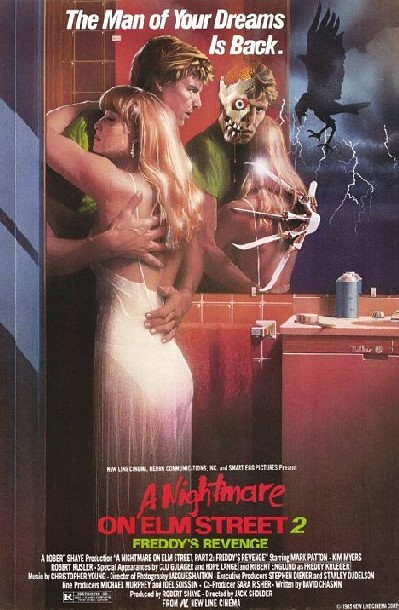
2.    At the talk show where Robert Englund surprises Heather in full Freddy regalia, he taunts the audience with, “You are all my children now,” a line from Freddy’s Revenge (1985).
3.    Heather’s son Dylan (Miko Hughes) repeats “Never sleep again” and other lines from the rhyme first heard in part one and chanted in all Nightmare films.
4.    Robert Shaye jokes, “I guess evil never dies, right?” One of the taglines to part four, The Dream Master (1988), was “Pure evil never really dies.”
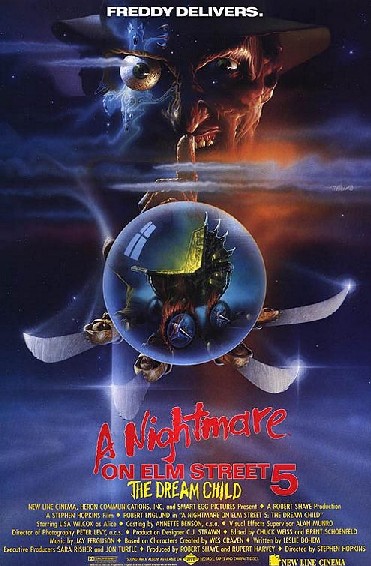
5.    Heather’s husband Chase (David Newsom) crashes his car when he falls asleep and gets attacked by Freddy. Dan (Danny Hassel) died similarly in part five, The Dream Child (1989).
6.    Just as Freddy made Dan’s corpse speak to Alice (Lisa Wilcox), he has Chase talk to Heather when she falls into his coffin.
7.    Heather and Dylan’s conversation about God recalls Tina (Amanda Wyss) pleading for God in part one. Freddy’s response? “This is God.”
8.    Dylan invites Heather to join him in his dreams. Bringing people into dreams was the power Kristen (Patricia Arquette/Tuesday Knight) displayed in Dream Warriors and Dream Master.
9.    When Heather calls Robert, he’s painting freaky Freddy art. Kristen couldn’t stop drawing Nancy’s house (and Freddy) in part three.
10.    To replicate Freddy’s glove, Dylan tapes knives to his fingers. In the first Nightmare, the glove is referred to as his “fingerknives.”
11.    The phone receiver turns into Freddy’s mouth and tongue, as it did in part one.
12.    Freddy needs to cross over into our world by getting past Heather, the gatekeeper. There was plenty of talk about gates and gatekeepers in Dream Master, but to be honest, I wasn’t paying much attention to the plot by that point.
13.    Heather wakes from a nightmare with a grey streak in her hair, just like Nancy in part one.
14.    A nurse tells Heather she’ll need a pass to get into the hospital’s restricted area, to which Heather replies, “Screw your pass.” This is another line from part one.
15.    Heather reminds Dylan, “Whatever you do, don’t fall asleep.” She said the same thing to Glen (Johnny Depp) as Nancy in the first Nightmare.
16.    An invisible Freddy lifts Julie (Tracy Middendorf) into the air, then drags her up the wall and onto the ceiling. This is almost exactly how Tina died in part one.
17.    Dylan’s a sleepwalker, which is bad news in these movies. In Dream Warriors, Phillip (Bradley Gregg) suffered from the same problem.
18.    Heather tells John Saxon that Fred Krueger killed Chase. By part two, Krueger was known as “Freddy,” so this is likely an allusion to part one. Of course, that’s underscored by the TV playing a similar scene from the first movie.
19.    The references get even more overt when Heather and John take on their original roles as Nancy and Lt. Thompson, down to wearing the same clothes they had on at the end of the first Nightmare.
20.    While trying to rescue Dylan from Freddy, Heather gets caught climbing the stairs, which turn into goop. This also happened in part one.

Be still, my nerdy heart. I have to admit that New Nightmare isn’t quite as good as it could have been. Freddy’s new makeup, which is supposed to be scarier, pales in comparison to his earlier incarnations. In fact, all of the scenes involving Freddy are somewhat lacking: this is really Heather Langenkamp’s movie. Still, without this film, there would be no Scream. And without Scream — well, I don’t even want to think about that.

Welcome to Elm Street: Part Six

0

In honor(?) of the new A Nightmare on Elm Street, we’re recapping all of the Elms so far. Find more on the Pixel Vision blog.

By 1991, when the optimistically-titled Freddy’s Dead: The Final Nightmare rolled around, the Elm Street series was still making money, but delivering few scares. Not like the series’ beloved hero cared, really — Freddy Krueger was as popular as ever. Just look at the opening credits of Freddy’s Dead, which equate Krueger and Nietzsche as quotable icons (“Welcome to prime time, bitch!” remains a phrase of note among philosophers, I’m sure.)

The only Nightmare film directed by a woman (Rachel Talalay, who made her directing debut; she later made 1995’s Tank Girl and has since helmed a shit-ton of TV shows), and the only to utilize 3-D (more on that later), Freddy’s Dead is set ten years in the future (so, 2001?) Freddy has slaughtered every kid in Springwood; the adults who remain are bonkers. The sole survivor is a height-phobic teen (Shon Greenblatt) we only ever know as John Doe; the film’s opening sequence pays homage to both The Twilight Zone and The Wizard of Oz (1939) as John ejects from a freaky airplane ride into a house spinning through a wind storm. Do I really have to tell you Freddy sails by on a broom stick? “I’ll get you, my pretty — and your little soul, too!”

John lives, but barely — battered and with no memory, he’s picked up by cops in Depressed Americatown, USA, and taken to a run-down shelter for troubled teens staffed by Maggie (Lisa Zane — yes, Billy’s sister!) and Doc (the Yaphet Kotto). In short order, we’re introduced to a ragtag crew of Dream Warriors 2.0: dope-smoking video game addict Spencer (future movie and TV semi-star Breckin Meyer); tough bitch Tracy (Lezlie Deane); and hearing aid-wearing Carlos (Ricky Dean Logan). In keeping with a series theme that’s especially pronounced here, all three have abusive parents.

The fact that John Doe has violent, vivid nightmares is intriguing to both Doc — who specializes in “dream therapy” — and Maggie, who suffers her own disturbing dreams. When it becomes apparent that Maggie and John are having variations on the same dream (though Maggie’s play out more like flashbacks, or sinister home movies), she hustles him into the youth center’s comically beat-up van for a visit to Springwood. Hey, maybe it’ll jog his memory — or hers.

OF COURSE, the three reckless youths with obviously identifiable weaknesses happen to stow along for the ride. Bad move. Springwood proves to be empty, save for a few insane adults (including Roseanne and Tom Arnold, at the height of their tabloid fame). While Maggie and John search for clues to their dark pasts, Spencer, Tracy, and Carlos explore an abandoned house — on Elm Street. Freddy appears and immediately begins fucking with all involved: for example, the deaf kid gets a Freddy-style hearing aid that makes everything painfully loud, and is then subjected to the sound of Freddy gleefully scratching his claws along a chalkboard. Needless to say, Carlos’ head explodes; needless to add, Freddy’s kiss-off is “Nice hearin’ from ya!”

Spencer’s death is far more humorous, and is probably the best example of how un-terrifying Freddy has become by now. As the stoner dozes, a busted TV comes to life. Johnny Depp does a rememberin’-my-roots cameo in a fake TV commercial, which is interrupted by Freddy. “Hey Spence — let’s trip out!” Droopy-eyed Spence grins as Iron Butterfly plays and psychedelic waves suck him into the set. Suddenly, he’s a character in a video game, being pounded first by his domineering father (“Be like me!”) and then Freddy himself, who’s also manning the joystick in some alternate reality to this alternate reality. As Maggie and Tracy watch in horror (and, presumably, the audience howls in delight), Spence sleepwalks all over the house, punching walls and bouncing into the ceiling. “Great graphics,” gamer Freddy murmurs in approval.

Anyway. Spence dies, and a sleeping John Doe can’t be roused to prevent his own untimely end (it involves a parachute and a bed of nails). Earlier, he and Maggie had learned from Springwood’s orphanage that Freddy Krueger’d had a kid, current whereabouts unknown. John had thought he was Krueger Jr., safe from Freddy’s wrath. But no! His last words, to Maggie: “It’s not a boy!”

So, Maggie the nightmare-having doctor realizes what we’ve known all along: Freddy Krueger is her father! ZOMG! Freddy’s Dead takes the opportunity to sketch in a backstory for our favorite child killer: he’s seen pulverizing a hamster as his eight-year-old classmates chant “Son of a hundred maniacs!”; he’s seen enjoying a beating from his stepfather (the Alice Cooper); he’s seen, through Maggie’s eyes, murdering his wife after she discovers a secret room in their Springwood house (contents: gloves, weird things in jars, cookies). Young Maggie, or Katherine, or whatever her birth name was, was sent to the orphanage soon after, giving Freddy further motivation to kill every kid in town. Or something. Apparently he was a devoted father.

Meanwhile, back at the shelter, Doc immediately understands the situation, unlike every other authority figure in the series EVER: “He’s fucking with the line between dreams and reality!” Seems Freddy is also trying to get Maggie to bring him more victims, allowing for this crowd-pleasing exchange:  “But this isn’t Springwood!” “Every town [dramatic pause] has an Elm Street!”

It is soon decided that Maggie, being Freddy’s spawn, is the only one who can enter his thoughts, get ahold of him in dreamville, and bring him into the real world, where he can be killed the fuck dead. “You’ll use these,” Doc says, pulling out a pair of 3-D glasses. While it might’ve been easier for the filmmakers to just insert a title card reading “PUT ON THE GLASSES NOW Y’ALL,” I suppose this was a somewhat more subtle way to issue the same orders.

Anyway, there’s an extended tussle in shoddy 3-D. Freddy finally dies (Maggie spears him with his own glove, for maximum irony). The end credits, which offer a memorializing highlight reel of Freddy’s greatest kills, unspool over what has to be Iggy Pop’s least-popular song of all time, “Why Was I Born? (Freddy’s Dead).” And horror fans finally know the answer to the question that’d gripped their dreams for nearly a decade: how do you kill Freddy Krueger? You could believe the movie’s harebrained plot. Or you could believe the evidence presented by the movie itself: kill the monster by transforming him into a campy, cackling, comedian.

Don’t worry — there are two more Freddy movies, plus the new flick, to go on our series. Grab a cup of coffee, kids!

http://www.youtube.com/watch?v=YmdityGT-R8&feature=related

Hot sexy events: April 28 – May 4

0

It’s time to take control, cats and kittens. And no, I don’t mean you’ve gotta throw away all those naughty thoughts of ropes and handcuffs — rather, it’s time to lay claim to your own sex life. This week’s sexy events give you ample room to play with this concept, be it Cleo Dubois (2008 leather Marshall of the Pride parade)’s weekend long intensive on mastering the whip for female dominants, or Julian Wolf’s class at Good Vibes on reaffirming the divine in your S&M. For a different take, head to Wicked Grounds’ Festish Munch, where you can calmly meet and greet potential playmates with as much discretion as you have over your extra foamy latte… or was that a mocha with whip? Regardless, get out there and make it how you want to.

S&M: Spirit & Meaning
Julian Wolf shows the way to BDSM scenes that inspire spiritual awakening, making it possible to be a sexy person, and a spiritual person, all in the same moment.
Wed/28 8-10 p.m., $25-30
Good Vibrations
603 Valencia, SF
(415) 552-5460
www.goodvibes.com

Fetish Munch
Do you like fetish play, dress up, BDSM fun, and “dark and sexy” music — but find it hard to really get to know your partners in the thick of the party? Take time to come discuss your passions over a cup of coffee at SF’s sexiest cafe, Wicked Grounds.
Wed/28 8-9:30 p.m., free
Wicked Grounds
289 8th St., SF
(415) 503-0405
www.wickedgrounds.org

Amazing Grace

The first movie to touch on AIDS issues in Israel, Amazing Grace witnesses the relationship between upstairs and downstairs neighbors. The film screens as part of the SF Jewish Film Festival and the “Out in Israel” LBGT Culture Festival.
Thur/29 9 p.m., free
Roxie Cinema
3125 16th St., SF
(415) 863-1087
www.sfjff.org

Cleo Dubois’ Women’s Erotic Dominance Weekend
A full weekend of women learning how to maximize their power in the dungeon. Feedback from previous attendees: “the course gave me more than I had anticipated or hoped for and I had hoped for quite a lot.” Time to get some more confidence in your life, starting with your sexual dynamics.
Starts Fri/30 7 p.m. @ private SOMA residence
Day long courses Sat/1 & Sun/2 @ SF Citadel
1277 Mission, SF
(650) 326-3269
cleodubois@sm-arts.com

Burlesque ‘N Brass
Blue Bone Express provides the jazz melodies to which lovely ladies will shake their spangles. Raise a glass (I hear they have good grapefruit juice cocktails, just a thought), and watch out for dangerous curves.
Sat/1 8:30 p.m.-12:30 a.m., $10
Café Van Kleef
1621 Telegraph, Oakland
(510) 763-7711
www.cafevankleef.com

SF Citadel Play Party
Romp amongst the slings and arrows, outrageous fortune pretty much guaranteed at this frisky get together for the leather community! The event is only open to members, but unaffiliated pervs, you’re in luck — you can buy in for a full year at the Citadel for just $10. They’re also open to work/play exchanges, if you’d like to volunteer for a shift.
Sat/1 8 p.m.-1 a.m., $25 for members
SF Citadel
1277 Mission, SF
(415) 626-1746
www.sfcitadel.org

Thrillpeddlers Present: “Hot Greeks”
The Thrillpeddlars follow up the wild success of “Pearls Over Shanghai” with this sassy little stage number, which tells the story of the Tri Thigh sorority girls’ quest to find the Oracle of Delphi (otherwise known as the Hot Twat of Tangier). The pricey tickets are a partner price for the special “shock box” seating. Oooo…
Sun/2 7 p.m., $30-69
Hypnodrome Theater
575 10th St., SF
(415) 377-4402
www.thrillpeddlers.com

Mommy’s Playdate
Madres only at this mingle fest for those with little ones. Leave the kiddies at home, and instead pick up “mommy-tini,” and get a one on one consultation from the Good Vibes staff sexologist. And a makeover… of what you’ll have to attend to find out.
Tues/4 7-9 p.m., free
Good Vibrations
1620 Polk, SF
(415) 345-0400
www.goodvibes.com

Welcome to Elm Street: Part Five

0

In honor(?) of the new A Nightmare on Elm Street, we’re recapping all of the Elms so far. Find more on the Pixel Vision blog.

Here’s some friendly advice — don’t be friends with Alice. She’s a nice girl and all, but she’s kind of a getting-stabbed-to-death magnet. It’s like Greta says in Nightmare on Elm Street 5: The Dream Child (1989): “The bottom line, Alice, if anyone’s trying to hurt you, supernatural or not, they’re going to have to go through us first.” Yeah, that’s not really a problem for Freddy Krueger, who’s all too happy about dispatching Alice’s friends and lovers. Souls make him strong! Hey, remember when he was just trying to get revenge? In the words of President Barack Obama, “This shit’s getting way too complicated for me.”

Part five of the Nightmare on Elm Street series isn’t all that well-regarded, but I actually like it far more than part four. Lisa Wilcox’s Alice breaks Carol Clover’s “Final Girl” model: she has sex, she gets naked, and she survives — twice! In The Dream Child, she’s transformed from the meek and mousy victim in Nightmare on Elm Street 4: The Dream Master (1988) to a kick-ass mama bear. That’s right, she’s with child. The plot is really silly, though it doesn’t matter. As Cheryl pointed out, by this point in the series we’re mostly watching for the nightmares. And the ones here are great.

Let me break it down, nightmare-by-nightmare.

“Hey, Danny, better not dream and drive!” Even though he’s all charged up and knows better, Dan (Danny Hassel), a holdover from part four, falls asleep on his way to meet Alice. He hears his mom call him an “ungrateful, unmanageable dickweed” on the radio. Don’t worry, she also calls Alice a “bimbo-slut-whore.” The car turns into Freddy, Dan loses all control, and he flies through the windshield. But wait, there’s more! Dan only thinks he’s survived — a stolen motorcycle also takes on some frightening Freddy features. Dan gets a hot fuel injection (less sexy than it sounds) and finally crashes in a fiery heap outside of the diner where Alice works. Tragic.

“Bon appétit, bitch.” Greta (Erika Anderson) may not get a death sequence as extended as Dan’s, but holy crap is it gross. In the real world, her mom is forcing her to attend a dinner party where lecherous older men ogle Greta’s model figure. You know, a day after her friend dies in a terrible accident. When Greta dozes off, she encounters Chef Freddy, who traps her in her chair and shovels unfathomable amounts of food into her mouth. Soon she’s got the chipmunk cheeks from hell — the most disturbing visual since Freddy’s sleepwalking puppet in Dream Warriors. And then Alice sees Greta in her fridge, which is bound to kill her appetite for at least a few days. Long story short: Greta chokes to death and no one even tries to intervene.

“You’re not crazy.” Well, duh, Yvonne (Kelly Jo Minter). Is everyone in these movies willfully dense? Yes, they’re slasher flicks. I’m just saying it would be nice if for once, the Final Girl’s friends believed her right away. But I digress. Diving boards are scary enough as it is, but Yvonne almost gets destroyed by one when she falls asleep in the pool. Of course, she doesn’t actually die. Instead, Yvonne gets pulled into Alice’s dream, which turns out to be a stroke of good luck. Wading in a nasty tank for a while is a whole lot better than what the rest of Alice’s friends face. Though I’m guessing Yvonne feels pretty awkward about the whole “not trusting her bestie” thing.

“Faster than a bastard maniac, more powerful than a loco-madman, it’s Super Freddy!” Not gonna lie, I totally have a crush on dweeby comic artist Mark (Joe Seely). He also has The Dream Child’s best nightmare, because it’s by far the most absurd — and because I’m pretty sure it was inspired by A-Ha’s “Take On Me” video. Mark is pulled into his comic, and at first, he’s sort of OK with it. In the comic, Mark can become the Phantom Prowler, a dark and deadly vigilante who says things like, “Time to die, you scar-faced, limp-dick!” But movie monsters are just as resilient as superheroes. Even after getting shot repeatedly, Freddy is still able to overtake Mark, slashing the crap out of him. Well, a two-dimensional paper version of Mark. And not a single papercut joke. Color me impressed.

There’s other great stuff here. I love all the unnerving flashbacks to Freddy’s conception: something about the combination of an innocent nun and 100 horny maniacs freaks me out more than Krueger himself. We also get Alice’s creepy offspring Jacob (Whitby Hertford) — no offense to the actor, but he’s just … weird-looking. Oh, and Alice travels inside her own womb, where Freddy is hanging out on her uterine wall. As one does. Part five may not be as good as parts one through three, but it’s way more tolerable than Freddy’s Dead (1991), which Cheryl will be slogging through next.

ENDORSEMENTS: San Francisco ballot measures

0

 PROPOSITION A

SCHOOL FACILITIES SPECIAL TAX

YES

This measure would extend a 1990 parcel tax that expires in 2010 by another 20 years, keeping it at its current rate ($32 a year for single family homes and commercial enterprises, $16 a year per dwelling unit for mixed use buildings). The tax brings in $7 million a year for San Francisco school facilities and would finance seismic upgrades, structural strengthening and related improvements of its facilities, and child care centers. Vote yes.


PROPOSITION B

EARTHQUAKE SAFETY AND EMERGENCY RESPONSE BONDS

YES

It’s hard to argue against a $430 million bond act to upgrade police, fire, and water facilities to prevent a catastrophic collapse of the city’s most basic public safety infrastructure in the event of an inevitable earthquake. Hard — but not impossible: Sup. Chris Daly, the lone vote against Prop. B, points out that the bond money would be used to upgrade police stations but that the old County Jail at 850 Bryant St. wouldn’t get any help. Prisoners, it seems (even those who are awaiting trial and have been convicted of nothing) aren’t worth protecting. And the Fire Department has been very hazy about where it’s going to spend the cash. So we’ve got some concerns here — but on balance, we’re endorsing Yes on B.


PROPOSITION C

FILM COMMISSION

YES

By some accounts, this measure was put together in retaliation for Mayor Gavin Newsom’s November 2009 demand that Film Commission executive director Stefanie Coyote resign — shortly after her husband, actor Peter Coyote, supported Attorney General Jerry Brown over Newsom for governor. But Bill Barnes, who works as a legislative aide for Newsom ally Sup. Michela Alioto-Pier, the author of Prop. C, says Alioto-Pier was working on this measure even before Coyote got ousted.

Either way, it’s a positive step. Prop. C would streamline a convoluted permitting process for shooting films in San Francisco — a process that can involve multiple departments — and would create a one-stop shop. It would also split the power to appoint the film commissioners between the mayor and the board (6-5, respectively), and require that all 11 commissioners have specific qualifications or experience. Vote yes.


PROPOSITION D

RETIREMENT BENEFITS

YES

Prop. D is a compromise. Sup. Sean Elsbernd wanted to reform the city’s pension system by mandating higher employee contributions and an end to what’s known as “spiking” — giving some employees a big raise just before they retire. Under current law, that worker would get a pension based on the inflated salary.

Elsbernd wanted to change the calculation and base pensions on an average of the final three years of salary an employee earned. Labor countered that some lower-paid workers only reach their top pay at the end of their careers. The final deal would base pensions on a two-year average. Prop. D would also require future employees to contribute and extra 2 percent to their pensions and require the city to set aside some money every year for the pension and retiree health care systems. In the end, progressive Sups. David Campos and Eric Mar signed on, and the city employee unions aren’t opposed. Vote yes.


PROPOSITION E

BUDGET LINE ITEM FOR POLICE SECURITY

YES

Prop. E would make one simple tweak to the reporting requirements for San Francisco’s annual city budget: a line-item on how much is spent on security for city officials and visiting dignitaries. As things stand, the amount the police department spends to protect people like, oh, say Mayor Gavin Newsom while he is crisscrossing the state campaigning for (lieutenant) governor is kept secret. That’s information the public has a right to know. Vote yes.


PROPOSITION F

RENTERS’ FINANCIAL HARDSHIP APPLICATIONS

YES

Prop. F would allow a tenant facing a rent increase to file a petition with the Rent Board claiming financial hardship. If the tenant was unemployed, or had his or her wages cut by 20 percent or more, or didn’t get a cost of living increase in government benefits and was paying at least 33 percent of his or her income as rent, the rent hike would be delayed for 60 days pending a hearing. If the renter can establish hardship, the landlord would have to hold off on the increase until the tenant’s employment or benefit situation improved. Few San Francisco landlords would be hurt by the delay in what are typically modest rent hikes — but a lot of tenants could avoid eviction. Vote yes.


PROPOSITION G

TRANSBAY TRANSIT CENTER

YES

Prop. G, a policy statement, became a moot point earlier this year, but it’s still good for San Franciscans to affirm the city’s support for bringing high-speed rail service downtown. The California High-Speed Rail Project is moving to create bullet train service from SF to downtown Los Angeles using bond money approved by voters in 2008. Even though that bond measure named the Transbay Terminal as the northern terminus of the first phase, some officials raised doubts about whether the downtown location was the best choice. That rail service was integral to plans for the transit center, which is currently being rebuilt, so the Board of Supervisors placed this measure on the ballot to support that choice. Earlier this month, the California High-Speed Rail Authority considered other alternatives and voted to stay with the Transbay Terminal. That’s the right way to go; vote yes.

ENDORSEMENTS: National and state races

15

Editor’s note: the file below contains a correction, updated May 5 2010. 


National races


U.S. SENATE, DEMOCRAT


BARBARA BOXER


The Republican Party is targeting this race as one of its top national priorities, and if the GOP can dislodge a three-term senator from California, it will be a major blow for the party (and agenda) of President Obama. The pundits are happily talking about how much danger Barbara Boxer faces, how the country’s mood is swinging against big-government liberals.


But it’s always a mistake to count out Boxer. In 1982, as a Marin County supervisor with little name recognition in San Francisco, she trounced then-SF Sup. Louise Renne for an open Congressional seat. Ten years later, she beat the odds and won a hotly contested primary and tough general election to move into the Senate. She’s a fierce campaigner, and with no primary opposition, will have a united party behind her.


Boxer is one of the most progressive members of the not-terribly progressive U.S. Senate. She’s been one of the strongest, most consistent supporters of reproductive rights in Washington and a friend of labor (with 100 percent ratings from the AFL-CIO and National Education Association). We’ve had our disagreements: Boxer supported No Child Left Behind, wrote the law allowing airline pilots to carry guns in the cockpit, and was weak on same-sex marriage when San Francisco sought to legalize it (although she’s come around). But she was an early and stalwart foe of the war in Iraq, split with her own party to oppose a crackdown on illegal immigration, and is leading the way on accountability for Wall Street. She richly deserves reelection, and we’re happy to endorse her.


CONGRESS, 6TH DISTRICT, DEMOCRAT


LYNN WOOLSEY


It’s odd that the representative from Marin and Sonoma counties is more progressive by far than her colleague to the south, San Francisco’s Nancy Pelosi. But over the years, Lynn Woolsey has been one of the strongest opponents of the war, a voice against bailouts for the big Wall Street banks, and a foe of cuts in the social safety net. We’re proud to endorse her for another term.


CONGRESS, 7TH DISTRICT, DEMOCRAT


GEORGE MILLER


George Miller has been representing this East Bay district since 1974, and is now the chair of the Education and Labor Committee and a powerhouse in Congress. He’s too prone to compromise (with George W. Bush on education policy) but is taking the right line on California water (while Sen. Dianne Feinstein is on the wrong side). We’ll endorse him for another term.


CONGRESS, 8TH DISTRICT, DEMOCRAT


NANCY PELOSI


We’ve never been terribly pleased with San Francisco’s most prominent Congressional representative. Nancy Pelosi was the author of the bill that created the first privatized national park at the Presidio, setting a horrible standard that parks ought to be about making money. She was weak on opposing the war, ducked same-sex marriage, and has used her clout locally for all the wrong candidates and issues. But we have to give her credit for resurrecting and pushing through the health care bill (bad as it was — and it’s pretty bad — it’s better than doing nothing). And, at a time when the Republicans are trying to derail the Obama presidency, she’s become a pretty effective partner for the president.


Her fate as speaker (and her future in this seat) probably depends on how the Democrats fare in the midterm Congressional elections this fall. But if she and the party survive in decent shape, she needs to take the opportunity to undo the damage she did at the Presidio.


CONGRESS, 9TH DISTRICT, DEMOCRAT


BARBARA LEE


Barbara Lee, who represents Berkeley and Oakland, is co-chair of the Progressive Caucus in the House, one of the most consistent liberal votes in Congress, and a hero to the antiwar movement. In 2001, she was the only member of either house to oppose the Bush administration’s Use of Force resolution following the 9/11 attacks, and she’s never let up on her opposition to foolish military entanglements. We’re glad she’s doing what Nancy Pelosi won’t — represent the progressive politics of her district in Washington.


CONGRESS, 13TH DISTRICT, DEMOCRAT


PETE STARK


Most politicians mellow and get more moderate as they age; Stark is the opposite. He announced a couple of years ago that he’s an atheist (the only one in Congress), opposed the Iraq war early, called one of his colleagues a whore for the insurance industry, and insulted President Bush and refused to apologize, saying: “I may have dishonored the commander-in-chief, but I think he’s done pretty well to dishonor himself without any help from me.” He served as chair of the House Ways and Means Committee for exactly one day — March 3 — before the Democratic membership overruled Speaker Pelosi and chucked him out on the grounds that he was too inflammatory. The 78-year-old may not be in office much longer, but he’s good on all the major issues. He’s also fearless. If he wants another term, he deserves one.


State races


GOVERNOR, DEMOCRAT


EDMUND G. BROWN


Jerry Brown? Which Jerry Brown? The small-is-beautiful environmentalist from the 1970s who opposed Pacific Gas and Electric Co.’s Diablo Canyon nuke and created the California Conservation Corps, the Office of Appropriate Technology, and the Farm Labor Relations Board (all while running a huge budget surplus in Sacramento)? The angry populist who lashed out at corporate power on a KPFA radio talk show and ran against Bill Clinton for president? The pro-development mayor of Oakland who sided with the cops on crime issues and opened a military academy? Or the tough-on-crime attorney general who refuses to even talk about tax increases to solve the state’s gargantuan budget problems?


We don’t know. That’s the problem with Brown — you never know what he’ll do or say next. For now, he’s been a terribly disappointing candidate, running to the right, rambling on about preserving Proposition 13, making awful statements about immigration and sanctuary laws, and even sounding soft on environmental issues. He’s started to hit his stride lately, though, attacking likely GOP contender Meg Whitman over her ties to Wall Street and we’re seeing a few flashes of the populist Brown. But he’s got to step it up if he wants to win — and he’s got to get serious about taxes and show some budget leadership, if he wants to make a difference as governor.


LIEUTENANT GOVERNOR, DEMOCRAT


JANICE HAHN


Not an easy choice, by any means.


Mayor Gavin Newsom jumped into this race only after it became clear that he wouldn’t get elected governor. He sees it as a temporary perch, someplace to park his political ambitions until a better office opens up. He’s got the money, the statewide name recognition, and the endorsement of some of the state’s major power players, including both U.S. Senators and House Speaker Nancy Pelosi. He’s also been a terrible mayor of San Francisco — and some progressives (like Sup. Chris Daly) argue, persuasively, that the best way to get a better person in Room 200 is to ship Newsom off to an office in Sacramento where he can’t do much harm and let the supervisors pick the next mayor.


But it’s hard to endorse Newsom for any higher office. He’s ducked on public power, allowing PG&E to come very close to blocking the city’s community choice aggregation program (See editorial, page 5). His policies have promoted deporting kids and breaking up families. He’s taken an approach to the city budget — no new revenue, just cuts — that’s similar to what the Republican governor has done. He didn’t even bother to come down and talk to us about this race. There’s really no good argument for supporting the advancement of his political career.


Then there’s Janice Hahn. She’s a Los Angeles City Council member, the daughter of a former county supervisor, and the sister of a former mayor. She got in this race way before Newsom, and her nightmare campaign consultant, Garry South, acts as if she has some divine right to be the only Democrat running.


Hahn in not overly impressive as a candidate. When we met her, she seemed confused about some issues and scrambled to duck others. She told us she’s not sure she’s in favor of legalizing pot, but she isn’t sure why she’s not sure since she has no arguments against it. She won’t take a position on a new peripheral canal, although she can’t defend building one and says that protecting San Francisco Bay has to be a priority. She won’t rule out offshore oil drilling, although she said she has yet to see a proposal she can support. Her main economic development proposal was to bring more film industry work to California, even if that means cutting taxes for the studios or locating the shoots on Indian land where there are fewer regulations.


On the other hand, she told us she wants to get rid of the two-thirds threshold in the state Legislature for passing a budget or raising taxes. She supports reinstating the car tax at pre-Gov. Arnold Schwarzenegger levels. She supports a split-roll measure to reform Prop. 13. She wants to see an oil-severance tax to fund education. She’s one of the few statewide candidates who openly advocates higher taxes on the wealthy as part of the solution to the budget crisis.


We are under no illusions that Hahn will be able to use the weak office of lieutenant governor to move on any of these issues, and we’re not at all sure she’s ready to take over the top spot. But on the issues, she’s clearly better than Newsom, so she gets our endorsements.


SECRETARY OF STATE, DEMOCRAT


DEBRA BOWEN


Debra Bowen is the only Democrat running, a sign that pretty much everyone in the party thinks she’s doing a fine job as Secretary of State. She’s run a clean office and we see no reason to replace her.


CONTROLLER, DEMOCRAT


JOHN CHIANG


Like Bowen, John Chiang has no opposition in the primary, and he’s been a perfectly adequate controller. In fact, when Gov. Schwarzenegger tried two years ago to cut the pay of thousands of state employees to the minimum wage level, Chiang defied him and refused to change the paychecks — a move that forced the governor to back down. We just wish he’d play a more visible role in talking about the need for more tax revenue to balance the state’s books.


TREASURER, DEMOCRAT


BILL LOCKYER


Bill Lockyer keeps bouncing around Sacramento, waiting, perhaps, for his chance to be governor. He was attorney general. Now he’s treasurer seeking a second term, which he will almost certainly win. He’s done some good things, including trying to use state bonds to promote alternative energy, and has spoken out forcefully about the governor’s efforts to defer deficit problems through dubious borrowing. He hasn’t, however, come out in favor of higher taxes for the rich or a change in Prop. 13.


ATTORNEY GENERAL, DEMOCRAT


KAMALA HARRIS


There are really only two serious candidates in this race, Kamala Harris, the San Francisco district attorney, and Rocky Delgadillo, the former Los Angeles city attorney. Harris has a comfortable lead, with Delgadillo in second and the others far behind.


Delgadillo is on his second try for this office. He ran against Jerry Brown four years ago and got nowhere. And in the meantime, he’s come under fire for, among other things, using city employees to run personal errands for him (picking up his dry-cleaning, babysitting his kids) and driving his car without insurance. On a more significant level, he made his reputation with gang injunctions that smacked of ethnic profiling and infuriated Latino and civil liberties groups. It’s amazing he’s still a factor in this race; he can’t possibly win the general election with all his baggage.


Harris has a lot going for her. She was among the first California elected officials to endorse Barack Obama for president, and remains close to the administration. She’s a smart, articulate prosecutor and could be one of the few women atop the Democratic ticket this year. We were never comfortable with her ties to Willie Brown, but he’s no longer a factor in state or local politics. These days, she’s more closely allied with the likes of State Sen. Mark Leno.


That said, we have some serious problems with Harris. She’s been up in Sacramento pushing Republican-style tough-on-crime bills (like a measure that would bar registered sex offenders from ever using social networking sites on the Internet) and forcing sane Democrats like Assembly Member and Public Safety Committee Chair Tom Ammiano to try to tone down or kill them (and then take the political heat). If she didn’t know about the problems in the SFPD crime lab, she should have, and should have made a bigger fuss, earlier.


But Harris has kept her principled position against the death penalty, even when it meant taking immense flak from the cops for refusing to seek capital punishment for the killer of a San Francisco police officer. She’s clearly the best choice for the Democrats.


INSURANCE COMMISSIONER, DEMOCRAT


DAVE JONES


Two credible progressives are vying to run for this powerful and important position regulating the massive — and massively corrupt — California insurance industry. Dave Jones and Hector De La Torre are both in the state Assembly, with Jones representing Sacramento and De La Torre hailing from Los Angeles. Both have a record opposing insurance industry initiatives; both are outspoken foes of Prop. 17; and either would do a fine job as insurance commissioner. But Jones has more experience on consumer issues and health care reform, and we prefer his background as a Legal Aid lawyer to De La Torre’s history as a Southern California Edison executive. So we’ll give Jones the nod.


BOARD OF EQUALIZATION, DISTRICT 1, DEMOCRAT


BETTY T. YEE


Betty Yee has taken over a job that’s been a stronghold of progressive tax policy since the days of the late Bill Bennett. She’s done well in the position, supporting progressive financial measures and even coming down, as a top tax official, in favor of legalizing (and taxing) marijuana. We’re happy to endorse her for another term.


SUPERINTENDENT OF PUBLIC INSTRUCTION


TOM TORLAKSON


Two prominent Democratic legislators are running for this nonpartisan post, state Sen. Gloria Romero of Los Angeles and Assembly Member Tom Torlakson of Martinez. It’s a pretty clear choice: Romero is a big supporter of charter schools who thinks parents should be able to move their kids out of one school district and into another (allowing wealthier white parents, for example, to abandon Los Angeles or San Francisco for the suburban districts). She’s been supported in the past by Don and Doris Fisher, who put a chunk of their GAP Inc. fortune into school privatization efforts. Torlakson wants more accountability for charters, opposes the Romero district-option bill, and has the support of every major teachers union in the state. Vote for Torlakson.


STATE SENATE, DISTRICT 8, DEMOCRAT


LELAND YEE


Sen. Leland Yee can be infuriating. Two years ago, he was hell-bent on selling the Cow Palace as surplus state property and allowing private developers to take it over. In the recent budget crisis, he pissed off his Democratic colleagues by refusing to vote for cuts that everyone else knew were inevitable (while never making a strong stand in favor of, say, repealing Prop. 13 or raising other taxes). But he’s always been good on open-government issues and has made headlines lately for busting California State University, Stanislaus over a secret contract to bring Sarah Palin in for a fundraiser — and has raised the larger point that public universities shouldn’t hide their finances behind private foundations.


Yee will have no serious opposition for reelection, and his campaign for a second term in Sacramento is really the start of the Leland Yee for Mayor effort. With reservations over the Cow Palace deal and a few other issues, we’ll endorse him for reelection.


 Correction update: Yee’s office informs us that the senator suports an oil-severance tax and a tax on high-income earners and “believes that Prop. 13 should be reformed,” although he hasn’t taken a position on Assemblymember Tom Ammiano’s reform bill. 


STATE ASSEMBLY, DISTRICT 12, DEMOCRAT


FIONA MA


Fiona Ma’s a mixed bag (at best). She doesn’t like Pacific Gas and Electric Co. and supports public power, but comes up with strange bills that make no sense, like a 2009 measure to limit rent control in trailer parks. Why does Ma, who has no trailer parks in her district, care? Maybe because the landlords who control the mobile home facilities gave her some campaign cash. She faces no opposition, and we’re not thrilled with her record, but we’ll reluctantly back her for another term.


STATE ASSEMBLY, DISTRICT 13, DEMOCRAT


TOM AMMIANO


When the history of progressive politics in modern San Francisco is written, Tom Ammiano will be a central figure. His long-shot 1999 mayoral campaign against Willie Brown brought the left to life in town, and his leadership helped bring back district elections and put a progressive Board of Supervisors in place in 2000. As a supervisor, he authored the city’s landmark health care bill (which Newsom constantly tries to take credit for) and the rainy day fund (which saved the public schools from debilitating cuts). He uses his local influence to promote the right causes, issues, and candidates.


And he’s turned out to be an excellent member of the state Assembly. He forced BART to take seriously civilian oversight of the transit police force. He put the battle to reform Prop. 13 with a split-role measure back on the state agenda. And his efforts to legalize and tax marijuana are close to making California the first state to toss the insane pot laws. As chair of the Public Safety Committee, he routinely defies the police lobbies and the right-wing Republicans and defuses truly awful legislation. We’re glad Ammiano’s still fighting in the good fight, and we’re pleased to endorse him for another term.


STATE ASSEMBLY, DISTRICT 14, DEMOCRAT


NANCY SKINNER


Nancy Skinner has taken on one of the toughest, and for small businesses, most important, battles in Sacramento. She wants to make out-of-state companies that sell products to Californians collect and remit sales tax. If you buy a book at your local bookstore, you have to pay sales tax; if you buy it from Amazon, it’s tax-free. That not only hurts the state, which loses hundreds of millions of dollars in tax revenue, it’s a competitive disadvantage to local shops. Skinner’s a good progressive vote and an ally for Ammiano on the Public Safety Committee. We’re happy to endorse her for another term.


STATE ASSEMBLY, DISTRICT 16, DEMOCRAT


SANDRE SWANSON


Sandre Swanson represents the district where BART police killed Oscar Grant, but he wasn’t the one out front pushing for more civilian accountability; that was left to SF’s Ammiano. And while Swanson was generally supportive of Ammiano’s bill, he was hardly a leader in the campaign to pass it. This is too bad, because Swanson’s almost always a progressive vote and has been good on issues like whistleblower protection (a Swanson bill that passed this year protects local government workers who want to report problems confidentially). We’ll endorse him for another term, but he needs to get tougher on the BART police.

Murder, he filmed

0

arts@sfbg.com

Get your shit peeled/ Check the murder rate, the shit’s real. —Eddi Projex, "Straight from Oakland"

MUSIC/FILM I first met Pretty Black, a member of Yukmouth’s Regime crew, in 2005 at the Mekanix’ studio in Oakland. He arrived with Husalah of the Mob Figaz to record. Goofing off, Hus urged me to get on the song, so I recorded an intro in mangled French, dubbing the pair "les hommes mobs." Black loved the pronunciation (moeb) and thus began one of my least likely rap-world friendships.

For even by rap standards, Black was a live wire. The 25-year-old always had a pistol on him, was always ready to fight, and, with his Range Rover and Lamborghini, clearly made his money off the street, though I didn’t inquire how. He was an angry young man, not someone to piss off. Yet according to Husalah, he had another side.

"Outside the circle, he seemed like the coldest dude on earth," Hus says. "But inside, you knew he was real compassionate. He provided for his niggas. And if you needed something, he was very resourceful."

"Plus," he adds, "if someone tried to fuck with you, he already knocked ’em out before you could even react."

Born in Chicago, Black was christened Ayoola Matthew Odumuyiwa by his Nigerian immigrant parents. When he first came to the Bay, he was known as Verstyle, but soon adopted the more in your face Pretty Black, a pun on the pimp sense of "pretty" (a "gorgeous" man) and his very dark skin. Like albino Jamaican rapper Yellowman, Black transformed a perceived negative — his color placing him on the lowest rung of our country’s caste system — into a defiant positive.

In 2008, on my birthday, May 25 (not, as sometimes reported, on May 30), Black was shot to death at an apartment complex where his relatives lived, a planned assassination. In other words, not random violence or robbery. Except for the killers, no one knows why. I was shocked because, while I could imagine someone wanting to kill him, I’d never known a murder victim. It’s like a candle flame being blown out: one second, fully here; the next, gone. I recalled, too, the last time I’d seen him, at a show featuring the Jacka. As we were catching up, he said, apropos of nothing, "Remember when we met and recorded that song? That was cool. Le moeb!" While ordinary at the time, this circling back to the night we met took on a retrospective uncanniness, as did one of his last songs, also recorded with the Mekanix, on which Black, playing both parts of a phone call, tells himself, "Don’t go outside, nigga. They’re trying to kill you."

BACK TO BLACK


I’ve been thinking about Black lately, in large part due to Land of the Homicide: The Murders in Oakland, CA (HookerBoyFilmz/HBO), a documentary DVD by Oakland filmmaker Dame Hooker. Brought into the game by veteran director Kevin Epps and multimedia journalist JR, Hooker has manned the cameras since 2001, releasing his first DVD, an overview of the local rap scene called The Bay Got Game (HookerBoy), in 2006. He’s also notched artist-oriented flicks like Mistah FAB’s Prince of the Bay (HookerBoy/InYoFace, 2007), among numerous other projects. Camera on shoulder, he’s a ubiquitous presence at any significant function, constantly accumulating footage of anything from a performance to a sideshow to an ass-whupping in high definition.

"I had a camera, but I was just shooting around the hood," Hooker recalls. "I didn’t know how to edit or anything. But FAB, Stalin, Shady Nate — I watched those dudes grow up. I started going to all their shows and they wanted the footage, so I learned how to edit just by watching TV or watching somebody else. Current TV on HBO showed me a lot about how to put it in a format."

Indeed, he nailed the format so well that Current TV licensed some of his footage and hired him and Epps to make content for the program’s Web site, which proved to be the genesis of the Land of the Homicide project.

"We did a pod, a little five-minute segment for Current TV," Hooker says. "It was called Popped in Oakland. I went around to my friends and was like, tell me how you got shot, and they was showing their wounds. HBO wanted me to extend it, and I was doing that already."

Some of the wounds are pretty grisly. One man pulls up a sleeve to display an arm that got sprayed with an AK. The arm is functional but it looks like a tree root, all twisted and gnarled, a permanent symbol of the gun problem in Oakland — which frequently leads the nation in homicides — not to say the entire country. Hooker himself hasn’t been immune to the violence. He shows me some of his own wounds.

"You got to know how to maneuver around here," he says grimly. "You can get shot just by looking at someone wrong. I got shot five times. Somebody thought I looked at them funny. I didn’t have no money on me or nothing."

RANDOM TARGETS


As Hooker’s own story suggests, Oakland’s gun violence often has a random quality to it. People get shot, sometimes killed, by mistake, in addition to intended victims like Pretty Black. One of the more notorious accidental murders was Jesse "Plan Bee" Hall, founder of the classic 1990s crew Hobo Junction, who was shot in 1992 while sitting next to the intended target. Among the interviewees are Plan Bee’s parents, his sister, and his younger brother, Bobby "Blu-Nose" Hall, as Hooker provides an unflinching look at the family’s devastation and grief. Before the end of the film, however, he winds up returning to the Hall residence as Blu-Nose himself is murdered, seemingly, like his brother, a random target.

"I got a large family. None of my family members have passed away like that," Hooker says. "Except my first cousin — we was real close — and my uncle, [and] two uncles, on my mother’s side. All the rest have been friends, but my friends be like my family."

Ordinarily, Blu-Nose’s death would raise a question like what are the odds of someone speaking on camera about gun violence being killed by gun violence shortly afterward? But this being Oakland, the question is: what are the odds of this occurring three times in quick succession? Because this is exactly what happens with Land of the Homicide, separating it from similarly-themed hood documentaries. Another of the main interviewees, a rapper from the East Oakland’s 70s named Hennessey who had many previous wounds to display, is also murdered. Though I hadn’t heard his music, I’d already begun to hear Hennessey’s name here and there; he’d just signed to Thizz for his first major project shortly before his death, and the contrast between his on-camera gregariousness and the extremely dapper corpse we see at his funeral makes a more emphatic argument against the legality of guns than any commentary could.

Pretty Black is the third victim. Although he didn’t have prior wounds himself, Black bumped into Hooker during the filming and agreed to lend his perspective as someone who knew the street life all too well.

"I was going around getting their opinion about the stuff," Hooker recalls. "Most of them was trying to help people, trying to get their hood right. I don’t know if it was a curse doing the DVD or what, but they all died back to back. It was supposed to be about the lives taken in Oakland, but it turned out to be the people that was interviewed."

I don’t think there’s a word for Hooker’s experience here. Obviously the tragic series of murders gives his DVD an authority and authenticity most documentaries couldn’t buy. But the price is not something he would have willingly paid.

"Land of the Homicide, that’s based on really good friends," he said. "DVDs, those don’t matter when it’s someone you know."

From Cleveland with love

2

johnny@sfbg.com

MUSIC Baby Dee is not your generic person in a band, with dull quotes about the process of recording an album. Baby Dee has something to say, and she says it with light power, ever so occasionally punctuating a comment with a machine-gun laugh that’s love-at-first-hearing. Some would say Baby Dee’s music is more of an acquired taste, but the new A Book of Songs for Anne Marie (Drag City) strips her musicality down to its essence, and the result, while owing a generative debt to German Lieder, is crystalline in a manner that trumps more affectation-laden contemporaries like Joanna Newsom and the musician most often compared to Dee, her friend Antony Hegarty of Antony and the Johnsons. Mabel Mercer comes to mind. On the eve of Dee’s SF visit, I got her on the horn, and the result was good enough that I didn’t want to write or talk around it. So here it is — 100-proof Baby Dee.

On the use of the Baby Dee song “Cavalry” in Joao Pedro Rodrigues’ movie To Die Like A Man: “He told me [it was the heart of the film] when I met him and I thought he was just blowing smoke up my ass. But so many reviews have said that he lavished all his gifts on that one scene.

How truly wonderful. Most people get a song in a movie and just an inconsequential fragment is playing in the background, but here the whole movie stops and everyone listens to the song — you can’t ask for more than that.

On her hometown: “I love Cleveland. It took me a long time to love Cleveland. I hated it all the time growing up. I left when I was 18 years old like a bullet out of a gun and never went back for more than a day at a time for almost 30 years.

The house I actually live in now, my recurring nightmare was to walk into the front door of that house. That was my end-of-the-world dream, instead of a holocaust or a great tsunami.

About ten years ago I went back there and ended up staying because my parents were in such bad shape. I was just experimenting with good behavior. [Laughs]

When they died I was stuck there, I’d lost my apartment in New York. I quit music and had a tree business. Then I woke up one morning and realized that I liked Cleveland. But it took me a lifetime. I’ve loved it ever since.

I never really toured the states, I’d toured Europe, and seeing what the rest of America is like made me love Cleveland. In Cleveland there is zero attitude at all. Nobody is cool in Cleveland, and if they are, it sure as hell isn’t because they live in Cleveland. The cool cities in America are New York, New Orleans — or what’s left of it — and San Francisco. In it’s own crazy way Vegas is cool. And maybe Niagara Falls.

New York is the city that never sleeps. I used to call Cleveland the city that shits the bed.”

On Marc Almond: “I adore, I worship Marc Almond. He’s one of the greatest people in the world in addition to being a great singer. People tend to think he’s a sweetheart, but in his case it’s absolutely true — he’s as good as gold. And we’ve got history — I gave him reasons to not be as good as gold to me. [Laughs] He’s just a prince.”

On German Lieder and classical music: “It had its influence on me, but in strange ways. When I grew up, I would leave the room when people would play Schubert. I couldn’t take it. It was an irrational hatred, and I haven’t had many musical ones. But there was history there — we took piano lessons, and my father had sort of been cast [by life] in the role of the Erl King with the dying child. Ooo, oogedy-boogedy, don’t go there! That kind of thing. We had to play some simple child’s version of Schubert’s Der Erlkönig, and my father was really into it without even having self-awareness why. He’d say “Play that one again” over and over, not even realizing it was about the death of his own soul. Hideous.

I was more at home with really, really old music. As a matter of fact I avoided the entire 19th century. It isn’t that there wasn’t beautiful music — Chopin, Beethoven — but I avoided the whole thing. I discovered Bach and went backwards from there. I was fascinated by Gregorian music and I finally got as a far as the Renaissance and became obsessed with [Giovanni Pieruigi da Palestrina] and the Spanish composer [Juan Evo] Morales [Ayma] and [Tomas Luis de] Victoria.”

On Joey Arias: “It’s not like Joey Arias is underrated. He might be the most beloved living drag singer. But he’s sort of ghettoized, very unfairly. I think he’s one of the greatest vocalists alive. If you’ve ever heard Joey get serious, there’s no greater heartbreaker.”

On her relation to the New York club scene: “The whole time cool things were happening in New York, I was in some dusty old piano loft in the South Bronx playing Palestrina on an organ.”

On her drink of choice: “It depends on when and where. If it’s before dinner, J&B Scotch on the rocks. If it’s after, it would definitely be Armagnac.”

BABY DEE

With Karl Blau, Jeffery Manson

Fri/30, 9 p.m., $12

Amnesia

853 Valencia, SF

(415) 970-0012

www.amnesiathebar.com

Regime genie

0

arts@sfbg.com

FILM While his unauthorized appearance in Team America: World Police (2004) was surely disillusioning, Kim Jong-il is known to be a foreign film fanatic as well as someone with a keen interest in his own country’s popular media. Popular meaning propagandic, and vice versa — distinctions being useless in North Korea’s case. Inappropriate TV and radio signals are jammed; Internet access is scant; lively arts expressions are strictly “official.” Worldwide, only Eritrea rates lower for freedom of the press.

But why complain when a government-supervised communications realm allows the flourishing of such refined entertainment as Let’s Trim Our Hair In Accordance With the Socialist Lifestyle? Thanks to which broadcast series we know that shorter hair is not only more stylish, patriotic, and hygienic, but improves intelligence — because long locks drain the brain of needed nutrients. (Thus explaining the intellectual reputations of hippies and metalheads.)

The “Dear Leader” has also overseen numerous big-screen productions with alluring titles like A Faithful Servant, A Single Mind, Brigade’s Political Commissar and Let’s Go to Mt. Kumgang. In a 50-page pamphlet titled “Great Man and Cinema: Anecdotes,” he spills all about this fabulous showbiz sideline. Well, perhaps not all: one doubts, for instance, that he comes clean about the 1978 kidnapping of leading South Korean director Shin Sang-ok, who after an attitude-improving prison stint was compelled to make 1985’s nationalistic Godzilla-slash-Golem monster saga Pulgasari.

Other Cinema’s “Mayday Parade(e)” program offers a full dose of propagandic kitsch from the Democratic People’s Republic and beyond. Its centerpiece is The Juche Idea, an hour-long exploration of today’s united-front wonderland. There are excerpts from colossal choreographed Pyongyang patriotic displays, lugubrious dramas, poems (“O bureaucratic capitalism!/ Wet slug to be suffocated in eggshells and beer”) and other materials illustrating the regime’s titular essential ideology. Offering outside perspective is the lengthy interview with a South Korean film student who’s expatriated to an artists’ agricultural collective here after unimpressed stopovers in the U.S. and Japan.

You can stop dialing that local Tea Party hotline right now. The Juche Idea is not quite what it appears to be — though so nearly so it’s ingenious. The final section in an ultra deadpan mockumentary trilogy by plain old American Jim Finn, it mixes actual archival and faked footage to satirize revolutionary snowblindness so subtly you might well be fooled. Following his prior efforts’ send-ups of Peruvian Shining Path militants and a nonexistent East German space program, he again shoots and scores.

The most hilariously ersatz segments are those providing lessons in English as both a Socialist and Capitalist language. Speaking their dialogue with genius stiltedness is Oleg Mavromatti as a Russian visitor no doubt impressed to learn that as far as agricultural and other advancements are concerned, “The manure we’re spreading is just the beginning.”

Moving farther eastward, the ATA program offers fun from another People’s Republic. Great Advancement of Chairman Mao Tse-tung’s Thought (1966), better known hereabouts as Mao’s Little Red Video, is a half-hour newsreel/pep rally focusing mostly on China’s first atomic and nuclear bomb tests. These are triumphant, natch; but more important is the fact that the people themselves are “a spiritual atomic bomb” who will inevitably blow decadent capitalist aggressors to smithereens by their sheer purity of rhetoric.

Early arrivals will be greeted by the turntablings of DJ Onanism and partial screening of Situationist prankster René Viénet’s 1977 Peking Duck Soup, or One More Effort, Chinamen, If You Want to Be Revolutionaries! This cheeky collage uses official imagery in service of an illustrated lecture enumerating all the lies, backstabbings, and massacres throughout Mao’s “visionary” rule. Any regime without humor is bound to generate a lot of the unintentional kind, but Viénet can’t help adding his own particular brand of aesthetic snark. Particularly felicitous are the uses of Serge Gainsbourg’s “Je t’aime … moi non plus” and the Singing Dogs’ “Jingle Bells.”

OTHER CINEMA

Sat/1, 8:30 p.m., $6

Artists’ Television Access

992 Valencia, SF

www.othercinema.com

Sweet Georgia Beyonce

0

Caitlin@sfbg.com

SPORTS You’d be hard-pressed not to like Handles Franklin. The spunky Harlem Globetrotter and I stood in a basement hallway of UC Berkeley’s Haas Pavilion on April 24, shortly before his team took on the Washington Generals. (The Globetrotters beat them handily, just like they’ve beaten almost every other team they’ve gone up against since 1926.)

“This is what I want to do in life. Everything prior to this was working my way to the Globetrotters,” said Franklin, holding his head up like the noble star of an action film. “When I was a kid I saw the Globetrotters on Scooby-Doo, and I knew I either wanted to solve mysteries or play basketball,” he told me, smiling. This is how the Globetrotters enter many of our lives, a fond childhood memory of red, white, blue, and orange blurs.

Jewish B-ball enthusiast Abe Saperstein created the team in Chicago more than 80 years ago. He chose the Harlem moniker to invoke the epicenter of African American culture, and for the Globetrotters to appear worldly. The all-black Globetrotters adopted a more dynamic style of play than acceptable in the NBA, which was gripped by Jim Crow segregation at the time. The team played exhibition games all over the country, often scheduled in double- headers with NBA teams to give the professional league’s ticket sales a boost. In 1948 and ’49, the all-black Trotters defeated the all-white Minneapolis Lakers, commonly assumed to be the best basketball team in the world. Two years later, the first black players were drafted into the NBA. Nat “Sweetwater” Clifton, a two-year Globetrotter alum, was one. Although continuing, unofficial racial quotas in the league meant that some players still Globetrotted while waiting to be called up (Wilt Chamberlin among them) the gradual dissolution of the color line led to the exodus of many of “Harlem’s” stars.

Which, in a way, freed the Globetrooters to do their thing. To date, they’ve played more than 20,000 games in more than 120 countries. “We’ve been able to cross generations using the international language of basketball, in regard to race, nationality, everything,” Handles said. “It’s important that we travel the globe spreading smiles.”

Off-court, community service is a big deal for the Trotters. Despite playing roughly 269 games a year, the players regularly carve out time for hospital visits and other charitable forays. During this last Bay appearance, the team dribbled across the Golden Gate Bridge, and Moo Moo Evans handed out free game passes to Earth Day volunteers in the Presidio. “It’s hectic,” Handles told me. “But there’s nothing like doing something you love. You sticking around for the game?”

Who misses the Globetrotters? Only suckers, I decided, watching the pregame show in which Globie, “the world’s most famous mascot,” slapped giant stunna shades onto his Earth-shaped head for a musical turn as Kanye, then donned a blonde wig to become Taylor Swift, and finally ripped off his Trotter uniform to reveal a black dress that left little of his blue-limbed body to the imagination. Globie had become Beyonce! The crowd goes wild for “Single Ladies.”

Then came the “magic circle,” the team’s traditional spinning and passing ritual done to the whistling strains of “Sweet Georgia Brown.” It soon became clear that it is Handles who will be running things tonight. As the Globetrotter showman, he was miked throughout the game, wandering off court to heckle late arrivals, sit in the laps of men’s wives, and jokingly steal purses — to the absolute delight of all those selected for harassment.

On the court, playfulness and showmanship were in ever-revolving focus. Most of the Globetrotters have competed in the upper echelons of the game. Current team member Hi Lite Bruton, before he started making appearances in ball-handling contests against trained sea lions, played for the Chicago Bulls. And through the clowning, they still ran plays that thrill, even in their occasional predictability. Dunks abound, as do no-look passes and — a Globetrotter specialty — a braided passing play in which the hapless Generals were forced to run behind the Globetrotters as they exchanged the ball in an endless figure eight.

Around me, children’s eyes lit up. “How many laughs do you have in your belly?” one tow-headed tyke squeezed out to his dad between chuckles. Handles is in the thick of it all, living his dream. He busts out a Fonz-like thumbs-up and hip waggle to punctuate his jibes and baskets. Sure, there wasn’t any doubt about the outcome. But forget tension, forget winning, it’s all about reliving that fuzzy, fleet-footed feeling.

Rep Clock

0

Schedules are for Wed/28–Tues/4 except where noted. Director and year are given when available. Double features are marked with a •. All times are p.m. unless otherwise specified.

ARTISTS’ TELEVISION ACCESS 992 Valencia, SF; www.atasite.org. $6-8. “Anxiety and Apple Seeds:” B (Cardenas, 2010), Fri, 8. Hosted by the film’s star, comedian Mary Van Note. “Other Cinema:” The Juche Idea (Finn, 2008), Sat, 8:30.

BALBOA 3630 Balboa, SF; www.balboamovies.com. $10. Wild at Heart (Lynch, 1990), Wed, 7. Presented by City Lights Bookstore and featuring readings by Barry Gifford, Robert Mailer Anderson, Eddie Muller, and more.

BERKELEY FELLOWSHIP OF UNITARIAN UNIVERSALISTS Fellowship Hall, 1924 Cedar, Berk; www.bfuu.org. Donations accepted. “Palestine: Occupied Lives, Non-Violence, and Steadfastness:” Bil’in My Love (Carmeli-Pollack, 2006), Fri, 7.

CAFÉ OF THE DEAD 3208 Grand, Oakl; (510) 931-7945. Free. “Independent Filmmakers Screening Nite,” Wed, 6:30.

CASTRO 429 Castro, SF; (415) 621-6120, www.castrotheatre.com. $7.50-10. “Kubrick:” •Lolita (1962), Wed, 2:15, 8, and Eyes Wide Shut (1999), Wed, 5; •2001: A Space Odyssey (1968), Thurs, 2:30, 8, and A.I. Artificial Intelligence (Spielberg, 2001), Thurs, 5:05. San Francisco International Film Festival, Fri-Tues. See film listings.

CHRISTOPHER B. SMITH RAFAEL FILM CENTER 1118 Fourth St, San Rafael; (415) 454-1222, www.cafilm.org. $6.50-10. Exit Through the Gift Shop (Banksy, 2010), call for dates and times. The Girl With the Dragon Tattoo (Oplev, 2009), call for dates and times. The Greatest (Feste, 2009), call for dates and times. Vincere (Bellocchio, 2009), call for dates and times. “Red Riding Trilogy:” Red Riding 1980 (Marsh, 2009), Wed, 6:30; Red Riding 1983 (Tucker, 2009), Thurs, 6:30. Touching Home (Miller and Miller, 2009), April 30-May 6, call for times.

CITY COLLEGE OF SAN FRANCISCO Ocean Campus, 50 Phelan, Cloud Hall, Rm 246, SF; (415) 239-3580. Free. City of Borders (Suh, 2009), Wed, 7. HUMANIST HALL 390 27th St, Oakl; www.humanisthall.org. $5. A Story From the Deep North (Browne, 2008), Wed, 7:30. JACK LONDON SQUARE PAVILION THEATER 98 Broadway, Oakl; www.oakuff.org. Free. “Oakland Underground Film Festival: Major Music:” Sonic Youth: Sleeping Nights Awake (Project Moonshine, 2006), Fri, 8; Kurt Cobain: About a Son (Schnack, 2006), Fri, 9:30. MECHANICS’ INSTITUTE 57 Post, SF; (415) 393-0100, rsvp@milibrary.org. $10. “CinemaLit Film Series: Day and Noir:” Act of Violence (Zinneman, 1948), Fri, 6. PACIFIC FILM ARCHIVE 2575 Bancroft, Berk; (510) 642-5249, www.bampfa.berkeley.edu. $5.50-9.50. San Francisco International Film Festival, April 23-May 6. See film listings. PIEDMONT 4186 Piedmont, Oakl; (510) 464-5980. $5-8. “Cult Classics Attack 5:” Indiana Jones and the Temple of Doom (Spielberg, 1984), Fri-Sat, midnight; Sun, 10am. PIEDMONT VETERANS’ MEMORIAL BUILDING 401 Highland, Piedmont; www.works-exercise.com. $25-75. I Know a Woman Like That (Madsen, 2009), Thurs, 7. Benefit for the Works Cooperative dance and exercise studio with special guests including Rita Moreno and Maxine Hong Kingston. Advance tickets only. RED VIC 1727 Haight, SF; (415) 668-3994. $6-10. Police, Adjective (Porumboiu, 2009), Wed-Thurs, 7, 9:20 (also Wed, 2). The Wolfman (Johnston, 2010), Fri-Sat, 7:15, 9:25 (also Sat, 2, 4:15). The White Ribbon (Haneke, 2009), Sun-Mon, 5, 8 (also Sun, 2). Food, Inc. (Kenner, 2008), Tues, 5:30. Special benefit for Pie Ranch includes a reception, presentation about Pie Ranch, and movie screening. Tickets are $25; advance purchase at www.pieranch.org. ROXIE 3117 and 3125 16th St, SF; (415) 863-1087, www.roxie.com. $5-9.75. Birdemic: Shock and Terror (Nguyen, 2008), Fri-Sat, 11. SAN FRANCISCO MUSEUM OF CRAFT AND FOLK ART 51 Yerba Buena Lane, SF; www.mocfa.org. $40. Bamako Chic (Gosling and Downs, work in progress), Thurs, 7. Benefit screening with live Malian food and music. SAN FRANCISCO PUBLIC LIBRARY Koret Auditorium, 100 Larkin, SF; www.sfpl.org. Free. “Canines on Camera:” Best in Show (Guest, 2001), Thurs, noon. SOUTHERN EXPOSURE 3030 20th St, SF; www.soex.org. $10. “How-To Homestead Hootenanny,” homesteading movie shorts, food tastings, and live music and dancing, Thurs, 7. STONESTOWN TWIN 501 Buckingham, SF; (415) 221-8182. $7.50-10.25. The Harimaya Bridge (Woolfolk, 2009), Wed-Thurs, call for times.

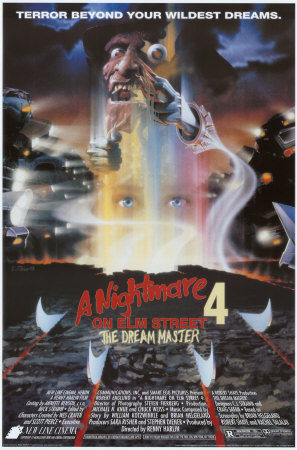
Welcome to Elm Street: Part Four

0

In honor(?) of the new A Nightmare on Elm Street, we’re recapping all of the Elms so far. Find more on the Pixel Vision blog.

In the immortal words of the Fat Boys: are you ready for Freddy?

Well, duh. By 1988’s A Nightmare on Elm Street 4: The Dream Master, everyone and their (human-faced) dog was ready for Freddy, whose status as a grinning, quotable pop culture icon would only be enhanced by his latest film. The Dream Master is the first of the Nightmare movies to basically do away with any semblance of a plot; instead, the film exists to provide variously surreal, outlandish, and repulsive nightmare sequences that inevitably end in the death of whatever character is chiefly involved.
And that ain’t such a bad thing. Though the behind the scenes credits are sorta impressive, actually — Renny Harlin, who’d go on to make Die Hard 2 (1990), Cliffhanger (1993), and Deep Blue Sea (1999), directed; Brian Helgeland, who shared a screenwriting Oscar with Curtis Hanson for 1997’s L.A. Confidential, and was later nominated for adapting 2003’s Mystic River, is among its co-writers — this movie is utterly ridiculous anytime Freddy’s not the center of attention.

Thankfully, that’s not often. As Louis described in his post on Nightmare 3, the remaining Elm Street kids/Dream Warriors — now more or less integrated into Springwood’s normal high school population —  are the first to go, and they go fast. But wait, you say! Didn’t Freddy get buried in consecrated ground, etc. etc., at the end of Dream Warriors? Yeah, but no matter: before Kincaid (Ken Sagoes) dies, he dreams his dog, Jason (zing!), turns demonic and pees a fiery stream into Freddy’s junkyard grave. Naturally, Freddy comes back to “life,” except he was already dead, or undead, or something, to begin with, wasn’t he? “You shouldn’t have buried me. I’m not dead!” Whatever, he’s back.

Before you can sing a slo-mo jump rope rhyme, Kincaid gets gloved, and ever-horny Joey (Rodney Eastman) drowns in his waterbed. Kristen (now played by Tuesday Knight, who’s no Patricia Arquette) meets a fiery end, but not before courteously extending Freddy’s nightmare-entering capabilities beyond the Elm Street circle: she pulls innocent, mousy Alice (Lisa Wilcox) into her fatal dream. (Freddy’s response: “How sweet! Fresh meat!”) Logically, of course, this means Freddy can now terrorize Alice and all of her friends, including her kung fu-fighting brother, Rick (Andras Jones); asthmatic nerd Sheila (Toy Newkirk); bug-phobic workout-aholic Debbie (Brooke Theiss); and letter-jacketed love interest Dan (Danny Hassel).

The death scenes benefit from what appears to be a bigger special-effects budget than previous films, with Debbie’s transformation into a giant cockroach remaining my personal favorite. There’s also a nice bit where Alice gets pulled into a movie screen, and an attempt at near-artsyness when a scene repeats multiple times to slow Alice and Dan from saving one of their imperiled, snoozing friends. I’m also a huge fan of the scene where Freddy visits Alice’s workplace, the Crave Inn (zing!) diner. Seems Freddy, in a particularly sassy mood, has ordered himself a pizza. A pizza covered in heads! Screaming heads! Freddy spears a head-meatball with one of his claws and excitedly smacks his lips: “My faaaaavorite!” The chewing sounds are amazing.

Later, Alice turns Perseus and “kills” Freddy by showing him his reflection in a piece of stained glass (but not before Freddy reminds us that “I. Am. Eternal!”) And since Freddy has now become not just a slaughterer-of-the-sleeping, but a taker-of-souls (when and how did that happen, exactly?), his captives sail to freedom past Alice in a wash of white light, as if Zelda Rubenstein was showing them the way. Yeah, that’s the end of him, for sure! Er … one more thing about Dream Master is its determined-to-be “hip” soundtrack, with Sinead O’ Conner, Dramarama, Blondie, and other artists contributing tunes. But you can’t go wrong with the Fat Boys.

Welcome to Elm Street: Part Three

0

In honor(?) of the new A Nightmare on Elm Street, we’re recapping all of the Elms so far. Find more on the Pixel Vision blog.

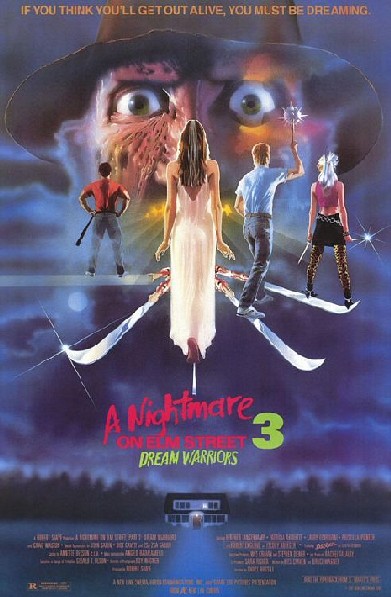
“Live together, die alone.” I stole that line from Lost, but it sums up A Nightmare on Elm Street 3: Dream Warriors (1987) all too well. The remaining Elm Street kids — you know, the ones whose parents enacted mob justice on Fred Krueger — find themselves locked in a psych ward. They’re not really crazy: they’re just having bad dreams. But these teens are (mostly) smarter than their predecessors, and they refuse to go down without a fight. The “dream warriors” pick up on two important facts: there’s safety in numbers, and you can do awesome shit when you’re dreaming. I believe The Simpsons’ Ralph Wiggum said it best: “Sleep! That’s where I’m a Viking.”
No Vikings in this bunch, sadly, but these kids do have pretty nifty powers and thus a fighting chance against Freddy. In case you’re planning on assembling your own team of dream warriors — and honestly, it’s not a bad idea — I thought I’d break down the pros and cons of part three’s heroes. Yes, most of them end up dead and those that don’t (spoiler alert) are offed in part four. But hey, it’s good to know what skills to look for and what faults to avoid when you’re trying to save your ass.

Presenting the dream warriors, in the order in which they bite it.

Phillip (Bradley Gregg)
Pros: Bitchin’ ‘80s hair.
Cons: Sleepwalker. First to die, with the most disturbing death scene by far. He really doesn’t have a lot going for him.

Jennifer (Penelope Sudrow)
Pros: Has a (somewhat painful) system for staying awake. Burning oneself with cigarettes shows serious motivation.
Cons: Smoker. Thinks she’s going to be an actress — yeah, she’s one of those. And, of course, the second to die. “Welcome to prime time, bitch.”

Taryn (Jennifer Rubin)
Pros: Stands her ground. That means not putting out for skeezy orderlies. Gets the best line of the movie: “In my dreams, I’m beautiful. And bad.” Switchblades.
Cons: Attitude. Really needs to comb that hair. Pesky heroin addiction, which Freddy exploits with terrifying fingerneedles.

Will (Ira Heiden)
Pros: Nerdy charm. In his dreams, he can walk — not to mention be the Wizard Master. That’s right, he can blow up evil wheelchairs with green lightning (in the name of Lowrek, Prince of Elves).
Cons: Even as a wizard master, he’s still just a dweeb. And eventually, a dead one.

Nancy Thompson (Heather Langenkamp)
Pros: She’s been here before. Check out that grey streak: it screams “survivor.” Prescription for Hypnocil. Won’t take getting killed lying down.
Cons: Lots of baggage. Dead friends, dead boyfriend, dead mom — rewatch the first Nightmare on Elm Street if you need a refresher. Kind of naïve, inevitably. You really thought ghost dad was legit?

Kristen (Patricia Arquette)
Pros: Good at art. Marvel at her popsicle stick recreation of Nancy’s house! Does flips. Can bring people into her dreams.
Cons: Can bring people into her dreams. Hey, that’s a bad thing when you’re trying to avoid getting murdered. Poor common sense. All the Freddy fan-art is asking for it, don’t you think?

Kincaid (Ken Sagoes)
Pros: Tells it like it is, which means more great lines: “Let’s go kick the motherfucker’s ass all over dream land!” “Yo, Freddy! Where you hidin’ at, you burnt-face pussy?” Also, dreams give him super strength!
Cons: Gets thrown in the quiet room a lot, so you know he’s bad news. Nasty habit of antagonizing Freddy Krueger.

Joey (Rodney Eastman)
Pros: Knows to wake up his friends when necessary. Dream scream can break mirrors and banish the boogeyman.
Cons: But mostly quiet. Too quiet. Ball of teenage hormones, which inspires him to follow the hot nurse from hell and get himself comatose.

Dr. Neil Gordon (Craig Wasson)
Pros: The only doctor who actually believes that his patients are being killed by Freddy Krueger. Master hypnotist. Sees dead people — or dead nuns, at least.
Cons: Not a teenager. Might we say he’s getting too old for this shit? Can’t even fight a skeleton.

So there you have it. Now you can — I’m so sorry for this — pick your own dream team. And if you’d like to recruit me as a dream warrior, you should know that I’ve seen countless horror movies and know how to survive relatively unscathed. On the other hand, I’m pee-my-pants frightened of Freddy, so let’s call it a draw.

Welcome to Elm Street: Part Two

2

In honor(?) of the new A Nightmare on Elm Street, we’re recapping all of the Elms so far. Find more on the Pixel Vision blog.

A Nightmare on Elm Street, Part 2: Freddy’s Revenge (1985) is probably the most reviled of all the Nightmare movies. Which is silly, because it’s awesome. OK, there are serious continuity problems and an utter lack of interior logic. You could skip right to part three without missing a beat — in fact, maybe you should. Freddy’s Revenge works better outside the context of the series. You have to appreciate this movie for what it is: a campy, homoerotic comedy. Dark comedy, but still.

Nancy (Heather Langenkamp) has been replaced by adorkable dweeb Jesse (Mark Patton). Freddy (Robert Englund) doesn’t want to kill Jesse; he wants to—wait for it — get inside him. And if you’re wondering how this Freddy relates to the original, don’t bother. Part 2’s Freddy seems to be able to torment people who are awake. He doesn’t murder teens on his own: he has to work through Jesse’s body. Or something. Screw the plot — the fun of Freddy’s Revenge is noting all the queer subtext.

Here’s my list of the 14 gayest things in this movie.

1.    Jesse’s uber-femme scream is way more piercing than Nancy’s. Now, I don’t want to make assumptions. I’m sure lots of straight boys scream like that. But in context, it’s suspect.

2.    Jesse is terrible at sports. Again, not trying to play into stereotypes. Well, no more than the movie is.

3.    Grady (Robert Rusler) queers things further when he pulls down Jesse’s pants. Then the boys start wrestling. Coach Schneider (Marshall Bell) offers the only appropriate response: “Assume the position.”

4.    To borrow a line from Buffy, “the subtext is rapidly becoming text.” “Guy gets his rocks off like this,” Grady says. “Hangs out at queer S&M joints downtown. He likes pretty boys like you.” Smile, Jesse. Grady thinks you’re pretty.

5.    Diagram of an ass on the chalkboard. Giant snake rubbing against Jesse’s face. Paging Dr. Freud!

6.    Jesse’s dance routine evokes painful memories for gay men everywhere who recall similar embarrassments. Relatedly, I love his Lady Gaga glasses.

7.    “Schneider’s always got a stick up his ass.” Cough.

8.    Look, I’m not saying sleepwalking isn’t real. I’m just saying sleepwalking into the aforementioned gay S&M club is a little hard to swallow. No pun intended.

9.    Coach Schneider’s death scene is where things get really interesting: he’s tied up, stripped, and ravaged in the shower. Need I mention the towel repeatedly slapping his ass? Or the fact that the showerheads are obviously penises?

10.    Jesse’s beard/love interest Lisa (Kim Myers) insists that she wants to help him. I think she means “cure” him, but we all know that never works.

11.    Once Jesse does try to hetero it up by making out with Lisa, he finds himself rudely interrupted. See, Freddy’s tongue is in his mouth.

12.    Where does he run? To (shirtless) Grady’s room, of course. This leads to the film’s most surreal exchange yet: “Something is trying to get inside my body.” “Yeah, and she’s female and she’s waiting for you in the cabana. And you want to sleep with me.”

13.    It doesn’t stop there. “He’s inside me,” Jesse whines. “I’m scared.” Just relax. “He’s inside me and he wants to take me again!” That Freddy — he’s insatiable!

14.    Fast-forward to Lisa’s intervention. “I love you, Jesse,” she says. Then she has the audacity to kiss Freddy, and you better believe he freaks. (Ew, girls.)

So in the end, Lisa’s love destroys the evil (read: queer) Freddy. A sadly homophobic twist to this otherwise gay romp. How would I have ended Freddy’s Revenge? Krueger realizes he’s just a metaphor for repressed sexuality and scampers off to part three, where he can be legitimately scary again. Meanwhile, Jesse and Grady ride off into the sunset, and any further bodily penetration is completely consensual.

Welcome to Elm Street: Part One

0

In honor(?) of the new A Nightmare on Elm Street, we’re recapping all of the Elms so far. Find more on the Pixel Vision blog.

It’s with a certain sense of outrage, but not surprise, that horror fans greet the remake of 1984’s A Nightmare on Elm Street. Truly, nothing is sacred anymore. (I mean, Michael Bay’s do-over-ator already had its way with that holiest of holys, 1974’s The Texas Chainsaw Massacre, in 2003.) I can only guess that Freddy Krueger is frikkin’ pissed off right now. (Jackie Earle Haley may be an Oscar nominee, and, OK, a pretty cool actor — but Robert Englund’s the only rightful Krueger in my book.) Pretty much the only thing you can do right now is pull that A Nightmare on Elm Street box set off the shelf and start watching ‘em all. (There are seven, plus 2003’s Freddy vs. Jason, which of course you purchased separately.) Get to it!

Alternatively, you can simply follow Guardian movie geek Louis Peitzman and myself as we recap each film in the week leading up to the new A Nightmare on Elm Street’s release Fri/30. Since I have a little bit of a Freddy obsession (just part of my collection pictured here), I’ll be getting the ball rolling, with a post by Louis on A Nightmare on Elm Street 2: Freddy’s Revenge (1985) to follow later today. Whatever you do, don’t fall asleep! (Or be surprised by spoilers, because these movies are like two decades old, people.)

The sporadically inaccurate but nonetheless helpful (and gloriously illustrated) volume The Nightmare Never Ends: The Official History of Freddy Krueger and the Nightmare on Elm Street Films, by William Schoell and James Spencer, is dedicated to “Jason and Michael — because they’ll always be second best.” And indeed, when Freddy Krueger was introduced to the world, audiences were already familiar with Misters Voorhees and Myers. (Hell, Friday the 13th was already up to part four, the hilariously misnomered The Final Chapter, by 1984.) But Freddy had something neither of those dudes had: a voice. He actually spoke to his victims! With a sense of humor to boot! (Though by mid-series he was communicating mostly in bad rhymes and even worse puns. But I digress.)

Legend states that Nightmare writer-director Wes Craven named his most famous character after a junior high rival (no word if the real Freddy ever realized his influence on movie-monster history). The last name came from Krug, the evil prison escapee from Craven’s first film, 1972’s Last House on the Left. Nightmare’s opening credits, which depict Krueger fashioning his trademark glove, feature the immortal words “introducing Johnny Depp;” they also present Englund as “Fred” Krueger. In later films, Englund would get above-title billing. But in 1984, nobody knew who Freddy was, or that they and everyone they knew would probably dress up as him for Halloween at least once. Certainly young Nancy Thompson (Heather Langenkamp), who lives in the white house with the red door on Elm Street in Springwood, Ohio, has never heard of him. But her bitterly divorced parents (Ronee Blakley, loopy star of 1975’s Nashville, plays her drunk mom; cult actor John Saxon plays her cop dad) know a little something about a child killer named Krueger. Seems they executed mob justice on his sweater-clad ass some years before. So why are Nancy and her friends (including Depp as her boyfriend, cut-off sweatshirt-clad Glen) meeting the allegedly dead Freddy in their dreams?

Freddy seeks revenge, of course, and little did those murderin’ parents know their quarry had supernatural powers: when the kids die in their dreams, they die in real life. Even though the parents know all about Krueger, they act like they don’t believe their bratty, rebellious teenagers. (With that rakish fedora, how could they even pretend to forget such a character?) This is a recurring theme in the Nightmare films: parents just don’t understand. Sometimes, they’ll even put bars on your bedroom window to “protect” you after they tuck you into bed, not realizing that growing up is hard, man. Especially when there’s a creepy creep chasing you with fingerknives through your dreams.

Nancy’s the wisest character here (evidenced in part by the gray streak that suddenly appears in her voluminous ‘80s coif after a harrowing Freddy encounter). Not only does she start mainlining caffeine to stay awake, she obtains a militia handbook (“I’m into survival!”) and begins plotting her naps with battlefield-worthy precision (with plenty of booby traps in place). Meanwhile, since Nancy actually doesn’t save anyone except herself, Craven’s behind-the-scenes team does wonders with special effects. Glen being sucked into, and bloodily vomited out of, his own bed is particularly memorable.

The film’s ending is the worst thing here. According to The Nightmare Never Ends, Craven and producer Robert Shaye disagreed on how to wrap up the story, with Craven believing it should end after Nancy defeats Freddy by taking back the power she’s unknowingly given him. Bam! End of Freddy. Shaye wanted more of a “Gotcha!”, which every other slasher movie in the history of the world has, and will always have. Guess who won? Eight — no, now nine movies later — we’re still expecting Freddy to come back.

The Daily Blurgh: Are brown people still legal on YouTube?

1

Curiosities, quirks, oddites, and items from around the Bay and beyond

Sarcasm fail at Canada’s National Post?

*****

When a Furry marries a Juggalo you get

******

It’s a bird! It’s a plane! It’s Banksy (Again. And this time, it’s apparently legit)

*****

Hey, Arizona Governor Jan Brewer: Fuck you very much.

******

One of this week’s Guardian cover stars, Peaches Christ, dishes (as her boy alter-ego, Joshua Grannell) about his new film, All About Evil, and why the Victoria Theater is San Francisco’s unsung movie palace.

*****

M.I.A ghost rides Suicide

*****

This is Spinal Tape!

*****

In honor of the Internet’s great black hole (aka YouTube) turning five, here is that compilation of the site’s 100 greatest hits crammed into just 4 minutes from last year (so, pardon the missing memes).

If you don’t feel like sitting through four minutes — or forever times infinity squared in Internet years — of wrap-up, here’s really what YouTube has meant in the past half-decade:

(It has been viewed 268,000 268,0001 times)

Big kids appreciating little movies — “Celestial Navigations” explores the work of Al Jarnow

0

It was science disguised by fun, flashy animation, and people everywhere ate that stuff up like it was a bowl of chocolate-covered bran. Filmmaker Al Jarnow is a dude who managed to make learning fun on Sesame Street and far more intersting than the overbearing bird and crabby monster in a can. Most people had no idea who was creating the incredible shorts that appeared on that show, but if you were a kid or parented one in the past 50 years, you’re bound to recognize his work. And now with an escavation of over 45 films, Celestial Navigations — playing Thurs/22 at Red Vic Movie House — brings Jarnow’s magic back for some instant reminiscing.

Colors flashed, stop motion and time-lapse techniques mystified, and simple, beautiful cartoons turned every day objects and topics into a beautiful experiment gone right. Jarnow’s films played for years and expanded minds in the wee morning hours prior to the school bell’s ring and the punch of the time card. Jarnow educated through psychadelic hypnosis, the eyes of eager audiences glazed over while the fast-paced, brightly-colored animations whizzed across the television screen. I was an ’80s tyke who rolled out of bed excited to watch Sesame Street’s “cool” movies (and Kermit, of course) and when I found them years later on You Tube, the situation is nearly identical: bowl of cereal, blanket, couch and eyes glued to the flashing screen.

Celestial Navigations is the Numero Group‘s first foray into the world of cinema and they’ve collected, color corrected and remastered a flashy bunch of classic Jarnow. The film also includes a 30-minute documentary on Jarnow’s creative process, which I’m hoping boils down his steps in a 3-2-1 Contact Style.


Celestial Navigations: The Short Films of Al Jarnow

Thurs/22, 7:15pm, 9:30pm, $6-9

Red Vic Movie House

1727 Haight, SF

www.redvicmoviehouse.com


“The Loved Ones:” the complete interview!

0

Pegged by some as “Misery meets Pretty in Pink,” Sean Byrne’s instant horror mini-classic is by turns poignant, funny, grotesque, alarming, and finally very, very satisfying. It’s sure to be a hit again in the San Francisco International Film Festival‘s Late Show section. Between festival travels, Byrne was back home in Melbourne when he answered my email queries.

San Francisco Bay Guardian:
The movie really throws you for a loop by spending the first stretch on serious psychological drama, then springing something entirely different.

Sean Byrne: Well, I needed [to establish] a hero who was uniquely qualified to survive hell. Someone who is conditioned to pain, who feels like they deserve to suffer. He’s a cutter or self-mutilator, someone who tries to block out emotional pain with physical pain. He’s a kid with a death wish who’s forced to endure a literal hell and in the process realizes he’s got everything to live for.

SFBG: Your central female character is more interesting than the usual horror movie villainness in that she’s so spoiled she thinks she’s a victim, which then excuses her behaving monstrously. Where did that come from?

SB: I was thinking about what could make a signature, iconic, highly marketable villain and I noticed how my five-year-old niece, along with almost every little girl, is obsessed with wearing pink. It’s part of the magic and fantasy stage of childhood, where they actually believe the Disney line “someday [my] prince will come.” So then I started thinking, well, what if our villain is a teenager with raging hormones but still somehow stuck in this spoiled, childish, pre-operational stage of development. I imagined “Princess” as a teenage version of that irritating kid in the supermarket who demands lollies and won’t stop screaming until she gets them!

SFBG: I like that her favorite song is self-pity anthem “Not Pretty Enough.” Has Kasey Chambers had any reaction to the film?

SB: I tried to stay within the horror genre but at the same time subvert the conventions, and having our troubled hero listen to heavy metal (the “devil’s music”) and our villain listen to a top-of-the-pops ballad like “Not Pretty Enough” was a way of doing that. As far as I know Kasey hasn’t seen the film. I’m dying to know how she’ll react.

SFBG: Did any particular films inspire you, in general or in making this film in particular?

SB: My filmic influences were a real mash up. Structurally the film is closest to Misery (1990) but tonally there are shades of Carrie (1976), Dazed and Confused (1993), Footloose (1984), The Terminator (1984), The Texas Chainsaw Massacre (1974 original), The Evil Dead (1981), Henry: Portrait of a Serial Killer (1986), [and the works of directors] David Lynch, Gaspar Noe, Michael Haneke, John Hughes, and even Walt Disney. The way Tarantino juxtaposes violence and comedy was a big influence. I’m also a huge David Fincher and P.T. Anderson fan. Audiences may recognize some of the influences but hopefully the film, as a whole, will be a fresh experience.

SFBG: A difference between this movie and those associated with “torture porn” is that here both victims and perps are pretty complicated characters.

SB: I hope so. I did my research and tried to get inside the heads of these characters before I started writing. Characters in horror movies are often one-dimensional cardboard cutouts. But really great ones like The Shining (1980), The Exorcist (1973), and Rosemary’s Baby (1968) delve into the psychology of the moment. They answer the question: how do ordinary people react to extraordinary situations honestly? They explore our base instincts with emotional authenticity.

I’ve made a horror movie, so I don’t want to sound hypocritical, but in my opinion movies that focus on the stalking bogeyman are actually kind of immoral because as an audience we’re almost forced to barrack for the killer. We know they won’t die (because there’s always a sequel) and we know nothing about the people being hunted and what makes them tick. So the main point of interest becomes, how much bare flesh am I going to see and how inventively gruesome is the next kill going to be? To me that’s not real horror. Real horror is having a relationship with the dark, extreme side of human nature and getting inside the cruelest of minds then genuinely caring about the people who are trapped in this terrifying web.

SFBG: The film really does dish out some horrifying abuse, though — did you ever pull back on how graphic it would be?

SB: No. Never. I’m not a fan of PG-13 horror. The middle ground is pretty boring — that’s why it’s called the middle ground. But we’re a balls-to-the wall pop-horror movie and as a fan growing up loving horror movies, I know what I like and I think I know what other true horror fans like, and we like to be pushed. Audiences go to horror movies to be scared. The brief is to freak them out so why hold back?

SFBG: Did anyone suggest you take out the whole comedy subplot involving the best friend’s dream date with the school’s goth chick? Although it works — both on its own and to provide some relief from the main action, which might be unbearable to watch without some interruption.

SB: The first draft of the screenplay was basically confined to the farmhouse, where most of the horror plays out, but it began to feel a bit suffocating. Like Misery, The Loved Ones is a kind of claustrophobic horror and also like Misery, which cuts to the sheriff and his wife for light relief, there are moments when the audience needs to take a breath, wipe their sweaty palms and maybe even have a nervous chuckle before preparing for the next white-knuckle onslaught.

SFBG: It’s a good thing your lead actress has already done some other, very different things, since otherwise she might be typecast forever as the horror-movie Girl from Hell.

SB: Yes, Robin McLeavy is an incredibly well-respected theater actress. She recently played Stella opposite Cate Blanchett’s Blanche in Liv Ullmann’s version of A Streetcar Named Desire, and won a Hayes Award for her performance, which is Washington’s answer to the Tonys.

SFBG: Upcoming projects? Have you gotten any overtures from major studios/producers?

SB: I’m writing a home invasion thriller with a unique twist, am attached to a medical thriller, which is a modern reworking of the Jekyll and Hyde story, and I’m in discussions with major studios and producers about a couple of other projects that I’d better keep quiet about for now.

The Loved Ones
San Francisco International Film Festival
May 2, 10:30 p.m., Castro, 429 Castro, SF
May 6, 3 p.m., Kabuki, 1881 Post, SF
www.sffs.org

Taking the Waters

0

arts@sfbg.com

SFIFF Jessica Rabbit was just drawn that way, Foster Brooks just happened to stumble on his “lovable lush” act, and likewise, actor-writer-producer Derek Waters — he of Drunk History fame — just sounds like he started poking around in the liquor cabinet earlier in the day. In the same way, we all happened to just look up from our many open browser screens and realize our attention spans have drastically shrunk — one of the many reasons Waters believes the histories have been so popular, leading to offers from HBO to produce a Drunk History sketch show and spinning off a host of homemade copycat videos on YouTube.

“Attention spans are way too small to watch whole movies,” says the 30-year-old Waters, speaking from Los Angeles. “I think if these came out in the ’70s, I don’t know how popular they would be.” And who can blame the pretenders, justly inspired by the shorts — and the sight of soused comedians relating their favorite great moments in history (while occasionally losing their lunch or lying down to get more comfy) while actors like Michael Cera, Jack Black, and Will Ferrell reenact out all the blurry details, down to Ben Franklin’s improbable “Holy shit … there’s a fucking lightning storm happening right now outside!”

The fact that creator Waters could get actors like Crispin Glover and John C. Reilly to play, for instance, the battling Thomas Edison and Nikola Tesla is yet another plus. “Edison was publicly electrocuting animals to prove his point,” Waters says. “And to see Crispin Glover doing that was a dream come true.”

No fear that Drunk History will swallow up cable — or traditional academic — programming, though Waters says his old teachers have e-mailed to tell him they’ve shown the films to their students. “I think Drunk History is funny for five minutes,” he says. “I don’t think you can ask too much of a drunk person.” The actor is doing a HBO series called Derek Waters Presents LOL instead (“I like to say it stands for ‘Lots of Losers.’ I guess you write what you know”), remaining committed to the short, funny form, as well as the dream of turning his 13th Grade short, set at a community college, into a full-fledged series.

All that makes Waters a primo candidate for a drunken evening at the theater with Wholphin DVD magazine editor Brent Hoff. He’ll be showing relevant shorts such as Bob Odenkirk’s gut-busting The Pity Card — part of Waters’ and The Big Bang Theory‘s Simon Helberg’s online short series Derek and Simon — and talking about that film, as well as, no doubt, the work he’ll contribute to Wholphin‘s next edition.

Incidentally, Wholphin‘s latest issue, its 11th, is a doozy: “It’s the most edible-looking yet,” quips Hoff in San Francisco. “All bubblegum-y colors.” It includes Ramin Bahrani’s Plastic Bag short with poignant hilarious voice-of-the-bag narration by Werner Herzog, in addition to an excerpt from Bitch Academy, a doc about Russian women taking a class on how to snag millionaires — a grim, scary variant of the cheese-cloaked Millionaire Matchmaker — which Hoff describes as “the most terrifying thing we’ve ever put out.”

More terrifying that listening to writer Eric Falconer lose his eight vodka cranberries and then get back up to talk American history? For some, it might be a draw. “There’s something fascinating,” Waters observes, “about someone so passionate about something but not moving forward at all.”

A DRUNKEN EVENING WITH DEREK WATERS AND WHOLPHIN

Mon/26, 9:30 p.m.

Sundance Kabuki

1881 Post, SF

www.sffs.org


Live on screen

0

johnny@sfbg.com

SFIFF All those with curious minds, step right up, we have live cinema waiting for you in this dark room. The idea of “live” or performance-generated movies has taken on a new vitality recently via the light-projecting likes of Bruce McClure, whose ear-splitting and eye-blasting appearances in San Francisco usually sell out. On a smaller local level, Konrad Steiner’s neo-benshi programs have united local writers and a wide variety of filmic subject matter in creative and sometimes entertaining ways. At the San Francisco Film Festival, live music by bands for silent works has become a reliable main attraction. But Sam Green’s and Dave Cerf’s new meta-documentary Utopia in Four Movements adds a new facet to the phenomenon: instead of utilizing an over-familiar voice-over, it unites live narration by Green with a musical performance overseen by Cerf, allowing for degrees of spontaneity and change.

Utopian, isn’t it? At the Mission bar the Phone Booth on an early Monday evening, Green can’t help but tease out his thoughts on the very word. “To me, utopia is almost a metaphor for hope, or hope in the imagination,” he says, shortly after we’ve been flirted with (and flashed) by one fierce female patron. “It’s about trying to be hopeful these days, which is hard. Utopia is almost a way to make up hope. In some ways it’s so preposterous. The word even has negative connotations these days — people are told not to be utopian.” Half an hour later, he returns for another analogy or two: “Utopia is a thing that never really exists. It’s like a flower — it always wilts. Even if there’s a moment of great utopian energy, it can’t last.”

Utopia may not exist in fully realized forms, but the quartet of mutations in Utopia in Four Movements (five if you count the movie) fascinate as real-life fables. The first segment explores Esperanto, which was invented in the late 19th century with the aim of its becoming a universal, international language. As Green puts it, Esperanto is “a wonderful idea that can’t be,” an idea that he illustrates with short direct portraits of contemporary Esperanto speakers that, uncannily, takes on a colors-of-Benneton feel.

Esperanto has also yielded some memorable black-and-white cinema, namely a 1965 Esperanto horror film shot in Big Sur by Conrad Hall, which stars a pre-Star Trek William Shatner. San Francisco movie maniacs may recognize Incubus through the efforts of Will The Thrill and Other Cinema’s Craig Baldwin. “William Shatner wrote a memoir in which he talks about it,” Green says, before adding some information that reflects Utopia‘s ever-changing nature –and utopia’s pitfalls. “I’m trying to do an interview with him because he’s practically the most famous person to have spoken Esperanto. But the world’s most famous Esperanto person is probably [financier] George Soros.”

The idea of utopia isn’t new to Green, whose best-known feature The Weather Underground (2002) digs deep into the multi-faceted realm of ’60s radicalism, riding out its actions and repercussions. The second part of Utopia, set in Cuba, adds a new chapter to Green’s explorations of thorny political contradiction. Like Assata Shakur, the segment’s subject lives in Cuba as a fugitive. In the present, she’s engaged with Cuban hip-hop, but she remains tied to her past as a radical in America. “It’s about the last embers of revolution,” says Green.

One of Utopia‘s movements examines the potential of forensice science in a manner quite different from pro-law enforcement US true crime television, showing how the smallest reinforcement can be regained from sites of mass tragedy. But the movie’s sojourn in China is in some ways its most vivid. There, Green takes an extended trip to the world’s largest shopping mall, in China. The subject matter is akin to dramas such as Jem Cohen’s Chain and Jia Zhangke’s The World (both from 2004), but this is a case of reality trumping fiction. “Almost every article I read about China and capitalism talked about how the world’s largest mall was there now,” says Green. “But nobody described it as a total failure. We were at the mall for ten days, and it was soul-killing. There’s something about a gigantic failed mall that is profoundly depressing.” Luckily, an encounter with a Teletubby who eventually removed its mask added some life to the experience.

The world’s largest shopping mall — at least for now: Green says it is slated to be bulldozed — may be grim, but it’s also richly symbolic when history is integrated to the picture. “Victor Gruen who essentially invented the [shopping] mall in the US in the 1950s was a socialist who came to America,” Green says, as “This Monkey’s Gone to Heaven” gives way to “I Feel Love” on the Phone Booth jukebox. “In turn the mall has gone to China, and the grounds of cultural revolution became the site of a government-funded bust of a mall. In a way, it’s the trajectory of the 20th century.

Today, we tiptoe into the 21st century, with a new president and old-new ways of seeing and making movies. “A year ago, when I was looking at [Utopia], people were saying ‘Aren’t you going to change everything because of Obama?’,” Green remarks. “It felt like cotton candy hope. When [U.S. presidents] are the limits of your possibility, it’s pretty lame.” Truth: Green may have used utopia in his title, but perhaps it’s time to come up with some fresh formulations of hope as well. *

UTOPIA IN FOUR MOVEMENTS

Sun/25, 9:30 p.m., Kabuki

Red, blonde, and blue

0

johnny@sfbg.com

SFIFF The evening breeze caresses the trees tenderly early on in João Pedro Rodrigues’s To Die Like a Man. This shift from the furious winds of Rodrigues’ Odete (a.k.a. Two Drifters, 2005) is a signal that the director, ever aware of the lexicon he’s blooming, is adopting a languid pace. Rodrigues’ third feature film isn’t immune to irony, a main one being that slow death allows his cinema to breathe most deeply.

At the onset, To Die Like a Man does not seem like the story of a drag queen perishing from poisonous silicone implants. Rodrigues begins in a nighttime jungle of young male longing, in a nod to Apichatpong Weerasethakul’s Tropical Malady (2004), though his vision is much less chaste. Greasepaint is applied to a beautiful young soldier’s face, and upon wearing that militaristic form of drag, he’s soon fucked by the masculine makeup artist. Moments later, the two enlistees happen upon a lone mansion and peer through a window. The pair of ladies within are … not quite ladies. We are in a world where a lush garden is gradually revealed to be a terrarium, and that terrarium is soon visually rhymed with an aquarium. Nothing is what it seems, except that which flowers and dies.

It isn’t until after a gunshot and Rodrigues’ trademark blood-red letter credits that we are introduced to Tonia (Fernando Santos), a buxom blonde who bears a familial relation to one of the soldiers. Not quite weary enough to dispense with her wry wit, Tonia makes her living performing drag numbers at a club, where a beautiful and quite opposite heir apparent (Jenni La Rue) looks down at her from the other side of a mirror. At home, she cares for her drug-addled, dress designer boyfriend Rosario (Alexander David). Her chief confidante, her little white dog Augustina, appears to be slightly more obedient.

Santos’ presence at the heart of To Die Like a Man opens up Rodrigues’ distinctive world view, giving this musical without (much) music a true voice besides that of the director — quite literally in one bravura sequence, where Tonia half-whispers, half-sings a song long after Rosario angrily snuffs it from the car radio, as the world passing by is reflected in a car window adorned with raindrops. The hot-as-hell garbageman of Rodrigues’ O Fantasma (2000) and the leggy lunatic of his schematic Odete are as mute as they are ravishing, but Tonia has something to say, in tones that are smoky and relaxed and resigned to fate. Within English-language films, Divine’s siren song in Hairspray (1988) and Dorian Corey’s backstage aria of wit in Paris is Burning (1990) are the best touchstones for Tonia — ones that reveal the heft of Santos’ performance.

In life, Tonia has not fully crossed over to the other side. To illustrate her ladylike sensitivity, she complains to her transsexual friend and hairdresser, Irene (Cindy Scrash), about a doctor’s blunt, origami-like demonstration of how a penis is transformed into a vagina through surgery. But the man beneath Tonia isn’t immune to a cruise through the dark for a grope in the park.

A true auteur who hasn’t fallen prey to the excessive worship that has hindered influences such as Tsai Ming-liang, Rodrigues is cultivating his craft. He’s aware that he’s still developing, yet comfortable enough about his formidable command that he can casually deploy the motifs of great filmmakers as pivot points. If Odete‘s peculiar double-vision was constructed from the eyes of Hitchcock and Warhol, To Die Like a Man is his In a Year of 13 Moons (1978), or 1999’s All About My Mother changed to All About My Father. (A Marnie poster hints which wing of the Hitchcock library Rodrigues currently resides in, exploring patriarchal and matriarchal ties.) Fassbinder and the larger specter of "’60s and ’70s European art film is hilariously invoked through the character of Maria Bakker (the superb Gonçalo Ferreira De Almeida), a sweet beacon of death prone to epigrams and fits of vamping. In the film’s key moment of ominous reverie, she and Tonia and their sidekicks sit down in the woods and are softly serenaded by Baby Dee’s song "Cavalry."

Rodrigues has a way with sound and image, and the queeniness of the characters here allows him and longtime partner and art director João Rui Guerra da Marta to indulge their own flouncier yet symbolically rich impulses. Tonia wraps a car gift for Rosario in silver foil, and her cell phone holder is a porcelain leather pump — with a puff ball at the heel. Her backstage mirror is decorated with photo mementos of Brad Renfro and Cristiano Ronaldo, and one of her chief stage outfits is like Dorothy’s red slipper turned into an entire dress. In a single shot, a bath towel, bath mat, and dog offer variations of furry whiteness. Twice, the aesthetically heightened naturalism of Rui Poças’s cinematography gives way entirely to fluorescent pastel hues.

Tonia’s story is about uncovering what is buried before one’s body is laid to rest. Her journey crosses through some of the Lisbon landmarks of Rodrigues’ previous films — the fatal intersection and cemetery walls of Odete, for example — while finding rare blooms on the edges of urbanity. A farewell tour as long as Cher’s, To Die Like a Man never tests one’s patience. Forget-me-not is one of the ever-referential Rodrigues’ secret mottoes as a director. Even if life and drag — and the drag of life — persist beyond the end of Tonia, he’s created a film to remember.

TO DIE LIKE A MAN

May 1, 9 p.m., Clay

May 3, 12:15 p.m., Kabuki

May 4, 6:15 p.m., Kabuki

Love, guts, and glory

0

arts@sfbg.com

SFIFF Though there were far starrier, more expensive films debuting in the Midnight Madness section of last year’s Toronto Film Festival, the category’s prize and foot-stomping audience favor was stolen by a low-budget Australian film that arrived with no fanfare, no name actors, and a writer-director who’d made no prior features.

Sean Byrne’s The Loved Ones focuses on small-town teenager Brent (Xavier Samuel), who’s severely depressed from a recent tragedy but rouses himself to attend the school prom — or would have, if he wasn’t hijacked instead for one of the most harrowing first dates in film history.

Pegged by some as "Misery meets Pretty in Pink," this instant horror mini-classic is by turns poignant, funny, grotesque, alarming, and finally very, very satisfying. It’s sure to be a hit again in the San Francisco International Film Festival’s Late Show section. Between festival travels, Byrne was back home in Melbourne when he answered my e-mail queries.

SFBG The movie really throws you for a loop by spending the first stretch on serious psychological drama, then springing something entirely different.

Sean Byrne Well, I needed [to establish] a hero who was uniquely qualified to survive hell. Someone who is conditioned to pain, who feels like they deserve to suffer. He’s a cutter or self-mutilator, someone who tries to block out emotional pain with physical pain. He’s a kid with a death wish who’s forced to endure a literal hell, and in the process realizes he’s got everything to live for.

SFBG Your central female character is more interesting than the usual horror movie villains in that she’s so spoiled she thinks she’s a victim, which then excuses her behaving monstrously. Where did that come from?

SB I was thinking about what could make a signature, iconic, highly marketable villain and I noticed how my five-year-old niece, along with almost every little girl, is obsessed with wearing pink. It’s part of the magic and fantasy stage of childhood, where they actually believe the Disney line "someday [my] prince will come." So then I started thinking, well, what if our villain is a teenager with raging hormones but still somehow stuck in this spoiled, childish, preoperational stage of development. I imagined "Princess" as a teenage version of that irritating kid in the supermarket who demands lollies and won’t stop screaming until she gets them.

SFBG I like that her favorite song is self-pity anthem "Not Pretty Enough." Has Kasey Chambers had any reaction to the film?

SB I tried to stay within the horror genre but at the same time subvert the conventions. And having our troubled hero listen to heavy metal (the "devil’s music") and our villain listen to a top-of-the-pops ballad like "Not Pretty Enough" was a way of doing that. As far as I know, Kasey hasn’t seen the film. I’m dying to know how she’ll react.

SFBG A difference between this movie and those associated with "torture porn" is that here both the victims and the perps are pretty complicated characters.

SB I hope so. I did my research and tried to get inside the heads of these characters before I started writing. Characters in horror movies are often one-dimensional cardboard cutouts. But really great ones like The Shining (1980), The Exorcist (1973), and Rosemary’s Baby (1968) delve into the psychology of the moment. They answer the question: how do ordinary people react to extraordinary situations honestly? They explore our base instincts with emotional authenticity.

SFBG The film really does dish out some horrifying abuse, though — did you ever pull back on how graphic it would be?

SB No. Never. I’m not a fan of PG-13 horror. The middle ground is pretty boring — that’s why it’s called the middle ground.

THE LOVED ONES

May 2, 10:30 p.m., Castro

May 6, 3 p.m., Sundance Kabuki


MORE ON SFBG.COM For an extended version of Dennis Harvey’s interview with Sean Byrne, visit www.sfbg.com/pixel_vision