Film

Hayes Valley Farm grows an urban farming community

3

Don Wiepert hasn’t always enjoyed the view out his bedroom window as much as he does now. An eight year resident of Oak Street, the senior citizen has a wonderful vantage point of the highway on-ramp covered in potted fruit trees and fava beans by Hayes Valley Farm, where he volunteers on a weekly basis. Before the community farming effort, he says, the parcel of land’s only crops were slightly less savory.

“This was a place for homeless living,” he tells me on my recent trip to see the fruits of the exciting new neighborhood project. “It was fenced off, ugly, inaccessible. Now it’s wonderful.”

His enthusiasm seems to be shared by everyone who enters into the Hayes Valley lot. On this windy Thursday afternoon, volunteers are collaborating on the various steps needed to make this exercise in urban farming a success. In one corner, a greenhouse is being erected. Over there, fellow volunteers plant the seedlings nutured in Wiepert’s own living room. Small hills that were once home to nothing but trees languishing under ivy covered, and oil soaked ground support rows of fava beans, and young lettuce.

Organizer Jay Rosenberg explains the process to me as we tour the fields he helped to envision. Back in 1964, neighborhood activists, including the Hayes Valley Neighborhood Association organized to stop the progress of the central freeway that would connect US-101 to the Golden Gate. The show of community force was impressive, but it stranded the planned highway on and off-ramps on a block of land between Octavia and Laguna Streets. “They left them here standing like ruins,” Rosenberg tells me. “This was a 2.2 acre forgotten space.”

The blocks, designated parcels “P” and “O” by the city, devolved into a gothic, ivy covered problem for the neighborhood. They were claimed by drug users and homeless tent communities — until Rosenberg, Christopher Burley, and David Cody, three young men with experience in sustainable entrepreneurship and permaculture, identified the land as yhe ideal spot to bring a self-sustaining food system into the neighborhood.

At first meeting weekly with community members at nearby Suppenkuche, the three formulated a plan to start an urban farming education and research center. On January 22nd, 2010, after months of permit-wrangling with the city and work with the Office of Economic and Workforce Development, they had the keys to the cyclone fences that surround the property.

Which really, was just the beginning. The trees on the lot were slowly being choked by the insidious ivy that had infiltrated the area, and the soil itself was highly toxic from years of brake dust, lead-based oils, and carbon monoxide emissions from cars. Even what crops to plant was at issue. Due to it’s heavy winds, chilly summer nights and minimal rainfall “San Francisco is a cool, Mediterranean-like, foggy desert,” says Rosenberg, making for unique agricultural conditions.

All sizable challenges, but they’re no match for the combined brain power of the Hayes Valley Farm team. The three, and an ever-growing army of neighborhood volunteers, got to work planting fava beans; natural nitrogen producers whose very shoots enrich the soil around them, as well as producing food. They’re adding the chopped down ivy to 80,000 pounds of donated cardboard, and mulch from the city’s regular landscaping program to turbo-fertilize their new farm.

They’ve also found ways to kickstart the harvest while the soil repairs itself. Rosenberg proudly walks me down the rows of what volunteers like to call “San Francisco’s largest patio garden,” over 150 sapling fruit trees and 1,500 plants that sit happily on Parcel P’s old freeway on-ramp. The “freeway food forest,” as Rosenberg calls it, is already helping to feed the 1,000 community members who have already put in 4,000 hours of volunteer time on the farm since January.

It’s merely the beginning for the farm. Although organizers have heard rumors that the city intends on building condos on their land in the next three to five years, Rosenberg says “We championed to be here in a temporary fashion.” An interactive classroom is in the works, one wall to be formed by a mural painted by students at the Chrissy Field Center. Although someday Rosenberg envisions produce and fruit tree sales, he hopes to continue offering the volunteers that help the farm flourish fruits and veggies to take home with them.

For Wiepert, though, the farm is more than just an outdoor larder. “I appreciate the opportunity to hang out with the younger people and their energy here,” the man tells me, moments before flinging a stick for one of the farm’s part-time dogs to chase after. “I think this place facilitates a feeling for a lot of people that they’re doing something meaningful,”

To welcome the farm into the neighborhood, organizers are planning a series of outdoor screenings of films that educate on soil depletion and other environmental topics. Popcorn and live entertainment included.

Hayes Valley Farm Film Night feat. Dirt! The Movie
Tues/18 Gates open at 7:30 p.m., films start at 8:15, $5-18
Hayes Valley Farm
450 Laguna, SF
www.hayesvalleyfarm.com

Streets of San Francisco: Miguel Pendás’ Vertigo tour

0

Last week I was able to go on Miguel Pendás’ Vertigo tour. Creative Director at the San Francisco Film Society, Pendás led a group of ten on a van journey that concluded at the foot of the Golden Gate Bridge.

The day was warm and sunny, which didn’t stop some of the film’s — and the city’s — heralded sites from throwing moody shade. You can never learn enough about Vertigo, a fictive story that stems from a tale by Ambrose Bierce but has roots in the Californian dirt and a romantic attraction to the depths of the ocean. Hitchcock’s reflecting pool for the screen taps into history and myth in myriad interwoven ways.

Director Travis Mathews makes gay porn intimate, cuddly, relatable

1

Travis Mathews is quickly making a name for himself in the San Francisco film scene. A short film culled from his In Their Room series earned him top honors at the Good Vibrations’ Independent Erotic Film Festival last year. Now he’s working on I Want Your Love, a full-length scripted feature. Although Mathews has only completed one demo scene, the project is already generating online buzz. I spoke to Mathews about his inspiration for I Want Your Love and how the short scene fits into the bigger picture.


San Francisco Bay Guardian: The last time I interviewed you, we were talking about In Their Room. What brings you back to erotic film?
Travis Mathews: I have always liked to see people be really candid, honest, raw, intimate, vulnerable. And I think there’s a lot of different ways that you can show that and reveal that in movies, and one of the ways you can do it is through sex. But strangely, I think that’s what’s missing in a lot of porn, is that all of those things that I just mentioned are missing from porn. Instead, it’s just the very carnal “money shot” where it seems often divorced from feeling, from interpersonal relationships, and then all those other things I mentioned, like intimacy, vulnerability, honesty. I consume porn like most people do, and I myself feel disconnected from it, and I don’t really feel engaged with it and I don’t expect much from it. And I hear a lot of other people complaining or echoing similar thoughts. It just seems crazy to me that there aren’t more depictions of real people—whatever real people means—but not chiseled, “I go to the gym four hours a day, six days a week” people, having sex in a believable scenario that doesn’t seem stagey or ridiculous.

Jesse in I Want Your Love

SFBG: The scenario you present in this scene from I Want Your Love is definitely relatable—two friends who haven’t had sex with each other but are thinking about giving it a try. It’s something that many gay men have experienced. What brought you to that scene?
TM: It’s a scene that’s been stretched for the demo for a feature that I wrote. So it’s one of among a lot of other things going on, a lot of scenes and a lot of other mini-dramas. It goes back to the original thing I told you: I want to write stuff and I want to show stuff that people can respond to that feels honest to them, even if they don’t totally relate to it. Like, maybe someone hasn’t had that same experience, but it is an experience that a lot of gay men have had. I think a lot of people can make that leap, that like, “I get that. I think that’s probably something that really happens.” I’m not interested in creating big dramas that overshadow the intimacy and the more nuanced stuff.
 

SFBG: One thing I really liked about the scene is how natural it felt. Was everything there scripted or was there improvisation as well?
TM: That was all scripted. The only thing that was improvised is when they’re having sex—there’s lines when they have sex that are scripted, but the only thing that’s improvised is, there’s a moment when they’re having sex when Jesse says, “Oh, this feels so good. Oh, I like it so much.” And then he checks in with Brenden, and says, “Are you OK? Do you want more?” And Brenden says, “Yeah.” Like, really soft, and I like that a lot. But everything else was scripted. So I gave them the script for the scene and they basically memorized it, and they knew about it, and we had talked about it. During our first rehearsal, it was more of a workshop. I told them from the beginning, “I’m not so married to this script that we can’t deviate from it. I want you guys to bring parts of your real self to it, and I also want you to give me feedback on whether this feels like something you or your character would say.” So we massaged it together as a team and it was definitely at that point a collaborative effort. It was very democratic at that point. Me, Jesse, and Brenden, and my DP/producer Keith sat together and went through the script and tried out lines that I had written to see how they worked.

Jesse from “In Their Room”

SFBG: It’s impressive to me that it’s scripted, because it does feel so real. You don’t really get the sense that they’re acting.
TM: That was at the top of my list of things that I really wanted to keep an eye on, is bad acting. I feel like there’s a lot of other things that you can massage or you can hide or you can choose not to include and insert something else. But if you’ve got bad acting, it’s really hard to recover from that, I think. Because as a viewer, when I see something that’s poorly acted, I lose interest and I just don’t believe it. And I feel disengaged from it, which goes back to the problem of so much porn that tries to be cinema or tries to be like a regular movie.

SFBG: So let’s talk about casting. I know you worked with Jesse on In Their Room, but how did you decide on these guys?
TM: The first time I met Jesse was when I basically knocked on his door and went to shoot him for In Their Room. And then, we had a mutual friend in common, and then we had other friends in common, and we became friends. And I also really liked the way Jesse looked on the camera. Not necessarily physically—although I think that he’s really a sexy, handsome guy—but how the camera would catch his eye, or I would be able to catch him doing something really small that seemed to say a lot more. He’s really good at just leaning into really quiet moments that we all engage with when we’re by ourselves. He’s a performance artist, so I think that’s part of it. I also think that there’s a comfort level that goes along with that. He does it in a way that’s so natural. He knew from the beginning—we talked very little about, with In Their Room, what my intention was, but he knew what I was getting very quickly. And with his own work, he deals with issues of masculinity and things like that, so it’s not like what I’m doing is divorced from the stuff he’s doing. So he got it right away, and that was really refreshing. So I knew I wanted to work with him again, and I was starting to write this feature toward the middle of last summer, and I definitely knew that I wanted him in it in some capacity. When we went forward to do the demo, I told him about the project, I told him I wanted him in it as this character, and he was enthusiastic about it and wanted to be involved.

So then it was a process of finding the person who was going to play opposite to him. We had a casting call on Butt Magazine’s blog, and I put the word out there among boys in San Francisco. We probably had less than a dozen serious contenders, and we auditioned a bunch of people. Brenden was actually the first person that we auditioned. I had seen Brenden out and told him I was interested in having him audition again, and he did. He and Jesse have really, really good chemistry together. They can be playful and sexy together, and that was key for me. A lot of these other guys would have been great, I’m sure, some of them, but it needed to feel like—because they were supposed to be old friends or best friends—it needed to feel like they were comfortable inhabiting each other’s space, and that it was a familiar thing for them to be doing that. So that’s what I was looking for. If it felt like these were two people who had just met each other yesterday, and now they’re pretending to be close friends, it wouldn’t have worked.

SFBG: So the movie extends past these two friends, then. Can you talk a little about what’s going on in the full feature?
TM: What’s potentially confusing, I think, to people is that, you don’t have any sense in just watching the demo, you don’t have any real sense of what this whole feature is about. Or I think people think they do. But the basic log line for it is, Jesse’s character has been living in San Francisco for a decade, and for reasons I’m going to leave a little bit vague, there’s money issues and he has to leave the city. He can’t afford to live here anymore, and he’s moving back to the Midwest to live with his dad. So it’s kind of an opposite Tales of the City story where he’s not coming bright-eyed and bushy-tailed into this Emerald City where everything’s new and he’s going to experience everything for the first time. It’s like he’s done it and the thing that he’s grappling with is how much he’s failed this experiment of moving to San Francisco, or how much the city’s failed him. And the movie takes place in the last 24 hours before he leaves San Francisco. There’s a party that happens the night before he leaves, so there’s all these opportunities for these friends that are interconnected and then with himself to have a lot of quiet moments and reflection and introspection and things about what it’s been like living here, and what it means to be leaving it. There’s also a lot of opportunities for playfulness and sexy times.

SFBG: There’s a thin line between “porn” and “erotic film,” if there is one. I wanted to ask you about your reaction to the term “porn,” and also some of the more recent variations, like “hipster porn” and “mumblecore,” which are kind of contentious.
TM: Honestly, I’m kind of entertained in hearing different people label it different things, and I’ve decided—before I even released this—to not get engaged with debates or arguments or getting in a place where I’m being defensive about what it is. I feel like, I’m going to hopefully get to make the movie that I want to make, and there’s going to be sex in it, and yes, it’s going to be produced by a porn company. If people want to stop there and just label it porn, they’re going to do that. I can’t control how people are going to respond to it, so I’ve kind of let go of that. Some of these terms, I think are funny. Like, “hipster porn,” I know that that has a—what did you say, “contentious”?

SBFG: Just because a lot of people immediately reject the term “hipster.”
TM: Sure. Yet at the same time, I think if you’re somebody who’s well-tuned with the word “hipster” and you heard “hipster porn,” I think your interest would be peaked and you would be like, “What is that? I want to see that.” Although, you know, you might have a knee-jerk reaction and be like, “Ugh, hipster porn.” So I don’t think it’s as simple as it being a pejorative thing. And “mumblecore,” I love Funny Ha Ha (2003). I think it’s amazing, and I actually think “mumblecore” is a funny term. I like it. I know the guys that are sort of spearheading that whole scene kind of hate that they’re reduced to that. I like the intention of mumblecore movies. I think that they’re often really poorly executed, but I think Humpday (2009) was a good movie. I think the dialog was fantastic and it seemed real. And I also think that about Funny Ha Ha. But I mean, you go further: sort of the grandfather of mumblecore movies is Cassavetes. He would shoot things in this cinema verite style and get people to bring their real selves to their performances.

SFBG: You said in another interview that you’d like I Want Your Love to feel very San Francisco, and I was hoping you could elaborate. Why is that important to you?
TM: I come from the country, Ohio—I’m a country boy from Ohio. I don’t mean that I’m a country bumpkin, but I still feel wide-eyed and really grateful for the fact that I live in San Francisco, and that I’m able to survive here. The city has its problems, but I love living here. For a long time now, I’ve wanted to do something that was, in some ways, a tribute to the city without being cheeseball or so obvious but more nuanced. But then, I also felt that there’s a particular brand—there’s a regional gay in San Francisco. I wanted to document the people that I know in San Francisco in a way that felt authentic to me. Not in a way to be like, “Look at us, we’re so cool!” But in a way to show these guys—and there will be women in the feature, too—in the most candid way that I can show. The more I do the In Their Room stuff, or after having done that, I realized how much the guys I shot for the most part and the spaces that they inhabit just ooze San Francisco, without me trying to do that. So that was part of the momentum as I was writing the feature. I was realizing that without really doing a lot of work or without really trying to do this explicitly, I was going to be able to showcase San Francisco in a very nuanced kind of way.

You can view the demo scene from I Want Your Love free of charge at Naked Sword. Perhaps needless to say, it’s NSFW. For more information about Travis Mathews, check out his Web site.

It’s reigning men!

0

Thrillpeddlers peddle more Cockettes in Hot Greeks and SF Playhouse gets kinda Guignol with Slasher

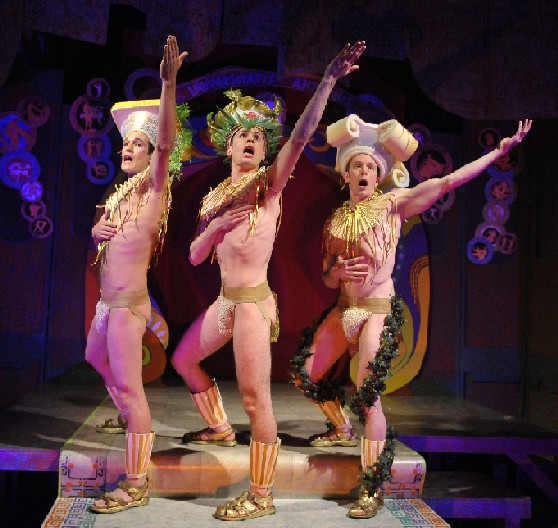
On the principle that when you’ve got it you should really flaunt it, San Francisco’s Thrillpeddlers essay their second revival of a musical by the storied Cockettes. Hot Greeks, which premiered in midnight performances at the old Palace Theater in 1972, was the gleefully crazed cross-dressing troupe’s only other fully scripted musical besides, of course, Pearls Over Shanghai, which Thrillpeddlers revived to long-running fame almost a year ago and which will run in repertory with the limited-run Greeks.

While not the Oresteia or anything, Hot Greeks is more than an excuse for a lot of louche, libidinous hilarity. Okay, not much more. But it is a knowing little romp — supported by some infectious songs courtesy of Martin Worman (book and lyrics) and Richard “Scrumbly” Koldewyn (music and additional lyrics, and musical director-accompanist for the revival) — wedding trashy high school romance with the trashy ancient Greece of Aristophanes and the Peloponnesian War.

As Athens U. prepares for the big game against traditional rival Sparta, pent-up frustrations on and off the field reach new heights when Tri Thigh Sorority’s own buxom-and-then-some head cheerleader, Lysistrata (played to deadpan perfection by Michael Soldier), leads her squad in a revolt against male domination, leaving the boys literally hard up (prostheses and the rest of the wonderful costuming on display by Kara Emry and Morningwood). A little gridiron frisking around (encouraged by the rousing patriotic ditty, “Everybody’s Got a Buddy on the Front,” featuring the always impressive Connie Champagne as dean’s wife Clitoristra) and finally a little sexual affirmative action by Lysistrata make everything all right in the end.

You’d expect Pearls to be a hard act to beat, but director Russell Blackwood’s Greeks is a blast — lovingly detailed, gamely performed, and voiced by a diverse and charmingly pan-sexual cast, and carefully choreographed, it’s a shrewd and sharply executed production that manages to remain always rambunctiously carefree in tone. But there’s more Cockettes mayhem in the second half of the evening, which is devoted to a floorshow menagerie of greatest hits and a chronological musical trip down memory lane with narrator Scrumbly Koldewyn, who begins things in Gertrude Stein drag for a rendition of “Gert’s Postcard” from the 1971–72 New Years Eve show Les Etoiles de Minuit, before taking over at the piano.

Together with Hot Greeks, the brightly executed and equally entertaining pieces on display in the floorshow serve to remind audiences of the perennial zest in much Cockettes material as well as the considerable talent that was there under all that glitter and pubic hair.

Texas cinematic massacre
 
Male domination gets a feminist comeuppance in Slasher, at SF Playhouse, but the effort seems both more serious and less supple than the joyfully subversive sexual pandemonium in Hot Greeks.

As the only breadwinner for her meds-addled wheelchair-bound mother (Susi Damilano) and kid sister (Melissa Quine), Sheena (Tonya Glanz) suffers run-of-the-mill humiliation and exploitation as a waitress at an Austin eatery frequented by film nerds like shaggy good-natured acquaintance Jody (Cole Alexander Smith). When Jody convinces an aging low-budget horror meister (Robert Parsons) to meet him there, the leering eye of the filmmaker takes in Sheena and convinces her to take the starring role as “the last girl” in his latest project, Blood Bath. Sheena’s big break, if that’s what it is, gets put in jeopardy by her vengeful haute-feminist mother, who plans to disrupt the shoot in no uncertain terms.

Unfortunately, no amount of stage blood can brighten the dreary sense of predictability in Slasher, though capable performances from an impressive cast directed by Jon Tracy go some way toward alleviating the chill lack of chills or the ho-hum aspect of its hardly fresh or revelatory feminist angle on the horror genre. Playwright Allison Moore has a talent for dialogue, though, and this regional premiere still manages to show her off as someone to watch.

Hot Greeks
Through June 27
Thurs, 8 p.m.; Sun, 7 p.m., $30-69
Hypnodrome Theatre, 575 Tenth St, SF
1-800-838-3006, www.thrillpeddlers.com

Slasher
Through June 5
Tues, 7pm; Wed-Sat, 8 p.m. (also Sat, 3 p.m.), $40
SF Playhouse, 533 Sutter, SF
(415) 677-9596, www.sfplayhouse.org

Whistling in the dark: Noir returns to the Roxie

1

It’s hard to guess what fictive icons of popular culture will endure and which will evaporate from the collective memory. In the 1940s, probably few would have imagined kiddie heroes Batman or Superman retaining marquee value into the next century. Bigger bets would no doubt have been placed on the Shadow, the Saint, and the Whistler, long-running radio men of mystery with uncanny (but not exactly supernatural, or super-heroic) abilities to witness the moral misdeeds of mortal men, not to mention their inevitable comeuppance.

In fact, the S-men usually doled out that payback themselves. Even more evanescent than his compatriots, the Whistler was less hands-on, more a Greek chorus sardonically telling the tale of each episode’s protagonists, gloating over the impending arrival of their just desserts. He was never a participant — was even a He, or an otherworldly It? He was, simply, a gimmicked-up omniscient narrator, the storyteller’s own voice turned into a character slash-framing device.

As a result the Whistler probably didn’t seem natural movie material — what can you do with a character that isn’t seen and doesn’t interact with others? Yet the 13-year series’ popularity was such that Columbia Pictures took the plunge anyway. The result was eight films made between 1944 and 1948, six showing during the two weeks of “I Still Wake Up Dreaming!,” Elliot Lavine’s latest noir revival extravaganza at the Roxie — in restored 35mm prints struck for the occasion, yet. (The Whistlers will also play Berkeley’s Pacific Film Archive May 29-June 5.)

These “B” programmers were economical in budget and length. But on both levels they got a lot out of a little: benefiting fully from Columbia’s production gloss despite their humble status (destined for the lower half of double bills), often packing an almost epic narrative arc and tonal gamut into about 65 minutes. They weren’t great movies, but they were great examples of the solid craft and pulp entertainment value “golden era” Hollywood managed even (or even especially) when just churnin’ them out.

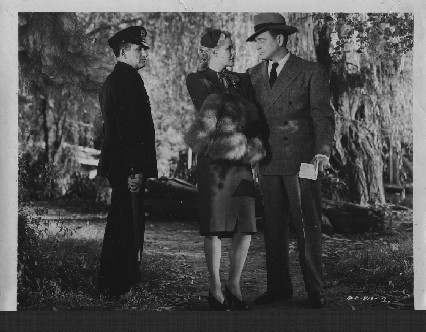
Each opens with a silhouette in trench coat and fedora floating along sidewalks and alley walls, uncredited actor Otto Forrest’s voice intoning “I am the Whistler … I know many strange tales, hidden in the hearts of men and women who have stepped into the shadows.” He then guides our attention to this particular case’s subject, who’s either planning something terrible or oblivious to the terrible something about to befall them.

If these central protagonists seemed oddly alike, that was because they were all played by one actor. Richard Dix was a big star of the 1920s and early 30s who was by then in his 50s, and looked it. He could credibly sport a tuxedo, bum’s rags, or murderous glare. Yet by and large he struck a placid, almost disinterested attitude throughout the series, despite his characters’ wildly varied circumstances. These included playing men who lose their identity (an amnesiac in 1945’s Power of the Whistler) or steal the wrong one (1944’s Mark of the Whistler); a terminally ill tycoon who marries a gold digger (1945’s Voice of the Whistler); or a gold digger sniffing inheritance dough (1946’s Secret of the Whistler, 1946’s The Mysterious Intruder).

The basic plot elements were interchangeable. But the particulars (often penned  by pulp masters like Cornell Woolrich) were complex — so many hitherto lawful characters turning homicidally venal on a dime — the support casts colorful, and execution snappy or moody as needed. (Directing four entries was William Castle, who’d turn to more garish thrills as the showman behind such gimmick-driven horror potboilers as 1964’s Strait-Jacket and 1965’s I Saw What You Did.)

There are a lot of other rarities in the Roxie fortnight, highlights including the entirely SF-shot 1949 cheapie Treasure of the Monte Cristo and Phil Karlson’s excellent 1953 99 River Street. Particularly fascinating are late entries showing in studio archive prints: 1958’s flop-sweaty NYC-set Cop Hater; 1963’s crazily cast (Mort Sahl! Sammy Davis Jr.! Pre-Bewitched Elizabeth Montgomery!), quite nasty mafioso meller Johnny Cool; and 1959’s The Fearmakers. The latter’s finger-waggling about “packaged politicians,” “well-heeled lobbyists,” and “phony front groups” muddying D.C. democracy played Red-scary then, but sure sound prescient in our post-Cold War now.
 
“I Still Wake Up Dreaming: Noir is Dead!/Long Live Noir!”
May 14-27, $5-9.75
Roxie, 3117 16th St, SF
(415) 863-1087, www.roxie.com 

Time travel

0

arts@sfbg.com

LIT Sometimes when I’m bored walking around Union Square, I wonder how many of the well-heeled white guys heading toward the Financial District are really criminal types who should be followed. Say, maybe some higher-up at Wells Fargo or Citigroup who helped rip off thousands through subprime loans before getting a nice slice of that sweet Wall Street bailout money.

When I’m feeling that way, I’m under the influence of a seminal 20th century writer who spent his most productive years in San Francisco. Here’s a passage that sends me there:

She walked on down Post Street to Kearny, stopping, stopping every now and then to look — or to pretend to look — in store windows; while I ambled along sometimes beside her, sometimes, almost by her side, and sometimes in front.

She was trying to check the people around her, trying to determine whether she was being followed or not. But here, in the busy part of town, that gave me no cause for worry. On a less crowded street it might have been different, though not necessarily so.

There are four rules for shadowing: Keep behind your subject as much as possible; never try to hide from him; act in a natural manner no matter what happens; and never meet his eye. Obey them, and, except in unusual circumstances, shadowing is the easiest thing that a sleuth has to do.

The narrator so hep to the ways of the tail is Dashiell Hammett’s “Continental Op,” an operative for the fictional Continental Detective Agency, whose adventures in print include some of Hammett’s finest San Francisco tales.

Don Herron’s walking tour of landmarks associated with Hammett’s time in San Francisco is well worth making for anyone curious about the history of the author of The Maltese Falcon and The Thin Man, who helped create hardboiled crime fiction and was one its greatest practitioners. At three to four hours of often hilly trekking, it’s a bit of a commitment, but at $10, it’s an affordable way to engage in the next best thing to time travel.

Herron, author of books about pulp actioneer Robert Howard and noir craftsman Charles Willeford, has been informally conducting the tour for three decades. It started in 1977 as part of a “free college” known as Communiversity. The Dashiell Hammett Tour: Thirtieth Anniversary Guidebook (2009), which updates earlier versions, is a nifty package that belongs on the shelf of any self-respecting San Francisco denizen with a passion for our city’s often twisted past. It’s a lively combination of biographical material about Hammett, assorted related trivia that never seems trivial, and Herron’s memories from 30 years of accompanying a broad spectrum of writers, fans, and eccentrics through the former stomping grounds of Hammett and his fictional creations.

The tour starts near the former site of the San Francisco Library Main Branch, now the Asian Art Museum. In an era of economic collapse papered over with massive subsidies to the same financial entities that brought us to collapse in the first place, lessons from earlier belt-tightening eras are useful. Hence it’s only appropriate to tip our fedoras to the memory of an autodidact left-winger who never finished high school but, by devoting years to reading in public libraries, got a better education than most who did. Though Hammett was making good money from writing crime fiction by the late 1920s, when he lived at 620 Eddy St. in the early 1920s, he couldn’t afford books and the library was a lifeline. The 1923 photo on page 66 of the guidebook, of what Heron calls “Hammett’s Reading Room” in the old main library branch at 200 Larkin St., is a beaut.

When Hammett and his family lived at 620 Eddy, their landlady was a bootlegger. Hammett’s wife later recalled cops rousting people in front of their window to the street. As Herron notes, today’s prohibition on hard drugs is about as effective at deterring users as the earlier one on alcohol, and equally effective at creating endless business opportunities for motivated entrepreneurs. If you’re not legally blind and are paying any attention at all, it’s likely you may see one or two such enterprising businesspeople on the streets of the Hammett tour. It’s also a safe bet they might bear a resemblance to the Continental Op’s self-description: “My face doesn’t scare children, but it’s a more or less truthful witness to a life that hasn’t been overburdened with refinement and gentility.”

The 1920s in San Francisco were wild, wide-open years full of fast living and dodgy characters. The late venerable columnist Herb Caen wrote of the period: “The Hall of Justice was dirty and reeked of evil. The City Hall, the D.A., and the cops ran the town as though they owned it, and they did … You could play roulette in the Marina, shoot craps on O’Farrell, play poker on Mason, and get rolled at 4 a.m. in a bar on Eddy.”

Hammett toiled on his used Underwood typewriter late into the night, creating characters and stories based on what he’d seen in that milieu. During World War I, he contracted both Spanish influenza and tuberculosis. When his TB got so bad that it was hazardous to the health of his wife and baby to maintain a family abode, he moved out and lived in a succession of apartments, including one up the hill from Eddy Street at 891 Post St., at the corner of Hyde. In a corner apartment on the fourth floor of that building, Hammett pounded out his first three novels. If you’re lucky, on Herron’s tour you’ll be buzzed in and get to see where Hammett typed, ate, drank, and smoked furiously — and sometimes pulled down the Murphy bed to sleep. The apartment of The Maltese Falcon‘s tough detective Sam Spade was based on the snug little dwelling.

The current occupant is Bill Arney, an architect and Hammett fan. When he showed the tour I was on around the small one-bedroom unit, I noticed a great compilation of “crime jazz,” soundtrack music from black and white crime movies and TV shows, on top of a pile of CDs. Appropriate, since Arney serves as announcer for the Noir City film festival local mover and shaker Eddie Muller puts on at the Castro Theatre every January.

Hammett left a permanent mark on San Francisco. Specifically, on the block-long street that used to be called Monroe, which runs south off Pine in the block between Powell and Stockton. From what is now called Dashiell Hammett Street, walk east on Bush and on the right, at Burritt Street, just before the Stockton tunnel overpass, ponder the plaque that reads: ON APPROXIMATELY THIS SPOT/MILES ARCHER,/PARTNER OF SAM SPADE,/WAS DONE IN BY/BRIGID O’SHAUGHNESSY.

We are lucky to be in a city that commemorates one of its most accomplished past local residents with a plaque honoring a killing that was a product of that writer’s imagination. *

MORE ON SFBG.COM: Johnny Ray Huston’s illustrated look at the Vertigo tour


360-degrees “Muralismo”

0

caitlin@sfbg.com

STREETS OF SAN FRANCISCO In the late 1960s, when the muralismo movement began gaining strength among artists and community organizers in the Mission District, or in the 1970s when pioneer female street artists Mujeres Muralistas first picked up their brushes to trick out Balmy Alley, they probably weren’t thinking about the de Young Museum and slick coffee table books.

But, to appropriate Jay-Z, street art’s got a new bitch — the fine art world. With the 2009 release of Precita Eyes’ eye-popping Street Art San Francisco: Mission Muralismo (www.missionmuralismo.com) and the corresponding year-long event series the picture book of the storied mural hood has spawned at the de Young museum, neighborhood tags and tableaus are gaining a stronger foothold in the world of high art. That is to say, the world of art that people pay big money for.

Banksy’s recent film, Exit Through the Gift Shop, and the attendant media frenzy about several tie-in works appearing around town, is the hyped-out crest of spray-can crazy that’s got San Francisco in its grip. Galleries like Project One, White Walls, and 1AM are selling works for hundreds and thousands of dollars that you once saw on the wall of your neighborhood elementary school or liquor store. High class Union Square Hotel Des Arts offers visitors the chance to sleep in well-appointed rooms designed by “street” artists Apex, Shepard Fairey, and Chor Boogie. It’s hip to be street, stay up to get down, yadda yadda.

So what’s new? After all, Jean-Michel Basquiat zoomed from asphalt to canvas, sparking a meteoric career that collectors loved to cop a piece of in the 1980s. In graffiti’s early days, New York taggers struggled to retain control of their art in the face of soaring price tags, grasping middlemen, and ad execs who recognized the power of the bubble letter to sell. Past generations of SF artists like Twist and Mars One have graduated from the streets entirely. “You need money to do bigger and better things,” White Walls curator Justin Giarla told me. “Galleries are another possible venue to find yourself in history books, museums.”

Mission Muralismo offers a seductively jumbled history. Its pages, a nonlinear whirl of street art celebrated in situ, are perfect for a disparate neighborhood art movement that includes Latin American freedom songs, urban rustic neo-folk, and unapologetic civil disobedience. Editor Annice Jacoby says it took years of “digging through people’s closets” to create.

“You have to find a container that reflects the contradictions and surprises of the street,” Jacoby told me. “This whole place [the Mission] is like a gallery, proliferating and procreating.” To encapsulate the movement’s feel, she took images of temporal art — murals tend to last no more than 12 years before they start to deteriorate — and laid them alongside thoughtful essays by artists and other key Mission figures.

It would be easy to mistake the whirl surrounding Muralismo as another round of outsider art profiteering. Easy, that is, if you didn’t know Precita Eyes’ history of sponsoring social justice-based community murals. Easy, if you forget that the de Young events don’t directly commodify in the murals depicted in the book by swallowing them whole — those murals are pretty well stuck to their walls. Easy, if you’ve never seen the diverse crowds the events draw and the enthusiasm and respect shown by all sides.

“You mention Basquiat, and what happened there is that collectors started recognizing his work and showing it. This is different — we’re not bringing in the art,” de Young director of public programs Renee Baldocchi. Her museum’s First Fridays Mission Muralismo events, part of its Friday night “Cultural Encounters” series, are more than opportunistic book tie-ins. They aim to focus on the culture of the artists themselves. Key figures in the mural movement featured in the book like Juana Alicia, the Billboard Liberation Front, and Jet Martinez (muralist and artistic director of the Clarion Alley Mural Project), come in to lecture — street artists, lecturing? — to packed crowds on what they do, why it’s important, and how you can do it too. “We’re hoping that by inviting them in to talk about their art, it makes more people aware of them in the world,” Baldocchi says.

“The [de Young] events, I see them attracting a lot of young people,” says Jaime Cortez, an artist who coordinated the Galeria de la Raza digital billboard campaign in the 1990s and AIDS awareness mural projects. “I think that’s because of the big name graffiti artists the events draw.” Perhaps these functions are less about changing the meaning of the murals they celebrate than the high art venue they’re being celebrated in.

“It’s not like they’re having a show of muralists [at the de Young],” says Martinez, who has feet in both the street and gallery art worlds. Jet spoke at the Mission Muralismo event highlighting Clarion Alley. “They’re providing a forum where we can speak about this art,” he said.

Hopefully there are some lifted conversations going on, because the color and uniqueness of the Mission’s public art is pretty dope. “You’re dealing with a monumental subject,” Jacoby acknowledges. “You have to find a container that reflects the contradictions and surprises of the street.”

Debates don’t get much weirder than ones about where art “belongs.” But what’s certain is that with all the attention — the de Young events, the Banksy histrionics — more people are seeing the writing on the wall. “Oftentimes we’re in a hurry; we don’t stop to look at the murals,” Baldocchi says. “This is providing a forum so that when we do go down into the Mission, we can look at them and think about what’s being said — especially the social justice side.” *

MISSION MURALISMO

First Fridays, 5 p.m., free

de Young Museum

50 Hagiwara Tea Garden Dr., SF.

(415) 750-3600

www.famsf.org/deyoung


Beauty lies

0

MUSIC Let’s get this out of the way: Icelandic composer Jóhann Jóhannsson writes beautiful music. His string sections shiver and swell, his melodies alternately soar and ache, and the electronic textures that he often weaves in amid the more traditional orchestral instruments are unobtrusively massaged into the mix. This is music that doesn’t take warming up to, but rather cocoons you with its immediate approachability and occasional familial resemblances to members of the classical canon as well as more modern film composers such as Nino Rota and Elmer Bernstein. (In fact, many of Jóhannsson’s albums started as original soundtracks, or have been used as such.)

“Prettiness is not something I strive for, even though I know that most people’s initial reaction to my work is to say that it’s beautiful,” Jóhannsson counters bluntly over the phone when I ask for his feelings on the subject. “I don’t think beauty is the main goal. I think it’s more a certain emotional quality. I work in a very visceral way and I try to make music that affects you viscerally and that affects you physically.”

This has certainly been my experience of Jóhannsson’s music, starting with Englaborn, his 2002 debut on the Touch label, and up through his most recent release, last year’s And In the Endless Pause There Came the Sound of Bees (Type), in spite of — or perhaps because of — its beauty. Listening to these classical-not-classical albums, it is hard not to feel that familiar tug inside — the affective prelude to either laughing or crying — that often occurs when one encounters something beautiful.

Composer Benjamin Britten once wrote that “It’s cruel, you know, that music should be so beautiful.” Britten then cataloged the different types of cruel beauty music allows the listener to access: there is “the beauty of loneliness and of pain: of strength and freedom,” “the beauty of disappointment and never-satisfied love,” and “the cruel beauty of nature and the everlasting beauty of monotony.”

The kinds of beauty described by Britten — beauty attenuated by pain or loss — are present in Jóhannsson’s music, enriched by the context of its conception. Englaborn’s icy and delicate arrangements were conceived as a compliment to the violence and emotional ugliness of the play it originally scored. Fordlandia (4AD), Jóhannsson’s monumental 2008 album, was inspired in part by Henry Ford’s abandoned prefabricated industrial town built in the Amazonian rainforest in 1928, itself a monument to failure. And In the Endless Pause … is an expanded soundtrack to Marc Craste’s animated eco-parable Varmints, a critique of the environmental costs of unchecked urbanization told with a cast of rodents. When asked who his ultimate fantasy collaborator would be, Jóhannsson immediately names the late, great depressive Belgian chanson specialist Jacques Brel.

Despite the unabashed emotionality of his music, with its darker spells of sturm und drang , Jóhannsson discusses his work matter-of-factly. “I think what I’m interested in is the clash of culture and nature, or of technology and nature,” he says. “I don’t write ‘absolute music.’ It always starts with a nonmusical idea.” Better to leave the gushing to the critics, I suppose — a charge that could certainly be leveled at this particular profile. But I know I won’t be the only one reaching for a handkerchief when Jóhannsson and his six-piece ensemble take to the Great American Music Hall’s stage. Yes, it is cruel that music can be so beautiful. But hearing it is nonetheless sublime.

JÓHAN JÓHANNSSON

With Christopher Willits

Fri/14, 9 p.m. (doors at 8 p.m.), $21

Great American Music Hall

859 O’Farrell, SF

1(888) 233-0449

www.gamh.com


Our Weekly Picks

0

WEDNESDAY 12

MUSIC

Fishtank Ensemble

It takes more than a swift set of strings or a Balkan backbeat to be able to stake a claim on the Gypsy music bandwagon, but the Bay Area’s Fishtank Ensemble slides smartly into what basically amounts to an ephemeral category by embracing its wider implications. From sinuous, sepia-toned swing to muscular gitano Flamenco to Serbian drinking standards, Fishtank Ensemble’s new CD Woman in Sin highlights their flexible musicality. Its tightly-knit collaborative compositions evoke both the roving influences of the Roma, and their far-flung connectivity. Skillfully balancing the talents of an operatic saw-playing chanteuse, Romani-trained violinist, slap-happy Serbian bassist, and Andalusian-inspired ax man, their endless variety leads to sublime cohesion. (Nicole Gluckstern)

8 p.m., $18.50–$19.50

Freight and Salvage Coffeehouse

2020 Addison, Berk.

(510) 548-1761

www.thefreight.org

THURSDAY 13

EVENT

A Fundraiser for the Haight-Ashbury Street Fair

Bands will battle, cars will crash, people will rage — tonight is not for the faint of heart. Join five Bay Area bands as they duke it out on stage to win the headlining slot at the 33rd annual Haight-Ashbury Street Fair. The contestants are the Jugtown Pirates, the Tell-Tale Heartbreakers, Project Pimento, Franco Nero, and the Swamees. All proceeds benefit the street fair, a cultural celebration for San Francisco that spotlights emerging and established bands and artists. The night concludes with a crash-up derby contest. (Lilan Kane)

9 p.m. (doors at 8 p.m.), $7

Paradise Lounge

1501 Folsom, SF

(415) 252-5017

www.paradisesf.com

FRIDAY 14

FILM

The Big Surf Weekend

Despite the fact that the ocean in these parts scares the shit out of me, I harbor a dreamy fondness for surfing. Tan boys with nice upper backs, VW vans — oh, and the zen of riding the waves, obviously. Viz Cinema’s surfing film festival provides an excellent reason to paddle out to Japantown — they’ll be showing a double header of the first two Endless Summers, and a unique triple feature of Japanese shorts. It includes the daredevil beach bums of Monster Wave in Cape Ashizuri, and Glacier Diary, which is not about surfing, but as the Viz Cinema website assures us, employs “similar filming techniques used to capture waves.” Pretty sure they mean the film crew pulled a wake and bake, and used “brah” as endearment while filming. (Caitlin Donohue)

Various show times (through Sat/15), $10

Viz Cinema @ New People

1746 Post, SF

(415) 525-8000

www.newpeopleworld.com

SATURDAY 15

EVENT

Tejiendo Justicia en Chiapas

Chiapas, Mexico is home to some of the most badass populist activists the world has ever seen. Merely witness the Zapatistas 1994 takeover of San Cristobol de las Casas City Hall when NAFTA took effect (you can, too — the Zapatistas’ skilled use of media marked them as early freedom fighters of the information age). But resistance takes less combative forms in the state, also. This free bilingual presentation highlights the efforts of Tzotzil and Tseltal indigenous women who have formed an artisan co-operative in their villages to autonomously improve their economic circumstances, preserve artistic heritage, and remain independent from domestic servitude and forced matrimony. Co-founder Celia Santiz-Ruiz is ready to teach. ¡Viva la lucha! (Donohue)

2 p.m. and 4 p.m., free

Mission Cultural Center for Latino Arts

2868 Mission, SF

(415) 821-1155

www.missionculturalcenter.org

PERFORMANCE

Kevin Simmonds’ MASS (Making All St. Sebastian)

Next to a crucified Christ, the most prolific image of Christian martyrdom is St. Sebastian. Sebastian was led by soldiers to a stake in a field, whereupon they “shot at [him] till he was as full of arrows as an urchin.” For artist Kevin Simmonds, Sebastian’s arrow-laden body — which healed completely, hence the saintliness — is a sex symbol and a reason for “celebrating and recasting male sexuality.” Simmonds has gathered over 25 men and had them pose as the hapless holy and hole-y figure in MASS (Making All St. Sebastian), a multimedia work that updates the martyr and culminates with a quasi Catholic mass. That’s good blasphemy right there. (Miller)

7–8:30 p.m., free

Good Vibrations

1620 Polk, SF

(415) 345-0500

www.goodvibes.com

LIT

Naked Girls Reading: The Wild Party

The Wild Party by Joseph M. March is a narrative poem that has to be read to be believed. Banned in 1928, the story captured the decadent age of prohibition and has called forth the wild and wicked natures of readers for nearly 100 years. William Burroughs claimed it as “the book that made me want to be a writer.” Could there be anything more alluring than an all-female cast reading this smoky, gin-soaked homage to lust, kink, and betrayal? How about if they’re naked? Founded one year ago in Chicago by burlesque queen Michelle L’Amour, Naked Girls Reading has inspired franchises all over the world, including this inaugural event in San Francisco organized by “Queen of the Fire Tassels,” Lady Monster. The regular readers on board tonight are Dottie Lux, Isis Starr, Kimberlee Cline, Lady Monster, Ruby Vixen and special guest Carol Queen. See you there. (Paula Connelly and D. Scot Miller)

7 p.m., $15 ($20 for the front row)

Center for Sex and Culture

1519 Mission, SF

www.nakedgirlsreading.net

EVENT

SF Vintage Paper Fair

Encompassing a vast array of what was at one time considered disposable paper products — now beloved as archival gems by those in the know — the ever-growing ephemera market places great value on artifacts. Revealing a sizable portion of our culture’s history, a treasure trove of these goods will be available at this weekend’s annual Vintage Paper Fair, be they original pin-up calendars by artists such as Alberto Vargas, historic post cards of places long gone, timetables of discontinued railways, or posters for classic films. Discerning collectors and amateur hobbyists alike are bound to find a priceless paper gem. (Sean McCourt)

10–6 p.m. (also Sun./16), free

Hall of Flowers, SF County Fair Building

Ninth Ave. and Lincoln, SF

(415) 668-1636

www.vintagepaperfair.com

DANCE/EVENT

Hip-Hop 4 Hope Dance Competition

If you like America’s Next Best Dance Crew, then tune in to this event. The Asian American Donor Program (AADP) is presenting the first Hip-Hop 4 Hope Dance Competition, a showcase for Bay Area dance crews with special guest judges. The crews include Soulidified Project, For the Cause, FUSION, FMC, VIP Vallejo, Alliance Streetdance, Eight Count, and Hydef. They’ll compete for a chance to win a $1,000 grand prize, while the rest of the proceeds will benefit AADP. You can purchase combo tickets for the after party at Suite 181 online. (Lilan Kane)

7 p.m., $15

Palace of Fine Arts

3301 Lyon , SF

(415) 567-6642

www.palaceoffinearts.org

FOOD/EVENT

SF Oysterfest

Oysters have long been associated with stout — when the dark beer was first emerging in the 1700s, the tasty bivalves were common food in pubs. Presented by O’Reilly’s, one of the city’s favorite Irish pubs, the 11th annual Oysterfest brings great food — there are plenty of other options besides the briny treats of the sea — and voluminous drink together, once again. Along for the ride is this year’s impressive live music lineup, including Cake and the Raveonettes. There will be cooking demos. (McCourt)

11 a.m., $30 (14 and under free)

Great Meadow at Fort Mason Center

Laguna and Bay, SF

www.oreillysoysterfestival.com

SUNDAY 16

EVENT

Forbidden Island’s Luau

If you can’t make it to Hawaii this year, you can still get leied by a native on the exotic island of Alameda, during Forbidden Island’s third annual Luau. Tiki lovers have suffered some setbacks lately with the closing of the San Francisco Trader Vic’s, and the rumored closing of the Tonga Room in the Fairmont Hotel to make way for some (gag) condos. But local tiki culture is far from dead: there’s a hot new tiki bar in Hayes Valley called Smuggler’s Cove, and Forbidden Island continues to celebrate the tiki spirit, with a straw thatched interior, giant statues, and a long cocktail menu of scorpion bowls, flaming drinks, and other rum-based, fresh-squeezed fruity surprises. So don your best Hawaiian shirt and haole smile and head to the, um, island for some live hula and fire dancing, Hawaiian BBQ, and live surf music by the Faux Hawaiians and Drifting Sand. (Connelly)

2 p.m.–10 p.m., free

Forbidden Island Tiki Lounge

1304 Lincoln, Alameda

(510) 749-0332

www.forbiddenislandalameda.com

FOOD/EVENT

SF Food Wars: Amuse Brunch (Brunch in a Bite)

Food culture in San Francisco is always changing. Whether it involves downing tasty treats from the Crème Brulée Cart, eating $50 truffle hamburgers, or spending $11 on a cocktail from Bourbon and Branch, foodies are on the scene. So whenever SF Food Wars has a new event around the corner, tickets sell out — fast. With past installments revolving around mini cupcakes, gourmet macaron and cheese, and chocolate cookies, the savory food competition has built a reputation. This time, competitors are crafting up unique brunch dishes capable of bringing your grandma’s frittata recipe to its knees. Warning: this event is not for tiny appetites. (Elise-Marie Brown)

12 p.m., $15

Thirsty Bear Brewery

661 Howard

(415) 974-0905

www.sffoodwars.com

EVENT

Bay to Breakers 2010

It’s been a long time since 1912, the year the first Bay to Breakers took place, raising the city’s morale after the big quake in 1906. Ninety-eight years later, the tradition lives on, as drunken debauchery specialists, nudists, and people in eccentric costumes all strive forward with one goal in mind — making it from one end of the peninsula to the other without passing out. So pull up that gorilla suit, pump the keg, and lace up those Asics, because running outside with your San Francisco brothers

and sisters beats a boring day inside watching reruns of Entourage. (Brown)

8:00 a.m., $39–$50

Steuart and Howard, SF

(415) 359-2800

www.ingbaytobreakers.com

TUESDAY 18

MUSIC

Shout Out Louds

In 2005, the world was introduced to Stockholm quintet the Shout Out Louds, thanks to their upbeat debut album Howl Howl Gaff Gaff. After worldwide success, tours and two successful records, these indie darlings decided to hide away and record their third album Work in a barn on the outskirts of Seattle. The results, as ever, are melodious and danceable and worthy of praise. (Brown)

8 p.m., $17

Great American Music Hall

859 O’Farrell, SF

(415) 885-0750

www.gamh.com

The Guardian listings deadline is two weeks prior to our Wednesday publication date. To submit an item for consideration, please include the title of the event, a brief description of the event, date and time, venue name, street address (listing cross streets only isn’t sufficient), city, telephone number readers can call for more information, telephone number for media, and admission costs. Send information to Listings, the Guardian Building, 135 Mississippi St., SF, CA 94107; fax to (415) 487-2506; or e-mail (paste press release into e-mail body — no text attachments, please) to listings@sfbg.com. We cannot guarantee the return of photos, but enclosing an SASE helps. Digital photos may be submitted in jpeg format; the image must be at least 240 dpi and four inches by six inches in size. We regret we cannot accept listings over the phone.


Event Listings

0

Event Listings are compiled by Paula Connelly. Submit items for the listings at listings@sfbg.com.

WEDNESDAY 12

Bike-In Movie Parking lot across from the Good Hotel, SF; www.disposablefilmfest.com. Good Hotel, 112 7th St, SF; (415) 621-7001. 4pm, free. Celebrate SF Bike Week starting at 4pm with Forage SF’s Underground Market, followed by a raffle at 7pm for cool bike gear, stays at the Good Hotel, and more, culminating in a screening of the Disposable Film Festival 2010 competitive shorts at 8pm. Valet bike parking available from the SFBC.

Write/Walk Meet at Mission High School, 3750 18th St., SF; (415) 252-4655. 6pm, free. Reading at Modern Times Bookstore, 888 Valencia, SF. 7pm, free. Enjoy a walking tour of poems by young poets from WritersCorps workshops at Mission High School that will be displayed in Mission storefronts for the month of May. Participating merchants include Candy Store Collective, Adobe Book Shop, Bombay Ice Cream, Borderlands Books, Dog Eared Bookstore, 826 Valencia, and more. Maps available at participating merchants.

Zhang Huan Sculpture Joseph L. Alioto Performing Arts Piazza, Civic Center Plaza, Larkin between the Main Library and the Asian Art Museum, SF; www.sfartscommission.org. 10am, free. Attend the dedication of internationally-acclaimed Chinese artist Zhang Huan’s Three Heads Six Arms copper sculpture that will be located in Civic Center Plaza through 2011.

THURSDAY 13

Bike Away From Work Party Rickshaw Stop, 155 Fell, SF; www.sfbike.org/btwd. 6pm; free for SFBC members, $10 for non-members. Get the skinny [jeans] on cycling fashion and style at this runway show and Bike to Work Day after party featuring tips on functional finery, complimentary bike valet, DJs, and raffle prizes.

Radical Women on Asian American Heritage New Valencia Hall, Suite 202, 625 Larkin, SF; (415) 864-1278. 7pm, free. Asian vegetarian buffet available at 6:15pm, $7.50. Hear artists Mia Nakano, Lenore Chinn and Nellie Wong discuss turning art into a collective voice for social change and the importance of the visibility of Asian American queers and women to the movements.

Rock the Bike California Academy of Sciences, 55 Music Concourse Dr., SF; www.calacademy.org. 7pm, $12. Celebrate one of San Francisco’s favorite method of transportation at this cycling themed NightLife featuring fun sustainable displays, including a bike-powered blender, a bike-powered DJ stage where you can take a turn pedaling, a performance by “the bike rapper” Fossil Fuel, bike-powered and inspired art, and more.

FRIDAY 14

BAY AREA

Ferment Change Humanist Hall, 390 27th St., Oak.; www.fermentchange.org. 7pm, $10-30 sliding scale. Support a more equitable food system at this fermented foods, culture, and urban agriculture series event where you can taste over a hundred different homemade fermented foods and beverages. Proceeds to benefit for urban agriculture heroes, City Slicker Farms. Bring your own fermented food to share and be entered in a raffle.

SATURDAY 15

Asian Heritage Street Celebration Larkin between Ellis and Grove, SF; www.asianfairsf.com. 11am-6pm, free. Celebrate Asian heritage at this street fair featuring two stages with over 100 music, dance, and other performance acts, an Anime area, a mah jong court, food and drink vendors, a cultural procession, an 8-foot high replica of a human colon, and much more.

Dawn Festival 2010 California Academy of Sciences, 55 Music Concourse Dr., Golden Gate Park, SF; www.dawnfestival.org. 7:30pm, $20. Reboot and Tablet Magazine host this celebration of the Jewish holiday of Shavuot, with Sandra Bernhard, Daniel Handler (aka Lemony Snicket), and more.

Inner Sunset Street Fair Irving at 10th Ave., SF; www.sfpix.com. 10am-8:30pm, free. Celebrate the Inner Sunset at this inaugural street fair set to feature sidewalk sales throughout the neighborhood, live music performances, dance lessons, art, crafts, food, yoga and tai chi lessons, and more.

MASS Good Vibrations Polk Street Gallery, 1620 Polk, SF; (415) 345-0400. 7pm, free. Enjoy this multimedia exhibit by poet and musician Kevin Simmonds called MASS (Making All Saints Sebastian), where he uses photographs, music, and poetry to recast male sexuality by having a diverse range of men pose as St. Sebastian.

SUNDAY 16

Alameda Backyard Chicken Coop Bicycling Tour Meet at 488 Lincoln, Alameda. 1pm, free. Take a self-guided bike tour of the many chicken coops of Alameda and check out a wide range of chicken coops while learning about urban chicken farming, ecological issues, and slow food on this 4.5 mile route. Maps will be provided at the start location and refreshment will be available along the route.

Bay to Breakers Start lines on Mission between Beale and Steuart, SF; (415) 359-2800, www.ingbaytobreakers.com. 8am; registration $48, group discounts available, free to be a spectator. Enjoy this authentic San Francisco marathon, complete with competitive runners and Mardi Gras style revelers, who follow athletes through the city in themed costumes and floats. Call or visit their website for rules and restrictions on alcohol consumption. Don’t forget to dispose of your own trash.


Rep Clock

0

Author and activist Cornel West appears in Justin Dillon’s doc about human trafficking, Call + Response. It screens Sun/16 at the Christopher B. Smith Rafael Film Center.

Schedules are for Wed/12–Tues/18 except where noted. Director and year are given when available. Double features are marked with a •. All times are p.m. unless otherwise specified.

ARTISTS’ TELEVISION ACCESS 992 Valencia, SF; www.atasite.org. $7. “Other Cinema:” Leslie Raymond and Jason Jay Stevens present a new A/V performance, Sat, 8:30.

CAFÉ OF THE DEAD 3208 Grand, Oakl; (510) 931-7945. Free. “Independent Filmmakers Screening Nite,” Wed, 6:30.

CASTRO 429 Castro, SF; (415) 621-6120, www.castrotheatre.com. $7.50-10. Iron Man 2 (Favreau, 2010), call for dates and times.

CERRITO 10070 San Pablo, El Cerrito; www.rialtocinemas.com. $7. “Cerrito Classics:” Chinatown (Polanski, 1974), Thurs, 7:15.

CHRISTOPHER B. SMITH RAFAEL FILM CENTER 1118 Fourth St, San Rafael; (415) 454-1222, www.cafilm.org. $6.50-10. Babies (Balmès, 2010), call for dates and times. Exit Through the Gift Shop (Banksy, 2010), call for dates and times. The Girl With the Dragon Tattoo (Oplev, 2009), call for dates and times. The Greatest (Feste, 2009), call for dates and times. Touching Home (Miller and Miller, 2009), call for dates and times. Vincere (Bellocchio, 2009), call for dates and times. Tenderloin (Anderson, 2009), Wed, 7. OSS 117: Lost in Rio (Hazanavicius, 2009), May 14-20, call for times. Call + Response (Dillon, 2008), Sun, 6:30.

GOOD HOTEL Parking lot, Seventh Street at Minna, SF; www.disposablefilmfest.com/events. Free. “Disposable Film Festival: Bike-In Screening,” short films, Wed, 8.

HUMANIST HALL 390 27th St, Oakl; www.humanisthall.org. $5. Destiny (Chahine, 1997), Wed, 7:30.

JACK LONDON SQUARE PAVILION THEATER 98 Broadway, Oakl; www.oakuff.org. Free. “Oakland Underground Film Festival: Remembering Playland (Wyrsch, 2010), Sat, 7:30.

MECHANICS’ INSTITUTE 57 Post, SF; (415) 393-0100, rsvp@milibrary.org. $10. “CinemaLit Film Series: Heroic Horizons: The View from Australia:” My Brilliant Career (Armstrong, 1979), Fri, 6.

PACIFIC FILM ARCHIVE 2575 Bancroft, Berk; (510) 642-5249, www.bampfa.berkeley.edu. $5.50-9.50. Theater closed through May 28.

PIEDMONT 4186 Piedmont, Oakl; (510) 464-5980. $5-8. “Cult Classics Attack 5:” Ghostbusters (Reitman, 1984), Fri-Sat, midnight; Sun, 10am.

RED VIC 1727 Haight, SF; (415) 668-3994. $6-10. The Last Station (Hoffman, 2009), Wed, 2, 7, 9:25. “Oscar Nominated Short Films 2010:” “Animation Program,” Thurs-Sat, 7:15 (also Sat, 2); “Live Action Program,” Thurs-Sat, 9:15 (also Sat, 4). It’s a Mad, Mad, Mad, Mad, World (Kramer, 1963), Sun-Mon, 5, 8 (also Sun, 2). Fish Tank (Arnold, 2009), May 18-19, 7, 9:20 (also May 19, 2). ROXIE 3117 and 3125 16th St, SF; (415) 863-1087, www.roxie.com. $5-9.75. October Country (Palmieri and Mosher, 2009), Wed-Thurs, call for times. “I Still Wake Up Dreaming! Noir is Dead/Long Live Noir:” •High Tide (Reinhardt, 1947), Fri, 6, 8:45, and Mysterious Intruder (Castle, 1946), Fri, 7:30, 10; •99 River Street (Karlson, 1953), Sat, 1:30, 4:45, 8, and Shield for Murder (O’Brien, 1954), Sat, 3:10, 6:20, 9:45; •Nightmare (Shane, 1956), Sun, 2, 5, 8, and The Mark of the Whistler (Castle, 1944), Sun, 3:45, 6:45, 9:45; •The Lady Confesses (Newfield, 1945), Mon, 6:40, 9:25, and Jealousy (Machaty, 1945), Mon, 8; •The Invisible Wall (Forde, 1947), Tues, 6:30, 9:30, and Treasure of Monte Cristo (Berke, 1949), Tues, 8.

VIZ CINEMA New People, 1746 Post, SF; www.newpeopleworld.com/films. $8-10. “Kaiju Shakedown: Godzillathon!:” Godzilla vs. Hedorah (Banno, 1971), Wed, 5; Godzilla vs. Gigan (Fukuda, 1972), Wed, 7; Godzilla vs. Megalon (Fukuda, 1973), Thurs, 5; Godzilla vs. Mechagodzilla (Fukuda, 1974), Thurs, 7.

YERBA BUENA CENTER FOR THE ARTS 701 Mission, SF; (415) 978-2787, www.ybca.org. $6-8. “To the Limit: Pina Bausch on Film:” The Complaint of the Empress (Bausch, 1989), Thurs, 7:30. Typeface (Nagan, 2009), Sat, 6, 8; Sun, 2, 4.

The Daily Blurgh: What should I do next, Edith Wharton?

Curiosities, quirks, oddites, and items from around the Bay and beyond

Today in fashion: Oakland lifts century-old ban on cross-dressing, Parisian women can now legally wear pants, and persons of any gender can express their displeasure at the state of Arizona with a t-shirt (American flag shirts, however, can get you into hot water).

*****
 
You’re never too young to violate California labor laws.

*****

Oil-sucking “brooms” made from stray pet hair help save the environment, resemble rotting salami.


*****

Is this MTV original series not child porn-by-proxy because someday its nerdy and extraordinarily hung protagonist will grow up to be a character in a Judd Apatow film? (Thanks WoW Report and Slog)

*****

This is why “No Substitutions” is totally fair game in a restaurant.

*****

Edith Wharton meets Choose Your Own Adventure

*****

Boob tube still bringing folks together, one couch potato at a time: “Like all social activities, television-watching demands compromise. People may have strong ideas about what they want to watch, but what they really want to do is watch together.”

*****
Scopitone Week continues! Click here to learn more about Scopitones. Continuing with our survey of the ladies of Scopitone, today’s clip returns us to France. Here’s the boysih Stella, with “Le Vampire,” one of her send-ups of the ye-ye style popularized by such other Scopitone cuties as France Gall. You know MJ totally bit this for the Thriller video. (Just like he bit another French classic.)

http://www.youtube.com/watch?v=E5in8MdBTgI

Space is the place

0

LIT/FILM “I’m a lifelong space fan old enough to remember the Apollo era and grow up on Star Trek — when I was little, the Apollo missions and Star Trek merged in my mind,” says Megan Prelinger. “I lived my life, but kept one eye on space, watching and waiting to see what would happen. As I got older I realized that the general public is disenfranchised from having an opinion about or experience of space. I thought I could make an intervention — an intervention into space.”

Prelinger’s intervention has taken the form of Another Science Fiction: Advertising the Space Race 1957-1962 (Blast Books, 240 pages, $29.95) a flat-out awesome full-color collection of illustrations of American aerospace coupled with a historical critique of a time when the sky wasn’t definied by fear and terror and the outer reaches were aligned with ideas about potential. Prelinger’s book is a work of Bay Area dedication and intellectual independence, akin to everything from Jacques Boyreau’s and Jenni Olson’s published collections of movie poster art to Trevor Paglen’s books on the hidden machinations of U.S. forces. It couldn’t arrive at a better time, with Carl Sagan warning us that aliens won’t be friendly, and President Obama demonstrating a marked lack of faith in the space program.

“The Obama administration wants things both ways,” says Prelinger, when the President’s most recent statements on the subject are broached. “They want to be committed in the long run but cancel everything in the short run to reformulate. The plans he’s laid out are too general. They’re almost hard to interpret. In the short run, he wants to stop spending money, and I can understand that, but the long term plans are underfunded and underarticulated. The jury is out.”

The jury may be out, but for the time being, the curious are invited to see a space-related film program that includes vintage short films selected by Prelinger. This weekend, “Atomic Age Artifactuality” brings Prelinger’s-choice archival treats such as Birth of the Orbis Electronic Computer and All About Polymophics to the screen, along with Laura Harrison and Beth Federici’s new documentary Space, Land and Time: Underground Adventures with Ant Farm. The ideas in the program should ricochet interestingly off of the recent Cold War treatise Double Take, by another Other Cinema regular Johan Grimonprez. “There’s a really complex interaction between tech and society in the Cold War, where it’s used to express utopian and dystopian possibilities,” Prelinger observes. “Those two dissonant possibilities exist side by side through decades.”

As for today, Prelinger’s vision is clear. “Our space program belongs to all of us,” she says. “We should think about what we want from it, and ask for it.”

(Johnny Ray Huston)

ANT FARM AND MEGAN PRELINGER: “ATOMIC AGE ARTIFACTUALITY”

Sat/8, 8:30 p.m., $6

Other Cinema

992 Valencia, SF

(415) 824-3890 www.othercinema.com

New York story

0

FILM The central characters in Nicole Holofcener’s new film, Please Give, Manhattan couple Kate (Catherine Keener) and Alex (Oliver Platt), display a fluency in the language of large round numbers that is occasionally disturbed by bouts of self-inflicted sticker shock. The proprietors of an up-market vintage furniture store — the hunting ground of interior designers and affluent nesters with a taste for midcentury modern — they troll the apartments of the recently deceased, redistributing the contents at an astonishing markup that occasionally leads to soul-searching exchanges like this: “How come you feel OK about this?” “Because it’s OK.” “OK.” Whether or not it’s OK, clearly it’s a living, since the couple has purchased the entire apartment of their elderly next-door neighbor (Ann Guilbert). Waiting for her to expire so they can knock down a wall, they try not to loom in anticipation in front of her granddaughters, the softly melancholic Rebecca (Rebecca Hall) and the brittle pragmatist Mary (Amanda Peet).

Holofcener has entered this territory before, examining the interpersonal pressures that a sizable income gap can exert in 2006’s Friends with Money. Here she turns to the pangs and blunderings of the liberal existence burdened with the discomforts of being comfortable and the desire to do some good in the world. Kate’s hand-wringing, while reflexive, keeps her up at night, and as she ably acquires the furnishings of the dead, she suffers crises of conscience about preying on the ignorance of their bereaved but busy adult children. Unfortunately, her penance is often embarrassingly misdirected. While her teenage daughter (Sarah Steele) suffers the less-abstracted agonies of bad skin and low self-esteem, Kate offers her leftovers to a black man waiting outside a restaurant for a table, mistaking him for a homeless person, and presumptuously weeps over a group of developmentally disabled teenagers playing basketball.

In scenes such as this, the film capably explores the unexamined impulses of liberal guilt, though the conclusion it reaches is unsatisfying. Like Holofcener’s other work, Please Give is constructed from the episodic material of mundane, intimate encounters between characters whose complexity forces us to take them seriously, whether or not we like them. Here, though, it offers these private connections as the best one can hope for, a sort of domestic grace accrued by doing right, authentically, instinctively, by the people in your immediate orbit, leaving the larger world to muddle along on its axis as best it can. (Lynn Rapoport)

PLEASE GIVE opens Fri/7 in Bay Area theaters.

Seasonal, effective

0

johnny@sfbg.com

FILM In taking on the subject of family in the documentary October Country, co-directors Michael Palmieri and Donal Mosher face some imposing specters, and I’m not just talking about the varied stories of the Mosher family, who step in front of the camera. If there’s any micro-genre within documentary that has become embattled over the past decade, it’s the family portrait, thanks to controversial or contentious works such as Andrew Jarecki’s Capturing the Friedmans and Jonathan Caouette’s Tarnation (both from 2003), son-of-Gray Gardens freakouts which incited claims of exploitation and sensationalism on their paths to a larger public profile.

Palmieri’s and Mosher’s movie is a quieter work, yet it isn’t folksy in a complacent Sundance manner, either. (It’s worth noting that October Country has picked up its fest-circuit awards outside of Park City.) The list of the maladies plaguing the Mosher clan — physical abuse, drug abuse, war trauma, custody battles, and abortion, to name a handful — would provoke an ambulance-chasing impulse in some filmmakers, blood ties be damned. But Palmieri (who edited and did cinematography) and Mosher (a former San Francisco resident whose photo essays on his family were shown at Artists’ Television Access) realize these are common American problems, and their treatment of them is at once deeper and more ephemeral. They use the passage of a year from one Halloween to the next to reveal the changes wrought — or evident — on a person’s face, and when they can, a person’s life.

While volatile men have left a mark on the Mosher women, October Country makes a quiet case for the family as an enduring matriarchy by beginning with introductions of its female generations: grandmother Dottie, daughter Donna, granddaughters Daneal and Desi, and infant great-granddaughter Ruby. (Wiccan sister-in-law Deniece soon hovers at the fringes of the domestic drama, in semi-alignment with co-director Donal’s Halloween framework.) Tweenage Desi is the film’s chief scene-stealer, through gruff observation rather than cutesy antics. "Videogames don’t really make you smarter, but they make your hands move faster," she observes minutes into the film, describing the hobby as "education for your fingers." The stoic and sole father of the house is Vietnam vet Don. Foster son Chris deploys his callow charm while nursing penchants for pill popping, weed dealing, and shoplifting. By film’s end his masculine good looks show signs of giving way to gauntness and gender ambiguity.

October Country has a light touch, rarely giving way to easy associations, and avoiding the reality television ploy of inciting arguments in all but one scene. Its look at Daneal’s young motherhood is just a side of a many-sided die, yet more perceptive than whole hours devoted to the subject by MTV documentaries. Cigarettes in hand, Dottie, Donna, and Daneal hold forth on life, while the camera lights upon abandoned GED books and other forms of abandonment signified by clutter. If this sounds grim, the beauty of the cinematography — attuned to the colors of fall and winter and the beauty of these people and their home — offsets the futility and depression. The structure of the story is loose enough to allow the filmmakers to sync up with Desi’s playful creativity and droll truths ("Nobody is fighting for anything" in the war, she notes later on) and the harsh American irony within Don’s fear of 4th of July fireworks.

This is the kind of documentary that looks closely enough to notice the sensitivity on a person’s face after she has been forced to break one of her creeds. Yet Mosher and Palmieri are selective as to when they allow their point-of-view to merge with that of the person on camera, only allowing this to happen once the family has become more familiar to the viewer. The story comes to a close where it began, on another Halloween, but with most everyone dressed up in costumes that hint at their true spirits, some more repressed than others. The moment brings one back to the film’s beginning, and its dedication to the Mosher family. A movie that might help its subjects understand and appreciate one another better, October Country also manages to look good in the process. All praise queer sensibility.

OCTOBER COUNTRY

Opens Fri/7

Roxie Cinema

3117 16th St, SF

(415) 863-1087
www.roxie.com

Rep Clock

0

Schedules are for Wed/5–Tues/11 except where noted. Director and year are given when available. Double features are marked with a •. All times are p.m. unless otherwise specified.

ALBANY 1115 Solano, Berk; www.landmarkafterdark.com. $10. The Rocky Horror Picture Show (Sharman, 1975), Sat, midnight.

ARTISTS’ TELEVISION ACCESS 992 Valencia, SF; www.atasite.org. $6. Letters from the Other Side (2006), Thurs, 7:30. "Feast of the Beast," experimental videos and performance art, Fri, 8. "Other Cinema:" What If, Why Not? Underground Adventures with Ant Farm (Harrison and Federici), Sat, 8:30.

BERKELEY FELLOWSHIP OF UNITARIAN UNIVERSALISTS Fellowship Hall, 1924 Cedar, Berk; www.bfuu.org. Donations accepted. "Palestine: Occupied Lives, Non-Violence, and Steadfastness:" Jerusalem: The East Side Story (Alatar), Fri, 7.

CAFÉ OF THE DEAD 3208 Grand, Oakl; (510) 931-7945. Free. "Independent Filmmakers Screening Nite," Wed, 6:30.

CASTRO 429 Castro, SF; (415) 621-6120, www.castrotheatre.com. $7.50-10. San Francisco International Film Festival, Thurs. See film listings. Call for Fri-Tues shows and times.
CHRISTOPHER B. SMITH RAFAEL FILM CENTER 1118 Fourth St, San Rafael; (415) 454-1222, www.cafilm.org. $6.50-10. Exit Through the Gift Shop (Banksy, 2010), call for dates and times. The Girl With the Dragon Tattoo (Oplev, 2009), call for dates and times. The Greatest (Feste, 2009), call for dates and times. Touching Home (Miller and Miller, 2009), call for dates and times. Vincere (Bellocchio, 2009), call for dates and times. Babies (Balmès, 2010), May 7-13, call for times.
FOUR STAR 2200 Clement, SF; (415) 666-3488. $4. Fimbulvinter, Sat, 11:15.
HUMANIST HALL 390 27th St, Oakl; www.humanisthall.org. $5. Al-Ghazali: The Alchemist of Happiness (Salazar, 2004), Wed, 7:30.
KORET QUAD Mission Bay Campus, UCSF, 1600 Fourth St, SF; (415) 476-2675. Free. Up (Docter, 2009), Thurs, 7:45. Outdoor screening.
MECHANICS’ INSTITUTE 57 Post, SF; (415) 393-0100, rsvp@milibrary.org. $10. "CinemaLit Film Series: Heroic Horizons: The View from Australia:" The Overlanders (Watt, 1946), Fri, 6.
PACIFIC FILM ARCHIVE 2575 Bancroft, Berk; (510) 642-5249, www.bampfa.berkeley.edu. $5.50-9.50. San Francisco International Film Festival, Wed-Thurs. See film listings. "Film and Video Makers at Cal: Works from the Eisner Prize Competition," Fri, 7. Theater closed May 7-28.
PIEDMONT 4186 Piedmont, Oakl; (510) 464-5980. $5-8. "Cult Classics Attack 5:" Star Trek IV: The Voyage Home (Nimoy, 1986), Fri-Sat, midnight.
RED VIC 1727 Haight, SF; (415) 668-3994. $6-10. Terribly Happy (Genz, 2010), Wed-Thurs, 7:15, 9:15 (also Wed, 2). House (Obayashi, 1977), Fri-Sat, 7:15, 9:15 (also Sat, 2, 4). Raging Bull (Scorsese, 1980), Sun-Mon, 7, 9:35. "San Francisco Opera: Madama Butterfly" (filmed performance), Sun, 2. The Last Station (Hoffman, 2009), May 11-12, 7, 9:25 (also May 12, 2).
ROXIE 3117 and 3125 16th St, SF; (415) 863-1087, www.roxie.com. $5-9.75. Breaking Upwards (Wein, 2009), Wed-Thurs, 8:45. The Runaways (Sigismondi, 2010), Wed, 9. The Secret of Kells (Moore, 2009), Wed-Thurs, 7. When You’re Strange (DiCillo, 2009), Wed, 7. "Film Racing Tour," Thurs, 6. October Country (Palmieri and Mosher, 2009), May 7-13, call for times.
VIZ CINEMA New People, 1746 Post, SF; www.newpeopleworld.com/films. $8-10. "Kaiju Shakedown: Godzillathon!:" Godzilla vs. Hedorah (Banno, 1971), Sat-Sun, 1; Mon and May 12, 5; Godzilla vs. Gigan (Fukuda, 1972), Sat-Sun, 3; Mon and May 12, 7; Godzilla vs. Megalon (Fukuda, 1973), Sat-Sun, Tues, and May 13, 5; Godzilla vs. Mechagodzilla (Fukuda, 1974), Sat-Sun, Tues, and May 13, 7.
YERBA BUENA CENTER FOR THE ARTS 701 Mission, SF; (415) 978-2787, www.ybca.org. $5-8. "To the Limit: Pina Bausch on Film:" On Tour with Pina Bausch (Akerman, 1998), Thurs, 7:30. New Kahnawaké (Bernier and Martin, 2010), Sat, 2.

Event Listings

0

Event Listings are compiled by Paula Connelly. Submit items for the listings at listings@sfbg.com.

WEDNESDAY 5

California Nights: Cinco de Mayo California Historical Society and Museum, 678 Mission, SF; (415) 357-1848. 6pm, free. Celebrate Mexico’s victory over invading French troops in 1862 and the continuous changes and developments in Latino communities throughout California since that time. Featuring complimentary Cinco de Mayo refreshments, DJ music, and admission to the museum’s Think California exhibit.

BAY AREA

Arctic Images David Brower Center, 2150 Allston, Berk.; (510) 550-6700. 6pm; free, RSVP at www.earthjustice.org/arctic. See the beauty of the Arctic along with the impending threats to this iconic region at this photo presentation with acclaimed wildlife photographer Florian Schulz.

THURSDAY 6

Fair Trade Wine Night Participating bars around the city, SF; www.fairtradewinenight.com. 7pm, free admission. Drink wine that tastes good and does good, where $1 from every glass you order will go to TransFair USA, a non profit dedicated to ensuring fair wages, safe working conditions, education for workers’ kids, and health care access for all workers.

Letters from the Other Side ATA, 992 Valencia, SF; (415) 821-6545. 7:30 p.m., $6 suggested donation. Watch this film that documents the realities of immigration and the families left behind through video letters carried across the U.S.-Mexico border, putting a human context onto the immigration debate. Sponsored by the A.N.S.W.E.R. Coalition.

FRIDAY 7

BAY AREA

Oakland Art Murmur Centered around 23rd St. and Telegraph, Oak.; oaklandartmurmur.com. 7pm, free. Wander between 19 Oakland galleries enjoying local art, free wine and snacks, occasional outdoor movies and other surprises. Participating galleries include Front Gallery, Mercury 20, Chandra Cerrito, Rock Paper Scissors Collective, and more. For a full list of participating galleries and for a map visit, oaklandartmurmur.com/map.

SATURDAY 8

Aorta Magazine Million Fishes Arts Collective, 2501 Bryant, SF; www.aortamagazine.com. 8pm, $5-10 sliding scale. Enjoy radical readings of poetry and prose, visuals, live music, and a dance party with DJ Puppet at the release party for the new issue of Aorta Magazine, Cardiac Unrest. Aorta is a self-produced, collectively-created publication that features emerging and established female, queer and transgender artists.

Art, Om, and Fortune Cookies Meet at sculpture on Patricia’s Green, Octavia at Hayes, SF; www.sfbike.org. 11am, $5 donation. Join local artists Erin Augustine and Colleen Mauer for a biking tour of the best outdoor sculptures in SF, followed by a mini-tour of the Golden Gate Fortune Cookie Factory and some light yoga. Bring a sketch book, camera, and thermos of tea.

Bacon Camp Chez Poulet, 3359 Cesar Chavez, SF; baconcamp.org. Noon, free. Share and learn about bacon in an event filled with discussions, demos and participant interaction centered around the uniting theme…bacon. Everyone is encouraged to participate by presenting food, art, demonstrations, judging contests, or volunteering.

Family Art Workshop The Imagine Bus Project, 342 9th St., SF; (415) 252-9125. 1pm, free. Explore an art exhibition from students who participate in the Imagine Bus Project’s after school programs, join in an art workshop led by Marcela Florez, and help create a short illustrated story about "The River of Things I Dream About," that will be included with the exhibit for its duration.

Meet the Animals Randall Museum, 199 Museum Way, SF; (415) 554-9600. 11am, free. Meet a variety of interesting creatures, from rodents to reptiles to birds of prey, that the Randall Museum provides a home to because they can no longer survive in the wild, and learn about California’s diverse and disappearing wildlife. This event is happening every Saturday in May.

BAY AREA

Pagan Festival Martin Luther King Jr. Civic Center Park, Berk.; thepaganalliance.org. 10am, free. Noon parade through Berkeley. Enjoy a procession, interfaith ritual, traditional dance, music, poetry, crafts, authors circle, vendors, food, altars, and more. This year’s theme is "Spiral of Life," which focuses on the turning of the wheel through the seasons and the stages of our lives.

Sweet and Savory Festival Jack London Square, 20th St. at Webster, Oak.; www.sweetshoppefests.com. Sat. 11am-10pm, Sun. 11am -6pm; $12. Celebrate all that is sweet at this two-day confectionary festival featuring goodies from SF Bay Area pastry chefs, confectioners, cupcake fairies, local restaurants, cheese makers, and more including a Champagne Bubble Bar.

SUNDAY 9

How Weird Street Faire Centered at Howard and 2nd St, 37° 47′ 12.4? N x 122° 23′ 53.7? W
San Francisco, Earth; howweird.org. Noon – 8pm; $10 suggested donation, $5 in costume. Enjoy ten blocks of art and celebration, and ten stages of music playing electronica, downtempo, dubstep, breaks, drum and bass, and more. Also featuring performances, colorful costumes, vendors, food and drinks, and a chance to take part in the setting of a new world record at 7:40pm, when all the stages broadcast a special peace song and revelers are invited to join in on the World’s Largest Bollywood Dance.

Walk the Tenderloin Meet at Powell, Eddy, and Market Streets, SF; www.sfcityguides.org. 9am, free. Explore the Tenderloin that evolved from an isolated rural village to it’s crucial role in the start of the California movie industry. Learn about famous madams, see where Billie Holiday was busted for opium, and discover the neighborhood poker clubs.

MONDAY 10

"Leaders at the Lab" Margaret Jenkins Dance Lab, Suite 200, 301 8th St., SF; (415) 861-3940. 7pm, free. Choreographers, dancers, dance-makers, and enthusiast are invited to take part in an intimate conversation with choreographer Simone Forti, where she will discuss the innovative career choices she made in order to flourish in the ever-changing climate of dance-making.

Celebrating Queen’s Day with some bitchin’ SF Royalty

0

Today is Queen’s Day in the Netherlands, meaning millions of people all across that cute little country are partying in the streets, wearing orange, and getting trashed in the name of Royalty. America at large has yet to pick up on the awesomeness of this Dutch holiday, but thank the gay gods San Francisco cherishes her Queens year-round. So while Amsterdam is going wild for Queen Beatrix, now is a good time to honor some of our city’s own brand of prime royalty. It’s time to bow to the Queen…

Pollo Del Mar

Pollo Del Mar,  a.k.a. “The Notorious P.D.M.” or Glamazon, doesn’t just rock the ‘hot drag queen’ title alone; she’s a performer, personality, emcee, magazine cover girl, journalist and even reigned as the 2007 Miss Trannyshack

SFBG: What are you the Queen of?
PDM: A little over a year ago, the San Francisco Bay Guardian declared me “The Queen of San Francisco Media.” It’s a title I hold proudly. I know that bitch Perez Hilton calls herself the “queen of all media,” but maybe my next goal should be to become the “DRAG Queen of All Media”?! LOL!!

SFBG: If you ruled as Queen, what would be your first order?
PDM: I’d like to order a two piece and a biscuit, please, as long as it’s Tuesday. That’s the 99-cent special at both Popeye’s AND KFC. Seriously, in this economy, that’s just smart meal planning, honey. Oh, yeah, and be good to yourself and others. If you don’t respect yourself, why should anybody else?

SFBG: Who is your ideal King?
PDM: To be honest, Barrack Obama isn’t too far from my ideal King. He’s sexy, powerful, socially conscientious and has a bangin’ body under those business suits. That Michelle is one lucky woman!

queen pollo

SFBG: What song would be your court’s anthem?
PDM: For the past several year’s, I’ve been closely associated with Nelly Furtado’s “Maneater” for obvious reasons. It just seems appropriate to keep that tradition alive. :::giggles:::

SFBG: Of what Queen would your reign most resemble? Elizabeth? The Queen of Hearts? Would you rule naughty or nice?
PDM: Honey, I’m definitely no ‘Virgin Queen,’ so that’s out! I say be beautiful, respectful and conscientious in public and be as nasty as you want to be once those bedroom doors are closed. And anyone who kisses and tells…Off with their heads!

SFBG: Our majesty, what are your most prized possessions?
PDM: To be possibly too serious for a moment, I kicked a daily drug habit six years ago, and the peace of mind, serenity and faith that comes with sobriety is the thing in my life I cherish most — well, that and my little Jack Russell Terrier, Piggy Del Mar! He’s the love of my life and, unlike any other man I’ve met in my life, annoyingly loyal!

SFBG: And your most adored, cherished wardrobe pieces?
PDM: Several years ago, I was given an amazing necklace and earring set as a gift from a friend. It’s something I could never have afforded on my own, and it’s so gorgeous that I feel elegant every time I wear it. For sentimental reasons, I also have a pair of faux fur boot covers I wore the night I won the Miss Trannyshack Pageant in 2007. They get raves every time I put them on — and remind me of a kick-ass night, too.


Her Royal Highness, Queen Cookie Dough.

Cookie Dough is a scorpio and one wild woman who isn’t afraid to wow audiences with her vivacious character. She’s an attention whore with a passion for film, leading her to star in films, documentaries, cabaret shows and all kinds of ridiculously wild acts that push boundries way beyond with her own CookieVision.

SFBG: What are you the Queen of?
Cookie: The Monster Show – The Longest Running Drag Show In The Castro

SFBG: If you ruled as Queen, what would be your first order?
Cookie: Rock And Roll All Night, and Party Everyday

SFBG: Who is your ideal King?
Cookie: My husband, DJ MC2

cookie!

SFBG: What song would be your court’s anthem?
Cookie: Let Me Entertain You – by Queen

SFBG: Of what Queen would your reign most resemble? Elizabeth? The Queen of Hearts? Would you rule naughty or nice?
Cookie: The Red Queen – Off with their heads

SFBG: Our majesty, what are your most prized possessions?
Cookie: My Husband, & Kitties – Lulu Fishpaw & Wolfgang

SFBG: And your most adored, cherished wardrobe pieces?
Cookie: My Shoes – 8 inch heels with a 4 inch platform


If you’re in the mood to celebrate, hit up one of these San Francisco equivilants– just make sure to wear orange and treat your date like the Queen she/he is…


Queen’s Day at SupperClub

Fri/30, 6:30pm Happy Hour, 7:30pm First Course, 9:30pm Party, $55-$65

SupperClub

657 Harrison, SF

www.SupperClub.com


DJ Marcus’ Queen’s Day w/ Eurocircle, NLBorrels and The Dutch Consulate General

Fri/30, 8 p.m., $10/$20.

Apartment 24, 440 Broadway, SF.

www.mjdjevents.com


Welcome to Elm Street: The Remake

0

I’ll say this about the remake of A Nightmare on Elm Street: it could have been worse. Yes, it’s pointless and unimaginative and producer Michael Bay should still be ashamed, but I didn’t hate every minute of it. I can’t say the same for Rob Zombie’s dreadful take on Halloween (2007) or the unholy mess that is 2009’s Friday the 13th.

Don’t get me wrong, A Nightmare on Elm Street is not good. It’s not terrible, if only because it has a few decent scares — all of which are, of course, shamelessly lifted from the original. (Tina’s death is still Tina’s death, even if her name is Kris and she’s played by Katie Cassidy.) It’s clear that this remake — like all of the other recent horror rehashings — was designed to bring new fans to the series. And how do you appeal to kids today? Lots of jump scares, apparently.

And here’s where I have to admit something: I was more startled watching the 2010 A Nightmare on Elm Street than I ever was watching the original. Jump scares are effective, because they are loud and jarring and — in this case — constant. So is the new Nightmare scary? Sure. I wasn’t exactly on the edge of my seat: it would be more accurate to say I was slumped down in my seat with my fingers in my ears. But yes, I jumped. A lot. Does that mean the remake is somehow more successful than the original? Please. I may have been freaked watching that movie on the big screen, but it’s never going to, you know, give me nightmares. In contrast, the original haunted my childhood to the extent that I had to make a pact with my subconscious never to dream about Freddy Krueger. (This is entirely true and adorable.)

Jump scares are cheap and they’re easy to avoid. When you’ve seen them once, they’re ruined forever. Good horror may employ a jump scare or two, but it doesn’t rely on them. In the 2010 Nightmare, they are relentless. I will concede that there one or two memorable visuals: Kris being tossed around in the air and dragged onto the ceiling, Nancy seeing her dead friend taunt her from a body bag, Freddy’s glove emerging from the bathtub. But wait, we’ve seen these already. Yep, they’re nearly shot-for-shot “borrowed” from the 1984 original. Lazy. Oh, and the classic shot of Freddy emerging from the wall above Nancy? Ruined by half-assed CGI. When will they learn?

The cast is passable. I’ve always liked Kyle Gallner and Thomas Dekker, and Katie Cassidy somehow didn’t turn me off forever with her role on (the remade) Melrose Place. (Actually, she was one of the few good things about that show.) Rooney Mara takes on Nancy, and she’s fine but forgettable. All of these talented young actors have the misfortune of appearing in a film that doesn’t let them do much of anything. Maybe the next Johnny Depp is among the bunch, but no one gives anything resembling a breakout performance.

And where to begin with Jackie Earle Haley’s Freddy? Haley was doomed from the moment he was cast, just by virtue of not being Robert Englund. It’s one of the major problems with this remake. No one cares who’s under Jason’s hockey mask or wielding Michael Myers’ knife. But Freddy Krueger is Freddy Krueger — accept no imitations. If the film wanted to completely recreate the character, then why use the familiar striped sweater and fedora? It only makes Haley’s status as not-Robert-Englund more noticeable. This Freddy is more brutal, to be sure, but he’s also far less fun. The nightmares he creates are means to an end, lacking any sense of irony or humor. He only speaks one pun (I know, right?), and it’s lifted shamelessly from part five. Wisecracking is essential to Freddy’s persona. Just imagine if Jason or Michael suddenly got chatty: it would be equally jarring and, well, stupid.

But, much as it pains me to admit this, Englund’s Freddy isn’t scary anymore. The franchise fell apart with sequels that were too campy to be taken seriously. Even Freddy vs. Jason (2003), which ups the gore, is mostly just silly. To which I say, so what? I’d rather have another preposterous sequel that’s messy and fun than a soulless adaptation. Or hey, no more sequels at all. Let’s make some good new horror — brutal, sharp, original. The French have been doing it for years. But I digress.

Here’s the part where I tell you to look away if you care about getting spoiled, because I’m about to give away the ending. Normally, I wouldn’t, but a) I don’t give a crap, and b) so many of this movie’s problems are located in its final act.

Let’s start with the big reveal that’s obvious after the first five minutes: the victims in the 2010 A Nightmare on Elm Street were abused by Fred Krueger as children. That’s right, he wasn’t a child killer in this version — he messed around with them instead. Now don’t get me wrong, that’s still really fucked, but it also destroys any semblance of logic the original had. (‘80s horror: not big on making sense.) In the 1984 movie, the parents had to kill Freddy before he killed more of their own. The legal system had let them down, and they were forced to take matters into their own hands. The parents here, however, never even bothered reporting Krueger to the police — they just chased and torched him. Maybe this is supposed to be commentary on our desensitization to violence or the threat of mob rule, but it’s a huge and improbable leap. Anyone who’s seen Last House on the Left — the 1972 original, damn it — knows that parents only kill psychos as revenge for murder. Eye for an eye, duh.

But more importantly, all this child molestation nonsense is icky. It’s uncomfortable for the wrong reasons. There’s a whole bit with Nancy and Quentin (Gallner) deciding that they made it all up. You know, like kids do. I’m sorry, but implying that kids aren’t to be trusted when it comes to reporting the bad touch is tacky — even if, eventually, they realize Krueger really was a creep. That scene is equally awkward, with Nancy looking through a series of dirty Polaroids taken of her at age five. The audience squirms for all the wrong reasons. This kind of shock factor is manipulative and, honestly, more distracting than anything else.

And then there’s the ending, which is similar to the original’s except somehow more nonsensical. My main issue with it? Quentin, Nancy’s would-be boyfriend, lives. This is the problem in most ‘80s horror updates. The originals almost always have one survivor, the so-called Final Girl. (Just read Carol Clover’s Men, Women, and Chain Saws, if you haven’t already.) But new horror can’t seem to do this, as though the idea of one teenage girl outlasting a movie monster is too much to believe. Instead, the boyfriend has to come to the rescue, as in the aforementioned Friday the 13th remake. How can there ever be another “scream queen” a la Jamie Lee Curtis if we keep sheltering our final girls? The slasher movie doesn’t need a hunky male hero (or Gallner, who is more cute than hunky) to protect its female lead. Perhaps, as Cheryl suggested while we were talking about this, it’s just easier for a modern male audience to identify with a dude than — God forbid — a girl. To which I say, man up and take it like a woman.

Look, I’m obviously very attached to the Nightmare on Elm Street series. I’ve spent the past week rewatching and reviewing the films to the extent that I’m (almost) burned out. And this review-turned-rant is fast approaching 1300 words. So, yes, I’m passionate and any remake was bound to disappoint me on some level. The new Nightmare may not be the worst ever, but it’s still a misguided mistake. And if I have to sit here and blather on so that New Line (a.k.a. “The House that Freddy Built,” now a part of Warner Bros.) doesn’t make another sequel — because they care — then so be it.

If you’ve read all the way through — not just this epic post, but also the ones preceding it — then many thanks. I hope Cheryl and I were able to help you remember or discover horror’s greatest series.

For now: good night, folks. Sweet dreams.

http://www.youtube.com/watch?v=B-tSvrkKx2Y

Welcome to Elm Street (and Crystal Lake): Part Eight

0

In honor(?) of the new A Nightmare on Elm Street, we’re recapping all of the Elms so far. Find more on the Pixel Vision blog.

The stage was set for Freddy vs. Jason (2003) long before Freddy’s glove made a cameo at the end of Jason Goes to Hell: The Final Friday (1993) — yet another in a long line of misleadingly-titled films promising the last stand of the boogeyman in question (lest ye forget, Jason X came out in 2001). Who didn’t want to see the wisecracking scourge of Springwood go glove-to-machete with Camp Crystal Lake’s burly maniac? Truly, it would be a grudge match for the ages, with two of the most franchise-able movie monsters (combined total in 2003: 17 films) poised to lure both long-standing loyalists and new blood into the theaters. (And even if the entire film was simply a canny marketing tactic, it worked — Freddy vs. Jason was a huge hit, earning $82 million in the United States alone.)

It goes without saying that all viewers must choose a side. And I don’t mean choosing the side of the generic teen actors (Monica Keena, Jason Ritter, Destiny’s Child-er Kelly Rowland)  — after all, it’s only fun when the bodies start dropping, so that ain’t even an option. I remember attending the Freddy vs. Jason press screening and being outraged that the promotional giveaway item was a paper Jason mask. Hold the (tongue-twisting) phone! No glove bedecked with cardboard razors? No disposable fedora? Clearly, favoritism was being displayed! UNFAIR TO FREDDY!

Um, anyway. Nearly 10 years later, I still have that paper hockey mask, but I hadn’t re-watched the movie since its release. Looking at it again last night, I remembered why: it’s just sort of blah. A huge amount of exposition — wherein we learn that the powers of Freddy (Robert Englund) have been nullified because Springwood grown-ups have taken drastic steps to make all the wee ones forget about him, and if nobody remembers him, they can’t fear him, and if they don’t fear him, he has no strength to sweeten anyone’s sleepytime, etc. etc. — leads to Freddy rousing his fellow hell-dweller, Jason (Ken Kirzinger), from whatever stasis the superhuman killing machine happens to be in this year. (For the record, I kinda liked Jason X. Jason in outer space was such an awesome idea, I didn’t really mind that the movie was so insanely formulaic otherwise.)

Anyway, Jason rises, again, lumbers over to Elm Street, and starts taking out the local under-18 population. Word gets out, thanks to some indiscreet cops and a couple of kids who’ve been institutionalized and medicated for the sole purpose of silencing the Ballad of Freddy Krueger. Oops. There are slicings, dicings, a rave in a corn field (wait — a rave? With glow sticks? In 2003? I hope this is a sign of the sense of humor that enabled director Ronny Yu to helm 1998’s Bride of Chucky), and all manner of bloodshed; at a certain point, Freddy gets pissed at Jason (“That hockey puck!”) for killing wide-awake kids he was hoping to slaughter in their dreams. Important lesson, everyone: it’s hard to reason with a voiceless, soulless, heavily armed killing machine.

SO. One thing leads to another, and Jason gets tranquilized. Freddy goes into his dream, and pretends to be Jason’s nagging-from-the-grave mother, kind of a Mrs. Bates in a turtleneck. Despite all efforts, Jason won’t die, of course. (Is it possible Freddy never saw a Friday movie? That’s Jason’s magic power! He is evil immortal! Like, duh!) The kids intervene by driving Jason’s snoozing body to Camp Crystal Lake. (All this time it was terrifyingly close to Springwood — who knew?)

Elm Street dweller Lori (Keena, whose character’s name may or may not be a reference to Laurie Strode from the Halloween movies) has the bright idea of bringing Freddy into the real world, which is exactly what happened in Freddy’s Dead (1991) and probably a few other Nightmares as well, but at this point, I’m having trouble keeping track. Pretty much, it’s breasty Lori’s only contribution to the film, even though she’s positioned as a Nancy Thompson-style last girl standing. Oh, how times have changed … and gotten worse.

Anyway, at last, Freddy and Jason have it out on the shores of Crystal Lake. There is fire, there are explosions, there’s a beheading, and if you really want to know, neither guy wins. There’s no winner! Haha, sucker! Argh. But, I suppose, the end result was convincing enough to pave the way for another clash of horror titans, Alien vs. Predator (2004), which in turn brought us Aliens vs. Predator: Requiem (2007), which in turn probably helped this summer’s Predators get made, and Predators looks awesome, so I’m not complaining. However, the success of Freddy vs. Jason also no doubt inspired last year’s Friday the 13th remake, which was utter shit (in 3-D), and the brand-new A Nightmare on Elm Street, which opens tomorrow, featuring Jackie Earle Haley instead of Robert Englund in the striped-sweater hot seat. How will Freddy fare? Stay tuned for Louis Peitzman’s review!

Keep watching the skies! “Birdemic” is coming!

1

By Peter Galvin

Birdemic: Shock and Terror: it’s heeeere! This underlit, out-of-focus and erratically-edited independent film is America’s newest cult obsession, recently booking a West Coast theater tour (including Fri/30-Sat/1 at the Roxie) on the back of some impressive press coverage and a thumbs-up from Adult Swim superstars Tim and Eric. It’s the story of a freak eagle attack on Half Moon Bay, and there’s no pussyfooting around the reality that Birdemic is an amateur work. If it weren’t for the awkward fades between scenes, I wouldn’t have been surprised to learn that the film was cut entirely in-camera. With all the fuss building around the picture, the allure must be in laughing at it, and setting out to laugh at a bad film can be a tricky endeavor. Searching for whimsy in a poorly-made film can be an infuriating struggle of highs and lows, a pitfall Birdemic avoids by being laughably inept in every frame.

Thank goodness that Birdemic is so devoted to its deficiencies, or it might have been disappointing to find that the first half is eagle-free. We awkwardly meet Rod (Alan Bagh), a big shot salesman with enough cash flow to spend 19 grand on a solar panel and drive a blue Mustang that “gets 100 em-pee-gees.” Rod awkwardly meets Nathalie (Whitney Moore), a fashion model who loves cats (“if I could afford it, I’d have ten of them!”). Naturally, the pair is drawn to each other and falls passionately in love, but their first night together is interrupted by a screaming eagle blitzkrieg, trapping Don and Nathalie in their motel room.

No one actor in Birdemic has the inverse charisma of Tommy Wiseau, director and actor of that other cult favorite The Room (2003), but the CG eagles come close. They look like clip art, hovering in the air accompanied by a grating, looped cawing sound, before divebombing houses and causing them to explode into flames. Are they enraged by global warming? If the terrorizing birds are eagles, are they a metaphor for America? Birdemic poses a number of heavy questions, but the one on the tip of my tongue is whether or not it’s rude to heap praise on the film for being bad. It’s pretty clear that director James Nguyen didn’t set out to make a comedy, but his straight-faced seriousness is much of what makes Birdemic so funny. Appearing along with his cast to support the film’s Roxie screening, Nguyen seems willing to take his success whichever way he can get it.

http://www.youtube.com/watch?v=jrmt-EMqzgo&feature=related

BIRDEMIC

Fri/30-Sat/1, 11 p.m., $9.75

Roxie, 3117 16th St, SF

www.roxie.com