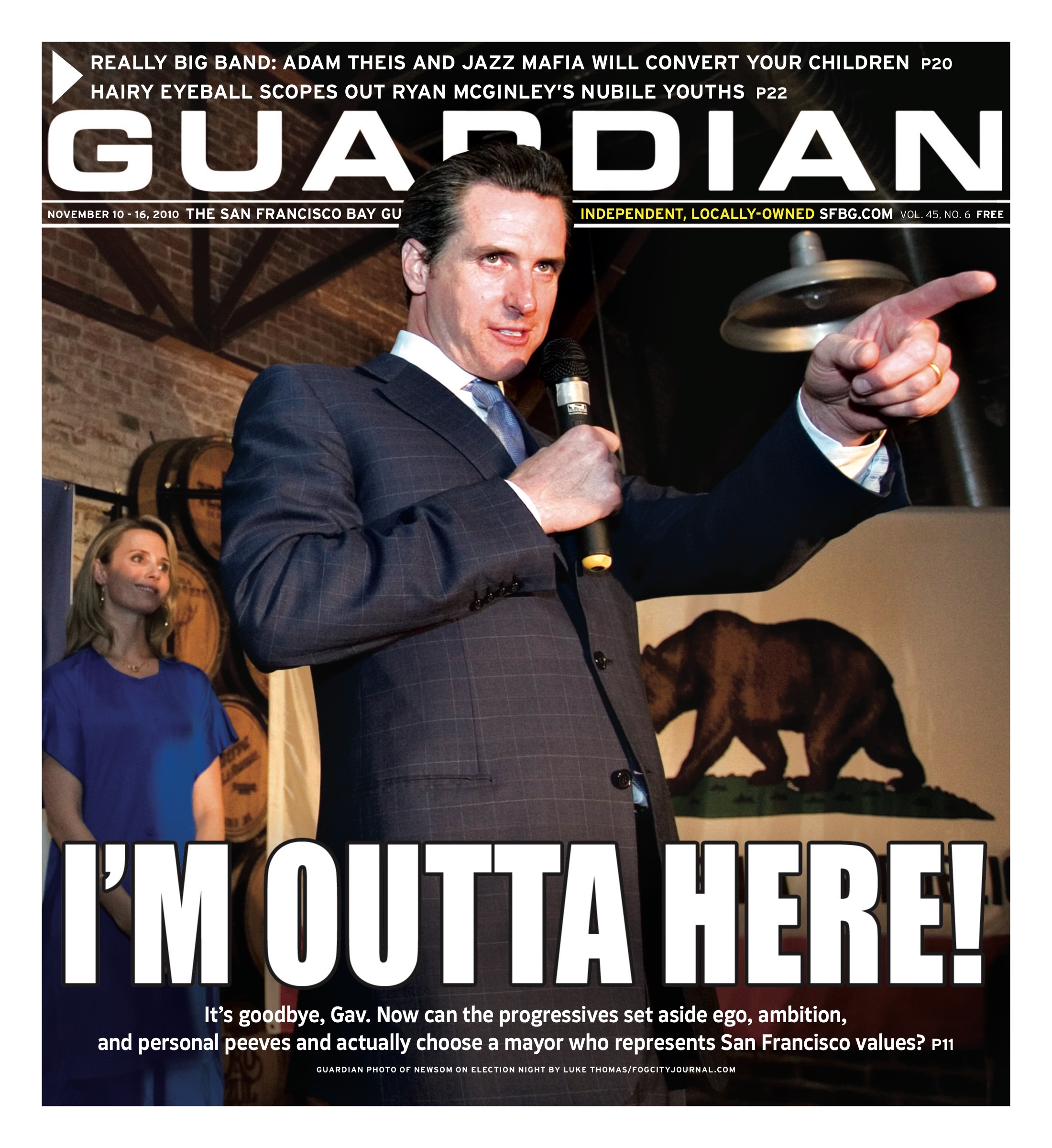
Progressives in San Francisco dodged a few bullets on election night, which was the highest hope that many held in a campaign season dominated by conservative money and messaging. The Board of Supervisors retained a progressive majority, Prop B’s attack on public employees went down, the wealthy will pay more property transfer taxes, and — perhaps the best news of all — Gavin Newsom is leaving for Sacramento a year before his mayoral term ends.
But economically conservative and downtown-backed campaigns and candidates scored the most election-night victories in San Francisco, killing a temporary hotel tax hike pushed hard by labor and several progressive-sponsored ballot measures, and winning approval for the divisive sit-lie ordinance and Prop. G, removing Muni driver pay guarantees, which had the widest margin of the night: 65-35 percent.
“Ultimately, downtown did well,” progressive political consultant Jim Stearns told us on election night, noting how aggressive spending by downtown business and real estate interests ended a string of progressive victories in the last several election cycles. He cited the likely election of Scott Wiener in District 8 and the strong challenge in District 2 by Mark Farrell to perceived frontrunner Janet Reilly, who had progressive and mainstream endorsements.
A preliminary Guardian analysis of reported spending by independent expenditure committees shows that groups affiliated with downtown or supporting more conservative candidates spent about $922,435, the biggest contributions coming from conservative businessman Thomas Coates and the San Francisco Board of Realtors, compared to $635,203 by more progressive organizations, mostly the San Francisco Democratic Party and San Francisco Labor Council.
That spending piggy-backed on national campaigns that were also skewed heavily to conservative and corporate-funded groups and messaging that demonized government and public employee unions, playing on people’s economic insecurities during a stubborn recession and jobless recovery.
Stearns said voters are having a hard time in this economy “and they don’t like to see the government spending.” He said national polls consistently show that people are more scared of “big government” than they are “big corporations,” even if San Francisco progressives tend to hold the opposite view.
And even that narrow defeat came after an almost unprecedented opposition campaign that included every elected official in San Francisco except the measure’s sponsor, Public Defender Jeff Adachi, and both the labor movement and many moderate groups.
“The campaign on this was extraordinary and caught fire at the end,” Alex Clemens, founder of Barbary Coast Consulting, said at SPUR’s Nov. 4 election wrap-up event. In particular, the message about how much Prop B would increase the health care costs on median-income city employees seemed to resonate with voters.
“We are really happy that Prop. B is going down because it was such a misguided measure. It was not well thought through,” Labor Council President Tim Paulson told the Guardian at the election night party labor threw with the San Francisco Democratic Party at Great American Music Hall. “San Francisco voters are the smartest in America.”
Paulson was also happy to see those voters approve taxing the transfer of properties worth more than $5 million, “because San Franciscans know that everyone has to pay their fair share.”
In the Board of Supervisors races, it was basically a status quo election that shouldn’t alter the body’s current politics dynamics much. Sup. Bevan Dufty will be replaced with fellow moderate Scott Wiener in D8 and Sup. Chris Daly by progressive Jane Kim in D6. The outcome of races to replace ideological wobbler Sup. Sophie Maxwell in D10 and conservative Michela Alioto-Pier in D2 may not be conclusively known for at least a few more days (maybe longer if the close races devolve into lawsuits), but neither is a seat that would diminish the board’s progressive majority.
Progressives could have made a gain if Rafael Mandelman had won in D8, but he was seven points behind Wiener on election night and even more after the initial ranked choice tally was run on Nov. 5. And in D6, fears that downtown-backed candidate Theresa Sparks might sneak past dueling progressive candidates Jane Kim and Debra Walker never materialized as Sparks finished far behind the lefty pair.
Consultant David Latterman, who worked for Sparks, told us on election night that he was surprised to see that Kim was the choice of 32 percent of early absentee voters “because we targeted those voters.” By comparison, Walker was at 20 percent and Sparks was at 21 percent in the initial returns, which tend to be more conservative. By the end of the night, Kim had 31.3 percent, Walker 27.7 percent, and Sparks just 16.5 percent.
“If she did that well with absentees, it seems like it was Jane’s race to win. If they choose Jane, they wanted Jane. It’s just that simple,” Latterman told us on election night.
At her election night party, Kim credited her apparent victory to a strong campaign that she said fielded 400 volunteers on Election Day, most wearing the bright red T-shirts that read “See Jane Run” on the back. “I feel good,” Kim told the Guardian. “What I’m really happy about is we ran a really good campaign.”
In the end, Kim’s campaign was put over the top by the second-place votes of Sparks’ supporters, with 769 votes going to Kim and 572 to Walker in the first preliminary run of ranked-choice voter tabulations. But despite the bad blood that developed between progressives in the Kim and Walker campaigns, Board President David Chiu, an early Kim supporter, sounded a conciliatory note, telling the Guardian on election night, “Given where Debra and Jane are, I’m glad that we’re going to keep this a progressive seat.”
Help keep a village in Mexico from being flooded. Come to the Mexican Consulate to protest construction of the El Zapotillo Dam, which would submerge the town of Temacapulín, Jalisco, and provide water to a neighboring state that already loses 40 percent of its water supply in transmission. Join families of Temacapulín in a musical and peaceful protest to stop the dam.
Join the nonprofit SF Public Press for drinks and appetizers, pick up a free copy of its latest newspaper, and meet the people who pull it all together.
Michael Moore’s hilarious cross-country road movie plumbs the depths of corporate America, asking the question: at a time when corporations are posting record profits, why are so many Americans still in danger of losing their jobs? Moore embarks on a one-man campaign to persuade Fortune 500 companies to reconsider their downsizing decisions.
Union workers at America’s first listener-sponsored radio station, KPFA 94.1 FM, have mobilized to oppose imminent cuts to KPFA staffing by their parent organization, the Pacifica Foundation. The Morning Show, Against the Grain, Hard Knock Radio, and KPFA Evening News all appear slated for severe program changes and/or decimating cuts.
Indybay, a hub for independent progressive news and activism, has been thriving for a decade, along with SF Bay Area and Santa Cruz Independent Media Centers and other projects. To celebrate and honor its many contributors, come hear form a diverse lineup of speakers from across Northern California discussing independent media’s role in social and environmental justice movements.
Be a part of the Filipino/American Coalition for Environmental Solidarity (FACES) first-ever community celebration, marking 10 years of building environmental justice and solidarity between the U.S. and the Philippines. Event features a palengke (market) of sustainable crafts, live performances from spoken word poet Aimee Suzara, Diwa Kulintang Ensemble, and guitarist Theresa Calpotura, along with delicious Filipino foods and more.
Mail items for Alerts to the Guardian Building, 135 Mississippi St., SF, CA 94107; fax to (415) 255-8762; or e-mail alerts@sfbg.com. Please include a contact telephone number. Items must be received at least one week prior to the publication date.
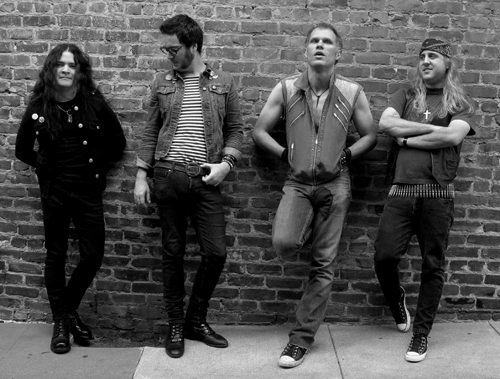
(For a review of Slough Feg’s latest, The Animal Spirits, go here. Read on for an interview with the band’s guitarist-singer, Mike Scalzi.)
San Francisco Bay Guardian: I noticed a clear theological theme running through the album. Was that – the Reformation – an area of historical interest to you? I’m interested in that choice, of a less exciting historical topic than maybe a more violent event…
Mike Scalzi: It’s not as metal, certainly. But in another way, Martin Luther was very metal, in that he was dedicated. Though he was Christian, in his dedication and his rebellion, he was metal. I was reading about all that stuff in an anthology of Western cultures. It was very general – I had to teach it. I’m a teacher. I started teaching Philosophy of Religion a year ago for the first time, and I’m not really that into teaching it, because its not my area of expertise, but I kinda had to.
[Writing music] helps me, actually. If I can write a song about it, it becomes more ingrained in my everyday thought. It becomes more second nature to say “oh, the 95 Theses!” It’s not just as a teaching aid, though. When it comes to Renaissance Christian theologians, he’s the most metal one. He’s out in the world. He’s out doing stuff, being a revolutionary. And a lot of his views are funny, a lot of the things he said were really funny and really extreme.
SFBG: Less metal for being ultimately successful, though. A lot of those so-called heretics were metal in the sense that they died for their principles, or were burnt at the stake or what have you.
MS: But he was the most badass one! Obviously, I don’t agree with him – he was a fundamentalist and all that, and he brought on fundamentalism in a way, I guess. But at least he said that trying to believe that the Bible is literal fact by reason alone is preposterous. That’s why he thought you had to exercise faith – because it’s preposterous. Everything in the Old Testament is preposterous, but you have to believe in it, purely to test your faith.
After seven records, you have to think of new things. I don’t want to repeat myself.
SFBG: What was the rubric for the lyrics that were included in the liner notes?
MS: Oh, those are the lyrics to “Trick the Vicar”
SFBG: Oh, so it’s just the one song?
MS: That was my decision. I’m sick of like…I’ve done that on every record and…
SFBG: People parse your lyrics?
MS: Oh, I don’t care about that. They come up with all sorts of weird interpretations, as if I really care that much. “Oh this means this and that means that. This is the deep meaning in this.” There’s no deep meaning in this shit! At least not that I know about! But at this point, trying to find things to say is a challenge.
With “Trick the Vicar,” I thought the lyrics to that would be important because it’s all one big pun. There’s obviously no deeper meaning, other than just being entertaining. It’s like something from a Benny Hill skit or something. So on the inside of the CD, I had all the puns – I came up with all those puns in the same month. They’re really silly, obviously.
SFBG: Well I did mean to confirm whether or not “boister” was a word.
MS: Good, good! No, its not. But when I say “There’s a boister that goes on in the cloister”…
SFBG: …from context it’s pretty clear.
MS: Yeah. It’s just a bunch of silliness, but it works for the song. I like silliness, and that’s one of the things that’s missing from a lot of metal: a good sense of humor. Metal used to have a sense of humor, in the 70s and 80s.
SFBG: That’s something that I was meaning to ask you about, if there’s a way to account for that sudden lack of humor. You have this form of music that has this potential to be taken seriously, but also the potential to be looked at with a sense of humor, or with an understanding of its many tongue-in-cheek aspects. It seems like a lot of its biggest fans, a lot of the people with the kind of familiarity with it that would enable them to see the humor, are the people least able to see it.
MS: Well, there are a lot of stupid people. You go to a metal show and you run into a lot of morons. Around here, you don’t have as many.
SFBG: I think it’s sort of like a dumbbell shaped-graph. On the one end, it attracts a lot of stupid people, but on the other end, it attracts a lot of people who are discerning and smart.
MS: I think, basically, they’re going to laugh at you one way or another. Being a metal guy, especially when you’re old, or older, or from the last generation of metal, they’re going to laugh at you. You make the choice of whether they’re going to laugh at you or with you. And I choose to laugh with them!
Also, metal, or indeed all rock and roll, is inherently funny. It is! People used to know that!
SFBG: Or inherently fun. That’s what a lot of people seem to lose sight of.
MS: Metal is inherently funny. No matter what! It’s funny. That’s one of the best things about it! It’s ridiculous, and it’s great because it’s ridiculous. People realized that way back. Black Sabbath, maybe not Led Zeppelin — they never had much of a sense of humor – Deep Purple, Judas Priest. The New Wave of British Heavy Metal. Early glam metal – Twisted Sister, Quiet Riot – they all had a sense of humor. Van Halen! Give me a break…that band was all humor until Sammy Hagar came, and it lost its sense of humor, and it started to suck.
The way that these things incorporated humor resembled vaudeville. That was David Lee Roth’s whole thing. Humor is part of entertainment. The most serious, heavy band, Black Sabbath, was also the most funny, because they realized – they were a British band with a British sense of humor.
SFBG: It’s interesting that you mention that. Do you think the trans-Atlantic shift had anything to do with that loss of humor?
MS: No, because Van Halen is the funniest. Maybe they’re not metal. Manowar! I don’t know if you want to open that can of worms. There’s a lot of evidence that they started out as a joke. They started out tongue-in-cheek and got serious as they went along. They know they’re funny; they may not want to acknowledge it, but they are.
SFBG: And the humor is bound up in the fact that everyone knows there is a joke, but no one will actually admit it. You can listen to it and pretend that you’re taking it seriously.
MS: It’s true of hardcore too. It used to be funny, now its all [imitates hardcore singing]. It’s lost its humor – some of it hasn’t, but most of it has. That’s one of my problems with a lot of the metal in this country, or in Germany too – people take it too seriously.
It’s the same thing with entertainment. I’m accused of being too traditionalist and narrow, but I’m bored by anything else. The way that entertainment used to be, in my opinion, was better. Period. It just used to be better. And now, it lacks.
I guess the question you’re asking is “why?” I don’t know why. I think it’s something about the world and the way people see entertainment. It has a much wider scope than it used to. People are much more involved in it as fans, and take it seriously as a statement, which is great, but maybe some of the actual enjoyment of it – from the performance standpoint and the artists’ standpoint – has been diminished by the fact that people hold it too close to their heart. The fragility of their egos and their identity are wrapped up in it in a way that causes problems.
SFBG: Like many discussions about the evolution and history of metal, I blame Nirvana. They taught people, or people took away from them this idea that if a band was trying to entertain you, that was somehow false.
MS: Well, that happened way before Nirvana, but that’s when it hit mainstream.
SFBG: There’s that line in Smells Like Teen Spirit: “Here we are now/Entertain us.”
MS: I don’t know if I have much to say about that. At the time, I didn’t like it. I heard their first album, before they were really popular, and I didn’t like it then. I was playing shows in San Francisco at the time, and I knew that I was not down with what was happening as a result of them. “Don’t try.” “Don’t give a shit.” “Nevermind.” “Be a loser.” I mean, sure, I thought that when I was a teenager. That’s the 14-year-old mentality: “everything sucks, so fuck it, man.” By the time you’re in your twenties you’ve grown out of that, you try to do something, unless you end up like Kurt Cobain, and you just fade off into negative, negative, everything sucks, and then die. [Sarcastically.] That’s great! That’s my hero! [Chuckles ruefully.] What the fuck is that?
SFBG: So, part and parcel of the conversation we’ve been having is the fact that you’re a very opinionated guy…
MS: So you’ve read my blog posts. There’s a new one today! I was just reading the comments.
SFBG: I did read them. I can only imagine what kind of comments you’re going to get on the most recent one. I was wondering if there’s something you can identify about metal that helps it attract opinionated people. Or, to reverse the chicken and the egg, if there’s something about being into metal that makes people opinionated?
MS: Well, I don’t think people get into metal for some other reason, and then get opinionated once they’re into metal. Unless you want to get into the fact that most metal is so bad now that you can get into it and say “oh god I’m so opinionated because there’s so much garbage out there. That’s true of a lot of kinds of music though.
It attracts opinionated people because it is extreme music. It attracts people who are into a certain kind of mentality. It happens from such an early age! I can’t analyze it. I got into metal, like a lot of people, when I was pretty young, and that was a long time ago! I don’t remember exactly. I don’t have immediate access to that feeling first being attracted to it. To me, its something that happened so far back that its like…
SFBG: …it’s like asking “why do you like mac ‘n’ cheese?”
MS: Exactly. And I have more access to what’s happened since then. But I don’t feel like I’m actively opinionated. People take things in, and they call them like they hear them. To me, things assault my sense, not the other way around. Nobody remembers being born into the world of music or food or anything and going “Hmm, I’m going to investigate this thing!” It’s more you hear something and you’re passed into this impression that you have. And some things, you get an impression and you go “Argh, that sucks! That really bothers me!” So my opinions, like those of most people who are opinionated, come from being stimulated by something in a positive or negative way. I would say I call it like I hear it.
I never thought of myself as opinionated until I moved here. People said that if I moved to San Francisco there would be all this great music. They said, “People out there are very enlightened.” And then I got here – 20 years ago – and I thought, “Everybody here’s not really that enlightened. There’s a lot of stupid bullshit going on out here.”
SFBG: Switching tacks completely, I’m curious about your master’s degree in philosophy. I read a little bit in another interview about what you teach, but I’m curious about what you focused on in your studies.
MS: I ended up studying Descartes for my thesis. I was interested in Descartes as a graduate student because his method was very simple and intuitive, and the whole point of it was a do-it-yourself type thing, rather than getting involved in this long academic tradition. Obviously, like anyone else, he comes from an academic tradition, but his point in Meditations [on First Philosophy] was to say “let’s erase everything that happened beforehand in philosophy and science and start on your own, with what you can know by yourself.”
I just found Descartes pretty easy to understand. I was able to maneuver in that ontology. I started taking seminars on Descartes, and I subsequently got interested in German idealism, like Kant and Schopenhauer, and like every metalhead, I was interested in Nietzsche.
In a master’s degree, you end up focusing on major guys because they have these comprehensive exams that test your knowledge of Plato, Descartes, Hume, etc. I stuck to a lot of that, because I knew I would have to take an exam on it.
SFBG: That Kantian or Cartesian originalist thinking – wiping the slate clean, starting with the Categorical Imperative, or something like that…
MS: …well, Kant is much more in the tradition, he’s not trying to wipe the slate clean. He’s just trying to be revolutionary.
SFBG: I’ll admit I’m only tenuously familiar with Kant, but I remember his ethics being founded on a sort “first principle” that ignores cultural baggage and so forth.
MS: Well, that’s what people say, but his point is to come up with something that is not dependent on circumstance in any way at all. Something that’s not empirical, that’s totally dependent on reason. Just like Descartes’ “I think, therefore I am,” in a way.
It’s something that you try to universalize by saying “what if everybody did this?” [Motions toward cookie on the table.] What if I were to steal this cookie? What if everybody did that? If it produces a contradiction – if its unreasonable for everybody to do something – you have to decide if it would be possible. Not if it would be right or wrong.
In order to establish a standard of right and wrong, you have to decide if it’s reasonable – could everyone do it. Suppose I don’t keep a promise – I say I’m going to show up here at 11, and I don’t. If I don’t do that, and I don’t keep my promise, what happens? It undermines the principle of the promise in the first place. If I don’t keep a promise, whatever, no big deal. What if nobody keeps promises. Could everybody do what I did? If no one keeps promises, there wouldn’t be promises in the first place.
SFBG: There’d be no point.
MS: You couldn’t make promises, because there’d be no such thing.
SFBG: Like if everyone stole, there would be no point in having property.
MS: If there were no property, you couldn’t steal. If there were no taking anybody’s word for anything, you couldn’t make a promise. It undermines its own possibility. It’s a contradiction that makes the act itself impossible. If its irrational to that extent, to the point where it makes the act itself a contradiction, then, according to Kant, its not morally permissible. That’s a little bit of a long answer.
SFBG: I’m going to attempt a sort of interviewer Triple Lutz here. Is Descartes’ idea of discarding what has come before, or Kant’s idea of ignoring circumstance to come up with principle…
MS: …Rational principle…
SFBG: …purely rational principle. Can that be applied to your creative process? In the sense that…
MS: No. [Laughs.] I wish I could say that it could. That’d be a brilliant piece of journalism. But as much as I’d love to be able to say that there’s some heavy metal calculus that I use in order to write by sheer principles of reason…no. At least, not for me. It’d be cool if there was some guy, some alchemist songwriter guy who was trying to find the principle of guitar or whatever.
SFBG: You could sort of take a stab at the categorical imperative of metal though, being like Maiden, Priest, and Sabbath, and not being affected by sort of the whims of circumstance.
MS: That’s the problem I’m encountering though. I don’t want to say that everything’s all based on the past. I don’t want to be a heavy metal anachronism. That’s what I’m getting in a lot of these responses to my Invisible Oranges articles. Again, to be philosophical about it, I get this confusion of cause and consequence. A lot of people say to me: “you don’t like death metal because you haven’t explored it.”
I try to keep the analysis somewhat objective, about why I don’t like the cookie monster vocals, the guitar sounds that are very brittle, and the drums that are triggered – clickety, clackety, clickety doesn’t sound “brutal.” It sounds like some bullshit to me.
People say, “You haven’t explored it enough. You haven’t heard the good stuff. You haven’t gone to the lengths that it takes to appreciate it.”
SFBG: If it’s good, it shouldn’t take any “lengths.”
MS: It’s confusing the cause with the consequence. It’s not that I don’t like extreme metal because I haven’t listened to enough of it. I haven’t listened to enough of it because I don’t like it. People think that I’ve come up with some sort of rigid heavy metal calculus and say “I like Priest, I like Maiden, I like Sabbath, Saint Vitus, whatever, some underground stuff too. These are the criteria of what I will listen to.”
It’s not like that! I grew up with the evolution of the whole thing, listening to it happen, and I heard things, and I said “I don’t like that! That’s crap! That sounds like someone who doesn’t care about what they’re doing.” It just sounds like shit to me, for whatever reason. And I heard more and more of it, and I chose not to investigate it.
SFBG: Getting back to philosophy just briefly, I saw in another interview that you described your music as having a Machiavellian aspect. I understand a Nietzschian aspect, but how does Machiavelli come into it?
MS: I was probably joking! I’m not sure. I was just being macho, talking about taking over the world. It’s a very vague characterization of Machiavelli, who I don’t really know shit about anyway.
SFBG: I was struck by the William Blake references in one of your old songs, “Tiger! Tiger!” Blake has always struck me as very metal.
MS: The reason that I put that stuff in there is not because of William Blake. It’s because of Alfred Bester, who quoted him.
SFBG: I noticed that you mentioned that author a lot in other interviews.
MS: A lot of sci-fi fans haven’t read him! This is insane to me. When people read The Stars My Destination – the original title of which was Tiger! Tiger! – they say “that’s the greatest fiction book I’ve ever read.” I was not a sci-fi or fantasy reader until I was 26, and someone got me that book. It was completely a fluke. I got it and I was like, “Ehh, I don’t really like science fiction books,” and then I finished it and said, “This is the best book I’ve ever read in my life.” Only on the basis of that did I get into science fiction.
SFBG: It’s tempting to ask you questions about Slough Feg’s distinctive sound, but seeing where my fellow interviewers have gone before, I was wary. It seems like we journalists want to get you to say “Oh, I choose to write songs with major chords because of this reason which is easy to print,” and your response is to say, “Look, this just my creative process; it’s how it sounds good to me.”
MS: Well, something that sounds good to me vocally sounds good because it’s catchy. If I remember it. I don’t always tape everything that I do. So, why do I remember it? That’s a whole question. Maybe I remember it because it sounds a little bit unique, maybe for some other reason.
SFBG: I think the music stands out to people, whether on record or live, because it makes melodic choices that almost seem like a deliberate subversion of the conventions of metal, like all those major chords. But I’m assuming that wasn’t a choice to subvert. That there wasn’t a point at which you were like, “Heavy metal is in minor keys – I’m going to do it a different way.”
MS: Well maybe there was! Again, it wasn’t a conscious choice. I don’t write Slough Feg songs according to music theory. I don’t say, “Now we’re going to do a song like this; now we’re going to do a song with these chords, or with this type of vocals.” If you do that, it ends up sounding overly stiff and deliberate.
But having said that, that’s not to say that there isn’t some kind of overall approach. When I do write stuff, what do I edit out? What do I keep? Stuff that reaches a certain criteria after the fact. Not when I come up with riffs, or vocals – that just happens. But what do I choose to keep? I don’t think about it consciously – it’s second nature to me now, so its hard to say – but basically, at one point, I wanted to write things that imitated Maiden, Sabbath, Thin Lizzy, Alice Cooper, Saint Vitus, Black Flag, and all that.
It became second nature to say “I want to pick up where Maiden left off,” but not to use major chords. The first “Irish-sounding” song I ever did was called “The Red Branch,” and I was sitting around in my living room, in a place I lived in years and years ago, I was sitting in my living room with an acoustic guitar, just joking around, singing to somebody as a joke, and I thought, “That’s a cool chord change!”
I keep a lot of things that other people would throw away, that they’d be scared to put on a record because it’s too silly-sounding. I say to myself “this is actually something that someone else wouldn’t do, and have the nerve to take seriously.” I think a lot of people are embarrassed to play Slough Feg-type songs. They were 20 years ago, at least. And now we’ve developed the sound to the point that it’s sort of obnoxious. People are like “what the hell man! This guy is willing to do this?!”
That’s what happened in San Francisco in the mid-nineties, playing this music. People would be like “God, you’re willing to get up onstage and play that? That sounds like nursery-rhyme music with metal instruments. It’s major. You’re singing like you’re in a 50s musical!”
Those are the kind of influences that I incorporate, maybe because it was something people weren’t willing to do, and so it sounded fresh to people.
SFBG: That sort of discomfort you describe is interesting, because you have this whole other offshoot of metal that’s built on discomfort. Black metal is based around saying “which chords can I play that will make people uncomfortable, that are the most dissonant.” You’ve come up with an incredibly unique way to do the same thing. You challenge people’s expectations, you make them uncomfortable, you take them out of their comfort zone, but instead of being really really heavy, or really fast, or really dissonant, or really down-tuned, you just have your own personal approach: to write chord changes that are, you know, silly.
MS: Or just really, really, traditional. Not that I intended that. But this is good, I think we hit the nail on the head in sense. When I started developing the sound, in the early nineties, a lot of it was a reaction. I didn’t write these looney tunes in 1989. I wrote them when I got here, and I started playing some shows, and I noticed that all the bands were drab, and all the bands played sort of one-dimensional speed metal. And I was totally nonplussed by it.
What I was writing was a reaction. I was saying “what can be done at this point?” Punk rock and speed metal and grindcore are just an extension of the same dirge – being obnoxious by being a dirge.
SFBG: And it’s an arms race, right? You can only go so fast. And then the next band that comes along has to go faster than that.
MS: And also it’s the attitude that’s so passe after a while. Spitting blood and whatever. I wanted touch on what people inevitably heard – kid’s music, or what your parents were playing – and pose the question: “are you willing to admit that this is enjoyable to you?” Slough Feg songs that do sound like they’re from a 50’s musical. Are you able to admit that this is catchy to you? That’s the punk rock maneuver, that I was able to think of it in those terms. And that’s what set us apart. But in a totally different way, in a way that goes back to like, “This is inherently enjoyable. Are you willing to partake in it, or are you too cool for it?”
SFBG: And it’s diametrically opposed to black metal. Black metal is “I will alienate you by doing something that is not enjoyable.” Your approach is “I will alienate you by doing something that is too enjoyable.”
MS: After the fact, that’s how we can analyze it. I think that’s a proper way to look at it. My songs do assault the listener, and people say “I can’t get it out of my head!” Because it’s written in very simple way – they’re really not that hard to write, but it’s a kind of songwriting that people aren’t willing to do.
Someone said to me in the 80’s, when I liked Venom a lot – they’re a very silly, vaudevillian form of Satanic metal – “Why do you like this? Anybody can do that. Anybody can play Venom songs.” And I said “yeah, that’s true. But nobody is willing to. That’s what makes it special.”
The Marina Merchants Association & The San Francisco Bay Guardian Present SIP SNACK & SHOP ON CHESTNUT STREET
Thursday, December 2nd from 6-9PM
Start your holiday shopping this season in your neighborhood!
Ticket includes: Tastings from over 20 restaurants and more than 25 beverage sponsors! Raffles & discounts of 15% or more at all participating businesses. Live Entertainment!
Ticketed guests may pick up your wristbands, wine glass, and program guide at either of these locations on Dec. 2nd starting at 6PM: Eastside West – 3154 Fillmore Street (at Greenwich) Wells Fargo – 2197 Chestnut Street Kelly Keiser Splendid Interiors – 2381 Chestnut St.
*All proceeds benefit the Marina Merchants Association.
Participating Businesses The Animal Connection II | Arbonne International | Benefit | Bin 38 | Books Inc. | Circa | City Optix | Crunch Fitness | E’Angleo | Eastside West | eCosway | GAP | Heritage Row | Isa |J’s Galleria | Jack’s | Judy’s Café | Kara’s Cupcakes | Kelly Keiser Splendid Interiors | Marina & Kebab | Marine Layer | Mezes | Monkey on Chestnut | Pacific Catch | Paper Source | Patxi’s Chicago Pizza | The Plant | Pluto’s | Pottery Barn | Pure Beauty | Rabat | The Republic | Ristorante Parma | San Francisco Optics on Chestnut | SusieCakes | Toss Designs | Two Skirts | Wandering Vet | We Olive | Wells Fargo | Y&I Clothing Boutique
Sponsors Artesa | Bear Flag | Black Star | Blue Moon | Brugal Rum | Chateau Potelle | DeLoach | Don Pilar | FIJI Water | Haamonii | Honest Tea | Hope & Grace | Hotel Del Sol | Long Meadow Ranch | M Squared | Magners | Millesime Cellars | Pale Moon | Peroni | Pretzel Crisps | Red Bull | Rock Sake | Solerno | Spring Mountain Vineyard | St. Supery | Svedka | Tres Agaves | Trumer | Vivid Bliss | Y. Rousseau
Partners The Bachelors of San Francisco | Crawl SF | Marina Community Association | PinchIT | San Francisco Ballet | SF City Dish | Spinsters of San Francisco | Urbanis | Yelp
Entertainment The Clef Divers | The Lollipop Guild, a San Francisco Gay Men’s Chorus ensemble | Marina Middle School Band
Audyssey, an L.A.-based audio laboratory, must have a thing for San Francisco. First it marketed its iPhone docking station as the South of Market, and now it’s calibrating the music scene by launching a monthly music showcase at 111 Minna: “Multiple genres. Local talent. The Neighborhood.” With live performances by Maus Haus, My First Earthquake, Shortkut, Trackademicks, Ghosts On Tape, DLRN, and Electric Sunset, and DJs King Most, Prince Aries, and A-Ron, the lineup is enough to make you forget the whole synergistic marketing thing (it’s free, yo). That many diverse acts and the promise of local food carts to keep you fed? (Food not free.) Half the fun should be seeing if it all come together under one roof. (Ryan Prendiville) 9 p.m., free 111 Minna Gallery 111 Minna, SF (415) 974-1719 www.audyssey.com/theneighborhood
THURSDAY 4
COMEDY
Michael Ian Black
First gaining widespread fame for his work on Stella, The State, Viva Variety and other TV shows, comedian Michael Ian Black has honed his sarcastic commentary on pop culture to a fine, surgical-quality blade, quite literally stealing the show on every appearance he has made on VH1’s I Love The … series. For those who just can’t get enough of his wit and witticisms from the short, seconds-long snippets that make it on the air, here’s the chance to experience a full-on onslaught of hilarious, side-splitting observations from one of the best funnymen on the circuit today. (Sean McCourt) Thurs.–Sun., 8 p.m. (also Fri.–Sat., 10:15 p.m.), $22.50–$23.50. Cobb’s Comedy Club 915 Columbus, SF (415) 928-4320 www.cobbscomedyclub.com
MUSIC
Marnie Stern
Kill Rock Stars artist Marnie Stern brings her whirlwind brand of finger-tap guitar shredding to Oakland. With influences ranging from math-rock godfathers Don Cabellero to punk and classic-rock staples, Stern and her band create quite the interesting racket. Equally impressive as Stern herself is her drummer, Zach Hill (of Hella), who matches her yelping vocal style and hyperactive arena rock solos with a frenetic creativity all his own. Stern’s new self-titled album brings the “noise for the sake of noise” level down just a tad and offers a more melodic and direct approach to her songwriting. (Landon Moblad) 8 p.m., $12 New Parish 579 18th St., Oakl. www.thenewparish.com
FRIDAY 5
VISUAL ART
“I Live Here: SF”
It goes without saying that we live in a pretty diverse city, but since February 2009 photographer Julie Michelle has been capturing the people and stories that make SF great in her “I Live Here: SF” portrait series. The end result includes more than 170 images of SF residents, complete with their personal stories and accounts of their connection to this lovely, crazy, and exciting city of ours. Her subjects cut across races, classes, ages, and neighborhoods; you might just be surprised by the SF microcelebrities who pop up in them. I guarantee you’ll recognize someone photographed for the exhibit — or at least have seen one walking by you on the street. (Ben Hopfer) 6-9 p.m., free SOMArts 934 Brannan, SF (415) 552-1770 www.iliveheresf.com
DANCE
“Shared Space 4”
This is the fourth “Shared Space” season for Todd Eckert and Nol Simonse, two dancers who couldn’t be more different from each other. Yet as choreographers they find common ground. At least for this season, they are both diving into the past for their world premieres. The intricate meters of a medieval poetic form and the music of J.S. Bach inspired Eckert’s new Sinfonia. Continuing his interest in Greek mythology, Simonse is reaching even farther back. Demeter, the goddess of harvest and generosity, became the springboard for Greater Than. With Dancer for Hire, however, he hits a painful, up-to-date note: how to keep dancing in these parlous times. (Rita Felciano) Fri/5-Sat/6, 8 p.m.; Sun/7, 7 p.m., $20 Dance Mission Theater 3316 24th St., SF (415) 273-4633 www.sharedspacesf.org
MUSIC
Ray Manzarek and Roy Rogers
A recent project bringing together two luminaries of the 1960s and ’70s California rock ’n’ roll scene, the collaboration between legendary Doors keyboardist Ray Manzarek and blues guitarist par excellence Roy Rogers has produced an eclectic exploration of musical styles, including reimaginings of Doors classics, along with other blues and jazz tracks. Tonight’s show is being billed as “An Evening of Rock ’n’ Roll Tales and Music” since the duo promise to share stories about their long and fruitful careers between songs — fans won’t want to miss this rare opportunity to hear them straight from the still-rocking source. (McCourt) 8 and 10 p.m., $18–$25 Yoshi’s San Francisco 1330 Fillmore St., SF (415) 655-5600 www.yoshis.com
DANCE
AXIS Dance Company and inkBoat
Known for its mix of disabled and able-bodied dancers, AXIS Dance Company has joined forces with Shinichi Iova-Koga and his company inkBoat to create ODD, a piece inspired by the work of Norwegian painter Odd Nerdrum. With cellist Joan Jeanrenaud performing a live original composition, ODD delves into themes found in Nerdrum’s paintings, including loneliness, fear, sexuality, and degradation. Iova-Koga’s choreography is mesmerizing to say the least and exactly how he will fuse two companies, a musician, and an artist’s work into an evening show is the source of much anticipation. (Emmaly Wiederholt) Fri/5–Sat/6, 8 p.m., Sun/7, 3 p.m., $15–$18 ODC Theater 3153 17th St, SF Also Nov. 12–14, $10–$22 Malonga Theater 1428 Alice, Oakl. www.axisdance.org
SATURDAY 6
MUSIC
San Francisco Symphony Día de los Muertos family concert
One hundred years ago as the Mexican Revolution kicked into high gear, could Emiliano Zapatista or Pancho Villa have anticipated the havoc that has their country in a stranglehold today? We hear so much about the Mexican drug wars (and bankroll them on the weekend) that it’s easy to forget our southerly neighbor’s beauty and culture. This makes it a particularly salient year for the symphony’s annual celebration of Chicano heritage, underwritten by an homage to the centennial celebration of the Revolution. Papel picado, sugar skulls, and steaming cups of Mexican chocolate precede the musical program, which itself features kid-friendly works from accomplished Latino composers. (Caitlin Donohue) 2 p.m., $15–$68 Davies Symphony Hall 201 Van Ness, SF (415) 864-6000 www.sfsymphony.org
PERFORMANCE
Burning Libraries: Stories from the New Ellis Island Arts and Literacy in Children’s Education (ALICE) is a grassroots organization composed of artists from multiple genres committed to bringing arts education to economically disadvantaged schools. Born out of a project encouraging children to learn their oral histories is Burning Libraries: Stories from the New Ellis Island, a new piece by ALICE Presents, the professional performing arm of ALICE. Encapsulating 30 stories from people in minority and immigrant communities, this theatrical piece fuses dance, music, video, puppetry, and aerial arts to explore what it truly means to be American. (Wiederholt) Through Nov. 14 Thurs/4 and Fri.–Sat., 8 p.m.; Sun, 3 p.m., $15–$30 ZSpace at Theater Artaud 450 Florida, SF Also Dec. 3–-5, $15–$25 Laney College Theater 900 Fallon, Oakl. www.alicepresents.com
MONDAY 8
DANCE
WestWave Dance Festival
If you are counting live performances, this is program three of this year’s WestWave Dance Festival. If you like your dance on screen as well as on stage, this is program four, since officially Nov. 7’s “Dance on Film Nite” is program three. Enough bean counting. It’s good to see that Monday night dance has caught on. Audiences apparently appreciate not having to squeeze all their dance fixes into the weekend. Of course, it helps to program stuff people want to see; tonight’s event is a good mix of well-, fairly-well, and little-known choreographers: Lisa Townsend, Brittany Brown Ceres, Erika Tsimbrovsky, Robert Dekkers, and Andrew Skeels. (Felciano) 8 p.m., $25 Cowell Theater Fort Mason Center, Marina at Laguna, SF (415) 345-7575 www.westwavedancefestival.org
TUESDAY 9
MUSIC
The Pains of Being Pure at Heart
With a name like the Pains of Being Pure at Heart, you’d be justified in taking these guys for some sappy, Bright Eyes wannabes. Luckily, this isn’t the case. Based out of New York City (who isn’t these days?), the band makes lovely little indie-pop tunes that couple boy-girl harmonies with Jesus and Mary Chain-style distortion. Check out the absolutely infectious track “Young Adult Friction” from the 2009 self-titled album for a taste. (Moblad) With Weekend and Grave Babies 8 p.m., $15 Independent 628 Divisadero, SF (415) 771-1421 www.theindependentsf.com
MUSIC
Kurt Vile and the Violators and Soft Pack
If sneering “I hope I die before I get old” epitomized a generation, what’s the significance of Matt Lamkin singing “I know I’m gonna die before I see my prime” on Letterman? Rock ’n’ roll is now collecting Social Security and emerging acts are hoping for a YouTube apotheosis. Musical appreciation amounts to identifying a band’s influences and then immediately writing them off. With the driving beat of Lamkin’s L.A.-based Soft Pack or the writing-from-the-bottom-of-a-well style of Philadelphia’s Kurt Vile and the Violators, this would be a disservice. The sounds familiar, but moves forward, and as Vile reminds, “I’ve got a freeway mind, let go of my head.” (Prendiville) With Purling Hiss 8 p.m., $14 Rickshaw Stop 155 Fell, SF (415) 861-2011 www.rickshawstop.com
As soon as it became clear on election night that Prop. L had passed, I wondered if opponents would organize some sort of mass sit-down or sleep-in as a response. Today, it appears that some San Franciscans are orchestrating just that. I’ve been alerted via Facebook to two different sidewalk sits in response to the passage of Prop. L.
Sidewalk sitters plan to stage the first one outside the Westfield Shopping Center on Sunday, Nov. 7. Here’s an excerpt from the event description, written in such colorful language that it almost comes off as a parody: “We are going assert our right (and the right of the homeless and homeless veterans) to sit anywhere we damn well fucking please by having lunch on the aforementioned fucking sidewalk in front of Westfield shopping center… this Sunday @ 1:00. The purpose is to hang out, have lunch, be visible, embody TRUE San Francisco values, network with folks about the next steps in the anti-prop L fight and to have fun. Of course getting cited for sitting on the sidewalk is a totally glamorous possibility that we will opportunistically use to the most dramatic effect possible. This is lunch, but it’s also a protest.” It urges participants to bring food to share. The post also encourages people to bring their kids along.
The second event is planned for Monday, Nov. 8, outside San Francicsco City Hall, and its organizers are more succint:
“calling all san franciscans and all humanity to a solidarity sit-in against the passage of proposition L–the so-called Sit/Lie law. bring your ASSets to city hall on monday, nov. 8 at 12 noon. if you can’t make it to city hall, sit on the closest sidewalk.”
Not sure if “all humanity” will mobilize for the cause, but it should be interesting.
Meanwhile, the drivers behind the official No on L campaign seem to be focusing their efforts on a more, um, lawful plan of attack. “We’re taking L to court,” declares a message posted today on the No on L campaign page on Facebook. “But we’re still ironing out the fundamentals of strategy. Keep an eye out for an announcement in the coming week.”
San Francisco voters approved Prop. L, the ordinance that bans sitting and lying down on city sidewalks, with 53 percent of the vote.
In her pieces, Jennifer Locke has, variously, jumped rope for 30 minutes in a full-body latex suit (cutting out a hole in the bottom afterward to drain out her accumulated sweat and urine); wrestled with a partner at the Berkeley Art Museum smeared in stage blood; covered herself in Elmer’s glue, let it dry into a second skin, and then peeled it off; received a lap dance from a male stripper; and branded a fellow participant.
Granted, reducing Locke’s art to such a titillating laundry list is a superficial move. But the immediate visceral spectacle her work repeatedly presents is undeniably seductive — albeit in a punk rock kind of way. It’s hard not to be pulled in by the grappling, athletic bodies, the donning and shedding of second skins, all frequently soundtracked by the amplified breath of the participants themselves, even if it sometimes causes one to flinch.
Locke, who has spent considerable time working as a pro dom and is herself a champion submission wrestler, is keenly aware of her art’s initial draws. “Yeah,” she laughs over the phone, “athletic bodies are inherently sexy. It’s in our nature as human beings to want to look. But I want there to be a barrier between the audience and the image of the body.”
In Locke’s work, which she describes as a sculptural hybrid of live studio actions and video, the camera often provides that layer (or more often, layers) of mediation. Locke strategically uses video within her pieces to alter the on-site audience’s expectations and perceptions of what’s occurring in front of them, as well as those of viewers encountering the pieces as video documents after the fact.
Whatever erotic or transgressive charge a viewer may have invested in the actions being performed becomes rewired through the camera set-up, or is short-circuited entirely. As critic Daniel Coffeen has noted of Locke’s work: “She does not dabble in human affect but in human mechanics.”
In the aforementioned BAM piece, Red/White (Fake Blood), Locke and her wrestling partner sparred in the museum’s loading bay, their actions relayed to the audience via a live video feed that, due to technical difficulties, wound up being projected in black and white. The door to the dock, however, was left slightly ajar so anyone who wanted to see the “real event,” and the piece’s “true colors,” could — although no one was ever specifically directed to.
In Black/White, a three-day piece done as part of the opening of the San Francisco offices of the Marina Abramovic Institute of Performance Art, Locke placed the camera filming a live feed of her actions so that it encompassed those viewing her as well, then projected that image on a rear wall so the audience could observe either Locke’s action or the projection of themselves watching Locke’s action, but not see both simultaneously.
“I used to talk a lot in my artist statement about power dynamics, but then I realized over time that I’m more interested in how meaning gets produced,” she says. “Power is a means to talk about that, but I want to know how those hierarchies actually shift around in reality: Who’s in control? Am I? Is the camera? Is the audience? My work is like a three-card monte.”
One of the joys of house music in this century is that it doesn’t exist. Or rather, its influence is so ubiquitous, its borders so gleamingly porous, that to call a dance track (or indie song, or laptop experiment, or even symphonic composition) “house” is to engage in the laughably vague. And while the expansion of the genre has produced its fair share of unlistenable clutter, it’s also given rise to exciting new standards of quality and adventurousness. Many of the new house standard bearers are located in the Bay Area, and among the most invigorating is Said Adelekan, known as DJ Said.
A Nigerian native who discovered his love for music through his family’s record collection, Said became a young disciple of Fela Kuti, the outspoken legend who shared his political message through Afrobeat, which combined a plethora of African styles into popping, hypnotic grooves featuring chiming guitars and swelling brass and organ chords. After promoting one of Kuti’s clubs in Lagos, Said moved to England to study and absorb the underground London club scene. Soon after, he found himself drawn to “the beautiful and very open” Bay Area in the 1990s, hosting parties like the wonderful, storied Atmosfere, which combined soulful house grooves with live instrumentation and Afrobeat spirit.
As his party reputation grew, Said felt the need to expand and launched the topnotch Fatsouls record label in 2007. “After a decade of successful event production, I realized that throwing parties isn’t all there is, and that creating music is equally important,” he says. “Dance music at the time had gotten so dark and aggressive, I wanted to counter that with something organic, refreshing. Something that celebrated the soul — the soul of the Bay Area, the soul of Africa, the soul of dance music — to bring that to the world.”
With his parties, Said had already attracted global attention to the Bay’s burgeoning Afrohouse scene, and his Fatsouls releases — featuring sparkling live instrumentation, heavy bass-driven grooves, and collaborations with soulful house giants like Alton Miller, Jerome Sydenham, Hideo Kobayashi, and Mr. Raoul K. — repped the Bay abroad as well. (The world dance music community also has been rediscovering house music’s black and African roots, celebrating complex rhythms and Chicago-style funkiness.) “The vast majority of people that download and buy Fatsouls vinyl are from Europe, Japan, South Africa, and Canada.” Said says. “I wanted to create and bring music to the very same people that had been attending my parties and keeping the spirit alive.”
Fatsouls’ first release, “Bad Belle (Remix),” a sublime, slow-burning slice of Afrohouse by Said overlaid with a ethno-ecological spoken word lament by Nigerian poet Ikwunga, was one of the best dance music releases of the past decade, and the seven Fatsouls releases since have shown an astonishing devotion to quality production and expanding scope. (Said plans to release a Fatsouls compilation soon.)
Said hasn’t stopped throwing parties either. “We & the Music” (first Fridays of the month, 9 p.m., $10. 222 Hyde, SF. www.222hyde.com ) is a fantastic and necessary monthly get-down in San Francisco that showcases the deep and lovely grooves being produced here — especially those coming from Oakland’s thriving soulful and Afro-influenced house scenes. East Bay players like Stephen Ringmaiden, Aybee and the Deepblak crew, and parties like The People, Top Ten Social, and Ra Rah are also contributing to the Bay’s liveliness, and Said is an invaluable supporter of their efforts.
“With the everchanging demographic of new partygoers here and so many promoters willing to cash in on faceless trends, I feel there’s a danger of the true San Francisco nightlife essence — diverse in its range but consistent in its dedication to soulfulness and intimacy — being compromised,” Said says. “With my parties and releases, I strongly wish to preserve that here and transmit it to the world.”
The San Francisco Planning and Urban Research Association’s post-election discussion and analysis session is popular with political junkies of all ideological stripes. Although it’s hosted by a knowledgeable duo — Barbary Coast Consulting founder Alex Clemens and political consultant David Latterman — a wide variety of political analysts always show up to create a lively, insightful discussion. Bring a bag lunch and your two cents.
12:30 p.m., $5 or free for members
SPUR office
654 Mission, SF
381-8726
Revolution is not a Tea Party
As the dust begins to settle on the midterm elections battlefield, come discuss how the country’s political fervor affected the national discourse on issues like immigration and civil rights. Was the Tea Party an actual grass roots revolution or merely a large angry mob? How long will the virulent xenophobia and nativism continue, and what can be done to counter it?
7-9 p.m., free
Revolution Books
2425 Channing Way
Berkeley
revolutionbooks@sbcglobal.net
THURSDAY NOV. 5
“Tranny Fest: San Francisco Transgender Film Festival”
Come one, come all: ladies and gentlemen, transgender, and gender queer. Now in its 12th season, Tranny Fest will open Thursday, with performances by Landa Lakes, Butch Tap, Thisway Thataway, and Psychobabble, among others. The festival continues Friday and Saturday with short films and videos by transgender and gender variant artists. Advance tickets will be available for the event.
In addition to California poet laureate emeritus Al Young, Revolution Books will also host jazz/blues music, guitarist Trevor Michaels, and other poems and song.
7 p.m.–9 p.m., free
Revolution Books
2425 Channing Way, Berk.
510-848-1196
SATURDAY NOV. 6
Green Festival San Francisco
Here’s more proof that green is the new black. One of the largest sustainability events in the country will be held at the San Francisco Concourse. The eco-confab includes lectures from Bill McKibben, Daniel Pinchbeck, Amy Goodman, and others. Vendors, workshops, music and an array of organic beer, wine, and vegetarian cuisine will also be on hand. Admission discounts are also available to students, seniors, cyclists and public transit riders.
Each year New Italian Cinema celebrates the rich cinematic tradition of Italy and brings the country’s newest directors and films to Bay Area audiences. The 2010 edition opens with Ferzan Ozpetek’s humorous drama Loose Cannons and features a three-film retrospective of this talented and prolific auteur. Closing the festival is Paolo Virzì’s moving new film The First Beautiful Thing, and in between are seven recent films by breakthrough filmmakers vying for the City of Florence Award. Join the Film Society—and the many filmmakers who will be present—for this weeklong feast of wonderful Italian films.
The tale of what really happened on Halloween Eve in 1951 in Rock Rapids, Iowa
As I was preparing to update my annual Halloween blog, I checked the Guardian politics blog to see what the action looked like for Sundaynight on Halloween Eve.
Three years ago, Mayor Gavin Newsom shut down the Halloween celebration in the Castro, killing off one of San Francisco’s most famous party events. But last year, as Melanie Ruiz reported, a local flash mob operator by the name of Amandeep “Deep” Jawa organizedan unauthorized “Take Back Halloween” party in front of the Ferry building. He arranged for at least two mobile DJs to spin and more than 300 people signed up on Facebook.
This year, well, this year, the Giants are in the middle of the World Series with the Texas Rangers and the orange and black pom poms have been waving jauntily from our stands. If they win tomorrow (Saturday) and then Sunday in Texas, all hell will break loose in the Castro and in the bars and streets all around town. The Giants have never won a World Series and the town is poised, hopefully not prematurely, for an explosive celebration that will give real color and meaning to this year’s Halloween.
Well, back where I come from in the Halloweens of my youth, we didn’t get permits, didn’t have authorization, didn’t wave orange pom poms. The police tried but failed to shut down our events. This was in my hometown of Rock Rapids, a small farming community nestled along the Rock River in northwest Iowa. But we did have some fast times and created some almost famous urban legends on Halloween. I can speak for a generation or two back in the early 1950s when Halloween was the one night of the year when we could raise a little hell and and hope to stay one step ahead of the cops.
Or, in the case of Rock Rapids, the one and only cop, who happened to be Elmer “Shinny” Sheneberger. Shinny had the unenviable job of trying to keep some semblance of law and order during an evening when the Hermie Casjens gang was on the loose. Somehow through the years, nobody remembered exactly when, the tradition was born that the little kids would go house to house trick and treating but the older boys could roam the town looking to make trouble and pull off some pranks.
It was all quite civilized.
The Casjens gang would gather (no girls allowed) and set out about our evening’s business, being careful to stay away from the houses of watchful parents and Shinny on patrol. Dave Dietz and I specialized in finding cars with keys in the ignition and driving them to the other end of town and just leaving them. We tipped over an outhouse or two, the small town cliche, but one time we thought there was someone inside. We never hung around to find out. There was some mischief with fences and shrubs and lawn sprinklers and potted plants on porches.
After an evening of such lusty adventures, we would go home about 11 p.m. and tell our parents what we had been up to and how we evaded Shinny the whole evening and they would (generally) be relieved. Shinny would just drive around in his patrol car and shine his lights here and there and do some honking. But somehow he never caught anybody or made any serious followup investigation. And the targets of our pranks never seemed to make police complaints. I once asked Paul Smith, the editor of the celebrated Lyon County Reporter, why he never wrote up this bit of zesty small town lore. “Bruce,” he said, “I don’t want things to get out of hand.” During my era, they never did. As a Rock Rapids reporter on special assignment, I feel an obligation to retell this story on Halloween and bring some Rock Rapids values to San Francisco.
Nonetheless, the city elders decided to keep Halloween devastation to a minimum and scheduled a dance in the Community Building, with the misbegotten idea the pranksters would give up their errant ways and come to the dance. The Casjens Gang would have none of this. In fact it was the year of the dance diversion that we made our most culturally significant contribution to Halloween lore in Rock Rapids. We happened upon a boxcar, loaded with coal, parked on a siding a block or so from Main Street, which also served as a busy main arterial highway for cars coming across northwest Iowa.
It is not clear to this day who came up with the idea of rolling the boxcar across Main Street and blocking all traffic coming from both directions. We massed behind the car and pushed and pushed but it wouldn’t budge. Then Bob Babl came up with a brilliant stroke: to use a special lever his dad used to move boxcars full of lumber for his nearby lumberyard. Bob slipped through a fence behind the yard and somehow managed to find the lever in the dark.
We massed again, now some 20 or so strong, behind the car and waited for the signal to push. Willie Ver Meer climbed to the top of the car and wrenched the wheel that set the brakes. We heaved in unison and the car moved slowly on the tracks until it reached the middle of Main Street. Willie gave a mighty heave and ground the car to a dead stop, bang, square in the middle of the street. Almost immediately, the cars started lining up on both sides of the car, honking away. Grace under pressure. An historic event. Man, were we proud.
We slipped away and from a safe distance watched the fruits of our labor unfold. Shinny, the ever resourceful police chief, soon came upon the scene. He strode into the dance in the nearby Community Building and commandeered enough of the dancers to come out and help him move the car back onto its siding. We bided our time and then went back and pushed the car once again into the middle of the street. Jerry Prahl added a nice touch by rolling out a batch of Firestone tires onto the street from his Dad’s nearby store. Suddenly, Main Street was a boxcar- blocked, tire-ridden mess. Again, the cars started lining up, honking away. Then we fled, figuring we were now wanted pranksters and needed to be on the lam.
The Casjens gang and groupies have retold the story through the years at our regular get togethers at the Sportsmen Club bar at Heritage Days in Rock Rapids and at our all-Rock Rapids Cocktail Party and Beer Kegger held in the back lawn of the Mary Rose Babl Hindt house in Cupertino. We would jokingly say that the statute of limitations never runs out in Rock Rapids and so we needed to be careful what we said and ought not to disclose fully the involvement of Dave Dietz, Hermie Casjens, Ted Fisch, Ken Roach, Jerry Prahl, Bob Babl, Romain Hahn, Willie Ver Meer, and lots of others, some who were there working in peril, others who declared they were there safely after the fact.
Three years ago, just before Halloween, I was invited back to Rock Rapids to speak to a fund-raising event for the local high school. It was a a crisp clear night just like the night of Halloween in l95l and a perfect setting to tell the story publicly in town for the first time. The event was at the new community building, on Main Street, just a block or so from the old Community Building, and a block or so from the siding where we found the boxcar. I told the audience that Shinny had assured me the statute of limitations had run out in Rock Rapids and that I could now, 54 years later, tell the boxcar- across -Main -Street caper with no fear of prosecution. And so I did, with relish.
Chuck Telford was in the audience and I recalled that he had driven up to us that night, as part of a civilian patrol, and inquired as to what we were doing. When he could see what we were doing, he just quietly drove off. “Very civilized behavior,” I said. Afterward, I told Chuck I would back him for mayor, on the basis of that incident alone. Craig Vinson, then the highway patrolman for the area, came up to me and said he remembered the incident vividly because he was on duty that night and came upon the boxcar blocking the highway with long lines of honking cars. “I got ahold of Shinny that night and told him it was his job to move the boxcar and get it off the highway,” he said. Others said they had gotten a whiff of the story but were never able to pin it down. The high school principal and superintendent didn’t say much and, I suspect, were worried my tale might lead to the Rock Rapids version of the movie “Ferris Buhler Takes A Day Off.”
For years, I said in my talk, I didn’t think that Shinny ever knew exactly what happened or who was involved in the caper or how we pulled it off, twice, almost before his very eyes. Shinny retired in Rock Rapids and I saw him twice a year when I came back to visit my parents. But I never said anything and he never said anything but finally a couple of years ago I found the right moment and cautiously filled him in. He chuckled and said, “Let’s drink to it.” And we did, for years.
At our last our reunion of the famous Dream Class of l953, I invited Shinny to sit in with us. He was still going strong at 89. He assured us once again that the statute of limitations had run out and we could speak openly about the Halloween caper in his presence and in front of witnesses. So Dave Dietz and I retold the story with expansiveness and gusto. Shinny supplied some key missing details. For example, he said that he didn’t get his troops out of the dance but out of the nearby movie theater with the threat that he would arrest them if they didn’t help him move the boxcar.
So there we were, 57 years later, working to make the fast times even faster on Halloween in Rock Rapids. Did he ever arrest anybody on Halloween? “No,” he said. “I would just shine my car lights and everybody would run.” Any hard feelings? Shinny chuckled. “Naw,” he replied. “Let’s drink to Halloween in the good old days.” And so we did. Shinny still calls me now and then in my office in San Francisco and he always tells the receptionist, “Tell Bruce, it’s Shinny. I’m his parole officer in Rock Rapids.” Alas, Shinny died last year but I am glad that we were able to confess properly to the top cop of Rock Rapids in l951 and to hear Shinny’s side of the story.
Those were the days, my friends. The days of fast times and safe Halloweens in Rock Rapids, Iowa. B3
P.S.: Ted Fisch, one of the conspirators, called me awhile back. He was the center when I was the left-handed quarterback on our 195l team. He became a colonel in the Air Force and loved to say that he was the only field grade officer he knew of who was a solid Democrat. We went over the Obama prospects and the campaign in detail. And then he said, Bruce, a friend of mine googled my name the other day and found that I was mentioned in your Halloween story. How could that be? Does that mean I am up there forever? Somehow, it made me feel good.
P.S. I love smalltown lore and will from time to time lay out the life and fast times and wild adventures of my hometown, the best little town in the territory. I invite you to contribute your smalltown stories and lore.
The San Francisco Film Society’s Cinema by the Bay festival celebrates the passion, innovation and diversity of Bay Area filmmaking, featuring new work produced in or about the San Francisco Bay Area that demonstrates the incredible depth and breadth of America’s film and media frontier.
The 2010 edition of Cinema by the Bay opens with Chris Brown’s darkly comic feature Fanny, Annie & Danny; dynamic films including Alejandro Adams’ suspenseful thriller Babnik, Emiko Omori’s affectionate and personal documentary Ed Hardy Tattoo the World, and shorts programs Baywatch! and The Stanford Scene screen throughout the weekend. SF360 Presents Essential SF concludes the festival in celebration of Bay Area veteran visionaries and the launch of the newly designed SF360.org.
For tickets and full program information, visit sffs.org.
Friday-Saturday, November 5-6th @The Roxie Theater, 3117 16th Street, San Francisco; Sunday, November 7th @ Southern Exposure, 3030 20th Street, San Francisco; Monday, November 8th @ The Lab, 2948 16th Street, San Francisco
WIN tickets to attend this event by sending an e-mail to promos@sfbg.com with your full name and the subject line “Cinema by the Bay” by midnight on Wednesday, 11/3.
West Side Story is back. Directed by Arthur Laurents, author of the original 1957 script, this rendition of the classic Romeo and Juliet story via 1950s New York City brings fresh life to the rivaling Jets and Sharks and Tony and Maria’s forbidden love. Musical favorites in Leonard Bernstein and Stephen Sondheim’s legendary score include “Tonight,” “America,” “Maria,” “I Feel Pretty,” and “Somewhere.” Jerome Robbins’ spirited dynamic choreography is as much a part of the magic as the story and music. See why West Side Story has captivated audiences for decades when its tour hits San Francisco. (Emmaly Wiederholt)
This year’s Halloween-y new releases, Paranormal Activity 2 and Saw 3D (the seventh entry in that undying series), may not be enough to satisfy your need for horror. Luckily, SFMOMA administers a double dose, starting with 1973’s Season of the Witch, an early George Romero film, about a housewife who becomes enmeshed in witchcraft. The must-see, though, is 1977’s Suspiria, in which an American ballet student travels to Germany to attend a new school where sinister goings-on are as common as pointe shoes. Directed by Dario Argento, the film is a Technicolor nightmare and an essential addition to the season. Read on for more Halloween movie revivals, including an additional Suspiria screening. (Ryan Prendiville)
A week before presenting a run of Olivier Assayas’ 330-minute cine-event, Carlos, the San Francisco Film Society hosts its annual sampling of Gallic small wonders. “French Cinema Now” welcomes a few familiar faces (Isabelle Huppert in Copacabana, Catherine Deneuve in Hidden Diary, one of Guillaume Depardieu’s last performances in A Real Life), along with auteur turns from Bertrand Tavernier (The Princess of Montpensier) and Alain Cavalier (Irène). Closing night brings Certified Copy, in which Abbas Kiarostami, like Hou Hsiao-hsien before him, calls upon Juliette Binoche for his French twist. If early reviews are any indication, the Iranian filmmaker remains intimately concerned with epistemology in spite of the change in scenery. (Max Goldberg)
During last year’s Performing Diaspora, Devendra Sharma’s Mission Suhani proved to be a major hit. Inspired by the tradition of arranged marriages dowries, it put a light-hearted twist on what has become a controversial though deeply embedded cultural practice. Mission charmed with the wit of its dramatization of this tale about greed, betrayal, and sweet revenge. It is performed by Nautanki Theater, a company of amateurs and professionals residing in Fresno. Nautanki is a North Indian folkloric style, half musical theater, half dance that has migrated to the Central Valley and, clearly, seems to be thriving within the local Indian community. (Rita Felciano)
With an instantly recognizable tune and shout along opportunities galore (“Who ya gonna call?”), the “Ghostbusters” theme song likely brings back a flood of fun memories for anybody who grew up in the 1980s or is a fan of the hit movie and much-played music video. Written and performed by Ray Parker Jr., the tune has had a life of its own ever since it was unleashed on audiences more than 25 years ago. Spirits should be high at tonight’s concert as Parker is sure to resurrect his biggest hit, just in time for Halloween. Bustin’ makes me feel good! (Sean McCourt)
I’m usually not a huge fan of weddings, but imagine this mythical union: L7 and Sleep joined in holy heavy matrimony, spitting out a bell-bottomed babe with a book titled Say You Love Satan in hand. Overlay this with indigo, fog, fuzz, a killer Hawkwind cover (the first song ever, it is said, to feature the word “parallelogram”), and dreamy female vocals dripping with distortion and demonic dew and doom. D-d-duhhh! This show is a no-brainer: formed back in 1993, Acid King is seminal SF stoner metal. Catch this rare local appearance on the heels of their Australian tour. C’mon, don’t be a plain ol’ square, be movin’ like a parallelogram. (Kat Renz)
Jaime has a traumatic brain injury limiting his impulse control. Loomis is autistic and particularly sensitive to touch. How they and other students navigate the high school environment is the premise of Valeria Fachman’s new play Failure 2 Communicate. At a high school for students with severe behavior disorders, emotional disturbances, and learning disabilities, teachers develop strong relationships with difficult students, eventually empowering the students to change their lives. This world premiere from Performers Under Stress — a local physical theater company committed to exploring challenging content — ultimately addresses disability and how we cope. (Wiederholt)
Why Hubbard Street Dance Chicago? First, fabulous performances; second, it’s a modern dance company that is not a one-choreographer deal; third, it boasts an international repertory we might never see otherwise (they were the first Twyla Tharp entrusted pieces to after she disbanded her own troupe). Further proof of reason No. 3: Spanish choreographer Nacho Duato just disbanded his own ensemble; Hubbard is bringing his baroque music box piece Arcangelo. When Dance Theater of the Netherlands visited last, it had been 22 years. Now Hubbard is bringing a Jirí Kylián work, 27’52”. What’s more, Hubbard promotes from within. The Bay Are premieres of Deep Down Dos and Blanco are the creations of Company dancer and choreographer in residence Alejandro Cerrudo.(Felciano)
“SF Sketchfest Presents: The Return of Tony Clifton”
When was the last time you saw a real zombie? Rumor has it that Tony Clifton is Andy Kaufman returned from the dead. (Hey, Jesus did it.) Just make sure you don’t mention the late comedian to Clifton; he’s notoriously touchy about the subject. In any case, Clifton is touring with his “Katrina Kiss-My-Ass Orchestra” as community service after being charged with disorderly conduct in New Orleans. Not only do proceeds benefit Comic Relief, but at each show one lucky ticket holder “will get to spend one night at Dennis Hof’s Moonlight Bunny with Mr. Clifton paying for the hooker of the winner’s choice.” Whoever he is, he’s still classy. (Prendiville)
Everyone remembers Carol Anne (“They’re heeeere!”) and Tangina (“This house is clean!”), but Poltergeist diehards know the heart of the 1982 horror classic is JoBeth Williams’ Diane Freeling, the kind of mother who’d crawl up a rope into purgatory to save her youngest child. (She also smokes weed and has a pretty awesome swimming-pool scene alongside several grinning corpses.) Clear your building-houses-over-graveyards-schedule; this Mark Huestis-produced event features an onstage interview with Williams, plus an array of entertainments, from a Carol Anne look-alike contest to a Poltergeist-inspired (creepy clowns? Creepier trees? Maggot-y steaks? Dead parakeets?) fashion show. (Cheryl Eddy)
7:30 p.m. (also noon, with Williams Q&A; 9 p.m., film only), $6–$30
Programmed by horror filmmaker Eli “Bear Jew” Roth, this SF Indiefest event offers nearly 24 hours of Halloween delights. Though drop-ins are welcome, this event is clearly structured to cater to true fiends who’ll sit tight for the whole dirty dozen, with dinner and breakfast breaks thoughtfully sprinkled throughout. Your descent into weak-kneed terror begins at noon with John Carpenter’s 1982 The Thing (highlight: blood-testing scene), and continues, in order, with Lucio Fulci’s 1979 Zombie (zombie vs. shark underwater fight); 1988’s The Vanishing (Dutch version, not Nancy Travis-starring remake); 1982’s Pieces (chainsaw-sploitation); 1973’s The Wicker Man (Nic Cage-free original); 1976 Spanish chiller Who Can Kill a Child?; in-a-row essentials Eraserhead (1977), Suspiria(1977), Cannibal Holocaust (1980), and The Evil Dead (1981); Miike Takashi’s delightfully violent Audition (1999); and 1973 giallo Torso. Brain-scrambling awesomeness. (Eddy)
Noon, free (donations to benefit CellSpace appreciated)
If you’re not too hung over from all the booze, hard drugs, or candy corn you gobbled down the night before, come check out this double-dip of spooky Disney classics on Halloween afternoon. First up is Something Wicked This Way Comes(1983), the Ray Bradbury-based tale of a demonic circus ringleader. (Haven’t thought about it for years, but in hindsight, it maaaaay just have something to do with my irrational fear of the circus.) Next up is Escape to Witch Mountain(1975). Unfortunately, or actually, perhaps very fortunately, this original version doesn’t star Dwayne “The Rock” Johnson or include a song by Miley Cyrus like the 2009 reboot does. (Landon Moblad)
Gaining some initial recognition as the singer and leader of Tubeway Army with their single “Down In The Park,” Gary Numan’s success exploded with the release of his 1979 solo record The Pleasure Prinicipal, which featured the hit single “Cars.” Inspiring untold New Wave, industrial, and goth bands with his sound and look over the ensuing years, Numan has been enjoying a resurgence of late, and has found himself on stage with groups such as Nine Inch Nails as a special guest. Tonight he’ll be performing his debut album in its entirety; expect it to be delivered with an extra dose of seasoned edginess when this icon hits the stage. (McCourt)
The Guardian listings deadline is two weeks prior to our Wednesday publication date. To submit an item for consideration, please include the title of the event, a brief description of the event, date and time, venue name, street address (listing cross streets only isn’t sufficient), city, telephone number readers can call for more information, telephone number for media, and admission costs. Send information to Listings, the Guardian Building, 135 Mississippi St., SF, CA 94107; fax to (415) 487-2506; or e-mail (paste press release into e-mail body — no text attachments, please) to listings@sfbg.com. We cannot guarantee the return of photos, but enclosing an SASE helps. Digital photos may be submitted in jpeg format; the image must be at least 240 dpi and four inches by six inches in size. We regret we cannot accept listings over the phone.
Stage listings are compiled by Guardian staff. Performance times may change; call venues to confirm. Reviewers are Robert Avila, Rita Felciano, and Nicole Gluckstern. Submit items for the listings at listings@sfbg.com. For further information on how to submit items for the listings, see Picks. For complete listings, see www.sfbg.com.
OPENING
Equus Boxcar Theatre Playhouse, 505 Natoma; 776-1747, www.boxcartheatre.org. $10-25. Opens Wed/27, 8pm. Runs Wed-Sat, 8pm. Through Nov 20. Boxcar Theatre kicks off its fifth season with Peter Shaffer’s drama, directed by Erin Gilley.
Failure to Communicate The Garage, 975 Howard; (800) 838-3006, www.brownpapertickets.com. Call for prices. Opens Fri/29, 8pm. Runs Fri-Sat 8pm; Sun, 2pm. Through Nov 14. Perfomers Under Stress opens its sixth season with the world premiere of a physical theater piece by Valerie Fachman.
The Unexpected Man EXIT Theatre, 156 Eddy; (800) 838-3006, www.brownpapertickets.com. $18-25. Opens Fri/29. Runs Fri-Sat, 8pm; Sun, 3pm. Through Nov 14. Spare Stage revives Yasmina Reza’s ironic comedy, starring Ken Ruta.
BAY AREA
Becoming Britney Center REPortory Company, Knight Stage 3 Theatre, 1601 Civic Drive, Walnut Creek; (925) 943-SHOW, www.centerREP.org. $25. Previews Thurs/28-Fri/29, 8:15pm. Opens Sat/30, 8:15pm. Runs Thurs-Sat, 8:15pm; Sun, 2:15pm. Through Nov 14.Center REPortory Company presents an original musical about a naïve pop star, written by Molly Bell and Daya Curley.
Palomino Aurora Theatre, 2081 Addison, Berk; (510) 843-4822, www.auroratheatre.org. $10-55. Previews Fri/29-Sat/30 and Nov 3, 8pm; Sun/31, 2pm; Tues/2, 7pm. Opens Nov 4, 8pm. Runs Wed-Sat, 8pm; Sun, 2 and 7pm; Tues, 7pm. Through Dec 5. David Cale brings his new solo play about a gigolo to Aurora Theatre for its Bay Area premiere.
Pirates of Penzance Novato Theatre Company Playhouse, 484 Ignacio, Novato; 883-4498, www.novatotheatercompany.org. $12-22. Opens Thurs/28, 8pm. Runs Thurs-Sat, 8pm; Sun, 3pm. Through Nov 21. Novato Theatre Company revives the popular Gilbert and Sullivan swashbuckling tale.
ONGOING
Christian Cagigal’s Obscura: A Magic Show EXIT Cafe, 156 Eddy; (800) 838-3006, www.brownpapertickets.com. $15-25. Thurs-Sat, 8pm. Through Dec 18. Magician Christian Cagigal presents a mix of magic, fairy tales, and dark fables.
Dracula’s School for Vampires Young Performers Theatre, Fort Mason Center, Bldg C, Third Floor, Room 300; 346-5550, www.ypt.org. $7-10. Sat, 1 pm; Sun, 1 and 3:30pm. Through Nov 14. Young Performers Theatre presents a Dracula comedy by Dr. Leonard Wolf.
Equus Boxcar Theatre Playhouse, 505 Natoma; 776-1747, www.boxcartheatre.org. $10-25. Opens Wed/27, 8pm. Runs Wed-Sat, 8pm. Through Nov 20. Boxcar Theatre kicks off its fifth season with Peter Shaffer’s drama, directed by Erin Gilley.
Futurestyle ’79 Off-Market Theater, Studio 250, 965 Mission; (800) 838-3006, www.brownpapertickets.com. $15-20. Wed, 8pm. Through Wed/27. A fully improvised episodic comedy played against the backdrop of SF in 1979.
Glory Days Boxcar Studios, 125 Hyde; www.jericaproductions.com. $30. Fri-Sat, 8pm; Sun, 2pm (no performance Sun/31). Through Nov 7. Jerica Prodcutions and the Royal Underground Theatre company present Nick Blaemire’s and James Gardiner’s one-act musical.
Habibi Intersection for the Arts, 446 Valencia; 626-2787, www.theintersection.org. $15-25. Thurs-Sun, 8pm. Through Nov 7. Intersection for the Arts and Campo Santo present the world premiere of a play by Sharif Abu-Hamdeh.
*Hamlet Alcatraz Island; 547-0189, www.weplayers.org. By donation. Sat-Sun, times vary. Through Nov 21. Outside of an actual castle, it would hard to say what could serve as a more appropriate stand-in for Kronborg castle of Helsingør—also known as Elsinore—than the isolated fortress of Alcatraz Island, where WE Players are presenting Hamlet in all its tragic majesty. As audience members tramp along
stony paths and through prison corridors from one scene to the next, the brooding tension the site alone creates is palpable, and the very walls impart a sense of character, as opposed to window-dressing. Deftly leaping around rubble and rock, a hardy troupe of thespians and musicians execute the three-hour
production with neat precision, guiding the audience to parts of the island and prison edifice that aren’t usually part of the standard Alcatraz tour package. Incorporating movement, mime, live music, and carefully-engineered use of space, the Players turn Alcatraz into Denmark, as their physical bodies meld into Alcatraz. Casting actress Andrus Nichols as the discontent prince of Denmark is an incongruity that works, her passions’ sharp as her swordplay, the close-knit family unit of Laertes, Ophelia, and Polonius are emphatically human (Benjamin Stowe, Misti Boettiger, Jack Halton), and Scott D. Phillips plays the
appropriately militaristic and ego-driven Claudius with a cold steel edge. (Gluckstern)
The action unfolds in the parlor of the newly married Tesmans, young mediocre academic George (Adam Simpson) and town beauty Hedda, née Gabler (a crisp, tightly wound and nicely understated Cecilia Palmtag), a woman of exceptional intelligence, ambition and pride—to call her fiery wouldn’t be bad either, especially since she’s so fond of shooting off her late father’s pistols. Frustrated by her paltry new life, Hedda seeks news of an old flame, Eilert Lovborg (Paul Baird), via the admiring and vaguely lecherous Judge Brack (Peter Abraham) and a timid acquaintance from school days, Thea (Joceyln Stringer). The semi-wild but brilliant Lovborg has published a new book that imperils George’s chances for a professorship. Less interested in securing George’s career than controlling Lovborg’s destiny, Hedda soon manipulates events around her with bold determination and tragic consequences. Passionate, violent and psychologically complex, Henrik Ibsen’s titular heroine is at turns sympathetic and disturbing, an independent soul trapped in and warped by a society that allows her too little scope—a modern predicament that has inspired many modern and postmodern adaptations. Off Broadway West’s straight-ahead production of the late-19th-century drama, helmed by artistic director Richard Harder, remains faithful to the period setting. This includes Bert van Aalsburg’s respectable scenic design and Sylvia Kratins impressive costumes, as well as the old if fine translation by William Archer, who first introduced Ibsen to the English-speaking world. Unfortunately, the quaint diction is not handled with equal grace across an uneven cast. Palmtag’s solid, at times admirable performance in the lead, however, goes a good way toward grounding an otherwise patchy production. (Avila)
Last Days of Judas Iscariot Gough Street Playhouse, 1620 Gough; (510) 207-5774, www.CustomMade.org. $10-30. Thurs-Sat, 8pm. Through Sat/30. Custom Made Theatre Company presents the 2005 play by New York’s Stephen Adly Guirgis (Our Lady of 121st Street, Jesus Hopped the A Train), which places purgatorial Judas (Kristoffer Alberto Barrera) on trial to determine his deserved fate for dropping a dime on Jesus and all that jazz. Flamboyant, sycophantic and horny prosecutor El-Fayoumy (Ben Ortega) and defense attorney Loretta (Amelia Avila) call between them a series of brow-raising witnesses—including Mother Teresa (Brandy Leggett), Sigmund Freud (Catz Forsman), and Satan (Richard Wenzel)—as Judas (seated on the upper tier of Sarah Phykitt’s suitably imposing split-level set) stares stoically in relative silence or appears in a series of childhood flashbacks. Characteristically funny and streetwise, as well as versed in the Catholic rigmarole as filtered through a NYC-boroughs sensibility, Guirgis’s play is also unusually tedious in its jokey, poky unfolding since—offering not much more than a cipher in the largely mute Iscariot—the proceedings lack a strong sense of dramatic stakes. It feels more like a revue than a play, or like an unnecessarily long-winded excuse for the final, well-turned concluding monologue by a heretofore marginal character (a speech delivered with admirable understatement by director Brian Katz). (Avila)
Law and Order: San Francisco Unit: The Musical! EXIT Theater, 156 Eddy; (800) 838-3006, www.brownpapertickets.com. $10. Mon, 8pm. Through Nov 15. Funny But Mean comedy troupe extends its newest show at a new venue.
Mary Stuart The Ashby Stage, 1901 Ashby, Berk; (510) 841-6500, www.shotgunplayers.org. $15-30. Thurs-Sat, 8pm; Sun, 5pm. (also Wed/27, Nov 3; 7pm). Through Nov 7. Shotgun Players presents Friedrich Schiller’s historical drama, directed by Mark Jackson.
*Pearls Over Shanghai Thrillpeddlers’ Hypnodrome, 575 10th St; (8008) 838-3006, www.brownpapertickets.com. $30-69. Sat, 8pm. Through Dec 19. Thrillpeddlers’ acclaimed production of the Cockettes musical continues its successful run.
Proof Exit Stage Left Theatre, 156 Eddy; www.belljartheatre.com. $20. Fri-Sat, 8pm. Through Sat/30. Bell Jar Theatre presents David Auburn’s award-winning play.
*The Real Americans The Marsh MainStage, 1062 Valencia; (800) 838-3006; www.themarsh.org. $20-50. Wed-Fri, 8pm; Sun, 5pm. Through Nov 6. The fifth extension of Dan Hoyle’s acclaimed show, directed by Charlie Varon.
*SHIToberfest Off-Market Theaters, 965 Mission; (800) 838-3006, www.brownpapertickets.com. $20. Fri-Sat, 8pm. Through Sat/30. This special October run of PianoFight’s bowel-loosening comedy series, the S.H.I.T. Show (for acronym fans, that’s the Stop Hating Imagination Time Show), revolves dizzyingly around the subject of beer, Germans and, perhaps less explicably, flatulent dolphins, among much else in the wide open seas of poor taste. Is it hilarious? It is. And you don’t even need to smuggle in a forty to make it so, though it certainly doesn’t hurt. Fine comic acting throughout a charismatic cast (including writer-director-producers Alex Boyd, Zach Cahn, Jed Goldstein, Ray Hobbs, Devin McNulty, Evan Winchester and Duncan Wold, with help from Nicole Hammersla, Gabrielle Patacsil, Rob Ready, Derricka Smith, Andy Strong, Jacque Vavroch and Dan Williams) combines here with generally solid to exceptional sketch work, video and song. Add in a permeating spirit of revelry, debauchery and irreverence and the evening becomes a diversion of the first order, culminating in an utterly sacrilicious sketch about a bunch of toasted beer-brewing monks treated to a papal visit—one of the best venial sins for your buck. When it comes to Octoberfesting this year, “Bavaria” is just S.H.I.T.–faced for Bay Area. (Avila)
Shocktoberfest!! 2010: Kiss of Blood Hypnodrome Theatre, 575 10th; (800) 838-3006, www.brownpapertickets.com. $25-35. Thurs-Fri, 8pm (Thurs/28-Sun/31 include performances of The Forsaken Laboratory by the Brazilian Grand Guignol group Vigor Mortis). Through Nov 19. Thrillpeddlers’ seasonal slice of eyeball is comprised of three playlets variously splattered with platelets, all directed by Russell Blackwood and bridged by a rousing burst of bawdy song from the full cast. Rob Keefe’s Lips of the Damned (after La Veuve by Eugene Heros and Leon Abric) takes place in a rat-infested museum of atrocities just before the fumigating starts, as an adulterous couple—comprised of a kinky married lady (a vivacious Kara Emry) and a naïve hunk from the loading dock (Daniel Bakken)—get their kicks around the guillotine display, and their comeuppance from the jilted proprietor (Flynn DeMarco). Keefe’s delightfully off-the-wall if also somewhat off-kilter Empress of Colma posits three druggy queens in grandma’s basement, where they practice and primp for their chance at drag greatness, and where newly crowned Crystal (a gloriously beaming Blackwood) lords it over resentful and suspicious first-runner-up Patty Himst (Eric Tyson Wertz) and obliviously cheerful, non-sequiturial Sunny (Birdie-Bob Watt). When fag hag Marcie (Emry) arrives with a little sodium pentothal snatched from dental school, the truth will out every tiny closeted secret, and at least one big hairy one. Kiss of Blood, the 1929 Grand Guignol classic, wraps things up with botched brain surgery and a nicely mysterious tale of a haunted and agonized man (Wertz) desperate to have Paris’s preeminent surgeon (DeMarco) cut off the seemingly normal finger driving him into paroxysms of pain and panic. Well-acted in the preposterously melodramatic style of the gory genre, the play (among one or two other things) comes off in a most satisfying fashion. (Avila)
Sunset Limited SF Playhouse, 533 Sutter; 677-9596, www.sfplayhouse.org. $40-50. Tues-Wed, 7pm; Thurs-Fri, 8pm; Sat, 3 and 8pm. Through Nov 6. This 2006 play by Cormac McCarthy exhibits some of the best and worst of the celebrated author, but significantly more of the latter. It sets an aging white academic and failed suicide (Charles Dean) in a room with his rescuer and would-be savior, a poor black social worker (Carl Lumbly), who has just snatched him from a railway platform ahead of a tête-à-tête with a train called the Sunset Limited. Both characters remain nameless, emphasizing the abstract pseudo-Socratic dimensions attendant on the dialogue-driven realism here (staged with a knowing wink in director Bill English’s scenic design, a partially walled wood-framed shack with see-through slits between the thin horizontal planking). The black man is a born-again Christian and ex-con convinced Jesus has just given him a major assignment. His dogmatic certainty is matched by the white man’s nihilism and despair. “I believe in the primacy of the intellect,” the miserable prof tells his host, who’s locked the door on his self-destructive guest in an effort to buy time to change his mind. Leaving aside the historically clichéd, problematic and baggage-heavy dynamic of a poor black American devoted to the welfare of a rich white one, neither man moves from his respective position one inch (at least until perhaps and partially at the very end), which constrains the dramatic development. Moreover, both sides argue feebly, mainly by gainsaying whatever it is the other one says, making this not a great intellectual debate either. SF Playhouse’s production sets two fine actors at this heavy-handed twofer, but little can be done to redeem so static and arid an exercise. (Avila)
Susie Butler Sings the Sarah Vaughan Songbook Exit Theater Cafe, 156 Eddy; (510) 860-0997, www.brownpapertickets.com. $15-20. Sat, 8:30pm. Through Nov 20. Local actress and singer Susie Butler takes on the Sassy songbook.
Zombie Town Stage Werx Theatre, 533 Sutter; www.stagewerx.org. (800) 838-3006, www.brownpapertickets.com. $24. Thurs-Sat, 8pm (also Sun/31, 5pm). Through Sun/31. Catharsis Theatre Collective presents a documentary play about zombie attacks in Texas.
BAY AREA
*Compulsion Berkeley Repertory Theatre, Thrust Stage, 2025 Addison; (510) 647-2949, www.berkeleyrep.org. $29-85. Dates and times vary. Through Sun/31. Director Oscar Eustis of New York’s Public Theater marks a Bay Area return with an imaginatively layered staging of Rinne Groff’s stimulating new play. Compulsion locates the momentous yet dauntingly complex cultural-political outcomes of the Holocaust in the career of a provocative Jewish American character, Sid Silver, driven by real horror, sometimes-specious paranoia, and unbounded ego in his battle for control over the staging of Anne Frank’s Diary. A commandingly intense and fascinatingly nuanced Mandy Patinkin plays the brash, litigious Silver, based on real-life writer Meyer Levin, a best-selling author who obsessively pursued rights to stage his own version of Anne Frank’s story. The forces competing for ownership of, and identification with, Anne Frank and her hugely influential diary extend far beyond her father Otto, Silver, or the diary’s publishers at Doubleday (represented here by a smooth Matte Osian in a variety of parts; and a vital Hannah Cabell, who doubles as Silver’s increasingly alarmed and alienated French wife). But the power of Groff’s play lies in grounding the deeply convoluted and compromised history of that text and, by extension, the memory and meanings of the Holocaust itself, in a small set of forceful characters—augmented by astute use of marionettes (designed by Matt Acheson) and the words of Anne Frank herself (partially projected in Jeff Sugg’s impressive video design). The productive dramatic tension doesn’t let up, even after the seeming grace of the last-line, which relieves Silver of worldly burdens but leaves us brooding on their shifting meanings and ends. (Avila)
Dracula Center REPertory Company, 1601 Civic, Walnut Creek; (925) 943-SHOW, www.centerrep.org. $36-42. Wed, 7:30pm; Thurs-Sat, 8pm; Sun, 2:30pm (also Nov 20, 8pm). Through Nov 20. Eugene Brancoveanu stars as the Count in a production directed by Michael Butler.
*East 14th: True Tales of a Reluctant Player Marsh Berkeley, 2120 Allston, Berk; www.themarsh.org. $20-50. Dates and times vary. Through Nov 21. Don Reed’s solo play, making its Oakland debut after an acclaimed New York run, is truly a welcome homecoming twice over. (Avila)
*The Great Game: Afghanistan Roda Theatre, 201 Addison, Berk; (510) 647-2949, www.berkeleyrep.org. $17-73. Call for times. Through Nov 7. Berkeley Rep presents the West Coast premiere of a three-part show about Afghanistan.
*Loveland The Marsh Berkeley, 2120 Allston Way; (800) 838-3006, www.brownpapertickets.com. $20-50. Fri, 7pm; Sat, 5pm. Through Nov 13. Ann Randolph’s acclaimed one-woman comic show about grief returns for its sixth sold-out extension.
Superior Donuts TheatreWorks at the Mountain View Center for the Performing Arts, 500 Castro; (650) 463-1960, www.theatreworks.org. $19-67. Tues-Wed, 7:30pm; Thurs-Fri, 8pm; Sat, 2 and 8pm; Sun, 2 and 7pm. Through Sun/31. This latest from Tracy Letts (August: Osage County, Killer Joe) starts out as a delicious treat but a hollowness in the center of it all leaves one less than fully unsatisfied. Director Leslie Martinson’s cast shines, however, as the action unfolds in crisp, engaging scenes set in the titular run-down donut shop in Chicago’s slowly gentrifying Uptown neighborhood. Owner-operator Arthur Przybyszewski (Howard Swain) is an aging baby boomer and second-generation Polish immigrant who fled to Canada to avoid the Vietnam draft and returned years later to take over his parents shop, alienated and hesitant, though well liked by his regulars. At least most: As the play opens his shop has been vandalized. Two beat cops are on the scene, James (Michael J. Asberry) and Randy (Julia Brothers), the latter eventually displaying a visible crush on an oblivious, then discombobulated Arthur. When an impressive young African American man named Franco (Lance Gardner) comes in and charms his way into a job, Arthur gradually finds himself drawn out of his shell and faced with the challenge of valuing another human being more than his own hide—a challenge underscored by Arthur’s several monologues, in which his personal history comes to the fore. The play feels pat and a little lazy-sentimental in the end, but there’s no denying the entertainment afforded here, especially by the magnetic pairing of leads Swain and Gardner. (Avila)
Winter’s Tale Live Oak Theatre, 1301 Shattuck, Berk; (510) 649-5999, www.aeofberkeley.org. $12-15. Fri-Sat, 8pm (also Sun/31, Nov 7, and Nov 14, 2pm; Nov 18, 8pm). Through Nov 20. Actor’s Ensemble of Berkeley presents the rarely-performed Shakespeare play.
PERFORMANCE/DANCE
“Beloved: A Requiem for Our Dead” CELLspace, 2050 Bryant; (510) 207-6101. $10-20. Fri/29, 8pm. Mangos With Chili presents a night of conjuring, memory, mourning and celebration.
“The ChatRoulette Halloween Show” Makeout Room, 3225 22nd St; www.chatrouletteshow.com. $12-15. Sat/30, 7:30pm. The Illuminated Theater presents a special Halloween edition of its show.
“Fright Nights at the Wharf” Castagnola’s, 286 Jefferson; (800) 838-3006, www.brownpapertickets.com. $10. Fri/29-Sat/30, 8pm. An evening of stand-up comedy by the water.
“Ghost Stories and other Horrors!” Jellyfish Gallery, 1286 Folsom; www.firesidestorytelling.com. $5. Wed/27, 8pm. Fireside Storytelling presents an evening of ghoulish tales.
“Kaleidoscope Cabaret” Brava Theater, 2781 24th St; (800) 838-3006, www.brownpapertickets.com. $20-25. Sat/30, 8pm. An evening of drag, burlesque, song, and aerial art by performers of color.
“Karaghiozis Saves the Economy” Hallidie Plaza, Market and 5th; 648-446, www.shadowlight.org. Free. Sun/31, 7pm. A Greek shadow theatre performance by Leonidas Kassapides.
“Make Drag, Not War!” Dance Mission Theater, 3316 24th St; www.dancemission.com. $15-20. Sun/31, 8pm. A drag show and dance party hosted by Artist Malcolm Drake.
“MUNI Diaries Live!” Makeout Room, 3225 22nd St; 647-2888, www.munidiaries.com. $5. Fri/29, 7:30pm. An evening of MUNI stories.
“Road trip to Pluto” 4 Star Theatre, 2200 Clement; (800) 838-3006, www.brownpapertickets.com. $9.99-12. Thurs/28, 8:30pm. Bitter Show reprises its contribution to the SF Fringe Fest.
“Romane Event Comedy Show: Super Special Election and Halloween Edition” Makeout Room, 3225 22nd St; 647-2888, www.pacoromane.com. Wed/27, 7:30pm. Paco Romane’s guests include Will Durst, Casey Ley, Grant Lyon, and Pamela Ames.
Devendra Sharma CounterPULSE, 1310 Mission; www.counterpulse.org. $14-24. Thurs/28-Sat/30, 8pm; Sun/31, 2pm. CounterPULSe’s “Performing Diaspora” program presents a contemporary take on Nautanki theater by Sharma.
“Stories From a Haunted Forest” Presidio’s Log Cabin, 1299 Story; www.bindlestiffstudio.org. Free. Sat/30, 7pm. Bindlestiff Studio presents a one-night-only phantasmic experience.
“Teatro Zinzombie!” Pier 29 at Battery; 438-2668, www.love.zinzanni.org. 117-167. Sun/31, 5:15pm. TeatroZinzanni is haunted for one night.
Trailer Park Boys Palace Fine Arts Theatre, 3601 Lyon; 567-6642, www.ticketmaster.com. $45-58. Thurs/28, 7:30pm. The fabled boys appear live in concert.
“Twilight Vixen Revue” SOMArts, 934 Brannan; (800) 838-3006, www.brownpapertickets.com. $12. A special Halloween edition.
“Upper Cut” The Dark Room, 2263 Mission; www.darkroomsf.com. $10. Thurs/28, 8pm. A weekly improve and sketch comedy open mic.
BAY AREA
Hubbard Street Dance Chicago Zellerbach Hall, UC Berkeley campus, Berk; (510) 642-9988, www.calperformances.org. $31-68. Fri/29-Sat/30, 8pm. The acclaimed dance company performs some West Coast premieres.
“Persephone’s Boots” Codornices Park, Berk; www.raggedwing.org. Free. Wed/27-Sun/31, 5:30pm. Ragged Wing Ensemble presents the world premiere of a performance created by Anna Schneiderman and the ensemble.
Events listings are complied by Caitlin Donohue. Submit items for the listings at listings@sfbg.com. For further information on how to submit items for listings, see Picks.
WEDNESDAY 21
Pecha Kucha 330 Ritch, SF; www.pecha-kucha.org/night/san-francisco. 8:20pm, $5 suggested donation. A potluck of art from divergent disciplines — industrial design, motion graphics, fashion, animation, and architecture, to name a few — that examines this month’s theme, “A la mode: how do we do/go/say/express the things we do?”
THURSDAY 28
Peace Pedalers welcome home benefit Park Chalet, 1000 Great Highway, SF; (415) 386-8439, www.parkchalet.com. 6pm, $5 suggested donation. After pedaling two-seater tandems through eight years and 81 countries, the cultural biking ambassadors are home — come check the sneak preview of the documentary made on their wanderings.
San Francisco Arts Market UN Plaza, Market and 8th St., SF; www.artsmarketsf.org. Noon-8pm, free. Handmade jewelry, locally printed books and posters, Tenderloin t-shirts, and other crafty holiday gifts await you at this weekly outdoor bazaar.
FRIDAY 29
City Hall Ghost Walk South Light Court (Polk Street entrance), City Hall, 401 Van Ness, SF; 6:30pm, free. www.sfcityguides.org. After hearing the spooky tales from watchmen and maintenance workers at City Hall, tour guide Rob Spoor started the annual walk of heebie-jeebies in the building.
Halloween Beer Hootenanny Speakeasy Brewery, 1195 Evans, SF; (415) 642-3371. 4-9pm, free. Live bluegrass tunes, a chance to sample Speakeasy’s Punkin’ Pie Payback Porter, Vanilla Bean Payback Porter, and more — even costumes contesting! — at Bayview’s favorite brewery.
Halloween in the Tenderloin Children’s Playground, 570 Ellis, SF; (650) 508-3770, www.facebook.com/NDNUBelmont. 4-7pm, free. Notre Dame de Namur University’s Streetwise Sociology class is creating this safe space for kids to trick-or-treat. Face-painting, pie-eating, pumpkin-carving, oh my!
Not-Too-Spooky Halloween Habitot Children’s Museum, 2065 Kittredge, Berk.; www.habitot.org. 9:30am-4:30pm, museum admission $9. Got a scaredy cat hanging with you this All Hallow’s Eve? Bring them to this boo-tiful family event for kids under 6. Mini golf and slime experiments await you!
Paris is Burningscreening and discussion El/La Para TransLatinas, 2940 16th St., SF; (415) 305-9480. Watch and discuss this exploration of homophobia, gender, and racism in 1980s New York City — and absorb what’s its lessons means in terms of San Francisco’s fight for social change.
BAY AREA
BAY-Peace office warming party BAY-Peace, 610 16th St. #403, Oakl.; (510) 763-1737, www.baypeace.org. 5-8:30pm, free. Check out the film made about this group’s humanitarian mission to Cuba and learn about their work introducing alternatives to militarism to Oakland youth.
SATURDAY 30
Journey to the End of the Night Justin Herman Plaza, SF; www.totheendofthenight.com. 7:30pm, free. The city-hacker leisure game zeitgeist re-emerges for its Halloween spectacular — come one come all to this interactive SF-wide game of tag, just but be sure you bring your thinking hat to crack the clues that await.
Rally to Restore Sanity Civic Center Plaza, SF; www.sfsanityrally.com. 9am, free. Too broke to make it to Jon Stewart and Stephen Colbert’s dueling marches in DC this weekend? All good — head down to SF’s satellite event and screw your ironic sense of civic engagement on tight.
Randall Museum’s Family Halloween Day Randall Museum, 199 Museum Way, SF; (415) 554-9600, www.randallmuseum.org. 10am-2pm, free. If Jackie Jones with her musical saw and dancing cat aren’t enough impetus to truck the clan down to this day of ghoulish games and creepy crafts, you need a serious dose of Halloween heckling.
SUNDAY 31
Alley Cat Halloween Bike Race and Scavenger Hunt Golden Gate Park Polo Fields, SF; trickstertreat.blogspot.com. 2pm, $10. This fundraiser for Up on Top, an after school program in the Tenderloin, takes bikers on an informal bike race through the mean city streets. Finish line’s at Bender’s in the Mission — let’s say, loser buys the winner a beer? For the kids, of course.
TUESDAY 2
Mission Cultural Center for Latino Arts Dia de los Muertos 2868 Mission, SF; (415) 821-1155, www.missionculturalcenter.org. 6-10pm, $5. “Death Becomes You/La Muerte Eres Tu” is the theme for the 43rd annual MCCLA Day of the Dead altar installations. Snack on some pan de muertos while you take part in mask-making, face-painting, and more.
Katherine Ellison BookShop West Portal, 80 West Portal, SF; (415) 564-8080. 7pm, free. An author reading from a foreign news correspondent cum mother of a boy with ADHD and their journey through medical and psychological treatments.
BAY AREA
Gourmet Ghetto’s Dia de los Muertos Celebration Shattuck and Cedar, Berk.; www.anotherbullwinkleshow.com. 6-9pm, free. A much needed altar to the bicyclists who’ve passed away this year from faulty road safety measures — a mobile diorama, in fact. Also, a sidewalk candle processional to mark the day the dead walk among us.
With the general election just days away, campaign disclosure reports show that downtown interests are spending huge amounts of money to create a more conservative San Francisco Board of Supervisors and to pass Proposition B, Public Defender Jeff Adachi’s effort to make city workers pay more for their pensions and health insurance.
Much of the spending is coming from sources hostile to programs designed to protect tenants in the city, including rent control and limits on the conversion on rental housing units to condominiums. An ideological flip of the board, which currently has a progressive majority, could also have big implications on who becomes the next mayor if Gavin Newsom wins his race for lieutenant governor.
At press time, downtown groups were far outspending their progressive counterparts through a series of independent expenditure committees, most of which are controlled by notorious local campaign attorney Jim Sutton (see “The political puppeteer,” 2/4/04) in support of supervisorial candidates Mark Farrell in District 2, Theresa Sparks in District 6, Scott Wiener in District 8, and Steve Moss in District 10.
Prop. B has also been a big recipient of downtown’s cash, although labor groups have pushed back strongly with their own spending to try to kill the measure, which is their main target in this election.
But the biggest spender in this election appears to be Thomas J. Coates, 56, a major investor in apartments and mobile homes and a demonstrated enemy of rent control. He alarmed progressive groups by giving at least $250,000 to groups that support Farrell, Sparks, Wiener, Moss, and Prop. G, legislation that Sup. Sean Elsbernd placed on the ballot to cut transit operator wages and change Muni work rules.
Although Coates declines to identify with a political party on his voter registration, he donated $2,000 to President George W. Bush in 2004. More significantly, he was the biggest individual donor in California’s November 2008 election, when he contributed $1 million to Prop. 98, which sought to repeal rent control in California and limit the government’s right to acquire private property by eminent domain.
Coates, who is also a yachting enthusiast and sits on San Francisco’s America’s Cup Organizing Committee (ACOC), donated $100,000 on Oct. 20 for Farrell, $45,000 for Sparks, $45,000 for Moss, and $10,000 for Wiener through third-party independent expenditure committees such as the Alliance for Jobs and Sustainable Growth.
The group has already received thousands of dollars in soft money from the San Francisco Police Officer’s Association, the Building Operators and Managers Association, the Golden Gate Restaurant Association, and SEIU-United Healthcare Workers, which supports a high-end hospital and housing complex on Cathedral Hill.
Those downtown groups have spent close to $200,000 on English and Chinese language mailers and robo calls in support of Sparks, Wiener, and Moss in hopes of securing a right-wing shift on the board.
Progressive groups including California Nurses Association, the San Francisco Tenants Union, and the SF Labor Council have tried to fight back in the supervisorial races. While downtown groups spent more than $100,000 promoting Sparks in D6, labor and progressive groups spent $13,000 opposing Sparks and $72,000 supporting progressive D6 candidate Debra Walker.
In D8, progressive groups that include teachers, nurses, and transit riders have outspent the downtown crowd, plunking down $40,000 to oppose Wiener and $90,000 to support progressive candidate Rafael Mandelman. So far, downtown groups have spent about $100,000 to support Wiener.
But in D10, the district with the biggest concentration of low-income families and communities of color, downtown interests spent $52,000 supporting Moss and $5,000 on Lynette Sweet while the Tenants Union was only able to summon $4,000 against Moss. The SF Building and Construction Trades Council spent $4,000 on Malia Cohen.
But that’s small potatoes compared to what downtown’s heavy-hitters are spending. The so-called Coalition for Sensible Government, which got a $100,000 donation from the San Francisco Association of Realtors, has already collectively spent $96,000 in support of Sparks, Wiener, Moss, Sweet, Rebecca Prozan in D8, Prop. G and Prop. L (sit-lie) and to oppose Prop. M (the progressive plan for police foot patrols) and Prop. N (a transfer tax on properties worth more than $5 million).
The Coalition for Responsible Growth, founded by Anthony Guilfoyle, the father of Mayor Gavin Newsom’s ex-wife, Kimberly Guilfoyle (who now works as a Fox News personality), has received $85,000 from the Committee on Jobs, $60,000 from the Realtors, and $35,000 from SF Forward. It has focused on spending in support of Prop. G and producing a voter guide for Plan C, the conservative group that supports Sparks, Wiener, Sweet, and Moss
Coates’ donations raise questions about his preferred slate’s views on tenant and landlord rights. A principal in Jackson Square Properties, which specializes in apartments and mobile homes, Coates is the founding partner of Arroya & Coates, a commercial real estate firm whose clients include Walgreens, Circuit City, and J.P. Morgan Investment Management. In 2008, when he backed Prop. 98, Coates told the San Francisco Chronicle that rent control “doesn’t work.”
Ted Gullicksen, director of the SF Tenants Union (SFTU), which has collectively spent $30,000 opposing Sparks, Wiener, and Moss, is disturbed that Coates spent so much in support of this trio.
“Coates was the main funder of Prop. 98,” Gullicksen explained. “His property is in Southern California. He’s pumping a lot of money into supervisors. And he clearly has an agenda that we fear Moss, Sparks, and Wiener share — which is to make the existence of rent control an issue they will take up in the future if elected to the board.”
That threat got progressive and labor groups to organize an Oct. 26 protest outside Coates’ San Francisco law office, with invitations to the event warning, “Be there or be evicted!”
Sparks, Moss, and Wiener all claim to support rent control, despite their support by someone who seeks to abolish it. “I answered such on my questionnaire to the SFTU, which chose to ignore it,” Sparks told the Guardian via text message. “In addition, I’ve been put out of apartments twice in SF, once due to the Ellis Act. They ignore that fact as well.”
Records show that in May 2009, Moss — who bought a rent-controlled apartment building near Dolores Park in D8 for $1.6 million and he lived there from the end of 2007 to the 2010, when he decided to run for office in D10 — served a “notice to quit or cure” on a tenant who complained about the noise from Moss’ apartment. Ultimately, Moss settled without actually evicting his tenant.
“I read about Coats’ [sic] contribution in Bay Citizen,” Moss wrote in an e-mail to the Guardian. “This donation was made to an independent expenditure committee over which I have no control and almost no knowledge. I have stated throughout the campaign, and directly to the Tenants Union, that I believe current rent control policy should remain unmolested.”
But Moss is with downtown on other key issues. He supports Newsom’s sit-lie legislation and the rabidly anti-tenant Small Property Owners Association, whose endorsement he previously called a “mistake.”
Yet Moss, who sold a condo on Potrero Hill in 2007 for the same price he paid for the entire building in 2001, seems to voice more sympathy for property owners than renters, who make up about two-thirds of city residents. He told us, “Landlords feel that they are responsible for maintaining costly older buildings and that they are not provided with ways to upgrade their units in ways that share costs with tenants.”
Another realm where downtown seems to be trying to flip the Board of Supervisors on a significant agenda item is on health care, particularly the California Pacific Medical Center proposal to build a high-end hospital and housing project on Cathedral Hill in exchange for rebuilding St. Luke’s Hospital in the Mission.
The project has divided local labor unions. UHW supports the project and a slate of candidates that its parent union, Service Employees International Union, is opposing through SEIU Local 1021, which is supporting more progressive candidates. The California Nurses Association also opposes the project and candidates such as Wiener who back it.
“A recent mailer by CNA falsely says that CPMC is closing St. Luke’s and Davies,” CPMC CEO Warren Browner recently complained in a letter to the Board of Supervisors. “We are not. We are committed to building a state-of-the-art, high-quality replacement hospital at St. Luke’s and continuing to upgrade Davies.”
But the CPMC rebuild is contingent on the board approving the Cathedral Hill project. So the CNA mailer focused on what could happen if the city rejects the CPMC project: “We could lose two San Francisco hospitals if Scott Wiener is elected supervisor.”
SEIU-UHW’s alliance with downtown groups and its use of member dues to attack progressive candidates places it at odds with SEIU Local 1021 and the SF Labor Council, which has endorsed Janet Reilly in D2, Walker in D6, Mandelman in D8, and Cohen (first choice) and Chris Jackson (second choice) in D10.
“We’re really disappointed that there are labor organizations that feel they have to team up with Golden Gate Restaurant Association, which is against health care [it challenged the city’s Healthy San Francisco program all the way to the U.S. Supreme Court], and with CPMC, which is working to keep nurses from joining a union,” Labor Council Director Tim Paulson said. “This alliance does not reflect what the San Francisco labor movement is about.”
Paulson said that the Labor Council values “sharing the wealth … So we don’t want Measure B [Jeff Adachi’s pension reform] or K [Newsom’s hotel tax loophole closure, which has a poison pill that would kill Prop. J, the hotel tax increase pushed by labor] or L [Newsom’s sit-lie legislation],” Paulson said.
CPMC’s plan is headed to the board in the next couple months, although Sup. David Campos is proposing that the city create a health services master plan that would determine what city residents actually need. Hospital projects would then be considered based on that health needs assessment, rather than making it simply a land use decision as it is now.
Moss told the Guardian that UHW endorsed him because of his positions on politicians and unions. “I agreed that politicians should get not involved in union politics,” Moss said. “The United Healthcare Workers seem to be a worthy group,” he added. “All they said was that they wanted to make sure that they had access.”
But CNA member Eileen Prendiville, who has been a registered nurse for 33 years, says she was horrified to see UHW members recently oppose Campos’ healthcare legislation. “I was shocked that they were siding with management,” she said.
Prendiville believes UHW is obliged to support CPMC’s Cathedral Hill plan, which is why it is meddling in local politics. In his letter to the board, Browner noted that his company and its parent company, Sutter Health, can’t legally do so directly. “The fact is that CPMC and Sutter Health are 501(c)(3) not-for-profit, nonpartisan organizations, and we neither endorse nor contribute to candidates,” Browner wrote.
“When UHW settled its contract with its members [as part of its fight with the rival National Union of Healthcare Workers], they had to publicly lobby for Cathedral Hill,” Prendiville claimed.
SEIU 1021 member Ed Kinchley, who works in the emergency room at SF General Hospital, is also furious that UHW is pouring money into downtown’s candidates and measures. “UHW isn’t participating in the Labor Council, it’s doing its own thing,” he said.
Kinchley said UHW, which is currently in trusteeship after a power struggle with its former elected leaders, is being controlled by SEIU’s national leaders, not its local membership, which explains why it’s aligned with downtown groups that have long been the enemy of labor.
“Sutter wants a monopoly on private healthcare and people like Rafael Mandelman and Debra Walker have been strong supporters of public healthcare,” Kinchley said. “I want someone who can straight-up say, here’s what’s important for families in San Francisco, especially something as important as healthcare. But it sounds like UHW is teaming up with the Chamber and supporting people who are not progressive.”
It was clear at several times during the Oct. 19 Senate committee hearing that Pacific Gas & Electric Co. had done a poor job of communicating with those affected by the pipeline explosion that brought catastrophe to San Bruno, a practice that is in keeping with its longstanding pattern of secrecy.
Kathy DeRenzi, a survivor who testified at the hearing, noted that she had written several letters to PG&E since the event, addressed to Vice President of Gas Operations Kirk Johnson. “I haven’t heard back from anyone,” she said. DeRenzi also noted that she has been in close contact with many affected residents since the blaze, and very few had received notification that the hearing would be held. “There would’ve been a lot more people here” had they known, she said.
San Bruno Mayor Jim Ruane also complained of the utility’s lack of communication. In the weeks following the blaze, he said, the company started a repurchasing program for residents whose homes had been damaged — but never mentioned it to city officials. “The city was never informed,” Ruane said. “It’s kind of a mixed message when we find out from the media about this program.”
Weeks earlier, the company continued to hide crucial information about its top 100 priority repairs until intense public pressure forced it to release the list. A recent article in the San Francisco Chronicle noted that two key PG&E employees who were on duty the night of the explosion declined to be interviewed by federal investigators about the pressure spike in the gas pipeline, saying they were “too traumatized” to talk.
PG&E also ignores the inquiries of certain media outlets. When a Guardian reporter attempted to approach Johnson to ask a question, media relations representative Joe Molica stood in the way and insisted that Johnson didn’t have time to talk. Asked for contact information so that an interview could be set up later, Molica appeared to search for a business card but came up empty-handed.
He then refused outright to provide his phone number or e-mail address. Asked why a media relations representative could not share his e-mail address with a reporter, Molica scoffed. “Because it will end up on some blog,” he snapped.
ARTS AND CULTURE Rene Yañez, the godfather of San Francisco’s Dia de los Muertos, is showing off the art for his new 3-D altar. The artist is hardly one to adhere to traditions, though he played a large role in creating one of the city’s most distinctive and popular interpretations of another country’s cultural celebrations.
Yañez’s elastic sense of the holiday’s expression mirrors the way his city has interpreted the Mexican holiday. Traditionally, Dia de los Muertos marks the time of year when the boundaries of the dead and living blur. Towns south of the border celebrate the day (which was synced with All Saint’s Day by the Catholic Church to capitalize on the cultural resonance of an indigenous celebration) by decorating the graves of loved ones with favorite treats and trinkets of those who’ve passed on.
But kicking the bucket doesn’t preclude your party pass on Dia de los Muertos. “The whole point of Day of the Dead is that we’re honoring death but mocking it,” says Martha Rodriguez, a Mexico City musician who curates the Dia de los Muertos San Francisco Symphony family concert that celebrates this year’s centennial of the Mexican Revolution.
“Through all the uprisings and death, there’s always space for fun,” Rodriguez says. “That’s kind of how Mexicans survive — we do not stop celebrating.”
Perhaps it’s the mix of spiritual connection, gravity, and levity — not to mention the stylin’ calaveras and brightly-colored floral iconography — that has made the celebration resonate here. The city hosts what is arguably the largest Muertos festivities in the country, featuring altar displays at SOMArts, the Mission Cultural Center for Latino Arts, and Garfield Park, as well as a procession that organizers expect to attract 100,000 participants.
Yañez and son Rio are the curators of the SOMArts’ epic yearly altar installation — an atmospheric production that transforms SOMArts’ drafty main hall into a series of reflective spaces that pay homage to fallen family members, casualties of natural disasters, manmade conflict, and even beloved gatos who have gone to that litter box in the sky.
The elder Yañez’s involvement with SF Dia-ing goes back to the early 1970s when he was artistic director at Mission’s Galeria de la Raza, a time when the neighborhood was absorbing political exiles from political strife in South and Central America. A way to observe the day of remembrance was needed. “We talked about creating a ritual, a ceremonial exhibit,” he says.
At first it was people from the neighborhoods who came to see the altars put together by the de la Raza artists. But eventually, word spread. “The exhibit proved very popular and the schools started coming around,” Yañez remembers.
The altars were a way of talking about Mexican culture and the Galeria started to print lesson plans for teachers. Eventually Yañez organized a procession through the neighborhood, like the ones held in Mexico. The first year, which current procession organizer Juan Pablo tells me was 1978, attracted somewhere between 75 to a few hundred people. But that was going to change.
“It’s the one thing that unites us, the cycle of life and death,” Pablo said in a phone interview. The thousands who attend these days see far more than traditional Mexican spirituality, Pablo said, with Wiccans marching in the parade, the Sisters of Perpetual Indulgence granting indulgences, and tributes being paid to issues worse than old age and mortality. Last year, for example, a walking altar called attention to the 5,000 unsolved assassinations of women in the Mexican border town Juarez.
Any description of SF’s festivities would be remiss if it didn’t mention the influx of Burning Man culture, with its preponderance of elaborately-costumed young people, the stilters, and the skeletons.
They make for a visually stunning event but produce ambivalent cultural connotations. Local blogs have facetiously proclaimed that with the entrenched multiculturalism of SF’s Dia, the holiday celebrations can be more appropriately titled “Day of the Dead Gringos.”
Rio Yañez grew up during this evolution. “The neighborhood’s changed so much, the parade is a reflection of that,” he says. “It’s a way of sharing culture. Even with all the drunk hipsters just having a good time marching, there’s still a good community spirit.”
That’s not to say there isn’t disagreement over how the holiday should be celebrated here. A dispute over who is the source of police complaints about overcrowding and public drunkenness led to a split between Juan Pablo’s collective’s march and the Marigold Project’s altar installations in Garfield Park. “They want to create a party atmosphere, and that’s not what it’s about,” Pablo said. “It’s about honoring the dead.
“The procession is a moving target without any of the hassles of a fixed location,” replies Kevin Mathieu, Marigold Project organizer.
Maybe nothing is ever completely at rest in a San Francisco — even the dead are caught in the winds of our city’s ongoing envisioning of the our culture’s true nature.
BART board candidate Bert Hill, who is endorsed by a broad array of progressive organizations in his bid to unseat Republican incumbent James Fang, will be campaigning and meeting commuters along with several of his campaign’s supporters.
Find a costume, hop on your bicycle, and join the monthly Critical Mass bike ride, Halloween edition. This rolling street party is always a fun way to flip the normal transportation paradigm, but it’s even more festive when composed of zombies, naughty nurses, and sexy cops.
Guardian sources have warned that a mob of zombies, possibly dressed in prom attire, will rampage through the streets of the Mission. They are said to be protesting being marginalized and are showing their solidarity with the LGBTQ community. Eventually, our sources say, they will converge at El Rio, 3158 Mission St., for a zombie prom featuring live music by Elle Niño and others, with a cover charge of $3 for the undead and $7 for the living.
8 p.m., free
Corner of 16th and Mission, SF
elleninosf@gmail.com
SUNDAY, OCT. 31
(SF) Rally to Restore Sanity
If you can’t make it to the National Mall in Washington, D.C. for the Rally to Restore Sanity and the March to Keep Fear Alive, the send-up of political events by Comedy Central satirists Jon Stewart and Steven Colbert, you can still take part in SF’s local version. The event include guest speakers, comedy, poetry, and dancing.
Panelists from the industry will seek to answer whether water pricing at the urban water agency level can work as a water conservation tool, whether rate increases jeopardize revenue, and how to serve low-income and low-use customers. RSVP at info@whollyh2o.org.
This election features pivotal races for the governor of California, U.S. Senate, and San Francisco Board of Supervisors, as well as important local and state propositions, so don’t forget to vote. Use this week’s cover as a cheat sheet or view our complete endorsements. Also visit the Guardian’s Politics blog on Election Day for a rundown on the evening parties and follow our live election coverage there that night.
WORKING DOGGEDLY TO PIN DOWN THE EDITOR OF THE POTRERO VIEW WHO IS ALSO A CANDIDATE FOR SUPERVISOR FROM DISTRICT 10
We’ve been trying to pin Steve Moss down on some key questions. Over the weekend, I sent him some questions by email. He responded, but ducked or ignored the real points and never gave us any straight answers.
Here’s our exchange, my questions and his answers — unedited, followed by some comments from me as we doggedly try to make sense of where Steve Moss really stands on key issues in the district.
Dear Steve,
In your October, pre-election issue of the Potrero View, your signed column compares the Guardian with Fox News and states that we are both “advocacy groups disguised as news purveyors” who “whip mostly anonymous commentators on their websites to call political candidates ‘weasle, lying, doucebags’ and worse.” You also state that “these same outlets barely take the time to edit–much less fact check–their stories.”
As you know, our reporter Sarah Phelan has done factual reporting on you and your campaign (http://www.sfbg.com/2010/09/14/five-things-you-should-know-about-steve-moss) and she and I have both checked with you to respond to our points before publication. We will continue our policy by submitting these email questions to you in advance of publication. Our deadline is 5 p.m. on Monday
l. What specific facts do you find inaccurate in our previous reporting on you and your campaign? (You mixed up a comment on a blog with Phelan’s actual story and reporting. Was this intentional?)
2. How much money have you and your various profit and nonprofit enterprises accepted from PG&E during this past year?
How much money have you accepted in total from PG&E during your many years of operating your profit and nonprofit enterprises? Why did you change the pro-public power View of Ruth Passen to a PG&E-friendly View under your ownership? (For example, Passen always supported public power but you as the new owner refused to support the last public power initiative and said it was “too contentious.”)
3. Campaign finance records show that Thomas Coates, a Republican who spent $l million trying to overturn rent control in California in 2008, has just dumped $45,000 into the so-called Alliance for Jobs and Sustainable Growth in support of your candidacy. Public records also show that you served a cure or quit notice to a tenant in your rent-controlled building in District 8. Would you comment on this? And would you state whether you support or oppose rent control?
4. On the front page of the October View, your lead story reported on the troubles of the Neighborhood House under the headline, “NABE Reeling Under City Budget Cuts.” Your story noted that the Nabe had lost “nearly $400,000 in funding from the Department of Human Services (DHS) and the Department of Children, Youth and Their Families” and that individual donations had dropped by 75 per cent. The result, your story noted, was that the NABE “has been forced to eliminate teen-focused programming, reduce elementary school offerings by 25 per cent, lay-off staff and impose pay cuts.”
Each year, the NABE sponsors the Potrero Hill festival as a benefit to raise much-needed funds. This year the benefit was more critical than ever to reduce its crippling deficit. Just as the View was going to press earlier this month, I got a call at the Guardian from a representative of the festival with a startling bit of information. I was told that you, as the owner and editor-publisher of the View, and a candidate for supervisor from our district, were refusing to run a full page ad for the festival, a key piece of the NABE’s promotion on the hill,if the ad contained the logo of the Guardian as a festival sponsor.
The representative was concerned that, if you wouldn’t run the NABE ad, that the Guardian as a media sponsor wouldn’t run a NABE ad in the Guardian. (I told him not to worry, do what he had to do to get the ad in the View, and that the Guardian would run the ad and double up on its promotion for the festival. The Guardian logo did not appear on the Nabe ad in the View but did appear on all other NABE promotions.)
Why did you make this threat to the NABE and its festival benefit? Were you serious?
5. You said in your endorsement interview at the Guardian that, if you were elected supervisor, you would give up the View. Do you still plan to do that, if elected? If so, how would you do that?
Steve Moss responds:
1. The entire way you’ve covered the District 10 election has been slanted towards the candidate you prefer, and against the candidates you dislike. From this perspective the Guardian is not serving the role of a newspaper, but rather is acting as an independent expenditure committee on behalf of its chosen candidates and causes. I’d be happy to select a panel of five independent journalists — you pick two, I’ll pick two, and the four can pick one — to render an opinion about how you’ve run the Guardian during this election cycle, and how I’ve run the View.
2. In 2010 I believe SF Power has received less than $25,000 in payments related to the small business demand-response program it operates, as sanctioned by the California Public Utility Commission. I’ve already provided you and your reporter with multiple responses to your requests about SF Power’s successfull advocacy related to CPUC orders requiring PG&E to fund programs focusing on working families and small businesses, all of which, as I’ve repeatedly pointed out, are a matter of public record.
The View has published several articles about community-based energy systems, and effective ways to achieve local control over the power grid, during my tenure as publisher. They are available on our website.
3. I read about Coats’ contribution in Bay Citizen. As you know, this donation was made to an independent expenditure committee over which I have no control and almost no knowledge. I have stated throughout the campaign, and directly to the Tenants Union, that I believe current rent control policy should remain unmolested.
4. I made no threat to the NABE. In fact, the festival was featured on the front page of the November issue, with a story inside, and a full page ad.
5. Yes. A new editor will be found to run the View if I’m elected to office.
Okay, You aren’t responsive. Let me try again, point by point:
l. I am not running for office. You are. Please tell me where we are factually wrong in any of our reporting on you and your campaign.
As you know, we have contacted you in advance of publication for comment. And you have written us twice with generalities but no specifics on inaccurate reporting.
2. You defend your PG&E payments on the basis that it’s actually money from the California Public Utilities Commission that PG&E is required by law to put up for energy efficiency projects. However, Loretta Lynch, former president of the CPUC, told me that PG&E decides who gets the money and that fund recipients that “cross PG&E” are in danger of getting their funds cut off.
In other words, if you want to continue to fund your organization with upwards of more than $l million over three years, you must avoid angering the utility. This may explain why the Potrero View under your ownership has switched from its historic position supporting public power under former owner Ruth Passen to going easy on PG&E and ducking a position on the most recent public power initiative (Proposition H).
The background: Your non profit collected $1,290,000 from the CPUC for energy efficiency projects over the past three years, according to SF Power’s annual revenues and estimated budgets from 2008 to 2010 as provided on its website.
The breakdown: $500,000 in 2008, $440,000 in 2009, $350,000 in 2010.
You also got $150,000 from the San Francisco Public Utilities Commission in 2008 and $125,000 in 2009. Your non profit also got $50,000 chunks each year from the Richard and Rhoda Goldman fund, where his wife Debbie Findling works. The Lisa and Douglas Goldman Fund kicked in $5,000 in 2008 and 2009. The Potrero View contributed $5,000 in 2008, $4,500 in 2009, and $5,000 in 2010. A footnote stated that SF Power “is also informally negotiating with the California Air Resources Board, San Francisco’s Office of the Mayor, Mirant Corporation, and Pacific Gas and Electric Company, among others, for project funding support.” Did you get any additional money from Mirant, PG&E, the Mayor, or anybody else? Are you still negotiating? If not, when did you stop?
Lynch explained that “all energy efficiency programs in California are funded by ratepayer dollars that are collected by the utilities as part of each ratepayer’s utility bill. Thus, California ratepayers, big and small, pay for all energy efficiency programs and each and every program is funded by ratepayers, not utilities.”
She said that the CPUC “sets broad parameters for each utility concerning the amount of overall energy efficiency savings to be achieved and in what customer classes (residential, small business, large business,etc.). But the utilities choose the program providers. The CPUC simply reviews the overall package provided by the utilities to check to see whether the energy efficiency savings targets are met.”
Thus, PG&E each year decides the amount of money going to SF Community Power. Lynch noted that some non profit people told her, when she was a commissioner, that “if you crossed PG&E, they would stop the funding.”
Lynch mentioned a meeting with you that showed PG&E’s influence on you, your non profit and the View. . She said that, shortly after she was termed out as a CPUC commissioner in 2009, you asked her to meet with him at Farleys coffee shop and asked her to serve on the board of his nonprofit. “I thanked him and said that he should consider my relationship with PG&E before making that offer if he was funded through PG&E, as PG&E and I have a very contentious relationship, and that they would not be happy if I were on the board. He thanked me for telling him and agreed that I should not serve on the board.” Lynch lives on Potrero Hill.
3. I followed up my rent control question: “If state law were amended to allow it, would you support extending rent control to vacant apartments?” No answer.
4. I got a call from Keith Goldstein, president of the Potrero Hill Association of Merchants and Businesses and co-chair of the festival. He had gotten an email from you that read: “Please have the festival’s pr agent remove the Guardian’s logo from any complimentary ad the View is providing the festival in this month’s paper.” Why did you make such an unprofessional move? Would you have backed out of sponsoring this event if the Guardian logo had remained? Is that how you would behave as a supervisor?
5. If elected, do you plan to sell the View? Will you continue to operate your non profit and take chunks of money from PG&E? If elected, would your income from PG&E disquality you from voting on PG&E and energy issues? At what point would you sever your relations, if at all, with your non profit and PG&E?
6. If you lose, will you (as your wife suggested in an email to friends) move back to your house on Liberty St in Distict 8?
Ralph Lemon, the acclaimed choreographer/visual artist, recently presented How Can You Stay in the House All Day and Not Go Anywhere? (October 7-10) at the Yerba Buena Center for the Arts. After the Fri/8 show, Angela Mattox, the space’s Performing Arts Curator, led a question-and- answer session with Lemon and the performers. One audience member asked about a section where video images of animals walked across a screen. First came a dog, then Lemon clad in a rabbit suit, then a flamingo, continuing with an assortment of animals including a giraffe and a walrus. The question pertained to the motivation of the scene. Jim Findlay, the video designer, responded that Lemon’s only direction had been to create grace. At this point Mattox, the curator, began to cry, touched deeply that an artist would strive for grace. The event was moving to witness, but I left with a nagging question: what exactly is grace? Grace carries a variety of connotations. Lithe ballet dancers are described as graceful. Many religious denominations seek God’s grace. A grace period is an extension of a due date. But grace also seems to be something less tangible, a mixture of elegance, good favor, moral stamina, and honor. I don’t know exactly what grace is. I don’t know what it means to create grace, especially in a dance context. I don’t know if Ralph Lemon’s show achieved grace.
How Can You Stay in the House All Day and Not Go Anywhere? featured both a film with live narration by Lemon and a performance with dancers. In the film, Lemon talked about his eight-year collaboration with centenarian Walter Carter and his wife Edna of Bentonia, MS. Mirroring Russian filmmaker Andrei Tarkovksy’s 1972 sci-fi romance Solaris, feeble and wobbly Walter and Edna reenacted some of the scenes in their mundane Mississippi home. In conjunction with Solaris’ romance between a cosmonaut and his dead wife and Walter and Edna’s enfeebled restaging, Lemon also spoke of the loss of his partner Asako Takami to cancer. The result was a meditation on love, loss, and reflections at the end of a lifetime.
The performance component consisted of four distinct sections. The first was a grueling tortuous dance that lasted 20 minutes. The dancers frenetically pushed themselves to exhaustion, endlessly throwing themselves through space with no seeming order. Succeeding that, performer Okwui Okpokwasili sobbed uncontrollably for eight minutes, her back convulsing as she faced away from the audience. This was followed by the above described animal video attempting grace. The show concluded with a contemplative sparse duet with Lemon and Okpokwasili. These four performance parts departed dramatically from the explicit film section, leaving the audience a performance section of perplexing bare minimalism.
http://www.youtube.com/watch?v=KS1PVIMpwLo
Did this all add up to grace? What struck me more than such aspirations was the sheer courage involved in presenting this material. It wasn’t created to be liked. It was created as a challenge, not to the audience, but to art itself. Can a twenty-minute dance with no form that pushes the limits of exhaustion be sustained? Is it watchable? People walked out of the performance. It takes great courage to present work that is not innately likeable.
The piece was also filled with humility. Particularly in the film section, it was as if Lemon had laid down on a table before strangers, sharing his intimate experience with loss, and Walter and Edna’s lifelong voyage together. Not only does it take guts to present that kind of subject matter and make oneself vulnerable, it also demands humility.
I suspect it is near impossible to create work embodying grace, love, courage, or any of those revered and venerated noble themes. But to paraphrase another point by Lemon in the question-and-answer session, it’s the struggle that’s important, more so than whether or not we succeed.
The producers site a drop in ticket sales during the pivotal final days leading up to the event, plus unexpected cost overruns, [and] operational issues as the causes for cancellation. More details will be forthcoming shortly.
The producers would like to extend their heartfelt thanks and gratitude to the contractors and entertainers who worked so hard to try and make this year’s Ball an extraordinary experience. In addition, they deeply regret causing any disappointment to those fans who have enjoyed attending the Ball as a source of entertainment and celebration of personal freedom for the past 30 years.
So maybe Ticketmaster wasn’t responsible for past years of the event’s disappointing ticket sales after all… But hey! Don’t let your whips and tassels droop, this is still the smut capital of America — we’ve got plenty more sexy events to get you through this wicked, wicked week. Wait — does this mean would-be EEB performer Ancilia Tilia needs a date this weekend? Get on that.
Iran’s authoritarian regime still gets away with locking up artists and intellectuals for their opinions. (The renowned Iranian filmmaker Jafar Panahi spent three months in prison this year for speaking his mind in public.) The contours of this system of political persecution come to the fore in the most personal and riveting of terms as longtime Iranian dissident, journalist, and author Houshang Asadi talks about (and reads from) his new memoir, Letters to My Torturer: Love, Revolution, and Imprisonment in Iran, in conversation with journalist and author Jonathan Curiel (Al’ America: Travels Through America’s Arab and Islamic Roots) at Berkeley Arts and Letters. The event is co-sponsored by the National Iranian American Council, Amnesty International, the Center for Middle Eastern Studies, and the Graduate School of Journalism at UC Berkeley.
Asadi, who as a committed journalist had faced arrest and repression under the Shah, was arrested in 1983 under the then-new Islamic Republic in a wave of repression against opposing political parties and speech. He spent a harrowing and deeply scarring six years in prison, two of those in solitary confinement. His eye-opening and moving memoir, detailing conditions inside Iran’s penal and justice systems for himself and other political prisoners, chronicles a crucial period in recent Iranian history with inescapable relevance for today. Told in epistolary form, the memoir highlights the perverse relationship with Asadi’s torturer while in prison, “Brother Hamid,” now an ambassador for Iran.
Asadi, who among much else was for a time the editor of leading Iranian film magazine Gozaresh-e-Film (Film Report), has lived in exile in France since 2003. You can find more information about the new book at his website.
You thought the real Halloween parties started next weekend? Ha! Wrong on two counts.
For one, you’re in San Francisco, so you know this is gonna be a ghoul gala that leaks out into the preceding and following weeks, if not months. Two, the portal to the other world opens the 22nd, not the 31st! (silly) Luckily, you have your deranged BDSM maniacs at the SF Citadel to remind you of the fact with Chamber of Horrors. For those together enough to have assembled their monster ‘fit early, a swell party to play out this journey into another realm where “the gods of old reach out from their dark place,” according to the press release. After all, what better place to witness the chaos that will ensue than a good old-fashioned dungeon? Whips at the ready, there’s gonna be evil spirits to subdue.
Air Sex Championships
Will this be sexy? Will you learn anything from a passel of performers humping the air, licking the air, squeezing the air’s titties? This grand tradition was started by a Japanese chap bereft of solid human beings to sex up. Now people across the world pretend, solo, on-stage, to being sexing – with clothes on. But will it… turn you on? For now, let’s file under maybe, but the event warrants exploration.
Honey a little wary of rear entry? Best to leave some things to the experts. Reassure them that nothing but good will befall them at this class with Lolo Winters, sex educator, who’ll be teaching on toys, position, and pleasure. Open to all genders and orientations.
Hobgoblins and naughty, naughty night horrors reign at this dungeon play party. Get the Halloween heebie-jeebies started early and get in touch with your evil side.
Steamworks launches a new play party! How’s it going to be different from their standard showers ‘n’ sex-a-thon? DJs? A $5 off discount when you tell them about the ad on their website? Sexy full moon graphics on the flier? Does it really matter – you’re getting laid!
Time for marabou, corsetry, and befeathered top hats! Exotic Erotic is back for its 31st year of SF-born and bred debauchery. This year the whole shebang is on the water at Craneway Pavilion and there will be porn star performers from across the globe (even a chance to make it with your favorite!), orgasmic bingo, the Family Stone on stage, and a slew of fine purveyors of lust capitalism at the accompanying EE Expo.
Expo: Fri/22 4 p.m.-midnight and Sat/23 noon-6 p.m., $20
Because you know it’s breast cancer awareness month – why not make it breast awareness month? Talking of tricks with the titties, Femina Potens is holding a special night of boobies, starring busty starlets Maxine Holloway and Bella Rossi, whose proceeds go straight to Shanti’s Lifelines breast cancer program. Squeeze ’em, ladies.