Event

Our Weekly Picks: February 16-22

0

WEDNESDAY 16

MUSIC

Dum Dum Girls

Dee Dee, bandleader of Dum Dum Girls, a 1960s pop-meets-early punk, all-girl four piece, is no dummy. Named not for the lollipops, but after the Vaselines’ album Dum-Dum and the Iggy Pop song “Dum Dum Boys,” DDG was initially a solo project on Dee Dee’s DIY record label, Zoo Music. To take her music beyond her bedroom, she called on the help of her friends: Jules (guitar and vocals), Bambi (bass), and Sandy (drums and vocals). DDR’s most recent album, Sub Pop release I Will Be, features Nick Zinner of the Yeah Yeah Yeahs, Crocodiles’ Brandon Welchez, and Los Angeles musician Andrew Miller. (Jen Verzosa)

With Minks and Dirty Beaches

9 p.m., $12

Bottom Of The Hill

1233 17th St., SF

(415) 621-4455

www.bottomofthehill.com


THURSDAY 17

EVENT

The Tribes of Burning Man

Either you are or you aren’t: I’m an aren’t. As in, not a Burning Man person. But that won’t stop me from trumpeting the release of The Tribes of Burning Man, the end result of six years of work by Steven T. Jones, known around the Guardian as Steve the City Editor and on Burning Man’s playa as “Scribe.” Chances are you’ve seen Jones’ Burning Man coverage in the Guardian’s pages over the years; his new book examines the history and philosophy of the annual event, as well as the ways that Burning Man has become a year-round lifestyle for some and a (counter-) cultural touchstone for hundreds of thousands of desert-goers. The Tribes launch party features readings by Jones and appearances by Burning Man leader Larry Harvey, circus performers Fou Fou Ha, beat boxer Kid Beyond, and other colorful characters from the book. (Cheryl Eddy)

7 p.m., $5 ($20 with book)

Project One

251 Rhode Island, SF

www.p1sf.com


MUSIC

3 Inches of Blood

Though it has endured many lineup changes, 3 Inches of Blood is always instantly recognizable, thanks to the falsetto assault of vocalist Cam Pipes (his real name). Drawing on power metal and thrash but hewing closely to the classic sounds of the New Wave of British Heavy Metal, Pipes and his Vancouver-based band have plied their rock the world over. Fire Up the Blades (2007) experimented with polished, immaculate production, with Slipknot drummer Joey Jordison producing, but 2009 release Here Waits Thy Doom stripped away the gloss, returning the band to its raw, urgent roots. Now that it’s coming to town, you won’t have to wait for your doom any longer. (Ben Richardson)

With Eluveitie, Holy Grail, System Divide

7:30 p.m., $20

Slim’s

333 11th St., SF

(415) 255-0333

www.slims-sf.com


FILM

“Around the World in 33 Films: The Jeonju Digital Project”

The still-young Jeonju International Film Festival is exceptional for privileging film culture over film markets. To take one significant example of this emphasis, for each edition the festival commissions three half-hour digital films by major auteurs. It’s almost impossible to imagine an American festival apportioning funds in this internationalist, art-first manner. Yerba Buena Center for the Arts screens all 33 Jeonju commissions from 2000-10 over the next two weeks. It’s an ambitious — and, one imagines, costly — program, so make it count. This first show features an especially strong class of 2010 (James Benning, Denis Côté, and Matías Piñeiro), with works by the new century’s preeminent film artists (Pedro Costa, Apichatpong Weerasethakul, Jia Zhangke, etc.) waiting in the wings. (Max Goldberg)

Feb 17–27 (2010 program: tonight, 7:30 p.m.), $8

YBCA Screening Room

701 Mission, SF

(415) 978-2700

www.ybca.org


FRIDAY 18

MUSIC

Chromeo

At first listen, Chromeo’s music would seem to run the risk of being a little tough to take seriously — if only it wasn’t so damn well-executed. Instead, the Montreal-based electro-funk duo creates perfectly retro-minded jams that skimp refuse to scrimp on creative songcraft or purely visceral dance floor diversion. The fantastic talk box solos don’t hurt either. Taking its cues from classic era funk, Hall and Oates-style blue-eyed soul, and modern synthpop, Chromeo’s 2010 album Business Casual has led to a slew of strong reviews, festival appearances, and a top 10 slot on Billboard’s dance/electronic chart. (Landon Moblad)

With MNDR and the Suzan

8 p.m., $25

Fox Theater

1807 Telegraph, Oakl.

(510) 548-3010

www.thefoxoakland.com


MUSIC

Bart B More

How old is Bart B More? In videos from his recent Asian tour, he’s got the pallid complexion that my friends did in high school. Maybe a result of the DJ lifestyle, spending too much time in clubs around 2 a.m. (or being Danish). The rest of Bart B’s existence, from what I can tell, consists of lifting weights and looking at Lamborghinis. Ah, to be an international beat maker, an up-and-comer who’s reputedly worth checking out. Anyway, Blasthaus resident Nisus has proven himself a reliable dance floor driver, delivering a binaural set at the Treasure Island Music Festival and excellently setting up the Twelves earlier this month. (Ryan Prendiville)

With Nisus and Tron Jeremy

9 p.m., $12.50

Rickshaw Stop

155 Fell, SF

(415) 861-2011

www.rickshawstop.com


MUSIC

Mark Growden

Back from another long stretch of touring and recording, wandering minstrel Mark Growden lands at the Brava Theatre with a brand new album Lose Me in the Sand and a posse of old-school Tucson troubadours as the backing band. Less sweepingly-thematic than 2010’s Saint Judas, the new album combines oddments of philosophy, romance, humor, and reminiscence, covering familiar tunes in startlingly unfamiliar ways, plus a handful of originals including a breakneck-paced courting song “Settle in a Little While” and a sepia-toned hometown lament “Killing Time.” Growden’s long-time collaborator and Porto Franco labelmate Seth Ford Young opens and also releases his eponymous debut album. (Nicole Gluckstern)

With Seth Ford Young

Fri/18–Sat/19, 8 p.m., $20–$50

Brava Theatre

2781 24th St., SF

(415) 641-7657

www.brava.org


PERFORMANCE

Move Thru Me

“I’m with the band” may sound smoother than “I’m with the dance company,” although either could be stated by the performers of Move Thru Me, a collaboration of Christine Cali’s Cali & Co Dance and Matthew Langlois’ the Welcome Matt band. A hybrid of rock ‘n’ roll and modern dance, the performance responds to the pursuit of a creative life and ongoing artistic practice. Prior to joining forces, Cali and Langlois each worked as independent artists for more than 15 years. The work includes a soundtrack of original music as well as online dance videos. As with any good concert tour — T-shirts! (Julie Potter)

Fri/18–Sat/19, 8 p.m. (also Sun/20, 5 p.m.), $10–$20

Dance Mission Theater

3316 24th St., SF

(415) 826-4441

www.dancemission.com


SATURDAY 19

EVENT

“From Produce to Production: New Traditions in Bay Area Food Culture”

Bay Area Now (BAN6), a triennial celebrating local artists from diverse disciplines, begins with a series of Bay Area-centric conversations about food, environmentalism, futurism, community activism, radical identities, and technology. The first roundtable discussion addresses new practices for growing, preparing and shopping for food, during which YBCA Executive Director Ken Foster will speak with food luminaries Bryant Terry, eco-chef and activist from Oakland and author of Vegan Soul Kitchen; Novella Carpenter, journalist, farmer and author of Farm City; and Leif Hedendal, a self-educated chef at San Francisco’s Greens and Oakland’s Citron restaurants, whose Bay Area culinary events combine art and food. (Potter)

1 p.m., free

Yerba Buena Center for the Arts

701 Mission, SF

(415) 987-2787

www.ybca.org


EVENT

The Fortune Cookie Chronicles

Planning on consuming a little New Year’s nosh during this weekend’s bunny-fueled festivities? Then you might be interested to know that the Japanese — not Chinese — invented the fortune cookie; Chinese takeout cartons can be found everywhere but China; and chop suey may or may not be an elaborate American hoax. I see all you smartphone nerds plinking “chop suey” into snopes.com right now, but save yourselves the trouble: New York Times reporter and author of The Fortune Cookie Chronicles Jennifer 8. Lee is here to unravel the history of Chinese cookery — and just in time for the Chinese New Year. The book is also seasoned with a healthy smattering of SF history to spice things up. (Emily Appelbaum)

2:30–4 p.m., free

San Francisco Public Library

Chinatown Branch

1135 Powell, SF

(415) 557-4400

www.sfpl.org


SUNDAY 20

EVENT

“San Francisco Mixtape Society presents Guilty Pleasures”

Listening to Ke$ha on repeat? Excited about Britney Spears’ upcoming release, Femme Fatale? Love to share music? Then the San Francisco Mixtape Society has you covered. It presents “Guilty Pleasures,” a night of music mixtape exchanges. Assemble a mixtape according to the theme in any format — cassette, CD, or USB — and leave with a fellow attendee’s mixtape; they’ll be exchanged throughout the evening via a raffle. Those who come armed with tunes will receive a free drink — and all the joy guilty pleasures can provide. (Verzosa)

4–6 p.m., free

Make-Out Room

3225 22nd St., SF

(415) 647-2888

www.sfmixtapesociety.com


MONDAY 21

EVENT

“The Cleveland Confidential Book Tour”

As the guitarist for Rocket from the Tombs and the Dead Boys, Cheetah Chrome helped write the sonic blueprint for punk rock — and now he’s written an autobiography, Cheetah Chrome: A Dead Boy’s Tale From The Front Lines of Punk Rock, which chronicles his explosive life and his role in one of the most infamous movements in modern pop culture. Joining him for “The Cleveland Confidential Book Tour” are Mike Hudson from the Pagans and Bob Pfeifer from Human Switchboard; don’t miss your chance to hear the story straight from the mouths of a triumvirate of punks’ founding fathers. (Sean McCourt)

Tonight, 6 p.m., $10

Hemlock Tavern

1131 Polk, SF

(415) 923-0923

www.hemlocktavern.com.

Tues/22, 7 p.m., free

Moe’s Books

2476 Telegraph, Berk.

(510) 849-2087

www.moesbooks.com

Feb. 23, 7 p.m., free

Gallery Fifty24

218 Fillmore, SF

www.noisepop.com


TUESDAY 22

MUSIC

Odd Future

The Internet has birthed yet another rap group with disturbing lyrics (see also: Die Antwoord), but this time there’s no doubt regarding the collective’s genuine intentions. Members of Los Angeles hip-hop skate crew Odd Future Wolfgang Kill Them All (OFWKTA) range in age from 16 to 23 and wax philosophical about typical teenage concerns, from school and love to murder and bondage. Sometimes the music comes off like a hip-hop parallel to horror metal, but ultimately Odd Future is less about fetishizing violence than it is about offering an unfettered forum for the group’s personalities. Though their ages imply novelty, listening to the sharp, dense flow of Earl Sweatshirt or the lo-fi contorted funk of Tyler the Creator confirms there can be no doubt that these kids are headed for big, big things. (Peter Galvin)

9 p.m., $16

Slim’s

333 11th St., SF

(415) 255-0333

www.slims-sf.com

The Guardian listings deadline is two weeks prior to our Wednesday publication date. To submit an item for consideration, please include the title of the event, a brief description of the event, date and time, venue name, street address (listing cross streets only isn’t sufficient), city, telephone number readers can call for more information, telephone number for media, and admission costs. Send information to Listings, the Guardian Building, 135 Mississippi St., SF, CA 94107; fax to (415) 487-2506; or e-mail (paste press release into e-mail body — no text attachments, please) to listings@sfbg.com. Digital photos may be submitted in jpeg format; the image must be at least 240 dpi and four inches by six inches in size. We regret we cannot accept listings over the phone.

Political activists still oppose Chiu’s handbill regulation

12

Progressive political activists and First Amendment advocates continue to have concerns about how Sup. David Chiu’s legislation to regulate handbill distribution will affect low-budget political campaigns, despite Chiu’s efforts to address the criticism.

Two weeks ago, he delayed deliberation on the measure, saying it wasn’t his intention to curtail political speech. The measure returns to the Board of Supervisors tomorrow (Tues/15), but the activists are asking that it be sent back to committee for more work.

Chiu and the Department of Public Works Menu and Flyer Littering Task Force introduced the legislation in an effort to clean up littering and to effectively penalize handbill distribution that doesn’t meet the new regulations of securing literature and ensuring it does not become litter. The new law would require handbills to be securely fastened on doorways or placed under doormats preventing them from becoming litter on the sidewalks and streets.

“You can’t just throw something on a stoop that can be blown away,” Catherine Rauschuber, one of Chiu’s legislative aides who worked on the measure, told us. Handbills can be anything from a menu for a local restaurant to a flyer promoting a community event to campaign advertising and political information. Newspapers are exempt.

But critics of the measure, including California First Amendment Coalition Director Peter Scheer, say it needs a lot more work to pass constitutional muster and safeguard free speech rights.

“The proposed amendment to the San Francisco ordinance is not a ‘reasonable’ regulation of handbills and leaflets because it leaves the distributor of such constitutionally protected materials in doubt as to how to comply,” he told the Guardian. “Specifically, the materials are required to be ‘secured.’ However, the most efficient means of doing so—using tape or other adhesive—is itself prohibited.”

Littering a neighborhood with unsecured handbills is already a criminal infraction, one that is rarely enforced, and Chiu’s legislation would make it an administrative penalty managed at the discretion of DPW. Rauschuber said the penalty would usually be a fine of around $100.

The DPW requested the authority to administer the penalties because it wasn’t a priority of the District Attorney’s Office to prosecute violators, and DPW officials said it would be more effective in lowering the instances of littering, Rauschuber told us.

Political activists such as Karen Babbitt worry about the effect the new legislation will have on grassroots campaigns. She believes that the language of the ordinance creates a disadvantage to political candidates with low-budget campaigns.

“If you place a piece of literature under a doormat and it still somehow ends up on the sidewalk, the campaign can be fined,” she told the Guardian. “I can’t think of a way that I, as a volunteer, could prove that I’d initially placed the piece of lit securely. I try to place them securely, but the wind sometimes still blows them away—especially in windy neighborhoods like Diamond Heights.”

The board’s Land Use and Economic Development Committee approved the measure on Jan. 24, and while political activists say it needs more work, those concerned about litter welcome the change.

Dawn Trennart, a member of the Middle Polk Neighborhood Association and the Menu and Flyer Littering Task Force, saw the handbills become a litter problem in her neighborhood last spring and brought it to Chiu’s attention.

“It is a litter and security problem,” said Trennart said. “The handbills get stuck in doors and cannot lock properly.”

The law would also allow buildings to post a smaller “no handbills” sign with 30-point font, instead of the current requirement of eight square inches, to prohibit distribution. Babbitt believes the ordinance is superfluous to the efforts political volunteers already make.

“Most folks I’ve volunteered with over the years already try to place pieces of literature in ways that keep them from blowing away. It makes your candidate look bad, after all, to have her or his literature blowing all over the neighborhood,” she said.

But she and other activists complain that the new law would presume the campaigns are guilty without offering proof. Scheer also pointed to a 1943 U.S. Supreme Court ruling in the case of Martin v. City of Struthers, which found that litter is not a compelling enough argument to regulate handbill distribution.

Scheer believes that, in order to satisfy the First Amendment, the ordinance should not only state what handbill distributors cannot do, but also state what they can do to avoid penalties, which is commonly called a “safe harbor” provision.

Still, political activists complain that they were not involved in the drafting of the ordinance. While the Sierra Club, ACLU, SF Labor Council, and other groups that distribute political handbills were not consulted, the activists note that Golden Gate Restaurant Association and other business groups were brought in to help shape the legislation.

By asking for the measure to be sent back to committee, where public testimony is taken, the political activists hope their concerns will finally be addressed.

Appetite: 1 Bourbon, 1 Scotch, 1 Beer

0

We San Franciscans are lucky to have a place like the Boothby Center for the Beverage Arts. Debuting last year at SF Cocktail Week as home base for the Barbary Coast Conservancy of the American Cocktail, this year sees the launch of Boothby classes, tastings and events on all things drink.

Naturally, there’s cocktails and spirits heavily represented. But there’s also going to be coffee classes from many of our local favorites on everything from brewing to roasting. There will also be tea and wine seminars, and founder H. Joseph Ehrmann’s Mixology 101 series (with three levels of advancement) for budding and experienced bartenders. 

Price ranges will vary but at this week’s cognac class, a mere $20 provided over an hour and a half of cognac education from New York experts, a side-by-side sampling of four cognacs, and three well-made cocktails from classics to modern inventions. The room was a mix of bartending industry folk and curious tasters, all with a hunger to learn (and imbibe).

Watch for Boothby Center parties during big drink weeks like a whisky-themed event around Whiskies of the World next month. This week clear your calender on Saturday night for 1 Bourbon, 1 Scotch, 1 Beer, a special SF Beer Week tasting where you’ll sample 15 beers and 15 whiskies (from rye to white dog) for the mere sake of discovering their complimenting flavors. Oh, and because they taste good.

1 Bourbon, 1 Scotch, 1 Beer
Sat/19, 6:30-9:30pm
$45 ticket
1161 Mission Street, Suite 120
bourbonscotchbeer-eorg.eventbrite.com 
www.sfcocktailweek.com

–Subscribe to Virgina’s twice monthly newsletter, The Perfect Spot: www.theperfectspotsf.com

Free jeans! — A Q&A with Caleb Nichols of Grand Lake

0

Hailing from San Luis Obispo, Calif. by way of Oakland, Grand Lake has become an art rock darling among the hip, not only because of its applauded 2010 LP Blood Sea Dream (Hippies Are Dead), but also for its cover of the theme song from The Adventures of Pete and Pete, originally done by Polaris. In March, the group is releasing an EP on Hippies Are Dead. In the interim, you can listen to the its take on Radiohead’s “The Tourist,” below. It was recorded in an art gallery in San Luis Obispo, and all of the reverb on the track comes from the room itself — nothing is digital. Grand Lake is set to rock out with Yuck and with Smith Westerns on Sun./13 at Bottom of The Hill. In advance of the show, I caught up with Grand Lake bandleader (and Port O’Brien alum) Caleb Nichols by email.

SFBG At your last show in San Francisco, Grand Lake performed as a duo. It was just you and John [Pomeroy]. But Grand Lake is usually a trio: you, John Pomeroy, and Jameson Swanagon, right? How did you three meet to form the band?
Caleb Nichols These days, Grand Lake is me plus various people – usually my boyfriend John, sometimes Jameson, and now my friend Josh Barnharn — also formerly of Port O’Brien — is working with us a bit. In the future I’m sure there will be other people involved too. I want some celebs. I have Bieber Fever.

SFBG What was your transition from Port O’Brien to Grand Lake like?
CN It was interesting. I went from playing big shows and touring all over the place to playing small rooms and warehouses in Oakland — not a bad change actually, except that I miss getting free jeans and stuff. I keep hoping to play Noise Pop, and then get invited to play a Diesel or Levi’s event, just so I can get some new pants. I don’t think I’ll feel like I’ve ‘made it’ again until somebody gives me stupidly expensive free jeans. Help.

Grand Lake “The Tourist” by elpuma70

SFBG Why the moniker “Grand Lake”?
CN Nothing to it. I was thinking up band names while driving to Oakland from L.A. This one sounded nice and easy.

SFBG Without referencing the names of genres, how would you describe the music Grand Lake puts out?
CN Our newer stuff is steeped in the coastal woods by our house. Birds. I’m listening to a lot of M. Ward, Microphones, Little Wings, even early Port O’Brien — getting back to the roots, you know?

SFBG Do you have a favorite Grand Lake song, and if so, what’s the background story behind it?
CN I really like “It Takes A Horse To Light A House.” The phrase was lifted from a flash card in the household of Mr. Van Pierszalowski. I think it has something to do with physics.

SFBG What’s your songwriting process like? What things/people/places do you draw inspiration from?
CN I write them in my head, and then I begrudgingly sit down and record demos. I’m an intuitive type of writer, and I dig minimalist poetry, especially Joseph Massey.

SFBG Describe Grand Lake (i.e., the music, its members, its overall vibe, etc.) in 10 words or fewer.
CN   Leaves are
        fall
        ing
        perfect
        ly.

SFBG You have a show coming up on Sunday, the 13th, yeah? So, what are you working on now? Anything in the pipeline?
CN Yes, indeed — we are grateful to be opening for Yuck and the Smith Westerns at Bottom of the Hill, one of my favorite places to play in SF. We’re releasing two EPs this year on Hippies Are Dead. The first one comes out this spring, and the second probably in the fall.

SFBG Any last words?
CN Please, somebody, give me some pants.

GRAND LAKE
With Smith Westerns, Yuck
Sun./13, 9 p.m.; $12
Bottom of the Hill
1233 17th St., SF
(415) 621-4455
www.bottomofthehill.com

Hyatt targeted as labor impasse drags on

0

Hundreds of Hyatt hotel workers and supporters represented by the UniteHere Local 2 union continued their 18-month long struggle against the Hyatt Corporation yesterday (Thu/10) by protesting outside the Hyatt Regency Hotel near the Embarcadero.

The Hyatt Regency was one of six hotels where demonstrations took place in a National Day of Action against Hyatt management. Local 2 said many issues still need to be negotiated, such as decreasing the current health care costs of $200 a month for a family plan, raising pensions from $900 to $1200 a month, and taking steps to reduce injuries to Hyatt employees.

“We want to draw attention to the injury rate that Hyatt has been witness to,” Local 2 spokeswoman Riddhi Mehta-Neugebauer said.

The protest, which started at 4:30 p.m., surrounded the front entrance of the Hyatt Regency on Drumm and Market Streets, with protestors sitting in front of its turnstile doors. About two dozen protestors were arrested, cited and released on charges of misdemeanor trespassing.

The Hyatt Corporation’s statement on yesterday’s actions tried to turn the blame on the union, stating they haven’t been willing to come to the bargaining table. “Once again, the leadership of UniteHere Local 2 is putting its own agenda ahead of the needs of its members,” the statement said.

Cynthia Reed, a telephone operator with the Hyatt for 22 years, who was a part of the protest, was angered that she has been without a fair contract since August 2009.

“I feel as though we are being oppressed,” she told the Guardian. “We, the workers, are living off $38,000 a year with $12,000 in taxes. We can’t live like this in San Francisco. We just want a living wage.”

Reed noted that some of her co-workers include parents of multiple children and cancer patients, while others are over retirement age. “If the union doesn’t stand up for us, who will?” Reed asked. “Why patronize these facilities when all the money is going to a few at the top?” she wondered before going back to a line of picketers chanting, “Union bustin’ is disgustin’!”

Peter Hillan, a spokesman that represents the Hyatt, was at the scene to give the corporation’s point of view. “It’s street theater,” he said of the event. “It’s taking revenue away from the business that could be going to the employees.”

Hillan said that over the past 18 months, the protests and the union’s call to boycott the hotels have taken about $10 million of convention business away from San Francisco’s Hyatts.

A meeting to discuss contract negotiations with the Hyatt Corporation and Local 2 is set for Feb. 24.

Twitter tax break could help a well-connected landlord

34

Opposition to the proposal to give millions of dollars in city payroll tax breaks to Twitter and other companies that open for business in the mid-Market area has focused on the bad precedent of caving into demands for corporate welfare and the lead role that two people who call themselves progressives – Sup. Jane Kim and Board President David Chiu – are taking in pushing the deal.

But behind-the-scenes, there’s another aspect of the deal that is troubling to advocates for transparent government that acts in the broad public interest, rather than that of powerful individuals. And once again, the specter at the center of this insider deal-making is none other that former mayor Willie Brown, whose close allies seem to once again have the run of City Hall.

The mid-Market property that Twitter wants to move into is San Francisco Mart, a million-square-foot building at Market and 9th streets, which sources say has been having a hard time finding tenants to fulfill its ambitious plan to “transition and reinvent” the old furniture outlet as a modern home for high-tech businesses. Most recently, they were unable to seal the deal with Twitter – until the tax break proposal popped up.

The building is owned by millionaire developer Alwin Dworman, founder of the ADCO Group and someone who has had a 30-plus-year friendship with Brown, who sang Dworman’s praises in this 2007 article from the San Francisco Business Times discussing this property and others. The property is also operated by Linda Corso, longtime partner of Warren Hinckle, a local media figure with close ties to Brown (as well as Gavin Newsom, who last year named Hinckle as his alternative representative to the DCCC). Reached by phone yesterday, Corso said she wasn’t directly involved in the negotiations with Twitter and would have someone call us, but nobody did.

Brown’s name has been popping up quite a bit in recent months as he and his allies re-exert their deal-making influence on the city, starting four months ago with his stealth support for Kim’s campaign and continuing with his role in elevating his protege Ed Lee to the interim mayor post (the way the pair ran City Hall when Brown was mayor is also the subject of an investigative report in this week’s Guardian) and placing ally Richard Johns onto the Historic Preservation Commission over progressive objections that he was unqualified.

Reached on his cell phone, Brown refused to comment, telling us, “I don’t want to talk to the the Bay Guardian ever in my life. Goodbye.” There is no indication that Brown or other representatives for Dworman lobbied the supervisors over the deal, and both Kim and Chiu say they weren’t contacted. “I’ve never spoken to the man and I don’t know much about his business,” Chiu said of Dworman, although he said that he was told by people in the Mayor Office, which brokered the deal, that Twitter was looking at moving into Dworman’s building.

Kim has maintained that she has very little contact with Brown and doesn’t know why he supported her candidacy. And she said the benefits for Dworman and other big mid-Market landlords who will profit from her legislation wasn’t a factor in her decision to sponsor it. In a prepared statement to the Guardian, she wrote, “I am not aware of any lobbyists for the Mid-Market legislation and therefore certainly have not met with any.  I have communicated directly with Twitter, who are [sic] excited to be a part of revitalizing the Mid-Market corridor and about partnering with community-based organizations and schools who serve the neighboring communities of SOMA and the Tenderloin.  Our office has convened neighborhood stakeholders who will be directly impacted by this legislation and they are currently committed to being a part of this dialogue over the next month.”

Kim told us last week that she philosophically opposes business tax breaks, but that she wanted to help stimulate the mid-Market area and keep Twitter from following through on its threat to leave town. Despite calling himself a progressive, Chiu has supported using targeted tax breaks as a economic development tool, including the biotech tax credit. And yesterday, he told us, “I would love to bring more companies in the mid-Market area…If we don’t do this policy, we will see future years of zero economic activity in that area.”

But progressives say these tax breaks are nothing but corporate welfare that will exacerbate the city’s budget deficit. During a benefit event for Lyon Martin Health Services last night at the Buck Tavern, which is owned by Kim predecessor Chris Daly, signs plastered throughout the bar urged the public to oppose the Twitter tax break in order to preserve public health and other vital city services.

Valley of the (killer) dolls

0

CHUCKY CHEESE It’s hard not to fall in love with Jennifer Tilly. Star of hits big (1997’s Liar Liar) and cult (1996’s Bound), she’s an Oscar-nominated (for 1994’s Bullets Over Broadway) actor who also happens to be a champion poker player. Though she specializes in dim-bulb sexpots, Tilly is no dummy — witness her hilarious turn in 2004’s Seed of Chucky. In addition to providing the voice for killer doll Tiffany (whom she also portrayed in 1998’s Bride of Chucky) she also plays “Jennifer Tilly,” a character who kinda but not really resembles the real Jennifer Tilly.

Seed of Chucky, directed by Child’s Play series creator Don Mancini, is the most gleefully campy Chucky film to date (John Waters cameo!) San Francisco’s favorite horror hostess, Peaches Christ, is bringing Tilly and Mancini to town for a special pre-Valentine’s Day screening. What better excuse to talk with Chucky’s main squeeze?

SFBG Are you excited about the Seed of Chucky event with Peaches Christ?

Jennifer Tilly We are so thrilled to be getting the Peaches Christ treatment. We loved the trailer — Don Mancini was like, “Oh my God, this is so exciting!” He’s the one who created the Chucky series. I don’t know if you’ve noticed, but over the years the franchise has just gotten more and more warped, and I really think the true spirit of Don Mancini is starting to come through.

SFBG I remember the first few Child’s Play movies did actually try to be scary.

JT A lot of people say that they were so scared when they saw the first Chucky movies that they couldn’t have any dolls around. But by now, everybody knows what Chucky is about. When we did Bride of Chucky, I think, there’s a line where somebody goes, “Oh my God, Chucky isn’t even scary. He’s so ’80s.” So when Don did Seed of Chucky, he just decided to go to town with it. Don just kind of got free reign to do whatever he wanted — though the studio did give him some notes when they got the first draft. They said, “It’s too funny. It’s too gay. And there’s too much Jennifer Tilly.” When he told me that, I thought, “How could there be too much Jennifer Tilly”? (Laughs.)

SFBG Did you have a hand in creating the “Jennifer Tilly” character?

JT After Bride of Chucky, Don became one of my very best friends. When he said I was going to play myself in Seed of Chucky, I said, “Oh, you have to make me an over-the-hill, horrible, obnoxious diva.” The studio was saying, “She’s too unlikable. She’s the protagonist, she should be likeable!” They didn’t understand that we were sort of deconstructing the genre. But a lot of the lines that were in the movie, I actually came up with — like when Tiffany is dragging Jennifer Tilly’s unconscious body, she goes, “Fuck, she’s fat!” Which was something I just ad-libbed. There were a lot of lines about how my career was in the toilet, like the famous line “I’m an Oscar nominee, and now I’m fucking a puppet!” The only thing Don had me do that I didn’t want to do was throw up in my purse. But I’m a pro. (Laughs.)

http://www.youtube.com/watch?v=FqtxZUvu4lQ

SFBG I heard that Don Mancini is planning a return-to-scary remake of Child’s Play (1988). Are you involved in that?

JT There are a lot of rumors — they definitely have the go-ahead to make the next Chucky movie, and I think that was one of the ideas. The other idea was to continue the Seed of Chucky story, because people really like the character of (Chucky’s child) Glen-Glenda. I honestly think we’ve come too far to turn back now. (Laughs.) I think the idea behind the remake is that we have so many more special effects, so you could do it so much more realistically. But I don’t think a good horror movie is about having the most brilliant special effects. It’s in the writing and the presentation and the acting.

Also, I just think the direction that Chucky is going — I’ve made over 60 movies, but everywhere I go, the No. 1 movie that people know me from is Bride of Chucky. I go to foreign countries where they don’t know any English at all, and they point at me and yell “Bride of Chucky!” And Don conceived Seed of Chucky as being a cross between Sunset Boulevard (1950) and Ordinary People (1980) — it’s not just a slasher film. There’s something for everybody!

WHEN CHUCKY MEETS PEACHES CHRIST

Sat/12, 8 p.m., $20

Victoria Theatre

2961 16th St., SF

www.peacheschrist.com


Viva la racy revolucion: SF’s newest burlesque babe talks back

2

You’re an Ivy League graduate who spends your days carrying a briefcase through the city’s marble halls. So how do you spend your nights? If your name — stage name in this case — is Sugar Magnolia, then the answer is burlesque dancing. Last Friday, Red Hots Burlesque made its weekly appearance at El Rio and among the false eyelashes and frippery emerged Magnolia’s debut performance in San Francisco. We caught up with her to talk shop about the burlesque scene and bold brashness.

The performer first got her naughty on while working as a queer organizer at Yale University. She helped put on school drag shows and while she “enjoyed reclaiming pop songs and gaying them up,” it turns out dressing in dapper drag wasn’t quite her cup of tea. It wasn’t long before her day job took her to the Big Apple, where NYC’s fab femmes introduced her to a world of glitter, sequins, and good times. “I realized I could perform, feel sexy, and be revolutionary at the same time,” the dancer told us in a Guardian interview. “Burlesque was that path.”

So she’s not new to workin’ the crowd. Sugar Magnolia — she didn’t want her real name used, given that whole day job thing — teased and titillated audiences in Brooklyn and New Haven, so we wanted to know what the Burly Q SF stage was like compared to similar shimmyings she’s done across the country.  “I was super-anxious before Friday night’s event because I was worried my act wasn’t clever enough. But I was reminded by the other performers that burlesque is about the revolution, but it’s also about letting go and reveling in sexuality, sweetness, and sass.” So there.

“Performing in New Haven was a beautiful way to begin my journey in burlesque,” she says, noting that the city has a strong queer community. “I knew I would always have friends in the audience. I also knew that as a young college student, simply getting on stage and performing a radical gender role was applause-worthy.”

Sugar Magnolia credits her friends and mentors from the Femme Family in NYC as well as the femme community in San Francisco with supporting her and helping her find her feet (which can be tough given the height of those heels). The dancer, who works as a legal investigator by day, broke into the San Fran scene as a stage kitten for Red Hots and was invited to perform by Red Hots resident hot mama, Dottie Luxe. Now, the performer uses burlesque as a way to be less conciliatory and fearful, more outrageous and brazen.

“I feel like I often have to apologize for my loudness, queerness, and sexuality in the normie world,” she says. But in the dance hall, “the audience is there because they love the bold brashness of burlesque and the curvy, outrageous, lovely performers who do it up.”

A red-hot revolutionary whose battle cry is “go nipple pasties or go home”? Good enough for us…


Red Hots Burlesque

Every Friday, 7:30 p.m., $5-$10 sliding scale

El Rio

3158 Mission, SF

(415) 282-3325

www.redhotsburlesque.com


Hot sexy events: February 9-15

1

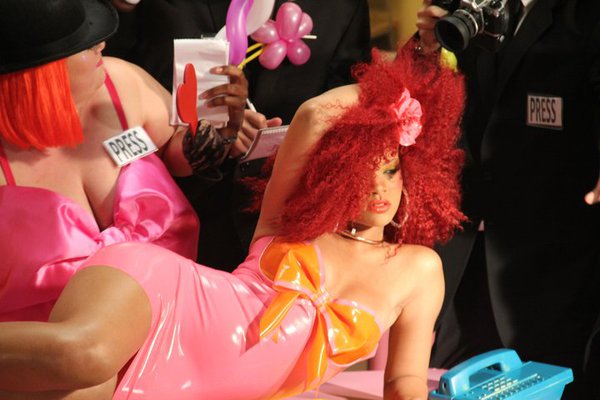
So Rihanna made an S&M video. No really, it’s called “S&M.” And yes, it does feature her walking Perez Hilton – not the sexiest choice – on a leash, while wearing a latex dress and a killer day-at-the-races hat-thing, plus her singing while hanging from the ceiling, men in restraints and gags, and creative use of duct tape. Yep, yet another celebrity discovers BDSM. While the video itself is not thrilling and not all that arousing (for my money, Rihanna’s made hotter), the girl’s got a way with outfits – she has a penchant for performing in latex, and sports a pretty incredible hood and stockings latex ‘fit in the new video, which already has 9.3 million views on YouTube, fyi. Perhaps she could be convinced to share the wealth at one of SF’s two kinky costume swaps this Sun/13 — at Kinky Salon and the SF Citadel respectively. Even if RiRi’s not in attendance, the event should be a good opportunity to re-up on some gear to wear to the next wild-and-wacky costumed sex party. Or nearly any of this weeks’ sex events, for that matter…


Bawdy Storytelling: “Slut or Whore?”

Four years of Bawdy Storytelling already? And it doesn’t look a day over “once upon a time”! At any rate, four years of exhibitionist show-and-tell deserves a little contemplation, so this month’s theme makes perfect sense. Sexologist Carol Queen and fowl-about-town Chicken John will be sharing scenes from their crazy line-toeing lives – maybe we can all sit back and think on what it means to get paid for it, whatever our career may be.

Weds/9 8 p.m., $10

The Blue Macaw

2656 Mission, SF

www.bawdystorytelling.com


Lyon-Martin Beer Bust

You’ve heard by now, no doubt, about how trans and woman-friendly Lyon-Martin Health Services is being threatened by these toughie economic times. Things are looking good for the clinic though, if one is to judge by the magnum-sized avalanche of fundraising events that have come down the chute from organizations and businesses all over the city. You can find a list of them here, by the way. And here’s a fabulous option: the Eagle will be busting beers out all afternoon in honor of safe, respectful, and effective reproductive health care – go drain a bottle, donate some cash to the cause, and buy some raffle tickets while you’re at it – your community will thank you.

Sat/12 3-6 p.m., free

The Eagle Tavern

398 12th St., SF

(415) 626-0880

www.lyon-martin.org


Valentino’s Casablanca

Here’s looking at you kid – you and your valentine(s, not trying to be limiting here) are welcome to get fuzzy at Stefanos invocation of Bogart’s bar. Sip on noir-style cocktails and look sultry while you check out violinists and sky-suspended roped beauties. Plus, there’s that big old dungeon to frolic in. Trust, this could be the beginning of a beautiful friendship(s, again, not tryin’ to hold you back here).

Sat/12 8-10 p.m., $30 singles, $60 couples, $90 trios

SF Citadel

1277 Mission, SF

(415) 626-2746

www.brownpapertickets.com


Kinky Salon Costume Swap

It can get rough attending themed swingers’ parties week in and week out – there’s only so many times you can wear those pink cat ears before their frisky fun seems a little worn out. Luckily, Kinky Salon’s got your back – show up at this naked person party (when you’re changing outfits people, game faces please) with an armload of the fetish funwear you’ve grown luke-warm on, and pick up another armload of your kinky peers’ cast-offs. Remember to clean everything before you bring it down.

Sun/13 4-6 p.m., $10 with costumes to swap, $20 without

Mission Control 

www.missioncontrolsf.org


Swap it Out!

Just like the one above, only the Citadel’s swap is a true naked lady party – only women and the female-identifying are allowed at this trade. Bring your threads (street clothes welcome at this swap) – the ones that no one picks up will be shipped off to charity at the end of the three hours. 

Sun/13 2-5 p.m., free

SF Citadel

1277 Mission, SF

(415) 626-2746

www.sfcitadel.org


Pop-Up Dildo Shop and Icecream Social

Now this will be all kinds of fun: an event at Fifty 24’s pop-up store with a little something for everyone. To whit, raunchy comedy by Will Franken, free organic icecream from Three Twins, a class on how to choose the perfect sex toy with Carol Queen, giveaways from Good Vibes, even free PBR! My goodness, and hot ’60s pop act Female Trouble to soundtrack the whole thing? Can you wait til Sunday, even? 

Sun/13 3-5 p.m., free

Fifty 24 SF Gallery

252 Fillmore, SF

Facebook: Good Vibrations’ Pop-Up Dildo Shop and Ice Cream Social


Club Neon Underwear Party

Now let’s not get ahead of ourselves here, folks. This is an underwear party – which does not mean that you’re guaranteed nookie (when are you, really), but the talent will be much easier to scope than in your typical nightclub scene. That stud over there seem awfully full in the boxer brief? Sweaty sweetie by the bathrooms shaking that demi-bra with the skills to pay the bills? Play your cards right and you may have found your valentine. 

Mon/14 9 p.m.-2 a.m., $5, free before 11 p.m. with no pants

The Knockout 

3223 Mission, SF

(415) 550-6994

Facebook: Club Neon Underwear Party


San Franciscans show solidarity with Egyptians

0

“Yesterday we were all Tunisian. Today we are all Egyptian. Tomorrow we will all be Free,” read one sign on at last weekend’s protest in solidarity with the wave of uprisings across the Arab world, an event drew thousands of people into the streets of San Francisco.

The crowd was diverse, from a variety of cultures and age groups. Sabreen Abdelnahmen is an 11-year-old Egyptian American who said she is “very proud there are people of many cultures and many religions fighting for the same thing.”

The events in the Middle East reverberate in San Francisco as well as many major cities, with everyone watching Egypt teeter toward democracy. To understand more about the events in Egypt, we spoke with local activist Yasmeen Daifallah, who helped organize the solidarity events and has connections in Egypt, where she attended Cairo University for six years. She is an activist, a political science doctoral student at UC Berkeley, and a singer in the Arabic music ensemble, ASWAT.

SFBG: Why protest in San Francisco?

YD: Two things were important to us. The first was to express solidarity… when [images of protests here] are transmitted to Tahrir Square [the central square where thousands of Egyptians have been remaining against government orders for two weeks]… it is definitely very uplifting. The second is to spread awareness in San Francisco…and in the U.S, to express a message to the American public and the American government. There should be respect for the people’s rights of self-determination and a cutting back on a strict consideration of self or national interest.

SFBG: Tell us about Tahrir Square, which has been at the heart of the protests, and who is leading the protests.

YD: I am amazed at the intensity of the steadfastness because many protestors are struggling to make a living. They all strike you as struggling to make a living and would not do anything to jeopardize making a living and these same people come out and say ‘we are staying here, we don’t care about bread, we care about dignity, we are not moving from here until [President Mubarak’s] regime falls.’

One of the most interesting things about this protest—there is no particular organization or person or even a group of organizations leading. Actually, the organizations are trying to piggy bag on the people and the momentum that is created by the public. For the leaderless nature that is has, it is remarkably organized.

SFBG: Why did the people rise up? Tell me a little about Egypt under Mubarak.

YD: The economic condition was abysmal and this is because when Mubarak came to power, the country started structural adjustment policies, which gave way to mass privatization. These have particularly intensified in the past 5-10 years. What this has translated into is massive unemployment and having to do several jobs in order to survive. On the day-to-day basis life under Mubarak is a life of economic hardship and social immobility.

When we start talking about the middle class, about politics and the political concerns probably [what is important] are fraudulent elections, rigging elections after people have actually voted but also preventing people from opposition movements from entering the ballot box to begin with. So this a very flagrant political repression. It takes place across the board. The second thing is the repression of the right to freedom of expression, whether in writing and the detention of journalists or in demonstrating. There is a law preventing the right to assemble. Then there is the bureaucracy and inefficiency, which all citizens suffer from on a daily basis. Their energies are exhausted in… getting their daily life going whether on the economic level, the bureaucratic level, or just the transportation level.

SFBG: You were just in Egypt and left 10 days before protests erupted. Do you wish you were there still? How does you feel as an Egyptian at this moment?

YD: Yes, very much so. I wish I were there—we all have a sense that there is something historic happening. We never had this number of people protesting against the regime and putting out demands that are this vocal and this radical. I wish I was more a part of this moment, I am just part of this moment from afar. I feel proud to be an Egyptian, which is a feeling you don’t get often, unfortunately.

On the one hand it feels bad because I wanted to be there to actually be a part of it. On the other hand, I have been convincing myself that there is a role that maybe I was destined to play being out here instead of out there.

SFBG: What do you think about the fears and concerns that democratic elections will lead to the rise of an Islamic government in Egypt?

YD: The question itself is unacceptable in the sense that fear and Islamic government put together should not be an issue. The issue is that people should have the right to determine who they want to govern them and whoever comes out of this is a legitimate leader.

The second thing is, you can easily see…this uprising is not an Islamic uprising—there is no foundation for this concern. The Islamic opposition, which has been among the most powerful if not the most powerful opposition movement will play a role and has to play, rightly, because they have been [part of the opposition]. There is no reason for concern, whether we look at it from the perspective that this is not an Islamic uprising or from the perspective that the nature of the Islamic opposition in Egypt is moderate in the sense that it is not militant and not violent and buys into a lot of democratic rhetoric and human rights rhetoric that is around.

SFBG: The other concerns have been around the lack of stability.

YD: This is not such a bad thing. The state of affairs in this point in time in the region is stability with no justice which in turn is bound to create instability and we have seen the instability of the intifada, we have the instabilities with the war on Gaza. Whatever we think of as stability in the Middle East is a fake and frail notion of stability. One would hope that if a new regime comes in Egypt that is more democratic that it would try to address some of the injustices that have been taking place so far regarding the Middle East peace process, but even this is not a guarantee.

At this point what one should focus on is who are the people at Tahrir, what are they demanding, and how can the international community help them get what they demand because this is not a violent uprising. This is not even an organized uprising. This is not a single actor uprising. It’s a crosscutting uprising and it is legitimate, which calls for respect and support and solidarity and anything less than that is betrayal.

SFBG: Where can people get the best information on what is happening in Egypt?

YD: Al Jazeera-English has been doing a good job at covering the events. It has definitely been the prime source of information to the extent that there is a huge campaign now demanding that Al Jazeera be available through satellite and cable providers in the United States. [For now,] you go online and click on live broadcast.

SFBG: Daifallah incorporates music into her politics through the Arabic musical ensemble ASWAT. Here’s a clip of their performance on Saturday:

http://www.youtube.com/watch?v=6fjZ0XjaJU8&feature=player_embedded


The Performant: Homing instinct

0

Performance thrives on the Living Room Circuit

What are the barest fundamentals of theatre once you remove it from “the” theatre? This is one of the questions site-specific performances are always confronted with, and the answer is not immediately clear. Does “theatre” require a script? (Then what is improv?) Does it require actors? (Then what is Spalding Gray?) Does it require a moral? (Then what is Ubu Roi?) Perhaps, like obscenity, it is immediately known when seen, but otherwise elusively indefinable. What does seem to be certain, particularly in light of the latest wave of productions set in non-traditional venues, is that performing in an actual theatre space is definitely not a requirement for creating an actual theatre piece.

Probably the best example of space self-sufficiency is the current upswing in salon-style performances. From participatory readings to full-blown plays performed for invited attendees, the trend has become so pervasive that Berkeley-based performance artist Philip Huang even coined a name for it: Home Theater, naturally. In May 2010, Huang launched the “Home Theater Festival”, with events on both sides of the bridge. This year, beginning March 3, the festival will include performances from all around the world, staged in the homes of the artists performing in it.

One participant in last year’s festival, performance-poet Baruch Porras-Hernandez, had such a positive experience he’s signed up for another slot this year on March 18, even though he doesn’t think he’ll be able to use the space he currently lives in on the grounds that it is too small. “It is one of the things I am most proud of, out of all my 2010 projects,” he tells me via email, “[I] have not seen so much joy in an audience.”

 Other pioneers of the living-room performance circuit include No Nude Men, who have been hosting theatre salons since 2009, though their interpretation of salon is more traditionally-slanted towards play-reading and subsequent discourse. In 2008, Boxcar Theatre staged Edward Albee’s “The American Dream” in four different living rooms across the Bay Area, and EmSpace Dance premiered their “Keyhole Dances” in a Victorian flat. And every couple of months in the upper Haight, The Living Room Reading Series brings together a diverse crowd of writers and readers together for an evening of wordsmithery on display.

Seduced by the potential of living rooms used for living art, two weekends ago I also hosted a performance salon in my home. And though I feel I must refrain from gushing about the specifics in this column (fabulous as they were!) I can say I highly recommend the experience on either side of the “stage.” Not only was a palpable intimacy created by just being packed in a smaller space, but more importantly by being in a *living* space, which quite literally made the event seem more alive. Though the atmosphere was casual, it was charged with an excitement I rarely, if ever, feel seated in the tidy rows of a conventional “theatre.”

Best of all, from my perspective, at least four attendees left vowing to host salons of their own, and one had attended a similar event in the Berkeley Hills the night before. This makes me hopeful to think that we’re standing at the brink of a bona-fide movement, not just a momentary fad.

Flush with tips

0

culture@sfbg.com

CULTURE I floated drunkenly into the second-story bathroom at 1015 Folsom. It’s a tiny affair, and my head was just enough obscured to make navigating past the waiting bodies a sure difficulty. I did my business and realized that the man that I had squeezed by, near the sink, wasn’t another patron, but some sort of bathroom attendant. In my inebriated state, it appeared to be an elaborate joke.

He was Latino, wearing a nice suit, and stood in the narrow space between the sink and one of the three urinals, his back against the middle pissoir. He had a mountain of curiosities piled over the sink, and a towel for drying hands draped over one arm.

“Have you worked here long?” I asked.

He shook his head. No. Just a little while.

“Do you keep your tips?”

No. He shook his head again, indicating that there was some sort of split. Reluctantly using the towel, I thanked him and dropped a Washington into the tip jar.

Somewhere, after more French techno, I drifted off to sleep. When I awoke, I wondered, had that really happened? Had I dreamt it? Had I hallucinated?

I sent 1015 Folsom an e-mail inquiring about the attendant. Apparently it was true. Barnaby May, who describes himself as a seven-year veteran of the nightclub scene, took credit for the hookup. He felt that something was lacking from 1015, that it would be better to have a bathroom attendant than not. He put me in contact with Shaun Fausz, who runs a company called Refreshus, which trains and supplies bathroom attendants.

According to Fausz, the service is tailored to appeal to a lackluster economy: it costs the clubs nothing. “Clubs would rather have a free service than have to repaint every few months and replace a trashed sink,” Fausz says. Which makes good sense in a city where one of the dominant aesthetics of the nightlife is a sort of high-class posturing that can quickly be ruined by a Magic Marker. Other clubs have resorted to taunting taggers. Look how fucked up our bathroom is, the Rickshaw Stop seems to say, what else can you do? Put up another sticker? The Independent has painted its water closets black to nullify vandalism.

Bathroom attendants from Refreshus act as security, whether they’re at a nightclub, like 1015, or at a strip club, like the Century Club, where one of Refeshus’ longest standing employees, Gary Lawton, has worked for nine months. Lawton says it’s “a good public service,” although he never imagined performing it. Positioned in the bathroom, he’s able to monitor illicit behavior. “As you hear the snorting, you know what’s going on and you just let them know that they have to take it outside,” he says. “Or they’ll approach me and ask me if its cool, and I’ll just inform them that it’s zero tolerance, as well as alcohol, because there’s no drinking with full nudity.”

This was news to me. (My Catholic upbringing and feminist programming at university makes it impossible to attend a “gentleman’s club.”) If a club includes full nudity, and not just topless dancing, alcohol is verboten. “Our beloved senator is responsible for that, Dianne Feinstein.” says Lawton. “It doesn’t make any sense — I mean that’s what security is for. If you see someone being belligerent, you just tell them to go get some fresh air or something.”

Lawton, who looks like he could be a bouncer, doesn’t necessarily tell people he’s a bathroom attendant as much as “a member of security, who’s stationed in the bathroom.” But no embarrassment shows when he discusses the details. He loves his work, where he gets to act as liaison, recommending girls to patrons and occasionally getting a peek himself. He gets to meet people from all over, and show them a piece of the world that he never glimpsed before being at the Century. “It’s something I can’t explain,” he says. “You know you’re stuck in the bathroom, and then you see them doing something like ‘School Girl Night.’ It’s wild. Like nothing I’ve ever seen before. It’s just amazing every time I get out there. They have several girls who actually lift their legs up and climb all the way to the ceiling. It’s like being at the circus, but they’re stripping.”

It’s an experience that, to put it simply, Lawton is generally priced out of, a world where “private dances” can cost upwards of $100. In terms of straightforward class, Lawton has no shortage — he’s a polite man who chooses his words with the precision of someone who makes a living speaking to people — but if we’re talking economics, he’s low on the ladder. Once or twice before meeting me at the Barbary Coast coffee shop off Market Street, Lawton had to drop appointments at the last minute, his housing situation in tumult. Truth is he’s on General Assistance, in the shelter system, and shared tips from a few nights work a week aren’t enough to get over.

The income for a bathroom attendant, the flow of tips, breaks down across class lines as well as cultural ones. In Lawton’s experience, middle- to upper-class white men tip well. With African American or Indian men, he doesn’t count on tips. In some ways, bathroom attendants perform an obsolete service that only older generations know how to handle. (Think of the bathroom attendants at Bimbo’s, and that club’s retro style.)

Fausz has his own observations: “European people don’t tip. They don’t have tipping over in Europe. Women don’t tip as often — they like to let the guys pay for everything when they go out.” To my knowledge, Refreshus doesn’t have female attendants.

While Lawton can’t enforce any specific prices, he sometimes has to step in, politely explaining that the service isn’t complimentary. “Everyone under 32, they’re oblivious,” he says. “They come in and see the candy and go, ‘Oh, it’s free.’ And you have to remind them that, no, this is a service. But you don’t force any prices. Like I’ll have a jar with a $5 bill and I’ll just let them use their own discretion, just remind them that the colognes are usually this amount because it’s expensive and I have to pay for all that. You just make them feel comfortable and let them know that even though it’s complimentary, this is how I make a living. I’m responsible for all this. Because they think the club provides the service.”

A lot of this has to do with exposure. While a number of clubs — Vessel, Harlot, Trigger — reportedly have similar services, bathroom attendants aren’t common. Lawton had never encountered one before landing his job, just seen them on TV, and he describes the position as obsolete. “Each generation wants their own type of representation,” he says. “So naturally anything they think of as obsolete just doesn’t apply to them.” At the same time, Lawton acknowledges that a genuine amount of surprise plays in his favor, and patrons admire that the service is still on offer.

Whether bathroom attendant work at the nightclubs provides enough income is unclear. In a place where people pack singles, like the strip clubs, the tips are expected to flow more freely. That’s fine with Lawton, who doesn’t like the more amphetamine-infused nightclub culture as much, having had close family members ruin their life over addiction.

Fausz has seen turnover, most often when attendants steal or are headhunted by clubs. Some just aren’t a good fit ,or can’t work in the environment, or can’t hold the right amount of conversation. (The attendant I met at the beginning of this piece no longer works for Fausz.) But there are people willing to work for Refreshus wherever the opportunity arises. On a recent night I ran into Russ, a lean fellow in a sharp jacket stationed in the more luxurious main bathroom at 1015 Folsom. He described the job as “a good way to supplement my income,” adding “I’m a personal trainer.”

Fausz wants to fit bathroom attendants into more of the city’s nightclubs, even if an event tends to draw a crowd for whom a bathroom attendant is an obscure novelty. He puts it simply: “I’m kind of training the next generation of people to tip.”

Rise up and reflect

0

arts@sfbg.com

FILM A 10-part anthology film marking the 100th anniversary of the Mexican Revolution, Revolución derives most of its resonance from bits of Mexico’s landscape and cultural identity rather than head-on treatments of the revolution and its ideals.

However, this should only be read as a shortcoming if one approaches the film anticipating overt political or nationalist engagement. Instead, as might be expected from independent-minded, festival-focused directors such as Fernando Eimbcke (2008’s Lake Tahoe) and Carlos Reygadas (2007’s Silent Light), these 10 short films by Mexico’s most recognized directors and actors (Gael García Bernal and Diego Luna coproduced the entire project and directed segments) shape up in unexpected ways.

Taken as a whole, Revolución presents an ordinary, dignified, beautiful Mexico (in contrast to its increasingly violent image, courtesy of sensationalized news reports). Apropos to the diversity of the nation is the diversity of cinematic styles employed.

Patricia Riggen’s Beautiful and Beloved is a heartfelt and comedic story of familial duty leading to a small revelation. When a second-generation immigrant has to sneak the corpse of her father across the border to fulfill his wishes of being buried in Mexico, she is initially resentful. But something in her changes amid the massive funeral procession when she engages with her dad’s garrulous old pal. Beautiful offers one of the more conventional narratives in the film; it also includes the most direct references to the revolution and outlines an easily discernible conflict. Rodrigo García’s 7th and Alvarado, on the other hand, is a dreamlike juxtaposition of ordinary pedestrians and traditional horseback soldiers on the streets of a Hispanic area of Los Angeles.

Similarly, the three segments that portray celebrations in order to consider how the revolution is remembered today are all poignant yet quite distinctive from each other. Eimbcke’s graceful The Welcome Ceremony opens the film on a quiet, observant note by depicting a taciturn tuba player preparing for a concert that never happens. Reygadas’ This is My Kingdom is a vérité-style depiction of raucous outdoor activities that contrasts middle-class enjoyment with the rituals of the homeless who share the space. Rodrigo Pla’s vision, 30/30, may be Revolución‘s most cynical — it explores the dissonance experienced by Mexican Revolutionary general Pancho Villa’s grandson when he is both superficially honored and callously ignored at a centennial event.

REVOLUCIÓN

Thurs/10–Fri/11, 7:30 p.m., $6–$8

Yerba Buena Center for the Arts

701 Mission, SF

(415) 978-2787
www.ybca.org

Come drink and put Lyon Martin over the top

0

Labor and transgender activist Gabriel Haaland reports that supporters of Lyon Martin Health Services have almost reached their $250,000 to save the clinic. Almost. Come help put them over the top on Wed/9 when I and other “celebrity bartenders” will be pouring stiff ones in a benefit event at the Buck Tavern (aka Daly’s Dive), 1655 Market, starting at 6 pm. Donation of $5-$20 requested. See you there.

Our Weekly Picks: February 9-15

0

WEDNESDAY 9

MUSIC

Turisas

I recently heard Turisas described as “Disney metal.” So before you run screaming in the other direction, hear me out when I claim that it was actually a compliment. Spearheaded by singer-founder Mathias “Warlord” Nygard, the band plays folk metal so lushly orchestrated that it sounds like a movie score, full of trumpet swells and epic organs. Onstage, it features an accordionist and a violinist; the latter is responsible for all the soloing that would traditionally be done on guitar. Turisas’ 2007 release The Varangian Way is an engrossing concept album whose eight tracks follow a group of Scandinavian travelers as they make their way across Russia by river and end up in Constantinople. New platter Stand Up and Fight is due Feb. 23, but you can get a sneak preview at the show. (Ben Richardson)

With Cradle of Filth, Nachtmystium, Daniel Lioneye

8 p.m., $27

Regency Ballroom

1300 Van Ness, SF

1-800-745-3000

www.theregencyballroom.com


DANCE

Eonnagata

Eonnagata comes with pretty impressive credentials, and promises to be unique. The work is a collaboration between maverick ballerina Sylvie Guillem, who has made waves ever since she dared to quit the Paris Opera Ballet to freelance; multi-whiz Canadian director Robert Lepage, whose Ex Machina company has redefined theater for the last 20 years; and dancer-choreographer Russell Maliphant, who mixes ballet with yoga and everything in between. The trio created and performs in a work that examines the in-between state of male-female sexual identity. Inspired by an 18th century French noble, spy, and diplomat who fluidly switched genders throughout his career, Eonnataga also acknowledges a debt to the onnagatas, the refined male actors in Kabuki who spent their careers playing female characters. (Rita Felciano)

Wed/9–Thurs/10, 8 p.m., $36–$72

Zellerbach Hall

Bancroft at Telegraph,

UC Berkeley, Berk.

(510) 642-9988

www.calperformances.org


EVENT

“How to Write A Dynamic Online Dating Profile”

You’ve been on blind dates. You’ve tried speed dating. You’ve even have had your mother set you up. But you still can’t find love? Turn to cyberspace. (Don’t be embarrassed. According to those Match.com ads, one out of five relationships now begin online.) Take it from Carol Renee, a self-proclaimed “logophile,” English teacher, and aspiring novelist who found the love of her life using the handle “Fearlessly Compassionate.” She’ll hold your hand during the daunting tasks of coming up with a tantalizing user name, writing an attention-grabbing headline, and composing a succinct and yet true-to-life bio in this “how-to” class. (Jen Verzosa)

6:15 p.m., free

San Francisco Public Main Library

Latino/Hispanic Community Room B

100 Larkin, SF

www.sfpl.org


THURSDAY 10

MUSIC

Ensiferum

The Finnish metallers in Ensiferum span many styles, taking the best of everything they encompass. From folk metal, they learned the power of haunting, infectious melody and atmospheric texture. From thrash, they got the exultation and catharsis of breakneck tempos and relentless picking. And from power metal, they got the gleeful, empowering satisfaction that comes from singing about dudes with swords. The recent infatuation with Pagan stylings among American metalheads has brought the band stateside numerous times now, and Ensiferum never disappoints. Having donned their warrior garb, the five Finns who make up the band don’t leave the stage until everyone and everything is vanquished. (Richardson)

With Finntroll, Rotten Sound, Barren Earth

7:30 p.m., $25

DNA Lounge

375 11th St., SF

415-626-2532

www.dnalounge.com


EVENT

“Lusty Trusty Ball SF”

Not on the guest list for the annual Manus-Salzman Valentine’s Day Ball? No matter. Your photo won’t be gracing the pages of the Nob Hill Gazette or SF Luxe this time next week, but as least you don’t have to worry about breaking out the black tie. At the less-costly-but-no-less-classy Lusty Trusty Ball, in exchange for forgoing the ice sculptures, posh catered nosh, and a live gingerbread boy to nibble candy off of (he was holdin’ it down for Hasbro’s Candy Land in keeping with last year’s Manus-Salzman theme, “The Game of Love”) you’ll enjoy DJs, VJs, and live groups galore. Plus, with punk rock cabaret from the Can-Cannibals, Circus Finelli’s all-female antics, and Red Hots Burlesque, you can have a hot night without the haut monde. (Emily Appelbaum)

8:30 p.m., $10–$20

Submission

2183 Mission, SF

(415) 425-6137

www.sf-submission.com


EVENT

“Oilpocalypse Now”

Last April’s Gulf Coast-ravaging oil spill may have slipped from the headlines, but the region is still struggling to recover. “Oilpocalypse Now” takes aim at the corporations that cause (and cover up) environmental disasters — indeed, the event is subtitled “Time for a 28th Amendment for the Separation of Corporation and State” — featuring a talk by Dr. Riki Ott, a community activist and marine biologist. Ott will present the documentary Black Wave: The Legacy of the Exxon Valdez (remember that one? Big Oil hopes you don’t!) Other speakers include Lisa Gautier, who helped organize the “hair boom” effort to soak up Gulf Coast oil; former Guardian columnist Summer Burkes, who witnessed the Louisiana devastation first-hand, and more. Proceeds benefit the Gulf Coast Fund, Ultimate Civics, and the Coastal Heritage Society of Louisiana. (Cheryl Eddy)

7 p.m., $10–$20

Grand Lake Theater

3200 Grand Lake, Oakl.

(510) 452-3556

www.summerburkes.wordpress.com

http://communitycurrency.org/node/63


FRIDAY 11

DANCE

“Black Choreographers Festival: Here and Now”

For the next three weekends the “Black Choreographers Festival: Here and Now” throws the spotlight on the Bay Area’s African American voices. Now in its seventh year, the festival brings together professionals from a rainbow of perspectives on dance. If this were an ideal world, these choreographers would have their own companies and regular seasons. Some do — Raissa Simpson, Deborah Vaughan, Paco Gomes — but the festival offers all an opportunity to make themselves heard in the context of their colleagues. The Oakland lineup is different from the San Francisco one; the third weekend focuses on up-and-coming new talent. And as always, the youth ensembles at the family matinee will be a special high-energy treat. (Felciano)

Fri/11–Sat/12, 8 p.m.;

Sun/13, 4 p.m., $10–$20

Laney College

900 Fallon, Oakl.

Feb. 17–19, 8pm; Feb. 20, 7 p.m.

ODC Theater

3153 17th St., SF

Feb. 25–26, 8 p.m.; Feb. 27, 7 p.m.

Dance Mission Theater

3316 24th St., SF

1-888-819-9106

www.bcfhereandnow.com


PERFORMANCE

You’re Gonna Cry

Where better than 24th Street to watch a solo show about the real lives of Mission District residents at the height of gentrification? Touching on everyone from the techies and bohemians to the Latino locals and immigrants, HBO Def Poet and Youth Speaks cofounder Paul S. Flores performs his theatrical work about the human cost of gentrification in the neighborhood. In addition to masterful storytelling, get ready for a gangster puppet show and digital murals, illuminating the changes brought by the dot-com boom and bust, real estate bubble, immigration, and forced evictions. The Mission is loaded with characters and Flores’s dynamic fusion of urban culture and spoken word brings them all to life. (Julie Potter)

Fri/11–Sat/12, 8 p.m., $15

Dance Mission Theater

3316 24th St., SF

(415) 273-4633

www.dancemission.com


EVENT

California International Antiquarian Book Fair

Ever wonder what ephemera left by our generation will be pored over in a millennium or two? Parking slips, band posters, books like Lady Isabella’s Scandalous Marriage and 1001 Deductions and Tax Breaks, 2011? Whatever the items, they’ll surely be found at the 1000th annual California International Antiquarian Book Fair. The festival, now only in its 44th year, tempts bibliophiles with a menagerie of historical snippets and antique selections. The perusables include musical prints and manuscripts, rare codices, antique children’s literature, fine bindings, maps, trade books, miscellaneous historical scraps, and — vocabulary word — “incunabula,” which are books, pamphlets, or broadsheets printed (not handwritten) in Europe before 1501. A trove of timeworn tomes? Simply splendid! (Appelbaum)

Fri/11, 3–8 p.m.; Sat/12, 11 a.m.–7 p.m.;

Sun/13. 11 a.m.–5 p.m., $10–$15

Concourse Exhibition Center

635 Eighth St., SF

(415) 551-5190

www.labookfair.com


SATURDAY 12

DANCE

Company C Contemporary Ballet

With a sampling of contemporary ballet from choreographers active across North America and Europe, Company C’s mixed-bill winter program includes a premiere set to the music of Elvis Costello by Artistic Director Charles Anderson in collaboration with Benjamin Bowman (both formerly of the New York City Ballet), and another by Maurice Causey, a former principal of William Forsythe’s Ballet Frankfurt. Also appearing from the diverse repertory of this vibrant company is Tovernon, a solo work by David Anderson, the father of Charles Anderson, and Daniel Ezralow’s Pulse, during which dancers take running starts to slide across stage wearing socks. (Potter)

Sat/12, 8 p.m.; Sun/13, 2 p.m., $18–$40

Yerba Buena Center for the Arts

701 Mission, SF

(415) 978-2787

www.companycballet.org


EVENT

“Woo At The Zoo”

Want to make things a bit more “wild” this year for Valentine’s Day? Then head on over to the San Francisco Zoo for “Woo At The Zoo,” the annual event that’s become a favorite activity for amorous humans looking to learn a bit more about our animal pals’ own mating habits and sexual behaviors. Make plans soon with your sweetheart for this special multimedia event that also includes a romantic brunch or dinner, along with drinks. Admit it — you’re already humming the words to the Bloodhound Gang’s “Discovery Channel” song, aren’t you? “You and me baby we ain’t nothing but mammals, so let’s do it like they do on the Discovery Channel!” (Sean McCourt)

Sat/12-Sun/13, 6 p.m.;

Also Sun/13, 11 a.m., $65–$75

San Francisco Zoo

One Zoo Road, SF

(415) 753-7080, ext. 7236

www.sfzoo.org


SUNDAY 13

MUSIC

High on Fire

How rad would it be to have an all-chick High on Fire tribute band called Pie on Fire? Though, yeah, that could go either way — hot cherry deliciousness or the evil feeling that makes your girlfriend chug sour pints of cranberry juice. And pulling off (literally) the shreddiness of Riffchild caliber is probably not gonna happen in this lifetime. In any case, join the real trio for a special one-off hometown show before they head out to tour New Zealand and beyond. An honorable way to ring in the annual holiday of love and lust, no? (Kat Renz)

8 p.m., $18

Slim’s

333 11th St., SF

(415) 255-0333

www.slims-sf.com


The Guardian listings deadline is two weeks prior to our Wednesday publication date. To submit an item for consideration, please include the title of the event, a brief description of the event, date and time, venue name, street address (listing cross streets only isn’t sufficient), city, telephone number readers can call for more information, telephone number for media, and admission costs. Send information to Listings, the Guardian Building, 135 Mississippi St., SF, CA 94107; fax to (415) 487-2506; or e-mail (paste press release into e-mail body — no text attachments, please) to listings@sfbg.com. Digital photos may be submitted in jpeg format; the image must be at least 240 dpi and four inches by six inches in size. We regret we cannot accept listings over the phone.
Rep Clock

0

Schedules are for Wed/9–Tues/15 except where noted. Director and year are given when available. Double and triple features are marked with a •. All times are p.m. unless otherwise specified.

ARTISTS’ TELEVISION ACCESS 992 Valencia, SF; www.atasite.org. $6. “Black History Month Film Showing:” Freedom on My Mind (Field and Mulford, 1994), Thurs, 7:30.

BERKELEY FELLOWSHIP OF UNITARIAN UNIVERSALISTS 1924 Cedar, SF; www.bfuu.org. Donations accepted. Chisholm ’72: Unbought and Unbossed (Lynch, 2004), Thurs, 7.

CASTRO 429 Castro, SF; (415) 621-6120, www.castrotheatre.com. $7.50-10. •Se7en (Fincher, 1995), Wed, 2:20, 7, and Memento (Nolan, 2000), Wed, 4:45, 9:25. “Buzz on Parade:” •Gold Diggers of 1933 (LeRoy, 1933), Thurs, 1:25, 4:55, and 8:55, and 42nd Street (Bacon, 1933), Thurs, 3:15, 7; •Dames (Enright, 1934), Fri, 1:25, 5:05, 9:10, and Footlight Parade (Bacon, 1933), Fri, 3:10, 7. “San Francisco Silent Film Festival Winter Event:” “It’s Mutual: Charlie Chaplin Shorts,” Sat, 1; L’argent (L’Herbier, 1928), Sat, 3:30; La Bohéme (Vidor, 1926), Sat, 8. For advance tickets ($15-17) or more info, visit www.silentfilm.org. “Scary Cow’s 13th Independent Film Festival,” Sun, 3. “A Victor/Victoria Valentine:” Victor/Victoria (Edwards, 1982), Mon, 9:30. With a tribute to star Lesley Ann Warren; for advance tickets and info on pre-show reception (8pm, $25), visit www.ticketfly.com.

CHRISTOPHER B. SMITH RAFAEL FILM CENTER 1118 Fourth St, San Rafael; (415) 454-1222, www.cafilm.org. $6.50-15. The Illusionist (Chomet, 2010), call for dates and times. “Mostly British Film Festival:” Boy (Waititi, 2010), Wed, 7; Beneath Hill 60 (Sims, 2010), Thurs, 7. Peter Pan (Brenon, 1924), Sun, 3. With the Mont Alto Motion Picture Orchestra.

FRAENKEL GALLERY 1453 Valencia, SF; www.believersfilm.com. Free. “The Believers” (Grannan, 2011), film installation, through Feb 26 (gallery hours Wed-Sun, noon-7).

HUMANIST HALL 390 27th St, Oakl; www.humanisthall.org. $5. The War on Democracy (Pigler and Martin, 2007), Wed, 7:30.

MECHANICS’ INSTITUTE 57 Post, SF; (415) 393-0100, rsvp@milibrary.org. $10. “CinemaLit Film Series: New Year’s Revolutions:” Yesterday, Today and Tomorrow (de Sica, 1963), Fri, 6.

PACIFIC FILM ARCHIVE 2575 Bancroft, Berk; (510) 642-5249, www.bampfa.berkeley.edu. $5.50-9.50. “Film 50: History of Cinema: Fantasy Films and Realms of Enchantment:” Aelita, Queen of Mars (Protanzanov, 1924), Wed, 3:10. “Radical Light: Alternative Film and Video in the San Francisco Bay Area:” Tongues Untied (Riggs, 1989) with “Binge” (Hershman, 1987), Wed, 7:30. “World Cinema Foundation:” Trances (El Maanouni, 1981), Thurs, 7. “Suspicion: The Films of Claude Chabrol and Alfred Hitchcock:” Rope (Hitchcock, 1948), Fri, 7; Inspector Lavardin (Chabrol, 1986), Fri, 8:40; Madame Bovary (Chabrol. 1991), Sat, 7; Story of Women (Chabrol, 1989), Sun, 5. “Cruel Cinema: New Directions in Tamil Film:” Subramaniapuram (Sasikumar, 2008), Sun, 3. “The Lunch Love Community Documentary Project,” Sun, 2:30.

RED VIC 1727 Haight, SF; (415) 668-3994; www.redvicmoviehouse.com. $6-10. The Jerk (Reiner, 1979), Wed, 2, 7:15, 9:20. “Nine Nation Animation,” Thurs-Fri, 7:15, 9:15. “A Special Fundraiser for the Red Vic: Lovers + Liberators:” •Bold Native (Hennelly and Suchan, 2010) and All Power to the People (Lee, 1996), Sat, 7, 9:30. Annie Hall (Allen, 1977), Sun-Tues, 7:15, 9:20 (also Sun, 2, 4).

ROXIE 3117 and 3125 16th St, SF; (415) 863-1087, www.roxie.com. $5-9.75. San Francisco Independent Film Festival, through Feb 17. See film listings or www.sfindie.com for more info. YERBA BUENA CENTER FOR THE ARTS 701 Mission, SF; (415) 978-2787, www.ybca.org. $6-8. “Volume 14: Middle East,” nine videos focusing on the Middle East compiled by ASPECT: The Chronicle of New Media Art, Jan 13-March 27 (gallery hours Thurs-Sat, noon-8; Sun, noon-6). “Revolución,” short films from Mexican directors, Thurs-Fri, 7:30. Shoah (Lanzmann, 1985), Sun, 11am (complete film with one-hour break). 

A public apology for recommending the recent Madlib live DJ set

5

When you recommend an event, you’re basically telegraphing expectations on an artist’s body of work. However, there is risk involved with live appearances.

For instance, there was no way of knowing that Madlib would spend the majority of the first half of his Fri/4 show at 103 Harriet pausing to ask, “Who knows Quasimoto?,” “Y’all know J Dilla?,” and “Who’s from the West Coast?” in order to drum up applause, and presumably, interest. This is a classic stage trick, and a musician will usually try to drum up support two or three times, in order to work the crowd into a frenzy. Last night, however, no matter how many different questions he asked or how loud the response went, there seemed to be no pleasing Madlib, he just went on and on, frustrating those that had mistakenly come to listen to him play music.

It only got worse once the booing started. While people steadily trickled out of the room for the next half hour or so, the DJ became locked in a battle with one persistent heckler; every beat he attempted to play had a new chorus, as Madlib shouted “You’s a fool!” “Foooooooooool!” and numerous other taunts. Madlib angrily insisted that he was just playing with the heckler (and everyone else, apparently), but there was no high road in sight, the music never took the main stage again as the DJ held the mic hostage.

No, even as the next few jockeys crouched in the wings, waiting to try to resuscitate the room, Madlib would not relent. It was an extremely slow death, going on to the point that the shrunken audience remained through a morbid fascination, as if stopping to watch a suicide jumper. Management tried to talk him down, with whispers in his ear, only to have him respond on the mic that five minutes (“Five minutes?”) was not enough. If there was ever an argument for reinstating another classic stage trick, the shepherd’s crook, it was last night.

And for this, I apologize.

The Free University of San Francisco kicks off teaching — to a lot of white people

71

“A piece of blank paper means anything you want can happen,” SF beat poet laureate Diane Di Prima was imparting a rare free lecture on shamanic poetry, the marquee event of this weekend’s popular first Free University of San Francisco teach-in at Viracocha. She had a packed the antique store-community center’s first floor showroom, encouraging in regards to the FUSF collective’s run at making free education available to all. But if the Free University wants to teach the world, why are the vast majority of its students – let’s not parse words here – white?

“Diversity outreach, that is absolutely one of our top priorities,” says FUSF organizer Alan Kaufman when the point was brought up in a phone interview with the Guardian yesterday. “We’re one of the most racially polarized cities, even in the progressive community. It’s something that needs to be explored and discussed.” Kaufman said that as the collective that runs the university moves forward, FUSF is actively working to involve minority community members – especially undocumented immigrants, one of SF’s populations who surely are among the least-served by the town’s would-be progressive creative institutions. 

It does seem like FUSF has the capacity to be a source of radical academia and community in the city. This weekend’s teach-in (which continues through tonight, Tues/8) attracted capacity crowds to many of its popular hour-and-a-half long courses: Di Prima’s “19th Century Visionary Poetry,” Kaufman’s “Jack Kerouac, Thelonius Monk and Jackson Pollack,” and David Cobb’s “Abolishing Corporate Personhood to Create Authentic Democracy” among them. Though FUSF’s plan for six to eight week classes in the future and another teach-in may be a stretch to replace the value of an actual university degree for students, the success of its initial weekend course schedule does say that some people in the city are ready to rethink the way we view teaching. After all, as Kaufman reminded us, the cost of a four year degree at Stanford is now pegged at a quarter of a million dollars. “That can’t last.” 

But if it’s going to be SF’s new center of alternative, cost-free education, FUSF has to appeal to more than just the aging hippies and earnest intellectual young people who attended this weekend’s teach-in. 

How? Well, that’s the question, really – one that many creative institutions in San Francisco have yet to resolve, if they’ve tackled it at all. “We’re going to need to come up with new answers because the new answers are not working.” Kaufman mentioned that he is particularly impressed by the way SF’s queer community has celebrated its diversity.

“I feel like there are reasons why different groups don’t get involved in the beginning of these things.” Writer Maisha Johnson is one of the only African Americans who has been involved with the Free University planning meetings since she heard about its first get-togethers through her involvement in literary events like Quiet Lightening. “For me, living in San Francisco, it’s hard to find out where the black community gathers. A lot of the time, the assumption is you go to Oakland for acitivities with people of color.” 

“If you’re looking at organizational power in San Francisco, it usually runs along lines of whiteness, maleness, and straightness. The only way to break down those social divisions is for people that don’t feel like they’re that similar to collaborate,” says Mumbles, a spoken word poet who is helping to organize an artist resource center called Merchants of Reality. 

Mumbles says that the goal of Merchants of Reality – which plans to operate out of SoMa’s Anon Gallery and Climate Theater — will be “to help artists commercialize themselves so that others don’t do it for them.” Its a pragmatic mission, one that will even involve what Mumbles refers to as the “realty community” in order to help artists find studio space in the abandoned buildings that dot the SF landscape. The center will also include darkroom facilities, digital video setup, screen-printing equipment, help finding studio space, and a possible performance venue, all for use by artists who normally don’t have the opportunity to use professional-grade equipment and materials, presumably many non-white artists and performers. 

Kaufman and Mumbles think that Merchants of Reality and the Free University can benefit from each other. “Space sharing is one way community can be developed,” says Kaufman, who told us the two groups are looking at ways to overlap each others’ missions in the hope of broadening the community of both organizations. 

Of course, its about more than organizational partners. “It requires more of an explicit effort to reach out to other communities,” says Johnson who will be a part of FUSF’s outreach committee and, adding that she’s heartened by the university’s chances to diversify itself. “Right now it’s really open to people to come in and work on their own vision.” Kaufman agreed that expanding FUSF’s audience means working towards a curriculum that everyone finds useful and illuminating, incorporating classes and promotional materials in different languages, and connecting those typically excluded from professorships in the United States teaching positions. “There’s whole areas of education that others might know about that we might not consider,” he said.

“I believe our university will become famous among universities – come to be known as the ‘Zorro’ of universities,” said Kaufman in an address to the university community. (Printed copies of his four addresses were available by the class sign-in sheets at this weekend’s teach-in.) High hopes — but if the school is meant to make a real difference in progressive education, it’ll have to find a way to bring its message to everyone.  


Free University of San Francisco’s first teach-in

(Started Feb. 5)

Tues/8 classes:

6-7:50 p.m.: “Critical Thinking (Introduction to Logic)”

w/ Jordan Bohall and Elena Granik

8-10 p.m.: “Introduction to Nietzsche”

w/ Evan Karp and Andrew Paul Nelson

Viracocha

998 Valencia, SF

fusf.wordpress.com


Black history, local hire, living color

31

City Hall kicked off its annual Black History month celebrations with a talk by Los Angeles philanthropist and former Xerox Corp. VP Bernard Kinsey about the importance of debunking myths about the absence of blacks in American history. And Mayor Ed Lee, who had just met with five dozen unemployed black construction workers from the Bayview, revealed how, when he was growing up in the projects in Seattle, his neighbors were black, and an African American named Darnell was one of the most loyal patrons of the restaurant that Lee’s father was trying to make succeed.


“And when my dad suddenly died of a heart attack, Darnell was the first person to offer my brother a job at his gas station,” Lee said. “So, this is not just about recognizing African American history, but recognizing what they did for us, and  making sure that no there are jobs and we protect the family structure. I know what it is to be helped by the African American culture.”


Lee’s recollections of Darnell came less than an hour after he met with Aboriginal Blackmen United, a group that represents unemployed construction workers in the Bayview, to discuss how its members can get hired at UCSF’s $1.5 billion hospital complex at Mission Bay and other local building sites.


At that meeting, ABU President James Richards thanked Lee for getting UC to clarify the details of its voluntary local hire plan at the Mission Bay hospitals.
But he warned that the fight is just starting. “We’ve got the unions to deal with,” Richards told Lee, referring to the reality that the unions also want their members to get work at the UCSF site.


Lee said he’d do his best to help.
“The African American community in San Francisco has not got its fair share,” he said. “I can’t say that everyone in the room is going to get a job, but I’ll open up doors and do my best.”


And then Lee confirmed that local hire is one of his top five priorities.
“My top priorities are the budget, pension reform, the America’s Cup, finding a good police chief and local hire,” he said. “I said that directly to every union leader yesterday. Some unions will be there, others will resist.”


ABU’s Richards said the need to have a G.E.D. to get into the city’s ob training programs is a barrier to employment for many in the Bayview.
“We have a lot of people, who are not able to get into CityBuild because they don’t take folks anymore who don’t have their G.E.D,” he said.


And he warned that the city’s black community is in crisis.
“I know there is a budget crisis, but this is a life crisis,” Richards said. “Young people are dying and it’s not even newsworthy any more.”


Lee suggested ABU work with the City to avoid the need to hold protests at construction sites in future,
“Let’s plan together, so you don’t have to go to all the sites,” Lee said. “I am for people getting their GED. But if someone has evidence that they are making an attempt to get their GED, we need to reward that with jobs. So that the GED is not a barrier, it’s a hope.”


And then Lee was off to attend his next round of meetings, which included the city’s Black History month event, where speakers noted that during Bernard Kinsey’s career with Xerox, he helped increase the hiring of blacks, Latinos and women,


Kinsey told the audience that he and Shirley Kinsey, his wife of 44 years, share a passion for African-American history and art. And that their world-famous Kinsey Collection, which contains art, books and manuscripts documenting African American triumphs and struggles from 1632 to the present, is currently on display at the National Museum of American History in Washington D.C, and a number of pieces are at the San Francisco African American Historical and Cultural Society. He noted that the posters of African Americans in the Civil War were reproductions of some of the art in those exhibits. 


Sup. Malia Cohen noted that about 200,000 African Americans participated in that war. Sup. Ross Mirkarimi, who represents the city’s Western Addition, where redevelopment triggered massive displacement of the black community in the 1960s, noted that eight members of the current Board of Supervisors, who selected Lee as the city’s first Chinese American mayor, are people of color.


“This is true representation,” Mirkarimi said, noting that the fact that the city’s African American population continues to drop (reportedly down from 6 percent to 3.9 percent, according to the 2010 Census) to “is a reminder that even the most forward-thinking cities have a lot of work to do.”


And Kinsey urged African Americans to start describing their ancestors as “enslaved.”


‘It will change how you look at your ancestors,” he said, “You don’t have a clue about what they sacrificed to get you to where you are today. We don’t tell you the ‘ain’t-it-awful’ story about slavery. We tell you the story of how we overcame.”


“You need three things for a successful life,” Kinsey added “Something to do. Someone to love. And something to look forward to.”


Kinsey said he and his wife have espoused two life principles, ‘To whom much is given much is required” and live “A life of no regrets.” And then he told a story about an eagle who was raised by a chicken.


The eagle ended up ashamed of his feathers, because the chickens never told him he was an eagle because they were afraid he’d end up ruling the barnyard.“He even grew up ashamed of his daughters,” Kinsey said.


Eventually, the eagle met another eagle, who told him the truth. “You ain’t no chicken,” the other eagle said.


“And this is the message,” Kinsey said. “Don’t think chicken thoughts, or dream chicken dreams. Think like an eagle.”


He warned the audience to be careful of buying into myths that would have them believe that African Americans played no role in building the U.S.
“There are stories that made America and stories that America made up,” Kinsey said. “And too often, the myth becomes the choice.”


And then he concluded by expounding on “the myth of absence.”
‘”African Americans are not seen, not because of their absence, but because of the presence of a myth that prepares and requires their absence,” Kinsey said. “And the manipulation of the myth changes the color of the past. It’s no accident that the dominate images from the past are white. And many of us have swallowed the pill.”


Saving Lyon-Martin

0

rebeccab@sfbg.com

When word got out that the Lyon-Martin Health Services clinic faced imminent closure, Luette Chavez’s cell phone started ringing off the hook. Her friends were going into panic mode.

“It’s shocking to think that something that’s so important to so many people could just be lost so easily,” Chavez told us. The clinic serves nearly 2,500 patients, regardless of their ability to pay for health care. It offers specialized services for queer women and transgender people, providing everything from primary care to mental health services to hormone treatment. A Hurricane Katrina survivor, medical school student, and part-time sex worker, Chavez volunteers at the clinic and relies on it for health care. Her dream is to someday start a free clinic in New Orleans that is cast in the mold of Lyon-Martin. But for now, all of her energy is consumed with the widespread effort to raise enough money to keep the clinic afloat. To survive, Lyon-Martin must pay off a $250,000 debt immediately.


CASH FLOW PROBLEM

As one volunteer among many, Chavez has adopted the mindset that failure is not an option. “I have absolutely every confidence that we will be able to save it ourselves because we’re running ourselves into the ground doing it,” she said.

Lyon-Martin’s board of directors initially voted to shut down the clinic at the close of business Jan. 27, citing insurmountable financial problems. That decision was rescinded, however, following an emergency meeting held at the LGBT Center shortly after news of its pending closure went viral. By Jan. 28, an emergency fund drive had netted close to $100,000 in pledges and cash donations. A fundraiser held Jan. 30 at El Rio drew nearly 700 supporters and roped in another $28,000.

Despite the outpouring of support, the long-term future of the 30-year-old clinic remains uncertain. Lyon-Martin can restructure and avoid shutdown if it manages to clear the $250,000 urgently owed, but it must find $500,000 to continue operating in the same capacity as it has. It has stopped accepting new patients, but will likely be able to serve current patients until at least the end of February.

“Without Lyon-Martin, a community that is historically marginalized won’t have anywhere to turn,” stated an open letter to supporters from Board Chair Lauren Winter, who was unavailable for comment.

A combination of state funding cuts, increased demand, and poor financial management created a perfect storm for Lyon-Martin. A key source of the trouble was that the clinic had not been keeping up with its billing, and after a certain amount of time, it could no longer claim reimbursements from Medi-Cal. Yet external factors such as state and local budget cuts contributed to the problem, too, and Lyon-Martin is not alone in that respect.

All across San Francisco, community clinics that serve low-income and uninsured people are struggling to do more with less. Jim Illig, president of the San Francisco Health Commission, told us that he knows of several other clinics in dire financial straits.

“There are a lot of clinics on the edge because they have dedicated their mission to serving the uninsured,” he said. “Any nonprofit clinic that you see — they’re struggling.” The Haight Ashbury Free Clinics, another nonprofit healthcare organization serving the uninsured, recently announced a merger with Walden House, a substance-abuse treatment center. The merger allowed the venerable health-care nonprofit to continue offering services after its budget was slashed by 50 percent due to reduced support from the city’s General Fund. Even as the cuts took effect, demand for the free clinic’s services rose 10 percent from 2009 to 2010.

“Every time I look into the waiting room, it’s full,” said Jeff Schindler, chief development officer.

If Lyon-Martin closes, its patients will have to be transferred to other clinics, but there’s high demand everywhere. Such an outcome might evoke a sense of dèjá vu for some. Last fall, when an LGBT-focused clinic called New Leaf shut down due to crippling financial problems, many of its clients were transferred to Lyon-Martin.


COMMUNITY SURPRISED, UPSET

The front office manager at Lyon-Martin, who wished to be identified only as Braz, said she’d had no warning that closure was imminent. “Just closing down like that seemed impossible. We couldn’t ethically do that,” she said. “Our patients are freaking out right now.”

Once people became aware that the clinic was on the brink of closure, some aired the criticism that the board should have been more forthright about financial troubles. The Bay Area Reporter, a San Francisco publication covering LGBT issues, published an editorial calling for the resignation of the six-member board, and several sources told the Guardian they expected the board members to step down.

Meanwhile, health officials and elected representatives have stepped into the mix, but no promises of governmental financial assistance had been secured by the time the Guardian went to press.

Department of Public Health Director Barbara Garcia was unavailable for comment, but released a prepared statement: “The Department of Public Health has been in close discussions with Lyon-Martin and the pressing need to make immediate changes to the way they conduct their financial affairs. We value the important health care services they deliver and will continue to work with them to find the best long-term outcome for the clinic and the patients.”

Sup. Scott Wiener told the Guardian that he’d been in discussions about Lyon-Martin with Garcia and Sup. David Campos. Sups. Ross Mirkarimi and Jane Kim also attended the emergency meeting, and California Sen. Mark Leno was said to be attempting to secure some state funding for the clinic. As the push to save the clinic continues, a parallel effort is moving forward to craft a contingency plan for how Lyon-Martin’s nearly 2,500 patients can access care in the event that it doesn’t survive.


COMPETENT CARE

Lyon-Martin patients and others familiar with its services stressed that the women’s clinic is a critical resource for lesbians and the transgender population, because medical staff are trained in that specialized area of care.

“The service there is incredible,” noted Cheryl Simas, who has been a patient there for three years. “They explain everything to you, you’re listened to, and you’re treated with care and respect.” Simas said it was a dramatic difference from an experience she’d had in the mid-1990s, when her healthcare provider was barely comfortable pronouncing the word “lesbian.”

Lyon-Martin medical staffers receive training on transgender patient care, and it even offers training in that realm for medical professionals from cities throughout the United States. “They are internationally renowned as a model for what it means to offer transgender care,” noted labor organizer Gabriel Haaland, who said he was once denied health care due to his transgender identity. “The healthcare system is a fairly traumatic experience for most transgender people,” he added.

If Lyon-Martin closed, “it’d be pretty tragic,” noted Carlina Hansen, executive director of the Women’s Community Clinic, which works closely with Lyon-Martin. When it comes to health care, “We live in an unusual city, in that there is a lot of need among low-income people, due in part to a high cost of living. “Every clinic in San Francisco provides an integral part of that network,” and each clinic fills a specific need, Hansen noted. “The diversity of the clinics matches the diversity of our community.”

Division of labor

0

sarah@sfbg.com


In the wake of a three-day protest by unemployed workers outside UCSF’s Mission Bay hospital construction site — and under pressure from city leaders — UC officials have announced voluntary local hiring targets at the $1.5 billion complex.


Targets start at hiring 20 percent of the project’s workers in San Francisco during 2011 and increase that by 5 percent each year until the hospital complex is completed, UCSF news director Amy Pyle told us. But she denies that UC was pressured into its decision. UC is a state agency that is exempt from local rules when it builds facilities for UCSF and other campuses.


“Our voluntary goals are not a result of their protest,” Pyle insisted. “We have been aware of the local hire concerns since before they were protesting.”


The protests have focused on the need to hire workers for southeast San Francisco, where unemployment rates are the highest in the city, particularly among the city’s African American population.


“Of course we are looking to be good neighbors and hire people from an area we know has been hard hit,” Pyle said, clarifying that under the University of California’s hiring program, “local residents mean people who live in San Francisco generally.”


Mission Bay Hospitals Projects executive director Cindy Lima said uproar at the site stemmed in part from perceptions that lots of work is available now, but she said that isn’t true.


“Job opportunities should ramp up in May, but right now, they are installing structural piles,” Lima said. “So if there is an opportunity for a carpenter or a laborer to get decks built, we call the union.” UC’s voluntary local hire announcement came after Mayor Ed Lee urged UC officials to formalize a community hiring plan for Mission Bay, and Aboriginal Blackmen United (ABU) president James Richards agreed to call off his group’s protest outside UC’s Mission Bay hospital complex, at least for now.


ABU member Fred Green, an unemployed construction worker who has lived in the Bayview for 50 years and has five children, said the protesters tried to remain peaceful. “But an empty belly makes you do strange things,” Green said. “If there’s enough work for everybody, why should we be stuck at home while someone comes into my community and takes food out of my kids’ mouths?”


Troy Moor, who has lived in the Bayview for 47 years and has two kids, speculated that if ABU blocked both gates to the project, it would cost UC thousands of dollars a day in lost productivity. “Here at the front gates, we are visible. But we figure that if by next week, nothing is happening, we’ll start making them lose money,” he said.


Michelle Carrington is a 58-year-old flagger and operating engineer from the Bayview who has been unemployed for 10 years. She said Dwayne Jones, who worked in the Mayor’s Office and helped her graduate from Young Community Developers, was “working to try and get us jobs.”


Jones, who is now with Platinum Advisors as a consultant to DPR Construction, UC’s prime contractor at its Mission Bay site, put in an appearance on day three of ABU’s protest. But he said his work with DPR had nothing to do with the ABU protest.


“UC is very committed to maximizing local hire where we can,” Lima told the Guardian. “It’s unfortunate there is a protest because it gives the sense we haven’t been working with the community when in fact we have been working with the Mayor’s Office, CityBuild, and every stakeholder interested in this project, including ABU.”


Richards said ABU mounted its protest to challenge UC’s claims that it has hired more local residents at the site. They were also angry over a flyer that encouraged residents interested in working at the site to sign up with the San Francisco Workforce Collaborative, in partnership with Rev. Arelious Walker’s BayView Hope Community Development Corporation, feeling as if the UC was trying to divide their community. Walker did not return our calls for comment.


“We were with Walker when he was fighting the Nation of Islam’s attempt to stop development at the shipyard, so it hurts so bad to see this,” Richards said. “Never again will we stand by and let people come into the southeast community and take our jobs. We’re going to fight until the end. If the community doesn’t work, no one works.”


But even as UC announced its voluntary Mission Bay goals, community advocates pressed UCSF to set higher targets, citing the city’s failure to attain 50 percent local hire goals under San Francisco’s decade-long policy of seeking to hit that goal.


Joshua Arce of the Brightline Defense Project said he is glad Lee expressed support for Sup. John Avalos’ local hire legislation, “but we are waiting to see if he implements the law as written or a watered-down version.”


Then-Mayor Gavin Newsom allowed Avalos’ legislation to become law without signing it, bowing to the veto-proof 8-3 majority that approved it. But in a 12/23/10 letter explaining his position, Newsom recommended modifications to accommodate the concerns of the building trades, whose members come from across the Bay Area.


“I know the passage of this policy has created high expectations among some residents of San Francisco,” Newsom wrote. “The city owes it to them to implement this policy in a way that will result in a successful program that is fiscally responsible and reflects the best thinking of the many stakeholders invested in San Francisco.”


But with Newsom moving to Sacramento, California Assembly member Tom Ammiano and Sens. Mark Leno and Leland Yee are urging legislators to support San Francisco’s newly approved local hire law as approved.


In a Jan. 25 letter that Leno and Yee signed, Ammiano encouraged Bay Area officials to work with the city to explore mutually beneficial “reciprocity agreements” in which local cities would support one another’s programs “aimed at providing disadvantaged job seekers opportunities in the construction sector.”


“In neighborhoods like the Bayview, the Mission, and the Western Addition, the promise of jobs — particularly living wage construction jobs — has been an unfulfilled promise for generations,” Ammiano wrote.


But in a Jan. 28 press release, UC officials clarified that “as one of 10 campuses of a statewide constitutional corporation and public trust,” UCSF is not subject to Avalos’ mandatory requirement and is prohibited from adopting mandatory requirements based upon residency.


Instead, UC promised to do more community outreach and try to carve out financial incentives to encourage contractors to hit UC’s targets at Mission Bay.


Lima said the hospital complex is a historic opportunity to put as many San Franciscans to work as possible. “We have set an ambitious hiring target but we recognize that the economic activity generated by the project can significantly benefit our neighbors and local residents,” she said


After his Jan. 27 meeting with UC, Richards told ABU members that “when DPR needs someone for a job, they’re gonna call Dwayne Jones, and then Dwayne will let us know. There are hundreds of jobs, but I don’t know if they are in every trade. So, I feel good. But not so good that I can say that 10 carpenters will be hired tomorrow. There’s not enough need for that right now. But the work that’s there, when they call, you’re going to know it.”


Lima said UC’s meeting with Richards was “positive”.


“We clarified some misunderstandings and made some progress,” Lima said, noting that work at the site will become increasingly available starting in May. “Our goal is still to create jobs for San Francisco residents and make this project happen. We are continuing to try and match people who need to go to work with available job opportunities. The bottom line is that there are a lot of people in this city who are out of work and a lot of groups with different intentions in mind and we get tangled in that process.”


Lima vowed to work closely with DPR Construction and major subcontractors to ensure qualified local residents — including those from neighborhoods closest to the site — can access the construction jobs. And she promised that results will be reported regularly and the size of the workforce will increase steadily, peaking with 1,000 workers in 2012.


“We are mindful that while these goals challenge us, they are also within reach,” Lima said, noting that UCSF has been engaged in creating job opportunities in the construction trades for San Franciscans since 1993. “Our success will depend on the participation and commitment of the broader community and the trade unions.”


UC’s move comes less than two weeks after Lee announced at the annual San Francisco Labor Council Martin Luther King Jr. Day breakfast that one of his top priorities is implementing Avalos’ mandatory local hire policy.


Lee’s comments suggest a different approach from Newsom’s, but it’s still not clear whether Lee intends to follow the “critical steps” that Newsom felt the city should take “to ensure the responsible and successful implementation of Avalos’ legislation.”


Arce said he was happy to see Lee address the issue at the MLK Day event. “Lee said that if we are using local dollars to create local jobs, those jobs should go to local workers,” Arce recalled, noting that the following week Lee started to coordinate with the Office of Economic and Workforce Development and CityBuild to engage community stakeholders and lay out a road map to implement Avalos’ legislation.


“They set a deadline of March 25 as the target date by which the language of Avalos’ mandatory legislation must be included in all public bids and contracts,” Arce said. “And it’s our understanding that Mayor Lee called UC Chancellor Susan Desmond-Hellmann directly on the morning of Jan. 27 [before ABU’s Richards met with UC officials] to ask that UCSF formalize a community hiring plan for Mission Bay as soon as possible.”


Avalos said he was “very encouraged” by Lee’s remarks. “To say that at the Martin Luther King Labor Breakfast was a big deal,” Avalos said, noting that the building trades were also in the room. “I feel Ed Lee wants to implement the legislation how it is written. He needs help doing that. He needs to create a process to make it happen, and I believe the folks who helped draft the legislation will be ready to do that. That’s not to say that this couldn’t go wrong, but I feel pretty confident that he will implement as strong a local hire model as possible.”