Elections

Labor’s love lost

4

Note: This file has been corrected from an earlier version.

rebeccab@sfbg.com

Two recent events could have major implications for Service Employees International Union Local 1021 — San Francisco’s largest public-sector union and an important ally for progressives — for better or for worse. And this union’s fate seems closely tied to that of the progressive movement in San Francisco.

The first event was likened to a “nuclear bomb in the morning paper” by one observer, and might be interpreted as the kickoff to a fierce budget battle. Mayor Gavin Newsom announced that he is considering a plan to help solve next year’s budget deficit by laying off 10,000 full-time city workers and rehiring them at 37.5 hours, which would amount to a sweeping 6.25 percent pay cut for workers and an estimated $50 million in savings for a fiscally impaired city.

Though it was framed by Newsom spokesperson Tony Winnicker as one preliminary cost-saving option among many, the proposal received prominent front-page coverage in the San Francisco Chronicle, even before official discussions were called between the mayor and public sector unions. Since SEIU Local 1021 represents 17,000 members in San Francisco and a majority of the city’s 26,000 total employees, it would likely absorb the greatest impact if such a plan went through.

At the same time the mayor’s startling announcement hit newsstands, SEIU was in the midst of mailing out ballots to its membership for union elections. “I don’t know whether it’s a coincidence, or if the city is taking advantage of the fact that SEIU is absorbed in its elections,” Sin Yee Poon, an SEIU chapter president for Human Services Agency workers, told us while pointing out that the events happened simultaneously.

With three separate slates of candidates vying for control of SEIU Local 1021, grudges between warring internal factions have intensified into bitter sparring matches. The timing is unfortunate — just as SEIU’s internal turmoil is coming to a head, one of its greatest battles is pending over an unprecedented $522 million budget shortfall that looms like a dark cloud over the city. The deficit will surely result in job losses, and the public sector union’s ability to mount resistance even as it wrestles with internal strife is shaping up to be a key question.

This pivotal moment carries wider political implications considering that the progressive organization has in the past helped seal an alliance between San Francisco’s left-leaning leaders and organized labor through the San Francisco Labor Council.

With SEIU besieged by infighting and soon to be hurting from wage slashes and layoffs, more conservative factions of the labor community, such as the San Francisco Firefighters Union and the Building and Construction Trades Council, have recently been butting heads with progressive members of the Board of Supervisors.

At the same time, forces on all sides are beginning to eye the coveted seats up for election in June at the Democratic County Central Committee, a Democratic Party hub that is a cornerstone of local political influence, as well as the seats that will open up on the Board of Supervisors in November. Negotiations between unions and the mayor are ongoing, and mayoral spokesperson Tony Winnicker was quick to note that Newsom is open to options, other than reconfiguring 10,000 city jobs, that organized labor brings to the table. At the same time, the Guardian heard from numerous sources that city workers felt outraged and blindsided by Newsom’s decision to air the plan in the Chronicle instead of bringing stakeholders to the table.

SEIU Local 1021 President Damita Davis-Howard told us she thinks the idea of taking $50 million out of the pockets of working people in a rocky economy is wrong-headed.

“This was devastating,” said Davis-Howard, who is running for a newly created union position called chief elected officer, which is different from the union president, and similar to an executive-director post. “The mayor might as well have raised their taxes, because if you decrease their pay by 6.25 percent, they will still have the same amount of work, they will still have to pay the same mortgage, they will still have to buy the same food, the same PG&E, and they’ll be doing it with a lot less money. If any idea like this were to go through, it would actually remove the very fabric or fiber of San Francisco. It would really cut to the core of the very being of San Francisco. … I don’t see how anybody could believe that we could continue being the city that we love being with this kind of action.”

Winnicker, the mayoral spokesperson, cast it as a plan that could avert hundreds or even thousands of layoffs. “This year the easy decisions are behind us,” he noted in a recent discussion with the Guardian.

Solving last year’s fiscal shortfall was far from easy — budget tussles between frontline city workers and the mayor got ugly, and even then, the city received millions in federal stimulus dollars to cushion the blow. A similar plan of sweeping hourly cuts was floated then too, but it didn’t gain enough traction to move forward.

“The mayor is facing a huge budget deficit, there’s no question about it — but he has not lifted one finger to raise a dime in revenue,” charged SEIU member Ed Kinchley, who works at San Francisco General Hospital. As for how the union might respond if such a proposal went through, he speculated, “I think it’s the kind of thing that could lead to a strike. A big fight.”

While the city charter bars strikes by public employees, Kinchley’s comment indicates the level of frustration among SEIU’s rank-and-file.


The proposal could present a common enemy and a rallying point for a union in disarray. Internal jockeying for elected positions can be fierce in any organization, but for San Francisco’s service-workers union, the rifts are particularly deep.

The elections, which will be decided Feb. 28, mark the first time since a radical restructuring in 2007 that members will collectively decide who should lead. In 2007, the face of SEIU was changed across California when the international president, Andy Stern, began consolidating dozens of far-flung locals into centralized, beefier entities in a bid to maximize political effectiveness (California comprises roughly one-third of the entire union’s membership).

Local 1021 came into existence when 10 locals were conglomerated into one 54,000-member giant — hence the “10-to-one” label — representing health care and frontline service workers from the Bay Area to the Oregon border. 

In San Francisco, where a large segment of its members are based, the shift was interpreted by some as a power grab, and it triggered a period of ongoing strife between those allied with Stern and the international wing on one side, and those dissatisfied with changes they saw as antithetical to the democratic ideals championed by Local 790, its predecessor, on the other.

In the years following the reorganization, Stern began trying to aggregate members by raiding other unions to consolidate power. But campaigns to bring in members from United Healthcare Workers (UHW) and fend off membership losses to the newly created National Union of Healthcare Workers (NUHW) have consumed money and resources that some members told the Guardian would’ve been better spent bolstering national support for health-care reform and the Employee Free Choice Act. According to one source, SEIU spent $10 million on a Fresno battle against NUHW.*

A fight waged between SEIU Local 1021 and UNITE HERE Local 2, a hotel-workers union that was historically allied with Local 1021’s predecessor, left some members especially stung because it marred a longstanding relationship between two groups of frontline workers.

“Andy Stern has concentrated more and more power into the hands of a group of so-called elite members of the union,” Kinchley told the Guardian. Stern’s top-down leadership style and growth-oriented objectives “run pretty harshly against what many of us believe is in the best interest of our workers locally,” he added.

In recent weeks, divisions have deepened further. A staff person who preferred not to be identified for fear of retribution filed charges with the U.S. Department of Labor against a supervisor, who is aligned with the international faction, for alleged harassment and bullying. Another complaint was filed with union leadership alleging that union bylaws were violated when membership money was authorized, but not spent, to conduct a poll without proper approval.*

“There’s a fiscal rogue-ness about it. [Davis-Howard] does whatever she wants, and she spends our dues money without authorization from anybody,” Kinchley charged.

Stern appointed Davis-Howard, and now she is running for election on a slate aligned with the international wing. When the Guardian tried to reach her to discuss union elections, spokesperson Carlos Rivera told us that Davis-Howard found it inappropriate to publicly discuss internal divisions.

Sin Yee Poon is running as her opponent on a reform slate, formed by members disaffected by the international’s modus operandi. “For the whole reform group, we’re disappointed with the general direction of corporate unionism,” Poon told the Guardian. Stressing that she believes grassroots, democratic ideals have eroded since the restructuring, she said members in her camp are agitated when they see resources siphoned into raids on other unions such as UNITE HERE and UHW. “We want it to be member-driven,” she said. “The raiding of other unions is absolutely not OK.”


The internal strife could have a wider ripple effect. SEIU Local 1021 has historically been influential in securing an alliance between the city’s labor community and San Francisco’s progressive leadership. During the last round of elections for San Francisco’s Board of Supervisors, Sups. John Avalos and Eric Mar campaigned and ultimately were elected with strong fundraising support from the labor council.

Yet in recent weeks, several skirmishes pitted certain factions of the labor community against progressive members of the Board of Supervisors. Outrage bubbled up from the firefighters — and ultimately the labor council as a whole — against a charter amendment proposed by Sup. John Avalos that would have extended the minimum number of work hours for firefighters.

Billed as a cost-saving measure, the proposal might have ultimately resulted in fewer firefighter jobs, but it was designed to spread the pain of budget cuts more equitably by grazing public safety departments instead of just inflicting blows on frontline and healthcare workers.

After Labor Council Executive Director Tim Paulson came out strongly against it, Avalos abandoned the idea. A source from within the labor council, who spoke on background only, described it as an opportunity for the labor council to come together and unite on class interests.

The political posturing that came out of that fight shook even Sup. David Campos, who vocally called for equitably sharing the pain during last year’s budget debacle. “This isn’t the way to do it,” Campos said when asked about Avalos’ failed charter amendment. “And I worry about the negative impact on labor and the progressive board. There are larger issues at play here. The entire progressive agenda is at stake. We need to think long-term about the specific issues plus the future of the progressive movement.”

Sup. Sean Elsbernd’s bid to reform the pension system to save money has provoked yet another fight with SEIU Local 1021. Union members argue that if they are asked to contribute to their own retirement funds, which would become mandatory under this proposal, then they should be given the same wage increase that other unions were granted when they agreed to similar terms.

But when Sup. Eric Mar tried to amend Elsbernd’s proposal by inserting language guaranteeing that pay increase, Elsbernd said it would cost the city millions more. If Mar’s amended version goes forward, “you’ll be going to the voters by yourself,” Elsbernd told the progressive-leaning supervisor at a Feb. 9 board meeting.


Another fight has erupted over 555 Washington, a tower proposed to go up beside the TransAmerica Pyramid, which was debated at a joint hearing Feb. 11 between the Planning Commission and the Recreation and Park Commission. For members of the Building & Construction Trades Council, which represents unionized carpenters, plumbers, and other workers in development-related trades, the project represented jobs — the screaming priority in an economy where funding for new construction has trickled to almost nil.

“There is, in general in San Francisco progressive politicians, a knee-jerk reaction to development projects,” Building & Trades Council Secretary Treasurer Michael Theriault told us. As a council representing people whose livelihoods depend on private sector construction, “We have a particular quandary,” he said. “We need politicians who at the same time are friendly to labor and understand that development is an economic tool that can help the city.”

The arm of labor representing Theriault’s council has been slammed with job losses due to the economic downturn, and he’s publicly expressed frustration when projects of this scale are shot down.

“What the mayor did, what Elsbernd did, and what Avalos did are all the same thing: They all staked out a position, put a provocative idea on the table, and forced unions to have a discussion with a gun to their head in a non-constructive way,” Mike Casey, president of UNITE HERE Local 2 and a member of the labor council’s Executive Committee.

A source familiar with the inner workings of the labor council said the tension between building trades and firefighters versus more left-leaning members of the labor community has been in existence for decades, and it isn’t anything new — particularly in the months preceding election season.

Casey challenged the very notion that there is a subculture of the labor council that isn’t progressive, pointing out that labor came together as whole to support Sups. Avalos, Mar, and David Chiu — “and I personally would do it again in a heartbeat,” he added. Internal catfights and struggles for control come with the territory in a democratic, diverse organization, he said. “As a group of working people, I have great regard for the membership [of SEIU Local 1021],” he said. “Occasionally there’s a dustup. In my experience, after the dust settles, more often that not, unions come out stronger for it.”.

*Corrections made to the original file.

Editorial: The attack on district elections

0

Nobody can honestly say that the district supervisors have ignored citywide issues or that they don’t have a citywide perspective.

The Chamber of Commerce, the Mayor’s Office, and the San Francisco Chronicle have created, apparently out of whole cloth, a new attack on district elections of supervisors. And although there’s no campaign or formal proposal on the table, the new move needs to be taken seriously.

And it’s important to understand from the start what this is really about.

The Chamber and the Chron are talking about the need for more “citywide perspective,” trying to spin the notion that supervisors elected by district care only about micro-local, parochial issues. But after 10 years of district elections, the record is exactly the opposite. District-elected supervisors have devoted themselves to a long string of exceptional citywide reform measures and have been guilty of very little district pandering.

Consider a few examples:

Healthy San Francisco, the local effort at universal health care that has drawn national attention and plaudits from President Obama, was a product of the district board, led by then-Sup. Tom Ammiano. So was the rainy day fund, which has provided millions to the public schools and prevented widespread teacher layoffs.

The district board reformed the makeup of the Planning Commission, Police Commission, and Board of Appeals.

District-elected Sup. Ross Mirkarimi’s legislation restricting the use of plastic bags has been hailed by environmental groups all over the country.

The district board passed the city’s minimum wage and sick day laws.

The district board created a citywide infrastructure plan and bond program.

Community choice aggregation, a direct challenge to Pacific Gas and Electric Co. that will bring San Francisco clean energy and lower electricity rates, is entirely a product of the district board. So is campaign finance reform, sanctuary city protecting for immigrants, a long list of tenant-protecting laws … the list goes on and on. What significant policy initiatives came out of the previous 10 years of at-large supervisors? Very little — except the promotion of hyper-expensive live-work lofts; the displacement of thousands of tenants, artists, and low-income people; and the economic cleansing of San Francisco, all on behalf of the dot-com boom, real estate speculators, and developers.

People can agree or disagree with what the board has done in the past decade, but nobody can honestly say that the district supervisors have ignored citywide issues or that they don’t have a citywide perspective.

No, this has nothing to do with citywide issues vs. district issues. It’s entirely about policy — about the fact that district supervisors are more progressive. About the fact that downtown can’t possibly get a majority under a district system — because with small districts, big money can’t carry the day.

Under an at-large system, nobody can seriously run for supervisor without at lest $250,000, and candidates who start off without high name recognition need twice that. There’s only one way to get that kind of money — and it’s not from protecting tenants and immigrants and fighting developers and PG&E.

In a district system, grassroots organizing — the stuff that labor and nonprofits and progressive groups are good at — is more important than raising money. So district supes are accountable to a different constituency.

Polls consistently show that people like having district supervisors — and for good reason. With at-large elections, the only people who have regular, direct access to the supervisors are big donors and lobbyists who can deliver money. District supervisors are out in the neighborhoods, take phone calls from community activists, and are far more accessible to their constituents.

So instead of trying to repeal the district system, the Chamber has come up with this “hybrid” effort. The idea would be to reduce the number of districts to seven and elect four supervisors citywide.

What that means, of course, is that a third of the board, elected on a pile of money, will be pretty much call-up votes for downtown. With two more from the more conservative districts, you’ve got a majority.

So this is about money and political control, and about the political direction the city is going, and about who’s going to set that direction. That’s the message progressive leaders need to start putting out, now. And every incumbent supervisor, and every candidate for supervisor, needs to make preservation of district elections a public priority


The attack on district elections

3

EDITORIAL The Chamber of Commerce, the Mayor’s Office, and the San Francisco Chronicle have created, apparently out of whole cloth, a new attack on district elections of supervisors. And although there’s no campaign or formal proposal on the table, the new move needs to be taken seriously.

And it’s important to understand from the start what this is really about.

The Chamber and the Chron are talking about the need for more “citywide perspective,” trying to spin the notion that supervisors elected by district care only about micro-local, parochial issues. But after 10 years of district elections, the record is exactly the opposite. District-elected supervisors have devoted themselves to a long string of exceptional citywide reform measures and have been guilty of very little district pandering.

Consider a few examples:

Healthy San Francisco, the local effort at universal health care that has drawn national attention and plaudits from President Obama, was a product of the district board, led by then-Sup. Tom Ammiano. So was the rainy day fund, which has provided millions to the public schools and prevented widespread teacher layoffs.

The district board reformed the makeup of the Planning Commission, Police Commission, and Board of Appeals.

District-elected Sup. Ross Mirkarimi’s legislation restricting the use of plastic bags has been hailed by environmental groups all over the country.

The district board passed the city’s minimum wage and sick day laws.

The district board created a citywide infrastructure plan and bond program.

Community choice aggregation, a direct challenge to Pacific Gas and Electric Co. that will bring San Francisco clean energy and lower electricity rates, is entirely a product of the district board. So is campaign finance reform, sanctuary city protecting for immigrants, a long list of tenant-protecting laws … the list goes on and on. What significant policy initiatives came out of the previous 10 years of at-large supervisors? Very little — except the promotion of hyper-expensive live-work lofts; the displacement of thousands of tenants, artists, and low-income people; and the economic cleansing of San Francisco, all on behalf of the dot-com boom, real estate speculators, and developers.

People can agree or disagree with what the board has done in the past decade, but nobody can honestly say that the district supervisors have ignored citywide issues or that they don’t have a citywide perspective.

No, this has nothing to do with citywide issues vs. district issues. It’s entirely about policy — about the fact that district supervisors are more progressive. About the fact that downtown can’t possibly get a majority under a district system — because with small districts, big money can’t carry the day.

Under an at-large system, nobody can seriously run for supervisor without at lest $250,000, and candidates who start off without high name recognition need twice that. There’s only one way to get that kind of money — and it’s not from protecting tenants and immigrants and fighting developers and PG&E.

In a district system, grassroots organizing — the stuff that labor and nonprofits and progressive groups are good at — is more important than raising money. So district supes are accountable to a different constituency.

Polls consistently show that people like having district supervisors — and for good reason. With at-large elections, the only people who have regular, direct access to the supervisors are big donors and lobbyists who can deliver money. District supervisors are out in the neighborhoods, take phone calls from community activists, and are far more accessible to their constituents.

So instead of trying to repeal the district system, the Chamber has come up with this “hybrid” effort. The idea would be to reduce the number of districts to seven and elect four supervisors citywide.

What that means, of course, is that a third of the board, elected on a pile of money, will be pretty much call-up votes for downtown. With two more from the more conservative districts, you’ve got a majority.

So this is about money and political control, and about the political direction the city is going, and about who’s going to set that direction. That’s the message progressive leaders need to start putting out, now. And every incumbent supervisor, and every candidate for supervisor, needs to make preservation of district elections a public priority.

Gavin for Lite Guv?

1

Willie Brown thinks it’s a good idea. And you can tell Newsom wants to consider it, since he knows there’s nothing else obvious for him to do once his term as mayor is up — and there are going to be a lot of options not too far down the road. Sen. Dianne Feinstein isn’t getting any younger, and at some point she’ll retire. If Jerry Brown doesn’t get elected governor, the Democrats will be looking for someone very different in four years. But once a politician like Newsom is out of office and out of the spotlight, he’ll have a hard time coming back.

So he could sit up there in the Lite Gov’s office, doing what John Garamendi did — taking on issues like cuts to the University of California (the Lt. Gov. sits on the Board of Regents) and making speeches about reform, and maybe he could get out in front of this constitutional convention stuff, and keep his name in the news, without having to make a single difficult or unpleasant decision that he can be blamed for later.

You know he wants to do it ….

But there’s this problem, and for Newsom, it’s very real.

As people close to the mayor have told me repeatedly, the money people who helped put the mayor in office — and who would have to be around to help him run for any other office — are not at all pleased with the prospect of Newsom leaving San Francisco a year early. See, that would give the district-elected supervisors the chance to fill the mayor’s job for the last year of Newsom’s term, and the person they appointed would be able to run as an incumbent.

And while it’s not clear who could get six votes (David Chiu? David Campos? Ross Mirkarimi? Aaron Peskin?) it’s pretty clear that the new mayor would not be an ally of Newsom’s pals.

Sure, when he was running for governor, it seemed fine — having their guy in charge of the state was worth the loss of the San Francisco mayor’s office. But for a relatively powerless job? I think they’d crucify him.

Progressives control City College board

0

By Anna Widdowson

The reelection of Milton Marks III as President of the City College of San Francisco’s Board of Trustees ruffled some feathers during last week’s board meeting, but it signals a real shift in the balance of power in the governance of this troubled district.

Dissent came primarily from longtime board member Natalie Berg, a fairly conservative and consistent (and crabby) supporter of former City College Chancellor Philip Day, who was indicted last July on eight felony charges for misappropriating public funds. Other longtime board members (and Day enablers) Lawrence Wong and Anita Grier also voted against Marks, who was a fairly isolated public interest advocate until two years ago, when he began to accumulate some allies.

One of those allies, progressive activist John Rizzo, last year replaced Berg as the board’s vice president, a post we was reelected to last week on the same 4-3 vote that Marks got. But while Berg opposes the pair on ideological grounds, she couched her criticism in the “long-standing tradition” of Board presidents’ declining to serve two terms in a row. She called Marks’s reelection “unprecedented” and a blow to the Board’s democracy.

Marks attributed the controversy over his reelection to a shift in the culture and ideology within the board. “(Berg) and other people used to have a real lock on the board and how it was run,” Marks told us. “Now there is a solid four votes on our side and I think they are feeling really unhappy that their time has come and gone.”

Marks noted that last year was the Board’s single most productive year in memory, which is probably a commentary on how abysmally this board has traditionally done its job as much as anything.

Berg has sat on the Board since 1996, and has served as president three times, though not in succession. Despite her quibbling, Berg didn’t offer to take the reigns herself, even after one concerned citizen audibly whispered from the audience, “If you’re so upset, why don’t you run?”

In fact, no one but Marks and Rizzo was nominated for either position. According to Marks, despite attempts to strong-arm the newest board members, Chris Jackson and Steve Ngo, the trio of dissenters knew they couldn’t win the election.

“They kind of scared Chris,” Marks said. “But he is such an honorable guy he never went back on his commitment to me or his ideology. And without his and Ngo’s vote, they knew they would lose the election and they didn’t want to be embarrassed.”

Jackson expressed distaste for the squabbling, and wondered aloud if perhaps students’ needs were a more pressing issue than elections. After all, if Berg keeps hogging air-time at meetings, the Board is likely to be largely stale-mated by petty internal power struggles.


The attack on district elections begins

2

I knew it was coming. After ten years of district-elected supervisors promoting progressive policies (minimum wage and sick day laws, universal health care, tenant protections, public power, development limits, affordable housing etc.) downtown has finally figured out how to launch a counter-attack. It was announced this morning in the pages of the Chronicle

I knew it was coming. After ten years of district-elected supervisors promoting progressive policies (minimum wage and sick day laws, universal health care, tenant protections, public power, development limits, affordable housing etc.) downtown has finally figured out how to launch a counter-attack. It was announced this morning in the pages of the Chronicle

The idea is to replace some of the district supes with at-large representatives – say, four of the 11. That Chamber of Commerce is doing a poll on the issue. Expect a November ballot initiative.

C.W. Nevius chimed in, too, arguing in favor of the “hybrid” (sounds so much like an eco-friendly car) system.

The line is going to be this: District supervisors don’t pay attention to citywide issues.

“People like the idea of being able to talk to a district supervisor about neighborhood problems, but also feel that they want someone they can go to with broader, citywide concerns,” said Steve Falk, president and CEO of the San Francisco Chamber of Commerce.

Or as Nevius puts it:

The truth is that San Francisco has more supervisors than any county in California. Is it too much to ask that a few of them have the entire city’s best interest in mind?

Let’s consider for a moment what this is really about.

For starters, get rid of the nonsense about a “citywide perspective.” Even Nevius didn’t try to push that too hard when I emailed him with the facts, to wit: Over the past ten years, district-elected supervisors have devoted themselves to a long string of exceptional citywide reform measures and have been guilty of very little district pandering.

Consider a few examples:

Healthy San Francisco
The Rainy-Day Fund
Reforming the makeup of the Planning Commission, Police Commission and Board of Appeals
Restricting the use of plastic bags
Minimum wage and sick day laws
A citywide infrastructure plan and bond program
Community choice aggregation and green energy
Campaign finance reform
Sanctuary city protecting for immigrants

The list goes on and on.

You may agree or disagree with what this board has done, but nobody can honestly say that the district supervisors have ignored citywide issues or that they don’t have a citywide persoective. No: This has nothing to do with citywide issues vs. district issues. It’s entirely about policy – about the fact that district supervisors are more progressive. About the fact that downtown can’t possibly get a majority under a district system – because with those small districts that Nevius complains about, big money can’t carry the day.

In a district system, grassroots organizing – the stuff that labor and nonprofits and progressive groups are good at – is more important than raising money. So district supes are accountable to a different constituency.

I watched an at-large board for almost 20 years, and it was, by and large, a collection of sold-out hacks who did exactly what the mayor and the downtown donors said. It was really pathetic.

The polls have consistently shown that people like have district supes, so now there’s this “hybrid” effort.

Here’s what it means:

Right now, there are three districts that will generally elect a more conservative representative – D 2 (Michela Alioto-Pier) D- 4 (Carmen Chu) and D-7 (Sean Elsbernd). Districts 8, 10, 11 and 1 are swing districts, and the rest are going to go generally progressive.

So the odds are under this system that the left-leaning constituencies will have at least six votes, and in good times, as many as eight.

Now take four of those votes away, pretty much forever. Set it up so that four supervisors, elected citywide, will be guaranteed downtown call-up votes. Then add in one or two more from the more conservative districts, and you’ve got a majority.

That, my friends, is exactly what this is about, and any effort to frame it as anything else is just spin.

I asked Nevius what the hell he was doing buying the bogus argument that we need citywide perspective – since the district board has already demonstrated that, consistently. Here’s his response:

First, I’d envision the city-wide supes as made to order swing votes. When a district supervisor had a good idea, let’s say Healthy San Francisco, it might not be an issue of critical interest for a district supervisor. But it would be right in the wheelhouse for a city-wide official, who is looking for broad stroke issues to back. And, although you didn’t advance the idea, I’d reject the notion that whomever it was that was elected city-wide would be incredibly conservative and obstructionist. The most moderate politician we’ve elected in this city is Gavin Newsom. Although the Guardian doesn’t agree with him much of the time, he’s still advanced some very progressive ideas. Everyone jumps on the Chris Daly example as why district elections are a problem, but I think we can look beyond that. I think he’s been an aberration. District supes like David Campos and David Chiu have proved they can compromise and govern so I think that’s a good thing. I would never advocate that we get rid of representation in the neighborhoods. But c’mon, 11 little districts in a very small city? As Jim Stearns said, some of the districts are no more than a mile square. Combining some of them would still let residents have someone they could call to get the potholes fixed, but also spread out the areas.

Okay, I didn’t say citywide supes would be conservative. Sean Elsbernd is (relatively) conservative. He’s also independent of any big-money interest and does what he thinks is right. He doesn’t need half a million dollars to get elected in his district.

What I say is that citywide supes would be in hock to big money. I’ve seen it, lived with it. Suffered from it.

And guess what: Healthy San Francisco didn’t need any citywide supes; it passed just fine with the district board.

So what this is about is money and political control, and it’s about the political direction the city is going and who’s going to set that direction. Let’s get that straight and be honest about, and then we can have this discussion.

Maxwell recall petition fails

2

Text by Sarah Phelan

The San Francisco Elections Department is reporting that the petition to recall Sup. Sophie Maxwell has failed.

“The Department of Elections verified the validity of a randomly selected sample of 500 signatures from the 8,008 signatures submitted,” a Dept. of Elections press release stated. “This statistical sampling shows the petition to have a valid total of 3,026 signatures. This total is less than the 7,529 required for this petition to qualify for the election.”

The press release also noted that the statistical sampling showed that 40.91 percent of the signatures on the petition are valid.

That’s a fair bit of disgruntlement–a factor that should have everyone in the D. 10 race paying close attention.


Recalling Sophie Maxwell

0

Written with Adrian Castañeda

maxwell.jpg
Does it make sense to try and recall termed-out D. 10 Sup. Sophie Maxwell?


A group of District 10 residents has turned in 8,008 signatures in an effort to recall Sup. Sophie Maxwell. Election department staff says that 7,529 signatures must be verified for the recall attempt to go forward.

‘We think it’s going to be a little tight,” said an election department worker, who preferred to remain anonymous.

Department of Elections staff have 30 days to count and verify the submitted signatures, but they predict the process could be completed as early as Thursday afternoon (Feb. 4) or Friday morning (Feb. 5).

Meanwhile, Maxwell is termed-out in January 2011–a mere 11 months away. And 15 candidates have already filed to enter the D. 10 race this fall, with a dozen others variously threatening to throw their hats in the ring.

But if the recall effort gets the green light and is placed on the June 8 ballot, and if Maxwell actually gets recalled as a result of that vote, Mayor Gavin Newsom would then get to appoint his choice of successor to her seat. And if that successor happens to be one of the candidates vying for Maxwell’s seat, wouldn’t that person have an enviable edge come the November election?

Bayview activist Daniel Landry insists the recall effort would be effective. 
“We’re sending a message to anyone who wants to be a supervisor of D-10, you must recognize the will of the voters,” Landry said.

D 10 candidate Ed Donaldson warns that any supervisor that does not understand the complexity of the city’s largest district can expect a similar backlash. He says the recall effort is evidence of District 10’s diversity.
“There is no one homogenous voice in the community,” Donaldson said.
He says that the current grass-roots organizing that brought about the recall effort is a result of changing political structure in the area, but is not yet on par with the other districts in town.
“We still allow our politics to be controlled from downtown,” Donaldson observed.

D 10 candidate Espanola Jackson warns that if Newsom appoints someone, that person had better listen to the wishes of the community, or else they will face a similar fate to Maxwell.

“What the mayor needs to understand is that if we can get the signatures in two weeks to recall Sophie, we can get them on whoever he appoints as well,” Jackson said.

But D 10 candidate Eric Smith worries that the recall effort will backfire. He cites a recent community meeting in the Bayview on the Department of Park and Recreation’s budget, as an example of why folks are turning to this seemingly desperate strategy.

“People were emotional, angry and desperate, because they feel no one listens to them,” Smith said. “That’s part of the problem here; they would rather have a supervisor go down swinging for them, rather than watch one seemingly side with Lennar, PG&E and the Mayor on issues contrary to their interests. At the DCCC [Democratic County Central Committee] last week, everyone except Chris Daly voted against the recall in support of Sophie.”

Smith added that Daly’s vote, “likely had more to do with his belief that this was a waste of time and had no chance of actually succeeding, but you’ll have to ask him.”

Daly, for his part, says he doesn’t believe the recall effort will qualify.

“Jake McGoldrick introduced an item in committee when he was a supervisor that the Board then passed that doubles the numbers of signatures required for a recall to qualify,” Daly said, noting that under the old recall rules the current effort would likely have succeeded in getting onto the ballot.

“And I don’t think the DCCC’s resolution against the recall effort was accurate,” Daly added. “It was long on the fact that Sophie isn’t guilty of malfeasance, but the truth is that a recall is a tool of democracy that is available and can be applied in cases where a representative is not being responsible to the needs of their district. So, while I’m not supportive of recalling Sophie, it would be patronizing for me to say that thousands of D. 10 residents don’t know what they are doing. The Democratic Party (with a capital D) is working against democracy (with a small d) in a patronizing way in a district that has a disproportionately high number of low-income folks and people of color. There is a significant level of disgruntlement, if that is a word, in District 10, and its residents have lodged a pretty real and significant complaint.”

Aaron Peskin, who chairs the DCCC’s executive board and is the former President of the San Francisco Board of Supervisors, also predicts that the effort to recall Maxwell is probably headed nowhere.

“There’s no way they got the numbers,” Peskin said. “You’re lucky if 50 percent of that shit runs.”

Peskin proffers three reasons why recalling Maxwell is against the community’s own interests.
“First, recalls are an instrument to be used when a representative has committed malfeasance, and not because you disagree with the political positions of a person who has been duly elected three times,” Peskin said. “Second, this elected official is in her last eleven months in office. So, it’s a huge waste of time and money. And third, for those not satisfied with their current supervisor, any representative that the mayor might nominate would be far, far worse.”

Smith also worries that the recall effort is akin to the community shooting itself in the foot.

“If Sophie gets recalled, (and that is a very big if), the Mayor will insert someone and we may be right back where we started from, or worse. That’s the terrible irony and one of the biggest problems in District 10. Folks are so mad, they’re willing to do whatever it takes to make them feel they have a voice in the outcome, even if it’s potentially worse. The same thing happened with the Navy and the Restoration Advisory Board. Some of the same folks who were frustrated by the process, tried to send a signal to the Navy that they weren’t being heard and for all their well- intentioned efforts, got the RAB dissolved. I truly feel for them, it’s absolutely heartbreaking, but at times, they can be their own worst enemy.”

To Smith’s mind, a recall has the potential for exacerbating the very problems the effort is purported to be about.

“This isn’t about malfeasance, or not showing up for work,” Smith observed. “It’s about being heard, respected and listened to. I don’t think any other Supervisor has ever had the challenges that Sophie has had to face here; the Bayview, the Hunters Point Shipyard’s toxic super-fund site, the homicide rate, unemployment, poor public transportation, dwindling services and community resources have made D10 one of the City’s largest melting pots of discontent. It’s just one of the reasons I’m running. The health, welfare, quality of life issues and the environment are the things I put above everything else out here, particularly above special interests and big money.”

“We will soon know how valid those signatures are; I can tell you that the many of the folks behind it feel very confident about it,” Smith continued. “But Sophie still has a lot friends in D10 who will not vote her out, so even if this makes the ballot, there is no guarantee it will carry. There are many, many folks who still love and support Sophie, so the folks who signed the recall petition will have to overcome the balance of the 37,000 D.10 voters who may not want to see her go and have a vested interest in seeing a fair electoral process in November, untainted by a Mayoral appointee, an appointee that would have implied advantage over any of the candidates in November.”

Smith has asked many folks why they are launching a recall when Maxwell only has 10 months left on the job.

“For them, it’s about making a statement; they want everyone to know that ‘They’re mad as hell and not going to take it anymore,’” Smith said. “They also want to send a signal to the D10 candidates that this is what you will face if you don’t listen to them. D10 is not for the squeamish, those easily intimidated or the faint of heart.”

On a side note, Smith observed that “we will need the world to come out to defeat Proposition 16″, the PG&E ballot measure in June. “And, depending on the turn out, many of the folks needed to come out for that, may also play a role as it relates to Sophie’s recall.”

Asked what she thought of the effort to recall her, Maxwell characterized it as “strange” and “destabilizing.”

‘It seems to me that this effort is destabilizing the community,” Maxwell said. “When you undercut the leadership, you destabilize a community in transition. At a time when these folks could have something to say about the future, they are looking at the past. It’s about backward thinking. It’s about not having the best interests of the community. It’s about egos. Because if this is for the community, then why not bring something to the table that’s about bringing some direction to the district?”

One of the last straws, in the minds of some recall signature gatherers, was Maxwell’s 2009 vote against a resolution that would have advised the Navy to restore its community-based Restoration Advisory Board. This board, which was established in 1994, had consistent access to the many technical and environmental documents surrounding the proposed clean-up of the heavily polluted Hunters Point Shipyard.

The RAB, whose primary fucntion was to share information on investigations and clean-ups at the shipyard, was also able to vote on the Navy’s proposed solutions and to request more information and/or speakers and experts so its members could educate themselves on related public health and safety issues. But early last year, the Navy announced that it was dissolving the RAB, citing dysfunctional behavior and off-topic discussions that were getting in the way of the RAB’s intended purpose.

The move to dissolve the RAB came just as the Navy was poised to take a series of important decisions on some of the most polluted and radiologically-impacted parcels on the shipyard. And many in the community saw the timing of the RAB’s dissolution as evidence that the Navy was going to ignore their wish to have these parcels dug out and hauled away, and not capped (a wish shared by the 87 percent of voters who supported Prop. P in 2000.)

But despite the outcry that followed the RAB’s 2009 dissolution, Maxwell voted to tell the Navy to either restore the RAB or find other ways to involve the community–thereby giving the Navy the choice, some felt, to ignore the community’s desire to reinstate the RAB.

And last night, the Navy, along with a flotilla of police and special agents, showed up at the Bayview YMCA to share its plan to reformulate the Navy’s original Community Involvement Plan—a plan that angered many meeting goers ( the majority of which were former RAB members,) since it didn’t appear to aim at reinstating the RAB. But to give the Navy credit, once it became clear that meeting attendees were underwhelmed by its plan, Navy officials scrapped their original agenda and allowed the community to speak instead about their wounds from the past and their hopes for the future. It remains to be seen where the Navy will go next, but those interested in tracking these developments can visit the Navy’s website for updates.

Maxwell for her part defended her vote–and pointed the finger at the Navy.

“The Navy has an obligation to get out its plans to the public,” Maxwell said. “People are getting information in many ways, these days, not just by coming to meetings. The Navy has just got another $92 million towards the shipyard clean up, but does anyone know what this means? It means that instead of taking years to clean up groundwater at the shipyard, we can spend that money on it, now. And if folks knew what capping really means, maybe they wouldn’t be against it. Mission Bay is capped. Schlage Lock will be. And all of them are brown fields.”

Maxwell worries that democracy is not currently being well served within her district, but not by her.
“There are folks who are trying to block real information from getting out, and if only your view can get out, that’s not democracy,” Maxwell said.

But so far, she’s not willing to publicly support anyone in the November D. 10 race.
“I’m waiting for people to have a better understanding of what this community is, what the common thread running through it is, and how to use rank choice voting,” she said.

And despite the current recall effort—and the insults regularly hurled her way with a voracity and meanness not generally seen in other supervisorial districts, Maxwell said she has truly enjoyed serving as D. 10 supervisor.

“When people say that it’s an honor to serve as an elected official, I really know what they mean, because I really feel that. Democracy is challenging, it’s messy and it’s invigorating. I think a lot of what’s going on in my district is about people using people. But what has changed for these folks? Their lives have gotten worse, not better. And they are going after me, because I am not part of their group. I have tried to stay focused on the issues.”


Supremes’ ruling underscores need for Fair Elections Acts

0

Text by Sarah Phelan

Daniel Newman, co-founder and executive director of the Berkeley-based MAPLight.org, warned today that the
Supreme Court’s decision (Citizens United v FEC) will turn a preexisting river of campaign cash into a flood. Newman should know. His non-partisan non-profit connects the dots between campaign cash and votes. But as Newman points out in a statement (that’s posted in full, below) all is not lost: The California Fair Elections Act is on the June ballot, and support is building in Congress for the Fair Elections Now Act. So, according to Newman, the political weather forecast could be summed up, as, expect flooding, but vote often to avert a complete swamp.

Continue reading to see Newman’s statement, in full:

Who will fight corporate America?

0

By Steven T. Jones
corpflag.jpg
This morning’s U.S. Supreme Court landmark decision overturning a 103-year-old law limiting corporate spending on elections is a huge setback for the people’s ability to counter the power of Wall Street and multi-national corporations, a development exacerbated by signals that the Democratic Party is retreating from even its nominally left-of-center initiatives in the wake of Tuesday’s loss of its Massachusetts seat in the U.S. Senate.

If this morning’s front page San Francisco Chronicle story is to be believed, Democratic congressional leaders are essentially abandoning health care reform and climate change legislation, shifting instead to focus on “creating jobs and cutting the enormous federal deficit.”

And if Mayor Gavin Newsom’s recent initiatives here are any indication, job creation is synonymous with corporate tax breaks, while deficit reduction probably means the elimination of even more government jobs, further enabling private sector excesses. Yes, the political climate in this country is turning as bleak and stormy as the California weather this week.

But at least downpours provide needed water. With progressive institutions from the anti-war movement to minor political parties at their weakest point in many years, it’s unclear who will unite and lead a public that is growing increasingly frustrated with this country’s political dysfunction and uneven economic recovery (that is, corporations are recovering but most people aren’t).

There are a few faint glimmers of hope. The Chron reports on an alliance between UC students and administrators to push for a reversal of deep cuts to education spending. And spending by labor unions was also unshackled by today’s court decision, which could be helpful if that movement wasn’t in such disarray right now and was willing and able to help lead a broad people’s movement.

But the question facing the country right now is this: who can effectively fight corporate America, and who is willing to do so?

The SF Weekly still gets it wrong

0

By Tim Redmond

I found it somewhat amusing that the SF Weekly’s writers, Benjamin Wachs and Joe Eskenazi, were really worried about whether we would be “professional” in responding to an inaccurate story about city finance:

We appreciate that the Guardian was kind enough to send us its letter prior to running its article, likely this week. Communications from the paper’s reporter have been thoughtful and professional — so we hold out hope that this may be an article that could do more than simply obscure San Francisco’s gaping weaknesses with analytical smokescreens. On the other hand, it may yet be a hit piece written for the benefit of the city political bodies the Guardian openly aligns itself with and shills for — and who are responsible for some of the misgovernment highlighted in our story

And then go on to respond to us with a piece that’s mostly snark – snark being the refuge of reporters who don’t really have facts to lean on.

I’m going on KQED’s Forum show Friday morning to debate the Weekly guys about this, which will be fun, but in the meantime I have to set something straight.

From the Weekly story:

The Guardian gets to break its own rules and compare San Francisco’s budget to L.A.’s and Chicago’s by “add[ing] to the L.A. and Chicago city budgets a percentage of the L.A. County and Cook County spending equal to each city’s percentage of the county population.”

This would make perfect sense — if it didn’t make no goddamn sense. You can’t just determine overlapping city and county budgets via long division; cities are cities and counties are counties because they have differing, separate services. L.A. City and County each have their own Departments of Public Works, Building Inspection Departments, road crews, parks departments, you name it. Cities pay for their own services because they usually don’t use the counties’. Simply adding a lump sum of county costs on to city costs makes about as much sense as multiplying the city numbers by Planck’s Constant.

Whoa – Planck’s Constant. Dude – you musta gone to college or something.

The fact is that you not only CAN compare SF to Los Angeles and Chicago by accounting for both city and county spending – you HAVE TO.

A little lesson in public finance here, since that’s one college class the Weekly boys apparently slept through.

Most communities in the U.S. have four basic levels of government – federal, state, county, and city (or township, or town). Some have even more (village etc.) and some have fewer (Connecticut abolished county-level government many years ago). And there are special districts, like BART and AC Transit and school districts and mosquito abatement districts and lots more.

But for this particular argument, we’re looking at state, county and city government. That’s what you get in California.

The counties, as operating arms of the state, provide many, many services – expensive services – to people who live in cities. In Los Angeles, for example, there’s a city police department that handles law enforcement. But after someone’s arrested by the LAPD, the COUNTY district attorney, the COUNTY public defender, and the COUNTY courts system take over. And if the perp is guilty, the COUNTY sheriff takes custody (or else the state does).

Los Angeles COUNTY provides much of the welfare money for poor residents of Los Angeles CITY. Los Angeles COUNTY runs the system that counts the ballots for Los Angeles CITY elections.

You get the point.

So if you want to compare spending in the city of Los Angeles to spending in the CITY AND COUNTY of San Francisco, you have to either (a) eliminate all of the functions that count as county services in San Francisco or (b) much simpler, estimate what percentage of the L.A. county budget goes to services in L.A. city.

We took a rational approach – take the population of L.A. city and the population of L.A. County, and apportion to L.A. city a percentage of the county budget equivalent to the proportion of county residents who live in the city. That’s probably a low estimate of county spending in L.A. city, since more of the crime and welfare needs of the county are situated in that one city than in any other part of the vast county.

But whatever, we’ll take the lowball number.

Not magic, not physics, not chemistry, just basic common-sense and a basic understanding of how finance works in American cities.

Is this perfect? No. What you really need to do is analyze exactly how much government money – state, federal, city, county, special district etc. – is spent in every city you want to compare. That’s a bigger task than either the Weekly or the Guardian has taken on so far.

And I admit – we may be wrong by a few percent one way or the other. But we aren’t the ones trying to claim that the city spends vastly more money than anyone else who compares to us.

Oh, and as for this:

On the other hand, it may yet be a hit piece written for the benefit of the city political bodies the Guardian openly aligns itself with and shills for — and who are responsible for some of the misgovernment highlighted in our story

Let me point out that most of the problems the Weekly points to are management issues that properly belong in the office of the Mayor of San Francisco.

And I don’t know in what possible universe – other than a Weekly hallucination – anyone could argue that Gavin Newsom is someone the Guardian is, or has ever been, aligned with.

Flares in the Political Dark

0

Norman Solomon is a nationally syndicated columnist on media and politics. He wrote the weekly “Media Beat” column from 1992 to 2009. His latest book is “Made Love, Got War: Close Encounters with America’s Warfare State” (2007). To read more from Solomon, visit www.normansolomon.com.

The winter solstice of 2009 arrived as a grim metaphor for the current politics of healthcare, war and a lot more. “In a dark time,” wrote the poet Theodore Roethke, “the eye begins to see.”

After a year of escalation in Afghanistan, solicitude toward Wall Street and the incredible shrinking healthcare reform, we ought to be able to see that the biggest problem among progressives has been undue deference to the Obama administration.

In recent months, the responses from the progressive base to the Obama presidency have often resembled stages of grief — with rotations of denial, bargaining, anger, depression and acceptance.

Mobilization of progressive movements to pressurize Obama in the White House and Democrats on Capitol Hill has always been essential. It hasn’t happened. Instead, among Democratic loyalists, reflexive support for the latest line from the administration has made it easier for Obama to move rightward.

In 2010, we should concentrate on generating the kind of public information, vigorous debate and grassroots organizing that could shift the center of political gravity in a progressive direction.

At every turn, progressives should be putting up a fight — not only in all kinds of venues outside the electoral system but also inside the Democratic Party. Winning elections will require doing the methodical and difficult work of running candidates in Democratic primaries, sometimes against entrenched incumbents.

For instance, that’s what stalwart anti-war progressive Marcy Winograd is doing in her challenge to Congresswoman Jane Harman in the Los Angeles area. Across the country, dozens of strong progressives are running for Congress with a real chance to win. They need our volunteer help and our financial support.

In some congressional districts with many progressive voters, blue dog Democrats are running for re-election without any declared primary opposition so far. That should change.

It’s time for progressives to get out there and fight the good fight in election campaigns. We should do what our conservative and centrist and mushy-liberal adversaries least want us to do. They don’t want more progressives to seriously engage in electoral battles.

During the last year, left to their own devices, the Democratic leaders on Capitol Hill and in the White House have managed to demobilize the progressive base that swept them into office. The latest nationwide polls are foreshadowing grim consequences; Republicans express far more eagerness to vote in 2010 than Democrats do.

In Washington, the conventional wisdom of top Democratic strategists has run amok, continually splitting the difference with Republicans. All year long we’ve seen Congress undermine basic progressive principles, whether for healthcare or peace or economic justice or environmental protection or civil liberties.

Despite the Democratic Party’s leadership, we have a huge stake in thwarting GOP ambitions and in replacing tepid Democrats with progressives. It might be more comfortable to just engage in the politics of denunciation — but we also need to change who is casting votes on Capitol Hill.

Among progressives, there’s a surplus of frustration, anger and despair. Let’s transform those downbeat energies into fuel for the imperative political work ahead.

Editor’s Notes

0

Tredmond@sfbg.com

Rep. Nancy Pelosi is scared. She hasn’t told me about it (we’re not that kind of friends), and she hasn’t said much in public, but I can sense it in her political decisions. She’s facing her toughest test yet as Speaker — managing the ambitious agenda of a new president whose popularity is declining while at the same time trying to avoid the type of loss in House seats that almost always befalls the president’s party at the first midterm elections.

In the past four years, with the Bush administration in shambles and Obama ascendant, the Democrats in Congress were soaring — Pelosi’s party picked up seats in 2006 and 2008, even in places where Democrats have never had much success. The Republican Party was on the ropes a year ago, staggering around like a punch-drunk boxer who can only swing wildly and blabber incoherently while the folks in the audience alternately laugh and shake their heads with pity.

But Pelosi’s discovering that it’s not so easy being in charge. The wars in Iraq and Afghanistan, the bank bailouts, the continued recession, the health care debate … it’s all wearing on the voters, and the Democrats no longer seem to have all the answers. So Pelosi is looking at a potential train wreck next fall, a drop in her majority that will have people questioning her leadership ability as Speaker.

I hope she’s taken the time to read a recent poll commissioned by the Progressive Change Campaign Committee, which shows that as many as a third of the Democratic voters in the country are less likely to go to the polls and support their party’s candidates in 2010 if Pelosi, Obama, and Co. can’t deliver a public option for health insurance.

"Obviously, passions over the public option are on full boil right now," blogger Greg Sargent wrote in his report on the poll in the Plum Line. "Passage of a health care bill of some kind, not to say the passage of time, could reduce the impact that dropping the public option could have on Dem turnout in the 2010 elections, particularly since they’re nearly a year away.

"But these numbers are a reminder of just how dispirited the Dem base is by the party’s inability to leverage their comfortable majority in support of an agenda built on core liberal priorities."

See, the danger for Pelosi and the Democrats isn’t that a few swing seats in traditionally Republican districts will shift away from the D column. It’s that millions of Democrats, particularly young, motivated, idealistic Democrats who worked their asses off to get Obama elected, and partied in the streets when he won, will give up next year and stay home.

That will have an impact on key Senate races, key House races, and races for governor in dozens of states (including California). The party’s activist base didn’t just help elect the president last fall; those organizers and campaigners gave Pelosi her powerful majority and bolstered the Democrats’ control of the Senate. And their efforts trickled down to the state and local level.

But we’re unhappy now. Afghanistan has us wondering what Obama’s idea of change really is — and a health care bill that caters to the private insurance industry is going to make it hard to get any of us motivated next year. We all know the difference between the Democrats and Republicans, and we’re not naive idiots who are going to vote the wrong way out of spite. But we might not fight so hard next time around — and for Pelosi, that would be a serious problem.

The problem with open primaries

0

OPINION California voters will see a ballot measure in June 2010 seeking approval for a "Top-two Open Primary" system. The measure would make it far more difficult for Californians to vote for any candidates other than incumbents and their best-funded challengers. It would also make it even easier for incumbents to get reelected.

Under the measure, all candidates for Congress and state office would run on a single primary ballot in June. Only the top two vote-getters would appear on the November ballot.

This system has been used in two other states, Louisiana and Washington. Louisiana used it for Congressional elections between 1978 and 2006. In all those years, only one incumbent was ever defeated for reelection (except that in 1992, two incumbents lost because they had to run against other incumbents, due to redistricting). Even Rep. William Jefferson (D-La.) was reelected under the top-two system in 2006, although the FBI had raided his Congressional office in May 2006 after $75,000 in bribe money had been found in his freezer.

But when Louisiana switched its Congressional elections to a system in which every qualified party had its own nominee, Jefferson was defeated by Joseph Cao, a Republican. That only happened because a vigorous Green Party nominee, Malik Rahim, polled 3 percent, "spoiling" Jefferson’s chances. Democrats will probably reclaim the seat in 2010 with a better nominee.

During the years Louisiana used top-two, no minor party ever placed first or second in the first round, except once in 2006, and then only because the minor party candidate was the incumbent’s only opposition. Thus, in all the more than 30 years Louisiana used the system, minor party candidates were nearly always missing from the final round.

Washington used top-two once, in 2008. Out of eight U.S. House seats, 8 statewide state races, and 123 legislative races, only one incumbent was defeated in the primary.

The only real change in Washington in 2008 was the elimination of minor party and independent candidates from the November election. For the first time since Washington has been a state, no minor party or independent candidate was on the November ballot for Congress or a statewide state race.

When minor party or independent candidates are kept off the November ballot, they can’t campaign in the summer and fall campaign season. The California proposal even eliminates write-ins in November.

And if the measure wasn’t harmful enough to minor parties, it also changes the rules for how a party retains its state recognition; parties would need approximately 100,000 registered members to survive. Currently the Peace and Freedom Party only has 58,000, so it would lose its place on the ballot. That’s ironic, since in 2008 Peace and Freedom had its best showing for president ever in California — 108,831 votes for Ralph Nader.

The real impetus behind the top-two open primary measure comes from Gov. Arnold Schwarzenegger, who has been pushing this idea since 2004.

Schwarzenegger has shown repeatedly that he doesn’t care about political minorities and voting rights. Twice he vetoed bills that would have made it easier for voters to have their write-in votes count. Twice he vetoed the bill for a compact among the states that would have guaranteed (if enough states passed the idea) that the person who got the most popular votes would win the presidency. He even vetoed a bill to delete some obsolete laws, declared unconstitutional in 1967 by the State Supreme Court, that barred members of the Communist Party from working in public school districts.

Now he wants an undemocratic primary system. The voters should reject it.

Richard Winger is the editor of Ballot Access News.

Public option: Is Pelosi listening?

8

By Tim Redmond

Nancy Pelosi lives, breathes, eats and sleeps to elect more Democrats to the House. That’s why she’s so wimpy on tough issues, why she won’t (so far) oppose the troop surge in Afghanistan and why she sometimes infuriates the progressive voters in her home town.

She long ago stopped representing San Francisco; her constituency is the Democratic Caucus — and the consultants who are running campaigns for Democrats in swing districts.

So I hope she’s seen this poll. It shows that the public option is not just good policy — it’s what Democratic voters demand. It’s what could make the difference between a weak effort in the mid-term elections and another strong year for Pelosi’s party and her speakership.

Will a donor boycott move the Dems?

1

There’s a lot of frustration over the failure of the Democratic congress and administration to move on marriage equality and Don’t-Ask-Don’t-Tell, and it’s going to get worse — I fear that in the wake of the loss in Maine (which was really just a setback on the inevitable the path to equality) will scare Congress even more and convince Rep. Nancy Pelosi to keep anything this “divisive” off the agenda going into next year’s midterm elections.

So the progressive blogosphere is trying a new tack: A boycott on donations to the Democratic National Commitee. It’s catching on — the folks at FireDogLake just endorsed it, and I just got off the phone with Markos at DailyKos, and he told me he’s signed on (though he hasn’t posted on it yet). Dan Savage is on board , no surprise.

Normally these things don’t make much of a difference — but in the past couple of years, donations from readers of blogs like DailyKos have been a significant factor in close Congressional races. So the DNC might actually feel this.

Meister: ‘Vetoes by silence’ hamper labor

0

Labor Hampered by ‘Vetoes of Silence’

By Dick Meister

Nothing is more basic to our democratic society than the principle of majority rule. But what if the eligible voters who fail to cast ballots were automatically recorded as voting “no”?

Ridiculous as it sounds, that’s exactly what the country’s airline and railroad workers face when they vote on whether they want union representation.

Imagine if every election had such a rule. President Obama wouldn’t be president, since less than half the eligible voters turned out for last year’s presidential election. Most, if not all, congressional candidates would also have lost last year — or in any other election year — since voter turnout for congressional elections has typically been less than 40 percent.

FAIR: The press fails the midterms

0

fair-header.jpg

Failing the Midterms: Press overplays election results

Republican candidates won gubernatorial races in New Jersey and Virginia on Tuesday; meanwhile, Democratic candidates won two special elections for the U.S. House of Representatives in New York and California. But it was very clear which set of elections corporate media wanted to portray as sending an important message about national politics–that voters were discontented with the White House and wanted Democrats to move to the right.

“By seizing gubernatorial seats in Virginia and New Jersey, Republicans on Tuesday dispelled any notion of President Obama’s electoral invincibility,” declared the Los Angeles Times (11/4/09)–as if Obama had previously been confused with Superman. On NPR, Mara Liasson reported (11/4/09): “There’s already a feisty argument going on about what the election results tell us, but there’s no argument about the score. The Democrats got a slap in the face. The Republicans a much-needed victory.”

The battle for District 6

0

tredmond@sfbg.com

The race to replace Chris Daly — the always progressive, sometimes hotheaded supervisor who has dominated District 6 politics for almost a decade — is becoming one of the most important battles of 2010, with the balance of power on the board potentially in play.

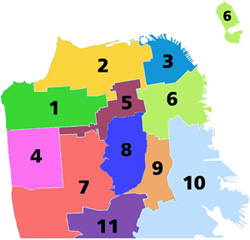
Through whatever accident of politics and geography, San Francisco’s even-numbered districts — five of which will be up for election next fall — haven’t tended to fall in the progressive column. Districts 2 (Marina-Pacific Heights) and 4 (Outer Sunset) are home to the city’s more conservative supervisors, Michela Alioto-Pier and Carmen Chu. District 8 (the Castro) has elected the moderate-centrist Bevan Dufty, and District 10 is represented by Sophie Maxwell, who sometimes sides with the progressives but isn’t considered a solid left vote.

District 6 is different. The South of Market area is among the most liberal-voting parts of San Francisco, and since 2000, Daly has made his mark as a stalwart of the board’s left flank. And while progressive are hoping for victories in districts 8 and 10 — and will be pouring considerable effort and organizing energy into those areas — Daly’s district (like District 5, the Haight/Western Addition; and District 9, Mission/Bernal Heights) ought to be almost a gimme.

But the prospect of three progressive candidates fighting each other for votes — along with the high-profile entry of Human Rights Commission director Theresa Sparks, who is more moderate politically — has a lot of observers scratching their heads.

Is it possible that the progressives, who have only minor disagreements on the major issues, will beat each other up and split the votes enough that one of the city’s more liberal districts could shift from the progressive to the moderate column?

A FORMIDABLE CANDIDATE


A few months ago, District 6 was Debra Walker’s to lose. The Building Inspection Commission member, who has lived in the district for 25 years, has a long history on anti-gentrification issues and strong support in the LGBT community.

Jim Meko, who also has more than a quarter century in the district and chaired the Western SOMA planning task force, was also a progressive candidate but lacked Walker’s name recognition and all-star list of endorsements.

Then rumors began to fly that school board member Jane Kim — who moved into the district a few months ago — was interested in running. Kim has been a leading progressive voice on the school board and has proven she can win a citywide race. She told me she’s thinking seriously about running, but hasn’t decided yet.

Having Kim in the race might not have been a huge issue — in District 9 last year, three strong progressives competed and it was clear that one would be the ultimate winner. But over the past two weeks, Theresa Sparks has emerged as a likely contender — and if she runs, which seems more than likely at this point, she will be a serious candidate.

Sparks picked up the kind of press most potential candidates would die for: a front-page story in SF Weekly and a long, flattering profile in San Francisco magazine, which called her "San Francisco’s most electrifying candidate since Harvey Milk." Sparks does have a compelling personal tale: a transgender woman who began her transition in middle age, survived appalling levels of discrimination, became a civil rights activist and now is seeking to be the first trans person elected to the San Francisco Board of Supervisors.

She has experience in business and politics, served on the Police Commission, and was named a Woman of the Year by the California State Assembly (thanks to her friend Sen. Mark Leno, who would likely support her if she runs).

"Anyone who knows Theresa knows that she is smart, a formidable candidate, can fundraise, and will run a strong race," Robert Haaland, a trans man and labor activist who supports Walker, wrote on a Web posting recently.

She’s also, by most accounts (including her own) a good bit more moderate than Walker, Meko, and Kim.

LAW AND ORDER


Sparks doesn’t define herself with the progressive camp: "I think it’s hard to label myself," she said. "I try to look at each issue independently." Her first major issue, she told me, would be public safety — and there she differs markedly from the progressive candidates. "I was adamantly against cuts to the police department," she said. "I didn’t think this was a good time to reduce our police force."

She said she supported Sup. David Campos’ legislation — which directs local law enforcement agents not to turn immigrant youth over to federal immigration authorities until they’re found guilty by a court — "in concept." But she told me she thinks the bill should have been tougher on "habitual offenders." She also said she supports Police Chief George Gascón’s crackdown on Tenderloin drug sales.

And she starts off with what some call a conflict of interest: Mayor Gavin Newsom just appointed her to the $160,000-a-year post as head of the HRC, and she doesn’t intend to step down or take a leave while she runs. She told me she doesn’t see any problem — she devoted more than 20 hours a week to Police Commission work while holding down another full-time job. "I don’t know why it would be an issue," she said, noting that Emily Murase ran for the school board while working as the director of the city’s Commission on the Status of Women.

But some see it differently. "It would be as if the school superintendent hired someone to a senior job just as that person decided to run for school board," Haaland said.

Sparks’ election would be a landmark victory for trans people. For a community that has been isolated, dismissed, and ignored, her candidacy (like Haaland’s 2004 run in District 5) will inspire and motivate thousands of people. And it’s a tough one for the left — opposing a candidate whose election would mean so much to so many members of one of the city’s most marginalized communities could be painful. "A lot of folks will say that the progressives will never support a transgender candidate," Haaland noted.

But in terms of the city’s geopolitics, it’s also true that electing Sparks would probably move District 6 out of the solidly progressive column.

"If we lose D6, it’s huge," Walker noted. "This is where most of the new development is happening, where law-and-order issues are playing out, where we can hope to save part of the city for a diverse population."

More than that, if progressives lose District 6 and don’t win District 8, it will be almost impossible to override mayoral vetoes and control the legislative agenda. And that’s huge. On issue like tenants rights, preventing evictions, controlling market-rate housing development, advancing a transit-first policy — and raising new revenue instead of cutting programs — the moderates on the board have been overwhelmingly on the wrong side.

Kim, for her part, doesn’t want to talk about the politics of the 2010 elections — except to say that she’s thinking about the race and will probably decide sometime in the next two months. But she agreed with my analysis of how any left candidate should view this election: if she’s going to enter, she needs to present a case that, on the issues that matter, she’d be a better supervisor than either of the two long-term district residents with strong progressive credentials already in the race.

"I don’t have an answer to that now," Kim told me. "And when I make my decision, I will."

Okay, we’ve got numbers

6

By Tim Redmond

And a couple of surprises.

With just the absentee ballots in — traditionally the most conservative votes — Prop. A is cruising to victory. No surprise there — that one was going to win easy.

Prop. B, which would take out of the City Charter the mandate that the supervisors hire no more than two staffers — is actually ahead in the absentees. That’s a big surprise — I suspected that the more conservative voters would buy the argument that the supes will just run wild and hire armies of staffers.

But there’s a message here — people LIKE district elections, and for the most part (while the reputation of legislative bodies in general ain’t that great) people seem to LIKE the San Francisco Board of Supervisors. They seem to realize that the board members have a huge amount of work to do, and need more help to properly serve voth the city and their own districts.

Prop. C, allowing the city to sell naming rights to Candlestick, is winning and will will handily.

Prop. D — the controversial measure to allow electronic billboards in Mid-Market — is losing, narrowly — but as the more progressive votes come in, that will widen and Prop. D will go down.

Oh — City Attorney Dennis Herrera and Treasurer Jose Cisneros are getting re-elected.

In Mexico, a bitter battle over electricity

0

By John Ross

MEXICO CITY — During the first week of October, the increasingly unpopular government of Felipe Calderon stepped up its ongoing war of words against the Mexican Electricity Workers Union (SME), one of the nation’s oldest labor organizations founded at the apogee of the landmark Mexican Revolution in 1914 when workers repeatedly shut down the Canadian-owned Mexican Light & Power Company. Now, with the centennial of the Revolution on deck in 2010, the SME’s survival as a union is in jeopardy and it may never make it to the birthday party.

Following the nationalization of electricity generation and distribution under President Adolfo Lopez Mateos in 1960, the SME (“Esmay”) won collective bargaining agreements for the newly created Luz y Fuerza Del Centro that distributes about a fifth of the nation’s energy to Mexico City and four surrounding states. Mexico’s second power utility, the Federal Electricity Commission (CFE) services the rest of the country and its workers are represented by a “charro” (company) union under the thumb of the Institutional Revolutionary Party (PRI) that ran the lives of Mexicans from the cradle to the grave for 71 years until it was displaced from power by Calderon’s rightist PAN in 2000.

Although the SME had longstanding ties to the PRI, it maintained a modicum of critical independence. Communists and Trotskyists wielded influence in union circles and decorated the walls of the union headquarters with proletarian murals. The Sindicato Mexicano de Electricistas has always been good for 40,000 boots on the ground when it comes to social protest. After the 1985 Mexico City earthquake that took up to 30,000 lives, SME workers rescued victims trapped in the rubble of fallen buildings and worked tirelessly around the clock to restore power in working class colonies. In contrast, the PRI-run government abandoned “los de abajo” (“those down below”) to their own fate.

Three years ago, after hotly contested presidential elections, the SME cautiously lined up with Andres Manuel Lopez Obrador (AMLO) after Calderon was awarded victory over the leftist leader in fraud-marred balloting. Calderon has never forgiven the union’s 66,000 members – 44,000 active workers and 22,000 pensioners – for this partisan sin.

The Monster

0

El Monstruo: Dread & Redemption In Mexico City is a perverse love letter to the most contaminated, crime-ridden, corrupt and conflictive urban stain on the western side of the planet, where I have been touched to live for the past quarter of a century. My life is now hopelessly entangled with the life of this monster of a megalopolis.

El Monstruo was indeed a monstrous book to write. The slagheap of materials that I sucked up — hundreds of volumes of history, slagheaps of newspapers, mountains of personal recollections — fill my threadbare room at the Hotel Isabel in the old quarter of this city from floor to ceiling. The narrative I have assembled spans 50,000,000 years give or take a few minutes, dating from the Paleocene to last spring’s Swine Flu panic with significant stops for the doomed Aztec empire, the war of liberation from Spain, the Mexican revolution of 1910-1919, the student massacres of the ’60s, the Great 1985 earthquake, and the erratic governance of the electoral left for the past 12 years.

It is a long story.

The Mexican Revolution was in many ways a war against Mexico City, a capital for which the rest of the country was named and from which all power continues to radiate. The great revolutionary leaders Emiliano Zapata and Pancho Villa viewed Mexico City as a Sodom & Gomorrah that had to be destroyed if the country was to be redeemed and they did their best to do so. The excerpt that follows speaks to the Monstruo on the eve of the downfall of dictator Porfirio Diaz and the inception of the first great revolution of the landless in the Americas.

WHAT THE LAND WAS LIKE

Back home in Morelos, Emiliano Zapata was elected village leader, entrusted to recover Anenecuilco’s lost lands, granted to the Indians by the Crown in the 17th century. The sugar planters, many of whom were foreigners, had gobbled up the Nahuas’ land and water without remorse.

“Land and Water” was in fact the slogan of Madero ally Vicente Leyva’s campaign for governor of Morelos in 1909 against Díaz’s gallo (rooster), Pablo Escandón, the scion of an immensely wealthy criollo family that had first struck it rich in real estate during Juárez’s Reform, and also a sugar planter who rarely bothered to visit the tiny state. Zapata aligned Anenecuilco’s fortunes with Leyva and Madero. Escandón won by a landslide of course, without ever having to leave El Monstruo. To Zapata, Escandón WAS El Monstruo.

By 1910, 2 percent of all Mexicans owned all the land—save for 70 million hectares held by foreigners with family names like Rockefeller and Hearst and Morgan. One hundred percent of the good farming land in Morelos was occupied by 17 haciendas operated by absentee patrones (bosses). The haciendas sucked up all the groundwater, leaving villages like Anenecuilco dry as a bone. The unequal distribution of water continues a century hence. Wealthy Chilangos have overrun Morelos with their golf courses and palatial second homes, leaving the villages just as thirsty as they were in 1910.

Years ago, I rented a large house in Olintepec, a colonia that shares ejido land (communal farmland) with Anenecuilco, and was able to see how the land must have looked to Zapata when he rode through these fields. I walked out through the tall sugar cane along the irrigation canals to the Caudillo’s humble adobe home, now a museum, on a back street in Anenecuilco, and each young horseman barreling down the country lanes could have been the Caudillo all over again.

But an hour and fifty-five minutes later, when I stepped down off a bus in the belly of the Monstruo, the urban hurly-burly swirling all around me, I always got a whiff of the profound culture shock Emiliano Zapata must have suffered when he was forced to visit this city he so detested.

MADERO’S REVOLUTION

Francisco Madero’s call for the revolution to commence November 20, 1910, stirred sparse response. Up in Puebla, Díaz’s agents murdered Madero’s lieutenant, the revolutionary shoemaker Aquiles Serdán, and his family, two nights before the festivities were slated to kick in. In Morelos, Zapata and the peasant army he had assembled bided their time, waiting to see who would make the first move first.

Mexicans are never on time. Finally, in January, Doroteo Arango AKA Francisco “Pancho” Villa, a popular Chihuahua desperado of Hobsbawmian proportions, and his ruthless cohort Pascual Orozco, declared themselves in revolt and were immediately joined by the Maderista governor of Coahuila, Venustiano Carranza and his “Constitutionalist” Army. Díaz’s Federales were beaten back at Ciudad Guerrero, Mal Paso, and Casas Grandes. Villa laid siege to Ciudad Juárez on the border, the vital railhead that linked Mexico City to the United States and was the lifeblood of the country’s commercial transactions.

By February 1911, with the synchronicity that sometimes made the Mexican Revolution work, the Zapatistas had advanced to Xochimilco. Workers in the heart of the city suffering from what the Porfirian rag El Imparcial tagged ”huelga-manía” or strike fever, declared seven major strikes that paralyzed the Monstruo in 1910–1911. Demonstrators were emboldened enough to assemble in the Zócalo and shout “Death to the Dictator!” beneath Don Porfirio’s balcony by spring. Others menaced his mansion on Cadena Street in the Centro Histórico and were repelled by the gendarmes.

Pablo Escandón fled Mexico for Europe, kvetching to the press that Mexico had fallen into “niggerdom.” Don Porfirio’s class of people was stunned by this threat to their carefree lives and comforts. Indeed, the leisure class had not changed all that much from when the criollos and Gachupines cowered inside the city as Hidalgo’s Indiada advanced on El Monstruo.

After three and a half decades in power, the Dictator remained a figure of adoration in the mansions of La Condesa. For the university students, largely the sons of the ruling class, Don Porfi was the epitome of modernity. To them, Villa and Orozco and Carranza were the Barbarians of the North, Zapata the Attila of the South, and they cast the Dictator as the savior of civilization as they knew it.

But the old man was 81, and it hurt just to keep a stiff upper lip. The medals weighed heavily on his chest. He knew in his heart of hearts what his adorers could not admit—the jig was really up. Ciudad Juárez was days away, even via the modern rail system he had built, and the army’s mobility to supply his troops was restricted. Don Porfiriopochtli, as political cartoonists were drawing him now, had, like the Aztecs, expanded his empire to a point where he could no longer defend it.

In May, the Dictator sent his vice president, Francisco León de la Barra, to the north to negotiate an easy exit to his 34 years on the throne of Mocuhtezuma, and on May 24, 1911, having brokered an agreement with Madero that León de la Barra would remain as provisional president for the next six months, the old man set sail from Puerto, México, for Paris, France, aboard the German steamer Ypringa with this famous caution: “The wild beasts have been loosed. Let us see who will cage them now.”

Wild celebrations broke out in Mexico City as if to underscore the old man’s dictum—15,000 workers invaded the Chamber of Deputies and marched on the National Palace, where the Dictator’s police opened fire, wounding scores. The offices of the Porfirian mouthpiece El Imparcial were set afire. By July, the Monstruo was shut down by a general strike. The wrath of the Mexicans had indeed been loosed, and Madero’s intentions to cage it up again would dictate the next phase of Mexico’s cannibal revolution.

THE GODS ARE SKEPTICAL

After a discreet pause to make sure the old man was really gone, Francisco Madero started off on the long train ride from Ciudad Juárez to Mexico City in early June. There were many treacheries up ahead and he had plenty of time to consider his options as the train lurched from state to state. As he passed through Zacatecas and Aguascalientes, jubilant mobs overran the train depots waving Mexican flags and shouting “¡Vivas!” until they were hoarse and Madero’s train long out of sight.

The presumptive president of Mexico arrived in the capital at Buenavista terminal, the great northern station, on the morning of June 9, and the tumult was overwhelming. Kandell compares it to Juárez’s return to rekindle the republic. I stare at the news photographs. People are excited, even exhilarated. They push and jostle for a view of the little Lenin look-alike. But some are more reserved. They stand back from the jubilant throng. They have come more out of curiosity than conviction. Their faces seem to ask, what next?

From Buenavista, Madero rode through the city in a Dupont motorcar, the sidewalks bursting with well-wishers and flag wavers. Many residents of the metropolis were relieved not so much because of the hope the little man brought with him as for the fact that this change of power had taken place with a minimum of damage to themselves and their city.

When Madero entered the old city for the final jog to the National Palace, he mounted a white horse. In the Palacio, he met with León de la Barra and they reaffirmed their bargain—Porfirio’s stooge would govern for the next six months while Madero campaigned for presidential elections set for November 2. The two emerged on the president’s balcony and “¡Vivas!” erupted from the joyous mob that filled the Zócalo below.

But the old Gods of Tenochtitlán were skeptical about Francisco Madero’s grasp on the presidency. At 6:00 that afternoon they rendered their verdict, upstaging his triumphal arrival in the capital with a deadly earthquake that surged out of the Pacific Ocean along the Jalisco coast and wrought havoc throughout that western state, killing 400 in Zapopan and setting off the Volcano of Colima before smashing into the north of Mexico City and leveling Santa María de la Ribera and San Cosme. There were no Richter scales in those days to measure the quake, but an uncounted number of lives were lost in the capital—perhaps hundreds, reported El Imparcial, which published three extras that day but paid scant attention to Madero’s arrival, burying the story beneath the fold.

Hear Ross read from El Monstruo and sign copies Nov. 18 at Modern Times, 888 Valencia, 7:30 p.m.

Who’s afraid of the angry nativists?

4

Text and photos by Sarah Phelan

Mickeymouse.jpg
Is this man the true face of those who want immigrant kids deported without a chance to prove their innocence?

Yesterday, hundreds showed up to support Sup. David Campos proposal that the city’s sanctuary policy be amended so that only immigrant youth who have actually committed a felony be referred to the feds for deportation. And during the four-hour hearing that ensued, only two people showed up to oppose the Campos amendment.

One of these two opponents is pictured above (forgive the ochre hue, but lighting in the Board chambers is tricky) and he seemed to be slurring his words.

The other described himself as an “openly gay person” and asserted that his sexual orientation is “not a choice.”

“But coming here is in violation of federal law,” this gentleman continued. “As a tax paying resident, I resent my tax dollars being used to settle a claim of the Bologna family, because the city failed to deport Edwin Ramos.”

Kudos to this gentleman, who didn’t share his name, for laying out the nativist argument against giving immigrant kids a chance to prove their innocence. (Especially since no one from the Mayor’s Office showed up to defend Newsom’s policy, which he implemented last July without any public input or notice.)

But as Campos politely pointed out to this gay, tax-paying resident, if the amendment which Campos is proposing was already in place, Ramos would have been deported while he was a youth.

And as others pointed out during yesterday’s hearing, some youth come here to escape persecution for their sexual orientation, others come because their parents brought them when they were very young, others come to send money to their cash-strapped families, and others were born here to undocumented parents and have never set foot in Latin America, even though some folks assume they are undocumented just because they are brown.

But let’s face it, those on the right who oppose the Campos amendment aren’t going to be swayed by reason, not when it comes to banging the drum for a good ol’ wedge issue like immigration, just before the 2010 elections.

Censored!

0

news@sfbg.com

Peter Phillips, director of Project Censored for 13 years, says he’s finished with reform. It’s impossible, he said in a recent interview, to try to get major news media outlets to deliver relevant news stories that serve to strengthen democracy.

"I really think we’re beyond reforming corporate media," said Phillips, a professor of sociology at Sonoma State University and director of Project Censored. "We’re not going to break up these huge conglomerates. We’re just going to make them irrelevant."

Every year since 1976, Project Censored has spotlighted the 25 most significant news stories that were largely ignored or misrepresented by the mainstream press. Now the group is expanding its mission — to promote alternative news sources. But it continues to report the biggest national and international stories that the major media ignored.

The term "censored" doesn’t mean some government agent stood over newsrooms with a rubber stamp and forbid the publication of the news, or even that the information was completely out of the public eye. The stories Project Censored highlights may have run in one or two news outlets, but didn’t get the type of attention they deserved.

The project staff begins by sifting through hundreds of stories nominated by individuals at Sonoma State, where the project is based, as well as 30 affiliated universities all over the country.

Articles are verified, fact-checked, and selected by a team of students, faculty, and evaluators from the wider community, then sent to a panel of national judges to be ranked. The end product is a book, co-edited this year by Phillips and associate director Mickey Huff, that summarizes the top stories, provides in-depth media analysis, and includes resources for readers who are hungry for more substantive reporting.

Project Censored doesn’t just expose gaping holes in the news brought to you by the likes of Fox, CNN, or USA Today — it also shines a light on less prominent but more incisive alternative-media sources serving up in-depth investigations and watchdog reports.

Phillips is stepping down this year as director of Project Censored and turning his attention to a new endeavor called Media Freedom International. The organization will tap academic affiliates from around the world to verify the content put out by independent news outlets as a way to facilitate trust in these lesser-known sources. "The biggest question I got asked for 13 years was, who do you trust?" he explained. "So we’ve really made an effort in the last three years to try to address that question, in a very open way, in a very honest way, and say, these are [the sources] who we can trust."

Benjamin Frymer, a sociology professor at Sonoma State who is stepping into the role of Project Censored director, says he believes the time is ripe for this kind of push. "The actual amount of time people spend reading online is increasing," Frymer pointed out. "It’s not as if people are just cynically rejecting media — they’re reaching out for alternative sources. Project Censored wants to get involved in making those sources visible."

The Project Censored book this year uses the term "truth emergency."

"We call it an emergency because it’s a democratic emergency," Huff asserted. In this media climate, "we’re awash in a sea of information," he said. "But we have a paucity of understanding about what the truth is."

The top 25 Project Censored stories of 2008-09 highlight the same theme that Phillips and Huff say has triggered the downslide of mainstream media: the overwhelming influence of powerful, profit-driven interests. The No. 1 story details the financial sector’s hefty campaign contributions to key members of Congress leading up to the financial crisis, which coincided with a weakening of federal banking regulations. Another story points out that in even in the financial tumult following the economic downturn, special interests spent more money on Washington lobbyists than ever before.

Here’s this year’s list.

1. CONGRESS SELLS OUT TO WALL STREET


The total tab for the Wall Street bailout, including money spent and promised by the U.S. government, works out to an estimated $42,000 for every man, woman, and child, according to American Casino, a documentary about sub prime lending and the financial meltdown. The predatory lending free-for-all, the emergency pumping of taxpayer dollars to prop up mega banks, and the lavish bonuses handed out to Wall Street executives in the aftermath are all issues that have dominated news headlines.

But another twist in the story received scant attention from the mainstream news media: the unsettling combination of lax oversight from national politicians with high-dollar campaign contributions from financial players.

"The worldwide economic meltdown and the bailout that followed were together a kind of revolution, a coup d’état," Matt Taibbi wrote in "The Big Takeover," a March 2009 Rolling Stone article. "They cemented and formalized a political trend that has been snowballing for decades: the gradual takeover of the government by a small class of connected insiders who used money to control elections, buy influence, and systematically weaken financial regulations."

In the 10-year period beginning in 1998, the financial sector spent $1.7 billion on federal campaign contributions, and another $3.4 billion on lobbyists. Since 2001, eight of the most troubled firms have donated $64.2 million to congressional candidates, presidential candidates, and the Republican and Democratic parties.

Wall Street’s spending spree on political contributions coincided with a weakening of federal banking regulations, which in turn created a recipe for the astronomical financial disaster that sent the global economy reeling.

Sources: "Lax Oversight? Maybe $64 Million to DC Pols Explains It," Greg Gordon, Truthout.org and McClatchey Newspapers, October 2, 2008; "Congressmen Hear from TARP Recipients Who Funded Their Campaigns," Lindsay Renick Mayer, Capitol Eye, February 10, 2009; "The Big Takeover," Matt Taibbi, Rolling Stone, March 2009.

2. DE FACTO SEGREGATION DEEPENING IN PUBLIC EDUCATION


Latinos and African Americans attend more segregated public schools today than they have for four decades, Professor Gary Orfield notes in "Reviving the Goal of an Integrated Society: A 21st Century Challenge," a study conducted by UCLA’s Civil Rights Project. Orfield’s report used federal data to highlight deepening segregation in public education by race and poverty.

About 44 percent of students in the nation’s public school system are people of color, and this group will soon make up the majority of the population in the U.S. Yet this racial diversity often isn’t reflected from school to school. Instead, two out of every five African American and Latino youths attend schools Orfield characterizes as "intensely segregated," composed of 90 percent to 100 percent people of color.

For Latinos, the trend reflects growing residential segregation. For African Americans, the study attributes a significant part of the reversal to ending desegregation plans in public schools nationwide. Schools segregated by race and poverty tend to have much higher dropout rates, more teacher turnover, and greater exposure to crime and gangs, placing students at a major disadvantage in society. The most severe segregation is in Western states, including California.

Fifty-five years after the Supreme Court’s Brown vs. Board of Education ruling, Orfield wrote, "Segregation is fast spreading into large sectors of suburbia, and there is little or no assistance for communities wishing to resist the pressures of resegregation and ghetto creation in order to build successfully integrated schools and neighborhoods."

Source: "Reviving the Goal of an Integrated Society: A 21st Century Challenge," Gary Orfield, The Civil Rights Project, UCLA, January 2009

3. SOMALI PIRATES: THE UNTOLD STORY


Somali pirates off the Horn of Africa were like gold for mainstream news outlets this past year. Stories describing surprise attacks on shipping vessels, daring rescues, and cadres of ragtag bandits extracting multimillion dollar ransoms were all over the airwaves and front pages.

But even as the pirates’ exploits around the Gulf of Aden captured the world’s attention, little ink was devoted to factors that made the Somalis desperate enough to resort to piracy in the first place: the dumping of nuclear waste and rampant over-fishing their coastal waters.

In the early 1990s, when Somalia’s government collapsed, foreign interests began swooping into unguarded coastal waters to trawl for food — and venturing into unprotected Somali territories to cheaply dispose of nuclear waste. Those activities continued with impunity for years. The ramifications of toxic dumping hit full force with the 2005 tsunami, when leaking barrels were washed ashore, sickening hundreds and causing birth defects in newborn infants. Meanwhile, the uncontrolled fishing harvests damaged the economic livelihoods of Somali fishermen and eroded the country’s supply of a primary food source. That’s when the piracy began.

"Did we expect starving Somalians to stand passively on their beaches, paddling in our nuclear waste, and watch us snatch their fish to eat in restaurants in London and Paris and Rome?" asked journalist Johann Hari in a Huffington Post article. "We didn’t act on those crimes — but when some of the fishermen responded by disrupting the transit-corridor for 20 percent of the world’s oil supply, we begin to shriek about ‘evil.’"

Sources: "Toxic waste behind Somali piracy," Najad Abdullahi, Al Jazeera English, Oct. 11, 2008; "You are being lied to about pirates," Johann Hari, The Huffington Post, Jan. 4, 2009; "The Two Piracies in Somalia: Why the World Ignores the Other," Mohamed Abshir Waldo, WardheerNews, Jan. 8, 2009

4. NORTH CAROLINA’S NUCLEAR NIGHTMARE


The Shearon Harris nuclear plant in North Carolina’s Wake County isn’t just a power-generating station. The Progress Energy plant, located in a backwoods area, bears the distinction of housing the largest radioactive-waste storage pools in the country. Spent fuel rods from two other nuclear plants are transported there by rail, then stored beneath circuutf8g cold water to prevent the radioactive waste from heating.

The hidden danger, according to investigative reporter Jeffery St. Clair, is the looming threat of a pool fire. Citing a study by Brookhaven National Laboratory, St. Clair highlighted in Counterpunch the catastrophe that could ensue if a pool were to ignite. A possible 140,000 people could wind up with cancer. Contamination could stretch for thousands of square miles. And damages could reach an estimated $500 billion.

"Spent fuel recently discharged from a reactor could heat up relatively rapidly and catch fire," Robert Alvarez, a former Department of Energy advisor and Senior Scholar at the Institute for Policy Studies noted in a study about safety issues surrounding nuclear waste pools. "The fire could well spread to older fuel. The long-term contamination consequences of such an event could be significantly worse than Chernobyl."

Shearon Harris’ track record is pocked with problems requiring temporary shutdowns of the plant and malfunctions of the facility’s emergency-warning system.

When a study was sent to the Nuclear Regulatory Commission highlighting the safety risks and recommending technological fixes to address the problem, St. Clair noted, a pro-nuclear commissioner successfully persuaded the agency to dismiss the concerns.

Source: "Pools of Fire," Jeffrey St. Clair, CounterPunch, Aug. 9, 2008

5. U.S. FAILS TO PROTECT CONSUMERS AGAINST TOXICS


Two years ago, the European Union enacted a bold new environmental policy requiring close scrutiny and restriction of toxic chemicals used in everyday products. Invisible perils such as lead in lipstick, endocrine disruptors in baby toys, and mercury in electronics can threaten human health. The European legislation aimed to gradually phase out these toxic materials and replace them with safer alternatives.

The story that has gone unreported by mainstream American news media is how this game-changing legislation might affect the U.S., where chemical corporations use lobbying muscle to ensure comparatively lax oversight of toxic substances. As global markets shift to favor safer consumer products, the U.S. Environmental Protection Agency is lagging in its own scrutiny of insidious chemicals.

As investigative journalist Mark Schapiro pointed out in Exposed: The Toxic Chemistry of Everyday Products and What’s at Stake for American Power, the EPA’s tendency to behave as if it were beholden to big business could backfire in this case, placing U.S. companies at a competitive disadvantage because products manufactured here will be regarded with increasing distrust.

Economics aside, the implications of loose restrictions on toxic products are chilling: just one-third of the 267 chemicals on the EU’s watch list have ever been tested by the EPA, and only two are regulated under federal law. Meanwhile, researchers at UC Berkeley estimate that 42 billion pounds of chemicals enter American commerce daily, and only a fraction have undergone risk assessments. When it comes to meeting the safer, more stringent EU standard, the stakes are high — with consequences including economic impacts as well as public health.

Sources: "European Chemical Clampdown Reaches Across Atlantic," David Biello, Scientific American, Sept. 30, 2008; "How Europe’s New Chemical Rules Affect U.S.," Environmental Defense Fund, Sept. 30, 2008; "U.S. Lags Behind Europe in Reguutf8g Toxicity of Everyday Products," Mark Schapiro, Democracy Now! Feb. 24, 2009

6. AS ECONOMY SHRINKS, D.C. LOBBYING GROWS


In 2008, as the economy tumbled and unemployment soared, Washington lobbyists working for special interests were paid $3.2 billion — more than any other year on record. According to the Center for Responsive Politics, special interests spent a collective $32,523 per legislator, per day, for every day Congress was in session.

One event that triggered the lobbying boom, according to CRP director Sheila Krumholz, was the federal bailout — with the federal government ensuring that the lobbyists got a piece of the pie. Ironically, some of the first in line were the same players who helped precipitate the nation’s sharp economic downturn by engaging in high-risk, speculative lending practices.

"Even though some financial, insurance and real estate interests pulled back last year, they still managed to spend more than $450 million as a sector to lobby policymakers," Krumholz noted. "That can buy a lot of influence, and it’s a fraction of what the financial sector is reaping in return through the government’s bailout program."

The list of highest-ranking spenders on Washington lobbying reads like a roster of some of the most powerful interests nationwide. Topping the list was the health sector, which spent $478.5 million lobbying Congress last year. A close runner-up was the finance, insurance, and real-estate sector, spending $453.5 million. Pharmaceutical companies plunked down $230 million; electric utilities spent $156.7 million; and oil and gas companies paid lobbyists $133.2 million.

Source: "Washington Lobbying Grew to $3.2 Billion Last Year, Despite Economy," Center for Responsive Politics, Open Secrets.org

7. OBAMA’S CONTROVERSIAL DEFENSE APPOINTEES


President Barack Obama’s appointments to the Department of Defense have raised serious questions among critics who’ve studied their track records. Although the news media haven’t paid much attention, the defense appointees bring to the administration controversial histories and conflicts of interest due to close ties to defense contractors.

Obama’s decision to retain Robert Gates, Secretary of Defense under President George W. Bush, marks the first time in history that a president has opted to keep a defense secretary of an outgoing opposing party in power.

Gates, a former CIA director, has faced criticism for allegedly spinning intelligence reports for political means. In Failure of Intelligence: The Decline and Fall of the CIA, author and former CIA analyst Melvin Goodman described him as "the chief action officer for the Reagan administration’s drive to tailor intelligence reporting to White House political desires." Gates also came under scrutiny for questions surrounding whether he misled Congress during the Iran-contra scandal in the mid-1980s, and was accused of withholding information from intelligence committees when the U.S. provided military aid to Saddam Hussein during the Iran-Iraq war.

Critics are also uneasy about the appointment of Deputy Defense Secretary William Lynn, who formerly served as a senior vice president at defense giant Raytheon Company and was a registered lobbyist for Raytheon until July 2008. Lynn, who previously served as Pentagon comptroller under the Clinton administration, came under fire during his confirmation hearing for "questionable accounting practices." The Defense Department failed multiple audits under Lynn’s leadership because it was unable to properly account for $3.4 trillion in financial transactions made over the course of several years.

Sources: "The Danger of Keeping Robert Gates," Robert Parry, ConsortiumNews.com, Nov. 13, 2008; "Obama’s Defense Department Appointees- The $3.4 Trillion Question," Andrew Hughes, Global Research, Feb. 13, 2009; "Obama Nominee Admiral Dennis Blair Aided perpetrators of 1999 church Killings in East Timor," Allan Nairn, Democracy Now! Jan. 7, 2009; "Ties to Chevron, Boeing Raise Concern on Possible NSA Pick," Roxana Tiron, The Hill, Nov. 24, 2008


8. BIG BUSINESS CHEATS THE IRS


The Cayman Islands and Bermuda are magnets for Bank of America, Citigroup, American International Group, and 11 other financial giants that were the beneficiaries of the federal government’s 2008 Wall Street bailout. It’s not the balmy weather that inspires some of America’s wealthiest companies to open operations in the Caribbean archipelago: the offshore oases provide safe harbors to stash cash out of the reach of Uncle Sam.

According to a 2008 report by the Government Accountability Office, which was largely ignored by the news media, 83 of the top publicly-held U.S. companies, including some receiving substantial portions of federal bailout dollars, have operations in tax havens that allow them to avoid paying their fair share to the Internal Revenue Service. The report also spotlighted the activities of Union Bank of Switzerland (UBS), which has helped wealthy Americans to use tax schemes to cheat the IRS out of billions.

In December 2008, banking giant Goldman Sachs reported its first quarterly loss, and promptly followed up with a statement that its tax rate would drop from 34.1 percent to 1 percent, citing "changes in geographic earnings mix" as the reason. The difference: instead of paying $6 billion in total worldwide taxes as it did in 2007, Goldman Sachs would pay a total of $14 million in 2008. In the same year, it received $10 billion and debt guarantees from the U.S. government.

"The problem is larger than Goldman Sachs," U.S. Representative Lloyd Doggett, a Texas Democrat who serves on the tax-writing House Ways and Means Committee, told Bloomberg News. "With the right hand out begging for bailout money, the left is hiding it offshore."

Sources: "Goldman Sachs’s Tax Rate Drops to 1 percent or $14 Million," Christine Harper, Bloomberg News, Dec. 16, 2008; "Gimme Shelter: Tax Evasion and the Obama Administration," Thomas B. Edsall, The Huffington Post, Feb. 23, 2009

9. U.S. CONNECTED TO WHITE PHOSPHOROUS STRIKES IN GAZA


In mid-January, as part of a military campaign, the Israeli Defense Forces fired several shells that hit the headquarters of a United Nations relief agency in Gaza City, destroying provisions for basic aid like food and medicine.

The shells contained white phosphorous (referred to as "Willy Pete" in military slang), a smoke-producing, spontaneously flammable agent designed to obscure battle territory that also can ignite buildings or cause grotesque burns if it touches the skin.

The attack on the relief-agency headquarters is just one example of a civilian structure that researchers discovered had been hit during the January air strikes. In the aftermath of the attacks, Human Rights Watch volunteers found spent white phosphorous shells on city streets, apartment roofs, residential courtyards, and at a U.N. school in Gaza.

Human Rights Watch says the IDF’s use of white phosphorous violated international law, which prohibits deliberate, indiscriminate, or disproportionate attacks that result in civilian casualties. After gathering evidence such as spent shells, the organization issued a report condemning the repeated firing of white phosphorus shells over densely populated areas of Gaza as a war crime. Amnesty International, another human rights organization, followed suit by calling upon the United States to suspend military aid to Israel — but to no avail.

The U.S. was a primary source of funding and weaponry for Israel’s military campaign. Washington provided F-16 fighter planes, Apache helicopters, tactical missiles, and a wide array of munitions, including white phosphorus.

Sources: "White Phosphorus Use Evidence of War Crimes Report: Rain of Fire: Israel’s Unlawful Use of White Phosphorus in Gaza," Fred Abrahams, Human Rights Watch, March 25, 2009; "Suspend Military Aid to Israel, Amnesty Urges Obama after Detailing U.S. Weapons Used in Gaza," Rory McCarthy, Guardian/U.K., Feb. 23, 2009; "U.S. Weaponry Facilitates Killings in Gaza," Thalif Deen, Inter Press Service, Jan. 8, 2009; "U.S. military resupplying Israel with ammunition through Greece," Saed Bannoura, International Middle East Media Center News, Jan. 8, 2009.

10. ECUADOR SAYS IT WON’T PAY ILLEGITIMATE DEBT


When President Rafael Correa announced that Ecuador would default on its foreign debt last December, he didn’t say it was because the Latin American country was unable to pay. Rather, he framed it as a moral stand: "As president, I couldn’t allow us to keep paying a debt that was obviously immoral and illegitimate," Correa told an international news agency. The news was mainly reported in financial publications, and the stories tended to quote harsh critics who characterized Correa as an extreme leftist with ties to Venezuelan President Hugo Chavez.

But there’s much more to the story. The announcement came in the wake of an exhaustive audit of Ecuador’s debt, conducted under Correa’s direction by a newly created debt audit commission. The unprecedented audit documented hundreds of allegations of irregularity and illegality in the decades of debt collection from international lenders. Although Ecuador had made payments exceeding the value of the principal since the time it initially took out loans in the 1970s, its foreign debt had nonetheless swelled to levels three times as high due to extraordinarily high interest rates. With a huge percentage of the country’s financial resources devoted to paying the debt, little was left over to combat poverty in Ecuador.

Correa’s move to stand up against foreign lenders did not go unnoticed by other impoverished, debt-ridden nations, and the decision could set a precedent for developing countries struggling to get out from under massive debt obligation to first-world lenders.

Ecuador eventually agreed to a restructuring of its debt at about 35 cents on the dollar. Nonetheless, the move served to expose deficiencies in the World Bank system, which provides little recourse for countries to resolve disputes over potentially illegitimate debt.

Sources: "As Crisis Mounts, Ecuador Declares Foreign Debt Illegitimate and Illegal," Daniel Denvir, Alternet, November 26, 2008; "Invalid Loans to Ecuador: Who Owes Who," Committee for the Integral Audit of Public Credit, Utube, Fall 2008; "Ecuador’s Debt Default," Neil Watkins and Sarah Anders, Foreign Policy in Focus, Dec. 15, 2008

——–

OTHER STORIES IN THE TOP 25

11. Private Corporations Profit from the Occupation of Palestine

12. Mysterious Death of Mike Connell—Karl Rove’s Election Thief

13. Katrina’s Hidden Race War

14. Congress Invested in Defense Contracts

15. World Bank’s Carbon Trade Fiasco

16. US Repression of Haiti Continues

17. The ICC Facilitates US Covert War in Sudan

18. Ecuador’s Constitutional Rights of Nature

19. Bank Bailout Recipients Spent to Defeat Labor

20. Secret Control of the Presidential Debates

21. Recession Causes States to Cut Welfare

22. Obama’s Trilateral Commission Team

23. Activists Slam World Water Forum as a Corporate-Driven Fraud

24. Dollar Glut Finances US Military Expansion

25. Fast Track Oil Exploitation in Western Amazon

Read them all at www.projectcensored.org