Election

Pride Board locks out press, protesters at public comment meeting

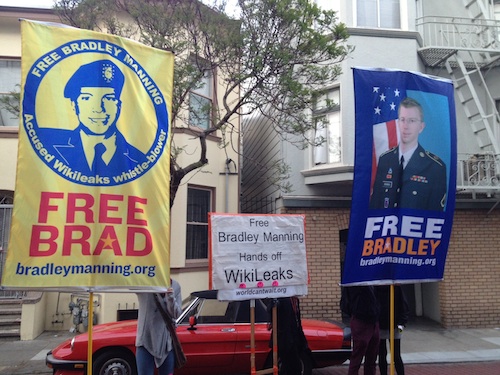
“Let the press in! Let the press in!” the crowd of about 50-60 Bradley Manning for Grand Marshal supporters chanted yesterday evening at 7pm, packed into the lobby of the Golden Gate Business Association on Pearl Street, after being denied entrance to the elevator leading to the Pride Board meeting on the fourth floor. A hired security guard held the crowd, which included reporters from KTVU and KQED, back and the elevator doors closed for the last time as “No cameras, no justice!” filled the air. 

The word came via the significant police presence outside the building (officers were also posted outside the building’s stairwell) that only 15 people at a time were being allowed into the board meeting, which was held to accept “public comment” on the Bradley manning controversy. The meeting was also supposedly held to address any questions about its official statement, released yesterday afternoon, rescinding Manning’s election as Grand Marshal because he was “not local.”

No one there, it was clear, was getting in. 

Safety hazards were cited. Surely, some protesters put forth, the Pride Board knew it would need a bigger space to address the community’s concern — like, say, the LGBT Community Center across the street? 

Scene inside the lobby after being denied entrance to the Pride Board public comment meeting

(Blogger Michael Petrellis did manage to get into the sparsely occupied meeting by arriving early and begging to use the bathroom. You can read his report here.)

Among the protesters outside were Daniel Ellsberg of Pentagon Papers fame, who spoke eloquently at a previous demonstration defending Manning. (He eventually made it into the meeting, along with a few other high-profile community representatives like Gary Virginia, Carol Queen, Starchild, Lisa Geduldig, and Rainey Reitman of the Bradley Manning Support Network.) Also present outside were members of Code Pink, ACT UP/SF, and the Gray Panthers.

Waiting on the street was attorney David Waggoner, who that day had filed an official discrimination complaint with the city’s Human Rights Commission. The complaint alleges that “the Pride Board syomped on the moral convictions of the grand marshals who voted for Manning. SF Pride — a recipient of City funding — is not allowed to discriminate against people just because they don’t like their moral support of Manning.”

The Pride Board ended its meeting early, and a representative said that it would plan another in a more appropriate — hopefully meaning bigger — venue. 

As usual, queer activist Tommi Avicolli Mecca put everything into perspective.

“I know it’s 40 years ago and I’m old, but I was at the first Gay Freedom march in Philadelphia in 1972 — and we were oficially protesting the war in Vietnam. How did we come to this — standing outside the corporate offices of Pride and shouting for them to let a military protestor, from the military itself, into their parade — into our parade?”

As the Manning supporters took to the streets and shouted “You say court martial, we say grand marshal!” from the nearby F-Market stop, Patricia Jackson, convener of the Gray Panthers, added:

“If Pride is about inclusion, how can they shut us out — of the meeting, of the conversation? The only way to heal any divide in a community is to accept that people have different views, and make things bigger than that.”  

Pride Board statement: Manning “not local,” controversy “not our mission”

20

Here’s the official statement just issued by the Pride SF Board about the Bradley Manning grand marshal fiasco, “clarifying” its bizarre rules (“Under longstanding policy, the community grand marshal upon whom the Electoral College votes is defined as ‘a local hero (individual) not being a celebrity'”), and directing the electoral college to vote for one of “two, duly qualified nominees for the 2013 Community Grand Marshal: Bebe Sweetbriar and Associate Justice Jim Humes.”

(Poor singing drag queen BeBe Sweetbriardespite her incredible productivity, even Pride doesn’t think she’s a celebrity! We still love you, Beebs.)

The statement also engages in a gross bit of condescencion.

“Those that nominated Mr. Manning surely knew that he is not a local, Bay Area community member, and that he should not have been voted on by the Electoral College. His nomination is more appropriately debated and voted on by the public than by a small group, and it could be next year when nominations open…. Taking sides in the controversy concerning Mr. Manning’s conduct is not appropriate for the organization and falls outside its core mission. We apologize to Mr. Manning, knowing that he did not ask to be at the center of a community firestorm, and for any harsh words that may have been said about him.”

Because the core mission of Pride, of course, is not to take a side in any controversy ever. Except gays in the military. And whether the Altoids float should come before or after PFLAG. Tell us, SF Pride: does Bud Light taste great, or is it less filling? We’ll have to wait until the end of time for an answer.

I’ll be asking the Pride Board about this statement tonight at its public meeting (7pm at 30 Pearl St., Fourth Floor). Stay tuned.


“For the past four decades, SF Pride has stood firmly to advance its mission to educate the world about LGBT issues, commemorate LGBT heritage, celebrate LGBT culture, and liberate LGBT people.  It remains a considerable honor and utmost commitment to engage the community to recognize those persons who have positively advanced the LGBT liberation movement, representing the full spectrum of contributions to advance full equality for all.

Presenting various categories and criteria for annual parade grand marshal nominees offers SF Pride and the community a broad range of opportunities to recognize and honor a diverse range of individuals and organizations for their achievements on behalf of LGBT people. Grand Marshal Categories include Celebrity, Lifetime Achievement, Organizational, Community, Special Guests, and Pink Brick.

The SF Pride Board recognizes and regrets the recent error in the announcement of Mr. Bradley Manning as the Electoral College’s Community Grand Marshal.  The Electoral College was not the appropriate forum for his nomination. The longstanding Grand Marshal Policy provides that one community grand marshal shall be elected by an electoral college composed of Community Grand and Honorary Marshals elected or appointed since 1999. Grand Marshal/Pink Brick Policy, Sections 3.3 and 5.2.3.  Under that longstanding policy, the community grand marshal upon whom the Electoral College votes is defined as “a local hero (individual) not being a celebrity.” Grand Marshal/Pink Brick Policy, Section 5.2.3.

Because Mr. Manning is not local, by definition under the Grand Marshal policy, he may not be nominated or elected by the Electoral College as its community grand marshal. The SF Pride Board determined that because the nomination and election had been conducted in the incorrect forum, the election could not be upheld as valid. Mr. Manning might rightfully qualify as a nominee for Celebrity Grand Marshal or another community grand marshal spot, but not as the Electoral College’s nominee, as a matter of longstanding, written policy.

The integrity of the elections process and procedures are important to SF Pride and the community. Those that nominated Mr. Manning surely knew that he is not a local, Bay Area community member, and that he should not have been voted on by the Electoral College.  His nomination is more appropriately debated and voted on by the public than by a small group, and it could be next year when nominations open.

Taking sides in the controversy concerning Mr. Manning’s conduct is not appropriate for the organization and falls outside its core mission. We apologize to Mr. Manning, knowing that he did not ask to be at the center of a community firestorm, and for any harsh words that may have been said about him. In the end, SF Pride recognizes that becoming embroiled in the controversy concerning the merit of Mr. Manning’s conduct was an honest mistake. However, because the Grand Marshal/Pink Brick policy precludes Mr. Manning from being nominated for, or elected as a community grand marshal by the Electoral College, SF Pride stands by his disqualification on those unequivocal policy grounds.

Moving forward, in the spirit of fairness and to respectfully honor the contributions of qualified nominees, the SF Pride Board is re-opening the Electoral College’s voting process so that it may select a Community Grand Marshal from the remaining two, duly qualified nominees for the 2013 Community Grand Marshal: Bebe Sweetbriar and Associate Justice Jim Humes. Members of the Electoral College will have until May 16 to re-cast their vote. 

Starting on Wednesday, May 8, ballots will be sent to the Electoral College both by email and snail mail. Votes can be cast by either email or postal mail to the SF Pride offices at 1841 Market Street, 4th Floor, San Francisco, CA 94103; Att: Electoral Voting.  Votes must be cast by 5pm PST on Thursday, May 16.  The elected Grand Marshal will be announced by noon the following day, Friday, May 17.  The SF Pride Board of Directors appreciates the support of concerned members of the community. These matters have been sorted out towards a fair resolution.  We encourage all former Community and Honorary Grand Marshals in the Electoral College to participate in this extended opportunity to select a qualified Community Grand Marshal for the 2013 Parade and Celebration.

Shortly before this statement was released, SF Pride received a complaint filed against it at the San Francisco Human Rights Commission concerning Mr. Manning.  This statement is not a response to that complaint, and SF Pride will be responding to that complaint in the proper forum, not in the press and/or at board meetings.”

Don’t vent, organize and “primary” a Democrat near you

5

By Norman Solomon

Norman Solomon is co-founder of RootsAction.org and founding director of the Institute for Public Accuracy. His books include “War Made Easy: How Presidents and Pundits Keep Spinning Us to Death.” He writes the Political Culture 2013 column.

Progressives often wonder why so many Republican lawmakers stick to their avowed principles while so many Democratic lawmakers abandon theirs. We can grasp some answers by assessing the current nationwide drive called “Primary My Congressman” — a case study of how right-wing forces gain ground in electoral terrain where progressives fear to tread.

Sponsored by Club for Growth Action, the “Primary My Congressman” effort aims to replace “moderate Republicans” with “economic conservatives” — in other words, GOP hardliners even more devoted to boosting corporate power and dismantling the public sector. “In districts that are heavily Republican,” the group says, “there are literally dozens of missed opportunities to elect real fiscal conservatives to Congress — not more ‘moderates’ who will compromise with Democrats. . .”

Such threats of serious primary challenges often cause the targeted incumbents to quickly veer rightward, or they may never get through the next Republican primary.

Progressive activists and organizations could launch similar primary challenges, but — to the delight of the Democratic Party establishment — they rarely do. Why not?

Here are some key reasons:

*  Undue deference to elected Democrats.

Members of Congress and other elected officials deserve only the respect they earn. All too often, for example, plenty of Congressional Progressive Caucus members represent the interests of the establishment to progressives rather than the other way around. 

*  Treating election campaigns more like impulse items than work that requires long-term planning and grassroots follow-through.

The same progressives who’ve spent years planning, launching and sustaining a wide range of community projects are apt to jump into election campaigns with scant lead time. Progressives need to build electoral capacity for the long haul, implementing well-planned strategic campaigns with candidates who come out of social movements and have a plausible chance to win on behalf of those movements.

*  Assuming that millions of dollars are necessary to win.

Yes, successful campaigns require effective fundraising — but money is often a less significant obstacle than a shortage of commitment and willingness to do painstaking grassroots organizing.

*  Self-marginalization by ignoring elections.

Some on the left prefer to stay out of electoral contests while focusing on the next protest demonstration — thus leaving the electoral field to battles between corporate Democrats and Republicans. One sure result: a progressive won’t win.

*  Self-marginalization with third-party efforts in partisan races.

In congressional races, Green Party and other progressive third-party candidates have a zero record of success in our lifetimes. In other races with party affiliations also on the ballot (such as governor and state legislature), victories have been almost nonexistent. In such races, the corporate-military complex is not in the slightest threatened by third-party candidates, who rarely get higher than a low single-digit percentage of the vote. In nonpartisan races, by contrast, there are examples of successful and uplifting campaigns by third-party candidates, as with Green Party member Gayle McLaughlin, the mayor of Richmond, California. 

By changing just a few words in the Club for Growth’s “Primary My Congressman” manifesto, progressives have a road map for electoral progress: In districts that are heavily Democratic, there are literally dozens of missed opportunities to elect real progressives to Congress — not more of those who go along with the Obama White House as it keeps compromising with Republicans.

Anyone serious about getting genuine progressives elected to Congress next year should be engaged in developing campaigns now. To avoid the impulse-item syndrome, that means identifying key races where progressives have a real chance to win, while remaining mindful that election campaigns should be subsets of social movements and not the other way around.

If there’s a defining issue that now separates the Obama party leadership from social decency, it is the president’s push to cut Social Security benefits. Less ballyhooed but also crucial is his push to cut Medicare benefits and the ever-present danger of cuts to already woefully-underfunded Medicaid. Meanwhile, Democratic leaders are unwilling to seriously cut the enormous military budget.

Any incumbent Democrat who is not serving progressive interests should be weighed as a possible primary target. And the most fruitful primary challenges are beckoning in heavily Democratic districts where there are many progressive voters and incumbents aren’t measuring up.

By that standard, the Congress members who may be vulnerable to a primary challenge include the 44 who tout their membership in the Progressive Caucus but have refused to sign the letter (initiated by Congressmen Alan Grayson and Mark Takano) promising not to vote to cut Social Security, Medicare or Medicaid benefits.

A good starting point to consider launching a primary challenge in your area would be to look at those 44 members of Congress who continue to refuse to make such a promise, leaving themselves wiggle room to vote for cuts in three crucial programs of the social compact. To see the list of those self-described “progressives,” click here. (Meanwhile, wherever you live, you can let your Congress member and senators know what you think of proposals for such cuts by clicking here.)

It’s fair to say those 44 members of Congress are among the many Democratic incumbents showing themselves to be more afraid of the Obama White House and the Democratic Party hierarchy than they are of voters in their own districts. Progressives in and around those districts need to do less venting and more organizing.

Norman Solomon is co-founder of RootsAction.org and founding director of the Institute for Public Accuracy. His books include “War Made Easy: How Presidents and Pundits Keep Spinning Us to Death.” He writes the Political Culture 2013 column.


Tech Bubble 2.0

58

OPINION We all remember the first dot-com bubble, right? Web technology start-ups flocked to San Francisco in the late 1990s. Thousands of would-be entrepreneurs and techies filled up the city. Gentrification of Central City neighborhoods accelerated sharply. Apartment rents jumped, followed by the condo boom. Demand for commercial office space, especially South of Market, quickly grew red-hot. Rents zoomed, and office developers rushed dozens of proposed new projects forward.

The leaders of Mayor Willie Brown’s gutless Planning Department rubber-stamped all they could, and decried the annual limit imposed on their approvals by the 1986 community-activist-sponsored Proposition M ballot measure.

The activists and the mayor put two competing measures on the November 2000 ballot in response. Both lost, but the progressive slate for the Board of Supervisors swept that election, defeating most of the mayor’s candidates.

And then Tech Bubble 1.0 popped. The peak year was 2000. The big dot-com bust, 9/11, and finally the Great Recession all followed.

The city’s office market crashed. Some new office buildings were foreclosed by their lenders. Many approved office developments went unbuilt. Overall office market vacancies approached 20 percent by 2010.

Ah, but here we go again — Tech Bubble 2.0! A new wave of recent technology industry start-ups — like Twitter and Yelp — are joining the growing survivors of Bubble Number 1 — like Salesforce. And San Francisco has become a premiere national media venue for the tech industry.

Thousands of would-be entrepreneurs and techies are again filling up the city. Apartment rents are going through the roof. Gentrification of Central City neighborhoods is accelerating even faster. Demand for commercial office space, still in SoMa, is red-hot again.

But by 2011 so much vacant space was on the market, and so many approved buildings were waiting for anchor tenants to start construction, that there has been room for them all so far. Several new buildings got underway. Mayor Ed Lee strategically took advantage of this market boom to target economic expansion to the Central Market District, the last disinvested zone of San Francisco’s Downtown.

Even today though, city office vacancies still exceed 5 percent. And according to the most recent Planning Department report, more than a dozen already-approved new buildings, totaling more than 4.5 million square feet, are waiting to start construction in the Transbay Transit District, South of Market, and Mission Bay. Another 5 million feet of office space is proposed for more than a dozen more pipeline projects for those areas. Plus another 2.5 million feet is planned for projects on Port property — including the San Francisco Giant’s huge project — that are not even on the Planning Department’s list yet!

How does this total of 12 million square feet of pending new San Francisco office buildings compare to historic demand? Going back to 1986, the amount of new office space actually built — true long-term market demand through the boom/bust business cycles — averages out to about only 750,000 square feet a year. The city’s old-school corporate headquarters dramatically downsized or even moved out of San Francisco — like Chevron and Bank of America — and that’s still ongoing. The new tech industry is mostly replacing them. So these 30+ identifiable current projects would provide a 16-year supply of office space at historic rates.

But even in the face of this evident market glut of future office buildings, the usual civic development hypsters are once again muttering about gutting Proposition M, and radically upzoning Soma for even greater office expansion. Is that who City Hall will listen to this time too?

Bubble? What Bubble? [Pop!]

John Elberling is executive director of the Tenants and Owners Development Corporation.

Mayor Lee’s mysterious breakfast companions [UPDATED]

See an update to this story below. San Francisco Mayor Ed Lee has been having breakfast with CEOs to seek millions in funding for the America’s Cup, but the identities of those CEOs remain a mystery.

At a City Hall hearing two weeks ago, America’s Cup Organizing Committee chief Kyri McClellan told supervisors that Lee has been “putting an incredible amount of energy” into fundraising to cover city costs for the America’s Cup. As the yacht race draws closer, pressure is building around an anticipated funding shortfall that could deal a blow to city coffers.

McClellan told supervisors that Lee was “holding breakfasts with CEOs” to raise money. Encouragingly, she added, “people are responding.”

So, who are the CEOs? And how much have they agreed to contribute? So far, nobody has disclosed that information.

Shortly after the hearing, the Guardian submitted a public records request to Lee’s office seeking documentation on the fundraising breakfasts and records showing the names and affiliations of the CEOs.

In response, we received several pages from the mayor’s calendar. Entries show that Lee held half a dozen meetings concerning “economic development,” with no mention of the America’s Cup. The mayor had a meeting at Waterbar, a restaurant on the Embarcadero overlooking the Bay Bridge, on the morning of Jan. 25; he had another meeting there Feb. 1; he met at the Hotel Vitale on Feb. 22; met at City Hall on Feb. 28; had breakfast at the St. Regis Hotel on March 1, and had lunch with someone at Original Joe’s on March 4. But there was no information disclosing whom he met with.

After receiving the documents, the Guardian left multiple voicemails with the mayor’s press office asking for the identities of the CEOs. So far, nobody has responded.

The request also yielded a fundraising form that asks prospective donors to “join the 2013 America’s Cup San Francisco Host Committee.”

Donors could opt to become a “Legacy Benefactor” for committing to give or raise $5 million; a “Legacy Partner” for $2.5 million; a “Strategic Partner” for $1 million, a “Civic Champion” for $500,000, or a mere “Member” for $250,000. Donors with questions or who wished “to connect with Mayor Lee” could call Stephanie Roumeliotes, the form noted. 

Roumeliotes is a prominent fundraiser and political strategist who provided financial consulting for the re-election campaigns of Senators Dianne Feinstein and Barbara Boxer. She was appointed to serve on the Golden Gate Concourse Authority, a part of the Recreation and Parks Department, by former Mayor Gavin Newsom.

A call to the number listed went to SGR Consulting, Roumeliotes’ firm. The receptionist declined to comment or to connect the Guardian with Roumeliotes, saying, “All press inquiries should be directed to the Mayor’s Office.”

UPDATE: We just received a voicemail from Christine Falvey, Mayor Lee’s press secretary, who told us “I don’t have a list of the attendees for those breakfasts. They were hosted by the America’s Cup Organizing Committee.” Which raises more questions, but in any case we placed a call to race organizers and will update again when we know more.

Willie Brown and Ammiano’s pot bill

35

Assemblymember Tom Ammiano’s new medical marijuana bill seems pretty straightforward. Almost everyone in the medpot biz thinks there ought to be some sort of statewide regulations for a growing industry that operates in a mish-mash of local jurisdictions with no overall rules. If nothing else, consumer-protection policies ought to be in place. And, of course, the more the dispensaries accept, and follow, reasonable regs, the easier it is to win the mainstream political support necessary to get the feds off all of our backs and ultimately follow Colorado and Washington.

All good, right?

So Ammiano, who has been on this issue for years, is proposing that the state’s Department of Alcoholic Beverage Control — which for all its problems has experience regulating mind-altering substances — draft and oversee medpot rules.

But the industry that makes a lot of money off the legalization of medicinal weed is famously fractured — and the politics of Sacramento are often nasty. Add in former San Francisco Mayor Willie Brown — who has his fingers in all sorts of business opportunities these days — and the story turns downright weird.
Ammiano’s been talking about Califonria and pot for years. He proposed legalization before the other states did, but frankly, this current state Legislature’s never going to have that kind of courage.

But he continues on with the effort. Last year, he tried to put pot under the Department of Consumer Affairs, which clearly didn’t want it; his bill died in the state Senate.

Normally, when new regulations are proposed for an industry, the Legislature holds what’s called a Sunrise Hearing, to bring all the stakeholders into a room and talk about what issues ought to be addressed. So Ammiano a few months back asked for a hearing in the Senate Business, Professions, and Economic Development Committee. No problem, said the chair, Curren Price, a Los Angeles Democrat.

But in February, five days before the hearing was set, Curran called the whole thing off. Turns out that the Governor’s Office and the Attorney General’s Office wanted no part of it, so it was hard to round up the essential players. Also, Curran was running for an open LA City Council seat and probably didn’t want the publicity. As Ammiano said at the time, “What’s up with marijuana? You can’t even have a hearing?”

Even without a hearing, he’s moving a new bill, AB 473, which would create under ABC a Division of Medical Cannabis Regulation and Enforcement. The bill is modeled on a successful effort in Colorado that has kept the feds at bay. Washington is also putting marijuana regulation under its liquor control authority.
“We’ve had not one federal intervention,” in Colorado, Matt Cook, a consultant who help write the rules in that state, said.

But just as Ammiano was preparing to line up support for his measure, another bill mysteriously appeared, in the state Senate. A “spot bill” with no actual content, the measure was set as a medical marijuana regulation placeholder. The authors: Senate President Darrell Steinberg and San Francisco’s Mark Leno.

Now: Leno’s been a big supporter of medical pot for years — but the bill wasn’t his idea. “Darrell told me he was going to do something about marijuana regulations, and he asked me if I would join him,” Leno told us.

What Leno didn’t know: Steinberg had been approached and asked to carry a bill by Willie Brown. Brown contacted the Senate president, sources tell us, and said that Ammiano was the wrong person to carry pot legislation.

Why? Who knows. Brown wouldn’t return my calls. But I can tell you with absolute certainty that Brown has been looking for ways to discredit Ammiano since 1999, when the then-supervisor challenged the mayor’s re-election in a legendary write-in campaign that galvanized the city’s left and created the momentum for the complete rejection of Brown’s politics and endorsed candidates a year later, in the first district elections.

And yes: Willie Brown carries a grudge. So it’s possible that he would go out of his way to make sure that Ammiano didn’t get credit for leading the way on what will evenutally be a huge sea chance in how California handles pot.

Now: This sort of thing isn’t viewed very highly in the hallowed halls of the state Leg, where people take their bills — and their history on issues — very seriously. Ammiano was furious, and talked to Steinberg, who (properly) apologized for stepping on his toes. Leno told us he had no intention of undermining his San Francisco colleague, that he had immense respect for Ammiano and all of his efforts, and that he wouldn’t move forward with any bill that didn’t have Ammiano’s input and support.

But it raises the question: Why is Brown even involved in medical marijuana? The only answer I can come up with is that he’s making money off it. Not as a dispensary owner or a grower, but as, in effect, a lobbyist.

When I heard Brown was messing around with the industry, I called Steve DeAngelo, who runs Harborside Health Center, the $22 million a year dispensary in Oakland. DeAngelo’s a promient leader on medical marijuana issues, and has built a respected business that pays taxes to Oakland, provides quality product, and is in many ways a model for what a dispensary should look like.

We talked for a while about Ammiano’s bill, and DeAngelo said he wants to be sure there’s community consensus. “The most important thing is that whatever passes addresses the issues and has broad supoprt in the industry,” he said. He agreed that regulation is needed, but stopped short of endorsing Ammiano’s bill, saying “there still needs to be further discussion.”

Then I asked him if he knew why Brown was talking to the state Senate president, and he told me:

“Willie Brown has been a political advisor to Harborside.”

I asked him if Harborside was paying Brown for his advice. He refused to say.

Okay then. But Brown doesn’t have much of a history of working on this issue pro bono, and is not known for serving as a “political advisor” (or doing much of anything else in the way of work) for free.

What does Brown think about the Ammiano bill? “He thinks,” DeAngelo said, “that it’s important it have a broad base of support.”

Willie Brown is not popular with the voters of California. His history of questionable (at best) ethics was among the reasons the voters approved terms limits for the Legislature. Hardly anyone on the left trusts him. A medical marijuana regulatory bill that has his fingerprints isn’t going to do much for “consensus” or “broad-based support.”

So maybe the best thing Brown could do for his client is stay the hell out of Sacramento.

Last gasp ends the sordid Mirkarimi saga

167

A San Francisco judge has dismissed a defamation lawsuit against Sheriff Ross Mirkarimi and his wife, Eliana Lopez, which is likely to be the last step in an ugly and protracted political, legal, and administrative battle stemming from Mirkarimi grabbing Lopez’s arm during an argument on Dec. 31, 2011.

The couple’s neighbors, attorney Abraham Mertens and his wife, Ivory Madison, reported the grabbing incident to police over the objections of Lopez, who had sought advice from Madison and allowed her to film a short but emotional video displaying a bruise on her arm, which became the main evidence against Mirkarimi.

That exploded into a high-profile drama in which Mirkarimi was vilified by the media, charged with domestic violence and witness dissuasion, pleaded guilty to misdemeanor false imprisonment, suspended without pay for six months by Mayor Ed Lee, and finally reinstated to office by the Board of Supervisors in October.

Along the way, the two couples – who are still neighbors, despite Mirkarimi’s efforts to sell his house and move – became increasingly bitter public rivals. Lopez consistently denied being abused and implied to reporters that Mertens and Madison had political motives for breaking her confidence and reporting the incident to police. Mertens and Madison maintained that Mirkarimi tried to dissuade their cooperation with police – an allegation that the long investigation failed to substantiate – and blasted Mirkarimi and Lopez in a San Francisco Chronicle op-ed.

Other than that, Madison and Mertens refused to talk to the press as the saga unfolded – a stance they maintained today, with a man who answered the phone at the Red Room website business they run immediately telling us, “They’re not interested in talking.”

But Madison, who went to law school before becoming a fantasy writer, did let loose in June when she submitted a wild, incredible 22-page declaration to the Ethics Commission as part of the city’s effort to permanently remove Mirkarimi on official misconduct charges, purporting to describe the tyrannical way the Mirkarimi ran the household, as Madison claimed she was told by Lopez (which she disputes).

The commission criticized and gutted the declaration, finding that it was prejudicial and contained little usable evidence. Commissioner Paul Renne even dressed down the deputy city attorneys for submitting it, calling it “clearly hearsay, clearly having the intention of poisoning the well of this hearing,” causing Deputy City Attorney Peter Keith to apologize and explain they had little to do with the declaration because Madison had hired a private attorney who helped her prepare it.

The couple and their attorney have threatened to sue Mirkarimi and Lopez for more than a year, and they finally filed the defamation case in January, and it has now been quickly dismissed. Domestic violence advocates and allies of Mayor Lee also threatened a recall election against Mirkarimi, but that also seemed to wither late last year – meaning this is probably the last we’ll hear about this case, at least until Mirkarimi runs for reelection in two years, if he decides to do so.

Asked to comment on the lawsuit’s dismissal, Mirkarimi told the Guardian, “My family and I are very happy and have moved forward, and I hope they are too.” His attorney, David Waggoner, told us, “Hopefully, the dismissal represents the end of what has been a long and painful experience for everyone involved.”

SEIU 1021 employees authorize strike as its clash with the city goes to arbitration

40

[UPDATE: The two sides reportedly reached a tenative agreement over the weekend]. Service Employees International Union Local 1021, which represents most city employees in San Francisco, continues to fight both internal and external challenges, with its own staff employees overwhelmingly authorizing a strike just as the union battles the city over pay equity issues.

As we reported last month, SEIU Local 1021 organizers, researchers, negotiators, and other professional staff, represented by Communication Workers of America Local 9404, have been without a contract since last fall and they’re resisting concessions to their pensions and health care benefits that President Roxanne Sanchez and her leadership team are seeking.

After several cancelled negotiating sessions between the two sides (which haven’t met since our story was published), CWA last week called for a strike authorization vote that was approved by 94 percent of voting members. CWA Area Director Libby Sayre and Nick Peraino, a CWA shop steward at Local 1021, say the vote repudiates Sanchez’s characterization that it is a small but vocal group that is unhappy with management.

“We’re very much united in our position and our willingness to do what it takes to get a decent contract,” Peraino told us. Sayre told the Guardian, “There is widespread sentiment they’re being low-balled by management.”

The two sides are scheduled to meet tomorrow (Fri/15), and Sayre told us the likelihood of a strike “depends on what management’s attitude is tomorrow.”

Sanchez and her core leadership team, including Vice President of Politics Alysabeth Alexander (both she and Sanchez are on leave from their jobs at Tenderloin Housing Clinic) and Larry Bradshaw, the vice president for the San Francisco region, last week won decisive re-election victories, indicating they have strong support from members.

Sanchez didn’t return a phone call seeking comment, but Local 1021 Political Director Chris Daly told us that he expects the dispute with employees to be resolved without a strike. “We have reason to believe it’s a tactic before they come to settle,” he said. He also questioned how many people voted in the election, and Sayre hasn’t returned our call with that follow-up question.

Meanwhile, Sup. John Avalos last week held a hearing before the Land Use and Economic Development Committee on Local 1021’s dispute with the city over a proposal by the Department of Human Resources to unilaterally lower the salaries on new hires in 43 job categories. Such changes were allowed in hard-won contract that the union negotiated with the city last year.

City officials say the salaries are too high based on a survey of similar positions in other Bay Area cities and counties, but the union has cast it as a pay equity issue, noting that the jobs are disproportionally held by women and minorities and they were deliberately increased in the ’80s and ’90s to offset historical institutional sexism and racism.

But pay equity provisions were removed from the City Charter during its 1997 revision, and Avalos has indicated he may sponsor legislation to address the issue. But in the meantime, Daly said appeals to Mayor Ed Lee to weigh in have been ignored and DHR officially submitted its pay reduction proposal to the arbitrator in the dispute on Monday.

So stay tuned, folks, San Francisco’s biggest labor union has a lot of the table right now and we’ll let you know how it turns out.

Workers underpaid by firms renovating fancy mid-Market offices

Union members from San Francisco Carpenters Local 22 were distributing flyers outside a developer’s Bush Street headquarters this week, upset that the company hired contractors who don’t pay union scale wages. “Hurting workers!” The bright orange flyers screamed. “Shame on them!”

The developer is Group I, headed by Joy Ou. In addition to being the CEO of the development firm, Ou is also listed on state licensing records as the principal officer of Construction Studios, Inc., one of the general contracting firms singled out on the flyer. Ou did not return Guardian calls seeking comment.

Group I is conducting office renovations at 988 Market Street, a 1920s-era building located at Sixth and Market streets adjacent to the Warfield Theater. Group I purchased the Warfield office building from David Addington. It is a prominent location: when Mayor Ed Lee ran for election in 2011, his campaign office was headquartered there. The building is also included among mid-Market properties eligible for payroll tax exclusion under a program hashed out in 2011 to revitalize the central Market corridor.

Of the multiple floors under renovation, two will house Benchmark Capital, a venture capital firm that invests in tech startups. Tech startup companies are poised to move in just below. It’s unclear whether these businesses will apply for the payroll tax break.

According to Bill Gerber of Tico Construction Co., a contractor tapped to conduct some of the renovations, the workers he’s hired actually are earning union-scale wages. “Tico is running it as a union job,” he said. “We are paying area wages.”

But Scott Littlehale, a spokesperson for the carpenters’ union, told the Guardian that Gerber never responded when the union asked him if Tico pays area standard wages on all jobs. “What we believe is that the developer in this case, Group I, has not required its contractors to pay area wages all the time on all its jobs,” Littlehale said. “This is a labor market that extends beyond a single job site.”

Under California law, workers employed on city-funded projects must pay the prevailing wage, which is $38.50 an hour for carpenters before benefits are factored in, according to the Department of Industrial Relations. Since 988 Market is not a publicly funded project, it’s not bound to this requirement.

Nevertheless, the idea that construction crews are working for less than the area standard in San Francisco’s burgeoning economic climate – to renovate space for a venture-capital firm that will qualify for a payroll-tax exclusion – raises questions about whether this kind of development is actually helping struggling workers recover from the economic hit of the last several years. Group I stands to make top dollar by renting its office spaces out to tenants heavily invested in the booming tech industry. Meanwhile, San Francisco is becoming increasingly unaffordable for skilled laborers.

Construction gigs are temporary by nature, and Littlehale said many union members earn less than the area median income. “Construction work had been a pathway to fairly stable middle class standards, and that’s under threat,” Littlehale said. “The big picture is: We’re going to hold the folks up the food chain accountable.”

Condo conversion compromise in the works despite Realtors’ resistance

180

[UPDATED BELOW] Negotiations between tenant advocates and real estate interests (including the political advocacy group Plan C) over the controversial condo lottery bypass legislation haven’t gone well or found common ground. But sources tell the Guardian that Sup. Jane Kim and Board President David Chiu, who has been mediating the dispute, are preparing to introduce compromise amendments that have the support of the San Francisco Tenants Union and other tenant advocates if a deal can’t be worked out with real estate interests.

Details are still being hammered out with advocates and the City Attorney’s Office, so the hearing scheduled for this Monday at the Land Use and Economic Development Committee will likely be postponed until March 25. But the basic deal is to allow the roughly 2,000 tenancies-in-common now seeking to convert into condos to do so in exchange for a long moratorium on new condo conversions, possibly indexed to construction of new affordable housing for the renters who comprise nearly two-thirds of San Franciscans.

The original legislation by Sups. Mark Farrell and Scott Wiener is being strongly backed by both current TIC owners who want the ability to refinance and Plan C and other real estate interests that want to continue converting ever more rent-controlled apartments into condos, rather than abiding the city’s current limit of 200 per year, awarded through a lottery system. The SFTU has strenuously resisted opening up those flood gates, but it’s open to clearing out the backlog in exchange to shutting the gates for awhile (see my story in this week’s Guardian for more on the political dynamics surrounding this issue).

“We’re hopeful that a majority of the board will support amendments which will significantly protect tenants and which will allow a version of the Wiener-Farrell legislation to be approved,” SFTU head Ted Gullicksen told us.

Progressives on the board oppose the legislation as currently written, and the swing votes are thought to be Sups. London Breed (which Plan C supported in the last election in exchange for what it says was her promise to support more condo conversions, an assurance she denies making), Norman Yee (who was brought into the Chiu-mediated negotiations), and Malia Cohen, with just one of them needed to force changes to the legislation.

But the real estate interests – including Plan C, the Association of Realtors (whose government affairs director we left a message for and are waiting to hear back from, and we’ll update below if/when we do), San Francisco Apartment Association, and other downtown-based groups – who are pushing for more condo conversions are likely to strongly resist the amendments. They simply want more rent-controlled apartments turned into condos they can sell, period.

Their perspective is reflected in SF Apartment Magazine, put out by the San Francisco Apartment Association, which every month offers advice to real estate investors and apartment building owners on various ways to buy apartment buildings, evict tenants or increase their rents, and convert the buildings to TICs or condos.

It runs a regular column called “TIC Corner” with the latest tricks for financing acquisitions and getting rid of those pesky tenants. In the November 2012 issue, for example, attorney D. Andrew Sirkin wrote excitedly about a new Securities and Exchange Commission rule that will now allow owners to advertise the sale of apartment buildings as TIC/condo investments, which he said “will dramatically ease the regulatory burden for real estate entrepreneurs wishing to raise money for apartment acquisitions and make it much easier to find investors.”

Another feature story in the magazine, “The ABCs of OMIs,” teaches these investors all the tricks for evicting tenants from their buildings, while “Roommate Roulette” offers advice to owners of rent-controlled buildings for keeping new roommates of existing tenants off the lease so they can charge market rate rents as soon as possible.

And, of course, the magazine is filled with ads for San Francisco apartment buildings that are for sale and just waiting to be cleared of tenants and turned into amazing real estate investment opportunities. Gullicksen says it is this mentality, applied to what even Mayor Ed Lee has called the city’s “precious few rent-controlled apartments,” that has animated the opposition to the Wiener-Farrell legislation. SFTU had planned a rally for Monday called “Stop Rent Control Attack,” which has now been postponed until March 25.

UPDATE 3/11: Sup. Wiener got back to us and said, “I hope we can move to a compromise and I don’t want to prejudge that compromise.” Asked about the concept of approving TICs in the pipeline in exchange for halting on all condo conversions for some number of years, he said, “It’s definitely something to explore, a pause in the lottery, and I’m open to that. But the devil is in the details.”

Happy International Women’s Day: There’s a long way to go

This coming Friday marks International Women’s Day, an event geared toward promoting gender equality across the globe. As women seek greater representation in politics, media, tech and other professional realms, controversies around gender equality issues continue to arise – even in San Francisco, a city nationally recognized for its progressive commitment to equality.

Last week, San Francisco Mayor Ed Lee landed in hot water with a comment that led some to question if he was implying that women with kids don’t have the time to serve as elected officials.

A few weeks before that, San Francisco blogger and programmer Shanley Kane shook things up with a widely circulated essay blasting Silicon Valley’s “toxic lies about culture,” in which she paints the start-up world as limiting for women despite oft-expressed ideals of inclusivity:

“What your culture might actually be saying is … We have a team of primarily women supporting the eating, drinking, management and social functions of a primarily male workforce whose output is considered more valuable. We struggle to hire women in non-administrative positions and most gender diversity in our company is centralized in social and admin work.” 

And when we dropped by the RSA Security Conference last week at San Francisco’s Moscone Center out of sheer curiosity to hear what the founder of Wikipedia had to say, we learned that even people who strive for an internationally inclusive open-source encyclopedia project are experiencing lopsided gender representation, and struggling to address it.

Jimmy Wales, who started Wikipedia about 12 years ago, asked his audience to “imagine a world in which every single person on the planet is given free access to the sum of human knowledge” as the foundational goal of the global endeavor, which is headquartered in San Francisco. But despite this lofty objective of global inclusivity, he admitted that Wikipedia is struggling to attract more female participation when it comes to the people who are writing articles for it.

As things stand, the people who contribute entries to Wikipedia are 87 percent male, he said. “We’re not happy about that number,” Wales said, noting that it is reflective of the gender imbalance in the tech community in general. “This is a really important goal for us: To improve female participation,” he added.

Dishearteningly, it seems to follow a broader trend of a lack of female representation in traditional media. A report released a couple weeks ago by the Women’s Media Center included some eye-opening stats:

  • At the current pace, it will take until 2085 for women to reach parity with men in leadership roles in government/politics, business, entrepreneurship and nonprofits.
  • By a nearly 3 to 1 margin, male front-page bylines at top newspapers outnumbered female bylines in coverage of the 2012 presidential election. Men were also far more likely to be quoted than women in newspapers, television and public radio. That’s also the case in coverage of abortion, birth control, Planned Parenthood and women’s rights.
  • Forty-seven percent of gamers are women, but 88 percent of video game developers are male.
  • The percentage of women who are television news directors edged up from the previous year, reaching 30 percent for the first time.

This may not sound like a lot to celebrate, but come Friday, the ongoing struggle for gender equality might just give you the inspiration to check out some local activities commemorating International Women’s Day, Women’s History Month or just some remarkable female-driven projects in the Bay Area.

Pick up a copy of the Guardian tomorrow and check out our special Women’s History Month event listings, where we’ll highlight everything from a gathering honoring female media professionals, to meet-ups for female coders, to murals painted by women, courtesy of Guardian Culture Editor Caitlin Donohue.

Just ignore the Chamber of Commerce

35

The Chronicle made a big deal of the fact that the Chamber of Commerce has a “21-point advocacy agenda” that “could weaken” the city’s “boundry pushing legislation and pro-labor policies.”

But really, nobody should even care.

The Chamber’s been pretty irrelevant to local politics for years now, and there’s no way six members of the Board of Supervisors are going to take the backward-thinking group up on its efforts to contract out city services and slow down cutting-edge proposals.

Actually, most of the “21-point agenda” is pretty tame. The Chamber, for example, wants to “Work with city government and advocacy groups to improve the ability of residents and visitors to move efficiently around the City by car, transit, bike and taxis.” And it hopes to “Continue to promote San Francisco’s small businesses through formulating favorable public policies and providing ample networking opportunities.” Wow. Hold the front page.

As for the things that might actually matter, forget it. Contracting out comes up almost every year at budget time; every year, a unified labor community shoots it down. This year will be the same. And nobody’s going to get City Attorney Dennis Herrera to release a public analysis of every piece of legislation before it’s approved.

Herrera’s better than his predecessors, by far, but he’s a lawyer, and lawyers don’t like to share with anyone the advice they give their clients. I often wish Herrera’s office would release more than it does, but unless the supervisors declare that they no longer want confidential advice from their attorney (which has its charm, to be sure, but also some real downsides) then the current policy will continue. Herrera will privately tell board members that there might be legal risks to some of their bills; the elected supervisors will decide whether to take those risks or not.

While I’m always an advocate of open government, the city attorney is not the Supreme Court. In the really bad old days, a city attorney named George Agnost used to routinely shut down progressive legislation by announcing that it was unconstitutional, leaving even conservative members of the board to denounce him. When the supes pass something, it’s a presumptively valid law. If you don’t like it, you can sue. The courts — not the city attorney — decide what’s legal and what isn’t.

And I have no idea where the Chamber’s Jim Lazarus came up with this:

But prior to Herrera and his predecessor, Louise Renne, city attorneys regularly issued public opinions, said Lazarus, a deputy city attorney in the 1970s who lost to Herrera in the 2001 election.

That’s completely untrue. I know; when Agnost was city attorney (in the 1970s and early 1980s) I tried constantly to get copies of his legal opinions. The vast majority were never released. That office was so secretive the city attorney wouldn’t even tell you his name if it wasn’t written on the door. When I pushed the issue, Agnost told me that copies of every non-confidential opinion he’d ever written were available at the public library. I went there. There were exactly three opinions on file, all of them noncontroversial and unrelated to any pending legislation.

Look, we all know that Gavin Newsom pushed the boundries of law when he approved same-sex marriages. But the California Supreme Court, faced with San Francisco’s civic disobedience, changed the law and said marriage was a basic right. And the US Supreme Court is about to do the same thing. Is the Chamber arguing that Newsom was wrong?

The Chamber is yesterday’s news. I don’t even know why we pay attention any more.


Does Ed Lee think moms can’t be supes?

40

As I expected, Mayor Lee appointed a new supervisor before the Democratic County Central Committee had a chance to weigh in on a resolution suggesting he appoint a mother. The resolution is moot now; Lee named Katy Tang, an aide to outgoing Sup. Carmen Chu, and my most accounts Tang is a smart young woman with plenty of experience in the district who will likely carry on the more conservative politics of her former boss. She will have to face the voters in November, but in a district where more than half the voters are Asian — and where Chu was popular, and Tang has been out and about on the streets for years — she’s going to be in a strong position to win.

So that should be over, and Rosenthal’s suggestion consigned to the Oh Well, That Was A Nice Idea file, and it would be … except that the mayor made a kinda stupid comment on KTVU. When asked about Rosenthal’s suggestion, he said there were lots of qualifications for office, one of them being “somone who’s going to be spending a lot of their personal time on the weekends.”

Now: I’m sure the mayor didn’t really mean to say that a woman with kids can’t hold a demanding public office, or that women with kids can’t spend time working on the weekends. “I know a dozen female law partners who would scoff at the idea that mothers don’t work at night and on weekends,” Rosenthal told me.

Sup. John Avalos has kids, and does a fine job on the board. Former Sup. Sean Elsbernd had a young family, and nobody ever said he didn’t devote enough time to the district. Sup. Eric Mar has a daughter, and just won a tough re-election race.

It’s absolutely true that none of the four women on the board right now has kids. I think that was sort of Rosenthal’s point. I don’t know; it’s 2013, and maybe I’m reading too much into this, but did the mayor of San Francisco just imply that women with kids don’t have the time to handle the responsibilities of elective office? I hope not.

Look for a quick decision on D4 appointment

44

A Democratic Party resolution calling on Ed Lee to appoint a mother to the Board of Supervisors may have driven the slow-moving mayor to fill the seat of departing Sup. Carmen Chu quickly, perhaps as soon as today (Feb. 21), City Hall sources are saying.

Lee appointed Chu to fill the post of Assessor-Recorder vacated when Phil Ting moved to the state Assembly. But he’s been dragging his feet on naming Chu’s replacement.

Alix Rosenthal, a member of the Democratic County Central Committee, has put a resolution on the agenda for the group’s Feb. 27 meeting urging the mayor to name a woman with a family. Her argument:

Political office is often beyond the reach of mothers, because balancing a political life with family and work is often an insurmountable challenge.  Appointing a mother to fill the District 4 seat will demonstrate the Mayor’s commitment to stemming the tide of families leaving San Francisco, and it may serve to inspire women with children to be politically engaged, and to run for office themselves in the future.

That, of course, could put the mayor’s allies on the DCCC in a tough situation. Will they vote to urge the mayor to do something he doesn’t want to — or will they vote against, you know, motherhood?

Of course, if the mayor makes an appointment before Feb. 27, the resolution becomes moot.

Rosenthal and some other politically active women are supporting Suzy Loftus, a member of the Police Commission and a mom. But D4 is more than half Asian, and has always had an Asian supervisor, so it’s unlikely the mayor would appoint a non-Asian to the job.

One obvious candidate: Katy Tang, who is now Chu’s legislative aide.

The mayor will want someone he can count on as loyal — and who he’s pretty sure can win an election. His last two appointees to elective office, Christina Olague and Rodrigo Santos, were both defeated the first time they faced the voters.

But at this point, Lee isn’t saying anything. Look for an announcement soon.


Stage Listings

0

Stage listings are compiled by Guardian staff. Performance times may change; call venues to confirm. Reviewers are Robert Avila, Rita Felciano, and Nicole Gluckstern. Submit items for the listings at listings@sfbg.com. For further information on how to submit items for the listings, see Picks.

THEATER

OPENING

The Lisbon Traviata New Conservatory Theatre Center, 25 Van Ness, SF; www.nctcsf.org. $25. Opens Fri/22, 8pm. Runs Wed-Sat, 8pm; Sun, 2pm. Through March 24. New Conservatory Theatre Center performs Terrence McNally’s play, a mix of comedy and tragedy, about the relationship between two opera fanatics.

Steve Seabrook: Better Than You Marsh San Francisco, 1062 Valencia, SF; www.themarsh.org. $15-50. Opens Fri/22, 8pm. Runs Fri, 8pm; Sat, 8:30pm. Through March 22. Kurt Bodden’s San Francisco Best of Fringe-winning show takes a satirical look at motivational speakers.

BAY AREA

Dostoevsky’s The Grand Inquisitor Berkeley City Club, 2315 Durant, Berk; www.centralworks.org. $15-28. Previews Thu/21-Fri/22, 8pm. Opens Sat/23, 8pm. Runs Thu-Sat, 8pm; Sun, 5pm. Through March 31. Central Works performs Gary Graves’ adaptation of the story-within-a-story from The Brothers Karamazov.

My Recollect Time South Berkeley Community Church, 1802 Fairview, Berk; (510) 788-6415. $12-25. Opens Fri/22, 9pm. Runs Sat/23-Sun/24, Feb 28, March 2, 7, and 9, 8pm; March 1, 8, 9pm; March 3, 5pm. Through March 9. Inferno Theater performs Jamie Greenblatt’s play about the life of former slave Mary Fields.

ONGOING

Dear Harvey New Conservatory Theatre Center, 25 Van Ness, SF; www.nctcsf.org. $25-45. Wed/20-Sat/23, 8pm; Sun/24, 2pm. There’s always room in San Francisco for milk — Harvey Milk, that is, our very own out-and-proud crusader for equal rights for all, whose election as city supervisor in 1977 and assassination in 1978 galvanized the LGBT movement on a national level. Part history lesson, part memorial tribute, the Patricia Loughrey-penned Dear Harvey offers details of the extent of his influence, mostly in the realm of the political, collected from interviews with over 30 of Milk’s associates and friends. Interspersing testimonials with Bay Area Reporter headlines, fan mail, and projections of Daniel Nicoletta’s candid photos of the era, each member of the ensemble cast assumes multiple roles throughout the piece including Harvey’s activist nephew Stuart Milk, the "Queen Mother of the Americas" Nicole Murray-Ramirez, openly-gay politician Tom Ammiano, former youthful aide and prominent AIDS activist Cleve Jones, Milk’s spitfire campaign manager Anne Kronenberg, and even Milk himself. At its core, Dear Harvey plays out mainly like a talking head-style documentary, the disparate strands of monologue woven together providing a composite image of a single character. But as endearing in many ways that character is, it’s not enough to sustain the overall piece, which never develops its other, often fascinating, characters enough for the audience to feel much of a connection to the stage, no matter how much, personally, they might feel a connection to Milk himself. (Gluckstern)

Foodies! The Musical Shelton Theater, 533 Sutter, SF; www.foodiesthemusical.com. $30-34. Fri-Sat, 8pm. Open-ended. AWAT Productions presents Morris Bobrow’s musical comedy revue all about food.

God of Carnage Shelton Theater, 533 Sutter, SF; www.sheltontheater.org. $38. Thu-Sat, 8pm. Through March 30. Shelton Theater presents Yasmina Reza’s Tony-winning comedy about upper-middle-class parents clashing over an act of playground violence between their children.

Hedwig and the Angry Inch Boxcar Playhouse, 505 Natoma, SF; www.boxcartheatre.org. $25-40. Wed-Sat, 8pm (also Sat, 5pm). Through March 2. Hold onto your hairpiece, Boxcar Theatre is reprising their all-too short summer run of Hedwig and the Angry Inch, and just in case you think you saw it already, be forewarned — you ain’t seen nothing yet. Recast, redesigned, and re-vamped, this outcast-rock musical familiarly follows the misadventures of one Hedwig Robinson (né Hansel Schmidt) with glam, guts, and glitter. But unlike the movie version penned by and starring John Cameron Mitchell as the titular chanteuse, or other staged versions, director Nick A. Olivero splits the larger-than-life, would-be rock sensation into eight different characters, who are each given a solo turn as well as plenty of ensemble harmonizing during the course of the two hour-plus performance. The effect is often electric, and just as frequently hilarious, as when the four female actors playing the role stomp across the stage swinging imaginary dicks in the air to the lyric "six inches forward and five inches back, I got a, I got an angry inch!" Supported by a tight quartet of rock musicians led by Rachel Robinson, and the phenomenal Amy Lizardo as Hedwig’s beleaguered "man Friday" Yitzhak, Hedwig keeps on extending for what appears to be an indefinite run, employing the time-honored Thrillpeddlers’ tradition of rotating cast members and comeback performances, which means you could theoretically go multiple times and never see quite the same show twice. I certainly plan to. (Gluckstern)

Jurassic Ark Exit Theatre, 156 Eddy, SF; www.theexit.org. $15-25. Fri-Sat, 8pm. Through March 16. Writer-performer David Caggiano’s zany, well-executed solo play centers on a Christian televangelist who is unwaveringly bent on making a big-budget movie about a cowboy-like Biblical Noah, his Ark, and the largely lovable dinosaurs callously left out of the story — a project he sees delivering a decisive blow to the Darwinians, while turning cineplexes across the land into celluloid cathedrals. Brother Dallas and his proselytizing pitch eventually find receptive ears in a trinity of movie-industry heavies, whose collective business acumen demands a few changes to the script. Meanwhile, the intoxicating power of it all leads to a lapse in Brother Dallas’s righteousness and a scandal reminiscent of Hugh Grant’s career. Dallas rebounds from this bout with the Devil and sees his movie made — but surely only he is unaware that the Devil keeps a Hollywood address. Smartly directed by Mark Kenward, this low-frills production relies almost exclusively on Caggiano’s sturdy ability with quick-change characterizations (couched in Dylan West’s modest lighting design and a suggestive soundscape by sound editor–musician John Mazzei). The fitful satire trades in pretty orthodox caricature and, in Brother Dallas, lacks a very compelling or sympathetic central figure; but it unfolds with a very cinematic imagination that, while formulaic, is itself one hell of a movie pitch. (Avila)

The Little Foxes Tides Theatre, 533 Sutter, SF; www.tidestheatre.org. $20-38. Wed/20-Sat/23, 8pm. Tides Theatre Company performs a modern take on the Lillian Hellman classic.

The Motherfucker with the Hat San Francisco Playhouse, 450 Post, SF; www.sfplayhouse.org. $30-70. Tue-Thu, 7pm; Fri-Sat, 8pm (also Sat, 3pm). Through March 16. A fine cast makes the most of Stephen Adly Guirgis’s deceptively coarse, often amusing little play, The Motherfucker with the Hat, which receives its local premiere in a sure and rowdy production from SF Playhouse. Director and designer Bill English’s striking two-tier set almost belies the intimate nature of the quirky story, which concerns a hapless parolee and recovering alcoholic named Jackie (a winningly frazzled, bumptious Gabriel Marin) who retreats to his AA sponsor’s apartment to pine and plot revenge after he discovers a stranger’s hat in the bedroom of his longtime Puerto Rican girlfriend, Veronica (played vividly by an at once edgy and vulnerable Isabelle Ortega). But Ralph, his suave and persuasive sponsor (played with unctuous charm gilded by just a hint of ineptitude by an excellent Carl Lumbly), may not be the guy he wants in his corner. Not that Jackie can see that — he’s got a man-crush on Ralph that dwarfs his already ambivalent affection for much put-upon but stalwart cousin Julio (a sharply funny Rudy Guerrero) and blinds him to the warning signals from Ralph’s own disgruntled wife (a coolly disgusted Margo Hall). Throughout, these working-class New York borough dwellers display their wit and shield their soft underbellies with a rapid-fire barrage of creative swearing. English and cast display a real comfort with this kind of material (this is SF Playhouse’s fourth Girguis play), which drapes its soft heart in the intimations of violence more than the real thing. If the heat and imaginative cursing also seem to cover up for a play with little dramatic purpose beyond a gentle and somewhat pat exploration of loyalty, maturity, and trust, there’s pleasure to be had in the unfolding. (Avila)

Not a Genuine Black Man Marsh San Francisco, 1062 Valencia, SF; www.themarsh.org. $25-50. Fri/22, 8pm; Sat/23, 5pm. What, the unapologetically middle-class Brian Copeland asks, is the real meaning behind the phrase "a genuine black man"? By way of an answer, the stand-up comic and KGO radio host offers up a simultaneously funny and disarmingly frank story about growing up African American in the racist suburb that was San Leandro in the early 1970s. Letting his narrative bounce back and forth between his boyhood memories and a period of depression that overtook him as a parent in 1999 — and interlacing the autobiography with verbatim utterances from both sides of the fight his family joined to desegregate the city — Copeland brings admirable chops as a comedian to bear on some difficult and disturbing, if ultimately hopeful, material. Note: review from an earlier run of the same show. (Avila)

Sex and the City: LIVE! Rebel, 1760 Market, SF; trannyshack.com/sexandthecity. $25. Wed, 7 and 9pm. Open-ended. Lady Bear, Trixie Carr, Heklina, and D’Arcy Drollinger star in this drag tribute to the long-running HBO show.

The World’s Funniest Bubble Show Marsh San Francisco, 1062 Valencia, SF; www.themarsh.org. $8-50. Sun, 11am. Extended through March 17. The Amazing Bubble Man (a.k.a. Louis Pearl) continues his family-friendly bubble extravaganza.

You Know When the Men Are Gone Z Space, 450 Florida, SF; www.zspace.org. $30-55. Wed/20-Thu/21, 7pm; Fri/22-Sat/23, 8pm; Sun/24, 3pm. Word for Word mounts two related short stories from the titular collection by Siobhan Fallon about the home-front impact of warfare on the families of an American army base. In The Last Stand, an injured soldier (Chad Deverman) returns home to his young wife (Roselyn Hallett) to find she has decided to leave him. In Gold Star, a wife (Arwen Anderson) learns of her soldier husband’s (Ryan Tasker) death — the officer who died saving the life of the young soldier in the first story. Reeling from grief, she innocently hangs on the words of the young soldier (Deverman) as he comes to visit her. Beautifully designed — with shrewd use of Z Space’s large, potentially engulfing stage by Jacqueline Scott (set), Drew Yerys (lighting, sound), Delia McDougall (costume, props), and Andrea Weber (choreography) — directors Joel Mullennix (Last Stand) and Amy Kossow (Gold Star) show an imaginative command of the material that has made the company’s trademark verbatim staging of literature a viable theatrical undertaking in its own right, with much to admire and ponder in the juxtaposition of words, blocking, characterization, and imagery. Moreover, the ensemble (rounded out by Marilet Martinez and Armando McClain) is very strong, with standout turns from the mutually sympathetic but achingly at-odds characters played by Deverman and Hallett in the first half, and by Anderson’s shattered, erratic, yet highly attuned new widow in the second. As for the stories themselves, certain details of base life (such as the prime parking spaces eerily and crassly allotted widows of soldiers killed in combat) reveal the author’s firsthand knowledge as the wife of an active-duty soldier, adding a sense of authenticity to these intimate, heartfelt, and movingly told stories. Their essentially everyday tragedies, however, remain tightly focused on the subtleties of grief rather than any larger contextualizing of the immediate political and moral dimensions of the American imperial machine in which all characters ultimately serve. That leaves largely intact and unexamined the usual allusions to sacrifice, service, nationhood, duty, and traditional modes of male and female heroism in war, which is perhaps the most distressing thing about these otherwise quietly troubled stories. (Avila)

BAY AREA

The Fourth Messenger Ashby Stage, 1901 Ashby, Berk; www.thefourthmessenger.com. $23-40. Wed-Thu, 7pm (no show Wed/20); Fri-Sat, 8pm; Sun, 2pm. Through March 10. It’s been some time since a work by local playwright Tanya Shaffer last graced our stages, not since 2005 to be precise, and in keeping with her penchant for multicultural themes, her latest piece, The Fourth Messenger, is a reimagining of the Siddhartha story, written as a musical in collaboration with composer Vienna Teng. Raina (Anna Ishida), a "hungry" journalism intern with a secret agenda, pitches her first scoop — the debunking of a beatific guru named Mama Sid (Annemaria Rajala) — and embeds herself in a meditation retreat where she can get close to the famously private teacher and uncover her past. Neither as humorous or as merciless as Jesus Christ Superstar or as exuberant as Godspell (though the excellent song "Monkey Mind" crackles with wit and trenchant observation, and the tender "Human Experience" genuinely uplifts), Messenger does offer a fairly solid primer to the path of spiritual enlightenment including its all-too-human fallout and sacrifices. The white-on-wood set design by Joe Ragey frames the action in a deceptively delicate layer of gauze and mystery, and the capable ensemble inhabit their multiple roles with ease — from jaded newsies to loyal disciples. Which makes it doubly unfortunate that the jazzy, piano-driven score seems pitched just outside of most of the actor’s ranges, even those of the notably skilled Ishida and Rajala, an admitted distraction for the monkey-minded, which is to say most of us. (Gluckstern)

Our Practical Heaven Aurora Theatre, 2081 Addison, Berk; www.auroratheatre.org. $32-60. Tue and Sun, 7pm (also Sun, 2pm); Wed-Sat, 8pm. Through March 3. Anthony Clarvoe’s new play receives its world premiere as a 2011 prizewinner in Aurora’s Global Age Project (GAP), which cultivates new work addressing life in the 21st century. In the case of this labored and dull effort, the young century and its anxious outlook come refracted through three generations of women who gather for holidays at a seaside home whose own future is threatened by, first, financial and, ultimately, climatic conditions. Neurotic, self-absorbed Sasha (Anne Darragh) and capable businesswoman Willa (Julia Brothers) are middle-aged best friends forever who grew up in the home of Sasha’s mother (Joy Carlin) and late father. Joining Sasha’s two daughters by separate husbands, Suze (Blythe Foster) and Leez (Adrienne Walters), is Willa’s daughter, Magz (Lauren Spencer), who suffers from a debilitating disease. Despite many personal and generational differences — and a rising conflict over the house — all six women share in a traditional bout of bird watching in this fragile nature "refuge" for bird and human alike. While bird watching supplies the play’s operative metaphors, however, it does little to actually bring these characters together in any compelling or convincing way. In fact, respective backstories are pretty sketchy in general, dialogue strained and broadcasting, and performances correspondingly patchy. The three stage veterans in director Allen McKelvey’s cast — Brothers, Carlin, and Darragh — go furthest toward making Clarvoe’s leaden exposition somewhat buoyant, but the momentary pleasure they provide can’t stem the overall tide. (Avila)

PERFORMANCE/DANCE

"Analog: New Work by Katharine Hawthorne" Joe Goode Annex, 401 Alabama, SF; analogdance.eventbrite.com. Fri/22-Sat/23, 8pm. $15-25. A full evening of choreography inspired by the intersection of art and science.

BATS Improv Bayfront Theater, Fort Mason Center, Marina at Laguna, SF; www.improv.org. Sat/23, 8pm. $20. The company performs "Warp Speed: An Improvised Trek!"

"Comedy Night at the Presidio" Presidio Café and Golf Course, 300 Finley, SF; www.presidiocafe.com. Thu/21, 8pm. $10. With Will Durst, Andrew Holmgren, and host Justin Gomes.

"Dance and Diaspora" ODC Theater, 3153 17th St, SF; www.odctheater.org. Fri/22-Sat/23, 8pm. $25-30. Featuring the work of belly dance artist Jill Parker and Afro-Brazilian choreographer Tania Santiago.

"Fabulous Artistic Guys Get Overtly Traumatized Sometimes: The Musical!" CounterPULSE, 1310 Mission, SF; www.counterpulse.org. Thu/21-Sun/24, 8pm. $20-25. DavEnd’s performance extravaganza promises "singing pink cakes, dancing mirrors, and couture genitalia."

"Killing Me Softly With Jazz Hands" Stage Werx Theatre, 446 Valencia, SF; (415) 517-3581. Wed/20, 8pm. $10. Comedian Becky Pedigo performs.

"Megillah 3.0" Intersection for the Arts, 925 Mission, SF; www.killingmylobster.com. Sat/23, 7pm, $20. Killing My Lobster launches its online collection of original videos, music, and performance with a Purim carnival, featuring live sketch shows, KML comedy videos, and more.

"Our Voices, Our Stories Play Reading Festival" San Francisco Playhouse, 450 Post, SF; www.sfplayhouse.org. Mon/25, 7:30pm. Free. Readings of in-development works Without and Opportunity for Defense and Obeah.

"San Francisco Magic Parlor" Chancellor Hotel Union Square, 433 Powell, SF; www.sfmagicparlor.com. Thu-Sat, 8pm. Ongoing. $40. Magic vignettes with conjurer and storyteller Walt Anthony.

"Smack Dab" Magnet, 4122 18th St, SF; www.magnetsf.org. Wed/20, 8pm. Free. Open mic featuring Randy Alford.

"Solo Sundays: Family Blend, the Sweet and the Bitter" Stage Werx Theatre, 433 Valencia, SF; www.brownpapertickets.com. Sun/24, 7pm. $12. With Susan Ito, Lisa Marie Rollins, and Zahra Noorbakhsh.

Tanya Bello’s Project. B. and Karen Reedy Dance ODC Dance Commons, 351 Shotwell, SF; www.odcdance.org. Sat/23, 8pm; Sun/24, 7pm. $22. Featuring the world premiere of Bello’s Games We Play(ed).

BAY AREA

"One-Off Wednesdays (or sometimes Two-Off)" Marsh Berkeley, 2120 Allston, Berk; www.themarsh.org. Wed/20, 8pm. $15-50. This week: Wayne Harris in The Letter: Martin Luther King at the Crossroads.

Supes scramble to find TIC deal

158

Some San Francisco supervisors are scrambling to find an acceptable compromise that would prevent condo-conversion legislation by Sups. Scott Wiener and Mark Farrell from becoming a bitter battle that could be a no-win situation for centrists.

Board President David Chiu is meeting with tenant groups and trying to craft an alternative to the proposal, which would allow some 2,000 tenancy in common units to convert to condominiums. Wiener says the legislation is needed to provide housing stability to people in the almost-but-not-quite-a-condo world of TICs. Tenant activists who have met with Chiu say he’s discussing ways to limit speculation, which might include a five-year ban on the resale of converted condos. But that won’t be anywhere near enough for the tenant groups.

In fact, tenant and landlord groups are both talking to Sup. Norman Yee, who will be one of the swing votes, and who could introduce a series of amendments to the Wiener/Farrell bill that would be more palatable to tenants.

“They’ve had a couple of meetings,” Yee told me. “We’re just examining the issues to see if there’s a compromise. It would be great if we could work something out so the supervisors could feel better about voting on this.”

But any deal, Ted Gullicksen of the San Francisco Tenants Union told me, would require “structural reform of the future condo-conversion process.”

Yee could probably get away with that — he’s never relied on landlords or real-estate interests for his campaign money, and there aren’t that many TIC owners in his district, which is largely single-family homes. This won’t be a vote that will make or break his future in District 7.

On the other hand, it could be a huge issue for Sup. London Breed, who represents a district with a huge majority of tenants and the most progressive voting record in the city. Breed insists that she hasn’t made up her mind on the issue, and she told me she agrees she’s on the hot seat here: Much of her political and financial support came from Plan C and real-estate interests that want more condo conversions, but she would face furious policial fallout if she voted against tenants. “I am open to a compromise, but only if it’s good policy for the city,” she said.

Supervisors David Campos and John Avalos are strongly against the TIC bill, and it’s likely that Sups. Eric Mar (who got immense support from tenants in his recent re-election) and Jane Kim (who didn’t support the measure in committee) will oppose it unless it’s altered in a way that tenants can accept.

Naturally, Farrell and Wiener are on the yes side, as is, almost certainly, Sup. Carmen Chu.

That leaves Breed, Chiu, Yee, and Sup. Malia Cohen — and three of them have to vote Aye for the bill to pass. Chiu wants to run for state Assembly from the tenant-heavy side of the city, but, as always, he’s looking for a way to avoid an ugly fight.

The problem is that the tenants aren’t going to sign off on anything modest; if they’re going to accept the conversion of 2,000 units that used to be rental housing, they’re going to want to be absolutely certain it doesn’t happen again — and that there are new rules in place that halt the rampant assault on existing rent-controlled housing.

So either the folks in the center — Yee, Breed, Chiu, and Cohen — are going to have to force the landlords to accept some long-term reforms that they won’t like, or politicans like Breed are going to be forced to take a yes or not vote that could come back to haunt them.


Union divisions

28

steve@sfbg.com

Service Employees International Union Local 1021 strenuously resists the wage and benefit givebacks regularly demanded in recent years by employers, including the city of San Francisco, which is now trying to slash the salaries for more than 40 city job classifications.

At the same time, Local 1021 is asking its own employees for benefit givebacks during new contract negotiations, a move that their own union is blasting as hypocritical.

That has squeezed Local 1021 President Roxanne Sanchez and her leadership team into a difficult position. They must fend off a revolt from staff that is turning vitriolic, without offending members who are in some cases worse off than the SEIU employees who represent them — all without weakening the union’s position at the bargaining tables with employers that relentlessly work to undermine the labor movement.

And they have to do it in the middle of an internal union election that they need to win to stay in power.

“The irony here is SEIU works assiduously to avoid takeaways in their contracts with employers and here they want givebacks from their own sweatshop-type working conditions,” says Libby Sayre, area director for Communications Workers of America Local 9404, which has represented SEIU Local 1021 employees since an internal reorganization in 2007. “It’s time for them to put some of their union principles into play.”

Local 1021 is proposing to increase how much employees pay for one of their health plans, eliminate the 401(k) pension match, and change some work rules, while keeping salaries where they’ve been stuck for many years. Employees say the givebacks total $416,000, and they’re coming even as the union maintains healthy reserves of about $11 million (the union says that level is now closer to $9 million).

“These are proposals they wouldn’t accept from an employer and they’re trying to impose them on their own employees,” Sayre told us. “It’s not justifiable. It’s not like this is a union in collapse.”

Yet Sanchez and her team, including Political Director Chris Daly, say the internal revolt led by a small number of disgruntled employees misrepresents how good the workers actually have it, particularly compared to members who have endured severe layoffs and salary and benefit cuts in recent years. Employees have another generous pension on top of the 401(k) (paying 2.5 percent of final salary per year worked), employer-paid health benefits (costs would go up for the PacificCare plan, but not Kaiser), normal step salary increases, and bonuses in lieu of raises in each of the last two years.

“Our staff has not given up anything,” Sanchez said. “They saw us cut the board’s budget by several hundred thousand dollars before we asked for anything.”

She said that with dues revenue falling along with membership numbers, and pension and health care costs rising steeply, the union can’t afford to keep dipping into its reserve funds, as it has in each of the last two years.

“We’re asking them to give modestly to their health care costs, and that we don’t pay for that second pension,” Sanchez said. “We are not balancing the budget on their backs, like what gets done with us.”

While both Daly and Sanchez admit the local has healthy reserve funds for its budget level, they say that’s necessary for the union to project strength, whether it be threatening a strike at the bargaining table or taking on ballot measures that would cripple the labor movement, such as last year’s Prop. 32, which the local dug into its reserve funds to fight.

“If we didn’t have healthy reserves, we’d be coming at them for more [givebacks] and doing layoffs,” Sanchez said.

While Sanchez said she resents being compared to the employers that her union battles, her rhetoric about the need for fiscal discipline is echoed by city officials who say they are already being generous with workers and they can’t afford to continue paying salaries that are so far beyond market rates.

“The city has to look at all the costs and be fiscally responsible and prudent,” said Susan Gard, a spokesperson for the city’s Department of Human Resources. “We don’t have the luxury of just looking at what’s best for employees.”

As allowed by the two-year contract Local 1021 reached with the city last year, DHR did a study comparing local salaries with eight other jurisdictions, finding that positions such as social workers, clerks, secretaries, custodians, and nursing assistants were between 16 and 48 percent above the Bay Area average. So the city is seeking to lower the salaries in 43 job classifications (applied to new hires only) and raise them for four classifications. The proposal will go before an arbitrator for a decision early next month.

Gard said the increases take into account San Francisco’s high cost of living and historic desire for pay equity, so most increases are less than half of the pay differentials the survey revealed. “They would all still be above market rates,” she said.

But Local 1021 officials say most of these positions had their salaries deliberately increased back in the 1980s and 1990s as part of an official city policy promoting pay equity for jobs often held by women and minorities. Even though that provision was removed from the official City Charter in 1996, they say it remains an important city policy.

“The city is rolling back decades of historic work on pay equity in this city,” Daly said. “We were concerned about equal treatment of workers who were disproportionately women and people of color.”

To highlight that pay equity issue, Local 1021 is planning a rally on Feb. 14 at noon outside DHR offices at 1 South Van Ness Avenue. Gard denies that the DHR proposal rolls back pay equity advances: “The city is committed to that principal, equal pay for equal work, and we don’t think our proposal erodes that.”

Sanchez said Local 1021 employees are undermining the union’s position in fights like this one, but they say the local needs to recognize and reward their work rather than justifying givebacks by comparing employees to members. “We don’t want to play the ‘our benefits are better than X-group’ games,” Nick Peraino, a 1021 researcher and CWA steward, told us. “We work very hard on behalf of the membership.”

Sayer accused Local 1021 leaders of arrogance and told us, “There is an attitude problem on the bargaining team and a reality problem on the part of the local,” a tone that that Sanchez sometimes mirrored when talking about the CWA campaign against her leadership.

Yet such vitriolic rhetoric may have as much to do with internal union politics as it does a true impasse. The leaders of the revolt by SEIU employees recently tried to decertify CWA and go with more forceful representation, a vote they lost badly but which may have spurred CWA to toughen its approach. Similarly, after SEIU members have accepted some bad contracts in recent years, some members may resent the organizers. Sanchez stressed how Local 1021 is member-led and responsive to the needs of workers, despite the current conflict.

“We want to make this organization good and strong,” Sanchez said, “and you can’t do that if you’re screwing over someone.”

High-rise risk

The fate of 8 Washington, a luxury high-rise project planned for San Francisco’s northern waterfront, remains uncertain after landing at the center of a political firestorm last year. Yet a whopping $42 million, invested by the California State Teachers Retirement System (CalSTRS), is currently tied up in the project.

Months from now, in the November 2013 election, San Franciscans will vote on a building height-limit variance crafted for this particular development. If the variance goes down, the luxury development – in spite of winning entitlements last June with an 8-3 vote of the Board of Supervisors – will be toast. That outcome could jeopardize CalSTRS’ $42 million contribution, and some retired teachers are beginning to ask questions.

“We have been watching with particular concern what appears to be an incredibly risky investment by CalSTRS,” four retired CalSTRS members from San Francisco wrote in a letter to the pension fund’s investment committee last October, requesting information about how project developer Pacific Waterfront Partners had made use of the funds.

Investment amount increased 

In response to the teachers’ request for information, CalSTRS indicated that the investment committee had actually increased its contribution up from $31.7 million last March, when final project approval seemed imminent.

The CalSTRS investment committee added the project to its investment portfolio in 2006 with an initial $26.7 million commitment. Prior to that, the pension fund had partnered with Pacific Waterfront Partners in a different venture to refurbish San Francisco Piers 1 ½, 3 and 5. That development was well received by the community, and since CalSTRS earned a healthy return on investment, the 8 Washington project seemed like a safe bet at the time.

But now that it’s frozen for months and faces possible reversal, pressure is mounting on the CalSTRS investment committee.

Earlier this week, a Change.org petition created to ask the CalSTRS board to reconsider its investment garnered 150 online signatures in the first 24 hours. The online petition website lists the initiator as “Lorraine Honig, Retired Teacher,” but could just as easily read No Wall on the Waterfront, the name of the opposition campaign created last year to amass signatures for a voter referendum on 8 Washington. Honig and several retired teachers initially queried the pension fund’s investment committee in league with Jon Golinger, a key driver behind No Wall on the Waterfront and chairman of the Telegraph Hill Dwellers, a neighborhood organization.

Honig, who is actually a retired social worker, explained that she used to be a member of the Golden Gateway Tennis and Swim Club, a community fitness center that would be razed to make way for 8 Washington. She’s since moved away from the neighborhood, but feels the planned 8 Washington waterfront housing complex is the wrong kind of development for San Francisco.

“The thing I object to is, it’s high end luxury housing,” she said. “There’s nothing that’s going to cost under a million. A lot of it is going to be absentee owners.” As for the CalSTRS investment, Honig said she felt worried: “I’m concerned that our money will be used to influence the voting.”

Funding used to counter signature gathering campaign

CalSTRS’ response letter also revealed that project developer Pacific Waterfront Partners had used nearly $31,000 to counter No Wall on the Waterfront’s efforts to gather enough signatures to qualify for a referendum. An expense roster showed that funds were used to cover graphic design, flyer printing, legal and compliance advice and “outreach personnel” costs.

A flurry of news reports from last July, however, indicated that some “outreach personnel” did no more than stand on the streets and physically block signature gatherers from asking passersby to sign the petition against 8 Washington. According to one account, when a signature gatherer approached project principal Simon Snellgrove to complain about this behavior, he responded: “That’s their job.”

At the end of the day, Pacific Waterfront Partners’ $31,000 expenditure to try and derail No Wall on the Waterfront’s bid for the ballot is decimal dust compared with the full investment in a building that has not been constructed, and may never be.

CalSTRS spokesperson Michael Sicilia declined to offer comment to the Guardian, instead pointing to the CalSTRS letter of response to its members. That letter stated in part: “CalSTRS is optimistic that the successful development of the underutilized space along the San Francisco waterfront will provide benefits to CalSTRS members in the form of investment income, as well as many direct benefits to the neighboring community and the city.”

So far, CalSTRS has not provided documents in response to a public records request submitted by the Guardian seeking more information about the investment. And neither CalSTRS nor Pacific Waterfront Partners has answered questions about just what would become of that significant investment if the project were ultimately killed. When we put this question Pacific Waterfront Partners spokesperson PJ Johnston, he responded: “I certainly would not speculate on what happens after the outcome of the election.”

How is the money being spent?

All of this leaves some open questions. Will that investment be washed away if voters effectively reject the project? Is the rest of the money still sitting in Pacific Waterfront Partners’ accounts, or was it eaten up by pre-construction costs? Is Snellgrove’s firm biding its time until November, when some of the funding can be tapped as a war chest to respond to No Wall on the Waterfront’s ballot referendum with an oppositional blitzkrieg?

“I don’t have a breakdown of their investment costs,” Johnston told the Guardian when posed with questions about how the funds had been used. “All pre-development phases require funding,” he added, referencing environmental impact studies, permitting, and other pre-construction hurdles that major developments must clear. “This process was drawn out over a number of years.”

Johnston also criticized the No Wall on the Waterfront campaign, saying, “A small band of corporate and really, really rich neighbors have put this on the ballot.”

And the project opponents who have deep pockets know a thing or two about investment, Golinger suggested in a letter to CalSTRS. He wrote, “The supporters of No Wall on the Waterfront who have experience with institutional investing warn that some money managers resist learning from their mistakes and, instead, double down on them, trying to prove they were right all along. The beneficiaries of the funds with which you are entrusted are sensitive to warning signs … that may be happening here.”

CalSTRS is the nation’s second largest pension fund and a source of financial support for retired educators throughout the state. About 70 percent of the money used to provide benefits is derived from investment income, and the $152.1 billion pension fund had $21.8 billion invested in real estate as of July 2, 2012. The Sacramento Bee reported earlier this week that the pension fund faces a $64 billion deficit, and would need $4.5 billion per year to become fully solvent.

Uncertain outlook

With the fate of 8 Washington now hitched to the unpredictable forces of San Francisco politics and voter sentiment, this luxury high-rise investment looks far riskier than it likely did when Pacific Waterfront Partners approached CalSTRS’ investment committee years ago.

On a broader scale, there are signs that higher-risk investments are becoming problematic for pension funds across the board. An academic study released by researchers from Yale University and Maastricht Univeristy in the Netherlands tracked public pension systems in the U.S. and elsewhere, and determined that major U.S. funds like CalSTRS are trending toward higher risk investments.

“Gradually, U.S. public funds have become the biggest risk-takers among pension funds around the globe,” the authors concluded. “A major worry is that their increased risk-taking is reckless and could lead to substantial future costs to taxpayers or public entities if their more volatile risky investments fail to meet the expected rates of return.” 

At this stage of the game, it’s too soon to say whether CalSTRS’ investment in 8 Washington will ultimately become a statistic backing up that worrisome finding. Early polling results from David Binder Research showed that voters would likely reject the height-limit increase by 56 percent. But November is still many months away.

Pot hearing cancelled — but why?

1

The state Senate Business, Professions, and Economic Development Committee was slated to hold a hearing Feb. 11 on Assemblymember Tom Ammiano’s efforts to create a regulatory framework for medical marijuana. That’s a fairly common practice when a new set of professional regulations is proposed; it’s called a “sunrise” hearing, and the idea is to get all the players in the room and see what kinds of concerns they have. A bill Ammiano introduced last year, AB 2312, would have put the authority to set state regs under the Department of Consumer Affairs; it died in the state Senate, but it will come back in some form or another.

So the committee chair, Sen. Curren D. Price, a Los Angeles Democrat, set the hearing, and committee staff went about rounding up witnesses — and then five days before the gavel dropped, the whole thing was called off.

What happened? Couple of things.

For starters, the office of Gov. Jerry Brown officially doesn’t like marijuana. And the DCA is part of the governor’s office. And the attorney general, Kamala Harris, has been awfully careful about getting into the medical marijuana fray. And the feds — or at least, the US attorney for Northern California — officially hates anything to do with the devil weed.

And all of those people should have been part of the regulatory discussion, except that somehow, they couldn’t quite make it to the hearing. “We had difficulty getting representatives of the administration and the attorney general to come,” Committee Consultant G. V. Ayers told me.

Then there’s the fact that Price is running for Los Angeles City Council (funny — in San Francisco, the supervisors want to be in the state Legislature. In LA, the state legislators want to be on the City Council. Possibly because there are no term limits, and there’s a huge city budget). And the election is in March. And anything Price (who has supported medical marijuana in the past) said or did that suggested he loves loco weed might get slung at him in the waning days of a long, expensive campaign.

So in 2013, everyone’s still afraid of pot. “What’s up with marijuana?” Ammiano asked me. “You can’t even have a hearing?”

Apparently not.

America’s new Progressive Era?

13

By Jeffrey D. Sachs
Jeffrey D. Sachs is Professor of Sustainable Development, Professor of Health Policy and Management, and Director of the Earth Institute at Columbia University. He is also Special Adviser to the United Nations Secretary-General on the Millennium Development Goals.

NEW YORK – In 1981, US President Ronald Reagan came to office famously declaring that, “Government is not the solution to our problem. Government is the problem.” Thirty-two years and four presidents later, Barack Obama’s recent inaugural address, with its ringing endorsement of a larger role for government in addressing America’s – and the world’s – most urgent challenges, looks like it may bring down the curtain on that era.

Reagan’s statement in 1981 was extraordinary. It signaled that America’s new president was less interested in using government to solve society’s problems than he was in cutting taxes, mainly for the benefit of the wealthy. More important, his presidency began a “revolution” from the political right – against the poor, the environment, and science and technology – that lasted for three decades, its tenets upheld, more or less, by all who followed him: George H. W. Bush, Bill Clinton, George W. Bush, and, in some respects, by Obama in his first term.

The “Reagan Revolution” had four main components: tax cuts for the rich; spending cuts on education, infrastructure, energy, climate change, and job training; massive growth in the defense budget; and economic deregulation, including privatization of core government functions, like operating military bases and prisons. Billed as a “free-market” revolution, because it promised to reduce the role of government, in practice it was the beginning of an assault on the middle class and the poor by wealthy special interests.

These special interests included Wall Street, Big Oil, the big health insurers, and arms manufacturers. They demanded tax cuts, and got them; they demanded a rollback of environmental protection, and got it; they demanded, and received, the right to attack unions; and they demanded lucrative government contracts, even for paramilitary operations, and got those, too.

For more than three decades, no one really challenged the consequences of turning political power over to the highest bidders. In the meantime, America went from being a middle-class society to one increasingly divided between rich and poor. CEOs who were once paid around 30 times what their average workers earned now make around 230 times that amount. Once a world leader in the fight against environmental degradation, America was the last major economy to acknowledge the reality of climate change. Financial deregulation enriched Wall Street, but ended up creating a global economic crisis through fraud, excessive risk-taking, incompetence, and insider dealing.

Maybe, just maybe, Obama’s recent address marks not only the end of this destructive agenda, but also the start of a new era. Indeed, he devoted almost the entire speech to the positive role of government in providing education, fighting climate change, rebuilding infrastructure, taking care of the poor and disabled, and generally investing in the future. It was the first inaugural address of its kind since Reagan turned America away from government in 1981.

If Obama’s speech turns out to mark the start of a new era of progressive politics in America, it would fit a pattern explored by one of America’s great historians, Arthur Schlesinger, Jr., who documented roughly 30-year intervals between periods of what he called “private interest” and “public purpose.”

In the late 1800’s, America had its Gilded Age, with the creation of large new industries by the era’s “robber barons” accompanied by massive inequality and corruption. The subsequent Progressive Era was followed by a temporary return to plutocracy in the 1920’s.

Then came the Great Depression, Franklin Roosevelt’s New Deal, and another 30 years of progressive politics, from the 1930’s to the 1960’s. The 1970’s were a transition period to the Age of Reagan – 30 years of conservative politics led by powerful corporate interests.

It is certainly time for a rebirth of public purpose and government leadership in the US to fight climate change, help the poor, promote sustainable technologies, and modernize America’s infrastructure. If America realizes these bold steps through purposeful public policies, as Obama outlined, the innovative science, new technology, and powerful demonstration effects that result will benefit countries around the world.

It is certainly too early to declare a new Progressive Era in America. Vested interests remain powerful, certainly in Congress – and even within the White House. These wealthy groups and individuals gave billions of dollars to the candidates in the recent election campaign, and they expect their contributions to yield benefits. Moreover, 30 years of tax cutting has left the US government without the financial resources needed to carry out effective programs in key areas such as the transition to low-carbon energy.

Still, Obama has wisely thrown down the gauntlet, calling for a new era of government activism. He is right to do so, because many of today’s crucial challenges – saving the planet from our own excesses; ensuring that technological advances benefit all members of society; and building the new infrastructure that we need nationally and globally for a sustainable future – demand collective solutions.

Implementation of public policy is just as important to good governance as the vision that underlies it. So the next task is to design wise, innovative, and cost-effective programs to address these challenges. Unfortunately, when it comes to bold and innovative programs to meet critical human needs, America is out of practice. It is time to begin anew, and Obama’s full-throated defense of a progressive vision points the US in the right direction.


Jeffrey D. Sachs is Professor of Sustainable Development, Professor of Health Policy and Management, and Director of the Earth Institute at Columbia University. He is also Special Adviser to the United Nations Secretary-General on the Millennium Development Goals.

Copyright: Project Syndicate, 2013.
www.project-syndicate.org