Election

PG&E pitches the Guardian for support

1

You know that Pacific Gas & Electric is carpet-bombing voters with its campaign to kill the CleanPowerSF program and pass Proposition 16 – which would prevent such renewable public power programs in the future – when one of their minions calls the Bay Guardian City Editor at his desk at work with their pitch.

That’s what happened this week when a representative of a PG&E front group, the Common Sense Coalition, called me to warn about San Francisco’s “dangerous energy scheme.” I listened for awhile, and then asked the guy a few of my own questions.

“What is the Common Sense Coalition?” I asked, a seemingly straightforward question that I already knew the answer to. I could hear him fumbling through his notes looking for the answer, and when he finally started to read me his deceptive script about “concerned citizens,” I asked another, “Where does the Common Sense Coalition get its funding?’

He didn’t seem to know, so I told him that PG&E Corp. has dedicated at least $35 million in ratepayer money – that is, profits from the high electricity rates paid by San Franciscans and PG&E’s other captive customers – to the campaign being waged by its front groups.

That campaign includes slick mailers and ads on websites (including the New York Times), television, and print publications, asking, “Do you think voters deserve the right to have the final say on how our money is spent?” Actually, the measure requires a two-thirds vote, which is nearly impossible to obtain when PG&E spends tens of millions of dollars to distort the truth in every election that its market share is threatened.

And the truth is that we do have a right to vote on the elected officials who pursue programs like CleanPowerSF, but we don’t have a right to vote on whether we get our power from PG&E or whether it uses our own money against us.

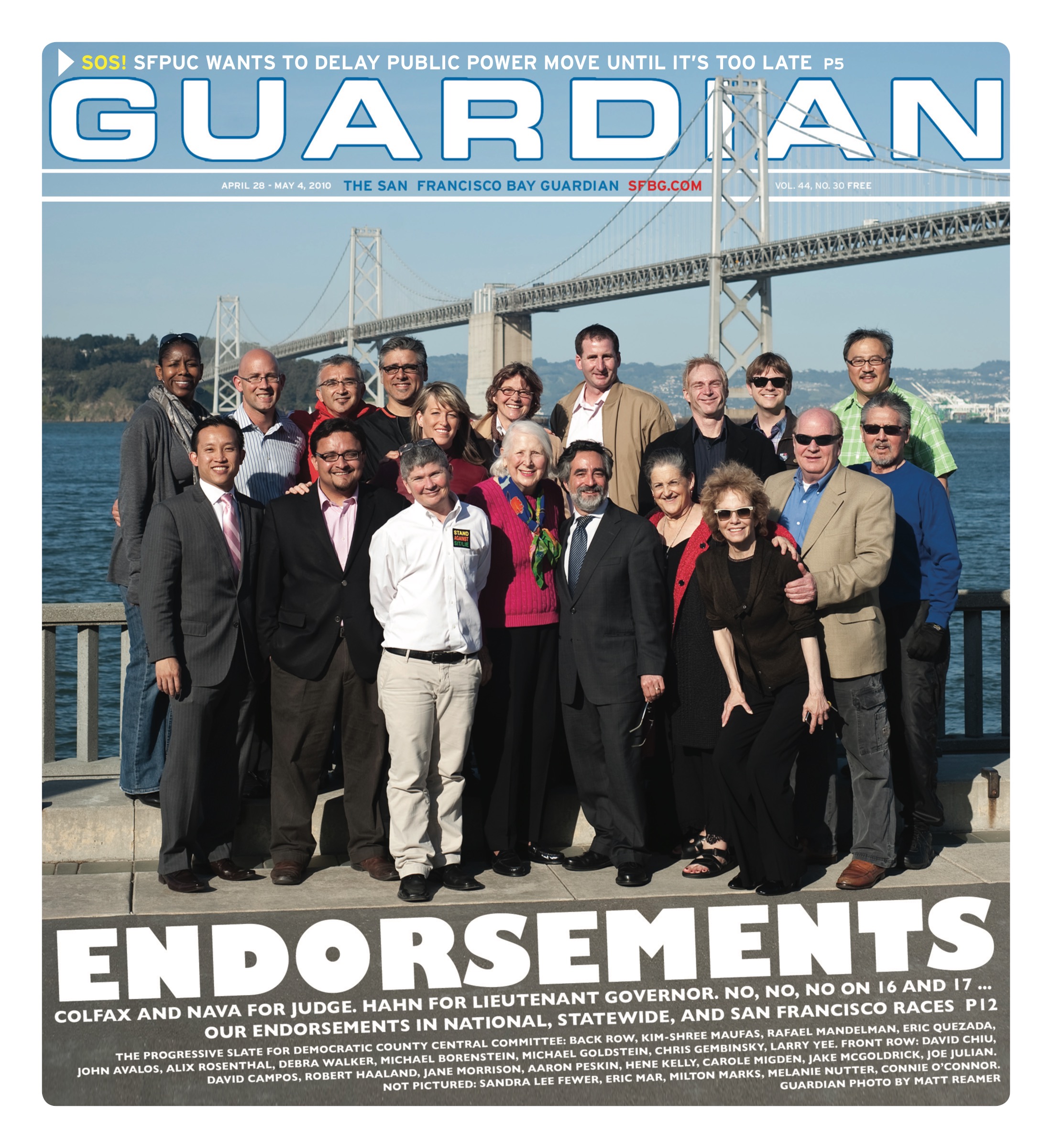
ENDORSEMENTS: Judicial races

2

SUPERIOR COURT JUDGE, SEAT 6


LINDA COLFAX


It’s rare to see an open seat on the Superior Court; judges typically retire midterm and allow the governor to appoint their replacement. And with a Republican governor, the more progressive Democrats have had a hard time getting even close to judicial appointments. Four highly qualified candidates are seeking this seat, and all of them make good cases for election.


Since judicial candidates can’t take stands on most political issues or indicate how they might rule on cases, it’s hard to get a sense of where the candidates stand. But they can talk about their backgrounds and experience — and about how the local courts are run. For example, the Superior Court is managed on a day-to-day basis by a presiding judge, elected by the sitting judges on the San Francisco bench. But those elections are secret; nobody except the judges know who the candidates were; who voted for which one; or what the final tally was. Court administration is done in closed meetings. Most of what happens in the courts is public — but there’s no presumption of cameras in the courtrooms to give the public access to the justice system.


Our choices for judge reflect our interest in a diverse judiciary, judges who have both professional and personal experience that will shape fair decisions — and jurists who believe in open government, including open courts.


Our choice for Seat 6 is Linda Colfax, a deputy public defender with a background in community service (she’s been an ACLU board member) and progressive politics. Like all four candidates, she has impressive legal credentials and trial experience. She also strongly supports sunshine in the courts and told us she would allow the press and public into judges’ meetings when appropriate, supports cameras in the courtrooms (except for cases where a witness or crime victim has to be protected), and efforts to make the courts work more efficiently.


Robert Retana, who grew up in East Los Angeles, has worked in both civil and criminal law, as a prosecutor and a civil litigator. He also has extensive community service with La Raza Centro Legal and the Lawyer’s Committee for Civil Rights. He was awfully vague on cameras in the courtroom and didn’t seem well-informed on open-government issues, but he’s certainly qualified for the job.


Rod Mcleod, a former San Francisco School Board member, told us he won’t raise any money for this race since he thinks judges shouldn’t be captive to special interests. That’s noble, but it also makes it unlikely he’ll be a factor in the end.


Harry Dorfman, a career prosecutor with the District Attorney’s Office, has extensive trial experience but was the least willing of all the candidates we interviewed to expand public access to the courts.


Colfax has the endorsements of Assembly Member Tom Ammiano, Sen. Mark Leno, and Sups. David Campos, John Avalos, and Eric Mar, among others. She would also diversify the bench in a significant way, not just because she’s a lesbian but because she spent her career in the Public Defender’s Office. And since Democratic and Republican governors alike tend not to appoint public defenders to the bench, that background and perspective is rare. Vote for Colfax.


SUPERIOR COURT JUDGE, SEAT 15


MICHAEL NAVA


Another rarity here: a contested race where challengers are taking on a sitting judge. Richard Ulmer, the incumbent, was a Republican living in Hillsborough when Gov. Schwarzenegger appointed him to the bench last year; he quickly changed his registration to independent and took up residence in Park Merced. But two gay men, Michael Nava and Daniel Dean, saw him as potentially vulnerable and, noting the lack of LGBT appointments coming out of the current administration, filed to challenge Ulmer.


Ulmer’s a smart and appealing person with an impressive legal resume, and we see no scandal that would mandate his removal from office. But we also recognize that this is an elected office, and that it’s perfectly acceptable for candidates who think they would better serve the public and the bench to run against an incumbent. In this case, we’re endorsing Michael Nava.


Nava, the grandson of Mexican immigrants, makes the case that judicial appointments can be just as political as elections: out of some 500 judicial appointments, Schwarzenegger has named perhaps five openly LGBT candidates. Nava also would bring a different perspective to the courts. His career has been in the public sector and he currently works as a staff attorney drafting decisions for Superior Court Justice Carlos Moreno. More than anyone else running for judge this year, Nava is an advocate of openness in the judiciary. He told us the courts are the third branch of government and should be held to most of the same sunshine standards at the executive and legislature.


Daniel Dean also makes a compelling case and has extensive courtroom experience as a litigator and judge pro tem. His accessibility and sense of humor would serve him well on the bench, and we hope he continues to seek a judicial slot. But in this race, we’re endorsing Nava.

ENDORSEMENTS: State ballot measures

8

PROPOSITION 13

LIMITS ON PROPERTY TAX ASSESSMENT FOR SEISMIC RETROFITS

YES

The primary sponsor of Prop. 13 is Republican Sen. Roy Ashburn, who dominated the news for several days after he was arrested for drunk driving on his way home from a Sacramento gay bar. Needless to say, Ashburn’s dramatic coming out has whipped up far more attention than his noncontroversial ballot initiative.

We’re generally opposed to anything that gives tax cuts or tax deferrals to property owners; thanks to a 1978 measure also called Prop. 13, much of the commercial and residential property in California is badly under assessed. And Prop. 13, 2010 style, is indeed a tax break. But it’s probably justified.

Buildings in this state are typically reassessed for property taxes after they’ve been modified with new construction, except in cases where the modifications are made to comply with earthquake-safety standards. While most buildings that undergo seismic retrofitting are exempt from reassessment until the property is transferred to a new owner, the exemption for unreinforced masonry buildings is limited to 15 years. Prop 13 would remove that 15-year cap.

The fiscal impact on cities is likely to be pretty minor, and the measure might encourage both commercial and residential landlords to bring their buildings up to standard. Vote yes.


PROPOSITION 14

OPEN PRIMARIES

NO

At the height of a royal mess last year when the state budget was long overdue and the two-thirds majority needed to pass it was still out of reach by one vote, Republican Sen. Abel Maldonado struck a deal with Democrats. He said he’d support the budget — if the majority party would meet a few of his demands. One thing he insisted on was Prop. 14 — a ballot measure that would effectively remove political parties from the primary elections process, allowing all voters to cast ballots for any candidate regardless of party affiliation.

Under Maldonado’s plan, all candidates would run on a single primary ballot, and the top two vote-getters would face off in the general election. Heavily funded by the California Chamber of Commerce and marketed by the same spin doctors and corporate lawyers who are rolling in Yes on 16 campaign money, Prop. 14’s backers say it will result in more centrist elected officials.

There are plenty of pitfalls here, the most worrisome being that it would drive up the cost of elections and give more moneyed (and corporate-allied) candidates a sharper competitive edge while elbowing out progressives. It would allow Republicans to play a role in what would normally be Democratic primaries (and vice versa.) The measure would also make it nearly impossible for smaller parties — the Green Party, for example — to offer candidates in the November elections.

Bad idea, bad process, Vote no.


PROPOSITION 15

FAIR ELECTIONS ACT

YES

California desperately needs electoral reform. Corporate campaign spending and lobbyists have poisoned the decision-making process and muzzled the voice of the people. Something radical needs to be done — and while this measure is only a small, measured step in the right direction, it’s an important and promising experiment.

Prop. 15 would create a pilot public financing program for the 2014 and 2018 races for California Secretary of State — and the program would be funded by a tax on lobbyists. Right now lobbyists pay only $12.50 per year to register with the state. This measure would increase that fee to $350 annually and use the money to create a fund of about $6 million that candidates for the crucial office overseeing elections in the state could tap after demonstrating their popular support by gathering a number of small contributions. All candidates who qualify would be given the same amount of money and left to compete on the issues. Ideally this public financing program would prove successful and eventually be expanded to other offices. Public financing of election campaigns, which is currently working well in Arizona and Maine, is certainly worth a try in California. Vote yes.


PROPOSITION 16

MONOPOLY PROTECTION FOR PG&E

NO! NO! NO!

The deceptively titled “Taxpayer’s Right to Vote Act” was dreamed up and funded entirely by Pacific Gas and Electric Co., the monopolistic utility that is worried it could face actual competition here in San Francisco (and elsewhere) from municipal electricity programs that would offer customers a greener energy mix and more accountability than PG&E executives will ever demonstrate.

Rather than accept some healthy competition, this sleazy corporation has opted to spend some $35 million to exterminate all possibilities of municipal electricity programs cropping up anywhere in the state in a bid to preserve its octopus-like grip on the energy market in Northern California. Prop. 16 would require a two-thirds majority vote at the ballot before any community choice aggregation (CCA) program — or any attempt at creating or expanding a public-power system — could move forward. That’s an extreme hurdle — -and PG&E knows it.

In effect, PG&E is trying to buy public policy here, trying to pass a law that will protect its own monopoly interests.

In San Francisco, the CCA being proposed would offer customers 51 percent renewable power by 2017, which means it would blow PG&E out of the water in the green arena and mark S.F. as taking greater strides toward combating climate change than any other major U.S. city. This example could set a precedent for others, which, in turn, could create favorable market conditions for green energy startups that want to harness wind, solar, biomass, geothermal, tidal, and energy efficiency alternatives.

The very existence of Prop. 16 is already threatening the San Francisco CCA; the city’s Public Utilities Commission is trying to delay a final contract until after the June 8 vote on the measure (see editorial, page 5)

Vote no on Prop 16. Not just because it’s an example of a big business single-handedly trying to alter the state constitution for its own economic benefit by pouring millions of dollars into a deceptive advertising campaign. Not just because a two-thirds majority vote requirement is anti-democratic. Not just because there were reports that the signature gatherers who got people to sign on in support of placing Prop. 16 on the ballot were telling people that its purpose was to limit PG&E expansion or encourage solar power. Not just because Senate Pro Tem Darrell Steinberg and a half dozen members of the Legislature sent a letter rebuking PG&E CEO Peter Darbee for disrespecting the democratic process by going straight to the ballot to undermine legislation it initially supported that enabled the creation of CCA programs. Not just because PG&E is using $35 million of ratepayer dollars (that’s the check you wrote them for your electricity bill!) to put out slick TV ads for this campaign when it should have been repairing the pipelines under those manholes that keep exploding and messing up your morning commute. Not even just because with CCA, you already have the right to vote whether or not you want to be part of it, a choice PG&E will never give you. And not just because PG&E keeps trying to raise rates, which is much more difficult for municipal energy agencies to do.

If for no other reason, vote no because Prop. 16 flies in the face of everything environmentalists stand for. It’s a measure that will thwart progress on fighting climate change, brought to you by the company that practically invented green-washing. PG&E is a huge nuclear power player; it purchases coal from mountaintop-removal coal mines in West Virginia that are completely devastating biodiverse landscapes in Southern Appalachia and screwing over poor people by tainting their drinking water; and it’s in the process of building fossil fuel-fired power plants in poor communities of color in California. The CCA programs at least represent a glimmer of hope for an alternative model; Prop. 16 kills off that possibility with one fell swoop motivated by pure greed. For the love of justice, democracy, and the planet, vote no on Prop 16.


PROPOSITION 17

CAR INSURANCE SCHEME

NO, NO, NO!

Mercury Insurance sponsored this measure and is campaigning for it with tens of millions of dollars, betting it can fool voters and make hundreds of millions of dollars in profits by doing so. And if the company is right, insurance rates will skyrocket for new drivers and those who haven’t had continuous insurance coverage, which experts say will increase the number of uninsured drivers on the roadways and end up increasing insurance rates for everyone.

Mercury and its founder George Joseph have been truly malevolent players in California, exploiting their customers to make billions of dollars in profits, attacking California’s landmark insurance reform measure Prop. 103 with lawsuits and corrupting campaign contributions over more than 20 years, and flouting insurance regulators in such brazen fashion that even Insurance Commissioner Steve Poizner, a conservative Republican, recently chastised the company for its “lengthy history of serious misconduct” (see “Buying power,” March 17).

Now, however, the company is hoping its promise to cut the insurance premiums of drivers who have maintained continuous coverage by “as much as $250 per year” will buy their votes and that they’ll overlook the myriad negative impacts of increasing everyone else’s premiums by $1,000 per year or more, based on Mercury’s own estimates.

Think about that. If you’re a driver who missed an insurance payment by even one day, or a soldier returning from boot camp, or someone with a low-income getting insurance for the first time or after ditching your car for a while, what are you going to do when you discover already-expensive car insurance comes with a $1,000 annual surcharge?

Many Californians, those who share our roads, will choose to drive without insurance. Then they’ll be more likely to leave the scene of accidents or declare bankruptcy rather than paying out-of-pocket for their accidents, both of which increase the cost of insurance for everyone else.

That’s how insurance works. If someone pays less, someone else pays more; and the only entity guaranteed to really make money over the long term is the insurance company. Don’t fall for this scam. Vote no on 17.

ENDORSEMENTS: National and state races

15

Editor’s note: the file below contains a correction, updated May 5 2010. 


National races


U.S. SENATE, DEMOCRAT


BARBARA BOXER


The Republican Party is targeting this race as one of its top national priorities, and if the GOP can dislodge a three-term senator from California, it will be a major blow for the party (and agenda) of President Obama. The pundits are happily talking about how much danger Barbara Boxer faces, how the country’s mood is swinging against big-government liberals.


But it’s always a mistake to count out Boxer. In 1982, as a Marin County supervisor with little name recognition in San Francisco, she trounced then-SF Sup. Louise Renne for an open Congressional seat. Ten years later, she beat the odds and won a hotly contested primary and tough general election to move into the Senate. She’s a fierce campaigner, and with no primary opposition, will have a united party behind her.


Boxer is one of the most progressive members of the not-terribly progressive U.S. Senate. She’s been one of the strongest, most consistent supporters of reproductive rights in Washington and a friend of labor (with 100 percent ratings from the AFL-CIO and National Education Association). We’ve had our disagreements: Boxer supported No Child Left Behind, wrote the law allowing airline pilots to carry guns in the cockpit, and was weak on same-sex marriage when San Francisco sought to legalize it (although she’s come around). But she was an early and stalwart foe of the war in Iraq, split with her own party to oppose a crackdown on illegal immigration, and is leading the way on accountability for Wall Street. She richly deserves reelection, and we’re happy to endorse her.


CONGRESS, 6TH DISTRICT, DEMOCRAT


LYNN WOOLSEY


It’s odd that the representative from Marin and Sonoma counties is more progressive by far than her colleague to the south, San Francisco’s Nancy Pelosi. But over the years, Lynn Woolsey has been one of the strongest opponents of the war, a voice against bailouts for the big Wall Street banks, and a foe of cuts in the social safety net. We’re proud to endorse her for another term.


CONGRESS, 7TH DISTRICT, DEMOCRAT


GEORGE MILLER


George Miller has been representing this East Bay district since 1974, and is now the chair of the Education and Labor Committee and a powerhouse in Congress. He’s too prone to compromise (with George W. Bush on education policy) but is taking the right line on California water (while Sen. Dianne Feinstein is on the wrong side). We’ll endorse him for another term.


CONGRESS, 8TH DISTRICT, DEMOCRAT


NANCY PELOSI


We’ve never been terribly pleased with San Francisco’s most prominent Congressional representative. Nancy Pelosi was the author of the bill that created the first privatized national park at the Presidio, setting a horrible standard that parks ought to be about making money. She was weak on opposing the war, ducked same-sex marriage, and has used her clout locally for all the wrong candidates and issues. But we have to give her credit for resurrecting and pushing through the health care bill (bad as it was — and it’s pretty bad — it’s better than doing nothing). And, at a time when the Republicans are trying to derail the Obama presidency, she’s become a pretty effective partner for the president.


Her fate as speaker (and her future in this seat) probably depends on how the Democrats fare in the midterm Congressional elections this fall. But if she and the party survive in decent shape, she needs to take the opportunity to undo the damage she did at the Presidio.


CONGRESS, 9TH DISTRICT, DEMOCRAT


BARBARA LEE


Barbara Lee, who represents Berkeley and Oakland, is co-chair of the Progressive Caucus in the House, one of the most consistent liberal votes in Congress, and a hero to the antiwar movement. In 2001, she was the only member of either house to oppose the Bush administration’s Use of Force resolution following the 9/11 attacks, and she’s never let up on her opposition to foolish military entanglements. We’re glad she’s doing what Nancy Pelosi won’t — represent the progressive politics of her district in Washington.


CONGRESS, 13TH DISTRICT, DEMOCRAT


PETE STARK


Most politicians mellow and get more moderate as they age; Stark is the opposite. He announced a couple of years ago that he’s an atheist (the only one in Congress), opposed the Iraq war early, called one of his colleagues a whore for the insurance industry, and insulted President Bush and refused to apologize, saying: “I may have dishonored the commander-in-chief, but I think he’s done pretty well to dishonor himself without any help from me.” He served as chair of the House Ways and Means Committee for exactly one day — March 3 — before the Democratic membership overruled Speaker Pelosi and chucked him out on the grounds that he was too inflammatory. The 78-year-old may not be in office much longer, but he’s good on all the major issues. He’s also fearless. If he wants another term, he deserves one.


State races


GOVERNOR, DEMOCRAT


EDMUND G. BROWN


Jerry Brown? Which Jerry Brown? The small-is-beautiful environmentalist from the 1970s who opposed Pacific Gas and Electric Co.’s Diablo Canyon nuke and created the California Conservation Corps, the Office of Appropriate Technology, and the Farm Labor Relations Board (all while running a huge budget surplus in Sacramento)? The angry populist who lashed out at corporate power on a KPFA radio talk show and ran against Bill Clinton for president? The pro-development mayor of Oakland who sided with the cops on crime issues and opened a military academy? Or the tough-on-crime attorney general who refuses to even talk about tax increases to solve the state’s gargantuan budget problems?


We don’t know. That’s the problem with Brown — you never know what he’ll do or say next. For now, he’s been a terribly disappointing candidate, running to the right, rambling on about preserving Proposition 13, making awful statements about immigration and sanctuary laws, and even sounding soft on environmental issues. He’s started to hit his stride lately, though, attacking likely GOP contender Meg Whitman over her ties to Wall Street and we’re seeing a few flashes of the populist Brown. But he’s got to step it up if he wants to win — and he’s got to get serious about taxes and show some budget leadership, if he wants to make a difference as governor.


LIEUTENANT GOVERNOR, DEMOCRAT


JANICE HAHN


Not an easy choice, by any means.


Mayor Gavin Newsom jumped into this race only after it became clear that he wouldn’t get elected governor. He sees it as a temporary perch, someplace to park his political ambitions until a better office opens up. He’s got the money, the statewide name recognition, and the endorsement of some of the state’s major power players, including both U.S. Senators and House Speaker Nancy Pelosi. He’s also been a terrible mayor of San Francisco — and some progressives (like Sup. Chris Daly) argue, persuasively, that the best way to get a better person in Room 200 is to ship Newsom off to an office in Sacramento where he can’t do much harm and let the supervisors pick the next mayor.


But it’s hard to endorse Newsom for any higher office. He’s ducked on public power, allowing PG&E to come very close to blocking the city’s community choice aggregation program (See editorial, page 5). His policies have promoted deporting kids and breaking up families. He’s taken an approach to the city budget — no new revenue, just cuts — that’s similar to what the Republican governor has done. He didn’t even bother to come down and talk to us about this race. There’s really no good argument for supporting the advancement of his political career.


Then there’s Janice Hahn. She’s a Los Angeles City Council member, the daughter of a former county supervisor, and the sister of a former mayor. She got in this race way before Newsom, and her nightmare campaign consultant, Garry South, acts as if she has some divine right to be the only Democrat running.


Hahn in not overly impressive as a candidate. When we met her, she seemed confused about some issues and scrambled to duck others. She told us she’s not sure she’s in favor of legalizing pot, but she isn’t sure why she’s not sure since she has no arguments against it. She won’t take a position on a new peripheral canal, although she can’t defend building one and says that protecting San Francisco Bay has to be a priority. She won’t rule out offshore oil drilling, although she said she has yet to see a proposal she can support. Her main economic development proposal was to bring more film industry work to California, even if that means cutting taxes for the studios or locating the shoots on Indian land where there are fewer regulations.


On the other hand, she told us she wants to get rid of the two-thirds threshold in the state Legislature for passing a budget or raising taxes. She supports reinstating the car tax at pre-Gov. Arnold Schwarzenegger levels. She supports a split-roll measure to reform Prop. 13. She wants to see an oil-severance tax to fund education. She’s one of the few statewide candidates who openly advocates higher taxes on the wealthy as part of the solution to the budget crisis.


We are under no illusions that Hahn will be able to use the weak office of lieutenant governor to move on any of these issues, and we’re not at all sure she’s ready to take over the top spot. But on the issues, she’s clearly better than Newsom, so she gets our endorsements.


SECRETARY OF STATE, DEMOCRAT


DEBRA BOWEN


Debra Bowen is the only Democrat running, a sign that pretty much everyone in the party thinks she’s doing a fine job as Secretary of State. She’s run a clean office and we see no reason to replace her.


CONTROLLER, DEMOCRAT


JOHN CHIANG


Like Bowen, John Chiang has no opposition in the primary, and he’s been a perfectly adequate controller. In fact, when Gov. Schwarzenegger tried two years ago to cut the pay of thousands of state employees to the minimum wage level, Chiang defied him and refused to change the paychecks — a move that forced the governor to back down. We just wish he’d play a more visible role in talking about the need for more tax revenue to balance the state’s books.


TREASURER, DEMOCRAT


BILL LOCKYER


Bill Lockyer keeps bouncing around Sacramento, waiting, perhaps, for his chance to be governor. He was attorney general. Now he’s treasurer seeking a second term, which he will almost certainly win. He’s done some good things, including trying to use state bonds to promote alternative energy, and has spoken out forcefully about the governor’s efforts to defer deficit problems through dubious borrowing. He hasn’t, however, come out in favor of higher taxes for the rich or a change in Prop. 13.


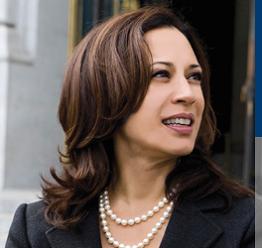
ATTORNEY GENERAL, DEMOCRAT


KAMALA HARRIS


There are really only two serious candidates in this race, Kamala Harris, the San Francisco district attorney, and Rocky Delgadillo, the former Los Angeles city attorney. Harris has a comfortable lead, with Delgadillo in second and the others far behind.


Delgadillo is on his second try for this office. He ran against Jerry Brown four years ago and got nowhere. And in the meantime, he’s come under fire for, among other things, using city employees to run personal errands for him (picking up his dry-cleaning, babysitting his kids) and driving his car without insurance. On a more significant level, he made his reputation with gang injunctions that smacked of ethnic profiling and infuriated Latino and civil liberties groups. It’s amazing he’s still a factor in this race; he can’t possibly win the general election with all his baggage.


Harris has a lot going for her. She was among the first California elected officials to endorse Barack Obama for president, and remains close to the administration. She’s a smart, articulate prosecutor and could be one of the few women atop the Democratic ticket this year. We were never comfortable with her ties to Willie Brown, but he’s no longer a factor in state or local politics. These days, she’s more closely allied with the likes of State Sen. Mark Leno.


That said, we have some serious problems with Harris. She’s been up in Sacramento pushing Republican-style tough-on-crime bills (like a measure that would bar registered sex offenders from ever using social networking sites on the Internet) and forcing sane Democrats like Assembly Member and Public Safety Committee Chair Tom Ammiano to try to tone down or kill them (and then take the political heat). If she didn’t know about the problems in the SFPD crime lab, she should have, and should have made a bigger fuss, earlier.


But Harris has kept her principled position against the death penalty, even when it meant taking immense flak from the cops for refusing to seek capital punishment for the killer of a San Francisco police officer. She’s clearly the best choice for the Democrats.


INSURANCE COMMISSIONER, DEMOCRAT


DAVE JONES


Two credible progressives are vying to run for this powerful and important position regulating the massive — and massively corrupt — California insurance industry. Dave Jones and Hector De La Torre are both in the state Assembly, with Jones representing Sacramento and De La Torre hailing from Los Angeles. Both have a record opposing insurance industry initiatives; both are outspoken foes of Prop. 17; and either would do a fine job as insurance commissioner. But Jones has more experience on consumer issues and health care reform, and we prefer his background as a Legal Aid lawyer to De La Torre’s history as a Southern California Edison executive. So we’ll give Jones the nod.


BOARD OF EQUALIZATION, DISTRICT 1, DEMOCRAT


BETTY T. YEE


Betty Yee has taken over a job that’s been a stronghold of progressive tax policy since the days of the late Bill Bennett. She’s done well in the position, supporting progressive financial measures and even coming down, as a top tax official, in favor of legalizing (and taxing) marijuana. We’re happy to endorse her for another term.


SUPERINTENDENT OF PUBLIC INSTRUCTION


TOM TORLAKSON


Two prominent Democratic legislators are running for this nonpartisan post, state Sen. Gloria Romero of Los Angeles and Assembly Member Tom Torlakson of Martinez. It’s a pretty clear choice: Romero is a big supporter of charter schools who thinks parents should be able to move their kids out of one school district and into another (allowing wealthier white parents, for example, to abandon Los Angeles or San Francisco for the suburban districts). She’s been supported in the past by Don and Doris Fisher, who put a chunk of their GAP Inc. fortune into school privatization efforts. Torlakson wants more accountability for charters, opposes the Romero district-option bill, and has the support of every major teachers union in the state. Vote for Torlakson.


STATE SENATE, DISTRICT 8, DEMOCRAT


LELAND YEE


Sen. Leland Yee can be infuriating. Two years ago, he was hell-bent on selling the Cow Palace as surplus state property and allowing private developers to take it over. In the recent budget crisis, he pissed off his Democratic colleagues by refusing to vote for cuts that everyone else knew were inevitable (while never making a strong stand in favor of, say, repealing Prop. 13 or raising other taxes). But he’s always been good on open-government issues and has made headlines lately for busting California State University, Stanislaus over a secret contract to bring Sarah Palin in for a fundraiser — and has raised the larger point that public universities shouldn’t hide their finances behind private foundations.


Yee will have no serious opposition for reelection, and his campaign for a second term in Sacramento is really the start of the Leland Yee for Mayor effort. With reservations over the Cow Palace deal and a few other issues, we’ll endorse him for reelection.


 Correction update: Yee’s office informs us that the senator suports an oil-severance tax and a tax on high-income earners and “believes that Prop. 13 should be reformed,” although he hasn’t taken a position on Assemblymember Tom Ammiano’s reform bill. 


STATE ASSEMBLY, DISTRICT 12, DEMOCRAT


FIONA MA


Fiona Ma’s a mixed bag (at best). She doesn’t like Pacific Gas and Electric Co. and supports public power, but comes up with strange bills that make no sense, like a 2009 measure to limit rent control in trailer parks. Why does Ma, who has no trailer parks in her district, care? Maybe because the landlords who control the mobile home facilities gave her some campaign cash. She faces no opposition, and we’re not thrilled with her record, but we’ll reluctantly back her for another term.


STATE ASSEMBLY, DISTRICT 13, DEMOCRAT


TOM AMMIANO


When the history of progressive politics in modern San Francisco is written, Tom Ammiano will be a central figure. His long-shot 1999 mayoral campaign against Willie Brown brought the left to life in town, and his leadership helped bring back district elections and put a progressive Board of Supervisors in place in 2000. As a supervisor, he authored the city’s landmark health care bill (which Newsom constantly tries to take credit for) and the rainy day fund (which saved the public schools from debilitating cuts). He uses his local influence to promote the right causes, issues, and candidates.


And he’s turned out to be an excellent member of the state Assembly. He forced BART to take seriously civilian oversight of the transit police force. He put the battle to reform Prop. 13 with a split-role measure back on the state agenda. And his efforts to legalize and tax marijuana are close to making California the first state to toss the insane pot laws. As chair of the Public Safety Committee, he routinely defies the police lobbies and the right-wing Republicans and defuses truly awful legislation. We’re glad Ammiano’s still fighting in the good fight, and we’re pleased to endorse him for another term.


STATE ASSEMBLY, DISTRICT 14, DEMOCRAT


NANCY SKINNER


Nancy Skinner has taken on one of the toughest, and for small businesses, most important, battles in Sacramento. She wants to make out-of-state companies that sell products to Californians collect and remit sales tax. If you buy a book at your local bookstore, you have to pay sales tax; if you buy it from Amazon, it’s tax-free. That not only hurts the state, which loses hundreds of millions of dollars in tax revenue, it’s a competitive disadvantage to local shops. Skinner’s a good progressive vote and an ally for Ammiano on the Public Safety Committee. We’re happy to endorse her for another term.


STATE ASSEMBLY, DISTRICT 16, DEMOCRAT


SANDRE SWANSON


Sandre Swanson represents the district where BART police killed Oscar Grant, but he wasn’t the one out front pushing for more civilian accountability; that was left to SF’s Ammiano. And while Swanson was generally supportive of Ammiano’s bill, he was hardly a leader in the campaign to pass it. This is too bad, because Swanson’s almost always a progressive vote and has been good on issues like whistleblower protection (a Swanson bill that passed this year protects local government workers who want to report problems confidentially). We’ll endorse him for another term, but he needs to get tougher on the BART police.

The CCA “conundrum”

The negotiations for the city’s green municipal power program still haven’t resulted in a finalized contract, and time is running out.

In 42 days, voters will decide whether Prop 16, the ballot initiative dubbed the “Taxpayers Right to Vote Act,” ought to be enshrined into state law. If a simple majority votes yes, the state constitution will be changed to require a two-thirds supermajority vote at the ballot before any municipal electricity program can move forward, effectively making it impossible for local governments to offer alternatives to investor-owned utility companies. Pacific Gas & Electric Co., the 105-year-old utility that gained infamy with the movie Erin Brockovich after it was accused of causing groundwater pollution which led to a cancer cluster in Hinkley, Calif., is poised to spend $35 million to pass Prop 16.

Here in San Francisco, where the vision for a green municipal power program goes back at least half a decade (and PG&E’s monopolistic grip dates back much farther), the plan’s most dedicated proponents have come to view Prop 16 as “the grim reaper.” At a meeting in City Hall last Friday about CleanPower SF, the community choice aggregation (CCA) program that could provide San Franciscans with 51 percent renewable electricity, Sup. Ross Mirkarimi repeated a mantra he’s intoned since approximately last year at this time: “All hands on deck.” Mirkarimi’s face looked tense, and his anxiety about the closing window of opportunity was plain even as he tried to display optimism. If a CleanPower SF program contract is not signed before June 8, when Prop 16 is decided, years of hard work and effort could be lost. With $35 million worth of carefully crafted PR messaging that reveals nothing about the sole financier of the measure or its anti-competitive intentions, Prop 16 has a decent shot at voter approval.

The race against the clock has been intensified by the fact that the San Francisco Public Utilities Commission, the city agency tasked with implementing CCA, has been unable (or unwilling, some critics charge) to broker a deal with Power Choice Inc., the energy service provider selected for CCA. Negotiating sessions have been ongoing since February, with SFPUC staff members, SFPUC General Manager Ed Harrington, three city attorneys, and staff of the Local Agency Formation Commission devoting hours to negotiations. “We are continuing to work hard to secure a contract,” SFPUC Assistant General Manager of Power Barbara Hale told the Guardian.

Yet as the days pass, the absence of a signed contract in hand has program advocates increasingly worried, frustrated, and suspicious of the SFPUC. “My sense, and my fear quite frankly, has been that the level of commitment [from the SFPUC] isn’t there, and if it were there … then we would have a finalized contract,” Sup. David Campos noted at a joint meeting between LAFCo and the SFPUC on Friday.

John Rizzo of the Sierra Club told the Guardian that Harrington approached the environmental group last week requesting that it join the SFPUC in issuing a press release blaming PG&E’s Prop 16 for marring CCA’s prospects. Harrington was ready to announce that the CCA had reached a preliminary contract, but not really a contract at all, since key terms such as a rate structure would not be hammered down till after the June 8 election. The Sierra Club declined to go along with that idea. Such a move would have jeopardized the program’s shot at success. Campos highlighted this problem at the meeting, saying, “Even though there are risks associated with CCA, the risk of not doing this and not having as concrete a contract by the election is greater.”

Green power advocate Eric Brooks noted that he had received a call from Nancy Miller, the executive director of LAFCo, notifying him that the SFPUC felt that Prop 16 had created a climate that made it too difficult to negotiate, and that a press release would be issued explaining as much. In the end, the SFPUC agreed to stay the course at the negotiating table. At Friday’s meeting, there was no mention of pushing the contract back to a later date. Instead, everyone nodded in polite agreement that all hands were, indeed, on deck.

But during his presentation to commissioners, Harrington emphasized the difficulty in meeting the twin program goals: green power on one hand, and competitive pricing on the other. He displayed charts showing how much more expensive wind and solar were than “brown power,” the fossil fuel and nuclear variety currently offered by PG&E. When challenged on the SFPUC’s commitment, Harrington responded tersely, “Staff commitment does not change the economic reality of the world.”

Brooks, who has weighed in and watched the process unfold since the beginning, later charged that Harrington was presenting a wholly different picture from what was originally agreed to as a way of subverting the program. “He purposely showed the numbers so that they would look worse,” Brooks said. “His key trick was … allowing the contractor the option of a 3-to-5 year contract. No one thinks you can pay renewable energy off in three years, that’s ridiculous. … He knows that the plan was to pay this off over 15 years. There’s no way he didn’t know that the idea is to pay it off in 15 years.”

Harrington was not available for comment. But Hale, who did speak with the Guardian, told us, “We’re absolutely open to a longer-term contract.” The problem, she said, has been determining a rate that makes sense both to guarantee the long-term viability of the program while meeting the renewable-energy program goals and the financial commitment necessary to make it worthwhile for the service provider. It’s like a big control board with multiple dials, and the problem seems to lie in twisting the knobs to find the appropriate setting. So far, they haven’t hit the sweet spot.

Meanwhile, the political backdrop of this “conundrum,” as Harrington called it, is that Mayor Gavin Newsom, now a candidate for Lieutenant Governor, would be placed in an awkward position if a Board-approved contract for the CCA program landed on his desk before June 8. If he endorsed the contract with his signature, he would earn the ire of PG&E, a moneyed political ally that could help him reach the office he aspires to. But if he vetoed CCA, it would amount to a stunning display of hypocrisy, since he would be a green mayor rejecting the greenest municipal power program ever attempted. Newsom, who wants to name a street after former Mayor Willie Brown even as Brown is publicly arguing in favor of Prop 16, could avoid that dilemma altogether if the contract negotiations just imploded, or were at least delayed till after June 8.

Housing relief – for tenants

1

OPINION Since the burst of the housing bubble, we’ve seen a lot of attention paid to the plight of homeowners hit hard by the recession and facing foreclosure. Indeed, President Obama recently enacted a protection for homeowners that requires banks to let unemployed homeowners delay their mortgage payments. But until now there has been little talk and even less action on how we can help tenants who are also in danger of losing their homes.

Tenants need economic relief too. Renters have been particularly hard hit by the housing bubble and the ensuing recession. During the bubble, real estate speculation caused San Francisco rents to increase by an average of 50 percent. When the bubble burst, tenants saw their jobs disappear and incomes drop — but rents remained at record high levels. Evictions for nonpayment of rent shot up as renter after renter found it impossible to keep up with San Francisco’s housing costs.

The June 8 election will give voters a chance to change that. Proposition F will give tenants the right to postpone rent increases when they’ve lost their jobs or seen their wages or hours cut.

Many tenants struggle to pay San Francisco’s sky-high rents in the best of times and, when hit with a layoff or reduction in pay, it becomes even more difficult. Any further rent increases would be devastating and put their housing at risk. Prop. F will provide needed relief to those tenants trying to pay high rents with vastly reduced incomes. Unemployed tenants or those who have seen their wages cut by 20 percent or more will be able to get any rent increase delayed simply by filing a petition with the San Francisco Rent Board and documenting that they are unemployed or have had wages cut.

With the difficulties renters face in one of the country’s most expensive housing markets, Prop. F is a mild and measured response to a very real crisis. Prop. F essentially does what any decent landlord would do anyway: give a break to tenants who’ve just lost their jobs and hold off on rent increases until back on their feet.

San Francisco voters should also give a break to tenants on the verge of losing their homes. Vote Yes on Prop. F.

Ted Gullicksen runs the San Francisco Tenants Union.

No more stalling on CCA

1

EDITORIAL There’s nothing wrong with city officials taking tough stands in negotiations with private contractors. Hundreds, thousands of times in the past few years, San Francisco department heads have rolled over and given away the store in sweetheart deals that put the city on the hook for all the money, make the public take all the risk, and give a private outfit all the profit. Pacific Gas and Electric Co. (remember the Tulock-Modesto sellout contract?), Lennar Corp., Recurrent Energy, and countless other developers, builders, suppliers, and service providers have easily taken the public to the cleaners with contracts that never seemed to get stuck in the due diligence process.

But when there’s a looming deadline, hundreds of millions of dollars, and the city’s energy future and environmental footprint at stake, why is the San Francisco Public Utilities Commission moving so incredibly slowly to hammer out a deal for the city’s community choice aggregation (CCA) program? And why is PUC general manager Ed Harrington doing everything in his power to make sure that nothing happens that might put the city in the power business until after PG&E’s initiative, Prop. 16 — which would block public power efforts — passes at the polls?

It’s infuriating — and the supervisors need to tell the PUC that they won’t approve anything the agency does or wants to do until this contract is completed.

Harrington’s shop has known for more than a year that it needed to work out a business deal with a supplier that could replace PG&E and manage a program to buy greener, cheaper power in bulk and resell it to San Francisco residents. Marin County is setting up a similar program and is far ahead of San Francisco. The city has chosen a vendor, Powerchoice Inc., run by people completely qualified to handle the business.

And now there’s a absolute, drop-deal mandate: the city has to complete negotiations and get the program underway before the June 8 election. That’s because PG&E is spending $35 million to try to pass an initiative that would mandate a two-thirds vote of the public before any new CCA can begin selling power to customers. If San Francisco wants to present a solid legal case that its CCA is already in business, the contract with Powerchoice needs to be completed and signed, now.

But Harrington has, to put it kindly, been dragging his feet. The negotiations are hung up on a few points, although none are deal-breakers; Powerchoice already has agreed to assume some of the financial risk, which was the biggest obstacle to a deal. Now it’s just a matter of hammering out the details — but the PUC staff isn’t acting as if there is any time pressure at all.

In fact, last week Harrington circulated a draft press release all but announcing that he was tossing the whole deal under the bus and postponing negotiations until after the June election. He wanted to say that the "uncertainly" surrounding Prop. 16 made a deal impossible.

But Powerchoice isn’t walking away or complaining about the initiative. The company’s CEO, Sam Enoka, made it clear to us in an interview April 26 that he is eager to move forward. If Harrington — an experienced negotiator with a large staff at his disposal — and his boss, Mayor Gavin Newsom, wanted a deal, it could be finished well ahead of the deadline.

Instead, Harrington showed up at the Local Agency Formation Commission meeting April 23 with charts and a PowerPoint presentation purporting to show that renewable energy is too expensive to sell at rates comparable to what PG&E charges local customers. That misses the point — PG&E’s rates are going up every year and renewables are coming down, and the greatest risk to the city, the ratepayers, and the planet is sticking with the unreliable private utility that relies on fossil fuels and nuclear power for much of its electricity portfolio.

If the city has legitimate issues with Powerchoice, fine: Sit down and begin working them out. Now. But the only thing we can see at this point is the administration of a mayor who wants to be lieutenant governor intentionally delaying the process and giving PG&E exactly what it wants. (We called the PUC April 26, our print deadline, to ask why there were no talks scheduled that day, but Harrington wasn’t available; he was taking the day off.)

Sups. Ross Mirkarimi and David Campos suggest that the board simply refuse to sign off on any contracts, appropriations, or other approvals for anything the SFPUC does until this contract is completed. That’s a fine idea; they should start today.

No more stalling on CCA

0

EDITORIAL There’s nothing wrong with city officials taking tough stands in negotiations with private contractors. Hundreds, thousands of times in the past few years, San Francisco department heads have rolled over and given away the store in sweetheart deals that put the city on the hook for all the money, make the public take all the risk, and give a private outfit all the profit. Pacific Gas and Electric Co. (remember the Tulock-Modesto sellout contract?), Lennar Corp., Recurrent Energy, and countless other developers, builders, suppliers, and service providers have easily taken the public to the cleaners with contracts that never seemed to get stuck in the due diligence process.

But when there’s a looming deadline, hundreds of millions of dollars, and the city’s energy future and environmental footprint at stake, why is the San Francisco Public Utilities Commission moving so incredibly slowly to hammer out a deal for the city’s community choice aggregation (CCA) program? And why is PUC general manager Ed Harrington doing everything in his power to make sure that nothing happens that might put the city in the power business until after PG&E’s initiative, Prop. 16 — which would block public power efforts — passes at the polls?

It’s infuriating — and the supervisors need to tell the PUC that they won’t approve anything the agency does or wants to do until this contract is completed.

Harrington’s shop has known for more than a year that it needed to work out a business deal with a supplier that could replace PG&E and manage a program to buy greener, cheaper power in bulk and resell it to San Francisco residents. Marin County is setting up a similar program and is far ahead of San Francisco. The city has chosen a vendor, Powerchoice Inc., run by people completely qualified to handle the business.

And now there’s a absolute, drop-deal mandate: the city has to complete negotiations and get the program underway before the June 8 election. That’s because PG&E is spending $35 million to try to pass an initiative that would mandate a two-thirds vote of the public before any new CCA can begin selling power to customers. If San Francisco wants to present a solid legal case that its CCA is already in business, the contract with Powerchoice needs to be completed and signed, now.

But Harrington has, to put it kindly, been dragging his feet. The negotiations are hung up on a few points, although none are deal-breakers; Powerchoice already has agreed to assume some of the financial risk, which was the biggest obstacle to a deal. Now it’s just a matter of hammering out the details — but the PUC staff isn’t acting as if there is any time pressure at all.

In fact, last week Harrington circulated a draft press release all but announcing that he was tossing the whole deal under the bus and postponing negotiations until after the June election. He wanted to say that the "uncertainly" surrounding Prop. 16 made a deal impossible.

But Powerchoice isn’t walking away or complaining about the initiative. The company’s CEO, Sam Enoka, made it clear to us in an interview April 26 that he is eager to move forward. If Harrington — an experienced negotiator with a large staff at his disposal — and his boss, Mayor Gavin Newsom, wanted a deal, it could be finished well ahead of the deadline.

Instead, Harrington showed up at the Local Agency Formation Commission meeting April 23 with charts and a PowerPoint presentation purporting to show that renewable energy is too expensive to sell at rates comparable to what PG&E charges local customers. That misses the point — PG&E’s rates are going up every year and renewables are coming down, and the greatest risk to the city, the ratepayers, and the planet is sticking with the unreliable private utility that relies on fossil fuels and nuclear power for much of its electricity portfolio.

If the city has legitimate issues with Powerchoice, fine: Sit down and begin working them out. Now. But the only thing we can see at this point is the administration of a mayor who wants to be lieutenant governor intentionally delaying the process and giving PG&E exactly what it wants. (We called the PUC April 26, our print deadline, to ask why there were no talks scheduled that day, but Harrington wasn’t available; he was taking the day off.)

Sups. Ross Mirkarimi and David Campos suggest that the board simply refuse to sign off on any contracts, appropriations, or other approvals for anything the SFPUC does until this contract is completed. That’s a fine idea; they should start today.

Herrera to San Francisco: boycott Arizona

25

I almost visited Arizona once.
I was in Nevada, visiting the Hoover Dam which crosses the border between Nevada and Arizona and took a photo next to the Arizona state sign.

But I didn’t cross the line. I already suspected that Arizona was groundzero for wingnuts, thanks to the decision of Arizona U.S. senator, Republican John McCain, to choose then Alaska governor Sarah Palin as his running mate in the 2008 presidential election.


At least, Democrat Janet Napolitano was still governor of Arizona at the time, and so was able to veto similar attempts to pass racist immigration laws in the state of


But now Republican Jan Brewer, a former Maricopa County supervisor, is governor of Arizona and has signed Arizona’s SB  1070, I think I’ll follow San Francisco city Attorney Dennis Herrera’s advice and implement a sweeping boycott of all things Arizona.


Citing San Francisco’s “moral leadership against such past injustices as South African apartheid, the exploitation of migrant farm workers, the economic oppression of Catholics in Northern Ireland, and discrimination against the LGBT community,” Herrera offered the services of his office’s contracts, government litigation and investigations teams to work closely with city departments and commissions to identify applicable contracts and to aggressively pursue termination wherever legally tenable.


“Arizona’s controversial new law makes it a state-level crime for someone to be in the country illegally, and even criminalizes the failure to carry immigration documents at all times by lawful foreign residents,” Herrera’s April 26 press release observed. “It additionally imposes a requirement for police officers to question those they suspect may be in the United States illegally. Civil libertarians have sharply criticized the law for being an open invitation for harassment and discrimination against all Latinos, regardless of their citizenship. It has also been rebuked by the nation’s law enforcement community, with the president of the Major Cities Chiefs Association, San Jose Police Chief Robert Davis, reiterating his organization’s 2006 policy statement that requiring local police to enforce immigration laws “would likely negatively effect and undermine the level of trust and cooperation between local police and immigrant communities.”


“Arizona has charted an ominous legal course that puts extremist politics before public safety, and betrays our most deeply-held American values,” said Herrera, who is the son of an immigrant from Latin America. “Just as it did two decades ago when it refused to observe Martin Luther King Jr. Day, Arizona has again chosen to isolate itself from the rest of the nation. Our most appropriate response is to assure that their isolation is tangible rather than merely symbolic. San Francisco should lead the way in adopting and aggressively pursuing a sweeping boycott of Arizona and Arizona-based businesses until this unjust law is repealed or invalidated. My office is fully committed to work with San Francisco city departments and commissions to identify all applicable contracts, and to pursue termination wherever possible.  And my office stands ready to assist in any legal challenges in whatever way it can.”


Meanwhile, Napolitano, who is serving as Obama’s Department of Homeland Security Secretary, joined Obama in calling Arizona’s new immigration law “misguided.”


Appearing on ABC News, Napolitano said of the bill: “That one is a misguided law. It’s not a good law enforcement law. It’s not a good law in any number of reasons.”
She also warned that Arizona’s law could get other states trying to pass similar legislation, which could create a patchwork of immigration rules, instead of an an overall federal immigration system.


“This affects everybody, and I actually view it now as a security issue,” Napolitano said. “We need to know who’s in the country. And we need to know, for those who are in the country illegally, there needs to be a period under which they are given the opportunity to register so we get their biometrics, we get their criminal history and we know who they are. They pay a fine. They learn English. They get right with the law.”


Here on the streets of San Francisco, immigrant advocates are asking folks to march on May Day in solidarity with the immigrant communities of Arizona.


“In 2006, the immigrant community took to the streets in huge numbers,” a press release from the May 1st coalition stated. “Millions of undocumented working people and their families sought a pathway to legalization and to a life without fear of work-place raids or middle-of-the night deportations that tear families apart. In 2010, conditions have only worsened as hate crimes have increased exponentially; intolerance has been legitimized by the rhetoric of the Tea Party; and governments (like Arizona) have instituted harsh policing and employment practices that terrorize our communities. The federal government has failed to solve the crisis of undocumented workers in this country. In San Francisco, thousands of workers face losing their jobs because of a flawed employment verification process. Our children are deported without due process and now we must fear the codification of racial bigotry in Arizona.  State and federal governments have ineffectively solved the budget crisis on the backs of the lowest paid workers.  We march in solidarity with Arizona’s immigrants; immigrants everywhere; and the hard-working people of San Francisco who’ve unfairly endured the burden of this economic crisis.


The May 1st Coalition invites the community to join them for an April 28 poster-making party at 10 a.m, City College Mission Campus at 1125 Valencia Street in preparation for a May Day march at which Olga Miranda, President of SEIU Local 87, Jane Kim, SFUSD school board president, and Pablo Rodriguez, city college faculty, will speak.


My favorite comment on this unfunny situation comes from Daily Kos contributing editor and Las Vegas resident Jed Lewison.


“What do you call a bunch of people who not only don’t see anything wrong with Arizona’s new hate law, but blame federal inaction on immigration reform for “forcing” Arizona to enact the law while simultaneously trying to block federal immigration reform legislation?” Lewison asks. “You call them conservatives.”


Nevius makes the case for a progressive DCCC

27

Chronicle columnist C.W. Nevius made an excellent argument for supporting the Guardian’s slate of progressive candidates for the Democratic County Central Committee in Saturday’s paper, even though he was trying to do just the opposite. But I suppose that perspective is everything.

Our perspective at the Guardian is one of great pride in San Francisco and its left-of-center values. Nevius looks at San Francisco from his home in Walnut Creek and sees a scary place where people question authority figures and don’t simply trust developers, big corporations, and the Chamber of Commerce to act in the public interest.

“The next two months will see a battle for the political soul of the city. It will pit the progressives against the moderates in a face-off that will have huge implications in the November elections and, perhaps, the election of the next mayor. The key is control of an obscure but incredibly influential organization called the Democratic County Central Committee,” Nevius writes, and he’s right about that.

But he’s wrong when he assumes most San Franciscans agree with him and others who want to make the city more like the sterile suburbs that they prefer. Nevius values “safe streets,” which is his code for giving police more power through the proposed sit-lie ordinance and other unpopular crackdowns, despite the fact that he sat in the back row and watched the DCCC voted overwhelmingly against sit-lie after nobody presented a credible case for it.

Nevius is so utterly blind to the fact that most San Franciscans want adequate mitigation and community benefits from development projects that he recently ranted and raved about the defeat of the 555 Washington project, even though it was unanimously rejected by the Board of Supervisors for inadequately addressing these requirements.

The “moderate values” that Nevius champions are actually quite extreme: give downtown and developers everything they want, never question the behavior of cops or the Fire Department’s budget, keep cutting taxes until city government becomes incapable of providing services or regulating the private sector, ignore the cultural value of nightclubs and artists, and deport all the undocumented immigrants.

This is the Democratic Party that Nevius and his allies like Sup. Michela Alioto-Pier and supervisorial candidate Scott Wiener (a conservative attorney who would be the best friend that the suburban cowboy cops could ever have on the board) want to promote, and it looks more like the Republican Party than a political party with San Francisco values.

But they aren’t honest about that intention, instead trying to fool people into believing that progressives are the extremists. “But when Mrs. Jones receives her Democratic voter guide in the mail…she’s thinking of the party of Barack Obama, not the party of Aaron Peskin and (Supervisor) Chris Daly,” Wiener said.

But in the Democratic presidential primary election, it was Daly and Peskin who were the strongest early supporters of Barack Obama, while Wiener backed John Edwards and Alioto-Pier, Mayor Gavin Newsom, and the rest of the “moderate” party stalwarts supported Hillary Clinton. That’s not a huge deal, but it’s a sign of how the so-called moderates are willing to distort political reality.

So Nevius is right. This is an important election and it is about the soul of the city. Do you support scared suburban twits who disingenuously try to hide behind the “moderate” label in order to seem more reasonable, or do you support progressive candidates who have integrity and won’t moderate their values in order to appease the cops or the capitalists?

If it’s the latter, support the Guardian’s slate (which is substantially similar to the slates approved by the Harvey Milk LGBT Democratic Club, the San Francisco Tenants Union, the Sierra Club’s SF Bay Chapter, and other progressive groups).

And if you want that slate to have some money to mail out a Guardian slate card, come to a fundraiser this Thursday evening at CELLspace, 2050 Bryant, featuring the candidates and some great exemplars of the culture they support, including amazing singer/songwriter Valerie Orth, the zany dance troupe Fou Fou Ha, and DJs Smoove and Kramer, who regularly rock the best clubs and community-based parties in town.

And by “town,” I mean San Francisco, not Walnut Creek.    

The danger of Props. 16 and 17

2

The problem here is not just two awful laws – it’s the idea that a single company, with loads of cash, can utterly subvert the basic premise of Democracy

EDITORIAL The California Democratic Party voted at its statewide convention April 17 to oppose Propositions 16 and 17. The San Francisco Chronicle — no friend of public power and consumer rights — endorsed strongly against both measures April 18. In fact, most major newspapers and civic groups have come out against what amounts to the most blatant attempt in California history by a pair of big corporations to buy favorable legislation at the ballot box.


And for Pacific Gas and Electric Co. and Mercury Insurance, none of that matters much.

This campaign is all about money — big gobs of money — and PG&E and Mercury have it and their opponents, so far, don’t. And if that doesn’t change in the next few weeks — if Democratic Party leaders, starting with Speaker of the House Nancy Pelosi and Sens. Dianne Feinstein and Barbara Boxer — don’t immediately start making the defeat of these two measures a priority, California will send a signal to every big corporate interest in the world that its laws and policies are for sale.

Prop. 16 is being sold — in slick TV ads and mailers so deceptive they can only be called intentional lies — as giving the voters the right to have a say before local government gets into the business of selling electricity. The proposition, one PG&E flyer notes, “is our best protection against government spending your money to get into a business they [sic] know nothing about.”

Actually, government knows a lot about the electricity business. All over California, public power agencies offer better service and lower rates than the private utilities. Nationwide, residents of more than 2,000 communities have public power — and few want to give it up and return to buying electricity from private utilities.

But that’s not the point. Prop. 16 exists entirely because PG&E wanted to stop competition. The company is spending at least $35 million of its money to pass a law that would require a two-thirds vote (a nearly insurmountable obstacle) before any local agency can offer or expand local electricity service. The Chronicle, which has always opposed public power in San Francisco, argues that “Californians should be skeptical of any local government’s claim that it can deliver cheaper and cleaner power than an established utility. But they should be at least as wary when that monopoly utility wants to deprive them of that choice.”

Prop. 17 is another blatant single-interest measure, sponsored and underwritten entirely by one giant insurance company, to change the way car insurance is regulated in California. It would, among other things, allow insurers to raise rates for people who don’t already have coverage. Give up your car for a year (because you lost your job and couldn’t afford it, or decided that you could commute just as well by bicycle, or for any other reason) and the next time you buy insurance, your rates could soar — even if your driving record was clean.

The problem here is not just two awful laws — it’s the idea that a single company, with loads of cash, can utterly subvert not only the intent of California’s initiative law but the basic premise of Democracy. PG&E and Mercury were unable to get the state Legislature to do what they wanted, so they hired campaign consultants, paid millions for people to gather signatures on petitions, put the self-serving measures on the ballot, and are now flooding airwaves and mailboxes with well-crafted, effective lies. If they succeed, what’s going to stop every other sleazy big-money interest from doing the same?

Well, right now, nothing.

It’s absolutely critical, both for the issues of public power and consumer rights and for the fundamental notion that you can’t simply buy a new law, that Props. 16 and 17 are defeated. But we’re not seeing a lot of evidence that any of the most influential people in California are taking this seriously.

State Sen. Mark Leno has done tremendous work in getting the state party to oppose Prop. 16. Assembly Member Tom Ammiano has been working nonstop in Sacramento to try to get some money into the No on 16 coffers. San Francisco Sup. Ross Mirkarimi has led the statewide organizing efforts. And San Francisco City Attorney Dennis Herrera joined a lawsuit to invalidate the law.

But in all the speeches and public statements that Pelosi, Boxer, Attorney General Jerry Brown, Lt. Gov. candidates Janice Hahn and Gavin Newsom, party chair John Burton, and others delivered at the state party convention, there was nary a mention of the fundamental importance of voting no on 16 and 17. None of the people who are capable of raising millions of dollars, the sort of money needed to defeat these measures, is making much of an effort to do it.

Props. 16 and 17 can be defeated. All it takes is a massive campaign to educate voters in a low turnout election about what these two measures actually are. But if the state’s political leaders allow these two measures to pass, California in 2010 will go down in history as the most corrupt and ungovernable state in America. And it’s very close to happening.


The danger of Props. 16 and 17

0

EDITORIAL The California Democratic Party voted at its statewide convention April 17 to oppose Propositions 16 and 17. The San Francisco Chronicle — no friend of public power and consumer rights — endorsed strongly against both measures April 18. In fact, most major newspapers and civic groups have come out against what amounts to the most blatant attempt in California history by a pair of big corporations to buy favorable legislation at the ballot box.

And for Pacific Gas and Electric Co. and Mercury Insurance, none of that matters much.

This campaign is all about money — big gobs of money — and PG&E and Mercury have it and their opponents, so far, don’t. And if that doesn’t change in the next few weeks — if Democratic Party leaders, starting with Speaker of the House Nancy Pelosi and Sens. Dianne Feinstein and Barbara Boxer — don’t immediately start making the defeat of these two measures a priority, California will send a signal to every big corporate interest in the world that its laws and policies are for sale.

Prop. 16 is being sold — in slick TV ads and mailers so deceptive they can only be called intentional lies — as giving the voters the right to have a say before local government gets into the business of selling electricity. The proposition, one PG&E flyer notes, "is our best protection against government spending your money to get into a business they [sic] know nothing about."

Actually, government knows a lot about the electricity business. All over California, public power agencies offer better service and lower rates than the private utilities. Nationwide, residents of more than 2,000 communities have public power — and few want to give it up and return to buying electricity from private utilities.

But that’s not the point. Prop. 16 exists entirely because PG&E wanted to stop competition. The company is spending at least $35 million of its money to pass a law that would require a two-thirds vote (a nearly insurmountable obstacle) before any local agency can offer or expand local electricity service. The Chronicle, which has always opposed public power in San Francisco, argues that "Californians should be skeptical of any local government’s claim that it can deliver cheaper and cleaner power than an established utility. But they should be at least as wary when that monopoly utility wants to deprive them of that choice."

Prop. 17 is another blatant single-interest measure, sponsored and underwritten entirely by one giant insurance company, to change the way car insurance is regulated in California. It would, among other things, allow insurers to raise rates for people who don’t already have coverage. Give up your car for a year (because you lost your job and couldn’t afford it, or decided that you could commute just as well by bicycle, or for any other reason) and the next time you buy insurance, your rates could soar — even if your driving record was clean.

The problem here is not just two awful laws — it’s the idea that a single company, with loads of cash, can utterly subvert not only the intent of California’s initiative law but the basic premise of Democracy. PG&E and Mercury were unable to get the state Legislature to do what they wanted, so they hired campaign consultants, paid millions for people to gather signatures on petitions, put the self-serving measures on the ballot, and are now flooding airwaves and mailboxes with well-crafted, effective lies. If they succeed, what’s going to stop every other sleazy big-money interest from doing the same?

Well, right now, nothing.

It’s absolutely critical, both for the issues of public power and consumer rights and for the fundamental notion that you can’t simply buy a new law, that Props. 16 and 17 are defeated. But we’re not seeing a lot of evidence that any of the most influential people in California are taking this seriously.

State Sen. Mark Leno has done tremendous work in getting the state party to oppose Prop. 16. Assembly Member Tom Ammiano has been working nonstop in Sacramento to try to get some money into the No on 16 coffers. San Francisco Sup. Ross Mirkarimi has led the statewide organizing efforts. And San Francisco City Attorney Dennis Herrera joined a lawsuit to invalidate the law.

But in all the speeches and public statements that Pelosi, Boxer, Attorney General Jerry Brown, Lt. Gov. candidates Janice Hahn and Gavin Newsom, party chair John Burton, and others delivered at the state party convention, there was nary a mention of the fundamental importance of voting no on 16 and 17. None of the people who are capable of raising millions of dollars, the sort of money needed to defeat these measures, is making much of an effort to do it.

Props. 16 and 17 can be defeated. All it takes is a massive campaign to educate voters in a low turnout election about what these two measures actually are. But if the state’s political leaders allow these two measures to pass, California in 2010 will go down in history as the most corrupt and ungovernable state in America. And it’s very close to happening.

Editor’s Notes

0

Tredmond@sfbg.com

The San Francisco Chamber of Commerce decided this month to release a scorecard ranking the members of the Board of Supervisors on business-related issues. The idea was pretty clear: make the progressives on the board appear “anti jobs” — although some of the selections (naming rights for Candlestick Park?) weren’t really jobs issues at all. And the scorecard wasn’t about jobs (after all, the biggest employers in San Francisco are public agencies); it was about the downtown agenda.

We typically wait until election time to review how the supes voted over the past two years, but since the Chamber is launching its assault early, we thought we’d add a dose of reality. On page 13, you can find our list of 20 key votes on a broad range of progressive issues and see how the district supervisors did.

There’s another guide in this issue, too — our annual look at the San Francisco International Film Festival. And in honor of the festival, we’ve done something unusual. There are two different versions of the Guardian cover, highlighting two different movies. Go ahead — collect ’em both. 


The Daily Blurgh: It lies beneath

0

Curiosities, quirks, oddites, and items from around the Bay and beyond

What has risen may sink, and what has sunk may rise: “Years ago, when San Francisco was called Yerba Buena, a lake covered parts of the Mission. Washerwoman’s Lagoon flowed through the Marina. The Sans Souci Creek traced a path now known to bicyclists as The Wiggle.

Hayes River flowed beneath City Hall, delaying an election in the 1980s by flooding the Registrar’s Office. Arroyo de los Dolores ran down to 18th Street past Dolores Park. Mission Creek flowed to the bay, and is now only visible in brief glimpses such as a pool in the basement of the Armory.” Matt Baume guides us through SF’s buried creeks in part two of his three part series for Streetsblog SF.

******

“Any person in a leadership position today has to be a hopeless optimist.” Kenneth Baker interviews Jay Xu, director of the Asian Art Museum.

*******

Do we live inside a wormhole’s neck?

********

There is, indeed, a Dutch Cartman — and a bit of NSFW salad-tossing. Amster-DAMN!

*********

Perhaps the only reason to go to Coachella this weekend (pace, Specials fans) — unalloyed zef-ness.

*********

Take a deep breath. It’s only hump day. You won’t die.

Will Obama help Kamala Harris?

12

President Obama is coming to California to help raise money for Sen. Barbara Boxer, who already has more than $8 million on hand. The president has to do this; Boxer’s seat is critical to the Democrats hopes for hanging on to a majority in the Senate,and Obama will pull out all the stops in this fall’s campaign to help Dems in tough races.


And while Boxer’s not going to get an easy pass, she’s still the front-runner — whatever the polls may show, she’s always been a great campaigner and has overcome tough odds plenty of times before. And unless Tom Campbell pulls it out in the GOP primary, she’s going to face either Carly Fiorina or Chuck DeVore, and both of them are too far to the right for California.


But there’s another key race this fall where Obama could also be a huge help. I think San Francisco D.A. Kamala Harris is going to win the Democratic primary for attorney general, but in the general election, she’s going to get hit hard by the GOP dirt machine. It’s going to be death penalty and cop killers all day long. Harris is tough, and knows what’s coming, but I can guarantee that race will be nasty, mean, dirty, ugly and as negative as you can imagine.


And Harris is going to need to raise a lot of money to fight back.


Now let’s remember: Harris was one of the first California elected officials to support Obama for president. She was the co-chair of his state campaign. And this fall, he could return the favor by making a visible endorsement — and by coming to town for a major Harris fundraiser. The president of the United States can raise $5 million in one night for a candidate — and that kind of boost, along with the positive press it would generate, might make the difference.


Of course, Obama, who (sadly) won’t come out against the death penalty, will have to take some hard questions and a few hits himself, in a tough national election year for Democrats, if he gets to close to Harris. And she’ s enough of a pragmatist that she’ll understand if he ducks this one.


But he really shouldn’t.

Verdict leaves SEIU-NUHW fight unresolved

44

By Christopher D. Cook

In a mixed ruling this morning (April 9), a nine-member U.S. District Court jury awarded $1.5 million to the Service Employees International Union in its ongoing campaign to stymie a rival union created by former SEIU staffers, in a mixed ruling that’s unlikely to resolve the unions’ protracted battle over members and leadership in the labor movement. 

Coming after a tense and bruising two-week trial and several days of jury deliberations, the verdict includes a $724,000 penalty against the insurgent National Union of Healthcare Workers, led by Sal Rosselli, former long-time president of SEIU’s United Healthcare Workers West (UHW). Rosselli and 15 of his NUHW colleagues were also hit with smaller penalties ranging from $30,000 to $74,000.

The SEIU lawsuit originally sought $25 million in damages for an array of allegations that its former staffers, who launched NUHW a day after the local was put in trusteeship, had stolen union funds and used SEIU resources and staff time to build their rival organization.

In the process of litigating the case, SEIU deployed four law firms at an expense of $5 million, according to SEIU-UHW communications director Steve Trossman (NUHW’s attorneys estimate the figure at closer to $10 million)—so if the award is upheld, SEIU stands to lose at least $3.5 million on the case. 

“It’s absolutely worth it,” said Michelle Ringuette, SEIU’s strategic affairs director.  “There’s no price tag on justice.”  She called the verdict “an enormous slam-dunk victory for SEIU members, who wanted to hold [NUHW] accountable…they are exhilarated today.”

But in an interview a few hours after the verdict, Rosselli said he and NUHW are undaunted by the ruling.  “Their goal was to destroy NUHW, and they failed,” he said.  “They wanted us to walk away from NUHW, that’s what this is all about…This will go on for more than a year before they can try to see a dime” of NUHW money, Rosselli added, noting NUHW’s attorneys will ask Judge William Alsup to set aside the verdict, and if he doesn’t they’ll press on to the U.S. Court of Appeals.

According to Rosselli, SEIU “said I was in jail, they said that I stole $3 million, and it hasn’t resonated…This has the potential to backfire on them—what we got dinged for is fighting the trusteeship, fighting for democracy, and fighting for a voice.”

Meanwhile, on the ground, where the two unions are locked in a tough fight for members, a different verdict is playing out.  In nine hospital elections over the past year, NUHW has won seven, mostly by resounding margins. The new union has won elections for more than 3,000 workers so far, while more than 100,000 have signed petitions requesting NUHW representation. The biggest organizing prize is Kaiser, where 50,000 workers will decide which union they want in an election this June.  “Once we win the Kaiser election, it’s going to be all over for SEIU healthcare,” Roselli said.

Rosselli said there are 100 union elections pending, and SEIU has moved to block all but 30 elections at nursing homes where staff turnover has been nearly 100 percent in the past year.  “The only reason they’re blocking is because they think they’re going to lose,” he said.

As the ruling came down, prominent California leaders such as United Farm Workers co-founder Dolores Huerta and former California State Senate pro tem John Burton issued statements supporting NUHW. “Tens of thousands of healthcare workers are organizing with NUHW for a real voice at work and a democratic voice in their union, and that will continue in spite of this verdict,” Huerta said. “These reformers stood up for workers’ right to vote when SEIU tried to take it away, and that’s the only thing they’re guilty of.”

Saturday voting — and how to fund it

9

Alex Tourk, a local political consultant who was once Gavin Newsom’s campaign manager, came by today to pitch us on his latest project: Saturday voting. He’s generated a fair amount of press on the concept, and it sounds like one of those thing nobody could oppose; why not open the polls an extra day? In fact, why not open the polls from Friday until Monday? Why Tuesday, anyway?


Well, Tuesday voting is a creature of the mid-1800s, when it took a couple of days to get from the farm to the town center, and nobody wanted to start out on a Sunday. Now it’s in the California constitution. But there’s no law that says you can’t vote Saturday AND Tuesday.


What Tourk is proposing is fairly simple: Voting places would be open Saturday, but there would be no voting machines. You’d just go there and fill out an absentee ballot. Which you could also do at home, of course, and a citywide vote-by-mail effort might increase turnout even more. (Or maybe it wouldn’t, given the low rate at which census forms are getting returned.)


Tourk says he wants to build excitement about elections and community interest; that’s why he wants the polls open an extra day — and a day when more people are off work and thus, in theory, would have more time to vote. He’s circulating an initiative that would set up a one-time pilot project, for the 2011 mayor’s race. If it works, maybe the supervisors and the mayor will want to continue it.


Here’s my big concern: Tourk doesn’t want to ask for public money from a city that’s deep in the red, so he’s proposing to raise the $1 million or so it would cost for Saturday voting from private interests.


Of course, the names of the donors would all be public, but still: Managing elections is about the most central democratic function of a government — and I really don’t want to see private interests involved. It seems to me that if this is worth doing, it’s worth paying for with public funds.


Where would that money come from? Here’s an idea: Prop. 15, the California Fair Elections Act, would set up a pilot program for public funding for statewide elections. The money would come from fees on lobbyists. Why can’t we do the same thing in San Francisco? Fund Saturday elections with a lobbyist fee — and a tax on political consultants.


Seriously: Consultants make money by manipulating democracy. They represent, on a deep philosophical level, the privatization of American politics. I’m not saying all consultants are bad or that they should be outlawed or anything like that — but a modest levy on political consultant fees would more than fund a Saturday election pilot program.


Tourk smiled when I suggested this, and would only say it was “an interesting idea.” Now, which supervisor is going to pick up on a tax that will only offend the small number of people who help get all our local officials elected?

Editor’s Notes

0

Tredmond@sfbg.com

A couple of weeks ago, political consultant David Latterman, who often works with downtown interests, sent off an e-mail warning that the pro big-business, moderate bloc needed to get its act together. "It appears as if different groups are unwilling to set aside their egos or agendas, and pool together resources in a comprehensive plan to take back the [Democratic County Central Committee]," he wrote. "And guess what, we’re going to lose, in June and November."

His point: the DCCC matters, a lot. "The DCCC controls the supe endorsements that matter most," he noted, adding, "The mayor’s race starts now."

And that’s absolutely true — and unless the folks downtown are foolish or have given up (and neither is terribly likely) they’re going to get the message, and there’s going to be a big-money push in the next two months to oust the progressive majority on the county committee.

The DCCC controls the Democratic Party endorsements — and the party slate card is among the most influential political slates in a city where the vast majority of the population votes for Democrats. The DCCC could well make the difference in some of the key supervisorial races this fall — and could play a key role in choosing the next mayor of San Francisco.

But it’s not a high-profile election. More than half the votes will probably be absentees. That means it’s critical that the progressive candidates can raise money, do mailers, and fight back.

At this point, there’s a pretty good consensus on a progressive slate. We published our endorsements last week, and the Milk Club, Sierra Club, Tenants Union, and Assembly Member Tom Ammiano have endorsed most of the same candidates. In the fall, labor, environmental groups, tenants, and other progressive interests will be putting a lot of money into the races for district supervisor. But I could argue that the DCCC is just as important — and if we don’t fight this one to win, it’s going to be a lot harder in November.

Judicial candidates: Dan Dean

0

Dan Dean is one of two candidates challenging Superior Court Judge Richard Ulmer in the June primary election. You can listen to our editorial board interview with him here.


Dan Dean by endorsements2010

Editorial: CCA: Get it done by the deadline

1

If the mayor and his handpicked PUC director, Ed Harrington, and his handpicked commissioners dawdle and delay, they’ll be giving a corrupt private utility exactly what it wants

EDITORIAL San Francisco has been talking about creating a community-choice aggregation system to sell cleaner electricity for five years now. There have been hearings, studies, debates, discussions, and negotiations. And now it’s coming down to the wire: to avoid the prospect of a Pacific Gas and Electric Company initiative on the June ballot that cuts the city’s effort off at the knees, San Francisco officials need to get CCA up and running before June 8.

But the mayor and the Public Utilities Commission don’t seem to have any sense of urgency. And the slow pace of negotiations with the contractor that would handle the electricity purchases is playing right into PG&E’s hands. If the mayor and his handpicked PUC director, Ed Harrington, and his handpicked commissioners dawdle and delay, they’ll be giving the corrupt private utility exactly what it wants.

It’s particularly frustrating since Marin County – which, unlike San Francisco, has no federal mandate for public power – is far ahead of this city, has a CCA program ready to go, and most likely won’t be affected by the PG&E initiative. What on earth is wrong with San Francisco?
CCA would allow the city to create the equivalent of an electricity buyer’s co-op, so that San Francisco could purchase electricity in bulk from providers that offer a more renewable mix. PG&E gets only a tiny portion of its power from renewables. With the advantage of wholesale purchases and no corporate profit, the city ought to be able to offer lower rates.

The contractor that won the bid to put the co-op together, Power Choice LLC, is run by people with substantial experience in the electricity business. The city’s been in talks with Power Choice about a contract since Feb. 9 – but progress is slow.

Harrington told us that he expects to have “a contract as soon as we can get a contract” but there’s no deadline. That’s crazy – there’s a very real deadline looming, a time bomb planted by PG&E, and the city needs to take it seriously. PG&E has used vast sums of corporate money to place a measure on the June ballot that would make it almost impossible to create new public-power entities; Proposition 16 would mandate a two-thirds local vote for any public agency that wants to sell retail electricity. And the company is spending $35 million on a campaign to get it passed.

That election is barely two months away – and if Prop. 16 passes before San Francisco has a signed contract and a CCA program under way, five years of work, led by Sup. Ross Mirkarimi and the Local Agency Formation Commission, could be for nothing. The best chance the city has to fight global warming, promote renewable energy, take control of its own energy future, and offer more stable, cheaper rates to customers could be gone, forever.

What’s the hang-up? Nobody’s talking, since the negotiations are still ongoing, but from what we hear, Harrington, Newsom, and the PUC members are worried about “risk” – that is, the risk that the San Francisco CCA might have to raise rates above what PG&E is currently charging to make the numbers pencil out. (Part of the risk: PG&E will have 60 days to try to convince customers to "opt out" of the CCA and stay with the private utility. If a critical mass of residents and businesses doesn’t stick with the CCA program, the economics could be dicey.)

But the risk discussions are missing a critical point: PG&E’s rates are going to go up, dramatically, over the next few years. The company already has an application for a stiff rate hike this year, and it’s inconceivable that the utility’s prices will do anything but continue to climb. So meeting the current rates is a moot point. And as Harrington acknowledged, renewable power rates are "much, much more stable than natural gas, oil, those kinds of things."

Besides, the real risk is that San Francisco will continue to violate the Raker Act and allow PG&E’s illegal monopoly to continue unabated. The PUC needs to get moving, now. Harrington should set a deadline, well in advance of the June election, and direct his staff to make every possible effort to get the program going by then. Newsom should publicly announce his support for the project and demand that the PUC finish its work in time to beat PG&E’s anti-public-power measure (unless he wants to run for lieutenant governor as the mayor who went back on his own positions and allowed PG&E to control the city).

Because right now, the only thing that has to happen for PG&E to win is nothing. *

CCA: Get it done by the deadline

1

EDITORIAL San Francisco has been talking about creating a community-choice aggregation system to sell cleaner electricity for five years now. There have been hearings, studies, debates, discussions, and negotiations. And now it’s coming down to the wire: to avoid the prospect of a Pacific Gas and Electric Company initiative on the June ballot that cuts the city’s effort off at the knees, San Francisco officials need to get CCA up and running before June 8.

But the mayor and the Public Utilities Commission don’t seem to have any sense of urgency. And the slow pace of negotiations with the contractor that would handle the electricity purchases is playing right into PG&E’s hands. If the mayor and his handpicked PUC director, Ed Harrington, and his handpicked commissioners dawdle and delay, they’ll be giving the corrupt private utility exactly what it wants.

It’s particularly frustrating since Marin County — which, unlike San Francisco, has no federal mandate for public power — is far ahead of this city, has a CCA program ready to go, and most likely won’t be affected by the PG&E initiative. What on earth is wrong with San Francisco?
CCA would allow the city to create the equivalent of an electricity buyer’s co-op, so that San Francisco could purchase electricity in bulk from providers that offer a more renewable mix. PG&E gets only a tiny portion of its power from renewables. With the advantage of wholesale purchases and no corporate profit, the city ought to be able to offer lower rates.

The contractor that won the bid to put the co-op together, Power Choice LLC, is run by people with substantial experience in the electricity business. The city’s been in talks with Power Choice about a contract since Feb. 9 — but progress is slow.

Harrington told us that he expects to have "a contract as soon as we can get a contract," but there’s no deadline. That’s crazy — there’s a very real deadline looming, a time bomb planted by PG&E, and the city needs to take it seriously. PG&E has used vast sums of corporate money to place a measure on the June ballot that would make it almost impossible to create new public-power entities; Proposition 16 would mandate a two-thirds local vote for any public agency that wants to sell retail electricity. And the company is spending $35 million on a campaign to get it passed.

That election is barely two months away — and if Prop. 16 passes before San Francisco has a signed contract and a CCA program under way, five years of work, led by Sup. Ross Mirkarimi and the Local Agency Formation Commission, could be for nothing. The best chance the city has to fight global warming, promote renewable energy, take control of its own energy future, and offer more stable, cheaper rates to customers could be gone, forever.

What’s the hang-up? Nobody’s talking, since the negotiations are still ongoing, but from what we hear, Harrington, Newsom, and the PUC members are worried about "risk" — that is, the risk that the San Francisco CCA might have to raise rates above what PG&E is currently charging to make the numbers pencil out. (Part of the risk: PG&E will have 60 days to try to convince customers to "opt out" of the CCA and stay with the private utility. If a critical mass of residents and businesses doesn’t stick with the CCA program, the economics could be dicey.)

But the risk discussions are missing a critical point: PG&E’s rates are going to go up, dramatically, over the next few years. The company already has an application for a stiff rate hike this year, and it’s inconceivable that the utility’s prices will do anything but continue to climb. So meeting the current rates is a moot point. And as Harrington acknowledged, renewable power rates are "much, much more stable than natural gas, oil, those kinds of things."

Besides, the real risk is that San Francisco will continue to violate the Raker Act and allow PG&E’s illegal monopoly to continue unabated. The PUC needs to get moving, now. Harrington should set a deadline, well in advance of the June election, and direct his staff to make every possible effort to get the program going by then. Newsom should publicly announce his support for the project and demand that the PUC finish its work in time to beat PG&E’s anti-public-power measure (unless he wants to run for lieutenant governor as the mayor who went back on his own positions and allowed PG&E to control the city).

Because right now, the only thing that has to happen for PG&E to win is nothing. *

Editor’s Notes

0

Tredmond@sfbg.com

For decades, the San Francisco City Charter has had a fairly simple process for filling vacancies in local elected offices: the mayor makes an appointment. A supervisor leaves office, or the district attorney leaves office, or the city attorney leaves office, or the controller leaves office, or the assessor leaves office, or the public defender leaves office … there’s no election. It’s up to the mayor to fill the job. It gives the person in Room 200 a tremendous amount of power.

Gavin Newsom’s a beneficiary of this system — he didn’t run for election the first time he took elected office. A mayor named Willie Brown appointed him to the Board of Supervisors.

If the mayor leaves office, on the other hand, the Board of Supervisors, by a majority vote, gets to fill that position. And while Newsom has never complained about any of this in the past, now that he thinks he’s going to get elected lieutenant governor, he’s got a campaign underway to make sure the current district-elected board doesn’t get to name his successor. He wants to change the City Charter to mandate a special election if a mayor leaves office before the end of his or her term.

It’s about as hypocritical and self-serving as you can imagine, although he carefully talks about “democracy” and “the voters choosing.”

I find it kind of silly (and expensive) to plan a special election for mayor in March or April of next year when there’s already a regular election for mayor in November. And special elections have notoriously low turnout (favoring candidates with money and name recognition). But let’s play this out.

I’ve always thought it was odd that the mayor got to appoint supervisors. The governor can’t appoint state legislators; the president doesn’t appoint members of Congress. So if we’re going to change things, let’s be sure to change that, too. And then let’s take away the mayor’s ability to fill any vacancy in any elected office.

But you see, Newsom’s office told me he’s against that. He doesn’t want to limit the mayor’s power — just the power of the supervisors. Go figure.


Campos on the next mayor

15

Just spoke with Sup. David Campos, who has some interesting thoughts on the next mayor and whether the supervisors should seek to change the City Charter to create a special election instead of filling a mayoral vacancy by appointment.


“I don’t have a problem with people having the final say,” Campos told me. “And they will, since there will be an election for mayor next year anyway.


“But the current system has been in place a long time, and a district-elected board appointed Dianne Feinstein mayor, and nobody had any problems with it back then. It’s just now that Newsom has decided to run for another office that he’s talking about this. It’s really self-serving.”


Yep, that it is.