Education

“Fabric of Cultures: Fashion, Identity, Globalization”

0

REVIEW In an age of inexpensive fashion knockoffs proliferated by stores like H&M and Forever 21, it’s become almost effortless to access catwalk trends. But while it’s a fashionista’s wet dream to possess such designer approximations, one wonders whether we’re forgetting our clothing’s origins, born from the creative genius of haute couture, which in turn found its inspiration in many of the world’s traditional garments. The Museum of Craft and Folk Art’s "Fabric of Cultures: Fashion, Identity, Globalization" assuages some of my qualms by giving viewers not only an education on the development of textiles like block printing and lace or openwork, but also an opportunity to peruse traditional and high-fashion pieces as well as some of the classic ensembles that still inspire designers today. The brilliant gold threading of a deep purple sari from India calls to mind a lamé dress in the Marc by Marc Jacobs spring line, and a Mexican women’s cream-colored coat with broad sleeves, pleated breast, and colorful embroidery reminds me of my slammin’ new outerwear from H&M. The 30-piece exhibition is divided into five themes: weaving, surface design, embellishment, and openwork/pleating, and boasts creations by the likes of Emilio Pucci and Mary McFadden. While "Fabric of Cultures" is not the largest or best-organized show one will encounter, it will help cultivate your knowledge of textiles, and there’s a sweet video presentation on pleating done at a factory in Japan. As viewer who loves clothes but can’t design them, I’d say the exhibit was better than an episode of Project Runway. Sorry, Heidi, et al.

FABRIC OF CULTURES: FASHION, IDENTITY, GLOBALIZATION Through April 27. Tues.–Fri., 11 a.m.–6 p.m.; Sat.–Sun., 11 a.m.–5 p.m. Museum of Craft and Folk Art, 51 Yerba Buena Lane, SF. $5. (415) 227-4888, www.mocfa.org

Stop the Cow Palace land grab

0

EDITORIAL Technically, the Cow Palace isn’t in San Francisco, but it’s part of the larger city’s history. It was the site of two historic political conventions, a string of historic concerts, and lots of less memorable smaller events. It’s home to the Grand National Rodeo. For a lot of people who care about links to the city’s past, it’s a treasure. For the half-million or so folks who pass through the doors every year, and the dozens of promoters who use the cavernous hall for expositions, shows, and performances that don’t fit anywhere else, it’s an invaluable part of the local cultural scene.

For people who worry about earthquakes and catastrophes, it has immense appeal — the place could serve as a gigantic shelter, with beds, showers, a huge parking lot for staging, and room to land helicopters in the event of a disaster.

To real estate developers, it’s a potential gold mine. And to Daly City, where the Cow Palace sits, it’s an opportunity to create a huge new complex of condos and retail stores that would bring in millions in new taxes.

So when state Sen. Leland Yee introduced a bill that would force the state to declare the Cow Palace surplus property and sell it to Daly City, the battle lines were drawn. A front-page story in the San Francisco Chronicle suggested that the venerable place could be razed for redevelopment. Supporters have come forward to talk about its role in the community and its value as a venue. The Daly City manager, Pat Martel, argued that the place gives her city nothing whatsoever in terms of taxes and hosts some events — like a gun show and the Exotic Erotic Ball — that her constituents find offensive.

What’s missing from most of this debate is the fact that this is 68 acres of prime real estate that’s still publicly owned. Declaring it surplus would almost certainly lead to the privatization of an immense block of potentially priceless urban land.

Yee’s bill, SB 1527, is just the latest chapter in a battle over the Cow Palace that goes back several years. The board that oversees the facility, which reports to the state Department of Agriculture, has been negotiating with Daly City to lease 13 acres of parking lot and underused land for development. That would allow the city to build some new housing, seek a supermarket that the neighborhood badly needs, and add to the local tax base. But the talks have stalled — and after Daly City hired powerhouse lobbyist and former assemblymember Bill Duplissea to take the case to the Legislature, and Daly City’s council asked for help, Yee stepped up.

SB 1527 mandates that the state sell the property to Daly City, with the proceeds going to pay off some of the debt the state incurred through the governor’s misguided deficit-recovery bonds. Yee argues that the state needs the money in this brutal year to save public education, and we understand how powerful that message can be — but selling off public land to cover budget shortfalls is almost always a terrible idea.

There’s little doubt what the endgame is here: Daly City doesn’t have the cash to buy 68 acres that will be worth hundreds of millions of dollars at fair market value. All the small municipality will be is a conduit — the land will be quickly flipped and sold (or leased for very long terms) to private developers.

The Yee bill is designated an "urgency measure," which means it could be approved as early as April. That’s ridiculous; there is no urgency here. This is a huge decision, and needs a lot more public discussion and debate.

We suspect that there’s a way to meet Daly City’s needs for development without turning over the entire 68 acres. There’s almost certainly a way for the Cow Palace to remain and for some of its land to be used for housing and retail.

But we haven’t even seen a template for what sort of project would go on the site. How much of the housing would be affordable? How much of the retail would serve the community? Would this become another chain-store-and-luxury-condo site with gated homes in an economically depressed area? What will the San Francisco neighborhoods that border on the site get out of it? Will there be any new parkland or open space? How will a large commercial complex there affect traffic, noise, pollution, displacement, and other environmental factors in the surrounding areas?

How on earth can you talk about selling off such a huge chunk of public land without even talking about how it will be used?

This is nuts. Yee’s bill needs to be defeated, and all the parties (including the San Francisco city planners and supervisors) need to start cautious, long-term discussions about the Cow Palace, its land, and the needs of the public. Otherwise this will appear — with justification — to be nothing but a sellout of gargantuan proportions.

Murder, revisited

0

Editor’s note: The Chauncey Bailey Project just won a major national award, the Renner Award from Investigative Reporters and Editors. The award honors “outstanding reporting covering organized crime or other criminal acts” According to the IRE press release, tho award went to A.C. Thompson, Thomas Peele, Josh Richman, Angela Hill, Mary Fricker, G.W. Schulz, Cecily Burt, Bob Butler, Paul T. Rosynsky and Harry Harris for “The Chauncey Bailey Project.” Thompson works with New American Media, Peele, Richan, Burt, Rosynsky, Hill and Harris are from the Bay Area News Group. Fricker is a retired reporter from the Santa Rosa Press Democrat. Bob Butler is a freelance radio reporter. Schulz works for the Bay Guardian. The coordinator of the project is Robert Rosenthal, director of the Center for Investigative Reporting. “These stories would have been difficult to pursue under any circumstances,” the organization noted, “but it took extreme dedication to get at the truth following the assassination of Oakland Post Editor Chauncey Bailey. In the tradition of the Arizona Project, this coalition of Bay area journalists delved into questionable real estate deals and contracts involving the owners of Your Muslim Bakery in Oakland. The reporters raised questions about the thoroughness of a police investigation into the group before Bailey’s murder. They probed the interrogation and confession of Bailey’s alleged killer. And they carried on the work that Bailey intended to pursue before his death. (IRE is providing data analysis and computer services for the project). “ —————————————————————- SANTA BARBARA – Police here, responding to inquiries by the Chauncey Bailey Project, have re-opened an investigation into the unsolved 1968 shooting deaths of a couple affiliated with a mosque that was the forerunner to Your Black Muslim Bakery. Detectives could arrive in Oakland as early as this week to question Abdul Raab Mohammad, 71, formerly known as Billy X Stephens. He is the brother of late Your Black Muslim Bakery patriarch Yusuf Ali Bey, who was born Joseph H. Stephens. In the mid-1960s, the brothers converted to Islam in this seaside city 90 miles north of Los Angeles and founded a now-defunct mosque, planting the seeds of what eventually became the Bey organization, its Oakland bakery and a culture of African-American defiance and self-reliance. But just as those aspects of the bakery began in Southern California, so too did allegations of intimidation and crimes ranging from fraud to murder. On Aug. 17, 1968, two members of the Santa Barbara mosque, Birdie Mae Scott, 33, and her husband, Wendell Scott, 30, were slain with a 30.30 rifle as they slept in an apartment they shared with her two children, ages 13 and 10. Though he was never named as a suspect, records show the police investigation at the time focused largely on Billy X Stephens, who was the organization’s top leader as minister. Joseph Stephens served as its secretary. No arrests were made in the case. Police reports were copied to microfilm, archived and remained untouched for decades. Nearly 200 pages of documents about the Scott killings released by Santa Barbara police to the Chauncey Bailey Project show that detectives in 1968 focused on internal mosque disputes as the motive in the Scott killings. Wendell Scott, according to police documents, had written a letter to Nation of Islam leaders in Chicago complaining that he had been forced to burn two cars belonging to the Stephens brothers’ mother so insurance money could be collected. Billy Stevens learned of the letter and suspended the Scotts from the mosque, the documents said. The couple was killed weeks later. Documents also show similarities to the Aug. 2 killing of Oakland Post editor Chauncey Bailey, who was investigating the bakery’s finances and internal disputes. A handyman at the bakery has been arrested and charged with murder in connection with the shooting. The handyman, Devaughndre Broussard, 20, told authorities he shot Bailey because he wanted to be a “good soldier” for bakery leaders; he has since recanted that confession. In both the Scott and Bailey cases, police have theorized the slayings were carried out to silence critics of the Stephens/Bey family and their organizations. Another look Santa Barbara police said they will investigate the Scott killing again. “There has been some recent information from some cases up in Oakland that have some similarities,” said Santa Barbara Police Lt. Amando Martel. Detectives will “see maybe if there are any connections with the case in Oakland and the one here in 1968.” Billy X Stephens, in a telephone interview from his home in Oakland, denied last week having anything to do with the double slaying in Santa Barbara. “I didn’t do it. I don’t know who did it, nor did I know beforehand that it was going to happen,” he said. “I don’t have anything to hide.” He said the shooting had nothing to do with the mosque and that “outsiders” committed the crime. In their 1968 reports, Santa Barbara police wrote they suspected Wendell Scott was targeted because of his complaints about Billy and Joseph Stephens. Police noted that Birdie Scott’s brother, Toby Jackson, told them Wendell Scott was “trying to drop out” of the organization. “In those days … the only way you left the Black Muslims was feet first because you were privy to information that may have involved possible criminal activity,” said retired Santa Barbara officer Keene Grand, who worked on the case. In investigating the Scotts’ killing, police found a pattern of intimidation and fear within the mosque’s members. The mosque was a closed group that resolved its own problems and had little contact with outsiders, especially police, records show. “There were a lot of discussions and rumors (in 1968) of the potential of a connection (between the killings and) the mosque and some of (its) leaders,” Martel said. “People were reluctant to talk.” Detectives also ran into a tangle of family intrigue – Birdie Scott was the sister of Billy X Stephens’ former wife, Mary. Documents show that detectives believed Mary Stephens, who still lives in Santa Barbara, may have known more about the killings than she said at the time. In a brief telephone interview last week, Mary Stephens said she would welcome justice for her late sister but declined to discuss the slaying. “It’s been 40 years and I’ve put it out my mind and I don’t want to put my mind back on it,” she said. Five weeks after the killings, Billy and Mary Stephens married for a second time. Police reports note that several people told detectives the couple remarried because Billy X Stephens believed Mary could not be forced to testify against him if she was his wife. The couple divorced again in 1976. The early investigation Much of the investigation in 1968 focused on Billy X Stephens and a phone call he made to police the night of the shooting – a call that other mosque members told police was in direct violation of Stephens’ stringent policy against bringing outsiders into mosque affairs, according to police reports. Stephens, however, said no such policy existed. “There was no rule about not calling the police,” he said last week. “You wouldn’t do it if it was a family disturbance. Any time I hear a gunshot I call the police.” Documents show that Stephens phoned police at 2:30 a.m. Aug. 17, 1968, but didn’t report hearing gunshots from the Scotts’ apartment, which was directly above his in a shoebox-shaped complex Stephens managed just yards from U.S. Highway 101. Stephens “said he just finished a business phone call and had gone to bed and was just in ‘twilight’ sleep when he heard what sounded like a door slam,” a detective wrote. Stephens told police he called the Scotts’ phone several times to inquire about their welfare and became worried when no one answered, records show. Police found the Scotts’ apartment door kicked in and the couple dead in their bed. Each was shot twice. The children in the next room were unharmed. Police began an aggressive canvas of the neighborhood at dawn. At least six people interviewed said they’d heard four gun shots roughly 20 minutes earlier than Stephens’ call to police, the reports said. One man, who lived about 75 yards away, told detectives the shots came during the climactic scene of a movie he was watching on television. The detectives contacted the Los Angeles television station that broadcast the movie and found the scene the man described aired about 2:10 a.m. Other people who lived nearby told police they also heard the shots, followed by a more dull, cracking sound, and police speculated that the gunman may have entered the apartment with a key and kicked in the door when leaving to make it look as if entry was forced, according to documents. Police noted that Stephens managed the apartment complex. Stephens said he never heard any shots and suggested the killer used a rifle with a silencer attached. “I didn’t hear any shots,” he told the Chauncey Bailey Project. “I heard them rumbling down the stairs.” There is no reference in the police reports to Stephens telling police he heard anyone on the stairs. When detectives confronted Stevens with the time discrepancy and other questions, he became angry and refused their request to take a lie detector test, according to reports. Last week, Stephens said he didn’t take the lie detector test because a woman phoned him anonymously and told him police would use the results to arrest him. “They were trying to build a case against me,” he said. Another person named in police reports in 1968 was a former U.S Army soldier named Ermond Givens. He is a retired school janitor, now 70, who changed his name to Ali Omar and lives in Alameda. He served as the mosque’s lieutenant and was responsible for what he described in a recent interview as “training the Muslim soldier.” In an interview at his Alameda home, Omar first said there were never any problems at the Santa Barbara mosque during his tenure there. When reminded of the double killing, he remembered that police had never solved the case but said he knew little about it. Police reports show that a woman named Ida Hamilton, who was also a member of the mosque, told detectives that Omar was among those closest to Billy X Stephens. Omar said last week he had no information about the shooting. Birdie Scott’s daughter, Audrey Hazelwood, who was 13 the night of the killing and in the next bedroom, cannot recall hearing the fatal shots. She said her family deserves to know who killed her mother and stepfather. “Of course we do,” said Hazelwood, now 53 and living in Santa Barbara, “My (late grandmother) always said that she would live to see the day” when the case would be investigated again. “But I guess it’ll be in my lifetime.” Investigation hits a dead end Police continued to investigate through the end of 1968, documents show, but hit a dead-end when 30.30 shell casings found in the Scott’s bedroom didn’t have any fingerprints on them. In the days before DNA testing, police were left with little physical evidence. Martel, the Santa Barbara police lieutenant, said any breaks in the case will have to come from someone with knowledge of it who talks to detectives. Detectives, he said, will question people in both Santa Barbara and Oakland, where the Stephens brothers moved in 1970 with orders from a Nation of Islam leader to open another mosque. A year later, the brothers split – Billy X became Abdul Raab Mohammad and stayed with the Nation of Islam. He served as a minister in the organization for 44 years and is now living in Oakland. Joseph Stephens took the name Yusuf Bey and broke away from the Nation of Islam. He started his own organization, which became Your Black Muslim Bakery and served as a center of empowerment and employment for African Americans in Oakland. It was one of the few places where ex-convicts could find work. Cracks in the bakery’s respectability began to appear in 1994 when four of its associates were charged with assaulting and torturing a man over a real estate deal. Bey died in 2003 while awaiting trial on statutory rape charges, and the bakery soon descended into chaos. Yusuf Bey’s hand-picked successor, Waajid Aliawwaad, 51, soon disappeared and was found five months later in a shallow grave. Another of Bey’s protégés left town after several men opened fire on him as he left his house for work. Police suspected other members of the organization were involved in both crimes, which remain unsolved, largely because police have found no one willing to provide them with information, a decades long pattern of silence that apparently began in Santa Barbara. Bob Butler is a freelance journalist. Thomas Peele is an investigative reporter for the Bay Area News Group. Contact Butler at bobbutler7@comcast.net and Peele at tpeele@bayareanewsgroup.com. The Chauncey Bailey Project is a consortium of news organizations dedicated to continuing the reporting that Bailey, editor of the Oakland Post, was pursuing when he was killed Aug. 2. For information, contact Dori J. Maynard of the Robert C. Maynard Institute for Journalism Education at 510-684-3071. E-mail tips to gwschulz@sfbg.com.

Alone again, or

0

› a&eletters@sfbg.com

In memoriam: Ike Turner, Buddy Miles, Teo Macero, and Arthur Lee

"Music won’t have no race, only space…." — an eternal lyric sung by that titanic philosopher Marvin Gaye, echoing many other dusky voices, from that of pioneer Afronaut Estevanico the Black, whose exploits across the sixteenth century, proto–American West supersede words, to the United Kingdom’s newest alt-country composer Lightspeed Champion. This sensibility is at the core of the Afro-Baroque aesthetic currently being revived as Arthurian legend — King Arthur Lee, that is. From punk-haired black girls in East New York City digging his hybrid soul on the subway through their iPods, to the foremost articulators of the genre’s lush, neoclassical Afropean clash — his Los Angelean heir Stew and the Houston-born boy-king Devonte Hynes, aka Lightspeed Champion — the Arthurly is wrecked no mo’. And it’s way past prime time for the original Love man to be honored on the black-hand side.

PASSING PHASES AND STAGES


The lure of fair Europa held sway over Arthur Lee’s next-gen singer-songwriter from Crenshaw-Adams in South Central Los Angeles: Stew. No more "California Dreamin’" or uneasy rock for this brer who eschewed his colored cloister for liberation abroad. Only Stew’s Negro Problem followed him to Western Europe and then to Gotham, where he’s brought it to the Great White Way in the format of Passing Strange (2007). What makes this choreo-poem Afro-Baroque is that at this play’s core it’s a conjure of sacrifice — lush and hybridized sonic bleeding for those Negro chillun who are nominally free but not weightless enough to swing a ride on ancient Kemet’s Ark of a Million Years.

Akin to Lightspeed Champion, Stew is the product of a God-fearing background and is prone to vanguard aesthetic allusions in parallel to his younger counterpart’s preoccupations with a blend of meditation, country, gospel, punk, Rocky Horror, French minimalist composer Alain Goraguer, and my friend Galt MacDermot’s Afro-fusionist musical score for Hair. The elder art-punk Stew can go head-to-head with the Afro-punk whippersnapper over Arthurly’s thorny crown, and nothing goes over so well during Passing Strange as the first act sequence when two costars, Daniel Breaker’s Youth and Eisa Davis’s Mother, enact their tense separation in homage to European avant-garde cinema.

Yass y’all, Passing Strange, which was incubated at the Berkeley Repertory Theater and Sundance Institute, is a bona fide masterpiece, yet not without flaw. On the structural tip, even with the move from downtown to midtown requiring a tightening up of the boho flow, the second "abroad" act still lacks a satisfying resolution and includes less of Stew’s meta-Pentecostal exhortations and fourth wall–smashing. And some aspects of the play are problematic, mostly on the score of gender politricks. On Broadway, Davis’s embodiment of her Mother role seems whittled down somehow — but I ain’t gon’ get into the thick of what goes on between black men and they mamas. Then there’s the grumbling from my historian sibling and others about the play’s valorizing of the second act’s European muses above the sacred black feminine. The title is derived from Shakespeare’s Othello, and after almost two decades of experience observing America’s black rock scene, it has struck me repeatedly the degree to which many black male rockers feel they can only truly rock by acquiring a baby mama who resembles Joni Mitchell circa 1970 or, nowadays, Feist. This, even when these black Atlantic boys believe Monika Danneman murdered their beloved Saint Jimi!

Still, Stew’s genius doesn’t make me want to put the hoodoo on him or Passing Strange. Rather, when he exhorts freedom from the podium with Arthur’s Little Red Book, Stew makes me wanna holler in Little Richard’s whoo-hoo! and reach back to my Baptist pastor granddaddy’s church in Georgia for my pious MLK Jr. hand fan with the wavy popsicle stick handle.

To wit: I have seen Passing Strange several times since being taken to see it for my birthday last spring at the Public Theatre (Mayday! Mayday!). While I applaud its leap to Broadway as a lifelong supporter of black difference and arts, my obsession with it is purely personal. Aside from Stevie Wonder at a distance, whose mother died a month before mine in 2006, no one feels my pain nor comes as close to articuutf8g the loss as Stew’s play. A mid-Atlantic chile from the opposite coast, I, like Stew, come from a restrictive Christian background — A.M.E. partisans on the maternal side and preaching as virtual family biniss on the paternal — that would condemn and cast me out for my atheism. Like me at an Allmans concert, Passing Strange is a spook in the Broadway buttermilk, probing the deep history of rock ‘n’ roll incubation and conservatism in the black church.

Although Stew’s a decade older than I, I also spent my youth in the ’70s plotting how to dance my way out of the constrictions of the black bourgeoisie horrorshow. And I loved punk and other subcultural provocations for the anarchic possibilities they presented in terms of society and style. Above all, I, too, long mistook songs for love — until now, when I’m in the grips of a hurt that music ultimately cannot heal. But while I appreciate my education abroad, I differ from Stew on the Europa-as-Utopia tip. Nothing breeds contempt like familiarity.

MR. MIDDLE PASSAGE


Stew’s alter-ego, Youth, comments that, "America can’t deal with freaky Negroes!" So there’s always been black in the Union Jack, leastways when it comes to rock ‘n’ roll — from Brian Jones’s ace boon Jimi Hendrix through to today’s new eccentric Lightspeed Champion. The UK has been perennially more hospitable to creative Africans who would be free, despite Ruth Owen of Mama Shamone’s faintly damning radio doc of last year, which took the pulse of the black rock orbit on both sides of the Atlantic.

Lightspeed Champion reminds me less of this ‘n’ that name-checked Britpopper than Modesto’s recently retired armchair critic of freeway flight and exurban strip-mall anomie: Granddaddy’s Jason Lytle. Perhaps this cracked Americana element stole into the proceedings since Hynes recorded his solo debut in Omaha amongst the cabal of Bright Eyes’ Saddle Creek-dippers, but it seems such wry "from inside the scene looking out" songs as "Everyone I Know Is Listening to Crunk" suggest the subjectivity of a disaffected young man looking for a room of his own far from the urban, madding crowd of druggies, chavs, and black authenticity dealers that surround its narrator. Like Lytle’s renovation of country and western — with an emphasis on restoring the western part of the early twentieth century modern genre from the perspective of what happens when America’s run out of room for expansion — Lightspeed Champion’s brand of high lonesome is borne out of England’s dreaming during the insular nation’s nightmarish era of being "overrun" by immigrants, urban blight, and various forms of terrorism.

It is rather fascinating that Texas-born Hynes should have escaped parochial black American life due to his itinerant parents’ lifestyle only to seek out Omaha-as-omphalos for requisite head space to craft his new opus, Falling Off the Lavender Bridge (Domino). Why? Precisely because it’s his attaining maturity in England that permitted Hynes to become the swooning, anxious, vulnerable almost to the point of fey version of black manhood that pervades his finely wrought songs. His brand of Afro iconoclasm — which got him signed as a Test Icicle at 19 and now gets him fêted for sepia twang in his early 20s — would have encountered far more roadblocks on American shores where young black males are required to be consistently hard and never punks (catch the final season of The Wire). Plus ça change, eh, Josephine et Jimmy? Of course, Hynes’s will-to-flight was telegraphed from childhood when he penned a comic about a superhero from Planet Voltarz whose power derived from wielding mathematical equations. The superhero’s moniker? Lightspeed Champion, whose power in maturity will likely rest on "touring until I die."

When he performed at that East Village hip cloister Mercury Lounge before a small fawning audience sporting about — a record — six Negroes, the fur-helmeted Champion in David Ruffin’s black glasses, a self-willed superhero and Urkel-in-Little Richard’s hairpiece, seemed to be signaling that the secret power propelling him out of the dystopic urban milieu he described was not merely blowing up in America but striving to refine a hyperliterate and well-enunciated language to get his Romantic apologias across. And don’t let the widescreen alt-country symphony "Galaxy of the Lost" fool you — our Devonte’s still black enough for ya, with his disc being inspired by a lot of hip-hop and by closing his debut with an ode to his Mama: "No Surprise (For Wendela)." If Falling Off the Lavender Bridge does the biniss projected, this postmodern Professor Longhair is on his way. Watch his space.

Despite the decades of separation, Stew and his fellow black Atlantic jumper Lightspeed Champion are both still seeking newer sonic horizons, even as that campaigning purveyor of "Them Changes," B-rack Obama, is traveling electric miles to paint the White House black.

Unchain my art

0

› a&eletters@sfbg.com

REVIEW The United States has the highest incarceration rate of any nation in the world, with more than 1.8 million people currently behind bars. But perhaps more disturbing is the fact that the largest state on the so-called left coast is the most prison-happy: California spends the most money in the nation on corrections while ranking 43rd in funding education.

This according to "Golden Rules: A Guide to the California Prison System," a booklet designed by Kelly Beile and Emily Wright, which presents startling statistics on the industry and economics behind this state’s prison system as part of "The Prison Project," Intersection for the Arts’s continuing multidisciplinary exploration into California’s criminal justice system. The book was produced in conjunction with an exhibition of work by an array of artists directly affected by the correctional facilities in our state.

With so little money being put into education for California’s unoffending citizens, it’s not surprising that next to nothing is spent on rehabilitation programs for prisoners. Thankfully, through private funding and grants, programs such as San Quentin’s Arts in Corrections and the William James Foundation’s Prison Arts Project exist to offer a creative outlet to inmates.

Arts in Corrections student Ronnie Goodman uses acrylic on canvas board to record daily life as a prisoner at San Quentin. In Under the Bullet Holes Shat (2007), Goodman captures the undifferentiated backs of inmates exiting the prison yard as beams of light stream through bullet holes in the tented tarp roof. One figure — perhaps the artist — hangs back from the crowd, a solitary man without a face.

The solitary man is a recurring subject in the show. In the work of Robert Stansbury, who died on San Quentin’s death row in 1991, the male subject appears alone with nature, walking on a beach or cooking his meat over a campfire. Stansbury was entirely self-taught, since programs such as Arts-in-Corrections are only available to "mainline" prisoners, not those on death row.

Another self-taught artist, on San Quentin’s Death Row since 1983, William Noguera recreates images from his dreams and memories in painstaking detail with ink on paper. Photo-realistic renderings of a couple embracing, a billowing curtain, a cross, a shadow, and a cityscape are overlapped and collaged together, creating networks of narratives. Each piece takes Noguera approximately 100 hours to complete, and the artist mixes his own blood into the ink with the belief that he might free a bit of himself from his four-by-10-foot cell with every composition.

Artist Mabel Negrete is not incarcerated, but her brother is, and their collaborative installation You and Me describes the relationship between inmates and their loved ones on the outside. Negrete compares a day in her own life, as she lives in freedom, and a day in the life of her brother, as he lives inside prison walls. On the wall of the gallery, Negrete transcribes a letter from her brother — in distraught hatch marks — and, next to it, her own letter in carefree cursive. On the floor, Negrete renders with masking tape the actual space of her brother’s shared cell, with two beds, a desk, and a toilet/sink, next to the equivalent space of her apartment bathroom.

"The Prison Project" also includes works by at-risk boys and girls through preventive youth education programs such as the Imagine Bus Project and City Studio. Noticeably underrepresented in the exhibition is work by adult women prisoners, especially since "Golden Rules" tell us that the incarceration of women in California has gone up exponentially in the last two decades (mostly for nonviolent offenses) due to mandatory sentencing laws.

Amid the troubling information provided by "Golden Rules" and the haunting art on view, a lighter moment seems necessary — and it arrives in the form of Larry Machado’s motorcycle sculpture Bone Shaker (1981-82). Assembled from the bones of dead rodents found on the prison yard, Bone Shaker is a straightforward, unsentimental symbol of freedom.

THE PRISON PROJECT

Through March 29

Tues., by appt.; Wed.–Sat., noon–5 p.m.

Intersection for the Arts

446 Valencia, SF

(415) 626-2787

Resistance is futile — or is it?

0

It was a time without precedent in American history. The commander-in-chief voiced his intention to take the country to war — a voluntary, preemptive war with no clear catalyst, no faraway invasion or Pearl Harbor or sinking of the Maine and millions of people shouted their opposition. With plenty of time to avert war, the protesters warned the invasion would be a costly disaster.

They were right. And it didn’t matter.

The war in Iraq was a test of our democratic ideals. It was a test that this country failed, a failure that has been felt by the people of the United States, Iraq, and elsewhere for the last five years. For many, the refusal of the US government to heed the demands of its citizens left them disillusioned and disempowered.

But others say it sparked a political change that woke up an apathetic citizenry, pulled the Democratic Party back to the left, and may have averted war with Iran.

It’s certainly arguable that the presidential campaign of Barack Obama owes its energy and success in part to the antiwar movement — and if Obama wins, he will be the first president in a long time who took office thanks to the support of a strong grassroots progressive movement.

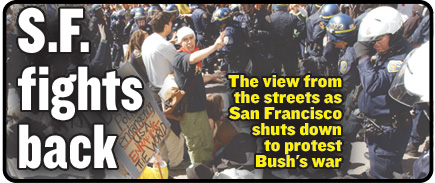
Nowhere was the clash of people power and government will more acute than on the streets of San Francisco, where a series of massive marches, some drawing nearly 100,000 people, filled the streets prior to the invasion of Iraq on March 19, 2003. The onset of war led protesters to effectively shut down the city, resulting in about 2,300 arrests and millions of dollars in costs to the city.

President George W. Bush dismissed the protests, of course, but he wasn’t the only one. Political leaders such as Rep. Nancy Pelosi, then-Mayor Willie Brown and soon-to-be Mayor Gavin Newsom (who didn’t attend any of the marches, unlike progressives on the Board of Supervisors) condemned the peace movement for hurting an innocent city. But with the “battle for San Francisco” making international news, the protesters were more concerned with the global audience.

A month earlier, on the weekend of Feb. 15 and 16, there were coordinated protests against the impending war in about 800 cities around the world, drawing around 10 million people. The peace march in Rome included about 3 million people, earning a listing in the Guinness Book of World Records as the largest anti-war rally in history. People have never made such a loud and clear statement against an incipient war.

Beyond the numbers, the antiwar movement was also right. On every major issue and prediction, the messages from the street proved correct while those from the White House were wrong. The US wasn’t welcomed as liberators. There were no weapons of mass destruction. Iraq after the invasion isn’t a stable democracy or shining beacon to anyone but the new generation of jihadis Bush created.

We can blame a hard-headed president, ineffectual opposition party, failure of the national media, or the national climate of fear following Sept. 11. But rather than refighting that lost battle, now is the time to gain perspective on the events of five years ago and determine what it means for democracy and the post-Bush national agenda.


TO THE STREETS

There were two main umbrella groups organizing protests before the war: Direct Action to Stop the War (DASW) and International ANSWER (Act Now to Stop War and End Racism). ANSWER has remained active and DASW has recently been reconstituted for the fifth anniversary of the war, using direct action in San Francisco as well as other urban centers and outposts like Chevron’s refinery in Richmond, which has reportedly been processing Iraqi oil.

“With the fifth anniversary coming up, we’re going back to direct action on the streets,” said Henry Norr of DASW. “But I don’t have any illusions that it’s going to be like it was five years ago.”

The maddening march to an ill-advised war created a political dynamic in which a broad cross-section of Americans was willing to hit the streets.

“We had a wonderfully diverse group of people, from soccer moms to anarchists,” said Mary Bull, who cofounded DASW, a collective of various affinity groups and concerned individuals formed in October of 2002 as Bush started beating the drums of war.

It was a group fiercely determined to prevent the war — and really believed that was possible. In fact, Bull recalls how she and other members of the group burst out crying at one meeting when a key activist said the war was going to happen.

Richard Becker, who cofounded ANSWER and serves as its West Coast coordinator, said that in the summer of 2002, “we came to the conclusion that [the war] was going to happen.” The group called its first big protest for Sept. 15, 2002, and another one two weeks later. But the movement really exploded on Oct. 26 when almost 100,000 people took to Market Street, much of it a spontaneous popular uprising.

“We were overwhelmed,” Becker said. “We were in a perpetual state of mobilization to keep up with what was going on. But then it didn’t stop the war.”

Did he think they could?

“I think a lot of people thought maybe it was possible to stop it. And we thought maybe it was possible to stop it,” Becker said.

The high point, according to Becker and Norr, was Feb. 17, 2003, when the New York Times ran a front page analysis piece entitled “A new power in the streets” that claimed “the huge anti-war demonstrations around the world this weekend are reminders that there may still be two superpowers on the planet: the United States and world public opinion.” But then Colin Powell went to the United Nations to argue for the invasion, and the Democrats in Congress did nothing, and it became clear war was coming.

Norr stayed out there protesting, being arrested several times and even shot in the leg by Oakland police with a rubber bullet during a protest at the Oakland docks. And he thinks some good came from the experience.

“The lesson for people is the political and economic elites are committed to preserving and extending empire. And they basically say as much in their own writing,” Norr said. “Wars are not anomalies.”

Despite being a frustrating and depressing exercise, most saw benefits to the failed movement. “People got an incredible education about how the system really worked,” Becker said. “Building a movement is mostly about a series of setbacks.”

Medea Benjamin, cofounder of both Global Exchange and CodePink and fixture of the anti-establishment peace movement for years, was upbeat about the protests. “We did our job as citizens. We did what we were supposed to do: organize, get people to take action, get people onto the streets,” she said. “We did everything we could think of.

“What you take from it is we don’t have a very well-developed democracy because the people spoke and the government didn’t listen.”

25war2_Lars1.jpg The ever-evolving “Democracy Wall” on Valencia Street, March 2003, helped stir up debate (Photo by Lars Howlett)


FACING ARREST

The collective action of five years ago starts with a series of personal stories — tens of thousands of them — so let me briefly begin with mine.

My arrival in San Francisco was closely tied to the march to war. I was living in Sacramento and working as the news editor of the Sacramento News & Review when Bush began his saber rattling against Saddam Hussein, but by the end of 2002 I had a falling out with my boss and found myself jobless.

Like most Northern Californians who opposed the war, I came to San Francisco on Jan. 18 to make my voice heard and experienced a bit of serendipity on my way to Justin Herman Plaza: while reading the Guardian on Muni, I saw their advertisement for a city editor, a job that was ideal for me at a paper I’ve always loved. Needless to say, it was a great day, empowering and full of possibilities.

Less than two months later I was on the job, and on the second week of that job I was back on the turbulent streets of San Francisco, part of a Guardian team covering the eruption of this city on the first full day of war. When I stepped off the cable car just after 7 a.m., people were streaming up Market Street and I joined them.

When a large group stopped at the intersection of Market and Beale, I stopped too, taking notes and bearing witness to this historic, exciting event. I had a press pass issued by the California Highway Patrol that allowed me to cross police lines, so when police in riot gear surrounded us and threatened arrest, I held my ground with 100 or so protesters.

After interviewing about a dozen people about why they were there and that they hoped to accomplish (see “On the bus: Journalists, lawyers, four-year-olds — the cops were ready to bust anyone Thursday morning“), I was arrested with the others and taken to a makeshift jail and processing center at Pier 27 (no charges were filed in my case, and charges against all of the 2,300 people arrested here in those first few days of the war were later dropped).

I recently tracked down a few of the people who appeared in my article, including Daphne and Ross Miller, who were at the center of the most interesting drama to play out during our standoff with the police. She’s a family practice physician, he’s an architect, and they live in Diamond Heights with their two children, Emet, who is almost 9, and Arlen, 12, who was away on vacation when the war began.

“We were genuinely shocked that the war started,” Ross told me. “We were at some of the earlier protests and really thought there was no way [Bush] could do it.”

They woke up March 20, 2003, to news that the war had begun and immediately walked to the BART station with Emet and rode to the Embarcadero station, not really planning for the day ahead but just knowing that they had to make themselves heard.

“We were pissed as hell. I don’t think I’ve ever been so angry in my life,” Daphne said.

They quickly came up with a plan. “We basically decided that if anyone was going to be arrested, it was going to be Ross and I’d stay with Emet. But it didn’t end up that way and I ended up in the arrest circle.”

Daphne had their house keys and threw them over the police line to Ross at one point. A photographer in the circle had gotten shots of a man named Roman Fliegel being roughed up by police as they pulled him off his bicycle, which was towing a trailer with a sound system, and decided to throw his backpack with camera gear out as well. When Ross — who had four-year-old Emet on his shoulders — caught it and refused police orders to give it to them, police grabbed Emet and roughly arrested Ross, leaving a gash on his forehead.

“Rage surged through the crowd, and it seemed as if things might get ugly, but the police kept a tight lid on the situation, using their clubs to shove back protesters who had moved forward,” I wrote at the time.

Emet was delivered into the circle with Daphne as the arrests continued, many quite rough. “At that point, as a mom, I had to exercise the most restraint ever,” said Daphne, who was angry about the situation but fearful about what she was exposing her son to. “Please, don’t let any violence happen here,” she pleaded with the crowd. Eventually, commanders on the scene let the mother and child go.

“The officer who let me go said that if he saw me again out there, he would call Child Protective Services on me,” Daphne said. But two days later, still brimming with outrage at her country’s actions, she ditched a downtown medical conference to rejoin the street protests, this time solo.

The couple say they’ve lost friendships over the war and have become more engaged with politics, coming to believe that Bush and the neocons are malevolent figures who knew how badly the war would go and did it anyway to establish a large, permanent military base in Iraq.

“Since that day, we’ve been far more active,” Ross said. “We realized you can’t just trust the system. You have to push.”

But that determination was mixed with feelings of disempowerment and depression. They attended some of the protests that following year, but the couple — like most people — just stopped going at some point because they seemed so futile.

“There was a horrible sense of resignation and a genuine depression that followed,” Ross told me.

The nadir was when Bush was reelected and they considered leaving the country. But then, Ross said, “we decided we’re not just going to run away and we’re not going to accept this.” Looking back, even with the scare over Emet, they express no regrets.

“It was the right thing to do because it was the wrong war to have. I’d do it again and again and again if I had to,” Ross said

They’re guardedly hopeful that Barack Obama could begin to turn things around if he’s elected. “I think the right president can at least start to dismantle this,” Daphne said. “I think thousands of people marching in the streets is something he would listen to.”

25war3_Charles1.jpg A die-in on the streets of San Francisco in March 2007 marked the fourth anniversary of the invasion (Photo by Charles Russo)


WITNESS TO HISTORY

Covering the peace movement in those early days was a heady experience, like reporting on a revolutionary uprising or working in a foreign country where the people are organized and active enough to be able to shut down society and brave enough to risk bodily injury for their beliefs.

I was at the founding meeting of CodePink — which became the most effective group at personally confronting the warmongers and keeping the war in the public eye — one evening at Muddy Waters in the Mission District shortly after the war started.

Looking back, Benjamin rattled off a long list of the alliances the group built — with labor, churches, businesses, and a wide array of social movements — and creative actions intended to build and demonstrate popular support for ending the war.

“We’ve done so many things and what did we get? We got a surge,” she said. “It shows the crisis in our democracy, the crisis of the two-party system, the crisis of a dysfunctional opposition party.”

Yet she said the peace movement has been remarkably successful in convincing the public that the war was a mistake and that it’s time for the troops to come home, even if the Democrats have been slow to respond to that shift.

“The progress we’ve made is turning around public opinion and that’s going to play a big role in the upcoming elections,” she said. For Norr, the role of the news media is a particular sore spot. He was a technology reporter for the San Francisco Chronicle who called in sick on the first full day of war and was arrested on Market Street with his wife and daughter, resulting in suspension by editor Phil Bronstein for his actions.

I wrote several stories on the issue, which culminated in Norr being fired and Bronstein unilaterally banning Chron employees from peace protests. I even borrowed CodePink’s guerilla tactics when Bronstein repeatedly refused to return my calls or address why he had singled out antiwar protesters for uniquely punitive treatment. I confronted him during a speech he gave at the Commonwealth Club (see “Lies and half-truths,” 5/7/03). That was the tenor of the times: we were all tired of being lied to and we decided to push back.

Norr was particularly frustrated with his own paper’s reporting of the war and started sending articles by the foreign press to his paper’s news desk, trying to wake his colleagues up to the pro-war propaganda being passed off as journalism in this country.

He was also disappointed with the country and with the Chronicle — both the management and his fellow reporters, who did little to support him — but the experience caused him to return to his roots as a progressive activist.

“The war and losing the job and everything brought an abrupt end to my consumerist phase and dumped me back into the world of being an activist,” said Norr, who serves on the KPFA 94.1 FM local station board and has made three recent trips to the Palestinian territories while working with the International Solidarity Movement.

Benjamin said Americans shouldn’t expect the next president to end the war — not without lots of pressure from a renewed and vocal peace movement. “This is the time to set the stage for the post-Bush agenda,” Benjamin said. “Don’t put your hopes in Barack Obama in getting us out of Iraq. Put your hopes in the people.”

25war4_Lane1.jpg A rally and nonviolent direct action at the Richmond refinery targeted Chevron on March 15 (Photo by Lane Hartwell)


THE AFTERMATH

The San Francisco Police Department, which spent more than $2 million on overtime costs responding to peace protests between March 15 and April 16, 2003, generally behaved with restraint and professionalism, but there were several exceptions.

The most costly and disturbing incident came when Officer Anthony Nelson began aggressively swinging his long riot baton at protesters, badly shattering the arm of peaceful protester Linda K. Vaccarezza, who suffered a permanent disability in her career as a court reporter.

Nelson’s incident report falsely stated that Vaccarezza had threatened him with a sign attached to a solid pole, but video of the incident later clearly showed there was no pole and that she was retreating when he teed off on her (see “The home front,” 05/19/04).

Vaccarezza received an $835,000 settlement from the city in November of 2004. On Oct. 5, 2005, two and a half years after the incident, SFPD fired Nelson for lying about what happened that day, and the City Attorney’s Office has been successfully fighting Nelson’s appeals in court ever since, putting in more than $100,000 in attorney time and costs into the Nelson and Vaccarezza cases.

The other significant ongoing litigation from the antiwar protests involved Mary Bull, who was arrested during an early protest for pouring fake blood in front of the entrance to Chevron’s San Francisco office before being allegedly strip searched and left naked in her San Francisco Jail cell for 36 hours.

Ironically, Bull was among those who brought a successful class action lawsuit against Sacramento County after she and others protesting a logging plan were strip searched, setting a precedent and led most counties to reform their strip-search policies. She used her share of the $15 million judgment to buy an organic permaculture farm in Sebastopol.

Her San Francisco case, in which Bull won a multimillion-dollar judgment, is still under appeal and now in mediation. Bull said the protests five years ago did make a difference, something she tells those who fret about its apparent failure. “I tell them to look at what issues the candidates are talking about now and I thank them for protesting then.”

“Even though we had millions throughout the world, we were sort of blocked, but now we’re regaining that momentum,” Melodie Barclay, a massage therapist who was also arrested with me on the first day of the war, told me recently. “We can’t judge it by the fact that we didn’t get the momentum we wanted.”

Norr started his antiwar activism working with Students for a Democratic Society in Boston, protesting the Vietnam War, which he said shares many similarities with the current situation, for good or for ill. He said that people tend to forget that while the protests then were huge and helped end the war, the movement did wane after Nixon ended the draft and substituted massive aerial bombardment for boots on the ground.

“The protests dropped off considerably,” he said. “A lot of the things that drove people to take risks in the late ’60s had faded by the early ’70s.”

He thinks the current administration learned a lesson from those days: it’s easier to maintain a war effort if the average citizen isn’t affected.

But there are other factors as well keeping a lid on the antiwar outrage.

“The culture has changed too. Young people are oversaddled with debt. People in schools seem to be docile. The culture as a whole seems to be more individualist and consumerist,” Norr said.

Yet some young people have woken up and many of them are funneling their energies into a peace group that was formed in the summer of 2005: World Can’t Wait, as in: the world can’t wait for the end of Bush’s second term before we change our direction and leadership.

“We don’t just want them gone, we need to repudiate their program,” said Giovanni Jackson, a 26-year-old WCW student organizer. “If we’re going to change anything, we need the youth.”

Jackson was at WCW’s founding convention in New York City, which came just as New Orleans was being flooded and then essentially abandoned by the federal government.

“When [Kerry] lost, people felt demoralized and World Can’t Wait kind of stepped into that situation,” Jackson said. “There was a lot of demoralization in the antiwar movement at that time.”

The group organized protests and student walkouts on Nov. 2, 2005.

“Everyone has their moments of doubt,” he said, “but I’m motivated by the crimes we see everyday.”


THE LESSONS

One of the biggest barriers to galvanizing people and turning the fifth anniversary of the war into something that might make a difference is the presidential election, which is diverting the energy of many potential protesters — and at the same time, offering some hope that a new president may lead to peace.

After all, every single one of the Democratic presidential candidates has promised to withdraw troops from Iraq, with varying timelines and numbers of US personnel left behind. And with enough encouragement, they might be willing to help change the status quo.

Many of the activists who volunteered their time and money to help move the Obama campaign into its front-runner position came out of the antiwar movement, and Obama’s strong stand against the war has been a key factor in his popularity.

Becker and some other activists don’t have much faith that a change in presidents will change the course in Iraq, although he agrees that much of the energy now surrounding Barack Obama derives directly from the antiwar movement.

“There’s been a huge upsurge of hope for Obama and that he might bring about the kind of change we need,” Bull said, adding that she doesn’t share that hope, believing the only path to peace is to pressure Obama and other leaders to commit to more progressive positions.

Norr said, “On one level, people have illusions about the power of peaceful protests. People believe in democracy, as well they should. We feel like the rulers should be paying attention to public opinion.

“It’s a remarkable story how broadly and quickly the American people have turned against the war. Public opinion was certainly ahead of the Democrats.”

And people will only grow more disenchanted with Iraq and its multitude of costs. “The people here are paying for this war, and everyday we have new stories about health clinics being shut down,” Becker said.

Becker was amazed last March as massive demonstrations for immigrant rights seemed to explode out of nowhere. “We think there will be more things like that,” he said.

Because after five years of organizing communities to resist the military-industrial complex’s plans, Becker thinks there’s been some visible progress.

“There isn’t a town or hamlet in the US that doesn’t have activism going on, but you wouldn’t know it from the corporate media,” Becker said. “It’s a mistake for people to feel discouraged.”


Freedom of Information: A citizen’s guide to fighting secret government

0

San Francisco has the best local sunshine law in the country — and there are still problems getting access to information. Even though the digital age in which we live affords government agencies with myriad ways to give citizens more access to public documents, there is too often little official will to create transparency. And often, bureaucrats are downright hostile to public scrutiny. But help is out there. This guide to local and national organizations offers a wide range of resources for journalists, citizen activists, and hell-raisers who want to track their tax money and hold their government accountable.

LOCAL ORGANIZATIONS


The California First Amendment Coalition is an independent, nonpartisan, nonprofit organization whose mission is to "promote and defend the people’s right to know" by improving compliance with state and federal access laws. CFAC’s Web site contains an archive of articles dealing with FOI issues, the texts of state FOI laws, and other useful resources. 534 Fourth St., Suite B, San Raphael, CA 94901. (415) 460-5060, cfac@cfac.org, www.cfac.org.

The California Newspaper Publishers Association is the umbrella organization to which most newspapers in the state belong, so it has an acute interest in open government. Its FOI Watch newsletter (also available online) includes a clearinghouse of sunshine news from around the state. 708 Tenth St., Sacramento, CA 95814. (916) 288-6015, tom@cnpa.com (general counsel Thomas Newton), www.cnpa.com.

Californians Aware, run by former CFAC general counsel Terry Francke, helps activists and organizations get access to public meetings and records and offers resources on the Web for citizens, public officials, journalists, and attorneys. 2218 Homewood Way, Carmichael, CA 95608. (916) 487-7000, info@calaware.org, www.calaware.org.

The Center for Investigative Reporting sponsors workshops on investigative techniques for journalists and university students. The center’s Web-based magazine provides FOI information, tips for journalists, and updates on past CIR investigations. 2927 Newbury St., Suite A, Berkeley, CA 94703. (510) 809-3160, center@cironline.org, www.muckraker.org.

The DataCenter provides on-call research, consultation, and referrals to justice organizations regarding FOI issues. It also offers research and action training. Services are free or on a sliding scale, depending on one’s ability to pay. 1904 Franklin St., Suite 900, Oakland, CA 94612. (510) 835-4692, ext. 376, www.datacenter.org.

The Electronic Frontier Foundation, an online First Amendment organization, works to uphold digital free speech, empower the online public, and protect privacy on the Internet. It provides stories and alerts on its Web site, with daily updates. Effector, an e-mail newsletter, is available through the site. 454 Shotwell St., S.F., CA 94110. (415) 436-9333, information@eff.org, www.eff.org.

The First Amendment Project is a public interest law firm that provides legal representation, educational programs, and low-cost or free advice for journalists, public interest organizations, and individual citizens with public records and FOI-related issues. In a joint publication effort with the Society of Professional Journalists, the project offers three free pocket guides, on the Brown Act, California’s Open Meeting Law, and accessing court records. The Web page has information on using the California Public Records Act as well as on getting court records. 1736 Franklin St., 9th floor, Oakland, CA 94612. (510) 208-7744, fap@thefirstamendment.org, www.thefirstamendment.org.

Media Alliance is a nonprofit media center that offers classes on journalism skills, including how to find and use public records. 1904 Franklin St., Suite 500 Oakland, CA 94612. (510) 832-9000, information@media-alliance.org, www.media-alliance.org.

The Society of Professional Journalists, Northern California Chapter, FOI Committee fights for open access to information and educates members of the public on FOI issues. The group provides a subscription e-mail list for journalists and others involved in FOI and First Amendment issues in California as well as putting on the James Madison FOI Awards. 222 Sutter St, 6th Floor, San Francisco, CA 94108 (415) 321-1700, www.spj.org/norcal.

NATIONAL ORGANIZATIONS


The Brechner Center for Freedom of Information conducts research and educates the public in mass-media law and the First Amendment, including public access to government meetings and records and litigation information. University of Florida, College of Journalism and Communications, 3208 Weimer Hall, P.O. Box 118400, Gainesville, FL 32611-8400. (352) 392-2273, www.jou.ufl.edu/brechner.

The Center for National Security Studies works with concerned citizens and groups to expose secret government policies and offers free assistance to those seeking records under the Freedom of Information Act. It also coordinates related litigation. 1120 19th St. NW, 8th floor, Washington, D.C. 20036. (202) 721-5650, cnss@cnss.org, www.cnss.org.

The FOIA Blog, created by an FOIA Washington attorney, has an updated list of documents currently being released by several government agencies infoprivacylaw@yahoo.com, www.thefoiablog.typepad.com.

The Freedom of Information Center of the University of Missouri School of Journalism has a collection of more than one million articles and documents about access to information at the local, state, and federal levels. The center works to ensure compliance with sunshine laws around the country. Its Web site contains links, updates, and tips on FOI inquiries. A free e-mail newsletter provides information on developments in FOI access and issues; you can sign up by contacting umcjourfoi@missouri.edu. University of Missouri, 133 Neff Annex, Columbia, MO 65211. (573) 882-5736, daviscn@missouri.edu, www.missouri.edu/~foiwww.

GovernmentDocs allows people to browse and search thousands of pages acquired through the FOIA and sunshine laws. Registered users can review and comment on documents. www.governmentdocs.org

GovTrack provides information on the U.S. Congress. It compiles information on federal legislation, voting records, and other congressional date and simplifies the language for ordinary citizens. It also indexes all bills, as well as changes to them, in Congress and all roll call votes www.govtrack.us.

Investigative Reporters and Editors provides educational services for investigative reporters and editors. The group’s Web site offers FOI-related resource guides, a database of FOI stories, tips for using the Freedom of Information Act, and a database of previous FOI requests. University of Missouri School of Journalism, 138 Neff Annex, Columbia, MO 65211. (573) 882-2042, www.ire.org

The National Freedom of Information Coalition is composed of First Amendment organizations dealing with FOI issues. It provides resources for the media, government officials, lawyers, and citizens who want access to public information. The coalition also offers seminars and workshops to media professionals, attorneys, academics, students, and the public on FOI issues and helps nurture start-up FOI groups and Internet sites. Its Web site offers links to relevant legislation and organizations state by state, as well as an Internet mailing list, FOI-L. 133 Neff Annex, Columbia, MO 65211. (573) 882-5736, cdavis@nfoic.org, www.nfoic.org.

OMB Watch is a member of the Public Access Working Group, a coalition of organizations promoting greater access to government information. OMB Watch offers an online newsletter, OMB Watcher, available on its Web site or by e-mail, which typically includes articles on FOI issues. To subscribe to the weekly e-mail version, e-mail join-ombwatcher@lyris.ombwatch.org. 1742 Connecticut NW, Washington, D.C. 20009. (202) 234-8494, www.ombwatch.org.

The Project on Government Secrecy is an advocacy and public education project of the Federation of American Scientists. The project has an extensive archive and provides regular news updates through its Web site and e-mail newsletter, Secrecy News. 1725 DeSales Street NW, 6th floor, Washington, D.C. 20036. (202) 454-4691, www.fas.org/sgp/index.htm.

Project Vote Smart provides information on local, state, and national candidates, including voting records, issue positions, campaign contributions, phone numbers, and mailing addresses. The database is accessible by calling the toll-free hotline at 1-888-VOTE-SMART. 1 Common Ground, Phillipsburg, MT 59858. (406) 859-8683 comments@vote-smart.org, www.vote-smart.org.

The Radio-Television News Directors Association is the world’s largest professional organization devoted to electronic journalism. It lobbies for cameras in courtrooms and strong FOI laws and provides coverage of FOI issues on its Web site. 1600 K St. NW, Suite 700, Washington, D.C. 20006. (202) 659-6510, www.rtnda.org.

The Reporters Committee for Freedom of the Press operates the 24-hour FOI Service Center at 1-800-336-4243 to answer emergency questions from journalists and others with open-records problems. 1101 Wilson Blvd., Suite 1101, Arlington, VA 22209. (703) 807-2100, rcfp@rcfp.org, www.rcfp.org.

The Society of Professional Journalists advocates for open access to information and educates members of the public on FOI issues. The society’s Web site has an FOI section with extensive links to resources and information, including a list of FOI advocacy organizations. 3909 N. Meridian St., Indianapolis, IN 46208. (317) 927-8000, questions@spj.org, www.spj.org.

State Sunshine and Open Records shares information, guidance and advice on developments and news about open records at the state and local level. They also have an extensive list of links to other sunshine blogs. www.openrecords.wordpress.com.

The Student Press Law Center works with the Reporters Committee for Freedom of the Press to cover FOI and other First Amendment issues reutf8g to high school and college journalists. It offers free advice, lawyer referrals, and analysis. 1101 Wilson Blvd., Suite 1100, Arlington, VA 22209. (703) 807-1904, admin@splc.org, www.splc.org.

The Sunlight Foundation develops a database to ensure transparency in government and fiscal accountability. They digitize new info and provide access to existing information. 1818 N Street NW, Suite 410, Washington, D.C. 20036, (202) 742-1520. www.sunlightfoundation.com.

WikiFOIA helps people understand the FOI Act on a state and federal level by providing a how-to-guide about open records requests, as well information on how to make that request. www.wikifoia.pbwiki.com.

INTERNATIONAL ORGANIZATIONS AND RESOURCES


The Guardian Web site has extensive information and links concerning international press-freedom issues. For details on journalists under fire, including frontline dispatches and reports from the battle to keep the world safe for journalists, go to www.sfbg.com/journalists/. For updates, dispatches, and links to national and international FOI groups, go to www.sfbg.com/FOI.

The UK FOI Blog provides a glimpse into how FOI issues are dealt with across the pond by listing news and developments on FOI in Great Britain. www.foia.blogspot.com.

Local government resources

The Government Information Center, on the fifth floor of the San Francisco Public Library’s Main Branch, stocks public documents published by the city. These include annual reports for committees and departments, minutes and agendas of official meetings, environmental impact reports, and city audits, ordinances, and resolutions. San Francisco Public Library, 100 Larkin St., S.F., CA 94102. (415) 557-4500, www.sfpl.org.

The Oakland Public Ethics Commission responds to complaints and holds hearings on possible violations of the city’s Sunshine Ordinance. Records, tapes of the commission’s meetings, agendas, and minutes can be picked up at the commission’s office. 1 Frank Ogawa Plaza, 4th floor, Oakland, CA 94612. (510) 238-3593, ethicscommission@oaklandnet.com, www.oaklandnet.com/government/public_ethics/webpage.html.

The Office of Information and Privacy, U.S. Department of Justice, provides online versions of frequently requested records, opinions, policy statements, and guides to the Freedom of Information Act. The guides include detailed instructions for filing FOIA requests, average response times for different governmental offices, and a wealth of other useful information. The text of the FOIA is available on the office’s Web site. 1425 New York Ave., Suite 11050, Washington, D.C. 20530. (202) 514-3642, www.usdoj.gov/oip/oip.html.

Public Access to Court Electronic Records is an online database of court records and decisions. Web access is 8¢ a page, and requires registration through the Web at www.pacer.psc.uscourts.gov. P.O. Box 780549, San Antonio, TX 78278. 1-800-676-6856, pacer@psc.uscourts.gov.

The San Francisco Ethics Commission monitors and enforces the Sunshine Ordinance and the city’s governmental-ethics, campaign-finance, and lobbyist-reporting laws. Individuals can file complaints regarding violations of the Sunshine Ordinance. The commission meets the second Monday of each month at 5:30 p.m. in City Hall, Room 408. 25 Van Ness, Suite 220, S.F., CA 94102. (415) 252-3100, ethics.commission@sfgov.org, www.sfgov.org/site/ethics_index.asp.

The San Francisco Law Library is open to the public, though only government officials, state bar members, and judges can check out items. Main reference library: Mon.-Fri., 8:30 a.m.-5 p.m., Veterans War Memorial Building, 401 Van Ness, Room 400, S.F. (415) 554-6821. Courthouse reference room: Mon.-Fri., 8:30 a.m.-4:30 p.m., 400 McAllister, Room 512, S.F. (415) 551-3647. Financial District branch: Mon.-Thurs., 9 a.m.-9 p.m.; Fri.-Sat., 9 a.m.-5 p.m.; Sun., noon-4 p.m., 685 Market St., Suite 420, S.F. (415) 882-9310, www.ci.sf.ca.us/site/sfll_index.asp.

The Sunshine Ordinance Task Force oversees compliance with San Francisco’s sunshine law by investigating complaints from individuals who believe city officials have withheld records or conducted meetings in violation of the law. The task force meets the fourth Tuesday of each month at 4 p.m. City Hall, 1 Dr. Carlton B. Goodlett Place, Room 244 (meetings held in Room 408), S.F. For complaint forms and other information call (415) 554-7724 or go to http://www.sfgov.org/site/sunshine_index.asp

PUBLICATIONS


The California First Amendment Coalition publishes the California Journalist’s Legal Notebook, a handy guide to the legal issues surrounding telephone interviews, press passes, gags on sources, and other journalism-related topics ($36.25, $30.88 for CFAC members, shipping included). Also by CFAC is The New Brown Act: How the Open Meeting Law Has Been Revised ($12.75, $7.39 for CFAC members, shipping included). (415) 460-5060.

The Oakland Public Ethics Commission publishes a free brochure, How to Notice a Public Meeting under the Oakland Sunshine Ordinance and the Brown Act, useful for making sure a public meeting follows the requirements of the Brown Act. (510) 238-3593, (510) 238-6620, ethicscommission@Oaklandnet.com, www.oaklandnet.com/government/public_ethics/webpage.html.

Access to Courts and Court Records in California, Open Meeting Laws in California, and The California Public Records Act are free, convenient, quick-reference guides published by the Society of Professional Journalists, Northern California Chapter, and the First Amendment Project. (510) 208-7744, www.thefirstamendment.org/freepress.html.

The ACLU Freedom of Information Project publishes Using the Freedom of Information Act: A Step-by-Step Guide (#4002, $3) and Your Right to Government Information (#1190, $5.95), which covers a broader range of topics, including how to get into public meetings. Both publications can be ordered online through the ACLU’s e-store or by phone. ACLU Publications, P.O. Box 4713, Trenton, NJ 08650-4713. 1-800-775-2258, www.aclu.org.

The Government Printing Office publishes The Freedom of Information Act Guide and Privacy Act Overview ($63), a 986-page guide to the FOIA produced by the Justice Department. It can be ordered by phone at 1-866-512-1800 or online at bookstore.gpo.gov. The Citizen’s Guide is available in its entirety online at www.fas.org/sgp/foia/citizen.html.

The Freedom of Information Clearinghouse Guidebook is a free brochure about making FOIA requests and appealing agency decisions. It’s available online through the Freedom of Information Clearinghouse. www.citizen.org/litigation/free_info/index.cfm.

Paper Trails: A Guide to Public Records in California ($12.89), written by Stephen Levine and Barbara Newcombe, is published by the Center for Investigative Reporting and supported by the California Newspaper Publishers Association. It can be ordered from the CIR. An abridged, online version is coming soon. 2927 Newbury St., Suite A, Berkeley,, CA 94703. (510) 809-3160, www.centerforinvestigativereporting.org/

The fourth edition of the Investigative Reporters’ Handbook ($61, $51 for Investigative Reporters and Editors members), by Steve Weinberg, Brant Houston, and Len Bruzzese, is a comprehensive and accessible guide for novice and experienced journalists that shows how to locate and use more than 500 sources of public information. (573) 882-3364, www.ire.org/store/books.

The Reporters Committee for Freedom of the Press supplies a wealth of publications on public access and other First Amendment topics. How to Use the Federal FOI Act ($5) is a handbook on FOI rights, with instructions for appealing if your request is denied, and includes sample letters. The First Amendment Handbook ($7.50) is a journalist’s pocket guide to FOI issues. Two guides — Judicial Records: A Guide to Access ($3) and Access to Electronic Records ($5) — analyze state laws and decisions regarding access to legal records and government electronic data. Tapping Officials’ Secrets is a set of guides to state public records and open-meeting laws ($10 a state). The News Media and the Law is a quarterly magazine that includes updates on legislation pertinent to FOI ($30 a year for four issues). Some of these publications are available in their entirety online; all can be ordered online. 1-800-336-4243, www.rcfp.org.

The second edition of Law of the Student Press ($18) is a vital handbook for student newspapers. It’s extensively annotated but avoids legalese and tries to bring the law to life for students and educators. The Student Press Law Center also publishes Covering Campus Crime, Third Edition ($2) and the Student Press Law Center Report ($15 for three issues a year). (703) 807-1904, www.splc.org.

Citizen Muckraking: How to Investigate and Right Wrongs in Your Community ($9) offers advice on writing press releases, conducting interviews, and using the FOIA. The book, a collaborative effort by the Center for Public Integrity, is available through Common Courage Press. 1-800-497-3207, www.commoncouragepress.com

>

Freedom of Information: 2007 James Madison Award winners

0

Click here for details on the First Amendment Awards Dinner.

Norwin S. Yoffie Career Achievement Award

DAN NOYES (COFOUNDER, CENTER FOR INVESTIGATIVE JOURNALISM)


If journalists were the subjects of trading cards like baseball players, the Dan Noyes rookie card would be just as impressive as a 2008 career highlights card. Think Reggie Jackson: a long, impressive career, spanning multiple organizations and a propensity to come out swinging big at the end of a hard-fought battle.

Over a career spanning 30 years, Noyes has pursued serious investigations, some lasting as long as a year, into everything from questionable Liberian timber imports to illicit gun trafficking from United States suppliers to the Nuestra family gang. Journalism first interested Noyes during the crucial investigative reporting that sparked Watergate scandal in the early 1970s.

In 1977 Noyes cofounded the Berkeley-based Center for Investigative Reporting (CIR), an independent news organization which produces in-depth stories and documentaries for all major news outlets. In 1979, reporting for the ABC News program 20/20, CIR broke a story on a swindling United Nations charity organization and its connections to international drug trafficking.

More recently, Noyes has done a series of print and broadcast pieces concerning gang violence in California and its effect on the lives of those surrounding the lifestyle. Noyes still holds an executive position at the CIR and continues to contribute to the world of investigative journalism.

Beverly Kees Educator Award

CLIFF MAYOTTE


Cliff Mayotte sees his Advanced Acting Class at Lick-Wilmerding High School as one that merges students’ "consciousness and awareness as young adults with their skills and energies as performance artists."

The subtitle of the course is "Theatre as Civic Dialogue," and the eight students enrolled during the 2007 spring semester used all their abilities to pull off a notable show.

After an introduction to Documentary Theatre — a form he described as "oral history turned into performance" — the group selected a topic that was important to them, giving birth to the "Censorship Project."

The students interviewed their peers, teachers, and administrators to gather perspectives on the ways in which expression and opinion can be muted or altered, both voluntarily and involuntarily. They reached out to organizations such as Project Censored, the First Amendment Project, and the Ella Baker Center for Human Rights. They transcribed interviews and studied subjects in order to capture statements, word patterns, and mannerisms of interviewees, then shaped the themes into a 60-minute performance.

Professional Journalists

WILL DEBOARD


"Being a high school sports guy, I don’t get to do this very often," the Modesto Bee‘s Will DeBoard said of his first major foray into investigative reporting. He had gotten a tip that the California Interscholastic Federation was investigating recruiting violations by the football program at Franklin High School in Stockton, which competed with schools in his area. DeBoard asked the school and CIF about recruiting violations, but the football coach flatly denied the allegations and the CIF wasn’t much more helpful.

So DeBoard decided to make formal requests for public records with the help of business reporter Joanne Sbranti, and after fighting through some initial denials, he obtained hundreds of pages of investigatory documents from CIF showing how the school was recruiting players from American Samoa. "It really was a treasure trove of great stuff. We got two weeks’ worth of stories out of these documents," DeBoard said. "It really showed us that what the school was telling us just wasn’t true."

The documents detailed the recruiting scheme and gave DeBoard tons of leads for follow-up stories, including the address of "a home owned by the coach where there were all these gigantic Samoan linemen living there." DeBoard called the effort an "adrenaline rush" better than that caused by the best game he’s covered and a high point of his journalism career.

THOMAS PEELE


Contra Costa Times investigative reporter Thomas Peele has a long history of battling for public records access on behalf of both reporters and private citizens. Peele, who helps with projects for all the newspapers under the Bay Area News Group-East Bay ownership, helped ensure the recovery of thousands of e-mails from the Oakland mayoral tenure of Jerry Brown when he left office to become the state’s attorney general in 2006. Peele also helped conduct a statewide audit of Public Records Act compliance by law enforcement agencies with the nonprofit Californians Aware, which revealed glaring inconsistencies in how police across the state make information about their activity available to the public. And he’s been a major figure in helping the Chauncey Bailey Project pry out new information about Bailey’s murder last year and it’s connection to Your Black Muslim Bakery. He began his career in 1983 at a small weekly in Bridgehampton, N.Y., and moved from there in 1988 to the Ocean County Observer in New Jersey before joining the CCT in 2000.

ROLAND DE WOLK


KTVU-TV producer Roland De Wolk is leading the investigative team of photographer Tony Hedrick and video editor Ron Acker in a quest to get the names of drivers who regularly use FasTrak lanes but don’t pay anything. But to date, says De Volk, the Metropolitan Transportation Commission has been blocking his team’s quest.

De Wolk told the Guardian that his team filed a California Public Records request when the MTC wouldn’t provide information on the amount of money it was losing thanks to drivers who don’t pay tolls when they use FasTrak lanes.

"We asked MTC for specific numbers last summer and got little information. That makes a reporter’s antennae quiver," said De Wolk.

But when he and his team asked for the numbers of people obstructing their plates, the MTC started acting squirrelly, De Wolk said.

"Finally, after six to eight weeks of asking we got an answer: a photo of a car whose plate was blank," fumed De Wolk, whose team continues to push for the names of the 10 most frequent FasTrak violators.

Broadcast News Outlet

KGO-TV


When KGO-TV reporter Dan Noyes and producer Steve Fyffe asked Muni to turn over records of public complaints against its drivers, they were ready for some bureaucratic foot dragging. But they never expected the yearlong grudge match that followed. First, the union representing Muni drivers sued to keep the records sealed. Then Muni’s parent department, the Municipal Transportation Agency, made a backroom deal with the union and released a blizzard of confusing and heavily redacted paperwork that would have made the Pentagon blush.

"It was essentially a big document dump," Fyffe told us. "There was no way to tell one form from another or which driver was which."

Noyes and Fyffe convinced their bosses at KGO-TV to file a lawsuit for full access to the records. The station prevailed, after which Noyes and Fyffe received over 1,200 pages of public complaints about 25 drivers. Recently, the station went back to court after Muni refused to release surveillance tapes of the drivers. As in the previous case, the judge ruled that the public had a right to the materials and forced the transit agency to hand the tapes over.

Fyffe said he sees KGO’s legal successes as small victories in a much larger fight. "I hope in the future that this case will make Muni and other city departments more [responsive] to records requests … these kinds of incremental victories hopefully lead, little by little, to a more open government."

Print News Outlet

SACRAMENTO BEE


The Sacramento Bee operates in a city run by top-tier politicians and their spinmeisters, so the editors and reporters there have placed increasingly high value on using documents to support their stories.

"We’ve always used public records here. Being in a state capital, we’re a little more aware of the necessarily of that," managing editor Joyce Terhaar said. "You just need to be able to tell a story about what’s really happening."

Yet she said that in recent years, the Bee has made a concerted effort to hire public-records experts and to have them share their knowledge with the paper’s staff through regular workshops. And last year, those efforts paid off with a string of big, impactful investigative stories.

Among them was Andy Furillo’s look at how much the state was spending to fight inmate care lawsuits, Andrew McIntosh’s exposé on the lack of oversight for paramedics and emergency medical technicians, and stories by John Hill and Kevin Yamamura on misconduct by the state’s Board of Chiropractic Examiners.

In selecting the Bee, Society of Professional Journalists judges recognized these individual efforts as well as the Bee‘s "institutional support of reporters and their use of public records for numerous stories."

Community Media

THE BERKELEY DAILY PLANET


One of the only ways to uncover corporate wrongdoing is to dig through court records, and it’s the job of the press to report what it discovers, said Becky O’Malley, executive editor for the Berkeley Daily Planet. She was convinced that a prior court order violated the public’s constitutional rights to see court documents, so the small daily newspaper sued and won in a California appeals court last year, making public 15,000 pages of records from a class-action suit filed against Wal-Mart in 2001.

The documents included allegations that the company had denied rest breaks to its workers and deleted hours from paychecks. In the Planet‘s freedom of information suit, the appeals court judges agreed with the paper’s attorneys that the case could set a dangerous precedent where the public would have to prove its right to access court records. "It’s becoming more of a trend for judges to grant permanent seals on court records," said O’Malley. That’s unfortunate, she added, since "the only way the public finds out about bad things going on in society is through court records."

Special Citation Award

CHAUNCEY BAILEY PROJECT


After Oakland journalist Chauncey Bailey was murdered last August, a large group of Bay Area media organizations formed a rare coalition to investigate his death and the activities of Your Black Muslim Bakery, a long-time East Bay institution believed by police to be involved in the killing. Since then, the group has produced several stories complete with audio, video, and photo presentations, the most recent of which is a series by retired Santa Rosa Press-Democrat reporter Mary Fricker detailing the sexual assault allegations made by young women once in the custody of Yusuf Bey Sr., founder of the bakery. Fricker received help from independent radio journalist Bob Butler, investigative reporter A.C. Thompson, and MediaNews staff writers Cecily Burt, Thomas Peele and Josh Richman. Other stories have reported allegations of real estate fraud against bakery associates, explored potential coconspirators in Bailey’s death, and examined the bakery’s ties to several prominent politicians. More about the project — the first of its kind since a group of journalists investigated the murder of Don Bolles more than 30 years ago in Arizona — can be found at chaunceybaileyproject.org, or at www.sfbg.com/news/chaunceybailey.

Public Official

MARK LENO


It was a staff member, Kathryn Dresslar, who told Assemblymember Mark Leno how horrible state agencies had become at complying with the California Public Records Act. Dresslar served on the board of Californians Aware, a group that advocates for open government, and she described to her boss how a 1986 audit by the organization had given every one of the 33 agencies in California government a failing grade.

Ryan McKee, then a high-school student and the son of CalAware board president Rich McKee, had visited each agency and asked for a few simple things. He wanted to see each agency’s guidelines for public access, and he requested some basic information, including the salary of the agency director. Agency after agency refused to follow the law.

So Leno introduced legislation that would have mandated that every agency post its access guidelines on the Web — and included stiff fines for agencies that violated the Public Records Act. "It put some teeth into the law," Leno told us. "And I got 120 of 120 members of the state Legislature to vote for it.

That wasn’t enough for Gov. Arnold Schwarzenegger, who vetoed the bill, saying it wasn’t needed. The governor insisted that he had already ordered state agencies to fix the problem.

"It was a great eye-opener for me, and showed me the resistance this administration has to allowing public access to state government," Leno said. "Without that access the public is at a great disadvantage."

Library

UC BERKELEY’S BANCROFT LIBRARY LOYALTY OATH PROJECT


It might be hard to believe, but in 1949 the University of California Regents, a bastion of higher education, rode the wave of anticommunist fervor and McCarthyism, forcing all UC employees to take a loyalty oath. The Board of Regents adopted the rule that UC administrators pushed forth: denounce communism and swear loyalty to the state, or face losing your job.

As could be expected, people resisted and 31 faculty, workers, and student employees lost their jobs. They appealed the case to the California Supreme Court and eventually were reinstated in 1952, but the controversy cast a pall over the UC’s reputation and divided campuses. With the help of a grant from UC President Emeritus David Gardner, archivists from UC Berkeley’s Bancroft Library and other researchers painstakingly compiled 3500 pages of text, many audio statements, and photos from four UC collections.

The online collection, which went live in December 2007, serves as primary source material for students and researchers who want to understand how UC administrators got embroiled in and came to terms with the McCarthy-era tensions that rocked the country.

Legal Counsel

RACHEL MATTEO-BOEHM


Electronic data is the new frontier for public-records law, and Rachel Matteo-Boehm, a lawyer with Holme, Roberts and Owen, last year won a key case preserving the public’s right to access to what some public agencies have tried to claim was proprietary data.

The county of Santa Clara produced a digital map showing property lines, assessors parcels and other key real-estate data, and that became the basis for a geographic information system tool. The GIS would allow users to plot everything from property taxes to street repairs, public investment, political party registration, school test scores and other trends. But Santa Clara wasn’t giving it out to the public: The database cost more than $100,000, which meant only big businesses could use it.

Boehm went to court on behalf of the California First Amendment Coalition to argue that the data was public, and must be made available without high charges. "As information begins to be collected in electronic form, and governments choose to put information in sophisticated electronic formats, you can run into real public-access problems," Boehn told us.

Boehm convinced a Santa Clara Superior Court judge that the data was indeed covered under the California Public Records Act. Now Santa Clara must make the map available to the public — and other counties with similar data, seeing the results of the suit, are following that rule.

The decision was a key one, Boehm said: "One day we’re going to wake up and all there will be is electronic records," she noted. And if governments can apply different rules to those documents, "you can kiss the Public Records Act goodbye."

Whistleblower

DAN COOKE


When Dan Cooke shared details of an alleged sewage spill on Alcatraz Island with the Guardian, the health of the national park — where he’d been working as an historical interpreter for over a decade — was foremost on his mind. But he lost his job after the story was published — apparently for taking a proactive role in noting details of the spill in the island’s log book and speaking candidly to the press about what he’d seen. Wanting nothing more than a return to his job leading educational tours of the island, he filed an administrative claim with the US Department of Labor against the Golden Gate National Park Conservancy and the National Park Service. And he called the Guardian. We reported his firing. The next time Cooke called, it was to happily report he was back on the job.

Citizen

SUPERBOLD (BERKELEYANS ORGANIZED FOR LIBRARY DEFENSE)


SuperBOLD has accomplished something entirely different from what it set out to do. Originally, the small group of devoted Berkeley public library users organized to oppose the installation of RFID tags in books. "In the process of going to library board of trustees meetings, we discovered they were vioutf8g the Brown Act," said Gene Bernardi, who heads SuperBOLD’s steering committee with Jane Welford, Jim Fisher, and Peter Warfield. They found, among other things, that certain documents were only made available to trustees and a lottery system was employed in selecting speakers during public comment. They took their complaints to the Berkeley city attorney and joined up with the First Amendment Project, which threatened a lawsuit. Things have changed, though it’s still not perfect — city council meetings only allow 10 speakers and the library trustees still play the lottery for public comment, but marginal improvements portend better days.

"Now you can speak more than once," said Bernardi. "Now you can speak on consent calendar and agenda items. So there are more opportunities to speak … if the Mayor [Tom Bates] remembers to call public comment."

Electronic Access

CARL MALAMUD, PUBLIC.RESOURCE.ORG


For years, web pioneer Carl Malamud has sought ways to use the Internet to connect average citizens with their government. His new Web site public.resource.org helps that cause by excavating buried public domain information and posting it online. Though still in its early stages, the site already allows users to tap into hard-to-find records from places like the Smithsonian, Congress, and the federal courts system.

Even though most government records are part of the public domain, fishing them out from the bureaucratic depths can be a daunting and expensive task, even for someone like Malamud. During a lecture at UC Berkeley last year, he related his recent difficulties in acquiring a simple database from the Library of Congress. Instead of turning over the materials, officials at the Library cited dubious copyright protections and presented Malamud with a bill for over $85,000 — all for access to supposedly public information.

Thanks to Malamud’s Web site, that database and millions of other documents are now available with the click of a mouse. Ultimately, Malamud hopes public.resource.org will help bring about an age of "Internet governance," in which every last byte of public data winds up online for all to see, free of charge.

THE SOCIETY OF PROFESSIONAL JOURNALISTS
NORTHERN CALIFORNIA CHAPTER presents the 23RD ANNUAL JAMES MADISON FREEDOM OF INFORMATION AWARDS DINNER

MARCH 18, 2008
NEW DELHI RESTAURANT
160 ELLIS STREET
SAN FRANCISCO
No-host bar @ 5:30 p.m.
Dinner/Awards @ 6:30 p.m.

TICKETS:
$50 SPJ members & students
$70 General public
For more information, contact David Greene (dgreene@thefirstamendment.org)

>

Editor’s Notes

0

› tredmond@sfbg.com

The week that the San Francisco Unified School District sent out preliminary layoff notices to 535 teachers, the New York Times Magazine devoted much of its special money issue to educational philanthropy. It’s a vicious kind of irony.

The United States heads into a deep recession, but for a new generation of multibillionaires, it’s another gilded age. Fortunes built over the past 15 years or so put the likes of Carnegie and Rockefeller to shame, and as the guys from Google recently proved, it’s still going on.

And the tax laws are more favorable to the rich than they have been at any time since the 1920s, so less and less of that greater and greater concentration of wealth is available for public priorities such as education.

But that’s OK, the Times says: Bill and Melinda Gates are giving a lot of money to schools. Something like $350 million a year. Wow! That’s enough to make up for maybe 10 percent of the current cuts to school districts in just the state of California. Thanks, Bill.

I don’t think anyone with the last name of Gates or Buffet reads the Guardian every week, but I bet a copy or two makes its way down the Peninsula to the Googleplex and maybe Oracle headquarters, so I’d like to make a suggestion here to the very rich.

You want to make a difference with your philanthropy? Well, you could start by funding a massive educational campaign to convince Californians that public education works and is valuable, then underwrite a ballot initiative to raise income taxes on people like yourselves. That would do more good, for more kids, for more years into the future than any amount of grantmaking on planet Earth.

But maybe that’s asking too much. Maybe that’s not measurable or accountable enough. Maybe you can’t put the test scores on a computer graph and track the day-to-day impact or your investment the way you can track your stock prices.

So let’s try something else. Maybe you could save one school district.

That’s right: one school district. A big one. Somewhere in urban America. I’d suggest the San Francisco Unified School District in the great state of California, but I’m biased. Just pick a district where the public money falls far short of the educational needs that also has a credible, competent elected school board running things.

And instead of setting up charter schools or building new gyms or concert halls with your name on them, put a big chunk of money — say, $3 billion — in a trust fund that would generate a few hundred million a year, forever. And then let the local school board spend it.

Sure, you’ll get some corruption. Sure, some of the money will be wasted on stupid pet projects or dumb ideas. But that’s going to happen whatever you do. And I would argue that right now, if the San Francisco schools got an additional $300 million a year, no strings attached, on top of the existing state funding, the public schools would improve radically, a generation of kids would be far better prepared for life, the achievement gap would close up a good bit, and there would be quantifiable, measurable progress on every possible metric.

And suddenly, maybe even the tax-averse people of California would realize that well-funded schools are worth paying for.

Sergei? Larry? Anyone?

Rally Against Pink Slips

0

Hundreds of people– teachers, administrators, school staff, parents, children, union members, state and city officials– gathered in front of the State Building at McAllister and Van Ness, to demand job security for educators and to put education at the top of California’s priority list.
Governor Schwarzenegger’s 2008-09 budget proposes a $4.8 billion cut in state education funds. This would create a $40 million deficit for the San Francisco Unified School District and, in anticipation, the City’s Board of Education sent out 535 pink slips to administrators and certified teachers this week. Paraprofessionals and support staff wait in limbo to learn how many of their positions are on the chopping block.
Organization and activism were in full effect at the rally: participants wore pink clothes, and carried pink balloons and signs to flaunt their opposition to termination notices; letters were written to Schwarzenegger; people carried signs reading ‘Sell a Hummer, Fund a School’ and ‘Terminate the Terminator’; chants of ‘Books Not Bombs!’ rang out; car horns blared in support.
Superintendent Carlos Garcia, who was in Sacramento yesterday with 100 state superintendents and 60 City principals to speak out against the cuts, displayed an oversized pink slip addressed to Arnold, and incited the crowd with the statement, “The fight is just starting…let’s keep the fight going!”
A number of local politicians offered words of outrage towards Schwarzenegger, as well as support of educators. Mayor Gavin Newson stated, “It goes without saying that we are opposed to the governor’s cuts.” He added that the city is not going to sit back and wait for the state to solve its woes, noting “There’s a $40 million problem, but we have a $30 million solution in our back pocket.” This refers to the City’s current $122 million rainy day fund that would divert 25% one-time infusion to SFUSD during a crisis.
State Assembly members Mark Leno and Fiona Ma also spoke. Both made specific mention of a bill, to be introduced tomorrow by Democrats in Sacramento, proposing a 6% severance tax on oil production in the state, as well as well as a 2% windfall profits tax on oil companies that could create $1.2 billion in funds to mitigate budget cuts. State Senator Carole Midgen vowed “We will never let them cut our schools”, and Supervisor Ross Mirkarimi called this endeavor a “Fight against the lack of common sense” of the Governor.
The stars of the day were the teachers, and one who received a pink slip is Tara Ramos. She is a second year probationary teacher of Spanish in 4th and 5th grades at Paul Revere Elementary in Bernal Heights. Revere is one of eight Dream Schools in SFUSD, which face especially rigorous standards in the No Child Left Behind era because a majority of students are at-risk, non-native speakers, and low proficiency.
Ramos said, “100% of the staff told the principal they want to come back,” in a recent staff meeting, yet 21 of 30 certified teachers got served notices this week, and many paraprofessionals have job insecurity.
While explaining the ‘Program Improvement’ requirements of NCLB–where standardized test scores are analyzed by factors such as race–Ramos stated, “Look at our population of kids at Paul Revere…the number of white kids you can count on one hand.” The irony of the whole situation is not lost on her or her colleagues: the tough schools that are full of young teachers face the most uncertainty; layoffs and rehirings create a cyle of shortages and voids; teachers are under constant scrutiny to raise test scores, and now have to worry about their jobs.
“It’s not fair,” Ramos said adamantly. Yet, her priority remains the children. “I’m not so worried about my job. I’m here for the kids…I can get another job.”
As Superintendent Garcia stated, the fight is just starting, so pay attention to this important issue. Write, call, or email the Governor’s office if you are opposed to his cuts, and hold all the officials accountable to their promises of support and finances. This is a social justice issue at its core.

SFIAAFF: Manila: the drama

0

› johnny@sfbg.com

Over roughly the past year, Brillante Mendoza has brought a pair of films to festivals that pack a particular one-two punch when they are programmed to play at the same event. Foster Child first bears witness to the final day that caretaker Thelma Maglangqui (superb veteran actress Cherry Pie Picache) mothers three-or-four-year-old mestizo John-John (Kier Segundo), and as sunlight gives way to night, it follows her from a Manila slum into the ostentatious hotel where she passes him over to wealthy white foster parents from San Francisco. Slingshot also uses a real-time conceit, but in an entirely different manner — locked within the mazelike alleys and shanties of Manila’s Mandaluyong City, it foregoes long takes and methodical passages to careen as if the camera were a baton passed from one preoccupied, panicky person to another. Or perhaps more aptly, as if the point of view was a valuable that one character fleeces from another’s pocket.

As a melodrama, Foster Child fits into the dominant genre of Filipino feature films that screen at international festivals — a genre that certain North American critics might enjoy more than writers such as Richard Bolisay and Alexis Tioseco, whose critical conversations are as vital to thriving "CineManila" activity as any current filmmaker. In a piece on one of Tioseco’s excellent Web sites, Criticine, Noel Vera recalls a Rotterdam screening where fellow film scholar and Chicago-based critic Jonathan Rosenbaum compared Mike De Leon’s Kisapmata (1981) to Rainer Werner Fassbinder’s Martha (1974). Perhaps in that spirit, Rosenbaum’s contemporary, the critic and influential programmer Tony Rayns, has likened Foster Child to Fassbinder as well.

I’d add another comparison that, however Eurocentric, is meant as a great compliment: Foster Child shares a number of similarities with Douglas Sirk’s mother of all melodramas, Imitation of Life (1959), such as a harshly ironic perspective on maternal bonds in a racist, capitalist world. When Mendoza’s film reaches its final wrenching moments — and Thelma seems stripped, at least temporarily, of life (even the future repetition of her foster maternal duties is harrowing) — a lesser director would have simply milked the pathos. Instead, Mendoza allows no mercy to invade his sympathy, presenting a sequence that calls to mind a scenario depicting Lana Turner’s selfish protests by the bedside of her dying maid Annie (Juanita Moore) in 1959’s Imitation of Life, a sight that is extra bitter because Annie’s lost daughter Sarah Jane (Susan Kohner) can be seen smiling in a nearby framed picture within the shot. Foster Child‘s climactic heartbreak is set against a backdrop of vulgar department store displays that privilege white glamour and which celebrate a false vision of familiar perfection. "The house that love built," proclaims one callow ad, depicting a mother and child. The cruel gods of capitalist marketing provide perfectly horrible set design.

Those last glances, leading to a weary climb up a concrete public transit stairwell, also ricochet off Foster Child‘s sustained (and indeed Fassbinder-like) first shot: a silent, postcard-perfect view of Manila’s high-rise cityscape that gives way to a noisier look at the ramshackle slums at the feet of those skyscrapers. A more subtle echo occurs between two scenes that take place nearer to the narrative’s center: an idyllic, sunlit view of Thelma bathing John-John outside her home, and a later moment when she has to wash him in a hotel’s many-mirrored, intimidating bathroom.

Engaged Web sites such as Bolisay’s Lilok Pelikula (Sculpting Cinema) have greeted this neorealist symbolism, and Foster Child‘s standing ovation at the 2007 Cannes Film Festival, with some wariness. Indeed, it is frustrating if international audiences take Mendoza’s movies for the whole of Filipino independent film today, when thanks to the punk-fueled Khavn de la Cruz, the monumental Lav Diaz, the prodigiously visionary Raya Martin, and the autobiographical John Torres, CineManila is frankly more inspired than almost all of the indie film — and much of the experimental work — currently coming from the United States. Mendoza’s talent equals or bests anyone who has passed through the Sundance factory in the past decade, but he and his more formally radical contemporaries have to vie for the same too-few spaces allocated to feature films from the Philippines at most festivals.

By working within relatively linear narrative structures and feature-length frameworks, Mendoza veers toward the mainstream currents of vital Filipino independent cinema. But he’s demonstrating great versatility. Slingshot‘s burnt-brown palette, verging on black-and-white in nighttime scenes, contrasts greatly with the more colorful, sun-dappled view of slum life in Foster Child, which is so pleasant that soap bubbles blown by children float through one shot. But it would be a mistake to see Foster Child‘s view of cramped city blocks as purely idealized, simply because a fresh array of mothers with newborn babies can be found on every corner — a scene in which foster system overseer Bianca (comedienne Eugene Domingo) greets these women and knowingly checks in on their offspring has a sinister underpinning.

Its title translated from a term (tirador) denoting a street hustler, Slingshot is harder and faster — money or valuables are frequently handed from one character to another on the sly as people move in an out of a shot that is itself moving forward. A viewer had best be on the top of his or her game while watching, because everyone in the film is on the make. But the gay Mendoza brings a subversive eye to the masculine genre of action: he knows that harder and faster might seem tougher, but it doesn’t necessarily mean one is savvier. Interestingly, while Slingshot‘s critical reception in CineManila realms seems warmer than that given to Foster Child, the film has had its share of semiblind assessments in English-language publications. More than one critic has complained that the film wears a viewer out with its frantic pace before it abruptly ends. The reviews fail to note that Mendoza frames his many-stranded story line and slum-stranded characters amid a broader view of societal and political corruption. He kicks the story off with cops raiding blocks of Mandaluyong City to round up and arrest people who are then bailed out by politicians in exchange for votes. He fades out with a glimpse of a pickpocket at work during a quasireligious campaign rally dominated by empty, clichéd speeches.

Between those crowd scenes, Slingshot joins a wide variety of characters for intimate treks through semi-anonymous acts, only to abandon them — just as fate might and a politician’s promises are certain to. Tess (Angela Ruiz) steals video equipment to pay for a pair of dentures. Her illicit lover Rex (Kristofer King) neglects fatherhood in favor of druggy reverie. In an example of tail-biting irony, the impulsive Caloy (Coco Martin, whose open-faced melancholy carries over from Mendoza’s debut feature The Masseur [2005]) needs to scrape together cash to keep the pedicab that he’s using to earn money. Meanwhile, Leo (Nathan Ruiz, the gamine title character of Aureaus Solito’s 2005 The Blossoming of Maximo Oliveros, now adolescent and pimply) begins what will eventually become one of the worst days of his life by accidentally getting his dick caught in his pants zipper. The two-dimensional faces of political candidates — including actor Richard Gomez, then running in real life for a Senate position — look on from the campaign billboards and posters that dominate public spaces.

In the eyes of the official system, Lopez’s Leo is the thief character of Slingshot‘s Tagalog title, but in the real world he’s just one of many everyday bandits, who are doing whatever they can to survive while a faceless upper class profits from their votes. There’s a potent undercurrent to Lopez’s performance perhaps being the titular one, though, since it’s much harsher than the similar turn he delivered as Maximo in Solito’s comparatively romantic film festival favorite. The differences in pace and look between Foster Child and Slingshot demonstrate that Mendoza is capable of sculpting widely contrasting true visions of Manila’s streets, which in turn shows that the exact same setting can take on widely varying characteristics based on one’s perspective at any given moment.

Part of Mendoza’s versatility might be grounded in his background as a production designer under the name Dante Mendoza. It also might reflect a developing, nuanced queer sensibility, one that has forsaken forebear Mel Chiongo’s eye for international markets to also produce a feature, 2007’s Pantasya, that possibly plays off of Slingshot‘s view of corrupt police forces and probably adds a critical dimension to the age-old "I love a man in an uniform" motif of gay porn. After half a dozen features as a director, Mendoza has ranged from melodrama to action, from a pentet of gay sex fantasies to a story about education amid the Aeta tribe (2006’s Manoro). His next step will probably be hard to predict, and it’ll definitely be worth watching.

FOSTER CHILD

March 14, 6:45 p.m., Kabuki

March 16, noon, Kabuki

SLINGSHOT

March 15, 7 p.m., Pacific Film Archive

March 18, 7 p.m., Kabuki

>> Complete Asian American Film Fest coverage

Health care paradoxes

0

OPINION What does homicide in the Western Addition have to do with the closure of the worker’s compensation clinic at San Francisco General Hospital? How does a mobile methadone-treatment van affect the broader public health of San Francisco?

These are just two of the questions that University of San Francisco nursing students are asking while San Francisco residents face a public health and safety crisis.

Public health and safety are both affected by economic conditions. Nonetheless, we must all question a need-blind cutback in services to public health.

It’s the task of San Francisco nursing professors to address the following confounding paradoxes:

Homelessness Nursing students, Department of Public Health staff, and a host of individuals and organizations work together at the commendable, but intermittent, Project Homeless Connect, while midyear budget cuts will shutter Buster’s Place, the only 24-hour drop-in center that serves homeless persons every day of the year.

Mental health Last semester USF students learned that increasingly scarce hospital beds for mentally ill and impoverished San Francisco residents were going to be cut back even further. Now budget cuts are planned that will decrease services for individuals on an outpatient basis.

Violence Nursing students learn about the effectiveness of education and physical exercise in ameliorating the deplorable conditions of the city’s housing projects and streets. The Western Addition has recently suffered from a spate of shootings; it seems an odd time to close a healthy and safe alternative to the violent streets such as tennis courts.

Occupational health The Occupational Health Clinic at SF General will soon be closed. USF students want to know why they should choose to work for a public health system that puts them at high risk for hepatitis B, HIV, back injury, and exposure to violent patients.

Substance use Methadone treatment for opiate addiction is an imperfect clinical intervention, but it’s certainly better than users overdosing on the street or spreading HIV and antibiotic-resistant skin infections by sharing needles. However, methadone treatment is expensive, and an innovative program to bring it to addicts will be delayed for budget reasons.

Access to care While the city’s health plan, Healthy San Francisco, is a laudable attempt to provide optional health care coverage to more residents, the budgets of public health clinics and hospitals that provide the care are being cut back.

Public health nursing San Francisco has pioneered effective programs tackling the disproportionate infant-mortality, asthma, diabetes, and hypertension rates among African American and Latino San Francisco residents. Now the cadre of public health nurses who do this work will be reduced, and Laguna Honda Hospital is being rebuilt with fewer patient beds. Who will monitor and support the disabled and seniors in the community if not the public health nurses?

As public health nurses, we implore our elected officials to protect the most vulnerable while making difficult decisions.

Sasha J. Cuttler

Sasha Cuttler is an assistant professor at the University of San Francisco School of Nursing

More funny money at City College

0

EDITORIAL The chancellor and the board of the San Francisco Community College District have tried hard to act as if the diversion of $30,000 in public funds for political purposes was just an isolated error, easily fixed. But as G.W. Schulz reports on page 14, an audit has found at least one other diversion, this time of at least $28,670 — and it’s starting to look as if there’s a pattern here.

The college administration, possibly with the knowledge of some of the trustees, has been spending public money on political campaigns. Money earmarked for public education has gone to promote bond acts that bring in money for the district — and that’s not only sleazy and unethical, it’s clearly a violation of law.

San Francisco District Attorney Kamala Harris is reportedly looking at the second diversion — but she needs to expand the probe immediately. If the administration of the outgoing Chancellor Philip Day shuttled public cash to bond campaigns twice, there’s a good chance it happened a few more times. And at a certain point, this rises to the level of serious criminal charges.

The first diversion, first reported in the Chronicle, involved a $30,000 payment from a motorcycle school that was using college parking lots for its classes. That rent money never made it into the public coffers; instead, it wound up helping to pay for the campaign for the latest round of City College bonds.

The latest revelation is just as smelly: the Foundation of the City College of San Francisco, a nonprofit that takes in donations for the school, gave $35,000 on November 6, 2006, to a political group that supports statewide college bond elections. A day later, on Nov. 7, the college itself handed $38,670 (the school’s $28,670 and another $10,000 in private money) to the foundation. That’s odd in and of itself — the foundation usually gives money to the school, not the other way around. And the timing is highly suspect; given the history of questionable financial moves at City College, the idea that some administrator would use the foundation to launder a cash contribution to a political group is not at all beyond the imagination.

The college board needs to hire its own special counsel to check every contribution to local college bond acts to see if there’s any more evidence of improper diversion of public funds. But an internal audit isn’t enough; Harris needs to look into this and make public her findings.

City College is a valuable public institution, and for years, the people running it have undermined public confidence in its financial integrity. That’s a crime itself — and if someone broke the law along the way, the district attorney has to make clear that it won’t be tolerated.

On shaky ground

0

› gwschultz@sfbg.com

The violations were purported to be accidental. Top administrators broke the law in two separate incidents in 2005 when they diverted a total of $30,000 belonging to City College of San Francisco to a local bond campaign committee, although they said it was an innocent mistake.

Now new documents obtained by the Guardian show an apparent pattern to this misuse of public funds. A special audit indicates that on Nov. 7, 2006, administrators from the school district transferred $38,670 to a bank account controlled by the Foundation of the City College of San Francisco, a nonprofit that seeks donations for the school and funds scholarships.

Just one day before, on Nov. 6, 2006, the foundation made a $35,000 cash contribution to the Community College Facility Coalition Issues Committee, which lobbies for and promotes statewide bonds to benefit schools like City College. State law bars City College from using public funds for such political purposes.

When asked about the money transfers, Vice Chancellor Peter Goldstein conceded to the Guardian that $28,670 of the newly uncovered funds were improperly moved to the foundation to replenish the Nov. 6, 2006 contribution, but he referred questions regarding who made that decision to outgoing chancellor Phil Day, who did not return a call.

The firm that conducted the audit, Louie & Wong, based in San Francisco, could find no evidence that the foundation’s board approved the contribution, and a lawyer hired by the foundation says the directors were not aware of the transfer of district funds into the foundation bank account at that time.

Although some of the board members later recalled authorizing the contribution, it wasn’t reflected in meeting minutes, and the directors say they never intended to launder public funds into a political contribution.

These revelations further damage the credibility of City College administrators, who for several months have undergone an investigation by the District Attorney’s Office into political fundraising efforts by the school. Spending public funds to support or oppose a ballot measure or candidate is against California law.

Two school trustees, Rodel Rodis and Julio Ramos, confirmed for the Guardian that the district attorney in recent weeks requested documents related to the transactions and will be interviewing senior administrators at the school soon, presumably including Day, who is leaving for a new job in Washington, DC, as this story goes to press. Both say the trustees only learned about the audit’s conclusions this month, although it was completed last summer.

"The way it’s always been presented to me is the foundation is supposed to give the district money in order for the district to fulfill its function of educating students," Ramos told us, "not vice versa."

The District Attorney’s Office will neither confirm nor deny the existence of such probes, but its investigation has been confirmed by sources and reported in both the San Francisco Chronicle and the Guardian (see "Day’s Dilemma," 8/8/07).

Day characterized the earlier diversions from the 2005 bond campaign as a simple misunderstanding when they were publicized last year. His administration wasn’t trying to do anything illegal, he wrote in a public statement at the time, and a resulting internal investigation called for by City College’s board of trustees seemed to confirm his claim.

"The 2005 campaign was compressed into little more than three months, and as a result of this rush, we made some mistakes," Day wrote in response to the report when it was released in January. "As the chancellor and CEO of this college, I take responsibility for these missteps."

But despite the breadth of the internal investigation, which filled 232 pages and detailed the history of the hastily organized 2005 bond election, its scope never reached the foundation’s political activities.

Now it appears that after the Chronicle published stories last April exposing the misdirected funds from 2005, the foundation’s board of directors asked for a special audit to ensure that all its financial transactions between 2005 and 2007 were free from any association with public funds the board wasn’t aware of.

The foundation at that time hired a lawyer, Peter Bagatelos, who told the Guardian that the board didn’t know $38,670 was transferred to the foundation’s bank account on the day of the November 2006 statewide election, when voters were asked for $10.4 billion in bond money to support California’s public schools.

"It was never done with their consent or knowledge or participation," Bagatelos said.

During the same two-year period covered by the audit, the foundation made cash donations to other political action committees (PACs) totaling $110,000, including $75,000 that went toward City College’s $246.3 million local bond election in 2005.

Those transactions appear to be legal because the foundation is a 501(c)3 nonprofit that technically operates separately from the school and can promote political causes that benefit community colleges within certain parameters, according to a coalition lobbyist. Each of those contributions were approved and properly documented by the foundation’s board, unlike the transactions from early November 2006.

Goldstein also said that the foundation’s board was not happy about the discovery and that the directors returned the money last April, just as the Chronicle‘s stories were breaking. He said the remaining $10,000 was legally acquired from yet another nonprofit controlled by the college and through a private vendor, but the foundation’s board elected to return that money as well on the advice of legal counsel "to avoid any appearance of impropriety."

"Any funds that the college is entitled to cannot and should not be transferred to the foundation," Goldstein told us. "The particular item that you’re asking about was absolutely a mistake. It should not have been transferred. It was found internally, corrected, and the funds were distributed to a variety of student organizations."

The Community College Facility Coalition, which received the $35,000 donation, was formed by a small group of school presidents in the spring of 1993 and today includes 52 districts across California. Its "issues committee" was created expressly for financing statewide bond campaigns.

The political action committee’s state election filings show that the foundation’s contribution was actually made on the same day City College transferred the $38,670 to the foundation’s bank account, rather than a day earlier as the audit states.

City College has aggressively sought such state money — nearly $200 million since 1998 — to match funds raised through local bonds from San Francisco taxpayers to help with its ongoing capital projects like a new gymnasium, a performing arts center, and campuses in the Mission and Chinatown.

The $35,000 contribution was among the largest made to the coalition’s PAC leading up to the election, and Paul Holmes, a lobbyist for the coalition, said only 10 to 12 schools use their foundations to support ballot measures each year. Rarely does it receive a donation of more than $20,000, he said. Holmes added that many colleges use their supporters for donations.

Judy Iannaccone, a spokesperson for the Rancho Santiago Community College District in Orange County, which helped raise $13,600 for the 2006 election, said they did so by forwarding the names of potential donors to the coalition, which allowed the school to remain impartial.

"The money was absolutely not from the general fund," Iannaccone told us.

Colleges and universities commonly form nonprofit foundations to raise money on their behalf from alumni and other supporters, like the behemoth $1.1 billion endowment of the UCSF Foundation, which encourages and administers private giving to the medical school and health-related research of the University of California-San Francisco.

City College’s foundation is considerably smaller. It had $22 million in net assets at the end of the 2007 fiscal year, according to district documents, and describes itself in an audit as a discrete component of the school. The foundation gives out hundreds of relatively small scholarships to students every year, some worth up to $3,000, but most for smaller amounts of between $250 and $500.

The foundation also maintains a separate board of directors that, like many higher-education foundations, contains top officials from the school itself, like Chancellor Day and Vice Chancellor Goldstein.

Most of the foundation’s other directors, however, are simply civic leaders who support City College’s mission but don’t work for the district and aren’t affiliated directly with Day’s administration.

The two entities are still close enough that the district handles bookkeeping for the foundation and shares its employees. For instance, the audit shows that the foundation’s finances — including its political contributions — were often prepared by City College’s chief administrative services officer, the title carried by Stephen Herman, who was implicated in the first round of illegal diversions made public last year.

"People literally thought that the college was obligated to make a contribution to this statewide campaign and that meant funds that would otherwise be under the college’s control could be eligible for a donation," Vice Chancellor Goldstein told us. "But, of course, that’s incorrect."

“Raise taxes. That clear enough?”

0

I guess there’s something to be said for term limits. State Senate President Don Perata, who will be out of office next year, said loud and clear yesterday something that’s needed to be said for a long time in this state: The governor’s budget cuts are unacceptable. And the state needs to find some new revenue.

The L.A. Times reports on a Perata press conference:

Perata drew his line in the sand while standing with his successor as Senate chief, Democrat Darrell Steinberg of Sacramento, and other Democratic senators and school leaders. Perata said the governor’s proposal to cut school spending by 10% is unacceptable, and Democrats will reject any budget that includes less for education next year than this year.

Asked how Democrats propose to make up the difference, Perata said: “Raise taxes. That clear enough? Raise taxes.”

Given the state’s dire finances, he said, “no one is going to tell me . . . the average Californian would not be willing to pay pennies on the dollar more for an education system . . . that is worth what we believe California is about.”

David Dayen at Calitics has the right line on this:

The second statement is exactly the way to play this. California is worth paying for. This state deserves a better education system than it’s getting, a better health care system than it’s getting, better infrastructure than it’s getting. Because of the broken revenue model, we can’t even fund the landmark global warming law that got the Governor on the cover of all those magazines. Paying for this state to have the society everyone generally wants is a patriotic act. That’s exactly the frame the Democrats are using.

There’s a hint of a “go-for-broke” strategy here, which I believe is sped up by the transition in the leadership. We’ve needed to have this fight for 20 years.

And so, the fight begins.

Newsom’s woman problem

0

OPINION Be nice, wait your turn, pay your dues, your time will come.

This is the “guidance” given to women in politics, and many of us have bided our time and paid our share of dues. But what happens when our time comes, and we speak out for what we believe in? We are called pushy, mean, controlling, or cold. And worse — we are stripped of our positions.

In the last month, four of the most respected women in city government have been removed from their posts:

Susan Leal is considered one of city government’s best managers and was leading the city toward a future of sustainable energy usage. According to the Chronicle, she was fired from her position as director of the San Francisco Public Utilities Commission because the Mayor did not consider her to be a “team player,” and because it appeared that Leal was readying herself for another run for Mayor in 2011.

Leah Shahum is a fearless bike advocate and Executive Director of the San Francisco Bicycle Coalition. She was removed from the city’s Municipal Transportation Agency for being an outspoken critic of the city’s inaction on promoting alternative forms of transportation.

Roma Guy is a fierce advocate for women’s health, a former lecturer in San Francisco State University’s health education department and a longtime progressive activist. She was removed from the city’s Health Commission without explanation.

Debra Walker is the only woman on the city’s powerful Building Inspection Commission, a longtime affordable housing activist, and a fighter for reform and transparency in the Department of Building Inspection (a male-dominated department in a male-dominated field). Walker lost her leadership position on the commission after she was targeted by the mayor’s office for openly disagreeing with his positions.

We can’t allow these affronts to go unnoticed and we can’t afford to lose more good women in poweror let the few that remain be silenced into inaction. It is time for women to stand behind our sisters who work hard every day to represent us in government, many on a volunteer basis, while also pursuing full time careers and caring for their families.

The National Women’s Political Caucus and the San Francisco Women’s Political Committee are working to increase the number of women in positions of influence in city government. In September of last year, 47 elected officials and other community leaders from the San Francisco women’s community came together for a Women’s Policy Summit where the participants agreed that our top priority is to promote more women to positions of influence in government.

Even though women comprise 51 percent of the voting population, we hold only 16 percent of the seats in Congress, 23 percent of state legislative seats nationwide, and 27 percent of the seats on the San Francisco Board of Supervisors. Only one elected executive office in San Francisco — district attorney — is held by a woman.

San Francisco must do more to promote women to leadership positions. We must also call on the mayor to appoint women to positions of influence in city government and demand an explanation when he removes qualified women from their posts without good cause. The time for patience and waiting our turn has passed. *

Alix Rosenthal, Amy Moy and Micha Liberty

Alix Rosenthal is the founder of the San Francisco Women’s Policy Summit. Amy Moy is president of the San Francisco Women’s Political Committee. Micha Liberty is president of the National Women’s Political Caucus (SF chapter).


Tooth and consequences

0

› culture@sfbg.com

It’s two days after Christmas and I’m sprawled out on a plastic-lined chaise lounge, sipping fluoride and waiting for the blood to stop gushing from my gums so the doctors can get back to work. Beyond the noise of drills and X-ray machines I hear grunts from several other patients and the sounds of merchants outside hawking sombreros, sweetbread, bootleg Fendi bags, and pottery. Kind of strange, but I’m not worried anymore. This is my second day at Dr. Rafael Lopez’s dental clinic, and I’m no longer freaked out that it’s nestled among trinket stores and cantinas in a bustling bazaar in Mexico.

I also don’t care that the dentists here speak hardly any English, nor I any Spanish. I mean, it’s not like I’m alone. All the other patients at Dr. Lopez’s office are either Canadian or American, and all the people shopping out front are too. In fact, nearly every person I’ve met on the streets here is Caucasian and an English speaker. We’re all dental tourists, and we’ve come to Los Algodones — a sunny border town near Yuma, Arizona, which allegedly has more dental clinics and pharmacies per block than any other city in the world — to save money. In my case, I’m in for three root canals with posts and crowns for the price of a secondhand scooter on eBay: $1,850, about a third of what I’d pay for the same procedures in the States.

I’d heard about Dr. Lopez’s clinic through a friend of my mother’s, but Los Algodones, like other dental tourism destinations, was easy to find on the Web. In fact, the town’s Web site, www.losalgodones.com, is actually a dental clinic referral network, with pictures of smiling clinicians and graphic before and after shots flashing across its home page. Clinics like Dr. Lopez’s, which often handle 10 to 20 patients a day, are set up exclusively for foreigners. Dr. Lopez estimates that 80 percent of his customers are American and 20 percent are Canadian; most Mexicans in the area can’t afford his rates. Many of them come to towns like this for big-ticket procedures like bridges and reconstructive surgery, some of which can cost more than $10,000 at home.

And they’re coming in increasing numbers. According to HealthCare Tourism International, a nonprofit accreditation and information organization set up to monitor the medical tourism boom, an estimated 1 million Americans will travel abroad this year for some of sort of medical service, up from the National Coalition on Health Care’s figure of about 150,000 in 2004. Of the procedures sought, 40 percent will be dental related. A recent article in the New York Times on the dental tourism phenomenon cited a boom in luxury travel packages designed around dental procedures. A root canal followed by a little fly-fishing in Costa Rica? Why not? The money you save can justify a short vacation.

ROOTS OF THE PROBLEM


Dr. Lopez’s clinic is, hopefully, the end of the road for me. I’ve been struggling with dental problems (and the potential resulting bills) for years. With all this talk of health care reform, you’d think I would have been able to find a decent low-cost US dentist, especially in civic-minded San Francisco. But it just wasn’t happening. For whatever reason, dental care and health care are viewed as two separate issues in the United States. When it comes to diseases, colds, and broken bones, you can usually catch a break, but good luck trying to get your teeth fixed on a budget. The truth is, even if you have some form of dental insurance, which is unlikely — according to the American Dental Association (ADA), only about half of all Americans do — dental care is nearly impossible for average wage earners to afford. At least, I’ve never been able to afford it. And I’ve looked everywhere.

My own dental horror story began nearly a decade ago when the Marine Corps kicked me off my retired father’s lifelong dental plan. I was fine for about a year, until the day I awoke with a terrible pain in my mouth. I was 19 at the time, taking classes at a community college and working at a café — barely able to pay rent, let alone find the time and money for a visit to the dentist. So I did the next best thing: simply ignored the pain, staving it off with copious amounts of ibuprofen when it got intense. The over-the-counter denial did the trick for almost two years, but I knew I would be forced to eventually bite the bullet, however softly.

And then it happened. My teeth started breaking. Not hurting, at least no more than usual, just breaking off — in huge, gray chunks.

This went on for years. By the time I was 25, four of my teeth had shattered and the rest seemed well on their way to doing the same. I adopted the diet of a five-month-old, unable to chew anything tougher than bananas or scrambled eggs. It was time to act, but I had no idea where to go. As a full-time student, getting by on financial aid, loans, and whatever I could rake in as a part-time waiter, I was nearly destitute. I’d recently transferred to San Francisco State University, but at that time, in order to purchase the student dental plan the school offered, I also had to purchase its medical plan, a combination that would have increased my monthly bills by nearly $200.

It was tempting, particularly in comparison with most employer-related or individual plans I qualified for, which could run into the thousands. But SFSU’s dental plan screened out existing problems, like the trainwreck I had going on, and carried an annual cap of less than $1,000. (Unlike medical insurance plans, which feature deductibles, most dental plans have annual monetary ceilings.) So even with the plan I would still be unable to afford even a fraction of the work I needed to have done. Since my student days, SFSU has implemented a dental-only plan available to undergrads, but often the limits are too low to cover anything other than cleanings and fillings.

Thus I began my search for a pro bono dentist, figuring that with all the uninsured people living in the city there must be someone around. It quickly became clear, however, that scoring free dental is harder than finding a decent vegetarian restaurant in rural Alabama.

QUEST FOR DENTAL


First, I had a glimmer of hope: a medical and dental clinic in Berkeley that had the word free in its name.

The Berkeley Free Clinic (BFC) has been offering free medical and dental care to the hard-up since 1969. It provides free HIV tests, medicine, preventative education, and more. But I needed dental work — and that was another story. As the only clinic in Northern California offering free fillings, extractions, and referrals to discount dentists, BFC is insanely popular. And since it’s run by volunteers and donors, it’s also chronically understaffed. Jessica Hsieh, a clinic coordinator, explained that the facility does as much as it can with limited resources. "We used to take patients on a first-come, first-served basis," she says. "But there were so many people lined up every night that our waiting room and hallway became fire hazards."

To deal with this problems, the clinic has devised a maddening selection system, which includes spotty business hours and a name-in-the-hat-style lottery. It sounded a little sketchy, but I gave it a go.

After making the 45-minute commute from my home, I arrived at the clinic at exactly 5:30 on a Monday evening. I scribbled my name on a small slip of paper, handed it to the receptionist, and took a seat in a waiting room crowded with students, broke workers, and homeless people. A nurse came out and told everyone to sit tight; the dentists were taking our names into a separate room and she’d return soon with their random choices. Ten minutes later, she came out again, read off three names, and then told everyone else to go home.

The room had been quiet as we all waited to see who’d won, but when a young blond girl with designer jeans and a fancy cell phone rose to claim her prize, the atmosphere became tense.

"That’s fucking bullshit," said a man with dirt on his face and ripped boots. "I’ve been coming here for weeks. This is her first fucking time!"

One of the dentists apologized and reminded us that we were welcome to keep trying as many times as we liked. I took his advice and returned three more times, missing a day of study or work for every fruitless visit until I gave up. One of my teeth in the back had started aching like hell, and I couldn’t stomach the wait any longer.

I broadened my search to include dental schools like that at the University of California San Francisco, where the wait times were rumored to be long, but once on the list, getting work done was guaranteed. After talking to students at the UCSF clinic, though, I realized treatment would require several days off from work and school because each step a student made during surgery would have to be approved by a busy professor and analyzed by other students. And the discount wasn’t exactly phenomenal.

The average cost of a single complete root canal procedure (root canal, post, and crown) at UCSF is more than $1,100, almost twice the amount I wound up paying in Mexico and way more than I could afford at the time.

So I scrapped the dental-school idea and dug deeper, figuring that if I couldn’t find free or cheap dental work, I could at least find a place that offered a payment plan. And I did find such a place.

Western Dental is like the McDonald’s of dental clinics. With multiple locations in almost every city in California, it’s effectively cornered the market on affordable dental work. Only it’s not cheap. A complete root canal procedure on one tooth can cost up to $1,590 — a lot less than a regular dentist, but much more than a dental school and about three times as much as Dr. Lopez charged me in Mexico. People flock to Western Dental because it lets you pay off your dental work like you would a car. You plunk down $99 for a yearlong membership, make a 20 to 30 percent down payment, and then pay the rest off monthly over the course of one year. And Western Dental doesn’t take your credit history into account when working out a plan.

Out of desperation, I eventually did get one of my teeth fixed at the Mission and 24th Street location, and wound up paying a $350 deposit and monthly installments of $110 for the next 12 months.

CAVITY CAVEATS


With my most painful tooth taken care of, I could now focus on finding a better deal, which is how I wound up in Mexico. So far it seems to have been a pretty smart decision. My new teeth look great and they’re holding up fine. I was treated extremely well by Dr. Lopez’s staff. But there are many reasons not go to Mexico for cheap dental work. And Brad Hatfield, a Korean War vet and retired city planner from Arizona City who asked that I not use his real name, knows them all.

Hatfield has been making the three-hour trip to Los Algodones for nearly a decade. He’s seen the town evolve from a haven for cheap trinkets and booze into what it is now: a medical resort for Americans with expensive tooth and eye issues. Hatfield started going to Los Algodones when he realized that even with his insurance he’d never be able to afford necessary dental work. But now, many years and thousands of dollars later, he’s learned his lesson.

"The problem with dentistry in Mexico," says Hatfield, "is that there’s no recourse. If something bad happens, you can’t sue anyone. All you can do is ask for your money back." And that’s just what Hatfield did when he returned from Los Algodones recently and discovered that his new teeth were worthless. Indeed, he claims that almost none of the work he’s gotten in Mexico has held up longer than a year or so.

This last time was the worst. "As soon as I got home," says Hatfield, "my gums started hurting really bad and bleeding off and on." When he called his clinic to complain, they denied his request for a refund and invited him back for some discounted work instead. Hatfield went back, got the work done, and thought his problems were over. But a few days later he realized they weren’t. "I was sitting here eating a piece of chocolate, and all of a sudden I realized I was chewing on two of my teeth and the bridge that was connecting them. All the work they had done had just fallen out."

Hatfield has tried repeatedly to get his dentist to refund his money back, but all he gets in response are invitations to return for more work. "Now they want to just rip all my teeth out and give me a full set of implants. It’s going to cost thousands of dollars on top of the $10,000 I’ve already spent there over the past year."

Hatfield is currently trying to get his problems fixed at a dental college in Mesa, Arizona, but he’s facing steeper prices and will probably have to return to Mexico soon. "My dental and medical problems have ruined me as a person," he says. "I can’t get a job because my teeth are so screwed up, and I can’t think through all this pain. I just don’t understand why dental work is so expensive. It’s much worse than medical."

THE BIG YANK


Hatfield brings up a good point. For some reason dental issues aren’t included in national or local debates about health care. Healthy San Francisco, the universal, citywide health care access program operated by the San Francisco Department of Public Health, doesn’t cover access to dental services, which were never even considered for inclusion. When reached by the Guardian for comment on this exclusion, SFDPH spokesperson Eileen Shields stressed the difference between the city’s program and regular insurance plans, saying "[Healthy San Francisco] is a health access plan, providing access to basic medical care. I mean, my health plan doesn’t even include dental — does yours?"

Denti-Cal, the state dental insurance program offered as part of Medi-Cal, is an option for California residents with a low income, a social security number, and at least one child. But it obviously doesn’t help the throngs who fill the waiting rooms of Western Dental. San Francisco General Hospital keeps an oral surgeon on call for extreme emergencies but if you want your janked-out teeth replaced or aren’t doubled over in chronic pain, SF General can’t help you.

It doesn’t look like any of this is changing soon. None of the candidates running for president this year has announced a platform that specifically deals with the high cost of dental care in America. Why? Why are medical and dental issues treated as two separate entities? And why is it so hard to afford dental treatment even with insurance?

Hsieh of the BFC thinks it may have to do with the fact that dental issues aren’t thought to be as life-threatening as medical issues. But if an infected tooth is left untreated, it can lead to death just as surely as unchecked pneumonia. On its Web site, the ADA acknowledges the high cost of dental insurance but privileges prevention over treatment, claiming that most dental problems are preventable. If Americans would just take care of their teeth, use their paltry insurance plans for routine checkups, and quit eating so much candy, they wouldn’t have to get root canals. But I brush after meals, floss regularly, and stay away from sweets — and I’ve been in and out of dental clinics with major problems since I was five.

Another theory has to do with the high costs of dental school and specialized equipment, which makes sense. But the truth of the matter, commonly pointed out in the ongoing health care debate, is that mixing profit with patients is a recipe for disaster. As long as insurance companies are able to make billions by fleecing their customers, and as long as dental clinics and drug companies are allowed to set their own prices, the general population is going to be cavity ridden and kind of ugly.

For now, it seems dental tourism may be the best option for people with normal-to-low incomes and chronic problems. Two months after my visit to Mexico, my teeth feel much better and I’m back on solid food. But this kind of travel isn’t for the fainthearted. The weather and food in Los Algodones are great. But getting your teeth ripped out and reconstructed in a foreign country with no legal recourse is dangerous and scary, especially during the high-traffic winter season when the tendency to rush through patients escalates.

My triple root canal, for example, took a mere two visits. The doctors hacked away for 10 hours straight, let me heal for one day, and then stuck on the crowns and pocketed my check. I stumbled out of Dr. Lopez’s office a few days before New Year’s, in a Novocain-induced daze, with blood on my shirt and pieces of rubber molding stuck to my cheeks. My jaws and head ached as I shuffled through the mile-long border-crossing corridor, sweating and dry-heaving.

As I approached the checkpoint, I wondered if I had made the right choice.

Then I remembered that I hadn’t actually made one. It was this or nothing.

Emma Lierley contributed to this report.


>>View a video interview with a Canadian dental tourist

Super lessons

0

› news@sfbg.com

The Super Fat Tuesday presidential primary election in San Francisco was marked by some portentous trends and factors that could have a big impact on who becomes the Democratic Party nominee — and whether that person will be accepted as the people’s legitimate choice.

Consider the scene the night before the election. A small army of young people made its way up Market Street carrying signs and pamphlets supporting their candidate, Barack Obama, taking up positions outside Muni and BART stations and on high-profile corners to spread the message of change.

Meanwhile, inside the Ferry Building, Mayor Gavin Newsom and former president Bill Clinton convened one of several "town hall meetings" held simultaneously around the country to promote the presidential campaign of Hillary Clinton, who checked in on a satellite feed.

Among the many luminaries on hand was State Sen. Carole Migden, a superdelegate (one of 71 from California) who has not yet pledged her support to either Clinton or Obama and who could ultimately play a huge role in determining the nominee. Migden made a show of exchanging pleasantries with the former president, warmly embracing him in front of a crowd of about 250 people and more than a dozen news cameras before taking a seat nearby.

But Election Day was for the regular citizens, and once their votes were counted and analyzed, a couple of things became clear. Clinton won California with the absentee ballots that she had been banking for weeks thanks to her deeply rooted campaign organization. Her margin of victory among early voters was about 20 percentage points.

Yet a late surge of support for Obama caused him to win at the polls on Election Day, leading to his outright victory in San Francisco by a margin of about 15,000 votes, or almost 8 percentage points. It was a symbolic victory for progressives on the Board of Supervisors, who backed Obama while Newsom campaigned heavily for Clinton (see "Who Wants Change?," 1/30/08).

Obama and Clinton were close enough in California and the rest of the Super Fat Tuesday states that they almost evenly split the pledged delegates (those apportioned based on the popular vote). But if present trends continue, even after Obama’s sweep of four states that voted the weekend after California, neither he nor Clinton will have captured the 2,025 delegates they need to secure the nomination before August, when the Democratic National Convention convenes in Denver.

That means the nomination could be decided by superdelegates such as Migden, a group comprising congresspeople and longtime Democratic Party activists, from party chair Art Torres down to those with key family connections, such as Christine Pelosi and Norma Torres.

And that could be a nightmare scenario for a party that hopes to unify behind a campaign to heal the country’s divisions.

Political analyst David Latterman, president of Fall Line Analytics in San Francisco, said this election was marked by a higher than expected turnout and more people than usual voting on Election Day rather than earlier. In San Francisco turnout was more than 60 percent, including an astounding 88.4 percent among Democrats.

"In the last couple weeks there was a strong get-out-the-vote push by Obama’s people," Latterman said during a postelection wrap-up at the downtown office of the San Francisco Planning and Urban Research Association (SPUR), which he delivered along with campaign consultant Jim Stearns.

Latterman said that Obama surge, which drew out voters who were generally more progressive than average, may have been the margin that pushed Proposition A, the $185 million parks bond, to victory. It trailed among absentee voters but ended up less than five points above the 66.6 percent threshold it needed to pass.

"I don’t know if this would have passed or not if it had not been for the Obama push at the end," Latterman said.

Stearns agreed, saying, "In some ways, we should name every park in the city Obama Park."

At the measure’s election-night party at Boudin Bakery on Fisherman’s Wharf (where some of the bond money will renovate Pier 43), Yes on A campaign consultant Patrick Hannan told us he was worried as the initial results came in.

"That is a high threshold to hit," he said of the two-thirds approval requirement for bond measures.

But as the crowd nibbled on crab balls and sourdough bread, the results moved toward the more comfortable level of around 72 percent support, prompting great joyful whoops of victory.

Recreation and Park Department executive director Yomi Agunbiade acknowledged that the decision to place the measure on the February ballot rather than June’s was a leap of faith made in the hopes that the presidential election would cause a high turnout of Democrats.

"We’re excited," Agunbiade said at the party. "This was a hard-fought race that involved getting a lot of people out in the field and letting folks know what this was about — and we’re definitely riding the wave of high voter turnout."

The strong turnout helped Obama win half of the Bay Area counties, Sacramento, and much of the coast, including both the liberal north coast and the more conservative Santa Barbara and San Luis Obispo counties.

But Clinton’s advantages of socking away early absentee votes and her popularity with certain identity groups — notably Latino, Asian, and LGBT — helped her win California.

Yet Obama’s appeal reaches beyond Democratic Party voters. He got some late support from prominent local Green Party leaders, even though their party’s candidates include former Georgia congressional representative Cynthia McKinney and maybe Ralph Nader (see "Life of the Party," 1/16/08).

Sup. Ross Mirkarimi, a founder of the California Green Party who also worked on Nader’s 2000 presidential campaign, announced his endorsement of Obama at the candidate’s Super Fat Tuesday event at the Fairmont San Francisco. Mirkarimi also noted the support of Greens Mark Sanchez, president of the San Francisco Board of Education, and Jane Kim, the highest vote getter in the school board’s last race.

"I registered Green because I felt their values were closer to mine," Kim, who left the Democratic Party in 2004, later told the Guardian. "But I’ve always endorsed whoever I thought was the best candidate for any office…. I saw Obama as a candidate taking politics in a different direction that I hadn’t seen a national candidate take things before."

If Obama’s campaign can continue to develop as a growing movement running against the status quo, he could roll all the way into the White House. But it’s equally possible to imagine the Clintons using their deep connections with party elders to muscle the superdelegates into making Hillary the nominee.

Stearns said this scenario could hurt the party and the country: "I can’t imagine a worse outcome for the Democratic Party than to have Obama go into the convention ahead on delegates he’s won and have Hillary Clinton win on superdelegates."

Amanda Witherell and David Carini contributed to this report.

They need more

0

It’s probably not fair to expect that if your duo goes bass free, if its rock falls somewhere under the crude banner of garage, and if your early riff education occurred in Detroit, you won’t be assailed with comparisons to the White Stripes. It’s even less fair if the best song on your debut pulls off the protoblues swagger and gnarly scale work that once made Jack and Meg interesting. But as applied to Leopold and His Fiction — the pairing of Motor City expat and current Russian Hiller Daniel Toccalino and drummer Ben Cook, formerly of Kentucky — that match is a little too neat. As Toccalino dryly put it to me the other week, checking in from a tour stop at the Sundance Film Festival, "There are garages everywhere."

Indeed. Toccalino and Cook — who have been playing together for three years, releasing one self-titled LP along the way — have their reasons for limiting personnel to two. Cook’s training is in jazz, and as his frontman sees it, this has taught the percussionist to carry a heavier load — to artfully sub in where the bass is supposed to go. "He fills up a lot of the low end," Toccalino notes admiringly. This doesn’t always come up on the album, on which songs are colored in by other instruments. But it’s a central skill when it comes to Leopold’s two-person live show, and the studio session drops clear hints in this direction. "Promise to Reality," a Doors-ish epic late in the record, is heated by a boplike boil of toms and kick drums.

Still, this is a jazz tactic being used in the service of rock. It’s a way to launch a leaner attack without losing depth, which makes sense: Leopold’s overriding urge is toward the primitive. Spare blues structures, ragged guitar riffs, and spent vocals abound on the LP, the last given extra wear by Julian Casablancas levels of distortion. This skuzzy bent can go several different ways. The trashed-up "Gonna Be Your Boy" — as opposed to your dog? — is the Stooges with the blues kept more audible. Yet — almost as if to even things up with his Kentucky bandmate — Toccalino can also twang out his melodies and head up a country and Southern rock path, as on the wide and glowing "Miss Manipulation," which evokes My Morning Jacket. The group may be at its best when covering a few scenes at once: "Mother Natures Son" feels like Iggy Pop up front with an Exile on Main Street–era Keith Richards on guitar.

There can be an itch, in supposedly bearish times for back-to-blues rock, to fetishize a band like this — to get giddy about the so-called honesty of its raw sound. To Toccalino’s credit, he seems to have little interest in playing the ideologue or the prophet. He mostly just likes the rapport of playing with only one other dude, feeling that it accelerates the creative process. "In three years we’ve gotten as far as [other bands] get in 10," he told me.

Besides, austerity has its limits. Ticking off the changes we’ll find on the pair’s second full-length, already cut and set for a late-spring release, he could only come up with increases: "A little more country, way more Motown, more Stooges." More, it seems, of everything.

LEOPOLD AND HIS FICTION

With Candy Apple

Sun/10, 8 p.m., call for price

Parkside

1600 17th St., SF

(415) 252-1330

www.theeparkside.com

The governor’s spending addiction

0

OPINION Just five months after boasting that California’s "budget deficit is zero," Gov. Arnold Schwarzenegger recently came back to tell us the state is facing a staggering $14.5 billion shortfall over the next 18 months.

To deal with this amazing turn of events he is now proposing that we slash funding for our court system; virtually close down our state parks system; cut more than $4.5 billion from K–12 education; decimate our AIDS Drug Assistance Program; further reduce reimbursement rates for health care providers; put the children of mothers on state assistance at risk of homelessness; deny the blind, the elderly, and the disabled even a minimal cost-of-living adjustment; and continue to underfund our higher education systems.

Voters should rightfully be bewildered and seriously concerned. How and when did this crisis happen? How could the state go from a budget deficit of zero to one of $14.5 billion in just five months?

The governor’s earlier boast about our nonexistent budget deficit was a great line from a great showman. But it failed to tell the real story.

The fact remains that Schwarzenegger created the beginnings of this budget catastrophe on his very first day in office, when he followed through on a campaign pledge he made during the 2003 recall election. His promise was to rescind the restoration of the vehicle license fee.

The VLF was created in 1935 as a 1.5 percent tax on the purchase price of every automobile sold in California. Iconic Republican governor Earl Warren raised it to 2 percent in 1948. VLF revenue does not go to the state’s General Fund. Rather, it goes to local governments to pay for fire and police protection, keep libraries and parks open, and keep our streets clean.

In 1998, at the height of the dot-com boom, when California had surplus tax revenue, the Stage Legislature offered car owners a temporary relaxation on the VLF. The average 2 percent VLF was then $300. The "good times" tax break lowered the amount car owners paid to just $100. The state picked up the remaining $200 so local governments would continue to receive the entire $300. At the time this cost the GF around $5 billion annually. The deal was to continue as long as there were "sufficient general funds" to make up the difference.

In 2003, after the boom went bust, we faced a $38 billion state budget deficit. Then-governor Gray Davis’s finance director correctly determined that there were no longer sufficient general funds to continue the good times tax break. The VLF was restored to where it had been for 50 years.

Candidate Schwarzenegger seized on the issue, and the rest is history. Unfortunately, the $6.15 billion that Schwarzenegger is now spending annually on the VLF tax break is money we don’t have. Neither are the billions he’s spending to cover that debt, which stands at more than $20 billion over the past four years. Combined, the cost of the VLF tax break and the debt to service it account for almost 90 percent of our current budget deficit.

Without the governor’s reckless and profligate spending habit, our state would have no budget crisis and there would be no need to dismantle essential governmental services.

We need to finally have an honest conversation with the voters of California. One can debate whether or not the VLF spending program is a good idea. What is not debatable is that the ongoing GF cost of the VLF spending program is the main cause of our budget woes.

An immediate intervention is necessary. We must break the governor’s spending addiction to correct the course of our state.

Mark Leno

Mark Leno represents Assembly District 13 in Sacramento.

Climate change teach-in

0

› news@sfbg.com

GREEN CITY For Van Jones, going green is not just about buying a Prius, putting a solar panel on a vacation home, or purchasing groceries at Whole Foods, which he calls Whole Paycheck. It’s also about training former gangsters in green-collar jobs, equitably distributing toxic waste sites, and bringing organic produce into urban ghettos.

According to the Oakland activist, who cofounded the Ella Baker Center for Human Rights (see "Redefining Radicalism," 9/19/06), there is a serious social injustice on the horizon, and the fight against it may just be the next great political movement in the United States.

Speaking Jan. 30 at San Francisco State University’s teach-in on climate change, Jones called on students to be the next great generation by recognizing that the environmental crisis presents the biggest opportunity for poor people and minorities since the New Deal. Today it seems such grandiose statements calling an entire generation to action tend to lack an inspired audience. However, no one could deny Jones was onto something big after the packed crowd in Jack Adams Hall erupted in an ovation after his challenge to students to make history by addressing poverty and the environment together.

Green pathways out of poverty was just one topic discussed during the SFSU segment of "Focus the Nation" — billed as the nation’s largest-ever teach-in, with more than 1,500 schools and universities participating. The nationally coordinated event aimed to create one day of focused discussion on global warming solutions for the US. Throughout the day expert panels at SFSU discussed green efforts in their respective fields with an underlying message of public involvement.

Keynote speaker Michael Glantz of the National Center for Atmospheric Research jumped on the generational bandwagon, predicting the 21st century would be remembered as the climate century. However, Glantz stressed public pressure would be crucial, as lessons learned about the environment are generally not used during policy making. He cited detailed studies conducted in the early 1970s of melting arctic sea ice due to anthropogenic causes.

When asked how he would reply to arguments that humans aren’t causing climate change, Glantz noted the success of the environmental movement in marginalizing these beliefs: "I don’t think we need to spend time now dealing with the skeptics when Exxon and Shell are worried about global warming."

Faculty from the SFSU geography and geosciences departments presented new trends in climate change data and modeling, focusing on predictions for California. The panel reported the state’s average temperature is on the rise. Even with the best estimates for halting global warming, the Sierra Mountains are expected to lose 40 percent of their snowpack over the next 100 years. Agricultural production and quality in the Central Valley are also expected to decline, as some plants will not get the chill period they need.

Geography professor Andrew Oliphant worked with students to create a carbon footprint calculator for attendees to use throughout the day. Oliphant said the calculator was tailor-made specifically for the event so attendees could analyze their daily habits.

Students were also present throughout the event to answer questions on an informative poster display. The posters depicted breakdowns of greenhouse gases, rising sea levels in the Bay Area, and the formation of acid rain.

Erin Rodgers, an environmental advocate with the California Union of Concerned Scientists, discussed green policies at the state level. Rodgers focused on California’s groundbreaking initiative to reduce greenhouse gas emissions to 1990 levels by 2020, a cut of about 30 percent from current levels.

Experts have established detailed plans on how to reach the target reduction, with a large focus on transportation, although the California Air Resources Board has yet to embrace a comprehensive plan that will get anywhere close to the goals it is charged with meeting.

Cal Broomhead, climate programs manager at the San Francisco Department of the Environment, spoke on local green efforts. He praised the city for keeping the same levels of greenhouse gas emissions since 1990 and its continued use of the "Fab 3" composting and recycling program.

Broomhead also stressed the importance of furthering environmental education efforts: "Through education we can get people to adopt pro-green technologies and behaviors. Once you have the last remaining stragglers, then you can require them to participate through law."

Comments, ideas, and submissions for Green City, the Guardian‘s weekly environmental column, can be sent to news@sfbg.com.

Chancellor Bling-Bling

0

› gwschulz@sfbg.com

Outgoing City College of San Francisco chancellor Phil Day presided over major institutional changes during his decade-long tenure, although he leaves under a cloud of financial scandals involving the misuse of public funds. Now a Guardian review of public records shows the decision to reward Day handsomely and neglect recommended internal auditing controls set the scene for the problems to come.

Day’s high-end compensation and accompanying expense account allowed him to live well. His total compensation last year eclipsed that of the heads of 18 other two-year colleges across California surveyed by The Chronicle of Higher Education, which included community colleges for the first time in its 2007 analysis.

Day’s earnings totaled $403,441 for the fiscal year ending in 2007 and included $25,448 in retirement pay plus $31,975 in deferred compensation. He received $12,000 to cover housing expenses — one of only two chancellors who were awarded the benefit — and the state paid $7,200 more for a car.

No one else surveyed from California came close. The runner-up, at Rancho Santiago Community College, made $80,000 less than Day and received nothing for a home or a car. Chui L. Tsang, head of a two-year college in Santa Monica, where the median home value is higher than in San Francisco, received about $30,000 toward housing and automobile expenses but earned a whopping $140,000 less than Day in total compensation.

Darroch Young, former chancellor of the community college district in Los Angeles, which has more students than any other in the country, earned almost $100,000 less than Day, who first joined City College in 1998. Day even made more money than the chancellors at six University of California campuses, including San Diego, Irvine, Davis, and Santa Cruz.

"Raw politics" was how trustee Julio Ramos described it to the Guardian. "The chancellor has had the majority on the Board of Trustees at City College," Ramos said. "Like with any majority, he can dictate the terms of his compensation package."

Trustee Milton Marks, who along with Ramos represents a frequently critical minority on the school’s independently elected board, added that the terms of Day’s contract were crafted before Marks and others ran for open seats on a reform slate.

As long as the board extended Day’s contract each year, it was difficult to slow his salary increases without convincing a majority to start from scratch and reevaluate his performance to determine if his compensation was reasonable. But it’s too late for that now. Day is leaving the school March 1 for a new job on the East Coast, but Marks wants the next chancellor to receive increases "that are not so rigidly tied to a formula."

Day’s compensation is a small fraction of the school’s $375 million budget. But it reflects the district’s priorities, and a recently unveiled 232-page internal probe of campaign law violations at the college stemming from a 2005 bond election offers a telling look at how the school has been operated under Day’s leadership.

To conduct the investigation, the school hired Steven Churchwell of the multinational law firm DLA Piper, the same group that examined steroids in major-league baseball for former senator George Mitchell. One of first things Churchwell did when he arrived at the school was to search for City College’s internal auditor. He soon discovered, however, that the college doesn’t have an internal auditor or an audit committee.

"It’s very common to have an internal auditor at an entity of this size," Churchwell told the school at a Jan. 24 meeting.

Outside auditors inspect the school’s books annually as required by law to make sure it’s following the rules of basic money management, a limited review compared to what an internal auditor, working full-time for the district, might check.

The Guardian reviewed the school’s annual outside audits going back several years and discovered that each of the reports between 1998 and 2003 advised the school to hire someone to do the job year-round internally.

"Regular internal audits enable timely detection of accounting inconsistencies and deviations from established policies and procedures," the reports state year after year. But each year the inspectors found anew that their recommendations were "not implemented."

Regarding the headline-grabbing mess that began when two school bureaucrats in separate instances illegally diverted public funds to a campaign committee, Churchwell said its causes were mistakes due more to ignorance than knowing attempts to break the law.

"It’s almost like lightning striking twice," Churchwell told the school.

But now it appears the storm might have been averted if Day and others in his administration had listened to the school’s outside auditors 10 years ago. Churchwell concluded that an internal auditor might have immediately caught election law violations but without one "no one person has a firm grasp on all the accounts that are open, what they are used for, or who can deposit checks into them," leading to a "glaring lack of oversight of the college’s involvement in fundraising from college contractors."

Day didn’t respond to requests for comment, nor did trustees Lawrence Wong or Anita Grier. But vice chancellor Peter Goldstein argued that the school would set the agenda for an internal auditor, so such a person might focus on how the district reports student attendance or manages financial aid, not necessarily on accounts receivable.

"My response would be that this is a very large and complicated institution from several different perspectives, including the financial one," Goldstein told the Guardian. "While no single person may have a complete understanding of every single account, I believe that we have enough professional staff at the right level with the right background over all the accounts."

It could be that like many bureaucrats, Day is threatened by the possibility of an efficiency expert roaming the school’s halls and compromising the administration’s control over its bank accounts. But Day complained at the Jan. 24 meeting that City College just didn’t have the resources to hire an internal auditor, even though auditors often find enough ways to reduce wasteful spending that they cover their own expense and much more.

Not to mention that if Day had earned as much in compensation as his equivalent in Los Angeles, City College would have had about $100,000 left over for an internal auditor. A district report from 2000 even concluded that an internal auditor at that time would have cost about $105,000.

Two vice chancellors implicated in the election law violations, James Blomquist and Stephen Herman, earned about $200,000 and $170,000 respectively during the 2007 calendar year, compensation figures obtained by the Guardian through a records request.

Blomquist worked as a regular consultant to the school before earning $175,000 his first full year as a City College administrator in 2005. His firm, Blomquist Consultancy, made $401,074 from the college between April 2002 and May 2004, records show.

As for Day, his largest pay increase came after the 2005 bond election, when he was given an 18 percent raise for the 2006 calendar year. He received a 17 percent raise during the year of the 2001 bond election, when the school asked voters for $195 million.

The Chronicle of Higher Ed points out that compensation for community college presidents lags behind what the heads of four-year institutions tend to earn, despite their growing responsibilities, like courting major donors and lobbying legislators. The extreme exception, however, is Day, who last year ranked third nationally in earnings among 68 other community college heads.

"Do I feel guilty at all about being one of the highest-paid college presidents in the country?" Day asked the education rag’s surveyors in November 2007. "Absolutely not."

His supporters argue that Day has attracted millions of new dollars from Sacramento to the district, and along with the school’s trustees, he helped promote a February ballot initiative designed to ensure that a greater portion of the state’s General Fund go toward community colleges. The current formula used by the state for financing two-year schools hinges on how much money is set aside for California’s K–12 system.

Day also took over a school with crumbling buildings, some constructed in the early 20th century. When Day inherited the more than 90-year-old John Adams Campus in the Haight, its bricks were "falling off the side of the building," he said in a glossy 12-page advertorial the college ran in the San Francisco Chronicle on Dec. 19, 2007.

The school floated two bond measures totaling about $458 million in 2001 and 2005 to complete projects citywide, but the latter was badly rushed. Poor planning and rising construction costs have forced the school to cancel projects promised to voters.

Diana Muñoz-Villanueva, a student representative on the Board of Trustees, said she lives on about $600 per month, "so I know there are ways to survive on less" than what the chancellor makes. But based on his duties, she said, "I think it’s fair. I hope to make that much money someday."

Day could nonetheless be taking a substantial pay cut for his new job in Washington DC, at the National Association of Student Financial Aid Administrators. According to its tax forms, the organization’s last president, Dallas Martin, who led the nonprofit for more than 30 years, earned about $250,000 during 2006 in pay and benefits.


—————————–

DAY FLIPS FROM THE FRYING PAN TO THE FIRE

Chancellor Phil Day’s departure from City College of San Francisco is not an indication that he’s easing into retirement. Instead, he’s crossing the country to join a controversy potentially hotter than anything he faced in politically rancorous San Francisco.

Day announced at the end of 2007 that he will be leaving the college in early March to accept the top job at the National Association of Student Financial Aid Administrators, one of the nation’s most powerful lobbying groups on issues related to higher education.

But the Washington DC nonprofit has spent the past year mired in a nationwide scandal over how student loan administrators at individual colleges promote certain bank lenders to students in exchange for kickbacks.

Six student loan administrators were fired or resigned and dozens of schools ceased entering into revenue-sharing agreements with lenders following an extensive investigation by New York attorney general Andrew Cuomo.

Several schools agreed to reimburse borrowers — i.e., college students — millions of dollars as part of a series of settlements with Cuomo’s office, which is still investigating how major lenders market their products to needy students.

The organization Day is poised to take over has been suffering embarrassing waves of unwanted attention as a result. Officials from Cuomo’s office physically monitored the group’s annual convention last July to ensure that corporate sponsors from banking institutions didn’t ply student loan administrators with lobster dinners, iPods, DVD players, nighttime parties, or trips to vacation resorts, all types of incentives offered to attendees in the past.

In other cases, school employees in charge of handling student loans simultaneously held thousands of shares of stock in lending companies, earned tens of thousands of dollars in consulting fees from them, and served on their advisory boards.

The Chronicle of Higher Education has followed the investigations closely and quoted a lobbyist in mid-January describing the NASFAA as "radioactive" on Capitol Hill due to the widening tumult. A congressional inquiry led by Sen. Ted Kennedy (D-Mass.) revealed last September that a University of Southern California official accepted Rose Bowl tickets from Citibank, a major national player in student lending.

Aid officials at the University of Texas "were treated to ice cream, lasagna, barbecue, candy bars, popcorn, happy hours, birthday cakes, cookies, and other personal benefits," according to the report.

A spokesperson for the NASFAA refused to comment beyond a statement released following Day’s appointment. But Day told the group’s members in a recent e-mail that national headlines regarding the kickbacks "have diminished the significance of our contributions," and he hopes to ease the criticism by holding "listening sessions" around the country.

"We need to develop a public relations/marketing and communications offensive that paints a more complete and compelling picture of the difference we can make in students’ lives," Day wrote.

The scandal erupted around what are known as preferred lenders lists, which colleges and universities distribute to students struggling to navigate the complex world of school loans, where private banks compete aggressively with direct lending offered by the federal government.

Most students rely on their school’s list of preferred lenders to make a decision, so banking institutions do whatever it takes to get their name on those lists (or their logos on school paraphernalia), from showering student-loan bureaucrats with lucrative gifts to exclusively sponsoring athletic departments and alumni associations.

Schools and lenders have promised to abide by a new list of ethics rules, drafted by Cuomo’s office in addition to other settlement terms, to regulate their conduct, and to restore faith in financial aid administrators.

The way to honor Matthew Shepard

0

OPINION Nearly 10 years ago Matthew Shepard was crucified on a fence in Wyoming because he was gay. Recently a bill bearing his name failed to pass the United States Senate.

S 1105, the Matthew Shepard Act, would "provide Federal assistance to States, local jurisdictions, and Indian tribes to prosecute hate crimes." Its supporters are still pushing for its passage, and Speaker of the House Nancy Pelosi wants to see it approved early this year. Here is why Congress should not bother:

Nearly 1,500 hate crimes motivated by sexual orientation were reported in the United States in 2006. To reduce that number we do not need a bill that would give the local sheriff a cash grant after some kid decides to crucify another kid because he likes to kiss boys. We need education.

Our school system is structured with the implication of heterosexuality. Any information that be construed as other than strictly heterosexual is rarely taught. James Baldwin is widely read in schools for his writings on the difficulties of living in a racist world. His writings on the difficulties of living in a homophobic world, however, are largely ignored. "The Fire Next Time," an essay on how to "end the racial nightmare" that blacks endure, is more widely read than Giovanni’s Room, which begins with the gay lover of the main male character about to be guillotined.

Most students know Alexander the Great as one of the most important generals of history, conquering most of the known world by the time of his death at 33. Some know of his three wives. Few know of Hephaistion, his lifelong companion, with whom it is widely acknowledged he had a sexual relationship. Through such selective edits of history, students learn (falsely) that heterosexuality is the norm and has been throughout time.

With this background, is it any wonder that hate crimes based on sexual orientation accounted for more than 15 percent of all hate crimes reported in the US in 2006?

These statistics will not be affected by reactionary laws. The Matthew Shepard Act will not change them. It will not allow him to celebrate another birthday. Nor will it help to ensure that no more children are robbed of their birthdays. The best it can hope for is to make sure their persecutors spend their birthdays in jail.

We expect schools to teach our children about history, math, and English and, by extension, about society. When they learn about Alexander but not Hephaistion, about "The Fire Next Time" but not Giovanni’s Room, about the Seneca Falls Convention but not Stonewall, they come to understand that heterosexuality is expected, that it is normal. And few children wish to be abnormal.

What we need in our schools is a curriculum that acknowledges the different sexualities and perceptions of sexuality that have existed in history. Tell the students about Baldwin’s Giovanni’s Room and Alexander the Great’s Hephaistion. From there, why don’t we let the students decide for themselves what is "normal"?

Matthew Shepherd’s attackers are serving consecutive life sentences in prison. S 1105 might send more people to prison with them. But it cannot prevent them from committing the crimes. Education might. And wouldn’t that be a better legacy to leave Shepard?

Christina Luu

Christina Luu is a student in the Economics Department at Stanford University. She is also a fellow of the Roosevelt Institution’s Center on Education, the nation’s first student-run think tank. She plans to graduate in spring 2010.

Bring back the car tax

0

EDITORIAL Assemblymember Mark Leno has shared with us some numbers from the legislature’s budget office, and they’re pretty compelling. Of the $14.5 billion shortfall the governor says we’ll see in the next 18 months, a full $9.36 billion — 65 percent — comes from exactly one source. That’s Gov. Arnold Schwarzenegger’s political decision to get rid of the state’s motor vehicle license fee. He calls it the car tax.

It’s crazy: for years the people of California paid the fee, which used to be 2 percent of the car’s value, to register their cars. It’s not a perfect tax, but it’s not a terrible one — people with expensive cars pay more — and it brought in a huge amount of money. When Schwarzenegger ran for office he promised to get rid of it, and that’s one of the first things he did after he was elected — but he never explained how the state was going to cover the cost.

California hasn’t been overspending on education and parks. It hasn’t been wasting huge amounts of money on social services or sending too much to cities. The state was already living on a rather modest budget. And then along came the recession, the huge interest payments ($2 billion) on the governor’s recent bail-out bonds, and the elimination of the vehicle license fee, and suddenly, there’s a massive budget shortfall.

The legislature’s pretty hamstrung here: Leno and some others will try, and try mightily, to bring in some new money, but it takes two-thirds of the State Assembly and the State Senate to pass a budget, and the Republicans, who have sworn on Ronald Reagan’s grave never to raise taxes, control more than a third of each house. And everyone, even the liberal Democrats, agrees that if you take a poll, the vast majority of Californians will oppose reinstating the dreaded "car tax."

But if you asked the question right — "Would you pay $200 per year to save public education, parks, and health services in California?" — you might get a better answer. This needs to be a massive, statewide campaign and education program — because unless we can turn around sentiment on the vehicle license fee, the next few years are going to be very, very ugly