Economy

State of the weed

22

steve@sfbg.com

CANNABIS When we did our first Cannabis Issue a year ago, the Bay Area’s medical marijuana industry was booming, and there was high anticipation that California would soon legalize weed for everyone.

Proposition 19 divided even those who fully support decriminalizing cannabis — partly because the existing system was working so well in San Francisco and many other cities, so people were wary of an uncertain future — and voters rejected the measure in November.

But only the most dogmatic anti-drug warrior would take that vote as a repudiation of the wonder weed, because California’s love affair with its top crop today is stronger than ever. And the burgeoning industry that grows, processes, and delivers marijuana continues to expand rapidly amid a stagnating larger economy.

Three new high-end cannabis dispensaries have opened in San Francisco in the last six months, bringing to 25 the number of licensed clubs, and the selection and quality of indoor and outdoor buds, concentrates, and edibles has never been greater. The industry’s many opportunities are starting to attract top talent from unrelated sectors of the economy, such as Mark Williams and Nic duTemps.

Williams recently quit his job at Apple to start CloudNine, which is developing a high-quality portable vaporizer called Firefly that will be assembled here in San Francisco and released this summer. Unlike current vaporizers made of plastic that use butane heaters to release the cannabanoids from the weed without burning it, Firefly is made of metal and glass with customizable wood inlays, uses advanced batteries in its heating element, and will retail for about $300.

“I decided now is the time,” Williams, 42, said of his decision to leave the corporate cubicle world after 20 years. “The market is maturing and the users’ ability to make a discerning choice about how they’re going to take marijuana is maturing.”

DuTemps worked in public relations for many years and she also jumped ship to do something she loves a few years ago: landscaping backyard gardens. “But then the bottom fell out of the economy,” she said, and people growing marijuana were the only ones who still wanted her expertise.

Yet the supply of cannabis products had grown faster than the number of dispensaries and delivery outlets in recent years. “The clubs were becoming incredibly flooded,” duTemps said. “People have found themselves with copious amounts of product and nowhere to sell it.”

So she decided to marry her PR expertise with her cannabis connections and last month started Sweeter Made, a medical marijuana cooperative and delivery service that uses an old meter maid vehicle for deliveries. DuTemps said she loves “the secret thrill of delivering medical cannabis, hash, and edibles in something that used to give people parking tickets.”

They’re just a couple of the countless Bay Area residents involved in the pot business, an expanding and evolving sector of the economy that even cash-strapped government agencies are getting involved in.

Oakland city officials recently stepped back from their ambitious plan to permit large-scale pot farms in industrial warehouses, mostly because of legal concerns, but that city and Berkeley last year moved forward with plans to legitimize and tax the industry at a higher rate. And the big next step — full legalization of weed for even recreational users — is still lingering on the horizon.

Oaksterdam University founder Richard Lee, who bankrolled placing Prop. 19 on the ballot, has announced that he’ll try again on the November 2012 ballot. He told the Guardian that he’s currently developing his battle plan, consulting his allies, and determining what the measure will look like.

“We’re still doing research on what went right and what went wrong,” Lee told us. “There were lots of people who were for legalization that didn’t like the details [of Prop. 19].”

For example, the measure allowed counties to set different legal standards, potentially creating a logistical nightmare for distributing the product. Lee said the new measure will probably include statewide standards and some degree of local control, but he’s still working with groups ranging from the Drug Policy Alliance to the NAACP to develop it. Meanwhile, CaNORML, the state chapter of the National Organization for the Reform of Marijuana Laws, will be gathering movement leaders together in Berkeley on Jan. 29 for a daylong conference titled “Marijuana Reform: Next Steps for California.”

While there are differing visions for where the movement is headed and over how hard and quickly to push for full legalization, it’s undeniable that the industry is thriving and here to stay.

The cruelest cuts

0

By Hannah Deveraux

OPINION Sitting alone in my apartment off Turk and Mason streets in San Francisco’s Tenderloin district, I try not to let myself slip back into depression or anxiety over my finances. My apartment is small, an adjective that makes it sound bigger than it really is. Still, it’s mine. I am able to pay rent through my Supplemental Security Income (SSI) check, and when my disability claim was first approved, I was relieved.

It had been a nearly two-year uphill battle with the Social Security Administration, and even after my benefits were approved, I still spent an additional three months living out of various shelters while I waited on several housing lists. But then the call came from my social worker at the shelter that I had been placed in a hotel in the Tenderloin, and I was excited to be out of shelters once and for all.

I am not someone who is easily given over to making hyperbolic statements, so I cannot say that I was ever happy to have to be living off SSI. Nevertheless, I was happy to have a roof over my head rather than a rain-soaked cardboard box, and I was thankful to have Medi-Cal. After all, San Francisco is just about the only place where transgender woman like myself can get affordable or free healthcare and be treated with dignity from our providers.

Little did I realize that being treated with dignity by our government was no longer in the cards.

It began when many of my friends, also on SSI or Social Security Disability Insurance (SSDI), started complaining about reductions to their checks. Our benefits were cut — but the Social Security Administration wasn’t telling us what had happened. Some checks were cut by as little as $20, some $60, and others as much as $150.

My check was unaffected for a few months, and then the cuts started to hit me as well. I have now seen six separate reductions to my monthly check, which was $964, and is now only $845. Because of the cuts, I no longer have enough to meet all of my basic needs each month. Many days, dinner is a loaf of warmed up garlic bread because it’s all I can afford.

But things got much worse. The government did the most inhumane thing imaginable: it took away vision and dental benefits from our Medi-Cal. Suddenly, three epiphanies about politics dawned on me: the first that the poor are sound bites for politicians; it always looks good for politicians to get their picture in the local newspaper with their arm around a smiling 60-something homeless guy. Second, the poor will always be the first minority group to have their funding for social service programs, essential food services, and low-cost or free medical care targeted in a bad economy.

The last thing I realized is that politicians don’t care if the poor die — as long as they die silently and the politicians don’t get blamed for it.

These days I wonder if I’ll even be able to keep my housing, and I often have anxiety attacks where my heart races and I cry to myself, just out of sheer stress and worry.

The fact is, I shouldn’t have to live this way. I have to wonder how amounts so small in proportion to California’s $25 billion deficit are even going to come close to making a difference.

It’s unconscionable that the first thought of our government would be to steal from those who are already disabled and poor and barely getting by, those who really don’t know how to advocate for themselves, and who have few allies to begin with. *

Hannah Deveraux has a roof over her head — for now.

They have issues: Members of the new Board speak

20

Board President David Chiu touched off a broad political discussion in recent weeks with his statement that officials were elected “not to take positions, but to get things done.” Delivered just before his reelection as Board President with the solid backing of the board’s moderate faction, Chiu’s comment has been viewed in light of City Hall’s shifting political dynamic, a subject the Guardian explores in a Jan. 19 cover story. Politics aside, Chiu’s statement also begs the question: Just what do members of the board hope to get done, and how do they propose to accomplish the items on their agenda?
Last week, Guardian reporters tracked down every member of the board to find out. We asked, what are your top priorities? And how do you plan to achieve them? Some spoke with us for 25 minutes, and others spoke for just 5 minutes, but the result offers some insight into what’s on their radar. Not surprisingly, getting the budget right was mentioned by virtually everyone as a top priority, but there are sharp differences in opinion in terms of how to do that. Several supervisors, particularly those in the moderate wing, mentioned ballooning pension and healthcare costs. Aiding small business also emerged as a priority shared by multiple board members.

Sup. Eric Mar
District 1

Issues:
*Budget
*Assisting small businesses
*Programs and services for seniors
*Food Security
*Issues surrounding Golden Gate Park

Elected in 2008 to represent D1, Sup. Eric Mar has been named chair of the powerful Land Use & Economic Development Committee and vice chair of the City Operations and Neighborhood Services Committee.

Asked to name his top priorities, Mar said, “A humane budget that protects the safety net and services to the must vulnerable people in San Francisco is kind of the critical, top priority.”

It’s bound to be difficult, he added. “That’s why I wish it could have been a progressive that was chairing the budget process. Now, we have to work with Carmen Chu to ensure that it’s a fair, transparent process.”

A second issue hovering near the top of Mar’s agenda is lending a helping hand to the small businesses of the Richmond District. “There’s a lot of anxiety about the economic climate for small business. We’re trying to work closely with some of the merchant associations and come up with ideas on how the city government can be more supportive,” he said. Mar also spoke about the need to respond to the threat of big box stores, such as PetCo, that could move in and harm neighborhood merchants. “I’m worried about too many of the big box stores trying to come in with an urban strategy and saying that they’re different — but they sure have an unfair advantage,” he noted.

Programs and services for the senior population ranked high on his list. Mar noted that he’d been working with senior groups on how to respond to a budget analyst’s report showing a ballooning need for housing – especially affordable housing – for seniors. “It’s moving from the Baby Boom generation to the Senior Boomers, and I think the population, if I’m not mistaken, by 2020 it’s going up 50 percent,” he said. “It’s a huge booming population that I don’t think we’re ready to address.”

Addressing food security issues through the Food Security Task Force also ranked high on Mar’s list, and he noted that he’s been working with a coalition that includes UCSF and the Department of Public Health to study the problem. “We’ve had a number of strategy meetings already, but we’re trying to launch different efforts to create healthier food access in many of our lowest income neighborhoods,” Mar said.

Finally, Mar talked about issues relating to the park. “I do represent the district that has Golden Gate Park, so I’m often busy with efforts to preserve the park, prevent privatization, and ensure enjoyment for the many residents not just in the Richmond but throughout the city that enjoy the park.” Although it’s not technically in his district, Mar noted that he is very supportive of HANC Recycling Center – and plans to advocate on their behalf to Mayor Lee.

Sup. Mark Farrell
District 2
Issues:
*Pension reform
*Long-term economic plan for city
*Job creation
*Quality-of-life issues

Elected to replace termed-out D2 Sup. Michela Alioto-Pier, Farrell has been named vice-chair of the Government Audits & Oversight Committee and a member of the Rules Committee. A native of D2, Farrell told the Guardian he believes his roots in the city and background as a venture capitalist would be an asset to the city’s legislative body. “I know at the last board, Carmen [Chu] was the only one who had any finance background,” he said. “To have someone come from the private sector with a business / finance background, I really do believe … adds to the dialogue and the discussion here at City Hall.”

Along those lines, Farrell said one of his top priorities is the budget. “I’m not on the budget and finance committee this time around, but given my background, I am going to play a role in that,” he said.

So what’s his plan for closing the budget deficit? In response, he alluded to slashing services. “In the past, there have been views that we as a city don’t provide enough services and we need to raise revenues to provide more, or the perspective that we first need to live within our means and then provide more services. Everyone’s going to disagree, but I’m in the latter camp,” he said. “I do believe we need to make some tough choices right now – whether it be head count, or whether it be looking at …pension reform. I do believe pension reform needs to be part of the dialogue. Unfortunately, it’s unsustainable.”

He also said he wanted to be part of “trying to create and focus on a framework for a long-term financial plan here in San Francisco.”

Secondly, Farrell discussed wanting to put together a “jobs bill.”

“Jobs is a big deal,” he said. “It’s something I want to focus on. There are only so many levers we can pull as a city. I think the biotech tax credits have spurred a lot of business down in Mission Bay.”

Next on Farrell’s agenda was quality-of-life issues, but rather than talk about enforcing San Francisco’s sit/lie ordinance – supported by political forces who organized under the banner of maintaining ‘quality-of-life’ – Farrell revealed that he is incensed about parking meter fines. “It is so strikingly unjust when you are 1 minute late to your parking meter and you have a $65 parking fine,” he said.

Farrell also mentioned development projects that would surely require time and attention. “CPMC is going to be a major dominant issue,” he said. He also mentioned Doyle Drive, and transitional age youth housing projects proposed in D2 – but as far as the housing project planned for the King Edward II Inn, which has generated some controversy among neighborhood groups, he didn’t take a strong position either way, saying he wanted to listen to all the stakeholders first.

Board President David Chiu
District 3
Issues:
*Budget
*Preserving neighborhood character
*Immigrant rights
*Preserving economic diversity
*Transit

Elected for a second two-year term as President of the Board, D3 Sup. David Chiu is rumored to be running in the mayor’s race, after he turned down former Mayor Gavin Newsom’s offer to appoint him as District Attorney. That offer was made after Kamala Harris won the state Attorney General’s race this fall. And when Chiu turned it down, former Mayor Gavin Newsom shocked just about everybody by appointing San Francisco Police Chief George Gascon, who is not opposed to the death penalty and was a longtime Republican before he recently registered as a Democrat, instead.

A temporary member of the Board’s Budget acommittee, Chiu is also a permanent member of the Board’s Government Audits & Oversight Committee.

Asked about his top priorities, Chiu spoke first and foremost about  “ensuring that we have a budget that works for all San Franciscans, particularly the most vulnerable.” He also said he wanted to see a different kind of budget process: “It is my hope that we do not engage in the typical, Kabuki-style budget process of years past under the last couple of mayors, where the mayor keeps under wraps for many months exactly what the thinking is on the budget, gives us something on June 1 for which we have only a couple of weeks to analyze, and then engage in the tired back-and-forth of debates in the past.” Chiu also spoke about tackling “looming pension and health care costs.”

Another priority, he said, was “Ensuring that our neighborhoods continue to remain the distinctive urban villages that they are, and protecting neighborhood character,” a goal that relates to “development, … historic preservation, [and] what we do around vacant commercial corridors.”

*Immigrant rights also made his top-five list. “I was very sad that last November we didn’t prevail in allowing all parents to have a right and a voice in school board elections,” he said, referencing ballot measure Proposition D which appeared on the November 2010 ballot. “I think we are going to reengage in discussion around Sanctuary City, another topic I have discussed twice already with Mayor Lee.”

Another issue for Chiu was  “ensuring again that hopefully San Francisco continues to remain an economically diverse city, and not just a city for the very wealthy.” He spoke about reforming city contracts: “In particular, dealing with the fact that in many areas, 70 to 80 percent of city contracts are awarded to non-San Francisco businesses. … I think there is more significant reform that needs to happen in our city contracting process.” Another economic-diversity measure, he said, was tax policy, “particularly around ensuring that our business tax is incenting the type of economic growth that we want.”

Finally, Chiu spoke about “Creating a transit-first city. This is not just about making sure MUNI is more reliable and has stable funding, but ensuring that we’re taking steps to reach a 2020 goal of 20 percent cycling in the city. Earlier this week I called for our transit agencies to look at pedestrian safety, because we are spending close to $300 million a year to deal with pedestrian deaths and injuries.”

Sup. Carmen Chu
District 4
*Budget
*Core Services
*Jobs
*Economy

Chiu has just named Sup. Carmen Chu as chair of the powerful Board and Finance Committee. And Chu, who worked as a budget analyst for Newsom’s administration, says the budget, core services, employment and the economy are her top priorities.

“My hope is that this year the budget is going to be a very collaborative and open process,” Chu said.

Chu believes workers benefits will be a central part of the budget-balancing debate.
“Any conversation about the long-term future of San Francisco’s budget has to look at the reality of where the bulk of our spending is,” she said.

Chu noted that the budget debate will have to take the state budget into account.
“At the end of the day, we need to take into account the context of the state budget, in terms of new cuts and taxes, because anything we do will be on top of the state level.

“We need to ask who do these measures really impact,” she added, noting that there were attempts to put revenue measures on the ballot last year.

Sup. Ross Mirkarimi
District 5
* Local Hire / First Source / Reentry programs
* Budget / generating revenue
* Infrastructure improvements
*Reversing MTA service cuts

With only two years left to serve on the Board, D5 Sup. Ross Mirkarimi has been named chair of the Board’s Public Safety Committee and vice-chair of the Budget and Finance Committee.

“One of my top priorities is building on and strengthening the work that I’ve already done and that Avalos is doing on mandatory local hire and First Source programs,” Mirkarimi said. He also spoke about “strengthening reentry programs for those coming out of the criminal justice system, because we still have an enormously high recidivism rate.”

The budget also ranked high on Mirkarimi’s list, and he stressed the need for “doing surgical operations on our budget to make sure that services for the vulnerable are retained, and looking for other ways to generate revenue beyond the debate of what’s going on the ballot.

“For instance, I helped lead the charge for the America’s Cup, and while the pay-off from that won’t be realized for years, the deal still needs to be massaged. What we have now is an embryonic deal that still needs to be watched.”

Mirkarimi mentioned safeguarding the city against privatization, saying one of his priorities was “retooling our budget priorities to stop the escalating practice of privatizing city services.”

 He spoke about “ongoing work citywide to make mixed-use commercial and residential infrastructure improvements, which coincide with bicycle and pedestrian improvements.”

Finally, Mirkarimi said he wanted to focus on transportation issues. “As Chair of the Transportation Authority, if I even continue to be chair, to take the lead on signature transit projects and work with the M.T.A. to reverse service cuts.”

Sup. Jane Kim
District 6
Issues:
*Jobs
*Economic Development
*Small Business
*Pedestrian Safety
*Legislation to control bedbug infestations

Elected to replace termed-out D6 Sup. Chris Daly, Kim has been named chair of the Rules Committee and a member of the Budget & Finance committee.

Kim believes that she will prove her progressive values through her work and she’s trying to take the current debate about her allegiances on the Board in her stride.

“The one thing I learned from serving on the School Board was to be really patient,” Kim told me, when our conversation turned to the issue of “progressive values.”

“I didn’t want to be President of the School Board for the first few years, because I loved pushing the envelope,” Kim added, noting that as Board President David Chiu is in the often-unenviable position of chief negotiator between the Board and the Mayor.

But with Ed Lee’s appointment as interim mayor, Kim is excited about the coming year.
“There are a lot of new opportunities, a different set of players, and it’s going to be very interesting to learn how to traverse this particular scene.”

Kim is kicking off her first term on the Board with two pieces of legislation. The first seeks to address bedbug infestations. “Particularly around enforcement, including private landlords,” Kim said, noting that there have also been bedbug problems in Housing Authority properties.

Her second immediate goal is to look at pedestrian safety, a big deal in D6, which is traversed by freeways with off-ramps leading into residential zones.
“Pedestrian safety is a unifying issue for my district, particularly for all the seniors,” Kim said, citing traffic calming, speed limit enforcement and increased pedestrian traffic, as possible approaches.

Beyond those immediate goals, Kim plans to focus on jobs, economic development and small businesses in the coming year. “What can we do to create jobs and help small businesses? That is my focus, not from a tax reduction point of view, but how can we consolidate the permitting and fees process, because small businesses are a source of local jobs.”

Kim plans to help the Mayor’s Office implement Sup. John Avalos’ local hire legislation, which interim Mayor Ed Lee supports, unlike his predecessor Mayor Gavin Newsom.

“Everyone has always liked the idea of local hire, but without any teeth, it can’t be enforced,” Kim observed. “It’s heartbreaking that young people graduate out of San Francisco Unified School District and there’s been not much more than retail jobs available.”

She noted that jobs, land use and the budget are the three overarching items on this year’s agenda. “I’m a big believer in revenue generation, but government has to come half-way by being able to articulate how it will benefit people and being able to show that it’s more than just altruistic. I think we have to figure out that balance in promoting new measures. That’s why it’s important to be strong on neighborhood and community issues, so that folks feel like government is listening and helping them. I don’t think it’s a huge ask to be responsive to that.”

Kim said she hoped the new mayor would put out a new revenue measure, enforce local hire, and implement Sup. David Campos’ legislation to ensure due process for immigrant youth.

“I think Ed can take a lot of the goodwill and unanimous support,” Kim said. “We’ve never had a mayor without an election, campaigns, and a track record. Usually mayors come in with a group of dissenters. But he is in a very unique position to do three things that are very challenging to do. I hope raising revenues is one of those three. As a big supporter of local hire, I think it helps having a mayor that is committed to implement it. And I’m hoping that Ed will implement due process for youth. For me, it’s a no brainer and Ed’s background as a former attorney  for Asian Law Caucus is a good match. Many members of my family came to the U.S. as undocumented youth, so this is very personal. Kids get picked up for no reason and misidentified. People confuse Campos and Avalos, so imagine what happens to immigrant youth.”

Sup. Sean Elsbernd
District 7
Issues:
*Parkmerced
*Enforcing Prop G
*Pension & healthcare costs
*CalTrain

With two years left to serve on the Board, D7 Sup. Sean Elsbernd has been named vice-chair of the Rules Committee and a member of the City Operations & Neighborhood Services Committee. He was congratulated by Chinatown powerbroker Rose Pak immediately after the Board voted 11-0 to nominated former City Administrator Ed Lee as interim mayor, and during Lee’s swearing-in, former Mayor Willie Brown praised Elsbernd for nominating Lee for the job.

And at the Board’s Jan. 11 meeting before the supervisors voted for Lee, Elsbernd signaled that city workers’ retirement and health benefits will be at the center of the fight to balance the budget in the coming year.

Elsbernd noted that in past years, he was accused of exaggerating the negative impacts that city employees’ benefits have on the city’s budget. “But rather than being inflated, they were deflated,” Elsbernd said, noting that benefits will soon consume 18.14 percent of payroll and will account for 26 percent in three years. “Does the budget deficit include this amount?” he asked.

And at the afterparty that followed Lee’s swearing in, Public Defender Jeff Adachi, who caused a furor last fall when he launched Measure B, which sought to reform workers’ benefits packages, told the Guardian he is not one to give up lightly. “We learned a lot from that,” Adachi said. “This is still the huge elephant in City Hall. The city’s pension liability just went up another 1 percent, which is another $30 million.”

As for priorities, Elsbernd broke it down into district, city, and regional issues. In D7, “Hands-down, without question the biggest issue … is Parkmerced,” he said, starting with understanding and managing the environmental approval process. If it gets approved, he said his top concerns was that “the tenant issue. And the overriding concern of if they sell, which I think we all think is going to happen in the near-term – do those guarantees go along with the land?”

Also related to Parkmerced was planning for the traffic conditions that the development could potentially create, which Elsbernd dubbed a “huge 19th Avenue issue.”

Citywide, Elsbernd’s top priorities included enforcing Proposition G – the voter-approved measure that requires MUNI drivers to engage in collective bargaining – and tackling pension and healthcare costs. He spoke about “making sure that MTA budget that comes to us this summer is responsive” to Prop G.

As for pension and healthcare, Elsbernd said, “I’ve already spent a good deal of time with labor talking about it, and will continue to do that.” But he declined to give further details. Asked if a revenue-generating measure could be part of the solution to that problem, Elsbernd said, “I’m not saying no to anything right now.”

On a regional level, Elsbernd’s priority was to help CalTrain deal with its crippling financial problem. He’s served on that board for the last four years. “The financial situation at CalTrain – it is without question the forgotten stepchild of Bay Area transit, and the budget is going to be hugely challenging,” he said. “I think they’ll survive, but I think they’re going to see massive reductions in services.”

Sup. Scott Wiener
District 8
Issues:
*Transportation
*Reasonable regulation of nightlife & entertainment industry
*Pension reform

Elected in November 2010 to replace termed-out D8 Sup. Bevan, Wiener has been named a temporary member of the Board’s Budget and Finance Committee and a permanent member of the Land Use and Economic Development Committee.

“Transportation is a top priority,” Wiener said. ‘That includes working with the M.T.A. to get more cabs on the street, and making sure that the M.T.A. collectively bargains effectively with its new powers, under Prop. G.”

“I’m also going to be focusing on public safety, including work around graffiti enforcement, though I’m not prepared to go public yet about what I’ll be thinking,” he said.

“Regulating nightlife and entertainment is another top priority,” Wiener continued. “I want to make sure that what we do is very thoughtful in terms of understanding the economic impacts, in terms of jobs and tax  revenues, that this segment has. With some of the unfortunate incidents that have happened, it’s really important before we jump to conclusions that we figure out what happened and why. Was it something the club did inappropriately, or was it just a fluke? That way, we can avoid making drastic changes across the board. I think we have been very reactive to some nightclub issues. I want us to be more thoughtful in taking all the factors into consideration.”

“Even if we put a revenue measure on the June or November ballot, we’d need a two-thirds majority, so realistically, it’s hard to envision successfully securing significant revenue measure before November 2012,” Wiener added. “And once you adopt a revenue measure, it takes time to implement it and revenue to come in, so it’s hard to see where we’ll get revenue that will impact the 2012 fiscal year. In the short term, for fiscal year 2011/2012, the horse is out of the barn”

“As for pension stuff, I’m going to be very engaged in that process and hopefully we will move to further rein in pension and retirement healthcare costs.”

Sup. David Campos
District 9
Issues:
*Good government
*Community policing
*Protecting immigrant youth
*Workers’ rights and healthcare

Elected in 2008, D9 Sup. David Campos has been named chair of the Board’s Government Audit & Oversight Committee and a member of the Public Safety Committee. And, ever since he declared that the progressive majority on the Board no longer exists, in the wake of the Board’s 11-0 vote for Mayor Ed Lee, Campos has found his words being used by the mainstream media as alleged evidence that the entire progressive movement is dead in San Francisco.

“They are trying to twist my words and make me into the bogey man,” Campos said, noting that his words were not a statement of defeat but a wake-up call.

“The progressive movement is very much alive,” Campos said. “The key here is that if you speak your truth, they’ll go after you, even if you do it in a respectful way. I didn’t lose my temper or go after anybody, but they are trying to make me into the next Chris Daly.”

Campos said his overarching goal this year is to keep advancing a good government agenda.

“This means not just making sure that good public policy is being pursued, but also that we do so with as much openness and transparency as possible,” he said.

As a member of the Board’s Public Safety Committee, Campos says he will focus on making sure that we have “as much community policing as possible.

He plans to focus on improving public transportation, noting that a lot of folks in his district use public transit.

And he’d like to see interim mayor Ed Lee implement the due process legislation that Campos sponsored and the former Board passed with a veto-proof majority in 2009, but Mayor Gavin Newsom refused to implement. Campos’ legislation sought to ensure that immigrant youth get their day in court before being referred to the federal immigration authorities for possible deportation, and Newsom’s refusal to implement it, left hundreds of youth at risk of being deported, without first having the opportunity to establish their innocence in a juvenile court.
‘We met with Mayor Lee today,” Campos told the Guardian Jan. 18. “And we asked him to move this forward as quickly as possible. He committed to do that and said he wants to get more informed, but I’m confident he will move this forward.”

Campos also said he’ll be focusing on issues around workers’ rights and health care.
“I want to make sure we keep making progress on those fronts,” Campos said.

“It’s been a rough couple of days,” Campos continued, circling back to the beating the press gave him for his “progressive” remarks.“But I got to keep moving, doing my work, calling it as a I see it, doing what’s right, and doing it in a respectful way. The truth is that if you talk about the progressive movement and what we have achieved, which includes universal healthcare and local hire in the last few years, you are likely to become a target.”

Sup. Malia Cohen
District 10
Issues:
*Public safety
*Jobs
*Preserving open space
*Creating Community Benefit Districts
*Ending illegal dumping
Elected to replace termed-out D10 Sup. Sophie Maxwell, Cohen has been named chair of the City & School District committee, vice chair of the Land Use and Economic Development Committee and vice chair of the Public Safety Committee.

Cohen says her top priorities are public safety, jobs, open space, which she campaigned on, as well as creating community benefits districts and putting an end to illegal dumping.

“I feel good about the votes I cast for Ed Lee as interim mayor and David Chiu as Board President. We need to partner on the implementation of local hire, and those alliances can help folks in my district, including Visitation Valley.”

“I was touched by Sup. David Campos words about the progressive majority on the Board,” she added. “I thought they were thoughtful.”

Much like Kim, Cohen believes her legislative actions will show where her values lie.
“I’d like to see a community benefits district on San Bruno and Third Street because those are two separate corridors that could use help,” Cohen said. 

She pointed to legislation that former D10 Sup. Sophie Maxwell introduced in November 2010, authorizing the Department of Public Works to expend a $350,000 grant from the Solid Waste Disposal Clean-Up Site trust fund to clean up 25 chronic illegal dumping sites.
“All the sites are on public property and are located in the southeast part of the city, in my district,” Cohen said, noting that the city receives over 16,000 reports of illegal dumping a year and spends over $2 million in cleaning them up.

Sup. John Avalos
District 11
*Implementing Local Hire
*Improving MUNI / Balboa Park BART
*Affordable housing
*Improving city and neighborhood services

Sup. John Avalos, who chaired the Budget committee last year and has just been named Chair of the Board’s City Operations and Neighborhood Services Committee, said his top priorities were implementing local hire, improving Muni and Balboa Park BART station, building affordable housing at Balboa, and improving city and neighborhood services.

“And despite not being budget chair, I’ll make sure we have the best budget we can,” Avalos added, noting that he plans to talk to labor and community based organizations about ways to increase city revenues. “But it’s hard, given that we need a two-thirds majority to pass stuff on the ballot,” he said.

Last year, Avalos helped put two measures on the ballot to increase revenues. Prop. J sought to close loopholes in the city’s current hotel tax, and asked visitors to pay a slightly higher hotel tax (about $3 a night) for three years. Prop. N, the real property transfer tax, h slightly increased the tax charged by the city on the sale of property worth more than $5 million.

Prop. J secured only 45.5 percent of the vote, thereby failing to win the necessary two-thirds majority. But it fared better than Prop. K, the competing hotel tax that Newsom put on the ballot at the behest of large hotel corporations and that only won 38.5 percent of the vote. Prop. K also sought to close loopholes in the hotel tax, but didn’t include a tax increase, meaning it would have contributed millions less than Prop. J.

But Prop. N did pass. “And that should raise $45 million,” Avalos said. “So, I’ve always had my sights set on raising revenue, but making cuts is inevitable.”


In the red

5

rebeccab@sfbg.com

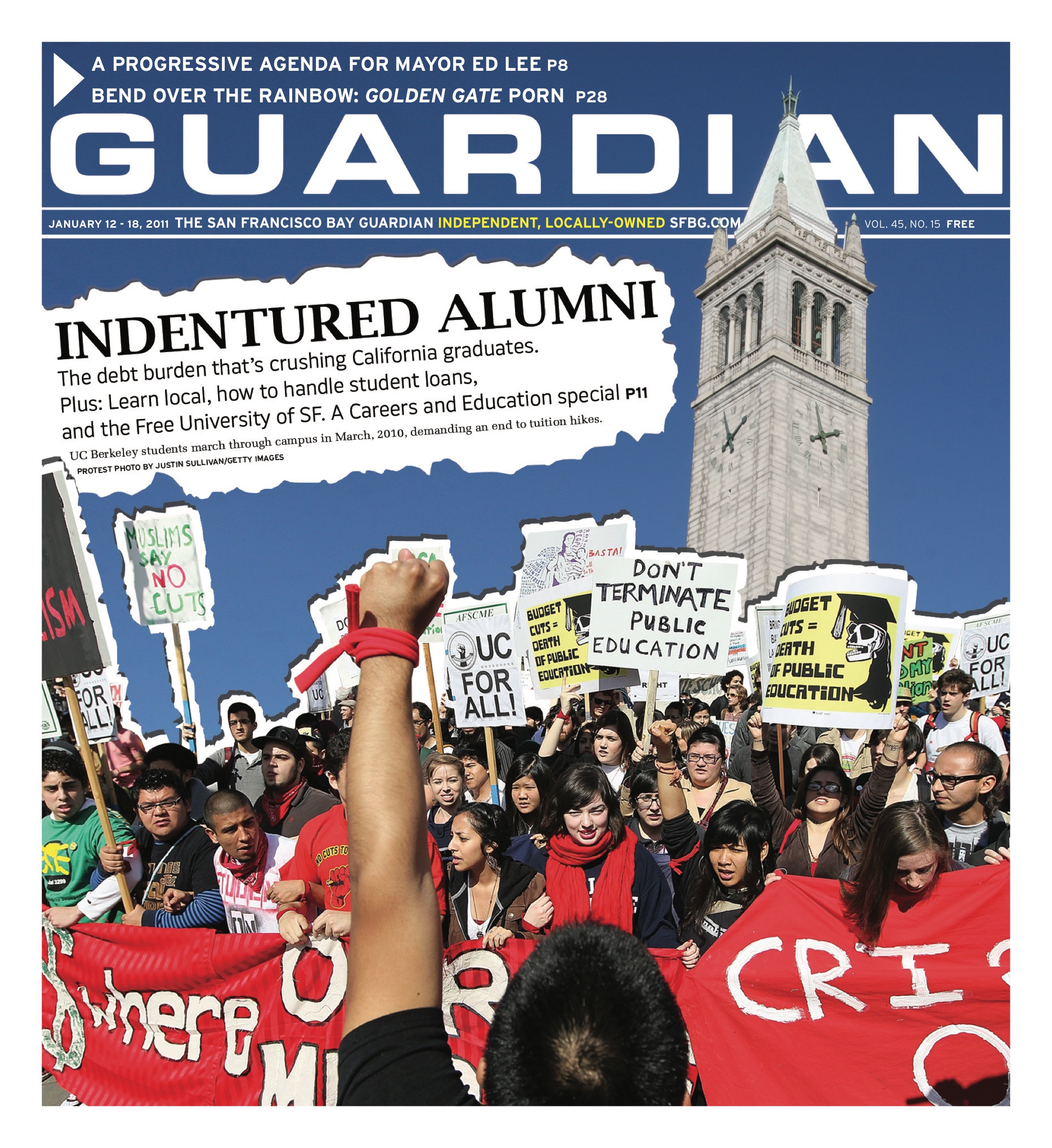
CAREERS AND ED When the University of California Board of Regents met Nov. 17, 2010 to approve an 8 percent tuition hike, roughly 300 UC students who were furious about the decision converged outside the University of California, San Francisco (UCSF) campus at Mission Bay to rally in opposition, some traveling from as far away as Los Angeles.

“We had been organizing with all the campuses to get students to come up because we really wanted to be there to let them know that it’s not what we want, and it’s something they can’t just get away with doing year after year,” said UC Student Association President Claudia Magana. The protests were raucous, and police cracked down by discharging pepper spray and making 13 arrests.

Despite the palpable fury outside and impassioned student opposition delivered to the Regents inside, the 8 percent fee increase was approved. It came on the heels of a 32 percent tuition increase imposed the year before, and the price was ratcheted up by 9 percent and 7 percent in the years prior to that.

The tuition hikes were steep, but hardly new. Indeed, the cost of attending UC schools has been rising steadily for quite a while. According to a study by economist Peter Donohue, student tuition and fees increased 277 percent from 1990-91 to 2008-09, and that was prior to the 40 percent increase that followed. That trend is repeated in rising costs at the California State University and California Community College systems (See “Access Denied,” April 6, 2010).

Student protesters have sought to make it clear that their outrage isn’t rooted in selfish unwillingness to shell out more money, but instead is linked to a broader concern about privatization and the increasingly limited accessibility of public education.

Magana expressed concern that the climbing cost of instruction at UC, though still a relative bargain compared with private institutions, would ultimately start to affect who could and couldn’t attain higher education through the public university system. The question isn’t limited to UC — tuition is increasing at public and private colleges across the board, and as income inequality sharpens, more students seek higher education.

“Students will always pay to be here,” she noted. “The issue is going to be, which students are here? That’s really the big problem — the huge class issue that’s going to come up. Although there are some forms of support for low-income students, it’s not easy.”


DEEPER IN DEBT

Rising costs at UC mirror the upward trend at private nonprofit and for-profit postsecondary institutions nationwide, and those higher prices have triggered a dramatic increase in student borrowing. While students from low- or medium-income families can access higher education at any institution they’re admitted to as long as they’re willing to take out significant sums in student loans, many find themselves at a serious disadvantage once they have to start repaying their debt.

A study conducted by the Public Interest Research Group (PIRG) noted that hefty debt burdens often dissuade graduates from pursuing careers in teaching, social work, the nonprofit sector, or other low-paying occupations that foster social justice. PIRG found that 23 percent of public four-year college grads and 38 percent of private four-year college grads were saddled with too much debt to manage paying back student loans on a starting teacher’s salary.

For students pursuing careers as social workers, the economic bind looked even worse: 37 percent of public school grads and 55 percent of private school grads with student loans wouldn’t be able to manage repayment with starting salaries in that field, the study concluded.

“Because students with lower incomes are more dependent on student loans than higher income students, students who already face significant challenges to attending college will more strongly feel the effect of loan debt on career choice,” the report points out.

“It’s a serious problem for so many young people to be starting out their working life so deep in debt,” said Edie Irons, spokesperson for The Institute on College Access and Success (TICAS), an Oakland-based research organization. “It really does limit people’s ability to take advantage of the opportunities education is supposed to provide. In concrete terms, it can make it really hard to buy a house, or start a business, or start a family, or go back to grad school, or to save for retirement or your own children’s education. And that’s all assuming you can keep up with the payments.”

Student loan debt has intensified over the past two decades. In 1993, just one third of all four-year college students graduated with debt, owing on average slightly more than $9,000, according to PIRG.

Today, the majority of college students take out loans to finance their education. Around 62 percent of public university students graduate with student loans, as do 72 percent of students attending private nonprofit institutions, and 96 percent of students attending for-profit institutions such as the University of Phoenix or the Academy of Art University, according to TICAS. Nationally, students graduate owing an average of $24,000, not counting debt associated with advanced degrees.

While young people must invest more than ever before to obtain higher education, the return on investment isn’t showing signs of improvement. The expected median income for UC graduates has stayed the same over the last decade, even as the cost of tuition has ballooned.

What’s more, says Bob Meister, president of the Council of UC Faculty Associations and professor of Political and Social Thought at UC Santa Cruz, is that an estimated 40 percent of public university students entering the workforce will either be unable to find a job, or will land in a lower-paying job that doesn’t require a college degree.

“For college graduates under 25, the unemployment rate is nearly as high as the national unemployment rate,” around 10 percent, Meister notes. “Over the past decade, what’s happened is that the median hasn’t risen. The top has risen very fast, and the bottom has fallen.”


IN A DIFFERENT CLASS

There’s no doubt that diminished state funding is affecting California’s public universities.

“A lot of departments are being eliminated, and a lot of professors who are really amazing are leaving to other universities,” Magana says. “And the waiting lists for classes are just ridiculous.” Academic goals are being compromised — for example, students had to abandon their push for an ethnic studies program at UCSC, she added, because the American studies department that would have partially supported it was slashed.

While diminished public funding has been used to explain the need to raise tuition, Meister has published numerous essays suggesting that the root cause of rising tuition costs at UC goes deeper than that, and he has gone so far as to publicly encourage students not to accept higher tuition without first demanding financial information.

Meister previously served on the UC budget committee and has observed the institution’s evolving financial policies for years. He doesn’t seem surprised that tuition is going up, regardless of what condition the economy is in or what amount of public funding is available because, as he puts it, “the universities will cost as much as they can.” UC had long sought to boost revenue by raising tuition, he noted, yet its leaders feared a rollback in state funding in response. But that changed under Gov. Arnold Schwarzenegger, who agreed to increase state support only on condition of that UC in turn require students to contribute more.

Around the same time that Schwarzenegger provided this new incentive to raise tuition, UC pooled its various revenue streams into a consolidated general revenue fund, Meister said, a departure from the old way of keeping separate accounts. This new fund, which included all non-state revenue and funding that wasn’t legally required to be used for certain purposes, could be pledged entirely as collateral for bonds for new construction projects, greatly increasing the institution’s borrowing power and boosting its revenue with the addition of new facilities.

To maintain its stellar bond rating, UC had to ensure an increase in revenues, according to Meister’s explanation, and to do that, UC ratcheted up the one source of revenue it had full control over: tuition. Meister laid bare this financial play in a 2009 open letter to students, titled “They Pledged Your Tuition.” Since it was published, a small corps of student activists has become deeply engaged in studying campus finance documents and airing criticism of financial policies.

Just before the Nov. 17 protests at UCSF Mission Bay, Meister published another open letter, this one addressed to UC President Mark Yudof. This one contemplated, “Why they think they can increase revenues regardless of how fast the economy grows … and regardless of whether the income of graduates is stagnant.”

His answer is somewhat surprising: “Their ability to raise tuition is a function of the growth of income inequality,” he told the Guardian. In the letter, Meister charges, “In the 21st century, when almost all income growth has been in the top 1 to 2 percent of California’s population, UC is still marketing income inequality to students as its most important product. It now expects all students to pay more for an ever-shrinking chance of reaping the ever-growing rewards that our economy makes available to the few. Your plan to increase revenue through tuition growth is feasible, of course, only because the federal government still allows students to borrow more for education despite the greater likelihood that they will not be able to repay — student loans may be the last form of subprime credit available in our economy.”

His theory highlights a paradox. “Being in the have-not category is increasingly worse,” he explains, “and so they are willing to take on more debt, which actually dampens their prospects for income growth.”

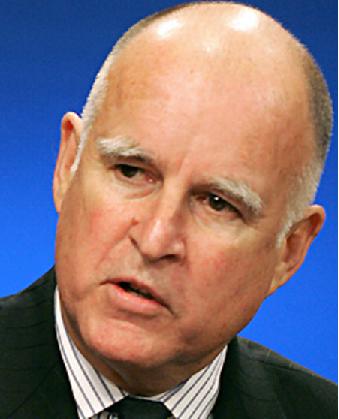
The question now is what will happen under Gov. Jerry Brown, who is likely to take a different stance toward rising tuition than Schwarzenegger but nonetheless is expected to unveil harsh cuts to education as a way to address a $26 billion budget deficit.

In a recent interview with the San Francisco Chronicle, UC Regent Richard Blum indicated that it probably would not be feasible to raise tuition again, so the message was that students should brace for more cuts to education.

When Brown unveiled his proposed budget on Jan. 10, he announced further cuts to higher education in California to balance the state budget. Brown’s revised 2010-11 budget decreases the state funding for UC, CSU, the community college system, and other higher education programs by $1.7 billion for the 2011-12 budget. The UC system would take a 13.3 percent hit in general fund support; the proposed cut to the CSU system is 12.5 percent; and the community college system would be cut by 6.9 percent.

Brown, who also wants to hold a special election to ask voters to maintain the current level of tax rates for income, sales, and vehicle license taxes for five years rather than let them expire later this year, expressed regret about making cuts to higher education. But he emphasized the need to make tough decisions in the face of a bleak financial outlook, saying, “We need to face the music.”

Sawako’s choice

0

arts@sfbg.com

FILM Sawako Decides, the most recent feature by the talented 27 year-old Japanese director Yuya Ishii, might not be the best film of 2010 that you never saw, but it certainly ranks as one of last year’s funniest — and perhaps more debatably, most feminist.

Yerba Buena Center for the Arts’ Ishii double feature “Lost in Japan,” which pairs Sawako with Ishii’s previous film To Walk With You (2009), is an all- too-brief introduction to a director whose modestly budgeted films about losers, misfits, and the socially marginalized in a Japan as depressed as they are have been garnering critical praise and catching the attention of festival programmers since his 2006 debut Rebel, Giro’s Love. Sawako Decides leaves no doubt that Ishii is one to watch (and to watch repeatedly).

Five years after winding up in Tokyo after a failed post-high school elopement, 20-something Sawako (a wonderful Hikari Mitsushima) has landed herself a thankless pink collar job serving tea at the offices of a toy manufacturer and an equally lame coworker boyfriend, whose young daughter from a previous marriage seems just as indifferent to Sawako as her father is. A human doormat in the extreme, Sawako is the first to agree the chorus of detractors that surround her that she’s, “not really much … a lower-middling type, really.” This routine existence is upended when her boyfriend arranges for Sawako to take over her estranged and terminally ill father’s freshwater clam packing business, and Sawako must face down the rural community — most notably, the pack of sniping older female employees she now oversees — who view her as a selfish deserter.

Although Sawako is a far cry from Emma Stone’s sass-spouting Olive in Easy A (2010), Ishii still wants his underdog to come out on top, and eventually the fates smile kindly, albeit crookedly, on her. By the time the film reaches the climactic scene in which a newly-emboldened Sawako leads her shocked employees in a rousing anti-government anthem, there is no denying that she has — to borrow the title phrase of another recent coming-of-age film anchored by a strong female character — true grit, and that Ishii is not only a wildly inventive filmmaker, but one who possesses a true heart.

Ishii — who also frequently edits and writes his films — combines humor and pathos in a way that mimics his bumbling antiheroes’ oft-failed attempts to integrate themselves within the world around them: jokes are frequently followed up a beat too late so as to go practically unnoticed or are delivered in a deadpan that verges on D.O.A. He also has a penchant for peppering his narratives with absurdist detours, out-of-the-blue dance numbers, and enough idiosyncratic supporting characters to make Miranda July proud.

Unlike July’s work, however, Ishii’s films leave no aftertaste of preciousness. Ishii’s characters are often as laughably insufferable as their peers make them out to be, but Ishii takes their funny-sad struggles to exist quite seriously, putting his work more in line with that of, say, Woody Allen or even Todd Solondz, than of anything Michael Cera has mumbled his way through. Ishii’s films are “existential” — a descriptor they’re frequently tagged with — to the extent that his characters, through much hilarious trial and error, transform their failure to achieve what society expects of them into a new ethics for living.

Thus, Sawako Decides‘ most radical proposition is that “nothing special” is not simply a demoted way of being, but grounds for collectivization. Japanese culture’s drive toward upper-middle class exceptionalism is exposed as a myth that should have died with the Bubble Economy (in To Walk With You, the protagonist discovers everybody’s mother wants them to be a lawyer largely for lack of imagination). Like Melville’s scrivener Bartleby, Sawako turns staying within one’s station into an act of defiance. To be the best at being a “lower-middling person” is not defeatist. Rather, it is to embrace one’s stunted potential as a generative constraint. If everyone’s a loser, than no one is. *


LOST IN JAPAN: THE EXISTENTIAL COMEDIES OF YUYA ISHII

Jan. 13–15, $6-$8

Yerba Buena Center for the Arts

701 Mission, SF (415) 978-2787 www.ybca.org

Editor’s Notes

0

tredmond@sfbg.com

Social inequality is morally wrong, politically dumb, and economically unsustainable. It also makes you fat.

Seriously.

There’s a book by two British epidemiologists that argues the physical and mental health case for economic equality — and it’s full of great stuff. It’s a year old, but I read a nice analysis of it in Nicholas Kristof’s column in the Jan. 2 New York Times. Kristof notes that Richard Wilkinson and Kate Pickett, both British epidemiologists, cited vast and growing evidence that societies with greater equality are in general more healthy. And by that they mean not only that those societies have less crime and violence; the people who live with greater equality actually have less heart disease, mental illness, and obesity.

The book is called The Spirit Level: Why Greater Equality Makes Societies Stronger. A lot of it’s kind of touchy-feeley, but in the end, they come to a scientific conclusion: “The relationships between inequality and poor health and social problems are too strong to be attributable to chance.”

The two scientists also take on one of the great taboos of modern economics. They argue that growth isn’t necessarily good, that the standard goal of every official government policy in every major nation in the world — capitalist, socialist, or communist — over at least the past half-century, has been based on a flawed assumption.

There aren’t even that many progressives in this country who want to challenge the idea that the economy needs to grow to solve problems like unemployment and poverty. Sim Van Der Ryn, the visionary planner and architect, once told me that it makes no sense to have “a perpetually adolescent economy.” But in most polite company, that’s heresy.

But our new governor, who once employed Van Der Ryn as the director of the Office of Appropriate Technology, has a few heretical cells in his Jesuit-trained brain. And while I don’t expect him to turn the state’s growth frenzy on its head, he ought to be willing to think about this:

The solution to California’s problems may lie more with redistributing the pie than with making it larger.

I’m not arguing that we should abandon growth, particularly at a time of high unemployment. But keep in mind: corporate profits are already up, both here and nationwide — but the big companies are hoarding their cash and not hiring. Banks are making money again — but they’re not lending it out. We’re in a different sort of recovery here, one that may, for the moment, be structurally jobless. During the deep recession, businesses figured out how to survive with fewer employees, and they’re not about to start expanding the payroll.

And of course, the public sector has done nothing but shrink, and there’s little talk of anything but more shrinking.

So maybe the only way we’re going to get out of this is to inject more money into the economy, not by borrowing but by sending some of the idle wealth at the top back down to the level where it might become production. It might make us all a lot healthier. Because it turns out that you don’t have to eat the rich; just tax them.

Social inequality makes you fat

23

This is one of my favorite bits of social science research of the past year: The kind of gross inequality that we see in the United States not only harms productivity, damages the economy and is unsustainable — it makes you fat. From the NYTimes:


For example, macaque monkeys are also highly social animals, and scientists put them in cages and taught them how to push a lever so that they could get cocaine. Those at the bottom of the monkey hierarchy took much more cocaine than high-status monkeys.


Other experiments found that low-status monkeys suffered physical problems, including atherosclerosis in their arteries and an increase in abdominal fat. And as with monkeys, so with humans. Researchers have found that when people become unemployed or suffer economic setbacks, they gain weight. One 12-year study of American men found that when their income slipped, they gained an average of 5.5 pounds.


So:


Among rich countries, those that are more unequal appear to have more mental illness, infant mortality, obesity, high school dropouts, teenage births, homicides, and so on.


My conclusion: tax the rich and we’ll all be a lot healthier. Happy new year.

Does Mayor Newsom represent SF workers or San Mateo politicians?

2

“Does Newsom represent local workers or San Mateo politicians?” That’s the question being asked  at City Hall today. And it’s threatening to deliver an unwelcome kick to Mayor Gavin Newsom on his way out of City Hall’s revolving doors, as dozens of unemployed construction workers deliver 1,000 Christmas cards that residents of Bayview Hunters Point, Chinatown, the Mission, the Tenderloin and South of Market have signed. The cards urge Mayor Gavin Newsom to “put the Merry into Christmas and the Happy back into New Year” and sign local hire law that the Board passed a week ago.

This special holiday season delivery has been in the works since Dec. 14, when Bayview-based job advocates Aboriginal Blackmen United (ABU) tried to meet with Newsom and get his signature on legislation that a super-majority on the Board support.

But after Newsom was a no-show and his chief of staff Steve Kawa refused to give ABU any assurances, community advocates Brightline Defense Project printed up a thousand of the cards urging Newsom to “put the Merry into Christmas”. And Brightline, ABU, Chinese for Affirmative Action, PODER, and the A. Philip Randolph Institute then asked unemployed workers, activists, and concerned citizens to sign this unusual set of greeting cards.

The move comes a day after the San Mateo County Board of Supervisors voted unanimously to urge Newsom to veto Avalos local hire policy. Local hire advocates suspect this counter-move was orchestrated to give Newsom political cover, should he choose to make the seemingly Scrooge-like move of vetoing, just before the holiday season, legislation that would help San Francisco residents secure work on billions of dollars worth of local tax-payer funded construction projects .

But the San Mateo supervisors claim that San Francisco’s plan, which would mandate that 50 percent of workers on city-funded projects are local residents, threatens to hurt an already sluggish regional economy.

“This is not the time to put isolation around a community,” San Mateo Sup. Carole Groom reportedly said at a hastily convened Dec. 21 special session.
 “If this is rejected, it would be time for all of us to sit down and talk about this,” fellow San Mateo County Sup. Adrienne Tissier reportedly said.

Newsom has until Christmas Eve to either sign or veto the law, though the Board can still override his veto, provided Avalos still has eight votes in the New Year. And if Newsom doesn’t sign or veto the law by week’s end, it will go into effect in 60 days.


San Mateo officials are arguing that the local hire legislation particularly impacts their county, because the law contains a “70-mile” clause that includes the San Francisco Airport, the Hetch Hetchy water system and the San Bruno jail.

Sup. John Avalos previously told the Guardian that project labor agreements protect workers at the airport and working on projects that the San Francisco Public Utilities Commission funds. But Tissier reportedly claimed that San Francisco’s local hire policy would kick in, once new contracts are negotiated.

Reached by phone, Avalos said it’s not clear if the San Mateo supervisors have actually read his legislation
‘If they had, they’d see a lot of ways that is supports San Mateo workers,” Avalos said.

San Francisco’s local hire legislation, which is the nation’s strongest, requires that 20 percent of workers within each construction trade be local residents starting in 2011. That number increases 5 percent annually for seven years, as local workers join trades where community representation is lacking, before reaching 50 percent. In other words, 80 percent of the workforce could be non-city residents in 2011, and even at 50 percent local hire, half of the jobs will still be available to workers who don’t live in San Francisco.
 
“That’s hardly an exclusion especially when you consider that San Francisco taxpayers are making the investments on these projects,” Avalos stated.
He believes that the San Mateo County Building Trades Council pressured the San Mateo Board to pass their Dec. 21 resolution urging a veto on his measure. Either way,  Victor Torreano, vice president of the San Mateo County Building Trades Council was quoted in media coverage of the Dec. 21 vote, saying, “the need for housing in San Francisco and the Peninsula make it impossible for many blue collar workers from sinking family roots in the area.”

Avalos acknowledges that San Francisco International Airport is in San Mateo County, and its workers understandably wants jobs there,
“San Mateo County has to put up with the sound of the airport, and its residents deserve to have jobs there, but this is much ado about nothing,” Avalos said. “But it’s the Building Trades that are uncomfortable with changing slightly their practices.”

Mike Theriault, Secretary-Treasurer of the San Francisco Building Trades Council, acknowledged that his group has never been pleased with Avalos’ legislation.

“But we are resigned to seeing how it plays out,” Theriault told the Guardian. “We think there are better things they could have done to guarantee access of San Francisco residents to careers in our trades.”

Theriault believes that Avalos may not understand the project labor agreement are of limited duration.
“So, they will require an extension of the existing labor agreement,” Theriault said,  noting the legislation states that future extensions would have to comply with the new law.

But Theriault acknowledged that with or without Newsom, Avalos’ legislation still has a chance to move forward.
“If he vetoes it, I understand that the Board will have another crack at it, Jan. 4,” THeriault said, referring to the current Board’s last meeting in January.
 
The Bay Area Council has also announced its opposition to Avalos’ legislation,
 “This troubling trend of intra-county battles being started by the San Francisco Board of Supervisors needs to stop,: Bay Area Council President and CEO Jim Wunderman said in a Dec. 21 statement. “The Bay Area is one regional economy, not nine island states. We need to focus on nurturing the fragile economic recovery in our region, not setting bad policies that pit county against county.  The Bay Area Council urges Mayor Newsom to veto this foolhardy piece of legislation.  Right now, we do not need any more incentives for businesses to leave any county, the Bay Area, or California.”

But advocates for the legislation note that the San Francisco Controller recently estimated that the law will pump $270 million into the local economy over the next 10 years. They hope Newsom will emerge from his warren-like office today and sign the law, delivering a historic Christmas present to the city’s growing ranks of unemployed workers.


But even if he doesn’t, Avalos isn’t sweating it.


“Newsom probably won’t sign it, and he’ll write a letter saying he’s opposed to it,” Avalos predicted. “And even if the new mayor is [SFPUC director] Ed Harrington, he’s been supportive of the measure. So Newsom has to answer his own conscience and ask himself, if he’s going to represent local residents or San Mateo politicians.”


According to Brightline’s Joshua Arce, ABU led about 30 to 40 workers from Bayview, Chinatown, and the Mission up to Room 200 today to drop off 1,000 signed  cards from residents in every neighborhood asking the Mayor to sign the community’s local hiring law by Christmas.
 
“Room 200 was locked, but we kept knocking,” Arce told the Guardian. “Eventually the doors opened and out came [Mayor Gavin Newsom’s chief of staff] Steve Kawa. We showed him all of the Christmas cards that we had for his boss and he thanked us. Ashley Rhodes of ABU explained that since we heard how much the Mayor liked the ABU holiday card last week, we printed up 1,000 more and got them signed by people from every community in San Francisco.”
 
“We asked where the Mayor was in terms of making his decision, he said that the Mayor was still studying all of the issues,” Arce continued. “He brought up the opposition from the San Mateo County Board of Supervisors, so we asked him to tell the Mayor to support us, the thousands of unemployed and job-hungry San Franciscans, over four San Mateo politicians.”
 
“Steve Kawa said that they will be working around the clock to make sure all concerns are addressed, and we showed Steve a card signed by Sup. Bevan Dufty just moments before we came upstairs,” Arce addded. “Sups. John Avalos and Eric Mar also signed Christmas cards to the Mayor.”

According to Arce, ABU left the two huge Santa bags full of cards with Kawa, who picked them up, commenting “These bags are awfully heavy.” 

“I asked him to make sure to tell his boss that the cards were printed on 100% recycled paper,” Arce concluded. “Let’s hope that Mayor Newsom puts the Merry into Christmas and the Happy back into New Year!”

Alerts

0

news@sfbg.com

WEDNESDAY, DEC. 22

Floyd Westerman Retrospective

You may remember him for his role in “Dances with Wolves” as Chief Ten Bears and as a country western singer/songwriter. But Floyd Westerman, a.k.a. Red Crow, was also an outspoken activist for Native Americans and the environment. A new documentary by Steve Jacobson explores his later life and activism. Along with the film, there will also be a social hour at 6:30 and a discussion following the film.

7:30–9:30 p.m., $5 suggested donation

Humanist Hall

390 27th St., Oakl.

510-681-8699

Real Mercantile Holiday Bazaar

If you still have some holiday shopping to do and just can’t summon the will to hit the stores or feed the machine, you can get some great stuff while supporting the local arts community and underground economy at the Real Mercantile Holiday Bazaar. held at arts impresario Chicken John spacious home and performance space. Homemade gifts and food are all available in a festive and very San Francisco atmosphere.

5–9 p.m., free

Chez Poulet

3359 Cesar Chavez, SF

www.therealmerchantile.com

THURSDAY, DEC. 23

Festivus 2010

San Francisco’s legendary Sisters of Perpetual Indulgence and pot activist Ed Rosenthal’s Green Aid unite to present a night of fundraising for the Medical Marijuana Legal Defense and Education Fund. The bash features an airing of grievances, feats of strength, the annual meeting of Dessert First Club, and live music and entertainment including The Phat Fly Girls and burlesque. Creative dress and cross-dressing encouraged.

7:30–11:30 p.m., $50 presale, $60 at door

SomArts

925 Brannan, SF

415-515-7483

SUNDAY, DEC 26

Get Your Spawn On

Join Brent Plater on a stroll through Muir Woods National Monument to learn more about coho and steelhead salmon and how to help them survive. The walk also features a search for endangered salmon in Redwood Creek. Make sure to wear something warm and bring your hiking boots.

10–12 p.m., free with RSVP

Meet at the Dipsea Trail trailhead

Muir Woods National Monument, Mill Valley

www.wildequity.org/events/3166

TUESDAY, DEC 28

Castro Queer-in

Join concerned local resident ins protesting the recently passed sit/lie ordinance more formally known as Proposition L. Bring out any and all musical instruments, games, food to share, face-painting kits, and any items to barter. Everyone will gather outside of Harvey Milk’s former camera store.

Noon–2 p.m., Free

575 Castro

Mail items for Alerts to the Guardian Building, 135 Mississippi St., SF, CA 94107; fax to (415) 437-3658; or e-mail alert@sfbg.com. Please include a contact telephone number. Items must be received at least one week prior to the publication date.

Editor’s Notes

3

tredmond@sfbg.com

When the talk comes around to budget politics these days — and these days, nobody in politics can talk about much else — there’s a pretty consistent line out there, from the mainstream left to the far right, and it goes like this:

Public employees have been riding high on great pay and benefits, and they’re going to have to accept that those days are over. We can do it nicely, and negotiate and all, but the people who work for the city and the state are getting a haircut. Pension reform. Health care premium hikes. Two-tiered wage systems. Sorry, folks — there’s no other choice.

And I understand the feeling. There are plenty of unemployed people out there who aren’t happy that they’re still paying taxes to support generous pay and health benefits for workers who are consistently maligned as lazy. There are small business owners who can barely afford minimally adequate health insurance for themselves and their employees. There are underpaid private-sector workers who get jealous when they hear what you make over at City Hall.

I get it, and in terms of political reality, public-sector pensions, pay, and benefits are going to have to be part of any budget resolution in Sacramento or San Francisco.

But let me say something else.

In the past 30 years, while public-sector unions were getting organized, becoming a political force and negotiating decent pay and benefits, the United States economy was shifting radically, in a way that we hadn’t seen since the turn of the Century. From Reagan on through Bush I, Clinton and Bush II, powerful forces in Washington launched a class war in this country, one that has as many victims as most of the traditional wars we’ve fought in the past century. The winners have been a small number of people and businesses that have grown impossibly rich — by taking money away from everyone else.

And they aren’t getting any cuts. In fact, their pay, pensions, benefits, and wealth aren’t even on the table. Which is profoundly unfair.

Of the 400 richest people in America (according to Forbes), 80 live in California. Their combined new worth is $231.8 billion — about 10 times the size of the state’s budget deficit. If they gave up just a modest amount of the benefits they get from living in this state and this country (and yes, the rich got that way in part because of the benefits they get from living here), we wouldn’t have a budget crisis at all.

The people who declared this war were smart enough to figure out how to divide the opposition, to turn us against each other. That’s why they keep winning.

Video babies of 2010: A wee look back

1

Smoking Baby, Preacher Baby, Iron Baby, Samba Baby, Mini Daddy — Is it too premature to nominate 2010 for “Year of the Video Baby”? Copious amounts of Gaga-goo aside, this year had plenty to offer li’l sprout gawkers — the baby meme has definitely replaced the baby mama as our go-to young ‘un pop cultural signifier of choice. Here are some of our favorite kid video (kideo?) shout-outs from the past year …

>>Iron Baby

>>Heavy Metal Baby

>>Samba Baby

http://www.youtube.com/watch?v=fSBnNA_dHNU

>>Smoking Baby

>>Mini Daddy (NOT Smoking baby)

>>Awesome Poetry Baby

>>Chronic Reggae Baby

http://www.youtube.com/watch?v=Gd5yN43TqCk

>>Baby Monkey Riding Pig

>>Demon Baby from Hell

>>BONUS Two-Headed Baby Turtle

Visit msnbc.com for breaking news, world news, and news about the economy


The politics of the last great depression

4

The American economy’s worse now than at any time since the Great Depression — and whatever the Republicans say in Congress (and the president signs on to) the private sector alone can’t possible pull us out. The only reason we’re not at 1930s levels of unemployment is that we’ve had some modest federal stimulus money over the past two years.


But we’ve got this dilemma: Although every smart economist agrees that it will take more massive federal spending to turn things around, all we’re getting out of Washington is the worst kind of spending — tax cuts for the rich, which will cost $900 billion and do very little to help the economy.


Part of what’s going on — and Jerry Brown talked about it at his education summit — is that the public doesn’t trust government to spend their money wisely. Brown cited a poll saying that nearly half of Californians still think we can solve most of the budget problems in the state by getting rid of government waste.


The Pew Research Center has put together a couple of fascinating papers on attitudes toward the public sector, and they’re worth a rad. (Thanks, Gabriel Metcalf at SPUR for tipping me off about this.) The first one is called “How a different America responded to the Great Depression.” Researcher Jodie Allen’s conclusion:


Quite unlike today’s public, what Depression-era Americans wanted from their government was, on many counts, more not less. And despite their far more dire economic straits, they remained more optimistic than today’s public. Nor did average Americans then turn their ire upon their Groton-Harvard-educated president — this despite his failure, over his first term in office, to bring a swift end to their hardship. FDR had his detractors but these tended to be fellow members of the social and economic elite.


More:


The most striking difference between the 1930s and the present day is that, by the standards of today’s political parlance, average Americans of the mid-1930s revealed downright “socialistic” tendencies in many of their views about the proper role of government.


True, when asked to describe their political position, fewer than 2% of those surveyed were ready to describe themselves as “socialist” rather than as Republican, Democratic or independent. But by a lopsided margin of 54% to 34%, they expressed the opinion that if there were another depression (and fears of one were mounting), the government should follow the same spending pattern as FDR’s administration had followed before.


And, those surveyed said they supported Roosevelt, the architect of the New Deal’s expansive programs, over his 1936 Republican opponent, Alfred Landon by more than two-to-one (62%-30%).


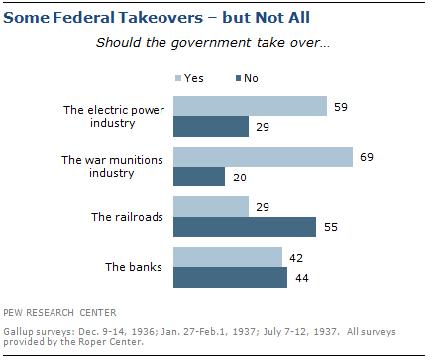
The charts are fascinating. A full 73 percent of Americans polled in 1936 thought government should provide free medical care to the poor. Sixty-four percent thought government should regulate and control war-time profits. In fact, 59 percent thought the government should take over the electric power industry and 69 percent favored nationalizing the wartime munitions industry.


And the people who were polled in these early surveys were overwhelmingly white, male and relatively well off. They were also socially conservative — 60 percent favored the death penalty and 67 percent wanted to deport all immigrants who were on public relief. Allen:


Is there a message in this for today’s America? Two possible lessons: First, it’s worth remembering that the social programs and banking controls that the New Deal era produced stood the nation in good stead over many decades of unprecedented prosperity. Second, Depression-era Americans’ faith in the country and its guiding institutions steeled them against the challenges of a double-dip recession and, years later, World War II. They had it worse, but they also expected it to get better, faster.


Compare that to a 1983 poll taken in the depth of the Reagan Recession, when 65 percent said that government had gone too far in regulating business, 62 percent rarely trusted the government in Washington and 78 percent opposed raising income taxes.


Fifty years, two generations, and the entire attitude of the American public toward government was turned on its head. It’s one of the fundamental dilemmas of American life, and one of the central reasons we’re in this mess.

PG&E granted cash reward, green light on power plant

0

While news surrounding Pacific Gas & Electric Co. has been dominated by a faulty weld and early warnings on the the San Bruno gas pipeline, which ruptured in a fatal explosion Sept. 9, the giant utility company received some good news at the Dec. 16 California Public Utilities Commission (CPUC) meeting.

Not only was PG&E awarded an additional $29 million cash reward for its performance in an energy efficiency program, bringing the total amount it’s received to $104 million, but it was granted commission approval to construct a new, $1.5 billion power plant in Oakley.

Ironically, the energy-efficiency program is designed to reduce the need to construct new power plants, which contribute to greenhouse gas emissions that are blamed for climate change.

The additional bonus was approved with a 3-2 vote on the “final true-up” of the energy-saving program. An independent CPUC evaluation of the utility’s performance in that program found that it fell short of the targets required to receive a cash bonus.

Commission President Michael Peevey justified the additional cash reward by saying utilities could not have known that the numbers they used to estimate energy savings were inflated, and that they would not have been able to adjust their energy-saving tactics in the middle of the program cycle to improve performance.

According to the Division of Ratepayer Advocates (DRA), a consumer-advocacy branch of the regulatory agency, “The CPUC today approved the additional $29.1 million award to PG&E in a 3-2 split vote, despite an Administrative Law Judge’s finding that no further bonuses should be awarded, nor penalties levied. Rather than receiving an additional $29 million bonus, PG&E should repay $74.9 million in bonuses already awarded for energy efficiency programs that failed to meet CPUC-established energy savings goals, and it should pay an additional $1.3 million in penalties, based on the original incentive mechanism.”

Barbara George, executive director of Women’s Energy Matters, blasted the decision. “In this shaky economy, it’s incredible that the Commission would force ratepayers to pay profits for utilities that missed their targets by a mile. This hurts everyone in California. Cities, businesses, and residential ratepayers will all have to pay twice for utilities’ failures — once for these undeserved ‘rewards,’ and again in high monthly utility bills that should have been reduced by these programs, but were not.”

The 4-1 vote to approve PG&E’s Oakley power plant was a reversal of an earlier commission decision rejecting the proposal. DRA weighed in on this item, too, saying data on PG&E power reserves suggests that the new facility is unnecessary.

“PG&E ratepayers are now on the hook for $1.5 billion in costs for energy they don’t need while being shut out of the decision-making process that will leave all PG&E customers with higher utility bills,” said DRA acting director Joe Como.

Holy high whoreiday

0

caitlin@sfbg.com

SEX It started with a serial killer. Porn star-feminist Annie Sprinkle was reading about mass murderer Gary Ridgeway slaughter of, on his count, 71 prostitutes in the 1980s and ’90s. She came across this in Ridgway’s explanation of his choice of victims: “I picked prostitutes because they were easy to pick up without being noticed. I knew they … might never be reported missing. I thought I could kill as many of them as I wanted without getting caught.”

It was a wake-up call for Sprinkle. “We don’t have equal protection,” says the busty self-termed “ecosexual,” who was a sex worker for 20 years and now serves as a role model to many in the radical sex community. Sprinkle reacted by organizing the first International Day to End Violence Against Sex Workers on Dec. 17, 2003. It’s an event that is now recognized in cities around the world.

In San Francisco, Sprinkle’s “whore holy high holiday” will be marked by a City Hall vigil for all the sex workers affected by discrimination and violence this year and performance art, followed by a march to the Center for Sex and Culture (sexandculture.org). All the events are free and open to anyone who wants to stand up for those that get paid to lay down.

This year, event organizers have a dangerously prude city policy in their sights: the toxic San Francisco Police Department practice of checking suspected prostitutes’ pockets for condoms to serve as proof of intent to have sex for money. It’s a policy that Mayor Gavin Newsom and the state’s first Latina attorney general, Kamala Harris, support. Sprinkle finds it completely at odds with the mission of promoting safe sex among anyone who could be walking down the street with a rubber in their pocket, as well as dangerous to sex workers. “It’s nasty, and really stupid, and so counterproductive — is that the message that we want to be sending?”

Which is not to say that Friday will be devoid of sweet, sexy joy entirely. After all, where would be the fun in gathering up SF’s sex-positive community if no one got naked? Later that evening, the Center for Sex and Culture will host a special edition of the national literary series Naked Girls Reading showcasing — yep — naked girls reading literature written by those who spread their legs to make their living.

“It’s a great opportunity for feminism and art,” says event organizer Lady Monster, who heard about Miss Erotic World 2005 Michelle L’amour’s original Naked Girl Chicago series and thought it a perfect fit for our pervy-intellectual burg. She held the first event in April and “it took off like wild blazes,” packing venues across town.

An ex phone sex operator who dabbled in private peep shows in her home state of Ohio without being told that the work was illegal, Lady Monster notes that the poor economy and demise of Craigslist escort ads in response to outside pressure has introduced even greater risks to sex workers, pressure that can lead them to accept unsafe working conditions. She feels that the nationwide observance of Dec. 17 “is a way to give people an opportunity to celebrate sex workers’ rights.”

On stage, her reading event will celebrate their contribution to arts and literature. Sexologist Dr. Carol Queen will be leafing through a book at the night’s nudie show; as well as burlesque star Dottie Lux; sex worker activist Robyn Few; Lady Monster herself (who’ll be reading from Some Girls, the memoir of Jillian Lauren, the American who lived and worked in a Brunei harem); and Sprinkle, among others. Lady Monster says the requirements needed to be onstage fall into three categories: readers must be accomplished writers, have public speaking experience, and — perhaps the most obvious — they’ve got be down to make the scene in the all together.

“Three hundred and sixty-four days a year we talk about how much we like our work, and one day a year we take time to realize that there are real victims out there,” Sprinkle says. It may be the oldest profession, but even in Gomorrah by the Bay, sex work is still a far cry from society’s respected elder.

INTERNATIONAL DAY TO END VIOLENCE AGAINST SEX WORKERS

Fri., Dec. 17

4 p.m., free

City Hall

Civic Center, SF

www.swopusa.org

NAKED GIRLS READING

9 p.m., $15–$20

Center for Sex and Culture

1519 Mission, SF

(415) 552-7399

www.nakedgirlsreading.com/sanfrancisco


Local hire, Steve Kawa, and the Americas Cup

2

Unemployed workers and community advocates hoping to secure Mayor Gavin Newsom’s support for Sup. John Avalos’ groundbreaking local hire legislation rallied at City Hall December 14 to meet with Newsom’s chief of staff Steve Kawa. But Newsom and Kawa were said to be in intense negotiations over the Americas Cup bid. So, James Richards, founder of Aboriginal Blacks United, waited until Kawa could see him, along with Florence Kong of the Bayview-based Kwan Wo Ironworkers. Joshua Arce of the Brightline Defense Project, and a group of local residents.

“‘Living in the city is so expensive,” Kong observed. “It’s not fair that a lot of local work is being done by workers from outside the city.”

Kawa finally emerged and shepherded folks out of the Mayor’s Office and into a meeting room close to the supervisors’ office. He was uncomfortable with having media at the meeting. But Richards said the group was OK with a reporter. And then he asked Kawa if Newsom would sign Avalos’ local hire law later that day.

“This is a very complex piece of legislation, and if it does become law, that’s when the work begins,” Kawa said, noting that Newsom will have ten days to review it, after its Dec. 14 reading. “Some folks are still concerned about it, partly on the trades union side,” Kawa added.

But Richards pressed his point. “After the Board acts today, we want to talk to the mayor,” Richards said. “We don’t want to wait around another ten days. We want him to assure us.”

But Kawa refused to give assurances. “At the end of the day, 42,000 San Francisco don’t have a job,” Kawa said, claiming the best local jobs program was Jobs Now, under Newsom.  “But the federal government is refusing to extend that program, and now we can’t hire anybody at City Hall and we have to get this economy growing,” he said.

When Joshua Arce of Brightline expressed concern that folks had met privately with Newsom to exert pressure against Avalos’ legislation, Kawa replied that Newsom had concerns that some folks could lose their jobs around San Francisco airport, because, technically, it’s in San Mateo.

“And are we sure this legislation will be successful?” Kawa continued. “The worst thing a government can do is over promise and under deliver. Our question is, you tell me how it will not fail. Because, yes, we want to have local hire, but don’t mislead anybody by saying, we pass this legislation, she gets a job. Our issue is making sure that we are not misleading anyone. Those are the concerns that people have. Will it be successful, as written? Because we can’t mislead your members, James.”

“Tell the mayor, we are here,” Richards said.
And then Kawa was shaking his hand and heading back to the Mayor’s Office, presumably to talk about cups and America.

“It’s a good thing, we are here today,” Richards said to the workers who remained sitting in the meeting room long after Kawa was gone. Many of them were young, black and male–and in search of a job. “Give a round of applause for your own self,” Richards continued. “It’s a good thing to let them know you come down here to take care of your own business.Because don’t nobody…”

He paused and the ABU members in the room immediately picked up the “don’t nobody give a damn” refrain, their voices ringing as one.

“Some times when we push too hard, when we get what we want, he get on a roll and tell all the reasons why he not going to sign. ‘I want to do this, but…” Richard added.

And then Richards turned to the issue of local hire at UC Mission Bay.“They gotta know today that we are hot on their trail,” he said. “Let them go tell that. Let Steve go tell that. Then they know we are fighting that.”

An hour later, when the Board gave Avalos’ legislation a veto-proof majority, Richards, Kong and the rest of the group burst into applause.
“It’s been quite a road to get here,” Avalos said.

“This is the most substantive policy San Francisco has passed in a generation,” Julian Davis observed, as local hire supporters rejoiced by the Tree of Hope, outside the Board’s Chambers.

Inside the Chambers, the Board was voting unanimously to support the city’s Americas Cup bid.

“To win a sailing race, every member of the crew has to work together,” Board President David Chiu said.  And his words could equally have applied to Avalos and the community’s effort to navigate treacherous political seas, get local hire legislation passed and, hopefully, lift everyone’s boat, in the process.

Holy high whoreiday

0

caitlin@sfbg.com

SEX It started with a serial killer. Porn star-feminist Annie Sprinkle was reading about mass murderer Gary Ridgeway slaughter of, on his count, 71 prostitutes in the 1980s and ’90s. She came across this in Ridgway’s explanation of his choice of victims: “I picked prostitutes because they were easy to pick up without being noticed. I knew they … might never be reported missing. I thought I could kill as many of them as I wanted without getting caught.”

It was a wake-up call for Sprinkle. “We don’t have equal protection,” says the busty self-termed “ecosexual,” who was a sex worker for 20 years and now serves as a role model to many in the radical sex community. Sprinkle reacted by organizing the first International Day to End Violence Against Sex Workers on Dec. 17, 2003. It’s an event that is now recognized in cities around the world.

In San Francisco, Sprinkle’s “whore holy high holiday” will be marked by a City Hall vigil for all the sex workers affected by discrimination and violence this year and performance art, followed by a march to the Center for Sex and Culture (sexandculture.org). All the events are free and open to anyone who wants to stand up for those that get paid to lay down.

This year, event organizers have a dangerously prude city policy in their sights: the toxic San Francisco Police Department practice of checking suspected prostitutes’ pockets for condoms to serve as proof of intent to have sex for money. It’s a policy that Mayor Gavin Newsom and the state’s first Latina attorney general, Kamala Harris, support. Sprinkle finds it completely at odds with the mission of promoting safe sex among anyone who could be walking down the street with a rubber in their pocket, as well as dangerous to sex workers. “It’s nasty, and really stupid, and so counterproductive — is that the message that we want to be sending?”

Which is not to say that Friday will be devoid of sweet, sexy joy entirely. After all, where would be the fun in gathering up SF’s sex-positive community if no one got naked? Later that evening, the Center for Sex and Culture will host a special edition of the national literary series Naked Girls Reading showcasing — yep — naked girls reading literature written by those who spread their legs to make their living.

“It’s a great opportunity for feminism and art,” says event organizer Lady Monster, who heard about Miss Erotic World 2005 Michelle L’amour’s original Naked Girl Chicago series and thought it a perfect fit for our pervy-intellectual burg. She held the first event in April and “it took off like wild blazes,” packing venues across town.

An ex phone sex operator who dabbled in private peep shows in her home state of Ohio without being told that the work was illegal, Lady Monster notes that the poor economy and demise of Craigslist escort ads in response to outside pressure has introduced even greater risks to sex workers, pressure that can lead them to accept unsafe working conditions. She feels that the nationwide observance of Dec. 17 “is a way to give people an opportunity to celebrate sex workers’ rights.”

On stage, her reading event will celebrate their contribution to arts and literature. Sexologist Dr. Carol Queen will be leafing through a book at the night’s nudie show; as well as burlesque star Dottie Lux; sex worker activist Robyn Few; Lady Monster herself (who’ll be reading from Some Girls, the memoir of Jillian Lauren, the American who lived and worked in a Brunei harem); and Sprinkle, among others. Lady Monster says the requirements needed to be onstage fall into three categories: readers must be accomplished writers, have public speaking experience, and — perhaps the most obvious — they’ve got be down to make the scene in the all together.

“Three hundred and sixty-four days a year we talk about how much we like our work, and one day a year we take time to realize that there are real victims out there,” Sprinkle says. It may be the oldest profession, but even in Gomorrah by the Bay, sex work is still a far cry from society’s respected elder.

INTERNATIONAL DAY TO END VIOLENCE AGAINST SEX WORKERS

Fri., Dec. 17

4 p.m., free

City Hall

Civic Center, SF

www.swopusa.org

NAKED GIRLS READING

9 p.m., $15–$20

Center for Sex and Culture

1519 Mission, SF

(415) 552-7399

www.nakedgirlsreading.com/sanfrancisco

Hiring at home

1

sarah@sfbg.com

The lame duck Board of Supervisors made history Dec. 7 when it voted 8-3 to approve mandatory local hire legislation for city-funded construction projects. The measure ends a decade-long effort to reach 50 percent local hiring goals through good-faith efforts.

“That’s a sea change in our local hiring discussion,” said Sup. John Avalos, who launched the legislation in October as part of the LOCAL-SF (Local Opportunities for Communities and Labor) campaign, which seeks to strengthen local hiring, address high unemployment rates, and boost the local economy.

The veto-proof passage of Avalos’ measure comes in the wake of a city-commissioned study indicating that San Francisco has failed to meet good-faith local hiring goals for public works projects even as unemployment levels rise in the local construction industry and several local neighborhoods face concentrated poverty.

Although Cleveland also has a local-hire law, the Avalos measure will be the strongest in the nation. Avalos’ legislative aide Raquel Redondiez told the Guardian that Cleveland’s 2003 legislation requires 20 percent local hire.

“This legislation doesn’t just have a mandated 50 percent goal,” Avalos explained, noting that San Francisco will require that each trade achieve a mandated rate and that 50 percent of apprentices be residents.

“This will ensure that our tax dollars get recycled back into the local economy, and that San Franciscans who are ready to work are provided the opportunity to do so,” Avalos said.

Avalos’ groundbreaking legislation phases in mandatory requirements that a portion of San Francisco public works jobs go to city residents and includes additional targets for hiring disadvantaged workers.


WHO GETS $25 BILLION?

The legislation replaces the city’s First Source program, under which contractors were required only to make good faith efforts to hire 50 percent local residents on publicly-funded projects. But the measure begins slowly by mandating levels some contractors are already reaching. According to a study commissioned by the city’s Office of Employment and Workforce Development and released in October, 20 percent of work hours on publicly-funded construction projects are going to San Francisco residents.

Avalos’ legislation, which is supported by a broad coalition of labor and community groups including PODER, the Filipino Community Center, Southeast Jobs Coalition, Kwan Wo Ironworks Inc., Rubecon, and Chinese for Affirmative Action, comes at a critical moment for the recession-battered construction industry.

Under the city’s capital plan, more than $25 billion will be spent on public works and other construction projects in the next decade — and two-thirds of this money will be spent over the next five years.

The measure has environmental benefits too. Transportation still accounts for more greenhouse gas emissions generated in the Bay Area than any other source, and San Francisco residents are more likely to take transit, walk, or bike to work than residents of other Bay Area counties. “When local citizens are able to work locally, there are fewer cars on the road and less air pollution,” Avalos said.

Sup. Ross Mirkarimi said that Avalos’ legislation is “just a start.”

“People have talked a good game about local hiring,” observed Mirkarimi, whose district includes the high unemployment-affected Western Addition.

“We are going to have to go beyond construction and start thinking about delving into the private sector,” Mirkarimi continued, pointing to the need to build 100,000 housing units over the next 25 years if the city is to keep up with a projected population increase. “Who is going to build that housing?” he asked.

Sup. Eric Mar noted that “the Sierra Club endorsed the measure early on because of the environmental benefits of having people work close to where they live.”

Sup. David Campos, whose district includes the Mission, said the measure was one of the most significant pieces of legislation to emerge from the board in recent years. “In the past, a lot of obstacles got in the way, including some legal challenges,” said Campos, who credited Avalos for navigating a complicated legal structure. “At the end of the day, I think this is going to benefit everyone.”

Mike Theriault, secretary-treasurer for the San Francisco Building Trades Council, told the Guardian he remains opposed to the legislation because the union presers to allocate jobs based on seniority, not residency. But he said the amendments make the measure “less harmful and more survivable in the short-term.”


THE ECONOMIC GAP

Termed-out Sup. Sophie Maxwell, who represents the city’s economically distressed southeast sector, has often noted that the construction industry provides a path to the middle class for people without advanced degrees or facing barriers to employment. She thanked Avalos for pushing legislation that promises to provides opportunities for “growing the middle class instead of importing it.”

“This industry closes the economic gap,” she said.

Board President David Chiu and termed-out Sups. Chris Daly and Bevan Dufty also supported Avalos legislation. But Dufty, who is running in the 2011 mayoral race, cast the eighth vote, which gave the measure a veto-proof majority.

The board’s Dec. 7 vote came a few hours after Bayview-based Aboriginal Blacks United founder James Richards and a score of unemployed local residents rallied at City Hall in the hopes of securing Dufty’s vote.

ABU has recently been protesting at UCSF’s Mission Bay hospital buildings site on 16th and Third streets. Its members also triggered a shut down at the Sunset Reservoir last month after a court ruled that locals promised jobs installing solar panels at the plant be replaced by higher-skilled engineers,

“It’s been too long that we have been protesting and fighting this good faith effort,” Richards told the Guardian. “We need a mandatory policy.”

Dufty is also hoping the Avalos measure could spread to other cities and benefit workers nationwide. “At a certain point I looked at labor and said, ‘Yes, I’m going for this legislation. But not just for San Francisco — you want to take this concept to other cities,’ ” Dufty said, as he made good on his promise to Richards to vote to support Avalos’ law.

Dufty seemed hopeful that Mayor Gavin Newsom would get behind the legislation. “But I respect that there may be a little bit of coming together between now and the second reading.”

Newsom spokesman Tony Winniker told the Guardian that the mayor has 10 days to review Avalos’ legislation after its Dec. 14 second reading. “He supports stronger local hire requirements but does want to review the many amendments that were added before deciding,” Winnicker said.

But will Newsom, who is scheduled to be sworn in as California’s next lieutenant governor Jan. 3, issue a veto on or before Christmas Eve on legislation that has been amended to address the stated concerns of the building trades?

That would be ironic since the amended legislation appears to match recommendations that the Mayor’s Taskforce on African American Outmigration published in 2009. The California Department of Finance projected that San Francisco’s black population would continue to decline from 6.5 percent (according to 2005 census data) to 4.6 percent of the city’s total population by 2050 — in part because of a lack of good jobs.


WILL NEWSOM VETO?

Avalos originally proposed to start at 30 percent and reach 50 percent over three years. But after the building trades complained that these levels were unworkable, Avalos amended the legislation to require an initial mandatory participation level of 20 percent of all project work-hours within each trade performed by local residents, with no less than 10 percent of all project work-hours within each trade to be performed by disadvantaged workers.

He also amended his legislation to require that this mandatory level be increased annually over seven years in 5 percent increments up to 50 percent, with no less than 25 percent within each trade to be performed by disadvantaged workers in the legislation’s sixth year.

A Dec. 1 report from city economist Ted Egan estimated that the local hire legislation would create 350 jobs and cost the city $9 million annually. But Egan clarified for the Guardian that this cost equals only 1 percent of the city’s spending on public works in any given year.

Vincent Pan of Chinese Affirmative Action, which supports Avalos’ local hiring policy, suggested that the mayor “check the temperature.”

“It would be leadership on the part of the mayor not to veto legislation that’s about San Francisco,” Pan said.

And Mindy Kener, an organizing member of the Southeast Jobs Coalition breathed a deep sigh of relief when Dufty’s vote made the law veto-proof. “It’s gonna go across the country,” Kener said. “We just made history.”

Local hiring — and purchasing

1

EDITORIAL The local hire ordinance that the Board of Supervisors approved last week once again puts the city on the cutting edge of progressive policy. San Francisco’s law, sponsored by Sup. John Avalos, is the strongest in the country, and ultimately will mandate that 50 percent of all the people hired on public works projects live in the city.

The politics of the bill were tricky; the local building trades unions opposed it on the grounds that many of their members live out of town and that hiring decisions should be based on seniority, not on residence. But eight supervisors recognized that a local hire law not only benefits the large numbers of unemployed San Franciscans; it’s also good economic policy for the city.

Numerous studies have shown that money paid out to local residents gets spent in town, and circulates in town, and creates more economic activity. That translates into fewer social and economic costs for the city and increased tax revenue.

There are costs to the law. Someone has to monitor compliance, and that requires additional city spending. Training local workers for union jobs may raise the price of some projects. But in the end, the studies all show that keeping money in the community is worth the price.

Avalos deserves tremendous credit for negotiating with labor and other interested parties, accepting compromises that don’t damage the impact of the measure and lining up eight votes to pass it, so even if Mayor Gavin Newsom vetoes it, the board can override the veto.

Now the board ought to apply the same principle to a local purchase law.

One of the major complaints small businesses have in San Francisco is their inability to get city contracts. The qualifying process is complicated and expensive — and when big out of town corporations with plenty of resources to put together bids can also offer lower prices, locals get left out.

The city spends vast sums of money, hundreds of millions of dollars a year, buying goods and services. Every dollar that leaves town translates into far more than a dollar lost to the local economy.

In fact, a 2007 study by Civic Economics showed that 38 percent of the money spent on locally based retailers in Phoenix, Ariz., remained in town and recirculated in the local economy; only 11 percent of the money spent at chain stores stayed in town.

That’s a huge difference, and would translate into many millions of dollars for the San Francisco economy. (Over time, the impact of local hire and local purchasing laws would be much greater than the one-time burst of income expected from the America’s Cup race.)

There are complications with any local purchase law. Not everything the city needs can be bought locally. Nobody in San Francisco, for example, makes train cars or fire engines. But on everything from office supplies and cars to uniforms and consulting contracts, there are (or could be) local companies handling the city’s business.

As with the Avalos law, there would be costs. Some small local suppliers would be unable to match the price that big chains offer. But the overall economic benefits to the city would greatly exceed those price differentials.

San Francisco currently gives a modest preference in bidding to local firms. But if the supervisors applied the Avalos principle and mandated that, within five years, a certain percentage of everything the city buys would have to go to local firms, city officials would be forced to do what they ought to do anyway: look local first.

Every year during the holiday season, the mayor and business leaders urge residents to shop locally. When the new Board of Supervisors takes over in January, the members should start looking beyond rhetoric and start working on legislation that would keep the city’s money in the city.

Alerts

0

steve@sfbg.com

WEDNESDAY, DEC. 15


Women’s Holiday Party

Come support and celebrate the holidays with San Francisco’s most politically active women. This annual party is thrown by the San Francisco Women’s Political Committee, and this year it’s being cohosted by NARAL Pro-Choice California, Good Ol Girls, Emerge California, and Planned Parenthood Shasta Pacific. The first 100 women to arrive receive a free glass of champagne, and the first 200 people get a free drink ticket.

6–9 p.m., free

Carnelian By The Bay

1 Ferry Plaza, SF

www.sfwpc.org

Jaynry@sfwpc.org


The Green Party party

The San Francisco Green Party is throwing a Green Holiday Hoopla. “Spread the word and come out to support a true progressive alternative to the scandalous, corporate-controlled duopoly that screws us over year after year,” reads the invitation, in true SF Green fashion. Cosmic Selector and other DJs will rock the party, Phantom Power and Ryan Hayes perform live, and speakers Mark Sanchez, John-Marc Chandonia, and Laura Well drop the truth.

7 p.m., free

Public Works

161 Erie, SF

www.sfgreenparty.org


D5 Democratic Club Kickoff

If you want to see who’s lining up to play a lead role in choosing Sup. Ross Mirkarimi’s successor in District 5 (Western Addition and the Haight) — or if you want to be in the group — stop by the District 5 Democratic Club’s Inaugural Fundraiser and Holiday Party. This is a qualifying membership for the newly reactivated D5DC, which only D5 residents may join. Mirkarimi hosts the event.

6:30–9 p.m., $30 (includes one-year membership) or $10 for hardship membership

Café Divis

359 Divisadero, SF

d5demclub@gmail.com


Bay Area Anarchist Salon

The Bay Area Anarchist Salon and Potluck is a monthly facilitated conversation by and for anarchists. This month, it poses the question: “In the spirit of the holiday season, what present-day gift-economy practices by anarchists and others point toward life after capitalism?” Bring a vegetarian item to share. The event is hosted by Station 40 Events Collective, which is trying to raise funds for new video projector.

7–10 p.m. $2–$5

Station 40

3030B 16th St, SF

SATURDAY, DEC. 18


Sidewalks are still for people

In the months leading up to the Nov. 2 election, Sidewalks Are For People held a series of events on sidewalks around San Francisco as part of its campaign against Prop. L, which makes it illegal to sit or stand on the sidewalks of San Francisco. Now that the measure passed, the group is taking to the sidewalks again for a similar event, this time in defiance of the new law. Stop by some of the events scattered around the city or create your own and register it at sidewalksareforpeople.org/december-18th-events/#register.

All day, free

Citywide

www.sidewalksareforpeople.org

EDITORIAL: Local hiring, and purchasing

1

Tomorrow’s Guardian editorial:

The local hire ordinance that the Board of Supervisors approved last week once again puts the city on the cutting edge of progressive policy. San Francisco’s law, sponsored by Sup. John Avalos, is the strongest in the country, and ultimately will mandate that 50 percent of all the people hired on public works projects live in the city.

The politics of the bill were tricky; the local building trades unions opposed it on the grounds that many of their members live out of town and that hiring decisions should be based on seniority, not on residence. But eight supervisors recognized that a local hire law not only benefits the large numbers of unemployed San Franciscans; it’s also good economic policy for the city.

Numerous studies have shown that money paid out to local residents gets spent in town, and circulates in town, and creates more economic activity. That translates into fewer social and economic costs for the city and increased tax revenue.

There are costs to the law. Someone has to monitor compliance, and that requires additional city spending. Training local workers for union jobs may raise the price of some projects. But in the end, the studies all show that keeping money in the community is worth the price.

Avalos deserves tremendous credit for negotiating with labor and other interested parties, accepting compromises that don’t damage the impact of the measure and lining up eight votes to pass it, so even if Mayor Gavin Newsom vetoes it, the board can override the veto.

Now the board ought to apply the same principle to a local purchase law.

One of the major complaints small businesses have in San Francisco is their inability to get city contracts. The qualifying process is complicated and expensive — and when big out of town corporations with plenty of resources to put together bids can also offer lower prices, locals get left out.

The city spends vast sums of money, hundreds of millions of dollars a year, buying goods and services. Every dollar that leaves town translates into far more than a dollar lost to the local economy.

In fact, a 2007 study by Civic Economics showed that 38 percent of the money spent on locally based retailers in Phoenix, Ariz., remained in town and recirculated in the local economy; only 11 percent of the money spent at chain stores stayed in town.

That’s a huge difference, and would translate into many millions of dollars for the San Francisco economy. (Over time, the impact of local hire and local purchasing laws would be much greater than the one-time burst of income expected from the America’s Cup race.)

There are complications with any local purchase law. Not everything the city needs can be bought locally. Nobody in San Francisco, for example, makes train cars or fire engines. But on everything from office supplies and cars to uniforms and consulting contracts, there are (or could be) local companies handling the city’s business.

As with the Avalos law, there would be costs. Some small local suppliers would be unable to match the price that big chains offer. But the overall economic benefits to the city would greatly exceed those price differentials.

San Francisco currently gives a modest preference in bidding to local firms. But if the supervisors applied the Avalos principle and mandated that, within five years, a certain percentage of everything the city buys would have to go to local firms, city officials would be forced to do what they ought to do anyway: look local first.

Every year during the holiday season, the mayor and business leaders urge residents to shop locally. When the new Board of Supervisors takes over in January, the members should start looking beyond rhetoric and start working on legislation that would keep the city’s money in the city.

Brown’s education summit gives me hope

0

Most of what’s going on is just really, really disturbing — Brown is doing a good job of explaining just how bad the economy is, just how awful things are for education — and what that means for students. But he made one comment that struck me as critical (and that might, maybe, make Brown a great governor) came about an hour into the presentation.


Brown was talking about how the nation got into this crisis — about how people were forced to live on borrowing, and when the real estate market collapsed America became de-leveraged — when he took a slight sidetrack to say:


“Income redistribution upward from the middle class is comparable to the 1920s … it’s a societal crisis. We have to exercise discipline, but also fairness.”


A few points on this:


1. The incoming governor of California actually mentioned the words “income redistribution.” That’s a term almost entirely missing from the current debate. And he made it clear that part of the budget problem — part of the reason the state and the nation are in this crisis — is that the rich have gotten a larger and larger share of the pie.


2. Brown seems to think this is actually a problem, a “societal crisis.” Again: Obama doesn’t talk about that. Other than Bernie Sanders, most politicians in Washington are afraid of it. Just talking about wealth and income inequality (particularly in the context of education funding) is a huge step.


3. Brown talked about “fairness and discipline” together. Yes, we have to understand that resources right now are limited; but we also have to understand that part of the budget debate ought to be about the larger social issue of unfair distribution of wealth.


I know none of this seems like such a huge deal — it’s basic reality. But it’s so unusual that it’s refreshing.