Dogs

15 lipsmacking cocktails for $5 and under

0

Screw on your drinking hats, cheapos — we tracked down 15 watering holes that’ll leave you toasted, in a financially stable kind of way. 

1. Tempest Bar’s $5 boilermaker

A shot of Jim Beam in a pint of PBR. Is this a terrible idea? Yes. Should you do it anyways? Yes. 

431 Natoma. (415) 495-1863

2. Phone Booth’s $4 tequila sunrise 

It’s a small place, but is embellished with awesome décor, cute bartenders, an eclectic mix of people, and really strong, cheap drinks. Their jukebox will have you coming back for more.  

1398 S. Van Ness, SF. (415) 648-4683


3. Moby Dick’s $6 2-for-1 margaritas 

Put both straws in your mouth, ease in to your brain freeze, and distract yourself with any of the three music videos playing on the screen overhead — a flawless solution for the worst of dates. 

4049 18th St., SF. (415) 861-1199, www.mobydicksf.com


4. Edinburgh Castle Pub’s $5 Jameson and coke 

It kind of looks like a barn — and this isn’t necessarily a bad thing. It’s a dive bar with a second floor, and is a fun place to go with a big group of friends.  

950 Geary, SF. (415) 885-4074, www.castlenews.com


5. Gold Cane Cocktail Lounge’s $4 bloody mary

The back patio here makes you forget you’re in a bar and feel like you’re in someone else’s backyard. The bartenders are sweet, the regulars always have a crazy story or four to share, and there’s free books in the back. 

1569 Haight, SF. (415) 626-1112


6. Butter’s $5 trailer tea 

Trailer tea, for those who were wondering, is sweet tea vodka. Butter also serves Prom Night punch in mason jars and has deep-fried Twinkies and SpaghettiOs. 

354 11th St., SF. (415) 863-5964, www.smoothasbutter.com 


7. You See Sushi’s $2.75 hot sake 

Now you see it, now you don’t. Your third round of sake will bring a whole new meaning to the restaurant’s name. 

94 Judah, SF. (415) 681-4010, www.youseesushi.com 


8. The Blue Light’s $3 SF Giant’s shot 

There’s not as much blue light as you think there would be, which is kind of disappointing. But their SF Giant’s shot — Harlem liqueur mixed with orange soda — will make you forget all of that anyway. 

1979 Union, SF. (415) 922-5510, www.thebluelightsf.com 


9. Delaney’s $4 vodka cranberry

A wonderful breath of dive bar air away from the typical Marina bars. Fully quipped with a jukebox, popcorn machine, and a Galaga/Pacman sit-down video game. 

2241 Chestnut, SF. (415) 931-8529 


10. Tornado’s $5 pomegranate cider 

This is a no-nonsense kind of bar. Know what you’re going to order, grab your drink, and gulp it down with a sausage from Rosamunde next door. 

547 Haight. (415) 863-2276, www.tornado.com


11. Lucky 13’s $4 whiskey sour

This dimly lit bar has cheap drinks, a good looking juke box, and free movie-grade popcorn (think butter). And the cutest dogs show up too.  

2140 Market, SF. (415) 487-1313 


12. Mission Bar’s $4 Manhattan

The red “BAR” sign that hangs outside lets you know this place gets straight to the point. Forget about names, just drink your drink. 

2695 Mission, SF. (415) 647-2300 


13. Specs’ Twelve Adler Museum Cafe’s $5 dirty vodka martini 

Postcards from around the world adorn the walls, a bluesy pianist playing in the corner, and an old school vibe that will take you back. 

12 William Saroyan, SF. (415) 421-4112 


14. Pittsburgh’s Pub’s $4 Ketel One and tonic 

If you ever fall asleep on the N-Judah and end up at the end of the Muni line, pick yourself up with any of the many cheap drinks at Pittsburgh’s Pub. 

4207 Judah, SF. (415) 664-3926 


15. Lexington Club’s $1 Margarita Fridays 

The only time it is perfectly okay to drink five margaritas in one sitting is at Lexington before 10 p.m. on Fridays. 

3464 19th St., SF. (415) 863-2052, www.lexingtonclub.com

NATHANIEL BLUMBERG, 1922-2012

3

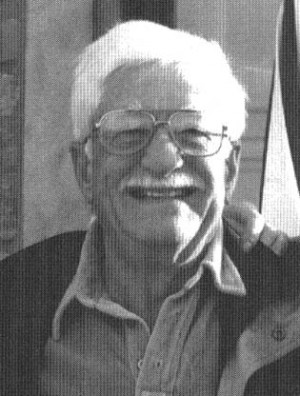
Nathan Blumberg, a great journalist who insisted on meeting deadlines, wrote his own obituary so that he would not miss his final deadline,  on Valentine’s Day, in 2012, when he died of complications from a stroke in Kalispell, Montana. Below is his obit,and his final byline, updated and corrected by Wilbur Wood, his former student and former city editor of the Guardian in the late 1960s.  Wood said that  Nathaniel wrote his own obit to insure that it would be complete and accurate. Nathaniel’s critique of mainstream journalism, and his  vision of independent journalism, were a major influence in the founding of the Guardian and the alternative press.

Nathaniel Blumberg was a World War II combat veteran, Rhodes Scholar, investigative reporter, national press critic, novelist, visiting professor and lecturer at major universities, dean and professor during his 35-year tenure at the University of Montana, and a man devoted to Montana for the last 55 years of his life.

He died February 14, 2012, at the age of 89 in Kalispell, Montana, where he had been hospitalized since a stroke February 8 in his home near Big Fork.     

Born April 8, 1922, in Denver, Colorado, Nathaniel Bernard Blumberg was the eighth and last child of Dr. Abraham Moses and Jeanette Blumberg. His father was a country doctor in Siebert, Colorado, for many years and had moved to Denver with his family to serve as superintendent of a tuberculosis sanitarium.

Nathaniel grew up in the west side of Denver with his four brothers and three sisters in a vibrant home filled with newspapers, magazines, books, music and long discussions of current events at the dinner table. He was graduated from East Denver High School after covering the city’s high school sports for the Rocky Mountain News while a senior.

His education at the University of Colorado was interrupted by the attack on Pearl Harbor and in August, 1942, he enlisted in the Army. After basic training, he was sent to the Army Specialized Training Program in Logan, Utah, and then to Camp Bowie in Texas. He was assigned to the forward observation team of Battery C of the newly formed 666th Field Artillery Battalion, a 155mm howitzer non-divisional unit trained to change mission on short notice. The Triple Sixes entered the war during one of the coldest winters of the century in Belgium against elite German SS troops in the Battle of the Bulge, the largest land battle in the history of the United States Army. The battalion then drove across the Roer river and the Rhine, through the heart of Germany and into occupation in Austria. He earned three battle stars and a Bronze Star in combat. 

Shortly after VE Day in 1945, he published the first history of a unit in World War II, “Charlie of 666,” which he had begun writing when the battalion was formed in 1944. With his poker winnings and combat pay, he published the 32-page booklet in a German print shop and distributed it to members of his battery to send home.

After the war he returned to the University of Colorado, was named editor of the student newspaper and received a bachelor of arts in journalism and a master of arts in history. He was awarded a Rhodes Scholarship for two years of study at Oxford University, where he earned a doctorate in modern history under the tutelage of the internationally known and controversial historian, A.J.P. Taylor. He was a starting guard for Oxford in the first Oxford-Cambridge basketball game ever played in 1949.

Nathaniel was an assistant professor of journalism at the University of Nebraska from 1950 to 1955, when in 1954 the University of Nebraska Press published his “One-Party Press?,” the first significant study of press performance in a presidential election. He went to Michigan State University for a year as an associate professor and in 1956 at the age of 34 he was brought to the Universty of Montana by President Carl McFarland to become dean and professor of the School of Journalism. He served under four presidents and two interim presidents during his 12 years as dean.

He established the annual Dean Stone Night in 1957 to honor the founder and first dean of the School of Journalism, to present awards to outstanding students and to bring a prominent journalist to lecture on the campus, a tradition still followed.

He formed the Department of Radio-Television in 1957 and brought in Phil Hess to put KUFM on air Jan. 31, 1965, six years before National Public Radio was begun in 1971. He has been called on air “the grandfather of Montana Public Radio, a public service of the University of Montana.”

With Mel Ruder of the Hungry Horse News, president of the Montana Newspaper Association, Nathaniel installed the Montana Newspaper Hall of Fame in the School of Journalism in 1958.

Also in 1958, he founded the Montana Journalism Review, the first journalism review in the United States, three years before the Columbia Journalism Review. It is still going.

Shortly after the inauguration of President Kennedy in 1961, the U.S. State Department asked him to serve as an “American Specialist” in Thailand for the summer. Three years later, under President Johnson, he again served in the same capacity for the summer in Trinidad, Guyana, Surinam and Jamaica.

He was elected vice president of the American Association of Schools and Departments of Journalism in 1962, declining to run for president because it meant he would be sponsoring a national journalism competition he and his faculty regarded as unethical. He was elected national chairman of the accreditation committee of the American Council on Education for Journalism in 1967 and national president of Kappa Tau Alpha, the society honoring scholarship in journalism, in 1969.

He was a member of the Rhodes Scholarship state selection committee from 1956 to 1987, including seven years as state secretary. He served six times on the western seven-state Rhodes regional selection committee.

Nathaniel was a staff writer for the Denver Post, associate editor of the Lincoln (Neb.) Star and assistant city editor of the Washington Post. He accepted invitations to serve as a visiting professor at Pennsylvania State University for fall quarter of 1964, Northwestern University’s Medill School of Journalism for the 1966-67 year and the Graduate School of Journalism at the University of California at Berkeley in 1970.

He married Lynne Stout in 1946 and they had three daughters, Janet Leslie, Jenifer Lyn and Josephine Laura. They divorced in 1970 but remained a close family. Their children and grandchildren gathered in Missoula on many occasions and spent long summers on the east shore of Flathead Lake.

Starting a new life in 1970, Nathan took the full name of Nathaniel on his birth certificate. In 1973, he married Barbara Farquhar, a college English professor and a widely published poet, who came to Missoula with her daughter, Nina. Barbara introduced him to Newfoundland dogs and they shared their 34 years together with seven Newfies (and a wolf with a touch of dog in her from the Helena hills). They enjoyed traveling together to beaches and fishing villages in the Canary Islands, Morocco, Spain, Portugal, Nova Scotia, and frequently to Florida, Mexico, Costa Rica, Orcas Island and the central Oregon coast. They balanced these adventures with quiet periods of writing in the cabin they designed and helped build near Big Fork.

In 1980 he established WoodFIREAshes Press to publish books which he hoped to write, edit and design without commercial publishers, editors or agents. He crafted “The Afternoon of March 30, A Contemporary Historical Novel” in l984, which centered on facts never reported by mainstream newspapers or on television about the attempted assassination of President Reagan by John W. Hinckley Jr. It received many warm reviews except for the Missoulian reviewer who didn’t care for the book although he termed the chapter on Hinckley’s trial “riveting.” Bud Guthrie wrote that he had “written a pretty bad novel but a forceful and persuasive book.” Doris Lessing, years before she was awarded the Nobel Prize for Literature, wrote Nathaniel, “I have read ‘The Afternoon of March 30’ with fascination. I really could not put it down, once I had started. If you ever come to London – and why should you, if you live in Montana, which I understand from friends of mine is one of the special places – then do let me know.”    
 
Nathaniel rarely spoke of his part in World War II until 19 survivors of his artillery battery gathered for a reunion in 1992 and urged him to write the uncensored story of their time at war. He returned to Belgium and Germany three times, including a three-day meeting with 32 German veterans of the Ardennes battle. In 2000 he published “Charlie of 666, a Memoir of World War II,” which included his 1945 history and his recollections on the war 55 years later. It was nominated for the 2002 Distinguished Book Award of the Society of Military History.

From 1991 to 1999 he published 20 issues of the “Treasure State Review, A Montana Periodical of Journalism and Justice.” Many of his graduates contributed to the 12-page newsletter. It served as his commentary on that decade of Montana history.

He wrote many articles for magazines, but he was most proud of his coverage of the “March on the Pentagon” in 1967 and his long essay, “Chicago and the Press,” based on his time on the streets and in the parks covering the protesters during the chaotic week of the 1968 Democratic National Convention. He was co-editor with Warren Brier of “A Century of Montana Journalism” and editor of the two-volume “Mansfield Lectures in International Relations.”

He was a demanding teacher with high standards who encouraged his students to live up to the highest principles of the journalism profession, to treat their native language with accuracy and affection, to always be skeptical but never cynical, and to remember that “sacred cows make the best hamburgers.” He was teacher, friend and counselor to hundreds of his students and took great pride in their professional success, their contributions to journalism in Montana and the nation, and their strong sense of public service in their chosen careers. They have written an extraordinary number of books. Scores of his graduates became lifelong friends.

Nathaniel was outspoken and had strong opinions. When he was honored by the Montana Newspaper Association along with Mel Ruder of the Hungry Horse News and Hal Stearns of the Harlowtown Times as the first three Master Editor/Publishers in 1991, he told a cheering audience of weekly journalists that “I am just as proud of the kind of people who don’t like me as I am of the kind of people who love me.” At the 25th anniversary of the Montana Constitutional Convention in Helena in 1997, his critique of the Montana daily press drew the longest standing ovation of the meeting.

His beloved Barbara Ann died of a stroke on the Autumnal Equinox, Sept. 21, 2007, a few days before her 73rd birthday. He also lost his youngest daughter, Josephine Loewen, in a tragic accident on Jan. 7, 2001, at the age of 46.

Survivors include his daughters, Janet Leslie Blumberg of Bothell, Wash., Jenifer Blumberg of Charlo, and stepdaughter Nina Gutierrez and husband Miguel of Ciudad Colon, Costa Rica; grandchildren Caleb Knedlik and wife Janine of Philadelphia, Pa., Asher Loeb of San Francisco, Ariel Diaz and husband Victor of Phoenix, Aram Loeb of Dayton, Ohio, Laramie and Kiam Loewen of Missoula, Adam Loewen of Portland, and Helen, Valerie and Sofia Gutierrez of Ciudad Colon, Costa Rica; numerous nieces and nephews and his first wife, Lynne Blumberg in Missoula.

He spent his last years in his cabin working on a book, including a chapter on “My 30 Years With John W. Hinckley, Jr.” in which he named Neil and Sharon Bush as co-conspirators in the attempt to assassinate President Reagan.

He requested no formal services and that his ashes be scattered with those of Barbara among the trees around their home near Big Fork.

On the Cheap Listings

0

On the Cheap listings are compiled by Soojin Chang. Submit items for the listings at listings@sfbg.com. For further information on how to submit items for the listings, see Picks.

WEDNESDAY 15

Radical Directing Lecture Series: Shari Frilot San Francisco Art Institute, 800 Chestnut, SF. (415) 771-7020, www.sfai.edu. 7:30 p.m., free. Shari Frilot is the curator of the Sundance Film Festival’s New Frontier Program. In this lecture, she will discuss the cinematic works that are being created at the crossroads where art, film, and new media technology meet.

THURSDAY 16

“Coloring Outside the Lines: Black Cartoonists As Social Commentators” panel discussion City College of San Francisco John Adams Campus, 1835 Hayes, SF. (415) 239-3580, www.ccsf.edu. 1:30 p.m.-3:30 p.m., free. Cartoonists are like modern jesters — they poke fun and offer criticism, but we can’t help but love them. Nowhere is this more apparent than in funnies that deal with race in our society. Join curator Kheven LaGrone and guests in a discussion of how black cartoonists have brought in a wide range of perspectives to racial issues and social prejudices.

“Project Censored with Mickey Huff” book release event Modern Times Bookstore Collective, 2919 24th St, SF. (415) 282-9246, www.mtbs.com. 7 p.m., free. Mainstream media seems to air more stories about cats running onto soccer pitches and M.I.A.’s middle finger than relevant news. Author Mickey Huff presents the top 25 underreported news stories you may have missed, and delves in to censorship issues in the relentless fight against Big Media.

“Beyond Cage-Free” panel discussion Port Commission Hearing Room, Ferry Building, 1 Embarcadero, SF. (415) 291-3276, www.cuesa.org. 6:30 p.m.-8:30 p.m., $5 suggested donation. The cage-free label promises eggs from unpenned hens, but can belie farm environments that are much more tragic than the happy picture on cartons would lead us to believe. Join the Center for Urban Education and Sustainable Agriculture in a panel discussion with Lexicon of Sustainability founder Douglas Gayeton, Ferry Plaza farmers, and local ranch owners.

San Francisco Childhood: Memories of a Great City Seen Through the Eyes of Its Children author discussion Green Arcade, 1680 Market, SF. (415) 431-6800, www.thegreenarcade.com. 7 p.m., free. This city has always been a hoot. Editor and author John van der Zee has put together writings dedicated to the magic of San Francisco by figures like Joe DiMaggio, Jerry Garcia, Margaret Cho, and Carol Channing. Come hear about how the city felt to them, and reflect on whether it’s the same for you today.

FRIDAY 17

SF Beer Olympics Impala, 501 Broadway, SF. (415) 982-5299, www.impalasf.com. 8:30 p.m., $10. To start the night, compete in a game of flip cup, beer pong, and relays with strangers, friends, and soon-to-be friends. Afterwards, Olympic champions and losers are welcome to meander upstairs for free admission to the Impala night club.

A night with photographer Robert Altman Wix Lounge, 3169 22nd St, SF. (415) 329-4609, www.wixloungesf.com. 7-10 p.m., free. Robert Altman not only survived the 1960’s but photographed some of the best parts of it. He will be talking about his work for Rolling Stone and his experiences photographing icons like Mick Jagger and Bill Graham. Come hang out with this all-around cool dude.

SATURDAY 18

“A Love Supreme” Harlem Renaissance art celebration First Unitarian Church of Oakland, 685 14th St, Oakl. (510) 893-6129, www.uuoakland.org. 6 p.m.-9 p.m., donations accepted. The Harlem Renaissance brought on an explosion of culture and redefined music, art, and literature in American history. Join local queer poets of color in a delicious potluck dinner and music-poetry session to celebrate how cultural richness and literary splendor have not stopped growing.

The Dark Wave book release party Fecal Face Dot Gallery, 2277 Mission, SF. (415) 500-2166, www.ffdg.net. 6-9 p.m., free. You may know Jay Howell from his zine Punks Git Cut! where he sketched out an assortment of naked people, dogs, and boners. Howell is now bringing his majestic artwork as the backdrop of his new book — a literary tale of a black metal band’s disenchanted lead singer.

SUNDAY 19

Art Beat Bazaar music, poetry, and pop-up indie-mart Starry Plough, 3101 Shattuck, Berk. (519) 841-2082, www.starryploughpub.com. 3-7 p.m., free. This is the first of the monthly community event Art Beat Foundation will be hosting as a way to showcase local musicians, spoken word artists, comedians, and visual artists. Let folk-rock band Upstairs Downstairs be the musical soundtrack to your trip to the quirky pop-up store, where you will find handmade treasures by artists like Cori Crooks and Brownie 510

Yiddish sing-along with Sharon Bernstein Jewish Community Center of San Francisco, 3200 California, SF. (415) 292-1200, www.jccsf.org. 5-6:30 p.m., free. This musical event is one part of KlezCalifornia’s Yiddish Culture Festival, a three-day event for anyone who is interested in Yiddish literature, interactions between musical cultures, klezmer music, and/or Eastern European Jewish history. Lyric books will be provided.

MONDAY 20

Open mic night with Les Gottesman and Bill Crossman Bird and Beckett Books and Records, 653 Chenery, SF. (415) 586-3733, www.birdbeckett.com. 7 p.m., free. Les Gottesman and Bill Crossman are poets, activists, and professors who are coming to share their latest and favorite works in this literary night. Gottesman’s words are said to be goosebump-invoking and Crossman’s smooth piano skills are not to be missed.

TUESDAY 21

“Laissez les bons temps rouler” Mardis Gras party Jazz Heritage Center, 1320 Fillmore, SF. (415) 346-5299, www.thefillmoredistrict.com. 5 p.m., $5 for wristbands. Make it a merry Fat Tuesday this year by going out to the Fillmore District for a neighborhood party of stilt walkers, jugglers, and face painters. 10 Fillmore Street venues will have live music and Mardi Gras-themed drinks and treats for under 10 dollars.

“Youthquake: High Style in the Swinging Sixties” American Decorative Arts forum and exhibit Koret Auditorium at de Young Museum, 50 Hagiwara Tea Garden, SF. (415) 750-3600, www.deyoung.famsf.org. 7 p.m., $15. Long hair and bellbottoms marked the fashion and music scene during the 1960’s, and a similarly defiant idiosyncrasy took over home décor. Join Mitchell Owens of Architectural Digest in a lecture on the bold and innovative interior style moves that were made during the exuberance of the youthquake.

“Feast of Words: A Literary Potluck” SOMArts Cultural Center, 934 Brannan, SF. (415) 552-1770, www.feastofwords.somarts.org. 7-9 p.m., $10 in advance; $5 with a potluck dish; $12 at door. Writers are often thought of as caffeine junkies who survive off of coffee and cigarettes. But hey, we eat just like any other Joe Schmo. At this literary event, foodies and writers unite to share (both food and literature) and learn about local cultures and flavors.

Localized Appreesh: The Yellow Dress

0

Localized Appreesh is our weekly thank-you column to the musicians that make the Bay. To be considered, contact emilysavage@sfbg.com.

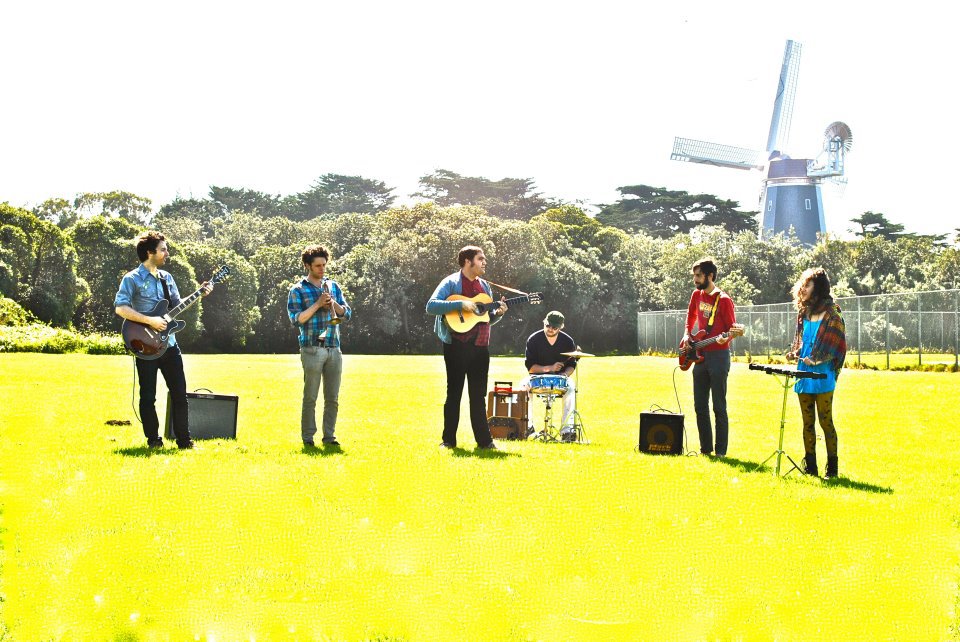
Dogs, ghosts, kids, hand-clapping, whistling on a sunny park day – it’s all in the video for the Yellow Dress’s “This Could Be Anything.” The song itself is already a treat, kicking off with the aforementioned clapping and whistling and a solitary guitar, in pipes mariachi trumpet and swallow-you-whole powerful vocal pipes à la orchestral pop master Beirut. (It also has garnered comparisons to Magnetic Fields and a drug-less Velvet Underground.)

The Yellow Dress closed out 2011 with a metaphoric group hug, thanks to the video and a well-received second album, Humblebees. This year, it’s already off to a run through the park, pull your dress up and get mud on your ankles, start. In the next seven days, the San Francisco band will play three local shows, all at interesting venues, perhaps a bit off the beaten path. Do it up big and catch a trio of Yellow Dress performances.

Year and location of origin: 2007, San Francisco (the corner of Haight and Fillmore to be exact)

Band name origin: We used to be called Mr Stopmotion and the Yellow Dress after a particularly dapper couple I saw walking through Golden Gate Park, back then we were just a two-piece, and the name was pretty unweildy. For about a day we were Mr Stopmotion, which sounds like a Devo/XTC cover band. We decided on The Yellow Dress, which immediately led to a dramatic (and affirming!) number of yellow dresses in both (me and original bandmember Jon) of our lives. For a not very interesting story that sure took a lot of time to write.

Band motto: I’m sorry.

Description of sound in 10 words or less: Earnest-indie-twee-folk-pop.

Instrumentation: Acoustic and electric guitar, bass, drums, glockenspiel, male/female vocals, trumpet, organs, whistles, hand claps, if anyone reading this plays the cello and love dinosaurs please call me.

Most recent release: Humblebees.

Best part about life as a Bay Area band: With so many artistic people around it’s easy to find like minded folks to play with, slowly envelop in your ever growing line-up.

Worst part about life as a Bay Area band: With so many artistic people around you are rarely the only game in town any given night.

First record/cassette tape/or CD ever purchased: The Top Gun soundtrack. It was great.

Most recent record/cassette tape/CD/or Mp3 purchased/borrowed from the Web: West Indies Funk Volume 3 (2012 is the year of the steel drum).

Favorite local eatery and dish: I miss Mission Burger so much, you have no idea. The Yellow Dress is however willing to give a full endorsement to the chicken millanesa torta at La Torta Gorda.

The Yellow Dress
With Adam Balbo, the Slaves
Thurs/9
Alley Cat Books
3036 24th St., SF


With Matt Dorrien, Fox and Woman
Fri/10, 8 p.m., $8
924 Gilman, Berk.
www.924gilman.com


Valentine’s Day Monthly Rumpus: Sugar’s Coming Out Party
With Pocket Full of Rye, Janine Brito
Feb. 14, 7 p.m., $10
Verdi Club
2424 Mariposa, SF
www.therumpus.net


“So this will really be a doggie disco.”

0

Let’s just get this out of the way immediately: there’s going to be a doggie dance this Sunday at the Stud. I could say no more about it and there would still be a segment of people, myself very much included, that would need to go, no questions asked. I mean, it’s a dance for dogs.

Well for the rest of you, I asked the questions. The official title is “Dance Doggy Dance A Fundraiser for WonderDog Rescue” and it’s the first of its kind for Wonderdog. The Stud is dog-friendly, and there will be DJs spinning lower decibel levels so as not to hurt those velvety pup ear flaps. 

“So the first DJ David Sternesky will be spinning disco during that time. ,” says Wonderdog volunteer “So this will really be a doggie disco.”

http://www.youtube.com/watch?v=3jyd1LdZpqA

Here’s hoping we see a Chihuahua mix doing the non-sexual hustle with a Lab, or perhaps a Bullmastiff  howling Chic’s “Le Freak.”

After Sternesky (Rocket Collective, Solid), Taco Tuesday (OH! & I Cochina Tonga’s) sidles into the DJ booth and real live humans can get in on the dancefloor as well. Either way, it’s a spot to bring your dog and have a cocktail.

Wonderdog is a volunteer group that rescues dogs from all over Northern and Central California. According to its site, it has “saved blind and deaf dogs, puppies as young as two weeks and seniors as old as 15.” It also offers hospice to special needs and elderly dogs.

The fundraising will go towards Wonderdog’s ability to pay vet bills, rent out its Western Addition space, transport dogs, and of course, feed the things.

Dance Doggy Dance
Sun/29, 9 p.m., $10-$20 donation
The Stud Bar
399 Ninth St., SF
www.wonderdogrescue.org

The Performant: Discord fever

0

San Francisco Tape Music Festival unwinds at ODC

The fact that it’s raining makes it an unexpectedly perfect night to attend the San Francisco Tape Music Festival. The water rushing through pipes and sweeping across the rooftop of the ODC Theatre adds an extra layer of ambience to the cacophonic tones emitting from a modest bank of speakers, squatting on the stage like forbidding monoliths. The here-and-now intrusion of the rainfall ties even the most outré compositions of the evening together in an entirely unanticipated manner, from the oldest (dated 1857) to those created this still-young year by members of the current incarnation of the San Francisco Tape Music Collective and sfSound.


Snugly protected from the bluster of the elements, we sit in patient anticipation as the lights dim to as near a full blackout as can be achieved with glowing EXIT signs and lighted soundboard. The darkness forces focus on the content of the composition, not the conduit, freeing the senses from the unconscious tyranny of vision. And a certain amount of focus does come in handy for an evening spent listening to the trajectories of polyphonic dissonance whizzing through the room at reckless speeds. Field recordings, samples of radio-age music scores, spoken murmurings of French, English, Greek, percussive clatterings, static-y white noise, and a host of sonic curiosities stack up on top of each other like the building blocks of childhood, leaning precariously, threatening to topple. “Purposeless play,” John Cage once described it, though of course such purposelessness contains a purpose all its own.

Maggi Payne, SF Tape Music Fest, SFBG.com

Composer Maggi Payne

A 16-minute Matthew Barnard composition entitled The Piano Makers sweeps the oddience into the Kemble piano factory, where Barnard made a series of field recordings of piano manufacturing: all clatter of machinery, zing of taut strings and tuning forks, and pounding of keys. John Cage’s Williams Mix kicks off a centennial celebration of Cage’s birth with a frenetic mélange of classic cartoon scores, old jazz standards, church hymns, radio announcements, and a lonesome foghorn. One of the evening’s most distinctive aural pleasures comes courtesy of noted theatrical sound-designer Cliff Caruthers, whose eerie, affecting Underneath would serve perfectly as the ambient score of some great, underwater epic — Gilgamesh perhaps — all creaking boards, and groaning depths, punctuated by the primal bellow of some unfathomable creature and a twinkle of silvery fish. Maggi Payne’s Glassy Metals rounds out the first half with a textural layering of metallic sounds manipulated to mimic the wet gurgle of a deep forest brook and rush of dry desert winds.

Ma++ Ingalls, SF Tape Music Fest, SFBG.com

Performer Ma++ Ingalls. Photo by Lenny Gonzalez

Two of the highlights of the second half include the second John Cage piece of the night, Imaginary Landscape No. 5. Composed on a block graph designating eight tracks and 42 separate sound clips, the realization of this version was created collaboratively by the Tape Music Collective, and performed by Ma++ Ingalls. Sterfos, by Orestis Karamanlis, also performed by Ingalls, transports the listener to a fishing village on the edge of the Aegean Sea. Bucolic village sounds such as the somber clang of church bells, footsteps crunching on gravel, the lapping of waves, dogs barking, children playing, and an elderly man with the oratory tone of a storyteller, all layered over with the urgent textural tones of aggressive modernity. More than any other piece of the evening, Sterfos embodies the cinematic quality of the music, a clearly defined story arc winding through the village entire. Only a minor technical glitch halfway through the piece mars the otherwise seamless meander along the shoreline of a strangely familiar sea.


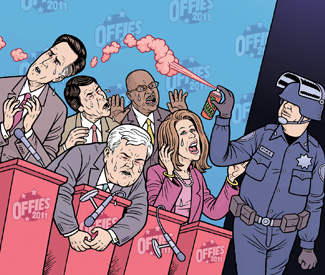
OFFIES 2011

0

It was the year of the Rapture (oh, wait, maybe not), the year of the great Republican resurgence (oh wait, maybe not), the year of Anthony Weiner’s penis and Gerard Depardeiu’s piss, the year of the Kardashians and Charlie Sheen … and the Offies in-basket overflows. Here are our favorite choice moments of 2011.


ACTUALLY, HIS THUMBS ON THE PHONE WERE THE ONES DOING DAMAGE

Anthony Weiner, in a sexting conversation with a middle-aged Nevada Democratic volunteer, described his penis as “ready to do some damage.”


AT LEAST SOMEBODY’S DOING SOMETHING ABOUT THE UNEMPLOYMENT RATE

Hustler publisher Larry Flynt offered Weiner a job


GOOD THING EXPERTISE IN THE ENGLISH LANGUAGE HAS NEVER BEEN A PREREQUISITE OF THE JOB

Presidential candidate Herman Cain, in an interview, said he didn’t know the name of the president of Uzbekistan, which he called UBEKE BEKI KEIE BAH BAH STAND O BAN STAN SO WHAT WHAT?


CERTAINLY NOT THE KIND OF FOOD FOR A MIGHTY MAN WHO SEXUALLY HARASSES HIS SUBORDINATES

Cain said that too many vegetable toppings make a “sissy pizza.”


BECAUSE AN ELECTRIFIED CARTOON MOUSE IS AN INSPIRATION TO US ALL

Cain blamed “elites” for derailing his campaign, then quoted from the Pokemon theme song.


NICE TO SEE HERMAN CAIN HAS COMPANY IN THE DEPARTMENT OF QUALITY POLITICAL CANDIDATES

Joe the Plumber announced he would run for Congress


COULD IT BE — THE STUPIDEST REPUBLICAN CANDIDATE EVER?

Rick Perry couldn’t remember which federal agencies he wanted to shut down.


EXCEPT THAT THE ALMIGHTY HASN’T BEEN ABLE TO TELL US WHICH DEPARTMENTS HE WOULD CUT, EITHER

Michelle Bachman said that the East Coast earthquake and hurricane were signs that God thought the country was spending too much money on government services.


IT APPEARS THE CHRISTIAN RIGHT CAN’T GET ITS STORIES STRAIGHT

Rush Limbaugh said that the power of Hurricane Irene, which caused 53 deaths and $15 billion in property damage, was blown out of proportion to promote “the leftist agenda.”


HMMM… SINCE HERS MAKES A BUSINESS OF “CONVERTING” GAY PEOPLE, WE HAVE TO WONDER WHAT HE TELLS HER TO DO

Bachman said wives should be obedient to their husbands


BUT HEY — THOSE GUYS ALL LOOK ALIKE

Bachman praised Waterloo, Iowa as the home of John Wayne, when it’s actually the home of serial killer John Wayne Gacy


AN EXCEPTIONAL NEW INTERPRETATION OF THE INTELLECTUAL ROOTS OF THE SECOND AMENDMENT

Sarah Palin insisted that Paul Revere “warned the British that they weren’t going to be taking away our arms, by ringing those bells.”


UM, RICK, THE SCHOOLS ARE CLOSED ON CHRISTMAS

A Rick Perry campaign ad said that “something’s wrong with America” because “gays can serve openly in the military but our kids can’t openly celebrate Christmas or pray in school.”


DAMN — THAT MEANS HE REALLY IS A DUMB AS HE LOOKS

Perry insisted he wasn’t drunk when he delivered a rambling speech in New Hampshire


OR MAYBE A LITTLE LIKE FINDING OUT THAT SHE WAS JUST USING YOU ALL ALONG

Sup. David Chiu said meeting Mayor Lee — who he helped put in office — after he broke his promise not to run was “a little like meeting an ex-girlfriend after a breakup.”


AND TALK ABOUT BEING USED

Ed Lee said he didn’t want to run for mayor, but he had trouble saying no to Rose Pak and Willie Brown


IT DOESN’T MATTER — AS THE GREAT RONALD REAGAN ONCE SAID, “FACTS ARE STUPID THINGS.”

Sen. John Kyle announced that 90 percent of Planned Parenthood’s business was abortions, and when it turned out he was wrong by a factor of 30, he said his allegation “wasn’t meant to be factual.”


THE U.S. HAS DEPOSED PEOPLE FOR LESS THAN THAT. OH, WAIT …

Moammar Gadafi said his political opponents were on LSD and kept a stash of photos of Condoleeza Rice.


OH WELL, YOU KNOW HOW GOD IS; HE FLAKES OUT ON DATES ALL THE TIME

Oakland radio minister Harold Camping announced that the end of the world would come Oct. 21.


TOO BAD THAT WILL ONLY COVER THE FIRST SESSION OF THE POOR KID’S THERAPY

A woman who created a media frenzy when she said that she had given her young daughter botox admitted she made the story up so a tabloid would pay her $200.


WHEREAS, OBAMA HAS NEVER DEMANDED THAT TRUMP SHOW HIS REAL HAIR

Donald Trump demanded that Barack Obama show his birth certificate.


IF THE JAPANESE WOULD ONLY CUT GOVERNMENT SPENDING SOME MORE, THIS SORT OF THING WOULDN’T HAPPEN

Rush Limbaugh made fun of Japanese people after the earthquake and tsunami, saying “where Gaia blew up is right where they make all these electric cars.”


THE SCHOOL’S ESTEEMED NAMESAKE, ON THE OTHER HAND, HAD 27 WIVES, SOME AS YOUNG AS 15, AND AT LEAST 64 CHILDREN, SO HE WOULD NEVER HAVE APPROVED OF SUCH A THING

Brigham Young University suspended basketball star Brandon Davies because he sex with his girlfriend.


IT’S AWFUL, THE SACRIFICES OUR POLITICAL LEADERS HAVE TO MAKE IN THE NAME OF THE COUNTRY

Newt Gingrich told the Christian Broadcasting Network that he’d cheated on his wife because he loved America so much.


ON THE OTHER HAND, IF YOU WEREN’T SO FULL OF SHIT THE PLUMBING MIGHT FUNCTION A BIT BETTER

Sen. Rand Paul complained to an energy department official that he didn’t like appliance efficiency standards because “we have to flush the toilet 10 times before it works.”


NATURALLY — CLEANLINESS IS NEXT TO GODLINESS. SORT OF LIKE MARITAL FIDELITY

Gingrich told Occupy protesters to take a bath.


WHAT — HE DOESN’T CONSIDER HIMSELF A “FROTHY MIX OF FECAL MATTER AND LUBE THAT IS SOMETIMES THE BYPRODUCT OF ANAL SEX?”

Former Senator and presidential candidate Rick Santorum complained about what turns up when you put his name in a Google search.


AND NEXT, WE’LL REDEFINE “POOR” AND ELIMINATE FOOD STAMPS

House Republicans tried to redefine “rape” to eliminate funding for abortions


OH WELL, THERE GOES THE SEASON

Stanford University stopped giving student athletes special lists of easy classes


DONALD — YOU’RE FIRED

Donald Trump tried to host a presidential debate but gave up when nobody wanted to be there.


THIS FROM A MAN WITH “INVENTED” INTEGRITY

Gingrich called the Palestinians an “invented” people.


GOOD THING ABOUT THE CRACK — THAT SHIT FUCKS UP YOUR BRAIN

Charlie Sheen opened his Violent Torpedo of Truth Tour in Detroit, where he burned a Two and A Half Men T-shirt, told the crowd that he was “finally here to identify and train the Vatican assassin locked inside each and every one of you,” demanded “freedom from monkey-eyed&ldots;sweat-eating whores,” and said he doesn’t do crack anymore.


AT LEAST HE’S GOT ONE THING GOING FOR HIM: HE JOGS WITH A GUN AND SO FAR HASN’T SHOT HIS OWN BALLS OFF

Rick Perry told the Associated Press that he shot a coyote that had threatened him on his morning jog.


KILL ‘EM ALL AND LET GOD SORT ‘EM OUT

The crowd at a Republican debate cheered after moderator Brian Williams noted that Rick Perry had overseen 234 executions.


ANOTHER GREAT MOMENT IN THE ANNALS OF LAW ENFORCEMENT

A Davis police officer pepper sprayed a group of peaceful protesters who were sitting on the ground.


SINCE THERE’S NO NEWS IN THE WORLD OF THE 1 PERCENT

The New York Post investigated sex at Occupy Wall Street


GOOD THING IT DIDN’T WORK — THE WATER FROM HEAVEN WOULD HAVE MADE THE BUNS ALL SOGGY

Perry held a religious rally to pray for rain at Reliant Stadium in Houston, and urged people to fast, although the concession stands sold hot dogs.


BUT WAIT — IF WE SHUT DOWN THE GOVERNMENT, AREN’T WE … OH, NEVER MIND

Michelle Bachman said she opposes same-sex marriage because “the family is the fundamental unit of the government.”


THE FACT THAT WE’RE EVEN WRITING ABOUT A TEENAGER WHO CALLS HER TITS “SNOWBALLS” IS A SIGN OF THE END OF CIVILIZATION

Child bride Courtney Stodden was kicked out of a pumpkin patch for dressing in daisy dukes and making out with her 53-year old husband, Doug Hutchinson, and she madly tweets things like “Squeezing my snowballs inside of a seasonal sexy little lingerie as I begin to swing around the Christmas tree to hot rock ‘n roll hits!”


IT SELLS, BABY, IT’S SELLS

Kim Kardashian made $12 million for doing essentially nothing.


A NEW DEFINITION OF TERROR: WATCHING A 63-YEAR-OLD MAN WHIP OUT HIS DICK

Gerard Depardieu pissed on the floor of an Air France jet after flight attendants told him he’d have to wait to use the bathroom.


WE’RE GOING TO TAKE A BUNCH OF STEROIDS AND THEN LIE ABOUT IT AND MAYBE WE CAN SPEND A MONTH THERE, TOO

The U.S. Justice Department spent millions of dollars and eight years to convince a judge to sentence Barry Bonds to spend a month at his Beverly Hills estate.

Louis Dunn: Census says dogs outnumber children in San Francisco

2

Another cartoon from longtime contributor Louis Dunn — this one poking some fun at a recent population change.

Tough mustard

2

le.chicken.farmer@gmail.com

CHEAP EATS Zeni said she’d been cooking for three days. But the shopping was the hardest part. She had to go all over town, she said, to get the right sausages and other meat … things.

Such as knuckles.

I have a new favorite butcher shop, but first I have to tell you about Zeni’s feijoada. Her man Nutmeg, who plays soccer with me and Alice Shaw the Person (and some other people) has been talking up Zeni’s feijoada for many, many seasons. Most often after the game, when all of us are hungry. But since our team conducts its games in Portuguese, a language I don’t understand, it’s all pretty much feijoada to me.

There’s always all this hollering on the field: feijoada, feijoada.

"I’m trying," I say, whenever it seems like they might be talking to me.

Generally speaking, we win.

But now Nutmeg and Zeni are moving back to Brazil, and as soon as we learned this our post-game chatter shifted from feijoada to feijoada-with-a-sense-of-urgency.

Then the next thing I knew I had died and gone to heaven. Which I readily identified by the smell of it, and then by this steaming plate of rice and black beans with sausage, pork, and everything but the chicken sink. The dish was sided by finely chopped collard greens, or couve, garnished with orange slices, and sprinkled with farofa — which is cassava flour toasted with butter and bacon.

Jesus, Mary and Joseph, I could have gone straight from that meal to the firing squad, uncomplainingly, but as it was I got to go to Berkeley, instead, and make some kitchen noodle soup with Crawdad’s kids.

Now, my friend Papa is learning to be a butcher, which is about as admirable and honest a line of work as is out there, to my way of thinking. So every time I saw her I would ask about her career and she would say, among other things, "Steak sandwich!" with the same kind of reverence with which Brazilians say feijoada.

I pictured raw, sawed beef on a roll, which made me happy. Then one day, eventually, we climbed that hill to Avedano’s, on Cortland St. in Bernal. Or Holly Park. In any case, Avedano’s is a butcherer of local grass-fed beef and other responsibly-raised animals, and they don’t only just saw and hack them for you to take home; they’ll also make you a nice (and entirely cooked) samwich. If you want.

Hedgehog had the Tuscan pork sandwich, with pickled onions and tomato. I got the steak with pecorino, arugula, and pickled tomatoes.

And these things did we eat on a bench. Outside. There, in the sunlight and warmth of mid-day, San Francisco, my love and I got in a huge fight over mustard. I won’t bore you with the details, cause I don’t remember them. But suffice to say that I loved my sandwich, and Hedgehog loved hers.

I’m not a very experienced sandwich eater, though. With my first bite, I lost a big juicy piece of steak to the sidewalk. It landed right between my feet, where other people’s dogs sit on their asses, between other people’s feet, and stare at other people’s sandwiches, panting and trying to make just the right face.

"Pick it up and eat it," Hedgehog said.

So I did.

I might have pushed the limit of the five-second rule, but it’s the spirit of the rule that matters.

And the steak was that good, I’m saying. Slightly rare, succulent … I couldn’t let some dumbass Bernal dog come and lap it up. It was mine!

And it was delicious, even with residual sidewalk all over it. Anyway, I didn’t get any dog ass cooties, or other exotic diseases. That I know of. Yet.

Although: a big dumb dog did come along, only moments later, and sniff and lick a little at the spot, before it’s owner tugged him away. "Ha," I said.

I am not, as you know, a dog lover.

AVEDANO’S

Mon.-Fri. 11 a.m.-8 p.m.; Sat. 9 a.m.-8 p.m; Sun. 11 a.m.-6 p.m.

235 Cortland, SF.

(415) 285-6328

AE/D/MC/V

No alcohol

Get read!

0


ROCK AND ROLL ALWAYS FORGETS

By Chuck Eddy

Duke University Press

352 pp., paper, $24.95

Chuck Eddy glides through music criticism like a grumpy fanatic. Each article included in Rock and Roll Always Forgets — culled from Eddy’s vast back catalogue of music journalism articles, beginning with the early 1980s — is packed with cultural references, touchstones, facts, witty asides, a dash of snark, and acknowledgments of once-obscure acts. Yet, he approaches each band like he’s the first to have discovered it. He’s a musical anthropologist, but also, archeologist, digging up the remains of musicians past, lest we forget. Take a piece on a Marilyn Manson show, written in 1996. More than simply describing the stage and the crowd (which he does, expertly: “[they] wore too much black makeup, but they didn’t scare me — most seemed to be upper-middle-class Catholic school teens from the burbs…”). He wanders near profundity, dissecting Manson’s overall persona, his ticks, his own cultural references, and those who came before him, namely Alice Cooper, but a great many more. Most importantly, Eddy alludes to why that all matters in the least. (Emily Savage)


TROPIC OF CHAOS

By Christian Parenti

Nation Books

295 pp., hardcover, $25.99

Through historical research and on-the-ground reporting in Kenya, war-torn areas of Afghanistan, and other regions marked by intense conflict, Christian Parenti offers an unusual and compelling analysis of violence through the lens of the environment. Tropic of Chaos: Climate Change and the New Geography of Violence teases out the idea that increasingly unstable weather patterns stemming from climate change have fueled conflict throughout impoverished areas of the Global South. In the savannahs of northwest Kenya, for instance, deadly cattle raids have intensified as intertribal warfare heats up in the face of water scarcity. Recurring droughts and floods in Afghanistan have made it exceedingly difficult for farmers raise traditional crops, making them increasingly reliant drought-resistant poppy — the raw ingredient for heroin — for economic survival. Parenti also turns a sharp eye upon the repression, surveillance, and counterinsurgency that first-world nations have employed to combat growing violence in water-scarce, conflict-ridden regions, and calls for a more enlightened approach. (Rebecca Bowe)


CAFE LIFE SAN FRANCISCO

by Joe Wolff

Interlink Books

224 pp., paperback $20

Small quirks in this guide to the city’s cafes and coffeehouses — the sixth in a series that includes Sydney, New York, and Venice — will let you know its not strictly, strictly for locals. Java Beach is lumped in with more gearhead-oriented Mojo Bicycle Cafe and Ninth Avenue’s Arizmendi Bakery is filed under the catchall “Sunset District and vicinity.” The introduction’s discussion of “San Fran” versus “Frisco” versus “the City” is one that became boring long ago. But those things matter little. In-depth histories of some of your favorite cafes, from Java Beach to Philz’ to Caffé Baonecci are lucid looks at the facts and rewards of small entrepreneurship in the city. And Roger Paperno’s loving photography of velvet crema and foccacia sheets combines with words to create an ode to the city’s third spaces that any caffeine-laptop addict will appreciate in their stocking. (Caitlin Donohue)


LIONS OF THE WEST: HEROES AND VILLAINS OF THE WESTWARD EXPANSION

By Robert Morgan

Algonquin Books

497 pp., hardcover, $29.95

Biography can be the best history; stories of the people who changed the world (for better, and often for worse) are more compelling than turgid texts of dates and places. Lions of the West recounts the development of the American frontier from the end of the Revolutionary War to the Civil War era through the lives of 10 men. Yeah, all men. In fact, Morgan (by choice or by the longtime bias of American historians) makes it appear as if all of the great and evil deeds done as the nation moved Westward Ho were the province of the male of the species. At times, the profiles are a bit over the top (I don’t really care that much about Kit Carson’s personal life.) Overall, though, it’s a detailed, lively, and informative book that minces no words, especially when discussing the theft of much of the southwest from Mexico. San Franciscans will enjoy learning who Stockton, Sloat, Castro, Winfield, and a few other streets were named after. (Tim Redmond)


VHS: ABSURD, ODD, AND RIDICULOUS RELICS FROM THE VIDEOTAPE ERA

By Joe Pickett and Nick Prueher

Running Press

272 pp., paper, $14

Found Footage Festival founders and comedy writers Joe Pickett and Nick Prueher are apparently the Indiana Joneses of VHS, unearthing remarkable video package cover art that would otherwise be relegated to hoarder basements, bonfires, and anywhere else the worst (a.k.a., the best) videotapes go to die. I salute these dudes, even though the captions they tag each page with aren’t always funny or necessary. Truly, the covers (soft-focus and garish, tacky and baffling) speak for themselves, direct dispatches from ye olden days, long before YouTube brought WTF-ness to anyone with an Internet connection. You see, children, back in the 1980s or 90s, home viewers had to seek this shit out: instruction in squirrel-calling, chair-dancing, seduction, hairstyling (“What the Heck Am I Going to Do With My Hair?”), baby-proofing, spotting counterfeit Beanie Babies, etc. Straight-to-video masterpieces (F.A.R.T.: The Movie). Horrible exercise fads (“Bunnetics: The Buttocks Workout”). Well-meaning but also ghoulish-looking self-improvement vids (“Face Aerobics”). Every page is magical. Your mind will be blown. (Cheryl Eddy)


BI-RITE MARKET’S EAT GOOD FOOD

By Sam Mogannam and Dabney Gough

Ten Speed Press

297 pp., hardcover, $32.50

Bi-Rite Market is the ultimate neighborhood grocery. Shockingly small (with ambition to expand), it’s jam-packed with the best in organic produce, meats, cheeses, and artisan food products, much of it local. Now, Bi-Rite founder Mogannam has a new book loaded with recipes for such inviting delectables as white bean puree with prosciutto crespelle and strawberry rhubarb pie. But don’t relegate it to the cookbook category. Hewing to Bi-Rite’s mantra of creating community through food, the authors share extensive tips on shopping seasonally and locally for the healthiest and best-tasting products, no matter where you may live. You’ll learn what to look for at the grocery, storage and usage tips, and more. Well-illustrated sections feature produce (broken down by season), wine, beer, cheese, deli meats, butchery, baked goods, and even farmer profiles. Bonus: stay tuned for Sweet Cream and Sugar Cones, Bi-Rite’s ice cream and frozen treats recipe book from its renowned creamery, out this April. (No word yet on whether it’ll tell us how to beat the ever-present line outside.) (Virginia Miller)


DAMNED

By Chuck Palahniuk

Doubleday

247 pp., hardcover, $25

Welcome to Hell, as seen through the eyes of 13-year-old Madison Spencer, the daughter of a jet-setting yet eco-hyperconscious movie starlet and philanthropist. This is Dante’s Inferno meets The Breakfast Club, a film that overtly informs the plot and its main characters. As in Palahniuk’s breakout novel Fight Club, it’s hard distinguish between reality and perception as Maddy leads readers past the Vomit Pond, across Dandruff Desert, and right into Satan’s black Town Car. As she recalls her final weeks on earth, you’re pretty sure that she didn’t really die from a marijuana overdose. Clearly, things are not what they seem as the novel looses an American teenager’s perspective on modern life in both the underworld and earthly realm, with wry commentary on everything from pop culture and capitalist excess to the defeated religions whose fallen gods roam Hades. The gags alone — like the telemarketing and chatroom porn the damned deliver to Earth, and Hell’s endless loop of The English Patient — make this a tough book to put down, all the way to its slightly unsatisfying conclusion. (Steven T. Jones)


BEST AMERICAN COMICS 2011

edited by Alison Bechdel

Houghton Mifflin Harcourt,

352 pp., paperback $25

Chris Ware’s textbooky flowcharts; Angie Wang’s Technicolor, spiraling pistil-armed super-flower-heroine; Peter and Maria Hoy’s intricately plotted cause-and-effect grid art — the sixth year of this hardcover assemblage of the year in superlative strip art soars as a holiday gift for your fave comic nerd. Visual trickery and innovative page staging aside, many of the graphic narratives in this book hold up on plot alone. An excerpt from Kevin Mutch’s Fantastic Life effectively mines zombie philosophy, dating paranoia, and begging drinks off your service industry friends for comic gold. Many of the best pieces, perhaps indicative of the graphic novel mood these days, explore the darker side of the human psyche. But what graphic novel fan is unfamiliar with complicated? (Caitlin Donohue)


THE TIPSY VEGAN

By John Schlimm

Lifelong Books/Da Capo

164 pp., paper, $17

Every time I think we’re past the stereotype of the sullen, uptight vegan, I get another comment like, “Wait, don’t you only eat vegetables?” Why yes, I do eat plenty of veggies, but I also eat decadent dishes such as The Tipsy Vegan‘s Party Monster Pancakes, loaded with the sweet nectar of amaretto and drenched in syrup. This book is a carnivorous teetotaler’s nightmare, boasting 75 boozy recipes stuffed with everything from “beer to brandy” for the liquor-loving vegan cooks among us. It’s not, as I initially imagined, a book on vegan cocktails — that would be far too easy. Written by John Schlimm (Ultimate Beer Lover’s Cookbook), a member of “one of the oldest brewing families in the United States,” the book includes booze-infused treats for parties, brunch, and supper: fried avocados, slur-baaaaked peaches with Cointreau, “Bruschetta on a Bender” — all of which kind of sound like stoner food to me. An nice touch: glossy food porn shots on every page. (Emily Savage)


PROJECT DOG

By Kira Stackhouse

self-published

352 pp., hardcover, $34.99

Local photographer Kira Stackhouse experienced an inspiration so intense that she ditched her high-profile marketing job to pursue it: she would photograph specimens of the 50 most popular canine breeds officially registered with the American Kennel Club (“purebred dogs”) that had been purchased from professional breeders — and pair them with photos of the exact same kinds of dogs found in local dog rescues and shelters. The purpose was to start a dialogue about the effects of professional breeding and highlight the many kinds of dogs available for adoption (and also to change peoples’ perceptions about rescue dogs). But a major part of the story — and what makes this book so fantastic — is the wonderful doggy photography and sumptuous layout. Dogs are posed, or pose themselves, against iconic Bay Area backdrops, accompanied by often hilarious, always revealing, biographies and profiles. Project Dog became an online sensation: this book cements its reputation. Available at www.projectdog.net. (Marke B.)


LISTEN TO THIS

By Alex Ross

Picador

384 pp., paper, $18

In the expanded paperback edition of his absorbing and erudite collection of essays, Alex Ross of the New Yorker writes what could be called his mantra as critic: “I have always wanted to talk about classical music as if it were popular music, and popular music as if it were classical.” Ross listened exclusively to classical until he was 20, something he admits may sound “freakish.” But whether he’s describing Björk in her recording studio in Iceland, or composer John Luther Adams’ sound and light installation in Alaska, Ross draws from an immeasurable well of knowledge and plunges into his subject with gusto. He can find commonalities between Radiohead’s “Pyramid Song” and Stravinsky’s Firebird Suite, clear away the myths that have clouded both Franz Shubert and Bob Dylan, and thoroughly explain why OK Computer and John Cage’s 4’33” are equally astonishing. Informative, eye opening, Ross is every lover of music thrown harmoniously into one. (James H. Miller)


MY FAMILY TABLE

By John Besh

Andrews McMeel Publishing

272 pp., hardcover, $35

To know anything about New Orleans’ dining scene is to know John Besh. As one of Nola’s great chefs, he has a number of restaurants, including the acclaimed August, elevating local cuisine in forward-thinking ways. His original book My New Orleans is a striking post-Katrina tome to one of the greatest cities in the world and its vibrant culinary history. It’s a gorgeous coffee table volume packed with photos of the region’s people, places, and foods — more than 200 recipes from Mardi Gras specialties to gumbo, many with a contemporary twist. Besh just released, My Family Table, with welcoming, everyday recipes he cooks with his family that are healthy, fresh, simple, and heartwarming. Besh’s star power (Iron Chef champion and James Beard award-winner that he is) never dominates. Like New Orleans, it’s a visually beautiful book, but this time themed by “School Nights,” “Breakfast with my Boys,” and recipes like “Curried Anything” or “Creamy Any Vegetable Soup.” Closing with the key element of cooking, the communal, he writes: “If asked what my last meal would be, I’d reply, ‘Any Sunday supper at home, cooked with love, for people I love.'” (Virginia Miller)


FOUR SEASONS OF YOSEMITE: A PHOTOGRAPHER’S JOURNEY

By Mark Boster

Time Capsule Press

128 pages, hardcover, $34.95

John Muir would have loved this book, the spectacular result of a passionate love affair with Yosemite National Park involving all of the principals in this impressive project. Muir helped glorify and preserve Yosemite with his voice and pen. Robert Redford, who fell in love with Yosemite as an 11-year-old boy recovering from a mild case of polio, wrote an eloquent introduction to the book. Photojournalist, Mark Boster was smitten by the beauty and grandeur of the Yosemite when he first visited the park as a child with his family. He spent a year in the park detailing its seasonal changes in more than 100 magnificent pictures. “I felt the breezes, analyzed the light, listened to the sound of the rivers and falls, and tried to capture the images that moved me,” he writes in his introduction. Catherine Hamm’s delicate haiku add a poetic touch to many scenes. (The two principals who brought this project to life with loving care are Narda Zacchino, a former editor of LA Times and the Chronicle, and Dickson Louie, a former executive at both those papers. Zacchino serves as publisher and editor and Louie as president and CEO of Time Capsule Press, which specializes in creating books by using the archival content of newspapers and magazines.) Available at www.fourseasonsofyosemite.com (Bruce B. Brugmann)


THE PDT COCKTAIL BOOK

By Jim Meehan

Sterling Epicure

368 pp., hardcover, $24.95

Few bars have made as much impact on the New York cocktail (and thus the international) scene than PDT. Known as an early mover in the speakeasy trend, PDT revives classic recipes and invents new ones in the classic spirit. Bartender Jim Meehan put PDT on the map, and he’s since gone on to write about drink and educate bar managers and tenders everywhere. In the PDT Cocktail Book, he shares more than 300 cocktail recipes in a comprehensive collection inspired by classic tomes like The Savoy Cocktail Book. There are recipes from generations of hard-working bartenders, tips on glassware, bar tools, equipment, garnishes, techniques, a listing of seasonal ingredients, even a spirits primer. In keeping with PDT’s connection to neighboring Crif Dogs who serve creative dogs in the bar, there’s a section of hot dog recipes from big-name chefs who are regulars at the bar, including David Chang (Momofuku), Wylie Dufresne (WD-50), and Daniel Humm (Eleven Madison Park). From the comfort of home, cook up a Mason Dog fried in cornmeal and huitlacoche (corn smut/fungus, a Mexican specialty) to go with the Little Bit of Country cocktail, which mixes bourbon, maple, and jalapeño. (Virginia Miller)


EVERYTHING IS ITS OWN REWARD: AN ALL OVER COFFEE COLLECTION

By Paul Madonna

City Lights

240 pp., hardcover, $27.95

Like Ben Katchor’s classic “Julius Knipl, Real Estate Photographer,” local artist Paul Madonna’s “All Over Coffee” — published every Sunday in the Chronicle and on essential Web zine The Rumpus (www.therumpus.net) — draws me into a psychic space that is at once serene and troubled, surreal and hyperreal. The effect comes as much from the drawing style as the dreamlike non-narrative: both are direct descendants of Winsor McKay’s “Little Nemo.” Madonna gets an extra chills-up-the-spine boost from his illustrations of semi-familiar San Francisco architecture and intersections, lucid as etchings of bleached Kodachrome shots. For this second collection of the strip, he broadens his nib to include not only the City by the Bay, but Paris, Rome, Buenos Aires, and Tokyo. Overheard quotes, snatches of philosophical discourse, interior monologue snippets, existential doubts, random observations, and short stories are floated over the images to capture a peculiarly lovely eddies in the zeitgeist.


I DON’T WANT TO KILL YOU

By Dan Wells

Tor

320 pp., paperback, $11.95

Some of this is sick shit. You need a warped sense of humor and a love for random violence to enjoy the tale of a young man who lives with his mom in a mortuary and fights a demon made of black goo who takes over the minds and bodies of humans. But it’s a different type of thriller — complete with its own kinda sweet moments of teenage love and angst — and it’s packed with great detail. (Did you know that undertakers use Vaseline to fill up bullet holes? Cool.) John Wayne Cleaver, perfect name for a demon hunter, is a sociopath who is beastly to his mother and can’t get along with the other kids . Except for a super-hot chick who he thinks must be a demon, otherwise why would she like such a loser geek? The demon is nasty and gouges out eyes, cuts off tongues, sticks bodies on poles … you gotta check it out. (Tim Redmond)


RICE AND CURRY: SRI LANKAN HOME COOKING

S.H. Fernando, Jr.

Hippocrene Books

224 pp., paperback, $19.95

After a tongue-inflaming visit to the East Village’s fantastic Sigiri restaurant in NYC a couple weeks back, my interest in — and lust for — spicy Sri Lankan treats like kiri hodhi (coconut milk gravy), rossam (coriander-tamarind broth), kool (seafood soup), Jaffna goat curry, and ulundu vai (savory donuts) was, er, inflamed. Fortunately for me, author “Skiz” Fernando recently spent a year on the island rediscovering his roots and delving into the varied cuisine (later serving as a guide for that cheeky culinary colonist Anthony Bourdain). The punchy, informative Rice and Curry is the result, and includes nice introductions to Sri Lankan geography and history, as well as tips on what to stock in your cupboard to achieve the certain Sri Lankan “oomph” that sets the cuisine apart from Indian. A particular passage that profiles Leela, Fernando’s aunt’s ancient maid, offers some real insight into the island’s food tradition and customs — and yields a marvelous, corruscating crab curry from her hometown of Chilaw, just in time for Dungeness season. (Marke B.)


HEDY’S FOLLY: THE LIFE AND BREAKTHROUGH INVENTIONS OF HEDY LAMARR

By Richard Rhodes

Doubleday

261 pp., hardcover, $26.95

An author best-known for his 1986 Pulitzer-winning The Making of the Atomic Bomb, Richard Rhodes might seem like an unlikely biographer for movie stunner Hedy Lamarr, who lit up Golden Age films like Cecil B. DeMille’s 1949 epic Samson and Delilah. But her above-average qualities (she was called “the most beautiful woman in the world”) extended beyond the superficial. After escaping her gilded-cage marriage to an Austrian munitions magnate, Lamarr found success — and five more husbands — in Hollywood; between roles, she started inventing “to challenge and amuse herself.” During World War II, she got serious about her hobby. Showbiz circles led her to avant-garde musician George Antheil, renowned for his groundbreaking composition for 1924 short Ballet Mécanique. As Rhodes writes, “[Lamarr] began thinking about how to invent a remote-control torpedo to attack submarines just at the time she met Antheil, who knew quite a lot about how to synchronize player pianos.” Together, the “charming Austrian girl” and “the bad boy of music” worked on that torpedo, as well as “spread-spectrum radio,” an innovation that paved the way for contemporary wireless technology. Unlikely? Yes. Fascinating? Indeed. Never underestimate a beautiful woman — or a skilled writer’s ability to humanize complicated characters and bring drama to a tale loaded with tech-speak. (Cheryl Eddy)


COME, THIEF

By Jane Hirschfield

Knopf

98 pp., hardcover, $25

As it happens, one of Bay Area poet Jane Hirschfield’s passages currently adorns the famous Kahn and Keville auto repair shop’s marquee in the Tenderloin: “What some could not have escaped/ others will find by decision/ each we call fate.” Well, you could never blame her for not thinking big. As a well-known and approachable poet, she sports a blurb from O, The Oprah Magazine on this, her ninth collection, the first in six years since releasing her arresting After. And while her slightly witchy, be-scarved, grandiloquent persona screams marketable poetess, there’s some understated magic in her latest poems. These ones are full of plums and glass and vague Zen spells that give off, in their overall effect, an rueful, anticipatory sigh. Some childlike wonder seeps in: “Another year ends./ This one, I ate Kyoto pickles,” says “Washing Doorknobs,” my favorite from the collection. “But one thing you’ll never hear from a cat/ is Excuse me” goes “A Small-Sized Mystery.” Sometimes you can almost Hirschfield her straining for ambiguity, the poems’ heavy life lessons tearing through her delicate webs of observation. Still, each poem here showcases Hirschfield’s incisive power. (Marke B.)


PLENTY

By Yotam Ottolenghi

Chronicle Books

287 pp., hardcover, $35

Recently I returned to London, eating my way extensively through the city. One of my gustatory highlights was Yotam Ottolenghi’s beloved bakery and restaurant, Ottolenghi (with four locations). Not only were his baked goods otherworldly delights, his straightforward but elegant dishes using pristine ingredients were among the freshest and satisfying of my London travels. Plenty, his new cookbook, is a cleanly designed book with vivid photos of recipes like broccoli gorgonzola pie and mushroom herb polenta. Most impressive? Ottolenghi’s recipes are 100% vegetarian. The meat-free aspect is barely emphasized, and one feels no lack in the diverse range of flavors (with Middle Eastern influences) presented. Since 2006, Ottolenghi has penned the UK Guardian’s vegetarian column — and he’s not even a vegetarian! This speaks to how respected he’s become as a chef in his use of veggies and grains. Plenty shows this talent off, but most importantly delivers approachable, easy-to-replicate recipes to tickle our palates. (Virginia Miller)


HILLBILLY NATIONALISTS, URBAN RACE REBELS, AND BLACK POWER

By Amy Sonnie and James Tracy

Melville House

201 pp., paper, $16.95

Gazing back in time to the era when the Black Panthers were serving up free breakfast to low income youth and coming into the crosshairs of COINTELPRO, few may be aware that an interracial coalition of radical organizers included a contingent of poor white southerners bent on fighting capitalism in solidarity with communities of color. Written by a cofounder of the Center for Media Justice and a longtime San Francisco housing activist, this detailed bit of radical history spotlights the organizing efforts of poor whites, transplanted from rural Appalachia to the low-income Uptown neighborhood of Chicago, to build coalitions of poor people in solidarity with civil rights leaders. Groups like Jobs or Income Now (JOIN), the Young Patriots, and Rising Up Angry launched campaigns against neglectful landlords and cops who brutalized their youth. They represented the white arc of the multiracial Rainbow Coalition, initiated by the Black Panthers in Chicago as “a code word for class struggle.” Bizarre as it may seem, “It became common to see [Panther] Fred Hampton ‘give a typically awe-inspiring speech on revolutionary struggle, while white men wearing berets, sunglasses, and Confederate rebel flags sewn into their jackets helped provide security for him.'”

(Rebecca Bowe)


MR. KILL

By Martin Limon

Soho Press

376 pp., hardcover, $24

Korea in the 1970s. The United States has 50,000 troops in country, mostly near the Demilitarized Zone, and they don’t always behave. In general, the Korean authorities allow the military to police its own — but when a young Korean woman is brutally raped on a train to Seoul, and the assailant appears to be an American, all hell breaks loose. Martin Limon lived in Korea for ten years, and he does a (fairly) good job of presenting a portrait of the Cold War tensions between the two supposed allies. There’s a little bit of American bias — the author is former military himself — and his potrayal of Korean society isn’t as sensitive or oddly loving as John Burdett’s descriptions of Thailand in the Bankok 8 series. Limon’s great storytelling and his lively and compelling protagonists, Sergeants George Sureno and Ernie Bascom, pull readers past those issues. Perfect gift for someone who likes international crime thrillers. (Tim Redmond)


THE RECIPE PROJECT

By One Ring Zero

Black Balloon Publishing

116 pp., hardcover, $24.95

It’s part cookbook, part music journalism, part rock opus, and hell, part coffee table book. The Recipe Project (subhead “A Delectable Extravaganza of Food and Music”) is a concept spearheaded by New York-based gypsy-klezmer act One Ring Zero. The band’s co-founders, Michael Hearst and Joshua Camp, created songs using the recipes of well-known chefs (Mario Batali, Isa Chandra Moskowitz, Chris Cosentino) as the word-for-word lyrics. The meals themselves served as musical influence; each recipe inspired a different sound. While the songs are not likely ones you’d listen to say, on a long lonesome drive, they do have a glint of childlike glee. It’s conceptual. The true genius of this project is its overall cohesiveness. It’s an all-in-one package. Follow the recipe, listen to the song, get some interesting background factoids. The Recipe Project also includes full recipe playlists, articles by rock journalists, and some pretty interesting interviews with chefs. (Emily Savage)


CARY GRANT: DARK ANGEL

By Geoffrey Wansell

Arcade Publishing

192 pp., hardcover, $24.95

Back in print (it was originally released in 1996), this paen to the dapper star of North By Northwest (1959), An Affair to Remember (1957), Notorious (1946), His Girl Friday (1940), and approximately 10 zillion other classic films is somewhere between a biography and a coffee-table book. It’s worth picking up for the lavish black-and-white photos alone, illustrating the span of Cary Grant’s career with film stills, behind-the-scenes shots, and the occasional almost-candid image (did he ever take a bad picture)? The accompanying text is straightforward, but — as its title suggests — doesn’t shy away from Grant’s well-documented countercultural experiments. (“Grant became so enthusiastic about the value of LSD that he extolled its virtues during the shooting of his next picture.”) Nor does it gloss over Grant’s vices (he smoked 30 to 40 cigarettes a day) and sometimes troubled personal life (he was married five times). But the book’s chief focus is Grant’s brilliant career. As Stanley Donen, who directed him three times, remarks to author Geoffrey Wansell, “He’s thought of as a man who achieved a certain elegance and savoir faire. But in truth he was a fantastic actor.” (Cheryl Eddy)


NATURAL HISTORY OF SAN FRANCISCO BAY

By Ariel Rubissow Okamoto and Kathleen M. Wong

University of California Press

352 pp., paperback, $24.95

Drag queens, beat poets, burlesque dancers, hyphy rappers, dot com techies — the human species of the Bay Area have been well-documented, but information on the non-human dwellers of the bay itself has been left to scattered guidebooks, obscure blogs, and academic sources. Authors Rubissow Okamoto and Wong have collected a wealth of biological and environmental information in their book, published this November. The cross-country saga of the striped bass, the hidden beauty of eelgrass, the varied contentions of the California water wars are presented in highly readable, easily digestible sections. The emphasis here is on environmental impact and recent conservation developments — I did not know that it’s officially dangerous to eat more than one pound a month of fish from the bay! — and the history of decades of restoration triumphs and setbacks is related sleekly and straightforwardly. Absorbing all the information in this illuminating primer helped me appreciate the seething loveliness and churning forces that make up the place I call home. (Marke B.)


Wag the dog: The SF kennel that makes your apartment look like kibble

2

Wiggle that paw into your trusty Birkin for a spare $150 this holiday season — you’re staying in the best room in town. Of course, the hospitality staff there is going to be a little hands-on. They’ll wake you at 6 a.m., feed you breakfast, put you in a play group with future-friends that share your weight, age, and temperment. They’ll read you a short story during nightly “cuddletimes” and make sure your owners can see you on the livefeed at all times. Also, in this scenario you are a dog.

“People don’t want a kennel these days,” Jose Gonzales, director of guest services at the Mission’s Wag Hotel, is showing me through his kennel’s state-of-the-art facilities. “They want a safe, clean, convenient place to leave their pet.”

Wag’s first branch opened in Sacramento in 2005, at which time Gonzales tells me “we really, literally redefined pet care.” Redefined it to mean luxury summer camp for the dander set, that is.

Where’s my mint. Guardian photo by Caitlin Donohue

The center is open 24 hours a day. In Wag’s parlance, its human customers are “parents,” individuals who need only peek at their iPhones and the hotel’s playroom livestreams shown thereon to determine whether Pawla Abdul needs another dog biscuit (Gonzales says he is wont to call in requests that employees give snacks to his own pooch when he leaves his furry friend to Wag). 

Wag smells more like air freshener than canine as the two of us explore its bowels, Gonzales imparting a stream of information and myself dutifully following after. Here are the glistening, occasionally flatscreen-bedecked two-room enclosures that house steerage boarders (the dog bowl in the door means the “room” has been serviced), the vast playrooms looked down upon by even more vast skylights. 

There are 239 of these quarters at Wag. Usually there are less than 100 dogs staying in them, although at peak times over holidays, there can be enough to necessitate 50 to 60 employees, when it’s “all paws on deck,” as Gonzales puns. There is a rooftop garden for dogs that love to feel the sun on their furry faces, even report cards given to each parent at their offspring-from-another-bitch’s terminus at Wag. These rate Puppy’s bowel movements, and cite the friends they’ve made at Wag by breed and name. There are special activities planned intermittently, like the 12 Days of Winter event from Dec. 1-16 that will afford the dogs opportunities to take photos on Santa’s lap and have staff members design stockings for them that suit their personalities. 

Reading selections in the Wag Suite. Guardian photo by Caitlin Donohue

But for some, this comfort is not enough. And there is still a chance for your young pup to be the first guest at the $150 a night Golden Gate Suite.

This is the grand finale of Gonzales’ tour. Here, in a secluded hallway far from the whines and yelps of steerage, a genteel canine can while away the three to four days that constitute the average stay at the hotel, in jet-setting style. 

A double bed (slung low to the floor, no jumping for the dogs of the one percent) with organic sheets, layers of pillows, and a faux fur throw is the centerpiece of the room, which rather resembles a slick private double in a high-end hostel. Upon the pillows rest a box of doggy “chocolates” made by a local artisan and a plush remote control, which does not operate the large flatscreen on one side of the room where room occupants will view their owners each night for a heart-warming Skype chat. 

There is also a stack of books for storytime on a coffee table. “I personally like The Giving Tree,” Gonzales tells me. “But that’s a personal favorite.”

“A lot of people thought that the room was built to be over the top,” he reflects, shortly before we call in a golden labrador named Montana to lounge for my camera on the bed and whine impatiently for the box of artisan treats Gonzales has safely hid behind his back. “But we built it to be practical. We looked at what a dog needs and what will make the client and dog super-happy.”

This super-happiness, Wag has decided, lies in bridging the gap between pet and human when the two must be geographically separated. To mimic the home environment, Golden Gate Suite patrons can even sit down with hotel employees to determine which Pandora channel their beloved four-legger will listen to. 

On the occasion of my visit, classical is playing throughout the hotel. “We’ve had different feedback from clients that they don’t want their dog listening to classical,” says the director of guest services. “Maybe they want movie noise. Yeah, dogs don’t watch movies. But we want them to feel at home.”


Wag Hotel

25 14th St., SF

(415) 876-0700

www.waghotels.com

Rat trap

0

news@sfbg.com

The contents of the ubiquitous bright yellow packages of a common household product are making some local activists go green. Residents are roiling against rats in Berkeley, Marin is trying to attract owls to eat them, and San Francisco is busy persuading stores to stop selling some of the most popular rat baits even before the federal government pulls the plug on pellet-type rodent poisons.

A battle is brewing between the $1 billion pesticide industry that makes D-Con and other common pellet-form rat and mouse poisons and the Environmental Protection Agency, which said June 4 it would either cancel and ban them or, depending on what they contain, require them to be sold with a childproof device.

Several of the makers of the rodenticides have gone to court to fight the proposal, which was supposed to go into effect by now. And four of the companies — Woodstream, Inc., Liphatech, Inc., Reckitt Benckiser, and Spectrum Group — won’t commit to stop making the products during the appeal process. In a press release, Reckitt said its anti-rat pellets are safe and "lawful for sale" unless a court orders otherwise. After the ban announcement, Alan Pryor, Liphatech’s sales director, called the EPA "an agency run wild."

In January, the EPA sued Reckitt in an attempt to instigate misbranding proceedings against the firm’s pellet products instead of canceling them, which could take courts a year or two to decide. But a district court ruled in favor of the company, calling the agency’s bid to speed things up via misbranding "arbitrary, capricious, an abuse of discretion and contrary to law."

The stakes are enormous. Rodent pellet products are strong sellers at hardware stores. Rodent prevention "is an issue throughout the year," says Paulino Tamayo, pest control buyer for San Francisco’s Cliff’s Variety. "Customers are constantly inquiring about it."

One reason: up to 4,000 children under the age of five are reportedly bitten by rats, which carry more than 70 known diseases, in large cities in the U.S. per year, according to the Centers for Disease Control & Prevention. It’s not just children who are seeing the rats.

On Sept. 20, disgusted subway workers demonstrated at New York’s Jamaica Central Terminal, where rats were reported multiplying and even infiltrating train cars. Claiming cutbacks by the MTA were contributing to increased trash and waving a banner reading "New Yorkers Deserve A Rat-Free Subway," members of Transport Workers Union Local 100 persuaded thousands of riders to sign a web petition. The New York Daily News reported the MTA is eliminating 254 cleaning jobs.

Steve Owens, assistant administrator for EPA’s Office of Chemical Safety & Pollution Prevention, said the EPA issued the change to "keep our children and pets safe from these poisons." Every year, the American Association of Poison Control Centers receives 12,000-15,000 reports of kids under the age of six being exposed to rodent bait.

Some analysts think the unreported exposure rate could be 10 times as high; the EPA estimates it’s four times as much. A 2006 EPA study found that of 68,005 children under six exposed to rodenticides, 18,084 had to be treated at a health care facility.

And according to the ASPCA’s National Animal Poison Control Center, tens of thousands of pets, livestock, and wildlife are being poisoned by rodenticides per year. "It’s common," says Dr. Camille DeClementi, senior director of the NAPCC. "Dogs frequently get into bait."

The EPA wants to ban 20 products with brodifacoum, which is in D-Con, and three other chemicals (bromadiolone, difethialone, and difenacoum) for use in residences. But pesticides with the chemicals could still be used by exterminators and farm owners. On Sept. 7, the agency said it would meet Nov. 29 to consider "scientific conclusions" supporting its decision; it’s accepting comments through Nov. 15.

One looming question: will the ban work? Some mom and pop shop owners are so desperate for sales in the recession that they’ve turned to offering dirt-cheap but illegal rat poisons, often from China. On Sept. 19, 12 people were arrested in New York City’s Chinatown for selling brodifacoum and sodium fluoroacetate-laced products which, because they look like cookies, could attract children, Manhattan District Attorney Cyrus Vance said at a news conference. The U.S. has forbidden use of sodium fluoroacetate against rats since 1972.

And while commending the EPA "for trying to reduce the risk of poisoning," DeClementi says that although the new regulations would stop most cats from being poisoned, many dogs will simply chew open the poison-strewn blocks, called "bait stations," that will be required if the regulations take effect. "Dogs," she says, "explore the world with their mouths. The same thing that makes the bait attractive to rodents will make it attractive to dogs. Dogs will seek the stations out."

Worse yet, DeClementi, a veterinarian who’s been with the ASPCA since 1999, predicts that the ban will produce an unintended consequence: if they lose in court, pest control companies will switch to selling a class of other, even more deadly poisons known as "first generation" rodenticides.

And their two most likely choices, believes DeClementi, will be bromethalin, a neurotoxin which causes paralysis or seizures that are almost impossible to treat, and cholecalciferol, a form of vitamin D which, in high doses, induces kidney failure that requires lengthy and expensive treatment.

"I wonder if sterlizing rodents would work better?" she asks. "But would eating rats on birth control also kill birds of prey?"

For now, she favors products that catch rodents "in a little house," such as rat zappers, and telling bird lovers to "keep their bird seed in containers instead of bags."

Others favor more natural approaches. After rats seeking warm places to nest caused a reported $5,000–<\d>$7,000 in damage to vehicles by chewing their carpets and other parts in the garage of the Marin County Civic Center, the county, in cooperation with the Hungry Owl Project, spent less than $1,000 to put up six barn owl boxes adjacent to the San Rafael building September 10. Each owl family can consume up to 5,000 of the voracious vermin per year.

Meanwhile, not everyone is waiting for the EPA’s rules to go into effect. Retailers around the USA are starting to withdraw rat pellet bait products.

Now that the EPA has published its rule change, stores in New York must, under state law, take the rat bait products off their shelves. And after the discovery of four dead Cooper’s hawks, three of which tested positive for rodenticide poisoning, activists in California say they will press for the enactment of a similar law.

"I’m outraged at the makers of these rodenticides for not caring about people or the welfare of animals," says Lisa Owens Viani, who founded Raptors Are The Solution (RATS) this summer after a Cooper’s hawk was found dead on a sidewalk off Berkeley’s Bancroft Street, four years after three other Cooper’s hawks died in her Berkeley neighborhood. Tests by the University of California at Davis showed the sidewalk hawk had ingested the rodenticides brodifacoum and diphacinone; two of the other birds tested positive for brodifacoum.

"The companies that are fighting (the EPA) are some of the same ones that make rodent traps," she says. "They will still have plenty of other products to sell."

Owens Viani, who led a jam-packed organizing meeting of RATS August 26, says part of her motivation to act is "a personal thing. I have lots of animals. My vet told me he’s seen lots of dogs, cats, and horses that have been poisoned by rats."

"A little girl was devastated to come across the young juvenile hawk that had bled to death on the sidewalk," she says.

"At first, I went door to door and passed out fliers, asking if anyone else was finding dead birds, for a five block radius," remembers Owens Viani. She discovered that although most bird books say Cooper’s hawks eat other birds, a local photographer had shot images of them also feeding rats to their young.

RATS plans to urge hardware and chain stores in the San Francisco Bay Area to immediately stop selling the products named by the EPA. "We want to push them along," says Owens Viani. "People are really concerned about this problem. They are tired of relying on poisons."

Meanwhile, on Sept. 9, San Francisco sent letters to about 140 hardware stores, big box stores, and garden centers, asking them to voluntarily "pledge to stop ordering" the affected products by Sept. 15. Signed by Melanie Nutter, director of the city’s Department of Environment, the letter included a list of "alternative rat and mouse baits" that meet the EPA’s standards.

"The EPA is being hamstrung" by the court battle, says Chris Geiger, San Francisco’s green purchasing manager. "The products in question are highly toxic. We think we owe it to the people of San Francisco to let them know about this situation and to encourage them not to sell or buy this stuff."

"The good thing is that there are other things people will buy instead," adds Geiger.

It isn’t the first time San Francisco’s been involved in the rodenticides controversy. In 2007, it virtually banned the use of rodenticides on city-owned properties, except for sewers, "where," says Geiger, "there’s nothing else we know of that can be used" to kill rats.

Sensing a potentially explosive issue that could pit environmentalists against people with health concerns about rats, Geiger says the city is trying to work with store owners in order to avoid trouble. "We want to help vendors not have people picketing outside their hardware outlets," he says. In coming weeks, San Francisco plans to hold community meetings to deal with consumer concerns about rodenticides.

So far, more than 15 stores have complied with the request. Among them: Sloat Garden Centers’ entire chain, including its stores in San Francisco, Mill Valley, San Rafael, Kentfield, Novato, and Danville; Papenhausen Hardware, in West Portal; and Cliff’s Variety, in the Castro.

Says Cliff’s Tamayo: "We’re selling out what little we have left of the old products and have already restocked our shelves with new items." At first, Tamayo considered slashing prices to lure worried customers back to the store. "I thought I might have to put them on sale," he says. But after getting only four complaints, Cliff’s is, at least for now, staying the course.

As for Owens Viani, she says it’s also now time to push the state to do what San Francisco is doing but on steroids, by having the Golden State order harmful rodenticide products removed from stores. "We want California to pass a law, so we are going to approach a legislator to get a bill going," says Viani, who lives in the flatlands of Berkeley, which is a prime breeding area for rats.

For information about the next meeting of RATS or to help the group succeed, please go to www.hungryowl.org/kboib or contact Owens Viani at lowensvi@sbcglobal.net.

Live Shots: Anamanaguchi at Slim’s

0

The self-proclaimed “nerds” behind me in the will-call line at Slim’s Sunday night were lamenting the theft of their culture. “I hate it when hipsters try to act like us,” one said, with threatening hostility. “Because you’re not one of us, you don’t know what it’s like, and it’s not fucking cool.” Oh crap, I thought, looking straight ahead. Are they talking about me? Do they think I’m a poser, coming to this show because it’s hip? That I wear chunky orthopedics and thick rimmed glasses for the purpose of ironic style? I got my ticket and went inside as fast as I could, away from the geek toughs.

Luckily the show itself wasn’t as militantly nerdcore as the line. Anamanaguchi borrows the speed and intensity of punk rock, but also has other notable influences. The band that’s known for making songs inspired by 8bit video game soundtracks, started out with “Space Wax America,” a new song that not only nods to Weezer’s “Surf Wax America” but has a bouncy background beat that could fit in with happy Euro techno. (Or maybe that certain rave quality was just the armfuls of glowsticks the band threw out to the audience. Or the visuals: colorful anime references including dogs, cats, and a never quite resolving cthuhlu Pokemon.) It’s like Anamanaguchi takes all the fun parts from genres and ditches the rest. And the band looks to be having a blast, particularly guitarist/member-who-handles-most-mic-breaks, Peter Berkman, who performed in a clearly homemade and adorable Adventure Time costume.

The band created the soundtrack to the video game version of the Scott Pilgrim Versus The World graphic novels, so combined with Halloween eve, I wasn’t surprised to see some evil ex-boyfriends amongst the crowd. I was, however, caught off guard by what appeared to be a combination of Ramona Flowers and the The Dark Knight’s Joker, giant red lips and short green hair with long tufts hanging down in front of each ear. Afterward, I asked her if I was identifying it right and she said, “Well, Ramona Flowers is my everyday look, and I wanted to be the Joker, so I guess you could say yes.” I checked my wallet and looked around for the guys from the line. If they still had it in for me, I could always give the girl a twenty to tell them “He’s with me.”

Opener: During a song about Jesus and fucking asses up like a car crash, opener Knife City took a brief swig of his beer and proceeded to spit it over the crowd in the front. The reaction from the rest of the crowd, looks of disgust and puzzlement, quickly revealed who was punk or not.

Drive, she said

0

le.chicken.farmer@gmail.com

CHEAP EATS Hedgehog was going to baseball games before she met me — mostly minor league ones, but anyway she was in it for the hot dogs. And beer. And people-watching. Now that she understands what’s actually going on down there on the field, well, it’s a whole new ball game.

Naturally, she wants to play. I’m all for that, so I got us a big bag of spits, and once she learned to spit them like a pro, I went to K-Mart: two gloves, one baseball, and a big old brand new wooden bat. Wood because Hedgehog is of course a sound person, and the crack of the bat is more important to her than longevity and distance, or even the ethics involved with the slaughter of innocent trees.

Through the course of only a few catch sessions, my boo evolved into a world class glove user and ball thrower. Now, having mastered the "wax on/wax off" and "paint the fence" of baseball, it was time for her to learn the Crane kick. So it was that we happened to be out and about in search of batting cages, me and her and Earl Butter.

He’s in the back seat, humming a happy little ditty and just generally playing with the power windows. I’m driving Hedgehog’s car, because I kind of know where Redwood City might be, and Hedgehog is firmly fastened into the passenger seat, trying to look casual while pressing the life out of the dashboard — her usual position when she’s not driving. Or at least when I am.

Our sense of equilibrium was toppled, however, when the conversation turned to oysters — an inevitable subject since, not only were they food, and not only were they one of our collective favorite foods, but Hedgehog had just had a batch of bad ‘uns in her hangtown fry. Not bad as in "get the bucket"; bad as in not fried, like I told Just For You to do a long time ago. Because every time I get breaded and fried oysters in my hangtown fry, it’s my new favorite dish ever, and every time I get just out-of-the-jar and into-the-eggs oysters, it’s crap.

So: Just For You. I’ve been trying to sell Hedgehog on San Francisco for almost a year, and now that I have her here, you feed her an overpriced and undergood hangtown fry. If she runs screaming back to New Orleans, it’s on you.

Anyway, the post-mortem being concluded on Hedgehog’s unfried fried oysters, someone who might have been me mentioned something about raw oysters. And then someone else who might have been me mentioned how when oysters are eaten raw, they might maybe be still alive.

"Define ‘alive,’" Hedgehog gasped, even wide-eyeder than she already was on account of my driving skills, which are considerable.

"Don’t worry, babe. They aren’t alive the way we are," I said, changing lanes for the third time in three seconds and zooming through what I like to call a "pink" light. (I may not enjoy living on the edge, but I sure do enjoy driving on it.)

"’Not alive the way we are’?" Earl Butter said. "Just remember that when the aliens spear you with a cocktail fork and swallow you whole with a spritz of lemon."

He had a point there.

But speaking of eating things raw: sushi! Sushi is a good thing, I’m sure we all agree, but it turns out there are levels of good. I don’t mean fine, good, and great; I mean there is sushi that just tastes how it tastes, and then there is Morally Superior sushi. Welcome to Tataki South.

We weren’t there, when we were there, just because it was rumored to be yummy (which it was).

We wanted to try us some "ethically caught fish" to see if it was like aluminum bats.

Well, the fish that is ethical to kill and eat is pretty tasty, but the short story that accompanies every slice justifying its death made dinner seem more like an outing to a museum than a meal. It also turns out that, just as in the Real World, clearing your palate’s conscious has a higher price tag.

Tataki is a tiny place that doesn’t believe in reservations for parties of less-than-six, so the wait was kinda long. But once we were inside, shoving ethically murdered fish down our gullets, it was so damn cozy and friendly, nothing else mattered. *

TATAKI SOUTH

Sun.-Thu. 5-9:30 p.m.; Fri.-Sat. 5-10 p.m.

1740 Church St., S.F.

(415) 282-1889

AE/D/MC/V

Beer & sake

SFPD allows OccupySF to grow into a tent city

14

Photos by Steven T. Jones, who also contributed to this report.

It seems the San Francisco Police Department is laying off the OccupySF encampment, at least for now. After top city officials sent mixed messages to the occupiers during a pair of high-profile hearings in City Hall this week, a full-blown tent city with working kitchen and medical tent has now been erected in Justin Herman Plaza.

During the Board of Supervisors meeting on Tuesday, Mayor Ed Lee voiced support for the movement’s message, but said that tents, tarps, and cooking in the plaza or in OccupySF’s presence on the sidewalk in front of the Federal Reserve wouldn’t be tolerated.

A string of protesters testified against the policy and the two recent police crackdowns, which was also criticized by John Avalos and other progressive supervisors who are working on a legislative solution to the standoff. But at the Police Commission hearing the next night, Police Chief Greg Suhr seemed to announce that police would stand  down and allow the encampment to continue.

Protesters packed the meeting and disrupted the proceedings with chants of “SFPD where is your humanity” and accusations of police brutality at several recent raids of their camp. Many representatives made public comments condemning police brutality and repression of the protests, and many speakers also connected it with a broader problem of police harassment, notably in Bayview-Hunters Point.

Said OccupySF protester Christopher Ray: “Obama himself does not have the right to come tell us to stop, to tell us to take down our tarps, to tell us we can’t eat, to cook food, to sleep there. Period. You would have change the Constitution of the United States in order to do that. We’re not leaving.”

By the end of the long meeting, Suhr expressed support in what seemed like a promise to OccupySF: “We have no future plans to go into the demonstration. We know that it’s for the long haul. We did work, or, I’m told that we were trying to work all day Sunday to take down the tarps and the structures. We did meet last week and I did provide a written notice that’s been provided wholesale since down there. We realize that this movement could go on indefinitely, and as such, I’m actually working with the Mayor’s Office personally to put the port-o-potties and the handwashing stations down there to provide sanitation. I don’t know that anybody’s doing that. And in other towns where this movement has grown and is very large, they’re already experiencing things like dogs that have bitten people, rats, sanitation issues, the lack of running water so I can assure you that our efforts are to keep it safe and to facilitate the First Amendment demonstration.”

His statement was meant with a cry of “Now that’s what I’m talking about!” and thunderous applause from the chamber, and the OccupySF movement has interpreted the remarks as permission for the encampment to continue without further police harassment. Guardian calls to the SFPD Public Affairs Office to clarify the policy have not yet been returned.

By last night, the encampment’s numbers and infrastructure had grown — with a kitchen producing group dinners and new tents being added throughout the evening — and there seemed to be only a cursory police presence. Many protesters were essentially declaring victory, telling the Guardian that the numbers only grew after each police raid, expressing hope that the city has now had a change of heart. 

This comes after a rocky history of SFPD relations with the protest. On October 5, police issued a notice requiring all tents at the encampment to be removed. Protesters complied, but police still moved in, confiscated all the protest’s materials, and ended up making one arrest in the ensuing altercation. Since, OccupySF has mostly refrained from erecting any structures; instead, the growing numbers, now an average of 200 per night, sleep on the sidewalk. When they put up two tarps when weather turned rainy on Sunday the 16th, the result was another nighttime police raid, this time with five arrests and several injuries to demonstrators.

Yet the next morning, protesters had strung up more tarps.  And in the past few days, many have pitched tents. Now, tents number over 40, and the police are yet to raid.

On Thursday, California Nurses Association and the National Nurses Association worked with OccupySF’s medic team to set up a medical tent. The tent has been sorely needed for a while, but it is only recently that supporters of the protest felt safe creating it.

When the tent was put up, police came and circulated a notice that had been issued on Oct. 1 stating, “Tents, overhead tarps, and/or wooden pallets are not to be within the demonstration area unless appropriate permits are obtained because of the potential hazard they present.” But police exited without attempting to enforce this notice, and as of now the medical tent, complete with a cot and a growing stock of supplies, is still in place.

Said Pilar Schiavo, an organizer with CNA who has been working with OccupySF: “We were able to provide treatment to a bunch of occupiers today.” She says there are many at OccupySF with no other access to health care besides the new tent. “It’s just basic first aid so far, but a little goes a long way here. One had a broken finger from Sunday’s raid.”

Schiavo says when they set up the tent early Thursday morning, protesters Tweeted, Facebooked, and otherwise put out calls for needed medical supplies. Shiavo was proud to report that “supplies started showing up an hour later.”

Just a short BART ride away, city officials in Oakland have accommodated Occupy Oakland and it has grown into a large tent city with ever-improving infrastructure and organization. Perhaps OccupySF is now headed down the same path.

Paws out

0

le.chicken.farmer@gmail.com

CHEAP EATS She’s allergic to dogs and cats, and can’t breathe in my apartment. Thus all this subletting. By way of a landing pad, we found a quick, couple-week rental until the 15th of the month. It was pet free, but dusty, maybe moldy, and cold. Our kitchen was a hot-plate on a broken washing machine, a toaster oven on a dresser, and a sink.

The sadness of which, complicated by the frustration of trying to find a breathable place to live in an already suffocating market, plus my team lost at least 30-0, and Hedgehog and I were rejected again for yet another apartment we’d wanted — it reduced both of us to tears at exactly the same time: Sunday.

Which may have contributed to our decision to go get a drink. Staying home in our shithole was not an option. There was no TV there, and the 49ers game was on, and postseason baseball. We would have to battle our depression the old-fashioned way: in a dark and stinky bar.

Wild Side West! One of my all-time new favorite bars ever, on the strength of its fantastic backyard garden that you can almost never sit in because it’s so damn cold out. Normally that’s where I go, but this time there were games on, and — and this is a big and — there was a table full of delicious homemade sausages: chicken ones, bangers, and big long juicy spicy Hungarians. There was cole slaw without mayo, bowls of pepperoncini and cornichons, and some really good pesto pasta salad. And a tip jar.

So we’re sitting inside, at the bar, tipping and eating and drinking and cheering, smooching and hugging during commercials, and just generally putting the “lesbian” back into lesbian bar, when in swaggers this loud, dreadlocked woman with a big, energetic and smelly dog, sets a plate of half-a-sausage on the bar next to me and while she orders her drink, the dog is trying to climb up on the stool next to mine. He actually almost gets her sausage before she manages to divert and calm him.

But already slobber is flying, and the dog is panting, shaking off cooties, and not smelling very entirely good, even to me, when Hedgehog goes, on the other side of me, Sniff.

Uh-oh, I think.

Understand: the 49ers are winning big. They’re wearing their home red, the mere sight of which cheers me to the marrow. The Brewers are up on the Cards — and that’s what we want in the National League. The Brewers. I don’t want us to have to leave this little bubble of sausage-y happiness we have found at the end of our hard cold week of searching, rejection, and 30-0. But am I the kind of person who advocates for herself, let alone her sweetie?

To date, no. But.

But I can hear Hedgehog getting sneezy and itchy. I can see it. Next comes raspy and breathless, and if you’ve ever sat with someone you love while they have an asthma attack, you’ll be with me when I turn to Dreads and say, “Can you please take your dog outside to the patio? My partner’s allergic.”

She looked at me as if I had asked her to — I don’t know — put out a cigarette, or something. “But this dog is friends with the owner,” she said, unable to fathom how a patron of her dog’s buddy’s bar could possible have a problem with it.

I said, “I don’t care.” I said, “My partner’s allergic. We’re here. And I’m asking you to take the dog outside.” I said these things!

“How about the other end of the bar?” she said.

“Fine,” I said, knowing we would miss the end of both games.

Hedgehog had half a drink left. The bartender came over to us as Dreads was relocating her dog, and she asked what happened.

“She’s allergic to dogs,” I said, “so I asked her to take hers outside.”

“Oh,” the bartender said, and went back to work.

Hedgehog sniffed. We left half a drink on the bar, and moved on, cursing and hating and vowing never to go back to my all-time new favorite bar ever. And later that day we found our dream-sublet: a cottage! In Oakland!

WILD SIDE WEST

Daily: 2 p.m.-2 a.m.

424 Cortland Ave., SF

(415) 647-3099

Cash only

Full bar


Film Listings

0

Film listings are edited by Cheryl Eddy. Reviewers are Kimberly Chun, Max Goldberg, Dennis Harvey, Lynn Rapoport, and Matt Sussman. For rep house showtimes, see Rep Clock.

SAN FRANCISCO DOCUMENTARY FILM FESTIVAL

The 10th San Francisco DocFest runs Oct 14-27 at the Roxie, 3117 16th St, SF, and the Shattuck Theatre, 2230 Shattuck, Berk. Tickets ($11) and complete schedule available at www.sfindie.com. For commentary, see “A Decade of DocFest.”

OPENING

The Big Year Steve Martin, Jack Black, and Owen Wilson star as bird-watching frenemies in this road-trip comedy. (1:30)

*Blackthorn This low-key neo-Western imagines what would’ve happened if Butch Cassidy had survived that shootout in 1908 Bolivia and retreated into anonymity as a rural rancher. Sam Shepard stars as the outlaw turned grizzled gringo (in flashbacks to the Sundance Kid days, he’s played by Game of Thrones‘ Nikolaj Coster-Waldau). Butch, now known as James Blackthorn, longs to return to America, so he empties his bank account and sells off his horses. His plan runs afoul when he loses his cash stash, thanks to a series of unfortunate events set into motion by gentleman bandit Eduardo (Eduardo Noriega), who’s just ripped off a nearby mine but is ill-suited for survival in the harsh backcountry. Determined to recoup his losses, Butch reluctantly teams up with Eduardo; there are shoot-outs and escapes on horseback and a nice series of scenes with Stephen Rea as an aging, frequently soused Pinkerton detective. Director Mateo Gil (writer of 1997’s Open Your Eyes, which starred Noriega) delivers an unpretentious spin on a legend highlighted by gorgeous landscapes and, of course, Shepard’s true-gritty performance. (1:38) Albany, Bridge. (Eddy)

Finding Joe Think of Finding Joe as a noob’s every-hero introduction to mythologist Joseph Campbell’s The Hero With a Thousand Faces. Director Patrick Takaya Solomon assembles a diverse group of Campbell experts and acolytes such as Joseph Campbell Foundation president Robert Walter, author Deepak Chopra, tai chi master Chungliang Al Huang, A Beautiful Mind (2001) screenwriter Akiva Goldsman, and skater Tony Hawk, who expound on every aspect of the hero’s journey, from experiencing spiritual death to finding bliss to summoning the courage to slay dragons. Somewhat predictable clips from Star Wars (1977) and other cinematic sources bring home the ways that pop culture has incorporated and been read through the filter of Campbell’s ideas. All of which makes for an accessible survey of our bro Joe’s work — though despite the inclusion of a few token female talking heads like actress Rashida Jones and Twilight (2008) director Catherine Hardwicke, Solomon’s past shooting action sports and commercials gives the doc a distinctly macho cast. (1:23) Opera Plaza, Shattuck. (Chun)

Fireflies in the Garden Don’t let the A-list cast (Willem Dafoe, Ryan Reynolds, Emily Watson, Julie Roberts) fool you: this is a minor-key melodrama that would be just as unmemorable with a cast of unknowns. Writer-director Dennis Lee tosses a co-writing credit to Robert Frost, whose poem lends the film its title and plays a part in a pivotal scene. Scarred by a childhood made miserable by his cruel father (Dafoe) — who, as onscreen dads go, really isn’t that terrible (see The Woman, below) — a successful writer (Reynolds) returns home for a family celebration that turns (wait for it) tragic. This is the kind of movie that attempts to hit big emotional notes without actually earning them; if the lure of Reynolds as a hunky sad sack is too great to resist, prepare to feel either completely unmoved or totally manipulated. Not sure which is worse. (1:39) Embarcadero. (Eddy)

Footloose Another unnecessary remake joins the queue at the box office, aiming for the pockets of ’80s-era nostalgics and fans of dance movies and naked opportunism. A recap for those (if there are those) who never saw the 1984 original: city boy Ren McCormack moves to a Middle American speck-on-the-map called Bomont and riles the town’s inhabitants with his rock ‘n’ roll ways — rock ‘n’ roll, and the lewd acts of physicality it inspires, i.e., dancing, having been criminalized by the town council to preserve the souls and bodies of Bomont’s young people. Ren falls for wayward preacher’s daughter Ariel Moore — whose father has sponsored this oversolicitous piece of legislation — and vows to fight city hall on the civil rights issue of a senior prom. Ren McCormack 2.0 is one Kenny Wormald (prepped for the gig by his tenure in the straight-to-cable dance-movie sequel Center Stage: Turn It Up), who forgoes the ass-grabbing blue jeans that Kevin Bacon once angry-danced through a flour mill in. Otherwise, the 2011 version, directed and cowritten by Craig Brewer (2005’s Hustle & Flow), regurgitates much of the original, hoping to leverage classic lines, familiar scenes, and that Dance Your Ass Off T-shirt of Ariel’s. It doesn’t work. Ren and Ariel (Dancing with the Stars‘ Julianne Hough) are blandly unsympathetic and have the chemistry of two wet paper towels, the adult supporting cast should have known better, and the entire film comes off as a tired, tuneless echo. (1:53) Balboa. (Rapoport)

*Happy, Happy Sigve (Henrik Rafaelsen) and Elisabeth (Maibritt Saerens) seem like very exciting new neighbors to Kaja (Agnes Kittelsen) — she’s almost hysterical with welcoming enthusiasm, perhaps overcompensating for the frigidity of her union to dour Eirik (Joachim Rafaelsen). But it soon emerges that the urban, urbane newcomers to this snowy country community also have more than their share of domestic woes. When those unpleasant facts tumble out over a rather disastrous dinner party, the revelation somehow throws Kaja and Sigve together as not just the injured parties in their respective marriages, but potential soulmates. This first feature for both director Anne Sewitzky and scenarist Ragnhild Tronvoll nearly passed unnoticed at Sundance this January — being so good-natured and, well, Norwegian — but dang if it wasn’t just too much of a genuine (as opposed to contrived) crowdpleaser to go ignored. The characters behave badly (as well as irresponsibly, since there are children involved), yet their fates develop real rooting interest through a number of clever, complex, sometimes hilarious narrative developments. It would be a delight even without the slam-dunk inspiration of an unlikely Greek chorus: four vanilla gents singing African-American spirituals a cappella as incongruous yet strangely perfect external commentary on our protagonists’ hapless entanglements. (1:28) Lumiere. (Harvey)

The Sleeping Beauty Fairytales are endemically Freudian; perhaps it has something to with their use of subconscious fantasy to mourn — and breathlessly anticipate — the looming loss of childhood. French provocateuse Catherine Breillat’s feminist re-imagining of The Sleeping Beauty carries her hyper-sexualized signature, but now she also has free reign to throw in bizarre and beastly metaphors for feminine and masculine desire in the form of boil-covered, dungeon-dwelling ogres, albino teenage princes, and icy-beautiful snow queens. The story follows Anastasia, a poor little aristocrat, who longs to be a boy (she calls herself “Sir Vladimir”). When her hand is pricked with a yew spindle (more of a phallic impalement, really), Anastasia falls into a 100-year adventurous slumber, eventually awakening as a sexually ripe 16-year-old. It all plays like an anchorless, Brothers Grimm version of Sally Potter’s 1992 Orlando. And while it’s definitely not for the kiddies, it’s hard to believe that many adults would find its overt symbolism and plodding narrative any more than a sporadically entertaining exercise in preciousness. Your own dreams will undoubtedly be more interesting — perhaps you can catch a few zzz’s in a theater screening this movie. (1:42) SFFS New People Cinema. (Michelle Devereaux)

The Thing A remake of a remake? Or a prequel to a remake? Whatever. Kurt Russell forever! (1:43) Shattuck.

Toast Oh, what a tasty dish Helena Bonham Carter has become, not afraid to look bad, mumsy, frazzled, or even like a fashion icon (as in recent Marc Jacobs ads). Watching her clean, cook, and spar with the young, preternaturally snobbish food writer Nigel Slater (played as a child by Oscar Kennedy, then as a teenager by Freddie Highmore) is the central, entirely edible joy of this changeable, not-quite-cozy journey back to a damp, dour ’60s-era Britain. Swinging London is more than simply a few miles away from Nigel’s sad childhood in this film based on Slater’s memoir: he fantasizes about lavish spreads of food while his aggro dad (Ken Stott) blusters hopelessly and his sickly mum (Victoria Hamilton) cringes at even spaghetti Bolognese and relies on the culinary fallback of toast. The arrival of the blowsy, earthy and, in Nigel’s eyes, unendingly tacky housekeeper, Mrs. Potter (Carter), brings genuinely good food — and welcome comedy — into Nigel’s life while stirring a sense of indignant competition. The way to a dad’s, or rather, a man’s, heart is obviously through a lofty, majestic lemon meringue pie. Too bad young Nigel is such an elitist bitch, making for a repugnant protagonist that’s hard to sympathize with. Likewise Highmore and Kennedy are outclassed when it comes to Bonham Carter, who snatches the entire film away with her undeniable sass, manic scrubbing, and sorrowful looks. (1:36) Opera Plaza, Shattuck. (Chun)

Trespass It’s a shame that director Joel Schumacher has to take the blowtorch of bad taste to this promising if melodramatic and theatrically static home-invasion thriller, especially considering the competence and likeability of the cast; the blood, sweat, and tears they shed; the pots boiled; and the scenery chomped, stomped, and summarily destroyed. Assembled in their set piece of a McMansion like sleek figurines all set to be knocked down, the affluent Miller family already appears to be a fairly dysfunctional lot: dad Kyle (Nicolas Cage) is more interested in cutting deals for his diamonds than paying any attention to his neglected, ineffectual wife, Sarah (Nicole Kidman), and his rebellious daughter, Avery (Liana Liberato). As Avery slips out for a clandestine teen party, in slithers a whole ‘nother screwed-up clan, led by Elias (Ben Mendelsohn) and Jonah (Cam Gigandet). This all-American fortress has been breached, but with little of the gut-level, primal genius of Sam Peckinpah’s Straw Dogs (1971). Broken glass, shattered bones, multiple death threats, and far too many cheesy, curtain-fluttering flashbacks ensue — the type that set you at the edge of your seat, simultaneously wondering what plot twist will materialize next and when the agony will be over, namely the Millers’, who Cage and Kidman invest with admirable bushels of conviction, and your own. (1:31) (Chun)

The Woman Writer-director Lucky McKee scored a cult hit with 2002’s May; his latest, The Woman (co-written with novelist Jack Ketchum), arrived in my mailbox packaged in a barf bag, “just in case.” This bit of Herschell Gordon Lewis-style gimmickry had me expecting great things, and indeed, McKee’s love of gore goes to 11, with gnawed-off digits, ripped-out entrails, and other squishy moments aimed squarely at shock-horror enthusiasts. All is not well in the household headed up by cheerful misogynist-sadist Chris (Sean Bridgers of Deadwood): his wife (May‘s Angela Bettis) is a quivering wreck; his older daughter (Lauren Ashley Carter) is concealing a growing secret; and his son (Zach Rand) is a middle-school sociopath. When Chris captures a Nell-by-way-of-Leatherface feral woman (Pollyanna McIntosh) in the woods near his home, he chains her up in a storm shelter and sets about “civilizing” her — which basically means keeping her as his own personal torture puppet. McKee, who never met a slo-mo shot he didn’t like, seems to be aiming for black comedy at least part of the time, but The Woman is so mean-spirited that by the time its inevitable tidal wave of revenge crashes down, it’s hard to feel any kind of satisfaction or release. Revulsion, however: yes. (1:45) (Eddy)

ONGOING

*American Teacher Public school teachers have one of the most important jobs in America — and most of them are paid very little in proportion to the long, difficult hours they put in (truth, no matter what Tea Partiers say). Vanessa Roth’s American Teacher — narrated by Matt Damon, co-produced by Dave Eggers, and spurred by the nonprofit Teacher Salary Project — examines the current state of the teaching profession, from its many drawbacks (like those mentioned above) to its chief rewards, namely, the feelings of joy that come from helping to expand young minds. As education experts lament the fact that top college grads gravitate toward big-bucks careers in law and medicine instead of teaching, the film profiles four teachers who’re struggling to stay in the career they love (one of them reluctantly quits his job at San Francisco’s Leadership High School in favor of a higher-paying gig with his family’s real-estate business). There’s also the Harvard grad tempted by a magnet school that pays its teachers over $100,000 a year; the pregnant first-grade teacher worried about the intricacies of maternity leave; and the most devastating tale, of a small-town Texas teacher and coach forced to take on a second job to support his family, at the eventual expense of his marriage. It’s likely that American Teacher will play mostly for audiences already sympathetic to its message, but there’s always hope a film like this will inspire an angry Fox News-er to have a change of heart. (1:21) Roxie. (Eddy)

*The Black Power Mixtape 1967-1975 Cinematic crate-diggers have plenty to celebrate, checking the results of The Black Power Mixtape 1967-1975. Swedish documentarian Göran Hugo Olsson had heard whispers for years that Swedish television archives possessed more archival footage of the Black Panthers than anyone in the states — while poring through film for a doc on Philly soul, he discovered the rumors were dead-on. With this lyrical film, coproduced by the Bay Area’s Danny Glover, Olsson has assembled an elegant snapshot of black activists and urban life in America, relying on the vivid, startlingly crisp images of figures such as Stokely Carmichael and Huey P. Newton at their peak, while staying true to the wide-open, refreshingly nonjudgmental lens of the Swedish camera crews. Questlove of the Roots and Om’Mas Keith provide the haunting score for the film, beautifully historicized with shots of Oakland in the 1960s and Harlem in the ’70s. It’s made indelible thanks to footage of proto-Panther school kids singing songs about grabbing their guns, and an unforgettable interview with a fiery Angela Davis talking about the uses of violence, from behind bars and from the place of personally knowing the girls who died in the infamous Birmingham, Ala., church bombing of 1963. (1:36) Shattuck. (Chun)

*Contagion Tasked with such panic-inducing material, one has to appreciate director Steven Soderbergh’s cool head and hand with Contagion. Some might even dub this epic thriller (of sorts) cold, clinical, and completely lacking in bedside manner. Still, for those who’d rather be in the hands of a doctor who refuses to talk down to the patient, Contagion comes on like a refreshingly smart, somewhat melodrama-free clean room, a clear-eyed response to a messy, terrifying subject. A deadly virus is spreading swiftly — sans cure, vaccine, or sense — starting with a few unlikely suspects: globe-trotting corporate exec Beth (Gwyneth Paltrow), a waiter, a European tourist, and a Japanese businessman. The chase is on to track the disease’s genesis and find a way to combat it, from the halls of the San Francisco Chronicle and blog posts of citizen activist-journalist Alan (Jude Law), to the emergency hospital in the Midwest set up by intrepid Dr. Mears (Kate Winslet), to a tiny village in China with a World Health investigator (Marion Cotillard). Soderbergh’s brisk, businesslike storytelling approach nicely counterpoints the hysteria going off on the ground, as looting and anarchy breaks out around Beth’s immune widower Mitch (Matt Damon), and draws you in — though the tact of making this disease’s Typhoid Mary a sexually profligate woman is unsettling and borderline offensive, as is the predictable blame-it-on-the-Chinese origin coda. (1:42) California, 1000 Van Ness, Sundance Kabuki. (Chun)

*The Dead Most zombie movies tell the same basic story, some variation of “survivors on the run.” Sometimes, the repetition is forgivable, as when the special effects are particularly juicy, or there’s totally unique plot twist (2009’s Zombieland set a new gold standard for that one), or there’s some other special thing that makes the film stand out from the brains-gobbling pack. For British directing brothers Howard J. and Jon Ford, that thing is the setting, which is neither backwoods America nor empty London, but West Africa. When The Dead begins, the outbreak (never explained) has already commenced; in an abandoned village, a grizzled American soldier (Rob Freeman) encounters a grim African soldier (Prince David Osei). Since they’re the only two living humans for miles, logic dictates they should team up; much of the film follows the pair on a surreal road trip through a rural landscape populated only by slow-moving, staring, ever-hungry undead. Despite some flaws (uneven acting, plus a few culturally iffy points — isn’t “witch doctor” kind of an outdated turn of phrase?), The Dead delivers where it matters, with moments of genuine suspense and some satisfyingly gross-outs. A+ in the ripped-off limbs department, Ford brothers. (1:45) Metreon. (Eddy)

The Debt On paper, The Debt has a lot going for it: captivating history-based plot, “it” actor Jessica Chastain, Helen Mirren vs. Nazis. And while the latest from John Madden (1998’s Shakespeare in Love) is fairly entertaining, the film is ultimately forgettable. Chastain plays Rachel, a member of an Israeli team tasked with capturing a Nazi war criminal and bringing him to justice. Mirren is the older Rachel, who is haunted by the long-withheld true story of the mission. Although The Debt traffics in spy secrets, it’s actually rather predictable: the big reveal is shrug-worthy, and the shocking conclusion is expected. So while the entire cast — which also includes Tom Wilkinson, Sam Worthington, and Ciaran Hinds — turn in admirable performances, the script is lacking what it needs to make The Debt an effective drama or thriller. Like 2008’s overrated The Reader, the film tries to hide its inadequacies under heavy themes and the dread with which we remember the Holocaust. (1:54) Piedmont. (Louis Peitzman)

Detective Dee and the Mystery of the Phantom Flame (2:02) Lumiere.

Dirty Girl The teenage heroine and hero of Dirty Girl, a self-possessed, unabashed slut and a chubby, diva-loving gay boy, were clearly meant for better things than life in the small-minded town of Norman, Okla., where they seem destined for a succession of beat-downs and shunnings. But as writer-director Abe Sylvia’s sweet-tart 1987-set story opens, Danielle (Juno Temple) and Clarke (Jeremy Dozier) have been wedged by a high school administration ill-equipped to handle square pegs into a remedial-track classroom that resembles the Island of Misfit Toys. There they are paired up for a “life skills” project as unenthusiastic new parents to a five-pound sack of flour (christened Joan after the pair’s respective idols, Jett and Crawford). Parenting missteps loom uncomfortably large in their lives: on Danielle’s home front, an ineffectual mother (Milla Jovovich), feebly deflecting her daughter’s rancor and clinging to her cheery Mormon boyfriend (William H. Macy); on Clarke’s, a homophobic father (Dwight Yoakam) and a recessive mother (Mary Steenburgen) passively witnessing his abuses. With none of the adults seeming up to the task of competently raising these misfit teenagers, it’s something of a relief when they acquire some wheels and Dirty Girl turns into a road movie — destination: Danielle’s mystery birth father, now living in California. With Danielle narrating — and penning diary entries in baby Joan’s name — Sylvia’s skillfully made first feature maps the high and low points of the journey with a comic eye and compassion, depicting a girl and her (flour)baby daddy’s deepening relationship and the complications attending any attempt to draw a family tree from scratch. (1:45) Lumiere, Metreon, Shattuck. (Rapoport)

Dolphin Tale (1:53) 1000 Van Ness, SF Center.

Dream House (1:33) 1000 Van Ness, SF Center.

*Drive Such a lovely way to Drive, drunk on the sensual depths of a lush, saturated jewel tone palette and a dreamlike, almost luxurious pacing that gives off the steamy hothouse pop romanticism of ’80s-era Michael Mann and David Lynch — with the bracing, impactful flecks of threat and ultraviolence that might accompany a car chase, a moody noir, or both, as filtered through a first-wave music video. Drive comes dressed in the klassic komforts — from the Steve McQueen-esque stances and perfectly cut jackets of Ryan Gosling as the Driver Who Shall Remain Nameless to the foreboding lingering in the shadows and the wittily static, statuesque strippers that decorate the background. Gosling’s Driver is in line with Mann’s other upstanding working men who hew to an old-school moral code and are excellent at what they do, regardless of what side of the law they’re working: he likes to keep it clear and simple — his services as a wheelman boil down to five minutes, in and out — but matters get messy when he falls for sweet-faced neighbor Irene (Carey Mulligan), who lives down the hall with her small son, and her ex-con husband (Oscar Isaac) is dragged back into the game. Populated by pungent side players like Albert Brooks, Bryan Cranston, Ron Perlman, and Christina Hendricks, and scattered with readily embeddable moments like a life-changing elevator kiss that goes bloodily wrong-right, Drive turns into a real coming-out affair for both Danish director Nicolas Winding Refn (2008’s Bronson), who rises above any crisis of influence or confluence of genre to pick up the po-mo baton that Lynch left behind, and 2011’s MVP Ryan Gosling, who gets to flex his leading-man muscles in a truly cinematic role, an anti-hero and under-the-hood psychopath looking for the real hero within. (1:40) 1000 Van Ness, SF Center, Sundance Kabuki. (Chun)

50/50 This is nothing but a mainstream rom-com-dramedy wrapped in indie sheep’s clothes. When Adam (Joseph Gordon-Levitt) learns he has cancer, he undergoes the requisite denial, anger, bargaining, depression, and acceptance like a formality. Aided by his bird-brained but lovable best friend Kyle (Seth Rogan), lovable klutz of a counselor Katherine (Anna Kendrick), and panicky mother (Anjelica Huston), Adam gets a new lease on life. This comes in the form of one-night-stands, furious revelations in parked cars, and a prescribed dose of wacky tobaccy. If 50/50 all sounds like the setup for a pseudo-insightful, kooky feel-goodery, it is. The film doesn’t have the brains or spleen to get down to the bone of cancer. Instead, director Jonathan Levine (2008’s The Wackness) and screenwriter Will Reiser favor highfalutin’ monologues, wooden characters, and a Hollywood ending (with just the right amount of ambiguity). Still, Gordon-Levitt is the most gorgeous cancer patient you will ever see, bald head and all. (1:40) 1000 Van Ness, SF Center, Sundance Kabuki. (Ryan Lattanzio)

The Help It’s tough to stitch ‘n’ bitch ‘n’ moan in the face of such heart-felt female bonding, even after you brush away the tears away and wonder why the so-called help’s stories needed to be cobbled with those of the creamy-skinned daughters of privilege that employed them. The Help purports to be the tale of the 1960s African American maids hired by a bourgie segment of Southern womanhood — resourceful hard-workers like Aibileen (Viola Davis) and Minny (Octavia Spencer) raise their employers’ daughters, filling them with pride and strength if they do their job well, while missing out on their own kids’ childhood. Then those daughters turn around and hurt their caretakers, often treating them little better than the slaves their families once owned. Hinging on a self-hatred that devalues the nurturing, housekeeping skills that were considered women’s birthright, this unending ugly, heartbreaking story of the everyday injustices spells separate-and-unequal bathrooms for the family and their help when it comes to certain sniping queen bees like Hilly (Bryce Dallas Howard). But the times they are a-changing, and the help get an assist from ugly duckling of a writer Skeeter (Emma Stone, playing against type, sort of, with fizzy hair), who risks social ostracism to get the housekeepers’ experiences down on paper, amid the Junior League gossip girls and the seismic shifts coming in the civil rights-era South. Based on the best-seller by Kathryn Stockett, The Help hitches the fortunes of two forces together — the African American women who are trying to survive and find respect, and the white women who have to define themselves as more than dependent breeders — under the banner of a feel-good weepie, though not without its guilty shadings, from the way the pale-faced ladies already have a jump, in so many ways, on their African American sisters to the Keane-eyed meekness of Davis’ Aibileen to The Help‘s most memorable performances, which are also tellingly throwback (Howard’s stinging hornet of a Southern belle and Jessica Chastain’s white-trash bimbo-with-a-heart-of-gold). (2:17) 1000 Van Ness, SF Center, Shattuck. (Chun)

The Human Centipede II: Full Sequence (1:28) Bridge, Shattuck.

The Ides of March Battling it out in the Ohio primaries are two leading Democratic presidential candidates. Filling the role of idealistic upstart new to the national stage — even his poster looks like you-know-who’s Hope one — is Governor Mike Morris (George Clooney), who’s running neck-and-neck in the polls with his rival thanks to veteran campaign manager (Philip Seymour Hoffman) and ambitious young press secretary Steven (Ryan Gosling). The latter is so tipped for success that he’s wooed to switch teams by a rival politico’s campaign chief (Paul Giamatti). While he declines, even meeting with a representative from the opposing camp is a dangerous move for Steven, who’s already juggling complex loyalties to various folk including New York Times reporter Ida (Marisa Tomei) and campaign intern Molly (Evan Rachel Wood), who happens to be the daughter of the Democratic National Party chairman. Adapted from Beau Willimon’s acclaimed play Farragut North, Clooney’s fourth directorial feature is assured, expertly played, and full of sharp insider dialogue. (Willimon worked on Howard Dean’s 2004 run for the White House.) It’s all thoroughly engaging — yet what evolves into a thriller of sorts involving blackmail and revenge ultimately seems rather beside the point, as it turns upon an old-school personal morals quandary rather than diving seriously into the corporate, religious, and other special interests that really determine (or at least spin) the issues in today’s political landscape. Though stuffed with up-to-the-moment references, Ides already feels curiously dated. (1:51) Balboa, California, 1000 Van Ness, Piedmont, Sundance Kabuki. (Harvey)

*Killer Elite Jason Statham has a lot going on, in addition to devastatingly attractive male-pattern balding: along with fellow Brit Daniel Craig, he’s one of the most believable action heroes in the cineplex today. This continent-hopping, Bourne-ish exercise, kitted out with piercingly loud sound design, comes chock-full of promise in the form of Statham, Robert De Niro, and Clive Owen, wielding endless firearms and finding new deadly uses for bathroom tile — you don’t want to be caught solo in anger management class with these specialists in cinematic rageaholism. Mercenary assassin Danny (Statham) wants out of the game after a traumatic killing involving way too much eye contact with a small child. Killer coworker Hunter (De Niro) pulled him out of that tight spot, so when the aging gunman is held hostage, Danny must emerge from hiding in rural Australia and take on a seemingly impossible case: avenge the deaths of a dying sheik’s sons, who were gunned down by assorted highly trained British military hotshots, get them to confess, and make it all look like an accident. Oh, yes, and try to make sure his own loved ones aren’t killed in the process. Dancing backwards as fast as he can is those retired Brits’ guardian angel-of-sorts, Spike (Owen), another intense, dangerous fellow with too much time on his hands. Throw in my favorite Oz evil-doer Adewale Akinnuoye-Agbaje as Danny and Hunter’s boss, some welcome been-there twinkle from De Niro, as well as a host of riveting fight scenes (and that ’00s cliché: sudden death by bus/truck/semi), and you have diverting popcorn killer. (1:40) 1000 Van Ness. (Chun)

The Lion King 3D (1:29) 1000 Van Ness, SF Center, Shattuck, Sundance Kabuki.

*Love Crime Early this year came the announcement that Brian De Palma was hot to do an English remake of Alain Corneau’s Love Crime. The results, should they come to fruition, may well prove a landmark in the annals of lurid guilty-pleasure trash. But with the original Love Crime finally making it to local theaters, it’s an opportune moment to be appalled in advance about what sleazy things could potentially be done to this neat, dry, fully clothed model of a modern Hitchcockian thriller. No doubt in France Love Crime looks pretty mainstream. But here its soon-to be-despoiled virtues of narrative intricacy and restraint are upscale pleasures. Ludivine Sagnier plays assistant to high-powered corporate executive Christine (Kristin Scott Thomas). The boss enjoys molding protégée Isabelle to her own image, making them a double team of carefully planned guile unafraid to use sex appeal as a business strategy. But Isabelle is expected to know her place — even when that place robs her of credit for her own ideas — and when she stages a small rebellion, Christine’s revenge is cruelly out of scale, a high-heeled boot brought down to squash an ant. Halfway through an act of vengeance occurs that is shocking and satisfying, even if it leaves the remainder of Corneau and Nathalie Carter’s clever screenplay deprived of the very thing that had made it such a sardonic delight so far. Though it’s no masterpiece, Love Crime closes the book on his Corneau’s career Corneau (he died at age 67 last August) not with a bang but with a crisp, satisfying snap. (1:46) Clay, Shattuck. (Harvey)

Midnight in Paris Owen Wilson plays Gil, a self-confessed “Hollywood hack” visiting the City of Light with his conservative future in-laws and crassly materialistic fiancée Inez (Rachel McAdams). A romantic obviously at odds with their selfish pragmatism (somehow he hasn’t realized that yet), he’s in love with Paris and particularly its fabled artistic past. Walking back to his hotel alone one night, he’s beckoned into an antique vehicle and finds himself transported to the 1920s, at every turn meeting the Fitzgeralds, Gertrude Stein (Kathy Bates), Dali (Adrien Brody), etc. He also meets Adriana (Marion Cotillard), a woman alluring enough to be fought over by Hemingway (Corey Stoll) and Picasso (Marcial di Fonzo Bo) — though she fancies aspiring literary novelist Gil. Woody Allen’s latest is a pleasant trifle, no more, no less. Its toying with a form of magical escapism from the dreary present recalls The Purple Rose of Cairo (1985), albeit without that film’s greater structural ingeniousness and considerable heart. None of the actors are at their best, though Cotillard is indeed beguiling and Wilson dithers charmingly as usual. Still — it’s pleasant. (1:34) Albany, Embarcadero. (Harvey)

*The Mill and the Cross One of the clichés often told about art is that it is supposed to speak to us. Polish director Lech Majewski’s gorgeous experiment in bringing Flemish Renaissance painter Peter Bruegel’s sprawling 1564 canvas The Procession to Calvary to life attempts to do just that. Majeswki both re-stages Bruegel’s painting –which draws parallels between its depiction of Christ en route to his crucifixion and the persecution of Flemish citizens by the Spanish inquisition’s militia — in stunning tableaux vivant that combine bluescreen technology and stage backdrops, and gives back stories to a dozen or so of its 500 figures. Periodically, Bruegel himself (Rutger Hauer) addresses the camera mid-sketch to dolefully explain the allegorical nature of his work, but these pedantic asides speak less forcefully than Majeswki’s beautifully lit vignettes of the small joys and many hardships that comprised everyday life in the 16th century. Beguiling yet wholly absorbing. (1:37) Opera Plaza. (Sussman)

Moneyball As fun as it is to watch Brad Pitt listen to the radio, work out, hang out with his cute kid, and drive down I-80 over and over again, it doesn’t quite translate into compelling cinema for the casual baseball fan. A wholesale buy-in to the cult of personality — be it A’s manager Billy Beane or the actor who plays him — is at the center of Moneyball‘s issues. Beane (Pitt) is facing the sad, inevitable fate of having to replace his star players, Jason Giambi and Johnny Damon, once they command the cash from the more-moneyed teams. He’s gotta think outside of the corporate box, and he finds a few key answers in Peter Brand (a.k.a. Paul DePodesta, played by Jonah Hill), who’s working with the sabermetric ideas of Bill James: scout the undervalued players that get on base to work against better-funded big-hitters. Similarly, against popular thought, Moneyball works best when director Bennett Miller (2005’s Capote) strays from the slightly flattening sunniness of its lead actor and plunges into the number crunching — attempting to visualize the abstract and tapping into the David Fincher network, as it were (in a related note, Aaron Sorkin co-wrote Moneyball‘s screenplay) — though the funny anti-chemistry between Pitt and Hill is at times capable of pulling Moneyball out of its slump. (2:13) 1000 Van Ness, Sundance Kabuki. (Chun)

Mozart’s Sister Pity the talented sister of a world-shaking prodigy. Maria Anna “Nannerl” Mozart, who may have had just as much promise as a composer as her younger brother, according to Rene Féret’s Mozart’s Sister. A scant five years older, enlisted in the traveling family band led by father-teacher Leopold (Marc Barbe), yet forced to hide her music, being female and forbidden to play violin and compose, Nannerl (Marie Féret, the filmmaker’s daughter) tours the courts of Europe and is acclaimed as a keyboardist and vocalist but is expected to share little of her brother’s brilliant future. Following a chance carriage breakdown near a French monastery, Nannerl befriends one of its precious inhabitants, a daughter of Louis XV (Lisa Féret, another offspring), which leads her to Versailles, into a cross-dressing guise of a boy, and puts her into the sights of the Dauphin (Clovis Fouin, who could easily find a spot in the Cullen vampire clan). He’s seduced by her music and likewise charms Nannerl with his power and feline good looks — what’s a humble court minstrel to do? The conceit of casting one’s daughters in a narrative hinging on unjustly neglected female progeny — shades of Sofia Coppola in The Godfather: Part III (1990)! — almost capsizes this otherwise thoughtful re-imagination of Maria Anna’s thwarted life; despite the fact Féret has inserted his children in his films in the past, both girls offer little emotional depth to their roles. Nevertheless, as a feminist rediscovery pic akin to Camille Claudel (1988), Mozart’s Sister instructs on yet another tragically quashed woman artist and might inspire some righteous indignation. (2:00) Embarcadero. (Chun)

*My Afternoons with Margueritte There’s just one moment in this tender French dramedy that touches on star Gerard Depardieu’s real life: his quasi-literate salt-of-the-earth character, Germain, rushes to save his depressed friend from possible suicide only to have his pretentious pal pee on the ground in front of him. Perhaps Depardieu’s recent urinary run-in, on the floor of an airline cabin, was an inspired reference to this moment. In any case, My Afternoons With Margueritte offers a hope of the most humanist sort, for all those bumblers and sad cases that are usually shuttled to the side in the desperate ’00s, as Depardieu demonstrates that he’s fully capable of carrying a film with sheer life force, rotund gut and straw-mop ‘do and all. In fact he’s almost daring you to hate on his aging, bumptious current incarnation: Germain is the 50-something who never quite grew up or left home. The vegetable farmer is treated poorly by his doddering tramp of a mother and is widely considered the village idiot, the butt of all the jokes down at the cafe, though contrary to most assumptions, he manages to score a beautiful, bus-driving girlfriend (Sophie Guillemin). However the true love of his life might be the empathetic, intelligent older woman, Margueritte (Gisele Casadesus), that he meets in the park while counting pigeons. There’s a wee bit of Maude to Germain’s Harold, though Jean Becker’s chaste love story is content to remain within the wholesome confines of small-town life — not a bad thing when it comes to looking for grace in a rough world. (1:22) Opera Plaza. (Chun)

*Point Blank Not for nothing did Hollywood remake French filmmaker Fred Cavaye’s last film, Anything for Her (2008) as The Next Three Days (2010) — Cavaye’s latest, tauter-than-taut thriller almost screams out for a similar rework, with its Bourne-like handheld camera work, high-impact immediacy, and noirish narrative economy. Point Blank — not to be confused with the 1967 Lee Marvin vehicle —kicks off with a literal slam: a mystery man (Roschdy Zem) crashing into a metal barrier, on the run from two menacing figures until he is cornered and then taken out of the action by fate. His mind mainly on the welfare of his very pregnant wife Nadia (Elena Anaya), nursing assistant Samuel (Gilles Lellouche) has the bad luck to stumble on a faux doctor attempting to make sure that the injured man never rises from his hospital bed. As police wrangle over whose case this exactly is — the murder of an industrialist seems to have expanded the powers of the stony-faced, monolithic Commandant Werner (Gerard Lanvin) — Samuel gets sucked into the mystery man’s lot, a conspiracy that allows them to trust no one, and seemingly impossibly odds against getting out of the mess alive. Cavaye never quite stops applying the pressure in this clever, unrelenting cat-and-mouse and mouse-and-his-spouse game, topping it with a nerve-jangling search through a messily chaotic police station. (1:24) Opera Plaza. (Chun)

Real Steel Everybody knows what this movie about rocking, socking robots should have been called. Had the producers secured the rights to the name, we’d all be sitting down to Over The Top II: Child Endangerment. Absentee father Charlie Kenton (Hugh Jackman) and his much-too-young son Max (Dakota Goyo) haul their remote-controlled pugilists in a big old truck from one underground competition to the next. Along the way Charlie learns what it means to be a loving father while still routinely managing to leave cherubic Max alone in scenarios of astonishing peril. Seriously, there are displays of parental neglect in this movie that strain credulity well beyond any of its Rock ‘Em Sock ‘Em elements. Fortunately the filmmakers had the good sense to make those elements awesome. The robots look great and the ring action can be surprisingly stirring in spite of the paper-thin human story it depends on. And as adept as the script proves to be at skirting the question of robot sentience, we’re no less compelled to root for our scrappy contender. Recommended if you love finely wrought spectacle but hate strong characterization and children. (2:07) 1000 Van Ness. (Jason Shamai)

*Sleep Furiously Gideon Koppel’s poetical feature takes a snapshot of an ebbing agricultural hamlet in middle Wales where his parents now live, one near in flavor and geography to Dylan Thomas’ fictive “Llareggub” in Under Milk Wood. Not that any background information is laid out here — this is the kind of documentary that eschews narrative and informational elements for an impressionist approach, little fragments of artfully arranged life adding up to a flavorsome if incomplete whole picture. Koppel is attracted to the way things haven’t changed — we never see a TV on, let alone somebody using a cell phone — yet we soon glean that things in Trefeurig are changing whether he likes it or not. The local residents we meet don’t: a dwindling populace has already shuttered the post office and other basic lifelines, with the schoolhouse scheduled next. What’s at issue here is the extinction of a community, though despite the attempts we see at sustaining local traditions, that may already be a foregone conclusion. Still, life goes on, from livestock birthings and shearings to the rain-or-shine route of John the mobile librarian, whose monthly visits to isolated pensioners provides Sleep‘s closest thing to a connecting thread. Some may be frustrated by the film’s opacity, and Koppel’s directorial choices can be pointlessly mannered. Yet there’s a lovely, lyrical warmth of observation that makes this perversely named (after a Noam Chomsky quote) nonfiction work a real pleasure to watch. It’s also a pleasure to hear, thanks to one exceptional local choir (featured in a rehearsal segment) and an original ambient soundtrack by Aphex Twin. (1:34) Roxie. (Harvey)

*Take Shelter Jeff Nichols directed Michael Shannon in 2007’s Shotgun Stories, released right around the time the actor’s decade-plus prior career broke huge with an Oscar nom for 2008’s Revolutionary Road. Their second collaboration, Take Shelter, is a subtle drama that succeeds mostly because of Shannon’s strong star turn, with an assist from Jessica Chastain (suddenly ubiquitous after The Help, The Debt, and Tree of Life). Curtis (Shannon) and Samantha (Chastain) live paycheck to paycheck in a small Midwestern town; the health insurance associated with his construction job is the only reason they’ll be able to afford a cochlear implant for their deaf daughter. When Curtis starts having horrible nightmares, he can’t shake the feeling that his dreams prophesize an actual disaster to come — or are an indicator that Curtis, like his mother before him, is slowly losing touch with reality. Curtis does seek professional help, but he also starts ripping up his backyard, making expensive improvements to the family’s tornado shelter. You know, just in case. Domestic turmoil, troubles at work, and social ostracization inevitably follow. Where will it all lead? Won’t spoil it for you, but Take Shelter‘s conclusion isn’t nearly as gripping as Shannon’s performance, an skillfully balanced mix of confusion, anger, regret, and white-hot terror. (2:00) Embarcadero, Shattuck, Sundance Kabuki. (Eddy)

*Weekend In post-World War II Britain, the “Angry Young Man” school excited international interest even as it triggered alarm and disdain from various native bastions of cultural conservatism. Alan Sillitoe’s Saturday Night and Sunday Morning (1958) discomfited many by depicting a young factory grunt who frequently wakes in a married woman’s bed, chases other available tail, lies as naturally as he breathes, and calls neighborhood busybodies “bitches and whores.” Today British movies (at least the ones that get exported) are still more or less divided by a sort of class system. There’s the Masterpiece Theatre school of costumed romance and intrigue on one hand, the pint-mouthed rebel yellers practicing gritty realism on another. Except contemporary examples of the latter now allow that Angry Young Men might be something else beyond the radar once tuned to cocky, white male antiheroes. The “something else” is gay in Weekend, which was shot in some of the same Nottingham locations where Albert Finney kicked against the pricks in the 1960 film version of Saturday Night. The landscape has changed, but is still nondescript; the boozy clubs still loud but with different bad music. It’s at one such that bearded, late-20s Russell (Tom Cullen) wakes up next morning with a hangover next to no married lady but rather Glen (Chris New). It would be unfair to reveal more of Weekend‘s plot, what little there is. Suffice it to say these two lads get to know each other over less than 48 hours, during which it emerges that Russell isn’t really “out,” while Glen is with a vengeance — though the matter of who is more emotionally mature or well adjusted isn’t so simple. Writer-director Andrew Haigh made one prior feature, a semi-interesting, perhaps semi-staged portrait of a male hustler called Greek Pete (2009). It didn’t really prepare one for Weekend, which is the kind of yakkety, bumps and-all romantic brief encounter movies (or any other media) so rarely render this fresh, natural, and un-stagy. (1:36) Embarcadero, Shattuck. (Harvey)

What’s Your Number? Following some sage relationship advice from Marie Claire about the perils of a lengthy sexual résumé, Ally (Anna Faris) resolves to cut off her partner roster at 20, too late to avoid getting tagged a slut by her friends but not, she hopes, to secure her soul mate — if she can cast back over a storied career of failed relationships and hook the one who might not have been a total douche after all. Aiding her in this sad, misguided quest is her far sluttier across-the-hall neighbor, Colin (Chris Evans), whose main selling point other than P.I. skills and a well-defined set of obliques seems to be that he’s virtually the only person in the movie who doesn’t think Ally is doomed to solitude for having slept with 20 people. Faris is a charmer, and — no mean feat given the modest claims of the material at hand — she injects a comic exuberance into Ally’s reunions with a succession of impossibles, who are either engaged to be married, still not interested, or a gay politico seeking a beard. For jokes not revealed in the trailer, see: the inexorable progression of Ally and Colin’s friendship (they have plenty of time to hang out, cyber-stalk people, and play games of strip H-O-R-S-E since she’s just been laid off and he has no visible source of income), which leaves Ally with a couple of insights into Colin’s character and motivations and the viewer shrugging, only half-convinced of the merits of bachelor number 21. (1:46) 1000 Van Ness. (Rapoport)


The Performant: Cinéma contradictoire

2

While I spent a good deal of time out of doors last weekend taking in, among other things, an obligatory pilgrimage to Hardly Strictly Bluegrass, a jaunt on the historic schooner Alma with the WE Players, the 30-year anniversary of the Sea Chantey Sing, and Chicken John’s book release party, it was the introspective medium of the cinema that captured my attentions most of all. From the Star of Tyche at ATA, to The Umbrellas of Cherbourg at Lost Weekend’s “Offline In-Store” Film Festival, I devoured a sumptuous visual feast the satiating effects of which still linger days after.

The expertly-crafted, surrealistic films of Nara Denning have a decidedly ephemeral quality about them. Soaked in sepia tone and fantasia, they appear to be both of this world but adamantly not tied to it, flitting around the edges of stark reality like moths ready to plunge into a deadly yet strangely compelling fire. Her deeply-compelling yet minimal storylines tend to feature quixotic protagonists who have somehow lost their way, treading unworn paths through incongruous scenery, from jungle islands to funhouse rides to oceanic squalls, while trapped in the dubious limbo between waking and dreaming.

Scored by Stoo Odom, and featuring a slew of talented guest musicians, the films sound as good as they look-which is to say, exquisite. Over the weekend at ATA Denning presented five new films, each more haunting than the next, collected together on one DVD entitled Under the Pavement

The first film of the new series, The Pendulum Heart, starring Christine Bonansea and Christopher Comparini, is set in a tangled, wooded area where a masked Bonansea dances, struggling, against a backdrop of branches and darkness before encountering a hybrid tree-man (Comparini) with whom she makes a connection. The tormented and hilarious Dogmatique, starring Will Franken, opens with a Monty Python-esque sequence of feet walking in place on a treadmill of giant gears accompanied by an effervescent Allison Lovejoy composition: “Dog Rag”.

Surrounded with a city full of men who have turned into dogs (literally), Franken struggles to retain his humanity, a battle he is increasingly in danger of losing. Sentenced in court to “the bone mine,” forced into a ring to face off against a suited canine opponent (one “Peter Bones”), Franken eventually gives himself over to the soothing jazz of the full moon (sung by the Blue Fairy, Momo Cheeskos). 

Two nightmare-tinged vignettes Narcissus and The Nun (presented together as Still Life), starring Nirmala Nataraj and Emi Stanley respectively, plumb the depths of violence and regret shrouded in Denning’s characteristic sepia tones and billowing fabrics and featuring an especially mournful sax solo played by Willy the Mailman.

The last film of the evening, the Odyssey-inspired Star of Tyche, floats on an ocean of unease, as Julia Zeffiro steers her fragile craft on an increasingly treacherous voyage. Encountering goddesses (Margaret Belton), mercenaries (Wylie Huey), and spirits of the dead, Zeffiro never makes it to shore, exiled to endless navigation of the unsympathetic waters and other-worldly obstacles. An ending one suspects is occasionally entertained by Denning herself, but if the quality of this latest batch of films is an indicator, it is a fate she will handily avoid.


We could ride trains

0

The Muni trains are fun. I rode them for years before I figured that out. 

Muni was always a matter of function, a means of getting around. I was in a rush, a busy person with Places to Be. I was late; the train wasn’t there. When one of those historic clankers from Boston showed up on Church Street, I got even more crabby. The thing goes about four miles an hour; don’t they know we’re on a schedule here?

And then I had a son.

Even before he could talk, Michael loved trains. He’d point at them and start waving his hands up and down and laughing. “Choo-choo” was one of his first words; I think he knew that one even before “dada” and “mama.” And when I finally took him for a ride on the J-Church, around his second birthday, he became the happiest boy on the planet.

For the next year or so, every weekend morning, when he woke me up at the crack of dawn, I’d ask him what he wanted to do that day, and he’d say, with a big smile, “We could ride trains!” And almost every Saturday and Sunday afternoon, that’s what we’d do, from Church Street to Market Street, down Market, maybe along the waterfront to the end of the line at Fisherman’s Wharf. Then we’d get on another train and ride back home.

Sometimes we’d stop for a while at Dolores Park; sometimes we’d have doughnuts and check out the sea lions at the wharf. Sometimes we’d take a walk along the bay and look at boats. But really, as Zen masters and three-year-old boys have always known, the journey was the destination.

It’s different seeing the city through a child’s eyes.

I remember the amazing sense of wonder I had when I first arrived in San Francisco, a 22-year-old out of the New York suburbs and a Connecticut college town who had never been west of Buffalo. Everything seemed so alive, so special and strange and funny. And after a while, like everyone else, I had to pay the rent, and fight with the bank and the phone company, and the IRS found me, and life in the big city became, well, life in the big city.

But when you walk around with a kid, it all starts to come back. The whole urban world is an adventure. That stuff blowing around on the sidewalks isn’t garbage — it’s treasure. The graffiti on the walls isn’t vandalism (or even art) — it’s a clue to some sort of puzzle, maybe a map to where the pirates buried the gold. Even watching the train pull away just before you get to the corner isn’t any reason to be mad — because (as Michael always announces with glee) pretty soon there will be another one!

Just walking out the door is an explosion of scientific marvels. The wind is moving air, which is pretty cool when you think about it. The fog is a cloud on the ground. The rain makes puddles, and puddles lead to big splashes and soaking wet feet, and life doesn’t get much better than that. I suspect that every day in Michael’s life is like the first time I smoked pot and tried to talk about the difference between time and color.

There was a long period (and now it seems like another lifetime) when I could go for weeks without venturing beyond work, the 500 Club, a couple of take-out places, and my apartment. The advantage (and curse) of this city is that you can live quite well in your own neighborhood (particularly when it’s a place like the Mission District or Bernal Heights), so you don’t need to go anywhere else.

Amazing what I was missing.

I’ve lived in or around the Mission for 10 years, and I’d never been to Garfield Pool. You can swim there for three bucks, and it’s never crowded. The locker room feels like something out of a 1940s socialist paradise — everything’s one color, brutally utilitarian, and just a little bit broken. There are free kickboards, basketballs (and a poolside hoop), and sometimes even swim goggles (I guess when people leave them behind they become properly nationalized). The Upper Noe Recreation Center has the same sort of feel: on Saturday mornings, there’s a toddler gym, filled with a huge conglomeration of toys that look and feel like they were never actually new. But they work just fine and are durable as hell, and on rainy days, dozens of children stranded inside get a chance to ride welded tricycles and plastic cars around and crash into each other, with no ill effect. I smile just thinking about it.

The big children’s playground at Golden Gate Park has a long, steep slide made out of concrete that would make a modern-day insurance agent gasp in horror and alarm. Kids who have barely learned to walk somehow manage to climb up about 75 slippery, uneven steps that are almost too much for me, then sit on torn pieces of cardboard and careen down a hard, fast incline and skid to a stop at the bottom. It’s outstanding.

At Crissy Field, there’s a narrow, shallow channel where the water in the newly restored tidal marsh flows in and out of the bay. I don’t think the people who oversaw the ecological restoration of the wetlands area had any idea they were creating a swimming hole for kids, but that’s what happened: on warm days, dozen of children splash in the stream and build elaborate sand castles on the banks. When the tide goes out, a muddy island appears in the middle. Even with the tide coming in, the channel is never more than a few feet deep. It’s mind-boggling: you’re on the edge of the bay, in the shadow of the Golden Gate Bridge, a few yards away from the icy-cold currents and riptides where even seriously athletic adults in wet suits venture only with care — and three-years-olds are romping in the water with their dogs.

There’s a railroad museum at the old Hunters Point shipyard, with vintage steam engines that still work. There’s a model river (full of water and plastic fish) at the Bay Area Discovery Museum in Sausalito. There’s a working beehive in the bug house at the San Francisco Zoo, and the queen bee has a white dot painted on her abdomen. There’s an artificial earthquake that shakes up the Lego houses you can build at the California Academy of Sciences.

There are stores in the Mission that sell parachuting space aliens. If you ask nicely at Mitchell’s Ice Cream, they’ll stick a few green gummy worms in your chocolate-chip cone.

These are all things I didn’t know.

When I was a kid in the suburbs, I couldn’t imagine growing up in a city. I hope my kids see it differently. Because I’m getting to be a kid again right here in San Francisco — and I can’t imagine anyplace better.

Film Listings

0

OPENING

Dream House Newlyweds Daniel Craig and Rachel Weisz, plus third wheel Naomi Watts, star in this psychological thriller. (1:33)

50/50 This is nothing but a mainstream rom-com-dramedy wrapped in indie sheep’s clothes. When Adam (Joseph Gordon-Levitt) learns he has cancer, he undergoes the requisite denial, anger, bargaining, depression, and acceptance like a formality. Aided by his bird-brained but lovable best friend Kyle (Seth Rogan), lovable klutz of a counselor Katherine (Anna Kendrick), and panicky mother (Anjelica Huston), Adam gets a new lease on life. This comes in the form of one-night-stands, furious revelations in parked cars, and a prescribed dose of wacky tobaccy. If 50/50 all sounds like the setup for a pseudo-insightful, kooky feel-goodery, it is. The film doesn’t have the brains or spleen to get down to the bone of cancer. Instead, director Jonathan Levine (2008’s The Wackness) and screenwriter Will Reiser favor highfalutin’ monologues, wooden characters, and a Hollywood ending (with just the right amount of ambiguity). Still, Gordon-Levitt is the most gorgeous cancer patient you will ever see, bald head and all. (1:40) Presidio. (Ryan Lattanzio)

Machine Gun Preacher The title sounds like a sequel to Hobo with a Shotgun — but there’s nary a speck of tongue-in-cheek, kitschy-koo-koo irony in this passionate rendering of the life of Sam Childers. Childers (Gerard Butler) was a former dealing, thieving biker who found God, built a refuge for Sudanese orphans and former child soldiers, and became their fiercest fight-fire-with-fire defender. As Machine Gun Preacher opens, Childers has just emerged from the pen — he’s still the mean motherfucker he always was, shooting up within hours of release and hooking up with chum Donnie (Michael Shannon) to rob dealers. But a semi-mystical run-in forces him to face the worst and sends him to church, to join wife Lynn (Michelle Monaghan), a former stripper and addict. Childers’ fiery love of the Lord, and his spontaneous visions, lead him to construct his own church for sketched-out recovered sinners like himself and then on to war-torn Sudan, where he discovers even more to fix — and likely more than he ever can. To his credit, director Marc Forster (2001’s Monster’s Ball, 2008’s Quantum of Solace) doesn’t shy away from the visceral violence nor the enraged holy-rolling that’s a clear part of Childers’ life, although the most memorable part of Machine Gun Preacher must be Butler, who gets his righteous wrath on in his meatiest part since 2006’s 300. (2:03) (Chun)

The Mill and the Cross One of the clichés often told about art is that it is supposed to speak to us. Polish director Lech Majewski’s gorgeous experiment in bringing Flemish Renaissance painter Peter Bruegel’s sprawling 1564 canvas The Procession to Calvary to life attempts to do just that. Majeswki both re-stages Bruegel’s painting –which draws parallels between its depiction of Christ en route to his crucifixion and the persecution of Flemish citizens by the Spanish inquisition’s militia — in stunning tableaux vivant that combine bluescreen technology and stage backdrops, and gives back stories to a dozen or so of its 500 figures. Periodically, Bruegel himself (Rutger Hauer) addresses the camera mid-sketch to dolefully explain the allegorical nature of his work, but these pedantic asides speak less forcefully than Majeswki’s beautifully lit vignettes of the small joys and many hardships that comprised everyday life in the 16th century. Beguiling yet wholly absorbing. (1:37) Embarcadero, Shattuck. (Sussman) *Mysteries of Lisbon Though produced for Portuguese television, Raúl Ruiz’s Mysteries of Lisbon won awards and raves on the festival circuit. Suddenly, the aging Ruiz seemed more assured his rightful status as a master. Mysteries of Lisbon has arrived for a rather miraculous theatrical run — but Ruiz is gone. He died in August 2011, having directed many more films than his 70 years. His movies have typically been the province of hardcore cinephiles, but this splendid epic holds wider appeal. It’s difficult to think of another movie that so satisfyingly captures the intricacies and volatilities of the 19th century novel — anyone enthralled by the teeming creations of Balzac and Dickens will find that Mysteries of Lisbon‘s four-and-a-half hours stream by. Ruiz was no stranger to the 19th century — his recent films included Klimt (2006) and the Proustian Time Regained (1999) — but the ornately plotted trio of novellas by Portuguese author Camilo Castelo Branco which supply these mysteries seem specially tailored to the director’s affinity for involved narrations. The story sweeps across dozens of characters and several generations of doomed love, revenge plots, disguised identities, uncertain parentages, and religious vows. We even glimpse the Napoleonic Wars. Ruiz’s narrations are commonly likened to labyrinths, but for Mysteries of Lisbon‘s vigorous expansion I reach for the cosmos: one luminous sphere rotates another which in turn rotates a larger system, the whole of it spreading outwards in all directions at once. (4:26) Embarcadero, Shattuck. (Goldberg)

Passione John Turturro’s lush tribute to the music of Naples, Italy is beamed directly from a strange alternate universe completely devoid of snark — a place where grand emotions and sweeping melodrama are presented at face value. In other words, anyone who can’t stomach a heaping helping of cheese will miss the point of Passione. (If you can stomach a small helping of cheese, the film will suck you in after a few minutes.) Passione is more free-form than docs like Buena Vista Social Club (1999), but it’s in a similar vein: a celebration of the musical traditions and artists from a specific place, and an exploration of what it is about that specific place that inspires such creativity. In Naples, there are centuries-old folk ballads, comedic ditties about the mafia, histrionic romantic duets, slinky laments, opera, and more. Actor-turned-director Turturro — the Brooklyn-born son of Italian immigrant parents — doesn’t really provide a structure so much as simply let the performances, most of which are staged in organic settings, flow. Fans of Italian popular music might recognize some of the singers, but most will be unfamiliar to stateside viewers. The majority of the songs offer subtitles, but even the ones that don’t are so over-the-top that their meanings (usually having to do with anguish, love, or the anguish of love) are easy to decipher. Turturro is scheduled to appear in person at the film’s Mon/3 evening screenings; check www.sffs.org for updates. (1:31) SFFS New People Cinema. (Eddy)

*Tucker and Dale vs. Evil See “Twang On.” (1:28) California, Lumiere.

What’s Your Number? Unlucky-in-love Anna Faris checks back in with all her former conquests in this romantic comedy. (1:46) Presidio.

ONGOING

Abduction (1:46) 1000 Van Ness.

*The Black Power Mixtape 1967-1975 Cinematic crate-diggers have plenty to celebrate, checking the results of The Black Power Mixtape 1967-1975. Swedish documentarian Göran Hugo Olsson had heard whispers for years that Swedish television archives possessed more archival footage of the Black Panthers than anyone in the states — while poring through film for a doc on Philly soul, he discovered the rumors were dead-on. With this lyrical film, coproduced by the Bay Area’s Danny Glover, Olsson has assembled an elegant snapshot of black activists and urban life in America, relying on the vivid, startlingly crisp images of figures such as Stokely Carmichael and Huey P. Newton at their peak, while staying true to the wide-open, refreshingly nonjudgmental lens of the Swedish camera crews. Questlove of the Roots and Om’Mas Keith provide the haunting score for the film, beautifully historicized with shots of Oakland in the 1960s and Harlem in the ’70s. It’s made indelible thanks to footage of proto-Panther school kids singing songs about grabbing their guns, and an unforgettable interview with a fiery Angela Davis talking about the uses of violence, from behind bars and from the place of personally knowing the girls who died in the infamous Birmingham, Ala., church bombing of 1963. (1:36) Embarcadero, Piedmont, Shattuck. (Chun)

Circumstance Thirteen (2003) goes to Tehran? The world of sex, drugs, and underground nightclubs in Iran provides the backdrop for writer-director Maryam Keshavarz’s lusty, dreamy take on the passionate teenagers behind the hijabs. Risking jail and worse are the sassy, privileged Atafeh (Nikohl Boosheri) and the beautiful, orphaned Shireen (Sarah Kazemy), who, much like young women anywhere, just want to be free — to swim, sing, dance, test boundaries, lose, and then find themselves. The difference here is that they’re under constant, unnerving surveillance, in a country where more than 70 percent of the population is less than 30 years old. Nevertheless, within their mansion walls and without, beneath graffitied walls and undulating at intoxicating house parties, the two girls begin to fall in love with each other, as Atafeh’s handsome, albeit creepy older brother Mehran (Palo Alto-bred Reza Sixo Safai) gazes on. The onetime musical talent’s back from rehab, has returned to the mosque with all the zeal of the prodigal, and has hooked up with the Morality Police that enforces the nation’s cultural laws. Filmed underground in Beirut, with layers that permit both pleasure and protest (wait for the hilarious moment when 2008’s Milk is dubbed in Farsi), Circumstance viscerally transmits the realities and fantasies of Iranian young women on the verge. (1:45) Opera Plaza, Shattuck. (Chun)

City of Life and Death There have been a number of recent works about the “rape of Nanking,” but perhaps none tackles the brutal nature of Nanjing’s fall with as much beauty as City of Life and Death. Shot in striking black and white, the film depicts the invasion of China’s capital by Japanese forces from a number of points of view, including that of a Japanese soldier. It can be difficult at times to become emotionally attached to characters within such a restless narrative, but the structure goes a long way toward keeping the proceedings balanced. The stunningly elaborate sets and cinematography alone are worth the price of admission, and it’s amazing that such detail was achieved with a budget of less than $12 million. But it is the unflinching catalog of the some 300,000 murders and rapes that took place between 1937 and 1938 in Nanjing that will remain with you long after watching. (2:13) Four Star. (Peter Galvin)

*Contagion Tasked with such panic-inducing material, one has to appreciate director Steven Soderbergh’s cool head and hand with Contagion. Some might even dub this epic thriller (of sorts) cold, clinical, and completely lacking in bedside manner. Still, for those who’d rather be in the hands of a doctor who refuses to talk down to the patient, Contagion comes on like a refreshingly smart, somewhat melodrama-free clean room, a clear-eyed response to a messy, terrifying subject. A deadly virus is spreading swiftly — sans cure, vaccine, or sense — starting with a few unlikely suspects: globe-trotting corporate exec Beth (Gwyneth Paltrow), a waiter, a European tourist, and a Japanese businessman. The chase is on to track the disease’s genesis and find a way to combat it, from the halls of the San Francisco Chronicle and blog posts of citizen activist-journalist Alan (Jude Law), to the emergency hospital in the Midwest set up by intrepid Dr. Mears (Kate Winslet), to a tiny village in China with a World Health investigator (Marion Cotillard). Soderbergh’s brisk, businesslike storytelling approach nicely counterpoints the hysteria going off on the ground, as looting and anarchy breaks out around Beth’s immune widower Mitch (Matt Damon), and draws you in — though the tact of making this disease’s Typhoid Mary a sexually profligate woman is unsettling and borderline offensive, as is the predictable blame-it-on-the-Chinese origin coda. (1:42) California, 1000 Van Ness, Sundance Kabuki. (Chun)

Crazy, Stupid, Love Keep the poster’s allusion to 1967’s The Graduate to one side: there aren’t many revelations about midlife crises in this cleverly penned yet strangely flat ensemble rom-com, awkwardly pitched at almost every demographic at the cineplex. There’s the middle-aged romance that’s withered at the vine: nice but boring family man Cal (Steve Carell) finds himself at a hopeless loss when wife and onetime teenage sweetheart Emily (Julianne Moore) tells him she wants a divorce and she’s slept with a coworker (Kevin Bacon). He ends up waxing pathetic at a slick nightclub where he catches the eye of the well-dressed, spray-tanned smoothie Jacob (Ryan Gosling), who appears to have taken his ladies man stance from the Clooney playbook. It’s manly makeover time: GQ meets Pretty Woman (1990)! Cut to Cal and Emily’s babysitter Jessica (Analeigh Tipton), who is crushing out on Cal, while the separated couple’s tween Robbie (Jonah Bobo) hankers for Jessica. Somehow Josh Groban worms his way into the mix as the dullard suitor of Hannah (Emma Stone) in a hanging chad of a storyline that must somehow be resolved in this mad, mad, mad, mad — actually, the problem with Crazy, Stupid, Love is that it isn’t really that crazy. It tries far too hard to please everybody in the theater to its detriment, reminding the viewer of a tidy, episodic TV series (albeit a quality effort) like Modern Family more than an actual film. Likewise I yearned for a way to fast-forward through the too-cute Jessica-Robbie scenes in order to get back to the sleazy-smart, punchy complexity of Gosling, playing adeptly off both Carrell and Stone. (1:58) SF Center, Shattuck. (Chun)

The Debt On paper, The Debt has a lot going for it: captivating history-based plot, “it” actor Jessica Chastain, Helen Mirren vs. Nazis. And while the latest from John Madden (1998’s Shakespeare in Love) is fairly entertaining, the film is ultimately forgettable. Chastain plays Rachel, a member of an Israeli team tasked with capturing a Nazi war criminal and bringing him to justice. Mirren is the older Rachel, who is haunted by the long-withheld true story of the mission. Although The Debt traffics in spy secrets, it’s actually rather predictable: the big reveal is shrug-worthy, and the shocking conclusion is expected. So while the entire cast — which also includes Tom Wilkinson, Sam Worthington, and Ciaran Hinds — turn in admirable performances, the script is lacking what it needs to make The Debt an effective drama or thriller. Like 2008’s overrated The Reader, the film tries to hide its inadequacies under heavy themes and the dread with which we remember the Holocaust. (1:54) Four Star, 1000 Van Ness, Presidio, Sundance Kabuki. (Peitzman)

Detective Dee and the Mystery of the Phantom Flame (2:02) Embarcadero, Four Star, Shattuck, Sundance Kabuki.

Dolphin Tale (1:53) 1000 Van Ness, Presidio, SF Center.

*Drive Such a lovely way to Drive, drunk on the sensual depths of a lush, saturated jewel tone palette and a dreamlike, almost luxurious pacing that gives off the steamy hothouse pop romanticism of ’80s-era Michael Mann and David Lynch — with the bracing, impactful flecks of threat and ultraviolence that might accompany a car chase, a moody noir, or both, as filtered through a first-wave music video. Drive comes dressed in the klassic komforts — from the Steve McQueen-esque stances and perfectly cut jackets of Ryan Gosling as the Driver Who Shall Remain Nameless to the foreboding lingering in the shadows and the wittily static, statuesque strippers that decorate the background. Gosling’s Driver is in line with Mann’s other upstanding working men who hew to an old-school moral code and are excellent at what they do, regardless of what side of the law they’re working: he likes to keep it clear and simple — his services as a wheelman boil down to five minutes, in and out — but matters get messy when he falls for sweet-faced neighbor Irene (Carey Mulligan), who lives down the hall with her small son, and her ex-con husband (Oscar Isaac) is dragged back into the game. Populated by pungent side players like Albert Brooks, Bryan Cranston, Ron Perlman, and Christina Hendricks, and scattered with readily embeddable moments like a life-changing elevator kiss that goes bloodily wrong-right, Drive turns into a real coming-out affair for both Danish director Nicolas Winding Refn (2008’s Bronson), who rises above any crisis of influence or confluence of genre to pick up the po-mo baton that Lynch left behind, and 2011’s MVP Ryan Gosling, who gets to flex his leading-man muscles in a truly cinematic role, an anti-hero and under-the-hood psychopath looking for the real hero within. (1:40) Marina, 1000 Van Ness, SF Center, Sundance Kabuki. (Chun)

Farmageddon First-time director Kristin Canty embarked on this documentary after discovering the healing power of raw milk in helping her child’s allergies. And it shows. Farmaggedon really should have been titled A Raw Deal for Raw Milk, considering its primary focus on several small family-operated dairies and the souring treatment they have received from government bureaucrats, spurring Canty’s activist act of making this movie. Larry and Linda Failace of Three Shephard’s Cheese in Vermont (the latter wrote her own book, 2007’s Mad Sheep: The True Story Behind the USDA’s War on a Family Farm) seem to have suffered the most, driven out of business when the sheep they brought over legally, with all the required quarantines, were seized and destroyed by the government agents on the pretext that the animals might spread “mad cow” disease. The sight of Linda Failace breaking into tears reading her daughter’s words about how the sheep were like her brothers and sisters is heart-breaking. Undermining such powerful, outrageous material are Canty’s textbook missteps: the director has major problems organizing her seemingly scattershot, lopsided material into a coherent and, er, organic whole, and lets her many sources drone on without a strong narrative through-line. All of this makes Farmaggedon a bit of a struggle to watch, although the dirt Canty digs up is likely to justifiably raise the hackles of progressive foodies. (1:30) Roxie, Smith Rafael. (Chun)

*The Future Dreams and drawings, cats and fantasies, ambition and aimlessness, and the mild-mannered yet mortifying games people play, all wind their way into Miranda July’s The Future. The future’s a scary place, as many of us fully realize, even if you hide from it well into your 30s, losing yourself in the everyday. But you can’t duck July’s collection of moments, objects, and small gestures transformed into something strangely slanted and enchanted, both weird and terrifying, when viewed through July’s looking glass. Care and commitment — to oneself and others — are two vivid threads running through The Future. Cute couple Sophie (July) and Jason (Hamish Linklater) — unsettling look-alikes with their curly crops — appear at first to be sailing contently, aimlessly toward an undemanding unknown: Jason works from home as a customer-service operator, and Sophie attempts to herd kiddies as a children’s dance instructor. But enormous, frightening demands beckon — namely the oncoming adoption of a special-needs feline named Paw-Paw (voiced by July as if it’s a traumatized, innocent child). Lickety-splitsville, they must be all they can be before Paw-Paw’s arrival. The weirdness of the familiar, and the kindness of strangers, become ways into fantasy and escape when the couple bumps up against the limits of their imagination. This ultra-low-key horror movie of the banal is obviously remote territory for July (2005’s Me and You and Everyone We Know). The Future is her best film to date and finds her tumbling into a kind of magical realism or plastic fantastic, embodied by a talking cat that becomes the conscience of the movie. (1:31) Roxie. (Chun)

The Guard Irish police sergeant Gerry Boyle (Brendan Gleeson) is used to running his small town on his own terms — not in a completely Bad Lieutenant (1992) kind of way, though he’s not afraid to sample drugs and hang with hookers. More like, he’s been running the show for years, and would prefer that big-city cops stay the hell out of his village. Alas, a gang of drug smugglers is doing business in the area, so an officious group of investigators from Dublin (horrors!) and America (in the form of an FBI agent played by Don Cheadle) soon descend. His mother’s dying, his brand-new partner’s missing, and between all the interlopers on both sides of the law, Boyle’s having a hard time having a pint in peace. Good thing he’s not as simple-minded as all who surround him think he is. Writer-director John Michael McDonagh (brother of playwright Martin, who directed 2008’s In Bruges — also starring Gleeson) puts an affable Irish spin on what’s essentially a pretty typical indie comedy, with some pretty typical crime-drama elements layered atop. Boyle’s character is memorably clever, but the film that contains him never quite elevates to his level. (1:36) Lumiere, Shattuck, Sundance Kabuki. (Eddy)

*The Hedgehog You needn’t possess the rough, everyday refinement of the characters of The Hedgehog to appreciate this debut feature by director-screenwriter Mona Achache — just an appreciation for a delicate touch and a tender heart. Eleven-year-old Paloma (the wonderful Garance Le Guillermic) is too smart for her own good, bored, neglected by her parents, and left to fend for herself with only her considerable imagination and a camcorder. She drifts around her fishbowl of privilege, a deluxe art nouveau-style apartment building in Paris, leveling her all-too-wise gaze on its denizens and plotting certain suicide on her 12th birthday — that is until a new resident appears in her viewfinder: a kindly Japanese gentleman Kakuro Ozu (Togo Igawa). He has as much of a connoisseur’s eye as Paloma — the proof is in his unlikely focus of attention, the building’s concierge Renée Michel (Josiane Balasko, resembling a burly Gertrude Stein), who hides her cultured and bookish inclinations behind a gruff, drab exterior. They recognize in each other a reverence for an almost monkish life of the mind, the austere elegance of wabi-sabi, and the transient beauty of rough-hewn imperfection, even in the sleek, well-heeled heart of the City of Light. To the credit of Achache, working with Muriel Barbery’s novel, these unlikely fragile friendships between outsiders take hold in a way that sidesteps preciousness and stays with you long after its pages have turned. (1:40) Smith Rafael. (Chun)

The Help It’s tough to stitch ‘n’ bitch ‘n’ moan in the face of such heart-felt female bonding, even after you brush away the tears away and wonder why the so-called help’s stories needed to be cobbled with those of the creamy-skinned daughters of privilege that employed them. The Help purports to be the tale of the 1960s African American maids hired by a bourgie segment of Southern womanhood — resourceful hard-workers like Aibileen (Viola Davis) and Minny (Octavia Spencer) raise their employers’ daughters, filling them with pride and strength if they do their job well, while missing out on their own kids’ childhood. Then those daughters turn around and hurt their caretakers, often treating them little better than the slaves their families once owned. Hinging on a self-hatred that devalues the nurturing, housekeeping skills that were considered women’s birthright, this unending ugly, heartbreaking story of the everyday injustices spells separate-and-unequal bathrooms for the family and their help when it comes to certain sniping queen bees like Hilly (Bryce Dallas Howard). But the times they are a-changing, and the help get an assist from ugly duckling of a writer Skeeter (Emma Stone, playing against type, sort of, with fizzy hair), who risks social ostracism to get the housekeepers’ experiences down on paper, amid the Junior League gossip girls and the seismic shifts coming in the civil rights-era South. Based on the best-seller by Kathryn Stockett, The Help hitches the fortunes of two forces together — the African American women who are trying to survive and find respect, and the white women who have to define themselves as more than dependent breeders — under the banner of a feel-good weepie, though not without its guilty shadings, from the way the pale-faced ladies already have a jump, in so many ways, on their African American sisters to the Keane-eyed meekness of Davis’ Aibileen to The Help‘s most memorable performances, which are also tellingly throwback (Howard’s stinging hornet of a Southern belle and Jessica Chastain’s white-trash bimbo-with-a-heart-of-gold). (2:17) California, 1000 Van Ness, SF Center, Sundance Kabuki. (Chun)

I Don’t Know How She Does It I don’t know how a likable comedian like Sarah Jessica Parker does it — meaning, such mediocre material as this mom-com. Parker may have parlayed her Sex and the City fame into a fashion, fragrance, and spin-off franchises, but she still hasn’t quite found her stride away from Carrie Bradshaw, though her Lucille Ball-esque physical comedy here — pulling down her skirt in mid-mommy-frazzle in front of her high-powered client — can be cute. Kate (Parker) just might be the busiest mom in the world: she’s juggling two kids, a hubby whose own career is on the rise (Greg Kinnear), and a major fund idea, which she has to sell to an attractive banking bigwig (Pierce Brosnan). Poor, poor privileged mom — in the trenches of the still-unadorable field of banking, with her obviously sizable salary, enviable Boston duplex, flaky-nice nanny, and bubbly single-mom friend (Christina Hendricks)! The biggest assist comes from her careerist aide, played by Olivia Munn, who grabs the biggest laughs with her deadpan delivery. (1:35) 1000 Van Ness. (Chun)

*Killer Elite Jason Statham has a lot going on, in addition to devastatingly attractive male-pattern balding: along with fellow Brit Daniel Craig, he’s one of the most believable action heroes in the cineplex today. This continent-hopping, Bourne-ish exercise, kitted out with piercingly loud sound design, comes chock-full of promise in the form of Statham, Robert De Niro, and Clive Owen, wielding endless firearms and finding new deadly uses for bathroom tile — you don’t want to be caught solo in anger management class with these specialists in cinematic rageaholism. Mercenary assassin Danny (Statham) wants out of the game after a traumatic killing involving way too much eye contact with a small child. Killer coworker Hunter (De Niro) pulled him out of that tight spot, so when the aging gunman is held hostage, Danny must emerge from hiding in rural Australia and take on a seemingly impossible case: avenge the deaths of a dying sheik’s sons, who were gunned down by assorted highly trained British military hotshots, get them to confess, and make it all look like an accident. Oh, yes, and try to make sure his own loved ones aren’t killed in the process. Dancing backwards as fast as he can is those retired Brits’ guardian angel-of-sorts, Spike (Owen), another intense, dangerous fellow with too much time on his hands. Throw in my favorite Oz evil-doer Adewale Akinnuoye-Agbaje as Danny and Hunter’s boss, some welcome been-there twinkle from De Niro, as well as a host of riveting fight scenes (and that ’00s cliché: sudden death by bus/truck/semi), and you have diverting popcorn killer. (1:40) 1000 Van Ness, Presidio. (Chun)

The Lion King 3D (1:29) SF Center, Shattuck, Sundance Kabuki.

*Love Crime Early this year came the announcement that Brian De Palma was hot to do an English remake of Alain Corneau’s Love Crime. The results, should they come to fruition, may well prove a landmark in the annals of lurid guilty-pleasure trash. But with the original Love Crime finally making it to local theaters, it’s an opportune moment to be appalled in advance about what sleazy things could potentially be done to this neat, dry, fully clothed model of a modern Hitchcockian thriller. No doubt in France Love Crime looks pretty mainstream. But here its soon-to be-despoiled virtues of narrative intricacy and restraint are upscale pleasures. Ludivine Sagnier plays assistant to high-powered corporate executive Christine (Kristin Scott Thomas). The boss enjoys molding protégée Isabelle to her own image, making them a double team of carefully planned guile unafraid to use sex appeal as a business strategy. But Isabelle is expected to know her place — even when that place robs her of credit for her own ideas — and when she stages a small rebellion, Christine’s revenge is cruelly out of scale, a high-heeled boot brought down to squash an ant. Halfway through an act of vengeance occurs that is shocking and satisfying, even if it leaves the remainder of Corneau and Nathalie Carter’s clever screenplay deprived of the very thing that had made it such a sardonic delight so far. Though it’s no masterpiece, Love Crime closes the book on his Corneau’s career Corneau (he died at age 67 last August) not with a bang but with a crisp, satisfying snap. (1:46) Albany, Clay, Smith Rafael. (Harvey)

Mary Lou A musical fable for fans of Glee, Hedwig and the Angry Inch (2001), The Adventures of Priscilla, Queen of the Desert (1994), and Bollywood, the latest from Eytan Fox (2002’s Yossi and Jagger) is a drag-flavored dramedy (Israel’s first?) Originally a hit miniseries in its home country, Mary Lou screens at the Castro in one big chunk jammed with singing, dancing, and a dreamy cast. Pouty Ido Rosenberg stars as Meir, a gay boy obsessed with finding the mother who left him when he was 10. After a disastrous graduation party, Meir flees his homophobic high school for the worldly environs of Tel Aviv, where he soon becomes a drag star named Mary Lou, after his mother’s favorite song. Love, loss, friendship, tragedy, joy, coming-of-age, and quite a few elaborate musical numbers soon transpire — the plot is not without clichés, to be sure, but it’s hard to hate on anything possessed of such sparkly energy. Not familiar with Svika Pick, the Israeli legend whose music provides much of the soundtrack? It matters not, especially if you’re a fan of deliriously corny pop tunes. (2:30) Castro. (Eddy)

Midnight in Paris Owen Wilson plays Gil, a self-confessed “Hollywood hack” visiting the City of Light with his conservative future in-laws and crassly materialistic fiancée Inez (Rachel McAdams). A romantic obviously at odds with their selfish pragmatism (somehow he hasn’t realized that yet), he’s in love with Paris and particularly its fabled artistic past. Walking back to his hotel alone one night, he’s beckoned into an antique vehicle and finds himself transported to the 1920s, at every turn meeting the Fitzgeralds, Gertrude Stein (Kathy Bates), Dali (Adrien Brody), etc. He also meets Adriana (Marion Cotillard), a woman alluring enough to be fought over by Hemingway (Corey Stoll) and Picasso (Marcial di Fonzo Bo) — though she fancies aspiring literary novelist Gil. Woody Allen’s latest is a pleasant trifle, no more, no less. Its toying with a form of magical escapism from the dreary present recalls The Purple Rose of Cairo (1985), albeit without that film’s greater structural ingeniousness and considerable heart. None of the actors are at their best, though Cotillard is indeed beguiling and Wilson dithers charmingly as usual. Still — it’s pleasant. (1:34) Albany, Embarcadero, Four Star, Piedmont. (Harvey)

Moneyball As fun as it is to watch Brad Pitt listen to the radio, work out, hang out with his cute kid, and drive down I-80 over and over again, it doesn’t quite translate into compelling cinema for the casual baseball fan. A wholesale buy-in to the cult of personality — be it A’s manager Billy Beane or the actor who plays him — is at the center of Moneyball‘s issues. Beane (Pitt) is facing the sad, inevitable fate of having to replace his star players, Jason Giambi and Johnny Damon, once they command the cash from the more-moneyed teams. He’s gotta think outside of the corporate box, and he finds a few key answers in Peter Brand (a.k.a. Paul DePodesta, played by Jonah Hill), who’s working with the sabermetric ideas of Bill James: scout the undervalued players that get on base to work against better-funded big-hitters. Similarly, against popular thought, Moneyball works best when director Bennett Miller (2005’s Capote) strays from the slightly flattening sunniness of its lead actor and plunges into the number crunching — attempting to visualize the abstract and tapping into the David Fincher network, as it were (in a related note, Aaron Sorkin co-wrote Moneyball‘s screenplay) — though the funny anti-chemistry between Pitt and Hill is at times capable of pulling Moneyball out of its slump. (2:13) Marina, 1000 Van Ness. (Chun)

Mozart’s Sister Pity the talented sister of a world-shaking prodigy. Maria Anna “Nannerl” Mozart, who may have had just as much promise as a composer as her younger brother, according to Rene Féret’s Mozart’s Sister. A scant five years older, enlisted in the traveling family band led by father-teacher Leopold (Marc Barbe), yet forced to hide her music, being female and forbidden to play violin and compose, Nannerl (Marie Féret, the filmmaker’s daughter) tours the courts of Europe and is acclaimed as a keyboardist and vocalist but is expected to share little of her brother’s brilliant future. Following a chance carriage breakdown near a French monastery, Nannerl befriends one of its precious inhabitants, a daughter of Louis XV (Lisa Féret, another offspring), which leads her to Versailles, into a cross-dressing guise of a boy, and puts her into the sights of the Dauphin (Clovis Fouin, who could easily find a spot in the Cullen vampire clan). He’s seduced by her music and likewise charms Nannerl with his power and feline good looks — what’s a humble court minstrel to do? The conceit of casting one’s daughters in a narrative hinging on unjustly neglected female progeny — shades of Sofia Coppola in The Godfather: Part III (1990)! — almost capsizes this otherwise thoughtful re-imagination of Maria Anna’s thwarted life; despite the fact Féret has inserted his children in his films in the past, both girls offer little emotional depth to their roles. Nevertheless, as a feminist rediscovery pic akin to Camille Claudel (1988), Mozart’s Sister instructs on yet another tragically quashed woman artist and might inspire some righteous indignation. (2:00) Bridge, Shattuck, Smith Rafael. (Chun)

*My Afternoons with Margueritte There’s just one moment in this tender French dramedy that touches on star Gerard Depardieu’s real life: his quasi-literate salt-of-the-earth character, Germain, rushes to save his depressed friend from possible suicide only to have his pretentious pal pee on the ground in front of him. Perhaps Depardieu’s recent urinary run-in, on the floor of an airline cabin, was an inspired reference to this moment. In any case, My Afternoons With Margueritte offers a hope of the most humanist sort, for all those bumblers and sad cases that are usually shuttled to the side in the desperate ’00s, as Depardieu demonstrates that he’s fully capable of carrying a film with sheer life force, rotund gut and straw-mop ‘do and all. In fact he’s almost daring you to hate on his aging, bumptious current incarnation: Germain is the 50-something who never quite grew up or left home. The vegetable farmer is treated poorly by his doddering tramp of a mother and is widely considered the village idiot, the butt of all the jokes down at the cafe, though contrary to most assumptions, he manages to score a beautiful, bus-driving girlfriend (Sophie Guillemin). However the true love of his life might be the empathetic, intelligent older woman, Margueritte (Gisele Casadesus), that he meets in the park while counting pigeons. There’s a wee bit of Maude to Germain’s Harold, though Jean Becker’s chaste love story is content to remain within the wholesome confines of small-town life — not a bad thing when it comes to looking for grace in a rough world. (1:22) Embarcadero, Shattuck. (Chun)

*Point Blank Not for nothing did Hollywood remake French filmmaker Fred Cavaye’s last film, Anything for Her (2008) as The Next Three Days (2010) — Cavaye’s latest, tauter-than-taut thriller almost screams out for a similar rework, with its Bourne-like handheld camera work, high-impact immediacy, and noirish narrative economy. Point Blank — not to be confused with the 1967 Lee Marvin vehicle —kicks off with a literal slam: a mystery man (Roschdy Zem) crashing into a metal barrier, on the run from two menacing figures until he is cornered and then taken out of the action by fate. His mind mainly on the welfare of his very pregnant wife Nadia (Elena Anaya), nursing assistant Samuel (Gilles Lellouche) has the bad luck to stumble on a faux doctor attempting to make sure that the injured man never rises from his hospital bed. As police wrangle over whose case this exactly is — the murder of an industrialist seems to have expanded the powers of the stony-faced, monolithic Commandant Werner (Gerard Lanvin) — Samuel gets sucked into the mystery man’s lot, a conspiracy that allows them to trust no one, and seemingly impossibly odds against getting out of the mess alive. Cavaye never quite stops applying the pressure in this clever, unrelenting cat-and-mouse and mouse-and-his-spouse game, topping it with a nerve-jangling search through a messily chaotic police station. (1:24) Opera Plaza. (Chun)

*Rise of the Planet of the Apes “You gotta love a movie where the animals beat up on the humans,” declared my Rise of the Planet of the Apes companion. Indeed, ape must not kill ape, and this Planet of the Apes prequel-cum-remake of Conquest of the Planet of the Apes (1972) takes the long view, back to the days when ape-human relations were still high-minded enough to forbid smart apes from killing those well-armed, not-so-bright humanoids. I was a fan of the original series, but honestly, I approached Rise with trepidation: I dreaded the inevitable scenes of human cruelty meted out to exploited primates — the current wave of chimp-driven films seems focused on holding a scary, shaming mirror up to the two-legged mammalian violence toward their closest living genetic relatives. It’s a contrast to the original series, which provided prisms with which to peer at race relations and generational conflict. But I needn’t have feared this PG-13 “reboot.” There’s little CGI-driven gore, apart from the visceral opening and the showdown, though the heartbreak remains. Scientist Will (James Franco, brow perpetually furrowed with worry) is working to find a medicine designed to supercharge the brain in the wake of Alzheimer’s — a disease that has struck down his father (John Lithgow). When the experimental chimp that responds to his serum becomes violently aggressive, the project is shut down, although the primate leaves behind a surprise: a baby chimp that Will and his father name Caesar and raise like a beloved child in their idyllic Bay Area Victorian. Growing in intelligence as he matures, Caesar finds himself torn by an existential dilemma: is he a pet or a mammal with rights that must be respected? Rise becomes Caesar’s story, rendered in heart-wrenching, exhilarating ways — to director Rupert Wyatt and his team’s credit you don’t miss the performance finesse of Roddy McDowell and Kim Hunter in groundbreaking prosthetic ape face in the original movies — while resolving at least one question about why humans gave up the globe to the primates. One can only imagine the next edition will take care of the lingering question about how even the cleverest of apes will feed themselves in Muir Woods. (1:50) 1000 Van Ness, SF Center. (Chun)

Sarah’s Key (1:42) Opera Plaza.

*Senna When Ayrton Senna died in 1994 at the age of 34, he had already secured his legacy as one of the greatest and most beloved Formula One racers of all time. The three-time world champion was a hero in his native Brazil and a respected and feared opponent on the track. This eponymous documentary by director Asif Kapadia is nearly as dynamic as the man himself, with more than enough revving engines and last minute passes to satisfy your lust for speed and a decent helping Ayrton’s famous personality as well. Senna was a champion, driven to win even as the sometimes-backhanded politics of the racing world stood in his way. A tragic figure, maybe, but a legend nonetheless. You don’t have to be an F1 fan to appreciate this film, but you may wind up one by the time the credits roll. (1:44) Opera Plaza, Smith Rafael. (Cooper Berkmoyer)

*Shaolin There’s a lot to like about Shaolin, from Andy Lau, as a warlord turned passionate monk, to the return of Jackie Chan, as a stir-frying Shaolin, to its overall Buddhistic message (by way of heaps of chopsocky, blood-spitting violence), to its many action scenes, complete with mucho ax-throwing and horsing around with out-of-control carriages. We’re at the dawn of China’s republic, and the warlords are squabbling over the country’s spoils. General Hou Jie (Lau) appears to be the most ruthless of them all, following his second in command Cao Man (Nicholas Tse) into the Shaolin Temple to pursue an enemy with a golden secret and arrogantly leaving his mark on the sanctuary signage. But tragedy turns Hou around and sends him in the temple once more, where he finds real brotherhood with the good-hearted monks. Lau has reteamed here with director Benny Chan, and the results effectively recast the star, sometimes too easily pictured as a villain with his hawkish looks, as a hero once again, all while foregrounding Buddhism and giving it to the white devils at the end — an anti-imperialism message that has become rote in recent years, little wonder considering China’s growing might and the hardening of positions on the front lines of the global economy. (2:11) SFFS New People Cinema. (Chun)

Straw Dogs Never could I have predicted there would be a day when the violent finale of Straw Dogs would be met with raucous cheers. The original 1971 film was produced within a morally ambiguous social climate and remains one of director Sam Peckinpah’s most controversial efforts; contemporary audiences trained to applaud a payoff of blood and gore are likely in the wrong headspace for a film like this. The remake, which sends a good-natured screenwriter (James Marsden) on a retreat in his wife’s (Kate Bosworth) sweaty Southern hometown where they find themselves at odds with a group of good ol’ boys, remains powerful and just as uncomfortable and mean as Peckinpah’s version, but it’s in service of a moral outcome that’s more in line with its commercial placement: ultimately it takes the road of “man becomes protector” over “man becomes monster.” If you have no interest in the original, you will find a fair bit of talent in this remake, but without the cynical attitude it can be hard to separate Straw Dogs from any other horror-movie-of-the-week. (1:50) 1000 Van Ness, SF Center. (Galvin)

*3 The press literature for 3, Tom Tykwer’s latest, throws around references to classic Hollywood screwball comedies, but this romantic drama is far too self-conscious, serious, and almost pretentious to ever completely ape the mercury lightness of that genre. Apart from one slightly jarring fantasy sequence or two, this polyamorous love story is all about contemporary Berlin bohemia, from hero Hanna’s (Sophie Rois) immersion in the worlds of science and art, to her increasingly plastic relationship with partner Simon (Sebastian Schipper). On the edge of their 20th anniversary, the smart, stylish 40-ish bohos are still in love, though a younger, perpetually amused-looking doctor Adam (Devid Striesow) threatens to turn their two-decade itch into something much more involved. Tykwer kicks off his high-minded romp with a pas de trois, sprinkling split-screen interludes into the program as he goes, but such devices fall away — sucking the viewer into its heady, seductive undertow — beneath the sheer eroticism of these sexual empiricists’ couplings, particularly in the humid, Cat People-like scenes set in a Badeschiff pool, which comes to resemble a carnally charged hothouse as envisioned by Olafur Eliasson. (1:59) Sundance Kabuki. (Chun)

The Tree of Life Mainstream American films are so rarely adventuresome that overreactive gratitude frequently greets those rare, self-conscious, usually Oscar-baiting stabs at profundity. Terrence Malick has made those gestures so sparingly over four decades that his scarcity is widely taken for genius. Now there’s The Tree of Life, at once astonishingly ambitious — insofar as general addressing the origin/meaning of life goes — and a small domestic narrative artificially inflated to a maximally pretentious pressure-point. The thesis here is a conflict between “nature” (the way of striving, dissatisfied, angry humanity) and “grace” (the way of love, femininity, and God). After a while Tree settles into a fairly conventional narrative groove, dissecting — albeit in meandering fashion — the travails of a middle-class Texas household whose patriarch (a solid Brad Pitt) is sternly demanding of his three young sons. As a modern-day survivor of that household, Malick’s career-reviving ally Sean Penn has little to do but look angst-ridden while wandering about various alien landscapes. Set in Waco but also shot in Rome, at Versailles, and in Saturn’s orbit (trust me), The Tree of Life is so astonishingly self-important while so undernourished on some basic levels that it would be easy to dismiss as lofty bullshit. Its Cannes premiere audience booed and cheered — both factions right, to an extent. (2:18) Lumiere. (Harvey)

*Warrior Those wondering why the mixed martial arts scene has captured the imagination of so many can finally understand what the fuss is all about, now that it comes filtered through a melodramatic narrative akin to The Fighter (2010). Warrior‘s mis-en-scene is immediately recognizable: a prodigal returns, in the form of Tom Conlon (Tom Hardy). Once a talented teenage wrestler, the now-battered man is the damaged youngest son of alcoholic ex-boxer Paddy Conlon (Nick Nolte). Tom wants his father to train him for a major mixed martial arts tournament with a multimillion-dollar purse, though the two obviously still have a deadly hold on each other — the repentant Paddy is on the wagon and the emotionally bruised Tom harbors secrets he won’t reveal — and battle with cutting comments rather than fists. Tom isn’t the only prodigal in the house: Paddy has lost the trust of Tom’s bro, Brendan (Joel Edgerton), a former fighter and present-day physics high school teacher who’s struggling to make ends meet with an underwater mortgage. Though Warrior is no Raging Bull (1980), it almost outdukes The Fighter in terms of its brutal bouts, conveying the swift, no-holds-barred action of MMA in the ring, while giving actors plenty of drama to wrap their jowls ’round — particularly in Nolte’s case. His tore-up turn as an all-excuses patriarch is as heartbreaking as a solid kick to the jaw. (2:19) SF Center. (Chun)

*We Were Here Reagan isn’t mentioned in David Weissman’s important and moving new documentary about San Francisco’s early response to the AIDS epidemic, We Were Here — although his communications director Pat Buchanan and Moral Majority leader Jerry Falwell get split-second references. We Were Here isn’t a political polemic about the lack of governmental support that greeted the onset of the disease. Nor is it a kind of cinematic And the Band Played On that exhaustively lays out all the historical and medical minutiae of HIV’s dawn. (See PBS Frontline’s engrossing 2006 The Age of AIDS for that.) And you’ll find virtually nothing about the infected world outside the United States. A satisfying 90-minute documentary couldn’t possibly cover all the aspects of AIDS, of course, even the local ones. Instead, Weissman’s film, codirected with Bill Weber, concentrates mostly on AIDS in the 1980s and tells a more personal and, in its way, more controversial story. What happened in San Francisco when gay people started mysteriously wasting away? And how did the epidemic change the people who lived through it? The tales are well told and expertly woven together, as in Weissman’s earlier doc The Cockettes. But where We Were Here really hits home is in its foregrounding of many unspoken or buried truths about AIDS. The film will affect viewers on a deep level, perhaps allowing many to weep openly about what happened for the first time. But it’s a testimony as well to the absolute craziness of life, and the strange places it can take you — if you survive it. (1:30) Castro. (Marke B.)


Film listings are edited by Cheryl Eddy. Reviewers are Kimberly Chun, Michelle Devereaux, Max Goldberg, Dennis Harvey, Louis Peitzman, Lynn Rapoport, Ben Richardson, and Matt Sussman. For rep house showtimes, see Rep Clock. For complete film listings, see www.sfbg.com.