Documentary

50 years in exile

0

arts@sfbg.com

VISUAL ART In 1988, Jeff Koons unveiled Michael Jackson and Bubbles, three ceramic sculptures of the pop icon and his pet chimpanzee. Koons’ sculptures, syncing his kitsch with Jackson’s gaudy tastes, were the conclusion of a series titled “Banality.”

In “Universal Remote,” Bay Area artist Jaime Cortez reintroduces Michael Jackson as an art subject. But Cortez is after something other than Koons’ surface banality. His exhibition’s variety of media — including a globular sculptural centerpiece that’s a counterpoint to Michael Jackson and Bubbles — form a mythic narrative. By turns revelatory and enigmatic, “Universal Remote”‘s look at history and human nature (to employ two Jackson keywords) is akin to Adam Curtis’ recent documentary It Felt Like a Kiss, which uses Phil Spector’s music to score the insidious maneuverings of the 1960s. If, as Cortez notes, the U.S. tends to sanitize the violence and viciousness of fairy tales, that clean-up work is trumped by a return-of-the-repressed within pop culture. I recently visited Cortez at Southern Exposure as he assembled the show, which includes a Jan. 29 program of readings and performances.

SFBG When did you decide to tell a Michael Jackson story?

JAIME CORTEZ It started a year ago. I was struck by how much Michael Jackson’s music was a part of my personal history. I’m at just the right age so that by the time I could be conscious of pop music, he was there. I realized that he did something that hardly anyone had done — he’d been a part of my life for decades. I started thinking about him more, and became fascinated with the aftermath of his death.

SFBG The degree of public scrutiny he received was akin to passing through the looking glass — you could say that he passed through the looking glass more often and intensely than anyone.

JC That’s a beautiful way of putting it. He was a creature of media. It was completely symbiotic — media tapped him, and he tapped media. My friend Ignacio [Valero] compares him to the frog put into boiling water that enjoys the heat until it’s too late.

He was consumed by this obsession with his own stardom. It’s almost as if he was making his face into a graphic brand. Everything was being flattened out: hot red lips, extremely pale face, shiny black eyebrows and hair.

SFBG His nose is central to your photo-collages. To me, it has fatal connotations. He marred or restricted a part of his body that is central to breathing and respiration.

JC I would look closely at photos of him and try to see him. There’s such a haze of media static and lies and mythologizing around him that it’s hard to get a bead on him. I feel that he was either in a deep state of constant denial, or a liar. He was constantly giving contradictory statements.

It actually made my eyes tear up when I took a good look at his face, his nose in particular — it was beyond repair. He had all the money in the world to change his face, but something went terribly wrong, and he was deformed.

SFBG Your show has many different forms: drawings, rotating scrolls, photo-collage, and sculpture. Why did you create more than one series of works?

JC There are theories about the five steps in the grieving process, and I was thinking about the different ways people deal with the passing of a person. The drawings of the animals represent a clean mourning. Michael Jackson was surrounded by so many parasitic people — those dependent on him for their financial well-being and sense of fabulousness — that his pets might have been the only place where he could get real love, besides maybe children. The pets are a stand-in for everyone’s grief.

The [show’s] lamps relate to the process of mythologizing from the record companies and the media — after a while, you couldn’t tell if the National Enquirer was more reliable than People or Newsweek. And then on top it all was his self-mythologizing. He alternated between extreme humility and grandiose egotism. The unadulterated rotating lamps that you buy for children’s rooms present a little story, one that illuminates a child’s space. I felt they were the proper form for exploring a very adult fairy tale about Faustian tradeoffs.

SFBG How did the text accompanying the lamps come about?

JC I was having dinner with Gary [Gregerson] and Jill Reiter, and Gary joked, “Michael Jackson was a castrato.” When he said that, I had this Tetris moment where all the blocks fell into place. When I began studying the castrati, it really got interesting. The most famous of them were basically rock stars. Women would faint or go gaga when they saw them. Women wanted to have sex with them. They looked different from other people because they developed differently from being castrated. And they had these gifts — the best of them had the lung power of a grown man coupled with a high, boyish or womanly voice.

SFBG How did you create the elaborate encasement that is the show’s centerpiece?

JC It’s built from a bunch of vases attached to each other with industrial adhesive. The statue is polymer modeling compound with wires for an Afro. The bubble on top is an acrylic globe I ordered from a street lamp company. On one hand, it makes him look like a specimen under a bell jar. Overall, it has a feeling of grandiosity and loneliness.

SFBG The mirror at the base adds another dimension.

JC Yes, it make the sense of space ambiguous. But most of all, I wanted to make something that looked precarious. For me, the piece is a visual analog for all the unbelievable machinery behind making a kid into a star. There’s an amazing amount of publicity and technology and image management, in addition to training and performing — this amazing apparatus, all of it built around a little 70-pound kid.

JAIME CORTEZ: UNIVERSAL REMOTE

Through Feb. 19, free

Southern Exposure

3030 20th St., SF

(415) 863-2141

www.soex.org

Beyond Berlin and Beyond

0

arts@sfbg.com

FILM In 1996 Ingrid Eggers cofounded Berlin and Beyond, that annual Castro Theatre showcase for all things celluloid (or digital) and German-language. Fourteen years later she retired from the San Francisco Goethe-Institut after two decades of service. B and B soldiers on without her, but Eggers now has her own weekend-long independent festival at that same art-deco movie palace.

Why a second S.F. German language film festival? “Because I think that German films are not really well-represented in the various film festivals in the Bay Area, especially not in the [San Francisco] International [Film Festival],” she says. “There was always a focus on French films, particularly under [ex-SFIFF chief] Peter Scarlet. We had French and Italian film weeks, but nothing German. The other thing is that with Berlin and Beyond having a [current] director who is, I guess, going into a more international direction with lots of coproductions, I think there are enough films that come from Germany that deserve an audience here.”

German Gems part zwei is hella heavy on debuts — six out of 10 features — which Eggers says “wasn’t intentional, but came about because lots of the bigger productions are very expensive [to book] these days. It’s not unusual to pay 1,000 euros for a single screening.” Plus, Germany is admirably generous when it comes to funding not just film production, but film schools and graduation feature projects.

One such gem showing this weekend, Philipp J. Pamer’s two-hour-plus Mountain Blood, is the sort of thing even veteran commercial talents might have a hard time getting bankrolled. It’s a 19th-century epic shot high in the Tyrolean Alps, involving romantic and military intrigue between sophisticated Bavarians and rough-edged Tyrols during a period of attempted French occupation. Eggers allows that kind of budgetary challenge would be “unheard of here for a first feature, but in Germany you can pull it off.”

Opening the festival is a movie by one far-from-new director. A quarter-century ago Percy Adlon (another Bavarian) ruled the arthouse circuit with Zuckerbaby (1985) and Bagdad Café (1987). There followed a gradual slide into obscurity suggesting Adlon wasn’t a maturing talent so much as a permanently immature one who got lucky a couple times early on.

Yet his Gems-launching historical fantasia Mahler on the Couch is wise, antic, over-the-top, and controlled. It portrays last-great-musical-Romantic Gustav Mahler (Johannes Silberschneider) as a neurotic egomaniac driven to the upholstery of Sigmund Freud (Karl Markovics) by worry over the professed infidelity of spouse Alma Mahler (Barbara Romaner).

This Freud is sometimes harshly insightful, to Gustav’s frequent distress. Yet this very trickily structured, farcically winking, incongruously picturesque film is less concerned with either of them than horny, tempestuous Alma — “the most beautiful girl in Vienna, from a good family, and very rich.” How disappointing, then, that she spends most of her adult life as wedded servant to a cultural behemoth. She, too, wanted to make music. But even had she turned out something well short of a genius in that regard, Adlon (cowriting and codirecting with son Felix) sympathizes with the fact that she was never allowed to discover that for herself.

Other German Gems highlights include Ina Weisse’s black comedy The Architect, in which a jaded, dysfunctional nuclear unit travels to an ancestral hamlet for a matriarch’s funeral and promptly falls apart in all kinds of unpredictable ways. Another bad dad is the subject of Lara Juliette Sanders’ documentary Celebration of Flight, about a 78-year-old ex-pilot and amateur airplane builder living on a Caribbean isle — though the film is too shy about probing the estranged family he’s basically exiled from. David Sieveking’s non-aerial nonfiction David Wants to Fly finds the incessantly onscreen director seeking an artistic father-mentor in David Lynch, though this patriarchal worship is soon torpedoed by the director’s skepticism toward his idol’s favorite cause, Transcendental Meditation.

Elsewhere, Thomas Stiller’s She Deserved It offers lurid teenage-bullying moral instruction à la Larry Clark, without the graphic sex. Andreas Pieper’s Disenchantments interweaves four stories about variously unhappy Berliners coping with “the dialectics of enlightenment.” (Now that is German.) For some welcome absurdism, there’s Björn Richie Lob’s Keep Surfing, which is Cali fragi-licious: its real-life subjects ride stationary river waves in the middle of Munich, which is like “water skiing in a wind tunnel.” Cowabunga, freunde!

GERMAN GEMS

Jan. 14–16, $11–$20

429 Castro, SF (415) 695-0864 www.germangems.com

Dark end of the street

0

DOCUMENTARY CLASSIC This column space is usually devoted to pop culture detritus. But this week we’ll bend the Trash definition to encompass human detritus, as in such timeless phrases as “Those people are nothing but trash.” The occasion is the Roxie’s restored re-release showcase of On the Bowery, a 1956 piece of early U.S. independent cinema that won major prizes. But it also struck many observers at the time as akin to literal trash: they wanted it dragged into some dark alley under cover of darkness, then quietly removed, lest polite society sift through the unflattering mess.

The 65-minute feature echoed Italian neorealism’s influence, as it mixed documentary footage with dramatic elements using amateur actors basically playing themselves. It provided a filmmaking “school” for debuting director Lionel Rogosin, a son of well-off New York City Jewish textile manufacturers who, like many of his peers, felt the need to make work addressing social equity rather than just “enjoy life” after the Holocaust. He hit on film as his chosen medium, South Africa’s apartheid system as desired subject — but as he knew nothing about filmmaking, taking on some smaller project first seemed apt.

Interviewed just before his turn-of-millennium death for 2009’s The Perfect Team: The Making of On the Bowery, which the Roxie is also showing, Rogosin recalls approaching this endeavor (initially planned as a short) with characteristic immersive fervency.

Having decided to focus on New York’s Skid Row district — the onetime flourishing heart of Manhattan whose slow degeneration began when an overground rail built in the 1870s bypassed stopping there — he spent a full six months befriending and bar-crawling with “Bowery bums,” occasionally slinking back to his Village apartment. (To neighbors’ consternation, sometimes these new pals would come uptown to pound on his door at 4 a.m., shaking the rich guy down for gin money.)

In the saloons and flops he found his cast, even his crew: cinematographer Richard Bagley, who shot 1948’s Oscar-nominated The Quiet One (another neorealist semidocumentary, about a Harlem juvenile delinquent), was found carousing thereabouts. (He died of cirrhosis in 1961 at 41. That was six years later and four years younger than Pulitzer Prize-winning scribe James Agee, who’d written The Quiet One and drank himself to death before he could write Bowery.)

Bagley understood what Rogosin meant in wanting the film to look like Rembrandt’s portraits of 17th-century Amsterdam’s poor and diseased — black and white On the Bowery has stunning passages of nothing but faces ruined by hooch and hardship, soulful in their grotesquerie. (Probably many were beyond registering being filmed.) The slim story, dialogue improvised within a barely scripted structure, centers on itinerant railroad worker Ray. Drifting into town between jobs, this uncomplicated rural Southerner has the ill fortune to get buddied up by the older Gorman, a.k.a. Doc (he claims to have blown a legit surgeon’s career), who spies a soft touch. Umpteen glasses later, Ray is left unconscious at the curb, his battered suitcase stolen by Doc to buy a few hours’ privacy in one flophouse’s chicken wire “room.”

Ray awakens the next day sobered but not sore, determined to stay dry long enough to clean up, get some work, and get outta here. Knowing his weakness for the sauce, he recognizes Bowery life as a pit he might easily vanish in. But after an abortive night at a depressing church mission, he answers the siren call of Doc’s mooching hospitality and gets in worse straits than ever. There’s both surprising redemption and a stone-cold reality check at the end of this woozy-view slice of gutter life.

On the Bowery won great acclaim in Europe and an eventual Oscar nomination as Best Documentary. (It was also inducted into the National Film Registry in 2008.) Yet it was scarcely distributed here, and outright condemned in some quarters. Eisenhower America preferred the less seemly aspects of its domestic life be kept hidden from view. Bagley’s shocking vistas of bruised, broken, passed-out “forgotten men” littering already decrepit city sidewalks at dawn — like extras in a Cold War sci-fi scare film about the Bomb — seemed not just an ugly truth but an unallowable one.

The New York Times and other commentators assailed the filmmakers for wallowing in gratuitous filth. At an otherwise triumphant Venice Festival premiere, socialite ambassador Clare Boothe Luce and publishing tycoon husband Henry snubbed Rogosin, the first Yank to win its Documentary Grand Prize. She reportedly encouraged the U.S. State Department to suppress Bowery‘s further exposure abroad — and was no doubt appalled when it became a runaway hit in certain Eastern Bloc nations.

Rogosin did make that South Africa film (1958’s Come Back, Africa, another Venice sensation) as well as several other little-seen social-justice documentaries, before continual funding shortages forced his mid-1970s retirement from the medium.

On the Bowery‘s “stars” imitated the art that had replicated their lives. Having been told by a real physician that he wouldn’t survive even one more binge, Gorman “Doc” Hendricks honored the crew’s pleas and stayed sober as long as the film was being shot. Once it wrapped, he promptly relapsed and died, never seeing a frame of the end product.

Handsome, affable 42-year-old Ray Salyer helped Rogosin promote the movie, dignified and frank about his own alcoholism in a Today interview excerpted in The Perfect Team. That publicity attracted Hollywood acting offers, including a purported $40,000 contract Salyer refused. When the attention got to be too much, he simply “hopped on a freight train and nobody ever saw him again.” Legend has it he later returned to the Bowery, dying there. A surviving nephew recalled his father (Ray’s twin among a brutal Kentucky Methodist minister’s 12 children) saying this wayward brother “returned permanently screwed up” from World War II military service. He was “still the charming, witty, engaging guy he had been, but with a deep sadness in his eyes. And he couldn’t drink enough to make it go away.”

ON THE BOWERY

Jan 14–20, $5–$9.75

Roxie Theater

3117 16th St., SF

(415) 431-3611

www.roxie.com


Going commando

0

CHEESY, SLEAZY CINEMA Last year found Jack Abramoff a peculiarly hot commodity at the movies, especially if you consider he spent most of the year in federal prison and hadn’t exercised his own Hollywood ambitions in nearly a quarter-century.

But then his recent on-screen exposure was not of an ilk he’d have chosen for himself: as subject of a documentary (2010’s Casino Jack and the United States of Money) and biographical drama (plain Casino Jack, also 2010) both depicting the now-infamous Washington, D.C., lobbyist as personification of that Shrub Era conservative jingoism, corrupt backdoor business deals, egomania, and greed that helped land us in our current economic craphole. And which got him four years, ending last month even as former Republican House Majority leader and BFF Tom DeLay faced the start of his own money-laundering slammer stint.

Abramoff was not likely to have enjoyed either portrait, not even as semi-sympathetically (albeit poorly) portrayed by Academy Award-winning thespian Kevin Spacey in the weaker film. If he’d been able to invent his own starring vehicle, no doubt it would have been more a flatteringly bold cross of 1987’s Wall Street (the Michael Douglas part), 1960’s Exodus (the Paul Newman as he-man crusader for Israel part) and 1980s Rocky-Rambo Stallone (the whole enchilada, from bulging biceps to rippling Old Glory and Commie-wasting weaponry). In the Reagan America of his physical if not yet political prime, he really was a bit of all those things: bodybuilder, Zionist, rabid anti-Red.

Whether he ever harbored dreams of being a celluloid hero, or was always content to become a real-life Supermensch, Abramoff did once make a movie — exactly one — exemplifying his beliefs and self-image in suitably cartoonish fashion, before realizing Hollywood’s corridors of power were puny game for a real man. So he moved on to the more hallowed halls of D.C. and Manhattan. But first, there was Red Scorpion.

This 1988 actioner starred 6-foot, 5-inch Swedish meatball Dolph Lundgren, hot from playing the robo-Russkie villain in Rocky IV (1985) and He-Man in Masters of the Universe (1987), as a “perfect killing machine” sent by evil Soviet commanders to assassinate a resistance leader in a fictive African nation under the thumb of Communist oppressors.

Tending not to play well with others, Lt. Nikolai Rachenko spends his first night here in jail for “disorderly conduct” — after a few drinks he’d kicked open a saloon door, beat up half the patrons, and machine-gunned the joint. Boys will be boys. He shares a cell with a local freedom fighter (Al White) and an American reporter (M. Emmet Walsh at his formidably most-obnoxious). For no obvious reason our steroid miracle of a KGB enforcer decides moments later to switch sides and help them escape. This effort requires killing about a million extras playing Russian and Cuban military occupiers to the tune of Little Richard’s “Good Golly Miss Molly.” (Because nothing says “Democracy rocks!” like the orgasmic trills of an African American queen.)

Slowly-dawning ability to feel empathy for suffering peoples indicated by the heavings of his perpetually oiled torso and completely unintelligible mutterings, Nikolai is recaptured by former masters and made to endure homoerotic torture. He escapes again, staggering through the desert alone, shirtless and shiny. Bushmen rescuers teach this Golden Bwana something or other — like Billy Jack, he sweats, grunts, and hallucinates toward enlightenment — and give him a scorpion tattoo as diploma.

Now armed spiritually as well as abdominally to do good, his reappearance in civilization spurs Walsh to call this juiced Russki “the gutsiest goddamn sonuvabitch I ever met.” (Arne Olsen’s screenplay, from the brothers Jack and Robert Abramoff’s story idea, is seldom even this articulate.)

The climactic triumphant popular uprising at one point hinges on Lundgren lifting a truck out of a sandtrap with his bare bulging guns, a bit included purportedly because Jack Abramoff was an iron-pumping addict himself at the time. (What makes the scene funnier is that it evidently occurred to no one that Nikolai’s load would be lightened if Walsh got his fat ass out of the truck cab for a minute.)

A movie rife with bad dialogue badly spoken — you’ll gulp as White seemingly enthuses “When we arrive there will be a celebration and much fisting!” — ends aptly with the worst pronunciation ever of “Fucken’ A.” Our heroes are then freeze-framed while strolling over another umpteen freshly killed Commies.

Red Scorpion was shrugged off as what it basically was, yet another Rambo ripoff arriving toward the tail end of that subgenre’s lifespan. (A theatrical flop, it did well enough on tape and cable to prompt 1994’s in-name-only sequel Red Scorpion 2, on which the Abramoffs got executive producer credits.) There certainly are more cheap, inept, laughable, senseless, just plain dumb films of its ilk — though this one does excel at dumbness — and unlike many it does have one good joke, involving a grenade and a decapitated hand. Otherwise, if not for its primary motivator’s subsequent antics, Red Scorpion would be just another forgotten B-grade cultural relic.

But the Beverly Hills-raised Abramoff — who spent the earlier part of the 1980s as an aggressive far-right youth activist — intended this first-last cinematic venture as a stealth combo of dynamite popular entertainment and anti-Red Menace propaganda. He modeled the character of “Mombaka’s” resistance savior Sundata (played by Ruben Nthodi) on real-life Angolan anti-Marxist rebel warlord Jonas Savimbi, a darling of later Cold War hawks. (Others would soon call him “a charismatic homicidal maniac.”)

It is still debated whether Red Scorpion‘s $16 million budget was secretly funded primarily by the South African government and/or military. Abramoff denies it — though he had already spearheaded support of the apartheid regime as College Republican National Committee chairman and founder of the dubiously named think tank, International Freedom Foundation. In any case, once protestors got wind of the production shooting in South Africa-controlled Namibia — defying an international boycott — a skittish Warner Bros. pulled out as distributor. (Scorpion was then picked up in the U.S. by Shapiro-Glickenhaus, who later gave us 1990’s Frankenhooker and 1992’s Basket Case 3: The Progeny.)

The shoot was fraught. Some actors and crew complained they were never paid; production was suspended for three months when money ran out; star attraction Lundgren was apparently quite the hulking handful on and off set. Afterward, Abramoff — who’d converted to Orthodox Judaism at age 12 after seeing Fiddler on the Roof (1971) — blamed the film’s potty-mouthed and violent excesses on director Joseph Zito (of future Tea Party fan Chuck Norris’ own 1985 anti-Commie classic Invasion U.S.A.) He founded something called the Committee For Traditional Jewish Values in Entertainment as penance.

That noble latter endeavor was abandoned about five seconds later, however, since by then Abramoff realized he had better things to do than mess around with pansy-ass showbiz. Among his future, better-known achievements — the ones that got him top billing as Inmate 27593-112 — were bilking casino-owning Native American tribes, keeping third world factory sweatshops safe from investigation, pimping Congress to myriad corporations, and otherwise pedaling corruption ’round the globe, all while clutching family values and raving against the Godforsaken liberals. He was ever so righteous about doing wrong.

Today, he’s free, if uncharacteristically silent, having finished both his hoosegow stint and a halfway-house stay during which he worked for below minimum wage at a Baltimore kosher pizzaria. One suspects he will not be flippin’ pie in the future, however. Sibling Robert Abramoff is still in the biz, producing such fascinating-sounding recent projects as 2009’s Pauly Shore and Friends, 2009’s Jesus People: The Movie, and 2010’s Dino Mom.

Lundgren, recently looking fine (if downsized) in 2010’s all-star Expendables, now directs his own direct-to-DVD action vehicles. Still fighting the good fight, alongside Israeli special forces and South African mercenaries, Savimbi died in a hail of machine-gun fire eight years ago. That event helped end Angola’s civil war after nearly three decades. And Red Scorpion lives on, more or less. I found my used VHS copy at Rasputin Music for 50 cents. Fucken’ A!

Past imperfect

0

arts@sfbg.com

YEAR IN FILM We’re all media scavengers now, but archival sounds and images remain a tantalizing lure for both the documentary profile and its surrealistic double, the found footage film. The first repackages capsules of the past while the second hijacks them — different economies of exchange, to be sure, though perhaps less starkly contrasted to those accustomed to hyperlinking their way through the dustbin.

The use of obscure footage as leverage is exceedingly clear in Jean-Michel Basquiat: The Radiant Child, a film structured around director Tamra Davis’ intimate camcorder interview with the artist in 1985. The close-up portrait gives us Basquiat’s sly intelligence, spacey charisma, and tragic oversensitivity to judgment — all to the good, but Davis’ inability to reckon with the exchange value of her insider access is disappointing. Selling and chronicling are inextricably linked with the celebrity artist, but Basquiat’s early graffiti partner Al Diaz is the only interviewee who addresses the issue of the golden goose frankly.

The Rolling Stones have always excelled at selling themselves, so it’s no surprise to see Mick and Keith’s executive producer credits on Stones in Exile. Fortunately for us, director Stephen Kijack (2006’s Scott Walker: 30 Century Man) recognizes 1972’s Exile on Main Street as a masterpiece of vibe and accordingly focuses great attention on the zonked record’s mise-en-scène. But the strictly MOR slate of interviewees — alas, no Pussy Galore here — makes the scraps of Robert Frank’s long suppressed Cocksucker Blues (1972) feel all the more bowdlerized.

The bankable aura of the rarely seen supplants Frank’s prickly immediacy, and the dream of a rock ‘n’ roll cinema is the poorer for it. If it’s easier to accept the brief stream of Jonas Mekas’ New York City film-diaries borrowed in LennonNYC, that’s because the footage serves a narrow expositional purpose in establishing the bohemian milieu that John Lennon and Yoko Ono embraced — and also because Mekas is himself interviewed. The PBS-produced doc’s failings are the conventional ones, but its archival trove does illuminate Lennon and Ono’s creative collaborations, especially insofar as their art hinged upon probing self-consciousness and the redemptive potential of intimacy.

On the other side of the archival aisle, the mad detectives and film theorists who whisper hidden truths in our ears have become increasingly ambitious storytellers. Johan Grimonprez’s inventive Double Take slips into the realms of the unreal by characterizing the Cold War as a literally Hitchcockian play of ciphers, while Yael Hersonski’s A Film Unfinished submits an oft-cited, little-understood Nazi propaganda film to ontological deliberation. Adam Curtis introduces his most recent raid of the archive, It Felt Like a Kiss, with print titles that speak for all these projects: “When a nation is powerful it tells the world confident stories about the future/ The stories can be enchanting or frightening/ But they make sense of the world/ But when that power begins to ebb the stories fall apart/ And all that is left are fragments which haunt you like half-forgotten dreams.”

As with Curtis’ earlier multipart films, It Felt Like a Kiss registers history as a shifting series of simultaneities and unforeseen consequences. The only slightly tongue-in-cheek cast includes Doris Day, Rock Hudson, Saddam Hussein, Enos the cosmonaut chimp, and everyone above level seven in the CIA. Initially conceived as a multichannel promenade, the film is named for the singularly disturbing pop song Carole King penned for Phil Spector and his Crystals. It’s one of four ’60s sides Curtis builds out as deeply personal, but emblematic chronicles of anguish and dread (the others are “I’ll Be Your Mirror,” “River Deep, Mountain High” and “Wouldn’t It Be Nice?”). In each case, Curtis surveys the decade’s interlocking horror shows with something like poignancy — a new feature of his work.

Atop all the uncanny déjà vus and dream-life convergences, It Felt Like a Kiss also serves up one of the greatest WTF endings in recent memory. After revealing a bunker’s worth of government computers (repurposed from Cold War fighting to credit card debt), Curtis cuts to Pillow Talk (1959). Doris Day is a vision of contentment going to bed, but then something disturbs her — on the soundtrack, a soaring engine noise is followed by a hard cut to black silence. Amazed at how economically Curtis suggests the coming impact, we cue the sequence up again and let our jaws drop when we see Day’s room number: 2001.

To be sure, there’s no rule that found footage films must generate conspiratorial heat. Jay Rosenblatt’s The Darkness of Day materializes a reserved contemplation of suicide using industrial discards — the forgotten nature of these older films itself becoming a token of loss in an elegiac context. Oblique images float upon fragmented suicide stories narrated from many different vantages: near and far, first-person and third, male and female, young and old, anonymous and notable. We hear excerpts drawn from 10 years of a diary of depression, read of an ancient Egyptian’s dispute with his own soul, and learn about the first man to jump off the Golden Gate Bridge.

This last story surfaces with a montage of the bridge’s construction — a monument, but to what? — and might be read as a critique of The Bridge (2006), which unaccountably turned us into voyeurs of suicide. The Darkness of Day travels the path of Night and Fog (1955), regarding trauma indirectly, as traces and shadows. Industrial footage is not the most obvious resource to make darkness visible, but Rosenblatt’s use of mass-produced materials subtly underscore the film’s suggestion that while suicide is always discrete and thus unknowable, it is also a social phenomenon.

For a more concrete cultural history glazed with Debordian wit, Andrei Ujica’s The Autobiography of Nicolae Ceausescu is matchless. After opening with a thoroughly demystified, inquisitorial video of Ceausescu and his wife Elena in 1989 — previously seen in Ujica’s 1992 collaboration with Harun Farocki, Videograms of a Revolution — we double back to the spectacular public funeral for the Romanian leader’s predecessor, Gheorghiu-Dej, in 1965. From here, Ujica proceeds more or less chronologically (and without voice-over) through Ceausescu’s decades in power, collecting speeches, press conferences, soft debates, home movies, inspections of factories and construction sites, and trips abroad to Communist countries and Hollywood (a letdown after the stupefying parades in China and North Korea).

One of the director’s most cunning insights is that since the totalitarian state stages reality to furnish proof of its own dominion — the problem with measuring Triumph of the Will (1933) as documentary — the resulting footage might be considered as if dictated by the leader. But by letting these “autobiographical” materials run at length, Ujica also opens a space for the accidents and lacunae that surely would have been excised from the official record. The fact that it’s so easy to imagine the propaganda version of this footage is part of the point: we calculate where the cuts would have been to “correct” Ceausescu’s diminutive posture and speechmaking, and in that gap lies much of 20th century history. The closest Ujica comes to giving the game away is when he cuts from one of Ceausescu’s baroque rhetorical performance (filmed in black-and-white, as with everything else we’ve seen up to this point) to his cheating at volleyball in a color home movie. It’s a wonderfully rude swipe at rulers everywhere and likely the single most smashing edit of the year.

Goal difference

0

cheryl@sfbg.com

YEAR IN FILM Making a mistake on the playing field can haunt an athlete for the rest of his or her career. For Colombian soccer star Andrés Escobar, a particularly heartbreaking blunder — an own goal during the 1994 World Cup — proved fatal. Just two weeks after Colombia’s first-round defeat in the tournament they’d been favored to win, team captain Escobar was shot after leaving a nightclub in his hometown of Medellín. There were rumors the killer yelled “Goal!” as he unloaded.

Presented merely as a sports-history anecdote, Escobar’s demise is sad and senseless. But his murder wasn’t an isolated incident, just a particularly high-profile one; it was part of an unimaginable tide of violence that swept Colombia in the 1980s and ’90s. If you watched the 2010 World Cup on ESPN, you probably saw commercials for The Two Escobars, presented as part of the channel’s “30 for 30” documentary series. Participants included genre pioneer Albert Maysles, whose film was about Muhammed Ali; Ice Cube, who used his own South Central childhood to reflect on the Raiders’ 1982 move from Oakland to Los Angeles; and brothers Jeff and Michael Zimbalist, whose longer entry The Two Escobars sifted through years of Colombian history to trace the corresponding lives of Andrés “The Gentleman of Football” Escobar and drug kingpin Pablo Escobar.

At 32, Jeff, who lives in San Francisco, is the older brother by 17 months. In 2005, he codirected the award-winning Brazilian music doc Favela Rising. Michael, an actor and writer who ran a theater company in Mexico for several years, lives in New York City. Though they’re Americans, the Zimbalists feel a strong connection to Colombian culture. They were researching another film in the country (previous endeavors included a project with Colombian superstar Shakira) when ESPN asked them to pitch an idea for “30 for 30.” Though the shared last name of the unrelated Andrés and Pablo makes for a memorable title, the brothers didn’t use the coincidence as a starting point.

“We didn’t choose the title until really late, actually, because it felt like it was more of a portrait of a time period. It was about the hopes and dreams of the Colombian people as told through the vehicle of these two characters,” Jeff says. “The choice to use the two characters came about more organically than that, too. Initially we had the assignment to go find story ideas for the ESPN series that were about the impact of sports on society, and vice versa.”

After learning more about Andrés, they knew they’d found a captivating subject. They also realized that they would need to contextualize his story in order to tell it properly.

“We didn’t want to make a whodunnit about who pulled the trigger,” Jeff says. “It was a lot more interesting to ask the question of how an athlete gets killed for making a mistake. But in order to understand that, you need to understand what narco-soccer is. We quickly realized that hadn’t been covered before. And that meant that people were very reluctant to talk about it for a number of reasons: out of fear, shame, or they didn’t want to revisit a traumatic time period.”

The idea of “narco-soccer” led the filmmakers directly to their other subject. “You can’t really explain the whole context of narco without understanding Pablo Escobar. And it also felt unwieldy to not tie the societal story to a subject, or to a personal narrative,” Jeff explains. “So using Pablo as the tool through which we could explain society, and Andres as the tool through which we could understand sports, the next challenge was finding their overlaps. They only literally overlap a number of times in their lives. So how does the story justifies the use of these two characters? It has to be thematic — and there was tons of great, thematic overlap, and parallel and contrast, between the two Escobars.”

If you weren’t among the millions who watched The Two Escobars‘ repeat showings on ESPN (or caught it at the Sundance Kabuki as part of the San Francisco Film Society’s “SFFS Screen” programming), here’s a crash course in narco-soccer, as explained by the movie: during the ’80s and ’90s, Colombian drug lords invested in soccer teams as a way to launder their ill-gotten gains. As teams’ coffers grew, so did their ability to hire top-notch players. Sides flush with dirty cash racked up victories and corruption behind the scenes grew to outlandish proportions. Referees could easily be bought — or eliminated. A huge soccer fan who’d risen from poverty, then used his wealth to build fields in the slums, Pablo was one of these investors. Andrés, of course, was one of the league’s stars.

Using no narrator, The Two Escobars instead weaves its account with contemporary interviews (the exhaustive list of talking heads includes soccer legends, jailed gangsters, coaches, cops, and the sisters of both Escobars) and expertly edited archival footage that enables the viewer to witness just about everything discussed: the might of Colombia’s national team in the run-up to the 1994 World Cup; the sight of Pablo enjoying soccer on both his palatial estate and, incredibly, while incarcerated; the horrific violence that became an everyday occurrence during Pablo’s war on Colombia’s government.

Obtaining these hours of interviews and footage — only a fraction of which made it into the final cut — posed various challenges. “[Subjects] were reluctant to talk for many reasons: it’s taboo; it’s often felt to be dangerous still,” Jeff says. “So there is fear. And also, it is traumatic to go back and visit those emotions. A lot of people would rather bottle that up. I’m not one to judge because I didn’t live during the reign of Pablo Escobar and [anti-Escobar vigilante group] Los Pepes in Colombia. But I do believe that expressing that stuff and getting it out can be cathartic.”

Culling the archival footage used in The Two Escobars took months of plowing through broadcast vaults, the private archives of both Escobars, and films shot by military police and amateur videographers. “We knew it wasn’t gonna be as powerful a film, as accessible a film, if we just rooted it in present-day talking head interviews,” Jeff says. “We needed to transport the viewer back into that time period. A lot of our decision to tell both the narratives of Pablo and Andrés, and make it bigger than just the ESPN assignment, to make it a theatrical movie, was hanging on whether or not we were able to find enough compelling visuals to create real scenes. We had myself, my brother, and a team of people just going through tapes.”

Editing was a monumental task, proving both labor-intensive and emotionally trying. “It was very difficult to whittle down the story,” Michael says. “At one point, we had a film that was sort of focused on being the first exposé of this secret world of narco-soccer. We had hours of anecdotes that really blew our minds. We ended up reducing that whole part of the story to what you could call act one of the movie, and that was certainly difficult. You’re just sorry to see things go.”

Though The Two Escobars screened worldwide, not just on ESPN but at the Tribeca and Cannes film festivals, one place it hasn’t been seen is, ironically, Colombia. Due to the sensitive subject matter, and objections to the final product by Andrés Escobar’s family — who didn’t appreciate being associated with Pablo Escobar — “it’s been completely censored,” Jeff says, noting that he and his brother did not intend to mislead anyone during the filming.

“We always knew it was going to be extremely controversial,” Michael says. “I was nervous in terms of what the reactions from Colombians would be, because obviously it’s very delicate, very loaded subject matter. There’s so much visceral emotion for any Colombian who went through that period of time. Virtually everyone who lived there in the ’80s and ’90s was touched by that violence.”

Though the brothers are disappointed the film hasn’t been shown in Colombia, that doesn’t mean no Colombians have seen it.

“Everywhere we’ve shown the film and done a Q&A, there have been Colombians present,” Michael says. “That’s been a really rewarding experience.”

“For Colombians, it’s not an easy 100 minutes to sit through,” adds Jeff. “But by the end, [the Colombians we’ve met] do feel that it’s an accurate portrayal, that it’s balanced journalism, and that the message is an important one about Colombia moving forward. It presents a lot of hope through Andrés’ family. That was our goal, to create a portrayal of Andrés that was heroic. We made sure the voice of his family is the takeaway from the movie. I think it couldn’t be more clear once you see the film how opposite Pablo and Andrés are in terms of who they are and what they stand for. I hope that Colombians get a chance to see the film because they’ll realize that.” 

www.the2escobars.com

Year in Film: 2010

0

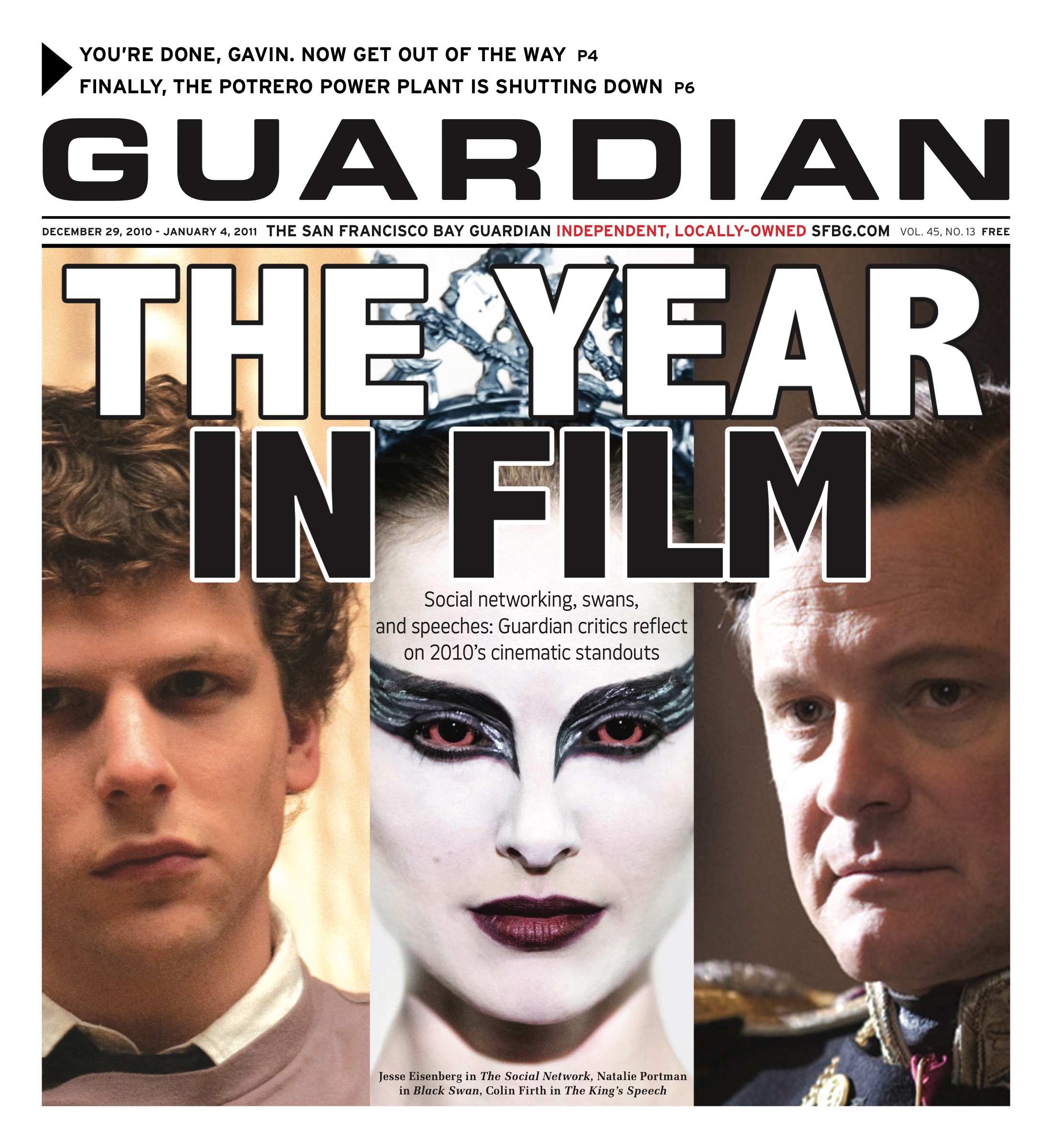
YEAR IN FILM To recap: 2010 was the year Oscar started dipping his golden fingers into the previous year’s pot of (mostly forgettable) big releases and fishing out 10 Best Picture nominees. Blue Pandora people were defeated at the podium, though they did leave a cultural stain behind — it’s safe to say, for example, that nobody’s been styling weddings after The Hurt Locker.

Predicting the next Academy Awards class requires looking past 2010’s top earners (Toy Story 3 and Inception aside) and focusing on films that pleased both critics and audiences (The Social Network, Winter’s Bone, Black Swan) — though if you’re in a betting mood, the carefully calibrated The King’s Speech seems exactly like the kind of movie the Academy will reward over anything achingly contemporary, staunchly gritty, or knowingly out-there. But as any true film fan knows, it’s usually not the movies that make the most money, or even win the most awards, that resonate and beg revisiting in the months and years that follow.

The Guardian’s annual Year in Film issue takes a look at some of 2010’s more notable trends, starring films you liked (The Kids Are All Right) and hated (I’m Still Here) — and films you wanted to see but forgot about and are now rushing to put on your Netflix queue (Splice). (Note: the “you” in the previous sentence is, uh, me.) And since I’m talking in the first person now, let me steer you toward my favorite documentary of the year (and 2010 boasted some great ones, including my second-favorite, The Tillman Story), made-for-ESPN tale The Two Escobars. I was lured in by heavy advertising during the World Cup — apologies to the Giants, but Landon Donovan’s ridiculous game-winner in USA versus Algeria is my pick for sports highlight of the year — and was unexpectedly mesmerized by its tragic story; only later did I learn of the film’s San Francisco connection. Read on, and pass the popcorn.

>>Babes in bondage

Or, 2010’s perfection-pursuing fatal femmes

>>Get “real”

The Social Network, Catfish, and I’m Still Here push the boundaries of truth and fiction

>>Past imperfect

Digging through the year in archival footage

>>Rate irate

Confidential to the Motion Picture Association of America: F-U

>>Baby daddy drama

Parsing 2010’s bumper crop of sperm donor comedies

>>Goal difference

Top 2010 doc The Two Escobars examines two sides of Colombian narco-soccer

>>Guardian critics pick their best movies of the year


Alerts

0

news@sfbg.com

WEDNESDAY, DEC. 22

Floyd Westerman Retrospective

You may remember him for his role in “Dances with Wolves” as Chief Ten Bears and as a country western singer/songwriter. But Floyd Westerman, a.k.a. Red Crow, was also an outspoken activist for Native Americans and the environment. A new documentary by Steve Jacobson explores his later life and activism. Along with the film, there will also be a social hour at 6:30 and a discussion following the film.

7:30–9:30 p.m., $5 suggested donation

Humanist Hall

390 27th St., Oakl.

510-681-8699

Real Mercantile Holiday Bazaar

If you still have some holiday shopping to do and just can’t summon the will to hit the stores or feed the machine, you can get some great stuff while supporting the local arts community and underground economy at the Real Mercantile Holiday Bazaar. held at arts impresario Chicken John spacious home and performance space. Homemade gifts and food are all available in a festive and very San Francisco atmosphere.

5–9 p.m., free

Chez Poulet

3359 Cesar Chavez, SF

www.therealmerchantile.com

THURSDAY, DEC. 23

Festivus 2010

San Francisco’s legendary Sisters of Perpetual Indulgence and pot activist Ed Rosenthal’s Green Aid unite to present a night of fundraising for the Medical Marijuana Legal Defense and Education Fund. The bash features an airing of grievances, feats of strength, the annual meeting of Dessert First Club, and live music and entertainment including The Phat Fly Girls and burlesque. Creative dress and cross-dressing encouraged.

7:30–11:30 p.m., $50 presale, $60 at door

SomArts

925 Brannan, SF

415-515-7483

SUNDAY, DEC 26

Get Your Spawn On

Join Brent Plater on a stroll through Muir Woods National Monument to learn more about coho and steelhead salmon and how to help them survive. The walk also features a search for endangered salmon in Redwood Creek. Make sure to wear something warm and bring your hiking boots.

10–12 p.m., free with RSVP

Meet at the Dipsea Trail trailhead

Muir Woods National Monument, Mill Valley

www.wildequity.org/events/3166

TUESDAY, DEC 28

Castro Queer-in

Join concerned local resident ins protesting the recently passed sit/lie ordinance more formally known as Proposition L. Bring out any and all musical instruments, games, food to share, face-painting kits, and any items to barter. Everyone will gather outside of Harvey Milk’s former camera store.

Noon–2 p.m., Free

575 Castro

Mail items for Alerts to the Guardian Building, 135 Mississippi St., SF, CA 94107; fax to (415) 437-3658; or e-mail alert@sfbg.com. Please include a contact telephone number. Items must be received at least one week prior to the publication date.

Curtain calls

1

arts@sfbg.com

THEATER Freud called dreams wish fulfillment; or reality, disguised, but basically as we’d like it to be. If you asked the Buddha and Heisenberg about reality, you’d get pretty much the same answer. Not that any of these guys went to the theater a lot in 2010. This year oscillated between quasi-documentary fidelity to facts and burrowing hallucinations like those induced by Gysin and Sommerville’s spinning stroboscopic Dreamachine. (A facsimile of one even graced The Burroughs and Kookie Show, Christopher Kuckenbaker’s Fringe Festival winner and definitely a peak stage encounter in 2010.) But it all amounted to an assault of some kind on the sleepwalking world outside. Dreaming in the theater can be much more lucid.

Best political theater riffs: In the Wake (Berkeley Rep) was not a perfect play, but Lisa Kron’s slightly lopsided new political dramedy had a way of upsetting some fundamental and suspect assumptions of mainstream liberals that was at times electrifying. Dan Hoyle’s The Real Americans, while not as politically provocative, also ventured outside the “liberal bubble” into red state territory, bringing back reportage in the form of deft rapid-fire characterizations, comedy, and music by the young but prodigious solo performer–playwright of Tings Dey Happen and Circumnavigator. And finally, the 51-year-old San Francisco Mime Troupe’s reaffirmed that its brand of agitprop is still a going concern. Posibilidad, or the Death of the Worker, set partly in the USA but inspired by the recent factory takeovers by workers in Argentina, was a shrewd, funny, tuneful plea for cooperatives against the grinning, co-opting tendencies of “capitalism with a human face.”

The most hyped production: Terrell Alvin McCraney’s trilogy, The Brother/Sister Plays. The only one that really worked for me was the second, The Brothers Size, which got a very strong production at the Magic under Octavio Solis. It was lean, focused, a small story with subtle, far-reaching reverberations. The other two plays reached consciously for the grandiose without finally grasping much. Nevertheless, the precedent-setting coordination between the Magic, Marin Theatre Company, and American Conservatory Theater in introducing these plays to the Bay Area was an exciting development.

Boldest venture: Berkeley Rep’s London import, Afghanistan: The Great Game, a seven-hour marathon of short scripts by 12 playwrights on the history and politics of this current critical object of U.S. imperial desire. A mixed bag theatrically, though impressively produced, but the historical perspective — boiling down to a dismal pattern of imperial design and hubris, infamy, and failure — was a point well taken. Indeed, the antiwar protest outside the White House on Dec. 16, where 131 arrests were made ahead of President Obama’s declaration of “progress” in Afghanistan, seemed its logical conclusion.

Best solo performances behind a large desk: Paul Gerrior in Krapp’s Last Tape (Cutting Ball); Joel Israel in Reluctant (Brava).

Best Pas de Donut: Howard Swain and Lance Gardner in Superior Donuts at TheatreWorks.

Best mise-en-scène as meaningful, mindful mess: This Is All I Need by Mugwumpin.

Best visiting productions: Japan’s Zenshinza Theatre Company at Zellerbach (Cal Performances); West Side Story at the Orpheum; Jane Austen Unscripted at BATS’ Bayfront Theater.

Best indefinable night in a theater: Dan Carbone at the Dark Room.

Best experiential fare: Etiquette by London’s Rotozaza (hosted by Yerba Buena Center for the Arts at the Samovar Tea Lounge).

Best extraterrestrial fare: Cynthia Hopkins’ The Success of Failure (or, The Failure of Success) at Yerba Buena Center for the Arts.

Best all-around design: The Tempest at Cutting Ball.

Best productions with death references in the title: Don’t Feel: The Death of Dahmer by writer-performer Evan Johnson; and when i die, i will be dead, a pair of dance/theater pieces by Alicia Ohs. Both Don’t Feel and when i die were nurtured and staged at the now-shuttered queer performance incubator Mama Calizo’s Voice Factory. Until some hoped-for resurrection, R.I.P. Mama Calizo’s.

Best (deconstruction of) Shakespeare: Juliet, directed by Mark Jackson at San Francisco State.

Best Bill Murray: Jody Frandle in Caddyshack Live! at the Dark Room.

Best debut by a new company: Symmetry Theatre with Show and Tell at the Thick House.

Best ensemble casts in a comedy: Learn to Be Latina (Impact Theatre); Shotgun Players’ production of The Norman Conquests (with a special nod to Richard Reinholdt in the title role); Man of Rock (Climate Theater); Scapin (ACT).

Best ensemble cast in a drama: Aurora Theatre Company’s Trouble in Mind (with a special nod to Margo Hall).

Best non-singing lead in a comic opera: Patrick Michael Dukeman in Jerry Springer, the Opera (Ray of Light Theatre).

Fight club

0

arts@sfbg.com

FILM Late in Boxing Gym, a pungent documentary even for Frederick Wiseman, an old-timer says something wise to his friend while lacing up. The friend doesn’t see the point of analogies. Our man admits that some only work on an intellectual level, but insists that others make intuitive sense of abstraction — the right metaphor can make all the difference in getting a particular movement. It’s hard to imagine that Wiseman would still be making his films if he didn’t think the same held true for a motion picture sequence.

Good thing, since boxing has been made to shoulder an awful lot of Hollywood hooey. Not much has changed since Manny Farber, writing in 1949, decried fight pictures for being “tightly humorless and supersaturated with worn-out morality … pure fantasy in so far as capturing the pulse of the beak-busting trade.” Wiseman isn’t interested in the trade so much as the discipline — though the big time’s spectacular images are plastered around the old-school Texas club. And yet even if Boxing Gym shrugs at the competitive elements of the sport, Wiseman’s squat compositions tune in the unglamorous business of keeping your dukes up when tired — the kind of matter-of-fact physical truth professional actors howl for.

By releasing Boxing Gym immediately after La Danse (2009), Wiseman ensures his own comparisons. The choreographer-dancer and trainer-boxer tandems are aligned not only in fancy footwork (Wiseman’s too), but also in their mirror-stretched studios. There are differences, of course — one can’t help but think of the Paris Ballet’s fundraising efforts when Richard Lord, the dexterous trainer-manager of the gym, explains membership dues. Perhaps because Wiseman is not beholden to an institutional cycle of rehearsals and performances in Boxing Gym, it’s the purer distillation of a kinetic education.

Watch Wiseman’s films together, and you’ll realize that different spaces register silence differently. The filmmaker’s musical ear is richly apparent in Boxing Gym‘s gloved rhythms and concrete echoes, to say nothing of the entrancing pendulum swings of side-by-side workouts. As in La Danse, Wiseman emulates the concentration of his subjects, but here he also picks up on their loose camaraderie in conversations about joblessness, the joy of getting hit and, closest to the bone, the Virginia Tech killings. The gym is still a masculine space, but one in which women (and children) are a significant presence. For more on the evolution of gender and “training,” one might well consult the filmmaker’s own catalog: Basic Training (1971), Manoeuvre (1979), and Missile (1987). Wiseman’s gym is finally a gathering place, one with atmosphere and history (and hardly any headphones) — all the more reason to see it in a movie theater.

BOXING GYM opens Wed/22 at the Roxie.


Thank you later

0

arts@sfbg.com

YEAR IN MUSIC The past year brought dozens of excellent albums, and hip-hop sounds topped the list. This wasn’t inevitable. Please recall 2009, when critics cited precious little rap in their favorites, save for Raekwon’s Only Built 4 Cuban Linx … Part 2 and Mos Def’s The Ecstatic. But in 2010, both rockists and heads reserved space for Kanye West’s My Beautiful Dark Twisted Fantasy, Big Boi’s Sir Lucious Left Foot: Son of Chico Dusty, the Roots’ How I Got Over, Drake’s Thank Me Later, and Flying Lotus’ Cosmogramma. And let’s not forget minor but important recordings such as Curren$y’s Pilot Talk and Yelawolf’s Trunk Muzik 0-60.

This winning slate confirmed that major label-backed rap is undergoing a renaissance. Nearly every artist made an impact by keeping their eye on the mainstream, from security guard-turned-bad actor Rick Ross recruiting Erykah Badu and Cee-Lo Green for his Teflon Don, to Bun B allowing Canadian teen idol Drake to call himself an “honorary member of UGK” on the former’s Trill O.G. Some complained that these rappers focused too much on claiming the hearts of soccer mama grizzlies and teens raised on Bratz dolls. But after years of boorish thugs peddling D-boy anthems and R&B gimmicks, this new pop sensibility sounded refreshing. (The sole exception may be Ludacris, who found success with Battle of the Sexes by offering a slick and familiar mix of strip club anthems and babymaker suites.)

B.o.B’s The Adventures of Bobby Ray was the most extreme product of these pop mirages. The Atlanta rapper scored two No. 1 hits (“Nothin’ but You” and “Airplanes”), but divided critics and fans by recruiting emo-rock burnout Rivers Cuomo and Hot Topic heroine Hayley Williams for his collection of gooey ballads. At its best, The Adventures of Bobby Ray had a charming innocence; at worst, it sounded like pandering. But at least it offered well-written tunes. In contrast, Nicki Minaj’s grating Pink Friday mashed bad 1980s John Hughes-approved synth-pop and soaring Rihanna choruses into a barely coherent mess. It proved that despite Nicki’s talent for ear-catching stunts, from her star turn as the bisexual chick who’ll do you and your man on Usher’s “Lil’ Freak” to her cipher-destroying rhymes on Kanye West’s “Monster” and Ludacris’ “My Chick Bad,” she was still a disappointingly underdeveloped songwriter.

Lost in the intense debate over the rap major domo was the demise of Definitive Jux. Once the mighty inheritor to the Fondle ‘Em tradition of B-boy nonconformity, and the source of key early-2000s works by Cannibal Ox, Aesop Rock, and Mr. Lif, it sagged under the weight of subpar and underpromoted releases before label head El-P mercifully pulled the plug last February. The news lit up the Internet for a day or two and then was seemingly forgotten. When Noz from cocaineblunts.com asked Yelawolf if he was “heartbroken” over Definitive Jux’s demise, the Alabama rapper answered: “I didn’t even know it ended. Well … I’m not heartbroken about it.” How ironic that Yelawolf was once a lyrical-minded backpacker too, before switching to gritty tales of deep South meth dealers.

There were other disturbing signs that Definitive Jux’s indie-rap scene was no longer ground zero for fledging MCs, from conscious rap advocates Little Brother breaking up, to Minneapolis freestyle ace Michael “Eyedea” Larsen dying at the tragically young age of 28. “Underground rap is dead,” noted Sean Fennessey in a Pitchfork essay hyping Los Angeles collective Odd Future. “In its stead, a different brand of homespun rappers have taken hold. Consider Lil B and Soulja Boy, who have been prolifically working the Web … to achieve their own kind of teenage heroism.”

Underground rap is not dead. It thrives with Bay Area imprints such as Interdependent Media (Truthlive’s Patience) and national players such as Duck Down Records (Skyzoo & Illmind’s Live from the Tape Deck) and Alpha Pup Records (Nocando’s Jimmy The Lock). Some of these labels subsist on scattershot independent distribution. Others recruit majors to achieve wider market penetration, including Stones Throw and EMI Label Services (Guilty Simpson’s OJ Simpson and Aloe Blacc’s retro-soul gem Good Things), and Decon and E1 Music (Black Milk’s Album of the Year). And who can blame them? These days, labels need all the help they can get. However, the principal philosophy of economic and artistic independence as an end unto itself has been forgotten.

In Robin D.G. Kelley’s 2002 book Freedom Dreams, a rapturous appreciation of 20th century black intellectualism, he writes, “Unfortunately, too often our standards for evaluating social movements pivot around whether or not they ‘succeeded’ in realizing their visions rather than on the merits or power of the visions themselves. … And yet it is precisely these alternative visions and dreams that inspire new generations.” Kelley could have referred to the many critics that marked Little Brother as hopelessly elitist for insisting that hip-hop should address more than the spoils of drug wars; dismissed the late Eyedea, Sage Francis, and others as silly white boys for addressing suburban middle-class concerns; and buried Definitive Jux as a repository of uncool, impossibly dense super-scientific lyricism.

By many measures, the indie-rap scene has been a failure. Unlike the network of homespun labels built by punks in the 1980s, the indie-rap scene didn’t create a thriving community without considerable financing from youth-targeting corporations, lifestyle brands, and advertising firms. And perhaps its denizens wrongly castigated dirty South rappers as ignorant, claimed that mainstream superstars like Jay-Z and Diddy were sell-outs, and turned the underground movement into a kind of purity test — all past conflicts that continue to bedevil it today. Yet these dreamers courageously imagined hip-hop culture as not only a way to entertain people and make money, but as a transformative experience that can help instill positive growth and change lives. They built a culture that holds key lessons for future rap generations.

The blog-rap generation doesn’t hold any illusions of being alternative, unless it’s manufacturing limp blasphemy like Odd Future’s use of Nazi imagery. (As Anti-Defamation League spokesman Abraham Foxman told The New York Times in a story on the Holocaust documentary Shoah, “To most kids growing up today, Hitler could be Genghis Khan.”) They’ll use any trope to be successful, from falsely claiming that they’re coke barons to bragging about their limited-edition sneaker collection and how much weed they smoke. There’s a gleeful egalitarianism in their digital miscellany. The beats bang but are same-y and indistinct, and the voices are barely distinguishable. As Wiz Khalifa simply said on his breakout single, “Black & Yellow”: “You can do it big.”

Some critics separated wheat from chaff with technical criteria such as internal rhyme schemes and double-time flow, as if MCs were ice skaters or guitar wankers. But the best artists simply illuminated their money hunger by any means necessary, effortlessly adding interesting twists to tired rap clichés. When Drake crooned on Thank Me Later, “I want this shit forever, man,” he evoked a poor man’s Nat King Cole. And when Curren$y ranted, “A gee is what I am, a jet is what I be” like a Southern Popeye on Pilot Talk II, he was insistent enough that you almost believed him.

And then there was Kanye West and My Beautiful Dark Twisted Fantasy. He created a spectacle out of an hour-long justification for his obnoxiousness, invited the genre’s biggest stars to support his meanderings on chauvinism and virility (or “my black balls”) and, most provocatively, continued a public call-and-response with Gil Scott-Heron. The conversation began with West’s sampling of Scott-Heron’s melancholy “Home Is Where the Hatred Is” for his 2005 album Graduation. Then Scott-Heron replied by using West’s “Flashing Lights” melody for “On Coming from a Broken Home,” the bittersweet coming-of age tale from Scott-Heron’s valiant yet muddled comeback, I’m New Here.

West ended Fantasy by sampling a large section from Scott-Heron’s 1970 spoken-word performance “Comment #1,” and retitling it “Who Will Survive in America?” The poem originally captured the COINTELPRO era and the U.S. government’s eradication of black radicals, but West seemed to use it for a different point. Perhaps he’s saying that fame serves as a protective armor against systemic racism and how “at the airport they check all through my bag and tell me that it’s random.” Or maybe he’s making a wry comment on celebrity culture as the only way to survive in America. Fantasy‘s cryptic epilogue perfectly summarized this year’s rap dreamers, lost in the pop Matrix.

Playlist

0

JANE BIRKIN

Di Doo Dah

(Light in the Attic)

Arriving in the wake of Light in the Attic’s reissue of the masterful L’Histoire de Melody Nelson, this, Birkin’s first proper — if such a word can be applied to anything involving Serge Gainsbourg — solo album, is a series of light delights. Jean-Claude Vannier trades his characteristic dark orchestration for a string sound that is agile and brighter. On the title track, Birkin revels — in a melancholy way — in her tomboyish characteristics, setting the stage for more pun-filled escapades in androgynous amorousness. Elsewhere, she’s a hitchhiker, a sidewalk cruiser, a hotel trick, a girl on a motorcycle, and other fantasy figurines. The most audacious song is “Les capotes anglaises,” which begins with her blowing up condoms and letting them float off a balcony. The special treat is “Le décadanse,” not so much a failed attempt at creating a dance craze as a successful erotic mockery of dance crazes. There, Gainsbourg appears for another classic duet.


DÂM-FUNK

Adolescent Funk

(Stones Throw)

The album’s name is apt, as these tracks, recorded between 1988 and 1992, capture Dâm-Funk’s sound and outlook in a teenage stage of sonic bumptiousness and lyrical lustiness. The content is spelled out in the titles: songs like “I Like Your Big Azz (Girl),” “Sexy Lady,” and “When I’m With U I Think of Her,” are a world away from the mystic leanings of more recent Dâm-Funk tracks like “Mirrors.” Equally direct are the album’s musings on existence, such as “I Love My Life.” The sound owes a debt to — or is a youthful outgrowth of — the early 1980s electro funk of Prince, Mandre, and others. Dâm-Funk has been honing his use of analog keyboards for a long time — when it comes to Korgs and Casios, he’s no new kid on the block, though he was back when these songs were captured on tape. The homecoming-dance cover art, selected by Peanut Butter Wolf from Dâm’s photo albums, captures the vintage feel perfectly.


THE FLYING LIZARDS

The Secret Dub Life of the Flying Lizards

(Staubgold)

Flying Lizards are best known for creating possibly the cheapest British chart-topper in history, a pots-and-pans 1979 cover of “Money (That’s What I Want),” distinguished by Deborah Evans’ hilarious deadpan vocal. As the title hints, Evans isn’t present on The Secret Dub Life of the Flying Lizards, nor are any other traditional vocalists — instead, main Lizard David Cunningham remixes 1978 source material by Jah Lloyd. The catch was that Cunningham only had a mono master tape to work with, rather than the plethora of tracks usually associated with dub. A lost gem from the early days of reggae-punk fusions and collisions, this album — with loops built from tape-splicing — reveals the dub underpinnings of Cunningham’s brash and innovative work on “Money.” An irreverent vanguard producer, he uses ping-pong balls to create ricochet effects on one track, just as “Money” seems to throw everything but the kitchen sink at listeners.


GIRLS

Broken Dreams Club EP

(True Panther Sounds)

One of the things that makes Girls so special is Christopher Owens’ ability to write so directly about the unavoidable aspects of life without falling into cliché. So it is on “Heartbreaker,” which begins with the observation, “When I look in the mirror/ I’m not as young as I used to be/ I’m not quite as beautiful as when you were next to me.” A newer addition to Girls’ nascent greatness, as displayed on this six-song collection, is their facility at traversing various genres while always sounding like themselves. The reggae and early rock ‘n’ roll fusion “Oh So Fortunate One,” the bossa nova touches of “Heartbreaker,” and the country lament of the superb title track (complete with pedal steel) sound like … Girls. While the sonic palette shifts from song to song — and sometimes within them — more than one composition evokes the anthemic balladry of their 2009 debut album’s “Hellhole Ratrace.” That’s no small achievement. The outlook, though, is less hopeful and more disillusioned. Who knows what the future holds.


GOLD PANDA

Lucky Shiner

(Ghostly International)

There should probably be a moratorium placed on the use of the word panda in group names, but the man known as Gold Panda can be forgiven, based on the sheer zinging energy of this album, which has nothing in common with any Beach Boys-flavored Animal Collective endeavors. One of Gold Panda’s trademarks is a sharply-edited, sped-up approach to vocal samples that makes Kanye West’s sound like screw. Instrumental tracks such as “Vanilla Minus,” “Snow & Taxis,” and the incandescent “Marriage” call the crackling warmth of the Field to mind, but their energy is more hyper, their outlook much more colorful. “Same Dream China” takes the glassy percussion of Pantha Du Prince’s “Stick to My Side” into out there realms — it’s one of a few tracks that maneuvers across a high wire just above exotica and Orientalism. A late contender for techno album of the year.


THE MANTLES

Pink Information

(Mexican Summer)

San Francisco’s the Mantles deliver great straightforward rock ‘n’ roll. Dressed in a cover by local artist Michelle Blade, this EP picks up where their debut album left off, as guitarist-singer Michael Olivares leads the charge with vocals that somehow manage to sneer and snarl and seem amiable at the same time. “Situations” is actually kind of harsh, taking a scenester or gold-digger to task for his or her shallow and failure-fated state of being. “Lily Never Married” is more reflective, a portrait of a spinster that opens into thoughts about family within a changing world. “Waiting Out the Storm” finds the group trying on its epic journey boots, and they fit just fine.


BRIAN MCBRIDE

The Effective Disconnect

(Kranky)

A disturbing subject yields mournful tone poems on this album by Stars of the Lid’s McBride, which collects elements of his soundtrack for Vanishing of the Bees, a 2009 documentary on colony collapse disorder. (Mercifully, voice over by Ellen Page is left off the album.) There’s no flight-of-the-bumblebee whimsy in McBride’s musical testimony to the spirit of the beehive. In the liner notes, he writes that filmmakers George Langworthy and Maryam Henein suggested he focus on “the gloriousness of the bees, the endurance and hardships of traditional beekeepers, pesticides, and the holistic nature of non-industrial agriculture.” These elements aren’t always clearly distinguished, but they are present in a manner that avoids cliché.


ARTHUR RUSSELL AND THE FLYING HEARTS FEATURING ALLEN GINSBERG

Ballad of the Lights

(Presspop Music)

“Ballad of the Lights” was performed by a friend at the late Arthur Russell’s funeral, which is as strong a proof as any that it is an important entry within his vast and diverse songbook. This two-song 10-inch vinyl release couples it with another recording from Russell’s many studio collaborations with Allen Ginsberg. Ginsberg’s recitals within “Ballad of the Lights” almost come off superfluous, except that they set the glory of the song’s resurrection-like structure in greater relief. The B-side, “Pacific High Studio Mantras,” is a Buddhist chant accompanied by instrumentation, and perhaps not intended for commercial release. (Ginsberg himself hinged back and forth about whether it should presented in this fashion.) Bob Dylan even figured briefly within Ginsberg’s and Russell’s endeavors, but with so few of them available, it’s hard to discern whether “Ballad of the Lights” is their best work. That it’s pretty great is clear, even if coupled with portraits by Archer Prewitt that play into the more cloying aspects of viewing artists as icons.


THE SOFT MOON

The Soft Moon

(Captured Tracks)

It’s no surprise that the debut album by Bay Area musician Luis Vasquez is dark and densely claustrophobic — nor is it a surprise that it’s excellent. It kicks off with one highlight from his earlier EPs, “Breathe the Fire,” where his whispered vocal — dancing over doom-laden bass and guitar worthy of Pornography-era Cure — manifests maximum sinuous menace. The death dance of “Circles” is more Sister of Mercy-like, but really, Vasquez transcends well-known goth and more obscure dark wave poses and influences through sheer intensity of focus. “Sewer Sickness” might be the album’s darkest and most compelling black pit, as Vasquez’s susurrant vocals take on the quality of a malevolent primal incantation.


SOLAR BEARS

She Was Coloured In

(Planet Mu)

Like Gold Panda, Solar Bears counter a dodgy name by delivering solid tunes. She Was Coloured In is more melodic than most recordings on Planet Mu. “Children of the Times” mixes Johnny Marr-caliber guitar shimmer with a Vocoder chorus that is sure to evoke comparisons to Air. Likewise, the title composition places Air-y elements up against Aphex Twin-like ambience. Enjoyably ham-fisted prog keyboard flourishes dive in and out of techno terrain on the title track. The chord changes and underpinnings of “Head Supernova” evoke Angelo Badalamenti’s scores for David Lynch. The riddle of Solar Bears is whether all these touchstones or influences add up to an act with its own identity or — perhaps no less an achievement in 2010 — a generically beautiful album.


JIM SULLIVAN

UFO

(Light in the Attic)

When an excellent songwriter disappears, his or her voice remains. There is proof of this in the recent issuing of Connie Converse’s priceless previously-private recordings, and now in this reissue of the 1969 debut album by Jim Sullivan, a ten-song collection that fuses orchestral ornamentation and plainspoken brevity. Sullivan vanished into the New Mexico desert one day in 1975, but his musical legacy is being revived, and rightfully so, as the best moments here are reminiscent of better-known contemporaries such as Fred Neil and Tim Hardin. All the doomed young men: there’s something eerie about the funereal string intro of the opening track “Jerome,” yet Sullivan’s music also possesses vitality and good cheer. Best of all is “UFO,” a graceful piece of baroque pop (and quintessential example of a California paranormal mindset), adorned with echo-laden effects that Malibu kinfolk and relative survivor Linda Perhacs might appreciate.


WILD NOTHING

Golden Haze EP

(Captured Tracks)

Captured Tracks is home to some of the most beautiful guitar sounds being made today, thanks to Beach Fossils and this group, who see no shame in sheer ’80s-ness. Wild Nothing hail from California, but England meets Australia (and gets along with it better than usual) on “Your Rabbit Feet,” as Slowdive-gone-fast guitar radiates around a vocal that’s equal parts Morrissey and Robert Forster in its offhand debonair delivery. “Take Me In” has another immediate, whirligig guitar melody, and a chorus as big as 100,000 violins. Gorgeous stuff.

Ho-ho-horror

0

arts@sfbg.com

FILM There is probably nowhere in the Christian-majority world where it’s as OK to wax hum-buggy about Christmas and all it entails as San Francisco. Allergies to carols (admit it, they’re horrible), frantically enabled shopaholicism, and forced contact with those people you moved here to get away from are all tolerated, even encouraged here.

In the rakishly Grinch-like spirit such sentiments allow, Yerba Buena Center for the Arts is observing “the season” with “Go to Hell for the Holidays: Horror in December.” This series might just as easily have been titled “Grievous Bodily Harm” since it serves up a six-program lineup of film and video features whose common thread is excess of a highly splattery kind. Included are a few variably antiqued golden oldies, as well as newer titles unlikely to get local commercial runs anytime soon (if ever). Some are fun, some deliberately unpleasant, and a couple manage to be both. All provide a sort of palliative effect for those seeking refuge from the suffocation of wholesome holiday cheer.

Because Jesus probably would, let’s approach “Hell”‘s contents tactfully, in ascending order of assault on any delicate sensibilities. The sole double bill on offer is also hands-down winner in terms of camp value, providing unintentional laughs in bulk for every intended scare. In fact, these two underseen gems of bright and shining awfulness comprise one of the more genius programming matches of 2010.

First up is the barely describable, let alone explicable, 1985’s Night Train to Terror, which alongside They Saved Hitler’s Brain (1968), Al Adamson’s ouevre, and a handful of other oddities personifies that most secret, least natural of genres: the Frankensteinian film. By which we don’t mean anything directly related to Mary Shelley, but rather movies crudely, grotesquely composed of parts harvested from other movies abandoned as dead.

Few are as triumphantly, energetically, and entertainingly arbitrary as Night Train, which stitches together bits of three features variably orphaned by legal trouble, runaway funding, aborted shooting, or all the above. Linking them — or desperately trying to — are scenes in which “Mr. Satan” and a white-bearded God gamble in a private car for the souls of their fellow train passengers. The latter are an ensemble of ultra-perky “New Wave” youth in Flashdance (1983) garb singing and kinda dancing in a neverending MTV video for synthpop non-hit “Dance With Me.”

Familiar B-flick faces like John Phillip Law and Cameron Mitchell surface sporadically in the wildly condensed “case histories” our biblical antagonists debate, drawn from individual films otherwise known as Cataclysm, Carnival of Fools, and Scream Your Head Off. That this bastard 1985 anthology was assembled, let alone actually shown in theaters, restores your faith in predictable mankind’s ability to occasionally touch the truly, inspirationally senseless.

This feeling one could apply to virtually anything by the late Doris Wishman, whose decades of bottom-rung exploitation work left miraculously intact an approach to such basics as continuity, camera coverage, and synch sound so primitive it achieves a sort of abstract impressionism. Her 1983 A Night to Dismember was stab at the slasher genre after almost a quarter century selling softcore sex. She brought to it exactly the same WTF aesthetic and narrative perversity she had to Nude on the Moon (1961) and Bad Girls Go to Hell (1965). If you’re a Wishman newbie, Dismember is a great place to start since its saga of the compulsively homicidal suburban Kent family is awesomely clumsy without being too dull or claustrophobic.

The mayhem she contrives (no doubt most “gore” was thriftily broiled for stew after each day’s shoot) looks even more laughable alongside the too convincing graphic ugh-liness of Thai cinematographer Tiwa Moeithaisong’s directorial debut Meat Grinder (2009). Its protagonist is a Bangkok noodle shop proprietor whose extremely abused history triggers a Texas Chainsaw style attitude toward fresh victuals, and whose threadbare grip on reality provides our brain-scrambling POV. Starting out like just another exercise in “Asian Extreme” excess, this grows both more outre and controlled as it goes along, balancing jet-black comedy with a certain grotesque pathos.

Charting a reverse trajectory is Red White & Blue, the first U.S. feature by Brit writer-director Simon Rumley, whose 2006 The Living and the Dead is one of the most original films (horror or otherwise) in recent memory. For 80 minutes, it’s a chillingly fine portrait of some well-marginalized characters in Austin, Texas, culminating in possibly the most alarming home invasion since Henry: Portrait of a Serial Killer (1986). But the rest degenerates into rote revenge-fantasy torture porn, further weakened by deliberate story mystifications more enervating than enigmatic.

There are excuses for horror fans who’ve missed Living and Dead — it was barely released in the U.S. — but none for those as yet unbathed in the blood of Wolf Creek. Allegedly based on actual events (a fib), Greg Mclean’s 2005 first feature takes exactly half its length to let nothing happen. Nothing, that is, save our getting to know three young people just ordinary and interesting enough to grow concerned about as they drive across Australia at summer holiday’s end, halted in the middle of nowhere by what at first seems routine bad luck. Several long dread-accruing minutes later, it turns out what’s happening to them is something far, far worse, unrelated to either luck or anything routine. Brilliantly atmospheric and visceral, Creek justifies YBCA’s hyperbolic claim as “possibly the best horror film of the decade.”

Also on “Hell”‘s menu are two films I could say more about, but won’t. Regarding Mladen Djordjevic’s Life and Death of a Porno Gang (2009), that’s because this all-outrages-inclusive tragicomedic mock-doc road flick was only available for preview in its original Serbian language. Still, it’s recommendable. Whereas Marc D. Levitz’s U.S. documentary Feast of the Assumption: BTK and The Otero Family Murders (2008), about a serial killer’s capture and impact on victims’ families 30 years later, would merit further discussion if it didn’t wobble between tabloid TV and home movie — all the while raising serious questions it doesn’t address, or perhaps even notice.

“GO TO HELL FOR THE HOLIDAYS”

Dec. 2–18, $6–$8

Yerba Buena Center for the Arts

701 Mission, SF

(415) 978-2787

www.ybca.org


Alerts

0

news@sfbg.com

WEDNESDAY, DEC. 1

Local hiring hearing

Sup. John Avalos’ San Francisco Local Hiring Policy for Construction ordinance, which mandates that construction projects that get city money hire more San Franciscans, has its first hearing and vote before the Board of Supervisors Budget and Finance Committee.

Noon, free

City Hall Room 250

1 Dr. Carlton B. Goodlett Place, SF

554-7723


FRIDAY, DEC. 3

Young Workers art auction

Young Workers United, the SF-based advocacy organization behind mandatory paid sick days and other progressive reforms, is hosting an art auction and fundraiser. This event features speakers, dancing, food and drinks, a raffle, and a silent art auction.

7–11 p.m. $10–$25 suggested donation

Mission Cultural Center for Latino Arts

2868 Mission Street

www.youngworkersunited.org


AK Press Holiday Sale

Buy independent books, zines, and anarchist lit to your heart’s content at this holiday sale, which offers books as low as $1 and a discount on everything. Drop into this warehouse, located minutes away from the 19th Street BART Station.

4–10 p.m., free

AK Press Warehouse

674-A 23rd St., Oakl.

510-208-1700


SATURDAY, DEC. 4

SantaCon

How could thousands of Santas be wrong? Come find out how wrong — oh, so very wrong — this annual flashmob bar crawl can be. In the last several years, SantaCon has grown from dozens to hundreds to thousands of people dressed as Santa Claus, sexy elves, and all manner of XXXmas characters (so many that it’s now broken down into several groups that try to converge a few times during the long, sloppy afternoon).

Noon, free

Throughout SF and the East Bay

Check online for meet-up locations

www.sanfranciscosantarchy.wordpress.com

www.santacon.info/San_Francisco-CA


Sea Watch for Endangered Sea Creatures

Come down and search for sea creatures like the humpback whale, stellar sea lion, and southern sea otters while enjoying the views from Fort Funston. This event is part of the Golden Gate National Parks Endangered Species Big Year, which seeks to help save the parks’ endangered species. 9–11 a.m., free RSVP required Fort Funston Observation Deck

Skyline Blvd., SF

415-349-5787


Wavy Gravy and his movie

Wavy Gravy is known as the emcee of the Woodstock festival, a hippie icon, activist, clown, and even a Ben & Jerry’s ice cream flavor. Wavy Gravy and filmmakers have created a documentary of one man’s quest to make the world a better place. Playing in theaters for one week only with a talk from Wavy Gravy and filmmakers on Dec. 4.

2, 4, 6, 8, and 10 p.m.

$8 (before 6 p.m.) $10 (general admission)

Landmark Shattuck Cinemas

2230 Shattuck, Berk.

(510) 464-5980


SUNDAY, DEC. 5


SFBC’s Winterfest

The San Francisco Bicycle Coalition, the city’s biggest grassroots advocacy organization, holds its annual winter fundraiser and membership party. Come bid on bike-related art and merchandise, hear from leaders of the carfree movement, and party down with more than 1,000 of the tightest butts in town.

6-10:30 p.m.

$15 for members, $40 for nonmembers (includes one-year membership)

SOMArts Gallery

934 Brannan, SF

www.sfbike.org/winterfest 

Mail items for Alerts to the Guardian Building, 135 Mississippi St., SF, CA 94107; fax to (415) 437-3658; or e-mail alert@sfbg.com. Please include a contact telephone number. Items must be received at least one week prior to the publication date.


Mädchen gone wild

1

Every nation had its distinct cinematic response to the sexual revolution of the 1960s and ’70s. Germany’s was characteristic in offering the pretense of order, “scientific” educational value, and encouraging a healthy collective morality — even if all this was usually mere gloss over the usual, more marketable qualities of copious T&A.

Encouraged by Scandinavian films already tearing down censorship barriers worldwide, Deutschland screens (the free-Western ones only, needless to say) began addressing the matter directly in 1968. Then, Oswalt Kolle, a psychiatrist’s son and tabloid journalist turned celebrity sex educator, commenced making features like Sexual Partnership (1968), The Sensual Male (1970), and Your Child, That Unknown Creature (1970). These fairly sober mixtures of documentary and dramatized “case histories” were as widely translated as his writings. (Nonetheless, Kolle and his family relocated to Amsterdam, citing constant harassment by conservative German politicians and media as the cause.)

Such success inevitably attracted imitation. Dr. Gunther Hunold’s Schulmädchen-Report had made best-seller waves with its collection of interviews with 14- to 20-year-old women about their sexual experiences and opinions. Enter Wolf C. Hartwig of Rapid Film, producer-distributor of such savory titles as Satan Tempts With Love (1960) and Your Body Belongs to Me (1959). He bought the book’s film rights, retaining Hunold as co-scenarist and consultant for 1970’s Schoolgirl Report: What Parents Don’t Think Is Possible, which proved so enormously popular that an entire national subgenre was born.

The resulting series of Schoolgirl Report features stretched through the entire Me Decade. All 13 are being issued on DVD by the Impulse Pictures label of South San Francisco’s CAV Distributing Corporation, a project that reaches its precise midpoint next month with 1974’s Schoolgirl Report Volume 7: What the Heart Must Thereby …. Watching too many of these interchangeable vintage sexploitation “documentaries” in close succession can be hazardous to your mental health, but in moderation — as with most things – — they prove instructive.

Volume 1 set the mold, sometimes in stone: factors like the groovy Farfisa-acid guitar-flute rock instrumental theme by Gert Wilden and His Orchestra (whose original soundtracks would continue to run a delightfully dated gamut from go-go discotheque to cocktail jazz to Mantovani-like schmuzak), cheap production values, Ernst Hofbauer’s on-the-nose direction, the wooden acting (despite allegedly “starring many anonymous youths and parents”), and an entire opening credits sequence would scarcely budge in film after film. More flexible within a limited range were the bodies bared by 20-something actors playing teens (seldom convincingly) and the framing devices for each installation of variably comic, dramatic, and tragic vignettes.

The first movie started with a flower-decal-covered VW full of hippie chicks and dudes driving by as a female voice says “That’s us: today’s youth. We want a new morality without hypocrisy.” Then an actor playing a reporter announces this “effective and spontaneous documentary shows our youth as they really are. [It] will open many parents’ eyes.”

More likely the Schoolgirl films opened a lot of men’s pants. For all the earnest jabber about “sexual prejudice and why German families hang on to it,” Hartwig, Hofbauer, scenarist Gunther Heller (Hunold split after the series’ launch) and company weren’t interested in liberating minds — let alone promoting feminism — so much as wrapping age-old male fantasies in a cloak of socioanthropological inquiry.

Women are occasionally victimized in the Schoolgirl universe: a lone black girl is set up for gang rape by racist classmates, a country lass is forced into prostitution by loutish dad, etc. But such instances usually end up with the protagonist rescued by a convenient Prince Charming, often as our narrator urges us to question whether they brought the abuse on themselves.

The overwhelming majority of tales present a brave new world of brazenly aggressive females demanding satisfaction whenever, wherever, with whomever. Particularly with older men, including priests, teachers, bus drivers, family friends, guest workers (Rinaldo Talamonti often appears as a comedy-relief Italian stereotype addressed in terms like “Hey, spaghetti! Show us your macaroni!”), even sexy older brothers.

Their behavior sometimes edges from fantasy fodder into the fanatical, as when a married fencing instructor tells his obsessed student, “You must be reasonable!” and she replies “I’ll be reasonable when I’m 75!” Or when another underage lassie brags that beyond regular partner sex, “I also do myself four or five times a day.” Most disturbing is a frequent refrain of blackmail, almost invariably used by nymphets on a reluctant authority figures to maintain a sexual relationship (and/or good grades). In the ickiest instance, Volume 5‘s 15-year-old Margit seduces Grandpa, saying if he refuses she’ll say he raped her; three months of action later he confesses to parents and police rather than endure more shame.

Ostensibly celebrating women’s newfound sexual freedom, the Schoolgirl Reports often seem to regard that as a menace to society as well. (At one curious point we’re informed “They’re all reading Valerie Solanas’ SCUM Manifesto, which turns men into slaves and a necessary evil for sex.”) Needless to say, the series’ major off-camera collaborators were an entirely penis-bearing roll call.

These films made tens of millions, not just in Western Europe but in overseas locations where their copious full-frontal nudity (nearly all female, of course) required cutting or fogging to meet local standards. Entries appeared around the globe under titles like Campus Pussycats, Smartie Pants, Further Confessions of a Sixth Form Girl, and Super Sexy Show. The 1980 final chapter didn’t hit American screens until three years later as Making Out — quite the reduction from an original German title translating as Don’t Forget the Love in Sex. Meanwhile Germany had been flooded with copycat “reports” (housewife, schoolboy, nurse, etc.), and in 1975 saw the legalization of hardcore porn. So a once ubiquitous, now quaint and bizarre example of mainstream softcore slowly petered (ahem) out.

The Impulse-CAV discs are notably stingy with extras — there aren’t any, not even trailers or a horrible-English-dubbing option — but in a way that suits their blunt appeal. After all, one shouldn’t expect many frills from movies wherein a dessert-spooning virgin (sex aside, ice cream appears this generation’s predominant onscreen indulgence) muses that a passing motorist “could help me get rid of that bothersome hymen,” or the “pathological dream world” of a girl troubled by incestuous thoughts features psychedelic imagery of Daddy menacing her nubile naked self with a shish kabob.

Alerts

0

alert@sfbg.com

THURSDAY, NOV. 25

Indigenous People’s Thanksgiving

Join this annual sunrise celebration on Alcatraz Island to honor Mother Earth, the spirit of popular resistance to exploitation, and generations past and future. Sponsored by the International Indian Treaty Council and American Indian Contemporary Arts and featuring guest speakers, drummers, dancers, and MC Lakota Harden.

4:45-6 a.m., $14 (for adult ferry ticket)

Pier 33, SF

(415) 981-7625


FRIDAY, NOV. 26

Malling of the Sacred

Join this Black Friday protest at Emeryville’s Bay Street Mall. The mall was built on top of an ancient Ohlone burial site, and even after years of protest actions by the local Native American community, the construction of the mall was completed after the human remains were unearthed.

11a.m.–3p.m., free

Shellmound and Ohlone, Emeryville

(510 )575-8408


Fur-free Friday

Thousands of animals are slaughtered for their fur each year. Join in a peaceful protest against the fur industry on one of the busiest shopping days of the year.

Noon–2 p.m., free

Union Square, SF

(415) 448-0058


SATURDAY, NOV. 27

South of the Border

Director Oliver Stone journeys south to interview Venezuelan President Hugo Chavez to investigate how the United States media has depicted him. He also speaks with several other South American presidents and creates an eye-opening documentary in the process.

1:30–4 p.m., free

Fremont Library

2400 Stevenson, Fremont

(510) 745-1400


TUESDAY, NOV. 30

Talking Trotsky

Join the Freedom Socialist Party for a screening of Sergei Eisenstein’s 1927 film The History of the Russian Revolution. The film is part of the Leon Trotsky discussion circle and encapsulates the world’s first socialist uprising.

7 p.m., $2–$5 sliding scale

New Valencia Hall

625 Larkin, Room 202, SF

(415) 864-1278


Death of Liberalism

Come hear journalist and author Chris Hedges discuss his latest book, The Death of the Liberal Class, which chronicles the gradual corruption and death of liberalism in the U.S., which was for decades a defense against the worst excesses of power.

6:30 p.m., $12

First Congregation Church

2345 Channing, Berk.

(510)967-4495


Green Film Festival

Enjoy a lively selection of short films including Matt Briggs; The Krill is Gone, which raises awareness of the growing threat to the world’s oceans, and Dive, in which filmmaker Jeremy Seifert and friends Dumpster dive in the back alleys and gated garbage receptacles of Los Angeles supermarkets. 6–9p.m., $10–$20 sliding scale

Ninth Street Independent Film Center

145 Ninth St., SF

www.sfgreenfilmfest2011launch.eventbrite.com 

Mail items for Alerts to the Guardian Building, 135 Mississippi St., SF, CA 94107; fax to (415) 437-3658; or e-mail alert@sfbg.com. Please include a contact telephone number. Items must be received at least one week prior to the publication date.