Democrats

ENDORSEMENTS: State ballot measures

8

PROPOSITION 13

LIMITS ON PROPERTY TAX ASSESSMENT FOR SEISMIC RETROFITS

YES

The primary sponsor of Prop. 13 is Republican Sen. Roy Ashburn, who dominated the news for several days after he was arrested for drunk driving on his way home from a Sacramento gay bar. Needless to say, Ashburn’s dramatic coming out has whipped up far more attention than his noncontroversial ballot initiative.

We’re generally opposed to anything that gives tax cuts or tax deferrals to property owners; thanks to a 1978 measure also called Prop. 13, much of the commercial and residential property in California is badly under assessed. And Prop. 13, 2010 style, is indeed a tax break. But it’s probably justified.

Buildings in this state are typically reassessed for property taxes after they’ve been modified with new construction, except in cases where the modifications are made to comply with earthquake-safety standards. While most buildings that undergo seismic retrofitting are exempt from reassessment until the property is transferred to a new owner, the exemption for unreinforced masonry buildings is limited to 15 years. Prop 13 would remove that 15-year cap.

The fiscal impact on cities is likely to be pretty minor, and the measure might encourage both commercial and residential landlords to bring their buildings up to standard. Vote yes.


PROPOSITION 14

OPEN PRIMARIES

NO

At the height of a royal mess last year when the state budget was long overdue and the two-thirds majority needed to pass it was still out of reach by one vote, Republican Sen. Abel Maldonado struck a deal with Democrats. He said he’d support the budget — if the majority party would meet a few of his demands. One thing he insisted on was Prop. 14 — a ballot measure that would effectively remove political parties from the primary elections process, allowing all voters to cast ballots for any candidate regardless of party affiliation.

Under Maldonado’s plan, all candidates would run on a single primary ballot, and the top two vote-getters would face off in the general election. Heavily funded by the California Chamber of Commerce and marketed by the same spin doctors and corporate lawyers who are rolling in Yes on 16 campaign money, Prop. 14’s backers say it will result in more centrist elected officials.

There are plenty of pitfalls here, the most worrisome being that it would drive up the cost of elections and give more moneyed (and corporate-allied) candidates a sharper competitive edge while elbowing out progressives. It would allow Republicans to play a role in what would normally be Democratic primaries (and vice versa.) The measure would also make it nearly impossible for smaller parties — the Green Party, for example — to offer candidates in the November elections.

Bad idea, bad process, Vote no.


PROPOSITION 15

FAIR ELECTIONS ACT

YES

California desperately needs electoral reform. Corporate campaign spending and lobbyists have poisoned the decision-making process and muzzled the voice of the people. Something radical needs to be done — and while this measure is only a small, measured step in the right direction, it’s an important and promising experiment.

Prop. 15 would create a pilot public financing program for the 2014 and 2018 races for California Secretary of State — and the program would be funded by a tax on lobbyists. Right now lobbyists pay only $12.50 per year to register with the state. This measure would increase that fee to $350 annually and use the money to create a fund of about $6 million that candidates for the crucial office overseeing elections in the state could tap after demonstrating their popular support by gathering a number of small contributions. All candidates who qualify would be given the same amount of money and left to compete on the issues. Ideally this public financing program would prove successful and eventually be expanded to other offices. Public financing of election campaigns, which is currently working well in Arizona and Maine, is certainly worth a try in California. Vote yes.


PROPOSITION 16

MONOPOLY PROTECTION FOR PG&E

NO! NO! NO!

The deceptively titled “Taxpayer’s Right to Vote Act” was dreamed up and funded entirely by Pacific Gas and Electric Co., the monopolistic utility that is worried it could face actual competition here in San Francisco (and elsewhere) from municipal electricity programs that would offer customers a greener energy mix and more accountability than PG&E executives will ever demonstrate.

Rather than accept some healthy competition, this sleazy corporation has opted to spend some $35 million to exterminate all possibilities of municipal electricity programs cropping up anywhere in the state in a bid to preserve its octopus-like grip on the energy market in Northern California. Prop. 16 would require a two-thirds majority vote at the ballot before any community choice aggregation (CCA) program — or any attempt at creating or expanding a public-power system — could move forward. That’s an extreme hurdle — -and PG&E knows it.

In effect, PG&E is trying to buy public policy here, trying to pass a law that will protect its own monopoly interests.

In San Francisco, the CCA being proposed would offer customers 51 percent renewable power by 2017, which means it would blow PG&E out of the water in the green arena and mark S.F. as taking greater strides toward combating climate change than any other major U.S. city. This example could set a precedent for others, which, in turn, could create favorable market conditions for green energy startups that want to harness wind, solar, biomass, geothermal, tidal, and energy efficiency alternatives.

The very existence of Prop. 16 is already threatening the San Francisco CCA; the city’s Public Utilities Commission is trying to delay a final contract until after the June 8 vote on the measure (see editorial, page 5)

Vote no on Prop 16. Not just because it’s an example of a big business single-handedly trying to alter the state constitution for its own economic benefit by pouring millions of dollars into a deceptive advertising campaign. Not just because a two-thirds majority vote requirement is anti-democratic. Not just because there were reports that the signature gatherers who got people to sign on in support of placing Prop. 16 on the ballot were telling people that its purpose was to limit PG&E expansion or encourage solar power. Not just because Senate Pro Tem Darrell Steinberg and a half dozen members of the Legislature sent a letter rebuking PG&E CEO Peter Darbee for disrespecting the democratic process by going straight to the ballot to undermine legislation it initially supported that enabled the creation of CCA programs. Not just because PG&E is using $35 million of ratepayer dollars (that’s the check you wrote them for your electricity bill!) to put out slick TV ads for this campaign when it should have been repairing the pipelines under those manholes that keep exploding and messing up your morning commute. Not even just because with CCA, you already have the right to vote whether or not you want to be part of it, a choice PG&E will never give you. And not just because PG&E keeps trying to raise rates, which is much more difficult for municipal energy agencies to do.

If for no other reason, vote no because Prop. 16 flies in the face of everything environmentalists stand for. It’s a measure that will thwart progress on fighting climate change, brought to you by the company that practically invented green-washing. PG&E is a huge nuclear power player; it purchases coal from mountaintop-removal coal mines in West Virginia that are completely devastating biodiverse landscapes in Southern Appalachia and screwing over poor people by tainting their drinking water; and it’s in the process of building fossil fuel-fired power plants in poor communities of color in California. The CCA programs at least represent a glimmer of hope for an alternative model; Prop. 16 kills off that possibility with one fell swoop motivated by pure greed. For the love of justice, democracy, and the planet, vote no on Prop 16.


PROPOSITION 17

CAR INSURANCE SCHEME

NO, NO, NO!

Mercury Insurance sponsored this measure and is campaigning for it with tens of millions of dollars, betting it can fool voters and make hundreds of millions of dollars in profits by doing so. And if the company is right, insurance rates will skyrocket for new drivers and those who haven’t had continuous insurance coverage, which experts say will increase the number of uninsured drivers on the roadways and end up increasing insurance rates for everyone.

Mercury and its founder George Joseph have been truly malevolent players in California, exploiting their customers to make billions of dollars in profits, attacking California’s landmark insurance reform measure Prop. 103 with lawsuits and corrupting campaign contributions over more than 20 years, and flouting insurance regulators in such brazen fashion that even Insurance Commissioner Steve Poizner, a conservative Republican, recently chastised the company for its “lengthy history of serious misconduct” (see “Buying power,” March 17).

Now, however, the company is hoping its promise to cut the insurance premiums of drivers who have maintained continuous coverage by “as much as $250 per year” will buy their votes and that they’ll overlook the myriad negative impacts of increasing everyone else’s premiums by $1,000 per year or more, based on Mercury’s own estimates.

Think about that. If you’re a driver who missed an insurance payment by even one day, or a soldier returning from boot camp, or someone with a low-income getting insurance for the first time or after ditching your car for a while, what are you going to do when you discover already-expensive car insurance comes with a $1,000 annual surcharge?

Many Californians, those who share our roads, will choose to drive without insurance. Then they’ll be more likely to leave the scene of accidents or declare bankruptcy rather than paying out-of-pocket for their accidents, both of which increase the cost of insurance for everyone else.

That’s how insurance works. If someone pays less, someone else pays more; and the only entity guaranteed to really make money over the long term is the insurance company. Don’t fall for this scam. Vote no on 17.

ENDORSEMENTS: National and state races

15

Editor’s note: the file below contains a correction, updated May 5 2010. 


National races


U.S. SENATE, DEMOCRAT


BARBARA BOXER


The Republican Party is targeting this race as one of its top national priorities, and if the GOP can dislodge a three-term senator from California, it will be a major blow for the party (and agenda) of President Obama. The pundits are happily talking about how much danger Barbara Boxer faces, how the country’s mood is swinging against big-government liberals.


But it’s always a mistake to count out Boxer. In 1982, as a Marin County supervisor with little name recognition in San Francisco, she trounced then-SF Sup. Louise Renne for an open Congressional seat. Ten years later, she beat the odds and won a hotly contested primary and tough general election to move into the Senate. She’s a fierce campaigner, and with no primary opposition, will have a united party behind her.


Boxer is one of the most progressive members of the not-terribly progressive U.S. Senate. She’s been one of the strongest, most consistent supporters of reproductive rights in Washington and a friend of labor (with 100 percent ratings from the AFL-CIO and National Education Association). We’ve had our disagreements: Boxer supported No Child Left Behind, wrote the law allowing airline pilots to carry guns in the cockpit, and was weak on same-sex marriage when San Francisco sought to legalize it (although she’s come around). But she was an early and stalwart foe of the war in Iraq, split with her own party to oppose a crackdown on illegal immigration, and is leading the way on accountability for Wall Street. She richly deserves reelection, and we’re happy to endorse her.


CONGRESS, 6TH DISTRICT, DEMOCRAT


LYNN WOOLSEY


It’s odd that the representative from Marin and Sonoma counties is more progressive by far than her colleague to the south, San Francisco’s Nancy Pelosi. But over the years, Lynn Woolsey has been one of the strongest opponents of the war, a voice against bailouts for the big Wall Street banks, and a foe of cuts in the social safety net. We’re proud to endorse her for another term.


CONGRESS, 7TH DISTRICT, DEMOCRAT


GEORGE MILLER


George Miller has been representing this East Bay district since 1974, and is now the chair of the Education and Labor Committee and a powerhouse in Congress. He’s too prone to compromise (with George W. Bush on education policy) but is taking the right line on California water (while Sen. Dianne Feinstein is on the wrong side). We’ll endorse him for another term.


CONGRESS, 8TH DISTRICT, DEMOCRAT


NANCY PELOSI


We’ve never been terribly pleased with San Francisco’s most prominent Congressional representative. Nancy Pelosi was the author of the bill that created the first privatized national park at the Presidio, setting a horrible standard that parks ought to be about making money. She was weak on opposing the war, ducked same-sex marriage, and has used her clout locally for all the wrong candidates and issues. But we have to give her credit for resurrecting and pushing through the health care bill (bad as it was — and it’s pretty bad — it’s better than doing nothing). And, at a time when the Republicans are trying to derail the Obama presidency, she’s become a pretty effective partner for the president.


Her fate as speaker (and her future in this seat) probably depends on how the Democrats fare in the midterm Congressional elections this fall. But if she and the party survive in decent shape, she needs to take the opportunity to undo the damage she did at the Presidio.


CONGRESS, 9TH DISTRICT, DEMOCRAT


BARBARA LEE


Barbara Lee, who represents Berkeley and Oakland, is co-chair of the Progressive Caucus in the House, one of the most consistent liberal votes in Congress, and a hero to the antiwar movement. In 2001, she was the only member of either house to oppose the Bush administration’s Use of Force resolution following the 9/11 attacks, and she’s never let up on her opposition to foolish military entanglements. We’re glad she’s doing what Nancy Pelosi won’t — represent the progressive politics of her district in Washington.


CONGRESS, 13TH DISTRICT, DEMOCRAT


PETE STARK


Most politicians mellow and get more moderate as they age; Stark is the opposite. He announced a couple of years ago that he’s an atheist (the only one in Congress), opposed the Iraq war early, called one of his colleagues a whore for the insurance industry, and insulted President Bush and refused to apologize, saying: “I may have dishonored the commander-in-chief, but I think he’s done pretty well to dishonor himself without any help from me.” He served as chair of the House Ways and Means Committee for exactly one day — March 3 — before the Democratic membership overruled Speaker Pelosi and chucked him out on the grounds that he was too inflammatory. The 78-year-old may not be in office much longer, but he’s good on all the major issues. He’s also fearless. If he wants another term, he deserves one.


State races


GOVERNOR, DEMOCRAT


EDMUND G. BROWN


Jerry Brown? Which Jerry Brown? The small-is-beautiful environmentalist from the 1970s who opposed Pacific Gas and Electric Co.’s Diablo Canyon nuke and created the California Conservation Corps, the Office of Appropriate Technology, and the Farm Labor Relations Board (all while running a huge budget surplus in Sacramento)? The angry populist who lashed out at corporate power on a KPFA radio talk show and ran against Bill Clinton for president? The pro-development mayor of Oakland who sided with the cops on crime issues and opened a military academy? Or the tough-on-crime attorney general who refuses to even talk about tax increases to solve the state’s gargantuan budget problems?


We don’t know. That’s the problem with Brown — you never know what he’ll do or say next. For now, he’s been a terribly disappointing candidate, running to the right, rambling on about preserving Proposition 13, making awful statements about immigration and sanctuary laws, and even sounding soft on environmental issues. He’s started to hit his stride lately, though, attacking likely GOP contender Meg Whitman over her ties to Wall Street and we’re seeing a few flashes of the populist Brown. But he’s got to step it up if he wants to win — and he’s got to get serious about taxes and show some budget leadership, if he wants to make a difference as governor.


LIEUTENANT GOVERNOR, DEMOCRAT


JANICE HAHN


Not an easy choice, by any means.


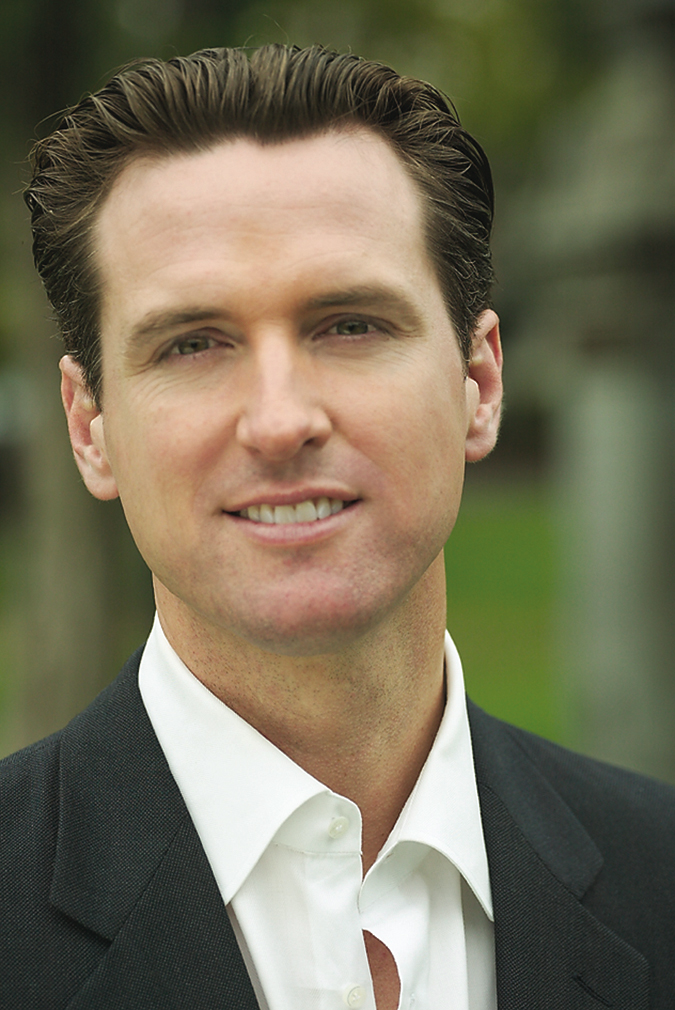
Mayor Gavin Newsom jumped into this race only after it became clear that he wouldn’t get elected governor. He sees it as a temporary perch, someplace to park his political ambitions until a better office opens up. He’s got the money, the statewide name recognition, and the endorsement of some of the state’s major power players, including both U.S. Senators and House Speaker Nancy Pelosi. He’s also been a terrible mayor of San Francisco — and some progressives (like Sup. Chris Daly) argue, persuasively, that the best way to get a better person in Room 200 is to ship Newsom off to an office in Sacramento where he can’t do much harm and let the supervisors pick the next mayor.


But it’s hard to endorse Newsom for any higher office. He’s ducked on public power, allowing PG&E to come very close to blocking the city’s community choice aggregation program (See editorial, page 5). His policies have promoted deporting kids and breaking up families. He’s taken an approach to the city budget — no new revenue, just cuts — that’s similar to what the Republican governor has done. He didn’t even bother to come down and talk to us about this race. There’s really no good argument for supporting the advancement of his political career.


Then there’s Janice Hahn. She’s a Los Angeles City Council member, the daughter of a former county supervisor, and the sister of a former mayor. She got in this race way before Newsom, and her nightmare campaign consultant, Garry South, acts as if she has some divine right to be the only Democrat running.


Hahn in not overly impressive as a candidate. When we met her, she seemed confused about some issues and scrambled to duck others. She told us she’s not sure she’s in favor of legalizing pot, but she isn’t sure why she’s not sure since she has no arguments against it. She won’t take a position on a new peripheral canal, although she can’t defend building one and says that protecting San Francisco Bay has to be a priority. She won’t rule out offshore oil drilling, although she said she has yet to see a proposal she can support. Her main economic development proposal was to bring more film industry work to California, even if that means cutting taxes for the studios or locating the shoots on Indian land where there are fewer regulations.


On the other hand, she told us she wants to get rid of the two-thirds threshold in the state Legislature for passing a budget or raising taxes. She supports reinstating the car tax at pre-Gov. Arnold Schwarzenegger levels. She supports a split-roll measure to reform Prop. 13. She wants to see an oil-severance tax to fund education. She’s one of the few statewide candidates who openly advocates higher taxes on the wealthy as part of the solution to the budget crisis.


We are under no illusions that Hahn will be able to use the weak office of lieutenant governor to move on any of these issues, and we’re not at all sure she’s ready to take over the top spot. But on the issues, she’s clearly better than Newsom, so she gets our endorsements.


SECRETARY OF STATE, DEMOCRAT


DEBRA BOWEN


Debra Bowen is the only Democrat running, a sign that pretty much everyone in the party thinks she’s doing a fine job as Secretary of State. She’s run a clean office and we see no reason to replace her.


CONTROLLER, DEMOCRAT


JOHN CHIANG


Like Bowen, John Chiang has no opposition in the primary, and he’s been a perfectly adequate controller. In fact, when Gov. Schwarzenegger tried two years ago to cut the pay of thousands of state employees to the minimum wage level, Chiang defied him and refused to change the paychecks — a move that forced the governor to back down. We just wish he’d play a more visible role in talking about the need for more tax revenue to balance the state’s books.


TREASURER, DEMOCRAT


BILL LOCKYER


Bill Lockyer keeps bouncing around Sacramento, waiting, perhaps, for his chance to be governor. He was attorney general. Now he’s treasurer seeking a second term, which he will almost certainly win. He’s done some good things, including trying to use state bonds to promote alternative energy, and has spoken out forcefully about the governor’s efforts to defer deficit problems through dubious borrowing. He hasn’t, however, come out in favor of higher taxes for the rich or a change in Prop. 13.


ATTORNEY GENERAL, DEMOCRAT


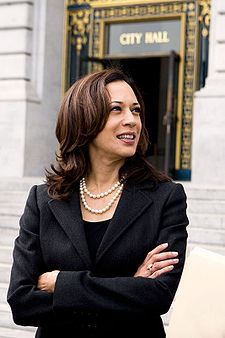
KAMALA HARRIS


There are really only two serious candidates in this race, Kamala Harris, the San Francisco district attorney, and Rocky Delgadillo, the former Los Angeles city attorney. Harris has a comfortable lead, with Delgadillo in second and the others far behind.


Delgadillo is on his second try for this office. He ran against Jerry Brown four years ago and got nowhere. And in the meantime, he’s come under fire for, among other things, using city employees to run personal errands for him (picking up his dry-cleaning, babysitting his kids) and driving his car without insurance. On a more significant level, he made his reputation with gang injunctions that smacked of ethnic profiling and infuriated Latino and civil liberties groups. It’s amazing he’s still a factor in this race; he can’t possibly win the general election with all his baggage.


Harris has a lot going for her. She was among the first California elected officials to endorse Barack Obama for president, and remains close to the administration. She’s a smart, articulate prosecutor and could be one of the few women atop the Democratic ticket this year. We were never comfortable with her ties to Willie Brown, but he’s no longer a factor in state or local politics. These days, she’s more closely allied with the likes of State Sen. Mark Leno.


That said, we have some serious problems with Harris. She’s been up in Sacramento pushing Republican-style tough-on-crime bills (like a measure that would bar registered sex offenders from ever using social networking sites on the Internet) and forcing sane Democrats like Assembly Member and Public Safety Committee Chair Tom Ammiano to try to tone down or kill them (and then take the political heat). If she didn’t know about the problems in the SFPD crime lab, she should have, and should have made a bigger fuss, earlier.


But Harris has kept her principled position against the death penalty, even when it meant taking immense flak from the cops for refusing to seek capital punishment for the killer of a San Francisco police officer. She’s clearly the best choice for the Democrats.


INSURANCE COMMISSIONER, DEMOCRAT


DAVE JONES


Two credible progressives are vying to run for this powerful and important position regulating the massive — and massively corrupt — California insurance industry. Dave Jones and Hector De La Torre are both in the state Assembly, with Jones representing Sacramento and De La Torre hailing from Los Angeles. Both have a record opposing insurance industry initiatives; both are outspoken foes of Prop. 17; and either would do a fine job as insurance commissioner. But Jones has more experience on consumer issues and health care reform, and we prefer his background as a Legal Aid lawyer to De La Torre’s history as a Southern California Edison executive. So we’ll give Jones the nod.


BOARD OF EQUALIZATION, DISTRICT 1, DEMOCRAT


BETTY T. YEE


Betty Yee has taken over a job that’s been a stronghold of progressive tax policy since the days of the late Bill Bennett. She’s done well in the position, supporting progressive financial measures and even coming down, as a top tax official, in favor of legalizing (and taxing) marijuana. We’re happy to endorse her for another term.


SUPERINTENDENT OF PUBLIC INSTRUCTION


TOM TORLAKSON


Two prominent Democratic legislators are running for this nonpartisan post, state Sen. Gloria Romero of Los Angeles and Assembly Member Tom Torlakson of Martinez. It’s a pretty clear choice: Romero is a big supporter of charter schools who thinks parents should be able to move their kids out of one school district and into another (allowing wealthier white parents, for example, to abandon Los Angeles or San Francisco for the suburban districts). She’s been supported in the past by Don and Doris Fisher, who put a chunk of their GAP Inc. fortune into school privatization efforts. Torlakson wants more accountability for charters, opposes the Romero district-option bill, and has the support of every major teachers union in the state. Vote for Torlakson.


STATE SENATE, DISTRICT 8, DEMOCRAT


LELAND YEE


Sen. Leland Yee can be infuriating. Two years ago, he was hell-bent on selling the Cow Palace as surplus state property and allowing private developers to take it over. In the recent budget crisis, he pissed off his Democratic colleagues by refusing to vote for cuts that everyone else knew were inevitable (while never making a strong stand in favor of, say, repealing Prop. 13 or raising other taxes). But he’s always been good on open-government issues and has made headlines lately for busting California State University, Stanislaus over a secret contract to bring Sarah Palin in for a fundraiser — and has raised the larger point that public universities shouldn’t hide their finances behind private foundations.


Yee will have no serious opposition for reelection, and his campaign for a second term in Sacramento is really the start of the Leland Yee for Mayor effort. With reservations over the Cow Palace deal and a few other issues, we’ll endorse him for reelection.


 Correction update: Yee’s office informs us that the senator suports an oil-severance tax and a tax on high-income earners and “believes that Prop. 13 should be reformed,” although he hasn’t taken a position on Assemblymember Tom Ammiano’s reform bill. 


STATE ASSEMBLY, DISTRICT 12, DEMOCRAT


FIONA MA


Fiona Ma’s a mixed bag (at best). She doesn’t like Pacific Gas and Electric Co. and supports public power, but comes up with strange bills that make no sense, like a 2009 measure to limit rent control in trailer parks. Why does Ma, who has no trailer parks in her district, care? Maybe because the landlords who control the mobile home facilities gave her some campaign cash. She faces no opposition, and we’re not thrilled with her record, but we’ll reluctantly back her for another term.


STATE ASSEMBLY, DISTRICT 13, DEMOCRAT


TOM AMMIANO


When the history of progressive politics in modern San Francisco is written, Tom Ammiano will be a central figure. His long-shot 1999 mayoral campaign against Willie Brown brought the left to life in town, and his leadership helped bring back district elections and put a progressive Board of Supervisors in place in 2000. As a supervisor, he authored the city’s landmark health care bill (which Newsom constantly tries to take credit for) and the rainy day fund (which saved the public schools from debilitating cuts). He uses his local influence to promote the right causes, issues, and candidates.


And he’s turned out to be an excellent member of the state Assembly. He forced BART to take seriously civilian oversight of the transit police force. He put the battle to reform Prop. 13 with a split-role measure back on the state agenda. And his efforts to legalize and tax marijuana are close to making California the first state to toss the insane pot laws. As chair of the Public Safety Committee, he routinely defies the police lobbies and the right-wing Republicans and defuses truly awful legislation. We’re glad Ammiano’s still fighting in the good fight, and we’re pleased to endorse him for another term.


STATE ASSEMBLY, DISTRICT 14, DEMOCRAT


NANCY SKINNER


Nancy Skinner has taken on one of the toughest, and for small businesses, most important, battles in Sacramento. She wants to make out-of-state companies that sell products to Californians collect and remit sales tax. If you buy a book at your local bookstore, you have to pay sales tax; if you buy it from Amazon, it’s tax-free. That not only hurts the state, which loses hundreds of millions of dollars in tax revenue, it’s a competitive disadvantage to local shops. Skinner’s a good progressive vote and an ally for Ammiano on the Public Safety Committee. We’re happy to endorse her for another term.


STATE ASSEMBLY, DISTRICT 16, DEMOCRAT


SANDRE SWANSON


Sandre Swanson represents the district where BART police killed Oscar Grant, but he wasn’t the one out front pushing for more civilian accountability; that was left to SF’s Ammiano. And while Swanson was generally supportive of Ammiano’s bill, he was hardly a leader in the campaign to pass it. This is too bad, because Swanson’s almost always a progressive vote and has been good on issues like whistleblower protection (a Swanson bill that passed this year protects local government workers who want to report problems confidentially). We’ll endorse him for another term, but he needs to get tougher on the BART police.

School Board fireworks

2

Look for some interesting heat and maybe some light at the school board meeting tonight (April 27). The teachers union is holding a march and members will be speaking out against the layoffs (PDF), since this is the last board meeting before pink slips to more than 800 teachers and 300 para-professionals. The district, of course, is broke, since most of the money comes from the state, and the state is broke for all the reasons we all know, and I don’t envy the job of the school board and the superintendent, who have to somehow balance the books. The teachers think there should be more cost-cutting at the central office and that the district should dip into reserve fund, which will be about $8 million to the good at the end of this year.


It’s complicated, but the state requires the district to keep 2 percent of its budget total in reserve; that’s a sound policy. Right now, according to information that SFUSD spokesperson Gentle Blythe sent me, the reserve is at $33.6 million, much more than is needed, but some of that is temporary federal stimulus money.


Here’s how the distict outlines the situation:


Our baseline projections (i.e., the fund balance that would result if no steps were taken to address the budget shortfalls) are that our Unrestricted General Fund (UGF) balance would be $24.2 million, negative $37.9 million, and negative $97.6 million at the end of the three respective years. At the end of FY 2009-10, we would have $8.4 million more in fund balance than the $15.8 million required. However, we would fall short of our required fund balance in the following two years by $53.7 million and $113.4 million, respectively. If the Superintendent’s Budget Deficit Action Plan were implemented, our UGF fund balance would be $33.6 million, $23.6 million, and $15.8 million at the end of the three respective years.  


That, of course, assumes that the economy will still be awful in the next two years, that the state won’t have or allocate any additional money to education and that this same horrible fiscal situation will continue. Which may be true — but it may also be true that things will get better with a Democrat in the Governor’s Office, and the projections might not be so dire.


Meanwhile, the board will also be taking up a truly awful bill called SB 955, which attacks teacher seniority. It’s an informational item only, but should generate some discussion, since board member Rachel Norton has already weighed in on it in her sfgate blog post:


Still, it’s clear that there is political traction for California to weigh in on the national conversation happening on teacher seniority and evaluation, and I’m told that an alternative bill is likely to be introduced by a Democratic sponsor. If that happens, it will be important for the Board to have a position on what provisions should be included or dropped.

At this point, there’s no Democratic alternative bill in Sacramento, but there are plenty of moderate Democrats who could come up with one. And it raises the whole touchy issue of how to handle staff reductions in a district where many of the senior teachers have managed to get themselves assigned to top-performing schools. “We just sent layoff notices to 60 percent of the staff at Alvarado,” Board President Jane Kim told me. “And some schools on the west side will have only 10 percent layoffs.”

I cna’t imagine a majority of this school board coming down on the side of reducing seniority for teachers. But the fact that Norton is talking about the board looking at other alternatives, and how a counter to SB 955 might be structured, suggests that this issue isn’t going away. 

A fitting memorial to labor’s dead and injured

0

Dick Meister, formerly labor editor of the SF Chronicle and KQED-TV Newsroom, has covered labor and politics for a half-century.

We’re coming up on another Workers Memorial Day April 28 – a day when organized labor and its allies honor the millions of men and women who’ve needlessly suffered and died because of workplace hazards and to demand that the government act to lessen the hazards.

It’s certain that unless federal authorities do act to expand and adequately enforce the neglected job safety laws, the number of victims will remain at a terrible and unnecessarily high level.

Every year, more than 6,000 Americans are killed on the job. More than 6 million are injured, at least half of them seriously. Another 60,000 die from their injuries or from cancer, lung and heart ailments and other occupational diseases caused by exposure to toxic substances.

 Think of that: An average of at least 16 workers killed and nearly 5,500 badly hurt on each and every day, plus 135 or more dying daily from job-related illness. The financial toll also is high: More than $3 billion in health care expenses and other costs to employers and workers, such as lost wages and production.

Trying to reduce workplace dangers, always a difficult task, became even more difficult when the Bush administration took office in 2000 and began eight years of what the United Auto Workers accurately cited as  “a harsh, vindictive attack on health and safety standards.”

Under President Bush, important new health and safety regulations proposed by experts were brushed aside by the Labor Department. Job-site inspections were all but abandoned and employers were asked merely to certify that they had voluntarily complied with the existing regulations.  Fines for violations were rare, in any case, as were criminal charges against employers whose willful violations led to injury, illness or death.

There was, in short, very little enforcement of the job safety laws, and absolutely no progress in reducing workplace dangers or the ever-mounting number of work-related injuries and fatalities.

But under President Obama, there’s genuine hope for change. As Obama’s Secretary of Labor, Hilda Solis, made clear at her swearing-in: “There’s a new sheriff in town.”

Solis has shifted from reliance on voluntary compliance to stricter enforcement, hiring hundreds of new investigators and enforcers for the Labor Department’s Occupational Safety and Health and Mine Safety Administrations. Most of them are longtime advocates for working people, some of them from organized labor. They’re holding jobs held during the Bush years by employer advocates whose main concern was shielding employers from the costs of making work safer.

Solis’ team has moved to enforce new rules to better protect some of the most endangered workers, including mine workers and crane operators. She’s also stressing the need to help the millions who suffer chronic pain in the neck, back, shoulders, arms or wrists and other suffering resulting from the endlessly repetitive movements and often heavy lifting required in many jobs today.

Those so-called ergonomic injuries are the most common  – and most neglected – of the  serious injuries suffered by U.S. workers.

Solis has put a task force to work designing a much tougher enforcement program for serious or repeat offenders, who will face mandatory job-site inspections. What’s more, she and Obama have named one of the country’s most distinguished safety experts, David Michaels of Georgetown University, to head the Occupational Safety and Health Administration (OSHA).

Michaels’ main goal is to get employers and workers and their unions to jointly develop programs that would include safety training for workers as part of an effort to meet what Michaels and other safety experts see as a great need to change  OSHA’s  direction and philosophy.

Michaels and Solis have gotten important help from congressional Democrats who introduced legislation to strengthen the safety laws, in part by increasing  penalties imposed on violators. Penalties now are so minimal that many employers simply ignore the law and consider the fines, if any, a routine cost of doing business.

The measures also call for more strongly protecting workers who report safety violations by their employers, extending the laws’ coverage to farmworkers, local and state government employees and other groups not currently covered, and otherwise strengthening workers’ job safety rights.

It’s certain, at any rate, that labor, Obama, Solis and their supporters will indeed wage the major battle for true job safety that they’ve promised and have, in fact,  already started. There could be no more fitting a memorial to the millions who’ve been needlessly maimed or killed while working to sustain themselves and their families.

Dick Meister, formerly labor editor of the SF Chronicle and KQED-TV Newsroom, has covered labor and politics for a half-century. Contact him through his website, www.dickmeister.com, which includes more than 350 of his  recent columns.

Newsom didn’t win in Los Angeles

5

I usually go to the California state Democratic Conventions, but I missed this one, so I’ve had to rely on news coverage to find out what happened — and it’s been pretty slim pickins. To read the Chron’s politics blog, you’d think the whole thing was silliness and parties, although Carla Marinucci got a fun comment from party Chair John Burton, who thinks the only thing that will drive the youth vote in November is pot.


But the news for people following the fate Gavin Newsom is that our mayor didn’t get the party’s endorsement for lieutenant governor. Matier and Ross spin it as a sorta, kinda victory:


Mayor Gavin Newsom didn’t get the state Democratic Party endorsement in his race for lieutenant governor, but he got the next best thing: keeping rival L.A. City Councilwoman Janice Hahn from getting it.


And technically, that’s true — Hahn ran hard for the endorsement, and really needed a boost, since she’s far behind in name recognition and money. But it was hardly a resounding win for the front-runner.


Newsom got 52 percent of the vote, short of the 60 percent needed for an endorsement. His campaign says, correctly, that he whupped Hahn, who got 42 percent.


But what’s remarkable is that Newsom had the support of all the party bigwigs — Nancy Pelosi, Dianne Feinstein, Burton — the folks who can usually pull strings and make sure that their candidate gets the nod. The truth is, Hahn never had a chance here; there was absolutely no way the L.A. council member was going to get enough votes to win the endorsement. Her only real play was to block Newsom — and she pulled it off.


So I wouldn’t call this a win for Newsom; I’d say it’s a sign that the grassroots Democrats are not entirely sold on the San Francisco mayor.

Will Obama help Kamala Harris?

12

President Obama is coming to California to help raise money for Sen. Barbara Boxer, who already has more than $8 million on hand. The president has to do this; Boxer’s seat is critical to the Democrats hopes for hanging on to a majority in the Senate,and Obama will pull out all the stops in this fall’s campaign to help Dems in tough races.


And while Boxer’s not going to get an easy pass, she’s still the front-runner — whatever the polls may show, she’s always been a great campaigner and has overcome tough odds plenty of times before. And unless Tom Campbell pulls it out in the GOP primary, she’s going to face either Carly Fiorina or Chuck DeVore, and both of them are too far to the right for California.


But there’s another key race this fall where Obama could also be a huge help. I think San Francisco D.A. Kamala Harris is going to win the Democratic primary for attorney general, but in the general election, she’s going to get hit hard by the GOP dirt machine. It’s going to be death penalty and cop killers all day long. Harris is tough, and knows what’s coming, but I can guarantee that race will be nasty, mean, dirty, ugly and as negative as you can imagine.


And Harris is going to need to raise a lot of money to fight back.


Now let’s remember: Harris was one of the first California elected officials to support Obama for president. She was the co-chair of his state campaign. And this fall, he could return the favor by making a visible endorsement — and by coming to town for a major Harris fundraiser. The president of the United States can raise $5 million in one night for a candidate — and that kind of boost, along with the positive press it would generate, might make the difference.


Of course, Obama, who (sadly) won’t come out against the death penalty, will have to take some hard questions and a few hits himself, in a tough national election year for Democrats, if he gets to close to Harris. And she’ s enough of a pragmatist that she’ll understand if he ducks this one.


But he really shouldn’t.

Force is the weapon of the weak: decrying the right’s violent rhetoric

16

American political discourse is being poisoned by some truly scary rhetoric from the right-wing, which is increasingly resorting to threats and condoning of violence, a trend that has played out in recent weeks right here on the Guardian’s Politics blog. Now is the time to recognize and stop it, just as a new coalition is calling for

San Francisco resident Greg Lee Giusti was arraigned in federal court this morning for making threatening phone calls to House Speaker Nancy Pelosi, one day after the arrest of Charles Alan Wilson for threatening to kill Sen. Patty Murray (D-Wash.). In both cases, the subject was the recent health care reform bill, the anger of the suspects stoked by misinformation and inflammatory rhetoric from top conservative politicians and media figures, as well as the Tea Party movement.

But these cases – along with the recent domestic terrorism plot by Christian fundamentalists and other incidents of overt and implied threats of violence – aren’t isolated examples; they are closer to the norm of rhetoric emanating from the right-wing these days, a trend not seen in this country since the months that led up to the bombing of the Oklahoma City federal building by right-wing radical Timothy McVeigh, the biggest act of domestic terrorism before 9/11.

Consider Giusti, who also wrote a scary letter to me and the Guardian in the midst of his threats against Pelosi, taking issue with our recent cover story that was critical of police crackdowns on SF nightlife. In additional to praising police violence and encouraging cops to “crack a few skulls open,” just like his NYPD cop uncle, who “knows how to inflect [sic] excruciating Paine [sic] on someone without leaving any signs of what happened.”

But Giusti was far from alone in promoting violence over the issues we’ve raised. SFPD Southern Station Capt. Daniel McDonough praised the sometimes-violent tactics of the two undercover cops who bust parties and nightclubs, strongly implying those tactics were justified to counter the unspecified threats of violence that nightclubs represent. “Because of their diligence and professionalism the amount of violence and disorder has been reduced,” McDonough wrote, echoing a troubling strain of right-wing political thought that condones violence to prevent even speculative threats of violence, a perspective that led us to invade Iraq.

And when I wrote about McDonough’s response yesterday, a commenter wrote that aggressive police tactics are justified because, “The unprecedented ascendancy of nightclubs and violation of the Constitutional rights of residents to peaceful use of their property calls for drastic measures.”

In a similar vein, our blog post this week on a newly released video of American soldiers in a helicopter opening fire on a crowd in Baghdad that included journalists and children while making disturbing comments that seemed to relish the opportunity to kill people also provoked some equally disturbing comments.

“So a couple of journalists embedded with terrorists killing Americans got wiped out…congrats to the shooters! A couple of terrorists in training got shot up in a terrorist rescue attempt…congrats to the shooters! Everyone on scene who died got what was coming to them,” one wrote, while another warned, “Raise a weapon against America or Americans and prepare to experience the worst day in the rest of your life. Hoowa!”

Even though the helicopter was miles away and the video showed no credible threats toward it or anyone else, supporters of the war seemed to think that quickly resorting to violence is acceptable. “This is the price we pay for are [sic] freedom. put yourself in that chopper and then put yourself on the ground they all no [sic] what can and will happen. It will happen at home again 911 just give it time. We will do are [sic] best to defend are [sic] country. GOD BLESS USA.”

And I will do my best to defend this country from right-wing extremists. That effort starts with challenging Sarah Palin’s winking exhortation for her followers to “lock and load,” and with letting commentators like Glenn Beck and Bill O’Reilly, on a nightly basis, cast liberals as enemies of the state to their well-armed listeners.

This is simply not OK, a point that’s being made by the prosecutors of Giusti and Wilson, as well as the new Stop Domestic Terrorism campaign by a coalition of organization concerns about the increasing violent rhetoric of the rights. 

“Law abiding Americans do not advocate violence against fellow Americans,” campaign spokesperson Brad Friedman said in a public statement. “As Americans, we all need to engage in a vigorous debate of the issues based on facts and reason rather than fear and prejudice.”

But even in San Francisco, it’s common for conservatives and so-called “moderates” to condone violence against the homeless, drug users, petty criminals, ravers, Critical Mass bicyclists, “illegal immigrants,” or others that they dismiss as “getting what’s coming to them” for daring to violate laws or social mores. I’ve personally had violence wished on me more times than I can count, in letters, phone messages, and to my face. 

As a full-time newspaper journalist for almost 20 years, I’ve dealt with right-wing crazies for a long time, but there are times when you can sense their indignation getting ratcheted up to dangerous levels. In 1994, I wrote stories for the Auburn Journal and Sacramento News & Review about right-wing “patriots” and “constitutionalists” that were part of the militia movement in Placer County.

They warned me that then-President Bill Clinton was an agent of the “New World Order” who was plotting a socialist takeover of the “real Americans,” and that violent resistance was necessary. They spun elaborate fantasies about the impending civil war, which they said the federal government had already started with their raids in Ruby Ridge and Waco. 

“You won’t be able to write an article like this anymore because the government will come and kick in your door and murder you and your children,” one militia member told me after my first article came out.

On April 19 of the next year, while I was working for the Santa Maria Times, I remember vividly when the federal building in Oklahoma City was bombed, killing 168 people. For the first 24 hours, most media outlets speculated that it was an attack by terrorists from the Middle East, but as soon as I heard it was the anniversary of the Waco incident, I knew exactly who was really responsible: the dangerous right wing extremism that pushed militia member Timothy McVeigh to attack his own country.

And now, it’s happening again. Overheated rhetoric on the right is casting Pelosi and fellow Democrats not just as political opponents, but as dangerous enemies of the “real Americans” that Palin claims to champion. They have, like Wilson said of Murray, “ a target on her back.”

When Sen. Leland Yee tried to find out how much Palin was being paid to speak at California State University-Stanislaus, he was aggressively attacked by her acolytes for trying to “take away her constitutional right to free speech,” according to an anonymous message left on his answering message yesterday, which his office shared with the Guardian. “Maybe we ought to have a homosexual with a long enough dick so he can stick it up his ass and fuck himself while he’s on stage giving a speech.”

Such crass, semi-literate, weirdly homophobic comments might be funny if they weren’t part of a larger, more dangerous trend in this country. Once again, a Democratic president is being actively accused of treasonous hostility to “real Americans” by major conservative figures with huge audiences, and once again, the lunatic fringe is being worked up into a frenzy.

The recently uncovered plot by Michigan militia members to murder police officers in the hopes of starting a holy war with the enemies of Christianity is just one indication for what this kind of rhetoric is leading to in isolated pockets around the country. Now is the time to put a stop to condoning violence in any of its forms, whether it’s cops cracking the skulls of clubbers or street denizens, soldiers firing on crowds of people, or citizens threatening our elected representatives.

“Force is the weapon of the weak,” said the radical pacifist-anarchist Ammon Hennacy, a quote that was often repeated by folk singer and progressive writer Utah Phillips, who I had the honor of covering at the same time I was covering the militia movement. It’s true, and at this difficult moment in our country’s history, let’s all try to stay strong.  

Editor’s Notes

0

Tredmond@sfbg.com

A couple of weeks ago, political consultant David Latterman, who often works with downtown interests, sent off an e-mail warning that the pro big-business, moderate bloc needed to get its act together. "It appears as if different groups are unwilling to set aside their egos or agendas, and pool together resources in a comprehensive plan to take back the [Democratic County Central Committee]," he wrote. "And guess what, we’re going to lose, in June and November."

His point: the DCCC matters, a lot. "The DCCC controls the supe endorsements that matter most," he noted, adding, "The mayor’s race starts now."

And that’s absolutely true — and unless the folks downtown are foolish or have given up (and neither is terribly likely) they’re going to get the message, and there’s going to be a big-money push in the next two months to oust the progressive majority on the county committee.

The DCCC controls the Democratic Party endorsements — and the party slate card is among the most influential political slates in a city where the vast majority of the population votes for Democrats. The DCCC could well make the difference in some of the key supervisorial races this fall — and could play a key role in choosing the next mayor of San Francisco.

But it’s not a high-profile election. More than half the votes will probably be absentees. That means it’s critical that the progressive candidates can raise money, do mailers, and fight back.

At this point, there’s a pretty good consensus on a progressive slate. We published our endorsements last week, and the Milk Club, Sierra Club, Tenants Union, and Assembly Member Tom Ammiano have endorsed most of the same candidates. In the fall, labor, environmental groups, tenants, and other progressive interests will be putting a lot of money into the races for district supervisor. But I could argue that the DCCC is just as important — and if we don’t fight this one to win, it’s going to be a lot harder in November.

Editor’s Notes

4

Tredmond@sfbg.com

The pot initiative’s going to pass in November. California’s going to legalize personal use and small sales. I think that’s clear from the polls, and from the fact that the pot supporters are raising a fair amount of money, and the fact that there won’t be much effective opposition.

The state Legislature might not like it — ballot measures are impossible to amend, and with debate and discussion the measure might be a little different. But Assembly Member Tom Ammiano has tried, again and again, to get his colleagues to see the light: this is going to happen, and if the folks in Sacramento are afraid of it, then they’re not going to have any influence over the final product.

And it’s amazing to me how many people are afraid of this issue.

All three major candidates for governor, including Jerry Brown, who must have smoked pot at some point in his life (would Linda Ronstadt have gone out with a guy who never smoked weed?), are publicly opposing the measure. Ammiano can’t get a majority of the Assembly to vote yes on his legalization bill — and Democrats control things. You wonder when these people are going to understand that the voters, most of them, really don’t care if pot becomes legal. It doesn’t frighten anybody anymore — except elected officials.

Humboldt County is already preparing for this; business leaders are talking about the economic impact on the region and how the North Coast can become the Napa Valley of green bud. The Obama administration needs to get ready too — ready to tell the federal drug agents to leave California alone. And a few years from now, life will go on, and everyone will take legal pot for granted — and I wonder how silly Jerry Brown’s going to feel. *

If we’re going to be whores, let’s at least get paid

2

The San Francisco City Planning Commission will be voting March 18th on a proposal to build luxury condos next to the Transamerica building. The developers are two out-of-town outfits that support Republican candidates. And therein lies an interesting tale.


Back in 1984, when dinosaurs roamed the Earth and newspapers made a lot of money and Dianne Feinstein was mayor, San Francisco was host to the Democratic National Convention, which nominated a guy named Walter Mondale (talk about dinosaurs) to run against Ronald Reagan for president. Running the convention, and all the parties and galas, cost a fair amount of cash, and Feinstein hit up all the big civic donor types to chip in.


One of the people atop her list was Walter Shorenstein, the local real-estate tycoon who was a huge donor to Democratic Party candidates (Bill Clinton used to stay at Shorenstein’s house when he was in town). Shorenstein was also trying to get permits to build some new highrises — and some of his buildings were so grossly out of proportion that even Feinstein’s Planning Commission, which loved all things big and highrise, was balking a little.


So Walter calls the mayor and says this: Don’t you dare ask me to donate to your Democratic Convention if your planners are going to jerk me around on my permits. And Feinstein, of course, made sure the Planning Commission backed down and Shorenstein got exactly what he wanted.


We did a big story, and even the Chronicle, which wasn’t big on criticizing Feinstein or Shorenstein, wrote about it, and there was all manner of outrage — as there should have been. It was terribly unseemly, and made the city look bad, and made Feinstein look like she could be pushed around by developers ….


And for all that, at least the special favors were going to a local guy who was donating money to Democrats and to the city’s convention efforts. Hideous as it was, as least San Francisco (and Feinstein, and Mondale) were getting something out of it.


Fast forward to today — when Gavin Newsom’s Planning Commission is considering an awful, out-of-scale project that even architecture magazines don’t like. And who benefits from the special favors? Not a local guy helping out with a local project, but an offshore corporation and a developer from L.A. who is on Meg Whitman’s Finance Committee.


I mean, if we’re going to be whores here in Democratic San Francisco, shouldn’t we at least get paid for it? 


Editorial: Who wins with the Transamerica condos?

4

The developers aren’t offering to build something that will create permanent jobs for local residents. They want a huge favor from San Francisco: they want the city to ignore its own planning rules, ignore its park-shadow ordinance, and hand over a piece of city street, just to make their project more profitable.

EDITORIAL  As the Planning Commission prepares to vote March 18 on a pointless and overly large condominium complex next to the Transamerica Pyramid, let us take a moment to look at who would benefit from the project’s approval.

The project sponsors, Aegon USA and Lowe Enterprises, would get the right to shadow public parkland, turn a city street into a private parking garage, and construct a project far beyond the allowable height for the location. They’d construct 248 luxury condos, which the city doesn’t need and will do nothing for the housing crisis. The developers would also make a lot of money on the deal; that’s why they want spot zoning to double the allowable height. When it comes to these sorts of projects, taller is more profitable.

And the two companies asking for these civic favors aren’t exactly San Francisco outfits that share the city’s values.

Aegon is a giant insurance and finance company based in the Netherlands that bought out the local Transamerica Company in 1999. The money Aegon makes on the deal won’t stay in San Francisco; even Aegon’s American subsidiary doesn’t have a home office here.

The company’s PAC is a major contributor to Republican causes and candidates (although some Democrats get money, too, particularly the likes of Sen. Blanche Lincoln of Arkansas, one of Aegon’s top-dollar friends, who is among the main reasons the Senate won’t pass a public option for health insurance). And over the past 10 years, Aegon PAC has contributed $39,500 to Lifepac, a Columbus, Ohio-based anti-abortion group.

Then there’s Lowe Enterprises, based in Los Angeles. The company’s chairman, Robert Lowe, and his employees were among Arnold Schwarzenegger’s top donors, with a whopping $159,500 in contributions to the Republican governor. Lowe is also a big supporter of Meg Whitman’s campaign for governor, and is on her finance committee.

So here we are in Democratic San Francisco, with a mayor who will be running on a Democratic ticket for statewide office (and a mayor, by the way, who loves to talk about supporting small local business and keeping money in the local economy) preparing to give a huge financial gift to a pair out out-of-town companies that share their wealth with right-wing Republicans.

Of course, it’s no surprise that a real estate developer would support Republican candidates — and it’s no surprise an insurance company would be working against health care reform. And if the city granted or denied building permits based on the politics of the applicant, there’d be serious legal consequences (and there should be). These things ought to be decided on the merits; developers who contribute to Democrats (like the Shorenstein Company) deserve the same scrutiny as the ones who give to Republicans.

But this isn’t a typical development deal. Aegon and Lowe aren’t asking for a permit for a project that meets the current zoning laws. They aren’t offering to build something that will create permanent jobs for local residents. They want a huge favor from San Francisco: they want the city to ignore its own planning rules, ignore its park-shadow ordinance, and hand over a piece of city street, just to make their project more profitable — and to give them more money that can go to opposing health-care reform and opposing abortion rights and electing right-wing Republicans. And they’re offering the city nothing in return.

On the merits, the project richly deserves to be rejected. The only reason to approve it is to grant a civic boon to a bunch of out-of-town corporations that ought to be embarrassed to be asking a favor from San Francisco. And the Planning Commission should be embarrassed to consider granting it.

Who wins with the Transamerica condos?

0

EDITORIAL As the Planning Commission prepares to vote March 18 on a pointless and overly large condominium complex next to the Transamerica Pyramid, let us take a moment to look at who would benefit from the project’s approval.

The project sponsors, Aegon USA and Lowe Enterprises, would get the right to shadow public parkland, turn a city street into a private parking garage, and construct a project far beyond the allowable height for the location. They’d construct 248 luxury condos, which the city doesn’t need and will do nothing for the housing crisis. The developers would also make a lot of money on the deal; that’s why they want spot zoning to double the allowable height. When it comes to these sorts of projects, taller is more profitable.

And the two companies asking for these civic favors aren’t exactly San Francisco outfits that share the city’s values.

Aegon is a giant insurance and finance company based in the Netherlands that bought out the local Transamerica Company in 1999. The money Aegon makes on the deal won’t stay in San Francisco; even Aegon’s American subsidiary doesn’t have a home office here.

The company’s PAC is a major contributor to Republican causes and candidates (although some Democrats get money, too, particularly the likes of Sen. Blanche Lincoln of Arkansas, one of Aegon’s top-dollar friends, who is among the main reasons the Senate won’t pass a public option for health insurance). And over the past 10 years, Aegon PAC has contributed $39,500 to Lifepac, a Columbus, Ohio-based anti-abortion group.

Then there’s Lowe Enterprises, based in Los Angeles. The company’s chairman, Robert Lowe, and his employees were among Arnold Schwarzenegger’s top donors, with a whopping $159,500 in contributions to the Republican governor. Lowe is also a big supporter of Meg Whitman’s campaign for governor, and is on her finance committee.

So here we are in Democratic San Francisco, with a mayor who will be running on a Democratic ticket for statewide office (and a mayor, by the way, who loves to talk about supporting small local business and keeping money in the local economy) preparing to give a huge financial gift to a pair out out-of-town companies that share their wealth with right-wing Republicans.

Of course, it’s no surprise that a real estate developer would support Republican candidates — and it’s no surprise an insurance company would be working against health care reform. And if the city granted or denied building permits based on the politics of the applicant, there’d be serious legal consequences (and there should be). These things ought to be decided on the merits; developers who contribute to Democrats (like the Shorenstein Company) deserve the same scrutiny as the ones who give to Republicans.

But this isn’t a typical development deal. Aegon and Lowe aren’t asking for a permit for a project that meets the current zoning laws. They aren’t offering to build something that will create permanent jobs for local residents. They want a huge favor from San Francisco: they want the city to ignore its own planning rules, ignore its park-shadow ordinance, and hand over a piece of city street, just to make their project more profitable — and to give them more money that can go to opposing health-care reform and opposing abortion rights and electing right-wing Republicans. And they’re offering the city nothing in return.

On the merits, the project richly deserves to be rejected. The only reason to approve it is to grant a civic boon to a bunch of out-of-town corporations that ought to be embarrassed to be asking a favor from San Francisco. And the Planning Commission should be embarrassed to consider granting it.

Downtown’s DCCC slate fizzles

9

I’m actually a bit surprised that Gavin Newsom’s allies haven’t made a bigger push to take back control of the San Francisco Democratic Party, which will play a key role in the fall supervisorial races. It looked for a while as if the downtown folks were organizing to put a slate of strong candidates with solid name recognition on the ballot. But when the Department of Elections closed Friday afternoon, and the deadline for filing passed, there weren’t that many new names on the ballot. Here’s the list. (PDF).


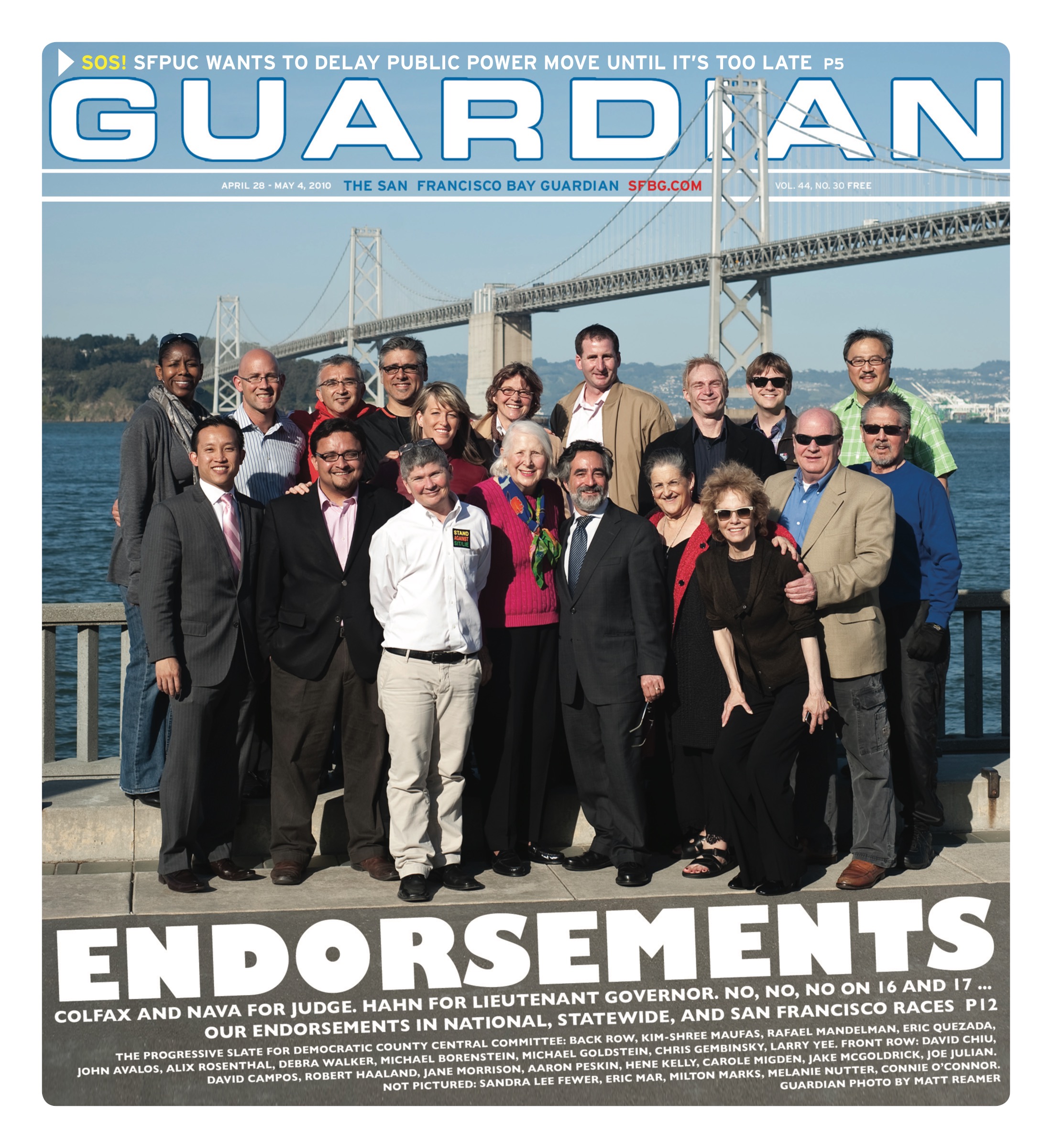
Twelve candidates will get elected in each of the two San Francisco Assembly districts. On the east side of town, in AD 13, eight progressive incumbents, including Sups. David Campos and David Chiu, former Sup. (and current DCCC chair) Aaron Peskin are running. So is School Board member Kim-Shree Maufas and former state Sen. Carole Migden. Supervisorial candidates (and incuments ) Rafael Mandelman and Debra Walker are running, as are former supervisorial candidates Eric Quezada and Alix Rosenthal.


Not a lot of star power in the more moderate camp. Other than former Sup. (and incumbent) Leslie Katz and sup. candidate (and incumbent) Scott Wiener, it’s not a powerful crew. So the progressives look to do well — as they usually do — in D 13.


D-12 is a little more conservative in general — and there are lots and lots of candidates, meaning name recognition is even more important. I’d thought maybe somebody would talk Sup. Sean Elsbernd or Sup Carmen Chu into running. But no: the only elected officials on the list are progressives, including Sups. John Avalos and Eric Mar, School Board member Sandy Fewer, and Community College Board member Milton Marks. Then there’s incumbent (and former Sup.) Jake Mcgoldrick.


The moderate, pro-Newsom camp — the folks who would try to shift the Democratic Party endorsements away from progressives in swing supervisorial districts — may be large, but not terribly deep. Incumbents Tom Hsieh and Megan Levitan are, of course, running again, and there’s Bill Fazio, who once ran for district attorney.


Myra Kopp, wife of former state Sen. (and retired judge) Quentin Kopp, is a candidate, and while she may be a little more politically conservative than Avalos and Mar, she’s not going to be in the Newsom camp, either; she’s more of an independent wild card.


Paul Hogart agrees with me that the progressives seem well situated to keep control of the DCCC, although it’s never a sure thing: there are no contribution limits for these races, and since it’s a low-profile office, big money can make a big difference. Let’s see what downtown tries to do to buff up and promote its candidates in the next two months.


Gav’s running for (lite) guv!

1

It’s not any big surprise that Gavin Newsom is officially running for lieutenant governor; we all knew that was in the cards. Newsom’s downtown allies don’t want him running, because he might win — which would mean a vacancy in the mayor’s office. But it’s really all about Newsom, and he doesn’t want to be termed out with nowhere to go.


Calitics makes the point that


In many ways, this race will showcase the future leadership of California Democrats. The winner of the primary will go on to defeat Abel Maldonado and will be a top contender to be the next governor, whether they succeed Jerry Brown or (god forbid) Meg Whitman. It’s to the benefit of Democrats and progressives that this race be issue-oriented, and free of the unfortunate personal attacks that would undermine all the candidates involved.


And Newsom loves the idea of being showcased as the future leader of California Democrats.


Newsom got a big bounce the moment he announced, when state Sen. Dean Florez, one of two other Democratic candidates for the office, dropped out and endorsed Newsom.


That leaves just Newsom and Janice Hahn, a Los Angeles City Council member who’s got an aggressive campaign (featuring Garry South, the asshole political consultant who used to work for Newsom).


Newsom starts off with a major lead; all the money he spent campaigning for governor gave him significant name recognition, and in a Democratic primary for a low-profile office, that makes a lot of difference. And his likely opponent in November is Abel Maldonado, a not-terribly-appealing Republican.


So the talk in San Francisco is all about who becomes the next mayor if Newsom wins — and already, the Newsom strategists are trying to figure out how to prevent the progressive district-elected board from appointing his replacement. The latest strategy: A Charter amendment establishing that a vacancy in the Mayor’s Office has to be filled in a special election.


Hard to argue against that — except that the special election would be in the spring of 2011, and the general election would be that fall, meaning two expensive elections (one of them guaranteed to have low turnout) in the course of 11 months.


There’s no way Newsom’s getting six votes on this board for his idea, which means he’s going to have to raise the money to gather 47,000 signatures. And if he does, the supervisors ought to respond with their own Charter amendment — establishing that vacancies on the Board of Supervisors (now filled by a mayoral appointment) also require a special election. That’s only fair.


And while Newsom and his allies talk about how unfair it is to have district supervisors, some of whom were elected with as few as 10,000 votes, decide on the next mayor, it’s worth thinking through what a special election for mayor would look like. For starters, a lot of people would probably run — and the results would be utterly unpredictable. Suppose everyone who really wants to be mayor jumped in: Leland Yee, Dennis Herrera, Aaron Peskin, Ross Mirkarimi, Bevan Dufty, maybe Michela Alioto-Pier, maybe Sean Elsbernd, maybe even Mark Leno … and the turnout will be ultra-low, and, well, the next mayor’s going to be elected with a remarkably small number of votes.


Assume a turnout of 100,000 — high for a special election. And assume seven candidates (there would probably be a lot more). That means the winner would be unlikely to have more than 20,000 first-place votes.


If it’s a ranked-choice voting situation, any of the above could pull it off. If it’s a simple plurality, hey: someone like Chris Daly, who has a small but highly devoted constituency, would have as good a chance as anyone.


The bottom line is that a special election doesn’t guarantee anything — in fact, it could turn out to be downtown’s worst nightmare.


Here’s the letter Newsom sent to potential supporters:


I didn’t come to this decision easily, but, after a great deal of consultation with my family, constituents and supporters, I believe that the best way for me to serve is by taking all of the many things that are right about California and applying them to fixing what’s wrong in Sacramento.  


The issues I fought for when I ran for Governor last year haven’t changed: our state still faces a massive budget crisis, painful unemployment, and rising student fees that threaten the stability and accessibility of our University system.  Too many Californians lack access to quality health care and too many schools are overcrowded and underfunded.


But, despite our challenges, I will always believe in California – the dynamism of its past and the promise of its future.  I’m also convinced that those of us who love this state have both an obligation and the capacity now to reform it and make it better. To do that, we need to embrace a new way of doing things in Sacramento and we need new leaders who are willing to stand up and change state government.


I’m proud that I have the support of Speaker Nancy Pelosi, Senate President Darrell Steinberg, Assembly Speaker John Perez, Sacramento Mayor Kevin Johnson, United Farm Workers co-founder Delores Huerta and California Nurses and teachers and I hope I can count on your support too.


And here’s some of the press coverage:


LA Times on Newsom run, including information on early fundraising.


Calitics on Florez’s exit from the race, including text of Florez
message and press release.


Newsom announces his candidacy in an interview with reporter Phil
Matier
on CBS 5. (video)

 Chronice on Newsom’s chances.


 Willie Brown on who will succeed Newsom as mayor.
 
Chronicle speculates on who will replace Newsom, specifically on the
possibility of David Chiu becoming mayor.

LA Observed on Gary South vs. Newsom.


LA Times blog on awkward Newsom-Brown pairing.

Politics and redistricting: The madness in SF’s future

8

The political merry-go-round in San Francisco going to be whirling at light speed soon. It’s partially the fault of term limits — over the next couple of years, some very talented, ambitious politicians are going to be forced to leave local office, and they’re looking for the next step. Part of it is the confluence of a bunch of events, starting with Mayor Gavin Newsom and District Attorney Kamala Harris both seeking statewide office.


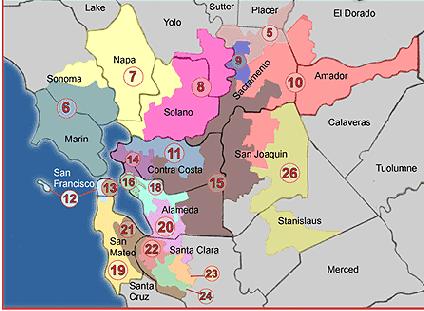
And there’s another factor that hasn’t been talked about much, but it’s really important: Next year, every Congressional, state Legislative and local supervisorial district is going to change.


After the decennial census, everyone has to draw new lines to reflect population shifts. At the state level (and Congressional redistricting is also a state function), that’s in the hands of a reapportionment commission, which I’m dubious about: The majority of the applicants are white people, and it’s supposed to have an equal number of Democrats and Republicans, although the state has far more Democratic voters. It’s anybody’s guess how they’ll actually draw the lines.


An elections task force will do the local lines, and it’s going to be harder to screw up; San Francisco supervisorial districts are supposed to reflect established neighborhood boundaries, and the population shifts within the city haven’t been that dramatic.And it’s unlikely anyone’s going to try to draw lines just to force an incumbent supervisor out of a district. But the districts will be a little bit different, and in San Francisco politics, a little bit can mean a lot.


The state Legislative districts will change significantly — and could change the politics of this area, and the state, in dramatic ways. For example, suppose Mark Leno’s Senate District moves somewhat North, to include a majority of Marin and Sonoma residents and only a small minority of San Franciscans? Suppose that district no longer includes Marin or Sonoma, but includes all of San Francisco (which would put Leno and Leland Yee in the same district)?


Suppose the 12th and 13th Assembly Districts, which now divide about East/West, shift to North and South? What if Tom Ammiano and Fiona Ma end up in the same district? (Um, I think that’s a closer relationship than either of them wants ….)


What happens if Nancy Pelosi is redistricted out of her seat? (Heh heh, won’t happen, but in theory, she and Lynn Woolsey could wind up living in the same district.)


It’s going to change the dynamics in a city that’s already poised for some upsets to the political apple cart.


Ross Mirkarimi’s termed out in 2012, and if he doesn’t run for mayor (or doesn’t get elected) he’ll be looking for the next step, which could be a run for the state Assembly; Tom Ammiano will be termed out in 2014. Of course, that’s been a gay seat for a long time (Carole Migden, Mark Leno, Ammiano) and by them someone like David Campos might be interested.


Or the district lines might have changed so much that both of them – or neither of them – can get elected.


If Bevan Dufty doesn’t get elected mayor, he’s out of a job – and he’s a political junkie who won’t easily retire. He’ll be looking at other offices, too. So will Sean Elsbernd, I suspect.


And that doesn’t even count the mayor’s race, which could, at this point, involve both state Senators, Leno and Leland Yee, and if either one wins, that opens up a Senate seat. And at the same time, if Kamala Harris is elected district attorney, that job will be open, and it’s an open secret that Board of Supervisors President David Chiu, a former prosecutor, would love to be in that office some day.


And in the background is the question of who becomes mayor if Newsom becomes lt. governor


 (and what happens to Aaron Peskin, an astute politician if ever there were one, and a potential mayor if this board of supervisors gets to make the appointment ). At lot to think about – and trust me, the thinking is already going on.

The Green Party’s nadir

2

This should be a great time for the Green Party. Its namesake color is being cited by every corporation and politician who wants to get in good with the environmentally-minded public; voters in San Francisco are more independent than ever; and progressives have been increasingly losing the hope they placed on President Barack Obama.
But the Green Party of San Francisco — which once had an influence on city politics that was disproportionate to its membership numbers — has hit a nadir. The number of Greens has steadily dwindled since its peak in 2003; the party closed its San Francisco office in November; and it has now lost almost all its marquee members.
Former mayoral candidate Matt Gonzalez, school board member Jane Kim, community college board member John Rizzo, and Planning Commissioner Christina Olague have all left the party in the last year or so. Sup. Ross Mirkarimi — a founding member of the Green Party of California and its last elected official in San Francisco — has also been openly struggling with whether to remain with an organization that doesn’t have much to offer him anymore, particularly as he contemplates a bid for higher office.
While a growing progressive movement within the Democratic Party has encouraged some Greens to defect, particularly among those with political ambitions, that doesn’t seem to be the biggest factor. After all, the fastest growing political affiliation is “Decline to State” and San Francisco now has a higher percentage of these independent voters than any other California county: 29.3 percent, according to state figures.
Democratic Party registration in San Francisco stood at 56.7 percent in November, the second-highest percentage in the state after Alameda County, making this essentially a one-party town (at last count, there were 256,233 Democrats, 42,097 Republicans, and 8,776 Greens in SF). Although Republicans in San Francisco have always outnumbered Greens by about 4-1, the only elected San Francisco Republican in more than a decade was BART board member James Fang.
But Republicans could never have made a real bid for power in San Francisco, as Gonzalez did in his electrifying 2003 mayoral run, coming within 5 percentage points of beating Gavin Newsom, who outspent the insurgent campaign 6-1 and had almost the entire Democratic Party establishment behind him.
That race, and the failure of Democrats in Congress to avert the ill-fated invasion of Iraq, caused Green Party membership to swell, reaching its peak in San Francisco and statewide in November 2003. But it’s been a steady downward slide since then, locally and statewide.
So now, as the Green Party of California prepares to mark its 20th anniversary next month in Berkeley, it’s worth exploring what happened to the party and what it means for progressive people’s movements at a time when they seem to be needed more than ever. Mirkarimi was one of about 20 core progressive activists who founded the Green Party of California in 1990, laying the groundwork in the late 1980s when he spent almost two years studying the Green Party in Germany, which was an effective member of a coalition government there and something he thought the United States desperately needed.
“It was in direct response to the right-wing shift of the Democrats during the Reagan and Bush Sr. administrations. It was so obvious that there had been an evacuation of the left-of-center values and policies that needed attention. So the era was just crying out woefully for a third party,” Mirkarimi said of the Green Party of California and its feminist, antiwar, ecological, and social justice belief system.
But he and the other founding Greens have discovered how strongly the American legal, political, and economic structures maintain the two-party system (or what Mirkarimi called “one party with two conservative wings”), locking out rival parties through restrictive electoral laws, control of political debates, and campaign financing mechanisms.
“I’m still very impassioned about the idea of having a Green Party here in the United States and here in California and San Francisco, vibrantly so. But I’m concerned that the Green Party will follow a trend like all third parties, which have proven that this country is absolutely uninviting — and in fact unwelcoming — of third parties and multiparty democracy,” Mirkarimi said.
Unlike some Greens, Mirkarimi has always sought to build coalitions and make common cause with Democrats when there were opportunities to advance the progressive agenda, a lesson he learned in Germany.
When he worked on Ralph Nader’s 2000 presidential campaign — a race that solidified the view of Greens as “spoilers” in the minds of many Democrats — Mirkarimi was involved in high-level negotiations with Democratic nominee Al Gore’s campaign, trying to broker some kind of leftist partnership that would elect Gore while advancing the progressive movement.
“There was great effort to try to make that happen, but unfortunately, everyone defaulted to their own anxieties and insecurities,” Mirkarimi said. “It was uncharted territory. It had never happened before. Everyone who held responsibility had the prospect of promise, and frankly, everybody felt deflated that the conversation did not become actualized into something real between Democrats and Greens. It could have.”
Instead, George W. Bush was narrowly elected president and many Democrats blamed Nader and the Greens, unfairly or not. And Mirkarimi said the Greens never did the post-election soul-searching and retooling that they should have. Instead, they got caught up in local contests, such as the Gonzalez run for mayor — “that beautiful distraction” — a campaign Mirkarimi helped run before succeeding Gonzalez on the board a year later.
Today, as he considers running for mayor himself, Mirkarimi is weighing whether to leave the party he founded. “I’m in a purgatory. I believe in multiparty democracy,” Mirkarimi said. “Yet tactically speaking, I feel like if I’m earnest in my intent to run for higher office, as I’ve shared with Greens, I’m not so sure I can do so as a Green.”
That’s a remarkable statement — in effect, an acknowledgement that despite some success on the local level, the Green Party still can’t compete for bigger prizes, leaving its leaders with nowhere to go. Mirkarimi said he plans to announce his decision — about his party and political plans — soon.
Gonzalez left the Green Party in 2008, changing his registration to DTS when he decided to be the running mate of Nader in an independent presidential campaign. That move was partly necessitated by ballot access rules in some states. But Gonzalez also thought Nader needed to make an independent run and let the Green Party choose its own candidate, which ended up being former Congress member Cynthia McKinney.
“I expressly said to Nader that I would not run with him if he sought the Green Party nomination,” Gonzalez told us. “The question after the campaign was: is there a reason to go back to the Green Party?”
Gonzalez concluded that there wasn’t, that the Greens had ceased to be a viable political party and that it “lacks a certain discipline and maturity.” Among the reasons he cited for the party’s slide were infighting, inadequate party-building work, and the party’s failure to effectively counter criticisms of Nader’s 2000 and 2004 presidential campaigns.
“We were losing the public relations campaign of explaining what the hell happened,” he said.
Gonzalez was also critical of the decision by Mirkarimi and other Greens to endorse the Democratic Party presidential nominees in 2004 and 2008, saying it compromised the Greens’ critique of the two-party system. “It sort of brings that effort to an end.”
But Gonzalez credits the Green Party with invigorating San Francisco politics at an important time. “It was an articulation of an independence from the Democratic Party machine,” Gonzalez said of his decision to go from D to G in 2000, the year he was elected to the Board of Supervisors.
Anger at that machine and its unresponsiveness to progressive issues was running high at the time, and Gonzalez said the Green Party became one of the “four corners of the San Francisco left,” along with the San Francisco Tenants Union, the Harvey Milk LGBT Democratic Club, and the San Francisco Bicycle Coalition, which helped set a progressive agenda for the city.
“Those groups helped articulate what issues were important,” Gonzalez said, citing economic, environmental, electoral reform, and social justice issues as examples. “So you saw the rise of candidates who began to articulate our platform.” But the success of the progressive movement in San Francisco also sowed the seeds for the Green Party’s downfall, particularly after progressive Democrats Chris Daly, Tom Ammiano, and Aaron Peskin waged ideological battles with Mayor Gavin Newsom and other so-called “moderate Democrats” last year taking control of the San Francisco Democratic Party County Central Committee.
“Historically, the San Francisco Democratic Party has been a political weapon for whoever was in power. But now, it’s actually a democratic party. And it’s gotten progressive as well,” Peskin, the party chair, told us. “And for a lot of Greens, that’s attractive.”
The opportunity to take part in that intra-party fight was a draw for Rizzo and Kim, both elected office-holders with further political ambitions who recently switched from Green to Democrat.
“I am really concerned about the Democratic Party,” Rizzo, a Green since 1992, told us. “I’ve been working in politics to try to influence things from the outside. Now I’m going to try to influence it from the inside.”
Rizzo said he’s frustrated by the inability of Obama and Congressional Democrats to capitalize on their 2008 electoral gains and he’s worried about the long-term implications of that failure. “What’s going on in Washington is really counterproductive for the Democrats. These people [young, progressive voters] aren’t going to want to vote again.”
Rizzo and Kim both endorsed Obama and both say there needs to be more progressive movement-building to get him back on track with the hopes he offered during his campaign.
“I think it’s important for progressives in San Francisco to try to move the Democratic Party back to the left,” Kim, who is considering running for the District 6 seat on the Board of Supervisors, told us. “I’ve actually been leaning toward doing this for a while.”
Kim was a Democrat who changed her registration to Green in 2004, encouraged to do so by Gonzalez. “For me, joining the Green Party was important because I really believed in third-party politics and I hope we can get beyond the two-party system,” Kim said, noting the dim hopes for that change was also a factor in her decision to switch back.
Another Green protégé of Gonzalez was Olague, whom he appointed to the Planning Commission. Olague said she was frustrated by Green Party infighting and the party’s inability to present any real political alternative.
“We had some strong things happening locally, but I didn’t see any action on the state or national level,” Olague said. “They have integrity and they work hard, but is that enough to stay in a party that doesn’t seem to be going anywhere?”
But many loyal Greens dispute the assertion that their party is on the rocks. “I think the party is going pretty well. It’s always an uphill battle building an alternative party,” said Erika McDonald, spokesperson for the Green Party of San Francisco, noting that the party plans to put the money it saved on its former Howard Street headquarters space into more organizing and outreach. “The biggest problem is money.”
Green Party activist Eric Brooks agrees. “We held onto that office for year and year and didn’t spend the money on party building, like we should have done a long time ago,” he said. “That’s the plan now, to do some crucial party organizing.”
Mirkarimi recalls the early party-building days when he and other “Ironing Board Cowboys” would canvas the city on Muni with voter registration forms and ironing boards to recruit new members, activities that fell away as the party achieved electoral successes and got involved with policy work.
“It distracted us from the basics,” Mirkarimi said. Now the Green Party has to again show that it’s capable of that kind of field work in support of a broad array of campaigns and candidates: “If I want to grow, there has to be a companion strategy that will lift all boats. All of those who have left the Green Party say they still support its values and wish it future success. And the feeling is mostly mutual, although some Greens grumble about how their party is now being hurt by the departure of its biggest names.
“I don’t begrudge an ambitious politician leaving the Green Party,” said Dave Snyder, a member of the Golden Gate Bridge, Highway, and Transportation District Board of Directors, and one of the few remaining Greens in local government.
But Snyder said he won’t abandon the Green Party, which he said best represents his political values. “To join a party means you subscribe to its ideals. But you can’t separate its ideals from its actions. Based on its actions, there’s no way I could be a member of the Democratic Party,” Snyder said.
Current Greens say many of President Obama’s actions — particularly his support for Wall Street, a health reform effort that leaves insurance companies in control, and the escalation of the war in Afghanistan — vindicate their position and illustrate why the Green Party is still relevant.
“The disillusionment with Obama is a very good opportunity for us,” McDonald said, voicing hope they Green can begin to capture more DTS voters and perhaps even a few Democrats. And Brooks said, “The Obama wake-up call should tell Greens that they should stick with the party.”
Snyder also said now is the time for Greens to more assertively make the case for progressive organizing: “The Democrats can’t live up to the hopes that people put on them.”
Even Peskin agrees that Obama’s candidacy was one of several factors that hurt the Green Party. “The liberal to progressive support for the Obama presidency deflated the Greens locally and beyond. In terms of organizing, they didn’t have the organizational support and a handful of folks alienated newcomers.”
In fact, when Mirkarmi and the other Green pioneers were trying to get the party qualified as a legal political party in California — no small task — Democratic Party leaders acted as if the Greens were the end of the world, or at least the end of Democratic control of the state Legislature and the California Congressional delegation. They went to great lengths to block the young party’s efforts.
It turns out that the Greens haven’t harmed the Democrats much at all; Democrats have even larger majorities at every legislative level today.
What has happened is that the Obama campaign, and the progressive inroads into the local party, have made the Greens less relevant. In a sense, it’s a reflection of exactly what Green leaders said years ago: if the Democrats were more progressive, there would be less need for a third party.
But Mirkarimi and other Greens who endorsed Obama see this moment differently, and they don’t share the hope that people disappointed with Obama are going to naturally gravitate toward the Greens. Rizzo and Kim fear these voters, deprived of the hope they once had, will instead just check out of politics. “They need to reorganize for a new time and new reality,” Rizzo said of the Greens.
Part of that new reality involves working with candidates like Obama and trying to pull them to the left through grassroots organizing. Mirkarimi stands by his decision to endorse Obama, for which the Green Party disinvited him to speak at its annual national convention, even though he was one of his party’s founders and top elected officials.
“After a while, we have to take responsibility to try to green the Democrats instead of just throwing barbs at them,” Mirkarimi said. “Our critique of Obama now would be much more effective if we had supported him.”
Yet that’s a claim of some dispute within the Green Party, a party that has often torn itself apart with differences over strategy and ideology, as it did in 2006 when many party activists vocally opposed the gubernatorial campaign of former Socialist Peter Camejo. And old comrades Mirkarimi and Gonzalez still don’t agree on the best Obama strategy, even in retrospect.
But they and other former Greens remain hopeful that the country can expand its political dialogue, and they say they are committed to continuing to work toward that goal. “I think there will be some new third party effort that emerges,” Gonzalez said. “It can’t be enough to not be President Bush. People want to see the implementation of a larger vision.”

The war on suburbs? Huh?

10

Joel Kotkin, the author and urban scholar, was on KQED’s Forum this morning talking about what he called “the war on the suburbs.” He’s got a new book out, called The Next Hundred Million: America in 2050, and he’s arguing, among other things, that the election of Scott Brown in Massachusetts signals that the Democratic Party and progressives in America have lost touch with the suburbs and are being mean to the poor suburbanites.


He talked, for example, about Tracy, California, and noted that a suburbanite living in Tracy doesn’t want to pay taxes because he doesn’t see what he’s getting for his money. Kotkin sugggestes that the state ought to go back to the Pat Brown era, and focus on spending money on infrastructure, instead of on “state employee pensions.”


Never mind that when Pat Brown was governor, the population of California was less than half what it is today — and the state was far less diverse, had far fewer immigrants, far fewer residents whose primary language is not English and, frankly, was a lot more tolerant of poverty.


That was also before the passage of Prop. 13, so the state didn’t have to spend money on schools and local government; local property taxes covered those things.


In fact, I think what’s going on is just the opposite of what Kotkin is talking about. (He, by the way, says that suburbs are going to be more and more sustainable as more jobs relocate and we start using natural gas in our cars.) I realize that suburban voters can easily shift to the Republican party if the Democrats aren’t careful, but I also think that what’s happening in the United States today is not a war on suburbs but a war on cities.


The state and federal governments have systematically defunded urban America for more than 30 years now, and we’re paying the price. The hypothetical suburbanite in Tracy may think he’s not getting his money’s worth, but the truth is just the opposite; the suburbs — typically, not always but typically — have better-funded schools, better maintained streets, better sewage systems, less crime … and less of an income gap among residents.


Cities are, and will remain, America’s future, and we ignore that at our peril.  


Rambling Jerry Brown speech raises fear among Dems

22

If Jerry Brown’s keynote speech last night to a gala environmentalist dinner is any indication, the Democratic Party faces an uphill battle to win this year’s governor’s race. The rambling, alternately vague and academic, and often pointless address did little to inspire or excite a large, sympathetic crowd that was loaded with top Democrats. In fact, some party luminaries were openly aghast at the poor performance, with one making this succinct (if off-the-record) assessment: “We’re fucked.”

Brown has never been a dynamic speaker, but the unscripted, half-hour speech – given at the Sierra Club San Francisco Bay Chapter’s David Brower Dinner in San Francisco, a $250 per head affair that drew top Bay Area Democrats – illustrates the danger of letting a primary be decided by legend and money rather than political persuasion.

Brown’s fundraising prowess and strong poll numbers chased Gavin Newsom and other potential rivals out of the Democratic Party gubernatorial primary, even though Brown hasn’t really outlined his political vision for California, given many extended speeches since being discussed as a candidate for governor, or even officially declared his candidacy (he and others have until March 12 to do so).

“This thing is really daunting,” Brown said of the governor’s race toward the end of the speech, seemingly unsure that he was ready to run, but saying he would make an announcement sometime in the next couple weeks.

Brown started his speech by telling the crowd that he didn’t know what he was going to talk about, so when he arrived (late) for the speech, he asked San Francisco Democratic Party chair Aaron Peskin what he should say, and Peskin told him to talk about how there were more salmon in the streams and better overall environmental health back when Brown was governor in the ‘70s.

But rather than taking that advice and giving a forceful call to strengthen environmental regulation or conjure up California’s better days, Brown meandered around and mused on that and other topics, feeding fears that the 71-year-old candidate might come off as a nostalgic, slightly senile former-Governor Moonbeam rather than an effective agent of needed change.

“During that period when I was governor, I’m not going to call it the golden age because some people think I’m in the golden age, so I don’t want to get people confused. That’s why I don’t want to talk about way back then, because there are a number of people I can see weren’t even born then, so it gets a little embarrassing and I like to pretend it was just yesterday. But in that period, California created almost twice as many jobs as the nation did. We created jobs at about 24 percent over eight years and the nation grew jobs at 13 percent, so almost twice as much. And then Deukmejian did pretty good, he had about the same, maybe half a percent more,” Brown rambled, ticking off statistics, hedging his point by noting how little governors can really do to create jobs, before working up to a decent line that was flatly delivered: “It was a time when the environment got its biggest boost, as far as public policy.”

Nobody applauded, so he continued. “I was thinking tonight, I was trying to figure out that if I did announce, what the hell would I say? And so I decided to go back and read my first announcement, January 24, 1974. I was 35 then, it was another time, I’m now a little older than that. But I talked about clean air, I talked about the energy crisis and getting new sources of energy. I talked about statewide land use planning” – that last item drawing some applause – “and I talked about jobs. And I was thinking, wow, we still got a jobs problem, we got an energy problem, we have a land use problem that feeds into the energy problem, and while the air is cleaner in many respects, it’s not clean enough, or it isn’t healthy enough.”

On substance, Brown had his moments. But even on the need for better statewide land use planning, he went off on a tangent, saying he didn’t even know what that meant when he filled out a Sierra Club questionnaire back in the ‘70s, and he’s not sure how to accomplish it now. 

“You have to make it easier to live closer to where you work,” Brown said in what of his few lines of the night that drew applause, although he didn’t begin to explain how he might achieve this goal. And on a controversial subject that is easily attacked by the right – big government wants more control over private property – Brown’s lackadaisical discussion of the issue was disconcerting.

He even rankled a few Sierra Club members by vaguely criticizing East Bay growth controls designed to reduce sprawl, which the Attorney General’s Office is seeking to overturn: “Pleasanton wants to create 50,000 jobs, but they have a housing cap – for all I know, Sierra Club probably supported that housing cap, so I want to just rub your nose in the housing cap for just a minute – the trouble with the housing cap is they want to create all these jobs.”

Brown tried to argue that allowing more housing in Pleasanton is a strategy for combating global warming because there are jobs there and it would reduce commutes, but he’s going to need to be more on his game than he is right now to win that argument. Instead, we get his fairly dismissive summary of this important issue: “Land use is a big deal, it’s difficult, lots to do on that.”

Against businesswoman Meg Whitman, the Republican gubernatorial primary frontrunner, there is real potential in Brown’s basic belief that markets need to be regulated and that running the government isn’t just like running a business. And somehow, Brown will need to find a way to better distill and deliver that message to counter the right’s pro-business sound bites. 

“There are people saying business knows best,” Brown said, meandering off about companies and widgets for a minute before continuing his point. “But when you look at what we really have to deal with, it’s not just about economics and the market. It’s also about ecology and morality, and morality is about customs, it’s about traditions, it’s about our deepest patterns of how we all relate to one another and that can’t just be assimilated into market incentives. The market assumes honesty, you meet your promises, and also assumes there’s a framework, because things can just run off the cliff and that’s exactly what’s happening. As you add more people, you have more cars, and when you have more cars, they burn fossil fuel and what’s happening in California is you have cars reproducing faster than people…That’s the real challenge here, that we’re trying to get the idea out that we’re trying to save the future.”

Reality bites

0

arts@sfbg.com

THEATER Feb. 5 saw a varied but collectively incensed body of American conservatives unfurl itself all red-white-and-blue in Nashville’s Gaylord Opryland Hotel for the first Tea Party Nation convention. The delegates, dubbed “teabaggers” by media wags and hailing from all parts of the land, responded enthusiastically to a keynote speech bewailing the “Islamification” of a nation overrun by foreigners and subverted from within by the Obama administration, the green movement, and the “cult of multiculturalism.”

Many in the Bay Area might look upon such a grouping, and the groundswell it purports to represent, with a vaguely uneasy sense of amusement, not to say superiority. But the name itself begs the question: are these people really patriots, or just pudheads? Maybe the only thing to do is gas up and head out for some reconnaissance. After all, there’s a legitimate wave of anger across the downsized middle of this otherwise clinically obese country, and it behooves us smug coastal dwellers to know something about it.

Or better idea: let Dan Hoyle go and report back from the stage. Like many a 20-something seeker before him, the restlessly peripatetic San Francisco–based writer-performer set out last year in a custom van to, as he put it in one of his dispatches to the San Francisco Chronicle, “find out what makes America’s heartland tick.” What he discovered during the three-month, 27-state odyssey may not be all that surprising in the end — indeed, the liberal biases Hoyle looks to complicate come back more or less intact — but it makes for a deft, sharply funny, and entirely engaging night of theater.

In the episodes brought to theatrical life here — astutely and meticulously shaped in collaboration with director Charlie Varon (Rabbi Sam) and reminiscent of the humanist satire of Garry Trudeau — Hoyle heads out from his charmingly incongruous but insular circle of friends (and their “liberal bubble”) straight to Texas, where he joins hands in mealtime prayer with a born-again Vietnam vet and his family, including a grandson about to ship off to Iraq with the Marines.

The dinner conversation is largely devoted to a defense of creationist history: “Now,” his kindly host asks with rhetorical relish, “How did Noah fit all those dinosaurs in the ark?” Afterward, Hoyle deflects a postprandial pass from the man’s son, who’s clearly surprised a guy from San Francisco could ever be so straight. Retreating to his van, Dan is not above doing some praying of his own, including hoping for the safety of the young soldier about to do “what I could never do” in Iraq.

Then it’s off to Alabama, Hoyle toggling expertly between, on the one hand, the casual racism of a moonshine-sipping paraplegic ex-trucker and his apologetic wife, and, on the other, an African American casino worker and ex-con (“livin’ the mutherfuckin’ American dream”) who expounds with gritty eloquence upon the impact of Obama on white and black minds.

Reagan Democrats, gun-show vendors, and aging Midwestern hippies-turned-reactionaries, among others, all lie on the road ahead. Hoyle finds much to sympathize with and honor along the way — an all-American cross-cultural encounter related by Ramón, a Dominican from New York whom Hoyle meets in Michigan, is particularly supple and hopeful — but the going is rough. Frequently Hoyle gives vent to his frustration in song, picking up the guitar and letting go a melodic tirade of inspired lyricism. “Americans” is pervaded with a sense of the playwright’s own loneliness, a frustrated desire for connection in the face of a reactionary populism that will not meet an earnest liberal halfway.

Maybe there is no halfway? Or maybe a halfway line requires more rigorous interrogation of the play’s own political assumptions. That might have cast the ideological landscape in a somewhat different light. After all, the widespread conviction that Obama is a “Moozlum” is one thing; a more general distrust of the state and big business as dangerously encroaching powers is another.

THE REAL AMERICANS

Through April 18

Thurs.–Fri., 8 p.m.; Sat., 5 p.m.

Sun/21, Feb 28, and all Sundays starting March 14, 3 p.m.

Marsh

1062 Valencia, SF

(415) 826-5750

www.themarsh.org


The malevolence of Mercury Insurance

9

Yesterday’s San Francisco Chronicle reports on a long history of illegal practices by Mercury Insurance – including discrimination against soldiers, artists, bartenders, and other professions in auto insurance coverage and rates – and the long-overdue political and regulatory attention being paid to the company.

But that’s just the tip of the iceberg. The real story of Mercury’s dealings in California is even more insidious, and it has implications to the health care reform legislation being pushed by President Obama and congressional Democrats, which would require all Americans to buy health insurance, just as all California motorists are required to buy car insurance from Mercury and other companies.  

Documents from the California Department of Insurance (275 pages worth, which we also obtained and which you can download here) detail the Mercury’s deceptive practices, but it was hardly a secret how Mercury operated, brazenly and openly defying standards and regulations that voters created in 1988 by approving Prop. 103.

The author of that measure, respected activist Harvey Rosenfield of Consumer Watchdog, has been sounding the alarm about Prop. 17, a measure that Mercury has placed on the June ballot that would overturn key parts of Prop. 103, allowing insurance companies to jack up premiums for those who haven’t been loyal and continuous insurance customers that paid every bill on time.

Rosenfield recently stopped by the Guardian and offered a fascinating history of insurance regulation in California – and his battles with his number one nemesis, Mercury Insurance.

“Prior to the passage of Prop. 103, which the voters approved in 1988, insurance companies were not regulated in California. They could basically get away with anything and they did. In 1984, the state Legislature mandated that people buy auto insurance and guess what happened? After that, everyone in the marketplace is required to buy insurance and there’s no protection against how much insurance companies could charge you for it or even if they refused to sell it to you because of where you lived or the color of your skin, there were just no protections,” Rosenfield told us.

“One of the most pernicious practices after the Legislature said you have to buy insurance was that when you went to the insurance companies and said, ‘OK, I’m required by law to buy insurance, now sell it to me.’ They’d say, well you didn’t have it before, so we’re not going to sell it to you now. Or, you didn’t have it before so therefore we’re going to surcharge you and double the price of insurance. Talk about a Catch 22.”

So consumer groups sued and Rosenfield started writing Prop. 103. In 1987, the courts said this was a legislative issue, not a judicial one, so the groups turned to the California Legislature.

“Of course, the Legislature was too beholden to the insurance lobbyists to do any of the proposals that we were offering, so we went to the ballot box in 1988. Prop. 103 did many things: it called for a rollback, requires insurance companies to open up their books and justify premiums, it requires auto insurance companies to base your premium on your driving record, the number of miles you drive every year, and your driving experience. No longer would your ZIP code be the dominant determinant for how much you pay. And that battle, just to get that put it in place, we didn’t win that until 20 years after 103 began. We won in basically in 2006, 18 years later, after court challenges and going to the commissioner.”

While Prop. 103 allows the insurance commissioner to set additional reasonable factors in setting insurance premiums, Rosenfield said, “The one rating factor that Proposition 103 prohibits is the one that insurance companies used before. Prop. 103 says you cannot base insurance premiums or refusing to insure somebody on the absence of prior insurance.”

But as the new documents and other court findings showed, Mercury ignored that provision and used it as a factor anyway, setting a surcharge of about 45 percent of the premium price if you hadn’t had insurance before, for which they were again sued.

“Mercury realizes they’re going to lose the civil suit, goes to Sacramento, spreads a fortune in campaign contributions, and lo and behold, gets a bill passed overriding this provision of Prop. 103, legalizing its surcharges. [Gov. Gray] Davis vetoes it in 2002 on the grounds that it violates Prop. 103. Another year goes by, Mercury spreads even more money around, and this time Davis is up in a recall election and needs Mercury’s money. So he takes the money, it’s $100,000 or more, and Davis signs the bill. We have to go to court and challenge the bill as an unconstitutional amendment to Proposition 103, which we finally succeed in doing and it’s upheld by the Court of Appeals in 2005. All that time, Mercury is overcharging people. Ultimately, Mercury is told, the law you sponsored is invalid and you can’t do it anymore, so it stops in 2005 – 10 years of wanton, brazen violation of the law. And that brings us to the Mercury initiative.”

But because these surcharges are so lucrative – in some states, a Consumer Watchdog investigation found, doubling or tripling premiums – Mercury decided to spend millions of dollars to place Prop. 17 on the June ballot, and it will spend millions more to fool consumers into believing that its somehow good for them.  

“The Mercury initiative is even more pernicious than what it was doing before, and here’s why. Under Mercury’s initiative, if you’ve never had prior insurance, you can be surcharged for the first time. It overturns the Prop. 103 provision and legalizes these surcharges. Then they’ve thrown in some other tricks and traps, as you’d expect an insurance company to do on a ballot measure.”

What are those tricks and traps? How have they been able to get away with this for so long? Why did Attorney General Jerry Brown, a candidate for governor, give the measure such a favorable and misleading ballot title and summary? Why has the Democratic Party been so unwilling to challenge them? We’ll have much more on Mercury and its corrupting corporate influence in future issues of the Guardian.

Coby King, Mercury’s vice president and spokesperson, wouldn’t speak directly about the newly revealed documents or the concerns they’re causing among regulators and politicians, sending us the same prepared statement he send to Chronicle, which says consumer groups are trying to “mislead consumers and rehash old allegations.”

Yet I pressed him on why Mercury has for decades shown such contempt for the regulatory framework created by Prop. 103, which the company has now challenged through lawsuits, sponsored legislation, lavish political contributions, the new ballot measure, and even through blatant violations of the law. He tried to refer me to Kathy Fairbanks, who headed the Mercury-backed front group, Californians for Fair Auto Insurance Rates, which is pushing Prop. 17.

But when I noted that the group is supposedly independent of Mercury, and it is the company’s hostility to Prop. 103 that I was asking about, he finally said this: “Prop. 103 is the law of the land, but to the extent there are improvements that can be made that are pro-business and pro-consumer, Mercury has not been shy about acting in the public interest.”

Ah, so it’s the public interest that Mercury has been acting in. Got it.


Gavin for Lite Guv?

1

Willie Brown thinks it’s a good idea. And you can tell Newsom wants to consider it, since he knows there’s nothing else obvious for him to do once his term as mayor is up — and there are going to be a lot of options not too far down the road. Sen. Dianne Feinstein isn’t getting any younger, and at some point she’ll retire. If Jerry Brown doesn’t get elected governor, the Democrats will be looking for someone very different in four years. But once a politician like Newsom is out of office and out of the spotlight, he’ll have a hard time coming back.

So he could sit up there in the Lite Gov’s office, doing what John Garamendi did — taking on issues like cuts to the University of California (the Lt. Gov. sits on the Board of Regents) and making speeches about reform, and maybe he could get out in front of this constitutional convention stuff, and keep his name in the news, without having to make a single difficult or unpleasant decision that he can be blamed for later.

You know he wants to do it ….

But there’s this problem, and for Newsom, it’s very real.

As people close to the mayor have told me repeatedly, the money people who helped put the mayor in office — and who would have to be around to help him run for any other office — are not at all pleased with the prospect of Newsom leaving San Francisco a year early. See, that would give the district-elected supervisors the chance to fill the mayor’s job for the last year of Newsom’s term, and the person they appointed would be able to run as an incumbent.

And while it’s not clear who could get six votes (David Chiu? David Campos? Ross Mirkarimi? Aaron Peskin?) it’s pretty clear that the new mayor would not be an ally of Newsom’s pals.

Sure, when he was running for governor, it seemed fine — having their guy in charge of the state was worth the loss of the San Francisco mayor’s office. But for a relatively powerless job? I think they’d crucify him.

Joseph Stiglitz: Muddling Out of Freefall

0

Here is our monthly installment of Joseph E. Stiglitz’s Unconventional Economic Wisdom column from the Project Syndicate news series. Stiglitz is University Professor at Columbia University and the winner of the 2001 Nobel Prize in economics. His new book is Freefall.

NEW YORK – Defeat in the Massachusetts senatorial election has deprived America’s Democrats of the 60 votes needed to pass health-care reform and other legislation, and it has changed American politics – at least for the moment. But what does that vote say about American voters and the economy?

It does not herald a shift to the right, as some pundits suggest. Rather, the message it sends is the same as that sent by voters to President Bill Clinton 17 years ago: “It’s the economy, stupid!” and “Jobs, jobs, jobs.” Indeed, on the other side of the United States from Massachusetts, voters in Oregon passed a referendum supporting a tax increase.

The US economy is in a mess – even if growth has resumed, and bankers are once again receiving huge bonuses. More than one out of six Americans who would like a full-time job cannot get one; and 40% of the unemployed have been out of a job for more than six months.

As Europe learned long ago, hardship increases with the length of unemployment, as job skills and prospects deteriorate and savings gets wiped out. The 2.5-3.5 million foreclosures expected this year will exceed those of 2009, and the year began with what is expected to be the first of many large commercial real-estate bankruptcies. Even the Congressional Budget Office is predicting that it will be the middle of the decade before unemployment returns to more normal levels, as America experiences its own version of “Japanese malaise.” 

As I wrote in my new book Freefall, President Barack Obama took a big gamble at the start of his administration. Instead of the marked change that his campaign had promised, he kept many of the same officials and maintained the same “trickle down” strategy to confront the financial crisis. Providing enough money to the banks was, his team seemed to say, the best way to help ordinary homeowners and workers.

When America reformed its welfare programs for the poor under Clinton, it put conditions on recipients: they had to look for a job or enroll in training programs. But when the banks received welfare benefits, no conditions were imposed on them. Had Obama’s attempt at muddling through worked, it would have avoided some big philosophical battles. But it didn’t work, and it has been a long time since popular antipathy to banks has been so great.

Obama wanted to bridge the divides among Americans that George W. Bush had opened. But now those divides are wider. His attempts to please everyone, so evident in the last few weeks, are likely to mollify no one.

Deficit hawks – especially among the bankers who laid low during the government bailout of their institutions, but who have now come back with a vengeance – use worries about the growing deficit to justify cutbacks in spending. But these views on how to run the economy are no better than the bankers’ approach to running their own institutions.

Cutting spending now will weaken the economy. So long as spending goes to investments yielding a modest return of 6%, the long-term debt will be reduced, even as the short-term deficit increases, owing to the higher tax revenues generated by the larger output in the short run and the more rapid growth in the long run.

Trying to “square the circle” between the need to stimulate the economy and please the deficit hawks, Obama has proposed deficit reductions that, while alienating liberal democrats, were too small to please the hawks. Other gestures to help struggling middle-class Americans may show where his heart is, but are too small to make a meaningful difference.

Three things can make a difference: a second stimulus, stemming the tide of housing foreclosures by addressing the roughly 25% of mortgages that are worth more than the value the house, and reshaping our financial system to rein in the banks.

There was a moment a year ago when Obama, with his enormous political capital, might have been able to achieve this ambitious agenda, and, building on these successes, go on to deal with America’s other problems. But anger about the bailout, confusion between the bailout (which didn’t restart lending, as it was supposed to do) and the stimulus (which did what it was supposed to do, but was too small), and disappointment about mounting job losses, has vastly circumscribed his room for maneuver.

Indeed, there is even skepticism about whether Obama will be able to push through his welcome and long overdue efforts to curtail the too-big-to-fail banks and their reckless risk-taking. And, without that, more likely than not, the economy will face another crisis in the not-too-distant future.

Most Americans, however, are focused on today’s downturn, not tomorrow’s. Growth over the next two years is expected to be so anemic that it will barely be able to create enough jobs for new entrants to the labor force, let alone to return unemployment to an acceptable level.

Unfettered markets may have caused this calamity, and markets by themselves won’t get us out, at least any time soon. Government action is needed, and that will require effective and forceful political leadership.

Joseph E. Stiglitz, winner of the 2001 Nobel Prize in economics, served as Chairman of the Council of Economic Advisers from 1995 to 1997. He is the author of the recently published bestseller, Freefall: America, Free Markets, and the Sinking of the World Economy.

Copyright: Project Syndicate, 2010.
www.project-syndicate.org
For a podcast of this commentary in English, please use this link: http://media.blubrry.com/ps/media.libsyn.com/media/ps/stiglitz122.mp3