Democratic Party

The danger of Props. 16 and 17

0

EDITORIAL The California Democratic Party voted at its statewide convention April 17 to oppose Propositions 16 and 17. The San Francisco Chronicle — no friend of public power and consumer rights — endorsed strongly against both measures April 18. In fact, most major newspapers and civic groups have come out against what amounts to the most blatant attempt in California history by a pair of big corporations to buy favorable legislation at the ballot box.

And for Pacific Gas and Electric Co. and Mercury Insurance, none of that matters much.

This campaign is all about money — big gobs of money — and PG&E and Mercury have it and their opponents, so far, don’t. And if that doesn’t change in the next few weeks — if Democratic Party leaders, starting with Speaker of the House Nancy Pelosi and Sens. Dianne Feinstein and Barbara Boxer — don’t immediately start making the defeat of these two measures a priority, California will send a signal to every big corporate interest in the world that its laws and policies are for sale.

Prop. 16 is being sold — in slick TV ads and mailers so deceptive they can only be called intentional lies — as giving the voters the right to have a say before local government gets into the business of selling electricity. The proposition, one PG&E flyer notes, "is our best protection against government spending your money to get into a business they [sic] know nothing about."

Actually, government knows a lot about the electricity business. All over California, public power agencies offer better service and lower rates than the private utilities. Nationwide, residents of more than 2,000 communities have public power — and few want to give it up and return to buying electricity from private utilities.

But that’s not the point. Prop. 16 exists entirely because PG&E wanted to stop competition. The company is spending at least $35 million of its money to pass a law that would require a two-thirds vote (a nearly insurmountable obstacle) before any local agency can offer or expand local electricity service. The Chronicle, which has always opposed public power in San Francisco, argues that "Californians should be skeptical of any local government’s claim that it can deliver cheaper and cleaner power than an established utility. But they should be at least as wary when that monopoly utility wants to deprive them of that choice."

Prop. 17 is another blatant single-interest measure, sponsored and underwritten entirely by one giant insurance company, to change the way car insurance is regulated in California. It would, among other things, allow insurers to raise rates for people who don’t already have coverage. Give up your car for a year (because you lost your job and couldn’t afford it, or decided that you could commute just as well by bicycle, or for any other reason) and the next time you buy insurance, your rates could soar — even if your driving record was clean.

The problem here is not just two awful laws — it’s the idea that a single company, with loads of cash, can utterly subvert not only the intent of California’s initiative law but the basic premise of Democracy. PG&E and Mercury were unable to get the state Legislature to do what they wanted, so they hired campaign consultants, paid millions for people to gather signatures on petitions, put the self-serving measures on the ballot, and are now flooding airwaves and mailboxes with well-crafted, effective lies. If they succeed, what’s going to stop every other sleazy big-money interest from doing the same?

Well, right now, nothing.

It’s absolutely critical, both for the issues of public power and consumer rights and for the fundamental notion that you can’t simply buy a new law, that Props. 16 and 17 are defeated. But we’re not seeing a lot of evidence that any of the most influential people in California are taking this seriously.

State Sen. Mark Leno has done tremendous work in getting the state party to oppose Prop. 16. Assembly Member Tom Ammiano has been working nonstop in Sacramento to try to get some money into the No on 16 coffers. San Francisco Sup. Ross Mirkarimi has led the statewide organizing efforts. And San Francisco City Attorney Dennis Herrera joined a lawsuit to invalidate the law.

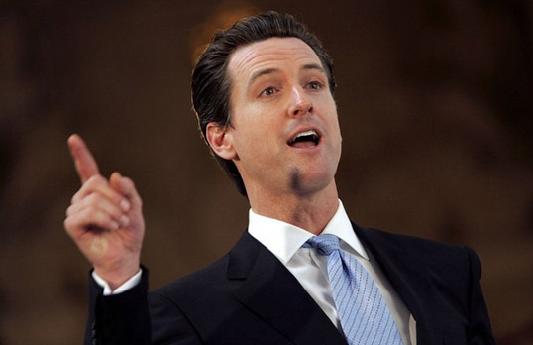
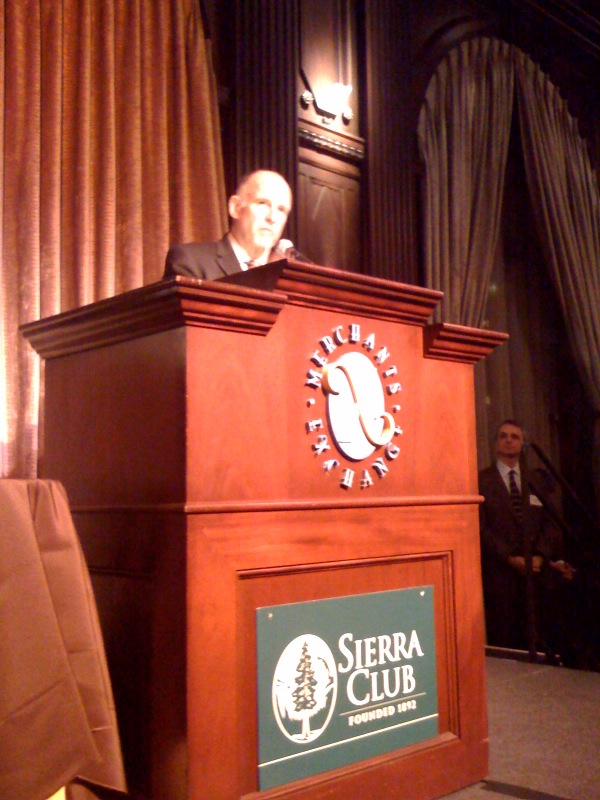
But in all the speeches and public statements that Pelosi, Boxer, Attorney General Jerry Brown, Lt. Gov. candidates Janice Hahn and Gavin Newsom, party chair John Burton, and others delivered at the state party convention, there was nary a mention of the fundamental importance of voting no on 16 and 17. None of the people who are capable of raising millions of dollars, the sort of money needed to defeat these measures, is making much of an effort to do it.

Props. 16 and 17 can be defeated. All it takes is a massive campaign to educate voters in a low turnout election about what these two measures actually are. But if the state’s political leaders allow these two measures to pass, California in 2010 will go down in history as the most corrupt and ungovernable state in America. And it’s very close to happening.

Newsom didn’t win in Los Angeles

5

I usually go to the California state Democratic Conventions, but I missed this one, so I’ve had to rely on news coverage to find out what happened — and it’s been pretty slim pickins. To read the Chron’s politics blog, you’d think the whole thing was silliness and parties, although Carla Marinucci got a fun comment from party Chair John Burton, who thinks the only thing that will drive the youth vote in November is pot.


But the news for people following the fate Gavin Newsom is that our mayor didn’t get the party’s endorsement for lieutenant governor. Matier and Ross spin it as a sorta, kinda victory:


Mayor Gavin Newsom didn’t get the state Democratic Party endorsement in his race for lieutenant governor, but he got the next best thing: keeping rival L.A. City Councilwoman Janice Hahn from getting it.


And technically, that’s true — Hahn ran hard for the endorsement, and really needed a boost, since she’s far behind in name recognition and money. But it was hardly a resounding win for the front-runner.


Newsom got 52 percent of the vote, short of the 60 percent needed for an endorsement. His campaign says, correctly, that he whupped Hahn, who got 42 percent.


But what’s remarkable is that Newsom had the support of all the party bigwigs — Nancy Pelosi, Dianne Feinstein, Burton — the folks who can usually pull strings and make sure that their candidate gets the nod. The truth is, Hahn never had a chance here; there was absolutely no way the L.A. council member was going to get enough votes to win the endorsement. Her only real play was to block Newsom — and she pulled it off.


So I wouldn’t call this a win for Newsom; I’d say it’s a sign that the grassroots Democrats are not entirely sold on the San Francisco mayor.

Sit/lie debate takes a strange new turn

Emails are rocketing around San Francisco political circles in anticipation of an April 21 meeting of the Democratic County Central Committee (DCCC), the policy-making body for the Democratic Party in San Francisco. Committee members are slated to discuss the city’s proposed sit/lie ordinance, a controversial measure backed by Mayor Gavin Newsom and Police Chief George Gascon meant to afford police more powers for dealing with hostile youth occupying sidewalk space.

Labor activist Gabriel Haaland, a DCCC committee member, touched off a small firestorm early this week when he submitted a resolution against the sit/lie ordinance. Haaland, who has lived in the Haight for around 15 years, said wayward youth have been flocking to that neighborhood and hurling occasional barbs at passersby (including himself) since he can remember, and recent interest in the issue does not make it a new problem. “What would actually solve the problem?” Haaland asked, and offered that sit/lie is not the answer. According to a post on Fog City Journal, his resolution for the Democratic Party to oppose sit/lie was co-sponsored by Assemblymember Tom Ammiano, Supervisor David Campos, Supervisor Chris Daly, Supervisor Eric Mar, Aaron Peskin, Hene Kelly, Rafael Mandelman, Michael Goldstein, Joe Julian, Jane Morrison, Jake McGoldrick, Michael Bornstein, and Debra Walker.

While some might look at a grungy street kid and see a menace to smooth business functioning or an unruly vagrant not being properly dealt with because the laws are too weak, Haaland said he perceives a kid from a broken home who already feels alienated from society. Incarceration for a nonviolent crime such as lying on the sidewalk would only further alienate these youths, he argued, possibly nudging them toward criminal behavior instead.

“This legislation will not solve longstanding, complex problems,” Haaland’s resolution reads. “City Hall has openly and repeatedly admitted in the press that the criminal justice system is failing to deal with similar issues in the Tenderloin, and has created an alternative known as the Community Justice Court (CJC) that is founded on principles of Restorative Justice.”

Restorative Justice is an alternative approach to dealing with crime that involves bringing together those who are directly affected to understand and address the harm that has been done, with emphasis on personal accountability and transformation. Some models also seek to change the conditions in which harmful actions occurred.

Haaland’s resolution urges the Board of Supervisors and the Mayor to oppose sit/lie, and to explore successful alternatives to incarceration.

The proposal sparked a second resolution, this one from committee member Scott Wiener, who is a candidate for the District 8 seat on the Board of Supervisors. Wiener submitted that the Democratic Party should officially get behind the CJC, and should acknowledge its error in opposing the court, a Newsom pet project, in 2008. “When I saw Gabriel’s resolution … I noticed it contained a positive reference to the [CJC],” Wiener told the Guardian. “I was pleasantly surprised.”

Furthermore, his resolution “encourages the Mayor and Board of Supervisors, budget permitting and based on careful analysis, to consider future expansion of the CJC’s geographic boundaries to include the Haight-Ashbury.”

Wiener is fully behind the sit/lie ordinance. “Right now, the police do not have enough enforcement tools to deal with some of the behavior on the streets,” he said. The measure has been an issue in the District 8 race, since progressive candidate Rafael Mandelman opposes the ordinance.

The resolution contest wasn’t over yet. In response to resolution No. 2, Haaland submitted yet another resolution — along with a personal note that appeared to extend an olive branch — revising Wiener’s proposal by urging support for “the restorative justice model as an alternative to incarceration.” (Haaland wrote an in-depth piece about restorative justice in a recent Guardian editorial.)

“I appreciated him doing that,” Wiener said when asked what he thought about resolution No. 3. “But I’m not convinced that that’s the way to go. That’s why I did not agree to it.”

Perhaps there won’t be any kum-ba-ya moments after all.

Along other email-blast circuits, Haaland’s initial proposal prompted David Villa-Lobos, a strong sit/lie advocate and District-6 contender, to sound his own alarm by urging SFPD officers to attend the April 21 meeting and defend the sit/lie ordinance.

The city Planning Commission recently voted 6-1 against the measure, and a grassroots group that brought opponents of the rule onto city sidewalks last month will hold another Stand Against Sit Lie citywide protest on April 24. The measure is expected to go before the Board of Supervisors near the end of the month.

The DCCC meeting will be held on Wednesday, April 21, at 6 p.m. in the basement auditorium of the California State Building, 455 Golden Gate Ave.

Andy Stern to quit SEIU

3

Just days after a San Francisco trial aired the ugly battle between Service Employees International Union President Andy Stern and some of his former top aides in the Bay Area, Stern has confirmed that he’s resigning after 38 years in the movement, 14 as head of SEIU.

Stern was once thought of as a rising figure in the progressive movement, but in recent years he has become a polarizing figure within the labor movement, prone to undemocratic power-building and starting fights with other unions. He was criticized as too close to corporations and the Democratic Party, but he doesn’t endear himself to either in an exit interview with the Huffington Post.

The fight between SEIU and the National Union of Healthcare Workers has created bad feelings on both sides, as indicated by the comments section every time we write about it, and I can’t help but think that Stern’s decision can only help the labor movement. But I suppose we’ll see.

BTW, there’s more on the SEIU-NUHW fight here at Spot.us, which we partnered with on this week’s story.

Editor’s Notes

0

Tredmond@sfbg.com

A couple of weeks ago, political consultant David Latterman, who often works with downtown interests, sent off an e-mail warning that the pro big-business, moderate bloc needed to get its act together. "It appears as if different groups are unwilling to set aside their egos or agendas, and pool together resources in a comprehensive plan to take back the [Democratic County Central Committee]," he wrote. "And guess what, we’re going to lose, in June and November."

His point: the DCCC matters, a lot. "The DCCC controls the supe endorsements that matter most," he noted, adding, "The mayor’s race starts now."

And that’s absolutely true — and unless the folks downtown are foolish or have given up (and neither is terribly likely) they’re going to get the message, and there’s going to be a big-money push in the next two months to oust the progressive majority on the county committee.

The DCCC controls the Democratic Party endorsements — and the party slate card is among the most influential political slates in a city where the vast majority of the population votes for Democrats. The DCCC could well make the difference in some of the key supervisorial races this fall — and could play a key role in choosing the next mayor of San Francisco.

But it’s not a high-profile election. More than half the votes will probably be absentees. That means it’s critical that the progressive candidates can raise money, do mailers, and fight back.

At this point, there’s a pretty good consensus on a progressive slate. We published our endorsements last week, and the Milk Club, Sierra Club, Tenants Union, and Assembly Member Tom Ammiano have endorsed most of the same candidates. In the fall, labor, environmental groups, tenants, and other progressive interests will be putting a lot of money into the races for district supervisor. But I could argue that the DCCC is just as important — and if we don’t fight this one to win, it’s going to be a lot harder in November.

Our Endorsements: For DCCC

10

The Democratic County Central Committee isn’t the most high-profile elected agency in San Francisco, but it’s really important. The committee sets policy for the local Democratic Party — and that includes endorsements. The people who control the committee control a slate card that goes out to every registered Democrat in the city, and that’s a vast majority of the voters. DCCC endorsements, carrying the imprimatur of the party, have a significant impact on local elections, particularly in district supervisor races.

For years, the DCCC was controlled largely by the old Brown-Burton machine, but two years ago, the progressives took back control, and that made a huge difference in electing good supervisors. The DCCC endorsement will also matter in the next mayor’s race.

The folks downtown realize this. David Latterman, a political consultant who often works with more moderate candidates and interest groups, sent a memo out March 17 titled “Headed toward the cliff in 2010 elections.” The memo, which we’ve obtained, argues that downtown and the moderates need to get organized, now: “If we can have one person run a coordinated effort with $150K … we can really pick up DCCC seats. Only a few will make a difference in the fall endorsements. The mayor’s race starts now.”

So it’s crucial that the progressives turn out to vote June 8, and vote for strong candidates for the DCCC who will support district elections, public power, tenant rights — and progressive candidates for supervisor.

We’ll be publishing endorsements for all of the June primary races and ballot measures in a few weeks, but we’ve decided to do early endorsements for the DCCC. Twelve people are elected from each assembly district. Here are our choices:


ASSEMBLY DISTRICT 12

John Avalos

Michael Borenstein

Sandra Lee Fewer

Chris Gembinski

Hene Kelly

Eric Mar

Milton Marks

Jake McGoldrick

Jane Morrison

Melanie Nutter

Connie O’Connor

Larry Yee


ASSEMBLY DISTRICT 13

David Campos

David Chiu

Michael Goldstein

Robert Haaland

Joseph Julian

Rafael Mandelman

Kim-Shree Maufas

Carole Migden

Aaron Peskin

Eric Quezada

Alix Rosenthal

Debra Walker


If we’re going to be whores, let’s at least get paid

2

The San Francisco City Planning Commission will be voting March 18th on a proposal to build luxury condos next to the Transamerica building. The developers are two out-of-town outfits that support Republican candidates. And therein lies an interesting tale.


Back in 1984, when dinosaurs roamed the Earth and newspapers made a lot of money and Dianne Feinstein was mayor, San Francisco was host to the Democratic National Convention, which nominated a guy named Walter Mondale (talk about dinosaurs) to run against Ronald Reagan for president. Running the convention, and all the parties and galas, cost a fair amount of cash, and Feinstein hit up all the big civic donor types to chip in.


One of the people atop her list was Walter Shorenstein, the local real-estate tycoon who was a huge donor to Democratic Party candidates (Bill Clinton used to stay at Shorenstein’s house when he was in town). Shorenstein was also trying to get permits to build some new highrises — and some of his buildings were so grossly out of proportion that even Feinstein’s Planning Commission, which loved all things big and highrise, was balking a little.


So Walter calls the mayor and says this: Don’t you dare ask me to donate to your Democratic Convention if your planners are going to jerk me around on my permits. And Feinstein, of course, made sure the Planning Commission backed down and Shorenstein got exactly what he wanted.


We did a big story, and even the Chronicle, which wasn’t big on criticizing Feinstein or Shorenstein, wrote about it, and there was all manner of outrage — as there should have been. It was terribly unseemly, and made the city look bad, and made Feinstein look like she could be pushed around by developers ….


And for all that, at least the special favors were going to a local guy who was donating money to Democrats and to the city’s convention efforts. Hideous as it was, as least San Francisco (and Feinstein, and Mondale) were getting something out of it.


Fast forward to today — when Gavin Newsom’s Planning Commission is considering an awful, out-of-scale project that even architecture magazines don’t like. And who benefits from the special favors? Not a local guy helping out with a local project, but an offshore corporation and a developer from L.A. who is on Meg Whitman’s Finance Committee.


I mean, if we’re going to be whores here in Democratic San Francisco, shouldn’t we at least get paid for it? 


Downtown’s DCCC slate fizzles

9

I’m actually a bit surprised that Gavin Newsom’s allies haven’t made a bigger push to take back control of the San Francisco Democratic Party, which will play a key role in the fall supervisorial races. It looked for a while as if the downtown folks were organizing to put a slate of strong candidates with solid name recognition on the ballot. But when the Department of Elections closed Friday afternoon, and the deadline for filing passed, there weren’t that many new names on the ballot. Here’s the list. (PDF).


Twelve candidates will get elected in each of the two San Francisco Assembly districts. On the east side of town, in AD 13, eight progressive incumbents, including Sups. David Campos and David Chiu, former Sup. (and current DCCC chair) Aaron Peskin are running. So is School Board member Kim-Shree Maufas and former state Sen. Carole Migden. Supervisorial candidates (and incuments ) Rafael Mandelman and Debra Walker are running, as are former supervisorial candidates Eric Quezada and Alix Rosenthal.


Not a lot of star power in the more moderate camp. Other than former Sup. (and incumbent) Leslie Katz and sup. candidate (and incumbent) Scott Wiener, it’s not a powerful crew. So the progressives look to do well — as they usually do — in D 13.


D-12 is a little more conservative in general — and there are lots and lots of candidates, meaning name recognition is even more important. I’d thought maybe somebody would talk Sup. Sean Elsbernd or Sup Carmen Chu into running. But no: the only elected officials on the list are progressives, including Sups. John Avalos and Eric Mar, School Board member Sandy Fewer, and Community College Board member Milton Marks. Then there’s incumbent (and former Sup.) Jake Mcgoldrick.


The moderate, pro-Newsom camp — the folks who would try to shift the Democratic Party endorsements away from progressives in swing supervisorial districts — may be large, but not terribly deep. Incumbents Tom Hsieh and Megan Levitan are, of course, running again, and there’s Bill Fazio, who once ran for district attorney.


Myra Kopp, wife of former state Sen. (and retired judge) Quentin Kopp, is a candidate, and while she may be a little more politically conservative than Avalos and Mar, she’s not going to be in the Newsom camp, either; she’s more of an independent wild card.


Paul Hogart agrees with me that the progressives seem well situated to keep control of the DCCC, although it’s never a sure thing: there are no contribution limits for these races, and since it’s a low-profile office, big money can make a big difference. Let’s see what downtown tries to do to buff up and promote its candidates in the next two months.


The Green Party’s nadir

2

This should be a great time for the Green Party. Its namesake color is being cited by every corporation and politician who wants to get in good with the environmentally-minded public; voters in San Francisco are more independent than ever; and progressives have been increasingly losing the hope they placed on President Barack Obama.
But the Green Party of San Francisco — which once had an influence on city politics that was disproportionate to its membership numbers — has hit a nadir. The number of Greens has steadily dwindled since its peak in 2003; the party closed its San Francisco office in November; and it has now lost almost all its marquee members.
Former mayoral candidate Matt Gonzalez, school board member Jane Kim, community college board member John Rizzo, and Planning Commissioner Christina Olague have all left the party in the last year or so. Sup. Ross Mirkarimi — a founding member of the Green Party of California and its last elected official in San Francisco — has also been openly struggling with whether to remain with an organization that doesn’t have much to offer him anymore, particularly as he contemplates a bid for higher office.
While a growing progressive movement within the Democratic Party has encouraged some Greens to defect, particularly among those with political ambitions, that doesn’t seem to be the biggest factor. After all, the fastest growing political affiliation is “Decline to State” and San Francisco now has a higher percentage of these independent voters than any other California county: 29.3 percent, according to state figures.
Democratic Party registration in San Francisco stood at 56.7 percent in November, the second-highest percentage in the state after Alameda County, making this essentially a one-party town (at last count, there were 256,233 Democrats, 42,097 Republicans, and 8,776 Greens in SF). Although Republicans in San Francisco have always outnumbered Greens by about 4-1, the only elected San Francisco Republican in more than a decade was BART board member James Fang.
But Republicans could never have made a real bid for power in San Francisco, as Gonzalez did in his electrifying 2003 mayoral run, coming within 5 percentage points of beating Gavin Newsom, who outspent the insurgent campaign 6-1 and had almost the entire Democratic Party establishment behind him.
That race, and the failure of Democrats in Congress to avert the ill-fated invasion of Iraq, caused Green Party membership to swell, reaching its peak in San Francisco and statewide in November 2003. But it’s been a steady downward slide since then, locally and statewide.
So now, as the Green Party of California prepares to mark its 20th anniversary next month in Berkeley, it’s worth exploring what happened to the party and what it means for progressive people’s movements at a time when they seem to be needed more than ever. Mirkarimi was one of about 20 core progressive activists who founded the Green Party of California in 1990, laying the groundwork in the late 1980s when he spent almost two years studying the Green Party in Germany, which was an effective member of a coalition government there and something he thought the United States desperately needed.
“It was in direct response to the right-wing shift of the Democrats during the Reagan and Bush Sr. administrations. It was so obvious that there had been an evacuation of the left-of-center values and policies that needed attention. So the era was just crying out woefully for a third party,” Mirkarimi said of the Green Party of California and its feminist, antiwar, ecological, and social justice belief system.
But he and the other founding Greens have discovered how strongly the American legal, political, and economic structures maintain the two-party system (or what Mirkarimi called “one party with two conservative wings”), locking out rival parties through restrictive electoral laws, control of political debates, and campaign financing mechanisms.
“I’m still very impassioned about the idea of having a Green Party here in the United States and here in California and San Francisco, vibrantly so. But I’m concerned that the Green Party will follow a trend like all third parties, which have proven that this country is absolutely uninviting — and in fact unwelcoming — of third parties and multiparty democracy,” Mirkarimi said.
Unlike some Greens, Mirkarimi has always sought to build coalitions and make common cause with Democrats when there were opportunities to advance the progressive agenda, a lesson he learned in Germany.
When he worked on Ralph Nader’s 2000 presidential campaign — a race that solidified the view of Greens as “spoilers” in the minds of many Democrats — Mirkarimi was involved in high-level negotiations with Democratic nominee Al Gore’s campaign, trying to broker some kind of leftist partnership that would elect Gore while advancing the progressive movement.
“There was great effort to try to make that happen, but unfortunately, everyone defaulted to their own anxieties and insecurities,” Mirkarimi said. “It was uncharted territory. It had never happened before. Everyone who held responsibility had the prospect of promise, and frankly, everybody felt deflated that the conversation did not become actualized into something real between Democrats and Greens. It could have.”
Instead, George W. Bush was narrowly elected president and many Democrats blamed Nader and the Greens, unfairly or not. And Mirkarimi said the Greens never did the post-election soul-searching and retooling that they should have. Instead, they got caught up in local contests, such as the Gonzalez run for mayor — “that beautiful distraction” — a campaign Mirkarimi helped run before succeeding Gonzalez on the board a year later.
Today, as he considers running for mayor himself, Mirkarimi is weighing whether to leave the party he founded. “I’m in a purgatory. I believe in multiparty democracy,” Mirkarimi said. “Yet tactically speaking, I feel like if I’m earnest in my intent to run for higher office, as I’ve shared with Greens, I’m not so sure I can do so as a Green.”
That’s a remarkable statement — in effect, an acknowledgement that despite some success on the local level, the Green Party still can’t compete for bigger prizes, leaving its leaders with nowhere to go. Mirkarimi said he plans to announce his decision — about his party and political plans — soon.
Gonzalez left the Green Party in 2008, changing his registration to DTS when he decided to be the running mate of Nader in an independent presidential campaign. That move was partly necessitated by ballot access rules in some states. But Gonzalez also thought Nader needed to make an independent run and let the Green Party choose its own candidate, which ended up being former Congress member Cynthia McKinney.
“I expressly said to Nader that I would not run with him if he sought the Green Party nomination,” Gonzalez told us. “The question after the campaign was: is there a reason to go back to the Green Party?”
Gonzalez concluded that there wasn’t, that the Greens had ceased to be a viable political party and that it “lacks a certain discipline and maturity.” Among the reasons he cited for the party’s slide were infighting, inadequate party-building work, and the party’s failure to effectively counter criticisms of Nader’s 2000 and 2004 presidential campaigns.
“We were losing the public relations campaign of explaining what the hell happened,” he said.
Gonzalez was also critical of the decision by Mirkarimi and other Greens to endorse the Democratic Party presidential nominees in 2004 and 2008, saying it compromised the Greens’ critique of the two-party system. “It sort of brings that effort to an end.”
But Gonzalez credits the Green Party with invigorating San Francisco politics at an important time. “It was an articulation of an independence from the Democratic Party machine,” Gonzalez said of his decision to go from D to G in 2000, the year he was elected to the Board of Supervisors.
Anger at that machine and its unresponsiveness to progressive issues was running high at the time, and Gonzalez said the Green Party became one of the “four corners of the San Francisco left,” along with the San Francisco Tenants Union, the Harvey Milk LGBT Democratic Club, and the San Francisco Bicycle Coalition, which helped set a progressive agenda for the city.
“Those groups helped articulate what issues were important,” Gonzalez said, citing economic, environmental, electoral reform, and social justice issues as examples. “So you saw the rise of candidates who began to articulate our platform.” But the success of the progressive movement in San Francisco also sowed the seeds for the Green Party’s downfall, particularly after progressive Democrats Chris Daly, Tom Ammiano, and Aaron Peskin waged ideological battles with Mayor Gavin Newsom and other so-called “moderate Democrats” last year taking control of the San Francisco Democratic Party County Central Committee.
“Historically, the San Francisco Democratic Party has been a political weapon for whoever was in power. But now, it’s actually a democratic party. And it’s gotten progressive as well,” Peskin, the party chair, told us. “And for a lot of Greens, that’s attractive.”
The opportunity to take part in that intra-party fight was a draw for Rizzo and Kim, both elected office-holders with further political ambitions who recently switched from Green to Democrat.
“I am really concerned about the Democratic Party,” Rizzo, a Green since 1992, told us. “I’ve been working in politics to try to influence things from the outside. Now I’m going to try to influence it from the inside.”
Rizzo said he’s frustrated by the inability of Obama and Congressional Democrats to capitalize on their 2008 electoral gains and he’s worried about the long-term implications of that failure. “What’s going on in Washington is really counterproductive for the Democrats. These people [young, progressive voters] aren’t going to want to vote again.”
Rizzo and Kim both endorsed Obama and both say there needs to be more progressive movement-building to get him back on track with the hopes he offered during his campaign.
“I think it’s important for progressives in San Francisco to try to move the Democratic Party back to the left,” Kim, who is considering running for the District 6 seat on the Board of Supervisors, told us. “I’ve actually been leaning toward doing this for a while.”
Kim was a Democrat who changed her registration to Green in 2004, encouraged to do so by Gonzalez. “For me, joining the Green Party was important because I really believed in third-party politics and I hope we can get beyond the two-party system,” Kim said, noting the dim hopes for that change was also a factor in her decision to switch back.
Another Green protégé of Gonzalez was Olague, whom he appointed to the Planning Commission. Olague said she was frustrated by Green Party infighting and the party’s inability to present any real political alternative.
“We had some strong things happening locally, but I didn’t see any action on the state or national level,” Olague said. “They have integrity and they work hard, but is that enough to stay in a party that doesn’t seem to be going anywhere?”
But many loyal Greens dispute the assertion that their party is on the rocks. “I think the party is going pretty well. It’s always an uphill battle building an alternative party,” said Erika McDonald, spokesperson for the Green Party of San Francisco, noting that the party plans to put the money it saved on its former Howard Street headquarters space into more organizing and outreach. “The biggest problem is money.”
Green Party activist Eric Brooks agrees. “We held onto that office for year and year and didn’t spend the money on party building, like we should have done a long time ago,” he said. “That’s the plan now, to do some crucial party organizing.”
Mirkarimi recalls the early party-building days when he and other “Ironing Board Cowboys” would canvas the city on Muni with voter registration forms and ironing boards to recruit new members, activities that fell away as the party achieved electoral successes and got involved with policy work.
“It distracted us from the basics,” Mirkarimi said. Now the Green Party has to again show that it’s capable of that kind of field work in support of a broad array of campaigns and candidates: “If I want to grow, there has to be a companion strategy that will lift all boats. All of those who have left the Green Party say they still support its values and wish it future success. And the feeling is mostly mutual, although some Greens grumble about how their party is now being hurt by the departure of its biggest names.
“I don’t begrudge an ambitious politician leaving the Green Party,” said Dave Snyder, a member of the Golden Gate Bridge, Highway, and Transportation District Board of Directors, and one of the few remaining Greens in local government.
But Snyder said he won’t abandon the Green Party, which he said best represents his political values. “To join a party means you subscribe to its ideals. But you can’t separate its ideals from its actions. Based on its actions, there’s no way I could be a member of the Democratic Party,” Snyder said.
Current Greens say many of President Obama’s actions — particularly his support for Wall Street, a health reform effort that leaves insurance companies in control, and the escalation of the war in Afghanistan — vindicate their position and illustrate why the Green Party is still relevant.
“The disillusionment with Obama is a very good opportunity for us,” McDonald said, voicing hope they Green can begin to capture more DTS voters and perhaps even a few Democrats. And Brooks said, “The Obama wake-up call should tell Greens that they should stick with the party.”
Snyder also said now is the time for Greens to more assertively make the case for progressive organizing: “The Democrats can’t live up to the hopes that people put on them.”
Even Peskin agrees that Obama’s candidacy was one of several factors that hurt the Green Party. “The liberal to progressive support for the Obama presidency deflated the Greens locally and beyond. In terms of organizing, they didn’t have the organizational support and a handful of folks alienated newcomers.”
In fact, when Mirkarmi and the other Green pioneers were trying to get the party qualified as a legal political party in California — no small task — Democratic Party leaders acted as if the Greens were the end of the world, or at least the end of Democratic control of the state Legislature and the California Congressional delegation. They went to great lengths to block the young party’s efforts.
It turns out that the Greens haven’t harmed the Democrats much at all; Democrats have even larger majorities at every legislative level today.
What has happened is that the Obama campaign, and the progressive inroads into the local party, have made the Greens less relevant. In a sense, it’s a reflection of exactly what Green leaders said years ago: if the Democrats were more progressive, there would be less need for a third party.
But Mirkarimi and other Greens who endorsed Obama see this moment differently, and they don’t share the hope that people disappointed with Obama are going to naturally gravitate toward the Greens. Rizzo and Kim fear these voters, deprived of the hope they once had, will instead just check out of politics. “They need to reorganize for a new time and new reality,” Rizzo said of the Greens.
Part of that new reality involves working with candidates like Obama and trying to pull them to the left through grassroots organizing. Mirkarimi stands by his decision to endorse Obama, for which the Green Party disinvited him to speak at its annual national convention, even though he was one of his party’s founders and top elected officials.
“After a while, we have to take responsibility to try to green the Democrats instead of just throwing barbs at them,” Mirkarimi said. “Our critique of Obama now would be much more effective if we had supported him.”
Yet that’s a claim of some dispute within the Green Party, a party that has often torn itself apart with differences over strategy and ideology, as it did in 2006 when many party activists vocally opposed the gubernatorial campaign of former Socialist Peter Camejo. And old comrades Mirkarimi and Gonzalez still don’t agree on the best Obama strategy, even in retrospect.
But they and other former Greens remain hopeful that the country can expand its political dialogue, and they say they are committed to continuing to work toward that goal. “I think there will be some new third party effort that emerges,” Gonzalez said. “It can’t be enough to not be President Bush. People want to see the implementation of a larger vision.”

Safe at last?

0

Dick Meister, former labor editor of the SF Chronicle and KQED-TV Newsroom, has covered labor and politics for a half-century. Contact him through his website, www.dickmeister.com, which includes more than 250 of his recent columns.

It’s called musculoskeletal disorder or MSD, the most common of the serious injuries suffered by U.S. workers. But because corporate employers fear that greater public awareness would force them to spend more on job safety, MSD has remained one of the least understood of injuries.

The latest government figures show that more than 60 percent of the million or more on-the-job injuries reported annually are MSD-related. Some of the victims are permanently disabled, and many more have to take time off from work while their injuries heal.

The victims include computer operators, factory and construction workers, meat and poultry processors, hospital and restaurant employees, supermarket clerks and many others.  They suffer serious neck, shoulder and back problems, chronically sore arms and wrists and other repetitive motion injuries resulting from work that requires them to be in almost constant motion, bending, reaching, typing, or frequently lifting heavy objects.

The first serious government efforts to combat the rapidly growing problem of MSD came ten years ago, in the final days of the Clinton administration. The Occupational Safety and Health Administration (OSHA) issued a lengthy set of so-called ergonomic regulations that were designed to lessen the dangers of MSD.

The regulations, which had taken three years to draft, covered such things as how long and how many breaks workers in particular occupations should get, what protective equipment should be issued to them, how their work stations should be designed and hundreds of related matters.

That was way too much for the U.S. Chamber of Commerce and other corporate employer representatives. They got their Republican allies, who controlled Congress, to repeal OSHA’s regulations just before the decidedly anti-labor George W. Bush succeeded Clinton.

Certainly neither Bush nor his OSHA appointees would even consider such impingements on their corporate friends. Signing the legislation that repealed the ergonomic regulations was one of Bush’s first acts as president. He followed that quickly by revoking 19 previously approved grants that were to go to unions, universities and labor-management groups to finance safety and health training programs for small business employers and particularly vulnerable groups such as construction workers and immigrants.

Bush’s OSHA appointees, many of them former executives of the industries they were supposed to regulate, blocked, withdrew or weakened dozens of other safety regulations in addition to those covering MSD. They discontinued safety education and training programs, worked with Congress to cut their own barely adequate budgets and instead of enforcing the safety laws, stressed  “voluntary compliance” by employers.

But now comes Barack Obama and his labor and Democratic Party allies to resume the fight for the ergonomic regulations President Clinton had been forced to abandon.

The initial proposals of President Obama’s OSHA appointees are modest. They’re asking merely that employers note, on the accident reports they are required to file, whether the injury was MSD-related. No such designation is currently required, which makes it difficult – if not impossible – for OSHA to collect the accurate data required to develop a program for effectively dealing with MSD, the most serious safety problem faced by American workers.

Corporate employers headed by the Chamber of Commerce oppose even that simple reform. They fear it would be a first step toward development of an ergonomic safety program that could cost employers millions of dollars to implement.

It also could bring badly needed protections to U.S. workers. But workers’ concerns are, of course, of secondary interest to the Chamber of Commerce and its Republican friends. They’re not much interested in helping working people. Their role is to further the profit-seeking of employers, even if that should come at the expense of the men and women who do the nation’s work.

Dick Meister, former labor editor of the SF Chronicle and KQED-TV Newsroom, has covered labor and politics for a half-century. Contact him through his website, www.dickmeister.com, which includes more than 250 of his recent columns.

Jerry Brown and the Rose Bird factor

16

Jerry Brown hadn’t even formally announced that he was running for governor when the San Francisco Chronicle brought up the name of Rose Bird.


It’s fine to talk about where Brown is vulnerable, and there’s no shortage of material. The guy has a long public record; anyone who served two terms as governor in the 1970s and early 1980s, and two terms as mayor of Oakland, and one term as chair of the state Democratic Party, and did a couple of years as a KPFA talk show host, is going to have baggage. He’s also got a wealth of experience.


But the Rose Bird stuff is a cheap shot.


Here’s how the Chron describes it:


Rose Bird: As governor, Brown appointed Bird to be chief justice of the state Supreme Court. After she invalidated the death sentence of every case she reviewed, voters in 1986 made her and two others the first judges unseated from the court. To voters older than 45, Bird’s name is shorthand for “liberal judges.”


Actually, voters ousted her after a savage campaign funded by big business interests who were mad at her pro-labor and pro-free speech rulings. The death penalty was their weapon, and even then it was pretty bogus: The Bird Court consistently upheld the constitutionality of the death penalty.


But in the early 1980s, death-penalty law was unsettled in the United States; the U.S. Supreme Court had in 1977 ruled that executions were legal in America, but set strict standards for states to follow. Most states were struggling to sort out what the ruling meant and to figure out how to comply. By 1986, when Bird was under assault, 38 states had adopted death-penalty laws, but only 13 had actually executed anyone. In conservative states like Arkansas, Kentucky, Mississippi and Tennessee, judges were trying to determine if the laws fit the Supreme Court’s standards — essentially what the Bird Court was doing in California.


And in California, the death-penalty statute had been written by John Briggs, the guy who wanted to keep gay people from teaching in the schools. The Briggs law was, by all accounts, poorly drafted, unclear and convoluted, and applying it under the federal standard was a challenge.


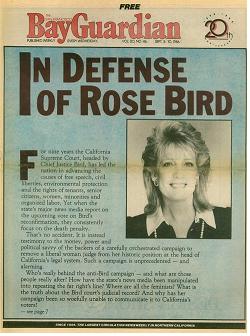
In other words, as we wrote at the time (In Defense of Rose Bird, Sept. 3, 1986):


The charge that the Bird court has refused to enforce the death penalty is simply inaccurate … the California Supreme Court has simply been doing what most state and federal courts have done over the past ten years: carefully scrutinizing death sentences to ensure that they are valid under the federal and state constitutions and complex and ever-changing standards of the U.S. Supreme Court.


The real issue didn’t make the press. Again, from our cover story at the time:


For nine years, the California Supreme Court, headed by Chief Justice Bird, has led the nation in advancing the causes of free speech, civil liberties, environmental protection and the rights of tenants, senior citizens, women, minorities and organized labor.


 Big-business interests organized and funded a massive campaign to get rid of Bird — not because of the death penalty but for purely economic reasons.


The Chronicle got it wrong back then, and is getting it wrong again today.

SEIU members oust the old guard

0

In a stunning repudiation of the union leadership installed by Service Employees International Union President Andy Stern – whose autocratic style, aggressive expansion, and friendly relationships with big employers has caused a rift in the national labor movement – members of SEIU Local 1021 have voted overwhelmingly for a reform slate of new leaders.

As we wrote recently, the stakes were high here in San Francisco, where the old guard leaders threatened to undermine the union’s progressive tendencies just as Mayor Gavin Newsom is threatening mass layoffs and pay cuts for city employees, and the San Francisco Labor Council’s ideological balance was being tipped by the pro-development push of the building trades.

But the results couldn’t have been more clear in the first local election since Stern installed the Local 1021 after merging 10 union locals together, including the former Local 790, which represents most city employees. Stern’s whole slate was voted out by a substantial margin, including current President Damita Davis-Howard, who had 1445 votes to the 2141 votes garnered by Sin Yee Poon, who now takes over the top spot after having led SF Human Services Agency workers.

Also pushed out was James Bryant, a political ally of Newsom and enabler of Pacific Gas & Electric and other downtown power brokers, who was defeated in his run for Political Action Committee Chair. Alysabeth Alexander, who is in her 20s, beat him by a vote of 2552-1506.

The vote will certainly strengthen the hand of progressives in San Francisco going into what’s expected to be a tough budget fight with Newsom, as well as helping progressive supervisorial candidates in the November election against what is expected to be a strong push by downtown to break the progressive majority on the Board of Supervisors.

In addition, it could roil SEIU’s internal politics after a turbulent year, in which Stern created divisive clashes with his own local health care workers (causing Sal Rosselli to create the rival National Union of Healthcare Workers), UNITE-HERE, and the California Nurses Association.


The press release from the winning reform slate follows: 

Reformers Sweep in SEIU 1021 Election; Members Vote for Transparency and Democracy for Northern California’s Largest Public Sector Union 

On Friday, thousands of public sector votes were counted to determine the future leadership of one of the largest unions in Northern California.  This is the first election for SEIU 1021, formed only three years ago after the merging of 10 locals.

The reform slate, Change 1021, swept the elections taking a clear majority of the executive leadership seats. This all-member slate easily defeated the former administration-appointees by the International SEIU.  Some candidates won by a 3 to 1 margin while others enjoyed a comfortable 2 to 1 lead on their opponents. See attached list of election results.

“We are excited about the opportunity to give the leadership of this Union back to the membership,” stated Karen Bishop, the San Francisco County Area Representative Elect.  Former San Francisco Board of Supervisors President and current Chair of the San Francisco Democratic Party  Aaron Peskin agreed, affirming, “It is very heartening to see that real democracy has prevailed.”

Change 1021 campaigned on a platform for reform, seeking a stronger union that would prioritize member representation at work sites; fiscal transparency; and an internal democratic structure. “Members spoke with their votes, sending a clear message about priorities,” said Roxanne Sanchez, President Elect.

The challenges for the new board are daunting-they must reunite and reinvigorate a membership hit hard by the economic downturn, with thousands to receive lay-off notices this week.  The Board Elect is ready to make the budget fight a priority to fight layoffs and preserve important public and non-profit services for our communities.

 “Our members have spoken, loudly and clearly, that business as usual is absolutely no longer tolerable and that a fundamental change in the focus of our union towards the needs and priorities of our members are in prompt order,” says Sin Yee Poon, Chief Elected Officer Elect. For now, there is cause for celebration as the congratulatory calls have been flooding across California from members, elected officials, labor leaders, and community partners.

Newly  elected members will assume office at the next Executive Board meeting, March 9th.   International Union leaders are expected to be in attendance.           

Change 1021 Candidates who were elected are: Chief Elected Officer, Sin Yee Poon; President, Roxanne Sanchez; First Vice President, Gary Jimenez; Second Vice President, Crawford Johnson; Third Vice President, Larry Bradshaw; Secretary, Pamela Morton; Treasurer, Kathy O’Neil; Political Action Comm. Chair, Alysabeth Alexander; Social & Economic Justice Comm. Chair, Gladys Gray; Capital Stewardship Comm. Chair, Harry Baker; Cities Industry Chair, Renita Terry; Counties Industry Chair, Ken Tam; Special Districts Industry Chair, Saul Almanza; Schools Industry Chair, Mynette Theard; Sacramento County Rep, Ken Bloomberg; Registered Nurses Industry Chair, David Fleming; City & County of SF Industry Chair, Kathy Basconcillo; San Francisco Area Reps- Karen Bishop, David Turner, Jacqueline Sowers; Alameda County Area Reps,- Amy Dooha, Eric Stern, Gregory Correa; Sonoma County Area Rep, Nancy Atwell; Budget & Finance Comm Region 3, Michael Tong; and Budget & Finance Comm. Region 4, Mary Jane Logan.

The battle for the forgotten district

24

sarah@sfbg.com

This November, when voters in District 10 — the largest, sunniest, and most diverse of the city’s 11 supervisorial districts — replace termed out Sup. Sophie Maxwell, they’ll be making a selection that could have pivotal implications for the entire city.

That’s because the next supervisor from southeast San Francisco inherits a district that is home to some of the city’s biggest environmental and public health challenges, as well as the most potential for development that will determine what kind of city San Francisco becomes.

District 10 is where you’ll find the most polluted and most underdeveloped lands in San Francisco, areas that could either be transformed into models of a sustainability or, in the words of Tony Kelly, the president of Potrero Boosters Neighborhood Association, “be turned into a toxic Foster City.”

District 10 is where the slaughterhouses, tanneries, and glue factories set up shop and used the bay as a dumping ground. It’s where the smokestacks of coal and oil fired power plants polluted the air. It’s where the Navy filled the Bay, built a shipyard at Hunters Point and loaded parts of the first atomic bomb onto the USS Indianapolis in 1945.

District 10 is where the bottom fell out of this industrial economy in 1974, when the Navy left, taking with it people’s jobs, pay, and hopes for a home of their own and a better future, particularly for what was then a predominantly African American population.

And District 10 is ground zero for plans that will triple the population and double the number of homes — homes that likely will only be “affordable” to Google executives and retirees from Marin, forever changing the face of San Francisco’s southeast sector. Critics fear that will accelerate what has been a steady exodus of black residents, replaced by megadeveloper Lennar’s vision for a new D10.

It’s against this dark history and difficult present that a wide open field of more than a dozen candidates are vying to replace Maxwell, who came to power in 2000 and has had a mixed voting record in her decade on the board. Sometimes, Maxwell was the eighth vote that let the progressive majority on the Board override Mayor Gavin Newsom’s veto and pass trailblazing legislation. Other times, she was the swing vote that allowed the moderate minority to carry Newsom’s water.

So, in addition to D10’s many internal challenges, this seat could determine the political balance of power on the Board of Supervisors, placing all the more importance on voters in this long-marginalized part of town.


DISTRICT OF DISCONTENT

Eric Smith, a biodiesel activist who has thrown his hat in the D10 ring, says that there is a lot of frustration in the air, and looking at the problems the district is facing, it’s hardly surprising that it has what nearly every candidate agrees is a fractured political culture.

“The Bayview, the Hunters Point Shipyard’s toxic Superfund site, the homicide rate, unemployment, poor public transportation, dwindling services and community resources have made D10 one of the city’s largest melting pots of discontent,” Smith said.

Smith’s words were spoken while the Elections Department was verifying signatures earlier this month on a second failed effort to qualify a petition to recall Maxwell.

Bayview resident and D10 candidate Marie Franklin didn’t support the attempt to recall Maxwell, but she understood it as “a frustration movement.”

“People are sinking in the sand, we’ve already lost so many of them, and they felt Sophie wasn’t doing anything for them,” said Franklin, who praised Maxwell for helping get Franklin’s apartment building complex renovated — a job that was completed 18 months ago, at a cost of $65 million, creating 500 local jobs.

“There are 654 units here, and they were uninhabitable,” Franklin said. “There was black mold, rain falling inside. We had people living worse than Haiti.”

Franklin, who said she is running because she “knows the history,” came here in 1978, when she and her son were living in a car after a fire left them homeless. She said the Bayview was a totally isolated area, barely part of mainstream San Francisco.

“There were no taxis, no services,” she recalled. “Nobody would come here, it was the stigmatized area where no one was accountable to provide services.”

The Bayview — which in some ways is the heart of D-!0 — wasn’t always a black community. But African Americans have been living here for 70 years, dealing with all the racism, denial of services, poverty, and pollution. And it bothers Franklin that 85 percent of the 10,500 homes that Lennar plans to develop won’t be affordable to the elderly, disabled, unemployed and low-income people who currently live in the Bayview.

“We need to preserve the diversity of the community and make sure their issues and information will flow to City Hall,” she said. “You must give the people a handle. If you don’t reach out, they’ll slip. That’s why folks out migrated.

Whoever succeeds Maxwell will be a central player in addressing some very big and dirty issues: the future of the Navy’s radiologically impacted shipyard at Hunters Point, Lennar’s massive redevelopment plan for the Shipyard and Candlestick Point, the polluting power plants, replacement of stinky digesters at the sewage plant, and the SF Hope public lousing rebuild.

There’s also the chance to address violence and crime. James Calloway, a candidate who has long worked in Bay Area schools, told us he believes that education and jobs are part of the keys to rejuvenating the district.

“Job opportunities are not as plentiful in the district,” Calloway said. “When I was a kid, you could walk down Third Street at 2 a.m. Now I wouldn’t walk down it at 9 p.m., and I know the area.”

Calloway is hopeful that the massive redevelopment plan, if done correctly, could start the district’s comeback. “Not a lot of black folks stay here when they have extensive education,” he said. “But it’s not only them. Many were displaced by redevelopment and had no way to go back.”


ELECTION UP FOR GRABS

The largest of the city’s 11 electoral districts, D10 is a huge triangular piece of land in the city’s southeast sector that was used as an industrial dumping zone for decades. Today, the district runs from the Giants stadium at AT&T Park to the 49ers stadium at Candlestick Point and encompasses Mission Bay, Potrero Hill, Dogpatch, India Basin, Portola, Little Hollywood, and Visitacion Valley. It’s also crossed by two freeways that isolate it from the rest of the city, and is home to a large number of crumbling housing projects that are in the process of being rebuilt.

Candidate Ed Donaldson grew up in the projects until he was 10 years old, when the Redevelopment Agency kicked his family out in the 1970s. “We landed on our feet, but others weren’t so lucky,” said Donaldson, who works as a housing counseling director at the San Francisco Housing Development Corporation.

“There is a sense that the Bayview and Visitacion Valley have not been included within the San Francisco family,” Donaldson said. “There is a sense of being forgotten.”

In 2007, Donaldson co-founded the Osiris Coalition to tackle the city’s dormant Certificate of Preference program, in which the Redevelopment Agency issued a document to displaced residents and businesses in the 1960s promising that they could return.

He also tried to rescue some 700 foreclosed properties and recycle them as affordable housing stock. And now he is trying to prevent the city from bulldozing seven SF Hope projects without guaranteeing residents that they have right to remain.

In 2007, Mayor Gavin Newsom and Maxwell convened an African American Outmigration Task Force that didn’t get a public hearing about its findings until August 2008. The timing angered some, who questioned why the report’s findings and implications for urban planning weren’t released before June 2008, when the residents of San Francisco voted for the Lennar-led Proposition G, a proposal to build 10,000 market rate homes at one of San Francisco’s last remaining black communities, which Newsom and Maxwell endorsed.

The taskforce didn’t publish its recommendations until the end of 2009, allegedly because of insider squabbling. Meanwhile, gentrification was going on actively, and many blamed Newsom, and by extension Maxwell, for failing to do anything with the group’s findings as D10 residents continued to suffer from high rates of asthma, cancer, unemployment and an ongoing black exodus.

It wasn’t always this way. In the 1940s, the district’s black population exploded when migrants from the south and World War II veterans came to work at the Hunters Point Naval Shipyard. Some moved to Alice Griffith Public Housing complex, or Double Rock, which was built as military housing in 1962. Others relocated to the Bayview when the Redevelopment Agency took over the Fillmore/Western Addition in the ’60s and ’70s as part of a controversial urban renewal effort.

But when the Navy abandoned the shipyard in 1974, unemployment hit the black community hard. Today, hundreds of the city’s lowest income residents live in Alice Griffith’s crumbling units and endure sewage backups, no heat, cloudy drinking water and leaking ceilings, as they wait for the projects to be rebuilt.

“Generations have been trapped in the silo of public housing and cannot get out, because of lack of opportunity and education, so when we legislate, we need to take that into consideration,” said candidate Malia Cohen, whose grandfather came from Texas to work at the shipyard where he met her grandmother, whose family came from New Orleans.

“My grandfather’s father was a longshoreman. He worked with the infamous Leroy King [a commissioner at the city’s Redevelopment Agency] and he has fantastically vivid stories of racism,” said Cohen, who works for the Federal Reserve Bank of San Francisco, previously served on the executive staff of Mayor Gavin Newsom, and has already raised over $18,000 in the D10 race and qualified for public matching funds.

“My family came here to work hard, they lived on Navy road in the projects, and then they bought a house here. My parents were born here, and we were all public schooled,” Cohen recalled as she took me on a tour of D10 that ended up in Visitacion Valley, an increasingly Chinese-American neighborhood that reflects a district-wide trend.

Census data show that by 2000, Asians were the largest racial group in the district (30 percent), followed by blacks (29 percent), whites (26 percent), and Latinos (19 percent). By 2003, according to the California Urban Issues project, the trend continued. Asians were the largest racial group (32 percent), followed by blacks (27 percent), whites (21 percent) and Latinos (17 percent) of the population.

This means that D10 candidates will have to garner support from more than one ethnic group to win. Over a dozen candidates have already filed papers in the race, but so far there is no clear front-runner.

Also frustrating the prognosticators is that fact that D10 has had the lowest voter turnout in the city, so the winner will also depend on who goes to the polls.

D10 candidate Geoffrea Morris, who is the grand daughter of longtime Bayview activist Charlie Walker, has been knocking on doors and participating in voter registration drives.

“We need new blood,” Morris said

Getting elected will be a complicated equation. Although Bayview’s population was 50 percent African American at the time of the 2000 census, it didn’t turn out the vote. In the 2006 election, only 14,000 of the district’s 37,000 registered voters went to the ballot, and 50 percent were from whiter, richer, and more Asian neighborhoods.

“It’s very important to the future of the city that the ethnicity diversity of the board be maintained and that the African American community have representation,” former Board President and current Democratic Party chair Aaron Peskin told the Guardian.

Maxwell recently told the Guardian that she’s not ready to endorse any D10 candidates yet. “I’m waiting for people to have a better understanding of what this community is, what the common thread running through it is, and how to use rank choice voting,” she told us.

The only candidate who currently holds elected office is BART director Lynette Sweet, who had her answers down pat when we reached her by phone, and even used wording that was eerily similar to Maxwell’s words.

“D10 is a pretty diverse district, but there is only one common thread: the need for economic development,” Sweet told me. “That’s true in Potrero Hill, Portola, Dog Patch and the Bayview. It’s the same mantra: a lot of small businesses need help, and the only way to help them is through economic development. In Potrero Hill it’s about land use. In the Bayview, it’s about the shipyard and better transportation and truancies.”


THE COMMON THREAD

District 10 is ground zero for the Lennar’s $2.2 billion plan to develop 10,500 market rate condos at the Shipyard and Candlestick Point. The plan will allegedly create thousands of jobs and new parks, deliver on an historic community benefits agreement that labor groups claim is so “lawyered up” that the developer can’t renege on its promises.

The package is framed as the one and only way to revitalize the southeast’s formerly vibrant economic engine. Indeed, any time anyone tries to slow down the process—to take time to thoroughly read the draft EIR and see if it adequately addresses the impacts of this massive urban reengineering project — a chorus of “no delays” starts up, either from residents of the housing projects desperate to see their homes rebuilt, or the labor contractors who hope to get jobs.

“It’s as if the city is playing checkers, while Lennar is playing three-dimensional chess,” Eric Smith observed.

Lennar has stated that it will contribute $711 million to finance this massive project. The remainder will be leveraged by Mello-Roos bonds, state taxes based on the use and size of a property and intended to raise money for needed services, and tax increment financing, which creates funding for projects by borrowing against future property tax revenues.

The conceptual plan won Maxwell’s backing but environmental groups are critical of the draft EIR.

During DEIR hearing, environmentalists questioned the wisdom and the cost of filling the Bay to build a bridge over Yosemite Slough, and building condos on Candlestick Point state recreation area, the only open major open space in the district.

But the city’s Planning Department also has 20,000-30,000 units of housing in its pipeline. This means that if all these plans get approved in the next decade, they’d account for 80 percent of residential development citywide. And D10’s population could triple, further skewing the district’s already shifting demographics.

In other words, D10 as we know it could become nothing more than a historic relic in a few years, and the next supervisor will play a key role in deciding whether that happens. SFHDC’s Ed Donaldson warns that any supervisor who does not understand the complexity of the city’s largest district can expect a similar recall backlash in future.

“There is no one homogenous voice in the community,” Donaldson said. “The grass-roots organizing that brought about the recall effort was a result of a changing political structure in the area, but is not yet on par with other districts in town. We still allow our politics to be controlled from downtown.”

Fellow candidate Eric Smith warns that the issues—and politics—are complex.

“People were emotional, angry, and desperate because they feel no one listens to them,” Smith said. “That’s part of the problem here; they would rather have a supervisor go down swinging for them, rather than watch one seemingly side with Lennar, PG&E and the mayor on issues contrary to their interests. That’s the terrible irony and one of the biggest problems in District 10. Folks are so mad, they’re willing to do whatever it takes to make them feel they have a voice in the outcome, even if it’s potentially worse.”

Smith cited the sequence of events that culminated last year in the Navy dissolving the community-based shipyard Restoration Advisory Board (RAB), which for years has reviewed technical documents and commented on the Navy’s clean-up proposals. But in December, the Navy made its official decision to disband the RAB, citing dysfunctional behavior and off-topic discussions that got in the way.

“Some of the same folks who were frustrated by the process, tried to send a signal to the Navy that they weren’t being heard and for all their well-intentioned efforts got the RAB dissolved,” Smith said. “I truly feel for them, it’s absolutely heartbreaking, but at times, they can be their own worst enemy.”

One of the looming issues about the shipyard is that the land has been polluted and needs to be cleaned. The shipyard contains radioactive debris from ships towed to the shipyard, after a 90-foot wave washed over them during an atomic test gone awry. The Navy burned 610,000 gallons of radioactively contaminated ship fuel at the shipyard, and workers showered on the shipyard, raising concerns that radioactive materials got into the drains and sewers. And questions have been raised about radiological tests on animals at the yard.


LEAKS AND FLOODS

It’s not just the shipyard that’s toxic. Even the buildings that were constructed to house workers 50 years ago are a serious mess.

Realtor Diane Wesley Smith, who grew up in public housing projects, took me on a walking tour of Alice Griffith last week to see conditions that tenants will likely have to endure until at least 2014, if the city sticks to its plan to relocate people into a new replacement unit in the same geographical area, if not the exact same site.

What we found was pretty messed up.

“The water sometimes comes out brown and feels like sand. It’s been like that for a year,” one resident said.

“The water is cloudy, the bath tub isn’t working and the sink keeps stopping up,” said another.

A woman named Silvia showed us how the water from the tap in her elderly mother’s kitchen flows out cloudy and then doesn’t settle properly, like foamy beer.

“The roof’s been leaking for years, the sewage backs up, but they just fixed the lights,” Silvia said. A neighbor named Linda was using her oven as a heater.

“The toilet backs up a lot, and my grandson’s been coughing a lot from asthma,” Linda said.

“Roaches is always a problem,” said a woman named Stormi, dressed in black sweats and a black T-shirt that read, “Can’t knock the hustle.”

“They’re trying,” said Stormi, a member of the Alice Griffith Residents Association, as a couple of Housing Authority trucks pulled up to do repairs.

“They promise that you will not have to leave your unit, but if they try to move us down to the waterfront, well, there’s a reason there’s no housing there, and it’s because the land will flood,” Stormi said.

“If we don’t end up at the table, we’ll end up on the menu,” Wesley Smith warned, as she stopped to chat with a group of young men, who were worried they would pushed out of the Alice Griffith rebuild through the criteria being established.

“Fred Blackwell, the executive director of the Redevelopment Agency, assures me that’s not the case, but Alice Griffith is a Housing Authority property, and empty promises have the potential to be great promises provided they are made in writing,” Wesley Smith said as we walked out of the projects and onto the road where a yellow and black sign announced “flooded” next to Candlestick Point park, where Lennar wants to build.

Malia Cohen expressed concern about Hope SF residents, as we drove through the Sunnydale housing project.

“We have to be diligent and mindful that people are not pushed out,” Cohen said, noting the sweeping views at Gleneagles golf course above Sunnydale, and the value of housing for a golf course community. “When public housing gets taken offline, we must work with Redevelopment and the Housing Authority to make sure no one is changing the rules halfway. We have to make sure the talks and walks line up. We need to be equal partners. We cannot be bulldozed by City Hall.”

Geoffrea Morris is a Calworks employee, at the Southeast Community College facility on Oakdale, which was built to mitigate the city’s expansion of the sewage plant in 1987. She cited concerns about the literacy levels of people who live in the 2200 public housing units that cluster D10. “A lot of people in Alice Griffith don’t even know the dates or when it’s going to be reconstructed,” Morris said. “Folks like to be told stuff like that, but the city gives you a stack of papers. Some will read them, but others rely on folks they think are trustworthy. They need stuff in layman’s terms written on one sheet of paper.”

Morris is a fan of the Internet who posted a community survey online, and made sure every housing project got some literature telling people to get informed. She worries about the digital divide in D10:

“A lot of folks don’t have computers and access to important information,” Morris said. “And let’s talk about the way ‘affordable’ is used to trick people.”

Michael Cohen, Newsom’s top economic adviser, recently stated in a memo that over the expected 15-20 year phased build out, Lennar’s Candlestick-Shipyard development would include, “up to 10,500 residential units, about 32 percent of which (3,345) will be offered at below market rates.”

“But 892 units of this ‘affordable category’ will be sold to folks earning $100,000,” Morris said. “So if you subtract 892 units from affordable unit category, you’re back to 25 percent affordable.”

Candidate Kristine Enea, an attorney and a former RAB member, chairs the India Basin Neighborhood Association, which administers a US EPA grant to hire experts to translate the Navy’s cleanup documents into plain English and comment on them She was frustrated by the Navy’s decision to dissolve the RAB.

“The lack of a forum does nothing to bolster the community’s trust in the cleanup or the redevelopment process,” Enea said.

Enea generally supports the Lennar project, but has concerns about whether it will adequately mitigate increased car traffic, or result in commercial development that benefits her neighborhood.

“India basin is a pocket of Hunters Point right along the shoreline,” Enea said. “Right now, we have no shops or restaurants, no ATM, no groceries, nothing beyond one liquor store and a few industrial businesses.

Potrero Boosters president Tony Kelly told us that District 10 residents can think for themselves. “D10 residents don’t need to rely on corporations to solve their problems,” he said.

“Folks in the eastern neighborhoods came up with a better revitalization plan than what the city proposed and community activists managed to close the power plant, after the city said it was impossible,” Kelly recalled.

And there’s no shortage of good ideas.

Kelly suggested that an urban agriculture center could immediately put low-skilled folks to work by erecting greenhouses on unused land. Smith said the industrial zone could be “incredible eco-park made from sustainable sources.

‘D 10 is the dumping ground for everything, including all the city’s waste,” he said. “We could be a shining example, not just for D 10, but the rest of the state.”

The D 10 candidate line up includes Calloway, Cohen, Donaldson, Smith, Enea: civil rights attorney Dewitt Lacy, Morris, Potrero View publisher Steve Moss; District 7 BART director Lynette Sweet, Wesley-Smith. Bill Barnes, who works for Sup. Michela Alioto-Pier, and Linda Richardson, who was appointed to the Human Rights Commission in 2007 by Mayor Newsom, have also expressed interest in the race.

In such a huge field, name identification will play a major role. Sweet is in office, but BART Board is not a high-profile job and won’t give her a huge advantage.

Cohen has a slight edge right now in that she’s raised $18,505, including $500 from former Newsom flak Peter Ragone, making her the first D. 10 candidate to qualify for campaign financing. The oldest of five girls, Cohen recalls how her mother got laid off from her city job as a school-based mental health worker and then rehired, as part of the city’s budget cuts.

“We felt that pinch and the frustrating games that are played out between the leadership and the rank and file,” she said.

Cohen who worked for Newsom in his first term as mayor, but has since left his administration , said she is uncomfortable at being framed as Newsom’s candidate.

“Because I’m not, but I am one of the few candidates who has seen how the mayor and the Board work—and don’t work—together,” she said.

Moss sees the city’s southeast as a “district in transition.” Over coffee at Farley’s in Potrero Hill, he told me that the southeastern neighborhoods could be “launching pads for environmentally sustainable growth.”

“The district’s been in a frozen period for 30 years, But despite the problems, people are deeply committed to and in love with their community.

“This district is the future of San Francisco and its social fabric—the diversity, income –and its problems are leftovers from the city’s industrial age.”


DISTRICT 10, BY THE NUMBERS

Total Acres: 5,650

Average household income: $85,000

Population: 73,000

Registered voters: 37,700

Average housing price: $335,000

Ethnicity (2003 figures): Asian 32%, African American, 27%, white 21%, Hispanic 17%

Development status of land: 18% residential, 38% is commercial, 38% undevelopable

All figures the latest available. Sources: SFGIS, Association of Bay Area Governments, U.S. Census, California Urban Issues Project. Ethnicity and income data is from 2003 and almost certainly has changed.


The attack on the SF left

20

If I were a political consultant hired by the San Francisco Chamber of Commerce and the big developers and the landlords and Mayor Newsom, and my job was to launch an effective attack on the progressive movement in the city and undermine progressive control of the Board of Supervisors, here’s what I’d do:


1. I’d attack district elections. See, every time the downtown folks have tried to run candidates in swing districts under the existing system, they’ve lost. That’s in part because the business types can’t seem to find decent candidates, and part because money doesn’t rule in districts, so progressives who can mobilize at the grassroots level have a better chance.


So when you can’t win the game you try to change the rules. You can’t do it too directly, because the polls show that people like having district supervisors, so I’d come up with a “hybrid” plan — say, seven districts and four at-large supervisors. Since anyone who runs at large in this city needs gobs of campaign cash, that would pretty much guarantee that four board members would be accountable to downtown. Then draw the districts to create two moderate-conservative seats, and the progressives have lost control.


I’d launch this by planting stories in the San Francisco Chronicle about a “growing movement” to change the way the supervisors are elected — even thought there is no real grassroots movement.


But that creates the appearance that’s needed to begin raising money and preparing for a ballot initiative. It’s not hard to get the Chron to bit on something like this; C.W. Nevius, the local columnist who lives in the East Bay suburbs, never liked district elections, so he’ll play along and the Chron’s corporate ownership, which is close to the Chamber folks, never liked the system either. You can expect an editorial from the Chronicle Feb. 28th calling for a partial repeal of district elections.


The argument won’t have anything to do with the fact that the Chron doesn’t like the policies this particular board has passed; it will be all about the need for a “citywide perspective.” Now, that’s just horseshit, since the district boards have done an immense amount of work on citywide issues (like mininum wage and health care) that the at-large boards would never do.


But “citywide perspective” is a term that’s been focus-group tested and sounds good.


2. I’d look for a nice wedge issue for the November elections — something that could be used against progressives in swing districts. When Newsom ran for mayor the first time, he used “care Not Cash” — a well-funded attack on homeless people.


And gee, guess what? There’s another nice anti-homeless measure that’s recently been floating around, and it comes from the media-savvy police chief, George Gascon. It’s called a “sit-lie” law — legislation that would criminize the act of sitting on the sidewalk. It’s got a lot of populist zing to is, particularly since Gascon is talking about the need to clean up Haight Street, where some ill-behaved young people have been bothering the merchants and shoppers.


A November ballot initiative on a sit-lie law would allow downtown to raise a lot of money — and attack people like Rafael Mandelman and Debra Walker, candidates for supervisor in districts where a simplistic attack on the homeless might play. 


3. I’d try to split the city’s labor movement and drive labor away from the progressives. The obvious tactic: Construction jobs. I’d get every construction trade union member to campaign in District 10 for a supervisor who will support Lennar Corp.’s redevelopment project, and I’d attack any supervisor or candidate who supports limits on, say, buildings that shadow the parks and call them anti-jobs.


4. I’d launch a quiet effort to raise a big chunk of money to push pro-downtown candidates for the Democratic County Central Committee. The DCCC used to be something of a political backwater, but under progressive control, it’s become a significant force in local elections. The DCCC controls the local Democratic Party endorsements and money — which can be a big factor in district supervisorial races.


Now: I have no evidence that any individual consultant has created any such plan — but it’s sure an interesting coincidence, isn’t it?


What I see right now is a coordinated, orchestrated attack on the left — and I’m getting a little nervous that our current leadership on the Board of Supervisors isn’t doing enough about it.


The war on suburbs? Huh?

10

Joel Kotkin, the author and urban scholar, was on KQED’s Forum this morning talking about what he called “the war on the suburbs.” He’s got a new book out, called The Next Hundred Million: America in 2050, and he’s arguing, among other things, that the election of Scott Brown in Massachusetts signals that the Democratic Party and progressives in America have lost touch with the suburbs and are being mean to the poor suburbanites.


He talked, for example, about Tracy, California, and noted that a suburbanite living in Tracy doesn’t want to pay taxes because he doesn’t see what he’s getting for his money. Kotkin sugggestes that the state ought to go back to the Pat Brown era, and focus on spending money on infrastructure, instead of on “state employee pensions.”


Never mind that when Pat Brown was governor, the population of California was less than half what it is today — and the state was far less diverse, had far fewer immigrants, far fewer residents whose primary language is not English and, frankly, was a lot more tolerant of poverty.


That was also before the passage of Prop. 13, so the state didn’t have to spend money on schools and local government; local property taxes covered those things.


In fact, I think what’s going on is just the opposite of what Kotkin is talking about. (He, by the way, says that suburbs are going to be more and more sustainable as more jobs relocate and we start using natural gas in our cars.) I realize that suburban voters can easily shift to the Republican party if the Democrats aren’t careful, but I also think that what’s happening in the United States today is not a war on suburbs but a war on cities.


The state and federal governments have systematically defunded urban America for more than 30 years now, and we’re paying the price. The hypothetical suburbanite in Tracy may think he’s not getting his money’s worth, but the truth is just the opposite; the suburbs — typically, not always but typically — have better-funded schools, better maintained streets, better sewage systems, less crime … and less of an income gap among residents.


Cities are, and will remain, America’s future, and we ignore that at our peril.  


Notes from the Sierra Club’s gala dinner

0

While I focused on Jerry Brown’s disappointing speech to the Sierra Club San Francisco Bay Chapter’s gala dinner on Wednesday night, there are a few more notable nuggets in my notebook worth posting here, starting with what appears to be the collapse of plans for a California Constitutional Convention.

The Guardian recently reported on the difficulties that the campaign was having, but consultant Clint Reilly told me that the effort is basically over, with fundraising shortfalls being the final nail in the coffin. That’s one more reason why “hope” seems to be in such short supply on the political landscape.

The event was held in the Merchant Exchange, a building owned by Reilly, who helped underwrite the gathering. So it was no surprise that the evening was MCed by his wife, Janet Reilly, who is running a strong campaign to replace Michela Alioto-Pier on the Board of Supervisors.

There were lots of political luminaries at the event (list to follow), but there was one particularly notable attendee and particularly notable absence. Los Angeles City Council member Janice Hahn was one of the few politicos from down south, making the rounds in support of her run for lieutenant governor. But Mayor Gavin Newsom, who is considering challenging her, didn’t show up.

Also a no-show was U.S. Sen. Barbara Boxer, who appeared by video to address the gathering and express appreciation for being the recipient of the Sierra Club’s first Phillip Burton Badge of Courage Award for environmental stewardship. Accepting the award on her behalf was California Democratic Party chair John Burton, who was his usual salty self, taking a dig at the San Francisco Chronicle by referring to someone who wrote “for the Chronicle back when that was a newspaper,” and describing the award’s namesake thusly: “My brother was an outstanding environmentalist who didn’t like the outdoors much.”

He also made this funny, self-effacing crack at the start of his speech: “I think a third of the people in this room would like to see the accelerator stuck on the rug of my Prius.” I was not among that third.

There was a strong turnout of local political leaders, but tellingly, only from the left side of the political spectrum. The members of the Board of Supervisors who turned out were David Chiu, Chris Daly, Ross Mirkarimi, Eric Mar, and John Avalos. Other political luminaries on hand included City Attorney Dennis Herrera, Sen. Leland Yee (Yee and Herrera are each running for mayor) City College trustee John Rizzo (who introduced Brown), Senator-turned-Oakland mayoral candidate Don Perata, District Attorney Kamala Harris, Rep. Jerry McNerney, and Sen. Loni Hancock.

Rambling Jerry Brown speech raises fear among Dems

22

If Jerry Brown’s keynote speech last night to a gala environmentalist dinner is any indication, the Democratic Party faces an uphill battle to win this year’s governor’s race. The rambling, alternately vague and academic, and often pointless address did little to inspire or excite a large, sympathetic crowd that was loaded with top Democrats. In fact, some party luminaries were openly aghast at the poor performance, with one making this succinct (if off-the-record) assessment: “We’re fucked.”

Brown has never been a dynamic speaker, but the unscripted, half-hour speech – given at the Sierra Club San Francisco Bay Chapter’s David Brower Dinner in San Francisco, a $250 per head affair that drew top Bay Area Democrats – illustrates the danger of letting a primary be decided by legend and money rather than political persuasion.

Brown’s fundraising prowess and strong poll numbers chased Gavin Newsom and other potential rivals out of the Democratic Party gubernatorial primary, even though Brown hasn’t really outlined his political vision for California, given many extended speeches since being discussed as a candidate for governor, or even officially declared his candidacy (he and others have until March 12 to do so).

“This thing is really daunting,” Brown said of the governor’s race toward the end of the speech, seemingly unsure that he was ready to run, but saying he would make an announcement sometime in the next couple weeks.

Brown started his speech by telling the crowd that he didn’t know what he was going to talk about, so when he arrived (late) for the speech, he asked San Francisco Democratic Party chair Aaron Peskin what he should say, and Peskin told him to talk about how there were more salmon in the streams and better overall environmental health back when Brown was governor in the ‘70s.

But rather than taking that advice and giving a forceful call to strengthen environmental regulation or conjure up California’s better days, Brown meandered around and mused on that and other topics, feeding fears that the 71-year-old candidate might come off as a nostalgic, slightly senile former-Governor Moonbeam rather than an effective agent of needed change.

“During that period when I was governor, I’m not going to call it the golden age because some people think I’m in the golden age, so I don’t want to get people confused. That’s why I don’t want to talk about way back then, because there are a number of people I can see weren’t even born then, so it gets a little embarrassing and I like to pretend it was just yesterday. But in that period, California created almost twice as many jobs as the nation did. We created jobs at about 24 percent over eight years and the nation grew jobs at 13 percent, so almost twice as much. And then Deukmejian did pretty good, he had about the same, maybe half a percent more,” Brown rambled, ticking off statistics, hedging his point by noting how little governors can really do to create jobs, before working up to a decent line that was flatly delivered: “It was a time when the environment got its biggest boost, as far as public policy.”

Nobody applauded, so he continued. “I was thinking tonight, I was trying to figure out that if I did announce, what the hell would I say? And so I decided to go back and read my first announcement, January 24, 1974. I was 35 then, it was another time, I’m now a little older than that. But I talked about clean air, I talked about the energy crisis and getting new sources of energy. I talked about statewide land use planning” – that last item drawing some applause – “and I talked about jobs. And I was thinking, wow, we still got a jobs problem, we got an energy problem, we have a land use problem that feeds into the energy problem, and while the air is cleaner in many respects, it’s not clean enough, or it isn’t healthy enough.”

On substance, Brown had his moments. But even on the need for better statewide land use planning, he went off on a tangent, saying he didn’t even know what that meant when he filled out a Sierra Club questionnaire back in the ‘70s, and he’s not sure how to accomplish it now. 

“You have to make it easier to live closer to where you work,” Brown said in what of his few lines of the night that drew applause, although he didn’t begin to explain how he might achieve this goal. And on a controversial subject that is easily attacked by the right – big government wants more control over private property – Brown’s lackadaisical discussion of the issue was disconcerting.

He even rankled a few Sierra Club members by vaguely criticizing East Bay growth controls designed to reduce sprawl, which the Attorney General’s Office is seeking to overturn: “Pleasanton wants to create 50,000 jobs, but they have a housing cap – for all I know, Sierra Club probably supported that housing cap, so I want to just rub your nose in the housing cap for just a minute – the trouble with the housing cap is they want to create all these jobs.”

Brown tried to argue that allowing more housing in Pleasanton is a strategy for combating global warming because there are jobs there and it would reduce commutes, but he’s going to need to be more on his game than he is right now to win that argument. Instead, we get his fairly dismissive summary of this important issue: “Land use is a big deal, it’s difficult, lots to do on that.”

Against businesswoman Meg Whitman, the Republican gubernatorial primary frontrunner, there is real potential in Brown’s basic belief that markets need to be regulated and that running the government isn’t just like running a business. And somehow, Brown will need to find a way to better distill and deliver that message to counter the right’s pro-business sound bites. 

“There are people saying business knows best,” Brown said, meandering off about companies and widgets for a minute before continuing his point. “But when you look at what we really have to deal with, it’s not just about economics and the market. It’s also about ecology and morality, and morality is about customs, it’s about traditions, it’s about our deepest patterns of how we all relate to one another and that can’t just be assimilated into market incentives. The market assumes honesty, you meet your promises, and also assumes there’s a framework, because things can just run off the cliff and that’s exactly what’s happening. As you add more people, you have more cars, and when you have more cars, they burn fossil fuel and what’s happening in California is you have cars reproducing faster than people…That’s the real challenge here, that we’re trying to get the idea out that we’re trying to save the future.”

The people vs. corporate power

2

steve@sfbg.com

The June 8 election is shaping up to be one that pits the people against powerful business interests, a contest that will demonstrate either that money still rules or that growing public opposition to corporate con-jobs has finally taken root.

On the state level, the five ballot measures include two brazen money-making schemes and two experiments in election reform, along with primary races that are still in flux. In San Francisco, where the ballot measures still have a few more weeks to shake out, the election will feature two rarely contested judges races, recession relief for renters, City Hall fiscal reforms, and a fight for control of the local Democratic Party.

So far, only four local measures have qualified for the San Francisco ballot, all placed there by members of the Board of Supervisors. Progressives qualified the Renters Economic Relief package (which limits rent increases during recessions and sets conditions for landlords passing costs to tenants), an initiative establishing community policing standards, and one affirming city support for making Transbay Terminal the northern high-speed rail terminus. Supervisors were unanimous in supporting a charter amendment governing the Film Commission.

But the board is still hashing out changes to the more controversial ballot proposals, a debate that will continue at its Feb. 23 meeting. They include an overhaul of how the city funds its pension program and an effort to remove Muni salary minimums from the city charter, both by Sup. Sean Elsbernd; a $652 million seismic safety bond proposed by Mayor Gavin Newsom; and a Sup. John Avalos charter amendment that would prevent the mayor from unilaterally defunding certain budget expenditures. All measures must be approved by March 5.

Also still forming up in the coming weeks are primary races for legislative seats (although no incumbents appear to be facing strong challenges) and all eight state constitutional offices, including governor (where Attorney General Jerry Brown seems poised to easily win the Democratic nomination), lieutenant governor, and attorney general (which District Attorney Kamala Harris is running for).

Candidates have until March 12 to declare themselves for statewide and legislative offices, as well as for the San Francisco Democratic County Central Committee, which could play a key role in this fall’s Board of Supervisors elections. Two years ago, a slate of progressives led by Aaron Peskin and Chris Daly launched a surprise attack to wrest control of the board away from the moderates who have long controlled it. Newsom, U.S. Sen. Dianne Feinstein, and their downtown allies are expected to try hard to regain control over their party’s purse-strings and endorsements.


JUDGING THE JUDGES

Another struggle from two years ago is also being replayed. In 2008, then-Sup. Gerardo Sandoval successfully challenged Superior Court Judge Thomas Mellon, arguing the Republican-appointed jurist was too conservative (and the entire court is not diverse enough) for San Francisco. This time the target is Judge Richard Ulmer, a conservative appointed by Gov. Arnold Schwarzenegger. Ulmer is being challenged by two LGBT attorneys, Daniel Dean and Michael Nava, the latter endorsed by Sen. Mark Leno, Assembly Member Tom Ammiano, and Peskin, who chairs the Democratic Party and could be helpful in the race. “He’s a brilliant guy,” Leno said of Nava.

Leno also has endorsed deputy public defender Linda Colfax, a Latina lesbian, in a four-way race to replace retiring Judge Wallace Douglass. The other candidates are Harry Dorfman, Roderick McLeod, and Robert Retana. If no candidate wins a majority of votes, the top two finishers square off in a runoff election in November.

Leno said he’s thrilled to see a diverse crowd of attorneys seeking judgeships: “This governor has failed horribly in his appointments, not only with the LGBT community, but with communities of color as well.”


TWO COMPANIES TRY TO BUY CALIF.

The struggle between the broad public interest and the wealthy power brokers that have long-dominated California politics is most apparent in the state propositions, which have been certified and for which ballot arguments are now being collected by the California Secretary of State’s Office.

Two of those ballot measures, Propositions 16 and 17, are blatantly self-serving efforts by a pair of powerful corporations to increase their profitability, however deceptively and with overwhelming amounts of campaign cash they are presented.

Prop. 16, sponsored by Pacific Gas & Electric Co., would require local governments to get two-thirds of voters to approve creation of energy programs like Clean Power SF, San Francisco’s plan for developing renewable energy projects and selling that power directly to citizens.

As we’ve reported (“Battle royale,” Jan. 13, and “PG&E attack mailer puts City Hall on defensive,” Dec. 22, 2009), PG&E placed the measure on the ballot to avoid having to repeatedly crush public power initiatives around the state with multimillion dollar campaigns, even though political leaders like Leno and Sup. Ross Mirkarimi say the measure violates the state’s community choice aggregation law. That law allows local governments to create energy programs and prohibits PG&E from interfering with those efforts.

“The unregulated behavior of corporate arrogance is killing our democracy. Prop. 17, sponsored by Mercury Insurance, would let companies increase car insurance premiums for a variety of reasons that are now prohibited by the 1988 measure Prop. 103. Mercury has continuously attacked that landmark law, using lawsuits, huge political contributions, sponsored legislation, and, according to newly released documents from the California Department of Insurance (see “The malevolence of Mercury Insurance,” Feb. 10, Guardian Politics blog), blatantly illegal activity in setting premiums and excluding certain customers, such as artists, bartenders, and members of the military.

“The Mercury initiative is even more pernicious than what it was doing before,” Harvey Rosenfield, who wrote Prop. 103 and works for Consumer Watchdog, told the Guardian. “Under Mercury’s initiative, if you’ve never had prior insurance, you can be surcharged for the first time. Then they’ve thrown in some other tricks and traps.”

Mercury spokesperson Coby King told us the company has been unfairly maligned and denies that the measure is simply about boosting its profits: “Prop. 103 is the law of the land, but to the extent there are improvements that can be made that are pro-business and pro-consumer, Mercury has not been shy about acting in the public interest.”

Yet few public interest groups or public officials believe the claims being made by Mercury or PG&E, and they hope that the public won’t be fooled.

“These are measures designed to give a financial advantage to a specific industry or company,” U.S. Rep. John Garamendi, who battled Mercury as California’s first insurance commissioner, told us. He strongly opposes both measures, but did say, “Money talks. It always has, particularly in propositions.”

Yet Leno said he’s a bit more hopeful: “Californians have been savvy in the past, and I do believe they’ll be able to see through the tens of millions of dollars in misleading ads.”

“To me, it’s a classic case study of what’s going on with the initiative process in California and with politics in general,” said Derek Cressman, western regional director of California Common Cause. “There are two initiatives literally sponsored by corporations to push very narrow interests.”

Yet Cressman said recent events could help. There’s been a big public outcry in recent weeks over the U.S. Supreme Court’s decision to allow unlimited corporate spending to influence elections, the role that insurance companies played in sinking federal health care reform efforts, and the way businesses interests are hindering efforts to deal with global warming.

“It makes people aware of the overwhelming role corporations are playing in dictating government policy,” Cressman said.


TAKE OUT THE MONEY

A pair of election reform measures might help lessen the influence of money and political parties. Prop. 14 is an open primaries measure that Sen. Abel Maldonado (R-Santa Maria) got placed on the ballot as a condition for breaking last year’s budget stalemate. It would create a single primary ballot and send the top two finishers to the general election, regardless of party.

Prop. 15, the California Fair Elections Act, takes direct aim at the corrupting influence of money in elections, creating a pilot public finance program in the secretary of state races for 2014 and 2018. The measure, which has broad support from politicians and good government groups in the Bay Area, is modeled on successful programs in Maine and Arizona.

“No elected official should be in the fundraising game the way they are now,” campaign chair Trent Lange told us. “This is a way to change how we fund elections.”

The idea is to create a model that will eventually be used for other offices. The campaign fund would be generated by a $350 annual fee on lobbyists, lobbying firms, and lobbyist employers. Currently lobbyists pay just $12.50 per year to register, which Lange said, “just shows the power of lobbyists in Sacramento.” *


Labor’s love lost

4

Note: This file has been corrected from an earlier version.

rebeccab@sfbg.com

Two recent events could have major implications for Service Employees International Union Local 1021 — San Francisco’s largest public-sector union and an important ally for progressives — for better or for worse. And this union’s fate seems closely tied to that of the progressive movement in San Francisco.

The first event was likened to a “nuclear bomb in the morning paper” by one observer, and might be interpreted as the kickoff to a fierce budget battle. Mayor Gavin Newsom announced that he is considering a plan to help solve next year’s budget deficit by laying off 10,000 full-time city workers and rehiring them at 37.5 hours, which would amount to a sweeping 6.25 percent pay cut for workers and an estimated $50 million in savings for a fiscally impaired city.

Though it was framed by Newsom spokesperson Tony Winnicker as one preliminary cost-saving option among many, the proposal received prominent front-page coverage in the San Francisco Chronicle, even before official discussions were called between the mayor and public sector unions. Since SEIU Local 1021 represents 17,000 members in San Francisco and a majority of the city’s 26,000 total employees, it would likely absorb the greatest impact if such a plan went through.

At the same time the mayor’s startling announcement hit newsstands, SEIU was in the midst of mailing out ballots to its membership for union elections. “I don’t know whether it’s a coincidence, or if the city is taking advantage of the fact that SEIU is absorbed in its elections,” Sin Yee Poon, an SEIU chapter president for Human Services Agency workers, told us while pointing out that the events happened simultaneously.

With three separate slates of candidates vying for control of SEIU Local 1021, grudges between warring internal factions have intensified into bitter sparring matches. The timing is unfortunate — just as SEIU’s internal turmoil is coming to a head, one of its greatest battles is pending over an unprecedented $522 million budget shortfall that looms like a dark cloud over the city. The deficit will surely result in job losses, and the public sector union’s ability to mount resistance even as it wrestles with internal strife is shaping up to be a key question.

This pivotal moment carries wider political implications considering that the progressive organization has in the past helped seal an alliance between San Francisco’s left-leaning leaders and organized labor through the San Francisco Labor Council.

With SEIU besieged by infighting and soon to be hurting from wage slashes and layoffs, more conservative factions of the labor community, such as the San Francisco Firefighters Union and the Building and Construction Trades Council, have recently been butting heads with progressive members of the Board of Supervisors.

At the same time, forces on all sides are beginning to eye the coveted seats up for election in June at the Democratic County Central Committee, a Democratic Party hub that is a cornerstone of local political influence, as well as the seats that will open up on the Board of Supervisors in November. Negotiations between unions and the mayor are ongoing, and mayoral spokesperson Tony Winnicker was quick to note that Newsom is open to options, other than reconfiguring 10,000 city jobs, that organized labor brings to the table. At the same time, the Guardian heard from numerous sources that city workers felt outraged and blindsided by Newsom’s decision to air the plan in the Chronicle instead of bringing stakeholders to the table.

SEIU Local 1021 President Damita Davis-Howard told us she thinks the idea of taking $50 million out of the pockets of working people in a rocky economy is wrong-headed.

“This was devastating,” said Davis-Howard, who is running for a newly created union position called chief elected officer, which is different from the union president, and similar to an executive-director post. “The mayor might as well have raised their taxes, because if you decrease their pay by 6.25 percent, they will still have the same amount of work, they will still have to pay the same mortgage, they will still have to buy the same food, the same PG&E, and they’ll be doing it with a lot less money. If any idea like this were to go through, it would actually remove the very fabric or fiber of San Francisco. It would really cut to the core of the very being of San Francisco. … I don’t see how anybody could believe that we could continue being the city that we love being with this kind of action.”

Winnicker, the mayoral spokesperson, cast it as a plan that could avert hundreds or even thousands of layoffs. “This year the easy decisions are behind us,” he noted in a recent discussion with the Guardian.

Solving last year’s fiscal shortfall was far from easy — budget tussles between frontline city workers and the mayor got ugly, and even then, the city received millions in federal stimulus dollars to cushion the blow. A similar plan of sweeping hourly cuts was floated then too, but it didn’t gain enough traction to move forward.

“The mayor is facing a huge budget deficit, there’s no question about it — but he has not lifted one finger to raise a dime in revenue,” charged SEIU member Ed Kinchley, who works at San Francisco General Hospital. As for how the union might respond if such a proposal went through, he speculated, “I think it’s the kind of thing that could lead to a strike. A big fight.”

While the city charter bars strikes by public employees, Kinchley’s comment indicates the level of frustration among SEIU’s rank-and-file.


The proposal could present a common enemy and a rallying point for a union in disarray. Internal jockeying for elected positions can be fierce in any organization, but for San Francisco’s service-workers union, the rifts are particularly deep.

The elections, which will be decided Feb. 28, mark the first time since a radical restructuring in 2007 that members will collectively decide who should lead. In 2007, the face of SEIU was changed across California when the international president, Andy Stern, began consolidating dozens of far-flung locals into centralized, beefier entities in a bid to maximize political effectiveness (California comprises roughly one-third of the entire union’s membership).

Local 1021 came into existence when 10 locals were conglomerated into one 54,000-member giant — hence the “10-to-one” label — representing health care and frontline service workers from the Bay Area to the Oregon border. 

In San Francisco, where a large segment of its members are based, the shift was interpreted by some as a power grab, and it triggered a period of ongoing strife between those allied with Stern and the international wing on one side, and those dissatisfied with changes they saw as antithetical to the democratic ideals championed by Local 790, its predecessor, on the other.

In the years following the reorganization, Stern began trying to aggregate members by raiding other unions to consolidate power. But campaigns to bring in members from United Healthcare Workers (UHW) and fend off membership losses to the newly created National Union of Healthcare Workers (NUHW) have consumed money and resources that some members told the Guardian would’ve been better spent bolstering national support for health-care reform and the Employee Free Choice Act. According to one source, SEIU spent $10 million on a Fresno battle against NUHW.*

A fight waged between SEIU Local 1021 and UNITE HERE Local 2, a hotel-workers union that was historically allied with Local 1021’s predecessor, left some members especially stung because it marred a longstanding relationship between two groups of frontline workers.

“Andy Stern has concentrated more and more power into the hands of a group of so-called elite members of the union,” Kinchley told the Guardian. Stern’s top-down leadership style and growth-oriented objectives “run pretty harshly against what many of us believe is in the best interest of our workers locally,” he added.

In recent weeks, divisions have deepened further. A staff person who preferred not to be identified for fear of retribution filed charges with the U.S. Department of Labor against a supervisor, who is aligned with the international faction, for alleged harassment and bullying. Another complaint was filed with union leadership alleging that union bylaws were violated when membership money was authorized, but not spent, to conduct a poll without proper approval.*

“There’s a fiscal rogue-ness about it. [Davis-Howard] does whatever she wants, and she spends our dues money without authorization from anybody,” Kinchley charged.

Stern appointed Davis-Howard, and now she is running for election on a slate aligned with the international wing. When the Guardian tried to reach her to discuss union elections, spokesperson Carlos Rivera told us that Davis-Howard found it inappropriate to publicly discuss internal divisions.

Sin Yee Poon is running as her opponent on a reform slate, formed by members disaffected by the international’s modus operandi. “For the whole reform group, we’re disappointed with the general direction of corporate unionism,” Poon told the Guardian. Stressing that she believes grassroots, democratic ideals have eroded since the restructuring, she said members in her camp are agitated when they see resources siphoned into raids on other unions such as UNITE HERE and UHW. “We want it to be member-driven,” she said. “The raiding of other unions is absolutely not OK.”


The internal strife could have a wider ripple effect. SEIU Local 1021 has historically been influential in securing an alliance between the city’s labor community and San Francisco’s progressive leadership. During the last round of elections for San Francisco’s Board of Supervisors, Sups. John Avalos and Eric Mar campaigned and ultimately were elected with strong fundraising support from the labor council.

Yet in recent weeks, several skirmishes pitted certain factions of the labor community against progressive members of the Board of Supervisors. Outrage bubbled up from the firefighters — and ultimately the labor council as a whole — against a charter amendment proposed by Sup. John Avalos that would have extended the minimum number of work hours for firefighters.

Billed as a cost-saving measure, the proposal might have ultimately resulted in fewer firefighter jobs, but it was designed to spread the pain of budget cuts more equitably by grazing public safety departments instead of just inflicting blows on frontline and healthcare workers.

After Labor Council Executive Director Tim Paulson came out strongly against it, Avalos abandoned the idea. A source from within the labor council, who spoke on background only, described it as an opportunity for the labor council to come together and unite on class interests.

The political posturing that came out of that fight shook even Sup. David Campos, who vocally called for equitably sharing the pain during last year’s budget debacle. “This isn’t the way to do it,” Campos said when asked about Avalos’ failed charter amendment. “And I worry about the negative impact on labor and the progressive board. There are larger issues at play here. The entire progressive agenda is at stake. We need to think long-term about the specific issues plus the future of the progressive movement.”

Sup. Sean Elsbernd’s bid to reform the pension system to save money has provoked yet another fight with SEIU Local 1021. Union members argue that if they are asked to contribute to their own retirement funds, which would become mandatory under this proposal, then they should be given the same wage increase that other unions were granted when they agreed to similar terms.

But when Sup. Eric Mar tried to amend Elsbernd’s proposal by inserting language guaranteeing that pay increase, Elsbernd said it would cost the city millions more. If Mar’s amended version goes forward, “you’ll be going to the voters by yourself,” Elsbernd told the progressive-leaning supervisor at a Feb. 9 board meeting.


Another fight has erupted over 555 Washington, a tower proposed to go up beside the TransAmerica Pyramid, which was debated at a joint hearing Feb. 11 between the Planning Commission and the Recreation and Park Commission. For members of the Building & Construction Trades Council, which represents unionized carpenters, plumbers, and other workers in development-related trades, the project represented jobs — the screaming priority in an economy where funding for new construction has trickled to almost nil.

“There is, in general in San Francisco progressive politicians, a knee-jerk reaction to development projects,” Building & Trades Council Secretary Treasurer Michael Theriault told us. As a council representing people whose livelihoods depend on private sector construction, “We have a particular quandary,” he said. “We need politicians who at the same time are friendly to labor and understand that development is an economic tool that can help the city.”

The arm of labor representing Theriault’s council has been slammed with job losses due to the economic downturn, and he’s publicly expressed frustration when projects of this scale are shot down.

“What the mayor did, what Elsbernd did, and what Avalos did are all the same thing: They all staked out a position, put a provocative idea on the table, and forced unions to have a discussion with a gun to their head in a non-constructive way,” Mike Casey, president of UNITE HERE Local 2 and a member of the labor council’s Executive Committee.

A source familiar with the inner workings of the labor council said the tension between building trades and firefighters versus more left-leaning members of the labor community has been in existence for decades, and it isn’t anything new — particularly in the months preceding election season.

Casey challenged the very notion that there is a subculture of the labor council that isn’t progressive, pointing out that labor came together as whole to support Sups. Avalos, Mar, and David Chiu — “and I personally would do it again in a heartbeat,” he added. Internal catfights and struggles for control come with the territory in a democratic, diverse organization, he said. “As a group of working people, I have great regard for the membership [of SEIU Local 1021],” he said. “Occasionally there’s a dustup. In my experience, after the dust settles, more often that not, unions come out stronger for it.”.

*Corrections made to the original file.

The malevolence of Mercury Insurance

9

Yesterday’s San Francisco Chronicle reports on a long history of illegal practices by Mercury Insurance – including discrimination against soldiers, artists, bartenders, and other professions in auto insurance coverage and rates – and the long-overdue political and regulatory attention being paid to the company.

But that’s just the tip of the iceberg. The real story of Mercury’s dealings in California is even more insidious, and it has implications to the health care reform legislation being pushed by President Obama and congressional Democrats, which would require all Americans to buy health insurance, just as all California motorists are required to buy car insurance from Mercury and other companies.  

Documents from the California Department of Insurance (275 pages worth, which we also obtained and which you can download here) detail the Mercury’s deceptive practices, but it was hardly a secret how Mercury operated, brazenly and openly defying standards and regulations that voters created in 1988 by approving Prop. 103.

The author of that measure, respected activist Harvey Rosenfield of Consumer Watchdog, has been sounding the alarm about Prop. 17, a measure that Mercury has placed on the June ballot that would overturn key parts of Prop. 103, allowing insurance companies to jack up premiums for those who haven’t been loyal and continuous insurance customers that paid every bill on time.

Rosenfield recently stopped by the Guardian and offered a fascinating history of insurance regulation in California – and his battles with his number one nemesis, Mercury Insurance.

“Prior to the passage of Prop. 103, which the voters approved in 1988, insurance companies were not regulated in California. They could basically get away with anything and they did. In 1984, the state Legislature mandated that people buy auto insurance and guess what happened? After that, everyone in the marketplace is required to buy insurance and there’s no protection against how much insurance companies could charge you for it or even if they refused to sell it to you because of where you lived or the color of your skin, there were just no protections,” Rosenfield told us.

“One of the most pernicious practices after the Legislature said you have to buy insurance was that when you went to the insurance companies and said, ‘OK, I’m required by law to buy insurance, now sell it to me.’ They’d say, well you didn’t have it before, so we’re not going to sell it to you now. Or, you didn’t have it before so therefore we’re going to surcharge you and double the price of insurance. Talk about a Catch 22.”

So consumer groups sued and Rosenfield started writing Prop. 103. In 1987, the courts said this was a legislative issue, not a judicial one, so the groups turned to the California Legislature.

“Of course, the Legislature was too beholden to the insurance lobbyists to do any of the proposals that we were offering, so we went to the ballot box in 1988. Prop. 103 did many things: it called for a rollback, requires insurance companies to open up their books and justify premiums, it requires auto insurance companies to base your premium on your driving record, the number of miles you drive every year, and your driving experience. No longer would your ZIP code be the dominant determinant for how much you pay. And that battle, just to get that put it in place, we didn’t win that until 20 years after 103 began. We won in basically in 2006, 18 years later, after court challenges and going to the commissioner.”

While Prop. 103 allows the insurance commissioner to set additional reasonable factors in setting insurance premiums, Rosenfield said, “The one rating factor that Proposition 103 prohibits is the one that insurance companies used before. Prop. 103 says you cannot base insurance premiums or refusing to insure somebody on the absence of prior insurance.”

But as the new documents and other court findings showed, Mercury ignored that provision and used it as a factor anyway, setting a surcharge of about 45 percent of the premium price if you hadn’t had insurance before, for which they were again sued.

“Mercury realizes they’re going to lose the civil suit, goes to Sacramento, spreads a fortune in campaign contributions, and lo and behold, gets a bill passed overriding this provision of Prop. 103, legalizing its surcharges. [Gov. Gray] Davis vetoes it in 2002 on the grounds that it violates Prop. 103. Another year goes by, Mercury spreads even more money around, and this time Davis is up in a recall election and needs Mercury’s money. So he takes the money, it’s $100,000 or more, and Davis signs the bill. We have to go to court and challenge the bill as an unconstitutional amendment to Proposition 103, which we finally succeed in doing and it’s upheld by the Court of Appeals in 2005. All that time, Mercury is overcharging people. Ultimately, Mercury is told, the law you sponsored is invalid and you can’t do it anymore, so it stops in 2005 – 10 years of wanton, brazen violation of the law. And that brings us to the Mercury initiative.”

But because these surcharges are so lucrative – in some states, a Consumer Watchdog investigation found, doubling or tripling premiums – Mercury decided to spend millions of dollars to place Prop. 17 on the June ballot, and it will spend millions more to fool consumers into believing that its somehow good for them.  

“The Mercury initiative is even more pernicious than what it was doing before, and here’s why. Under Mercury’s initiative, if you’ve never had prior insurance, you can be surcharged for the first time. It overturns the Prop. 103 provision and legalizes these surcharges. Then they’ve thrown in some other tricks and traps, as you’d expect an insurance company to do on a ballot measure.”

What are those tricks and traps? How have they been able to get away with this for so long? Why did Attorney General Jerry Brown, a candidate for governor, give the measure such a favorable and misleading ballot title and summary? Why has the Democratic Party been so unwilling to challenge them? We’ll have much more on Mercury and its corrupting corporate influence in future issues of the Guardian.

Coby King, Mercury’s vice president and spokesperson, wouldn’t speak directly about the newly revealed documents or the concerns they’re causing among regulators and politicians, sending us the same prepared statement he send to Chronicle, which says consumer groups are trying to “mislead consumers and rehash old allegations.”

Yet I pressed him on why Mercury has for decades shown such contempt for the regulatory framework created by Prop. 103, which the company has now challenged through lawsuits, sponsored legislation, lavish political contributions, the new ballot measure, and even through blatant violations of the law. He tried to refer me to Kathy Fairbanks, who headed the Mercury-backed front group, Californians for Fair Auto Insurance Rates, which is pushing Prop. 17.

But when I noted that the group is supposedly independent of Mercury, and it is the company’s hostility to Prop. 103 that I was asking about, he finally said this: “Prop. 103 is the law of the land, but to the extent there are improvements that can be made that are pro-business and pro-consumer, Mercury has not been shy about acting in the public interest.”

Ah, so it’s the public interest that Mercury has been acting in. Got it.


Recalling Sophie Maxwell

0

Written with Adrian Castañeda

maxwell.jpg
Does it make sense to try and recall termed-out D. 10 Sup. Sophie Maxwell?


A group of District 10 residents has turned in 8,008 signatures in an effort to recall Sup. Sophie Maxwell. Election department staff says that 7,529 signatures must be verified for the recall attempt to go forward.

‘We think it’s going to be a little tight,” said an election department worker, who preferred to remain anonymous.

Department of Elections staff have 30 days to count and verify the submitted signatures, but they predict the process could be completed as early as Thursday afternoon (Feb. 4) or Friday morning (Feb. 5).

Meanwhile, Maxwell is termed-out in January 2011–a mere 11 months away. And 15 candidates have already filed to enter the D. 10 race this fall, with a dozen others variously threatening to throw their hats in the ring.

But if the recall effort gets the green light and is placed on the June 8 ballot, and if Maxwell actually gets recalled as a result of that vote, Mayor Gavin Newsom would then get to appoint his choice of successor to her seat. And if that successor happens to be one of the candidates vying for Maxwell’s seat, wouldn’t that person have an enviable edge come the November election?

Bayview activist Daniel Landry insists the recall effort would be effective. 
“We’re sending a message to anyone who wants to be a supervisor of D-10, you must recognize the will of the voters,” Landry said.

D 10 candidate Ed Donaldson warns that any supervisor that does not understand the complexity of the city’s largest district can expect a similar backlash. He says the recall effort is evidence of District 10’s diversity.
“There is no one homogenous voice in the community,” Donaldson said.
He says that the current grass-roots organizing that brought about the recall effort is a result of changing political structure in the area, but is not yet on par with the other districts in town.
“We still allow our politics to be controlled from downtown,” Donaldson observed.

D 10 candidate Espanola Jackson warns that if Newsom appoints someone, that person had better listen to the wishes of the community, or else they will face a similar fate to Maxwell.

“What the mayor needs to understand is that if we can get the signatures in two weeks to recall Sophie, we can get them on whoever he appoints as well,” Jackson said.

But D 10 candidate Eric Smith worries that the recall effort will backfire. He cites a recent community meeting in the Bayview on the Department of Park and Recreation’s budget, as an example of why folks are turning to this seemingly desperate strategy.

“People were emotional, angry and desperate, because they feel no one listens to them,” Smith said. “That’s part of the problem here; they would rather have a supervisor go down swinging for them, rather than watch one seemingly side with Lennar, PG&E and the Mayor on issues contrary to their interests. At the DCCC [Democratic County Central Committee] last week, everyone except Chris Daly voted against the recall in support of Sophie.”

Smith added that Daly’s vote, “likely had more to do with his belief that this was a waste of time and had no chance of actually succeeding, but you’ll have to ask him.”

Daly, for his part, says he doesn’t believe the recall effort will qualify.

“Jake McGoldrick introduced an item in committee when he was a supervisor that the Board then passed that doubles the numbers of signatures required for a recall to qualify,” Daly said, noting that under the old recall rules the current effort would likely have succeeded in getting onto the ballot.

“And I don’t think the DCCC’s resolution against the recall effort was accurate,” Daly added. “It was long on the fact that Sophie isn’t guilty of malfeasance, but the truth is that a recall is a tool of democracy that is available and can be applied in cases where a representative is not being responsible to the needs of their district. So, while I’m not supportive of recalling Sophie, it would be patronizing for me to say that thousands of D. 10 residents don’t know what they are doing. The Democratic Party (with a capital D) is working against democracy (with a small d) in a patronizing way in a district that has a disproportionately high number of low-income folks and people of color. There is a significant level of disgruntlement, if that is a word, in District 10, and its residents have lodged a pretty real and significant complaint.”

Aaron Peskin, who chairs the DCCC’s executive board and is the former President of the San Francisco Board of Supervisors, also predicts that the effort to recall Maxwell is probably headed nowhere.

“There’s no way they got the numbers,” Peskin said. “You’re lucky if 50 percent of that shit runs.”

Peskin proffers three reasons why recalling Maxwell is against the community’s own interests.
“First, recalls are an instrument to be used when a representative has committed malfeasance, and not because you disagree with the political positions of a person who has been duly elected three times,” Peskin said. “Second, this elected official is in her last eleven months in office. So, it’s a huge waste of time and money. And third, for those not satisfied with their current supervisor, any representative that the mayor might nominate would be far, far worse.”

Smith also worries that the recall effort is akin to the community shooting itself in the foot.

“If Sophie gets recalled, (and that is a very big if), the Mayor will insert someone and we may be right back where we started from, or worse. That’s the terrible irony and one of the biggest problems in District 10. Folks are so mad, they’re willing to do whatever it takes to make them feel they have a voice in the outcome, even if it’s potentially worse. The same thing happened with the Navy and the Restoration Advisory Board. Some of the same folks who were frustrated by the process, tried to send a signal to the Navy that they weren’t being heard and for all their well- intentioned efforts, got the RAB dissolved. I truly feel for them, it’s absolutely heartbreaking, but at times, they can be their own worst enemy.”

To Smith’s mind, a recall has the potential for exacerbating the very problems the effort is purported to be about.

“This isn’t about malfeasance, or not showing up for work,” Smith observed. “It’s about being heard, respected and listened to. I don’t think any other Supervisor has ever had the challenges that Sophie has had to face here; the Bayview, the Hunters Point Shipyard’s toxic super-fund site, the homicide rate, unemployment, poor public transportation, dwindling services and community resources have made D10 one of the City’s largest melting pots of discontent. It’s just one of the reasons I’m running. The health, welfare, quality of life issues and the environment are the things I put above everything else out here, particularly above special interests and big money.”

“We will soon know how valid those signatures are; I can tell you that the many of the folks behind it feel very confident about it,” Smith continued. “But Sophie still has a lot friends in D10 who will not vote her out, so even if this makes the ballot, there is no guarantee it will carry. There are many, many folks who still love and support Sophie, so the folks who signed the recall petition will have to overcome the balance of the 37,000 D.10 voters who may not want to see her go and have a vested interest in seeing a fair electoral process in November, untainted by a Mayoral appointee, an appointee that would have implied advantage over any of the candidates in November.”

Smith has asked many folks why they are launching a recall when Maxwell only has 10 months left on the job.

“For them, it’s about making a statement; they want everyone to know that ‘They’re mad as hell and not going to take it anymore,’” Smith said. “They also want to send a signal to the D10 candidates that this is what you will face if you don’t listen to them. D10 is not for the squeamish, those easily intimidated or the faint of heart.”

On a side note, Smith observed that “we will need the world to come out to defeat Proposition 16″, the PG&E ballot measure in June. “And, depending on the turn out, many of the folks needed to come out for that, may also play a role as it relates to Sophie’s recall.”

Asked what she thought of the effort to recall her, Maxwell characterized it as “strange” and “destabilizing.”

‘It seems to me that this effort is destabilizing the community,” Maxwell said. “When you undercut the leadership, you destabilize a community in transition. At a time when these folks could have something to say about the future, they are looking at the past. It’s about backward thinking. It’s about not having the best interests of the community. It’s about egos. Because if this is for the community, then why not bring something to the table that’s about bringing some direction to the district?”

One of the last straws, in the minds of some recall signature gatherers, was Maxwell’s 2009 vote against a resolution that would have advised the Navy to restore its community-based Restoration Advisory Board. This board, which was established in 1994, had consistent access to the many technical and environmental documents surrounding the proposed clean-up of the heavily polluted Hunters Point Shipyard.

The RAB, whose primary fucntion was to share information on investigations and clean-ups at the shipyard, was also able to vote on the Navy’s proposed solutions and to request more information and/or speakers and experts so its members could educate themselves on related public health and safety issues. But early last year, the Navy announced that it was dissolving the RAB, citing dysfunctional behavior and off-topic discussions that were getting in the way of the RAB’s intended purpose.

The move to dissolve the RAB came just as the Navy was poised to take a series of important decisions on some of the most polluted and radiologically-impacted parcels on the shipyard. And many in the community saw the timing of the RAB’s dissolution as evidence that the Navy was going to ignore their wish to have these parcels dug out and hauled away, and not capped (a wish shared by the 87 percent of voters who supported Prop. P in 2000.)

But despite the outcry that followed the RAB’s 2009 dissolution, Maxwell voted to tell the Navy to either restore the RAB or find other ways to involve the community–thereby giving the Navy the choice, some felt, to ignore the community’s desire to reinstate the RAB.

And last night, the Navy, along with a flotilla of police and special agents, showed up at the Bayview YMCA to share its plan to reformulate the Navy’s original Community Involvement Plan—a plan that angered many meeting goers ( the majority of which were former RAB members,) since it didn’t appear to aim at reinstating the RAB. But to give the Navy credit, once it became clear that meeting attendees were underwhelmed by its plan, Navy officials scrapped their original agenda and allowed the community to speak instead about their wounds from the past and their hopes for the future. It remains to be seen where the Navy will go next, but those interested in tracking these developments can visit the Navy’s website for updates.

Maxwell for her part defended her vote–and pointed the finger at the Navy.

“The Navy has an obligation to get out its plans to the public,” Maxwell said. “People are getting information in many ways, these days, not just by coming to meetings. The Navy has just got another $92 million towards the shipyard clean up, but does anyone know what this means? It means that instead of taking years to clean up groundwater at the shipyard, we can spend that money on it, now. And if folks knew what capping really means, maybe they wouldn’t be against it. Mission Bay is capped. Schlage Lock will be. And all of them are brown fields.”

Maxwell worries that democracy is not currently being well served within her district, but not by her.
“There are folks who are trying to block real information from getting out, and if only your view can get out, that’s not democracy,” Maxwell said.

But so far, she’s not willing to publicly support anyone in the November D. 10 race.
“I’m waiting for people to have a better understanding of what this community is, what the common thread running through it is, and how to use rank choice voting,” she said.

And despite the current recall effort—and the insults regularly hurled her way with a voracity and meanness not generally seen in other supervisorial districts, Maxwell said she has truly enjoyed serving as D. 10 supervisor.

“When people say that it’s an honor to serve as an elected official, I really know what they mean, because I really feel that. Democracy is challenging, it’s messy and it’s invigorating. I think a lot of what’s going on in my district is about people using people. But what has changed for these folks? Their lives have gotten worse, not better. And they are going after me, because I am not part of their group. I have tried to stay focused on the issues.”


Sitting boundaries

0

Aggressive lobbying efforts by the San Francisco Police Department and some of its allies who are pushing a proposed sit/lie ordinance have irked some current and former members of the Board of Supervisors.

The legislation was privately created by new Police Chief George Gascón and then played up in the mainstream media. It would make it illegal to sit or lie down on public sidewalks. Supporters say it would make it easier for cops to target people who harass neighborhood residents.

But in other cities where similar laws have been passed, protests have erupted from homeless-advocacy organizations and civil liberties groups, which say criminalizing this behavior unfairly (and unconstitutionally) targets homeless people who have nowhere else to go.

In Portland, Ore., a similar law was enacted then overturned by the courts. In Los Angeles, an ordinance against sleeping on the sidewalk was challenged by the American Civil Liberties Union, resulting in the 9th Circuit Court of Appeals ruling in 2006 that unless adequate shelter is available for homeless people in L.A., arresting them for sleeping on the sidewalk amounted to cruel and unusual punishment.

But an e-mail action alert included in SFPD Central Station Capt. Anna Brown’s monthly community newsletter encouraged people to contact the mayor and the Board of Supervisors to support the creation of a sit/lie ordinance. “Naturally, there is resistance from the left-leaning Board of Supervisors who feel this is an attack on the homeless population,” it noted.

That unusually overt political plea caught the eye of Aaron Peskin, former president of the Board of Supervisors and current chair of the San Francisco Democratic Party, who called it “funky.” Peskin told us he’d never seen an advocacy pitch like this go out in a captain’s newsletter before, and he questioned whether this was an appropriate use of city resources.

But the City Attorney’s Office says this doesn’t fall under city laws banning electioneering by city employees, who are barred from using government resources to endorse a candidate or ballot initiative, or from doing any campaign-related work on city property.

Yet this kind of pitch “is not considered political activity,” Jack Song, a spokesperson for City Attorney Dennis Herrera, told the Guardian.

But Sup. David Campos, a former police commissioner, frowned upon it nonetheless. “Something like this is not really helpful to the Board of Supervisors and the Police Department working together,” Campos said.

Sup. Ross Mirkarimi took a similar view. At a recent Board of Supervisors meeting, he requested a hearing about the ordinance because he said the media-driven public debate had occurred without formal discussion. Anti-loitering and public nuisance laws are already on the books, Mirkarimi pointed out.

“What makes those laws inadequate?” he asked. “How would the proposed law augment what is already in effect?”

The alert wasn’t actually written by Capt. Brown, who included it in her newsletter. It was drafted by the Community Leadership Alliance, an organization headed by David Villa-Lobos, a longtime resident of the Tenderloin and a candidate for the District 6 Supervisor seat.

Since Gascón floated the idea of creating a sit/lie ordinance, CLA has kicked into high gear to mobilize support, most recently issuing its action alert e-mail to 8,000 recipients. Police captains were included in the e-mail blast, Villa-Lobos told us, but each captain decides independently what to include in his or her newsletter.

People sitting and lying on sidewalks is “a really, really big problem, especially in the crime-ridden areas,” Villa-Lobos said. “God bless the homeless, but it’s a big problem there too.” Several years ago, his organization tried to mount a campaign for a sit/lie ordinance, but it didn’t go anywhere. “People came out and said we were trying to violate civil rights,” he said.

The Community Leadership Alliance is active in the Tenderloin, SoMa, and the mid-Market Street area, and the group occasionally holds monthly meetings at the Infusion Lounge, an upscale nightclub owned by Scott Caroen, the chair of the organization.

Gascón worked with deputy city attorneys to draft the ordinance and all district police stations have submitted to their commanders a list of areas that they feel could benefit from the law, according to a Tenderloin district newsletter. Mirkarimi told the Guardian that some supervisors were kept in the dark for weeks about the fact that an ordinance had been drafted. “This wasn’t collaborative at all,” Mirkarimi told us. “We never received it until we demanded to see it.”

The Haight-Ashbury, where residents and visitors have been complaining about harassment from wayward traveling youth, has been ground zero for discussion about a sit/lie ordinance. A small group of irate residents there and the Park Station Capt. Teresa Barrett have rallied in support of the law, saying it would give police a new tool to target these disruptive street kids.

But it’s clear that the ordinance’s supporters want to see it applied broadly and to be used to roust the homeless in neighborhoods throughout the city.

“CLA feels that our sidewalks should be enjoyable and a place of social gathering, and that the ordinance could go a long way in helping our neighborhoods feel safer,” reads the Community Leadership Alliance alert that was included in the police captain’s newsletter. “It may also reduce the overall homeless population in San Francisco by discouraging people from coming to the city to beg for money.”

Newsom and O’Reilly celebrate conservatism

0

By Steven T. Jones

Anyone who still thinks that Mayor Gavin Newsom is a liberal who has been unfairly maligned by the Bay Guardian and other wild-eyed San Francisco lefties should watch his appearance on Bill O’Reilly’s Fox News show last night, in which Newsom praises O’Reilly (a right-wing reactionary if there ever was one) as a political moderate, correctly calls himself an economic conservative, and said he watches O’Reilly’s show every night and agrees with much of what he hears.

While Newsom meekly disagrees with O’Reilly’s ridiculous main premise that the situation in Sacramento and San Francisco proves that “liberal governance just don’t work,” he spends far more time agreeing with O’Reilly than challenging any of O’Reilly’s ludicrous and inaccurate assertions.

For example, O’Reilly blames California’s fiscal mess on liberals (actually, the main problem is our Republican governor and a two-thirds budget vote threshold that has let conservatives hold the state hostage) and casts San Francisco as increasingly overrun with homeless people and pot clubs (both of which have declined, leaving SF with just 22 licensed and well-regulated cannabis dispensaries).

Instead of defending traditional Democratic Party values (those that existed before Bill Clinton and others allowed them to be coopted by big corporations and anti-government crusaders) and his party’s current leaders, Newsom bends over backward to highlight his no-new-taxes stance and says, “We operate in a fiscally conservative manner.”

As the Chronicle reports today, San Francisco is facing a $522 million and growing budget deficit, which Newsom is only trying to increase with his proposed tax cuts and embrace of Reaganomics, while steadfastly refusing to work with others on finding new revenue sources. This is a recipe for disaster, but at least Newsom is sure to be invited back on his buddy Bill’s show, where he they can together celebrate the crash of civil society as we know it.