Democratic Party

Who will fight corporate America?

0

By Steven T. Jones
corpflag.jpg
This morning’s U.S. Supreme Court landmark decision overturning a 103-year-old law limiting corporate spending on elections is a huge setback for the people’s ability to counter the power of Wall Street and multi-national corporations, a development exacerbated by signals that the Democratic Party is retreating from even its nominally left-of-center initiatives in the wake of Tuesday’s loss of its Massachusetts seat in the U.S. Senate.

If this morning’s front page San Francisco Chronicle story is to be believed, Democratic congressional leaders are essentially abandoning health care reform and climate change legislation, shifting instead to focus on “creating jobs and cutting the enormous federal deficit.”

And if Mayor Gavin Newsom’s recent initiatives here are any indication, job creation is synonymous with corporate tax breaks, while deficit reduction probably means the elimination of even more government jobs, further enabling private sector excesses. Yes, the political climate in this country is turning as bleak and stormy as the California weather this week.

But at least downpours provide needed water. With progressive institutions from the anti-war movement to minor political parties at their weakest point in many years, it’s unclear who will unite and lead a public that is growing increasingly frustrated with this country’s political dysfunction and uneven economic recovery (that is, corporations are recovering but most people aren’t).

There are a few faint glimmers of hope. The Chron reports on an alliance between UC students and administrators to push for a reversal of deep cuts to education spending. And spending by labor unions was also unshackled by today’s court decision, which could be helpful if that movement wasn’t in such disarray right now and was willing and able to help lead a broad people’s movement.

But the question facing the country right now is this: who can effectively fight corporate America, and who is willing to do so?

Restoring majority rule

0

Gov. Arnold Schwarzenegger’s lame duck response to California’s projected $20 billion state deficit has given supporters of more than 30 budget and revenue-related state initiatives now in circulation a renewed sense of urgency as they scramble to gather signatures and qualify proposed solutions to the state’s ongoing financial emergency for the November ballot.

But while this plethora of initiatives reflects widespread frustration over the state’s broken system of governance, disagreement rages over how to fix it and how best to restore majority rule to California.

“These are the hardest decisions a government must make, yet there is simply no conceivable way to avoid more cuts and more pain,” the governor told reporters Jan. 8 as he released a new budget proposal calling for $8.5 billion in cuts to state workers’ wages, health and human services, and prisons; a legally questionable $4.5 billion shift in other funds; and $6.9 billion in federal reimbursements that have yet to be approved.

Even steeper social services cuts are in the works, Schwarzenegger warned, if the feds don’t comply with this request for a bailout. But he refused to target corporations and millionaires as revenue sources, clinging instead to the standard Republican pledge not to raise taxes.

“We didn’t hear him say, ‘We are going to pinch the wealthy and the corporate,'<0x2009>” State Sen. Mark Leno observed. “He is definitely setting his sights on the social safety net.”

Recent revolts within the public university system, including the November takeover of UC Berkeley’s Wheeler Hall, suggest that tuition hikes, layoffs, and reduced study options have brought students to the tipping point.

But UC Berkeley linguistics professor George Lakoff fears that without restoring majority rule to the state’s budget and revenue-related measures, such revolts only address symptoms, not causes, of the impasse.

So Lakoff decided to author the California Democracy Act, an initiative that would replace the state’s two-thirds requirement on budget and revenue bills with a simple majority vote, after Sen. Loni Hancock invited him to meet with a group of Democratic state senators last spring.

“She said the Democrats were having problems getting anything done, and I went away saying, ‘this is ridiculous,'<0x2009>” Lakoff said. “It occurred to me that since the problem came by way of the initiative process, then it was possible to rectify it that way.”

Proposition 13, approved by voters in 1978, limited property tax increases and required a two-thirds supermajority in the Legislature to approve most new tax increase, measures that contributed mightily to the state’s bleak financial situation.

California also requires a two-thirds vote for the Legislature to approve the annual budget, along with only Arkansas and Delaware. On Jan. 5, Sonoma State philosophy professor Teed Rockwell told the Potrero Hill Democratic Club to endorse Lakoff’s initiative, noting that California is the only state to require two-thirds vote on budget and revenue bills.

“I have learned that essentially everything that is uniquely wrong with California results from this one fact,” Rockwell said.

California has the largest number of millionaires in the U.S., but as Rockwell observed, thanks to the fiscal stranglehold of the Republican minority, “We do not have enough money to keep our parks open or maintain affordable tuition at our public colleges. And the extremists in Sacramento want to solve this problem by decreasing taxes on millionaires and increasing taxes on the middle class.”

Rockwell noted that of the 22 states that produce oil in the U.S., all have oil severance taxes, including Sarah Palin’s Alaska and George W. Bush’s Texas — except California.

But while the California Democracy Act simply resolves that “all legislative actions on revenue and budget must be determined by a majority vote,” neither the state Democratic Party nor the major unions are willing to support Lakoff’s measure, citing its bad results in the polls.

Instead, veteran legislator and California Democratic Party Chair John Burton is backing a Hancock proposal that seeks to reduce to a simple majority the Legislature’s voting requirement on budget bills.

Lakoff warns that budget bills merely determine how to slice the pie, while revenue bills determine the size of the pie. This means that if Democrats succeed in only reforming the state’s budget voting requirements, they’ll still be stuck with having to make painful cuts.

But Hancock, who has been living with the results of this fiscal gridlock since she was elected to the state Assembly six years ago and helped sponsor the failed oil severance tax initiative in 2006, believes decisions to cut prison or education spending are not trivial.

“Last year Democrats gave $2 billion in tax breaks just to get one desperately needed Republican vote on the budget,” Hancock told the Guardian. “And now the Republicans are asking for takeaways on environmental and labor protections that they otherwise wouldn’t have any power to negotiate.”

“I am a realistic idealist,” Hancock continued. “I believe we are better off to get the majority vote to pass the budget. That way, the minority might begin to negotiate and have a more rational conversation. I’m very pleased that throughout the state, folks are recognizing that state governance is broken.”

California Tax Reform Association executive director Lenny Goldberg told us it’s hard to choose between the Lakoff and Hancock initiatives.

“It’s a question of what’s achievable, of how to focus energy,” Goldberg said. “Lowering the vote requirement for the budget would eliminate some of the hostage-taking and help reverse the corporate loopholes that the Democrats were forced to accept to get a budget passed. So at least it would make the budget process better.”

But he agrees that budget reform only makes the Democrats solely responsible for the budget, while preventing them from raising revenue.

“So there is some disagreement whether it’s better to do one, if you can’t do tax reform,” he said. “In the end, it’s a strategic, not substantive, question. Is it better to do budget alone, or not at all? Personally, I think we’re better off doing budget reform than nothing — but it’s a close call.”

Hancock and Lakoff both believe that a competing initiative, endorsed by Schwarzenegger and funded by the group California Forward, is the poison pill in the upcoming fiscal equation.

“Unfortunately, it’ll make it harder to raise fees,” Hancock said.

“It should be renamed California Backward,” Lakoff quipped, noting that while the California Forward initiative supports a simple majority on budget bills, it seeks to raise to two-thirds the voting threshold on new fees.

California Forward executive director Jim Mayer said his organization supported Prop. 11, the redistricting measure that passed in November 2008, “as a start to melt the political gridlock.

“And our two initiatives will help legislators do a better job of spending the pie,” Mayer added, noting that his group is talking to Democrats and Republicans as well as counties, cities, and branches of the Chamber of Commerce.

One of California Forward’s initiatives seeks to change the budget vote requirement to a simple majority and create a two-year budget cycle. It also forces the Legislature to use one-time revenues for one-time expenditures — and requires a two-thirds vote on fee increases, raising Democrat hackles.

“When the Legislature attempts to replace what’s currently a tax on utilities with a fee, currently they can do that with a simple majority. But people on the right tend to worry that if you eliminate a tax and call it a fee, it’s illegal,” California Forward spokesperson Ryan Rauzon explained.

The other initiative would allow county governments to identify priorities and raise revenue with a simple majority vote, Mayer said, a plan he claims is about “empowering local governments.”

Gavin Newsom is flat-out factually wrong

0

By Tim Redmond

The mayor of San Francisco made a remarkable statement in his state of the city address. It goes like this, according to the Chron’s report:

“I have not met one human being who says we’re undertaxed in San Francisco,” [Newsom] said.

That’s flat-out factually wrong. And I can prove it.

Gavin Newsom has met me on many occasions. He’s been to my office, and I’ve been to his. We’ve had extensive talks about tax policy. I am a human being, and I’m willing to take a DNA test to prove it.

And Newsom knows that I believe very strongly that we are undertaxed in San Francisco.

I don’t think I’m the only human being he knows who believes that, either. As Aaron Peksin, chair of the local Democratic party, pointed out when I called him on this::

I believe that the voters of San Francisco have demonstrated repeatedly that they are willing to accept new taxes. In November, 2008, they closed loopholes on the payroll taxes, increased the real-property transfer tax and voted in a 911 tax. The voters recently chose to tax themselves for an open space and recreation bond, have voted repeatedly to levy taxes against themselves to improve their schools, and I believe the mayor himself is the sponsor of a proposed general obligation bond — a form of tax — for this June to improve seismic safety.

There is, of course, a distinction between regressive taxes like sales taxes and progressive taxes (like the property transfer levy). But San Franciscans don’t seem to believe, on the whole, that they are overtaxed.

And they shouldn’t. Thanks to Prop. 13, California homeowners and commercial property owners pay scandalously low property taxes. Thanks to the Republicans in Sacramento, wealthy California residents pay scandalously low income taxes. Thanks to Ronald Reagan and G.W. Bush, wealthy Americans pay scandalously low taxes.

And as a whole, Americans pay lower taxes than most other industrialized democracies.

That’s one reason we have such a weak education system and that the gap between the rich and the poor is so high.

So you’re wrong, Gavin. You do know people who think San Franciscans are under taxed. And they’re right.

Newsom’s corporate giveaway

0

By Steven T. Jones
state of city.jpg
After going through a ridiculous security check (I waited 15 minutes for an “escort,” but they never even inspected my bag) to get into Mayor Gavin Newsom’s invite-only State of the City speech last night in the Asian Art Museum, I chatted with my colleague Melissa Griffin, the blogger and Examiner columnist, as Newsom worked the room.

The mayor eventually wound his way over to me, and when I turned to greet him, he gave me a playful shove, knocking me off balance and telling me, “Be nice!” Just minutes into his speech, in which he promoted corporate tax breaks and a discredited “local economic stimulus package,” I understood what he meant.

When he introduced this trickle-down economics initiative almost a year ago, we cited studies showing that it was a political gimmick that didn’t work and shot down Newsom’s claim that the city’s economist supported this giveaway of public funds to the private sector.

But last night, Newsom chided the Board of Supervisors for not scheduling hearings on his proposal to waive payroll taxes for new businesses and new jobs, create tax credits for health insurance costs, and extend current tax breaks for biotech companies, seemingly oblivious to the fact that such actions will add to the massive budget deficit that he barely mentioned.

The Chronicle today quoted gleeful Chamber of Commerce head Steve Falk and the chilly reaction that this strange initiative got from supervisors, but San Francisco Democratic Party chair Aaron Peskin went even further, this morning telling us, “I am so disappointed that the mayor of San Francisco is taking a page from the playbook of the Republican Party. This sounds like Ronald Reagan’s trickle down economics. In an era when some of the richest corporations have made zillions of dollars and the U.S. government just gave them zillions more, now we’re going to close hospitals and say we can’t pave our streets.”

Flares in the Political Dark

0

Norman Solomon is a nationally syndicated columnist on media and politics. He wrote the weekly “Media Beat” column from 1992 to 2009. His latest book is “Made Love, Got War: Close Encounters with America’s Warfare State” (2007). To read more from Solomon, visit www.normansolomon.com.

The winter solstice of 2009 arrived as a grim metaphor for the current politics of healthcare, war and a lot more. “In a dark time,” wrote the poet Theodore Roethke, “the eye begins to see.”

After a year of escalation in Afghanistan, solicitude toward Wall Street and the incredible shrinking healthcare reform, we ought to be able to see that the biggest problem among progressives has been undue deference to the Obama administration.

In recent months, the responses from the progressive base to the Obama presidency have often resembled stages of grief — with rotations of denial, bargaining, anger, depression and acceptance.

Mobilization of progressive movements to pressurize Obama in the White House and Democrats on Capitol Hill has always been essential. It hasn’t happened. Instead, among Democratic loyalists, reflexive support for the latest line from the administration has made it easier for Obama to move rightward.

In 2010, we should concentrate on generating the kind of public information, vigorous debate and grassroots organizing that could shift the center of political gravity in a progressive direction.

At every turn, progressives should be putting up a fight — not only in all kinds of venues outside the electoral system but also inside the Democratic Party. Winning elections will require doing the methodical and difficult work of running candidates in Democratic primaries, sometimes against entrenched incumbents.

For instance, that’s what stalwart anti-war progressive Marcy Winograd is doing in her challenge to Congresswoman Jane Harman in the Los Angeles area. Across the country, dozens of strong progressives are running for Congress with a real chance to win. They need our volunteer help and our financial support.

In some congressional districts with many progressive voters, blue dog Democrats are running for re-election without any declared primary opposition so far. That should change.

It’s time for progressives to get out there and fight the good fight in election campaigns. We should do what our conservative and centrist and mushy-liberal adversaries least want us to do. They don’t want more progressives to seriously engage in electoral battles.

During the last year, left to their own devices, the Democratic leaders on Capitol Hill and in the White House have managed to demobilize the progressive base that swept them into office. The latest nationwide polls are foreshadowing grim consequences; Republicans express far more eagerness to vote in 2010 than Democrats do.

In Washington, the conventional wisdom of top Democratic strategists has run amok, continually splitting the difference with Republicans. All year long we’ve seen Congress undermine basic progressive principles, whether for healthcare or peace or economic justice or environmental protection or civil liberties.

Despite the Democratic Party’s leadership, we have a huge stake in thwarting GOP ambitions and in replacing tepid Democrats with progressives. It might be more comfortable to just engage in the politics of denunciation — but we also need to change who is casting votes on Capitol Hill.

Among progressives, there’s a surplus of frustration, anger and despair. Let’s transform those downbeat energies into fuel for the imperative political work ahead.

Losing hope

0

news@sfbg.com

In the back room of Tommy’s Joynt, more than a dozen members of the antiwar group Code Pink gathered Dec. 1 to watch television coverage of President Barack Obama’s speech announcing that 30,000 more U.S. troops would be sent to fight in Afghanistan, his second major escalation of that war this year.

“This is not the hope you voted for!” read a flyer distributed at the event.

Yet even among Code Pink’s militant members, reactions ranged from feeling disappointed and betrayed to feeling validated in never believing Obama was the agent of change that he pretended to be.

Jennifer Teguia seemed an example of former, while Cecile Pineda embodied the latter. “Right down the line, it’s been the corporate line,” Pineda told us, citing as examples Obama’s support for Wall Street bailouts and insiders and his abandonment of single-payer health reform in favor of an insurance-based system. “For serious politicos, hope is a fantasy.”

Throughout the speech, Pineda let out audible groans at Obama lines such as “We did not ask for this fight” and “A place that had known decades of fear now has reason to hope.” When the president promised a quick exit date, Pineda labeled it “the old in and out.” And when Obama made one too many references to 9/11, she blurted out, “Ha! 9/11!” and “He sounds just like Bush!”

But Teguia just looked saddened by the speech, and maybe a little weary that after nearly eight years of fruitlessly fighting Bush’s wars, the movement will now need to reignite to resist Obama’s escalation, which will put more U.S. troops in Iraq and Afghanistan than Bush ever deployed.

“People are feeling tired and overwhelmed. We’ve been doing this year after year, and it’s endless. People are feeling dispirited,” Teguia told me just before the speech began.

She and other Obama supporters were willing to be patient and hopeful that Obama would eventually make good on his progressive campaign rhetoric. “But people are starting to feel like this window is closing,” Teguia said. “Now it’s at the tipping point.”

Obama has always tried to walk a fine line between his progressive ideals and his more pragmatic, centrist governing style. But in a conservative and often jingoistic country, Obama’s “center” isn’t where the antiwar movement thinks it ought to be.

“Obama is trying to unite the establishment instead of uniting the people against the establishment,” Teguia said.

That grim perspective was voiced by everyone in the room.

“Not only is he not clearing up the mess in Iraq, he’s escautf8g in Afghanistan,” said Rae Abileah, a Code Pink staff member who coordinates local campaigns. “I think people are outraged and frustrated and they’ve had enough.”

Perhaps, but the antiwar movement just isn’t what it was in 2003, when it shut down San Francisco on the first full day of war in Iraq. And the fact that Obama is a Democrat who opposed the Iraq War presents a real challenge for those who don’t support his Afghanistan policy and fear that it will be a disaster.

Democratic dilemma

Obama’s announcement — more then anything Bush ever said or did — is dividing the Democratic Party establishment, and the epicenter of that division is in San Francisco.

Rep. Nancy Pelosi is the Speaker of the House, second in command of the Democratic Party, essentially the person most responsible for the success or failure of a Democratic president’s agenda in Congress. She also represents a city where antiwar sentiment is among the strongest in the nation — and many of her Bay Area Democratic colleagues have already spoken out strongly against the Afghanistan troop surge.

Lynn Woolsey, the Marin Democrat who chairs the Progressive Caucus, issued a statement immediately following Obama’s speech in which she minced no words: “I remain opposed to sending more combat troops because I just don’t see that there is a military solution to the situation in Afghanistan,” she said, adding that “This is no surprise to me at all. I knew [Obama] was a moderate politician. I’ve known it all along.”

Woolsey told the Contra Costa Times that she thinks a majority of Democrats will oppose funding the troop increase — and that it will pass the House only because Republicans will vote for it.

Barbara Lee, (D-Oakland), the only member of Congress to vote against sending troops to Afghanistan eight years ago, has already introduced a bill, HR 3699, that would cut off funding for any expanded military presence there.

George Miller, (D-Martinez), has been harsh in his criticism. “We need an honest national government in Afghanistan,” Miller said in a statement. “We don’t have one. We need substantial help from our allies in the region, like Russia, China, India, and Iran. We are not getting it. We need Pakistan to be a credible ally in our efforts. It is not. We need a substantial commitment of resources and troops from NATO and our allies. While NATO is expected to add a small number of new troops, other troops have announced they are leaving. We need a large Afghan police force and army that is trained and ready to defend their country. We don’t have it.”

So where’s Pelosi? Hard to tell. At this point, she’s refused to say whether she supports the president’s plan. We called her office and were referred to her only formal statement on the issue, which says: “Tonight, the president articulated a way out of this war with the mission of defeating Al Qaeda and preventing terrorists from using Afghanistan and Pakistan as safe havens to again launch attacks against the United States and our allies. The president has offered President Karzai a chance to prove that he is a reliable partner. The American people and the Congress will now have an opportunity to fully examine this strategy.”

That sounds a lot like the position of someone who is prepared to support Obama. And that might not play well in her hometown.

The San Francisco Democratic County Central Committee has been vocal about criticizing the wars in Iraq and Afghanistan, and on July 22, 2009, the committee passed a resolution demanding an Afghanistan exit strategy. There’s a good chance someone on the committee will submit a resolution urging Pelosi to join Woolsey, Lee, and Miller in opposition to the Obama surge. “I’ve been thinking about it,” committee member Michael Goldstein, who authored the July resolution, told us.

That sort of thing tends to infuriate Pelosi, who doesn’t like getting pushed from the left. And since there are already the beginnings of an organized effort by centrist Democrats and downtown forces to run a slate that would challenge progressive control of the local Democratic Party, offending Pelosi (and encouraging her to put money into the downtown slate) would be risky.

Still, Goldstein said, “she’ll probably do that anyway.”

And it would leave the more moderate Democrats on the Central Committee — who typically support Pelosi — in a bind. Will they vote against a measure calling for a withdrawal from Afghanistan? Could that be an issue in the DCCC campaign in June 2010 — and potentially, in the supervisors’ races in the fall?

In at least one key supervisorial district — eight — the role of the DCCC and the record of its members will be relevant, since three of the leading candidates in that district — Rafael Mandleman, Scott Wiener, and Laura Spanjian — are all committee members.

Tom Gallagher, president of the Bernal Heights Democratic Club and author of past antiwar resolutions at the DCCC, acknowledged what an uphill battle antiwar Democrats face.

“The antiwar movement today is a bunch of beleaguered people, half of whom have very bad judgment,” he said. “I’m afraid a lot of people have just given up.”

On the streets

The day after Obama’s speech, Code Pink, the ANSWER Coalition, and four other antiwar groups sponsored a San Francisco rally opposing the Afghanistan decision — the first indication of whether Bay Area residents were motivated to march against Obama.

ANSWER’s regional director Richard Becker told us the day before, “I think we’re going to get a big turnout. The tension has really been building. We may see a revival.”

But on the streets, there wasn’t much sign of an antiwar revival, at least not yet. Only about 100 people were gathered at the intersection of Market and Powell streets when the rally begun, and that built up to maybe a few hundred by the time they marched.

“I’m wondering about the despair people are feeling,” Barry Hermanson, who has run for Congress and other offices as a member of the Green Party, told us at the event. He considered Obama’s decision “a betrayal,” adding that “it’s not going to stop me from working for peace. There is no other alternative.”

As Becker led the crowd in a half-hearted chant, “Occupation is a crime, Afghanistan to Palestine,” Frank Scafani carried a sign that read, “Democrats and Republicans. Same shit, different assholes.”

He called Obama a “smooth-talking flim-flam man” not worthy of progressive hopes, but acknowledged that it will be difficult to get people back into the streets, even though polls show most Americans oppose the Afghanistan escalation.

“I just think people are burned out after nine years of this. Nobody in Washington listens,” Scafani said. “Why walk around in circles on a Saturday or Sunday? It doesn’t do anything.”

Yet he and others were still out there.

“I think people are a little apathetic now. Their focus in on the economy,” said Frank Briones, an unemployed former property manager. He voted for Obama and still supports him in many areas, “but this war is a bad idea,” he said.

Yet he said people are demoralized after opposing the preventable war in Iraq and having their bleak predictions about its prospects proven true. “Our frustration was that government ignored us,” he said. “And they’ll probably do the same thing now.”

But antiwar activists say they just need to keep fighting and hope the movement comes alive again.

“We don’t really know what it is ahead of time that motivates large numbers of people to change their lives and become politically active,” Becker told us after the march, citing as examples the massive mobilizations against the Iraq War in 2003, in favor of immigrants rights in 2006, and against Prop. 8 in 2008. “So we’re not discouraged. We don’t have control over all the factors here, and neither do those in power.”

Antiwar groups will be holding an organizing meeting Dec. 9 at 7 p.m. at Centro del Pueblo, 474 Valencia, SF. Among the topics is planning a large rally for March 20, the anniversary of the Iraq War. All are welcome.

The battle for the DCCC is on

29

By Tim Redmond

The battle over the future of the Democratic Party in San Francisco is underway in earnest. The Building Owners and Managers Association (BOMA), which represents downtown property interests, is holding a forum Dec. 11 to talk about the Democratic County Central Committee — and, perhaps, kick off organizing for a downtown-backed DCCC slate.

The forum is in the board room of the Chamber of Commerce, which is also sponsoring the event.

Mayor Gavin Newsom and the downtown business community have been decidedly unhappy with the state of the panel that controls policy for the local party since a progressive slate led by Aaron Peskin took control in 2008. The DCCC often seems like a political footnote, but it has considerable influence: the committee decides on local party endorsements, putting the stamp of the Democratic Party behind candidates for local office. And the San Francisco Democratic Party slate card has been largely in the progressive camp the past two years.

The BOMA forum will feature two DCCC incumbents, Mary Jung and Scott Wiener, who are both in the moderate-centrist camp. Wiener told me he sees this just as an informational event, “to let people know what the committee does.” He said he knew of no political agenda behind the discussion. (Although, interestingly, Peskin — the chair of the local party — wasn’t invited to speak.)

Ken Cleaveland, BOMA’s director of governmental affairs, also said he was only out to educate his constituents. “Most of the business community doesn’t know what the DCCC does and doesn’t know why it’s important,” he told me. “We need to be aware of the influence it has.”

But he’s certainly not against using the meeting as an organizing platform: “I would love to see a pro-business slate happen,” he said. “The business community hasn’t been as organized as the progressives have in fielding slates.”

We all knew this was coming — but it’s a sign that the progressives will have to mount an even-more-serious campaign to hold onto control of the DCCC against what could be a well-funded assault in June.

California Dems: Get out of Afghanistan

1

California Democratic Party sends a clear message to President Obama. Stop making war in Afghanistan. Will he get the message?

By Norman Solomon

(Norman Solomon is co-chair of the national Healthcare NOT Warfare campaign, launched by Progressive Democrats of America. He is the author of a dozen books including “War Made Easy: How Presidents and Pundits Keep Spinning Us to Death.”)

There’s a significant new straw in the political wind for President Obama to consider. The California Democratic Party has just sent him a formal and clear message: Stop making war in Afghanistan.

Overwhelmingly approved on Sunday (Nov. 15) by the California Democratic Party’s 300-member statewide executive board, the resolution is titled “End the U.S. Occupation and Air War in Afghanistan.”

The Examiner’s swipe at Jerry Brown

3

By Tim Redmond

Newspapers that subscribe to wire services like AP have the right to condense, edit, and pretty much use the material any way they want. The results can be telling.

Witness the AP story that ran today on Jerry Brown’s campaign for governor.

You can read what appears to be the full, unedtied version here.

Then there’s the version that ran in the print edition of the Examiner. You can find that by going here and paging through to p. 17.

I got an interesting email from h. brown on the two stories. His analysis:

What was cut:

“Obama [won] the biggest margin of victory in a
California presidential election since at least
WW II.”

Praise for Brown:

“opening government for women and minorities”

“Democratic party becoming increasingly diverse”

[The original story] said that Brown is: “famously independent”

The Examiner editors changed it to:

“famously erratic personality and propensity
for outlandish statements”

Again: Nothing out of the ordinary here at all, editors do this stuff every day. But it’s an interesting window into how media bias shows up in the most subtle little ways.

Leno goes after PG&E initiative

1

By Tim Redmond

State Sen. Mark Leno is asking the leadershiop of the state Democratic Party to pass an emergency measure opposing Pacific Gas and Electric Co’s plans for a statewide initiative against public power.

Leno told me he will travel to San Diego Nov. 14th to personally introduced a resolution to the party’s Executive Board putting the party on record in opposition to the measure. The company has been paying signature gatherers to collect enough names to place the measure on next spring’s statewide ballot.

The board is meeting that weekend. Since this would be an emergency measure, Leno said, any member of the Resolutions Committee could block it. But Leno thinks that’s unlikely; “who,” he asked, “is going to stand up and defend PG&E right now?”

Killing the dream

0

tredmond@sfbg.com

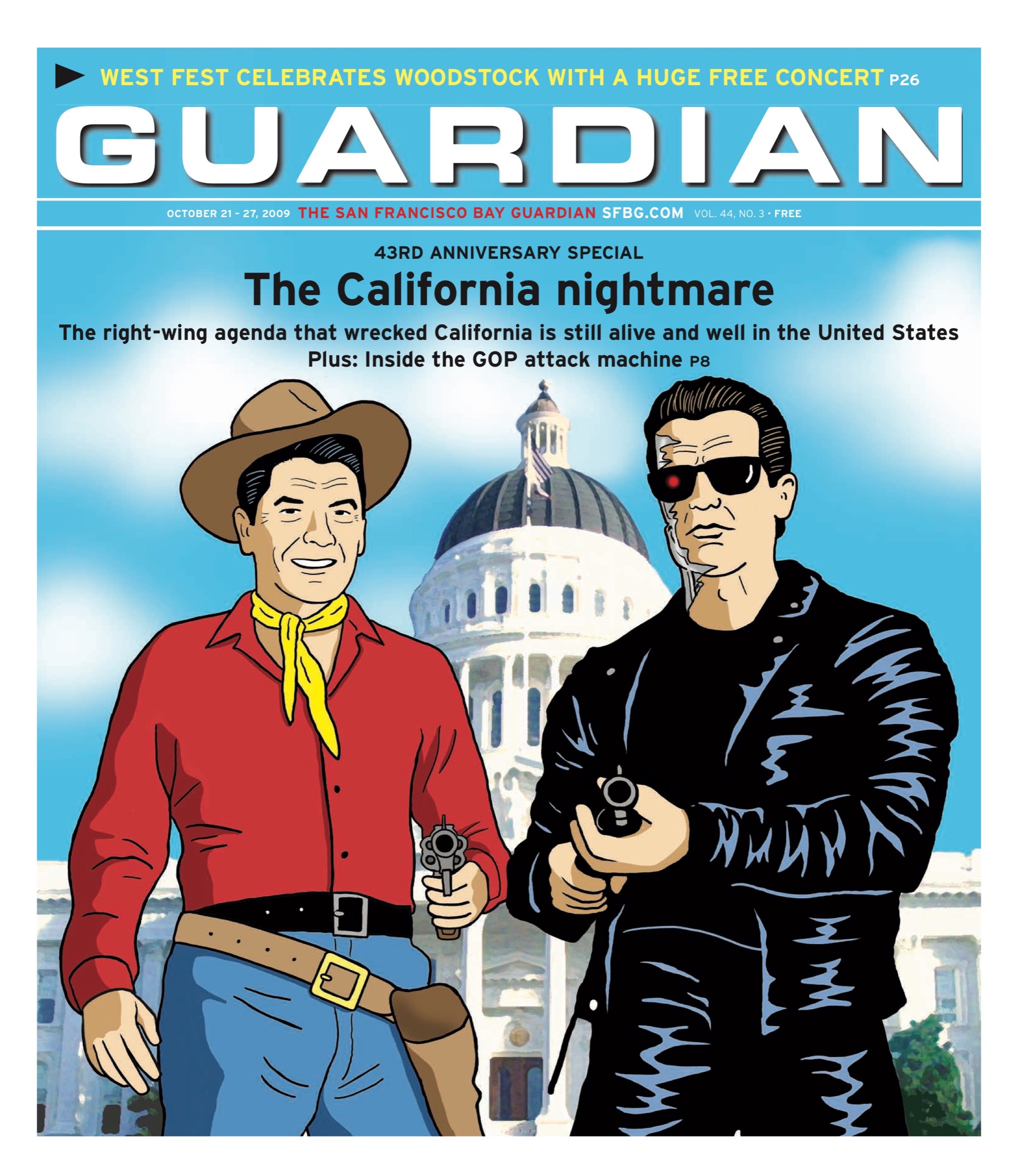
When the first issue of the Bay Guardian hit the stands in 1966, it was still really possible to talk about the California dream. The state had seemingly limitless potential and was in many way a model for the nation — a free public university system that was the envy of the world, an economy that provided jobs to hundreds of thousands of new arrivals, the beginnings of what would be the nation’s premier environmental movement pushing to save San Francisco Bay, save the coast, save Lake Tahoe … and the Free Speech Movement, the Summer of Love, the United Farm Workers Union, and so much more that was transforming politics and culture in the United States from the West Coast.

Twelve years later, it was all falling apart. Eight years of Gov. Ronald Reagan and then the passage of Proposition 13 launched a very different kind of movement out of the West, a movement that sought to dismantle the public sector and the social safety net, to treat government as the enemy, and to use culture wars to convince working-class Americans to vote against their own economic interests.

And now California is being described as the nation’s first failed state. Gov. Arnold Schwarzenegger — the second Republican actor to hold that role — has driven the state to the brink of bankruptcy. The University of California is drowning in red ink, raising fees and turning away students. The state’s water system is a mess; cities and counties are in fiscal collapse; the economy’s in the tank; and nobody seriously talks about a California dream anymore.

The story of how that happened — and how the diseases of tax-revolts, privatization, government corruption, and public disempowerment spread east from California — is the focus of this 43rd anniversary issue. It’s both enlightening and a bit scary to read through old issues, because in hundreds of stories over the past four decades, the Guardian has warned of exactly what was to come.

The very first issue of the Bay Guardian talked about the "historic election" pitting the incumbent, Democrat Pat Brown, against Reagan. A lot of people in the emerging "new left" were arguing that there wasn’t a bit of difference between the two, and that you might as well sit out the election. But the Guardian had a different take. The election was really about the direction California wanted to go, the paper said, a choice between a state that cares about the public sector and social welfare and a state where those things don’t matter.

"Reagan’s stands typify the temper of the cause," the Nov. 7, 1966 editorial stated. "He is on record, at various times, in opposition to the progressive income tax, Social Security, Medicare, the anti-poverty program, farm subsidies, the TVA, the Civil Rights Act, the Voting Rights Act, public housing, federal aid to education, and veterans hospitalization for anything other than service-connected disabilities. How can a man or a movement govern the state of California with such a political philosophy?"

Reagan’s election may have seemed like a fluke, but it was nothing of the sort. By the mid 1960s, with the counterculture — and equally important, the economic left — looking to make major inroads in American policy, the broad outlines of a right-wing attack plan were in place.

That’s something the Guardian always recognized — that powerful people who moved the levers of government typically did so with a long-term plan.

In San Francisco, part of that plan was the transformation of a human-scale city to a West Coast version of Manhattan. The idea: tear up South of Market (then mostly low-income housing) for a shiny new convention center and hotels. Dump dozens of big high-rise office buildings downtown. Construct a fixed-rail system to carry suburban commuters into the dense downtown. Drive up property values — massively — and if that means blue collar jobs and working class people had to go to make way for wealthier office workers, so be it. In the end, of course, the architects of the plan — landowners, developers, bankers, and big business leaders — became immensely wealthy.

On the state and national level, their plans were broader. Even so, they had one major aim: throttle the pubic sector. Cut off the funding for government programs, reduce regulations, undermine any concept of a welfare estate — and cut taxes on the rich.

As we report on page 8, the architects of this plan are happy today to talk about how it worked — how Reagan launched his war on government back in the 1970s, how a group of well-funded think tanks developed plans, and political consultants took advantage of people’s fears (and the Democratic Party’s failures) to put those plans into action.

The movement really got off the ground in 1978 with the passage of Proposition 13.

Prop. 13 emerged from a state in the middle of a massive growth spurt and a heated political cauldron of money, race, and Legislative failure. Howard Jarvis, a Republican landlord lobbyist who hated taxes, hated government, hated public schools, and disdained most Californians — "63 percent of [public school] graduates are illiterate" and would have no need for public libraries, he once quipped — took advantage of a gaping hole in political leadership and set off a movement that would cripple the United States of America.

The measure marked the final, fatal end in California of the era known as the ’60s — a period when the left was ascendant, when taxes on the wealthy funded education, infrastructure and programs for inner cities, and when economic and cultural liberalization seemed to be spreading across the nation.

Rising property values, driven by rapid population growth, were driving up property taxes — and the problem was real. Long-time residents, particularly people on fixed incomes, saw their taxes rise so high they couldn’t afford to stay in their homes. The Legislature could have addressed that (with, say, a split-roll measure that taxed residential and commercial property at different rates) but utterly failed to move on the crisis.

A series of assessor’s office scandals didn’t help, either. And, at the same time, the California Supreme Court ruled that rich school districts had to share revenue with poor districts, infuriating wealthy white property owners.

Jarvis and his partner Paul Gann circulated petitions to roll back property taxes and make it almost impossible to raise taxes in the future. It passed with 65 percent of the vote.

Of course, big businesses (particularly utilities) were the big winners. As the Guardian pointed out on June 1, 1978, the top five utilities in California alone (including Pacific Gas and Electric Co.) would gain billions from the tax cuts.

But beneath it all was a simmering discontent with government — something Jarvis had set afire and would later be used by Ronald Reagan and the right-wing operatives who backed him to undermine the New Deal, the social safety net, and the basic social contract in America. The antitax folks played to white people who didn’t want to see their money going to minorities, to the middle-class folks who thought (thanks to the assessor scandals) their tax money was being wasted by corruption — and to a lot of younger people coming out of the 1960s who had learned from Vietnam, COINTELPRO, and Watergate not to trust government.

The Bay Guardian opposed the measure strongly: "Most analyses indicate that without replacement taxes, hundreds of thousands of California public servants would be thrown out of work (which is exactly what Howard Jarvis intends) … " a May 18, 1978 editorial noted. "Vote for Prop. 13 only if you favor decreased government services (including cutbacks in everything from libraries to schools to street-cleaning crews and possibly police and fire departments) and are fond of half-baked measures that favor the rich."

Prop. 13 set off a national movement to cut taxes — and riding that wave, Reagan was elected president in 1980. He immediately set about attempting to slash taxes on big business and the wealthiest Americans, and eliminate environmental, workplace safety, and employment regulations.

You can see the results in California — and across the nation. The very strategies that emerged in this state and that the right has supported over the years have come very close to destroying the United States economy, leaving millions out of work — while the gap between the rich and the poor has risen to unsustainable levels.

Part of the reason this national attack on government and the public sector worked was the failure of Democrats to recognize that corruption matters. It was no small wonder that Californians were losing faith in government — in the 1970s and 1980s, the state Legislature, under the Democratic control of Speaker Willie Brown, was awash in sleaze, paralyzed by lobbyist influence and campaign money. Yet leading Democrats, fearful of Brown’s power, did little to reign in the appalling corruption.

In fact, when Brown became mayor of San Francisco, the entire Democratic Party, from the president of the United States on down, seemed to treat him as royalty — despite the fact that he was selling the city to every developer and corporate lobbyist who waved money under his nose. When taxpayers knew that a large part of their money was going to fund juicy jobs for Brown’s cronies and pet projects, it was hard to argue for higher taxes.

And it was the Democratic Party leadership in San Francisco who presided over two of the greatest examples of privatization of public resources in modern history: the Presidio and the Raker Act. Rep. Nancy Pelosi was the author of the bill that, for the first time, turned a national park over to the private sector — and hardly a Democratic leader in the city dared to lift a finger in opposition. And for decades — since the Guardian first broke the story in 1969 — the city’s Democratic power brokers have bowed and genuflected to PG&E and allowed the private utility to control the local electric grid and block implantation of the federal law that mandates public power for San Francisco.

And now PG&E wants to pull off one of the greatest feats of privatization in American history. The company has launched a ballot initiative that would wipe out any further attempts at public power in California, essentially guaranteeing that private companies, not the public sector, control the vast, critical resource of electric power in this state.

It’s the latest big battle between two divergent visions of America — and this time, the folks who have done so much damage to this state and this nation can’t be allowed to win. In fact, maybe the campaign against PG&E can be the turning point, the time when California realizes that privatization, attacks on the public sector, tax cuts for the rich, and political sleaze are a formula for disaster.

The Chron, the guv and the issues

3

By Tim Redmond

It’s as if the San Francisco Chronicle didn’t recognize that there are real issues facing California — and that the governor is acting like a thug, threatening the future of the state and clowning around like it doesn’t matter.

Check this out: The Chron’s editorial page criticizes Tom Ammiano for standing up to the governor:

But Assemblyman Tom Ammiano crossed the line when he shouted “You lie!” at Gov. Arnold Schwarzenegger during a Democratic fundraiser in San Francisco on Wednesday night. Ammiano reportedly went even further on the crass-o-meter when he suggested that the governor could kiss his posterior.

.

(By the way, this is San Francisco — it’s okay for the daily newspaper to say “ass.”)

And then suggests that this was just a nice event at which

The governor was invited for a brief visit to a Democratic Party event by former Mayor Willie Brown

(By the way, Brown is also a San Francisco Chronicle columnist)

without ever saying that Brown had no business bringing the governor — who is so openly threatening the Democrats with mass bill vetoes that Sen. Mark Leno is forced to ask “are we dealing with the Mob or the governor of California?” — to a Democratic party fundraiser.

Brown was playing his normal games, goofing around and ignoring the life-and-death issues at stake. He and Arnold are buds, and Brown backed Schwarzenegger for governor over a Democrat. He knew bringing the guy into that room would create a furor, and he knew that the governor would love it (it helps him with his conservative base to get booed by San Francisco Democrats.)

Ammiano knows all that, too, and frankly, was somewhat reserved in his comments. I would have gone further; I would have called out Willie Brown for a back-stabbing political stunt.

And don’t the Chron editorial writers have any sense of humor? “You lie” was a joke, guys, a parody. Please: Lighten up, and get a clue.

The Democrats wild night

24

By Tim Redmond

Well, I’m really sorry I missed the Democratic Party gala Wednesday night. Apparently it was quite a show. Brian Leubitz has a great report at Calitics on the unexpected appearance of Gov. Schwarzenegger and the overwhelmingly negative response by the attendees, including Assemblymember Tom Ammiano, who stood up and shouted “You Lie!”

“It was political theater of the type we love,” Ammiano told me.

Seriously, though: Former Mayor Willie Brown apparently told the guv that the event was happening, and since Schwarzenegger was in the same hotel for a President’s Cup event, he decided (perhaps at Brown’s invitation, it’s not entirely clear) just to drop by. And everyone was supposed to act all nice and pretend that they’re aren’t real, serious issues in Sacramento and that the governor isn’t really, really screwing up the state and hurting a lot of people.

“This wasn’t the Legislative Chambers, where you have to put up with this shit,” Ammiano said.. “It’s like this guy just showed up and took a big dump in my living room.”

Labor folks weren’t happy, either, and a bunch of them walked out. Then Ammiano (and we should all give thanks that he’s in the Legislature, reminding everyone what San Francisco stands for) accepted an award and made a speech:

And then he proceeded to bludgeon the Governor’s record. He questioned why he was holding bills hostage to get a bad water deal. He questioned why a Governor who has vetoed the Harvey Milk Day bill would stand up in front of a room that was at least 25% LGBT. He politely asked Mayor Brown to send a message to the governor to sign the bills already.

And finally, Senator Mark Leno closed the proceedings for the evening. Leno took a different tack than Ammiano’s passion. He simply stated the facts. He said that the events of this evening were all funny and stuff, but the fact is that this Governor had cut state workers salaries by 15% with the furloughs. This Governor wanted to cut IHSS salaries to minimum wage. This Governor illegally used the line item veto to slash funding for domestic violence shelters. And that he, and the Senate Democrats, were going to fight him tooth and nail.

And to a loud applause, Leno stepped off the stage and the crowd began to thin. And everybody was saying, “um, wow.”

The other thing Ammiano said in his speech was that Democrats have gotten a little lax on standing up for their friends — and he mentioned both ACORN and Kim-Shree Maufas, and both times was met with huge applause.

And, of course, the Chron’s Carla Marinucci focused her reporton Willie Brown’s comments about how inappropriate this all was and how everyone needed to make nice to poor Arnold. But there are serious issue here that aren’t just fun and games, and when the stakes are as high as they are here, I’m glad to see them Democrats (or at least some of them) deciding not to play so nice with a governor who is smiling while he drives the state into bankruptcy and despair.

PS: Ammiano told me that when Marinucci called him, she seems astounded that he had said “kiss my gay ass” while walking out of the governor’s speech. “I told her, I don’t remember, but I probably did say that,” Ammiano said. “After all, it’s safe sex.”

On health care, just win

0

EDITORIAL This could very well be the pivotal moment in Barack Obama’s presidency. If he loses on health care reform — or worse, if he caves in to right-wing bullying tactics and abandons a strong public option — then not only will the American people and economy suffer, but Obama will have hobbled his ability to effectively address the myriad problems facing this country.

The time for negotiating with Republicans on health care is over. They have proven to be hostile and irrational obstructionists interested only in sabotaging both Obama and health care reform, repeatedly telling lies to incite anger and fear in the populace. Beyond being irresponsible, they have abandoned their role as good-faith participants in the political process.

Even when U.S. Health and Human Services Secretary Kathleen Sebelius suggested on Aug. 16 that private co-ops might be an acceptable alternative to the public plan — a tactical and policy mistake that understandably outraged progressives — Republicans refused to come back to the bargaining table.

With that gesture, Republicans showed that their overheated denunciations of the public option were simply a political ploy. They will scream "socialized medicine" on behalf of insurance companies no matter what is in this reform package, so Obama and the Democrats need to ignore them, develop the strongest possible plan, and do whatever it takes to get it through Congress this fall, even when that means stretching procedural rules to require only a bare majority vote for the most controversial elements.

The Democrats have already compromised enough. As the Guardian has said ("It’s the insurance companies, stupid," 7/22/09), a single-payer system is the only reform that will bring the cost savings this country (and its residents and businesses) desperately needs. Democrats were foolish to abandon that so early, a decision that emboldened conservatives and insurance industry shills in both parties and led to the current standoff.

So if Obama and House Speaker Nancy Pelosi are right that starting over on health care reform would cause the moment of possibility to be lost — and we aren’t sure they’re right, although we understand the point — then they need to get tough and push through their plan without letting it get watered down any more.

Despite the over-amplification of right-wing talking points, the political winds have shifted in this country. Progressives are ascendant and they expect fundamental reforms. Pelosi (to her credit) acknowledged as much in August when she said that health reform bill without a strong public option wouldn’t be approved by the House.

That’s because the House Progressive Caucus, led by Rep. Lynn Woolsey from Petaluma, now has more members than the conservative Blue Dog Coalition, 81 to 52. It’s not the 1990s anymore, when then-President Bill Clinton felt he had to compromise with the emerging right wing to get anything done. Now Democrats finally need to acknowledge progressives and enlist their help in moving a bold reform agenda.

Today, the Republicans have been thoroughly discredited, but the Democratic Party is its own worst enemy. The people who gave the Democrats substantially congressional majorities expect action, and if the Democrats can’t toughen up and deliver, this country is headed for a real political crisis that could easily spin out of control.

Obama and Pelosi need to seize the moment and pass a health reform bill that includes a robust public option and explicitly allows states like California to experiment with single-payer systems, which is the only system that will truly hold down health care costs and drive a stake through the heart of the insurance industry, which is ruining not just the health care system, but the political system as well. *

Obama needs to stop being nice

0

By Tim Redmond

The New York Times has a great piece by Jean Edward Smith on why Obama needs to stop trying for a bipartisan health plan and a compromise that the moderates and conservatives can agree on:

This fixation on securing bipartisan support for health care reform suggests that the Democratic Party has forgotten how to govern and the White House has forgotten how to lead.

This was not true of Franklin Roosevelt and the Democratic Congresses that enacted the New Deal. With the exception of the Emergency Banking Act of 1933 (which gave the president authority to close the nation’s banks and which passed the House of Representatives unanimously), the principal legislative innovations of the 1930s were enacted over the vigorous opposition of a deeply entrenched minority. Majority rule, as Roosevelt saw it, did not require his opponents’ permission.

When Roosevelt asked Congress to establish the Tennessee Valley Authority to provide cheap electric power for the impoverished South, he did not consult with utility giants like Commonwealth and Southern. When he asked for the creation of a Securities and Exchange Commission to curb the excesses of Wall Street, he did not request the cooperation of those about to be regulated. When Congress passed the Glass-Steagall Act divesting investment houses of their commercial banking functions, the Democrats did not need the approval of J. P. Morgan, Goldman Sachs or Lehman Brothers.

From the start, the wrong people (that is, the insurance industry reps.) have been at the table. Now the president is going to Congress to make his case — but he ought to have enough support to get a strong bill passed anyway.

And maybe he can start his speech with this report from the National Nurses Movement, which notes:

Researchers from the California Nurses Association/National Nurses Organizing Committee analyzed data reported by the insurers to the California Department of Managed Care. From 2002 through June 30, 2009, the six insurers rejected 45.7 million claims — 22 percent of all claims.

The main point here:

Left hanging in the air is a bigger question. If the private insurers are not paying for care, why do we have private insurers?

Garamendi for Congress

0

EDITORIAL The Sept. 1 special election to replace Ellen Tauscher (who has taken a post with the Obama administration) in the East Bay’s Congressional District 10 includes a large field with several great candidates. In fact, any of the top half-dozen or so Democratic Party candidates would be an improvement on Tauscher, a member of the Blue Dog Coalition who supported the Iraq War.

All these top candidates are good on the issues, including requiring a strong public option in health care reform (most go even further and support single-payer), ending the military’s "don’t ask, don’t tell" policy, withdrawing troops from Iraq and developing an exit strategy for Afghanistan, achieving marriage equality, limiting federal drug and immigration raids, reforming Wall Street, and developing a sustainable energy policy that addresses climate change.

But it’s a tougher decision to choose between the experienced politicians in the race and a couple of attractive newcomers, who argue that fresh faces and new ideas are what’s most needed now in Congress, where the Democratic Party’s huge new majorities have so far produced disappointing results.

The most impressive of these new candidates is Anthony Woods, a smart, charismatic young person of color who has a remarkable personal story. From growing up poor in Fairfield with a single mom and without health insurance, Woods got into the U.S. Military Academy at West Point and then went to Harvard, where he earned a master’s degree in public policy from the prestigious Kennedy School of Government.

Then, after doing two tours of duty in the Iraq War and earning the Bronze Star, Woods informed his commanding officer that he is gay. He was honorably discharged from the military and forced to repay the federal government for his college tuition, in the process becoming a cause célèbre in the LGBT community, which has strongly backed his candidacy.

Adriel Hampton, a former San Francisco Examiner political reporter who now works for the San Francisco City Attorney’s Office, also brings to the race a fresh perspective and intriguing ideas about using technology to engage more citizens with their government. We’re glad they’re running, but they could each use some more political experience before assuming such an important office at this critical point in history.

Fortunately, there are three Democratic Party office-holders in the race. Joan Buchanan is a member of the California Assembly who is running a strong race, while State Sen. Mark DeSaulnier has a more extensive political background, a long list of endorsers (including Tauscher and Sen. Mark Leno), and a strong voice calling for fundamental reforms of the political system, including being an early proponent for calling a constitutional convention in California.

DeSaulnier was the clear frontrunner and would have made an excellent member of Congress — but then Lt. Gov. John Garamendi dropped his plans to run for governor again and got into the race. It was a game changer. Garamendi has been in public service since he was elected to the Legislature in 1974; he later served as deputy secretary of the Department of the Interior under President Bill Clinton and as California’s first and best insurance commissioner, where he learned to play hardball with health insurance companies.

Garamendi has a forceful presence, progressive values, long relationships with key power brokers and knowledgeable advocates, and an unmatched history of intensive work on the most pernicious problems that Congress is now wrestling with, including health care reform and resource issues. From day one, he would be a leader who would help President Barack Obama move his agenda.

"I have the experience and knowledge we need right now in Congress," Garamendi told the Guardian‘s editorial board. He’s right, and he has earned our endorsement. *

Editorial: Garamendi for Congress

0

Garamendi has an unmatched history of intensive work on the most pernicious problems that Congress is now wrestling with. And he is a strong advocate for single payer health care.

Garamendi for Congress

EDITORIAL The Sept. 1 special election to replace Ellen Tauscher (who has taken a post with the Obama administration) in the East Bay’s Congressional District 10 includes a large field with several great candidates. In fact, any of the top half-dozen or so Democratic Party candidates would be an improvement on Tauscher, a member of the Blue Dog Coalition who supported the Iraq War.

All these top candidates are good on the issues, including requiring a strong public option in health care reform (most go even further and support single-payer), ending the military’s “don’t ask, don’t tell” policy, withdrawing troops from Iraq and developing an exit strategy for Afghanistan, achieving marriage equality, limiting federal drug and immigration raids, reforming Wall Street, and developing a sustainable energy policy that addresses climate change.

Run, Sanchez, run

4

By Steven T. Jones
sanchez.jpg
Loretta Sanchez

The Guardian may not have been a big fan of Willie Brown when he was mayor, but I certainly appreciate his political insights now, as expressed in some of his Sunday Chronicle column items. He knows the players and their motivations better than anyone, making him one of the top sources in town for political buzz.

So his observation yesterday that others are likely to jump into the Democratic Party gubernatorial primary is good news for anyone loathe to watch Gavin Newsom and Jerry Brown beat the crap out of each other – including trying to out-tough-on-crime each other, a specialty of Newsom’s Neanderthal campaign chief Garry South — before one of them limps into a tough race against the Republican nominee.

Brown leads with the likelihood that Steve Westly will jump in, which isn’t very exciting to progressive voters. And he teases out how Dianne Feinstein is still a possibility – again, not too exciting for progressives, but at least she’d likely move the governorship into the D column.

Yet it’s the last name he mentions – Rep. Loretta Sanchez from Orange County – who would instantly become a progressive favorite if she gets in. And she’s also someone who’s proven palatable to OC conservatives and has a real independent streak that would appeal to voters who are sick of both major parties (and for good reason).

So, Rep. Sanchez, if this link finds its way to you, let me just say on behalf of San Franciscans who fear the prospect of a Governor Newsom: please run!

Bitter medicine

0

news@sfbg.com

The Democratic Party has been promising a major overhaul of the health care system for a generation or more. Now, with President Barack Obama and his party’s congressional leaders in a strong position to finally reach that elusive goal by next month, this should be a momentous time for the reform movement.

So why are so many health reform advocacy groups unhappy?

The answer involves policy and process. Rather than pushing for the single-payer system that many progressive groups demand and say is needed, Democratic leaders immediately opted for a compromise plan they hoped would be acceptable to economic conservatives and the insurance industry.

But Republicans are still calling them socialists for doing it, while the insurance industry — which loves the portion of the legislation that requires everyone to buy coverage — is still spending $1.4 million a day to either kill the complicated bills or turn them to its advantage.

When congressional Democrats unveiled America’s Affordable Health Choices Act (HR 3200) on July 14, many reformists thought a long-awaited, dramatic overhaul to a broken system was close at hand. The insurance companies would finally be made to adhere to ethical practices, and the Democrats would defend their plan to establish a government-run health insurance option that could compete with private insurers and keep them in check.

“American families cannot afford for Washington to say no once again to comprehensive health care reform,” said Rep. George Miller (D-Martinez), who chairs the crucial House Education and Labor Committee.

The Democrats’ bill does address some critical flaws in the health care system. It would greatly expand Medicare to ensure coverage for low-income individuals, and would subsidize coverage for those earning up to 400 percent of the federal poverty level, defined as $43,320 for an individual and $88,200 for a family of four. The bill would forbid insurance companies from denying coverage to patients based on a preexisting condition, age, race, or gender. It would eliminate co-pays for preventative care and establish a cap on annual out-of-pocket expenses. To pay for it, the proposal would create a graduated tax on households earning more than $350,000 a year, with the top bracket being a 5.4 percent levy on incomes of more than $1 million.

Progressive members of Congress threw their support behind the bill because — and only because — it included the public option. “The public option is central to our support of health care reform,” read a statement from the Congressional Progressive Caucus.

Rep. Lynn Woolsey (D-Petaluma), who chairs the CPC, was quoted in the Huffington Post as saying, “We have already compromised. More than 90 percent of the progressive caucus would vote today for a single-payer system. And so for us to compromise and get behind a really good strong public plan, I mean that’s as far as we’re going.”

While that statement indicates the precarious nature of the current legislation — which will likely be weakened further as it works its way through the process and merges with legislation from the more conservative U.S. Senate — many progressive groups aren’t even willing to go that far.


COVERAGE ISN’T CARE

Many single-payer supporters say some reform is better than none, and that the passage of HR 3200 would represent a major win. “We can advance many of the principles that we support with the House bill,” said Anthony Wright, executive director of Health Access California and an organizer for the national reform advocacy group Health Care for America Now. The nation, he believes, needs to endorse principles such as universally covering Americans and making sure patients aren’t left alone “at the mercy of the private insurance industry.”

Yet other groups fear this cure would be worse than the disease, sending millions of new customers into a private insurance system that simply doesn’t work, and compounding existing problems.

“We’re still pushing for a national single-payer bill,” Dr. James Floyd, a health reform researcher with the nonprofit group Public Citizen, told the Guardian. “While we’re open to other options, we haven’t seen anything [in proposals by Democratic congressional leaders] yet that is acceptable.”

That position has plenty of support among the general public and reform-minded organizations, for whom single-payer continues to be the holy grail.

The current proposal “doesn’t change the system one bit,” said Leonard Rodberg, a member of Physicians for a National Health Program, who works in health policy. “These bills are requiring that people buy insurance, but there are no numbers about how much the insurance would cost. And if the cost of the insurance is still too high, you can remain uninsured.”

And as negotiations center on the government-run insurance option, the concept of scratching the status quo and offering free Medicare-like health care to every American instead has fallen to the wayside.

Rep. John Conyers (D-Mich.) got 84 co-sponsors for his single-payer bill, HR 676, and hearings were held in June to explore the option. But congressional leaders then took it off the table. The reasons why seem to be as much about political will as they are about campaign contributions from the insurance industry. As one high-level congressional staffer told us, many lawmakers won’t back a single-payer system in part because they “don’t want to have to respond to being accused of being a socialist by the right wing.”

Then there’s the insurance lobby. “They spend hundreds of millions,” the staffer said. “They lobby Congress, and they provide millions to campaigns. They have Fox News. But the single-payer movement is growing leaps and bounds.”

Rodberg said the insurance industry would love to see a mandate to buy insurance approved at a time when insurers are losing customers because the economy is shedding thousands of jobs each month. “This is a bailout for the insurance companies,” Rodberg told us. “But there’s absolutely nothing in this legislation that will control costs, because it just leaves it to the insurance companies and the market.”

Dr. Jim G. Kahn, president of the California Physicians’ Alliance and a professor at UCSF with expertise in health policy, told us he believes the proposed bill falls short of the goal of comprehensive, universal coverage. “‘Universal’ was recently redefined by [Montana Sen. Max] Baucus as 95 percent — i.e., 15 million uninsured,” Kahn told us via e-mail. “Reaching even that level will be hard, due to the complexity of enforcing an ‘individual mandate’ on families with only modest income (and hence no subsidies). And in eagerness to reach that level, more and more people will become underinsured, with inadequate coverage and a further boost in already high medical bankruptcy.”

Medical debt contributed to nearly two-thirds of all bankruptcies in 2007, according to a study in the American Journal of Medicine. The majority of those afflicted were solidly middle-class homeowners at the start of their illness, and most had private health insurance.

Health Care Now, a hub for single-payer grassroots groups, is planning a large rally in Washington, D.C., for July 30, the anniversary of the founding of Medicare, on which many single-payer plans would be based. “Single-payer is the only plan that would truly be universal and contain costs,” said Katie Robbins of Health Care Now, arguing that the current plan pushed by congressional leaders “doesn’t protect us from the ills of the insurance-based system as we know it.”

Other progressive groups are withholding judgment for now, hoping the good aspects will ultimately outweigh the bad. “We’re digging through them now. We support a bill that has a true public option, and the House bill has that,” said Consumer Watchdog’s Jerry Flanagan. “But we really dislike the individual mandate [to purchase health insurance]. The insurance companies really don’t want the public option, but they really want the mandate.”


LEAVING OPTIONS OPEN

Even if single-payer isn’t going to be the national model yet, advocates say it’s crucial that states such as California be allowed to experiment with the option anyway. Single-payer advocates in Congress have insisted the health care legislation be amended to explicitly allow states to do single-payer (otherwise, federal preemption laws and the Employee Retirement Income Security Act might prevent states from doing so).

On July 17, Rep. Dennis Kucinich (D-Ohio) successfully inserted such an amendment into the bill that cleared the House Committee on Education and Labor with a 25-19 vote, which included significant Republican support. The amendment was opposed by Miller, indicating Democratic Party leaders oppose the change and may ultimately succeed in stripping it from the bill.

“George Miller is a longtime supporter of a national single-payer plan and health care reform. The truth is, however, there are not enough votes in the House or the Senate to pass a final bill that contains single-payer language. That is unfortunate but it is also the truth,” Miller spokesperson Rachel Racusen told the Guardian.

California is a hotbed of single-payer activism. Even a leading candidate for state insurance commissioner, Assemblymember Dave Jones (D-Sacramento) — who appeared on the steps of San Francisco City Hall on July 15 to receive the endorsements of a long list of local elected officials — has made single-payer advocacy a central plank in his campaign.

The movement is so strong in California that it actually had legislators vying for who would get to carry its banner. San Francisco’s own state senator Mark Leno, a longtime single-payer supporter, was selected this year to take over the landmark single-payer legislation previously sponsored by termed-out legislator Sheila Kuehl, which has passed twice, only to be vetoed by Gov. Arnold Schwarzenegger.

“The more I dive into this issue, the more convinced I am that the answer has to be single-payer,” Leno told us. “The only reform that truly contains costs is single-payer.”

Leno doesn’t fault Obama for taking a more cautious stance — but he does believe the federal government shouldn’t block states like California from creating single-payer systems. “States should be incubators of trying different proposals. We have a great history with that,” Leno said.

But even with a Democratic governor, there’s no guarantee that single-payer would be approved. Mayor Gavin Newsom is running for governor, featuring health care reform in his platform. He chairs the U.S. Conference of Mayors National Health Care Reform Task Force, which is pushing for approval of the Obama plan. But even Newsom won’t promise to back the Leno plan.

“He doesn’t think single-payer is the best option now,” Newsom’s campaign manager Eric Jaye told us when asked whether Newsom would sign the legislation as governor. “He hopes and believes that as governor he will be supporting a national public option.”

But in the end, the governor may not matter. Leno said the political reality in California is that voters, rather than legislators, will need to approve the single-payer system. The funding mechanism for any ambitious health care plan would require a two-thirds vote in the legislature, a political impossibility.

“The difference in California is the voters will have the final say. And I’m excited about that. The voters of California will be able to say to the insurance companies, ‘We’ve had enough, now go away,'” Leno told us. He said he expects a ballot campaign in 2012.

Of course, it won’t be that simple. Leno knows that the insurance industry will spend untold millions of dollars to defend itself and a “status quo that is only working for them, not for anyone else. This is an enormously powerful industry and they control the debates.”

“Our effort here in California is an educational one. We have from now until the election in 2012 to make the arguments,” Leno said.


THE COST OF INSURANCE

Testifying at a hearing of the House Education and Labor Committee in June, Geri Jenkins, a registered nurse and the co-president of the California Nurses Association, related the story of Nataline Sarkisyan. The 17-year-old girl needed a life-saving liver transplant, Jenkins explained to Congress members. “But CIGNA would not approve it,” she told them, “until I, and hundreds of others, protested. During one of the protests, I was with Hilda, Nataline’s mother, when she got the call of approval.”

Hilda’s relief didn’t last long. By the time the hurdle had been cleared, Jenkins testified, “it was too late. Nataline died an hour later.”

Nataline’s story sparked national outrage, and it has since become a flagship tale highlighting all that is wrong with this country’s health care system. But as the debate about health care reform continues inside House and Senate committee chambers, discussion about “universal health care” — a phrase with a simple ring to it — has grown murkier.

“We have a universal health care system now,” Flanagan said, referring to how all Americans with serious medical conditions have a right to treatment — even if that treatment comes with great expense in an overcrowded public hospital emergency room. “It’s just the most inefficient system imaginable.”

With the August congressional recess coming up fast and Obama leaning on Capitol Hill to shift into high gear on an issue that was a hallmark of his campaign, the pressure is on to vote on the historic health care reform legislation within weeks.

The Senate Health, Education, Labor, and Pensions Committee passed a health care reform bill July 16 that is similar to the House bill, with the vote split along party lines. Now, national attention has turned to the Senate Finance Committee, chaired by Baucus, which continued its efforts last week to achieve a bipartisan bill.

Many of progressive reform advocates simply don’t trust the players in Washington, D.C., to get this right, particularly Baucus. “He’s the voice of the insurance companies in the Senate,” Flanagan said.

A recent article in the Washington Post estimated that the insurance industry is spending an estimated $1.4 million per day to influence the outcome of the health care legislation, and pointed out that many of the lobbyists were Washington insiders who had previously worked for key legislators, such as Baucus.

The Center for Responsive Politics, a nonpartisan nonprofit research group that tracks money in U.S. politics and operates the Web site opensecrets.org, launched an intensive study of health care sector lobbyist spending, including cataloguing industry contributions to individual candidates from 1989 to the present. Baucus received more industry campaign contributions in that time than any other Democrat, the CRP study reveals, with a total of $3.8 million. Henry Waxman (D-<\d>Los Angeles), who chairs the House Energy and Commerce Committee, received a total of $1.4 million in that same time, while Speaker Nancy Pelosi (D-San Francisco) received $1.2 million.

Starting in the 2008 election cycle, the health sector gave more to Democrats than to Republicans, according to the CRP’s analysis.

To overcome that kind of money and influence, advocates say it was crucial to wield a credible single-payer option — a sort of death penalty for the insurance industry — for as long as possible.

“Having single-payer discussions on the table really informs the debate over the public option,” Flanagan said. “But by removing single-payer, it made the public option the left flank.”

Flanagan, like many, is worried about how a 900-page bill will turn out. “There are a thousands ways to get it wrong,” he said. “An easy way to get it right would be to just do a single-payer system.” ————

HEALTH CARE BY THE NUMBERS

Uninsured Americans: 47 million

Uninsured Californians: More than 6.7 million (about one in six)

African Americans without health insurance in California: 19 percent

Latinos without health insurance in California: 31 percent

Whites without health insurance in California: 12 percent

San Franciscans without health insurance: 15.3 percent

Rise in health-insurance premiums from 2000 to 2007 in California: 96 percent

Projected rise in health care costs per family without reform: $1,800 per year

Percentage of bankruptcies attributed to an individual’s inability to pay medical bills: 62 percent

Percentage of Americans who skip doctor visits because of the cost: 25 percent

U.S. rank of 19 industrialized nations on preventable deaths due to treatable conditions: 19

Jobs that would be created by extending Medicare to all Americans: 2.6 million

Annual U.S. spending on billing and insurance-related administrative costs for health care: $400 billion

Sources: Health Care for America Now, American Journal of Medicine, Physicians for a National Health Program

Why the budget deal really sucks

2

By Tim Redmond

Calitics, which has done an outstanding job covering the state budget mess from the beginning, has the best line on the rotten deal that the Big Five reached yesterday:

Whoever cares the least about the outcome wins.

If you don’t care whether children get health care, whether the elderly, blind and disabled die in their homes, whether prisoners rot in modified Public Storage units, whether students get educated… you have a very good chance of getting a budget that reflects that.

If on the other hand you claim to care, you will concede and concede and concede so you can at least play the responsible part and say at the end that you didn’t completely eliminate the social safety net, though what you did get in return will be totally unclear.

And you will do it every single time.

On Forum this morning, the talk of course was all about the budget, and of course some of the callers were curious about the prospects for a state Constitutional Convention to rewrite the rules for approving a budget. The California Democratic Party is already on board with eliminating the two-thirds requirement, which is a fine thing and may wind up on the ballot soon. The Constitutional Convention is a bit more tricky.

See, the problem is how you decide who gets to be in the room; who will be the delegates to this convention? And one of the very bad ideas out there is to choose the delegates more or less at random, the same way we choose jurors.

What you will wind up with, I guarantee, is a majority of people who don’t want to raise taxes.

A large part of what has to happen in California is the education of the population, and that’s where the Democratic Party and the other stakeholders ought to be taking the lead. Perhaps the candidates for governor and the senior elected officials can all help raise money for a major statewide campaign explaining to people how the cut of the vehicle license fee, the lack of an oil-severance tax, the corporate loopholes and Prop. 13 have led directly to the cuts that are preventing qualified kids from getting a college education, preventing sick people from getting care, destroying public schools and the like.

Ever few years the Dems, the unions and the other activists have to raise big chunks of money to fight some ballot measure or another. How about, say, $50 million now to try to show the voters what’s really going on, so we don’t have to keep doing this dance over and over and over?

SF leaders back Jones and snub Alioto-Pier

0

By C. Nellie Nelson

Numerous city officials gathered this morning on the steps of City Hall to endorse Assembly member Dave Jones in his run for state insurance commissioner, even as rumors that Sup. Michela Alioto-Pier may run for the same office were finally reported in the Chronicle and Examiner. Still, the city leaders opted to side with out-of-towner Jones over the more conservative Alioto-Pier.

Local Democratic Party chair and former Board of Supervisors President Aaron Peskin introduced the candidate, saying that a real reformer is needed to run the Insurance Commission of California. City Attorney Dennis Herrera followed, exhorting that he could not think of a better candidate for consumers. Herrera described how most health insurers “gender rate” – charging as much as 39 percent more to insure women – and stated that Jones is committed to ending the disparity, which has already been outlawed in 10 states.

Board of Supervisors President David Chiu also spoke briefly in support of Jones, noting that the candidate had brought together the largest number of officials to endorse his candidacy.

Fireworks at the DCCC

0

By C. Nellie Nelson

The San Francisco Democratic County Central Committee heard a resolution urging city agencies to not privatize city services last night. It’s the sort of measure that would normally pass without much debate — the local Democratic Party has always taken the side of the unions on contracting-out disputes.

But in the midst of the budget mess, the head of the firefighters’ union, John Hanley, showed up to berate the committee members, some of whom are also supervisors, over the latest budget moves.

As Hanley raged about putting firefighters’ lives on the line, committee chair Aaron Peskin and other members tried to make the point of order that this resolution was about privatizing city services, not changes to the budget. Hanley raised his voice louder yet, and, with his face a deep shade of red, he waved a pointed finger around as he yelled about $80 million in cuts.

At that point DCCC member and supervisor Chris Daly rose from his chair and pointing his finger at Hanley demanded, “Don’t point at me!” Hanley became even further agitated, and some committee members demanded that both Daly and Hanley leave. Both then ultimately quieted down, and neither was forced to leave.

In spite of the jarring display and repeated attempts to bring the focus back to the privatization of city services, commenters continued to speak on budget concerns. Former DCCC member and Deputy Sheriff David Wong said the Democratic Party should be for working people, and asked to not have the sheriff’s budget cut. Committee member Robert Haaland asked him if he supported or opposed contracting out sheriff services, but Wong didn’t answer.

Several SEIU members and Department of Public Health workers followed, speaking of seniors missing meals, nursing-to-staff ratios at SF General that result in less skilled workers doing responsibilities above their level of training, and even clients who had just been killed while on a wait list for city services.

When public comment closed, committee members addressed the hotly contended budget decision in a general way. Peskin began, “I want to refute the politics of fear and demagoguery,” referring to Hanley’s intimidating style of speaking. “There’s no question the pie has shrunk,” he continued, reiterating that in a fundamental notion of fairness, all departments must share the pain.

Haaland noted that 1,500 people would be laid off in the Department of Public Health, and that just wouldn’t be true of all departments. He said that cutting the DPH by $100 million would gut the Healthy San Francisco program, and result in $4 million cut from HIV services.

Peskin followed, declaring flatly, “I don’t want my house to burn down either.” He urged everyone to be part of the solution.

The members moved to take out language referring to specific professions that might be privatized, and with those changes, overwhelmingly passed the resolution against privatizing city services.

Is this really our only choice?

22

By Tim Redmond

603newsom.jpg 603brown.jpg

Now that Antonio Villaraigosa appears not to be running for governor, the most populous state in the nation, the world’s eighth-largest economy, is headed for a very ugly choice. The Democratic Party has exactly two prominent candidates to run California — Jerry Brown, who has become a conservative with his no-new-taxes pledge and his tough-on-crime stuff, and Gavin Newsom, who has been a pretty awful mayor of San Francisco.

Is this the best that the state can do?

It might be — and here’s the problem. In a state this big, with more than 36 million people, a race for governor is all about image. It’s about television ads and media hype — and most people don’t pay attention to the details. Brown is ahead in the polls almost entirely because of name recognition; he’s the attorney general, has been govenor before, his dad was governor, he’s run for president — people have heard of him. Liberal Democrats who are older and remember when he was the dynamic young, progressive leader think back fondly to those days. Democrats who are more moderate look at his hard-ass love-developers-and-cops tenure as mayor of Oakland. Nobody has any idea how he would fix the state’s economy; I don’t think he knows himself.

Newsom is catching up, and will make this a close race, because he’s the new young face — and because he’s got a team of consultants and producers who are experts at creating false images. He’ll run as the “green mayor,” although he’s opposed the most important environmental measures in the city. He’ll run as a sensible leader who balanced a budget with no borrowing or taxes (although he’s doing it by destroying the local safety net). What most voters won’t see is the arrogant, petulant guy who has surrounded himself with fawning accolytes and nasty hit men. They won’t see a person who is way over his head in his current job, and has no business moving on to a much bigger one.

And that’s what we’ve got.

I wasn’t kidding last week when we talked about splitting up the state. It sounds like a radical idea, but think about it: If we were electing a governor of the coastal counties between Sonoma and Los Angeles, Jerry Brown wouldn’t even be a factor — and a lot of smart, experienced progressives would have a shot at the job. We wouldn’t be facing this ugly choice of finding someone either bland or conservative enough to appeal to the Central Valley. The voting population would be much smaller, and thus the vast sums of money that candidates have to raise would be significantly reduced.

We might even get a good governor.

In the meantime, we have to do better than this. Is there nobody else out there, no real change candidate who might actually be able to take on the serious problems facing California?