David Chiu

Did Lennar hire an armed security guard from Andrews International?

11

I didn’t attend the April 12 hearing of the Board’s city operations and neighborhood services committee about Lennar’s decision to send an armed ex-SFPD officer to a Feb. 18 community meeting at the Nation of Islam’s mosque on Third Street.

But video footage shows that it was a packed house, during which plenty of folks stated loud and clear that they thought it was a really bad and potentially dangerous idea to send an armed ex-officer into a community meeting in the Bayview.


“What next? Concealed weapons at City Hall?” a member of the public asked.

At meeting’s end, Sups. John Avalos, Carmen Chu, Sean Elsbernd voted to refer a resolution urging Lennar Corporation to issue a formal, written apology to members of the Stop Lennar Action Movement (SLAM.) to the full Board without recommendation, after Elsbernd voiced concern that the ex-officer may have been threatened and had racial epithets hurled his way.

“If the gentleman was threatened, if racial language was used, in that case it should not be one- sided,” Elsbernd said. “There should be apologies on the other side as well.”

Meanwhile, it’s worth shining light on another question: Who was the ex-officer actually working for?

During the meeting, much was made of the fact that the ex-officer, who told police his name was Bob Tarantino though apparently that is not his real name, gave as his work contact an address in Miami, Florida, where PR agency Sitrick and Company, has an office.

(Lennar once sent a Sitrick employee to talk to me and my editors at the Guardian, after we published the first in a series of reports that showed that the company failed to adequately enforce promised asbestos dust mitigation plans at its Shipyard site.)

But Sitrick managing director Glenn Bunting, who oversees the company’s San Francisco, Silicon Valley and Miami offices, told the Guardian that the ex-officer in question has never worked for or been an employee of Sitrick.

“We know who is on our pay roll and we don’t provide security services,” Bunting said.

He confirmed that Sitrick recently opened an office in Miami and sublets space from another firm in the same building. “We have a very small presence in Miami,” Bunting said.

So, who could Tarantino work for who  also has the same address in Miami, Florida, where Lennar Corporation is headquartered?

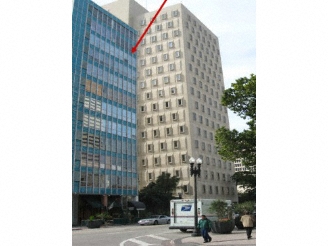
The building in question looks pretty big, lies across the street from the court house and is home to Andrews International, which is headquartered in Los Angeles, and bills itself as “a full service provider of security and risk mitigation services” and the “largest private, American-owned full-service security provider in the United States.”

In October 2009, Andrews International acquired Verasys LLC, a Miami-based consulting firm focused on global risk mitigation, investigations and security services.

“The acquisition added new offices in Miami, Tampa, Dallas, Atlanta and Bogotá, expanding service capabilities in all 50 states and Latin America” an Andrews International press release states.“ This followed the June 2009 acquisition of the U.S. and Mexico guarding operations of Garda World Security Corporation (TSX: GW), encompassing 14 offices across the U.S. and abroad. Most recently in January 2010, Andrews International acquired A&S Security, a California-based full service security company, expanding operations in its Western U.S. Region.”

So, it’s possible Bob Tarantino, or whatever his name is, works for these folks?
Lennar Urban’s Kofi Bonner has not replied to this question, as of this blog posting. But in a March 15 letter to Board President David Chiu and D. 10 supervisor Sophie Maxwell, Bonner said he was “working with our vendors to prevent such an episode from happening again.”


Bonner’s letter wasn’t entirely apologetic.

“Lennar has become increasingly concerned that some community meetings have devolved into hostility accompanied by intimidation of our supporters,” Bonner stated. “For that reason, I decided against sending any employees or consultants to the meeting in question.”

“I am truly disturbed by the ensuing physical and verbal abuse directed at the security firm employee,” Bonner continued. “Not surprisingly, he is independently considering his legal options.”

Newsom wants more authority for party-crashing cops

12

At a time of rising concern about police crackdowns on San Francisco nightlife – including the use of unprovoked brutality, selective harassment, and punitive property seizures – it would seem a strange time to call for abolishing the Entertainment Commission and returning its authority to the San Francisco Police Department. But Mayor Gavin Newsom has now called for doing just that.

Newsom last week refused calls to get involved with mediating a nasty dispute between the SFPD and nightlife workers and advocates, who have filed claims and lawsuits against the city alleging improper police behavior, including a racketeering lawsuit and another lawsuit alleging police retribution against promoter Arash Ghanadan for complaining about mistreatment, for which Police Chief George Gascon is scheduled for a video deposition on April 8 (other depositions involving Gascon and the undercover partners Officer Larry Bertrand and ABC agent Michelle Ott will follow in coming weeks).

The police crackdown, the subject of recent cover stories in both the Guardian and the SF Weekly, has been underway for more than a year and nightlife advocates say it is reminiscent of the arbitrary police enforcement against disfavored clubs and parties in the late 1990s that led to the creation of the Entertainment Commission in the first place.

Making Newsom’s new stance even more puzzling, the commission has been responsive to the overhyped criticism of the commission by nightlife critics, some politicians, and the San Francisco Chronicle and Examimer. The commission voted last night to suspend Suede for shooting out front, a decision that Board of Supervisors President David Chiu (whose North Beach constituents have put pressure on him to rein in problem clubs) cast as a litmus test for the commission, and one it apparently passed. In addition, Commissioner Terrance Alan, who had been criticized for his conflicts of interest, last week announced that he will be stepping down from the commission when his term expires in June. 

“Isn’t anyone paying attention? It’s really got me baffled,” Alan said of the continuing calls to kill the commission. “I don’t know what this is about.”

He isn’t the only one. Commissioner Jim Meko, who had been critical of the commission’s industry-heavy makeup and reluctance to take aggressive action against problem clubs, told the Chronicle that turning permitting and enforcement over to the cops would be much worse.

Sen. Mark Leno, who as a supervisor created the commission back in 2002, agrees. He told us that he opposes the change proposed by Newsom.

“I strongly believe the original reasons for the creation of the commission, an inherent conflict in having the same body that enforces licensing to also issue those licenses, remains,” Leno told us.

Leno also noted that it was only in November that the Board of Supervisors voted to give the commission more authority to suspend the licenses of problem clubs, which they used with Suede, delivering the maximum penalty possible: a 30-day suspension.  

“If they just gave them additional authority, let’s give it a little time to work out before we talk about disbanding them,” Leno said. He also noted that it’s strange to see the mayor and supervisors criticizing the industry-heavy makeup of the commission considering that they’re the one who make those appointments: “That’s in the hands of the board and the mayor.”

Neither Chiu nor Newsom have returned our calls seeking comment, but several Guardian sources with long involvement in the conflict between the SFPD and the nightlife community say the cops – particularly hardasses like Commander James Dudley, who has often made comments critical of nightlife and its promoters — have long sought to have more power over nightclub, private parties, and the citizens who attend them.

But until there is a fair airing of and resolution to the trend of overzealous and belligerent enforcement actions by the SFPD, any move to give that agency more authority to kill the fun in San Francisco is likely to be met with heavy opposition.


UPDATE: David Chiu just got back to me, saying Newsom hadn’t consulted him before taking his stand and telling us, “I don’t agree that we need to abolish the commission.”

But as the supervisor from a sometimes-rowdy district that includes a couple of clubs where violence has occurred, Chiu does want to make some changes in how nightlife is governed in San Francisco, seeing a conflict between the Entertainment Commission’s role promoting nightlife and regulating it: “The Entertainment Commission has conflicting missions.”

Chiu said he would like to see nightclub permitting turned over to a body like the Interdepartmental Staff Committee on Traffic and Transportation (ISCOTT), which handles street closure permits and has representatives from several city agencies. It would exist alongside the Entertainment Commission, whose work Chiu said has become “overly politicized” in recent months.

At the same time, Chiu said, “I generally agree with” the Guardian’s coverage of the War of Fun, and said that he’s helped facilitate meetings with SFPD to deal with issues like the inappropriate police seizures of DJ’s laptops: “From my perspective, I want to make sure people’s civil rights aren’t being violated.”

But Chiu said the problem seems to lie more with the California Department of Alcoholic Beverage Control than the SFPD: “It appears the ABC has been inappropriately cracking down on the mainstream venues that are trying to do the right thing.”

Chiu said there isn’t a pressing need to act quickly on the Entertainment Commission issue and said that he would work with Leno on the solution, something Leno confirmed, telling us, “I have had some conversations with David Chiu and I’m going to get more involved.”

Downtown’s DCCC slate fizzles

9

I’m actually a bit surprised that Gavin Newsom’s allies haven’t made a bigger push to take back control of the San Francisco Democratic Party, which will play a key role in the fall supervisorial races. It looked for a while as if the downtown folks were organizing to put a slate of strong candidates with solid name recognition on the ballot. But when the Department of Elections closed Friday afternoon, and the deadline for filing passed, there weren’t that many new names on the ballot. Here’s the list. (PDF).


Twelve candidates will get elected in each of the two San Francisco Assembly districts. On the east side of town, in AD 13, eight progressive incumbents, including Sups. David Campos and David Chiu, former Sup. (and current DCCC chair) Aaron Peskin are running. So is School Board member Kim-Shree Maufas and former state Sen. Carole Migden. Supervisorial candidates (and incuments ) Rafael Mandelman and Debra Walker are running, as are former supervisorial candidates Eric Quezada and Alix Rosenthal.


Not a lot of star power in the more moderate camp. Other than former Sup. (and incumbent) Leslie Katz and sup. candidate (and incumbent) Scott Wiener, it’s not a powerful crew. So the progressives look to do well — as they usually do — in D 13.


D-12 is a little more conservative in general — and there are lots and lots of candidates, meaning name recognition is even more important. I’d thought maybe somebody would talk Sup. Sean Elsbernd or Sup Carmen Chu into running. But no: the only elected officials on the list are progressives, including Sups. John Avalos and Eric Mar, School Board member Sandy Fewer, and Community College Board member Milton Marks. Then there’s incumbent (and former Sup.) Jake Mcgoldrick.


The moderate, pro-Newsom camp — the folks who would try to shift the Democratic Party endorsements away from progressives in swing supervisorial districts — may be large, but not terribly deep. Incumbents Tom Hsieh and Megan Levitan are, of course, running again, and there’s Bill Fazio, who once ran for district attorney.


Myra Kopp, wife of former state Sen. (and retired judge) Quentin Kopp, is a candidate, and while she may be a little more politically conservative than Avalos and Mar, she’s not going to be in the Newsom camp, either; she’s more of an independent wild card.


Paul Hogart agrees with me that the progressives seem well situated to keep control of the DCCC, although it’s never a sure thing: there are no contribution limits for these races, and since it’s a low-profile office, big money can make a big difference. Let’s see what downtown tries to do to buff up and promote its candidates in the next two months.


Gav’s running for (lite) guv!

1

It’s not any big surprise that Gavin Newsom is officially running for lieutenant governor; we all knew that was in the cards. Newsom’s downtown allies don’t want him running, because he might win — which would mean a vacancy in the mayor’s office. But it’s really all about Newsom, and he doesn’t want to be termed out with nowhere to go.


Calitics makes the point that


In many ways, this race will showcase the future leadership of California Democrats. The winner of the primary will go on to defeat Abel Maldonado and will be a top contender to be the next governor, whether they succeed Jerry Brown or (god forbid) Meg Whitman. It’s to the benefit of Democrats and progressives that this race be issue-oriented, and free of the unfortunate personal attacks that would undermine all the candidates involved.


And Newsom loves the idea of being showcased as the future leader of California Democrats.


Newsom got a big bounce the moment he announced, when state Sen. Dean Florez, one of two other Democratic candidates for the office, dropped out and endorsed Newsom.


That leaves just Newsom and Janice Hahn, a Los Angeles City Council member who’s got an aggressive campaign (featuring Garry South, the asshole political consultant who used to work for Newsom).


Newsom starts off with a major lead; all the money he spent campaigning for governor gave him significant name recognition, and in a Democratic primary for a low-profile office, that makes a lot of difference. And his likely opponent in November is Abel Maldonado, a not-terribly-appealing Republican.


So the talk in San Francisco is all about who becomes the next mayor if Newsom wins — and already, the Newsom strategists are trying to figure out how to prevent the progressive district-elected board from appointing his replacement. The latest strategy: A Charter amendment establishing that a vacancy in the Mayor’s Office has to be filled in a special election.


Hard to argue against that — except that the special election would be in the spring of 2011, and the general election would be that fall, meaning two expensive elections (one of them guaranteed to have low turnout) in the course of 11 months.


There’s no way Newsom’s getting six votes on this board for his idea, which means he’s going to have to raise the money to gather 47,000 signatures. And if he does, the supervisors ought to respond with their own Charter amendment — establishing that vacancies on the Board of Supervisors (now filled by a mayoral appointment) also require a special election. That’s only fair.


And while Newsom and his allies talk about how unfair it is to have district supervisors, some of whom were elected with as few as 10,000 votes, decide on the next mayor, it’s worth thinking through what a special election for mayor would look like. For starters, a lot of people would probably run — and the results would be utterly unpredictable. Suppose everyone who really wants to be mayor jumped in: Leland Yee, Dennis Herrera, Aaron Peskin, Ross Mirkarimi, Bevan Dufty, maybe Michela Alioto-Pier, maybe Sean Elsbernd, maybe even Mark Leno … and the turnout will be ultra-low, and, well, the next mayor’s going to be elected with a remarkably small number of votes.


Assume a turnout of 100,000 — high for a special election. And assume seven candidates (there would probably be a lot more). That means the winner would be unlikely to have more than 20,000 first-place votes.


If it’s a ranked-choice voting situation, any of the above could pull it off. If it’s a simple plurality, hey: someone like Chris Daly, who has a small but highly devoted constituency, would have as good a chance as anyone.


The bottom line is that a special election doesn’t guarantee anything — in fact, it could turn out to be downtown’s worst nightmare.


Here’s the letter Newsom sent to potential supporters:


I didn’t come to this decision easily, but, after a great deal of consultation with my family, constituents and supporters, I believe that the best way for me to serve is by taking all of the many things that are right about California and applying them to fixing what’s wrong in Sacramento.  


The issues I fought for when I ran for Governor last year haven’t changed: our state still faces a massive budget crisis, painful unemployment, and rising student fees that threaten the stability and accessibility of our University system.  Too many Californians lack access to quality health care and too many schools are overcrowded and underfunded.


But, despite our challenges, I will always believe in California – the dynamism of its past and the promise of its future.  I’m also convinced that those of us who love this state have both an obligation and the capacity now to reform it and make it better. To do that, we need to embrace a new way of doing things in Sacramento and we need new leaders who are willing to stand up and change state government.


I’m proud that I have the support of Speaker Nancy Pelosi, Senate President Darrell Steinberg, Assembly Speaker John Perez, Sacramento Mayor Kevin Johnson, United Farm Workers co-founder Delores Huerta and California Nurses and teachers and I hope I can count on your support too.


And here’s some of the press coverage:


LA Times on Newsom run, including information on early fundraising.


Calitics on Florez’s exit from the race, including text of Florez
message and press release.


Newsom announces his candidacy in an interview with reporter Phil
Matier
on CBS 5. (video)

 Chronice on Newsom’s chances.


 Willie Brown on who will succeed Newsom as mayor.
 
Chronicle speculates on who will replace Newsom, specifically on the
possibility of David Chiu becoming mayor.

LA Observed on Gary South vs. Newsom.


LA Times blog on awkward Newsom-Brown pairing.

Politics and redistricting: The madness in SF’s future

8

The political merry-go-round in San Francisco going to be whirling at light speed soon. It’s partially the fault of term limits — over the next couple of years, some very talented, ambitious politicians are going to be forced to leave local office, and they’re looking for the next step. Part of it is the confluence of a bunch of events, starting with Mayor Gavin Newsom and District Attorney Kamala Harris both seeking statewide office.


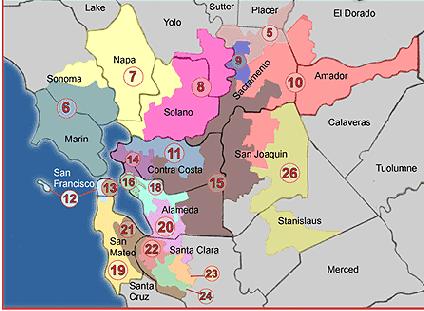
And there’s another factor that hasn’t been talked about much, but it’s really important: Next year, every Congressional, state Legislative and local supervisorial district is going to change.


After the decennial census, everyone has to draw new lines to reflect population shifts. At the state level (and Congressional redistricting is also a state function), that’s in the hands of a reapportionment commission, which I’m dubious about: The majority of the applicants are white people, and it’s supposed to have an equal number of Democrats and Republicans, although the state has far more Democratic voters. It’s anybody’s guess how they’ll actually draw the lines.


An elections task force will do the local lines, and it’s going to be harder to screw up; San Francisco supervisorial districts are supposed to reflect established neighborhood boundaries, and the population shifts within the city haven’t been that dramatic.And it’s unlikely anyone’s going to try to draw lines just to force an incumbent supervisor out of a district. But the districts will be a little bit different, and in San Francisco politics, a little bit can mean a lot.


The state Legislative districts will change significantly — and could change the politics of this area, and the state, in dramatic ways. For example, suppose Mark Leno’s Senate District moves somewhat North, to include a majority of Marin and Sonoma residents and only a small minority of San Franciscans? Suppose that district no longer includes Marin or Sonoma, but includes all of San Francisco (which would put Leno and Leland Yee in the same district)?


Suppose the 12th and 13th Assembly Districts, which now divide about East/West, shift to North and South? What if Tom Ammiano and Fiona Ma end up in the same district? (Um, I think that’s a closer relationship than either of them wants ….)


What happens if Nancy Pelosi is redistricted out of her seat? (Heh heh, won’t happen, but in theory, she and Lynn Woolsey could wind up living in the same district.)


It’s going to change the dynamics in a city that’s already poised for some upsets to the political apple cart.


Ross Mirkarimi’s termed out in 2012, and if he doesn’t run for mayor (or doesn’t get elected) he’ll be looking for the next step, which could be a run for the state Assembly; Tom Ammiano will be termed out in 2014. Of course, that’s been a gay seat for a long time (Carole Migden, Mark Leno, Ammiano) and by them someone like David Campos might be interested.


Or the district lines might have changed so much that both of them – or neither of them – can get elected.


If Bevan Dufty doesn’t get elected mayor, he’s out of a job – and he’s a political junkie who won’t easily retire. He’ll be looking at other offices, too. So will Sean Elsbernd, I suspect.


And that doesn’t even count the mayor’s race, which could, at this point, involve both state Senators, Leno and Leland Yee, and if either one wins, that opens up a Senate seat. And at the same time, if Kamala Harris is elected district attorney, that job will be open, and it’s an open secret that Board of Supervisors President David Chiu, a former prosecutor, would love to be in that office some day.


And in the background is the question of who becomes mayor if Newsom becomes lt. governor


 (and what happens to Aaron Peskin, an astute politician if ever there were one, and a potential mayor if this board of supervisors gets to make the appointment ). At lot to think about – and trust me, the thinking is already going on.

Editorial: Where landlords, developers, and cars are king

1

EDITORIAL Are cars more important than people? Is it OK to evict a tenant just to make space for a garage? Should new garages be designed to preserve on-street parking too? Seems like a no-brainer to us. But legislation by Sup. David Chiu that would put some limits on the expansion of garages — an increasing problem in Chinatown and North Beach — has infuriated some real estate interests, and it’s possible that this eminently reasonable bill might fail.

It’s a sad statement on San Francisco politics, and the implications go way beyond this one planning measure.

The problem has its roots in the Ellis Act, the state law that allows landlords to clear all the tenants out of a building, then sell it to wealthier people who want to buy their units as tenants in common (TICs). The Ellis Act has been responsible for thousands of San Franciscans losing their homes — and a new twist has been developing in Chiu’s district.

In the crowded Chinatown-North Beach area, parking is at a premium and people who are buying TICs want a place to put their cars. So landlords and speculators are throwing out tenants not just for new owners, but to make room for garages.

Chiu’s law — which would apply only in parts of District 3 — would deny building owners a permit to construct a new garage if a tenant was evicted under the Ellis Act in the past 10 years. And it would require a conditional use authorization from the City Planning Department for any new garage construction.

Chiu also wants new rules for curb cuts — the openings in sidewalks that allow cars to drive into garages. The cuts would have to be as small as possible and designed to preserve on-street parking.

On a larger level, the bill would make it easier to construct new housing without parking — a significant change in how San Francisco has handled off-street parking for many years. Instead of mandating garages in new apartment buildings, Chiu wants to discourage them. He’s saying, in essence, that space for people is more important than space for cars.

That’s a logical step in a city that is trying to enforce a transit-first policy. It’s a small piece of a larger political battle to transform a city planning system that for too long has been driven by the needs of the private automobile. It should have passed unanimously and Mayor Newsom should sign it into law.

In fact, the bill passed on first reading Feb. 9, with only Sups. Sean Elsbernd and Carmen Chu voting against it. But Sup. Bevan Dufty now says he has concerns about the measure, and Chiu has agreed to postpone the final vote until March 9.

Dufty’s a key vote, because it’s likely at this point that the mayor will veto the measure. And with Elsbernd and Chu opposed and Michela Alioto-Pier still out with health problems, supporters can’t override a veto without Dufty.

We couldn’t reach Dufty, but supporters of the bill say he wants the measure watered down to eliminate the conditional use requirement — which would force city planners to check and make sure the builder or landlord was following the rules — and replace it with a discretionary review requirement, which would allow the garage construction unless someone objected. That puts the burden on the tenants (who in many cases are low income people whose primary language isn’t English) to protect themselves. And it would undermine much of the power of the bill.

It’s insane for Dufty to oppose a reasonable measure that only applies to a small part of one district, protects vulnerable tenants, and pushes the city away from further automobile dependence. It’s insane that the mayor is expected to veto the bill. It’s insane that it’s even an issue. And if the ordinance fails, it will be a sign that even in San Francisco, in 2010, landlords, developers, and cars are still king.


Where landlords, developers, and cars are king

3

EDITORIAL Are cars more important than people? Is it okay to evict a tenant just to make space for a garage? Should new garages be designed to preserve on-street parking too? Seems like a no-brainer to us. But legislation by Sup. David Chiu that would put some limits on the expansion of garages — an increasing problem in Chinatown and North Beach — has infuriated some real estate interests, and it’s possible that this eminently reasonable bill might fail.

It’s a sad statement on San Francisco politics, and the implications go way beyond this one planning measure.

The problem has its roots in the Ellis Act, the state law that allows landlords to clear all the tenants out of a building, then sell it to wealthier people who want to buy their units as tenants in common (TICs). The Ellis Act has been responsible for thousands of San Franciscans losing their homes — and a new twist has been developing in Chiu’s district.

In the crowded Chinatown-North Beach area, parking is at a premium and people who are buying TICs want a place to put their cars. So landlords and speculators are throwing out tenants not just for new owners, but to make room for garages.

Chiu’s law — which would apply only in parts of District 3 — would deny building owners a permit to construct a new garage if a tenant was evicted under the Ellis Act in the past 10 years. And it would require a conditional use authorization from the City Planning Department for any new garage construction.

Chiu also wants new rules for curb cuts — the openings in sidewalks that allow cars to drive into garages. The cuts would have to be as small as possible and designed to preserve on-street parking.

On a larger level, the bill would make it easier to construct new housing without parking — a significant change in how San Francisco has handled off-street parking for many years. Instead of mandating garages in new apartment buildings, Chiu wants to discourage them. He’s saying, in essence, that space for people is more important than space for cars.

That’s a logical step in a city that is trying to enforce a transit-first policy. It’s a small piece of a larger political battle to transform a city planning system that for too long has been driven by the needs of the private automobile. It should have passed unanimously and Mayor Newsom should sign it into law.

In fact, the bill passed on first reading Feb. 9, with only Sups. Sean Elsbernd and Carmen Chu voting against it. But Sup. Bevan Dufty now says he has concerns about the measure, and Chiu has agreed to postpone the final vote until March 9.

Dufty’s a key vote, because it’s likely at this point that the mayor will veto the measure. And with Elsbernd and Chu opposed and Michela Alioto-Pier still out with health problems, supporters can’t override a veto without Dufty.

We couldn’t reach Dufty, but supporters of the bill say he wants the measure watered down to eliminate the conditional use requirement — which would force city planners to check and make sure the builder or landlord was following the rules — and replace it with a discretionary review requirement, which would allow the garage construction unless someone objected. That puts the burden on the tenants (who in many cases are low income people whose primary language isn’t English) to protect themselves. And it would undermine much of the power of the bill.

It’s insane for Dufty to oppose a reasonable measure that only applies to a small part of one district, protects vulnerable tenants, and pushes the city away from further automobile dependence. It’s insane that the mayor is expected to veto the bill. It’s insane that it’s even an issue. And if the ordinance fails, it will be a sign that even in San Francisco, in 2010, landlords, developers, and cars are still king.

The Chronicle’s dishonest hit on district elections

8

The move to get rid of district elections – which is based entirely on the fact that big business and more conservative voices (including the Chron) don’t like the progressive policy positions of the current board – is now well under way. The Chron devoted its Insight section to the issue Feb. 28, leading with a long editorial that wandered back and forth between points and never really made the case.


An example of the Chron’s logic:


But sitting atop the decision-making tree [in San Francisco] are small-time politicos, some elected with fewer than 10,000 votes in a city with a population of 808,976.


Horrifying! It’s as if the United States Congress – which has to decide issues like war and peace — was made up of local politicos who were elected with as few as 100,000 votes in a nation of 350 million.


Or as if the California Assembly – which has to deal with a $28 billion budget deficit – was made up of local politicos who were elected with as few as 50,000 votes in a state of more than 35 million.


A district supes votes could represent about 1.2 percent of the entire city. A state Assembly member could represent only 0.1 percent of the population of the state. And yet, I don’t hear the Chron calling for the state Assembly to be replaced with an at-large body.


More:


A town with sweeping plans to develop two empty Navy bases at Hunters Point and Treasure Island, fill vacant offices with new jobs, and cut its budget by more than a half billion dollars isn’t getting the thought, expertise – and citywide vision – it needs for these challenges.
This lack of broad leadership obstructs the city’s future. A major cause is the district election system that magnifies neighborhood and tight-knit interest groups to produce officeholders with little stake in citywide questions. If all politics is local, as former House Speaker Tip O’Neill famously declared, then San Francisco has pushed this dictum to the max. It’s all about me and my neighborhood.


That’s absolutely, factually untrue – the district elected board has done more to advance citywide issues – from minimum wage to health care to the rainy day fund to infrastructure planning – than any at-large board in the previous 20 years.


And the Chron’s own editorial contradicts that argument:


Supervisor David Campos (a winner with 9,440 votes) led a move to keep illegal immigrants who are juveniles accused of felonies from being turned over to federal authorities, despite a city legal opinion that the idea wouldn’t fly. Supervisor John Avalos (6,918 votes) dreamed up the “must spend” order directing the mayor to maintain expenditures in a record deficit year. Thankfully, he dropped the idea at the 11th hour


Okay, I get that the Chronicle editorial board doesn’t like the Campos sanctuary bill or the Avalos must-spend legislation – but that are both citywide issues. They have nothing to do with “me and my neighborhood.”


Which is really the entire point here. The Chron doesn’t like the outcome of district elections – because over the past ten years, the progressives have shown they can win district races. There’s a good reason for that; in district races, you don’t need to raise huge amounts of money.


As Assemblymember Tom Ammiano and Supervisor David Chiu point out in an opposing editorial:


Part of that increased accessibility to government is the result of the decrease in the cost of running a district versus a citywide election. In the 1994 citywide elections, the average winning candidate spent $456,000 in today’s dollars. That’s 225 percent greater than the amount spent today: In 2008, the winning candidates spent an average of $204,000. Candidates needing to raise money for a citywide race will inevitably turn to special interests for contributions. If you believe elected representatives should speak up for people, not just the special interests that donated to their campaigns, today’s district system serves you better.


They also note:


Before district elections were passed, under a citywide election system, many neighborhoods – the Excelsior, the Sunset, the Mission and Bayview-Hunters Point – had no supervisor of their own. Today, all residents can pick up the phone and reach an office responsible for their neighborhood and responsive to their concerns – a broken streetlight, a dangerous pothole or a consistently tardy Muni line.


A lot of people don’t like Chris Daly’s personality, and some don’t like his politics, but if you’re a person living on SSI in a grubby little hotel room in the Tenderloin and you need help, you can walk into his office and get a welcome reception and assistance with your needs. You won’t get that from the mayor.


On the other hand, do you think, Don Fisher ever needed to stand in line and try to make a 15-minute appointment to talk to Gavin Newsom? Seriously?


And while we’re on the personality stuff: Yeah, some of Daly’s antics have been over the top. But he’s no worse than some of the others who have served on citywide boards. Former Sup. Bill Maher once accused one of his opponents of having a small penis, and waved around two fingers spread about an inch apart to the press and public.


More important, we had supervisors who did nothing. We had supervisors who did exactly what the mayor said without any question. We had supervisors who were wholly-owned subsidiaries of major local corporations. I’ll take Chris Daly over those folks any day.


By any rational standard, the district board over the past ten years has been more productive, more accountable, more representative and more accessible than any at-large board I’ve seen in my almost 30 years of covering this city.


So the Chron needs to shut up about “citywide perspective”’ and personalities. If the paper wants to oppose district elections, it needs to drop the poll-tested downtown talking points and tell the truth:


The current board is too liberal for the Chron. The moderate candidates the paper prefers can’t win in districts. So they want to change the rules.


That’s the story, beginning, middle and end.


Notes from the Sierra Club’s gala dinner

0

While I focused on Jerry Brown’s disappointing speech to the Sierra Club San Francisco Bay Chapter’s gala dinner on Wednesday night, there are a few more notable nuggets in my notebook worth posting here, starting with what appears to be the collapse of plans for a California Constitutional Convention.

The Guardian recently reported on the difficulties that the campaign was having, but consultant Clint Reilly told me that the effort is basically over, with fundraising shortfalls being the final nail in the coffin. That’s one more reason why “hope” seems to be in such short supply on the political landscape.

The event was held in the Merchant Exchange, a building owned by Reilly, who helped underwrite the gathering. So it was no surprise that the evening was MCed by his wife, Janet Reilly, who is running a strong campaign to replace Michela Alioto-Pier on the Board of Supervisors.

There were lots of political luminaries at the event (list to follow), but there was one particularly notable attendee and particularly notable absence. Los Angeles City Council member Janice Hahn was one of the few politicos from down south, making the rounds in support of her run for lieutenant governor. But Mayor Gavin Newsom, who is considering challenging her, didn’t show up.

Also a no-show was U.S. Sen. Barbara Boxer, who appeared by video to address the gathering and express appreciation for being the recipient of the Sierra Club’s first Phillip Burton Badge of Courage Award for environmental stewardship. Accepting the award on her behalf was California Democratic Party chair John Burton, who was his usual salty self, taking a dig at the San Francisco Chronicle by referring to someone who wrote “for the Chronicle back when that was a newspaper,” and describing the award’s namesake thusly: “My brother was an outstanding environmentalist who didn’t like the outdoors much.”

He also made this funny, self-effacing crack at the start of his speech: “I think a third of the people in this room would like to see the accelerator stuck on the rug of my Prius.” I was not among that third.

There was a strong turnout of local political leaders, but tellingly, only from the left side of the political spectrum. The members of the Board of Supervisors who turned out were David Chiu, Chris Daly, Ross Mirkarimi, Eric Mar, and John Avalos. Other political luminaries on hand included City Attorney Dennis Herrera, Sen. Leland Yee (Yee and Herrera are each running for mayor) City College trustee John Rizzo (who introduced Brown), Senator-turned-Oakland mayoral candidate Don Perata, District Attorney Kamala Harris, Rep. Jerry McNerney, and Sen. Loni Hancock.

Bay Area faith leaders gather to call for immigration reform

2


By Rebecca Bowe

An event will be held this evening (2/18) at the Mission Dolores Basilica to urge Sens. Barbara Boxer and Diane Feinstein to push for nationwide immigration reform. The gathering of people from the immigrant community and faith-based organizations, which is being put together by the San Francisco Organizing Project, will be held in conjunction with the national Reform Immigration for America campaign.

Pat Bregant of SFOP told the Guardian that a turnout of around 1,000 is expected. Several families whose lives have been turned upside down by deportations will share their stories.

More than 35 clergy members from throughout the Bay Area will attend, including Bishop William Justice, Archdiocese of San Francisco. Others who are expected include Jim Molinari, state director for the office of Sen. Diane Feinstein, and San Francisco Supervisors David Chiu and David Campos.

Myrna Godinez, who came to the United States from war-torn El Salvador 26 years ago, said immigrants face steep challenges such as accessing health care and obtaining education. “They come here to work,” she said, “and to live in peace.” She said she faced many challenges trying to build a life here, but in her case, coming to the United States also meant being able “to go outside without being afraid of getting killed.”
The Mission Dolores Basilica is located at 3321 16th Street in San Francisco.

The event will be held from 7 to 8:30 p.m. and is free and open to the public.

The “Newsom wins” merry-go-round: What fun

10

Gavin Newsom still hasn’t said for sure that he’s in the race for lt. governor, although just about everyone in town now thinks he’s going for it.

But the very prospect of the mayor leaving office before his term is up has the political classes speculating: Who gets that job? And how does it happen?

It’s actually pretty interesting.

Under the City Charter, the president of the Board of Supervisors becomes acting mayor in the event that the mayor leaves office before the end of his or her term. Then the supervisors, by a six-vote majority, can appoint someone else to the job.

Melissa Griffin lays out one piece of the scenario, which is that the board could appoint a new mayor in advance, without anyone serving as acting mayor.

But there’s much more to the story.

According to a fascinating city attorney’s opinion issued in 1978 (PDF), when George Moscone and Harvey Milk were killed and Dianne Feinstein was board president, no supervisor is allowed to vote on his or her own appointment. Which would mean that if, say, Board President David Chiu wanted the job, he’d need six votes not including his own.

Now the plot thickens. Suppose nobody can round up six votes — that is, a majority of the supervisors can’t agree on a new mayor? Well, Chiu, as board president, would be acting mayor — potentially for the entire duration of Newsom’s term, roughly a year. He’d also remain as board president. It’s the same as if the mayor goes out of the state and names an acting mayor in his place; that person is still a supervisor. So Chiu would have all the powers of both the mayor and the board president — and immense amout of clout for one person at City Hall.

But wait, there’s more: Chiu is board president only until the board elected in November of this year takes office, which would be about five days after Newsom would become lite guv. So unless the current board can choose a new mayor, with six votes (not including the vote of any supervisor being nominated), the new board would elect a new board president — who would instantly become acting mayor at the same time.

And since supervisors are allowed to vote for themselves for board president, any member would be allowed to vote for him- or herself for acting mayor.

Confused yet? Clearly, the folks who wrote the City Charter never actually envisioned this scenario (or didn’t think about it very much).

Of course, what that means that with the current board split the way it is, with exactly six solid progressive votes, someone who isn’t currently on the board (say, Aaron Peskin — or Tom Ammiano, or Mark Leno, or whoever) would have a better chance of getting a majority than a current member, who would need at least one of the moderate bloc votes.

And if Newsom runs, it will make the fall supervisorial elections even more important, because potentially those newly elected supes will be choosing not only a board president but a mayor.

Here’s another fun twist: If District Attorney Kamala Harris is elected attorney general, the mayor gets to appoint a new D.A. But suppose Newsom also wins and is sworn in a few minutes before Harris. Presumably acting mayor David Chiu (a former prosecutor who rumor has it might like to be D.A. himself someday) would choose the new D.A. — and suppose Chiu knows he doesn’t have six votes to be mayor. There’s no reason why he couldn’t appoint himself D.A., leaving a vacancy on the board and a vacancy for board president, which would be filled by anyone who could get six votes, who would then be acting mayor and could appoint a new supervisor to Chiu’s seat. Who could then be the deciding vote on who gets to be mayor.

Whoa. I can’t wait. Run, Gavin, Run.

Labor’s love lost

4

Note: This file has been corrected from an earlier version.

rebeccab@sfbg.com

Two recent events could have major implications for Service Employees International Union Local 1021 — San Francisco’s largest public-sector union and an important ally for progressives — for better or for worse. And this union’s fate seems closely tied to that of the progressive movement in San Francisco.

The first event was likened to a “nuclear bomb in the morning paper” by one observer, and might be interpreted as the kickoff to a fierce budget battle. Mayor Gavin Newsom announced that he is considering a plan to help solve next year’s budget deficit by laying off 10,000 full-time city workers and rehiring them at 37.5 hours, which would amount to a sweeping 6.25 percent pay cut for workers and an estimated $50 million in savings for a fiscally impaired city.

Though it was framed by Newsom spokesperson Tony Winnicker as one preliminary cost-saving option among many, the proposal received prominent front-page coverage in the San Francisco Chronicle, even before official discussions were called between the mayor and public sector unions. Since SEIU Local 1021 represents 17,000 members in San Francisco and a majority of the city’s 26,000 total employees, it would likely absorb the greatest impact if such a plan went through.

At the same time the mayor’s startling announcement hit newsstands, SEIU was in the midst of mailing out ballots to its membership for union elections. “I don’t know whether it’s a coincidence, or if the city is taking advantage of the fact that SEIU is absorbed in its elections,” Sin Yee Poon, an SEIU chapter president for Human Services Agency workers, told us while pointing out that the events happened simultaneously.

With three separate slates of candidates vying for control of SEIU Local 1021, grudges between warring internal factions have intensified into bitter sparring matches. The timing is unfortunate — just as SEIU’s internal turmoil is coming to a head, one of its greatest battles is pending over an unprecedented $522 million budget shortfall that looms like a dark cloud over the city. The deficit will surely result in job losses, and the public sector union’s ability to mount resistance even as it wrestles with internal strife is shaping up to be a key question.

This pivotal moment carries wider political implications considering that the progressive organization has in the past helped seal an alliance between San Francisco’s left-leaning leaders and organized labor through the San Francisco Labor Council.

With SEIU besieged by infighting and soon to be hurting from wage slashes and layoffs, more conservative factions of the labor community, such as the San Francisco Firefighters Union and the Building and Construction Trades Council, have recently been butting heads with progressive members of the Board of Supervisors.

At the same time, forces on all sides are beginning to eye the coveted seats up for election in June at the Democratic County Central Committee, a Democratic Party hub that is a cornerstone of local political influence, as well as the seats that will open up on the Board of Supervisors in November. Negotiations between unions and the mayor are ongoing, and mayoral spokesperson Tony Winnicker was quick to note that Newsom is open to options, other than reconfiguring 10,000 city jobs, that organized labor brings to the table. At the same time, the Guardian heard from numerous sources that city workers felt outraged and blindsided by Newsom’s decision to air the plan in the Chronicle instead of bringing stakeholders to the table.

SEIU Local 1021 President Damita Davis-Howard told us she thinks the idea of taking $50 million out of the pockets of working people in a rocky economy is wrong-headed.

“This was devastating,” said Davis-Howard, who is running for a newly created union position called chief elected officer, which is different from the union president, and similar to an executive-director post. “The mayor might as well have raised their taxes, because if you decrease their pay by 6.25 percent, they will still have the same amount of work, they will still have to pay the same mortgage, they will still have to buy the same food, the same PG&E, and they’ll be doing it with a lot less money. If any idea like this were to go through, it would actually remove the very fabric or fiber of San Francisco. It would really cut to the core of the very being of San Francisco. … I don’t see how anybody could believe that we could continue being the city that we love being with this kind of action.”

Winnicker, the mayoral spokesperson, cast it as a plan that could avert hundreds or even thousands of layoffs. “This year the easy decisions are behind us,” he noted in a recent discussion with the Guardian.

Solving last year’s fiscal shortfall was far from easy — budget tussles between frontline city workers and the mayor got ugly, and even then, the city received millions in federal stimulus dollars to cushion the blow. A similar plan of sweeping hourly cuts was floated then too, but it didn’t gain enough traction to move forward.

“The mayor is facing a huge budget deficit, there’s no question about it — but he has not lifted one finger to raise a dime in revenue,” charged SEIU member Ed Kinchley, who works at San Francisco General Hospital. As for how the union might respond if such a proposal went through, he speculated, “I think it’s the kind of thing that could lead to a strike. A big fight.”

While the city charter bars strikes by public employees, Kinchley’s comment indicates the level of frustration among SEIU’s rank-and-file.


The proposal could present a common enemy and a rallying point for a union in disarray. Internal jockeying for elected positions can be fierce in any organization, but for San Francisco’s service-workers union, the rifts are particularly deep.

The elections, which will be decided Feb. 28, mark the first time since a radical restructuring in 2007 that members will collectively decide who should lead. In 2007, the face of SEIU was changed across California when the international president, Andy Stern, began consolidating dozens of far-flung locals into centralized, beefier entities in a bid to maximize political effectiveness (California comprises roughly one-third of the entire union’s membership).

Local 1021 came into existence when 10 locals were conglomerated into one 54,000-member giant — hence the “10-to-one” label — representing health care and frontline service workers from the Bay Area to the Oregon border. 

In San Francisco, where a large segment of its members are based, the shift was interpreted by some as a power grab, and it triggered a period of ongoing strife between those allied with Stern and the international wing on one side, and those dissatisfied with changes they saw as antithetical to the democratic ideals championed by Local 790, its predecessor, on the other.

In the years following the reorganization, Stern began trying to aggregate members by raiding other unions to consolidate power. But campaigns to bring in members from United Healthcare Workers (UHW) and fend off membership losses to the newly created National Union of Healthcare Workers (NUHW) have consumed money and resources that some members told the Guardian would’ve been better spent bolstering national support for health-care reform and the Employee Free Choice Act. According to one source, SEIU spent $10 million on a Fresno battle against NUHW.*

A fight waged between SEIU Local 1021 and UNITE HERE Local 2, a hotel-workers union that was historically allied with Local 1021’s predecessor, left some members especially stung because it marred a longstanding relationship between two groups of frontline workers.

“Andy Stern has concentrated more and more power into the hands of a group of so-called elite members of the union,” Kinchley told the Guardian. Stern’s top-down leadership style and growth-oriented objectives “run pretty harshly against what many of us believe is in the best interest of our workers locally,” he added.

In recent weeks, divisions have deepened further. A staff person who preferred not to be identified for fear of retribution filed charges with the U.S. Department of Labor against a supervisor, who is aligned with the international faction, for alleged harassment and bullying. Another complaint was filed with union leadership alleging that union bylaws were violated when membership money was authorized, but not spent, to conduct a poll without proper approval.*

“There’s a fiscal rogue-ness about it. [Davis-Howard] does whatever she wants, and she spends our dues money without authorization from anybody,” Kinchley charged.

Stern appointed Davis-Howard, and now she is running for election on a slate aligned with the international wing. When the Guardian tried to reach her to discuss union elections, spokesperson Carlos Rivera told us that Davis-Howard found it inappropriate to publicly discuss internal divisions.

Sin Yee Poon is running as her opponent on a reform slate, formed by members disaffected by the international’s modus operandi. “For the whole reform group, we’re disappointed with the general direction of corporate unionism,” Poon told the Guardian. Stressing that she believes grassroots, democratic ideals have eroded since the restructuring, she said members in her camp are agitated when they see resources siphoned into raids on other unions such as UNITE HERE and UHW. “We want it to be member-driven,” she said. “The raiding of other unions is absolutely not OK.”


The internal strife could have a wider ripple effect. SEIU Local 1021 has historically been influential in securing an alliance between the city’s labor community and San Francisco’s progressive leadership. During the last round of elections for San Francisco’s Board of Supervisors, Sups. John Avalos and Eric Mar campaigned and ultimately were elected with strong fundraising support from the labor council.

Yet in recent weeks, several skirmishes pitted certain factions of the labor community against progressive members of the Board of Supervisors. Outrage bubbled up from the firefighters — and ultimately the labor council as a whole — against a charter amendment proposed by Sup. John Avalos that would have extended the minimum number of work hours for firefighters.

Billed as a cost-saving measure, the proposal might have ultimately resulted in fewer firefighter jobs, but it was designed to spread the pain of budget cuts more equitably by grazing public safety departments instead of just inflicting blows on frontline and healthcare workers.

After Labor Council Executive Director Tim Paulson came out strongly against it, Avalos abandoned the idea. A source from within the labor council, who spoke on background only, described it as an opportunity for the labor council to come together and unite on class interests.

The political posturing that came out of that fight shook even Sup. David Campos, who vocally called for equitably sharing the pain during last year’s budget debacle. “This isn’t the way to do it,” Campos said when asked about Avalos’ failed charter amendment. “And I worry about the negative impact on labor and the progressive board. There are larger issues at play here. The entire progressive agenda is at stake. We need to think long-term about the specific issues plus the future of the progressive movement.”

Sup. Sean Elsbernd’s bid to reform the pension system to save money has provoked yet another fight with SEIU Local 1021. Union members argue that if they are asked to contribute to their own retirement funds, which would become mandatory under this proposal, then they should be given the same wage increase that other unions were granted when they agreed to similar terms.

But when Sup. Eric Mar tried to amend Elsbernd’s proposal by inserting language guaranteeing that pay increase, Elsbernd said it would cost the city millions more. If Mar’s amended version goes forward, “you’ll be going to the voters by yourself,” Elsbernd told the progressive-leaning supervisor at a Feb. 9 board meeting.


Another fight has erupted over 555 Washington, a tower proposed to go up beside the TransAmerica Pyramid, which was debated at a joint hearing Feb. 11 between the Planning Commission and the Recreation and Park Commission. For members of the Building & Construction Trades Council, which represents unionized carpenters, plumbers, and other workers in development-related trades, the project represented jobs — the screaming priority in an economy where funding for new construction has trickled to almost nil.

“There is, in general in San Francisco progressive politicians, a knee-jerk reaction to development projects,” Building & Trades Council Secretary Treasurer Michael Theriault told us. As a council representing people whose livelihoods depend on private sector construction, “We have a particular quandary,” he said. “We need politicians who at the same time are friendly to labor and understand that development is an economic tool that can help the city.”

The arm of labor representing Theriault’s council has been slammed with job losses due to the economic downturn, and he’s publicly expressed frustration when projects of this scale are shot down.

“What the mayor did, what Elsbernd did, and what Avalos did are all the same thing: They all staked out a position, put a provocative idea on the table, and forced unions to have a discussion with a gun to their head in a non-constructive way,” Mike Casey, president of UNITE HERE Local 2 and a member of the labor council’s Executive Committee.

A source familiar with the inner workings of the labor council said the tension between building trades and firefighters versus more left-leaning members of the labor community has been in existence for decades, and it isn’t anything new — particularly in the months preceding election season.

Casey challenged the very notion that there is a subculture of the labor council that isn’t progressive, pointing out that labor came together as whole to support Sups. Avalos, Mar, and David Chiu — “and I personally would do it again in a heartbeat,” he added. Internal catfights and struggles for control come with the territory in a democratic, diverse organization, he said. “As a group of working people, I have great regard for the membership [of SEIU Local 1021],” he said. “Occasionally there’s a dustup. In my experience, after the dust settles, more often that not, unions come out stronger for it.”.

*Corrections made to the original file.

Gavin watch: The Lt. Gov. rumors

14

The rumors that Newsom is going to announce imminently that he’s running for Lt. Governor turned out to be a bit premature.

But I am still hearing from very solid sources that he’s seriously considering jumping into the race — and while the San Francisco left didn’t back his run for governor, this would be a very different campaign. The Lt. Gov. isn’t really in charge of anything, but has a certain amount of power, not just from the platform and the ability to issue press statements (one of Newsom’s favorite hobbies), but because that person gets a seat on the state Lands Commission (offshore oil drilling) and the U.C. Regents (education cuts). Newsom would most likely be fine on both issues.

And the truth is, we all know Newsom doesn’t really want to be a wine clerk.

And lieutenant governors are often well positioned to move on to higher offices it worked for John Kerry, for example (and for Gray Davis, if you call that working). I think Newsom would love to position himself to run for U.S. Senate when Dianne Feinstein, who will be 79 when her current term expires in 2012, decides to retire.

And, of course, from the perspective of progressives infuriated with what he’s done as mayor, it would get him out of town a year early, and let this district-elected board appoint a new chief executive.

That’s got all sorts of talk started, with the typical Chronicle-style “Oh My God Aaron Peskin could be mayor” stuff (and let’s be serious — Peskin would be a way better mayor than the current occupant of Room 200) to serious discussion about how this will affect the 2011 mayor’s race.

If any of the current contenders could round up six votes, it would be a major boost; that person could then run as an incumbent.

I don’t think this board would ever choose state Sen. Leland Yee, who is positioning himself for the run. City Attorney Dennis Herrera? Maybe — but given how pissed some of the progressives are about the Sanctuary Ordiance, it would be a stretch.

Sfist is running a poll, and right now it looks like the readers like Ross Mirkarimi but think Peskin or David Chiu is a more likely winner.

And trust me, even the thought of Gavin leading town has that scramble already heating up.


Sunshine and shadows

2

tredmond@sfbg.com

It was, the San Francisco Chronicle proclaimed, the end of the world for development in the city, or at least something close to that. A ballot measure, sponsored by Sup. David Chiu, restricting new buildings from casting shadows on city parks “could imperil major development projects,” a Jan. 28 article by John Cote said. “Everything from a new wing at the San Francisco Museum of Modern Art to the expansion of the Moscone Center and creation of a new downtown core around a rebuilt Transbay Terminal could be affected.”

A lot of that is wildly exaggerated. The Chiu ordinance, which has since been pulled from the ballot pending a city study of the issue, would hardly have halted all development — or even all high-rises — in San Francisco. It wouldn’t have gutted the Transbay Terminal plan (although it might have forced planners to reduce the height of a tower that would soar 400 feet above the tallest building in San Francisco). In fact, the real story is how Chiu has managed — for now — to stop a backroom attempt by developers to undermine a 25-year-old environmental law. We found some fascinating evidence of how Mayor Gavin Newsom has been working with the San Francisco Chamber of Commerce to undermine Chui’s efforts — using broad threats to try to get his way.

Chiu’s legislation sought to clear up a couple of loopholes in a landmark 1984 law, which passed on the ballot as Proposition K. The measure, authored by then-Sup. Bill Maher, essentially barred any new construction that would cast a significant shadow on a city park.

In 1989, the final implementation guidelines were approved, and they’ve stopped literally hundreds of proposed projects from casting dark shadows on public open space.

But in the past year, city planners have been meeting with lawyers for big developers and looking for a way to change the rules. Citing new technology that better measures the curve of the earth and complex algorithms that calculate sunlight, the Planning Department has since proposed revising the Prop. K guidelines — in a way that would allow taller buildings and more shadows without getting the approval of voters or supervisors.

Chiu told us he’s been trying for months to find out exactly what the proposed guidelines would do — how many new buildings, at what heights, would be able to shadow which parks. “I was unable to get any answers,” he said.

The measure he drafted would have barred any new guidelines that allowed more shadows — and would have required the Board of Supervisors to sign off any changes. It would still allow the city to make case-by-case exemptions for projects that cast minor shadows but are otherwise deserving of approval — affordable housing developments, for example.

But downtown went nuts — and Newsom joined the fray.

The crux of the opposition came from the Chamber — and is outlined in an e-mail from Chamber Vice President Rob Black to members of the Chamber board.

“The mayor was very direct and clear about the need to defeat the measure,” the e-mail, which we obtained, states. “The mayor was also very clear that he was in no mood for deal-making on the issue and that he would look very unfavorably on any developer or anyone else who tries to cut a deal with David Chiu on the issue. He literally said, you will be on your own for the next two years if you go there.”

Black confirmed that the e-mail was in fact his — but said the version we’d obtained “has been edited. Some words were changed and other omitted.” He refused to say what the changes were, saying that the e-mail was meant to be a confidential communication to his board. However, he confirmed that the basic message and descriptions of a meeting with Newsom were accurate.

Tony Winnicker, Newsom’s press secretary, confirmed that Newsom had been directly involved in trying to scuttle the ordinance — and didn’t deny the mayor had made those threats.

“The mayor made clear the importance of asking the supervisor to withdraw the measure,” Winnicker wrote in an e-mail to us. “The mayor was clear that backroom deal-making should not be tolerated on the issue.”

Chiu was somewhat aghast at the mayor’s statements. “The context for all this is that the developers and their lawyers were trying to change the rules,” he said.

Aaron Peskin, the former supervisor and longtime North Beach neighborhood activist, told us that the “hysteria around this is factually untrue. This isn’t about stopping development — it’s about making sure development doesn’t have an adverse impact on the city’s common space.”

So now Chiu has agreed to hold off — but only if the key stakeholders (not just developers) have some input into how planning devises new shadow rules. And he’s ready to go back to the ballot in November if the developers try to play games again.

That makes sense, Gabriel Metcalf, executive director of the San Francisco Planning and Urban Research Association, told us. “There should be a heavy burden of proof on the people who want new rules,” he said. “And there should be a heavy burden of proof for anyone who wants a ballot measure.”

In other words, Prop. K — as it is, as it’s stood all these years — is working pretty well. And if the developers hadn’t tried to sneak in some big changes, none of this would have happened in the first place.

The “jobs” shell game

0

Written with Nima Maghame

news@sfbg.com

While many San Francisco city officials have been trying to figure out how to close a projected budget deficit of more than $520 million, Mayor Gavin Newsom has spent the last month trying to make that spending gap even larger by aggressively pushing a variety of business tax cuts that economists say will do little to improve the local economy and could actually make it worse.

Newsom first proposed his so-called “local economic stimulus package” a year ago during his ill-fated run for governor, just as President Barack Obama was pushing his own economic stimulus plan. But unlike the federal government’s $787 billion plan, about a third of which involved tax cuts demanded by conservatives, Newsom proposed to cut local business taxes while also deeply slashing local government spending and laying off hundreds of city workers.

Most economists say that’s a terrible idea. In fact, a report issued at the time by Moody’s Investor Services made it clear that every dollar of direct government spending adds about $1.60 into the economy (or $1.73 if it’s on food stamps, the most stimulative spending government can make), whereas business tax cuts add only about $1 to the economy for every dollar spent.

We clashed with the Mayor’s Office at the time on our Politics blog (see “Mayor Newsom doesn’t understand economics,” 2/13/09), with Newsom’s spokesperson telling us the mayor was relying on the input of City Economist Ted Egan. But when we interviewed Egan about the issue, he agreed that it’s a bad idea to slash government spending to pay for tax cuts.

“We were in no way saying you should cut taxes to stimulate the economy, particularly if it means reducing government spending,” Egan told us then. And when we asked directly whether it’s better for San Francisco’s economy for the city to directly spend a dollar on payroll or to give that dollar away in a private sector tax break, he told us, “The consensus among economists is that most of the time government spending stimulates the economy more.”

The Board of Supervisors basically ignored Newsom’s proposal. But he revived it last month, expanding the proposals with even more private sector subsidies and making them the centerpiece of his Jan. 13 State of the City speech, publicly pushing it since then with a series of public events at businesses located in the city.

And this time — with the local economy still slow, projected city budget deficits bigger than ever, and little serious talk about how the city can bring in more money — it appears the proposals will be the subject of a series of hearings before Board of Supervisors’ committees in the coming weeks.

Newsom’s tax cut proposals include a proposal to waive the 1.5 percent payroll tax (the city’s main business tax) for all new hires; extend and expand the payroll tax exemption for biotech companies (see “Biotech’s bonanza,” p. 12); give small businesses tax credits for their spending on health plans; and allow developers to pass one-third of their affordable housing in-lieu fees onto future homeowners.

Newsom and his Press Secretary Tony Winnicker have spoken euphorically about the proposals, saying they’re desperately needed to spur the local economy. “We believe that enacting these tax incentives, particularly the payroll tax credit for new hires, is one of the single biggest things we can do for economic growth,” Winnicker said.

Despite repeated questions about the economists’ concerns over financing tax cuts with government spending cuts, we couldn’t get them to address the tradeoff directly. “The mayor will support critical public services,” was all Winnicker would say about the deep cuts that Newsom is expected to announce in his June 1 budget.

Sup. John Avalos, who chairs the Board of Supervisors Budget and Finance Committee, expressed more skepticism about the mayor’s proposals. “Do tax breaks have the intended effect of stimulating the economy? As we underfund government services, are we getting a net gain or are we getting something taken away? For the very small businesses in my district, it’s going to be trickle-down economics. It’s very unrelated and unmeasurable in benefit,” he told us.

David Noyola, board aide to President David Chiu, said his boss is supporting the biotech tax credit but reserving judgment on the rest. “It’s going to be a cost-benefit analysis,” Noyola said. “When we’re talking about jobs, we’re talking about public and private sector jobs, always.”

While Egan’s economic analysis predicts tax cuts will encourage some economic growth, even he is circumspect about the good it will do, particularly without finding a way to avoid deep cuts in city spending. “The truth of the matter is that our stimulus efforts are small because the city has relatively small power to affect the local economy,” Egan told us.

That’s the consensus economic opinion. Huge federal spending can help a national economy a little bit, but local economies are just different animals that local governments are largely powerless to really alter, particularly through tax cuts.

“I agree with Egan: city government has little power over the local economy,” Mike Potepan, an urban development economist at San Francisco State University, told the Guardian.

Both economists agree that tying tax cuts to job creation or development stimulus is better than general tax cuts, but that neither is good if it means laying off more city workers.

“Research shows that by cutting taxes you have more business activity where studies show it is likely to effect employment,” Potepan said. “On the other side, you have to think about revenue. Cities are going to have to balance their budgets, which could mean a cut in services.”

Author Greg LeRoy expresses a more critical perspective in his book The Great American Jobs Scam: Corporate Tax Dodging and the Myth of Job Creation (1995, Berrett-Koehler), amassing evidence from economic studies and CEO surveys that corporate tax breaks, even those tied to new job creation, have almost no effect on private companies’ decisions about where to locate and whether to hire.

“How can companies get away with this? Because the system is rigged. Corporations have it down to a science. They have learned how to chant ‘jobs, jobs, jobs’ to win huge corporate tax breaks — and still do whatever they wanted all along,” LeRoy writes. “That’s the Great American Jobs Scam: an intentionally constructed system that enables corporations to exact huge taxpayer subsidies by promising quality jobs — and lets them fail to deliver. The other benefit often promised — higher tax revenues — often proves false as well.”

While proposing to forgo collecting millions of dollars in payroll taxes (the Controller’s Office is still working on a projected total for the tax cut package), the Mayor’s Office also wants to spur development of new housing with a proposal that would delay collection of needed affordable housing money by more than a decade.

After hearing mostly from a large crowd of desperate developers and construction workers during a Jan. 21 hearing on the proposal, the Planning Commission approved the package on a 4-3 vote, with the mayor’s appointees in agreement and the board’s appointees in dissent. It will be considered by the Board of Supervisors Land Use Committee sometime after Feb. 12.

The most controversial part of the fee reform package involves reducing the fee developers pay to support affordable housing by 33 percent, then charging a 1 percent transfer tax to subsequent buyers of those homes. Egan estimates developers would save almost $20,000 per housing unit, and that it would take an average of 16 years for the city to recover that money. But for high-rise luxury condos, the city would eventually recover about $27,000 per unit.

“It’s a classic make-an-investment-now-to-get-more-later strategy,” Michael Yarne, who crafted the policy for the Mayor’s Office of Economic and Workforce Development at Newsom’s direction, told the Guardian.

“If it makes it feasible for projects to be started, then it is worth passing,” Tim Colen, a representative of San Francisco Housing Action, said at the Planning Commission hearing, expressing hope that it will help create desperately needed construction jobs and new market rate housing.

But affordable housing advocates and some progressives criticize the policy as completely backward, saying that affordable housing development is desperately needed now, during these tough economic times, rather than a policy that encourages more market rate housing and bails out bad investments made at the height of the real estate bubble.

“What the city needs to do is directly build affordable housing, for which there is a demand,” affordable housing activist Calvin Welch told us. “The problem is that the banks don’t want to lend these guys money because they know nobody can afford to buy houses at the prices that these guys are demanding.”

Debra Walker, who is running for supervisor from District 6 and voted against the proposal when it came before the Building Inspection Commission (the sole vote on a commission dominated by mayoral appointees), agrees.

“The whole argument is that it stimulates development, but it doesn’t,” Walker said, arguing that the incremental gains (about 25 housing units per year, Egan estimates) will be offset by delayed affordable housing construction. “There would be more economic stimulus by using the fee to build more affordable housing.”

Instead, it simply shifts resources to favored entities: from home owners to developers, in the case of the affordable housing fees, or in the case of the tax credits, from the public to the private sector. But Newsom’s office just doesn’t see it that way.

“The Guardian believes in protecting public sector employees over private sector employees,” was how Winnicker formulated our understanding of what the economists are saying. “Most people don’t work for the city, and if we can support private sector jobs, that adds to sales tax revenues and benefits the economy. Despite a short-term impact of the tax credit, that’s a benefit.”

Adam Lesser contributed to this report


Why Newsom drives me nuts

2

This is the kind of thing that drive me nuts about the Newsom administration.


A few days ago, SF Appeal ran an item on a speech Newsom gave about condo conversions. The mayor wants to let more people turn rental units and tenancy-in-common units into condominiums; that, Newsom argues, will bring more revenue into the city treasury (those conversion permits are expensive).


But there’s a reason why the city limits to 200 the number of units that can be converted in any one year. Turning a rental unit into a condo reduces the number of rentals available, and turning a rent-controlled unit into a condo (or into a TIC and then a condo) cuts into the affordable housing stock.


And a majority of the supervisors, who recognize the impact the mayor’s plan would have on tenants (by making it easier to take rental units off the market), are dubious.


Okay, that’s a difference of opinion. You don’t have to make it personal. And yet, at his press conference, the mayor insisted that


“Half of the members of the board have been beneficiaries of condo conversions, and yet they deny it to other people.”


As the Appeal pointed out, that’s simply untrue.


A majority of Board members own their homes, according to a check of property records: mayoral allies Michela Alioto-Pier, Sean Elsbernd and Carmen Chu all enjoy the benefits of owning and equity, as do Sophie Maxwell and progressive Budget chairman John Avalos.


Eric Mar and David Chiu rent, according to a City Hall source. Chris Daly lives in a condo, but “my condo has always been a condo,” according to the supervisor (and according to the Assessor-Recorder’s Office, Daly at least bought his condo as a condo and not a tenancy-in-common or conversion).


By all accounts, progressive Ross Mirkarimi is on the condominium-conversion waitlist (an older news report says Ross owns a TIC and is on the conversion list; we’ll check in with him to confirm, he is at this moment still in committee). Mirkarimi and Bevan Dufty would be the two Board members conflicted-out of any votes on condo-conversions; Dufty went from a condo to a TIC after his daughter was born.


“And nobody was evicted,” the Bev told us today.


Okay, as I see it only one supervisor is even in a position to benefit from the condo conversion law. So I asked Tony Winnicker, the mayor’s press secretary, whether Newsom had been misquoted. Apparently not. So why did ne make an innacurate statement that insulted half the members of the board?


Winnicker:


His comments came in the context of the polarized politics of San Francisco which pit tenants vs homeowners to the benefit of no one. He was speaking that many Boardmembers enjoy the benefits of homeownership and that opposing the condo conversion proposal denies those benefits to others who are already living in TICs and displacing no one through condo conversion.


But there’s a big distinction between what Winnicker is talking about and what Newsom actually said. It’s entirely possible to be a homeowner in this city without evicting anyone and without taking a rental unit off the market. That’s what most of the homeowning board members have done.


As for TICs “displacing no one,” that’s wrong, too. The number one cause of no-fault evictions in this city is the use of the Ellis Act to clear the tenants out of a building to create a TIC. The only thing holding the TIC epidemic in check is the fact that the TIC ownership model is complex and a bit tricky. The minute you can convert those TICs into condos, you open the floodgates for a lot more of them — and that means a lot more evictions.


Newsom can make the case for condo conversions just fine without making factually inaccurate statements that insult the supervisors. Instead he pulls this shit. And then he complains about the supervisors not wanting to work with him


Drives me nuts.


Newsom’s perplexing attack on San Francisco’s economy

4

There’s a crazy disconnect in City Hall these days over how to help the local economy. Mayor Gavin Newsom has spent much of the last month focusing on “jobs” and “local economic stimulus,” proposing to give a few million dollars in tax breaks to local companies while refusing to discuss new tax measures to help close the city’s $522 million budget deficit.

As we explain in detail in tomorrow’s Guardian, economists just don’t think the tax cuts will help the economy much at all – particularly if the city is reducing its spending and payroll to do so — but even some progressive supervisors are playing along to appease the anxious business community. For example, Board of Supervisors President David Chiu supports an extension of the biotech tax, denying city coffers the benefit of efforts by the city and UCSF to become an important hub for the industry.

Then, in today’s Chronicle, Newsom floats the idea of unilaterally shortening the workweek for city employees in order to save $50 million in payroll costs, firing 10,000 workers and then rehiring most of them to do so. But let’s be clear about this: that means removing $50 million from San Francisco’s economy, or even more once you figure in the multiplier effect that would more than double that loss.

As much as Newsom and his Chamber of Commerce allies love to bash government, the city is one of San Francisco’s largest employers, a clean industry with good-paying jobs. And it just makes no sense why they prefer to inflict mass layoffs on that employer – not to mention the reduced city services that will hurt even private sector productivity — rather than increase taxes on large corporations that ship their profits out of the city and therefore offer minimal benefits to this city’s economy.   


Gavin for Lite Guv?

1

Willie Brown thinks it’s a good idea. And you can tell Newsom wants to consider it, since he knows there’s nothing else obvious for him to do once his term as mayor is up — and there are going to be a lot of options not too far down the road. Sen. Dianne Feinstein isn’t getting any younger, and at some point she’ll retire. If Jerry Brown doesn’t get elected governor, the Democrats will be looking for someone very different in four years. But once a politician like Newsom is out of office and out of the spotlight, he’ll have a hard time coming back.

So he could sit up there in the Lite Gov’s office, doing what John Garamendi did — taking on issues like cuts to the University of California (the Lt. Gov. sits on the Board of Regents) and making speeches about reform, and maybe he could get out in front of this constitutional convention stuff, and keep his name in the news, without having to make a single difficult or unpleasant decision that he can be blamed for later.

You know he wants to do it ….

But there’s this problem, and for Newsom, it’s very real.

As people close to the mayor have told me repeatedly, the money people who helped put the mayor in office — and who would have to be around to help him run for any other office — are not at all pleased with the prospect of Newsom leaving San Francisco a year early. See, that would give the district-elected supervisors the chance to fill the mayor’s job for the last year of Newsom’s term, and the person they appointed would be able to run as an incumbent.

And while it’s not clear who could get six votes (David Chiu? David Campos? Ross Mirkarimi? Aaron Peskin?) it’s pretty clear that the new mayor would not be an ally of Newsom’s pals.

Sure, when he was running for governor, it seemed fine — having their guy in charge of the state was worth the loss of the San Francisco mayor’s office. But for a relatively powerless job? I think they’d crucify him.

The attack on district elections begins

2

I knew it was coming. After ten years of district-elected supervisors promoting progressive policies (minimum wage and sick day laws, universal health care, tenant protections, public power, development limits, affordable housing etc.) downtown has finally figured out how to launch a counter-attack. It was announced this morning in the pages of the Chronicle

I knew it was coming. After ten years of district-elected supervisors promoting progressive policies (minimum wage and sick day laws, universal health care, tenant protections, public power, development limits, affordable housing etc.) downtown has finally figured out how to launch a counter-attack. It was announced this morning in the pages of the Chronicle

The idea is to replace some of the district supes with at-large representatives – say, four of the 11. That Chamber of Commerce is doing a poll on the issue. Expect a November ballot initiative.

C.W. Nevius chimed in, too, arguing in favor of the “hybrid” (sounds so much like an eco-friendly car) system.

The line is going to be this: District supervisors don’t pay attention to citywide issues.

“People like the idea of being able to talk to a district supervisor about neighborhood problems, but also feel that they want someone they can go to with broader, citywide concerns,” said Steve Falk, president and CEO of the San Francisco Chamber of Commerce.

Or as Nevius puts it:

The truth is that San Francisco has more supervisors than any county in California. Is it too much to ask that a few of them have the entire city’s best interest in mind?

Let’s consider for a moment what this is really about.

For starters, get rid of the nonsense about a “citywide perspective.” Even Nevius didn’t try to push that too hard when I emailed him with the facts, to wit: Over the past ten years, district-elected supervisors have devoted themselves to a long string of exceptional citywide reform measures and have been guilty of very little district pandering.

Consider a few examples:

Healthy San Francisco
The Rainy-Day Fund
Reforming the makeup of the Planning Commission, Police Commission and Board of Appeals
Restricting the use of plastic bags
Minimum wage and sick day laws
A citywide infrastructure plan and bond program
Community choice aggregation and green energy
Campaign finance reform
Sanctuary city protecting for immigrants

The list goes on and on.

You may agree or disagree with what this board has done, but nobody can honestly say that the district supervisors have ignored citywide issues or that they don’t have a citywide persoective. No: This has nothing to do with citywide issues vs. district issues. It’s entirely about policy – about the fact that district supervisors are more progressive. About the fact that downtown can’t possibly get a majority under a district system – because with those small districts that Nevius complains about, big money can’t carry the day.

In a district system, grassroots organizing – the stuff that labor and nonprofits and progressive groups are good at – is more important than raising money. So district supes are accountable to a different constituency.

I watched an at-large board for almost 20 years, and it was, by and large, a collection of sold-out hacks who did exactly what the mayor and the downtown donors said. It was really pathetic.

The polls have consistently shown that people like have district supes, so now there’s this “hybrid” effort.

Here’s what it means:

Right now, there are three districts that will generally elect a more conservative representative – D 2 (Michela Alioto-Pier) D- 4 (Carmen Chu) and D-7 (Sean Elsbernd). Districts 8, 10, 11 and 1 are swing districts, and the rest are going to go generally progressive.

So the odds are under this system that the left-leaning constituencies will have at least six votes, and in good times, as many as eight.

Now take four of those votes away, pretty much forever. Set it up so that four supervisors, elected citywide, will be guaranteed downtown call-up votes. Then add in one or two more from the more conservative districts, and you’ve got a majority.

That, my friends, is exactly what this is about, and any effort to frame it as anything else is just spin.

I asked Nevius what the hell he was doing buying the bogus argument that we need citywide perspective – since the district board has already demonstrated that, consistently. Here’s his response:

First, I’d envision the city-wide supes as made to order swing votes. When a district supervisor had a good idea, let’s say Healthy San Francisco, it might not be an issue of critical interest for a district supervisor. But it would be right in the wheelhouse for a city-wide official, who is looking for broad stroke issues to back. And, although you didn’t advance the idea, I’d reject the notion that whomever it was that was elected city-wide would be incredibly conservative and obstructionist. The most moderate politician we’ve elected in this city is Gavin Newsom. Although the Guardian doesn’t agree with him much of the time, he’s still advanced some very progressive ideas. Everyone jumps on the Chris Daly example as why district elections are a problem, but I think we can look beyond that. I think he’s been an aberration. District supes like David Campos and David Chiu have proved they can compromise and govern so I think that’s a good thing. I would never advocate that we get rid of representation in the neighborhoods. But c’mon, 11 little districts in a very small city? As Jim Stearns said, some of the districts are no more than a mile square. Combining some of them would still let residents have someone they could call to get the potholes fixed, but also spread out the areas.

Okay, I didn’t say citywide supes would be conservative. Sean Elsbernd is (relatively) conservative. He’s also independent of any big-money interest and does what he thinks is right. He doesn’t need half a million dollars to get elected in his district.

What I say is that citywide supes would be in hock to big money. I’ve seen it, lived with it. Suffered from it.

And guess what: Healthy San Francisco didn’t need any citywide supes; it passed just fine with the district board.

So what this is about is money and political control, and it’s about the political direction the city is going and who’s going to set that direction. Let’s get that straight and be honest about, and then we can have this discussion.

Mirkarimi’s mandatory foot patrols ballot measure

0

Text by Sarah Phelan

Mirkarimi.jpg

Sup. Ross Mirkarimi, along with Sups. Eric Mar, David Chiu, John Avalos and David Campos, submitted a ballot initiative today that asks voters to require the San Francisco Police Department to implement community-based foot/ beat and MUNI patrols.

The legislation would require the Captain of each district police station, in consultation with neighbors, merchants and community stakeholders, to establish and assign officers to foot/beat patrols within their station’s
jurisdiction.

The measure would also require station commanders to coordinate with adjacent stations for the efficient policing of distressed MUNI lines.

“Foot/beat patrols work very well in deterring crime and building trust with the community – it’s proven throughout the United States,” Mirkarimi said in a press release. “Walking or bicycling police beats or riding Muni should not be a luxury for the one of the best funded per capita police departments in the nation.”

The measure, Mirkarimi said, would provide substantial discretion to the SFPD command staff and the City’s district stations to define and modify beats in response to crime statistics, community input and evolving realities on the street.

Mirkarimi also submittied a hearing request on the implementation of an “Anti-Sit/Lie” law.

“There has been a great deal of misinformation on how this law works – completely absent from the public
discussion is both the District Attorney and City Attorney to substantiate any of the presumed effects,” Mirkarimi stated. “There are questions that remain unanswered as to why current anti-loitering and
nuisance laws aren’t being enforced.”

Dennis Herrera’s (mostly) most excellent swearing-in

0

Text, photos and video by Sarah Phelan

Dennis Herrera’s son believes his dad will do a great job–and here he says so in Mandarin.

There were a lot of things to like about City Attorney Dennis Herrera’s Jan. 7 swearing-in ceremony.

tourkpeskin.jpg
Alex Tourk and Aaron Peskin chat each other up.

It brought together a who’s who of Democratic elected officials, past and present, a string of supervisorial candidates, department heads, union leaders and other party cling-ons. In other words, prime feeding ground for sharky journalists in search of juicy pieces of chum.

lockeyer.jpg
State treasurer (and former State Attorney General) Bill Lockeyer did a good job of kicking off the event.

And it ended with cupcakes–in other words, prime feeding ground for snarky journalists in desperate need of calories.

chiunewha.jpg
Board President David Chiu, Mayor Gavin Newsom and City Attorney Dennis Herrera await the swearing-in.

And, as an unexpected bonus, we got to see Herrera’s eight-year-old son Declan get up and say, “I know you’ll do great, Dad,” (amongst other things) in English–and then switch into seemingly fluent Mandarin–a skill he apparently picked up by attending Chinese school, according to his obviously proud dad.

Dek.jpg
Declan wows the crowd with his bilingual prowess (and we suspect he speaks Spanish, too.)

But there was a protest action that marred Herrera’s otherwise flawless swearing-in–and it bothered the City Attorney no end, even though it was a silent protest and did not interrupt his ceremony.
ICEadvice.jpg

Organized by the San Francisco Immigrant Legal and Education Network (SFILEN), (oops, supporters of the action subsequently contacted me to say it was organized by the San Francisco Immigrant Rights Defense Committee) the protest sought to keep the limelight on the city’s newly amended sanctuary legislation, which the Board of Supervisors approved with a veto-proof majority last fall, but which Mayor Gavin Newsom has repeatedly said he intends to ignore.

Hererra, for his part, says he will doing everything he can to defend the amended legislation, which seeks to ensure that juveniles get their day in court before being referred to federal immigration authorities.

The legislation was amended in fall 2009, 16 months after Newsom ordered city officials to start referring suspected undocumented juveniles to ICE, when they are booked on felony charges.

Since then, immigrant advocates have documented how Newsom’s policy has needlessly ripped families apart and had a chilling effect on the local immigrant community. And they believe it’s within Herrera’s powers to tell the mayor that he must implement the new policy, which Sup. David Campos authored, personal preferences notwithstanding.

This is why a string of immigrant rights advocates showed up at Herrera;s swearing-in and silently held up signs that, pieced together, read, “Herrera’s advice sends kids to ICE”. But while their message was intended to goad Herrera into pressuring Newsom into implementing the newly amended sanctuary law, it obviously succeeded in exasperating the City Attorney, who says he is doing everything within his powers around this legislation,

Reached by the cupcakes, Herrera told me that “nothing could be farther from the truth” than the protestors’ message.

“I just say what the law is and what the risks are,” Herrera said. “Folks spreading misinformation are doing a disservice to a very serious issue. The policy objective is important. We don’t want innocent kids deported. I’ve had good meetings with immigrant advocates and lawyers. We are working with them to see what sort of arenas that might allow us some possible implementation.”

Herrera also noted that the letter his office sent to the US Attorney Joseph Russoniello, warning of possible legal action, was simply laying out a standard legal option.

“It’s not saying we are going to do it,” Herrera explained, addressing advocates’ concerns that the City was going to enter into a legal suit instead of implementing duly-enacted legislation.

Tenant Torment

0

Mayor Gavin Newsom’s mid-December decision to announce — on YouTube — that he planned to introduce legislation to protect San Francisco renters from foreclosure-related evictions has outraged tenants rights organizations.

They say Newsom is trying to undermine a much stronger bill by Sup. John Avalos that would give thousands of tenants in newer buildings the same protections as tenants in buildings constructed before 1979.

The mayor’s bill is a classic piece of politics — stealing some of the limelight and giving political cover to mayoral candidate Sup. Bevan Dufty, who voted against Avalos’ package but doesn’t want to be seen as anti-tenant.

This way Newsom and Dufty can enthusiastically support a bill that won’t offend as many landlords — while the mayor vetoes a more robust tenant-protection measure.

Dufty’s decision to side with Sups. Michela Alioto-Pier, Carmen Chu, and Sean Elsbernd in voting Dec. 8 against Avalos’ just-cause legislation gave Newsom veto power over a package that would have empowered thousands of renters.

The Avalos legislation seeks to extend just-cause eviction requirements and protections to tenants in units that are not now subject to eviction controls, which includes most residential rental units built after June 13, 1979. That’s when the city’s current rent control law took effect — and as part of a compromise needed to get the votes for that law, its framers agreed to exempt all “newly constructed” housing.

Newsom’s proposal would only protect those tenants from one category of evictions.

While Newsom promised to introduce his counter-proposal Dec. 15, nothing has come from the Mayor’s Office of Housing so far, fuelling suspicions that the legislation is in fact being drafted by Michael Yarne, a former developer who now works for the Mayor’s Office of Economic and Workforce Development.

Asked Dec. 16 if the Mayor’s Office has submitted any tenant protection legislation, mayoral spokesperson Joe Arellano e-mailed the Guardian, “Not yet. Still ironing out a few details.”

‘OUTRAGEOUS’

In his YouTube address, Newsom said he was committed to vetoing the Avalos legislation, which he claimed was “well-intended” but “went too far.”

His alternative, Newsom said, would protect tenants from the “predatory nature of banks” and “other circumstances” related to “macroeconomic challenges.”

Sara Shortt, executive director of the Housing Rights Committee of San Francisco, described Newsom’s play as “outrageous.”

“The mayor is essentially stealing a bill that came out of the community, watering it down and taking credit for other people’s work,” she said.

“Probably the most frustrating part of this is that there was no attempt to work with any of us,” Shortt added.

As Shortt notes, if Avalos’ legislation doesn’t pass, tenants in at least 10,000 rental units that have come onto the market since 1979 will be left without just-cause eviction protection. That means they can be tossed out for almost any reason.

Shortt’s estimate includes 1,900 units at Trinity Place, 113 units at 430 Main St., 308 units at 333 Harrison St., 113 units built by the Emerald Fund in the Castro District, 192 recently completed units at Strata in Mission Bay, 179 units at 1 Polk St., 720 units at 1401 Market St., 52 units at 818 Van Ness Ave., 5,679 units at Park Merced, and 720 units at Archstone, 350 Eighth St.

But her estimate doesn’t factor in the thousands of potential rentals in the pipeline for Treasure Island, the Candlestick Point shipyard development and the old Schlage Lock site.

Facing a mayoral veto and unwilling to leave tenants without any hope, Avalos introduced an amended version of his just-cause evictions package that addressed Dufty’s concerns about unintended consequences during the board’s Dec. 15 meeting.

“Dufty said he was worried that if someone was in the military and was sent to Afghanistan or decided to go to Harvard to finish their master’s and then wanted to return to their apartment, they’d have to pay a relocation benefit,” Avalos legislative aide Raquel Redondiez explained.

So Avalos amended his legislative package to provide an owner the option of giving additional notice in lieu of making relocation payments for owner move-in eviction of a newly converted single-family home or individually-owned condominium, provided the tenant was initially given specified notice of this status.

The amended bill would also allow eviction from a condominium unit with separable title that had been rented by the developer for a limited time prior to sale of the unit, when the developer has given specified advance notice to the renters.

But Dufty still voted against the amended legislation.

Dufty’s legislative aide Boe Hayward claimed the office didn’t cut a deal with Newsom. “We heard Newsom was interested in introducing legislation but we haven’t seen a draft,” Hayward said. “Michael Yarne mentioned it.”

NO DATA

Hayward told the Guardian that part of Dufty’s problem was an absence of data to support advocates’ claims that people in non-rent-controlled units are being evicted without cause.

“I’ve heard anecdotally that this has happened, but I’ve never seen anyone testify that this has happened,” Hayward said.

He also said Dufty wants Avalos to sit down with small property owners and the San Francisco Apartment Association to hear their concerns.

Shortt acknowledged that such data is hard to come by, but noted that this data gap occurs precisely because there is currently no reporting requirement for evictions that occur in buildings built after June 1979.

“For folks in non-rent-controlled units, it’s like the Wild West,” she said. “Landlords can say ‘I want you out’ and they don’t have to give a reason.

“Right now, such evictions are perfectly legal,” Shortt added, noting that part of the benefit of Avalos’ proposed legislation is that these evictions would be tracked and monitored in future.

She said the mayor’s alternative doesn’t address the larger problem. “While foreclosures are a huge piece of the problem, they are not all of it. There is all this new construction going on. And now that the housing market has turned, units that are either being built or temporarily marketed as rentals, not condos. We’re gaining more units without protections. We can’t just turn a blind eye and say there is no problem and wait for a crisis.”

Dufty told the Guardian that he voted Dec. 15 against Avalos’ amended proposal because “small property owners weren’t invited to the table to dialogue. There needs to be more dialogue between tenant advocates and property owners to come to common ground.”

He said owners are already keeping thousands of rent-controlled units off the market and fears they’ll do the same with post-1979 units. “I don’t want to legislate to the extremes and create a ripple effect where post-1979 units are kept off the market. I’m trying to find ways for folks to rent out their units.” Dufty also said he hadn’t seen the mayor’s proposed legislation.

Shortt said she doesn’t understand what Dufty hopes to achieve by convening landlords and tenant groups. “I feel like we’ve made it clear where we’re willing to go on this, and I can’t imagine anything the San Francisco Apartment Association or others might say that would convince us otherwise. Maybe it’s just a torture technique.”

————–

PROTECTING FAMILIES FROM EVICTIONS

Another major tenant protection bill — Sup. Eric Mar’s legislation to protect families from owner move-in evictions — is headed to the full Board of Supervisors in January. The legislation follows what Mar calls “a couple of minor tweaks” during a Dec. 14 Land Use Committee hearing that took place after months of vetting his bill with the public and family, tenant, and landlord advocacy groups.

The bill seeks to protect families with children from eviction through the OMI process, but would preserve the right of a landlord’s family to evict a tenant’s family, Mar explained.

“During these challenging economic times, our city needs to do whatever it can to ensure that our families are able to live and work here,” Mar said. “This legislation will help our city protect one of our most vulnerable populations: families with children.”

During the hearing, Mar observed that San Francisco is the third most expensive county in the nation for renters and that rent-controlled housing, which encompasses about 70 percent of the city’s rental housing stock, contributes to maintaining a balanced city.

“When a rent-controlled unit is vacated voluntarily or through eviction, the landlord can bring the rental property up to current market rate, making these units unaffordable for our working class and low-income families,” Mar said.

Ted Gullicksen, executive director of the San Francisco Tenants Union, said children need to be protected from no-fault evictions.

“San Francisco protects seniors and other vulnerable tenants from no-fault evictions like the so-called owner move-in eviction,” Gullicksen observed. “We see many families with children being evicted in San Francisco, too often resulting in the family being forced to leave the city where their children were born.”

Advocates say the problem is serious. “We see families flee San Francisco every year due to evictions such as owner move-ins,” said Chelsea Boilard, family policy and communications associate at Coleman Advocates for Children.

Representatives for the San Francisco Apartment Association and other landlord groups spoke out against Mar’s proposal, arguing that anyone with children would have a permanent protection and raising similar objections to ones raised in hearings on Sup. John Avalos’ just-cause legislation.

By the meeting’s end, Mar had amended his legislation to address concerns around the definition of “custodial parent,” including the worry that a 19-year-old could sublease a room to a 16-year-old pretending to be the “custodial parent.”

But Sup. Sophie Maxwell came out against Mar’s amended proposal, which is headed to the full board in January at the recommendation of Mar and Board President David Chiu. All three supervisors sit on the Land Use committee.

“I’m not comfortable with a yes on this legislation,” Maxwell said. “I think we need a comprehensive look at our rental laws and what we need to do. Otherwise, we’ll end up with a hodgepodge.” (Sarah Phelan)

The next budget battle

0

EDITORIAL There is some good news — in a manner of speaking — about Mayor Gavin Newsom’s proposed midyear budget cuts: they don’t just affect Muni, recreation and parks, human services, and public health. The departments that have been hammered hardest in the past year still face spending reductions — but so do police and fire. The $6 million in Police Department cuts and $1.7 million in Fire Department cuts actually exceed the $7.4 million that the Department of Public Health will have to absorb.

That, of course, requires some context — over the past few budget cycles, DPH has lost far more money than public safety. And the Fire Department has far more fat than its modest cut reflects. And the Human Services Agency is still taking a $3.3 million hit. And the mayor is still keeping five press secretaries. And it’s not at all clear how much of the cuts will involve paring the bloated management ranks, and how much will be the further elimination of front-line services.

And this is just the start — the budget deficit for next year is more than $400 million, and the blood on the floor by the time that’s resolved will make this round look easy.

But the very fact that some of the sacred cows of San Francisco are facing their own financial pain sends an important message: this budget crisis won’t be solved just by screwing the poor — and the unions representing the cops and firefighters are going to have to step up and work with the rest of organized labor to push for some new revenue. And they’ll need to put up some money and reach out to the more conservative voters to promote the tax increases San Francisco desperately needs.

Now it’s up to the supervisors to put in motion the process to take substantial changes in the way the city is funded out of the discussion stage and into the policy arena.

When Newsom was running for governor, it was almost impossible to get him to talk seriously about raising revenue; he clearly wanted to be the candidate who could talk about balancing a city’s budget without raising taxes. Now that he’s not looking for votes in the Central Valley, he’s been a little more open to the idea that a cuts-only budget won’t work the next time around.

Unfortunately, the two main ways he wants to raise money are both terrible ideas. Newsom is talking about gutting the condominium conversion limits and allowing anyone who pays a fee to get a permit to turn an apartment into a condo. That would have a devastating impact on the city’s rental housing stock. He also wants to sell off taxicab permits — a plan that would undermine the city’s longstanding policy of allowing working cab drivers to use the permits at a modest fee and create a structure where the right to drive a cab would be determined at auction and given to the highest bidder.

The condo conversion plan is unlikely to get six votes, and the progressive supervisors should make it clear that a taxi privatization proposal isn’t the best way to solve the budget crisis, either. Then the mayor and the board can start working on a progressive tax plan to put before the voters next year.

The Budget Committee will be ground zero for the debate. Sup. John Avalos chaired that committee through last year’s harrowing budget battles, but in the past the job has rotated. If Board President David Chiu intends to appoint a new chair for next year, he should name one of the two qualified progressives with background on the committee. Either Sup. Ross Mirkarimi or Sup. David Campos would be an excellent choice.

The next budget battle

0

EDITORIAL There is some good news — in a manner of speaking — about Mayor Gavin Newsom’s proposed midyear budget cuts: they don’t just affect Muni, recreation and parks, human services, and public health. The departments that have been hammered hardest in the past year still face spending reductions — but so do police and fire. The $6 million in Police Department cuts and $1.7 million in Fire Department cuts actually exceed the $7.4 million that the Department of Public Health will have to absorb.

That, of course, requires some context — over the past few budget cycles, DPH has lost far more money than public safety. And the Fire Department has far more fat than its modest cut reflects. And the Human Services Agency is still taking a $3.3 million hit. And the mayor is still keeping five press secretaries. And it’s not at all clear how much of the cuts will involve paring the bloated management ranks, and how much will be the further elimination of front-line services.

And this is just the start — the budget deficit for next year is more than $400 million, and the blood on the floor by the time that’s resolved will make this round look easy.

But the very fact that some of the sacred cows of San Francisco are facing their own financial pain sends an important message: this budget crisis won’t be solved just by screwing the poor — and the unions representing the cops and firefighters are going to have to step up and work with the rest of organized labor to push for some new revenue. And they’ll need to put up some money and reach out to the more conservative voters to promote the tax increases San Francisco desperately needs.

Now it’s up to the supervisors to put in motion the process to take substantial changes in the way the city is funded out of the discussion stage and into the policy arena.

When Newsom was running for governor, it was almost impossible to get him to talk seriously about raising revenue; he clearly wanted to be the candidate who could talk about balancing a city’s budget without raising taxes. Now that he’s not looking for votes in the Central Valley, he’s been a little more open to the idea that a cuts-only budget won’t work the next time around.

Unfortunately, the two main ways he wants to raise money are both terrible ideas. Newsom is talking about gutting the condominium conversion limits and allowing anyone who pays a fee to get a permit to turn an apartment into a condo. That would have a devastating impact on the city’s rental housing stock. He also wants to sell off taxicab permits — a plan that would undermine the city’s longstanding policy of allowing working cab drivers to use the permits at a modest fee and create a structure where the right to drive a cab would be determined at auction and given to the highest bidder.

The condo conversion plan is unlikely to get six votes, and the progressive supervisors should make it clear that a taxi privatization proposal isn’t the best way to solve the budget crisis, either. Then the mayor and the board can start working on a progressive tax plan to put before the voters next year.

The Budget Committee will be ground zero for the debate. Sup. John Avalos chaired that committee through last year’s harrowing budget battles, but in the past the job has rotated. If Board President David Chiu intends to appoint a new chair for next year, he should name one of the two qualified progressives with background on the committee. Either Sup. Ross Mirkarimi or Sup. David Campos would be an excellent choice.