David Campos

Bay Area faith leaders gather to call for immigration reform

2


By Rebecca Bowe

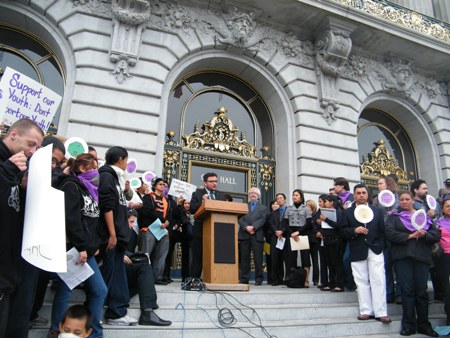
An event will be held this evening (2/18) at the Mission Dolores Basilica to urge Sens. Barbara Boxer and Diane Feinstein to push for nationwide immigration reform. The gathering of people from the immigrant community and faith-based organizations, which is being put together by the San Francisco Organizing Project, will be held in conjunction with the national Reform Immigration for America campaign.

Pat Bregant of SFOP told the Guardian that a turnout of around 1,000 is expected. Several families whose lives have been turned upside down by deportations will share their stories.

More than 35 clergy members from throughout the Bay Area will attend, including Bishop William Justice, Archdiocese of San Francisco. Others who are expected include Jim Molinari, state director for the office of Sen. Diane Feinstein, and San Francisco Supervisors David Chiu and David Campos.

Myrna Godinez, who came to the United States from war-torn El Salvador 26 years ago, said immigrants face steep challenges such as accessing health care and obtaining education. “They come here to work,” she said, “and to live in peace.” She said she faced many challenges trying to build a life here, but in her case, coming to the United States also meant being able “to go outside without being afraid of getting killed.”
The Mission Dolores Basilica is located at 3321 16th Street in San Francisco.

The event will be held from 7 to 8:30 p.m. and is free and open to the public.

Labor’s love lost

4

Note: This file has been corrected from an earlier version.

rebeccab@sfbg.com

Two recent events could have major implications for Service Employees International Union Local 1021 — San Francisco’s largest public-sector union and an important ally for progressives — for better or for worse. And this union’s fate seems closely tied to that of the progressive movement in San Francisco.

The first event was likened to a “nuclear bomb in the morning paper” by one observer, and might be interpreted as the kickoff to a fierce budget battle. Mayor Gavin Newsom announced that he is considering a plan to help solve next year’s budget deficit by laying off 10,000 full-time city workers and rehiring them at 37.5 hours, which would amount to a sweeping 6.25 percent pay cut for workers and an estimated $50 million in savings for a fiscally impaired city.

Though it was framed by Newsom spokesperson Tony Winnicker as one preliminary cost-saving option among many, the proposal received prominent front-page coverage in the San Francisco Chronicle, even before official discussions were called between the mayor and public sector unions. Since SEIU Local 1021 represents 17,000 members in San Francisco and a majority of the city’s 26,000 total employees, it would likely absorb the greatest impact if such a plan went through.

At the same time the mayor’s startling announcement hit newsstands, SEIU was in the midst of mailing out ballots to its membership for union elections. “I don’t know whether it’s a coincidence, or if the city is taking advantage of the fact that SEIU is absorbed in its elections,” Sin Yee Poon, an SEIU chapter president for Human Services Agency workers, told us while pointing out that the events happened simultaneously.

With three separate slates of candidates vying for control of SEIU Local 1021, grudges between warring internal factions have intensified into bitter sparring matches. The timing is unfortunate — just as SEIU’s internal turmoil is coming to a head, one of its greatest battles is pending over an unprecedented $522 million budget shortfall that looms like a dark cloud over the city. The deficit will surely result in job losses, and the public sector union’s ability to mount resistance even as it wrestles with internal strife is shaping up to be a key question.

This pivotal moment carries wider political implications considering that the progressive organization has in the past helped seal an alliance between San Francisco’s left-leaning leaders and organized labor through the San Francisco Labor Council.

With SEIU besieged by infighting and soon to be hurting from wage slashes and layoffs, more conservative factions of the labor community, such as the San Francisco Firefighters Union and the Building and Construction Trades Council, have recently been butting heads with progressive members of the Board of Supervisors.

At the same time, forces on all sides are beginning to eye the coveted seats up for election in June at the Democratic County Central Committee, a Democratic Party hub that is a cornerstone of local political influence, as well as the seats that will open up on the Board of Supervisors in November. Negotiations between unions and the mayor are ongoing, and mayoral spokesperson Tony Winnicker was quick to note that Newsom is open to options, other than reconfiguring 10,000 city jobs, that organized labor brings to the table. At the same time, the Guardian heard from numerous sources that city workers felt outraged and blindsided by Newsom’s decision to air the plan in the Chronicle instead of bringing stakeholders to the table.

SEIU Local 1021 President Damita Davis-Howard told us she thinks the idea of taking $50 million out of the pockets of working people in a rocky economy is wrong-headed.

“This was devastating,” said Davis-Howard, who is running for a newly created union position called chief elected officer, which is different from the union president, and similar to an executive-director post. “The mayor might as well have raised their taxes, because if you decrease their pay by 6.25 percent, they will still have the same amount of work, they will still have to pay the same mortgage, they will still have to buy the same food, the same PG&E, and they’ll be doing it with a lot less money. If any idea like this were to go through, it would actually remove the very fabric or fiber of San Francisco. It would really cut to the core of the very being of San Francisco. … I don’t see how anybody could believe that we could continue being the city that we love being with this kind of action.”

Winnicker, the mayoral spokesperson, cast it as a plan that could avert hundreds or even thousands of layoffs. “This year the easy decisions are behind us,” he noted in a recent discussion with the Guardian.

Solving last year’s fiscal shortfall was far from easy — budget tussles between frontline city workers and the mayor got ugly, and even then, the city received millions in federal stimulus dollars to cushion the blow. A similar plan of sweeping hourly cuts was floated then too, but it didn’t gain enough traction to move forward.

“The mayor is facing a huge budget deficit, there’s no question about it — but he has not lifted one finger to raise a dime in revenue,” charged SEIU member Ed Kinchley, who works at San Francisco General Hospital. As for how the union might respond if such a proposal went through, he speculated, “I think it’s the kind of thing that could lead to a strike. A big fight.”

While the city charter bars strikes by public employees, Kinchley’s comment indicates the level of frustration among SEIU’s rank-and-file.


The proposal could present a common enemy and a rallying point for a union in disarray. Internal jockeying for elected positions can be fierce in any organization, but for San Francisco’s service-workers union, the rifts are particularly deep.

The elections, which will be decided Feb. 28, mark the first time since a radical restructuring in 2007 that members will collectively decide who should lead. In 2007, the face of SEIU was changed across California when the international president, Andy Stern, began consolidating dozens of far-flung locals into centralized, beefier entities in a bid to maximize political effectiveness (California comprises roughly one-third of the entire union’s membership).

Local 1021 came into existence when 10 locals were conglomerated into one 54,000-member giant — hence the “10-to-one” label — representing health care and frontline service workers from the Bay Area to the Oregon border. 

In San Francisco, where a large segment of its members are based, the shift was interpreted by some as a power grab, and it triggered a period of ongoing strife between those allied with Stern and the international wing on one side, and those dissatisfied with changes they saw as antithetical to the democratic ideals championed by Local 790, its predecessor, on the other.

In the years following the reorganization, Stern began trying to aggregate members by raiding other unions to consolidate power. But campaigns to bring in members from United Healthcare Workers (UHW) and fend off membership losses to the newly created National Union of Healthcare Workers (NUHW) have consumed money and resources that some members told the Guardian would’ve been better spent bolstering national support for health-care reform and the Employee Free Choice Act. According to one source, SEIU spent $10 million on a Fresno battle against NUHW.*

A fight waged between SEIU Local 1021 and UNITE HERE Local 2, a hotel-workers union that was historically allied with Local 1021’s predecessor, left some members especially stung because it marred a longstanding relationship between two groups of frontline workers.

“Andy Stern has concentrated more and more power into the hands of a group of so-called elite members of the union,” Kinchley told the Guardian. Stern’s top-down leadership style and growth-oriented objectives “run pretty harshly against what many of us believe is in the best interest of our workers locally,” he added.

In recent weeks, divisions have deepened further. A staff person who preferred not to be identified for fear of retribution filed charges with the U.S. Department of Labor against a supervisor, who is aligned with the international faction, for alleged harassment and bullying. Another complaint was filed with union leadership alleging that union bylaws were violated when membership money was authorized, but not spent, to conduct a poll without proper approval.*

“There’s a fiscal rogue-ness about it. [Davis-Howard] does whatever she wants, and she spends our dues money without authorization from anybody,” Kinchley charged.

Stern appointed Davis-Howard, and now she is running for election on a slate aligned with the international wing. When the Guardian tried to reach her to discuss union elections, spokesperson Carlos Rivera told us that Davis-Howard found it inappropriate to publicly discuss internal divisions.

Sin Yee Poon is running as her opponent on a reform slate, formed by members disaffected by the international’s modus operandi. “For the whole reform group, we’re disappointed with the general direction of corporate unionism,” Poon told the Guardian. Stressing that she believes grassroots, democratic ideals have eroded since the restructuring, she said members in her camp are agitated when they see resources siphoned into raids on other unions such as UNITE HERE and UHW. “We want it to be member-driven,” she said. “The raiding of other unions is absolutely not OK.”


The internal strife could have a wider ripple effect. SEIU Local 1021 has historically been influential in securing an alliance between the city’s labor community and San Francisco’s progressive leadership. During the last round of elections for San Francisco’s Board of Supervisors, Sups. John Avalos and Eric Mar campaigned and ultimately were elected with strong fundraising support from the labor council.

Yet in recent weeks, several skirmishes pitted certain factions of the labor community against progressive members of the Board of Supervisors. Outrage bubbled up from the firefighters — and ultimately the labor council as a whole — against a charter amendment proposed by Sup. John Avalos that would have extended the minimum number of work hours for firefighters.

Billed as a cost-saving measure, the proposal might have ultimately resulted in fewer firefighter jobs, but it was designed to spread the pain of budget cuts more equitably by grazing public safety departments instead of just inflicting blows on frontline and healthcare workers.

After Labor Council Executive Director Tim Paulson came out strongly against it, Avalos abandoned the idea. A source from within the labor council, who spoke on background only, described it as an opportunity for the labor council to come together and unite on class interests.

The political posturing that came out of that fight shook even Sup. David Campos, who vocally called for equitably sharing the pain during last year’s budget debacle. “This isn’t the way to do it,” Campos said when asked about Avalos’ failed charter amendment. “And I worry about the negative impact on labor and the progressive board. There are larger issues at play here. The entire progressive agenda is at stake. We need to think long-term about the specific issues plus the future of the progressive movement.”

Sup. Sean Elsbernd’s bid to reform the pension system to save money has provoked yet another fight with SEIU Local 1021. Union members argue that if they are asked to contribute to their own retirement funds, which would become mandatory under this proposal, then they should be given the same wage increase that other unions were granted when they agreed to similar terms.

But when Sup. Eric Mar tried to amend Elsbernd’s proposal by inserting language guaranteeing that pay increase, Elsbernd said it would cost the city millions more. If Mar’s amended version goes forward, “you’ll be going to the voters by yourself,” Elsbernd told the progressive-leaning supervisor at a Feb. 9 board meeting.


Another fight has erupted over 555 Washington, a tower proposed to go up beside the TransAmerica Pyramid, which was debated at a joint hearing Feb. 11 between the Planning Commission and the Recreation and Park Commission. For members of the Building & Construction Trades Council, which represents unionized carpenters, plumbers, and other workers in development-related trades, the project represented jobs — the screaming priority in an economy where funding for new construction has trickled to almost nil.

“There is, in general in San Francisco progressive politicians, a knee-jerk reaction to development projects,” Building & Trades Council Secretary Treasurer Michael Theriault told us. As a council representing people whose livelihoods depend on private sector construction, “We have a particular quandary,” he said. “We need politicians who at the same time are friendly to labor and understand that development is an economic tool that can help the city.”

The arm of labor representing Theriault’s council has been slammed with job losses due to the economic downturn, and he’s publicly expressed frustration when projects of this scale are shot down.

“What the mayor did, what Elsbernd did, and what Avalos did are all the same thing: They all staked out a position, put a provocative idea on the table, and forced unions to have a discussion with a gun to their head in a non-constructive way,” Mike Casey, president of UNITE HERE Local 2 and a member of the labor council’s Executive Committee.

A source familiar with the inner workings of the labor council said the tension between building trades and firefighters versus more left-leaning members of the labor community has been in existence for decades, and it isn’t anything new — particularly in the months preceding election season.

Casey challenged the very notion that there is a subculture of the labor council that isn’t progressive, pointing out that labor came together as whole to support Sups. Avalos, Mar, and David Chiu — “and I personally would do it again in a heartbeat,” he added. Internal catfights and struggles for control come with the territory in a democratic, diverse organization, he said. “As a group of working people, I have great regard for the membership [of SEIU Local 1021],” he said. “Occasionally there’s a dustup. In my experience, after the dust settles, more often that not, unions come out stronger for it.”.

*Corrections made to the original file.

“Whatever happened to my sanctuary city amendment?”

0

Yesterday, Sup. David Campos called for a status report on steps taken by San Francisco’s Juvenile Probation Department to implement an ordinance that the Board passed last fall to protect the confidentiality of juveniles’ immigration status.

And it already sounds like JPD has done nothing to implement it—and isn’t planning to, either, any time soon.

Campos announced that he met with Juvenile Probation Department (JPD) Chief William Siffermann today, and Siffermann told him that he had no intention of complying with the ordinance, which the Board passed Nov. 10, 2009.


JPD has had three months to figure out how best to implement the ordinance, which Campos helped author last year, and which seeks to give kids their day in court before handing them over tofederal immigration authorities for possible deportation.

Campos said he called the hearing so all the folks who worked to pass the legislation, and those it impacts, “have a public forum to hear about the decision not to implement it.”

Campos also requested a report on the impacts of JPD’s current policy towards suspected undocumented juvenile felons—a policy that Newsom ordered without public review and that JPD implemented on August 2008.

The report, Campos said, will include but is not limited to, the following:

1.    Determinations of cases of undocumented immigrant youth—original changes and final determination by the courts.

This will involve exploring not only what these youth were originally charged with at booking, but also what the local juvenile courts ultimately determined in their cases. So, expect to see a pattern in which the courts throw out or reduce the charges that resulted in these juveniles being reported to the feds at the moment of booking. Only, by the time the courts reach this determination, these kids have already been nabbed by the feds and transferred to detention facilities outside the city and/or state—a practice that has already resulted in the needless ripping apart of immigrant families.

2.    Policies, procedures and training provided to staff regarding inquiry into the immigration status of youth and compliance with the 1989 City of Refuge ordinance.

This exploration will likely lead to some eye-opening revelations as to how juvenile probation officers are expected, under the policy that Newsom ordered in 2008,  to question youth suspected of being undocumented, and how that contrasts/compares with the city’s original sanctuary ordinance which the Board implemented in 1989.
3.    The numbers of undocumented immigrant youth that have been reported to US Immigration and Customs Enforcement (ICE) since Newsom ordered his change in sanctuary policy direction in 2008.

Up until now, it’s been almost impossible to discover exactly how many kids the city has handed over to ICE under Newsom’s new policy. Yes, even though the city is now spending local tax payer dollars to hand local immigrants’ kids over to the feds, the city has not told the public how many kids have been handed over or their current whereabouts. This information, coupled with information about the final determinations that local courts made in these kids’ cases, will likely be another mind blower.

4.    Changes in caseload and staffing as a result of implementing Newsom’s new sanctuary policy direction in 2008.
Again, expect to see some interesting patterns emerge. Has the city saved money by referring kids to ICE at the moment of booking? How about time? And just how well trained are juvenile probation officers in the intricacies of immigration law, anyway?

5.    Information about department financial and human resources dedicated to collaboration with ICE.

This is where the proverbial shit may truly start hitting the fan. Are we needlessly alienating the immigrant community?  Are we doing so in counter productive ways?

As chair of the Rules Committee, Campos promised to schedule this hearing as soon as possible, so watch the Board’s committee calendar and expect to see sparks fly.

Gavin for Lite Guv?

1

Willie Brown thinks it’s a good idea. And you can tell Newsom wants to consider it, since he knows there’s nothing else obvious for him to do once his term as mayor is up — and there are going to be a lot of options not too far down the road. Sen. Dianne Feinstein isn’t getting any younger, and at some point she’ll retire. If Jerry Brown doesn’t get elected governor, the Democrats will be looking for someone very different in four years. But once a politician like Newsom is out of office and out of the spotlight, he’ll have a hard time coming back.

So he could sit up there in the Lite Gov’s office, doing what John Garamendi did — taking on issues like cuts to the University of California (the Lt. Gov. sits on the Board of Regents) and making speeches about reform, and maybe he could get out in front of this constitutional convention stuff, and keep his name in the news, without having to make a single difficult or unpleasant decision that he can be blamed for later.

You know he wants to do it ….

But there’s this problem, and for Newsom, it’s very real.

As people close to the mayor have told me repeatedly, the money people who helped put the mayor in office — and who would have to be around to help him run for any other office — are not at all pleased with the prospect of Newsom leaving San Francisco a year early. See, that would give the district-elected supervisors the chance to fill the mayor’s job for the last year of Newsom’s term, and the person they appointed would be able to run as an incumbent.

And while it’s not clear who could get six votes (David Chiu? David Campos? Ross Mirkarimi? Aaron Peskin?) it’s pretty clear that the new mayor would not be an ally of Newsom’s pals.

Sure, when he was running for governor, it seemed fine — having their guy in charge of the state was worth the loss of the San Francisco mayor’s office. But for a relatively powerless job? I think they’d crucify him.

The attack on district elections begins

2

I knew it was coming. After ten years of district-elected supervisors promoting progressive policies (minimum wage and sick day laws, universal health care, tenant protections, public power, development limits, affordable housing etc.) downtown has finally figured out how to launch a counter-attack. It was announced this morning in the pages of the Chronicle

I knew it was coming. After ten years of district-elected supervisors promoting progressive policies (minimum wage and sick day laws, universal health care, tenant protections, public power, development limits, affordable housing etc.) downtown has finally figured out how to launch a counter-attack. It was announced this morning in the pages of the Chronicle

The idea is to replace some of the district supes with at-large representatives – say, four of the 11. That Chamber of Commerce is doing a poll on the issue. Expect a November ballot initiative.

C.W. Nevius chimed in, too, arguing in favor of the “hybrid” (sounds so much like an eco-friendly car) system.

The line is going to be this: District supervisors don’t pay attention to citywide issues.

“People like the idea of being able to talk to a district supervisor about neighborhood problems, but also feel that they want someone they can go to with broader, citywide concerns,” said Steve Falk, president and CEO of the San Francisco Chamber of Commerce.

Or as Nevius puts it:

The truth is that San Francisco has more supervisors than any county in California. Is it too much to ask that a few of them have the entire city’s best interest in mind?

Let’s consider for a moment what this is really about.

For starters, get rid of the nonsense about a “citywide perspective.” Even Nevius didn’t try to push that too hard when I emailed him with the facts, to wit: Over the past ten years, district-elected supervisors have devoted themselves to a long string of exceptional citywide reform measures and have been guilty of very little district pandering.

Consider a few examples:

Healthy San Francisco
The Rainy-Day Fund
Reforming the makeup of the Planning Commission, Police Commission and Board of Appeals
Restricting the use of plastic bags
Minimum wage and sick day laws
A citywide infrastructure plan and bond program
Community choice aggregation and green energy
Campaign finance reform
Sanctuary city protecting for immigrants

The list goes on and on.

You may agree or disagree with what this board has done, but nobody can honestly say that the district supervisors have ignored citywide issues or that they don’t have a citywide persoective. No: This has nothing to do with citywide issues vs. district issues. It’s entirely about policy – about the fact that district supervisors are more progressive. About the fact that downtown can’t possibly get a majority under a district system – because with those small districts that Nevius complains about, big money can’t carry the day.

In a district system, grassroots organizing – the stuff that labor and nonprofits and progressive groups are good at – is more important than raising money. So district supes are accountable to a different constituency.

I watched an at-large board for almost 20 years, and it was, by and large, a collection of sold-out hacks who did exactly what the mayor and the downtown donors said. It was really pathetic.

The polls have consistently shown that people like have district supes, so now there’s this “hybrid” effort.

Here’s what it means:

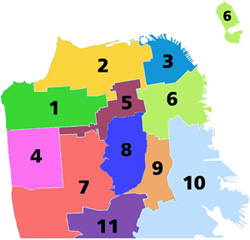
Right now, there are three districts that will generally elect a more conservative representative – D 2 (Michela Alioto-Pier) D- 4 (Carmen Chu) and D-7 (Sean Elsbernd). Districts 8, 10, 11 and 1 are swing districts, and the rest are going to go generally progressive.

So the odds are under this system that the left-leaning constituencies will have at least six votes, and in good times, as many as eight.

Now take four of those votes away, pretty much forever. Set it up so that four supervisors, elected citywide, will be guaranteed downtown call-up votes. Then add in one or two more from the more conservative districts, and you’ve got a majority.

That, my friends, is exactly what this is about, and any effort to frame it as anything else is just spin.

I asked Nevius what the hell he was doing buying the bogus argument that we need citywide perspective – since the district board has already demonstrated that, consistently. Here’s his response:

First, I’d envision the city-wide supes as made to order swing votes. When a district supervisor had a good idea, let’s say Healthy San Francisco, it might not be an issue of critical interest for a district supervisor. But it would be right in the wheelhouse for a city-wide official, who is looking for broad stroke issues to back. And, although you didn’t advance the idea, I’d reject the notion that whomever it was that was elected city-wide would be incredibly conservative and obstructionist. The most moderate politician we’ve elected in this city is Gavin Newsom. Although the Guardian doesn’t agree with him much of the time, he’s still advanced some very progressive ideas. Everyone jumps on the Chris Daly example as why district elections are a problem, but I think we can look beyond that. I think he’s been an aberration. District supes like David Campos and David Chiu have proved they can compromise and govern so I think that’s a good thing. I would never advocate that we get rid of representation in the neighborhoods. But c’mon, 11 little districts in a very small city? As Jim Stearns said, some of the districts are no more than a mile square. Combining some of them would still let residents have someone they could call to get the potholes fixed, but also spread out the areas.

Okay, I didn’t say citywide supes would be conservative. Sean Elsbernd is (relatively) conservative. He’s also independent of any big-money interest and does what he thinks is right. He doesn’t need half a million dollars to get elected in his district.

What I say is that citywide supes would be in hock to big money. I’ve seen it, lived with it. Suffered from it.

And guess what: Healthy San Francisco didn’t need any citywide supes; it passed just fine with the district board.

So what this is about is money and political control, and it’s about the political direction the city is going and who’s going to set that direction. Let’s get that straight and be honest about, and then we can have this discussion.

On pension reform, a way forward

0

EDITORIAL Sup. Sean Elsbernd is taking on one of the most complicated and politically tricky issues in San Francisco — reforming the pension fund and health care system for retired city employees. He’s right that the system needs reform — but his measure has some serious drawbacks and needs some significant amendments.

The problems facing the system are so confusing, and the legal and financial aspects so arcane, that it’s hard for anyone to grasp the full situation. But we can sum it up pretty simply:

San Francisco’s pension fund is in far better shape than pension funds in many cities and is a long way from any financial crisis. But over the next few years, thanks to weak stock market performance, the city’s cash obligation — the amount of general fund money that must be paid into the retirement system — is going to rise quickly into the hundreds of millions of dollars.

The retiree health care system is in a lot more trouble — with the rising cost of care, the city will be on the hook for a serious amount of money over the next decade or two. And since the obvious answer — a single-payer system that would cut costs immensely — isn’t anywhere on the immediate political horizon, the San Francisco supervisors need to address the problem.

Elsbernd’s proposed fix is also complicated; the main legislation runs 61 pages. But in essence, he wants to make sure all city employees pay directly into the system; raise the amounts new employees, cops, and firefighters contribute; and set up a rainy-day fund to divert excess pension revenue in good years into a trust that could fund health care pension obligations in down years. He’s also going after a scam common in the police and fire departments where people about to retire get sudden promotions and big salary bumps for a few months, then collect pensions based on the higher pay scale.

The first part is — and should be — almost certainly dead. Members of the Service Employees International Union local 1021 agreed several years ago as part of contract negotiations to give up a pay hike; in exchange, the city agreed to take over the workers’ obligation to pay into the pension fund. Changing that, and outlawing any similar deals in the future, is unacceptable to labor and could drag down the whole proposal.

It’s also tricky to raise pension contributions for “new employees” since Mayor Gavin Newsom has been firing people then rehiring them at lower pay rates. Do those people lose their pension seniority? That has to be fixed.

But given the sweet deal cops and firefighters have, it’s entirely appropriate to ask them to contribute more to retirement. And while some city employees actually get and deserve raises in their final year of work (and the language in Elsbernd’s bill doesn’t address this and needs work), pension spiking is a problem that tends to give extra cash to people who are on the higher end of the pay scale at the expense of lower-paid workers.

And the heart of his proposal — to set up a trust fund for excess money in good years — deserves serious consideration. Yes, it’s a set-aside, and yes, there are legal complications. But the cost of doing nothing is too high to ignore.

Elsbernd should have done this differently — he should have met in advance with all the stakeholders and sought to hammer out a compromise. Even so, there’s a lot for progressives to work with here. If Elsbernd is willing to engage with labor and the board majority, and the progressive supervisors are willing to acknowledge the problem and look for amendments that make this bill acceptable, there’s a way for the city to come out ahead.

Sup. David Campos has moved to “split the file” — that is, to turn the Elsbernd bill into two identical measures. The move gives the progressives a chance to make amendments even if Elsbernd doesn’t want to go along, and could wind up giving the supervisors a choice between two competing measures. We’d prefer that Elsbernd work with his colleagues on a measure everyone can back. But in the end, the best option is a charter amendment that fixes the problems Elsbernd has identified — without being unfair to city employees.

And if Elsbernd and the progressives can come to a deal, there’s a lesson here for the mayor: if you try to work with your opponents, you can actually get things done.

Sitting boundaries

0

Aggressive lobbying efforts by the San Francisco Police Department and some of its allies who are pushing a proposed sit/lie ordinance have irked some current and former members of the Board of Supervisors.

The legislation was privately created by new Police Chief George Gascón and then played up in the mainstream media. It would make it illegal to sit or lie down on public sidewalks. Supporters say it would make it easier for cops to target people who harass neighborhood residents.

But in other cities where similar laws have been passed, protests have erupted from homeless-advocacy organizations and civil liberties groups, which say criminalizing this behavior unfairly (and unconstitutionally) targets homeless people who have nowhere else to go.

In Portland, Ore., a similar law was enacted then overturned by the courts. In Los Angeles, an ordinance against sleeping on the sidewalk was challenged by the American Civil Liberties Union, resulting in the 9th Circuit Court of Appeals ruling in 2006 that unless adequate shelter is available for homeless people in L.A., arresting them for sleeping on the sidewalk amounted to cruel and unusual punishment.

But an e-mail action alert included in SFPD Central Station Capt. Anna Brown’s monthly community newsletter encouraged people to contact the mayor and the Board of Supervisors to support the creation of a sit/lie ordinance. “Naturally, there is resistance from the left-leaning Board of Supervisors who feel this is an attack on the homeless population,” it noted.

That unusually overt political plea caught the eye of Aaron Peskin, former president of the Board of Supervisors and current chair of the San Francisco Democratic Party, who called it “funky.” Peskin told us he’d never seen an advocacy pitch like this go out in a captain’s newsletter before, and he questioned whether this was an appropriate use of city resources.

But the City Attorney’s Office says this doesn’t fall under city laws banning electioneering by city employees, who are barred from using government resources to endorse a candidate or ballot initiative, or from doing any campaign-related work on city property.

Yet this kind of pitch “is not considered political activity,” Jack Song, a spokesperson for City Attorney Dennis Herrera, told the Guardian.

But Sup. David Campos, a former police commissioner, frowned upon it nonetheless. “Something like this is not really helpful to the Board of Supervisors and the Police Department working together,” Campos said.

Sup. Ross Mirkarimi took a similar view. At a recent Board of Supervisors meeting, he requested a hearing about the ordinance because he said the media-driven public debate had occurred without formal discussion. Anti-loitering and public nuisance laws are already on the books, Mirkarimi pointed out.

“What makes those laws inadequate?” he asked. “How would the proposed law augment what is already in effect?”

The alert wasn’t actually written by Capt. Brown, who included it in her newsletter. It was drafted by the Community Leadership Alliance, an organization headed by David Villa-Lobos, a longtime resident of the Tenderloin and a candidate for the District 6 Supervisor seat.

Since Gascón floated the idea of creating a sit/lie ordinance, CLA has kicked into high gear to mobilize support, most recently issuing its action alert e-mail to 8,000 recipients. Police captains were included in the e-mail blast, Villa-Lobos told us, but each captain decides independently what to include in his or her newsletter.

People sitting and lying on sidewalks is “a really, really big problem, especially in the crime-ridden areas,” Villa-Lobos said. “God bless the homeless, but it’s a big problem there too.” Several years ago, his organization tried to mount a campaign for a sit/lie ordinance, but it didn’t go anywhere. “People came out and said we were trying to violate civil rights,” he said.

The Community Leadership Alliance is active in the Tenderloin, SoMa, and the mid-Market Street area, and the group occasionally holds monthly meetings at the Infusion Lounge, an upscale nightclub owned by Scott Caroen, the chair of the organization.

Gascón worked with deputy city attorneys to draft the ordinance and all district police stations have submitted to their commanders a list of areas that they feel could benefit from the law, according to a Tenderloin district newsletter. Mirkarimi told the Guardian that some supervisors were kept in the dark for weeks about the fact that an ordinance had been drafted. “This wasn’t collaborative at all,” Mirkarimi told us. “We never received it until we demanded to see it.”

The Haight-Ashbury, where residents and visitors have been complaining about harassment from wayward traveling youth, has been ground zero for discussion about a sit/lie ordinance. A small group of irate residents there and the Park Station Capt. Teresa Barrett have rallied in support of the law, saying it would give police a new tool to target these disruptive street kids.

But it’s clear that the ordinance’s supporters want to see it applied broadly and to be used to roust the homeless in neighborhoods throughout the city.

“CLA feels that our sidewalks should be enjoyable and a place of social gathering, and that the ordinance could go a long way in helping our neighborhoods feel safer,” reads the Community Leadership Alliance alert that was included in the police captain’s newsletter. “It may also reduce the overall homeless population in San Francisco by discouraging people from coming to the city to beg for money.”

Marijuana goes mainstream

6

I’ve smoked marijuana on and off for most of my adult life, usually in the evening to help let go of the anxieties associated with being a progressive wage slave in an increasingly conservative capitalist country.

Buying my pot, which is California’s biggest cash crop, has always been a criminal transaction: in hushed tones or coded language, I arrange to meet a dealer I’ve been set up with through friends. And when I meet him (they’ve always been men), I give him cash in exchange for an eighth- or quarter-ounce of whatever kind of pot he’s selling.

I don’t know what variety I’m buying, who grew it, or how it was grown; whether violence or environmental degradation have occurred along the supply chain; or even whether it is an indica or sativa, the two most basic cannabis families that have differing effects on users.

I’ve been completely in the dark, both in terms of what I was buying and who was benefiting from the transaction, but that changed recently. I obtained a doctor’s recommendation to legally smoke weed — honestly citing anxiety as my affliction — and set out to explore the area’s best cannabis clubs.

It was a little strange and disorienting at first, this new world of expert purveyors of the finest Northern California marijuana and the various concentrates, edibles, drinkables, and other products it goes into. But what eventually struck me is just now normal and mainstream this industry has become, particularly in San Francisco, which has long led the movement to legalize marijuana.

Unlike in cities such as Los Angeles, where the rapid proliferation of unregulated pot clubs has made headlines and raised community concerns, San Francisco years ago made its clubs jump through various bureaucratic hoops to become fully licensed, permitted, and regulated, free to join the mainstream business community, pay their taxes, and compete with one another on the basis of quality, price, customer service, ambiance, and support for the community.

As Californians prepare to decide whether to decriminalize marijuana for even recreational use — on Jan. 28, advocates plan to turn in enough valid signatures to place that initiative on the fall ballot — it’s a good time to explore just what the world of legal weed looks like.

Pretty much everyone involved agrees that San Francisco’s system for distributing marijuana to those with a doctor’s recommendation for it is working well: the patients, growers, dispensary operators, doctors, politicians, police, and regulators with the planning and public health departments.

“It works and it should continue to be replicated,” Sup. Ross Mirkarimi, who created the legislation four years ago that led to the current system, told us. “It’s now mainstream.”

Public health officials agree. “In general, we’re very happy about our relationship with the industry and their commitment to the regulations,” said Dr. Rajiv Bhatia, San Francisco’s environmental health director. “We did this well and we did it cooperatively with the clubs.”

Bhatia said there are now 22 fully-permitted clubs (and two more under review) in San Francisco, less than half the number operating when the regulations were created. He also said the city no longer receives many complaints from neighbors of clubs.

Misha Breyburg, managing partner of the nonprofit Medithrive, which opened just a few months ago on Mission Street, supports the process too. “The regulations generally are not easy, but I think that’s okay,” he said. “The process was long and cumbersome and stressful, but very fair.”

Martin Olive, director of the Vapor Room, one of the city’s largest and best dispensaries, agrees that the permitting process professionalized the industry: “I’m proud to be here because the city government has been amazing.”

Richard Lee — founder of Oaksterdam University in Oakland, which teaches marijuana cultivation and is the main financial backer behind the initiative to legalize and tax pot — said San Francisco and Oakland have demonstrated that cannabis clubs can function like any other legitimate industry and become a real asset to their neighborhoods and the local economy.

“Once they started legalizing the clubs, they had no more problems,” Lee told us. “It really is boring and really not a big deal. It’s only the prohibition that makes it exciting and a little scary.”

In fact, Lee said that normalizing and legalizing the marijuana industry is the best way to deal with the problems associated with the illegal drug trade, such as violence, creation of a criminal class, respect for law enforcement, wasted public resources, lost tax opportunities, unsafe growing operations, and environmental damage.

“We need to end cannabis prohibition to end the violence,” Lee said.

Bringing marijuana above ground also has created an artisanship that’s similar to the wine industry, elevating cultivation practices to an art form, improving the science behind it, and making users more sophisticated about subtle differences in taste and effect among the dozens of varieties now on the market.

But the growers themselves still exist in a murky gray area. Although they can get some legal cover as registered caregivers to a cooperative’s members, they’re still exposed to thefts, shakedowns, logistical difficulties, and raids by federal agents or even local police, such as the series of raids in the Sunset District last fall that targeted even legitimate growers for the clubs.

“Right now, cultivators have no air cover at all and they’re getting mixed messages,” Mirkarimi said, calling for the city to better protect growers and even consider getting into the business of growing pot for the clubs and patients. “General Hospital should dispense medical cannabis.”

That issue and others related to the city’s relationship with the industry are currently the subject of a working group convened by Sup. David Campos, a byproduct of which is the proposal to create a Medical Cannabis Task Force to advise the Board of Supervisors, an item the board was scheduled to vote on Jan. 26.

Mirkarimi said he’s also concerned about current rules that ban smoking in clubs that are within 1,000 feet of schools or drug treatment facilities, which has served to prohibit smoking in all but a few San Francisco clubs. Oakland bans smoking in all its clubs. “That’s where the laws could be modified, because you don’t want to take away that social vibe,” Mirkarimi said. “San Francisco needs to be a leader in activating the next step.”

Olive, whose club allows smoking and has a great social scene, agrees that something is lost when the clubs are forced to be simply transactional.

“This is a social healing medicine, and we’re here to promote an inviting atmosphere where people can share their stories,” Olive said. “The whole point is not to just come in and get your medicine, but to be a part of a community.”

That community can range from young stoners to dying old patients, who can both benefit from their communion. “It’s the hippies and the yuppies. Everyone comes here,” Breyburg said. Or as Olive told me, “There is something intrinsically rewarding to sharing a joint with someone, as silly as that sounds.”

The voter-approved Proposition 215 and state law are deliberately vague on what ailments qualify for a doctor’s recommendation, spawning a sub-industry of physicians who specialize in pot, like the ones at the clinic I visited, Dr. Hanya Barth’s Compassionate Health Options in SoMa.

The busy clinic charges around $130 for an initial visit and patients walk away with a legal recommendation, which is all state law requires to legally use marijuana (the clinic recommended also buying a $100 state ID card or a $40 card from the Patient ID Center in Oakland, but I didn’t need them to enter any of the clubs I visited).

The long forms patients fill out even suggest anxiety as an affliction that pot can help, but the clinic also asks patients to sign a waiver to obtain detailed medical records supporting the recommendation. When Barth learned that I have a shoulder separation for which I underwent an MRI a few years ago, she requested those records and added “shoulder pain” to my “anxiety” affliction.

“My goal is not just to give people a recommendation. I look at how I can help or support the person beyond just giving them a recommendation,” Barth told me, illustrating her point by showing me two packs of cigarettes from patients whom she said she convinced to quit smoking.

Her vibe combines the healer and the old hippie, someone who sees a plethora of uses for marijuana and generally thinks society would be better off if everyone would just have a puff and chill out. The clubs also don’t draw distinctions based on their customers’ reasons for smoking.

“There is a distinct difference between medical use and recreational use,” Olive said, telling stories about amazing turnarounds he’s seen in patients with AIDS, cancer, and other debilitating diseases, contrasting that with people who just like to get high before watching a funny movie, which he said is also fine.

But Olive said there’s an important and often under-appreciated third category of marijuana use: therapeutic. “They use cannabis to cope, to unwind, to relax, to sleep better, or to think through problems in a different way,” Olive said.

This third category of user, which I officially fall into, seems to be the majority people I encountered in the local clubs. And while it may be easy for cannabis’ critics to dismiss such patients as taking advantage of laws and a system meant to help sick people, Olive says they play an important role.

“They make it easier for the cannabis clubs to give it away to the people who really need it,” Olive said, referring the practice by most clubs of giving away free weed to low-income or very sick patients, which is supported by the profits made on sales.

The Vapor Room is widely regarded as having one of the best compassionate giving programs, and Olive estimated that the operation gives away about a pound per week through local hospice programs and by giving away edibles and bags of cannabis vapor at the club.

Some of the profits are also used to offer free massage, yoga, chiropractic, and other classes to their members, a system being taken to new heights by Harborside Health Center in Oakland, which has fairly high prices but uses that revenue to offer an extensive list of free services and laboratory analysis of the pot it sells, identifying both contaminants (such as molds or pesticides) and the level of THC, the compound that gets you high.

Olive said there’s also a positive psychological impact of legitimizing the use of marijuana: “It no longer feels like you’re doing a bad thing that you have to be sneaky about.”

As I created my list of the clubs I planned to review, I found abundant online resources such as www.sanfranciscocannabisclubs.com and www.weedtracker.com. But an even better indicator of how mainstream this industry has become were the extensive listings and reviews on Yelp.com.

I combined that information with recommendations from a variety of sources I interviewed to develop my list, which is incomplete and entirely subjective, but nonetheless a good overview of the local industry and the differences among the clubs.

Also, like our restaurant reviewers, I didn’t identify myself as a journalist on my visits, preferring to see how the average customer is treated — and frankly, I was amazed at the high level of friendly, knowledgeable customer service at just about every club. To comply with city law, all the clubs are fully accessible by those with disabilities.

So, with that business out of the way, please join me on my tour of local cannabis clubs, in the (random) order that I visited them:

————

DIVINITY TREE

While the reviews on Yelp rave about Divinity Tree (958 Geary St.), giving it five stars, I found it a little intimidating and transactional (although it was the first club I visited, so that might be a factor). But if you’re looking to just do your business in a no-frills environment and get out, this could be your place.

The staff and most of the clientele were young men, some a bit thuggish. One worker wore a “Stop Snitching” T-shirt and another had “Free the SF8.” But they behaved professionally and were knowledgeable and easy to talk to. When I asked for a strain that would ease my anxiety but still allow me enough focus to write, my guy (patients wait along a bench until called to the counter) seemed to thoughtfully ponder the question for a moment, then said I wanted a “sativa-dominant hybrid” and recommended Neville’s Haze.

I bought 1/16 for $25 and when I asked for a receipt, it seemed as though they don’t get that question very often. But without missing a beat he said, “Sure, I’ll give you a receipt,” and gave me a hand-written one for “Meds.”

Buds weighed on purchase

Open for: three years

Price: Fairly low

Selection: Moderate

Ambiance: A transactional hole in the wall

Smoke On Site: No

Thug factor: Moderate

Access/Security: Easy. Membership available but not required

————-

GRASS ROOTS

Located at 1077 Post St. right next to Fire Station #3, Grass Roots has the feel of a busy saloon. Indeed, as a worker named Justin told me, many of the employees are former bartenders who know and value customer service. With music, great lighting, and nice décor, this place feels comfortable and totally legit. Whereas most clubs are cash-only, Grass Roots allows credit card transactions and has an ATM on site.

The steady stream of customers are asked to wait along the back wall, perusing the menus (one for buds and another with pictures for a huge selection of edibles) until called to the bar. When asked, my guy gave me a knowledgeable breakdown of the difference between sativa and indica, but then Justin came over to relieve him for a lunch break with the BBQ they had ordered in and ate in the back.

Justin answered my writing-while-high inquiry by recommending Blue Dream ($17 for a 1.2-gram), and when I asked about edibles, he said he really likes the indica instant hot chocolate ($6), advising me to use milk rather than water because it bonds better with the cannabinoids to improve the high. Then he gave me a free pot brownie because I was a new customer. I was tempted to tip him, but we just said a warm goodbye instead.

Buds weighed on purchase

Open for: five years

Price: Moderate

Selection: High

Ambiance: A warm and welcoming weed bar

Smoke On Site: No

Thug factor: Low

Access/Security: Easy

————–

HOPENET

Hopenet (223 Ninth St.) is one of the few places in the city where you can smoke on site, in a comfortable, homey style, as if you’re visiting a friend’s apartment. In addition to the loveseat, two chairs, and large bong, there is a small patio area for smoking cigarettes or playing a guitar, as someone was doing during my visit.

Although the small staff is definitely knowledgeable, they all seemed stoned. And when I asked about the right weed for my writing problem, a gruff older woman impatiently dismissed any indica vs. sativa distinctions and walked away. But I learned a lot about how they made the wide variety of concentrates from the young, slow-talking guy who remained.

He weighed out a heavy gram of White Grapes for $15, the same price for Blue Dream, and $2 cheaper than I had just paid at Grass Roots. That was in the back room, the big middle area was for hanging out, and the front area was check-in and retail, with a case for pipes and wide variety of stoner T-shirts on the walls.

Buds weighed on purchase

Open for: seven years

Price: Low

Selection: Moderate

Ambiance: Like a converted home with retail up front

Smoke On Site: Yes!

Thug factor: Low

Access/Security: Easy

————

VAPOR ROOM

Vapor Room (607A Haight, www.vaporroom.com) is San Francisco’s best pot club, at least in terms of feeling like an actual club and having strong connections to its community of patients. It’s a large room where customers can smoke on site, giving this collective a warm, communal vibe that facilitates social interaction and fosters a real sense of inclusiveness.

Each of the four large tables has a high-end Volcano vaporizer on it, there’s a big-screen TV, elegant décor, and large aquarium. There’s a nice mix of young heads and older patients, the latter seeming to know each other well. But, lest members feel a little too at home, a sign on the wall indicates a two-hour time limit for hanging out.

Its early days in the spot next door were a bit grungier, but the new place is bright and elegant. It has a low-key façade and professional feel, and it strongly caters to patients’ needs. Low-income patients are regularly offered free medicine, such as bags full of vapor prepared by staff. Mirkarimi said the Vapor Room is very involved in the Lower Haight community and called it a “model club.”

But they’re still all about the weed, and they have a huge selection that you can easily examine (with a handy magnifying glass) and smell, knowledgeable staff, lots of edibles and concentrates, a tea bar (medicated and regular), and fairly low standardized pot prices: $15 per gram, $25 per 1/16th, $50 per eighth. And once you got your stuff, grab a bong off the shelf and settle into a table — but don’t forget to give them your card at the front desk to check out a bowl for your bong. As the guy told me, “It’s like a library.”

Buds weighed on purchase

Open for: six years

Price: Moderate

Selection: High

Ambiance: Warm, communal hangout

Smoke On Site: Yes!

Thug factor: Low

Access/Security: Easy, but membership required

————-

MEDITHRIVE

The newest cannabis club in town, MediThrive (1933 Mission, www.medithrive.com) has a bright, fresh, artsy feel to it, with elegantly frosted windows and a welcoming reception area as you enter. This nonprofit coop takes your photo and requires free membership, and already had almost 3,000 members when I signed up a couple weeks ago. Tiana, the good-looking young receptionist, said the club recently won a reader’s choice Cannabis Cup award and noted that all the art on the walls was a rotating collection by local patients: “We’re all about supporting local art.”

The decorators seemed to have fun with the cannabis concept, with a frosted window with a pot leaf photo separating the reception area from the main room, while the walls alternated wood planks with bright green fake moss that looked like the whole place was bursting with marijuana. There’s a flat-screen TV on the wall, at low volume.

The large staff is very friendly and seemed fairly knowledgeable, and the huge selection of pot strains were arranged on a spectrum with the heaviest indica varieties on the left to the pure sativas on the right. Lots of edibles and drinkables, too. The cheapest bud was a cool steel tin with a gram of Mission Kush for $14 (new members get a free sample), while the high rollers could buy some super-concentrated OG Kush Gold Dust ($50) or Ear Wax ($45) to sprinkle over their bowls.

Prepackaged buds

Open for: three months

Price: Moderate

Selection: High

Ambiance: Professional, like an artsy doctor’s office

Smoke On Site: No

Thug factor: Very low

Access/Security: Easy, but membership required

————

KETAMA COLLECTIVE

At 14 Valencia St., Ketama is a testament to how silly it is that clubs within 1,000 feet of schools aren’t permitted to allow smoking on site. This former café has a large, comfortable seating area and full kitchen, both of which have had little use since a school opened way down the street last year, causing city officials to ban smoking at Ketama.

Pity, because it seems like a great place to just hang out. Yet now it just seemed underutilized and slow. The staff is small (one door guy and a woman hired last summer doing sales), and we were the only customers during the 20 minutes I was there (except for the weird old guy drinking beer from a can in a bag who kept popping in and out).

But it still had jars of good green bud, several flavors of weed-laced drinks and edibles, and a pretty good selection of hash and kief at different prices, and the woman spoke knowledgeably about the different processes by which they were created. To counteract the slow business, Ketama has a neon sign out front that explicitly announces its business — another indication the industry has gone legit.

Buds weighed on purchase

Open for: five years

Price: Low

Selection: Limited

Ambiance: Dirty hippie hangout, but with nobody there

Smoke On Site: No

Thug factor: Low

Access/Security: Easy, but free membership required

————

MR. NICE GUY

Belying its name, Mr. Nice Guy (174 Valencia St.) thrilled and scared me, but not necessarily in a bad way. Located across the street from Zeitgeist, the thug factor here was high and so was the security, allowing no human interaction that wasn’t mediated by thick Plexiglass, presumably bulletproof.

After initially being told by a disembodied voice to come back in five minutes, I submitted my doctor’s recommendation and ID into the slot of a teller’s window, darkened to hide whoever I was dealing with. Quickly approved, I was buzzed into a small, strange room with three doors.

I paused, confused, until the disembodied voice again told me, “Keep going,” and I was buzzed through another door into a hallway that led to a large room, its walls completely covered in brilliant murals, expertly painted in hip-hop style. Along the front walls, a lighted menu broke down the prices of about 20 cannabis varieties.

Then finally, I saw people: two impossibly hot, young female employees, lounging nonchalantly in their weed box, like strippers waiting to start their routines. The only other customer, a young B-boy, chatted them up though the glass, seemingly more interested in these striking women than their products.

I finally decided to go with the special, an ounce of Fever, normally $17, for just $10. I opened a small door in the glass, set down my cash, and watched the tall, milk chocolate-skinned beauty trade my money for Fever, leaving me feeling flushed. It was the best dime-bag I ever bought.

Prepackaged buds

Open for: ???

Price: Moderate, with cheap specials

Selection: High

Ambiance: Hip hop strip club

Smoke On Site: No

Thug factor: High

Access/Security: High security but low scrutiny

————-

BERNAL HEIGHTS COLLECTIVE

Bernal Collective (33 29th St. at Mission) seemed both more casual and more strict than any of the other clubs in town — and it also turned out to be one of my favorites.

After refusing to buy pot for a guy out front who had just been turned away, I entered the club and faced more scrutiny than I had at any other club. It was the only club to ask for my doctor’s license number and my referral number, and when I tried to check an incoming text message, I was told cell phone use wasn’t allowed for “security reasons.” On the wall, they had a blown-up copy of their 2007 legal notice announcing their opening.

But beyond this by-the-book façade, this club proved warm and welcoming, like a comfortable clubhouse. People can smoke on site, and there’s even a daily happy hour from 4:20–5:20 p.m., with $1 off joints and edibles, both in abundant supply. Normal-sized prerolled joints are $5, but they also offer a massive bomber joint with a full eighth of weed for $50.

The staff of a half-dozen young men were knowledgeable about the 20 varieties they had on hand and offered excellent customer service, even washing down the bong with an alcohol-wipe before letting a customer take a rip from the XXX, a strong, sticky bud that was just $15 for a gram.

Buds weighed at purchase

Open for: five years

Price: Fairly low

Selection: High

Ambiance: A clubhouse for young stoners

Smoke On Site: Yes

Thug factor: Low

Access/Security: Fairly tight

————-

LOVE SHACK

This longtime club (502 14th St.) has had its ups and downs, the downs coming mostly because of its location on a fairly residential block. After taking complaints from neighbors, the city required Love Shack to cap its membership, although that seems to be changing because the club let me in, albeit with a warning that next time I would need to have a state ID card. It was the only club I visited to have such a requirement.

Once inside this tiny club, I could see why people might have been backed up onto the street at times. But the staff was friendly and seemed to have a great rapport with the regulars, who seemed be everyone except me. The knowledgeable manager walked me through their 20-plus varieties, most costing the standard street price of $50 per eighth, or more for stronger stuff like Romulan.

On the more affordable end of the spectrum was the $10 special for Jack Herrer Hash, named for the longtime legalization advocate who wrote The Emperor Wears No Clothes, a classic book on the history of the movement.

Buds weighed at purchase

Open for: eight years

Price: Moderate

Selection: High

Ambiance: Small, like a converted apartment

Smoke On Site: No

Thug factor: Moderate

Access/Security: Tight

————-

COFFEE SHOP BLUE SKY

Blue Sky (377 17th St., Oakland)is based on the Amsterdam model of combining marijuana dispensaries with coffee shops, although it suffers a bit from Oakland’s ban on smoking. Still, it’s a cool concept and one that Richard Lee sees as the future of marijuana-related businesses because of the synergy between smoking and grabbing a bite or some coffee.

Most of Blue Sky is a small coffee shop and smoothie bar, but there’s a little room in back for buying weed. “We’ve got the best prices around,” said the guy who checked my ID, and indeed, $44 eighths and $10 “puppy bags” were pretty cheap. Customers can also sign up to do volunteer political advocacy work for free weed.

The only downside is the limited selection, only four varieties when I was there, although the woman at the counter said the varieties rotate over the course of the day based on the club’s purchases from growers.

Prepackaged buds

Open for: 14 years

Price: Low

Selection: Very limited

Ambiance: A fragrant little room behind a coffee shop

Smoke On Site: No

Thug factor: Low

Access/Security: Easy

————–

HARBORSIDE HEALTH CENTER

I have seen the future of legitimized medical marijuana businesses, and it’s Harborside (1840 Embarcadero, Oakland). With its motto of “Out of the shadows, into the light,” this place is like the Costco of pot — a huge, airy facility with a dizzying number of selections and even a “rewards card” program.

All new members are given a tour, starting with sign-up sheets for daily free services that include yoga, chiropractic, acupuncture, reiki, consultations with herbalists, and classes on growing. Then we moved to a section with the clones of dozens of pot plant varieties available for purchase (limit of 72 plants per visit), along with a potted marijuana plant the size of a tree.

Harborside is also blazing the trail on laboratory services, testing all of its pot for contaminants and THC content, labeling it on the packaging just like the alcohol industry does. Some of the smaller clubs don’t like how over-the-top Harborside is, and they complain that its prices are high. But those profits seem to be poured back into the services at this unique facility.

Prepackaged buds

Open for: three years

Price: High

Selection: Huge

Ambiance: A big, open shopping emporium

Smoke On Site: No

Thug factor: Low

Access/Security: Tight

————-

SANCTUARY

The people who run Sanctuary (669 O’Farrell St.), the first club to fully comply with the new city regulations and get its permanent license, have been active in the political push for normalizing medical marijuana, as a wall full of awards and letters from politicians attests. Owner Michael Welch was commended for his work by the Harvey Milk LGBT Democratic Club, where Sanctuary employee Tim Durning has been an active longtime member and former elected officer.

Sanctuary has a generous compassionate giving program and caters to lots of poor residents of the Tenderloin neighborhood. While the club is prohibited from allowing smoking, they fudge the restriction with a Volcano vaporizer. “A lot of patients are on fixed income and live in the SROs, where they can’t smoke, so we let them vaporize here whether they buy from us or not,” Durning told us.

Those who do buy from them find a huge selection — including 20 different kinds of hash and 17 varieties of buds — at a wide price range. Staffers know their products well and take their business seriously, giving a regular spiel to new members about responsible use, which includes maintaining neighborhood relations by not smoking near the business.

Buds weighed on purchase

Open for: five years

Price: Low to moderate

Selection: High

Ambiance: Campaign headquarters for the marijuana movement

Smoke On Site: No, but vaporizing OK

Thug factor: Low

Access/Security: Easy

————–

GREEN DOOR

If low prices or a huge selection of edibles are what you seek, Green Door (843 Howard St., www.greendoorsf.com) could be the club for you.

Eighths of good green buds start at a ridiculously low $25 and go up to just $50 (the cheapest price for eighths at many clubs and also the standard black market price). If that’s not low enough, super-broke users can buy a quarter-ounce bag of high-grade shake for $40.

If you didn’t already have the munchies going in, you’ll get them perusing the huge menu of edibles: from weed-laced knockoffs of Snickers bars and Reese’s Peanut Butter Cups for just $5 to cupcakes, ice cream, or Chex party mix. They have lots of hash and other concentrates as well.

Somehow, the club also manages to have a strong compassionate giving program and contibutes to local civic organizations that include the Black Rock Arts Foundation, Maitri AIDS Hospice, and Friends of the Urban Forest.

The club itself is a little sterile and transactional, with an institutional feel and employees stuck behind teller windows. But even though that and the steady flow of tough-looking young male customers raise its thug factor a bit, the employees all seemed friendly and helpful, giving free edibles to first-time customers.

Prepackage buds

Open for: 8 years (4 here, 4 in Oakland)

Price: Cheap

Selection: High for edibles, moderate for weed

Ambiance: Like a community bank of cheap weed

Smoke On Site: No

Thug factor: Moderate

Access/Security: Easy access, high security

————–

RE-LEAF HERBAL CENTER

While I had heard good things about Re-Leaf (1284 Mission St.), my first impression was that it’s a little sketchy. As the door guy was checking my recommendation card and ID, I asked whether they allow smoking on site. He looked as if this was a difficult question, paused, and finally told me to ask the people behind the counter.

The small club was blaring gangsta rap when I entered, after a while lowering the volume to compete less with the blaring television set to an ultimate fighting match. It had two small fridges filled with tasty-looking edibles and lots of vaporizers and other merchandise for sale, but only eight varieties of marijuana.

But the service was good, and after knocking $5 off my gram of Jim Jones (a variety I only found here) because I was a first-time customer, he told me it was OK to smoke on site. I sat down on the couch, but there were no bongs, vaporizers, pipes, or even ashtrays to use.

Buds weighed on purchase

Open for: two years (three years at previous SF location)

Price: Fairly low

Selection: Limited

Ambiance: A loud head shop that also has some weed

Smoke On Site: Yes and no

Thug factor: Moderate to high

Access/Security: Easy

Scraping bottom

0

The job of scrubbing down a city bus after it’s gone out of service is no picnic. At a Jan. 20 Budget and Finance Committee hearing called by Sup. Chris Daly to discuss health and safety impacts related to Municipal Transportation Agency layoffs, supervisors took a virtual tour of a Muni bus that was trashed on multiple levels: tagged inside and out, soiled with vomit, and strewn with garbage. Among the roughly 100 Muni workers who will lose their jobs to midyear budget cuts are 10 “car cleaners” — those unsung heroes who scrub away late into the night, tackling the residue left behind by the Sharpie-wielding, litterbug masses.

“We do send out all of our vehicles clean,” MTA spokesperson Judson True told the Budget and Finance Committee members at the hearing. “We do not send out any of our vehicles with any health issues … and we will not.” Despite his assurances, members of the Board of Supervisors and some Muni staffers voiced fears that with fewer and more overworked car cleaners, the overall experience of riding public transit could suffer.

It’s just one small example of on-the-ground impacts of painful budget cuts inflicted to solve a steep shortfall affecting the city’s transit agency. The fiscal woes aren’t unique to Muni. In coming months, San Francisco city departments across the board will have to contend with revenue shortfalls and find ways to continue providing services with diminished resources.

But with layoffs and other proposals such as raising fares, reducing service, and charging more for discount passes on the table, many are raising objections — including several members of the MTA Board of Directors, a body that is wholly appointed by Mayor Gavin Newsom. In a rare show of defiance at a Jan. 19 MTA Board meeting, several directors even resuscitated the idea of extending parking-meter hours and raising meter fees to generate new transit revenue, an idea Newsom previously rejected.

$49 MILLION IN THE RED

Muni has lost $180 million in state funding over the last three years due to “the nightmare in Sacramento,” as True put it, and no one seems to believe the fiscal crisis can be resolved without some degree of pain.

At the Jan. 19 MTA Board meeting, transit agency Chief Financial Officer Sonali Bose outlined the dismal financial picture, explaining that Muni has been hit hard by declining parking and taxi fees and impacts to the city’s general fund, leaving it about $49 million in the hole for the current budget cycle. After the layoffs, Muni will still face a $17 million problem. To solve it, suggestions include jacking up the historic F Line trolley fare from $3 to $5, charging $30 for discount monthly passes for seniors and passengers with disabilities, and reducing service.

Even against the gloomy fiscal backdrop, the prospect of eliminating jobs to make up for the losses drew serious concerns from MTA directors. “Once somebody’s gone, they’re gone,” Director Shirley Breyer Black noted. “I think moving forward with cuts in these classifications will send us into deeper fiscal crisis.”

All the affected workers — most of them frontline employees — are slated to lose their jobs by May 1, and around one-third of them were dismissed Jan. 22.

Muni Executive Director and CEO Nathaniel Ford emphasized that the decision to cut jobs was not made lightly. But at a Budget and Finance Committee meeting the following day, progressive members of the Board of Supervisors expressed alarm after hearing union members sound off about how the cuts disproportionately affect lower-paid classifications. The majority of layoffs target members of Service Employees International Union Local 1021, San Francisco’s largest labor union, which represents frontline workers across city departments.

“I understand that there are no good decisions,” Daly told the Guardian, adding that a certain group of workers seem to bearing the brunt of the cuts. “What progressive supervisors are calling for is for the budget to be handled more evenly,” he said.

A single Municipal Executives’ Association (MEA) employee — an MTA manager earning between $105,950 and $135,200 per year — was let go during this latest round of about 100 Muni layoffs, according to an agency memo. In the past year, MTA reduced its upper-level management team from 108 to 96 employees. In contrast, 33 members of SEIU Local 1021 — the majority frontline workers earning between $45,656 and $64,272 a year — will be affected by the cuts.

“Unfortunately, when MTA discovered that they had a budget problem, they didn’t bring all parties to the table,” SEIU Organizer Leah Berlanga testified at the Budget and Finance Committee hearing. “The way we got invited was via pink slips. That’s the only time they will talk to people who do direct services.”

When asked whether Muni had assessed mid- and upper-management level jobs to even the scales, True responded that a few mid-level managers were included in the latest round of cuts. One reason the layoffs seem disproportionate, he added, is that there are so many more frontline workers than others. “The budget picture has affected the entire agency,” he said. “No one is happy about these decisions.”

But SEIU Local 1021 characterized the layoffs as misguided, and attempted to identify waste and mismanagement within the agency in a packet of alternative cost-saving measures it submitted to MTA. At the top of the list was the suggestion that the agency eliminate 35 retired Muni employees, who are allowed to work up to 960 hours per year and earn wages in addition to their pensions. And according to the union, there are 21 temporary workers in the agency who’ve exceeded a two-year limit for short-term employment. SEIU recommended that those temps be dismissed too.

SEIU also criticized the decision to lay off 24 parking control officers (PCOs) — uniformed workers who have the unenviable job of issuing parking citations to bring in revenue for the city. “To me, if you do the simple math, it doesn’t make any sense. They make most of the money for the MTA,” said a PCO who testified at the hearing.

According to SEIU’s calculations, eliminating 24 employees who dole out parking tickets could result in a $7.2 million loss for the city in parking revenue. But True said MTA disagrees with this figure, and pointed to an internal memo showing how revenue from parking citations dropped in recent years even as more PCOs were hired. Nonetheless, at the urging of SEIU, the MTA Board agreed to postpone those 24 layoffs until February to buy time to study the impact. For other positions, negotiations between MTA and the union are ongoing. The details on still more layoffs, which will affect transit operators, is yet to come.

Sup. David Campos is asking for a management audit to see if Muni is spending its money efficiently. “I think we should look at best practices and how we’re operating before we finalize any cuts,” he said.

THE PARKING POLITICS

During a round of MTA budget talks last fall, the idea of extending city parking meter hours and raising meter fees was floated as a means of recouping losses — but Newsom balked at the idea, saying higher parking fees could harm small businesses. Now MTA Director Bruce Oka has revived — and endorsed — the concept.

“I can hold my nose and vote on anything, but I refuse to vote on something when I believe we have not looked under a rock for every source of funding,” Oka said at the meeting. “We have to extend the parking meter hours — we have to find dollars. If Room 200 [i.e. Newsom] doesn’t want that to happen, well then … he’s got to come up with a way to do what we need to do. If he’s not going to raise parking meters or extend parking meter time, he’s got to come up with some money.”

Tom Radulovich, executive director of nonprofit Livable City and one of the individuals who helped to create MTA in 1999, summed up Oka’s comments with a note of surprise: “He really called out the mayor,” he said. “I haven’t seen MTA Board members do that — they usually cover for him.”

Radulovich — who is also on the BART Board — says targeting motorists for more revenue instead of transit riders would be more equitable, sustainable, and in keeping with the city’s Transit First goals in the long run. Proposition A, passed November 2007, established “a strong mandate to reduce transportation-related greenhouse gas emissions,” he pointed out. But, he noted, with layoffs that could affect the qualify of service and possibly deter people from riding, “We don’t see how MTA is going to get to those voter-mandated transit goals.” *

MUNI MEETINGS

PUBLIC MEETINGS ON SFMTA BUDGET

Saturday, Feb. 6, 10 a.m. to noon

Tuesday, Feb. 9, 6 p.m. to 8 p.m.

Saturday, Feb. 20, 10 a.m. to noon

One South Van Ness Ave. at Market Street, 2nd Floor Atrium

SFMTA BOARD MEETINGS

Friday, Jan. 29, 10 a.m.; discussion of FY10 options, including Muni service reductions

Tuesday, Feb. 16, 11 a.m.; public hearing on proposed FY10 budget actions

Tuesday, Mar. 2, 2 p.m.; public hearing and possible board approval of FY10 budget actions

Location: City Hall, 1 Dr. Carlton B. Goodlett Place, Room 400

Mirkarimi’s mandatory foot patrols ballot measure

0

Text by Sarah Phelan

Mirkarimi.jpg

Sup. Ross Mirkarimi, along with Sups. Eric Mar, David Chiu, John Avalos and David Campos, submitted a ballot initiative today that asks voters to require the San Francisco Police Department to implement community-based foot/ beat and MUNI patrols.

The legislation would require the Captain of each district police station, in consultation with neighbors, merchants and community stakeholders, to establish and assign officers to foot/beat patrols within their station’s
jurisdiction.

The measure would also require station commanders to coordinate with adjacent stations for the efficient policing of distressed MUNI lines.

“Foot/beat patrols work very well in deterring crime and building trust with the community – it’s proven throughout the United States,” Mirkarimi said in a press release. “Walking or bicycling police beats or riding Muni should not be a luxury for the one of the best funded per capita police departments in the nation.”

The measure, Mirkarimi said, would provide substantial discretion to the SFPD command staff and the City’s district stations to define and modify beats in response to crime statistics, community input and evolving realities on the street.

Mirkarimi also submittied a hearing request on the implementation of an “Anti-Sit/Lie” law.

“There has been a great deal of misinformation on how this law works – completely absent from the public
discussion is both the District Attorney and City Attorney to substantiate any of the presumed effects,” Mirkarimi stated. “There are questions that remain unanswered as to why current anti-loitering and
nuisance laws aren’t being enforced.”

Not your typical board meeting drama

0

By Rebecca Bowe

Yesterday’s Board of Supervisors meeting was thrown into disorder when a woman began shrieking, “Get away from me!” She was yelling at Sheriff Deputy Thompson as he forcibly led her to the door of the Board Chambers, gripping her by the arm.

An angry showdown manifested in the corridor just outside the doors when a group began shouting chants in protest of the officer’s move.

The woman, Maria Cristina Gutierrez, is a principal at Mission-based preschool Companeros del Barrio, she later told reporters. She and other preschool staffers had attended the meeting with a group of kids, ages 3 to 5, to deliver handmade cardboard messages to Sup. David Campos opposing the Muni layoffs, since some of the kids’ parents will be affected. She told reporters that once she realized they were short on time and wouldn’t be able to stay for the whole public comment session, she was scrambling to get the signs completed and hand-delivered to the supervisor.

Exactly what took place next will come under close scrutiny in the course of an investigation, but it’s clear is that the situation escalated to the point where the entire meeting was disrupted, Gutierrez wound up with a mark where her arm was twisted, and the kids were frightened. This isn’t the first time this sort of thing has happened at a Supervisors meeting — last July, Fog City Journal blogger Luke Thomas was also forcibly ejected from a meeting by Deputy Thompson after being told he was getting too close while photographing an event.

According to a sheriff’s incident report containing a narrative from Sheriff Deputy Saenz, who was also on duty, the trouble started because Gutierrez, her adult son, and two of the kids were blocking the center aisle when they were working on the signs. They did not respond to requests made in English and Spanish to return to their seats, the report notes.

Dennis Herrera’s (mostly) most excellent swearing-in

0

Text, photos and video by Sarah Phelan

Dennis Herrera’s son believes his dad will do a great job–and here he says so in Mandarin.

There were a lot of things to like about City Attorney Dennis Herrera’s Jan. 7 swearing-in ceremony.

tourkpeskin.jpg
Alex Tourk and Aaron Peskin chat each other up.

It brought together a who’s who of Democratic elected officials, past and present, a string of supervisorial candidates, department heads, union leaders and other party cling-ons. In other words, prime feeding ground for sharky journalists in search of juicy pieces of chum.

lockeyer.jpg
State treasurer (and former State Attorney General) Bill Lockeyer did a good job of kicking off the event.

And it ended with cupcakes–in other words, prime feeding ground for snarky journalists in desperate need of calories.

chiunewha.jpg
Board President David Chiu, Mayor Gavin Newsom and City Attorney Dennis Herrera await the swearing-in.

And, as an unexpected bonus, we got to see Herrera’s eight-year-old son Declan get up and say, “I know you’ll do great, Dad,” (amongst other things) in English–and then switch into seemingly fluent Mandarin–a skill he apparently picked up by attending Chinese school, according to his obviously proud dad.

Dek.jpg
Declan wows the crowd with his bilingual prowess (and we suspect he speaks Spanish, too.)

But there was a protest action that marred Herrera’s otherwise flawless swearing-in–and it bothered the City Attorney no end, even though it was a silent protest and did not interrupt his ceremony.
ICEadvice.jpg

Organized by the San Francisco Immigrant Legal and Education Network (SFILEN), (oops, supporters of the action subsequently contacted me to say it was organized by the San Francisco Immigrant Rights Defense Committee) the protest sought to keep the limelight on the city’s newly amended sanctuary legislation, which the Board of Supervisors approved with a veto-proof majority last fall, but which Mayor Gavin Newsom has repeatedly said he intends to ignore.

Hererra, for his part, says he will doing everything he can to defend the amended legislation, which seeks to ensure that juveniles get their day in court before being referred to federal immigration authorities.

The legislation was amended in fall 2009, 16 months after Newsom ordered city officials to start referring suspected undocumented juveniles to ICE, when they are booked on felony charges.

Since then, immigrant advocates have documented how Newsom’s policy has needlessly ripped families apart and had a chilling effect on the local immigrant community. And they believe it’s within Herrera’s powers to tell the mayor that he must implement the new policy, which Sup. David Campos authored, personal preferences notwithstanding.

This is why a string of immigrant rights advocates showed up at Herrera;s swearing-in and silently held up signs that, pieced together, read, “Herrera’s advice sends kids to ICE”. But while their message was intended to goad Herrera into pressuring Newsom into implementing the newly amended sanctuary law, it obviously succeeded in exasperating the City Attorney, who says he is doing everything within his powers around this legislation,

Reached by the cupcakes, Herrera told me that “nothing could be farther from the truth” than the protestors’ message.

“I just say what the law is and what the risks are,” Herrera said. “Folks spreading misinformation are doing a disservice to a very serious issue. The policy objective is important. We don’t want innocent kids deported. I’ve had good meetings with immigrant advocates and lawyers. We are working with them to see what sort of arenas that might allow us some possible implementation.”

Herrera also noted that the letter his office sent to the US Attorney Joseph Russoniello, warning of possible legal action, was simply laying out a standard legal option.

“It’s not saying we are going to do it,” Herrera explained, addressing advocates’ concerns that the City was going to enter into a legal suit instead of implementing duly-enacted legislation.

Best of the Bay 2009: Local Heroes

0

ANGELA CHAN

As staff attorney at the Asian Law Caucus, Angela Chan has been at the forefront of a yearlong effort to ensure that all undocumented juveniles have the right to due process in San Francisco.

That effort began last summer, shortly after Mayor Gavin Newsom, who had just decided to run for governor, announced that undocumented juveniles henceforth would be reported to federal authorities the minute they are booked on suspicion of having co

mmitted a felony — and before they can access an immigrant-rights lawyer.

These changes primarily affect Latino youth, but Chan, whose Cantonese-speaking parents ran a restaurant in Portland, Ore., sees the broader connections to other immigrant communities.

“I grew up in an immigrant community in a white working-class neighborhood,” Chan explained. “I saw the barriers — language, culture, racism, xenophobia — and I realized that there was not a lot of power and awareness. I learned to appreciate civil rights.”

As a teenager, Chan was determined to become an attorney. The temporary passage of California Prop. 187 — prohibiting undocumented immigrants from using social services, health care, and public education — intensified her determination. Chan graduated cum laude from Harvard Law School, and has been able to focus on this particular juvenile justice battle thanks to a Soros Justice Fellowship and the ALC’s “innovative, fluid, creative, and client-centered vision.”

449-chan.jpg

“I’ve tried different ways of challenging inequality — direct confrontation, anger — but I’ve found the best way is through policy, and being very educated and strategic,” Chan said.

She said she’s hopeful that Sup. David Campos has the votes this summer to pass veto-proof amendments to the city’s undocumented-youth protection policy. As she put it: “People are starting to understand the difference between the juvenile and adult justice system and the issues around due process.” (Sarah Phelan)

————-

449-davis.jpg

JULIAN DAVIS

Take a look at just a few of the things Julian Davis has done: He ran the 2008 public-power campaign. He’s on the board of San Francisco Tomorrow. He’s president of the Booker T. Washington Community Service Center. He’s a founder of the MoMagic Collaborative, which fights youth violence in the Western Addition. He’s on the board of the San Francisco Housing Development Corporation. He’s been appointed by the Board of Supervisors to serve on the Market-Octavia Citizens Advisory Committee. He’s a founder of the Osiris Coalition, which is working to ensure that public-housing tenants have the right to return to their homes after renovations. He’s hosted countless events for charities and political campaigns.

Then think about this: he’s only 30.

Davis grew up in Palo Alto, and moved to the corner of Haight and Fillmore after getting bachelor’s and master’s degrees in philosophy from Brown University. Philosophers weren’t exactly in demand at the time, so he wound up “playing my guitar on the streets for burrito money” while starting a PhD program at Stanford.

He also saw three people shot to death on his corner. “And I realized,” he explained, “that the academic life wasn’t going to be for me.”

Davis started organizing against community violence, and, inspired by Matt Gonzalez’s mayoral campaign, ran for supervisor in 2004. That got him started in local politics. He’s headed to law school at Hastings this fall, and it’s a safe bet that he’ll be a leader in the progressive political community for years to come. (Tim Redmond)

———–

449-Schooley.jpg

DAVID SCHOOLEY

“He’s a visionary. He’s very determined. He never gives up.”

That’s how Ken McIntire, executive director of San Bruno Mountain Watch, describes David Schooley, who founded the Mountain Watch nonprofit four decades ago.

“For many years, David led every Sierra Club hike, organized every restoration party, and even took the bus to community fairs up and down the Peninsula so he could set up a table and distribute fliers about San Bruno Mountain,” McIntire recalls.

Now snowy-haired and allegedly semiretired, Schooley, 65, remains as nimble as a goat when it comes to hiking across his beloved mountain, which rises and cuts across the Peninsula just south of San Francisco in San Mateo County — and whose ecosystem has been identified as one of 18 global biodiversity hotspots in need of protection

Schooley’s love for the mountain — which is covered with low-growing grasses, coastal sage, and scrub year-round and is dotted with wildflowers each spring — led him to found SBMW in 1969 and fight the expansion of the Guadalupe Valley Quarry and the growth of nearby Brisbane. Both were threatening to destroy the biggest urban open space in the United States and the habitat of rare butterflies, including the San Bruno elfin.

As Schooley explains, while the mountain is often hit with strong gusty winds and enveloped in thick fog, it is a great butterfly habitat and the last fragment of an entire ecosystem — the Franciscan region — the rest of which has been buried beneath San Francisco’s concrete footprints.

Two years ago, Schooley had the pleasure of once again finding the tiny raspberry-colored elfin caterpillars on some sedum (its host plant) on the north-facing upper benches of the quarry.

“It’s a miracle,” Schooley told me at the time, delighted by this living example of nature’s ability to overcome human-made damage on the mountain.

At the time, Schooley was hoping the state park system would annex the property where the elfins were found. That hasn’t happened yet. But as McIntire says of Schooley (who dreams of a wildlife corridor that runs from the bay to the ocean), “David is always pushing for more open space around the mountain, for more nature and less development, and trying to reach a bigger audience.” (Sarah Phelan)

————-

449-mime.jpg

SAN FRANCISCO MIME TROUPE

The San Francisco Mime Troupe is the conscience of the city, our proudest export, and — as it celebrates its 50th year — perhaps our most enduring sociopolitical institution. That’s a lot of kudos to heap on an artists’ collective, particularly one that delivers its theatrical social satire with such over-the-top comedy and music, but it isn’t a statement that we make lightly.

The SFMT embodies the very best San Francisco values — limitless creativity, a hunger for justice, courage under fire, an uncompromising commitment to creating a better world, and a progressive missionary zeal — and offers a powerful and entertaining reminder of those values every July 4, when it presents its new show in Dolores Park.

After it sings (and preaches) to the progressive choir of San Francisco, the troupe hits the road, visiting such less-than-enlightened outposts as the Central Valley and rural Northern California, delivering important messages to audiences that need to hear them most. “First of all, it’s humorous, so that breaks down a lot of barriers from the get-go,” SFMT general manager Jenee Gill tells us.

But even here in the early ’60s, the San Francisco Recreation and Park Commission tried to use obscenity laws to ban the SFMT from performing in public parks. The troupe successfully fought the commission in court, setting an important free speech precedent. Modern San Francisco has grown up with the SFMT showing us the way forward with its uniquely high-stepping, knee-slapping, consciousness-raising style, and we’re a better city for it. (Steven T. Jones)

All local heroes photos by Pat Mazzera

The next budget battle

0

EDITORIAL There is some good news — in a manner of speaking — about Mayor Gavin Newsom’s proposed midyear budget cuts: they don’t just affect Muni, recreation and parks, human services, and public health. The departments that have been hammered hardest in the past year still face spending reductions — but so do police and fire. The $6 million in Police Department cuts and $1.7 million in Fire Department cuts actually exceed the $7.4 million that the Department of Public Health will have to absorb.

That, of course, requires some context — over the past few budget cycles, DPH has lost far more money than public safety. And the Fire Department has far more fat than its modest cut reflects. And the Human Services Agency is still taking a $3.3 million hit. And the mayor is still keeping five press secretaries. And it’s not at all clear how much of the cuts will involve paring the bloated management ranks, and how much will be the further elimination of front-line services.

And this is just the start — the budget deficit for next year is more than $400 million, and the blood on the floor by the time that’s resolved will make this round look easy.

But the very fact that some of the sacred cows of San Francisco are facing their own financial pain sends an important message: this budget crisis won’t be solved just by screwing the poor — and the unions representing the cops and firefighters are going to have to step up and work with the rest of organized labor to push for some new revenue. And they’ll need to put up some money and reach out to the more conservative voters to promote the tax increases San Francisco desperately needs.

Now it’s up to the supervisors to put in motion the process to take substantial changes in the way the city is funded out of the discussion stage and into the policy arena.

When Newsom was running for governor, it was almost impossible to get him to talk seriously about raising revenue; he clearly wanted to be the candidate who could talk about balancing a city’s budget without raising taxes. Now that he’s not looking for votes in the Central Valley, he’s been a little more open to the idea that a cuts-only budget won’t work the next time around.

Unfortunately, the two main ways he wants to raise money are both terrible ideas. Newsom is talking about gutting the condominium conversion limits and allowing anyone who pays a fee to get a permit to turn an apartment into a condo. That would have a devastating impact on the city’s rental housing stock. He also wants to sell off taxicab permits — a plan that would undermine the city’s longstanding policy of allowing working cab drivers to use the permits at a modest fee and create a structure where the right to drive a cab would be determined at auction and given to the highest bidder.

The condo conversion plan is unlikely to get six votes, and the progressive supervisors should make it clear that a taxi privatization proposal isn’t the best way to solve the budget crisis, either. Then the mayor and the board can start working on a progressive tax plan to put before the voters next year.

The Budget Committee will be ground zero for the debate. Sup. John Avalos chaired that committee through last year’s harrowing budget battles, but in the past the job has rotated. If Board President David Chiu intends to appoint a new chair for next year, he should name one of the two qualified progressives with background on the committee. Either Sup. Ross Mirkarimi or Sup. David Campos would be an excellent choice.

The next budget battle

0

EDITORIAL There is some good news — in a manner of speaking — about Mayor Gavin Newsom’s proposed midyear budget cuts: they don’t just affect Muni, recreation and parks, human services, and public health. The departments that have been hammered hardest in the past year still face spending reductions — but so do police and fire. The $6 million in Police Department cuts and $1.7 million in Fire Department cuts actually exceed the $7.4 million that the Department of Public Health will have to absorb.

That, of course, requires some context — over the past few budget cycles, DPH has lost far more money than public safety. And the Fire Department has far more fat than its modest cut reflects. And the Human Services Agency is still taking a $3.3 million hit. And the mayor is still keeping five press secretaries. And it’s not at all clear how much of the cuts will involve paring the bloated management ranks, and how much will be the further elimination of front-line services.

And this is just the start — the budget deficit for next year is more than $400 million, and the blood on the floor by the time that’s resolved will make this round look easy.

But the very fact that some of the sacred cows of San Francisco are facing their own financial pain sends an important message: this budget crisis won’t be solved just by screwing the poor — and the unions representing the cops and firefighters are going to have to step up and work with the rest of organized labor to push for some new revenue. And they’ll need to put up some money and reach out to the more conservative voters to promote the tax increases San Francisco desperately needs.

Now it’s up to the supervisors to put in motion the process to take substantial changes in the way the city is funded out of the discussion stage and into the policy arena.

When Newsom was running for governor, it was almost impossible to get him to talk seriously about raising revenue; he clearly wanted to be the candidate who could talk about balancing a city’s budget without raising taxes. Now that he’s not looking for votes in the Central Valley, he’s been a little more open to the idea that a cuts-only budget won’t work the next time around.

Unfortunately, the two main ways he wants to raise money are both terrible ideas. Newsom is talking about gutting the condominium conversion limits and allowing anyone who pays a fee to get a permit to turn an apartment into a condo. That would have a devastating impact on the city’s rental housing stock. He also wants to sell off taxicab permits — a plan that would undermine the city’s longstanding policy of allowing working cab drivers to use the permits at a modest fee and create a structure where the right to drive a cab would be determined at auction and given to the highest bidder.

The condo conversion plan is unlikely to get six votes, and the progressive supervisors should make it clear that a taxi privatization proposal isn’t the best way to solve the budget crisis, either. Then the mayor and the board can start working on a progressive tax plan to put before the voters next year.

The Budget Committee will be ground zero for the debate. Sup. John Avalos chaired that committee through last year’s harrowing budget battles, but in the past the job has rotated. If Board President David Chiu intends to appoint a new chair for next year, he should name one of the two qualified progressives with background on the committee. Either Sup. Ross Mirkarimi or Sup. David Campos would be an excellent choice.

Herrera to Campos: duck and cover

4

LouisNewsom2.jpg
Louis XIV’s weakness was liking to hear people sing his praises. Is the same true of Newsom? And is this why he is refusing to meet with immigrant advocates, who have been critical of his sanctuary policy cave-in, and do the right thing for immigrant youth?

Text by Sarah Phelan

City Attorney Dennis Herrera replied today to Sup. David Campos’ request that he tell Newsom that he’s not a monarch. Campos made his request after Newsom said he intends to ignore the Board’s veto-proof amendment to the sanctuary ordinance.

Herrera also replied to Campos’ request that the Juvenile Probation Department could comply with the ordinance’s directive by adopting a proposed policy thqt was drafted by the Asian Law Caucus.

And the answer seems to be yes, Newsom’s not a monarch, and yes, JPD could adopt ALC’s proposed policy, but it all comes down “to the extent permitted by state and federal law,” which sounds like a massive passing of the buck.

Russoniello has to go

0

EDITORIAL When you look behind the problems San Francisco has had with its sanctuary city policy — the arrest and threatened deportation of kids as young as 15, the threats to city officials trying to protect juveniles, the threats to the new policy Sup. David Campos won approval for — there’s one major figure lurking: U.S. Attorney Joe Russoniello.

He’s the same one who was behind the raids on medical marijuana clubs. He’s a Republican whose former law firm, Cooley, Godward, gets hefty legal fees from representing Pacific Gas and Electric Co. — one of the biggest federal criminals in the land. He served under Presidents Ronald Reagan and George W. Bush.

And it’s a mystery to us why this holdover from a discredited administration is still running the Justice Department in one of the most liberal parts of the United States.

The Obama administration has been slowly replacing Bush appointees with more progressive U.S. attorneys. Some say the process has been dragging on too long — after all, Bill Clinton fired every one of the nearly 100 U.S. attorneys shortly after taking office and started putting his own people in place right away. But in many states, the process has moved forward; 20 jurisdictions have new U.S. attorneys, and nominations are pending in about 10 more.

So why is the process taking so long in California?

Choosing a top federal prosecutor isn’t entirely the job of the president. Under long-held Washington traditions, the senior U.S. senator of the president’s party has tremendous influence over the selection process, and in California, Sens. Barbara Boxer and Dianne Feinstein have split up the duties. Boxer is screening candidates for the Northern District, and Feinstein is handling the Central and Southern Districts. So for all practical purposes, Russoniello’s replacement is going to be chosen by Boxer.

The senator ought to be asking all the candidates the same question San Francisco City Attorney Dennis Herrera recently asked Russoniello: Will you promise not to prosecute individual city workers who follow the San Francisco Sanctuary Ordinance? And she should finalize her choice quickly and send that name to the White House with all due dispatch. Russoniello has to go, and his departure is way overdue.

Herrera, meanwhile, has his own Sanctuary Ordinance challenges: Sup. David Campos has asked Herrera to formally advise the supervisors on the legality of Mayor Newsom’s refusal to follow the immigration policies that a veto-proof majority of the board passed. Newsom claims that the Campos law, which overturns Newsom’s policy of mandating that all juvenile offenders be reported to immigration authorities at the time of arrest, violates federal statutes.

In a Dec. 10 letter to Herrera, Campos warned that Newsom’s move would "establish the dangerous precedent that a mayor can disregard legislation that the board has properly passed.

"To say that this would undermine the board’s authority is an understatement. This is to say nothing of the fact that it would mean that undocumented children would continue to lack basic rights in San Francisco."

So that puts the city attorney — who is almost certainly going to run for mayor himself — on the hot seat. He needs to make a clear ruling that the mayor can’t just ignore city law. And he and Newsom should both be in touch with Boxer to urge her to move rapidly on a new U.S. attorney who will be more favorable to progressive immigration policies.

Editorial: Russoniello has to go

0


Sen. Barbara Boxer is screening candidates for the U.S. attorney post and now ought to finalize her choice quickly and send it to the White House for appointment

EDITORIAL When you look behind the problems San Francisco has had with its sanctuary city policy — the arrest and threatened deportation of kids as young as 15, the threats to city officials trying to protect juveniles, the threats to the new policy Sup. David Campos won approval for — there’s one major figure lurking: U.S. Attorney Joe Russoniello.

He’s the same one who was behind the raids on medical marijuana clubs. He’s a Republican whose former law firm, Cooley, Godward, gets hefty legal fees from representing Pacific Gas and Electric Co. — one of the biggest federal criminals in the land. He served under Presidents Ronald Reagan and George W. Bush.

Campos to Herrera: tell Newsom he’s not a king

12

LoiusNewsom.jpg
Louis XIV didn’t exactly have a good rap as king of France. Is Newsom in danger of becoming Louis’ SF equivalent?

Text by Sarah Phelan

‘We may have a strong-mayor system of government, but it is not a monarchy,” writes Sup. David Campos in a Dec. 10 letter to City Attorney Dennis Herrera, sent the day that the Board’s veto-proof civil rights legislation to restore due process to undocumented kids is supposed to kick in—except Mayor Gavin Newsom has said he intends to ignore it.

“Nothing short of unprecedented,” is how Campos describes Newsom’s posture—as he urges Herrera to issue a written legal opinion on whether the mayor has “the authority to unilaterally refuse to implement the duly-enacted civil rights legislation at issue, where such legislation was reviewed and approved as to form by you and your office.”

Empty threats

0

sarah@sfbg.com

A controversial change to San Francisco’s sanctuary city policy — requiring due process to play out before city officials turn arrested undocumented immigrant minors over to federal authorities — officially becomes city law this week. But its implementation is still in limbo.

Last month, the Board of Supervisors voted 8-3 to override a veto of the legislation by Mayor Gavin Newsom, who says he won’t implement it anyway because he thinks it violates federal law. Authored by Sup. David Campos, the legislation goes into effect Dec. 10, and the city’s Juvenile Probation Department has 60 days to implement it, meaning the new policy kicks in Feb. 8.

City Attorney Dennis Herrera sought assurances from Joe Russoniello, the US Attorney for Northern California, that he wouldn’t prosecute local officials who follow the amended sanctuary city policy, as Russoniello had intimated to reporters. Russoniello refused to do so.

"I have no authority, discretionary or otherwise, to grant amnesty from federal prosecution to anyone who follows the protocol set out in the referenced ordinance," Russoniello wrote in a Dec. 3 letter.

But as UC Davis law professor Bill Ong Hing said Russoniello hasn’t cited any case law to support his position that following the ordinance could amount to harboring a fugitive from justice.

"It’s no more than hot air," Hing wrote Dec. 4 in a San Francisco Immigrant Rights Defense Coalition Dec. 4 press release. "While Russoniello has been vocally opposed to San Francisco’s pro-immigrant policies for two decades now, nothing will come of his empty threats…There has never been a federal prosecution anywhere in the country against city officials for following sanctuary ordinances."

In fact, it’s possible that Russoniello — a holdover appointee by President George W. Bush — won’t even get the opportunity."

The legal newspaper The Recorder reported Dec. 4 that the Obama administration is close to announcing Melinda Haag, a former federal prosecutor, as Russoniello’s replacement.

"Recently the Justice Department informed Russoniello that he could not hire any more personnel for the office, multiple sources said, which could suggest a choice for his successor is coming soon," the article stated, although it also noted that FBI background checks have yet to be completed. "So even if a successor is chosen soon, it would be several weeks before a name is submitted to the U.S. Senate, much less confirmed."

Despite Newsom’s public statements that he won’t enforce the new law, City Attorney’s Office spokesperson Matt Dorsey recently assured a group of civil rights advocates that Newsom’s comments have "no legal effect," and that Herrera intends to vigorously defend the new sanctuary law.

Representatives of 70 community groups last week showed up at the office to urge Herrera to enforce the law. "Hundreds of community members and community organizations poured our hearts into the democratic process for over a year," Cynthia Muñoz-Ramos of the St. Peter’s Housing Committee told Dorsey. " We worked hard to pass a policy to restore due process rights to undocumented youth. Our city officials must be open and accountable to us. City Attorney Herrera should advise the mayor that he cannot refuse to implement the due process policy. It’s past time to restore due process rights for all of our city’s youth. Justice delayed is justice denied."

After the meeting, Muñoz and more than a dozen community advocates told us they were frustrated by Newsom’s stance and that innocent kids were already being ripped from their families, creating deep-seated fear within the immigrant community that cooperating with local police could result in racial profiling and referral to the feds.

Angela Chan, staff attorney at the Asian Law Caucus, told us, "We agree with City Attorney Herrera’s stated intention to vigorously defend the duly-enacted, legally sound policy. It is paramount for Herrera to take immediate steps to uphold the law, including advising the mayor that he cannot refuse to implement this law."

Russoniello to Herrera: No Way. Kinda.

5

Text and photos by Sarah Phelan

Russo11a.jpg
The City Attorney’s office has been trying to smoke out Russoniello for weeks on the city’s sanctuary ordinance.

And finally, US Attorney Joe Russoniello has replied in writing to City Attorney Dennis Herrera’s Nov. 10 request that Russoniello provide “reasonable assurance” that his office won’t prosecute local officials who follow the city’s new sanctuary policy.

And it seems that Russoniello’s answer is “no way,” though it’s qualified by conditions that suggest that the feds are only interested in deporting convicted juvenile felons, even as their policies rip innocent kids from their families.

“I have no authority, discretionary or otherwise, to grant amnesty from federal prosecution to anyone who follows the protocol set out in the referenced ordinance,” Russoniello wrote in his Dec. 3 letter to Herrera.

Dorseysmi215.jpg
Meanwhile, a group of community advocates shared their concerns that the sanctuary legislation be duly enacted with City Attorney spokesperson Matt Dorsey (left) today. (See end of this post for further details.)

“We present a case for indictment when there is a reasonable basis for believing that a federal crime has been committed and a conviction can be obtained,” Russoniello wrote, noting that, ”not every case that meets this test is necessarily brought.”

“A number of factors may come into play… including, as you correctly referenced with respect to so-called ‘medical marijuana’ cases, our need to prioritize cases, given our limited resources,” Russoniello stated.

Under the city’s new sanctuary policy, juveniles will get their day in court before being referred to federal immigration authorities in an effort to prevent needless deportations.

This new policy, which takes effect Dec. 10, gives the city’s Juvenile Probation Department 60 days (Feb. 8, 2010) to figure out how to implement the new legislation.

But Mayor Gavin Newsom has said he intends to ignore the policy, claiming it violates federal law, as has Gabe Calvillo, president of the city’s probation officers union. They also cite a federal Grand Jury that Russoniello convened last year to investigate the actions of Juvenile Probation Department officers, who tried to repatriate Honduran teenagers accused of selling drugs, instead of referring them to the feds forl deportation.

conference15.jpg
City Attorney spokesperson Matt Dorsey listens as community advocates express frustration over Newsom’s comments that he intends to ignore the sanctuary legislation, even as Herrera has promised to aggressively defend the policy.

Russoniello has claimed that JPD’s former activities were tantamount to “harboring.” But that procedure was discontinued last year, and it won’t be reinstated, when the city’s amended policy kicks in, in February.

But while Sup. David Campos has repeatedly stated that his sanctuary policy amendments won’t shield anyone found guilty of a felony, Russoniello claims the new policy violates federal law, even as he admits that cases are typically prosecuted by his office in the belief that a conviction can be obtained, and on a priority basis.

Cinthya15.jpg
Dorsey (second right) listens as Cynthia Muñoz-Ramos of the St. Peter’s Housing Committee (far right) requests that Herrera provide the local community with written assurances that the new sanctuary policy will be duly implemented.

Guarded secrets

5

By Rebecca Bowe

mystery box.jpg
How much did the mayor’s security detail cost when he campaigned outside SF? SFPD isn’t telling.

When San Francisco Police Department Assistant Chief Jim Lynch spoke before the Rules Committee this morning, he mentioned that the Police Chief George Gascon was unable to attend because he was at the swearing-in ceremony of Los Angeles’ new police chief.

“Out of curiousity,” Sup. Michela Alioto-Pier asked Lynch, “How many officers went to L.A. with Chief Gascon?” She was referring to his security detail for an event that was clearly unrelated to San Francisco city business.

Lynch replied that he could not say. When pressed whether security had in fact been provided for him by SFPD, he gave the same response. Sorry. Can’t tell you.

It’s the same response that Sup. Ross Mirkarimi received for months when he tried in vain to get the dollar amount for Mayor Gavin Newsom’s security detail for campaign-related events outside city and state borders. According to the SFPD, divulging that information could compromise security tactics.

The discussion at this morning’s Rules Committee focused on legislation authored by Mirkarimi, co-sponsored by Sups. John Avalos, David Campos, and Chris Daly, which would require elected officials to reimburse the city for the cost of “dignitary security” (think bodyguards) when that protection is provided on the campaign trail outside San Francisco.

“It’s not about one elected official,” Mirkarimi noted, while acknowledging that Newsom’s frequent travel had sparked interest in the issue. “It’s about reviewing standard operating procedure,” he said, and creating a system for cost recovery when taxpayer dollars are used to send SFPD forces off to campaign-related events. With the General Fund already in rough shape, Mirkarimi added, “fiscal vigilance is demanded.”

Holiday blues

0

rebeccab@sfbg.com

Ethea Farahkhan lost her city job Nov. 29, when a round of city layoffs impacting front-line workers took effect.
Farahkhan, a woman of color who was an administrative assistant at San Francisco’s Department of Children, Youth and their Families, said she would have a job if it weren’t for Mayor Gavin Newsom’s decision not to spend money approved by the Board of Supervisors to save people from job losses during the holiday season.

The layoffs rippled through city government as DPH employees with seniority exercised “bumping rights” to replace employees like Farahkhan, who was hired three years ago.

“No one’s in a festive mood. We’re concentrating on making mortgages and buying food to put on our table,” Farahkhan told us when we caught up with her Thanksgiving eve. “I know San Francisco is not exempt from the economic crisis,” she added, “but I feel like our mayor is out of touch. He’s never been in this position.”

If DPH layoff had been covered by existing funds and incoming grant money, as directed by a veto-proof, 8-3 vote of the Board of Supervisors on Nov. 24, she said, “I would definitely have a job to go to.” Instead, Mayor Gavin Newsom announced after the board vote that he was refusing to spend the reallocated funding to halt the 478 DPH layoffs and reassignments.

Farahkhan’s union, Service Employees International Union (SEIU) Local 1021, spent months trying to save these jobs, finally winning over the final supervisor needed to overcome a veto, Sup. Sophie Maxwell, shortly before the vote. Then, for the second time in as many months, the head of the executive branch announced that he would simply ignore the legislative branch.

The impasse doesn’t bode well for a city that’s about to wrestle with a record midyear budget deficit again.
In October, Newsom declared that he would ignore the board’s passage of legislation — by the same 8-3 vote that could override a mayoral veto — to prevent deportation of undocumented youth in custody until they are convicted. It was the first of two actions that seemed to answer the question of whether the mayor is willing to work with the supervisors on the toughest problems facing the city.

That was the question raised last summer when the board discussed a budget analyst’s report that Newsom had either cut or refused to spend about $15.6 million of the $37.5 million that supervisors approved in budget add-backs for the 2008-09 fiscal year. With the mayor cutting 42 percent of program funding that the board fought to restore, trust was already eroding.

During budget deliberation, some progressive supervisors unsuccessfully tried to place hundreds of millions of dollars on reserve, which would give the board some leverage to force Newsom to honor his pledge to work with supervisors on midyear budget cuts, but the board ultimately decided not to do so.

The mayor’s latest rejection came after a long, embittered battle with the union. SEIU members resorted to drastic measures — staging protests in traffic intersections, distributing flyers outside Newsom’s PlumpJack restaurants, barging into his office unannounced singing civil-rights era ballads — to pressure the mayor. But neither those media stunts, nor compromise solutions developed by Sups. John Avalos, Bevan Dufty, and Board President David Chiu, could persuade Newsom to go along with revisiting the DPH cuts.

“Mayor Newsom cannot spend funds the city does not have,” Newsom’s press secretary, Joe Arellano, told the Guardian when asked for an explanation. “The board action didn’t provide any new money — it takes dollars already being used to pay other employees’ salaries.”

The money allocated by the board was already destined for salaries and benefits of other DPH employees, but Sups. Avalos, Chris Daly, and Ross Mirkarimi argued that new federal dollars en route to the city via state and federal channels would bring the department budget back into balance. An estimated $34 million in federal funding is expected to flow into city coffers for health services by mid-2010, but Arellano indicated that the mayor intends to use that money to help balance next year’s deficit.

As the city considers midyear slashes to cope with next year’s monstrous $522 million shortfall, the spirit of cooperation that Newsom publicly emphasized at the outset of last year’s budget cycle now seems dead. Chiu told the Guardian that the only way the board was able to achieve a palatable budget back in July was through controversial partnership with the Mayor’s Office. But when supervisors approached Newsom with alternative solutions for restoring the DPH layoffs, “the mayor was not interested in exploring these different options,” Chiu explained.

Now, Chiu said he’s worried by the implications of the mayor’s defiant approach to the board. “We have two branches of government — legislative and executive. Eleven of us are required to set laws for the city, and the mayor is supposed to carry it out. I hope and believe that the mayor would respect the roles of our respective branches,” Chiu said, carefully choosing his words when asked for his perspective on this trend. “I don’t know how we are going to get through next year if we can’t … not just agree to disagree, but figure out where we agree.”

Chiu’s persistent search for common ground stands in contrast to Daly’s more adversarial approach. In July, just before the board signed off on the 2009-10 budget, Daly floated a proposal to place $300 million on reserve — which would require additional board action to spend, thereby giving supervisors some leverage — but it failed to pass.

Daly also proposed a placing a charter amendment on the ballot that would have required the mayor to fund certain board-approved programs that supervisors deemed especially important. But that failed too when only Sups. Mirkarimi, David Campos and Eric Mar supported it. In a recent conversation with the Guardian, Daly indicated that this possibility could be revived. “It doesn’t matter how many supervisors it takes” to pass legislation, Daly said. “[The mayor] wants to govern unilaterally, and that’s not okay.”

As for the mayor’s latest announcement that he wouldn’t spend the money to restore DPH salaries, Daly said it’s not over yet. “There will be meetings. There will be discussions,” he said. “We’re going to move on this.”

At the same time, midyear cuts are speeding through the pipeline. By Dec. 4, city department heads will have to figure out how to slash their current budgets by 4 percent. By Feb. 20, Newsom is asking for plans to cut an additional 20 percent, plus an extra 10 percent in contingency funding in order to address next year’s gaping deficit.

Those “adjustments,” as they’re called in bureaucratic jargon, promise to be painful. As the next city budget squabble comes into focus on the horizon, the question of revenue measures is still out there and isn’t helped by the current acrimony at City Hall.

Progressive supervisors are also moving to tackle spending areas they deem wasteful, such as a surge in high-dollar management salaries or some of the mayor’s pet projects. Newsom is angling for opening the condo conversion floodgates by letting people buy their way out of the lottery system — a one-time moneymaker that progressives find repugnant because it depletes rental-housing stock.

As the city grows more financially anemic, accusations of mismanagement abound. After the board’s vote on DPH cuts, Newsom was quoted in the San Francisco Chronicle saying that progressive supervisors are in a “reality-free zone.”

But Farahkhan and other SEIU employees who are facing layoffs during the holidays believe Newsom is the one who is living on a different planet. “He’s at the top of the pay scale,” Farahkhan said, “and out of touch with everyday working people.”

——-

MUNI CUTS BACK SERVICE

Service reductions that will affect about half of all Muni routes start Dec. 5, the result of San Francisco Municipal Transportation Agency’s early summer deal to close a $129 million budget deficit for the current fiscal year. And that’s just the beginning of the bad news.
Less than halfway through this budget cycle, SFMTA is already looking at an additional $45 million deficit, partly because of the agency’s failure to follow through on plans to increase parking revenue, such as the stalled proposal to extend parking meter hours (see “We want free parking!” Oct. 28).
So additional layoffs and Muni service reductions or even another fare hike are possible, even though Muni fares have already doubled to $2 since Gavin Newsom became mayor. SFMTA officials say midyear budget reduction decisions will be made by the SFMTA Board of Directors over the next two months.
But for now, to find out how this week’s Muni service reductions will affect you, visit www.sfmta.com. (Steven T. Jones)

Supes vote to suspend public health layoffs for two months

9

By Rebecca Bowe

Department of Public Health employees who are affected by budget cuts have reason to breathe a temporary sigh of relief after today’s Board of Supervisors meeting. Eight supervisors, the two-thirds majority needed to pass the item, voted to spend roughly $1.8 million in the Department of Public Health to push back pending layoffs until the end of January. Sup. David Campos suggested the compromise move, emphasizing that job loss is particularly bitter when it strikes during the holiday season.

Although the supervisors — excluding Sups. Carmen Chu, Sean Elsbernd, and Michela Alioto-Pier, who all voted no — have expressed their intentions to keep the public health workers in their jobs for now, many questions still remain.

The biggest one: What will Mayor Gavin Newsom do? He could veto the move, or, he could simply decide not to appropriate the money, as Sup. Elsbernd made very clear during the meeting.

In the corridor just outside the Board Chambers, City Controller Ben Rosenfield told the Guardian that he believes the layoffs will still go into effect. “Everything the mayor has indicated to me is that they do not intend to spend the funds,” he said. “This could be seen as partially an academic exercise.”

But several feet away, SEIU spokesperson Carlos Rivera sounded more optimistic: “Right now, we are just going to celebrate this, and hopefully the mayor will come around and not be the Grinch who Stole Christmas,” he said. “I know he has a big heart.”