David Campos

Take me out to the ball game (just not in Arizona)

1

City Attorney Dennis Herrera and Supervisor David Campos are asking Major League Baseball Commissioner Bud Selig to seek an alternative to Phoenix, Arizona to host the 2011 All-Star Game, unless that state’s controversial immigration law is repealed.
The move follows Herrera and the Board of Supervisors call to boycott Arizona, following Arizona’s accidental Gov. Jan Brewer’s infamous April 23 signing of SB 1070.

In their letter to the MLB’s Selig, Herrera and Campos call the new Arizona law, “an unambiguous and direct threat to the liberty of millions of Americans who are Latino or who may appear to be of foreign origin. And it comes as the debate over immigration ramps up nationwide, spilling over into city council chambers and federal court houses, as well as onto baseball fields, as rightwing electeds in Texas, Colorado and now Oklahoma boast of plans to introduce similar legislation to Arizona.

“Arizona’s new law goes far beyond merely pushing the envelope of a politically contentious issue,” Campos and Herrera state. “It is a direct and tangible threat to the fundamental rights of many Major League Baseball players and fans, and an affront to millions of Americans who are — or who may appear to be — of foreign heritage.”


Newsom’s puppet show

0

Mayor Gavin Newsom, who has been doing exactly what Pacific Gas and Electric Co. wants at City Hall, is complaining that some of the supervisors are Bay Guardian puppets.


Supes try applying pressure to urge CCA contract

At the April 27 Board of Supervisors meeting, Sup. David Campos made a motion to push back board approval for San Francisco Public Utilities Commission infrastructure improvement projects until a contract was in hand for the city’s Community Choice Aggregation program. If a contract isn’t signed by June 8, when voters will decide on Pacific Gas & Electric Co.’s Prop 16 in the June election, the city could be vulnerable to a legal strike against its green municipal power program from PG&E.

“Having watched the very slow process” of negotiating a contract, “I believe CCA should be the top priority,” Campos said.

Sup. Ross Mirkarimi, who chairs the Local Agency Formation Commission (LAFCo) and has been the primary driver behind CCA on the board, acknowledged that asking the board to withhold funding for city infrastructure projects was “an extraordinary act,” but warned that the imminent threat of Prop 16 called for drastic measures. “Given this external threat from a corporation that is doing everything in its power to subvert and deny San Francisco’s right to move forward, it alarms me, like I know some of you, that we do not have a contract in hand … knowing very well the kind of resources and fervor that have been demonstrated or exemplified in the past by the PUC or by the administration or by whatever other combinations of political forces who insist on something getting done by certain timelines and deadlines,” Mirkarimi said.

But while Campos and Mirkarimi won the support of Sups. Chris Daly and Eric Mar, they failed to bring the others around. The tactic of withholding approval on an ordinance in order to send a clear message to a city department about a separate issue “sets a real, real bad precedent for how we’re going to be doing our work here,” Avalos said, though he did voice his support for CCA.

Sup. Sean Elsbernd came out strongly against the move, and made a motion to table Campos’ initial motion to push the vote back for two weeks until a CCA contract was finalized. Then, in one of those dizzying contests the Supes sometimes get into, Daly made a motion to table Elsbernd’s motion to table Campos’ motion to table the vote.

To put it simply, six supervisors voted to move forward with the vote as scheduled, while four voted to hold back on approving funding for SFPUC projects until a finalized CCA contract was in hand. Sups. Mirkarimi, Chris Daly, and Eric Mar voted with Campos to hold off; Sups. Bevan Dufty, John Avalos, David Chiu, Michela Alioto-Pier, and Carmen Chu voted with Elsbernd to proceed. (Sup. Sophie Maxwell was absent.) After that skirmish went down, all ten voted to approve the funding for the SFPUC infrastructure projects.

When reached later by phone, Board President David Chiu said, “We are fully committed to seeing a CCA contract happen before the June election,” and noted that he brought up the urgency of the matter in a meeting with the mayor, who in turn voiced his own commitment.

ENDORSEMENTS: Judicial races

2

SUPERIOR COURT JUDGE, SEAT 6


LINDA COLFAX


It’s rare to see an open seat on the Superior Court; judges typically retire midterm and allow the governor to appoint their replacement. And with a Republican governor, the more progressive Democrats have had a hard time getting even close to judicial appointments. Four highly qualified candidates are seeking this seat, and all of them make good cases for election.


Since judicial candidates can’t take stands on most political issues or indicate how they might rule on cases, it’s hard to get a sense of where the candidates stand. But they can talk about their backgrounds and experience — and about how the local courts are run. For example, the Superior Court is managed on a day-to-day basis by a presiding judge, elected by the sitting judges on the San Francisco bench. But those elections are secret; nobody except the judges know who the candidates were; who voted for which one; or what the final tally was. Court administration is done in closed meetings. Most of what happens in the courts is public — but there’s no presumption of cameras in the courtrooms to give the public access to the justice system.


Our choices for judge reflect our interest in a diverse judiciary, judges who have both professional and personal experience that will shape fair decisions — and jurists who believe in open government, including open courts.


Our choice for Seat 6 is Linda Colfax, a deputy public defender with a background in community service (she’s been an ACLU board member) and progressive politics. Like all four candidates, she has impressive legal credentials and trial experience. She also strongly supports sunshine in the courts and told us she would allow the press and public into judges’ meetings when appropriate, supports cameras in the courtrooms (except for cases where a witness or crime victim has to be protected), and efforts to make the courts work more efficiently.


Robert Retana, who grew up in East Los Angeles, has worked in both civil and criminal law, as a prosecutor and a civil litigator. He also has extensive community service with La Raza Centro Legal and the Lawyer’s Committee for Civil Rights. He was awfully vague on cameras in the courtroom and didn’t seem well-informed on open-government issues, but he’s certainly qualified for the job.


Rod Mcleod, a former San Francisco School Board member, told us he won’t raise any money for this race since he thinks judges shouldn’t be captive to special interests. That’s noble, but it also makes it unlikely he’ll be a factor in the end.


Harry Dorfman, a career prosecutor with the District Attorney’s Office, has extensive trial experience but was the least willing of all the candidates we interviewed to expand public access to the courts.


Colfax has the endorsements of Assembly Member Tom Ammiano, Sen. Mark Leno, and Sups. David Campos, John Avalos, and Eric Mar, among others. She would also diversify the bench in a significant way, not just because she’s a lesbian but because she spent her career in the Public Defender’s Office. And since Democratic and Republican governors alike tend not to appoint public defenders to the bench, that background and perspective is rare. Vote for Colfax.


SUPERIOR COURT JUDGE, SEAT 15


MICHAEL NAVA


Another rarity here: a contested race where challengers are taking on a sitting judge. Richard Ulmer, the incumbent, was a Republican living in Hillsborough when Gov. Schwarzenegger appointed him to the bench last year; he quickly changed his registration to independent and took up residence in Park Merced. But two gay men, Michael Nava and Daniel Dean, saw him as potentially vulnerable and, noting the lack of LGBT appointments coming out of the current administration, filed to challenge Ulmer.


Ulmer’s a smart and appealing person with an impressive legal resume, and we see no scandal that would mandate his removal from office. But we also recognize that this is an elected office, and that it’s perfectly acceptable for candidates who think they would better serve the public and the bench to run against an incumbent. In this case, we’re endorsing Michael Nava.


Nava, the grandson of Mexican immigrants, makes the case that judicial appointments can be just as political as elections: out of some 500 judicial appointments, Schwarzenegger has named perhaps five openly LGBT candidates. Nava also would bring a different perspective to the courts. His career has been in the public sector and he currently works as a staff attorney drafting decisions for Superior Court Justice Carlos Moreno. More than anyone else running for judge this year, Nava is an advocate of openness in the judiciary. He told us the courts are the third branch of government and should be held to most of the same sunshine standards at the executive and legislature.


Daniel Dean also makes a compelling case and has extensive courtroom experience as a litigator and judge pro tem. His accessibility and sense of humor would serve him well on the bench, and we hope he continues to seek a judicial slot. But in this race, we’re endorsing Nava.

ENDORSEMENTS: San Francisco ballot measures

0

 PROPOSITION A

SCHOOL FACILITIES SPECIAL TAX

YES

This measure would extend a 1990 parcel tax that expires in 2010 by another 20 years, keeping it at its current rate ($32 a year for single family homes and commercial enterprises, $16 a year per dwelling unit for mixed use buildings). The tax brings in $7 million a year for San Francisco school facilities and would finance seismic upgrades, structural strengthening and related improvements of its facilities, and child care centers. Vote yes.


PROPOSITION B

EARTHQUAKE SAFETY AND EMERGENCY RESPONSE BONDS

YES

It’s hard to argue against a $430 million bond act to upgrade police, fire, and water facilities to prevent a catastrophic collapse of the city’s most basic public safety infrastructure in the event of an inevitable earthquake. Hard — but not impossible: Sup. Chris Daly, the lone vote against Prop. B, points out that the bond money would be used to upgrade police stations but that the old County Jail at 850 Bryant St. wouldn’t get any help. Prisoners, it seems (even those who are awaiting trial and have been convicted of nothing) aren’t worth protecting. And the Fire Department has been very hazy about where it’s going to spend the cash. So we’ve got some concerns here — but on balance, we’re endorsing Yes on B.


PROPOSITION C

FILM COMMISSION

YES

By some accounts, this measure was put together in retaliation for Mayor Gavin Newsom’s November 2009 demand that Film Commission executive director Stefanie Coyote resign — shortly after her husband, actor Peter Coyote, supported Attorney General Jerry Brown over Newsom for governor. But Bill Barnes, who works as a legislative aide for Newsom ally Sup. Michela Alioto-Pier, the author of Prop. C, says Alioto-Pier was working on this measure even before Coyote got ousted.

Either way, it’s a positive step. Prop. C would streamline a convoluted permitting process for shooting films in San Francisco — a process that can involve multiple departments — and would create a one-stop shop. It would also split the power to appoint the film commissioners between the mayor and the board (6-5, respectively), and require that all 11 commissioners have specific qualifications or experience. Vote yes.


PROPOSITION D

RETIREMENT BENEFITS

YES

Prop. D is a compromise. Sup. Sean Elsbernd wanted to reform the city’s pension system by mandating higher employee contributions and an end to what’s known as “spiking” — giving some employees a big raise just before they retire. Under current law, that worker would get a pension based on the inflated salary.

Elsbernd wanted to change the calculation and base pensions on an average of the final three years of salary an employee earned. Labor countered that some lower-paid workers only reach their top pay at the end of their careers. The final deal would base pensions on a two-year average. Prop. D would also require future employees to contribute and extra 2 percent to their pensions and require the city to set aside some money every year for the pension and retiree health care systems. In the end, progressive Sups. David Campos and Eric Mar signed on, and the city employee unions aren’t opposed. Vote yes.


PROPOSITION E

BUDGET LINE ITEM FOR POLICE SECURITY

YES

Prop. E would make one simple tweak to the reporting requirements for San Francisco’s annual city budget: a line-item on how much is spent on security for city officials and visiting dignitaries. As things stand, the amount the police department spends to protect people like, oh, say Mayor Gavin Newsom while he is crisscrossing the state campaigning for (lieutenant) governor is kept secret. That’s information the public has a right to know. Vote yes.


PROPOSITION F

RENTERS’ FINANCIAL HARDSHIP APPLICATIONS

YES

Prop. F would allow a tenant facing a rent increase to file a petition with the Rent Board claiming financial hardship. If the tenant was unemployed, or had his or her wages cut by 20 percent or more, or didn’t get a cost of living increase in government benefits and was paying at least 33 percent of his or her income as rent, the rent hike would be delayed for 60 days pending a hearing. If the renter can establish hardship, the landlord would have to hold off on the increase until the tenant’s employment or benefit situation improved. Few San Francisco landlords would be hurt by the delay in what are typically modest rent hikes — but a lot of tenants could avoid eviction. Vote yes.


PROPOSITION G

TRANSBAY TRANSIT CENTER

YES

Prop. G, a policy statement, became a moot point earlier this year, but it’s still good for San Franciscans to affirm the city’s support for bringing high-speed rail service downtown. The California High-Speed Rail Project is moving to create bullet train service from SF to downtown Los Angeles using bond money approved by voters in 2008. Even though that bond measure named the Transbay Terminal as the northern terminus of the first phase, some officials raised doubts about whether the downtown location was the best choice. That rail service was integral to plans for the transit center, which is currently being rebuilt, so the Board of Supervisors placed this measure on the ballot to support that choice. Earlier this month, the California High-Speed Rail Authority considered other alternatives and voted to stay with the Transbay Terminal. That’s the right way to go; vote yes.

The CCA “conundrum”

The negotiations for the city’s green municipal power program still haven’t resulted in a finalized contract, and time is running out.

In 42 days, voters will decide whether Prop 16, the ballot initiative dubbed the “Taxpayers Right to Vote Act,” ought to be enshrined into state law. If a simple majority votes yes, the state constitution will be changed to require a two-thirds supermajority vote at the ballot before any municipal electricity program can move forward, effectively making it impossible for local governments to offer alternatives to investor-owned utility companies. Pacific Gas & Electric Co., the 105-year-old utility that gained infamy with the movie Erin Brockovich after it was accused of causing groundwater pollution which led to a cancer cluster in Hinkley, Calif., is poised to spend $35 million to pass Prop 16.

Here in San Francisco, where the vision for a green municipal power program goes back at least half a decade (and PG&E’s monopolistic grip dates back much farther), the plan’s most dedicated proponents have come to view Prop 16 as “the grim reaper.” At a meeting in City Hall last Friday about CleanPower SF, the community choice aggregation (CCA) program that could provide San Franciscans with 51 percent renewable electricity, Sup. Ross Mirkarimi repeated a mantra he’s intoned since approximately last year at this time: “All hands on deck.” Mirkarimi’s face looked tense, and his anxiety about the closing window of opportunity was plain even as he tried to display optimism. If a CleanPower SF program contract is not signed before June 8, when Prop 16 is decided, years of hard work and effort could be lost. With $35 million worth of carefully crafted PR messaging that reveals nothing about the sole financier of the measure or its anti-competitive intentions, Prop 16 has a decent shot at voter approval.

The race against the clock has been intensified by the fact that the San Francisco Public Utilities Commission, the city agency tasked with implementing CCA, has been unable (or unwilling, some critics charge) to broker a deal with Power Choice Inc., the energy service provider selected for CCA. Negotiating sessions have been ongoing since February, with SFPUC staff members, SFPUC General Manager Ed Harrington, three city attorneys, and staff of the Local Agency Formation Commission devoting hours to negotiations. “We are continuing to work hard to secure a contract,” SFPUC Assistant General Manager of Power Barbara Hale told the Guardian.

Yet as the days pass, the absence of a signed contract in hand has program advocates increasingly worried, frustrated, and suspicious of the SFPUC. “My sense, and my fear quite frankly, has been that the level of commitment [from the SFPUC] isn’t there, and if it were there … then we would have a finalized contract,” Sup. David Campos noted at a joint meeting between LAFCo and the SFPUC on Friday.

John Rizzo of the Sierra Club told the Guardian that Harrington approached the environmental group last week requesting that it join the SFPUC in issuing a press release blaming PG&E’s Prop 16 for marring CCA’s prospects. Harrington was ready to announce that the CCA had reached a preliminary contract, but not really a contract at all, since key terms such as a rate structure would not be hammered down till after the June 8 election. The Sierra Club declined to go along with that idea. Such a move would have jeopardized the program’s shot at success. Campos highlighted this problem at the meeting, saying, “Even though there are risks associated with CCA, the risk of not doing this and not having as concrete a contract by the election is greater.”

Green power advocate Eric Brooks noted that he had received a call from Nancy Miller, the executive director of LAFCo, notifying him that the SFPUC felt that Prop 16 had created a climate that made it too difficult to negotiate, and that a press release would be issued explaining as much. In the end, the SFPUC agreed to stay the course at the negotiating table. At Friday’s meeting, there was no mention of pushing the contract back to a later date. Instead, everyone nodded in polite agreement that all hands were, indeed, on deck.

But during his presentation to commissioners, Harrington emphasized the difficulty in meeting the twin program goals: green power on one hand, and competitive pricing on the other. He displayed charts showing how much more expensive wind and solar were than “brown power,” the fossil fuel and nuclear variety currently offered by PG&E. When challenged on the SFPUC’s commitment, Harrington responded tersely, “Staff commitment does not change the economic reality of the world.”

Brooks, who has weighed in and watched the process unfold since the beginning, later charged that Harrington was presenting a wholly different picture from what was originally agreed to as a way of subverting the program. “He purposely showed the numbers so that they would look worse,” Brooks said. “His key trick was … allowing the contractor the option of a 3-to-5 year contract. No one thinks you can pay renewable energy off in three years, that’s ridiculous. … He knows that the plan was to pay this off over 15 years. There’s no way he didn’t know that the idea is to pay it off in 15 years.”

Harrington was not available for comment. But Hale, who did speak with the Guardian, told us, “We’re absolutely open to a longer-term contract.” The problem, she said, has been determining a rate that makes sense both to guarantee the long-term viability of the program while meeting the renewable-energy program goals and the financial commitment necessary to make it worthwhile for the service provider. It’s like a big control board with multiple dials, and the problem seems to lie in twisting the knobs to find the appropriate setting. So far, they haven’t hit the sweet spot.

Meanwhile, the political backdrop of this “conundrum,” as Harrington called it, is that Mayor Gavin Newsom, now a candidate for Lieutenant Governor, would be placed in an awkward position if a Board-approved contract for the CCA program landed on his desk before June 8. If he endorsed the contract with his signature, he would earn the ire of PG&E, a moneyed political ally that could help him reach the office he aspires to. But if he vetoed CCA, it would amount to a stunning display of hypocrisy, since he would be a green mayor rejecting the greenest municipal power program ever attempted. Newsom, who wants to name a street after former Mayor Willie Brown even as Brown is publicly arguing in favor of Prop 16, could avoid that dilemma altogether if the contract negotiations just imploded, or were at least delayed till after June 8.

No more stalling on CCA

1

EDITORIAL There’s nothing wrong with city officials taking tough stands in negotiations with private contractors. Hundreds, thousands of times in the past few years, San Francisco department heads have rolled over and given away the store in sweetheart deals that put the city on the hook for all the money, make the public take all the risk, and give a private outfit all the profit. Pacific Gas and Electric Co. (remember the Tulock-Modesto sellout contract?), Lennar Corp., Recurrent Energy, and countless other developers, builders, suppliers, and service providers have easily taken the public to the cleaners with contracts that never seemed to get stuck in the due diligence process.

But when there’s a looming deadline, hundreds of millions of dollars, and the city’s energy future and environmental footprint at stake, why is the San Francisco Public Utilities Commission moving so incredibly slowly to hammer out a deal for the city’s community choice aggregation (CCA) program? And why is PUC general manager Ed Harrington doing everything in his power to make sure that nothing happens that might put the city in the power business until after PG&E’s initiative, Prop. 16 — which would block public power efforts — passes at the polls?

It’s infuriating — and the supervisors need to tell the PUC that they won’t approve anything the agency does or wants to do until this contract is completed.

Harrington’s shop has known for more than a year that it needed to work out a business deal with a supplier that could replace PG&E and manage a program to buy greener, cheaper power in bulk and resell it to San Francisco residents. Marin County is setting up a similar program and is far ahead of San Francisco. The city has chosen a vendor, Powerchoice Inc., run by people completely qualified to handle the business.

And now there’s a absolute, drop-deal mandate: the city has to complete negotiations and get the program underway before the June 8 election. That’s because PG&E is spending $35 million to try to pass an initiative that would mandate a two-thirds vote of the public before any new CCA can begin selling power to customers. If San Francisco wants to present a solid legal case that its CCA is already in business, the contract with Powerchoice needs to be completed and signed, now.

But Harrington has, to put it kindly, been dragging his feet. The negotiations are hung up on a few points, although none are deal-breakers; Powerchoice already has agreed to assume some of the financial risk, which was the biggest obstacle to a deal. Now it’s just a matter of hammering out the details — but the PUC staff isn’t acting as if there is any time pressure at all.

In fact, last week Harrington circulated a draft press release all but announcing that he was tossing the whole deal under the bus and postponing negotiations until after the June election. He wanted to say that the "uncertainly" surrounding Prop. 16 made a deal impossible.

But Powerchoice isn’t walking away or complaining about the initiative. The company’s CEO, Sam Enoka, made it clear to us in an interview April 26 that he is eager to move forward. If Harrington — an experienced negotiator with a large staff at his disposal — and his boss, Mayor Gavin Newsom, wanted a deal, it could be finished well ahead of the deadline.

Instead, Harrington showed up at the Local Agency Formation Commission meeting April 23 with charts and a PowerPoint presentation purporting to show that renewable energy is too expensive to sell at rates comparable to what PG&E charges local customers. That misses the point — PG&E’s rates are going up every year and renewables are coming down, and the greatest risk to the city, the ratepayers, and the planet is sticking with the unreliable private utility that relies on fossil fuels and nuclear power for much of its electricity portfolio.

If the city has legitimate issues with Powerchoice, fine: Sit down and begin working them out. Now. But the only thing we can see at this point is the administration of a mayor who wants to be lieutenant governor intentionally delaying the process and giving PG&E exactly what it wants. (We called the PUC April 26, our print deadline, to ask why there were no talks scheduled that day, but Harrington wasn’t available; he was taking the day off.)

Sups. Ross Mirkarimi and David Campos suggest that the board simply refuse to sign off on any contracts, appropriations, or other approvals for anything the SFPUC does until this contract is completed. That’s a fine idea; they should start today.

No more stalling on CCA

0

EDITORIAL There’s nothing wrong with city officials taking tough stands in negotiations with private contractors. Hundreds, thousands of times in the past few years, San Francisco department heads have rolled over and given away the store in sweetheart deals that put the city on the hook for all the money, make the public take all the risk, and give a private outfit all the profit. Pacific Gas and Electric Co. (remember the Tulock-Modesto sellout contract?), Lennar Corp., Recurrent Energy, and countless other developers, builders, suppliers, and service providers have easily taken the public to the cleaners with contracts that never seemed to get stuck in the due diligence process.

But when there’s a looming deadline, hundreds of millions of dollars, and the city’s energy future and environmental footprint at stake, why is the San Francisco Public Utilities Commission moving so incredibly slowly to hammer out a deal for the city’s community choice aggregation (CCA) program? And why is PUC general manager Ed Harrington doing everything in his power to make sure that nothing happens that might put the city in the power business until after PG&E’s initiative, Prop. 16 — which would block public power efforts — passes at the polls?

It’s infuriating — and the supervisors need to tell the PUC that they won’t approve anything the agency does or wants to do until this contract is completed.

Harrington’s shop has known for more than a year that it needed to work out a business deal with a supplier that could replace PG&E and manage a program to buy greener, cheaper power in bulk and resell it to San Francisco residents. Marin County is setting up a similar program and is far ahead of San Francisco. The city has chosen a vendor, Powerchoice Inc., run by people completely qualified to handle the business.

And now there’s a absolute, drop-deal mandate: the city has to complete negotiations and get the program underway before the June 8 election. That’s because PG&E is spending $35 million to try to pass an initiative that would mandate a two-thirds vote of the public before any new CCA can begin selling power to customers. If San Francisco wants to present a solid legal case that its CCA is already in business, the contract with Powerchoice needs to be completed and signed, now.

But Harrington has, to put it kindly, been dragging his feet. The negotiations are hung up on a few points, although none are deal-breakers; Powerchoice already has agreed to assume some of the financial risk, which was the biggest obstacle to a deal. Now it’s just a matter of hammering out the details — but the PUC staff isn’t acting as if there is any time pressure at all.

In fact, last week Harrington circulated a draft press release all but announcing that he was tossing the whole deal under the bus and postponing negotiations until after the June election. He wanted to say that the "uncertainly" surrounding Prop. 16 made a deal impossible.

But Powerchoice isn’t walking away or complaining about the initiative. The company’s CEO, Sam Enoka, made it clear to us in an interview April 26 that he is eager to move forward. If Harrington — an experienced negotiator with a large staff at his disposal — and his boss, Mayor Gavin Newsom, wanted a deal, it could be finished well ahead of the deadline.

Instead, Harrington showed up at the Local Agency Formation Commission meeting April 23 with charts and a PowerPoint presentation purporting to show that renewable energy is too expensive to sell at rates comparable to what PG&E charges local customers. That misses the point — PG&E’s rates are going up every year and renewables are coming down, and the greatest risk to the city, the ratepayers, and the planet is sticking with the unreliable private utility that relies on fossil fuels and nuclear power for much of its electricity portfolio.

If the city has legitimate issues with Powerchoice, fine: Sit down and begin working them out. Now. But the only thing we can see at this point is the administration of a mayor who wants to be lieutenant governor intentionally delaying the process and giving PG&E exactly what it wants. (We called the PUC April 26, our print deadline, to ask why there were no talks scheduled that day, but Harrington wasn’t available; he was taking the day off.)

Sups. Ross Mirkarimi and David Campos suggest that the board simply refuse to sign off on any contracts, appropriations, or other approvals for anything the SFPUC does until this contract is completed. That’s a fine idea; they should start today.

Day laborers link sit-lie to Arizona crackdown

13

After another overwhelming vote against it last night, the sit-lie ordinance (banning sitting or lying on SF sidewalks) proposed by Mayor Gavin Newsom and Police Chief George Gascon is probably toast. But just to make sure, the activists at Stand Against Sit Lie are holding another day of creative protests on sidewalks around the city this Saturday, 4/24.

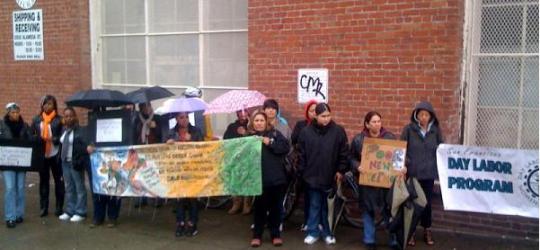
Among the 13 events scheduled so far will be immigrant day laborers sitting along Cesar Chavez Street between Mission and San Van Ness streets to protest both sit-lie and another legislative attack on immigrants, the controversial Arizona measure that essentially bans undocumented immigrants and encourages police to arrest them using racial profiling techniques.

The SF Day Labor Program is organizing the protest and today sent out a statement linking the two measures, noting that the sit-lie ordinance criminalizing otherwise lawful behavior and targets marginalized populations. Last night at the DCCC meeting, Sup. David Campos also made the point that day laborers who stand on street corners all day seeking work sometimes need to rest.

“Day laborers in San Francisco have to sit down once in awhile when they’re out on street corners waiting for work,” Jose Ramirez, a day laborer and coordinator of the SF Day Labor Program, said in today’s statement.  “Taking us to jail for sitting down in San Francisco is the same as immigrants being targeted by police for simply being Latino.”

After the Planning Commission early this month voted 6-1 to recommend against the sit-lie ordinance – finding that it violated a number of city goals and policies – the measure is awaiting consideration by the Board of Supervisors Public Safety Committee, possibly on May 3. 

DCCC: Thumbs down on sit / lie

San Francisco’s Democratic County Central Committee voted last night in favor of a resolution opposing San Francisco’s proposed sit / lie ordinance, a law backed by Mayor Gavin Newsom and Police Chief George Gascon that would make it illegal to sit or lie down on city sidewalks. Gabriel Haaland introduced the resolution, and it passed with overwhelming support.

Here’s a YouTube clip of Haaland’s comments during the committee discussion, filmed by Linda Post.

The DCCC is the policy-making body for the Democratic Party in San Francisco, chaired by former Board of Supervisors President Aaron Peskin. The vote followed a lengthy public comment session in which a wide variety of people voiced their opposition to sit / lie, including homeless youth advocates, residents of the Haight, and surprise guest Malia Cohen — formerly an executive staff member for Mayor Gavin Newsom. Some comments provoked laughter (“Sit /lie is like the fungus that won’t go away!” one Tenderloin resident exclaimed), while others framed their arguments in moral terms (“It’s hard to think of it as anything less than criminalizing poverty,” attorney David Waggoner charged). Cohen, for her part, called the ordinance “mean-spirited.”

The central committee members held a meaty discussion too, in which several members shared deeply personal stories to explain their feelings about the ordinance. Haaland described how, after graduating from law school in the mid-1990s, he found it so difficult to find work as a transgendered person that he worried about becoming homeless himself.

Committee member Tom Hsieh, who said he’d lived in the Haight for 10 years, spoke about his young daughter and expressed his discomfort about the “anything goes attitude” he’d seen people on the streets exhibit in her presence. Hsieh was one of a handful of committee members who voted against Haaland’s resolution. The others were Scott Wiener, Meagan Levitan, Mary Jung, and the proxy for Sen. Dianne Feinstein, while Matt Tuchow and the proxy for Assemblymember Fiona Ma abstained.  

Sup. David Campos addressed Hsieh’s concerns directly, saying that he did not believe the proposed ordinance actually addressed the sort of behavior that he found upsetting. “Sit / lie is the wrong focus,” Campos said. “The focus should be, how do we make policing better in San Francisco?” Noting that he had formely served as a police commissioner, he called for more effective community policing.

When he met with the mayor’s office about sit / lie, Campos added, he got the impression that the law was not actually meant to stop people from sitting or lying down on the sidewalk, but to target hostile behavior occurring on the street. “When you pass a law, you have to mean what it says,” he noted. He also pointed out that day laborers who wait on sidewalks for work would essentially be criminalized by the ordinance, since it’s unreasonable to expect that they wouldn’t occasionally sit down while waiting for a job.

Meanwhile, Scott Wiener’s resolution to endorse the Community Justice Center and encourage its expansion into the Haight failed with 14 voting against it and 10 voting to support it, while two abstained. While many committee members voiced general support for the CJC, a few said they resisted the idea of dictating to the Haight that it should install a similar court.

The DCCC also endorsed Linda Colfax and Michael Nava as candidates for Judge.

Sit/lie debate takes a strange new turn

Emails are rocketing around San Francisco political circles in anticipation of an April 21 meeting of the Democratic County Central Committee (DCCC), the policy-making body for the Democratic Party in San Francisco. Committee members are slated to discuss the city’s proposed sit/lie ordinance, a controversial measure backed by Mayor Gavin Newsom and Police Chief George Gascon meant to afford police more powers for dealing with hostile youth occupying sidewalk space.

Labor activist Gabriel Haaland, a DCCC committee member, touched off a small firestorm early this week when he submitted a resolution against the sit/lie ordinance. Haaland, who has lived in the Haight for around 15 years, said wayward youth have been flocking to that neighborhood and hurling occasional barbs at passersby (including himself) since he can remember, and recent interest in the issue does not make it a new problem. “What would actually solve the problem?” Haaland asked, and offered that sit/lie is not the answer. According to a post on Fog City Journal, his resolution for the Democratic Party to oppose sit/lie was co-sponsored by Assemblymember Tom Ammiano, Supervisor David Campos, Supervisor Chris Daly, Supervisor Eric Mar, Aaron Peskin, Hene Kelly, Rafael Mandelman, Michael Goldstein, Joe Julian, Jane Morrison, Jake McGoldrick, Michael Bornstein, and Debra Walker.

While some might look at a grungy street kid and see a menace to smooth business functioning or an unruly vagrant not being properly dealt with because the laws are too weak, Haaland said he perceives a kid from a broken home who already feels alienated from society. Incarceration for a nonviolent crime such as lying on the sidewalk would only further alienate these youths, he argued, possibly nudging them toward criminal behavior instead.

“This legislation will not solve longstanding, complex problems,” Haaland’s resolution reads. “City Hall has openly and repeatedly admitted in the press that the criminal justice system is failing to deal with similar issues in the Tenderloin, and has created an alternative known as the Community Justice Court (CJC) that is founded on principles of Restorative Justice.”

Restorative Justice is an alternative approach to dealing with crime that involves bringing together those who are directly affected to understand and address the harm that has been done, with emphasis on personal accountability and transformation. Some models also seek to change the conditions in which harmful actions occurred.

Haaland’s resolution urges the Board of Supervisors and the Mayor to oppose sit/lie, and to explore successful alternatives to incarceration.

The proposal sparked a second resolution, this one from committee member Scott Wiener, who is a candidate for the District 8 seat on the Board of Supervisors. Wiener submitted that the Democratic Party should officially get behind the CJC, and should acknowledge its error in opposing the court, a Newsom pet project, in 2008. “When I saw Gabriel’s resolution … I noticed it contained a positive reference to the [CJC],” Wiener told the Guardian. “I was pleasantly surprised.”

Furthermore, his resolution “encourages the Mayor and Board of Supervisors, budget permitting and based on careful analysis, to consider future expansion of the CJC’s geographic boundaries to include the Haight-Ashbury.”

Wiener is fully behind the sit/lie ordinance. “Right now, the police do not have enough enforcement tools to deal with some of the behavior on the streets,” he said. The measure has been an issue in the District 8 race, since progressive candidate Rafael Mandelman opposes the ordinance.

The resolution contest wasn’t over yet. In response to resolution No. 2, Haaland submitted yet another resolution — along with a personal note that appeared to extend an olive branch — revising Wiener’s proposal by urging support for “the restorative justice model as an alternative to incarceration.” (Haaland wrote an in-depth piece about restorative justice in a recent Guardian editorial.)

“I appreciated him doing that,” Wiener said when asked what he thought about resolution No. 3. “But I’m not convinced that that’s the way to go. That’s why I did not agree to it.”

Perhaps there won’t be any kum-ba-ya moments after all.

Along other email-blast circuits, Haaland’s initial proposal prompted David Villa-Lobos, a strong sit/lie advocate and District-6 contender, to sound his own alarm by urging SFPD officers to attend the April 21 meeting and defend the sit/lie ordinance.

The city Planning Commission recently voted 6-1 against the measure, and a grassroots group that brought opponents of the rule onto city sidewalks last month will hold another Stand Against Sit Lie citywide protest on April 24. The measure is expected to go before the Board of Supervisors near the end of the month.

The DCCC meeting will be held on Wednesday, April 21, at 6 p.m. in the basement auditorium of the California State Building, 455 Golden Gate Ave.

Benefits: April 7-April 13

0

Ways to have fun while giving back this week

Thursday, April 8

1369 Lights
Be among the first to get a copy of the new Moholy Ground Magazine, the New Photography Journal. Meet Moholy Ground staff and featured artists and enjoy cocktails and music from DJ BoomBostic spinning soul, motown, and funk. The Moholy Ground Project publishes nonprofit art journals and books and provides low cost promotions and marketing to art organizations and individuals involved in the art community.
7 p.m., $5
Blue Six Acoustic Room
3043 24th St., SF
www.moholyground.org

Friday, April 9

FACT/SF

Grab some gloves, hats, or any other costumes you feel like wearing  and head to this fundraiser party for the dance troupe FACT/SF featuring a silent auction, drinks, snacks, performances by Light Fiction, Lily Taylor, Emily Woo Zeller, DJ Nuxx, and more, including a sneak preview of FACT/SF’s new project, The Consumption Series.
8 p.m., $20-100 sliding scale
Mama Calizo’s Voice Factory
1519 Mission, SF
www.factsf.org

Saturday, April 10

Catwalk 2010
Watch as aspiring male to female transgender models from all over the country compete for the Catwalk 2010 crown in categories such as cocktail wear, swimwear, and evening wear. Proceeds from the event go to the AIDS Housing Alliance.
7 p.m., $40
SOMArts Gallery
934 Brannan, SF
catwalkusa.com

Poker Tounament
Attend this poker tournament to benefit Bay Area Women Against Rape (BAWAR), an organization that provides 24 hour services for survivors of sexual assault and their significant others. First, second, and third place winners will receive prizes and there will be raffle drawings throughout the night.
7:30 p.m., $50 buy in
Station Barber Shop
Suite 100
4400 Grand, Oak.
(510) 214-2299
poker@bawar.org, call or email to register

Soiree 8
Celebrate the San Francisco LGBT Community Center’s eighth anniversary with a night of decadent foods from San Francisco restaurants, entertainment from queer artists, and flowing cocktails featuring special guests Theresa Sparks and David Campos. The evening is scheduled to end with a dance party with music by local DJs.
7 p.m., $95
Terra Gallery
511 Harrison, SF
soiree.sfcenter.org

Sunday, April 11

Rose Pistola Cooks for North Beach
Enjoy a bountiful family style dinner, served at long tables, and accompanied by wines by Fancis Coppola Wines to benefit the North Beach Citizens, a neighborhood organization for the homeless. The hosts of the evening will be Lawrence Ferlinghetti and Jeanette Etheredge, so expect poetry  readings, film screenings, dancing, and other suprises.
6 p.m., $125
Basement of Sts. Peter and Paul Church
666 Filbert, SF
www.northbeachcitizens.org

Thawing ICE

0

sarah@sfbg.com

Top San Francisco officials are still refusing to implement legislation approved by the Board of Supervisors that requires due process to play out before immigrant youth accused of felonies are turned over to the federal government, despite recent developments that call into question arguments that have been made against that policy.

Mayor Gavin Newsom, whose veto of the legislation was overridden by the board in November 2009, has been the main obstacle to putting the new policy in place. He has argued that it violates federal law, that the city faces civil liability for harboring undocumented immigrants accused of crimes, and that only serious criminals have been affected by his unilateral 2008 decision to turn minors over to federal authorities before they have been convicted.

But then Muni bus driver Charles Washington’s wife, Tracey Washington, and 13-year-old stepson, undocumented immigrants from Australia, were placed under the control of U.S. Immigration and Customs Enforcement and ordered deported after the boy got into a fight at his middle school.

The case generated sympathetic media coverage because the felony charges and deportation order seemed excessive, so the federal government issued a 60-day reprieve to allow the family to finish applying for green cards and so the boy could have his day in juvenile court.

“All this got triggered by the non-implementation of a law that the board duly enacted last year,” Washington said March 11, a week after getting his reprieve, expressing exasperation with city officials. “The police are overcharging kids and waiting for someone else to whittle the charges down, and the probation officers are referring the kids to ICE, waiting for someone else to deal with the situation.”

Newsom’s policy required the city’s juvenile probation department to refer Washington’s stepson to federal immigration authorities after local police charged the boy with felony robbery, assault, and extortion in a dispute over 46 cents. Authorities then required his mother, rather than his stepfather, to come pick him up and placed an electronic monitoring device on her pending a deportation hearing.

Newsom’s policy has had a big impact in the city’s immigrant communities. Since July 2008 when the mayor ordered changes to Sanctuary City policies that had been in place for two decades, 125 youths have been referred to ICE, according to a March 9 report from the city’s Juvenile Probation Department.

In addition to the Mayor’s Office, the JPD has refused to enforce policies enacted through legislation by Sup. David Campos that are technically supposed to be the new city policy on referring undocumented youth, and the City Attorney’s Office has not required city employees to follow the new law, arguing it can only give advice and not compel departments to take action.

“With the benefit of legal advice provided by the City Attorney’s Office and outside legal counsel, and in light of current restrictions imposed by federal law, particularly the position taken by federal law enforcement authorities, the department has concluded that it cannot modify its policies and practices,” probation chief William Siffermann said at a March 4 hearing of the Board of Supervisors Rules Committee on why his department didn’t implement the legislation.

Grilled by Campos, Siffermann could not identify a federal law that requires city officials to report kids to federal immigration authorities upon arrest. Instead, Sifferman pointed to what many in the criminal justice community see as U.S. Attorney Joseph Russoniello’s overly broad interpretation of federal immigration laws, including his allegation that transporting arrested juveniles to court hearings amounts to “harboring aliens.”

But the Washingtons’ case struck a raw nerve at City Hall, and the Obama administration’s conciliatory response, along with other recent legal developments, indicate that it isn’t the feds that are preventing implementation of Campos’ legislation.

In February, Superior Court Judge Charlotte Woolard ruled in a civil case that the Bologna family — of which three members were murdered in 2008, allegedly by Edwin Ramos, an undocumented immigrant who had been in city custody as a juvenile — can’t hold the city liable for failing to prevent the murders.

That crime had been sensationalized by the San Francisco Chronicle, the San Francisco Examiner, and nativist groups, putting pressure on Newsom to change the Sanctuary City policy. Newsom’s spokespeople repeatedly have referred to it as an example of the civil liability the city faced.

On March 1 (the same day Washington first went public), City Attorney Dennis Herrera replied to allegations that his office has not done enough to implement Campos’ amendment by citing its victory in the Bolognas’ civil case, which sought punitive damages and to invalidate the city’s sanctuary ordinance.

Herrera also asked Gary Grindler, acting deputy attorney general at the U.S. Department of Justice, to direct the U.S. Attorney’s Office in the Northern District of California to “not use its limited resources to criminally prosecute local officials and employees who abide by California and local laws regarding the reporting of undocumented juvenile immigrants to the federal immigration authorities.”

Herrera based his March 12 request on an Oct. 19, 2009 memo that Grindler’s predecessor, David Ogden, issued curtailing federal action against medical marijuana dispensaries, which Herrera argued could serve as the model for clarifying the federal position on the city’s sanctuary law.

“If city officials and employees follow the mandates of state law, including those regarding the confidentiality of records of juvenile detainees, and the requirements of the amendment permitting the reporting to ICE of juveniles only after they have been adjudicated as wards of the court for criminal conduct, then the U.S. Attorney should not make it a priority to use its scarce federal resources to prosecute those city officials on the theory that by not reporting them at an earlier point, the city officials or employees are guilty of harboring,” Herrera wrote.

Campos said he welcomes any effort to get clarification from the feds, but believes such clarification is not necessary — and may not be forthcoming anyway. “So San Francisco should move forward. The law, in my view, allows us to do so, and it’s the right thing to do.”

Why Muni is in such trouble

10

OPINION The Municipal Transportation Agency’s Web site states a goal of providing a "convenient, reliable, accessible, and safe transit system that meets the needs of all transit users" in San Francisco. I have a feeling that if you ask most Muni riders, few would use those words ("convenient," "reliable," "safe," "meeting the needs of all transit users") to describe Muni today.

Riders have been put in the untenable position of paying higher fares for less service. Yet Muni still faces a $17 million deficit (projected to grow to $55 million next year), which it proposes to close by again increasing fares and cutting services. When asked about Muni recently, Mayor Gavin Newsom pointed to a $179 million reduction in state funding as the culprit. And while no one can dispute the devastating impact of such a cut, there are a few questions that suggest that the state alone is not to blame for Muni’s troubles.

For one, we just learned that the MTA has not had a management and performance audit since 1996. Although it’s undergone a number of fiscal audits, a management audit is different; such an audit would actually evaluates Muni’s operations to determine if the system is run effectively and efficiently. How is it that an $800 million operation can go for 14 years without that type of evaluation?

Moreover, what does it say about how Muni is managed when the agency has consistently failed to control overtime costs? We just learned that Muni accounts for about half of the city’s overtime expenses. This fiscal year alone, Muni has spent $23.8 million in overtime, or 45.6 percent of the city’s total. What kind of management and operational practices allow an agency to function like this?

And why is Muni spending 9 percent of its budget ($67 million) on work orders (with other departments) for services that may or may not have much to do with its mission — including $12.2 million for the Police Department, $8.5 million for the Department of Telecommunications, and $6.9 million for the General Services Agency that runs 311? Since a quarter of the value of these work orders would suffice to wipe away its deficit, what, if anything, has Muni done about this?

And speaking of Muni’s deficit, why is it that increasing fares and reducing services seem to be the only tools in its tool box? As a number of transportation experts have suggested, there are several options that should have been on the table — raising parking fees, adding parking meters, charging for blue placards, and putting a revenue measure on the ballot, just to name a few. While some of these options may not be the answer, has Muni at least considered them? Did it consider them before proposing more fare increases and service cuts, including doubling fares for seniors, the disabled, and youth?

All this points to a more fundamental question — what about the MTA Board? Has the board provided the type of engaged and independent oversight needed to guarantee effective management? And is independent oversight even possible when all board members are appointed by one person, the mayor?

Because of these and other questions, I am proud that the Board of Supervisors unanimously approved a motion I introduced asking the budget analyst to conduct an independent management audit of the MTA. Given the timing of the budget process, the first phase of the audit will be completed by May 1, with the remainder in the summer. The audit will evaluate key areas of Muni’s operations to shed light on whether it is truly following best practices. We owe it to the ridership to face these questions head on. We no longer have the luxury to wait for the state to do the right thing.

SF Supervisor David Campos represents District 9.

Downtown’s DCCC slate fizzles

9

I’m actually a bit surprised that Gavin Newsom’s allies haven’t made a bigger push to take back control of the San Francisco Democratic Party, which will play a key role in the fall supervisorial races. It looked for a while as if the downtown folks were organizing to put a slate of strong candidates with solid name recognition on the ballot. But when the Department of Elections closed Friday afternoon, and the deadline for filing passed, there weren’t that many new names on the ballot. Here’s the list. (PDF).


Twelve candidates will get elected in each of the two San Francisco Assembly districts. On the east side of town, in AD 13, eight progressive incumbents, including Sups. David Campos and David Chiu, former Sup. (and current DCCC chair) Aaron Peskin are running. So is School Board member Kim-Shree Maufas and former state Sen. Carole Migden. Supervisorial candidates (and incuments ) Rafael Mandelman and Debra Walker are running, as are former supervisorial candidates Eric Quezada and Alix Rosenthal.


Not a lot of star power in the more moderate camp. Other than former Sup. (and incumbent) Leslie Katz and sup. candidate (and incumbent) Scott Wiener, it’s not a powerful crew. So the progressives look to do well — as they usually do — in D 13.


D-12 is a little more conservative in general — and there are lots and lots of candidates, meaning name recognition is even more important. I’d thought maybe somebody would talk Sup. Sean Elsbernd or Sup Carmen Chu into running. But no: the only elected officials on the list are progressives, including Sups. John Avalos and Eric Mar, School Board member Sandy Fewer, and Community College Board member Milton Marks. Then there’s incumbent (and former Sup.) Jake Mcgoldrick.


The moderate, pro-Newsom camp — the folks who would try to shift the Democratic Party endorsements away from progressives in swing supervisorial districts — may be large, but not terribly deep. Incumbents Tom Hsieh and Megan Levitan are, of course, running again, and there’s Bill Fazio, who once ran for district attorney.


Myra Kopp, wife of former state Sen. (and retired judge) Quentin Kopp, is a candidate, and while she may be a little more politically conservative than Avalos and Mar, she’s not going to be in the Newsom camp, either; she’s more of an independent wild card.


Paul Hogart agrees with me that the progressives seem well situated to keep control of the DCCC, although it’s never a sure thing: there are no contribution limits for these races, and since it’s a low-profile office, big money can make a big difference. Let’s see what downtown tries to do to buff up and promote its candidates in the next two months.


Campos on the next mayor

15

Just spoke with Sup. David Campos, who has some interesting thoughts on the next mayor and whether the supervisors should seek to change the City Charter to create a special election instead of filling a mayoral vacancy by appointment.


“I don’t have a problem with people having the final say,” Campos told me. “And they will, since there will be an election for mayor next year anyway.


“But the current system has been in place a long time, and a district-elected board appointed Dianne Feinstein mayor, and nobody had any problems with it back then. It’s just now that Newsom has decided to run for another office that he’s talking about this. It’s really self-serving.”


Yep, that it is.


Politics and redistricting: The madness in SF’s future

8

The political merry-go-round in San Francisco going to be whirling at light speed soon. It’s partially the fault of term limits — over the next couple of years, some very talented, ambitious politicians are going to be forced to leave local office, and they’re looking for the next step. Part of it is the confluence of a bunch of events, starting with Mayor Gavin Newsom and District Attorney Kamala Harris both seeking statewide office.


And there’s another factor that hasn’t been talked about much, but it’s really important: Next year, every Congressional, state Legislative and local supervisorial district is going to change.


After the decennial census, everyone has to draw new lines to reflect population shifts. At the state level (and Congressional redistricting is also a state function), that’s in the hands of a reapportionment commission, which I’m dubious about: The majority of the applicants are white people, and it’s supposed to have an equal number of Democrats and Republicans, although the state has far more Democratic voters. It’s anybody’s guess how they’ll actually draw the lines.


An elections task force will do the local lines, and it’s going to be harder to screw up; San Francisco supervisorial districts are supposed to reflect established neighborhood boundaries, and the population shifts within the city haven’t been that dramatic.And it’s unlikely anyone’s going to try to draw lines just to force an incumbent supervisor out of a district. But the districts will be a little bit different, and in San Francisco politics, a little bit can mean a lot.


The state Legislative districts will change significantly — and could change the politics of this area, and the state, in dramatic ways. For example, suppose Mark Leno’s Senate District moves somewhat North, to include a majority of Marin and Sonoma residents and only a small minority of San Franciscans? Suppose that district no longer includes Marin or Sonoma, but includes all of San Francisco (which would put Leno and Leland Yee in the same district)?


Suppose the 12th and 13th Assembly Districts, which now divide about East/West, shift to North and South? What if Tom Ammiano and Fiona Ma end up in the same district? (Um, I think that’s a closer relationship than either of them wants ….)


What happens if Nancy Pelosi is redistricted out of her seat? (Heh heh, won’t happen, but in theory, she and Lynn Woolsey could wind up living in the same district.)


It’s going to change the dynamics in a city that’s already poised for some upsets to the political apple cart.


Ross Mirkarimi’s termed out in 2012, and if he doesn’t run for mayor (or doesn’t get elected) he’ll be looking for the next step, which could be a run for the state Assembly; Tom Ammiano will be termed out in 2014. Of course, that’s been a gay seat for a long time (Carole Migden, Mark Leno, Ammiano) and by them someone like David Campos might be interested.


Or the district lines might have changed so much that both of them – or neither of them – can get elected.


If Bevan Dufty doesn’t get elected mayor, he’s out of a job – and he’s a political junkie who won’t easily retire. He’ll be looking at other offices, too. So will Sean Elsbernd, I suspect.


And that doesn’t even count the mayor’s race, which could, at this point, involve both state Senators, Leno and Leland Yee, and if either one wins, that opens up a Senate seat. And at the same time, if Kamala Harris is elected district attorney, that job will be open, and it’s an open secret that Board of Supervisors President David Chiu, a former prosecutor, would love to be in that office some day.


And in the background is the question of who becomes mayor if Newsom becomes lt. governor


 (and what happens to Aaron Peskin, an astute politician if ever there were one, and a potential mayor if this board of supervisors gets to make the appointment ). At lot to think about – and trust me, the thinking is already going on.

Newsom’s silly trick

19

Gavin Newsom’s got a plan: He’s going to stop those damn district-elected progressives from appoining a new mayor even if it takes some wacky legal footwork. According to the Chron’s Matier and Ross:


For the past two weeks, Newsom’s political team has been combing the state Constitution to determine if the mayor, assuming he’s elected statewide, could legally push back his Jan. 3 swearing-in for the new job until after Jan. 8.


If he can, the job of naming his successor would go to the newly elected Board of Supervisors, which is sworn in Jan. 8, instead of the current lineup.


I don’t know where that team is looking in the state Constitution, but the language seems pretty clear to me. Article V, section 2, provides that the “Governor shall be elected every fourth year…and hold office from the Monday after January 1….” In 2011, that’s Jan. 3. It also says (article V, section 11) that “The Lieutenant Governor, Attorney General, Controller, Secretary of State, and Treasurer shall be elected at the same time and places and for the same term as the Governor.”


And since the mayor of San Francisco is, by Charter, a full-time job, Newsom can’t be both mayor and lt. governor. Which means, I think, that he’s got to start the new job Jan. 3, and the new Board of Supervisors doesn’t take office until a week later.


There’s another twist here: The City Charter discusses a “vacancy” in the office of mayor, and authorizes the Board of Supervisors to select someone to fill the remainder of a vacant term. If Newsom wins in November, it will be clear that a vacancy is looming — and there’s no reason why the supervisors can’t pass a motion right away designating the person who they intend to have fill that vacancy. In other words, this current board could select the next mayor even before Newsom officially resigns.


Now, it’s also true that the motion wouldn’t become effective until the mayor actually left office, and could be rescinded at any time up until that moment. But if the supervisors find six votes for a candidate, and designate that person as Newsom’s successor, it’s unlikely the board would decide to change its mind and rescind in just a few weeks.


And even if all that doesn’t fly, there’s a very good chance that progressives will still control the next board. Four progressive supes will carry over — Ross Mirkarimi, John Avalos, Eric Mar and David Campos. If progressive candidates win two of the three swing races — in districts 6, 8 and 10 — then the overall politics of the board won’t change dramatically.


So there’s actually a chance that a progressive mayor could take office next January. Whether Newsom likes it or not


MUNI driver: luck, not system, saved my family

3

MUNI bus driver Charles Washington says it was luck that won his family a reprieve from a federal deportation order. His Australian bride Tracey, who he married in Reno last April, and her 13-year-old son were served deportation orders after the boy got into a schoolyard fight and a police officer wrote him up with three felony charges. Under the city’s current policy, felony charges against undocumented youth triggers an immediate referral to ICE before the youth can prove their innocence.

Charles and Tracey Washington hug outside a hearing on the city’s policy towards immigrant youth. After the hearing, the juvenile probation department dropped language from its policy that advocates say could lead to racial profiling, but JPD Chief William Sifferman said the department cann’t allow kids due process for fear of being accused of harboring and transporting aliens.

Washington’s family won a reprieve after the media learned of their plight, an outcome Charles puts down to luck, not evidence that the system is working. He believes the nightmare his family is going through proves that the city’s policy towards immigrant youth isn’t working. And he wants those responsible for setting that policy to take responsibility and fix what’s broken,  not pass the buck by trying to hide behind federal laws they claim prevent them from fixing their own policy.

“The problem with the policy is that is doesn’t allow for due process,” Washington said during a March 4 hearing on the city’s policy which Mayor Gavin Newsom ordered in 2008.”The policy is based upon the original charges that a police officer made, a  field officer who has to make a quick decison based upon a couple of known facts,” Washington said. “Kids get treated as if they are guilty before they are proven innocent. There has to be a better way for the system to work.”

Washington doesn’t blame the city’s police or probation officers for his stepson getting referred to the feds before he could prove he was innocent of felony-level charges.

Gabe Calvillo, president of the city’s probation officers union, congratulated the Washington family on their reprieve, but repeated concerns that giving kids their day in court would put his members at risk.

And Washington does not blame city workers for the fact that federal immigration agents used his stepson as bait to get his wife to come in to their Sansome Street office where they handed her and her son deportation orders and slapped an electronic monitoring device on her ankle–a device she is still wearing to this day.

 Tracey Washington demonstrates the device that the feds are forcing her to wear, making her feel like a “murderer,” even though the couple say federal contractors gave them misinformation about when to apply for a green card, after she got married to  Charles Washington while she and her two sons were here on a visa waiver.

As a city worker, Washington gets that these city workers were simply following orders. But as a husband, father and US citizen who is still fighting to keep his family intact, he believes that those responsible for the policy that led to this nightmarish sequence of events are hiding behind claims that their hands are tied by federal law. And he wants them to get off their hands and back to the drawing board, so other families don’t have to go through what his family just experienced.

And unlike many families that feel they were unnecessarily ripped apart by the city’s policy towards immigrant kids, Washington can articulate his concerns without fear of being deported himself.

“It’s unbelievable how any family could have been put in that position,” Washington said, recalling how his son landed in ICE’s hands, after a SFPD officer wrote him up for three felony charges, following a schoolyard fight over 46 cents.

When an SFPD officer charges a juvenile with a felony, juvenile probation is required to refer the kid to US Immigration and Customs Enforcement (ICE), if they suspect the youth is here without legal documentation.

Once Washington’s stepson was referred to ICE, under a policy that Mayor Gavin Newsom ordered in 2008, the feds ordered him and his mother deported, without waiting to see if local courts actually find the boy guilty of any felony charges.

It was only when Washington went public with his family’s nightmare and the media started making calls that ICE backed off.

But while it was the city’s flawed policy that landed the Washingtons in this dilemma, the Mayor’s Office did not offer to try and help. Instead, the Mayor’s office claimed that their case proves that Newsom’s policy is “not draconian.” (You can read Newsom’s full statement at the end of this post.)

“The Mayor’s Office could have contacted me, tracked me down,” Washington said. “But they just sat back and waited to jump on the band wagon, whichever way it went.”

Mayoral spokesperson Tony Winnicker said the Mayor’s Office was sympathetic to the family’s plight but could see no reason to get involved in what he described as “a federal immigration matter.”

But Washington notes that it was Newsom’s policy that led to his stepson being referred to ICE, and the feds would have deported his family this week, if they hadn’t gone public with their case,a step most immigrant families are afraid to take.

“The bottom line is that we got lucky,” Washington said. “How many families wouldn’t know what to do in this situation? When I spoke at the press conference at the Asian Law Caucus,  I didn’t know what to do either. What if the Asian Law Caucus had been too busy, or the media hadn’t come to the press conference? Does everybody have to contact a lawyer. Our story shows that the system failed, and that it was luck that saved us.”

While folks are acting as if the Washingtons’ problems are over, the family still faces huge financial and legal challenges.

“For the time being, we’ve had a huge burden lifted off of us, but the next huge problem is that we are bing requested to have one-way plane tickets ready for the first part of April, though we are not being asked to leave now until May 4, that’s several thousand dollars that we have to lose,” Washington said, noting that it will cost over $4,000 to apply for green cards.
“Meanwhile, It looks like everyone wants to point the finger at someone else instead of focusing on the fact that there is a problem.”

Washington made his comments after a hearing that Sup. David Campos called to determine why the Juvenile Probation department hasn’t implemented an amendment that Campos introduced in 2009 to address the Catch 22 situation that’s  hidden within Newsom’s current policy and that ensnared the Washingtons’ kid.

Campos’ amendment instructed probation officers to wait until kids have had their day in court before referring them to ICE. But Mayor Newsom said he will ignore the amendment, and JPD Chief Sifferman has refused to implement it.

Either way, Campos’ March 4 hearing offered a rare insight into the, some would say, dysfunctional dynamics within the city’s juvenile justice department since it came under the microscope of US Attorney Joe Russoniello in 2008.

A Bush appointee, Russoniello has been ideologically opposed to the concept of sanctuary ever since the city enacted its City of Refuge ordinance in the 1980s, when he was first US Attorney for Northern California.

After Kevin Ryan was fired as US Attorney in 2006 and hired as Newsom’s director of criminal justice in 2007, Russoniello resumed his post as top federal prosecutor, a position of power that let him launch a federal Grand Jury investigation in 2008 to determine if JPD’s former practices violated federal law.

Ryan has since resigned from the Mayor’s Office, and the Obama adminstration is vetting Russoniello’s replacement, but the City claims it can’t give immigrant kids their day in court for fear of federal retaliation. And some believe the unresolved tension between the city’s sanctuary policy and the federal immigration laws will continue, unless national immigration reform occurs.

Juvenile Probation Department Chief William Sifferman said today that his department is eliminating language from its juvenile immigrant policy that could be an invitation to racial profiling.

JPD Chief William Sifferman told Campos that his department looked into Campos’ amendment, which directs JPD to modify its policies and practices to the “extent permitted by federal law”‘and concluded that it cannot modify them.

Sifferman recalled what happened when JPD used to return immigrant youth to their country of origin or place them in group homes, with no notification to ICE.

“Many of these youth were arrested for selling crack cocaine in the Tenderloin, were placed in group homes, ran away, were rearrested, selling drugs again,” Sifferman testified.

He recalled how JPD officers were interrogated and threatened with arrest by federal agents who intercepted them at Houston airport as they were accompanying minors to Honduras. And that Russoniello subsequently convened a Grand Jury to investigate JPD’s actions.

“That investigation continues to this day,” Sifferman said. “The department’s current policy was adpoted becoasue of these concerns.”

“Until a court rules otherwise, the department must conclude that [federal] law would not allow the city to change its policy,” Sifferman said.

He said probation officers are trained not to directly question juveniles or their parents about their immigration status. And hee noted “a marked reduction” in the number of unaccompanied Honduran minors who have been arrested for selling crack cocaine.

“We believe our policy has significantly reversed a 15-year trend in the city’s history,” he said.

Sifferman said he did not receive Campos’ request for time estimate information until 48 hours before the March 4 hearing, though Campos said he made his request weeks ago.

But he offered some statistics, including the fact that “since July 2008, JPD has released 107 unduplicated youth to ICE, 125 times.”

“This means that 17 were referred to ICE twice, that they returned to country of origin, then reoffended,” Sifferman explained.

He also noted that 92 percent of the youth are released to ICE after a felony finding.

“Only a small number are released to ICE without having determined if they had committed a felony,” Sifferman said.

The monthly average of kids referred to ICE for the first four months of the city’s new policy was ten, Sifferman said.

“And for the past 16 months, it’s been five,” he said. “We attribute this decline to undocumented Honduran youth no longer returning to the Tenderloin to sell crack with the same frequency.”

But he claimed that while there has been a reduction in releases to ICE, there had been no measurable decline in probation officer’s case or work load.

‘They continue to supervise kids who have not been referred to ICE,” he said.

“We have dedicated none of our resources to working with ICE,” he added.

Contact with ICE is limited to fax transmissions, follow-up phone calls, and follow-up responses, Sifferman said.

“Probation officers do not arrest or detain youth based on their undocumented status nor do they assist in taking youth into ICE custody,” Sifferman said. “We must always recognize the public safety impliations of our policy.”

Asked what kind of resources JPD spends on this contact, Sifferman said, “De minimus.”

Pressed  for more details,  Sifferman said, “It’s difficult to estimate given that our staffing level functions are ministerial—a fax being sent a record placed in a file, a phone call about a potential release date. We haven’t done a time study.”

Campos noted that unlike JPD’s former policy, the amendment he enacted last fall does not call for prior policing and actual transport of youth across the country. But Sifferman countered that if youth are released back into the community, JPD could be aked to transport them “to various locales.”

Campos questioned Sifferman as to the origin of language in Newsom’s current policy that immigrant advocates believe could lead to racial profiling (language that, as the Guardian learned today, has now been deleted from the policy).

“In determining whether there is reasonable suspicion that youth is undocumented, one of the criteria listed in the policy says, ‘presence of undocumented persons, ‘ but how would you know when a person is undocumented?” Campos asked.

“There could be information in the arresting report describing the conditions,” Sifferman suggested.

“How did you decide to include this language in the policy?” Campos asked.

“It was based on research and advice we received from the City Attorney’s office,” Sifferman said. “The entire policy is based on review and approval of the City Attorney’s office.”

“Can you see how something as open-ended as this could lead to racial profiling?” Campos asked.

‘It could, it requires vigilant oversight, if that criterion was taken alone, we’d have  a problem wth that,” Sifferman said.

Sup. Eric Mar said he was “very upset,” that Sifferman did not have the cost estimates available.
Mar also voiced concerns that the policy sounded “like a justification for racial profiling.”

“I really respect you, but it sure sounds like you’re flying in the face of San Francicso values when you are not implementing a policy to protect due process,” Mar said.

“I disagree that we have been intentionally stalling,” said Sifferman, who has been hit with budget cuts and staffing reductions in the past couple of years like other department heads.

Campos took issue with Sifferman citing Title 8, Section 1373 of the US code as justification for not implementing his policy amendment.

That section of the US code states that, “Notwithstanding any other provision of Federal, State, or local law, a Federal, State, or local government entity or official may not prohibit, or in any way restrict, any government entity or official from sending to, or receiving from, the Immigration and Naturalization Service information regarding the citizenship or immigration status, lawful or unlawful, of any individual. “

“Can you point to a section of the federal law that requires you to report?” Campos said
“No, I can’t,” Sifferman said.

But Sifferman subsequently noted  that there is a prohibition against “transporting and harboring any person known to be undocumented,” a position that leaves JPD officers feeling vulnerable given that the department has received three federal Granf Jury subpoenas related to JPD’s previous policy towards juveniles.

During public comment, UC Davis Law Professor Bill Ong Hing addressed the fact that a bunch of misinformation continues to swirl around the city’s immigrant juvenile policy.

“I would encourage the Board, Chief Sifferman, the Mayor’s Office and City Attorney’s office to sit down together,” Hing said. “A lot of misinformation is floating around.”

Hing noted that there is nothing in the Campos amendment that prohibits reporting kids to ICE.

“But you do not have to volunteer information to them, if it’s not required,” Hing said.

“The vast majority of jurisdictions don’t contact ICE [before kids have day in court], they recognize that’s not good policing, ” Hing continued. “Under the rules of federalism, there is nothing that prohibits this ordinance.”

“And there has never been a prosecution of a city worker [for following a city’s sanctuary policy], and [a prosecution of a city worker for that] wouldn’t be authorized by the Obama admininstration,” Hing claimed.

He also said that a confidential memo that Mayor Newsom leaked to the Chronicle was ‘laughable”.

“It exagerrates the likelihood of a successfully overruling the sanctuary ordinance,” Hing said.

Hing concluded that City Attorney approved language in Newsom’s current policy, “is a complete inviation for racial profiling.”

City Attorney spokesperson Matt Dorsey responded forcefully to these accusations.

“Racial profiling is illegal, and something we take very seriously,” Dorsey wrote in an email.” Part of the City Attorney’s duty is to advise against illegal conduct. If a client department informs us that a policy could risk illegality, we will work with our clients to make sure laws aren’t broken, and that no one’s rights are violated. That’s a job lawyers do every day.  And that’s especially true here, where the matter involves litigation, threats of litigation, and a federal criminal investigation.”

And today, JPD decided to eliminate the language that was triggering racial profiling concerns.

Meanwhile, mayoral spokesperson Tony Winnicker noted that of the 125 reports to ICE since July 2008, 97 percent were for felony arrests, and the other 3 percent were “misdemeanors with priors.”

Winnicker also emailed a statement from Newsom that reads as follows:

“I have long supported our sanctuary policy and a range of policies and programs designed to assist our immigrant community. I believe San Francisco continues to be an international leader with our efforts to protect immigrants in our community. However, the sanctuary ordinance as originally conceived and adopted was designed to protect all residents of our city, not as a shield for felons and criminal behavior. I will not put City staff, our sanctuary city policy and thousands of residents at risk to shield felony criminal behavior by a few. Immigration and Customs enforcement is a federal responsibility. San Francisco cannot be the arbiter of immigration cases that take place within the City. That’s why many other counties in California have a similar policy of reporting suspected juvenile felons to Immigration and Customs Enforcement at the booking stage. The recent example of the Washington family validates that our current policy is appropriate. Juvenile Probation officials report undocumented felony arrests to Immigration & Customs Enforcement, and Immigration & Customs Enforcement officials determine the appropriate response. In this case, once President Obama’s Immigration and Customs Enforcement office became aware of the exceptional circumstances around the case, they took commendable action to ensure that the young boy and his family were given time to resolve their residency status.San Francisco’s Sanctuary Ordinance continues to strike the appropriate balance between offering a welcoming hand to our immigrant community and protecting the public safety of law-abiding residents of our City.”

That’s a fine statement, and I’m sure the mayor cares about youth, whatever their nationality and immigration status. But  immigrant youth still face a  Catch 22 trap within his policy that has led kids who haven’t committed felonies being referred to ICE for deporation. The question now becomes, can a miracle happen? Will everyone involved–at the city and federal level–sit down and hash out an equitable solution? Will heads of other city departments acknowledge their role in this process or will Sifferman be hung out to dry all on his lonesome? And will a bunch more kids get thrown under the bus before we as a nation find our way towards a saner and more equitable immigration process? Stay tuned.


ICE postpones deporting SF MUNI worker’s family

2

I just got a call from US Immigration and Customs Enforcement advising me that ICE has decided to postpone deporting the wife and son of MUNI bus driver Charles Washington for 60 days.

“We’re hoping that postponing their removal will afford them the opportunity to get their affairs in order and address outstanding legal issues,” ICE spokesperson VIrginia Kice told me. Kice said this extension should give the family time to deal with their “pending adjustment application,” and determine “whether they have the opportunity to gain legal status.”

That’s great news for the Washingtons and another sign that may be hope, after all. (Angela Chan, staff attorney for the Asian Law Caucus, is now trying to get ICE to give the family 6 months, since this is how long US Citizenship and Immigration Service (US CIS) has told her it would take for them to process the Washingtons’ green card applications, and hopefully all the federal agencies involved are going to coordinate their efforts on this case.)

Meanwhile, Sup. David Campos is still trying to get the Juvenile Probation Department to implement his amendment to the sanctuary ordinance to stop nightmares like this from happening. Campos has scheduled a hearing at 10 a.m., Thursday March 4. So, stay tuned.

Family’s deportation illustrates why Campos’ amendment is needed

7

The case of MUNI bus driver Charles Washington, whose wife Tracey and her 13-year old son face deportation on Friday after the boy tried to take 46 cents from another kid, helps illustrate why Sup. David Campos spent over a year working with local immigration experts to figure out a way to amend the city’s sanctuary policy. Under the Campos amendment, which Mayor Gavin Newsom has refused to implement, kids like Charles Washington’s 13-year-old stepson would only be referred to US immigration and Customs Enforcement after a juvenile justice determined that they were actually guilty of a felony.

Unfortunately, the city’s juvenile probation department, under Mayor Gavin Newsom’s orders, and running scared of rightwing nuts who have unsuccesfully tried to sue the city, has refused to implement Campos amendment. Campos, who spent over a year working with immigration experts to develop a measured and legally defensible amendment, has called a hearing to determine why juvenile probation is refusing to implement his amendment, which a super majority of the Board supported last year,thereby overriding Newsom’s mayoral veto.

And now, with the face of the Washingtons all over the local media, city officials are either rushing to clarify their positions, or avoiding reporters altogether, as the Washingtons fight to keep their family intact–and in San Francisco.

Sgt Tomioka of the San Francisco police Department left me a message this morning to clarify that the SFPD doesn’t refer immigrant youth to US Immigration and Customs Enforcement (ICE).

“That is not a function of the SFPD,” Tomioka said in a voice message.
And she’s right. That job is left to the city’s probation officers. But the city’s probation officers are required, under Newsom’s policy, to refer kids to ICE if the arresting SFPD officer charges them with a felony. So, in that sense the SFPD is involved in the ICE referral process, albeit indirectly.

As the SFPD’s Sgt. Wilfred Williams explained, SFPD officers make the arrests, write up the charges and transport suspected juvenile felons to the Juvenile Justice Center.

And it’s at the Juvenile Justice Center that members of the city’s Juvenile Probation Department are required, under Newsom’s orders, to pick up the phone and refer kids to US Immigration and Customs Enforcement (ICE) when kids they suspect of being undocumented are booked with felony charges.

In the case of Charles Washington’s skinny 13-year-old stepson, the kid was arrested by the SFPD on Jan. 25 and charged with felony assault, extortion and robbery. I haven’t seen a police report of the incident, yet. But Washington said it was based on what the other kid’s family told the police, and that there were no witnesses to the incident. And felony charges are all that’s needed, under Newsom’s current policy to require a probation officer to refer a kid to ICE.

And once juveniles are in the hands of ICE, a nightmarish Catch 22 kicks in, in which local protections no longer apply, and ICE’s deportation orders can trump any legal immigration application, including green card applications.

In the case of the Washingtons, the family was applying for green cards–applications that cost thousands of dollars. And US Citizenship and Immigration Services had agreed to review their case. But then came their son’s arrest by the SFPD who charged him with three felonies and transported him to Juvenile Probation, whose officers were required to refer him to ICE. And ICE, according to Washington, then used his son “as bait” to get his wife to show up at their office, where they slapped an electronic monitoring device on her ankle and gave her and her son their deportation marching orders.

Angela Chan, staff attorney at the Asian Law Caucus, and the lawyer helping the Washingtons’ negogiate their way through this immigration nightmare, clarified that USCIS isn’t refusing to consider their case, because of the stepson’s referral.
Instead, the problem is that USCIS  won’t be able to finish that process before Friday, when the Washingtons are due to be deported.

“Unfortunately, the mother and her child will be deported by ICE well before their greencard application can be processed by USCIS, which can take months,” Chan said.

Further compounding the Washingtons’ legal problems is the fact that their 13-year-old is supposed to appear before a juvenile justice on Monday (March 8) to review the charges against him.Chan said it’s likely that a juvenile justice would review the boy’s case and reduce the charges, probably requiring him to do six months informal probation. In other words, the felony charges that led to his referral to ICE likely wouldn’t be upheld in court.

Now, under the amendment that Sup. Campos authored and the Board approved last fall, but Newsom is refusing to implement, the boy’s probation oficer would not be required to refer him to ICE if the felony charges aren’t upheld. In which case, the boy would go free, his parents could continue applying for green cards, and the family could remain intact

But since ICE want to deport Washington’s stepson before his March 8 hearing, the boy won’t have his day in court. Even worse, he will likely be slapped with a bench warrant by the juvenile justice department–the kind of Catch 22 detail that will play havoc with future attempts to apply for green cards from outside the US.

I asked Lori Haley of US ICE what’s the big hurry to deport the Washingtons by Friday.
“They overstayed their visas,” was all Haley would say, along with the comment that “We don’t confirm when someone is going to be deported.”

Asked who was responsible for telling the Washingtons that they needn’t rush to apply for green cards, which is what Charles Washington said happened, Haley referred me to UC CIS, whose spokesperson Sharon Rummery said it was impossible to ascertain if a contractor with the US government misinformed the family.

‘I can’t say that it’s true or not, because it was a private conversation between one of the operators who works on our customer service line,” Rummery said. “Our operators are highly trained and are backed up by our trained officers,” Rummery continued, confirming that the operators are contractors, not US CIS staff.

Rummery offered that folks who are deported to their native country can file for a waiver of deportation and also a waiver of a ban on reentering the country.

“They have to demonstrate that an immediate relative, who has legal status, in this case the husband, will suffer severe hardship,” Rummery said. “When they are sent away, then they can apply for a waiver and return with a green card.”

But Rummery said she could not provide a reliable time estimate as to how long all this would take, nor did she know how the stepson’s felony charges and possible bench warrant would impact the family’s chances of getting a green card through this process.

So, I called Sens. Barbara Boxer, Dianne Feinstein, Speaker of the House Nancy Pelosi, and President Barack Obama’s press office to see if any of them are aware of this case and whether they would consider a private bill. As the Asian Law Caucus’ Chan explained to me, earlier today, “A private bill is when a bill is passed to grant immigration relief for an individual.  It doesn’t change SF’s policy or the way the feds are bullying us, but it may help this family.
  
No one in Boxer, Feinstein, Pelosi or Obama’s press offices was aware of this case when I called, but they all said they’d look into it,and the folks in Feinstein’s office sounded horrified that a kid could be deported thanks to a schoolyard fight over 46 cents. So, maybe there is hope after all.

To date, Mayor Gavin Newsom’s new media spokesperson Tony Winnicker hasn’t returned my calls.

But I did read that Winnicker had told the Chronicle that it was “‘an unfortunate situation for the family, and we’re sympathetic to it.”

“But [Winnicker] said the mayor is actually protecting ‘hard-working, law-abiding residents of this city, including undocumented residents’ by reporting youths after felony arrests,” the Chronicle continued.

Somehow, I don’t think that Charles Washington, a hard-working law-abiding resident of San Francisco, would agree that anybody is protecting him by deporting his wife and her two kids. Especially since the 13-year old hasn’t even had his day in court to determine if he is even guilty as charged.

And while the Chron wrote that Washington “hopes to visit them in Australia,” the Chron’s reporter must have left the press conference by the time Washington explained  how often he is likely to get to visit Australia. As Washington noted,  if you are deported, you typically have to wait 3-10 years to visit the US again.
“So, if it’s a 10-year ban, I’ll get to visit them 3 times, and if it’s a 3-year ban, I’ll get to visit them once,” Washington, who drives a MUNI bus, said.

“I refer to them as my sons, because I’m still going to be their dad,” continued Washington, who is praying for a miracle.

In the meantime, Sup. David Campos is holding a March 4 hearing before the Board’s rules committee to explore why the City’s Juvenile Probation Department has refused to implement Campos’ amendment to Newsom’s sanctuary policy. Up unitl now, Newsom’s office has claimed that taking this extra precaution would violate the US Constitution. I wonder how many families like the Washingtons are going to have to be destroyed before someone in the Mayor’s Office decides that it’s time to revaluate their position and prevent local families from get ripped apart, simply because their kids, green cards or not, insist on acting like kids.


Newsom’s sanctuary policy destroys MUNI worker’s family

12

“They used our son as bait, just to get the mother to come in,” Washington said.

When San Francisco native and MUNI bus driver Charles Washington married Tracey, his Australian girlfriend in Reno last April, he never imagined that she and her sons would be deported after her 13-year-old bullied another kid at school for 46 cents.

But that’s what will happen Friday, March 5, almost a year after their wedding, unless a miracle happens. And this travesty is happening thanks to Mayor Gavin Newsom’s overreaching juvenile sanctuary policy, a broken federal immigration system, and a couple who tried to do the right thing, but were told they didn’t need to apply for a green card in a hurry, when they called an immigration number for information last year.

‘What more could we have done other than call the number?” Washington asked, noting that once they were told it wasn’t urgent, they began saving up, so they could afford the several thousand dollars a green card for his wife and two kids was going to cost.


But now, thanks to a bullying incident at school, and the city’s overly draconian policy towards immigrant youth, Washington’s wife and her 13-year-old son will be deported to Australia on Friday, and her 5-year-old boy will accompany them, while Washington  stays in San Francisco to look after his 12-year old daughter (pictured in a photograph taken at the March 1 press conference at Asian Law Caucus).

“There are no laws that prevent me from going to Australia, but I have joint custody of my daughter from a previous marriage and her mother is not going to authorize the child to move, so I’m hoping for a miracle,” Washington explained.

His wife Tracey, who has been forced to wear a federal electronic monitoring bracelet since February, looked on in silence, flanked by her sons and step-daughter.

Washington, who grew up on Mt. Davidson Terrace, and was formerly in the military, had been driving a MUNI bus for a year and a half, when he woke one morning after he got home from his late-night MUNI shift, to hear the phone ringing with a call from his stepson’s school to say there where problems between him and a sixth grader.

“The school told me it was their policy to call the parents any time the police are going to talk to a child,” Washington said. Twenty minutes later, he and his wife were at the school, talking to an SFPD officer, who said a report had been filed by another parent about the incident and the police now wanted to talk to their kid.

After the interview with the police, Washington thought the worst thing that could happen was that the officer would write a citation to say his son needed to appear at juvenile court. Instead, the police arrested his stepson, putting him in handcuffs and saying that they were going to take him to the Juvenile Justice center.

“I think my son was in shock, as I was, “ Washington said. “What he actually did, and what the actual charges are, they are universes apart. Back when I was in school, at worst, a bully was sent home for the day, creating problems for them at home, when they explain to their parents why they’ve been sent home.”

Instead, Washington’s stepson was charged with felony robbery, extortion and assault after the parents of a sixth-grader at his school called the police, but his case has yet to be adjudicated by a juvenile justice, –and a bench warrant will be issued if he fails to attend a March 8 hearing in San Francisco—3 days after he and his mother are deported.

According to Washington, (pictured here (left) with Angela Chan, (right) staff attorney for the Asian Law Caucus) no weapons, no injuries and no witnesses were involved in his stepson’s incident. “And it was strictly one kids’ words against the other,” Washington said.

So, why did the police decide to refer his stepson to the federal immigration authorities?

“I think the officer picked up on the fact that he had an accent,” Washington said. “And when asked where he was born, my stepson said, ‘Australia.’ He is 13 years old. He doesn’t know if he is undocumented or not. As far as he is concerned, he was born in Australia, moved to San Francisco, and this is his family, his new family.”

Washington said his stepson was held for a week at Juvenile Hall for a week, during which the atmosphere at home became tense and stressful.

“We did not understand why this was happening,” Washington said. “Kids on my bus get on and do way worse things than he actually did, and the police usually make their presence known, but there is no worry about going to Juvenile Hall.”

But the worst was yet to come.
After his stepson had been at Juvenile Hall for about a week, Washington got a call from his stepson’s probation officer, saying that he was going to have to contact federal Immigration and Customs Enforcement (ICE).

“He said he had to contact ICE, that he was just doing his job, that it’s what’s required under his job title,” Washington said.

Under a new policy that Mayor Gavin Newsom ordered in the summer of 2008, the city’s juvenile probation officers are required to contact the feds when a juvenile is booked on suspected felony charges. This means, the probation officers are required to contact ICE before immigrant kids have even had a hearing before a juvenile judge to determine if they are in fact, guilty, as charged.

‘They didn’t say, ‘he might be deported,’” Washington said.” I was just told that there might be a ‘ICE hold put on him,’ but at this point I was still not understanding the importance of ICE.”

Once ICE picked up his stepson and transferred him to ICE’s facility on Sansome Street, Washington got a call from his stepson, who said he was OK.

“At this point, we were aware of the immigration issue, so I told my wife to stay at home and I went down there with a lawyer, and I was able to meet with my son,” Washington recalled.

But when he got back home, he received a call from his lawyer who notified him that if his wife was willing to go in and put on an electronic monitoring ankle bracelet, the feds would release their son.

“So, I drove my wife to Sansome Street, and that’s when we were informed that she was being handed her deportation orders, along with our 13-year-old son,” he said

His wife has been wearing the electronic monitoring ankle bracelet ever since.

“She wore pants today because it makes her feel ashamed, and she cries nightly over the fact that she feels like she’s being treated like an animal,” Washington said. “She says, ‘I feel like they think I’m a murderer, but I’m not, I haven’t done anything wrong.’”

According to Washington, his wife arrived in the country along with her kids on a 90-day visa-waiver, and the couple got married about 45 days into that visa.

“We had known each other for seven years, and we looked into getting a green card, two days after we were married, and we were told, not once, but twice, that if you enter on a visa-waiver, there is no deadline to apply for your green card. We were misinformed.”

But while Washington notes that the office that he spoke to was a contractor for the federal government and had its information wrong, he still can’t get over the fact that the federal government would treat him and his wife this way, using their son as bait.

‘This is all shocking to me,” Washington said. “I never dreamed America would treat not only someone from America, but someone not from America, this way. All we want is for our application to be reviewed based upon the facts. We are being told it’s too late.”

Equally upsetting for Washington was the experience of seeing his stepson used as bait.

‘They used our son as bait, just to get the mother to come in,” he said. “ Our son wasn’t there for more than 4 or 5 hours ,and we had no clue that the deportation papers would be served until we walked in. They hadn’t even put the monitoring bracelet on her. She could easily have run, but we still don’t want to break the law, regardless of the outcome. Even though we did something wrong according to ICE, it wasn’t intentionally. If we had been given the correct information, we wouldn’t be here. Yes, we couldn’t afford the money at that time, but we’d have made sacrifices.”

Washington said he is reaching out to the media in a last ditch effort to save his family.

“I don’t know any other way but to network, maybe someone might know someone else who can save my family,” he said. ‘My stepson, he’s just a nerd, he’s not a violent person, he’s not aggressive at all, he’s just being a boy, and he really hasn’t had a father figure in his life, until he moved here.”

Angela Chan, staff attorney for the Asian Law Caucus, which has been helping the Washington family try to get their green cards, said that if the son had never been reported to ICE, then the family likely would have received green cards.

“But now they are refusing to consider it, because of the ICE referral,” Chan said.

Chan also explained that if the boy was able to appear before a juvenile justice, he’d likely get informal probation for a first-time minor offense.

“He only had a hearing, but the juvenile proceedings were halted, when he got handed off to ICE,” Chan said. “The District Attorney had filed charges, but they had not yet been adjudicated, and a judge had not yet reduced the charges.”

Jane Kim, President of the San Francisco United School District said the School Board unanimously supported the amendment to Newsom’s policy that Sup. David Campos introduced last year and which a supermajority of the Board of Supervisors supports.

“We have seen how changes in the Juvenile Probation Department as of August 2008 have been used as a blunt tool to separate family members, regardless of whether the juvenile is convicted of the charges, and regardless of the family’s circumstances. And we don’t believe that the Campos amendment violates the US Constitution.”

“Newsom’s policy has put a lot of burden on our staff,’ Kim said, explaining how schools are now worried about calling the police, lest students end up being deported because the police referred them to ICE, based merely on accusations, 

“For those worried about public safety, I think this type of situation encourages under reporting,” Kim said.

Washington for his worries that his wife and her kids will be homeless in Australia.

‘My wife sold her furniture and gave up her apartment in Melbourne to come here, and her mother and father have a one-bedroom apartment, so there is no space for her and two kids,” he said

He also worries that if they ever manage to come back, his stepson will have a warrant out for his arrests:
 ‘Today we were notified that if my stepson doesn’t show up for his March 8 pre-hearing (in the juvenile justice system where the DA’s office is pressing charges), we’ll have to worry about a warrant for his arrest, which will make it even more difficult for him to move back” Washington said.

If a person is deported, they are barred from reentering the country for 3-10 years.

The Washingtons’ federal deportation will occur the day after the Board of Supervisors holds a hearing into why the city’s Juvenile Probation Department has failed to implement the city’s new policy towards immigrant youth: under the new policy, which the Board passed in 2009, a teenager like Tracey Washington’s son would get his day in court before being referred to federal immigration.

Since July 2008, when Newsom first began requiring probation officers to report all suspected undocumented youth for deportation right after arrest – before the youth  receives an attorney or a hearing on the alleged charges, over 160 children have been reported to ICE without regard to their innocence or how minor the offense.

In November 2009, a community-based based campaign resulted in the passage of a new policy that restores due process to immigrant youth. The new policy gives youth an opportunity to have a hearing and requires a finding that the youth committed a felony before any referral to ICE. If implemented, the new policy would boost public safety for all residents because it would put an end to the Mayor’s policy, which has caused immigrant residents to be afraid to have contact with city employees.

 “Until Mayor Newsom restores due process to all youth in San Francisco, many more hard-working families like the Washingtons will be torn apart,” said Chan.
On Thursday, March 4, the Board’s’ Rules Committee will hold a 10.30 am hearing at City Hall regarding Juvenile Probation Department’s refusal to implement the Campos amendment which would restore due process to youth.

The Chronicle’s dishonest hit on district elections

8

The move to get rid of district elections – which is based entirely on the fact that big business and more conservative voices (including the Chron) don’t like the progressive policy positions of the current board – is now well under way. The Chron devoted its Insight section to the issue Feb. 28, leading with a long editorial that wandered back and forth between points and never really made the case.


An example of the Chron’s logic:


But sitting atop the decision-making tree [in San Francisco] are small-time politicos, some elected with fewer than 10,000 votes in a city with a population of 808,976.


Horrifying! It’s as if the United States Congress – which has to decide issues like war and peace — was made up of local politicos who were elected with as few as 100,000 votes in a nation of 350 million.


Or as if the California Assembly – which has to deal with a $28 billion budget deficit – was made up of local politicos who were elected with as few as 50,000 votes in a state of more than 35 million.


A district supes votes could represent about 1.2 percent of the entire city. A state Assembly member could represent only 0.1 percent of the population of the state. And yet, I don’t hear the Chron calling for the state Assembly to be replaced with an at-large body.


More:


A town with sweeping plans to develop two empty Navy bases at Hunters Point and Treasure Island, fill vacant offices with new jobs, and cut its budget by more than a half billion dollars isn’t getting the thought, expertise – and citywide vision – it needs for these challenges.
This lack of broad leadership obstructs the city’s future. A major cause is the district election system that magnifies neighborhood and tight-knit interest groups to produce officeholders with little stake in citywide questions. If all politics is local, as former House Speaker Tip O’Neill famously declared, then San Francisco has pushed this dictum to the max. It’s all about me and my neighborhood.


That’s absolutely, factually untrue – the district elected board has done more to advance citywide issues – from minimum wage to health care to the rainy day fund to infrastructure planning – than any at-large board in the previous 20 years.


And the Chron’s own editorial contradicts that argument:


Supervisor David Campos (a winner with 9,440 votes) led a move to keep illegal immigrants who are juveniles accused of felonies from being turned over to federal authorities, despite a city legal opinion that the idea wouldn’t fly. Supervisor John Avalos (6,918 votes) dreamed up the “must spend” order directing the mayor to maintain expenditures in a record deficit year. Thankfully, he dropped the idea at the 11th hour


Okay, I get that the Chronicle editorial board doesn’t like the Campos sanctuary bill or the Avalos must-spend legislation – but that are both citywide issues. They have nothing to do with “me and my neighborhood.”


Which is really the entire point here. The Chron doesn’t like the outcome of district elections – because over the past ten years, the progressives have shown they can win district races. There’s a good reason for that; in district races, you don’t need to raise huge amounts of money.


As Assemblymember Tom Ammiano and Supervisor David Chiu point out in an opposing editorial:


Part of that increased accessibility to government is the result of the decrease in the cost of running a district versus a citywide election. In the 1994 citywide elections, the average winning candidate spent $456,000 in today’s dollars. That’s 225 percent greater than the amount spent today: In 2008, the winning candidates spent an average of $204,000. Candidates needing to raise money for a citywide race will inevitably turn to special interests for contributions. If you believe elected representatives should speak up for people, not just the special interests that donated to their campaigns, today’s district system serves you better.


They also note:


Before district elections were passed, under a citywide election system, many neighborhoods – the Excelsior, the Sunset, the Mission and Bayview-Hunters Point – had no supervisor of their own. Today, all residents can pick up the phone and reach an office responsible for their neighborhood and responsive to their concerns – a broken streetlight, a dangerous pothole or a consistently tardy Muni line.


A lot of people don’t like Chris Daly’s personality, and some don’t like his politics, but if you’re a person living on SSI in a grubby little hotel room in the Tenderloin and you need help, you can walk into his office and get a welcome reception and assistance with your needs. You won’t get that from the mayor.


On the other hand, do you think, Don Fisher ever needed to stand in line and try to make a 15-minute appointment to talk to Gavin Newsom? Seriously?


And while we’re on the personality stuff: Yeah, some of Daly’s antics have been over the top. But he’s no worse than some of the others who have served on citywide boards. Former Sup. Bill Maher once accused one of his opponents of having a small penis, and waved around two fingers spread about an inch apart to the press and public.


More important, we had supervisors who did nothing. We had supervisors who did exactly what the mayor said without any question. We had supervisors who were wholly-owned subsidiaries of major local corporations. I’ll take Chris Daly over those folks any day.


By any rational standard, the district board over the past ten years has been more productive, more accountable, more representative and more accessible than any at-large board I’ve seen in my almost 30 years of covering this city.


So the Chron needs to shut up about “citywide perspective”’ and personalities. If the paper wants to oppose district elections, it needs to drop the poll-tested downtown talking points and tell the truth:


The current board is too liberal for the Chron. The moderate candidates the paper prefers can’t win in districts. So they want to change the rules.


That’s the story, beginning, middle and end.


Who cares about San Francisco’s (black and brown) prisoners?

0

I knew Sup. Chris Daly was going to get slammed for his Feb. 23 vote against placing a $412 million earthquake-safety bond measure on the June ballot. I knew it when I heard him say the following: ”I care more about the people at the jail, the people who are there involuntarily, if we have a seismic incident, then I do about the rest of the people at 850 Bryant.”

Daly noted that he would have supported the bond package if it included money for new lockups, as was originally proposed.

‘What about the people in the jails?” Daly asked. “These are San Franciscans, my constituents, folks who are disproportionately people of color, folks who are disproportionately low-income and have been caught up in the criminal justice system.”

What I later discovered  was that several key figures in the local prison reform movement, including Dorsey Nunn of Legal Services for Prisoners with Children and Rhodessa Jones of the Medea Project, a visionary theater model for incarcerated women, were sitting in the Chambers, awaiting commendations as part of the city’s ongoing Black History Month celebrations.

Later that same afternoon, Sup Ross Mirkarimi honored Jones (left) and Idris Ackamoor (right) for their work with Cultural Oddysey. And afterwards, I caught up with Jones by phone to see what she thought of the plan not to rebuild the jails on Bryant Street , a decision apparently made to reduce the price of the city’s proposed seismic safety charter amendment by $250 million.

Jones, who conducted a residency at San Francisco county jail that resulted in the Medea Project, told me that these kind of inequitable decisions illustrate why she got motivated to do work inside jail, in the first place.

“When we walk into the jail, we try to educated the prisoners that they have no rights and no safety,” Jones said. “We are trying to find ways to infuse their lives with the political reality and end recidivism.”

She also noted that she has not been able to take the Medea Project inside the local jail because it’s gotten so crowded.

But last time she was there, the women were primarily black and brown and, according to Jones, “they are the fastest growing number inside.”

Jones, who is currently working on the issue of reparations and “how the prison-industrial complex looks so much like slavery,”  told me that in the 20 years since she began the Medea project, she’s learned that figuring out the questions around any issue is central to understanding it.

“So, are these folks not human beings as well? How do we transform the humanity? And what would Christ do? A lot of people don’t have any connection with an issue until it’s sitting at their dinner table,” Jones said.

Meanwhile, the Board also honored a dozen other local African American leaders,

These honorees included Brian Gadsden (at the podium) and Herve Ernes

Sup. Carmen Chu recognized Kenyatta Scott of Abraham Lincoln High School (in red at the podium.


Sup. Ross Mirkarimi recognized Don Lacey (KPOO FM) and Marcus Books.

Sup. Daly recognized Bobby Bogan (at the podium below) of Seniors Organizing Seniors.

Sup. Sean Elsbernd recognized Courtney Johnson Clenendin, and Sup. Bevan Dufty recognized John Weber (see below); emperor of the Imperial Court

Sup. David Campos recognized Karen Huggins (at the podium) for her work with residents of San Francisco Housing Authority properties, describing her as a “force of nature.”

Sup. Sophie Maxwell, whose district is the subject of our cover story recognized Emily Wade-Thompson (at podium below), George Wahington Elementary School principal.

Supervisor Avalos recognized Joseph Lambert and Elba Clemente-Lambert, (both at podium below) who run the Creative Music Emporium.

“We are the last remaining African American owned store in San Francisco, and the only independent music store south of Cesar Chavez,” the Lamberts said.

On the way out of the press box, I couldn’t help photographing  this cutting in a file compiled by local African American videographer and blogger Ace Washington, who is passionately concerned about the ongoing exodus of San Francisco’s already dwindling black population. 

Anyone want to hazard a guess what the 2010 census is going to reveal? (Here’s a clue: it’s doubtless less than it was ten years ago).

Meanwhile, I’ll leave you with this video clip of Bobby Bogan talking about how he used to be in a gang and recruit for the gang, but is now working for and with seniors, one of other most vulnerable populations in town besides blacks, children, folks with disabilities and, you guessed it, prisoners of color.