David Campos

Awaiting consensus

5

news@sfbg.com

Mayor Ed Lee’s pension reform proposal was unveiled May 24 with support from some of those who helped develop it, including investment banker Warren Hellman, Rebecca Rhine from the Municipal Executives Association, San Francisco Chamber of Commerce head Steve Falk, and San Francisco Labor Council Executive Director Tim Paulson.

The plan would dramatically alter the way the city manages employee retirement benefits, starting July 2012, while exempting employees who earn less than $50,000. Lee described it as “serious,” “comprehensive,” and a plan that “reflects consensus.”

Already the legislation to place it on the fall ballot has secured the cosponsorship of Board President David Chiu and Sup. John Avalos, rival candidates for mayor. Other mayoral candidates also offered their support, including former Sup. Bevan Dufty and City Attorney Dennis Herrera.

But there is one notable exception to the support for this plan, a party that has been at the negotiating table where it was crafted: Service Employees International Union Local 1021, which represents about half of the city’s 26,000 employees. The union claims the plan disproportionately affects 500 SEIU members, who are mostly women and people of color and already took large pay cuts last year to avoid layoffs.

Avalos, who described Lee’s proposal as “a sensible approach” and “the right way to go,” has said that if SEIU’s concerns aren’t adequately addressed, he’ll withdraw his sponsorship.

“I’d like to get to a consensus, but if we don’t and 10,000 union workers don’t sign on, I’m going to take my name off as a sponsor,” Avalos said. “We have to find ways to pay for pension benefits without decimating jobs and social services.”

Lee’s measure also didn’t win over Public Defender Jeff Adachi, who claims the proposal won’t make deep enough or fast enough cost savings in the next few years, so he will continue gathering signatures to place a rival measure on the ballot.

So rather than the consensus product Lee hoped the whole city family would be able to convince voters to support, it’s looking like pension reform could again be a divisive issue and one that spills over into this year’s mayor’s race.

Chiu thanked “our brothers and sisters from the labor community” when Lee announced his pension measure, noting that “each city worker that makes more than $50,000 would have to give thousands every year.” He supports the pension deal and hopes SEIU will eventually back it. Avalos and Sen. Leland Yee, another mayoral candidate, seem to be waiting for SEIU to sign on before offering their full support.

Mayoral spokesperson Christine Falvey told us that Lee views SEIU’s concerns as separate from the pension reform proposal. “He appreciates SEIU’s input in the pension reform talks and has committed to sitting down with them and trying to resolve this issue.”

Then there’s Adachi, who helped qualify Measure B, a 2010 pension reform proposal that united labor and city leaders in opposition. He continues to gather signatures to qualify a competing pension measure, needing about 50,000 signatures by early July unless Lee amends his plan to secure greater cost savings in less time.

“My focus is on this issue,” Adachi said, praising Lee’s efforts at achieving consensus. “But is this going to solve this problem so we don’t have to come back within two to three years? It comes down to a math problem.”

Adachi says Lee’s plan doesn’t adequately address the city’s need to save money now.

“The stress period is really in the next four years, so my hope is that the mayor’s proposal could be strengthened,” Adachi said, noting that his proposal yields $90 to $144 million in annual savings, compared to $60 to $90 million annually under Lee’s plan.

“SEIU is right that Mayor Lee’s proposal is inequitable,” Adachi added, noting that Measure B was criticized for being unfair to lower-income workers. “That’s why my new proposal increases pension contribution rates in $10,000 graduations. But under Lee’s plan, a person who earns $100,000 contributes the same rate as someone who makes $50,000.”

He criticized Lee’s plan for requesting only modest increases from safety workers. “Police and fire cost two to three times as much as everyone else’s retirement. They pay 17 percent of what’s in the fund and take out 36 percent. So that means SEIU folks are subsidizing the costs of safety workers’ retirement.”

Adachi acknowledged it would be better to have one measure everyone can support. “But I don’t agree that we should put ineffective reform on the ballot,” he said.

Adachi took a lead role on the issue in 2010 when he qualified Measure B mostly with backing from a few wealthy sponsors, including venture capitalist Michael Moritz, a financial supporter of Republican Ohio Gov. John Kasich and the Ohio Republican Party. Adachi took lots of political heat for the move, but he shrugs off the criticisms.

“It comes down to making sure people understand the issue,” he said. “A year ago, no one was acknowledging that it was a problem, but now everyone does. I’m hoping the board strengthens the proposal. It’s going to take supervisors really looking at this to see if works, not just jumping on the bandwagon.”

According to the Department of Human Resources, Lee’s plan would yield an estimated savings of $800 million to $1 billion over 10 years, with the bulk coming from increased employee retirement fund contributions of up to 6 percent for future and current employees. The proposal raises the retirement age from 62 to 65 for most city workers and from 55 to 58 for public safety workers. It also imposes caps on pensions for new employees.

Lee’s proposal must now make its way through the Rules Committee and win the approval of the full board by July 12, the deadline for supervisors to submit charter amendments. According to the Department of Human Resources, 89 percent of San Francisco’s 26,000 city workers earn more than $50,000. That means only 3,000 city workers fall below the $50,000 cut-off that exempt them from paying extra, under Lee’s plan.

But Larry Bradshaw, a bargaining unit member of SEIU 1021, said that members who make slightly more than that threshold will face pay cuts under the plan, on top of the pay cuts they took last year to avoid being laid off by Mayor Gavin Newsom.

For certified nursing assistants, the shift would amount to a roughly $12,000 annual pay cut, Bradshaw said. Security guards would face an estimated $5,000 per year cut, and clerical workers could face anywhere from $1,000 to $11,000 per year.

These workers faced getting fired and rehired at lower-paid classifications to make up for a revenue shortfall, but the union reached an agreement to stave off the worst pay cuts for those “de-skilled” employees by imposing a one percent across-the-board cut for all members in order to restore the salary cuts.

As SEIU workers take the pay cut to fund pensions, he said union members won’t be able to continue subsidizing the salaries of these deskilled workers.

“So we’re not going to have that option of asking our members to keep funding these workers who have taken this 20 percent pay cut,” he said. “And these are primarily women and people of color.”

But Sup. Sean Elsbernd and other supporters of the pension deal say the plight of these workers is an unrelated issue. “They aren’t a pension issue, so wouldn’t it be more appropriate to discuss them in the collective bargaining context?”

Elsbernd believes Lee’s measure is “fair and equitable,” partly because employees’ pension contributions would be reduced in boom years when tax revenue and stock market gains swell the city’s coffers.

“But Jeff Adachi is throwing a big roll of the legal dice,” Elsbernd said. He noted that city employees have long paid 7.5 percent toward their pensions. “But now, along come two pension reform plans that both challenge that notion.

“And every case in California shows you have to provide a commensurate benefit to change that kind of right,” he continued, arguing that Lee’s proposal is more legally sound because it lowers employees’ contributions during boom years. “So the $60 million that our plan would save is a hell of a lot more secure than the $90 million Jeff claims his plan would save.”

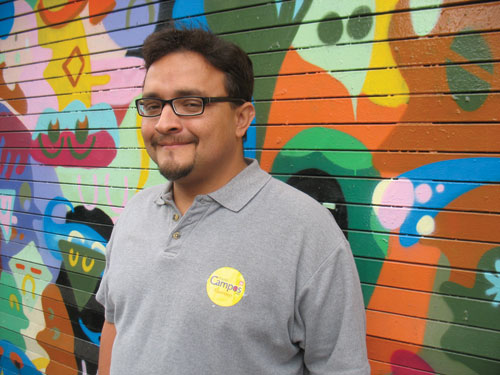
Sup. David Campos has yet to take a position on Lee’s plan, but hopes there is a way to address legitimate concerns about lower-income workers. “There’s no question that we have to do something about pension reform,” he said. “I don’t know if there’s a perfect proposal. But I’m especially intrigued by Mayor Lee’s plan. It recognizes that low-wage workers should not be expected to contribute at a higher rate than higher-wage workers. But we have to put the mayor’s proposal in the context of what else is happening, which is why SEIU’s de-skilling concerns are legitimate.” Campos credited Adachi for highlighting pension reform. “My hope is that we can come up with something that we can all be supportive of, where the mayor and Jeff’s proposals are combined. And while we have to be careful that the balance that has been constructed is maintained, this allows for a dialogue at the board, and for Jeff to be involved, so we can come up with a unified proposal. Because if we are going to address pension reform, we need to do so with a united front.”

Supervisors and activists decry businesses that deny wages to low-income workers

13

For one of this country’s first government hearings regarding wage theft yesterday (Thurs/12), San Francisco activists, public employees, and politicians alike were determined to find ways to address issues surrounding low-income workers who are paid below minimum wage or otherwise deprived of money they’re entitled to.

Wage theft may involve a number of different violations including payment below the minimum wage, obligation to work off the clock, and denial of overtime and sick pay. Low-income jobs such as construction work, hospitality and domestic care are the most cited types of employment for wage theft and wage theft disproportionately affects communities of color and those with language barriers.

“We are not going to allow any worker in San Francisco to be exploited,” said Sup. David Campos said on the steps of City Hall, later presiding over the Government Audit and Oversight Committee hearing on the issue. “Wage theft affects the lowest wage workers and their ability to make a living and survive in these tough economic times.”

The pre-hearing protest and the meeting was comprised of workers with emotional stories of poverty and injustice. Other speakers included Donna Levitt, the director of the Office of Labor Standards Enforcement, the agency in charge of overseeing claims of employers withholding wages, and Rajiv Bhatia, the director of Occupational and Environmental Health at the San Francisco Department of Public Health.

Levitt said that 500 claims of wage theft have been addressed by the OLSE since the minimum wage law’s inception in 2003. Dan Goncher of Harvey M. Rose Associates, which does budget analysis for the city, cited data showing that the OLSE takes significantly longer to go through the hearing process for back wages than other agencies. However, Levitt mentioned that 97 percent of cases are settled and never go to the City Attorney’s Office for a hearing.

“Very little thought from our policymakers was made on how this was going to be enforced,” Levitt said of the current minimum wage law.

The coalition of community organizations including Young Workers United, Filipino Community Center, Chinese Progressive Association, San Francisco Tenants Association, Unite Here Local 2, Mujeres Unidas y Activas, and others joined together for the protest in order to raise awareness of some proposed amendments to the current minimum wage enforcement law.

Co-sponsored by Campos and Sup. Eric Mar, the amendments would add additional penalties such as raising the fine for employers from $500 to $1,000 for retaliating against workers exercising rights under the current law, the ability to interview employees and inspect payroll records at places of business, the requirement of notifying employees when an employer is being investigated, and to posting of a public notice when an employer fails to comply with a settlement agreement.

“We want to see the city taking a stronger commitment to addressing the issue of wage theft,” said lead organizer of the Chinese Progressive Association Shaw San Liu. “We don’t want this to be a one-day publicity stunt.”

One of the workers, who spoke about his experience of wage theft, recalled working long hours without the assurance of payment. “We would wait for hours for them to come back pay us but they never came,” Jose Cruz, a day laborer and client of La Raza Centro Legal, said about one of his jobs.

Bhatia explained to the supervisors and crowded audience in the committee hearing room that in the last week, 26 percent of the nation’s low wage workers were paid less than minimum wage. He also outlined different steps such as tracking chronic violators and training health inspectors to make referrals to local enforcement agencies in cases of non-compliance, so the SFDPH could support the community efforts in decreasing wage theft.

In addition, both Campos and Board President David Chiu made a point of speaking about how wage theft also detrimentally affects businesses.

“Most businesses play by the rules and those businesses are at a disadvantage when we allow businesses to not follow the rules,” said Campos.

“This is not about workers versus businesses,” Chiu said. “The issue of wage theft effects workers and workers’ families across the city.”

City officials pedal and praise on Bike to Work Day

6

photos by Luke Thomas/Fog City Journal

Almost every top city official pedaled up to City Hall this morning for the 17th annual Bike to Work Day, all pledging their support for expanding safe cycling opportunities in San Francisco and declaring the bike to be a vital part of the city’s transportation infrastructure that will only grow in importance in the coming years.

“We should all feel proud that we have more to celebrate than ever in the history of Bike to Work Day,” said Leah Shahum, executive director of the San Francisco Bicycle Coalition, which sponsored the event and facilitated the rides by city officials, including riding Sups. Jane Kim and Carmen Chu to work on tandem bikes. Shahum praised the city for rapidly expanding the network of bike lanes and facilities over the last year.

Shahum accompanied Mayor Ed Lee on a ride along JFK Drive in Golden Gate Park (which Lee announced will soon get the city’s next separated green bikeway), along car-clogged Fell and Oak streets, through the Wiggle, and along Market Street toward City Hall.

Lee told us, “I feel good, exhilarated,” as he neared City Hall, where he and officials gave speeches praising bikes and calling for improvements to the system. “I want to experiment with ways to have detached bike lanes on Fell and Oak,” Lee said to the applause of cyclists familiar with competing with cars on those fast-moving streets.

Lee also declared his support for the goals of SFBC’s Connecting the City initiative, which calls for a system of safe, crosstown bikeways, connecting the bay to the ocean and the northern waterfront to the south side of the city. He also called for continuing the green bike lanes on Market Street all the way to the Ferry Building and said, “I’m dedicated to it.”

Board President David Chiu, who sponsored the legislation that set the goal of achieving 20 percent of all vehicle trips by bicycle by the year 2020, said he was proud to see so many bikes on the streets today. “Thank you for showing the world how we roll,” he told the crowd, also voicing his support for the crosstown bike route plan. “We have to imagine safe enough conditions for 8- and 80-year-olds to bike.”

“It makes us a healthier, happier, and more vibrant city when we bike together,” Sup. Eric Mar told the gathering.

Sup. Sean Elsbernd was the only member of the board not to bike today, but his fellow fiscal conservative Sup. Mark Farrell biked in from District 2 and told the gathering that improving the city’s bicycling infrastructure “is critical to our future.”

Chu doesn’t ride a bike, but she hoped on a tandem bike with SFBC board member Amandeep Jawa and told him, “Thanks for helping me see San Francisco in a new way,” noting her new appreciation for the sights, smells, and small details that opened up along a route to work that she usually drives.

Sup. Ross Mirkarimi called his District 5 the “epicenter” for cycling in the city and declared, “It’s time that we take back Masonic Boulevard…to make sure it’s safe for bicyclists and pedestrians.”

Sup. Jane Kim told the crowd, “I grew up a city girl and I never learned how to ride a bike,” but said that former SFBC director Dave Snyder and others have been trying to teach her recently. In her ride in on the back of a tandem bike, “I got to feel how unsafe it is to have cars and buses jostle around you.”

Sup. Scott Wiener told the gathering, “This was my first Bike to Work Day and it’s not going to be my last.”

Sup. David Campos told us he really enjoyed his ride up Valencia Street, where the stoplights are timed to the pace of bicyclists. “It’s the best ride in the city. If we can make more streets like Valencia we’d be in better shape,” Campos told us.

In his speech, Campos said, “We have so much happening around bicycling, bu we also have a long way to go.”

Sup. Malia Cohen said she biked the longest way in to City Hall, all the way from 3rd Street and Thomas, and that she was happy about both the bike infrastructure improvements and carfree events like Sunday Streets. “I want to encourage you all to come out to the Bayview for Sunday Streets [on June 12],” she said.

For all the celebration and improvements to the system, Sup. John Avalos said it’s important to continue establishing respect on the roads for bicyclists. “We have to change many minds about biking in San Francisco,” he said.

To illustrate the increasingly important role that bicycling is playing in San Francisco, SFMTA Commissioner Cheryl Brinkman cited city studies showing a 58 percent increasing in the number of cyclists on the streets of San Francisco over the last four years, noting a comparable increase in Muni ridership or in motorists on the roads would have resulted in gridlock in those systems.

“It’s a good lesson for us,” Brinkman said, voicing support for the goal to creating 100 miles of dedicated bikeways throughout the city in order to promote safe cycling.

Campos urges Lee to implement entire due process law

12

Text by Sarah Phelan. Photographs by Luke Thomas


After the Guardian broke the news that Mayor Ed Lee was planning to only partially implement Sup. David Campos’ due process legislation, we headed to City Hall to witness Lee announce his partial shift during question time. And afterwards, Lee told reporters that he spent the months since he was appointed reviewing the policy and talking with leaders in the city’s juvenile justice departments.


“I looked at the difference between youth with family here and youth who did not,” Lee said, noting that his decision to let youth that have family here to have their day in court is in keeping with his policy of focusing on family reunification and getting families more involved.


Lee stressed that youth with family here will still need to be enrolled in school and not be repeat offenders in order to have their day in court.


“It will be decided upon on a case by case basis,” he said.


Lee said he has had conversations with the federal government and US Immigration and Customs Enforcement (ICE) about the policy shift. “We have discussed this,” Lee said. “And we did get a very strong feeling that the federal government is a bit confused.”


Asked how far he is willing to go to defend this latest policy shift, Lee said, “I’ll take that up as it comes. President Obama is struggling with immigration right now.”


Reminded that his predecessor Mayor Gavin Newsom refused to implement any aspect of Campos’ due process legislation, even though a super-majority of the Board passed the ordinance in 2009, Lee said, “I don’t compare myself with the former mayor.”


Asked what percentage of immigrant youth that end up getting booked are “unaccompanied,” Lee said he did not have those statistics. “Check with Siffermann,” he said, referring to the head of the city’s Juvenile Probation Department.”


Lee’s announcement was met with mixed reviews among immigrant advocates.


Civil rights groups applauded Lee’s decision to immediately begin implementation of Campos’ legislation, which was passed in November 2009, restores due process for immigrant youth in the city’s juvenile justice system and ensures that innocent youth are not torn from their families for deportation.  But they also expressed disappointment that Lee will only be implementing the policy for youth who have immediate family here, and not for unaccompanied youth.  And they all urge him to fully implement what they described as Campos’ “duly-enacting, common-sense law so that all innocent youth receive protections.”


They noted that implementation of Campos’ broadly-supported law, which has been endorsed by over 70 organizations, had been stalled until today due to former Mayor Newsom’s refusal to enact the law. 


Under Newsom’s direction, Juvenile Probation reported over 160 youth to ICE at the point of arrest, prior to the youth receiving due process, based only on a juvenile probation officer’s “reasonable suspicion” that a youth is undocumented. 


Civil rights advocates note that Newsom’s problematic policy was responsible for tearing innocent youth from their families and spreading fear among immigrant residents around coming forward to cooperate with police, either as witnesses or victims of crime.  


And they observe that the policy that Juvenile Probation Department has been enforcing since the summer of 2008, and which involved reporting youth for life-altering deportation at arrest, went well above and beyond any obligations under federal law. 


They noted that, as a cadre of legal scholars, including University of San Francisco Law Professor Bill Ong Hing, have repeatedly made clear, there is no requirement imposed on city officials under federal law to ask about immigration status or to report individuals suspected of being undocumented.”


Ana Perez, executive director of Central American Resource Center, agreed.“While we appreciate Mayor Lee taking action to finally begin implementation, we are concerned that he is only implementing the policy for accompanied youth and not for youth who may be unaccompanied because they are trafficked to this country, are orphans, or are escaping persecution.”


“I’m certain it’s not for all youth,” Pérez continued. “So, it’s a small win. But what about the kids who are victims of human trafficking? The fact is we spent so much time developing a policy that was approved by a majority of the Board. So, this is bitter sweet.”


Asked what became of the criminal grand jury investigation that then US Attorney Joe Russoniello initiated in 2008, when Mayor Gavin Newsom was running for governor, and news first broke that the city was accompanying youth who weren’t here with family back to their home country, Pérez suppressed a snort. “It seems that was a bunch of empty threats to try and get the city to move to a more conservative position,” she said. “It’s been a whole new day with Obama.”


Angela Chan, staff attorney at the Asian Law Caucus said that Juvenile Probation’s prior policy of reporting innocent youth exacerbated the impact of a broken federal immigration system on local immigrant families. “We appreciate that Mayor Lee has taken this long awaited step forward because he values family unity and due process for youth,” Chan said. “However, we ask that the Mayor not exclude unaccompanied youth from receiving due process protections.”


Patricia Lee, managing attorney in the Juvenile Unit at the Public Defender’s Office also supported the demand for complete implementation of Campos’ legislation. “If you want the immigrant community to feel safe enough to cooperate with police and probation, then those agencies should not be viewed as representatives of immigration,” she said. “My clients and their families are scared of probation, they are scared of police. Selective implementation of the due process policy for only accompanied youth and not to unaccompanied youth does not solve this problem.” 


And Charles Washington, the Muni bus driver and longtime San Francisco resident, whose wife and 14 year old son were almost separated from him as a result of the prior Juvenile Probation policy, expressed concern that the policy would only be implemented for some youth. “I’m glad to see Mayor Lee is doing the right thing by implementing the due process policy,” he said. “However, he should not leave any youth, especially those who are most vulnerable, behind.”


Sup. Campos applauded the Mayor for implementing the policy while expressing disappointment that it is only partial implementation. As Campos’ stated during the Board meeting, but after Lee had already left, “This body enacted that law and that law needs to be respected.  It is not up to the executive branch to second guess the legislative branch.” 


Sup. Eric Mar added that he supports full implementation for all youth.


 And Sup. Jane Kim, who asked the Mayor during the Board’s Question Time about his plans for implementation, stated, “My hope is that he will commit to full implementation of this policy.”


But in the end, the burden fell on Campos to explain why partial due process is unjust. “This is a good first step, but it doesn’t go far enough,” Campos explained. “As I understand it, the decision Mayor Lee has taken is, that if you are a minor, and are accused of a felony, you will be given due process if you have family here. But if you are charged with a felony, but don’t have family here, then you will not be given due process. Let me begin by thanking Mayor Lee for at least taking one step in the right direction. That said, we still will not have full compliance with a law that was duly enacted by this body. Full compliance means giving every child that interacts with the juvenile justice system due process. So, {Mayor Lee’s first step] is simply not sufficient.”


Campos noted that when mayors are sworn in, they agree to uphold laws that the Board enacts. “So, the law needs to be respected,” Campos said. “It’s not up to the executive branch to second guess the legislative body. That second guessing can only be done by the courts. Therefore, we, once again, ask the mayor of San Francisco to comply with full implementation.”


Noting that a bedrock of the U.S.’ justice system is the principle that we are innocent until proven guilty, Campos said that if the mayor does not fully implement the law, as approved by the Board, “There’s a very real possibility that children that we are reporting [to ICE for possible deportation] are not guilty of what they have been accused of. So, once again, I ask the mayor to reconsider his opinion.”


Campos also noted that there are already procedures in place, within the existing juvenile justice system, to ensure that “we do not have individuals released who should not be.”


After the meeting, Campos noted that the format for the Board’s question time with the mayor currently leaves something to be desired: an opportunity for the Board to reply.


“It would be better if it would allow for some exchange, though obviously, we don’t want it to be a ‘gotcha’ game. But at this moment, it’s too rigid.”


 Asked who drafted the current Question Time format, Campos replied, “Board President David Chiu.”

Mayor Lee to partially implement Campos’ due process ordinance

1

Today at question time, Sup. Jane Kim will ask Mayor Ed Lee what his plan is to implement a due process ordinance that Sup. David Campos authored and a super majority of the Board approved in 2009, prohibiting the Juvenile Probation Department from reporting undocumented youths at the time of arrest. And according to an anonymous source, Lee will say he has decided to implement the policy, if the youth in question are “accompanied,” which means they have family here.

Immigrant advocates say Mayor Lee should be commended for his leadership in implementing the due process policy to keep immigrant families together. But they believe that Lee needs to go the whole way. “Immigrant and civil rights groups are adamant that the policy must be implemented for all youth, accompanied and unaccompanied, and this has to be immediately,” our source said. “The due process policy does not discriminate between these two groups and the policy cannot be selectively enforced.”
 
As Kim planned to point out during the Board’s question time, voters approved San Francisco’s Sanctuary City Ordinance in 1989. That ordinance prohibits our Police Department and local government officials from assisting in the prosecution of immigration enforcement unless it is required under federal or state law.

In 2009, the Board, under Campos’ leadership, passed-by a supermajority-a clarification to that ordinance to prohibit local law enforcement from reporting undocumented youths unless they are convicted of a felony. To date, this ordinance has not been followed by the City.

But in a May 9 memo to the city’s Probation Department personnel, Juvenile Probation Department Chief Probation Officer William Siffermann and Assistant Chief Probation Officer Allen Nance wrote that since revising JPD’s policy 8.12 nearly three years ago [per Mayor Gavin Newsom’s instructions], they have closely monitored JPD’s implementation of its protocols.

And after considering all perspectives and after careful review, they have decided to “modify our existing policy in a manner that aligns our Departmental policies more closely with the values inherent within San Francisco’s Sanctuary City ordinance, without compromising our balanced commitment to public safety and the best interests of the minor.”

“Effective immediately, San Francisco Juvenile Probation Department notices to the federal authorities of minor/persons booked on felonies who are suspected of being undocumented AND are accompanied (lives with a verifiable parent, guardian or blood relative in the immediate Bay Area and is enrolled in school) will be made only upon a felony adjudication, upon apprehension on an outstanding warrant, or upon issuance of a new warrant following release from custody pending adjudication,” the JPD memo reads. “Minor/persons booked on felonies who are suspected as being undocumented, AND are verified adults or unaccompanied by any verifiable parent, guardian or blood relative residing in the Bay Area, whether or not enrolled in school, will continue to be reported to the federal authorities upon determination of this status.”

“Policy 8.12 will continue to ensure that all suspected undocumented minors booked and convicted of committing a felony will continue to be reported to the federal authorities,” the JPD memo continues. ‘While the Department will neither assist nor interfere with the federal authorities’ overwhelming duties and responsibilities related to the enforcement of immigration laws, we will continue to honor their lawful detainers regarding suspected illegal immigrants.”

“We are confident that your uniform compliance with this policy adjustment will continue to reflect the Department’s interest and your professional commitment to preserving families while we discharge all of our many duties that protect public safety,” the JPD memo concludes.

Illinois pulls out of Secure Communities

16

As California considers reforming Secure Communities, Illinois announced today that it is terminating its involvement in the controversial federal immigration program. California and Illinois moves come in face of Washington D.C’s decision to opt out of S-Comm and Washington State’s refusal to participate. And they test ICE’s claims that the program is mandatory, as other states watch these developments.

(UPDATE: Yesterday, I erroneously reported that New York State had refused to participate in S-Comm.That is not the case. New York State does allow jurisdictions to participate, they have a MOA with ICE, and 8 more counties just joined. I confused NY with Washington State, which has refused to join.)

In a May 4 letter to Immigration and Customs Enforcement (ICE), Illinois Gov. Pat Quinn enclosed a notice from Illinois State Police (ISP) director Hiram Grau, notifying ICE that because of its indiscriminate use of the “Secure Communities” deportation program, Illinois is terminating the November 2009 S-Comm Memorandum of Agreement (MOA) between ISP and U.S. Department of Homeland Security’s ICE.”

“The stated purpose of the program, as set forth in the MOA, is to “identify, detain and remove from the United States aliens who have been convicted of ¬serious criminal offenses and are subject to removal (emphasis added), ICE’s statistics on the Secure Communities program, compiled through February 28, 2011, reveal that the implementation of the Secure Communities program in Illinois is contrary to the stated purpose of the MOA: more than 30 percent of those deported from the United States, under the program, have never been convicted of ¬any crime, much less a serious one. In fact, by ICE’s own measure, less than 20 percent of those who have been deported from Illinois under the program have ever been convicted of a serious crime.”

Quinn notes that on November 9, 2010, his office directed ISP to suspend S-Comm until a review of the program and its adherence to the MOA could be conducted. “Upon evaluation of data provided by ICE to the State of Illinois, conversations between ICE and members of my administration, and a new, proposed MOA from ICE, it’s clear that the conflict between the MOA as signed by ISP and ICE’s implementation of the program cannot be resolved to the State of Illinois’ satisfaction.”

“With this termination, no new counties in Illinois can be activated and those counties that were previously activated… must be deactivated and removed from the Secure Communities program,” Quinn concludes.

Illinois’ move comes as California Assemblymember Tom Ammiano’s Transparency and Responsibility Using State Tools (TRUST) Act passes out of the California Assembly’s Public Safety Committee, next stop appropriations. The TRUST Act would allow local governments to opt out of S-Comm or set standards for jurisdictions that chose to participate. Joining Ammiano as co-sponsors of the TRUST Act are Assemblymembers Gil Cedillo (D-LA) and Bill Monning (D- Carmel) and Sen. Leland Yee (D-SF). Endorsers include 80 organizations, local governments and elected officials, including the Santa Clara and Santa Cruz County Boards, San Francisco Sheriff Michael Hennessey, who blew the whistle on S-Comm in San Francisco a year ago, and has endorsed San Francisco Sup. Ross Mirkarimi in the sheriff’s race this fall, retired Sacramento Police Chief Arturo Venegas, and civil rights and faith groups, including the California Partnership to End Domestic Violence, the California Labor Federation, the San Bernardino Catholic Diocese and Equality California.

Advocates hope Ammiano’s TRUST Act will restore balance and accountability to the nation’s immigration system. They charge that S-Comm’s misleading focus, over-broad reach and lack of transparency have eroded trust between police and immigrant communities, making victims and witnesses to crimes reluctant to come forward.

The TRUST Act would make S-Comm an “opt-in” program so local governments can tailor their participation based on local needs.The bill would set safeguards for municipalities that do elect to participate in S-Comm to guard against racial profiling and would ensure that children and domestic violence survivors are not swept up by S-Comm. The TRUST act also upholds the right to a day in court by only reporting for deportation individuals convicted – not merely accused – of crimes.

These moves come fresh in the heels of Congressman Luis Gutierrez’s April 27 appearance in San Francisco, where he was joined by San Francisco Sups David Campos and John Avalos, and Board President David Chiu in asking President Obama for administrative relief from rapidly increasing deportations.
“We need to stop deporting parents and ripping apart all families, including same-sex partners, “ wrote Chiu, Campos and mayoral candidate Avalos. “We need to stop deporting students who would have been eligible for the DREAM ACT. Last year, the U.S. deported an estimated 400,000 immigrants, the highest number of deportations per year in the history of our nation. We must allow our counties to opt out of  “S-Comm” (Secure Communities), which is making our communities less secure, and we support Congressman Gutierrez in these courageous requests. Immigrants are part of the fabric of our communities, and we need to fix our immigration system so everyone who lives here can continue to live as a full member of society without constant fear of safety, security, and livelihood being jeopardized at any moment.”


Ross for boss (of the sheriff’s department)

3

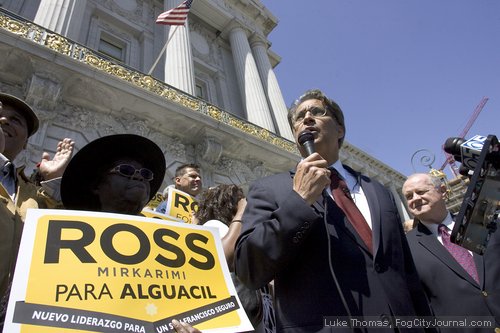
City Hall’s steps were awash in multi-lingual black and yellow “Ross Mirkarimi for Sherrif” signs at noon today, as Mirkarimi supporters watched Sheriff Mike Hennessey, who is stepping down after 31 years of service and eight elections, endorse Sup. Mirkarimi as the next sheriff.  “New Leadership for a Safe San Francisco” was printed on the English version of the signs that Mirkarimi’s supporters carried. They included former Mayor Art Agnos, Sups. David Campos and Eric Mar, Tim Paulson of the Labor Council, Debra Walker, Linda Richardson, Sharen Hewitt, Terry Anders, and Mirkarimi’s partner Eliana Lopez and their almost two-year old son Theo. And everyone had plenty of great things to say about outgoing sheriff Hennessey and sheriff candidate Mirkarimi. And Hennessey even pinned a shiny toy sheriff’s badge onto the T-shirt of Mirkarimi’s son Theo, making him the happiest kid in town. At least for the day.

Campos kicked off the event by honoring Hennessey as the “most progressive and most effective sheriff in the country.”
“Mike Hennessey is also my neighbor in District 9. I see him taking out the trash so I know he’s a good neighbor,” Campos joked, as he listed the many achievements in Hennessey’s long career as an elected official in San Francisco. These achievements included Hennessey’s pioneering innovations in criminal justice and culminated in his decision to blow the whistle in 2010 on the federal government’s plan to activate its controversial Secure Communities program in San Francisco—without telling the public.
“He’s not afraid to stand up for what’s right,” Campos said.

‘This is the time for me to move on,” Hennessey announced, as he laid out his reasons for endorsing Mirkarimi as Sheriff, over other candidates in the field.
Hennessey described the Sheriff’s Department as a “large enterprise” that has over 1,000 employees, a $150 million budget and whose jail houses an average population of 2,000 folks in custody, on a daily basis.
“It’s not something that can be handled lightly,” Hennessey said. “That’s why I’m here to endorse Ross Mirkarimi as the next sheriff.”

Hennessey listed the many endeavors that he and Mirkarimi have worked closely on, including a number of criminal justice issues, and he cited Mirkarimi’s extensive law enforcement background, his significant legislative accomplishments in the areas of criminal justice and public safety, and his ability to find innovative solutions and overcome obstacles to progress, as reasons to support Mirkarimi.

Hennessey observed that criminal justice is “one of the thornier issues” that members of the Board of Supervisors are often asked to get involved in, but often duck.”But Ross has not shied away from working on them,” Hennessey said, citing Mirkarimi’s involvement in shaping the “No Violence Alliance Project” and his leadership in creating the Safe Communities Re-entry Council.

Hennessey also noted that in face of AB 109, the Governor’s plan to transfer state inmates to county jails, “it’s vitally important to have person in charge of sheriff’s office that understands these alliances and can make them work more effectively.”

Hennessey concluded by observing that the Sherrif’s Department has to deal with a lot of bureaucracy, so it’s important to understand how the Board, the budget process and other city departments, including the District Attorney’s office and the police, work.
‘And that’s why I’m endorsing Ross as Sheriff,” Hennessey said

Then it was the turn of Mirkarimi, who graduated from the San Francisco Police Academy, did Naval Reserve training and worked for more than 8 years as an investigator for the District Attorney’s office, to speak.

“I have never been at a loss for words,” Mirkarimi acknowledged, as he launched into a speech that began by thanking everyone for showing up at short notice “for one of the most important occasions of my political career.”

Mirkarimi did a great job of giving Hennessey the praise he deserves.
“He is a living legend,” Mirkarimi said. “It’s completely impossible to fill his shoes.”
Citing Hennessey’s integrity and his ability to innovate, Mirkarimi warned that, “Maybe it’s come to the point where we have taken him for granted. He’s the longest serving elected official in the history of San Francisco, and he’s probably the most understated.”

“And the most important endorsement in this race is that of Mike Hennessey,” Mirkarimi added, as he gave Hennessey his commitment “to build upon your legacy as effectively as possible.”

Mirkarimi cited some of the most immediate and serious challenges that face the next sheriff. These include AB 109, which Gov. Jerry Brown just signed, which. Mirkarimi said, threatens to increase the reentry prisoner level by 30 percent in California. “It will take creative ingenuity and resources to make sure we are effective in taking care of this population,” he said.

Mirkarimi also touched on the rising number of veterans that are ending up in the prison system, talked more about the No Violence Alliance Project, and suggested that certified deputy sheriffs could help serve warrants, transfer prisoners, and patrol Muni, “when the police department finds itself understaffed” so as to ensure that San Francisco is safe.

“For every four people arrested and jailed in San Francisco, three out of four are repeat offenders in a three-year period,” Mirkarimi warned, by way of explaining why he wants to advance a more collaborative spirit between SPPD and the Sheriff’s department.

Mirkarimi also noted that one out of every 15 African American males are in jail, at any time in the year, compared to I out of 300 males who are not black or brown. “So, we must step up our game in dealing with poverty,” he said, as he recommended increased access to job training and good jobs, “so work doesn’t become a seasonal hope but a permanent job.” He also made the connections between a lack of good housing, childcare, and schools and a rise in poverty, crime and recidivism.

Mirkarimi concluded by crediting Hennessey for “walking that fine pirouette” between upholding the principles of public safety and understanding the power of redemption at the same time.

I asked Sheriff Mike Hennessey what he considers to be the biggest challenges of running for sheriff/
“Letting people know what you are going to do, and what your issues are,” Hennessey said, noting that San Francisco has an intelligent, issues-driven electorate.

And Mirkarimi’s supporters weren’t shy about letting folks know the issues that the current D5 Supervisor has helped them with, over the years.

“Ross, as a supervisor and me, as someone who comes from a community of color, we know the habits that ex-offenders can bring with them, if there are no safety nets,” said Terry Anders who sits with Mirkarimi on the Safe Communities Reentry Council. “And I believe in what Ross stands for and the integrity of his person. He’s one of the first people to show up when there are crimes and victims, and he attends basketball games and boxing matches.”

Paulette Brown, whose son Aubrey Abraska Jr, was murdered in August 2006, but whose killers have still not been brought to justice.
“We shouldn’t have to run and leave our families, we should be protected,” Brown said. “Ross is my district supervisor and if he can get in, and do something about crime and solve unsolved homicides, then I’m for him. Maybe if he gets in, he’ll have more pull to do something about these unresolved cases.”

And then it was back to work, which for Mirkarimi now includes the somewhat daunting task of trying to raise money in an election year that also includes a mayor’s race, but does not include the help of public financing, at least not for the sherrif’s race….

The case against consolidation

0

sarah@sfbg.com

With officials predicting that San Francisco will spend $500 million annually on health care costs for city employees and retirees, the Board of Supervisors Government Audit and Oversight Committee held an April 28 hearing to analyze why hospitals costs are higher in Northern California than Southern California, and why costs have escalated in the last decade.

A panel of experts outlined a list of cost drivers and identified hospital consolidation as the major culprit — a finding that fueled concerns that costs will skyrocket once Sutter Health, which operates the California Pacific Medical Center that took over St Luke’s in 2005, builds a 555-bed hospital on Cathedral Hill. The board will consider approving the project as soon as this summer.

Ellen Shaffer, codirector of the Center for Policy Analysis, said that the city’s recently approved Health Care Services Master Plan (“Critical Care,” 11/23/10) provides San Francisco with leverage to collect and analyze data and make informed health choices.

Shaffer noted that since 1960, when there were 26 hospitals in San Francisco, facilities consolidated so frequently that by 1990, only 12 hospitals remained. And by 1998, the three largest hospital networks controlled 43 percent of hospital beds — compared to 18 percent just four years earlier.

“Today in San Francisco, the most expensive of the northern counties hospitals get $7,349 per patient per day on average,” she said. “In Los Angeles County, the figure is $4,389.”

David Hopkins, a senior advisor at the Pacific Business Group on Health, said that Sutter Health, which reported a 30 percent increase in net income in 2010, already controls 44 percent of hospital beds in San Francisco. Catholic Healthcare West controls 28 percent, and UCSF controls 26 percent. “Insurance companies say Sutter’s size and dominant position give it an upper hand in contract negotiations,” Hopkins observed.

Healthcare planning and policy consultant Lucy Johns said technology is another key cost driver. “It’s a medical arms race,” Johns said. “Every hospital wants the latest everything.”

Jane Sandoval, a registered nurse at St Luke’s, said that what residents and workers need is access to affordable healthcare, not luxury care at overpriced rates.

“We’d rather have enough staff and the ability to care for all patients than work in a facility that’s likened to a five-star hotel,” Sandoval said. She noted that State Insurance Commissioner Dave Jones filed suit April 13 to intervene on behalf of the plaintiff in a whistleblower suit against Sutter Health, which has been accused of fraudulently charging insurers millions of dollars for anesthesia services that either weren’t provided or were billed higher than typical rates.

Anne McLeod, senior vice president of health policy for the California Hospital Association, an industry trade group, claimed that Northern California’s higher hospital prices are primarily due to higher labor and living costs in the Bay Area. “Wages are a huge component of hospital costs, and they represent the fastest growing component of costs,” she said.

But Glenn Melnick, a professor of health care finance at the University of Southern California, said that even if a hospital was airlifted from Los Angeles to San Francisco, its costs would still be 38 percent higher after adjusting for local differences. “When hospitals consolidate into large systems that dominate a specific region, that hospital system has the power to demand contracts from health plans that include high reimbursement rates for their services and limit the ability of health plans to offer low-cost products and share the data consumers need to compare costs across providers,” Melnick said

Sup. David Campos, who called for the hospital costs hearing, observed that the cost of creating jobs includes health care benefits. “So to the extent that things like hospital consolidation are increasing costs, the hospitals themselves are implicated,” he said.

But CPMC media relations manager Kevin McCormack noted that CPMC/Sutter has invested more than $7 billion since 2000 on technology, facility construction, and improvements to address medical needs and state seismic safety requirements.

“Sutter Health appreciates its role in ensuring that health care is affordable. And we realize that holding the line on prices without compromising quality will require additional cost reductions,” McCormack said. “To this end, doctors and nurses and support staff throughout our Sutter Health network are working aggressively to substantially reduce expenses.”

He denied that Sutter had engaged in inappropriate anesthesia billing practices. “The lawsuit paints a false and inaccurate picture,” McCormack said.

He also said that plenty of competition remains in Northern California. “The decision by the California Public Employees Retirement System in 2004 to shift a significant number of members away from Sutter-affiliated hospitals to other providers demonstrates there’s plenty of healthy competition,” McCormack said.

But Campos said the hearing clarified that, while there are different factors why costs are going up, one of the most important is hospital consolidation. “We need to ensure that we understand that, even in face of higher labor and cost of living costs, hospital costs in Northern California are still 30 percent higher than Southern California,” Campos said.

Noting that CalPERS excluded Sutter from its network, Campos added: “We need to follow suit in terms of saying that we’re only going to do business with hospitals that are responsive to our concerns and follow best practices.”


Spies in blue

19

sarah@sfbg.com

San Francisco cops assigned to the FBI’s terrorism task force can ignore local police orders and California privacy laws to spy on people without any evidence of a crime.

That’s what a recently released memo appears to say — and it has sent shockwaves through the civil liberties community.

It also has members of the S.F. Police Commission asking why a carefully crafted set of rules on intelligence gathering, approved in the wake of police spy scandals in the 1990s, were bypassed without the knowledge or consent of the commission.

“It’s a bombshell,” said John Crew, a long-time police practices expert with the American Civil Liberties Union of Northern California.

The ACLU obtained the document April 4 under the California Public Records Act after a long battle. It’s a 2007 memorandum of understanding outlining the terms of an agreement between the city and the FBI for San Francisco’s participation in the Joint Terrorism Task Force.

And, according to Crew, it effectively puts local officers under the control of the FBI. “That means Police Commission policies do not apply,” Crew said. “It allows San Francisco police to circumvent local intelligence-gathering policies and follow more permissive federal rules.”

Veena Dubal, a staff attorney at the Asian Law Caucus, agreed: “This MOU confirms our worst fears,” she said.

Dubal noted that in the waning months of the Bush administration, the FBI changed its policies to allow federal authorities to collect intelligence on a person even if the subject is not suspected of a crime. The FBI is now allowed to spy on Americans who have done nothing wrong — and who may be engaged in activities protected by the First Amendment.

FBI activity under this new “assessment” category has since come under fire, and a recent report in The New York Times showed that the FBI has conducted thousands of assessments each month, and that these guidelines continue under Obama.

And if the feds do control San Francisco police policy, then the San Francisco cops could be spying on innocent people — a dramatic change from longstanding city policy. “The MOU is disturbing,” Police Commission member Petra DeJesus told the Guardian. “The department is assuring us that local policies are not being violated — but it looks as if it’s subject to interpretation.”

It’s the latest sign of a dangerous trend: San Francisco cops are working closely with the feds, often in ways that run counter to city policy.

And it raises a far-reaching question: With a district attorney who used to be police chief, a civilian commission that isn’t getting a straight story from the cops, and a climate of secrecy over San Francisco’s intimate relations with outside agencies, who is watching the cops?


SPIES LIKE US

San Francisco has a long — and ugly — history of police surveillance on political groups. SFPD officers spied on law-abiding organizations during the 1984 Democratic National Convention; kept files in the 1980s on 100 Bay Area civil, labor, and special interest groups; and carried out undercover surveillance of political groups focused on El Salvador and Central America.

Those abuses led the Police Commission to develop a departmental general order in 1990 known as DGO 8.10. The local intelligence guidelines require “articulable and reasonable suspicion” before SFPD officers are allowed to collect information on anyone.

Even those rules weren’t enough to halt the spies in blue. In 1993, police inspector Tom Gerard was caught spying on political groups — particularly Arab American and anti-apartheid organizations and groups Gerard described as “pinko” — and selling that information to agents for the Anti-Defamation League.

As the ACLU and Asian Law Caucus noted in a December 2010 letter to Cdr. Daniel Mahoney: “That scandal was not just about the fact that peaceful organizations and individuals were being unlawfully spied upon and their private information sold to foreign governments, but that the guidelines adopted in 1990 had never been fully implemented by SFPD. No officers had been trained on the new guidelines and no meaningful audit had ever been implemented.”

Over the years, the commission has tried to keep tabs on police intelligence and prevent more spy scandals. The general order mandates that local police officials have to request general authority from a commanding officer and the chief to investigate any activity that comes under First Amendment protections — and must specify in the request what the facts are that give rise to this suspicion of criminal activity. The order also states that the chief can’t approve any request that doesn’t include evidence of possible criminal activity.

Those requests are reviewed monthly by the Police Commission and there are annual audits of the SFPD files to monitor compliance — so the notion that the local cops are joining the FBI spy squad without commission oversight is more than a little disturbing.

Officials with the FBI and SFPD are doing their best to reassure the local community that there’s nothing to worry about. But so far their replies seem to duck questions about whether FBI guidelines trump local policies. For example, the MOU states that “when there is a conflict, [task force members] are held to the standard that provides the greatest organizational benefit.”

We asked Mahoney to clarify: does that mean the local cops could be held to the FBI’s standards?

“The San Francisco Police Officer(s) who are assigned to the Joint Terrorism Task Force always have and continue to be required to follow all SFPD’s policies and procedures,” Mahoney replied in a statement.

That’s confusing; do they follow SFPD policies, or obey the MOU?

We asked FBI special agent-in-charge Stephanie Douglas whether SFPD officers are involved in surveillance and “assessments” (that FBI code word for creating spy files on individuals and groups) and whether they are identifying as SFPD or FBI officers.

“The FBI only initiates investigations on allegations of criminal wrongdoing or threats to our national security,” Douglas replied April 21. “Our investigations are conducted in compliance with the Constitution, the laws of the United States, the Attorney General Guidelines, the Domestic Investigation and Operations Guide, and all other FBI policies.”

Okay, that’s typical FBI-speak. Here’s more: “The JTTF is a task force comprised of FBI special agents, agents from other federal agencies, and local police officers who have been officially deputized as federal task force officers (TFOs) who have the power and authority of a federal agent. Because all JTTF TFOs are actually de facto federal agents, they are required to operate under federal laws and policies when involved in a JTTF case.”

So the cops are actually feds. But wait: “Our standard JTTF MOU recognizes, however, that the JTTF TFOs do wear two hats, as it were, and directs JTTF TFOs to follow his or her own agency’s policy when it is stricter than the FBI policy under certain circumstances,” Douglas concluded.

Again: not exactly clear, and not exactly reassuring.

“At some point they need to say whether SFPD officers are engaged in assessments,” Crew said.

These questions have spurred the Police Commission and Human Rights Commission to schedule a joint hearing in May to discuss what the document means, why SFPD never alerted the civilian oversight authorities, and whether a clarifying addendum can be tacked onto the agreement.


SPY FOR US OR LEAVE

The concerns are likely to be intensified by recent developments in Portland, Ore.

Portland dropped out of the Joint Terrorism Task Force in 2005 over concerns that local cops would be violating privacy laws. But in November 2010, the FBI thwarted a bomb plot allegedly linked to terrorists, and city officials came under pressure to rejoin the JTTF.

But Mayor Sam Adams has insisted on language that would bar local cops from doing surveillance and assessments, which, apparently, won’t fly with the feds.

On April 20, Willamette Week, the Portland alternative paper, wrote that Adams “effectively scuttled” Portland’s reentry into its local JTTF because of his anti-spying language.

In an April 19 letter to Adams, U.S. Attorney for Oregon Dwight Holton stated that Adams’ proposal of only allowing officers with the Portland Police Bureau to be involved in investigations and not in FBI assessments was a deal-breaker.

“Unfortunately, as currently drafted, the proposed resolution does not provide a way in which the PPB can rejoin the team,” Holton wrote. “There is a single provision that stands as a roadblock to participation — specifically the provision that seeks to have the City Council delineate only certain investigative steps a task force officer can take part in. Specifically, the resolution seeks to dictate for the JTTF which stages of an investigation task force officers from the [Portland police] can work on.”

“Investigation and prevention of complex crimes and terrorism are typically fluid and fast-moving,” he added. “It makes no sense to ask [Portland police] officers to be in for one part of a conversation, but out for another part of the same conversation as investigators discuss findings from assessments, investigations, etc. in evaluating and addressing terrorist threats in Portland and beyond.”

The message isn’t lost on San Francisco civil liberties activists. If you don’t let your cops join the spy squad, they can’t be a part of the task force.

“It was one thing to join the JTTF 10 years ago when they were operating under guidelines that, while not to the ALCU’s taste, were at least tied to some level of suspicion,” Adams said. “But they have taken their procedures and guidelines and moved them to the far right. It’s one thing to say that it’s necessary for the FBI to do that, and quite another to say that local agencies have to forfeit their own policies — and with no public debate or decision-making.”


ASK THE FEDS FIRST

Further complicating the question of police oversight is the fact that George Gascón, who was police chief when civil liberties groups started asking for a copy of the MOU last fall, refused to turn over the document without asking the feds first.

In a Jan. 4 letter to the ACLU and ALC, Gascón and Mahoney stated that the SFPD could not speak to information about the duties, functions, and numbers of officers assigned to the Joint Terrorism Task Force “without conferring with our partners in the Federal Bureau of Investigation.”

“I am sure you can appreciate the delicate balance we hold in crafting policy that not only supports our mission in the ultimate protection of life, but also in advancing democratic values through collaboration with the communities we serve,” Gascón and Mahoney wrote.

And Gascón is now district attorney.

“It raises the question of accountability,” said Public Defender Jeff Adachi “We want to make sure that police officers working in the city, regardless of whether it be for the feds or the SFPD, are complying with general orders and policies established by the department. But when officers go on an assignment with the feds, we don’t know if they are operating under parameters set by local law.”

Unearthing the FBI’s hitherto clandestine MOU with the SFPD appears to be yet another sign that local police are increasingly being subjected to federal policies not in keeping with local procedures.

As the Guardian previously reported, the 2008 decimation of San Francisco’s sanctuary city legislation and the 2010 activation of the federal government’s controversial Secure Communities program, which both happened during former Mayor Gavin Newsom’s tenure, means that the city of St. Francis now ranks among the top 38 counties nationwide that are deporting “noncriminal aliens.”

Dubal also noted that the FBI came to the SFPD in 1996 asking for help with the task force, but also sought a waiver from the Police Commission so officers could participate without having to follow local rules. “And within two weeks, then Mayor Willie Brown said, not in our town,” Dubal said. “So in 1997, the SFPD said we are not going to join unless we can follow our own rules. And in 2001, when the SFPD joined, it was under an MOU that required them to comply with SFPD rules and was signed in 2002 by then-SFPD Chief [Earl] Saunders.”

Dubal said that after local law enforcement agencies sign an MOU with the FBI, they designate and assign officers to work from FBI headquarters. “In the past, two SFPD officers, paid with San Francisco tax dollars, physically worked in the FBI’s office in a secure room where you can only go if you have security clearance. But they still can’t spy without reasonable suspicion, and they also need audits.”

Crew and Dubal said that in a recent meeting, SFPD officials assured them that local police were following General Order 8.10, but that they are open to creating an MOU addendum to clarify this.

Crew and Dubal remain unsure if the FBI would be agreeable to signing off on that. They note that the FBI has previously stated that its JTTF has sensitive investigations going on so it can’t give the public all the information. “Fine, but the issue is, Are these investigations based on suspicion, or are they based on religious background, associations, ethnicity, and travel patterns?” Dubal said.

They also doubt that the MOU would even have surfaced if not for comments that then SFPD Chief Gascón made, first in October 2009, then in March 2010, that triggered an uproar in the local Muslim, Arab, and Pakistani and Afghani communities.

At the time, Gascón, who has a law degree and graduated from the FBI Academy, had just landed in San Francisco fresh from a stint as police chief for Meza, Ariz., where he drew praise for speaking out against Maricopa County Sheriff Joe Arpaio’s inhumane treatment of undocumented immigrants Given this seemingly progressive stance, Gascón shocked civil libertarians in San Francisco when he said he wanted to unearth SFPD’s intelligence unit, which was disbanded amid scandal in the early 1990s.

“We have to realize that in the post-9/11 world, San Francisco is an iconic city, like New York, Washington. and Los Angeles,” Gascón said. “If somebody wanted to make a big statement about something they disliked about America, doing it here would definitely get attention. We need to know what is going on under the surface of the city.”

But Gascón did not say how a revived police spy unit, which had been shut down in large part due to Crew’s work, would operate. And six months later, he upset Bay Area Muslims during a March 2010 breakfast by reportedly saying that the Hall of Justice building was not just susceptible to earthquakes, but also to an attack by members of the city’s Middle Eastern community who could park a van in front of it and blow it up.

Gascón subsequently claimed that he “never referred to Middle Easterners or Arab Americans,” but that he had instead singled out the Afghanistan and Yemen communities because they pose “potential terrorism risks”

“In light of Gascón’s comments and his desire to resurrect the intelligence unit, people were asking, ‘Is it possible that the SFPD is also doing the same thing?'” Dubal asked, noting that she started getting complaints in 2009 and throughout 2010 about the FBI.

“Folks were saying that the FBI was asking about their religious identity, their family situation, and their political activities,” she recalled. “I certainly saw an upswing in innocent people being contacted. People were saying, ‘What the hell? — the FBI knocked on my door at 5 a.m.'”


COMMUNITIES UNDER SIEGE

A 2011 Human Rights Commission report documents frequent complaints from Arab, Muslim, and South Asian communities facing racial and religious profiling while traveling and unwaraanted interrogation, surveillance, and infiltration by local and federal law enforcement personnel at their homes, places of worship, and workplaces.

The report recommended asking the supervisors and the Police Commission to “ensure that all SFPD officers, including those deputized to the Joint Terrorism Task Force, follow and comply with local and state privacy laws, including DGO 8.10.”

On April 5, the Board of Supervisors voted 10-0 to approve a resolution, sponsored by Sup. Ross Mirkarimi and cosponsored by Sups David Chiu, Eric Mar, David Campos, and John Avalos, to endorse the HRC report.

All this is happening against the backdrop of FBI guidelines that have been loosened twice since September 2011, first by U.S. Attorney General John Ashcroft in the wake of the 9/11 terrorist attacks, then by Attorney General Michael Mukasey in the dying days of the Bush administration, and now by the Obama administration.

And as The New York Times reported in March, records obtained through a Freedom of Information Act request show that between Dec. 2008 and March 2009, the FBI began 11,667 assessments of people and groups for criminal/terror links, completed 8,605 assessments, and launched more than 400 intensive investigations based on the assessments. The FBI also told the Times that agents continue to open assessments at about the same pace

Crew noted that Mukasey’s guidelines marked the first time since 1976 that the FBI has been allowed to do assessments and collect files without a suspicion that a crime has occurred.

Dubal observed that the most relevant documents to emerge from a recent FOIA request to determine if the FBI has engaged in disturbing intelligence gathering activities are those related to “geomapping.”

“The materials are not particular to Northern California, but they show how FBI maps communities based in ethnic concentrations,” Dubal said.

Dubal also pointed to the case of Yasir Afifi, an Egyptian American student from Santa Clara, who found an FBI tracking device on his car when he took it in for an oil change. In March 2011, CAIR filed suit in Washington, D.C., alleging that the FBI violated Afifi’s First, Fourth, and Fifth Amendment rights by failing to obtain a warrant.

DeJesus recently told the Guardian that the Police Commission was never made aware of the MOU’s existence. “The chief should have checked in with the commission president, at the very least,” she said. “The idea that they were not reporting this to anyone is disconcerting.”

“The SFPD does not have the authority to enter into a secret agreement with the FBI whereby some of its officers are allowed to conduct intelligence operations in violation of the Police Commission’s General Order 8.10,” Crew added.

In a Jan. 25 letter to Mahoney, representatives from the ACLU and the ALC noted that “in the past, the SFPD had not previously deferred to the FBI on whether or how to openly address how San Francisco police officers will be supervised and held to well-established and painstakingly and collaboratively crafted San Francisco general orders.”

“These are low-level investigations that require no criminal predicate, meaning that when initiating an assessment, FBI agents can conduct intrusive forms of investigation without any criminal suspicion,” Dubal said. “These include interviewing innocent Americans, infiltrating organizations, using open source data to spy and surveil, going into religious centers such as mosques to spy and surveil, and recruiting and using informants.”




Busy week for immigration reform advocates

12

On Tuesday, April 26, the California Assembly’s Public Safety Committee holds a hearing on AB 1081, Assemblymember Tom Ammiano’s Transparency and Responsibility Using State Tools (TRUST) Act. The TRUST Act seeks to allow local governments to opt out of US Immigration and Customs Enforcement (ICE’s) controversial “Secure Communities” program and to set standards for jurisdictions that chose to participate in S-Comm.

Also on Tuesday, Congressmember Luis Gutierrez kicks off his “Change Takes Courage” immigrant rights tour in seven California cities. Gutierrez lands in San Francisco Wednesday, April 27, and the Bay Area immigrant community and LGBT leaders will host him on the steps of City Hall, as Gutierrez asks President Obama to stop the record number of deportations of immigrant families and students that have already occurred under the Obama administration.

Joining Ammiano in Sacramento on Tuesday as co-sponsors of the TRUST Act are Assemblymembers Gil Cedillo (D-LA) and Bill Monning (D- Carmel) and Sen. Leland Yee (D-SF). Endorsers include 80 organizations, local governments and elected officials, including the Santa Clara and Santa Cruz County Boards, San Francisco Sheriff Michael Hennessey and retired Sacramento Police Chief Arturo Venegas, and civil rights and faith groups, including the California Partnership to End Domestic Violence, the California Labor Federation, the San Bernardino Catholic Diocese and Equality California.

SF Sheriff Michael Hennessey blew the whistle on S-Comm last May, but was unable to stop the feds from activating the program in San Francisco last June. And the most recent batch of S-Comm statistics show that San Francisco, once famed as a sanctuary city, now ranks in the top 38 counties nationwide that deport “non-criminal aliens,” which is ICE-speak for immigrants whose primary misstep is that they are in the country without the requisite paperwork.

Ammiano’s Trust Act hearing comes just days after Congressmember Zoe Lofgren (D- San Jose) called for an investigation into the conduct of ICE officials around advising local municipalities whether they are required to participate in ICE’s S-Comm program.

“You can’t have a government department essentially lying to local government and to members of Congress. This is not OK,” Lofgren said April 22, following the disclosure of hundreds of ICE documents that allegedly show that the agency has been giving intentionally contradictory and misleading information about S-Comm to local officials.

“From then-Attorney General Brown on down, it’s painfully clear ICE deceived Californians about S-Comm,” said Angela Chan, a staff attorney with the Asian Law Caucus. “That’s unacceptable behavior for a government agency in a democracy.”

Advocates hope that Ammiano’s TRUST Act will restore balance and accountability to the nation’s otherwise broken immigration system. They charge that S-Comm’s misleading focus, over-broad reach and lack of transparency have eroded trust between police and immigrant communities, making victims and witnesses to crimes reluctant to come forward.

The TRUST Act would make S-Comm an “opt-in” program so local governments can tailor their participation based on local needs.

The bill would also set safeguards for municipalities that do elect to participate in S-Comm to guard against racial profiling and would ensure that children and domestic violence survivors are not swept up by S-Comm.

The TRUST act also upholds the right to a day in court by only reporting for deportation individuals convicted – not merely accused – of crimes.

Tuesday’s hearing will be followed by Congressman Luis Gutierrez’s Wednesday appearance in San Francisco, which the African Advocacy Network, Asian Law Caucus, Central American Resource Center, Chinese for Affirmative Action, People Organized to Demand Environmental and Economic Rights, Out4Immigration, San Francisco Interfaith Coalition on Immigration, and Dolores Street Community Services sponsored.

Sups David Campos, John Avalos, and David Chiu will join Gutierrez and their message to President Obama is laid out in the following press statement:

“We need administrative relief to uphold the values of opportunity, justice, and human rights for all to move our country forward. With the stroke of a pen, President Obama could put a halt to the rapidly increasing deportations that are taking place. We need to stop deporting parents and ripping apart all families, including same-sex partners. We need to stop deporting students who would have been eligible for the DREAM ACT. Last year, the U.S. deported an estimated 400,000 immigrants, the highest number of deportations per year in the history of our nation. We must allow our counties to opt out of  “S-Comm” (Secure Communities), which is making our communities less secure, and we support Congressman Gutierrez in these courageous requests. Immigrants are part of the fabric of our communities, and we need to fix our immigration system so everyone who lives here can continue to live as a full member of society without constant fear of safety, security, and livelihood being jeopardized at any moment.”


Stopping the garbage monopoly

2

A few years back, when Aaron Peskin was president of the Board of Supervisors, he decided that the contract to perform budget and policy analysis ought to go out to bid. Supporters of longtime budget analyst Harvey Rose were aghast — Rose, by all accounts, does a great job watching the city’s dollars and helping the supervisors evaluate proposals. He has more than 30 years of institutional knowledge and memory; the very thought of replacing him seemed insane.

But Rose works as a private contractor, and for decades, he had the equivalent of a no-bid contract — the same sort of deal he and his staff have warned against. So the supervisors took bids — and, to nobody’s surprise, Rose won the contract. That was the right outcome. Except that faced with a competitive bid, he lowered his prices, and the city saved about $500,000.

That’s an important lesson, one the supervisors ought to keep in mind on April 20 when they consider the latest version of a proposal to award the contract for taking the city’s trash to a landfill. Two competing outfits, Recology and Waste Management, are fighting for the lucrative deal. It’s a complex environmental and policy issue: Recology is proposing to haul the trash all the way to Yuba County, and Waste Management would truck it to the existing Altamont landfill. But there’s a critical policy issue hanging in the background.

Since 1932, the company now known as Recology (formerly Sunset Scavenger then Norcal Solid Waste Systems) has had an exclusive, no-bid contract to collect garbage within the San Francisco city limits. The contract to haul the stuff over the bridge and out of town gets put out to bid, but only Recology can pick up residential and commercial garbage. The rates are set by the director of public works. And Recology pays the city nothing — zero — in franchise fees. (The only money the city gets from the garbage company is some $7.5 million a year that goes to the Department of Environment.) Oakland, with about half the number of customers, gets $29 million a year for its general fund from its garbage contractors; by that standard, San Francisco could pull in at least another $14 million a year, maybe more. And it’s not as if Recology is hurting — the company’s San Francisco revenue last year was $275 million.

Both the budget analyst and a private report commissioned by the city’s Local Agency Formation Commission have recommended that San Francisco put its garbage contract out to bid. In fact, the LAFCO report, done by R3 Consulting, notes that San Francisco is the only one of 95 cities surveyed in the Bay Area that had no competitive bidding process for local garbage hauling — and is the only city that has neither a bidding process nor a formal franchise agreement. According to the consultant, “it does not appear that Recology is contractually obligated to 1) negotiate with San Francisco or 2) continue providing service.”

This is utterly unacceptable. Sup. David Campos is absolutely right to be proposing a ballot measure that would mandate competitive bidding. And if he can’t find three more supervisors to sign on (and wouldn’t that be a sad statement), citizen activists are prepared to gather signatures.

We recognize that Recology is a local, worker-owned company with fully unionized employees and good benefits. That should — and will — be a factor in any bidding process. But no $275 million deal should be awarded to anyone in perpetuity, without the city having any leverage to negotiate.

The bid to haul waste to the landfill is directly related: If the board awards Recology that contract too, then the company will have such a monopoly that competitive bidding would be difficult. The committee should continue that item until the board figures out how to handle Recology’s overall contract. Rushing it through now would be a bad mistake.


Endangered Eagle may still have hope

4

news@sfbg.com

An important community institution never truly dies. It remains in the hearts and minds of everyone it has touched — a fact that that patrons who have lived and loved (sometimes literally) in the Eagle Tavern understand. But that doesn’t mean they’re ready to loosen their talons and let go.

With the help of San Francisco’s supervisors, some seriously committed community energy — and maybe even a Dallas cowboy who likes his leather — they may not have to.

For the past week, patrons of one of San Francisco’s oldest and boldest gay leather bars have been rallying to save their stomping ground from uncertain fate. It started when they found that rumors swirling since early in the year were true: the Eagle was slated to close at the end of April and faced a May 1 eviction.

Since then, defenders of the 12th Street space have scraped together emergency meetings and impromptu marches, a surprise leather night at the Skylark Bar (owned by a believed-to-be buyer), and a demonstration on the steps of City Hall. Letters were sent to the Board of Supervisors, petitions signed, and pink tent campouts planned as vigils.

Through it all, the message carrying most clearly was that the Eagle Tavern is far more than a swingin’ hot spot. “It’s our history and it’s our culture,” said organizer Kyle DeVries at a rally on the steps of City Hall last Tuesday. “And we’re proud of what we’ve given to this city.”

That “what” includes more than $1 million raised through the years at popular Sunday beer busts supporting everything from breast cancer research to AIDS awareness. But it also includes providing a safe haven and sense of belonging for San Francisco’s queer community for more than three decades.

And now, patrons have learned they will eek out another month. Thanks to the huge outpouring of support from Eagle denizens, and political pressure from three San Francisco supervisors, the end-of-April plan to fly the coop has been delayed at least until the end of May, Eagle manager Ron Hennis said.

But since the issue first exploded April 11, efforts to save the sacred space haven’t slowed down. At press time, supporters were planning an April 19 “Tuesday roost” at the Eagle in hopes of pumping energy and cash back into the tavern on a night known to be quiet.

Sup. Scott Wiener, along with Sups. David Campos and Jane Kim, sent a letter to the San Francisco Police Department that reviews liquor license sales in connection with the California Department of Alcohol Beverage Control. The letter reviewed the Eagle’s importance in SF’s queer community and stated that its authors are “adamantly opposed to any sale that would result in the Eagle’s destruction.”

The supervisors urged the SFPD to “closely scrutinize, consistent with applicable legal standards, any requested liquor license transfer relating to the Eagle to ensure that any such transfer will not harm the LGBT community by putting an end to the Eagle.”

So far, these efforts have been promising for Eagle patrons. In a phone interview, Wiener told us that Skylark owner Steve Englebrecht has pulled out of negotiations to buy the place. But the situation remains complex.

Eagle manager Ron Hennis explained that current owners John Gardiner and Joe Banks decided to sell the Eagle a year ago to focus on their other SoMa leather bar, Hole in the Wall Saloon, which has been plagued with high-cost property battles of its own.

Gardiner and Banks didn’t respond to our e-mails. But Hennis said they intended to sell the business — which includes the Eagle name, equipment, and liquor license — to people they felt would maintain the existing spirit of the bar: Hennis, Eagle entertainment coordinator Doug Hilsinger, and Lila Thirkield, owner of the Lexington Club.

Hennis and Hilsinger told us a contract was signed and the deal had progressed through an initial set of inspections and into escrow when the property’s owner, John Nikitopoulos, refused to negotiate a new lease with the prospective owners.

Despite successful conversations up to that point, Gardiner and Banks “turned off and didn’t say why,” Hennis said.

Further complicating the matter, Gardiner and Banks’ lease ran out and Nikitopoulos hasn’t renewed it. He’s been renting the property month-to-month and is reportedly raising the monthly price tag, which has remained the same for the past 10 years.

Hennis said the owners were still paying rent when they were threatened with eviction — which would mean a death sentence for the Eagle unless they could sell the business to a party Nikitopoulos would be willing to negotiate a lease with.

In the midst of the stalemate, Nikitopoulos offered to buy the business (and most important, the liquor license) from Gardiner and Banks, who refused saying they’d already agreed to sell to Hennis and his partners. Nikitopoulos then approached Hennis, suggesting Hennis purchase the business as planned and then sell him the liquor license. When Hennis also turned down the landlord’s offer — without the liquor license, Hennis wouldn’t actually own the bar — he disappeared from the conversations.

At the April 12 demonstration, mayoral candidate Bevan Dufty called for the stakeholders involved to recognize that in a city that “values history — indeed, is defined by history,” the lease on the Eagle is “more than just a business transaction.

“The owner of this building needs to come to the table and talk about this,” he urged.

But Nikitopoulos, a resident of Santa Rosa who inherited the property from his father, hasn’t responded to Hennis, reporters, or even to calls from Sup. Wiener. He was, however, reportedly in communication with Englebrecht when the Skylark owner swept in to purchase the space and liquor license — but not the name or the leather culture.

Though Englebrecht withdrew, supporters worry Nikitopoulos could potentially negotiate a lease with a different tenant — leaving the bar a casualty of SoMa’s continued gentrification.

Longtime Eagle patron Mike Talley, who has lived in SoMa for more than two decades, fears the Eagle would fit perfectly into a familiar story of luxury lofts, astronomical rent increases, and — inevitably — mass evictions. He explained that what the Chronicle’s late columnist Herb Caen called the Miracle Mile — a strip of SoMa gay and leather bars that once numbered in the dozens — now consists of just a few properties “hanging in there.”

Mark Kliem, a.k.a Sister Zsa Zsa Glamour of the Sisters of Perpetual Indulgence, echoed Talley’s concern, saying, “The rest of the entire world is family-friendly. Why can’t we have this one little half-mile area to call queer space?”

It’s worth noting that the Eagle is by no means exclusively gay. It is famous for its Thursday-night rock shows where, according to an Eagle DJ, “a melting pot of hipsters, stoners, and rockers mixed with the leather crowd.”

“Everyone was cool,” he said. “Everyone was welcome.”

Still, the bar has become an icon of San Francisco’s queer community.

Kim, who represents the district, presented the Eagle with a letter of commendation recognizing its 30 outstanding years as a “venue, cultural institution, safe haven, and home for the LGBT community” at the April 12 meeting.

“You can’t threaten something as important as this institution,” Campos added.

Wiener, Kim, and California Sen. Mark Leno also praised the Eagle at Sunday’s regularly scheduled beer bust. Leno lauded the efforts of local drag queen/community organizer Anna Conda, and referred to the week’s events as “Stonewall West.”

If anything, the week of demonstrations has drawn San Francisco’s queer community closer. And there is hope that the crowd can stay together in the spot they claimed for themselves. One white-horse possibility is Mark Frazier, owner of a Dallas bar also named the Eagle — and also home to a leather crowd.

Seth Munter of Herth Realty in San Francisco said Frazier has been eyeing the SF Eagle for more than a year, and that he is “interested and able to participate in continuing the Eagle as it has been, either with partners or on his own.”

Reached by phone in Dallas, Frazier told us he’s dreamt of the business since before his own Eagle took flight in 1995. “I think the San Francisco Eagle has a lot of history and a core base of support,” he said. “Any time you go into a business with so much support, it’s going to be successful.”

Frazier stressed that like the SF original, his Eagle has raised substantial sums for charity. Though he acknowledged that the bottom line of all businesses is to make money, “the successful ones continue to give back to the community — and not only monetarily.”

So far, Frazier said he has “exchanged e-mails with the powers that be” and that he is confident the Eagle’s troubles stem from a “communication gap” he could help fix.

Hennis expressed hope about the possibility of working with Frazier in addition to pursuing other options like historical preservation.

Demonstrators have penned more than 100 hand-written letters to the Historic Preservation Commission urging it to assign the Eagle landmark status. Commissioner Alan Martinez said such a process could cost thousands of dollars and would not “grant the right to dictate businesses or tenants.”

Still, he announced publicly that giving the building historic status is not “about turning the city into a museum — it’s about our history.”

Though landmark status protects the physical property, it would also provide legitimacy, an instantaneous way to tell the building’s story and bind the community together. And no matter what happens with the sale of the Eagle, that’s one possibility that flies.


Welcome to the neighborhood, museum mural

1

Ellen and Lance Anderson are visiting their son in the Sunset, all the way from upstate New York. They’d read about the mural they’re now standing in front of in the newspaper that morning, and decided to make a trip out to the Mission to check it out. “And maybe get something to eat,” Lance told me, looking around at the vendors setting up around us and the mural for the Mission Community Market‘s first day of 2011. 

No snacks being forthcoming, the Andersons settled on peppering artist Ben Wood with questions about the seven years of work that had culminated on the wall in question. Was he really the one who had photographed the 1700s mural on an interior wall of the Mission Dolores, a mural hidden for centuries by the main reredos?

He was, he told them. Wood must be used to answering such questions – his project to transcribe a historic mural has gotten tons of press. But here I zone out and regard the mural itself. I’ve heard its back story

It is something to see the mural there’s been so much buzz about in paint-and-plaster person, and mainly because it’s not what I was expecting. For one, it’s not very pretty, strictly speaking. 

Being familiar with Wood’s work, I probably could have anticipated its realness. He’s not in the business of creating ornamental works, that one. Most of Woods’ projects to date have involved digging up historical events and subjecting them to the public imagination. In the past, that’s meant projecting images of Ohlone Indians on the Coit Tower on the Fourth of July and making a short film that animates the Diego Rivera mural that was removed from the Rockefeller Center with videos of people telling its story.

So here’s the Mission Dolores mural, an exact translation of a piece of what you’d see if you had dropped into that foot and a half crawl space between the altar and the wall on the day that Wood and historian-archaeologist Eric Blind photographed it in 2004. There are meticulously rendered dents, areas where the paint was torn off by less-than-meticulous workers, cracks in the wall, all faithfully recorded by Clarion Alley artists Jet Martinez, Bunnie Reiss, and Ezra Eismont. 

Between the blemishes and the colorful geometric pattern taken from a different part of the church that frames the mural, it’s certainly an artistic statement. But what I find interesting about the piece is that it uses the form of street mural to communicate history and open up years gone by to neighbohood discussion.

Passer-bys and Mission Community Market-goers can interprete for themselves just how much of the Ohlones’ own faith was put into the work, how much Christianity had already penetrated their lives. Maybe it can be a hint to what life was like back then, at the dawning of the Mission District.

At the mural’s official unveiling ceremony and market kick-off, Supervisor David Campos addressed the crowd that had formed as the farmers and vendors finished pyramiding their mandarins, angling their mini-pies, and smoothing their Mission bus line t-shirts for optimal visual appeal. “The Mission is thriving because of the organizing that happens here,” he said.  

Campos passes the mic to Wood, who wonders out loud how much of the journey to the wall behind him he has time to share (not a lot). Blind gets the mic next, and comments on how great it was to work with Woods, sharing his archaeologist’s pleasure at seeing his findings erected in a busy neighborhood farmers market.

“So often we find things like this that are hundreds of years old and it’s so hard to figure out how to share them with large groups of people.”

Martinez talks about the piece’s future on this block as his little boy Lazlo runs circles around him. “We’re not trying to combat graffiti, we’re trying to share the space.” 

The owner of the Mission Market building was surely attracted to the mural project as a way of preventing the tags that still cover the non-muraled side of his property’s wall (for which there is plans for another Martinez mural). One hopes for the best for the Ohlone mural, but even with the explicatory paragraph that Martinez lettered over the door of the indoor marketplace on which it’s painted, the unassuming nature of the piece seems a ripe target for taggers. 

Lazlo cuts the ribbon hastily strung up across the wall and bam: the Mission has a new mural. I hope it treats it well, but either way, welcome to the neighborhood. 


Supes vote on Botanical Garden fees

The Board of Supervisors voted on April 12 to keep in place nonresident fees at the San Francisco Botanical Garden for at least another two years, rejecting a proposal by Sup. John Avalos to do away with the fees and make up for the shortfall with a portion of revenues brought in by a real-estate transfer tax that was approved by voters last year.

Advocating for his position, Avalos stood to tell a story about his last visit to the Botanical Garden. “A couple months ago, I was able to go there with my kids,” he began. “I went in, I was asked for my ID, I showed my ID. I noticed the next person who came in after me looked very agitated when she got to the gate. She said the F-word very loud, and she started to walk away. I approached her, and I said, ‘hey what’s going on?’ And she said, ‘I come here everyday, and I’m being asked for my ID, and I have to go back to my house to get it because I don’t have it with me today.'”

She wasn’t the only person who seemed disgruntled by the gatekeeper that day. “On my way out, I noticed a few tourists coming up,” Avalos continued. “It looked like they were from Germany. They walked up to the gate and then they walked back away from the gate. They clearly did not go in because they did not want to pay the fee.” A couple in their 60s tried to enter, but they did not go in because they didn’t have their IDs proving that they lived in San Francisco, he added.

Bottom line: “The gate and the fee has really diminished what people’s enjoyment of the park has been like for decades,” he said. “Can’t there just be one fee that we don’t raise? Can this be that one fee? I don’t think that’s asking too much.” He also noted that budget analyst’s report showed that the fees did not bring in the revenue that had been anticipated, a point echoed by Sups. Ross Mirkarimi and David Campos.

Yet Avalos’ pitch wasn’t enough to persuade his colleagues. On the question of whether money from the real-estate transfer tax revenues should be used to make up for the nonresident fees so that the Botanical Garden could be free for everyone, supervisors said no on a 7-4 vote, with Sups. Eric Mar, Mirkarimi, Campos, and Avalos voting yes.

The board also voted on whether the nonresident admission fees should be extended beyond June 30, 2011 (a date set when the fee was initially imposed), as proposed by Mayor Ed Lee. Board President David Chiu offered an amendment that the fees would only remain in place for two years, after which point the debate could be rehashed. The amendment was adopted, and the mayor’s proposal passed on a 6-5 vote, with Sups. Jane Kim, Mar, Mirkarimi, Avalos, and Campos voting no.

So, that’s how it went down at the board. If you’re a nonresident, the Botanical Garden still isn’t free.

Since Kim and Avalos both shared their accounts of visiting the Botanical Garden, I thought I’d share my own photos and impressions from a visit on a recent afternoon, when I had several hours to myself to explore Golden Gate Park’s haven of greenery. Admission was free, since I’d planned ahead to bring my ID.

The day was sunny and warm, and I spent a long time photographing the light streaming through a cluster of bamboo and sitting by a pond watching some water bugs skip around on the surface. It was a welcome escape from city life with an element of educational value, since all the plants are labeled with plaques identifying their Latin names, common names, and places of origin.

I noticed two people sitting wordlessly together in the sun. The woman, who seemed to be a caregiver, was seated on a bench, and beside her was an elderly man in a wheelchair with a blanket over his lap. The man seemed to be very frail. Yet he wore a serene expression, and was clearly enjoying the calm and quiet afternoon.

I don’t know if they paid to get in or not. As Board President David Chiu noted at the meeting before voting in favor of keeping the fee in place, “We don’t live in a perfect world.” You can argue about the privatization of parks, or about the need to find all possible sources of revenue in order to fend off cuts to city-funded services. Nevertheless, it’s sad to think of the folks who would be barred from the simple pleasure of sitting in the sun surrounded by natural beauty, because they can’t afford to pay.

Will Muni youth passes be saved?

0

A popular and successful program that gave free group bus passes to summer programs for kids is up for renewal — but nobody knows if Muni officials will approve it.


The Summer Youth Group Pass allowed thousands of children in 50 different nonprofit summer programs access to free rides for field trips. Last year 850 passes were made available and each covered a groups of roughly 20 students.
But despite political support from educators and youth activity leaders, and a official letter from Sup David Campos and City Attorney Dennis Herrera, San Francisco Municipal Transporttion Agency Executive Director Nathaniel Ford remains mute on whether the program will continue.


Herrera and Campos issued the letter March 31 detailing the importance of the passes and urging action. Herrera said, “I’m hopeful [it will be renewed]. It was a tremendous success last year and I see no reason why it won’t continue this year.”
But SFMTA spokesperson Kristin Holland a decision has yet to be made. She said staff must look at the finances of renewing the program and that she has yet had audience with Ford to ask his response to the letter.


The politicians in support of the passes are taking their cues from educators and youth advocates on the ground. Education advocate Margaret Brodkin, for example, said she believes “we need to make summer a much more enriching time for young people, especially for low income people.”


One person she said is working toward that goal is Jeff Feinman, executive director of Mission Graduates. Feinman explained, group passes “allow kids to see different parts of the San Francisco they wouldn’t have opportunity to see otherwise. It’s a reward for the work they do.”


From an organizational perspective, group passes are important for two major reasons. Feinman said, “logistically, they make coming and going easy.” Instead of requiring a pass for each student, one pass can work for an entire group. He added that “the cost saving is huge for our programs that are cash strapped.”


When it comes to public transit, Campos said it is important to not only alleviate funding woes but to move forward with comprehensive support for low-income Muni riders. “[Group passes] is one piece of a larger puzzle,” he said. “We want to make Muni more accessible affordable to students in the public schools.”


He added, “We have been exploring the possibilities of making Muni free for all youth in San Francisco. That’s a long term plan.”

Board delays Yellow Pages vote

3

In an attempt to assuage big business interests, the Board of Supervisors decided yesterday (Tues/29) to delay the vote on an ordinance regulating the Yellow Pages, a piece of legislation that would create a three-year pilot program to rid the city of unsolicited phone books. A vote on the legislation is set for May 10.

The ordinance by Board President David Chiu passed the Land Use Committee on March 22. In attendance was a large opposition including the Yellow Pages Association, representatives of International Brotherhood of Electrical Workers and AT&T Advertising Solutions to stress the importance of the directory to small businesses and local jobs.

Although it appears the votes are there to pass it, supervisors including progressive David Campos and business-friendly Sean Elsbernd pushed for the delay so the city’s chief economist could undertake an analysis to understand how the “ban” would affect city businesses and to allow the public to continue to voice its opinions on the issue.

According to a previous Guardian article on the ordinance, many local businesses have chosen to advertise elsewhere, and many residents, including populations generally seen to use the Yellow Pages such as the elderly and non-English speakers, will still be able to easily obtain phone books if need be.

Alexia Marcous, Vice President of the Green Chamber of Commerce and a strong advocate in favor of the ordinance, said she was disappointed that the board chose to delay the vote.

“It’s politically motivated,” she told the Guardian. “Instead of doing what’s best for the city, they are stalling.”

While Marcous noted that it’s always prudent to obtain more information, it was unnecessary for the public to “provide further rebuttal” on the ordinance that she believes already has overwhelming support. Marcous states that some of the consequences of delaying the vote include the costs the city incurs for “dealing with the blight and litter and diverting the vital funds from more important issues.”

If the board decides to authorize the ordinance, Marcous sees San Francisco as a success story for other cities to emulate.

“It shows we are willing to do something about the egregious distribution practices that are only helping the Yellow Pages,” she said.

YPA Vice President of Public Policy and Sustainability Amy Healy posted on the Yellow Pages blog last week, before the vote was made, that the Yellow Pages Coalition “will be working diligently over the next week to influence the other members of the Board of Supervisors.”

Rent control is sticking point in Parkmerced debate

After a marathon debate at the March 29 Board of Supervisors meeting lasting several hours, a vote to certify the environmental impact report (EIR) for the masssive Parkmerced overhaul was pushed back until May 24.

Sup. David Campos raised concerns about the plan, saying the outstanding issue for him was questions surrounding whether a provision of the development agreement guaranteeing preservation of rent control could be enforced. He said he did not feel supervisors could rule on the EIR without having that issue settled. Campos made the motion to continue, which was seconded by Sup. Sean Elsbernd and agreed upon unanimously.

“I have to say that for me, there is still a question that remains that has to do with the potential loss of rent control housing,” Campos said. “I understand that there are differences of opinion with respect to that issue, but I am still puzzled as to whether or not we have all the information that needs to be had to make an informed decision here. I think that something as important as this project requires that we have as much information as we can.”

Elsbernd, whose District 7 includes Parkmerced, raised concerns about the impact to residents of living in a long-term construction zone, but he said he was convinced that the project could help improve public transit and serve to limit congrestion on the western side of the city. “It’s one step backward to get two steps forward,” he said of the increase in roughly 6,000 parking spaces that would go along with the project. “The west side is dramatically underserved when it comes to public transit, and it’s only going to improve with a project like this.”

But Campos, who sparred with Elsbernd at many turns throughout the lengthy discussion, said it was hard to see how traffic along 19th Avenue would improve with the addition of so many more cars. “You’re talking about 9,450 parking spaces, plus 1,681 street parking spaces, so the total number is 11,131. … So I’m trying to understand how such a significant increase will actually help congestion, which is what was said earlier. How’s that something that will actually make things better, not worse?”

Don’t miss the free MUNI youth bus pass!

4

If you do down to the BART station at 16th and Mission today (Thursday) from 3-5 p.m., you’ll see banners that read ‘Get Your Free Fast Pass.” The PR blitz is the work of the MORE Public Transit Coalition, which is conducting a series of community bus pass clinics in the Mission, the Bayview and Chinatown in the coming weeks to help low-income families apply for free MUNI youth passes. 

Last week, at the urging of the MORE Public Transit Now Coalition and Sup. David Campos, the MTA Board approved the Youth Lifeline Program, which will provide 12,000 low-income youth with free MUNI bus passes in April, May and June.

But to access the free bus pass program, low-income families need to fill out an application and return it to the MTA Office. As a result, community organizers are setting up the bus pass clinics to inform low-income parents and students about the program and to help them to apply.

“We fought hard to get these free bus passes,” Gloria Esteva of POWER (People Organized to Win Employment Rights) said in a press release. “Now we want to make sure that children get these passes in their hands and don’t have to worry having bus fare in order to make it school each day.”

More than 20,000 transit dependant students in San Francisco rely on public transit to travel to and from school daily. But last year, the price of the Youth Fast Pass doubled from $10 to $20.

“We take the bus everywhere we go,” Un Un Che from the Chinese Progressive Association. Said. “My family depends on MUNI to get to school, to work, to the doctor.  Buses are not a luxury; they are a necessity.”

A similar clinic will be held in the Bayview on Monday March 14 at the Mandela Plaza at the corner of 3rd Street and Palou. A second clinic will be held in the Mission on Thursday March 17 and a second in the Bayview on Monday March 21. Future clinics are planned for Chinatown, though dates are not yet available. But applications will be available at all locations in English, Spanish, and Chinese, and assistance will be provided in all three languages.
 Organizers note that while the program is a positive step, the 12,000 passes still fall short of meeting the need for affordable public transportation in San Francisco.
 
“We know that next year the city plans to continue to cut yellow school buses,” POWER organizer Beatriz Herrera said.  “We need a permanent program that will ensure that our children can travel safely around the city, get to school each day, and meet their basic transit needs.”

Rec & Park begins HANC eviction before Board vote

Just as the Board of Supervisors was gearing up to vote at its Mar. 8 meeting on a resolution defending the Haight Ashbury Neighborhood Council (HANC) Recycling Center against eviction from Golden Gate Park, Sup. Ross Mirkarimi noted that the Recreation & Parks Department had already filed an unlawful detainer against HANC, the first legal move in an eviction process. “I think that only escalates the matter, in what I believe is an unprincipled way,” Mirkarimi said.

“It’s very unfortunate that we did have this unlawful detainer action being filed,” Sup. David Campos noted. “I am hopeful that the city reconsiders that action.”

Mirkarimi had originally drafted the resolution to urge Rec & Park to “rescind the eviction of the HANC Recycling Center from Golden Gate Park.”
Board President David Chiu made a move to amend Mirkarimi’s resolution, replacing the part about rescinding the eviction with some language calling for Rec & Park to “negotiate in good faith.” Mirkarimi’s resolution also requested the Rec & Park and the Department of the Environment to establish a “comprehensive Parks recycling program utilizing the expertise, volunteer base, and facilities of the HANC Recycling Center in Golden Gate Park.”

Mirkarimi stressed the need for the city to assist HANC in finding a new location, and questioned how the loss of the recycling service offered by HANC could possibly be replaced by vending machines in nearby grocery stores. “We’re going to have a people-traffic problem … I guarantee that that problem’s going to escalate exponentially,” Mirkarimi said.

Mirkarimi’s resolution passed 6-5, with Sups. Scott Wiener, Carmen Chu, Malia Cohen, Sean Elsbernd, and Mark Farrell dissenting. However, the District 5 supervisor acknowledged in his comments that Rec & Park is not accountable to the board, so the resolution may not have any effect on the outcome. “Let’s keep in mind, decisions by Rec & Park — it’s one of two commissions citywide whose decisions are not appealable by the Board of Supervisors,” Mirkarimi said. “They work as a parallel government.” As things stand, Rec & Park commissioners are appointed by the mayor. Alluding to a charter amendment that would have changed that governance to include Board of Supervisors’ appointees, Mirkarimi said, “I’m sure soon that that’s going to come back.”

Reached by phone, Rec & Park Policy and Public Affairs Director Sarah Ballard did not directly answer a question about why Rec & Park went ahead with the legal filings for HANC’s eviction before the Board had a chance to vote on Mirkarimi’s resolution. “We have plans to build a community garden at that site,” Ballard said. “And we’d like to get started.”

Eric Brooks, speaking on behalf of Our City, did not mince words during public comment. “This is an agency that is out of control, totally full of itself, and belligerent to the Board of Supervisors and toward the public when it comes to these issues,” Brooks said. “I think it’s really time for the Board of Supervisors to take strong action to democratize Rec & Park, to change the way that the Rec & Park Commission is constructed so that the Board has a majority of those selected — until this agency can show that it’s not a rogue agency.”

Editor’s Notes

1

Tredmond@sfbg.com

Back in the early 1990s, when the city was hurting for money even more than usual, Sue Hestor, the environmental lawyer who is always full of good ideas, called me up and suggested that the city start charging banks a fee for every storefront ATM. "They have turned the public sidewalks into their bank lobbies," she said. ATMs can lead to congestion and are magnets for crime; why shouldn’t the banks (which made a lot of money replacing human tellers with machines and costly private space with public property) help pay for some of those impacts? After all, banks escaped most local business taxes.

I ran that one up the old flagpole, and got nowhere. Back then, the city attorney was Louise Renne, who wasn’t known for aggressive approaches to revenue generation; she immediately told me it wasn’t legal. Back then, at least nine of the 11 supervisors were guaranteed to vote against anything that would offend big business.

A few years later, Tom Ammiano, who had become the only supervisor serious about brining in new money for San Francisco, suggested that the city put a tiny tax on transactions at the Pacific Stock Exchange. A similar tax in New York City had brought in millions. The exchange quickly marched up to Sacramento and got the state to outlaw the idea.

Down in Los Angeles, they’re trying to put a severance tax on oil production. Great idea. Too bad (not really) we have no oil wells here.

Lots of good ideas. It’s time for some more.

Things in San Francisco are really, really dire, and the district-elected supervisors are far more open to progressive approaches to the budget crisis. And if you’re willing to stipulate — as I am — that San Francisco has a revenue problem as much as a spending problem, and that the rich and big businesses are radically undertaxed, then its time for a comprehensive look at the ways this city might bring in some more money.

There are some nice concepts floating around. David Chiu, the Board of Supervisors president, is talking about reforming the city’s business tax. Sup. John Avalos tried to put a nickel-a-drink impact fee on alcohol wholesalers. Sup. David Campos thinks downtown should help pay for Muni service. I still like the notion of a city income tax.

But what we need is a long list of options — a complete guide to how a charter city and county in California in 2011 is legally allowed to raise money.

Dennis Herrera, the city attorney, is a smart guy; he’s figured out all kinds of ways to use his office to go after polluters, scam artists, and crooks. I suspect that with a bit of a nudge, he could help develop a few dozen legally sound ways to tax the wealthy individuals and institutions. That ought to be priority one for the Budget Committee.

I’m not sure what would work best, and nobody else is either. But we ought to have all the options.

Waste not

0

sarah@sfbg.com

The San Francisco Board of Supervisors has delayed consideration of a city waste disposal contract while officials investigate a broad range of questions ranging from logistical considerations to whether to break up Recology’s current garbage collection monopoly.

Is it feasible to move the city’s entire infrastructure for waste and recycling to the Port of San Francisco? Would it be more sustainable to barge or rail the city’s trash directly from the port rather than drive it across the Bay Bridge to Oakland every day? Considering that recyclables get shipped from Oakland to Asia anyway, why not send them by barge rather than truck? Or is that idea just an empty gesture since recycles, mostly paper products, consitute only 10 percent of the waste stream?

Some of these questions are being studied as part of a survey the San Francisco Local Agency Formation Commission (LAFCO) is trying to complete by April, others as part of a longer-term investigation by the Department of Environment (DoE). At LAFCO’s Feb. 28 meeting, commissioners requested a survey of how other jurisdictions in the Bay Area procure trash collection, hauling, and disposal contracts.

Although the studies differ in scope and duration, both were triggered by a Feb. 3 Budget and Legislative Analyst (BLA) report that revealed that the annual cost to ratepayers of San Francisco’s waste system is $206 million. Yet only the $11 million landfill contract is being put out to competitive bid (see “Garbage Curveball,” 02/08/11).

The BLA report revealed that a 1932 ordinance intended to address territorial disputes around trash collection and transportation in San Francisco ultimately gave Recology (formerly NorCal Waste) a monopoly on all post-collection recycling, consolidation, composting, long-distance transport to landfills, and waste disposal contracts. The report triggered a political firestorm by recommending that the city replace existing trash collection and disposal laws with legislation that would require competitive bidding on all waste contracts and that rates for residential and commercial trash collection become subject to Board of Supervisors approval.

Faced with these recommendations, the Board of Supervisors Budget and Finance Committee asked Feb. 9 for a two-month delay on DoE’s proposal to award Recology a 10-year contract to dispose of San Francisco’s municipal solid waste at Recology’s Ostrom Road landfill Yuba County when its contract at Waste Management’s Altamont landfill expires.

DoE officials predict the WM contract will expire in 2015. But company representatives estimate the contract will last much longer, based on reduced volumes that San Francisco has been trucking to Altamont.

Sup. John Avalos, a LAFCO commissioner, requested that the LAFCO study include a map to give folks “a visual” of landfill locations throughout the greater Bay Area. “And there’s been an interesting discussion about the use of barging,” Avalos said, pointing to the flotilla of barges involved in building the Bay Bridge, which could be repurposed when that jobs ends. “A new maritime use could help the port raise revenue and reinvigorate other maritime uses on its property.”

At that point in the hearing, Sup. Ross Mirkarimi, the vice chairman of LAFCO, floated his “alternative barge plan,” under which only recyclables would get sent across the Bay to Oakland. Noting that he has met with Port Director Monique Moyer and Office of Economic and Workforce Development staff, Mirkarimi said that “the port is not equipped to deal with solid waste. But it is equipped to deal with recyclables, so this is something we should pursue.”

But Sup. David Campos, the chairman of LAFCO, clarified that the survey should still include a study of barging all trash. “Barging is complicated, but this is about providing basic information,” he said.

Records show the port reached out to DoE in 2009 with a letter that identified rail (but not barging) as an environmentally sustainable mode for moving waste from the city to its next landfill site.

In a June 23, 2009 letter to the DoE, Moyer and David Gavrich, president and CEO of the SF Bay Railroad (SFBR), stated that “rail directly from the port can not only minimize environmental impacts, it can provide an anchor of rail business for the port and a key economic development engine for the Bayview-Hunters Point community and the city as a whole.”

Recology’s trucks currently collect and haul about half the city’s waste to its recycling center, which sits on port-owned land at Pier 96. After the recyclables are offloaded for processing, the trucks haul the rest of the garbage through the Bayview and back onto the freeway to Brisbane, where it is loaded onto bigger trucks that haul the trash over the Bay Bridge each night to WM’s Altamont landfill near Livermore.

“It would seem most efficient to not double- or triple-handle the waste but to put it directly onto rail at the port instead,” Moyer and Gavrich wrote in 2009. “Collection vehicles could then go directly back out onto their routes, reducing time, fuel, emissions, and traffic impacts.”

The pair noted that SFBR and its affiliate Waste Solutions Group have used rail to haul more than 2 million tons of waste directly from the port in the past 15 years, using gondolas and 12-foot high municipal solid waste (MSW) containers on flat cars. They included an aerial photo showing Recology’s central recycling facility at Pier 96 and the extensive rail infrastructure and barge options that surround the facility.

But DoE never got back to them, Gavrich recalled last week as he fired up a SFBR locomotive and rode the rail tracks that crisscross the 20-acre port-owned facility that lies between SFBR’s outfit, Recology’s Pier 96 recycling facility, and the bay that is currently home to idle barges and rail cars that sit rusting a stone’s throw from the economically depressed Bayview.

“All that’s needed is two to four acres for an excellent transfer station,” Gavrich said. “Barge and rail access could not be better. It’s just waiting to be developed.”

In February, DoE officials told the Budget & Finance Committee that they had looked into and rejected barging as an option. But it turns out they did not conduct an official study. “There hasn’t been a study to date,” DoE’s Assmann said March 7, when the Guardian requested DoE’s barging report. “We had a discussion about it, but no formal policy.”

Assmann noted that DoE asked waste management companies that bid on the city’s landfill disposal contract to include a barging option. “But nobody did,” Assmann said, referring to Recology and Waste Management, the two finalists in the city’s landfill disposal contract bid process.

Assmann said DoE is currently doing a long-term study into three transportation and facilities options for waste using port facilities: the first option would involve moving the entire infrastructure for waste and recycling to the port. The second would be to use the port as a transfer facility for garbage, and truck, barge, or rail haul garbage from the port. The third would involve barging recyclables only from Pier 96.

Assmann notes that the majority of infrastructure for the city’s waste system is at Recology’s Tunnel Road facility on the San Francisco-Brisbane border, a situation he claims would make it impossible to design, permit, finance, and build new facilities at the port before 2015.

But Barry Skolnick, WM’s vice president for Bay Area operations, told the Guardian that 2016 is a more realistic estimate of the landfill expiration date. “At the current disposal rate, we do not believe San Francisco will exhaust its disposal volumes under the existing Altamont landfill contract until 2016 at the earliest,” Skolnick said. “There is plenty of time for the Board of Supervisors and LAFCO to explore best practices and options for its collection, recycling, composting, transferring, and residual waste disposal services.”

Skolnick noted that WM discussed extending the Altamont contract at the Budget & Finance Committee hearing and the LAFCO hearing, and is proposing to extend the city’s current contract by several years.

“We are preparing a proposed three-year extension of the disposal agreement for San Francisco’s review this week,” Skolnick said. “The extension would involve a price increase for disposal but less than the disposal rate offered under the proposed Recology rail haul to Ostrom Road in Yuba County. The three-year extension would provide disposal at the Altamont until 2019 or 2020.”

But Assmann noted that Recology, which currently pays the port $1 million a year to lease Pier 96, wants to expand its Brisbane facility on Recology-owned land. “We have offered to analyze [the Brisbane expansion] option,” Assmann said, estimating that a new transfer facility would cost $40 to $60 million, while a new integrated facility would cost $200 to $450 million.

“If the infrastructure moved to the port, that would have big positive implications for the port,” Assmann said, acknowledging that the port would lose money if Recology relocates entirely to Brisbane. Plus, Brisbane might demand fees from a new facility, he noted. “But consolidation would save ratepayers money in the long run because the operation would become more efficient.”

Unlike the LAFCO study, DoE won’t have its report ready by April, when the city needs to decide on the landfill contract.

“Our proposal is to look at the bigger picture,” Assmann said. “If the board approves Recology’s landfill contract, we’ll still go ahead and do it. The board can always delay its landfill decision. But this looks at infrastructure the landfill agreement won’t impact.”

DoE recommends working with Recology to implement a pilot program to barge recyclables from Pier 96 to the Port of Oakland as it studies long term infrastructure options including locating infrastructure at the port, Assmann said. DoE also recommends that the proposed plan to award Recology the landfill contract and facilitation agreement remain the same “since our analysis shows (and the port concurs) that all options for utilizing the port for any kind of landfill transportation would require a permitting process that would last a minimum of five years and a total timeline of at least seven to nine years.”

So far, the landfill contract has not come before the full board because of delays and continuations at the Budget & Finance Committee. As Judson True, legislative aide to Board President David Chiu, recently observed, the process over the last few months has raised more questions than answers, including unexpected angles such as how the port can be better utilized and the implications of the 1932 refuse collection and disposal ordinance. “We need to get these answers before we can move forward,” True said. “We all have a lot of work to do before we can figure out what’s best for the city and pick a path.”

But Gavrich hopes history doesn’t repeat itself and that Chiu shows some leadership on the garbage contract hornet’s nest. “There are so many compelling reasons and benefits for the city — but that hasn’t stopped the city from doing the wrong thing in the past,” Gavrich said. Gavrich pointed to 2007, when all members of the board except Sup. Chris Daly voted to give the sewage sludge contract to Recology even though its bid was $3 million higher than the competitor, S&S Trucking.

A Dec. 14 2007 San Francisco Chronicle article by Robert Selna quoted Mirkarimi as saying that a key reason for awarding the contract to Recology was that it was a union company. “That’s the elephant in the room,” Mirkarimi said, framing the board’s decision to go with Recology as being about “the devil we know.” Selna recently left the Chronicle to work as Mirkarimi’s legislative aide.

Mirkarimi’s recent suggestion that LAFCO explore barging recyclables as a pilot program has Gavrich worried. “Saying let’s explore simply barging recyclables makes no sense. It’s a fraction of what makes barge/rail haul economically viable.” Gavrich said. “It would put a greater burden on the ratepayer than the economic and environmentally inefficient system they have in place at Pier 96. The port should get the deal. It would be a cash cow.”