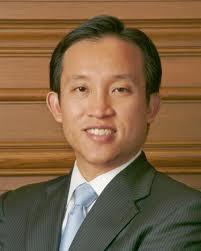
David Campos

20 percent by 2020

52

steve@sfbg.com

There’s no doubt that San Francisco is one of the best cities in the United States for bicyclists, a place where near universal support in City Hall has translated into regular cycling infrastructure improvements and pro-cyclist legislation, as a slew of activists and politicians will attest to on May 10 after dismounting from their Bike to Work Day morning rides.

But even the most bike-friendly U.S. cities — including Portland, Ore., Davis, Chicago, and New York City — are still on training wheels compared to our European counterparts, such as Amsterdam and Copenhagen, where around 30 percent of all vehicle trips are by bike. By comparison, even the best U.S. cities are still in the low single digits. [Correction: Davis, which stands alone among U.S. cities, is actually at about 15 percent bike mode share]

Board President David Chiu and other city officials proposed to aggressively address that gap two years ago after returning from a fact-finding trip to Europe that also included Ed Reiskin, executive director of the San Francisco Municipal Transportation Agency (SFMTA), the agency charged with implementing city policies that favor transit riders, cyclists, and pedestrians over motorists.

Chiu sponsored legislation setting the goal of having 20 percent of all vehicle trips in San Francisco be by bike by the year 2020 and calling for the SFMTA to do a study on how to meet that goal. It was overwhelmingly approved by the Board of Supervisors and signed by Mayor Ed Lee, who has regularly cited it and proclaimed his support for what it now official city policy.

But the city will fail to meet that goal, probably by a significant amount, unless there is a radical change on our roadways.

The latest SFMTA traffic survey, released in February, showed that bikes represent about 3.5 percent of vehicle trips, a 71 percent increase in five years. While the San Francisco Bicycle Coalition (SFBC) lauded that gain as “impressive,” it would mean a 571 percent increase in the next seven years to meet the 2020 goal.

The SFMTA study on how to meet the goal is long overdue, with sources telling us its potentially controversial conclusions have it mired by internal concerns and divisions. SFMTA spokesperson Paul Rose told us in March that it was coming out in April, and now he won’t say when to expect it and he won’t even make its authors available to answer our questions.

“We want to make sure everything is addressed before the plan is finalized,” he told us, acknowledging that it’s been a difficult process. “The challenge of reaching the goal is ambitious.”

Chiu acknowledges that the goal he set probably won’t be met and expressed frustration with the SFMTA. “I’m disappointed that two years after we set that goal, there is still no plan,” he told us, adding that to make major gains “will take leadership at the top” and a greater funding commitment to this cost-effective transportation option: “We’re spending budget dust on something that we say is a priority for the city.”

Reiskin also seemed to acknowledge the difficulty in meeting the goal when we asked him about it and he told us, “To get to 20 percent would be a quantum leap, no question, but the good news is there’s strong momentum in the right direction.”

Yet on Bike to Work Day, it’s worth exploring why we’re failing to meet our goal and how we might achieve it. What would have to happen, and what would it look like, to have 20 percent of traffic be people on bikes?


CLOSING THE GAP

SFBC Executive Director Leah Shahum said that all the group’s studies show safety concerns are by far the biggest barrier to getting more people on bikes. Most people are simply scared to share space with automobiles, so SFBC’s top priority has been creating more bikes lanes, particularly lanes that are physically separated from traffic, known as cycletracks, like those on a portion of Market Street.

“We’ve seen it time and again, when you build, they will come,” Shahum said. “People want to feel safe. They want dedicated space on the roadways.”

SFBC’s Connecting the City proposal calls for the creation of four crosstown colored cycletracks totaling 100 miles. Other bike activists emphasize the importance of projects that close key gaps in the current bike network, such as the dangerous section along Oak and Fell streets that separates the Panhandle from the Wiggle, scary spots that deter people from cycling.

That safety concern — and the possibilities for making cycling a more attractive option to more people — extends to neighborhood streets that don’t have bike lanes, where Shahum said measures to slow down automobile traffic and increase motorist awareness of cyclists would help. “What we’re talking about is a calmer, safer, greener, neighborhood-focused street,” she said.

Bike advocates say the goal is to make cycling a safe and attractive option for those 8 to 80 years old, a goal that will require extensive new bike infrastructure — not just new bike lanes, but also more dedicated bike parking — as well as education programs for all road users.

“What I hope is on the drawing board is infrastructure that will make more people feel safe riding, particularly women,” SFMTA board member Cheryl Brinkman, a regular cyclist, told us.

Shahum also praised the Bay Area Rapid Transit District’s new Bike Plan, which seeks to double the percentage of passengers who bike to stations (from 4 percent now up to 8 percent in 10 years), saying Muni should also take steps to better accommodate cyclists. And she praised the city’s bike-sharing program that will debut in August, making 1,000 bikes available to visitors.

But to realize the really big gains San Francisco would need to hit 20 percent by 2020 would take more than just steadily increasing the mileage of bike lanes, says Jason Henderson, a San Francisco State University geography professor who is writing a book on transportation politics. It would take a systemic, fundamental shift, one either deliberately chosen or forced on the city by dire circumstances.

“If gasoline goes to $10 per gallon, sure, we’ll get to 20 percent just because of austerity,” Henderson said. But unless energy prices experience that kind of sudden shock, which would idle cars and overwhelm public transit, thus forcing people onto bikes, getting to 20 percent would take smart planning and political will. In fact, it will require the city to stop catering to drivers and accommodating cars.

Henderson noted that bicycle mode share is as high as 10 percent in some eastern neighborhoods, such as the Mission District, Lower Haight, and in some neighborhoods near Civic Center. “In this part of the city, Muni is crowded and young people get tired of Muni being such a slow option,” Henderson said. “If you live within a certain radius of downtown, it’s easier to bike.”

To build on that, he said the city needs to limit the number of parking spaces built in residential projects in the city core even more than it does now, as well as adding substantially more affordable units. “The most bikeable parts of the city have massive rent increases,” he said. “We have to make sure affordable housing is wrapped around downtown.”

Henderson said city leaders need to show more courage in converting car lanes and street parking spaces into bike lanes, creating bike corridors that parallel those focused on cars or transit, and exempting most bike projects from the detailed environment review that slow their implementation. At the same time, he said the city needs to drastically expand Muni’s capacity to give people more options and compensate for bike improvements that may make driving slower.

“If you want 20 percent bike mode share, you need 30 percent on transit,” he said, noting that public transit ridership in San Francisco is now about 17 percent, far less than in the great bike cities of Amsterdam and Copenhagen, which made a commitment to reducing reliance on the automobile starting in the 1970s. “It’s like a puzzle.”


BARRIERS AND BACKLASH

The kind of active urban planning that Henderson advocates would be anathema to many San Franciscans, particularly people like Rob Anderson, the blogger and activist who sued San Francisco over the lack of studies supporting its Bike Plan and created a four-year court injunction against bike projects that just ended two years ago.

“The only way you could get to 20 percent is creating gridlock in San Francisco. I don’t think it’s going to happen. City Hall is adopting a slogan as transportation policy,” he told us. “It’s a statement of pro-bike, anti-car principle, but it’s not a realistic transportation policy.”

Anderson considers bicycles to be dangerous toys that will never be used by more than a small minority of city residents, believing the majority will always rely on automobiles and there will be a huge political backlash if the city continues to take space from cars for bikes or open space.

Many city officials and cycling advocates say making big gains means convincing people like Anderson that bicycles are not just a viable transportation option, but an important one to facilitate given global warming, oil wars, public health issues, and traffic congestion that will only worsen as the population increases.

“We need to help all San Franciscans see cycling as a legitimate transportation option,” Chiu said. Or as Shahum put it, “It’s prioritizing space for biking, walking, and transit over driving.”

Shahum said the city’s political leaders seem to get it, but she doesn’t feel the same sense of urgency from the city’s planners.

“I feel like the bureaucracy needs to get on board. We have strong political support and the public support is growing,” Shahum said. “We’ve set ambitious, worthwhile, and I think achievable goals, yet nobody is holding the city accountable….It can’t just be a political platitude, it needs to be an actual plan with measureables and people held accountable.”

She cited studies showing that the most bike-friendly cities in the U.S. are spending between $8 million and $40 million a year on bike infrastructure and education programs, “but San Francisco is spending more like $2-3 million, which is peanuts…San Francisco has got to start putting its money where its mouth is to improve biking numbers.”

It’s cheap and easy to stripe new bike lanes. “It’s one of the best investments we can make in terms of mode share,” Reiskin said. That makes cycling advocates question the city’s true commitment to goals like the 2020 policy. “We will need more investment,” Chiu said, “but compared to other modes of transportation, it is far cheaper per mile.”


POLITICAL WILL

So why then has San Francisco slipped back into a slow pace for doing bike projects following a year of rapid improvements after the bike injunction was lifted? And why does the city set arbitrary goals that it doesn’t know how to meet? The answer seems to lie at the intersection of the political and the practical.

“We need a more detailed and comprehensive strategy that says this is where we need to be in five years and this is how we get there,” Sup. David Campos, who chairs the San Francisco Transportation Authority, told us. “I feel like the commitment is there, but it’s a question of what resources you have to devote to that goal.”

But it’s also a question of how those resources are being used, and whether political leaders are grabbing at low-hanging fruit rather than making the tough choices to complete the city’s bike network and weather criticisms like those offered by Anderson.

It often seems as if SFMTA is still prioritizing political projects or experimenting in ways that waste time and money. For example, the most visible improvement to the bike network in the last year, and the one most often cited by Mayor Lee, is the new cycletracks on JFK Drive in Golden Gate Park. But they do little to make cycling more attractive and they may even exacerbate tensions between cyclists and drivers.

It was one of two major bike projects that Mayor Lee announced on Bike to Work Day last year, and it seemed to have more to do with politicians announcing more bike lane mileage that with actually improving the bike network.

The other project Lee announced, just a few blocks of bike lanes on Fell and Oak streets, really was a significant bike safety advance that SFBC has been seeking for several years. But Lee failed to live up to his pledge to install them by the end of 2011 after neighbors complained about the lost parking spots, and the project was pushed back to next year at the earliest.

“We’re talking about three blocks. It’s relatively small in scope but huge in impacts,” Shahum said of the project. “If the pace of change on these three blocks is replicated through the city, it’ll take hundreds of years to meet the [20 percent] goal.” But Lee Press Secretary Christine Falvey said: “The mayor is very much committed to the aggressive goals set to get to 20 percent by 2020 and the city is moving in the right direction. He has also always supported the Oak Fell project and we’re seeing progress.” Yes, but not the kind of progress the city would need to make to meet its own goal. “Chicago is really the leader right now,” Shahum said, noting Chicago Mayor Rahm Emanuel’s commitment to building 25 miles a year of new cycletracks and the city’s advocacy for getting more federal transportation money devoted to urban cycling improvements. “Where does San Francisco fit in this? Do we want to be at that level or not?”

Sunday Streets coming to — and staying in — the Mission

2

Sunday Streets – the once-controversial closure of streets to automobiles so they can be fully used by pedestrians, cyclists, and skaters, temporarily expanding the amount of open space in San Francisco – has become a popular monthly event and it rotates among neighborhoods around the city. And as the organizers prepare for this Sunday’s event in the Mission, where its biggest and best incarnations are held, city officials today announced an expansion of the program: the Mission will now host Sunday Streets on the first weekend of each month through the summer.

“Sunday Streets really comes to life and realizes its full potential when it’s in the Mission,” Ed Reiskin, executive director of the San Francisco Municipal Transportation Agency, said this morning at a press conference on the steps of City Hall.

The business community initially resisted the idea when it was proposed five years ago by Mayor Gavin Newsom and its chief sponsor, the nonprofit Livable City, concerned that customers would have a hard time getting to stores. But just the opposite has proven true as the popular events fill the streets with thousands of people.

“When Sunday Streets started, I know there was a little apprehension, we even felt it in the Mission,” Sup. David Campos, who represents the Mission. “But the neighborhood has come together to embrace the project.”

Mayor Ed Lee called the expansion of Sunday Streets “a great pilot program for San Francisco” and said that it represents “our openness to learning to use our streets differently.”

San Francisco was the third city in the country to hold these street closures – known as cicolvias in Bogota, Columbia, which pioneered the concept – following Portland, Ore. (the first, and one that we covered) and New York City. This Sunday’s event runs from 11 am to 4 pm, mostly along Valencia and 24th streets.

Progressives party — together

6

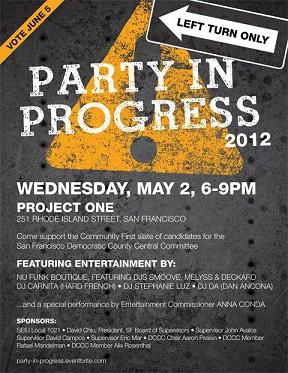
There are plenty of political fundraisers during campaign seasons, but this one will be especially interesting: The progressive slate for the Democratic County Central Committee is coming together for an event May 2 at 6 pm at Project One. The host committee includes outgoing chair Aaron Peskin and Sup. David Chiu, who have not always been on the best of terms — and Committee incumbent Alix Rosenthal, the main organizer of the event, who is also the organizer of what some see as a competing slate.

And that slate is having its own problems — involving clashes between some of the progressive women (Hene Kelley, who will no doubt be at the May 2 event) and some of the more moderate women (Hydra Mendoza, who won’t be there.) The party invite has a street sign saying “left turn only” — which is not at all what some of the people on Rosenthal’s other slate are thinking.

Rosenthal told us: “I personally think it’s remarkable that Aaron, Rafi [Mandelman], David Chiu, David Campos, Eric Mar, John Avalos and I are all on the host committee, given the rifts in the progressive movement of late.”

Yep. Everyone’s getting along. For one night, anyway.

The two defining votes of 2012

38

The Board of Supervisors will be facing two votes in the next couple of months that will define this board, establish the extent of the mayor’s political clout — and potentially play a decisive role in the political futures of several board members.

Oh: They’ll also have a lasting impact on the future of this city.

I’m talking about 8 Washington and CPMC — one of them the most important vote on housing policy to come along in years, the other a profound decision that will change the face of the city and alter the health-care infrastructure for decades to come.

Both projects have cleared the Planning Commission, as expected. Neither can go forward without approval from a majority of the supervisors. And there will be intense downtown lobbying on both of them.

The 8 Washington project would create what developer Simon Snellgrove calls the most expensive condos ever built in San Francisco. A piece of waterfront property would become a gated community for the very, very rich, many of whom won’t even live here most of the time. If it’s approved, the economy won’t collapse, neighborhoods won’t be destroyed — but it will make a powerful statement about the city’s housing policy. The message: We build housing for the 1 percent. We are a city that caters only to one very tiny group of people. We are willing to let the needs of the few drive our policy over the needs of the many.

Face it: There is no shortage of housing for the people who will buy Snellgrove’s condos. There’s a severe shortage of housing for most of the people who actually work in San Francisco. And the city’s housing policy is so scewed up that it’s making things worse. That’s the message of 8 Washington.

Then there’s CPMC. California Pacific Medical Center wants to put a snazzy state-of-the art new medical center on Van Ness, which is all well and good. But the giant nonprofit Sutter Health, which operates CPMC, has been openly hostile to some of the city’s demands (for housing, transit and other environmental mitigiation) and the proposal that Mayor Ed Lee has signed off on is way out of balance. There’s not anything even close to a reasonable link between jobs and housing — which will impact the entire city. You bring in a lot of new workers and don’t help build enough housing for them and everyone’s rent goes up.

CPMC also wants to radically downsize St. Luke’s Hospital, the only full-service facility on the south side of town except for the overcrowded and overloaded SF General. Health care for a sizable part of the city will suffer.

This is a very big deal, and the Chamber of Commerce is pushing hard for the supes to approve it. A lot of labor and the entire affordable housing community is against it.

So put those two votes in front of a board where the progressive majority has been very shaky of late — and where Lee will be working hard to line up six votes — and you’ve got potential political dynamite. Supervisor John Avalos told me he has serious concerns about both projects. Sup. David Campos told me he feels the same way. Sup Eric Mar is unlikely to vote for 8 Washington and unlikely to oppose the health-care workers and the progressive leaders who want to block the CPMC deal and make Sutter come back with a better offer, but some elements of labor are pushing hard for 8 Washington and Mar is up for re-election in one of the city’s swing districts.

Sup. David Chiu is against 8 Washington. I’ve called Sups. Jane Kim and Christina Olague (who was not a fan of the project when she was on the Planning Commission) but they haven’t gotten back to me. Olague is running for re-election this fall in the city’s most progressive district, one that’s right on the edge of the CPMC project site; Kim’s district is on the other edge.

You can’t really count to six on either of these projects without getting Chiu and/or Kim and/or Olague. Chiu has no progressive opposition, but if he supports the CPMC deal, someone may decide to challenge him. If Olague supports either project, it will give her opponents plenty of fodder for the fall campaign (John Rizzo, who is running against her, told me he opposes both). If Olague opposes the two projects, it’s going to be much harder for anyone to run against her from the left since she will have demonstrated that she can stand up the mayor on tough issues.

I’ll let you know if I hear more.


Guardian endorsements for June 5 election

34

>>OUR ONE-PAGE “CLEAN SLATE” PRINTOUT GUIDE IS HERE. 

As usual, California is irrelevant to the presidential primaries, except as a cash machine. The Republican Party has long since chosen its nominee; the Democratic outcome was never in doubt. So the state holds a June 5 primary that, on a national level, matters to nobody.

It’s no surprise that pundits expect turnout will be abysmally low. Except in the few Congressional districts where a high-profile primary is underway, there’s almost no news media coverage of the election.

But that doesn’t mean there aren’t some important races and issues (including the future of San Francisco’s Democratic Party) — and the lower the turnout, the more likely the outcome will lean conservative. The ballot isn’t long; it only takes a few minutes to vote. Don’t stay home June 5.

Our recommendations follow.

PRESIDENT

BARACK OBAMA

Sigh. Remember the hope? Remember the joy? Remember the dancing in the streets of the Mission as a happy city realized that the era of George Bush and The Gang was over? Remember the end of the war, and health-care reform, and fair economic policies?

Yeah, we remember, too. And we remember coming back to our senses when we realized that the first people at the table for the health-policy talks were the insurance industry lobbyists. And when more and more drones killed more and more civilian in Afghanistan, and the wars didn’t end and the country got deeper and deeper into debt.

Oh, and when Obama bailed out Wall Street — and refused to spend enough money to help the rest of us. And when his U.S. attorney decided to crack down on medical marijuana.

We could go on.

There’s no question: The first term of President Barack Obama has been a deep disappointment. And while we wish that his new pledge to tax the millionaires represented a change in outlook, the reality is that it’s most likely an election-year response to the popularity of the Occupy movement.

Last fall, when a few of the most progressive Democrats began talking about the need to challenge Obama in a primary, we had the same quick emotional reaction as many San Franciscans: Time to hold the guy accountable. Some prominent left types have vowed not to give money to the Obama campaign.

But let’s get back to reality. The last time a liberal group challenged an incumbent in a Democratic presidential primary, Senator Ted Kennedy wounded President Jimmy Carter enough to ensure the election of Ronald Reagan — and the begin of the horrible decline in the economy of the United States. We’re mad at Obama, too — but we’re realists enough to know that there is a difference between moderate and terrible, and that’s the choice we’re facing today.

The Republican Party is now entirely the party of the far right, so out of touch with reality that even Reagan would be shunned as too liberal. Mitt Romney, once the relatively centrist governor of Massachusetts, has been driven by Newt Gingrich and Rick Santorum so deeply into crazyland that he’s never coming back. We appreciate Ron Paul’s attacks on military spending and the war on drugs, but he also opposes Medicare and Social Security and says that people who don’t have private health insurance should be allowed to die for lack of medical care.

No, this one’s easy. Obama has no opposition in the Democratic Primary, but for all our concerns about his policies, we have to start supporting his re-election now.

U.S. SENATE

DIANNE FEINSTEIN

The Republicans in Washington didn’t even bother to field a serious candidate against the immensely well-funded Feinstein, who is seeking a fourth term. She’s a moderate Democrat, at best, was weak-to-terrible on the war, is hawkish on Pentagon spending (particularly Star Wars and the B-1 bomber), has supported more North Coast logging, and attempts to meddle in local politics with ridiculous ideas like promoting unknown Michael Breyer for District Five supervisor. She supported the Obama health-care bill but isn’t a fan of single-payer, referring to supporters of Medicare for all as “the far left.”

But she’s strong on choice and is embarrassing the GOP with her push for reauthorization of an expanded Violence Against Women Act. She’ll win handily against two token Republicans.

U.S. CONGRESS, DISTRICT 2

NORMAN SOLOMON

The Second District is a sprawling region stretching from the Oregon border to the Golden Gate Bridge, from the coast in as far as Trinity County. It’s home to the Marin suburbs, Sonoma and Mendocino wine country, the rough and rural Del Norte and the emerald triangle. There’s little doubt that a Democrat will represent the overwhelmingly liberal area that was for almost three decades the province of Lynn Woolsey, one of the most progressive members in Congress. The top two contenders are Norman Solomon, an author, columnist and media advocate, and Jared Huffman, a moderate member of the state Assembly from Marin.

Solomon’s not just a decent candidate — he represents a new approach to politics. He’s an antiwar crusader, journalist, and outsider who has never held elective office — but knows more about the (often corrupt) workings of Washington and the policy issues facing the nation than many Beltway experts. He’s talking about taxing Wall Street to create jobs on Main Street, about downsizing the Pentagon and promoting universal health care. He’s a worthy successor to Woolsey, and he deserves the support of every independent and progressive voter in the district.

U.S. CONGRESS, DISTRICT 12

NANCY PELOSI

Nancy Pelosi long ago stopped representing San Francisco (see: same-sex marriage) and began representing the national Democratic party and her colleagues in the House. She will never live down the privatization of the Presidio or her early support for the Iraq war, but she’s become a decent ally for Obama and if the Democrats retake the House, she’ll be setting the agenda for his second term. If the GOP stays in control, this may well be her last term.

Green Party member Barry Hermanson is challenging her, and in the old system, he’d be on the November ballot as the Green candidate. With open primaries (which are a bad idea for a lot of reasons) Hermanson needs support to finish second and keep Pelosi on her toes as we head into the fall.

U.S. CONGRESS, DISTRICT 12

BARBARA LEE

This Berkeley and Oakland district is among the most left-leaning in the country, and its representative, Barbara Lee, is well suited to the job. Unlike Pelosi, Lee speaks for the voters of her district; she was the lone voice against the Middle East wars in the early days, and remains a staunch critic of these costly, bloody, open-ended foreign military entanglements. We’re happy to endorse her for another term.

U.S. CONGRESS, DISTRICT 13

JACKIE SPEIER

Speier’s more of a Peninsula moderate than a San Francisco progressive, but she’s been strong on consumer privacy and veterans issues and has taken the lead on tightening federal rules on gas pipelines after Pacific Gas and Electric Company killed eight of her constituents. She has no credible opposition.

STATE SENATE, DISTRICT 11

MARK LENO

Mark Leno started his political career as a moderate member of the Board of Supervisors from 1998 to 2002. His high-profile legislative races — against Harry Britt for the Assembly in 2002 and against Carole Migden for the Senate in 2008 — were some of the most bitterly contested in recent history. And we often disagree with his election time endorsements, which tend toward more downtown-friendly candidates.

But Leno has won us over, time and again, with his bold progressive leadership in Sacramento and with his trailblazing approach to public policy. He is an inspiring leader who has consistently made us proud during his time in the Legislature. Leno was an early leader on the same-sex marriage issue, twice getting the Legislature to legalize same-sex unions (vetoed both times by former Gov. Arnold Schwarzenegger). He has consistently supported a single-payer health care system and laid important groundwork that could eventually break the grip that insurance companies have on our health care system. And he has been a staunch defender of the medical marijuana patients and has repeatedly pushed to overturn the ban on industrial hemp production, work that could lead to an important new industry and further relaxation of this country wasteful war on drugs. We’re happy to endorse him for another term.

STATE ASSEMBLY, DISTRICT 17

TOM AMMIANO

Ammiano is a legendary San Francisco politician with solid progressive values, unmatched courage and integrity, and a history of diligently and diplomatically working through tough issues to create ground-breaking legislation. We not only offer him our most enthusiastic endorsement — we wish that we could clone him and run him for a variety of public offices. Since his early days as an ally of Harvey Milk on gay rights issues to his creation of San Francisco’s universal health care system as a supervisor to his latest efforts to defend the rights of medical marijuana users, prison inmates, and undocumented immigrants, Ammiano has been a tireless advocate for those who lack political and economic power. As chair of Assembly Public Safety Committee, Ammiano has blocked many of the most reactionary tough-on-crime measures that have pushed our prison system to the breaking point, creating a more enlightened approach to criminal justice issues. We’re happy to have Ammiano expressing San Francisco’s values in the Capitol.

STATE ASSEMBLY, DISTRICT 19

PHIL TING

Once it became abundantly clear that Assessor-Recorder Phil Ting wasn’t going to get elected mayor, he started to set his eyes on the state Assembly. It’s an unusual choice in some ways — Ting makes a nice salary in a job that he’s doing well and that’s essentially his for life. Why would he want to make half as much money up in Sacramento in a job that he’ll be forced by term limits to leave after six years?

Ting’s answer: he’s ready for something new. We fear that a vacancy in his office would allow Mayor Ed Lee to appoint someone with less interest in tax equity (prior to Ting, the city suffered mightily under a string of political appointees in the Assessor’s Office), but we’re pleased to endorse him for the District 19 slot.

Ting has gone beyond the traditional bureaucratic, make-no-waves approach of some of his predecessors. He’s aggressively sought to collect property taxes from big institutions that are trying to escape paying (the Catholic Church, for example) and has taken a lead role in fighting foreclosures. He commissioned, on his own initiative, a report showing that a large percentage of the foreclosures in San Francisco involved some degree of fraud or improper paperwork, and while the district attorney is so far sitting on his hands, other city officials are moving to address the issue.

His big issue is tax reform, and he’s been one the very few assessors in the state to talk openly about the need to replace Prop. 13 with a split-role system that prevents the owners of commercial property from paying an ever-declining share of the tax burden. He wants to change the way the Legislature interprets Prop. 13 to close some of the egregious loopholes. It’s one of the most important issues facing the state, and Ting will arrive in Sacramento already an expert.

Ting’s only (mildly) serious opponent is Michael Breyer, son of Supreme Court Justice Breyer and a newcomer to local politics. Breyer’s only visible support is from the Building Owners and Managers Association, which dislikes Ting’s position on Prop. 13. Vote for Ting.

DEMOCRATIC COUNTY CENTRAL COMMITTEE

You can say a lot of things about Aaron Peskin, the former supervisor and retiring chair of the city’s Democratic Party, but the guy was an organizer. Four years ago, he put together a slate of candidates that wrenched control of the local party from the folks who call themselves “moderates” but who, on critical economic issues, are really better defined as conservative. Since then, the County Central Committee, which sets policy for the local party, has given its powerful endorsement mostly to progressive candidates and has taken progressive stands on almost all the ballot issues.

But the conservatives are fighting back — and with Peskin not seeking another term and a strong slate put together by the mayor’s allies seeking revenge, it’s entirely possible that the left will lose the party this year.

But there’s hope — in part because, as his parting gift, Peskin helped change state law to make the committee better reflect the Democratic voting population of the city. This year, 14 candidates will be elected from the East side of town, and 10 from the West.

We’ve chosen to endorse a full slate in each Assembly district. Although there are some candidates on the slate who aren’t as reliable as we might like, 24 will be elected, and we’re picking the 24 best.

DISTRICT 17 (EAST SIDE)

John Avalos

David Campos

David Chiu

Petra DeJesus

Matt Dorsey

Chris Gembinsky

Gabriel Robert Haaland

Leslie Katz

Rafael Mandelman

Carole Migden

Justin Morgan

Leah Pimentel

Alix Rosenthal

Jamie Rafaela Wolfe


DISTRICT 19 (WEST SIDE)

Mike Alonso

Wendy Aragon

Kevin Bard

Chuck Chan

Kelly Dwyer

Peter Lauterborn

Hene Kelly

Eric Mar

Trevor McNeil

Arlo Hale Smith

State ballot measures

PROPOSITION 28

YES

LEGISLATIVE TERM LIMITS

Let us begin with a stipulation: We have always opposed legislative term limits, at every level of government. Term limits shift power to the executive branch, and, more insidiously, the lobbyists, who know the issues and the processes better than inexperienced legislators. The current system of term limits is a joke — a member of the state Assembly can serve only six years, which is barely enough time to learn the job, much less to handle the immense complexity of the state budget. Short-termers are more likely to seek quick fixes than structural reform. It’s one reason the state Legislatures is such a mess.

Prop. 28 won’t solve the problem entirely, but it’s a reasonable step. The measure would allow a legislator to serve a total of 12 years in office — in either the Assembly, the Senate, or a combination. So an Assembly member could serve six terms, a state Senator three terms. No more serving a stint in one house and then jumping to the other, since the term limits are cumulative, which is imperfect: A lot of members of the Assembly have gone on to notable Senate careers, and that shouldn’t be cut off.

Still, 12 years in the Assembly is enough time to become a professional at the job — and that’s a good thing. We don’t seek part-time brain surgeons and inexperienced airline pilots. Running California is complicated, and there’s nothing wrong with having people around who aren’t constantly learning on the job. Besides, these legislators still have to face elections; the voters can impose their own term limits, at any time.

Most of the good-government groups are supporting Prop. 28. Vote yes.

PROPOSITION 29

YES

CIGARETTE TAX FOR CANCER RESEARCH

Seriously: Can you walk into the ballot box and oppose higher taxes on cigarettes to fund cancer research? Of course not. All of the leading medical groups, cancer-research groups, cancer-treatment groups and smoking-cessation groups in the state support Prop. 29, which was written by the American Cancer Society and the American Heart Association.

We support it, too.

Yes, it’s a regressive tax — most smokers are in the lower-income brackets. Yes, it’s going to create a huge state fund making grants for research, and it will be hard to administer without some issues. But the barrage of ads opposing this are entirely funded by tobacco companies, which are worried about losing customers, particularly kids. A buck a pack may not dissuade adults who really want to smoke, but it’s enough to price a few more teens out of the market — and that’s only good news.

Don’t believe the big-tobacco hype. Vote yes on 29.

San Francisco ballot measures

PROPOSITION A

YES

GARBAGE CONTRACT

A tough one: Recology’s monopoly control over all aspects of San Francisco’s waste disposal system should have been put out to competitive bid a long time ago. That’s the only way for the city to ensure customers are getting the best possible rates and that the company is paying a fair franchise fee to the city. But the solution before us, Proposition A, is badly flawed public policy.

The measure would amend the 1932 ordinance that gave Recology’s predecessor companies — which were bought up and consolidated into a single behemoth corporation — indefinite control over the city’s $220 million waste stream. Residential rates are set by a Rate Board controlled mostly by the mayor, commercial rates are unregulated, and the company doesn’t even have a contract with the city.

Last year, when Recology won the city’s landfill contract — which was put out to bid as the current contract with Waste Management Inc. and its Altamont landfill was expiring — Recology completed its local monopoly. At the time, Budget Analyst Harvey Rose, Sup. David Campos, and other officials and activists called for updating the ordinance and putting the various contracts out to competitive bid.

That effort was stalled and nearly scuttled, at least in part because of the teams of lobbyists Recology hired to put pressure on City Hall, leading activists Tony Kelley and retired Judge Quentin Kopp to write this measure. They deserve credit for taking on the issue when nobody else would and for forcing everyone in the city to wake up and take notice of a scandalous 70-year-old deal.

We freely admit that the measure has some significant flaws that could hurt the city’s trash collection and recycling efforts. It would split waste collection up into five contracts, an inefficient approach that could put more garbage trucks on the roads. No single company could control all five contracts. Each of those contracts would be for just five years, which makes the complicated bidding process far too frequent, costing city resources and hindering the companies’ ability to make long-term infrastructure investments.

It would require Recology to sell its transfer station, potentially moving the waste-sorting facility to Port property along the Bay. Putting the transfer station in public hands makes sense; moving it to the waterfront might not.

On the scale of corrupt monopolies, Recology isn’t Pacific Gas and Electric Co. It’s a worker-owned company and has been willing to work in partnership with the city to create one of the best recycling and waste diversion programs in the country. For better or worse, Recology controls a well-developed waste management infrastructure that this city relies on, functioning almost like a city department.

Still, it’s unacceptable to have a single outfit, however laudatory, control such a massive part of the city’s infrastructure without a competitive bid, a franchise fee, or so much as a contract. In theory, the company could simply stop collecting trash in some parts of the city, and San Francisco could do nothing about it.

As a matter of public policy, Prop. A could have been better written and certainly could, and should, have been discussed with a much-wider group, including labor. As a matter of real politics, it’s a messy proposal that at least raises the critical question: Should Recology have a no-bid, no contract monopoly? The answer to that is no.

Prop. A will almost certainly go down to defeat; Kopp and Kelly are all alone, have no real campaign or committee and just about everyone else in town opposes it. Our endorsement is a matter of principle, a signal that this longtime garbage deal has to end. If Recology will work with the city to come up with a contract and a bid process, then Prop. A will have done its job. If not, something better will be on the ballot in the future.

For now, vote yes on A.

PROPOSITION B

YES

COIT TOWER POLICY

In theory, city department heads ought to be given fair leeway to allocate resources and run their operations. In practice, San Francisco’s Department of Recreation and Parks has been on a privatization spree, looking for ways to sell or rent public open space and facilities as a way to balance an admittedly tight budget. Prop. B seeks to slow that down a bit, by establishing as city policy the premise that Coit Tower shouldn’t be used as a cash cow to host private parties.

The tower is one of the city’s most important landmarks and a link to its radical history — murals painted during the Depression, under the Works Progress Administration, depict local labor struggles. They’re in a bit of disrepair –but that hasn’t stopped Rec-Park from trying to bring in money by renting out the place for high-end events. In fact, the tower has been closed down to the public in the past year to allow wealthy patrons to host private parties. And the city has more of that in mind.

If the mayor and his department heads were acting in good faith to preserve the city’s public spaces — by raising taxes on big business and wealthy individuals to pay for the commons, instead of raising fees on the rest of us to use what our tax dollars have already paid for — this sort of ballot measure wouldn’t be necessary.

As it is, Prop. B is a policy statement, not an ordinance or Charter amendment. It’s written fairly broadly and won’t prevent the occasional private party at Coit Tower or prevent Rec-Park from managing its budget. Vote yes.


Pushing back

0

Dexter Cato has no right to be here.

He’s standing on the corner outside the house he bought in 1990. His four kids, still teenagers, grew up here. He was living here when his wife, Christina, passed away following a car accident in 2009. Next door is the house he grew up in, having spent all his life on Quesada Avenue, in the wide streets and residential friendliness of the Bayview.

Still, the bank says Cato doesn’t belong here anymore, evicting him when his home went into foreclosure in August 2010. Yet Cato and his community not only fought back and reoccupied the home last month, they have turned it into a community center and base of operations from which to fight other foreclosures in the area.

The house, at the corner of Quesada and Jenning, is draped with banners, such as “Banks: no foreclosures!” and “keep families in our homes!” In the rain on March 16, when they were unfurled on the property that has remained vacant for nearly two years, surrounded by neighbors and friends, Cato moved back in. It was a gamble and an act of civil disobedience. Now they feel festive; it’s been a month, and no one has shown up to tell Cato he has to leave.

It has become a home base for a who’s who list of “foreclosure fighters,” the name taken on by Cato and others who have, in recent months, gone to extreme means to prevent banks from foreclosing on their homes. There’s Vivian Richardson, who got her foreclosure rescinded after 1,400 emails to her loan servicer. There’s Alberto Del Rio, who was ignored and told that his paperwork was lost during a Kafka-esque two-year loan modification attempt, only to win a meeting with top Wells Fargo executives last month after Occupy Bernal got behind his cause. There’s Carolyn Gage, who took a cue from protesters downtown and occupied her Bayview home in November.

Those taking on the foreclosure crisis certainly have a big task ahead of them. Since the market collapsed in 2008, there have been 12,410 foreclosures in San Francisco, according to data from RealtyTrac as compiled by the Alliance of Californians for Community Empowerment (ACCE). The neighborhoods with the most foreclosures are Ingleside-Excelsior/Crocker Amazon, Visitacion Valley/Sunnydale, and Bayview-Hunters Point, with more than 1,000 in each neighborhood. But the number of home foreclosures are in the hundreds in every neighborhood in San Francisco.

Despite the pandemic, many San Francisco residents say they felt distinctly alone in the events surrounding receiving notice of default.

“I’ve lived in Noe Valley since 1972,” said Kathy Galvess, an activist we spoke to Cato’s basement. “I didn’t know anybody who had been foreclosed on.”

When she got her eviction notice and, hooking up with ACCE and Occupy Bernal, faced her situation and the extent of the crisis, she wondered if her neighbors knew something she didn’t.

“I asked around the neighborhood, no one had any idea,” she said. “That’s how the banks get away with it. We suffer in silence.”

Carolyn Gage echoed that sentiment. “A while ago, foreclosure was shameful. But now it shouldn’t be. It’s happening in a systemic way, so people are getting over that shame,” she told me and several neighbors March 24 during a barbecue at Cato’s house.

This shame came in part from the illusion that the onslaught of seemingly affordable home loans from the housing bubble’s height were, in fact, affordable.

“The easy money fueled the ability for people to refinance every one or two years. A lot of people did that and just lived on it. Certain people used it, some abused it, others got caught up in it,” said CJ Holmes, a real estate broker in Santa Rosa who became interested in understanding the meanings of the crisis when the value of property she owned plummeted in 2008.

While President Bush signed on to Troubled Asset Relief Program (TARP) in 2008, and bailouts to Fannie Mae and Freddie Mac continued to roll out well into the Obama presidency, foreclosures were steadily clearing San Francisco of longtime residents, not to mention property tax and home values on foreclosure-stricken blocks.

There were advocates working on the behalf of those getting evicted. The Alliance of Californians for Community Empowerment looked into cases and worked to discern the complex chain of entitlement, talk to the right people, and try to get loans modified. HUD-certified organizations like the Mission Economic Development Agency (MEDA) and the San Francisco Housing Development Corporation (SFHDC) counseled homeowners and waded through paperwork.

“The modification process takes an average of 12 months to complete,” said Jose Luis Rodriguez, a foreclosure counselor with MEDA, in an email. The loan modification process can make or break a homeowners chances of keeping their home, leaving them in what he called “purgatory.”

Assessor-Recorder Phil Ting later concluded that in 84 percent of foreclosure cases, there was some kind of faulty paperwork.

“We’d fax documents to banks and they would habitually lose documents. We’d have to fax them sometimes up to 10 times,” said Jonathan Segarra, director of communications for MEDA.

Alberto Del Rio had the same issue. During his loan modification struggle, “we kept having to sign up for a new case,” Del Rio told me. “About every three months. Generally because they lost paperwork, or paperwork wasn’t properly transmitted.”

“There was no callback on their part,” he said. “We would have to call to get updates and they would say: oh, it’s closed, you have to start over with the paperwork now.”

But this lost paperwork epidemic, an emblem of the carelessness that ran rampant through the mad expansion of the subprime mortgage industry, has more than one face. It is likely due to lost paperwork, for example, that Cato has been living in the home that is, technically, no longer his.

No one seems to have the title.

At the time of sale, it was owned by Wells Fargo. According to transaction records, the foreclosure is being serviced by American Home Mortgage Servicers; they get a portion of the money, but do not own it. According to Wells Fargo representatives, that bank is now the trustee of the mortgage, also known as the beneficiary.

ACCE has claimed that Wells Fargo “sold the house back to itself,” and that American Home Mortgage Services, the company currently servicing the loan, is a subsidiary of Wells Fargo. Ruben Pulido, a Wells Fargo spokesperson, denies this.

“That’s incorrect. American Home mortgage services is completely different and separate from Wells Fargo,” Pulido told us.

But Martinez believes that “they’re different entities in that they work separately, but they’re the main servicer for Wells Fargo, they only service for Wells Fargo.”

Calls and emails to American Home Mortgage Services went unanswered.

Last fall, as an angry mass suddenly emerged from the American public, cries of “banks got bailed out, we got sold out” rang through the streets. Occupy Bernal and ACCE have had success in the city government, gaining support from Sups David Campos and John Avalos, who represent some of the hardest hit districts, helping facilitate meetings between Wells Fargo representatives and homeowners with foreclosure horror stories, with some success.

Activists also went for more civil disobedience-style tactics. These were on display Feb. 22, when dozens of supporters showed up at Monica Kenney’s Excelsior home. Kenney was in the midst of dealing with a foreclosure that didn’t seem right. She had received a forbearance agreement and made the first payment on it June 27, then was surprised to learn that, June 28, her house had been sold at auction.

“At this point I wrote Wells Fargo and I said, I have this paperwork, and I want you to honor it and rescind the foreclosure,” Kenney explained when she came to speak with us at the Guardian offices. She gave us copies of the forbearance agreement.

“Their response was, we did nothing wrong and the foreclosure will stand,” she said. “So at that point I decided I would fight to retain my home.”

After dishing out most of her savings in a lawsuit and eviction stays, the fight looked grim, and her house was slated for eviction. The plan — the last line of defense — was to simply bring as many people as possible to Kenney’s home and hope they could fend off eviction. Kenney remembers her nerves, huddled up that cold morning with veteran foreclosure fighter Vivian Richardson, worried that no one would show up.

“Then, at six in the morning, I had foreclosure fighters, neighbors, friends, Occupy Bernal, Occupy folks period, they just started showing up at the house, and just sat down, hunkered down with me and said, we’ll do whatever we can to at least dissuade the sheriff,” she recalls

It worked. And it hasn’t stopped working. Many people who have joined with Occupy Bernal and ACCE are still in their homes thanks to everything from lobbying politicians to civil disobedience. Some were evicted despite the protest movement’s best efforts but, thanks to newfound community, they avoided homelessness.

Kathy Galvess wasn’t able to keep her home, but her experience was made much more pleasant by Occupy Bernal. “Stardust got the moving truck and helped me move, out of the goodness of his heart,” she told me. “And if it wasn’t for Vivian, me and my sister would be wandering the streets in these storms we’ve been having.”

It’s that community, it’s that tireless work, it’s that victory in the midst of a sea of ongoing challenges that was celebrated at the barbecue at Cato’s house. It’s hard to know the future of the occupied home. The goal of the coalition supporting it was to keep it until April 24, the day of a Wells Fargo shareholders meeting that a large coalition of advocates are determined to shut down.

But for now, the place has become a community center and a symbol of hope and defiance. Politicians have certainly taken note. The Board of Supervisors passed a resolution last week urging banks to suspend foreclosures in San Francisco.

“It’s great,” Cato said. “That’s what the house is useful for right now. Everyone’s coming in and asking, how can we be a part of this, how can we help.”

Free Muni for kids makes sense

0

EDITORIAL San Francisco is a transit-first city that has spent millions of dollars over the years trying to convince people to ride Muni. And yet, one of the best and most effective ways to get people out of their cars is facing surprising opposition.

Sup. David Campos has been pushing for months to get Muni to allow young people to ride free. It makes immediate sense: The school district, perpetually short on funds, is cutting back bus service (which is preferable to cutting back classroom instruction). For low-income families, the disappearance of a yellow school bus, which offered transportation free of charge, is a financial obstacle — and the last thing anyone needs is another obstacle to keep kids out from coming to school.

Reduced-fare youth passes are already available — but they aren’t easy to get. Parents need to show up in person, during the day, with a birth certificate, passport or other government ID; that’s hard for a lot of working parents. The school district ought to be able to sell the passes, but right now nobody has the resources to make that happen.

It’s possible to create a system to identify and offer free service to low-income families, but again, unless it’s done through the schools, where that data is already kept (for reduced-price lunches), we’re talking about creating a complicated bureaucracy that isn’t remotely necessary.

According to Campos, the cost of providing free service for all youth is only $8 million a year — and he’s identified regional transit funds to pay for much of it. Muni has a deep budget deficit already, and anything that costs more money has to be carefully evaluated, but there are so many ways to cover the price tag. (Why is Muni still paying the Police Department tens of millions of dollars to get cops on the buses when that’s part of the department’s job already?)

And this goes beyond Ethe very clear needs of low-income families. Getting young people onto the buses is an excellent way to convince the next generation of San Franciscans that it’s not necessary to own and operate a motor vehicle in the city. The message is already getting out — according to an April 5, 2012 study by the Frontier Group, the number of car miles driven by people between 16 and 34 dropped 23 percent between 2001 and 2009. That trend crosses class lines — in fact, among young people who earned more than $70,000 a year, public transit use rose 100 percent over the decade and biking by 122 percent.

In other words, it’s proving to be a massive challenge to get older people out of their cars, but the kids are already moving in that direction. With a little help and push, San Francisco could make giant strides in the next few years.

And a significant reduction in car use would more than pay for the cost of free Muni for youth. Every car off the road means less road maintenance, less air pollution — and perhaps more important, less congestion to slow down the buses. Faster buses means more riders and more fares (and less money spent paying drivers to sit in traffic).

So it’s a great idea that pays for itself and helps the environment. And yet some city officials (led by Sup. Scott Wiener) still resist. They should back off; the city should move to approve this plan immediately.

Editorial: Free Muni tickets for kids makes sense

5

San Francisco is a transit-first city that has spent millions of dollars over the years trying to convince people to ride Muni. And yet, one of the best and most effective ways to get people out of their cars is facing surprising opposition.

Sup. David Campos has been pushing for months to get Muni to allow young people to ride free. It makes immediate sense: The school district, perpetually short on funds, is cutting back bus service (which is preferable to cutting back classroom instruction). For low-income families, the disappearance of a yellow school bus, which offered transportation free of charge, is a financial obstacle — and the last thing anyone needs is another obstacle to keep kids out from coming to school.

Reduced-fare youth passes are already available — but they aren’t easy to get. Parents need to show up in person, during the day, with a birth certificate, passport or other government ID; that’s hard for a lot of working parents. The school district ought to be able to sell the passes, but right now nobody has the resources to make that happen.

It’s possible to create a system to identify and offer free service to low-income families, but again, unless it’s done through the schools, where that data is already kept (for reduced-price lunches), we’re talking about creating a complicated bureaucracy that isn’t remotely necessary.

According to Campos, the cost of providing free service for all youth is only $8 million a year — and he’s identified regional transit funds to pay for much of it. Muni has a deep budget deficit already, and anything that costs more money has to be carefully evaluated, but there are so many ways to cover the price tag. (Why is Muni still paying the Police Department tens of millions of dollars to get cops on the buses when that’s part of the department’s job already?)

And this goes beyond the very clear needs of low-income families. Getting young people onto the buses is an excellent way to convince the next generation of San Franciscans that it’s not necessary to own and operate a motor vehicle in the city. The message is already getting out — according to an April 5, 2012 study by the Frontier Group, the number of car miles driven by people between 16 and 34 dropped 23 percent between 2001 and 2009. That trend crosses class lines — in fact, among young people who earned more than $70,000 a year, public transit use rose 100 percent over the decade and biking by 122 percent.

In other words, it’s proving to be a massive challenge to get older people out of their cars, but the kids are already moving in that direction. With a little help and push, San Francisco could make giant strides in the next few years.

And a significant reduction in car use would more than pay for the cost of free Muni for youth. Every car off the road means less road maintenance, less air pollution — and perhaps more important, less congestion to slow down the buses. Faster buses means more riders and more fares (and less money spent paying drivers to sit in traffic).

So it’s a great idea that pays for itself and helps the environment. And yet some city officials (led by Sup. Scott Wiener) still resist. They should back off. The city should move to approve this plan immediately.


Why free Muni for youth makes sense

62

Supervisor Scott Wiener has gone out of his way to dis the plan to let kids ride Muni for free. His oped in the Chron April 9 argued that the city just doesn’t have the money ($8 million):

We need to increase access to transportation for low-income youth, but a new and expensive obligation for Muni – at a time when Muni cannot pay for its basic operational needs and is expanding parking meters and increasing parking fines – is a bad idea.

But that misses the point — and People Organized to Win Employment Rights is mounting a petition campaign to get Wiener back on track.

The Municipal Transportation Agency, which oversees Muni, failed to approve the plan the first time around, but the vote was tied with Commission Chair Tom Nolan absent, so it’s still possible to move it forward. And on April 17, Sup. David Campos, who proposed the plan, and his allies will try again.

Yes, Muni is (perpetually) broke, and yes, deficits and cuts mean declines in service. But Campos has identified money to pay for the program without damaging operating and maintenance funds. Oh, and the parking meters get dragged in again:

The understandable public perception is that Muni is expanding parking meters to Sundays, adding new meters, and raising ticket prices not to pay for improvements to the system but rather to fund free Muni for all youth, even those who don’t need the subsidy.

And the problem with that is … what? People with cars ought to subsidize transit riders — young, old and everything in between. It’s really not that expensive to park at a meter in San Francisco, and now that most of them take credit cards, you don’t have to carry $5 in quarters around with you. I drive a car myself, to ferry my kids around. I have no sympathy for people who pay to have a large motor vehicle in a transit-first city and don’t want to pay for the impacts.

(Besides, what are all those religious people complaining about — nobody pays to park for Sunday church anyway. They just park in the middle of the street.)

But put all of that aside for a minute and think about this: San Francisco spends all kinds of money, directly and indirectly, trying to convince people to ride Muni instead of driving. And one of the best ways to get new riders is to get kids started as transit users as soon as their parents decide they’re old enough to get on the bus.

For us, that was sixth grade, when we bought my son a clipper card and told him we weren’t leaving work early to pick him up (in the car) after school any more. I showed him how to find the Muni map on the web, showed him how to connect to NextBus on his phone, gave him a pat on the head (not really) and sent him off to explore the wonders of San Francisco public transit. It’s worked like a charm: He takes the bus to his martial arts class, takes the bus to Cards and Comics to buy Magic Cards, takes the bus to the mall and to visit friends … and now he knows more about the system than I do. He can navigate on his own anywhere in town — and he loves it. It’s freedom. Suburban kids have to wait until they’re 16 and can get a driver’s license to even begin to get that sense that they don’t need parents in tow to go where they want to go.

Most of the teenagers I know in this city don’t bother to learn to drive any more. They bike and they take the bus. That’s a wonderful thing — and San Francisco should do everything possible to encourage it.

And a great way to start is to invest a modest amount of money — less than one percent of Muni’s budget — in training kids that the way to travel is by bus and train. Make it easy; make it free. Hell, half the middle-school kids who ride Muni never pay the fare anyway; they go in the back door and pocket the money that their parents gave them for bus fare so they can buy something they aren’t supposed to have. It’s the way of the world.

This isn’t just a subsidy for kids who can’t afford Muni, although that’s a great thing and I’m all in favor. It’s an investment in the future, a cheap step toward a future day when turning 16 isn’t all about going to the DMV, and travel doesn’t mean car travel — and the streets of San Francisco are cleaner, safer, less crowded and better for all of us. Isn’t that worth the money?

Come on, Tom Nolan; you’re the swing vote. Make this happen.


San Francisco’s loss

116

news@sfbg.com

San Francisco is increasingly losing its working and creative classes to the East Bay and other jurisdictions — and with them, much of the city’s diversity — largely because of policy decisions that favor expensive, market-rate housing over the city’s own affordable housing goals.

“It’s definitely changing the character of the city,” said James Tracy, an activist with Community Housing Partnership. “It drains a big part of the creative energy of the city, which is why folks came here in the first place.”

>>Is Oakland cooler than San Francisco? Oaklanders respond.

Now, as San Francisco officials consider creating an affordable housing trust fund and other legislative changes, it’s fair to ask: Does City Hall have the political will to reverse the trend?

Census data tells a big part of the story. In 2000, the median owner-occupied home in San Francisco cost $369,400, and by 2010 it had more than doubled to $785,200. Census figures also show median rents have gone from $928 in 2000 up to $1,385 in 2010 — and even a cursory glance at apartment listings show that rents have been steadily rising since then.

Tracy and other affordable housing activists testified at an April 9 hearing before the Board of Supervisors Land Use and Economic Development Committee on a new study by the Budget and Legislative Analyst, commissioned last July by Sup. David Campos, entitled “Performance Audit of San Francisco’s Affordable Housing Policies and Programs.”

“There’s a hearing right now at City Hall about our housing stock and how it’s been skewing upward toward those with higher incomes,” Board President David Chiu told us, noting that it is sounding an alarm that, “Creative individuals that make this place so special are being driven out of the city.”

Oakland City Council member Rebecca Kaplan said that San Francisco’s loss has been a gain for Oakland and other East Bay cities, which are enjoying a new cultural vibrancy that has so far been largely free of the gentrifying impacts that can hurt a city’s diversity.

“You can add more people without getting rid of anybody if you do it right. Most of development is looking at places that are now completely empty like the Lake Merritt BART station parking lot, empty land around the Coliseum, and the West Oakland BART station,” Kaplan told us. “We have to commit to revitalization without displacement.”

Yet the fear among some San Franciscans is that we’ll have just the opposite: displacement that actually hinders the city’s attempts at economic revitalization. “What’s at stake is the economic recovery of the city,” Tracy said. “You can’t have such a large portion of the workforce commuting into the city.”

TOO MANY CONDOS

A big part of the problem is that San Francisco is building plenty of market-rate (read: really expensive) housing, but not nearly enough affordable housing. The report Campos commissioned looked at how well the city did at meeting various housing construction goals it set for itself from 1999 to 2006 in its state-mandated Housing Element, which requires cities to plan for the housing needs of its population and absorb a fair share of the state’s affordable housing needs.

The plan called for 7,363 market-rate units, or 36 percent of the total housing construction, with the balance being housing for those with moderate, low, or very low incomes. Developers built 11,293 market rate units during that time, 154 percent of what was needed and 65 percent of the total housing construction. There were only 725 units built for those with moderate incomes (just 13 percent the goal) and just over half the number of low-income units needed and 83 percent of the very low-income goal met.

“We have to do a better job of monitoring and evaluating each project,” Chiu said. “Every incremental decision we make determines whether this will be a city for just the wealthy.”

The situation for renters is even worse. From 2001-2011, the report showed there were only 1,351 rental units built for people in the low to moderate income range, people who make 50-120 percent of the area median income, which includes a sizable chunk of the working class living in a city where about two-thirds of residents rent.

“The Planning Commission does not receive a sufficiently comprehensive evaluation of the City’s achievement of its housing goals,” the report concluded, calling for the planners and policymakers to evaluate new housing proposals by the benchmark of what kind of housing the city actually needs. Likewise, it concluded that the Board of Supervisors isn’t being regularly given information it needs to correct the imbalance or meet affordable housing needs.

Policy changes made under former Mayor Gavin Newsom also made this bad situation even worse. Developers used to build affordable housing required by the city’s inclusionary housing law rather than pay in-lieu fees to the city by a 3-1 ratio, but since the formulas in that law changed in 2010, 55 percent of developers have opted to pay the fee rather than building housing.

Also in 2010, Newsom instituted a policy that allowed developers to defer payment of about 85 percent of their affordable housing fees, resulting in an additional year-long delay in building affordable housing, from 48 months after the market rate project got permitted to 60 months now.

Tracy and the affordable housing activists say the city needs to reverse these trends if it is to remain diverse. “It’s not even debatable that the majority housing built in the city needs to be affordable,” Tracy said.

Mayor Ed Lee has called for an affordable housing trust fund, the details of which are still being worked out as he prepares to submit it for the November ballot. Chiu said that would help: “I will require a lot of different public policies, but a lot of it will be an affordable housing trust fund.”

GROWTH AND DIVERSITY

San Francisco’s problems have been a boon for Oakland.

“With much love and affection to my dear SF friends, I must say that Oakland is more fun,” Kaplan told us. “Also I think a lot of people are choosing to live in Oakland now for a variety of reasons that aren’t just about price. We have a huge resurgent art scene, an interconnected food, restaurant, and club scene, a place where multicultural community of grassroots artists is thriving, best known from Art Murmur.”

There is fear that Oakland could devolve into the same situation plaguing San Francisco, with rising housing prices that displace its diverse current population, but so far that isn’t happening much. Oakland remains much more racially and economically diverse than San Francisco, particularly as it attracts San Francisco’s ethnically diverse residents.

“We’re not looking at a situation where the people moving into town are necessarily predominantly white,” Kaplan said. “We’re having large growth in quite a range of communities, including growing Ethiopian and Eritrean and Vietnamese populations…If you don’t want to live in a multicultural community, maybe Oakland’s not your cup of tea.”

According to the 2010 census, a language other than English is spoken at home in 40.2 percent of Oakland households, compared to 25.4 percent in San Francisco. “Almost every language in the world spoken in Oakland,” Kaplan said.

African Americans make up 28 percent of Oakland’s population, compared to only 6.1 percent in San Francisco, and 6.2 percent of the population of California. In San Francisco, the number of black-owned businesses is dismal at 2.7 percent, compared to 4 percent statewide and 13.7 percent in Oakland. The census also finds that 25.4 percent Oaklanders are people of Latino origin, compared to San Francisco at 15.1 percent and 37.6 percent statewide. San Francisco is 33.3 percent Asian, compared to Oakland at 16.8 percent and all of California at 13 percent.

Both cities are less white than California as a whole; the state’s white population is 57.6 percent, compared to 34 percent in Oakland and 48.5 percent in San Francisco.

Gentrification shows its face differently depending on the neighborhood. Some say Rockridge, a trendy Oakland neighborhood where prices have recently increased, has gone too far down the path.

“Rockridge has been ‘in’ for a long time, but the prices are staggering and it isn’t as interesting any more,” Barbara Hendrickson, an East Bay real estate agent, told us.

The nationwide foreclosure crisis didn’t spare Oakland and may have sped up its gentrification process. “The neighborhoods are being gentrified by people who buy foreclosures and turn them into sweet remolded homes,” observed Hendrickson.

Yet Kaplan said many of these houses simply remain vacant, driving down values for surrounding properties and destabilizing the community. “I think we need a policy where the county doesn’t process a foreclosure until the bank has proven that they own the note,” said Kaplan, who mentioned that the city has had some success using blight ordinances to hold banks accountable for the empty buildings.

And as if San Francisco didn’t have enough challenges, Kaplan also noted another undeniable advantage: the weather. “The weather is really quite something,” she said. “I have days with a meeting in San Francisco and I always have to remember to bring completely different clothing. Part of why I wanted to live in California was to be able to spend more time outdoors, be healthy, bicycle, things like that. So that’s pretty easy to do over here in Oakland.”

End the health-care scam

15

OPINION Last year, after receiving data from San Francisco, the Wall Street Journal reported on an investigation into the use of health reimbursement accounts by several local restaurants. It showed a group of employers evading the city’s health care law while charging their customers a “Healthy San Francisco” surcharge that is never actually spent on employees’ health care.

Rather than providing health coverage to their workers, as customers are led to believe, the restaurants are allocating funds for HRAs — and taking back the funds before they can be used.

The numbers speak for themselves: Of the $62 million that was set aside for health care accounts in 2010, more than $50 million was kept by employers.

>>WHO’S GAMING THE SYSTEM? CLICK HERE FOR OUR COMPLETE GUIDE TO RESTAURANTS WITH SURCHARGES — AND WHERE THE MONEY GOES

Workers spoke about never being notified about the accounts; being forced to jump through numerous, often onerous hoops to receive reimbursements or never receiving reimbursements; facing severe restrictions on use of the funds; and fearing retaliation for seeking to access the funds. It was clear that as long as employers can take back unspent funds they have a large incentive to restrict workers’ access.

In response, Supervisor Campos drafted an amendment to the Health Care Security Ordinance (known as Healthy San Francisco) that would have closed this loophole, which was being exploited by a small number of employers. The Chamber of Commerce, accompanied by the San Francisco Chronicle, made hysterical claims about impending job loss and business closures, and after the Board of Supervisors approved the legislation on a 6-5 vote, Mayor Ed Lee vetoed it.

Supervisors Malia Cohen and David Chiu then authored “compromise” legislation that actually didn’t address the problem. Their version merely allowed employers to take back workers’ health care dollars after two years instead of one. This cosmetic change did, however, provide enough window dressing to please the Chamber, so the supervisors approved it and Mayor Lee signed it into law.

Now, just a few months later, an article in the Public Press showed exactly why we opposed the Cohen/Chiu amendment in the first place: It doesn’t really close the loophole. Employers can still take money back from the HRAs. This creates a clear incentive to choose HRAs over insurance — the worst option for workers. Furthermore, the loophole leaves responsible businesses that provide health coverage to employees through insurance or HSF competing against employers that exploit it by paying less into HRAs.

We find it unconscionable that there are businesses charging customers a health-care surcharge and then keeping the money for profit. What is more unconscionable is that City Hall passed an amendment that continues to let it happen.

The Department of Labor Standards Enforcement compliance data for 2011 will be available next month — and if that continues to show abuse of the HRA provision, then it’s time for the Board of Supervisors to end the charade and truly close the loophole once and for all. Healthy San Francisco is about providing health care for workers — not creating additional profit for businesses.

Assemblymember Tom Ammiano represents the 13th District. Supervisor David Campos represents District 9.

Guest opinion: Free Muni for all youth

20

On Tuesday, April 3, the Municipal Transportation Agency board faces a decision between providing free Muni passes for all San Francisco youth or providing free passes to only low-income youth. ComMunity advocates and Sup. David Campos have identified the funding. We are calling on the MTA board to take this opportunity to invest in a new generation of transit riders by establishing free Muni for ALL youth.

The movement to win free Muni passes for youth originated from cuts of between 40 percent and 100 percent to yellow school busses over the next two years.  As a society, we have responsibility to make sure youth can access free public education — and as a city we have a responsibility to get kids to school even as state funding is eliminated.

Right now 60 percent of all trips in San Francisco are taken by car, and for years we have not seen a huge change in transit mode share. If San Francisco wants to meet our climate objectives, we need to take steps now to encourage young people to get out of their cars.  In New York City, a program of free transit passes for youth has created generations of loyal transit riders. In order to truly become a transit-first city, we need to do the same here.

While the struggle to afford bus fare is obviously a larger challenge for very low-income families, due to the high cost of living in the city, there are many working-class and middle-income families who also struggle with the costs of transit for their children. The costs of housing, food, healthcare, and transit add up quickly for San Francisco families and have all contributed to a crisis of family flight out of San Francisco.

San Francisco currently has the smallest child population of any major U.S. city. While this is complex problem, requiring a huge investment in affordable housing and a strategy to bring more working-class jobs to the city, by establishing free Muni for all youth the city can take a very concrete step forward towards making the city more family friendly. Thousands of families would benefit from an extremely modest investment of $8.7 million a year.

The low-income youth and parents who have been at the forefront of this movement advocating for the free youth passes are nervous about their own ability to access a low-income-only pass because of the bureaucratic challenges they experience trying to apply to other government programs. The Muni Lifeline pass for low-income adults is very hard to access, requiring applicants to wait for hours during a weekday at the Human Service Agency headquarters.

The Federal Free School Lunch Program requires parents to provide documentation of income level. Using a means test would be difficult and costly to administer and could exclude some low-income young people — especially those from undocumented families and the children of parents who work in the informal economy. San Francisco should not create paperwork barriers that will prevent our young people from getting to school.

The documentation required now to get youth clipper cards prevents many families from getting them. Immigrant families who do not have copies of all their birth certificates are prevented from getting youth passes when they encounter difficulties getting birth records from their native countries.

With all of those factors, it just makes sense to make Muni free for all youth.

Jane Martin is an organizer with People Organized to Win Employment Rights (POWER).

End the healthcare scam

7

OPINION Last year, after receiving data from San Francisco, the Wall Street Journal reported on an investigation into the use of health reimbursement accounts by several local restaurants. It showed a group of employers evading the city’s health care law while charging their customers a “Healthy San Francisco” surcharge that is never actually spent on employees’ health care.

Rather than providing health coverage to their workers, as customers are led to believe, the restaurants are allocating funds for HRAs — and taking back the funds before they can be used.

The numbers speak for themselves: Of the $62 million that was set aside for health care accounts in 2010, more than $50 million was kept by employers.

Workers spoke about never being notified about the accounts; being forced to jump through numerous, often onerous hoops to receive reimbursements or never receiving reimbursements; facing severe restrictions on use of the funds; and fearing retaliation for seeking to access the funds. It was clear that as long as employers can take back unspent funds they have a large incentive to restrict workers’ access.

In response, Supervisor Campos drafted an amendment to the Health Care Security Ordinance (known as Healthy San Francisco) that would have closed this loophole, which was being exploited by a small number of employers. The Chamber of Commerce, accompanied by the San Francisco Chronicle, made hysterical claims about impending job loss and business closures, and after the Board of Supervisors approved the legislation on a 6-5 vote, Mayor Ed Lee vetoed it.

Supervisors Malia Cohen and David Chiu then authored “compromise” legislation that actually didn’t address the problem. Their version merely allowed employers to take back workers’ health care dollars after two years instead of one. This cosmetic change did, however, provide enough window dressing to please the Chamber, so the supervisors approved it and Mayor Lee signed it into law.

Now, just a few months later, an article in the Public Press showed exactly why we opposed the Cohen/Chiu amendment in the first place: It doesn’t really close the loophole. Employers can still take money back from the HRAs. This creates a clear incentive to choose HRAs over insurance — the worst option for workers. Furthermore, the loophole leaves responsible businesses that provide health coverage to employees through insurance or HSF competing against employers that exploit it by paying less into HRAs.

When the landmark Healthy San Francisco legislation passed five years ago, it never occurred to us that some businesses would be so obvious in their attempts to game the system. We find it unconscionable that there are businesses charging customers a healthcare surcharge and then keeping the money for profit. What is more unconscionable is that City Hall passed an amendment that continues to let it happen.

The Department of Labor Standards Enforcement compliance data for 2011 will be available next month — and if that continues to show abuse of the HRA provision, then it’s time for the Board of Supervisors to end the charade and truly close the loophole once and for all. Healthy San Francisco is about providing healthcare for workers — not creating additional profit for businesses.

Assemblymember Tom Ammiano represents the 13th District. Supervisor David Campos represents District 9.

Sorting through scandal

22

news@sfbg.com

>>Read the Guardian Op-Ed by Eliana Lopez’s friend Myrna Melgar here.

On March 20, Mayor Ed Lee announced his decision to suspend and seek the removal of Sheriff Ross Mirkarimi, taking the city into complex and uncharted legal and political territory. He did so with little explanation in a statement lasting two minutes. Then he went and hid.

Over the past week, the mayor has refused to expound on the reasoning behind his decision, won’t answer questions from reporters, and has held no public events where he might face the news media.

But he’s set off the political equivalent of a nuclear bomb, forcing the supervisors to take on a no-win situation in an election year and leaving the City Attorney’s Office, the Ethics Commission, and Mirkarimi’s lawyers scrambling to figure out how this will all play out.

At issue is whether Mirkarimi’s guilty plea to a misdemeanor false imprisonment charge — and his actions since the New Year’s Eve conflict with his wife, Eliana Lopez, that led to the three domestic violence charges that he originally faced — warrant his immediate removal from office without pay pending hearings that could take months. Mirkarimi, the mayor alleges, violated official misconduct standards written into the City Charter with little discussion in 1995, broad language that has yet to be interpreted by a court.

Mirkarimi and his new attorney, David Waggoner, responded March 27 by filing a court petition challenging that language — “conduct that falls below the standard of decency, good faith and right action impliedly required of all public officers” — as unconstitutionally vague and arguing Lee abused his mayoral discretion in suspending Mirkarimi and violated his due process rights by taking away his livelihood without a hearing. They are asking the court to order Mirkarimi’s reinstatement, or at least the restoration of his salary, until the long city process determines his fate.

“It makes it more difficult for the sheriff to fight these charges when he’s suspended without pay,” Waggoner told us.

To those who have been calling for Mirkarimi’s removal for the last few months, the case seems simple: Mirkarimi grabbed Lopez’s arm with enough force to leave a bruise, police and prosecutors got a video the neighbor made of the wife tearfully telling the story, and Mirkarimi tried to quell the controversy by calling it a “private matter” — infuriating anti-domestic-violence advocates who have spent decades trying to explain that DV is a crime, not a family issue. The sheriff ended up pleading guilty to a related charge.

That, many say, is plenty of reason to remove him from office: How can a top law-enforcement official do his job when he’s been convicted of a crime for which advocates say there should be zero tolerance? How can a man who runs the jails have any credibility when he’s pled guilty to false imprisonment?

“He has chosen not to resign and now I must act,” Lee said at a press conference he held shortly after the 24-hour deadline he gave Mirkarimi to resign or be removed.

But like everything in this politically fractured and passionate city, it’s a lot more complicated.

WHAT REALLY HAPPENED

Lopez and her attorneys have consistently maintained that Mirkarimi was not abusive, that the video was created solely in case their deteriorating marriage devolved into a child custody battle, and that it was not an accurate description of what happened that day, suggesting the former Venezuelan soap opera star was telling a particular kind of story.

The Guardian and the San Francisco Chronicle (“Mirkarimi’s argument with wife detailed,” March 25) have pieced together some of what happened. Sources say the couple argued in the car on the way to lunch at Delfina Pizzeria about whether Lopez would take their nearly three-year-old son, who was sitting in the backseat, with her to Venezuela.

The couple had been having marital problems and Mirkarimi, worried that she might not return or that their son could be kidnapped for ransom, got angry. As the argument escalated, Mirkarimi decided to take the family home. On the way, Mirkarimi told her that he had spoken to a lawyer and learned that she needed written permission from him to take their son out of the country and that he wouldn’t do so.

That made Lopez angry and she got out of the car and tried to unfasten their son to leave when Mirkarimi grabbed her right arm, leaving a bruise that was clear in the videotape but which wasn’t visible a week later when she wore a sleeveless dress to Mirkarimi’s swearing in ceremony for sheriff.

That’s the couple’s version of events, anyway. There are no witnesses who can verify or dispute it.

Lee never called Lopez or her attorney to hear this story before deciding to remove him from office. But in the official charges he filed against Mirkarimi, Lee alleges “acts of verbal and physical abuse against his wife” and that he “restrained Ms. Lopez and violated her personal liberty,” plus unproven allegations that he was never charged with, including encouraging neighbors to destroy evidence, and of hurting morale in the Sheriff’s Department (based on a newspaper quote from a political opponent).

You don’t have to defend Mirkarimi’s conduct or belittle the serious crime of domestic violence — in fact, you don’t have to believe anything the sheriff or his wife have said — to ask a few basic questions. Is this extraordinary executive power warranted in this case? What harm would come from waiting for a recall election, the usual method of removing elected officials after a scandal? Why did Lee give Mirkarimi 24 hours to resign and did he offer anything as incentive (sources tell us he offered another city job)? Will he release the City Attorney’s Office advice memo, and if not, why?

The Guardian submitted those and many other questions to Mayoral Press Secretary Christine Falvey, who said she would answer them by March 23, but then sent us this message at the end of that day before going on vacation: “After looking at your questions, it seems Mayor Lee addressed much of this in his comments on Tuesday. After Sheriff Mirkarimi pleaded guilty to a crime of false imprisonment, Mayor Lee made a thorough review of the facts, reviewed his duties under the Charter and gave the Sheriff an opportunity to resign. When that did not happen, he moved to suspend the Sheriff.”

Very few progressives have stood up publicly and taken Mirkarimi’s side. One of them is Debra Walker, a longtime activist and city commissioner.

“This is about McCarthyism at this point, and not domestic violence,” Walker told us. “Instead of helping [Lopez], they have succeeded in breaking this family apart. It’s just bullying. It was always aimed at Ross stepping down and removing him as sheriff.”

THE LEGAL MESS

So what happens next? It is, to say the least, unclear.

The last time a public official was charged with misconduct was in the 1970s, when Joe Mazzola, an official with the Plumbers Union, was removed from the Airport Commission because he refused to order striking plumbers back to work. The state Court of Appeal later overturned that decision, ruling that “official misconduct” had to be narrowly construed to be conduct directly related to the performance of official duties (a case Waggoner relies on in his petition).

But the City Charter has changed since then, and now allows removal for the vague charge of “conduct that falls below the standard of decency and good faith and right action impliedly required by all public officers.” That phrase gives extraordinary power to the mayor — and, given some of the conduct we’ve seen at City Hall over the years, could have been used to remove a long list of city officials.

The Charter states that Mirkarimi, as the accused, will get a hearing before the Ethics Commission, and that he can be represented by counsel. It’s silent on the question of what form that hearing will take, what the rules of evidence will be, what witnesses will be allowed, and what rights the defendant will have.

Four of the five Ethics Commission members are practicing attorneys, and before they can call a hearing, they’ll have to hold a meeting to discuss the rules.

In the case of former Sup. Ed Jew, who was accused of falsifying his address, Ethics was prepared to take only written testimony (Jew resigned before any hearing, partially to deal with more serious federal charges of shaking down constituents for bribes). But that’s not a hard and fast rule — this time, the panel could decide to allow both sides to present witnesses.

If the commission decides to allow evidence, someone will have to rule on what evidence can be presented and what can’t. Will that be the commission chair, Benjamin Hur, or the commission as a whole?

The answer is: Nobody knows for sure. Hur told us he couldn’t comment on anything related to the case; the City Attorney’s Office won’t comment, either, since the office is representing both the mayor (on the prosecution side) and the supervisors and the Ethics Commission, and the board and the commission haven’t made any decisions on rules yet.

Then it gets even trickier. The Board of Supervisors has to vote on whether to remove the sheriff, and it takes nine votes to do that. So if three supervisors vote no, Mirkarimi is automatically back in office.

There are no rules in the Charter for how the board will proceed; in theory, the supervisors could simply accept the recommendation of the Ethics Commission and vote without any further hearings. They could rely on the record of the Ethics proceedings — or they could hold the equivalent of a second trial, with their own witnesses and procedures.

To add another layer of confusion, Mirkarimi, as sheriff, is classified under state law as a peace officer — and the Peace Officers’ Bill of Rights sets entirely different standards for administrative and disciplinary hearings. Among other things, Mirkarimi could assert the right to have the Ethics Commission hearing closed to the public and the records sealed.

State law also mandates that a peace officer facing suspension without pay has the right to a hearing and adjudication within 90 days. That’s not in the City Charter; under the Charter, the city can wait as long as it wants to decide the issue.

Nobody knows for sure whether the Peace Officers Bill of Rights trumps the City Charter.

It’s clear that Mirkarimi, like anyone accused of a crime or facing an administrative hearing, has the right to due process — but not necessarily the same rights as he would have in a court proceeding. It’s also clear that the supervisors will be sitting in a quasi-judicial role — and thus can’t take into account anything that isn’t part of the official record of the case.

They probably can’t, for example, hold a public hearing on the issue — and judges in a case are theoretically supposed to ignore the hundreds of calls and emails that are now flooding in to the board offices on all sides.

The political implications are equally complex. Lee would have been in a dangerous situation if he declined to file charges — if Mirkarimi ever did anything else this disturbing, some would say it was Lee’s fault for leaving him in office.

It’s a safe bet that none of the supervisors are happy about having to vote on Mirkarimi’s job, but it’s particularly tough for the progressives. Anyone on the left who votes against removal will be subject to a barrage of attack ads — and since the balance of power on the board will be decided in November, when David Chiu, John Avalos, Eric Mar, David Campos, and Christina Olague, all more or less part of the progressive bloc, will all be up for re-election, the pressure on them will be immense.

That, in and of itself, ought to be reason for the sheriff to step down, some progressives say: Is preserving Mirkarimi in the Sheriff’s Office worth potentially destroying the progressive majority on the board? It’s a good question — and one that Lee’s advisors were well aware of, too.

Threats from mayor and neighbor in evolving Mirkarimi saga

43

In Old West and pulp fiction stories, it’s usually the sheriff who tells a criminal that he has 24 hours to get out of town or else. But in the latest twist in an increasingly ugly San Francisco drama, that’s what Mayor Ed Lee reportedly told Sheriff Ross Mirkarimi yesterday afternoon, setting up a 5 pm showdown by which Lee told Mirkarimi to resign or face removal from office.

That’s just one of a few rapidly unfolding developments surrounding domestic violence allegations against Mirkarimi, who pleaded guilty to a reduced charge of false imprisonment and is now facing Lee’s threat of bringing official misconduct charges against him.

With the criminal case ending yesterday, Mirkarimi’s wife, Eliana Lopez, and her attorney Paula Canny called a press conference for noon today to finally tell the story of what happened on New Year’s Eve, when the couple fought and Lopez was left with a bruise on her arm, the next day telling neighbor Ivory Madison that Mirkarimi had inflicted it.

But Canny arrived without Lopez, telling the large pack of journalists that they were no longer free to talk because of a cease-and-desist letter and civil lawsuit threatened by Madison and her lawyer husband, Abraham Mertens, who wrote an op-ed in today’s Chronicle calling for Mirkarimi’s removal and accusing Mirkarimi, Lopez, and their lawyers of trying to “discredit, dissuade and harm my wife.”

“Events have risen so that Eliana Lopez is no longer willing to come speak,” Canny said, noting that she has had to get her own lawyer to defend against the accusations and legal threats from Mertens and Madison. 

[added from here at 3:30 pm] Canny repeated a previous claim that Lopez knew Madison had attended law school and was seeking legal help from her, making the videotape confidential under attorney-client privilege, a claim Mirkarimi’s judge rejected. “My client sought legal advice from someone she thought reasonably to be an attorney,” Canny said today, noting that only Lopez can lift the veil of confidentiality in such cases.  

Although Lopez didn’t cooperate with the prosecution of her husband, maintaining that she was not a victim of domestic violence, Canny reiterated that Lopez was willing to testify in court as to what really happened that night but that she wanted immunity from prosecution first. “She has always said she would testify under immunity, but the District Attorney’s Office refused to offer it,” Canny said today. 

Given that Mirkarimi faced a child endangerment charge because their two-year-old son, Theo, was present during the altercation, it’s conceivable that Lopez could also be charged with a crime. Sources close to Mirkarimi and Lopez told the Guardian that Lopez was prepared to say today that Mirkarimi was restraining rather than attacking her, something she was willing to discuss with reporters before these latest legal threats.

Canny noted that the media circus and threats made on the couple’s livelihood have been the most damaging part of a saga that she called “an amazing, horrible experience” and  “oppressive and unfair,” noting the irony of a prosecution that purported to be about helping victims of domestic violence.

“Has any of this helped Eliana Lopez? Has any of this helped Theo?” Canny said. “This is not about helping her.”

She said that neither Lee nor anyone from the Mayor’s Office have tried to contact Lopez. “If the mayor wants to call me, I’d say he’s not trying to make the world a better place,” Canny said.

Canny also had this message for Lee: “To the mayor, please respect the electoral process,” adding that Lopez also strongly wants Mirkarimi to remain in office and that “Eliana Lopez is not afraid of Ross. Eliana Lopez loves Ross…If people care about them at all, let Ross do his job.”

Canny also took issue with La Casa de las Madres and other domestic violence advocates that have pressured Lee to oust Mirkarimi and sought to capitalize on the case, even circulating Lopez’s name and image. “That’s not how crime victims are to be taken care of,” Canny said. 

Many political and legal observers say they’re surprised by Lee’s apparent decision to suspend Mirkarimi and bring official misconduct charges, saying it will be a complicated, distracting, and divisive process that is unlikely to result in Mirkarimi’s removal. They say the charges so clearly don’t rise to the level of official misconduct that even the Ethics Commission, where the hearing is held, may reject them. If Ethics recommends Mirkarimi’s removal, it was take nine of the 11 members of the Board of Supervisors to remove him.

Then again, these observers speculate that Lee may simply want to use the hearings to air the evidence and discredit Mirkarimi so that he’d be easy pickings for a recall campaign that could be launched this summer — in the process, potentially gaining a campaign issue to use against progressive supervisors facing reelection this fall. The Chronicle reported yesterday that the case has generated a bonanza of donations to La Casa de las Madres, which is planning to do Spanish-language billboards in the Mission District, where Sup. David Campos is now running for reelection.

Lee has not offered many substantial comments on why he may believe official misconduct charges are warranted, but he’s expected to do so as soon as this afternoon when he announces his decision on the Mirkarimi matter.


Save our homes

9

yael@sfbg.com


This story has been edited


Bay Area activists, fueled in part by the Occupy movement, have recently taken stands against police brutality, for the rights of the homeless, against the corporate power of banks, and much more. But, arguably, nowhere has the movement been more successful than in the fight against foreclosures and evictions.


With the support of Alliance of Californians for Community Empowerment (ACCE) and the Bayview Foreclosure Fighters, several Bayview residents whose homes had already been sold continue to occupy them, and in some cases sales have been rescinded. Occupy Bernal has used civil disobedience to postpone six housing auctions, keeping their neighbors in their homes that much longer. They secured a meeting with Diana Stauffer, Wells Fargo Home Mortgage senior vice president, and David Campos, District 9 supervisor, to delay foreclosure proceedings.


But the activists are pushing for a full moratorium on foreclosures and evictions in San Francisco. Such a moratorium is not without precedent. In recent years, sheriffs have stopped evictions and foreclosures in Wayne Country, Michigan; Cook County, Illinois; Butler County, Ohio; and Philadelphia County, Pennsylvania.


When Cook County Sheriff John Dart imposed his moratorium in 2010, he said, “I can’t possibly be expected to evict people from their homes when the banks themselves can’t say for sure everything was done properly. I need some kind of assurance that we aren’t evicting families based on fraudulent behavior by the banks.”


San Francisco seems ripe for a similar stance, as Assessor-Recorder Phil Ting recently released a report revealing widespread lawbreaking in foreclosure proceedings. The report found that 84 percent of foreclosures in San Francisco over the last three years involved faulty paperwork, some of it amounting to fraud.


Representatives from the District Attorney’s and the City Attorney’s offices told the Guardian that they are concerned about the report. These bodies may be starting the process of further investigating findings. Last week, Sheriff Ross Mirkarimi, whose office carries out the county’s evictions, said he has begun an initiative to collect and analyze the city’s foreclosure data.


But Mirkarimi’s hands may be tied. As he told Ann Garrison of KPFA radio Feb. 25, “I don’t have the latitude or discretion, much as I would like, because there would need to be a change in state law that empowers municipal sheriffs to be able to use that discretion.”


Occupy Bernal formed just a couple months ago, but it has emerged as a powerful advocate for homeowners facing foreclosure. The neighborhood-based branch of the Occupy movement chose to focus specifically on preventing the evictions of Bernal Heights residents, where over 100 homes face foreclosure.


They kept the pressure up Feb. 25, when a group of supporters convened at 1090 Chestnut Street, the residence of John Stumpf, the CEO of Wells Fargo. That bank owns the majority of mortgages on Bernal homes facing foreclosure.


The protest wasn’t meant to block the street and no one tried to enter the building where Stumpf owns three of the 14 floors. But police decided that the group of about 150 warranted blocking off the entire block to traffic, to the annoyance of many neighbors.


“You collected $43.7 billion in taxpayer money and have since made record profits at the expense of low-income communities, while repeatedly breaking your legal and moral obligations as a creditor. You have failed to comply with loan modification requirements under your own lending agreements,” said a blown-up “foreclosure notice” outside Stumpf’s home.


In the spirited street theater scene, activists dressed as an auctioneer and a larger-than-life John Stumpf played out a fake auction of Stumpf’s property.


Dexter Cato, a father of four whose wife was recently killed in a car crash in the midst of months-long loan modification proceedings, faces foreclosure from his Bayview home of 40 years.


“Stumpf, we want a new address for you,” said Archbishop Franzo King of the Western Additions’ John Coltrane church, “850 Bryant Street!”


The crowd then proceeded to chant this address: the San Francisco Hall of Jusice and County Jail.


“We understand that some of our customers are going through difficult times during this economic recovery,” said Jim Foley, president of Wells Fargo’s Greater Bay Area region, in a press release responding to the Feb. 25 protest. The company plans to hold “Home Preservation Workshops” in Richmond March 7 and 8 to help homeowners facing foreclosure.


Public officials may be a long way from locking up CEOs for foreclosure fraud, but some have taken notice of complaints against the banks. On Feb. 2, the Berkeley City Council voted not to extend its contract with Wells Fargo to manage $300 million in city assets, citing its foreclosures on city residents.


On a national level, activists have been successful in persuading people to transfer their money to local banks and credit unions in recent months. Javelin Strategy and Research came out with statistics that 5.6 million Americans have switched bank service providers in the past 90 days, three times the normal transfer rate. Bank Transfer Day in early October was specifically cited as the trigger by 610,000 of those people.


The recent $25 billion settlement between the five largest banks and attorneys general in California and other states over mortgage fraud made big headlines, but activists note that it allocates a measly $2,000 to some people who have lost their homes to foreclosure. Occupy Bernal’s Buck Bagot said people need more protection from powerful banks. “Banks suckered people into this stuff, and they have made billions,” Bagot said. “We’re not saying people shouldn’t have to pay off the money they borrowed, but it took two to tango.”

Plastic bags banned from all SF stores

12

The Board of Supervisors voted to expand a 2007 ban on plastic checkout bags to cover all retail and food establishments.

The law bans all businesses from providing plastic bags to customers. It also requires a ten cent fee for paper bags, to be pocketed by the store. With the ban, only paper bags, compostable bags, and reusable bags will be permitted at checkout. The city hopes to encourage shoppers to carry reusable bags.

Supervisors acknowledged that this ordinance could create confusion and inconvenience for business owners.

Many supervisors, notably Chiu and Weiner, emphasized that in the past few months they had done outreach in their districts, explaining the bill at open forums and neighborhood association meetings, and getting community feedback.

Two amendments– an exemption of certain items, such as fresh flowers, bulk candy and loose nails, and a cap of the paper bag cost at ten cents- -were the were results of community feedback.

With the amendments, the ban passed unanimously, with ten votes (Supervisor David Campos was ill and not in attendane.)

Melanie Nutter, Director of the city’s Department of the Environment, helped lead the outreach efforts.

“I am pleased. The legislation being considered today will encourage customers to reuse their bags. This will dramatically reduce the impact of hundreds of millions of disposable bags currently in use in our city. These bags end up on our streets, in our bay and oceans, and in landfills,” said Nutter.

The most notorious effect of plastic pollution on the Pacific Coast is the “Great Pacific Garbage Patch,” a floating conglomeration of trash that has been known to kill marine life and has been a target of environmental concern.

The ban will take effect Oct. 1.

Nutter said that the city is looking into a bag giveaway program to ease access to reusable and compostable bags for consumers and businesses. She added that, for businesses that are not able to use up their inventory of plastic bags by Oct. 1, some exemptions to the implementation date may be made.

Original legislation to ban plastic bags from grocery stores and chain pharmacies passed in 2007.  Since, several California cities have followed suit, including Malibu, Palo Alto, Los Angeles, San Jose and Long Beach.

“Now, it’s time for San Francisco to catch up and continue to show environmental leadership,” said Supervisor Christina Olague.

Alerts

0

yael@sfbg.com

THURSDAY 9

Occupy Oakland Forum on Police Actions

Oakland’s Citizen Police Review Board had been planning a forum on the Oakland Police and Occupy Oakland for months — until they announced at the last minute that it was canceled. In response, the Occupy Oakland Forum Committee is hosting essentially the same forum, and inviting the same speakers, including Jim Chanin, civil rights lawyer from the Oakland Riders case, and Police Chief Howard Jordan. They hope to give the community a chance to respond to the recent controversy surrounding treatment of Occupy Oakland by police.

6:15 p.m., free

Grand Lake Theater

3200 Grand, Oakl.

oakland@occupyreport.org


Reelect David Campos

District 9 Sup. David Campos and his re-election campaign are throwing their first fundraiser event in the Mission. It will include drinks, appetizers, and a chance to talk with the man himself.

6 p.m., free

Blue Macaw

2565 Mission, SF

(415) 920-0577


FRIDAY 10

Kenneth Harding benefit

A star-studded night of music to benefit the Kenneth Harding Jr. Foundation. Support the foundation created after Harding, an unarmed black 19-year-old, was killed by SFPD officers in an incident spurred by an unpaid $2 train fare. The night’s line-up includes Fly Benzo, BVHP neighborhood resistance leader, emcee and City College student, who faces four years in prison on multiple counts including “videotaping the police” for his responses to the shooting.

9 p.m., $12

330 Ritch, SF

www.330ritch.com/calendar


SUNDAY 12

Move to Amend

David Cobb, spokesperson for the Move to Amend campaign, will speak about corporate personhood. Move to Amend is an effort to amend the constitution to abolish corporate personhood, which saw a large turnout on its national day of action on Jan. 20. Cobb is also a former Green Party presidential candidate.

7 p.m., $5-10

Berkeley Fellowship of Unitarian Universalist’s Hall

1924 Cedar, Berk.

(510) 841-4824

www.movetoamend.org


Harlem is Nowhere

Hear author Sharifa Rhodes-Pitts and organizer Alicia Garza talk about the history and meaning of Harlem as a center for black politics and culture, the effects of gentrification, and the geography of building power for people of color. This event is part of an ongoing “authors in conversation” series at the Museum of the African Diaspora. Rhodes-Pitts is the author of Harlem is Nowhere: A Journey to the Mecca of Black America, and Garza is the co-executive director of People Organized to Win Employment Rights (POWER) in San Francsico.

2 p.m., free

Museum of the African Diaspora

685 Mission, SF

www.moadsf.org/visit/calendar.html

Two clean energy tracks for SF

1

OPINION CleanPowerSF, San Francisco’s green electricity alternative to Pacific Gas and Electric Co., is set to launch this year. The program is following two parallel paths — one to build renewable energy in San Francisco and create thousands of local jobs, the other to purchase clean power from remote sources from Shell Energy.

While both tracks bring advantages, this bifurcated approach could end up serving only 30 percent of city residents. Fortunately, the city can easily improve the launch of CleanPowerSF by merging the two tracks.

Enacted by the Board of Supervisors and Mayor Gavin Newsom in 2004 and in 2007, CleanPowerSF is not a public-power program like Santa Clara’s Silicon Valley Power or Alameda Municipal Power. CleanPowerSF is a public-private partnership, much like the successful Marin Clean Energy, which can buy power in bulk from outside companies — and also generate its own renewable energy. PG&E still owns the transmission grid and will deliver electricity to customers, who then have the option of choosing between CleanPowerSF and PG&E.

The San Francisco Public Utilities Commission has embarked on a detailed analysis of PG&E electricity data to find out how much electricity is used in different parts of the city at different times of the day and how much it costs. That will pinpoint exactly where in San Francisco renewable energy should be built for the highest efficiency and lowest costs to ratepayers.

While this analysis is being conducted, the SFPUC plans to initiate the second track, offering ratepayers 100% renewable electricity purchased from Shell Energy North America. That will get CleanPowerSF up and running quickly — but would cost ratepayers between $6.70 and $54.50 more a month more than PG&E. As a result, the SFPUC estimates that as many as 70% of ratepayers could leave CleanPowerSF and go back to PG&E.

The SF PUC plans to offer CleanPowerSF to two-thirds of San Francisco customers — 230,000 residences — with as many as 155,000 opting out. Once these people opt out, they won’t be customers of the cheaper, locally produced, job-creating, green energy that will come later.

By comparison, only 20 percent of Marin Clean Energy customers opted out at initial rollout. That’s because Marin Clean Energy offers a 27 percent renewable energy option in addition to a higher-cost 100 percent green option. The “light-green” option is cheaper because it mixes in lower-cost, non-renewable electricity.

The PUC could keep more San Franciscans in CleanPowerSF by integrating the local generation and data analysis and purchasing tracks. First, it could include a cheaper light-green option like Marin’s. To determine what mix of renewable and non-renewable electricity would be cost-competitive with PG&E, the PUC would use the results from the first track, the analysis of electricity usage data, expected this spring. The Board of Supervisors could make these changes when it takes up the Shell contract this month or next.

In the past few months, CleanPowerSF has made much progress thanks to San Francisco Supervisor David Campos and Ed Harrington, general manager of the San Francisco Public Utilities Commission. The addition of a cost-competitive light-green option would enable CleanPowerSF to better compete with PG&E and keep more San Franciscans in the program — for the long term. That would significantly increase the number of new local jobs created and have a greater effect in fighting global climate change. It worked in Marin, and it can work in San Francisco as well..

John Rizzo is former chair of the Sierra Club Bay Area Chapter and current president of the San Francisco Community College Board


Mayor Lee’s call for more hearings gets wary reception

41

Labor and the Left came out strongly against Mayor Ed Lee’s proposed charter amendment to require all city legislation be delayed and subjected to hearings by the Small Business Commission and other commissions if it might cost private sector jobs, putting its prospects of making the ballot in doubt.

 “This legislation is one, unnecessary; two, unbalanced; and three, divisive,” Mike Casey, president of the San Francisco Labor Council – whose executive committee voted unanimously to oppose the legislation – said during today’s Rules Committee hearing on the measure.

He and other labor leaders noted that members of the business community have plenty of opportunities to weigh in on legislation it opposes, but Lee’s proposal would elevate employers’ interests far above those concerning the environment, consumers, public health, or workers. “This legislation gives one stakeholder undue power in the democratic process, which is undemocratic,” said Kate Hegé of La Raza Centro Legal, which represents day laborers and other immigrants.

Teacher Ken Tray of United Educators of San Francisco said, “Often times ‘jobs’ is used as a red herring to divert the city from doing what it needs to do.” It was a common theme, as opponents of the proposal noted that paid sick leave, the local minimum wage, and requiring employee health benefits were all fiercely opposed by the business community. “Anything that raises workers up, we’re told it’s a job killer,” said Larry Bradshaw of SEIU Local 1021.

Small business representatives – a bit sheepishly, given the tenor of the hearing, and without support from their downtown brethren – said they were simply looking for the ability to express their concerns. “We’ve tried to let small business have a voice at the Board of Supervisors,” said longtime small business advocate Scott Hauge, a regular at City Hall.
Keith Goldstein of Potrero Dogpatch Merchants Association said, “We feel we don’t have a say in this process.”

Mayor’s Office board liaison Jason Elliott emphasized that Lee’s charter amendment would create a delay and an extra hearing or two, but that supervisors would still be free to approve the legislation anyway. “This is about public participation and feedback,” Elliott said.

But Sup. David Campos, who led the questioning of Elliott, wasn’t buying it. “What’s the reason behind this? Is there a specific reason the Mayor’s Office has decided to do this now and through a charter amendment?” Campos said, probing for instances in which the Mayor’s Office thought the business community hadn’t been heard.

Elliott continued to say it was about emphasizing jobs and taking more public input, but he couldn’t explain what’s lacking currently or what’s muting employers. Campos thanked the Mayor’s Office for being willing to work with supervisors and accept amendments – including many introduced today, which delayed the vote on the measure until next week.
But Campos questioned the need for the legislation, comparing it to the hollow jobs rhetoric from the current field of Republican presidential candidates. “It’s not just the number of jobs you have, it’s the quality of those jobs,” Campos said.

(Side note: the Mayor’s Office issued a press release today celebrating the first two businesses to take advantage of last year’s controversial mid-Market payroll tax exemption, Zendesk and Pearl’s Deluxe Burgers, which created 56 jobs between them. And to help create those great burger joint jobs, Pearl’s got Redevelopment Agency assistance, a low-interest city loan, and an exemption from the payroll tax. For hiring burger flippers that probably make minimum wage. But I digress…)

Campos said that everyone in City Hall wants to see more good jobs in the city, “but I don’t believe this is a constructive approach.” Sup. Jane Kim echoed the sentiment, saying private sector job creation isn’t the only imperative. “Lowering our minimum wage to $3 or $1 an hour would create plenty of jobs in San Francisco,” she said.

Even the more conservative third committee member, Sup. Mark Farrell, said he tends to agree with his committee colleagues and made the motion to continue the item until next week, when its prospects for passage look weak unless Lee can convince them that there’s more to this measure than just political grandstanding.

How should San Franciscans vote?

36

The Board of Supervisors Rules Committee will consider competing proposals for changing how elections are conducted in San Francisco tomorrow (Thu/26) at 2 p.m., taking public testimony and voting on which ideas should go before voters in June.

Sups. Sean Elsbernd and Mark Farrell propose to end the ranked-choice voting (RCV) system and go back to runoff elections, while Sups. David Campos and John Avalos propose modifying RCV to allow more than three candidates to be ranked and changing the public campaign financing system to make qualifying more difficult and thus thin the electoral herd a bit. They would also consolidate odd-year elections for citywide offices into a single year, a proposal that Sup. Scott Wiener is also offering as a stand-alone measure.

“We believe our current election system fundamentally works. However, we heard concerns from voters during our last election that it was difficult to discern the different ideas and ideologies of the numerous candidates in the race. We are introducing an ordinance today that is designed to address this concern,” Avalos said in a public statement on Jan. 10 when their measure was introduced.

That package came in reaction to the proposal to repeal the RCV system that voters approved in 2002, a campaign that has been strongly promoted for years by political moderates, downtown groups such as the San Francisco Chamber of Commerce, and the San Francisco Chronicle and other mainstream media outlets.

During a forum at the San Francisco Planning and Urban Research Association last week, Elsbernd debated Steven Hill – the author and activist who created the city’s RCV system – on the issue. Much of it came down to differences over how to gauge the will of voters and allow them to make good decisions.

Hill’s argues that runoff elections – which have traditionally been held in December, although the current proposal could create either June/November or September/November elections – tend to have very low turnout of voters (who tend to be more white, rich, and conservative than in general elections). And they are usually dominated by nasty, corporate-funded independent expenditures campaigns designed to sully the more progressive candidate.

“Let’s face it, December was just a terrible time of year for an election,” Hill said, adding that September would be just as bad, June is too early, and both options would also likely have low turnouts.

Hill said that while RCV may have flaws, so does every electoral system, but that RCV is an accurate gauge of voter preference. He displayed charts and statistics showed that the winning candidate in every election since RCV started has won a majority of the continuing ballots, which are those that remain after a voter’s first three choices have been eliminated.

But Elsbernd seized on that idea to say, “Continuing ballots, that’s what this issue is all about.” He made the distinction between continuing ballots and total ballots cast, saying the latter is what’s important and that few winners under RCV receive a majority of total ballots cast.

“Our elected officials should be elected by a majority of the votes cast,” Elsbernd said.

He said that runoff elections offer voters a clear distinction between different candidates and their ideologies, and he even dangled a proposition that might have appealed to progressives in the last mayor’s race: “Wouldn’t we have loved our month of Ed Lee debating John Avalos about the future of San Francisco?”

Elsbernd cited crowded field free-for-all races like the District 10 race of 2010, in which Malia Cohen came from behind to win using RCV, saying they muddy up the contests. “The benefit of the runoff is you get that true one on one,” Elsbernd said, calling for “real discussion, real debates, about what San Franciscans want.”

Yet Hill said the crowded fields of candidates in some recent races wasn’t caused by RCV, a system that promotes real democracy by giving voters more than one choice of candidates rather than being stuck with the lesser of two evils. And rather than showing the problems with RCV, Hill said Cohen’s election (an African-American woman elected to serve a largely African-American district) and that of Mayor Jean Quan in Oakland (who came from behind to beat Don Perata, who many perceived as a corrupt party boss) show how RCV can help elevate minority and outsider candidates.

All those arguments – and many, many more – will likely be made during what’s expected to be a long afternoon of public testimony.

Supervisors make the Chamber of Commerce happy

7

You want a sense of what’s happened to politics at City Hall? Here you go: the San Francisco Chamber of Commerce is thrilled.


The Chamber just released its 2011 voting scorecard on the Board of Supervisors (which it calls the “Paychecks and Pink Slips Scorecard,” as if most of the stuff the Chamber supports had anything to do with actual job creation), and guess what? The board is more pro-downtown than it has been in a while:


The 2011 year-end scorecard reveals marked improvement in city’s efforts to create jobs and grow the economy. Overall, the Board of Supervisors received a score of 82 percent (equivalent to a B – grade), up from 60 percent (or a D – grade) in 2010. Individual rankings also improved, with five supervisors increasing their scores by at least 15 percent since last year. In 2011, a solid majority of supervisors voted in favor of jobs, the economy and government efficiency more than 75 percent of the time.


The top performer: Sup. Scott Wiener, who voted with the Chamber 88 percent of the time. Second best: Supervisor David Chiu (82%). The worst (or best, depending how you see downtown’s agenda of low taxes, reduced public services and minimual regulations) was Sup. John Avalos, who scored 56%.


The reality is that some of the Chamber’s key votes were relatively noncontroversial things that everone on the board supported — for example, a law sponsored by Sups. Ross Mirkarimi, Eric Mar, David Campos and Wiener making it easier for small cafes and restaurants to host live music and a measure restricting restaurant waste, both of which passed unanimously. There were some votes where nearly everyone opposed the Chamber — the cell phone disclosure requirements and the ban on yellow pages. And on a couple of them, even Chamber darlings Sean Elsbernd and Mark Farrell were on the wrong side — they voted against a tax exclusion for stock options because they wanted even greater tax reductions.


But on the key votes, you can see where the majority of the board lies: Six, sometimes seven votes with downtown, five, sometimes four with the rest of us. Not exactly a progressive majority. 

The new board committes: Not great news

49

Board President David Chiu has released the new committee assignments for 2012, and they aren’t a whole lot different from last year’s — except in a few areas. And they aren’t exactly an indication of progressive power.

The three most conservative supervisors — Mark Farrell, Sean Elsbernd and Carmen Chu — all were named to chair committees. Supervisors Eric Mar and John Avalos also are committee chairs, although David Campos was relegated to the joint City and School District Select Commitee, which is important but takes no votes and has no role in the legislative process.

Word is, however, that Campos may wind up chairing the Transportation Authority.

The Budget and Finance Committee is run by Chu, but Avalos and Jane Kim are also members, giving a majority to the progressives. But during the budget season, that panel expands to five members — and the additional two, Scott Wiener and Malia Cohen, are both decidedly on the moderate side. That means progressives will not have a majority on the panel that plays the central role in setting the city’s budget.

The Rules Committee is improved from last year — Kim is the chair, joined by Campos and Farrell. But Land Use and Economic Development — possibly the second most important committee after Budget and Finance — is dominated by moderates; Mar is the chair but Cohen and Wiener will have a 2-1 majority.

State Assemblymember Tom Ammiano told me he’s concerned that the two openly gay members of the board, Campos and Wiener, aren’t in more prominent roles. “It seems like there are two very hardworking people who were slighted here,” he said.

But Chiu disagrees, saying that the assignments “reflect the diversity of the board and the city.” He added: “Last year (when conservatives were given key posts) everyone thought the sky would fall, and it didn’t.”

The sky falling is pretty dramatic; I suspect it won’t. But there’s a difference between the sky falling and the progressive agenda moving forward.


Should city commissioners live in San Francisco?

14

Overriding the Rules Committee recommendation and dissing Sup. Scott Wiener – who has taken a lead role on protecting nightlife from critical cops and NIMBY neighbors – the Board of Supervisors yesterday voted to appoint Glas Kat Supper Club owner Steven Lee to the Entertainment Commission, even though he doesn’t live in the city and needed a special residency waiver. UPDATE (1/12, 3 PM): Sup. Sean Elsbernd informs us that the City Attorney’s Office has ruled residency waivers can’t be used with Charter Commissions such as Entertainment, thus invalidating this appointment. 

Why would supervisors do so when Castro club owner Tim Eicher, Wiener’s pick and the Rules Committee’s choice, was well-qualified, anxious to serve, and actually lives in the city? Maybe it has something to do with the fact that sources say Chinatown political fixer Rose Pak and Pak protege David Ho are close to Lee and have been lobbying on his behalf. Or that Wiener said Lee supporters have been making the argument that there are already too many gay men on the commission.

“Nightlife issues are important tot he LGBT community,” Wiener said, noting that he was disappointed that Lee supporters have made that argument, particularly because he noted the LGBT people are underrepresented on many city commissions, particularly the powerful Planning and Airport commissions, where there are none.

Whatever the case, it made for a tense discussion at the board yesterday, followed by a vote that didn’t break along normal ideological lines. The motion by Sup. Eric Mar to substitute Lee for Eicher was approved on a 6-5 vote, with Sups. David Campos, Carmen Chu, Sean Elsbernd, Mark Farrell, and Wiener opposed.

Lee supporters noted that he has lived and worked in San Francisco for decades even though he has recently moved down the peninsula to help care for an aging father and disabled brother. For three generations, Lee’s family has been opening and operating businesses in San Francisco, including nightclubs.

“I felt his experience was somewhat superior,” Sup. John Avalos said of his reason for backing Lee.

But those who voted against Lee said it’s a troubling precedent to choose an out-of-towner over a city resident. “To grant a residency waiver for someone when we have a qualified San Francisco candidate is something we just don’t do,” Farrell said.

Sup. Jane Kim cited examples of other appointees that had such waivers, but Elsbernd angrily retorted that those were for seats that no city residents had applied for. And if Sup. Malia Cohen gets her way, there will be even more non-residents being appointed to city commissions. She said that she intends to recommend African Americans who have left the city to serve on various commissions, and she told her colleagues that she expects their future support for that effort.

After the hearing, both Lee and Ho downplayed Pak’s role in the move, telling the Guardian that Lee had key supporters in many of the supervisorial districts. “I’ve been doing this on my own,” Lee said. “I never asked Rose to help me.”

As for his priorities on the Entertainment Commission, Lee said, “Obviously, our main goal is public safety, but also working with the neighbors.”