Corruption

Endorsement interviews: Sharmin Bock

4

Sharmin Bock is one of just two candidates for district attorney ever to try a criminal case in court. In fact, she’s tried plenty of them in a 23-year career as an Alameda County prosecutor. She’s lived in San Francisco all that time, commuting across the Bay because, she told us, Alameda County had one of the two best D.A.’s offices in the country. (Not a nice assessment of the office she’s seeking; her implication is that she didn’t want to work at home because the office was never up to her standards).

Bock really pushed the experience line, saying that a candidate who hadn’t been in the trenches couldn’t lead a team of lawyers on the path toward reform. She told us she doesn’t think low (or maybe even mid-level) drug dealers should be in jail, and is big on changing the was cases are charged. She told us she opposes the death penalty, would never charge a non-violent felony as a third strike, and would focus on fixing the crime lab problems. She also vowed to be aggressive about municipal corruption.

Check out the audio and video after the jump.


Bock by endorsements2011

Chamber hip-hop opera ‘Great Integration’ returns with a second act

0

Perhaps you’ve seen the billboard on your daily Bay Bridge commute: simple white background, a hand with two fingers pressed together, and in bold type, the words Great Integration: A Chamber Hip-Hop Opera.

If you, like many commuters, are intrigued by the concept, allow me to shed some light. The two-act performance, which takes places this week, is a true blend of classical music and hip-hop; it’s 90 minutes of continuous flow, MCs spinning a dark and moral tale of modern corruption over a live ensemble of flute, clarinet, violin, cello, piano, drums, and bass. It’s a production spearheaded by the duo behind Oakland’s Gold Fetus Records – Christopher Nicholas and Joo Wan Kim, musicians who met in the dorms at Berklee College of Music, and Kim’s Ensemble Mik Nawooj. For this particular piece, Nicholas is mostly behind the scenes in organizing mode, and Kim is the music director who wrote the lurid tale at the heart of Great Integration.

“I think in order for something like this to happen, there has to be a general hybridization,” says Kim, “if you think about ‘crossover’, it generally means you’re compromising the genre, but what I’m doing is not necessarily hip-hop or classical, but bringing the elements of [both] and creating something new. In that way, to my knowledge, I don’t think anybody has done this – or to this length.”

The basic storyline follows five material lords, each corporate tycoons who represent  fundamental elements of the world – wood, fire, earth, water, and metal – and what happens when the Gods decide to assassinate the lords. Kirby Dominant is the MC for act one of Great Integration, playing a character in this act called “the Black Swordsman of Dominance.” Rico Pabón, the MC for act two, plays a character dubbed “the Water Bearer.”

Initially, Kim planned to base Great Integration on a comic book, but Dominant disliked the idea and pushed him to look deeper. The final plot came to Kim in a vision during a routine BART ride between San Francisco and Berkeley. It was those cryptic messages about God coming to earth and the material world’s end that inspired his story.

Creating the initial concept behind the chamber hip-hop opera itself took even longer. If you’ll allow it, I’ll reach farther back into Kim’s musical past to illuminate the hybridization. Born and raised in South Korea, he got his bachelors at Berklee, studying Western European classical music, and later received his masters at the San Francisco Conservatory Of Music . He was introduced to hip-hop by his friend, drummer Valentino Pellizzer, and initially hated it.

“I just didn’t understand it, then one day it clicked to me, I realized it was actually good,” Kim says. “I listened to NWA and really liked it. People think it’s really weird, because I’m totally into classical so they’re like ‘you might like J Dilla or Mos Def’ or some like, conscious hip-hop, but no, I listen to gangster rap.”

In 2005, Kim wrote a piece that started as chamber music. Pellizzer suggested he add an MC on it, so Kim contacted  Dominant and they did a show together. That was the musical precursor to Great Integration, long before the storyline was written. With the concept, the plots, the ensemble, and the MCs all in place, Kim and Co. presented the first act of Great Integration in 2010 with live dancers. They later performed it again at Yoshi’s and the Red Poppy Art House with just the musical elements. Now, for the first time, Great Integration premieres the second act, and the debut of MC Rico Pabón in the production – all going down this Friday, Sept. 30 at the Old First Concerts. Kim hopes the piece will expand the public’s understanding of what you can do with a piece of music.

“For our culture, the only thing we have is pop art. And unfortunately some of it, is really bad,” he complains, “People running the business don’t really care about good or bad, as long as they make money.”

Though he also sees the importance of music for the people: “On the other end of the spectrum there are people who are in school, getting grants, and writing this work that has nothing to do with anything – so nobody gets that. They drink wine and talk about fucking Stravinsky. Stravinsky wouldn’t like that. When he was writing music, he was writing for people. What Golden Fetus is doing, we’re bringing sophistication, but we’re not snobs. We love NWA as well.”

Great Integration: A Chamber Hip-Hop Opera
Fri/30, 8 p.m., $14-$17
Old First Concerts
1751 Sacramento, SF
www.goldenfetus.com

Endorsement Interviews: George Gascon

16

George Gascon is, as far as we can determine, the only police chief in the country ever to become a district attorney. It’s put him in an odd position, particularly given the recent problems in the SFPD: He has to monitor and possibly prosecute people who used to work for him. That conflict has been a big part of the campaigns against him.

Gascon discussed the situation at length, telling us that he’s proud to be “a progressive chief of police who became district attorney.” He said that he was the one who brought some of the department’s problems (the crime lab, the lack of a Brady policy) to light. “I have taken on police corruption aggressively,” he said.

You can listen to the full interview (and see the video) after the jump.

Gascon by endorsements2011


Endorsement interviews: Bill Fazio

2

Bill Fazio has been both a prosecutor and a defense lawyer — most recently working on the defense side — and his views on criminal justice have changed a bit since he first ran for District Attorney’s office in 1999. Back then, he was a supporter of the death penalty; today, he says it’s an expensive failure. He’s not a big fan of “buy busts,” and said he supports restorative justice (but in a limited way). He vowed to us that he’d appoint a team of investigators and prosecutors to go after municipal corruption. You can listen to the interview and watch the video after the jump.

Fazio by endorsements2011


Mayor Lee and PG&E

9

EDITORIAL Pacific Gas and Electric Company is the number one corporate criminal in San Francisco. The company’s malfeasance caused the deaths of eight people and destroyed an entire neighborhood in San Bruno last year. The National Transportation Safety Board, in a report issued August 30, denounced PG&E’s “integrity management program without integrity” and blasted the company’s efforts to “exploit weakness in a lax system of oversight.”

That doesn’t even address the fact that PG&E has been operating an illegal monopoly in San Francisco for more than 80 years, engaging in an ongoing criminal conspiracy to violate the federal Raker Act. Or the fact that the utility spent $50 million of ratepayer money on a ballot initiative aimed at eliminating consumer choice in the electricity market.

So why was Mayor Ed Lee out at a PG&E public relations event Sept. 1 praising the “great local corporation” as a “great company that gets it?”

Well, the mayor’s campaign press spokesperson, Tony Winnicker, says that PG&E was at the event to donate $250,000 to a program for at-risk youth, and that the mayor was only recognizing that, for all its flaws, the utility “also [does] something good for our public schools and low-income kids.”

That’s not enough, and that’s not acceptable — and the mayor should apologize to the residents of San Francisco, San Bruno and everyplace else in California where the giant corporation has done serious and lasting damage.

It’s nice that PG&E gave a contribution to a program that helps Soma kids learn to read and to play baseball. We support the RBI program and its goals. Never mind that the $250,000 is about 0.005 percent of the money that the utility spent trying to block public power in California. Never mind that PG&E pays such a low franchise fee that it robs of city of millions of annual tax dollars that could fund programs like this one. It still sounds like a large sum, and to the nonprofit program at Bessie Charmichael School, it is.

But there’s a reason PG&E gives money to community groups and programs like this all over town — it’s a way to buy support and respect. Corporate largess of this sort is a relatively cheap public relations strategy — and for the mayor not to see that is embarrassing.

It’s a particularly notable conflict of interest, too — Lee’s top patron and biggest political supporter, Willie Brown (who knows a bit about corruption himself) has been on PG&E’s payroll as a private attorney for the past several years, earning about $200,000 a year.

Most of the candidates for mayor have been taking a gentle approach to Lee, and that makes a certain amount of sense — in a ranked-choice voting environment, negative campaigning often backfires. But there’s nothing inappropriate about saying that the mayor of San Francisco has damaged his own reputation and the reputation of the city by allowing himself to be used at a PR tool by PG&E. Remember: He didn’t just show up and thank the utility for the money. He called PG&E a “great local corporation,” which is, quite simply, false. This ought to become an issue in the race, and Lee should be forced to explain his position on public power, his ties to Brown and PG&E and his willingness to put aside years of malfeasance in the name of a small contribution.

Editorial: Mayor Ed Lee: Keeping City Hall safe for PG&E

15

Mayoral candidates Dennis Herrera, John Avalos and Leland Yee blast Lee’s pro-PG&E comments (in postscript)

Pacific Gas and Electric Company is the number one corporate criminal in San Francisco. The company’s malfeasance caused the deaths of eight people and destroyed an entire neighborhood in San Bruno last year. The National Transportation Safety Board, in a report issued August 30, denounced PG&E’s “integrity management program without integrity” and blasted the company’s efforts to “exploit weakness in a lax system of oversight.”

That doesn’t even address the fact that PG&E has been operating an illegal monopoly in San Francisco for more than 80 years, engaging in an ongoing criminal conspiracy to violate the federal Raker Act. Or the fact that the utility spent $50 million of ratepayer money on a ballot initiative aimed at eliminating consumer choice in the electricity market.

So why was Mayor Ed Lee out at a PG&E public relations event Sept. 1 praising the “great local corporation” as a “great company that gets it?”

Well, the mayor’s campaign press spokesperson, Tony Winnicker, says that PG&E was at the event to donate $250,000 to a program for at-risk youth, and that the mayor was only recognizing that, for all its flaws, the utility “also [does] something good for our public schools and low-income kids.”

That’s not enough, and that’s not acceptable — and the mayor should apologize to the residents of San Francisco, San Bruno and everyplace else in California where the giant corporation has done serious and lasting damage.

It’s nice that PG&E gave a contribution to a program that helps Soma kids learn to read and to play baseball. We support the RBI program and its goals. Never mind that the $250,000 is about 0.005 percent of the money that the utility spent trying to block public power in California. Never mind that PG&E pays such a low franchise fee that it robs of city of millions of annual tax dollars that could fund programs like this one. It still sounds like a large sum, and to the nonprofit program at Bessie Charmichael School, it is.

But there’s a reason PG&E gives money to community groups and programs like this all over town — it’s a way to buy support and respect. Corporate largess of this sort is a relatively cheap public relations strategy — and for the mayor not to see that is embarrassing.

It’s a particularly notable conflict of interest, too — Lee’s top patron and biggest political supporter, Willie Brown (who knows a bit about corruption himself) has been on PG&E’s payroll as a private attorney for the past several years, earning about $200,000 a year.

Most of the candidates for mayor have been taking a gentle approach to Lee, and that makes a certain amount of sense — in a ranked-choice voting environment, negative campaigning often backfires. But there’s nothing inappropriate about saying that the mayor of San Francisco has damaged his own reputation and the reputation of the city by allowing himself to be used at a PR tool by PG&E. Remember: He didn’t just show up and thank the utility for the money. He called PG&E a “great local corporation,” which is, quite simply, false. This ought to become an issue in the race, and Lee should be forced to explain his position on public power, his ties to Brown and PG&E, his positon on  community choice aggregation, his willingness to kick  the PG&E-friendly  commissioners off the PUC and appoint credible public power advocates  and to put aside decades  of  City Hall malfeasance in the name of a small contribution.

P.S. As the Sept. 2 Examiner put it neatly in its headline, “Mayor, PG&E engage in baseball diplomacy, Utility donates to youth program in wake of NTSB criticism.”
Amy Crawford’s excellent heads-up  story noted that Lee “also heaped praise on PG&E, which announced a $250,000 loan to RBI “

Then she quoted Lee as saying without gulping or blushing, “Isn’t  that a wonderful contribution from a great local corporation? They’re a great company that gets it.”

Crawford put the quote in the proper context: “PG&E”s generosity came just two days after the National Transportation Safety Board blamed it for a deadly San Bruno gas line explosion one year ago.  The blast and subsequent fire destroyed a neighborhood, killing eight.”

As usual, PG&E downplayed the tragedy by calling it all just a “coincidence.”  She quoted Joe Molica, the PG&E spokesman, as saying,  “We’re really here to talk about kids.” Crawford wrote that Molica declined to “discuss the damning criticism.”  Three mayoral candiates promptly blasted Lee for his telling remarks. Three candidates for mayor promptly blasted Lee’s pro-PG&E remarks.

City Attorney Dennis Herrera  said the next day  that  “Ed Lee’s lavish praise for PG&E as ‘a great corporation’ on the eve of the one-year anniversary of the San Bruno tragedy, just days after federal regulators blamed the utility for a ‘litany of failures’ that claimed eight lives, is unconscionable,” said Herrera. “It shows insensitivity to victims’ families, and poor judgment for allowing his office to be used as a corporate PR tool. No less troubling, it ignores the serious work my office and others have done to protect San Franciscans from PG&E’s negligence, to prevent further explosions like those in San Bruno last year and in Cupertino on Wednesday. The interim Mayor should reassess his laudatory view of PG&E, and apologize to San Bruno victims’ families.”. http://herreraformayor.com/2011/09/herrera-criticizes-ed-lees-lavish-praise-pge-eve-oneyear-anniversary-san-bruno-blast/

Sup. John Avalos also  said the next day  that  “Ed Lee called PG&E a “great corporation” yesterday–a great corporation who spent $50 million last year trying to pass a ballot measure that would ensure their monopoly in places like San Francisco instead of repairing and inspecting pipes like the one that caused this terrible destruction.  Now this “great” corporation wants its customers to foot the bills for its negligence and bad practices?  Ed Lee says that this corporation “gets it.”  PG&E seem to “get” that a symbolic donation to a charity at the height of their unpopularity might help their rate-payers forget the catastrophic results of their negligence and bad practices ”  http://avalosformayor.org/2011/09/breaking-ed-lee-praises-pge-for-being-great-avalos-responds/s

State Sen. Leland Yee later  said that  “Obviously Ed Lee doesn’t understand that words matter. Eight of my constituents died and dozens lost their homes a year ago, and that is why I passed legislation to help those affected families try rebuilding their lives and why I am now pushing legislation to hold PG&E accountable. Rather than praising PG&E, the interim mayor should be calling on the Governor to sign the numerous bills to force the private utility to do what they have failed to do for decades – proper technology, inspection, and safety.”

And so Mayor  Lee has publicly demonstrated that he doesn’t get it and that he is poised to wallow in the Willie Brown sleaze of keeping City Hall safe for PG&E and its allies. Let’s keep the pressure on.  B3


Dick Meister: VIVA EL BOICOTTEO!

2

By Dick Meister

(Third part of a five part daily series)

Although the United Farm Workers initially relied solely on strikes in its drive to win union contracts for California’s farm workers, it soon switched to the much more effective weapon of the boycott.

Growers could easily replace strikers, and often did. But they couldn’t do much about customers – individuals and institutions – who heeded the UFW’s call to not buy any grapes, lettuce or wine from growers who continued to rebuff the UFW demands for union recognition.

The boycotts helped forge a potent coalition of clergymen, industrial unionists, young activists and civil rights advocates, liberal Democratic politicians, socially conscious shoppers and others. They also waved crimson banners, sang the farm workers’ songs, chanted their slogans and espoused non-violence, on city streets, outside supermarkets, in meeting halls, wherever they could. There were an estimated 17 million of them worldwide between 1968 and 1975, including 10 to 12 percent of all U.S. adults. Later boycotts drew less support but were nevertheless effective in winning new contracts.

John Giumarra Jr., a young lawyer who spoke for the grape growers who signed the first UFW contracts, declared that boycott pressures had been threatening to “destroy a number of farmers.” Lionel Steinberg, a major Coachella Valley grape grower who was the first to agree to a UFW contract, urged others to quickly reach an agreement, lest they continue losing millions of dollars in sales.

Steinberg told his fellow growers, “It is costing us more to produce and sell our grapes than we are getting paid for them. We are losing maybe 20 percent of our market. The boycott is illegal and immoral, but it also is a fact.”

The signing of the union contracts with grape growers in Delano signaled the inevitable. California’s farm workers were going to be organized, and the next target would be those in the nearby Salinas and Santa Maria valleys, which produced 70 percent of the nation’s iceberg lettuce and much of its other vegetables. It was called “America’s Salad Bowl,” a flat, fertile place where morning fog hung heavy over land carpeted green for miles.

Men and women hovered over the land, gripping hoes so short their handles scarcely protruded above their fast-moving hands as they stooped and cut, stooped and cut. Most worked under the supervision of men with the broad accents of Texas, Oklahoma and Arkansas who had wielded hoes for small independent growers before giant corporations bought up the land and hired them to manage their new holdings. These men were among the Dust Bowl Refugees of the 1930s who had made their own violently opposed demands for better working lives during the Great Depression.

Many of the former Dust Bowl Refugees were lured into urban employment when the depression ended, but those who remained as managers joined the farm corporations to oppose the demands of the Chicano and Filipino American farm workers who replaced the at the bottom of the economic totem pole.

The demands were for union recognition elections in which the UFW seemed a certain winner. But if they didn’t agree to elections, the growers faced the certain prospect of a boycott like that which had been so costly to grape growers.

There was, however, an alternative that the growers had overlooked until the inevitability of unionization arrived with the UFW demands. They might arrange to bypass elections and sign with another union that would demand less than the aggressive, unorthodox UFW and at the same time ease the sting of a boycott by enabling by enabling growers to point out that their workers were unionized.

The growers found their alternative in the Teamsters Union, which feared that UFW strikes and boycotts would endanger the flow of produce handled by truck drivers, cannery workers and other Teamster members. What’s more, Teamster officials were eager for representation rights that would allow them to control the field workers. The potential was immense: more than 30,000 farm workers in the two valleys alone. That would bring a lot of new money into the dues and pension funds used by leaders of the corruption-ridden Teamsters to gain power, influence and fat salaries for themselves.

Virtually all the 170 growers in the two valleys soon announced they had signed Teamster contracts, even though the Teamsters had no farm worker members. The growers and Teamsters hadn’t even agreed on specific contract terms. They were in so great a rush to head off the UFW, they merely signed agreements that the terms would be filled in later. The terms, however, would not be decided in consultation with the workers or their union. Terms were left solely to grower and Teamster representatives.

The workers were not even allowed to ratify the contracts, although they would be required to join the Teamsters and have union dues deducted from their paychecks. If they didn’t join the Teamsters, they’d be fired. Most workers got basic pay raises of 10 to 50 cents an hour in return for forced membership in the Teamsters and some minimal health and welfare benefits – but that was all.

Teamster recognition was a very small price for growers to pay in exchange for maintaining their ability to make decisions on pay and working conditions in isolation from the direct collective demands of their employees. Since the Teamsters’ main interest lay elsewhere, in transportation and food processing, growers also could expect that even the minimal terms of the contracts would not be fully enforced and that strikes and boycotts were hardly a possibility. But on the slim chance that the growers might still feel insecure, the contracts were written to stand for five years.

Chavez was outraged at the Teamsters’ “act of treason against the legitimate aspirations of farm workers.” He declared “all-out war against the Teamsters and the bosses ” and marched into Salinas with several hundred farm workers and an AFL-CIO contingent headed by Organizing Director Bill Kircher. Pickets went immediately to a farm where 250 workers had been fired for not joining the Teamsters. Hundreds of workers struck at other farms and the UFW began preparing for legal action and a nationwide lettuce boycott.

Growers got a court order against what was ruled an illegal jurisdictional dispute, but the pickets and boycotters kept marching nevertheless and Chavez began “a penitential fast against injustice.”

In less than two weeks, the Teamsters were asking for a treaty with the UFW. It was quickly reached. The Teamsters agreed to reallocate jurisdiction over field workers to the UFW and agreed that growers who had signed with the Teamsters could switch to the UFW without penalty.

But there was a catch. Growers who had signed Teamster contracts would not give them up. Finally, UFW members voted to strike. It was, at the start, the largest and most effective farm strike since the mid-1930s. More than 5000 workers left their jobs at nearly 150 farms, and produce shipments were cut from 200 carloads a day to 75 or less. Growers were losing an average of $500,000 a day.

Unlike the vineyard strike, this dispute was violent, with beatings suffered by UFW and Teamster partisans alike. Some of the turmoil was caused by officials of a Teamster cannery workers local who were charged with using $25,000 in union funds to hire some of the local’s burly members to “guard” fields from UFW organizers.

A judge ruled there could only be one informational picket at 22 of the Salinas Valley farms that made up the strikers’ main targets, none at the eight others. Nor would the UFW be allowed to call a boycott against any of the 170 growers who held Teamster contracts. The union nevertheless called a boycott. Officially, the strike continued, but the major effort was at food markets in 64 cities across the country, where UFW members and supporters urged shoppers to bypass lettuce from the struck growers.

A judge ordered Chavez arrested. He went to jail accompanied by more than 2000 UFW members and supporters, including Coretta King and Ethel Kennedy. They cheered Chavez’ parting advice to “boycott the hell out of them!” and then began a series of prayer vigils and other highly publicized demonstrations. After three weeks, Chavez was released, pending the outcome of a UFW appeal.

The boycott continued at an intensified pace throughout the early months of 1971 until a committee of Catholic bishops mediated a settlement between national Teamster and AFL-CIO leaders. But growers still refused to give up their Teamster contracts. They held them for a half-dozen years more, until the Teamsters, beaten badly in a series of union representation elections under California’s new farm worker bargaining law, finally abandoned as futile the fierce fight they had waged against the UFW for more than a decade.

Meanwhile, the boycott continued, as the UFW expanded its organizing efforts to Florida and Arizona. The UFW’s victory in California was truly spectacular. Imagine, one of the youngest and smallest unions in the country, representing the most oppressed of American workers, decisively beating the country’s largest and most powerful union.

It was the UFW’s incredible use of the boycott that did it,  the major non-violent weapon available to all who would seek justice from an oppressor.

Dick Meister, former labor editor of the SF Chronicle and KQED-TV Newsroom, has covered labor and politics for more than a half-century. Contact him through his website, www.dickmeister.com, which includes more than 350 of his columns.


Editor’s Notes

6

tredmond@sfbg.com

I have friends — progressives, activists, good people — who support Ed Lee for mayor. They tell me that Lee is accessible, that he listens to labor and grassroots community groups, that he’s going to be good on a lot of issues and that, compared to the mayors we’ve had in the past 30 years or so, he won’t be all that bad.

I respect that. I understand. But I try to remind them, and anyone else who’s listening, that the years when Willie Brown ran this town were really, really bad.

At the height of the Brown era, during the dot-com boom, hundreds of evictions were filed every single month. Thousands and thousands of low-income and working-class tenants were displaced, tossed out of San Francisco forever. Blue-collar jobs were destroyed as high-tech offices took over industrial space. Every single developer who waved money at the mayor got a permit, no matter how ridiculous, dangerous or crazy the project was.

In 1999, Paulina Borsook wrote a famous piece for Salon called “How the Internet ruined San Francisco.” But the Internet was just technology; what damaged this city so badly was a mayor who didn’t care what happened to the most vulnerable populations. At one point, Brown even said that poor people shouldn’t live in this city. We called his policies “the economic cleansing of San Francisco.”

He controlled local politics — brutally. If you didn’t kiss the mayor’s ring, you were crushed. He announced one day that the supervisors (then elected citywide) were nothing but “mistresses who have to be serviced” — and since most of them were utterly subservient to Brown, they didn’t even complain. Only one person on the board — Tom Ammiano — regularly defied the mayor; occasionally, Leland Yee and Sue Bierman joined him. But that was it.

The corruption was rampant. People who paid to play got in the door; nobody else came close. You did a favor for Brown and you got a commission appointment or a high-paid job, even if you weren’t remotely qualified.

The ones who suffered most were the poorest residents, particularly tenants, particularly on the east side of town. Brown didn’t seem to care that his appointments, deals and policies were causing terrible pain on the ground; it was as if politics was just a fun game, as if he were some sort of royal potentate, partying in the executive suites and ignoring what was happening on the streets.

There are people who believe that Ed Lee can be independent of Brown, and I hope they’re right. But Lee and Brown are close, and Brown helped put him in office — and the thought of even a small part of that rotten era of sleaze coming back makes me very, very nervous.

The real Leland Yee

53

tredmond@sfbg.com

It’s early January 2011, and the Four Seas restaurant at Grant and Clay is packed. Everyone who is anyone in Chinatown is there — and for good reason. In a few days, the Board of Supervisors is expected to appoint the city’s first Asian mayor.

The rally is billed as a statement of support for Ed Lee, the mild-mannered bureaucrat and reluctant mayoral hopeful. But that’s not the entire — or even, perhaps, the central — agenda.

Rose Pak, who describes herself as a consultant to the Chinese Chamber of Commerce but who is more widely known as a Chinatown powerbroker, is the host of the event. She stands in front of the room, takes the microphone, and, in Cantonese, delivers a remarkable political speech.

According to people in the audience, she says, in essence, that the community has come out to celebrate and support Ed Lee — but that’s just the start. She also urges them not just to promote their candidate — but to do everything possible to prevent Leland Yee from becoming mayor.

She continues on for several minutes, lambasting Yee, the state Senator who lived in Chinatown as a child, accusing him of about every possible political sin — and turning the Lee rally into an anti-Yee crusade. And nobody in the crowd seems terribly surprised.

Across Chinatown, from the liberal nonprofits to the conservative Chamber of Commerce, there’s a palpable fear and distrust of the man who for years has been among San Francisco’s most prominent Asian politicians — and who, had Lee not changed his mind and decided to run for a full term this fall, was the odds-on favorite to become the city’s first elected Chinese mayor.

The reasons for that fear are complex and say a lot about the changing politics of Asian San Francisco, the power structure of a city where an old political machine is making a bold bid to recover its lucrative clout — and about the career of Yee himself.

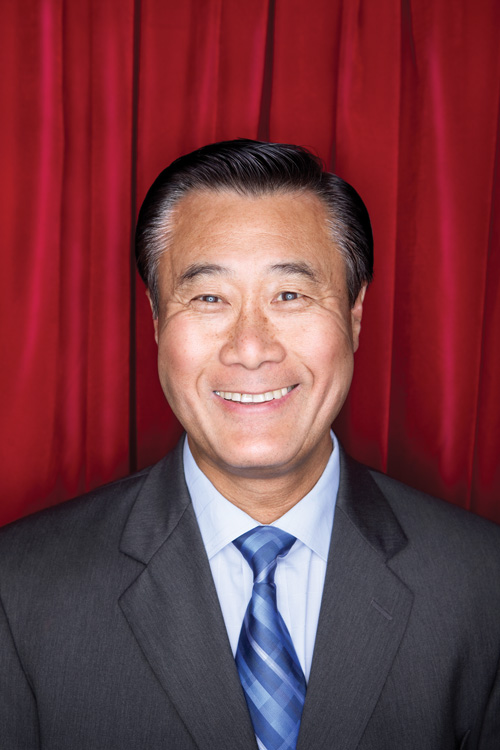
Senator Leland Yee is a political puzzle. He’s a Chinese immigrant who has built a political base almost entirely outside of the traditional Chinatown community. He’s a politician who once represented a deeply conservative district, opposed tenant protections, voted against transgender health benefits and sided with Pacific Gas and Electric Co. on key environmental issues — and now has the support of some of the most progressive organizations in the city. He’s taken large sums of campaign money from some of the worst polluters in California, but gets high marks from the Sierra Club.

His roots are as a fiscal conservative — yet he’s been the only Democrat in Sacramento to reject budget compromises on the grounds that they required too many spending cuts.

He’s grown, changed, and developed his positions over time. Or he’s become an expert at political pandering, telling every group exactly what it wants to hear. He’s the best chance progressives have of keeping the corrupt old political machine out of City Hall — or he’s a chameleon who will be a nightmare for progressive San Francisco.

Or maybe he’s a little bit of all of that.


Leland Yin Yee was born in Taishan, a city in China’s Guangdong province on the South China Sea. The year was 1948; Mao Zedong’s Communist Party of China had taken control of much of the countryside and was moving rapidly to take the major cities. The nationalist army of General Chiang Kai-Shek was falling apart, and Yee’s father, who owned a store, decided it was time for the family to leave.

The Yees made it to Hong Kong, and since Mee G. Yee had previously lived in the United States and served in the U.S. Army during World War II, he was ultimately able to move the family to San Francisco. In 1951, the three-year-old Leland Yee arrived in Chinatown.

For four years, Yee lived with his sister and mother in a one-room apartment with a shared bathroom while his father worked as a sailor in the merchant marine. It was, Yee recalled in a recent interview, a tight, closed, and largely self-sufficient community.

“The movie theater, the shoe store, the barber shop, food — everything you needed you could get in Chinatown,” Yee said. “You never had to leave.”

Of course, after a while, Yee and his mom started to venture out, down Stockton Street to Market, where they’d shop at the Emporium, the venerable department store. “It was like walking into a different country,” he said. “If you didn’t know English, they didn’t have time for you.”

Yee, like a lot of young Chinese immigrants of his era, put much of his time into his studies — in the San Francisco public schools and in a local Chinese school. “My mom spoke a village dialect, and we had to learn Cantonese,” he said. “Every little kid had to go to Chinese school. We hated it.”

When Yee was eight, his parents managed to buy a four-unit building on Dolores Street, and the family moved to the Mission, where he would spend not only the rest of his childhood but much of his early adult life. He graduated from Mission High School, enrolled in City College, studied psychology and after two years won admission to UC Berkeley.

Berkeley in 1968 was a very different world from Chinatown and even the relatively controlled environment he’d experienced at home in the Mission. “You didn’t protest in school. You’d have been sent home, and your mother would kill you,” he said.

At Berekely, all hell was breaking loose, with the antiwar protests, the People’s Park demonstrations, the campaign to create a Third World College (which led to the first Ethnic Studies Department), and a general attitude of mistrust for authority. “I developed a sense of activism,” Yee said. “I realized I could speak out.”

That spirit quickly vanished when Yee lost faith in some of his fellow activists. “People would work with us, then get into positions of power and use that against you,” he recalled. “A lot of my friends said ‘forget it.’ I left the scene.”

Yee once again devoted his energy to school, earning a masters at San Francisco State University and a Ph.D in child psychology from the University of Hawaii. Along the way, he met his wife, Maxine.

With his new degree, the Yees moved back to San Francisco — and back in with his parents at the Dolores property, where he, Maxine and a family that would grow to four kids would live for more than a decade.


Yee worked as a child psychologist for the San Francisco Department of Public Health, starting the city’s first high school mental-health clinic. He went on to become a child psychologist at the Oakland Unified School District, then joined a nonprofit mental health program in San Jose.

In 1986, Yee decided to get active in politics for the first time since college, and ran for the San Francisco School Board. He lost — and that would be the only election he would ever lose. In 1988, he won a seat, and established himself as an advocate for students of color, fighting school closures in minority neighborhoods. He also tried to get the district to modify its harsh disciplinary rules, arguing against mandatory expulsions.

On fiscal issues, though, Yee was a conservative. For his first term, despite the brutal cutbacks of the recession of the late 1980s and early 1990s, he insisted that the district make do with the money it had. His solution to the red ink: Cut waste. Only in 1992, when he was up for re-election, did he acknowledge that the district needed more cash; at that point, he supported a statewide initiative to tax the rich to bring money to the schools.

The sense of fiscal conservatism — of holding the line on taxes, but mandating open and fair contracting procedures and tight financial controls — was a hallmark of much of his political career. When the Guardian endorsed him for re-election to the board in 1992, we wrote that “there’s real value in his continuing vigilance against administrative fat and favoritism in contracts.”

Over the next four years, Yee worked with then-Superintendent Waldemar “Bill” Rojas, a deeply polarizing figure who pushed his own personal theory of “reconstitution” — firing all the staff at low-performing schools — and later was enmeshed in a scandal that led to prison time for a contractor he’d hired. Yee told me he was the only board member to vote against hiring Rojas, but people who were watching the board closely back then say he didn’t always stand up to the superintendent.

He also became what some say was a bit too close with Tim Tronson, a consultant hired by the district as a $1,000-a-day facilities consultant. Tronson wound up getting indicted on 22 counts of grand theft, embezzlement, and conspiracy in a scheme to steal $850,000 from the schools, and was sentenced to four years in state prison.

In 1998, when some school board members wanted to build housing for teachers on property that the district owned in the Sunset, Yee led the opposition — with Tronson’s help. At one meeting at Sunset Elementary School, Yee went so far as to say, according to people present, that “Tim Tronson is my man, and I rely on him for advice.”

Yee acknowledged that he worked closely with Tronson to defeat that housing project. “He was the facilities manager,” Yee explained, “and I said that I trusted his judgment.”


Yee has either a great sense of political timing or exceptional luck. He ran for the Board of Supervisors in 1996, facing one of the weakest fields in modern San Francisco history. He was the only Chinese candidate and one of just two Asians (the other, appointed incumbent Michael Yaki, barely squeaked to re-election). In an at at-large election with the top five winning seats, Yee came in third, with 103,000 votes.

He was never a progressive supervisor. In 2000, the Guardian ranked the good votes of what we referred to as Willie Brown’s Board, and Yee scored only 43 percent. He was against campaign finance reform. He supported the brutal gentrification and community displacement represented by the Bryant Square development. He voted to kill a public-power feasibility study and opposed the Municipal Utility District initiative. He opposed a moratorium on uncontrolled live-work development.

In 2002, Yee was one of only three supervisors to oppose Proposition D, a crucial public-power measure that would have broken up PG&E’s monopoly in the city. He stood with PG&E (and then-Sups. Tony Hall and Gavin Newsom) in opposition to the measure, then signed a pro-PG&E ballot argument packed with PG&E lies.

When I asked him about that stand, Yee at first didn’t recall opposing Prop. D, but then said he “stood with labor” on the issue. In fact, the progressive unions didn’t oppose Prop. D at all; the opposition was led by PG&E’s house union, IBEW Local 1245.

Yee was particularly bad on tenant issues. He not only voted to deny city funding for the Eviction Defense Collaborative, which helped low-income tenants fight evictions; he actually tried to get the city to put up money for a free legal fund to help landlords evict their tenants. He opposed a ballot measure limiting condo conversions. He opposed a measure to limit the ability of landlords to pass improvement costs on to their tenants.

In 2001, Yee voted to uphold a Willie Brown veto of legislation to limit tenancies in common, a backdoor way to get around the city’s condo conversion ordinance. Only Hall and Newsom, then the most conservative supervisors on the board, joined Yee. At one point, he started asking whether the city should consider repealing rent control.

He opposed an affordable housing bond in 2002, joining the big landlord groups in arguing that it would raise property taxes. Every tenant group in town supported the measure, Proposition B; every landlord group opposed it.

I asked Yee about his tenant record, and he told me that he now supports rent control. But he said that he was always on the side of homeowners and small landlords, and that property ownership was central to Chinese culture. “I was responding to the Chinese community and the West Side,” he said.

He wasn’t much of an environmentalist, either — at least not in today’s terms. He was one of the only city officials to support a “Critical Car” rally in 1999, aimed at promoting the rights of vehicle drivers (and by implication, criticizing Critical Mass and the bicycle movement).

His record on LGBT issues was mixed. While he supported a counseling program for queer youth when he was on the school board, he also supported JROTC, angering queer leaders who didn’t want a program in the public schools run by, and used as a recruiting tool for, the military, which at that point open discriminated against gay and lesbian people.


Yee was also one of only two supervisors who voted in 2001 against extending city health benefits to transgender employees.

That was a dramatic moment in local politics. Nine votes were needed to pass the measure, and while eight of the supervisors were in favor, Yee and Hall balked. At one point, Board President Tom Ammiano had to direct the Sheriff’s Office to go roust Sup. Gerardo Sandoval, who was ducking the issue in his office, to provide the crucial ninth vote.

Yee didn’t just vote against the bill. According to one reliable source who was there at the time, Yee spoke to a community meeting out on Ulloa Street in the Sunset and berated his colleagues, quipping that the city should have better things to do than “spend taxpayer money on sex-change operations.”

It was a bit shocking to trans people — Yee had, over the years, befriended some of the most marginalized members of what was already a marginalized community. “There was one person at the rail crying, saying ‘Leland, how could you do this to us,'” Ammiano recalled.

The LGBT community was furious with Yee. “I didn’t speak to him for at least a year,” Gabriel Haaland, one of the city’s most prominent transgender activists, told me.

Yee now says the vote was a mistake — but at the time, he told me, he was under immense pressure. When he voted for the queer youth program, he said, “the elders of the Chinese community ripped me apart. They called my mother’s friends back in the village [where he was born] and said her son was embarrassing the Chinese community.”

That must have been difficult — and he said that “if I had known the pain I had caused, I wouldn’t have voted that way.” But it was hard to miss that pain his vote caused.

On the other hand, people learn from their experiences, attitudes evolve, we all grow up and get smarter, and the way Yee describes it, that’s what happened to him.

In 2006, when he was running for state Senate, Yee met with a group of trans leaders and formally — many now say sincerely — apologized. It was an important gesture that made a lot of his critics feel better about him.

“He didn’t have to do that,” Haaland said. “People change, and he paid for his crime, and that’s genuine enough for me.”

As a former school board member, Yee kept an interest in the schools — but not always a healthy one. At one point, he actually proposed splitting SFUSD into two districts, one on the (poorer) east side of town and one on the (richer) west. “We strongly opposed that,” recalled Margaret Brodkin, who at the time ran Coleman Advocates for Children and Youth. “Eventually he dropped the idea.”

For all the problems, in his time on the Board of Supervisors, Yee developed a reputation for independence from the Brown Machine, which utterly dominated much of city politics in the late 1990s. His weak 43 percent rating on the Guardian scorecard was actually third-best among the supervisors, after Ammiano and the late Sue Bierman.

In 1998, he was one of the leaders in a battle to prevent the owners of Sutro Tower from defying the city’s zoning administrator and placing hundreds of new antennas on Sutro Tower. He, Bierman, and Ammiano were the only supervisors opposing Brown’s crackdown on homeless people in Union Square.

When he ran in the first district elections, in 2000, against two opponents who had Brown’s support and big downtown money, the Guardian endorsed him, noting that while he “can’t be counted on to support worthy legislation … He’s one of only two board members who regularly buck the mayor on the big issues.”

(He never liked district elections, and used to take any opportunity to denounce the system, at times forcing Ammiano to use his position as president to tell Yee to quit dissing the electoral process and get to the point of his speech.)


In 2002, the westside state Assembly district seat opened up, and both Yee and his former school board colleague Dan Kelly ran in the Democratic primary. Yee won, and went on to win the general election with only token opposition.

His legislative record in the Assembly wasn’t terribly distinguished. Yee never chaired a policy committee — although he did win a leadership post as speaker pro tem. And he cast some surprisingly bad votes.

In 2003, for example, then-Assemblymember Mark Leno introduced a bill that would have exempted single-room occupancy hotels from the Ellis Act, which allows landlords to evict tenants for no reason. Yee refused to vote for the bill. Leno was furious — he was one vote short of a majority and Yee’s position would have doomed the bill. At the last minute, a conservative Republican who had grown up in an SRO hotel voted in favor.

When he ran for re-election in 2004, we noted: “What’s Leland Yee doing up in Sacramento? We can’t figure it out — and neither, as far as we can tell, can his colleagues or constituents. He’s introduced almost no significant bills — compared, for example, to Assemblymember Mark Leno’s record, Yee’s is an embarrassment. The only high-profile thing he’s done in the past several years is introduce a bill to urge state and local governments to allow feng shui principles in building codes.”

In 2006, Yee decided to move up to the state Senate, and he won handily, beating a weak opponent (San Mateo County Supervisor and former San Francisco cop Mike Nevin) by almost 2-1. His productivity increased significantly in the upper chamber — and in some ways, he moved to the left. He’s begun to support taxes — particularly, an oil severance tax — and when I’ve questioned him, he somewhat grudgingly admits that Prop. 13 deserves review.

He’s done some awful stuff, like trying to sell off the Cow Palace land to private developers. But he has consistently been one of the best voices in the Legislature on open government, and that’s brought him some national attention.

Yee has been a harsh critic of spending practices and secrecy at the University of California, and when UC Stanislaus refused in 2010 to release the documents that would show how much the school was paying Sarah Palin to speak at a fundraiser, Leland flew into action. He not only blasted the university and introduced legislation to force university foundations to abide by sunshine laws; he worked with two Stanislaus students who had found the contract in a dumpster and made headlines all over the country.

He’s fought for student free speech rights and this year pushed a bill mandating that corporations that get tax breaks for job creation prove that they’ve actually created jobs — or pay the tax money back. He’s also won immense plaudits from youth advocates and criminal justice reformers for his bill that would end life-without-parole sentences for offenders under 18.

Along the way, he compiled a 100 percent voting record from the major labor unions, including the California Nurses Association and SEIU, and with the Sierra Club. All three organizations have endorsed him for mayor.

Yee told me that he thinks he’s become more progressive over the years. “My philosophy has shifted,” he said.

Yet when you talk to his colleagues in Sacramento, including Democrats, they aren’t always happy with him. Yee has a tendency to be a bit of a loner — he’s never chaired a policy committee and in some of the most bitter budget fights, he’s refused to go along with the Democratic majority. Yee insists that he’s taken principled stands, declining to vote for budget bills that include deep service cuts. But the reality in Sacramento is that budget bills have until this year required a two-thirds vote, meaning two or three Republicans have had to accept the deal — and losing a Democratic vote has its cost.

“You have to give up all sorts of things, make terrible compromises, to get even two Republicans,” one legislative insider told me. “When a Democrat goes south, you have to find another Republican, and give up even more.”

In other words: It’s easy to take a principled stand, and make a lot of liberal constituencies happy, when you aren’t really trying to make the state budget work.


I met Rose Pak on a July afternoon at the Chinatown Hilton. She brought along her own loose tea, in a paper package; the waitress, who clearly knew the drill, took it back to the kitchen to brew. Pak and I have not been on the greatest of terms; she’s called the Guardian all kinds of names, and I’ve had my share of critical things to say about her. But on this day, she was polite and even at times charming.

After we got the niceties out of the way (she told me I was unfair to her, and I told her I didn’t like the way she and Willie Brown played politics), we started talking about Yee. And Pak (unlike some people I interviewed for this story) was happy to speak on the record.

She told me Yee had “no moral character.” She told me she couldn’t trust him. She told me a lot of stories and made a lot of allegations that we both knew neither she nor I could ever prove.

Then we got to talking about the politics of Chinatown and Asians in San Francisco, and a lot of the animosity toward Yee became more clear.

For decades, Chinatown and the institutions and people who live and work there have been the political center of the Chinese community. Nonprofits like the Chinatown Community Development Center have trained several generations of community organizers and leaders. The Chinese Chamber of Commerce, the Six Companies, and other business groups have represented the interests of Chinese merchants. And while the various players don’t always get along, there’s a sense of shared political culture.

“In Chinatown,” Gordon Chin, CCDC’s director, likes to say, “it’s all about personal connections.”

There’s a lively infrastructure of community-service programs, some of which get city money. There’s also a sense that any mayor or supervisor who wants to work with the Chinese community needs to at least touch base with the Chinatown establishment.

Yee doesn’t do that. “He doesn’t give a shit about them,” David Looman, a political consultant who has worked with many Chinese candidates over the years, told me.

Yee’s Asian political base is outside of Chinatown; he told me he sees himself representing more of the Chinese population of the Sunset and Richmond and the growing Asian community in Visitacion Valley and Bayview.

Pak is connected closely to Brown, who Yee often clashed with. For Pak, Brown, and their allies, strong connections to City Hall mean lucrative lobbying deals and public attention to the needs of Chinatown businesses. Then there’s the nonprofit sector.

CCDC and other nonprofits do important, sometimes crucial work, building and maintaining affordable housing, taking care of seniors, fighting for workers rights, and protecting the community safety net. Yee, Pak said, “has never shown any interest in our local nonprofits. We all work together here, and he doesn’t seem to care what we do.” Yee told me he has no desire to see funding cut for any critical social services in any part of town. But he has also made no secret of the fact that he questions the current model of delivering city services through a large network of nonprofits, some of which get millions of taxpayer dollars. And the way Pak sees it, all of that — the nonprofits, the business benefits, the contracts — are all at risk. “If Leland Yee is elected mayor,” she told me, “we are all dead.”

I ran into an old San Francisco political figure the other day, a man who has been around since the 1970s, inside and outside of City Hall, who remains an astute observer of the players and the power relationships in the local scene. At the time we talked, he wasn’t supporting any of the mayoral candidates, but he had a thought for me. “This town,” he said, “is being taken over by a syndicate. Willie Brown is the CEO, and Rose Pak is the COO, and it’s all about money and influence.”

That’s not a pleasant thought — I’ve lived through the era of political machine dominance in this town, and it was awful. In the days when Brown ran San Francisco, politics was a tightly controlled operation; only a small number of people managed to get elected to office without the support of the machine. Developers made land-use policy; gentrification and displacement were rampant; corruption at City Hall turned a lot of San Franciscans off, not only to the political process but to the whole notion that government could be a positive force in society.

A few years ago, I thought those days were over — and to a certain extent, district elections will always make machine politics more difficult. But when I see signs of the syndicate popping up — and I see a candidate like Ed Lee, who’s close friends with Brown, leading the Mayor’s Race — it makes me nervous. And for all his obvious flaws, at least Leland Yee isn’t part of that particular operation. If there’s a better reason to vote for him, I don’t know what it is.

YEE HOME PURCHASE RAISES SUSPICIONS

Rose Pak has a question about Leland Yee. “How,” she asked me, “did the guy manage to buy a million-dollar house on a $30,000 City Hall salary?”

Pak isn’t the only one asking — numerous media reports over the years have examined how Yee raised a family of four and bought a house in the Sunset on very little visible income. And while I’m not usually that interested in the personal finances of political candidates, I decided that it was worth a look.

Here’s what I found: Public records show that in July 1999, Yee and his wife, Maxine, purchased a house on 24th Avenue for $875,000 (it’s now assessed at slightly more than $1 million). At the time, Yee was a San Francisco supervisor, earning a little more than $30,000 a year. (The salary of the supervisors was raised dramatically shortly after Yee left the board and went to the state Assembly.) His wife wasn’t working. And his economic interest statements for that period show no other outside earnings. So the disposable, after-tax income of the entire Yee family couldn’t have been much more than $25,000.

That, by any normal standard, shouldn’t have been enough to float a mortgage that, records show, totaled $516,000. In fact, the interest payments alone on that mortgage alone would total $3,600 a month — more than Yee’s gross income.

Documents in the Assessor’s Office show another paper trail, too. In 1989, Jung H. Lee, Yee’s mother, transferred the deed on a four-unit Dolores St. building where the family had been living to Maxine and Leland Yee — for no money. And a few months before the Yees bought the Sunset house, they took out a $320,000 home-equity loan on that property. That was the down payment on the Sunset property.

Still: At that point, the Yees would have been paying off two mortgages, with a total nut of about $5,000 a month — and supporting four kids, in San Francisco. In 2002, Yee’s economic interest statement’s show some modest income from teaching at Lincoln University — but nowhere near enough to pay that level of expenses.

What happened? Yee explains it this way: “For more than 10 years, we were living rent-free in my parents’ property,” he told me I an interview. “We were a close Chinese family, and my parents provided the food and helped pay for the children’s clothing. So we had almost no expenses and we lived very frugally.”

During that period, Yee was working for the San Francisco Department of Public Health, the Oakland Unified School District, and a San Jose nonprofit, earning, he said, between $50,000 and $90,000 a year. If he saved almost all of that money, he would have had more than a half-million dollars in the bank when he bought the Sunset house.

There’s nothing on any of his economic disclosure forms showing any ownership of stocks or other reportable financial interests during that period, so he wasn’t investing the money. In fact, he says, it was, and is, all in simple savings accounts. A bit unusual for that large a sum of money.

How did he get a mortgage? “Back then,” he said, “banks were willing to lend a lot more freely than they do today.”

Starting in 2003, Yee was in the state Assembly, making a higher salary — but still not much in excess of $100,000 a year. After taxes, he was probably taking home about $75,000 — and $60,000 was going to the two mortgages.

How did he do it? “We have been supplementing our income with our savings,” he said. “We don’t take vacations, we are very careful with our money.” And they clearly aren’t desperate for cash — Yee’s daughter occupies two of the four units in the Dolores St. building they own, but the other two units are vacant.

It’s possible. It’s plausible. But I don’t blame people for wondering how he managed to pull it off. (Tim Redmond, with research assistance by Oona Robertson) 


BIG CORPORATIONS HAVE BACKED YEE

Yee became a prodigious fundraiser in Sacramento — and a lot of the money came from big corporations that had business in the Legislature. And while he has perfect scores from the Sierra Club and the big labor unions, he’s taken tens of thousands of dollars from some of the biggest corporations, agribusiness interests, and polluters in the state. And at times, he’s voted their way.

Since 1993, for example, campaign finance records show Yee has taken more than $20,000 from Chevron, ExxonMobil, Valero, Conoco Phillips, and BP. He’s received another $22,450 from the chemical industry (and industry employees). Most of it came from Clorox, Dow Chemical, and Dupont.

And while the Sierra Club may not have considered it a priority, Sen. Mark Leno has worked hard to pass a bill limiting chemical fire retardants in furniture. In 2008, Yee voted against Leno’s AB 706.

That year he also refused to support a bill that would prohibit the use of the chemical diacetyl in workplaces. The industries that opposed AB 514 (including Bayer, Abbott Laboratories, Pfizer, and Johnson & Johnson) have given Yee a total of more than $60,000.

In 2003, Yee voted against a crucial tenant bill, one that would have prevented the owners of single room occupancy hotels from using the Ellis Act to evict tenants. He received a campaign check for $2,500 from the San Francisco Apartment Association the next day. Landlords in general have given Yee close to $40,000.

Then there’s agribusiness. Yee gets a lot of money from the farming industry, despite the fact that there obviously aren’t many farms in his district. Why, for example, would the California Poultry Association, the California Cattlemen’s Association, and the California Farm Bureau give him money? The Poultry Association’s Bill Mattos told us that Yee “has taken a keen interest in California’s poultry industry.”

Yee also took immense flak from the San Francisco Chronicle and other papers over a 2003 vote against a bill to limit emissions from farm vehicles. In an editorial, the paper wrote that he was “doing dirty work for the lobbyists.” In the end, under immense public pressure, he switched positions and voted for the bill. I asked Yee about all that money from all those bad operators, and he told me — as most politicians will — that campaign cash has never influenced any of his votes.

So why do all these groups give him money? “It’s about whether you will sit down and listen,” Yee said. “I will talk to all sides and at least consider the arguments as a thoughtful human being. Then I vote my conscience.” (Tim Redmond, with research by Oona Robertson) 

Lee appointment of Nuru darkens the ethical cloud over Room 200

10

City Attorney Dennis Herrera deserves credit for being the one mayoral candidate willing to bring a full-throated denunciation of the sleazy and corrupt politics now flowing from Mayor Ed Lee, who yesterday appointed discredited political fixer Mohammed Nuru to head the Department of Public Works, compounding a series of ethically questionable actions by Lee and his supporters.

While it was inexplicably buried by editors at the bottom of Section C, the Chronicle’s City Insider today had a pair of good stories on Lee’s mounting political problems. The first was about how the U.S. Attorney’s Office has reportedly launched a probe of Progress for All and its “Run, Ed, Run” campaign, for which Lee ally Rose Pak illegally sought support from executives at Recology, the garbage company that had just been awarded a huge city contract, largely because then-City Administrator Lee had given the company far higher ratings than the other two supposedly impartial bid judges.

The second story was about Herrera slamming Lee’s choice of Nuru. On his campaign website, Herrera reminded voters about the scandals that have surrounded Nuru – like Lee, someone who has always taken his cues from former Mayor Willie Brown – who illegally diverted city funds and workers into campaigning for Brown in 1999 and Gavin Newsom in 2003. Brown now writes for the Chronicle and is even allowed to comment on the mayor’s race.

The scandal – first broken by the Chronicle in 2004, furthered by reporting in the Guardian, and then investigated by Herrera’s office – involved Nuru steering city funds to his nonprofit San Francisco League of Urban Gardeners and then requiring its employees to illegally do campaign work during work hours. Nuru then went to work for Lee at the DPW while continuing to illegally use SLUG’s funds and employees for political purposes.

Herrera said the appointment smacks of “cronyism, politics, and poor judgment.” Previously, Herrera had the best line about Lee as he jumped into race, telling a mayoral forum: “To my mind, Ed Lee’s biggest problem isn’t that he’s a dishonest man – it’s that he’s not his own man,” Herrera said. “The fact is, if Ed Lee is elected mayor, powerful people will continue to insist on things.”

Topping that list of the powerful people who have clearly been pulling Lee’s strings throughout his career are Pak and Brown, both of whom are consultants who regularly get paid by corporations that do big business with the city and need support from the Mayor’s Office. And their actions are often blatant and shameless, just like Nuru’s history, and even exposure of the misdeeds doesn’t correct the problem.

For example, as I reported last week, Brown’s administration helped Pak buy a Rincon Hill condo for half-price through a city affordable housing program in 2002, even though her disclosure forms showed she had $73,414 in her checking account, some of which probably included the $12,000 consulting fee she reported on her tax return from Emerald Fund – the politically connected developer of the project, employees of which are barred from buying such below-market rate units – and $10,000 from Chiang CM Construction, which helped fund Progress for All.

Most of this information was prominently reported in 2003 by the Examiner, but nothing was ever done. Pak got to keep her taxpayer-subsidized condo. Same thing with Nuru, who remained at DPW even after the City Attorney’s Office and Controller’s Office concluded his actions were corrupt. And Lee was appointed interim mayor even after being tied to several corrupt Brown scams, including overriding city workers to give contracts to fraudulent companies at Brown’s behest.

And now, Lee has placed Nuru in charge of a city department with a $129 million city budget and 1,200 employees, despite Nuru’s proven history of directing his subordinates to illegally campaign for his mayoral benefactors. You couldn’t even make this stuff up, and even Examiner columnist Melissa Griffin flatly calls the move “stupid.”

But I think it’s more than just stupid. And the appointment of Nuru is more than just a setback from DPW that good government activists had been fearing for a long-dysfunctional department that had gotten much better in recent years. It looks like flat-out corruption of the sort that ought to knock Lee out of the frontrunner position and hopefully land him in front of a grand jury at some point.

Obama, Lee, Avalos, and the arc of history

84

People need to hear compelling stories, particularly from those who aspire to lead them, a point that author and psychologist Drew Westen nailed in his incisive think-piece in Sunday’s New York Times, “What Happened to Obama?” His conclusions also apply in San Francisco, where progressives have lost control of the narrative to the tax-cutting centrists, who are telling stories that serve mainly to enfeeble the people and prop up powerful interests.

“The stories our leaders tell us matter, probably almost as much as the stories our parents tell us as children, because they orient us to what is, what could be, and what should be; to the worldviews they hold and to the values they hold sacred. Our brains evolved to ‘expect’ stories with a particular structure, with protagonists and villains, a hill to be climbed or a battle to be fought,” Westen writes.

Contrast that with the guiding narrative in San Francisco politics right now, put forth by Mayor Ed Lee, his supporters, and the crew of mostly bland centrists who aspire to replace him, all of whom cast conflict itself as the villain. Much like Obama, they all style themselves as the administrators-in-chief, conflict-averse protagonists content to compromise away what little wealth and power the average citizen still possesses. Not only does that narrative guarantee that Lee will be elected, but it’s a false and short-sighted narrative that does a profound disservice to this city.

The one candidate in the mayor’s race who understands that class matters, that conflict is a necessary part of politics, and that we’re all getting screwed over by the rich and powerful is John Avalos. But despite some flashes of progressive populism on the stump, he hasn’t really been consistently and boldly telling San Francisco the story of itself that it really needs to hear right now, which is the same story that Obama should be telling the American people.

“I know you’re scared and angry. Many of you have lost your jobs, your homes, your hope. This was a disaster, but it was not a natural disaster. It was made by Wall Street gamblers who speculated with your lives and futures. It was made by conservative extremists who told us that if we just eliminated regulations and rewarded greed and recklessness, it would all work out. But it didn’t work out,” begins the story that Westen said Obama should have told during his inaugural address.

And that’s the story that Avalos should be telling right now, combating the myths that have been put out there by Lee, David Chiu, Bevan Dufty, Dennis Herrera, and the other centrists in the race, that if we just give Twitter, Zynga, Oracle, Sutter Health, Willie Brown’s clients, and every other corporation and developer who promises to create jobs everything they want, then we’ll all be okay.

But on some level, we all know that just isn’t true, and it hasn’t been true for a long time. Only a fool would trust them to take care of us at this point. The greed and self-interest of rich individuals and corporations – which has gone unchecked for far too long, at least partly because of the political corruption they’ve sponsored – is reaching epidemic proportions. It is the villain that needs to be fought, it is the hill that needs to be climbed.

“When faced with the greatest economic crisis, the greatest levels of economic inequality, and the greatest levels of corporate influence on politics since the Depression, Barack Obama stared into the eyes of history and chose to avert his gaze. Instead of indicting the people whose recklessness wrecked the economy, he put them in charge of it. He never explained that decision to the public — a failure in storytelling as extraordinary as the failure in judgment behind it. Had the president chosen to bend the arc of history, he would have told the public the story of the destruction wrought by the dismantling of the New Deal regulations that had protected them for more than half a century. He would have offered them a counternarrative of how to fix the problem other than the politics of appeasement, one that emphasized creating economic demand and consumer confidence by putting consumers back to work. He would have had to stare down those who had wrecked the economy, and he would have had to tolerate their hatred if not welcome it. But the arc of his temperament just didn’t bend that far,” Westen wrote.

He was riffing off Obama’s penchant for quoting the MLK line, “The arc of the moral universe is long, but it bends toward justice,” which he returned to again with his devastating conclusion: “But the arc of history does not bend toward justice through capitulation cast as compromise. It does not bend when 400 people control more of the wealth than 150 million of their fellow Americans. It does not bend when the average middle-class family has seen its income stagnate over the last 30 years while the richest 1 percent has seen its income rise astronomically. It does not bend when we cut the fixed incomes of our parents and grandparents so hedge fund managers can keep their 15 percent tax rates. It does not bend when only one side in negotiations between workers and their bosses is allowed representation. And it does not bend when, as political scientists have shown, it is not public opinion but the opinions of the wealthy that predict the votes of the Senate. The arc of history can bend only so far before it breaks.”

That is the moment we find ourselves in, both as a country and as a city. And it is a story that we’re still waiting for a future leader to tell us with enough power and passion that we all begin to believe it.

Editor’s Notes

tredmond@sfbg.com

I had, as they say, a spirited and frank discussion last week with Enrique Pearce, the political consultant working on the Run Ed Run campaign. I chided Pearce, whose firm is called Left Coast Communications, for leading an effort that, at the very least, involves some touchy legal and ethical issues. (After all, the group is raising money for a campaign for a candidate who hasn’t filed as a candidate. There are reasons why federal, state, and local laws mandate that people who are running for office declare that they want the office before they start raising money.)

Pearce insisted he was doing nothing illegal. (Okay, if he says so.) He also argued that his firm is the most progressive consulting operation in the city. (Whatever.) But the real focus of our discussion — and the reason it’s worth talking about — was the question of whether corruption really matters.

I think sleaze — and the appearance of sleaze — is a defining progressive issue. If Pearce agrees, he’s got some ‘splainin’ to do.

Let’s back up here. When Willie Brown was speaker of the state Assembly, he passed some good legislation, and allowed some very bad legislation to become law. But his greatest legacy is term limits — and the terrible public perception of what was once one of the best state legislatures in the nation.

Brown was the epitome of corruption, a guy who actively flouted the notion of honest, open government. Among other things, he had a private law practice on the side — and clients would pay him big money because of his influence on state legislation. Of course, we never knew who the clients were; he wouldn’t release the list.

When he was mayor, his sleazy ways continued — and left even progressive San Franciscans believing that you can’t trust City Hall with your money. Which means, of course, that it’s harder to convince anyone to pay more taxes.

There’s no question that Brown and Chinatown powerbroker Rose Pak (don’t get me started) were key players in putting Mayor Ed Lee in office, and that they’re playing a big role in this new effort. Which means, as far as I’m concerned, that it’s utterly untrustworthy — and that progressives should be miles and miles away.

I’m not arguing that Ed Lee is a bad mayor (he’s way better than the last guy). He might even turn into a good mayor if he runs for a full term. Pearce thinks he’d be better for progressives than state Sen. Leland Yee. We can argue that later.

But as long as his campaign is directly linked to people whose standard practices undermine the heart of the progressive agenda (which depends on a belief that government can be trusted to take on social problems), then you can count me out.

Don’t go changin’

0

arts@sfbg.com

THEATER The story of earnest young traveling salesman Gregor Samsa, who awakens one morning to discover he has changed into something he and his family can only describe as vermin, Kafka’s 1915 novella The Metamorphosis has undergone a number of metamorphoses of its own in terms of adaptations for stage and screen. One of the latest is the lauded 2006 interpretation by actor Gísli Örn Gardarsson and director David Farr, a coproduction between Iceland’s Vesturport Theatre and England’s Lyric Hammersmith that debuted in London and made its U.S. premiere at the Brooklyn Academy of Music last winter.

Berkeley’s Aurora Theatre offers the first wholly American production of this stage version, under the direction of Bay Area playwright-director-actor Mark Jackson. The production has many fine features, but the balance between the social and emotional content of the story and its abstract or absurdist framework gets skewed a bit too far toward the latter.

Jackson’s production stakes out its own territory by eschewing the Nazi-era periodizing of the original Vesturport–Lyric Hammersmith production. This Metamorphosis is set in the American 1950s — although the trappings of that place and time are only vaguely evoked here. Indeed, the costumes, semi-abstract split-level set, and heightened performance style together seem a blurry blend of Germanic petit bourgeois culture, high modernism, and Leave It to Beaver-esque TV surreality.

A horror and embarrassment to his family, Gregor (a winningly agile and sympathetic Alexander Crowther) confines himself most of the time to a variety of perches in his second-floor room — an environment rendered via a striking modernist pop-out painting and vertical jungle gym by Nina Ball. Its spare features are all askew and rotated forward on a sloped, accordion-like set of ridges, a veritable waterfall of steps supporting an elongated metallic bed frame and the creeping, scrambling Crowther.

Formerly the main breadwinner of his downwardly mobile lower-middle-class family, Gregor does not report for work one day. It’s that day, of course, that he drops so far in the estimation of his family that he is no longer even comprehensible to them, no longer even human. They instinctively side with his overbearing employer (Patrick Jones) and consider their own plight now that they must fend for themselves. Only his beloved sister Grete (Megan Trout) makes a serious attempt at communication and sympathy, although with melancholy results.

Grete is the key figure in this brisk 80-minute stage adaptation. Her brother’s transformation entails her own, from a would-be dancer into an eligible commodity in the material calculations of her desperate family and finally into a self-possessed agent in the cold material world. Trout is sharp but perhaps too perky and superficial in the role, since the anguish Gregor feels at seeing her metamorphose doesn’t have the same impact in the absence of a convincing sibling bond. Gregor clearly lives vicariously through the promise of Grete’s freedom, her life as an artist. When that dies, when she is transformed, his own demise is complete.

Gregor’s parents (played with sure satirical exaggeration but, again, little beyond comic anguish by Madeline H.D. Brown and Allen McKelvey) also feel too distant from it all. The cast offers little coherence as a family, albeit a fractured one. Instead we get a nicely wrought metaphor without much of a sense of its stakes, a lost opportunity and no doubt an unintended consequence. Bosses and subhumans, marriage as sexual commerce, art as perversion, the quiet everyday destruction of personality, the corruption of the closest social bonds by vast coercive hierarchies of power and authority — Jackson’s right, you don’t need to go back to Nazi Germany to find all that. It should all feel closer to home. *

METAMORPHOSIS

Through July 17

Wed.–Sat., 8 p.m.; Tues. and Sun., 7 p.m.;

Also Sun., 2 p.m., $10–$55

Aurora Theatre

2081 Addison, Berk.

(510) 843-4822

www.auroratheatre.org

Dick Meister: Can a woman beat Hoffa?

0


A woman as president of the macho Teamsters Union that was once headed by supermacho Jimmy Hoffa? It could happen. 

Sandy Pope thinks so, and she’s going to try as hard as she can to make it happen – going to try as hard as she can to succeed Hoffa’s lawyer son, Jimmy junior, as head of one of the country’s largest and most powerful unions.

If a majority of delegates at the Teamster convention that opened today in Las Vegas vote for Pope to unseat Hoffa, who was first elected a dozen years ago, she’ll be only the third woman to ever head an international union.

Randi Weingarten, the highly regarded president of the American Federation of Teachers, who took office in 2008, is one of the others. The third is Mary Kay Henry, who just recently succeeded the controversial Andy Stern as president of the country’s largest union, the 1.3 million-member Service Employees International Union, the SEIU.

The Teamsters comes in at number two, with 1.2 million members. Hoffa’s supporters argue that Sandy Pope is not up to handling such a huge and diverse union. Her record, however, seems to indicate otherwise.

For 33 years, the 54-year-old Pope has held her own in the union’s macho culture, as a driver of big long haul freight trucks and as a warehouse worker.  For seven years she’s been president of a New York Teamster local of drivers and warehouse workers, one of only 16 of the Teamster’s 407 locals nationwide to be headed by a woman.

Before that, Pope was an international union representative in the Teamster’s warehouse division. She’s been a longtime leader of the Teamsters for a Democratic Union (TDU), which has exposed much of the corruption that’s been common in the union since the days of Hoffa senior as president.

The TDU’s work has led to some important corrections in union operations, but much remains to be done, and it’s unlikely that Hoffa junior would do much about it.  As the incumbent, he’s running a status quo campaign. Some local level Teamster officials fear retaliation from Hoffa and his allies if they campaign for Pope.

But Pope certainly isn’t backing off one bit. She’s promising to halt or at least slow the concessions that Teamster negotiators have granted employers in recent years.  Under her, she says, the union” will close the concessions stand.”

It also would push the union’s officers off the gravy train. In one Minnesota Teamsters local closely allied with Hoffa, for instance, the principal officer is paid $200,000 a year. Hoffa himself is paid $363,000.  And that’s going on at the same time that many rank-and-file Teamsters are taking pay and benefit cuts and otherwise feeling the effects of a declining economy.

It’s what the pro-labor magazine “Labor Notes” quite accurately calls “the union leadership’s back-scratching, pocket-lining culture.”

Generally speaking, Pope’s promising to return to the basics of union operations – to build public support, mobilize the union’s current members and wage a major organizing drive to recruit new members. Pope also promises that some 20,000 of the union’s members whose jobs have been downgraded to part-time can expect a drive to make those jobs full-time.

It’s clear that, like many dissident Teamsters, Sandy Pope is “sick of having a lawyer with a big name hijack our union.”


Dick Meister, former labor editor of the SF Chronicle and KQED-TV Newsroom, has covered labor and politics for more than a half-century. Contact him through his website, www.dickmeister.com, which includes more than 300 of his columns.


Film Listings

0

Film listings are edited by Cheryl Eddy. Reviewers are Kimberly Chun, Michelle Devereaux, Peter Galvin, Max Goldberg, Dennis Harvey, Johnny Ray Huston, Louis Peitzman, Lynn Rapoport, Ben Richardson, and Matt Sussman. For rep house showtimes, see Rep Clock. For first-run showtimes, see Movie Guide.

FRAMELINE

The 35th San Francisco International LGBT Film Festival runs June 16-26 at the Castro, 429 Castro, SF; Rialto Cinemas Elmwood, 2966 College, Berk; Roxie, 3117 16th St., SF; and Victoria, 2961 16th St., SF. For tickets (most films $9-$15) and complete schedule, visit www.frameline.org.

OPENING

The Art of Getting By The Art of Getting By is all about those confusing, mixed-up and apparently sexually frustrating months before high school graduation. George (Freddie Highmore) is a trench coat-wearing misanthrope — an old soul, as they say — whose parents and teachers are always trying to put him inside a box and tell him how to think. He finds a kindred sprit in Sally (Emma Roberts) who smokes and watches Louis Malle films. Hot. Heavily scored by the now-ancient songs of early ’00s blog bands, it may all sound like indie bullshit but this one has charm and wit despite its post-trend package. Like a sad little crayon, Highmore is a competent Michael Cera surrogate du jour. Writer-director Gavin Wiesen embraces hell of clichés, but he suitably sums up a generational angst along the way. The film may not always feel real, but it does have real feeling. Look out for great performances from Blair Underwood and Alicia Silverstone. (1:24) Shattuck, Sundance Kabuki. (Ryan Lattanzio)

*Beautiful Boy Save the children, but pity the parents. Director-cowriter Shawn Ku’s Beautiful Boy is one of two recent films concerning parents of kids who go on school killing sprees, and it’ll get potentially shortchanged due to the forthcoming We Need to Talk About Kevin‘s head-turning cast and its Hitchcockian literary source material. Still, Beautiful Boy shines in its own humble way, by dint of its quiet sense of integrity and refusal to pander. The bone-deep unhappiness suffusing the family concerned was present long before 18-year-old college student Sammy (Kyle Gallner) picked up a gun, killed more than a dozen people, then took his own life. Surviving parents Kate (Maria Bello) and Bill (Michael Sheen) already kept separate bedrooms under the same roof and led separate lives, with Bill pasting an unsettling grin on for work and Maria relentlessly pushing to make everything all right, neither noticing the barely perceptible warning signs that their only son was succumbing to despair. Belying its title, Beautiful Boy is less focused on the desperate youngster than on the adults attempting to cope with the horror he’s wrought — not necessarily cleaning up after him or picking up the pieces, but somehow finding their way through their own explosive responses. Bolstered by fine performances by Bello and Sheen, it’s yet another installment in the post-9/11 cinema of trauma — this time, attempting to imagine the unimaginable and to comprehend a kind of healing. (1:40) SF Center. (Chun)

Green Lantern Ryan Reynolds stars as the green-suited hero. (1:45) Four Star, Presidio, Sundance Kabuki.

Just Like Us You want to like Just Like Us, Egyptian American director-comedian Ahmed Ahmed’s documentary charting his tour of the Middle East. The comic gets credit for touching on potentially thought-provoking material while fishing for laughs amid a potential minefield of religious and cultural taboos and pushing audience boundaries in countries where national borders are hard-fought and loaded with controversy. Journeying from Dubai to Beirut to Ahmed’s ancestral homeland, the friendly band of merrymakers, including female comic Whitney Cummings, deals with self-censorship, sight-sees, and learns what kind of jokes fly with an audience unaccustomed to the conventions of standup comedy. Unfortunately the doc feels self-interested and suffers from the fact we hear so little from the ordinary people in the cheap seats. The hope is that Ahmed and his crew would break it all down and crack it open, but just as its title and its comedians’ jokes go, Just Like Us prefers to play it safe, underlining a good-natured message of inclusion and unity, never quite hitting the smart, sharp commentary that the best comedy aspires to. (1:12) Lumiere. (Chun)

*Last Mountain Appalachia remains a gorgeous natural refuge — at least those parts not razored by coal-mining corporations who dynamite the tops off hills in order to access mineral deposits. Flooding, deforestation, chemical contamination, and human ailments including brain tumors are among the significant accusations levied against greedy privatizations by Bill Haney’s documentary. On the other hand, a huge amount of the nation’s electricity hies from the region’s coal. Gorgeously photographed, Last Mountain is a stark portrait of political corruption rolling back all environmental regulation. Who’s the major reactionary villain here? Duh: W. At times the movie seems overmuch a promotion for Robert F. Kennedy, Jr., a croak-voiced environmental activist who objects to the spoilage of his privileged childhood vacation playground. But he’s right — at least ideologically. (To his credit, he calls out corporations as the dominating players in “our campaign finance system, which is just a system of legalized bribery.”) For locals who’ve both profited and suffered from strip-mining (the area’s cancer rate is sky-high, sometimes-fatal workplace violations ditto), as well as imported civil disobedience protestors, the reality is much harsher. (1:35) Embarcadero, Shattuck. (Harvey)

*Making the Boys In 1968 The Boys in the Band revolutionized Broadway and opened a lot of minds by being a hit play (and film) about NYC homosexuals. Yet on the cusp of “Gay Liberation” and for many years thereafter, much of the actual gay community hugely objected to author Mart Crowley’s fictive portrait of its ‘mos as insular, shallow, classist, bitchy, and guilt-ridden. It was (as interviewee Edward Albee notes here) a picture ideally suited to straight Broadway audiences who lined up to see queers rendered pitiful if still identifiably human. Crayton Robey’s absorbing documentary chronicles the bumpy road of Boys and its creators — Crowley never had another hit, floundering until he moved into TV series scripting. The cast of the 1970 movie version, directed by William Friedkin (one year before The French Connection, followed by The Exorcist), saw their big break turn into a virtual industry blacklisting. Exceptions were unimpeachably heterosexual thespians Laurence Luckinbill and Cliff Gorman, who only “played” gay. This engrossing document recalls a work that trailblazed, was rejected as politically correct, then re embraced as an important touchstone in gay visibility and self-empowerment. (1:33) Roxie. (Harvey)

Mr. Popper’s Penguins Jim Carrey plays a New Yorker who suddenly finds himself taking care of six penguins. Wackiness ensues. (1:35) Presidio.

*The Trip See “In Spite of Himself.” (1:52) Clay, Smith Rafael.

*Trollhunter Yes, The Troll Hunter riffs off The Blair Witch Project (1999) with both whimsy and, um, rabidity. Yes, you may gawk at its humongoid, anatomically correct, three-headed trolls, never to be mistaken for grotesquely cute rubber dolls, Orcs, or garden gnomes again. Yes, you may not believe, but you will find this lampoon of reality TV-style journalism, and an affectionate jab at Norway’s favorite mythical creature, very entertaining. Told that a series of strange attacks could be chalked up to marauding bears, three college students (Glenn Erland Tosterud, Tomas Alf Larsen, and Johanna Morck) strap on their gumshoes and choose instead to pursue a mysterious poacher Hans (Otto Jespersen) who repeatedly rebuffs their interview attempts. Little did the young folk realize that their late-night excursions following the hunter into the woods would lead at least one of them to rue his or her christening day. Ornamenting his yarn with beauty shots of majestic mountains, fjords, and waterfalls, Norwegian director-writer André Ovredal takes the viewer beyond horror-fantasy — handheld camera at the ready — and into a semi-goofy wilderness of dark comedy, populated by rock-eating, fart-blowing trolls and overshadowed by a Scandinavian government cover-up sorta-worthy of The Girl with the Dragon Tattoo (2009). (1:30) Lumiere, Shattuck. (Chun)

ONGOING

*L’Amour Fou Pierre Thoretton’s documentary L’amour fou opens with two clips of men bidding farewell. The first, from 2002, is of the French-Algerian couturier Yves Saint Laurent announcing his retirement in a moving and emotional speech worthy of his favorite writer Marcel Proust. The second is of Pierre Bergé, Saint Laurent’s longtime business partner and former lover, eulogizing his departed friend at the designer’s memorial service six years later. Thoretton’s film is suffused with goodbyes, many tender and candid, some portentous and rehearsed. To be sure, L’amour fou is a touching portrait of the powerful and tempestuous bond between Saint Laurent and Bergé, a bond that lasted close to five decades and resulted in one of the great empires of 20th century fashion. But it is also, alongside David Teboud’s two 2002 YSL documentaries, another entry in the hagiography of Saint Laurent, one cannily steered by Bergé as much as by Thoretton. Well-spoken and charming, Bergé still comes off as the punchy entrepreneurial foil to Saint Laurent’s dazzling but fragile genius. He can be both hyperbolic (praising Saint Laurent’s gifts) but also forthcoming (discussing the designer’s demons). Former muses Loulou de la Falaise and Betty Catroux are also interviewed, but this is clearly Bergé’s show. (1:43) Opera Plaza. (Sussman)

*Beginners There is nothing conventional about Beginners, a film that starts off with the funeral arrangements for one of its central characters. That man is Hal (Christopher Plummer), who came out to his son Oliver (Ewan McGregor) at the ripe age of 75. Through flashbacks, we see the relationship play out — Oliver’s inability to commit tempered by his father’s tremendous late-stage passion for life. Hal himself is a rare character: an elderly gay man, secure in his sexuality and, by his own admission, horny. He even has a much younger boyfriend, played by the handsome Goran Visnjic. While the father-son bond is the heart of Beginners, we also see the charming development of a relationship between Oliver and French actor Anna (Mélanie Laurent). It all comes together beautifully in a film that is bittersweet but ultimately satisfying. Beginners deserves praise not only for telling a story too often left untold, but for doing so with grace and a refreshing sense of whimsy. (1:44) Embarcadero, Piedmont, Sundance Kabuki. (Peitzman)

*Bill Cunningham New York To say that Bill Cunningham, the 82-year old New York Times photographer, has made documenting how New Yorkers dress his life’s work would be an understatement. To be sure, Cunningham’s two decades-old Sunday Times columns — “On the Street,” which tracks street-fashion, and “Evening Hours,” which covers the charity gala circuit — are about the clothes. And, my, what clothes they are. But Cunningham is a sartorial anthropologist, and his pictures always tell the bigger story behind the changing hemlines, which socialite wore what designer, or the latest trend in footwear. Whether tracking the near-infinite variations of a particular hue, a sudden bumper-crop of cropped blazers, or the fanciful leaps of well-heeled pedestrians dodging February slush puddles, Cunningham’s talent lies in his ability to recognize fleeting moments of beauty, creativity, humor, and joy. That last quality courses through Bill Cunningham New York, Richard Press’ captivating and moving portrait of a man whose reticence and personal asceticism are proportional to his total devotion to documenting what Harold Koda, chief curator at the Costume Institute at the Metropolitan Museum of Art, describes in the film as “ordinary people going about their lives, dressed in fascinating ways.” (1:24) Balboa, Opera Plaza. (Sussman)

Bride Flight Who doesn’t love a sweeping Dutch period piece? Ben Sombogaart’s Bride Flight is pure melodrama soup, enough to give even the most devout arthouse-goer the bloats. Emigrating from post-World War II Holland to New Zealand with two gal pals, the sweetly staid Ada (Karina Smulders) falls for smarm-ball Frank (Waldemar Torenstra, the Dutchman’s James Franco) and kind of joins the mile high club to the behest of her conscience. The women arrive with emotional baggage and carry-ons of the uterine kind. As the harem adjusts to the country mores of the Highlands, Frank tries a poke at all of them in a series of sex scenes more moldy than smoldery. This Flight, set to a plodding score and stuffy mise-en-scene, never quite leaves the runway. Not to mention the whole picture, pale as a corpse, resembles one of those old-timey photographs of your great grandma’s wedding. These kinds of pastoral romances ought to be put out to, well, pasture. (2:10) Opera Plaza, Shattuck. (Lattanzio)

*Bridesmaids For anyone burned out on bad romantic comedies, Bridesmaids can teach you how to love again. This film is an answer to those who have lamented the lack of strong female roles in comedy, of good vehicles for Saturday Night Live cast members, of an appropriate showcase for Melissa McCarthy. The hilarious but grounded Kristen Wiig stars as Annie, whose best friend Lillian (Maya Rudolph) is getting hitched. Financially and romantically unstable, Annie tries to throw herself into her maid of honor duties — all while competing with the far more refined Helen (Rose Byrne). Bridesmaids is one of the best comedies in recent memory, treating its relatable female characters with sympathy. It’s also damn funny from start to finish, which is more than can be said for most of the comedies Hollywood continues to churn out. Here’s your choice: let Bridesmaids work its charm on you, or never allow yourself to complain about an Adam Sandler flick again. (2:04) Empire, Marina, 1000 Van Ness, Shattuck, Sundance Kabuki. (Peitzman)

*Cave of Forgotten Dreams The latest documentary from Werner Herzog once again goes where no filmmaker — or many human beings, for that matter — has gone before: the Chauvet-Pont-d’Arc Cave, a heavily-guarded cavern in Southern France containing the oldest prehistoric artwork on record. Access is highly restricted, but Herzog’s 3D study is surely the next best thing to an in-person visit. The eerie beauty of the works leads to a typically Herzog-ian quest to learn more about the primitive culture that produced the paintings; as usual, Herzog’s experts have their own quirks (like a circus performer-turned-scientist), and the director’s own wry narration is peppered with random pop culture references and existential ponderings. It’s all interwoven with footage of crude yet beautiful renderings of horses and rhinos, calcified cave-bear skulls, and other time-capsule peeks at life tens of thousands of years ago. The end result is awe-inspiring. (1:35) Balboa, SF Center, Shattuck. (Eddy)

*The Double Hour Slovenian hotel maid Sonia (Ksenia Rappoport) and security guard Guido (Filippo Timi) are two lonely people in the Italian city of Turin. They find one another (via a speed-dating service) and things are seriously looking up for the fledgling couple when calamity strikes. This first feature by music video director Giuseppe Capotondi takes a spare, somber approach to a screenplay (by Alessandro Fabbri, Ludovica Rampoldi, and Stefano Sardo) that strikingly keeps raising, then resisting genre categorization. Suffice it to say their story goes from lonely-hearts romance to violent thriller, ghost story, criminal intrigue, and yet more. It doesn’t all work seamlessly, but such narrative unpredictability is so rare at the movies these days that The Double Hour is worth seeing simply for the satisfying feeling of never being sure where it’s headed. (1:35) Opera Plaza. (Harvey)

*Everything Must Go Just skirting the edge of sentimentality and banality, Everything Must Go aims to do justice by its source material: Raymond Carver’s rueful, characteristically spare short story, “Why Don’t You Dance?,” from the 1988 collection Where I’m Calling From. And it mostly succeeds with some restraint from its director-writer Dan Rush, who mainly helmed commercials in the past. Everything Must Go gropes toward a cinematic search for meaning for the Willy Lomans on both sides of the camera — it’s been a while since Will Ferrell attempted to stretch beyond selling a joke, albeit often extended ones about masculinity, and go further as an actor than 2006’s Stranger Than Fiction. The focus here turns to the despairing, voyeuristic whiskey drinker of Carver’s highly-charged short story, fills in the blanks that the writer always carefully threaded into his work, and essentially pushes him down a crevasse into the worst day of his life: Ferrell’s Nick has been fired and his wife has left him, changing the locks, putting a hold on all his bank accounts, and depositing his worldly possessions on the lawn of their house. Nick’s car has been reclaimed, his neighbors are miffed that he’s sleeping on his lawn, the cops are doing drive-bys, and he’s fallen off the wagon. His only reprieve, says his sponsor Frank (Michael Pena), is to pretend to hold a yard sale; his only help, a neighborhood boy Kenny who’s searching for a father figure (Christopher Jordan Wallace, who played his dad Notorious B.I.G. as a child in 2009’s Notorious) and the new neighbor across the street (Rebecca Hall). Though Rush expands the characters way beyond the narrow, brilliant scope of Carver’s original narrative, the urge to stay with those fallible people — as well as the details of their life and the way suburban detritus defines them, even as those possessions are forcibly stripped away — remains. It makes for an interesting animal of a dramedy, though in Everything Must Go‘s search for bright spots and moments of hope, it’s nowhere near as raw, uncompromising, and tautly loaded as Carver’s work can be. (1:36) SF Center. (Chun)

The Hangover Part II What do you do with a problematic mess like Hangover Part II? I was a fan of The Hangover (2009), as well as director-cowriter Todd Phillips’ 1994 GG Allin doc, Hated, so I was rooting for II, this time set in the East’s Sin City of Bangkok, while simultaneously dreading the inevitable Asian/”ching-chang-chong” jokes. Would this would-be hit sequel be funnier if they packed in more of those? Doubtful. The problem is that most of II‘s so-called humor, Asian or no, falls completely flat — and any gross-out yuks regarding wicked, wicked Bangkok are fairly old hat at this point, long after Shocking Asia (1976) and innumerable episodes of No Reservations and other extreme travel offerings. This Hangover around, mild-ish dentist Stu (Ed Helms) is heading to the altar with Lauren (The Real World: San Diego‘s Jamie Chung), with buds Phil (Bradley Cooper) and Doug (Justin Bartha) in tow. Alan (Zach Galifianakis) has completely broken with reality — he’s the pity invite who somehow ropes in the gangster wild-card Mr. Chow (Ken Jeong). Blackouts, natch, and not-very-funny high jinks ensue, with Jeong, surprisingly, pulling small sections of II out of the crapper. Phillips obviously specializes in men-behaving-badly, but II‘s most recent character tweaks, turning Phil into an arrogant, delusional creep and Alan into an arrogant, delusional kook, seem beside the point. Because almost none of the jokes work, and that includes the tired jabs at tranny strippers because we all know how supposedly straight white guys get hella grossed out by brown chicks with dicks. Lame. (1:42) Marina, 1000 Van Ness, SF Center, Shattuck, Sundance Kabuki. (Chun)

*Incendies When tightly wound émigré Nawal (Luba Azabal) dies, she leaves behind adult twins Jeanne (Mélissa Désormeaux-Poulin) and Simon (Maxim Gaudette) — and leaves them documents that only compound their feelings of grief and anger, suggesting that what little they thought they knew about their background might have been a lie. While resentful Simon at first stays home in Montreal, Jeanne travels to fictive “Fuad” (a stand-in for source-material playwright Wajdi Mouawad’s native Lebanon), playing detective to piece together decades later the truth of why their mother fled her homeland at the height of its long, brutal civil war. Alternating between present-day and flashback sequences, this latest by Canadian director Denis Villeneuve (2000’s Maelstrom) achieves an urgent sweep punctuated by moments of shocking violence. Resembling The Kite Runner in some respects as a portrait of the civilian victimization excused by war, it also resembles that work in arguably piling on more traumatic incidences and revelations than one story can bear — though so much here has great impact that a sense of over-contrivance toward the very end only slightly mars the whole. (2:10) Shattuck. (Harvey)

Judy Moody and the Not Bummer Summer Try not trying so hard, Judy Moody. The tween paperback fave gets an OTT makeover for the cineplex, as director John Schultz and company throw as many bells, whistles, silly new slang, kooky gruesome colors, CGI twinkles, sing-along subtitles, and zany hijinks into the mix as possible, in vain hope of keeping kiddie eyeballs from drifting. Bright-eyed redhead Judy Moody (Jordana Beatty) — think Pippi Longstocking, only way more annoying — is stuck at home for the season, sans most of her pals and parentals, scuttling her plans for a Not Bummer Summer filled with weirdly competitive thrill points (her very own invention) and pointless faux adventures (ditto). Her cute, arty, wack-eee Aunt Opal (Heather Graham) offers some diverting solace, but the summer seems to find its groove only after Judy slimily co-opts younger bro Stink’s (Parris Mosteller) obsession with Bigfoot. Lovers of visceral kid stuff will appreciate Judy and mob’s affection for pee and puke references — too bad the entire enterprise just reeks of very bummer desperation. (1:31) 1000 Van Ness, Shattuck. (Chun)

Kung Fu Panda 2 The affable affirmations of 2008’s Kung Fu Panda take a back seat to relentlessly elaborate, gag-filled action sequences in this DreamWorks Animation sequel, which ought to satisfy kids but not entertain their parents as much as its predecessor. Po (voiced by Jack Black), the overeating panda and ordained Dragon Warrior of the title, joins forces with a cavalcade of other sparring wildlife to battle Lord Shen (Gary Oldman), a petulant peacock whose arsenal of cannons threatens to overwhelm kung fu. But Shen is also part of Po’s hazy past, so the panda’s quest to save China is also a quest for self-fulfillment and “inner peace.” There’s less character development in this installment, though the growing friendship between Po and the “hardcore” Tigress (Angelina Jolie) is occasionally touching. The 3-D visuals are rarely more than a gimmick, save for a series of eye-catching flashbacks in the style of cel-shaded animation. (1:30) 1000 Van Ness, SF Center. (Sam Stander)

Midnight in Paris Owen Wilson plays Gil, a self-confessed “Hollywood hack” visiting the City of Light with his conservative future in-laws and crassly materialistic fiancée Inez (Rachel McAdams). A romantic obviously at odds with their selfish pragmatism (somehow he hasn’t realized that yet), he’s in love with Paris and particularly its fabled artistic past. Walking back to his hotel alone one night, he’s beckoned into an antique vehicle and finds himself transported to the 1920s, at every turn meeting the Fitzgeralds, Gertrude Stein (Kathy Bates), Dali (Adrien Brody), etc. He also meets Adriana (Marion Cotillard), a woman alluring enough to be fought over by Hemingway (Corey Stoll) and Picasso (Marcial di Fonzo Bo) — though she fancies aspiring literary novelist Gil. Woody Allen’s latest is a pleasant trifle, no more, no less. Its toying with a form of magical escapism from the dreary present recalls The Purple Rose of Cairo (1985), albeit without that film’s greater structural ingeniousness and considerable heart. None of the actors are at their best, though Cotillard is indeed beguiling and Wilson dithers charmingly as usual. Still — it’s pleasant. (1:34) Albany, Balboa, Embarcadero, 1000 Van Ness, Piedmont, Sundance Kabuki. (Harvey)

*My Perestroika Robin Hessman’s very engaging documentary takes one very relatable look at how changes since glasnost have affected some average Russians. The subjects here are five thirtysomethings who, growing up in Moscow in the 70s and 80s, were the last generation to experience full-on Communist Party indoctrination. But just as they reached adulthood, the whole system dissolved, confusing long-held beliefs and variably impacting their futures. Andrei has ridden the capitalist choo-choo to considerable enrichment as the proprietor of luxury Western menswear shops. But single mother Olga, unlucky in love, just scrapes by, while married schoolteachers Lyuba and Boris are lucky to have inherited an apartment (cramped as it is) they could otherwise ill afford. Meanwhile Ruslan, once member of a famous punk band (which he abandoned on principal because it was getting “too commercial”), both disdains and resents the new order just as he did the old one. Home movies and old footage of pageantry celebrating Soviet socialist glory make a whole ‘nother era come to life in this intimate, unexpectedly charming portrait of its long-term aftermath. (1:27) Balboa. (Harvey)

Pirates of the Caribbean: On Stranger Tides The last time we saw rascally Captain Jack Sparrow (Johnny Depp), he was fighting his most formidable enemy yet: the potentially franchise-ending Pirates of the Caribbean: At World’s End (2007). The first Pirates movie (2003) was a surprise critical success, earning Depp his first-ever Oscar nomination; subsequent entries, though no less moneymaking, suffered from a detectable case of sequel-itis. Overseeing this reboot of sorts is director Rob Marshall (2002’s Chicago), who keeps the World’s End notion of sending Jack to find the Fountain of Youth, but adds in a raft of new faces, including Deadwood‘s Ian McShane (as Blackbeard) and lady pirate Penélope Cruz. The story is predictably over-the-top, with the expected supernatural elements mingling with sparring both sword-driven and verbal — as well as an underlying theme about faith that’s nowhere near as fun as the film’s lesser motifs (revenge, for one). It’s basically a big swirl of silly swashbuckling, nothing more or less. And speaking of Depp, the fact that the oft-ridiculous Sparrow is still an amusing character can only be chalked up to the actor’s own brand of untouchable cool. If it was anyone else, Sparrow’d be in Austin Powers territory by now. (2:05) 1000 Van Ness. (Eddy)

*Le Quattro Volte There are “documentaries” that use staged or fictive elements to fib, and others toward some greater truth. Michelangelo Frammartino’s Le Quattro Volte is of the second type. You might well question just how much of this “docu-essay” simply occurred on camera, or occurred when/how it did for the camera. But that really doesn’t matter, because the results have their own enigmatic, lyrical truth, one that might not have been arrived at by pure observation. In some ways, this is a better movie about life, existence, and the possibility of God than The Tree of Life. At the very least, it’s shorter. It might help to know — though the film itself won’t tell you — that Frammartino drew inspiration from the purported theories of ancient Greek philosopher, mathematician, and mystic Pythagoras. (Purported because his sect was highly secretive and no writings survive.) He believed in transmigration of the soul, a.k.a. metempsychosis — souls reincarnating from human to animal to various elements, endlessly replenishing nature. There, now you have some CliffsNotes on a movie that itself chooses to wash over the viewer almost as neutrally as the stationary landscape studies of James Benning. Void of recorded music and nearly all speech (the few overheard bits go untranslated), Frammartino’s film — shot in and around the medieval Calabrian village of Serra San Bruno — is part neorealist nod and part metaphysical rapture. It is gorgeous, and occasionally goofy, just like the deity one might pick to be Up There. (1:28) Lumiere, Shattuck. (Harvey)

Submarine (1:37) SF Center.

*Super 8 The latest from J.J. Abrams is very conspicuously produced by Steven Spielberg; it evokes 1982’s E.T.: The Extra-Terrestrial as well as 1985’s The Goonies and 1982’s Poltergeist (so Spielbergian in nature you’d be forgiven for assuming he directed, rather than simply produced, the pair). But having Grandpa Stevie blessing your flick is surely a good thing, especially when you’re already as capable as Abrams. Super 8 is set in 1979, high time for its titular medium, used by a group of horror movie-loving kids to film their backyard zombie epic; later in the film, old-school celluloid reveals the mystery behind exactly what escaped following a spectacular train wreck on the edge of their small Ohio town. The PG-13 Super 8 aims to frighten, albeit gently; there’s a lot of nostalgia afoot, and things do veer into sappiness at the end (that, plus the band of kids at its center, evoke the trademarks of another Grandpa Stevie: Stephen King). But the kid actors (especially the much-vaunted Elle Fanning) are great, and there’s palpable imagination and atmosphere afoot, rare qualities in blockbusters today. Super 8 tries, and mostly succeeds, in progressing the fears and themes addressed by E.T. (divorce, loneliness, growing up) into century 21, making the unknowns darker and the consequences more dire. (1:52) California, Empire, Four Star, 1000 Van Ness, Presidio. (Eddy)

*13 Assassins 13 Assassins is clearly destined to be prolific director Takashi Miike’s greatest success outside Japan yet. It’s another departure for the multi-genre-conquering Miike, doubtless one of the most conventional movies he’s made in theme and execution. That’s key to its appeal — rigorously traditional, taking its sweet time getting to samurai action that is pointedly not heightened by wire work or CGI, it arrives at the kind of slam-dunk prolonged battle climax that only a measured buildup can let you properly appreciate. In the 1840s, samurai are in decline but feudalism is still hale. It’s a time of peace, though not for the unfortunates who live under regional tyrant Lord Naritsugu (Goro Inagaki), a li’l Nippon Caligula who taxes and oppresses his people to the point of starvation. Alas, the current Shogun is his sibling, and plans to make little bro his chief adviser — so a concerned Shogun official secretly hires veteran samurai Shinzaemon (Koji Yakusho) to assassinate the Lord. Fully an hour is spent on our hero doing “assembling the team” stuff, recruiting other unemployed, retired, or wannabe samurai. When the protagonists finally commence their mission, their target is already aware he’s being pursued, and he’s surrounded by some 200 soldiers by the time Miike arrives at the film’s sustained, spectacular climax: a small village which Shinzaemon and co. have turned into a giant boobytrap so that 13 men can divide and destroy an ogre-guarding army. A major reason why mainstream Hollywood fantasy and straight action movies have gotten so depressingly interchangeable is that digital FX and stunt work can (and does) visualize any stupid idea — heroes who get thrown 200 feet into walls by monsters then getting up to fight some more, etc. 13 Assassins is thrilling because its action, while sporting against-the-odds ingeniousness and sheer luck by our heroes as in any trad genre film, is still vividly, bloodily, credibly physical. (2:06) Bridge, Shattuck. (Harvey)

The Topp Twins: Untouchable Girls It’s hard to name an American equivalent of New Zealand’s Topp Twins — a folk-singing, comedy-slinging, cross-dressing duo who’re the biggest Kiwi stars you’ve never heard of (but may be just as beloved as, say, Peter Jackson in their homeland). Recent inductees in the New Zealand Music Hall of Fame, the fiftysomething Jools and Lynda, both lesbians, sing country-tinged tunes that slide easily from broad and goofy (with an array of costumed personas) to extremely political, sounding off on LGBT and Maori rights, among other topics. Even if you’re not a fan of their musical style, it’s undeniable that their identical voices make for some stirring harmonies, and their optimism, even when a serious illness strikes, is inspiring. This doc — which combines interviews, home movies, and performance footage — will surely earn them scores of new stateside fans. (1:24) Roxie. (Eddy)

The Tree of Life Mainstream American films are so rarely adventuresome that overreactive gratitude frequently greets those rare, self-conscious, usually Oscar-baiting stabs at profundity. Terrence Malick has made those gestures so sparingly over four decades that his scarcity is widely taken for genius. Now there’s The Tree of Life, at once astonishingly ambitious — insofar as general addressing the origin/meaning of life goes — and a small domestic narrative artificially inflated to a maximally pretentious pressure-point. The thesis here is a conflict between “nature” (the way of striving, dissatisfied, angry humanity) and “grace” (the way of love, femininity, and God). After a while Tree settles into a fairly conventional narrative groove, dissecting — albeit in meandering fashion — the travails of a middle-class Texas household whose patriarch (a solid Brad Pitt) is sternly demanding of his three young sons. As a modern-day survivor of that household, Malick’s career-reviving ally Sean Penn has little to do but look angst-ridden while wandering about various alien landscapes. Set in Waco but also shot in Rome, at Versailles, and in Saturn’s orbit (trust me), The Tree of Life is so astonishingly self-important while so undernourished on some basic levels that it would be easy to dismiss as lofty bullshit. Its Cannes premiere audience booed and cheered — both factions right, to an extent. (2:18) California, Embarcadero, Smith Rafael, Sundance Kabuki. (Harvey)

*X-Men: First Class Cynics might see this prequel as pandering to a more tweeny demographic, and certainly there are so many ways it could have gone terribly wrong, in an infantile, way-too-cute X-Babies kinda way. But despite some overly choppy edits that shortchange brief moments of narrative clarity, X-Men: First Class gets high marks for its fairly first-class, compelling acting — specifically from Michael Fassbender as the enraged, angst-ridden Magneto and James McAvoy as the idealistic, humanist Charles Xavier. Of course, the celebrated X-Men tale itself plays a major part: the origin story of Magneto, a.k.a. Erik Lehnsherr, a Holocaust survivor, is given added heft with a few tweaks: here, in an echo of Fassbender’s turn in Inglourious Basterds (2009), his master of metal draws on his bottomless rage to ruthlessly destroy the Nazis who used him as a lab rat in experiments to build a master race. The last on his list is the energy-wrangling Sebastian Shaw (Kevin Bacon), who’s set up a sweet Bond-like scenario, protected by super-serious bikini-vixen Emma Frost (January Jones). The complications are that Erik doesn’t ultimately differ from his Frankensteins — he pushes mutant power to the detriment of those puny, bigoted humans — and his unexpected collaborator and friend is Xavier, the privileged, highly psychic scion who hopes to broker an understanding between mutants and human and use mutant talent to peaceful ends. Together, they can move mountains—or at least satellite dishes and submarines. Jennifer Lawrence as Raven/Mystique and Nicholas Hoult as Hank McCoy/Beast fill out the cast, voicing those eternal X-Men dualities — preserving difference vs. conformity, intoxicating power vs. reasoned discipline. All core superhero concerns, as well as teen identity issues — given a fresh charge. (2:20) Empire, 1000 Van Ness, Presidio, Sundance Kabuki. (Chun)


A fountain of Penn

0

When Arthur Penn died at 88 last September, obituaries listing career highlights reinforced the notion that he was one of those directors — others include Mike Nichols and George Roy Hill — who were BFDs in the 1960s and ’70s yet rapidly faded from prominence thereafter. In Penn’s case the decline was especially steep, particularly given that during arguably the single most roiling period of change in mainstream American filmmaking, he was at the top of the heap in terms of prestige and thematic adventure.

Did he simply lose interest? Did some significant flops dishearten him? Whatever the cause, post-1976 his occasional films — he was never very prolific — became those of any competent journeyman whose projects seemingly picked him rather than vice versa. (Particularly dismaying was 1981 “turbulent ’60s” drama Four Friends, in which he reduced that era of his own greatest impact to stereotype-ridden soap opera.) After the respectable 1996 TV movie Inside, about apartheid, he never directed another feature.

The Pacific Film Archive’s June retrospective is titled “Arthur Penn: A Liberal Helping.” That moniker pays tribute to his lefty conscience, yet in another sense this assortment isn’t so liberal: there’s nothing here dating from after the 1976 Bicentennial Year, when both he made his last identifiably personal film and saw it widely trashed. (That would be The Missouri Breaks, a Jack Nicholson-Marlon Brando revisionist western that deserved better than it got but was doomed to ridicule by one of Brando’s deliberately bizarre later performances. Now, of course, that’s its major attraction.)

What we’ve got here is an extraordinary run: encompassing 1967’s Bonnie and Clyde, one of those movies that changed the movies in general; 1969’s counterculture pulse-taking Alice’s Restaurant; Little Big Man, the big-noise historical black-comedy literary adaptation (along with Nichols’ Catch-22) of 1970; and 1962’s The Miracle Worker, a joltingly good translation of the play he directed on Broadway. Even his commercial failures were exceptionally interesting, from 1958 film debut The Left Handed Gun (Paul Newman as Gore Vidal’s neurotic Billy the Kid) to 1965’s Mickey One (a dazzling, pretentious expressionist nightmare with Warren Beatty at its bewildered center) and 1975’s Night Moves (private eye Gene Hackman wading into a morass of Florida Keys corruption).

But there was a blot even during those glory days. In the mid-1960s the country was in thrall to civil rights struggles, and them “Hollywood liberals” duly responded. Penn’s 1966 The Chase was arguably the worst, most artificial “prestige” effort to deal with the issue this side of Otto Preminger’s 1967 Hurry Sundown, which humiliated Jane Fonda even more. (It has a scene in which she tries to arouse probably-gay Southern tycoon husband Michael Caine by fellating his saxophone.)

Hopes were high for a while, though. Adapting The Chase, Horton Foote’s 1952 Broadway failure about an escaped con settling a score with a Texas sheriff was no less than literary lioness Lillian Hellman, penning her first (and as it turned out, last) screenplay since being blacklisted as an alleged commie threat.

Everybody was excited about their involvement in the prestigious project, packed as it was with high-profile talent on and off-screen. (Besides Brando’s sheriff, Robert Redford’s fugitive, and Fonda as his pining ex-wife, the cast included E.G. Marshall, Angie Dickinson, Janice Rule, Miriam Hopkins, Robert Duvall, and James Fox.) Penn wanted to prove he could direct a large-scale commercial picture; Fonda to break away from sex-kitten roles; Redford to establish himself as a movie star; etc. All were thrilled about working with the exalted Brando, who badly needed a hit. He also strongly identified with the (initial) script’s potent commentary on civil rights struggles.

Like Foote before her, Hellman envisioned a taut, intimate drama about small-town tensions boiling over during one long night of drunkenness, bigotry, and violence. But this was, above all, a “Sam Spiegel Production.” And the notoriously egomaniacal, controlling, duplicitous producer (one colleague called him “a corkscrew … very effective … but twisted and bent”), hungry for more Oscar gold after a major roll encompassing The African Queen (1951), On the Waterfront (1954), The Bridge on the River Kwai (1957), Suddenly, Last Summer (1959), and Lawrence of Arabia (1962), kept pressing her to make it “larger.” He eventually brought other writers in to further tart things up.

As detailed in James Robert Parish’s book Fiasco: A History of Hollywood’s Iconic Flops, the steadily cheapening rewrites continued daily even after shooting commenced. Morale sank, with Brando the most conspicuous malcontent. (One scene he remained enthused about was his sheriff being badly beaten by local bigots — onscreen it’s as if the sleepwalking actor suddenly wakes up for a couple vivid minutes.) Penn clashed with the old-school cinematographer he hadn’t chosen. Adding insult to injury, Spiegel managed to exclude the director from the editorial process, insisting that the film be cut in London or Los Angeles while fully aware that Penn was stuck in New York City on a Broadway assignment.

The result was crude, inauthentic (it was shot in SoCal), stagey-looking, with variably laughable Texas accents and barn-door-broad sexual innuendos. Aiming for importance in the worst way imaginable, it instead recalls the lurid finger-waggling Southsploitation of such later non-triumphs as Shanty Tramp (1967), The Klansman (1974), Scum of the Earth (1963), Mandingo (1975), and (more recently) Hounddog (2007), albeit on a more grandiose scale. Embarrassingly, this movie about Southern prejudice and injustice kept any people of color waaaay in the background: its lone “noble Negro” was played by Joel Fluellen, billed 21st.

Reviews were scathing (“witless and preposterous drivel,” “a phony, tasteless movie”) and the expensive project tanked commercially as well. It also turned Spiegel’s luck for keeps: all his subsequent films were ambitious disappointments. Penn recovered, and then some — next stop, Bonnie and Clyde — but one suspects that he (or Foote, or Hellman, or Brando) never quite got over being so callously undermined and pushed around. For the next decade, at least, he made sure he’d never be in that kind of compromised position again.

ARTHUR PENN: A LIBERAL HELPING

June 10–29, $5.50–$9.50

Pacific Film Archive

2575 Bancroft, Berk.

(510) 642-5249

www.bampfa.berkeley.edu


Guardian takes seven awards

0

news@sfbg.com

The Bay Guardian won seven awards, including the top prize for overall excellence, at the Peninsula Press Club awards dinner May 21.

The overall excellence award cites the Guardian as the best non-daily paper in the region. The San Francisco Business Times was second and Central City Extra placed third.

Steven T. Jones won a first place award in the Specialty Story category for his report “Marijuana goes mainstream.” Jones and Rebecca Bowe shared top honors in the News Story category for “Buying power,” a report on corporate corruption. Tim Redmond won first place in the Political Column category and third place for editorial writing.

Bowe and Alex Emslie took third place honors in Breaking News for their report on the BART Police killing verdict. Redmond and Rula Al-Nasrawi shared second place in that category for “Mysteries of the death-drug scramble.”


Gascón’s essential conflict

0

The latest video of a police arrest in a Tenderloin hotel room — this one apparently showing police officers entering a room without a warrant, attacking an unarmed bystander, and stealing a resident’s duffle bag — has set off a wide range of investigations. But what’s really disturbing is that the video is all too typical of what seems to be business as usual among undercover narcotics detectives. In fact, a series of recent security videos show San Francisco cops doing one thing — and reporting something else.

“We’ve yet to run across a single video that matches up with what the police swear to in their report,” noted Chief Public Defender Attorney Matt Gonzalez.

We’re not talking about one police station, one crew, or one rogue cop. This is, to all available evidence, a pattern of rotten behavior in the department. It’s impossible to believe that these are just a few isolated incidents — or that the problems are concentrated in the lower ranks. If command-level officers didn’t know what was going on, then they’re incompetent. If they knew — which is far more likely — then they were covering up.

That’s nothing new in the old boy’s club that is the San Francisco Police Department. While the criminal cases against senior cops in the Fajitagate scandal went nowhere, the evidence strongly suggested that a cover-up had been ordered and executed at all levels.

In that case, Terence Hallinan, the district attorney, took the lead in trying to hold the cops accountable. But now the person running the D.A.’s Office — former Police Chief George Gascón — is politically paralyzed. Gascón can’t investigate systemic corruption in a department that until recently he was running. He can’t, at this point, even seem to figure out which cases he can take and which he can’t. He hasn’t adopted and made public a conflict of interest policy for himself and his office. And any honest policy would make it impossible for him to get involved in any action involving his former employees.

This is, to put it mildly, the exact reason why police chiefs don’t become district attorneys, why Gavin Newsom’s parting shot to the city has badly damaged the credibility of local law enforcement. It’s also the strongest argument possible for the election of a new district attorney.

David Onek, one of the candidates challenging Gascón, has called for a conflict of interest policy saying, “The people of San Francisco deserve and demand a district attorney who will avoid clear conflicts of interest as a matter of policy — rather than personal whim.” That’s a no-brainer. But the problem goes deeper. As Sharmin Bock, a veteran Alameda County prosecutor who is also running for Gascón’s job, noted, there’s no policy that can address this problem. If Gascón punts all investigations of the SFPD to the FBI or the state attorney general, he’s not only giving up local jurisdiction, he’s vastly increasingly the likelihood that nothing will ever happen. The FBI has limited jurisdiction; the Attorney General’s Office isn’t set up to do this kind of work.

“The only answer,” she said, “is a different D.A.”

Gascón needs to deal with this situation immediately, publicly, and credibly. Perhaps the city needs an independent special prosecutor, someone outside Gascón’s office but with full authority to seek indictments (paid for out of Gascón’s budget, since he created this mess.) Because if he can’t find a solution, he’s going to have a hard time convincing anyone he deserves to stay on the job. 


Editorial: Gascón’s essential conflict

0


The latest video of a police arrest in a Tenderloin hotel room — this one apparently showing police officers entering a room without a warrant, attacking an unarmed bystander, and stealing a resident’s duffle bag — has set off a wide range of investigations. But what’s really disturbing is that the video is all too typical of what seems to be business as usual among undercover narcotics detectives. In fact, a series of recent security videos show San Francisco cops doing one thing — and reporting something else.

“We’ve yet to run across a single video that matches up with what the police swear to in their report,” noted Chief Public Defender Attorney Matt Gonzalez.

We’re not talking about one police station, one crew, or one rogue cop. This is, to all available evidence, a pattern of rotten behavior in the department. It’s impossible to believe that these are just a few isolated incidents — or that the problems are concentrated in the lower ranks. If command-level officers didn’t know what was going on, then they’re incompetent. If they knew — which is far more likely — then they were covering up.

That’s nothing new in the old boy’s club that is the San Francisco Police Department. While the criminal cases against senior cops in the Fajitagate scandal went nowhere, the evidence strongly suggested that a cover-up had been ordered and executed at all levels.

In that case, Terence Hallinan, the district attorney, took the lead in trying to hold the cops accountable. But now the person running the D.A.’s Office — former Police Chief George Gascón — is politically paralyzed. Gascón can’t investigate systemic corruption in a department that until recently he was running. He can’t, at this point, even seem to figure out which cases he can take and which he can’t. He hasn’t adopted and made public a conflict of interest policy for himself and his office. And any honest policy would make it impossible for him to get involved in any action involving his former employees.

This is, to put it mildly, the exact reason why police chiefs don’t become district attorneys, why Gavin Newsom’s parting shot to the city has badly damaged the credibility of local law enforcement. It’s also the strongest argument possible for the election of a new district attorney.

David Onek, one of the candidates challenging Gascón, has called for a conflict of interest policy saying, “The people of San Francisco deserve and demand a district attorney who will avoid clear conflicts of interest as a matter of policy — rather than personal whim.” That’s a no-brainer. But the problem goes deeper. As Sharmin Bock, a veteran Alameda County prosecutor who is also running for Gascón’s job, noted, there’s no policy that can address this problem. If Gascón punts all investigations of the SFPD to the FBI or the state attorney general, he’s not only giving up local jurisdiction, he’s vastly increasingly the likelihood that nothing will ever happen. The FBI has limited jurisdiction; the Attorney General’s Office isn’t set up to do this kind of work.

“The only answer,” she said, “is a different D.A.”

Gascón needs to deal with this situation immediately, publicly, and credibly. Perhaps the city needs an independent special prosecutor, someone outside Gascón’s office but with full authority to seek indictments (paid for out of Gascón’s budget, since he created this mess.) Because if he can’t find a solution, he’s going to have a hard time convincing anyone he deserves to stay on the job.<0x00A0><cs:5>2<c


Tourk’s clients sully Herrera’s mayoral campaign

22

Does anyone really believe that lobbyist and campaign consultant Alex Tourk isn’t talking to City Attorney Dennis Herrera, whose mayoral campaign Tourk is running, about the biggest clients and issues that Tourk is representing? Honestly, do they believe the public is that stupid?


Apparently so, because that’s the story they were feeding to the Chronicle and its readers today, denying that the two men had ever talked about the Stow Lake Boathouse vendor contract or California Pacific Medical Center and its controversial plan to build a new hospital and housing project on Cathedral Hill.


I mean, c’mon, Tourk even filed documents with the Ethics Commission stating that they had talked about those issues and clients, only to now deny it after realizing that it’s actually illegal to lobby one of your campaign clients. Luckily, Herrera had the good judgment to refer the matter to the Oakland City Attorney’s Office to investigate, considering that this city’s hopelessly corrupt and ineffectual Ethics Commission has abdicated its watchdog responsibilities in favor of repeatedly rubber-stamping every ethics waiver that comes before it, making a mockery of itself and contributing mightily to culture of political corruption that has been on the rise in San Francisco.


This is a problem that runs far deeper that just the Recreation and Parks Department steering the Oretega family vendor to Tourk, who then used his insider connection to get them the contract, which is unseemly enough. No, that’s just the tip of the iceberg with a consultant who has deep connections to monied interests and who has been hired by a mayoral candidate who actually hopes to gain some progressive support.


Consider Tourk’s client list. CPMC is perhaps the most controversial project facing city approval this year, one in which a powerful corporation is making big demands that are being strenuously opposed by a wide swath of working class San Franciscans. Whether Herrera would support this project as mayor and what modifications he would make are important litmus tests to determine what kind of mayor he would be. Yet his campaign consultant is simultaneously advocating for CPMC.


How would Herrera be on police issues, ranging from officer accountability to pension reform to whether to retain new Police Chief Greg Suhr? And can we really have faith that whatever stands Herrera takes weren’t influenced by the fact that the San Francisco Police Officers Association is another Tourk client?


Other Tourk clients include Civil Sidewalks, which advocated for the sit-lie ordinance that police are now struggling with how to legally implement; CH2MHill, the Lennar subcontractor who exposed Hunters Point residents to carcinogenic construction dust; Medjool Restaurant, whose politically connected owner has pushed projects that clash with local planning codes; Prado Group, which has a number of development proposals in SF; Target Corp., which is doing a controversial remodel of the Metreon; and many others.


Is Tourk touting his inside access to man who may be the next mayor? Will Herrera’s campaign benefit from that cross-pollination? I’ve left messages with Tourk and Herrera to ask these questions and others, and I’ll update this post when the call back, but what do you think they’re going to say? And, based on their credibility-stretching comments to the Chron today, will anyone believe them?


UPDATE: Herrera called back, but he wouldn’t discuss these issues on-the-record, instead just giving me a quote similar to the one he gave the Chron: “I was surprised to read that Alex Tourk listed me on his lobbying disclosure forms because he never lobbied me on any of those clients and issues.”