Congress

Alerts

0

alert@sfbg.com

WEDNESDAY, NOV. 17


“The Master Switch: The Rise and Fall of Information Empires”

Will corporations consolidate power over the Internet the way they have with television — or will it remain a source of free-flowing information? The Commonwealth Club presents a conversation on the possibilities with Tim Wu, author; policy advocate, and professor at Columbia University.

5:30 p.m., $8 members, $20 nonmembers

Commonwealth Club

595 Market, 2nd floor, SF

(415) 597-6700

THURSDAY, NOV. 18


Halt, thief!

To draw attention to the National Day of Action Against Wage Theft, the San Francisco Progressive Workers Alliance holds a rally and press conference highlighting how low-wage workers can have their wages withheld from them.. National surveys show that 68 percent of low-wage workers report minimum-wage violations, illegal pay deductions, denied overtime pay, and other forms of economic exploitation.

11 a.m., free

SF City Hall,

Polk Street steps

1 Dr. Carlton B. Goodlett, SF

crain100@gmail.com, shawsan@cpasf.org.


Fight the right

The International Socialist Organization presents Alan Maass, editor of the SocialistWorker.org and author of The Case for Socialism, giving a lecture entitled “The Right Turn in U.S. Politics: How It Happened … and What We Can Do To Stop It.”

1 p.m., free

CCSF Ocean Campus,

Statler Wing Room 14

Phelan and Juson, SF

iso@norcalsocialism.org

(415) 452-5481

SATURDAY, NOV. 20


A Progressive platform

The West Coast Regional Congress hosts plenary sessions and workshops on living-wage jobs, universal health care, affordable housing, Social Security, high-quality education, progressive taxation of corporations and the wealthy, and peace and self-determination.

9 a.m., free

Horace Mann Middle School

3351 23rd St. SF

(415) 863-1225


Be the change

Aimee Allison moderates a free talk on “Weaving through Change: Identifying Intersections Between Education, Health and Economics.” In the organizers’ words, “the event aspires to provide a safe space for discourse and structure to improve the quality of our thoughts, our actions, and most important, our results as change agents.”

9 a.m.–2 p.m., free

Laney College

900 Fallon, Oakl.

(510) 464-3424

SUNDAY, NOV. 21


The Legacy of Thanksgiving

This Free Land Project event brings together artists, activists, and communities to explore the complex history of Thanksgiving and acknowledge the legacy of US colonialism and genocide against Native Americans. Featuring Audiopharmacy, Jeremy Goodfeather, Mohawk , Yvonne Swan, Sinixt Arrow Lakes Nation Raw-G.

7 p.m., $10–$25 sliding scale

La Peña Cultural Center

3105 Shattuck, Berk.

(510) 849-2568 2

Mail items for Alerts to the Guardian Building, 135 Mississippi St., SF, CA 94107; fax to (415) 437-3658; or e-mail alert@sfbg.com. Please include a contact telephone number. Items must be received at least one week prior to the publication date.

A fitting end to Dellums’ mayoral tenure

3

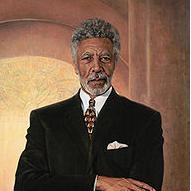
Oakland Mayor Ron Dellums has announced that he won’t give his final State of the City speech tomorrow in person as scheduled, instead performing the legally required duty by simply sending in a written report and video, a fitting end to his terrible tenure as mayor.

“In lieu of a public address this Wednesday, Mayor Dellums has opted to provide a comprehensive, printed State of the City report and accompanying video chronicling his four-year administration. These will be available on line at www.oaklandnet.com on November 17, 2010,” read a memo released yesterday by the Mayor’s Office.

It will be an ignominious end for a legendary political figure who rose from the black power movement of the ’60s to serve a remarkable 13 terms in Congress, where he was a leading voice against war and wasteful military spending. But as mayor, Dellums simply failed to lead a city that desperately needed him, ducking the city’s biggest problems and any sense of public accountability.

When Dellums came to the Bay Guardian offices four years ago to seek our endorsement (which we gave him, hoping he would be better than then-frontrunner Ignacio De La Fuente), Executive Editor Tim Redmond asked him what qualified him to be mayor and whether he was up for coming out of retirement to take on such a demanding job. Dellums responded with fiery indignation – how dare we question his fitness for such a piddling office after such a distinguished political career.

In retrospect, it was a good question, and a telling non-answer. Luckily for Oakland, after two mayors in a row that were legendary if imperious political figures, the city will now have a mayor – Jean Quan (who narrowly beat a man who would have followed in the Jerry Brown/Ron Dellums model: Don Perata) – who is committed to doing the hard work on this very difficult job. We wish her well.

Rebuilding the labor movement

0

Dick Meister, former labor editor of the SF Chronicle and KQED-TV Newsroom, has covered labor and politics for a half century. Contact him through his website, www.dickmeister.com, which includes more than 250 of his columns.

Unions, as you might certainly expect, have been having a rough time during the current recession. How rough? Well, overall union membership declined by a whopping 771,000 over the past year.

The number of workers in unions is still large, around 15 million. But that’s only a little more than 12 percent of the country’s workforce. There is one bright spot: More than one-third of public employees are in unions.

The figures for workers in private employment, however, show that only about 7 percent of them are in unions, That’s the lowest percentage of unionized workers in private employment since 1900. That’s right – the lowest percentage in 110 years.

Unions are fighting hard to reverse the downward trend, and though many outside the labor movement openly doubt – or at least wishfully think – that it can’t be done, I think they’re wrong. The doubters are forgetting that it’s been done before  – and done in the face of obstacles that were at least as great as those confronted by union adherents today.
It began 75 years ago this month, in November of 1935, when eight affiliates of the American Federation of Labor – the AFL – put together what soon became the independent Congress of Industrial Organizations, or CIO. Their aim was to mobilize the racially and ethnically mixed mass of generally unskilled workers in steel, rubber, auto, meatpacking and other basic industries.

The AFL had largely ignored the industrial workers in favor of skilled and semi-skilled white craftsmen who were organized into separate unions according to their trade – plumbing, printing, carpentry and so forth – rather than by industry.

That kept most workers isolated from each other and enabled the industrial corporations that dominated the economy to unilaterally set pay and working conditions at the lowest possible levels.

The CIO leaders believed that workers could not make a decent living and that the labor movement could not grow and possibly not even survive unless workers were brought together in tight solidarity through industrial as opposed to the craft unionism. of the AFL.

The issues today are different. But the basic need for solidarity remains, as does the need to organize workers whatever their occupation.

That won’t be easy, with only about 12 percent of today’s workforce in unions. But when the CIO began in 1935, less than 10 percent of the country’s workers were in unions, and they faced a Great Depression that was much worse than today’s Great Recession.

The labor movement hit rock bottom during the Depression of the 1930s. But finally unemployment became so widespread and pay and working conditions so bad that large numbers of workers rebelled – most under the banners of the CIO.

 President Franklin Roosevelt, fearing revolution, quickly pushed through Congress bills that in effect put the government behind the workers attempts to organize. They were granted the legal right to organize and to strike – and to choose by majority votes unions to represent them in collective bargaining with their employers.

Millions of workers flocked to unions, CIO and AFL unions alike. Millions engaged in strikes and other militant actions to press their bargaining demands. Pay rose substantially. Workers won unheard of fringe benefits. Working hours were reduced without reductions in pay. Grievance procedures were instituted. Job security was greatly enhanced.

Most important, the living standards of ordinary Americans were raised. And the United States at last had a true middle class.

As the CIO grew, so did the AFL. By the time the competing organizations merged in 1955 to form the AFL-CIO, one of every three U.S. workers belonged to a union.

The vital, demanding and essential task of today’s labor leaders is nothing less than to do what was done by their predecessors when they formed the CIO three-quarters of a century ago . . . nothing less than to bring new life to the American labor movement.


Dick Meister, former labor editor of the SF Chronicle and KQED-TV Newsroom, has covered labor and politics for a half century. Contact him through his website, www.dickmeister.com, which includes more than 250 of his columns.

Only a miracle can save Steve Li now

41

Supporters of Shing Ma “Steve” Li, a 20-year-old nursing student, gathered outside the offices of Sen. Barbara Boxer today to urge her to sponsor a private bill in a last ditch effort to halt Li’s deportation to Peru, which is scheduled to take place Monday, November 15—two months after ICE (Immigration and Customs Enforcement) agents arrested Li in San Francisco.

“While we do not introduce private bills, our staff is happy to meet with Mr. Li’s family and his attorneys to discuss his case,” Boxer spokesperson Zachary Coile emailed the Guardian, as protesters delivered stack of letters to Boxer’s office, asking that she intervene in Li’s case.

Unlike Sen. Dianne Feinstein who has sponsored private bills in the past, Boxer has no record of intervening in this way. But advocates were hopeful that now that she has survived the November 2010 election, Boxer will pull off a miracle before Monday.

This afternoon, Li’s attorney Sin Yen Ling texted the Guardian that her request for deferred action had been denied, meaning that Li will be on a plane to Peru on Monday, baring some last minute miracle.

“Our office has been in touch with ICE and is exploring the options,” Gil Duran, media spokesperson for Sen. Dianne Feinstein told the Guardian, half an hour after Li’s request for deferred action was denied.

And Boxer spokesperson Zachary Coile said the senator’s staff met with Li’s mother, his attorney, his City College professor and others, this afternoon.

“While we do not introduce private bills, our staff was happy to meet with Steve Li’s family and his attorney to discuss his case,” Coile stated. “We reiterated Senator Boxer’s strong support for the DREAM Act, which would provide a path to citizenship for tens of thousands of undocumented students who go to college or serve in the military. Senator Boxer will keep working in the Senate until it becomes law.”

And tonight, Drew Hammill, press secretary to Speaker Nancy Pelosi emailed the following statement to the Guardian:

“Speaker Pelosi believes that Steve Li’s case is a textbook example of the pressing need for comprehensive immigration reform and passage of the DREAM Act. Speaker Pelosi is working with other Members to recommend that ICE grant deferred action in this case.”

Boxer, Feinstein and Pelosi, who have both been strong supporters of the DREAM Act, have vowed to keep working until it is passed.

Earlier this fall, on Sept. 14—the day before ICE arrested Li– Senate Majority Leader Harry Reid announced plans to add the DREAM Act as an amendment to the Department of Defense authorization bill.

But that effort was blocked by Senate Republicans. And after the bloodbath that congressional Democrats endured this November, it’s unclear if the DREAM Act has a prayer, though Nancy Pelosi vowed to move it forward during Congress’ upcoming lame-duck session, and it has continued to attract bi-partisan support since it was first introduced in 2001 by Senators Richard Durbin (D-Il) and Richard Lugar (R-IN).

At today’s protest, Li’s legal counsel, Sin Yen Ling, decried the federal government’s decision to deport her client.

“A 20-year-old City College student is not a threat to our national security,” Ling said. “We need to bring Steve Li home as soon as possible.”

According to Ling, Li has not seen his mother Maria, who divorced Li’s dad for years and lives with Li in San Francisco, since his Sept. 15 arrest, when  ICE picked up Li and his mother in Ingleside on Sept. 15 and placed them in separate cars. The car carrying Li then picked up Li’s  father in the Richmond, and all three family members were processed at ICE’s Sansome Street office in downtown San Francisco, before being transferred to Sacramento County Jail. But Li was then involuntarily transferred to an ICE detention facility in Arizona. Meanwhile, Li’s parents were released from detention when ICE determined that China does not want them back because they left China seeking political asylum. But they are now required to wear cumbersome electronic monitoring anklets, because they are deemed a flight risk, and are not allowed to leave San Francisco.

As a result, Li’s parents have been unable to visit their son in Arizona. And should he be deported to Peru, it’s not clear if they will be permitted to follow. And should if they decide to travel to Peru, they will not be allowed to reenter the U.S. for at least ten years, further complicating a complex situation.

At today’s rally, Li’s mother Maria spoke in public for the first time,  breaking down into tears, as she begged Sen. Boxer and the U.S. government to help.

“He has no money, no clean clothes, how will he get by?” she asked, referring to ICE’s plan to put her son on a plane to Lima, Peru, where he reportedly knows no one.  “Sen. Boxer, will you just watch and pretend you didn’t see anything? Today, when you see all of us standing here begging you, will you respond to us? I hope you can understand it from a mother’s perspective and meet with me to discuss how we can help Steve.”

Ling said Li’s mother decided to speak because of the direness of her son’s situation, even though she was wearing a federally-mandated monitoring anklet.
“She felt it was now or never,” Ling said.

Li’s teacher Sang Chi also spoke, praising Li as a model student and a prime example of the kind of person that should be eligible for the DREAM Act. And then the Rev. Norman Fang led Li’s supporters in a prayer.

‘We ask that a miracle take place and that Steve’s mom and San Francisco can be happy again, that the heart and soul of what is morally right can overcome regulations,” Fang said, noting that 100 years, his family members were detained at Angel Island “for no other reason than they were Chinese. ‘There is only one border in our world—the one that separates Heaven and Earth.”

Li’s attorney Sin Yen Ling clarified that she doesn’t believe that ICE singled Li out.
“He’s just been swept up as part of a larger program,” Ling said, noting that actions that split families apart and target folks who came to this country as undocumented children have inspired a movement of DREAMers—folks who support the DREAM Act.

Every year, about 65,000 U.S. raised students, who would qualify for the DREAM Act’s proposed benefits, graduate from high school, according to the National Immigration Law Center (NILC).

“These include honor roll students, star athletes, talented artists, homecoming queens, and aspiring teachers, doctors and U.S. soldiers,” states a NILC press release. “They are young people who have lived in the U.S. for most of their lives and desire only to call this country their home. Even though they were brought to the U.S. years ago as children, they face unique barriers to higher education, are unable to work legally in the U.S. and often live in constant fear of detection by immigration authorities.”

Asked how ICE caught up with Li, who does not have a criminal record, Ling pointed to modern technology
“In this day and age, you can track anyone down,” Ling said.” And it’s a priority for ICE to identify people with final deportation orders,” she continued. Ling was referring to the fact that Li’s parents were denied their request for political asylum from China and issued a removal order, unbeknownst to their son Steve, who was born in Peru, came to the U.S. when he was 12 and was 14, when his parents’ asylum request was denied.

But Ling did not blame President Barack Obama, who promised to bring millions of undocumented residents out of the shadows, when he was running for president in 2008.
“It’s tough to criticize the president when he had five different priorities coming into office, including healthcare. His administration probably miscalculated how long it would take to pass healthcare. And part of the problem is partisan politics around immigration.”

Ling estimates that there are two million young people currently in the U.S. who would benefit from the passage of the DREAM Act, but blamed partisan politics for why the legislation failed to pass by only 3 votes in the Senate in September.

Sup. David Campos showed up at the rally and told Li’s supporters that the Board of Supervisors unanimously approved a resolution Nov. 9 calling for ICE to defer Li’s deportation.

“The Board is not always on the same page, but on this issue we were unanimous,” Campos said. “We get it, we understand the tragedy that this deportation would result in. And we remain hopeful that something will happen. There are millions of young people in the same predicament, and the solution is not deportation. The solution is passing comprehensive immigration reform. Until then, we need an intervention.”

Meanwhile, somewhere in Arizona, Steve Li sits in a jail cell, hoping, praying and dreaming…

SFBG Radio: The great political disconnect

4

In today’s episode, we ask: If the polls show that some 75 percent of the American people think Congress ought to raise taxes on the rich and cut defense spending, why doesn’t either party talk about it seriously? Listen after the jump.

sfbgradio11/1/2010 by endorsements2010

How to fight the GOP

0

OPINION Now what?

Now we need to build a grassroots progressive movement — wide, deep, and strong enough to fight the right and challenge the corporate center of the Democratic Party.

The stakes are too high and crises too extreme to accept “moderate” accommodation to unending war, regressive taxation, massive unemployment, routine foreclosures, and environmental destruction.

A common formula to avoid is what the Rev. Martin Luther King Jr. called “the paralysis of analysis.” Profuse theory + scant practice = immobilization.

It’s not enough to denounce what’s wrong or to share visionary blueprints. Day in and out, we’ve got to organize for effective and drastic social change, in all walks of life and with a vast array of activism.

Yes, electioneering is just one kind of vital political activity. But government power is extremely important. By now we should have learned too much to succumb to the despairing claim that elections aren’t worth the bother.

Such a claim is false. For instance, consider the many hundreds of on-the-ground volunteers who rejected the paralysis of analysis by walking precincts and making phone calls to help reelect progressive Rep. Raul Grijalva (D-Arizona). Grijalva won a tight race in the state’s southwestern district and will return to Congress next year — much to the disappointment of the corporate flacks and xenophobes who tried to defeat him because of his strong stance against the state’s new racial-profiling immigration law.

The mass-media echo chamber now insists that Republicans have triumphed because President Obama was guilty of overreach. But since its first days, the administration has undermined itself — and the country — with tragic under-reach.

It’s all about priorities. The Obama presidency has given low priority to reducing unemployment, stopping home foreclosures, or following through with lofty pledges to make sure that Main Street recovers along with Wall Street.

Far from constraining the power of the Republican Party, the administration’s approach has fundamentally empowered it. The ostensibly shrewd political strategists in the White House have provided explosive fuel for right-wing “populism” while doing their best to tamp down progressive populism. Tweaks aside, the Obama presidency has aligned itself with the status quo — a formula for further social disintegration and political catastrophe.

The election of 2010 is now grim history. It’s time for progressives to go back to the grassroots and organize with renewed, deepened commitment to changing the direction of this country. If we believe that state power is crucial — and if we believe in government of, by, and for the people — it’s not too soon to begin planning and working for change that can make progressive victories possible in future elections. 

Norman Solomon is co-chair of the Healthcare Not Warfare campaign, launched by Progressive Democrats of America. His books include War Made Easy: How Presidents and Pundits Keep Spinning Us To Death.

The next mayor

108

tredmond@sfbg.com

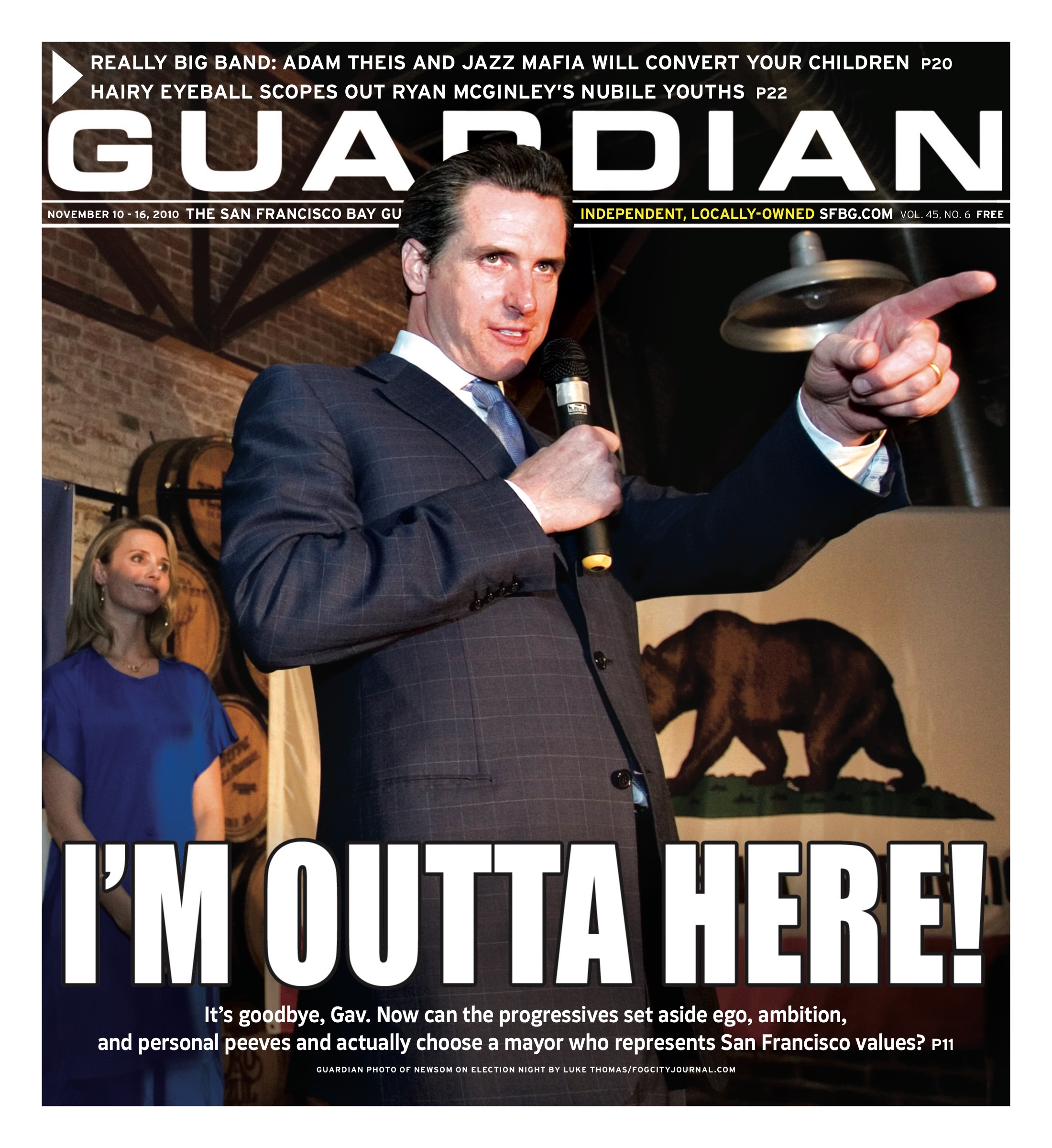
By the time a beaming Mayor Gavin Newsom took the stage at Tres Agaves, the chic SoMa restaurant, on election night, enough results were in to leave no doubt: the top two places on the California ballot would go to the Democrats. Jerry Brown would defeat Meg Whitman in the most expensive gubernatorial race in American history — and Newsom, who once challenged Brown in the primary and dismissed the office of lieutenant governor, would be Brown’s No. 2.

It might not be a powerful job, but Newsom wasn’t taking it lightly anymore. “We can’t afford to continue to play in the margins,” he proclaimed proudly, advancing a vague but ambitious agenda. “There is absolutely nothing wrong with California that can’t be fixed with what’s right with California.”

But around the city, as results trickled in for the local races, the talk wasn’t about Newsom’s role in the Brown administration, or the change the Democrats might bring to Sacramento. It was about the profound change that could take place in his hometown as he vacates the office of mayor a year early — and opens the door for the progressives who control the Board of Supervisors to appoint a chief executive who agrees with, and is willing to work with, the majority of the district-elected board.

At a time when the Republican takeover of Congress threatens to create gridlock in Washington, there’s a real chance that San Francisco’s government — often paralyzed by friction between Newsom and the board — could take on an entirely new direction. It’s possible that the progressives, long denied the top spot at City Hall, could put a mayor in office who shares their agenda.

This could be a turning point in San Francisco, a chance to put the interests of the neighborhoods, the working class, small businesses, the environmental movement, and economic justice ahead of the demands of downtown and the rich. All the pieces are in place — except one.

To make a progressive vision happen, the fractious (and in some cases, overly ambitious) elected leaders of the progressive movement will have to recognize, just for a little while, that it’s not about any individual. It’s not about David Chiu, or Ross Mirkarimi, or Chris Daly, or John Avalos, or Eric Mar, or David Campos, or Jane Kim, or Aaron Peskin. It’s not about any one person’s career or personal power.

It’s about a progressive movement and the issues and causes that movement represents. And if the folks with the egos and personal gripes and career designs can’t set them aside and do what’s best for the movement as a whole, then the opportunity of a generation will be wasted.

Folks: this is a hard thing for politicians to recognize. But right now it’s not about you. It’s about all of us.

It’s an odd time in San Francisco, fraught with political hazards. And it’s so confusing that no one — not the elected officials, not the pundits, not the lobbyists, not the insiders — has any clear idea who will occupy Room 200 in January.

Here’s the basic scenario, as described by past opinions of the city attorney’s office:

Under the state Constitution, Newsom will take office as lieutenant governor Jan. 3, 2011. The City Charter provides that a vacancy in the Mayor’s Office is filled by the president of the Board of Supervisors until the board can choose someone to fill the job until the end of the term — in this case, for 11 more months.

So if all goes according to the rules (and Newsom doesn’t try to play some legal game and delay his swearing-in), David Chiu will become acting mayor on Jan.3. He’ll also retain his job as board president.

On Jan. 4, the current members of the Board of Supervisors will hold a regularly scheduled Tuesday meeting — and the election of a new mayor will be on the agenda. If six of the current supervisors can agree on a name (and sitting supervisors can’t vote for themselves) then that person will immediately take office and finish Newsom’s term.

If nobody gets six votes — that is, if the board is gridlocked — Chiu remains in both offices until the next regular meeting of the board — a week later, when the newly elected supervisors are sworn in.

The new board will then elect a board president — who will also instantly become acting mayor — and then go about trying to find someone who can get six votes to take the top job. If that doesn’t work — that is, if the new board is also gridlocked — then the new board president remains acting mayor until January 2012.

There are at least three basic approaches being bandied about. Some people, including Newsom and some of the more conservative members of the board, want to see a “caretaker” mayor, someone with no personal ambition for the job, fill out Newsom’s term, allowing the voters to choose the next mayor in November, 2011. That has problems. As Campos told us, “The city has serious budget and policy issues and it’s unlikely a caretaker could handle them effectively.” In other words, a short-termer will have no real power and will just punt hard decisions for another year.

Then there’s the concept of putting in a sacrificial progressive — someone who will push through the tax increases and service cuts necessary to close a $400 million budget gap, approve a series of bills that stalled under Newsom, take the hits from the San Francisco Chronicle, and step out of the way to let someone else run in November.

The downside of that approach? It’s almost impossible for a true progressive to raise the money needed to beat a downtown candidate in a citywide mayor’s race. And it seems foolish to give up the opportunity to someone in the mayor’s office who can run for reelection as an incumbent.

Which is, of course, the third — and most intriguing — scenario.

The press, the pundits, and the mayor have for the past few months been pushing former Sup. Peskin as the foil, trying to spin the situation to suggest that the current chair of the local Democratic Party is angling for a job he wouldn’t win in a normal election. But right now, Peskin is no more a front-runner than anyone else. And although he’s made no secret in the past of wanting the job, he’s been talking of late more about the need for a progressive than about his own ambitions.

“If the board chose [state Assemblymember] Tom Ammiano, I would be thrilled to play a role, however small, in that administration,” Peskin told us.

In fact, Peskin said, the supervisors need to stop thinking about personalities and start looking at the larger picture. “If we as a movement can’t pull this off, then shame on us.”

Or as Sup. Campos put it: “We have to come together here and do what’s right for the progressive movement.”

Two years ago, the San Francisco left was — to the extent that it’s possible — a united electoral movement. In June, an undisputed left slate won a majority on the Democratic County Central Committee. In November 2008, Districts 1, 3, 5, and 11 saw consensus left candidates running against downtown-backed opponents — and won. In D9, three progressives ran a remarkably civil campaign with little or no intramural attacks.

The results were impressive. As labor activist Gabriel Haaland put it, “we ran the table.”

But that unity fell apart quickly, as a faction led by Daly sought to ensure that Sup. Ross Mirkarimi couldn’t get elected board president. Instead that job went to Chiu — the least experienced of the supervisors elected in that class, and a politician who is, by his own account, the most centrist member of the liberal majority.

This fall, the campaign to replace Daly in D6 turned nasty as both Debra Walker and Jane Kim openly attacked each other. Walker sent out anti-Kim mailers, and Kim’s supporters charged that Walker was part of a political machine — a damaging (if silly) allegation that created a completely unnecessary rift on the left.

And let’s face it: those fights were all about personality and ego, not issues or progressive strategy. Mirkarimi and Daly have never had any substantive policy disagreements, and neither did Walker and Kim.

In the wake of that, progressives need to come together if they want to take advantage of the opportunity to change the direction of the city. It’s not going to be easy.

“We’re good at losing,” Daly said. “I’m afraid we’re doing everything we can to blow it.”

The cold political calculus is that none of the current board members can count on six votes, and neither can Peskin or any of the other commonly mentioned candidates. The only person who would almost certainly get six votes today is Ammiano — and so far, he’s not interested.

“I know you never say never in politics, but I’m happy here in Sacramento. Eighty-six percent of the voters sent me back for another term, and I think that says something,” he told us.

It’s hardly surprising that someone like Ammiano, who has a secure job he likes and soaring approval ratings, would demur on taking on what by any account will be a short-term nightmare. The city is still effectively broke, and next year’s budget shortfall is projected at roughly $400 million. There’s no easy way to raise revenue, and after four years of brutal cuts, there’s not much left to pare. The next mayor will be delivering bad news to the voters, making unpleasant and unpopular decisions, infuriating powerful interest groups of one sort or another — and then, should he or she want the job any longer, asking for a vote of confidence in November.

Yet he power of incumbency in San Francisco is significant. The past two mayors, Newsom and Willie Brown, were reelected easily, despite some serious problems. And an incumbent has the ability to raise money that most progressives won’t have on their own.

Chiu thus far is being cautious. He told us his main concern right now is ensuring that the process for choosing the next mayor is open, honest, and legally sound. He won’t even say if he’s officially interested in the job (although board observers say he’s already making the rounds and counting potential votes).

And no matter what happens, he will be acting mayor for at least a day, which gives him an advantage over anyone else in the contest.

But some of the board progressives are unhappy about how Chiu negotiated the last two budget deals with Newsom and don’t see him as a strong leader on the left.

Ross Mirkarimi is the longest-serving progressive (other than Daly, who isn’t remotely a candidate), and he’s made no secret of his political ambitions. Then there’s Campos, an effective and even-tempered supervisor who has friendly relationships with the board’s left flank and with centrists like Bevan Dufty. But even if Dufty (who I suspect would love to be part of electing the first openly gay mayor of San Francisco) does support Campos, he’d still need every other progressive supervisor. Campos also would need Chiu’s vote to go over the top. Which means Chiu — who needs progressive support for whatever his political future holds — would have to set aside his own designs on the job to put a progressive in office.

In other words, some people who want to be mayor are going to have to give that up and support the strongest progressive. “If there’s someone other than me who can get six votes, then I’m going to support that person,” Campos noted.

Then there are the outsiders. City Attorney Dennis Herrera has already announced he plans to run in the fall. If the board’s looking for a respected candidate who can appeal to moderates as well as progressives, his name will come up. So will state Sen. Mark Leno, who has the political gravitas and experience and would be formidable in a re-election campaign in November. Leno doesn’t always side with the left on local races; he supported Supervisor-elect Scott Wiener, and losing D6 candidate Theresa Sparks. But he has always sought to remain on good terms with progressives.

All that assumes that the current board will make the choice — and even that is a matter of strategic and political dispute. If the lame duck supervisors choose a mayor — particularly a strong progressive — you can count on the San Francisco Chronicle, Newsom, and the downtown establishment to call it a “power grab” and cast doubt on the legitimacy of the winner.

“But choosing a mayor is the legal responsibility of this board and they ought to do their jobs,” Peskin said.

The exact makeup of the next board was still unclear at press time. Jane Kim is the likely winner in D6 and has always been a progressive on the School Board. She’s also close to Chiu, who strongly supported her. If Malia Cohen or Lynette Sweet wins D10, it’s unlikely either of them will vote for a progressive mayor.

Newsom also might try to screw things up with a last-minute power play. He could, for example, simply refuse to take the oath of office as lieutenant governor until after the new board is seated.

Chiu’s allies say it makes sense for the progressives to choose a mayor who’s not identified so closely with the left wing of the board, who can appeal to the more moderate voters. That’s a powerful argument, and Herrera and Leno can also make the case. The progressive agenda — and the city — would be far better off with a more moderate mayor who is willing to work with the board than it has been with the arrogant, recalcitrant, and distant Newsom. And if the progressives got 75 percent of what they wanted from the mayor (as opposed to about 10 percent under Newsom), that would be cause to celebrate.

But to accept that as a political approach requires a gigantic assumption. It requires San Franciscans to give up on the idea that this is still, at heart, a progressive city, that the majority of the people who live here still believe in economic and social justice. It means giving up the dream that San Francisco can be a very different place, a city that’s not afraid to defy national trends and conventional wisdom, a place where socioeconomic diversity is a primary goal and the residents are more important than the big companies that try to make money off them. It means accepting that even here, in San Francisco, politics have to be driven by an ever-more conservative “center.”

It may be that a progressive can’t line up six votes, that a more moderate candidate winds up in the Mayor’s Office. But a lot of us aren’t ready yet to give up hope.

Additional reporting by Noah Arroyo.

Advocates say Steve Li is DREAM Act eligible

4

The Board of Supervisors plans to introduce a resolution at their Nov. 9 meeting denouncing the deportation of Shing Ma “Steve” Li, a  20-year-old DREAM Act student at City College of San Francisco, calling for Immigration and Customs Enforcement to grant him deferred action status, and urging Congress to pass the DREAM (Development, Relief and Education for Alien Minors) Act.

The move comes the same day San Francisco Unified School District Board President Jane Kim (leading in the as yet unresolved race to replace termed-out D6 Sup.Chris Daly) plans to introduce a similar resolution at the SFUSD Board meeting, and a week after City College Board Trustee Lawrence Wong introduced a resolution supporting Li, who has lived in California since 2002 and is studying to be a nurse , but is now in an immigration detention center in Arizona.

“It’s unreal how fast things change”, Li said in a statement made from Arizona, just seven weeks after ICE raided his home and arrested him.

Li, who is ethnically Chinese, was born in Peru as his parents fled political persecution in China. And  ICE is allegedly preparing to deport him to Peru, which he left when he was 12. (Calls to ICE had not been returned as of blog post time, but I’ll update this blog, when I get a reply.)

“He knows no one in Peru,” said Li’s lawyer, Sin Yen Ling, senior staff attorney at the Asian Law Caucus, as she described how Li’s grandma returned to China, when his grandfather died.

Five years ago, the U.S. denied Li’s parents political asylum from China and issued a removal order. But Li says he was unaware of his immigration situation until his home was raided, and advocates and community members believe his case illustrates how the U.S.’s immigration system tears up families and targets contributing members of society.

Li’s Sept. 15 arrest occurred one week before Congress failed to vote on the DREAM Act, which would provide a pathway to legalization to undocumented students who’ve grown up in the US and atten two years of college or served two years of the military.

“It’s critical to pass the DREAM Act before the new Congressional session, but Steve literally cannot wait and is set for deportation any day now, that’s why we need our Senators’ leadership today,”  Li’s attorney Sin Yen Ling told me, noting that so far their has been no response from Sen. Dianne Feinstein, and that advocates are planning to target Sen. Barbara Boxer, now that the election is over.

In their resolution, Board President David Chiu and Sups. Eric Mar, John Avalos, David Campos and Ross Mirkarimi note that the DREAM Act is “bipartisan legislation that addresses the situation faced by young people who were brought to the United States years ago as undocumented immigrant children, and who have since grown up here, stayed in school, and kept out of trouble.”

These five supervisors note that each year, 65,000 U.S.-raised students who qualify from the DREAM Act’s benefits graduate. They also note that Democratic Sen. Dick Durbin and Republican Sen. Richard Lugar asked Department of Homeland Security Secretary Janet Napolitano on April 21, 2010 to halt the deportation of immigrant students who could earn legal status under the DREAM Act, which has the support of the House and Senate leadership, all of the relevant committee chairs, the nation’s military leaders, and President Barack Obama.

“I will do whatever it takes to support efforts to pass this bill so I can sign it into law on behalf of students seeking a college education and those who wish to serve in our country’s uniform. It’s the right thing to do,” Obama told the Congressional Hispanic Caucus on September 15, 2010—the same day that Li was arrested in San Francisco.

Update: Since writing this blog, I got a call back from ICE’s Lori Haley, who said she was limited in how much information she could share, but sent me this statement concerning Li:

“Shing Ma Li was taken into custody by ICE Fugitive Operations team officers on September 15, 2010, based upon a final order of removal issued by an immigration judge in 2004.  In 2005, the Board of Immigration Appeals (BIA) reviewed his case and upheld the immigration judge’s decision.  Shing Ma Li currently remains in ICE custody while the agency seeks to make arrangements for his removal.”


SFBG Radio: The election bloodbath

6

Today Johnny and Tim talk about Congress — what happened, and why, and how (and whether) Obama can turn things around. Check it out after the jump.

sfbgradio1132010 by endorsements2010

Election 2010: SF’s season of political madness

7

You can draw — or not draw — all sorts of conclusions about the meaning of last night’s national election, but I can tell you what the state and local results mean: A season of political madness. As of the first week in January, San Francisco will have a new mayor and (probably) a new district attorney, and neither will be elected by the voters. And if some pundits are correct and Nancy Pelosi decides to retire rather than taking a seat on the back bench, then a once-in-a-lifetime change to take a safe seat in Congress will open up. And man, will the mad scramble be on.


Gavin Newsom will be sworn in as lt. governor the same day that Kamala Harris (if her lead in the polls holds) will be sworn in as attorney general. In theory, that means Board President David Chiu will become acting mayor — with the authority to appoint a new district attorney. That’s if Harris doesn’t step down a day early, allowing Newsom to appoint her replacement. Deals are being offered and tossed around already (and one of the interesting elements is that Chiu has always been interested in the D.A.’s job — which would open up not only the board presidency but his D3 seat.)


Then the current board members will have five days before their terms end to choose a new mayor by majority vote (except that no supervisor can vote form him or herself), and in the meantime, Chiu will be both acting mayor and board president. If the supes can’t make a decision, the new board — and we still don’t know who will be on that board — will get a chance to elect both a new board president (and acting mayor) and a new mayor.


And to make it more complicated, a number of the people being looked at for the mayor’s job — and some of the people who plan to run for mayor next November — would also be very interested in Pelosi’s seat.


This election isn’t over yet — but already, I promise you, the talks are on and everyone’s thinking about the deal.


It’s going to be crazy — and it also offers progressives a rare change to reshape city politics. No matter what happens with the D6 and D10 races, progressives will hold the board majority. If they can work together — thinking about the larger agenda, not just their personal egos — this could turn out very well indeed.

GOLDIES 2010 LIFETIME ACHIEVEMENT: Rick and Megan Prelinger

0

“Juxtaposition,” “serendipity,” “appropriation,” and “collaboration” are all words that come up frequently when you talk to Rick and Megan Prelinger about the Prelinger Library.

Tucked above a SoMa carpet store, the space (“a free offering, an installation, a workshop, and an extension of our living room,” according to the handout given to visitors) is stuffed floor-to-ceiling with books, maps, magazines, and other ephemera. It is a place where artists, students, teachers, architects, T-shirt makers — basically anyone with a curious, creative mind — can seek information and inspiration. Visitors are encouraged to photograph, copy, and scan materials for future use in their own projects.

“This is a completely unconventional library,” Rick says. “It’s much more a place where serendipity rules.”

A certain magic comes courtesy of the library’s unconventional shelving system, designed by Megan to maximize what she calls “browsing-based discoveries.” It’s based on a continuum of ideas and interests, not Dewey Decimals. In a section dedicated to the American South, for example, a dusty government tome about Georgia’s river system might nestle next to a paperback copy of Deliverance.

“[Library visitors] tend to start going where they think they’re headed,” Megan said. “Then they find something they’d never seen before, and they just go in a different direction. They come out going, “Wow! I thought I was looking for this, but I found this.'<0x2009>”

Opened to the public in June 2004, the Prelinger is tailored to its current location. Though the fit is snug, Prelingers have no plans to upsize. “The collection is composed in such a way that there’s a relationship between the aisles,” Rick explains.

But the collection is anything but static. In addition to what they call the “user-based chaos” that arises when visitors remove and replace books on the shelves, the Prelingers are constantly adding to, and editing, their highly selective inventory. Subjects range from transportation and land-use to media studies and political history (they joke that the stacks harbor “98 percent bad ideas”). “[The library is] specific to what we’re interested in,” Rick says. “But we’re interested in a lot of things.”

The Prelinger also boasts an online component composed of thousands of digital books that may be downloaded for free. Though this represents only a fraction of the physical collection, it’s a useful tool for those who can’t visit the library in person. As it is, the place has limited hours, and both Prelingers support it with other endeavors.

Megan is also a historian, a wild-bird rehabilitator, and an author; her 2010 release, Another Science Fiction: Advertising the Space Race 1957-62 (Blast Books), is a gorgeous, hefty volume that culls and contextualizes imagery from magazines like Missiles and Rockets, bound editions of which can be admired in the library. Rick is widely known for the Prelinger Archives, a groundbreaking moving image archive he founded in 1983. It eventually grew to include more than 60,000 works — all originally made by amateurs or earmarked for industrial, educational, and advertising use. Much of it was acquired by the Library of Congress in 2002 and 2003 (some 2,500 titles are also available online). The archive inspired Rick’s 2004 collage film, Panorama Ephemera, as well as his popular “Lost Landscapes” presentations, which meld lively discussions about history with found footage.

Along those lines, the Prelingers have a new-old passion: home movies. “Megan and I now run a really fast-growing and exciting home movie collection,” Rick says. “Home movies — that’s the only cinema that matters for me. Each one is unique. We think we understand home movies, but they’re shallow and deep at the same time.”

Rick’s latest film (“slowly in the works”) will be based on this burgeoning collection. “One of the things that we say we’re trying to do — it’s a little grandiose, but it’s actually true — is putting together a complete ethnographic portrait of 20th century North America through home movies,” Rick says. Looking at what they’ve accomplished so far, it’s not hard to conclude that if anyone can pull off such a feat, it’ll be the Prelingers.

www.archive.org/details/prelinger; www.prelingerlibrary.org

>>MORE GOLDIES 2010

GOLDIES 2010 LIFETIME ACHIEVEMENT: Marc Huestis

0

“What a swimmer is Dracula’s daughter!,” exclaims John “the Cool Ghoul” Zacherle, as “Dinner With Drac” blares from the speakers in Marc Huestis’ Redstone Labor Temple office. ‘Tis the season for Huestis’ tribute to Poltergeist‘s Jobeth Williams, and the activist, filmmaker, and camp impresario is in the final stretches of preparing for the big night.

What hasn’t Marc Huestis done? As a youngster, he arrived in San Francisco from Long Island, New York, unafraid to recite poetry while sporting a pompadour that would make any Elvis impersonator feel size envy. Soon you could see him singing in drag or writhing around on stage in a dirty diaper in Angels of Light productions. But from the very beginning, film was at the heart of Huestis’s life. His father was an editor who worked on the ’60s teen music TV show Hullabaloo, while his mother was a showgirl. “I have a little bit of both in me,” he jokes, and it’s the truth — a Marc Huestis extravaganza involves informed editing and explosive creative freedom.

One of Huestis’ first notable celebrations was the San Francisco Gay Film Festival, now known as the Frameline fest, which he and his non-biological twin-of-sorts Daniel Nicoletta (born just three days apart from him) began with other like minds in 1976. “It was fun, a bunch of kooky hippie kids who wanted to get their movies shown,” he remembers. “There was no pretense, and the group of us were able to get together to do it. It’s great to see what it has evolved into, and feel a bit like a patron saint. Some people will always hate you, but at this age” — Huestis is 55 — “you get to the point where some people respect you. And you respect yourself.”

In 1982, after making some short films, Huestis wrote and directed Whatever Happened to Susan Jane?, his distinctly San Francisco answer to the kinds of antic comedies John Waters was making on the East Coast. In recent years, the movie has found a new audience amongst music lovers devoted to San Francisco’s new wave heyday — one of its strongest aspects is its documentation of wild performances from Tuxedo Moon and other groups of the day. “It was a great combination of gay culture and punk culture,” Huestis says of the era. “There’s a kindness to it, and it was very smart.”

Huestis’s next feature-length movie, 1993’s Sex Is… is very much a film of its time. A direct look at and discussion of the experience of gay sex and intimacy amid the AIDS crisis, it was also a do-it-yourself, many-year labor of love, with DIY aesthetics one common thread throughout Huestis’s creative life. “It’s very heartfelt,” he says of the film. “It was an important film when it came out because no one was talking about sex, and if they were, it was really hypocritically. The high point of my life was to be at the Berlin Film Festival for the world premiere, and then several days later, be at the awards presentation with Billy Wilder sitting nearby. For me, having HIV, and not thinking I was going to live, that moment was a gift.”

One year later, Huestis moved into his office in the Labor Temple, a treasure trove of film memorabilia where the walls are lined with autographed photos, and VHS tapes, DVDs, VCRs and DVD players are stacked on top of each other — in a well-organized fashion. The site is his base for the celebrity events that he puts on at the Castro Theatre, theatrical and cinematic programs that have blazed a trail for another generation of movie mayhem purveyors such as Jesse Hawthorne Ficks and this year’s Goldie winner Joshua Grannell, a.k.a. Peaches Christ.

Old media surrounds us as we talk, but there is little doubt that Huestis, experienced at putting together political and community fundraisers, is always focused on the present and future as well. “I love new media,” he says. “I could not do what I do if I didn’t have knowledge. I design the posters, I do the clip reels, I get the music together, I do the PR. I would sell the popcorn if I could. I love it. I never get tired of movies.”

It’s fitting, then, that Huestis gets to call one of this country’s oldest and most beautiful movie palaces, the Castro Theatre, home. “One of the first shows I put on there was when the Republicans took control of Congress, so everything comes around,” he says. “The best thing is seeing someone go there for the first time. To me it’s like the town barn, but it’s an amazing, beautiful place.”

If star power can me measured in size, some of the players that Huestis has brought to the Castro over the years — Debbie Reynolds, Jane Russell, Tony Curtis, Piper Laurie, Patty Duke — rival the size of the fabled venue. He’s also given eccentric talents such as Sylvia Miles and Karen Black the type of spotlight they deserve. In the end, it’s about gratitude, on his part, on behalf of the audience, and hopefully, from the subjects of his tributes. Huestis’ night for Tony Curtis resulted in him being hired by the actor to create a clip retrospective that ultimately wound up being shown at Curtis’s funeral. “I had a great fondness for and connection with him,” he says. “I love it when they’re thankful, because no one shows gratitude, the world is so entitled. After the [Castro] show, he [Curtis] held my hand really hard, looked me straight in the eyes, and said, ‘Thank you.'”

Thank you, Marc Huestis.

www.myspace.com/marchuestispro  www.youtube.com/user/hostesshue

>>MORE GOLDIES 2010

Election Night Parties

7

These are heady days to live in San Francisco, what with the Giants’ World Series victory last night, Halloween festivities the night before, and today’s Dia de los Muertos, which I believe is Spanish for Election Night (okay, we know they’re different, but given this year’s electoral slate, we couldn’t resist). It’s also a big election for The City, with our own Gavin Newsom and Kamala Harris seeking statewide office, a pivotal Board of Supervisors election, and some controversial propositions.

As usual, we’ll be covering and blogging all the election action live on this site. But if you’d like to get out there and mix and mingle with the politicos yourself, here’s the list of parties, which will be updating as we learn about more of them:

Board of Supervisors

D2

Janet Reilly – La Barca Restaurant, 2036 Lombard St. @ Fillmore

D6

Debra Walker- 8-10pm Outsider (894 Geary) and 10-12:30am, Great American Music Hall, 859 O’Farrell

Jane Kim: Public Works, 161 Erie Street @ Mission

Jim Meko- Campaign HQ, 364 10th Street

James Keys- Amsterdam Cafe (937 Geary, between Larkin and Polk)

Theresa Sparks: Don Ramon’s, 225 11th Street

Glendon “Anna Conda” Hyde: Eagle Tavern, 12th and Harrison

D8

Rafael Mandelman – Pilsner Inn, 225 Church St., @ Market

Scott Weiner: Harvey’s. 500 Castro @ 18th

Rebecca Prozan: Noe Valley Tavern, 4054 24th St., between Noe and Castro

D10

Lynette Sweet: Campaign HQ, 1 Rhode Island

Chris Jackson: Campaign HQ, 93 Leland Ave.

Dewitt Lacy: Bloom’s Saloon, 1918 18th @ Missouri

Steve Moss: Goat Hill Pizza, 300 Connecticut

Tony Kelly, Potrero Hill Neighborhood House, 953 DeHaro,

Malia Cohen: Poquito’s, 2368 3rd Street

SF School Board

Kim-Shree Maufas – Circulating with stops at Walker Democratic Party parties.

Hydra Mendoza: Mercury Lounge, 1582 Folsom St., @ 11th St.

Margaret Brodkin: home, 45 Graystone Terrace

Emily Murase: 6-9pm 142 Clearfield Drive (Between Ocean and Eucalyptus

Interest Groups

SF Labor Council/Democratic Party: Great American Music Hall, 859 O’Farrell St.

League of Pissed Off Voters: El Rio, 3158 Mission

Conservatives/Tea Party California Council: Pirro’s Restaurant, 2244 Taraval

SF Propositions

No on B – Great American Music Hall, with Dems/Labor

Yes on Prop B/Adachi: Lava Lounge, 527 Bryant Street

Yes on D, Mercury Lounge, 1582 Folsom @ 12th

No on L: Great American Music Hall, with Dems/Labor

Yes on L: Hobson’s Choice, 1601 Haight

State and Federal Races

John Dennis for Congress: Nectar Wine lounge, 3330 Steiner (off Lombard)

Jerry Brown for Governor: Fox Theater, 1807 Telegraph Ave, Oakland

Gavin Newsom for Lt. Gov: Tres Agaves – La Plaza De Agave Room, 130 Townsend @ 2nd

Kamala Harris for Attorney General, Delancey Street Foundation, 600 Embarcadero


Rebecca Kaplan for Oakland Mayor: Everett & Jones BBQ, 126 Broadway, Oakland

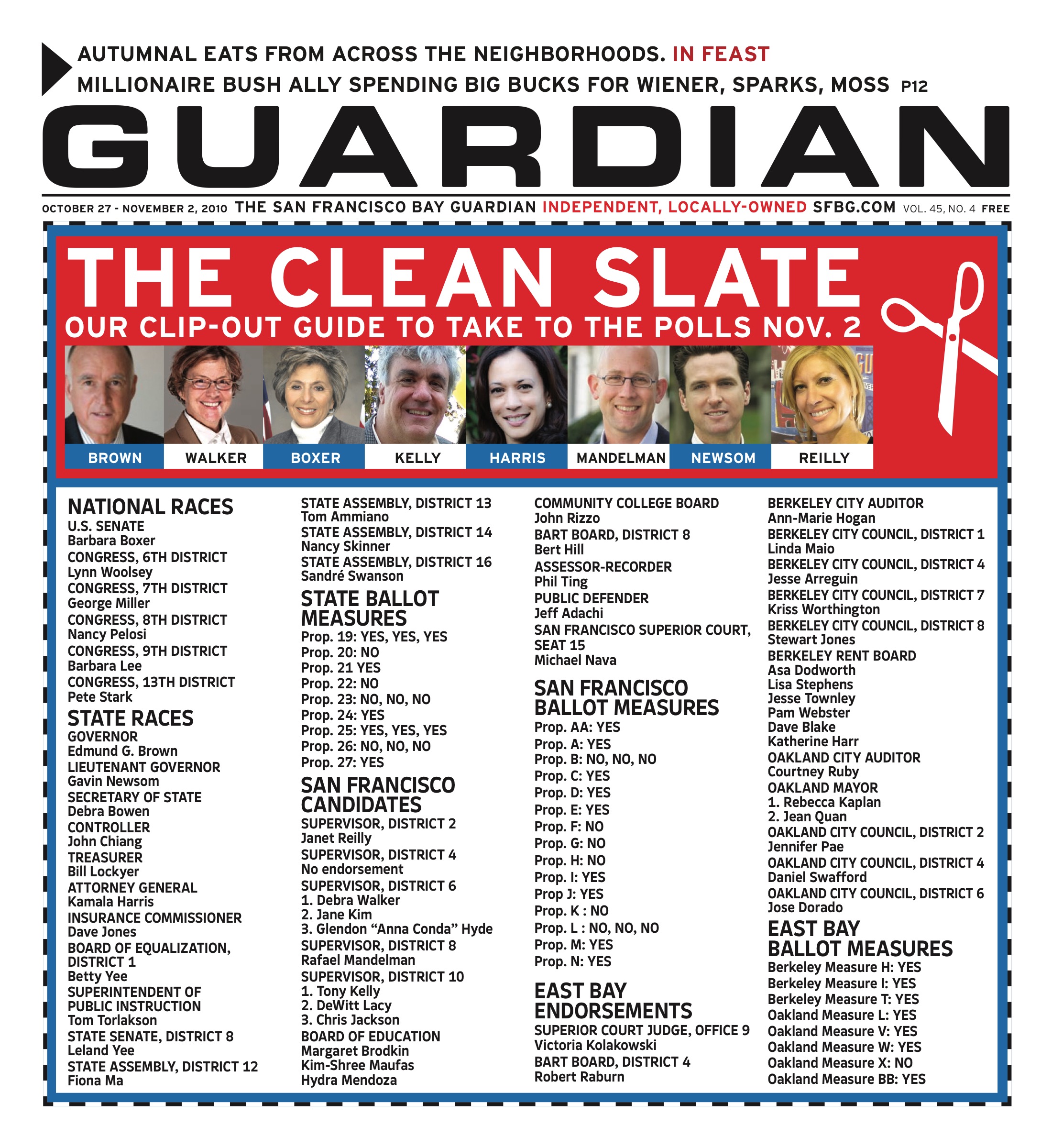
Fall election ’10 clip out guide

15

Click here for the San Francisco Bay Guardian’s complete endorsements — and happy voting. CLICK HERE for the printable PDF from our home page.


NATIONAL RACES

U.S. Senate

Barbara Boxer


Congress, 6th District

Lynn Woolsey


Congress, 7th District

George Miller


Congress, 8th District

Nancy Pelosi


Congress, 9th District

Barbara Lee


Congress, 13th District

Pete Stark


STATE RACES

Governor

Edmund G. Brown


Lieutenant governor

Gavin Newsom


Secretary of state

Debra Bowen


Controller

John Chiang


Treasurer

Bill Lockyer


Attorney general

Kamala Harris


Insurance commissioner

Dave Jones


Board of Equalization, District 1

Betty Yee


Superintendent of public instruction

Tom Torlakson


State Senate, District 8

Leland Yee


State Assembly, district 12

Fiona Ma


State Assembly, District 13

Tom Ammiano


State Assembly, District 14

Nancy Skinner


State Assembly, District 16

Sandré Swanson


STATE BALLOT MEASURES

Prop. 19: YES, YES, YES

Prop. 20: NO

Prop. 21 YES

Prop. 22: NO

Prop. 23: NO, NO, NO

Prop. 24: YES

Prop. 25: YES, YES, YES

Prop. 26: NO, NO, NO

Prop. 27: YES


SAN FRANCISCO CANDIDATES

Supervisor, District 2

Janet Reilly


Supervisor, District 4

No endorsement


Supervisor, District 6

1. Debra Walker

2. Jane Kim

3. Glendon “Anna Conda” Hyde


Supervisor, District 8

Rafael Mandelman


Supervisor, District 10

1. Tony Kelly

2. DeWitt Lacy

3. Chris Jackson


Board of Education

Margaret Brodkin

Kim-Shree Maufas

Hydra Mendoza


Community College Board

John Rizzo


BART Board, District 8

Bert Hill


Assessor-Recorder

Phil Ting


Public Defender

Jeff Adachi


San Francisco Superior Court, Seat 15

Michael Nava


SAN FRANCISCO BALLOT MEASURES

Prop. AA: YES

Prop. A: YES Prop. B: NO, NO, NO

Prop. C: YES

Prop. D: YES

Prop. E: YES

Prop. F: NO

Prop. G: NO

Prop. H: NO

Prop. I: YES

Prop J: YES

Prop. K : NO

Prop. L : NO, NO, NO

Prop. M: YES

Prop. N: YES


EAST BAY ENDORSEMENTS

BART Board District 4

Robert Raburn


Berkeley City Auditor

Ann-Marie Hogan


Berkeley City Council District 1

Linda Maio


Berkeley City Council District 4

Jesse Arreguin


Berkeley City Council District 7

Kriss Worthington


Berkeley City Council District 8

Stewart Jones


Berkeley Rent Board

Asa Dodworth

Lisa Stephens

Jesse Townley

Pam Webster

Dave Blake

Katherine Harr


Oakland City Auditor

Courtney Ruby


Oakland Mayor

1. Rebecca Kaplan

2. Jean Quan


Oakland City Council District 2

Jennifer Pae


Oakland City Council District 4

Daniel Swafford


Oakland City Council District 6

Jose Dorado


EAST BAY BALLOT MEASURES

Berkeley Measure H: YES

Berkeley Measure I: YES

Berkeley Measure T: YES

Oakland Measure L: YES

Oakland Measure V: YES

Oakland Measure W: YES

Oakland Measure X: NO

Oakland Measure BB: YES


OFA opens SF office, hosts debate watch party

12


President Obama’s political operation, Organizing For America, is opening its first San Francisco office today (Tues/12), just in time to hold a watch party for this evening’s final California gubernatorial debate between Jerry Brown and Meg Whitman. So stop by 1406 Valencia at 6:30 for the debate, or stop by at 4 pm to watch Obama greet the crowd via video hookup.

Emily Dulcan, OFA’s California communications director, said the office will be focused on get-out-the-vote efforts for the Nov. 2 election, including phone banking and precinct walking for races that include Brown for Governor, U.S. Sen. Barbara Boxer’s reelection effort, Congressional races, and even some local measures.

“A lot of our volunteers hover between local races and the big races,” said Dulcan, who said she was starting to feel good about the chances of Democrats doing well at the polls. “People are really starting to see what’s at stake in this election. We can go back to the failed policies of the Republicans and President George W. Bush, or we can move forward under President Obama.”

While history and many pundits predict the Democrats will lose seats in Congress this fall – mostly because of the stubbornly bad economy and the fact that the party in power usually loses ground in the midterm elections – recent computer modeling by the New York Times showed there’s an almost unprecedented amount of uncertainty in forecasting how this election will really go. And that it could largely depend on which party can get out the vote in a fairly lackluster election season.

A trio of great Hispanic leaders

0

Dick Meister, former labor editor of the SF Chronicle and KQED-TV Newsroom, has covered labor and politics for a half-century. Contact him through his website, www.dickmeister.com, which includes more than 250 of his columns.

It’s Hispanic Heritage Month, an excellent time to remember three of the most important Hispanic labor leaders in U.S. history. All three were engaged in the much needed and very tough job of organizing and improving the generally poor conditions of the nation’s largely Latino farm labor force.

Cesar Chavez, of course, is one of the farm worker leaders we should particularly honor. Another is Dolores Huerta, who joined Chavez in founding the United Farm Workers union – and who, in fact, is still organizing and otherwise helping Latino workers, particularly women.

The third leader who’s especially deserving of honor is the lesser known but no less important t pioneer farm labor organizer, Ernesto Galarza. Despite his important work, Galarza has been largely forgotten – though certainly not by me.  He’s been dead now for a quarter-century, but I recall him well from my days as a reporter covering farm labor:

His shining, black hair and fierce, penetrating gaze. His angry, intense words and slashing speeches against those who resisted demands for reform. His scholarly writing and novels and poetry – and his teaching.

Galarza was one of the loudest and most unusual of the voices that have been raised for the farm worker. He had a Ph. D., wrote a half-dozen books and numerous pamphlets and articles , and taught at all levels, from elementary school to university.

Yet Galarza was also an active union organizer – a key leader in laying the groundwork for the farm labor movement led by Cesar Chavez.

Galarza came to California’s fields in 1948, as an officer of the American Federation of Labor’s now long gone National Farm Labor Union. He had grown up in California, and had worked on farms as a teenager.

But Galarza had left that behind to head off to college on a scholarship and, eventually, to Columbia University for a doctorate in Latin American affairs.

After that, Galarza worked for the Pan American Union in Washington – until, characteristically, he became enraged over what he felt was the organization’s overlooking the exploitation of Latin American workers by US business interests. He resigned to take the job with the National Farm Labor Union.

Galarza led several strikes, but he was completely thwarted by the federal Bracero program that allowed growers to import penniless, undemanding Mexican workers to replace US workers who dared to strike or otherwise seek better treatment. So Galarza shifted his efforts into trying to abolish the Bracero program.

For more than a dozen years he fought a frustrating and often lonely battle. He spoke out endlessly before legislative committees and elsewhere, He issued hundreds of reports documenting the abuses of U.S. and Mexican workers under the Bracero program,. But the program remained untouched, and by 1960, Galarza’s union was gone. Near exhaustion, he turned mainly to writing and teaching.

But finally, in 1964, the public pressure that Galarza had a key role in generating led Congress to kill the Bracero program. It’s no coincidence that year, 1964, was the same year in which Cesar Chavez began his organizing drive. For Galarza was correct: The existence of the Bracero program had made farm labor organizing impossible.

By the time of Galarza’s death at 78 in 1984, the Chavez-led United Farm Workers had become an effective, nationally supported union.

The farm labor system still relies heavily on desperately poor immigrant workers, But thanks to the farm workers union that Ernesto Galarza helped bring about, many workers have had the chance to seek – and many have won – the right to the decent lives that Ernesto Galarza spent so much of his life seeking for them.

I was fortunate enough to also get to know Cesar Chavez.  I first met him when I was covering labor for the San Francisco Chronicle. It was on a hot summer night 45 years ago in the little farm town of Delano in southern California.

“Si se puede . . . It can be done . . . Si se puede.” He said it repeatedly as we talked deep into the early morning hours.

Si se puede . . . But I would not be persuaded. Too many others, over too many years, had tried and had failed to win for farm workers the union rights they had to have if they were to escape their severe economic and social deprivation. The Industrial Workers of the World who stormed across western fields early in the 20th century, had first tried organizing farm workers – and failed. Failing, too, were Communist organizers, socialists, and AFL and CIO organizers.

I was certain Chavez’ effort would be no different from theirs. Boy, was I wrong.  I had not accounted for the tactical brilliance, creativity, courage and just plain stubbornness of Cesar Chavez.

He understood that farm workers had to organize themselves, not depend on outsiders to do it. Chavez led the workers in creating a union of their own, which then sought out – and won – widespread support  from influential outsiders through boycotts and other tactics of non-violence patterned after those of Mohandas Gandhi and Martin Luther King Jr.

Chavez proved beyond doubt that the poor and oppressed can prevail against even the most powerful of opponents – if they can effectively organize themselves and adopt non-violence as their principal tactics. As Chavez explained, “We have our bodies and spirits and the justice of our cause as our weapons.”

The results of the Chavez-led organizing drives were impressive – the first farm union contracts in U.S. history, and the California law, also a first, that requires growers to bargain collectively with workers who vote for unionization.

Chavez worked closely with Dolores Huerta in creating and leading the United Farm Workers union. Huerta was, for instance, one of the principal leaders of the worldwide grape boycott that forced growers to agree to those first farm labor contracts  – which Huerta negotiated despite her lack of experience in contract bargaining.

Huerta’s work with the UFW was just a part of her lifelong and extraordinarily successful and courageous fight for economic and social justice that she waged while also raising 11 children.

Huerta’s traveled the country, speaking out and joining demonstrations for a wide variety of causes and successfully lobbying legislators for important gains for Hispanic immigrants and others.

Huerta started out as an elementary school teacher in northern California in 1955, but soon tired of seeing the children of farm workers regularly come to school hungry. That, and her anger over the injustices suffered by the local farm workers, led Huerta to quit teaching and join the Community Services Organization – the CSO – an organization founded by community organizer Saul Alinsky, with Chavez eventually serving as its General Director.

The CSO helped local Chicanos wage voter registration drives and take other actions to win a strong political and economic voice. But when the CSO’s other directors refused to agree to a union organizing drive among local farm workers, Chavez and Huerta quit to organize on their own. Like so many others, the CSO directors said it couldn’t be done. Thankfully, they were wrong and Cesar Chavez and Dolores Huerta were right.

But being right is just the first step, essential as it is. Hundreds of thousands, if not millions of poorly treated farm workers badly need to be organized, badly need the decent treatment that unionization can bring them, as it did to many others that the extraordinary efforts of Cesar Chavez, Dolores Huerta, and Ernesto Galarza helped bring to many others.

Dick Meister, former labor editor of the SF Chronicle and KQED-TV Newsroom, has covered labor and politics for a half-century. Contact him through his website, www.dickmeister.com, which includes more than 250 of his columns.

Get a clue, Randy Shaw

29

I read BeyondChron every day, and Randy Shaw, who operates the site, and Paul Hogarth, his managing editor, often have interesting commentary. But I’m constantly annoyed by people who run what by any stretch is a journalistic operation, but don’t follow the basic rules of (even alternative, activist) journalism: When you’re going to say something nasty about somebody, you call that person for comment.


Randy never called me, or Steve Jones, or Bruce Brugmann, before he launched an attack on the Guardian as part of a political machine. If he had — or if he’d done any reporting work and called around town — he might have learned something.


Randy’s argument is that the “machine” — including the Bay Guardian — is trying to block Jane Kim’s election as D6 supervisor. Let’s examine that for a minute.


There are plenty of people in San Francisco who would love to have a political machine. But it’s just not happening. The very fact that Jane Kim has the support of so many progressives — including the Board president, David Chiu, and Supervisors Eric Mar and John Avalos (all part of what Shaw calls the “machine”) suggests that nobody has to clout — not even me — to tell a candidate whether she can run for office, to control (or cut off) campaign contributions, or to wire an election.


In the days when Willie Brown ran San Francisco, the machine really did keep people from running for office. It really did close off avenues to political advancement. And if the machine was against you, it was really hard to raise money. If Brown were still the boss, and he didn’t want Kim to run, she would have been frozen out of much of the support and money she has today. Instead, Brown was at her campaign kickoff — and nobody’s manged to intimidate her many supporters and campaign contributors.


And guess what? The Guardian — the axis of the machine evil trying to freeze out Kim — endorsed her as our second choice.


I stand by what I said months ago — there’s nobody in San Francisco today — and no cadre or group — with the clout to operate as a political machine.


Nobody can line up six automatic votes on the Board of Supervisors. Even the progressives on the Democratic County Central Committee can’t always seem to get it together (note that Aaron Peskin, the chair and supposed machine honco, supported Tony Kelly for supervisor, and the DCCC didn’t put Kelly on its slate).


Right now, power in this city is fairly diffuse. That’s both a good and a bad thing. Good because machines are exclusionary, bad because it means the progressives can’t always function on a level that gets the right candidates elected and the right legislation through. Good because the left in this city is aggressively, almost happily disorganized and politically diverse, full of characters, voices, interest groups, candidates and elected officials who don’t always agree with each other and take orders from nobody. Bad because when we’re disorganized, we tend to lose.


Jane Kim didn’t get the DCCC endorsement. Nobody talked to me about that; I’m not on the panel and none of the members called to ask my advice. I would have said what the Guardian said in our endorsement package: There are exactly two progressive candidates who are qualified to be the next D6 supervisor, and their names are Debra Walker and Jane Kim. I still don’t understand why Kim entered the race against an established candidate with whom she has no substantial policy disagreements; I think that, before Kim moved to the district and entered the race, Walker was the clear consensus candidate of progressives, and as a matter of strategy, since Kim and Walker are both on the same side on the key issues, it might have made more sense for the left to unite behind one candidate.


But that’s not the issue anymore; Kim had every right to run, and now any cogent, honest ranked-choice voting strategy includes both her and Walker.


That statement alone makes clear that the Guardian’s not exactly in synch with the DCCC or any of Shaw’s other “machine” operations. The DCCC decided that the top candidate in D10 should be DeWitt Lacy, and left Tony Kelly off the slate entirely. We endorsed Tony Kelly as our first choice. The labor activists on the DCCC (and in the “machine”) are dead set against Margaret Brodkin winning a seat on the Board of Education; we endorsed her.


I would have explained our positions to Randy Shaw if he’d called or emailed me; I’m really easy to reach. And slapping people around without talking to them is bad journalism and bad progressive politics. Randy and I have disagreements, but I don’t consider him the enemy; we’re both part of a larger progressive community, and while I love (and thrive on) disputes in that community, we ought to be civil about it.


(I always contact Randy before I write about him. I did that yesterday, and asked him a series of questions, including why he never called me for comment. His non-response: “I write 3-4 articles a week and have published three books. You are free to quote from anything I have written without asking me about it.”)


Herb Caen used to say (somewhat in jest) that if you “check an item, you lose it.” In other words, once you start talking to everyone involved in an issue, you sometimes find out that the story isn’t at all the way you heard it.


That’s what should have happened with Shaw’s completely inaccurate claim about Steve Jones.


BeyondChron says that Jones was trying to get Kim to challenge Carmen Chu in D4 because they’re both Asian-American, ” in effect saying that as an Asian-American Jane should run among ‘her people,’ implying that demographics prevailed over issues and political stands.”


I talked to Steve about it; he did, indeed, talk to Jane Kim when Kim was shopping around for a district to run in. What he told her — and would have told Randy Shaw — was that it would be great for Kim, a school board member with citywide name recognition, to knock off Carmen Chu and expand the progressive majority rather than going after a strong progressive candidate in a solidly progressive seat. Race had nothing to do with it.


In fact, just about everything we’ve written about Kim comes down to the same argument: Sometimes, you have to think about the larger progressive movement, not just about yourself.


I sometimes wish the all the people who say the Bay Guardian is part of a powerful Peskin Machine were right: I’d love to pass a city income tax, hit the wealthy up for about half a billion dollars a year, eliminate the budget deficit without cutting services, municipalize PG&E (and have municipal cable TV and broadband), ban cars on a lot of streets, create 25,000 units of affordable housing … I’ve got a great agenda. And the Guardian’s so powerful that none of it ever happens.


Randy Shaw and I were both around for the tail end of the Burton Machine, and I think he gives the brothers Phil and John Burton too much credit. They were great on national issues, progressive champions in Congress. But they weren’t progressive leaders on local issues.


The Burton Machine was nowhere on the fights against overdevelopment and downtown power. Phil Burton rarely used his clout to support progressive causes and candidates at home. The machine got Harvey Milk fired from a commission appointment when he announced he was going to run for state Assembly against Art Agnos. The machine came together to make sure that Nancy Pelosi, an unknown who had never held office, got elected to Congress instead of Harry Britt, the most progressive elected official in the city at the time. The machine never helped out on public power, the numerous anti-highrise initiatives, rent control, or much of anything else that challenged the real estate interests like Walter Shorenstein, who gave vast sums of money to the Democratic Party.


Yes, George Moscone, a Burton ally, supported district elections, but once he got elected he stopped challenging downtown power.


And, of course, when Willie Brown emerged as heir to the machine throne, he was a disaster for progressives. He also at one point controlled an unshakable majority on the Board of Supervisors; he could call up votes whenever he needed.


The progressives in San Francisco today share an ideology on local issues — tough local issues that involve powerful economic forces at home.


And honestly, Randy: It’s not all about Jane Kim.


Endorsements 2010: National races

10

 U.S. SENATE

BARBARA BOXER

The San Francisco Chronicle made a stunning — and utterly irresponsible — statement when it refused to endorse either candidate in this race, saying that neither Boxer, the three-term incumbent, nor challenger Carly Fiornia, was qualified for the job. That’s insane — this one’s as clear and obvious a choice as you could ask for in American politics.

Boxer’s one of the leading voices for the progressives in the U.S. Senate. She was an early and stalwart foe of the war in Iraq; she’s been good on immigration (even when other Democrats have been ducking); and she’s a leading voice for accountability in financial companies. She’s finally come around on same-sex marriage and has a perfect record on reproductive rights and labor issues.

Fiornia’s chief claim to fame is that she ran one of the nation’s top companies, screwed up its history of excellent labor relations, outsourced 30,000 jobs, orchestrated a train wreck of a merger, and was fired. She left with enough of a golden parachute to help finance her campaign for Senate.

Fiorina’s anti-choice. She strongly supported Prop. 8 and opposes marriage equality. She’s so rabidly seeking the support of the gun nuts that she actually said that people on the federal “no-fly” list should be able to buy handguns. She supports the Arizona anti-immigration law. She’s for tax cuts for the rich and can’t even figure out if she’s supporting or opposing Prop. 23.

This one is a no-brainer. Vote for Boxer.


CONGRESS, 6TH DISTRICT

LYNN WOOLSEY

Woolsey was against the war when her colleague to the south, Nancy Pelosi, was still waffling. She’s a consistent voice against cuts in the safety net (and has the distinction of being the only member of Congress who was once on welfare). We’re happy to endorse her for another term.


CONGRESS, 7TH DISTRICT

GEORGE MILLER

Miller’s an East Bay institution, now seeking his 18th term. He’s been good and bad on issues — weak at first on the war, bad on education (he supported No Child Left Behind), but generally sound on environmental issues. And this spring, he was willing to publicly challenge Sen. Dianne Feinstein (D-Calif.) on a terrible water bill.


CONGRESS, 8TH DISTRICT

NANCY PELOSI

It’s odd that Pelosi’s become such a symbol of liberal Democrats and fodder for the right-wing attack machine. When you look at her record, she’s hardly a San Francisco liberal and certainly no progressive. She’s not even a strong supporter of same-sex marriage. She was bad on the war for too long and seems far more interested in raising money than representing her constituents. But she did salvage the health care bill, and she’s held up as Obama’s chief Capitol Hill ally under enormous pressure, and if the Democrats survive with control of the House, she’ll stay speaker. If not, she should think about retiring.


CONGRESS, 9TH DISTRICT

BARBARA LEE

Lee became a hero to the peace movement worldwide when she refused after 9/11 to vote to authorize then-President Bush to go to war. She was the only member of either house willing to stand up against what would become the costly and bloody invasions of Iraq and Afghanistan. But she’s also been a strong supporter of HIV funding, is one of the few members of Congress to show much leadership on poverty issues, and has been elected to chair the Progressive Caucus. We’re happy to endorse her for another term.


CONGRESS, 13TH DISTRICT

PETE STARK

Stark is the Sup. Chris Daly of Congress, a fearless progressive who’s not afraid to ruffle feathers — or even insult the president — when he thinks it’s necessary. At 78, he’s an outspoken atheist (the only one in Congress), a staunch foe of the wars in Iraq and Afghanistan, and a progressive on all the major issues. He’s not terribly popular among his colleagues, who allowed him to serve for only one day as chair of the Ways and Means Committee before dethroning him for his inflammatory statements. But on balance, we’re glad he’s around.


>>BACK TO ENDORSEMENTS 2010

American politics is a circus that never leaves town

0

 American politics is a circus, no doubt of that. The trouble is, it’s a circus that never leaves town.

That’s bad for the country, but good for observers who are interested in becoming more intimately acquainted with the talent on display. Having watched several recent performances, I’d like to offer my opinion of some of the leading players in what is surely the greatest show on earth, Ringling Brothers, Barnum and Bailey, and Buffalo Bill Cody himself notwithstanding.

(One caveat: Because the show never stops, there’s a regular turnover in personnel. I can’t guarantee that the same performers will be on hand when you next visit the big tent. But don’t worry about being short-changed on entertainment. The supply of people who want to be in this circus is limitless.)

Aerialists:

The principal high flyer of the moment is Rep. Paul Ryan, Republican of Wisconsin, who when he’s not soaring high above reality represents, with no particular distinction, a district just down the road from where I live. Brightly costumed in Austrian economic theory and unencumbered by data or any knowledge of the behavior of actual human beings, he swings on his trapeze while waving the banner of his Plan for America’s Future. In the future this daring young man envisions, taxes will be cut, the budget will be pared down to next to nothing, the deficit will be erased, Medicare will be replaced by vouchers and Social Security with private accounts, all insurance companies will be scrupulously honest and all businessmen incorruptible and everyone will invest wisely and there will never be another depression or even recession and wishes will be horses and beggars will ride to El Dorado, which will turn out to be situated at the base of the Big Rock Candy Mountain . Remember, though, that while Rep. Ryan is working with a net, if he gets his way you won’t have one.

Jugglers:

Right now it’s the Tea Partiers doing the bulk of the juggling. They’re mostly old enough to be covered by Medicare and on the receiving end of Social Security and no way in hell are they giving up those benefits. Still, they are committed to reducing government spending as long as there’s a black guy running the government. So to keep those balls in the air they have to believe both things at least until 2012 when they can put a white person back in the White House (and why else would they call it that?) and the deficit won’t matter anymore.

Clowns:

Those oddly-dressed and -painted little men you see emerging from the tiny car, whom you first take to be syphilitic dwarfs, are in reality congressman of both parties fleeing responsibility for anything congress itself may have done. Good or bad doesn’t matter; if the public is anti-Washington, so are they. With their antics – hurling invective and flailing at one another with slap-sticks – they hope to distract you from examining their records; regrettably, they are no more amusing than ordinary clowns.

Lion Tamers:

No lions are being tamed at present. The erstwhile lion tamers – the members of the Supreme Court – have been called away to protect corporations from the depredations of the public interest.

Contortionists:

Before your very eyes, the Anti-Defamation League will twist its principles (in order to suck up the American right-wing) by opposing the so-called Ground Zero mosque. Pretzel-making is a straightforward business in comparison. Don’t miss this one.

Ringmaster:

There is no ringmaster, but candidates for the position are coming from all directions. There are so many of them Halloween party-goers can’t find costumes and BDSM parlors are facing a shortage of whips. First there’s Sarah Palin, all spiffed up and ready to take charge. But no, here comes Glenn Beck and he’s got God on his side. Now Bill O’Reilly is sputtering with anger at his losing his lead. Sean Hannity wants the world to know that if anger is what it takes nobody can get than him. And Rupert Murdoch may just decide to let his underlings sulk and take the job himself.

Nobody can predict the outcome. All we know, alas, is that the show must go on.

Labor Day heroes

0

Dick Meister, former labor editor of the SF Chronicle and KQED-TV Newsroom, has covered labor and politics for a half-century. Contact him through his website, www.dickmeister.com, which includes more than 250 of his recent columns.

Let’s pause for a moment this Labor Day to recognize some of our most important, yet most maligned workers.

They’re teachers and librarians, police officers and firefighters.  They’re bus drivers, doctors and nurses. Judges and lawyers, landscape gardeners and arborists. They’re laborers and other maintenance and construction workers . . .

They are, of course, public employees. There are millions of them, who every day perform many thousands of the essential tasks that keep our country going.

It is they who keep our streets and highways, our parks and playgrounds safe and clean, who help educate our children, provide emergency health care, convey us to our jobs and back home, who sometimes risk their very lives to protect us from harm.

Yet for all that, public employees have come under heavy bipartisan attacks by political leaders and would-be leaders who find them an easy target to blame for the budget shortfalls that beset government at all levels. Labor costs, after all, make up the bulk of government spending everywhere.

The politicians and too many others who benefit from the public employees’ services – and, in fact, demand the services – say public employees are paid too much and their fringe benefits are way too generous, especially their pensions.

The employees’ pay and benefits were in most cases the result of democratic give-and-take collective bargaining and are guaranteed in union contracts that their government employers agreed to, sometimes after a long and difficult struggle by the workers.

But that was then, this is now. This is a time to make scapegoats of public employees, to shift the blame for economic troubles to them.

Public servants they were then, but public enemies they are now in many quarters, where they’re characterized as overpaid and underworked members of greedy and much too economically and politically powerful unions.
Their unions are now in the vanguard of the labor movement, growing larger and stronger while other unions shrink, and becoming serious new threats to anti-labor forces on Wall Street and elsewhere that seek profit from the work of others in private and public employment alike.

There’s no legitimate reason for any government entity to finance operations at the expense of its employees, whose jobs are among the nation’s most important, or to deny  them much deserved pay and benefit increases.  There’s plenty of money available to cover the costs.

And where is that treasure trove to be found?  Where else but in money-hungry corporate America. It’s simple. Repeal the huge tax cuts that President Bush and his corporation-loving, union-hating Republican colleagues bestowed on their wealthy friends.

That would bring in an estimated $3.75 trillion over the next ten years and just about erase the federal budget deficit.  But that’s not going to happen as long as Republicans retain enough votes in Congress to wage a filibuster.

GOP leaders would rather try to reduce the deficit by such outrageous steps as raising the Social Security retirement age from 67 to 70, and thus deny much-needed benefits to millions of the working class Americans who we honor on Labor Day.

None are more deserving of our appreciation, none more deserving of being honored than the men and women who do the work of government that benefits us all.

Happy Labor Day.

Dick Meister, former labor editor of the SF Chronicle and KQED-TV Newsroom, has covered labor and politics for a half-century. Contact him through his website, www.dickmeister.com, which includes more than 250 of his recent columns.

Hands off social security!

2

Dick Meister, former labor editor of the SF Chronicle and KQED-TV Newsroom, has covered labor and politics for a half-century. Contact him through his website, www.dickmeister.com, which includes more than 250 of his recent columns.

Republican leaders in Congress would have us believe that most Americans support cutting Social Security and Medicare payments as a way to cut the federal budget deficit. But don’t you believe it.

As the AFL-CIO and other labor sources have discovered, that’s at best a figment of the Republican imagination. Or, as is most likely, it’s a bald-faced political lie.

The proof came in a poll marking the 75th anniversary of Social Security this year. It was conducted by a prominent research organization, Greenberg Quilan Rosner, and commissioned by the nation’s leading public employee unions, the Service Employees International and American Federation of State, County and Municipal Employees, joined by MoveOn.org and the Campaign for America’s Future.

The poll was in response to Republican House leader John Boehner’s call for reducing the federal budget deficit by raising the Social Security retirement age to 70, while continuing President Bush’s massive tax breaks for multi-billion-dollar corporations and wealthy individuals.

Boehner, that is, wants to lower the Republicans’ rich friends’ taxes at the expense of Americans who must rely on Social Security payments, averaging less than $14,000 a year, to meet their basic living expenses.

It would make much more sense, of course, to reduce the deficit by increasing taxes on the wealthy at least to the level they were before Bush’s tax cuts, rather than do it by raising the retirement age and making other financial cutbacks that hurt low and middle income Americans.

So, what did the poll show?

Most Democrats and independents responding wanted to end the Bush tax cuts that, if not repealed, will increase the deficit by an estimated $3.1 trillion over the next decade and reduce government revenue by more than $650 billion. That obviously would greatly curtail Social Security and other government programs for poor and middle class Americans.

It shouldn’t surprise anyone that most of the Republicans polled did not want to repeal the tax cuts and thus help government provide more services to those who need them, often badly need them.

Nevertheless, nearly 70 percent of the probable voters polled, whatever their political party, opposed cutting Social Security and Medicare to reduce the deficit.
What’s more, two-thirds of the Republicans also opposed raising the retirement age, despite their general dislike of the Social Security system. Raising the retirement age from 67 to 70 obviously would greatly curtail Social Security and other government programs designed to help poor and middle class Americans. But that apparently didn’t disturb many of the Republicans polled. Most of them did not want to repeal the tax cuts under any circumstance.

The AFL-CIO concluded – and quite accurately, I think – that “those conservative politicians who want to use concern about deficits as an opening to go after Social Security or Medicare risk a backlash” from voters.

The poll made clear that relatively few people are buying the Republican claims that Social Security and Medicare outlays are a major cause of the continuing federal budget deficit. Too many people have too much sense to believe that.

But what did sensible voters see as the main causes of the deficit?

Nearly half of those polled blamed the costs of the wars in Iraq and Afghanistan.
About a third blamed the bailouts of big banks and the auto industry.

Nearly a third blamed lobbyists and special interests for getting unnecessary spending put into the budget.

Almost as many placed the major blame on President Obama’s economic recovery or stimulus plan.

About one-fourth blamed the Bush tax cuts.  A relative few blamed the economic recession that reduced tax revenue and required costly government support for the unemployed. A relatively few others blamed the deficit on the cost of Medicare prescription drug benefits.

What it boils down to is this, as the AFL-CIO’s James Parks said in a bit of public advice to GOP Congressman Boehner:  “The public doesn’t like your plan to cut their Social Security so your rich friends can get another tax break.”

Anyone doubting the popularity and importance of Social Security need only consider a recent AARP survey that showed  “exceedingly high” support for the program.

” Clearly,” said AARP researcher Colette Thayer, ” most Americans rely on Social Security and expect it to be a source of income in their retirement. In fact, it is the most commonly cited source of retirement income.”

    Whatever their ages, whether over 30 or under, the poll – just as others like taken on the program’s anniversary dates five, 15 and 25 years ago – shows that Social Security is one of the government’s most important programs in that it provides essential retirement income to millions of Americans who would otherwise have little or no income.

The Campaign for America’s Future and MoveOn.org, will be jointly campaigning for candidates in the coming midterm elections who’ll pledge to block cuts in Social Security and Medicare and otherwise back the organizations’ liberal agendas. The unions that helped them sponsor the poll will also be waging major campaigns, as will other AFL-CIO affiliates.

They’re backing the kind of political candidates we should all back – and as strongly as we can. Our social security depends on it.

Dick Meister, former labor editor of the SF Chronicle and KQED-TV Newsroom, has covered labor and politics for a half-century. Contact him through his website, www.dickmeister.com, which includes more than 250 of his recent columns.

Community Congress convened

1

news@sfbg.com

About 60 San Francisco citizens voted just before 1 p.m. on Aug. 15 to adopt a progressive platform of approximately 100 policy recommendations they hope will define the agenda of candidates and elected officials in coming years and offer a contrasting vision for the city to that of downtown corporate interests.

Sunday’s culmination of the 2010 Community Congress represented almost a year’s work by some 400 San Franciscans and dozens of community-based organizations, according to the Congress’ draft recommendations. The congress convened all day Aug. 14, at the University of San Francisco’s Fromm Hall, where participants engaged in breakout groups aimed at addressing four distinct local policy categories: health and human services; Muni and public transportation; affordable housing and tenant rights; and community-based economic development.

Recommendations in the four areas were drafted prior to the congress and published by the Guardian (see “Reinvention of San Francisco,” Aug. 4 and “Ideas that work: a plan for a new San Francisco,” Aug. 11), but planning group coordinator Calvin Welch said between a one-quarter and one-third were rewritten and amended during the breakout sessions on Saturday and by the congress as a whole on Sunday. Representatives from the breakout groups are working to finalize all the last-minute amendments and hope to post a final document by on the congress’ website (www.sfcommunitycongress.wordpress.com) by Aug. 20.

“This is a group of left-progressive people trying to articulate a left-progressive view for the city that is distinct from the cynicism of the [San Francisco] Chronicle and [Mayor] Gavin Newsom’s message,” Welch told the Guardian after the vote.

Gail Gilman facilitated the final adoption session on Aug. 15, passing a microphone to those who wished to speak or propose amendments while pushing the group to stick to the schedule. “I think we produced a solid progressive platform that will gain traction in the upcoming supervisors race,” Gilman told the Guardian outside the congress. “We’re hoping to have actionable items implemented over the next five years.”

Some of the congress’ ambitious agenda had to be put on hold, either because consensus couldn’t be reached or groups simply ran out of time. The Muni group’s recommendation to delay the Central Subway Project and use those funds to address “Muni’s backlog of operating, maintenance, and capital improvement needs” was tabled, as was decentralizing control of expenditures in health and human services out of the mayor’s hands. However, several agencies that the congress hopes to create, including a “canopy” entity to manage San Francisco’s public health system, would have direct budgetary control over city departments.

Health and human services group coleader and Bayview-Hunters Point Foundation Executive Director Jacob Moody told the crowd about a question posed early in the congress that informed his group’s recommendations: How do we create a city where people can live, work, and prosper together?

Welch admitted that some of policy recommendations would be difficult to realize and would draw the ire of powerful political groups in San Francisco, but he insisted that creating a municipal bank, an economic redevelopment agency, and a health and human services planning agency, and implementing several of the Muni group’s recommendations, were actionable in the short term.

“Some others would need to wait until the election of a new mayor,” Welch said. “I hope we can get some mayoral candidates to endorse some of these proposals.”

Sunnydale/southeast neighborhood community organizer Sharen Hewitt said that although there were often disagreements at the congress, the most important aspect of the event to her was that everyone learned from the perspectives of others.

“Tension is not always bad,” Hewitt told the Guardian at the event. “Everybody came here with biases and interests. Everybody needs to leave here with more. I’m damn near 60 years old and I grew half an inch today.”

Sunday’s congress and policy platform were modeled after San Francisco’s first Community Congress, which took place in 1975. But Welch told us this congress was entirely new. “To the extent that there is a historical aspect, 35 years ago we tried to figure out a way to bring people together. And 35 years later, young people want to do the same thing.”

“Diamond” Dave Whittaker, a modern Emperor Norton-esque San Francisco personality, closed the congress with a poem. “The basis of real social change is happening here,” he said. “And we need to continue casting a wider net, finding the thread, and letting it flourish.”

How to save Muni

22


Editors note: In this week’s paper, we offered a series of proposals for discussion at the community congress Aug. 14th and 15th. Here’s one that we couldn’t fit:

By Jerry Cauthen

San Francisco is a transit-first city, yet its bus system is perennially in crisis. Everyone knows Muni needs fixing—but how do we do it in a way that honors the needs of both drivers and riders, while deepening San Francisco’s commitment to sustainability and transit innovation? How do we maintain and improve service when Muni and the San Francisco Municipal Transportation Agency face deep budget deficits and service cuts on a regular basis?

Here are a few priorities that Muni advocates have identified:

1. The discussion around MUNI must include everyone–motorists, Muni drivers and riders, neighborhood groups, business people, labor groups, low-income people, communities of color, seniors, youth and the disabled. 

2. Muni drivers should be encouraged and empowered to take an active part in the discussion.  In order to creatively address Muni’s operating problems, we must tap into the knowledge and experience of those on the front lines driving our buses.

Accountability, reasonable work rules and good performance are essential. While changes to the current work rules and practices deserve consideration, it must be recognized that Muni drivers have difficult jobs and important responsibilities that warrant good pay and proper respect—from both Muni riders and SFMTA Management.

3. An outside financial audit of the SFMTA should commence immediately.  The audit should include an analysis of how overtime is assigned, how other departments assess Muni for services, and how developer transit assessment fees and other revenues for Muni are assessed and collected. 

4. There’s been no management audit of the SFMTA since 1996.  Such an audit is long overdue, and should be performed as soon as possible.
Some other recommendations discussed at a Muni summit this spring:

A) Improving the flow of Muni Vehicles.  In September 2009, SFMTA Executive Director Nathaniel Ford supported the idea of conducting test programs to improve the flow of transit vehicles on congested streets such as Stockton Street and Columbus Avenue.  To date, there has been no follow through on this promise.  Action on this should proceed at once.

B) Priority for Light Rail Vehicles.  We must take steps to prevent trucks, automobiles, bicycles and pedestrians from slowing down light rail vehicles.  This would include pre-empted signals, signals in place of stop lights and traffic barriers, and eliminating the queues of automobiles that block the flow of light rail vehicles.  Similar steps would help facilitate the flow of buses: eliminating parking lanes on certain streets, limiting deliveries to off-peak hours and creating special parking zones for trucks.

C) Improved Customer Service. Buses will run faster and more smoothly with greater emphasis on getting riders to the back of the bus.  This would involve stationing rear door loaders to sell and collect tickets during peak commute periods. Conveniently located ticket vending machines would help speed up the loading process and allow passengers to pay fares with either credit cards or cash.
Funding and Costs

We all know that Muni must be adequately funded and efficiently run – but how?

To boost Muni use and revenues, the city can:

Work with large and small employers, apartment owners, residential developers and Municipal permitting authorities to provide incentives for people to use Muni Fast Passes and/or TransLink. 
Create a moderately priced all-day pass, and a higher cost day pass also valid on ferries and commuter bus services. Along major commercial corridors, businesses and employers who benefit from Muni should help subsidize the system — for instance, through progressive impact taxes.

Increase parking meter fees/hours/days and garage taxing rates as appropriate.  Eliminate parking exemptions, discounted all-day parking (except for neighborhood protected parking) and all other special parking privileges.

These are just some of our ideas.  We invite you to attend the Community Congress to continue this important dialogue and draft your own recommendations on transit issues.