condos

Just longing for sameness

0

[An earlier version of this article incorrectly identified Paul Robeson as Renee Gibbons’ lover, when in fact it was William Marshall. We regret the error]

caitlin@sfbg.com

IRISH Yesterday she and her husband received notice that it would soon be converted into a condo. But for the moment, it is still hers. We are sitting in Irish author Renee Gibbons’ rent-controlled North Beach apartment of 31 years and she is telling me about the time she saw Van Morrison walking down Columbus Street in the 1970s.

“I was looking pretty foxy,” she remembers. Gibbons still recalls what she was wearing: a woven Irish sweater, hippie skirt, and knee-length camel-colored boots.

Morrison had always been one of those celebrities who she knows — she just knows — would fall in love with her if only they knew each other. So imagine the scene: a pretty girl and a boy pass each other, walk on, and then turn with their entire bodies to look at the other. Only then he resumed his journey and the moment was over.

Not that Gibbons hasn’t had enough torrid love affairs to fill a book. In fact, she’s done just that with Longing For Elsewhere: My Irish Voyage Through Hunger, History, and High Times (self-published, 250pp, $16.95). And though she took William Marshall for a lover at the age of 19, and was a fashion model in Paris, Longing‘s short folk stories revolve around places, not people. It’s her first book, though she did write a column in the Irish Herald for 13 years.

An inveterate traveler, Gibbons and husband, 84-year old retired radical longshoreman Lew, have made their home in the North Beach neighborhood, which to Gibbons has the feel of a small village. But the evictions are rampant on their block, and the day before our interview the daughter of Gibbons’ landlord sent her a letter stating their intention to convert the building into condos. The couple pays $1200 a month for their space. The letter said they could buy their unit for $2 million.

Steering from that painful subject, I ask Gibbons where — since this is the St. Patrick’s Day issue of the Guardian after all — people should go to see the real (read: not green beer) Irish community of San Francisco.

She recommends bars, primarily. Irelands 32 and the Plough and the Stars in the Richmond, Berkeley’s Starry Plough, where she and her daughter used to sing (a natural talent, her daughter now tours with Prince), O’Reilly’s down the street from her home. The Irish Castle Gift Shop is also a hub, a place where the San Francisco Irish can shop for Barry’s Irish tea, fishermen’s sweaters, Irish baked beans, and “the real” kind of Cadbury’s chocolate, and travelers can dip in for some Éire hospitality. “They take the time to chat and all that,” Gibbons says.

Longing is a self-narrated look at the life of a radical bohemian, a woman who came from poverty unheard of in this country (she calls this part of the book “Angela’s Ashes without the dead babies.”) to become an adventurer. Gibbons and Lew once traveled from Santiago, Chile to Dublin — without flying on an airplane. The journey took them to Argentina, Africa, Istanbul, and they did it in two months.

So she doesn’t limit her community to the Irish and Irish Americans in town, relating more to the activist set. She and Lew been occupying with the best of them (“I have a photograph of Lew on his cane giving the cops in riot gear the whatfor,” she tells me. “They were trying to stop him from protesting in front of the docks where he used to work!”) When the two alit on San Francisco, the city fit them like a glove.

She’s prepared to fight for her right to stay in North Beach, where every morning she does tai chi in Washington Square, where she celebrated Nelson Mandela’s release from prison with her daughter, and where she can always depend on the local green grocer for the block’s gossip.

“But we’re not going quietly,” she says. “I told the landlord the only way we’re leaving here is in urns or pine coffins.” Gibbons doesn’t drive, and honestly has no desire to live anywhere in the United States besides San Francisco. Maybe she’ll go back to Ireland, she says. They take care of their elderly there better than we do.

“North Beach is known as a bohemian community. There’s hardly any poets or artists left in the neighborhood.” It may just be that the San Francisco she loves is in its last days. Maybe it’s always in its last days, making it doubly important that all its remaining freaks and artist-types get record of their lives on paper. 

LONGING FOR ELSEWHERE: RENEE GIBBONS AUTHOR READING

Fri/16 7 p.m., free

Books Inc.

601 Van Ness, SF

www.renee-gibbons.com


The case for a study of the economic impact of market rate housing

88

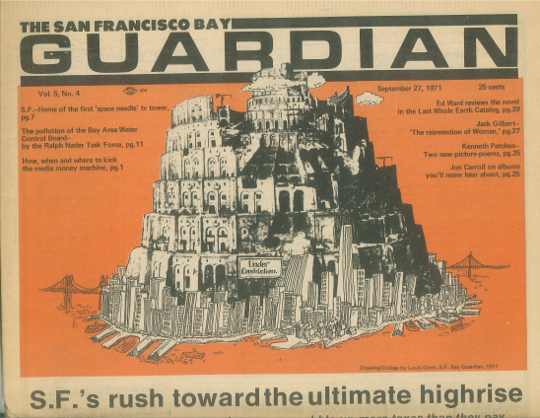
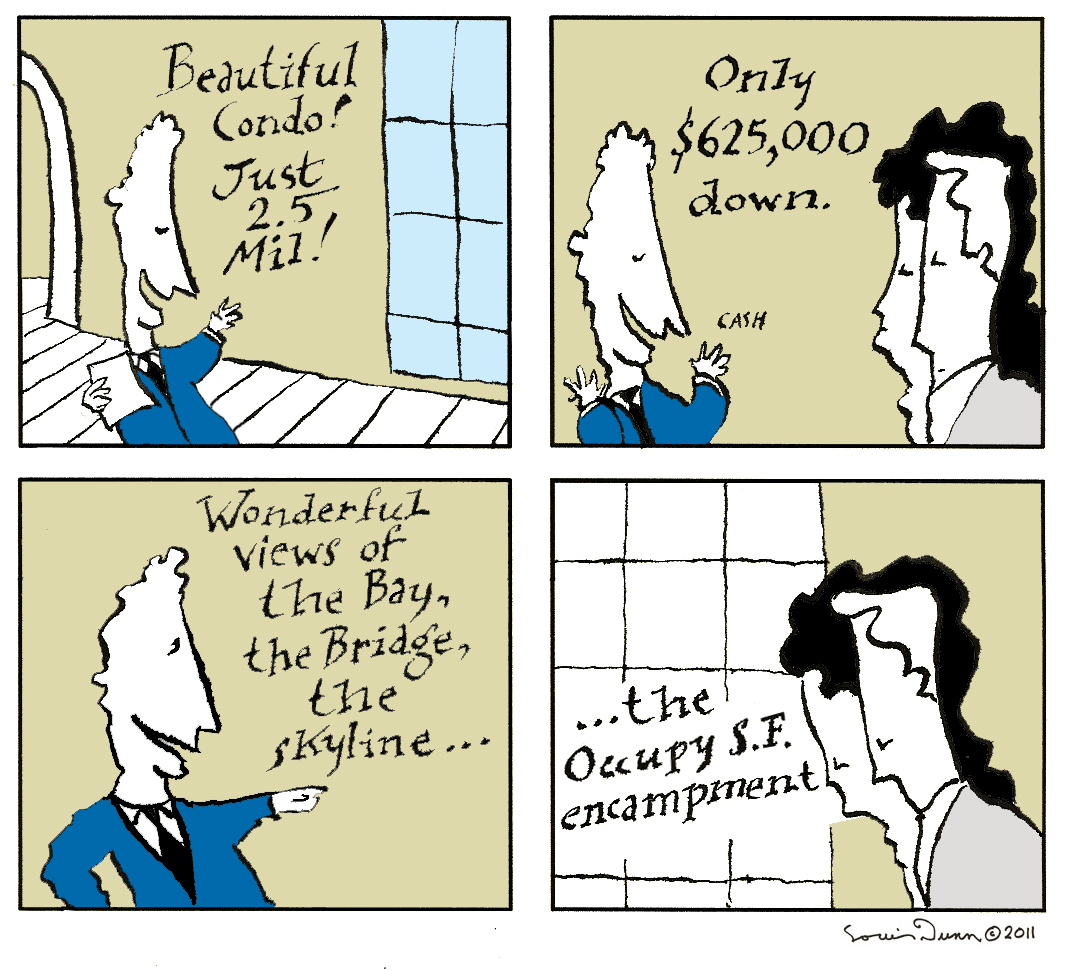
“SF’s rush toward the ultimate highrise” read the headline on the Guardian front page of Sept. 27, 1971. The headline and the graphics by Art Director Louis Dunn illustrated the central point of our bombshell study: that despite the rhapsodies of  the Chamber of Commerce and the big developers, highrise commercial buildings don’t produce gushing revenues and they don’t pay for themselves.In fact, our exclusive study of the downtown highrise district  found that “for every $10 the district yields to the city treasury, the city has to provide $11 in services.

“Put another way: the highrise district contributes $62.9 million, or 25.2% of all locally generated municipal revenue.  But it costs $67.7 million, or 25.2% of all locally financed expenditures (figures from fiscal 1970.

“This means taxpayers subsidize–35 cents or so on the tax rate in fiscal 1970–the construction and maintenance of our civic monuments–the Bank of America building, the Transamerica building, the Hilton Hotel–and soon, another 23 skyscrapers that will be taller and bulkier and more  expensive than ever for residents and taxpayers.”

Project Director Tom Lehner, a San Francisco resident and expert on urban policy from UC-Berkeley’s School of Public Policy, made the crucial point: :”This report overturns once and ffor  all, emphatically and conclusively, the conventional wisdom that downtown skyscrapers somehow provide the municipal treasury with its lifeblood.

“Anyone who thinks for a moment about what’s happening in New York,” Lehner added, “will come to the same conclusion as our study did.  But the air’s been so full of propaganda from the Chamber of Commerce and other downtown interests like the Examiner and Chronicle that it’s difficult to have a clear thought about the subject.”  The economic  fact that taxpayers subsidize highrise development has become gospel and helped provide the ammunition for the slow growth movement on commercial highrises that ultimately won on the Proposition M  initiative in 1986.

Below is the  PDF that shows our study with the Louis Dunn drawings: scroll  through.

http://test.sfbg.com/PDFs/highrise.pdf

Today, the burning issue is the luxury building at 8 Washington and the host of market rate developments already built or in the works and their impact on neighborhoods. And today the city needs a study that can provide the facts on the economic impact of market rate development and how neighborhoods can cope with the impacts in an era of “now new taxes.”

Tony Kelly is the president of the Potrero Hill Boosters and one of the most knowledgeable neighborhood activists on the market rate housing front.  He and the Boosters are dealing with the Mission Bay Landrush and the city’s plan to flood the Eastern Neighborhoods with market rate housing. His take is most instructive on why a study is needed:

‘”During the Eastern Neighborhoods re-zoning in 2008, I saw neighbors who supported development turn into NIMBYs overnight as soon as they realized that building market-rate housing in San Francisco doesn’tpay for itself, or much of anything else.  On Potrero Hill, we spent an entire decade working on neighborhood planning that was supposed to  
give us new parks, new transit lines, and better schools in a part of town that desperately needs all of that.  And then, when the new zoning was finally approved … … we found out that none of those improvements made it over the finish line. 


“The impact fees for the new development won’t even come close to providing the transit, parks, schools or infrastructure that the new residents need, let alone those of us who are already here in a very underserved part of town.  I shouldn’t really have to remind you that the new housing isn’t affordable for City residents.  And the Planning  
Department’s own study from 2008 confirms that when you build market-rate housing, you create a bigger need for affordable housing – more than you are getting in affordable housing fees or inclusionary units.

” So, with every new market rate housing unit, we are falling further behind on everything the City needs to do to support neighborhoods.  And the increased property taxes are all going to the General Fund, to support services elsewhere in the City.  Who in their right minds, in any neighborhood, would sign up for such a deal?

“Now, on this side of town, we are stuck with development plans that are designed to double the populations of district 10 and district 6 in the next 20 years.  In my neighborhood, Potrero Hill, the population will triple. And now we have to figure out how to support this booming population without much help from City Hall.

“The new condominium projects that the Potrero Boosters Neighborhood Association has already seen in the past few months reveal the consequences of the Eastern Neighborhoods rezoning—thousands of condos and apartments (and thousands more residents) coming to the neighborhood, with very few opportunities for children or families, and not much planning from the City for alternatives to automobiles.  

“We cannot have urban density in our part of this City with suburban ways of living and getting around, and yet, that is what we have, now and in the future.  So in the neighborhoods, we have to plan (and takeaction) to create our own infrastructure, and not simply rely on what the City manages to give us.”

Kelly’s arguments against pellmell market rate housing is particularly strong for the city’s new frontier of Mission Bay and the Eastern Neighborhoods, but it applies to every neighborhood and the entire city.  This is why for starters the supervisors need to direct the budget analyst or the city’s economist to do a detailed study to help Tony Kelly and the rest of the neighborhoods deal properly with the onslaught of market rate housing.  b3

Editorial on the case against 8 Washington:
>
http://www.sfbg.com/bruce/2012/03/06/editorial-case-ag

The struggle for housing money at City Hall

24

It’s barely March, and the next election isn’t until June and that’s just primaries and the Democratic County Central Committee, but we just started getting political mail anyway. It’s a piece from the Board of Realtors, denouncing plans for an increase in the real-estate transfer tax “to provide subsidized housing to people who want to live in San Francisco but don’t have the means to do so.” Mayor Ed Lee, the flier says, is backing this “outrageous” plan.

What, exactly, is going on here?

Well, for starters, the mayor is distinctly NOT pushing for an increase in the transfer tax, not right now, anyway. What he is doing is meeting with housing advocates and legislators and trying to come up with a stable source of funding for affordable housing — yes, for families and low-income people, many of them longtime residents who are being forced out by Ellis Act evictions, others of them people who work in the city and would rather live here than commute from Pinole, which everyone with any sense agrees is a good idea.

The problem: For years, San Francisco used Redevelopment Agency tax-increment money for affordable housing. Now that money’s gone, since the governor abolished redevelopment agencies. Actually, the money’s not gone, technically — the increased tax revenue from redevelopment project areas still exists. It’s just that the state is now taking a bunch of it, and other taxing entities like BART and the school district get some of it, and now it’s impossible to send bonds and borrow money against it. So what was once tens of millions for affordable housing is now a few million.

“We might have $20 million a year in the general fund,” said housing activist Peter Cohen. “But that’s compared to the $40 million or $50 million we had in the past, and it still leaves housing short.”

Lee has promised repeatedly to fix that problem, to find a way to make sure that there’s enough money that the nonprofits who build housing can plan and develop for the long term. Right now, it’s being called a Housing Trust Fund, but nobody knows exactly how it will actually work.

Remember: The city’s own General Plan states that 60 percent of all new housing should be available at below market rate. All of the regional growth projections say that San Francisco needs to build more housing — for its own workforce, not just for the rich. (And the local workforce, for all the tech jobs the mayor keeps hyping, is still mostly public-sector workers and service employees, most of whom can’t possibly afford the soaring rents and housing prices in this city.)

A lot of the existing affordable housing money comes from the city’s inclusionary housing law, which mandates that market-rate developers set aside a percentage of their new units (usually 20 percent) for lower-income people. Most developers eschew allowing poor people into their condo enclaves, so they pay a fee into a city fund instead.
But if we’re aiming for 60 percent, and we’re getting (at most) 20 percent, we’re a long ways off. Oh, and the developers are starting to argue that the 20 percent rule is too onerous and they can’t build enough condos for the rich if they have to throw scraps to the poor and middle-class, too.

And some supervisors are squawking about building more housing for the middle class, and right now in a zero-sum game, that means less for low-income people.
This all adds up to a mess for the mayor, and it’s no wonder some advocates are talking about raising the transfer tax — which, after all, is paid by the seller of a residential or commercial building, and while there are absolutely some houses underwater in San Francisco (and there should probably be an exemption in the tax for that situation), overall home prices are rising again, and many, probably most home sales these days involve substantial profit. It’s not a perfect tax, but it’s a tax on a class that is (generally) better off to support a class that is typically not so well off.

Here’s the problem: If the mayor supports a transfer tax, and that’s part of the final package, the realtors and the commericial building owners will no doubt put huge amounts of money into defeating it. That would mean Lee would have to raise a bucket of money and campaign really hard to pass it. But Lee’s demonstrated that he’s not the fighting type; he wants something that nobody serious will oppose. Which is why my sources at City Hall say that he wants the transfer tax off the table.

That could mean that the Housing Trust Fund will be a basic set-aside, a budgetary mandate that a certain amount of money go into a reliable fund for housing. That’s one of the city’s most pressing needs (really, if this becomes a city of just the rich, even those of us who own houses or have rent-controlled apartments won’t want to live here any more. Mayor Larry Ellison? Eeew.) So I’m okay with that. I’m not a big fan of set-asides, but this is the whole future of San Francisco we’re talking about.

So the realtors can take a chill pill — the mayor doesn’t want to get in a fight with you. Sigh.

Paperwork snafu delays big condo project

22

The developers of the 8 Washington project, who have already spent a sizable sum of money on legal, lobbying and prep work, have run into another setback: The March 8 hearing on the project’s shadow impacts has been postponed because of a missing public notice.

The hearing notice and the agenda for the joint meeting of the Planning Commission and the Recreation and Parks Commission wasn’t posted on the Rec-Park website, as required by state law, Linda Avery, the Planning Commission secretary, told us.

The joint meeting was set to consider the impact of shadows the project would cast on nearby Sue Bierman Park and to consider allowing increased shading. That approval is necessary before the project can move forward.

The problems with the public notice were brought to light by Zane Gresham, a lawyer with Morrison and Foerster who often represents developers. In a March 5 letter (PDF) to the two commission presidents, Gresham pointed out that the hearing notice describes the lot on Washington Street, where the project will be constructed, but never mentions the location of the park that will be shadowed.

“The notice misleads the public as to what lots would be affected by the proposed action and fails to disclose to the public the subject of the action to be considered,” the letter stated. “Because the instant hearing notice does not meet minimum legal standards, we respectfully request that no action be taken.”

Avery said that letter sparked a review of the entire notice, and city staffers discovered that it wasn’t properly posted. It also apparently fails to describe fully the action that the two commissions would take: they would to amend the acceptable shadow levels for the park, and then vote to apply those amendments to the 8 Washington development. Only the first type of action is mentioned in the paperwork.

It’s not clear who made the mistakes with the notices — but for a project of this magnitude, critics say it’s remarkable that the city and the developers can’t get the little details of posting a notice correct. “This is the gang that couldn’t shoot straight,” former supervisor Aaron Peskin told me.

The other mystery: Who hired Gresham to review the notice? His letter makes no mention of any specific client, and none of the leading public foes of 8 Washington have retained him. He hadn’t returned my calls and emails by press time.

AH, BUT HERE’S THE UPDATE: Chuck Finnie, who works for the lobbying firm BMWL, just called to tell me that Gresham represents Equity Office Properties, which runs the Ferry Building. EOP, a major national real-estate development firm, is unhappy because the 8 Washington project will wipe out a parking lot used by patrons of the Ferry Building’s businesses. “When EOP took on the job of restoring that building, part of the deal was that parking would be available,” Finnie said. “The Port is ignoring that responsibility.”

Gee, this condo enclave gets more and more unpopular by the day.
 

The case against 8 Washington

35

tredmond@sfbg.com

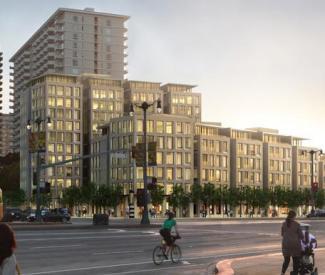
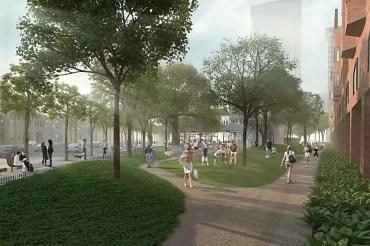
In city planning terms, it’s a fairly modest project: 134 condos, no buildings more than 12 stories tall, on a 27,000-square-foot site. It’s projected to meet the highest environmental building standards and offers new open space and pedestrian walkways. It’s near Muni, BART, and ferry lines. And the city will collect millions of dollars in new taxes from it.

But the 8 Washington project, which will come before the Planning Commission March 8, has become a flashpoint in city politics, one of the defining battles of Mayor Ed Lee’s administration — and a symbol of how the city’s housing policy has failed to keep pace with the needs of the local workforce.

Put simply, it will create the most expensive condos in city history, housing for the richest of the 1 percent on the edge of the waterfront — and will further push San Francisco toward becoming a city that caters almost entirely to the very wealthy.

So in a city where the growing divide between the 1 percent and the rest of us has become a central issue and where the lack of affordable housing is one of the top civic concerns, 8 Washington is an important test. By any rational standard, this sort of development is the last thing San Francisco needs.

But some of the best-connected lobbyists in the city are pushing it. One of the mayor’s closest allies, Chinatown powerbroker Rose Pak, is a leading advocate — and the final outcome will say a lot about city politics in the Lee administration.

There are all sorts of half-truths and misleading statements by supporters of 8 Washington. Here are the five main reasons the project shouldn’t be approved.

1. It fills no housing need. San Francisco has no shortage of housing for the very rich; the dramatic need, outlined in both regional planning documents and the city’s own General Plan, is for low- and moderate-income housing for the people who actually work in this city (see “Dollars or sense?” 9/28/10). While San Francisco is getting richer by the day, the core workforce — public employees, workers in the hotel and restaurant industry, service workers, construction and trade workers, and a majority of the people in the lower levels of the finance and tech sector — are being priced out of the city. That means more people working here and living far out of town, often commuting by car, in what everyone agrees is an unsustainable situation. Meanwhile, more and more high-paid workers from Silicon Valley are living in San Francisco — again, commuting to distant jobs, either by car or by corporate bus.

The city’s General Plan states that some 60 percent of all new housing built in the city should be below market rate. San Francisco desperately needs housing for its workforce. This type of project simply puts the city deeper in the hole and further from its housing goals.

2. It’s a reward for bad actors. The main developer of this project is Simon Snellgrove, but one of his partners is, by necessity, Golden Gateway, which owns a significant part of the land — and which has been flouting at least the spirit if not the letter of city and state law and costing San Francisco tens of millions of dollars.

As project opponent Brad Paul has noted in written testimony, when Timothy Foo, the current owner, bought the complex from Perini Corp. about 20 years ago, he used a loophole in state law that allowed him to avoid a formal transfer of ownership. That means the property wasn’t re-assessed, costing the city about $1.5 million a year. According to the Assessor’s Office, the deal wasn’t illegal (and these tricks to avoid reassessment are relatively common) but still: He’s costing the city millions by using a loophole not available to most people.

Golden Gateway, which was built in a redevelopment area as middle-class housing, is now renting out apartments as short-term tourist or corporate rentals. There are dozens of examples right now on Craigslist. City law bars the owners of rental housing from converting it to hotel rooms, but a loophole in that law makes what Foo’s outfit is doing technically legal. But he’s clearly violating the spirit of the city ordinance that seeks to protect rental housing from hotel conversions.

One of the main aesthetic complaints about the area — something Snellgrove’s lobbyists have tried to use to support the project — is the ugly fence that now surrounds the Golden Gateway Tennis and Swim Club. But who do you suppose put that fence there?

Do we as a city want to be giving special zoning benefits to companies that try to circumvent tax and housing laws?

3. It’s an environmental disaster. Snellgrove and his architects, Skidmore Owning and Merrill, are seeking LEED platinum certification for the project, saying that its energy-efficiency, water use, and green building materials will make it one of the most sustainable structures in San Francisco. It is, the project website notes, close to all types of public transit.

But LEED doesn’t take into account what the building is used for (see “Is LEED really green,” 7/5/11) — and in this case, the use makes a huge amount of difference.

People who buy multi-million-dollar condos don’t tend to take Muni or BART when they go places. That’s not conjecture, it’s a proven fact. A 2008 study by the American Public Transportation Association notes, bluntly, that wealthier people are more likely to drive cars. When you move into the stratospheric regions of the ultra-rich, that’s even more true. A 2011 report on the Charting Transport website notes: “The very rich tend to shun public transport.”

The current zoning in the area allows for one parking space for every four residential units. Snellgrove is asking for one space per unit — in other words, he figures every single buyer will have a car.

Many of the people who buy these condos won’t be working or even living most of the time in San Francisco. These are condos for world travelers, second and third homes for people who want to spend a few weeks a year in San Francisco. “They aren’t going to be living here all year,” Christina Olague, a former Planning Commission member who is now the District 5 supervisor, told us last July.

If five of the 165 residents of 8 Washington fly in a private or corporate jet from, say, New York to their SF pad once a month, the project will cause the use of jet fuel equivalent to what a normal family would use driving a car for 330 years, Paul noted.

“How many solar panels are needed compensate for burning 396,000 gallons of jet fuel a year?” he asked.

Then there’s the construction issue. If the developer’s projections are correct, as many as 20,000 dump truck runs will be trundling along the Embarcadero for several months, one every two minutes — and it could be happening right as the traffic nightmare called the America’s Cup is hitting the waterfront.

It also goes against some 40 years of waterfront planning policy, all of which as focused on downzoning and creating open space. This would be the first upzoning of San Francisco waterfront property in decades.

4. It will wipe out what is mostly a middle-class recreation facility. The Golden Gateway Tennis and Swim Club will be closed for three years, then (possibly) reopened later as a smaller facility. The club — with two outdoor pools and six tennis courts — sounds like something for the elite, and it’s managed by the upscale Bay Club, but a lot of the users are longtime Golden Gateway residents and seniors. “I would say 30 or 35 percent of the users are seniors,” Lee Radner, chair of Friends of Golden Gateway, told me. Most, he said, are middle-class people, and the expense isn’t that high. “My wife and I pay $3 a day to use the pool,” he said. “I swim every day, and it would cost more than that to use the public pools in the city.” He added: “There are some wealthier people, of course, but many of us are retired and on fixed incomes.”

We’re talking about 90,000 total square feet of outdoor recreation space — which dwarfs the 20,000 square feet of open space the developer promised to provide.

5. The city doesn’t get much out of the deal. In exchange for upzoning the waterfront, creating a big all of buildings and screwing up the city’s housing balance, what does the San Francisco general fund get? Not a lot. The estimates for new tax revenue run about $1.5 million a year of the next 60 years — and when you translate that to what economist call “net present value,” the cash equivalent today of that revenue stream, it’s about $30 million. The Port of San Francisco is talking about creating a special infrastructure financing district — sort of the equivalent of a redevelopment area — to pull that money out in advance, which may not even be legal (since part of the land is a former redevelopment area, the state law that allows these special finance districts may not apply). But even so, a Jan. 14 Port memo suggests that the agency has plans to spend all that money on its own infrastructure — setting up a potential battle between the supervisors and the Port Commission over where the money, if it actually can be collected up front, will go.

Like any developer, Snellgrove will pay into the city’s affordable housing fund — in this case, about $9 million to pay for the equivalent of 27 units. No affordable units will be on site, of course; that would detract from the uber-wealthy ambience of the place. And it’s not clear when those units would be built. “Nobody builds 27-unit buildings any more,” Paul, a former deputy mayor for housing, said. “We’ll have to wait until there’s enough money for a bigger project, somewhere, sometime down the road. That’s what we’re getting here.”

Either way, it’s not a huge benefit for allowing this disaster of a project — and it’s a terrible statement for San Francisco to make. At a time when the mayor has cleared the Occupy protesters — who are talking about how little the rich pay in taxes — off the waterfront, the city is preparing to move in the exceptionally rich, who aren’t paying anywhere near their fair share in tax revenue to local government.

(Nobody knows for sure whether the costs of servicing high-end residential exceed the revenue the city gets from property taxes. In 1971, the Guardian put together the first-ever cost-benefit study for highrise office development, which showed that commercial buildings cost the city more than they paid; that’s been confirmed and demonstrated over the years to the point where it’s hardly even an argument any more. The supervisors ought to ask the city economist or the budget analyst to do the same sort of analysis for luxury condos.)

There’s another element here: Mayor Lee made a point during his campaign to say over and over again that he was an independent thinker, that powerful and influential allies like Rose Pak would not be calling the shots at City Hall. This will be his first major test: Pak and lobbyist Marcia Smolens are working hard to promote 8 Washington. And we’re already getting some disturbing signals out of the mayor’s office.

Lee told us that he has “no thoughts” about the project and hasn’t been paying any attention to it. That’s an odd stance, considering that his own Port Commission is pushing it and staffers in his office are working with the developer. This is a big priority for Pak, and the notion that she has never mentioned it to the mayor defies reason. Board President David Chiu, who talks to the mayor regularly, opposes the project, which is in Chiu’s district.

It’s hard to imagine that anyone who pays attention to local politics could be missing what will be one of the landmark votes this spring on the Planning Commission — which will take up the project March 8 — and the Board of Supervisors.

The mayor, may, indeed, be ignoring everything that supporters and opponents of 8 Washington have said and may be waiting until the Planning Commission vote to take a position. But if he’s just ducking questions because he’s planning to support it, he’s making a big mistake.

This is a chance for San Francisco to go beyond the platitudes about building housing, go beyond the hype about “green” buildings, see through the fraud about community benefits and consider what this really is: A special favor for a developer who wants to cater to the top 1 percent of the 1 percent and move San Francisco even closer to being a city of, by, and for the elite. The only reasonable vote on 8 Washington is No.


Editorial: The case against the 8 Washington tower

27

Editorial note: In 1971, at the height of the Alvin Duskin anti-highrise battle, the Guardian did a special first ever cost benefit study for high rise office development.

We found that highrises cost the city  more in services than they produce in revenue.  This meant that the commercial high rise boom could be fought on economic grounds, not just aesthietic and environmental grrounds, and the Chamber of Commerce/Big development gang could never adequately refute our findings.  In fact, they are now taken for  granted. So, as the 8 Washington battle is poised to open the floodgates even further for a forest of market rate residential  buildings, it’s time for the city to do its own study to determine the economics of high end  residential buildings.  Does the cost of servicing luxury residential buildings exceed the taxes they pay? We and many others in the neighborhoods are certain that market rate housing doesn’t pay for itself. But the facts are needed and so we urge the supervisors to direct the budget analyst or the city economist to do a similar analysis  for luxury condos.  Below is Executive Editor Tim Redmond’s powerful argument against 8 Washington.

By Tim Redmond

tredmond@sfbg.com

In city planning terms, it’s a fairly modest project: 134 condos, no buildings more than 12 stories tall, on a 27,000-square-foot site. It’s projected to meet the highest environmental building standards and offers new open space and pedestrian walkways. It’s near Muni, BART, and ferry lines. And the city will collect millions of dollars in new taxes from it.

But the 8 Washington project, which will come before the Planning Commission March 8, has become a flashpoint in city politics, one of the defining battles of Mayor Ed Lee’s administration — and a symbol of how the city’s housing policy has failed to keep pace with the needs of the local workforce.

Put simply, it will create the most expensive condos in city history, housing for the richest of the 1 percent on the edge of the waterfront — and will further push San Francisco toward becoming a city that caters almost entirely to the very wealthy.

So in a city where the growing divide between the 1 percent and the rest of us has become a central issue and where the lack of affordable housing is one of the top civic concerns, 8 Washington is an important test. By any rational standard, this sort of development is the last thing San Francisco needs.

But some of the best-connected lobbyists in the city are pushing it. One of the mayor’s closest allies, Chinatown powerbroker Rose Pak, is a leading advocate — and the final outcome will say a lot about city politics in the Lee administration.

There are all sorts of half-truths and misleading statements by supporters of 8 Washington. Here are the five main reasons the project shouldn’t be approved.

1. It fills no housing need. San Francisco has no shortage of housing for the very rich; the dramatic need, outlined in both regional planning documents and the city’s own General Plan, is for low- and moderate-income housing for the people who actually work in this city (see “Dollars or sense?” 9/28/10). While San Francisco is getting richer by the day, the core workforce — public employees, workers in the hotel and restaurant industry, service workers, construction and trade workers, and a majority of the people in the lower levels of the finance and tech sector — are being priced out of the city. That means more people working here and living far out of town, often commuting by car, in what everyone agrees is an unsustainable situation. Meanwhile, more and more high-paid workers from Silicon Valley are living in San Francisco — again, commuting to distant jobs, either by car or by corporate bus.

The city’s General Plan states that some 60 percent of all new housing built in the city should be below market rate. San Francisco desperately needs housing for its workforce. This type of project simply puts the city deeper in the hole and further from its housing goals.

2. It’s a reward for bad actors. The main developer of this project is Simon Snellgrove, but one of his partners is, by necessity, Golden Gateway, which owns a significant part of the land — and which has been flouting at least the spirit if not the letter of city and state law and costing San Francisco tens of millions of dollars.

As project opponent Brad Paul has noted in written testimony, when Timothy Foo, the current owner, bought the complex from Perini Corp. about 20 years ago, he used a loophole in state law that allowed him to avoid a formal transfer of ownership. That means the property wasn’t re-assessed, costing the city about $1.5 million a year. According to the Assessor’s Office, the deal wasn’t illegal (and these tricks to avoid reassessment are relatively common) but still: He’s costing the city millions by using a loophole not available to most people.

Golden Gateway, which was built in a redevelopment area as middle-class housing, is now renting out apartments as short-term tourist or corporate rentals. There are dozens of examples right now on Craigslist. City law bars the owners of rental housing from converting it to hotel rooms, but a loophole in that law makes what Foo’s outfit is doing technically legal. But he’s clearly violating the spirit of the city ordinance that seeks to protect rental housing from hotel conversions.

One of the main aesthetic complaints about the area — something Snellgrove’s lobbyists have tried to use to support the project — is the ugly fence that now surrounds the Golden Gateway Tennis and Swim Club. But who do you suppose put that fence there?

Do we as a city want to be giving special zoning benefits to companies that try to circumvent tax and housing laws?

3. It’s an environmental disaster. Snellgrove and his architects, Skidmore Owning and Merrill, are seeking LEED platinum certification for the project, saying that its energy-efficiency, water use, and green building materials will make it one of the most sustainable structures in San Francisco. It is, the project website notes, close to all types of public transit.

But LEED doesn’t take into account what the building is used for (see “Is LEED really green,” 7/5/11) — and in this case, the use makes a huge amount of difference.

People who buy multi-million-dollar condos don’t tend to take Muni or BART when they go places. That’s not conjecture, it’s a proven fact. A 2008 study by the American Public Transportation Association notes, bluntly, that wealthier people are more likely to drive cars. When you move into the stratospheric regions of the ultra-rich, that’s even more true. A 2011 report on the Charting Transport website notes: “The very rich tend to shun public transport.”

The current zoning in the area allows for one parking space for every four residential units. Snellgrove is asking for one space per unit — in other words, he figures every single buyer will have a car.

Many of the people who buy these condos won’t be working or even living most of the time in San Francisco. These are condos for world travelers, second and third homes for people who want to spend a few weeks a year in San Francisco. “They aren’t going to be living here all year,” Christina Olague, a former Planning Commission member who is now the District 5 supervisor, told us last July.

If five of the 165 residents of 8 Washington fly in a private or corporate jet from, say, New York to their SF pad once a month, the project will cause the use of jet fuel equivalent to what a normal family would use driving a car for 330 years, Paul noted.

“How many solar panels are needed compensate for burning 396,000 gallons of jet fuel a year?” he asked.

Then there’s the construction issue. If the developer’s projections are correct, as many as 20,000 dump truck runs will be trundling along the Embarcadero for several months, one every two minutes — and it could be happening right as the traffic nightmare called the America’s Cup is hitting the waterfront.

It also goes against some 40 years of waterfront planning policy, all of which as focused on downzoning and creating open space. This would be the first upzoning of San Francisco waterfront property in decades.

4. It will wipe out what is mostly a middle-class recreation facility. The Golden Gateway Tennis and Swim Club will be closed for three years, then (possibly) reopened later as a smaller facility. The club — with two outdoor pools and six tennis courts — sounds like something for the elite, and it’s managed by the upscale Bay Club, but a lot of the users are longtime Golden Gateway residents and seniors. “I would say 30 or 35 percent of the users are seniors,” Lee Radner, chair of Friends of Golden Gateway, told me. Most, he said, are middle-class people, and the expense isn’t that high. “My wife and I pay $3 a day to use the pool,” he said. “I swim every day, and it would cost more than that to use the public pools in the city.” He added: “There are some wealthier people, of course, but many of us are retired and on fixed incomes.”

We’re talking about 90,000 total square feet of outdoor recreation space — which dwarfs the 20,000 square feet of open space the developer promised to provide.

5. The city doesn’t get much out of the deal. In exchange for upzoning the waterfront, creating a big all of buildings and screwing up the city’s housing balance, what does the San Francisco general fund get? Not a lot. The estimates for new tax revenue run about $1.5 million a year of the next 60 years — and when you translate that to what economist call “net present value,” the cash equivalent today of that revenue stream, it’s about $30 million. The Port of San Francisco is talking about creating a special infrastructure financing district — sort of the equivalent of a redevelopment area — to pull that money out in advance, which may not even be legal (since part of the land is a former redevelopment area, the state law that allows these special finance districts may not apply). But even so, a Jan. 14 Port memo suggests that the agency has plans to spend all that money on its own infrastructure — setting up a potential battle between the supervisors and the Port Commission over where the money, if it actually can be collected up front, will go.

Like any developer, Snellgrove will pay into the city’s affordable housing fund — in this case, about $9 million to pay for the equivalent of 27 units. No affordable units will be on site, of course; that would detract from the uber-wealthy ambience of the place. And it’s not clear when those units would be built. “Nobody builds 27-unit buildings any more,” Paul, a former deputy mayor for housing, said. “We’ll have to wait until there’s enough money for a bigger project, somewhere, sometime down the road. That’s what we’re getting here.”

Either way, it’s not a huge benefit for allowing this disaster of a project — and it’s a terrible statement for San Francisco to make. At a time when the mayor has cleared the Occupy protesters — who are talking about how little the rich pay in taxes — off the waterfront, the city is preparing to move in the exceptionally rich, who aren’t paying anywhere near their fair share in tax revenue to local government.

(Nobody knows for sure whether the costs of servicing high-end residential exceed the revenue the city gets from property taxes. In 1971, the Guardian put together the first-ever cost-benefit study for highrise office development, which showed that commercial buildings cost the city more than they paid; that’s been confirmed and demonstrated over the years to the point where it’s hardly even an argument any more. The supervisors ought to ask the city economist or the budget analyst to do the same sort of analysis for luxury condos.)

There’s another element here: Mayor Lee made a point during his campaign to say over and over again that he was an independent thinker, that powerful and influential allies like Rose Pak would not be calling the shots at City Hall. This will be his first major test: Pak and lobbyist Marcia Smolens are working hard to promote 8 Washington. And we’re already getting some disturbing signals out of the mayor’s office.

Lee told us that he has “no thoughts” about the project and hasn’t been paying any attention to it. That’s an odd stance, considering that his own Port Commission is pushing it and staffers in his office are working with the developer. This is a big priority for Pak, and the notion that she has never mentioned it to the mayor defies reason. Board President David Chiu, who talks to the mayor regularly, opposes the project, which is in Chiu’s district.

It’s hard to imagine that anyone who pays attention to local politics could be missing what will be one of the landmark votes this spring on the Planning Commission — which will take up the project March 8 — and the Board of Supervisors.

The mayor, may, indeed, be ignoring everything that supporters and opponents of 8 Washington have said and may be waiting until the Planning Commission vote to take a position. But if he’s just ducking questions because he’s planning to support it, he’s making a big mistake.

This is a chance for San Francisco to go beyond the platitudes about building housing, go beyond the hype about “green” buildings, see through the fraud about community benefits and consider what this really is: A special favor for a developer who wants to cater to the top 1 percent of the 1 percent and move San Francisco even closer to being a city of, by, and for the elite. The only reasonable vote on 8 Washington is No.

Food-truck battle at the board of supes

14

The supervisors are weighing in on a state bill that would ban food truck from parking within 1500 feet of schools — and it’s really tricky.

Let’s start with a bit of reality: My kids go to public schools, my son’s in middle school, he rides Muni home — and there’s ample opportunity for him to buy some really nasty stuff. There’s a 7-Eleven a couple of blocks from his school, and kids walk over there all the time and buy those disgusting 32-ounce sugar bombs. If a truck selling chips and soda and greasy tacos showed up at 3:30 p.m., the kids would be lined up to spend the money their parents though was going for a nice healthy lunch.

And the trucks would go there, if they could, the same way the ice cream trucks used to cruise through my suburban neighborhood in the 1960s (yeah, I’m old, old, old) in the late afternoon, when they could guarantee America’s children would be hungry and ready to spoil their supper.

But they can’t, see, because San Francisco already bans food trucks from within 1,500 feet of a public middle school or high school — which is a pretty broad zone.

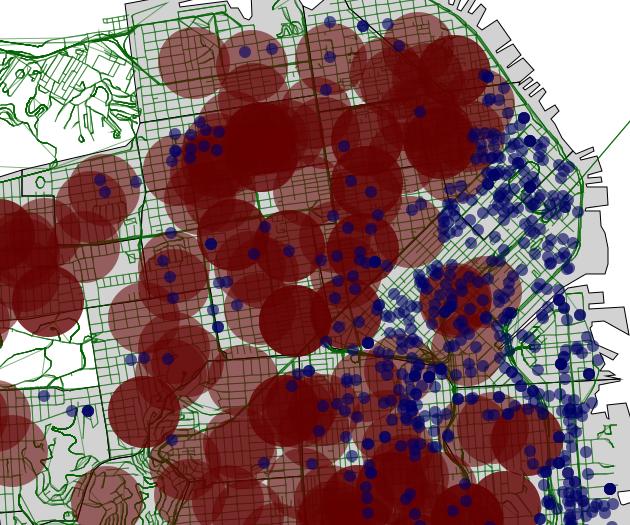
Now Assemblymember Bill Monning has introduced a bill that would make that ban statewide — and would include middle schools and private schools. Sounds good, and some healthy-food advocates love it. But San Francisco’s a little different than, say, Hayward or Fresno — this is such a dense city that there are schools almost everywhere. If you ban food trucks from within 1,500 feet of all schools, then you ban them from about 80 percent of the city. Burrito Justice has a great set of maps that give you the picture (burritohibition!)

The maps also suggest the problems with banning anything from within 1,500 feet of a school in San Francisco. Pot clubs, liquor stores, sex clubs … there are all sorts of places where you really don’t want your kids hanging out, but if you make those broad exclusions, you force them all into a very few small areas (including northern Soma, the waterfront and Bayview) and that’s not exactly fair, either. Should all the food trucks in the city be congregated in those crowded places that fit the 1,500 foot rule?

My 10-year-old daughter walks through the heart of the Castro, which is probably within 1,500 feet of her school, and there’s some stuff in the storefronts that isn’t exactly age appropriate, and we deal. She asked me once why people were walking around naked, and I said “because they like to,” and she shrugged and that was that.My 12-year-old son knows that people smoke pot and that it’s legal for adults to use as medicine; I don’t think the notion of him walking past a well-regulated dispensary is going to make him any more (or less, god help me) likely to try some for himself some day.

So I’m kind of with Sup. Scott Wiener, who wants the city to oppose the Monning bill — not because I want trucks selling Doritos out in front of Aptos in the afternoon, but because I think San Francisco already prevents that, and 1,500 feet is way too much for a city this size. Maybe amend the bill to allow cities to make their own rules, but have the state rules apply if they don’t. Maybe allow cities beyond a certain density to change the distance to 500 feet.

Maybe think a little more about what it really means to ban things because they’re close to schools. It doesn’t always make sense.

PS: Actually, I’m thinking maybe we should ban all multimillion-dollar condos from anywhere within 5,000 feet of a school. Exposing the impressionable minds of small children to such graphic, disgusting, ostentatious displays of wealth has to be bad for them. Worse than seeing a sex club, anyway.


The 8 Washington disaster goes to Planning

100

The urban planning disaster that is 8 Washington goes before the San Francisco City Planning Commission March 8 amid a long list of questions — including Mayor Lee’s position on the project and how it could screw up the America’s Cup.

Developer Simon Snellgrove wants to build the most expensive condos in San Francisco history on the waterfront, 145 units that will be far out of reach to anyone who makes less than half a million dollars a year. And many of the units will require income far higher than that. It’s not just housing for the 1 percent; it’s housing for the top half of the 1 percent.

There’s no need for this kind of housing in SF; the very rich have no problem finding places to live. And the spot zoning violates every standard of good waterfront planning practice.

The project will benefit the Port of San Francisco, which stands to take a cut of the money since some of the project is on Port land. But more than half of the land is owned by Golden Gateway and is a former redevelopment area, so the supervisors and the Port are going to have to fight over who gets the property tax increments and how that’s all financed.

More interesting, 8 Washington will be a boon to Golden Gateway, which as the landowner is a partner in the deal. And Golden Gateway is one of those big properties that are paying far too little in city taxes. When the complex changed hands several years ago, the owners used a stock-swap deal to transfer it, avoiding the Prop. 13 reassessment that could have substantially raised its taxes. So the city’s losing millions of dollars — and now Timothy Foo, who is the principal owner of Golden Gateway, will be getting a nice favor from the city he’s been screwing.

Oh, and by the way — a lot of Golden Gateway units are being advertised as short-term (that is, hotel) rentals — something that violates at least the spirit of city law. This is an outfit that deserves special zoning treatement from San Francisco?

Then there’s the fact that this could be a serious problem for the big America’s Cup party. Project critic Brad Paul has been analyzing the impacts of the development, and noticed some new language in the comments and responses to the Environmental Impact Report suggesting that excavation could lead to something like 200 dump-truck trips a day along the Embarcadero — roughly one trip every two minutes. In an email to Paul, Paul Matltzer in the Planning Department confirmed that the likely construction process could, indeed, involve that many dump trucks, rumbling along the Embarcadero during the peak construction period, which will also be the peak period for America’s Cup tourism.

Dump trucks, Paul (who used to drive one) notes, start slowly and brake slowly. The Embarcadero is already crowded — and will be far more crowded during the Cup races, so much so that city officials are thinking of closing traffic lanes to all but bicyles and transit. How, exactly, will that work out with 200 trucks a day fighting for room?

I’ve called and emailed the America’s Cup people, but they haven’t gotten back to me. I’ll keep you posted.

Lee’s office hasn’t gotten back to me, either, but I’m hearing that the mayor is telling people he hasn’t made up his mind — on a project that’s a week away from the Planning Commission and that one of his close allies, Rose Pak, is strongly promoting.


What’s wrong with the America’s Cup deal? A lot

21

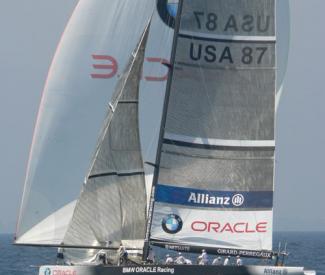
Let’s start out with a premise that even Larry Ellison’s minions have come to accept: The race is happening here. Too late now to move it to another city. Worst-case scenario, according to Stephen Barclay, the point person for the world’s sixth-richest man: “If we don’t meet those dates, the teams will be forced to relocate to other places around the bay.”

That’s right — the teams will relocate to other places around the bay. The host city will still, for all practical purposes, be San Francisco; the races will happen off SF’s waterfront (where the Coast Guard is willing to allow them and the conditions are right) and the rich tourists will stay here, not in Burlingame or Fremont.

If Ellison decides the city’s not giving him enough, he won’t put up $55 million to fix up some of the waterfront piers. The city may decide that a development deal of some sort with him makes economic sense. But it’s a real-estate deal at this point, not a deal for the race. At least, that’s what the Ellison team seems to be confirming.

And I fear that the real-estate deal that the Board of Supervisors Finance Committee sent forward yesterday, 2-1, is a bad deal for the city.

The terms are really complicated, and it makes my head hurt just trying to figure it all out — and still, the supes are expected to vote on the 120-plus-page document Feb. 28. Here’s what we do know, though:

The supervisors originally came to a deal with the America’s Cup Event Authority back in December. The concept was — and is — pretty straightforward, the same sort of deal the city has done (or, certainly, the Redevelopment Agency has done) many times in the past. In exchange for putting cash into renovating several piers, Ellison’s group would get long-term leases and development rights on the property. The idea: The city can’t afford to fix the piers. Ellison’s organization can. And once the property is renovated, the developer can make back that initial investment, and a profit, by building commercial space, condos and whatever else the Port decides to allow.

In a perfect world, San Francisco (and the state and the feds) would tax the hell out of people like Ellison, and there’d be public money to rebuild the waterfront as public open space, recreational facilities and the like. And wouldn’t that be utterly cool? Wouldn’t this city have the most awesome waterfront in the world?

But no: The only way the piers are going to anything but a place to park cars until they fall into the bay is if some private developer gets the rights to build something that I won’t like.

Supervisors Jane Kim and Mark Farrell, who don’t agree on a lot of things, both agreed with my basic analysis of the politics here: We shouldn’t let the excitement over the prospect of a boat race get in the way of analyzing this for what it is: A financing tool for the Port to get its infrastructure fixed up. Without a private investor, “they just don’t have the capacity to do that,” Kim told me.

So let’s just stipulate for a moment that this is the best, maybe the only way the city can restore the Port. Then it comes down to the real issue: Has the Mayor’s Office negotiated a good enough deal? Is San Francisco getting enough out of this? Or is everyone so hyper-buzzed about fancy carbon-fiber boats in the water (and I admit, they’re pretty cool) and free-spending tourists in the hotels and restaurants that we’re letting Mr. Ellison — who didn’t get so stinky rich by being a weak negotiator — walk away with most of the cookies?

Remember: Ellison’s not doing the city any favors. He’s only fixing up the piers that he will effectively own (as least for most of the rest of this century).

Back in December, the rough outlines looked like this: A corporation set up by Oracle, called the America’s Cup Event Authority, would put $55 million into repairing and renovating piers, then would get  66-year leases and development rights on piers 30-32, 26 and 28, as well as seawall lot 330, across the Embarcadero, which Ellison’s team wants to turn into more condos for rich people. If that’s not enough to pay for Ellison’s investment, Ellison’s heirs or successors get half the rent for the piers for another 15 years. That’s 81 years.

The original deal mandated that the city would collect a 1 percent fee on the re-sale of the new condos. It also had a requirement that Ellison share with the city any profits he made by flipping the long-term leases.

That’s a big deal, because almost nobody in the city actually holds onto development entitlements anymore. A developer wins the right to build an office building — and next week, he or she sells that right to somebody else. It’s almost certain that at some point, Ellison — whose sole goal here is going to be making a profit off city land — will decide that the best way to make money is to cash out. He’ll keep his 66-year leases for a few years, maybe lobby his way to approvals for office, condos, time-shares (gasp! yeah, they’ll do that if it’s legal) restaurants or whatever — then sell the remaining time on the leases, plus the development rights, to somebody else. And because he’s Larry Ellison, he’ll wind up making a nice tidy profit.

That used to be what happened with Port property (see: Pier 39) but lately, the Port’s gotten a bit wiser and has, in some cases, insisted that part of the profit from flipping a lease goes back to the city. In the original discussions, Ellison was going to have to pay the Port 15 percent of any net gains he made from the almost inevitable sale of the valuable leases.

But that’s gone now. After the board approved Newsom’s deal, the former mayor — who was always terrible at negotiation with the rich and powerful and always gave away the store — went back and monkeyed around with it. He and Sup. David Chiu insisted that the changes were just technical, not substantive enough to require a new board vote — but the current deal has no 15 percent cut for the Port, and the 1 percent levy on condo sales only applies after the second owner sells — which will be years down the road.

Then there’s the part where the city has to reimburse Ellison if the cost of renovating the piers exceeds what’s expected (oh, and we have to pay him 11 percent interest, which is about ten times what I get on my bank account; how about you?) There’s no cap on what the city might have to pay. And Ellison gets to develop a new marina.

And while Pier 29 is no longer a part of the deal, the city has to give Ellison $12 million — or rights to a pier to be named later. (Maybe Ellison figures that in a few years the people who opposed Pier 29 development will be out of office and he can convince the new mayor and supervisors to give Pier 29 back. It’s not legally excluded.)

Kim told me she’s going to insist that the final deal include a local-hire provision, which the rest of the board would be crazy not to support (and which Ellison, despite his company’s problems with local labor laws in the past, would be crazy not to accept).

But overall, Kim — who with Sup. Carmen Chu was part of the 2-1 majority sending the package to the full board — told me she thought the city got a good deal. “It took me a while,” she said. “But [Port Director] Monique Moyer convinced me that this was good for them.”

Sup. John Avalos, the dissenting vote on the Finance Committee, isn’t convinced. He’s got a long list of concerns, starting with the fact that he thinks the projected attendance and economic benefits are a bit delusional. “The figures seem farfetched,” he told me. “I’m seeing a lot of pumped up numbers. And those numbers drive whether this is a good deal for the city or not.”

He’d like to see the 1 percent rule apply to the second condo sale, not the third. He’d like to see the Port get 15 percent of the profits from any sale. And he’d like a cap on the reimbursements the city has to give to Ellison.

But here’s the problem: When the development agreement comes before the board, sitting as a Committee of the Whole Feb. 28, it will be hard to put any of that back in the agreement. This is a contract, and while the board can pass a resolution asking for more, in the end, it’s a matter of voting it up or down.

Vote yes and it’s done — more or less as is — although Kim says there will be another chance to make changes down the road, since the board and the Planning Commission will have to sign off on whatever type of development Ellison wants to do. The problem with that scenario? Ellison’s lawyers will wave this development agreement around like a Giants victory towel and proclaim that it binds the city and limits any ability to demand any more changes later. That’s how these people operate.)

Vote no and the ball goes back to Larry’s Court: His group can sit down with the Mayor’s Office and make some changes, or they can walk away (and build their boat sheds in …. where? Oakland? Foster City? Who’s got waterfront that can handle this?)

When the Finance Committee send the package to the full board, Avalos said, “we pretty much lost our ability to influence the agreement. Now we have to decide if we want to call [Ellison’s] bluff.”

PS: One of the lingering issues is whether the America’s Cup Organizing Committee can raise the $30 million-odd that is needed to make the numbers pencil out. If I were a rich person and Mark Buell, the ACOC point person, called me for money, here’s what I’d say:

How much is Larry Ellison contributing?

See, Ellison’s improvements on the waterfront aren’t charity. He’s looking to make a buck off everything he does. In past eras, the great robber baron capitalists would donate civic monuments — libraries and museums and stuff — and by any traditional standard of great wealth, Ellison ought to be writing a personal check for that $30 million. Or at least for some of it.

But so far, he hasn’t given a penny. The sixth richest man in the world isn’t actually donating anything to San Francisco. Yeah, he’s gracing us with his lordly presence, but cash? Nada.

Good luck with that one, Mark.

PPS: This whole concept that the city needs to fix the “crumbling” piers ought to be examined. First of all, nobody’s ever said that Pier 29 was in anything but fine shape. But beyond that, the Bay Conservation and Development Commission considers piers to be bay fill, and in the long term, wants San Francisco to get rid of some of them. “Maybe it’s a good thing if some of the piers fall into the bay,” former Sup. Aaron Peskin told me. “Then we’ll have more leeway with BCDC when we want to fix up some of the others.”

Research assistance by Royce Kurmelovs

Bounce to this: Rusty Lazer does Mardi Gras

1

Due to health problems, Big Freedia had to cancel her and Rusty Lazer’s Noise Pop gig at Public Works Sat/25. The event been transmutated into a big gay dance party with Double Duchess, DJ Bus Station John, and more. You should still read this interview, though.

With all its technicolor thrift flair, Mardi Gras costumes in state of midway-preparedness, and sleepy passels of breakfast-cooking houseguests, Jay Pennington’s New Orleans clapboard house is pretty hallucinatory on the Saturday afternoon of Carnaval weekend. Staring out the window waiting for the bounce DJ to call me up for our interview, I was to be excused for imagining that the shed in the side lot was producing actual chords while the New Orleans monsoon that raged outside hit it.

When I come across him in his bedroom, Pennington – who is also known as Rusty Lazer, and is the now-famous transgender NOLA bounce artist Big Freedia’s DJ and informal manager – is threading colored paper onto a string. He was going to be Hanuman the monkey god at the Mardi Gras parades on Sunday, his day off from work over Mardi Gras weekend. Around him, the city has ballooned with tourists and locals chucking beads at targets, high-stepping through brass numbers, eating frosted king cake, and peeing in inappropriate places.

I braved the rain that afternoon to talk about bounce music and Mardi Gras with Pennington, so it was kind of a surprise when our conversation swerved into the intricacies of 501(c)3 registration. It shouldn’t have been. He is a lot like New Orleans itself, a town that counts as a centuries-old melting pot, where the frat boys hang at the same bars as the career jazz musicians hang at the same bars as the pretty queer kids who sometimes party at dark gay leather bars (I was privy to this last comingling within six hours of landing in the Big Easy, at Daddy Aki’s Peacock party at the Phoenix Eagle Leather Bar where Pennington and his new managee Nicky Da B spun). [Correction: An earlier version of this article identified Peacock as Jay Pennington’s party. It is actually organized by Daddy Aki. Our bad.]

If you are a NOLA entertainer, Mardi Gras weekend counts among the most hectic of the year. Pennington had evenly informed me that my suggested meet-up time of noon was at least two hours too early considering the aftermath of the night shift on the decks he’d pulled before and that he would surely pull again that evening. But it’s two thirty now and for the moment, he’s able to focus on Hanuman, and attempt to tell me what’s so special about his city.

Hands-on Hanuman: Rusty Lazer in mid-Mardi Gras repose. Guardian photo by Caitlin Donohue

Though the DJ is playing less and less a role in Big Freedia’s career as she blows up and sells out shows around the country, Pennington continues to be a driving force in bounce’s dispersal outside NOLA. He signed his first official managerial contract with Nicky Da B, an adorable local whose track with Diplo hit Soundcloud last week. Bounce is indigenous to New Orleans — like Chicago’s juke and Detroit’s jit — a Caribbean-inflected dance music that is well known for the way its dancers pop their hips at machine gun rates.

Pennington is also is the co-founder along with Delaney Martin of New Orleans Air Lift, an international program he made to support local artists post-Katrina. This loosely-incorporated organization (it’s not 501(c)3 and relies instead on private donations, like the sales of the work of Swoon, one of the few females in the upper echelons of the street art world – her intricate, delicate wheatpastes blanket the fence next to Pennington’s house.) The Airlift Project has sponsored trips by New Orleanian artists to Berlin, even the import of Siberian breakdancer Ivan Stepanov to New Orleans.

This last story illustrates one of Pennington’s biggest turn-ons — fostering the artistic combustion that happens when a bunch of different energies get together. As illustration, he shows me a high fashion video shoot made by Lady Gaga’s stylist Nick Knight featuring the 19-year-old local bounce dancer Quack. 

After seeing a video of the improbably Barbie-bodied dancer, Knight contacted Pennington to ask if she’d care to do the same dance wearing Alexander McQueen for a fashion film series. Quack didn’t have a passport, but she went and got one with Pennington. The next day they went to London, found themselves “sitting in a room with nothing but Amazonian models.” Quack danced for eight hours to make the video, which turned out to be a testament to not just the extreme sexuality of bounce music, but also its athleticism, and emotional panacea. 

“This is the music that makes people forget that they’re hungry,” Pennington tells me, excitedly clicking through videos of schoolkids bouncing in rec centers, and endless YouTube clips of home bounce practice, done against a wall, ass to the camera. “It’s finally tuned to helping you forget your problems.” He wants to “take a New Orleans plane full of people all over the world,” to teach bounce to the masses. “In case anybody around here has forgotten how to have fun.”

The music lends itself to teaching — singers often give specific commands in songs, a popular request being for everbody to bend over and keep their ass popping. “Bounce is all instructions,” Pennington says.

The ability to move among social groups is one of the reasons why Pennington fell in love with New Orleans. 

“Here, you’re part of a community, not just part of a scene,” he reflects. “The difference is that the communities include all the people in your community. I don’t feel that in Portland or Austin.” He says the young arrivals in other artsy, liberal towns “hang out in mirrored social groups. I don’t know if that means anything, but it makes sense to me.” Pennington considers the neighborhood connections he’s made through participating in NOLA’s famous informal second line parades as, if not more, crucial than the ones he’s made with fellow travelers who have alit upon New Orleans as a haven for weirdos and music freaks. “New Orleans black community is nothing if not family-oriented,” he says.

Those mirrored social groups are a concept that should make sense to those beyond DJ Rusty Lazer. Part of what makes gentrification such a bummer is that when young bohos move into low-rent, family-oriented neighborhoods, they don’t form connections with the existing culture, imposing their own wacky adventures on top of the landscape as though they’re the first to really enjoy it. 

This missed connection leads newcomers away from frequenting established neighborhood businesses, and doesn’t provide for enough interconnectedness to get any kind of organizing come when rents start to rise and the condos come in. So good for New Orleans, and especially the rapidly changing Bywater neighborhood if they can avoid the typical storyline of minority community attracting broke artists attracting yuppies who can pay first, last, second, and third months’ rent in cash. 

Not the town doesn’t have other defense mechanisms. “The heat, the bugs, that lack of industry, the violence — that keeps it from growing out of control,” says Pennington. “It keeps the excessively ambitious away. When this place piles it on, it really piles it on. You can’t just casually live in New Orleans.” Wise words to the San Franciscan exodus that will surely come in the next months after tech boom 2.0

And for the record, I wasn’t hallucinating the house making music. The Ninth Ward’s musician mad scientist Quintron installed a rain organ into the Music Box, a small village of structures built in Pennington’s sideyard by 70 people to be played like a symphony, complete with Quintron playing conductor and a capacity crowd crammed into bleacher seating and crouching amid the structures themselves. At recent performances during last fall, 750 people showed up to watch the show. There was space for 250 in the sidelot. 

Who gets to live here?

38

yael@sfbg.com

Housing policy — which determines who will be able to live in San Francisco — has been a hot topic at City Hall these days.

At a Board of Supervisors Land Use and Economic Development Committee meeting on Feb. 13, representatives from the Mayors Office of Housing (MOH) reported on the state of middle-income housing in San Francisco, at the request of Sup. Scott Wiener. “Middle class” people make up 28 percent of the city’s population, a 10 percent decrease in the past two decades, and to reverse that decline would cost about $4.3 billion in housing subsidies, or more than half the city’s annual budget.

Wiener, who insists that “middle income and low income housing are not mutually exclusive,” said he’s raising the issue because the needs of the shrinking middle class are not being addressed. But during the public comment period, a long procession of low-income residents say city housing policies have kept them on the brink of homelessness. The takeaway message was: don’t embark on new housing efforts until you can enforce the ones that are already in place.

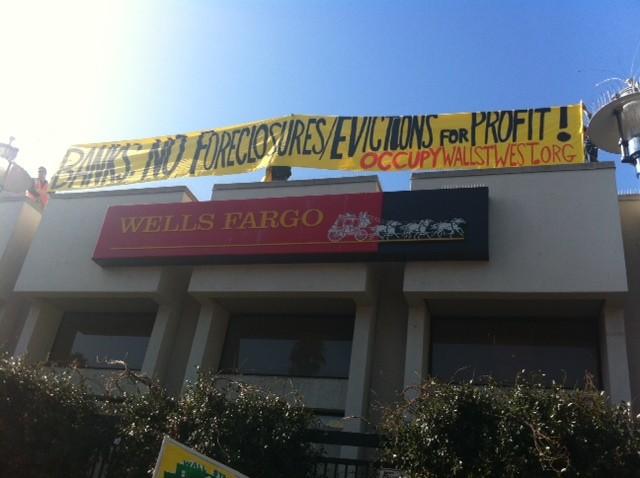
Also underscoring the desperate state of many San Francisco residents, Assessor-Recorder Phil Ting released a report Feb. 16 that contains shocking statistics about invalid foreclosures and illegal evictions in San Francisco. Ting found that 99 percent of all foreclosure proceedings in San Francisco in the past four years have contained paperwork irregularities, and in 84 percent of cases, banks or lenders have committed fraud or broke other laws.

With the loss of the redevelopment agencies, Mayor Ed Lee’s proposal for a housing trust fund, renewed calls for more condo conversions, and a new focus on middle income housing incentives, the conversation on housing in San Francisco is heating up.


MOVING TOWARDS RENTAL

San Francisco’s housing market is 64 percent rentals and 36 percent ownership, according to MOH. So despite the focus of politicians and developers on homeownership, housing policy in San Francisco mostly involves renters, many of whom face myriad threats.

Rents can be so steep that market-rate rental housing is becoming increasingly accessible only for parts of the middle class and the highest income brackets in the city. People in San Francisco tend to pay a huge chunk of their income towards rent.

The federal Housing and Urban Development Agency considers it reasonable for a households to pay 30 percent of their income towards rent; but for the city’s very low income households, rent is typically nearly 60 percent of income. For middle income households, the average percent paid toward rent has increased since 1990, but remains below 30 percent.

Those people fall mainly into the middle-income bracket, those earning 80-120 percent of Area Median Income (AMI.) Planning Director John Rahaim said that for the very low-income population (0-50 percent AMI) all rental housing is “virtually off-limits.”

So, for the middle class, renting a place in San Francisco is tough. For the low and very-low income, it’s next to impossible. And that reality threatens the city’s diversity.

“The highest rent burden still falls on lower income residents, many of whom pay 70 percent of their income as rent,” Sup. Eric Mar, who also sits on the Land Use Committee, said at the hearing. “In my district, people have whole families living in their living room or extra bedroom.”

But things may be looking up for renters. MOH’ Brian Cheu said developers believe that the market trends are heading towards construction of new rental housing after being almost exclusively owner-occupied units for many years. Cheu said there are 725 rental units in the pipeline for the next five to ten years, more than twice the new housing units meant for ownership slated for that time period.

Most of this will be market rate housing, and thus still unaffordable for a good deal of the population. But for those making around 100 percent of AMI — the middle class that Wiener hopes to serve — there are more rental units on the way.

“Any increase in supply of rental housing would help,” said San Francisco Tenants Rights head Ted Gullickson, “because there’s been virtually no new rental housing built in San Francisco is last 20 years.”

Even as Wiener promised to continue to prioritize the needs low-income residents, the foreclosure crisis was barely acknowledged at the Feb. 13 hearing. Many low-income residents say they are not sure they can trust the city’s claim that “this is not a matter of us vs. them.”

At public comment, many community members spoke of the housing troubles that they were already facing. Yue Hua Yu, who spoke at the Feb. 13 hearing, lives with her family of four in a single residency occupancy hotel room (SRO), units intended for single occupants.

“We would support a policy that protects the city’s affordable housing stock,” said a statement from Wing Hoo Leumg, president of the Chinatown Community Tenants Association.

Renting may be the realistic choice for most San Franciscans, but homeownership remains an important goal and achievement for many families, and the main obsession of many politicians.

Part of the middle class exodus is unmistakably due to better homeownership rates in Oakland, Daly City, Marin, and other surrounding areas. But there are neighborhoods with higher rates of homeownership than others, including Bayview-Hunters Point.

BHP has long been a prime spot for low-income homeowners, but it’s slated for extensive new housing construction in the coming decades that could compromise its affordability. It is also an area hit hard by the foreclosure crisis: there have been 2,000 foreclosures in Bayview in the past four years, according to Ed Donaldson, housing counseling director at the San Francisco Housing Development Corporation.

Rising prices and the foreclosure crisis have played a large part in the large-scale African American out-migration that has devastated San Francisco communities in recent decades.


APARTMENTS OR CONDOS?

One of the biggest points of controversy in the homeownership debate has been the issue of condo conversion, which was brought up again this past week at the Feb. 14 Board of Supervisors meeting, when Sup. Mark Farrell asked Lee if he would support legislation to let 2400 tenancy-in-common (TIC) owners bypass legal limits and fastrack towards condo conversion.

Farrell framed this as “a vehicle to allow residents of our city to realize their goal of homeownership.”

On Jan. 16, the city held its annual condo conversion lottery, in which 200 lucky TIC owners win the chance to convert their units into condos, thereby legally becoming homeowners. TICs and condo conversion have long been fraught with controversy in San Francisco, where there is never enough housing for everyone who wants it.

Condo conversion proponents say that turning a TIC — usually a building that used to be rental housing that has been purchased by a group of people that own it in common — into condos is a cheap way to become a homeowner in a city as expensive as San Francisco.

But tenants rights advocates have long opposed this process on the basis that it depletes the city of its rental housing stock. “When you have more condo conversions, you have more evictions, and it’s harmful to low-income residents” Gullicksen said.

This controversy, and the struggle to maintain a balance between opportunities for homeownership and reasonable rents has raged in San Francisco for years. In 1982, the Board of Supervisors passed a limit of 200 condo conversions per year as a compromise. There are no regulations, however, on converting rental housing to TICs.

“This has come up almost every single year for years and years about this time,” said Peter Cohen, organizer with the Council of Community Housing Organizations.

This year, however, proponents are not simply reiterating a request to bypass the condo conversion lottery. Plan C, a coalition of San Francisco moderates, is pushing for adding a fee to condo conversion, ranging from $10,000 to $25,000, which would go towards an affordable housing fund.

Mayor Lee said that he is open to considering a change in condo conversion policy, “providing it balances our need for revenue for affordable housing, the value that responsible homeownership brings to the city, and the rights of tenants who could be affected by a change in policy.”


WHOSE TRUST FUND?

This comes at a time when the city is facing a loss of millions per year for affordable housing with the dissolution of the redevelopment agency (see “Transfer of power, Jan. 31).

That dissolution led to Mayor Lee’s plan for an affordable housing trust fund, to be voted on as a ballot measure this November. The kick-off for that plan also began recently, with a press conference and big-tent meeting to discuss what it might look like.

On the day after the Land Use Committee meeting, where he started the conversation on “middle class” housing, Wiener posed a question to Lee at a Board of Supervisors meeting, asking how the mayor plans to “ensure that the housing trust fund that comes out of the process you have convened will meaningfully address the need for moderate/middle income housing.”

Some are concerned that too much of the trust fund could be allocated outside low-income demographics. “There’s a limited size pie of resources,” Cohen said. “Just in a matter of the last months, we lost the redevelopment agency. The city is madly scrambling to try to replace that through housing trust fund, and working to get us back to somewhere close to where we were…Is that pie, that has dramatically shrunk, going to be stretched further for another income band?”

That question will be important when the proposal goes to vote in November. According to Donaldson, many low-income homeowners will not vote for the measure unless it addresses their needs. The specifics of the measure calling for the trust fund are still being worked out. But, it will likely be funded by an increase of the transfer tax paid when homes change ownership.

Yet that proposal was the subject of an unusual political broadside from the San Francisco Association of Realtors, which last week sent out election-style mailers attacking the idea. “Brace yourself for an unexpected visit from the city’s tax collector,” the mailer warns, showing the hand of government bursting through the wall of a home, urging people to contact Lee’s office.

The measure may also see opposition from low-income communities, especially if, as Wiener has urged in the past week, it allocates a chunk of funds towards middle-income housing.

“It’s hard to find people who will support it. They’re saying, ‘what’s in it for me? Why would I vote for a transfer tax that I’m going to have to pay to help finance the building of affordable housing or middle-income housing. Why support programs that will support middle income people, who make more money than existing homewoners?” explained Donaldson. To agree on a way forward for housing in San Francisco, policymakers will need to reconcile a range of interests. In the worst-case scenario, the profit interests of realtors and developers will overtake the interests of San Francisco families struggling to continue to live in the city they love. But housing advocates are willing to work together to come to a solution. “Let’s put everything on the table, and let’s figure it out. In the spirit of cooperation, and with the understanding that each respective constituent group is not going to get everything that they want, but let’s put all the cards of the table,” said Donaldson.

Ellison wins, SF loses

6

EDITORIAL San Francisco’s not going to lose the America’s Cup. Oracle CEO and yachting billionaire Larry Ellison is too excited about the prospect of bringing the sport (and his company’s logo on the sail of his boat) to a mass audience for the first time in history that he’s not about to abandon San Francisco Bay. The process is too far along; that much is a done deal.

But the development agreements for the city’s waterfront is not a done deal at all — in fact, the proposal could wind up giving Ellison effective control over five piers and a valuable waterfront lot that he could develop for condos. And the city won’t get anywhere near enough out of the deal.

The development agreement is really just a sideshow in the cup planning; nobody’s disagreeing that Ellison’s America’s Cup Event Authority will need space to stage the race, and that will require the renovation of some waterfront property. And nobody disputes that the event will bring tourism and revenue to the city, which will offset some of the cost of allowing Ellison rights to the waterfront.

The rest of it is purely a real estate deal: Ellison’s offering to put millions of dollars into renovating crumbling and underused piers, and in exchange the Port of San Francisco — which lacks the money to rebuild the waterfront and has no credible plans for a good part of its property — could give Ellison long-term low-cost leases and development rights on Piers 26, 28, 30-32 and possibly 29, as well as Seawall Lot 330 at Embarcadero and Bryant.

The city’s never been terribly good at cutting tough deals with real-estate developers, and the history of San Francisco is littered with examples of the taxpayers losing out to the speculators and builders. And in the furor of excitement over the America’s Cup, this development agreement could become the latest sellout.

The original projections for the economic impact of the event are looking more and more questionable; it’s entirely possible that San Francisco will wind up with far less than the $1.4 billion in spending and the thousands of jobs that cup promoters have promised. It’s still going to be a big deal, and the city (particularly the hospitality industry) will do well — but it’s not the answer to all of San Francisco’s problems. By the end of 2013, the event will be over — and Ellison will have essentially taken title to a huge amount of public land, for as long as 60 years into the future. And he won’t be paying the city the normal development fees, the normal impact fees, or even reasonable annual rent to the Port.

The supervisors need to put aside the hype around a sailing regatta and look at this for what it is: A real-estate development agreement with one of the world’s richest people. And right now, it’s not a good deal for the city.

Guardian editorial: Ellison wins, San Francisco loses!

3

EDITORIAL San Francisco’s not going to lose the America’s Cup. Oracle CEO and yachting billionaire Larry Ellison is too excited about the prospect of bringing the sport (and his company’s logo on the sail of his boat) to a mass audience for the first time in history that he’s not about to abandon San Francisco Bay. The process is too far along; that much is a done deal.

But the development agreements for the city’s waterfront is not a done deal at all — in fact, the proposal could wind up giving Ellison effective control over five piers and a valuable waterfront lot that he could develop for condos. And the city won’t get anywhere near enough out of the deal.

The development agreement is really just a sideshow in the cup planning; nobody’s arguing that Ellison’s America’s Cup Event Authority will need space to stage the race, and that will require the renovation of some waterfront property. And nobody disputes that the event will bring tourism and revenue to the city, which will offset some of the cost of allowing Ellison rights to the waterfront.

The rest of it is purely a real estate deal: Ellison’s offering to put millions of dollars in to renovating crumbling and underused piers, and in exchange the Port of San Francisco — which lacks the money to rebuild the waterfront and has no credible plans for a good part of its property — will give Ellison long-term low-cost leases and development rights on Piers 26, 28, 30-32 and possibly 29, as well as Seawall Lot 330 at Embarcadero and Bryant.

The city’s never been terribly good at cutting tough deals with real-estate developers, and the history of San Francisco is littered with examples of the taxpayers losing out to the speculators and builders. And in the furor of excitement over the America’s Cup, this development agreement could become the latest sellout.

The original projections for the economic impact of the event are looking more and more questionable; it’s entirely possible that San Francisco will wind up with far less than the $1.4 billion in spending and the thousands of jobs that cup promoters have promised. It’s still going to be a big deal, and the city (particularly the hospitality industry) will do well — but it’s not the answer to all of San Francisco’s problems. By the end of 2013, the event will be over — and Ellison will have essentially taken title to a huge amount of public land, for as long as 60 years into the future. And he won’t be paying the city the normal development fees, the normal impact fees, or even reasonable annual rent to the Port.

The supervisors need to put aside the hype around a sailing regatta and look at this for what it is: A real-estate development agreement with one of the world’s richest people. And right now, it’s a lousy deal for the city.


Future Twin

6

The two females in Future Twin (www.futuretwin.com) — Jean Yaste and Stephanie Rose — met one another in a moped gang called the Lockits, another member of the band was in a moped crew called Treats of the Loin; I’m not sure if you can concoct a greater back-story than that but I’d be hard-pressed to find one. And the San Francisco fivesome, which formed in December 2010 originally as a trio, makes the equivalent of moped rock on its debut EP cassette, Situation (which is also available for download, for those without a tape player). Released Jan. 31, Situation revs up with roaring guitar, and incorporates field recordings of gunshots and small engines such as lawnmowers and of course, mopeds, but veers from blunt roughness, instead leaning towards powerful girl group-style vocals and multi-part harmonies.

While the first release is a small one, the Mission-based band has chops, brains, and a clear bond. Though perhaps not tight enough to get all its members to a photoshoot — while the drummer Antonio “Tones” Roman-Alcala with strep throat made it, another Future Twin simply texted, “yo, just didn’t feel like going.” No matter, Future Twin celebrates the release of Situation at the Hemlock this Thu/2 (9 p.m., $6. 1131 Polk, SF. www.hemlocktavern.com).

Description of sound: Psychedelic farmageddon grandma rock.

What do you like most about the Bay Area music scene: The things we liked most was the Clarion Alley block party until the damn breeders built their precious condos next door and started their war on fun. These people need to be taken out and the “scene” will heal itself.

What piece of music means the most to you and why: Rap News Occupy 2012. Why? No reason.

Favorite local eatery and dish: Secret Spot has delicious bagels, fresh squeezed juice, and homegrown greens.

Who would you most like to tour with: Bill Murray (as a zombie) and Kool Keith (as himself).

Wall played

0

Also in this issue, Guardian writer Matt Sussman on who got the hype — and who earned it — in the galleries at Art Basel Miami 2011

VISUAL ART The popular face of Miami is made of aqua blue views and chrome rims, but the parts of Wynwood that haven’t been covered by murals yet look more like asphalt and the muted tones of low-cost rentals. Since the 1950s it’s been largely a Puerto Rican neighborhood. It’s also where many African Americans moved when they got priced out of the Overtown neighborhood to the south, where they were originally relegated by Jim Crow laws.

But, in a high-low art tornado last month, Wynwood is also where I learn that the popular legend labeling the Mission District the neighborhood with the most densely-packed street art in the world is total bunk.

Wynwood’s main drag Second Avenue is Clarion Alley on acid. Having come straight from Miami International Airport, my rental car barely inches down the strip, so omnipresent are the weaving, goggling packs of urban art voyeurs in oversized silk shirt-dresses and vertiginous wedge heels or where’d-you-get-’em sneakers. The only sign of the neighborhood’s year-round residents are the sporadic flaggers in self-bought orange vests waving cars into parking spots.

Angry sharks, Persian cat-women, color-washed streetcars, and owls sitting shotgun in convertibles — sometimes layered on top of each other — grace walls here. Designs pour off walls and onto the sidewalk. Here, the fairytale nymphs and walking houses of Os Gemeos on a fancy restaurant; there, a massive black-and-white photo wheatpaste by JR of bulging, watching eyes that echo the look of passers-by. I nearly break my neck on Mexico City artists Sego and Saner’s horned beetle-men, who clutch amulets and wear fanged leopard masks on the backs of their heads. Absolut Vodka has occupied a parking lot with a temporary open-air club, dotting it with human-sized aerosol cans and fencing it off with chainlink. It’s enough to make any street art fan lose their shit, or at least the rental car.

I’ve parachuted into the middle of Miami’s yearly art inferno, a.k.a. the week that the Art Basel art fair comes to town. Since 2002, this Swedish import has filled Miami Beach Convention Center with astronomically-priced works from over 260 international galleries. Umpteen ancillary art and design fairs populate deco hotel-land and its surrounds during this time — the city becomes one largely, loudly turned-out gallery opening.

Wynwood, with its surplus of 80-foot blank walls, hosts many an art collection — but it’s most visible contribution to the scene is its dense network of murals. Of these, the undisputed center is a compound of buildings grouped around a courtyard of marquee works dubbed Wynwood Walls. The properties were purchased by (in)famous neighborhood rejuvenator Tony Goldman in 2004. Many hold Goldman responsible for the gentrification of Soho, South Beach, and city center Philadelphia.

Wynwood Walls is his carefully orchestrated attempt to use the allure of street art to change the area’s economic fortune. Shortly before Art Basel 2011, Goldman produced a series of YouTube shorts dubbed “Here Comes the Neighborhood,” in which longtime graffiti photographer Martha Cooper cheerfully opines “Now we’ve got something [street art] that people are calling the biggest art movement in history of the world. And it just might be.”

The night of my arrival, the amount of in-progress murals at which the crawling traffic gives one an opportunity to gawk is striking. At least a dozen artists labor within a four-block radius, greeting fans, drinking beers and staring up at their half-finished creations contemplatively.

Such was the mood in which I find Buenos Aires street artist Ever, who along with an assistant is completing a massive wall featuring two disembodied heads emitting his signature riotously colorful cognitive mapping hives, which in the past he’s painted emerging from the brains of Mao Tse-Tung and his own younger brother. Ever was flown up by a community-based Atlanta street art festival, Living Walls, to paint a Second Avenue parking lot wall as part of the festival’s first project outside of Georgia.

It’s not his first international street art festival, but Ever is among the artists under-impressed with the Basel-time scene in Wynwood.

“It’s like the alcohol. I hate the shit — but one drink more!” We talk when the dust of Basel has long settled; Ever, fellow street and gallery artist Apex, and I perched around Apex’s studio in a Market and Sixth Street garment factory building.

Apex, who has been to Miami during Basel week four times, and twice to paint the crystallized, color-saturated “super burner” murals he is known for, explains that for him, the problem is exploitation. Street artists typically paint walls for a pittance or for free, in a neighborhood where businesses are making boatloads of money off spectators that come to marvel.

“You have, like, Tony Goldman, he gives a certain amount of money, property owners make money, but artists, a few make money,” Apex explains. “The rest, no. Artists get caught in the excitement of it. But who is getting paid off of it?”

“Who wins,” Ever adds.

“If someone is making money off of it, you should know who that is,” concludes Apex.

But the two artists agree that Art Basel week is an excellent education in the workings of the high art world for aspiring professionals, and that the camaraderie that flourishes between street artists can be important, inspirational.

And of course, the parties. Basel is known for them — 2011 featured everything from the $200-a-ticket “Fuck Me I’m Famous” David Guetta show to surprise kudos for the partykids from Pharrell onstage at Yelawolf’s Saturday night gig at a castle-shaped outdoor club in Wynwood. On my first night in town, the whole Living Walls gang — organizers, artists, errant alternative journalist from San Francisco — pile into cars and hit the Design District to check out the opening of the group show of Primary Flight, a local collective that got its start commissioning murals wall-by-wall in Wynwood.

“We started noticing we weren’t the breadwinners of the galleries,” Primary Flight founder Books Bischof tells me in a phone interview. “It was like fuck you, we’re going to take to the streets. We’re all curators in a sense, so we might as well get up and be seen.” Bischof logged time connecting with local graffiti crews and Wynwood’s homeless population to make sure he had community support for bringing the art crowd into the neighborhood during Basel week. He somewhat resents Goldman’s “just buy it” approach. “When we learned about [his Wynwood building purchases] we were like, well that’s kind of fucked.” (Though officially the two camps exist amicably, Goldman told me he upon arriving in the neighborhood he found Primary Flight’s piecemeal approach to its murals “helter-skelter.”)

But along with Wynwood’s art scene, Primary Flight has grown. In addition to its mural program — through which Apex painted his 2011 Miami wall — attendees at the collective’s gallery space could take in traditional paintings and sculptures, but also Mira Kum’s “I Pig, Therefore I Am” installation featuring the artist in the nude, living with two pigs in a small enclosure for 104 hours. “We represent artists with a street art, fuck you swagger,” comments Bischof.

Things are much more established now in Wynwood, which by most counts serves as Miami’s arts district year-round. There are expensive coffeeshops and bars, fine restaurants, precious florists, and blocks of galleries selling accessible art. (During Art Basel week, one of these is given over to an artist who specializes in kawaii food art printed onto affordable decals and posters. An entire wall is covered in swirly-topped ice cream cones in a hundred color options.)

Though professional street art certainly existed prior to his engagement, this upscaling can largely be attributed to Goldman’s speculative interest. Goldman’s PR agency sends me press materials dubbing Wynwood “the next great discovery in the Goldman Properties portfolio.” His company’s general methodology is to buy up historic buildings in socioeconomically depressed neighborhoods and fill them with upscale businesses that attract more pedestrian traffic.

There is little doubt that Goldman envisions the future of Wynwood as a place where housing units rent for far more than many of its current residents can afford. His team has spent considerable time and effort working with Miami’s city council on creating live-work zoning in Wynwood (not unsimilar to the type of zoning that loaded San Francisco’s SoMa with high cost condos). After the Basel hangover has dissipated, I get a chance to talk with him.

“When I went to Wynwood and I had boxy warehouse buildings, it was a much different challenge for me,” says Goldman during our decorous phone interview. “Now I could be free. Some people would look at ugly buildings and empty parking lots and loading zones — what I saw was an international outdoor street art museum. Huge canvas opportunities.” He bought six of those buildings in the center of the neighborhood, two of which now house spendy restaurants run by his son and daughter.

Goldman is not completely without street art cred. Since 1984, he has owned a massive wall on Manhattan’s Bowery and Houston Streets that has hosted murals from Keith Haring, Barry McGee, and Shepard Fairey. “[Street art] is freer in a lot of ways than walking in a museum, which a lot of street artists consider graveyards,” he says. “Not that I agree with them, not that I disagree with them either. I think Wynwood Walls is one place that has validated the art form as an important contribution to contemporary art.”

But Wynwood Walls also serves as the main attraction to an area in which Goldman Properties has monetarily invested. “It [is] a center place that the arts district really didn’t have, a town square, a centerpiece that was defined architecturally,” reflects Goldman. “It served its purpose.”

But perhaps this use of street art as tool of gentrification is not so incongruous. After all, most if not all professional street artists are able to create murals only by selling gallery-ready pieces. Ever tells of painting a mural for Coca-Cola with studiomate Jaz, only to use his paycheck to create three more public walls. “The reality of art is you always need a rich person,” he says.

Which is, more or less, to say that even in Wynwood, professional street art is not entirely soulless. Take for example one of Ever’s favorite Wynwood pieces, done by Spanish artist Escif. The wall was so popular, in fact, it merited a cameo in a “Here Comes the Neighborhood” episode. And not for its bright colors or revolutionary design; it’s just black capital letters on a flat white background.

But it does have a pretty direct message for good-intentioned folks in Wynwood. It says: “Remember, u’re not doing it for the money.”

Protesters climb on Wells Fargo roof to protest evictions

9

Activists held a massive banner and pitched a tent on the roof of the Wells Fargo branch at 16th and Mission Jan 14, while 150 supporters watched from the parking lot. Seven were arrested.

Organizers say the demonstration was meant to draw attention to the bank’s complicity in unfair foreclosures and evictions.

The protest was planned by a coalition of Bay Area housing rights and homelessness advocacy groups, along with organizers from Occupy San Francisco.

Sarah Shortt, Executive Director of the San Francisco Housing Rights Committee, says that abuses by corporate banks are inextricably linked to issues that her group has been working on for years; “evictions, displacement, affordable housing, and tenants rights.”

After rallying at 16th and Mission, protesters looked up to see that six had climbed to the roof. They unfurled a banner reading “Banks: No Foreclosures/Evictions for Profit!”

A fire truck arrived ten minutes later, and put up a ladder to give the police and firefighters access to the roof.

The Police Department cooperated with protesters, assisting a negotiation with the bank branch’s manager. A letter detailing their demands, including a moratorium on foreclosures and an end to predatory and speculative loans, was apparently faxed to Wells Fargo spokeswoman Holly Rockwood.

Protesters said that they would not leave the roof until they had a meeting scheduled with Wells Fargo CEO John Stumpf. Six were arrested.
According to an SFPD statement, “A bank employee signed a private person’s arrest (citizens arrest) for trespassing.”

After those arrested were painstakingly shuttled down the ladder and into a police van, protesters blocked the van from leaving Hoff street between 16th and 17th for about ten minutes until it sped out through the parking lot. Protesters then marched to the nearby Mission Police Station, where a drummer from the Brass Liberation Orchestra, which often accompanies protest events in the city, was arrested for allegedly assaulting a police officer with her drum.

Those arrested on the roof were cited for trespassing and released within hours. Supporters have put up money to release the drummer, known as Montana; bail was set at $8,100.

While the drama on the roof unfolded, Shortt, along with organizers from Causa Justa: Just Cause and the San Francisco Tenants Union, spoke about abuses committed against tenants and homeowners. They also spoke about Wells Fargo’s investment in private prisons. 

In a press release, organizers said that the protest was meant to call attention to “predatory equity scams, Ellis Act evictions, and immoral home loans.”

The Ellis Act allows landlords to evict tenants for any reason, if they don’t re-rent the units at a higher price in the next five years. The act hasno restrictions on selling the units as tenancies in common — a backdoor way to create condos — and that’s a lucrative and common practice in the Mission.

Ellis Act evictions increased by 8% in 2011, According to the San Francisco Rent Board Annual Report.

Jose Morales, a tenant who was evicted based on the Ellis Act and activist with the San Francisco Tenants Union, spoke to the crowd Saturday. Said Morales, “I have osteoporosis, I’m 82 and a half years old, but you still see me walking around with my sign.”

He displayed protest signs declaring that housing is a human right and urging single-payer health care.

Mesha Irizarry also told her story to the protesters. Her Bayview home was sold to Bank of New York, then transferred to Bank of America on September 1, but says that she refuses to leave and is fighting the foreclosure.

“We do not play the blame-the-victim game. We are not alone. We are not ashamed to sat ay what has happened to us. We are fighting back, and we are going to win” said Irizarry, who named several other women who are resisting foreclosures in Bayview. 

Irizarry began a San Francisco chapter of Occupy the Hood, a group dedicated to confronting problems that disproportionately affect the poor and people of color within the Occupy Movement. In San Francisco, the branch has focused mainly on defending homes from foreclosure and eviction. Saturday’s protest was part of that effort.

This demonstration was also a part of a series targeting banks, that protesters plan to top off with a day-long “occupation of the financial district” January 20th.

Said Occupy SF Housing Coalition media spokesman Gene Doherty, “The banks and the development companies that have gotten us all into (the foreclosure crisis) are a major part of the problem…it is their ethical duty, moral duty right now to be fixing this. And if that means it’s going to eat into their profit, that means it eats into their profit.”


Redrawing the map

43

tredmond@sfbg.com, steve@sfbg.com

The most important political change of 2012 may not be the appointment of a new District 5 supervisor or the inauguration of a new mayor and sheriff. A process moving slowly through a little-known city task force could wind up profoundly shifting the makeup, and balance of power, on the Board of Supervisors — and hardly anyone is paying attention, yet.

The Redistricting Task Force is in the process of drawing new lines for the supervisorial districts, as mandated every 10 years when new census data is available. The nine-member body is made up of three appointees each by the board, the mayor and the Elections Commission. While mandated to draw equal-sized districts that maintain “communities of interest,” the board has almost unchecked authority to decide which voters are in which districts.

While it’s difficult to draw 11 bad districts in San Francisco, it’s entirely possible to shift the lines to make it more difficult to elect progressives — something many groups out there are anxious to do.

VIEW THE CURRENT WORKING DRAFT MAP HERE


CONSOLIDATING THE LEFT

Downtown and pro-landlord groups are circulating their own draft maps, attempting to influence the outcome. Their goal is hardly a secret: If progressive voters can be concentrated in a small number of districts — say, districts 5, 6, and 9 — it’s more likely that a majority of the board will be moderates and conservatives.

The task force has looked at 10 “visualizations” prepared by a consultant, and each of them had some alarming aspects. For example, the visualizations mostly pushed such conservative areas as Seacliff and Presidio Heights into District 1, which is represented by progressive Sup. Eric Mar.

On Jan. 4, those drafts were replaced by a single working draft map, which is now on the task force’s hard-to-find website (www.sfgov2.org/index.aspx?page=2622) — and it’s not as bad as the earlier versions. The working draft keeps Seacliff and Presidio Terrace in District 2 — which share similar demographics.

“The working families in the Richmond don’t belong in the same community of interest as the millionaires with homes overlooking the ocean,” Mar told us.

But there are other changes that some may find alarming. The more conservative Portola neighborhood, which is now in District 9, would be included in District 11, while D9 would pick up the more liberal north Mission. That would make D9 an even safer progressive district — but make D11 harder for a progressive like the incumbent, John Avalos, to win.

The task force has been holding hearings on each of the districts — but there’s been little discussion about how the new lines will affect the makeup of the board, and the politics and policy of the city, as a whole.


POPULATION CHANGES

The driving force behind the changes in the districts is the rather dramatic population shift on the east side of the city. Most of the districts, census data show, have been relatively stable. But since 2000, 24,591 more people have moved into D6 — a nearly 30 percent increase — while 5,465 have moved into D10 (a 7.5 percent increase) and 5,414 into D11 (8.7 percent). D9 saw the biggest population decrease, losing 7,530 voters or 10.3 percent.

The huge growth in D6 has been the result of a boom in new high-end condos in the Rincon Hill and SoMa neighborhoods, and it’s changed the demographics of that district and forced the city to rethink how all of the surrounding districts are drawn.

No matter what scenario you look at, D6 has to become geographically smaller. Most of the maps circulating around suggest that the north Mission be shifted into D9 and parts of the Tenderloin move into districts 3 and 5. But those moves will make D6 less progressive, and create a challenge: The residents of the Tenderloin don’t have a lot in common with the millionaires in their high-rise condos.

As progressive political consultant David Looman noted, “The question is, how do you accommodate both the interests and concerns of San Francisco’s oldest and poorest population and San Francisco’s youngest, hippest, and very prosperous population?”

The working map is far from final. By law, the population of every district has to be within 1 percent of the median district population, or up to 5 percent if needed to prevent dividing or diluting the voting power of minority groups and/or keeping established neighborhoods together.

Under the current draft, eight of the 11 districts are out of compliance with the 1 percent standard, and District 7 has 5.35 percent more residents than the mean, so it will need to change. But task force Chair Eric McDonnell told the Guardian that he expects the current map to be adopted with only slight modifications following a series of public meetings over the next couple months.

“The tweaks will be about how we satisfy the population equalization, while trying to satisfy communities of interest,” McDonnell said, noting that this balancing act won’t be easy. “I anticipate everyone will be disappointed at some level.”


OUTSIDE INFLUENCES?

Some progressives have been concerned that downtown groups have been trying to influence the final map, noting that the San Francisco Board of Realtors, downtown-oriented political consultants David Latterman and Chris Bowman, and others have all created and submitted their own maps to the task force.

McDonnell said the task force considered solutions proposed by the various maps, but he said, “We won’t adopt wholesale anyone’s maps, but we think about what problem they were trying to solve.”

For example, some progressive analysts told us that many of the proposals from downtown make D9 more progressive, even though it is already a solidly progressive seat, while making D8 more conservative, whereas now it is still a contestable district even though moderates have held it for the last decade.

“It would be nice to see the Mission in one district, but it makes D8 considerably more conservative, so it’s a balancing act,” said Tom Radulovich, a progressive activist who ran for D8 supervisor in 2002.

Latterman told us he has a hard time believing the final map will be substantially similar to the current draft. “Once that gets circulated to the neighborhoods, I find that hard to believe it won’t change,” he said. “A lot of the deviations are big and they will have to change.”

He said that he approached the process of making a map as a statistician trying to solve a puzzle, and that begins with figuring out what to do with D6. “I fall back on my technician skills more than the political,” Latterman, who teaches political science at the University of San Francisco, said. “It’s a big puzzle.”

Latterman also disputed concerns that he or others have tried to diminish progressive voting power, saying that’s difficult to do without a drastic remaking of the map, something that few people are advocating.

“It’s hard to make major political changes with the other constraints we have to meet,” he said. “Unless you’re willing to scrap everything we have, it’ll be hard to make major political changes.”

Once the task force approves a final map in April, there’s little that can be done to change it. The map will go to both the Elections Commission and the Board of Supervisors, but neither can alter the boundaries.

“We are the final say,” McDonnell said. That is, unless it is challenged with a lawsuit, which is entirely possible given the stakes.

City Hall’s 2012 agenda

16

EDITORIAL There’s so much on the to-do list for San Francisco in 2012 that it’s hard to know where to start. This is a city in serious trouble, with unstable finances, a severe housing crisis, increased poverty and extreme wealth, a shrinking middle class, crumbling and unreliable infrastructure, a transportation system that’s a mess, no coherent energy policy — and a history of political stalemate from mayors who have refused to work with progressives on the Board of Supervisors.

Now that Ed Lee has won a four-year term, he and the supervisors need to start taking on some of the major issues — and if the mayor wants to be successful, he needs to realize that he can’t be another Gavin Newsom, someone who is an obstacle to real reform.

Here are just a few of the things the mayor and the board should put on the agenda for 2012:

• Fill Sup. Ross Mirkarimi’s seat with an economic progressive. This will be one of the first and most telling moves of the new Lee administration — and it’s critical that the mayor appoint a District 5 supervisor who is a credible progressive, someone who supports higher taxes on the rich and better city services for the needy and is independent of Lee’s more dubious political allies.

• Make the local tax code more fair — and bring in some new revenue. Everybody’s talking about changing the payroll tax, which makes sense: Only a small fraction of city businesses even pay the tax (which is not a “job killer” but is far too limited). Sup. David Chiu had a good proposal last year that he abandoned; it called for a gross receipts tax combined with a commercial rent tax — a way to get big landlords and companies (like law firms) that pay no business tax at all to contribute their fair share. That’s a good starting point — but in the end, the city needs more money, and the new system should be set up to bring in at least $100 million more a year.

• Create a linkage between affordable and market-rate housing. This has to be one of the key priorities for the next year: San Francisco’s housing stock is way out of balance, and it’s getting worse. The city’s own General Plan mandates that 60 percent of all new housing should be available at below-market-rate prices; the best San Francisco ever gets from the developers of condos for the rich is 20 percent. The supervisors need to enact legislation tying the construction of new market-rate housing to an acceptable minimum level of affordable housing to keep the city from becoming a place where only the very rich can live.

• Demand a good community-benefits agreement from CPMC. The California Pacific Medical Center has a massive new hospital project planned for Van Ness Avenue — and so far, CPMC officials are refusing to provide the housing, transportation and public health mitigations that the city is asking for. This will be a key test of the new Lee administration — the mayor has to demonstrate that he’s willing to play hardball, and refuse to allow the project to move forward unless hospital officials reach agreement with community activists on an acceptable benefits agreement.

• Make CleanEnergySF work. A recent study by the website Energy Self-Reliant States shows that by 2017 — in just five years — the cost of solar energy in San Francisco will drop below the cost of Pacific Gas and Electric Company’s fossil-fuel and nuclear mix. So the city’s new electricity program, CleanEnergySF, needs to be planning now to build out both a large-scale solar infrastructure system and small-scale distributed generation facilities on residential and commercial roofs and set the agenda of offering clean, cheaper energy to everyone in the city. The money from the city’s generation can be used to purchase distribution facilities to phase out PG&E altogether.

• Don’t let Oracle Corp. take over even more of the waterfront. The America’s Cup continues to move forward — but at every step of the way, multibillionaire Oracle CEO Larry Ellison is trying to squeeze the city for more. Mayor Lee has to make it clear: We’ve given one of the richest people in the world vast amounts of valuable real estate already. He doesn’t need a giant TV screen in the Bay or more land swaps or more city benefits. Enough is enough.

There’s plenty more, but even completing part of this list would put the city on the right road forward. Happy new year.

Guardian editorial: City Hall’s 2012 agenda

20

EDITORIAL There’s so much on the to-do list for San Francisco in 2012 that it’s hard to know where to start. This is a city in serious trouble, with unstable finances, a severe housing crisis, increased poverty and extreme wealth, a shrinking middle class, crumbling and unreliable infrastructure, a transportation system that’s a mess, no coherent energy policy — and a history of political stalemate from mayors who have refused to work with progressives on the Board of Supervisors.

Now that Ed Lee has won a four-year term, he and the supervisors need to start taking on some of the major issues — and if the mayor wants to be successful, he needs to realize that he can’t be another Gavin Newsom, or Willie Brown, mayors who were an obstacle  to real reform.

Here are just a few of the things the mayor and the board should put on the agenda for 2012:

+Fill Sup. Ross Mirkarimi’s seat with an economic progressive. This will be one of the first and most telling moves of the new Lee administration — and it’s critical that the mayor appoint a District 5 supervisor who is a credible progressive, someone who supports higher taxes on the rich and better city services for the needy and is independent of Lee’s more dubious political allies.

+Make the local tax code more fair — and bring in some new revenue. Everybody’s talking about changing the payroll tax, which makes sense: Only a small fraction of city businesses even pay the tax (which is not a “job killer” but is far too limited). Sup. David Chiu had a good proposal last year that he abandoned; it called for a gross receipts tax combined with a commercial rent tax — a way to get big landlords and companies (like law firms) that pay no business tax at all to contribute their fair share. That’s a good starting point — but in the end, the city needs more money, and the new system should be set up to bring in at least $100 million more a year.

+Create a linkage between affordable and market-rate housing. This has to be one of the key priorities for the next year: San Francisco’s housing stock is way out of balance, and it getting worse. The city’s own General Plan mandates that 60 percent of all new housing should be available at below-market-rate prices; the best San Francisco ever gets from the developers of condos for the rich is 20 percent. The supervisors need to enact legislation tying the construction of new market-rate housing to an acceptable minimum level of affordable housing to keep the city from becoming a place where only the very rich can live.

+Demand a good community-benefits agreement from CPMC. The California Pacific Medical Center has a massive new hospital project planned for Van Ness Avenue — and so far, CPMC officials are refusing to provide the housing, transportation and public health mitigations that the city is asking for. This will be a key test of the new Lee administration — the mayor has to demonstrate that he’s willing to play hardball, and refuse to allow the project to move forward unless hospital officials reach agreement with community activists on an acceptable benefits agreement.

+Make CleanEnergySF work. A recent study by the website Energy Self-Reliant States shows that by 2017 — in just five years — the cost of solar energy in San Francisco will drop below the cost of Pacific Gas and Electric Company’s fossil-fuel and nuclear mix. So the city’s new electricity program, CleanEnergySF, needs to be planning now to build out both a large-scale solar infrastructure system and small-scale distributed generation facilities on residential and commercial roofs and set the agenda of offering clean, cheaper energy to everyone in the city. The money from the city’s generation can be used to purchase distribution facilities to phase out PG&E altogether.

+Don’t let Oracle Corp. take over even more of the waterfront. The America’s Cup continues to move forward — but at every step of the way, multibillionaire Oracle CEO Larry Ellison is trying to squeeze the city for more. Mayor Lee has to make it clear: We’ve given one of the richest people in the world vast amounts of valuable real estate already. He doesn’t need a giant TV screen in the Bay or more land swaps or more city benefits. Enough is enough.

There’s plenty more, but even completing part of this list would put the city on the right road forward. Happy new year.


Editor’s notes

68

tredmond@sfbg.com

Twenty years ago, if you mapped income distribution in San Francisco on a standard graph, you’d see what the economist call a bell curve: At one end were a small number of very poor families, at the other a small number of very rich, and in between the bulk of the city was somewhere roughly close to what you could call middle class.

Take the 2012 census data and make that graph today and you get the opposite — it’s becoming a U-shape, with more people in poverty and more gross wealth and not as much in the center.

You could see that on stark display at City Hall Dec 12.

At 10 a.m., the City Operations and Neighborhood Services Committee heard several hours of testimony on the alarming rise in the number of homeless families. In the end, the Mayor’s Office agreed to find $3 million to help out.

At 1 p.m., the Land Use and Economic Development Committee heard testimony on a plan to build more housing — on the waterfront, for the top one quarter of the top one percent of the richest people in America, people who will need more than $3 million just for the downpayment on their new digs.

The plan calls for 145 of what Port of San Francisco officials call “high end” or “luxury” condominiums, along with 400 underground parking spaces. “It’s going to be tight on three levels,” a Port official testified. “Most of it will be valet parking.” The developer wants to raise the height limit along the waterfront for the first time in half a century.

The Port, which controls some of the land, will get a cut of all the condo sales, maybe as much as $500,000 a year; that money will go to rebuild old piers and fund a long list of Port projects — including the America’s Cup. (Ted Gullicksen of the San Francisco Tenants Union was sitting next to me at the hearing, and he shook his head at that bit of news. “Condos for rich people to pay for boats for rich people,” he said.)

A long list of people, including former City Planning Director Alan Jacobs and former City Attorney Louise Renne — spoke against the project. Jacobs and Renne both explained that this was single-site spot zoning that would change the half-century consensus that the city should “decrease height toward the waterfront so the people can see and enjoy the meeting of land and water,” as Jacobs put it.

Jacobs gave the committee members his one “absolute truth” about city planning: “If a developer accepts and knows that a rule can’t be broken, then it will be economical to build within it. If he or she think it can be changed, then suddenly it will not be economical. It’s called greed.”

In other words, Simon Snellgrove, the developer of 8 Washington, could make money with a lower-scale project that conforms to existing height limits. But he can make more money if the city gives him a big honkin favor.

But it’s not all about height limits for me. It’s not even about the fact that the project will chop up a tennis and swimming club that serves about 2,000 more-or-less middle-class people in an effort to make life nicer for about 145 very rich people.

It’s about what kind of housing we’re building in San Francisco. “Every study that we’ve seen shows that we’ve vastly overbuilt housing for the wealthy,” Gullicksen testified.

And we’re not just talking the ordinary wealthy here. The most compelling testimony came from Frederick Allardyce, a real-estate broker from Sotheby’s who said he had been involved in the sale of about 70 percent of all luxury condos sold from Washington St. to the waterfront. He gave us a glimpse of who would be living — sort of — at 8 Washington.

The cheapest condos would require an income of $469,000, a downpayment of $625,000, and another $493,000 of liquid reserves. Monthly payment: $13,699. The higher-end units would require an annual income of $1.029 million and a downpayment of $6.5 million.

“That’s not the one percent,” he said. “It’s the top one quarter of the top one percent.”

And, Allardyce explained, most of the people who buy that level of property are so rich that they don’t actually live there. It’s a second or third or fourth home, a place to stay a few weeks out of the year. And since the project involves chopping up a tennis and swim club used by some 2,000 people (who are nowhere near that rich), “you’re eliminating the use of that land by the general public” in favor of a tiny elite.

The developer says that the city will get money to build 33 below-market-rate units. That’s nice; by that standard, 80 percent of the new housing goes to the richest people in the world, and 20 percent for everyone else. That percentage ought to be reversed — and until it is (or at least, until we have a plan to build enough affordable housing for the people who really need a place to live in San Francisco) I can’t imagine why we’d want to be doing favors to feed the greed of developers.

What we’re doing in this city is making life harder for low-income people who are increasingly living on the streets and doing big favors for the spectacularly wealthy. There’s no sanity in our housing policy — except to turn San Francisco even more into a city of the rich.

The one percent on the waterfront

10

EDITORIAL While Mayor Ed Lee struggles with the OccupySF encampment, another, very different group has its eyes on the city’s waterfront. On the edges of the ground where protesters are talking about the one percent of Americans that control the vast majority of the nation’s wealth, two major development projects aimed entirely at that very wealthy sliver are starting to move forward.

At 8 Washington and 75 Howard, developers want to build a total of 365 condominiums aimed at people with incomes that place them in the top sliver of the richest Americans. It will be a key test for the Ed Lee administration: Will he evict the Occupy protesters and allow the One Percent to claim choice property on the waterfront?

The 8 Washington project calls for 165 of what developer Simon Snellgrove says will be the most expensive condos ever built in San Francisco. The 12-story building, sitting on the edge of the Embarcadero, would include units selling for as much as $10 million, and even the low-end places would go for $2.5 million or more.

At 75 Howard, the Paramount Group and Morgan Stanley want to demolish a parking garage and erect a 284-foot tower with units that the San Francisco Business Times predicts would sell for at least $1,000 a square foot.

Just to be clear what we’re talking about here, a $2.5 million condo, according to real estate experts, would require that a buyer have $625,000 cash to put down and an income of more than $450,000 a year. Either that or millions in spare cash to plunk down.

That, needless to say, is not the majority of the working people in San Francisco.

There’s no conceivable planning or housing-policy rationale for either of these projects. They offer nothing that the city needs; there is absolutely no shortage of housing for people with that kind of income. In fact, allowing these two projects to proceed would directly violate the city’s own General Plan and every regional planning proposal for San Francisco’s housing mix. The General Plan states that some 60 percent of all the new housing built in San Francisco should be below market rate. Environmental sanity suggests that the city ought to be building housing for people who work here — high housing costs have driven thousands of local workers to live in the East Bay or further out, leading to long, energy-intensive commutes. And the more of this ultra-luxury housing the city builds, the more the housing balance gets disrupted — and the more rapidly San Francisco becomes a city of, by and for the One Percent.

The two projects have powerful support — among other things, Lee’s friend and ally Rose Pak is promoting 8 Washington, as is lobbyist Marcia Smolens. If Lee has any scrap of independence he’ll make it clear that both of these projects are dead on arrival.

The Chron pushes 8 Washington

36

The Chron’s urban design writer, John King, thinks that the 8 Washington project would be a dandy addition to the San Francisco waterfront:

The project’s allure is what happens on the ground. Jackson Street would extend east as a 47-foot-wide pedestrian path; Pacific would conclude at the new triangular park. A narrow greenway north from Drumm would be widened to 37 feet.

The open spaces are the work of Peter Walker, who also designed nearby Sidney Walton Park, the green heart of otherwise drab Golden Gateway. What’s envisioned at 8 Washington extends the artful simplicity of that popular space. But it takes cues from the transitional location, offering pathways and nooks rather than trying to upstage the waterside drama.

So the landscape is going to look nice.

But there’s a lot more to a project than the way it looks. I’m not going to go all Form Follows Function here, but before you evaluate how much green space the development will have and what pedestrians will encounter, you have to ask another question: Why are we building this thing in the first place?

And to that, there is no good answer.

Guardian editorial: The one per cent on the waterfront

27

EDITORIAL While Mayor Ed Lee struggles with the OccupySF encampment, another, very different group has its eyes on the city’s waterfront. On the edges of the ground where protesters are talking about the one percent of Americans that control the vast majority of the nation’s wealth, two major development projects aimed entirely at that very wealthy sliver are starting to move forward.

At 8 Washington and 75 Howard, developers want to build a total of 365 condominiums aimed at people with incomes that place them in the top sliver of the richest Americans. It will be a key test for the Ed Lee administration: Will he evict the Occupy protesters and allow the One Percent to claim choice property on the waterfront?

The 8 Washington project calls for 165 of what developer Simon Snellgrove says will be the most expensive condos ever built in San Francisco. The 12-story building, sitting on the edge of the Embarcadero, would include units selling for as much as $10 million, and even the low-end places would go for $2.5 million or more.

At 75 Howard, the Paramount Group and Morgan Stanley want to demolish a parking garage and erect a 284-foot tower with units that the San Francisco Business Times predicts would sell for at least $1,000 a square foot.

Just to be clear what we’re talking about here, a $2.5 million condo, according to real estate experts, would require that a buyer have $625,000 cash to put down and an income of more than $450,000 a year. Either that or millions in spare cash to plunk down.

That, needless to say, is not the majority of the working people in San Francisco.

There’s no conceivable planning or housing-policy rationale for either of these projects. They offer nothing that the city needs; there is absolutely no shortage of housing for people with that kind of income. In fact, allowing these two projects to proceed would directly violate the city’s own General Plan and every regional planning proposal for San Francisco’s housing mix. The General Plan states that some 60 percent of all the new housing built in San Francisco should be below market rate. Environmental sanity suggests that the city ought to be building housing for people who work here — high housing costs have driven thousands of local workers to live in the East Bay or further out, leading to long, energy-intensive commutes. And the more of this ultra-luxury housing the city builds, the more the housing balance gets disrupted — and the more rapidly San Francisco becomes a city of, by and for the One Percent.

The two projects have powerful support — among other things, Lee’s friend and ally Rose Pak is promoting 8 Washington, as is lobbyist Marcia Smolens. If Lee has any scrap of independence,  he’ll make it clear that both of these projects are dead on arrival.